Process Development and Validation of Reverse-Phase High-Performance Liquid Chromatography Method for Simultaneous Quantification of Quercetin, Thymoquinone, and Pterostilbene



Abstract
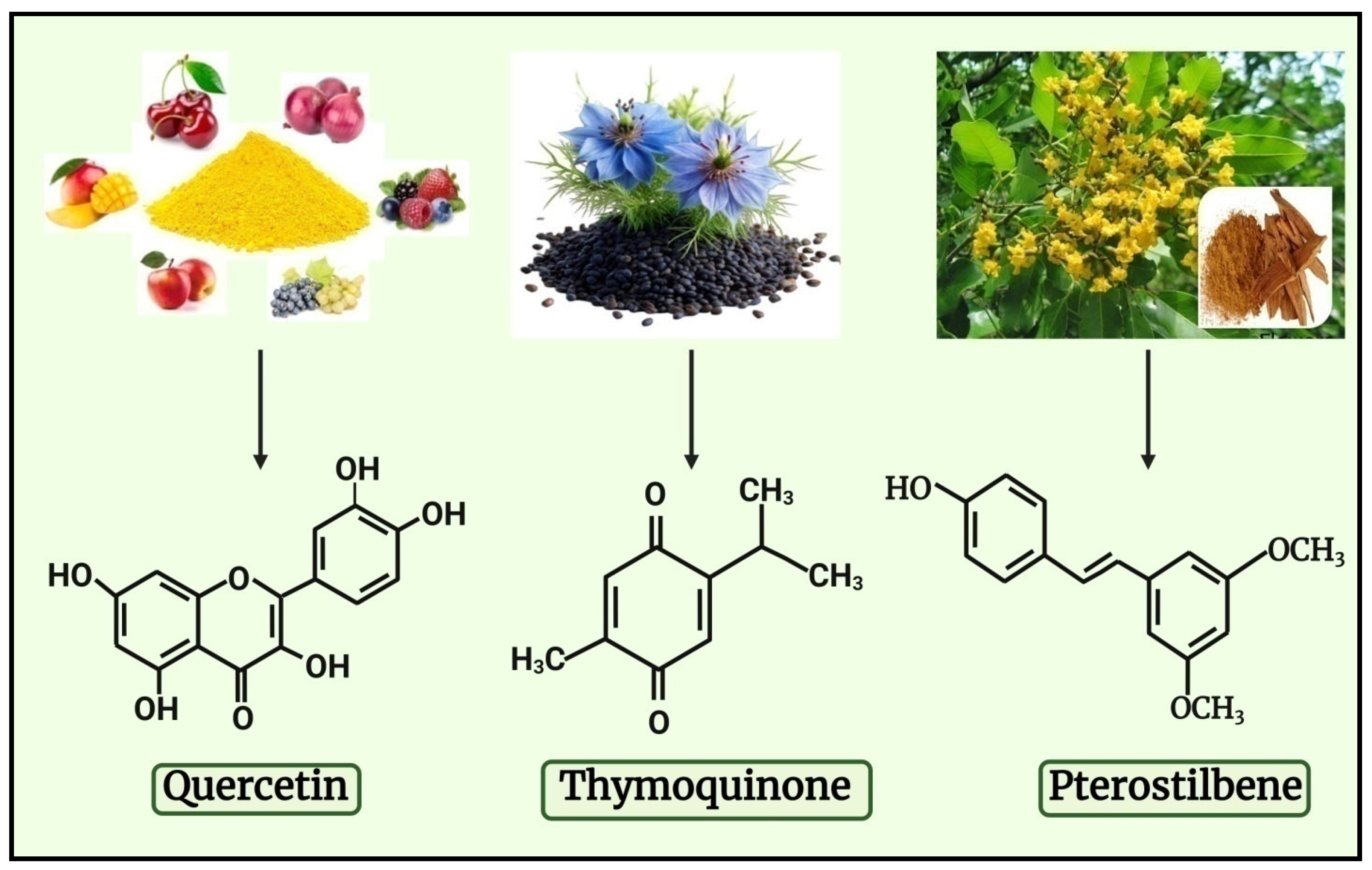
1. Introduction
2. Materials and Methods
2.1. Preparation of Stock Solutions and Working Mixture Solution
2.2. Selection of Detection Wavelength
2.3. Selection of Chromatographic Conditions
2.4. Method Validation
3. Results
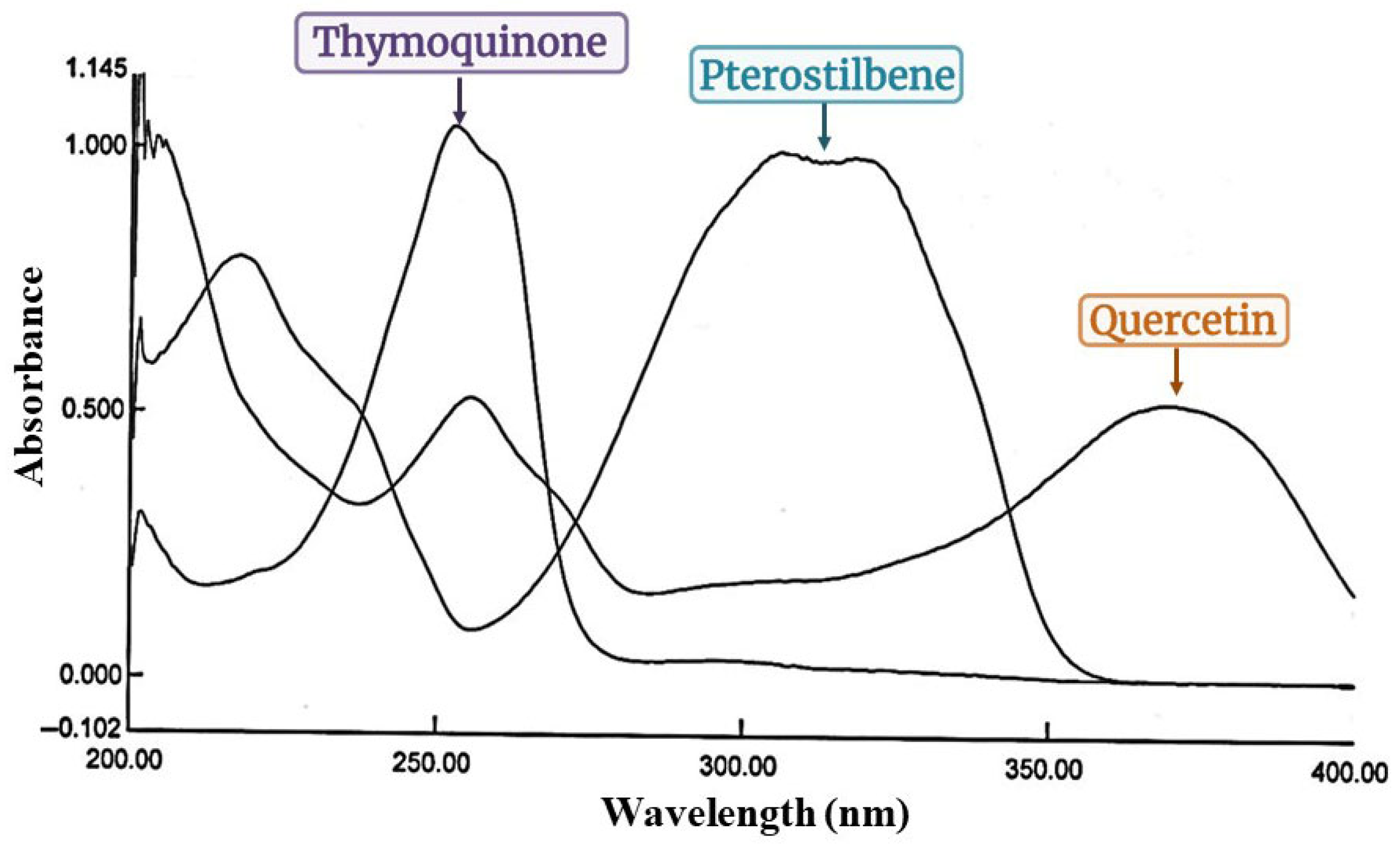
3.1. Selection of Detection Wavelength
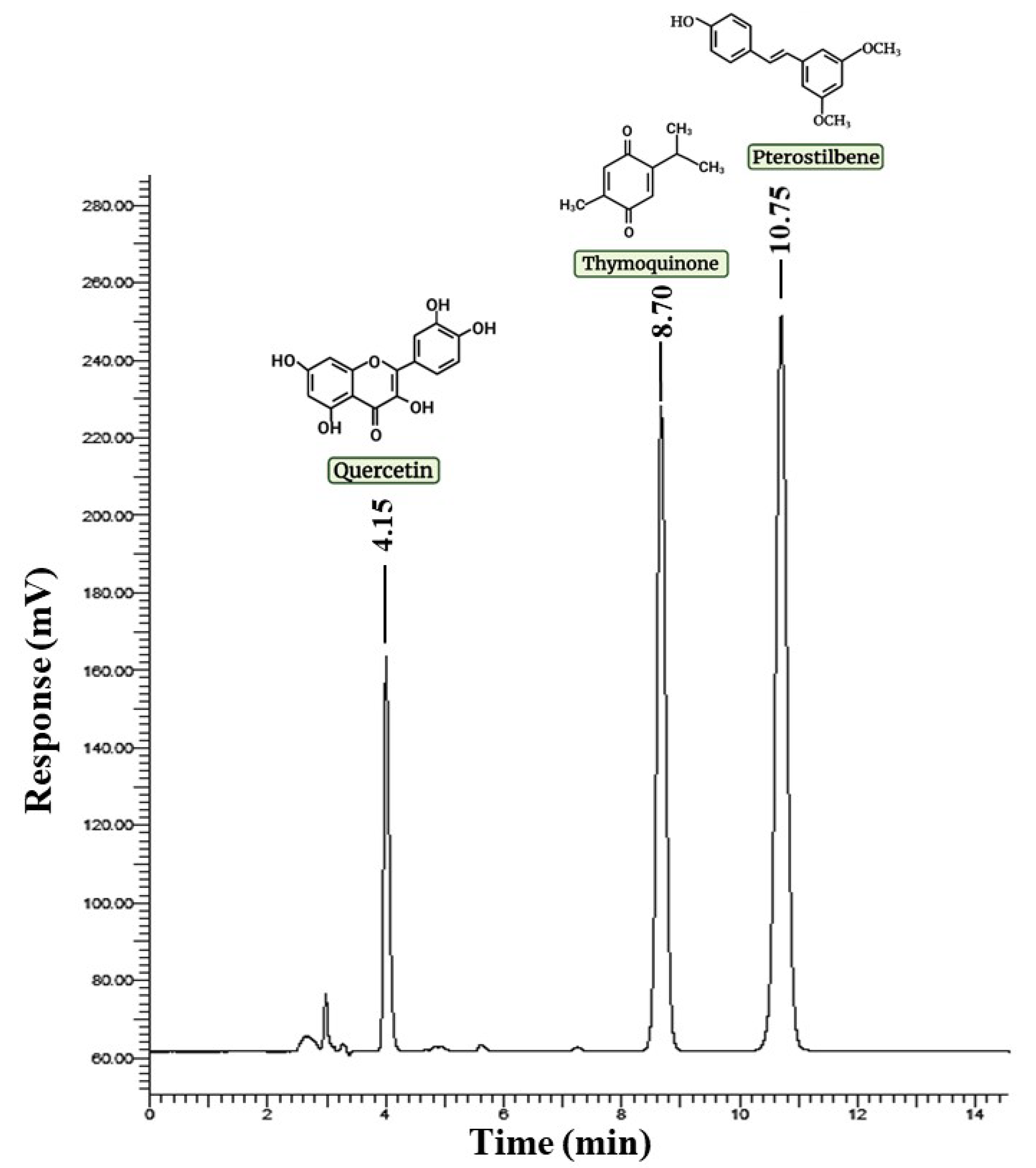
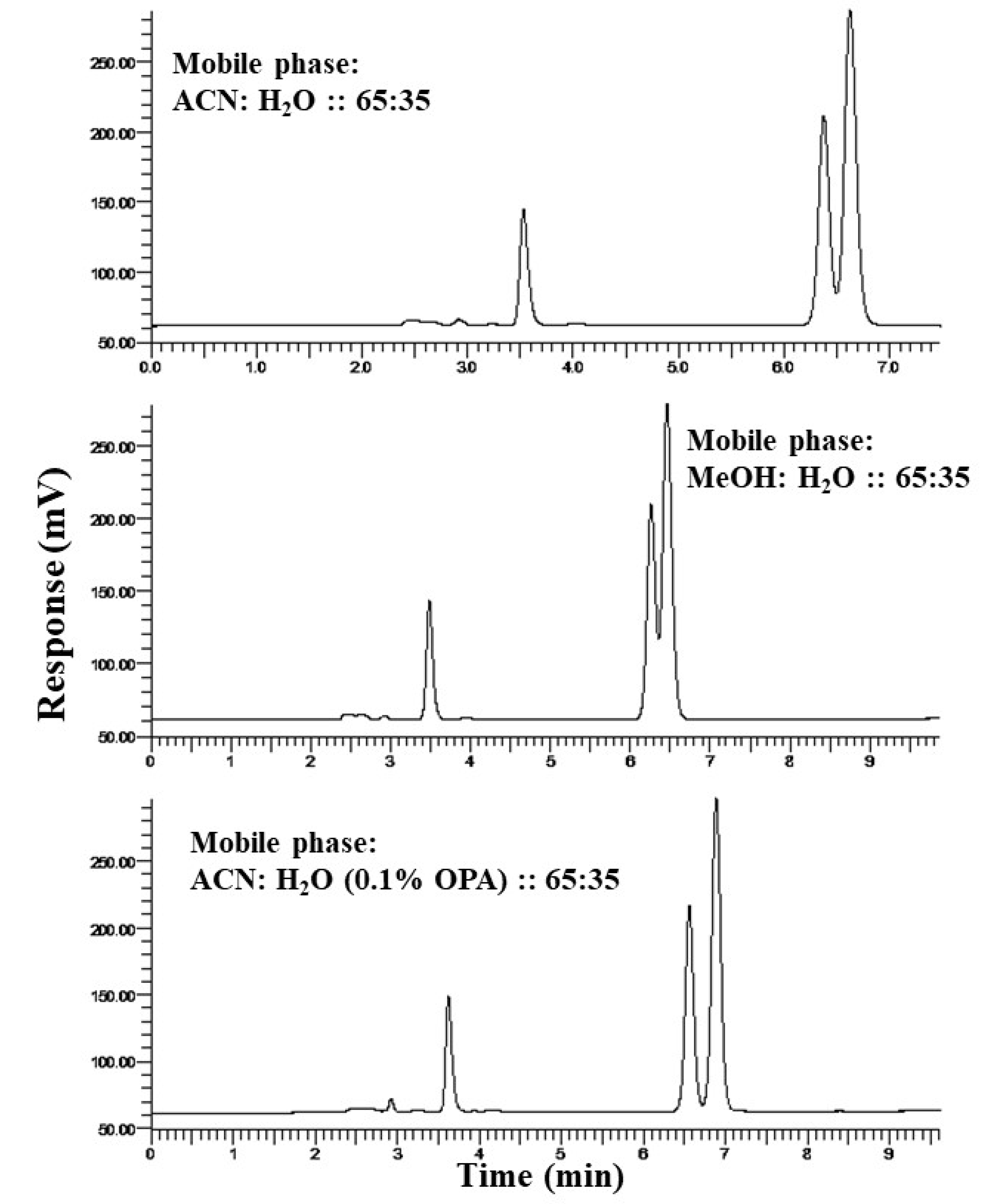
3.2. Selection and Optimization of Chromatographic Conditions
3.3. System Suitability Parameters

| System Suitability Parameters | Quercetin | Thymoquinone | Pterostilbene |
|---|---|---|---|
| Retention time (min) | 4.15 ± 0.02 | 8.70 ± 0.03 | 10.75 ± 0.04 |
| Number of theoretical plates | 38,625.188 | 68,421.531 | 64,878.88 |
| Peak height | 227,553.31 | 322,070.97 | 378,706.53 |
| Tailing factor | 1.2908 | 1.0095 | 1.0168 |
| Signal to noise ratio | 5688.83 | 1894.53 | 2103.92 |
| Mean peak area | 716,517.66 | 1,658,838.67 | 2,482,514.55 |
| SD | 1363.110 | 6063.106 | 9108.190 |
| Relative SD | 0.190 | 0.365 | 0.366 |
| Capacity factor (k′) (t0: 1 min) | 3.15 | 7.70 | 9.75 |
| Resolution | - | 3.03 | 2.98 |
| Separation factor (α) | - | 3.24 | 1.31 |
3.4. Method Validation
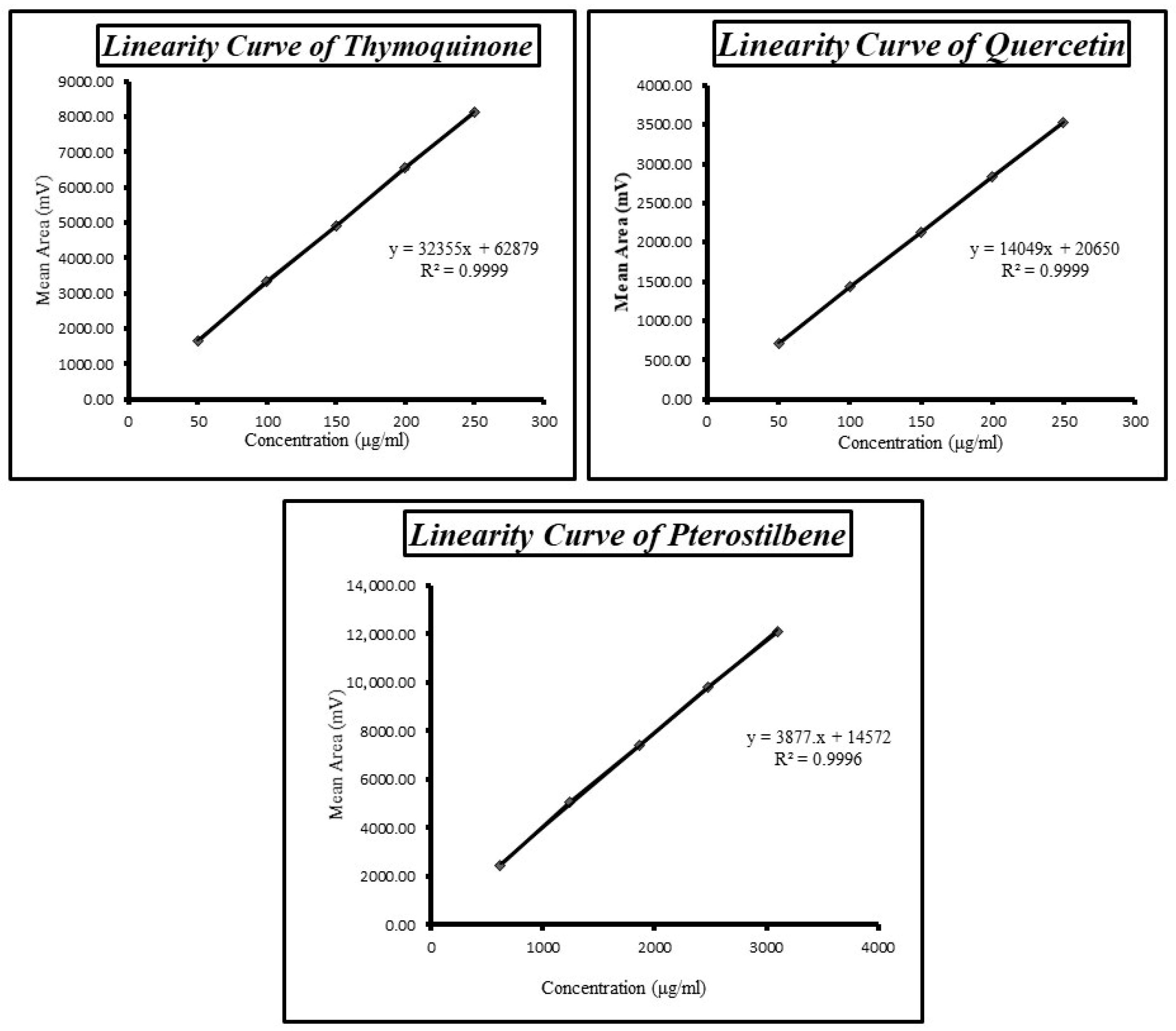
3.4.1. Linearity
| Linearity Parameter | Quercetin | Thymoquinone | Pterostilbene |
|---|---|---|---|
| Correlation coefficient (r2) | 0.9999 | 0.9999 | 0.9996 |
| Regression equation (y) | 14049x + 20650 | 32355x + 62879 | 3877x + 14572 |
| Linearity range (μg/mL) | 50–250 μg/mL | 50–250 μg/mL | 620–3100 μg/mL |
| Residual standard deviation | 6588.217509 | 23,558.51111 | 83,187.36082 |
| Limit of detection | 1.55 μg/mL | 2.40 μg/mL | 70.79 μg/mL |
| Limit of quantification | 4.69 μg/mL | 7.28 μg/mL | 214.52 μg/mL |

3.4.2. Accuracy
3.4.3. Precision
3.4.4. Robustness
4. Discussion
5. Conclusions
Author Contributions
Funding
Data Availability Statement
Acknowledgments
Conflicts of Interest
Abbreviations
| AUC | Area under curve |
| LOD | Limit of detection |
| LOQ | Limit of quantification |
| PDA | Photo-diode array detector |
| RP-HPLC | Reverse-phase high-performance liquid chromatography |
| RSD | Relative standard deviation |
| SD | Standard deviation |
| UHPLC-DAD | Ultra high-performance liquid chromatography–diode array detector |
| USP | United States Pharmacopeia |
| UV | Ultraviolet |
| UV–Vis | Ultraviolet–visible |
References
- Zhang, Q.; Yue, Y.; Li, X.; Zhang, C.; Guo, Y.; Wang, Z.; Li, J. Advances in Analytical Techniques for Bioactive Compound Quantification in Medicinal Plants: Innovations, Challenges, and Pharmaceutical Applications. Microchem. J. 2025, 214, 114119. [Google Scholar] [CrossRef]
- Moretti, L.; Molteni, L.; Palmioli, A.; Airoldi, C. Advanced NMR Screening: Unveiling Bioactive Compounds in Complex Molecular Mixtures. ACS Omega 2025, 10, 40680–40693. [Google Scholar] [CrossRef] [PubMed]
- Meunier, M.; Schinkovitz, A.; Derbré, S. Current and Emerging Tools and Strategies for the Identification of Bioactive Natural Products in Complex Mixtures. Nat. Prod. Rep. 2024, 41, 1766–1786. [Google Scholar] [CrossRef] [PubMed]
- Queiroz, E.F.; Guillarme, D.; Wolfender, J.-L. Advanced High-Resolution Chromatographic Strategies for Efficient Isolation of Natural Products from Complex Biological Matrices: From Metabolite Profiling to Pure Chemical Entities. Phytochem. Rev. 2024, 23, 1415–1442. [Google Scholar] [CrossRef]
- Gashaw, A.D.; Desta, M.A.; Yaya, E.E. A Comprehensive Review-Current Development in Spectroscopic and Chromatographic Techniques for Natural Product Analysis. Results Chem. 2025, 16, 102341. [Google Scholar] [CrossRef]
- Jug, U.; Glavnik, V.; Kranjc, E.; Vovk, I. HPTLC–Densitometric and HPTLC–MS Methods for Analysis of Flavonoids. J. Liq. Chromatogr. Relat. Technol. 2018, 41, 329–341. [Google Scholar] [CrossRef]
- Wetzel, K.; Tishakova, T.; Häßler, M.; Niedenthal, T.; Ayala-Cabrera, J.F.; Montero, L.; Schmitz, O.J. Which Extraction Technique Is the Best for LC × LC Analysis of Bioactive Compounds from European Medicinal Plants: Conventional or Sustainable Extraction Techniques? Green Anal. Chem. 2025, 12, 100233. [Google Scholar] [CrossRef]
- Mungwari, C.P.; King’ondu, C.K.; Sigauke, P.; Obadele, B.A. Conventional and Modern Techniques for Bioactive Compounds Recovery from Plants: Review. Sci. Afr. 2025, 27, e02509. [Google Scholar] [CrossRef]
- Yu, J.; Wu, X.; Liu, C.; Newmaster, S.; Ragupathy, S.; Kress, W.J. Progress in the Use of DNA Barcodes in the Identification and Classification of Medicinal Plants. Ecotoxicol. Environ. Saf. 2021, 208, 111691. [Google Scholar] [CrossRef]
- Nkwocha, C.C.; Ogugofor, M.O.; Chukwuma, I.F.; Njoku, O.U. Identification and Characterization of Phytochemicals and Constituents in Desmodium Velutinum Stem Using High-Performance Liquid Chromatography (HPLC). Pharmacol. Res.-Mod. Chin. Med. 2022, 3, 100090. [Google Scholar] [CrossRef]
- Das, U.; Mali, S.N.; Mandal, S. Unveiling the Ameliorative Effects of Phyto-Selenium Nanoparticles (PSeNPs) on Anti-Hyperglycemic Activity and Hyperglycemia Irradiated Complications. BioNanoScience 2025, 15, 231. [Google Scholar] [CrossRef]
- Chaachouay, N.; Zidane, L. Plant-Derived Natural Products: A Source for Drug Discovery and Development. Drugs Drug Candidates 2024, 3, 184–207. [Google Scholar] [CrossRef]
- Das, K.; Das, P.; Mana, S. Effective Bioactive Compounds and Their Antiviral Properties from Some Selected Aquatic Plants through in Silico and in Vitro Approaches. Aquaculture 2023, 573, 739574. [Google Scholar] [CrossRef]
- Naeem, A.; Hu, P.; Yang, M.; Zhang, J.; Liu, Y.; Zhu, W.; Zheng, Q. Natural Products as Anticancer Agents: Current Status and Future Perspectives. Molecules 2022, 27, 8367. [Google Scholar] [CrossRef]
- Ribeiro, G.D.J.G.; Rei Yan, S.L.; Palmisano, G.; Wrenger, C. Plant Extracts as a Source of Natural Products with Potential Antimalarial Effects: An Update from 2018 to 2022. Pharmaceutics 2023, 15, 1638. [Google Scholar] [CrossRef]
- Dhamodharan, K.; Vengaimaran, M.; Sankaran, M. Pharmacological Properties and Health Benefits of Capsicum Species: A Comprehensive Review. In Capsicum—Current Trends and Perspectives; Baylen Yllano, O., Ed.; IntechOpen: London, UK, 2023; ISBN 978-1-80356-005-2. [Google Scholar]
- Atpadkar, P.P.; Gopavaram, S.; Chaudhary, S. Natural–Product–Inspired Bioactive Alkaloids Agglomerated with Potential Antioxidant Activity: Recent Advancements on Structure-Activity Relationship Studies and Future Perspectives. In Vitamins and Hormones; Elsevier: Amsterdam, The Netherlands, 2023; Volume 121, pp. 355–393. ISBN 978-0-443-15768-4. [Google Scholar]
- Nag, S.; Pallavi, J.; Bose, U.D.; Jalili, S.; Pramanik, N.; Mohanto, S.; Ahmed, M.G. The Effect and Mechanisms of Flavonoids on Inflammation and Chronic Metabolic Diseases. In Role of Flavonoids in Chronic Metabolic Diseases; Mishra, N., Ashique, S., Gowda, B.H.J., Farid, A., Garg, A., Eds.; Wiley: Hoboken, NJ, USA, 2024; pp. 317–345. ISBN 978-1-394-23804-0. [Google Scholar]
- Cosme, F.; Aires, A.; Pinto, T.; Oliveira, I.; Vilela, A.; Gonçalves, B. A Comprehensive Review of Bioactive Tannins in Foods and Beverages: Functional Properties, Health Benefits, and Sensory Qualities. Molecules 2025, 30, 800. [Google Scholar] [CrossRef]
- Liu, C.; Yan, Z.; Chen, X.; Mandal, S.; Das, U.; Singh, S.; Olatunji, O.J. Pharmacological Insights on Multifaceted Therapeutic Applications of Stilbenoids: A Comprehensive Updates. Fitoterapia 2026, 188, 107034. [Google Scholar] [CrossRef]
- El-Saadony, M.T.; Yang, T.; Saad, A.M.; Alkafaas, S.S.; Elkafas, S.S.; Eldeeb, G.S.; Mohammed, D.M.; Salem, H.M.; Korma, S.A.; Loutfy, S.A.; et al. Polyphenols: Chemistry, Bioavailability, Bioactivity, Nutritional Aspects and Human Health Benefits: A Review. Int. J. Biol. Macromol. 2024, 277, 134223. [Google Scholar] [CrossRef]
- Mesut, B.; Al-Mohaya, M.; Gholap, A.D.; Yeşilkaya, E.; Das, U.; Akhtar, M.S.; Sah, R.; Khan, S.; Moin, A.; Faiyazuddin, M. Demystifying the Potential of Lipid-Based Nanocarriers in Targeting Brain Malignancies. Naunyn-Schmiedeberg’s Arch. Pharmacol. 2024, 397, 9243–9279. [Google Scholar] [CrossRef]
- Sarkar, D.; Das, U.; Chatterjee, S. Theaflavin-Enriched Black Tea. In Tea in Health and Disease Prevention; Elsevier: Amsterdam, The Netherlands, 2025; pp. 649–660. ISBN 978-0-443-14158-4. [Google Scholar]
- Hazra, K.; Kumar, D.; Dutta, S.; Dighe, D.; Saha, S.; Mangal, A.K.; Singh, R.; Meena, A.K.; Babu, G. Endurance of Phytocompounds in Classical Preparation from the Root of Rauvolfia Serpentina: Pharmaceutical Dosage Validation by HPTLC, HPLC–UV, and LC–MS/MS. J. Anal. Sci. Technol. 2024, 15, 57. [Google Scholar] [CrossRef]
- Zou, H.; Ye, H.; Kamaraj, R.; Zhang, T.; Zhang, J.; Pavek, P. A Review on Pharmacological Activities and Synergistic Effect of Quercetin with Small Molecule Agents. Phytomedicine 2021, 92, 153736. [Google Scholar] [CrossRef] [PubMed]
- Wei, B.; Zhang, Y.; Tang, L.; Ji, Y.; Yan, C.; Zhang, X. Protective Effects of Quercetin against Inflammation and Oxidative Stress in a Rabbit Model of Knee Osteoarthritis. Drug Dev. Res. 2019, 80, 360–367. [Google Scholar] [CrossRef] [PubMed]
- Haddad, P.; Eid, H. The Antidiabetic Potential of Quercetin: Underlying Mechanisms. Curr. Med. Chem. 2017, 24, 355–364. [Google Scholar] [CrossRef] [PubMed]
- Wei, X.; Meng, X.; Yuan, Y.; Shen, F.; Li, C.; Yang, J. Quercetin Exerts Cardiovascular Protective Effects in LPS-Induced Dysfunction in Vivo by Regulating Inflammatory Cytokine Expression, NF-κB Phosphorylation, and Caspase Activity. Mol. Cell Biochem. 2018, 446, 43–52. [Google Scholar] [CrossRef]
- Jakaria, M.; Azam, S.; Jo, S.-H.; Kim, I.-S.; Dash, R.; Choi, D.-K. Potential Therapeutic Targets of Quercetin and Its Derivatives: Its Role in the Therapy of Cognitive Impairment. J. Clin. Med. 2019, 8, 1789. [Google Scholar] [CrossRef]
- Eftekhari, A.; Ahmadian, E.; Panahi-Azar, V.; Hosseini, H.; Tabibiazar, M.; Maleki Dizaj, S. Hepatoprotective and Free Radical Scavenging Actions of Quercetin Nanoparticles on Aflatoxin B1-Induced Liver Damage: In vitro/in vivo Studies. Artif. Cells Nanomed. Biotechnol. 2018, 46, 411–420. [Google Scholar] [CrossRef]
- Hasan, A.M.W.; Al Hasan, M.S.; Mizan, M.; Miah, M.S.; Uddin, M.B.; Mia, E.; Yana, N.T.; Hossain, M.A.; Islam, M.T. Quercetin Promises Anticancer Activity through PI3K-AKT-mTOR Pathway: A Literature Review. Pharmacol. Res.-Nat. Prod. 2025, 7, 100206. [Google Scholar] [CrossRef]
- Lan, C.-Y.; Chen, S.-Y.; Kuo, C.-W.; Lu, C.-C.; Yen, G.-C. Quercetin Facilitates Cell Death and Chemosensitivity through RAGE/PI3K/AKT/mTOR Axis in Human Pancreatic Cancer Cells. J. Food Drug Anal. 2019, 27, 887–896. [Google Scholar] [CrossRef]
- Sudaka, Y.; Mitsui, T.; Kida, H.; Sultana, M.J.; Nishikawa, M.; Ikushiro, S.; Yamaguchi, N. Validation of a Quantitation Method for Conjugated Quercetin in Human Plasma. J. Pharm. Biomed. Anal. 2025, 258, 116738. [Google Scholar] [CrossRef]
- Shabani, H.; Karami, M.H.; Kolour, J.; Sayyahi, Z.; Parvin, M.A.; Soghala, S.; Baghini, S.S.; Mardasi, M.; Chopani, A.; Moulavi, P.; et al. Anticancer Activity of Thymoquinone against Breast Cancer Cells: Mechanisms of Action and Delivery Approaches. Biomed. Pharmacother. 2023, 165, 114972. [Google Scholar] [CrossRef]
- Ravi, Y.; Vethamoni, P.I.; Saxena, S.N.; Kaviyapriya, M.; Santhanakrishnan, V.P.; Raveendran, M.; Ashoka, N.N.; Choudhary, S.; Verma, A.K.; Harisha, C.B.; et al. Anticancer Potential of Thymoquinone from Nigella sativa L.: An in-Silico and Cytotoxicity Study. PLoS ONE 2025, 20, e0323804. [Google Scholar] [CrossRef] [PubMed]
- Kurowska, N.; Madej, M.; Strzalka-Mrozik, B. Thymoquinone: A Promising Therapeutic Agent for the Treatment of Colorectal Cancer. Curr. Issues Mol. Biol. 2023, 46, 121–139. [Google Scholar] [CrossRef] [PubMed]
- Gupta, P.; Sharma, S.; Gupta, A.; Kawish, S.M.; Iqbal, M.; Rahman, S.; Aqil, M.; Kohli, K.; Sultana, Y. Development and Validation of a Robust RP-HPLC Method for the Simultaneous Analysis of Exemestane and Thymoquinone and Its Application to Lipid-Based Nanoformulations. ACS Omega 2024, 9, 30120–30130. [Google Scholar] [CrossRef] [PubMed]
- Zakarial Ansar, F.H.; Latifah, S.Y.; Wan Kamal, W.H.B.; Khong, K.C.; Ng, Y.; Foong, J.N.; Gopalsamy, B.; Ng, W.K.; How, C.W.; Ong, Y.S.; et al. Pharmacokinetics and Biodistribution of Thymoquinone-Loaded Nanostructured Lipid Carrier After Oral and Intravenous Administration into Rats. Int. J. Nanomed. 2020, 15, 7703–7717. [Google Scholar] [CrossRef]
- Raikar, P.R.; Dandagi, P.M.; Kazi, T. Development and Validation of Novel RP-HPLC Method for the Simultaneous Estimation of Capecitabine and Thymoquinone in the Biodegradable Nanoparticles Using Full Factorial Design. J. Chromatogr. Sci. 2023, 61, 773–783. [Google Scholar] [CrossRef]
- Burits, M.; Bucar, F. Antioxidant Activity of Nigella sativa Essential Oil. Phytother. Res. 2000, 14, 323–328. [Google Scholar] [CrossRef]
- Alkhatib, H.; Mawazi, S.; Al-Mahmood, S.A.; Zaiter, A.; Doolaanea, A. Thymoquinone Content in Marketed Black Seed Oil in Malaysia. J. Pharm. Bioall Sci. 2020, 12, 284. [Google Scholar] [CrossRef]
- Chung, K.X.; Wei, P.L.Y.; Akowuah, G.A. Different Extraction Methods for Thymoquinone from Nigella sativa L. Seeds and Antioxidant Activity. Indian J. Nat. Prod. Resour. 2023, 14, 75–80. [Google Scholar] [CrossRef]
- Kaushik, N.; Barmanray, A. Optimisation of Ultrasound-Assisted Extraction Conditions Using Response Surface Methodology and Identification of Thymoquinone from Black Cumin (Nigella sativa L.) Seed Extract. Food Technol. Biotechnol. 2025, 63, 262. [Google Scholar] [CrossRef]
- Kaseke, T.; Opara, U.L.; Fawole, O.A. Novel Seeds Pretreatment Techniques: Effect on Oil Quality and Antioxidant Properties: A Review. J. Food Sci. Technol. 2021, 58, 4451–4464. [Google Scholar] [CrossRef]
- Chen, R.-J.; Wang, Y.-J. Pterostilbene and Cancer Chemoprevention. In Cancer; Elsevier: Amsterdam, The Netherlands, 2021; pp. 451–463. ISBN 978-0-12-819547-5. [Google Scholar]
- Tsai, H.-Y.; Ho, C.-T.; Chen, Y.-K. Biological Actions and Molecular Effects of Resveratrol, Pterostilbene, and 3′-Hydroxypterostilbene. J. Food Drug Anal. 2017, 25, 134–147. [Google Scholar] [CrossRef]
- Basak, S.; Mandal, S.; Chattopadhyay, M. Simultaneous Spectrophotometric Assay for Estimation of Norfloxacin and Metronidazole in Tablets. Asian J. Chem. 2010, 22, 5971–5975. [Google Scholar]
- Neunert, G.; Kamińska, W.; Nowak-Karnowska, J. Evaluating the Thymoquinone Content and Antioxidant Properties of Black Cumin (Nigella sativa L.) Seed Oil During Storage at Different Thermal Treatments. Appl. Sci. 2025, 15, 377. [Google Scholar] [CrossRef]
- Ahmad, R.; Ahmad, N.; Shehzad, A. Solvent and Temperature Effects of Accelerated Solvent Extraction (ASE) Coupled with Ultra-High Pressure Liquid Chromatography (UHPLC-DAD) Technique for Determination of Thymoquinone in Commercial Food Samples of Black Seeds (Nigella sativa). Food Chem. 2020, 309, 125740. [Google Scholar] [CrossRef]
- Alam, P.; Shakeel, F.; Taleuzzaman, M.; Foudah, A.I.; Alqarni, M.H.; Aljarba, T.M.; Alshehri, S.; Ghoneim, M.M. Box-Behnken Design (BBD) Application for Optimization of Chromatographic Conditions in RP-HPLC Method Development for the Estimation of Thymoquinone in Nigella sativa Seed Powder. Processes 2022, 10, 1082. [Google Scholar] [CrossRef]
- Ahmad, N.; Ahmad, R.; Al Qatifi, S.; Alessa, M.; Al Hajji, H.; Sarafroz, M. A Bioanalytical UHPLC Based Method Used for the Quantification of Thymoquinone-Loaded-PLGA-Nanoparticles in the Treatment of Epilepsy. BMC Chem. 2020, 14, 10. [Google Scholar] [CrossRef] [PubMed]
- Habib, N.; Choudhry, S. HPLC Quantification of Thymoquinone Extracted from Nigella sativa L. (Ranunculaceae) Seeds and Antibacterial Activity of Its Extracts against Bacillus Species. Evid.-Based Complement. Altern. Med. 2021, 2021, 1–11. [Google Scholar] [CrossRef] [PubMed]
- Raikar, P.R.; Dandagi, P.M.; Kurangi, B.K. Design of Experiment (DoE) Approach for a Simpler HPLC Technique Estimating Thymoquinone from Nigella sativa Seeds, Commercial Formulation, Polymeric Nanoparticles, and Its Stability Indication. Int. J. Pharm. Sci. Res. 2022, 13, 3690–3702. [Google Scholar] [CrossRef]
- Iqbal, M.; Alam, P.; Anwer, M.T. High Performance Liquid Chromatographic Method with Fluorescence Detection for the Estimation of Thymoquinone in Nigella sativa Extracts and Marketed Formulations. Open Access Sci. Rep. 2013, 2, 655–671. [Google Scholar] [CrossRef]
- Jamil, S.; Al-Gharni, Y.; Anwer, M.; Ansari, M.; Al-Shdefat, R.; Ahmad, M.; Al-Saikhan, F. RP-HPLC Method for the Analysis of Quercetin in Eruca Sativa with Green Solvent. Curr. Pharm. Anal. 2017, 13, 208–214. [Google Scholar] [CrossRef]
- Shailajan, S.; Joshi, H.; Tiwari, B. A Comparative Estimation of Quercetin Content from Cuscuta Reflexa Roxb.Using Validated HPTLC and HPLC Techniques. J. Appl. Pharm. Sci. 2014, 4, 123–128. [Google Scholar] [CrossRef]
- Yue-ling, M.; Yu-jie, C.; Ding-rong, W.; Ping, C.; Ran, X. HPLC Determination of Quercetin in Three Plant Drugs from Genus Sedum and Conjecture of the Best Harvest Time. Pharmacogn. J. 2017, 9, 725–728. [Google Scholar] [CrossRef]
- Garg, P. HPLC Estimation of Flavanoid (Quercetin) of Leaves and Stem Extracts of Ocimum Sanctum and Tinospora Cordifolia. J. Phytopharm. 2021, 10, 220–224. [Google Scholar] [CrossRef]
- Haq, N.; Shakeel, F.; Ghoneim, M.M.; Asdaq, S.M.B.; Alam, P.; Aloatibi, F.O.; Alshehri, S. Determination of Pterostilbene in Pharmaceutical Products Using a New HPLC Method and Its Application to Solubility and Stability Samples. Separations 2023, 10, 178. [Google Scholar] [CrossRef]
- Nikam, K.; Bhusari, S.; Wakte, P. High Performance Liquid Chromatography Method Validation and Forced Degradation Studies of Pterostilbene. Res. J. Pharm. Technol. 2022, 15, 2969–2975. [Google Scholar] [CrossRef]
- Annapurna, M.M.; Venkatesh, B.; Teja, G.R. Development of a Validated Stability Indicating Liquid Chromatographic Method for the Determination of Pterostilbene. Indian J. Pharm. Educ. Res. 2018, 52, s63–s70. [Google Scholar] [CrossRef]
- Zhang, Y.; Shang, Z.; Gao, C.; Du, M.; Xu, S.; Song, H.; Liu, T. Nanoemulsion for Solubilization, Stabilization, and In Vitro Release of Pterostilbene for Oral Delivery. AAPS Pharmscitech 2014, 15, 1000–1008. [Google Scholar] [CrossRef] [PubMed]
- Gandhi, Y.; Kushwaha, V.; Kumar, V.; Rawat, H.; Charde, V.; Mishra, S.K.; Singh, G.; Soni, H.; Kumar, R.; Shakya, S.K.; et al. Simultaneously Quantification of Eight Marker Compounds by HPLC, and HPTLC Analysis for the Marker-Based Shelf-Life Kinetic Study for the Standardization of Polyherbal Drug AYUSH SG-5, Medicinal Properties and Computational Studies. Microchem. J. 2024, 199, 109958. [Google Scholar] [CrossRef]
- Misro, L.; Boini, T.; Maurya, R.; Radhakrishnan, T.; Rohith, K.S.; Kumar, V.; Sharma, P.; Singh, A.; Singh, R.; Srikanth, N.; et al. Analytical Method Development and Validation for Simultaneous Estimation of Seven Markers in Polyherbal Formulation JKC by Using RP-HPLC. Futur. J. Pharm. Sci. 2024, 10, 92. [Google Scholar] [CrossRef]
- Almajali, B.; Al-Jamal, H.A.N.; Taib, W.R.W.; Ismail, I.; Johan, M.F.; Doolaanea, A.A.; Ibrahim, W.N. Thymoquinone, as a Novel Therapeutic Candidate of Cancers. Pharmaceuticals 2021, 14, 369. [Google Scholar] [CrossRef]
- Dong, M. HPLC and UHPLC for Practicing Scientists, 1st ed.; Wiley: Hoboken, NJ, USA, 2019; ISBN 978-1-119-31376-2. [Google Scholar]


| Sample | Method | Chromatographic Conditions | Column Used | Ref. | |||
|---|---|---|---|---|---|---|---|
| Mobile Phase | Flow Rate | Detection | Inj. Volume | ||||
| Thymoquinone | |||||||
| Thy content in black cumin seeds (Nigella sativa) oil | HPLC diode array UV Vis | 40% H2O and 60% of acetonitrile | 1 mL/min | 254 nm | 20 μL | Inertsil ODS-3: (5 µm, 4.6 mm × 250 mm) | [48] |
| Accelerated solvent extraction (ASE) of Thy | UHPLC–DAD | Acetonitrile 50%: 2 mM ammonium formate 50% | 0.2 mL/min | 256 nm | 10 µL | Accucore™ Vanquish™ C18 (1.5 µm; 100 mm × 2.1 mm) | [49] |
| Thy in seed powder of Nigella sativa (NS) | HPLC–UV | Methanol/acetonitrile/buffer (2.2 mM ammonium formate): 35:50:15 | 0.9 mL/min | 249 nm | 15 μL | Symmetry® LC-18 (150 mm × 3.9 mm × 5 μm) | [50] |
| Thy | UHPLC–PDA | Methanol/water (80:20) | 0.3 mL/min | 260 nm | 5 µL | Pinnacle DB Cyanom (1.9 µm; 30 cm × 2.1 cm) | [51] |
| Extract of Thy | RP-HPLC–UV | Water and methanol (40:60) | 1.5 mL/min | 254 nm | 10 μL | Inertsil ODS-3v: (5 µm, 4.6 mm × 150 mm) | [52] |
| Thy | RP-HPLC–UV | Water/methanol (25:75) | 1 mL/min | 253 nm | 20 μL | Luna C18 (250 mm × 4.60 mm, 5 µm) | [53] |
| Thy | HPLC–florescence detector | 20 mM KH2PO4 buffer (pH adjusted to 2.7 ± 0.05 using 50% OPA (60:40) | 1 mL/min | 274 excitations and 340 emissions | 25 µL | Symmetry LC 18 (150 mm × 3.9 mm, 5 µm) | [54] |
| Quercetin | |||||||
| Que in the extract of Eruca Sativa | HPLC–UV | Methanol/water with β-cyclodextrin (5 mM) with 0.1% orthophosphoric acid (70:30) | 1 mL/min | 370 nm | 10 μL | Lichrosphere-100, C 18 (25 cm × 4.6 mm, 5 μm) | [55] |
| Que in C. reflexa | HPLC–UV | 0.025 M NaH2PO4 buffer—ACN (pH—2.6) (72:28) | 1.2 mL/min | 378 nm | 20 μL | Cosmosil C18-column (150 mm × 4.6 mm, 5 μm) | [56] |
| Que in three plant drugs from genus Sedum | HPLC–DAD | Methanol and 0.40% phosphoric acid (49:51) | 1 mL/min | - | 20 μL | Agilent Eclips XDB- C18 (4.6 × 250 mm, 5 µm) | [57] |
| Que in Ocimum sanctum and Tinosporacordifolia | HPLC–UV | Acetonitrile and methanol (50:50) | 1 mL/min | 256 nm | 20 μL | C-18 column with 250 mm × 4.60 mm | [58] |
| Pterostilbene | |||||||
| Pte and Pte capsules | HPLC–UV | Acetonitrile and water (90:10) | 1 mL/min | 254 nm | 20 μL | Nucleodur (150 mm × 4.6 mm, 5 μm) | [59] |
| Pte | HPLC–UV | Water/ACN (35:65) | 1 mL/min | 306 nm | 20 μL | ACE C-18 Column (150 × 4.6 mm, 3 um) | [60] |
| Pte | HPLC–PDA | 0.1% Trifluoroacetic acid in water/acetonitrile (10:90) | 0.6 mL/min | 219 nm | 20 μL | Phenomenex C8 (250 mm × 4.6 mm, 5 µm) | [61] |
| Pte-loaded nanoemulsion | HPLC–PDA | Methanol and distilled water (60:40) | 1 mL/min | 319 nm | 10 μL | Phenomenex LunaC18 (250 × 4.6 mm, 5 μm) | [62] |
| Parameters | Description |
|---|---|
| Column | Perkin Elmer Phenyl Column (250 mm × 4.6 mm, 5 μm) |
| Detection wavelength | 254 nm |
| Flow rate | 1.0 mL/min |
| Temperature | 35 °C |
| Injection volume | 5 μL |
| Mobile phase | 0.1% orthophosphoric acid in HPLC water/acetonitrile (55:45 v/v) |
| Recovery Study | Quercetin | Thymoquinone | Pterostilbene | ||||||
|---|---|---|---|---|---|---|---|---|---|
| Spike level | 80% | 100% | 120% | 80% | 100% | 120% | 80% | 100% | 120% |
| Concentration taken (μg/mL) | 50 | 50 | 50 | 50 | 50 | 50 | 620 | 620 | 620 |
| Concentration added (μg/mL) | 40 | 50 | 60 | 40 | 50 | 60 | 496 | 620 | 744 |
| Recovered content | 90.37 | 99.99 | 109.97 | 89.49 | 99.48 | 109.35 | 1120.02 | 1242.15 | 1364.92 |
| Mean percentage of recovery ± SD | 100.41 ± 0.483 | 99.99 ± 0.174 | 99.97 ± 0.179 | 99.44 ± 0.414 | 99.48 ± 0.312 | 99.41 ± 0.190 | 100.36 ± 0.666 | 100.17 ± 0.627 | 100.06 ± 0.540 |
| RSD (%) | 0.350 | 0.228 | 0.083 | 0.230 | 0.128 | 0.106 | 0.375 | 0.058 | 0.112 |
| Parameters | Quercetin | Thymoquinone | Pterostilbene |
|---|---|---|---|
| Inter-Day (Day 1) | |||
| Mean peak area | 620,400.15 | 1,738,496.22 | 2,521,265.64 |
| SD | 610.4464 | 5916.723 | 2956.208 |
| Relative SD | 0.098396 | 0.340336 | 0.117251 |
| Inter-Day (Day 2) | |||
| Mean peak area | 617,057.16 | 1,744,775.29 | 2,539,296.00 |
| SD | 995.2106 | 2759.759972 | 2035.197078 |
| Relative SD | 0.161283 | 0.158172 | 0.080148 |
| Intra-Day | |||
| Mean peak area | 650,664.28 | 1,731,903.2 | 2,508,017.9 |
| SD | 850.2117 | 9344.877 | 4722.844 |
| Relative SD | 0.130668 | 0.539573 | 0.18831 |
| Parameters | Quercetin | Thymoquinone | Pterostilbene |
|---|---|---|---|
| By altering the detection wavelength of 252 nm | |||
| Retention time (min) | 4.099 | 8.894 | 11.07 |
| Mean peak area | 92,616.35 | 153,644.3 | 218,083.9 |
| Standard deviation | 489.8528 | 480.2017 | 1500.679 |
| Relative standard deviation | 0.528905 | 0.312541 | 0.68812 |
| Tailing factor | 1.3 | 1.1 | 1.1 |
| Number of theoretical plate count | 34,575.51 | 65,568.74 | 61,055.44 |
| By altering the detection wavelength of 254 nm | |||
| Retention time (min) | 4.00 | 8.658 | 10.705 |
| Mean peak area | 96,142.17 | 166,323 | 190,213 |
| Standard deviation | 103.1943 | 225.3557 | 239.7754 |
| Relative standard deviation | 0.107335 | 0.135493 | 0.126056 |
| Tailing factor | 1.2 | 1.0 | 1.0 |
| Number of theoretical plate count | 38,625.188 | 68,421.531 | 64,878.88 |
| By altering the detection wavelength of 256 nm | |||
| Retention time (min) | 4.077 | 8.859 | 11.104 |
| Mean peak area | 95,669.25 | 162,180 | 154,565.5 |
| Standard deviation | 185.0442 | 326.4393 | 796.7615 |
| Relative standard deviation | 0.193421 | 0.201282 | 0.515485 |
| Tailing factor | 1.2 | 1.0 | 1.0 |
| Number of theoretical plate count | 40,752.2 | 70,021.1 | 65,333.11 |
| By altering the flow rate: 0.9 mL/min | |||
| Retention time (min) | 4.52 | 9.82 | 12.28 |
| Mean peak area | 90,553.53 | 159,284.73 | 180,551.96 |
| Standard deviation | 165.959 | 295.0118 | 156.476 |
| Relative standard deviation | 0.1832 | 0.18521 | 0.086665 |
| Tailing factor | 1.4 | 1.1 | 1.1 |
| Number of theoretical plate count | 32,876.7 | 63,891.5 | 61,222.09 |
| By altering the flow rate: 1.0 mL/min | |||
| Retention time (min) | 4.019 | 8.733 | 10.868 |
| Mean peak area | 95,478.68 | 161,276.28 | 182,396.79 |
| Standard deviation | 154.7664 | 255.6494 | 454.5533 |
| Relative standard deviation | 0.162095 | 0.158516 | 0.249211 |
| Tailing factor | 1.2 | 1.0 | 1.0 |
| Number of theoretical plate count | 38,625.188 | 68,421.531 | 64,878.88 |
| By altering the flow rate: 1.1 mL/min | |||
| Retention time (min) | 3.710 | 8.069 | 10.126 |
| Mean peak area | 92,716.04 | 160,504.90 | 179,568.54 |
| Standard deviation | 156.2852 | 467.7465 | 267.2273 |
| Relative standard deviation | 0.168563 | 0.291422 | 0.148816 |
| Tailing factor | 1.2 | 1.0 | 1.0 |
| Number of theoretical plate count | 40,025.2 | 70,120.5 | 65,333.11 |
| By altering the temperature: 30 °C | |||
| Retention time (min) | 4.031 | 8.731 | 10.854 |
| Mean peak area | 93,372.6 | 164,516.2 | 189,005 |
| Standard deviation | 511.0089 | 1023.95 | 659.9987 |
| Relative standard deviation | 0.547279 | 0.6224 | 0.349197 |
| Tailing factor | 1.2 | 1.1 | 1.1 |
| Number of theoretical plate count | 36,600.349 | 66,995.135 | 62,967.16 |
| By altering the temperature: 35 °C | |||
| Retention time (min) | 4.018 | 8.709 | 10.814 |
| Mean peak area | 97,229.11 | 164,724.2 | 183,317.3 |
| Standard deviation | 73.09304 | 173.5275 | 235.8738 |
| Relative standard deviation | 0.075176 | 0.105344 | 0.12867 |
| Tailing factor | 1.2 | 1.0 | 1.0 |
| Number of theoretical plate count | 39,325.194 | 69,271.015 | 65,105.995 |
| By altering the temperature: 40 °C | |||
| Retention time (min) | 4.018 | 8.708 | 10.815 |
| Mean peak area | 96,657.06 | 164,565.1 | 186,573.503 |
| Standard deviation | 203.744 | 383.1356 | 1239.142 |
| Relative standard deviation | 0.2107 | 0.232817 | 0.664 |
| Tailing factor | 1.2 | 1.0 | 1.0 |
| Number of theoretical plate count | 39,388.7 | 69,070.8 | 65,333.11 |
| Parameters | Acceptable Criteria | Obtained Result | |||
|---|---|---|---|---|---|
| Quercetin | Thymoquinone | Pterostilbene | |||
| Linearity | Correlation coefficient ≥ 0.999 | 0.9999 | 0.9999 | 0.9996 | |
| Range | 80–120% | 50–250 μg/mL | 50–250 μg/mL | 620–3100 μg/mL | |
| LOD | - | 1.55 μg/mL | 2.40 μg/mL | 70.79 µg/mL | |
| LOQ | - | 4.69 μg/mL | 7.28 μg/mL | 214.52 µg/mL | |
| Precision Repeatability | RSD < 2% | 0.130668 | 0.539573 | 0.18831 | |
| Inter-day precision | RSD < 2% | 0.098396 | 0.340336 | 0.117251 | |
| 0.161283 | 0.158172 | 0.080148 | |||
| Accuracy | 80% Spike | Recovery (98–102%) | 100.41 ± 0.483 | 99.44 ± 0.414 | 100.36 ± 0.666 |
| 100% Spike | 99.99 ± 0.174 | 99.48 ± 0.312 | 100.17 ± 0.627 | ||
| 120% Spike | 99.97 ± 0.179 | 99.41 ± 0.190 | 100.06 ± 0.540 | ||
Disclaimer/Publisher’s Note: The statements, opinions and data contained in all publications are solely those of the individual author(s) and contributor(s) and not of MDPI and/or the editor(s). MDPI and/or the editor(s) disclaim responsibility for any injury to people or property resulting from any ideas, methods, instructions or products referred to in the content. |
© 2026 by the authors. Licensee MDPI, Basel, Switzerland. This article is an open access article distributed under the terms and conditions of the Creative Commons Attribution (CC BY) license.
Share and Cite
Das, U.; Mandal, S.; Ranch, K.; Singh, S. Process Development and Validation of Reverse-Phase High-Performance Liquid Chromatography Method for Simultaneous Quantification of Quercetin, Thymoquinone, and Pterostilbene. Processes 2026, 14, 428. https://doi.org/10.3390/pr14030428
Das U, Mandal S, Ranch K, Singh S. Process Development and Validation of Reverse-Phase High-Performance Liquid Chromatography Method for Simultaneous Quantification of Quercetin, Thymoquinone, and Pterostilbene. Processes. 2026; 14(3):428. https://doi.org/10.3390/pr14030428
Chicago/Turabian StyleDas, Ushasi, Sanchita Mandal, Ketan Ranch, and Sudarshan Singh. 2026. "Process Development and Validation of Reverse-Phase High-Performance Liquid Chromatography Method for Simultaneous Quantification of Quercetin, Thymoquinone, and Pterostilbene" Processes 14, no. 3: 428. https://doi.org/10.3390/pr14030428
APA StyleDas, U., Mandal, S., Ranch, K., & Singh, S. (2026). Process Development and Validation of Reverse-Phase High-Performance Liquid Chromatography Method for Simultaneous Quantification of Quercetin, Thymoquinone, and Pterostilbene. Processes, 14(3), 428. https://doi.org/10.3390/pr14030428