Article

Single-Column Partial Vapor Recompression Retrofit Design for Separation of 1,2-Propanediol and Ethylene Glycol Mixture


by
Rafaella Machado de Assis Cabral Ribeiro
*,
Fernanda Ribeiro Figueiredo
and
Diego Martinez Prata
Department of Chemical and Petroleum Engineering, Universidade Federal Fluminense, Passo da Pátria 156, E315, Niterói 24210-240, RJ, Brazil
*
Author to whom correspondence should be addressed.
Processes 2026, 14(3), 421; https://doi.org/10.3390/pr14030421
Submission received: 13 December 2025 / Revised: 20 January 2026 / Accepted: 22 January 2026 / Published: 25 January 2026
(This article belongs to the Section Chemical Processes and Systems)

Abstract

For the separation of the close-boiling 1,2-propanediol and ethylene glycol mixture, several process intensification (PI) schemes have been proposed for the two-column configurations. However, no PI technology has yet been investigated for the challenging single-column design operating at atmospheric pressure (SCD). The previously published improvements include the economically modified single-column design (MSCD) as well as high-pressure configurations with (HPDHI) and without (HPD) feed-preheating heat integration. Therefore, this study proposes a partial vapor recompression (SCD-PVR) configuration to intensify this separation using UniSim Design software. Economic and environmental performances were evaluated through total annualized cost (TAC) and CO2 emissions. When directly compared with the SCD, MSCD, HPD, and HPDHI schemes, the SCD-PVR achieved CO2 emission reductions of 67.9%, 68.6%, 61.2%, and 56.0%, respectively. Considering a 5-year payback period, SCD-PVR outperformed the SCD and MSCD schemes, decreasing TAC by 9.7% and 11.2%. For a 10-year payback period, the benefits became more significant, with TAC reductions of 31.4%, 32.7%, 17.2%, and 9.3% relative to SCD, MSCD, HPD, and HPDHI. These findings demonstrate that SCD-PVR provides a more energy-efficient, environmentally sustainable, and economically attractive alternative for retrofitting existing plants.

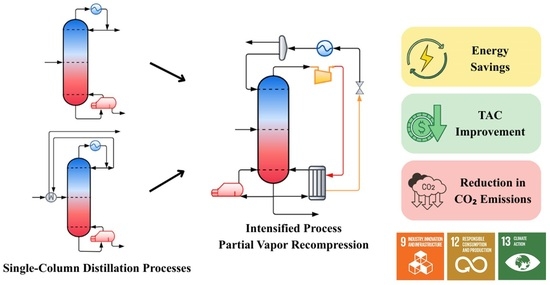
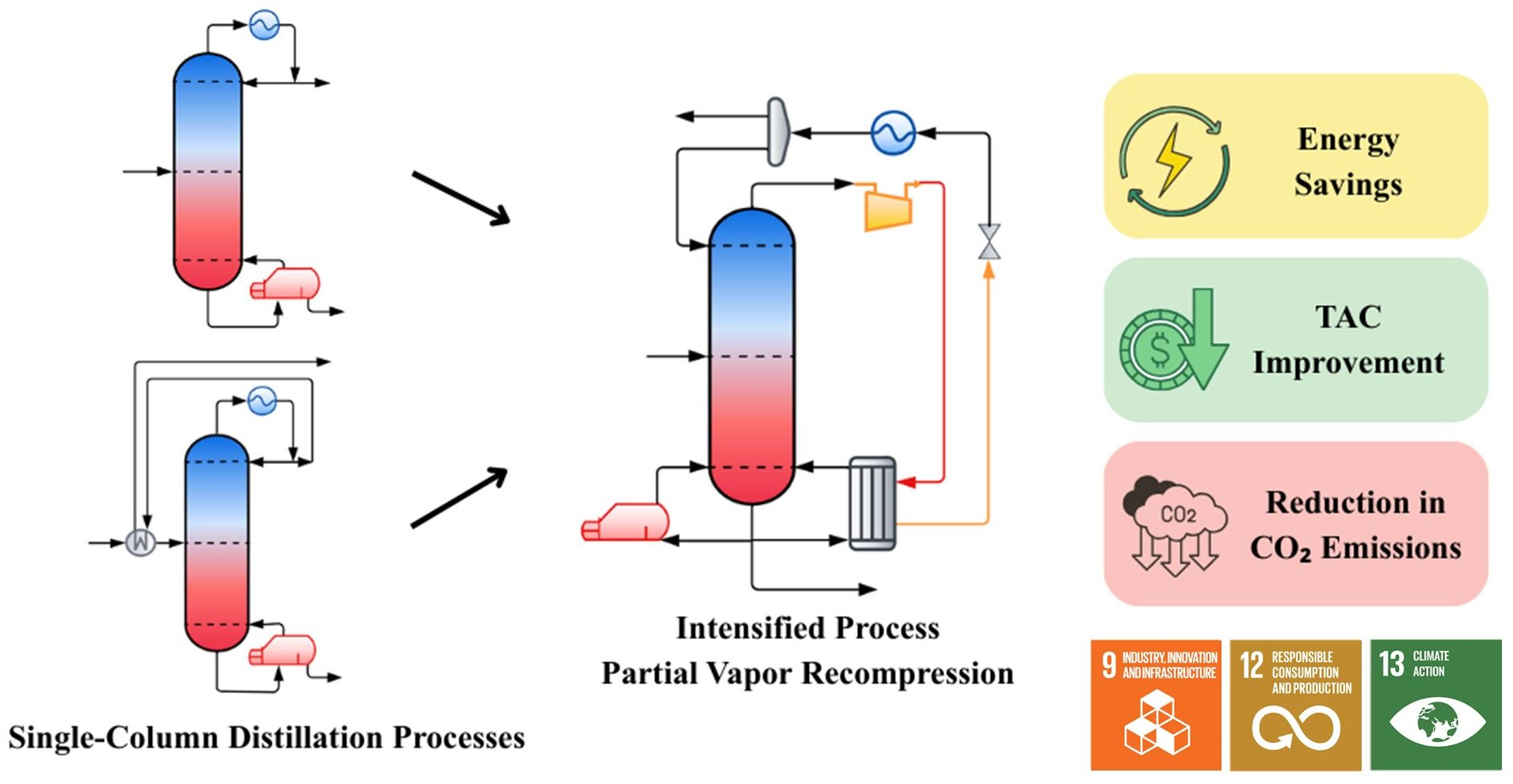
Graphical Abstract

1. Introduction

Nowadays, the chemical sector accounts for roughly 27% of industrial energy consumption and its associated CO2 emissions, highlighting the urgency of more sustainable production of fuels and chemicals [1]. Thus, the growing sustainability demands are driving major research efforts to transform energy use in the chemical industry and replace fossil fuels with renewable sources [2]. From a conscious and sustainable perspective, a key emerging trend expected to influence the design and implementation of the transition from fuel-based operations to progressive electrification is gaining prominence [3].
Regarding the industrial sector, distillation remains the dominant separation technology, accounting for approximately 90–95% of all purification and recovery operations [3,4,5,6]. Its widespread use is attributed to its robustness, operational simplicity, controllability, flexibility, and overall effectiveness in achieving high product purities [2,3,6]. Consequently, distillation is responsible for an estimated 40–60% of the chemical and petrochemical sector’s total energy consumption, which contributes nearly 3% of global energy demand [1], a proportion that is expected to remain largely unchanged in the foreseeable future [4]. Furthermore, distillation relies on high-quality thermal energy, typically supplied as steam to the reboiler, while rejecting heat at much lower temperatures in the condenser, reflecting its inherently low thermodynamic efficiency [2,4,7]. Thus, its operation is associated with considerable environmental impacts, including cooling water consumption in condensers [8,9] and CO2 emissions during steam generation through fossil-fuel combustion for use as the heating medium in reboilers [1,5,10].
In this context, process intensification (PI) has emerged as a key strategy for advancing distillation technology in the chemical and petrochemical industries. By combining innovative equipment design with hybrid separation concepts, PI aims to minimize energy and water consumption, reduce waste generation and pollutant emissions, enhance operational safety, and improve separation efficiency, thereby enabling more sustainable and efficient production processes [2,3,4,5]. PI rethinks conventional distillation schemes and substantially advances sustainability in the chemical and petrochemical sectors, directly contributing to UN Sustainable Development Goals 7, 9, 12, and 13 [11]. Thus, several technologies have been proposed, including dividing-wall column [8,11,12], double- or multiple-effect distillation [13,14,15], thermally coupled column [16,17], bottom-flashing [18,19], and vapor recompression as partial [20,21,22] or full configurations [9,10,23,24], among others [4].
As vapor recompression (VR) is implemented as an external auxiliary system, replacement of the existing distillation column is not required [4,6]. This feature allows VR to integrate synergistically with other process intensification technologies, enabling highly compact configurations such as dividing-wall columns assisted by vapor recompression with reaction [25] or without [7,26]. VR is notable for its simplicity, easy implementation, and proven operational efficiency [2,7], as well as its potential for a wide range of practical industrial applications [5,27]. Thus, it provides an attractive retrofit option for existing plants, where capital expenditure constraints and uninterrupted production are critical considerations [6,28]. Moreover, when supplied with renewable energy, such electrification can substantially lower greenhouse gas emissions and thereby contribute expressively to the decarbonization of the industrial sector [1]. VR works by directly compressing column overhead vapor, which raises its temperature and pressure so that the thermal energy can be reused as a heat source for the bottom liquid stream via a heat exchanger acting as a reboiler, thereby enhancing thermodynamic efficiency [6].
A literature survey reveals substantial benefits of VR schemes in both economic and environmental terms. For example, operational cost reductions of up to 94% have been reported for the n-hexane/ethyl acetate system [24]. Significant reductions in CO2 emissions have also been documented for the methylcyclohexane/n-butyl alcohol [29], methanol/diethylamine [30], n-butanol-water [31], and n-heptane/ethyl acetate [20] systems, with reported savings of approximately 90%, 89%, 78.9%, and 43%, respectively. In the latter two cases, only partial vapor recompression (PVR) is feasible, as the original steam-driven reboiler remains necessary along with the compressor’s electricity consumption to meet the original energy demand required for separation. Although not yet common in the literature, PVR has shown potential for improving both economic and environmental performance, notably in cases where full vapor recompression is not feasible. Ternary separation systems have likewise been intensified using VR, including tetrahydrofuran/isopropanol/water [32] and benzene–toluene–xylene mixtures [10]. Reported energy and CO2 emission reductions reach approximately 65% and 34.3% for the former system, as well as 84.7% and 60.6% (China), 72.3% (United States), and 92.4% (Brazil) for the latter. The last study also reported reductions of about 66.7% and 77.2% in operational utility costs and water consumption, respectively. These studies demonstrate that VR can significantly improve process efficiency and sustainability for a wide variety of azeotropic and close-boiling mixtures.
Regarding the separation of 1,2-propanediol and ethylene glycol, only a few studies have explored energy-efficient and cost-effective alternatives, primarily due to their close boiling points (187.6 ◦C and 197.3 ◦C, respectively) and low relative volatility (1.34 at 1 atm). These challenges are further amplified in plants with limited space and low feed flow rates (i.e., 10 kmol/h compared with 3600 kmol/h for the BTX system [8,10]), where separation is typically achieved using a single distillation column. Chen et al. [33] and Duan et al. [34] investigated several distillation schemes for separating 1,2-propanediol and ethylene glycol mixtures, based on a two-column configuration, including double-effect, extractive (applying sulfolane and triethylene glycol as entrainers), thermally coupled, and pressure-swing thermally coupled configurations, with and without heat integration. Specifically, for the single-column configuration, Chen et al. [33] proposed an atmospheric pressure design, which was subsequently subject to economic optimization by Duan et al. [34]. Further enhancements considering high-pressure operation and feed-preheating heat integration to reduce energy demand were also introduced by Duan et al. [34]. However, these studies focused primarily on energy savings, without evaluating environmental impacts.
In light of the above, several PI strategies have been proposed for the 1,2-propanediol and ethylene glycol system for the two-column operating configurations. However, as reviewed, no PI technology has been investigated for the single-column design. Therefore, this work seeks to address this knowledge gap by proposing a novel PVR retrofit for the conventional atmospheric single-column configuration. The conventional single-column distillation process and the proposed SCD-PVR-intensified configuration were rigorously designed using UniSim software. A comprehensive evaluation of the proposed scheme and previously reported high-pressure configurations was then performed based on economic criteria and preliminary CO2 emission estimates, thereby assessing both techno-economic feasibility and sustainability from an early-stage design perspective.

2. Methodology

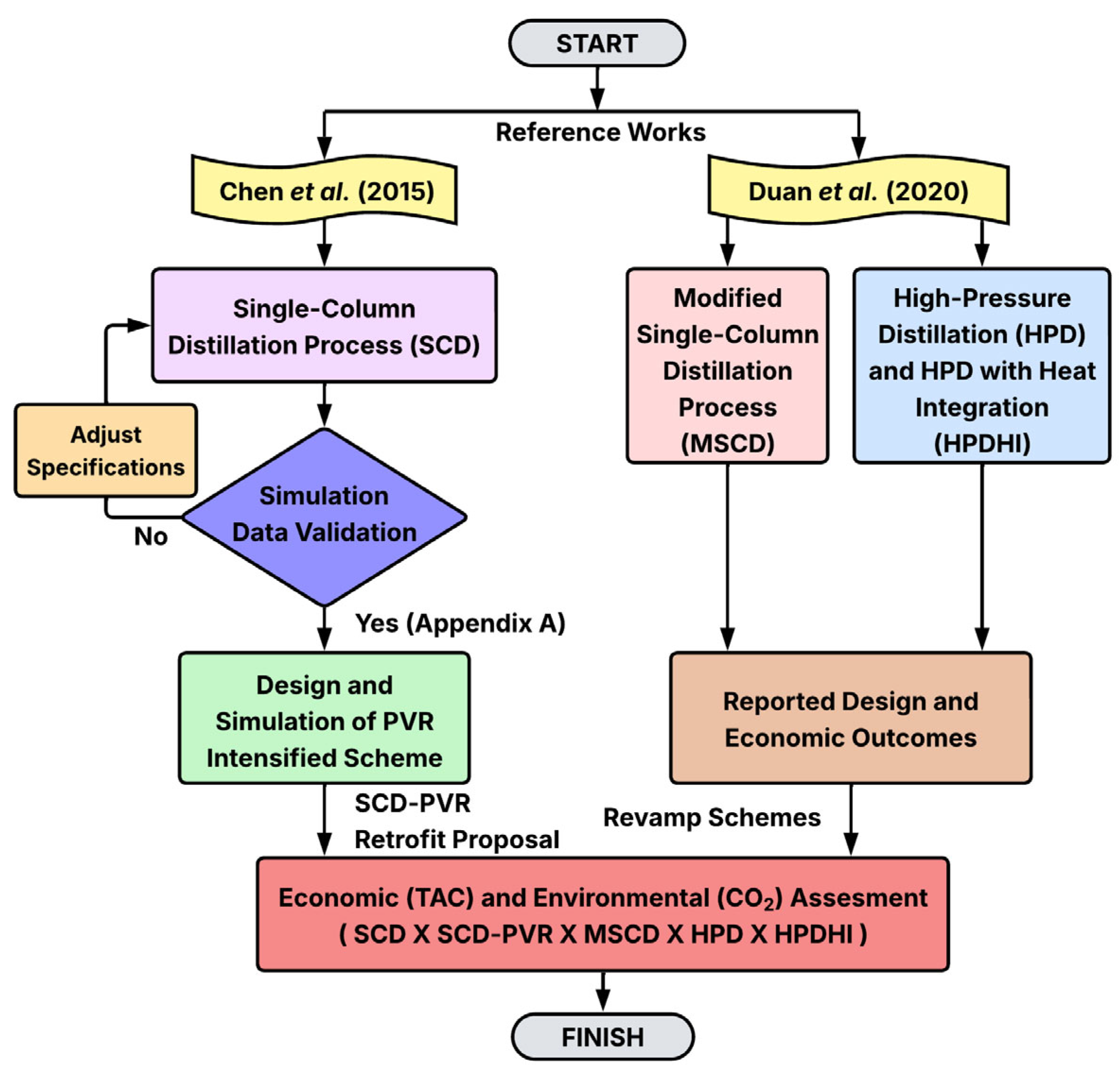
This study adopted an integrated theoretical–computational approach, in which steady-state simulations were performed using the UniSim® Design R490. The UniSim software incorporates rigorous thermodynamic models and detailed representations of distillation column units, based on MESH (Mass balance, phase Equilibrium, mole fraction Summation and Heat balance) equations, making it a reliable platform for the analysis of chemical processes. Its consistency has been demonstrated through comparisons with experimental data [13], and it has also shown a strong ability to reproduce results previously reported in studies conducted with Aspen Plus® software V11 [8]. The methodological development of this research was organized into seven main stages:
I—Comprehension and simulation of the single-column distillation (SCD) process, operating at 101.3 kPa (1 atm), as reported by Chen et al. [33]. In Appendix A, Table A1 and Table A2, the computational simulation is validated by comparing the UniSim mass and energy stream results with those previously reported [33] accepting a tolerance of up to 5% for relative deviations [8];
II—Design and simulation of partial vapor recompression configuration (SCD-PVR) at atmospheric pressure for retrofitting the SCD process via economic optimization;
III—Conduction of a direct analysis (i.e., without simulation) of the reported design specifications and the associated mass and energy requirements for the atmospheric economically modified approach (MSCD), as well as for the high-pressure distillation (HPD) and high-pressure feed-preheating heat-integration distillation (HPDHI) schemes at 276 kPa proposed by Duan et al. [34], to support the revamp of the 1,2 propanediol (1,2-PDO) and ethylene glycol (EG) separation system;
IV—Conduction of an economic analysis based on the TAC criterion for 3-, 5-, and 10-year payback periods for all evaluated alternatives, using strictly the utility costs assumptions and capital equipment cost correlations reported previously by Chen et al. [33] and Duan et al. [34], as well as a sensitivity analysis based on the electricity price;
V—Conduction of a preliminary environmental analysis embracing CO2 emissions for all the evaluated schemes (SCD, MSCD, HPD, HPDHI, and the proposed SCD-PVR);
VI—Provision of a systematic comparative assessment of all alternatives, focusing on quantitative indicators of economic performance and associated environmental impacts;
VII—Report of key findings and conclusions.
The Non-Random Two-Liquid (NRTL) model was selected to represent the vapor–liquid equilibrium and thermodynamic behavior in both the conventional configuration and the partial vapor recompression (SCD-PVR) simulations. This choice ensures a consistent and fair comparison with the results reported by Chen et al. [33] and Duan et al. [34] for the SCD, MSCD, HPD, and HPDHI configurations, which were also evaluated using the NRTL model. These studies have demonstrated, supported by reliable experimental data validation [35,36], that the NRTL model accurately describes the binary system 1,2-PDO/EG with minimal deviations.
The distillation columns were converged using UniSim®’s Sparse Continuous Solver numerical method with default tolerances for equilibrium/specification and mass/energy imbalance convergence. This approach introduces an advanced iteration scheme that enhances the robustness and stability of distillation column calculations in UniSim software, particularly when dealing with two liquid phases on the tray, highly non-ideal systems, reactive distillation, and poor initial estimates during optimization [9].
Finally, it is assumed that the plant is located in the United States, as per the reference works [33,34], according to assumed utility costs.
Figure 1 summarizes the methodological procedure derived from the steps described above, which will be further discussed and detailed in the subsequent sections.

3. Performance Evaluation Metrics

Evaluation metrics play a crucial role in modern industry for monitoring operations and guiding early-stage design. Although several performance indicators exist [8], computer-aided tools increasingly assess them to more accurately identify environmental and economic impacts. In this context, total annualized cost (TAC) and CO2 emissions emerge as two of the most essential evaluation metrics for supporting decision-making, particularly when comparing different distillation alternatives [20,24,29,30,31], as energy consumption—encompassing both combustion-based and electrical sources—directly correlates with CO2 emissions and constitutes a major driver of utility costs.

3.1. TAC Criteria

In chemical engineering economic analysis, the TAC criterion, presented in Equation (1) [37], is a widely used metric for evaluating distillation column intensification strategies. It provides a unified economic basis by integrating both capital equipment expenditure investment (CapEx) and operational costs (OpEx) contributions into a single annualized value, serving as a key objective in design optimization [2,7,25]. This metric has previously been used to develop optimal economic designs and to evaluate different separation strategies for the 1,2-PDO/EG system [33,34]. Therefore, the present work adopts the same methodology, using an operating period of 8000 h/year and applying identical capital equipment installation cost correlations (i.e., column shell and trays, reboiler, condenser, heat exchanger, and compressor) and utility cost prices (i.e., cooling water and electricity, as well as low-, medium-, and high-pressure steam (LPS, MPS, and HPS)), as presented in Table 1 and Table 2, respectively. Shortened payback periods of 3 and 5 years, as well as an extended 10-year period, are assumed for all evaluated alternatives [10,19,30], considering that industrial plants can remain productive for more than 40 years [38,39].
T A C   $ y e a r = C a p E x P a y b a c k   P e r i o d + O p E x

3.2. CO2 Emissions

In modern chemical industries, the accurate estimation of carbon dioxide emissions is essential for assessing process sustainability, ensuring compliance with environmental regulations, and supporting effective decarbonization strategies [1,2,3]. CO2 emissions are directly connected to the United Nations Sustainable Development Goal 13 (Climate Action), which emphasizes the need for urgent measures to combat climate change and its impacts. Thus, the mitigation of pollutant emissions through process intensification strategies is directly linked to Sustainable Development Goal 9 (Industry, Innovation, and Infrastructure) and Goal 12 (Responsible Consumption and Production), highlighting the importance of estimating CO2 emissions to assess the environmental impact of industrial processes. In distillation systems, CO2 emissions arise predominantly from the thermal energy required to drive separation. These direct emissions occur when heating steam is generated from fossil-fuel combustion in boilers or when fired reboilers are used. Additionally, configurations such as vapor recompression, bottom flashing, and pressure-swing thermally coupled distillation rely on compressor machinery, typically powered by electricity, which introduce indirect emissions associated with off-site power generation.
In this regard, Gadalla et al. [42] developed a widely used methodology, based on Equations (2) and (3), for estimating CO2 emissions from steam-generating boilers. The approach quantifies emissions according to the amount of fuel required to supply the necessary thermal duty, as determined from the boiler heat balance and its combustion efficiency. An excess supply of air is assumed to guarantee complete combustion, thereby eliminating the formation of carbon monoxide [43]. This methodology has become standard in chemical engineering analyses and has been extensively applied in process intensification studies of distillation units [7,15,20,29,30], including investigations of the 1,2-PDO/EG separation system [33,34]. Furthermore, indirect CO2 emissions from electrically driven equipment can be estimated by adding the final term in Equation (2). In this case, the effective electrical power demand, corrected for equipment efficiency, is multiplied by the locality electricity-grid emission factor to account for the carbon intensity of external power generation. Accordingly, the total CO2 emissions (CDE), expressed in kgCO2/h, are estimated based on Equations (2) and (3):
C D E = Q f u e l N H V × C % 100 × α × 3600 s 1 h + Q c o m p × β
Q f u e l = Q p r o c λ p r o c × h p r o c − h b f w × T F T B − T 0 T F T B − T s t a c k
where Qfuel (kW) represents the thermal energy produced from fuel combustion; C% indicates the carbon content, measured in kg carbon per kg of fuel; and α denotes the stoichiometric conversion factor between CO2 and carbon. The Net Heating Value (NHV), expressed in kJ/kg, is the energy content of each fuel type. Qfuel is estimated based on the boiler’s heat balance, where the terms Qproc, hproc, hbfw, and λproc denote the energy required by the reboiler (kW) (from processes simulation), the enthalpy and latent heat of vaporization of steam supplied to the process (kJ/kg), the enthalpy of boiled feed water (kJ/kg), and the steam latent heat of vaporization (kJ/kg), respectively. TFTB, Tstack, and T0 represent the flame temperature, boiler flue gas temperature, and ambient temperature, respectively, all in Kelvin. Qcomp (kW) is the electrical energy demand of the compressor (corrected for its efficiency), and β is the local emission factor, in kgCO2 per kW of electricity consumed. Boiled feedwater is assumed to enter at 373 K (100 °C) [15,19,43], and natural gas is taken as the boiler fuel [7,10], consistent with previous studies. Table 3 summarizes the parameter values adopted for estimating CO2 emissions.
It is important to note that CO2 emissions from auxiliary water-related sources, such as cooling water and steam generation, were not considered in this study, as they account for approximately 0.5% of total CO2 emissions [9,44].
It is important to note that CO2 emissions are reported in kgCO2/h, consistent with the objective of comparing alternative separation configurations under identical feed conditions, production capacities, and product quality specifications. The analysis focuses on operational (gate-to-gate) energy consumption associated with each analyzed configuration (system boundary). Complete combustion is assumed, with air supplied in excess and high flame temperatures, such that all consumed fuel is fully converted to CO2 with no formation of carbon monoxide (CO), thereby eliminating the need to estimate additional CO2-equivalent emissions.

4. Processes Description

This section provides a comprehensive overview of process configurations that employ a single-column distillation, operated at atmospheric or higher pressures, for separating the close-boiling 1,2-PDO/EG mixture. The discussion covers the conventional single-column distillation (SCD) system and previously proposed revamp options, including the economically modified single-column distillation (MSCD), high-pressure distillation (HPD), and high-pressure feed-preheating heat-integration distillation (HPDHI). In addition, a new retrofit process intensification strategy based on partial vapor recompression (SCD-PVR) is also introduced. It is important to note that the distillation columns were modeled using ideal equilibrium stages with 100% stage efficiency. In addition, pressure drops in the reboilers, condensers, and heat exchangers were assumed to be negligible, as previously reported [33,34]. Detailed descriptions of the operational conditions, design and sizing relationships, utility requirements (e.g., electricity, cooling water, and heating steam), and product specifications used in the subsequent analysis are provided.

4.1. Conventional Single-Column Distillation (SCD)

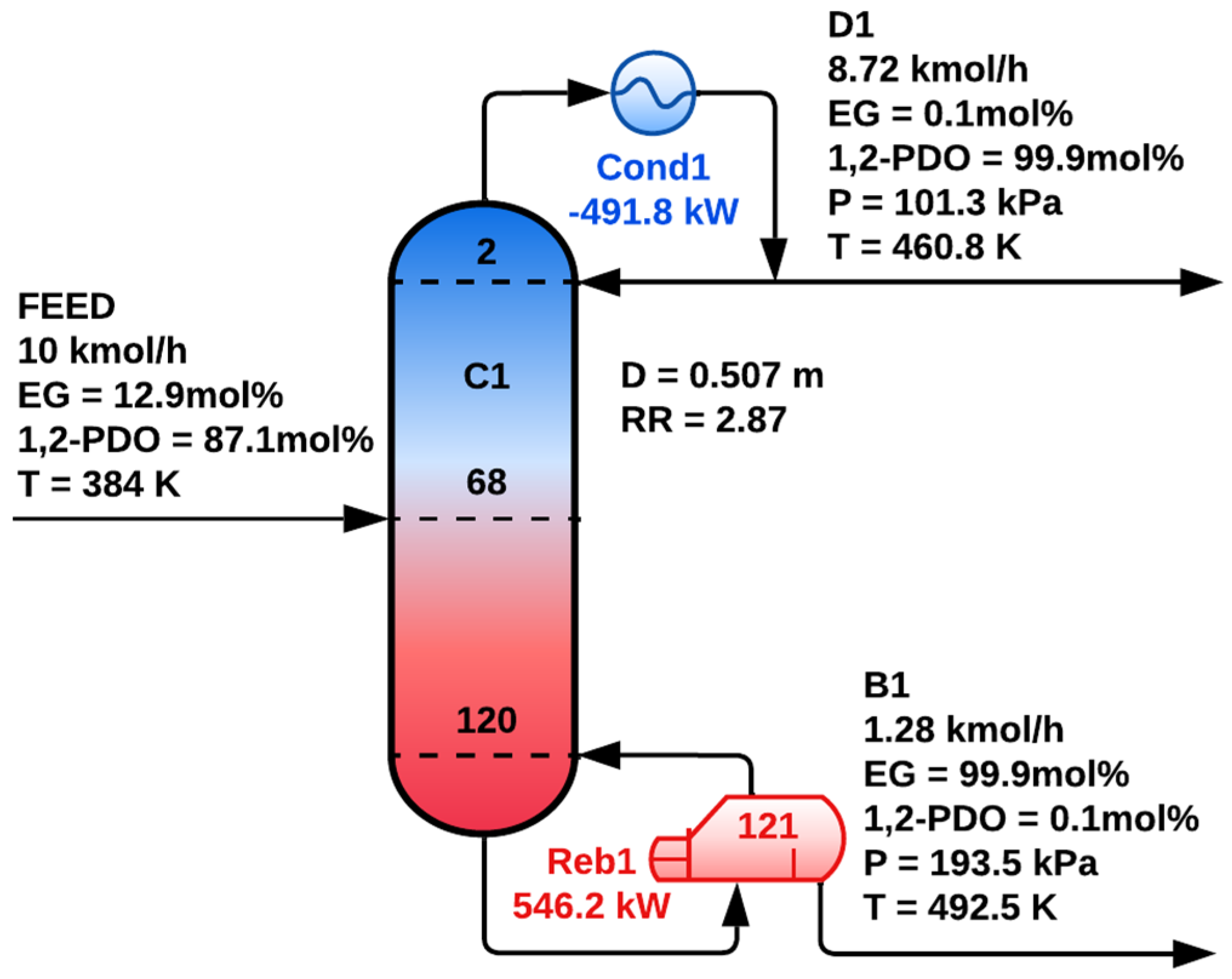
The conventional process for separating the 1,2-PDO/EG mixture relies on a single-column distillation (SCD) configuration, shown in Figure 2, which depicts the economically optimized flowsheet reported by Chen et al. [33]. The corresponding simulation results, previously validated (Appendix A, Table A1 and Table A2), are applied as the benchmark for comparison and for developing the proposed intensification strategy. It is important to highlight that, in addition to mass balance (flow rates and product quality), the model was validated against key performance parameters, including condenser and reboiler duties as well as column temperature and pressure profiles, providing confidence in the subsequent economic and environmental analyses.
In this configuration, a feed stream of 10 kmol/h composed of 87.1 mol% 1,2-PDO and 12.9 mol% EG, at a temperature of 384 K and atmospheric pressure, is introduced at stage 68 of the distillation column (C1). Column C1 has 121 total stages (using Aspen Plus® software nomenclature, where stage 1 corresponds to the condenser and the final stage to the reboiler), with a tray space of 0.6096 m (2 ft), an internal diameter (ID) of 0.507 m, and a reflux ratio of 2.87. The distillate stream (D1) is collected at a flow rate of 8.72 kmol/h, achieving a high purity of 99.9 mol% 1,2-PDO and only 0.1 mol% of EG, at a temperature of 460.8 K and atmospheric pressure, representing the successful recovery of the more volatile component. Moreover, the bottom stream (B1) is obtained at a flow rate of 1.28 kmol/h composed of 99.9 mol% of EG and 0.1 mol% of 1,2-PDO, at 492.5 K and 193.5 kPa (1.91 atm), completing the separation of the heavier component. A pressure drop of 0.7814 kPa (0.0077 atm) per tray was considered for the distillation column [33].
In the SCD configuration, the condenser of column C1 (Cond1) operates at 460.8 K, enabling the use of cooling water as the utility. Cooling water is assumed to be supplied at 305 K and discharged at 315 K, both at 500 kPa [33,42]. The reboiler of column C1 (Reb1) operates at 492.5 K and requires high-pressure steam (HPS, 41 barg, 527.2 K) [33,34].
Although Couper et al. [45] suggest splitting columns taller than 175 ft into two units due to wind loads and foundation considerations, the separation of the 1,2-PDO/EG mixture can be performed in a single column with 119 internal trays, exceeding 238 ft, as previously designed [33]. Moreover, in real petrochemical plants, such as cracker units, single-shell propylene-propane splitters of even greater size with 160 internal trays (or more) are in operation [46], indicating that the cited heuristic is not universally applicable.

4.2. Modified Single-Column Distillation (MSCD)

The economically modified single-column distillation (MSCD) configuration, shown in Figure 3, presents the findings achieved by Duan et al. [34]. In their study, the authors investigated the effects of varying the reflux ratio (RR) and the distillate rate (D1) under identical feed conditions to satisfy two key specifications: the product quality of both the distillate and bottom streams. To achieve this, an optimization procedure was applied, employing a sensitivity analysis-based screening method and considering the total number of theoretical stages and the feed-stage location as the decision variables. The optimization aimed to minimize the TAC economic criteria while employing the same capital equipment correlations and utility costs outlined by Chen et al. [33].
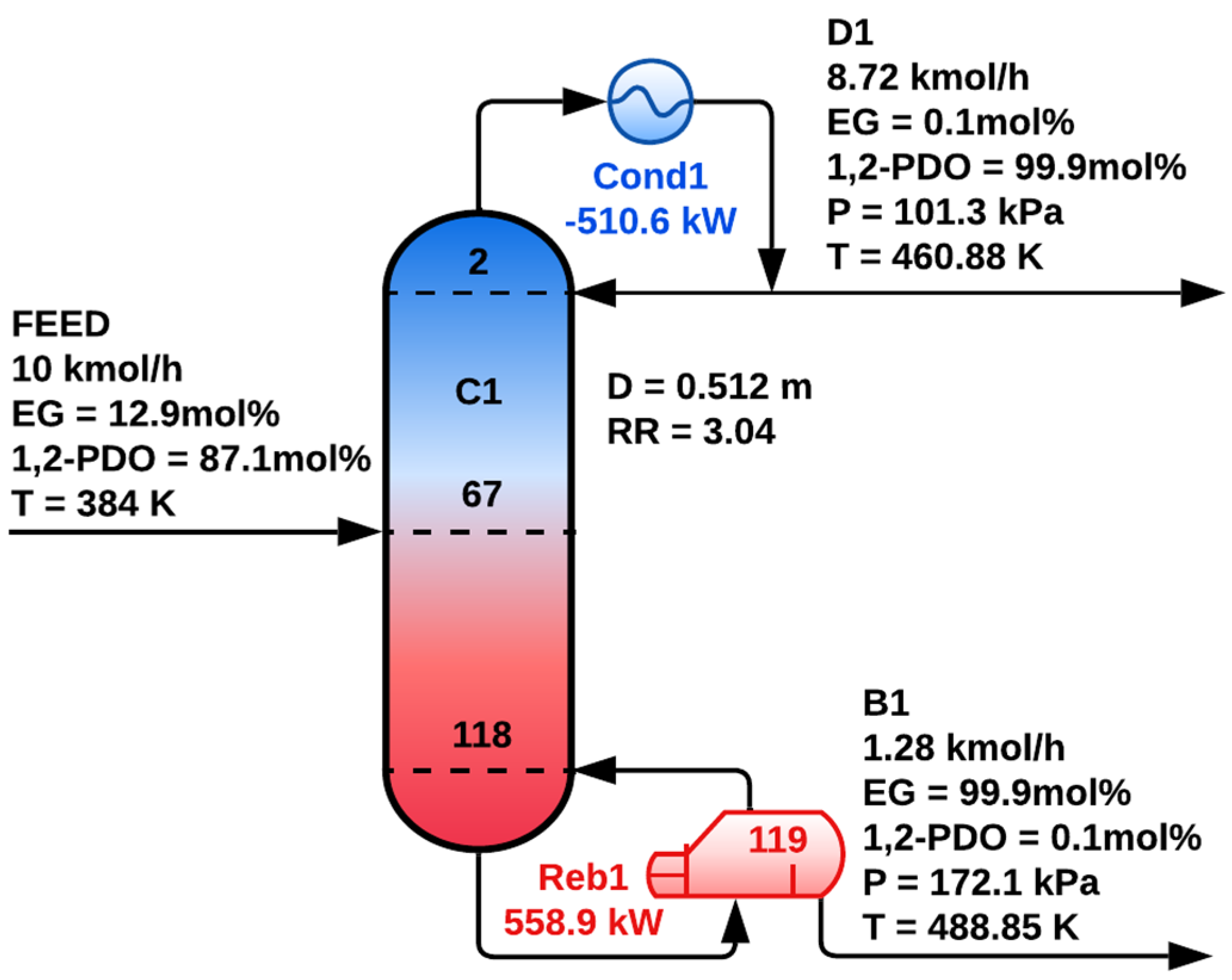
For this configuration, the feed stream, with the same composition and temperature as the reference case [33], enters column C1 at stage 67. The column contains 119 stages, with a tray spacing of 0.6096 m (2 ft) and a reflux ratio of 3.04. The distillate stream (D1) is withdrawn at a flow rate of 8.72 kmol/h, achieving a high purity of 99.9 mol% 1,2-PDO and only 0.1 mol% of EG, and at a temperature of 460.88 K and atmospheric pressure. The bottom stream (B1) is recovered at a flow rate of 1.28 kmol/h, composed of 99.9 mol% of EG and 0.1 mol% of 1,2-PDO, at 488.85 K and 172.1 kPa. A pressure drop of 0.61 kPa (0.0060 atm) per tray was considered for the distillation column [34]. These outputs represent the complete separation of both mixture components. As observed, this configuration employs two fewer trays and places the feed one stage lower than the design proposed by Chen et al. [33]. According to Duan et al. [34], the slight differences in optimization results, regarding the number of theoretical stages, feed-stage location, and reflux ratio, are attributed to the different pressure drop assumptions. It is worth noting that the column diameter was not specified in Duan et al.’s [34] study. Thus, based on the capital expenditure correlations for the distillation column, covering both the shell and the internal trays, and the total installed-cost value reported by the authors, the corresponding column diameter, 0.512 m (very close to the Chen et al.’s original diameter), was calculated and also presented in Figure 3.
In the MSCD configuration, the condenser (Cond1) and reboiler (Reb1) of column C1 operate at 460.88 K and 488.85 K, respectively. Therefore, similar to the SCD scheme, cooling water is required as the overhead utility, while high-pressure steam supplies the reboiler duty.

4.3. High-Pressure Distillation (HPD)

The economically optimal flowsheet for the separation of the 1,2-PDO/EG mixture in a high-pressure distillation (HPD) process, designed by Duan et al. [34], is shown in Figure 4. The authors investigated the effect of operating pressure on the vapor–liquid equilibrium of the system and demonstrated that at higher pressures and for 1,2-PDO concentrations between 0.6 and 1.0, the equilibrium curve deviates further from the diagonal line, indicating that nearly pure 1,2-PDO can be obtained more easily, thus requiring fewer separation stages and offering possible economic benefits. The optimization was performed similarly to the MSCD case, also considering the minimum TAC as objective.
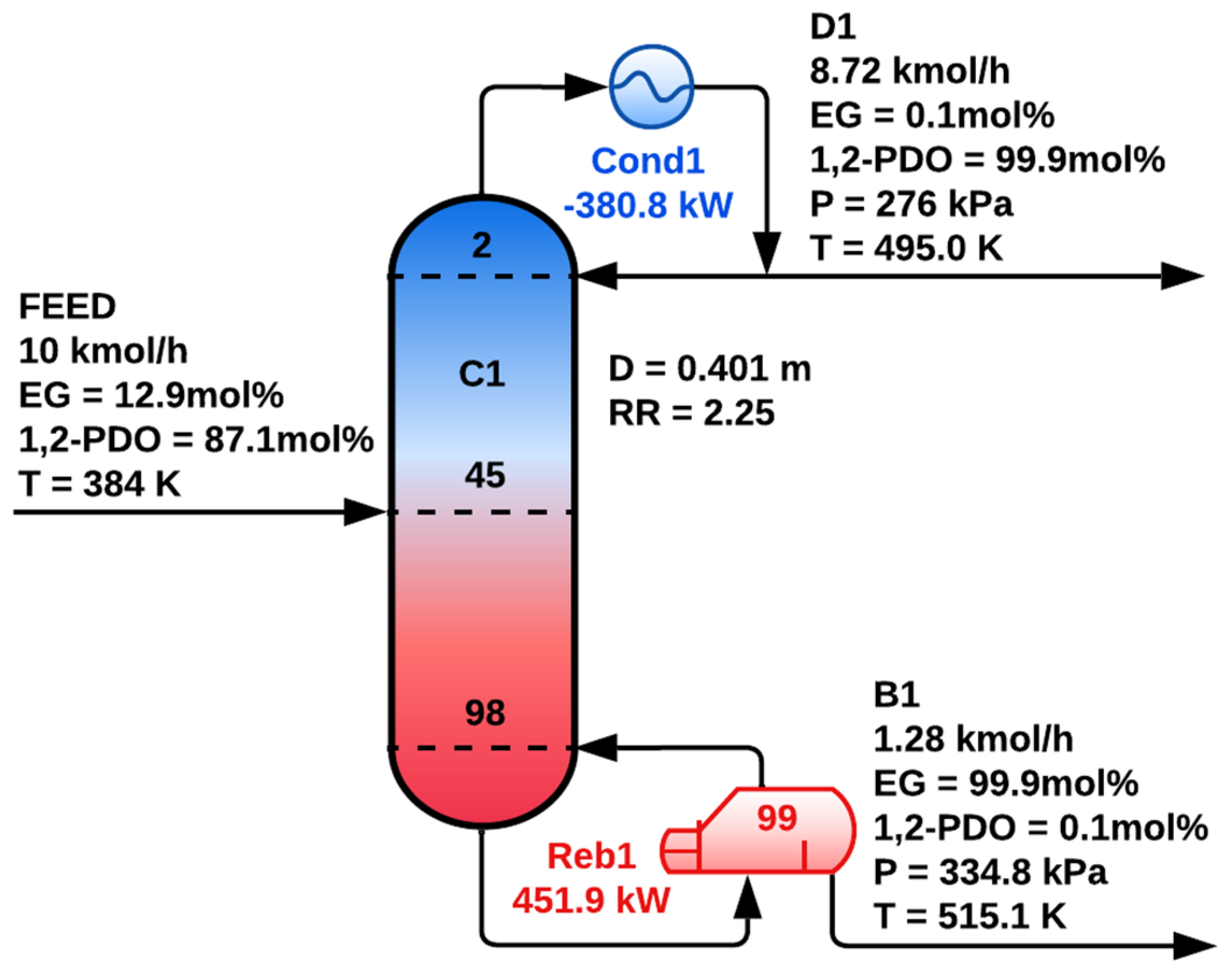
This configuration adopts the same feed conditions as the reference case [33], consisting of 10 kmol/h with 87.1 mol% 1,2-PDO and 12.9 mol% EG at 384 K, introduced at stage 45 of column C1. This column has 99 total stages, with a tray space of 0.6096 m (2 ft) and a reflux ratio of 2.25. The distillate stream from C1 (D1) is recovered at a flow rate of 8.72 kmol/h, achieving a high purity of 99.9 mol % 1,2-PDO and only 0.1 mol% of EG, at a temperature of 495.0 K and a pressure of 276 kPa. The bottom stream from C1 (B1) is collected at a flow rate of 1.28 kmol/h, composed of 99.9 mol% of EG and 0.1 mol% of 1,2-PDO, at 515.1 K and 334.8 kPa. A pressure drop of 0.61 kPa (0.006 atm) per tray was considered [34]. Again, the column diameter was not specified; therefore, using the capital expenditure correlations along with Duan et al.’s [34] reported installed cost, the corresponding thin diameter 0.401 m was estimated and is shown in Figure 4.
In the HPD configuration, the condenser of column C1 (Cond1) operates at 495.0 K, whereas the corresponding reboiler (Reb1) operates at 515.1 K. Therefore, despite the increased operating pressure, the condenser still requires cooling water for effective heat removal, and the reboiler must continue to be supplied with high-pressure steam to satisfy the heat-transfer duty. It is also noteworthy that, although the HPD configuration raises the bottom temperature, the temperature driving force between the HPS (527.2 K) and the reboiler (515.1 K) remains adequate, thereby satisfying the differential temperature constraint of 12 K. It is important to note that Duan et al. [34] assumed a widely used differential temperature constraint of 10 K in the reboiler (i.e., steam temperature minus bottom temperature), whereas Chen et al. [33] used a value of 20 K. In this work, a value of 12 K is adopted as a conservative compromise, ensuring that all previously proposed configurations for the 1,2-PDO/EG system are compatible with the use of the same high-pressure steam (527.2 K), avoiding superheated steam for high-pressure schemes [34].

4.4. High-Pressure Distillation with Heat Integration (HPDHI)

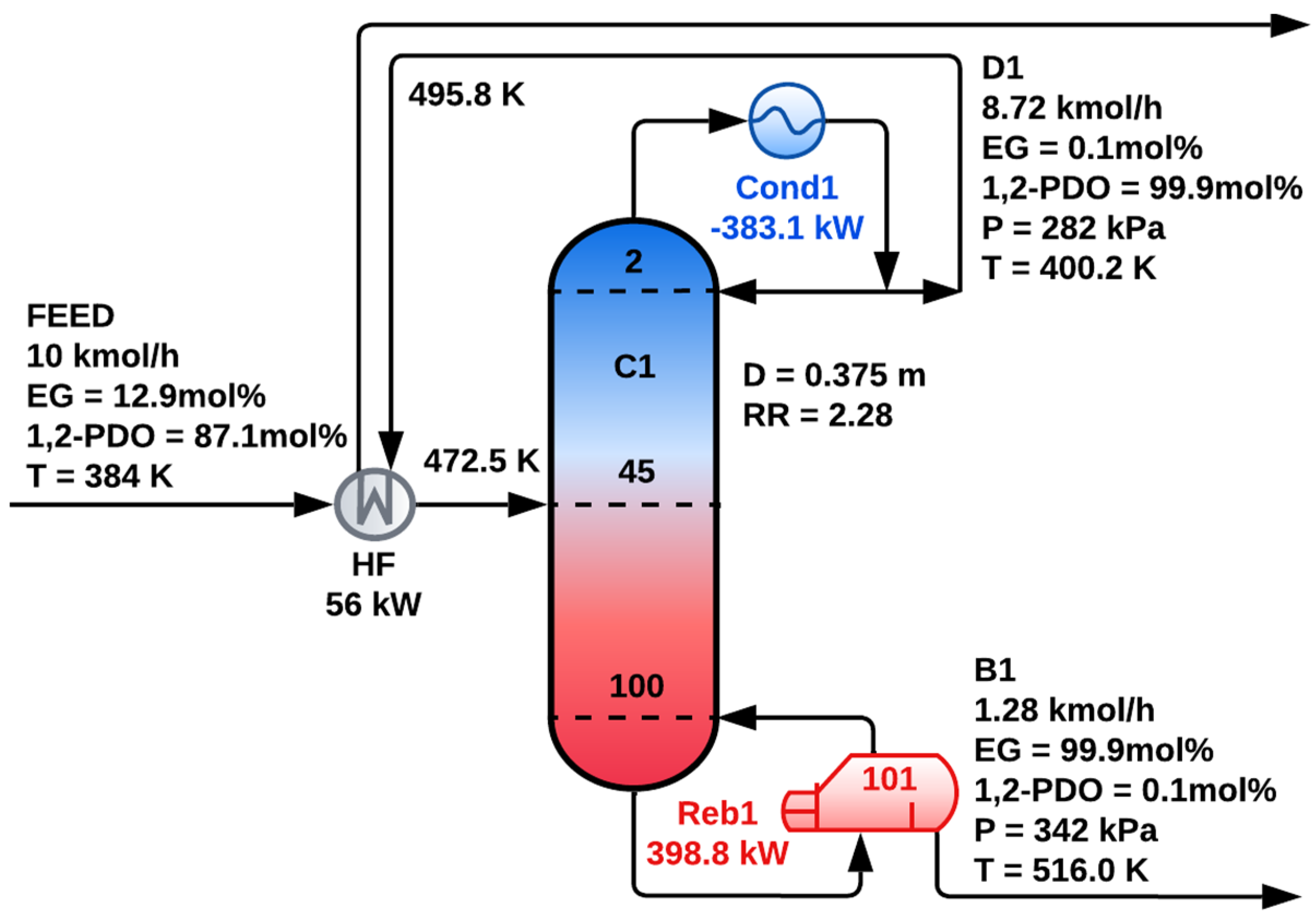
As noted, the high-pressure configuration elevates the overall column temperature profile, enabling both the overhead and bottom streams to serve as potential heat sources for feed preheating. In this context, Duan et al. [34] demonstrated that employing the overhead product, characterized by a larger molar flow rate (8.72 kmol/h) than the bottom stream (1.28 kmol/h), can significantly reduce reboiler energy consumption via an effective heat-integration strategy. Again, an optimization procedure was applied to minimize the TAC criteria while maintaining product quality constraints and also considering the same feed conditions, as presented in Figure 5. In this configuration, the feed stream enters a preheater (HX1), where it exchanges heat with the distillate overhead stream (D1). This heat-integration step increases the feed temperature from 384 K to 472.5 K prior to its introduction into column C1 at stage 45. C1 column has 101 total stages, with a tray space of 0.6096 m (2 ft) and reflux ratio of 2.28. The distillate stream (D1), withdrawn at 8.72 kmol/h, contains 99.9 mol % 1,2-PDO and only 0.1 mol% of EG. Leaving the column at 495.8 K and 282 kPa, this stream is subsequently cooled to 400.2 K during heat integration with the feed, representing the recovery of the more volatile component. The bottom stream from C1 (B1) is collected at a flow rate of 1.28 kmol/h composed of 99.9 mol% of EG and 0.1 mol% of 1,2-PDO, at 516.0 K and 342 kPa, corresponding to the separation of the heavier mixture component. A pressure drop of 0.61 kPa (0.0068 atm) per tray was considered. Once more, the resulting thin diameter, 0.375 m, obtained from the correlations and results reported [34], is presented in Figure 5.
Similar to the HPD configuration, the condenser (Cond1) and reboiler (Reb1), operating at temperatures 495.8 K and 516.0 K, continue to rely on external cooling water and HPS utilities to satisfy the overhead and bottom thermal duties, respectively. In addition, both the reboiler, supplied with HPS at 527.2 K, and the feed preheater (HF) satisfy the differential temperature constraint of 12 K and the minimum temperature approach of 10 K (16.2 K), respectively.

4.5. Partial Vapor Recompression Proposal (SCD-PVR) Design

In the conventional SCD process described by Chen et al. [33], the reboiler constitutes the primary contributor to the TAC economic criteria, due to its high thermal energy demand supplied by high-pressure steam to satisfy the bottom-product specifications. Therefore, to enhance system performance and reduce associated CO2 emissions, this work proposes an intensified retrofit configuration based on a partial vapor recompression strategy, hereafter referred to as SCD-PVR.
It is assumed that, although the physical space of single-column configurations for separating the 1,2-PDO/EG mixture is smaller than that of two-column alternatives, the existing plant layout can accommodate the addition of a compact, single-stage compressor (i.e., with a compression ratio below four and therefore not requiring intercoolers as additional heat exchangers [45,47]), as well as a limited number of supplementary heat exchangers. These include the new reboiler, which is expected to have a smaller heat-transfer area and overall size than the original unit, and the auxiliary heat exchanger, thereby enabling implementation with minimal modifications to the original plant layout and ensuring brownfield retrofit feasibility.
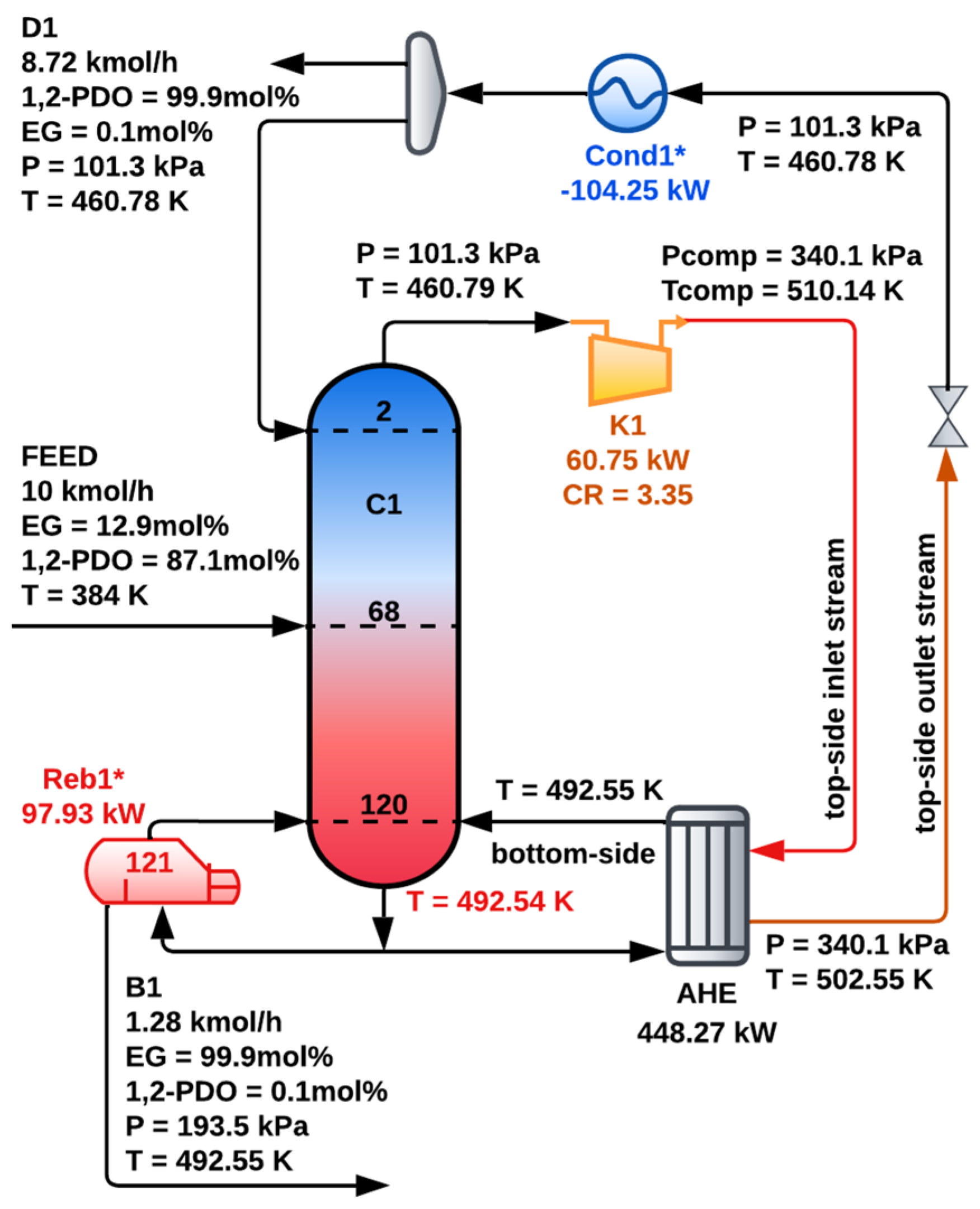
A key indicator of the preliminary thermodynamic performance of vapor recompression systems is the coefficient of performance (COP) [48], which is based on condenser and reboiler temperatures. When the COP exceeds 10, the implementation of this technology is generally considered highly favorable for process intensification [7,10,31]. Wide (high)-boiling separation systems typically exhibit a larger temperature difference between the top and bottom of the column than close-boiling systems, which leads to a lower COP value and may therefore restrict the practical implementation of the VR strategy. Otherwise, close-boiling systems result in higher COP values, for which the implementation of the said strategy is more favorable [5,31]. For the proposed SCD-PVR configuration shown in Figure 6, the resulting COP is 14.54 (reboiler at 492.55 K and condenser at 460.8 K). Therefore, this high COP value highlights the strong energy-saving potential of the configuration and reinforces its industrial relevance, particularly in contexts promoting electrification and low-carbon energy integration. The SCD-PVR strategy consists of compressing the overhead vapor stream from column C1, thereby increasing its pressure, temperature, and thermodynamic potential, allowing its partial reuse as the heat source in the bottom stream, and minimizing the required high-pressure steam, as illustrated in Figure 6. Thus, an auxiliary heat exchanger (AHE), designed to enable heat integration between process streams, is introduced in a partial vapor recompression strategy. Furthermore, a throttling valve and a condenser are used to readjust the temperature and pressure of the distillate (D1) as well as the reflux stream to the original operating conditions.
The compressor’s compression ratio is a key operating parameter that strongly influences both process economics (compressor and heat exchanger capital expenditure and electricity utility cost) and the resulting discharge temperature and pressure conditions [10,24]. Thus, the saturated overhead vapor is compressed using an electric-driven centrifugal compressor (K1) with polytropic and mechanical efficiencies of 71% and 97%, respectively, as previously employed by Duan et al. [34] for the separation of the 1,2-PDO/EG mixture base case. To maintain mechanical reliability and ensure technical feasibility, the compression ratio per stage is limited to a maximum of 4 [45] and the discharge temperature should not exceed 523.1 K (250 °C) [34,47]. In addition, no condensation of the overhead vapor stream is permitted during compression. If necessary, a top preheater should be used [10,24].
In the partial vapor recompression strategy, the reboiler and the auxiliary heat exchanger have a significant impact on the TAC criteria. Their design is directly influenced by the compressor outlet pressure and temperature, which determine the effective driving forces for heat integration, the required heat-transfer area, and therefore the associated capital equipment expenditure. Furthermore, the thermal design of the reboiler (Reb1*), the auxiliary heat exchanger (AHE), and the condenser (Cond1*) must comply with established rule-of-thumb constraints to ensure feasible heat-transfer performance and reliable long-term operation, namely, a minimum of 12 K and 11 K (20 °F) for the reboiler (Reb1*) and the condenser (Cond1*) [33,41], respectively. For the reboiler, this corresponds to the difference between steam temperature (HPS at 527.2 K) and the boiling stream base temperature. For the condenser, this relevant limit reflects the temperature difference between the reflux drum and the outlet cooling water (315 K) [33]. For the auxiliary heat exchanger (AHE), this driving force corresponds to the logarithmic mean temperature difference (LMTD) of process streams [33]. In addition, a minimum temperature approach constraint of 10 K is imposed, as recommended in the literature, to ensure a balanced economic trade-off between capital expenditure and utility costs, while also avoiding excessively small pinch temperatures within the heat exchanger [8,41,49]. These calculated temperature driving forces (ΔTReb, ΔTCond, and ΔTAHE), together with the global heat-transfer coefficients (UReb, UCond, and UAHE) and the required heat duties (QReb, QCond, and QAHE), are then used to determine the heat-exchange area of each piece of equipment and, consequently, the associated capital expenditure. These correlations, summarized in Table 1, represent the CaPex contribution to the TAC criterion alongside the distillation column (based on diameter (D) and length (L)) and compressor (based on pressure (Pcomp)) investment. The energy demands of the reboiler (QReb), condenser (QCond), and compressor (Pcomp), along with the corresponding utility costs reported in Table 2, constitute the OpEx contribution to the TAC index. Finally, for each selected payback period (3-, 5-, and 10-years) and operating time (8000 h), the overall economic TAC performance metric is calculated.
In light of the above, an optimization procedure is necessary to achieve the economically optimum design of the proposed SCD-PVR based on the same TAC equations, correlations, and parameters as used previously [33,34] for a fair comparison.
Maintaining focus on retrofitting the unit, the proposed design maintains the original operation atmospheric pressure (101.3 kPa), number of theoretical stages, feed-stage location, and feed specifications, while improving energy efficiency through a partial vapor recompression strategy.
The optimization procedure was carried out directly within the UniSim Design environment, without the need for external routines in Python or other software, such as Matlab®, using the well-established Successive Quadratic Programming (SQP) algorithm available in the Optimize structure of the software. This approach, rather than relying on the standard Optimizer routine, enables the selection of solvers better suited for complex, highly nonlinear optimization tasks. SQP is recognized as a robust and efficient iterative method for solving constrained nonlinear optimization problems [38,50,51]. Within this integrated framework, a UniSim Spreadsheet block is employed to define and update the decision variables, including their initial bounds and guesses, as well as the objective function (TAC), including capital expenditure and utilities costs, and associated constraints, including differential driving temperatures and minimum approach temperatures. This configuration allows UniSim to systematically adjust both decision and process variables to satisfy the mathematical model (MESH equations) and optimization targets, all within the same simulation environment used for process design.
With the addition of the auxiliary heat exchanger (AHE) (i.e., a shell-and-tube heat exchanger represented by two streams: a hot stream on the top side and a cold stream on the bottom side), it becomes necessary to specify two operational variables for this unit (i.e., three degrees of freedom) during optimization, since the temperature at the bottom of the column (i.e., the inlet temperature of the AHE bottom side) is known through simulation (492.54 K) (i.e., filling one degree of freedom of three required). Accordingly, the inlet and outlet temperatures on the AHE top side were selected as decision optimization variables, along with two others, to satisfy the distillation column requisites and convergence. For these last two, the distillate flow rate (8.72 kmol/h) and the bottom product temperature (B1) (492.55 K) were selected, both known from the simulation of the conventional distillation column (SCD). The remaining problem with two decision optimization variables can be simplified by using just one of them—the compressor discharge pressure (Pcomp)—from which the compressor outlet temperature is obtained (Tcomp), corresponding directly to the top-side inlet temperature of the AHE (510.14 K). Therefore, the top-side outlet temperature must be adjusted (specified) to satisfy the 10 K minimum approach temperature constraint in the AHE, which defines the heat flow duty, as well as the outlet temperature from at the bottom side (492.55 K) and reminiscent reboiler duty (97.93 kW). This adjustment is implemented via a UniSim Adjust block, resulting in a top-side outlet temperature of 502.55 K. These conditions ensure that the required product specifications in the D1 and B1 streams (flow rate, composition, temperature, and pressure) are preserved. A relative tolerance of 10−4 between successive objective function values (previous and current iterations) was adopted as the convergence criterion.

5. Results and Discussion

This section outlines the main findings of the economic evaluation and the preliminary CO2 emissions estimates performed for the analyzed processes.

5.1. Economic Analysis Results

Table 4 details the economic performance of all single-column distillation schemes previously introduced by Chen et al. [33] and Duan et al. [34], SCD, MSCD, HPD, and HPDHI, as well as the intensified retrofit alternative, SCD-PVR.
Regarding equipment capital investment, the intensified retrofit alternative exhibits prominently higher upfront costs compared with the other single-column distillation schemes. This increase is primarily attributed to the additional compressor and heat exchanger required in the SCD-PVR configuration. Consequently, the capital investment rises by 50.31%, 50.27%, 58.15%, and 57.34% relative to the SCD, MSCD, HPD, and HPDHI alternatives, respectively. In particular, the compressor alone accounts for 44.05% of the total capital expenditure in the SCD-PVR scheme (Table 4), highlighting the major economic drawback associated with adopting the vapor recompression retrofit strategy, as expected [10].
Despite the higher capital investment, Table 4 also demonstrates that the SCD-PVR configuration achieves a substantial decrease in cooling water and high-pressure steam usage, which translates into lower operating expenses for these associated operational utilities. In terms of cooling water, the SCD-PVR requires 78.80%, 79.58%, 72.62%, and 72.78% less expenditure than the SCD, MSCD, HPD, and HPDHI schemes, respectively. For high-pressure steam, the reductions of 82.07%, 82.48%, 78.33%, and 75.44% are similarly notable when compared with the aforementioned configurations. These savings occur because, although the reboiler remains in operation (with a lower energy demand), the SCD-PVR, as an external arrangement, fundamentally alters the overall process energy profile. The compressed heated overhead vapor enables enhanced heat-integration opportunities, allowing a significant portion of its thermal energy to be recuperated in the bottom auxiliary heat exchanger. Following depressurization, the top stream enters the condenser at a substantially lower temperature than in the conventional configuration, thereby reducing external utility requirements.
In contrast to the other single-column distillation alternatives, the SCD-PVR has an additional electricity expense due to compressor operation. Nevertheless, the overall operating cost is substantially reduced, with total savings of 63.54%, 64.38%, 55.84%, and 50.16% relative to the SCD, MSCD, HPD, and HPDHI schemes, respectively.
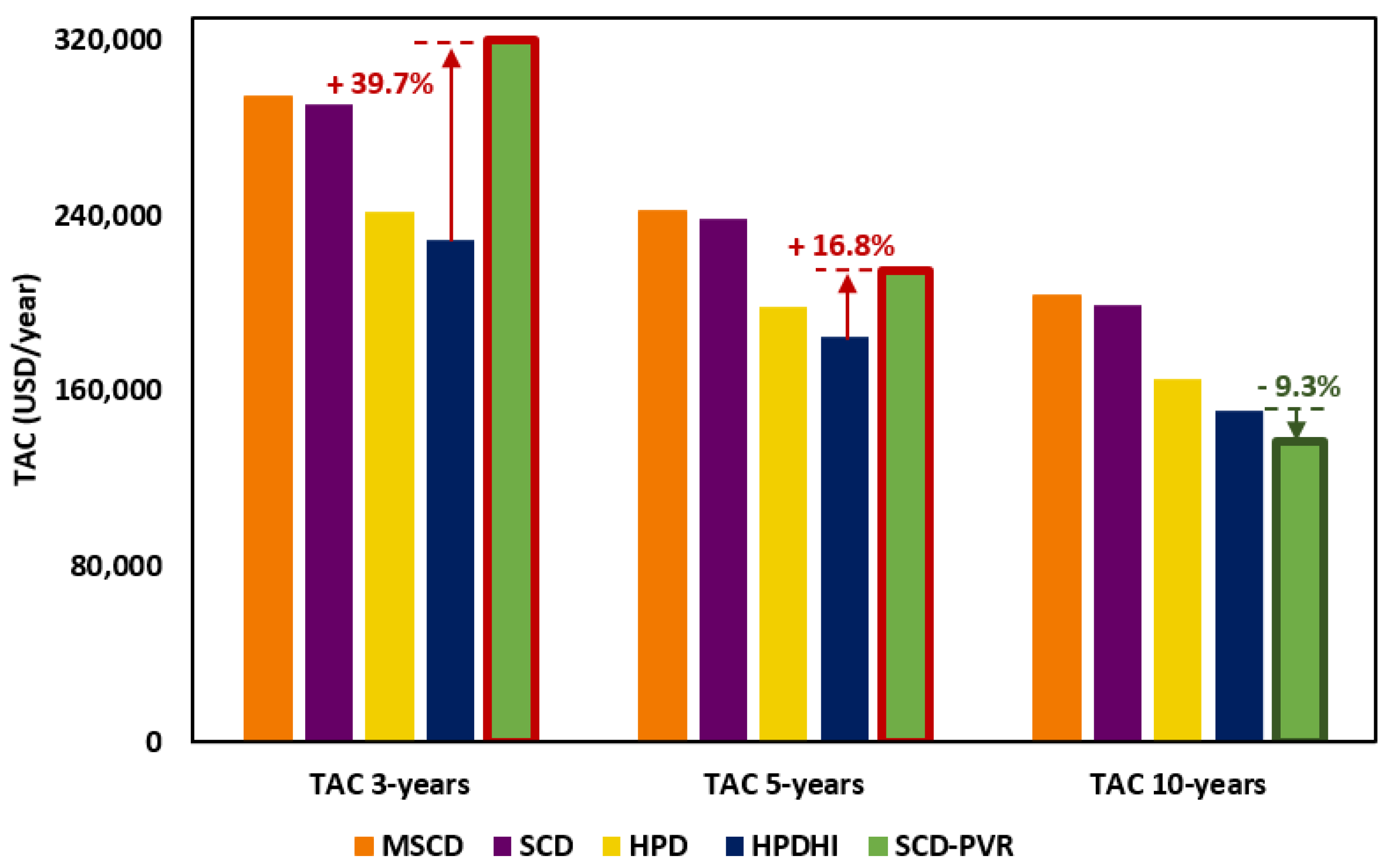
Regarding the TAC criterion, which accounts for both capital expenditure and utility-related operating costs over a defined payback period, evaluations were performed for 3-, 5-, and 10-year scenarios, as shown in Table 4 and Figure 7. Over the 3-year horizon, the partial vapor recompression system exhibits higher TAC values compared with the other single-column distillation alternatives, with increases of 10.1% relative to SCD and 8.7% relative to MSCD, and substantially higher increases of 32.2% and 39.7% compared to HPD and HPDHI, respectively.
However, when the payback period is extended to 5 years, SCD-PVR becomes more economically favorable than the SCD and MSCD alternatives, achieving TAC reductions of 9.7% and 11.2%. Even so, it still underperforms relative to the HPD and HPDHI schemes, exhibiting increases of 8.6% and 16.8% relative to those processes. Finally, for a 10-year payback period, the economic advantage of the retrofit becomes even more pronounced. The SCD-PVR configuration exhibits substantial TAC reductions of about 31.4%, 32.7%, 17.2%, and 9.3% relative to the SCD, MSCD, HPD, and HPDHI schemes, respectively, outperforming all previously reported single-column distillation alternatives.
It is important to emphasize that the partial vapor recompression scheme is economically less attractive than the other configurations when the analysis is restricted to short payback horizons of 3 and 5 years. However, over a 10-year period, its economic performance improves considerably, as shown in Figure 7, emerging as the most economically attractive option for long-term operation, particularly in operating plants expected to run for several decades [38]. This behavior underscores the long-term economic benefit of adopting vapor recompression for the separation of the 1,2-PDO/EG mixture. In particular, the SCD-PVR alternative reaches its breakeven point after approximately 3 years and 10 months when compared with the SCD conventional counterpart [33], and after roughly 7 years and 7 months relative to the HPDHI revamping configuration [34], the most economically favorable single-column configuration reported so far. The key advantage of vapor recompression is its capacity to substitute a portion of the thermal energy traditionally supplied by steam, commonly produced through natural gas combustion, with electrical power used to drive the compressor. Although this approach raises electricity consumption, it significantly lowers dependence on fossil-fuel-derived heat, ultimately reducing total energy demand and enhancing the overall energy efficiency of the process.

5.2. Economic Performance: Sensitive

Utility costs are subject to temporal and regional variability due to historical factors, operational conditions, and strategic considerations [9,10], with electricity prices being particularly sensitive to the local power-generation mix and the dissemination of renewable energy sources. In the base case, fixed unit costs are assumed for cooling water, heating steam, and electricity (Table 2), which directly influence the TAC economic evaluation criteria, as considered previously [33,34]. Since electricity is the primary utility in the vapor recompression strategy, which constitutes the intensified retrofit option for the conventional SCD configuration, it is essential to assess the impact of its price variations on the economic performance. Therefore, a sensitivity analysis is conducted by varying the electricity price to evaluate the robustness and competitiveness of the proposed SCD–PVR configuration relative to previously reported configurations that rely exclusively on thermal utility.
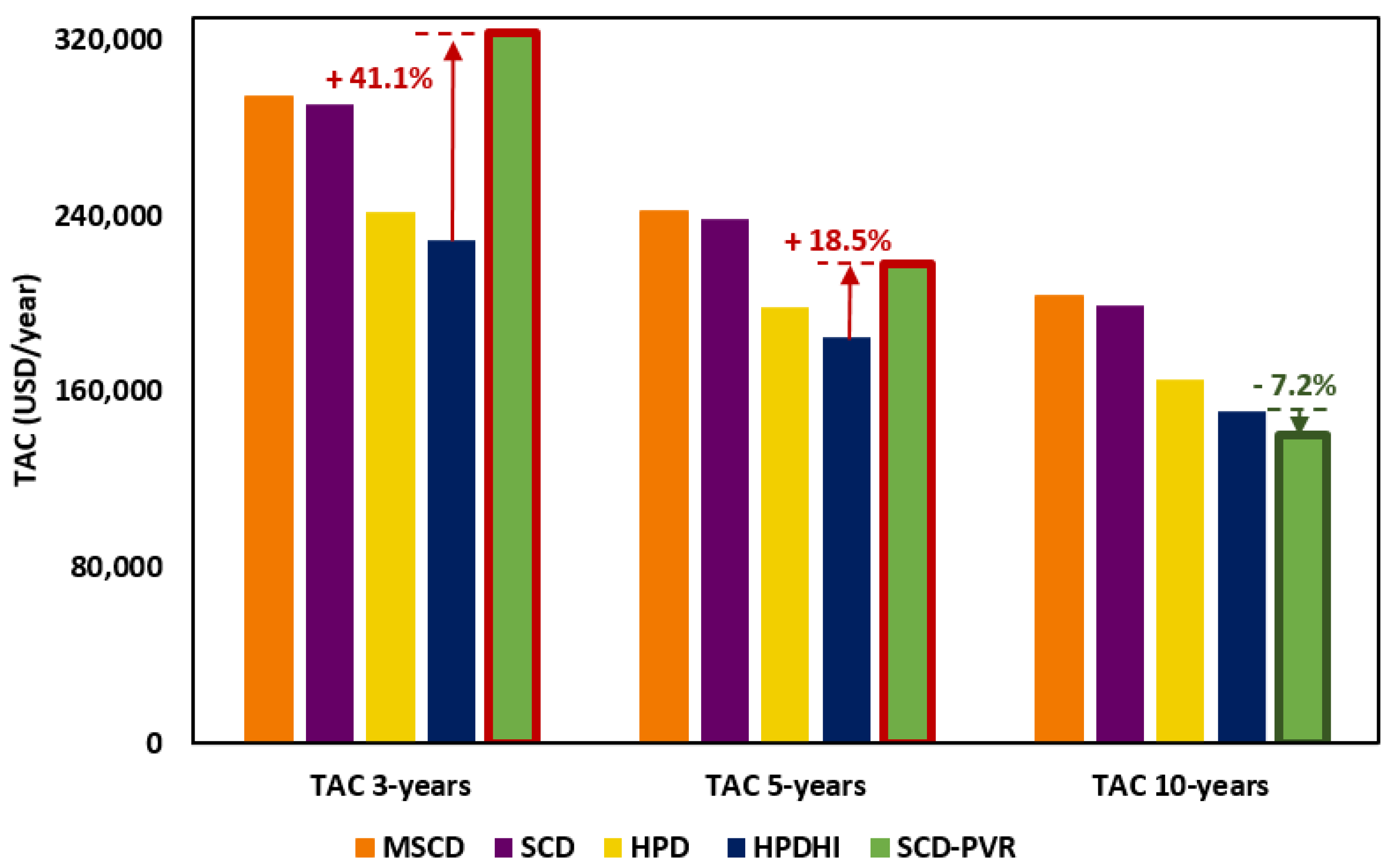
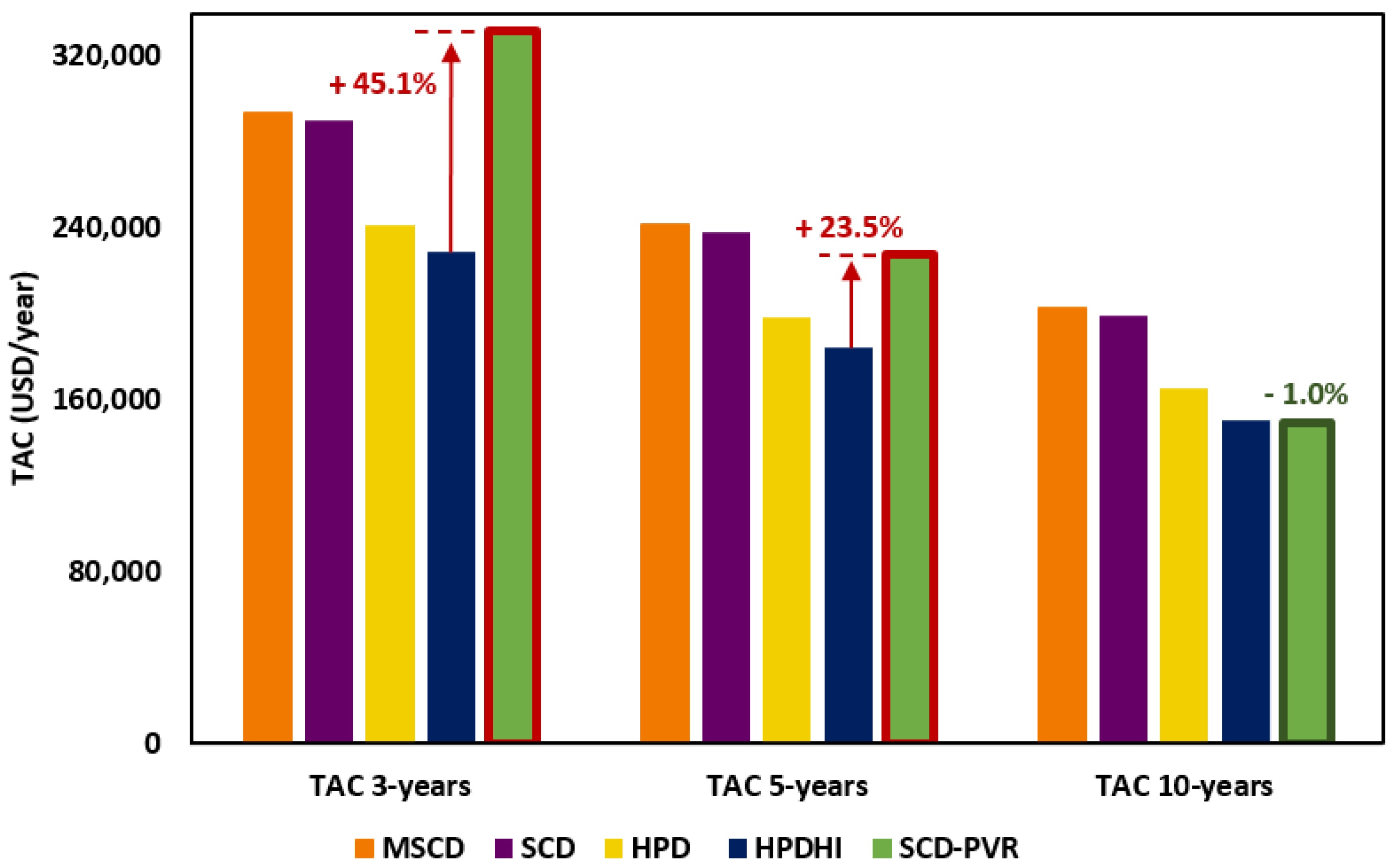
The analysis considers two electricity price levels: 24.03 USD/GJ [52], based on United States EIA electricity data from October 2025, and 18.72 USD/GJ [9,10,41,44], which represents a commonly adopted industrial electricity price. The latter value approximately corresponds to the mean between the base-case electricity price of 16.9 USD/GJ [33,34] and the higher value of 24.03 USD/GJ. Figure 8 and Figure 9 present the TAC values for payback periods of 3, 5, and 10 years, considering electricity prices of 18.72 USD/GJ and 24.03 USD/GJ, corresponding to increases of 10.77% and 42.19% relative to the base-case price, respectively, while all other utility costs are kept constant.
The results presented in Figure 8 and Figure 9 show that increasing electricity prices affect exclusively the proposed intensified SCD–PVR configuration, since this is the only option that employs a compressor and therefore relies directly on electrical energy. The configurations previously reported in the literature are based solely on thermal utilities, and their TAC values remain unchanged under the investigated electricity price scenarios. Despite this conservative penalization applied only to the proposed SCD–PVR configuration, the intensified process remains economically competitive. For an electricity price of 18.72 USD/GJ, the SCD–PVR option achieves a TAC reduction of approximately 7.2% relative to the closest competing configuration for a 10-year payback period. Even at the highest electricity price considered (24.03 USD/GJ), the SCD–PVR configuration still presents a lower TAC, maintaining an economic advantage of 1% under the same payback period. These results confirm that the economic attractiveness of the partial vapor recompression strategy is robust, even when electricity price variability is explicitly accounted for.

5.3. CO2 Emissions Profile Results

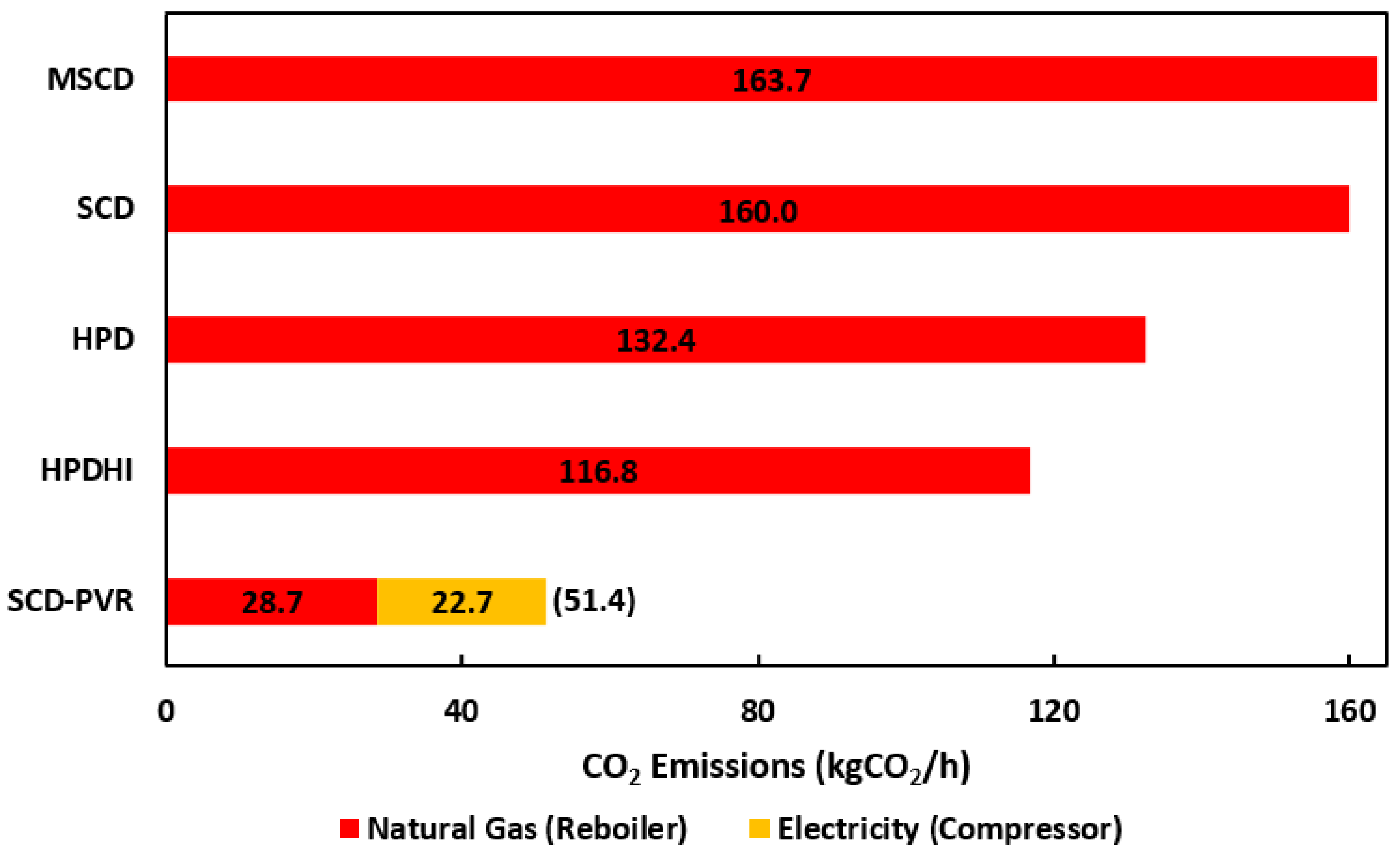
From an environmental standpoint, the CO2 emissions associated with each configuration are shown in Figure 10. The SCD, MSCD, HPD, and HPDHI schemes release 160 kgCO2/h, 163.7 kgCO2/h, 132.4 kgCO2/h, and 116.8 kgCO2/h, respectively, due to natural gas combustion for steam generation. In contrast, the SCD-PVR configuration emits only 51.4 kgCO2/h, considering both the steam required from the boiler and the electricity consumed by the compressor. This corresponds to pollutant reductions of 67.9%, 68.6%, 61.2%, and 56.0% relative to the SCD, MSCD, HPD, and HPDHI counterparts, respectively. These notable decreases arise mainly from the substantial reduction in steam demand, especially high-pressure steam (HPS). Moreover, this supports sustainability objectives by enabling the integration of renewable electricity sources, such as wind, solar, and geothermal energy, into the energy mix, leading old operating plants to new modern and conscious perspectives.
In light of the above discussion, these results indicate that the economic and environmental performance of the configurations is closely related to their energy consumption patterns. All configurations previously reported in the literature rely exclusively on steam, resulting in higher CO2 emissions due to fossil-fuel combustion. In contrast, the SCD–PVR configuration partially replaces heating steam with electricity, which reduces CO2 emissions, even in scenarios where the electricity prices are higher, benefiting the previously steam-related configurations. Consequently, while the reduction in TAC for SCD–PVR is significant mainly for longer payback periods, as expected due to the expensive compressor [2], the environmental benefit of lower CO2 emissions is present across all payback periods, highlighting the trade-off between economic and environmental objectives in industrial brownfield retrofit applications.

5.4. Limitations and Future Work

In the present work, partial vapor recompression is evaluated under the assumption of steam generation from fossil-fuel combustion and compressor operation powered by grid-supplied grey electricity, representing non-renewable energy sources, in line with previous benchmarking studies [33,34]. This choice reflects current industrial practice and allows a consistent, gate-to-gate comparison of distillation configurations based on operational performance. The manuscript does not examine the integration of vapor recompression with renewable or carbon-neutral electricity sources. Such an analysis would require additional assumptions regarding electricity availability (industrial scale) and grid composition, as well as consideration of the inherent intermittency of renewable power. This intermittency represents a major challenge for the continuous operation of electricity-driven compressors, which reinforces the importance of storage technologies [53]. Nevertheless, vapor recompression is inherently well suited to electrification and, therefore, future decarbonization through renewable electricity. The use of renewable power sources would primarily affect the CO2 intensity of electricity consumption, while the relative energy-efficiency advantages of vapor recompression compared to conventional configurations would remain unchanged. The adopted methodology for the preliminary estimation of CO2 emissions provides a consistent, conservative, and meaningful basis for comparing alternative configurations [7,15,20,29,30]. Moreover, a more comprehensive environmental assessment—based on multiple indicators beyond CO2 emissions and grounded in the Life Cycle Assessment (LCA) methodology to capture broader upstream and downstream impacts—would be appropriate at later stages of process design development. Both aspects are therefore considered beyond the scope of the present study, constituting limitations of this work and representing relevant directions for future research.
Looking forward, the increasing availability of low-carbon electricity from renewable sources and the growing emphasis on industrial decarbonization are expected to further stimulate the adoption of vapor recompression and other heat-pump-based strategies for revamping and retrofitting operating industrial facilities. In this context, fully electrified vapor recompression configurations based on flash vapor circulation, as recently proposed in the literature by Cui et al. [54], represent a promising alternative that merits further investigation, as well as the bottom-flashing configuration [18,19]. Future studies should assess the technical, economic, environmental, and operational feasibility of such configurations, particularly with respect to their applicability to retrofit scenarios. In addition, the development and integration of more comprehensive and representative safety metrics would complement the analyses presented in this work and support a more holistic evaluation of advanced electrified distillation systems.

6. Conclusions

This work introduced a new configuration based on partial vapor recompression (SCD-PVR) for the purification of the 1,2-propanediol/ethylene glycol mixture and benchmarked its performance against the previously reported conventional single-column distillation (SCD) design [33] and the modified single-column distillation (MSCD), high-pressure distillation (HPD), and high-pressure distillation with heat integration (HPDHI) schemes [34]. A detailed economic and preliminary environmental analysis was performed, integrating total annualized cost (TAC), which considers capital investment and utility operational costs, over multiple payback horizons (3-, 5-, and 10-years) and CO2 emissions, which had not been previously quantified for these aforementioned schemes.
The results confirm that the proposed intensified configuration substantially lowers energy demand, operating costs, and emissions. Although the required compressor investment prevents SCD-PVR from being economically competitive within the short 3-year payback period, its performance improves notably over longer horizons. For a 5-year period, SCD-PVR achieves lower TAC values than the SCD and MSCD schemes, with reductions of 9.7% and 11.2%. Over a 10-year period, the economic advantage becomes even more pronounced, with TAC decreases of 31.4%, 32.7%, 17.2%, and 9.3% when compared with the SCD, MSCD, HPD, and HPDHI counterparts. Environmentally, the SCD-PVR system consistently outperforms all alternatives, reducing CO2 emissions by 67.9%, 68.6%, 61.2%, and 56.0% respectively, demonstrating clear superiority in sustainability.
Although electricity consumption becomes substantial due to the compressor duty, the integration of renewable energy sources provides a feasible pathway to further strengthen the system’s sustainability. Overall, the SCD-PVR configuration emerges as the most advantageous single-column retrofit option among all the alternatives evaluated, offering both economic and environmental benefits and aligning with the United Nations Sustainable Development Goals.
As an external arrangement, future studies may also explore integrating the vapor recompression strategy with the flash vapor circulation scheme as well as other previously reported intensification technologies for separating the 1,2-propanediol/ethylene glycol mixture, such as thermally coupled and double-effect distillation.
Moreover, the development of more comprehensive and representative environmental metrics based on the Life Cycle Assessment (LCA) methodology represents an important step toward complementing the present preliminary analysis by enabling the evaluation of environmental impacts of purified products across their entire life cycle, from raw material extraction through production, distribution, use, and final disposal. Therefore, it should be considered in future research.

Author Contributions

Conceptualization, D.M.P. and R.M.d.A.C.R.; methodology, D.M.P.; software, R.M.d.A.C.R.; validation, F.R.F. and D.M.P.; formal analysis, R.M.d.A.C.R.; investigation, F.R.F.; data curation, F.R.F.; writing—original draft preparation, R.M.d.A.C.R.; writing—review and editing, D.M.P. and F.R.F.; visualization, R.M.d.A.C.R.; supervision, F.R.F.; project administration, D.M.P. All authors have read and agreed to the published version of the manuscript.

Funding

This research was funded by the Coordination for the Improvement of Higher-Level Personnel (Coordenação de Aperfeiçoa-mento de Pessoal de Nível Superior, CAPES) (0001) and the Brazilian National Council for Scientific and Technological Development (Conselho Nacional de Desenvolvimento Científico e Tecnológico, CNPq) (grant CNPq (No. 18/2024, project 307704/2025-4)).

Data Availability Statement

The original contributions presented in the study are included in the article; further inquiries can be made on request.

Acknowledgments

The authors gratefully acknowledge the Federal Fluminense University for infrastructure and encouragement of this work. We would like to thank Honeywell for providing the UniSim Design Suite R490 simulation software used in this work.

Conflicts of Interest

The authors declare no conflicts of interest.

Abbreviations

The following abbreviations are used in this manuscript:
1,2-PDO1,2 propanediol
CapExCapital equipment expenditure investment
CDECO2 emissions
EGEthylene glycol
HPDHigh-pressure distillation
HPDHIHigh-pressure distillation with pre-feed heat integration
HPSHigh-pressure steam
LPSLow-pressure steam
MPSMedium-pressure steam
NHVNet Heating Value
NRTLNon-Random Two-Liquid
OpExOperational expenditure
MSCDModified single-column distillation
PVRPartial vapor recompression
SCDSingle-column distillation
SCD-PVRSingle-column distillation assisted by partial vapor recompression
SQPSuccessive Quadratic Programming
TACTotal annualized cost
VRVapor recompression

Appendix A

Simulation Data Validation

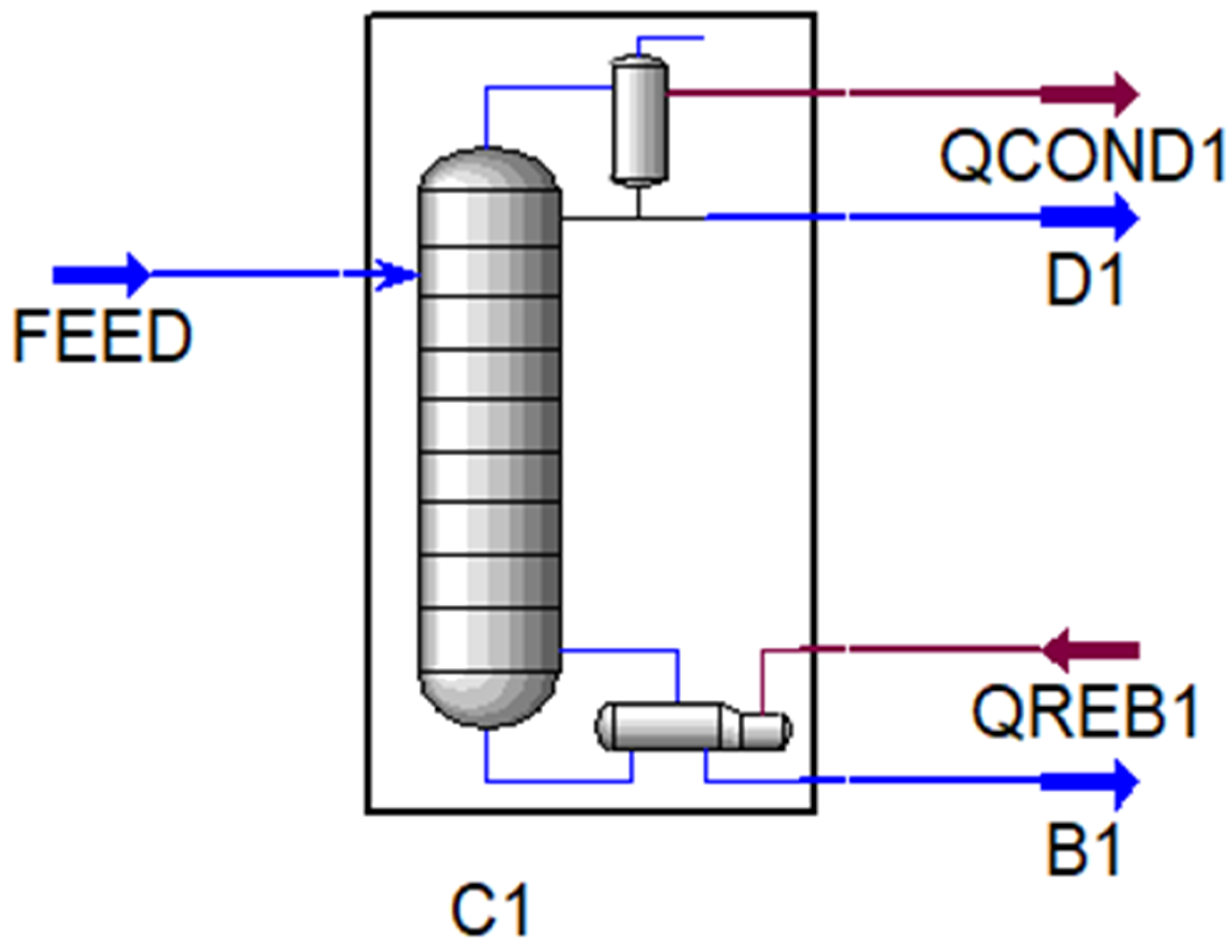
Table A1 summarizes a comparison of the SCD process data reported by Chen et al. [33] and the results obtained from the simulations performed in this study. The table reports the mass streams and their compositions, temperatures, and pressures, along with the calculated relative deviations. This comparison provides a quantitative evaluation of the agreement between the reference data and the simulated results, allowing verification of the adopted tolerance criteria.
Similarly, Table A2 provides a comparison for the energy demand streams.
Table A1. Results for the SCD process simulation: validation of mass streams.
StreamT
(K)
P
(atm)
Molar Flow (kmol/h)Composition
1,2-PDOEG
D1Chen et al. [33]460.8818.720.9990.001
This Work460.7818.720.9990.001
Deviation (%)0.020000
B1Chen et al. [33]493.291.911.280.0010.999
This Work492.551.911.280.0010.999
Deviation (%)0.150000
Table A2. Results for the SCD process simulation: validation of energy streams.
EquipmentEnergy (kW)Deviation (%)
Condenser 1Chen et al. [33]495.1−0.67
This Work491.8
Reboiler 1Chen et al. [33]543.6+0.48
This Work546.2
Furthermore, Figure A1 exhibits a conceptual flowsheet of the SCD process as implemented in the simulation environment.
Figure A1. Single-column distillation (SCD) scheme in the UniSim interface.
Processes 14 00421 g0a1
The evaluation of the data presented in Table A1 and Table A2 indicates that the relative deviations in both mass and energy streams are minimal, consistently remaining below the 5% threshold. This level of agreement satisfies the tolerance criteria defined for validating the conventional SCD simulation [8]. Minor differences can be attributed to the use of different process simulation platforms, as Chen et al. [33] utilized Aspen Plus while the current study employed UniSim Design Suite R490. Additionally, the specification of product stream compositions can lead to adjustments in other process variables, such as the temperatures of the top (D1) and bottom (B1) streams, which in turn influence the energy requirements of the condenser and reboiler.
Therefore, the close alignment between the simulation results and the reference previously published data confirms the validity of the conventional single-column distillation (SCD) model (based on MESH equations) and further demonstrates the robustness and reliability of the NRTL thermodynamic model for the 1,2-PDO/EG separation system, supporting its selection and application in the present study. This validated baseline provides a reliable foundation for the subsequent investigation of the proposed process intensification strategy via vapor recompression.

References

  1. Cui, C.; Qi, M.; Zhang, X.; Sun, J.; Li, Q.; Kiss, A.A.; Wong, D.S.H.; Masuku, C.M.; Lee, M. Electrification of distillation for decarbonization: An overview and perspective. Renew. Sustain. Energy Rev. 2024, 199, 114522. [Google Scholar] [CrossRef] [Scilit]
  2. Kiss, A.A.; Smith, R. Rethinking Energy Use in Distillation Processes for a More Sustainable Chemical Industry. Energy 2020, 203, 117788. [Google Scholar] [CrossRef] [Scilit]
  3. Tang, W.-T.; Chien, C.-K.; Ward, J.D. A Review of Energy Intensification Strategies for Distillation Processes: Cyclic Operation, Stacking, Heat Pumps, Side-Streams, Dividing Walls and Beyond. Sep. Purif. Technol. 2025, 357, 130030. [Google Scholar] [CrossRef] [Scilit]
  4. Kong, Z.Y.; Sánchez-Ramírez, E.; Yang, A.; Shen, W.; Segovia-Hernández, J.G. Process intensification from conventional to advanced distillations: Past, present, and future. Chem. Eng. Res. Des. 2022, 188, 378–392. [Google Scholar] [CrossRef] [Scilit]
  5. Kooijman, H.A.; Sorensen, E. Recent Advances and Future Perspectives on More Sustainable and Energy Efficient Distillation Processes. Chem. Eng. Res. Des. 2022, 188, 473–482. [Google Scholar] [CrossRef] [Scilit]
  6. Jana, A.K. Advances in Heat Pump Assisted Distillation Column: A Review. Energy Convers. Manag. 2014, 77, 287–297. [Google Scholar] [CrossRef] [Scilit]
  7. Mantingh, J.; Kiss, A.A. Enhanced process for energy efficient extraction of 1,3-butadiene from a crude C4 cut. Sep. Purif. Technol. 2021, 267, 118656. [Google Scholar] [CrossRef] [Scilit]
  8. Figueiredo, F.R.; Prata, D.M. Environmental Assessment and Eco-Efficiency Analysis of the Dividing Wall Distillation Column for Separating a Benzene–Toluene–Xylene Mixture. Processes 2025, 13, 391. [Google Scholar] [CrossRef] [Scilit]
  9. Figueiredo, F.R.; Prata, D.M. Eco-efficiency analysis and intensification of the monochlorobenzene separation process through vapor recompression strategy. Chem. Eng. Process. 2025, 207, 110073. [Google Scholar] [CrossRef] [Scilit]
  10. Figueiredo, F.R.; Prata, D.M. Double Vapor Recompression Strategy as a Retrofit Solution for the Conventional Benzene-Toluene-Xylene Distillation. Chem. Eng. Process. Process 2025, 216, 110382. [Google Scholar] [CrossRef] [Scilit]
  11. Segovia-Hernández, J.G.; Hernandez, S.; Sánchez-Ramírez, E.; Mendoza-Pedroza, J. A short review of dividing wall distillation column as an application of process intensification: Geographical development and the pioneering contribution of Prof. Arturo Jimenez in Latin America. Chem. Eng. Process. 2021, 160, 108275. [Google Scholar] [CrossRef] [Scilit]
  12. Premkumar, R.; Rangaiah, G.P. Retrofitting conventional column systems to dividing-Wall Columns. Chem. Eng. Res. Des. 2009, 87, 47–60. [Google Scholar] [CrossRef] [Scilit]
  13. Figueiredo, F.R.; Paiva, A.P.R.; dos Santos, R.O.; Prata, D.M. Eco-efficiency analysis and intensification of the monochlorobenzene separation process through double-effect strategy. Chem. Eng. Process. 2024, 197, 109709. [Google Scholar] [CrossRef] [Scilit]
  14. He, F.; Tang, Y.; Lu, Z.; Hu, Q.; Yang, Y.; Li, G.; Li, H.; Chen, K. An Effective Purification of Double-Effect Distillation for Bio-Based Pentamethylene Diisocyanate. RSC Adv. 2023, 13, 31518–31527. [Google Scholar] [CrossRef] [Scilit]
  15. Junqueira, P.G.; Caxiano, I.N.; Mangili, P.V.; Prata, D.M. Environ-Economic Analysis of Conceptual Intensification Alternatives Applied to the Ethylbenzene Production. Comput. Chem. Eng. 2020, 136, 106783. [Google Scholar] [CrossRef] [Scilit]
  16. Horsch, A.S.; Skiborowski, M. Thermally Coupled Distillation Columns without Vapor Transfer—Current State and Further Needs. Sep. Purif. Technol. 2025, 354, 128762. [Google Scholar] [CrossRef] [Scilit]
  17. Yang, A.; Su, Y.; Chien, I.-L.; Jin, S.; Yan, C.; Wei, S.; Shen, W. Investigation of an Energy-Saving Double-Thermally Coupled Extractive Distillation for Separating Ternary System Benzene/Toluene/Cyclohexane. Energy 2019, 186, 115756. [Google Scholar] [CrossRef] [Scilit]
  18. Fan, S.; Feng, Z.; Lu, R.; Lv, L.; Dong, L. Enhanced Extractive Distillation Processes for Separating N-Hexane and 1,2-Dichloroethane via Bottom Flash Heat Pump. Chem. Eng. Process. Process 2022, 179, 109069. [Google Scholar] [CrossRef] [Scilit]
  19. You, X.; Rodriguez-Donis, I.; Gerbaud, V. Reducing process cost and CO2 emissions for extractive distillation by double-effect heat integration and mechanical heat pump. Appl. Energy 2016, 166, 128–140. [Google Scholar] [CrossRef] [Scilit]
  20. Tian, X.; Wang, R.; Wang, H.; Li, C.; Liu, J. Energy-Saving Extractive Distillation Processes Design and Optimization for the Separation of Ethyl Acetate and n-Heptane Azeotrope. Fuel 2025, 379, 132974. [Google Scholar] [CrossRef] [Scilit]
  21. Hou, W.; Zhang, Q.; Zeng, A. Separation of N-Heptane/Isobutanol via Eco-Efficient Vapor Recompression-Assisted Distillation: Process Optimization and Control Strategy. Front. Chem. Sci. Eng. 2021, 15, 1169–1184. [Google Scholar] [CrossRef] [Scilit]
  22. Zhang, Q.; Liu, M.; Zeng, A. Performance Enhancement of Pressure-Swing Distillation Process by the Combined Use of Vapor Recompression and Thermal Integration. Comput. Chem. Eng. 2019, 120, 30–45. [Google Scholar] [CrossRef] [Scilit]
  23. Zhang, Z.; Wang, Y.; Zhang, M.; Guang, C.; Li, M.; Gao, J. Energy-Saving Investigation of Pressure-Swing Distillation Strengthening Configurations for Benzene/Isobutanol Binary Azeotrope. Sep. Purif. Technol. 2022, 296, 121381. [Google Scholar] [CrossRef] [Scilit]
  24. Feng, Z.; Shen, W.; Rangaiah, G.P.; Dong, L. Design and Control of Vapor Recompression Assisted Extractive Distillation for Separating N-Hexane and Ethyl Acetate. Sep. Purif. Technol. 2020, 240, 116655. [Google Scholar] [CrossRef] [Scilit]
  25. Devaraja, D.; Kiss, A.A. Novel Intensified Process for Ethanolamines Production Using Reactive Distillation and Dividing-Wall Column Technologies. Chem. Eng. Process. Process 2022, 179, 109073. [Google Scholar] [CrossRef] [Scilit]
  26. Yang, A.; Jin, S.; Shen, W.; Cui, P.; Chien, I.-L.; Ren, J. Investigation of Energy-Saving Azeotropic Dividing Wall Column to Achieve Cleaner Production via Heat Exchanger Network and Heat Pump Technique. J. Clean. Prod. 2019, 234, 410–422. [Google Scholar] [CrossRef] [Scilit]
  27. Gopichand, S.; Devotta, S.; Omideyi, T.O.; Holland, F.A. Heat Pump Assisted Distillation. X: Potential for Industrial Applications. Int. J. Energy Res. 1988, 12, 569–582. [Google Scholar] [CrossRef] [Scilit]
  28. Rangaiah, G.P. Chemical Process Retrofitting and Revamping: Techniques and Applications, 1st ed.; John Wiley & Sons: London, UK, 2016; pp. 1–432. [Google Scholar]
  29. Gao, X.-X.; Cheng, Q.-R.; Yang, Y.; Lu, K.; Chen, M.-Y. Novel Heat Pump and Heat Integration Assisted Pressure Swing Distillation for Separating Methyl Cyclohexane and N-Butyl Alcohol to Save Energy and Reduce CO2 Emissions. Energy Source Part Recovery Util. Environ. Eff. 2022, 44, 9633–9648. [Google Scholar] [CrossRef] [Scilit]
  30. Shi, P.; Zhang, Q.; Zeng, A.; Ma, Y.; Yuan, X. Eco-Efficient Vapor Recompression-Assisted Pressure-Swing Distillation Process for the Separation of a Maximum-Boiling Azeotrope. Energy 2020, 196, 117095. [Google Scholar] [CrossRef] [Scilit]
  31. Zhang, Q.; Chen, Y.; Yue, C.; Yin, T.; Xiang, W. Process Intensification and Dynamic Control of a Vapor-Recompression-Assisted Heterogeneous Azeotropic Distillation for Separating N-Butanol/Water. Chem. Eng. Process. 2024, 202, 109865. [Google Scholar] [CrossRef] [Scilit]
  32. Xu, Y.; Li, J.; Ye, Q.; Li, Y. Design and Optimization for the Separation of Tetrahydrofuran/Isopropanol/Water Using Heat Pump Assisted Heat-Integrated Extractive Distillation. Sep. Purif. Technol. 2021, 277, 119498. [Google Scholar] [CrossRef] [Scilit]
  33. Chen, Y.-C.; Hung, S.-K.; Lee, H.-Y.; Chien, I.-L. Energy-Saving Designs for Separation of a Close-Boiling 1,2-Propanediol and Ethylene Glycol Mixture. Ind. Eng. Chem. Res. 2015, 54, 3828–3843. [Google Scholar] [CrossRef] [Scilit]
  34. Duan, C.; Li, C.; Li, H. Separation of a Close-Boiling 1,2-Propanediol and Ethylene Glycol Mixture Using Pressure-Related Distillation. Ind. Eng. Chem. Res. 2020, 59, 3173–3181. [Google Scholar] [CrossRef] [Scilit]
  35. Li, X.; Wang, R.; Na, J.; Li, H.; Gao, X. Reversible Reaction-Assisted Intensification Process for Separating the Azeotropic Mixture of Ethanediol and 1,2-Butanediol: Reactants Screening. Ind. Eng. Chem. Res. 2018, 57, 710–717. [Google Scholar] [CrossRef] [Scilit]
  36. Zhong, Y.; Wu, Y.; Zhu, J.; Chen, K.; Wu, B.; Ji, L. Thermodynamics in Separation for the Ternary System 1,2-Ethanediol + 1,2-Propanediol + 2,3-Butanediol. Ind. Eng. Chem. Res. 2014, 53, 12143–12148. [Google Scholar] [CrossRef] [Scilit]
  37. Douglas, J.M. Conceptual Design of Chemical Processes; McGraw-Hill: New York, NY, USA, 1988; pp. 1–601. [Google Scholar]
  38. Prata, D.M.; Lima, E.L.; Pinto, J.C. Simultaneous Data Reconciliation and Parameter Estimation in Bulk Polypropylene Polymerizations in Real Time. Macromol. Symp. 2006, 243, 91–103. [Google Scholar] [CrossRef] [Scilit]
  39. Seider, W.D.; Lewin, D.R.; Seader, J.D.; Widagdo, S.; Gani, R.; Ng, K.M. Product and Process Design Principles: Synthesis, Analysis and Evaluation, 4th ed.; John Wiley & Sons: West Sussex, UK, 2016; pp. 1–784. [Google Scholar]
  40. Luyben, W.L. Comparison of extractive distillation and pressure-swing distillation for acetone/chloroform separation. Comput. Chem. Eng. 2013, 50, 1–7. [Google Scholar] [CrossRef] [Scilit]
  41. Turton, R.; Bailie, R.C.; Whiting, W.B.; Shaeiwitz, J.A. Analysis Synthesis and Design of Chemical Processes, 5th ed.; Prentice Hall: Upper Saddle River, NJ, USA, 2018; pp. 1–1520. [Google Scholar]
  42. Gadalla, M.A.; Olujic, Z.; Jansens, P.J.; Jobson, M.; Smith, R. Reducing CO2 Emissions and Energy Consumption of Heat-Integrated Distillation Systems. Environ. Sci. Technol. 2005, 39, 6860–6870. [Google Scholar] [CrossRef] [Scilit]
  43. Gutiérrez-Guerra, R.; Segovia-Hernández, J.G.; Hernández, S. Reducing Energy Consumption and CO2 Emissions in Extractive Distillation. Chem. Eng. Res. Des. 2009, 87, 145–152. [Google Scholar] [CrossRef] [Scilit]
  44. de Miranda, T.d.C.R.D.; Figueiredo, F.R.; de Souza, T.A.; Ahon, V.R.R.; Prata, D.M. Eco-efficiency analysis and intensification of cryogenic extractive distillation process for separating CO2-C2H6 azeotrope through vapor recompression strategy. Chem. Eng. Process. 2024, 196, 109636. [Google Scholar] [CrossRef] [Scilit]
  45. Couper, J.R.; Penney, W.R.; Fair, J.R.; Walas, S.M. Chemical Process Equipment: Selection and Design, 3rd ed.; Butterworth-Heinemann: Oxford, UK, 2012; pp. 1–864. [Google Scholar]
  46. Fábrega, F.M.; Rossi, J.S.; d’Angelo, J.V.H. Exergetic analysis of the refrigeration system in ethylene and propylene production process. Energy 2010, 35, 1224–1231. [Google Scholar] [CrossRef] [Scilit]
  47. Jensen, J.K.; Markussen, W.B.; Reinholdt, L.; Elmegaard, B. On the Development of High Temperature Ammonia–Water Hybrid Absorption–Compression Heat Pumps. Int. J. Refrig. 2015, 58, 79–89. [Google Scholar] [CrossRef] [Scilit]
  48. Pleşu, V.; Bonet Ruiz, A.E.; Bonet, J.; Llorens, J. Simple Equation for Suitability of Heat Pump Use in Distillation. Comput. Aided Chem. Eng. 2014, 33, 1327–1332. [Google Scholar] [CrossRef] [Scilit]
  49. Cui, C.; Sun, J. Rigorous design and simultaneous optimization of extractive distillation systems considering the effect of column pressures. Chem. Eng. Process. Process 2019, 139, 68–77. [Google Scholar] [CrossRef] [Scilit]
  50. Prata, D.M.; Pinto, J.C.; Lima, E.L. Comparative Analysis of Robust Estimators on Nonlinear Dynamic Data Reconciliation. Comput. Aided Chem. Eng. 2008, 25, 501–506. [Google Scholar] [CrossRef] [Scilit]
  51. S Santos, L.d.S.; de Souza, K.M.F.; Bandeira, M.R.; Ruiz Ahón, V.R.; Peixoto, F.C.; Prata, D.M. Dynamic Optimization of a Continuous Gas Lift Process Using a Mesh Refining Sequential Method. J. Pet. Sci. Eng. 2018, 165, 161–170. [Google Scholar] [CrossRef] [Scilit]
  52. Electric Power Monthly. Available online: https://www.eia.gov/electricity/monthly/epm_table_grapher.php?t=epmt_5_6_a (accessed on 4 January 2026).
  53. Molina, R.A.; Barros, J.J.C.; López, M.P.C.; Coira, M.L.; Gochi, A.C. A comparative sustainability assessment of several grid energy storage technologies. Appl. Energy 2025, 396, 126248. [Google Scholar] [CrossRef] [Scilit]
  54. Cui, C.; Zhang, X.; Qi, M.; Lyu, H.; Sun, J.; Kiss, A.A. Fully electrified heat pump assisted distillation process by flash vapour circulation. Chem. Eng. Res. Des. 2024, 206, 280–284. [Google Scholar] [CrossRef] [Scilit]
Figure 1. Methodology flowchart [33,34].
Processes 14 00421 g001
Figure 2. Conventional single-column distillation (SCD) design at 101.3 kPa.
Processes 14 00421 g002
Figure 3. Modified single-column distillation (MSCD) design at 101.3 kPa [34].
Processes 14 00421 g003
Figure 4. Optimal high-pressure distillation (HPD) design at 276 kPa [34].
Processes 14 00421 g004
Figure 5. Optimal high-pressure heat-integration distillation (HPDHI) design at 282 kPa [34].
Processes 14 00421 g005
Figure 6. Optimal single-column partial vapor recompression distillation (SCD-PVR) design.
Processes 14 00421 g006
Figure 7. Economic evaluation of each configuration over different payback periods.
Processes 14 00421 g007
Figure 8. Economic evaluation of each configuration over different payback periods (18.72 USD/GJ).
Processes 14 00421 g008
Figure 9. Economic evaluation of each configuration over different payback periods (24.03 USD/GJ).
Processes 14 00421 g009
Figure 10. CO2 emission profile for each configuration.
Processes 14 00421 g010
Table 1. Equipment sizing correlations for CapEx calculations.
EquipmentEquations and ParametersRefs.
Column Shell Cost= 17640 (D)1.066 (L)0.802[33,34,37,40]
  D: Diameter (m), L: Height (m)
Column Height= 1.2 × 0.6096 × (NT − 2)[33,34,37,40]
  NT: Total number of theoretical stages
Heat Exchanger Cost= 7926 (A)0.65[33,34,37,40]
  Heat-transfer area (m2): A = Q/(U × ΔT)
  Q: Duty (kW), ΔT: differential temperature (K),
  U: Heat-transfer coefficient (kW/K·m2)
  UCond = 0.852 kW/K·m2
  ΔTCond = reflux-drum temperature − 315 K (ΔTCond > 11 K)
  UReb = 0.568 kW/K·m2
  ΔTReb = steam temperature – base temperature (ΔTReb > 12 K)
  UHF = 0.852 kW/K·m2 liquid-to-liquid (feed preheater)
  ΔTHF = LMTD of inlet and outlet temperature differences
  UAHE = 0.568 kW/K·m2
  ΔTAHE = LMTD of inlet and outlet temperature differences
  HF and AHE minimum temperature approach ΔTmin ≥ 10 K[33,34,37,40]
Compressor Cost
(Centrifugal)
= (M&S/280) × 517.5 × Pcomp0.82 × (2.11 + 1); Pcomp < 10,000 bhp[34,37]
  Pcomp: Compressor power (bhp, adjusted by its efficiency)
  Pcomp < 543.52 bhp (405.3 kPa) (optimization upper limit)
  Tcomp < 523.1 K (optimization upper limit)
M&S IndexM&S (Marshall and Swift index) = 1625.9[34]
Operating Period8000 h/year[33,34]
Table 2. Utility costs for estimating OpEx.
UtilitiesCostReference
HPS (41 barg, 527.2 K)USD 9.88/GJ[33,34,40,41]
MPS (10 barg, 457.2 K)USD 8.22/GJ[33,34,40,41]
LPS (5 barg, 433.2 K)USD 7.78/GJ[33,34,41]
Cooling waterUSD 0.354/GJ[33,34,41]
ElectricityUSD 16.9/GJ[33,34]
Table 3. CO2 emissions calculation parameters.
ParameterValueReference
NHV (kJ/kg) of natural gas fuel51,600[15,42]
C% (kg of carbon/kg)75.4%[15,42]
α3.67[19,42]
λproc (HPS 527.2 K) (kJ/kg)1698.1[15,19]
hproc (HPS 527.2 K) (kJ/kg)2799.4[15,19]
hbfw (373 K) (kJ/kg)419[19,42]
TFTB (K)2073[19,42]
Tstack (K)433[19,42]
T0 (K)298[19,42]
β (kgCO2/kWh) United States 2023–2024 (average)0.3734[10]
Table 4. Economic results.
ParameterSCDMSCDHPDHPDHISCD-PVR
Installed capital cost (kUSD)Column307.810306.780203.321192.484307.810
Reboiler63.33764.287111.146107.77520.724
Condenser17.84718.28713.17713.1916.511
Feed preheater00020.5500
Heat exchanger0000102.989
Compressor0000344.836
Total CapEx (kUSD) 388.994389.354327.644334.000782.870
Energy cost (kUSD/year)Steam (HPS)155.429159.031128.585113.47627.867
Cooling Water5.0145.2063.8823.9061.063
Electricity000029.569
Total OpEx (kUSD/year) 160.443164.237132.467117.38258.499
TAC (kUSD/y) 3 years 290.107294.022241.682228.715319.455
Savings (%)(−10.1%)(−8.7%)(−32.2%)(−39.7%)
TAC (kUSD/y) 5 years 238.242242.108197.996184.182215.073
Savings (%)(+9.7%)(+11.2%)(−8.6%)(−16.8%)
TAC (kUSD/y) 10 years 199.342203.173165.232184.182136.786
Savings (%)(+31.4%)(+32.7%)(+17.2%)(+9.3%)
Disclaimer/Publisher’s Note: The statements, opinions and data contained in all publications are solely those of the individual author(s) and contributor(s) and not of MDPI and/or the editor(s). MDPI and/or the editor(s) disclaim responsibility for any injury to people or property resulting from any ideas, methods, instructions or products referred to in the content.