Article

A Material–Structure Integrated Approach for Soft Rock Roadway Support: From Microscopic Modification to Macroscopic Stability


1
School of Energy and Mining Engineering, Xi’an University of Science and Technology, Xi’an 710054, China
2
Key Laboratory of Western Mine Exploitation and Hazard Prevention, Ministry of Education, Xi’an 710054, China
3
School of Energy and Mining Engineering, China University of Mining and Technology-Beijing, Beijing 100083, China
4
School of Energy and Mining Engineering, China University of Mining and Technology, Xuzhou 221116, China
*
Author to whom correspondence should be addressed.
Processes 2026, 14(3), 414; https://doi.org/10.3390/pr14030414
Submission received: 20 December 2025 / Revised: 16 January 2026 / Accepted: 19 January 2026 / Published: 24 January 2026
(This article belongs to the Section Petroleum and Low-Carbon Energy Process Engineering)

Abstract

As a cornerstone of China’s energy infrastructure, the coal mining industry relies heavily on the stability of its underground roadways, where the support of soft rock formations presents a critical and persistent technological challenge. This challenge arises primarily from the high content of expansive clay minerals and well-developed micro-fractures within soft rock, which collectively undermine the effectiveness of conventional support methods. To address the soft rock control problem in China’s Longdong Mining Area, an integrated material–structure control approach is developed and validated in this study. Based on the engineering context of the 3205 material gateway in Xin’an Coal Mine, the research employs a combined methodology of micro-mesoscopic characterization (SEM, XRD), theoretical analysis, and field testing. The results identify the intrinsic instability mechanism, which stems from micron-scale fractures (0.89–20.41 μm) and a high clay mineral content (kaolinite and illite totaling 58.1%) that promote water infiltration, swelling, and strength degradation. In response, a novel synergistic technology was developed, featuring a high-performance grouting material modified with redispersible latex powder and a tiered thick anchoring system. This technology achieves microscale fracture sealing and self-stress cementation while constructing a continuous macroscopic load-bearing structure. Field verification confirms its superior performance: roof subsidence and rib convergence in the test section were reduced to approximately 10 mm and 52 mm, respectively, with grouting effectively sealing fractures to depths of 1.71–3.92 m, as validated by multi-parameter monitoring. By integrating microscale material modification with macroscale structural optimization, this study provides a systematic and replicable solution for enhancing the stability of soft rock roadways under demanding geo-environmental conditions. Soft rock roadways, due to their characteristics of being rich in expansive clay minerals and having well-developed microfractures, make traditional support difficult to ensure roadway stability, so there is an urgent need to develop new active control technologies. This paper takes the 3205 Material Drift in Xin’an Coal Mine as the engineering background and adopts an integrated method combining micro-mesoscopic experiments, theoretical analysis, and field tests. The soft rock instability mechanism is revealed through micro-mesoscopic experiments; a high-performance grouting material added with redispersible latex powder is developed, and a “material–structure” synergistic tiered thick anchoring reinforced load-bearing technology is proposed; the technical effectiveness is verified through roadway surface displacement monitoring, anchor cable axial force monitoring, and borehole televiewer. The study found that micron-scale fractures of 0.89–20.41 μm develop inside the soft rock, and the total content of kaolinite and illite reaches 58.1%, which is the intrinsic root cause of macroscopic instability. In the test area of the new support scheme, the roof subsidence is about 10 mm and the rib convergence is about 52 mm, which are significantly reduced compared with traditional support; grouting effectively seals rock mass fractures in the range of 1.71–3.92 m. This synergistic control technology achieves systematic control from micro-mesoscopic improvement to macroscopic stability by actively modifying the surrounding rock and optimizing the support structure, significantly improving the stability of soft rock roadways.

1. Introduction

In China’s energy security landscape, the coal mining industry remains a fundamental pillar [1,2], within which reliable soft rock roadway support technology is critically essential to ensure safe, efficient, and sustainable mining operations. Longdong Mining Area, an important coal base in China, is characterized by the widespread presence of soft rock, along with its tendency to undergo significant mechanical degradation under engineering disturbance, which poses a persistent challenge to achieving stable surrounding rock control in roadways [3,4,5]. In particular, increasing mining depth elevates in-situ stress and pore water pressure [6,7,8,9], which further activates the rheological and softening behavior of soft rock, shifting the failure mode from the conventional strength loss to an uncontrollable continuous large deformation [10]. This evolution necessitates more advanced and adaptive support strategies capable of addressing both material deterioration and structural instability in such challenging geotechnical environments.
Current research on coal-bearing soft rocks has predominantly focused on the analysis of their macroscopic mechanical behavior [11,12]. Seminal work by scholars such as He et al. [13] has laid a theoretical foundation for understanding rock mechanics in deep engineering contexts, revealing the complex mechanical behavior and deformation challenges of soft rock under high-stress environments. Further studies by Ma et al. [14], and others have provided detailed case-specific analyses of large deformation mechanisms and corresponding control strategies for deep soft rock roadways [15,16]. While these contributions provide a valuable theoretical basis for support design [17], a critical research gap remains in explicitly correlating microscopic failure mechanisms with macroscopic behavioral patterns [18,19]. Specifically, the quantitative relationship between the hydration of expansive clay minerals and the subsequent softening and strength reduction of the rock mass is yet to be fully elucidated.
In parallel, numerous support schemes have been proposed to address these engineering challenges [20]. Kang et al., for instance, have systematically reviewed various support technologies tailored for deep and complex roadways [21,22,23]. Innovations such as the theory of constant-resistance and large-deformation anchor bolts proposed by Zhao et al. [24,25], and the coupled support concept, aim to better coordinate deformation between the support system and the surrounding rock. A significant advancement was put forth by He Manchao in the form of the Excavation Compensation Method (ECM). This approach addresses the limitations of traditional methods like Protodyakonov’s Method (MTM) and the New Austrian Tunneling Method (NATM) in controlling large deformations in deep tunnels by actively compensating for stress loss induced by excavation, thereby transforming a large-deformation system into a more manageable small-deformation one [26]. Although technologies such as high-pre-stressed support can mitigate deformation to some extent [27], many existing solutions are hampered by complex construction procedures, high costs, and low efficiency, thus failing to meet the demands of modern, intelligent tunneling operations for speed, economy, and efficiency [28,29,30]. More fundamentally, many traditional support methods remain passive in nature. They often fail to fundamentally enhance the intrinsic mechanical properties of the soft rock itself [31,32,33] and lack effective countermeasures against critical issues such as the water sensitivity of clay minerals and the propagation of micro-fractures, ultimately compromising the long-term stability of roadways [34].
To address these multifaceted challenges—namely, the limitations of traditional support, the disconnect between macro and micro mechanics, and the inefficiency in modern mining production—this study initiates from a detailed investigation of the microstructure and composition of soft rock. We propose a novel collaborative control methodology that integrates active modification of the surrounding rock with a tiered anchoring system. The efficacy of this approach is validated through a field application at Xin’an Coal Mine. The significant outcomes obtained demonstrate the potential of this integrated strategy to provide a systematic and effective solution for enhancing the stability and safety of soft rock roadways.

2. Microscopic Mechanisms of Soft Rock Instability

2.1. Microstructural Characterization via SEM

Scanning Electron Microscopy (SEM) (Hitachi Ltd., Marunouchi, Japan) is a pivotal technique for high-resolution imaging of rock microstructures, enabling precise observation of microtopography and internal features in soft rock under coupled stress and moisture conditions [35,36,37,38]. In this study, SEM analyses were conducted on mudstone samples retrieved from the roof of the 3205 Material Gateway at the 1500 m location in Xin’an Coal Mine (Table 1), with the aim of characterizing the morphology and distribution of pores and fractures at the microscale.
As illustrated in Figure 1, SEM images at increasing magnifications reveal a progressively detailed view of the sample’s microstructure. At 100× magnification (Figure 1a), the surface appears rough with adhered fine fragments. At 500× (Figure 1b), well-developed fractures with widths ranging approximately from 5.13 μm to 9.39 μm become clearly visible. Under 1000× magnification (Figure 1c), an interconnected fracture network is observed, with crack widths varying between approximately 0.89 μm and 5.47 μm, accompanied by noticeable surface irregularity. Further examination at 2000× (Figure 1d) confirms extensively developed microfractures, with a maximum aperture reaching about 20.41 μm, indicating weak cementation and poor surface integrity.
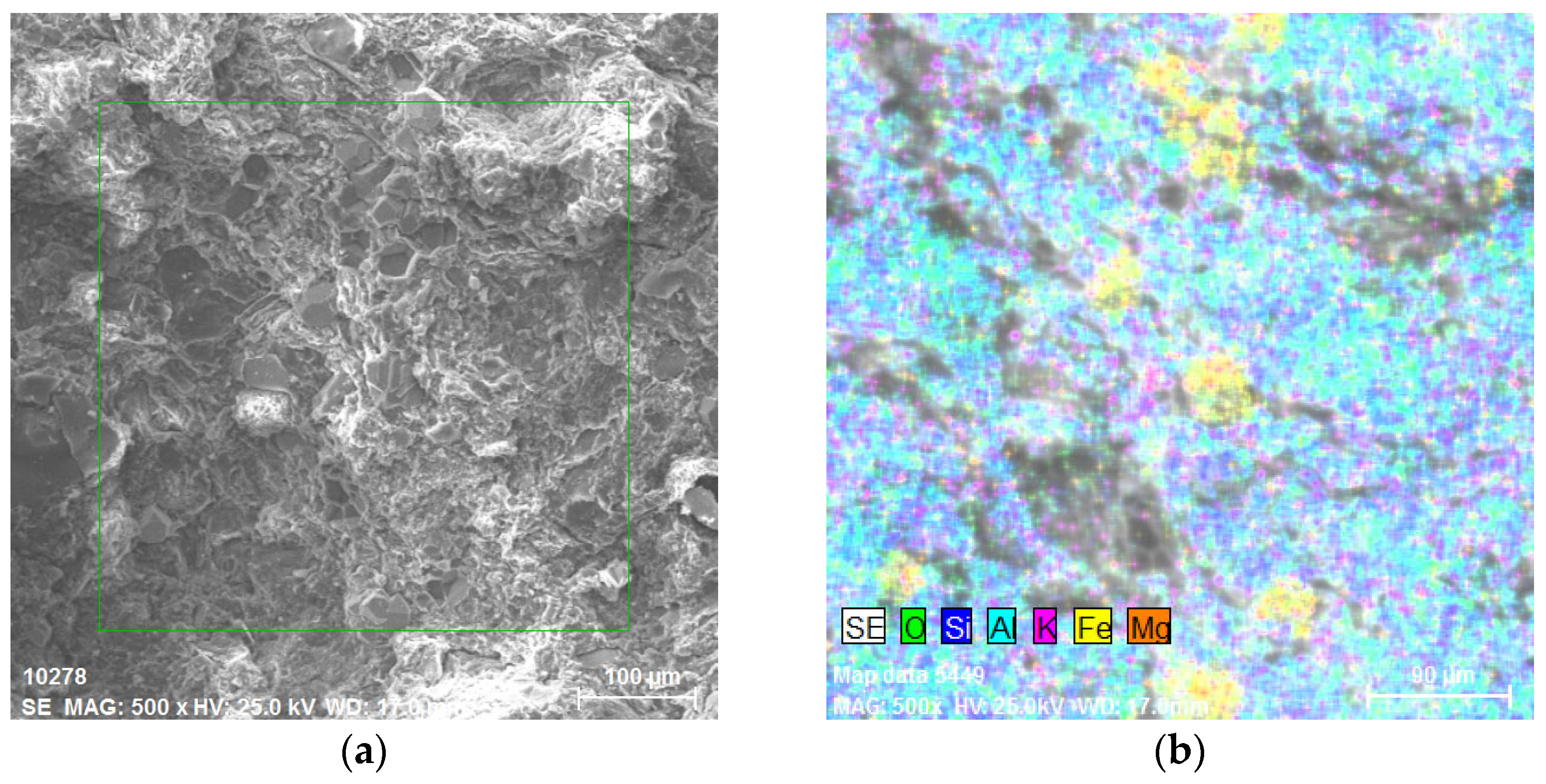
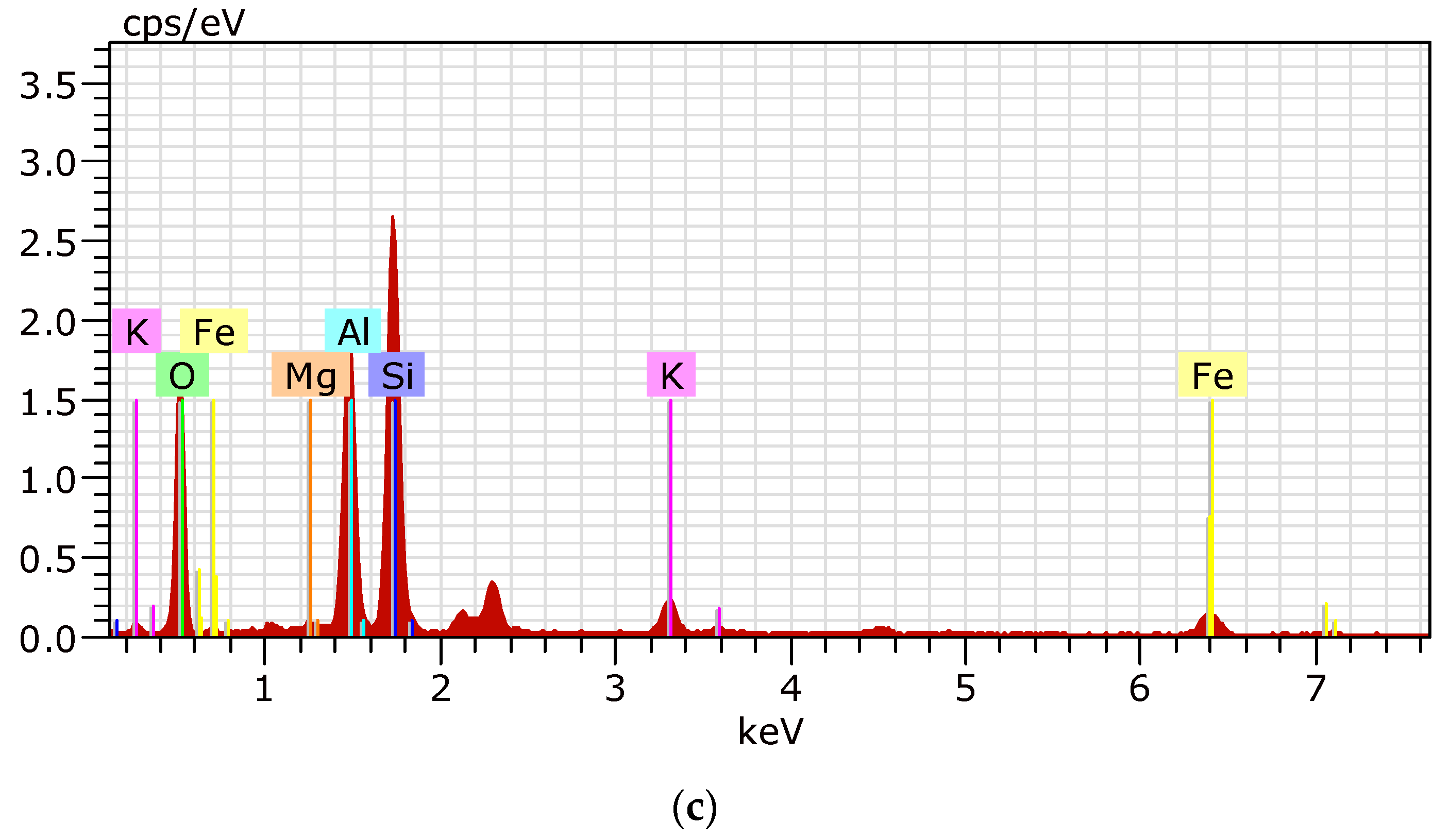
Energy Dispersive Spectroscopy (EDS) was performed on a representative region at 500× magnification to identify elemental composition and distribution. As shown in Figure 2, the dominant elements detected include oxygen, silicon, aluminum, potassium, and iron. These elements are characteristic of quartz and kaolinite, corroborating that the sample is primarily composed of these minerals.
The SEM observations collectively demonstrate that the roof mudstone exhibits significant spatial heterogeneity in fracture development, with widths spanning from 0.89 μm to 20.41 μm, predominantly concentrated between 5.13 μm and 9.39 μm. A multi-scale network of pores and fractures pervades the rock matrix, with flaky or loosely aggregated clay minerals lining the fracture surfaces. This open microstructure not only facilitates water ingress and mineral swelling but also promotes softening and disintegration upon saturation. Consequently, the rock mass exhibits low intrinsic strength alongside low permeability, which collectively hinder the penetration and consolidation efficacy of conventional cement-based grouts within such fine-scale fracture systems.

2.2. Mineral Composition and Swelling Potential via XRD

X-ray Diffraction (XRD) is a well-established analytical method for identifying mineral phases and quantifying their relative abundance in rock specimens [39,40]. This section applies XRD analysis to soft rock samples obtained from Xin’an Coal Mine to determine their mineralogical composition, with particular emphasis on clay minerals known to influence swelling behavior and hydro-mechanical stability. The resulting diffraction patterns enable identification of primary minerals based on characteristic peak positions, while semi-quantitative evaluation provides insight into the proportional distribution of key mineral constituents.
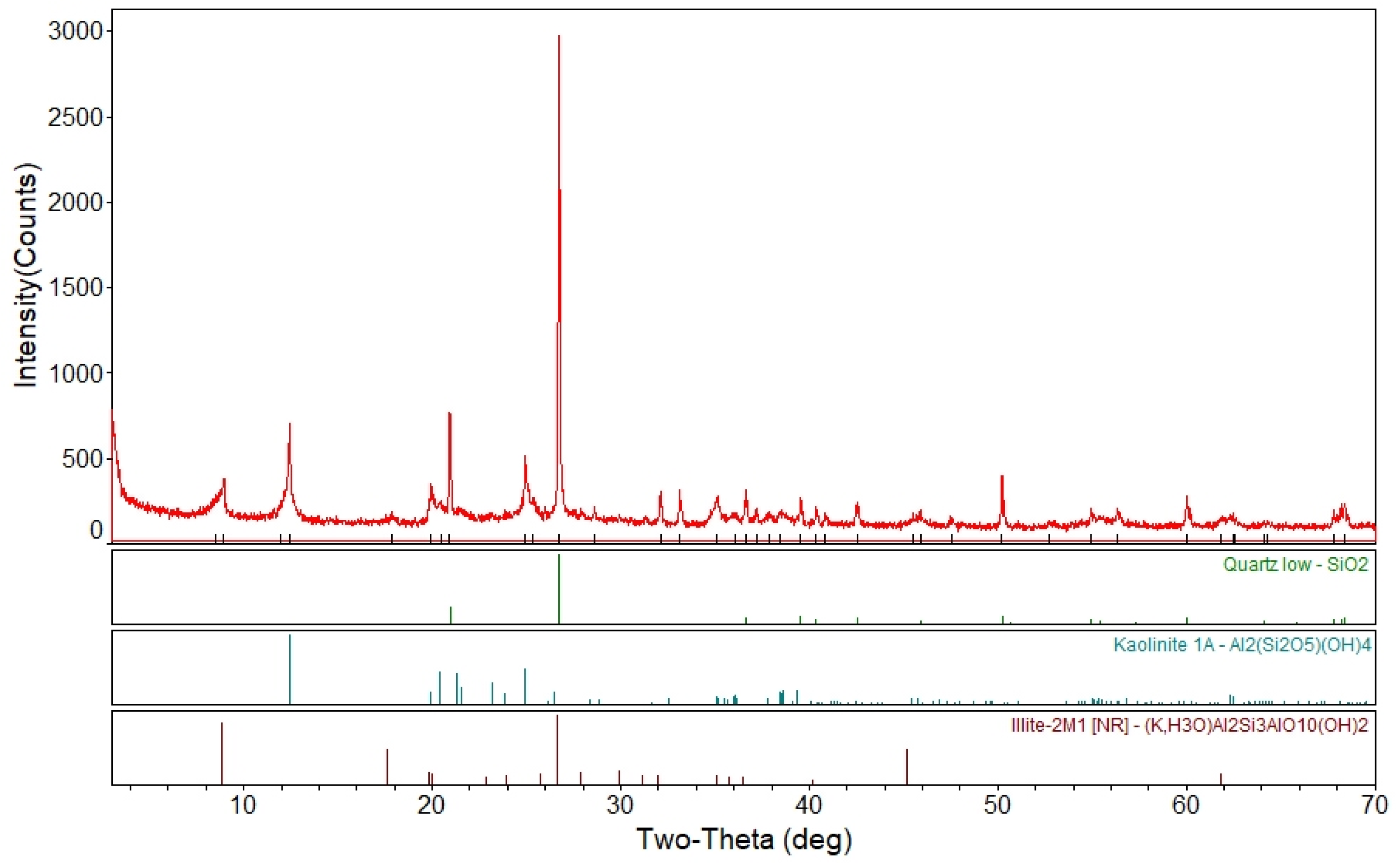
The collected samples were pulverized to pass a 325-mesh sieve, and 0.5 g aliquots were analyzed using a Bruker D8 ADVANCE X-ray diffractometer (BRUKER AXS GMBH, Karlsruhe, Germany). The resulting diffraction pattern is presented in Figure 3.
As illustrated in Figure 3, the sample is predominantly composed of kaolinite, quartz, and illite. Semi-quantitative analysis summarized in Table 2 reveals that the roof rock contains significant amounts of kaolinite (45.5%) and illite (12.6%), which together account for 58.1% of the total mineral content. Quartz constitutes the remaining 41.9%.
The high proportion of clay minerals, particularly kaolinite and illite, is of critical importance to the mechanical behavior of the rock mass. These minerals are characterized by their fine particle size and pronounced hydrophilicity. Upon interaction with water infiltrating through micro-fractures, adsorption water films develop and thicken, promoting the softening and eventual dissolution of cementitious components. This process weakens interparticle bonds, reduces cohesive strength, and initiates a cycle of swelling and disintegration that ultimately compromises the stability of the roadway. The XRD findings thus provide a mineralogical basis for understanding the propensity of the surrounding rock to degrade in humid conditions, corroborating the microstructural vulnerabilities identified via SEM analysis.

2.3. Argillization and Disintegration Behavior in Humid Conditions

Building upon the microstructural and mineralogical analyses presented in preceding sections, this study further investigates the macroscopic mechanical degradation of soft rock under hydraulic coupling through systematic immersion-disintegration testing. By simulating the humid underground environment, the experiments aim to elucidate the correlation between mineral composition, microstructure, and the argillization-disintegration behavior of the rock mass. The results provide critical insights into the time-dependent weakening mechanisms of soft rock, thereby informing the design of support technologies tailored to such challenging geotechnical conditions.
A representative 100 g rock sample collected from the roof of the 3205 Material Gateway at the 1500 m location in Xin’an Coal Mine was immersed in a transparent container filled with water. The disintegration process was monitored continuously, with particular attention to the initial breakdown time and the state of the specimen after 24 h of immersion. Upon completion of the test, the disintegrated material was filtered, transferred to a tray, and dried in an oven at 105 °C until a constant mass was attained. The dried product was then cooled in a desiccator and its surface morphological characteristics were documented.
As depicted in Figure 4, the sample exhibited clear signs of disintegration within 5 min of immersion. After 1 h, the disintegration process accelerated, accompanied by increased water turbidity and the accumulation of particulate matter at the bottom of the container. By 3 h, intense disintegration was observed, leading to the release of flaky fragments. After 6 h, significant sedimentation had occurred. At the 12-h mark, originally coherent rock blocks had largely disintegrated into small, flaky particles. After 24 h, the sample was fully broken down into fine flaky debris, with water turbidity further intensified.
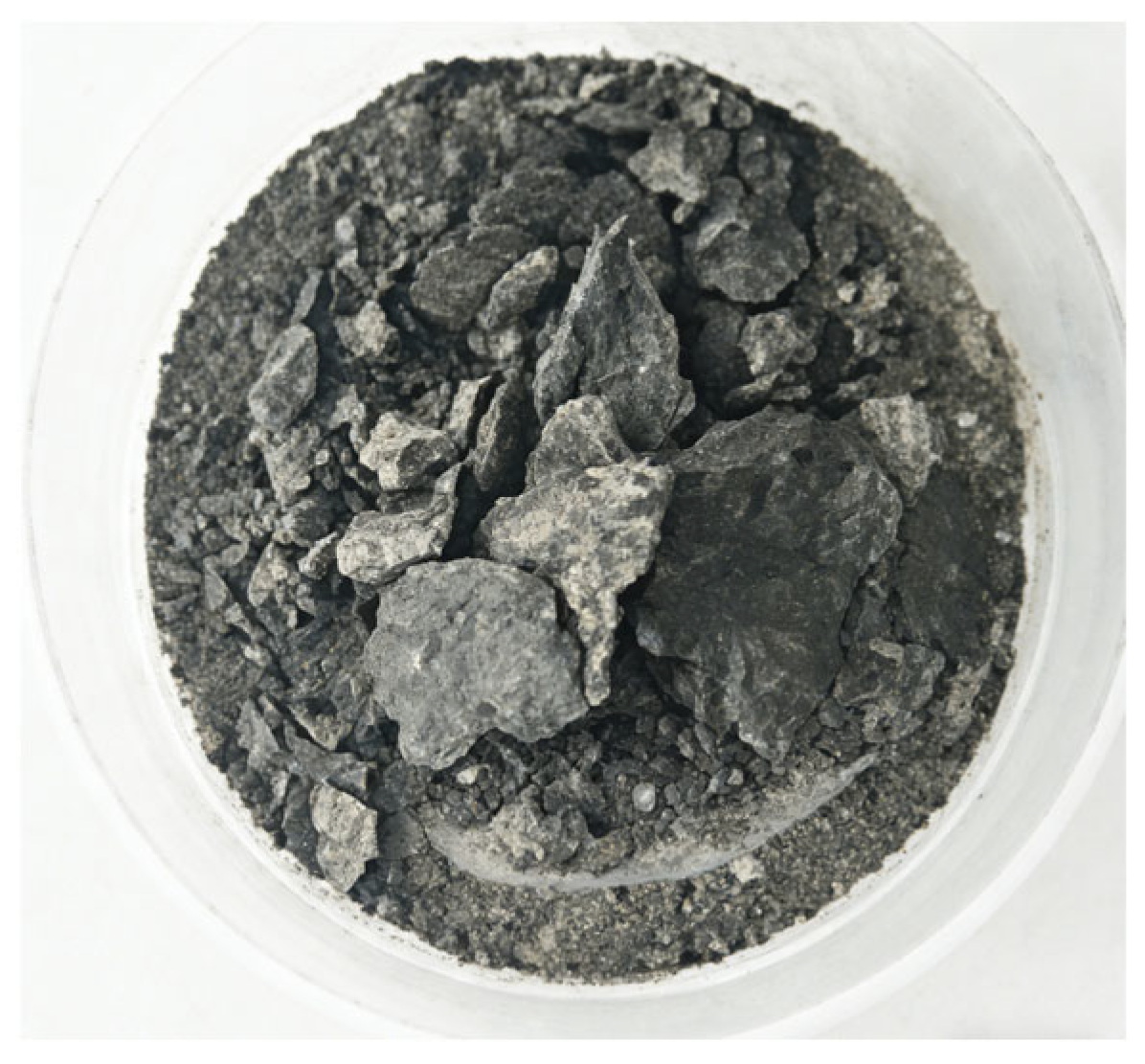
Following filtration and drying, the resulting material consisted entirely of flaky disintegration products, as shown in Figure 5. The original rock structure was completely lost, and a substantial amount of clayey particles remained, confirming that argillization was the primary cause of liquid turbidity during the immersion process.
The experimental results demonstrate that the soft rock undergoes a progressive disintegration process when saturated, transitioning from initial slow breakdown to sustained and stable degradation in later stages. The dominant failure mode observed was flaky spalling, accompanied by steadily increasing water turbidity. These behaviors confirm the strong hydrophilicity of the rock and its marked susceptibility to softening, argillization, swelling, and disintegration upon water contact—all of which contribute to a sharp reduction in mechanical strength. Furthermore, the tendency of the material to undergo drying-induced cracking and post-air-drying disintegration underscores the critical role of water as a triggering factor in the instability of fractured argillaceous roadway surrounding rock. These findings align consistently with the high clay mineral content identified via XRD and the micro-fracture network revealed by SEM, collectively establishing water–rock interaction as a fundamental mechanism driving roadway instability.

2.4. Macroscopic Instability Modes in Soft Rock Roadways

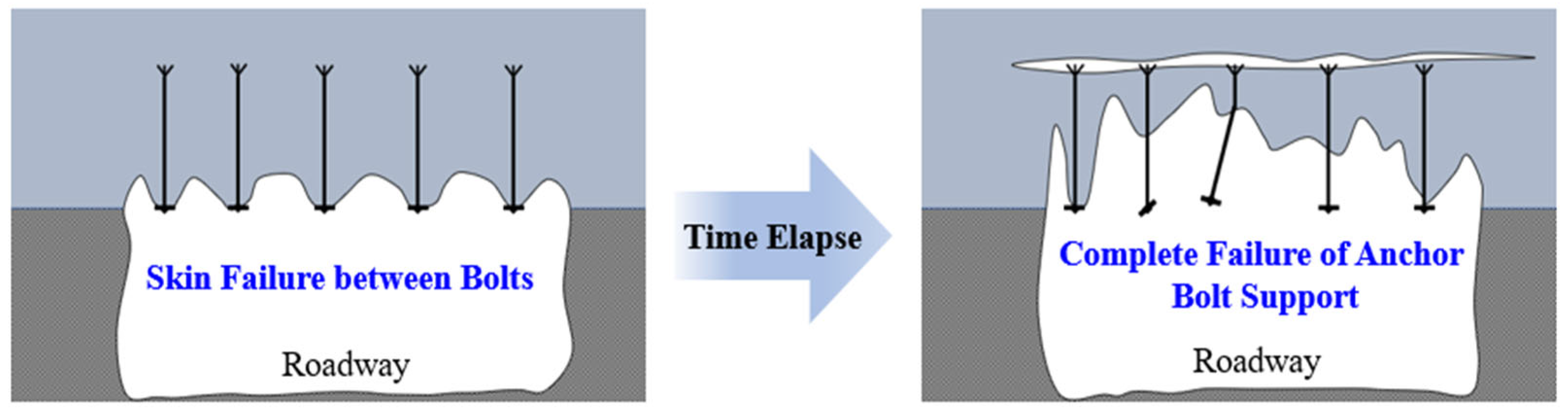
The progressive degradation of clay-rich soft rock under hydraulic interaction leads to continuous argillization, strength reduction, and ultimately, large-scale deformation and support failure in roadway structures. This mode of failure, predominantly driven by water–rock interactions in expansive clay minerals, represents a persistent and critical challenge in support engineering across numerous coal mining regions in China. As the surrounding rock weakens, the loss of cohesive strength around bolt trays results in anchorage loosening and failure, further exacerbating macroscopic instability phenomena such as severe roof collapse, pronounced floor heave, and considerable rib convergence, as typified in Figure 6.
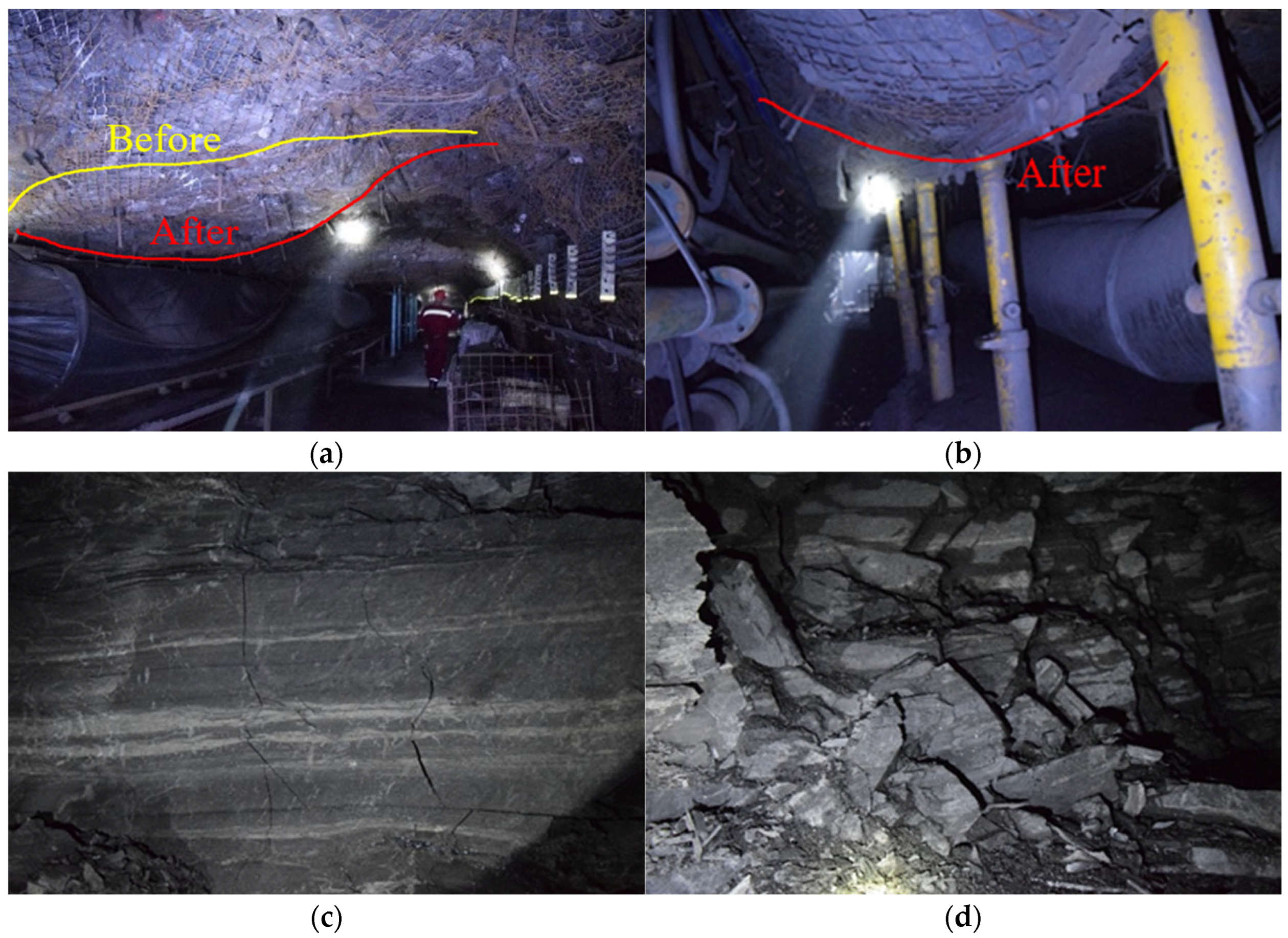
Under conventional support systems, soft rock roadways typically exhibit pronounced deformation, including marked roof subsidence, rib convergence, and floor heave. The roof strata are often highly fractured and susceptible to weathering, manifesting numerous pockets and depressions. In many cases, localized roof sections are temporarily stabilized using single hydraulic props to mitigate imminent collapse risks. As illustrated in Figure 7c, the exposed rock at the working face shows macroscopic cracks—evidence of pervasive damage—coupled with intense fragmentation and low intact strength.
When subjected to overburden loads, traditional support systems frequently fail to supply adequate resistance to the roof rock mass, inhibiting the formation of a stable load-bearing structure. The failure process typically initiates with the development of fine transverse cracks within the roof strata. With continued stress and environmental exposure, these cracks propagate and interconnect, prompting bending deformation and progressive subsidence along the fracture networks. In advanced stages, a distinct concave profile forms in the central roof zone, accompanied by localized rock spalling and detachment. Under extreme conditions, these processes can culminate in comprehensive roof collapse, as depicted in Figure 7a.
To temporarily counter roof subsidence, many mining operations resort to single prop systems for passive support (Figure 7b). While this measure affords short-term operational safety, it suffers from inherent limitations: poor stability under asymmetric loading, susceptibility to tilting or toppling, limited capacity to withstand concentrated roof pressures, and a lack of real-time monitoring capability. Furthermore, such systems are ill-suited to highly fractured and bedded roof conditions, often exacerbating local instability and increasing the risk of partial or full roof failure.
Field investigations further reveal that the exposed rock mass in soft rock roadways exhibits widespread macroscopic cracking (Figure 7c), indicative of extensive damage. The low intrinsic strength of the rock renders it highly sensitive to external disturbances—such as excavation-induced stress redistribution—which can trigger rapid crack propagation and instability with minimal warning. Moreover, the surrounding rock typically exists as a disintegrated, blocky structure with no coherent load-bearing capacity (Figure 7d). The penetration of large fractures deep into the rock mass facilitates rib spalling, roof falls, and in severe cases, full-section collapse. Even when initial support is installed, the fragmented and low-strength rock often fails to maintain the designed roadway section, leading to persistent convergence and floor heave. When support capacity is exceeded, uncontrolled deformation ensues, resulting in overall instability.
Integrating the findings from micro-scale analyses with field observations, it is evident that the instability of soft rock in the studied roadway arises from the synergistic effect of intrinsic mineralogical properties—specifically, the high content of expansive clay minerals—and extrinsic environmental conditions, notably high humidity. The pre-existing micro-fracture network facilitates water infiltration and promotes swelling stress development, which collectively degrade rock mass strength and amplify deformation. These processes ultimately overwhelm the capacity of traditional support systems. Therefore, an effective control strategy must achieve dual objectives: sealing micro-fractures to prevent fluid ingress and stabilizing or passivating clay mineral activity to inhibit swelling. This holistic understanding underscores the necessity of an integrated support methodology, paving the way for the material–structure synergistic technology introduced in the following section.

3. A Synergistic Control Technology: Material and Structural Integration

3.1. Development of High-Performance Grouting Material with Redispersible Polymer

The control of soft rock roadways is challenged by the inherent properties of the surrounding rock, including low strength, fragmentation, and pronounced rheological behavior. These characteristics impose specific performance requirements on grouting materials: high penetrability to permeate fractured rock masses rapidly, and the development of early-age strength to provide immediate load-bearing capacity and suppress time-dependent deformation. Conventional cement-based grouts often fall short due to slow setting, low early strength, and poor adhesion to weak rock interfaces. Such limitations result in a delayed mechanical response, wherein support fails to keep pace with deformation, ultimately leading to inadequate control of soft rock stability. To address these shortcomings, this study introduces a specially formulated cement-based anchoring material designed for full-length grouting applications in soft rock roadways.
The developed grouting material comprises a composite binder system of P.O 42.5R Portland cement and sulfoaluminate cement, which synergistically ensures rapid strength development. Ultrafine quartz sand (70–110 mesh) is incorporated to enhance pumpability through small-diameter hollow anchor pipes. Fly ash is added to refine the microstructure and improve long-term durability, while a combination of polycarboxylate superplasticizer and hydroxypropyl methyl cellulose (HPMC) optimizes rheology and water retention. A YH-S type expansive agent is included to impart controlled expansion, and—critically—redispersible polymer powder (RPP) is introduced to significantly improve interfacial bonding with the surrounding rock.
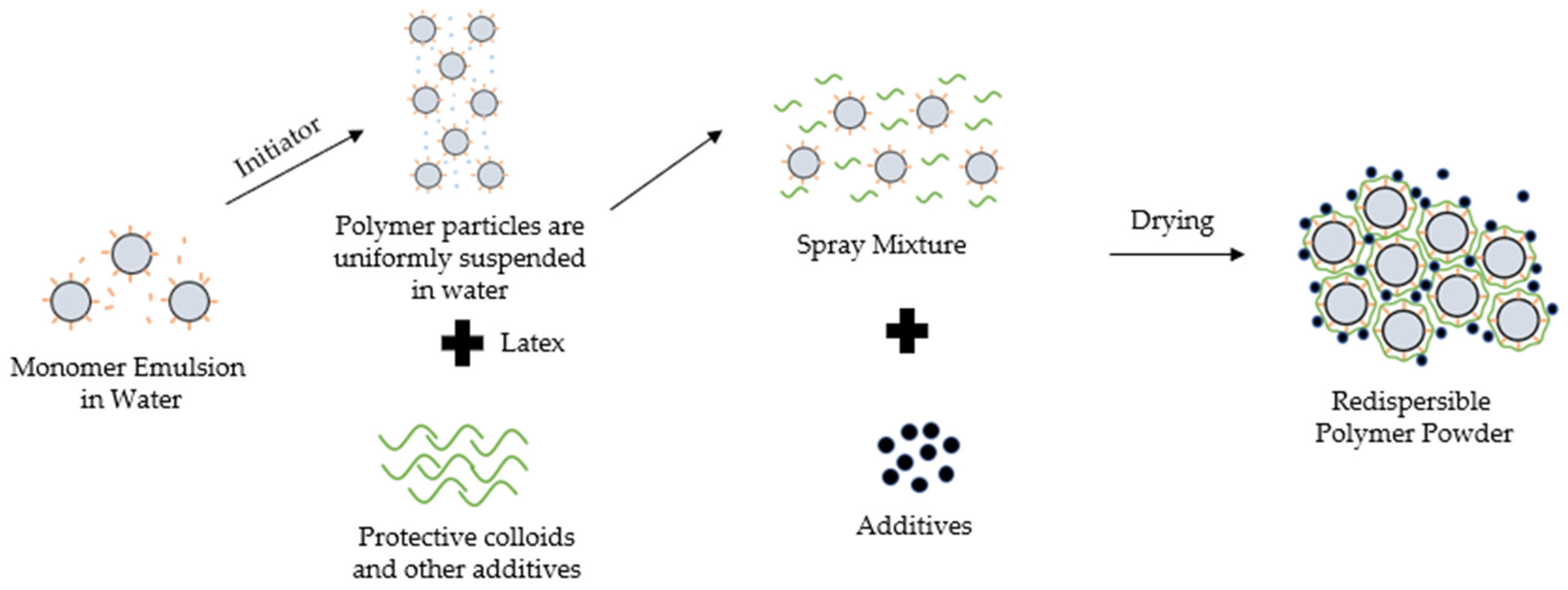
Redispersible latex powder is a redispersible powdery product formed by blending-spray drying of monomer polymer emulsion, as shown in Figure 8 [37]. It is mainly composed of polymer resin, protective colloids, anti-caking agents, and other additives, with a structure where the outer hydrophilic protective colloid encapsulates the inner polymer resin and additives. Among them, the protective colloid is usually polyvinyl alcohol (PVA), which provides a protective effect on the polymer resin during the drying and storage of the latex powder, preventing mutual adhesion and agglomeration. The polymer particles in the latex powder can be redispersed when exposed to water, and form a continuous polymer film at the matrix interface during the drying process, thereby improving the adhesion force between the interface and the matrix. The addition of redispersible latex powder in the system is expected to significantly enhance the bond strength between cement-based anchoring materials and rock mass.
This material exhibits a low water-cement ratio (0.35:1) and high paste stability, minimizing bleed water and promoting the formation of a dense bonding interface with the rock. The incorporation of RPP facilitates the in-situ formation of a polymer phase upon curing. Surface functional groups of the polymer participate in chemical bonding with the cement matrix, while intermolecular forces and polymer-cement hybridization collectively enhance cohesion and interfacial adhesion, leading to a substantial increase in bond strength.
Functionally, the material acts through both physical and chemical modification of the rock mass. Leveraging its high fluidity, minimal shrinkage, and slight expansion, it effectively penetrates micron-scale fractures identified in prior SEM analyses. Upon hardening, it exerts active expansive pressure and induces radial compressive stresses, resulting in “self-stressing” cementation and dense fracture filling. This process not only seals water migration pathways but also transforms fractured rock into a coherent, load-bearing medium, markedly improving overall strength and integrity.
In terms of long-term performance, the material demonstrates high chemical stability, addressing the water sensitivity of clay minerals revealed by XRD. Its chloride-free composition and low heat of reaction prevent secondary damage during application. The resulting grouted body forms a durable, high-bond-strength filler that permanently seals fractures, reduces permeability, and effectively isolates the rock from water ingress. This significantly inhibits argillization and strength degradation, ensuring sustained reinforcement under humid conditions.
As summarized in Table 3, the developed grout exhibits superior mechanical and operational performance compared to conventional cement pastes. It achieves a 5-h compressive strength of ≥25 MPa—far exceeding the typical <10 MPa of traditional grouts—and reaches ≥30 MPa and ≥47 MPa at 1 and 3 days, respectively, representing a two- to three-fold improvement. The 7-day strength exceeds 55 MPa, which is approximately twice that of conventional materials. Flexural performance is similarly enhanced, with 5-h and 7-day flexural strengths of ≥4.1 MPa and ≥6.7 MPa, respectively, indicating high toughness and crack resistance. With a fine particle size (0–15 μm), short initial setting time (70–118 s), wide applicable temperature range (5–35 °C), and low water demand, the material offers excellent constructability and rapid strength development, making it well-suited for the demanding conditions of soft rock roadway support.

3.2. Tiered Thick Anchoring System for Enhanced Load-Bearing Capacity

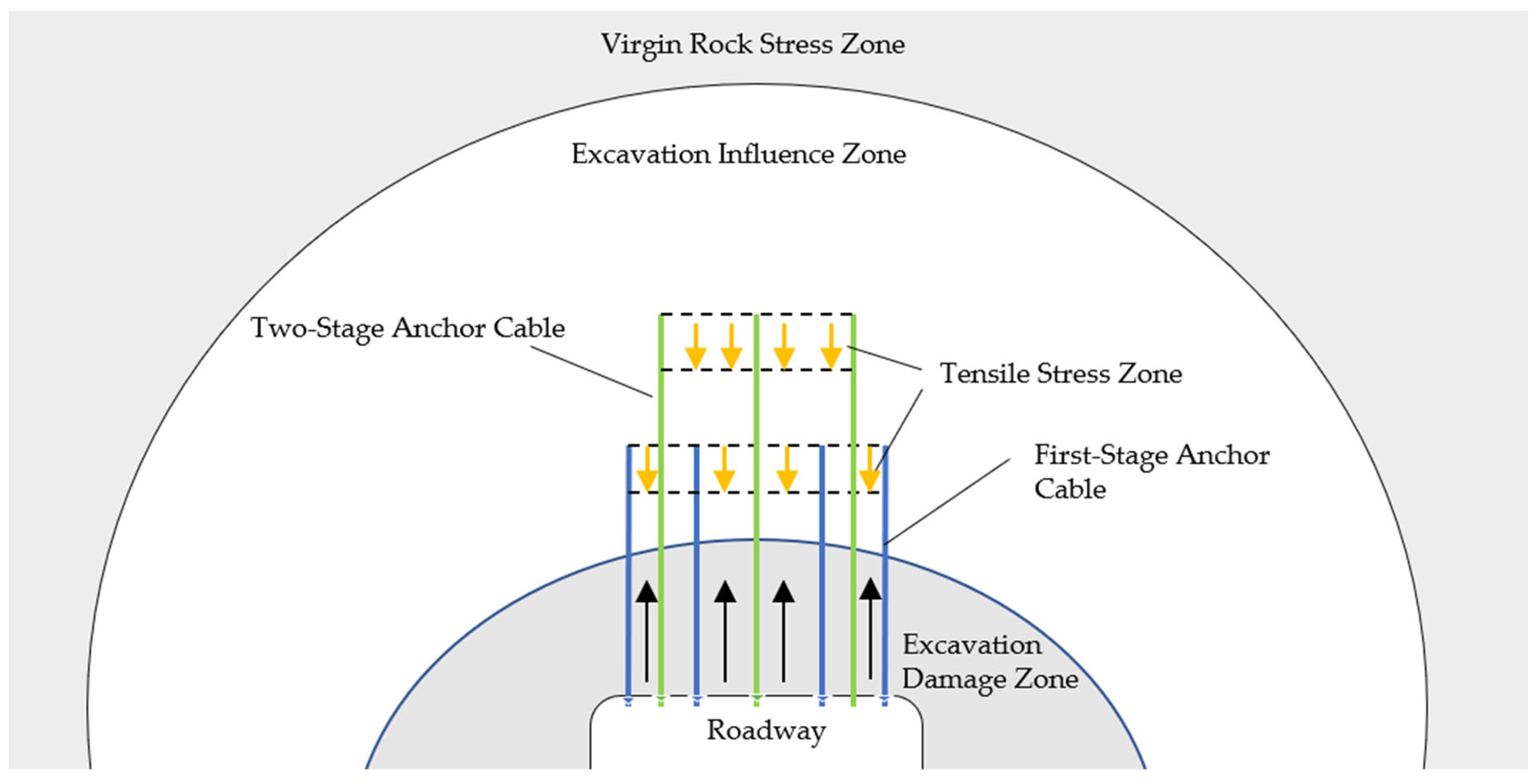
Following roadway excavation, the surrounding rock mass is typically divided into three distinct zones: the excavation damaged zone (EDZ), the excavation affected zone, and the virgin rock stress zone, as illustrated in Figure 9. Conventional support systems typically employ primary anchor bolts with lengths under 3.0 m, which often reside within or near the boundary of the EDZ. This configuration tends to generate a tensile stress-damaged zone in the anchored segment that can interconnect with pre-existing shallow fractures in the EDZ, potentially leading to progressive failure and eventual collapse. To overcome this limitation, this study proposes a tiered thick anchoring system that extends beyond the EDZ, offering three fundamental advantages, as schematically represented in Figure 9: (1) it mitigates tensile stress concentration within the anchoring segment; (2) it prevents the interconnection between the tensile-damaged zone and shallow fractures; and (3) it compacts shallow fractures under high tensile stress, thereby inhibiting their propagation and establishing the foundation for a high-stiffness, high-strength anchoring layer.
A distinct layer of fine sandstone is identified between coal seam and the overlying mudstone composite roof. Based on established engineering precedents and analytical methods, the thicknesses of the primary (L1) and secondary (L2) reinforcement layers are determined using Equation (1).
L 1 = 1 . 5 × T 2 L 2 = 1 . 5 × L 1
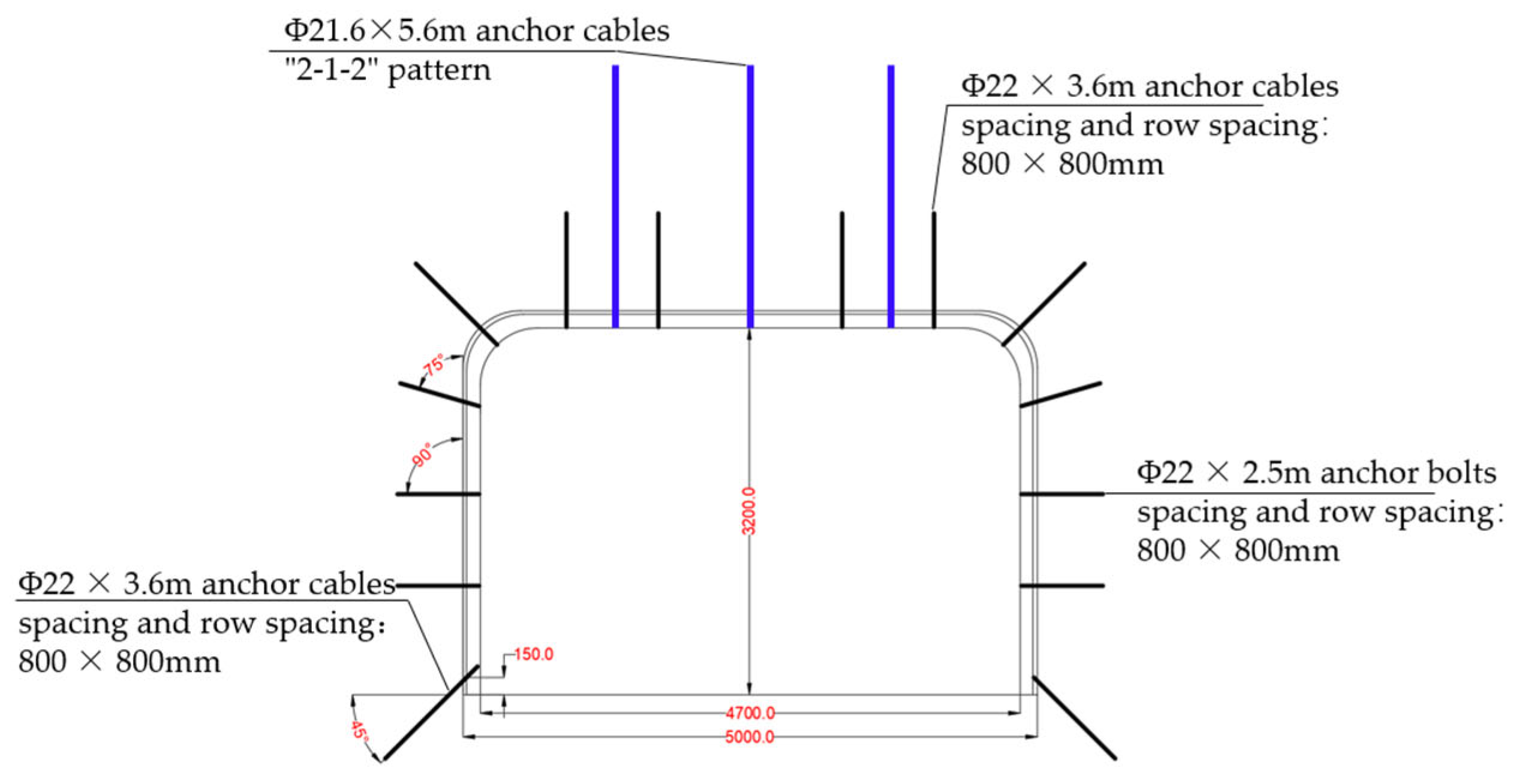
The reinforcement strategy for the thick-layer anchored rock beam in the roof of the 3205 Material Gateway is designed as a two-tier system. In areas exhibiting higher degradation, the secondary load-bearing capacity is enhanced by increasing the density of secondary anchor cables. The primary load-bearing ring is designed with a thickness of 3.3 m, corresponding to a bolt length of 3.6 m to minimize damage within this zone. The secondary reinforced load-bearing ring has a thickness of 5.3 m, with anchor cables extending to 5.6 m to ensure stress continuity and effective load transfer to stable strata.
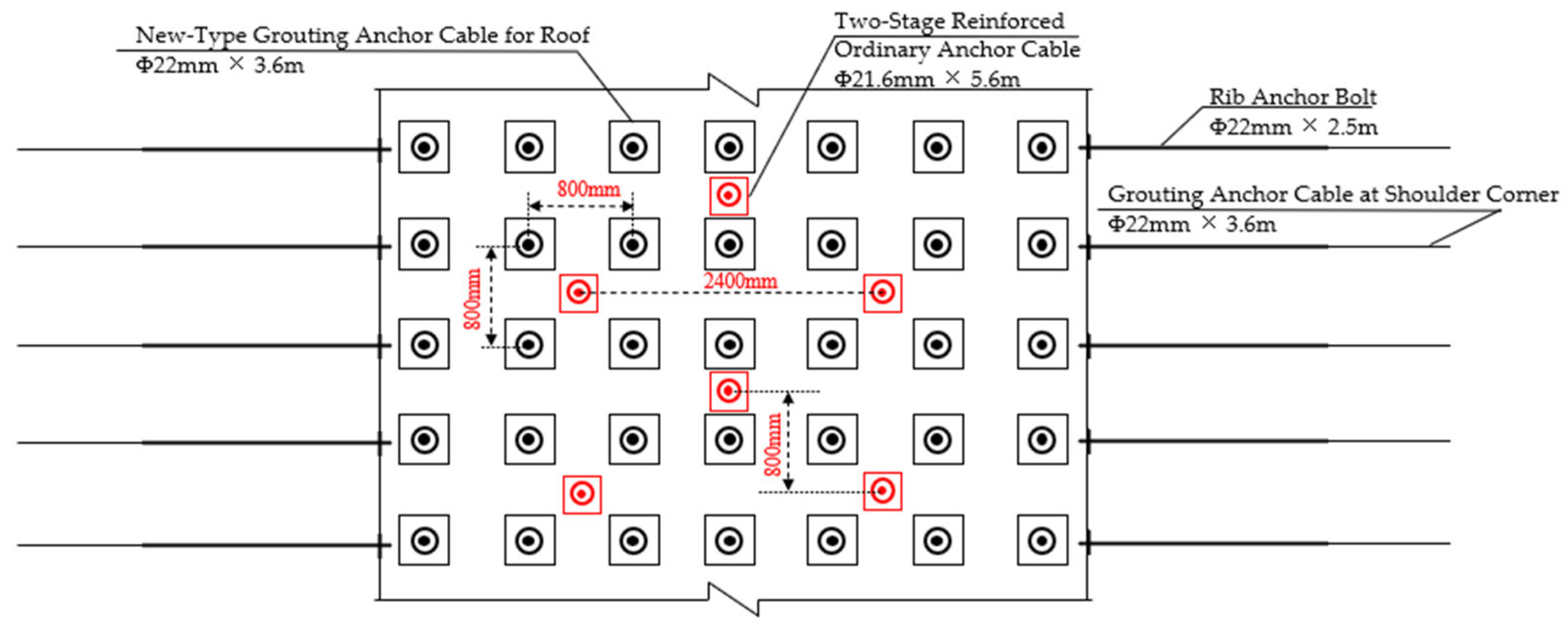
Research indicates that applying a prestress below 32% of the bolt’s ultimate load capacity positively influences the rock mass in the anchored zone [42]. Accordingly, this study implements a differentiated prestress configuration: the primary anchoring layer is tensioned to 28% of its breaking capacity (150 kN) to provide immediate stabilization, while the secondary reinforcement layer is prestressed to 30% of its capacity (180 kN). This approach ensures synergistic interaction between the two support tiers, optimizing the overall load-bearing mechanism. The specific support parameters are shown in Figure 10 and Figure 11.
The detailed support parameters are as follows:
  • Roof Support:
  • High-strength grouted anchor cables (Φ22 mm, L = 3.6 m);
  • Spacing: 800 mm × 800 mm, 7 cables per row;
  • Pretension force: ≥150 kN;
  • Steel ladder beams (L = 3300 mm, Φ = 14 mm) for the central five cables.
  • Rib Support:
  • 6 left-handed non-longitudinal rib threaded steel bolts (Φ22 mm × 2500 mm);
  • 2 high-strength grouted anchor cables (Φ22 mm × 3600 mm) per side;
  • Support pattern: 800 mm × 800 mm;
  • Bolt orientation: perpendicular to sidewalls, with shoulder bolts angled at 15° upward;
  • Bottom corner cables: installed at 45° downward, 150 mm from floor;
  • Pretension requirements: bolts ≥ 80 kN (torque ≥ 300 N·m), cables ≥ 150 kN;
  • 2 steel ladder beams per row (L = 2500 mm, Φ = 12 mm).
  • Secondary Roof Reinforcement:
  • Conventional anchor cables (Φ21.6 mm, L = 5.6 m) in 2-1 pattern;
  • Intra-row spacing: 2400 mm;
  • Pretension force: ≥180 kN.
  • Ancillary Components:
  • Standard bolt trays: 150 mm × 150 mm × 10 mm;
  • Mine-grade pressure-resistant trays (260 mm × 260 mm × 14 mm) for cable support;
  • 45° special-shaped trays for rib corner cables;
  • Diamond-shaped metal mesh:
    Roof: Φ10 mm, 5800 mm × 1000 mm, 50 mm × 50 mm mesh;
    Ribs: Φ10 mm, 2600 mm × 1000 mm, 50 mm × 50 mm mesh;
    Overlap: 200 mm between adjacent mesh sheets.
  • Resin Anchoring System:
  • Cables: one K2550 and one Z2550 cartridge (K2550 leading);
  • Bolts: one K2350 and one Z2350 cartridge (K2350 leading).
  • Construction Sequence:
Primary roof grouted cables must be installed immediately following face advancement. Rib bolts and grouted cables should be completed within 4–6 rows behind the face. Grouting of the seven roof cables must be finalized within 4–6 rows of roof support installation, preceding completion of rib support. Bottom corner cable grouting should commence immediately after their installation. The grouting operation employs the self-developed high-performance grouting materials described in Section 3.1, at 3–5 MPa pressure, maintained for 3–5 min upon reaching the design pressure before proceeding to subsequent operations.

3.3. Synergistic Mechanism of Grouting and Anchoring

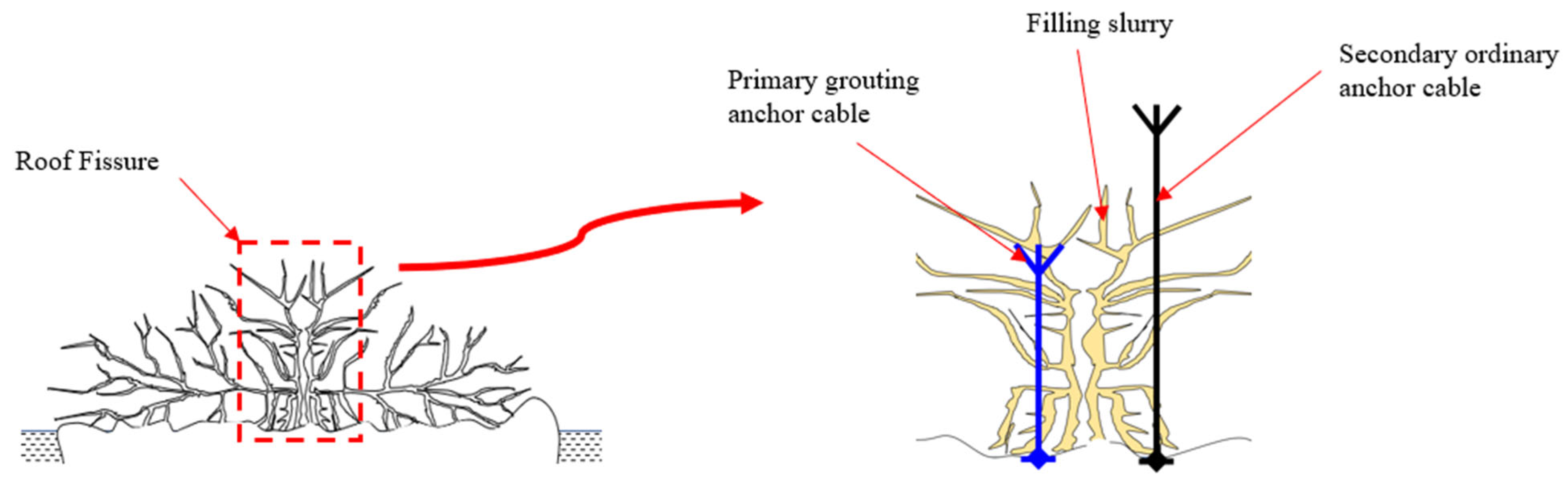
This section synthesizes the capabilities of the self-developed grouting material with the structural advantages of the tiered thick anchoring system to establish an integrated material–structure control system. The underlying synergistic mechanism, illustrated schematically in Figure 12, is systematically analyzed to elucidate how this combined approach enhances roadway stability.
The synergy operates through two interconnected mechanical pathways. Firstly, the grouting material provides essential microscale reinforcement within the excavation-damaged zone (EDZ), establishing a reliable mechanical basis for the tiered anchoring system. Utilizing its low water-cement ratio, micro-expansion characteristics, and polymer-modified matrix, the specialized cementitious grout achieves thorough penetration and dense filling of the microfracture network previously identified. This process not only seals the fractures but also induces self-stress cementation, which substantially enhances the cohesion, internal friction angle, and overall integrity of the shallow rock mass. Consequently, the anchoring basis for the primary-level grouted cables is transformed from a weak, fractured medium into a coherent, strengthened composite. This enables efficient and reliable transfer of the applied pretension force (150 kN), facilitating the formation of a stable shallow load-bearing ring.
Secondly, the tiered anchoring structure establishes a favorable macroscale stress environment that activates and confines the grout-strengthened zone. The secondary-level anchor cables, prestressed to 180 kN, extend beyond the excavation-affected zone into stable rock strata, forming a robust deep load-bearing arch. This arch applies a continuous circumferential confinement to the shallow grouted rock mass, effectively converting its stress state from uniaxial or biaxial compression to a more favorable triaxial condition. Such confinement maximizes the strength potential of the grout-reinforced matrix, suppresses crushing and swelling deformations in the EDZ, and inhibits further fracture propagation. It also maintains the grouted zone under a persistently high confining pressure, promoting a dense and stable microstructure.
Together, these mechanisms create a progressive load-bearing system that integrates reinforcement across scales—from microscale fracture filling to macroscale structural anchoring—and through depths—from the shallow grouted ring to the deep anchored arch. The rapid early-age strength development of the grouting material fulfills the critical time-sensitivity requirement for soft rock control, effectively restraining initial deformation. Simultaneously, the long-term chemical stability of the grout and the sustained load-bearing capacity of the tiered anchors ensure durable performance over the roadway’s service life.
In summary, the proposed synergistic control technology improves the intrinsic mechanical properties of the rock mass through microscale modification via grouting, while optimizing the macroscopic load distribution and stress state through the tiered anchoring structure. This dual approach achieves coordinated control over both deformation and stability in soft rock roadways. The validity of this theoretical mechanism and its practical efficacy under complex in situ conditions are evaluated through field application and monitoring in the following section.

4. Field Application and Performance Evaluation

4.1. Geological and Engineering Context

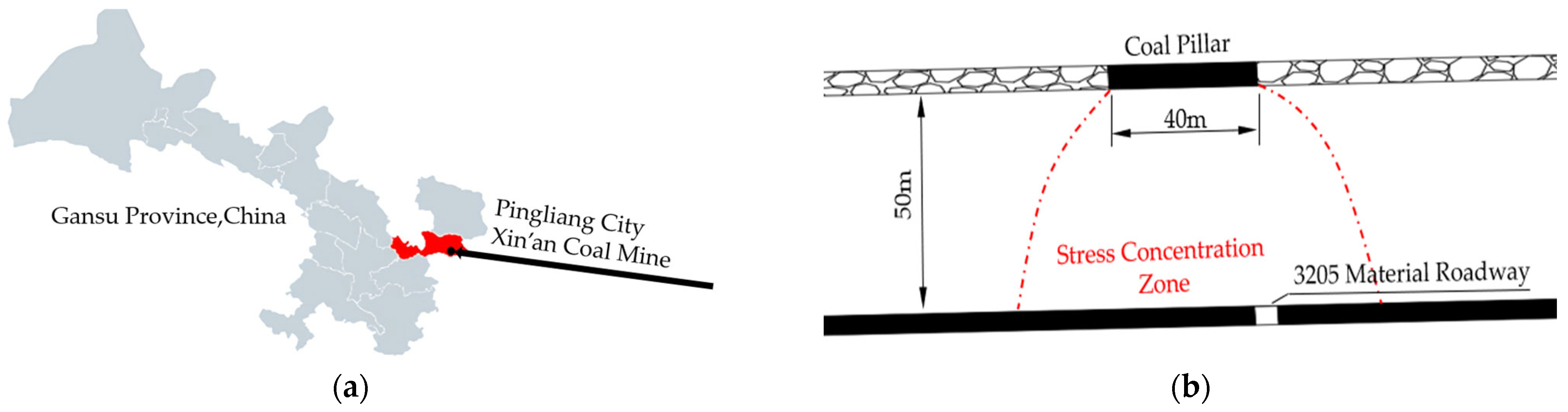
Xin’an Coal Mine is situated in Pingliang City, Gansu Province, China, as shown in Figure 13a. The mine operates under complex engineering conditions, with the first mining panel (No. 3205) of Coal Seam No. 3 serving as the focus of this study. This panel has an average burial depth of 945 m and a seam thickness of 3.1 m, dipping gently between 0° and 8°. A significant overlying goaf, resulting from previous extraction in the 1203 and 1205 panels of Coal Seam No. 1, is located approximately 50 m above the 3205 working face. A 40 m wide interburden coal pillar separates these mining horizons, contributing to elevated stress concentrations in the surrounding strata. It has been demonstrated in the previously published papers of our research group that the 3205 material drift under study is located within the stress concentration zone induced by the coal pillar reserved in the overlying coal seam [43]. The relative layout relationship between the upper coal pillar and the 3205 material drift is shown in Figure 13b.
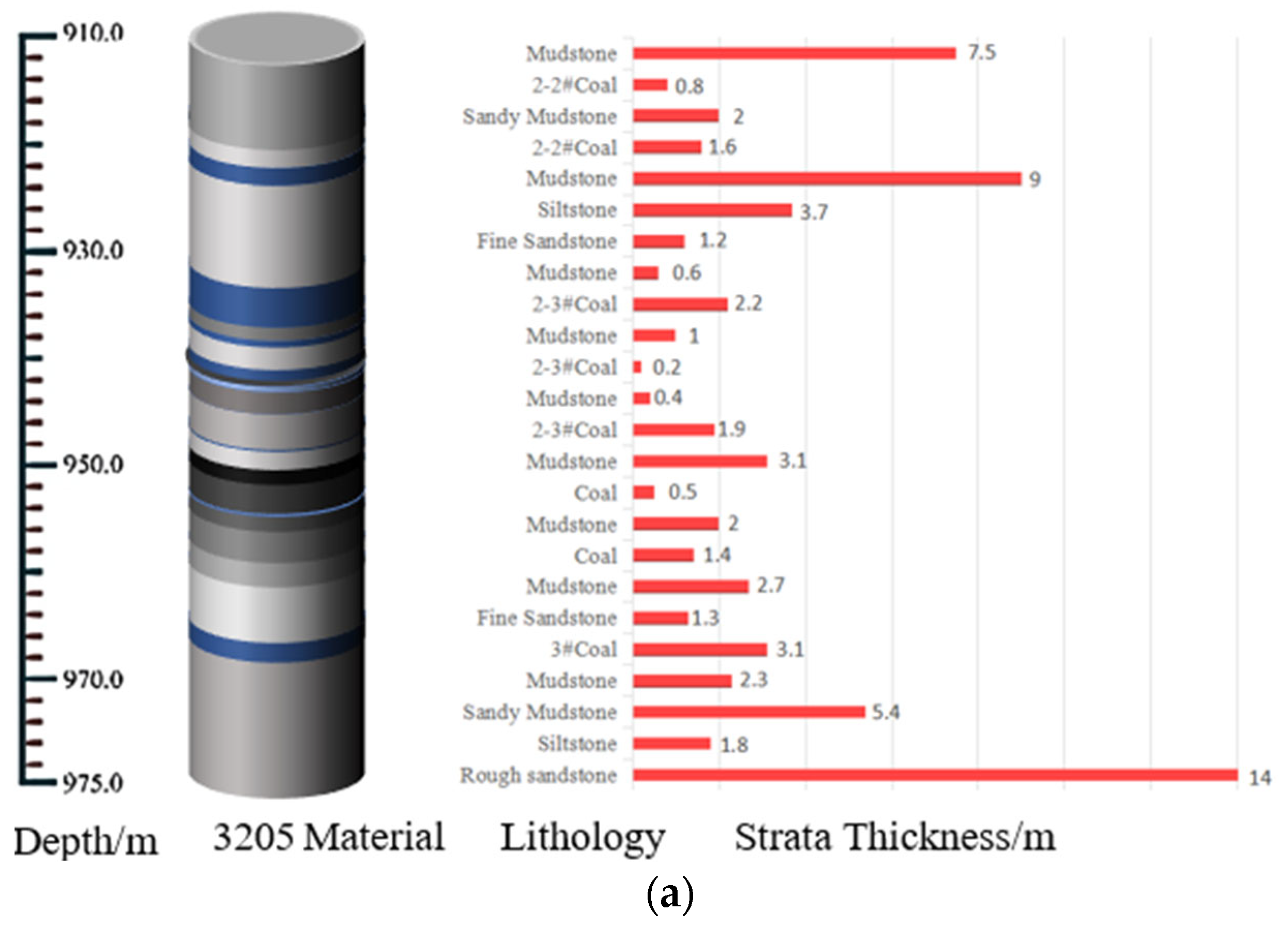
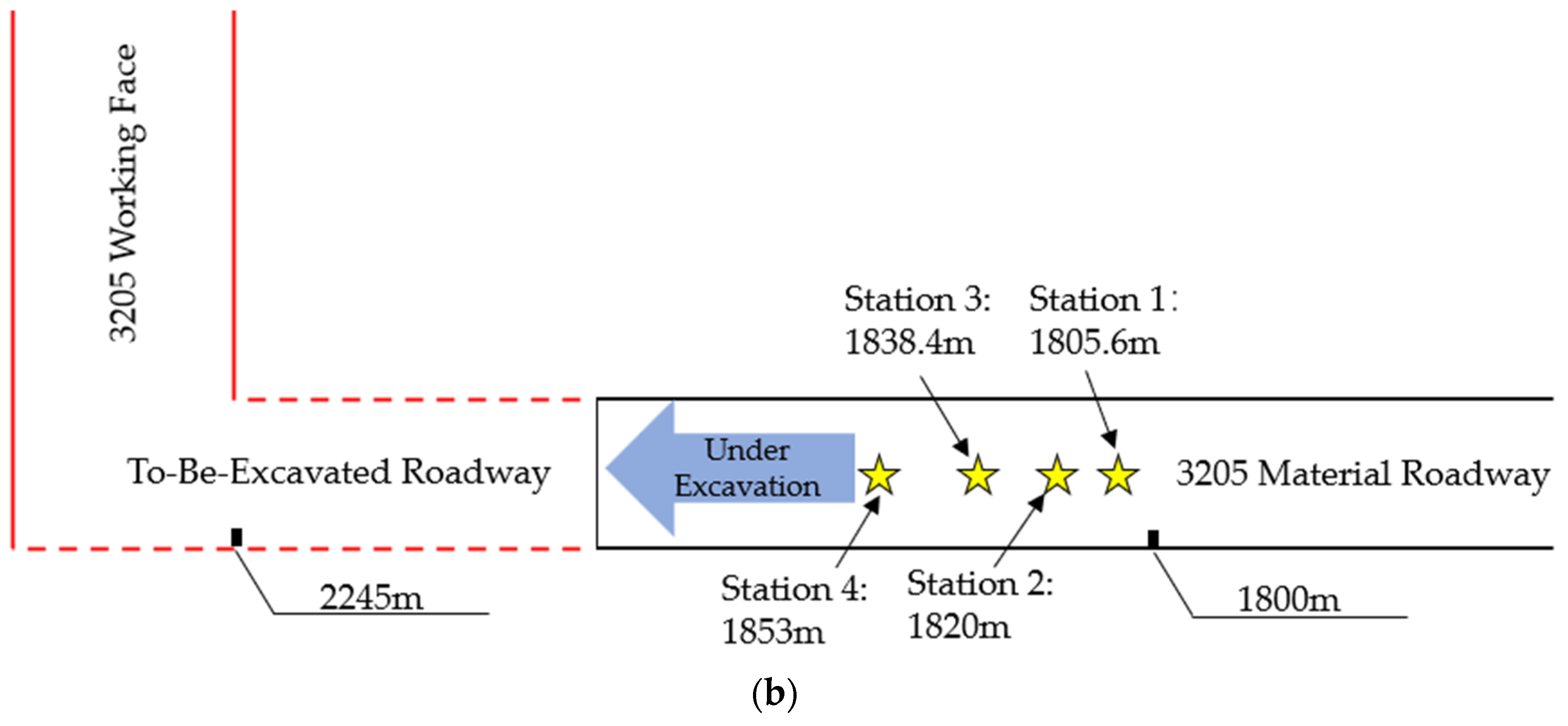
As illustrated in the stratigraphic column of Figure 14a, the 3205 material gateway is developed within the No. 3 coal seam of the Yan’an Formation, which averages 3.33 m in thickness. The immediate roof comprises a 0.94 m thick composite of dark gray mudstone, sandy mudstone, and fine siltstone. These lithologies are characterized by low mechanical strength and a marked propensity for water-induced swelling, consistent with the mineralogical and microstructural attributes identified in Section 2.1 and Section 2.2. The overlying roof strata form a multi-layered sequence of fine sandstone and mudstone, further complicating the geomechanical environment. In addition, the 3205 working face is a reserved mining face, and the 3205 material gateway is a preparatory gateway under excavation. The positional relationship between the drift under excavation and the working face is shown in Figure 14b.
The total length of the gateway is 2136 m. The excavation dimensions are 5.0 m in width and 3.2 m in height, with finished cross-sectional dimensions of 4.7 m × 3.05 m after support installation. The final cross-sectional area of the roadway is 15.1 m2. The floor strata consist of a multi-layered assemblage of mudstone and siltstone, with the immediate floor measuring 1.58 m in thickness. At this location, the mining depth reaches approximately 948 m, imposing high in-situ stresses that exacerbate the challenging ground conditions.
The experimental application of the proposed support system was implemented in a 50 m-long section between chainages 1800 m and 1845 m along the 3205 material gateway. A total of 55 rows of the were installed in this zone. Grouting of the roof anchor cables was carried out up to 115 m behind the advancing face, while grouting of the bottom corner cables was completed on one side only, establishing a partially reinforced configuration that would later help illustrate the system’s asymmetric performance under field conditions.

4.2. Original Support Scheme and Effects

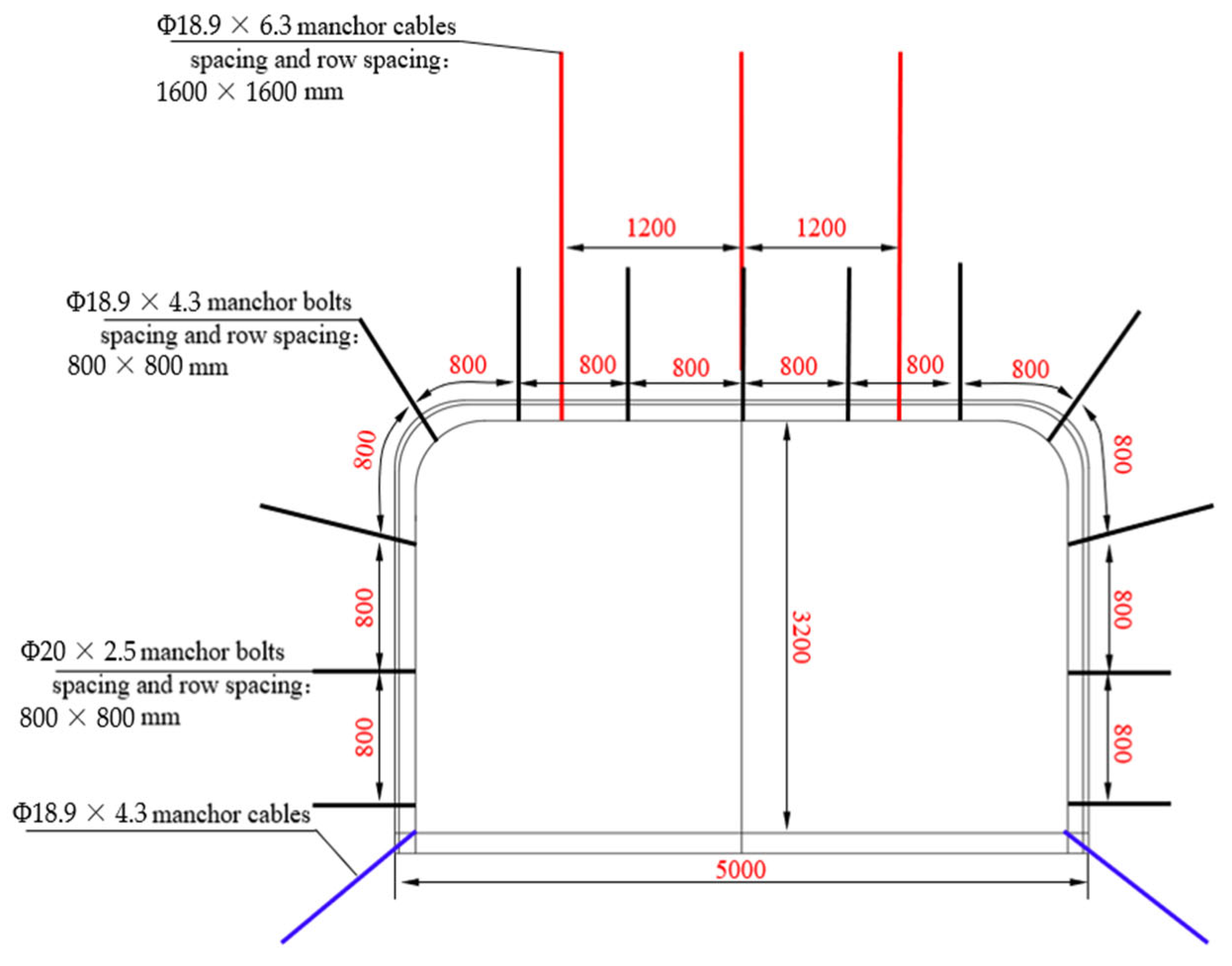
The original support scheme for the 3205 material drift (Figure 15) was designed as follows: For the roof and the shoulder sockets of the two sidewalls, Φ18.9 mm × 4300 mm cable bolts were adopted with a spacing of 800 mm × 800 mm, 9 pieces per row; For the middle parts of the two sidewalls, left-hand non-ribbed threaded steel bolts of Φ22 mm × 2500 mm were used, 4 pieces per row; For the bottom corners of the two sidewalls, Φ18.9 mm × 4300 mm cable bolts were installed, 2 pieces per row; For roof reinforcement support, Φ18.9 mm × 6300 mm cable bolts were employed with a spacing of 1600 mm × 1600 mm, 3 pieces per row.
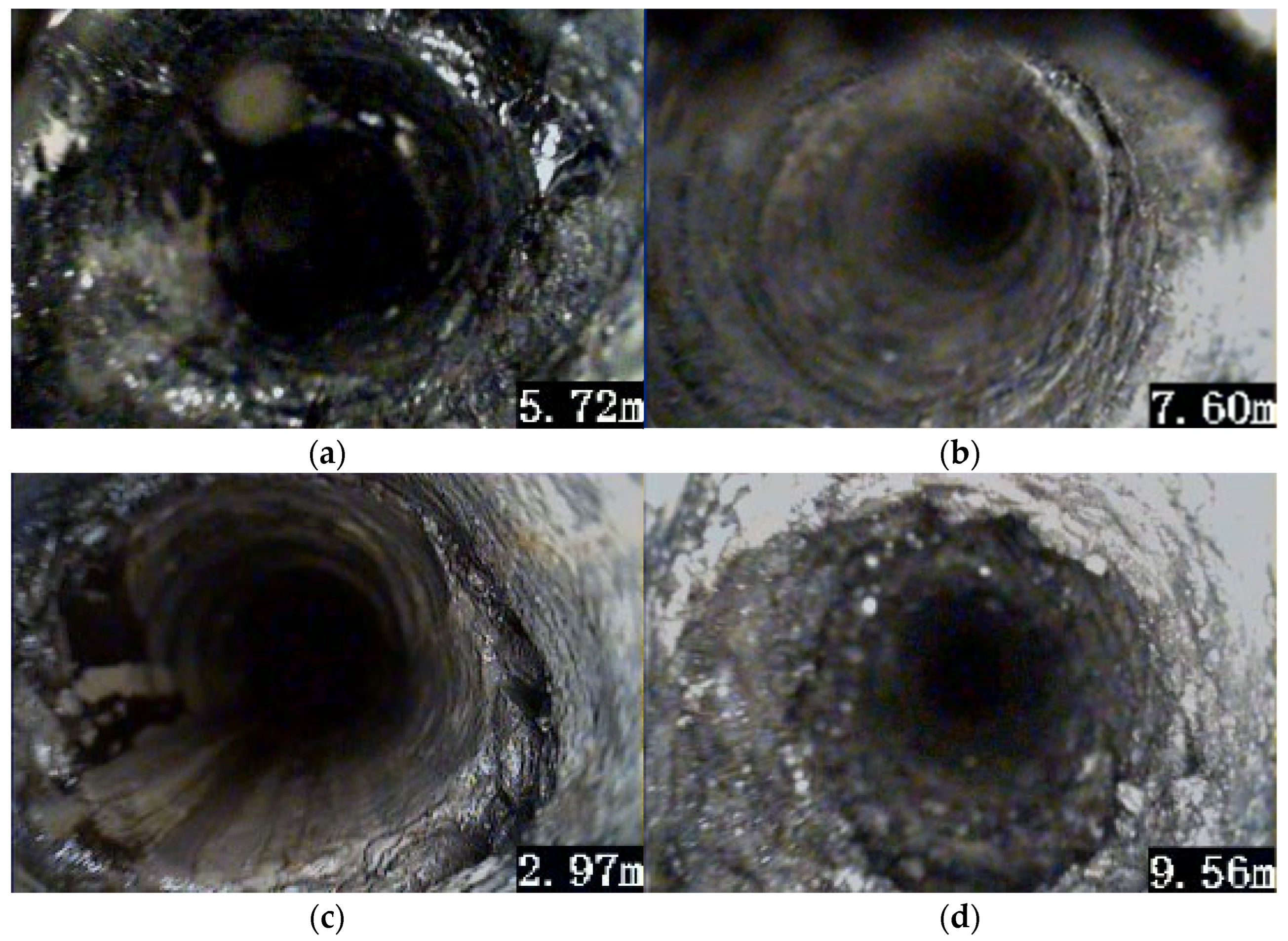
First, under the background of the original support scheme, borehole televiewer surveys were conducted on the roof at four different measurement points in 3205 Material Road and 3205 Transport Road respectively. The four measurement points in 3205 Mate-rial Road (designated KC1-4) are located at roadway chainages of 295 m, 235 m, 85 m and 65 m, while those in 3205 Transport Road (designated KY1-4) are at 640 m, 395 m, 330 m and 218 m, with a uniform borehole diameter of 34 mm and a depth ranging from 9 to 10 m. The observation results are shown in Figure 16.
It was found through observations that all eight measurement points indicate signif-icant deficiencies in the original support scheme, with fractures, bed separations, and fractured zones widely developed in the surrounding rock. Among the four points in the Material Road, the maximum depth of the fractured zone reaches 5.72 m under full cable support, and the fracture depth exceeds 7.6 m under combined bolt-cable support, beyond the cable anchorage range, posing a risk of overall roof subsidence. For the four points in the Transport Road, the shallow part is severely fractured and weathered, the maximum bed separation amount exceeds 50 mm, the deepest fractured zone reaches 9.56 m, and fractures extend deep outside the support zone in some areas. Overall, the 0–4 m shallow layer is a concentrated failure zone, and the development of deep fractures exhibits time-dependent effect and stress sensitivity. The original support (full cable support and combined bolt-cable support) has insufficient stiffness, and its anchorage range fails to cover the deep fractured zones, making it unable to adapt to the high ground stress and weathering effects of the deep-buried soft rock coal roadway with composite roof, resulting in poor surrounding rock stability.
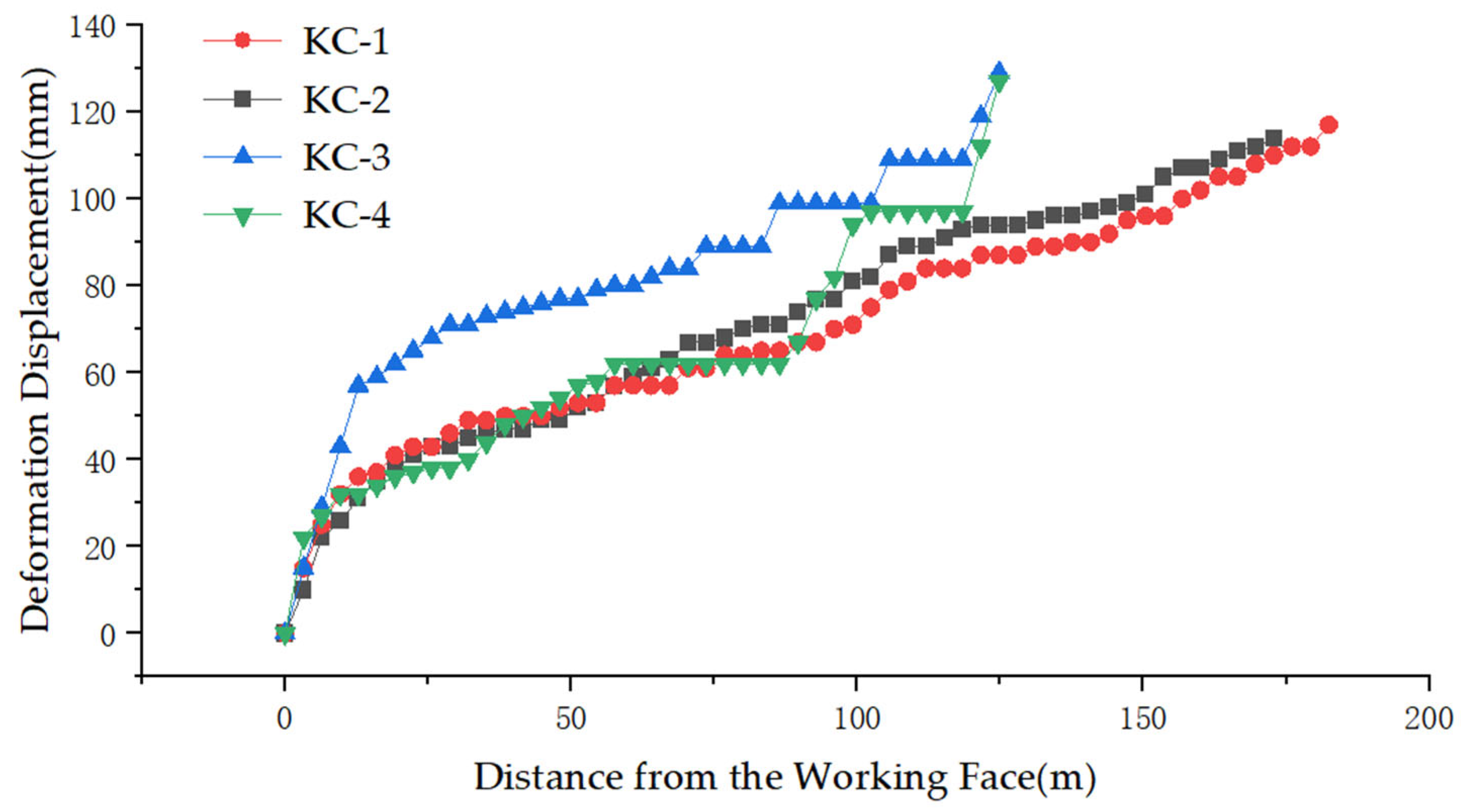
In addition, roof displacement monitoring was carried out for the four measuring points (marked as KC1-4) in the 3205 material drift (Figure 17). Under the original support scheme, the roof subsidence of the four measuring points showed an overall continuous increasing trend with the increase in distance from the working face, without obvious signs of stabilization. In the initial stage (0–30 m), the deformation rate was relatively fast; in the later stage, the growth rate slowed down but continued to develop. Eventually, the maximum deformation of KC-3 reached 129 mm, while those of KC-1, KC-2, and KC-4 were 118 mm, 114 mm, and 97 mm respectively. The long-term continuous deformation indicates that the strength and stiffness of the original support structure are obviously insufficient, failing to effectively restrain the development of surrounding rock deformation and making it difficult to ensure the long-term stability of the drift.

4.3. Monitoring Scheme and Instrumentation

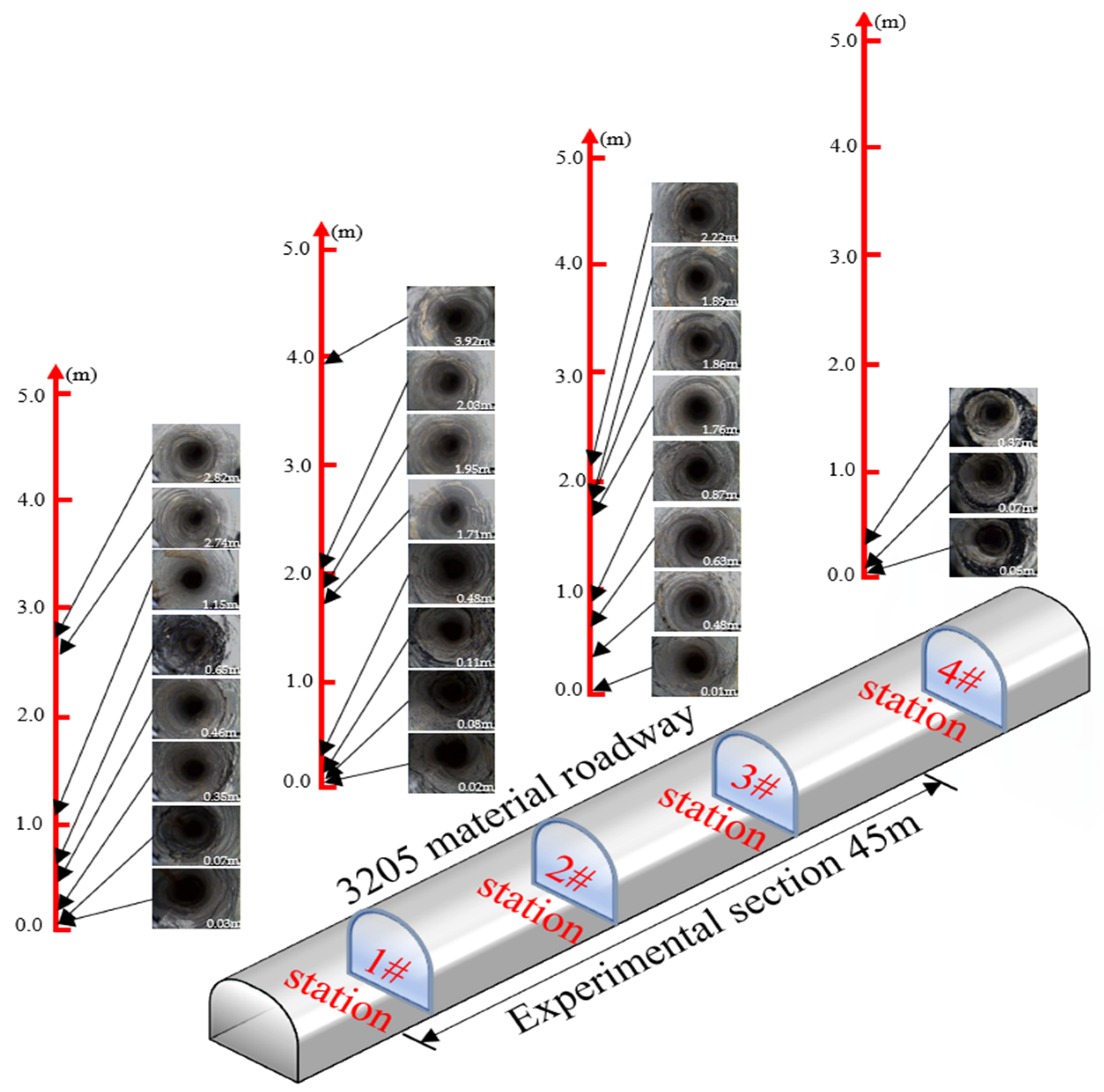
To quantitatively evaluate the effectiveness of the proposed grouting-anchoring synergistic control technology, a dedicated 45-m experimental section was established within the 3205 material gateway. A comprehensive and multifaceted monitoring scheme was implemented, designed to capture the system’s performance across different physical domains and spatial scales. This scheme encompassed: (1) roadway surface displacement measurement, to quantify macroscopic deformation behavior; (2) axial force monitoring of bolts and anchor cables, to assess the internal load transfer and interactive mechanics between the support system and the surrounding rock; and (3) borehole televiewer observation, to directly visualize the integrity of the deep surrounding rock and the effectiveness of grout penetration in sealing fractures. The subsequent sections present and compare the monitoring results from these three complementary perspectives, thereby providing a holistic verification of the technology’s practical application value.
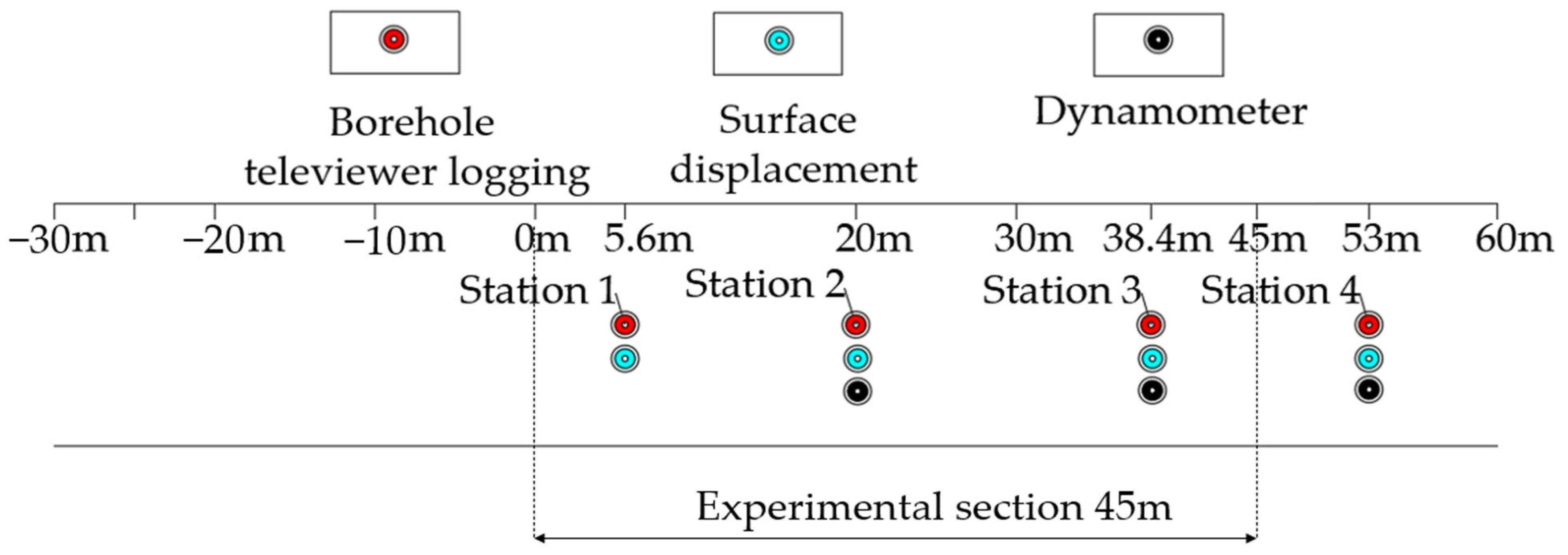
Four monitoring stations were strategically deployed along the gateway, beginning from a reference origin at chainage 1800 m. The station layout was designed to capture performance variations both within the experimental zone and in adjacent traditionally supported areas. Specifically, three stations were positioned inside the experimental section at offsets of 5.6 m, 20 m, and 38.4 m from its starting point, sampling locations at different distances from the advancing face and potential local geological variations. A fourth reference station was installed 8 m outside the experimental section, within a zone supported by conventional methods, to serve as a baseline for comparative analysis. The spatial distribution of these stations is illustrated in Figure 18. At each station, the monitoring protocol included concurrent measurements of surface displacement, anchor cable axial force, and borehole wall conditions via televiewer. Notably, the monitoring start time varies according to the different installation sequences of the monitoring stations. After the installation of Station 1, it was monitored daily for a total of 49 days, while Stations 2–4 were monitored daily for as long as 45, 44 and 42 days respectively. It should be noted that, due to practical constraints encountered during field installation, the axial force monitoring system at Station 1 malfunctioned and yielded no valid data; however, the remaining three stations functioned properly and provided complete datasets for analysis.

4.4. Analysis of Support Effectiveness

4.4.1. Roadway Surface Displacement

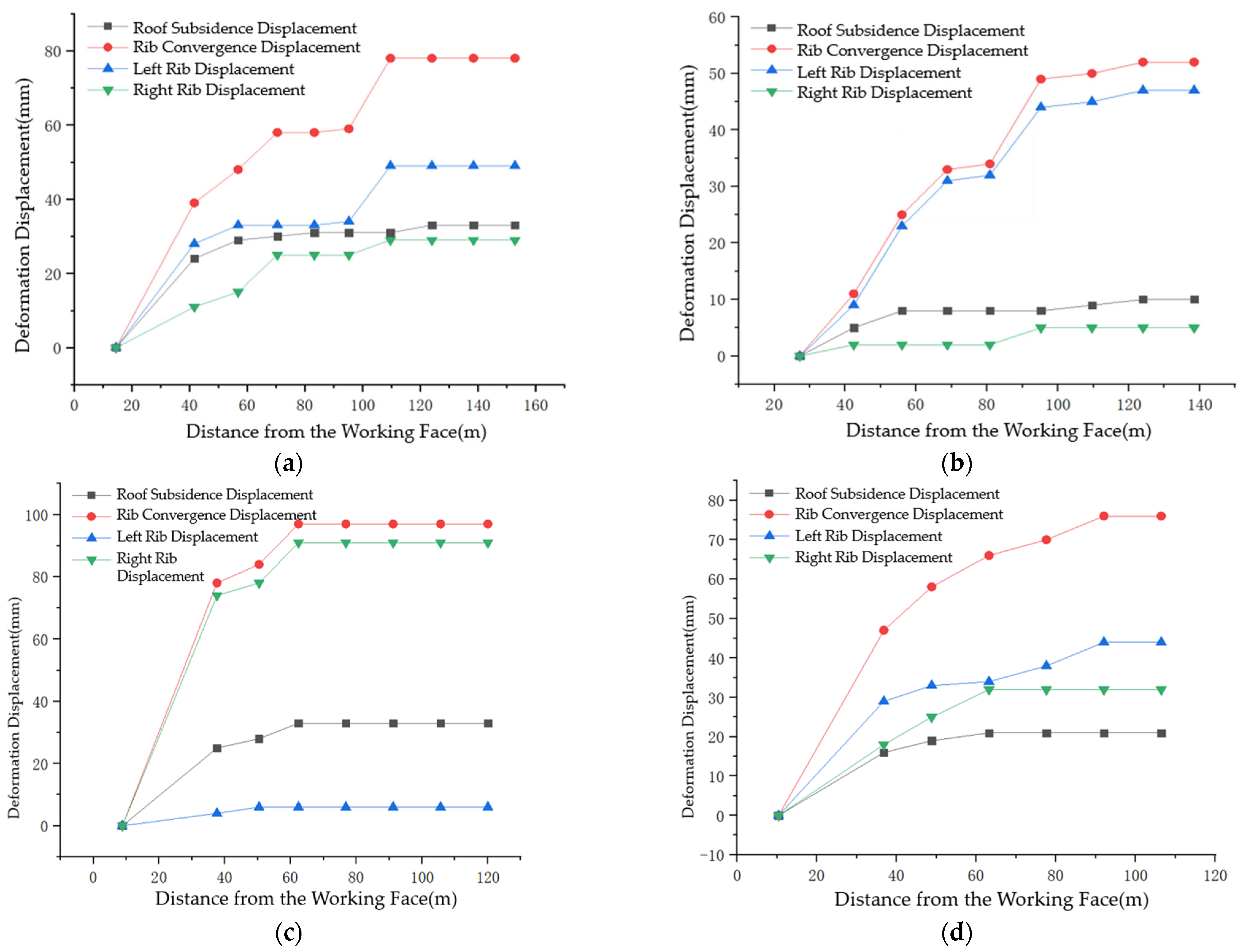
Systematic monitoring of roadway surface displacement was implemented following the completion of the experimental section to quantitatively evaluate the performance of the newly developed support system. The evolution of surface displacement with increasing distance from the excavation face is presented in Figure 19.
Analysis of the monitoring data reveals distinct spatiotemporal characteristics in surrounding rock deformation. The majority of deformation occurs within 0–60 m from the excavation face, with the most intense deformation phase concentrated in the 0–40 m interval. Beyond 40 m, deformation rates progressively diminish, generally stabilizing after 100 m.
Spatial analysis demonstrates significant performance variations between support systems. Station #2, located within the experimental section employing the new synergistic support system, exhibited superior performance with only 10 mm of roof subsidence and 52 mm of rib convergence—the smallest deformation magnitudes recorded and the shortest distance to stabilization. This result provides direct field validation of the enhanced control capability offered by the integrated material–structure approach.
In contrast, Stations #1 and #3, also within the experimental section but potentially affected by local geological variations or construction implementation, showed greater deformation. Both stations recorded 33 mm of roof subsidence, while Station 3 experienced substantial rib convergence of 97 mm. The pronounced deformation at Station 3′s left rib is attributed to stress concentration induced by wooden wedge extrusion from coal hole wall closure—a localized effect that highlights the system’s sensitivity to construction details.
Notably, Station 4, positioned in the transition zone between new and traditional support systems, displayed intermediate performance with 21 mm roof subsidence and 76 mm rib convergence. These values, while greater than those at Station 2, represent significant improvement over typical performance in traditional support zones, suggesting that the new system exerts a beneficial stress redistribution effect that extends beyond its immediate application area.
The collective displacement data conclusively demonstrates that the material–structure integrated support system substantially enhances surrounding rock stability, with particular efficacy in controlling both roof subsidence and rib convergence. The superior performance observed at Station #2 validates the theoretical synergistic mechanisms proposed in Section 3.3, confirming that the combination of microscale rock modification and optimized structural support effectively mitigates deformation in challenging soft rock conditions.

4.4.2. Axial Force Response of Bolts and Cables

While surface displacement monitoring captures the macroscopic deformation behavior of the surrounding rock, the axial force evolution in bolts and cables provides critical insight into the internal load transfer mechanisms and interactive performance between the support system and the rock mass. This section analyzes the axial force monitoring data from anchor cables installed under different support configurations to evaluate the mechanical effectiveness and temporal behavior of the proposed integrated support system from a structural mechanics perspective.
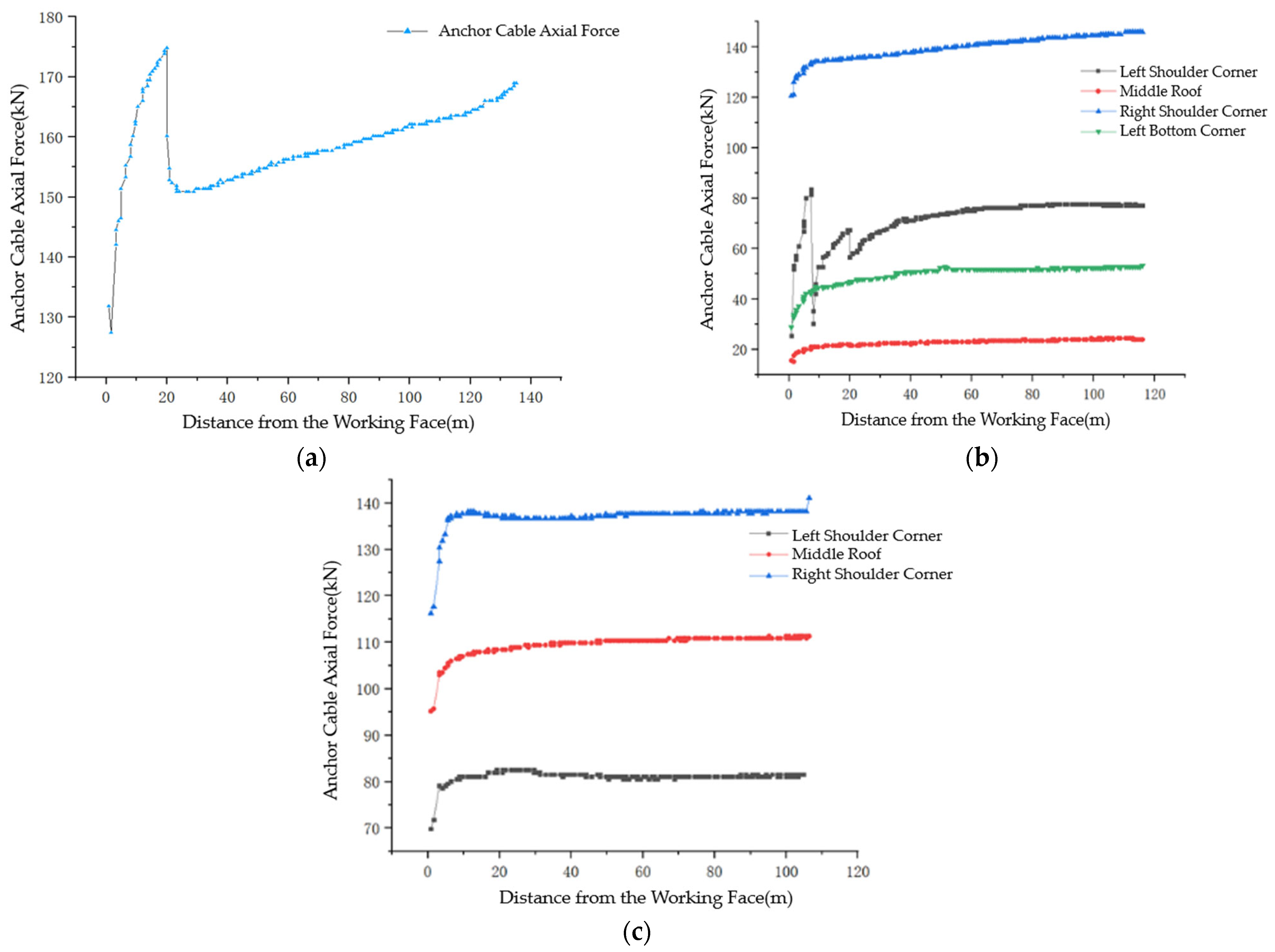
Systematic monitoring of anchor cable axial forces was conducted at Stations 2, 3 and 4, representing respectively the new support scheme experimental section, a problematic implementation area, and the traditional support zone. The recorded axial force developments are presented in Figure 20.
The axial force data reveal fundamentally different response patterns under the three support conditions. At Station 2, where the integrated material–structure support system was properly implemented, the anchor cables exhibited an ideal load response sequence. Following initial tensioning to 132 kN, the axial forces increased rapidly within 0–20 m from the face, demonstrating effective early engagement with the surrounding rock. After a brief adjustment period, the forces entered a phase of stable growth, indicating continuous load transfer and sustained interaction with the rock mass as face advance progressed. This response pattern validates the synergistic mechanism described in Section 3.3, where the grout-strengthened rock mass effectively transfers stress to the anchoring system while the tiered configuration maintains progressive load development.
In contrast, Station 3 displayed severely compromised performance due to inadequate initial pretensioning (mostly below 30 kN). The significantly reduced preload resulted in diminished system stiffness and poor stress transfer efficiency. The left shoulder cable experienced two distinct axial force losses at 10 m and 20 m intervals, indicating progressive failure and stress redistribution in the shallow surrounding rock. Meanwhile, the middle roof cable remained largely inactive, failing to provide meaningful support resistance. This deficient response highlights the critical importance of proper installation quality and adequate preload in realizing the designed support functionality.
At Station 4, representing the conventional support scheme, the anchor cables showed a characteristically limited response. The axial forces increased rapidly within the immediate 0–10 m range behind the face but then stabilized at near-constant levels. This pattern reflects the system’s restricted capacity to adapt to long-term stress redistribution and rheological deformation, resulting in passive rather than active support behavior.

4.4.3. Internal Fracture Sealing and Rock Mass Integrity

While the axial force response of bolts and cables provides insight into the mechanical interaction between the support system and surrounding rock, the underlying structural changes within the rock mass itself require direct observation to fully validate the reinforcement mechanism. This section employs borehole televiewer technology to quantitatively assess fracture distribution characteristics and grouting effectiveness under the new support scheme, providing critical evidence of rock mass improvement from a structural perspective. The borehole wall characteristics of roof strata at each measuring station, revealed by televiewer logging, are shown in Figure 21.
Comprehensive televiewer surveys were conducted in four strategically positioned roof boreholes in the test section to systematically evaluate fracture development patterns and grout penetration effectiveness. In the test area implementing the new support scheme (Holes 1, 2 and 3), fracture development depths were recorded as 1.15 m, 2.03 m and 2.22 m, respectively. Although these boreholes exhibited various structural discontinuities—including circumferential fractures, longitudinal cracks, and localized fractured zones—all showed clear evidence of effective grout penetration and cementation. Particularly noteworthy are the distinct grout filling traces observed at depths of 2.74 m and 2.82 m, demonstrating the exceptional penetration capability of the polymer-modified grouting material into the microfracture network previously identified in SEM analysis.
For Holes 2 and 3, the borehole walls below approximately 2 m depth displayed intact conditions with well-preserved sedimentary textures, indicating that the support system effectively protected the deeper rock mass from excavation-induced damage. This structural preservation confirms that the tiered anchoring system successfully transferred loads to competent strata beyond the excavation-damaged zone, consistent with the design principles outlined in Section 3.2.
In stark contrast, Hole 4—located outside the influence zone of the new support scheme—exhibited fundamentally different characteristics. Despite a relatively shallow fracture development depth of only 0.37 m, this borehole revealed multiple fractured zones with no visible grouting reinforcement traces. The absence of grout penetration and the poorly consolidated nature of the rock mass represent typical characteristics of unreinforced surrounding rock under traditional support conditions.
The comparative analysis provides direct structural evidence that the new support scheme has effectively inhibited fracture propagation through comprehensive grouting reinforcement. The transformation from a fractured, discontinuous rock mass to a coherent, cemented medium represents a fundamental shift from “passive support” to “active reinforcement”—a core principle of the material–structure integrated approach. This internal structural improvement directly correlates with the enhanced deformation control and optimized axial force responses documented in preceding sections, completing the mechanistic validation of the proposed technology across multiple observational scales.

4.4.4. Overall Performance Assessment

Integrating the multi-parameter monitoring results—encompassing roadway surface displacement, axial forces in support elements, and internal rock mass structure—provides compelling and consistent evidence that the proposed grouting-anchoring synergistic control technology effectively addresses the core challenges inherent in soft-rock roadway support. The coherent performance pattern observed across these distinct physical domains not only validates the underlying technical principles but also confirms the practical efficacy of the integrated material–structure approach.
Material-level modification has been decisively achieved through the deployment of the high-performance polymer-modified grout. Borehole televiewer observations directly confirm that the grout thoroughly penetrates and consolidates the micro-fracture network previously characterized by SEM (widths 0.89–20.41 μm), thereby transforming the originally fragmented, weak rock mass into a continuous, coherent load-bearing medium. This reconstruction at the microscale directly counteracts the water-sensitivity and strength-degradation mechanisms associated with the high clay-mineral content (kaolinite + illite = 58.1%) identified via XRD, establishing a durable mechanical foundation for the subsequent structural support.
Structural-level optimization is demonstrated by the monitored response of the tiered anchoring system. The axial-force evolution patterns confirm an efficient, progressive load transfer from the grout-strengthened shallow zone to the competent deep strata, forming a composite load-bearing structure that actively engages both the improved shallow rock and the stable deep rock. This mechanism shifts the support paradigm from conventional passive resistance to active reinforcement, wherein the applied pre-stress is effectively maintained and even increased as the rock deforms, thereby continuously confining the surrounding rock and suppressing further deformation.
The synergistic interplay between material modification and structural optimization is unequivocally demonstrated by the concordance of the monitoring datasets. The markedly reduced roadway deformation (e.g., ~10 mm roof subsidence and ~52 mm rib convergence at Station 2) is directly correlated with the ideal “early-engagement—sustained-resistance” axial-force response of the anchor cables. Both outcomes are structurally explained by the effective fracture sealing and enhanced rock-mass integrity observed in the televiewer logs. This multi-domain consistency confirms that the system functions as an integrated whole, where material enhancement and structural action are mutually reinforcing.
In summary, the proposed technology represents a substantial advance over conventional support methods by establishing a complete control pathway spanning from microscale material modification to macroscale structural optimization. The field performance validates the fundamental premise that effective soft-rock support requires simultaneous intervention at both material and structural levels—proactively improving the intrinsic properties of the rock mass while optimally managing the mechanical load distribution. The successful application in the challenging ground conditions of Xin’an Coal Mine provides a validated, replicable methodological framework for achieving long-term stability in deep soft-rock roadways under high-stress and humid environments.

5. Conclusions

This study systematically investigates the stability control of soft rock roadways through an integrated material–structure methodology, which coherently links micro-mesoscopic mechanism analysis, innovative support technology development, and comprehensive field validation. The principal findings and contributions are summarized as follows:
  • The intrinsic instability mechanism of soft rock has been quantitatively elucidated, revealing that well-developed micron-scale fractures (0.89–20.41 μm) and a high content of expansive clay minerals (kaolinite and illite totaling 58.1%) collectively facilitate water infiltration, mineral swelling, and strength degradation, constituting the fundamental cause of macroscopic deformation and support failure.
  • A novel synergistic control technology was established, integrating self-developed polymer-modified grouting material with a tiered thick anchoring system. This approach achieves microscale fracture sealing and self-stress cementation while constructing a continuous macro-scale load-bearing structure through optimized shallow-deep load transfer and differentiated prestress application.
  • Field application in the 3205 material gateway of Xin’an Coal Mine demonstrated the superior performance of the proposed system. The experimental section exhibited significantly controlled deformation—roof subsidence of ~10 mm and rib convergence of ~52 mm, representing reductions of approximately 55% in roof subsidence and 32% in rib convergence compared with the conventionally supported section—coupled with ideal axial force response characteristics and effective fracture sealing to depths of 1.71–3.92 m, confirming the transition from passive support to active reinforcement.
  • The study provides a systematic methodology bridging microscale material modification to macroscale structural optimization, offering a replicable and effective solution for soft rock roadway support under high-stress and humid conditions. The integration of performance monitoring across displacement, stress, and structural domains validates the coherence and robustness of the proposed technology.

Author Contributions

S.Y. proposed this idea. Y.X. and H.Z. conducted data collection and processing at Xin’an Coal Mine in Pingliang City, Gansu Province. Y.X. and F.G. performed determination and analysis of samples. S.Y. and Z.X. wrote and modified the manuscript. S.Y. Supervised the project, S.Y. and F.G. revised the manuscript. All authors have read and agreed to the published version of the manuscript.

Funding

This work was partially supported by the National Natural Science Foundation of China [grant numbers 52474180]; the Local Service Special Program of the Scientific Research Project by the Education Department of Shaanxi Province [grant numbers 25JE011]; the Postdoctoral Fellowship Program of CPSF [grant number 2022MD723829], and the Outstanding Youth Program of Xi’an University of Science and Technology [grant number 2022YQ3–08].

Data Availability Statement

The original contributions presented in this study are included in the article. Further inquiries can be directed to the corresponding author.

Conflicts of Interest

The authors declare no conflicts of interest.

References

  1. Yan, L.; Chang, J.; Shi, W.; Wang, T.; Qiao, L.; Guo, Y.; Wang, H. Creep Deformation Characteristics and Control Technology in Deep Mine Soft Rock Roadway. Geomech. Geophys. Geo-Energy Geo-Resour. 2024, 10, 144. [Google Scholar] [CrossRef]
  2. Chen, X.; Wang, X.; Zhang, D.; Qin, D.; Wang, Y.; Wang, J.; Chang, Z. Creep and Control of the Deep Soft Rock Roadway (DSRR): Insights from Laboratory Testing and Practice in Pingdingshan Mining Area. Rock Mech. Rock Eng. 2022, 55, 363–378. [Google Scholar] [CrossRef]
  3. Wang, Q.; Jiang, B.; Pan, R.; Li, S.-C.; He, M.-C.; Sun, H.-B.; Qin, Q.; Yu, H.-C.; Luan, Y.-C. Failure Mechanism of Surrounding Rock with High Stress and Confined Concrete Support System. Int. J. Rock Mech. Min. Sci. 2018, 102, 89–100. [Google Scholar] [CrossRef]
  4. Metzler, I.; Frühwirt, T.; Hölzl, H.; Marcher, T. Argillaceous Soft Rock In-Situ Test Program in Tunneling. Rock Mech. Rock Eng. 2025, 58, 11523–11539. [Google Scholar] [CrossRef]
  5. Zuo, Q.; Li, X.; Li, P.; Deng, M.; Adoko, A.C. Surrounding Rock Instability Mechanism for Fault-Crossing Tunnels in Water-Rich Soft Rock. Bull. Eng. Geol. Environ. 2024, 83, 252. [Google Scholar] [CrossRef]
  6. Rahimi, B.; Sharifzadeh, M.; Feng, X.-T. Ground Behaviour Analysis, Support System Design and Construction Strategies in Deep Hard Rock Mining—Justified in Western Australian’s Mines. J. Rock Mech. Geotech. Eng. 2020, 12, 1–20. [Google Scholar] [CrossRef]
  7. Ma, Z.; Zheng, H.; Zhang, D.; Zhou, L.; Cao, J.; Liang, X.; Chen, C. Instability Mechanism and Control Technology of Soft Rock Roadways Affected by Mining in Karst Mountain Area. Geomech. Geophys. Geo-Energy Geo-Resour. 2024, 10, 22. [Google Scholar] [CrossRef]
  8. Tolooiyan, A.; Dyson, A.P.; Karami, M.; Shaghaghi, T.; Ghadrdan, M. Investigation of an Australian Soft Rock Permeability Variation. Bull. Eng. Geol. Environ. 2020, 79, 3087–3104. [Google Scholar] [CrossRef]
  9. Bizjak, K.F.; Petkovšek, B. Displacement Analysis of Tunnel Support in Soft Rock around a Shallow Highway Tunnel at Golovec. Eng. Geol. 2004, 75, 89–106. [Google Scholar] [CrossRef]
  10. Wang, X.; Zhang, Y.; Zhang, Q.; Wei, Y.; Liu, W.; Jiang, T. Space-Time Evolution Characteristics of Deformation and Failure of Surrounding Rock in Deep Soft Rock Roadway. Sustainability 2022, 14, 12587. [Google Scholar] [CrossRef]
  11. Meng, Q.-B.; Liu, J.-F.; Xie, L.-X.; Pu, H.; Yang, Y.-G.; Huang, B.-X.; Qian, W. Experimental Mechanical Strength and Deformation Characteristics of Deep Damaged–Fractured Rock. Bull. Eng. Geol. Environ. 2022, 81, 32. [Google Scholar] [CrossRef]
  12. Yuan, A.; Huang, H.; Li, T. Study on Meso-Mechanical Evolution Characteristics and Numerical Simulation of Deep Soft Rock. Processes 2025, 13, 2358. [Google Scholar] [CrossRef]
  13. He, M.-C.; Sun, X. Numerical Simulation Study on Coupled Support of Soft Rock Roadways in Deep Mining. J. China Univ. Min. Technol. 2005, 34, 37–40. [Google Scholar] [CrossRef]
  14. Ma, X. Coupling Control Technology of Active Support and Surrounding Rock Stability for Deep Soft Rock Roadways. China Energy Environ. Prot. 2025, 47, 271–278. [Google Scholar] [CrossRef]
  15. Frenelus, W.; Peng, H.; Zhang, J. Seepage Actions and Their Consequences on the Support Scheme of Deep-Buried Tunnels Constructed in Soft Rock Strata. Infrastructures 2024, 9, 13. [Google Scholar] [CrossRef]
  16. Niu, S.; Jing, H.; Yang, S. Research and Application of Stability Control Technology for Deep Soft Rock Roadways. J. China Coal Soc. 2011, 36, 914–919. [Google Scholar] [CrossRef]
  17. Jaiswal, A.; Shrivastva, B.K. Numerical Simulation of Coal Pillar Strength. Int. J. Rock Mech. Min. Sci. 2009, 46, 779–788. [Google Scholar] [CrossRef]
  18. Sun, X.; Shi, F.; Ding, J.; Tao, Z.; Zhang, Y.; Miao, C.; Cui, L. Study on Microscopic Mechanism and Failure Mode of Water–Rock Coupling in Fine Sandstone Under Uniaxial Compression. Rock Mech. Rock Eng. 2023, 56, 6823–6842. [Google Scholar] [CrossRef]
  19. Wu, K.; Jin, B.; Hong, S.; Chen, J.; Nie, Q.; Liu, H.; Cai, H.; Gao, X. Analysis of Macroscopic, Microcosmic, and Microscopic Characteristics of Red-Bed Soft Rock in Central Yunnan and Its Mechanical Response in Construction. Phys. Fluids 2024, 36, 106607. [Google Scholar] [CrossRef]
  20. Wang, Q.; Jiang, B.; Li, S. High Strength Support for Soft Surrounding Rock in Deep Underground Engineering; Springer: Singapore, 2020. [Google Scholar] [CrossRef]
  21. Jiang, B.; Wang, L.; Lu, Y.; Gu, S.; Sun, X. Failure Mechanism Analysis and Support Design for Deep Composite Soft Rock Roadway: A Case Study of the Yangcheng Coal Mine in China. Shock Vib. 2015, 2015, 452479. [Google Scholar] [CrossRef]
  22. Kang, H.; Jiang, P.; Wu, Y.; Gao, F. A Combined “Ground Support-Rock Modification-Destressing” Strategy for 1000-m Deep Roadways in Extreme Squeezing Ground Condition. Int. J. Rock Mech. Min. Sci. 2021, 142, 104746. [Google Scholar] [CrossRef]
  23. Yang, R.; Li, Y.; Guo, D.; Yao, L.; Yang, T.; Li, T. Failure Mechanism and Control Technology of Water-Immersed Roadway in High-Stress and Soft Rock in a Deep Mine. Int. J. Min. Sci. Technol. 2017, 27, 245–252. [Google Scholar] [CrossRef]
  24. Zhao, T.; Xing, M.; Guo, W.; Wang, C.; Wang, B. Anchoring Effect and Energy-Absorbing Support Mechanism of Large Deformation Bolt. J. Cent. South Univ. 2021, 28, 572–581. [Google Scholar] [CrossRef]
  25. He, M.; Wang, Q. Excavation Compensation Method and Key Technology for Surrounding Rock Control. Eng. Geol. 2022, 307, 106784. [Google Scholar] [CrossRef]
  26. Zhao, C.; Li, Y.; Liu, G.; Meng, X. Mechanism Analysis and Control Technology of Surrounding Rock Failure in Deep Soft Rock Roadway. Eng. Fail Anal. 2020, 115, 104611. [Google Scholar] [CrossRef]
  27. Lin, W.; Cheng, J.; Li, D.; Dang, H. Deformation Characteristics and Control Technology of Roadway in Water-Rich Soft Rock. Geofluids 2022, 2022, 2234334. [Google Scholar] [CrossRef]
  28. Zhu, D.; Gao, L.; Ma, Q.; Zhuo, Z.; Li, Z. Research on the Deformation Mechanism and Control Technology of the Floor in Deep Soft Rock Roadway. Geofluids 2025, 2025, 5130542. [Google Scholar] [CrossRef]
  29. Yang, X.; Wang, E.; Wang, Y.; Gao, Y.; Wang, P. A Study of the Large Deformation Mechanism and Control Techniques for Deep Soft Rock Roadways. Sustainability 2018, 10, 1100. [Google Scholar] [CrossRef]
  30. Wan, F.; Wang, B.; Fu, C.; Li, L.; Li, X. Stability Control Measures of Soft and Broken Surrounding Rocks of Super-Large Section Tunnel Constructed Using Benching Tunneling Method. IOP Conf. Ser. Earth Environ. Sci. 2021, 769, 032082. [Google Scholar] [CrossRef]
  31. Li, J.; You, W.; Wu, S.; Li, J.; Han, J. Research Progress on Safety Control of Surrounding Rock-Support System in Deep Buried Soft Rock Tunnels. IOP Conf. Ser. Earth Environ. Sci. 2021, 719, 032090. [Google Scholar] [CrossRef]
  32. Jiang, L.; Li, H.; Ma, L.; Guan, W.; Wang, H.; Feng, H.; Zhang, B.; Wang, R. Deformation Control Technology for Surrounding Rock in Soft Rock Roadways of Deep Kilometer-Scale Mining Wells. Symmetry 2025, 17, 1911. [Google Scholar] [CrossRef]
  33. Wang, H.; Guo, C.; Sun, W.; Wang, H.; Yang, X.; Wang, F. Peridynamic Simulation of Fracturing in Heterogeneous Rock Based on X-Ray Diffraction and Scanning Electron Microscope Tests. Int. J. Multiscale Comput. Eng. 2024, 22, 67–84. [Google Scholar] [CrossRef]
  34. Sui, W.; Wang, Y.; Li, J. Microscopic Study of Shale Anisotropy with SEM In Situ Compression and Three-Point Bending Experiments. Energies 2023, 16, 2440. [Google Scholar] [CrossRef]
  35. Sui, W.; Tian, Y.; Yao, C. Investigation of Microscopic Pore Structure Variations of Shale Due to Hydration Effects through SEM Fixed-Point Observation Experiments. Pet. Explor. Dev. 2018, 45, 955–962. [Google Scholar] [CrossRef]
  36. Zhang, M.; Zhang, Z.; Zhang, D.; Zou, D.; Du, J.; Wang, Z.; Li, C. Study on Pore and Fissure Structure Characteristics of Deep Soft Coal Rock. Geofluids 2021, 2021, 1475926. [Google Scholar] [CrossRef]
  37. Carter, J.L.W.; Uz, T.K.; Ibrahim, B.; Pigott, J.S.; Gordon, J.V. A Comparison of Energy Dispersive Spectroscopy in Transmission Scanning Electron Microscopy with Scanning Transmission Electron Microscopy. Ultramicroscopy 2025, 270, 114106. [Google Scholar] [CrossRef]
  38. Nowak, S.; Lafon, S.; Caquineau, S.; Journet, E.; Laurent, B. Quantitative Study of the Mineralogical Composition of Mineral Dust Aerosols by X-Ray Diffraction. Talanta 2018, 186, 133–139. [Google Scholar] [CrossRef]
  39. Craddock, P.R.; Herron, M.M.; Herron, S.L. Comparison of Quantitative Mineral Analysis by X-Ray Diffraction and Fourier Transform Infrared Spectroscopy. J. Sediment. Res. 2017, 87, 630–652. [Google Scholar] [CrossRef]
  40. Skinner, H.C.W. X-Ray Diffraction Analysis Techniques to Monitor Composition Fluctuations within the Mineral Group: Apatite. Appl. Spectrosc. 1968, 22, 412–414. [Google Scholar] [CrossRef]
  41. Xiang, Z.; Zhang, N.; Xie, Z.; Mu, F.; Zhao, J.; Wu, X.; Wang, G.; Ma, X. Research and Development and Characterization of Poured Cement-based Full-length Anchorage Materials for Mining. J. Min. Saf. Eng. 2025, 42, 1042–1053. [Google Scholar] [CrossRef]
  42. Kang, H.; Jiang, T.; Gao, F. The Function of Prestress in Bolt Support. J. China Coal Soc. 2007, 7, 680–685. [Google Scholar] [CrossRef]
  43. Guo, F.; Zhang, N.; Xie, Z.; Han, C.; Zhang, C.; Yuan, Y.; He, Z.; Liu, J. A Three-Dimensional Supporting Technology, Optimization and Inspiration from a Deep Coal Mine in China. Rock Mech. Rock Eng. 2024, 57, 655–677. [Google Scholar] [CrossRef]
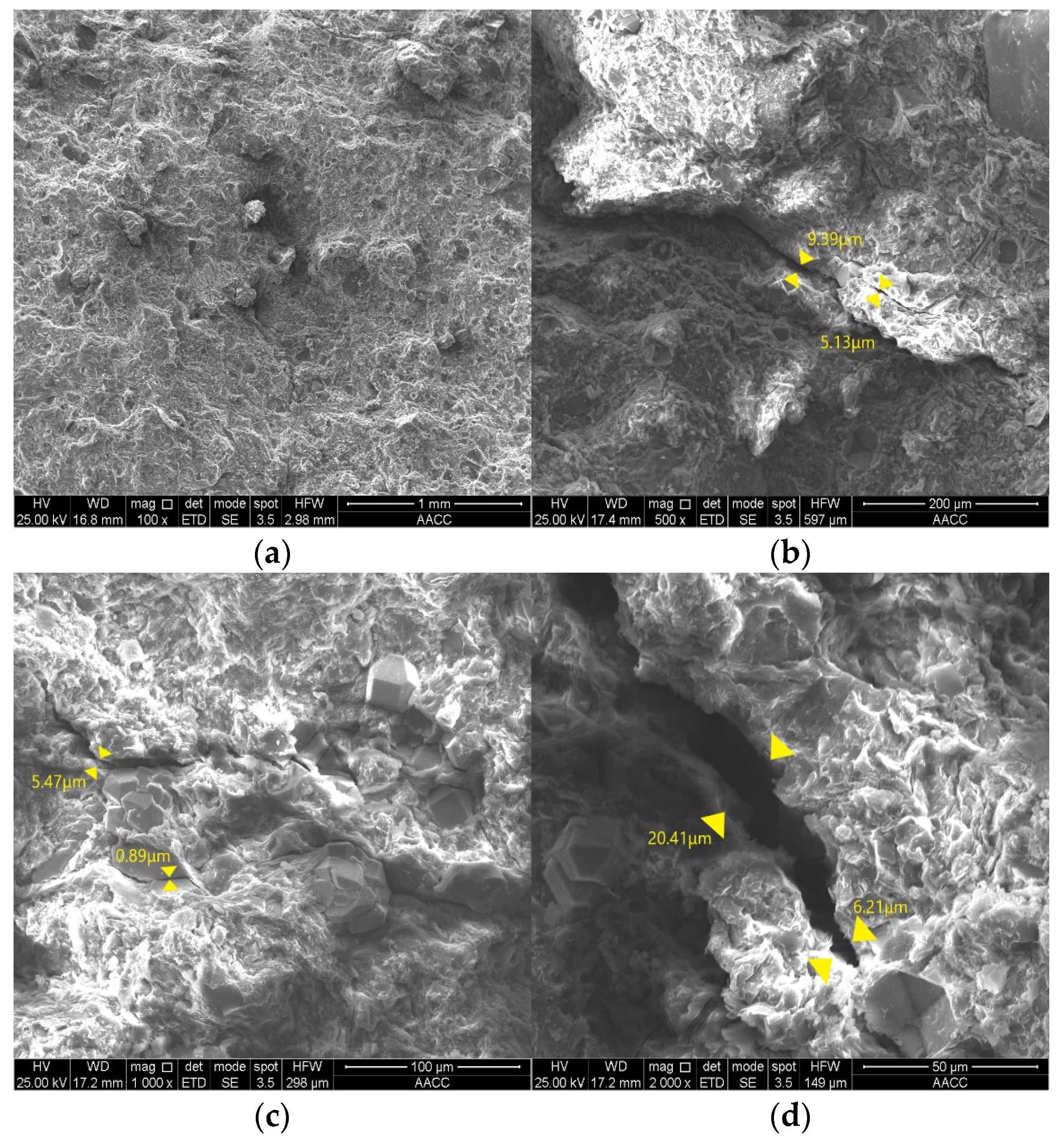
Figure 1. Surface morphology of roof rock samples from the 3205 Material Gateway in Xin’an Coal Mine at: (a) ×100 Magnification; (b) ×500 Magnification; (c) ×1000 Magnification; (d) ×2000 Magnification.
Processes 14 00414 g001
Figure 2. EdS Analysis Results of the Roof Rock Sample: (a) Sem Image At ×500, (b) Elemental Distribution Map, (c) Energy Spectrum.
Processes 14 00414 g002aProcesses 14 00414 g002b
Figure 3. X-Ray Diffraction Pattern of the Roof Rock Sample from Xin’An Coal Mine.
Processes 14 00414 g003
Figure 4. Time-Lapse Sequence of the Rock Sample Disintegration Process During Water Immersion.
Processes 14 00414 g004
Figure 5. Morphology of the Dried Disintegration Products After Oven Treatment.
Processes 14 00414 g005
Figure 6. Roof Collapse Triggered by Surface Failure and Strength Deterioration.
Processes 14 00414 g006
Figure 7. Characteristic Failure Modes Under Original Support in Soft Rock Roadways: (a) Roof Subsidence; (b) Single-Prop Roof Support; (c) Macroscopic Cracking at the Excavation Face; (d) Fractured Rock Mass Exposed at the Face.
Processes 14 00414 g007
Figure 8. The Preparation Principle of Redispersible Latex Powder [41].
Processes 14 00414 g008
Figure 9. Schematic diagram illustrating the mechanism of the two-stage anchor cable support system.
Processes 14 00414 g009
Figure 10. Cross-Sectional View of Support in the Experimental Section of 3205 Material Gateway.
Processes 14 00414 g010
Figure 11. Top View of Support in the Experimental Section of 3205 Material Gateway.
Processes 14 00414 g011
Figure 12. Schematic Diagram of the Synergistic Support Mechanism Integrating Grouting and Tiered Anchoring.
Processes 14 00414 g012
Figure 13. (a) Geographic location of Xin’an Coal Mine. (b) Layout of Upper Coal Pillar Relative to 3205 Material Roadway.
Processes 14 00414 g013
Figure 14. (a) Stratigraphic Column Showing Lithological Composition in the Vicinity of the 3205 Material gateway. (b) Diagram of the Positional Relationship between the 3205 Material gateway and the Working Face.
Processes 14 00414 g014aProcesses 14 00414 g014b
Figure 15. Cross-sectional View of the Original Support Scheme for the 3205 Material Gateway.
Processes 14 00414 g015
Figure 16. Borehole televiewer logging under the original support scheme: (a) KC-2, (b) KC-3, (c) KY-2, (d) KY-4.
Processes 14 00414 g016
Figure 17. Roof Displacement Diagram Under the Original Support Scheme.
Processes 14 00414 g017
Figure 18. Spatial distribution of monitoring stations within and adjacent to the experimental section.
Processes 14 00414 g018
Figure 19. Surface displacement evolution at monitoring stations: (a) Station #1, (b) Station #2, (c) Station #3, (d) Station #4.
Processes 14 00414 g019
Figure 20. Evolution of anchor cable axial force with face advance at: (a) Station 2, (b) Station 3, (c) Station 4.
Processes 14 00414 g020
Figure 21. Borehole wall characteristics revealed by televiewer logging in roof strata.
Processes 14 00414 g021
Table 1. SEM Experimental Sample Information.
NumberSampling PointLithology
XARoof at 1500 m, 3205 Material GatewayMudstone
Table 2. Semi-Quantitative Mineral Composition of the Sample from Xin’An Coal Mine.
MineralSemi-Quantitative Results wt.%
Quartz41.9
Kaolinite45.5
Illite12.6
Table 3. Performance Indicators of the Developed Anchoring Material.
ItemUnitNew
Material Value
Conventional
Material Value
Difference (Δ)
5h Compressive StrengthMPa≥25≥520
1d Compressive StrengthMPa≥30≥1020
3d Compressive StrengthMPa≥47≥2522
7d Compressive StrengthMPa>55≥3520
5h Flexural StrengthMPa≥4.1≥3.01.0
1d Flexural StrengthMPa≥4.2≥3.21.0
3d Flexural StrengthMPa≥4.5≥3.61.1
7d Flexural StrengthMPa≥6.7≥51.7
Particle Sizeum0–1530–50
Initial Setting Times70–118200–240
Construction Temperature°C5–355–35
Water-Cement Ratio 0.35:10.5:1
Usage Ratio of Components A and B 1:1
Disclaimer/Publisher’s Note: The statements, opinions and data contained in all publications are solely those of the individual author(s) and contributor(s) and not of MDPI and/or the editor(s). MDPI and/or the editor(s) disclaim responsibility for any injury to people or property resulting from any ideas, methods, instructions or products referred to in the content.