Article

Structural Transformation and Decoupling Strategies in a Carbon-Intensive Catch-Up Economy

1
Business School, Henan University of Science and Technology, Luoyang 471023, China
2
School of Economic Management and Law, Jiangxi Science and Technology Normal University, Nanchang 330029, China
*
Authors to whom correspondence should be addressed.
Processes 2026, 14(2), 367; https://doi.org/10.3390/pr14020367
Submission received: 22 December 2025 / Revised: 15 January 2026 / Accepted: 19 January 2026 / Published: 21 January 2026

Abstract

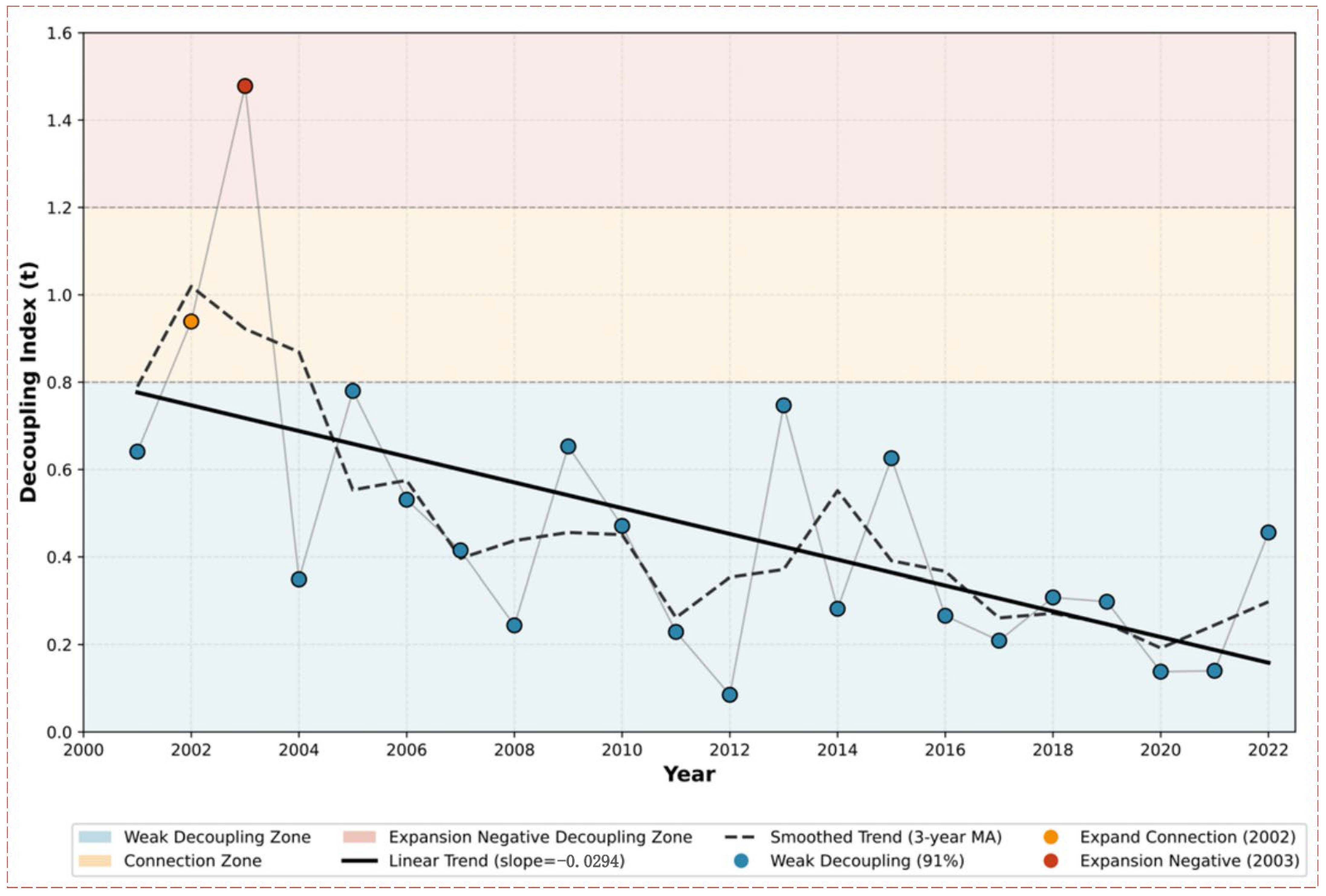
For less-developed, carbon-dependent regions, achieving carbon decoupling while pursuing economic catch-up presents a fundamental challenge. This study investigates this persistent dilemma through the case of Jiangxi Province, China, a typical coal-reliant inland region. Utilizing data from 2000 to 2022, we estimate carbon emissions following IPCC guidelines and employ the Generalized Divisia Index Method (GDIM) to decompose emission drivers, effectively overcoming the limitation of factor independence in conventional decomposition analyses. The results identify economic scale (cumulative contribution: 97.81%) and energy consumption (51%) as the primary drivers of emission growth, while carbon intensity of output (−47.38%) emerges as the strongest inhibiting factor. The application of the Tapio decoupling model reveals that weak decoupling is the dominant state, prevailing in 91% of the study period. This persistent pattern underscores only a partial and unstable separation between economic growth and emissions, highlighting the region’s entrenched carbon lock-in. Our findings demonstrate that transcending this weak decoupling dilemma necessitates a strategic shift beyond efficiency gains. We propose that the resolution lies in accelerating structural transitions within the energy system and fostering low-carbon industrial upgrading. This study not only elucidates the dynamics of the carbon decoupling challenge in catch-up regions but also offers actionable and context-specific pathways, providing a valuable reference for analogous regions, particularly in developing and transition economies.
Keywords: carbon decoupling; catch-up region; GDIM; weak decoupling; carbon lock-in carbon decoupling; catch-up region; GDIM; weak decoupling; carbon lock-in