
Assessing Water Reuse Through Life Cycle Assessment: A Systematic Review of Recent Trends, Impacts, and Sustainability Challenges
 , , , ,
  and
and
Abstract
1. Introduction
2. Materials and Methods
2.1. Study Design and Reporting
2.2. Information Sources and Search Strategy
2.3. Eligibility Criteria
2.4. Study Selection
2.5. Data Collection and Data Items
2.6. Risk of Bias and Quality Considerations
3. Results and Discussion
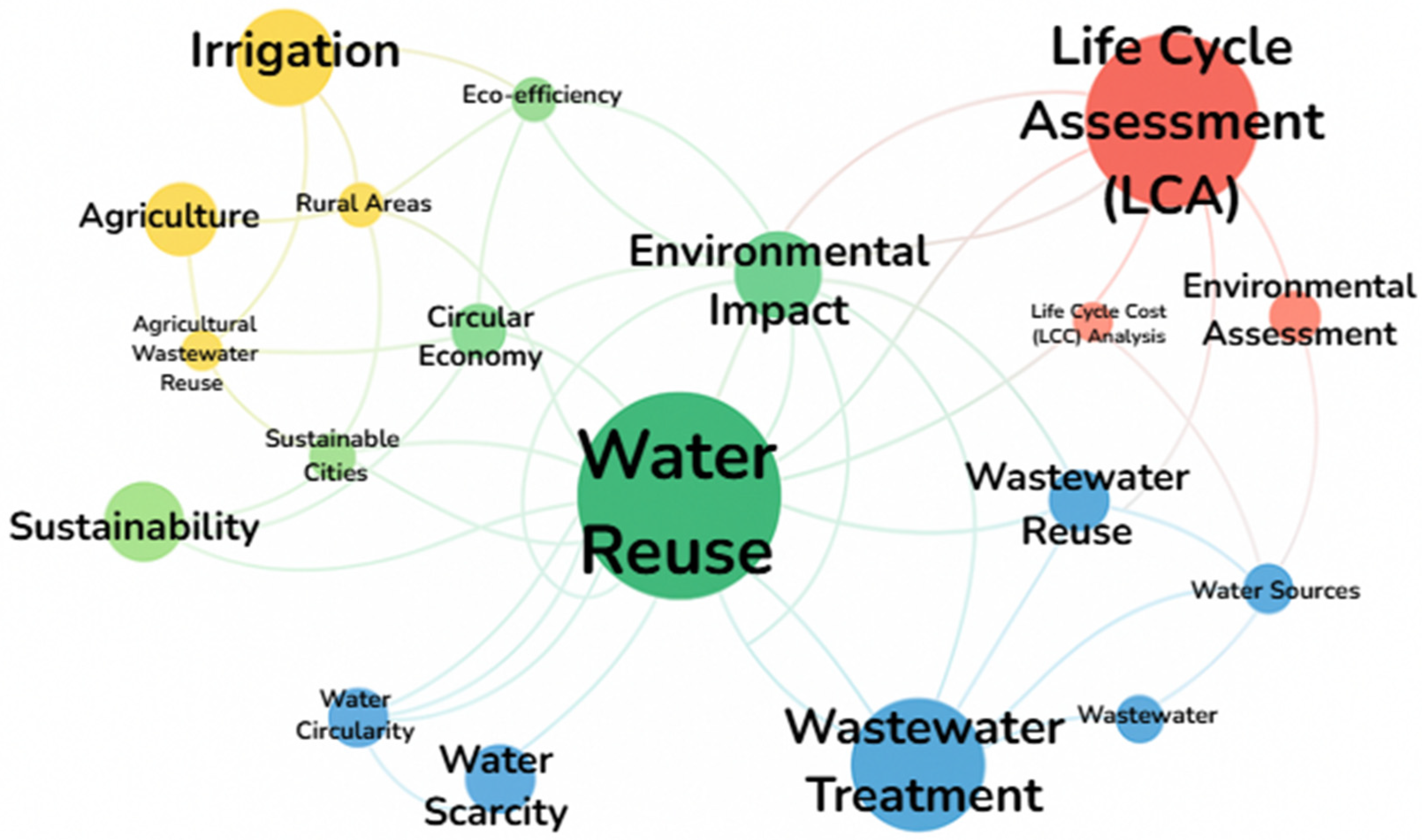
3.1. Profile of Articles Selected for Analysis
3.2. LCA Methodological Approach
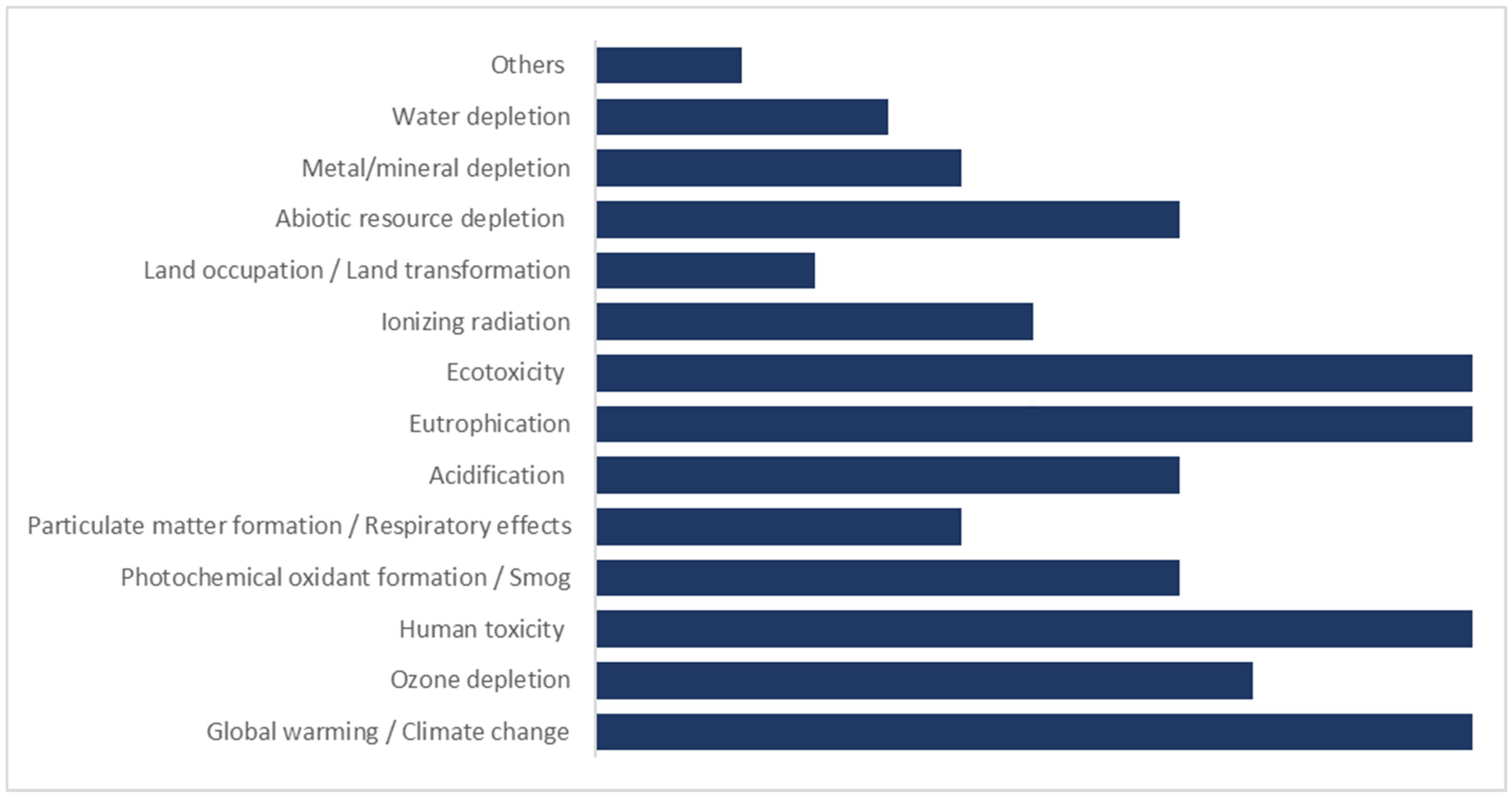
3.3. Analysis of the Main Results of the Studies
3.4. Challenge and Outlook
4. Conclusions
Supplementary Materials
Author Contributions
Funding
Data Availability Statement
Acknowledgments
Conflicts of Interest
References
- FAO. Livestock and Environment Statistics: Manure and GHG Emissions. Global, Regional and Country Trends 1990–2018. FAOSTAT Analytical Brief 14 2020. Available online: https://openknowledge.fao.org/server/api/core/bitstreams/f0cebfdd-725e-4d7a-8e14-3ba8fb1486a7/content (accessed on 30 July 2025).
- Pokhrel, Y.; Felfelani, F.; Satoh, Y.; Boulange, J.; Burek, P.; Gädeke, A.; Wada, Y. Global terrestrial water storage and drought severity under climate change. Nat. Clim. Change 2021, 11, 226–233. [Google Scholar] [CrossRef]
- Christou, A.; Beretsou, V.G.; Iakovides, I.C.; Karaolia, P.; Michael, C.; Benmarhnia, T.; Fatta-Kassinos, D. Sustainable wastewater reuse for agriculture. Nat. Rev. Earth Environ. 2024, 5, 504–521. [Google Scholar] [CrossRef]
- de Sá, P.L.S.; Lousada, S.A.N.; Teixeira, H.L.S. Tratamento de Águas Residuais: Uma Visão Geral da Pesquisa Através da Análise Bibliométrica. J. Lifestyle SDGs Rev. 2025, 5, e03641. [Google Scholar]
- Rebelo, A.; Amaro, A.B.; Quadrado, F. Water Reuse: A Risk Assessment Model for Water Resources. KnE Mater. Sci. 2022, 193–203. [Google Scholar] [CrossRef]
- Brandao, J.M.; Simoes, L.M.; Callapez, P.; Magalhaes, V. Água em Viseu: Desafios de um percurso centenário. In La Gestion del Agua en la Península Ibérica (Siglos XIX y XX); Sílex Ediciones: Madrid, Spain, 2022; pp. 451–470. Available online: https://hdl.handle.net/10174/36040 (accessed on 22 June 2025).
- United Nations. The United Nations World Water Development Report 2017: Wastewater—The Untapped Resource. UNESCO—United Nations Educational, Scientific and Cultural Organization. 2017. Available online: https://unesdoc.unesco.org/ark:/48223/pf0000247552_por (accessed on 5 June 2025).
- Águas do Tejo Atlântico. Fábrica de Água. Águas do Tejo Atlântico. 2019. Available online: https://www.aguasdotejoatlantico.adp.pt/ (accessed on 24 June 2024).
- ISO 14040; Environmental Management—Life Cycle Assessment—Principles and Framework. International Organization for Standardization (ISO): Geneva, Switzerland, 2006.
- ISO 14044; Environmental Management—Life Cycle Assessment—Requirements and Guidelines. International Organization for Standardization (ISO): Geneva, Switzerland, 2006.
- Santos, L.; Brás, I.; Ferreira, M.; Domingos, I.; Ferreira, J. Life Cycle Assessment of Green Space Irrigation Using Treated Wastewater: A Case Study. Sustainability 2024, 16, 5696. [Google Scholar] [CrossRef]
- Azeb, L.; Hartani, T.; Aitmouheb, N.; Pradeleix, L.; Hajjaji, N.; Aribi, S. Life cycle assessment of cucumber irrigation: Unplanned water reuse versus groundwater resources in Tipaza (Algeria). J. Water Reuse Desalination 2020, 10, 227–238. [Google Scholar] [CrossRef]
- Foglia, A.; Andreola, C.; Cipolletta, G.; Radini, S.; Akyol, Ç.; Eusebi, A.L.; Fatone, F. Comparative life cycle environmental and economic assessment of anaerobic membrane bioreactor and disinfection for reclaimed water reuse in agricultural irrigation: A case study in Italy. J. Clean. Prod. 2021, 293, 126201. [Google Scholar] [CrossRef]
- Kalboussi, N.; Biard, Y.; Pradeleix, L.; Rapaport, A.; Sinfort, C.; Ait-Mouheb, N. Life cycle assessment as decision support tool for water reuse in agriculture irrigation. Sci. Total Environ. 2022, 836, 155486. [Google Scholar] [CrossRef] [PubMed]
- Negi, R.; Chandel, M.K. Life cycle assessment of wastewater reuse alternatives in urban water system. Resour. Conserv. Recycl. 2024, 204, 107469. [Google Scholar] [CrossRef]
- Rodríguez, C.; Sánchez, R.; Rebolledo, N.; Schneider, N.; Serrano, J.; Leiva, E. Life cycle assessment of greywater treatment systems for water-reuse management in rural areas. Sci. Total Environ. 2021, 795, 148687. [Google Scholar] [CrossRef]
- Maeseele, C.; Roux, P. An LCA framework to assess environmental efficiency of water reuse: Application to contrasted locations for wastewater reuse in agriculture. J. Clean. Prod. 2021, 316, 128151. [Google Scholar] [CrossRef]
- Canaj, K.; Mehmeti, A.; Morrone, D.; Toma, P.; Todorović, M. Life cycle-based evaluation of environmental impacts and external costs of treated wastewater reuse for irrigation: A case study in southern Italy. J. Clean. Prod. 2021, 293, 126142. [Google Scholar] [CrossRef]
- Szalkowska, K.; Zubrowska-Sudol, M. Opportunities for water reuse implementation in metropolitan areas in a complex approach with an LCA analysis, taking Warsaw, Poland as an example. Sustainability 2023, 15, 1190. [Google Scholar] [CrossRef]
- Hargitai, R.H.; Sebestyén, V.; Somogyi, V. Potential water reuse pathways from a life cycle analysis perspective in the poultry industry. J. Water Process Eng. 2024, 64, 105577. [Google Scholar] [CrossRef]
- Akhoundi, A.; Nazif, S. Life-Cycle Assessment of Tertiary Treatment Technologies to Treat Secondary Municipal Wastewater for Reuse in Agricultural Irrigation, Artificial Recharge of Groundwater, and Industrial Usages. J. Environ. Eng. 2020, 146, 04020031. [Google Scholar] [CrossRef]
- Vu, T.T.; Huang, C.-F.; Phan, H.A.; Bach, T.T.N.; Zhang, P.; Bui, H.M. Biogas Utilization and Water Reuse in Paper Mill Wastewater Treatment: A Life Cycle Analysis. Water Air Soil Pollut. 2025, 236, 265. [Google Scholar] [CrossRef]
- Mclennan, C.; Rudi, G.; Altchenko, Y.; Ait-Mouheb, N. Will the European Regulation for water reuse for agricultural irrigation foster this practice in the European Union? Water Reuse 2024, 14, 115–135. [Google Scholar] [CrossRef]
- Du, Z.; Wang, Z.; Guo, F.; Wang, T. Dynamic structures and emerging trends in the management of major trauma: A bibliometric analysis of publications between 2012 and 2021. Front. Public Health 2022, 10, 1017817. [Google Scholar] [CrossRef]
- Tsangas, M.; Papamichael, I.; Banti, D.; Samaras, P.; Zorpas, A.A. LCA of municipal wastewater treatment. Chemosphere 2023, 341, 139952. [Google Scholar] [CrossRef] [PubMed]
- Larsen, V.G.; Tollin, N.; Sattrup, P.A.; Birkved, M.; Holmboe, T. What are the challenges in assessing circular economy for the built environment? A literature review on integrating LCA, LCC and S-LCA in life cycle sustainability assessment, LCSA. J. Build. Eng. 2022, 50, 104203. [Google Scholar] [CrossRef]
- Dong, B.; Song, C.; Li, H.; Lin, A.; Wang, J.; Li, W. Life cycle assessment on the environmental impacts of different pig manure management techniques. Int. J. Agric. Biol. Eng. 2022, 15, 78–84. [Google Scholar] [CrossRef]
- Schaubroeck, T.; Schaubroeck, S.; Heijungs, R.; Zamagni, A.; Brandão, M.; Benetto, E. Attributional & consequential life cycle assessment: Definitions, conceptual characteristics and modelling restrictions. Sustainability 2021, 13, 7386. [Google Scholar] [CrossRef]
- Luo, C.; Yao, X.; Zhang, Y.; Zhou, H. An empirical study on the impact of different structural systems on carbon emissions of prefabricated buildings based on SimaPro. World J. Eng. Technol. 2023, 11, 434–453. [Google Scholar] [CrossRef]
- Huijbregts, M.A.; Steinmann, Z.J.; Elshout, P.M.; Stam, G.; Verones, F.; Vieira, M.; Van Zelm, R. ReCiPe2016: A harmonised life cycle impact assessment method at midpoint and endpoint level. Int. J. Life Cycle Assess. 2017, 22, 138–147. [Google Scholar] [CrossRef]
- Devi, S.A.; Mirwan, M. Analisis Life Cycle Assessment (LCA) pada Proses Produksi Pupuk ZA II Menggunakan Metode Recipe 2016. INSOLOGI J. Sains Dan Teknol. 2023, 2, 620–632. [Google Scholar] [CrossRef]
- Anazonwu, I.A.; Fahmi, M.Z. Wastewater treatment, greenhouse gas emissions, and our environment. Recent Adv. Nat. Sci. 2024, 2, 121. [Google Scholar] [CrossRef]
- Chen, X.; Zhao, B.; Shuai, C.; Qu, S.; Xu, M. Global spread of water scarcity risk through trade. Resour. Conserv. Recycl. 2022, 187, 106643. [Google Scholar] [CrossRef]
- Mannina, G.; Cosenza, A.; Ekama, G.A. A comprehensive integrated membrane bioreactor model for greenhouse gas emissions. Chem. Eng. J. 2018, 334, 1563–1572. [Google Scholar] [CrossRef]
- Kesari, K.K.; Soni, R.; Jamal, Q.M.S.; Tripathi, P.; Lal, J.A.; Jha, N.K.; Ruokolainen, J. Wastewater Treatment and Reuse: A Review of its Applications and Health Implications. Water Air Soil Pollut. 2021, 232, 208. [Google Scholar] [CrossRef]
- Li, G.; Hao, C.H.; Jing, Y.M.; Liu, D.X.; Li, Y. Eutrophication problems of recycled water for landscape water and ecological restoration. Appl. Mech. Mater. 2013, 361, 938–941. [Google Scholar] [CrossRef]
- Pranta, A.D.; Rahaman, M.T.; Ahmed, M.S.; Arefin Rafi, M.S. Navigating eutrophication in aquatic environments: Understanding impacts and unveiling solutions for effective wastewater management. Res. Ecol. 2023, 5, 11–18. [Google Scholar] [CrossRef]
- Liwarska-Bizukojc, E. Evaluation of Ecotoxicity of wastewater from the full-scale treatment plants. Water 2022, 14, 3345. [Google Scholar] [CrossRef]
- Olagunju, B.D.; Olanrewaju, O.A. Life cycle assessment of ordinary portland cement (OPC) using both problem oriented (Midpoint) approach and damage oriented approach (Endpoint). In Product Life Cycle-Opportunities for Digital and Sustainable Transformation; IntechOpen: London, UK, 2021; Available online: https://www.intechopen.com/chapters/77062 (accessed on 23 June 2025).
- Gu, L.; Lin, B.; Gu, D.; Zhu, Y. An endpoint damage oriented model for life cycle environmental impact assessment of buildings in China. Chin. Sci. Bull. 2008, 53, 3762–3769. [Google Scholar] [CrossRef]
- Dudkowski, R. Objectives of the Study. In Managing Value Co-Creation in University-Industry Partnerships; Springer International Publishing: Cham, Switzerland, 2021; pp. 61–63. [Google Scholar]
- Pereira Filho, J.M.; Vieira, E.L.; Silva, A.M.A.; Cezar, M.F.; Amorim, F.U. Efeito do tratamento com hidróxido de sódio sobre a fração fibrosa, digestibilidade e tanino do feno de jurema-preta (Mimosa tenuiflora Wild). R. Bras. Zootec. 2003, 32, 70–76. [Google Scholar] [CrossRef]
- Rezaei, N.; Diaz-Elsayed, N.; Mohebbi, S.; Xie, X.; Zhang, Q. A multi-criteria sustainability assessment of water reuse applications: A case study in Lakeland, Florida. Environ. Sci. Water Res. Technol. 2019, 5, 102–118. [Google Scholar] [CrossRef]
- deMonsabert, S.; Bakhshi, A.; Maas, C.; Liner, B. Incorporating Energy Impacts into Water Supply and Wastewater Management. American Council for an Energy Efficient Economy. 2009. Available online: https://www.aceee.org/files/proceedings/2009/data/papers/6_86.pdf (accessed on 24 June 2025).
- Plappally, A.K. Energy requirements for water production, treatment, end use, reclamation, and disposal. Renew. Sustain. Energy Rev. 2012, 16, 4818–4848. [Google Scholar] [CrossRef]
- Hallmann, M.; Grant, T.; Alsop, N. Life Cycle Assessment and Life Cycle Costing of Water Tanks as a Supplement to Mains Water Supply; Centre for Design at RMIT University: Melbourne, Australia, 2003. [Google Scholar]
- Hackenhaar, I.C.; Moraga, G.; Thomassen, G.; Taelman, S.E.; Dewulf, J.; Bachmann, T.M. A comprehensive framework covering Life Cycle Sustainability Assessment, resource circularity and criticality. Sustain. Prod. Consum. 2024, 45, 509–524. [Google Scholar] [CrossRef]
- Ren, J.; Toniolo, S. (Eds.) Life Cycle Sustainability Assessment for Decision-Making: Methodologies and Case Studies; Elsevier: Amsterdam, The Netherlands, 2019. [Google Scholar]
- Bruno, A.; Menichini, T.; Silvestri, L. Life Cycle Sustainability Assessment (LCSA): A comprehensive overview of existing integrated approaches to LCA, S-LCA, and LCC. Eur. J. Sustain. 2025, 14, 13. [Google Scholar] [CrossRef]
- Page, M.J.; McKenzie, J.E.; Bossuyt, P.M.; Boutron, I.; Hoffmann, T.C.; Mulrow, C.D.; Shamseer, L.; Tetzlaff, J.M.; Akl, E.A.; Brennan, S.E.; et al. The PRISMA 2020 statement: An updated guideline for reporting systematic reviews. BMJ 2021, 372, n71. [Google Scholar] [CrossRef]



| Study No | Ref | Title | Authors | Years | Country | Journal |
|---|---|---|---|---|---|---|
| 1 | [11] | Life Cycle Assessment of Green Space Irrigation Using Treated Wastewater: A Case Study | Lenise Santos, Isabel Brás, Miguel Ferreira, Idalina Domingos, José Ferreira | 2024 | Portugal | Sustainability |
| 2 | [12] | Life cycle assessment of cucumber irrigation: unplanned water reuse versus groundwater resources in Tipaza (Algeria) | Latifa Azeb, Tarik Hartani, Nassim Aitmouheb, Ludivine Pradeleix, Nouredddin Hajjaji, Soumaya Aribi | 2020 | Algeria | Journal of Water Reuse and Desalination |
| 3 | [13] | Comparative life cycle environmental and economic assessment of anaerobic membrane bioreactor and disinfection for reclaimed water reuse in agricultural irrigation: A case study in Italy | Alessia Foglia, Corinne Andreola, Giulia Cipolletta, Serena Radini, Çağrı Akyol, Anna Laura Eusebi, Peyo Stanchev, Evina Katsou, Francesco Fatone | 2021 | Italy | Journal of Cleaner Production |
| 4 | [14] | Life cycle assessment as decision-support tool for water reuse in agricultural irrigation | Nesrine Kalboussi, Yannick Biard, Ludivine Pradeleix, Alain Rapaport, Carole Sinfort, Nassim Ait-mouheb | 2022 | France | Science of the Total Environment |
| 5 | [15] | Life cycle assessment of wastewater reuse alternatives in urban water system | Rajhans Negi, Munish K. Chandel | 2024 | India | Resources, Conservation & Recycling |
| 6 | [16] | Life cycle assessment of greywater treatment systems for water reuse management in rural areas | Carolina Rodríguez, Rafael Sánchez, Natalia Rebolledo, Nicolás Schneider, Jennyfer Serrano, Eduardo Leiva | 2021 | Chile | Science of the Total Environment |
| 7 | [17] | An LCA framework to assess environmental efficiency of water reuse: Application to contrasted locations for wastewater reuse in agriculture | Camille Maeseele, Philippe Roux | 2021 | France | Journal of Cleaner Production |
| 8 | [18] | Life cycle-based evaluation of environmental impacts and external costs of treated wastewater reuse for irrigation: A case study in southern Italy | Kledja Canaj, Andi Mehmeti, Domenico Morrone, Pierluigi Toma, Mladen Todorović | 2021 | Italy | Journal of Cleaner Production |
| 9 | [19] | Opportunities for Water Reuse Implementation in Metropolitan Areas in a Complex Approach with an LCA Analysis, Taking Warsaw, Poland as an Example | Karolina Szalkowska, Monika Zubrowska-Sudol | 2023 | Poland | Sustainability |
| 10 | [20] | Potential water reuse pathways from a life cycle analysis perspective in the poultry industry | Réka Harasztiné Hargitai, Viktor Sebestyén, Viola Somogyi | 2024 | Hungary | Journal of Water Process Engineering |
| 11 | [21] | Life-Cycle Assessment of Tertiary Treatment Technologies to Treat Secondary Municipal Wastewater for Reuse in Agricultural Irrigation, Artificial Recharge of Groundwater, and Industrial Usages | Ali Akhoundi, Sara Nazif | 2020 | Iran | Journal of Environmental Engineering (ASCE) |
| 12 | [22] | Biogas Utilization and Water Reuse in Paper Mill Wastewater Treatment: A Life Cycle Analysis | Thuy Thi Vu, Chih Feng Huang, Hao Anh Phan, Thuy Thi Ngoc Bach, Panyue Zhang, Ha Manh Bui | 2025 | Vietnam | Water, Air, & Soil Pollution |
| Study No | LCA Type | System Boundaries | Functional Unit |
|---|---|---|---|
| 1 | Attributional | Gate-to-gate expanded | 1 m2 of irrigated green area/day |
| 2 | Attributional | Cradle-to-field | 1 ha/1 kg of cucumber |
| 3 | Attributional | Cradle-to-field | 1 m3 of treated effluent |
| 4 | Attributional | Cradle-to-field | 1 ha of irrigated vineyard |
| 5 | Attributional | Cradle-to-gate expanded | 1 m3 of water delivered |
| 6 | Attributional | Cradle-to-grave | 1 m3 of treated gray water |
| 7 | Attributional | Cradle-to-gate | 1 m3 of water |
| 8 | Attributional | Cradle-to-field | 1 m3 of water |
| 9 | Attributional | Gate-to-use | 211 m3/day |
| 10 | Attributional | Cradle-to-gate expanded | Total weight of chickens slaughtered in one year |
| 11 | Attributional | Cradle-to-gate expanded | 1 m3/day of treated effluent |
| 12 | Attributional | Cradle-to-cradle | 1 m3 of treated effluent |
| Study No | Software/Method | Database |
|---|---|---|
| 1 | SimaPro 9.6.01/ReCiPe 2016 | Ecoinvent |
| 2 | ReCiPe 2016 1.03 | Ecoinvent v3 |
| 3 | Umberto LCA+ 10/ReCiPe 2008 | Ecoinvent 3.6 |
| 4 | SimaPro 9.1.1.1/ILCD 2011 | Ecoinvent 3.6 |
| 5 | OpenLCA 1.10.3/CML-IA | Ecoinvent versão 3.8 |
| 6 | OpenLCA 1.10/TRACI 2.1 | Ecoinvent 3.7 |
| 7 | SimaPro 9.0/ReCiPe 2016 | Ecoinvent 3.5 |
| 8 | OpenLCA 1.10.2./ReCiPe 2016 | Ecoinvent 3.1 |
| 9 | OpenLCA 1.11.0/CML-IA | ELCD 3.2. and OzLCI2019 |
| 10 | GaBi—Software 10.6.1.35/ReCiPe 2016 | GaBi—databases/Ecoinvent 3.0 |
| 11 | SimaPro 8./Impact 2002+ | Ecoinvent V3 |
| 12 | SimaPro 9.5./ReCiPe (H) v1.13 | Ecoinvent v3.9.1 |
| Evaluation Level/Study No | 1 | 2 | 3 | 4 | 5 | 6 | 7 | 8 | 9 | 10 | 11 | 12 |
|---|---|---|---|---|---|---|---|---|---|---|---|---|
| Midpoint | x | x | x | x | x | x | x | x | x | x | x | x |
| Endpoint | x | x | x | x | x | x | x |
| Study No | Study Objective | Scenarios Evaluated | Global Warming Potential | Eutrophication | Ecotoxicity | Human Toxicity |
|---|---|---|---|---|---|---|
| 1 | Assess the environmental impacts of irrigating green spaces with treated water (Viseu, Portugal) | Single Scenario | +15% | −7% | −10% | Carc: −3.5% Non-carc: −3.5% |
| 2 | LCA of irrigation for cucumber: comparing unplanned reuse, groundwater, and planned reuse (Algeria) | Groundwater | 1.30 kg CO2-eq/ha | 0.022 kg P-eq/ha | 0.053 kg 1,4-DB-eq/ha | Carc: 0.031 kg Non-carc: 1.33 kg (1,4-DCB-eq) |
| Reclaimed water | 1.81 kg CO2-eq/ha | 0.020 kg P-eq/ha | 0.104 kg 1,4-DB-eq/ha | Carc: 0.036 kg Non-carc: 1.58 kg (1,4-DCB-eq) | ||
| Reuse + optimal fertilization | 0.77 kg CO2-eq/ha | 0.018 kg P-eq/ha | 0.075 kg 1,4-DB-eq/ha | Carc: 0.014 kg Non-carc: 0.58 kg (1,4-DCB-eq) | ||
| 3 | Compare tertiary disinfection alternatives in agricultural reuse LCA | UV | −7% | −32% | −35% | +19% |
| PAA | −9% | −32% | −35% | +12% | ||
| UASB + AnMBR | −28% | +68% | −35% | +55% | ||
| 4 | LCA of vineyard irrigation: compare water sources/technologies (France) | Reuse vs. River (UV) | Lower in reuse | Lower | Lower | Lower |
| Reuse vs. Surface (UF) | Higher in reuse | Equal | Higher | Higher | ||
| Chlorination | No difference | No difference | No difference | No difference | ||
| 5 | Urban reuse strategies LCA (Europe): centralized, indirect, direct potable, etc. | NPR | −12% | −100% | −50% | −24% |
| IPR | +30% | +20% | +15% | +31% | ||
| DPR | +34% | −87% | +70% | +98% | ||
| dNPR_C | +22% | −56% | +55% | +96% | ||
| dNPR_B | +33% | −40% | +60% | +115% | ||
| Hybrid scenarios | +36 to +45% | −87 to −90% | +80% | +128% | ||
| 6 | Urban irrigation reuse LCA: energy types, distribution, and sources | Case 1 (Public, no add. energy) | 14.4 kg CO2-eq | 0.0694 kg N-eq | 300 CTUe | 8.66 × 10⁻⁶ CTUh |
| Case 2 (truck delivery) | 140 kg CO2-eq | 0.177 kg N-eq | 1260 CTUe | 1.52 × 10⁻⁵ CTUh | ||
| Cases 3–10 (varied configs) | 23.7–136 kg CO2-eq | 0.137–0.247 kg N-eq | 5930–9540 CTUe | 1.86 × 10⁻⁵–2.87 × 10⁻⁵ CTUh | ||
| 7 | Compare reuse vs. conventional/desalination supply | Coastal (desalination) | Impact reduction ≥ 67% with reuse | Reduction ≥ 67% | Reduction ≥ 67% | Reduction ≥ 67% |
| Arid coastal (RT1) | Reduction in all categories | Reduction | Reduction | Reduction | ||
| RT2/fossil energy | Higher impacts than conventional | Higher | Higher | Higher | ||
| 8 | LCA: reuse vs. baseline for irrigation | TWW reuse | 0.706 kg CO2-eq/m3 | 0.367 × 10⁻⁴ kg P-eq/m3 | 0.104 × 10⁻² kg 1,4-DCB-eq/m3 | Carc: 2.26 × 10⁻⁴ Non-carc: 6.90 × 10⁻⁵ kg 1,4-DCB-eq/m3 |
| Baseline | 0.626 kg CO2-eq/m3 | 0.230 × 10⁻⁴ kg P-eq/m3 | 0.066 × 10⁻² kg 1,4-DCB-eq/m3 | Carc: 1.89 × 10⁻⁴ Non-carc: 6.27 × 10⁻⁵ kg 1,4-DCB-eq/m3 | ||
| 9 | Reuse for municipal washing: truck vs. dedicated network | Truck | 3.37 × 10³ kg CO2-eq | 3.59 kg PO43−-eq | 1.71 kg 1,4-DB-eq | 102 kg 1,4-DB-eq |
| Dedicated network (construction total) | 3.60 × 10⁵ kg CO2-eq | 261 kg PO43−-eq | 19.6 kg 1,4-DB-eq | 3270 kg 1,4-DB-eq | ||
| 10 | Industrial reuse/reduction/tertiary LCA | SBR | −0.84% vs. baseline | ≈0% | ≈0% | ≈0% |
| SBR-wwtp | −1.09% | +3.47% | +10.45% | +41.98% | ||
| River | −0.85% | ≈0% | −0.07% | −0.06% | ||
| Reduce (50% less water) | −1.22% (best) | ≈0% | +0.04% | +0.09% | ||
| Irrigation | −0.89% | ≈0% | −0.05% | −0.06% | ||
| 11 | Tertiary reuse for irrigation, recharge, industry | Irrigation: DF + GAC + Chl | 0.32 mPt (climate) | 0.82 mPt (ecosystems) | 13.6 mPt (human) | 249.2 mPt (total) |
| UF + Chl | 15.0 mPt (climate) | 3.25 mPt (ecosystems) | 92.7 mPt (human) | 273.9 mPt (total) | ||
| CW + Chl | 0.32 mPt (climate) | 84.4 mPt (ecosystems) | 13.6 mPt (human) | 261.5 mPt (total) | ||
| Artificial Recharge: MBR + Chl | 9.2 mPt (climate) | 16.4 mPt (ecosystems) | 259 mPt (human) | 1194 mPt (total) | ||
| Industrial: UF + RO + Chl | 26.4 mPt (climate) | 23.4 mPt (ecosystems) | 576 mPt (human) | 2026 mPt (total) | ||
| 12 | LCA of paper mill reuse: biogas burn vs. energy and water reuse | UASB + flare (baseline) | 2.05 kg CO2-eq/m3 | 9.34 × 10⁻⁴ kg P-eq/m3 | 4.46 × 10⁻³ kg 1,4-DCB-eq/m3 | 6.08 × 10⁻² kg 1,4-DCB-eq/m3 |
| Biogas to energy | −30% (~1.4 kg CO2-eq/m3) | −30% (~7 × 10⁻⁴ kg P-eq/m3) | −30% (~3 × 10⁻³ kg 1,4-DCB-eq/m3) | −30% (~4 × 10⁻² kg 1,4-DCB-eq/m3) | ||
| Water reuse | −10 to −30% (1.4–1.85 kg CO2-eq/m3) | −10 to −30% (6.5–8.4 × 10⁻⁴ kg P-eq/m3) | −10 to −30% (3.1–4 × 10⁻³ kg 1,4-DCB-eq/m3) | −10 to −30% (4.3–5.4 × 10⁻² kg 1,4-DCB-eq/m3) | ||
| IC reactor (advanced tech) | 0.10 kg CO2-eq/m3 | nd | nd | nd |
Disclaimer/Publisher’s Note: The statements, opinions and data contained in all publications are solely those of the individual author(s) and contributor(s) and not of MDPI and/or the editor(s). MDPI and/or the editor(s) disclaim responsibility for any injury to people or property resulting from any ideas, methods, instructions or products referred to in the content. |
© 2026 by the authors. Licensee MDPI, Basel, Switzerland. This article is an open access article distributed under the terms and conditions of the Creative Commons Attribution (CC BY) license.
Share and Cite
Santos, L.; Brás, I.; Barreto, A.; Ferreira, M.; Ferreira, A.; Ferreira, J. Assessing Water Reuse Through Life Cycle Assessment: A Systematic Review of Recent Trends, Impacts, and Sustainability Challenges. Processes 2026, 14, 330. https://doi.org/10.3390/pr14020330
Santos L, Brás I, Barreto A, Ferreira M, Ferreira A, Ferreira J. Assessing Water Reuse Through Life Cycle Assessment: A Systematic Review of Recent Trends, Impacts, and Sustainability Challenges. Processes. 2026; 14(2):330. https://doi.org/10.3390/pr14020330
Chicago/Turabian StyleSantos, Lenise, Isabel Brás, Anna Barreto, Miguel Ferreira, António Ferreira, and José Ferreira. 2026. "Assessing Water Reuse Through Life Cycle Assessment: A Systematic Review of Recent Trends, Impacts, and Sustainability Challenges" Processes 14, no. 2: 330. https://doi.org/10.3390/pr14020330
APA StyleSantos, L., Brás, I., Barreto, A., Ferreira, M., Ferreira, A., & Ferreira, J. (2026). Assessing Water Reuse Through Life Cycle Assessment: A Systematic Review of Recent Trends, Impacts, and Sustainability Challenges. Processes, 14(2), 330. https://doi.org/10.3390/pr14020330