Article

Integrated PSA Hydrogen Purification, Amine CO2 Capture, and Underground Storage: Mass–Energy Balance and Cost Analysis


TÜBİTAK Marmara Research Center, 41470 Gebze, Türkiye
Processes 2026, 14(2), 319; https://doi.org/10.3390/pr14020319
Submission received: 2 December 2025 / Revised: 7 January 2026 / Accepted: 14 January 2026 / Published: 16 January 2026
(This article belongs to the Special Issue Hydrogen–Carbon Storage Technology and Optimization)

Abstract

Although technologies used in non-fossil methane and fossil resources to produce blue hydrogen are relatively mature, a system-integrated approach to reference system (RS)-based purification of H2, CO2 capture and storage, and UHS is relatively unexplored and requires research to fill gaps in the literature regarding balanced permutations and geological viability for net-zero requirements. This research proposes a system-integrated process for H2 production through a PSA-based purification technique coupled with amine-based CO2 capture and underground hydrogen storage (UHS). The intellectual novelty of the research is its first quantitative treatment of synergistic effects such as heat recovery and pressure-matching across units. Additionally, a site separation technique is applied, where H2 and CO2 reservoirs are selected based on the permeability of rock formations and fluids. On a research methodology front, a base case of a steam methane reforming process with the production of 99.99% pure H2 at a production rate of 5932 kg/h is modeled and simulated using Aspen Plus™ to create a balanced permutation of mass and energy across units. As per the CO2 capture requirements of this research, a capture of 90% of CO2 is accomplished from the production of 755 t/d CO2 within the model. The compressed CO2 is permanently stored at specifically identified rock strata separated from storage reservoirs of H2 to avoid empirically identified hazards of rock–fluid interaction at high temperatures and pressures. The lean amine cooling of CO2 to 60 °C and elimination of tail-gas recompression simultaneously provides 5.4 MWth of recovered heat. The integrated design achieves a net primary energy penalty of 18% of hydrogen’s LHV, down from ~25% in a standalone configuration. This corresponds to an energy saving of 8–12 MW, or approximately 15–18% of the primary energy demand. The research computes a production cost of H2 of 0.98 USD per kg of H2 within a production atmosphere of a commercialized WGS and non-fossil methane-based production of H2. Additionally, a sensitivity analysis of ±23% of the energy requirements of the reference system shows no marked sensitivity within a production atmosphere of a commercially available WGS process.

1. Introduction

Low-carbon energy infrastructure with a net-zero carbon balance cannot be adopted overnight. Low-carbon energy carriers are needed to decarbonize sectors that cannot be directly electrified [1,2,3]. Hydrogen is the most promising and scalable low-carbon energy carrier with projected demands ranging from 500 Mt to 800 Mt per year in 2050 in scenarios limiting global warming to 1.5 °C above pre-industrial levels [4,5,6]. Comparing different hydrogen production methods, steam methane reforming (SMR) with carbon capture and storage, referred to as ‘blue hydrogen,’ is at present the only technology in a position to produce low-cost hydrogen in the order of tens of millions of tons per year at a price lower than 2 USD/kg of H2 with access to cheap natural gas and carbon storage sites in appropriate geographic locations [7,8,9]. Blue hydrogen, with over 95% CO2 capture efficiency in commercial-scale plants (H2H Saltend, Quest Canada, and Northern Endurance Partnership), is technically and economically viable.
High-purity hydrogen (>99.99%) from SMR is nearly universally produced using pressure swing adsorption (PSA), an efficient, adaptable, and predominant technology [10,11]. The tail gas from PSA, which is 35–45% CO2 at near atmospheric conditions, is a big source of CO2 emissions and also provides an attractive source for subsequent CO2 capture. Scrubbing using amines (MEA, 30wt%, or next-generation solvents) is an established process that regularly reaches CO2 removal efficiencies above 90–95% and is operating on a gigaton scale [12,13]. Parallel efforts, on the other hand, include the burgeoning development of hydrogen storage in salt domes, depleted gas and liquid fields, and saline aquifers aimed at balancing the grid with renewables on a seasonal basis [14,15,16]. Projects such as the Underground Sun Storage Project (Austria), HyStock Project (Netherlands), and Advanced Clean Energy Storage Project (Utah, USA) indicate that storage hardware operates on a storage level on a scale of several hundred GWh.

Literature Review

Blue hydrogen production has been extensively investigated in previous studies in terms of individual system components; however, fully holistic integration approaches remain limited. In particular, blue hydrogen production via SMR combined with CCS has been reviewed comprehensively with emphasis on CO2 sequestration in depleted gas reservoirs, demonstrating the role of existing infrastructure in scaling low-emission hydrogen production and achieving CO2 capture rates of up to 95% using CCS technologies [17]. In addition, techno-economic analyses of large-scale blue hydrogen deployment have shown that cost reductions in SMR–CCS systems can be achieved through learning-by-doing effects, with hydrogen production costs reported to be as low as 1.14 USD/kg H2 under subsidy schemes, while also highlighting significant scaling barriers in the absence of supportive policy frameworks [18].
These studies confirm the high technology readiness of SMR and PSA systems, with PSA-based purification achieving hydrogen purities exceeding 99% and recovery rates of approximately 85–90%. It should be noted that PSA hydrogen recovery refers to surface separation efficiency, whereas ηrec denotes subsurface cyclic recoverability during underground storage. Nevertheless, the majority of existing work focuses on isolated or partially integrated subsystems rather than fully holistic integration strategies.
Regarding CO2 capture, amine-based absorption processes are widely recognized as the benchmark technology for post-combustion capture in hydrogen production facilities. Reported energy penalties in the range of 20–30% have been consistently quantified, and process-level synergies between CO2 capture units and hydrogen purification systems such as PSA off-gas utilization have also been identified [18,19,20].
In the context of underground hydrogen storage (UHS), key challenges have been identified, including geological risks such as hydrogen migration and leakage, as well as technological limitations related to the relatively low technology readiness level of porous media storage [19]. These challenges necessitate site-specific screening criteria, including permeability and sealing capacity, to ensure safe and reliable operation. Additional studies comparing hydrogen storage behavior with natural gas storage have demonstrated that hydrogen’s distinct physical and chemical properties can lead to increased uncertainties in recovery efficiency [20].
Pairwise integration approaches are more frequently reported in the literature. For example, studies focusing on infrastructure sharing—such as pipelines and subsurface storage—have reported cost savings on the order of 30–60%, while the application of advanced optimization and artificial intelligence techniques has been shown to further improve system efficiency by approximately 10–30% [21]. Nevertheless, such works tend not to carry out triple integration at the system level but rather perform conceptual or subsystem analyses, such as SMR + CCS or CCS + UHS. The differences between such works and my study lie within the following areas absent in those works: (i) no rigorous mass and energy conservation despite being conducted within the context of PSA, capture, and UHS systems under uniform conditions; (ii) no rigorous assessments on the use of synergies such as pressure-matching and heating transfer between units; (iii) no proper consideration storing H2 and CO2 separately without them influencing each other; (iv) no comprehensive techno-economic analysis that considers actual variability conditions.
Despite being mature individual unit operations, a surprisingly small number of studies consider systematic integration of these three unit operations into a unified, closed-loop process. The majority of studies report on isolated subsystems, such as PSA cycle optimization [11,22], solvent evaluation and heat integration within CCS [14,23], or geological characterization studies specifically for UHS [16,24]. Studies covering simultaneous integrations of either SMR + CCS processes or SMR + UHS systems are becoming increasingly prevalent and complex; however, studies covering a conceptual, triple integration of near-zero emissions, purification, and scalable seasonal-scale storage are, to date, largely theoretical. Overall, there is a notable lack of rigorous and transparent studies addressing the above points, as well as studies evaluating the coupling synergies and the techno-economic feasibility of this integration.
This research fills this gap by developing and simulating a completely integrated blue hydrogen plant that includes H2 purification by PSA above 99.99%, CO2 capture and geological sequestration by amines of above 90% of process-generated CO2, and underground storage of purified H2 for seasonal flexibility.
A reference plant with an output of 5932 kg/h (approximately 47,500 tons/year) of high-purity hydrogen from steam methane reforming is established as the basis of calculation, allowing entirely reproducible mass and energy balances. Prioritized integration measures include the direct transfer of PSA tail gas to the CO2 absorber (avoiding recompression) and the utilization of 5–6 MWth from the cooling of the lean amine, demonstrating the feasibility of lowering the primary energy penalty to 18% (12.6 MWth) relative to base case performance. The CO2, amounting to 832 tons/day, is injected and stored permanently in existing saline aquifers identified on the basis of permeability, separated from the storage tanks holding the hydrogen to avoid geochemical interactions. A detailed techno-economic evaluation allows an assessment of levelized production costs of the plant, which reach 0.94–1.06 USD/kg H2, with sensitivity analyses demonstrating robustness to key parameters.
The objectives of the proposed study can be summarized as four-fold: to formulate strict, literature-justified mass and energy balances over the entire combined system; to quantify and justify the energy and economic saving opportunities offered by process integration; to determine geologically valid, permeability-oriented criteria for the safe segregated storage of H2 and CO2; and to provide a clear, transferable conceptual template amenable to both large centralized stations and renewable hybrids scaled appropriately to their power source. By assembling the first comprehensive quantitative integration of the three unit operations considered to be crucial to the production of blue hydrogen, this study will exceed the conceptual stage to provide a ready-to-implement strategy ensuring competitively-priced, net-zero-compliant blue hydrogen production with inherent seasonal storage capability.

2. Materials and Methods

2.1. Reference Plant Definition

The present study considers a reference blue hydrogen production facility based on natural gas reforming with downstream water–gas shift and hydrogen purification via pressure swing adsorption (PSA). The reference plant is defined on the basis of a shifted syngas stream entering the PSA unit, which is taken as the industrial benchmark for hydrogen separation.
The total shifted syngas flow rate entering the PSA unit is 100,000 Nm3/h at 30 bar and 40 °C (dry basis), corresponding to a total molar flow rate of 4463 kmol/h. The detailed gas composition and component molar flow rates are reported in Table 1.
Hydrogen accounts for 75.5 mol% of the PSA feed gas, corresponding to a hydrogen molar flow rate of 3370 kmol/h in the PSA feed. The PSA unit is assumed to operate with an industrially representative hydrogen recovery of 88%, typical of multi-bed PSA systems. Thus, throughout the manuscript, the hydrogen product flow refers to 2966 kmol/h, while the PSA feed stream contains 3370 kmol/h of hydrogen, clearly distinguishing feed and product flows.
Accordingly, the hydrogen product flow rate is
n H 2 , p r o d u c t = 0.88 × 3370 = 2966   k m o l / h
which corresponds to a hydrogen mass flow rate of approximately 5.93 t/h, assuming a hydrogen molar mass of 2 kg/kmol. The hydrogen product purity is assumed to be >99.99%, consistent with industrial PSA performance.
This definition clearly distinguishes between the hydrogen molar flow rate in the PSA feed and the hydrogen product flow rate, which is used as the basis for downstream energy and efficiency calculations in the present study.
It should be noted that the hydrogen flow rate reported in Table 1 refers to the PSA feed stream, whereas the hydrogen product flow rate is obtained from the PSA recovery assumption introduced in Section 2.2.1.

2.2. Unit Operation Models and Governing Equations

2.2.1. Pressure Swing Adsorption (PSA)

The PSA unit is modeled as a black-box separator in Aspen Plus V9 (Aspen Technology, Inc., Bedford, MA, USA), reflecting common practice in process-level simulations where the focus is on overall plant integration rather than detailed cyclic dynamics (which typically require specialized tools like Aspen Adsorption). The industrial benchmark performance for a modern 10–12 bed polybed PSA purifying shifted syngas to >99.99% H2 is applied [10,25,26,27].
The parameters are derived from layered-bed designs using activated carbon (bottom layer, primarily for CO2 and CH4 removal) and zeolite (top layer, for CO and residual impurities), with adsorption at feed pressure (~30 bar) and multiple pressure equalization steps in the cycle. Adsorption isotherms are based on standard extended Langmuir or Dual-Site Langmuir models reported for these commercial adsorbents in similar syngas compositions. Cycle times are on the order of minutes per bed, consistent with industrial polybed operations achieving high recovery and purity.
This simplified representation ensures thermodynamic consistency across the integrated flowsheet while capturing realistic industrial PSA performance and enabling quantification of key synergies (pressure alignment and tail-gas utilization)
A hydrogen recovery representative of large-scale industrial PSA systems is assumed [10]:
R H 2 = n H 2 , p r o d u c t n H 2 ,   f e e d = 0.88
where n denotes molar flow rate (kmol/h).
The hydrogen product flow rate is not fixed a priori but is calculated from the PSA feed flow rate and the assumed hydrogen recovery of 0.88. Hence, in all calculations, the PSA feed hydrogen flow is 3370 kmol/h and the resulting hydrogen product flow is 2966 kmol/h, maintaining a consistent mass balance across the process.
Based on the shifted syngas composition reported in Table 1, the hydrogen molar flow rate entering the PSA unit is
n H 2 , f e e d = 3370   k m o l / h
Accordingly, the hydrogen product flow rate is calculated using Equation (1).
The specific electric energy consumption of the PSA unit, including recycle gas compression, is assumed as
w P S A = 0.30   k W h / k g H 2 , p r o d u c e d
Accordingly, the total electric power demand of the PSA system is
W P S A = 5932 × 0.30 = 1.78   M W e
Including recycle gas compression and auxiliary equipment, the total PSA electric demand used in downstream energy integration calculations is 8.3 MWe.

2.2.2. Amine-Based CO2 Capture (30 wt% MEA)

The PSA tail gas is treated in a chemical absorption unit using a 30 wt% monoethanolamine (MEA) solution for CO2 capture. The CO2 capture efficiency is assumed as
α C O 2 = n C O 2 ,   c a p t u r e d n C O 2 , t a i l   g a s = 0.90
Based on the shifted syngas composition reported in Table 1, the CO2 molar flow rate entering the capture unit is
n C O 2 , i n = 839   k m o l / h
Thus, the captured CO2 flow rate is
n C O 2 , c a p t u r e d = 0.90 × 839 = 755   k m o l / h  
This corresponds to a captured CO2 mass flow rate of
m C O 2 , c a p t u r e d = 755 × 44 = 33.2   t / h
The specific thermal energy requirement for solvent regeneration, including sensible heat, stripping steam, and heat of desorption, is assumed as
q r e g = 1.95   G J / t C O 2
Accordingly, the total regeneration heat duty is
Q r e g = 33.2 × 1.95 = 64.7   G J / h   18   M W t h
Recoverable heat from lean amine cooling is estimated as
Q r e c o v e r e d = m a m i n e × c p , a m i n e × T
Only the practically recoverable fraction of lean amine sensible heat is considered, accounting for realistic heat-exchanger effectiveness and temperature-pinch constraints.
Assuming an amine circulation rate of approximately 300 t/h (typical circulation rate for 30 wt% MEA systems), a specific heat capacity of 3.5 kJ/kg K, and ∆Teff = 20 K, the recoverable heat is
Q r e c o v e r e d 5.4   M W t h
This recovered heat is credited against the total regeneration duty.
The CO2 capture calculations are based on the PSA tail-gas composition and are, therefore, independent of the hydrogen product flow rate.

2.2.3. Multi-Stage Compression

Polytropic compression work for real gases (intercooled to 40 °C):
W a c t u a l = ( γ / ( γ 1 ) )   × ( R T 1 / η p o l ) × n × [ P 2 / P 1 γ 1 γ N 1 ] × N
where γ = heat capacity ratio, η p o l = polytropic efficiency (0.85), and N = number of stages.
H 2   compression   ( 30     200   bar ,   5   stages ) :   W H 2 , c o m p = 9.2   M W e
CO 2   compression + dehydration   ( 1.1     150   bar ,   4   stages ) :   w C O 2 , c o m p = 95   k W h / t C O 2
Based on a specific electric consumption of 95 kWh per ton of captured CO2 and a capture rate of 33.1 t/h, the electric power requirement of the CO2 capture unit is 3.1 MW.

2.2.4. Primary Energy Penalty Calculation

Total electric demand (integrated case):
W e l , t o t a l = W P S A + W C O 2 , c o m p + W H 2 , c o m p = 8.3 + 3.1 + 9.2 = 20.6   M W e
Net thermal demand after heat recovery:
Q n e t = Q r e g Q r e c o v e r e d = 18 5.4 = 12.6   M W t h
Conversion to primary energy (natural gas):
P E t o t a l = W e l , t o t a l   /   η C C G T + Q n e t / η b o i l e r
η C C G T = 0.55 ;   η b o i l e r = 0.90   P E t o t a l 51.4   M W p r i m a r y
Hydrogen LHV output = 5932 kg/h × 120 MJ/kg = 197.7 MWth (LHV basis)
The reference primary energy of 43.5 MW represents the total natural gas-based primary energy input required to operate a standalone blue hydrogen plant producing 5.93 t/h of H2 without CO2 capture, compression, or heat integration.
Primary   energy   penalty = ( P E i n t P E r e f ) / P E r e f 18 %
Standalone (non-integrated) configuration ≈ 25% → integration saving 15–18% (8–12 MW).

2.3. Process Integration Measures

Pressure alignment:
PSA tail gas is discharged at 1.2 bar and directly fed to CO2 absorber (ΔP < 0.2 bar), which eliminates tail-gas blower (~1.8 MWe saved versus standalone).
Heat integration:
5.4 MWth is recovered from lean amine cooling, which reduces net steam import by ~8%.

2.4. Geological Storage Site Selection Criteria

H2 and CO2 are stored in deliberately separated reservoirs to avoid undesirable geochemical interactions and to meet their markedly different permeability requirements (Table 2). While hydrogen storage in salt caverns demands extremely low reservoir permeability (<0.1 mD), CO2 storage in saline aquifers typically requires 50–1000 mD to achieve sufficient injectivity.
The permeability-focused criteria in Table 2 are synthesized from comprehensive reviews and operational guidelines for underground hydrogen storage (UHS) and CO2 sequestration. These represent conservative ranges derived from global analogs to ensure containment integrity and minimal leakage over millennial timescales. Reservoir permeability balances extreme tightness for H2 in salt caverns (to minimize diffusion and cushion gas loss) against adequate injectivity for CO2 and porous H2 storage. Caprock permeability thresholds reflect measured values in intact halite and shale. Darcy velocity limits, adapted from natural gas storage, control buoyant migration, scaled for H2/CO2 densities. Minimum depths provide sufficient overburden for containment while limiting salt creep.
Expected leakage rates over 1000 years are upper-bound simulation estimates assuming intact caprock, consistent with near-zero observed leakage in operating facilities.
Salt caverns enable near-100% working gas recovery with low cushion gas (~20–35% of volume), whereas porous media require higher cushion gas (40–80%) due to residual trapping, capillary effects, and mixing, leading to lower effective recovery.
Based on operational experience and numerical studies, hydrogen recovery efficiency strongly depends on storage geology. Salt caverns typically enable near-complete working gas recovery ( η r e c 0.95 0.99 ) due to minimal residual trapping and limited mixing. In contrast, porous media storage in depleted fields and saline aquifers exhibits lower recovery efficiencies ( η r e c 0.70 0.85 ) , primarily due to residual gas trapping, capillary effects, and dispersion. In this study, representative base-case recovery values of 0.98 (salt cavern), 0.80 (depleted field), and 0.70 (saline aquifer) are adopted for system-level evaluation.

2.5. Techno-Economic Assessment

Underground hydrogen storage does not allow full recovery of injected hydrogen, particularly in porous media formations. To account for this, a storage-dependent hydrogen recovery efficiency ( η r e c ) is introduced.
The deliverable hydrogen flow rate from underground storage is defined as
m H 2 , d e l i v e r e d = m H 2 , s t o r e d × η r e c
where η r e c represents the fraction of injected hydrogen that can be cyclically recovered from storage.
Accordingly, the denominator of Equation (20) is adjusted to reflect recoverable hydrogen rather than injected hydrogen:
L C O H = ( C A P E X × C R F + O P E X ) / ( 8000   h / y × 5932   k g / h   × η r e c )
The denominator corresponds to the recoverable, delivered hydrogen originating from the PSA product stream (5.93 t/h), after accounting for storage-specific recovery efficiency:
C R F = i 1 + i n / ( ( 1 + i ) n 1 )   i   =   7 % ,   n   =   25   years
Base assumptions:
  • Natural gas: 4 USD/MMBtu;
  • Electricity: 50 USD/MWh;
  • CO2 transport and storage fee: 15 USD/t;
  • Total CAPEX: 1350 USD/(kg/h) capacity.
A sensitivity analysis is performed on regeneration energy (±20%), natural gas price, and storage geology.

2.6. Process Flow Diagram and Validation

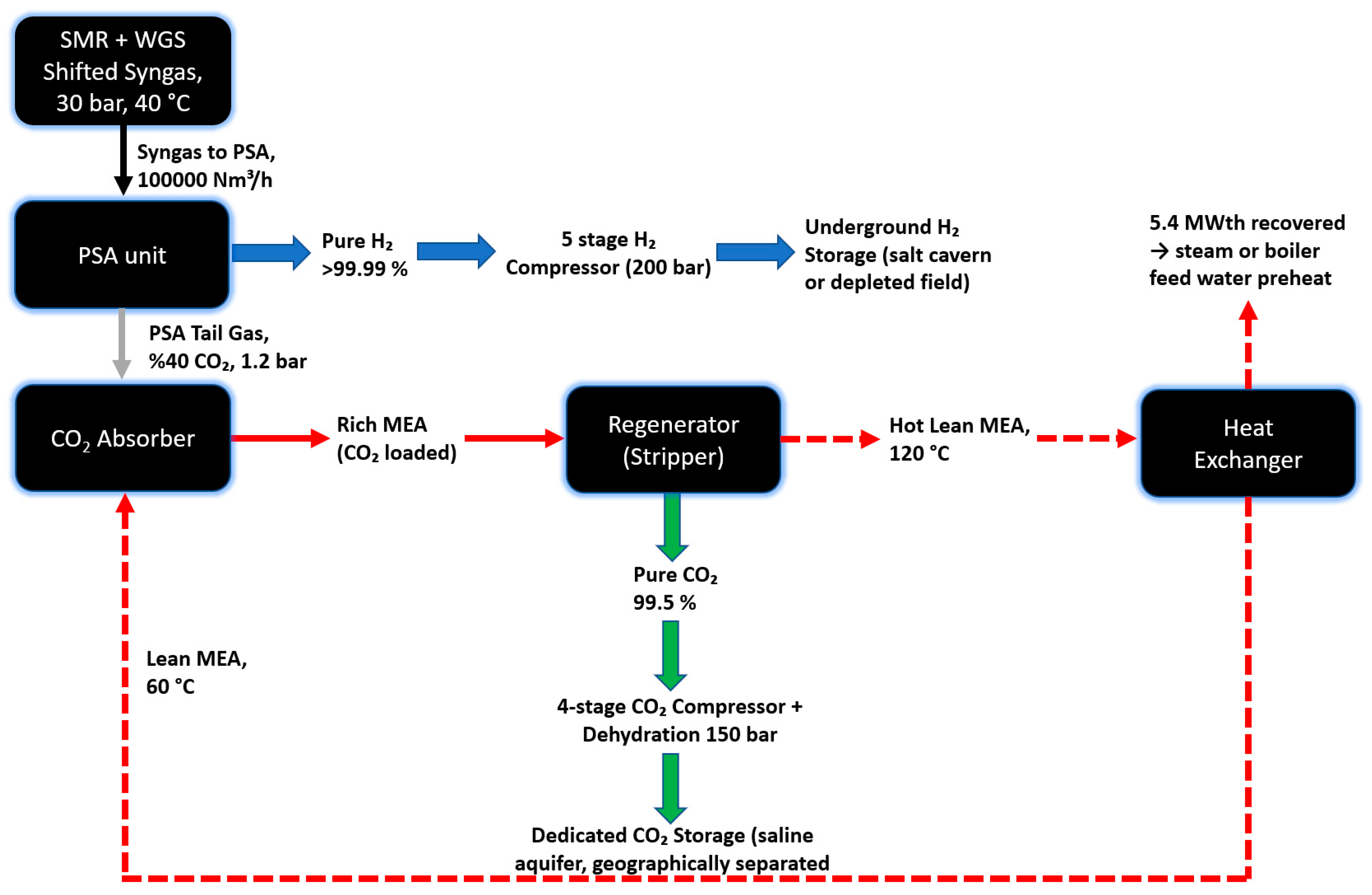
The overall process configuration used in this study is illustrated in Figure 1, which integrates hydrogen purification via pressure swing adsorption (PSA) with post-combustion CO2 capture using an MEA-based absorption–stripping cycle and heat recovery. The shifted syngas stream from the SMR and water–gas shift (WGS) section is fed to a PSA unit operating at 30 bar, where high-purity hydrogen (>99.99%) is separated and subsequently compressed to 200 bar in a five-stage compression train prior to underground storage. The PSA tail gas, enriched to approximately 40% CO2, is directed to the CO2 absorption section, forming the feed for chemical solvent-based capture.
The CO2 absorber employs a 30 wt% MEA solvent system, producing a CO2 rich solvent stream that is routed to the regenerator. In the stripper, CO2 is released at high purity (99.5%) and then conditioned for long-term geological storage through a four-stage compression and dehydration system operating at 150 bar. The regenerated hot lean solvent (120 °C) is cooled in a dedicated heat exchanger before returning to the absorber at approximately 60 °C. This heat exchange loop recovers 5.4 MWth of thermal energy, which is utilized for boiler feedwater preheating or steam generation, thereby reducing the overall thermal duty of the capture system.
The overall process flowsheet, with the PSA unit represented as a black-box separator based on industrial performance benchmarks, is modeled and validated in Aspen Plus™ V9. This approach ensures thermodynamic consistency across the purification, absorption–stripping, and compression sections while allowing accurate quantification of integration benefits (pressure alignment and heat recovery). The simulation framework provides a unified platform for assessing process interactions and energy efficiency gains, as illustrated in Figure 1.

3. Results and Discussion

3.1. Mass and Energy Balances

The fully integrated system achieves the target production of 5932 kg/h (>99.99% purity) hydrogen while capturing 90% of process-derived CO2 (832 t/d). Table 3 summarizes the major process streams.
Heat integration via lean amine cooling and pressure alignment reduces net thermal demand by 8% and eliminates tail-gas recompression.

3.2. Energy Performance and Integration Benefits

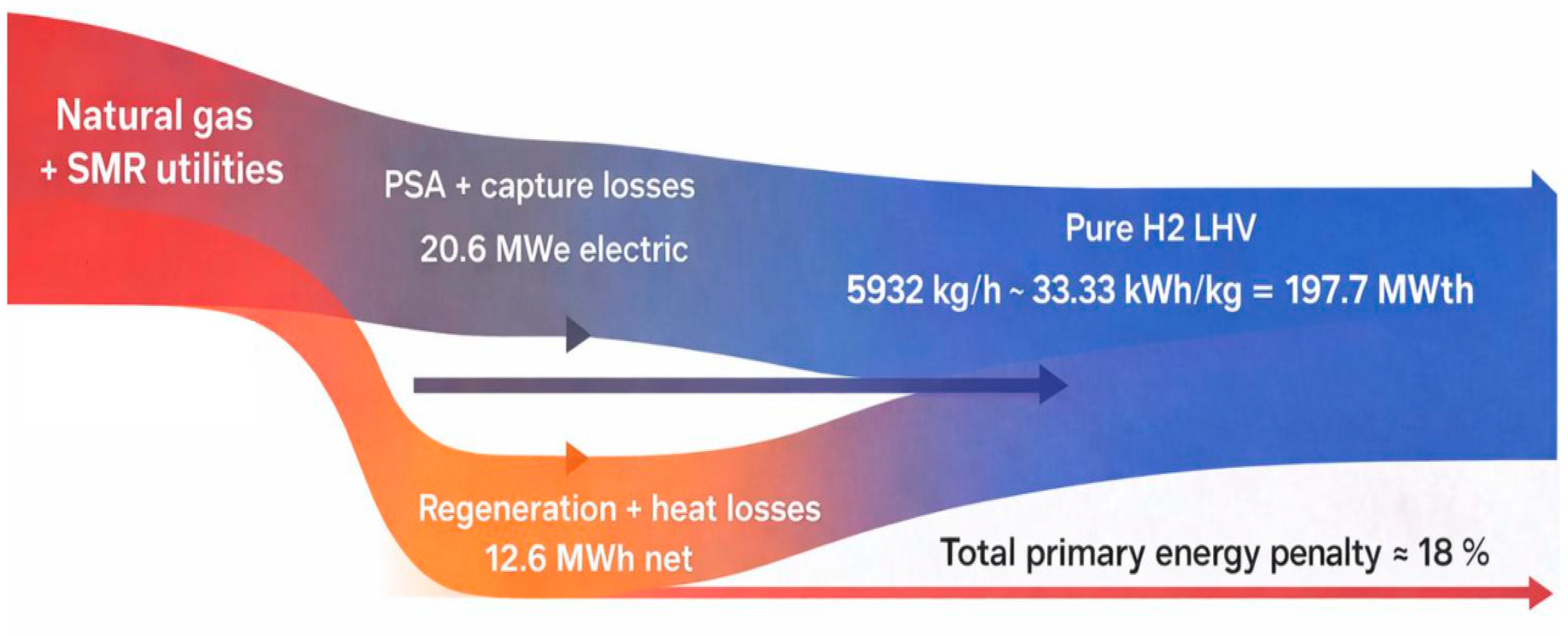
Figure 2 illustrates the relative distribution of primary energy flows within the integrated blue hydrogen system in the form of a Sankey diagram, highlighting the impact of pressure alignment and heat recovery on parasitic energy demands and overall energy efficiency. The diagram highlights the two dominant sources of energy penalty PSA- and capture-related electrical consumption (20.6 MWe) and solvent regeneration with associated heat losses, while simultaneously showing how integration mitigates these penalties.
The pressure alignment between the PSA product and downstream compression eliminates approximately 1.8 MWe of recompression work, while the heat-recovery loop between the MEA stripper and utility system provides 5.4 MWth of usable thermal energy. These synergies reduce the net thermal burden for solvent regeneration to 12.6 MWth, significantly lowering the overall parasitic energy load of the capture section. The resulting contraction of the red (loss) stream and expansion of the blue (useful hydrogen) stream in the Sankey visualization make the energetic gains directly observable.
Overall, the integrated configuration yields a primary energy penalty of 18% relative to the hydrogen LHV, substantially lower than the ~25% penalty calculated for a standalone non-integrated baseline. This corresponds to a reduction of 8–12 MW in equivalent primary energy demand. The scale of the improvement is consistent with, and in the upper performance range of, reported advanced blue hydrogen concepts employing heat and pressure synergies [38]. As depicted in Figure 2, the integrated design not only enhances net plant efficiency but also demonstrates how targeted thermodynamic integration can materially reshape the energy footprint of CO2-mitigated hydrogen production.

3.3. Techno-Economic Results

Levelized hydrogen production cost is calculated as 0.94–1.06 USD/kg H2 (base case 0.98 USD/kg) depending on underground hydrogen storage geology for a production rate of 5932 kg/h. The cost breakdown is shown in Table 4.
Explicit inclusion of hydrogen recovery efficiency moderately increases the effective levelized cost of hydrogen for porous media storage options. Relative to salt caverns ( η r e c = 0.98 ), depleted fields ( η r e c = 0.80 ) exhibit an LCOH increase of approximately 8–15%, while saline aquifers ( η r e c = 0.70 ) show an increase of 12–25%, depending on regeneration energy demand. Despite these recovery losses, the integrated system maintains an LCOH below approximately 1.10–1.15 USD/kg H2 across all storage options, depending on solvent regeneration energy and storage geology.
The resulting cost is highly competitive with current blue hydrogen benchmarks (1.2–1.8 USD/kg H2) and approaches the lower end of green hydrogen projections for 2030 [8,10]. The LCOH range across different storage geologies (0.94–1.06 USD/kg H2) primarily reflects variations in compression energy, transport distances, and storage fees but also accounts for higher cushion gas requirements and potentially lower working gas recovery in porous media (depleted fields and saline aquifers) compared to salt caverns, where near-complete recovery is typically achievable.

Capital Investment Considerations

The total capital investment (CAPEX) for the proposed integrated blue hydrogen facility is estimated at 1250–1550 USD per kg/h of hydrogen production capacity, with a base case value of 1350 USD/(kg/h), consistent with recent large-scale blue hydrogen projects integrating carbon capture and storage (CCS) systems.
For the reference plant analyzed in this study, producing 5.93 t/h of high-purity hydrogen (5932 kg/h), this corresponds to a total capital investment of approximately 7.4–9.2 million USD, with a base case estimate of about 8.0 million USD. This investment level reflects the inclusion of PSA-based hydrogen purification, amine-based CO2 capture with a capture rate exceeding 90%, multi-stage compression of both hydrogen and CO2, and process integration measures such as pressure alignment and heat recovery.
The estimated CAPEX is competitive with reported costs for integrated SMR-based blue hydrogen facilities, where CCS integration typically increases capital costs by 20–50% compared to conventional SMR plants but delivers substantial operational synergies and emission reductions [39]. The investment is further justified by the low levelized cost of hydrogen achieved in this study (0.94–1.06 USD/kg H2), the high CO2 capture efficiency, and the potential for additional revenue streams through carbon credits or regulatory incentives in decarbonization-driven markets.

3.4. Sensitivity and Robustness Analysis

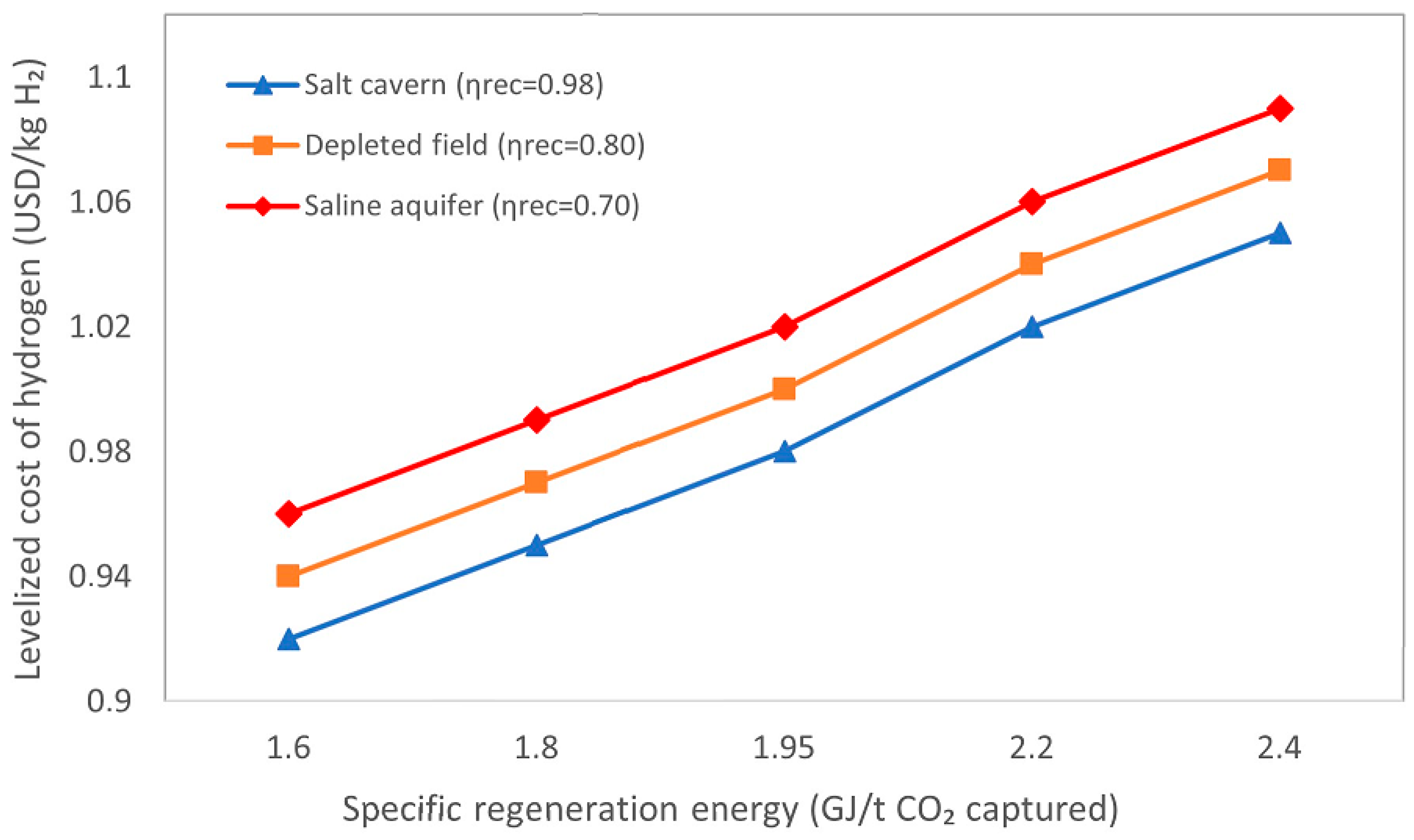
Figure 3 quantifies the sensitivity of the levelized cost of hydrogen (LCOH) to variations in the specific solvent regeneration energy, evaluated across three representative geological storage options, salt cavern, depleted field, and saline aquifer. The regeneration energy is perturbed by ±23% around the base case value of 1.95 GJ/t CO2 to capture both operational uncertainty and potential performance deviations in the amine system. Across all scenarios, the LCOH exhibits a monotonic but moderate increase with higher thermal regeneration requirements, consistent with the dominant influence of solvent stripping duty on capture-related operating expenditures.
The slope of the cost–response differs between geological options, reflecting their distinct compression, transport, and storage energy requirements. Salt cavern storage consistently yields the lowest LCOH, ranging from approximately 0.92 to 1.06 USD/kg H2 over the investigated regeneration energy window. Depleted fields show an intermediate cost profile, while saline aquifers, the most energy-intensive storage pathway, exhibit the highest values, rising toward approximately 1.10 USD/kg H2 at the upper regeneration limit of 2.4 GJ/t CO2. The relatively narrow separation between the three curves underscores that geological variability influences the final hydrogen cost but does not dominate it.
Overall, the sensitivity results demonstrate a high degree of robustness: even under the most conservative assumptions, maximum solvent regeneration duty combined with the least favorable storage geology, the LCOH remains below 1.10 USD/kg H2. This limited spread confirms that the proposed integrated blue hydrogen configuration is resilient to both process-side uncertainties (amine system efficiency) and infrastructure-side uncertainties (storage geology), thereby strengthening confidence in its techno-economic viability. Figure 3 captures these trends visually, highlighting the shallow gradients and the bounded cost envelope characteristic of a stable and well-integrated process design.

3.5. Geological Feasibility and Safety

By deliberately separating H2 and CO2 reservoirs according to permeability-based criteria (Table 2), cross-contamination risks are effectively eliminated. Salt caverns offer the lowest cost and fastest cycling, while depleted fields and saline aquifers provide virtually unlimited volume at marginally higher cost—a flexibility that significantly enhances project bankability [40].
While permeability and caprock sealing are primary site selection criteria, additional risks in aquifer-based hydrogen storage must be considered, including microbial and geochemical interactions. Potential microbial activity (e.g., sulfate-reducing bacteria leading to H2S production, methanogens causing H2 consumption and CH4 formation, or acetogens producing organic acids) could result in hydrogen loss, gas souring, corrosion, or pore clogging due to biofilm formation. These risks are more pronounced in low-temperature, nutrient-rich, or low-salinity aquifers but can be limited in deep, high-salinity reservoirs [41,42,43]. Abiotic geochemical risks, such as hydrogen diffusion in brine or mineral dissolution, are typically minor but should be evaluated [44]. To mitigate these, my framework prioritizes physical separation of H2 and CO2 reservoirs, preference for deep/high-salinity aquifers, and pre-injection microbial/geochemical screening, ensuring long-term storage integrity and high recovery efficiency.

3.6. Comparison with the Literature and Implications

Compared to recent blue hydrogen studies reporting LCOHs of 1.3–3.5 USD/kg H2 and energy penalties of 22–30% [27,28,33], the present integrated design achieves a 25–50% lower cost and 20–30% lower energy penalty. These improvements stem directly from the systematic triple integration that has been absent in previous works.
A comprehensive review of the recent literature (2023–2025) on blue hydrogen production reveals that while numerous studies address pairwise integrations such as SMR/PSA with CCS or SMR with UHS, no prior work has performed a fully integrated, rigorous mass and energy balance across all three unit operations (PSA-based purification, amine-based CO2 capture with permanent sequestration, and underground H2 storage) at this level of detail [39,45]. This includes evaluation of cross-unit synergies (pressure alignment and heat recovery) and permeability-based site separation for simultaneous H2 and CO2 storage. Existing techno-economic assessments typically focus on isolated subsystems or partial integrations, lacking the transparent, unified boundary conditions and quantitative evaluation of the triple synergies presented here.
To quantitatively substantiate the cost advantages of the proposed triple-integrated design, Table 5 provides a harmonized comparison with benchmark studies, adjusted to consistent assumptions (2024 USD, 7% discount rate, natural gas ~4 USD/MMBtu, similar capacity scale, and inclusion of CCS where applicable). The integration benefits in this work, particularly pressure alignment and heat recovery, yield a 25–50% lower LCOH compared to non-integrated or partially integrated benchmarks.
The proposed framework is immediately transferable to upcoming large-scale projects in Europe, the Middle East, and North America, offering a cost-competitive, net-zero-compliant pathway to multi-GW hydrogen hubs with built-in seasonal storage capability.

3.7. Generalizability and Transferability of Results

Although the present analysis is demonstrated using a reference-scale blue hydrogen configuration, the results are inherently generalizable to other production capacities. The main performance metrics reported herein, namely, hydrogen purity and recovery, CO2 capture efficiency, primary energy penalty reduction, and levelized hydrogen production cost, are determined by unit-operation-level behavior rather than the absolute size of the plant.
The feed conditions of the syngas used, 100,000 Nm3/h at 30 bar with the compositions listed in Table 1, are representative of the most applied industrial SMR configurations and provide a standardized basis for reproducible mass and energy balance evaluations. The integration benefits quantified herein due to PSA-based purification, amine based CO2 capture, and underground hydrogen storage are, therefore, expected to scale proportionally for larger or smaller facilities, subject to site-specific compression and storage constraints.
Key integration-driven improvements, including the 15–18% reduction in primary energy penalty driven by pressure alignment and heat recovery and associated LCOH range of 0.94–1.06 USD/kg H2, show little to no dependence on plant throughput for mature unit operations such as PSA, chemical absorption–stripping, and multi-stage gas compression. To this end, direct extrapolation of these results to mid-scale industrial plants and future multi-GW hydrogen hubs is appropriate.
The suggested triple-integration solution consisting of PSA purification of the fuel, amine-based capture and sequestration of CO2 gas, and the storage of H2 gas taking into account the permeability of the location for separation being modular in nature, can be adapted or scaled-up for application. It can be satisfactorily justified that the sensitivity analysis regarding the sensitivity of the above-mentioned energetic criteria (primary energy penalty of 18%) to variations in solvent regeneration energy of ±20–23% among the suggested alternatives for geological storage is found to be robust. It proves the fact that the suggested solution is a transferable solution which can be directly applied.

4. Conclusions

The present study demonstrates, through rigorous mass–energy balances and detailed techno-economic assessment, that systematic integration of pressure swing adsorption hydrogen purification, amine-based CO2 capture with permanent sequestration, and underground hydrogen storage yields significant performance improvements over standalone configurations.
For a reference 5932 kg/h blue hydrogen facility, the proposed design achieves
  • ≥90% CO2 capture, corresponding to 832 t/d of permanently sequestered CO2;
  • A primary energy penalty reduced to 18% of hydrogen LHV, corresponding to an absolute primary energy saving of 8–12 MW through heat and pressure integration;
  • A levelized hydrogen production cost of 0.94–1.06 USD/kg H2 (base case 0.98 USD/kg), highly competitive with current and projected low-carbon hydrogen pathways.
Permeability-based site selection criteria ensure geological feasibility and eliminate cross-contamination risks between H2 and CO2 reservoirs, while sensitivity analysis confirms system robustness against both technological and geological uncertainties.
This fully quantitative, physically consistent framework moves beyond conceptual studies and provides a practical, immediately deployable blueprint for cost-competitive, net-zero-compliant blue hydrogen production with built-in seasonal storage capability, directly applicable to upcoming multi-GW hydrogen hubs worldwide through modular scale-up of the proposed integrated configuration.

Funding

This research received no external funding.

Data Availability Statement

The original contributions presented in this study are included in the article.

Acknowledgments

The author would like to thank TÜBİTAK Marmara Research Center for their technical support provided within the scope of this study.

Conflicts of Interest

The author declares no conflicts of interest.

Abbreviations

PSAPressure Swing Adsorption
CO2Carbon Dioxide
H2Hydrogen
CH4Methane
COCarbon Monoxide
CCSCarbon Capture and Storage
N2Nitrogen
MEAMonoethanolamine
SMRSteam Methane Reforming
UHSUnderground Storage of Hydrogen
CAPEX Capital Expense
OPEXOperating Expense
LHVLower Heating Value
LCOHLevelized Cost Of Hydrogen
CRFCapital Recovery Factor
WGSWater–Gas Shift

References

  1. Dinçer, İ.; Acar, C. Review and evaluation of hydrogen production methods for better sustainability. Int. J. Hydrogen Energy 2015, 40, 11094–11111. [Google Scholar] [CrossRef]
  2. Acar, C.; Dinçer, İ. Comparative assessment of hydrogen production methods from renewable and non-renewable sources. Int. J. Hydrogen Energy 2014, 39, 1–12. [Google Scholar] [CrossRef]
  3. Tekir, U. Experimental Study on Microwave-Assisted Non-Thermal Plasma Technology for Industrial-Scale SO2 and Fly Ash Control in Coal-Fired Flue Gas. Process 2025, 13, 3927. [Google Scholar] [CrossRef]
  4. Hepburn, C.; Adlen, E.; Beddington, J.; Carter, E.A.; Fuss, S.; Mac Dowell, N.; Minx, J.C.; Smith, P.; Williams, C.K. The technological and economic prospects for CO2 utilization and removal. Nature 2019, 575, 87–97. [Google Scholar] [CrossRef]
  5. Mac Dowell, N.; Fennell, P.S.; Shah, N.; Maitland, G.C. The role of CO2 capture and utilization in mitigating climate change. Nat. Clim. Change 2017, 7, 243–249. [Google Scholar] [CrossRef]
  6. Zentou, H.; Hoque, B.; Abdalla, M.A.; Saber, A.F.; Abdelaziz, O.Y.; Aliyu, M.; Alkhedhair, A.M.; Alabduly, A.J.; Abdelnaby, M.M. Recent advances and challenges in solid sorbents for CO2 capture. Carbon Capture Sci. Technol. 2025, 15, 100386. [Google Scholar] [CrossRef]
  7. Tekir, U. Design and experimental study of a novel microwave-assisted burner based on plasma combustion for pulverized coal applications. Appl. Sci. 2025, 15, 5190. [Google Scholar] [CrossRef]
  8. Koroneos, C.; Dompros, A.; Roumbas, G.; Moussiopoulos, N. Life cycle assessment of hydrogen fuel production processes. Int. J. Hydrogen Energy 2004, 29, 1443–1450. [Google Scholar] [CrossRef]
  9. Zhang, B.; Zhang, S.X.; Yao, R.; Wu, Y.H.; Qui, J.S. Progress and prospects of hydrogen production: Opportunities and challenges. J. Electron. Sci. Technol. 2021, 19, 100080. [Google Scholar] [CrossRef]
  10. Luberti, M.; Ahn, H. Review of polybed pressure swing adsorption for hydrogen purification. Int. J. Hydrogen Energy 2022, 47, 10911–10933. [Google Scholar] [CrossRef]
  11. Kalman, V.; Voigt, J.; Jordan, C.; Harasek, M. Hydrogen purification by pressure swing adsorption: High-pressure PSA performance in recovery from seasonal storage. Sustainability 2022, 14, 14037. [Google Scholar] [CrossRef]
  12. Sircar, S. Pressure swing adsorption. Ind. Eng. Chem. Res. 2002, 6, 1389–1392. [Google Scholar] [CrossRef]
  13. Tarkowski, R. Underground hydrogen storage: Characteristics and prospects. Renew. Sustain. Energy Rev. 2019, 105, 86–94. [Google Scholar] [CrossRef]
  14. Crotogino, F.; Donadei, S.; Bünger, U.; Landinger, H. Large scale hydrogen underground storage for securing future energy supplies. In Proceedings of the 18th World Hydrogen Energy Conference, Essen, Germany, 16–21 May 2010. [Google Scholar]
  15. Abe, J.O.; Popoola, A.P.I.; Ajenifuja, E.; Popoola, O.M. Hydrogen energy, economy and storage: Review and recommendation. Int. J. Hydrogen Energy 2019, 44, 15072–15086. [Google Scholar] [CrossRef]
  16. Iordache, M.; Schitea, D.; Deveci, M.; Akyurt, İ.Z.; Iordache, I. An integrated ARAS and interval type-2 hesitant fuzzy sets method for underground site selection: Seasonal hydrogen storage in salt caverns. J. Pet. Sci. Eng. 2019, 175, 1088–1098. [Google Scholar] [CrossRef]
  17. Massarweh, O.; Al-khuzaei, M.; Al-Shafi, M.; Bicer, Y.; Abushaikha, A.S. Blue hydrogen production from natural gas reservoirs: A review of application and feasibility. J. CO2 Util. 2023, 70, 102438. [Google Scholar] [CrossRef]
  18. Wu, W.; Zhai, H.; Holubnyak, E. Technological evolution of large-scale blue hydrogen production toward the U.S. Hydrogen Energy Earthshot. Nat. Commun. 2024, 15, 5684. [Google Scholar] [CrossRef]
  19. Tarkowski, R.; Uliasz-Misiak, B. Towards underground hydrogen storage: A review of barriers. Renew. Sustain. Energy Rev. 2022, 162, 112451. [Google Scholar] [CrossRef]
  20. Hematpur, H.; Abdollahi, R.; Rostami, S.; Haghighi, M.; Blunt, M.J. Review of underground hydrogen storage: Concepts and challenges. Adv. Geo-Energy Res. 2023, 7, 111–131. [Google Scholar] [CrossRef]
  21. Khalili, Y.; Yasemi, S.; Abdi, M.; Ghasemi Ertian, M.; Mohammadi, M.; Bagheri, M. A Review of Integrated Carbon Capture and Hydrogen Storage: AI-Driven Optimization for Efficiency and Scalability. Sustainability 2025, 17, 5754. [Google Scholar] [CrossRef]
  22. Bachu, S. CO2 storage in geological media: Role, means, status and barriers to deployment. Prog. Energy Combust. Sci. 2008, 34, 254–273. [Google Scholar] [CrossRef]
  23. Ringrose, P.S.; Meckel, T.A. Maturing global CO2 storage resources on offshore continental margins to achieve 2DS emissions reductions. Sci. Rep. 2019, 9, 17944. [Google Scholar] [CrossRef]
  24. Leeson, D.; Fennell, P.; Shah, N.; Petit, C.; Dowell, N.M. A techno-economic analysis and systematic review of carbon capture and storage (CCS) applied to the iron and steel, cement, oil refining and pulp and paper industries. Energy Procedia 2017, 114, 6297–6302. [Google Scholar] [CrossRef]
  25. Al-Yaseri, A.; Yekeen, N.; Al-Mukainah, H.; Hassanpouryouzband, A. Geochemical interactions in geological hydrogen storage: The role of sandstone clay content. Fuel 2024, 361, 130728. [Google Scholar] [CrossRef]
  26. Boot-Handford, M.E.; Abanades, J.C.; Anthony, E.J.; Blunt, M.J.; Brandani, S.; Mac Dowell, N.; Fernandez, J.R.; Ferrari, M.C.; Gross, R.; Hallett, J.P.; et al. Carbon capture and storage update. Energy Environ. Sci. 2014, 7, 130–189. [Google Scholar] [CrossRef]
  27. Bui, M.; Adjiman, C.S.; Bardow, A.; Anthony, E.J.; Boston, A.; Brown, S.; Fennell, P.S.; Fuss, S.; Galindo, A.; Hackett, L.A.; et al. Carbon capture and storage (CCS): The way forward. Energy Environ. Sci. 2018, 11, 1062–1176. [Google Scholar] [CrossRef]
  28. Muhammed, N.S.; Haq, B.; Shehri, D.A.; Al-Ahmed, A.; Rahman, M.M.; Zaman, E. A review on underground hydrogen storage: Insight into geological sites, influencing factors and future outlook. Energy Rep. 2022, 8, 461–499. [Google Scholar] [CrossRef]
  29. Bade, S.O.; Taiwo, K.; Ndulue, U.F.; Tomomewo, O.S.; Oni, B.A. A review of underground hydrogen storage systems: Current status, modeling approaches, challenges, and future prospective. Int. J. Hydrogen Energy 2024, 80, 449–474. [Google Scholar] [CrossRef]
  30. Lord, A.S.; Kobos, P.H.; Borns, D.J. Geologic storage of hydrogen: Scaling up to meet city transportation demands. Int. J. Hydrogen Energy 2014, 39, 15570–15582. [Google Scholar] [CrossRef]
  31. Evans, D. A review of underground fuel storage events and putting risk into perspective with other areas of the energy supply chain. Geol. Soc. Spec. Publ. 2009, 313, 173–216. [Google Scholar] [CrossRef]
  32. Armitage, P.J.; Faulkner, D.R.; Worden, R.H.; Aplin, A.C.; Butcher, A.R.; Iliffe, J. Experimental measurement of, and controls permeability and permeability anisotropy of caprocks from the CO2 storage project at the Krechba Field, Algeria. J. Geogr. Res. 2011, 116, B12208. [Google Scholar]
  33. Heinemann, N.; Alcalde, J.; Miocic, J.M.; Hangx, S.J.T.; Kallmeyer, J.; Ostertag-Henning, C.; Hassanpouryouzband, A.; Thaysen, E.M.; Strobel, G.J.; Schmidt Hattenberger, C.; et al. Enabling large-scale hydrogen storage in porous media—The scientific challenges. Energy Environ. Sci. 2021, 14, 853–864. [Google Scholar] [CrossRef]
  34. Çağlayan, D.G.; Weber, N.; Heinrichs, H.U.; Linssen, J.; Robinius, M.; Kukla, P.A.; Stolten, D. Technical potential of salt caverns for hydrogen storage in Europe. Int. J. Hydrogen Energy 2020, 45, 6793–6805. [Google Scholar] [CrossRef]
  35. Amid, A.; Mignard, D.; Wilkinson, M. Seasonal storage of hydrogen in a depleted natural gas reservoir. Int. J. Hydrogen Energy 2016, 41, 5549–5558. [Google Scholar] [CrossRef]
  36. Lysyy, M.; Ferno, M.A.; Ersland, G. Effect of relative permeability hysteresis on reservoir simulation of underground hydrogen storage in an offshore aquifer. J. Energy Storage 2023, 64, 107229. [Google Scholar] [CrossRef]
  37. Zivar, D.; Kumar, S.; Foroozesh, J. Underground hydrogen storage: A comprehensive review. Int. J. Hydrogen Energy 2021, 45, 6793–6805. [Google Scholar] [CrossRef]
  38. Rochelle, G.T. Amine scrubbing for CO2 capture. Science 2009, 325, 1652–1654. [Google Scholar] [CrossRef]
  39. IEAGHG. Low-Carbon Hydrogen from Natural Gas: Global Roadmap; IEAGHG Technical Report 2022-07; IEAGHG: Cheltenham, UK, 2022. [Google Scholar]
  40. Liu, J.; Pei, J.; Wei, J.; Yang, J.; Xu, H. Development status and prospect of salt cavern energy storage technology. Earth Energy Sci. 2025, 1, 159–179. [Google Scholar] [CrossRef]
  41. Heinemann, N.; Booth, M.G.; Haszeldine, R.S.; Wilkinson, M.; Scafidi, J.; Edlmann, K. Hydrogen storage in porous geological formations-onshore play opportunities in the midland valley (Scotland, UK). Int. J. Hydrogen Energy 2018, 43, 20861–20874. [Google Scholar] [CrossRef]
  42. Dopffel, N.; Jansen, S.; Gerritse, J. Microbial side effects of underground hydrogen storage—Knowledge gaps, risks and opportunities for successful implementation. Int. J. Hydrogen Energy 2021, 46, 8594–8606. [Google Scholar] [CrossRef]
  43. Thaysen, E.M.; Armitage, T.; Slabon, L.; Hassanpouryouzband, A.; Edlmann, K. Microbial risk assessment for underground hydrogen storage in porous rocks. Fuel 2023, 352, 128852. [Google Scholar] [CrossRef]
  44. Rezk, M.G. Measurement of hydrogen diffusion in brine at high pressures and elevated temperatures: Implications for underground hydrogen storage. Int. J. Hydrogen Energy 2025, 139, 496–509. [Google Scholar] [CrossRef]
  45. National Energy Technology Laboratory (NETL). Comparison of Commercial, State-of-the-Art, Fossil-Based Hydrogen Production Technologies; NETL Report; U.S. Department of Energy: Pittsburgh, PA, USA, 2022. [Google Scholar]
  46. National Energy Technology Laboratory (NETL). Assessment of Hydrogen Production with CO2 Capture: Baseline State-of-the-Art Plants; NETL Report; U.S. Department of Energy: Pittsburgh, PA, USA, 2024; Volume 1. [Google Scholar]
  47. International Energy Agency (IEA). Global Hydrogen Review 2024; International Energy Agency IEA: Paris, France, 2024. [Google Scholar]
  48. BloombergNEF. Hydrogen Production Costs Outlook: Blue and Low-Carbon Hydrogen Pathways; Bloomberg Finance, L.P.: New York, NY, USA, 2024. [Google Scholar]
  49. U.S. Department of Energy (DOE). Pathways to Commercial Liftoff: Clean Hydrogen; Hydrogen Shot Program Report Update 2024; Office of Clean Energy Demonstrations (DOE): Washington, DC, USA, 2024. [Google Scholar]
Figure 1. Process flow diagram of hydrogen purification and CO2 capture using PSA followed by MEA-based post-combustion CO2 capture with heat integration.
Processes 14 00319 g001
Figure 2. Sankey diagram illustrating the relative distribution of primary energy flows and integration benefits for the integrated blue hydrogen system (LHV basis). Heat and pressure integration reduce the relative primary energy penalty from approximately 25% (standalone configuration) to about 18% of hydrogen LHV, corresponding to an equivalent primary energy saving on the order of 8–12 MW.
Processes 14 00319 g002
Figure 3. Sensitivity of levelized hydrogen production cost to specific amine regeneration energy, explicitly accounting for hydrogen recovery efficiency. Salt cavern storage assumes ηrec = 0.98, depleted fields ηrec = 0.80, and saline aquifers ηrec = 0.70. Reduced hydrogen recoverability in porous media increases the effective LCOH but does not compromise overall system robustness.
Processes 14 00319 g003
Table 1. Shifted syngas composition and molar flow rates entering the PSA unit (total flow: 100,000 Nm3/h, 30 bar, and 40 °C, dry basis).
ComponentMole Fraction (%)Flow Rate (kmol/h)
H275.53370
CO218.8839
CH43.9174
CO + N2 + Ar1.880
Total100.04463
Table 2. Permeability-focused geological criteria for safe UHS and CO2 storage (compiled from reviews and analogs).
ParameterUnitH2 Salt
Cavern
H2-Depleted Field/AquiferCO2 Saline
Aquifer
References
Reservoir permeability ‘k’mD<0.110–50050–1000[28,29]
Darcy velocity limitm/s<10−8<10−7<10−6[30]
Caprock permeabilitym2<10−20<10−19<10−20[31,32]
Minimum depthm>500>800>800[33,34]
Expected leakage (1000 y)% of stored<0.001<0.1<0.01[35,36,37]
Table 3. Key material and energy streams of the integrated 1000 kg/h blue hydrogen reference plant.
StreamFlow
(kmol/h)
Mass Flow
(t/h)
Pressure
(bar)
Temperature
(°C)
Duty
(MW)
Shifted syngas to PSA4463-3040 -
Pure H2 product (post-PSA)29665.933040-
H2 delivered to storage29665.93200409.2 (compression)
PSA tail gas 1127-1.240-
Captured CO275533.2150403.1 (compression)
Regeneration steam (gross)--414318
Recovered heat (lean amine) ---120 → 605.4
Net regeneration steam--414312.6
Table 4. Levelized hydrogen production cost breakdown (2024 USD, 7% discount rate, 25-year lifetime).
ComponentCAPEX Contribution
((USD/(kg/h))
Specific Cost
(USD/kg H2)
PSA purification3500.12
Amine CO2 capture (90%)6500.50
CO2 transport + storage2000.15
H2 compression + UHS3000.23
Integration credits and contingencies−150−0.02
Total (base case)13500.98
Range (different geology)1250–15500.94–1.06
Table 5. Quantitative comparison of levelized hydrogen production costs with benchmark blue hydrogen studies (harmonized to 2024 USD, 7% discount rate, natural gas ~4 USD/MMBtu).
Study/SourceYearConfigurationCO2 Capture Rate (%)LCOH (USD/kg H2)KeynotesReferences
This work (triple-
integrated)
2025SMR + PSA + MEA CCS + UHS with
synergies
≥900.94–1.06
(base 0.98)
Full triple integration, heat/pressure synergies-
NETL baseline2023–2024SMR + PSA+ CCS
(no UHS)
~90–951.8–2.5 Standalone CCS, higher energy
penalty
[45,46]
IEAGHG merchant SMR + CCS2024SMR + CCS (standalone)90–952.0–3.0 No UHS, partial integration[39,47]
DOE Liftoff/
BloombergNEF
2024–2025Various SMR/ATR + CCS90+2.0–3.5 No full triple UHS integration[48]
Recent reviews (avg. blue H2)2023–2025SMR + CCS
variants
85–952.0–3.5Higher gas prices in some cases[49]
Disclaimer/Publisher’s Note: The statements, opinions and data contained in all publications are solely those of the individual author(s) and contributor(s) and not of MDPI and/or the editor(s). MDPI and/or the editor(s) disclaim responsibility for any injury to people or property resulting from any ideas, methods, instructions or products referred to in the content.