Article

Aggregation of Air Conditioning Loads in Building Microgrids: A Day-Ahead and Real-Time Control Strategy Considering User Privacy Requirements

1
State Grid Anhui Electric Power Research Institute, Hefei 230601, China
2
School of Electrical Engineering and Automation, Hefei University of Technology, Hefei 230009, China
*
Author to whom correspondence should be addressed.
Processes 2026, 14(2), 280; https://doi.org/10.3390/pr14020280
Submission received: 24 November 2025 / Revised: 4 January 2026 / Accepted: 11 January 2026 / Published: 13 January 2026
(This article belongs to the Section Energy Systems)

Abstract

Air conditioning loads play a critical role in maintaining the supply–demand balance of building microgrids (BMGs), yet their distributed nature and volatile response may undermine secure and stable operation. This paper proposes a day-ahead and real-time aggregated control strategy for BMG air conditioning loads with user privacy protection. First, an approximate aggregation model is developed based on building heat transfer characteristics, and the aggregated response potential is evaluated by jointly considering user comfort and willingness. Second, without sharing fine-grained user information, a Building Microgrid Operator (BMO)–Load Aggregator (LA) day-ahead distributed-scheduling model is formulated and solved using the alternating direction method of multipliers (ADMM). Finally, to address load fluctuations caused by heterogeneous initial indoor temperature distributions, a real-time control strategy based on State-Queueing (SQ) temperature-state pre-transfer is proposed. Case studies show that, compared with the baseline scheme, the proposed method reduces the system operating cost from CNY 50,694.58 to CNY 47,131.64, a 7% decrease, and decreases load shedding from 1466.35 kWh to 257.31 kWh, an 82% decrease. Meanwhile, the real-time control effectively suppresses power fluctuations in the early control stage, thereby improving both economic performance and response smoothness.

1. Introduction

Driven by the global energy transition and sustainable development goals, optimizing energy consumption in buildings has become a crucial approach to achieving energy conservation and emission reduction [1,2,3]. As one of the primary energy-consuming devices in buildings, air conditioning loads enable buildings to exhibit a certain level of demand-response capability while maintaining user comfort [4,5,6,7]. Therefore, optimizing electricity consumption strategies in buildings is key to unlocking the potential of air conditioning load control, and microgrid energy management provides a feasible solution to this challenge [8,9].
With the comprehensive deployment of distributed generation (DG), energy storage systems, and intelligent modules in buildings, the concept of the BMG has emerged. The BMG system is managed by the BMO, which oversees unified energy consumption management, engages in electricity purchasing and selling transactions with the upper-level power grid, and adjusts its operational strategies to maximize economic benefits [10,11]. Air conditioning loads are primarily aggregated and regulated by the LA, contributing to the supply–demand balance within the system [12]. However, the BMO and LA are typically separate entities, and due to user privacy protection concerns, the LA does not share detailed user equipment information with the BMO [13,14]. Therefore, how to fully consider user privacy requirements while formulating rational energy consumption plans and implementing precise control of air conditioning loads is of great significance for enhancing energy efficiency, reducing consumption, and ensuring the secure and stable operation of BMG systems [15,16]. To this end, Ref. [17] proposes a decentralized energy management framework for privacy-preserving demand response in smart buildings, enabling individual users to participate in system-level optimization while retaining full control over their local operational data.
Currently, research on air conditioning load control in BMG systems can be broadly categorized into two main aspects: optimization scheduling and control strategies, based on the differences in application scenarios and regulation objectives.
In the research on air conditioning load optimization scheduling methods for BMG systems, the BMO needs to explore the response characteristics of air conditioning loads in depth to maximize their potential in system regulation, peak-shaving and valley-filling, and supply–demand balance, thereby formulating reasonable and effective scheduling plans [18,19]. Ref. [20] develops a centralized optimization scheduling model for BMGs, which comprehensively considers the management of heating, ventilation, and air conditioning (HVAC) units, lighting equipment, photovoltaic (PV) generation, and energy storage systems in each building. Ref. [21] proposes a real-time scheduling method for multiple BMGs based on model predictive control, effectively optimizing the energy consumption plans of HVAC systems in individual apartments and improving the matching performance between regional generation and consumption. To further enhance real-time scheduling efficiency, Ref. [22] applies Lyapunov optimization technology (LOT) to BMG scheduling, optimizing the total cost, thermal comfort cost, and charging/discharging strategies of batteries and electric vehicles through real-time dispatch, which has practical engineering significance. Ref. [23] investigates a residential multi-energy community with controllable heating, ventilation, and air conditioning (HVAC) systems and energy storage, and proposes a two-stage coordinated scheduling framework consisting of day-ahead planning and real-time correction. In both stages, a decentralized model predictive control scheme based on the alternating direction method of multipliers (ADMM) is employed to enable distributed scheduling of user-side HVAC and to mitigate uncertainty. Ref. [24] addresses the issue of source–load mismatch in high-penetration renewable energy systems by establishing a two-stage energy-trading framework for HVAC systems, incorporating day-ahead scheduling and intra-day real-time clearing to mitigate real-time power shortages in residential microgrids. At the air conditioning load scheduling level, existing optimization scheduling methods primarily rely on centralized algorithms. However, since the BMO and LA are typically separate entities, the issue of privacy protection in information exchange between them remains largely unexplored by scholars both domestically and internationally.
Air conditioning load control strategies focus more on the fine-grained regulation of aggregated or individual air conditioning units under different scenarios. These strategies primarily adopt Direct Load Control (DLC) methods, where control models are constructed by setting appropriate objective functions, decision variables, and constraints [25]. Ref. [26] thoroughly considers the power rebound effect of air conditioning loads before and after demand response, establishing a reserve capacity–time evaluation framework and proposing a sequential control strategy that effectively improves the utilization efficiency of air conditioning loads as reserve resources. Ref. [27] introduces a novel alternating-current DLC mechanism that constrains regional generation capacity and directly controls users’ air conditioning duty cycles, achieving peak load reduction while maintaining user comfort, with significant economic and environmental benefits. To enhance the flexibility of air conditioning control, Ref. [28] develops an SQ model based on air conditioning switching cycle characteristics, setting start–stop transition temperatures to regulate operational state changes, thereby realizing distributed rolling control of air conditioners. Ref. [29] proposes an Adaptive ON/OFF State-Switching (AOSS) control method for inverter-based air conditioning clusters, integrating the traditional SQ model into an Inverter Air Conditioning Load (IACL) cluster for short-term power control, demonstrating promising control performance. At the air conditioning load control level, while existing research strategies accommodate diverse control requirements across different scenarios, their control objectives are typically predetermined, resulting in a disconnection from the day-ahead scheduling layer. Moreover, they fail to adequately consider power fluctuations caused by the initial temperature distribution of air conditioning loads.
The above studies have achieved promising control performance in different scenarios, but have not realized the coordinated optimization of the scheduling and control layers. Therefore, to fully consider user privacy protection needs while balancing the differing interests of the BMO and users, this paper proposes a day-ahead and real-time air conditioning load aggregation and control strategy for BMG systems, incorporating user privacy requirements. At the day-ahead scheduling layer, a distributed-scheduling model based on ADMM is developed to address user privacy concerns, enabling energy consumption optimization under unknown global information. At the real-time control layer, a control strategy based on the SQ model temperature state pre-transition is proposed to mitigate response fluctuations caused by uneven initial temperature distributions among users, achieving coordination between the scheduling and control layers. The significant contributions of this study are summarized as follows:
(1)
Day-ahead and real-time air conditioning load aggregation and control framework: To address the insufficient coordination between the air conditioning load scheduling and control layers, a collaborative framework for day-ahead and real-time air conditioning load aggregation and control is constructed. At the day-ahead scheduling layer, user privacy protection is fully considered, and a distributed-scheduling plan is formulated based on boundary information exchange between the BMO and LA. At the real-time control layer, the LA aims to minimize control time and designs a real-time air conditioning load control strategy that tracks the scheduling plan. The proposed framework effectively accounts for the diverse interests of multiple stakeholders while ensuring user privacy protection, enabling coordinated optimization of the scheduling and control layers.
(2)
BMO-LA distributed scheduling: To address the BMO’s computational burden and user privacy concerns, a day-ahead distributed optimization scheduling model is developed that considers the interests of both the BMO and LA. The model minimizes system operating costs and employs the ADMM algorithm, which ensures strong privacy protection and efficient parallel-computing capabilities, to iteratively solve the corresponding subproblems. The proposed model effectively reduces system operating costs and enables distributed optimization with unknown user global information.
(3)
SQ-based pre-emptive control strategy: To mitigate power fluctuations caused by uneven initial air conditioning temperature distributions, a real-time air conditioning load control strategy based on the SQ-based pre-emptive control is proposed. By adjusting the temperature modules in the SQ model based on their density distribution, this strategy aims to minimize control time while facilitating rapid transitions between temperature states, ensuring a balanced distribution of load levels across different modules. The proposed strategy effectively reduces power fluctuations in load clusters, achieving precise air conditioning load control.
The remainder of this paper is organized as follows. Section 2 introduces the overall framework for day-ahead and real-time air-conditioning load aggregation and control in BMG systems, and presents the approximate aggregation model considering building thermal characteristics and response-potential assessment, the day-ahead distributed scheduling model for BMO-LA with response potential, as well as the SQ-based pre-emptive control strategy for air-conditioning loads. Section 3 presents the case study and numerical results used to validate the proposed model. Finally, conclusions are summarized in Section 4.

2. Materials and Methods

2.1. Day-Ahead and Real-Time Aggregation and Control Framework for Air Conditioning Loads in Integrated BMG System

In multi-building integrated BMG systems, unified energy management is overseen by the BMO, which functions as both a production hub and a dispatch center, engaging in electricity-purchasing and -selling transactions with the upper-level power grid. While ensuring the stable operation of the system, the BMO further enhances economic benefits by optimizing its operational strategies. Direct participation of distributed building users in scheduling would increase system complexity. Therefore, the LA plays a crucial role in managing flexible loads such as air conditioning. By aggregating users’ energy consumption data and executing the scheduling plans issued by the BMO, the LA centrally regulates the loads within its jurisdiction. This approach not only alleviates the scheduling burden on BMO but also facilitates efficient demand-response management.
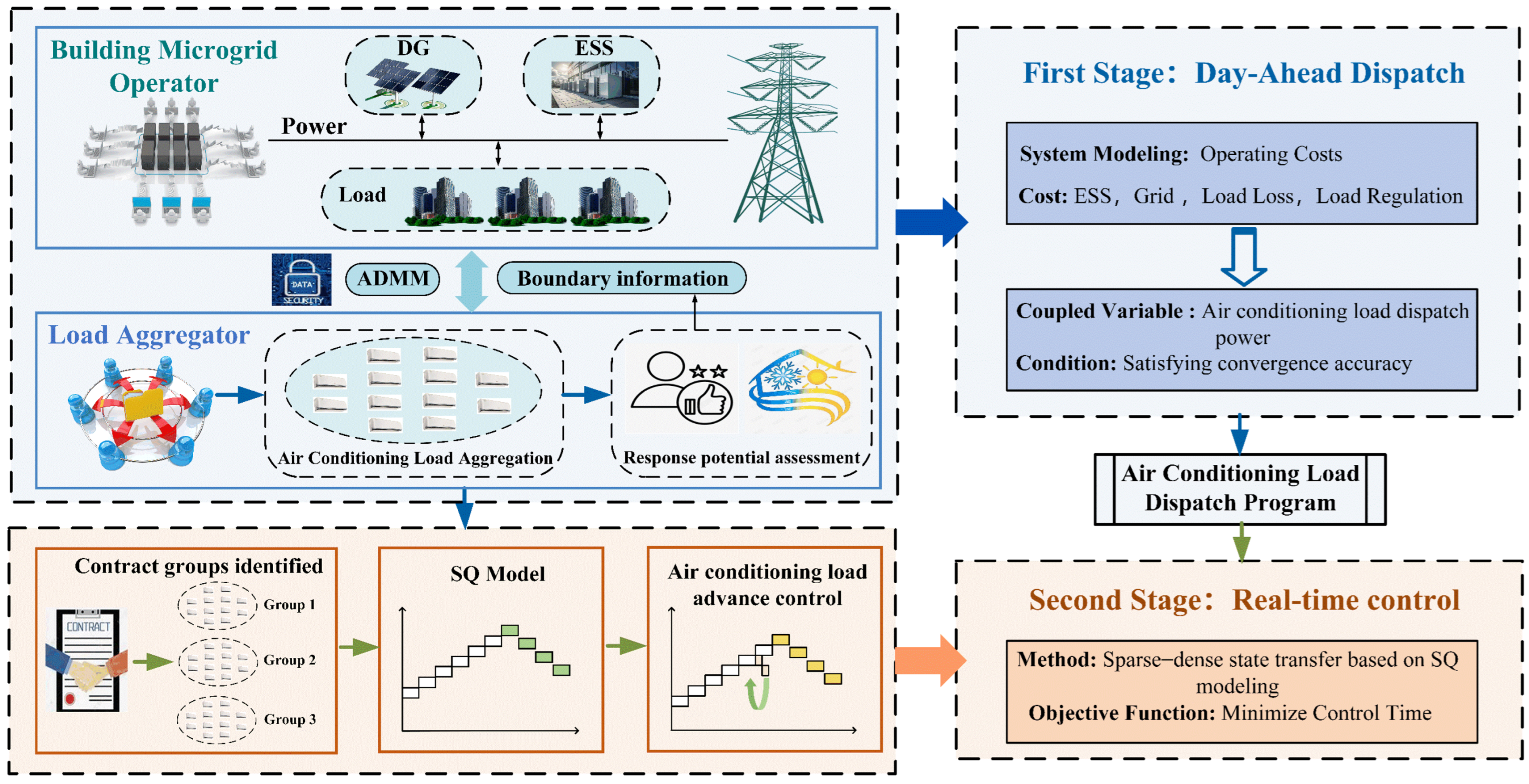
In this paper, we focus on the coordinated optimization of supply and demand in integrated BMG systems and construct a day-ahead and real-time aggregation and control framework for air conditioning loads, as illustrated in Figure 1.
The day-ahead scheduling layer models the scheduling process by considering user privacy protection requirements and utilizes the aggregated response potential assessment from LA as boundary information. Based on the exchanged information between the BMO and LA, a distributed day-ahead scheduling plan is formulated to optimize energy consumption under unknown global information.
The real-time control layer focuses on the precise execution of scheduling decisions. In this layer, the LA acts as the executor within the proposed framework. It classifies air conditioning loads into multiple contract groups based on the adjustable temperature range and initial temperature distribution of users. To track the scheduling plan issued by the BMO, pre-emptive control based on the SQ model is applied, utilizing the density distribution of temperature modules. The primary objective of this control strategy is to minimize regulation time, ensuring coordinated, flexible, and precise real-time control of air conditioning loads while effectively tracking the scheduling decisions.

2.2. Approximate Aggregation Model of Air Conditioning Loads

2.2.1. Single-Zone RC Thermal Model for Buildings

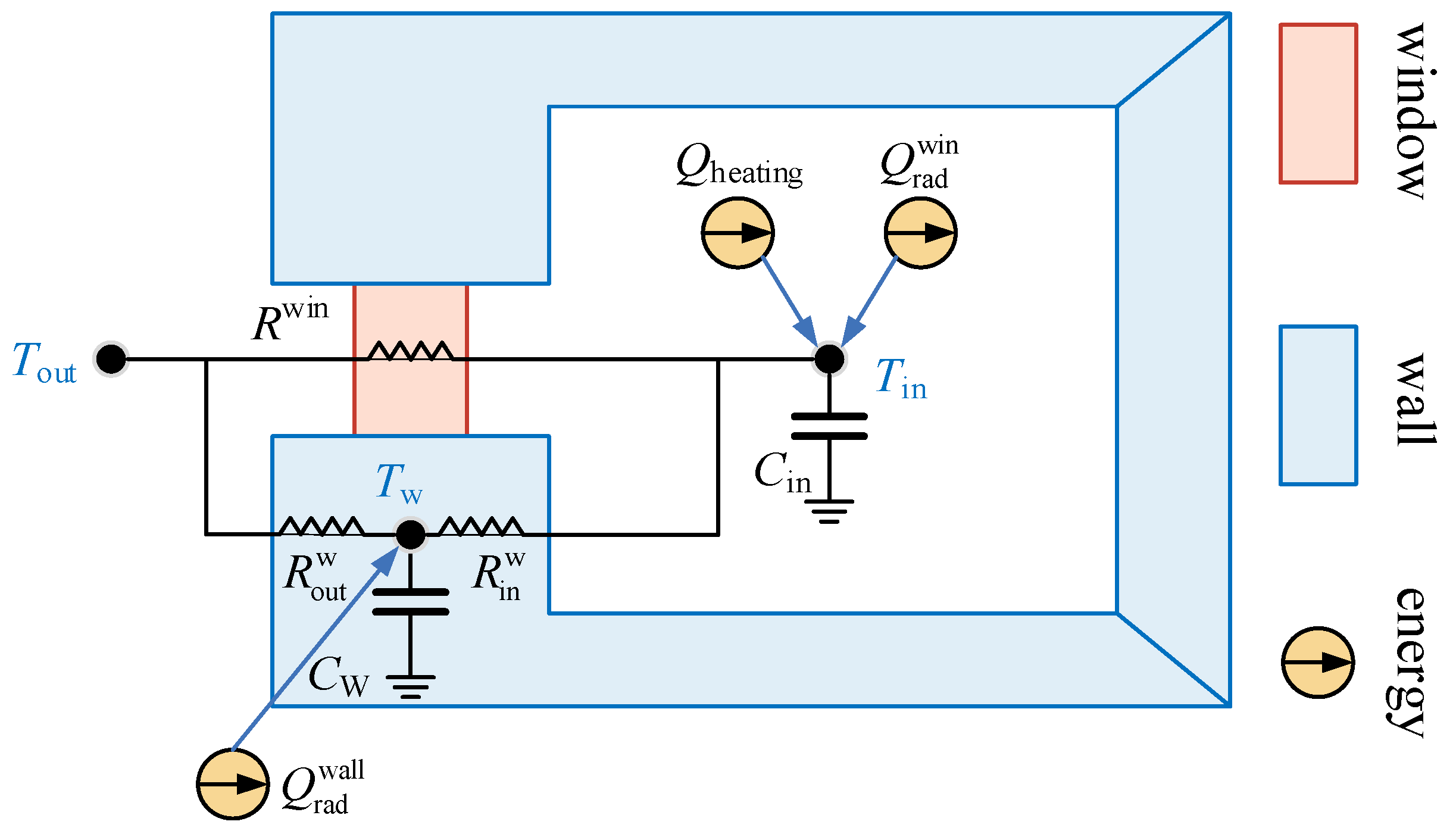
To simplify the modeling process and improve the computational efficiency of large-scale aggregated scheduling, this paper adopts a single-zone RC thermal model to characterize the thermal dynamics of user buildings. The model assumes that the air conditioner regulates only the temperature of the primary occupied room, while heat transfer through the roof, floor, and adjacent rooms is neglected. The single-zone RC model represents an independently controlled zone rather than assuming a uniform temperature for the entire building. A typical single-zone RC thermal model for buildings is illustrated in Figure 2, where the walls, indoor, and outdoor environments are represented as network nodes. The thermal capacitance effects caused by wall thickness and indoor space are denoted by C w and C in , respectively, with the node temperatures serving as the state variables. It is important to note that heat exchange between internal rooms in a building is mutual. Therefore, when aggregating the heating/cooling demand for an entire building, the internal heat exchange process can be neglected for simplification.
The wall thermal balance constraint for a single-zone user is expressed as
C w d T wall d t = T in T wall R in wall + T out T wall R out wall + γ A Q r a d wall
where T wall , T in and T out represent the temperatures of the wall, indoor, and outdoor nodes, respectively. R in wall and R out wall denote the thermal resistances of the wall’s inner and outer layers, which are connected to the indoor and outdoor nodes, respectively. γ represents the solar absorptivity of the building wall, which depends on its orientation. A denotes the external surface area of the building wall (excluding window areas), and Q r a d wall is the solar irradiance corresponding to that wall surface.
The indoor thermal balance constraint for a single-zone user is expressed as
C in d T in d t = T wall T in R in wall + ξ in T out T in R w , in + ξ in γ w A w , in Q rad w , in + m t β sea Q int
m t = 0 , T in T set 0.5 δ 1 , T in T set + 0.5 δ m t ε other
where ξ in is the window presence coefficient (1 if a window is present, otherwise 0); R w , in represents the thermal resistance of the window; γ w is the solar transmittance of the window; A w , in denotes the window area; Q rad w , in represents the solar irradiance corresponding to the window; m t is the on/off status of the air conditioning load, as defined in Equation (3); β sea is the seasonal coefficient, set to −1 in summer and 1 in winter—this study primarily considers summer conditions, so β sea = 1 ; Q int represents the cooling (or heating) power of the air conditioning unit, which is related to the rated power by P int = Q int / η ; η is the energy efficiency ratio; T set denotes the air conditioner temperature setpoint, which is set to 26 °C; δ denotes the deadband of the air conditioning control, with a value of 1 °C; and ε denotes the simulation time step.
Solving for T in using the system of ordinary differential equations derived from Equations (1) and (2) leads to a second-order nonhomogeneous differential equation with constant coefficients. This introduces two eigenvalues, making it difficult to directly determine the on/off duration of temperature-controlled loads. This paper assumes that T wall can be linearized and rewrites it as a function of the indoor and outdoor temperatures at the same time instant. This approximation is mainly applicable to scenarios where the outdoor temperature and solar irradiance vary slowly within a single control cycle, and where the thermal inertia of the building envelope makes the temporal variation of T wall relatively smooth:
T wall = A 1 T in + A 2 T out + A 3
A 1 = 1 2 C w R in wall R out wall + 2 R out wall C w R in wall R out wall + R out wall + R in wall A 2 = 1 2 C w R in wall R out wall + 2 R in wall C w R in wall R out wall + R out wall + R in wall A 3 = γ A Q rad wall R in wall R out wall C w R in wall R out wall + R out wall + R in wall
By substituting Equation (5) into Equation (2), Equation (2) can be rewritten as a first-order nonhomogeneous linear differential Equation with T i n as the only state variable:
d T in d t = A 4 T in + A 5 T out + A 6    m t = 1 A 4 T in + A 5 T out + A 7    m t = 0
A 4 = ( A 1 1 ) R w , i n ξ i n R in wall C i n R in wall R w , i n A 5 = A 2 R w , i n + ξ i n R in wall C i n R in wall R w , i n A 6 = A 3 + ( ξ i n γ w A w , i n Q r a d w , i n + β s e a Q int ) R in wall C i n R in wall A 7 = A 3 + ξ i n γ w A w , i n Q r a d w , i n R in wall C i n R in wall
By solving Equation (7), the single-cycle ON duration t o and OFF duration t c of the thermostatically controlled load can be obtained, and their sum yields the total ON/OFF duration of one control cycle:
t o = 1 A 4 ln ( T set + B 1 / A 4 + 0.5 δ T set + B 1 / A 4 0.5 δ ) t c = 1 A 4 ln ( T set + B 2 / A 4 0.5 δ T set + B 2 / A 4 + 0.5 δ ) B 1 = A 5 T out + A 6 B 2 = A 5 T out + A 7

2.2.2. Air Conditioning Load Group Model

The power consumption of a single air conditioner can be modeled based on its own characteristics; however, for the LA and BMO, the primary focus is on the aggregated air conditioning power of the load cluster.
P agg t = i = 1 N P int p on , i
where P agg t represents the aggregated power of the air conditioning load cluster; p on , i denotes the probability of the i-th air conditioning load being in the ON state; and N is the total number of air conditioning loads in the cluster.
For a single air conditioning unit, its average power consumption is solely determined by the duty cycle of its ON state. Therefore, the probability of being in the ON state is denoted as p on , i , and it is calculated as follows:
p on , i = t o t o + t c
Substituting Equation (4) into Equation (6) and applying inequality transformations, we obtain
C in A 4 ( B 2 / A 4 + T set + 0.5 δ ) η i P int , i P on , i C in A 4 ( B 2 / A 4 + T set 0.5 δ ) η i P int , i P on , i
From the above Equation (11), the upper and lower bounds of the approximate aggregated power for an N-load cluster can be derived as
P agg , up = i = 1 N C in A 4 ( B 2 / A 4 + T set 0.5 δ ) η i P agg , down = i = 1 N C in A 4 ( B 2 / A 4 + T set + 0.5 δ ) η i
where P agg , up represents the upper bound of the aggregated-air conditioning load power, and P agg , down represents the lower bound of the aggregated-air conditioning load power cluster.
Therefore, the estimated aggregated power of the load cluster can be represented by any value within the interval P agg , down , P agg , up .
P ˜ agg = α P agg , down + ( 1 α ) P agg , up    α 0 , 1

2.3. Multi-Factor Air Conditioning Load Response-Potential Model

Currently, most definitions of demand-response potential focus on the ability of the load power to increase or decrease during a demand-response event. To further explore the response potential of air conditioning loads, this study comprehensively considers user comfort and willingness to participate as key factors in evaluating air conditioning load response potential.
(1)
User Comfort Level
To more comprehensively characterize user comfort perception, the Predicted Mean Vote (PMV) index, formulated based on the international standard ISO 7730 [30], is introduced to quantify users’ thermal comfort perceptions. It is assumed that, except for air temperature T i n , all other parameters are given as fixed values. To highlight the relationship between the PMV index and indoor temperature, a simplified form of the PMV equation is derived as follows:
I PMV , t = 2.43 3.76 ( T sk T in ) M ( I cl + 1 )
where I PMV , t is the PMV value of the indoor user at time t; T sk represents the average skin temperature when the human body perceives comfort, typically set to 34 °C; M denotes the metabolic rate of the human body, typically set to 1 met; and I cl is the thermal resistance of clothing, typically set to 0.5 clo. Thus, the relationship between indoor temperature and PMV can be expressed as
T in , t = T sk ( 2.43 I PMV , t ) ( I cl + 0.1 ) M 3.76
The PMV comfort index is a comprehensive metric that integrates multiple factors affecting human comfort, including air temperature, humidity, airflow velocity, clothing insulation, and physical activity level. It quantifies human comfort on a standardized scale within the range of [ 1 , 1 ] . According to its definition, when I PMV = 0 , users experience optimal comfort. However, as I PMV deviates further from zero, the perceived comfort level decreases. By substituting I PMV = 1 , 1 into Equation (15), the user’s comfort temperature range [ T in , t down 0 , T in , t up 0 ] can be obtained.
(2)
User Willingness Degree
User willingness degree is assessed by comparing electricity costs with psychological expectations. When the electricity price exceeds the baseline price, users perceive the cost as higher than expected, increasing their willingness to participate in demand response. Consequently, they lower their thermal comfort requirements and expand the acceptable temperature range. Conversely, when the electricity price falls below the baseline price, willingness to participate decreases, and the acceptable temperature range narrows.
Willingness reflects users’ sensitivity to electricity price variations and is influenced by factors such as income level, educational attainment, and age. To ensure engineering implementability and reproducibility, this study adopts a relatively simplified set of influencing factors in the user willingness model to capture how user heterogeneity affects participation in demand response. Meanwhile, the corresponding coefficient values are specified based on publicly available census data. Typically, users with lower income, higher education levels, and younger demographics are more inclined to participate in demand response programs. To quantify these influences, the education level coefficient φ 1 , household income coefficient φ 2 , and average age coefficient φ 3 are introduced. Together, they determine the subjective response coefficient φ , which measures users’ price sensitivity and participation willingness μ i , t [31].
μ i , t = φ ( e p r e a l p max 1 e p b a s e p max 1 )
φ = φ 1 φ 2 φ 3 max ( φ 1 , φ 2 , φ 3 )
φ 1 = a 1 , 0 e d u ω 1 a 2 , ω 1 e d u ω 2 a 3 , ω 2 e d u ω 3
φ 2 = e I , 0 I ω 4 e ω 4 , I ω 4
φ 3 = a 4 e ( A a g e ω 5 ) 2
where 0 a 1 < a 2 < a 3 1 , 0 a 4 1 , ω 1 , ω 2 , ω 3 is the user’s education level, increasing from high to low; ω 4 is the threshold of user willingness influenced by household income; ω 5 denotes the average age of the user group; e d u is the user’s education level; I is household income; and A a g e is the average age of household users.
From the above equation, it is clear that the willingness factor μ i , t represents the willingness of the ith user to participate in a demand-response event at time t. When μ i , t is positive, it indicates that the user tends to participate more actively in demand response under a price level higher than the baseline and is willing to relax comfort constraints to some extent; when μ i , t is negative, it indicates that the user tends to maintain the original comfort level under a price level lower than the baseline and is less inclined to participate. The strength of this tendency is reflected by the absolute value of μ i , t , with a larger magnitude indicating a stronger propensity.
By considering the user’s willingness factors, the temperature constraint range originally determined by the user comfort model can dynamically change. The temperature variation formula is as follows:
Δ T i , t = μ i , t ( T in , t up 0 T in , t down 0 )
where Δ T i , t is the temperature adjustment variation in the ith air conditioning device at time t, considering user willingness factors.
Thus, after considering user willingness, the temperature constraint range becomes [ T in , t down , T in , t up ] , which is calculated as follows:
T in , t up = T in , t up 0 + Δ T i , t
T in , t down = T in , t down 0 Δ T i , t
where T in , t down and T in , t up are the upper and lower temperature constraint limits, respectively, considering both user comfort and willingness.
If α is 0.5, the air conditioning cluster response power range is P ac , t min , P ac , t max . The formulas for the maximum response power, minimum response power, and response potential are as follows:
P ac , t max = i = 1 N C in A 4 ( B 2 / A 4 + T in , t down ) η i
P ac , t min = i = 1 N C in A 4 ( B 2 / A 4 + T in , t up ) η i
Δ P ac , t = i = 1 N C in A 4 ( T in , t down T in , t up ) η i
where P ac , t min and P ac , t max are the maximum and minimum response power values of the air conditioning cluster, respectively, corresponding to the temperature constraint limits determined by considering both user comfort and willingness; Δ P ac , t is the response potential of the air conditioning cluster at this time.

2.4. Day-Ahead Distributed-Scheduling Model for BMO-LA Considering Response Potential

The BMO and LA are typically separate entities. To prevent individual users from directly interacting with the BMO, which could lead to the exposure of user energy consumption data, air conditioning users do not share their device information with the BMO for privacy protection. Therefore, this study develops a day-ahead distributed-scheduling model from the perspectives of the BMO and LA, considering the potential of air conditioning load control.

2.4.1. Objective Function

The power output facilities in residential buildings mainly include energy storage systems and rooftop PV systems. To fully highlight the peak-shaving and valley-filling advantages of air conditioning loads, this section assumes that the operating cost of renewable energy generation is zero. Thus, the total operating cost consists of the following four components: (i) the cost of purchasing electricity from the main grid, (ii) the charging and discharging cost of energy storage systems, (iii) compensation cost for air conditioning loads, (iv) the penalty cost for load shedding. The specific formulation is given in Equation (27).
min f = t = 1 T C grid , t P grid , t + C ess P ess , t + C ac P ac , t + C loss P loss , t
where C grid , t and P grid , t represent the electricity purchase price and purchased electricity volume from the grid, respectively; C ess and P ess , t denote the charging/discharging cost coefficient and charging/discharging power of the energy storage system, respectively; C ac and P ac , t correspond to the compensation price per unit of electricity for air conditioning loads and the target power, respectively; and C loss and P loss , t represent the penalty price for load shedding and the amount of shed load, respectively.

2.4.2. Constraints

(1)
Power Balance Constraint
P grid , t + P ess , t D + P PV , t = P l , t + P ess , t C P ac , t P loss , t
where P ess , t C and P ess , t D represent the charging and discharging power of the energy storage system, respectively; P PV , t denotes the predicted PV output; and P l , t represents the load demand at time t.
(2)
Air Conditioning Load Response-Potential Constraint
P ac , t min P ac , t P ac , t max
(3)
PV Output Constraint
0 P PV , t P PV , t max
(4)
Power Purchase Constraint
0 P grid , t P grid , max
where P grid , max represents the maximum allowable power purchase from the grid.
(5)
Energy Storage Charging and Discharging Constraints
0 P ess , t D P ess , max D χ D , t 0 P ess , t C P ess , max C χ C , t χ D , t + χ C , t 1 S ess , t = S ess , t 1 + P ess , t C η ess C P ess , t D η ess D S ess min S ess , t S ess max
where P ess , max C and P ess , max D represent the maximum charging and discharging power of the energy storage system, respectively; χ C , t and χ D , t are binary variables indicating the charging and discharging states of the energy storage system; η ess C and η ess D denote the charging and discharging efficiency of the energy storage system; and S ess min and S ess max represent the storage capacity limits of the energy storage system.

2.4.3. Distributed Solution Based on ADMM Algorithm

Equations (27)–(32) constitute a centralized optimization scheduling model. However, when users have privacy protection requirements, integrating load consumption optimization and building energy supply scheduling into a single unified model is impractical. To address this, this study adopts the ADMM algorithm, leveraging its advantages in distributed solving. ADMM effectively protects user privacy while also handling complex constraints efficiently by introducing Lagrange multipliers, ensuring good algorithm convergence. Thus, the centralized optimization problem in Equation (27) is decomposed into two subproblems: the BMO optimization scheduling subproblem and the central air conditioning scheduling subproblem. If more complex stochastic uncertainties are considered, such as random disturbances in real-time loads, stochastic-ADMM and related approaches could be explored.
min f 1 = t = 1 T C grid , t P grid , t + C ess , t P ess , t + C loss , t P loss , t min f 2 = t = 1 T C ac , t P ac , t
By introducing the Lagrange multiplier λ ρ and the penalty term ρ P , the objective function is expressed as
min S 1 = t = 1 T C grid , t P grid , t + C ess , t P ess , t + C loss , t P loss , t + λ ρ ( P int , t P ¯ int , t ) + ρ P 2 P int , t P ¯ int , t 2 2
min S 2 = t = 1 T C ac , t P ac , t + λ ρ ( P ac , t P ¯ int , t ) + ρ P 2 P ac , t P ¯ int , t 2 2
P ¯ int , t = P int , t + P ac , t 2
where P ¯ int , t represents the average value of the coupling variable between the two subproblems.
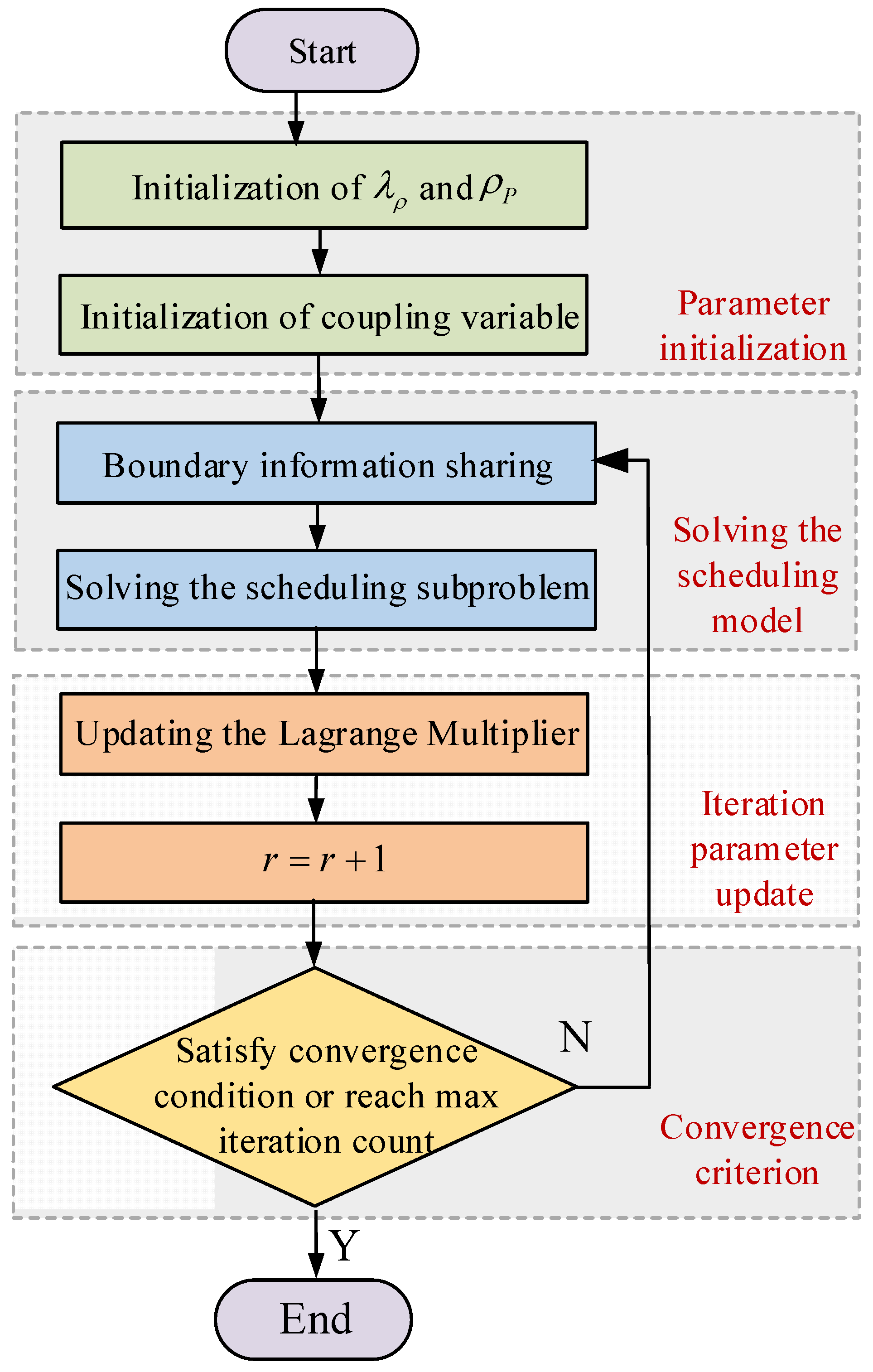
The specific steps of the algorithm are illustrated in Figure 3:
(1)
Parameter Initialization: Set the iteration index r = 0 and the convergence precision ε = 10 3 , initialize the iteration count to 0, and initialize the coupling variable P int , t 0 = P ac , t 0 = 0 , the Lagrange multiplier λ ρ = 0 , and the penalty factor ρ P = 0 .
(2)
Boundary Information Sharing: The BMO entity and LA entity share their respective coupling variable information, forming a synchronous ADMM. The solution formulation is given in Equation (36).
(3)
Solving the Scheduling Subproblems: For the BMO, receive the scheduled air conditioning load power P a c , t from the LA, solve the scheduling subproblem S 1 , and update the planned scheduling power P int , t r + 1 for air conditioning loads in the BMG. For the LA, receive the scheduled air conditioning load power P int , t r + 1 from the BMO, solve the scheduling subproblem S 2 , and determine the planned response amount P a c , t r + 1 for the LA. Update the coupling variable P ¯ int , t r + 1 using Equation (36).
(4)
Updating the Lagrange Multiplier and Iteration Count: Update the Lagrange multiplier according to Equation (37).
λ p , t r + 1 = λ p , t r + ρ p r + 1 ( P int , t r + 1 P ¯ int , t r + 1 )
Update the algorithm iteration count by incrementing it by one.
r = r + 1
(5)
Determine the algorithm convergence condition. If the termination condition in Equation (39) is satisfied, the iteration process terminates; otherwise, return to Step 2 and repeat the computation until either the convergence condition is satisfied or the maximum iteration count is reached.
t = 1 T P int , t P ¯ int , t 2 2 < ε or r > r max

2.5. SQ-Based Pre-Emptive Control Strategy for Air Conditioning Load

Due to the non-uniform initial indoor-temperature distribution among users, the actual air conditioning load response may deviate from the expected value, thereby affecting the execution of the scheduling plan. To address this issue, this paper proposes a pre-regulation strategy for air conditioning loads based on a state queue model, aiming to achieve balanced load distribution through refined management.
The state queue model refers to the linear discretization of air conditioning operating states into several discrete states within a complete control cycle, with each state corresponding to a specific temperature level. As shown in Equation (8), the durations of the air conditioner being in the ON and OFF states during the control cycle are denoted by t o and t c , respectively. The fundamental expression of the model is given in Equation (40):
T in , t + 1 = T in , t + ( T max T min ) Δ t / t c m t = 0 T in , t ( T max T min ) Δ t / t o m t = 1
To account for the impact of parameter heterogeneity on control performance, K-means clustering is applied to the temperature variation parameters derived from the ON/OFF cycles of air conditioning loads. The main reason for choosing K-means is that it has a low computational cost, requires minimal distributional assumptions, and involves fewer hyperparameters, enabling stable user grouping within the real-time control loop and providing interpretable cluster centroids for setting group-level control parameters in the subsequent SQ-based scheme. The cluster centroids are used as the basis for grouping, and it is assumed that air conditioners within the same group share homogeneous parameters. Control tasks are then allocated according to the aggregated power of each group. For each air conditioning load within a cluster, N distinct temperature ranges and corresponding initial temperatures are defined. Based on the temperature range determined during potential evaluation, contract groups are formed. The upper and lower bounds of the temperature ranges for each contract group increase in increments of 0.5 °C. Each load within a group signs a day-ahead response contract with the load aggregator, selecting from K available temperature intervals. When dispatching control tasks, the load aggregator assigns regulation tasks to each contract group based on the control capacity of that group. The control capacity of an individual load is calculated using Equation (41). Based on the air conditioning parameters and the number of users n within each contract group, the load aggregator can compute the total aggregated control capacity of the group, as shown in Equation (42).
P control , i , t = t c , i t o , i + t c , i P int , i , t
P control , t = j = 1 n P control , i , t
After assigning the dispatch tasks to each contract group, the number of loads n close , k that need to be controlled within each contract group can be determined based on Equations (8) and (42).
Using the state queue model, the contract groups are divided into M temperature intervals, where the number of air conditioning loads in the m-th interval is denoted as n on , m . Due to the uneven distribution of users’ initial indoor temperatures, when applying the state queue model, boundary intervals may suffer from low load density, making it difficult to ensure a uniform number of responsive loads across all temperature intervals, which may lead to power fluctuations. To address this issue, each contract group is divided into M temperature intervals, where the number of air conditioning loads in the m-th temperature interval is denoted as n on , m . A load distribution standard value γ = n close , k / M is defined to assess the sparsity of load distribution across temperature intervals. If γ > n on , m , it indicates that the air conditioning load in this temperature interval is sparse, and the number of sparse intervals is recorded as n sparse . Conversely, if γ < n on , m , it indicates that the load distribution is dense. In the actual dispatch process, to mitigate the uneven load distribution in dense intervals, a pre-emptive control strategy is employed to transfer a portion of the loads from dense intervals to sparse intervals, thereby achieving refined load management.
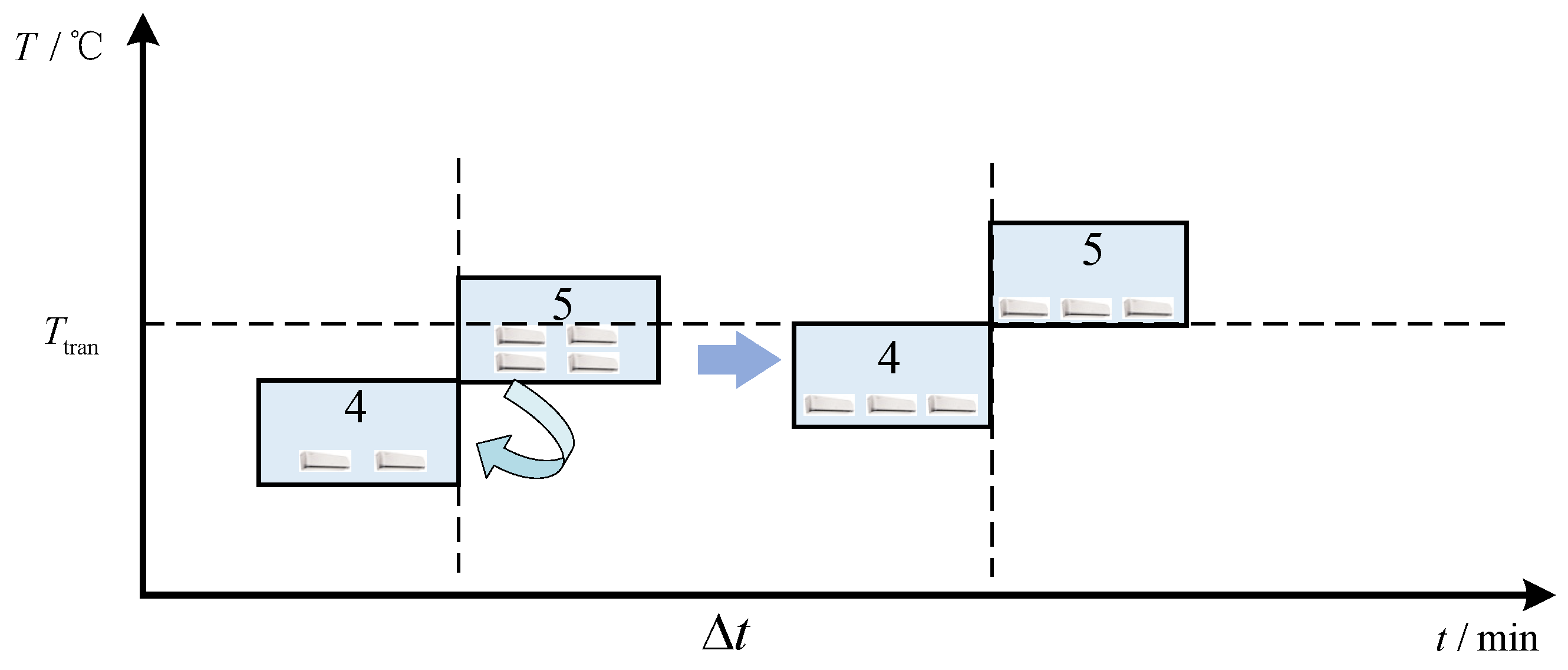
The principle of the pre-regulation strategy is illustrated in Figure 4. Before the dispatch plan is issued, if temperature state 4 is sparsely populated while temperature state 5 is densely populated, a portion of the loads in state 5 are precooled, while the loads in state 4 continue to warm up as usual. When both sets of loads reach the same temperature, the loads from state 5 are switched off and transition to the same state as those in state 4, thereby completing the pre-shifting process.
The pre-shifting from densely populated states to sparsely populated states can be categorized into two scenarios: one involves lowering the temperature of the densely populated state to shift toward the sparse state, while the other involves raising the temperature for the same purpose. The corresponding operation time can be obtained by solving the system of equations formed by Equations (8) and (40):
(1)
When T sparse , up , m < T dense , up , m 1 : The transfer time is obtained by equating the time required for the sparse state to warm up to the intermediate temperature T tran , m 1 with the time required for the dense state to cool down to the same temperature T tran , m 1 .
T tran , m 1 = ( B 1 / A 4 ) T sparse , up , m ( B 2 / A 4 ) T dense , up , m 1 T dense , up , m 1 T sparse , up , m + ( B 1 B 2 ) / A 4 Δ t d , m = 1 A 4 ln T sparse , up , m + B 2 / A 4 T tran , m 1 + B 2 / A 4
where T sparse , up , m is the highest temperature of the queue module in the m-th sparse state, T dense , up , m 1 is the highest temperature of the queue module in the m i -th dense state, and T tran , m 1 is the temperature after load transfer in the m i -th state.
(2)
When T sparse , up , m > T dense , up , m 1 : At this point, the transfer time is divided into two stages. The first stage is the time required for the sparse state to shift to the upper temperature limit T max , k of the contract group. The second stage is determined by equating the time for the dense state to warm up to temperature T tran , m 1 with the time for the sparse state to cool down to temperature T tran , m 1 .
T later , m 1 = T dense , up , m 1 T max , k + B 2 / A 4 T sparse , up , m + B 2 / A 4 + B 2 / A 4 T max , k T sparse , up , m T sparse , up , m + B 2 / A 4
T tran , m 1 = ( B 1 / A 4 ) T later , m 1 ( B 2 / A 4 ) T max , k T max , k T later , m 1 + ( B 1 B 2 ) / A 4 Δ t s , m = 1 A 4 ln ( T sparse , up , m + B 2 / A 4 T max , k + B 2 / A 4 ) 1 A 4 ln ( T max , k + B 1 / A 4 T tran , m 1 + B 1 / A 4 )
where T later , m 1 is the transformed temperature of module m i when transferring from a sparse state to the highest temperature, and T max , k is the upper temperature limit of the k-th contract group.
To prevent air conditioning power drop, the number of loads in each temperature state of the state queue model should meet the required levels. Therefore, this paper establishes an objective function that minimizes the control time, formulated as follows:
min T i = m = 1 n d Δ t d , m + m = 1 n s Δ t s , m
The transfer constraints are defined as
n d + n s = m = 1 n close , k γ n min , m n on , m γ 0
where n d is the number of loads transferred from the dense state group to the sparse state group when T s p a r s e , up , m < T dense , up , m 1 , Δ t d , m is the transfer time for each load in n d , n s is the number of loads transferred from the dense state group to the sparse state group when T s p a r s e , up , m > T dense , up , m 1 , Δ t s , m is the transfer time for each load in n s , and n min , m is the number of loads in the k-th sparse state group.

3. Example Simulation

The experiments in this paper were all run on MATLAB software, with version R2024b.

3.1. Parameter Setting

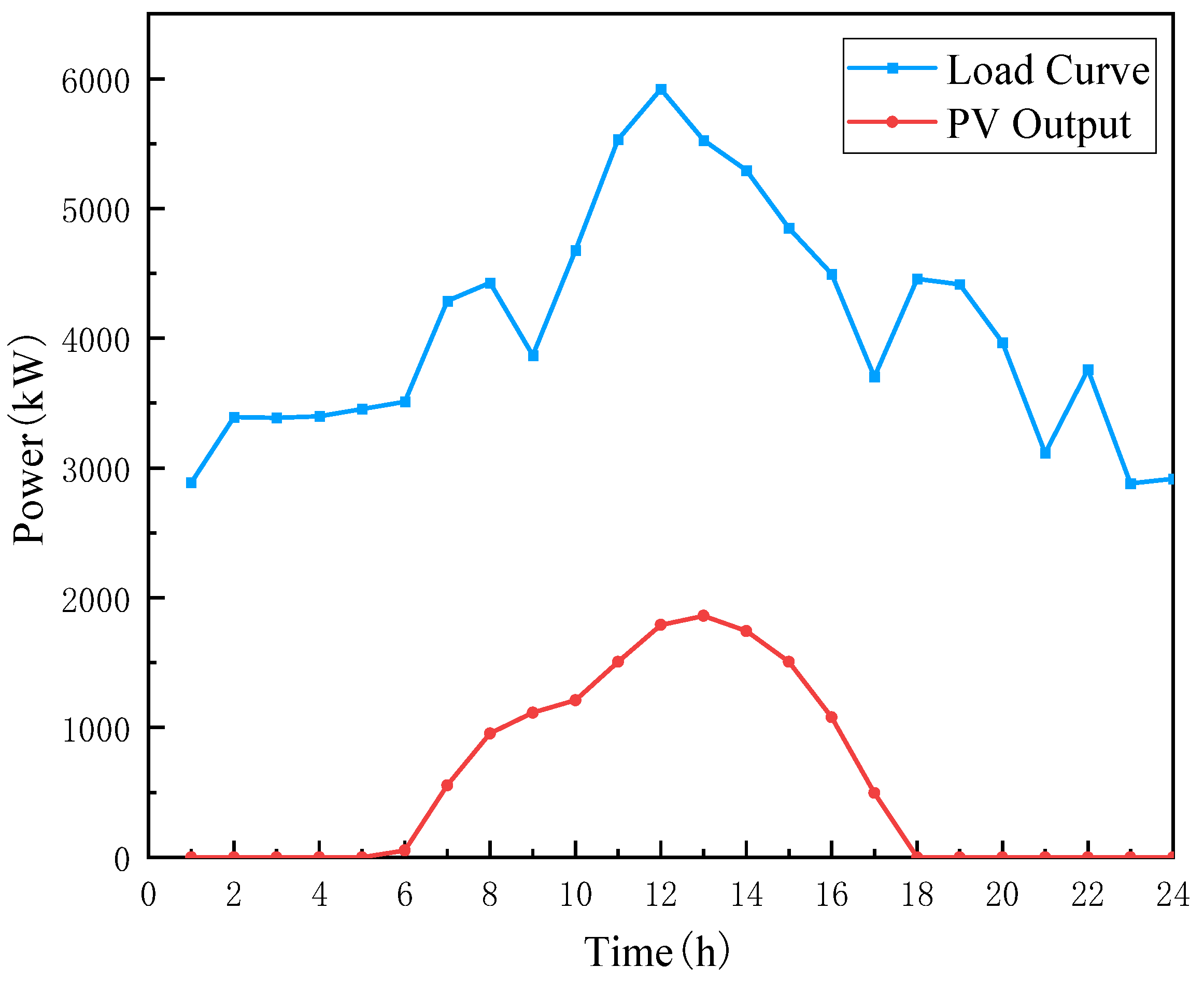
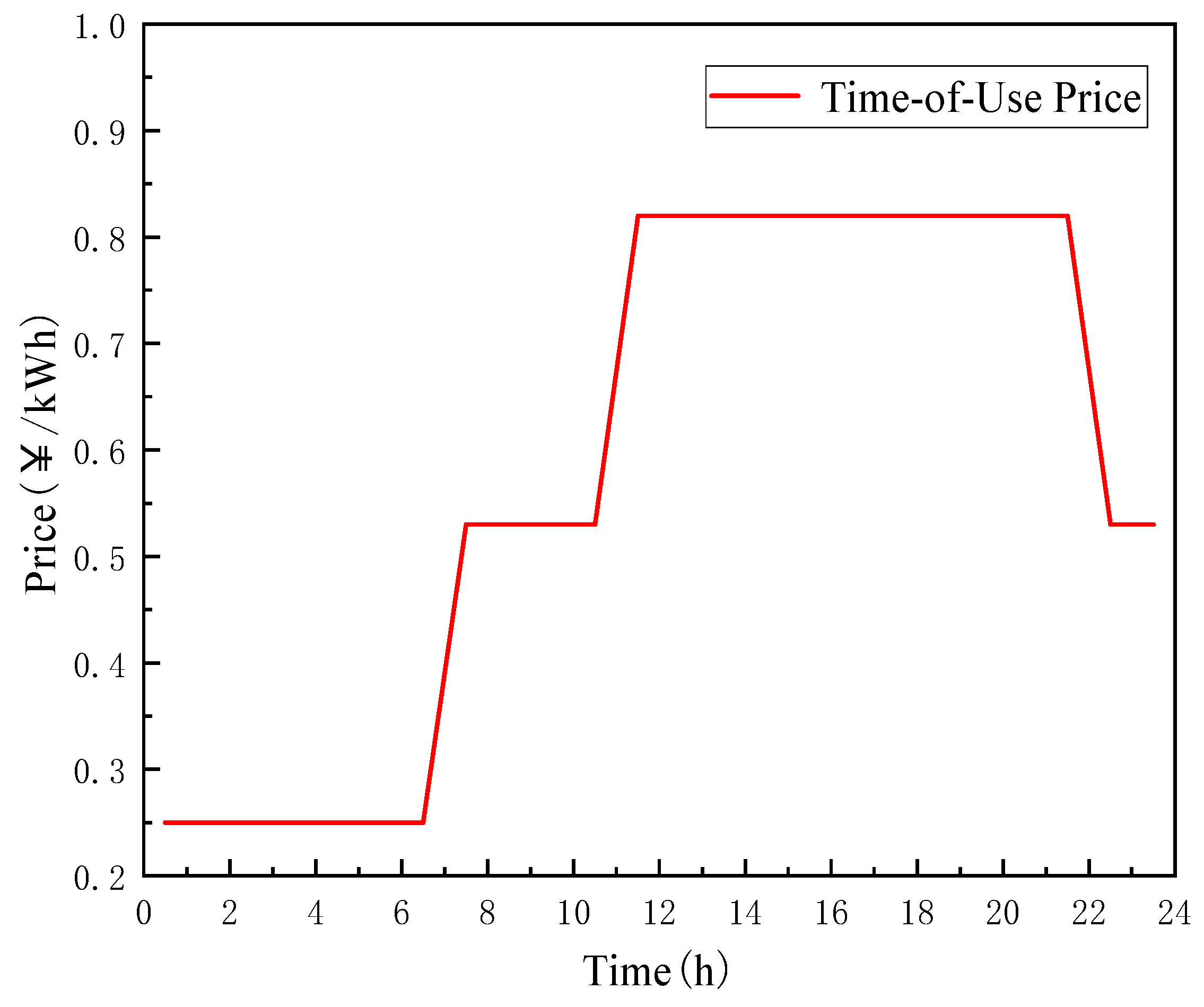
In this case study, the BMG system consists of 6000 air conditioning units, with specific parameters listed in Table 1, where each parameter follows a uniform distribution within its respective range. The BMG system also includes PV generation, energy storage, and other functional devices, with their parameters and unit regulation costs provided in Table 2. The time-of-use electricity price is shown in Figure 5, while the PV output and load demand of the BMG system are illustrated in Figure 6.

3.2. Validation of the Approximate Aggregation Model for Air Conditioning Loads

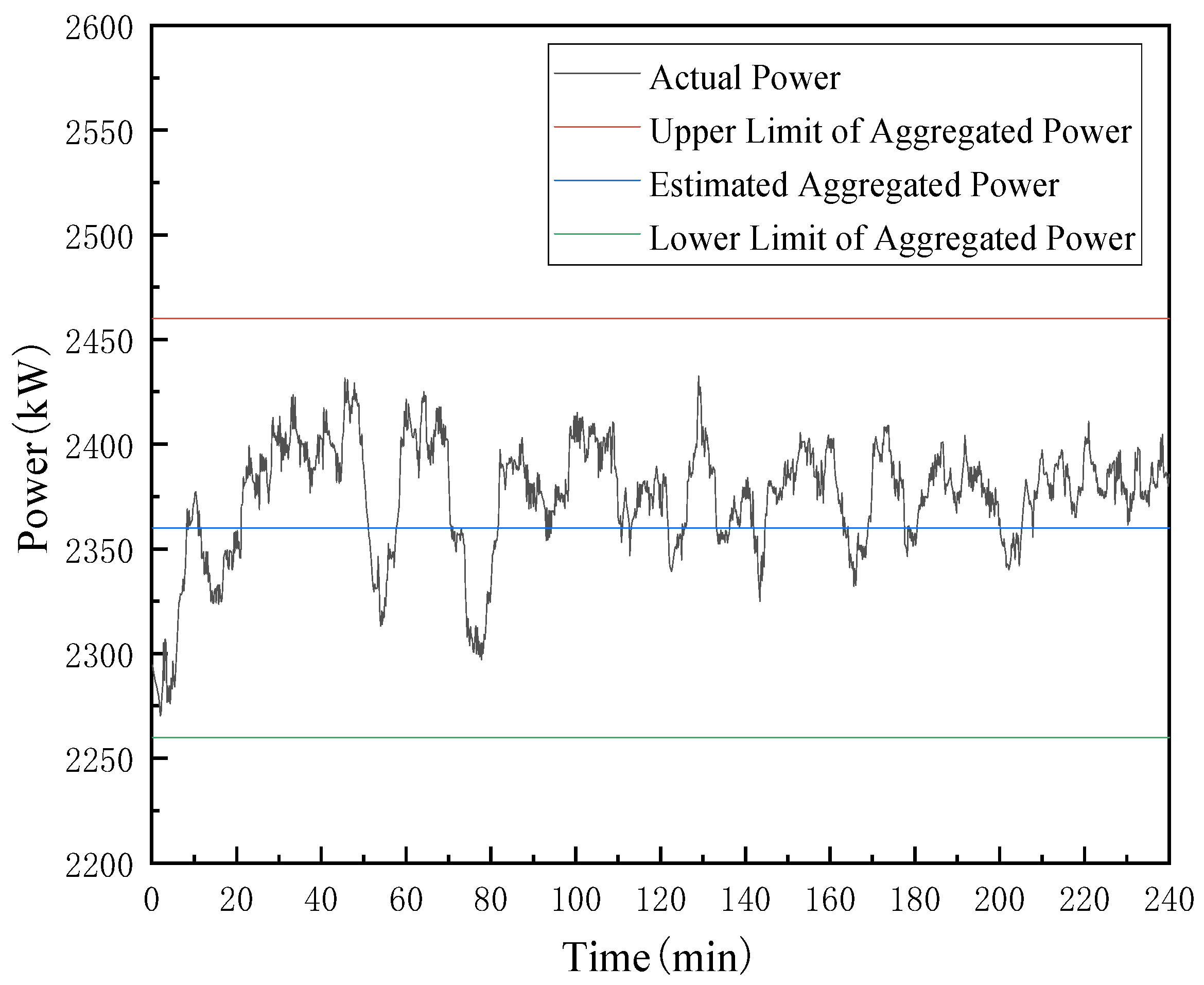
In this study, 6000 air conditioning units are simulated using the parameters set in Table 1, with Monte Carlo simulation results serving as the reference for actual power consumption comparison. The initial ON/OFF states of air conditioners are assumed to be randomly assigned. The aggregated air conditioning load power is analyzed under conditions of 34 °C temperature and 100% solar irradiance during 11:00–15:00. The simulation results are presented in Figure 7.
From Figure 7, it can be observed that at 34 °C, the aggregated air conditioning load power of 6000 units stabilizes within the range of 2260–2460 kW. According to the proposed formula in this study, when α = 0.5, the estimated aggregated power is 2361.3 kW. The estimated power bounds successfully encompass the actual power range, demonstrating a good approximation effect.
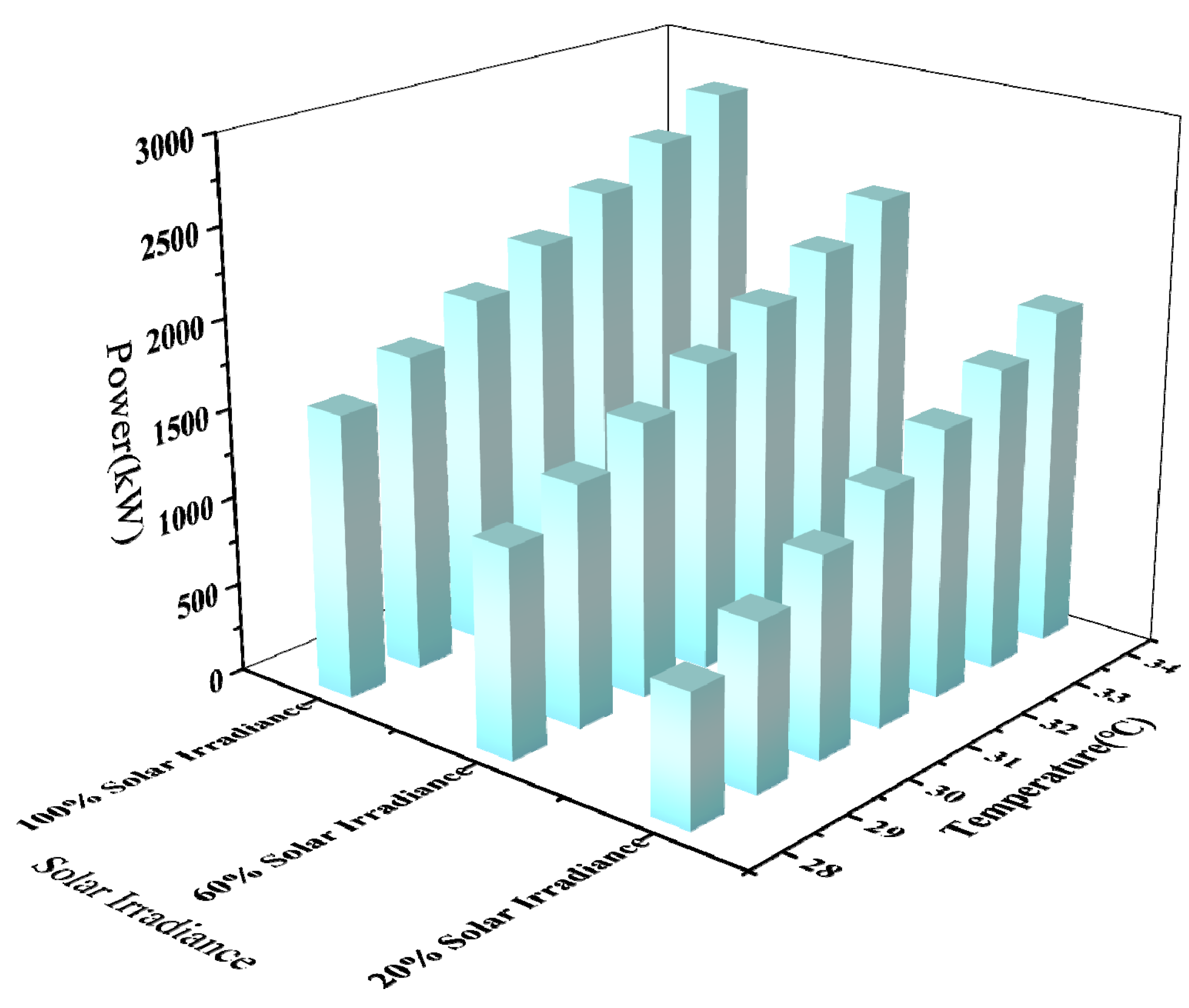
Figure 8 illustrates the aggregated power of building air conditioning loads under different solar irradiance levels and temperatures. The results indicate that as outdoor temperature increases and solar irradiance intensifies, the aggregated air conditioning power also rises. This is because the heat absorbed per unit of area per unit of time by the building increases with higher solar intensity and ambient temperature. Consequently, the time required for the indoor temperature to drop to the lower setpoint boundary increases, while the time for it to rise to the upper setpoint boundary decreases. As a result, the duty cycle of temperature-controlled devices increases, leading to a corresponding increase in the aggregated power consumption and maximum response power of building air conditioning loads.

3.3. Simulation Analysis of Load Response Potential

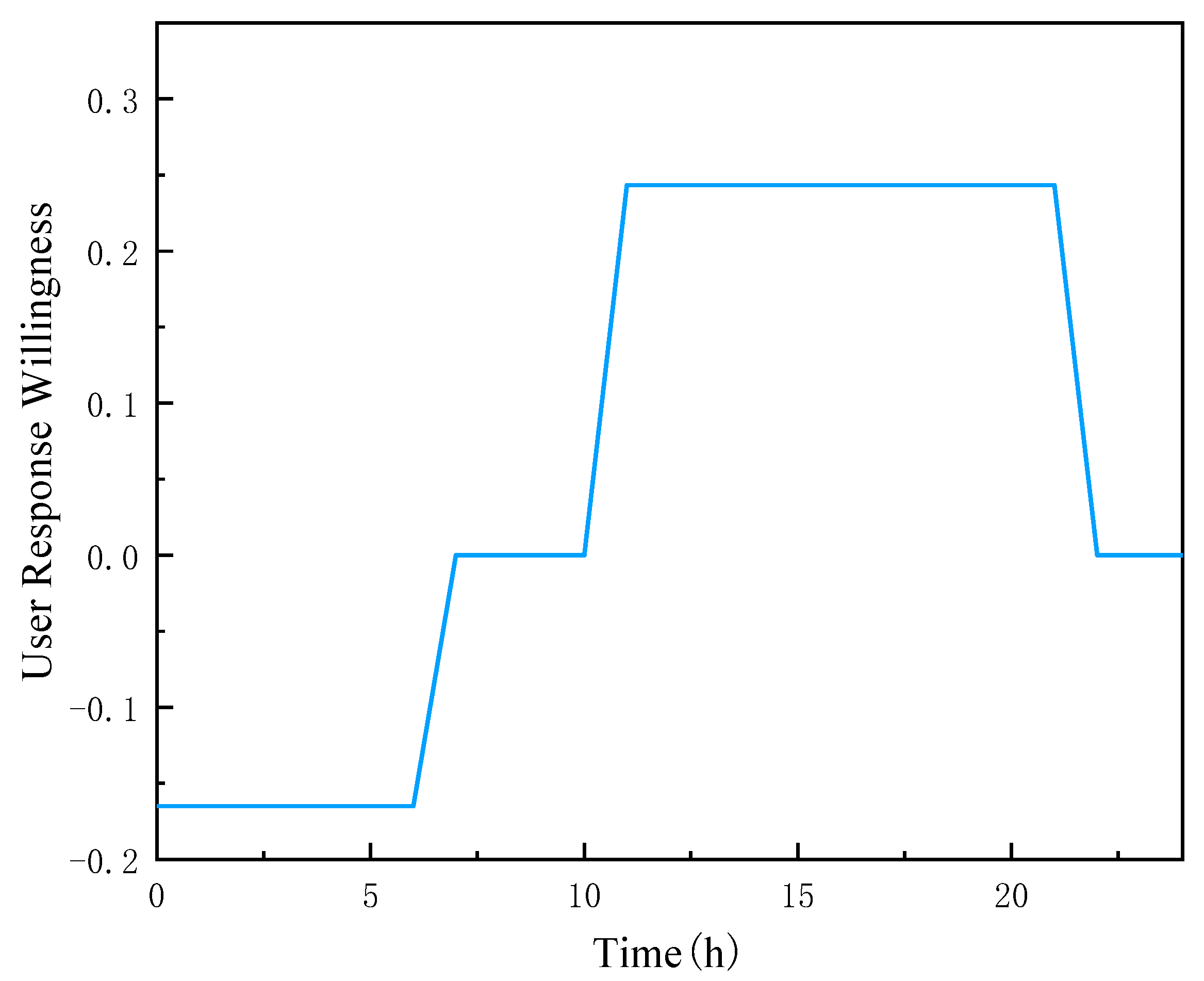
To reasonably assess the response potential of the air conditioning load cluster and facilitate its effective participation in demand response, this study refers to the Seventh Population Census data published by the Anhui Provincial Bureau of Statistics, China. Using the flat-period electricity price in the time-of-use pricing scheme as the baseline price, the user willingness to participate in demand response at different time periods is obtained, as shown in Figure 9.
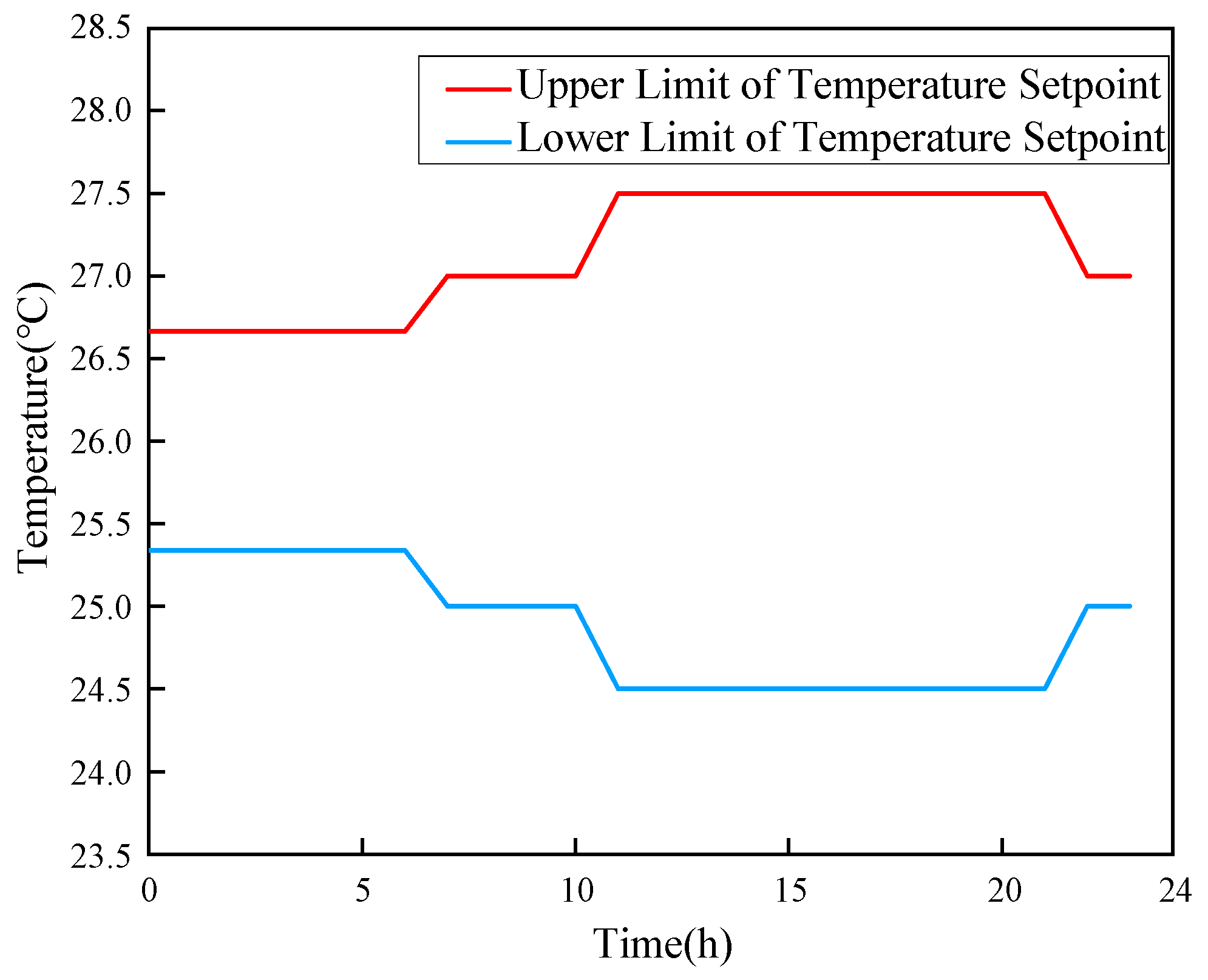
From Figure 9, it can be observed that between 0:00 and 7:00, the electricity price is lower than the baseline price, resulting in a negative user willingness of −0.1653, indicating low participation willingness in demand response. Between 7:00 and 10:00, 16:00 and 18:00, and 21:00 and 24:00, the electricity price equals the baseline price, with a neutral willingness of 0, meaning users have no strong inclination to participate. Between 10:00 and 16:00 and 18:00 and 21:00, the electricity price is higher than the baseline price, leading to a positive user willingness of 0.2434, indicating a high participation willingness in demand response. Using Equations (22) and (23), the adjustable temperature range for users is calculated and presented in Figure 10.
Figure 10 illustrates the temperature setpoint range for air conditioning loads, evaluated based on user comfort and willingness indices. The red line represents the upper bound of the temperature setpoint range. The blue line represents the lower bound of the temperature setpoint range. During periods of low user willingness for demand response (negative willingness), users are reluctant to adjust their air conditioning temperature significantly. The adjustable range is 25.47–26.53 °C, which is slightly narrower than the original setpoint range. During periods when the electricity price equals the baseline price (neutral willingness), users hold a neutral stance toward demand-response participation, and the adjustable range remains unchanged from the original setpoint limits. During periods of high user willingness (positive willingness), users actively participate in demand response, and the adjustable temperature range expands to 24.5–27.5 °C.
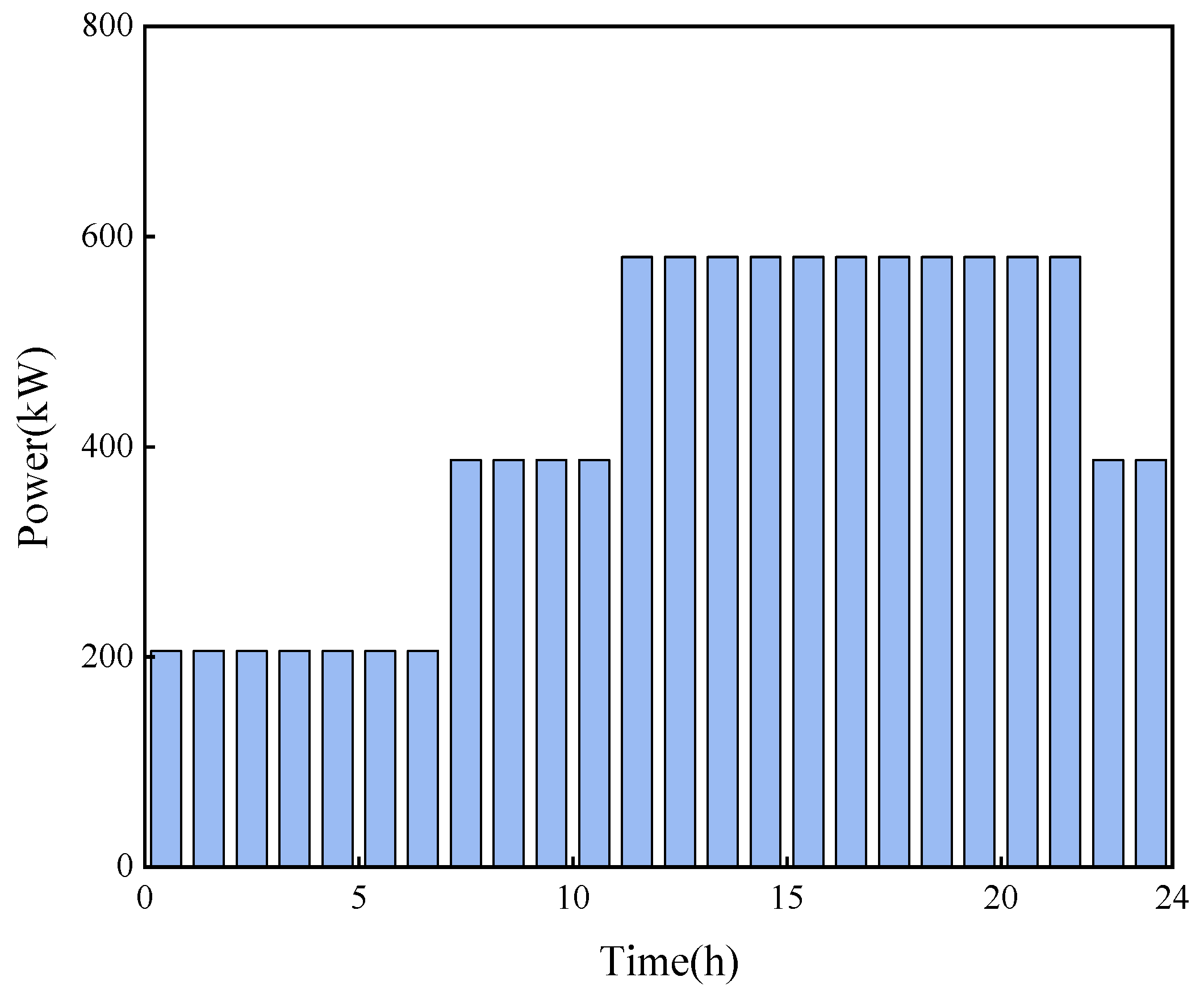
The initial temperature setpoints of the air conditioning cluster are assumed to follow a uniform distribution between 25 °C and 27 °C, with an expected value of 26 °C. For the load reduction scenario, the evaluated response potential of the air conditioning cluster is shown in Figure 11.
From Figure 11, it can be observed that during periods of low user willingness (negative willingness), the adjustable temperature range is narrow, resulting in a response potential of only 205.26 kW. During neutral willingness periods, where users hold a neutral stance on demand-response participation, the response potential increases to 387.02 kW. During periods of high user willingness (positive willingness), the adjustable temperature range expands further, leading to a response potential of 580.53 kW. These results demonstrate that the proposed evaluation model effectively assesses the aggregated response potential of air conditioning loads.

3.4. Simulation Analysis of the BMO-LA Day-Ahead Distributed-Scheduling Model

In this section, a simulation analysis of the BMO-LA day-ahead distributed-scheduling model is conducted. The initial values of the coupling variable and Lagrange multiplier are both set to 0. The initial value of the penalty parameter is set to 0.1. The maximum number of iterations is set to 50, and the convergence criterion is defined with the tolerances of both the primal and dual residuals set to 0.01.
Two scenarios are considered based on whether the response potential of air conditioning loads is taken into account:
  • Scenario 1: Without considering the response potential of air conditioning loads.
  • Scenario 2: Considering the response potential of air conditioning loads.

3.4.1. Scheduling Results Analysis

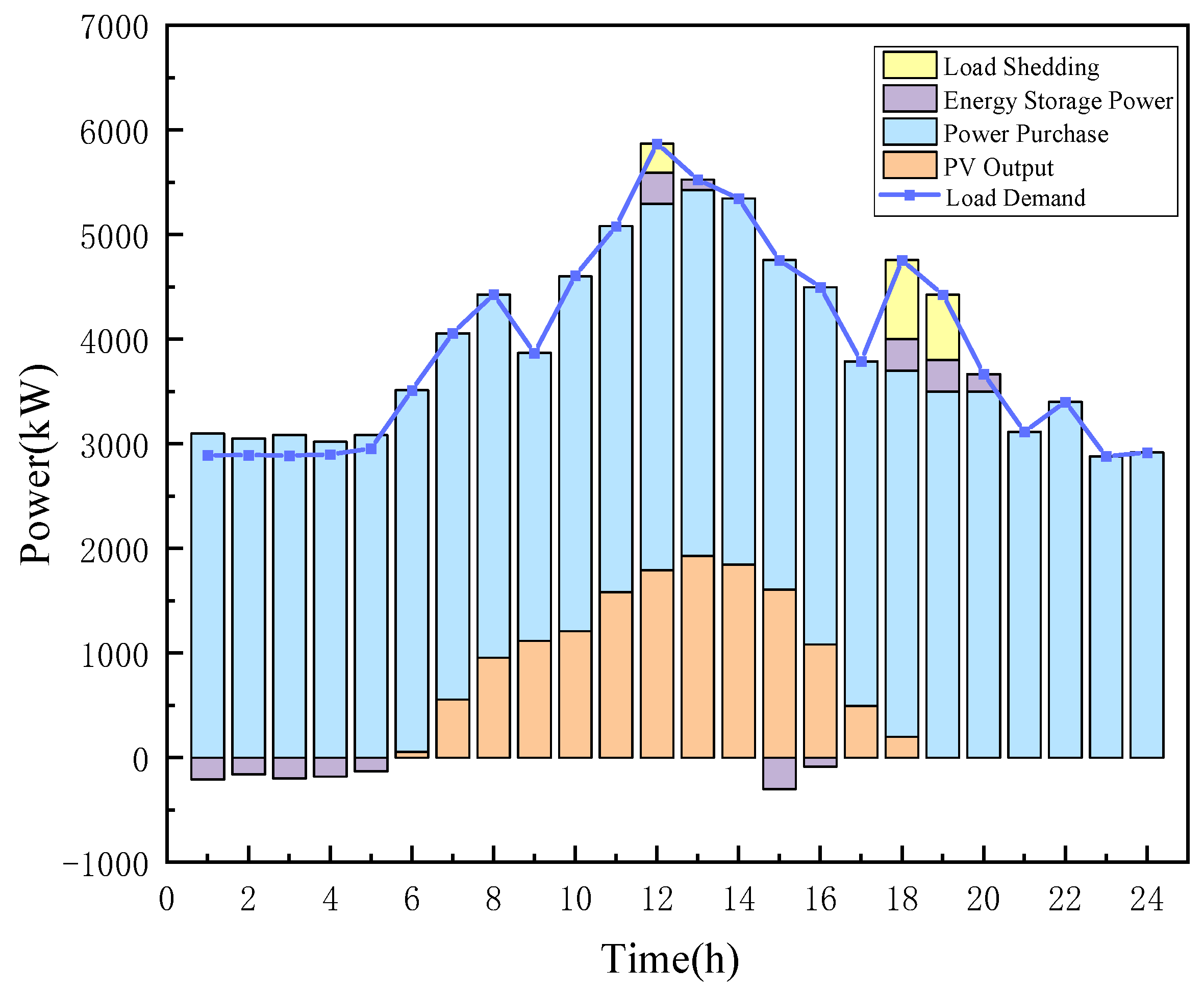
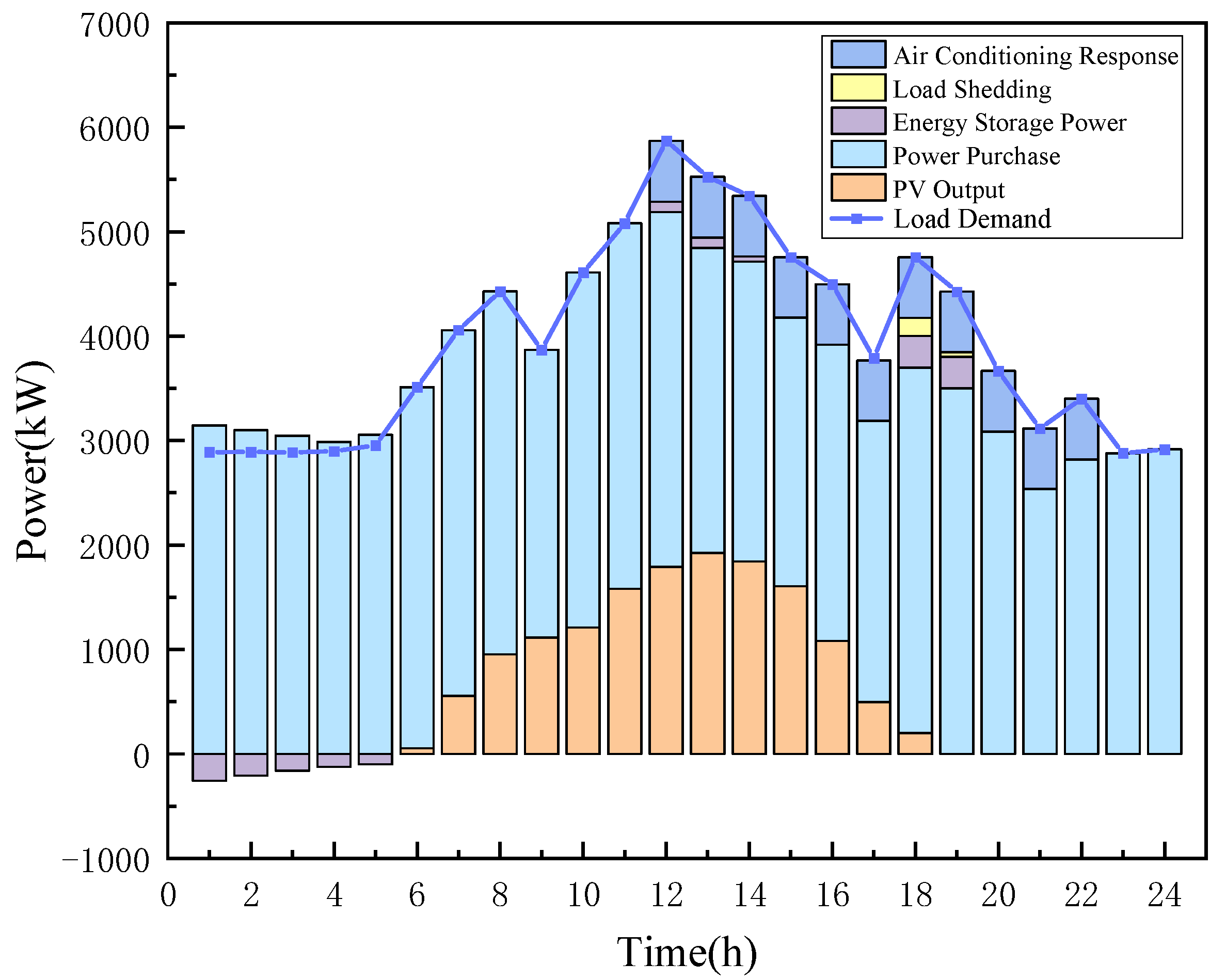
The hourly power scheduling results of Scenario 1 and Scenario 2 are shown in Figure 12 and Figure 13, respectively. It can be observed that without considering the response-potential characteristics of air conditioning loads, load losses occur during peak periods from 11:00 to 14:00 and from 18:00 to 20:00 due to power purchase constraints from the grid. During the midday period, load losses are relatively small because of favorable photovoltaic output, whereas after 18:00, the photovoltaic output is almost zero, resulting in more significant load losses.
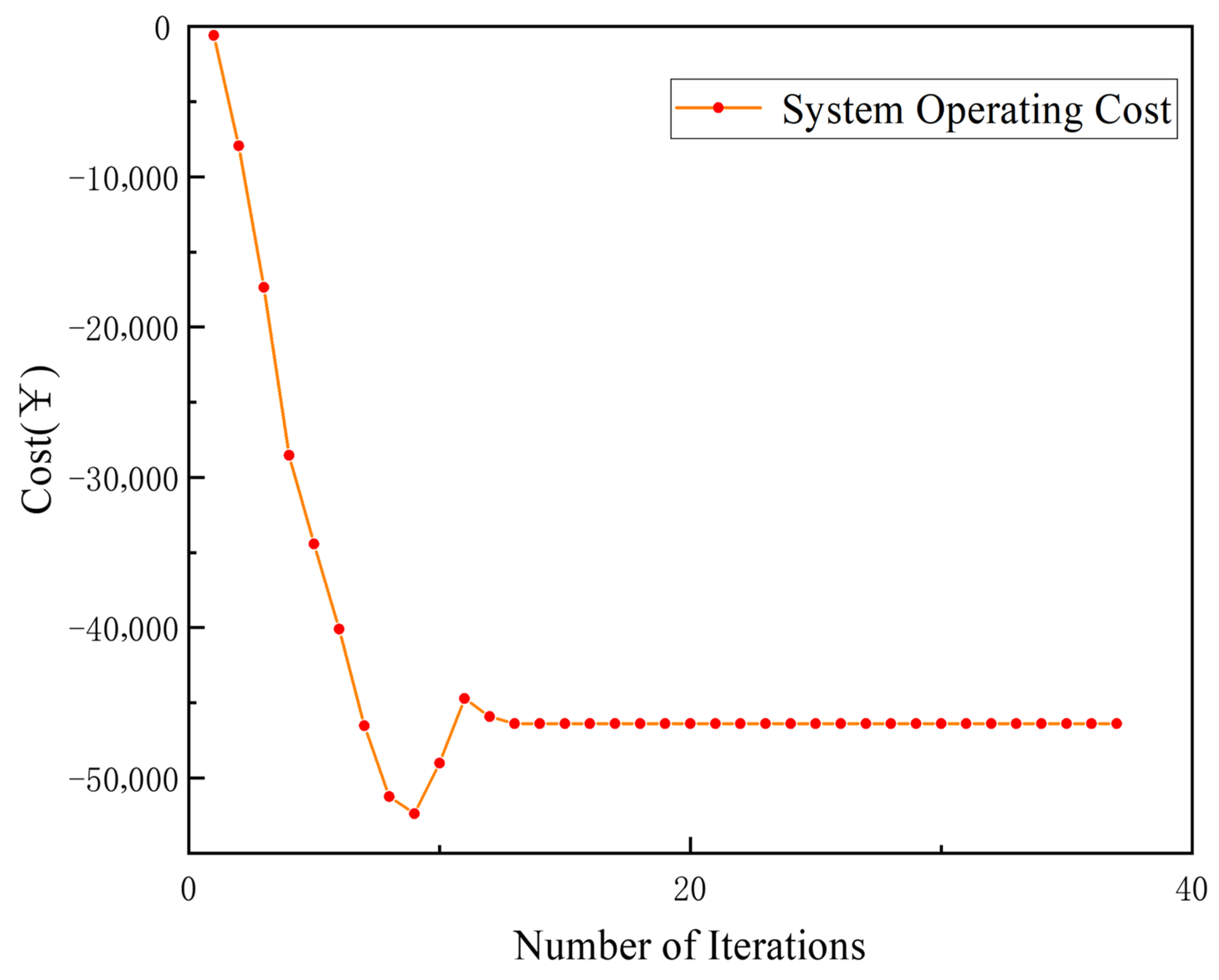
In contrast, the scheduling results that consider the response potential of air conditioning loads demonstrate that the LA can reduce electricity consumption by compensating users, thereby balancing user comfort and willingness. During the midday peak from 11:00 to 14:00, the large air conditioning response potential combined with strong photovoltaic output eliminates load losses in the building microgrid system. Although photovoltaic output is absent between 18:00 and 20:00, the air conditioning response potential effectively reduces load losses during this period. Between 20:00 and 22:00, since the cost of load shifting is lower than the time-of-use electricity price, the air conditioning load response can reduce overall system operating costs. Figure 14 shows the algorithm iteration results, where convergence is achieved after 37 iterations, yielding a balanced solution.
The scheduling operation costs and load shedding results for Scenario 1 and Scenario 2 are shown in Table 3. Compared to Scenario 1, Scenario 2, which considers air conditioning load response potential, leads to a reduction in the system operating cost from CNY 50,694.58 to CNY 47,131.64, a 7.6% decrease; and a reduction in load shedding from 1466.35 kWh to 257.31 kWh, a 82% decrease. These results demonstrate that air conditioning loads can significantly reduce the energy burden of the BMG system, while also exhibiting effective peak-shaving and valley-filling characteristics.

3.4.2. Analysis of Scheduling Results Under Different Compensation Prices

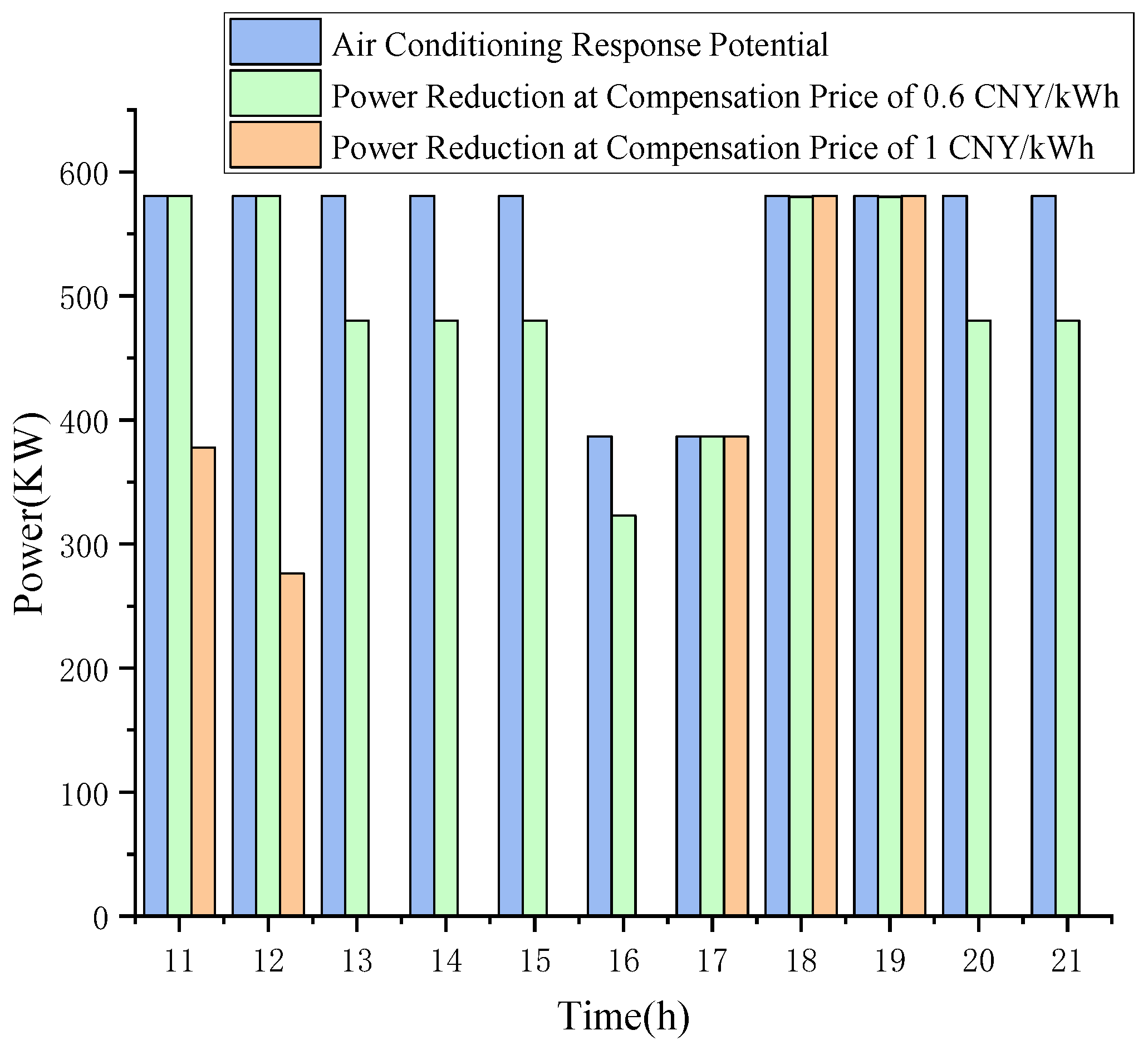
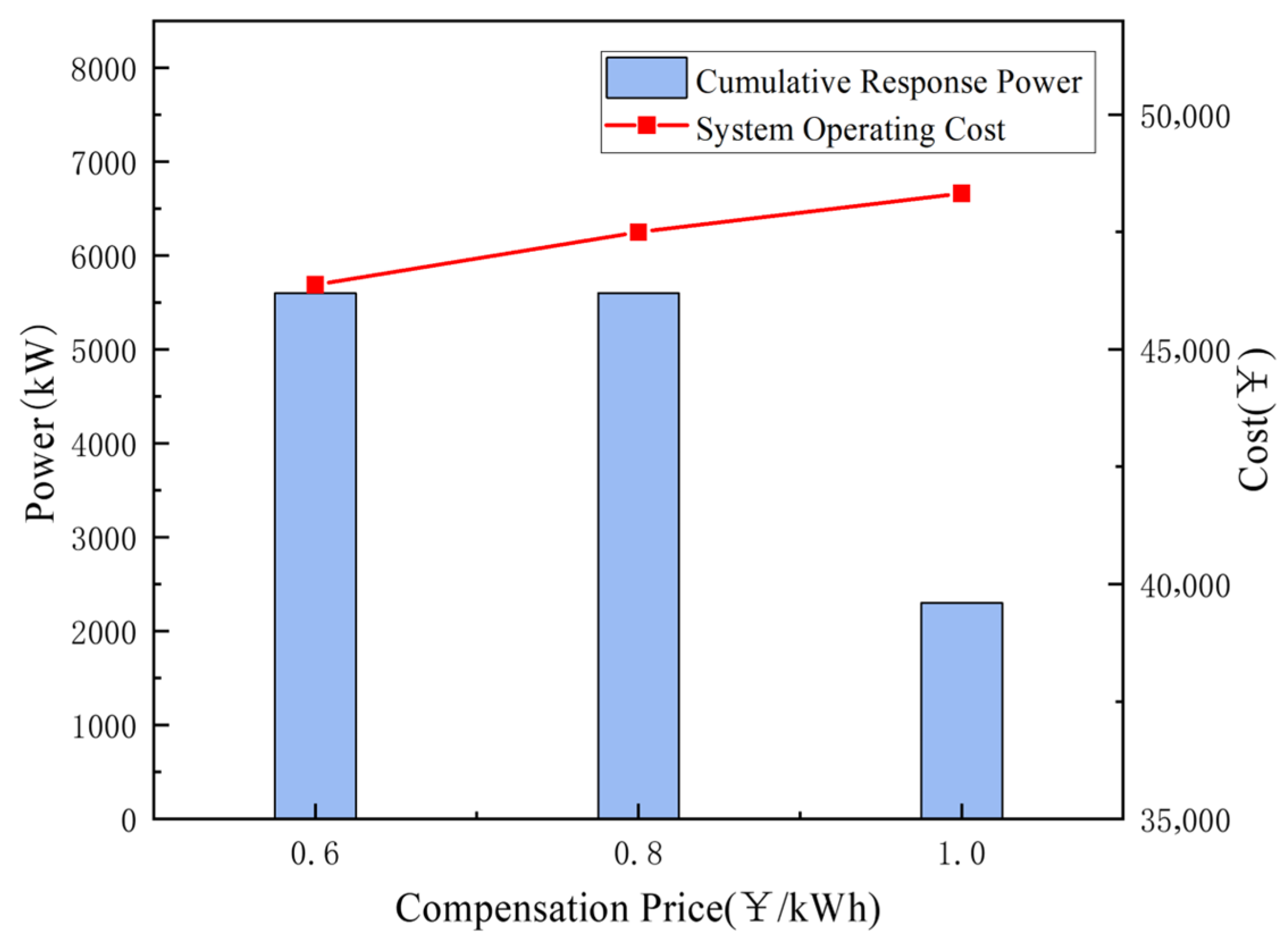
The total operating cost of the BMG system and the cumulative response power of air conditioning loads under different compensation prices are shown in Figure 15. As the compensation price for air conditioning load scheduling increases, the total operating cost of the BMG system also increases. Correspondingly, when the compensation price exceeds the peak electricity price of CNY 0.82, the total regulated power of air conditioning loads scheduled by BMO decreases.
Figure 16 shows the power reduction in air conditioning loads during different time periods when the compensation price is set to 0.6 and 1. When the compensation price exceeds the peak electricity price of CNY 0.82, the response power of air conditioning loads scheduled by the BMG decreases. Under this condition, air conditioning loads only respond during periods when load losses occur.

3.5. Simulation Analysis of the Real-Time Air Conditioning Control Strategy

According to the content in Section 2.5 of this paper, to ensure the effectiveness of regulation, the K-means clustering algorithm is applied using the features P int , 1 / A 4 , B 1 / A 4 , and B 2 / A 4 to cluster air conditioning loads into different aggregation groups and calculate the capacity of each group. Each group is assigned scheduling tasks proportionally based on its aggregated capacity. The LA performs regulation on each aggregation group according to the allocated scheduling tasks. The clustering results are presented in Table 4.
This paper analyzes the air conditioning load task of 580.8 kW scheduled for the 13:00–14:00 time slot assigned to Group 1. After capacity allocation, the scheduling task for Group 1 is 212.7 kW. Based on the temperature ranges determined in the response-potential evaluation, the load aggregator (LA) establishes contract groups for Group 1, where the upper and lower temperature bounds of each contract group increase in increments of 0.5 °C. Users select and sign contracts for the appropriate temperature regulation intervals according to their willingness to respond, implying that the initial temperature distribution varies among users within different contract groups. Each contract group is divided into 10 temperature intervals based on the state queue model. The contract parameters and the number of signed users are presented in Table 5.
Based on the above-allocated scheduling tasks, the number of loads required to participate in regulation for each contract group can be calculated using Equation (40), from which the parameter τ is derived. The required regulation load quantities for each contract group in the sparse state interval are listed in Table 6.
Using the proposed control strategy, regulation is applied to three contract groups. The load transfer quantities in each contract group are calculated based on Equations (42) and (43), and the results are shown in Table 7.
From Table 7, the load transfer results for each contract group are as follows: in Contract Group 1, the load shortages in Temperature Modules 1 and 2 are compensated by transferring seven and two loads, respectively, from Module 3. The corresponding transfer times are 2.41 min and 1.15 min. In Contract Group 3, the load shortages in Temperature Modules 6 and 7 are compensated by transferring one and six loads, respectively, from Module 5. The corresponding transfer times are 3.39 min and 1.95 min.
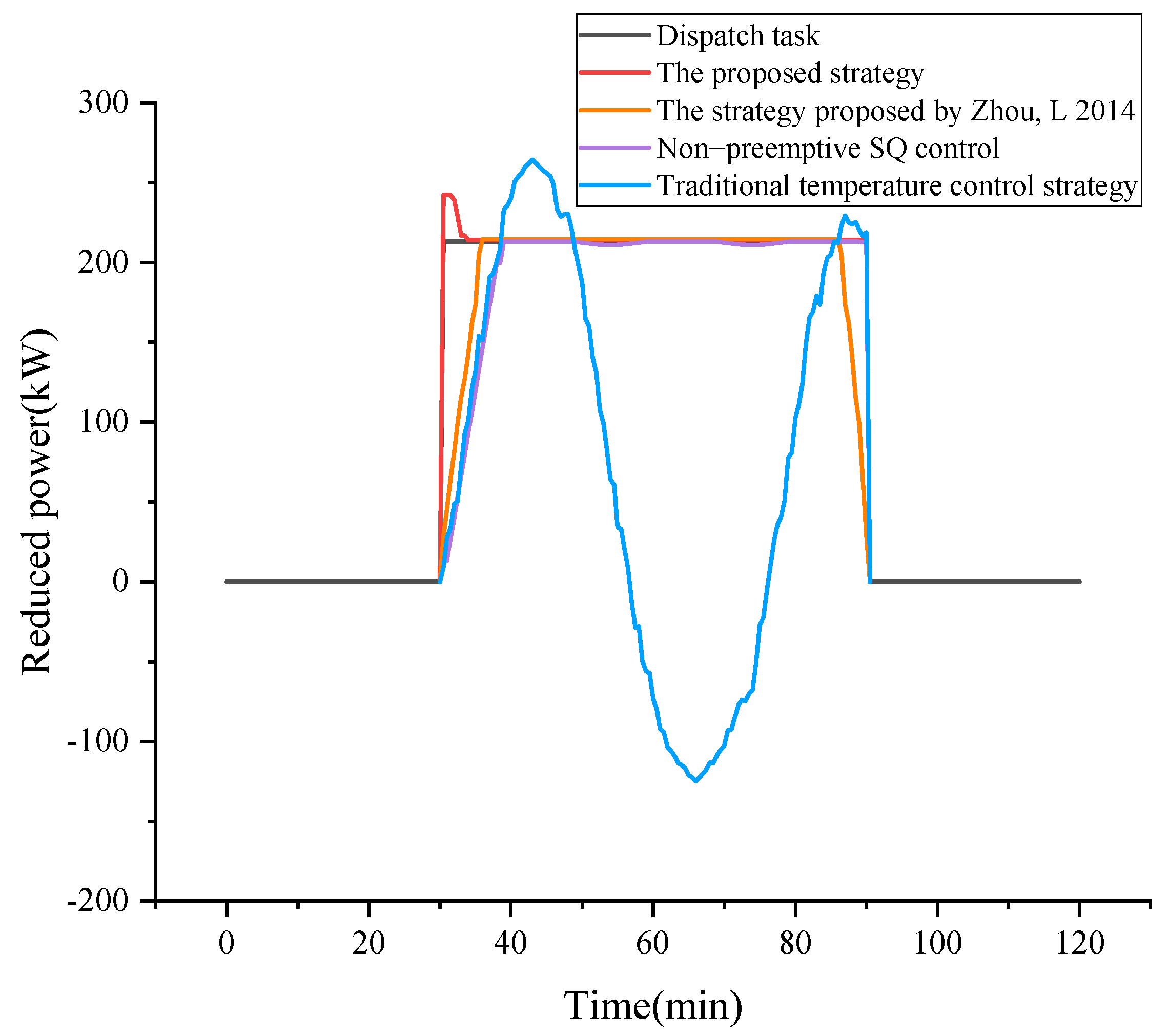
The proposed control strategy is applied to the contract groups within Group 1, and the control performance is illustrated in Figure 17. The horizontal axis in the figure represents the time of the real-time control process, and the vertical axis represents the power reduction amount after air conditioning load aggregation, which is used to reflect the tracking ability, transient-fluctuation size, and steady-state deviation of different control strategies for scheduling peak-shaving tasks.
The proposed control strategy is compared with the traditional temperature control strategy (i.e., reducing the temperature setpoint by 0.5 °C), non-pre-emptive SQ control, and the friendly temperature adjustment strategy based on the state queue model proposed in Ref. [32]. When applying the strategy proposed in this paper, the maximum power fluctuation within the first 3.39 min is 27.04 kW. This is because the objective function is set to minimize the state transition time, allowing a rapid advance transfer from dense to sparse states toward the idealized distribution of the state queue model. As a result, the power reduction increases gradually and becomes stable. In contrast, the traditional temperature control strategy—by directly lowering the setpoint—can reduce the load in the initial stage. However, it disrupts the diversity of the state queue model, causing some states to become vacant or disappear. This leads to power rebound phenomena in air conditioning loads, resulting in significant power fluctuations and subsequent periodic oscillations. The overall response process of non-pre-emptive SQ control is relatively stable and can avoid the obvious rebound caused by traditional temperature control. However, the speed of achieving the target power reduction in the initial stage of scheduling is relatively slow, and there is a certain transient tracking lag. As for the control strategy in Ref. [32], upon receiving the scheduling task, it takes approximately 5 min to reach the target power reduction, during which a certain degree of response deviation occurs. To evaluate the impact of parameter sampling and initial-state uncertainty on the results, we conducted multiple independent runs under identical settings using different random seeds. The results show that the variations in key metrics are limited, and the relative ranking of different control strategies, as well as the main conclusions, remain consistent. From the above comparison, it can be concluded that the proposed strategy in this paper can rapidly and effectively reduce power fluctuations. It enables a more uniform distribution of load across different temperature states in the state queue during peak-shaving response, thereby effectively mitigating load volatility and minimizing response deviation.

4. Conclusions

This study addresses the issues of dispersion and response fluctuation of air conditioning loads in BMG systems and proposes a day-ahead and real-time coordinated aggregation control strategy for air conditioning loads in BMG. The conclusions drawn from the case study are as follows:
(1)
The proposed day-ahead and real-time aggregated control framework for air conditioning loads can effectively exploit the response potential of air conditioning loads. By co-optimizing the scheduling and control layers, it achieves coordinated, flexible, and precise control in tracking the scheduling plan, thereby enhancing system stability and reliability.
(2)
In terms of load modeling, an approximated model of air conditioning loads is developed based on a single-zone RC model of buildings, incorporating the thermal transfer characteristics of buildings. The model fully accounts for the influence of external environmental factors on aggregated power and introduces user comfort and willingness indices to further explore the multi-factor aggregation response potential of building air conditioning loads, providing a foundation for day-ahead scheduling.
(3)
At the day-ahead scheduling layer, the flexible regulation characteristics of air conditioning load clusters during peak load periods are fully utilized to established a BMO-LA day-ahead distributed-scheduling model. By adopting an ADMM-based distributed strategy, the model effectively reduces system operation costs and load losses without compromising user information privacy.
(4)
At the real-time control layer, a pre-emptive air conditioning load control strategy based on the SQ model is proposed. This approach effectively mitigates power fluctuations caused by uneven initial temperature distributions of air conditioners, achieves refined control of air conditioning loads, and further ensures the supply–demand balance of the BMG system.
The proposed control strategy provides a new perspective for flexible load management in integrated BMG systems. Future research can investigate aggregated air conditioning load control under multi-source uncertainties to enable more comprehensive intelligent energy management for BMGs. Meanwhile, a multi-dimensional satisfaction evaluation framework can be introduced by constructing calibratable satisfaction curves for thermal comfort, economic benefits, and privacy preferences, and then achieving trade-offs among these dimensions through multi-objective optimization or risk-constrained decision-making. In addition, for large-scale deployment, it is worth exploring engineering acceleration and communication-overhead reduction strategies such as hierarchical ADMM, and integrating data-driven forecasting models to improve the robustness and generalizability of day-ahead scheduling and real-time control.

Author Contributions

Methodology, J.D., W.D., B.X., D.H., D.Q., H.W. and Z.T.; software, J.D. and W.D.; validation, B.X.; formal analysis, D.H.; investigation, D.Q.; resources, J.D.; data curation, B.X.; writing—original draft preparation, W.D.; writing—review and editing, D.Q.; funding acquisition, D.Q. All authors have read and agreed to the published version of the manuscript.

Funding

This project was supported by the State Grid Anhui Electric Power Co., Ltd.: Science and Technology Project (B3120524003L).

Data Availability Statement

The data presented in this study are available on request from the corresponding author.

Conflicts of Interest

Authors Jinjin Ding, Wangchao Dong, Bin Xu and Dan Hu were employed by the State Grid Anhui Electric Power Research Institute. The remaining authors declare that the research was conducted in the absence of any commercial or financial relationships that could be construed as a potential conflict of interest. State Grid Anhui Electric Power Co., Ltd. had no role in the design of the study; in the collection, analyses, or interpretation of data; in the writing of the manuscript, or in the decision to publish the results.

Abbreviations

C w Heat capacity effect caused by wall thickness e d u User education level
C in Heat capacity effect caused by indoor spaceIHousehold income
T wall Wall temperature A a g e Average age of household users
T in Indoor temperature Δ T i , t Temperature adjustment variation in the i-th air conditioning equipment at time t considering user willingness factors
T out Outer node temperature Δ P ac , t Response potential of the air conditioning cluster
R in wall Internal thermal resistance of the wall C grid , t Power purchase price from the power grid
R out wall External thermal resistance of the wall P grid , t Power purchase volume from the power grid
γ Light absorption of building walls C ess Energy storage equipment charging and discharging cost coefficient
ASurface area of the building’s external wall C ac Compensation price per unit of electricity for air conditioning loads
Q r a d wall Light intensity corresponding to the wall P ac , t Target power of air conditioning loads
ξ in Window existence coefficient C loss Load loss penalty price
R w , in Window thermal resistance P loss , t Load loss electricity
γ w Light transmittance of windows P ess , t C Energy storage charging power
A w , in Building window area P ess , t D Energy storage discharging power
Q r a d w , in Light intensity corresponding to the windows P PV , t Photovoltaic predicted output
m t Air conditioning load switch state P l , t Load demand at time t
β sea Seasonal coefficient χ C , t Energy storage equipment charging state
Q int Cooling (heating) power of air conditioning equipment χ D , t Energy storage equipment discharging state
η Coefficient of Performance (COP) η ess C Energy storage charging efficiency
T set Air conditioning temperature setpoint η ess D Energy storage discharging efficiency
δ Control dead zone of air conditioning λ ρ Lagrange multiplier
t o Start-up time ρ P Penalty parameter
t c Shutdown time P ¯ int , t Average value of coupled variables between the two subproblems
P agg t Aggregated power of the air conditioning load cluster n close , k Number of loads to be controlled in each contract group
p on , i Probability of the i-th air conditioning load in the cluster being in the on state n on , m Number of air conditioning loads in the m-th temperature interval
T c o m Optimal comfortable temperature n sparse Number of sparse intervals
I PMV , t PMV value of indoor users at time t T sparse , up , m Maximum temperature of the queue module in the m-th sparse state
T sk Average skin temperature when the human body feels comfortable T dense , up , m 1 Maximum temperature of the queue module in the m1-th dense state
I cl Clothing thermal resistance T tran , m 1 Temperature after load transfer in the m1-th state
φ 1 Education level coefficient T later , m 1 Temperature of the m1-module after transition
φ 2 Household income coefficient n d Number of loads transferred( T s p a r s e , up , m < T dense , up , m 1 )
φ 3 Average age coefficient Δ t d , m The load transfer time for each load in nd
φ Subjective response coefficient n s Number of loads transferred( T s p a r s e , up , m > T dense , up , m 1 )
μ i , t User willingness impact factor Δ t s , m The load transfer time for each load in ns
ω 1 , ω 2 , ω 3 User education level increases from high to low ω 4 Threshold of user willingness given household income
ω 5 average age of the user group

References

  1. Cheng, Z.; Yao, Z. A novel approach to predict buildings load based on deep learning and non-intrusive load monitoring technique, toward smart building. Energy 2024, 312, 133456. [Google Scholar] [CrossRef]
  2. Karbasforoushha, M.A.; Khajehzadeh, M.; Jearsiripongkul, T.; Keawsawasvong, S.; Eslami, M. A comprehensive review of building energy optimization using metaheuristic algorithms. J. Build. Eng. 2024, 98, 111377. [Google Scholar] [CrossRef]
  3. Wang, C.; Wang, B.; You, F. Demand response for residential buildings using hierarchical nonlinear model predictive control for plug-and-play. Appl. Energy 2024, 369, 123581. [Google Scholar] [CrossRef]
  4. Zheng, Z.; Tang, R.; Luo, X.; Li, H.; Wang, S. A Distributed Coordination Strategy for Heterogeneous Building Flexible Thermal Loads in Responding to Smart Grids. IEEE Trans. Smart Grid 2024, 15, 1620–1633. [Google Scholar] [CrossRef]
  5. Waseem, M.; Lin, Z.; Liu, S.; Zhang, Z.; Aziz, T.; Khan, D. Fuzzy compromised solution-based novel home appliances scheduling and demand response with optimal dispatch of distributed energy resources. Appl. Energy 2021, 290, 116761. [Google Scholar] [CrossRef]
  6. Du, Y.; Zandi, H.; Kotevska, O.; Kurte, K.; Munk, J.; Amasyali, K.; Mckee, E.; Li, F. Intelligent multi-zone residential HVAC control strategy based on deep reinforcement learning. Appl. Energy 2021, 281, 116117. [Google Scholar] [CrossRef]
  7. Ostadijafari, M.; Dubey, A.; Yu, N. Linearized Price-Responsive HVAC Controller for Optimal Scheduling of Smart Building Loads. IEEE Trans. Smart Grid 2020, 11, 3131–3145. [Google Scholar] [CrossRef]
  8. Mahmud, A.; Dhrubo, E.A.; Ahmed, S.S.; Chowdhury, A.H.; Hossain, F.; Rahman, H.; Masood, N.-A. Energy conservation for existing cooling and lighting loads. Energy 2022, 255, 124588. [Google Scholar] [CrossRef]
  9. Ding, Y.; Zhang, H.; Yang, X.; Tian, Z.; Huang, C. An adaptive switching control model for air conditioning systems based on information completeness. Appl. Energy 2024, 375, 124004. [Google Scholar] [CrossRef]
  10. Gao, Y.; Li, S.; Fu, X.; Dong, W.; Lu, B.; Li, Z. Energy management and demand response with intelligent learning for multi-thermal-zone buildings. Energy 2020, 210, 118411. [Google Scholar] [CrossRef]
  11. Fu, Y.; O’Neill, Z.; Wen, J.; Pertzborn, A.; Bushby, S.T. Utilizing commercial heating, ventilating, and air conditioning systems to provide grid services: A review. Appl. Energy 2022, 307, 118133. [Google Scholar] [CrossRef]
  12. Jiang, L.; Yao, R.; Liu, K.; McCrindle, R. An Epistemic-Deontic-Axiologic (EDA) agent-based energy management system in office buildings. Appl. Energy 2017, 205, 440–452. [Google Scholar] [CrossRef]
  13. Kim, J.; Yoo, Y.-S.; Yang, H.S.; Choi, H.S. Robust uncertainty-aware control of energy storage systems using biased renewable energy forecast. Appl. Energy 2024, 367, 123309. [Google Scholar] [CrossRef]
  14. Pinto, G.; Kathirgamanathan, A.; Mangina, E.; Finn, D.P.; Capozzoli, A. Enhancing energy management in grid-interactive buildings: A comparison among cooperative and coordinated architectures. Appl. Energy 2022, 310, 118497. [Google Scholar] [CrossRef]
  15. Rosales-Asensio, E.; De Simón-Martín, M.; Borge-Diez, D.; Blanes-Peiró, J.J.; Colmenar-Santos, A. Microgrids with energy storage systems as a means to increase power resilience: An application to office buildings. Energy 2019, 172, 1005–1015. [Google Scholar] [CrossRef]
  16. Rohács, D. Analysis and optimization of potential energy sources for residential building application. Energy 2023, 275, 127508. [Google Scholar] [CrossRef]
  17. Ding, Y.; Sun, X.; Ruan, J.; Shi, W.; Wu, H.; Xu, Z. Customized decentralized autonomous organization based optimal energy management for smart buildings. Appl. Energy 2024, 376, 124223. [Google Scholar] [CrossRef]
  18. Luo, J.; Panchabikesan, K.; Lai, K.; Olawumi, T.O.; Mewomo, M.C.; Liu, Z. Game-theoretic optimization strategy for maximizing profits to both end-users and suppliers in building rooftop PV-based microgrids. Energy 2024, 313, 133715. [Google Scholar] [CrossRef]
  19. Utama, C.; Troitzsch, S.; Thakur, J. Demand-side flexibility and demand-side bidding for flexible loads in air-conditioned buildings. Appl. Energy 2021, 285, 116418. [Google Scholar] [CrossRef]
  20. Pinzon, J.A.; Vergara, P.P.; Da Silva, L.C.P.; Rider, M.J. Optimal Management of Energy Consumption and Comfort for Smart Buildings Operating in a Microgrid. IEEE Trans. Smart Grid 2019, 10, 3236–3247. [Google Scholar] [CrossRef]
  21. Rezaei, E.; Dagdougui, H. Optimal Real-Time Energy Management in Apartment Building Integrating Microgrid With Multizone HVAC Control. IEEE Trans. Ind. Inform. 2020, 16, 6848–6856. [Google Scholar] [CrossRef]
  22. Alzahrani, A.; Sajjad, K.; Hafeez, G.; Murawwat, S.; Khan, S.; Khan, F.A. Real-time energy optimization and scheduling of buildings integrated with renewable microgrid. Appl. Energy 2023, 335, 120640. [Google Scholar] [CrossRef]
  23. Rigo-Mariani, R.; Ahmed, A. Coordinated management under uncertainty and fair revenue distribution in a multi energy community. Energy 2025, 339, 138802. [Google Scholar] [CrossRef]
  24. Nematkhah, F.; Bahrami, S.; Aminifar, F.; Catalao, J.P.S. Exploiting the Potentials of HVAC Systems in Transactive Energy Markets. IEEE Trans. Smart Grid 2021, 12, 4039–4048. [Google Scholar] [CrossRef]
  25. Cui, W.; Ding, Y.; Hui, H.; Lin, Z.; Du, P.; Song, Y.; Shao, C. Evaluation and Sequential Dispatch of Operating Reserve Provided by Air Conditioners Considering Lead–Lag Rebound Effect. IEEE Trans. Power Syst. 2018, 33, 6935–6950. [Google Scholar] [CrossRef]
  26. Wang, Y.; Tang, Y.; Xu, Y. A Distributed Control Scheme of Thermostatically Controlled Loads for the Building-Microgrid Community. IEEE Trans. Sustain. Energy 2020, 11, 350–360. [Google Scholar] [CrossRef]
  27. Rama Curiel, J.A.; Thakur, J. A novel approach for Direct Load Control of residential air conditioners for Demand Side Management in developing regions. Energy 2022, 258, 124763. [Google Scholar] [CrossRef]
  28. Lu, N.; Zhang, Y. Design Considerations of a Centralized Load Controller Using Thermostatically Controlled Appliances for Continuous Regulation Reserves. IEEE Trans. Smart Grid 2013, 4, 914–921. [Google Scholar] [CrossRef]
  29. Zhou, T.; Chen, H.; Zhang, N.; Han, Y.; Zhou, S.; Li, Z.; Zhou, M. An analogue on/off state-switching control method suitable for inverter-based air conditioner load cluster participating in demand response. Appl. Energy 2024, 363, 123096. [Google Scholar] [CrossRef]
  30. ISO 7730:2025; Ergonomics of the Thermal Environment—Analytical Determination and Interpretation of Thermal Comfort Using Calculation of the PMV and PPD Indices and Local Thermal Comfort Criteria. International Organization for Standardization (ISO): Geneva, Switzerland, 2025.
  31. Wang, B.; Cai, Q.; Sun, Z. Determinants of willingness to participate in urban incentive-based energy demand-side response: An empirical micro-data analysis. Sustainability 2020, 12, 8052. [Google Scholar] [CrossRef]
  32. Zhou, L.; Li, Y.; Gao, C.W. Improvement of temperature adjusting method for aggregated air-conditioning loads and its control strategy. Proc. CSEE 2014, 34, 5579–5589. [Google Scholar] [CrossRef]
Figure 1. Day-ahead and real-time aggregation and control framework for air conditioning loads in integrated BMG systems.
Processes 14 00280 g001
Figure 2. Single-zone RC thermal model for buildings.
Processes 14 00280 g002
Figure 3. ADMM algorithm flowchart.
Processes 14 00280 g003
Figure 4. SQ-based pre-emptive control model.
Processes 14 00280 g004
Figure 5. Time-of-use electricity price settings.
Processes 14 00280 g005
Figure 6. Building microgrid system load and PV data.
Processes 14 00280 g006
Figure 7. Estimated aggregated power of air conditioning loads and its upper and lower bounds.
Processes 14 00280 g007
Figure 8. Aggregated power of building air conditioning loads under different light intensities and temperatures.
Processes 14 00280 g008
Figure 9. User response willingness.
Processes 14 00280 g009
Figure 10. Temperature setpoint range based on user comfort and willingness.
Processes 14 00280 g010
Figure 11. User response potential.
Processes 14 00280 g011
Figure 12. Scheduling results for Scenario 1.
Processes 14 00280 g012
Figure 13. Scheduling results for Scenario 2.
Processes 14 00280 g013
Figure 14. ADMM algorithm iteration results.
Processes 14 00280 g014
Figure 15. Air conditioning response power and operating cost under different compensation prices.
Processes 14 00280 g015
Figure 16. Power reduction at different time periods under various compensation prices.
Processes 14 00280 g016
Figure 17. Effectiveness and comparison of control strategies [32].
Processes 14 00280 g017
Table 1. Building and air conditioning parameter settings.
ParametersValue Range
Q int / kW [3, 4]
η i [2.5, 2.7]
R in w , R out w / ( ° C · kW 1 ) [12.5, 13]
R w , in / ( ° C · kW 1 ) [13.5, 14]
C w / ( kW · h ) · ° C 1 [2.5, 2.7]
C in / ( kW · h ) · ° C 1 [0.7, 1]
T set / ° C [25, 27]
γ [0.1, 0.15]
γ w [0.55, 0.6]
δ 1
ξ in 1
Table 2. Building microgrid system parameters.
ParametersValue Range
C ess 0.1
C ac 0.6
C loss 2.5
P grid , max 3500
P ess , min / P ess , max 0/200
S ess , min / S ess , max 40/500
S ess , 0 150
η ess C / η ess D 0.96
Table 3. Scheduling operation cost and load shedding results.
ScenarioSystem Operating CostLoad Shedding
Scenario 150,694.581466.35
Scenario 247,131.64257.31
Table 4. Clustering grouping results.
Group P int 1 / A 4 B 1 / A 4 B 2 / A 4 Number of Users
11.692.700.84−41.061832
21.672.690.57−41.211656
31.712.711.09−41.381512
Table 5. Contract parameters for signed users.
Contract GroupTemperature IntervalAdjustable CapacityContracted Users
1[24.5, 26.5]713.38573
2[25, 27]660.96712
3[25.5, 27.5]601.70547
Table 6. Regulation load demand for sparse modules in each contract group.
GroupResponse QuantityτState Group
1267
17077200
35460016
Table 7. Load quantity state transition results.
GroupState Transition Results [Quantity, Time (min)}
3-13-25-65-7
17, 2.412, 1.150, 00, 0
30, 00, 01, 3.396, 1.95
Disclaimer/Publisher’s Note: The statements, opinions and data contained in all publications are solely those of the individual author(s) and contributor(s) and not of MDPI and/or the editor(s). MDPI and/or the editor(s) disclaim responsibility for any injury to people or property resulting from any ideas, methods, instructions or products referred to in the content.