Article

A Hydrodynamic Model of the Subsea Christmas Trees in the Drill Pipes Retrieval Process at 2000-Meter Water Depth

1
College of Mechanical and Transportation Engineering, China University of Petroleum (Beijing), Changping, Beijing 102249, China
2
Engineering Technology Department, CNOOC (China) Limited, Tianjin 300452, China
3
CNOOC (China) Limited, Hainan Branch, Haikou 570311, China
4
College of Safety and Ocean Engineering, China University of Petroleum (Beijing), Changping, Beijing 102249, China
*
Author to whom correspondence should be addressed.
Processes 2026, 14(2), 256; https://doi.org/10.3390/pr14020256 (registering DOI)
Submission received: 2 December 2025 / Revised: 28 December 2025 / Accepted: 31 December 2025 / Published: 12 January 2026

Abstract

Subsea Christmas trees serve as key technical equipment for subsea oil and gas development, as they regulate the flow of oil and gas at subsea wellheads. Most deep-water subsea Christmas trees deployed in China depend on imports, resulting in high procurement costs. Post-operation, these systems are typically hoisted and recovered using drill pipes and steel wire ropes. However, the harsh and dynamic deep-sea environment complicates the prediction of the tree movement posture in seawater, making safe retrieval an urgent challenge in marine oil and gas resource exploitation. Focusing on 2000 m water depth subsea Christmas tree installation and retrieval, with a specific sea area in the South China Sea as the case study, this paper applies OrcaFlex software version 11.4 to analyze drill pipe stress during retrieval and investigate movement posture changes of the tree body across different stages. Meanwhile, targeting varied operational sea conditions and integrating orthogonal test analysis, this paper quantifies the influence of parameters (wave height, ocean current velocity, and retrieval speed) on the retrieval process. The findings provide theoretical guidance and technical support for China’s deep-water subsea Christmas tree installation and retrieval operations.

1. Introduction

Offshore oil and gas development has emerged as a vital replacement zone for global oil and gas resources [1]. The research and development of localized offshore oil and gas equipment, along with key technologies, constitute significant measures to ensure Chinese oil and gas security [2]. Subsea Christmas trees, as core equipment in subsea production systems for offshore oil and gas extraction, play an irreplaceable role in petroleum exploitation [3].
Owing to their large mass and complex structure, subsea Christmas trees pose substantial challenges in design and manufacturing, resulting in high costs [4]. Upon completion of their operational cycle, they are typically retrieved through hoisting operations using drill pipes and wire ropes [5]. The complex and variable marine operating environment introduces additional challenges to the retrieval of subsea equipment. Consequently, the retrieval of deepwater subsea Christmas trees represents a critical link in the entire oil and gas field development project, where both economic efficiency and safety must be comprehensively considered.
Domestic and foreign experts have conducted extensive theoretical derivations and experimental simulation analyses on the installation process of large-scale underwater equipment. Wang et al. [6,7,8] analyzed the advantages and characteristics of different lowering schemes for underwater manifolds. Based on the small deformation theory, they proposed a basic theoretical model for the drill pipe installation of underwater manifolds. Combined with the Smoothed Particle Hydrodynamics (SPH) method, a dynamic model for underwater manifolds passing through the splash zone was established. Furthermore, the dynamic response of the drill pipe during the three stages of lowering the underwater manifold using the drill pipe was simulated via the OrcaFlex software. Bai et al. [9] considered factors such as the Response Amplitude Operator (RAO) of the vessel and environmental conditions. Based on the small-deformation bending theory, they conducted a hydrodynamic sensitivity analysis on the lowering of deepwater drill pipes for subsea manifolds using the finite element discretization method. Tang et al. [10] established and solved the bending moment equilibrium equation of drill pipes based on the small-deformation beam theory, deriving the lateral displacement of shallow-water Christmas trees during installation and the variation in drill pipe loads. Tuo et al. [11], focusing on the operating environment at a water depth of 1500 m, established a simulation model for the lowering and installation process of deepwater Christmas trees using OrcaFlex software, and analyzed the effects of factors such as wind, waves, and currents on the deflection and stress of drill pipes. Ouyang et al. [12] established a three-dimensional fluid–structure interaction mechanical model for the lowering and installation of subsea Christmas trees. Through calculation and analysis, they found that the stress at the top of the drill pipe is relatively large during the installation process. Xu et al. [13] established a theoretical mechanical model for drill pipe lowering based on the hull RAO and wave coupling effects, and studied the influence of the upper hull’s movement on the mechanical properties of the drill pipe and the lowering attitude of subsea equipment. Qin et al. [14] established a mechanical analysis model and equations based on the Euler-Bernoulli beam theory, and applied OrcaFlex software to analyze the stress changes and deformation of drill pipes during the lowering process of subsea Christmas trees. Wang et al. [15] used MATLAB software and, based on the basic principles of the dynamics of Christmas tree drill pipe lowering, discretely solved the longitudinal vibration mechanical simulation model of the drill string-Christmas tree using the finite difference method, and analyzed the dynamic characteristics during the lowering and installation process of the Christmas tree. Xiao et al. [16] established a fourth-order partial differential equation with variable coefficients based on the Euler-Bernoulli beam theory, and conducted experimental and numerical studies on the vibration characteristics of drill pipes during the lowering process of subsea Christmas trees. Wang et al. [17] established a numerical coupling model that can reflect the mechanical properties of drill pipes, analyzed the dynamic response of drill pipes during the installation process of subsea Christmas trees under the combined action of wave currents and platform movement, and found that the drill pipe size has the greatest influence on the lateral displacement and bending stress of the drill pipe. Huang et al. [18] conducted a parameter sensitivity analysis on the installation process of Christmas tree drill pipes based on diffraction theory and studied the influence of different environmental load parameters on the stress of drill pipes and the dynamic response of Christmas trees. Gu et al. [19] established a coupling model of the Christmas tree drill pipe lowering system using the finite element method, analyzed the dynamic response of subsea Christmas trees under the combined action of different influencing factors, and formed a set of methods for analyzing the stress reliability of subsea Christmas tree installation structures. He et al. [20] established a quasi-static load calculation model for the drill pipe lowering process, and obtained the ultimate load and stress distribution of drill pipes under different operating sea conditions through theoretical analysis and numerical simulation using Ansys software. Sun et al. [21], based on the Morison equation, derived the hydrodynamic equation of drill pipes under the action of waves and currents using the differential element method. Combined with the finite element simulation method, they concluded that the maximum deflection of the drill pipe occurs at a position one-third of the pipe length from the sea surface.
In summary, existing studies have predominantly focused on analyzing the lowering process of subsea Christmas trees and other large-scale subsea equipment, while research on the retrieval process of subsea Christmas trees remains scarce. This paper investigates the specific process of drill pipe retrieval for deepwater subsea Christmas trees. Focusing on a 2000 m water depth operating area in the South China Sea, it analyzes the impacts of environmental loads such as wind, waves, and currents on the retrieval process of Christmas trees using OrcaFlex simulation software. It explores the changes in the motion response of Christmas trees under different retrieval speeds. Meanwhile, combined with the orthogonal experimental method, it reveals the influence degrees of variations in different environmental and retrieval process parameters on the offset and retrieval attitude of the Christmas tree body, as well as the mechanical response of the drill pipe. The research results provide theoretical support for the retrieval of deepwater subsea Christmas trees in the South China Sea.

2. Drill Pipe Retrieval Process

2.1. Brief Description of the Drill Pipe Retrieval Process

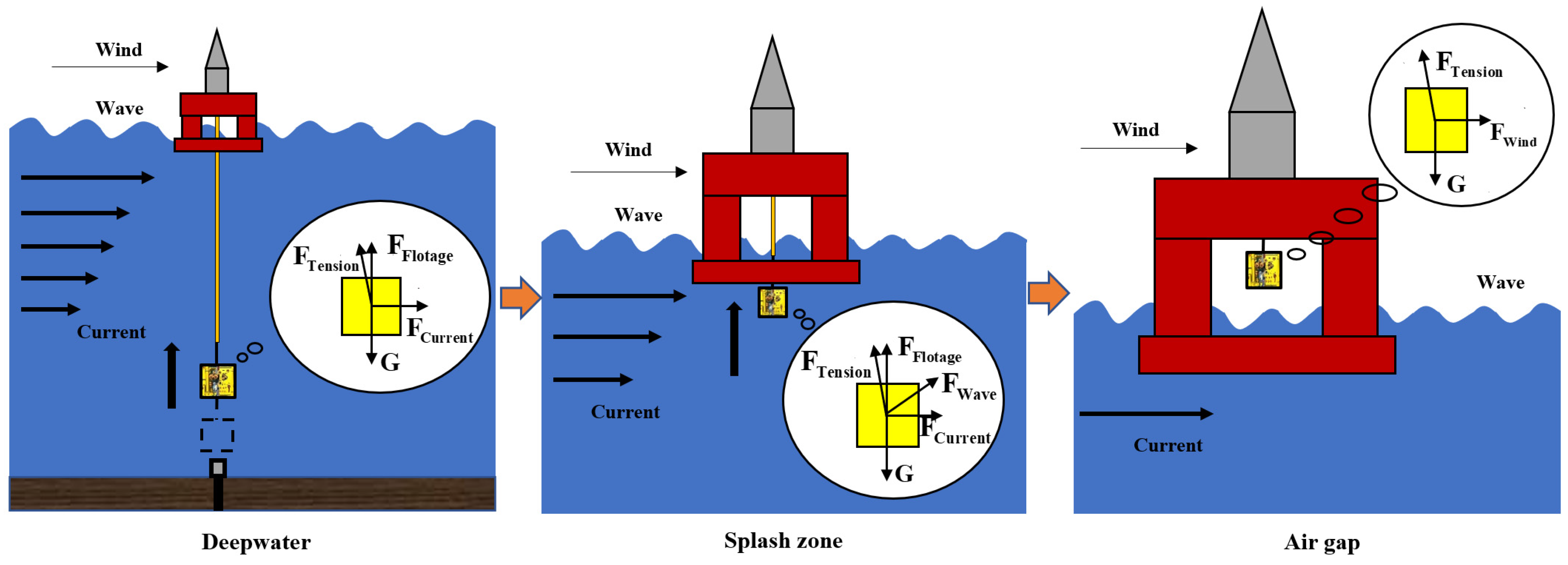
The retrieval of deepwater subsea Christmas trees is a complex nonlinear system dynamics process. During the retrieval, the tree body is not only affected by its own gravity and the pulling force of the drill pipe but also by environmental loads such as sea wind, waves, and currents [22]. According to different working conditions during the retrieval process of the Christmas tree, it is mainly divided into three stages: deepwater retrieval, crossing the splash zone, and crossing the air gap, as shown in Figure 1.
The area 2 m above the sea surface and 30–50 m below the sea surface is generally referred to as the splash zone. Compared with the deepwater area, the current velocity in the splash zone is higher, and the wave movement is more intense. Under the combined action of multiple loads such as wind, waves, and currents, the subsea Christmas tree experiences very violent movement, and the stress fluctuation of the drill pipe is relatively large. In this stage, the combined effect of waves and currents is likely to cause damage to the components of the tree’s body.
The air gap refers to the area between the lower deck of an offshore platform and the sea surface or the crest of wave peaks [23]. After the subsea Christmas tree leaves the sea surface, it is hoisted through the air gap via the drill pipe system and retrieved into the moon pool. During this stage, the movement of the Christmas tree is mainly affected by sea wind loads and platform motion. The stress at the top of the drill pipe is relatively small, with no significant changes in load, while the tree body swings back and forth in the air due to its own inertia.

2.2. Theoretical Analysis of Drill Rod Retrieval Process

The retrieval of subsea oil trees is affected by environmental factors such as wind, waves, and currents. During this process, environmental loads act on the drill pipe, thereby influencing the force on the entire drill pipe and altering the movement posture of the oil tree body [24]. The long-term variation in wind is generally treated as static. The pressure of the wind load applied to the acting surface of the drill pipe is proportional to the kinetic energy function of the air, which is expressed as [25]:
p w = α v w 2
In the formula: P w represents pressure (Pa); α is the pressure coefficient (N·s2/m), typically taken as 0.613; v w is the design wind speed (m/s).
The ocean current is distributed throughout the entire range of the drill pipe. When calculating the ocean current load, the ocean current can be regarded as a stable planar flow [26]:
f c = 1 2 C D ρ W D d v c max 2
F c = 1 2 ρ W D d 0 l C D v c 2 d y
In the formula: f c represents the sea current force per unit length of the pipe string (N/m); F c represents the total sea current force on the pipe string (N); C D is the dimensionless drag coefficient, generally falls within the range of 0.6 to 1.2 for smooth tubular structures such as drill pipes and risers, a conservative value of 1.2 is adopted in this analysis [27]; ρ W is the density of seawater (kg/m3); D d is the diameter of the pipe string (m); v c is the sea current velocity (m/s); l is the length of the pipe string below the water surface (m); d y is the increment of the pipe string length (m).
The drill pipe in the splash zone will be subjected to the combined effect of waves and sea currents, and it is necessary to consider the dangerous working conditions when the drill pipe is under the action of waves and currents in the same direction. Generally, the vector sum of the wave particle velocity and the sea current velocity is calculated first, and the combined force of waves and currents is calculated using the Morison equation, which can be expressed as the following formula [28]:
f y = 1 2 C D ρ W D d u y + v c u y + v c + C M ρ W π D d 2 4 u y t
In the formula: f y represents the combined force of waves and currents acting on the pipe string per unit length (N/m);   u y is the horizontal velocity of water particles (m/s); C M is the dimensionless inertial force coefficient for smooth cylindrical members, such as drill pipes and risers, typically ranges from 1.5 to 2.0 in engineering practice, in this study, a conservative value of 2.0 is adopted due to the prolonged wave periods characteristic of the marine environment [27]; u y t is the horizontal acceleration of water particles (m/s2).
During the retrieval process of subsea oil production trees, the force on the drill pipe is quite like that during the lowering process. Since the force exerted by the sea breeze on the drill pipe is much smaller than the combined force of waves and currents, it can be ignored in the force analysis. In routine engineering operations, the displacement of the Christmas tree is generally minimal during drill pipe retrieval. To facilitate the study of the mechanical characteristics of the drill pipe, it is generally treated as a beam for mechanical analysis, and the following assumptions are made [29]:
  • The drill pipe is composed of isotropic materials with uniform and continuous distribution, and only linear elastic deformation is considered. The stiffness of the drill pipe does not change.
  • The lift force of the ocean current is not considered. The motion of waves, ocean currents, and the drill string is regarded as being in the same plane.
  • The deformation of the drill pipe is considered as small deformation, satisfying the theory of small deformation beams.
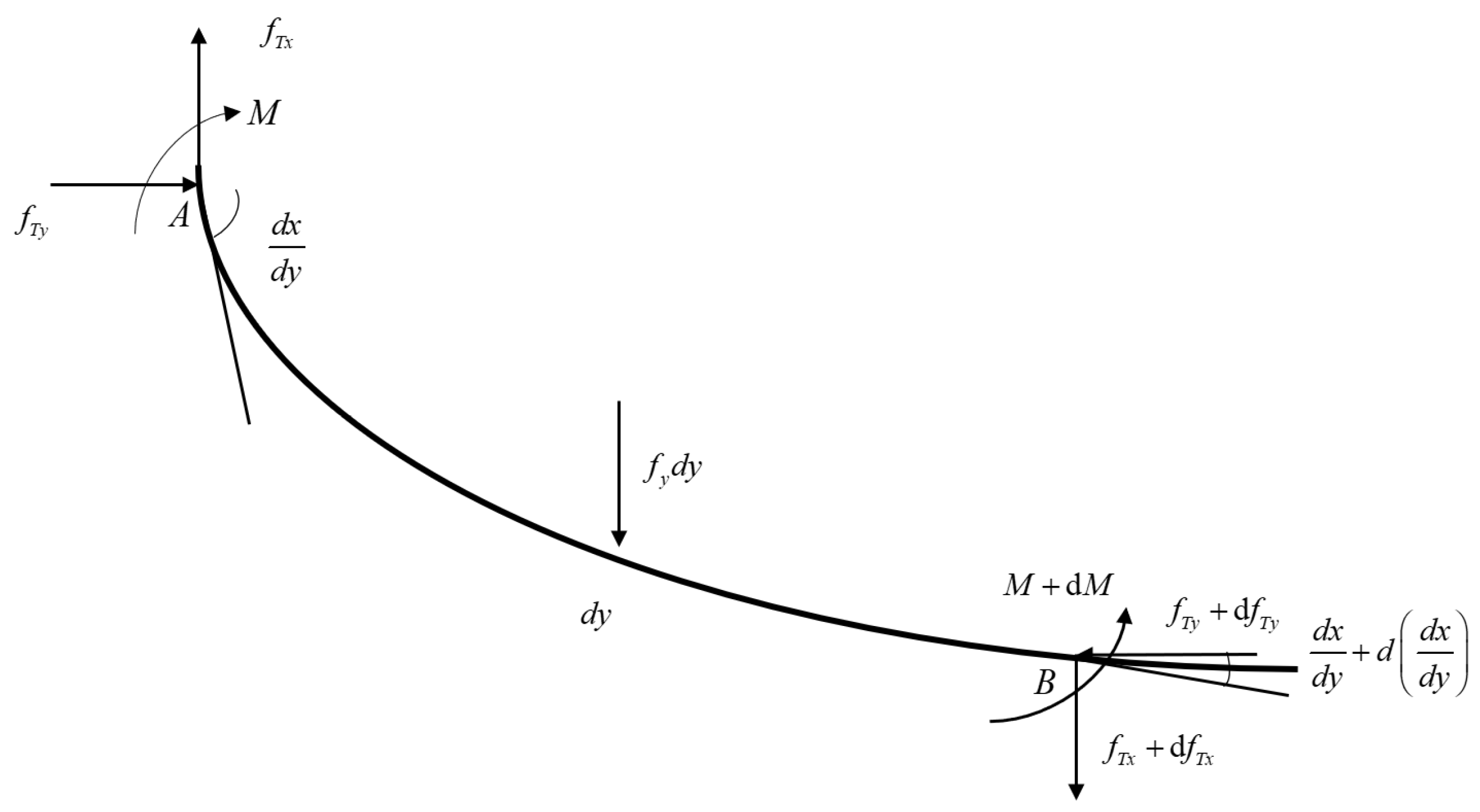
During the retrieval stage, after the drill pipe deforms, a micro-section “dy” of the drill string is taken as shown in Figure 2, where f Tx is the axial tension varying along the “x” direction, f Ty is the axial tension varying along the “y” direction, and “ M ” is the bending moment. Through mechanical analysis, the deflection differential equation of the drill pipe during the retrieval process is obtained as:
d 2 d y 2 E I d 2 x d y 2 f T y y d 2 x d y = f y
In the formula, E I represents the bending stiffness of the drill pipe.

3. Establishment of the Subsea Christmas Tree Retrieval Model

3.1. Environmental Parameters

To ensure the safe retrieval of subsea Christmas trees, it is necessary to determine the impacts of factors such as environmental loads and retrieval processes on the operation. In daily deepwater operations, sea wind has relatively little direct influence on the movement of Christmas trees. Therefore, this paper mainly studies the stress distribution of drill pipes and the changes in the motion response of Christmas trees under parameters such as ocean waves and currents with different return periods. The environmental parameters used are all derived from the measured environmental parameters in a 2000 m water depth sea area in the South China Sea, as shown in Table 1 and Table 2.

3.2. Establishment of OrcaFlex Model

3.2.1. Modeling of Semi-Submersible Platform

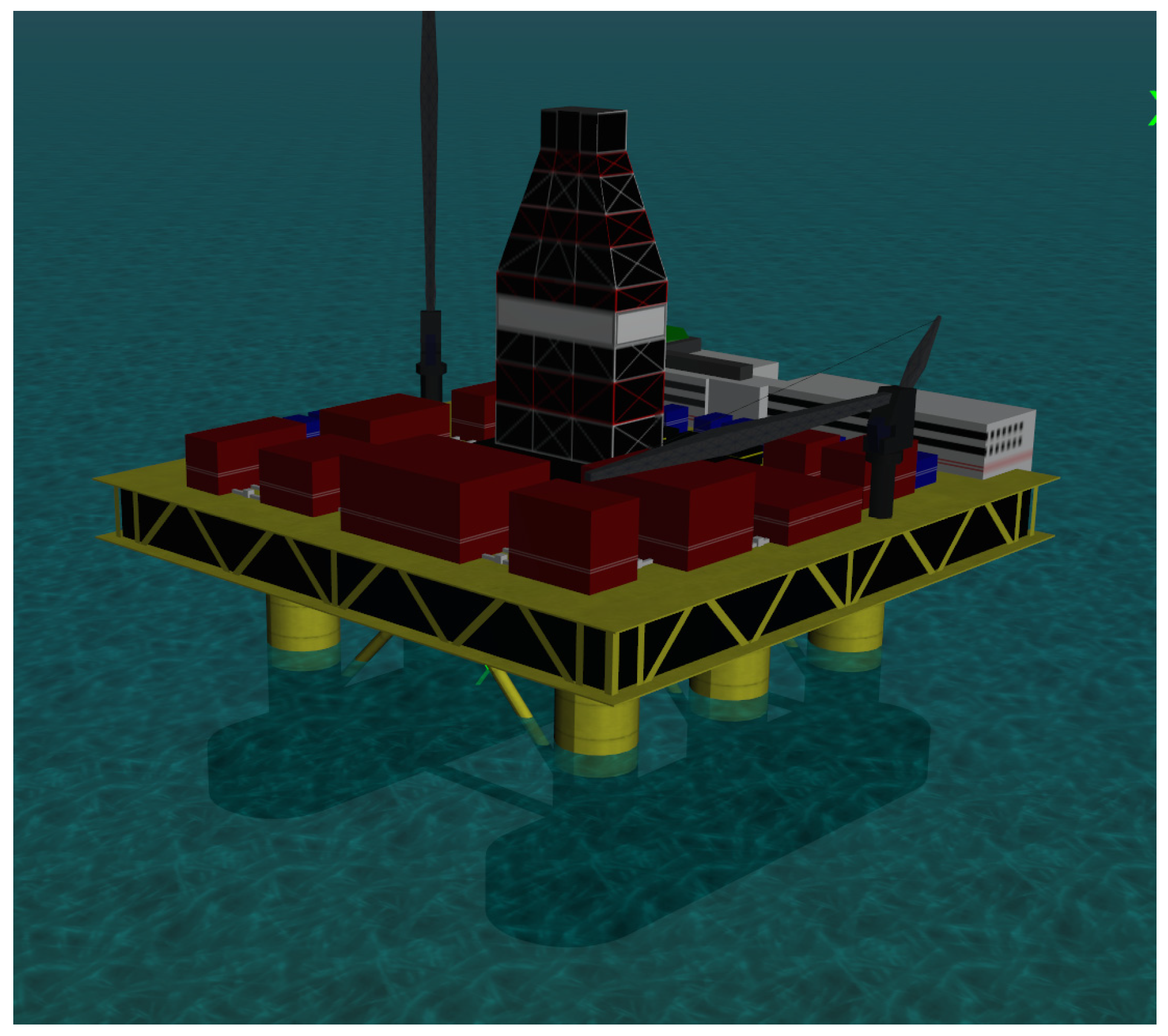
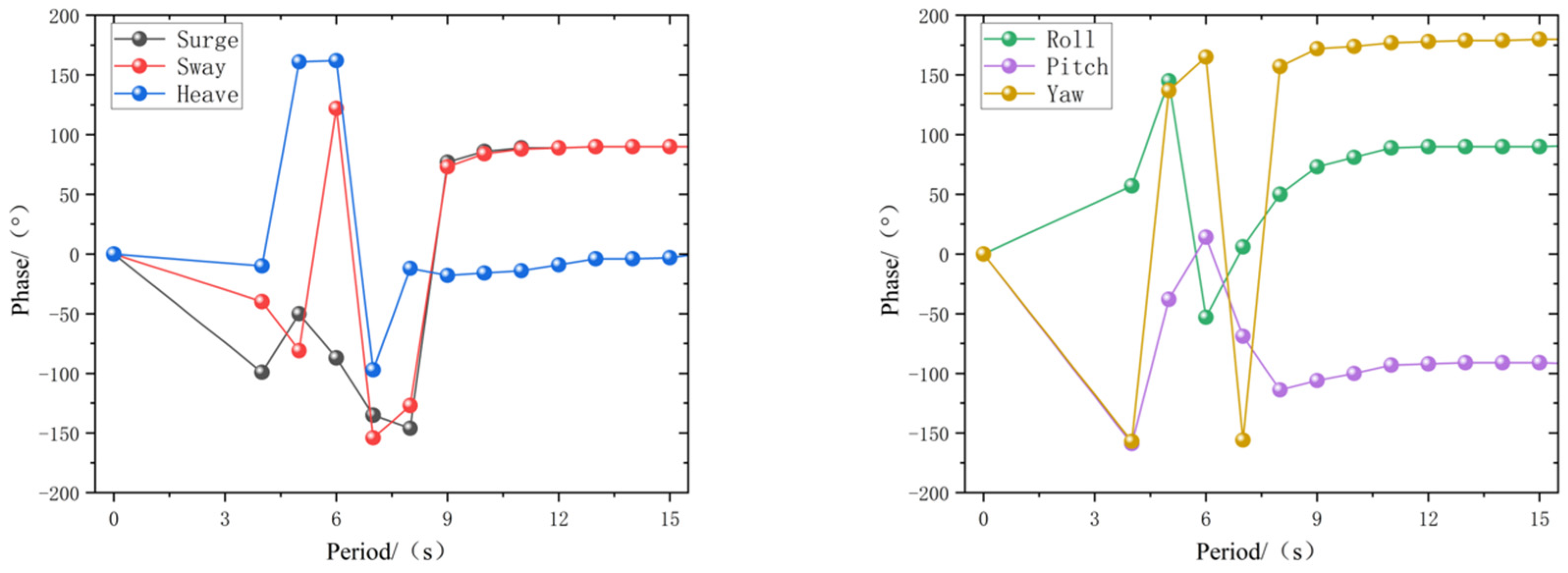
In practical deepwater operations, the retrieval of drill pipes for subsea Christmas trees is typically performed using a semi-submersible platform. This analysis employs the “HYSY 981” drilling platform for simulation calculations. To enhance computational efficiency, the platform model is first simplified in OrcaFlex software by retaining its fundamental geometry while ensuring accurate representation of structural mechanical properties. The basic parameters of the platform are summarized in Table 3. After establishing the foundational model, key parameters such as platform mass, draft depth, and Response Amplitude Operators (RAOs) are incorporated. The specific model configuration is illustrated in Figure 3, while selected RAO curves are presented in Figure 4.

3.2.2. Modeling of Subsea Christmas Tree

The analysis employed a horizontal Christmas tree for the calculations. The combined weight of the tree body and its accompanying installation tools is approximately 70 t. The tree body dimensions are 5.3 m in length, 4.8 m in width, and 5 m in height.
Within the OrcaFlex software environment, two primary structural modeling modules are available: Buoys and Shape. The Shape module is primarily used for visual representation and possesses no physical properties. In contrast, the Buoys module can accurately represent the various mechanical characteristics of a structure. Consequently, the subsea Christmas tree model was constructed using the Buoys module.
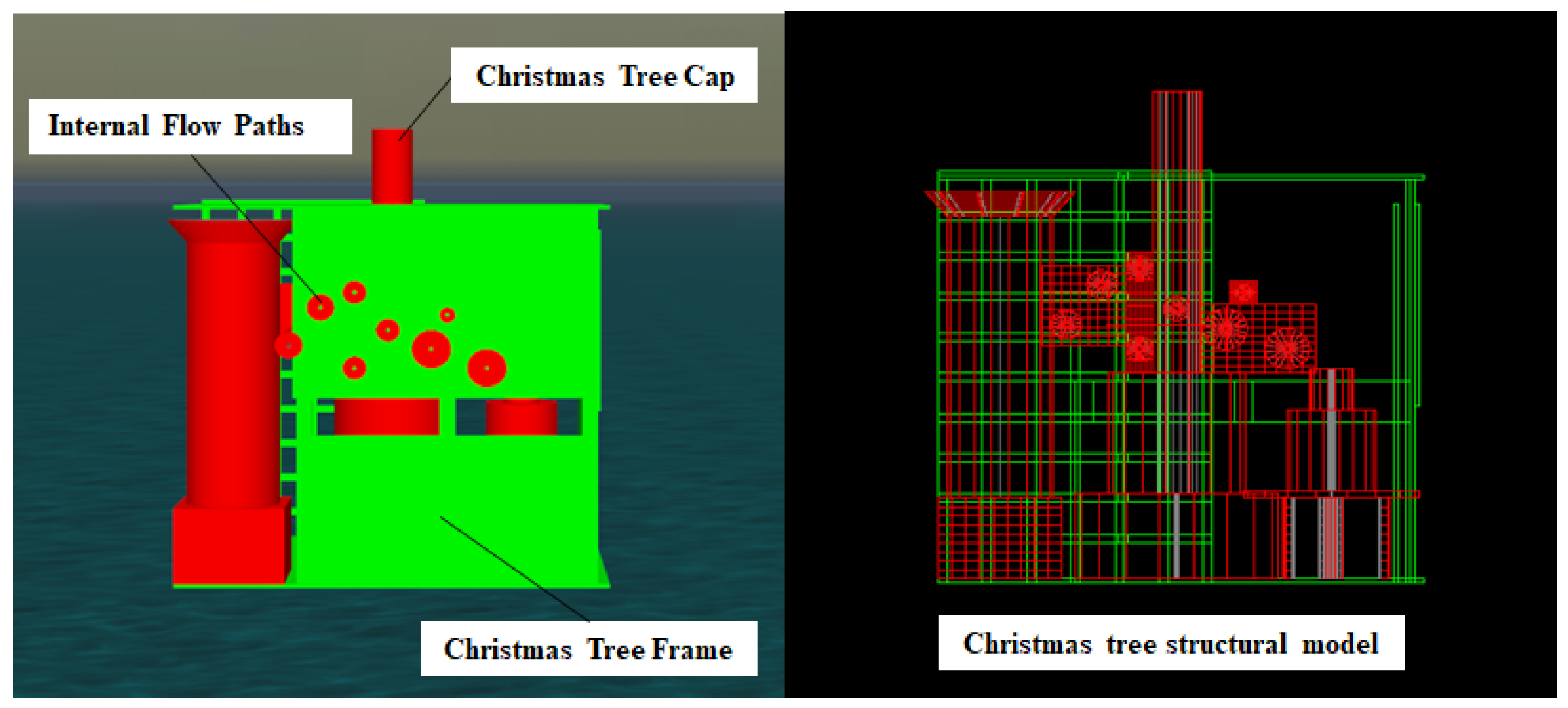
As illustrated in Figure 5, the modeling process involved initially creating individual models for each component of the Christmas tree, such as the tree cap, main frame, and internal bores. These discrete components were subsequently assembled into the complete tree structure. Finally, physical parameters, including the weight of each component, were assigned to finalize the establishment of the subsea Christmas tree model.

3.2.3. Modeling of Drill Pipe System

During the retrieval process of a subsea Christmas tree, a wire rope segment is typically used to connect it to the drill pipe. This configuration avoids a direct connection between the drill pipe and the Christmas tree, which would induce significant bending moments at the connection point and potentially damage the tree structure.
In OrcaFlex, the Line module is utilized to model both the drill pipe and the wire rope. Specifically, the Homogeneous Pipe model within the Line module is selected to represent the drill pipe, while the General line type is used to model the wire rope. The fundamental parameters for the wire rope and the drill pipe (Grade S-135) are provided in Table 4 and Table 5, respectively. Furthermore, the Winches module is employed to simulate the top-drive system on the offshore platform. By defining the retrieval velocity within this module, the simulation of the subsea Christmas tree retrieval operation is completed.

4. Parameter Analysis of Subsea Christmas Tree Retrieval Process

4.1. Wave Height

Wave conditions in China’s maritime areas are generally severe, with a significant wave height of up to 13.4 m for the 100-year return period. Waves significantly influence the motion response of both the platform and the subsea Christmas tree structure. This paper analyzes four different wave conditions corresponding to return periods of one year, ten years, fifty years, and one hundred years, with significant wave heights of 6.3 m, 9.5 m, 12.3 m, and 13.4 m, respectively. This selection facilitates a discussion on the influence of wave parameters on the drill pipe stresses and the motion response of the subsea Christmas tree. The relevant wave parameters are listed in Table 1.
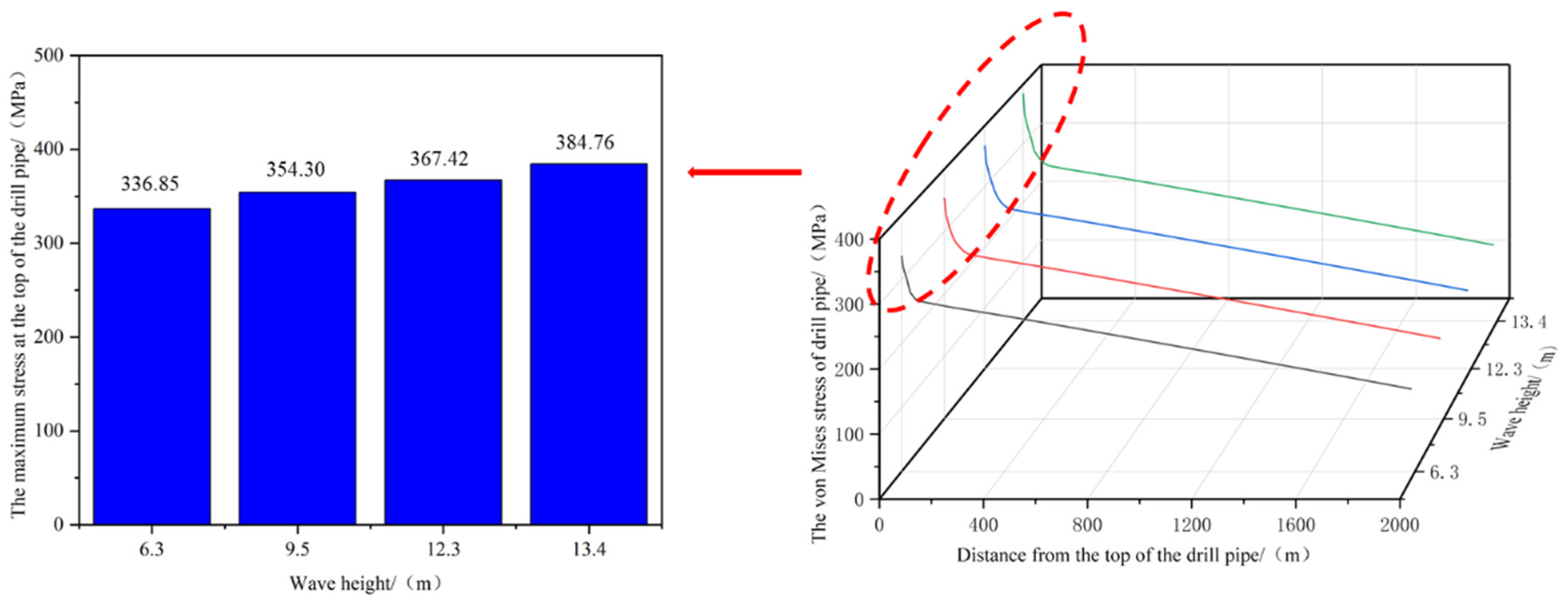
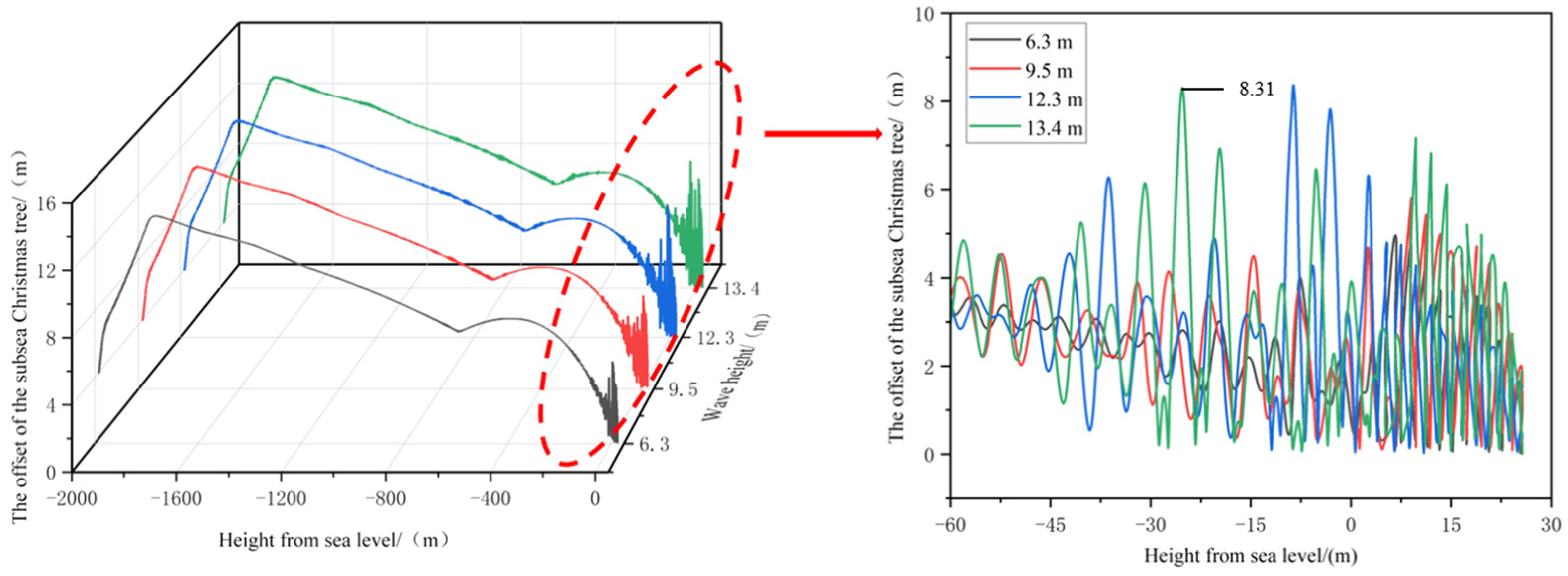
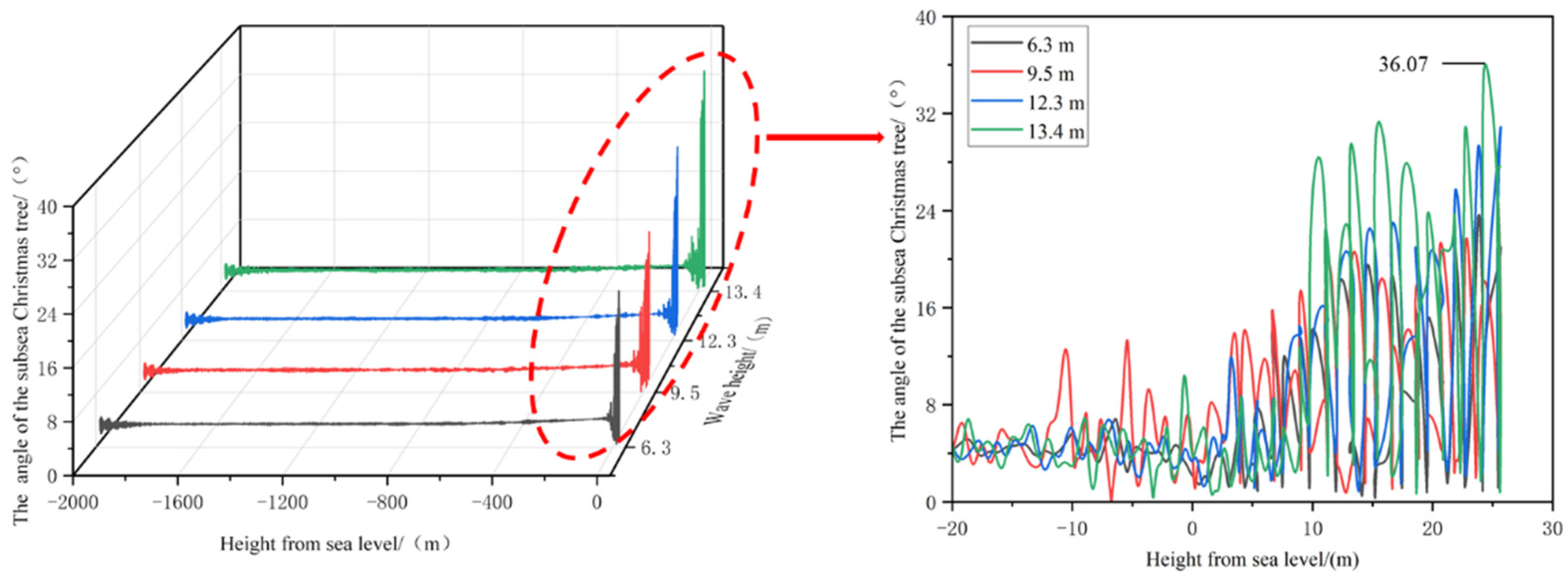
Numerical simulations were performed using OrcaFlex software to analyze the impact of different wave heights on the Christmas tree retrieval process. Figure 6 illustrates the local stress distribution along the drill pipe under various wave heights. Figure 7 and Figure 8 depict the effects of wave height on the dynamic response of the Christmas tree. The results indicate that the wave height exerts a profound influence on the motion attitude of the Christmas tree, particularly when it traverses the splash zone. Furthermore, the wave height significantly affects the stress experienced by the drill pipe during retrieval. The maximum stress at the top of the drill pipe reaches 384.76 MPa under the 13.4 m wave height condition.

4.2. Current Velocity

Ocean current velocities are subject to variation due to meteorological influences, with particularly significant fluctuations occurring at the sea surface during extreme weather events. The variation in current velocity generally diminishes with increasing water depth. Surface current velocities typically fall within the range of 0.3 m/s to 2.04 m/s, where 2.04 m/s represents a 100-year return period event. Consequently, higher velocities are not considered in this discussion. For the purpose of simulation, four distinct current velocity scenarios were selected: 1.09 m/s (1-year return period), 1.46 m/s (10-year return period), 1.86 m/s (50-year return period), and 2.04 m/s (100-year return period). The parameters for the different velocity profiles are presented in the accompanying Table 2.
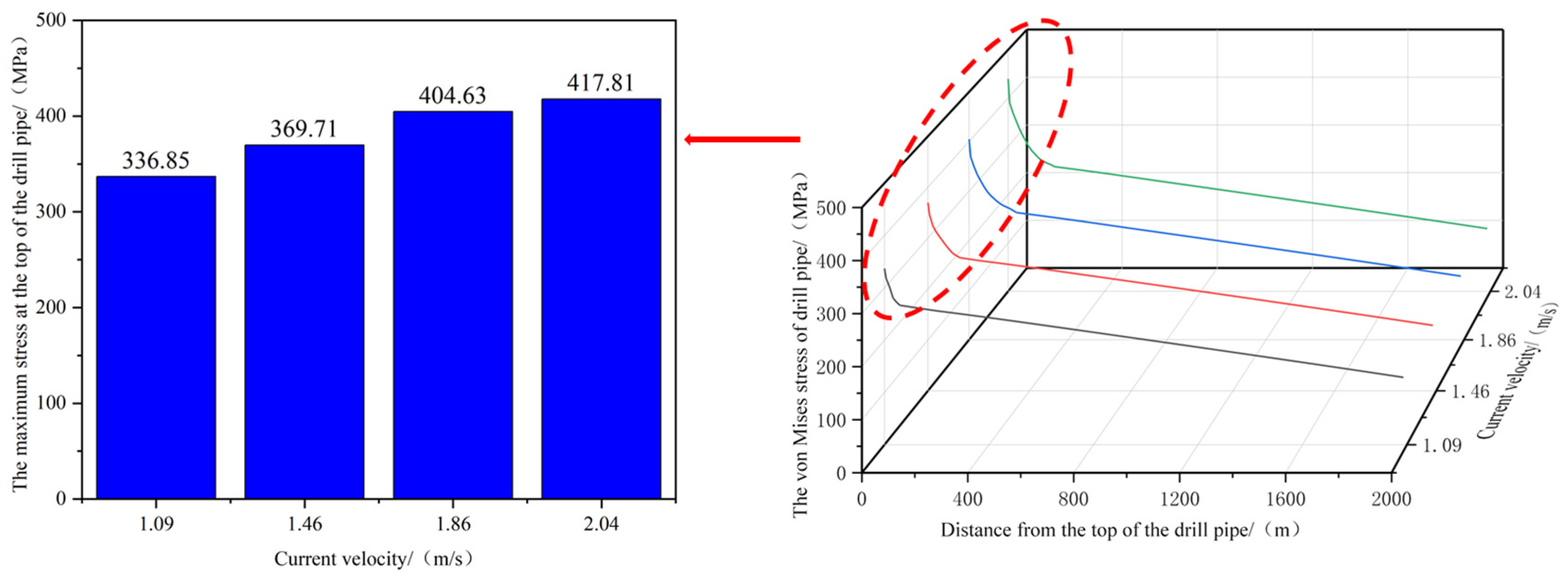
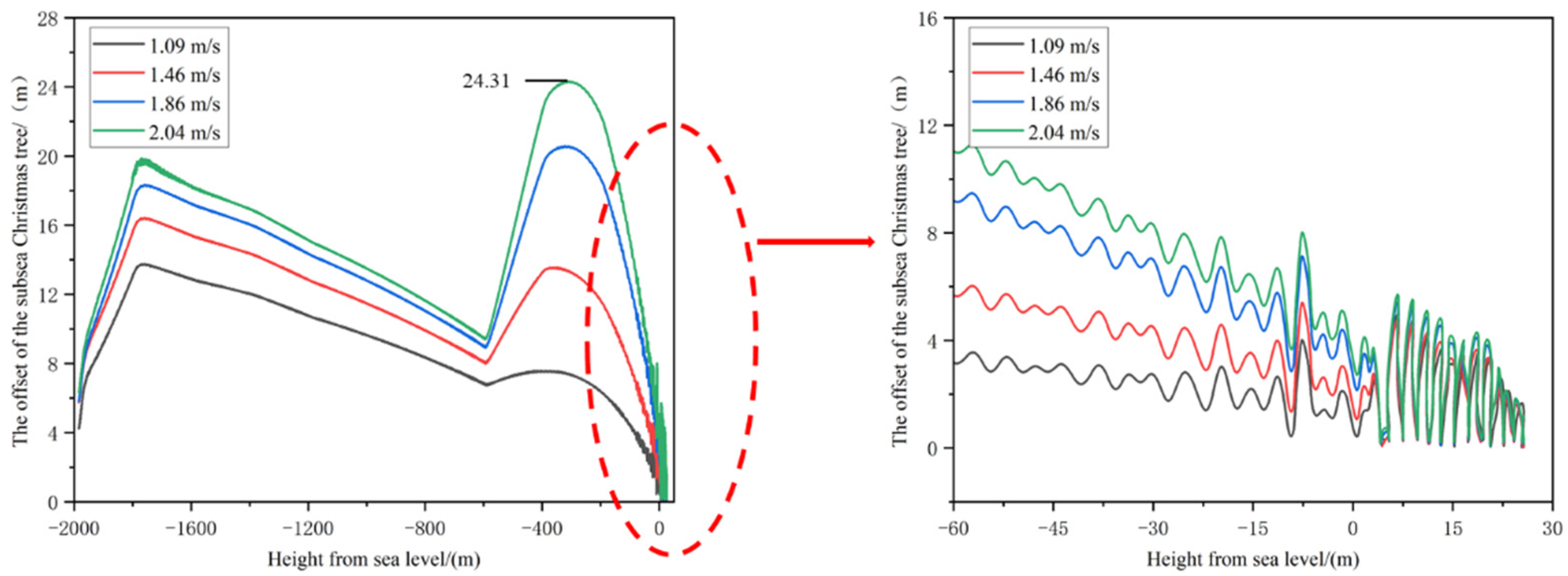
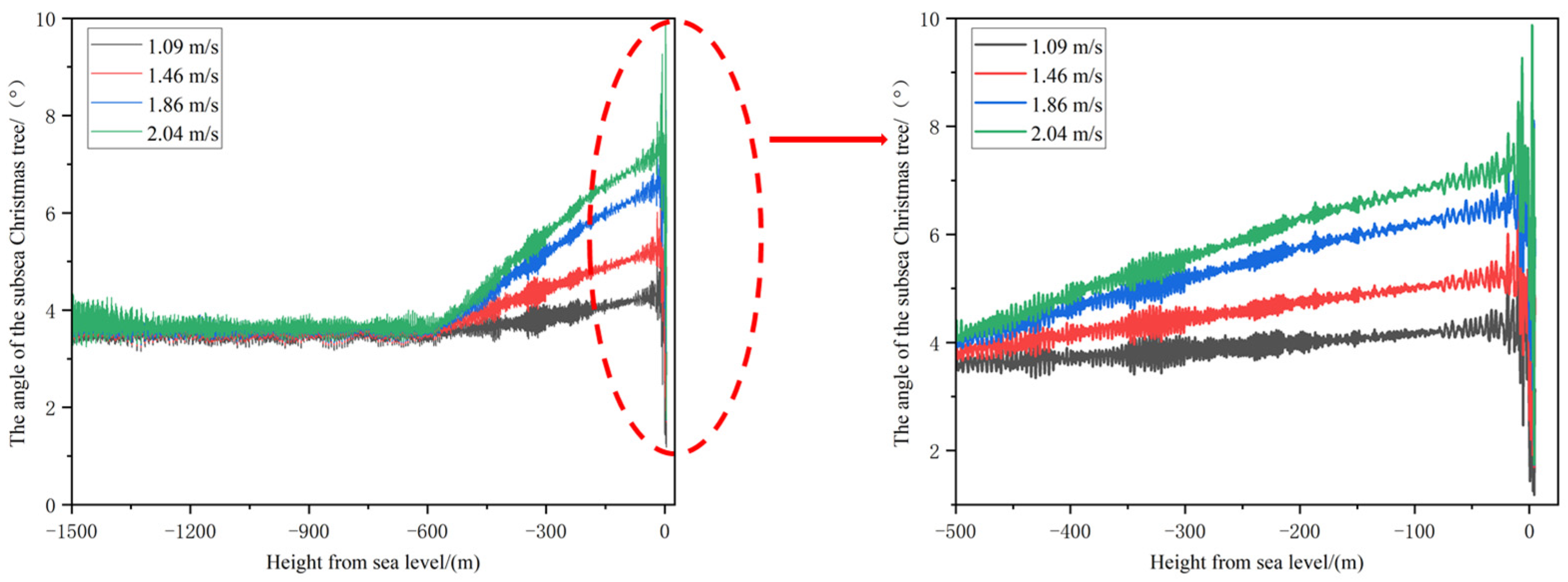
Figure 9, Figure 10 and Figure 11 show the impact of different current velocities on the dynamic response during the Christmas tree retrieval process. It can be seen from the figures that as the current velocity increases, both the drill pipe stress and the Christmas tree offset increase significantly, and the inclination angle of the Christmas tree also increases to some extent. Under the 100-year return period condition, the maximum stress at the top of the drill pipe is 417.81 MPa, the maximum offset of the Christmas tree is 24.31 m.

4.3. Retrieval Speed

During the retrieval process of subsea Christmas trees, environmental loads can cause significant impacts on them. Therefore, the retrieval speed of the drill pipe should not be too high. In engineering practice, the lowering and retrieval speed of subsea equipment is generally controlled within 0.5 m/s. Hence, this paper selects five retrieval speeds (0.1 m/s, 0.2 m/s, 0.3 m/s, 0.4 m/s, and 0.5 m/s) for simulation analysis to study the influence of different retrieval speeds on the maximum stress at the top of the drill pipe and the motion response of the subsea Christmas tree. As shown in Table 6, with the increase in retrieval speed, the offset of the Christmas tree changes slightly, the inclination angle increases continuously, and the tension at the top of the drill pipe first decreases and then increases. When the retrieval speed is 0.4 m/s, the tension at the top of the drill pipe is the smallest, reaching 336.84 MPa, and when the retrieval speed is 0.5 m/s, the inclination angle of the Christmas tree is the largest, reaching 28.38°.

4.4. Wave Direction Angle

When waves and ocean currents act from different directions, the platform and subsea Christmas tree will exhibit different motion responses, thereby affecting the retrieval process. Table 7 reflects the impact of different current velocities on the dynamic response during the Christmas tree retrieval process. It can be seen from the table that the wave direction angle has a relatively small influence on the drill pipe stress and the Christmas tree offset throughout the retrieval process of the Christmas tree drill pipe. The difference in the maximum stress at the top of the drill pipe is less than 2 MPa, and the difference in the total offset of the Christmas tree is less than 0.4 m. However, the wave direction angle has a significant impact on the inclination angle of the Christmas tree. When the wave direction angle is 135°, the tree body has the smallest inclination angle, which is 9.97°; when the wave direction angle is 0°, the tree body has the largest inclination angle, reaching 23.62°.

4.5. Orthogonal Test Analysis

During the retrieval process, the drill pipe-Christmas tree system is affected by multiple factors simultaneously. It is difficult to fully grasp the movement changes in the Christmas tree and the actual mechanical response of the drill pipe by only analyzing the impact of a single parameter. Orthogonal test, which can select some representative points from comprehensive tests based on orthogonality, is an efficient, rapid, and economical experimental design method [30]. To reveal the influence degree of different parameter changes on the offset and retrieval attitude of the Christmas tree as well as the mechanical response of the drill pipe, tests with four levels were conducted for four factors (current velocity, wave height, wave angle, and retrieval speed in the splash zone). In the experiments, the parameters of the influencing factors for each group are shown in Table 8, and the experimental calculation results are shown in Table 9.
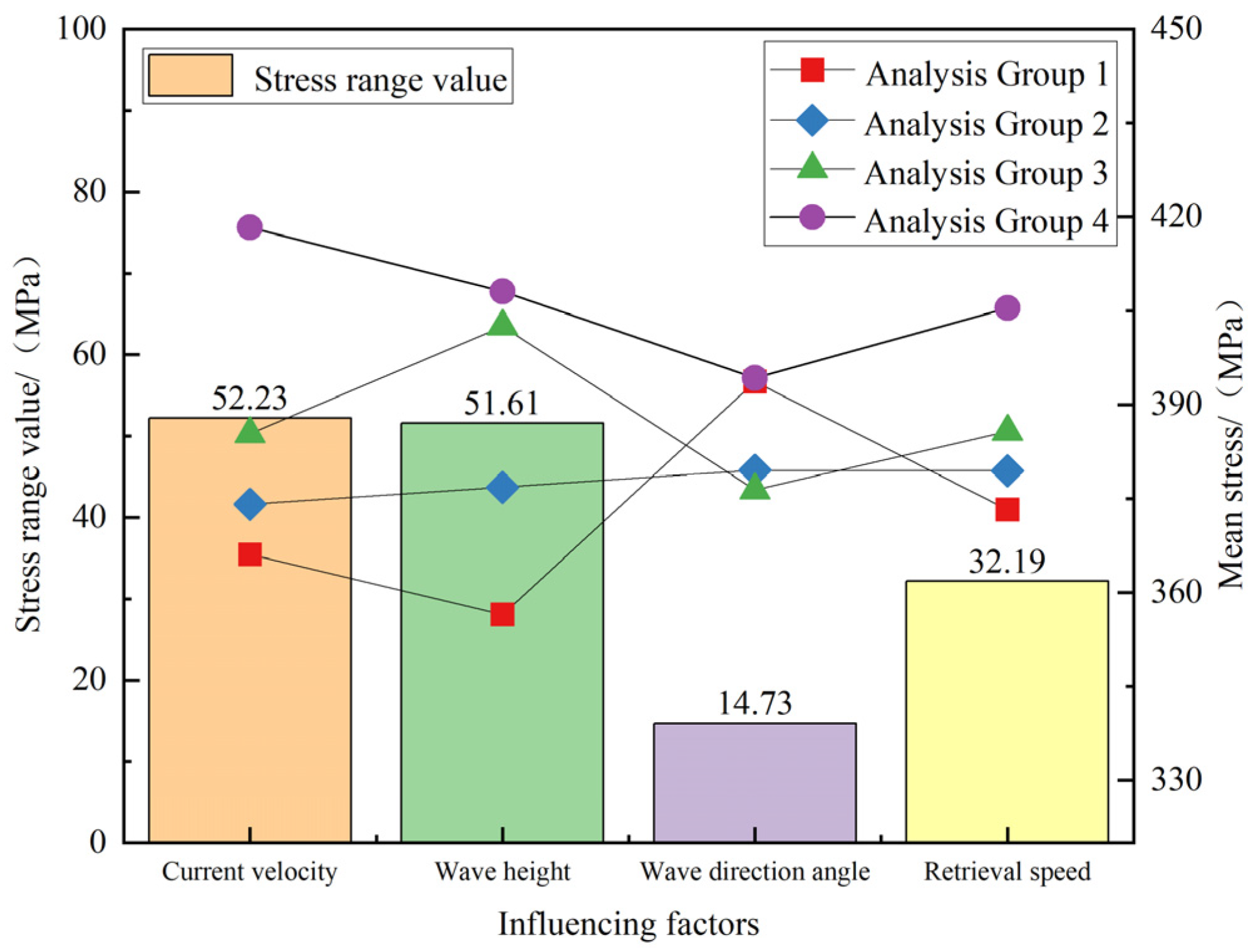
Based on the simulation results, each factor was grouped to calculate the mean values, and a range analysis was conducted. As shown in Figure 12, when the current velocity is 1.09 m/s, the average value of the maximum stress at the top of the drill pipe is 366.11 MPa, and when the current velocity is 2.04 m/s, the average value of the maximum stress at the top of the drill pipe is 418.34 MPa, so the range is 52.23 MPa. The range values of the stress at the top of the drill pipe under the influence of different factors were calculated in sequence. Through comparison, the factors affecting the drill pipe stress in descending order of intensity are: current velocity > wave height > retrieval speed > wave direction angle.
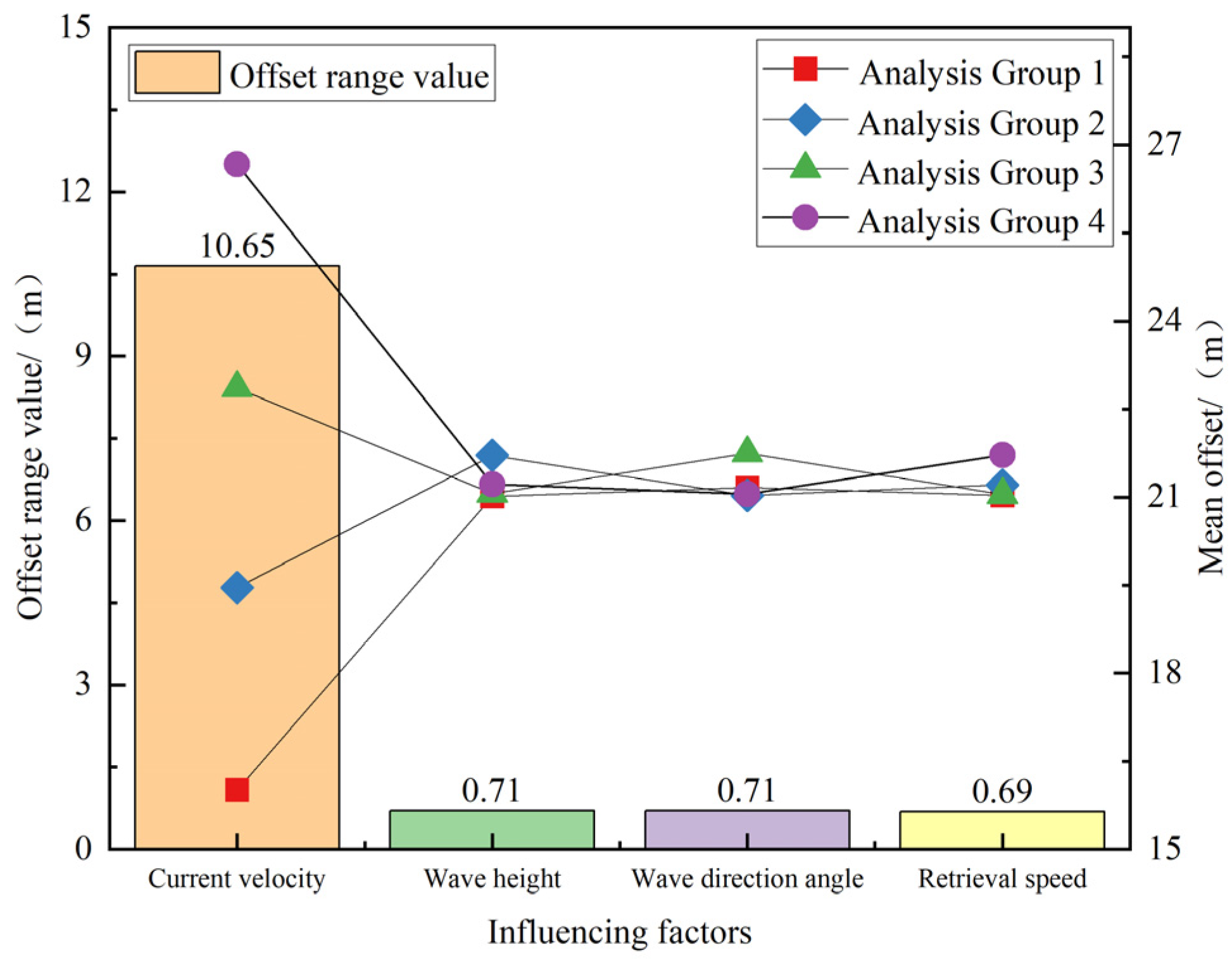
A range analysis was performed on the maximum offset of the Christmas tree, and the analysis results are shown in Figure 13. From the analysis data in the table, the factors affecting the offset of the Christmas tree in descending order of intensity are: current velocity > wave height > wave direction angle > retrieval speed.
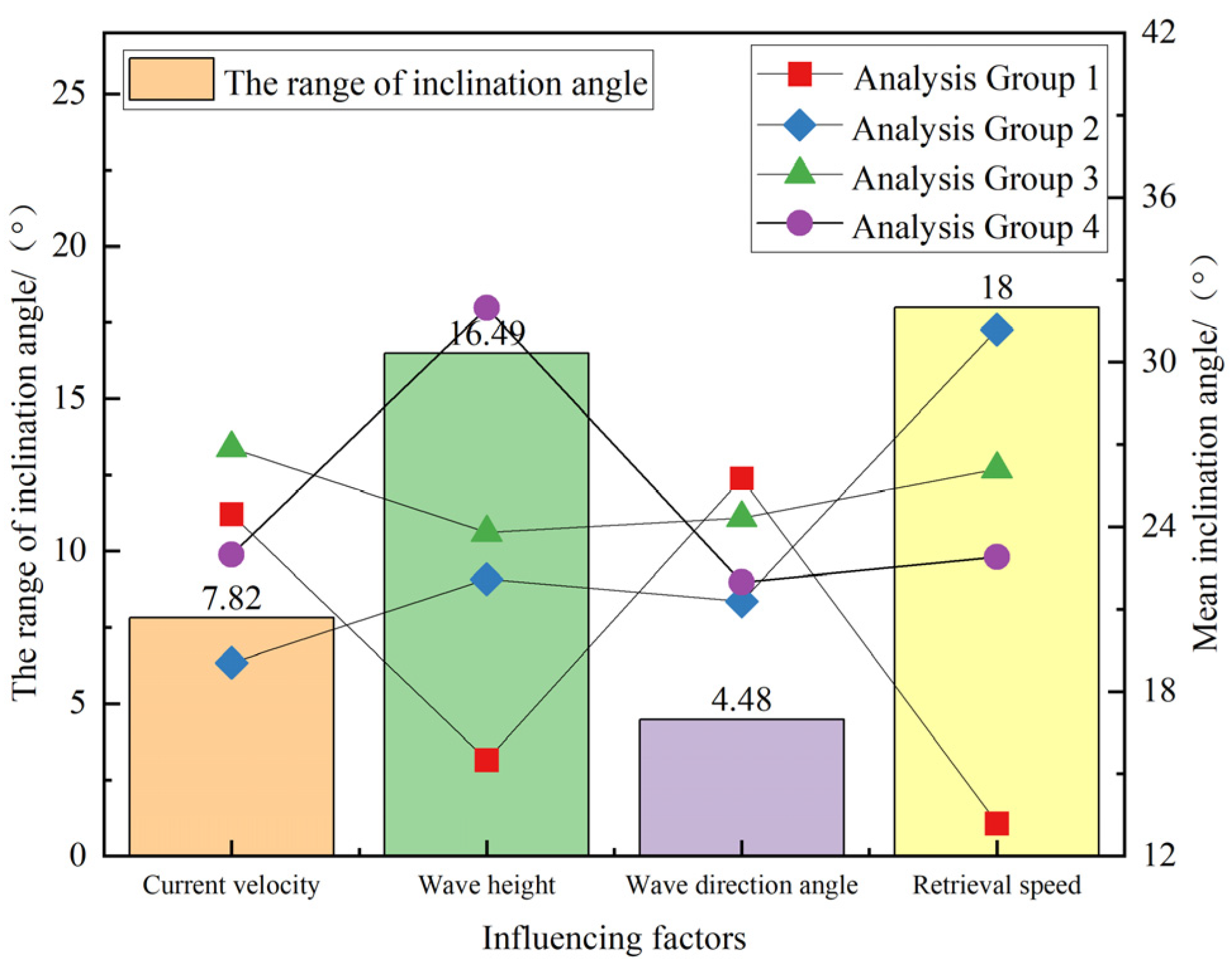
A range analysis was carried out on the inclination angle of the subsea Christmas tree, and the analysis results are presented in Figure 14. According to the analysis data in the table, the factors affecting the inclination angle of the drill pipe in descending order of intensity are: retrieval speed > wave height > current velocity > wave direction angle.

4.6. Comparative and Verification Analysis

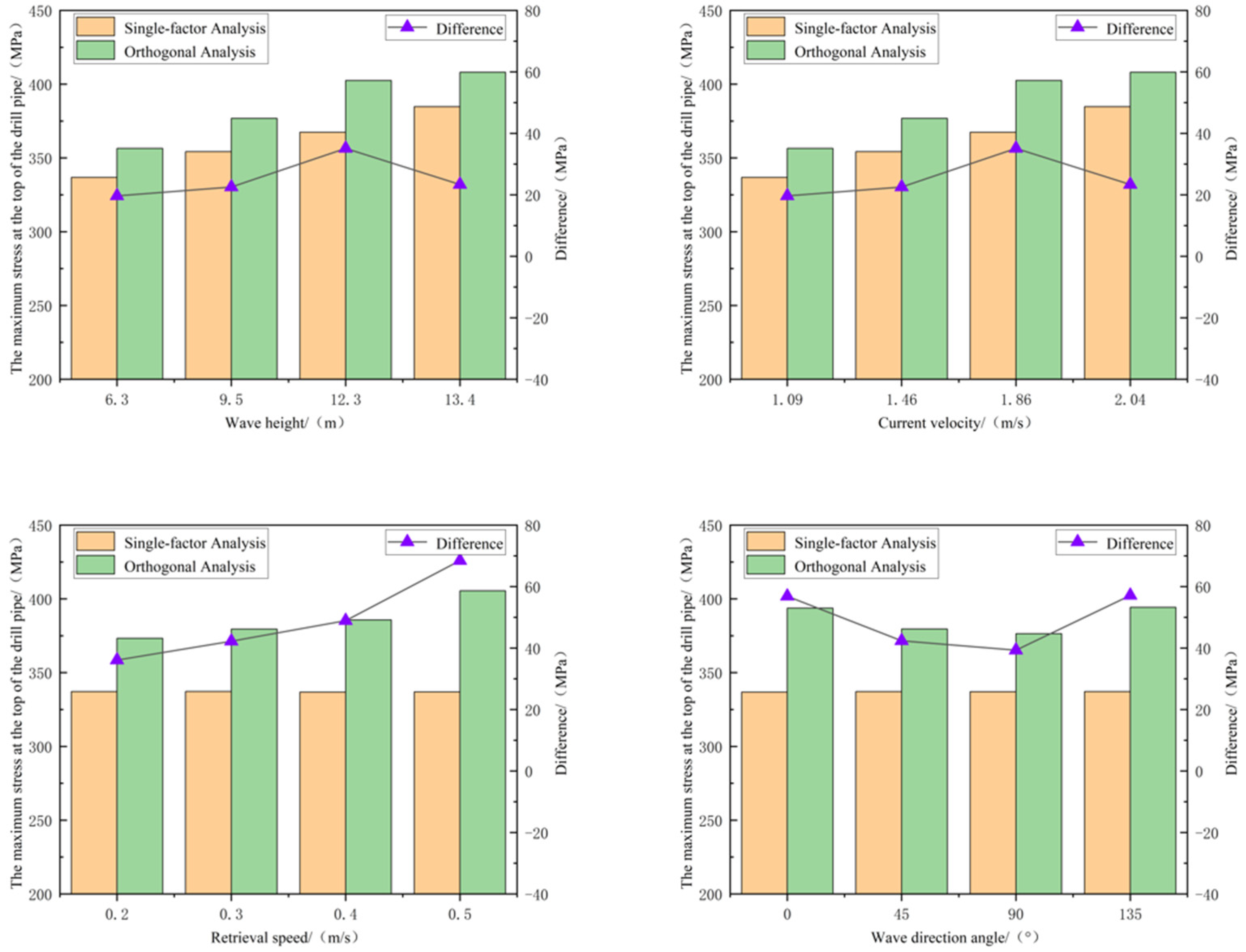
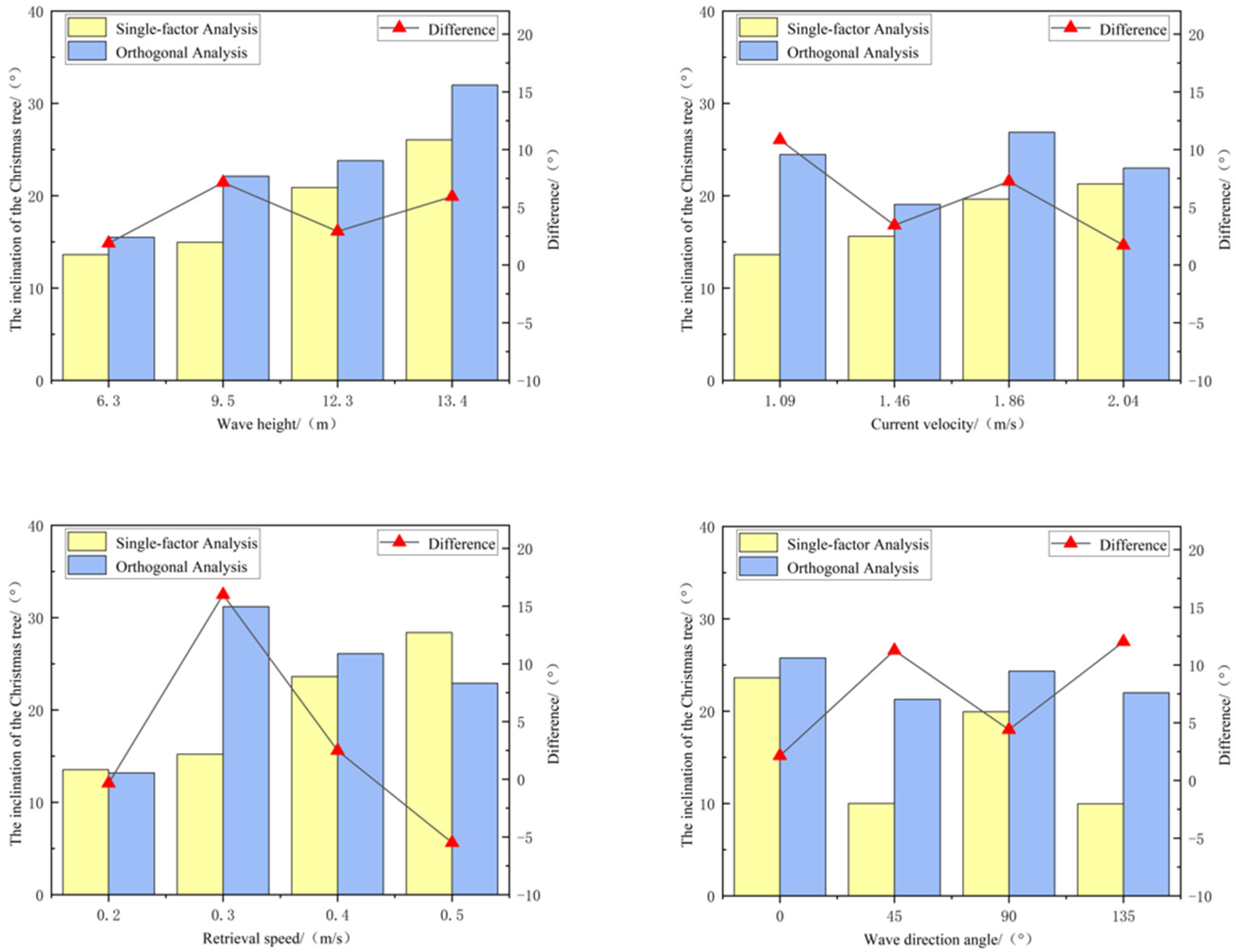
As illustrated in the figure, a comparative discussion is conducted on the results of single-factor analysis and orthogonal factor analysis. Figure 15 reveals that the drill pipe stresses in the orthogonal analysis are generally higher than those in the single-factor analysis across most mean groups. The increase in drill pipe stress is more pronounced under varying wave direction angles and retrieval speeds, while the changes in the other two groups are relatively minor. This suggests that variations in wave height and current velocity are the primary influencing factors for the stress at the top of the drill pipe, and the superposition of different environmental factors tends to amplify the stress values.
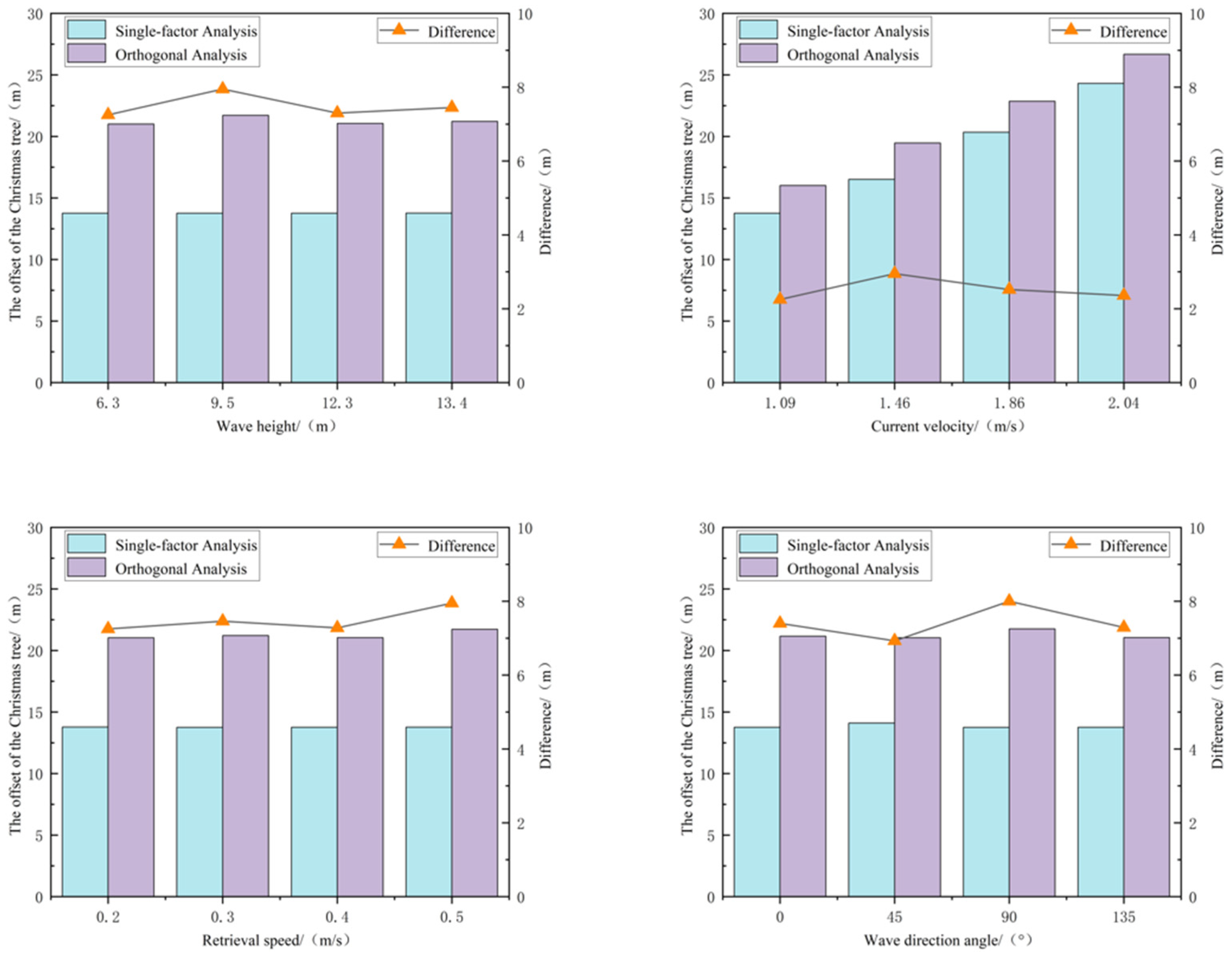
From Figure 16, it can be observed that, in both single-factor and orthogonal analyses, current velocity has a significant impact on the offset of the Christmas tree, whereas the influence of other factors is minimal. Additionally, the Figure 17 indicates that the inclination angles in the orthogonal analysis results are generally higher compared to those in the single-factor analysis. This implies that under the combined effects of different environmental factors, the dynamic response of the Christmas tree becomes more pronounced.
To validate the findings of this study, existing literature is referenced. For instance, Xiao et al. [31] conducted a parameter sensitivity analysis on the drill pipe deployment process of a subsea emergency blowout preventer using OrcaFlex software. Their results indicated that the maximum stress on the drill pipe occurs at its top section. Furthermore, when the emergency blowout preventer passes through the splash zone, both current velocity and wave height significantly affect its dynamic response, leading to considerable inclination angles and vibrational offsets. Similarly, studies by Huang et al. [18] demonstrated that during the installation of a Christmas tree, the stress at the top of the drill pipe is greatly influenced by wave height and current velocity, while the effect of wave direction angle is relatively minor. Inclination angles are primarily affected by wave conditions, whereas offset is mainly influenced by current velocity.
The external loads acting on the subsea Christmas tree during the retrieval process examined in this study are largely like those during the deployment and installation processes described in the literature, except for the axial stress on the drill pipe. A comparison shows that the analytical results of this study are consistent with the findings reported in the literature.

5. Conclusions

This study investigates the effects of environmental factors such as ocean wind, waves, and currents on the retrieval process of a deepwater subsea Christmas tree by combining single-factor sensitivity analysis and orthogonal experimental analysis. The main conclusions are as follows:
Current velocity is the most significant environmental factor affecting both drill pipe stress and Christmas tree offset. As the current velocity increases, the stress at the top of the drill pipe rises significantly, and the offset of the Christmas tree also increases accordingly. Waves have a considerable influence on both drill pipe stress and inclination angle. With increasing wave height, the stress at the top of the drill pipe increases substantially due to wave slamming forces, while the inclination angle of the Christmas tree gradually rises. Furthermore, the analysis indicates that the retrieval speed is the strongest factor affecting the inclination angle of the Christmas tree.
In summary, during practical engineering operations, it is essential to ensure that wave height and current velocity remain within safe limits. Additionally, an appropriate retrieval speed should be selected to enable the Christmas tree to pass quickly through deepwater and splash zones, thereby ensuring both safety and efficiency in completing the retrieval process.
This study has certain limitations. In the analysis of currents, the focus was primarily on the drag force exerted by currents on the drill pipe and the tree structure, while the vibrational response of the drill pipe induced by lift forces and vortex-induced vibrations was not sufficiently addressed. Future research could focus on local flow field analysis of the Christmas tree and drill pipe system to further elucidate the dynamic response mechanisms involved in the retrieval process of deepwater subsea Christmas trees.

Author Contributions

Conceptualization, X.W. and J.C.; methodology, X.W. and M.L.; software, X.W. and J.C.; validation, C.Z.; formal analysis, X.W.; investigation, H.W.; resources, X.W.; data curation, M.L.; writing—original draft preparation, Q.W.; writing—review and editing, Y.W. All authors have read and agreed to the published version of the manuscript.

Funding

This research was funded by “Research on the Development of 1500 m Subsea Christmas Trees and Control Systems”.

Data Availability Statement

The original contributions presented in this study are included in the article. Further inquiries can be directed to the corresponding author.

Conflicts of Interest

Author Xudong Wu was employed by the company Engineering Technology Department, CNOOC (China) Limited, Authors Ming Luo, Chunming Zeng and Heng Wang were employed by the company CNOOC (China) Limited, Hainan Branch. The remaining authors declare that the research was conducted in the absence of any commercial or financial relationships that could be construed as a potential conflict of interest.

References

  1. Xie, Y.H.; Liu, S.J.; Yang, J.; Wang, Y.B.; Yin, Q.S.; Yang, Y.X. Development Status and Trend of Deepwater Oil and Gas Drilling Technologies and Equipment. Sci. Technol. Foresight 2023, 2, 22–31. Available online: https://kns.cnki.net/kcms2/article/abstract?v=7KCVMXbQLqLcJFk5wZN7pW5LuentrAIWnsfBjC31LCvHWDhZUgeQItssE_s55dg0NhWzr9P9lb1pSF1QrxdXSHhoyHNYs-abjUbHzVPhRJ5trV4ewLV8rhdAV6f37rnDscSbS32usJhWmxTdSP8a_WTFhHtYaQywRhe9EF642H6pV6gfodYu8A==&uniplatform=NZKPT&language=CHS (accessed on 26 July 2023).
  2. Mi, L.J.; An, W.Z.; Chen, H.J.; Han, Y.F.; Sun, Q.; Hou, G.X. Development mode of the shallow water subsea production system in Bohai sea area and the development status of localized equipments. China Offshore Oil Gas 2023, 35, 137–146. Available online: https://kns.cnki.net/kcms2/article/abstract?v=7KCVMXbQLqLZTQYC88UqI1ZZTR0TWOX-bnJWHNjwxL_IJvRO3rjLgZf7kC7TVtTeestTAiWoBy5bwJ2WwevuUSqtp-4gz1cY5KcCh1zZFLlHk4ua-FRnRMiFVROxuFsOoH9qEofEU-6p9Hk_Yl1ujG11YKlplcT4A_gw3cJX92pQ0jhpTu7_dA==&uniplatform=NZKPT&language=CHS (accessed on 19 June 2023).
  3. Ren, G.L.; Wang, Y.; Meng, W.B.; Zhang, C.; Li, S.Z. Risk analysis of Deepwater horizontal Christmas tree in operating mode. China Pet. Mach. 2024, 52, 63–70. [Google Scholar] [CrossRef]
  4. Tan, A.Q. Process difficulties and countermeasures of subsea Christmas tree body. China Ship Surv. 2025, 87–91. Available online: https://kns.cnki.net/kcms2/article/abstract?v=7KCVMXbQLqIo1AOKLE4b9QDwldKPZfRIipQS2VUFUbZ6wctp1onziWgwqVNiBQt4YBX8WjUASbDQ8DkEhH8xOxUG8K9dc7NLWJQA1MO7dCHdw_4IaUevCjD1y0fs4Qi3ThhouwVVr1_Rs_l8r2bM-496XHVYTf3ew6L-6SQBZ2haKCyzu_COGA==&uniplatform=NZKPT&language=CHS (accessed on 25 February 2025).
  5. Li, Z.J.; Liu, D.H. Research on Installation Method of Subsea Tree in Shallow Water Oil Field. Petro Chem. Equip. 2024, 27, 125–127. Available online: https://kns.cnki.net/kcms2/article/abstract?v=7KCVMXbQLqJt6M7TUoIY3YBs0ouSBQT2POIK9f6ajBcyuUVccmFK-bFcThBJ6RKw1CmRx8qDU63ZEKIxyZtYHNjIrf5XmfTgSLKx73ot10BNpvBQS1UWW8rXSxRdmdEbVp2lZ3oC3ILc41_UlSQuRRedzMe7SKzI2zsAOk7ub82SGEGFyFp_3w==&uniplatform=NZKPT&language=CHS (accessed on 22 November 2024).
  6. Wang, Y.Y.; Yang, C.; Liang, W.P.; Li, L.W.; Wang, P.; Li, L. Static Analysis of subsea manifold installation by the sheave method. China Pet. Mach. 2019, 47, 50–56. [Google Scholar] [CrossRef]
  7. Wang, Y.Y.; Tuo, H.; Li, L.W.; Zhao, Y.; Qin, H.; An, C. Dynamic simulation of installation of the subsea cluster manifold by drilling pipe in deep water based on OrcaFlex. J. Pet. Sci. Eng. 2018, 163, 67–78. [Google Scholar] [CrossRef]
  8. Wang, Y.Y.; Li, X.Y.; Ma, Q.; Wang, J.J.; Song, X.H.; Jin, R.L. The wave slamming dynamic characteristics of the installation of subsea manifold during splash zone considering air cushion effect. Ocean Eng. 2025, 319, 120201. [Google Scholar] [CrossRef]
  9. Bai, Y.; Ruan, W.D.; Yuan, S.; He, X.; Fu, J.B. 3D mechanical analysis of subsea manifold installation by drill pipe in deep water. Ships Offshore Struct. 2014, 9, 333–343. [Google Scholar] [CrossRef]
  10. Tang, J.D.; Shang, Z.H.; Ruan, W.D.; Zhou, F.X.; Bai, Y. Mechanical analysis of the installation of the oil production tree moon pool without guide. Low Temp. Archit. Technol. 2015, 37, 72–75. Available online: https://link.cnki.net/doi/10.13905/j.cnki.dwjz.2015.09.028 (accessed on 19 October 2015).
  11. Tuo, H.H.; Li, H.; Zhang, Y.J.; Qin, H.; Gu, J.J.; Wang, Y.Y.; Duan, M.L. Simulation of running and installation of deep water X-tree based on OrcaFlex. China Pet. Mach. 2017, 45, 58–62. [Google Scholar] [CrossRef]
  12. Ouyang, S.S.; Wang, Y.; Liu, Y.N.; Zhang, K.; Luo, X.L. Drill string mechanical analysis of running underwater Christmas tree based on fluid-structure interaction. Oil Field Equip 2016, 45, 39–43. Available online: https://kns.cnki.net/kcms2/article/abstract?v=7KCVMXbQLqK5ThMqu7socnMphF9rYbf-WAJFSBjBuUDqBlmkyZ5VBpWeySRIJUSeeWkq-ucMAXUAhoYEwltBDoaQevAAu5XGtFWcZqHlnmj5QrC-YwPauy0P2DlNnK3UdKZSvQy72B7xR5zSyRkZ-NC1TfLcEq7hv5wQuBRpW--EWjouRGGNUQ==&uniplatform=NZKPT&language=CHS (accessed on 8 December 2016).
  13. Xu, X.X.; Liu, Y.N.; Luo, X.L.; Wang, W.C.; Chen, Y.X.; Zhong, Z.C.; Wang, Y. Mechanical analysis of drill pipe installation based on vessel RAO and wave coupling. China Pet. Mach. 2018, 46, 34–39. [Google Scholar] [CrossRef]
  14. Qin, H.Z.; Liu, J.; Xiao, W.S.; Wang, B.X. Quasistatic nonlinear analysis of a drill pipe in subsea Xmas tree installation. Math. Probl. Eng. 2019, 2019, 1–9. [Google Scholar] [CrossRef]
  15. Wang, C.; Fang, H.H.; Na, F.; Jin, H.; Wang, A.Y.; Liu, J. Research on vertical release and installation of drill string-production tree based on heave compensation. Chin. J. Eng. Des. 2020, 27, 478–486. Available online: https://link.cnki.net/urlid/33.1288.TH.20200825.0959.002 (accessed on 26 August 2020).
  16. Xiao, W.S.; Qin, H.Z.; Liu, J.; Liu, Q.; Cui, J.G.; Wang, F. Natural frequencies and mode shapes of drill pipe in subsea Xmas tree installation. Math. Probl. Eng. 2020, 2020, 5634194. [Google Scholar] [CrossRef]
  17. Wang, F.; Deng, X. Deformation and mechanical behavior of the drill pipe during subsea production tree installation. J. Eng. Res. 2022, 10, 269–280. [Google Scholar] [CrossRef]
  18. Huang, Y.; Wang, E.J.; Zhang, C.; Meng, W.B.; Tong, W.J.; Zhao, W.Q.; Zhao, S.W.; Duan, M.F. Sensitivity analysis of factors affecting the downstream of subsea Christmas tree drill pipe based on OrcaFlex. Oil Field Equip. 2022, 51, 22–31. Available online: https://kns.cnki.net/kcms2/article/abstract?v=7KCVMXbQLqKnjmMPKF0mAmFeck4O8c-rLQ1UDprVo0gYnIyn0p4HFDz1Mw8q7ELtKmEOKvIOVNqaujbULQaSQtmm1lfAiWd9tdaHwAd6aU5WHJZ9et8r1pvPDzZ4t0sr5wB0SNylQ5WO1yGQ_CYhkdqN-TMpxSrOx2GHdz-FHZbtvS7vd2Dr5g==&uniplatform=NZKPT&language=CHS (accessed on 4 April 2022).
  19. Gu, C.W.; Zhang, C.; Wang, Y.Y.; Li, N.; Li, L. A structural reliability analysis method of subsea Christmas tree running tool based on Monte Carlo. China Offshore Oil Gas 2022, 34, 184–193. Available online: https://kns.cnki.net/kcms2/article/abstract?v=7KCVMXbQLqIShtHlYZf4lHwkW-TyS2fEhA1EFrAl8f3fSYqfQBVTUOZxhKsb0-cEb5yBthxLj_8Q1TZ2Qzs5s9O6ABqTAKw8DTkCyXitCVqhII6CyAZQM7Wj-1kW0nESFe4a4P3aPujNW_2oEXOMF3_-JG2MUhMOVrCynHoctttc2pum2sAKkg==&uniplatform=NZKPT&language=CHS (accessed on 12 September 2023).
  20. He, G.L.; Wang, L.Q.; Wang, J.R.; Shen, K.X.; Xiang, H.F.; Wang, J.T.; Chen, H.W.; Xu, B.C.; Qing, R.L.; Yin, G.L. Load calculation and strength analysis of the Deepwater landing drill Pipe-Lowering operation. Energies 2024, 17, 1258. [Google Scholar] [CrossRef]
  21. Qiaolei, S.; Yuwei, L.; Le, X.; Ding, F.; Long, D.; Jiangang, W. Analysis of lateral dynamic response characteristics of drilling riser during installation of deep-water Christmas tree. J. Eng. Res. 2023, 13, 1250–1262. [Google Scholar] [CrossRef]
  22. Zhang, M.; Liao, L.J. A critical review and technical analysis of subsea Christmas tree installation: Domestic and international perspectives. Chem. Eng. Manag. 2020, 11, 174–175. Available online: https://kns.cnki.net/kcms2/article/abstract?v=7KCVMXbQLqLOdNSBUjJbckoZtES8GDIlUAND8GiCj6w2eyL0LsaLZwD2L5EFUieb0ucZdq1NU3dnaIQz523xjSUc5NGTcKzkXY9jXVDeQdS3saYwPyX4SCLJ5imGmCLoSIpLjfa8CPT58eIHFRC_YKyf0gVxhsPHvK0DC2nLnU1rC0mDAf13Nw==&uniplatform=NZKPT&language=CHS (accessed on 23 April 2020).
  23. Wang, Z.D.; Liu, M.Y.; Ling, H.J.; Dai, T.; Zhu, Q.B. Air gap prediction of a semi-submersible platform. Ocean Eng. 2015, 33, 10–15. [Google Scholar] [CrossRef]
  24. Wu, M.; Dong, Z.Y.; Li, M.Q. Calculation of Fatigue Damage to Subsea Pipe Risers. Petro Chem. Equip. 2024, 27, 10–17. Available online: https://kns.cnki.net/kcms2/article/abstract?v=7KCVMXbQLqJuczCqGyzVFcRUMIUaJfdXg4S3d4c7dfxDcyFwm-aI4WLYbWjrxRJsDnrygeNuF74jbVZRz5E-m0rdQS6bbbEPnjpHXdulcUeQU_xulT5_Z8ym_PsQwHaQ10r6AfgbT--Gs5VG7GjpLRV1wNO6ynmDkWOvje665WCLtkf8EZpRug==&uniplatform=NZKPT&language=CHS (accessed on 20 August 2024).
  25. Zan, X.X.; Lin, Z.H.; Gou, Y. Numerical study on the force distribution on cylindrical structure by internal solitary wave and its prediction with Morison equation. Ocean Eng. 2022, 248, 110701. [Google Scholar] [CrossRef]
  26. Jiang, J.S. Research on Mechanical Properties of Deepwater Drilling Riser System. Master’s Thesis, Northeast Petroleum University, Daqing, China, 2023. Available online: https://link.cnki.net/doi/10.26995/d.cnki.gdqsc.2023.000528 (accessed on 30 May 2023).
  27. Ren, G.L.; Liu, X.Y.; Meng, W.B.; Peng, W.; Sun, Q.L. Mechanical performance analysis of test string in ultra deep water shallow gas reservoirs with riserless system. Well Test 2025, 34, 15–20. [Google Scholar] [CrossRef]
  28. Sun, Q.L.; Liu, Y.W.; Xia, L.; Feng, D.; Wang, P.; Zhang, H. Lateral Dynamic Characteristics of Riser Under Wave-Current Load During Running and Installation. China Pet. Mach. 2023, 51, 50–56+65. [Google Scholar] [CrossRef]
  29. Lin, X.J.; Xiao, W.S.; Wang, H.Y. Drill string mechanical analysis of running deepwater oil tree. J. China Univ. Pet. 2011, 35, 125–129. Available online: https://kns.cnki.net/kcms2/article/abstract?v=7KCVMXbQLqKDvnZ-IUkLTqMs8FHTuS36hrll-52ioGhuZVS2yAzYUvezy_S-Aw-7NlP519OTQjj-mHTmGHp-SkiwkpqvNKHe5rj3NrYRBr_bJkhPqfQMxJWcpYcYYph_MosKNV2wEMVBWhOAdi0AyNVXdtVi6C4i0uu7SEz4yjZcxPTcVfVX6Q==&uniplatform=NZKPT&language=CHS (accessed on 14 December 2011).
  30. Wu, Z.H.; Cui, C.Y.; Zhang, X.C.; Yi, N.G.; Zhang, P.; Liu, Z.J. Sensitivity analysis of ice-induced vibration response parameters of the vertical leg offshore platform. J. Dalian Marit. Univ. 2021, 47, 93–99. [Google Scholar] [CrossRef]
  31. Xiao, T. Stability analysis of drill pipe inversion and recovery of underwater emergency well capping stack. Chem. Eng. Manag. 2023, 53–55. [Google Scholar] [CrossRef]
Figure 1. Drill pipe retrieval process of deepwater subsea Christmas trees.
Processes 14 00256 g001
Figure 2. Force analysis diagram of drill pipe micro-section.
Processes 14 00256 g002
Figure 3. Semi-Submersible Drilling Platform model.
Processes 14 00256 g003
Figure 4. Displacement RAOs of a Semi-submersible Platform at 30°.
Processes 14 00256 g004
Figure 5. Subsea Christmas model.
Processes 14 00256 g005
Figure 6. The influence of different wave heights on drill pipe stress.
Processes 14 00256 g006
Figure 7. The influence of different wave heights on the offset of the Christmas tree.
Processes 14 00256 g007
Figure 8. The influence of different wave heights on the inclination angle of the Christmas tree.
Processes 14 00256 g008
Figure 9. The influence of different current velocities on drill pipe stress.
Processes 14 00256 g009
Figure 10. The influence of different current velocities on the offset of the Christmas tree.
Processes 14 00256 g010
Figure 11. The influence of different current velocities on the inclination angle of the Christmas tree.
Processes 14 00256 g011
Figure 12. Range analysis table for stress at the top of drill pipe.
Processes 14 00256 g012
Figure 13. Range analysis table for Christmas tree offset.
Processes 14 00256 g013
Figure 14. Range analysis table for Christmas tree tilt angle.
Processes 14 00256 g014
Figure 15. Comparison of maximum stress at the top of drill pipe.
Processes 14 00256 g015
Figure 16. Comparison of Christmas tree offset.
Processes 14 00256 g016
Figure 17. Comparison of Christmas tree inclination angles.
Processes 14 00256 g017
Table 1. Environmental data—Wave height.
Return Period/(Years)11050100
Significant Wave Height/(m)6.39.512.313.4
Maximum Wave Height/(m)10.816.321.223.0
Zero-crossing Period/(s)8.09.310.411.0
Spectral Peak Period/(s)12.113.614.414.7
Table 2. Environmental data—Current velocity.
Return Period/(Years)11050100
Sea surface current velocity/(m/s)1.091.461.862.04
One-fifth of the water depth/(m/s)0.741.021.261.37
Two-fifth of the water depth/(m/s)0.560.620.660.68
Three-fifth of the water depth/(m/s)0.540.610.640.66
One-fifth of the water depth/(m/s)0.530.590.630.65
Seabed current velocity/(m/s)0.300.350.350.35
Table 3. Platform parameters.
Length/(m)Width/(m)Height/(m)Average Draft/(m)Operating Displacement/(t)
114891371951,624
Table 4. Wire cable parameters.
TypeDiameter/(m)Density/(kg/m3)Drag Force CoefficientAdded Mass Coefficient
Steel wire cable0.07268771.21.0
Table 5. Drill pipe parameter.
Pipe GradeOuter Diameter
/(cm)
Inner Diameter
/(cm)
Density
/(kg/m3)
Tensile Strength
/(MPa)
Torsional Strength
/(kPa)
S-13514.9212.637885746.8170.833
Table 6. The influence of different retrieval speeds on the subsea Christmas tree retrieval process.
Retrieval Speed/(m/s)Maximum Stress at the Top of the Drill Pipe/(MPa)Total Offset of the Christmas Tree/(m)Inclination Angle of the Christmas Tree/(°)
0.1337.3413.7710.13
0.2337.1713.7813.53
0.3337.2413.7515.20
0.4336.8413.7623.62
0.5336.9813.7728.38
Table 7. The influence of different wave direction angles on the subsea Christmas tree retrieval process.
Wave Direction Angles/(°)Maximum Stress at the Top of the Drill Pipe/(MPa)Total Offset of the Christmas Tree/(m)Inclination Angle of the Christmas Tree/(°)
0336.8413.7623.62
45337.1914.1010.01
90337.0813.7519.93
135337.1413.769.97
180337.3413.7723.48
Table 8. Factors and levels in orthogonal test design.
Analysis GroupCurrent Velocity/(m/s)Wave Height/(m)Direction Angle/(°)Retrieval Speed/(m/s)
11.096.300.2
21.099.5450.3
31.0912.3900.4
41.0913.41350.5
51.466.3450.4
61.469.5900.5
71.4612.31350.2
81.4613.400.3
91.866.3900.2
101.869.51350.3
111.8612.300.4
121.8613.4450.5
132.046.3900.4
142.049.51350.5
152.0412.300.2
162.0413.4900.3
Table 9. Results of the orthogonal experiment.
Analysis GroupMaximum Stress at the Top of Drill Pipe/(MPa)Christmas Tree Displacement/(m)Inclination Angle of the Christmas Tree/(°)
1332.9515.9312.18
2342.5316.0326.15
3380.6816.0231.61
4408.2716.0727.91
5330.0218.6215.83
6376.4121.3414.32
7384.5218.6912.46
8405.5219.2033.57
9345.1922.8513.95
10366.5322.8427.57
11414.5122.8836.95
12415.2622.8528.99
13417.7926.6120.02
14421.8626.6320.35
15430.3726.6414.15
16403.3326.7837.45
Disclaimer/Publisher’s Note: The statements, opinions and data contained in all publications are solely those of the individual author(s) and contributor(s) and not of MDPI and/or the editor(s). MDPI and/or the editor(s) disclaim responsibility for any injury to people or property resulting from any ideas, methods, instructions or products referred to in the content.