Article

A CFD–DEM Study on Non-Spherical Cutting Transport in Extended-Reach Wells Under Rotary Drilling

1
CNOOC Research Institute Co., Ltd., Beijing 100028, China
2
National Key Laboratory of Petroleum Resources and Engineering, China University of Petroleum (Beijing), Beijing 102249, China
3
College of Energy Innovation, China University of Petroleum (Beijing), Beijing 102249, China
*
Author to whom correspondence should be addressed.
These authors contributed equally to this work.
Processes 2026, 14(1), 165; https://doi.org/10.3390/pr14010165
Submission received: 1 December 2025 / Revised: 19 December 2025 / Accepted: 30 December 2025 / Published: 4 January 2026

Abstract

To investigate the accumulation and transport behavior of non-spherical particles during rotary drilling in extended-reach horizontal wells, a CFD–DEM numerical simulation study was carried out based on actual field drilling parameters. The effects of flow rate, drillpipe rotation speed, drilling fluid viscosity, and particle shape on cutting transport were systematically analyzed in terms of spatial distribution of particle concentration, microscopic movement velocity of particles, and annular pressure drop. A dimensionless pressure-drop–flow-pattern chart was then constructed to characterize the coupled flow–particle transport behavior. The results indicate that flow rate, rotation speed, viscosity, and cutting shape all markedly affect the transition from a stationary cutting bed to suspended transport. Increasing the flow rate, rotation speed, and viscosity promotes hole cleaning. However, once these parameters exceed a certain threshold, further improvements in cutting removal are accompanied by a sharp increase in annular pressure drop. The final Π–DPD dimensionless chart was developed, which can be used for rotary drilling parameter optimization in extended-reach wells, and Π ≈ (2.5–3.1) × 104 is recommended as the preferred range.

1. Introduction

During drilling in the horizontal section of extended-reach wells, cuttings generated at the bit tend to deposit in the annulus under gravity and form a cutting bed. The bed is axially non-uniform under different drilling parameters. Severe deposition can increase annular pressure drop and cause downhole problems such as drill string torsional damage, stuck pipe, and pump-off events [1,2,3,4]. Therefore, clarifying how conventional drilling parameters affect cutting transport in the annulus is important for identifying potential sticking locations, mechanical reach limits, and wellbore pressure distribution. It also supports the design and optimization of drilling parameters.
Laboratory experiments [5,6,7,8] and numerical simulations [9,10,11] have been used to observe and analyze the downhole cutting transport process and to investigate the effects of drillpipe rotation speed, flow rate, and rate of penetration. In experimental research, Song et al. [12] analyzed the effects various parameters on the comprehensive sliding-friction coefficient (CSFC) between the drillpipe and cutting bed during cutting transport and established a general CSFC prediction model. Jing et al. [13] investigated the cutting bed interface through experimental methods, revealed six types of cross-sectional distributions of the cutting bed, established a flow pattern map, calculated the asymmetric cutting bed area, and developed a prediction model. Yang et al. [14] prepared non-spherical cuttings using real cuttings obtained by cutting sandstone with a PDC drill bit, established a cutting carrying test platform, and investigated the effects of cutting sphericity (φ), rotational speed, and cutting volume on cutting carrying performance. Zhou et al. [15] conducted an experimental study on the influences of fluid viscosity and drillpipe rotational speed on the sliding friction coefficient in cutting transport and developed a corresponding model to provide predictive guidance.
Conventional numerical simulations are mostly based on the Two-Fluid Model (TFM), which treats both solid and liquid phases as continuous media. This approach cannot resolve the detailed motion of discrete particles or particle–particle, particle–fluid, and particle–wall interactions. In recent years, CFD–DEM has been increasingly applied to simulate solid–liquid two-phase flow in drilling. For example, Akhshik et al. [16,17] simulated cutting transport in horizontal and deviated wells with a rotation drillpipe and analyzed the effects of rotation speed, flow rate, and well deviation angle on annular pressure drop and cutting concentration. Sun et al. [18] reproduced four typical cutting transport regimes in horizontal wells and constructed a flow-regime map based on the relationship between flow regime and dimensionless pressure loss. Yan et al. [19] studied the influence of a four-lobe drillpipe on wellbore cutting cleaning performance. Meng et al. [20] established a CFD–DEM model to investigate the cutting migration problem during coiled tubing rotation, introduced non-spherical cuttings particles, and explored the effects of different particle shapes, sizes, and wellbore geometries on cutting migration. Zhang et al. [21] developed a novel cleaner based on the CFD–DEM method and comprehensively analyzed the effects of various parameters and different cutting shapes on hole cleaning efficiency in horizontal sections. However, most existing CFD–DEM studies use spherical particles, whereas field-generated cuttings are highly non-spherical. Studies that consider non-spherical particles remain relatively limited and are often restricted to single performance indicators, while the combined effects of multiple parameters have not yet been systematically investigated. Therefore, numerical simulations that consider non-spherical particle cuttings and deeply reveal the influence and mechanisms of drilling parameters and multiple cutting shapes under such conditions have strong engineering relevance.
In this study, a coupled CFD–DEM solid–liquid two-phase flow model was established, and its validity was verified. The model is used to dynamically simulate the annular transport of non-spherical disc cuttings under different combinations of drilling parameters and transport characteristics with four types of cutting shapes (spherical, disc, cone, and cubic). On the basis of verifying the validity of the model through the mesh and time independence test, the effects of flow rate, rotation speed, fluid viscosity, and particle shape on hole-cleaning performance are systematically analyzed. A composite dimensionless number Π and a dimensionless pressure drop DPD are introduced to evaluate annular pressure drop characteristics and cutting transport behavior under drillpipe rotation. The coupled effects of multiple parameters are elucidated, and an optimal operational window for extended-reach horizontal wells is identified. From an engineering perspective, the proposed dimensionless chart provides a practical tool for drilling engineers to identify operating windows that balance cutting bed mitigation and annular pressure drop control in extended-reach wells, thereby supporting field drilling parameter design and optimization.

2. Materials and Methods

This study establishes a CFD–DEM coupled model. The DEM solver is used to calculate the forces on cutting particles and their trajectories in the annular flow field. Various types of contact and collision are considered. To focus on the transport behavior of cuttings in the annulus, the following assumptions are made:
  • The drilling fluid is a continuous, incompressible fluid.
  • The flow is fully turbulent, and the standard k–ε model is used to describe turbulence.
  • The cuttings are modeled as irregular, rigid, non-spherical particles represented using a multi-sphere approach consistent with field practice. This is consistent with common practice in CFD–DEM simulations of cutting transport. Particle deformation and breakage during transport are neglected.

2.1. Liquid-Phase Control Equations

Fluid motion obeys the principles of mass and momentum conservation. The Navier–Stokes equations are used to determine the flow field. For an incompressible fluid, the continuity equation is written as follows [22]:
ϕ ρ f t + ( ϕ ρ f u f ) = 0
where Φ is the porosity between solid particles; ρf is the drilling fluid density, kg/m3; t is time, s; ∇ is the Laplacian operator; and uf is the drilling fluid velocity, m/s.
The equation of conservation of momentum is given by the following formula:
ϕ ρ f u f t + ( ϕ ρ f u f u p ) ϕ ( μ u f ) = p F p + ϕ ρ f g
where uₚ is cutting velocity, m/s; μ is drilling fluid viscosity, Pa·s; p is pressure, Pa; Fₚ is circumferential pressure difference, N; and g is the gravitational acceleration, m/s2.
The flow field inside the wellbore is modeled using the standard k-ε model. Although the standard k–ε turbulence model has limitations in accurately resolving near-wall flow behavior and localized high-shear regions, the shear rate in the annular core region away from the walls is generally moderate. Moreover, the standard k–ε model has been widely used in CFD–DEM studies of annular cutting transport due to its numerical robustness and reasonable prediction of flow characteristics. As the present study focuses on the overall transport trends of cuttings rather than detailed near-wall turbulence structures, the standard k–ε model was therefore adopted as the turbulence closure. The turbulent kinetic energy equation and the dissipation equation are given by the following formulas [23]:
ρ k t + ρ u j k x j = x j [ ( μ + μ t σ k ) k x j ] + μ t u i x j ( u i x j + σ u j x i ) μ ( u i x j ) 2
ρ ε t + ρ u k ε x k = x k [ ( μ + μ t ε ) ε x k ] + C 1 ε k μ t u i x j ( u i x j + u j x i ) C 2 ρ ε 2 k
The turbulent viscosity coefficient μ t is defined as μ t = c μ p k / ε . The values of the constants in the model are as follows: cμ = 0.09, C1 = 1.44, C2 = 1.92, σk = 1.0, and σε = 1.3.

2.2. Solid-Phase Control Equation

The movement speed of the cutting particles and the forces acting on them follow Newton’s second law [24]. The governing equations are as follows:
m p d u p d t = V p P + m p g + f d + f b + j = 1 N F c
I d ω d t = j = 1 n p M p
M p = M a , p + M t p
where mp is the mass of the particle, kg; Vp is the volume of the particle, m3; up is particle velocity, m/s; ω is angular velocity, rad/s; fd and fb represent the resistance and buoyancy acting on the particle, N; Fc is the total contact force acting on the particle, N; np is the number of particles in contact with particle p; and Mp represents the total torque generated by the rotation of particles, which mainly includes the torque produced by the normal force Mn,p and the tangential force Mt,p, N·m. The expressions are as follows:
M n , p = C = 1 C R c f c n , i j
M t , p = C = 1 C R c f c t , i j
In the formula, Rc is the vector pointing from the center of the particle to the contact point, m; C is the total number of contact points of a single sphere within a single time step; fcn,ij and fct,ij are the normal component and tangential component of the contact force, N.
The translational motion of the particles occurs simultaneously with their rotational motion around the center of mass. Assuming that multiple particles rotate around a fixed axis with an angular velocity ω, their translational kinetic energy Ek,t and rotational kinetic energy Ek,r are, respectively:
E k , t = 1 2 m v p 2
E k , r = 1 2 J j ω r 2
where Jj represents the moment of inertia of the particle in the j direction (j = x, y, z).

2.3. Cutting Particle Collision Model

The most important contact model in DEM basic theory refers to the contact elastic–plastic mechanical model generated by the contact between individual particles. This paper adopts the most commonly used contact model in theoretical analysis and engineering applications—the Hertz–Mindlin (no-slip) model. This model is used to describe the contact behavior between particles of various shapes, including circular, elliptical, and irregularly shaped particles, taking into account particle rolling and using the rolling damping model to analyze the motion behavior of cutting particles [25].
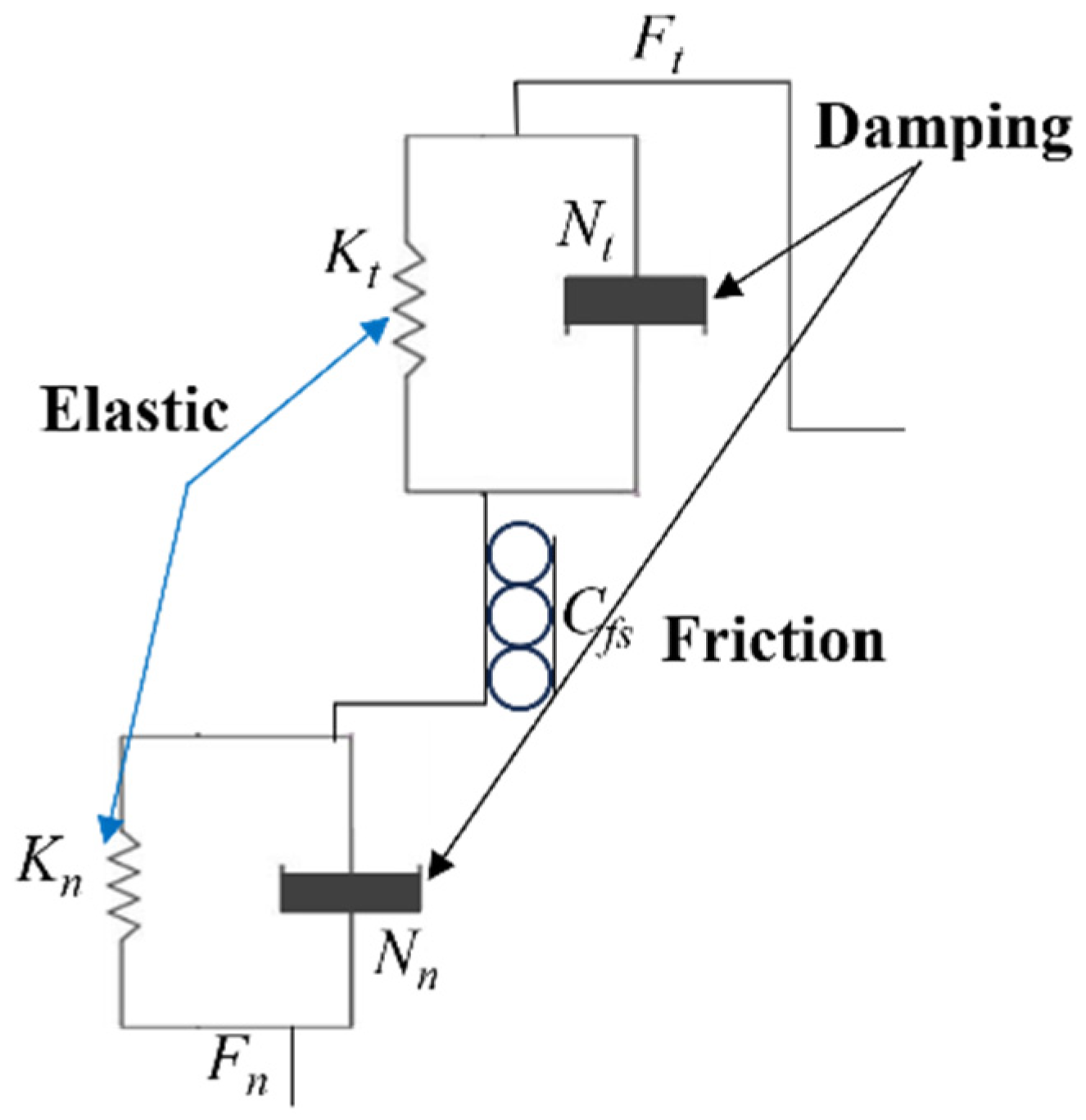
The Hertz–Mindlin (no-slip) model regards particle collision as contact involving a nonlinear spring group, and the force diagram is shown in Figure 1. It is described by the following equation set [25,26,27].
F c = F n + F t
where Fc is the contact force, N; Fn presents the normal force, N; and Ft is the tangential force, N.
F n = K n δ n N n ν n
In the formula, Kn is the normal elastic recovery coefficient; δn is the normal overlap at the contact point; Nn is the normal damping force, N; and vn is the magnitude of the normal relative velocity of the two particle surfaces at the contact point, m/s.
K n = 4 3 E s q δ n R s q
N n = 5 K n m s q N n d
N nd = ln C nre π 2 + ln C nre 2 , C nre 0 1 , C nre = 0
where Eeq is the equivalent Young’s modulus of two particles, Pa; Req is the equivalent radius of the two particles, mm; meq is the equivalent mass of the two spherical particles, kg; Nnd is the normal damping coefficient; and Cnre is the normal recovery coefficient.
For the tangential contact force, it can be simplified to the elastic–damper–static friction mechanical model, and its calculation formula is as follows:
F t K t δ t N t v t , K t δ t < K n δ n C fs K t δ n C fs δ t δ t , K t δ t K n δ n C fs
In the formula, Kt represents the tangential elastic recovery coefficient; δt is the tangential overlap at the contact point; vt is the magnitude of the relative tangential velocity of the two particle surfaces at the contact point, m/s; and Cfs is the static friction coefficient.
K i = 8 G e q δ α R e q
N i = 5 K i m e q N i d
N td = ln ( C tre ) π 2 + ln ( C tre ) 2 , C tre 0 1 , C tre = 0
where Geq represents the equivalent shear modulus of two particles, Ntd is the tangential damping coefficient, and Ctre is the tangential recovery coefficient.
The rolling damping model is used to characterize the rolling behavior characteristics when cuttings interact with each other or with the wall. This model introduces the rolling friction coefficient to constrain the rolling of the cuttings, causing the particles to bear the rolling damping torque. The calculation formula for its mechanical model is as follows:
M r = ω r e l ω r e l C r R e q F n
ω r e l = ω 1 ω 2
Here, Mr represents the rolling damping torque, N·m; ωrel is the relative rotational angular velocity, rad/s; Cr is the rolling friction coefficient; and ω1 and ω2 are the rotational angular velocities of particle 1 and particle 2, rad/s.

2.4. Calculation Conditions

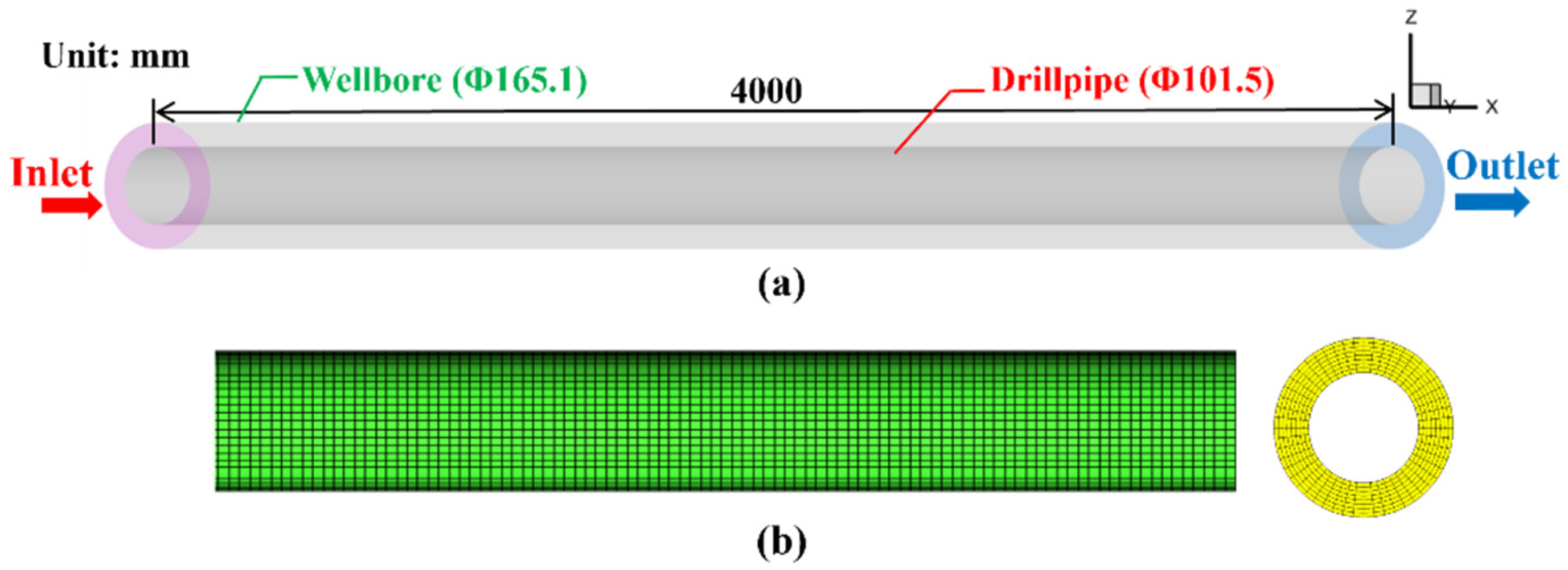
This study establishes a horizontal well model. The geometry and computational mesh are shown in Figure 2. The domain is discretized using a hexahedral-structured mesh. Mesh motion is enabled to account for drillpipe rotation. The inlet and outlet boundaries are specified as a velocity inlet and a pressure outlet, respectively. The wellbore wall is modeled as a stationary wall, while the drillpipe is set to rotate.
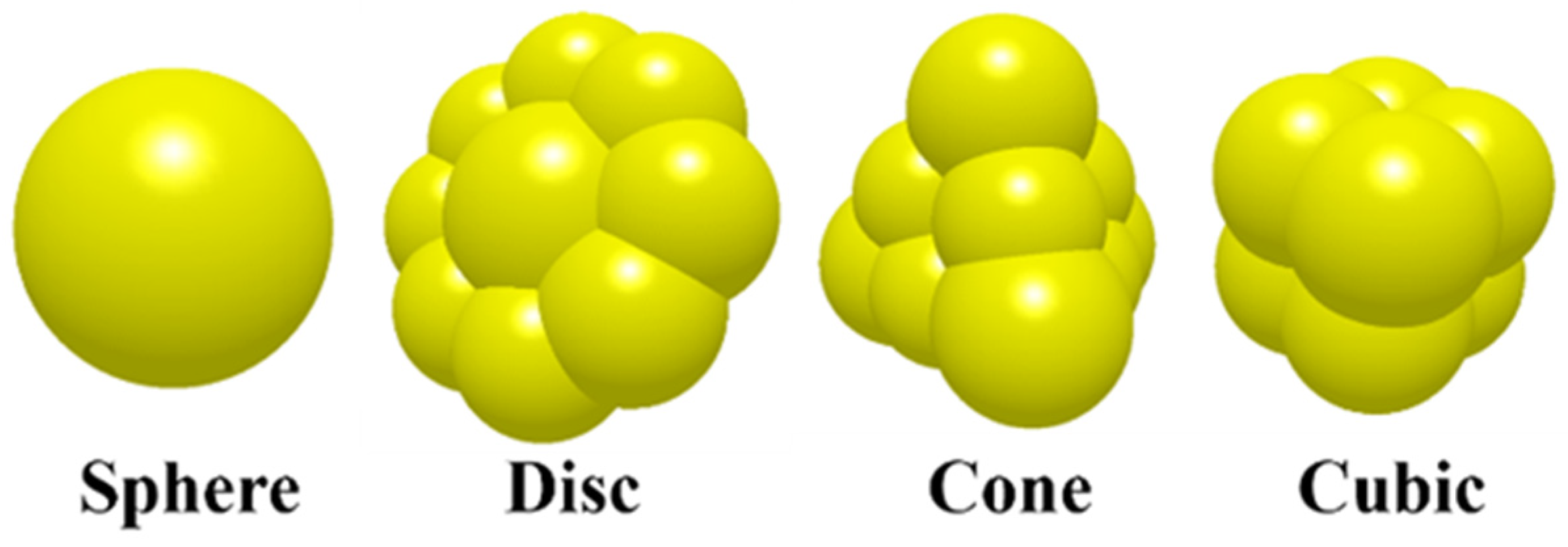
In actual drilling operations, cutting particles usually have irregular shapes, which makes their transport behavior difficult to model accurately. To address this, the non-spherical cuttings are represented using a multi-sphere approach in the DEM simulations. Each non-spherical particle is constructed by rigidly connecting multiple overlapping spheres to approximate the target particle shape (sphere, disc, cone, and cubic), as schematically shown in Figure 3.
The wellbore and drillpipe diameters of the Da-13 well in the Xinjiang Oilfield are consistent with those adopted in the present model, and its development conditions are representative of typical field operations. Therefore, based on the particle size distribution in the horizontal section of the Da-13 well (Table 1), where the dominant cutting size ranges from 2.0 to 2.8 mm, an equivalent particle size was selected for the numerical simulations. Based on this, an equivalent particle diameter of 2.4 mm is selected for this study, which is the median value of the dominant size range (2.0–2.8 mm) observed in the horizontal section of the Da-13 well. Using a representative equivalent size allows the effects of flow rate, drillpipe rotation, fluid viscosity, and particle shape on cutting transport to be systematically investigated while avoiding additional uncertainties introduced by multi-size distributions. Here, the equivalent diameter is defined as the diameter of a spherical particle with the same mass as the target particle. The Hertz–Mindlin (no-slip) contact model was employed for particle–particle and particle–wall interactions. The material properties and contact parameters used in the DEM simulations are summarized in Table 2. The detailed simulation parameters are listed in Table 3.

2.5. Model Validation

This study verifies the numerical validity of the horizontal well model by comparing it with previously published experimental results under similar conditions, along with conducting mesh independence and time step independence analyses. It is aimed at ensuring both the accuracy of the results and the efficiency of the simulations.
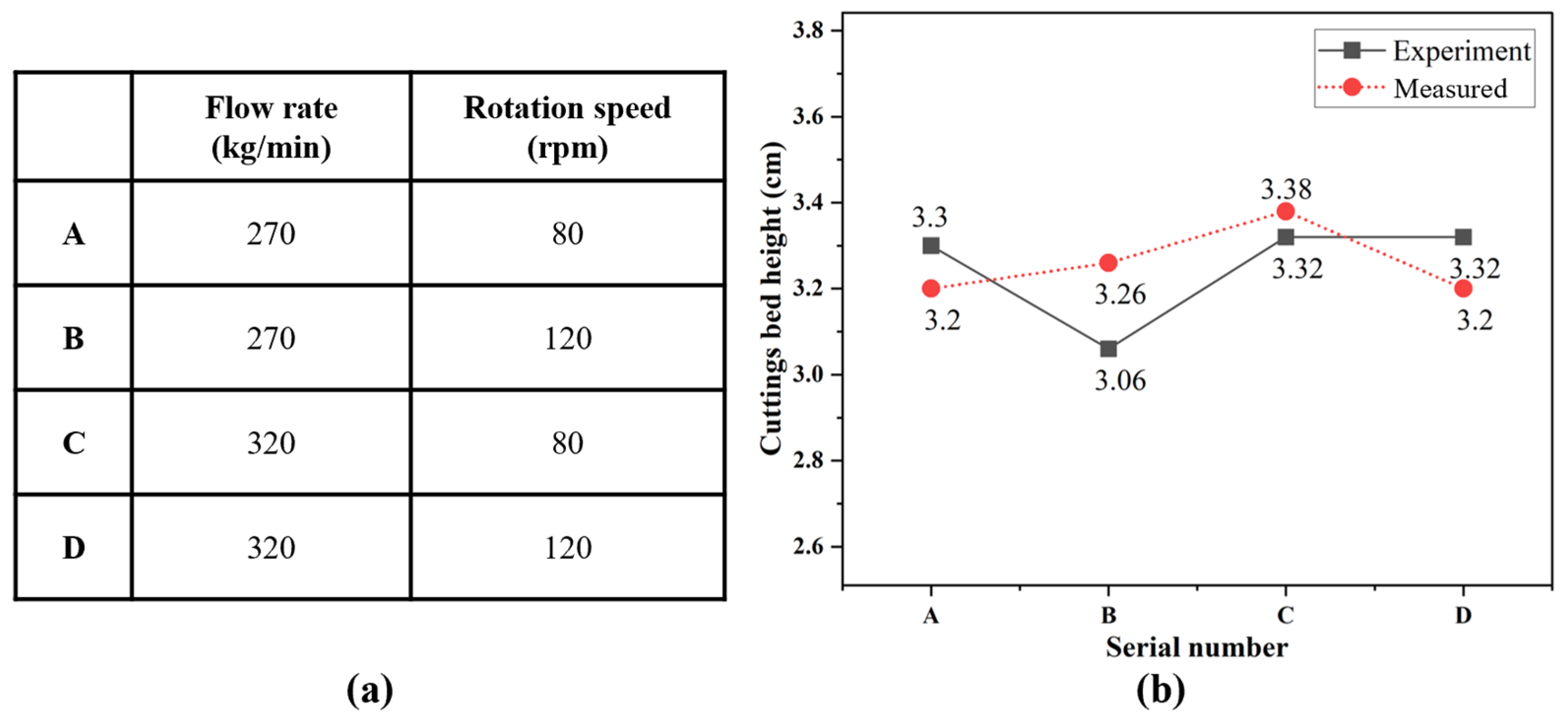
To ensure the computational stability and result reliability of the established numerical model, this study conducts validation based on the classic experiment by Barooah et al. [28], with the core parameters of the model highly consistent with those of the experiment: the annular geometric parameters are specifically set as a wellbore diameter of 114.3 mm, a wellbore length of 6.16 m, and a drillpipe diameter of 63.5 mm; the fluid phase adopts a Herschel–Bulkley fluid containing 0.05% Flowzan additive; the annular eccentricity is set to 0% (i.e., concentric annular condition); the physical property parameters of cutting particles are determined as a density of 2600 kg/m3 and a particle size of 2 mm. On this basis, liquid volume flow rates (170 kg/min, 320 kg/min) and drillpipe rotational speeds (80 RPM and 120 RPM) are selected as key control variables, and 4 sets of differentiated validation cases are designed and established. Through systematic comparative analysis between the model calculation results and the experimental measured data, the relative deviations between them are all controlled within 8% (Figure 4). This error level fully confirms the effectiveness and excellent numerical prediction accuracy of the established numerical model.
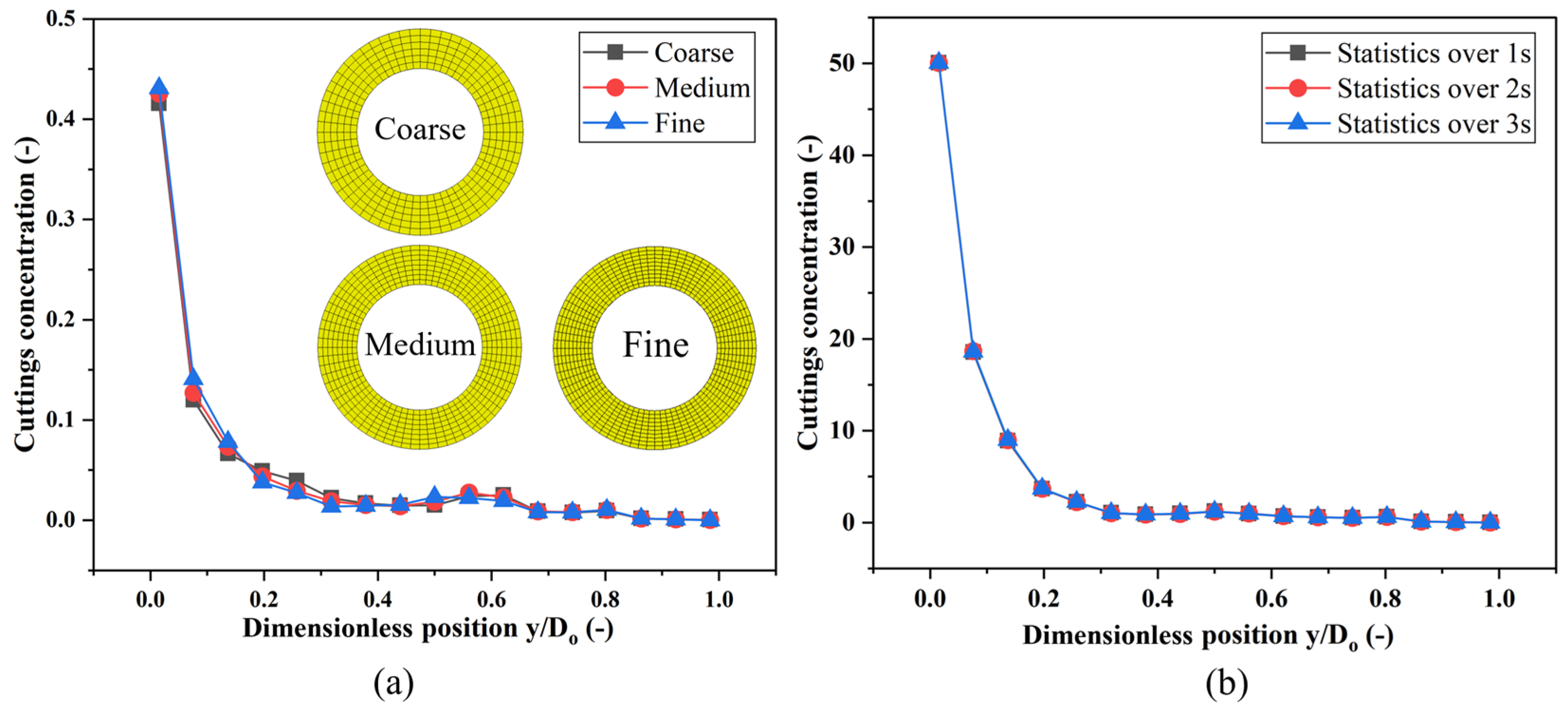
To minimize the influence of mesh size on the results, three mesh schemes (fine, medium, and coarse) are generated and compared. Figure 5a shows the average cutting concentration at different dimensionless radial positions, y/Do, for each scheme. The results are basically the same, indicating that the simulations are mesh-independent. Considering both computational cost and accuracy, the medium mesh is adopted for all subsequent cases.
To eliminate systematic errors related to statistical time, the effect of different sampling durations on the average cutting concentration at each dimensionless radial position is further examined after the flow field reaches a steady state. As shown in Figure 5b, the results for different statistical times have good consistency, and the deviations are negligible. Therefore, a statistical time of 2 s is used in the subsequent analysis.

3. Results

In this study, disc-shaped cuttings are taken as the primary particle type. The effects of flow rate, rotation speed, fluid viscosity, and cutting shape on cutting transport in horizontal wells are analyzed.

3.1. The Effect of Flow Rate on Cutting Transport

In this study, disc-shaped particles are used as the cutting phase at N = 100 rpm and μ = 10 mPa·s. The analysis focuses on the cutting concentration distribution, annular pressure drop, and cutting velocity. The objective is to systematically clarify the effect of flow rate on hole-cleaning performance in horizontal wells.
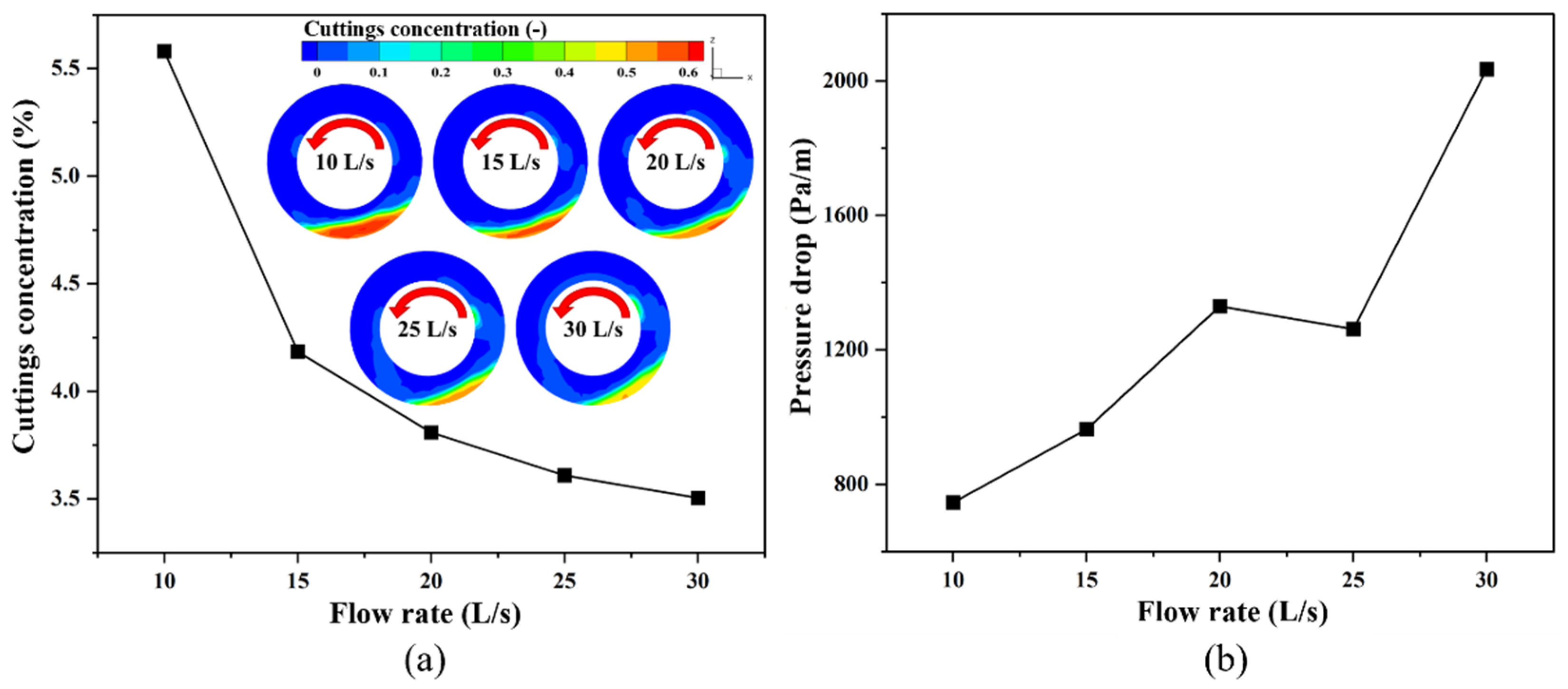
Figure 6a shows that the overall cutting concentration in the annulus decreases as the flow rate increases, indicating improved wellbore cleanliness. However, this decreasing trend gradually levels off. At higher flow rates, continued increases in flow rate only provide limited additional improvement. At low flow rates, a distinct cutting bed forms in the lower part of the annulus. As the flow rate increases, the bed thickness declines. When Q > 25 L/s, the bed almost disappears, and the cuttings are mainly transported in suspension.
Meanwhile, the annular pressure drop is analyzed. Figure 6b quantitatively shows that the annular pressure drop rises with flow rate. The main reason is that a higher flow rate enhances the annular velocity and strengthens turbulence. More turbulent kinetic energy is produced and dissipated in the flow field, which leads to a higher frictional pressure drop along the wellbore.
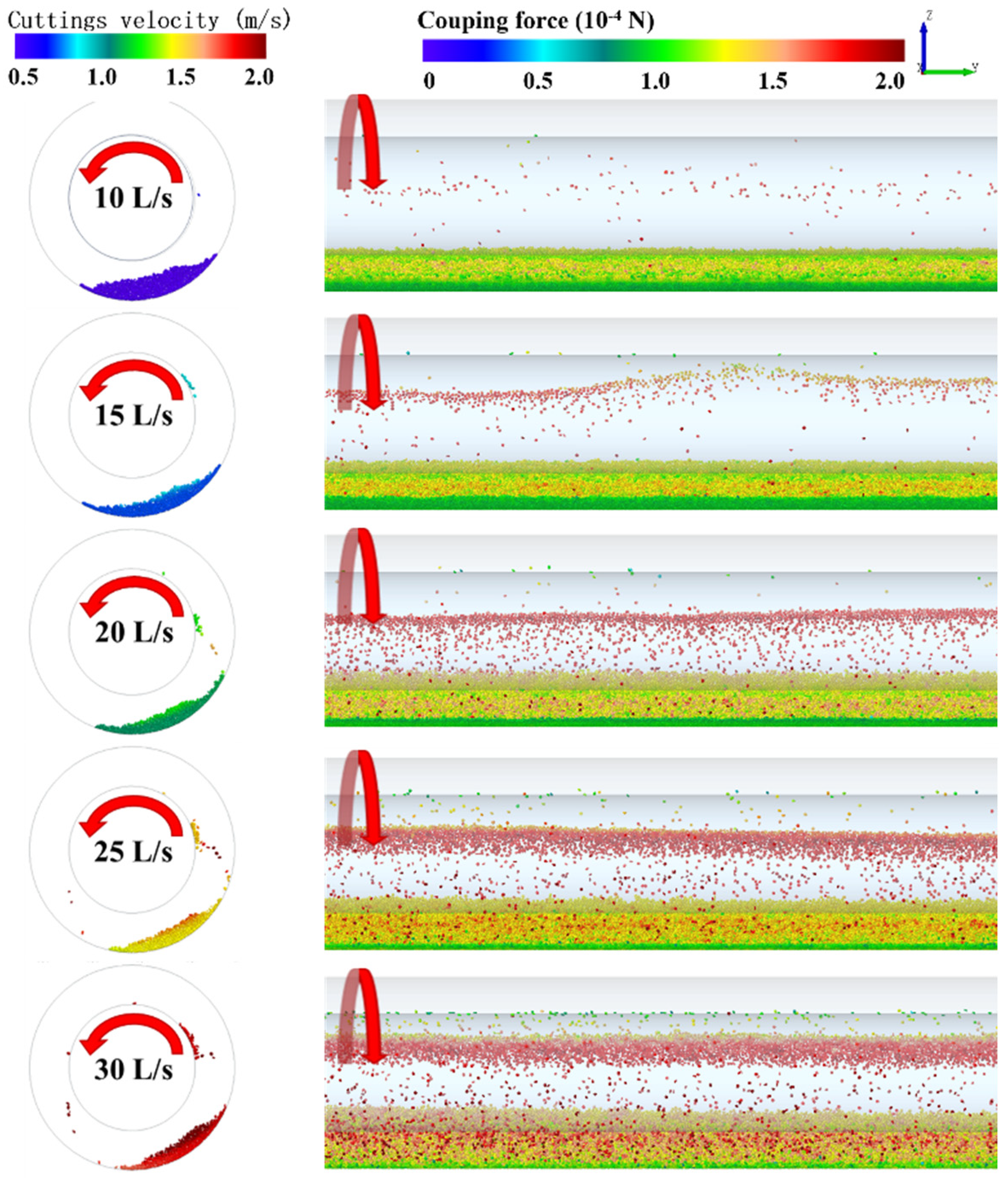
Figure 7 enlarges the 3 m cross-section and the 3–3.5 m region to show cutting details. This indicates that the overall cutting velocity increases with flow rate, and no stationary cutting bed forms in the range Q = 10–30 L/s. Notably, a local maximum particle velocity appears in the middle region above the deposition cuttings.
Further observation shows that suspended cuttings above the bed and the streak-like band of suspended cuttings formed in the upper annulus experience stronger fluid–solid interaction forces. They gain more fluid momentum and are therefore more likely to move axially and circumferentially with the flow. Under the circumferential flow induced by drillpipe rotation, the suspended particles above the bed are lifted and move upward. They then decelerate under gravity and exhibit a transient zero vertical velocity at a certain height, where an upper annulus streak is formed. As the flow rate increases, the number of suspended particles increases. Driven by the combined tangential force and lift, more particles are entrained, and the streak region further expands and widens.

3.2. The Effect of Drillpipe Rotation Speed on Cutting Transport

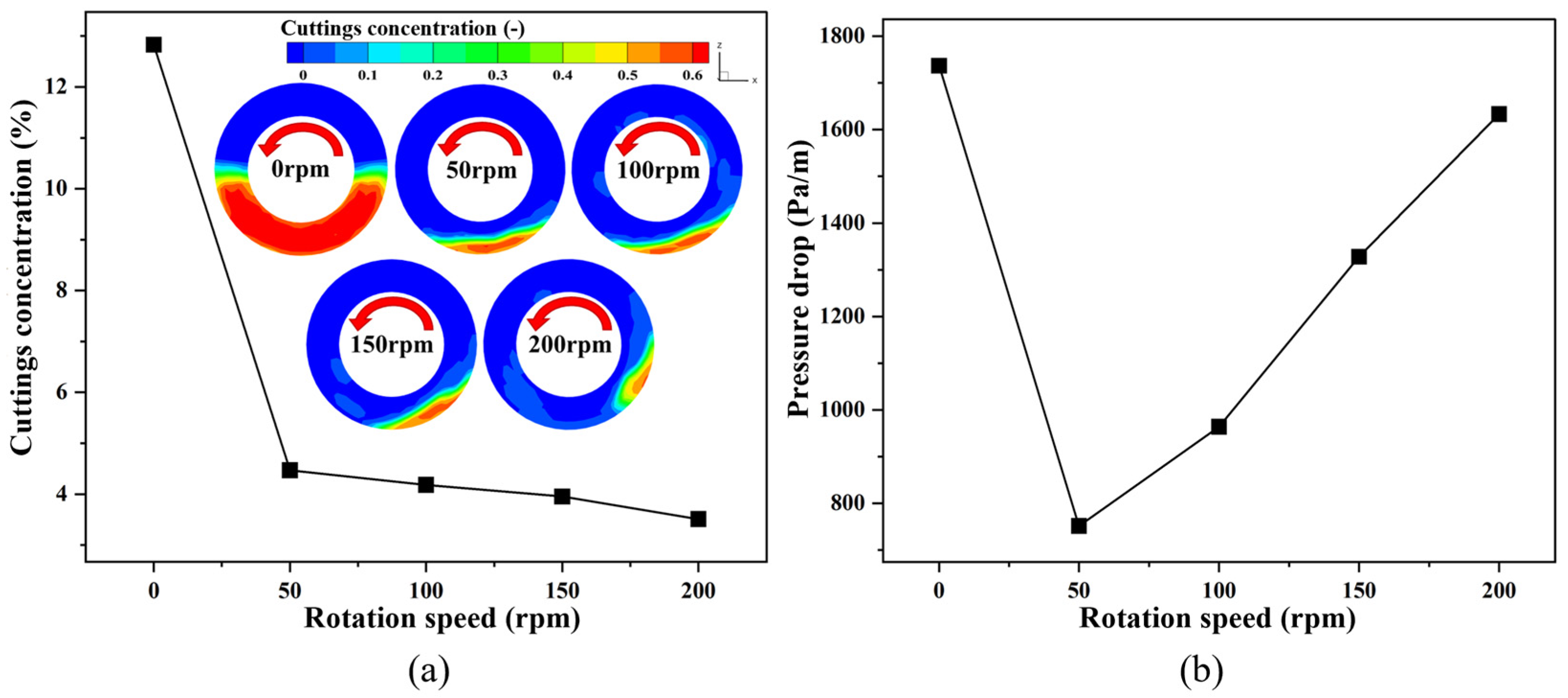
In this subsection, disc-shaped particles are used as cuttings at Q = 15 L/s and μ = 10 mPa·s to study the effect of drillpipe rotation speed on cutting transport. Figure 8a shows that, without drillpipe rotation, significant cutting deposition occurs in the annulus. The stationary cutting bed occupies more than 45% of the annulus, which degrades hole-cleaning quality and markedly escalates the risks of stuck pipe and abnormal pump pressure. Once the drillpipe starts to rotate, the annular cutting concentration diminishes sharply, and an excessively high cuttings bed no longer forms, indicating a strong positive effect on hole cleaning. As the rotation speed increases, the cutting concentration further declines, and the cutting distribution shifts toward the direction of rotation.
The pressure drop mechanism changes accordingly, as shown in Figure 8b. With drillpipe rotation, pressure drop is mainly controlled by turbulence production and dissipation. Higher rotation speed intensifies annular turbulence, increases viscous friction and turbulent fluctuation losses, and thus leads to higher pressure loss. On the other hand, without rotation, pressure drop is dominated by solid loading and geometric constraints. A high solids concentration and a thick stationary cutting bed enhance particle stress and interphase momentum exchange, while reducing the effective flow area. This causes a pronounced surge in pressure drop and may trigger formation breakdown and lost circulation.
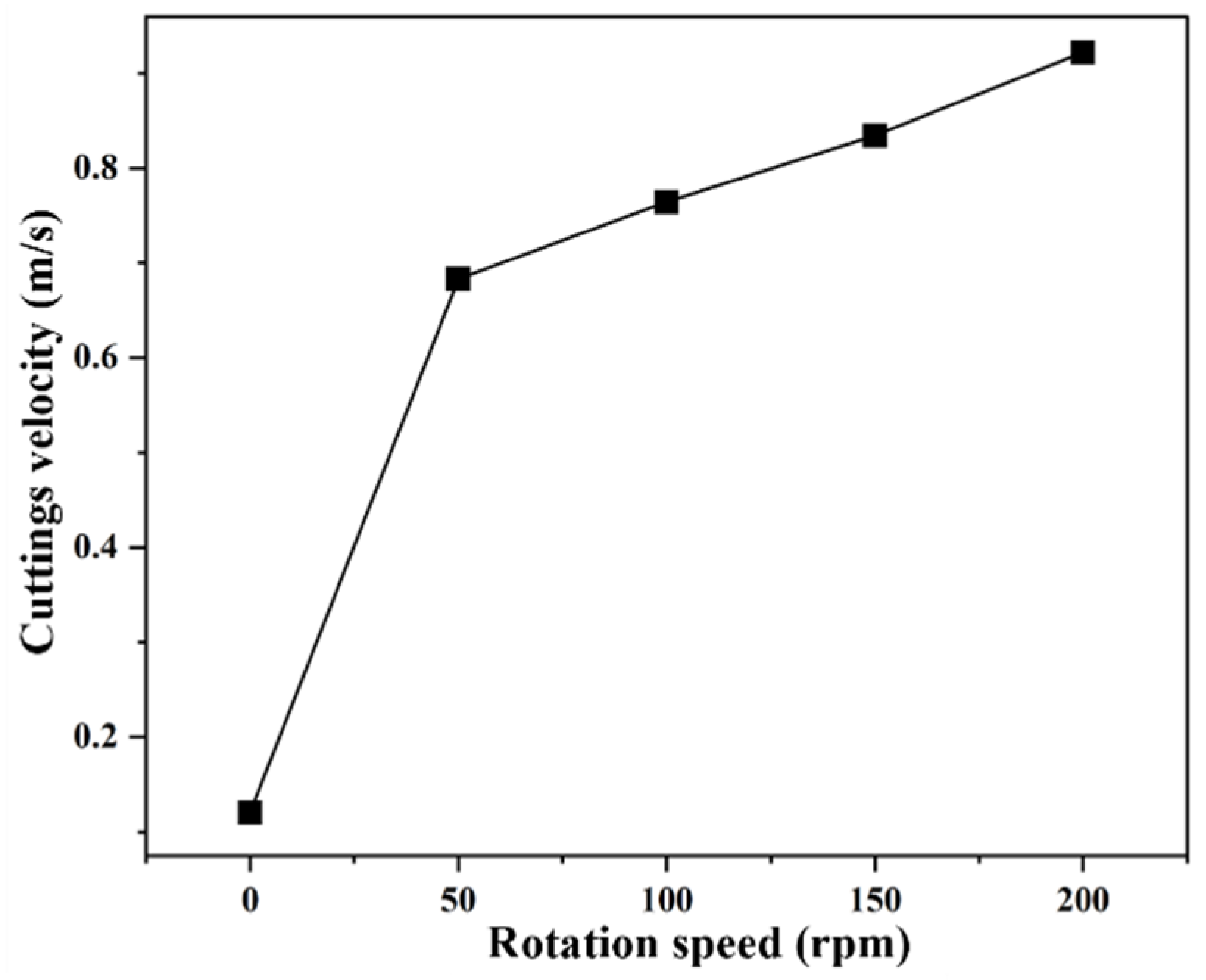
Figure 9 indicates that, in the non-rotating case, the axial cuttings velocity is generally low, and a stationary bed readily forms, which severely hinders transport. After drillpipe rotation is introduced, cutting transport improves significantly, and its efficiency increases approximately monotonically with rotation speed. This indicates that rotation enhances fluid–particle momentum transfer and promotes the transition of more particles into suspended, flow-following transport.
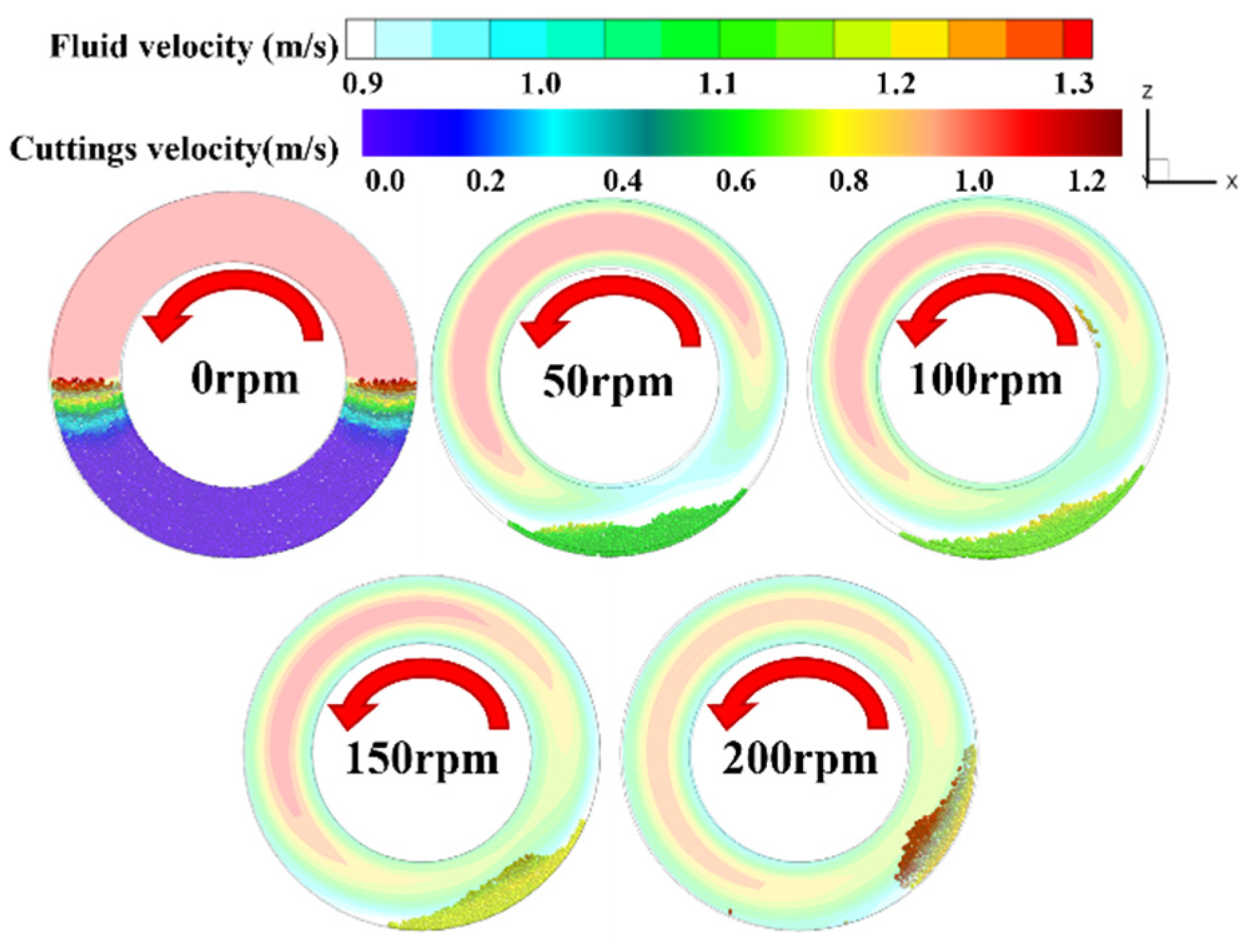
Figure 10 further shows that the fluid velocity is low in regions with cutting deposition. At N = 0 rpm, a cutting bed forms in the rear part of the annulus with a thickness of about half the annular height. A large number of cuttings become stationary, which compresses the effective flow area. The upper fluid is forced to accelerate, forming a high-velocity zone and driving a relatively fast layer of cuttings above the bed in the flow direction. When drillpipe rotation is introduced, the extensive stationary bed is significantly reduced, and the cuttings mainly exhibit a moving bed pattern. As the rotation speed increases, particle velocity rises accordingly. At the same time, for the fluid phase, both high- and low-velocity regions shrink with increasing rotation speed. The overall velocity field becomes more uniform, and dead zones are reduced. More continuous momentum transfer above the bed is achieved, which is beneficial for sustained cutting transport and suppression of re-deposition.

3.3. The Effect of Fluid Viscosity on Cutting Transport

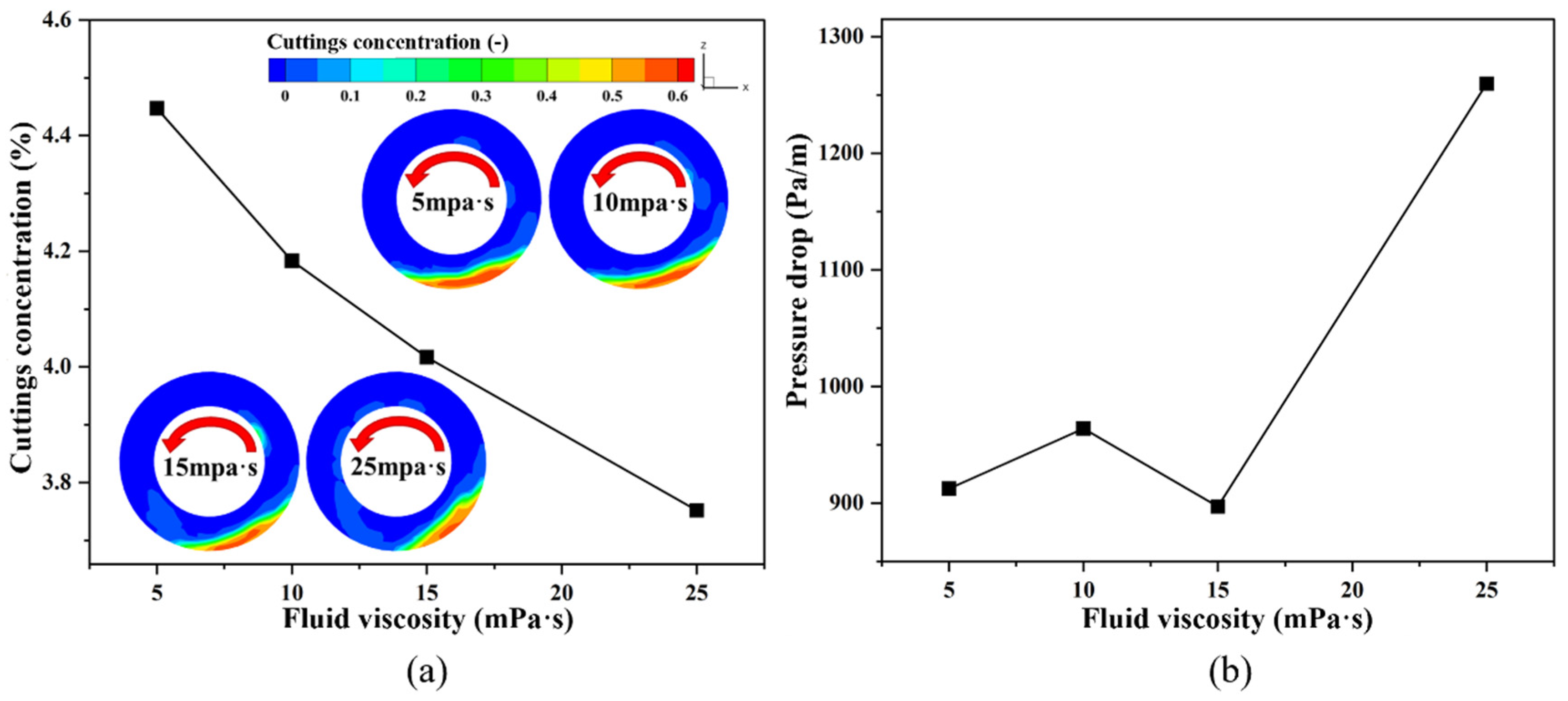
At Q = 15 L/s and N = 100 rpm with disc-shaped cuttings, the effect of drilling fluid viscosity on cutting transport is examined. Figure 11a displays in detail how cutting concentration and distribution vary with viscosity. As viscosity enhances, the overall annular cutting concentration reduces, and the stationary bed becomes thinner. This indicates that higher viscosity suppresses particle deposition and enhances hole-cleaning capacity. Meanwhile, under the circumferential flow induced by drillpipe rotation, suspended cuttings exhibit a more pronounced bias toward the direction of rotation, and the cutting streak becomes clearer.
Figure 11b shows that the annular pressure drop exhibits a threshold behavior. When μ = 5–15 mPa·s, the annular pressure drop changes little. When μ increases to 25 mPa·s, the pressure drop soars sharply. Mechanistically, higher viscosity increases the drag on particles and reduces deposition, but it also enhances internal friction and turbulent energy dissipation in the fluid. This intensifies energy loss and causes a steep increase in pressure drop. Therefore, in field optimization, it is necessary to balance the “slowing decrease in cutting concentration” against the “rapid escalation in pressure drop” to achieve a combined optimum between hole-cleaning efficiency and flow economy.
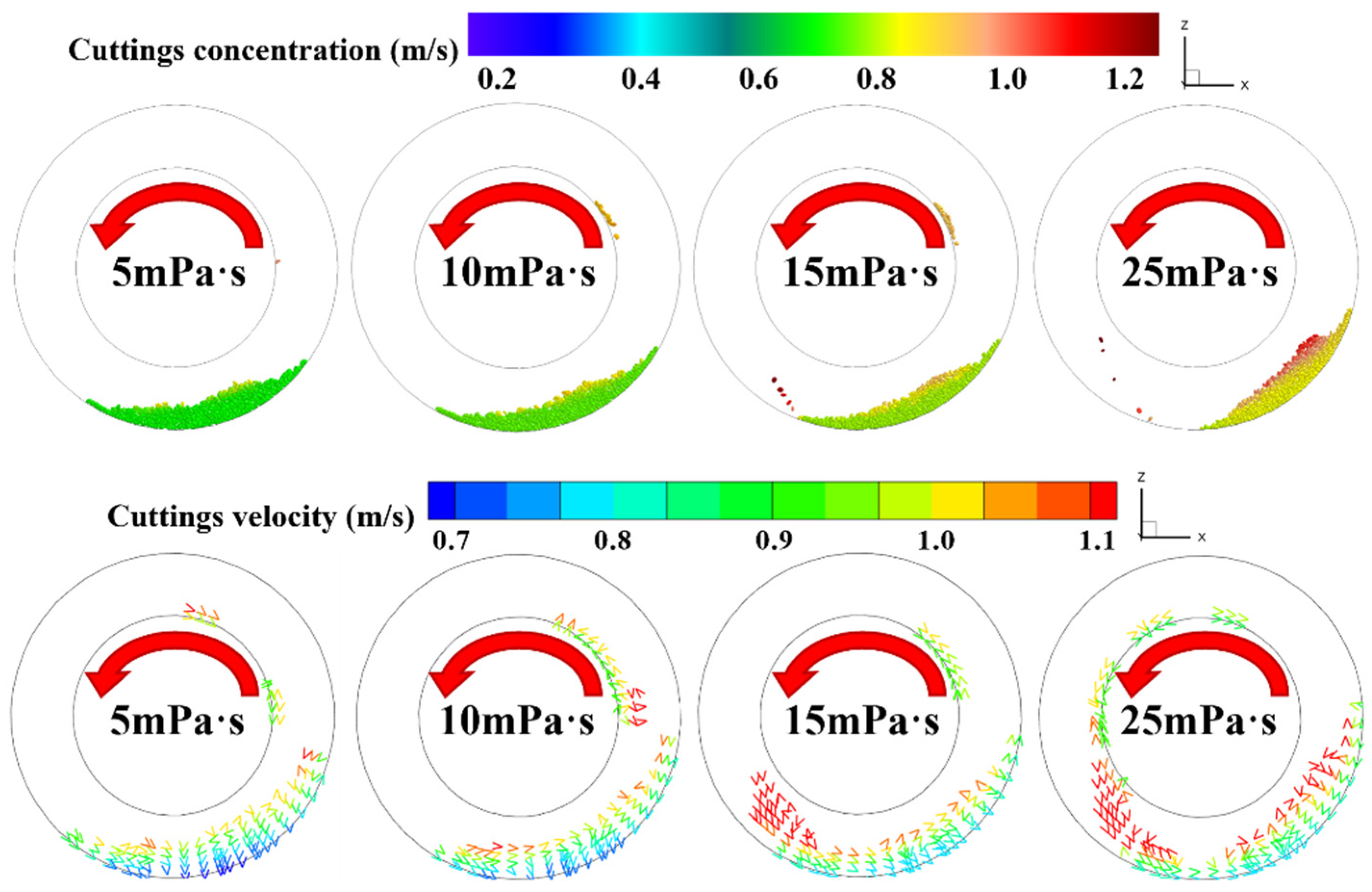
A detailed analysis of the cutting velocity distribution and vector field (Figure 12) signifies that cutting velocity increases with viscosity. This indicates a more effective transfer of fluid momentum to the particles. The high-velocity region along the upper edge of the bed also widens as viscosity enhances, and this effect is most pronounced at μ = 25 mPa·s. It is also observed that, for μ = 5–15 mPa·s, higher viscosity leads to more cuttings in the suspended streak, while for μ = 15–25 mPa·s, fully suspended cuttings appear on the left side of the annulus. The vector field reveals the underlying flow pattern: as viscosity increases, more cuttings at the bottom of the annulus move circumferentially instead of remaining deposited, and an increasing number of particles rise to form the suspended streak. From μ = 15 mPa·s onward, some cuttings are carried around the drillpipe in a full loop before settling again, which explains the growing quantity of suspended cuttings on the left side of the annulus for μ = 15–25 mPa·s. And at μ = 25 mPa·s, the high-viscosity drilling fluid provides strong carrying capacity, and depositional motion of the cuttings is greatly weakened. The cuttings are carried around the drillpipe and fall on the left side of the annulus, and the suspended streak on the right side disappears.

3.4. The Effect of Cutting Shape on Cutting Transport

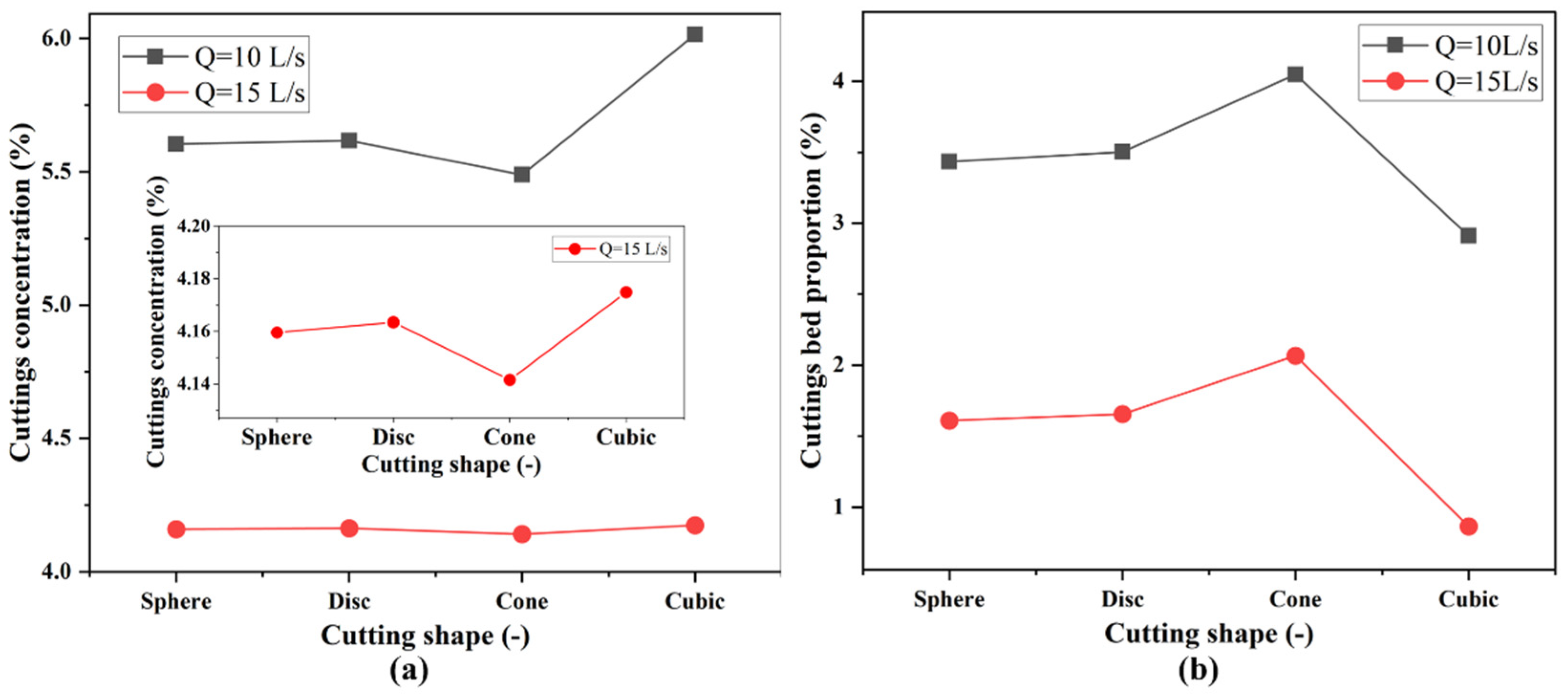
At N = 100 rpm and μ = 10 mPa·s, this section compares the annular cuttings transport of four particle shapes—sphere, disc, triangular cone, and cubic—at two low-to-medium flow rates, Q = 10 and 15 L/s. Figure 13a shows that at Q = 10 L/s, the annular cutting concentrations for disc and spherical particles are similar. The cone particles give the lowest annular cutting concentration, while the cubic particles give the highest. At the higher flow rate of Q = 15 L/s, the differences in annular cutting concentration become less pronounced, but the same trend can still be identified in the enlarged view.
The proportion of the annulus occupied by the cutting bed (C > 50%) is extracted in Figure 13b. Although cone particles yield the lowest overall cutting concentration, their shape makes them easier to fit together and stack tightly, resulting in the highest bed proportion. Cubic particles, due to their regular shape, show the lowest bed proportion. The bed proportion of disc-shaped particles is slightly higher than that of spheres, owing to their irregular shape.
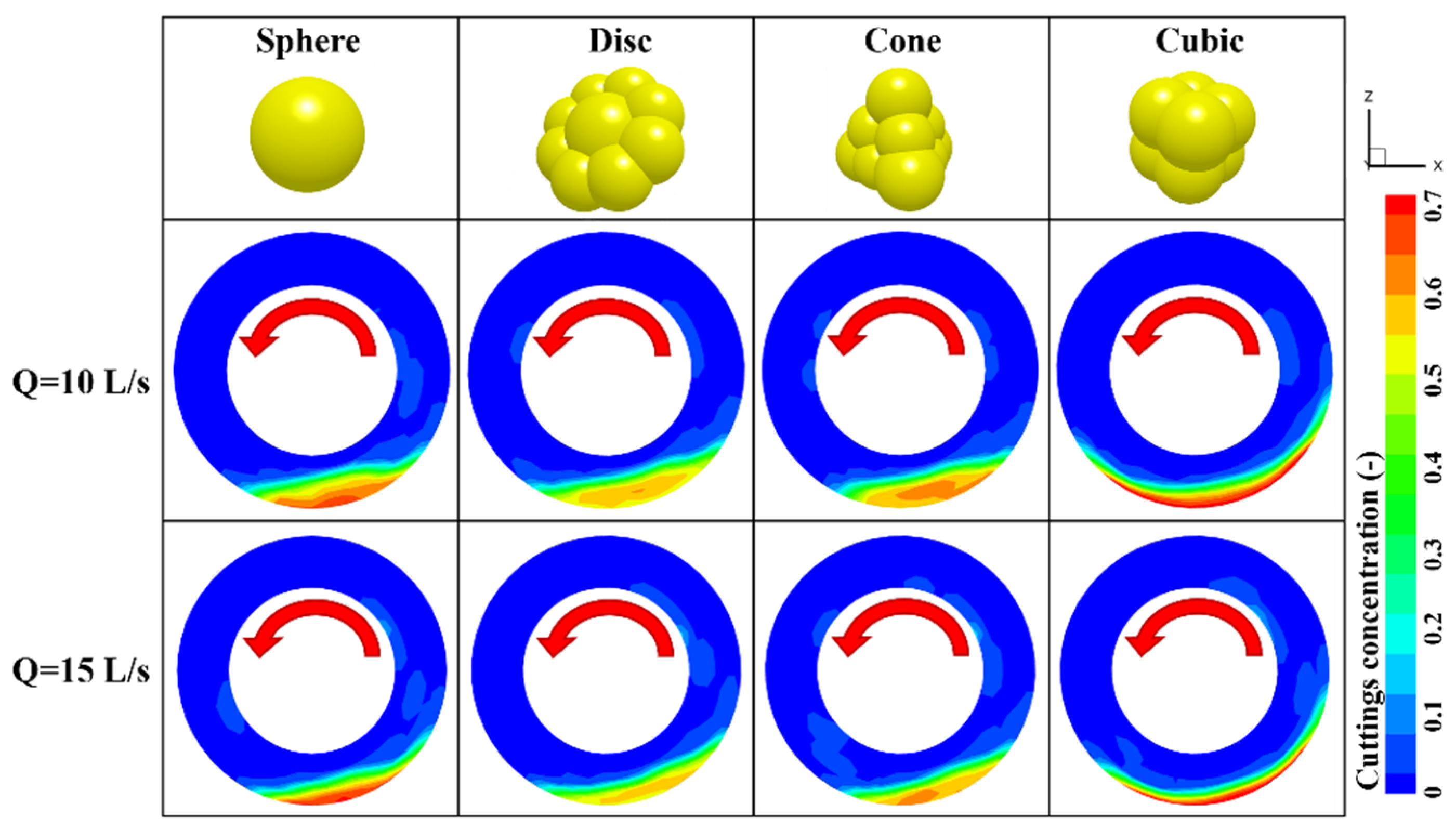
A further analysis of the concentration distributions of the four particle shapes at the two flow rates in Figure 14 illustrates that spherical and cubic particles have the largest areas of high-concentration bed (C > 65%). Spherical particles tend to roll and rearrange after deposition in the low-velocity region, forming large and high-concentration domains. For cubic particles, geometric constraints limit rolling and promote lateral spreading along the bottom, so the high-concentration bed becomes “flat and wide” in space. Cone cutting particles exhibit some local high-concentration zones, but their beds tend to loosen during motion, and continuous high-concentration regions are relatively limited. Disc-shaped cutting particles show a more uniform bed concentration distribution.
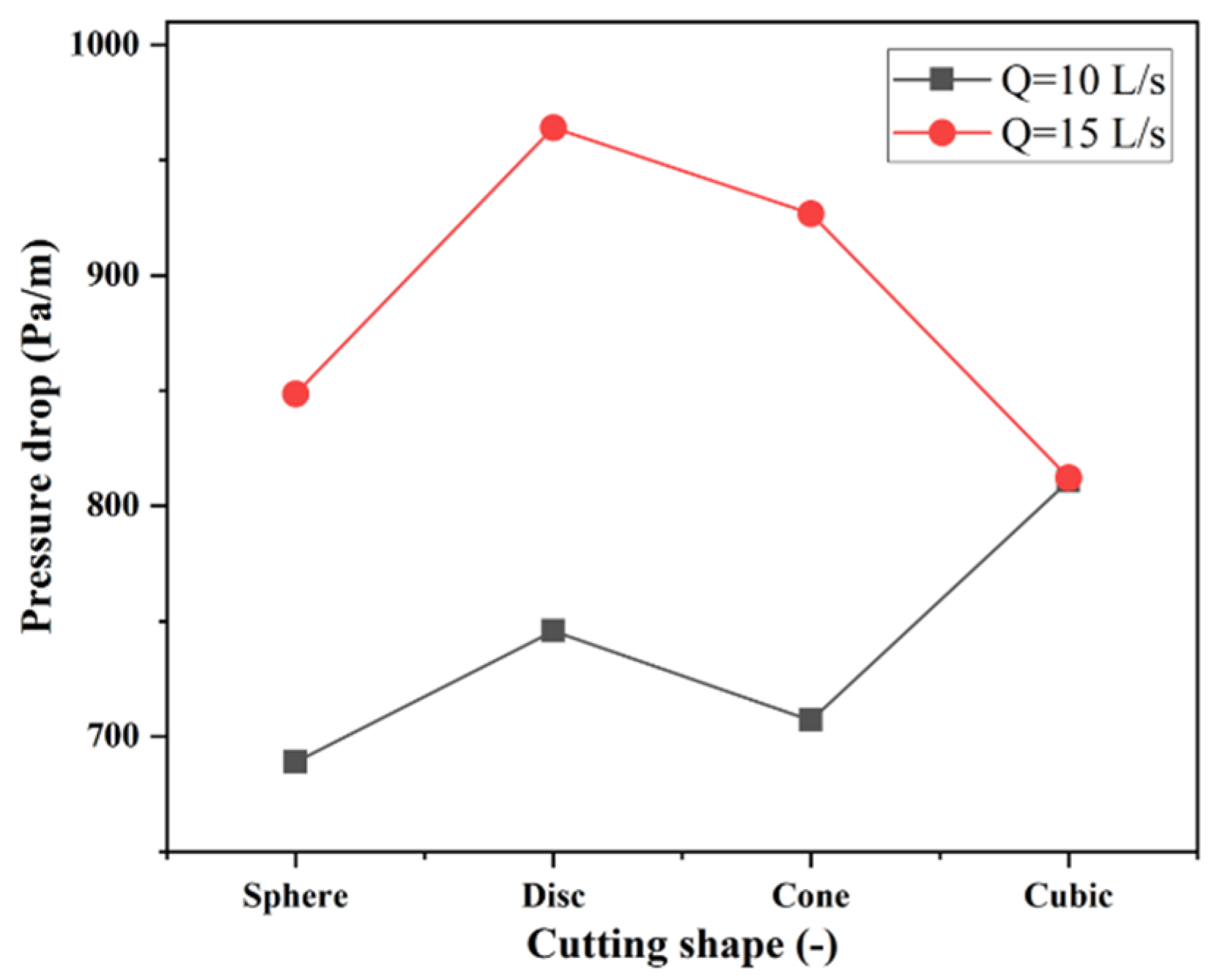
The pressure drop results (Figure 15) reveal shape-related differences in flow losses. Disc cuttings show the highest pressure drop, followed by cone cuttings. This is because their asymmetric shapes make them prone to wobbling in shear flow, disturbing the flow field and increasing pressure drop. Sphere particles, with their regular symmetry, produce a lower pressure drop.
A special feature is that the annular pressure drop for cubic cuttings is not sensitive to the change in flow rate between the two cases. It is inferred that, when the flow rate decreases from 15 to 10 L/s, cubic particles exhibit the largest increase in annular cutting concentration. The additional pressure drop caused by solids accumulation offsets the reduction in pressure loss due to the lower flow velocity, so the total pressure drop changes only slightly.
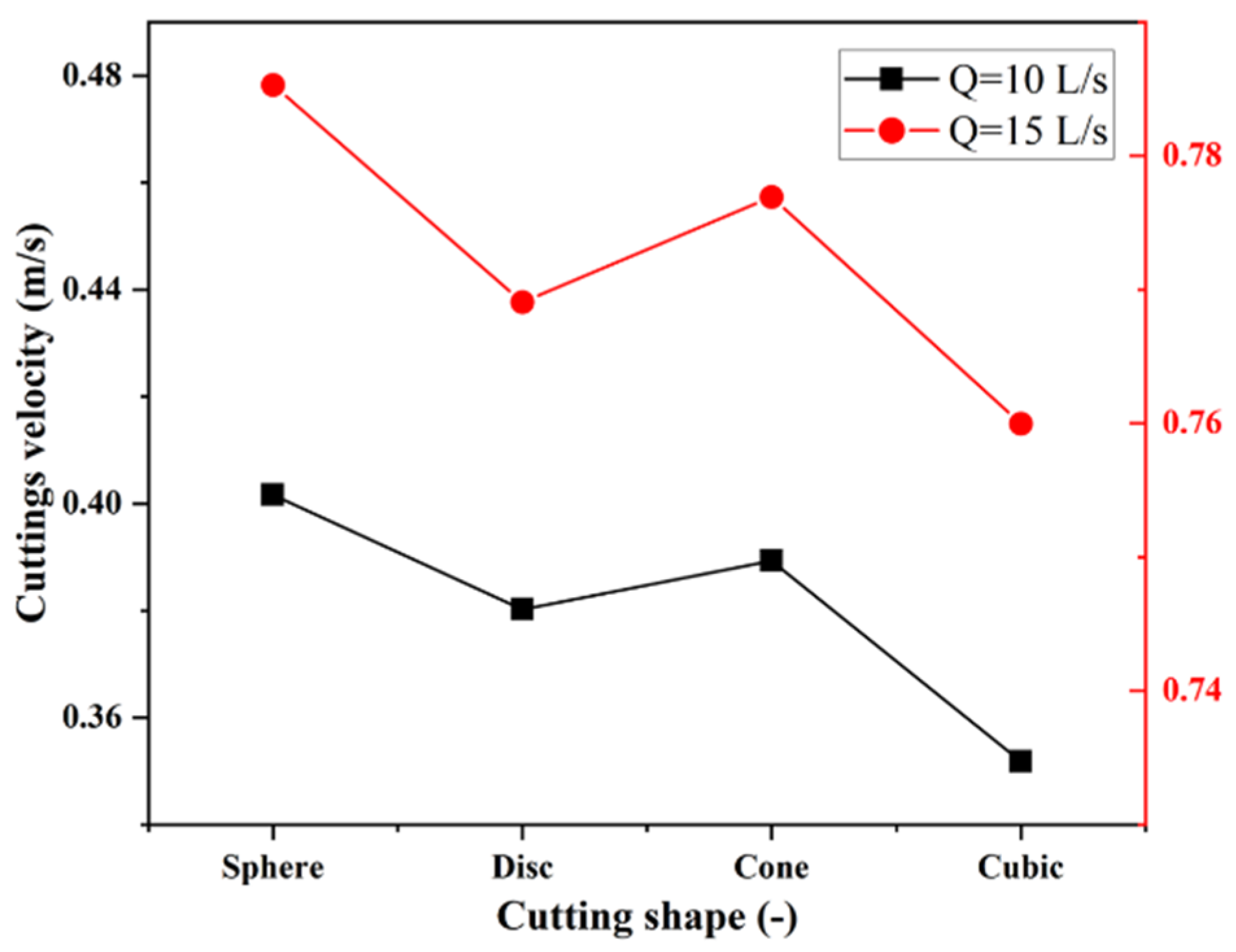
A quantitative analysis of cutting transport velocity is given in Figure 16. At low flow rate, the velocity differences between particle shapes are more pronounced. Spherical particles move mainly by rolling. They are the easiest to initiate and transport and have the highest velocity. Cone particles move through a combination of sliding and rolling, but their geometry tends to promote interlocking, which hinders motion and leads to a lower velocity. Disc and cubic cuttings move predominantly by sliding. Their motion is strongly hindered, and their transport velocities are the lowest. However, the flat shape of disc cuttings can generate lift and promote suspension, so their velocity is higher than that of cubic cuttings.
Because particle shape affects both the mode of motion in the fluid and the stacking structure after deposition, different shapes exhibit different transport behaviors, and these differences become more evident at low flow rates. Overall, the order of transport efficiency and resuspension potential with respect to shape is sphere > disc > cone > cubic.

3.5. Dimensionless Pressure Drop Chart

Accurate estimation and control of annular pressure drop along the wellbore axis are crucial during drilling operations. Different flow conditions lead to different annular pressure drops and distinct cutting patterns. Considering flow rate, drillpipe rotation speed, drilling fluid properties, and cutting shape, a composite dimensionless number Π and a dimensionless pressure drop DPD [29] are introduced to predict and evaluate annular pressure drop and cutting transport under drillpipe rotation. The composite dimensionless number Π is defined as the ratio of the square root of a composite Reynolds number Re to the square root of the particle Stokes number St. The composite Reynolds number Re consists of the axial Reynolds number ReA in the main flow direction, the tangential Reynolds number ReT induced by drillpipe rotation, and the particle Reynolds number ReP. The specific expressions are as follows:
D P D = Δ P Δ L 1 ρ w g
Π = Re / S t
Re = Re A + Re T + Re P
Re A = ρ f u f ( D o D i ) μ
Re T = ρ f ( D o D i ) ( N 2 π / 60 ) D i μ
Re p = ρ f u p d e ϕ 1 / 3 μ
St = ρ s d e 2   u p 18 μ ( D o D i )
u p = g d e 2 ( ρ s p f ) 18 μ
In the formulas, ∆P/∆L is unit length pressure drop, Pa/m; ρw is the density of water, taking 1000 kg/m3; g is the gravitational acceleration, taking 9.8 m/s2; ρf is drilling fluid density, kg/m3; uf is the inlet velocity of drilling fluid, m/s; Do is the diameter of the wellbore, m; Di is the diameter of the drillpipe, m; μ is the drilling fluid viscosity, Pa·s; N is the drillpipe rotation speed, rpm; de is the equivalent diameter of the particles, m, defined as the diameter of the spherical particle with the same volume as the non-spherical particle; ρs is the cutting density, in kg/m3; up is the sedimentation velocity of the cuttings, m/s; and Φ is the sphericity of the non-spherical particles.
Due to the differences between the transport behavior of non-spherical and spherical particles, the sphericity Φ is introduced to quantify the shape of the non-spherical cuttings considered in this study. It is defined as the ratio of the surface area As of the equivalent sphere to the actual surface area Ap of the particle. The surface area (Ap) of the multi-sphere particles was obtained by geometric calculation based on the constructed non-spherical particles. The calculation results are shown in Table 4. The corresponding formula and the sphericity values of the four particle shapes are given below [30]:
ϕ = A s A p
The transitions between different cutting transport regimes can be interpreted using dimensionless parameters and hydrodynamic forces. Increasing Reynolds number enhances flow inertia relative to viscous effects, leading to stronger drag forces acting on the cuttings, while drillpipe rotation intensifies local shear and promotes shear-induced lift, particularly near the rotating pipe. Meanwhile, the Stokes number reflects the particle response to the surrounding flow, with lower values indicating stronger particle–fluid coupling and favoring suspended transport, and higher values promoting particle inertia and bed formation. The combined effects of drag, lift, and shear-related forces therefore govern the transition from stationary beds to moving and suspended transport observed in the simulations.
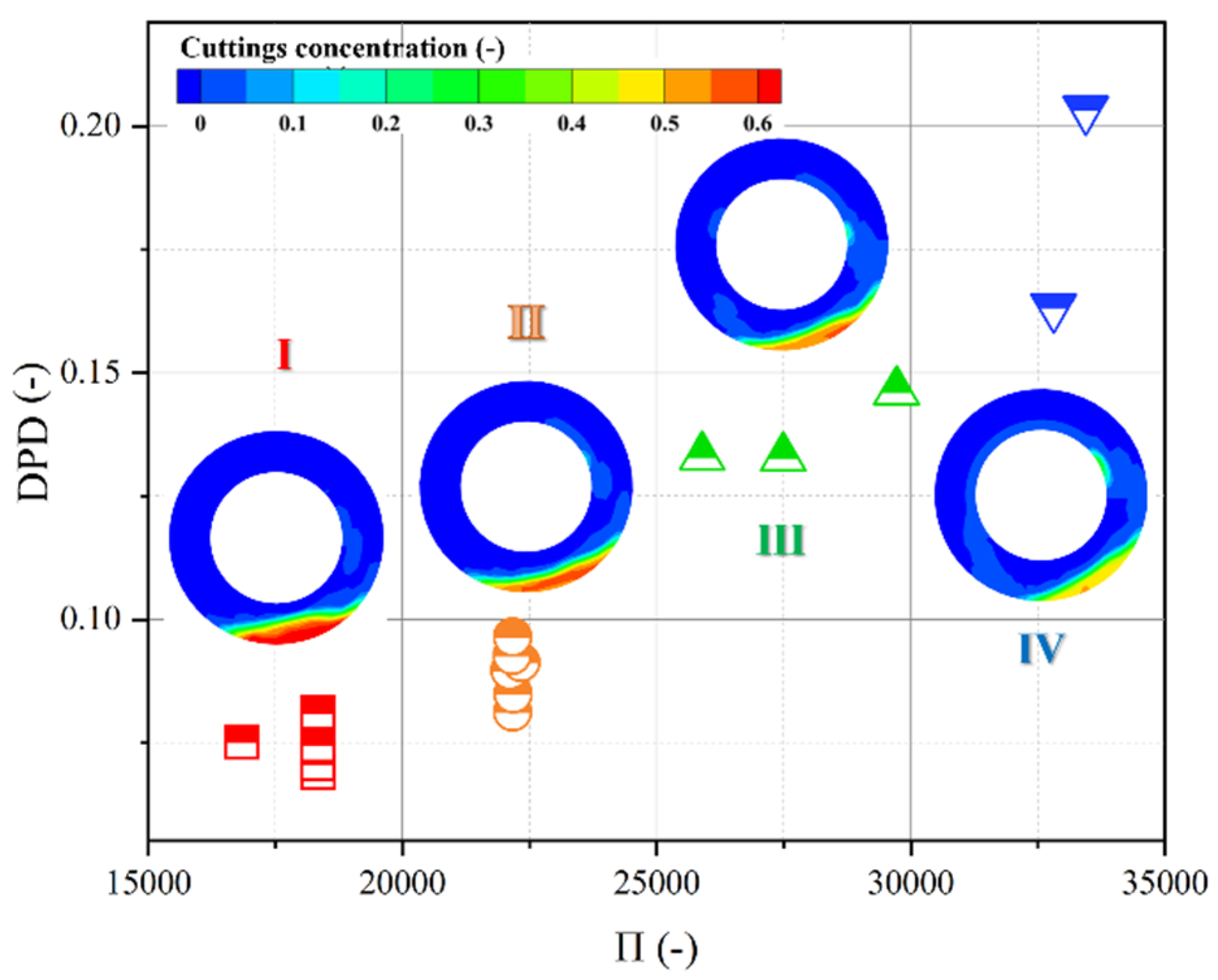
To obtain an annular pressure drop correlation that is both accurate and generalizable under different boundary conditions, a relationship between the composite dimensionless number Π and the dimensionless pressure drop DPD is established. This correlation is used to quantify the influence of boundary conditions on annular pressure drop and shows good monotonicity and discriminative capability, as illustrated in Figure 17. The scattered data exhibit a clear monotonic increasing trend, indicating that DPD increases with Π. This monotonic behavior confirms the effectiveness of Π as a function of the composite Re and the St.
In region I (Π < 2.0 × 10⁴), the annular pressure drop is low, but a thick cutting bed tends to form, which increases the risk of stuck pipe and related incidents. In region II, the pressure drop increases only slightly, while the cutting bed becomes noticeably thinner, and deposition is noticeably mitigated. For Π > 2.5 × 10⁴, the pressure drop starts to rise more rapidly, and the cuttings bed continues to decline. In region IV (Π > 3.0 × 10⁴), the cuttings bed almost disappears, and fully suspended transport is achieved, which greatly benefits cutting removal and hole cleaning but requires attention to the risk associated with the sharp increase in pressure drop. Overall, it is recommended to maintain Π around region III, i.e., Π ≈ (2.5–3.1) × 104, to balance bed suppression against excessive pressure drop. The DPD chart is used to illustrate the relationship among flow patterns, pressure drop, and cutting transport parameters, and to identify an optimal operational window for drilling parameter selection.

4. Conclusions

This study develops a CFD–DEM coupled model to systematically simulate and analyze the effects of flow rate, drillpipe rotation speed, drilling fluid viscosity, and cutting shape on cutting transport in horizontal well annuli. A dimensionless pressure drop prediction chart is also constructed. The main conclusions are as follows:
  • In terms of overall hole-cleaning behavior, flow rate, rotation speed, and drilling fluid viscosity jointly control the cutting transport efficiency. And they govern the evolution from a stationary cutting bed to a moving bed and then to suspended transport. Moderate increases in these parameters weaken the bottom cutting bed, strengthen the high-velocity band along the bed surface and the suspended cuttings streak, and improve hole cleanliness. However, when the parameters exceed a certain level (e.g., Q > 25 L/s, μ > 15 mPa·s), the reduction in cutting concentration becomes marginal, while the frictional pressure drop rises rapidly. A balance is therefore required between improved hole cleaning and increased pressure drop.
  • The transport and resuspension capability of cuttings decreases with shape in the order sphere > disc > cone > cubic. Correspondingly, the deposited structures evolve from a thin bed that is easy to remobilize to a dense, laterally spread or interlocked bed that is difficult to mobilize. Increasing flow rate can partly alleviate these shape effects and reduce bed accumulation, but it cannot eliminate the impact of particle shape on deposition and migration patterns.
  • A composite dimensionless number Π and a dimensionless pressure drop DPD are introduced, and a dimensionless pressure-drop–flow-pattern chart is established for rotary drilling with non-spherical cuttings. DPD increases monotonically with Π; that is, annular pressure drop rises as Π increases, while the cutting bed thickness and overall cutting concentration decrease. The dimensionless chart provides a reference for field parameter optimization. It is recommended that Π be controlled in the range Π ≈ (2.5–3.1) × 104 to achieve a combined optimum between hole-cleaning efficiency and pressure drop.
Limitations: Although this study provided insights into the movement of non-spherical rock cuttings in horizontal wells through CFD–DEM numerical simulation, the following key limitations also need to be taken into account:
  • The effect of drillpipe eccentricity in horizontal wells is not considered, which may influence the annular flow field and cutting transport behavior.
  • A representative equivalent particle size is adopted instead of a full particle size distribution, which simplifies the particle-scale description of field-generated cuttings.
  • Particle breakage and attrition during cutting transport are not considered in the simulations.
  • The drilling fluid is simplified as a Newtonian fluid, and more realistic non-Newtonian rheological models, such as the Herschel–Bulkley model, are not included.
Future research will focus on addressing these limitations to further advance the understanding of cutting transport behavior.

Author Contributions

Conceptualization, M.Z. and X.S.; data curation, Y.L. and M.Z.; formal analysis, Y.L.; funding acquisition, Z.P.; methodology, Z.P., Y.L., Y.S., and Y.W.; supervision, M.Z., Z.P., B.L., and Y.S.; validation, Y.L. and Y.S.; visualization, X.S.; writing—original draft, Z.P. and Y.L.; writing—review and editing, Z.P., Y.L., B.L., Y.W., and Y.S. All authors have read and agreed to the published version of the manuscript.

Funding

This research was funded by (1) The Innovative Research Group Project National Natural Science Foundation of China (No.52421002); (2) Distinguished Young Foundation of National Natural Sci-ence Foundation of China grant number (No. 52125401); (3) The scientific research project of the CNOOC-CUP Joint Research Institute for Marine Energy Engineering Technology, Research on Intelligent Warning, Regulation and Collaborative Optimization Technologies for Offshore Drill-ing Risks (No. 022-YXKJ-014).

Data Availability Statement

The original contributions presented in the study are included in the article; further inquiries can be directed to the corresponding author.

Conflicts of Interest

Authors Zhaoyu Pang, Bingxuan Li, and Yi Wu were employed by the CNOOC Research Institute Co., Ltd. The remaining authors declare that the research was conducted in the absence of any commercial or financial relationships that could be construed as a potential conflict of interest. The CNOOC Research Institute Co., Ltd., had no role in the design of the study; in the collection, analysis, or interpretation of data; in the writing of the manuscript, or in the decision to publish the results.

References

  1. Qing, W.; Jiawei, Z.; Minghao, S.; Guodong, J.; Haige, W.; Xiaofeng, S. The Settlement Drag Coefficient of Gulong Shale Cuttings in Power-Law Fluids in Daqing Oilfield. Pet. Drill. Tech. 2022, 51, 54–60. [Google Scholar] [CrossRef]
  2. Shuai, J.; Li, X.; Haolin, Z.; Xi, W.; Feifei, Z. A Method for Minimizing Annulus Pressure Loss by means of Hole Cleaning and Hydraulics Coupling. Pet. Drill. Tech. 2020, 48, 56–62. [Google Scholar] [CrossRef]
  3. Wang, H.; Zhou, B. Progress and prospect of tight sandstone gas well drilling and completion technologies. Nat. Gas Ind. 2022, 42, 159–169. [Google Scholar] [CrossRef]
  4. Zhu, N.; Huang, W.; Gao, D. Numerical analysis of the stuck pipe mechanism related to the cutting bed under various drilling operations. J. Pet. Sci. Eng. 2022, 208, 109783. [Google Scholar] [CrossRef]
  5. Xiang, H.; Sun, B.; Li, H.; Niu, H. Experimental research on cuttings transport in extended-reach horizontal well. Oil Drill. Prod. Technol. 2014, 36, 1–6. [Google Scholar] [CrossRef]
  6. Huque, M.M.; Imtiaz, S.; Zendehboudi, S.; Butt, S.; Rahman, M.A.; Maheshwari, P. Experimental study of cuttings transport with non-Newtonian fluid in an inclined well using visualization and electrical resistance tomography techniques. SPE Drill. Complet. 2021, 36, 745–762. [Google Scholar] [CrossRef]
  7. Huque, M.M.; Rahman, M.A.; Zendehboudi, S.; Butt, S.; Imtiaz, S. Experimental and numerical study of cuttings transport in inclined drilling operations. J. Pet. Sci. Eng. 2022, 208, 109394. [Google Scholar] [CrossRef]
  8. Song, X.; Xu, Z.; Wang, M.; Li, G.; Shah, S.; Pang, Z. Experimental study on the wellbore-cleaning efficiency of microhole-horizontal-well drilling. SPE J. 2017, 22, 1189–1200. [Google Scholar] [CrossRef]
  9. Amanna, B.; Movaghar, M.R.K. Cuttings transport behavior in directional drilling using computational fluid dynamics (CFD). J. Nat. Gas Sci. Eng. 2016, 34, 670–679. [Google Scholar] [CrossRef]
  10. Erge, O.; Ozbayoglu, E.M.; Miska, S.Z.; Yu, M.; Takach, N.; Saasen, A.; May, R. Equivalent circulating density modeling of Yield Power Law fluids validated with CFD approach. J. Pet. Sci. Eng. 2016, 140, 16–27. [Google Scholar] [CrossRef]
  11. Song, X.; Li, G.; Wang, M.; Yi, C.; Su, X. Numerical simulation on cuttings carrying regularity for horizontal wells drilled with coiled tubing. Pet. Drill. Tech. 2014, 42, 28–32. Available online: https://syzt.com.cn/article/doi/10.3969/j.issn.1001-0890.2014.02.006 (accessed on 10 October 2025).
  12. Song, X.; Xiao, H.; Yang, H.; Wang, H.; Zhou, M.; Xu, Z.; Zhu, Z.; Li, B.; Jing, S. Experimental study on the sliding friction of cuttings bed and pipe during horizontal-well drilling considering pipe rotation. Powder Technol. 2024, 436, 119440. [Google Scholar] [CrossRef]
  13. Jing, S.; Song, X.; Zhou, M.; Xu, Z.; Sun, Y.; Xiao, H.; Abou-Kassem, A.; Kuru, E. Experimental investigation of the annular cross-sectional distribution of cuttings bed with drillpipe rotation in horizontal wells. Powder Technol. 2024, 436, 119520. [Google Scholar] [CrossRef]
  14. Yang, X.; Tu, J.; Cai, C.; Zeng, Q.; Wei, H.; Pu, Z.; Chen, H. Experimental study of rock cutting-carrying for high-pressure CO2 jet drilling based on non-spherical rock cuttings. Drill. Eng. 2024, 51, 90–95. Available online: http://jour.tkgc.net/tkgc/article/html/20240225?st=search (accessed on 10 October 2025).
  15. Zhou, M.; Wang, H.; Xiao, H.; Song, X.; Qi, Y.; Wang, H.; Han, L.; Duan, S.; Xu, Z.; Zhu, Z. Experimental Study of Fluid Rheological Properties on the Friction of Cuttings Bed in the Horizontal Well. In Proceedings of the 58th U.S. Rock Mechanics/Geomechanics Symposium, Golden, CO, USA, 23–26 June 2024. [Google Scholar]
  16. Akhshik, S.; Behzad, M.; Rajabi, M. CFD–DEM approach to investigate the effect of drill pipe rotation on cuttings transport behavior. J. Pet. Sci. Eng. 2015, 127, 229–244. [Google Scholar] [CrossRef]
  17. Akhshik, S.; Rajabi, M. CFD-DEM modeling of cuttings transport in underbalanced drilling considering aerated mud effects and downhole conditions. J. Pet. Sci. Eng. 2018, 160, 229–246. [Google Scholar] [CrossRef]
  18. Sun, Y.; Song, X.; Zhou, M.; Xu, Z.; Zhu, Z.; Jing, S.; Xiao, H.; Qi, Y.; Li, G. Numerical investigation of flow patterns in cuttings transport for extended-reach horizontal wells with rotation drillpipe. Powder Technol. 2024, 438, 119595. [Google Scholar] [CrossRef]
  19. Yan, T.; Qu, J.; Sun, X.; Chen, Y.; Hu, Q.; Li, W.; Zhang, H. Numerical investigation on horizontal wellbore hole cleaning with a four-lobed drill pipe using CFD-DEM method. Powder Technol. 2020, 375, 249–261. [Google Scholar] [CrossRef]
  20. Meng, Q.; Liu, Y.; Qin, X.; Dou, Z.; Zhang, J.; Zhang, J.; Yang, G. Investigation on the Critical Flow Rate of Cuttings Transport in Coiled Tubing Sidetracking by Using a CFD-DEM Coupled Model. Arab. J. Sci. Eng. 2023, 48, 9311–9327. [Google Scholar] [CrossRef]
  21. Zhang, Y.; Wang, X.; Hu, Z.; Qin, Y.; Zhou, M. Numerical Simulation for Structural Optimization and Cuttings Transport Analysis of a Multistage Vortex Cuttings Cleaner. SPE J. 2025, 30, 6848–6861. [Google Scholar] [CrossRef]
  22. Hu, J.; Zhang, G.; Li, J.; Chen, Y.; Yan, F. Numerical simulation of cuttings migration based on CFD-DEM coupling model. Fault-Block Oil Gas Field 2022, 29, 561–566. [Google Scholar]
  23. Yuchun, K.; Yunshan, Y.; Yingxin, Y. Advanced de velopment and simulation of bottom fluid field of PDC bits based on CFD. Drill. Prod. Technol. 2007, 30, 7779. [Google Scholar]
  24. Cundall, P.A.; Strack, O.D. A discrete numerical model for granular assemblies. Geotechnique 1979, 29, 47–65. [Google Scholar] [CrossRef]
  25. Guanzhou, H. Research on Liquid-Solid Two-Phase Flow During Cuttings Transportation in Wellbore Using CFD-DEM Method. Ph.D. Thesis, Northeast Petroleum University, Daqing, China, 2024. [Google Scholar] [CrossRef]
  26. Pengju, Q. Numerical Simulation of PDC Bit Bottom Holeflow Field and Cuttings Migration Efficiency Improvement. Master’s Thesis, Wuhan University of Science and Technology, Wuhan, China, 2023. [Google Scholar] [CrossRef]
  27. Yin, W.; Jun, A.; Qing, Y. A CFD-DEM coupled method incorporating soil inter-particle rolling resistance. Rock Soil Mech. 2017, 38, 1771–1780. [Google Scholar] [CrossRef]
  28. Barooah, A.; Khan, M.S.; Khaled, M.S.; Rahman, M.A.; Hassan, I.; Hasan, R.; Maheshwari, P.; Hascakir, B. Investigation of cutting transport in horizontal/deviated annulus using visualization and pressure drop techniques for two-phase slurry flow. J. Nat. Gas Sci. Eng. 2022, 100, 104460. [Google Scholar] [CrossRef]
  29. Xi, W. Modeling and Analysis Research of Dynamic Cuttings Transport in Extended Reach Well. Ph.D. Thesis, Yangtze University, Jingzhou, China, 2020. [Google Scholar] [CrossRef]
  30. Wang, G.; Tan, K.; Cao, C. Settling Behavior and Drag Coefficient Model of Rock Cuttings of Varied Shapes. Drill. Fluid Complet. Fluid 2022, 39, 707–713. [Google Scholar] [CrossRef]
Figure 1. Cutting contact model of the DEM model.
Processes 14 00165 g001
Figure 2. Wellbore geometric conditions and mesh division. (a) Geometric schematic diagram; (b) simulation calculation mesh.
Processes 14 00165 g002
Figure 3. Cutting particle shape.
Processes 14 00165 g003
Figure 4. Comparison of the cutting bed height between the experiment and measured results: (a) Parameter settings of four sets; (b) comparison of results.
Processes 14 00165 g004
Figure 5. Verification of time-independence and mesh-independence. (a) Cutting concentration under three mesh divisions; (b) cutting concentration at different statistical times.
Processes 14 00165 g005
Figure 6. The influence of drilling fluid flow rate: (a) cutting concentration and the distribution at 3 m, (b) annular pressure drop.
Processes 14 00165 g006
Figure 7. Comparison of cutting velocity and coupled force distribution under different flow rates.
Processes 14 00165 g007
Figure 8. The influence of drillpipe rotation speed: (a) cutting concentration and the distribution at 3 m; (b) annular pressure drop.
Processes 14 00165 g008
Figure 9. The influence of rotation speed on the cutting velocity.
Processes 14 00165 g009
Figure 10. The distribution of cutting and fluid velocity at different rotation speeds.
Processes 14 00165 g010
Figure 11. The influence of drilling fluid viscosity: (a) cutting concentration and the distribution at 3 m; (b) annular pressure drop.
Processes 14 00165 g011
Figure 12. Velocity distribution and vector characteristics of cuttings under different fluid viscosities.
Processes 14 00165 g012
Figure 13. The effects of different cutting shapes under Q = 10 L/s and Q = 15 L/s: (a) Cutting concentration (b) The proportion of cutting bed.
Processes 14 00165 g013
Figure 14. The distribution of cutting concentration at Y = 3 m under different cutting shapes.
Processes 14 00165 g014
Figure 15. The influence of different cutting shapes on the annular pressure drop.
Processes 14 00165 g015
Figure 16. The influence of different cutting shapes on the cutting velocity.
Processes 14 00165 g016
Figure 17. Dimensionless pressure drop characteristic chart.
Processes 14 00165 g017
Table 1. Particle size distribution of the horizontal well section in Da 13th well.
Particle Size (mm)0.0–0.50.5–1.01.0–2.02.0–2.82.8–4.04.0–5.05.0–6.06.0–7.0>7.0
Proportion (%)6.737.4918.8131.1926.306.732.290.310.15
Table 2. Parameter settings in DEM.
DefinitionValue
Young’s modulus, (pa)1 × 10⁷
Poisson ratio0.3
Wall sliding friction coefficient 0.3
Wall rolling friction coefficient0.01
Particle–particle sliding friction coefficient0.3
Particle–particle rolling friction coefficient0.01
Coefficient of restitution0.65
Table 3. Simulation parameter settings.
SymbolDefinitionValueUnit
DoWellbore diameter165.1mm
DiDrillpipe diameter101.5mm
LThe calculated domain length 4m
ρsCutting density2600kg/m3
deEquivalent particle size2.4mm
CsCutting concentration3%
ρlDrilling fluid density1200kg/m3
QDrill fluid flow rate10, 15, 20, 25, 30L/s
NDrillpipe rotation speed0, 50, 100, 150, 200rpm
μDrill fluid viscosity5, 10, 15, 25mPa·s
Table 4. Sphericity of non-spherical particles.
ShapeSphereCubicConeDisc
Φ1.000.860.770.80
Disclaimer/Publisher’s Note: The statements, opinions and data contained in all publications are solely those of the individual author(s) and contributor(s) and not of MDPI and/or the editor(s). MDPI and/or the editor(s) disclaim responsibility for any injury to people or property resulting from any ideas, methods, instructions or products referred to in the content.