Mechanistic Analysis of Stage-Dependent In Situ Hydrogen Production from Heavy Oil Under Nitrogen Atmosphere


Abstract
1. Introduction
2. Materials and Methods
2.1. Materials and Sample Preparation
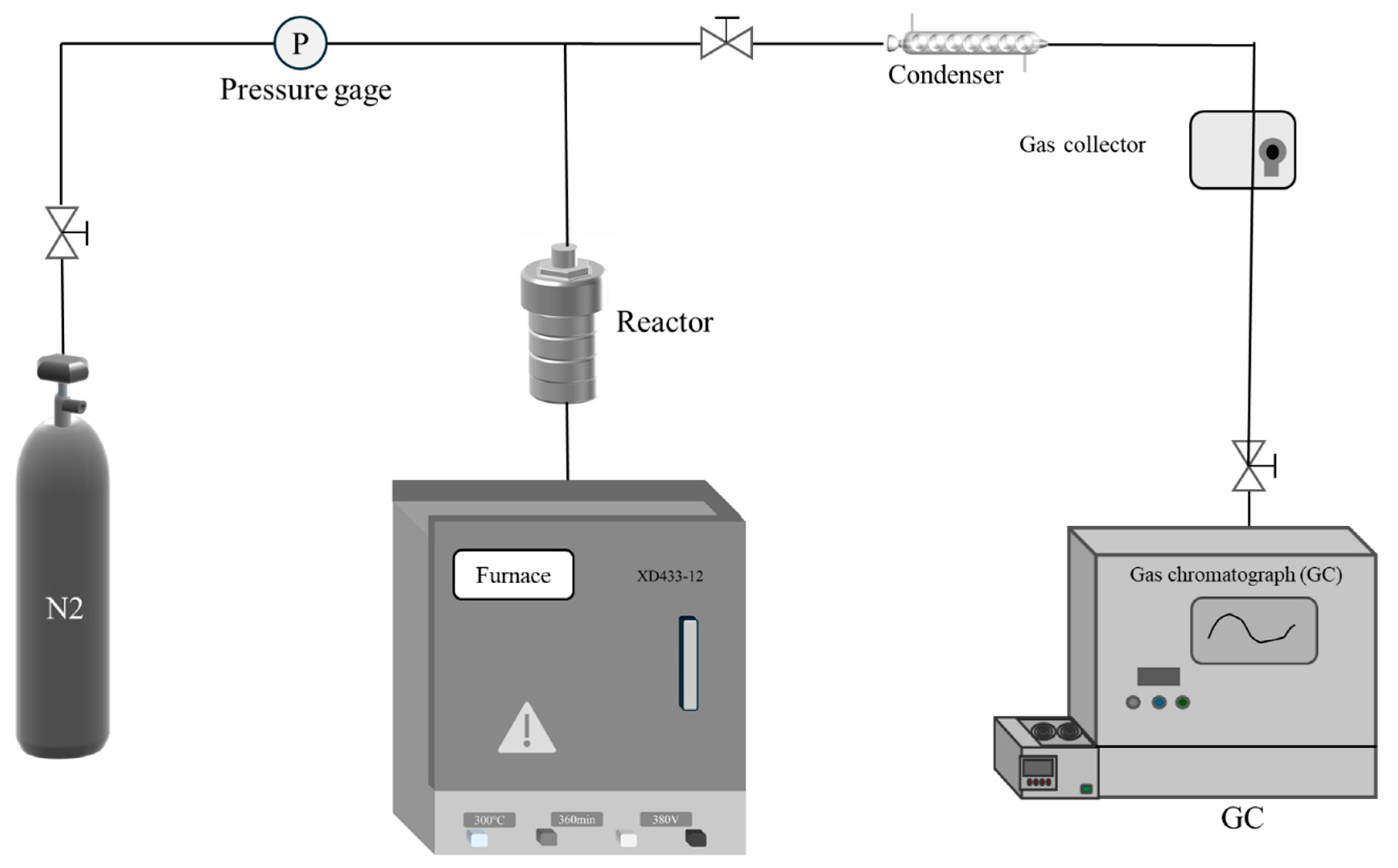
2.2. Experimental Procedure and Methods
2.3. Analysis Methods for Gaseous Products and Reaction Residues
- (1)
- Analysis of gaseous products
- (2)
- Elemental analysis
3. Results and Discussion
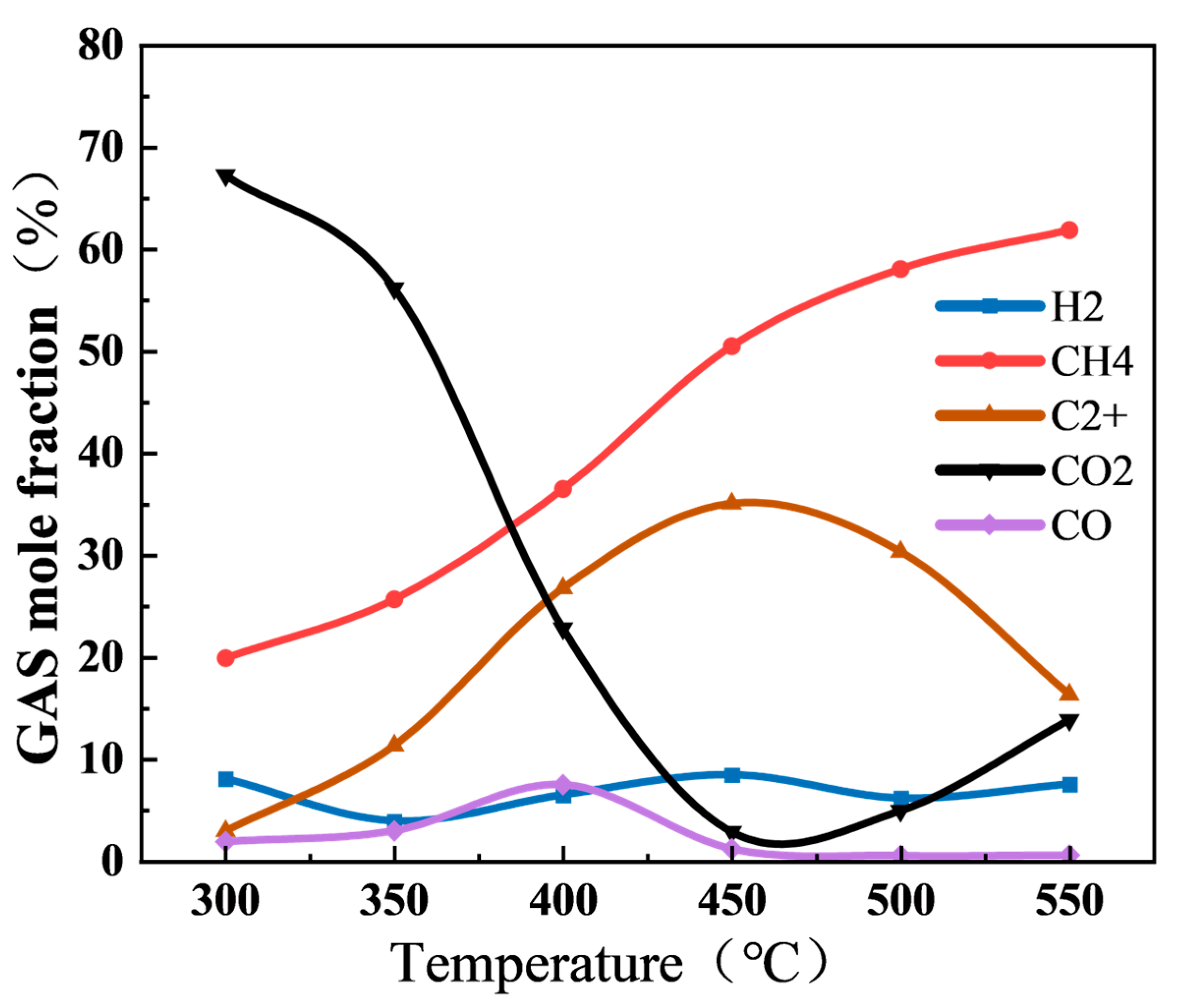
3.1. Effect of Temperature on Gas Composition
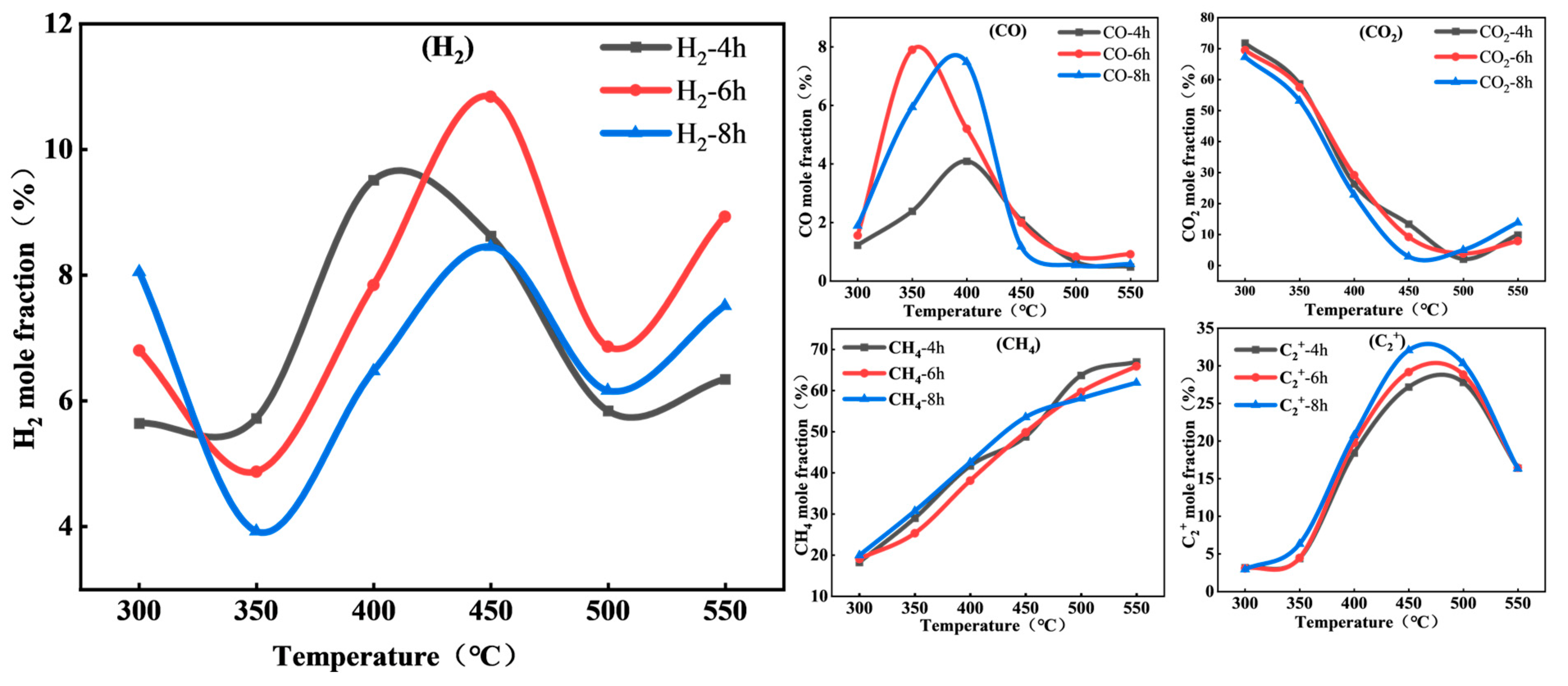
3.2. Effect of Reaction Time on Gas Composition and H2 Mole Fraction
3.3. Comparison of Maximum H2 Mole Fractions with Previous Studies
3.4. Elemental Analysis of Residues
4. Hydrogen-Production Mechanism
5. Conclusions
- (1)
- Under an inert N2 atmosphere and an oil-to-water ratio of 1:1, the in situ hydrogen-production process of heavy oil in the range of 300–550 °C can be qualitatively divided into three approximate stages: the deoxygenation activation stage (roughly 300–400 °C), the water–gas shift hydrogen-production stage (roughly 400–500 °C), and the coke conversion hydrogen-production stage (roughly 500–550 °C).
- (2)
- Temperature is the key factor controlling the dominant reaction pathway and H2 mole fraction. As the temperature increases, the system gradually shifts from deoxygenation and initial cracking to deep cracking, aromatization/condensation, and coke conversion, among which 400–500 °C is the temperature interval associated with relatively high H2 mole fractions under the investigated conditions.
- (3)
- Reaction time mainly affects the conversion degree of the system and gas distribution. At high temperatures, 6 h gives a better H2 mole fraction, whereas an excessively long residence time enhances hydrogen-consuming reactions and is associated with a lower H2 mole fraction.
- (4)
- High-temperature reactions significantly promote dehydrogenation, aromatization, and coking. Coke serves as an important intermediate carrier for sustained hydrogen production. At 550 °C, the H/C ratio of the dried bulk residual mixture decreases from 1.61 to 0.13, which is consistent with extensive dehydrogenation and the progressive formation of hydrogen-poor, condensed carbonaceous structures.
- (5)
- Based on the distribution of gaseous products, the effect of reaction time, and the elemental evolution characteristics of the residues, a stage-dependent reaction mechanism for heavy-oil in situ hydrogen production in the range of 300–550 °C is proposed, clarifying the continuous evolution pathway of deoxygenation activation, water–gas shift hydrogen production, and coke conversion hydrogen production, as well as their controlling roles in H2 generation.
Supplementary Materials
Author Contributions
Funding
Data Availability Statement
Conflicts of Interest
References
- Sun, H.; Wang, H.; Cao, X.; Shu, Q.; Fan, Z.; Wu, G.; Yang, Y.; Wu, Y. Innovations and Applications of the Thermal Recovery Techniques for Heavy Oil. Energy Geosci. 2024, 5, 100332. [Google Scholar] [CrossRef] [Scilit]
- Gomaa, S.; Salem, K.G.; El-Hoshoudy, A. Enhanced Heavy and Extra Heavy Oil Recovery: Current Status and New Trends. Petroleum 2024, 10, 399–410. [Google Scholar] [CrossRef] [Scilit]
- Yang, S.; Huang, S.; Jiang, Q.; Jiang, G.; Liu, Q.; Wang, Z.; Gong, R. In-Situ Solvents Generation Enhanced Steam Assisted Gravity Drainage (ISSG-SAGD): A Low Carbon and High-Efficiency Approach for Heavy Oil Recovery. Energy 2024, 291, 130370. [Google Scholar] [CrossRef] [Scilit]
- Wang, L.; Guo, J.; Li, C.; Xiong, R.; Chen, X.; Zhang, X. Advancements and Future Prospects in In-Situ Catalytic Technology for Heavy Oil Reservoirs in China: A Review. Fuel 2024, 374, 132376. [Google Scholar] [CrossRef] [Scilit]
- Demirci, O.K.; Çınar, C.; Kocakulak, T. Investigation of the Combined Use of Diesel and CNG Fuels on an HCCI Engine Using Response Surface Methodology (RSM). Sci. Iran. 2025, 32, 1–15. [Google Scholar] [CrossRef] [Scilit]
- Gülcan, H.E.; Demirci, O.K.; Erol, D.; Tunçer, E. Energy, Exergy and Exergoeconomic Analysis of a CI Engine Fuelled with Waste Frying Oil Biodiesel Blended with Waste Tyre Pyrolysis Oil and Higher Alcohols (Heptanol and Octanol): A Waste-to-Energy Approach. Biomass Bioenergy 2026, 207, 108787. [Google Scholar] [CrossRef] [Scilit]
- Yang, S.; Huang, S.; Jiang, Q.; Yu, C.; Zhou, X. Experimental Study of Hydrogen Generation from In-Situ Heavy Oil Gasification. Fuel 2022, 313, 122640. [Google Scholar] [CrossRef] [Scilit]
- Tang, X.; Pu, W.; Chen, Q.; Liu, R.; Yang, Y. A Comprehensive Study on Kinetics for Hydrogen Generation from Aquathermolysis Gasification of Heavy Crude Oil. Int. J. Hydrogen Energy 2023, 48, 39780–39790. [Google Scholar] [CrossRef] [Scilit]
- Song, P.; Li, Y.; Yin, Z.; Ifticene, M.A.; Yuan, Q. Simulation of Hydrogen Generation via In-Situ Combustion Gasification of Heavy Oil. Int. J. Hydrogen Energy 2024, 49, 925–936. [Google Scholar] [CrossRef] [Scilit]
- Liu, Y.; Yu, C.; Jiang, Q.; Liu, Y.; Fan, Z.; Deng, H.; Li, M.; Liu, Y.; Xiong, M. Kinetic Modeling of In-Situ Hydrogen Generation from Bitumen and Its Influencing Factors and Mechanisms Study. Fuel 2025, 385, 134155. [Google Scholar] [CrossRef] [Scilit]
- Okere, C.J.; Sheng, J.J. A New Modelling Approach for In-Situ Hydrogen Production from Heavy Oil Reservoirs: Sensitivity Analysis and Process Mechanisms. Energy 2024, 302, 131817. [Google Scholar] [CrossRef] [Scilit]
- Ifticene, M.; Yuan, Q. Numerical Modeling of In-Situ Hydrogen Production via Cyclic Air-Steam Injection in Heavy Oil Reservoirs. Int. J. Hydrogen Energy 2025, 129, 172–183. [Google Scholar] [CrossRef] [Scilit]
- Cheshkova, T.V.; Grinko, A.A.; Min, R.S.; Sagachenko, T.A. Structural Transformations of Heavy Oil Asphaltenes in the Course of Heat Treatment. Pet. Chem. 2022, 62, 214–221. [Google Scholar] [CrossRef] [Scilit]
- You, A.; Huang, S.; Gong, R.; Jiang, Q.; Fan, D.; Zhao, H. Experimental Study on the Mechanism of Associated Gas Generation by Heavy Oil Aquathermolysis and Thermal Cracking during Steam Injection. J. Anal. Appl. Pyrolysis 2024, 182, 106722. [Google Scholar] [CrossRef] [Scilit]
- Liu, X.-S.; Wang, L.-T.; Huang, Z.-B.; Yuan, P.-Q. Characteristics of Hydrogen Abstraction Involved in Thermal Processing of Heavy Oil. Chem. Eng. Sci. 2024, 298, 120346. [Google Scholar] [CrossRef] [Scilit]
- Liu, J.; Jiang, X.; Shen, J.; Zhang, H. Pyrolysis of Superfine Pulverized Coal. Part 2. Mechanisms of Carbon Monoxide Formation. Energy Convers. Manag. 2014, 87, 1039–1049. [Google Scholar] [CrossRef] [Scilit]
- Wang, C.-W.; Peng, X.-L.; Liu, J.-Y.; Jiang, R.; Li, X.-P.; Liu, Y.-S.; Liu, S.-Y.; Wei, L.-S.; Zhang, L.-H.; Jia, C.-S. A Novel Formulation Representation of the Equilibrium Constant for Water Gas Shift Reaction. Int. J. Hydrogen Energy 2022, 47, 27821–27838. [Google Scholar] [CrossRef] [Scilit]
- Ang, M.; Oemar, U.; Kathiraser, Y.; Saw, E.; Lew, C.; Du, Y.; Borgna, A.; Kawi, S. High-Temperature Water-Gas Shift Reaction over Ni/xK/CeO2 Catalysts: Suppression of Methanation via Formation of Bridging Carbonyls. J. Catal. 2015, 329, 130–143. [Google Scholar] [CrossRef] [Scilit]
- Byeon, H.-J.; Jeon, K.-W.; Kim, H.-M.; Lee, Y.-H.; Heo, Y.-S.; Park, M.-J.; Jeong, D.-W. Promotion of Methanation Suppression by Alkali and Alkaline Earth Metals in Ni-CeO2 Catalysts for Water-Gas Shift Reaction Using Waste-Derived Synthesis Gas. Fuel Process. Technol. 2022, 231, 107229. [Google Scholar] [CrossRef] [Scilit]
- Lim, J.Y.; McGregor, J.; Sederman, A.J.; Dennis, J.S. Kinetic Studies of the Methanation of CO over a Ni/γ-Al2O3 Catalyst Using a Batch Reactor. Chem. Eng. Sci. 2016, 146, 316–336. [Google Scholar] [CrossRef] [Scilit]
- Saw, E.; Oemar, U.; Tan, X.; Du, Y.; Borgna, A.; Hidajat, K.; Kawi, S. Bimetallic Ni–Cu Catalyst Supported on CeO2 for High-Temperature Water-Gas Shift Reaction: Methane Suppression via Enhanced CO Adsorption. J. Catal. 2014, 314, 32–46. [Google Scholar] [CrossRef] [Scilit]
- Wang, J.; Anthony, E.J. A Study of Thermal-Cracking Behavior of Asphaltenes. Chem. Eng. Sci. 2003, 58, 157–162. [Google Scholar] [CrossRef] [Scilit]
- Wang, F.; Wei, Q.; Li, K.; Biney, B.W.; Liu, H.; Chen, K.; Wang, Z.; Guo, A. Coke Formation of Heavy Oil during Thermal Cracking: New Insights into the Effect of Olefinic-Bond-Containing Aromatics. Fuel 2023, 336, 127138. [Google Scholar] [CrossRef] [Scilit]
- Félix, G.; Djimasbe, R.; Tirado, A.; Varfolomeev, M.A.; Ancheyta, J. Kinetic Study for the Ashalcha Heavy Crude Oil Upgrading at Supercritical Water Conditions. Fuel 2025, 380, 133145. [Google Scholar] [CrossRef] [Scilit]
- Zhao, R.; Wang, T.; Ren, H.; Jiang, N.; Li, X.; Lv, W.; Wang, H.; Bai, S. A Strategy for Enhanced Hydrogen Generation: The Effect of Varying Atmospheres on In-Situ Gasification in Heavy Oil Reservoirs. Appl. Energy 2024, 376, 124168. [Google Scholar] [CrossRef] [Scilit]
- Kapadia, P.; Kallos, M.; Gates, I. A Review of Pyrolysis, Aquathermolysis, and Oxidation of Athabasca Bitumen. Fuel Process. Technol. 2015, 131, 270–289. [Google Scholar] [CrossRef] [Scilit]
- Fan, H.; Zhang, Y.; Lin, Y. The Catalytic Effects of Minerals on Aquathermolysis of Heavy Oils. Fuel 2004, 83, 2035–2039. [Google Scholar] [CrossRef] [Scilit]
- Mullins, O.C. The Modified Yen Model. Energy Fuels 2010, 24, 2179–2207. [Google Scholar] [CrossRef] [Scilit]
- Ma, Y.; Ge, Z.; Zeng, M.; Zha, Z.; Tao, Y.; Zhang, H. Reactivity and Performance of Steam Gasification during Biomass Batch Feeding. Carbon Resour. Convers. 2023, 6, 229–237. [Google Scholar] [CrossRef] [Scilit]
- Li, N.; Zhang, X.; Zhang, Q.; Chen, L.; Ma, L.; Xiao, X. Reactivity and Structural Changes of Asphaltene during the Supercritical Water Upgrading Process. Fuel 2020, 278, 118331. [Google Scholar] [CrossRef] [Scilit]
- Muraza, O.; Galadima, A. Aquathermolysis of Heavy Oil: A Review and Perspective on Catalyst Development. Fuel 2015, 157, 219–231. [Google Scholar] [CrossRef] [Scilit]
- Alvarez, E.; Marroquín, G.; Trejo, F.; Centeno, G.; Ancheyta, J.; Díaz, J.A. Pyrolysis Kinetics of Atmospheric Residue and Its SARA Fractions. Fuel 2011, 90, 3602–3607. [Google Scholar] [CrossRef] [Scilit]
- Wang, F.; Zhang, Z.; Zhang, X.; Jiao, S.; Yang, Y.; Jin, X.; Liu, H.; Wang, Z.; Guo, A. In-Situ Hydrogenation of Heavy Oil via Medium-Temperature Water-Gas Shift Reaction Enhanced with Supercritical n-Heptane: Improved PAHs Hydrogenation Effectiveness and Upgraded Thermal Cracking Performance. Fuel 2026, 414, 138312. [Google Scholar] [CrossRef] [Scilit]



| Element | [wt%] |
|---|---|
| Carbon | 3.02 |
| Oxygen | 37.31 |
| Silicon | 32.81 |
| Magnesium | 0.35 |
| Aluminum | 17.48 |
| Iron | 5.95 |
| Cobalt | 1.13 |
| Nickel | 1.95 |
| Total | 100 |
| Reference | Feedstock | Method | Reaction Conditions | Maximum H2 (mol%) |
|---|---|---|---|---|
| Song [9] | Athabasca bitumen | Numerical simulation | Air/steam; 800 °C; 4.0 MPa | 34 |
| Liu [10] | CA-28 bitumen | Numerical simulation | N2; 425 °C; 6 MPa; 10 d | 28.6 |
| You [14] | Xinjiang heavy oil | Batch reactor experiment | N2; 340 °C; 24 h | 6.8 |
| Zhao [25] | Shengli heavy oil | Kinetic cell experiment | mixed atmosphere; 600 °C | 1.29 |
| Present study | Liaohe heavy oil | Batch reactor experiment | N2; 450 °C; 6 h | 10.84 |
| Sample | Temperature | Elemental Composition (wt%) | ||||
|---|---|---|---|---|---|---|
| C | H | N | S | H/C | ||
| Original oil sample | -- | 78.90 | 10.64 | 0.94 | 0.32 | 1.61 |
| Residual mixture | 550 | 3.82 | 0.04 | 0.06 | 0.02 | 0.13 |
Disclaimer/Publisher’s Note: The statements, opinions and data contained in all publications are solely those of the individual author(s) and contributor(s) and not of MDPI and/or the editor(s). MDPI and/or the editor(s) disclaim responsibility for any injury to people or property resulting from any ideas, methods, instructions or products referred to in the content. |
© 2026 by the authors. Licensee MDPI, Basel, Switzerland. This article is an open access article distributed under the terms and conditions of the Creative Commons Attribution (CC BY) license.
Share and Cite
Tang, J.; Deng, Y.; Lv, B.; Yu, C.; Guan, W.; Jiang, Y. Mechanistic Analysis of Stage-Dependent In Situ Hydrogen Production from Heavy Oil Under Nitrogen Atmosphere. Processes 2026, 14, 2962. https://doi.org/10.3390/pr14182962
Tang J, Deng Y, Lv B, Yu C, Guan W, Jiang Y. Mechanistic Analysis of Stage-Dependent In Situ Hydrogen Production from Heavy Oil Under Nitrogen Atmosphere. Processes. 2026; 14(18):2962. https://doi.org/10.3390/pr14182962
Chicago/Turabian StyleTang, Junshi, Ye Deng, Bolin Lv, Chunsheng Yu, Wenlong Guan, and Youwei Jiang. 2026. "Mechanistic Analysis of Stage-Dependent In Situ Hydrogen Production from Heavy Oil Under Nitrogen Atmosphere" Processes 14, no. 18: 2962. https://doi.org/10.3390/pr14182962
APA StyleTang, J., Deng, Y., Lv, B., Yu, C., Guan, W., & Jiang, Y. (2026). Mechanistic Analysis of Stage-Dependent In Situ Hydrogen Production from Heavy Oil Under Nitrogen Atmosphere. Processes, 14(18), 2962. https://doi.org/10.3390/pr14182962