Article

Adaptive Connectivity and Robust Plane Extraction from Microseismic Event Clouds: A Systematic Benchmark and Conditional Case Study


1
Research Institute of Oil Production Engineering of Daqing Oilfield Co., Ltd., Daqing 163453, China
2
Heilongjiang Provincial Key Laboratory of Oil and Gas Reservoir Stimulation, Daqing 163453, China
3
State Key Laboratory of Continental Shale Oil, Daqing 163453, China
4
National Key Laboratory of Oil and Gas Resources and Engineering, China University of Petroleum (Beijing), Beijing 102249, China
5
Xinjiang Key Laboratory of Petroleum Engineering Pilot Test, Karamay 834000, China
6
College of Petroleum Engineering, China University of Petroleum (Beijing), Beijing 102249, China
*
Authors to whom correspondence should be addressed.
Processes 2026, 14(18), 2961; https://doi.org/10.3390/pr14182961
Submission received: 12 August 2026 / Revised: 14 September 2026 / Accepted: 15 September 2026 / Published: 17 September 2026
(This article belongs to the Section Petroleum and Low-Carbon Energy Process Engineering)

Abstract

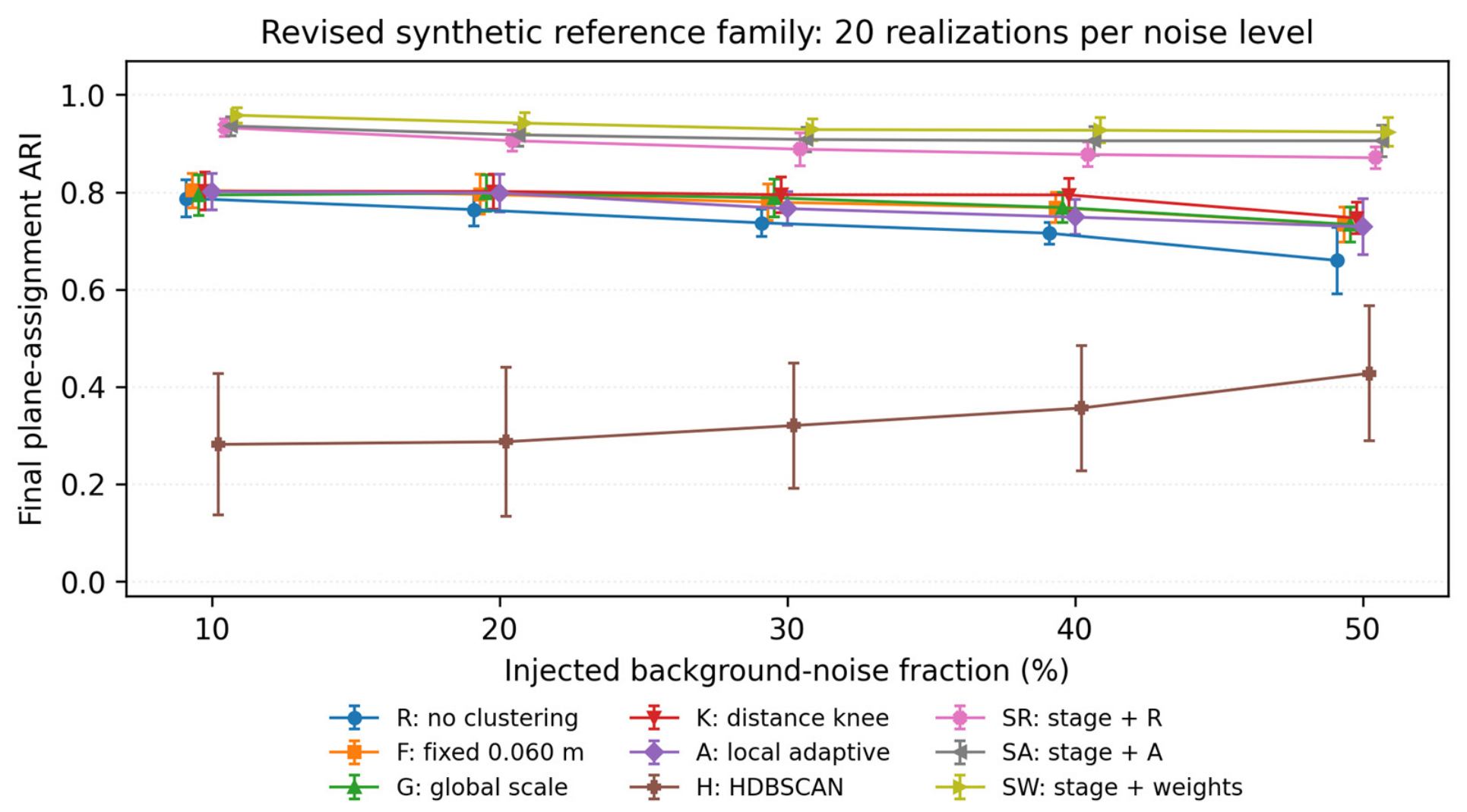
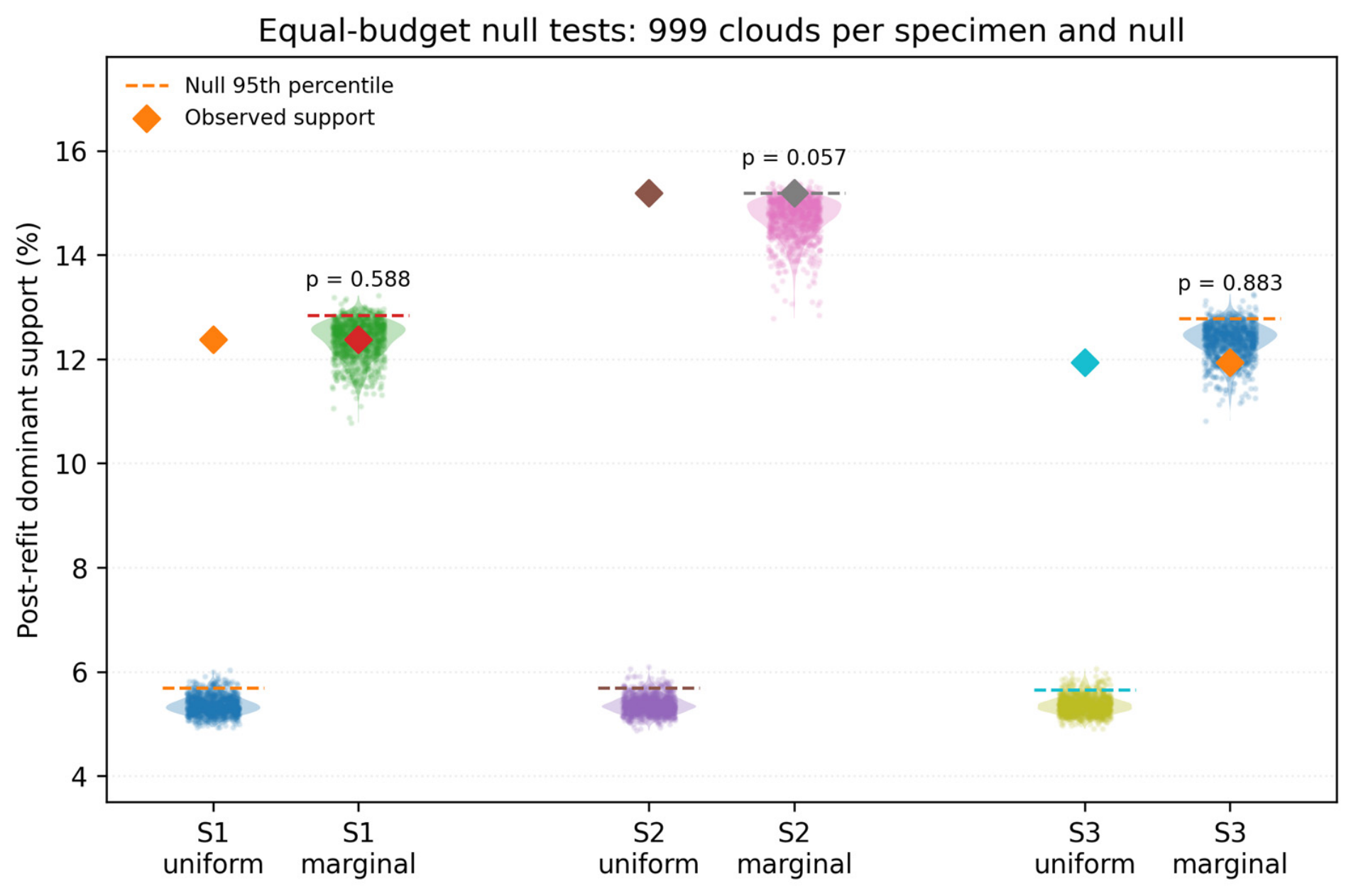
Two-meter-scale true-triaxial hydraulic-fracturing models involve a large monitoring volume, strongly nonuniform microseismic event densities, and substantial vibration and background noise, making conventional fixed-scale clustering or direct geometric fitting prone to cluster fragmentation, event-band mixing, and low-support false planes. To address these limitations, this study proposes an automatic workflow for extracting dominant event planes from noisy microseismic point clouds. After quality control and spatial-boundary screening, nearest-neighbor statistics are used for adaptive density analysis, followed by support-first RANSAC plane fitting and PCA-based parameter refitting. Parameter sensitivity, null-model testing, and subsampling stability are further used to evaluate robustness. Extended synthetic tests demonstrate that the workflow can identify multiple planes under varying noise levels, event densities, plane spacing, and localization errors, while stage constraints are particularly important for separating spatially overlapping event bands. The method was then applied to three 2 m × 2 m × 1 m tight-sandstone fracturing experiments. For each specimen, 3200 high-quality candidate events were retained from approximately 10,000 located events. The extracted dominant subhorizontal event planes showed support fractions of 12.38%, 15.19%, and 11.94%, dips of 0.97°, 0.59°, and 1.83°, and RMS residuals of 10.96, 10.43, and 11.12 mm, respectively. The results indicate that the proposed workflow can consistently extract coherent dominant event planes from high-noise, nonuniform microseismic datasets in large-scale physical models. These planes represent dominant spatial structures of the located events and should not be interpreted directly as actual opened or conductive hydraulic-fracture surfaces.
Keywords: microseismic event cloud; acoustic emission; adaptive density connectivity; RANSAC; planar consensus; synthetic benchmark; conditional null model; reproducibility microseismic event cloud; acoustic emission; adaptive density connectivity; RANSAC; planar consensus; synthetic benchmark; conditional null model; reproducibility