This is an early access version, the complete PDF, HTML, and XML versions will be available soon.
Article

Experimental and Kinetic Modeling Study on the Autoignition of Ammonia/Propane Mixtures

1
School of Materials and Energy, Guangdong University of Technology, Guangzhou 510006, China
2
School of Ocean Engineering, Guangzhou Maritime University, Guangzhou 510725, China
3
College of Vehicle and Traffic Engineering, Henan University of Science and Technology, Luoyang 471003, China
*
Authors to whom correspondence should be addressed.
These authors contribute equally to this work.
Processes 2026, 14(18), 2953; https://doi.org/10.3390/pr14182953
Submission received: 18 August 2026 / Revised: 10 September 2026 / Accepted: 12 September 2026 / Published: 16 September 2026
(This article belongs to the Section Chemical Processes and Systems)

Abstract

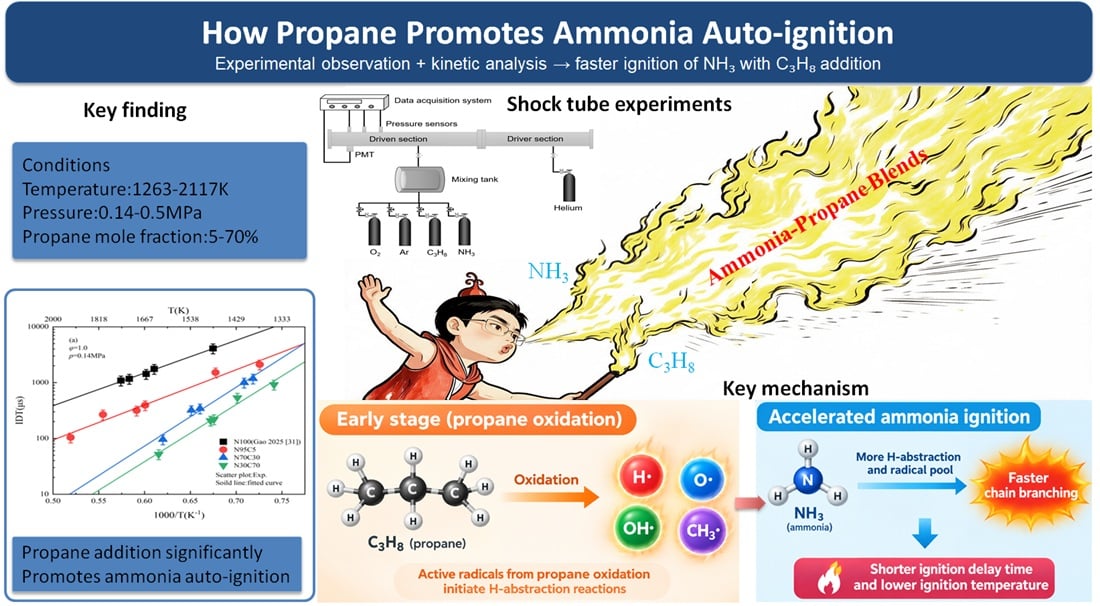
Utilizing ammonia (NH3) as a zero-carbon alternative fuel requires a deeper understanding of its combustion characteristics, with ignition delay time (IDT) serving as a critical descriptive parameter. To investigate the effects of propane (C3H8) addition on NH3 ignition at high temperatures, the ignition delay times of NH3/C3H8 blends were systematically measured using a shock tube over a wide range of conditions: temperatures of 1263–2117 K, pressures of 0.14–0.5 MPa, equivalence ratios of 0.5–2.0 and propane mole fractions of 5–70%. The results indicate that propane addition significantly promotes ammonia ignition. Under stoichiometric and 1.4 atm pressure conditions, the addition of C3H8 to pure NH3 reduces the ignition delay time by approximately fivefold, allowing auto-ignition to occur at a lower temperature. Furthermore, detailed chemical kinetic mechanisms from the literature were adopted for numerical simulations and validated against the newly acquired experimental data. Kinetic analysis reveals that the propane addition does not alter the main oxidation pathways of ammonia, while it triggers C-N cross-reactions at higher blending ratios (>30%). The active radicals generated during the early stages of propane oxidation accelerate H-abstraction reactions, serving as the key mechanism responsible for the shortened ignition delay times and promoted ignition.
Keywords: ammonia; propane; shock tube; ignition delay time; chemical kinetics ammonia; propane; shock tube; ignition delay time; chemical kinetics
Graphical Abstract