Article

Modulation of Electrical Charge Transfer in Cornstarch-Based Films Through Carbonized Polymer Dots and Their Validation as Electrodes in Triboelectric Nanogenerators


by
Jennifer A. Ayala-Arenas
1,
José G. Quiñones-Galván
2,
Enrique Campos-González
3,
Victor H. Romero-Arellano
1 and
José M. Blancas-Flores
1,*
1
Departamento de Ciencias Básicas y Aplicadas, Centro Universitario de Tonalá, Universidad de Guadalajara, Tonalá 45425, Jalisco, Mexico
2
Departamento de Física, Centro Universitario de Ciencias Exactas e Ingenierías, Universidad de Guadalajara, Guadalajara 44430, Mexico
3
Investigadores por México SECIHTI-Departamento de Física, Instituto Nacional de Investigaciones Nucleares, Apdo. Postal 18-1027, México 11801, Mexico
*
Author to whom correspondence should be addressed.
Processes 2026, 14(18), 2941; https://doi.org/10.3390/pr14182941
Submission received: 11 August 2026 / Revised: 10 September 2026 / Accepted: 11 September 2026 / Published: 16 September 2026

Abstract

In this study, electrically conductive cornstarch-based films are developed by incorporating carbonized polymer dots (CPDs), and their charge-transfer capability is evaluated through their electrical characterization and their validation as electrodes in a triboelectric nanogenerator (TENG). The incorporation of controlled amounts of CPDs promoted the formation of conductive pathways within the cornstarch matrix, improved charge transport, and reduced electrical resistance, with a maximum conductivity of 196.602 µΩ−1 cm−1 obtained for the optimized composition. Spectroscopic analyses revealed that this behavior arises from interfacial interactions between the hydroxyl-rich cornstarch chains and functionalized nitrogen-containing CPDs, which facilitate charge transfer within the polymer matrix. An optimal CPD quantity provides a balance between conductive carbon domains and polar surface functionalities, maximizing charge mobility without inducing aggregation. The improved electrical response of the optimized composite film was further validated by implementing it as an electrode in a triboelectric nanogenerator, which exhibited a current of 2.087 µA, corresponding to an approximately 334-fold enhancement compared to a reference device based on pristine cornstarch. These results firstly demonstrate that CPDs provide an effective route for modulating electrical charge transfer in cornstarch-based films and secondly highlight the potential of sustainable polymer composites as low-cost conductive materials for flexible electronics, biodegradable electrodes, and energy-related applications.

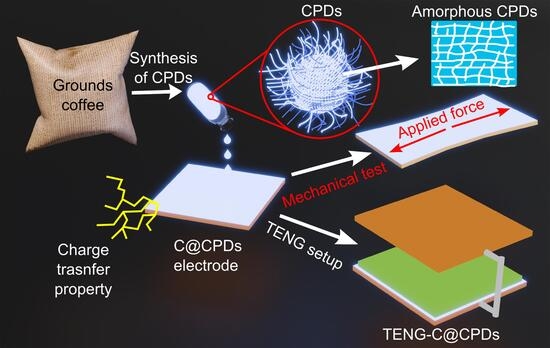
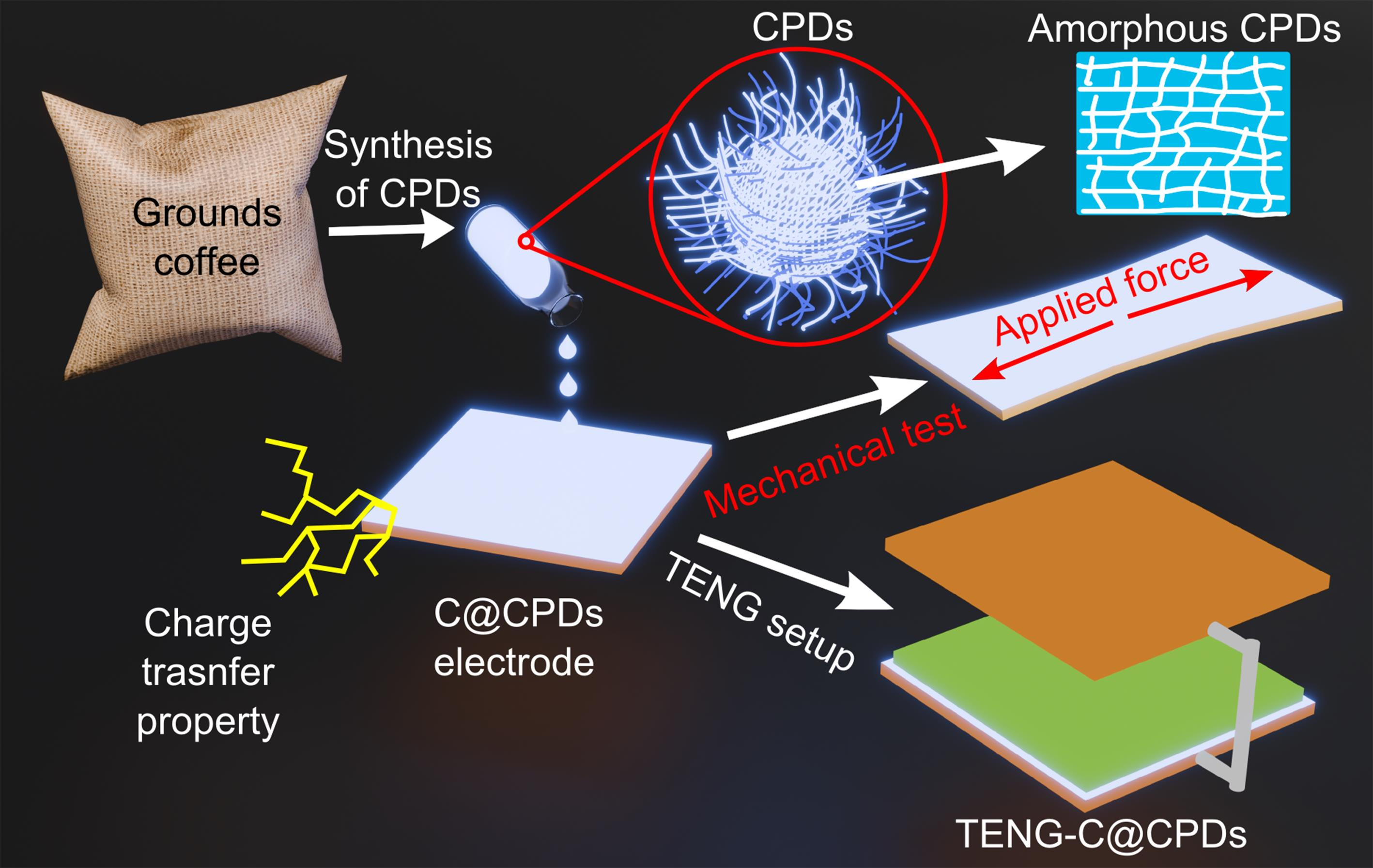
Graphical Abstract

1. Introduction

The rapid growth of flexible electronics, wearable devices, and sustainable technologies has stimulated the development of materials with mechanical flexibility, low environmental impact, and electrical functionality [1,2,3]. Among the approaches explored to impart electrical functionality to polymeric materials, the incorporation of conductive nanostructures has proven particularly effective. Metallic nanoparticles, metal oxides, carbon nanotubes, graphene, and carbon black have been widely employed to improve charge transport and electrical performance in polymer matrices [4,5,6,7,8,9,10,11,12,13,14]. Their incorporation enables the modulation of charge-transfer processes within the polymer matrix, providing a versatile strategy for tailoring the electrical properties of polymer-based materials without compromising their processability or mechanical flexibility.
In parallel with the development of electrically functional polymeric materials, triboelectric nanogenerators (TENGs) have attracted considerable attention as platforms requiring flexible electrodes that can collect, transport, and sustain electrical charge under dynamic operating conditions [15,16,17,18,19,20,21,22]. Since the electrical output of a TENG depends not only on triboelectric charge generation, but also on the ability of the electrode to collect, transport, and sustain electrical charge, considerable attention has been devoted to the development of flexible electrode materials based on polymer–nanomaterial composites [23,24,25,26,27,28,29,30,31,32]. These materials offer advantages such as mechanical flexibility, low weight, and compatibility with wearable and deformable electronic systems [33]. However, most polymeric materials employed for these applications are derived from non-renewable sources and are not biodegradable, raising concerns regarding their long-term environmental impact.
In this context, biodegradable polymeric materials have attracted increasing attention as environmentally friendly alternatives to conventional petroleum-derived materials for electronic and energy-harvesting applications. Cornstarch is particularly attractive because of its biodegradability, renewability, low cost, abundance, and ease of processing [34,35]. Furthermore, its hydroxyl-rich structure provides multiple opportunities for interaction with functional nanomaterials. Carbonized polymer dots (CPDs), on the other hand, possess nanoscale dimensions, partially graphitized carbon domains, and abundant oxygen- and nitrogen-containing surface functionalities, making them promising candidates for modifying charge-transport behavior within polymer matrices [36,37]. Despite the growing interest in sustainable polymeric materials with electrical functionality, the mechanisms by which carbonized polymer dots modulate electrical charge transfer in biodegradable starch matrices remain poorly understood. In particular, the relationships between CPD quantity, interfacial interactions, conductive pathway formation, and the resulting electrical response have not been systematically investigated.
In this work, the modulation of electrical charge transfer in cornstarch-based polymer films is investigated by incorporating controlled amounts of carbonized polymer dots (CPDs) derived from spent coffee grounds. Particular emphasis is placed on understanding how CPD content influences interfacial interactions, conductive pathway formation, and charge-transport behavior within the polymer matrix. Possible charge-transfer pathways include hydrogen-bonding and polar interactions between cornstarch hydroxyl groups and CPD surface functionalities, as well as charge hopping through sp2-rich carbon domains and nitrogen-containing sites. Finally, the electrical response of the films is evaluated through conductivity measurements and by implementing them as electrodes in a vertical contact triboelectric nanogenerator using PDMS as a reference dielectric material, providing indirect validation of their charge-transfer capability under dynamic electrostatic excitation.

2. Materials and Methods

2.1. Materials

The materials used to develop the TENG presented in this study were ground coffee, alimentary-grade cornstarch, glycerin, ethanol, distilled and deionized water, and Sylgard® 184 silicone (elastomer and curing agent) obtained from Sigma-Aldrich (Naucalpa de Juárez, Mexico).

2.2. Synthesis of Carbonized Polymer Dots

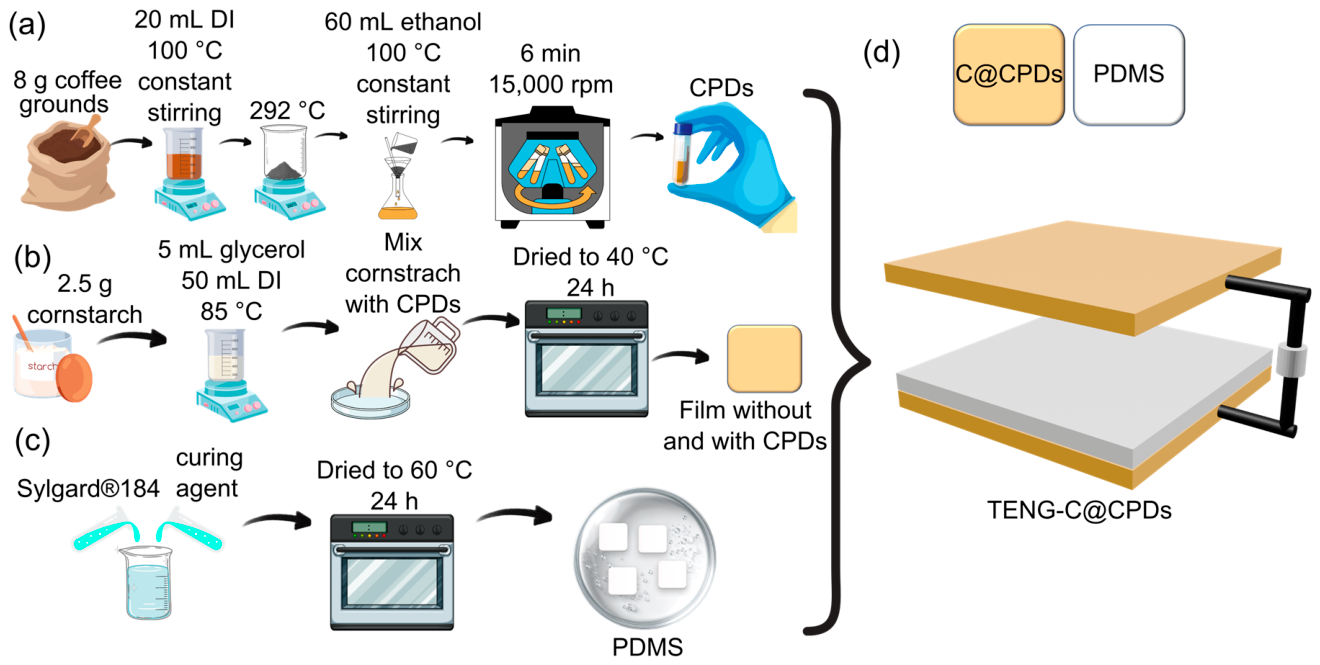
To synthesize the CPDs, a thermally assisted partial carbonization method was employed (Figure 1a). A total of 8 g of ground coffee was dispersed in 20 mL of distilled water, and the mixture was stirred continuously for 30 min at 100 °C using a hotplate stirrer, IKA-Werke GmbH & Co. KG, Alemania, Staufen, which promotes hydrolysis. Subsequently, the water was, and partial carbonization was carried out by gradually increasing the temperature up to 292 °C and maintaining it for 20 min under continuous stirring. Finally, the powder was dispersed in 60 mL of ethanol and sequentially filtered using Whatman filters, Whatman filters (Cytiva, Reino Unido, Maidstone) with pore sizes of 8 µm and 1 µm. The resulting suspension was then centrifuged at 15,000 rpm for 6 min to remove large particles. This process yielded a yellow-colored colloidal suspension of carbonized polymer dots.

2.3. Preparation of Polymeric Films

A total of 2.5 g of cornstarch was dispersed in 50 mL of deionized water and heated to 85 °C under constant stirring for 10 min. Subsequently, 5 mL of glycerol was added, and the mixture was continuously stirred until approximately half of the water had evaporated. This step facilitates polymer chain interactions. The resulting gel was cast into molds and dried in an oven at 40 °C for 24 h (Figure 1b), obtaining a flexible polymer matrix for use as a support material for CPDs.
In addition, the PDMS film was prepared by mixing the Sylgard® 184 silicone elastomer base with the curing agent at a mass ratio of 10:1. Once thoroughly mixed, the mixture was cast into molds and cured in an oven at 60 °C for 24 h, as shown in Figure 1c.
Composite cornstarch-based films (C@CPDs) were prepared by depositing CPDs onto preformed cornstarch-based films. Pristine cornstarch-based films were cut into samples with dimensions of 3 × 3 × 0.041 cm, and controlled amounts of CPDs (2.5, 5, 25, 35, 50, 100, 200, and 1000 µL) were directly dispersed onto the surface of each film by pipetting, ensuring uniform surface coverage. The films were then left to dry at room temperature, allowing the CPDs to diffuse into the polymer matrix during solvent evaporation. To preserve the deposited CPDs and avoid their removal from the film surface, no immersion, rehydration, or post-deposition washing was performed. In parallel, PDMS films were cut into squares with an area of 9 cm2 and a thickness of approximately 0.082 ± 0.001 cm.

2.4. Design of the Triboelectric Nanogenerator

The vertical contact-mode triboelectric nanogenerator was constructed by aligning the composite cornstarch-based films in a parallel configuration and mounting them onto a custom-built mechanical actuation system. The PDMS layer was positioned between the films, serving as the dielectric component, while the composite cornstarch-based films acted as triboelectric electrodes (Figure 1d). Conductive wires were connected to each electrode to enable electrical-performance measurements. The system operated under cyclic vertical compression and release, with a maximum displacement of 5.5 mm, an average applied force of 4 N, and a frequency of 24 Hz, as these parameters are close to those employed in our previous studies and have shown reliable performance [38,39]. Additionally, all TENG electrical outputs were rectified. To confirm that the recorded signals genuinely originate from the TENG device and are free of parasitic noise or measurement artifacts, we performed a switching-polarity test on the raw AC voltage signal. The open-circuit voltage was recorded under both forward and reverse electrical connections before any rectification (more details in Supporting Information (Figure S4)), and the measurements were performed under ambient laboratory conditions at room temperature. The assembled systems were labeled as follows: TENG-C for the reference system (film without CPDs) and TENG-CPDsxxxx for the systems containing CPDs, where “xxxx” corresponds to the amount of CPDs used in microliters.

2.5. Characterization Techniques of CPDs

CPDs were characterized by UV-Vis spectroscopy (V-770 EX, JASCO, Tokyo, Japan), Fourier Transform Infrared Spectroscopy (FT-IR) (Alpha, Bruker, Ettlingen, Germany), X-ray photoelectron spectroscopy (XPS) (K-Alpha spectrometer (Thermo Scientific, East Grinstead, UK) equipped with a monochromatic Al Kα radiation source (1486.6 eV)), fluorescence spectroscopy (Acton spectrometer (Acton Research Corp., Acton, MA, USA) equipped with a Hamamatsu photomultiplier tube (Hamamatsu Photonics K.K., Hamamatsu, Japan)), Transmission Electron Microscopy (TEM) (Jeol JEM 2010, Tokyo, Japan).

2.6. Characterization of Cornstarch and Composite Cornstarch-Based Films

Cornstarch-based film was characterized by Fourier Transform Infrared Spectroscopy (FT-IR), X-ray diffraction (XRD), ( Malvern Panalytical, Almelo, Países bajos), and X-ray photoelectron spectroscopy (XPS) (Thermo Scientific K-Alpha), and analyses of mechanical properties were conducted at a deformation rate of 50 mm/min using a United Model SFM-10 universal testing machine (United Testing Systems, Fullerton, CA, USA).

2.7. Electrical Characterization Techniques

The electrical resistance of the composite cornstarch-based films was measured using a picoammeter (Keithley 6485, Solon, OH, USA); the TENG devices’ electrical performance was characterized using a digital storage oscilloscope (UTD4204C, Uni-Trend Technology Co., Ltd., Dongguan, China); and the output voltage and current values were determined by averaging the peak voltage and peak current readings obtained under cyclic mechanical excitation.

3. Results and Discussion

3.1. Characterization of CPD Nanostructures

3.1.1. Optical Characterization of CPDs

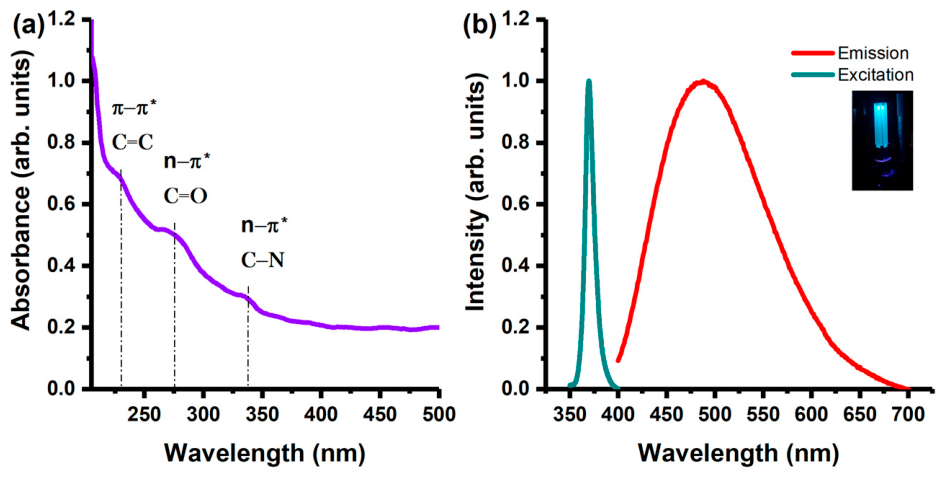
Figure 2a shows the UV–Vis absorption spectrum of the CPDs, which presents three main bands at 228, 278, and 337 nm. The absorption at 228 nm is attributed to π–π* transitions of C=C bonds in sp2-hybridized carbon domains, while the band at 278 nm corresponds to n–π* transitions associated with C=O groups and/or disordered aromatic domains. The feature centered at 337 nm is assigned to n–π* transitions related to nitrogen-containing surface states, such as C–N functional groups formed during the carbonization process [40,41,42,43]. Figure 2b shows the excitation spectrum of the 370 nm LED source (Alonefire, Shenzhen, China), whose wavelength lies close to the C–N absorption band, favoring electronic transitions from these surface-related states.
Figure 2b also shows the photoluminescence spectrum of the CPDs, which exhibits a broad emission band extending from 400 to 650 nm, with a maximum centered at 488 nm, characteristic of blue-region fluorescence. This emission is primarily attributed to surface-state-related electronic transitions, preferentially accessed through n–π* excitation pathways, whereas far UV excitation is commonly associated with π–π* transitions within sp2 carbon domains. The presence of surface functional groups, particularly nitrogen-containing species, promotes exciton trapping and enhances radiative recombination, resulting in improved luminescence efficiency [44].

3.1.2. Morphological and Structural Characterization of CPDs

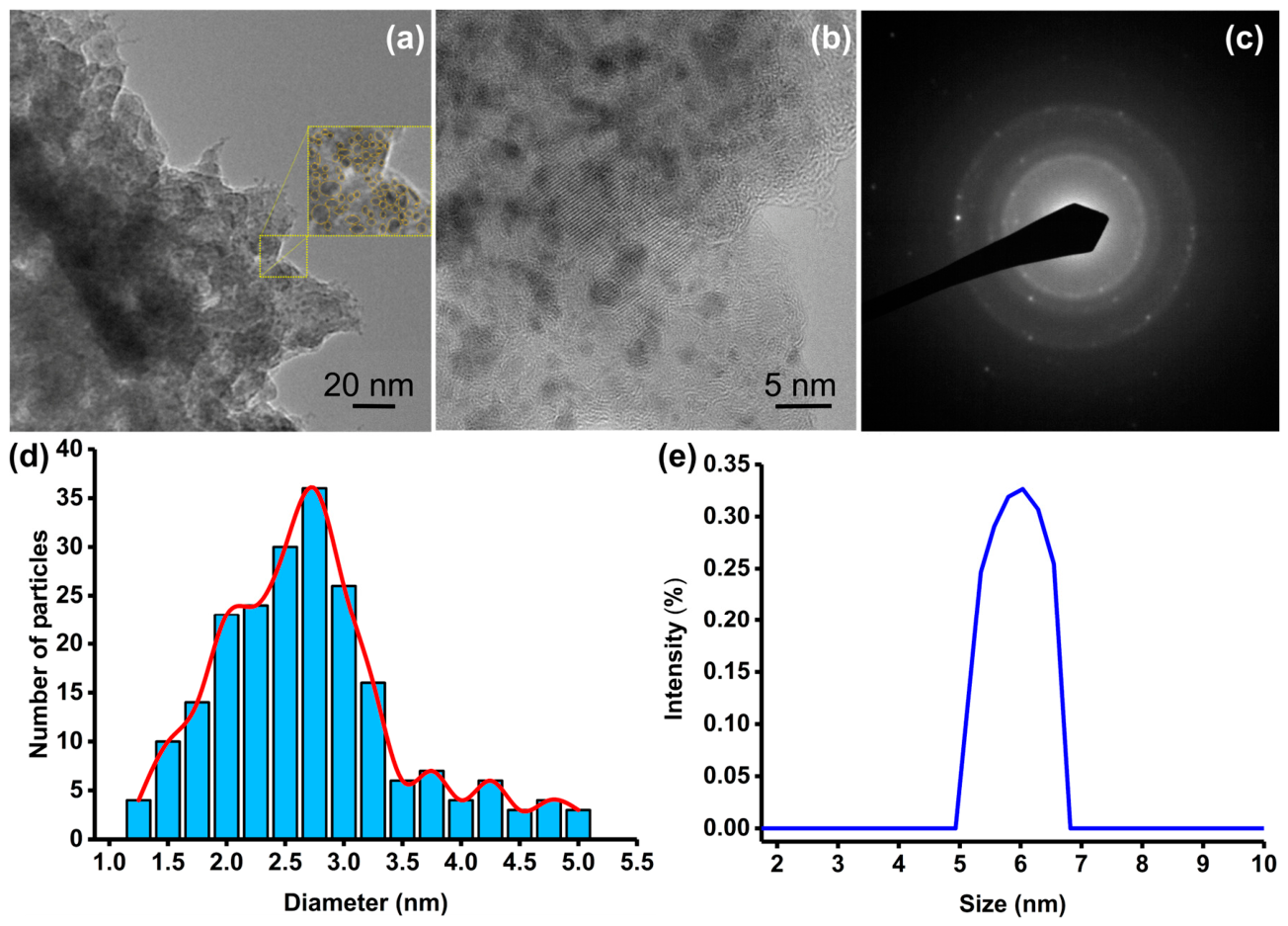
The morphology and structure of the CPDs were examined by TEM. Figure 3a shows a polydisperse population of quasi-spherical nanoparticles, while Figure 3b presents a high-resolution image revealing predominantly amorphous contrast with only occasional localized lattice fringes, indicating highly disordered carbon structures with limited short-range order and the absence of well-defined graphitic domains. This is further supported by the SAED pattern (Figure 3c), which shows broad diffuse rings, associated with short-range graphitic-like correlations. The absence of sharp diffraction spots confirms the lack of long-range crystallographic order, consistent with predominantly amorphous carbon [45,46].
The particle size distribution obtained from TEM (Figure 3d) shows diameters ranging from approximately 1.25 to 5 nm, with an average size of 2.72 ± 0.08 nm calculated from 216 individual CPDs using ImageJ software, version 1.52a. Complementary DLS measurements (Figure 3e) yield an average hydrodynamic diameter of ~6 nm, which reflects the contribution of surface functional groups and the solvation layer and does not indicate significant particle aggregation.

3.1.3. XPS characterization of CPDs

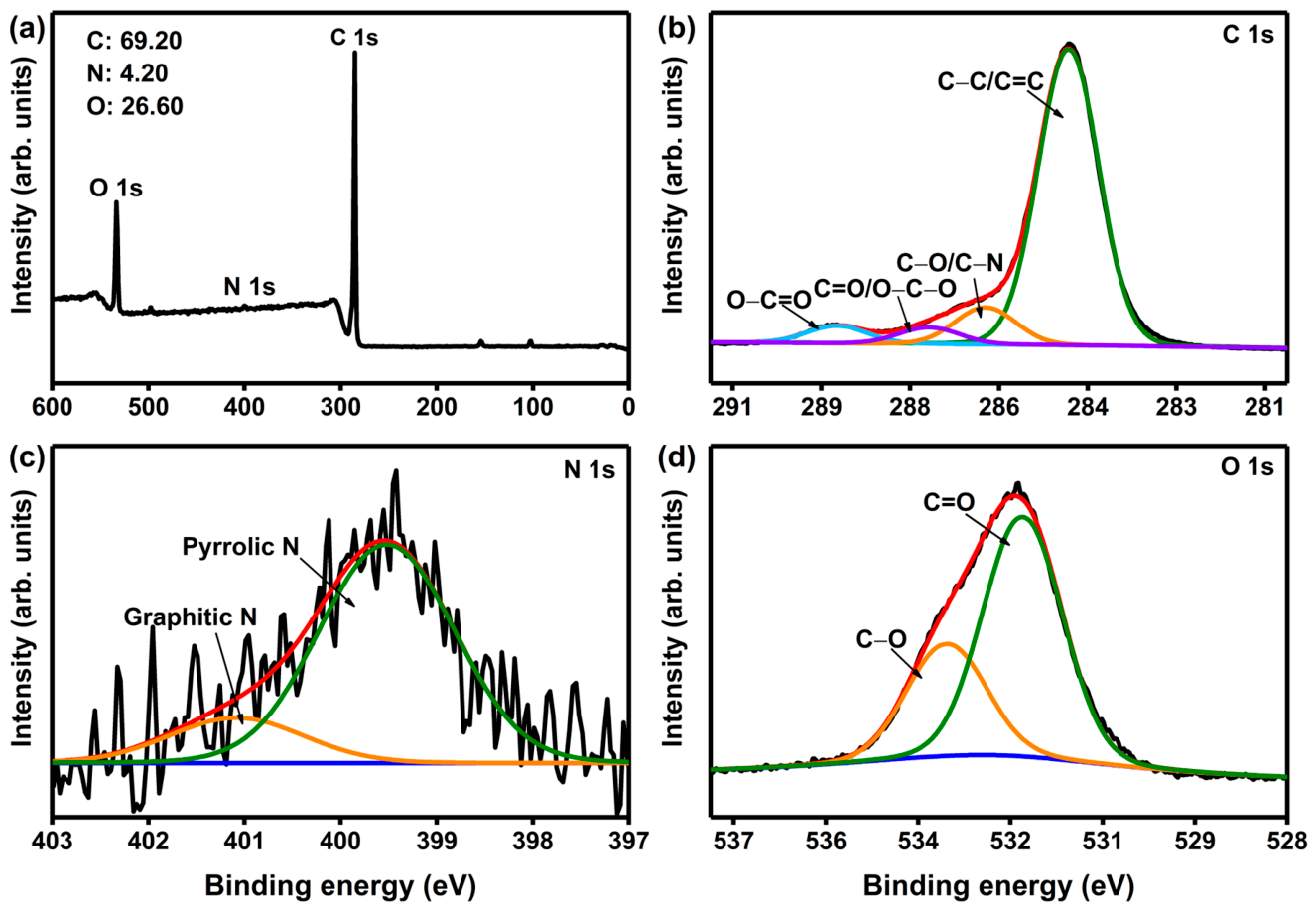
Figure 4 shows the results of the XPS analysis of the CPDs, confirming the presence of carbon, nitrogen, and oxygen, with characteristic signals at 284.73, 399.66, and 532.17 eV, respectively. The elemental composition was determined to be 69.20 at.% C, 4.20 at.% N, and 26.60 at.% O (Figure 4a). The high-resolution C1s spectrum (Figure 4b) was deconvoluted into four components corresponding to C–C/C=C (284.73 eV), C–O/C–N (286.23 eV), C=O/O-C-O (287.25 eV), and O–C=O (288.91 eV), indicating the coexistence of graphitic carbon domains and oxygen- and nitrogen-containing functional groups. The high-resolution N 1s spectrum (Figure 4c) exhibited peaks at 399.66 and 401.07 eV, which are assigned to pyrrolic N and graphitic N species (corresponding to nitrogen atoms incorporated into sp2-hybridized carbon domains (C–N–C)), respectively, confirming nitrogen’s incorporation into the carbon framework. The O1s spectrum (Figure 4d) displayed contributions at 532.17 and 533.50 eV, attributed to C=O and C–O functionalities. Overall, the XPS results confirm a heteroatom-rich, highly functionalized surface typical of CPDs [47,48,49], which is consistent with the UV–Vis results and with the FT-IR spectra presented in the Supporting Information (Figure S1).

3.2. Characterization of Cornstarch-Based Films Without and with CPDs

3.2.1. XRD Spectroscopy of Cornstarch-Based Films with CPDs

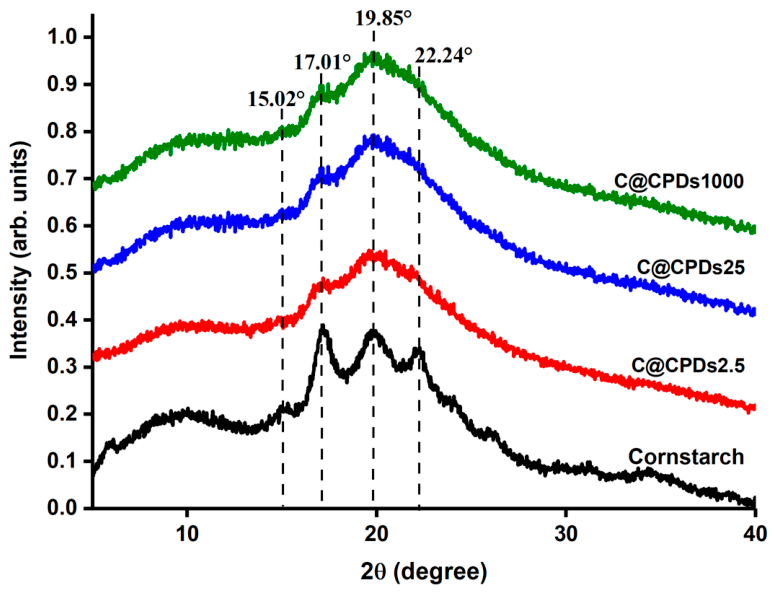
Figure 5 shows the X-ray diffraction (XRD) patterns of cornstarch and cornstarch-based films containing CPDs at different loadings (2.5, 25, and 1000 µL). All films exhibit a predominantly amorphous structure, characterized by broad diffraction features with maxima at 2θ = 15.02°, 17.01°, 19.85°, and 22.24°, which are typically associated with native cornstarch [35], and no significant differences are observed among the XRD patterns upon CPD incorporation. This behavior is consistent with the TEM analysis of the CPDs, which also shows an amorphous character, indicating that the addition of CPDs does not induce detectable structural rearrangements within the cornstarch matrix.

3.2.2. XPS Characterization of the Cornstarch and Composite Cornstarch-Based Films

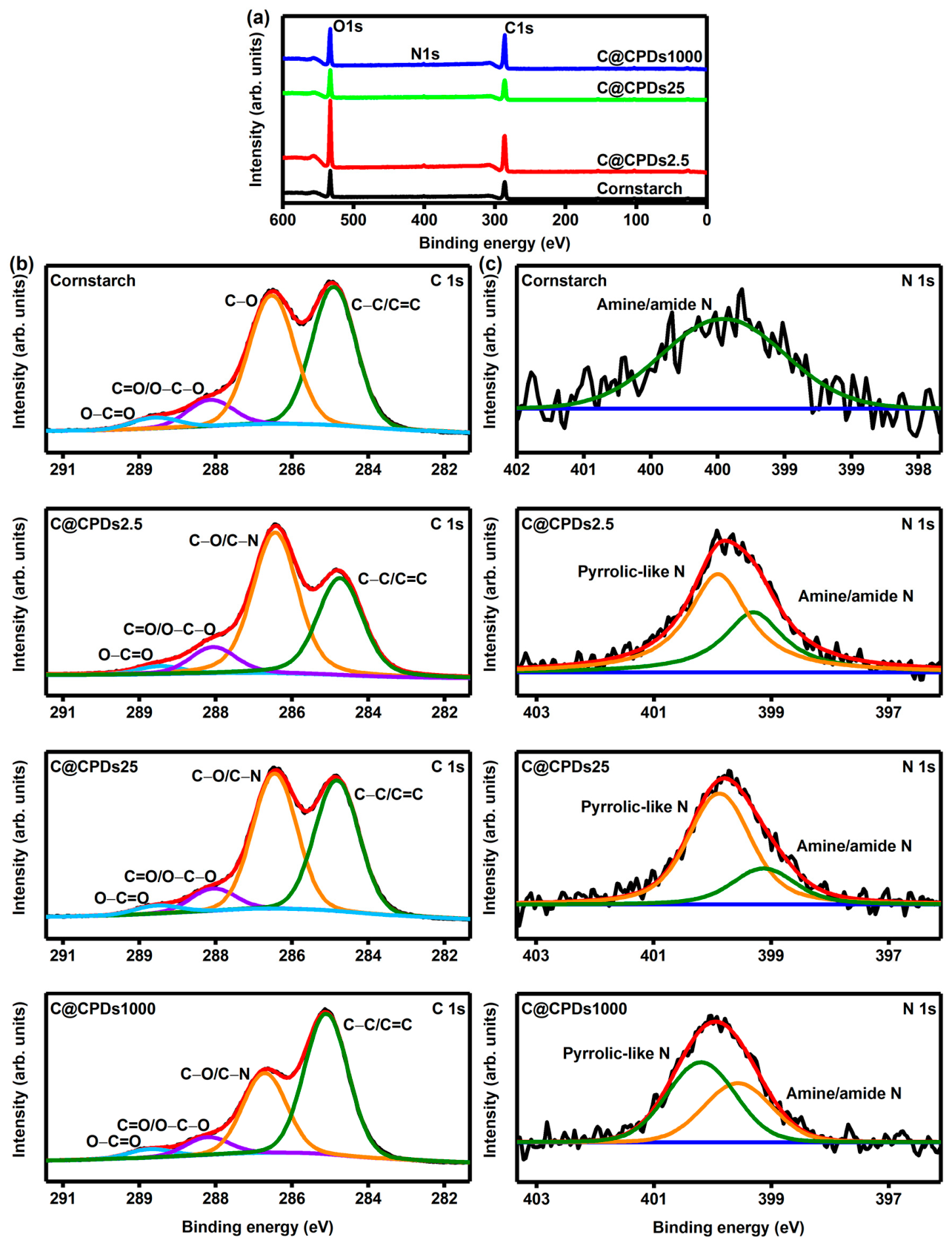
Figure 6 shows the results of XPS analysis evaluating the surface chemical composition and bonding states of cornstarch-based films and their composites with CPDs. The survey spectra shown in Figure 6a reveal that the cornstarch-based film is primarily composed of carbon and oxygen, with a minor nitrogen contribution (1.8 at. %, Table 1), attributed to residual protein traces inherent to commercial cornstarch [50]. Upon CPD incorporation, a pronounced increase in nitrogen content is observed, reaching approximately 9.8 and 9.6 at. % for C@CPDs2.5 and C@CPDs25, respectively, confirming the successful introduction of nitrogen-containing CPDs at the film surface. Notably, further increasing the CPD loading to C@CPDs1000 does not result in a proportional increase in nitrogen content, which instead slightly decreases to 8.6 at. %, suggesting partial CPD aggregation and reduced effective surface exposure.
The high-resolution C 1s spectra of cornstarch-based films and their composites (Figure 6b and Table S1) were deconvoluted to elucidate the chemical evolution induced by CPD incorporation. The cornstarch-based film exhibits characteristic contributions at ~284.8 eV (C–C/C=C), ~286.2 eV (C–O), ~287.8 eV (C=O/O–C–O), and ~289.0 eV (O–C=O) [51]. Although a low nitrogen content is detected in the survey spectrum, no distinct C–N contribution can be detected in the C 1s region due to its strong overlap with the dominant C–O signal and the minor concentration of nitrogen-containing species. Upon incorporating CPDs, an increase is observed in the contribution at ~284.6–284.9 eV, assigned to C–C/C=C bonds, indicating the introduction of sp2-hybridized carbon domains associated with the CPD structure. In parallel, the component at ~286.2–286.4 eV is attributed to overlapping C–O and C–N environments, while the peak at ~287.6–287.8 eV remains dominated by carbonyl-type species, with a possible minor contribution from nitrogen-containing functionalities. The presence of oxygen- and nitrogen-containing carbon environments inferred from the C 1s deconvolution is consistent with the FT-IR results (Supporting Information, Figure S2), which reveal characteristic vibrational bands associated with hydroxyl, carbonyl, carboxyl, and nitrogen-containing functional groups. Notably, the composite with intermediate CPD loading (C@CPDs25) exhibits the most balanced distribution of carbon species, combining an increased fraction of sp2 carbon with a significant contribution of oxygen- and nitrogen- containing functional groups. This balance suggests optimized interfacial interactions between CPDs and the cornstarch matrix, promoting effective electronic delocalization without excessive phase separation [52]. At higher CPD loading (C@CPDs1000), the further increase in the C–C/C=C contribution accompanied by a decrease in heteroatom-containing carbon species indicates partial CPD aggregation and reduced chemical coupling with the polymer matrix.
The high-resolution N 1s spectra provide further insight into the chemical environment of nitrogen in the cornstarch and composite cornstarch-based films (Figure 6c). The cornstarch-based film exhibits a broad low-intensity N 1s signal centered at ~399.8 eV, attributed to residual nitrogen-containing species, primarily amide and amine groups (–NH–/–CONH2) associated with protein traces inherent to commercial cornstarch. Upon incorporating CPDs, the N 1s spectra become more intense and better defined, indicating an increased and chemically more homogeneous nitrogen population at the surface. Deconvolution reveals contributions in the 399.3–400.3 eV range, which are assigned to amine/amide and pyrrolic-type nitrogen environments, including nitrogen species involved in hydrogen bonding with the hydroxyl-rich cornstarch matrix. Notably, the composite with intermediate CPD loading (C@CPDs25) exhibits the narrowest and most symmetric N 1s envelope, suggesting an optimal interfacial interaction and a more uniform nitrogen chemical environment. At higher CPD loading (C@CPDs1000), the slight broadening of the N 1s signal is consistent with partial CPD aggregation and increased heterogeneity at the surface. The lower nitrogen signal observed for this composition may be associated with the formation of CPD-rich aggregates or multilayered regions that alter the near-surface composition and partially obscure nitrogen-containing functionalities from the XPS analysis.
The O 1s spectra (Figure S3 and Table S2) of all samples display a dominant contribution centered at ~532.6 eV, attributed to C–O/C–OH environments characteristic of polysaccharide structures [53,54]. The absence of clearly resolved additional components suggests that the oxygen functionalities introduced by CPDs remain spectrally overlapped with the abundant hydroxyl groups of the cornstarch matrix. Nevertheless, changes in peak width and relative intensity reflect modifications in the local oxygen environment upon CPD incorporation, consistent with strong interfacial interactions between CPDs and cornstarch chains.
The N 1s spectrum of pristine CPDs exhibits a distinct contribution at ~401.1 eV, assigned to graphitic nitrogen embedded within sp2-hybridized carbon domains. Upon incorporation into the cornstarch matrix, this high-binding-energy component is no longer resolved as a separate peak, and the N 1s envelope becomes narrower and shifts toward lower binding energies (≤400 eV). This behavior indicates a modification of the nitrogen electronic environment caused by strong interfacial interactions between CPDs and the hydroxyl-rich cornstarch matrix. Hydrogen-bonding and electronic-polarization effects partially screen the positive character of graphitic nitrogen, leading to peak overlap with amide- or pyrrolic- type nitrogen species. Similar spectral narrowing observed in the O 1s region further supports the presence of strong CPD–cornstarch interactions, which are expected to play a key role in charge transport and mechanical reinforcement within the composite films.

3.2.3. Mechanical Characterization of Cornstarch-Based Film and Composite Films

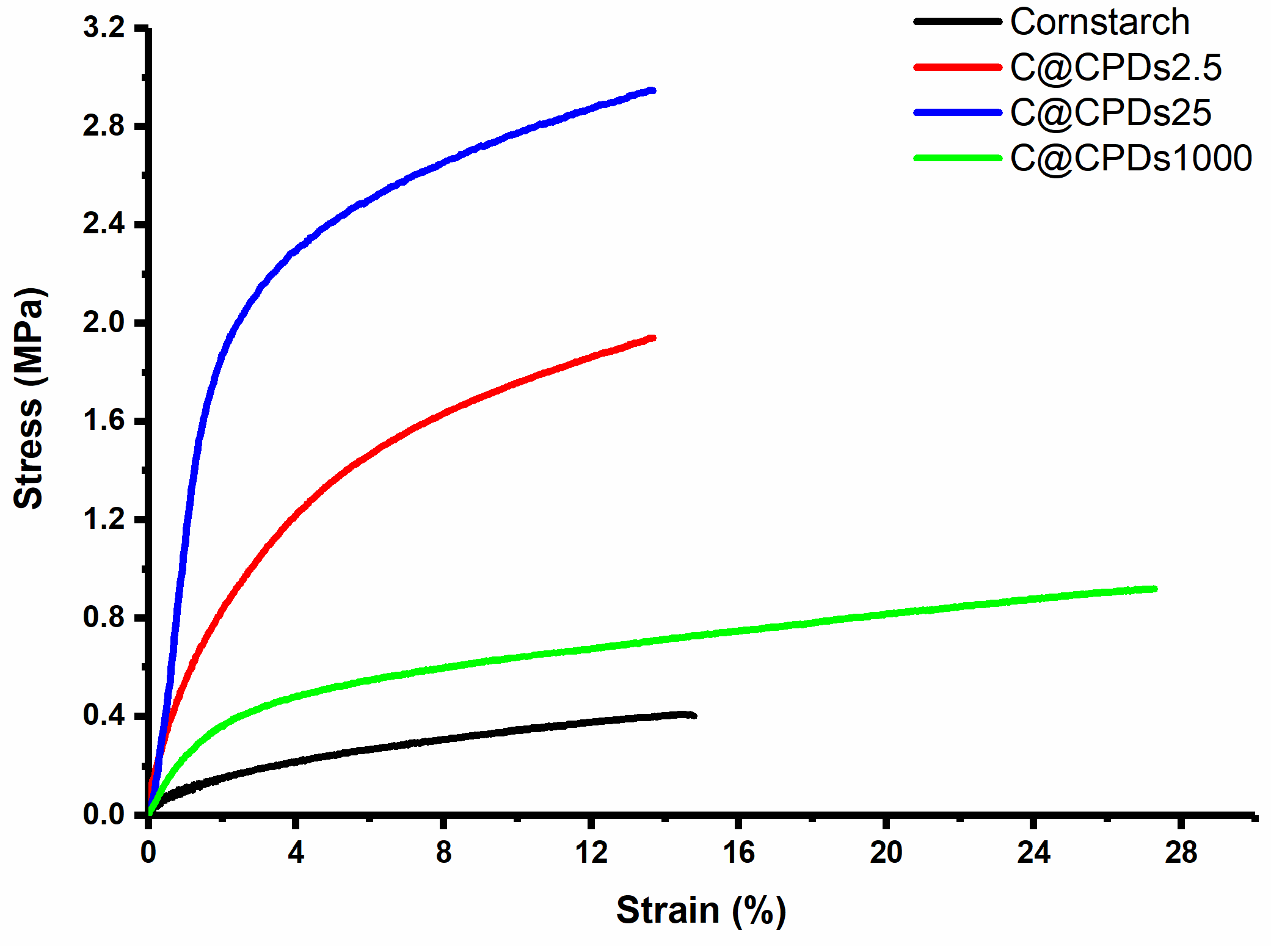
Figure 7 shows the stress–strain curves of the films, with the primary mechanical parameters summarized in Table 2. The mechanical response exhibits a strong dependence on CPD content. The Young’s modulus of cornstarch was 12.30 MPa, which is within the reported range for cornstarch-based materials [55,56]. Upon CPD incorporation, the modulus increased to 46.5 MPa for C@CPDs2.5 (278%) and to 114.40 MPa for C@CPDs25 (830%), indicating a pronounced stiffening effect associated with effective nanoscale reinforcement and strong interfacial interactions [57,58]. In contrast, excessive CPD loading (C@CPDs1000) led to a reduced modulus of 24.00 MPa, attributed to nanoparticle aggregation, which limits matrix–reinforcement interactions and mechanical efficiency [59].
All films exhibited very high extensibility. The strain-at-break point of cornstarch reached 14.79%, while C@CPDs2.5 and C@CPDs25 showed similar values of 13.67% and 13.68%, respectively. Notably, C@CPDs1000 exhibited an exceptionally high strain-at-break point of 27.27%, which is comparable to that of highly deformable elastomeric systems [60]. This unusually high extensibility may be associated with the high CPD loading, where aggregation and the resulting heterogeneous microstructure may promote localized chain rearrangement and strain redistribution before fracture. Toughness increased markedly with CPD incorporation, from 0.04 MJ m−3 for cornstarch to 0.19 MJ m−3 (C@CPDs2.5) and 0.32 MJ m−3 (C@CPDs25), corresponding to an increase of ~685%. This maximum toughness reflects an optimal balance between stiffness and deformability. Conversely, C@CPDs1000 showed reduced toughness (0.18 MJ m−3), consistent with stress concentration effects induced by CPD agglomeration.
Mechanical parameters were obtained from a single tensile test for each composition (n = 1); therefore, no statistical dispersion is reported. A more in-depth study of the mechanical properties should be conducted in future work.
The enhance mechanical performance is attributed to chemically mediated interfacial interactions between CPDs and the cornstarch matrix [61]. CPDs possess a high density of surface functional groups, including amine, amide, and hydroxyl moieties, as well as nitrogen-containing carbon domains, which enable strong interfacial interactions with the hydroxyl-rich cornstarch chains through hydrogen bonding and dipole–dipole interactions. These interactions act as physical crosslinking points that restrict chain mobility and promote efficient stress transfer. At intermediate loadings (C@CPDs25), optimal CPD dispersion maximizes interfacial contact, yielding the best combination of stiffness and toughness. At low loadings, interfacial interactions are insufficient for effective reinforcement, while at high loadings, aggregation reduces reinforcing efficiency and introduces localized stress concentration sites. Overall, these results demonstrate that mechanical reinforcement arises from interfacial chemistry rather than simple filler addition, with a clear optimal CPD concentration.

3.3. Electrical Characterization

3.3.1. Electrical Resistance of Cornstarch and Composite Cornstarch-Based Films

To avoid redundancy, optical, structural, and mechanical characterizations were performed on a representative set of compositions. Electrical measurements were subsequently extended over a wider range of CPD contents to capture the full evolution of charge-transport behavior.
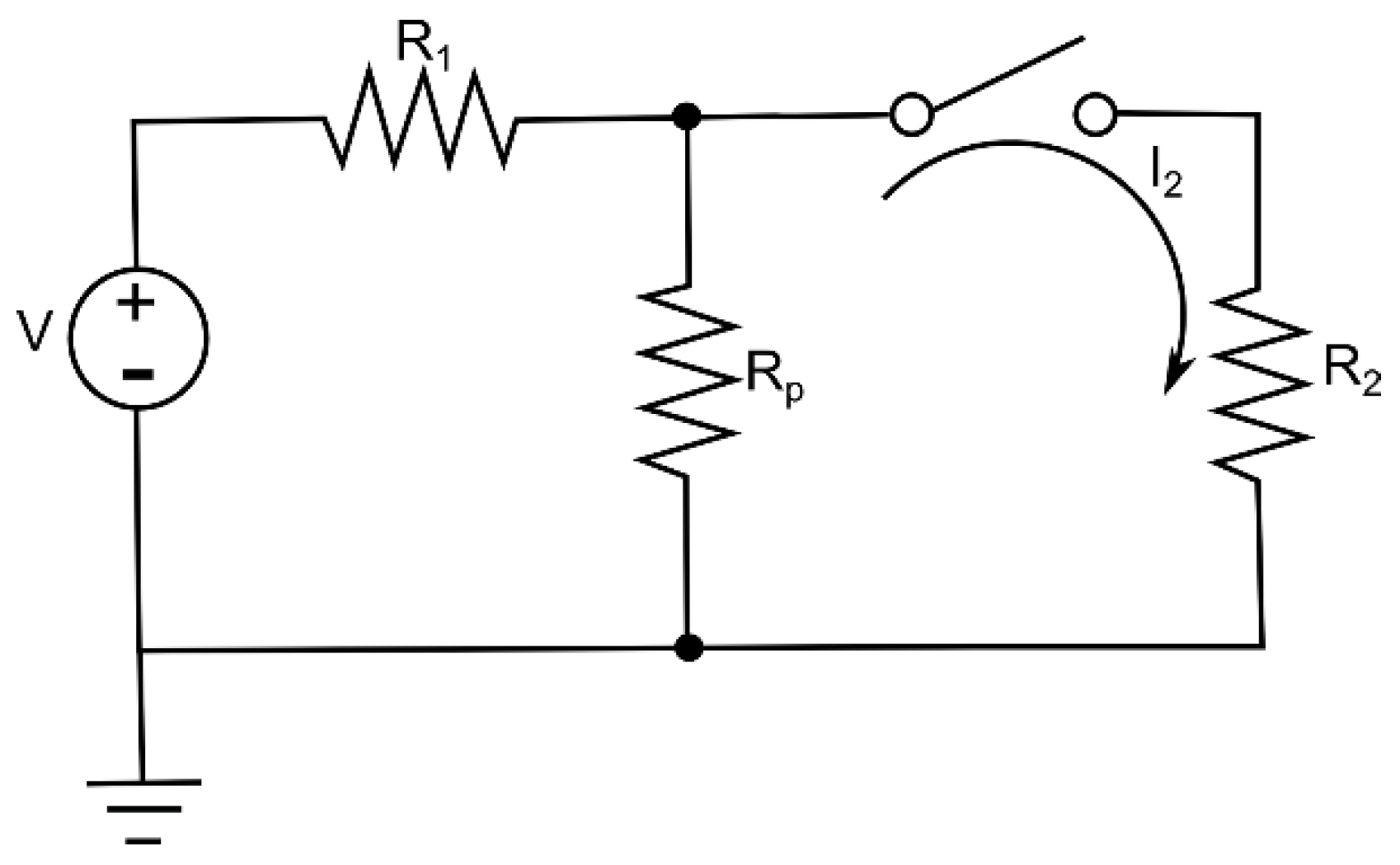
The electrical resistance of the cornstarch-based composite films was evaluated to assess their performance as electrodes in a vertical contact–separation triboelectric nanogenerator (TENG). The films were incorporated into a custom-designed electrical circuit (Figure 8), enabling the indirect estimation of film resistance Rp (Equation (1)) from the measured current (I2). The circuit consisted of a DC voltage source (V = 6 V), a current-limiting resistor (R_1 = 2.2 Ω), the film resistance, a load resistor (R2 = 220 kΩ), and a current meter in the output branch. All measurements were performed using films with identical dimensions (2.3 × 0.7 × 0.041 cm) and a fixed copper electrodes separation of 0.54 cm. Electrical resistance measurements were performed by placing the electrodes in contact with the surface of the films using a consistent and reproducible measurement configuration applied uniformly across all samples.
R p = I 2 R 1 R 2 V I 2 ( R 1 + R 2 )
Table 3 summarizes the resistance, resistivity, and conductivity values obtained for cornstarch and composite cornstarch-based films. A gradual decrease in electrical resistance is observed as the CPD content increases from 0 to 25 µL, reaching a minimum value of 1.706 kΩ for the C@CPDs25 sample. Beyond this quantity, the resistance increases again, reaching 2.719 kΩ at the highest CPD loading. The resistivity was calculated using Equation (2), where ρ is the resistivity, L is the distance between the electrodes, and S is the cross-sectional area. As expected, the resistivity follows a similar trend to the resistance. while the conductivity calculated as the inverse of resistivity, reaches a maximum value of 196.602 µΩ−1 cm−1 for C@CPDs25. These results demonstrate that it is possible to modulate electrical charge transfer incorporating CPDs [62].
The maximum conductivity obtained for C@CPDs25 is comparable to the values reported for other starch-based composites containing carbonaceous fillers. For example, plasticized-starch/graphene composites have been reported to reach conductivity of approximately 9.7 × 10⁻⁴ S cm−1, while graphene-reinforced potato starch films exhibited conductivity of up to 3.9 × 10⁻⁴ S cm−1 at 2 wt% graphene [63,64]. In thermoplastic starch/carbon-black composites, conductivity increased from approximately 3.1 × 10⁻⁷ to 4.2 × 10⁻³ S cm−1 as the carbon-black content increased through the percolation region [65]. Other starch–graphene systems have also demonstrated conductivity in the order of 10−4 S cm−1 [66]. Although the conductivity of the present films remains below that of some highly loaded carbon-based starch composites, the results demonstrate that CPDs can effectively modulate charge transfer in the cornstarch matrix, reaching a conductivity within the range reported for starch-based conductive materials.
R p = ρ L S
The increase in conductivity at low CPD contents can be attributed to the effective incorporation and dispersion of CPDs within the polymer matrix, which promotes charge-transport mechanisms such as charge hopping and the formation of interconnected conductive pathways. At higher CPD loadings, the observed increase in resistivity is likely associated with CPD agglomeration, reduced dispersion homogeneity, and partial saturation of electrically active sites, which disrupt continuous charge-transport pathways. These results firstly demonstrate that the electrical response of cornstarch-based films can be modulated through CPD incorporation, and secondly support the indirect electrical validation of CPDs using the TENG configuration discussed in the following section.

3.3.2. Electrical Characterization of TENG Based on Composite Cornstarch-Based Films as Electrodes

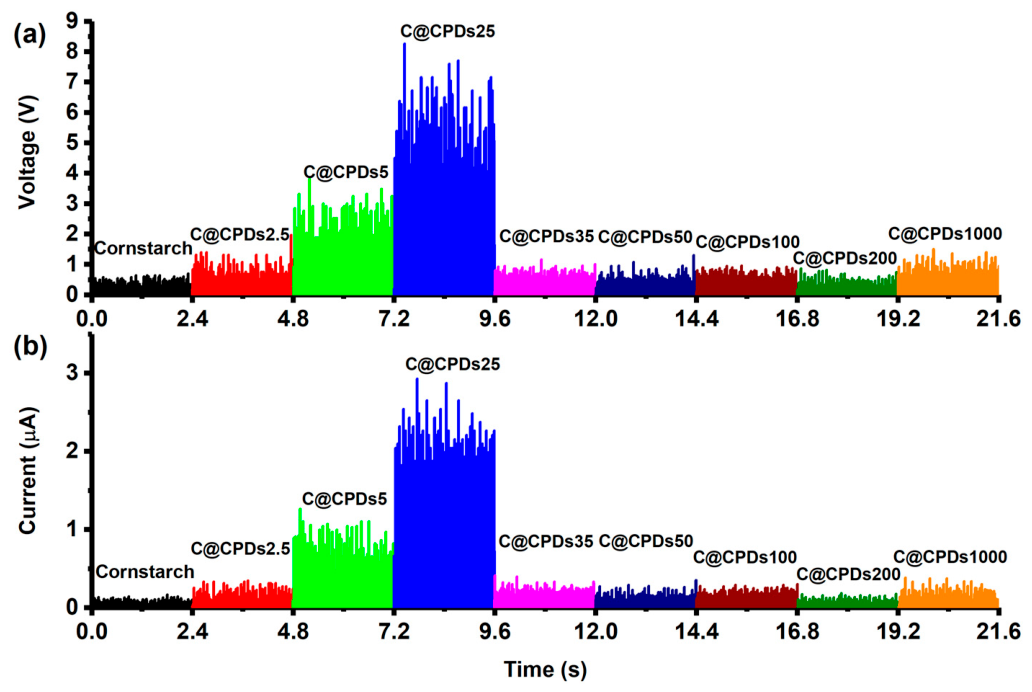
Figure 9a,b show the voltage and current outputs of the different TENG configurations. Progressive enhancement is observed for systems incorporating C@CPDs2.5 and C@CPDs5 films, reaching a maximum for TENG-C@CPDs25, which delivers a peak voltage of 5.757 V, a current of 2.087 μA, and a power output of 12.015 μW (Table 4), corresponding to an ~334-fold increase relative to the reference system. Beyond this composition, further CPD addition results in a sharp decline in performance, with output values comparable to those of the pristine cornstarch-based TENG. Notably, the evolution of voltage, current, and power closely follows the conductivity trend, indicating a direct correlation between CPD content, charge transport, and TENG performance.
Both the pristine cornstarch-based film and the composite films exhibit measurable electrical conductivity (Table 3), indicating that charge transport can occur within the polymeric matrix even in the absence of CPDs. Previous studies on glycerol-plasticized starch films have reported that glycerol modifies the hydrogen-bonding network, molecular mobility, phase behavior, and electrical response of starch matrices, with conductivity being associated with ionic transport and mobile charge carriers in glycerol- and moisture-rich domains [67,68,69,70]. Accordingly, the measurable conductivity of the pristine cornstarch film may be associated with glycerol-induced polar interactions and mobile charge carriers rather than with long-range electronic conduction. The incorporation of CPDs up to C@CPDs25 enhances this charge-transport capability by providing additional electrically active carbon domains and promoting the formation of effective charge-transport pathways within the composite.
The mechanical characterization further supports this interpretation. The incorporation of CPDs leads to a progressive increase in toughness and elongation at break for the C@CPDs25 composition, while maintaining mechanical integrity. This behavior suggests that CPDs do not act as rigid fillers at these concentrations, but rather they contribute to stress redistribution within the cornstarch matrix, likely facilitated by interfacial interactions and the plasticizing effect of glycerol. Such structural compliance may favor local rearrangements of cornstarch chains around CPDs, indirectly supporting the formation of continuous pathways for charge transport.
The spectroscopic and microscopic analyses (FT-IR, XPS, and TEM) reveal that CPDs consist of partially graphitized carbon domains decorated with abundant oxygen- and nitrogen-containing functional groups. When incorporated into the cornstarch–glycerol matrix, these functionalized nanodomains promote strong interfacial interactions and homogeneous dispersion at low and intermediate CPD quantities [71]. The hydroxyl groups of cornstarch may interact with oxygen- and nitrogen-containing functionalities on the CPD surface through hydrogen bonding and other polar interactions, facilitating electronic coupling between the polymer matrix and the carbonized domains. In addition, the sp2-rich carbon domains and graphitic nitrogen species may provide electronically active sites that facilitate charge hopping between neighboring CPDs, while the interfacial interactions with the starch chains may reduce local energy barriers for charge transfer. These effects may reduce the average distance between electronically active regions and facilitate hopping- or tunneling-assisted charge transport [72,73]. This evolution is consistent with the progressive development of interconnected charge-transport pathways with maximum conductivity observed for C@CPDs25, where the reduced interparticle distance between CPDs favors the establishment of interconnected conductive pathways [74,75].
At higher CPD quantities, conductivity decreases markedly due to CPD aggregation driven by van der Waals and π–π interactions [76,77]; such aggregation disrupts the homogeneity of the composite, increases structural heterogeneity, and interrupts effective charge-transport pathways. As a result, the system no longer favors charge transport between electronically active domains, and the electrical resistance increases significantly, reaching values up to 2.719 kΩ for C@CPDs1000.
Beyond their influence on charge transport within composite films, CPDs may also affect the triboelectric interface established between the composite cornstarch-based film and the PDMS. The nanometric size of the CPDs (≈2.72 nm, as observed by TEM) provides a high specific surface area and a large density of interfacial sites capable of modifying the local surface topology and the effective contact established during the contact–separation process. At low and intermediate CPDs quantities, the relatively homogeneous distribution of CPD is expected to promote closer physical contact between both triboelectric films, facilitating charge generation and accumulation at the interface [78]. Consequently, the enhanced electrical response observed for TENG-C@CPDs25 may arise from the combined effect of improved charge transport within the composite film and more efficient charge exchange during triboelectric contact.
From a device perspective, the effective contact area between the composite cornstarch-based film and the PDMS is a key parameter governing triboelectric charge generation. According to the classical capacitance relationship (Equation (3)), an increase in effective contact area can favor greater charge storage and accumulation during contact–separation cycles. Therefore, the improved interfacial contact expected for well-dispersed CPDs may contribute to the observed performance trends. In contrast, the conductivity results suggest that excessive CPD quantities promote agglomeration and surface heterogeneity, as suggested by the conductivity results, which may reduce the effective contact area and hinder charge exchange at the triboelectric interface, ultimately contribution to the deterioration of TENG performance. Collectively, these observations highlight the importance of maintaining an appropriate balance between CPD quantity and dispersion to preserve both effective conductive pathways and efficient interfacial charge transfer within the TENG system.
C = ε 0 ε r S d
During TENG operation, the PDMS film and the composite cornstarch-based film are brought into contact under an external compressive force, generating triboelectric charges at the interface due to their different electron affinities. Upon separation, the spatial separation of these charges creates a potential difference and an associated electric field, driving charge redistribution through the external circuit. As the separation distance increases, the potential difference reaches a maximum and charge transfer approaches equilibrium. During the subsequent re-contacting of the films, the charge distribution is progressively restored, producing the characteristic electrical output of the TENG. Therefore, the ability of the composite cornstarch-based films to transport and sustain electrical charge is expected to influence the magnitude of the measured electrical output. The electrical behavior of the composite cornstarch-based films is further reflected in the output performance of the TENG system (Table 4). In this study, integrating the films into the TENG serves a dual purpose. On one hand, it demonstrates the functional applicability of the cornstarch-based composites as active materials within a triboelectric device. On the other hand, the TENG configuration provides an indirect yet sensitive platform to validate the ability of the films to transport and sustain electrical charge under dynamic contact–separation conditions.
The systematic increase in voltage, current, and power output up to TENG-C@CPDs25 closely follows the conductivity trend observed in Table 3, suggesting a direct correlation between enhanced charge transport within the composite films and their electrical response during TENG operation. These results indicate that the conductive pathways formed at intermediate CPD quantities support charge migration and accumulation, thereby improving the electrical output of the system. Beyond this optimal composition, the decline in TENG performance mirrors the reduction in conductivity, reinforcing the interpretation that excessive CPD aggregation disrupts conductive networks and limits effective charge transport.
It is important to note that, although both DC electrical measurements and TENG output are related to charge transport within the films, they pertain to fundamentally different transport regimes. The resistance and conductivity values reported in Table 3 were obtained under direct current injection, where charge carriers preferentially follow the least resistive pathways and the measured response reflects an effective, averaged transport behavior that is sensitive to local heterogeneities and interfacial barriers. In contrast, the electrical response of the TENG arises from triboelectric charge generation and the establishment of a transient electric field during contact–separation cycles, without external current injection. Under these conditions, the electric field may facilitate charge redistribution, dipolar polarization, and field-assisted hopping or tunneling processes [79] that are not fully captured by DC measurements. Consequently, variations in TENG current output (Table 4) do not necessarily reproduce the trend observed in the DC conductivity measurements, but rather, indirectly validate the films’ ability to support electrical charge transfer under dynamic electrostatic excitation.
For comparison, the optimized C@CPDs25-based TENG exhibited an output voltage of 5.757 V, a current of 2.087 µA, and a maximum power density of 3.004 µW cm−2. This power density is of the same order of magnitude as that reported for a bacterial-cellulose/carbon-black electrode-based TENG, which reached 4.89 µW cm−2 with a voltage of 102 V and current of 2 µA, although its output voltage was substantially higher [80]. TENGs employing graphene-based electrodes and bio-derived polymeric materials have reported higher power densities, including 63.7 µW cm−2 (with a voltage of 100 V and a current of 7 µA) for a graphene composite paper electrode in a fully degradable TENG [81] and substantially higher values (440 V, 1.16 A, and 0.4 W cm−2) for graphene electrodes coupled with cellulose nanocrystal triboelectric layers [82]. These differences are expected because TENG performance strongly depends on device architecture, electrode morphology, contact conditions, excitation pressure and frequency, and electrical loading. Therefore, the TENG results obtained here are primarily considered a validation of the charge-transfer capability of the C@CPDs25 film as a flexible electrode, rather than an attempt to compete with high-output graphene-based TENG architectures.
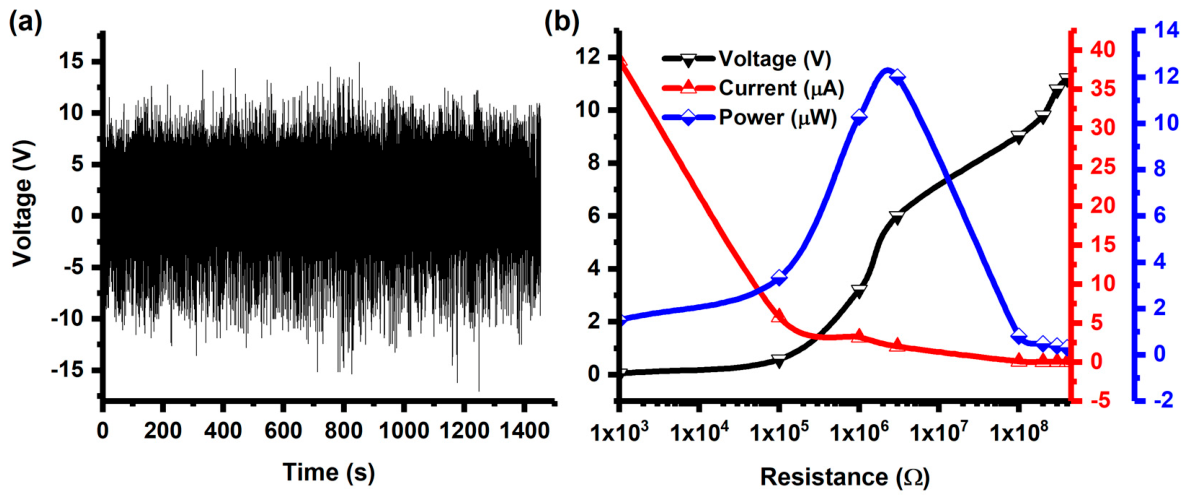
On the other hand, Figure 10a shows the stability and durability assessment of the TENG-C@CPDs25 system when subjected to continuous mechanical operation for 24 min, corresponding to approximately 34,872 compression cycles under an applied force of ~4 N at a frequency of 24 Hz. Throughout the test, the output voltage exhibits a consistent alternating signal with average peak amplitudes approximately ±5.824 V, showing no significant signs of degradation or signal decay. This stable electrical response is consistent with the favorable mechanical properties previously observed for the C@CPDs25 film, which exhibits the highest Young’s modulus and toughness among the studied compositions while maintaining a high strain-at-break point. The combination of enhanced stiffness and energy dissipation capacity enables the composite cornstarch-based film to withstand repeated mechanical deformation without crack formation or structural failure, which is critical for minimizing mechanical fatigue and preserving interfacial contact stability during prolonged cyclic operation. Furthermore, the absence of significant signal degradation suggests that the contact interface between the composite cornstarch-based film and the PDMS remains sufficiently stable throughout the cycling test. The steady voltage profile over time therefore confirms that the composite cornstarch-based films retain their structural integrity and triboelectric performance under cyclic mechanical loading. This operational stability highlights their strong potential for long-term energy-harvesting applications. Hence, these results strongly support the use of C@CPDs25 films as durable and efficient electrode materials for TENG devices.
In addition, Figure 10b shows the electrical performance of the TENG-C@CPDs25 system under various external resistive loads, ranging from 1 × 10³ to 4 × 10⁸ Ω. As the external resistance increases, a progressive rise in output voltage is observed, reaching a maximum of 11.21 V at 4 × 10⁸ Ω. In contrast, the output current exhibits a continuous decline, starting from 38.7 μA at 1 kΩ and decreasing to 28.01 nA at the highest resistance evaluated, which aligns with the expected behavior of triboelectric systems. Furthermore, the power output analysis reveals a peak value of 12.00 μW at an external resistance of 3 MΩ. This point represents the optimal load condition, where the product of voltage and current is maximized. These findings emphasize the crucial role of tuning the external load resistance based on the intended application, as it directly affects the energy output of the device. Consequently, this type of analysis is essential for optimizing the design and integration of TENG systems in real-world applications, ranging from self-powered sensors to energy-harvesting technologies.

4. Conclusions

This study demonstrates that the electrical and mechanical properties of cornstarch-based films can be effectively modulated through the controlled incorporation of carbonized polymer dots. The resulting composite films exhibited enhanced charge-transfer capability, with the optimized composition (C@CPDs25) showing an increase in conductivity from 173,160 to 196,602 µΩ−1 cm−1 while preserving the flexibility and structural integrity of the polymer matrix. These results indicate that the electrical response of the films is strongly influenced by the formation of conductive pathways and interfacial interactions within the composite structure. The electrical functionality of the optimized films was further validated by implementing them as electrodes in a triboelectric nanogenerator, where a stable and reproducible electrical response was obtained under cyclic operation. The findings confirm that the improved charge-transfer capability of the composite films can be translated into enhanced device performance under dynamic electrostatic conditions. Although the conductivity values remain below those typically reported for highly conductive nanomaterial-based electrodes, the present system is based on renewable and biodegradable constituents, providing an alternative approach for the development of sustainable polymeric conductive materials. Consequently, CPD-modified cornstarch-based films emerge as promising low-cost platforms for flexible electronics, biodegradable electrodes, and energy-related applications.

Supplementary Materials

The following supporting information can be downloaded at https://www.mdpi.com/article/10.3390/pr14182941/s1, Figure S1: FT-IR spectrum of coffee ground-based CPDs; Figure S2: FT-IR spectroscopy of the polymeric films with different concentrations of CPDs; Figure S3: High-resolution O 1s XPS spectra of pristine cornstarch and cornstarch composite films; Figure S4: Switching polarity test of the raw AC output. Unrectified open-circuit voltage waveforms recorded under forward (blue) and reverse (red) electrical connections, demonstrating a symmetric 180° phase inversion that confirms the authentic triboelectric origin of the generated signal; Table S1: C 1s spectrum adjustment parameters of the films; Table S2: O 1s spectrum adjustment parameters of the films.

Author Contributions

Conceptualization, J.M.B.-F. and V.H.R.-A.; methodology, J.A.A.-A., J.M.B.-F., E.C.-G. and J.G.Q.-G.; formal analysis, J.A.A.-A., J.M.B.-F., V.H.R.-A. and J.G.Q.-G.; investigation, J.A.A.-A., J.M.B.-F. and V.H.R.-A.; resources, J.M.B.-F.; writing—original draft preparation, J.M.B.-F. and J.A.A.-A.; writing—review and editing, J.M.B.-F., J.G.Q.-G. and V.H.R.-A. All authors have read and agreed to the published version of the manuscript.

Funding

This research received no external funding.

Data Availability Statement

The original contribution presented in this study are included in the article/Supplementary Materials. Further inquiries can be directed to the corresponding author.

Conflicts of Interest

Author E.C.-G. was employed by the Secihti-Instituto Nacional de Investigaciones Nucleares. The remaining authors declare that the research was conducted in the absence of any commercial or financial relationships that could be construed as potential conflicts of interest.

Abbreviations

The following abbreviations are used in this manuscript:
CPDsCarbonized Polymer Dots
TENGTriboelectric Nanogenerator

References

  1. Yang, D.; Yu, J.; He, Z.; Li, P. Database energy saving strategy using blockchain and Internet of Things. Sci. Rep. 2025, 15, 2316. [Google Scholar] [CrossRef] [Scilit] [PubMed]
  2. Pang, C.; Li, F.; Hu, X.; Meng, K.; Pan, H.; Xiang, Y. Degradable silk fibroin based piezoresistive sensor for wearable biomonitoring. Discov. Nano 2024, 19, 55. [Google Scholar] [CrossRef] [Scilit] [PubMed]
  3. Carrascosa, A.; Sánchez, J.S.; Morán-Aguilar, M.G.; Gabriel, G.; Vilaseca, F. Advanced Flexible Wearable Electronics from Hybrid Nanocomposites Based on Cellulose Nanofibers, PEDOT and Reduced Graphene Oxide. Polymers 2024, 16, 3035. [Google Scholar] [CrossRef] [Scilit] [PubMed]
  4. Zare, Y.; Munir, M.T.; Rhee, K.Y. A novel approach to predict the electrical conductivity of nanocomposites by a weak interphase around graphene network. Sci. Rep. 2024, 14, 21514. [Google Scholar] [CrossRef] [Scilit] [PubMed]
  5. Karst, A.; Parpaite, T.; Bouquey, M.; Pelletier, H.; Soulestin, J.; Samuel, C. Synthesis of PEDOT particles and manufacturing of electrically conductive PEO/PEDOT thermoplastic composites by twin-screw extrusion. Polymer 2024, 290, 126577. [Google Scholar] [CrossRef] [Scilit]
  6. Ramesan, M.T.; Varghese, M.; Jayakrishnan, P.; Periyat, P. Silver-Doped Zinc Oxide as a Nanofiller for Development of Poly(vinyl alcohol)/Poly(vinyl pyrrolidone) Blend Nanocomposites. Adv. Polym. Technol. 2018, 37, 137–143. [Google Scholar] [CrossRef] [Scilit]
  7. Mohammed, G.; El Sayed, A.M.; Morsi, W.M. Spectroscopic, thermal, and electrical properties of MgO/polyvinyl pyrrolidone/polyvinyl alcohol nanocomposites. J. Phys. Chem. Solids 2018, 115, 238–247. [Google Scholar] [CrossRef] [Scilit]
  8. Salim, E.; Abdelghany, A.M.; Tarabiah, A.E. Ameliorating and tuning the optical, dielectric, and electrical properties of hybrid conducting polymers/metal oxide nanocomposite for optoelectronic applications. Mater. Chem. Phys. 2024, 313, 128788. [Google Scholar] [CrossRef] [Scilit]
  9. Yassin, A.Y. Synthesized polymeric nanocomposites with enhanced optical and electrical properties based on gold nanoparticles for optoelectronic applications. J. Mater. Sci. Mater. Electron. 2023, 34, 46. [Google Scholar] [CrossRef] [Scilit]
  10. Huang, Y.-T.; Inomata, N.; Wang, Z.; Lin, Y.-C.; Ono, T. Flexible Porous Carbon Black–Polymer Composites with a High Gauge Factor. Sens. Mater. 2020, 32, 2527–2538. [Google Scholar] [CrossRef] [Scilit]
  11. Zhang, W.; Piao, S.; Lin, L.; Yin, Y.; Guo, J.; Jiang, Z.; Cho, Y.; Li, R.; Gao, J.; Pang, H.; et al. Wearable and antibacterial HPMC-anchored conductive polymer composite strain sensor with high gauge factors under small strains. Chem. Eng. J. 2022, 435, 135068. [Google Scholar] [CrossRef] [Scilit]
  12. Wu, X.; Lu, C.; Zhang, X.; Zhou, Z. Conductive natural rubber/carbon black nanocomposites via cellulose nanowhisker templated assembly: Tailored hierarchical structure leading to synergistic property enhancements. J. Mater. Chem. A 2015, 3, 13317–13323. [Google Scholar] [CrossRef] [Scilit]
  13. Park, W.; Hu, J.; Jauregui, L.A.; Ruan, X.; Chen, Y.P. Electrical and thermal conductivities of reduced graphene oxide/polystyrene composites. Appl. Phys. Lett. 2014, 104, 113101. [Google Scholar] [CrossRef] [Scilit]
  14. Chen, J.; Han, J.; Xu, D. Thermal and electrical properties of the epoxy nanocomposites reinforced with purified carbon nanotubes. Mater. Lett. 2019, 246, 20–23. [Google Scholar] [CrossRef] [Scilit]
  15. Wang, Z.L. On Maxwell’s displacement current for energy and sensors: The origin of nanogenerators. Mater. Today 2017, 20, 74–82. [Google Scholar] [CrossRef] [Scilit]
  16. Shi, Z.; Zhang, Y.; Gu, J.; Liu, B.; Fu, H.; Liang, H.; Ji, J. Triboelectric Nanogenerators: State of the Art. Sensors 2024, 24, 4298. [Google Scholar] [CrossRef] [Scilit] [PubMed]
  17. Fan, F.R.; Tian, Z.Q.; Wang, Z.L. Flexible triboelectric generator. Nano Energy 2012, 1, 328–334. [Google Scholar] [CrossRef] [Scilit]
  18. Wang, Z.L. Triboelectric nanogenerators as new energy technology and self-powered sensors: Principles, problems and perspectives. Faraday Discuss. 2014, 176, 447–458. [Google Scholar] [CrossRef] [Scilit] [PubMed]
  19. Khandelwal, G.; Maria Joseph Raj, N.P.; Kim, S.J. Materials Beyond Conventional Triboelectric Series for Fabrication and Applications of Triboelectric Nanogenerators. Adv. Energy Mater. 2021, 11, 2101170. [Google Scholar] [CrossRef] [Scilit]
  20. Sun, B.; Xu, D.; Wang, Z.; Zhan, Y.; Zhang, K. Interfacial structure design for triboelectric nanogenerators. Battery Energy 2022, 1, 20220001. [Google Scholar] [CrossRef] [Scilit]
  21. Li, X.; Yang, Q.; Ren, D.; Li, Q.; Yang, H.; Zhang, X.; Xi, Y. A review of material design for high performance triboelectric nanogenerators: Performance improvement based on charge generation and charge loss. Nanoscale Adv. 2024, 6, 4522–4544. [Google Scholar] [CrossRef] [Scilit] [PubMed]
  22. Mi, Y.; Zhao, Z.; Wu, H.; Lu, Y.; Wang, N. Porous Polymer Materials in Triboelectric Nanogenerators: A Review. Polymers 2023, 15, 4383. [Google Scholar] [CrossRef] [Scilit] [PubMed]
  23. Lim, G.H.; Kwak, S.S.; Kwon, N.; Kim, T.; Kim, H.; Kim, S.M.; Kim, S.W.; Lim, B. Fully stretchable and highly durable triboelectric nanogenerators based on gold-nanosheet electrodes for self-powered human-motion detection. Nano Energy 2017, 42, 300–306. [Google Scholar] [CrossRef] [Scilit]
  24. Lee, B.Y.; Kim, S.U.; Kang, S.; Le, S.D. Transparent and Flexible High Power Triboelectric Nanogenerator with Metallic Nanowire-embedded Tribonegative Conducting Polymer. Nano Energy 2018, 53, 152–159. [Google Scholar] [CrossRef] [Scilit]
  25. Cao, W.T.; Ouyang, H.; Xin, W.; Chao, S.; Ma, C.; Li, Z.; Chen, F.; Ma, M.G. A Stretchable High-Output Triboelectric Nanogenerator Improved by MXene Liquid Electrode with High Electronegativity. Adv. Funct. Mater. 2020, 30, 2004181. [Google Scholar] [CrossRef] [Scilit]
  26. Zhao, X.; Chen, B.; Wei, G.; Wu, J.M.; Han, W.; Yang, Y. Polyimide/Graphene Nanocomposite Foam-Based Wind-Driven Triboelectric Nanogenerator for Self-Powered Pressure Sensor. Adv. Mater. Technol. 2019, 4, 1800723. [Google Scholar] [CrossRef] [Scilit]
  27. Guan, Q.; Lin, G.; Gong, Y.; Wang, J.; Tan, W.; Bao, D.; Liu, Y.; You, Z.; Sun, X.; Wen, Z.; et al. Highly efficient self-healable and dual responsive hydrogel-based deformable triboelectric nanogenerators for wearable electronics. J. Mater. Chem. A 2019, 7, 13948–13955. [Google Scholar] [CrossRef] [Scilit]
  28. Dai, X.; Huang, L.B.; Du, Y.; Han, J.; Zheng, Q.; Kong, J.; Hao, J. Self-Healing, Flexible, and Tailorable Triboelectric Nanogenerators for Self-Powered Sensors Based on Thermal Effect of Infrared Radiation. Adv. Funct. Mater. 2020, 30, 1910723. [Google Scholar] [CrossRef] [Scilit]
  29. Yang, H.J.; Lee, J.W.; Seo, S.H.; Jeong, B.; Lee, B.; Do, W.J.; Kim, J.H.; Cho, J.Y.; Jo, A.; Jeong, H.J.; et al. Fully stretchable self-charging power unit with micro-supercapacitor and triboelectric nanogenerator based on oxidized single-walled carbon nanotube/polymer electrodes. Nano Energy 2021, 86, 106083. [Google Scholar] [CrossRef] [Scilit]
  30. Dos Reis, G.S.; de Oliveira, H.P.; Montes Candido, I.C.; Luiz Freire, A.; Molaiyan, P.; Luiz Dotto, G.; Grimm, A.; Mikkola, J.P. Supercapacitors and triboelectric nanogenerators based on electrodes of greener iron nanoparticles/carbon nanotubes composites. Sci. Rep. 2024, 14, 11555. [Google Scholar] [CrossRef] [Scilit] [PubMed]
  31. Shen, J.; Yang, Y.; Zhang, J.; Lin, W.; Gu, H. Carbon Quantum Dot-Functionalized Dermis-Derived Transparent Electronic Skin for Multimodal Human Motion Signal Monitoring and Construction of Self-Powered Triboelectric Nanogenerator. ACS Appl. Mater. Interfaces 2024, 16, 46771–46788. [Google Scholar] [CrossRef] [Scilit] [PubMed]
  32. Song, Y.; Wu, H.; He, X.; Fang, C.; Song, Q.; Chen, M.; Liu, Z.; Lu, Y.; Yu, B.; Liu, T.; et al. Triboelectric Nanogenerator Made with Stretchable, Antibacterial Hydrogel Electrodes for Biomechanical Sensing. ACS Appl. Mater. Interfaces 2024, 16, 50630–50639. [Google Scholar] [CrossRef] [Scilit] [PubMed]
  33. Xie, B.; Guo, Y.; Chen, Y.; Zhang, H.; Xiao, J.; Hou, M.; Liu, H.; Ma, L.; Chen, X.; Wong, C. Advances in Graphene-Based Electrode for Triboelectric Nanogenerator. Nano-Micro Lett. 2024, 17, 17. [Google Scholar] [CrossRef] [Scilit] [PubMed]
  34. Lu, H.; Ji, N.; Li, M.; Wang, Y.; Xiong, L.; Zhou, L.; Qiu, L.; Bian, X.; Sun, C.; Sun, Q. Preparation of Borax Cross-Linked Starch Nanoparticles for Improvement of Mechanical Properties of Maize Starch Films. J. Agric. Food Chem. 2019, 67, 2916–2925. [Google Scholar] [CrossRef] [Scilit] [PubMed]
  35. Hazrol, M.D.; Sapuan, S.M.; Zainudin, E.S.; Zuhri, M.Y.M.; Abdul Wahab, N.I. Corn Starch (Zea mays) Biopolymer Plastic Reaction in Combination with Sorbitol and Glycerol. Polymers 2021, 13, 242. [Google Scholar] [CrossRef] [Scilit] [PubMed]
  36. Yang, F.; Zeng, Q.; Dong, W.; Kang, C.; Qu, Z.; Zhao, Y.; Wei, H.; Zheng, W.; Zhang, X.; Yang, B. Rational adjustment to interfacial interaction with carbonized polymer dots enabling efficient large-area perovskite light-emitting diodes. Light Sci. Appl. 2023, 12, 119. [Google Scholar] [CrossRef] [Scilit] [PubMed]
  37. Zulfajri, M.; Sudewi, S.; Ismulyati, S.; Rasool, A.; Adlim, M.; Huang, G.G. Carbon Dot/Polymer Composites with Various Precursors and Their Sensing Applications: A Review. Coatings 2021, 11, 1100. [Google Scholar] [CrossRef] [Scilit]
  38. Blancas Flores, J.M.; Pérez García, M.G.; González Contreras, G.; Coronado Mendoza, A.; Romero Arellano, V.H. Polydimethylsiloxane nanocomposite macroporous films prepared via Pickering high internal phase emulsions as effective dielectrics for enhancing the performance of triboelectric nanogenerators. RSC Adv. 2021, 11, 416–424. [Google Scholar] [CrossRef] [Scilit] [PubMed]
  39. Blancas-Flores, J.M.; Morales-Rivera, J.; Rocha-Ortiz, G.; Hernandez Ahuactzi, I.F.; Cabrera-Chavarria, J.J.; Andrade-Melecio, H.A.; Astudillo-Sanchez, P.D.; Antolín-Cerón, V.H. Energy harvesting through the triboelectric nanogenerator (TENG) based on polyurethane/cellulose nanocrystal. Int. J. Renew. Energy Dev. 2024, 13, 1162–1174. [Google Scholar] [CrossRef] [Scilit]
  40. Liu, B.; Chu, B.; Wang, Y.L.; Hu, L.F.; Hu, S.; Zhang, X.H. Carbon dioxide derived carbonized polymer dots for multicolor light-emitting diodes. Green Chem. 2021, 23, 422–429. [Google Scholar] [CrossRef] [Scilit]
  41. Bramhaiah, K.; Bhuyan, R.; Mandal, S.; Kar, S.; Prabhu, R.; John, N.S.; Gramlich, M.; Urban, A.S.; Bhattacharyya, S. Molecular, Aromatic, and Amorphous Domains of N-Carbon Dots: Leading toward the Competitive Photoluminescence and Photocatalytic Properties. J. Phys. Chem. C 2021, 125, 4299–4309. [Google Scholar] [CrossRef] [Scilit]
  42. Tao, S.; Feng, T.; Zheng, C.; Zhu, S.; Yang, B. Carbonized Polymer Dots: A Brand New Perspective to Recognize Luminescent Carbon-Based Nanomaterials. J. Phys. Chem. Lett. 2019, 10, 5182–5188. [Google Scholar] [CrossRef] [Scilit] [PubMed]
  43. Abdul Manaf, S.A.; Hegde, G.; Mandal, U.K.; Wui, W.T.; Roy, P. Functionalized Carbon Nano-Scale Drug Delivery Systems from Biowaste Sago Bark for Cancer Cell Imaging. Curr. Drug Deliv. 2017, 14, 1071–1077. [Google Scholar] [CrossRef] [Scilit] [PubMed]
  44. Ru, Y.; Ai, L.; Jia, T.; Liu, X.; Lu, S.; Tang, Z.; Yang, B. Recent advances in chiral carbonized polymer dots: From synthesis and properties to applications. Nano Today 2020, 34, 100953. [Google Scholar] [CrossRef] [Scilit]
  45. Siddique, A.B.; Pramanick, A.K.; Chatterjee, S.; Ray, M. Amorphous Carbon Dots and Their Remarkable Ability to Detect 2,4,6-Trinitrophenol. Sci. Rep. 2018, 8, 9770. [Google Scholar] [CrossRef] [Scilit] [PubMed]
  46. De, B.; Karak, N. A green and facile approach for the synthesis of water soluble fluorescent carbon dots from banana juice. RSC Adv. 2013, 3, 8286–8290. [Google Scholar] [CrossRef] [Scilit]
  47. Liu, J.; Li, D.; Zhang, K.; Yang, M.; Sun, H.; Yang, B. One-Step Hydrothermal Synthesis of Nitrogen-Doped Conjugated Carbonized Polymer Dots with 31% Efficient Red Emission for In Vivo Imaging. Small 2018, 14, 1703919. [Google Scholar] [CrossRef] [Scilit] [PubMed]
  48. Liu, B.; Chen, Z.; Chu, B.; Wang, Y.L.; Li, N.; Zhang, H.; Yang, Y.; Hu, S.; Zhang, X.H. Clustering-Induced White Light Emission from Carbonized Polymer Dots. Adv. Photonics Res. 2021, 2, 2000161. [Google Scholar] [CrossRef] [Scilit]
  49. Wang, R.; Gu, W.; Liu, Z.; Liu, Y.; Ma, G.; Wei, J. Simple and Green Synthesis of Carbonized Polymer Dots from Nylon 66 Waste Fibers and Its Potential Application. ACS Omega 2021, 6, 32888–32895. [Google Scholar] [CrossRef] [Scilit] [PubMed]
  50. Heckl, M.P.; Kratky, T.; Jekle, M.; Alpers, T.; Becker, T. Characterization of native starch granules from different botanical sources and the contribution of surface-associated lipids and proteins to the accuracy of 3D food printing. J. Food Eng. 2025, 390, 112408. [Google Scholar] [CrossRef] [Scilit]
  51. Sifuentes-Nieves, I.; Flores-Silva, P.C.; Gallardo-Vega, C.; Hernández-Hernández, E.; Neira-Velázquez, G.; Mendez-Montealvo, G.; Velazquez, G. Films made from plasma-modified corn starch: Chemical, mechanical and barrier properties. Carbohydr. Polym. 2020, 237, 116103. [Google Scholar] [CrossRef] [Scilit] [PubMed]
  52. Du, F.P.; Cao, N.N.; Zhang, Y.F.; Fu, P.; Wu, Y.G.; Lin, Z.D.; Shi, R.; Amini, A.; Cheng, C. PEDOT/graphene quantum dots films with enhanced thermoelectric properties via strong interfacial interaction and phase separation. Sci. Rep. 2018, 8, 6441. [Google Scholar] [CrossRef] [Scilit] [PubMed]
  53. Qin, S.; Sun, H.; Wan, X.; Wu, Y.; Lin, X.; Kan, H.; Hou, D.; Zheng, Z.; He, X.; Liu, C. Carboxymethylcellulose reinforced starch films and rapid detection of spoiled beverages. Front. Bioeng. Biotechnol. 2022, 10, 1099118. [Google Scholar] [CrossRef] [Scilit] [PubMed]
  54. Chen, X.; Yao, W.; Gao, F.; Zheng, D.; Wang, Q.; Cao, J.; Tan, H.; Zhang, Y. Physicochemical Properties Comparative Analysis of Corn Starch and Cassava Starch, and Comparative Analysis as Adhesive. J. Renew. Mater. 2021, 9, 979–992. [Google Scholar] [CrossRef] [Scilit]
  55. Hincapié Rojas, D.F.; Ospina Gomez, K.A.; Pineda Gómez, P.; Cardona García, C.I.; Tinoco Navarro, H.A.; Moscoso Londoño, O.; Londoño Calderón, C.L. Non-conventional characterization of the elastic properties of starch films reinforced with micro- and nano-silica particles. Mater. Chem. Phys. 2025, 344, 131163. [Google Scholar] [CrossRef] [Scilit]
  56. Arifin, H.R.; Djali, M.; Nurhadi, B.; Azlin-Hasim, S.; Masruchin, N.; Almira Vania, P.; Hilmi, A. Corn Starch-Based Bionanocomposite Film Reinforced with ZnO Nanoparticles and Different Types of Plasticizers. Front. Sustain. Food Syst. 2022, 6, 886219. [Google Scholar] [CrossRef] [Scilit]
  57. Jiang, L.; Morelius, E.; Zhang, J.; Wolcott, M.; Holbery, J. Study of the Poly(3-hydroxybutyrate-co-3-hydroxyvalerate)/Cellulose Nanowhisker Composites Prepared by Solution Casting and Melt Processing. J. Compos. Mater. 2008, 42, 2629–2645. [Google Scholar] [CrossRef] [Scilit]
  58. Aitomäki, Y.; Oksman, K. Reinforcing efficiency of nanocellulose in polymers. React. Funct. Polym. 2014, 85, 151–156. [Google Scholar] [CrossRef] [Scilit]
  59. Almeida, V.S.; Válio Barretti, B.R.; Ito, V.C.; Malucelli, L.; da Silva Carvalho Filho, M.A.; Demiate, I.M.; Pinheiro, L.A.; Lacerda, L.G. Thermal, Morphological, and Mechanical Properties of Regular and Waxy Maize Starch Films Reinforced with Cellulose Nanofibers (CNF). Mater. Res. 2020, 23, e20190576. [Google Scholar] [CrossRef] [Scilit]
  60. Sonseca, A.; Madani, S.; Rodríguez, G.; Hevilla, V.; Echeverría, C.; Fernández-García, M.; Muñoz-Bonilla, A.; Charef, N.; López, D. Multifunctional PLA Blends Containing Chitosan Mediated Silver Nanoparticles: Thermal, Mechanical, Antibacterial, and Degradation Properties. Nanomaterials 2020, 10, 22. [Google Scholar] [CrossRef] [Scilit] [PubMed]
  61. Zhang, X.; Liu, C.; Yang, X.; Jiang, Q.; Liu, C.; Zhao, P. Multifunctional Starch-Based Composite Films Embedded with Carbon Dots for pH-Responsive Sensing and Monitoring of Food Freshness. Molecules 2025, 30, 4421. [Google Scholar] [CrossRef] [Scilit] [PubMed]
  62. Jing, T.; Xu, B.; Yang, Y. Organogel electrode based continuous fiber with large-scale production for stretchable triboelectric nanogenerator textiles. Nano Energy 2021, 84, 105867. [Google Scholar] [CrossRef] [Scilit]
  63. Zheng, P.; Ma, T.; Ma, X. Fabrication and Properties of Starch-Grafted Graphene Nanosheet/Plasticized-Starch Composites. Ind. Eng. Chem. Res. 2013, 52, 14201–14207. [Google Scholar] [CrossRef] [Scilit]
  64. Gürler, N.; Torgut, G. Graphene-reinforced potato starch composite films: Improvement of mechanical, barrier and electrical properties. Polym. Compos. 2020, 42, 173–180. [Google Scholar] [CrossRef] [Scilit]
  65. Peidayesh, H.; Mosnácková, K.; Špitalský, Z.; Heydari, A.; Šišková, A.O.; Chodák, I. Thermoplastic Starch–Based Composite Reinforced by Conductive Filler Networks: Physical Properties and Electrical Conductivity Changes during Cyclic Deformation. Polymers 2021, 13, 3819. [Google Scholar] [CrossRef] [Scilit] [PubMed]
  66. Zhao, W.; Sugunan, A.; Gillgren, T.; Larsson, J.A.; Zhang, Z.B.; Zhang, S.L.; Sommertune, J.; Dobryden, I.; Ahniyaz, A. Surfactant-free starch-graphene composite films as simultaneous oxygen and water vapour barriers. npj 2D Mater. Appl. 2022, 6, 20. [Google Scholar] [CrossRef] [Scilit]
  67. Tarique, J.; Sapuan, S.M.; Khalina, A. Effect of glycerol plasticizer loading on the physical, mechanical, thermal, and barrier properties of arrowroot (Maranta arundinacea) starch biopolymers. Sci. Rep. 2021, 11, 13900. [Google Scholar] [CrossRef] [Scilit] [PubMed]
  68. Ayala Valencia, G.; Agudelo Henao, A.C.; Vargas Zapata, R.A. Influence of glycerol content on the electrical properties of potato starch films. Starch/Stärke 2014, 66, 260–266. [Google Scholar] [CrossRef] [Scilit]
  69. Shao, F.; Cai, M.-L.; Gu, X.-F.; Wu, G.-D. Starch as ion-based gate dielectric for oxide thin film transistors. Org. Electron. 2017, 45, 203–208. [Google Scholar] [CrossRef] [Scilit]
  70. Rao, A.; Bhat, S.; De, S.; Cyriac, V. Improving supercapacitor performance with novel potato starch-PVA solid polymer electrolyte blend modified by sodium perchlorate-glycerol additives. J. Energy Storage 2024, 102, 113965. [Google Scholar] [CrossRef] [Scilit]
  71. Forero-Sandoval, I.Y.; Franco-Bacca, A.P.; Cervantes-Álvarez, F.; Gómez-Heredia, C.L.; Ramírez-Rincón, J.A.; Ordonez-Miranda, J.; Alvarado-Gil, J.J. Electrical and thermal percolation in two-phase materials: A perspective. J. Appl. Phys. 2022, 131, 230901. [Google Scholar] [CrossRef] [Scilit]
  72. Motaghi, A.; Hrymak, A.; Motlagh, G.H. Electrical conductivity and percolation threshold of hybrid carbon/polymer composites. J. Appl. Polym. Sci. 2015, 132, 41744. [Google Scholar] [CrossRef] [Scilit]
  73. Kovacs, J.Z.; Velagala, B.S.; Schulte, K.; Bauhofer, W. Two percolation thresholds in carbon nanotube epoxy composites. Compos. Sci. Technol. 2007, 67, 922–928. [Google Scholar] [CrossRef] [Scilit]
  74. Serban, B.C.; Cobianu, C.; Dumbravescu, N.; Buiu, O.; Bumbac, M.; Nicolescu, C.M.; Cobianu, C.; Brezeanu, M.; Pachiu, C.; Serbanescu, M. Electrical Percolation Threshold and Size Effects in Polyvinylpyrrolidone-Oxidized Single-Wall Carbon Nanohorn Nanocomposite: The Impact for Relative Humidity Resistive Sensors Design. Sensors 2021, 21, 1435. [Google Scholar] [CrossRef] [Scilit] [PubMed]
  75. Rana, S.M.S.; Zahed, M.A.; Rahman, M.T.; Salauddin, M.; Lee, S.H.; Park, C.; Maharjan, P.; Bhatta, T.; Shrestha, K.; Park, J.Y. Cobalt-Nanoporous Carbon Functionalized Nanocomposite-Based Triboelectric Nanogenerator for Contactless and Sustainable Self-Powered Sensor Systems. Adv. Funct. Mater. 2021, 31, 2105110. [Google Scholar] [CrossRef] [Scilit]
  76. Rahman, M.M.; Khan, K.H.; Parvez, M.M.H.; Irizarry, N.; Uddin, M.N. Polymer Nanocomposites with Optimized Nanoparticle Dispersion and Enhanced Functionalities for Industrial Applications. Processes 2025, 13, 994. [Google Scholar] [CrossRef] [Scilit]
  77. Kinloch, I.A.; Suhr, J.; Lou, J.; Young, R.J.; Ajayan, P.M. Composites with carbon nanotubes and graphene: An outlook. Science 2018, 362, 547–553. [Google Scholar] [CrossRef] [Scilit] [PubMed]
  78. Hatta, F.F.; Mohammad Haniff, M.A.S.; Ambri Mohamed, M. Enhanced-Performance Triboelectric Nanogenerator Based on Polydimethylsiloxane/Barium Titanate/Graphene Quantum Dot Nanocomposites for Energy Harvesting. ACS Omega 2024, 9, 5608–5615. [Google Scholar] [CrossRef] [Scilit] [PubMed]
  79. Wang, Z.; Zhang, J.; Weng, G.J. Modeling the percolation behavior of conductive particles/insulating polymer-based composites with equivalent circuit of resistance. Polymer 2025, 324, 128262. [Google Scholar] [CrossRef] [Scilit]
  80. Freire, A.L.; Lima, L.R.; Candido, I.C.M.; Silva, L.G.; Ribeiro, S.J.L.; Carrilho, E.; Oliveira, T.L.; de Oliveira, L.F.C.; Barud, H.S.; de Oliveira, H.P. Metal-Free, Bio-Triboelectric Nanogenerator Based on a Single Electrode of Bacterial Cellulose Modified with Carbon Black. Nanoenergy Adv. 2024, 4, 110–121. [Google Scholar] [CrossRef] [Scilit]
  81. Liu, H.; Shu, Q.; Xiang, H.; Wu, H.; Li, Z.; Zhou, H. Fully degradable triboelectric nanogenerator using graphene composite paper to replace copper electrodes for higher output performance. Nano Energy 2023, 108, 108223. [Google Scholar] [CrossRef] [Scilit]
  82. Alghamdi, M.S.; Morgan, J.J.; Walsh, K.; Shin, D.W.; Nigmatullin, R.; Saadi, Z.; Routledge, J.; Neves, A.I.S.; Russo, S.; Eichhorn, S.J.; et al. Triboelectric nanogenerator based on cellulose nanocrystals and graphene for energy harvesting from piano playing motion. Nano Energy 2025, 138, 110816. [Google Scholar] [CrossRef] [Scilit]
Figure 1. Schematic representation of (a) CPDs synthesis, (b) cornstarch and composite cornstarch-based films preparation, (c) PDMS film preparation and (d) TENG system assembly.
Processes 14 02941 g001
Figure 2. (a) Absorption and (b) excitation and photoluminescence emission spectra of CPDs, the inset showing photographs of CPDs under 370 nm UV light excitation.
Processes 14 02941 g002
Figure 3. (a) TEM image of the CPDs showing quasi-spherical morphology; (b) high-resolution TEM image; (c) selected area electron diffraction (SAED) pattern of the CPDs; (d) particle size distribution histogram obtained from TEM analysis; (e) hydrodynamic size distribution measured by dynamic light scattering (DLS).
Processes 14 02941 g003
Figure 4. T (a) XPS Survey spectrum of CPDs and analysis of (b) C 1s, (c) N 1s and (d) O 1s from ground coffee.
Processes 14 02941 g004
Figure 5. XRD spectrum of cornstarch-based films to different concentrations of CPDs.
Processes 14 02941 g005
Figure 6. (a) XPS survey and high-resolution (b) C 1s and (c) N 1s spectra of cornstarch and composite cornstarch-based films.
Processes 14 02941 g006
Figure 7. Representative stress–strain curves of cornstarch nanocomposite films; these curves are truncated at the strain-at-break point.
Processes 14 02941 g007
Figure 8. Circuit diagram to measure the resistance in the films.
Processes 14 02941 g008
Figure 9. (a) Rectified Output voltage and (b) rectified output current obtained using a full-wave bridge rectifier of the TENG system based on different nanocomposite films with CPDs.
Processes 14 02941 g009
Figure 10. T (a) Durability and stability of the output voltage of the TENG-C@CPDs25 System and (b) current, voltage and power of the TENG as a function of load resistance.
Processes 14 02941 g010
Table 1. Surface elemental composition by XPS.
SampleC (at.%)N (at.%)O (at.%)
Cornstarch76.31.821.9
C@CPDs2.573.99.816.3
C@CPDs2574.59.615.9
C@CPDs100071.68.619.8
Table 2. Mechanical properties of cornstarch and composite cornstarch-based films.
SampleYoung Modulus (MPa)Strain at Break (%)Toughness (MJ m−3)
Cornstarch12.3014.790.04
C@CPDs2.546.5013.670.19
C@CPDs25114.4013.680.32
C@CPDs100024.0027.270.18
Table 3. Resistance, resistivity and conductivity of the different films.
SampleResistance (KΩ)Resistivity (KΩ cm)Conductivity (µΩ−1 cm−1)
Cornstarch1.937 ± 0.0105.775 ± 0.011173.160 ± 1.839
C@CPDs2.51.874 ± 0.0095.587 ± 0.010178.977 ± 1.870
C@CPDs51.814 ± 0.0095.408 ± 0.010184.897 ± 1.946
C@CPDs251.706 ± 0.0085.086 ± 0.010196.602 ± 2.044
C@CPDs352.241 ± 0.0116.681 ± 0.010149.667 ± 1.571
C@CPDs502.352 ± 0.0127.012 ± 0.011142.604 ± 1.510
C@CPDs1002.538 ± 0.0137.567 ± 0.011132.153 ± 1.401
C@CPDs2002.656 ± 0.0137.919 ± 0.010126.282 ± 1.325
C@CPDs10002.719 ± 0.0138.107 ± 0.010123.356 ± 1.288
Table 4. Voltage, current, and power outputs of TENG system.
SampleVoltage (V)Current (µA)Power (µW)
TENG-C0.435 ± 0.0080.084 ± 0.0020.036 ± 0.030
TENG-C@CPDs2.50.790 ± 0.0180.169 ± 0.0040.133 ± 0.033
TENG-C@CPDs52.255 ± 0.0390.741 ± 0.0131.671 ± 0.025
TENG-C@CPDs255.757 ± 0.0892.087 ± 0.03312.015 ± 0.022
TENG-C@CPDs350.693 ± 0.0130.223 ± 0.0040.154 ± 0.026
TENG-C@CPDs500.625 ± 0.0120.151 ± 0.0030.094 ± 0.028
TENG-C@CPDs1000.722 ± 0.0130.177 ± 0.0040.128 ± 0.029
TENG-C@CPDs2000.452 ± 0.0090.098 ± 0.0020.044 ± 0.028
TENG-C@CPDs10000.956 ± 0.0170.169 ± 0.0040.161 ± 0.030
Disclaimer/Publisher’s Note: The statements, opinions and data contained in all publications are solely those of the individual author(s) and contributor(s) and not of MDPI and/or the editor(s). MDPI and/or the editor(s) disclaim responsibility for any injury to people or property resulting from any ideas, methods, instructions or products referred to in the content.