Analysis of Hydraulic Fracture Propagation Behavior Using a Thermo-Hydro-Mechanical Coupled Model

Abstract
1. Introduction
2. Construction of the Numerical Model
2.1. Assumption of Fracturing Model for Geological Reservoirs
- (1)
- The reservoir rock is treated as a continuous, isotropic, and homogeneous porous medium.
- (2)
- The mechanical behavior is described by continuum damage mechanics, with failure governed by the maximum tensile stress criterion and the Mohr–Coulomb criterion.
- (3)
- Small-strain and small-displacement conditions apply, consistent with poroelasticity theory.
- (4)
- Fluid flow in the fractures and porous matrix obeys Darcy’s law.
- (5)
- Local thermal equilibrium is assumed between the fluid and the solid skeleton; heat transfer follows Fourier’s law.
- (6)
- No chemical reactions occur between the reservoir rock and the groundwater; the rock matrix is fully saturated with water.
- (7)
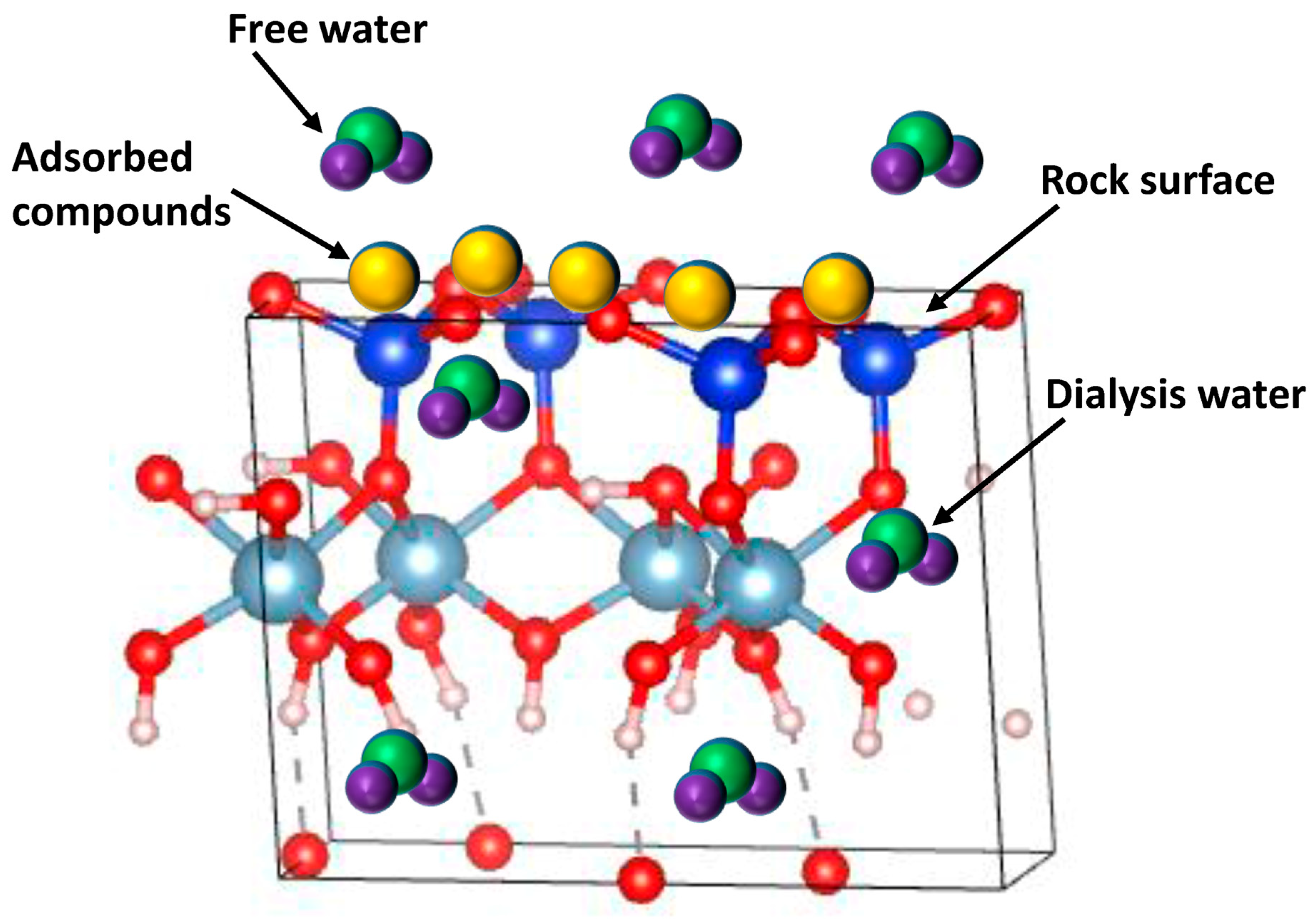
- The present model is a thermo-hydro-mechanical (THM) model. Molecular-scale interpretations (as hypotheses based on previous literature) are used only for discussion and are not formulated as governing equations.The present model is two-dimensional, homogeneous, and isotropic. These simplifications differ significantly from real shale and granite reservoirs, which typically contain bedding planes, natural fractures, and spatial heterogeneity in mechanical and petrophysical properties. The idealized two-dimensional homogeneous isotropic framework was deliberately adopted to isolate the fundamental thermo-hydro-mechanical coupling mechanisms without the confounding effects of geological complexity. Consequently, the simulated fracture geometries and propagation patterns should be interpreted as baseline behaviors under simplified conditions. Extension of the model to three-dimensional heterogeneous media that incorporate bedding, discrete fracture networks, and property variability is recognized as an important direction for future research.
2.2. Mathematical Governing Equations
2.2.1. Multiphase-Coupled Thermal Field
2.2.2. Reservoir Seepage Equation
2.2.3. Stress Field Equation
2.2.4. Boundary Conditions and Reservoir Parameters
2.2.5. Damage Evolution Equation for Reservoir Rocks
2.2.6. Calculation of Seepage, Imbibition, Adsorption, and Proppant Settling
2.2.7. Numerical Implementation and Computational Details
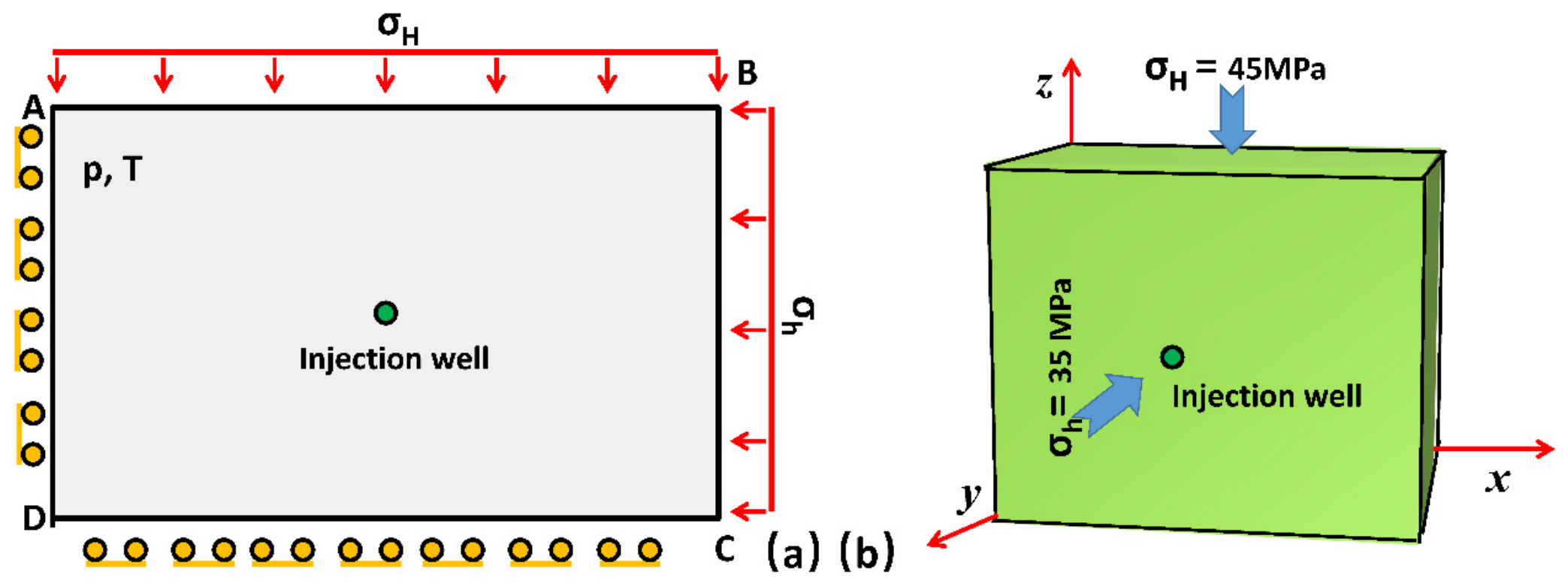
- Model geometry and mesh
- Time stepping and convergence
- Injection conditions
- Boundary and initial conditions
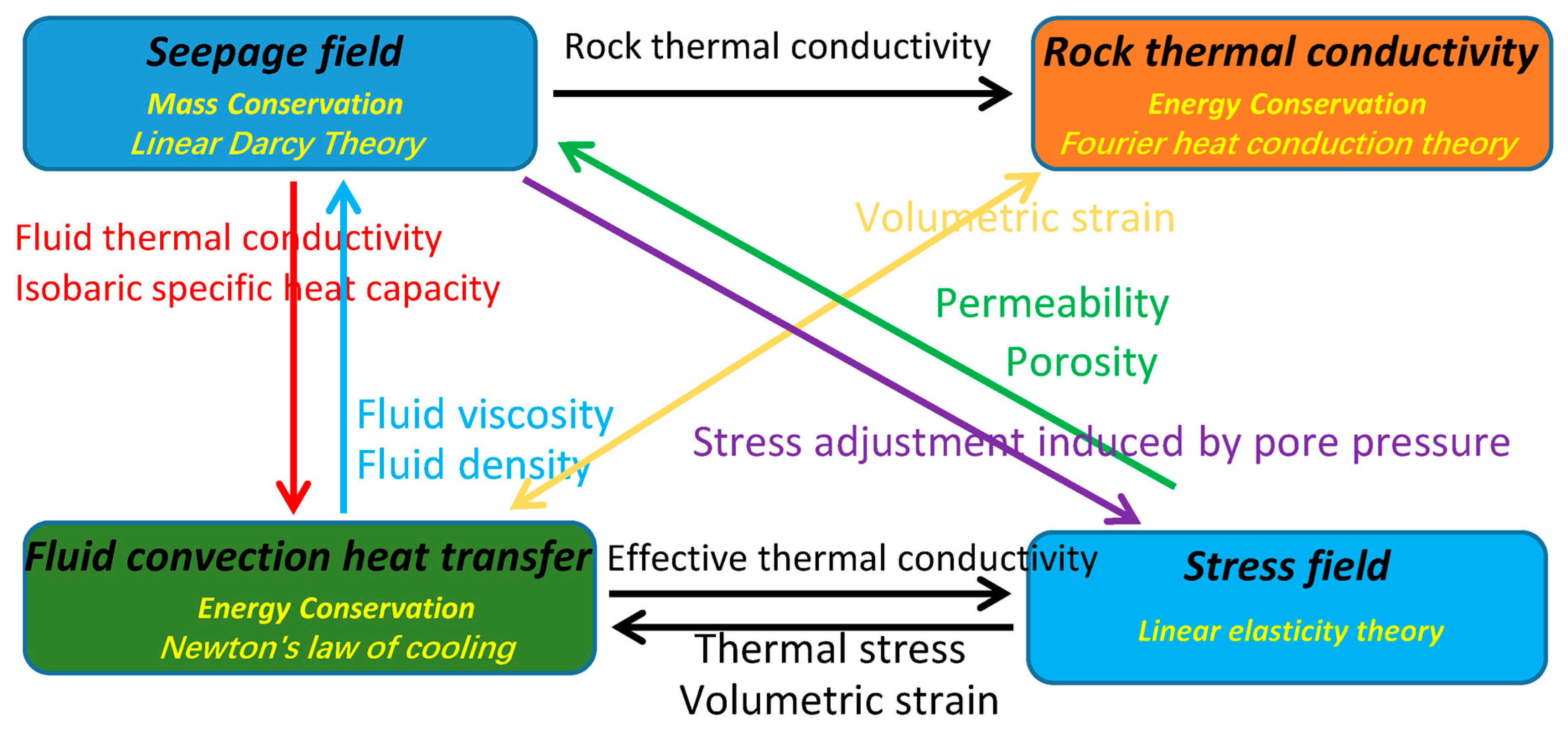
2.3. Thermo-Hydro-Mechanical Coupling in Water-Based Hydraulic Fracturing of Geological Reservoirs
2.4. Sensitivity Analysis of Key Parameters
2.5. Model Validation
3. Results and Discussion
3.1. Fracture Geometry and Propagation Behavior
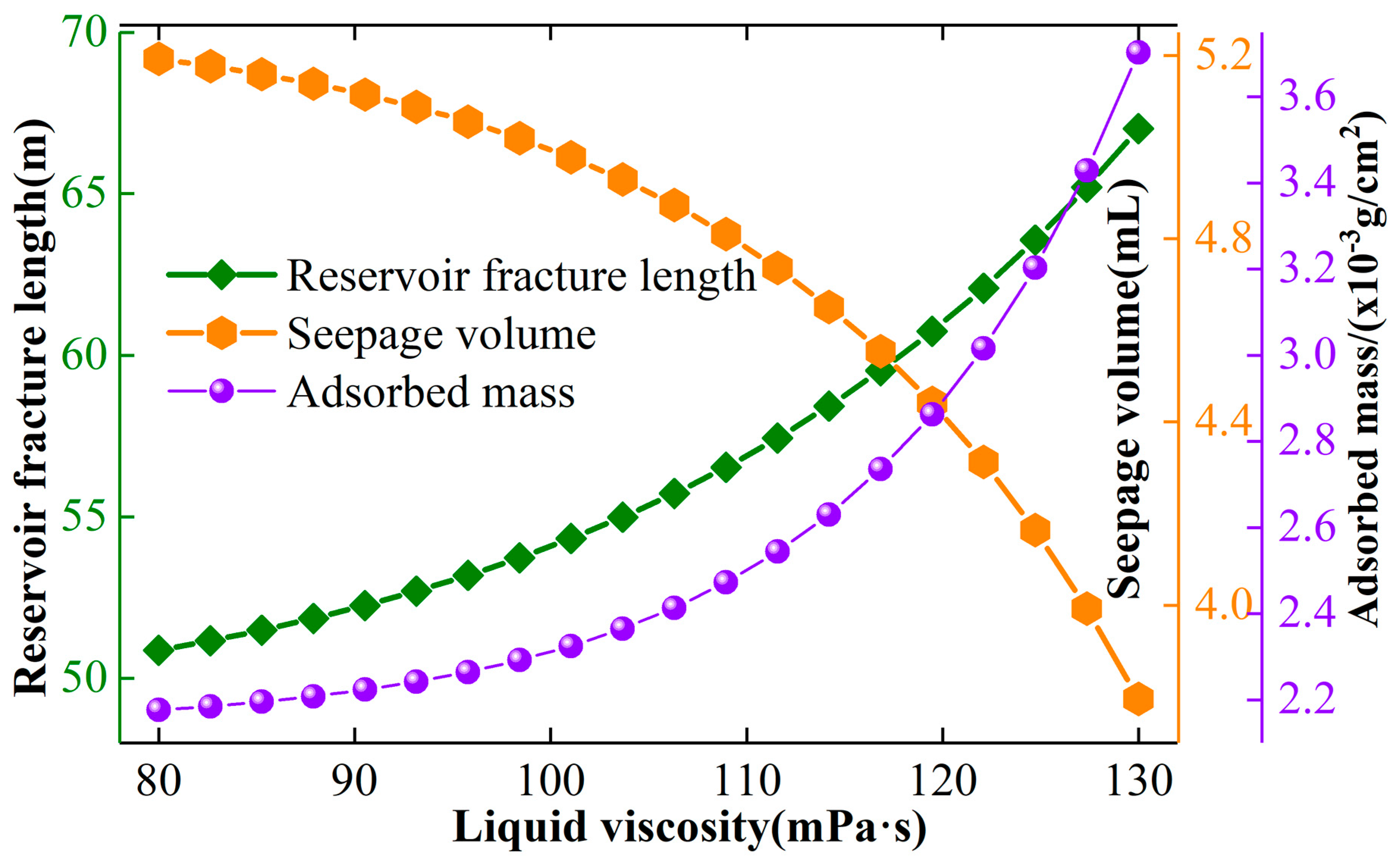
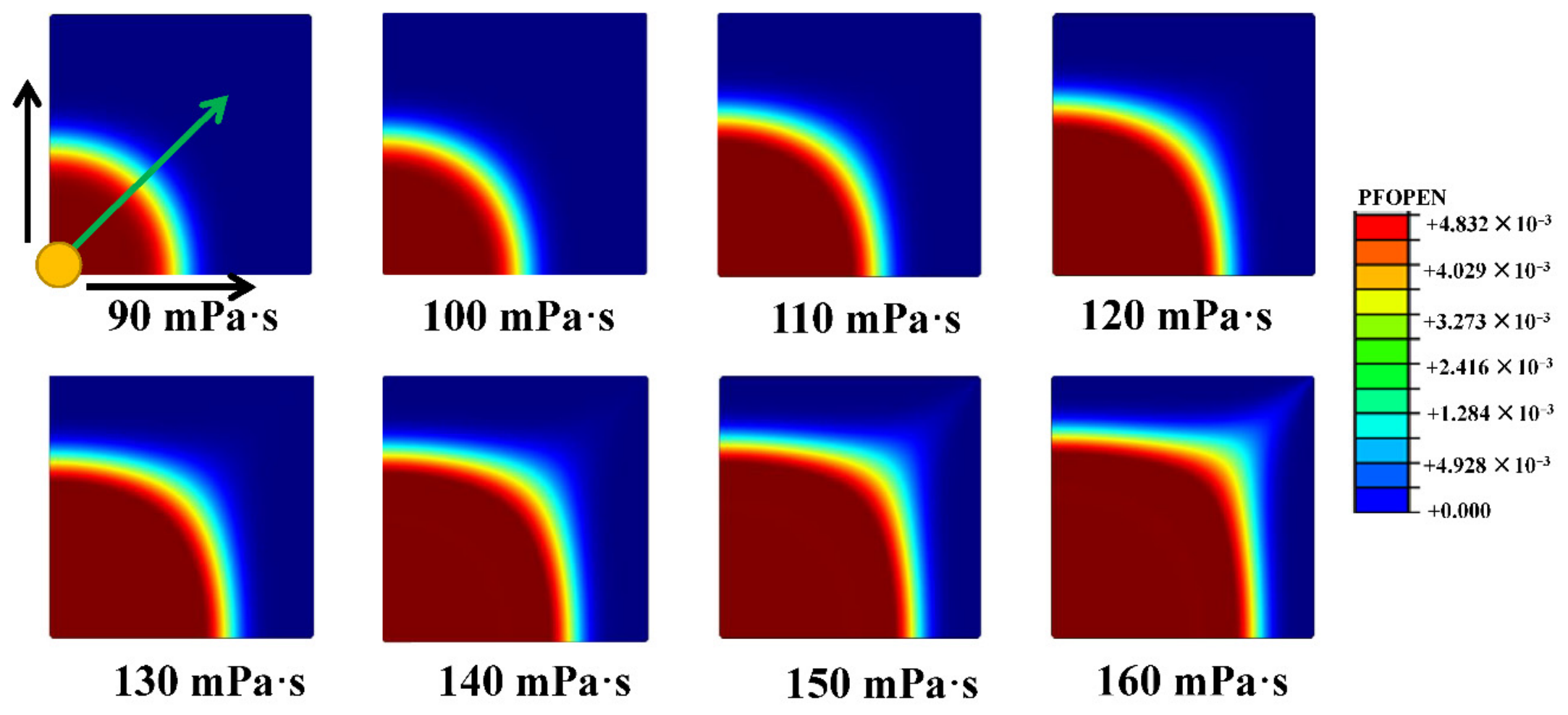
3.1.1. Adjustment of Fracture Propagation and Geometry by Fluid Viscosity


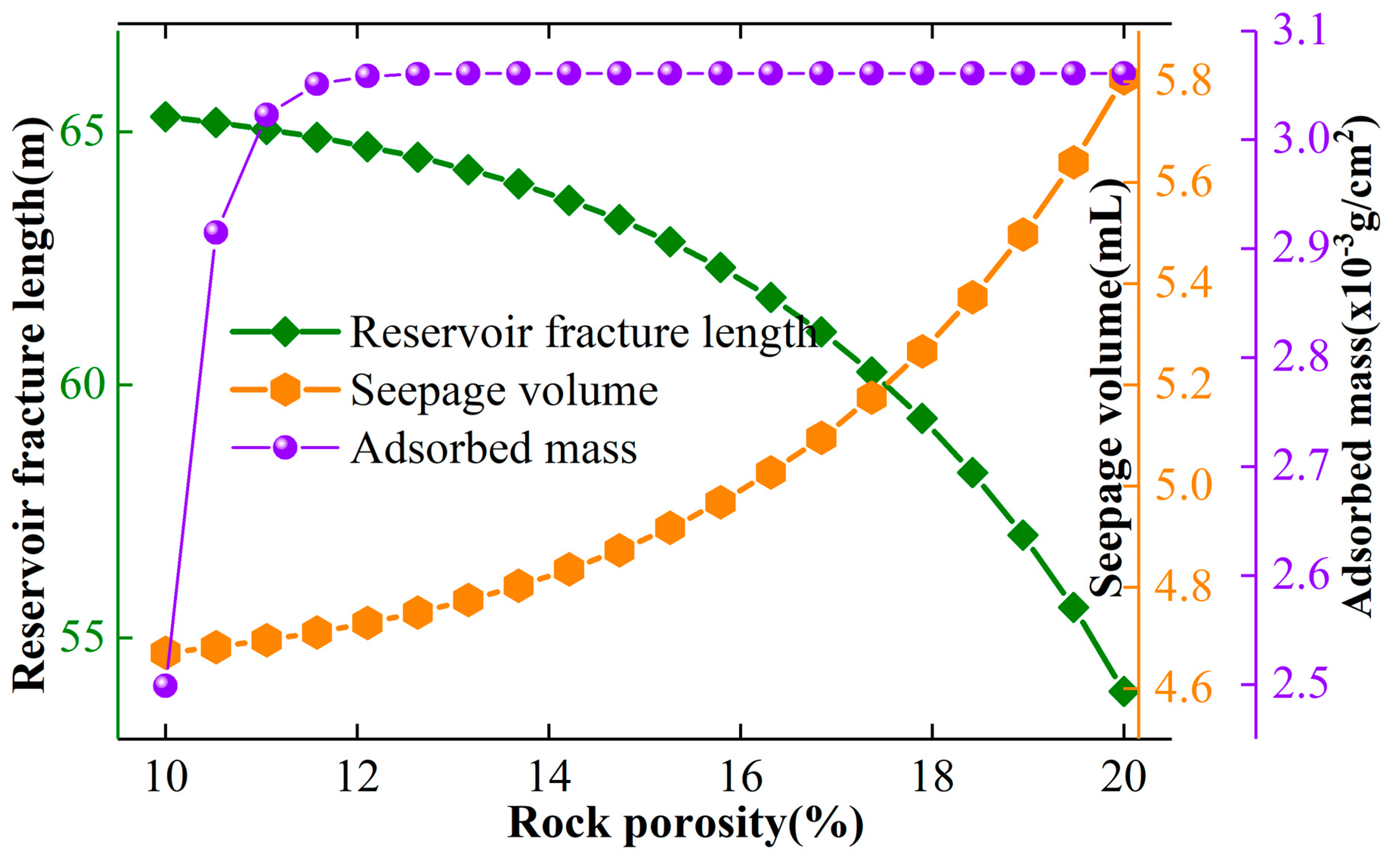
3.1.2. Effect of Rock Porosity on Fluid Permeation and Fracture Propagation
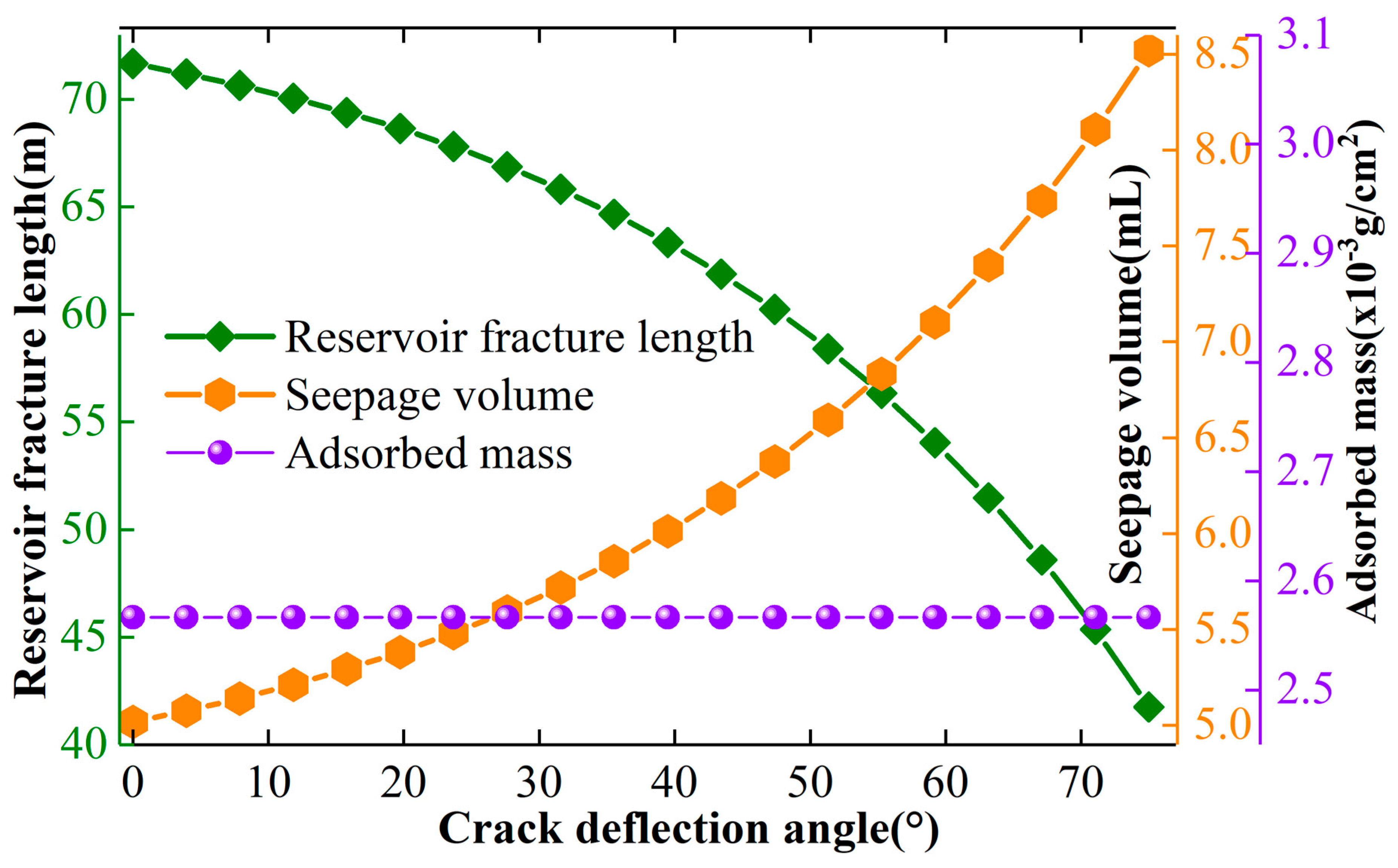
3.1.3. Effect of Crack Deflection Angle
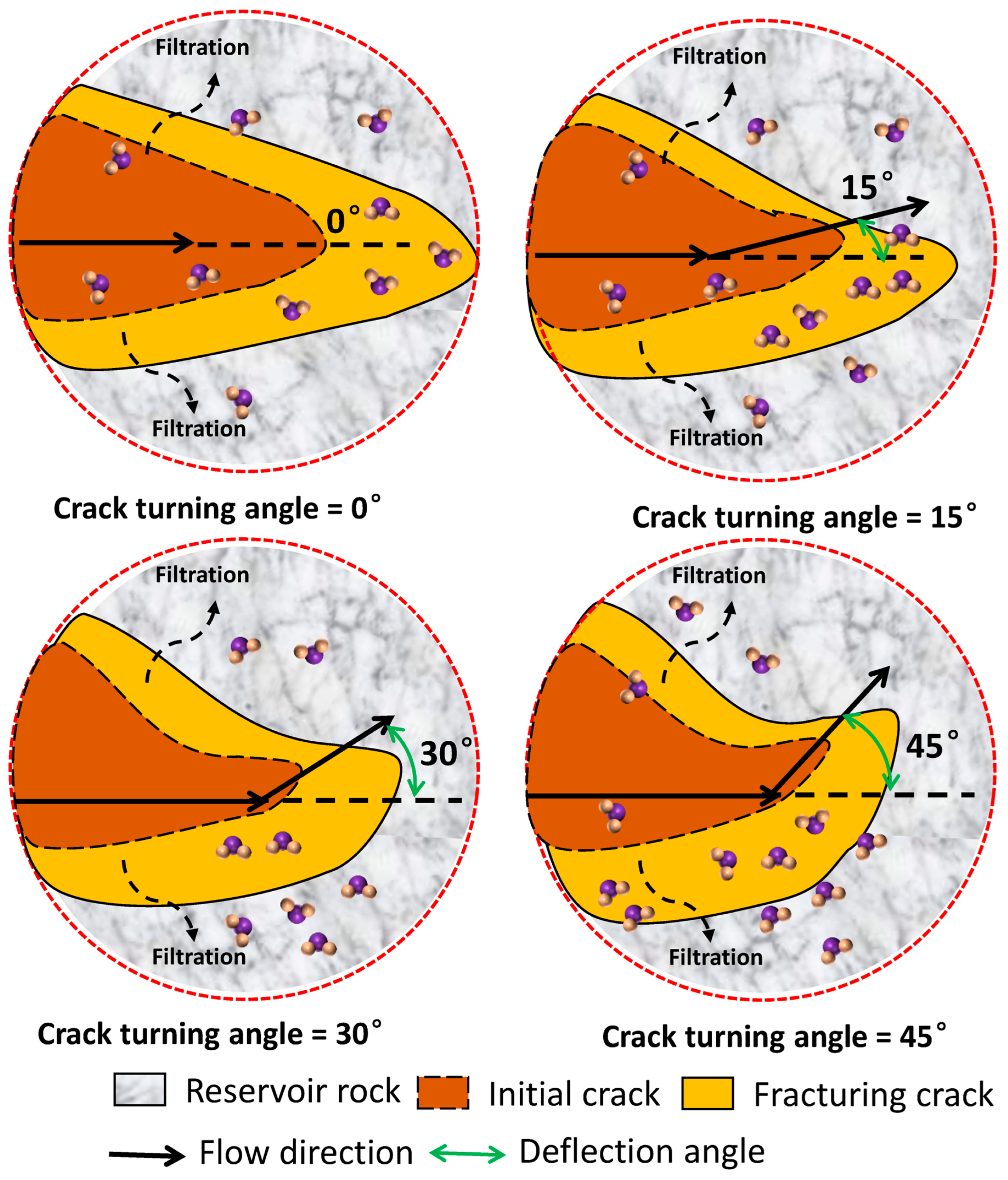
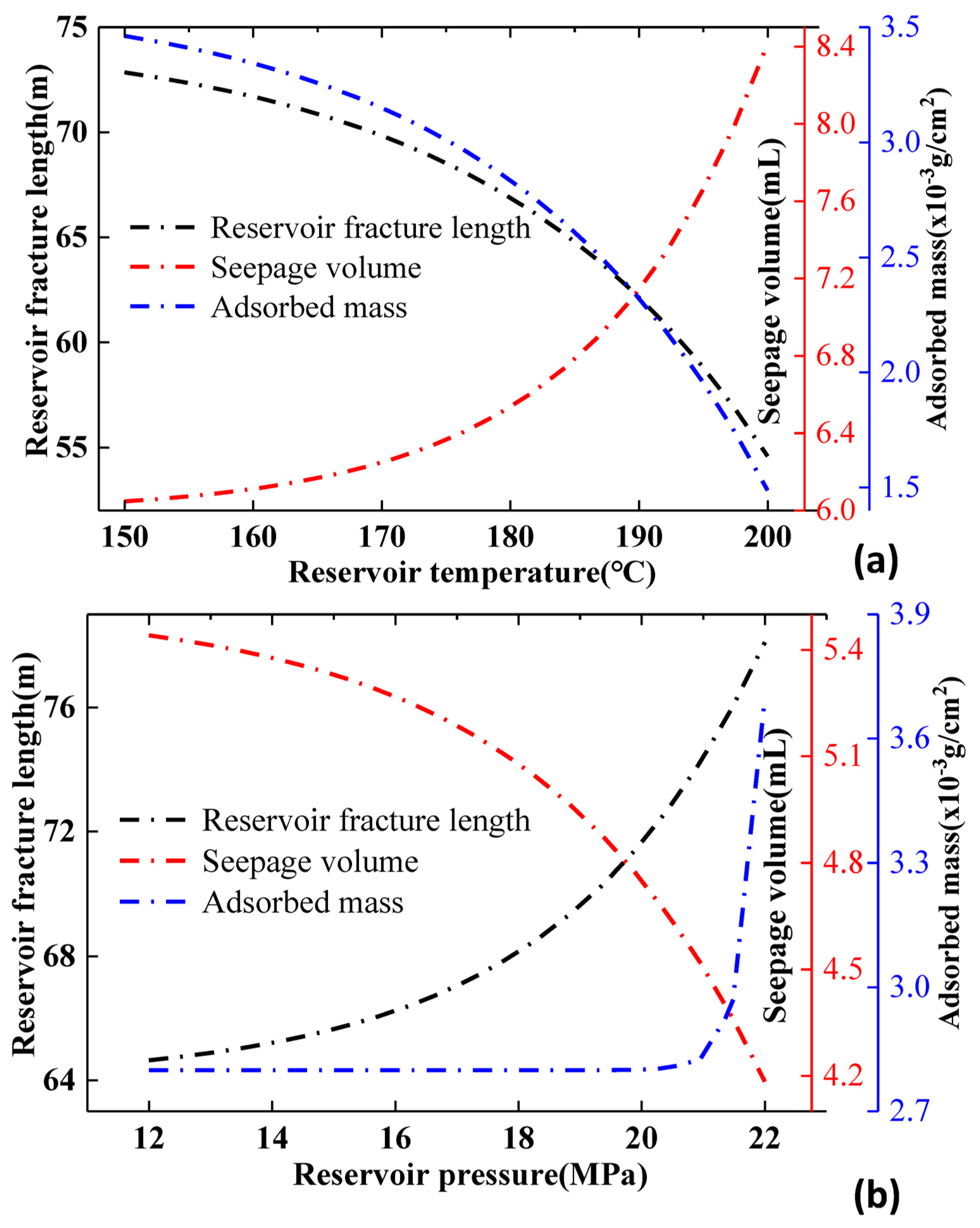
3.1.4. Effect of Reservoir Conditions

3.2. Particle Settling Behavior in Reservoir Fractures
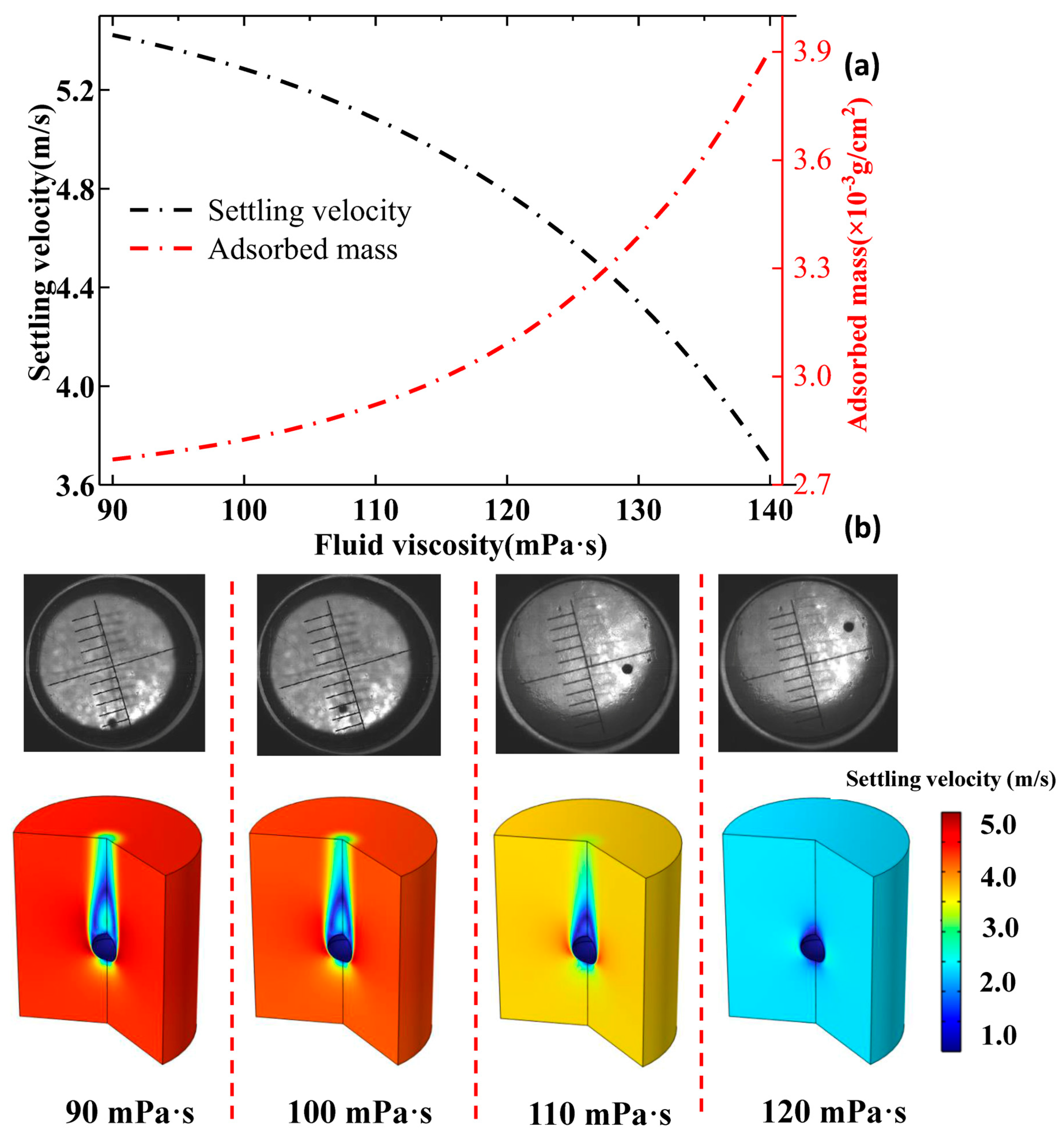
3.3. Fracturing Fluid Sweep Area and Stimulation Effectiveness

4. Conclusions
Author Contributions
Funding
Data Availability Statement
Conflicts of Interest
References
- Xu, C.; Dowd, P.A.; Tian, Z.F. A simplified coupled hydro-thermal model for enhanced geothermal systems. Appl. Energy 2015, 140, 135–145. [Google Scholar] [CrossRef] [Scilit]
- Ismail, A.; Azadbakht, S. A comprehensive review of numerical simulation methods for hydraulic fracturing. Int. J. Numer. Anal. Methods Geomech. 2024, 48, 1433–1459. [Google Scholar] [CrossRef] [Scilit]
- Li, L.C.; Tang, C.A.; Li, G.; Wang, S.Y.; Liang, Z.Z.; Zhang, Y.B. Numerical simulation of 3D hydraulic fracturing based on an improved flow-stress-damage model and a parallel FEM technique. Rock Mech. Rock Eng. 2012, 45, 801–818. [Google Scholar] [CrossRef] [Scilit]
- Li, Q.; You, D.; Li, Q.; Wang, F.; Wang, Y.; Yang, Y. Analysis of sedimentation behavior and influencing factors of solid particles in CO2 fracturing fluid. Processes 2025, 13, 4049. [Google Scholar] [CrossRef] [Scilit]
- Ren, Q.-Q.; Li, L.-F.; Wang, J.; Jiang, R.-T.; Li, M.-P.; Feng, J.-W. Dynamic evolution mechanism of the fracturing fracture system—Enlightenments from hydraulic fracturing physical experiments and finite element numerical simulation. Pet. Sci. 2024, 21, 3839–3866. [Google Scholar] [CrossRef] [Scilit]
- Li, Q.; Wang, F.; Wu, J.; Li, Q.; Zhang, G. Multivariate Coupling Model and Reservoir Characteristics of Enhanced Geothermal Reservoirs. Energies 2026, 19, 3180. [Google Scholar] [CrossRef] [Scilit]
- Taleghani, A.D.; Gonzalez-Chavez, M.; Yu, H.; Asala, H. Numerical simulation of hydraulic fracture propagation in naturally fractured formations using the cohesive zone model. J. Pet. Sci. Eng. 2018, 165, 42–57. [Google Scholar] [CrossRef] [Scilit]
- Wu, H.; Lyu, X.; Shang, X.; Huang, X.; Chang, Y. A Sensitivity-Driven Inversion Framework for Efficient Calibration of 3D Geomechanical Models: Application to a Shale Reservoir. Reserv. Sci. 2026, 2, 305–323. [Google Scholar] [CrossRef] [Scilit]
- Lu, C.; Ma, L.; Li, Z.; Huang, F.; Huang, C.; Yuan, H.; Tang, Z.; Guo, J. A novel hydraulic fracturing method based on the coupled CFD-DEM numerical simulation study. Appl. Sci. 2020, 10, 3027. [Google Scholar] [CrossRef] [Scilit]
- Guo, T.; Hao, T.; Yang, X.; Li, Q.; Liu, Y.; Chen, M.; Qu, Z. Numerical simulation study of fracture propagation by internal plugging hydraulic fracturing. Eng. Fract. Mech. 2024, 310, 110480. [Google Scholar] [CrossRef] [Scilit]
- Xu, B.; Liu, Y.; Wang, Y.; Yang, G.; Yu, Q.; Wang, F. A new method and application of full 3D numerical simulation for hydraulic fracturing horizontal fracture. Energies 2018, 12, 48. [Google Scholar] [CrossRef] [Scilit]
- Hu, J.; Cao, J.X.; He, X.Y.; Wang, Q.F.; Xu, B. Numerical simulation of fault activity owing to hydraulic fracturing. Appl. Geophys. 2018, 15, 367–381. [Google Scholar] [CrossRef] [Scilit]
- Shi, X.; Qin, Y.; Xu, H.; Feng, Q.; Wang, S.; Xu, P.; Han, S. Numerical simulation of hydraulic fracture propagation in conglomerate reservoirs. Eng. Fract. Mech. 2021, 248, 107738. [Google Scholar] [CrossRef] [Scilit]
- Ma, X.; Sun, Y.; Guo, W.; Jia, R.; Li, B. Numerical simulation of horizontal well hydraulic fracturing technology for gas production from hydrate reservoir. Appl. Ocean Res. 2021, 112, 102674. [Google Scholar] [CrossRef] [Scilit]
- Lizhe, L.; Fujian, Z.; You, Z.; Zhuolin, C.; Bo, W.; Yingying, Z.; Yutian, L. The prediction and optimization of Hydraulic fracturing by integrating the numerical simulation and the machine learning methods. Energy Rep. 2022, 8, 15338–15349. [Google Scholar] [CrossRef] [Scilit]
- Wu, J.; Li, Q.; Li, Q.; Wang, F.; Cheng, Y.; Yan, C. Design and Optimization of Bottom-Hole Temperature–Pressure Combinations in Gas Production from Gas Hydrates via Carbon Dioxide Replacement Strategy. Energies 2026, 19, 3536. [Google Scholar] [CrossRef] [Scilit]
- Yang, P.; Zhang, S.; Zou, Y.; Zhong, A.; Yang, F.; Zhu, D.; Chen, M. Numerical Simulation of integrated three-dimensional hydraulic fracture propagation and proppant transport in multi-well pad fracturing. Comput. Geotech. 2024, 167, 106075. [Google Scholar] [CrossRef] [Scilit]
- Li, Q.; Li, Q.; Wang, F.; Xu, N.; Wang, Y.; Bai, B. Settling behavior and mechanism analysis of kaolinite as a fracture proppant of hydrocarbon reservoirs in CO2 fracturing fluid. Colloids Surf. A Physicochem. Eng. Asp. 2025, 724, 137463. [Google Scholar] [CrossRef] [Scilit]
- Wu, M.Y.; Zhang, D.M.; Wang, W.S.; Li, M.H.; Liu, S.M.; Lu, J.; Gao, H. Numerical simulation of hydraulic fracturing based on two-dimensional surface fracture morphology reconstruction and combined finite-discrete element method. J. Nat. Gas Sci. Eng. 2020, 82, 103479. [Google Scholar] [CrossRef] [Scilit]
- Sun, C.; Zheng, H.; Liu, W.D.; Lu, W. Numerical simulation analysis of vertical propagation of hydraulic fracture in bedding plane. Eng. Fract. Mech. 2020, 232, 107056. [Google Scholar] [CrossRef] [Scilit]
- Tian, W.; Li, P.; Dong, Y.; Lu, Z.; Lu, D. Numerical simulation of sequential, alternate and modified zipper hydraulic fracturing in horizontal wells using XFEM. J. Pet. Sci. Eng. 2019, 183, 106251. [Google Scholar] [CrossRef] [Scilit]
- Eveline, V.F.; Akkutlu, I.Y.; Moridis, G.J. Numerical simulation of hydraulic fracturing water effects on shale gas permeability alteration. Transp. Porous Media 2017, 116, 727–752. [Google Scholar] [CrossRef] [Scilit]
- Liu, X.; Rasouli, V.; Guo, T.; Qu, Z.; Sun, Y.; Damjanac, B. Numerical simulation of stress shadow in multiple cluster hydraulic fracturing in horizontal wells based on lattice modelling. Eng. Fract. Mech. 2020, 238, 107278. [Google Scholar] [CrossRef] [Scilit]
- Guo, T.; Hao, T.; Chen, M.; Zhang, Y.; Qu, Z.; Jia, X.; Zhang, W.; Yu, H. Numerical simulation on Geothermal extraction by radial well assisted hydraulic fracturing. Renew. Energy 2023, 210, 440–450. [Google Scholar] [CrossRef] [Scilit]
- Ma, X.; Cheng, J.; Sun, Y.; Li, S. 2D numerical simulation of hydraulic fracturing in hydrate-bearing sediments based on the cohesive element. Energy Fuels 2021, 35, 3825–3840. [Google Scholar] [CrossRef] [Scilit]
- Li, Q.; Li, Q.; Wang, F.; Wu, J.; Wang, Y.; Jin, J. Effects of geological and fluid characteristics on the injection filtration of hydraulic fracturing fluid in the wellbores of shale reservoirs: Numerical analysis and mechanism determination. Processes 2025, 13, 1747. [Google Scholar] [CrossRef] [Scilit]
- Zhang, X.; Si, G.; Bai, Q.; Xiang, Z.; Li, X.; Oh, J.; Zhang, Z. Numerical simulation of hydraulic fracturing and associated seismicity in lab-scale coal samples: A new insight into the stress and aperture evolution. Comput. Geotech. 2023, 160, 105507. [Google Scholar] [CrossRef] [Scilit]
- Zhang, Z.; Sun, Q.; Wang, H.; Chen, C.; Chen, C.; Zhou, Q.; Gong, Q.; Zhuo, X.; Zhuo, P. The impact of reservoir parameters and fluid properties on seepage characteristics and fracture morphology using water-based fracturing fluid. Processes 2025, 13, 3166. [Google Scholar] [CrossRef] [Scilit]
- Li, Q.; Li, Q.; Cao, H.; Wu, J.; Wang, F.; Wang, Y. The crack propagation behaviour of CO2 fracturing fluid in unconventional low permeability reservoirs: Factor analysis and mechanism revelation. Processes 2025, 13, 159. [Google Scholar] [CrossRef] [Scilit]
- Cong, Z.; Li, Y.; Tang, J.; Martyushev, D.A.; Yang, F. Numerical simulation of hydraulic fracture height layer-through propagation based on three-dimensional lattice method. Eng. Fract. Mech. 2022, 264, 108331. [Google Scholar] [CrossRef] [Scilit]
- Liu, X.; Sun, Y.; Guo, T.; Rabiei, M.; Qu, Z.; Hou, J. Numerical simulations of hydraulic fracturing in methane hydrate reservoirs based on the coupled thermo-hydrologic-mechanical-damage (THMD) model. Energy 2022, 238, 122054. [Google Scholar] [CrossRef] [Scilit]
- Liu, Y.F.; Li, W.; Xiao, Z.H.; Ji, S.W.; Liu, Q.; Tang, Y.F.; Zhang, Y.; Wang, J.M. Recent Progress in Organic Inhibitors for Anticorrosion in Complex Acid Environments. Coatings 2026, 16, 150. [Google Scholar] [CrossRef] [Scilit]
- Chen, M.; Guo, T.; Zou, Y.; Zhang, S.; Qu, Z. Numerical simulation of proppant transport coupled with multi-planar-3D hydraulic fracture propagation for multi-cluster fracturing. Rock Mech. Rock Eng. 2022, 55, 565–590. [Google Scholar] [CrossRef] [Scilit]
- Wang, L.; Dong, Y.; Zhang, Q.; Duan, R. Numerical simulation of pressure evolution and migration of hydraulic fracturing fluids in the shale gas reservoirs of Sichuan Basin, China. J. Hydrol. 2020, 588, 125082. [Google Scholar] [CrossRef] [Scilit]
- Li, Q.; Li, Q.; Wu, J.; He, K.; Xia, Y.; Liu, J.; Wang, F.; Cheng, Y. Wellhead Stability During Development Process of Hydrate Reservoir in the Northern South China Sea: Sensitivity Analysis. Processes 2025, 13, 1630. [Google Scholar] [CrossRef] [Scilit]
- Adamu, M.A.; Ali, A.M.; Kasim, S. Supervised Seismic Facies Classification in Ataga Field of Niger Delta Basin using a Thalweg Tracker and Deep Learning Approach. Reserv. Sci. 2026, 2, 289–304. [Google Scholar] [CrossRef] [Scilit]
- Liu, Y.F.; Zhou, L.; Wan, X.C.; Tang, Y.F.; Liu, Q.; Li, W.; Liao, J. Synthesis and Characterization of a Temperature-Sensitive Microcapsule Gelling Agent for High-Temperature Acid Release. ACS Omega 2024, 9, 20849–20858. [Google Scholar] [CrossRef] [Scilit]
- Wang, W.; Guo, X.; Duan, P.; Kang, B.; Zheng, D.; Zafar, A. Investigation of plugging performance and enhanced oil recovery of multi-scale polymer microspheres in low-permeability reservoirs. Nat. Gas Ind. B 2023, 10, 223–232. [Google Scholar] [CrossRef] [Scilit]
- Huang, L.; Liao, X.; Fan, M.; Wu, S.; Tan, P.; Yang, L. Experimental and numerical simulation technique for hydraulic fracturing of shale formations. Adv. Geo-Energy Res. 2024, 13, 83–88. [Google Scholar] [CrossRef] [Scilit]
- Ao, F.; Qingchao, L.; Qiang, L.; Jingjuan, W.; Fuling, W.; Chuanliang, Y. Numerical Simulation Investigation of Fracture Propagation Behavior Patterns and Sensitivity Factors of Oil Shale Reservoirs in the Xunyi Region Considering the Influence of Natural Fracture. Geofluids 2025, 2025, 2762142. [Google Scholar] [CrossRef] [Scilit]
- Mwakipunda, G.C.; Komba, N.A.; Ayimadu, E.T.; Yu, L. Model Development for Brittleness Index Estimation and Depth Determination in Hydraulic Fracturing Operations in Shale Gas Reservoirs Using Machine Learning Algorithms. SPE J. 2025, 30, 4409–4430. [Google Scholar] [CrossRef] [Scilit]
- Guo, T.; Tang, S.; Liu, S.; Liu, X.; Zhang, W.; Qu, G. Numerical simulation of hydraulic fracturing of hot dry rock under thermal stress. Eng. Fract. Mech. 2020, 240, 107350. [Google Scholar] [CrossRef] [Scilit]
- Li, Q.; Li, Q.; Han, Y. A numerical investigation on kick control with the displacement kill method during a well test in a deep-water gas reservoir: A case study. Processes 2024, 12, 2090. [Google Scholar] [CrossRef] [Scilit]
- Yaobin, S.; Weiyong, L.; Changchun, H.; Erhu, B. Numerical simulation of the influence of natural fractures on hydraulic fracture propagation. Geofluids 2020, 2020, 8878548. [Google Scholar] [CrossRef] [Scilit]
- Zhang, K.; Gao, Y.; Chen, S.; Tan, Z.; Wu, X.; Wang, W.; Tian, Y.; Su, Y.; Liu, S.; Wang, H. Determination of Reserve Parameters of Gulong Shale Oil Reservoir and Its Geological Significance. Reserv. Sci. 2026, 2, 276–288. [Google Scholar] [CrossRef] [Scilit]
- Lv, M.; Guo, T.; Chen, M.; Liu, Y.; Yang, X.; Qu, Z.; Dai, C. Review of proppant flowback after hydraulic fracturing: Research, control, and prediction methods. Geoenergy Sci. Eng. 2025, 246, 213651. [Google Scholar] [CrossRef] [Scilit]
- Li, Q.; Li, Q.; Wang, F.; Wu, J.; Wang, Y. The carrying behavior of water-based fracturing fluid in shale reservoir fractures and molecular dynamics of sand-carrying mechanism. Processes 2024, 12, 2051. [Google Scholar] [CrossRef] [Scilit]
- Wu, J.; Ansari, U. From CO2 Sequestration to Hydrogen Storage: Further Utilization of Depleted Gas Reservoirs. Reserv. Sci. 2025, 1, 19–35. [Google Scholar] [CrossRef] [Scilit]
- Li, Y.; Hu, W.; Zhang, Z.; Zhang, Z.; Shang, Y.; Han, L.; Wei, S. Numerical simulation of hydraulic fracturing process in a naturally fractured reservoir based on a discrete fracture network model. J. Struct. Geol. 2021, 147, 104331. [Google Scholar] [CrossRef] [Scilit]
- Zhu, X.; Wei, S.; Luo, W.; Gong, X.; Chu, Y. Numerical simulation and experimental study on improving gas drainage by hydraulic fracturing. Energy Sources Part A Recovery Util. Environ. Eff. 2023, 45, 1965–1982. [Google Scholar] [CrossRef] [Scilit]
- Li, Q.; Liu, J.; Wang, S.; Guo, Y.; Han, X.; Li, Q.; Cheng, Y.; Dong, Z.; Li, X.; Zhang, X. Numerical insights into factors affecting collapse behavior of horizontal wellbore in clayey silt hydrate-bearing sediments and the accompanying control strategy. Ocean Eng. 2024, 297, 117029. [Google Scholar] [CrossRef] [Scilit]
- Dalla Barba, F.; Picano, F. A novel approach for direct numerical simulation of hydraulic fracture problems. Flow Turbul. Combust. 2020, 105, 335–357. [Google Scholar] [CrossRef] [Scilit]
- Fan, Y.; Shu, L.; Huo, Z.; Hao, J.; Yang, L. Numerical simulation research on hydraulic fracturing promoting coalbed methane extraction. Shock Vib. 2021, 2021, 3269592. [Google Scholar] [CrossRef] [Scilit]
- Tang, H.; Luo, S.; Liang, H.; Zeng, B.; Zhang, L.; Zhao, Y.; Song, Y. Integrated numerical simulation of hydraulic fracturing and production in shale gas well considering gas-water two-phase flow. Pet. Explor. Dev. 2024, 51, 684–696. [Google Scholar] [CrossRef] [Scilit]
- Li, Q. Reservoir Science: One Year On–Achievements, Challenges, and Future Prospects. Reserv. Sci. 2026, 2, 272–275. [Google Scholar] [CrossRef] [Scilit]
- Zhou, T.; Wang, H.; Li, F.; Li, Y.; Zou, Y.; Zhang, C. Numerical simulation of hydraulic fracture propagation in laminated shale reservoirs. Pet. Explor. Dev. 2020, 47, 1117–1130. [Google Scholar] [CrossRef] [Scilit]
- Li, Q.; Wang, F.; Forson, K.; Zhang, J.; Zhang, C.; Chen, J.; Xu, N.; Wang, Y. Affecting analysis of the rheological characteristic and reservoir damage of CO2 fracturing fluid in low permeability shale reservoir. Environ. Sci. Pollut. Res. 2022, 29, 37815–37826. [Google Scholar] [CrossRef] [Scilit]
- Kang, H.; Xia, Y.; Feng, M.; Lu, C.; Gao, F. Case study of hydraulic fracturing for coal burst risk mitigation. Int. J. Coal Sci. Technol. 2025, 12, 61. [Google Scholar] [CrossRef] [Scilit]
- Yang, K.; Gao, D. Numerical simulation of hydraulic fracturing process with consideration of fluid–solid interaction in shale rock. J. Nat. Gas Sci. Eng. 2022, 102, 104580. [Google Scholar] [CrossRef] [Scilit]
- Li, Q.; Cheng, Y.; Li, Q.; Zhang, C.; Ansari, U.; Song, B. Establishment and evaluation of strength criterion for clayey silt hydrate-bearing sediments. Energy Sources Part A Recovery Util. Environ. Eff. 2018, 40, 742–750. [Google Scholar] [CrossRef] [Scilit]
- Wang, J.; Guo, T.; Chen, M.; Qu, Z.; Zhang, B.; Zhang, W.; Zhai, C.; Zheng, P. Numerical simulation of fracture propagation morphology in hydraulic fracturing development of geothermal reservoirs based on the CDEM-THM3D. Comput. Geotech. 2024, 172, 106444. [Google Scholar] [CrossRef] [Scilit]
- Ma, J.; Li, X.; Yao, Q.; Tan, K. Numerical simulation of hydraulic fracture extension patterns at the interface of coal-measure composite rock mass with Cohesive Zone Model. J. Clean. Prod. 2023, 426, 139001. [Google Scholar] [CrossRef] [Scilit]
- Han, L.; Zhou, X. Numerical Simulations of the Hydraulic Fracture Propagation in Poroelastic Media Using the Coupled Hydro-Mechanical Field-Enriched Finite Element Method. Rock Mech. Rock Eng. 2025, 58, 245–274. [Google Scholar] [CrossRef] [Scilit]
- Zhai, M.; Wang, D.; Zhang, Z.; Zhang, L.; Yang, F.; Huang, B.; Zhong, A.; Li, L. Numerical simulation and multi-factor optimization of hydraulic fracturing in deep naturally fractured sandstones based on response surface method. Eng. Fract. Mech. 2022, 259, 108110. [Google Scholar] [CrossRef] [Scilit]
- Yan, X.; Yu, H. Numerical simulation of hydraulic fracturing with consideration of the pore pressure distribution based on the unified pipe-interface element model. Eng. Fract. Mech. 2022, 275, 108836. [Google Scholar] [CrossRef] [Scilit]
- Hu, X.; Huang, G.; Zhou, F.; Qiu, Y.; Gou, X.; Chen, C. Pressure response using wavelet analysis in the process of hydraulic fracturing: Numerical simulation and field case. J. Pet. Sci. Eng. 2022, 217, 110837. [Google Scholar] [CrossRef] [Scilit]
- Li, Q.; Li, Q.; Wu, J.; Li, X.; Li, H.; Cheng, Y. Wellhead Stability During Development Process of Hydrate Reservoir in the Northern South China Sea: Evolution and Mechanism. Processes 2025, 13, 40. [Google Scholar] [CrossRef] [Scilit]
- Li, Q.; Wu, J.; Li, Q.; Wang, F.; Cheng, Y. Sediment Instability Caused by Gas Production from Hydrate-Bearing Sediment in Northern South China Sea by Horizontal Wellbore: Sensitivity Analysis. Nat. Resour. Res. 2025, 34, 1667–1699. [Google Scholar] [CrossRef] [Scilit]
- Zhang, B.; Guo, T.; Qu, Z.; Wang, J.; Chen, M.; Liu, X. Numerical simulation of fracture propagation and production performance in a fractured geothermal reservoir using a 2D FEM-based THMD coupling model. Energy 2023, 273, 127175. [Google Scholar] [CrossRef] [Scilit]
- Zeng, H.; Jin, Y.; Wang, D.; Yu, B.; Zhang, W. Numerical simulation on hydraulic fracture height growth across layered elastic–plastic shale oil reservoirs. Processes 2022, 10, 1453. [Google Scholar] [CrossRef] [Scilit]
- Shi, X.; Ge, X.; Gao, Q.; Han, S.; Zhang, Y.; Kong, X. Numerical simulation of hydraulic fracture propagation from recompletion in refracturing with dynamic stress modeling. Geomech. Geophys. Geo-Energy Geo-Resour. 2024, 10, 155. [Google Scholar] [CrossRef] [Scilit]
- Onwubuariri, C.N.; Aigba, P.I.; Dinneya, O.C.; Nwokoma, E.U. Integrated Seismic Interpretation and Petrophysical Evaluation for Hydrocarbon Volumetric Estimation in the BUKS Offshore Field, Niger Delta, Nigeria. Reserv. Sci. 2026, 2, 261–271. [Google Scholar] [CrossRef] [Scilit]
- Wang, D.; Li, S.; Zhang, D.; Pan, Z. Understanding and predicting proppant bedload transport in hydraulic fracture via numerical simulation. Powder Technol. 2023, 417, 118232. [Google Scholar] [CrossRef] [Scilit]
- Li, Q.; Wang, F.; Wang, Y.; Bai, B.; Zhang, J.; Lili, C.; Sun, Q.; Wang, Y.; Forson, K. Adsorption behavior and mechanism analysis of siloxane thickener for CO2 fracturing fluid on shallow shale soil. J. Mol. Liq. 2023, 376, 121394. [Google Scholar] [CrossRef] [Scilit]
- Fu, H.; Huang, L.; Hou, B.; Weng, D.; Guan, B.; Zhong, T.; Zhao, Y. Experimental and numerical investigation on interaction mechanism between hydraulic fracture and natural fracture. Rock Mech. Rock Eng. 2024, 57, 10571–10582. [Google Scholar] [CrossRef] [Scilit]
- Nawab, S.; Ali, M.; Hullio, I.A.; Noshad; Liu, N.; Jokhio, S.A. A Machine Learning Framework for Artificial Lift Method Selection with Physics-Informed Data Balancing. Reserv. Sci. 2026, 2, 228–260. [Google Scholar] [CrossRef] [Scilit]
- Yin, P.F.; Yang, S.Q.; Gao, F.; Tian, W.L.; Zeng, W. Numerical investigation on hydraulic fracture propagation and multi-perforation fracturing for horizontal well in Longmaxi shale reservoir. Theor. Appl. Fract. Mech. 2023, 125, 103921. [Google Scholar] [CrossRef] [Scilit]
- Zhao, J.; Wang, Z.; Lin, R.; Ren, L.; Wu, J.; Wu, J. Numerical simulation of diverting fracturing for staged fracturing horizontal well in shale gas reservoir. J. Energy Resour. Technol. 2023, 145, 053202. [Google Scholar] [CrossRef] [Scilit]
- Li, Q.; Wang, F.; Wang, Y.; Zhou, C.; Chen, J.; Forson, K.; Miao, R.; Su, Y.; Zhang, J. Effect of reservoir characteristics and chemicals on filtration property of water-based drilling fluid in unconventional reservoir and mechanism disclosure. Environ. Sci. Pollut. Res. 2023, 30, 55034–55043. [Google Scholar] [CrossRef] [Scilit]
- Zhu, D.; Han, G.; Zou, H.; Cui, M.; Liang, C.; Yao, F. A review of the hydraulic fracturing in ductile reservoirs: Theory, simulation, and experiment. Processes 2022, 10, 2022. [Google Scholar] [CrossRef] [Scilit]
- Min, Q.; Zhang, M.; Li, M.; He, Y.; Bordas, S.P.; Zhang, H. Hydraulic fracturing simulation of concrete dam integrating intelligent crack detection and refined modeling methods. Eng. Struct. 2024, 305, 117760. [Google Scholar] [CrossRef] [Scilit]
- Xia, Y.; Yao, M.; Li, T.; Yang, H.; Tang, C.A. Numerical analysis of hydraulic fracture propagation in deep shale reservoir with different injection strategies. J. Rock Mech. Geotech. Eng. 2024, 16, 3558–3574. [Google Scholar] [CrossRef] [Scilit]
- Ran, Q.; Zhou, X.; Dong, J.; Xu, M.; Ren, D.; Li, R. Numerical simulation of multi-fracture propagation based on the extended finite element method. Processes 2023, 11, 2032. [Google Scholar] [CrossRef] [Scilit]
- Zhang, Y.; Guo, T.; Chen, M.; Qu, Z.; Cao, J.; Yang, X.; Fu, H.; Zhang, X. Numerical simulation study of fracture height growth considering the influence of bedding planes. Comput. Geotech. 2024, 168, 106144. [Google Scholar] [CrossRef] [Scilit]
- Wang, Y.; Sun, Y. Simulation Analysis of Wellhead Sinking during the Development of Weakly Consolidated Marine Hydrate Deposits with Depressurization Strategy. Reserv. Sci. 2026, 2, 203–227. [Google Scholar] [CrossRef] [Scilit]
- Liu, Y.H.; Zhang, J.T.; Bai, J.; Zhang, F.S.; Tang, J.Z. Numerical study of hydraulic fracturing in the sectorial well-factory considering well interference and stress shadowing. Pet. Sci. 2023, 20, 3567–3581. [Google Scholar] [CrossRef] [Scilit]
- Huang, G.; Li, M.; Zhou, F.; Chu, J.; Xiong, Z. A new numerical simulation method for multi-stage in-fracture temporary plugging and diverting fracturing: Based on the modified cohesive zone model. Rock Mech. Rock Eng. 2024, 57, 8723–8740. [Google Scholar] [CrossRef] [Scilit]
- Li, Q.; Wang, F.; Wang, Y.; Zhang, J.; Yu, X.; Zhao, M.; Zhou, C.; Forson, K.; Shi, S.; Zhao, Y.; et al. Influence of organoboron cross-linker and reservoir characteristics on filtration and reservoir residual of guar gum fracturing fluid in low-permeability shale gas reservoirs. Environ. Sci. Pollut. Res. 2022, 29, 82975–82985. [Google Scholar] [CrossRef] [Scilit]
- Zhu, T.; Wei, X.; Zhang, Z. Numerical simulation of hydraulic-mechanical-chemical field coupled acid fracturing in complex carbonate reservoir. Comput. Geotech. 2023, 156, 105277. [Google Scholar] [CrossRef] [Scilit]
- Prieto, M.; Aristizabal, J.A.; Pradilla, D.; Gómez, J.M. Simultaneous numerical simulation of the hydraulic fractures geometry in multi-stage fracturing for horizontal shale gas wells. J. Nat. Gas Sci. Eng. 2023, 102, 104567. [Google Scholar] [CrossRef] [Scilit]
- Ma, X.; Jiang, D.; Fang, X.; Wang, X. Numerical simulation of single-cluster and multi-cluster fracturing of hydrate reservoir based on cohesive element. Eng. Fract. Mech. 2022, 265, 108365. [Google Scholar] [CrossRef] [Scilit]
- Lv, M.; Guo, T.; Jia, X.; Wen, D.; Chen, M.; Wang, Y.; Qu, Z.; Ma, D. Study on the pump schedule impact in hydraulic fracturing of unconventional reservoirs on proppant transport law. Energy 2024, 286, 129569. [Google Scholar] [CrossRef] [Scilit]
- Huang, S.; Li, Z.; Song, X.; Ju, B.; Zhang, C.; Xu, B. Oil displacement behavior of polymer flooding in horizontal well patterns: Experimental and numerical simulation approaches. Reserv. Sci. 2026, 2, 189–202. [Google Scholar] [CrossRef] [Scilit]
- Li, Q.; Wang, Y.; Wang, F.; Wu, J.; Tahir, M.U.; Li, Q.; Yuan, L.; Liu, Z. Effect of thickener and reservoir parameters on the filtration property of CO2 fracturing fluid. Energy Sources Part A Recovery Util. Environ. Eff. 2020, 42, 1705–1715. [Google Scholar] [CrossRef] [Scilit]
- Pu, Y.; Li, S.; Tang, D.; Chen, S. Numerical simulation study on the effectiveness of temporary plugging and fracturing in deep coal seam to construct complex fracture network. Geoenergy Sci. Eng. 2023, 227, 211939. [Google Scholar] [CrossRef] [Scilit]
- Zhang, N.; Luo, Z.; Chen, Z.; Liu, F.; Liu, P.; Chen, W.; Wu, L.; Zhao, L. Thermal–hydraulic–mechanical–chemical coupled processes and their numerical simulation: A comprehensive review. Acta Geotech. 2023, 18, 6253–6274. [Google Scholar] [CrossRef] [Scilit]
- Wang, H.; Jie, Y.; Zhou, D.; Ma, X. Underground hydrogen storage in depleted gas reservoirs with hydraulic fractures: Numerical modeling and simulation. J. Energy Storage 2024, 97, 112777. [Google Scholar] [CrossRef] [Scilit]
- Zuo, L.; Li, X.; Han, Z.; You, Q.; Liu, X. Numerical simulation of proppant transport in major and branching fractures based on CFD-DEM. ACS Omega 2024, 9, 13163. [Google Scholar] [CrossRef] [Scilit]
- Tang, L.; Wang, T.; Liu, Y.; Zhou, H. Methane interface desorption mechanism in geological reservoirs after natural gas hydrate decomposition. Reserv. Sci. 2026, 2, 172–188. [Google Scholar] [CrossRef] [Scilit]
- Li, Q.; Wang, Y.; Wang, F.; Li, Q.; Kobina, F.; Bai, H.; Yuan, L. Effect of a modified silicone as a thickener on rheology of liquid CO2 and its fracturing capacity. Polymers 2019, 11, 540. [Google Scholar] [CrossRef] [Scilit]
- Xia, B.; Zhou, Y.; Zhang, X.; Zhou, L.; Ma, Z. Physical and numerical investigations of target stratum selection for ground hydraulic fracturing of multiple hard roofs. Int. J. Min. Sci. Technol. 2024, 34, 699–712. [Google Scholar] [CrossRef] [Scilit]
- Lei, Z.; Zhang, Y.; Zhang, S.; Shi, Y. Numerical study of hydraulic fracturing treatments and geothermal energy extraction from a naturally fractured granitic formation. Geothermics 2023, 111, 102692. [Google Scholar] [CrossRef] [Scilit]
- Brantson, E.T.; Obeng, S.D.A.; Ocran, D.; Duodu, E.K.; Iyiola, Z.O.; Adjei, E.J.; Adu-Awuku, J.; Owusu, A.G. Evaluating enthalpy production in geothermal reservoirs: Insights from response surface methodology and advanced machine learning techniques. Reserv. Sci. 2026, 2, 151–171. [Google Scholar] [CrossRef] [Scilit]
- Li, Q.; Wang, Y.; Wang, X.; Yu, H.; Li, Q.; Wang, F.; Kobina, F. An application of thickener to increase viscosity of liquid CO2 and the assessment of the reservoir geological damage and CO2 utilization. Energy Sources Part A Recovery Util. Environ. Eff. 2019, 41, 368–377. [Google Scholar]
- Iranmanesh, M.A.; Pak, A. Three-dimensional numerical simulation of hydraulically driven cohesive fracture propagation in deformable reservoir rock using enriched EFG method. Comput. Geosci. 2023, 27, 317–335. [Google Scholar] [CrossRef] [Scilit]
- Li, Y.; Hu, W.; Wei, S.; Li, L.; Zhang, Z.; Song, S. Influence of preexisting discontinuities on hydraulic fracture complexity in a naturally fractured reservoir. Eng. Geol. 2022, 311, 106919. [Google Scholar] [CrossRef] [Scilit]
- Li, Q.; Li, Y.; Cheng, Y.; Li, Q.; Wang, F.; Wei, J.; Liu, Y.; Zhang, C.; Song, B.; Yan, C.; et al. Numerical simulation of fracture reorientation during hydraulic fracturing in perforated horizontal well in shale reservoirs. Energy Sources Part A Recovery Util. Environ. Eff. 2018, 40, 1807–1813. [Google Scholar] [CrossRef] [Scilit]
- Xue, Y.; Liu, S.; Chai, J.; Liu, J.; Ranjith, P.; Cai, C.; Gao, F.; Bai, X. Effect of water-cooling shock on fracture initiation and morphology of high-temperature granite: Application of hydraulic fracturing to enhanced geothermal systems. Appl. Energy 2023, 337, 120858. [Google Scholar] [CrossRef] [Scilit]
- Li, M.-H.; Zhou, F.-J.; Wang, B.; Hu, X.-D.; Wang, D.-B.; Zhuang, X.-Y.; Han, S.-B.; Huang, G.-P. Numerical simulation on the multiple planar fracture propagation with perforation plugging in horizontal wells. Pet. Sci. 2022, 19, 2253–2267. [Google Scholar] [CrossRef] [Scilit]
- Wang, L.; Yao, Y.; Zhao, G.; Adenutsi, C.D.; Wang, W.; Lai, F. A hybrid surrogate-assisted integrated optimization of horizontal well spacing and hydraulic fracture stage placement in naturally fractured shale gas reservoir. J. Pet. Sci. Eng. 2022, 216, 110842. [Google Scholar] [CrossRef] [Scilit]
- Zhou, X.; Yang, F.; Chen, Z.; Su, Y. Mechanistic insights and engineering strategies for wellbore integrity control in polar permafrost reservoirs. Reserv. Sci. 2026, 2, 126–150. [Google Scholar] [CrossRef] [Scilit]
- Patel, S.; Wilson, I.; Sreenivasan, H.; Krishna, S. Numerical simulations of proppant transportation in cryogenic fluids: Implications on liquid helium and liquid nitrogen fracturing for subsurface hydrogen storage. Int. J. Hydrogen Energy 2024, 56, 924–936. [Google Scholar] [CrossRef] [Scilit]
- Wang, E.; Zhu, H.; Yi, X.; Li, Q.; Zhao, P.; Micheal, M.; Tan, H.; Zhang, Z. Numerical simulation of fracture propagation in high-energy gas fracturing of shale reservoir. Geoenergy Sci. Eng. 2025, 252, 213915. [Google Scholar] [CrossRef] [Scilit]
- Li, Q.; Cheng, Y.; Li, Q.; Ansari, U.; Liu, Y.; Yan, C.; Lei, C. Development and verification of the comprehensive model for physical properties of hydrate sediment. Arab. J. Geosci. 2018, 11, 325. [Google Scholar] [CrossRef] [Scilit]
- Zhao, M.; Yuan, B.; Liu, Y.; Zhang, W.; Zhang, X.; Guo, W. Dynamic prediction of fracture propagation in horizontal well hydraulic fracturing: A data-driven approach for geo-energy exploitation. Geoenergy Sci. Eng. 2024, 241, 213182. [Google Scholar] [CrossRef] [Scilit]
- Wang, H.; Zhou, D.; Zou, Y.; Zheng, P. Effect mechanism of seepage force on the hydraulic fracture propagation. Int. J. Coal Sci. Technol. 2024, 11, 43. [Google Scholar] [CrossRef] [Scilit]
- Yu, Y.; Yu, M.; Liu, X.; Cui, Y.; Chahan, B. Numerical Analyses of Multiple Fracture Interactions in Hydraulic Fracturing Using a Stress–Seepage–Damage Coupled Procedure. Rock Mech. Rock Eng. 2026, 59, 6841–6867. [Google Scholar] [CrossRef] [Scilit]
- Wang, S.; Zhou, J.; Zhang, L.; Han, Z.; Kong, Y. Numerical insight into hydraulic fracture propagation in hot dry rock with complex natural fracture networks via fluid-solid coupling grain-based modeling. Energy 2024, 295, 131060. [Google Scholar] [CrossRef] [Scilit]
- Khan, M.; Nawaz, S.; Gao, X.; Khan, N.M. Reservoir characterization of Eocene carbonates and Cambrian sands in the Eastern Potwar Region, Pakistan. Reserv. Sci. 2026, 2, 111–125. [Google Scholar] [CrossRef] [Scilit]
- Li, Q.; Wang, Y.; Wang, Y.; San, J.; Li, Q.; Foster, G. Synthetic process on hydroxyl-containing polydimethylsiloxane as a thickener in CO2 fracturing and thickening performance test. Energy Sources Part A Recovery Util. Environ. Eff. 2018, 40, 1137–1143. [Google Scholar] [CrossRef] [Scilit]
- Wang, J.; Xie, H.P.; Matthai, S.K.; Hu, J.J.; Li, C.B. The role of natural fracture activation in hydraulic fracturing for deep unconventional geo-energy reservoir stimulation. Pet. Sci. 2023, 20, 2141–2164. [Google Scholar] [CrossRef] [Scilit]
- Liu, S.; Liu, Z.; Zhang, Z. Numerical study on hydraulic fracture-cavity interaction in fractured-vuggy carbonate reservoir. J. Pet. Sci. Eng. 2022, 213, 110426. [Google Scholar] [CrossRef] [Scilit]
- Lu, Y.; Cai, Z.; Huang, D.; Yao, X.; Ma, Q.; Chen, D. Peridynamic modeling and analysis of interfacial crack propagation by hydraulic fracturing in layered shale. Comput. Geotech. 2025, 184, 107280. [Google Scholar] [CrossRef] [Scilit]
- Wang, J.; Guo, T.; Chen, M.; Qu, Z.; Liu, X.; Wang, X. Numerical simulation of deflagration fracturing in shale gas reservoirs considering the effect of stress wave impact and gas drive. Int. J. Rock Mech. Min. Sci. 2023, 170, 105478. [Google Scholar] [CrossRef] [Scilit]
- Lisjak, A.; Hinkey, J.; Andersen, J.; Mahabadi, O.; Detournay, E.; Araujo, E.; Rimmelin, R. Development of a novel dynamic wellbore fracturing technology by integrating full-scale experimental testing and FDEM numerical simulations. Rock Mech. Rock Eng. 2026, 59, 5607–5638. [Google Scholar] [CrossRef] [Scilit]
- Garcia, A.V.; Rached, R.M.; Rodriguez-Hernandez, C.D.; Santamarina, J.C. Hydraulic Fracture Propagation in Pre-structured Media: Stress Field and Fracture Network Topology. Rock Mech. Rock Eng. 2026, 59, 3605–3615. [Google Scholar] [CrossRef] [Scilit]
- Makki, S.; Maalouf, E.; Yehya, A. Review of the environmental and health risks of hydraulic fracturing fluids. Heliyon 2025, 11, e40883. [Google Scholar] [CrossRef] [Scilit]
- Li, Q.; Zhang, C.; Yang, Y.; Ansari, U.; Han, Y.; Li, X.; Cheng, Y. Preliminary experimental investigation on long-term fracture conductivity for evaluating the feasibility and efficiency of fracturing operation in offshore hydrate-bearing sediments. Ocean Eng. 2023, 281, 114949. [Google Scholar] [CrossRef] [Scilit]
- Li, Q.; Wu, J. Factors affecting the lower limit of the safe mud weight window for drilling operation in hydrate-bearing sediments in the Northern South China Sea. Geomech. Geophys. Geo-Energy Geo-Resour. 2022, 8, 82. [Google Scholar] [CrossRef] [Scilit]



| Parameter | Value | Unit |
|---|---|---|
| Rock type | Granite | |
| Density (ρr) | 2700 | kg/m3 |
| Specific heat capacity | 1000 | J/(kg·K) |
| Thermal conductivity | 3.0 | W/(m·K) |
| Young’s modulus | 50 | GPa |
| Poisson’s ratio | 0.25 | |
| Thermal expansion coefficient (×10−6) | 8.0 | K |
| Initial porosity | 0.01 | |
| Initial permeability (×10−15) | 5.0 | m2 |
| Initial fracture aperture | 0.2 | mm |
| Fluid density | 1000 | kg/m3 |
| Fluid viscosity | Temperature-dependent | Pa·s |
| (a) Initial permeability | ||
| Permeability (m2) | Fracture length (m) | Relative change |
| 1 × 10⁻¹⁵ | 46.5 | 15% |
| 5 × 10⁻¹⁵ (base) | 40.5 | 0 |
| 1 × 10⁻¹⁴ | 33.2 | −18% |
| (b) Thermal expansion coefficient | ||
| α (/K) | Fracture length (m) | Relative change |
| 5.0 × 10⁻⁶ | 38.8 | −4% |
| 8.0 × 10⁻⁶ (base) | 40.5 | 0 |
| 1.2 × 10⁻⁵ | 43.1 | 6% |
| (c) Coupling coefficient | ||
| Coupling coeff. | Fracture length (m) | Relative change |
| 0.05 | 38.2 | −4% |
| 0.07 (base) | 40.5 | 0 |
| 0.10 | 42.8 | 6% |
| (a) Breakdown pressure validation | ||||
| Case | Zhang et al. (2025) [28] | Present model | Experimental data | Relative error |
| Breakdown pressure/MPa | 32.0 | 33.7 | 33.9 | 5.3% |
| (b) Fracture half-length validation | ||||
| Time (s) | Zhang et al. (2025) [28] | Present model | Experimental data | R2 |
| 200 | 18.5 | 18.1 | 18.3 | 0.94 |
| 400 | 30.2 | 29.6 | 29.9 | |
| 600 | 39.8 | 40.5 | 40.2 | |
| 800 | 46.3 | 45.7 | 46.1 | |
| 1000 | 51.6 | 52.2 | 51.9 | |
| (c) Fracture aperture validation | ||||
| Time (s) | Zhang et al. (2025) [28] | Present model | Experimental data | Erroravg |
| 200 | 1.12 | 1.08 | 1.10 | 3.2% |
| 400 | 1.85 | 1.90 | 1.87 | |
| 600 | 2.45 | 2.51 | 2.49 | |
| 800 | 2.82 | 2.76 | 2.79 | |
| 1000 | 3.10 | 3.05 | 3.08 | |
| Level | Fluid Viscosity (mPa·s) | |||||
|---|---|---|---|---|---|---|
| 80 | 90 | 100 | 110 | 120 | 130 | |
| This model | 35 | 36 | 38 | 41 | 45 | 50 |
| Previous model | 34 | 35.5 | 37.4 | 40.1 | 44.3 | 49 |
Disclaimer/Publisher’s Note: The statements, opinions and data contained in all publications are solely those of the individual author(s) and contributor(s) and not of MDPI and/or the editor(s). MDPI and/or the editor(s) disclaim responsibility for any injury to people or property resulting from any ideas, methods, instructions or products referred to in the content. |
© 2026 by the authors. Licensee MDPI, Basel, Switzerland. This article is an open access article distributed under the terms and conditions of the Creative Commons Attribution (CC BY) license.
Share and Cite
Wang, L.; Zhang, Y.; Ma, Z.; Zhou, C.; Feng, F.; Gu, Y.; Liu, X.; Lin, X.; Xie, Y.; Wang, F. Analysis of Hydraulic Fracture Propagation Behavior Using a Thermo-Hydro-Mechanical Coupled Model. Processes 2026, 14, 2923. https://doi.org/10.3390/pr14182923
Wang L, Zhang Y, Ma Z, Zhou C, Feng F, Gu Y, Liu X, Lin X, Xie Y, Wang F. Analysis of Hydraulic Fracture Propagation Behavior Using a Thermo-Hydro-Mechanical Coupled Model. Processes. 2026; 14(18):2923. https://doi.org/10.3390/pr14182923
Chicago/Turabian StyleWang, Lili, Yanming Zhang, Zhanguo Ma, Changjing Zhou, Fei Feng, Yonghong Gu, Xinjia Liu, Xiaobo Lin, Yuhang Xie, and Fuling Wang. 2026. "Analysis of Hydraulic Fracture Propagation Behavior Using a Thermo-Hydro-Mechanical Coupled Model" Processes 14, no. 18: 2923. https://doi.org/10.3390/pr14182923
APA StyleWang, L., Zhang, Y., Ma, Z., Zhou, C., Feng, F., Gu, Y., Liu, X., Lin, X., Xie, Y., & Wang, F. (2026). Analysis of Hydraulic Fracture Propagation Behavior Using a Thermo-Hydro-Mechanical Coupled Model. Processes, 14(18), 2923. https://doi.org/10.3390/pr14182923