3D CFD Simulation of a H-Darrieus Turbine with Variable Pitch: A Quantitative Vorticity Analysis



Abstract
1. Introduction
2. Numerical Methodology
2.1. Physical Model
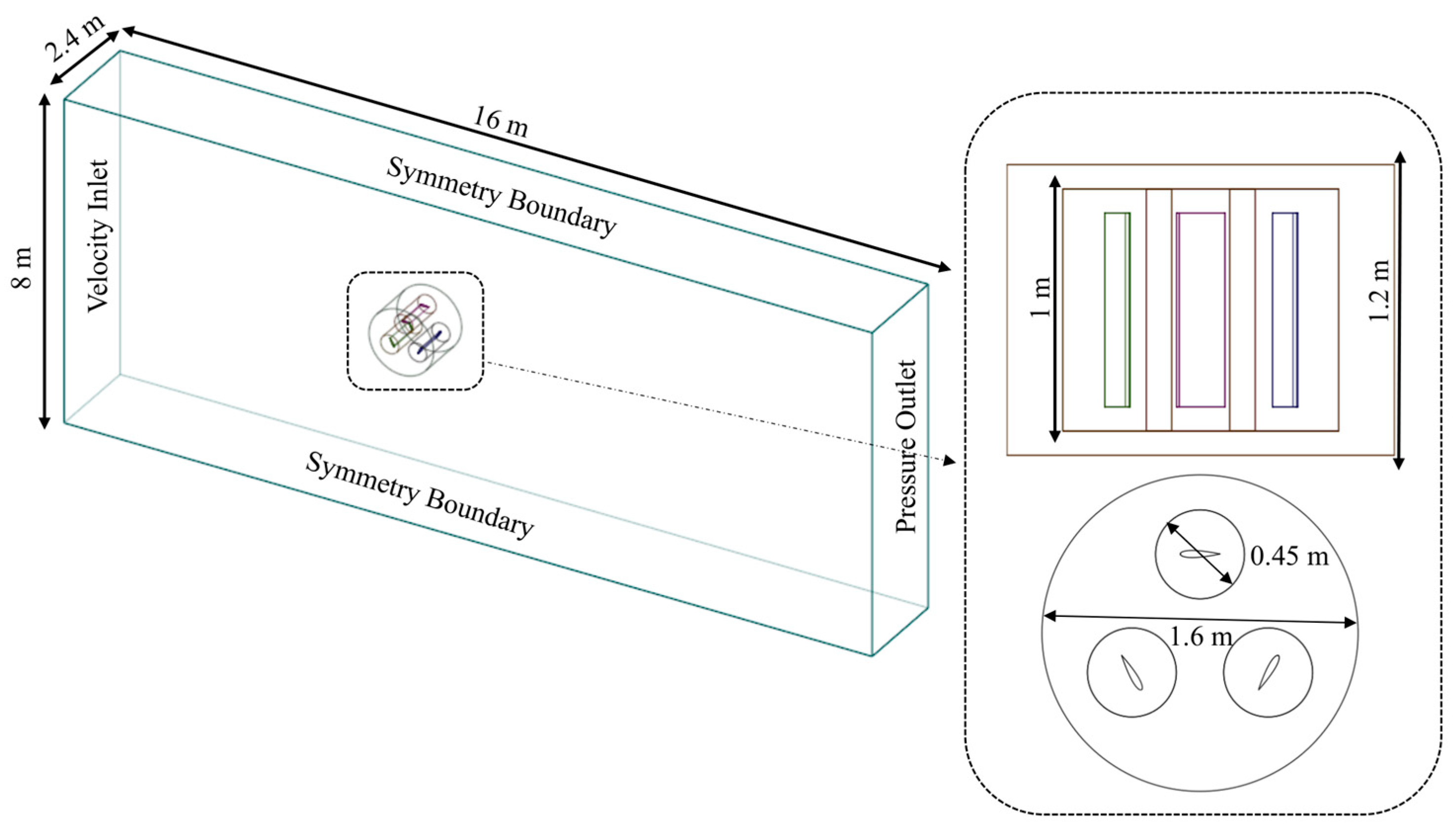
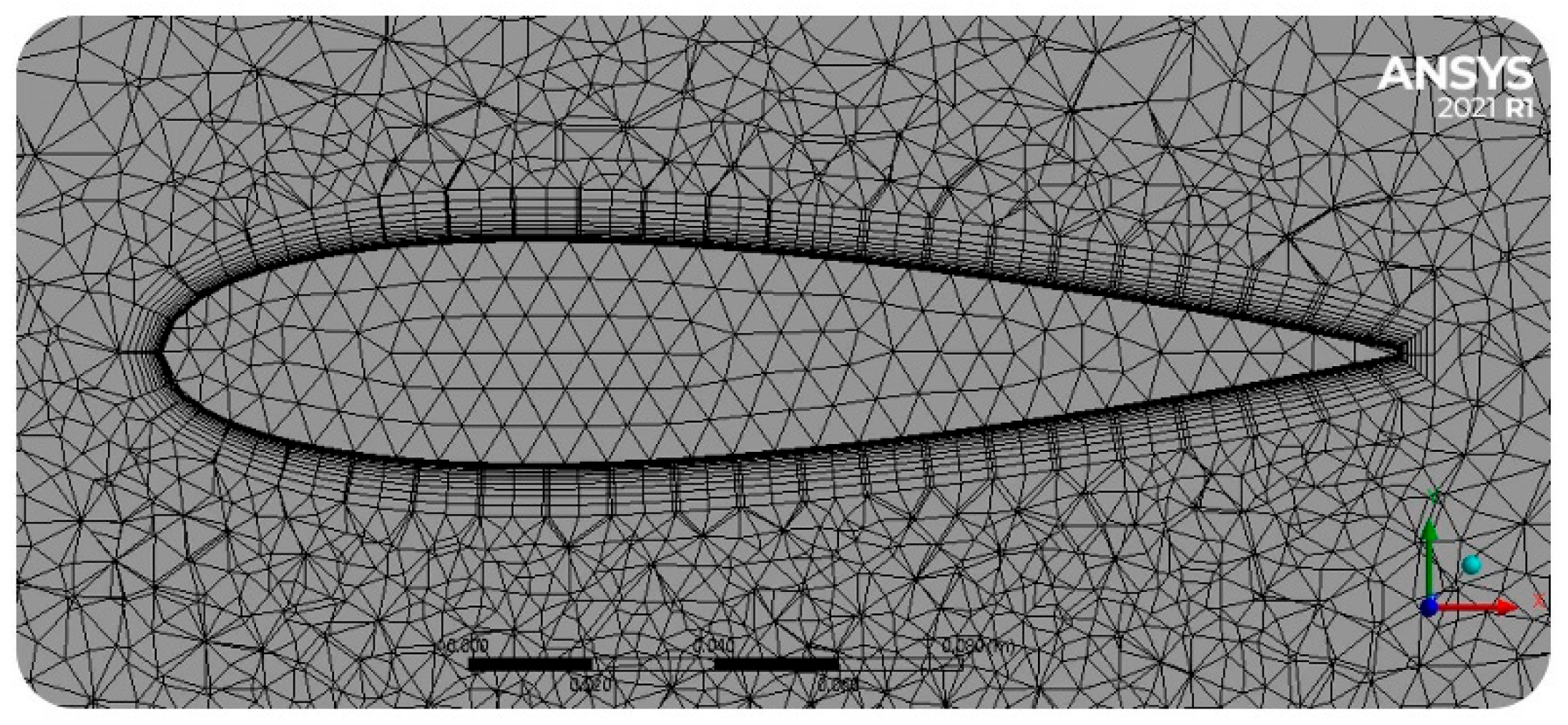
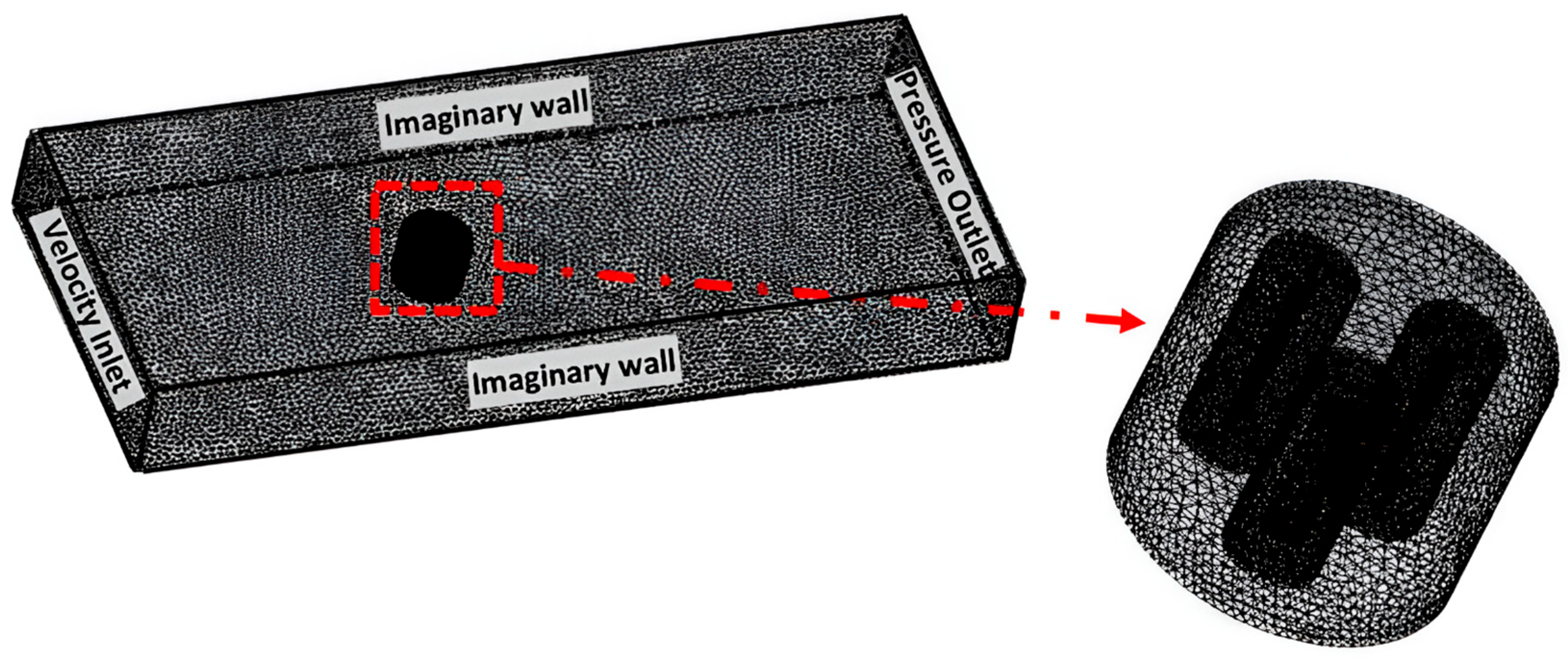
2.2. Computational Domains
- (a)
- A constant inlet air velocity ( = 8 m/s).
- (b)
- A fixed domain air exit flow, with zero-gauge pressure at the outlet.
- (c)
- A fixed domain air inlet flow with a 1% turbulence.
- (d)
- A constant fluid velocity, the same as that of the incoming wind flow (slip wall condition), at the computational upper, lower and lateral domain boundaries.
- (e)
- A no-slip wall condition at the rotor blade surfaces.
2.3. Solver Settings
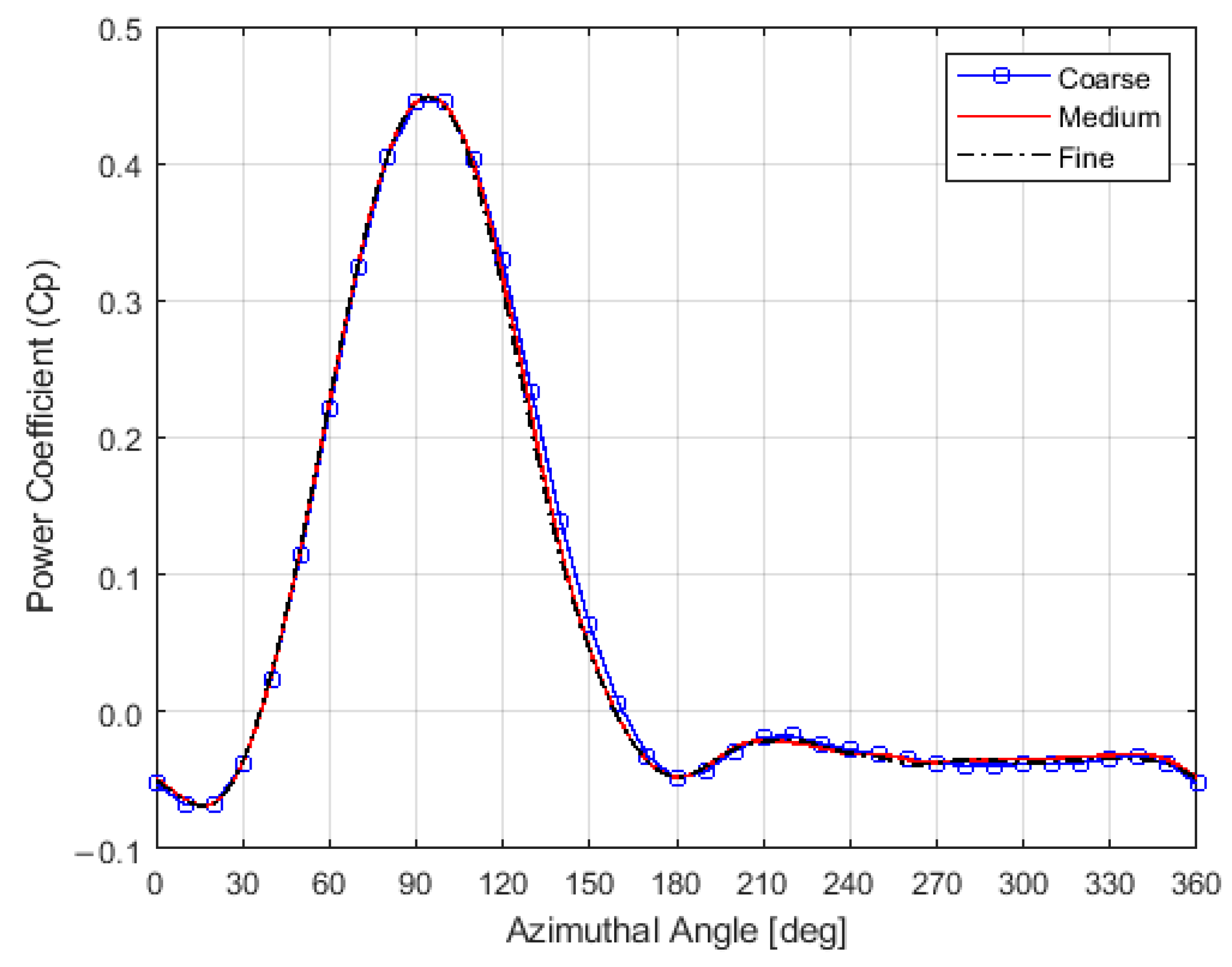
2.4. Sensitivity Analysis
2.4.1. Grid Size Selection
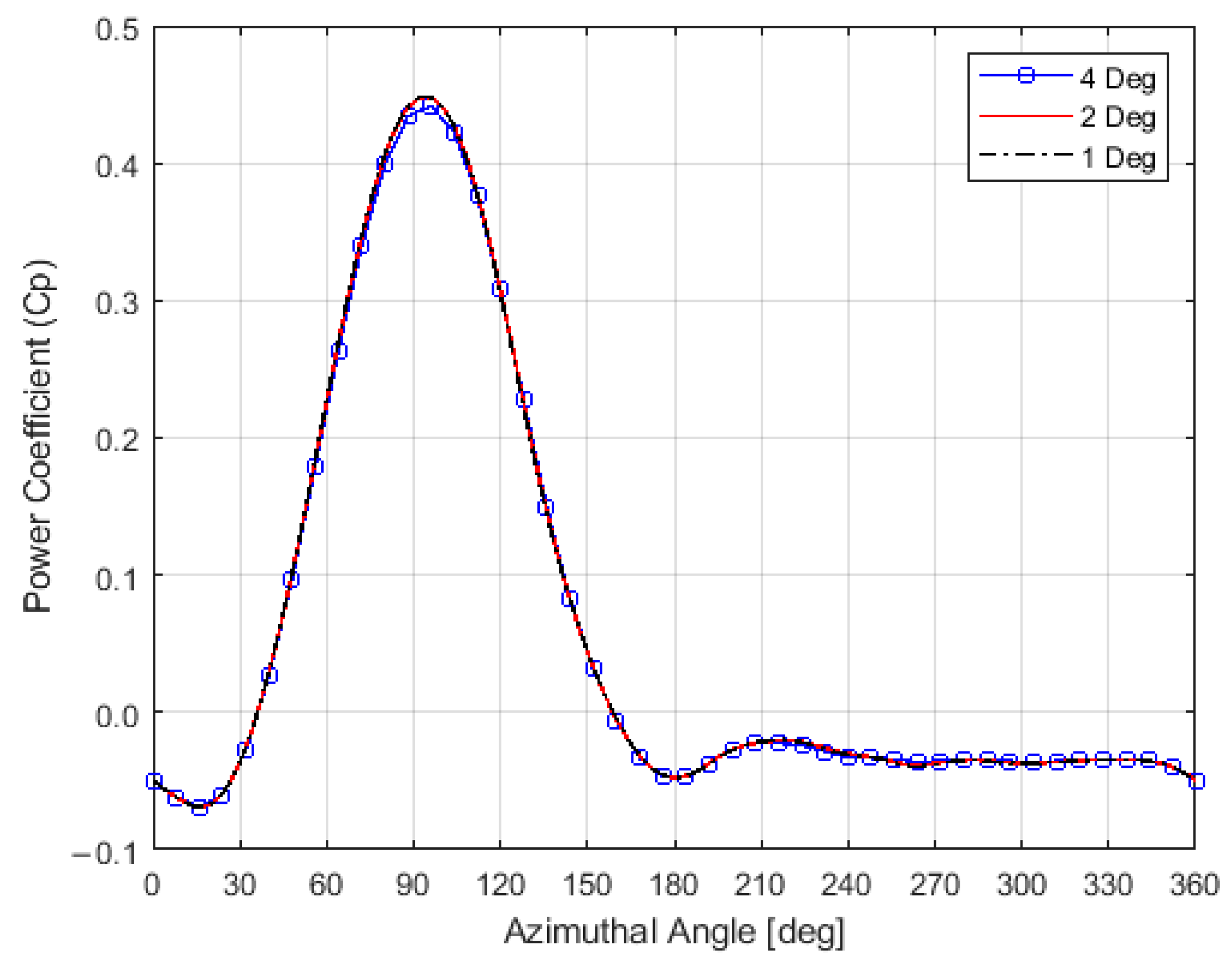
2.4.2. Timestep Selection
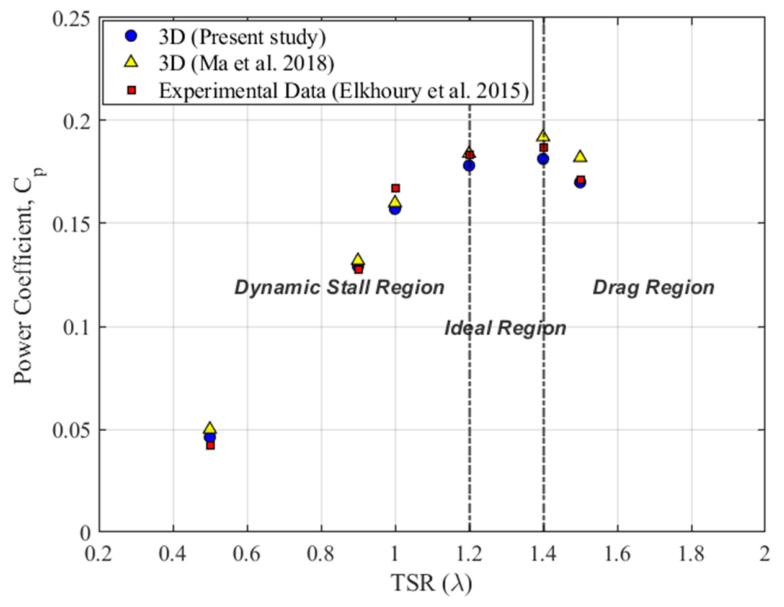
2.5. Comparison with Experimental Data
- (i)
- Dynamic stall region (0.5 < TSR < 1.2);
- (ii)
- Optimum operating range (1.2 < TSR < 1.4);
- (iii)
- Drag region, where viscous and friction effects dominate (TSR > 1.4).
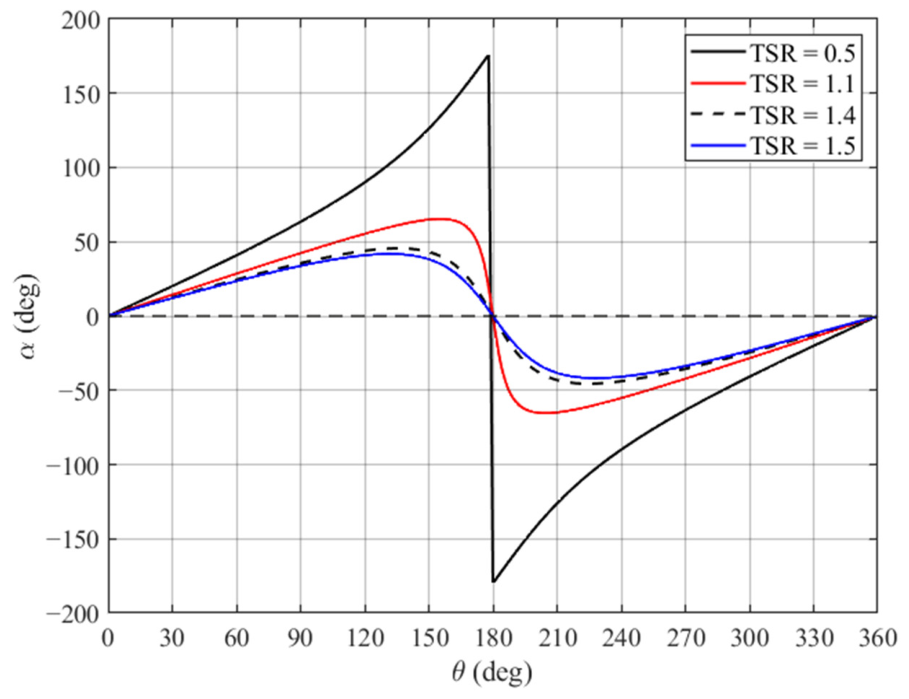
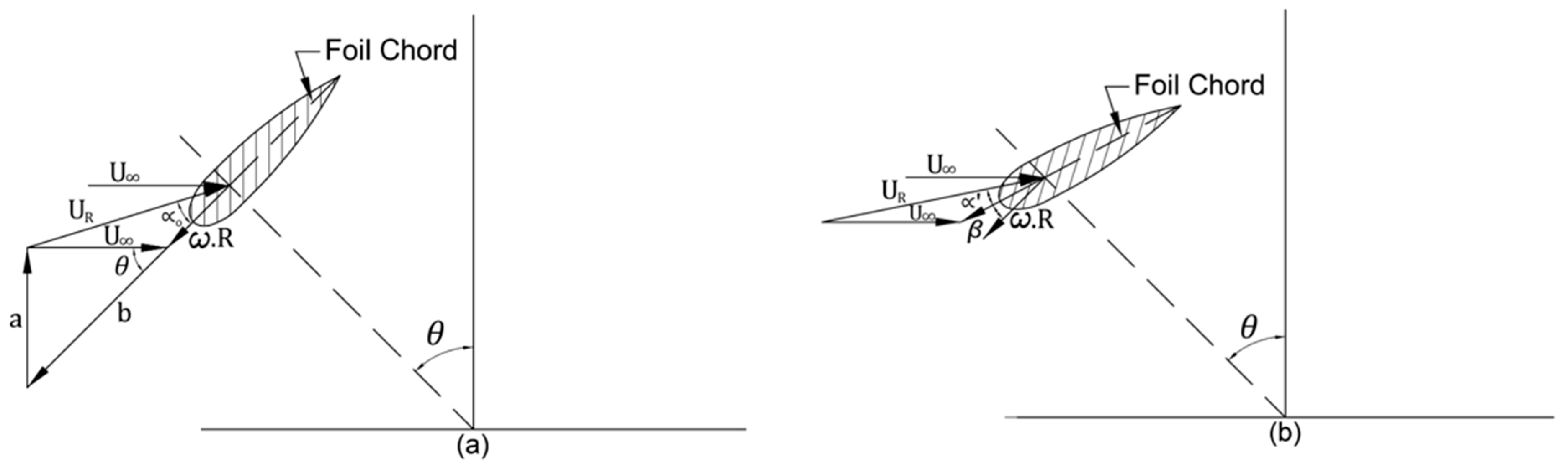
2.6. Effect of Angle of Attack (α) on Cp
2.7. Variable Pitch Angle
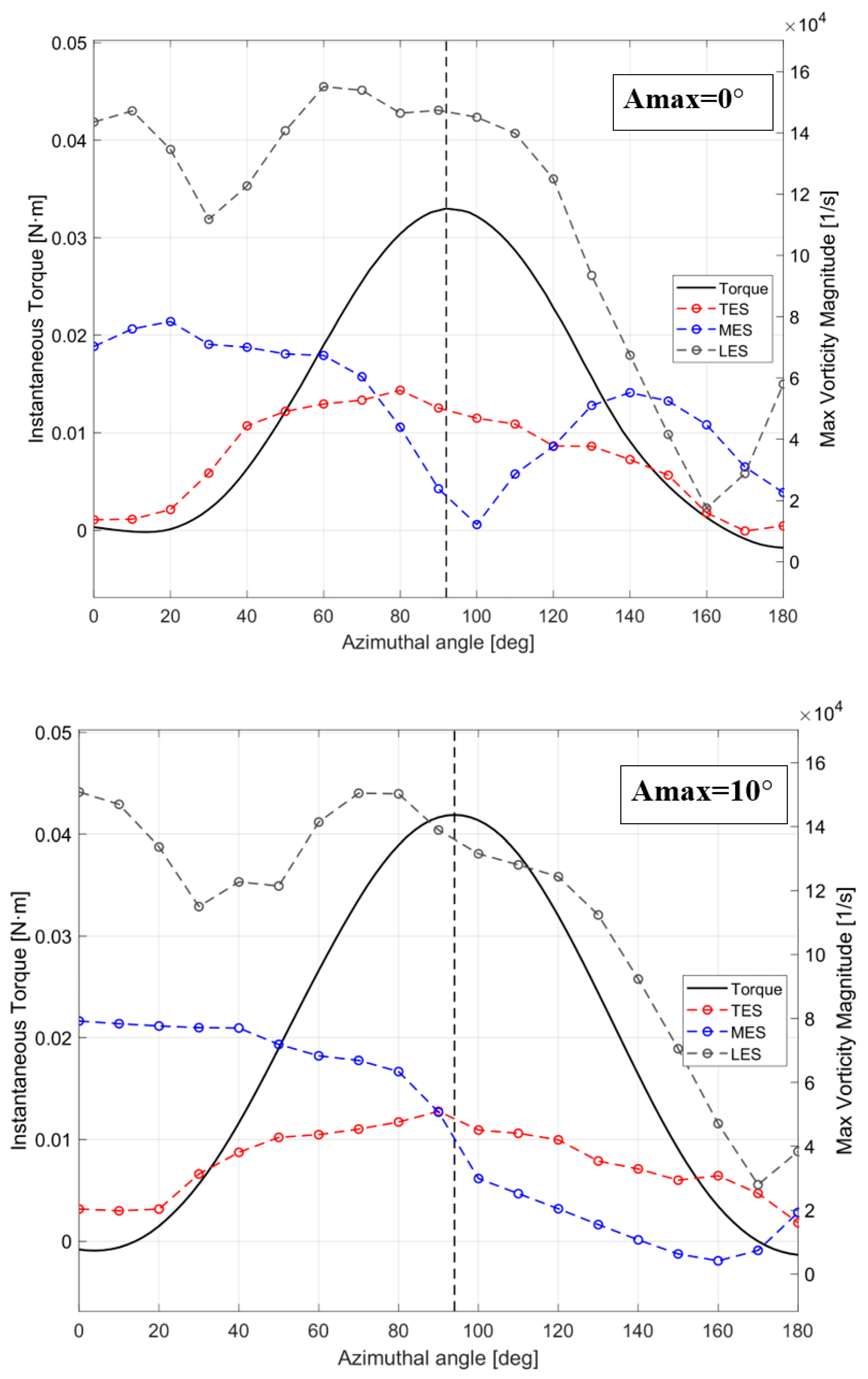
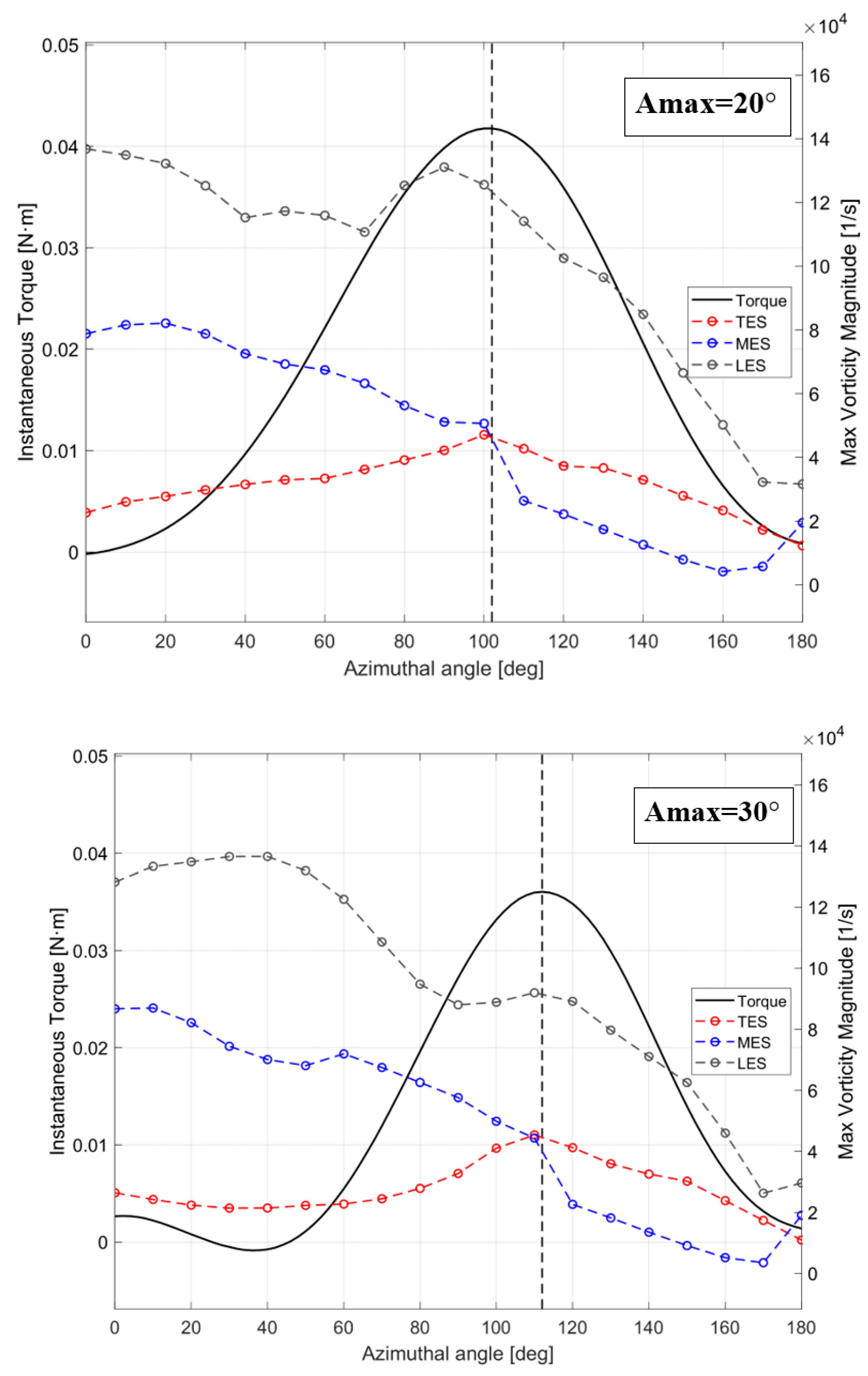
2.8. Instantaneous Torque and Vorticity Evaluation Methodology
3. Results
3.1. Effect of Pitch Amplitude on the Power Coefficient (Cp)
- (a)
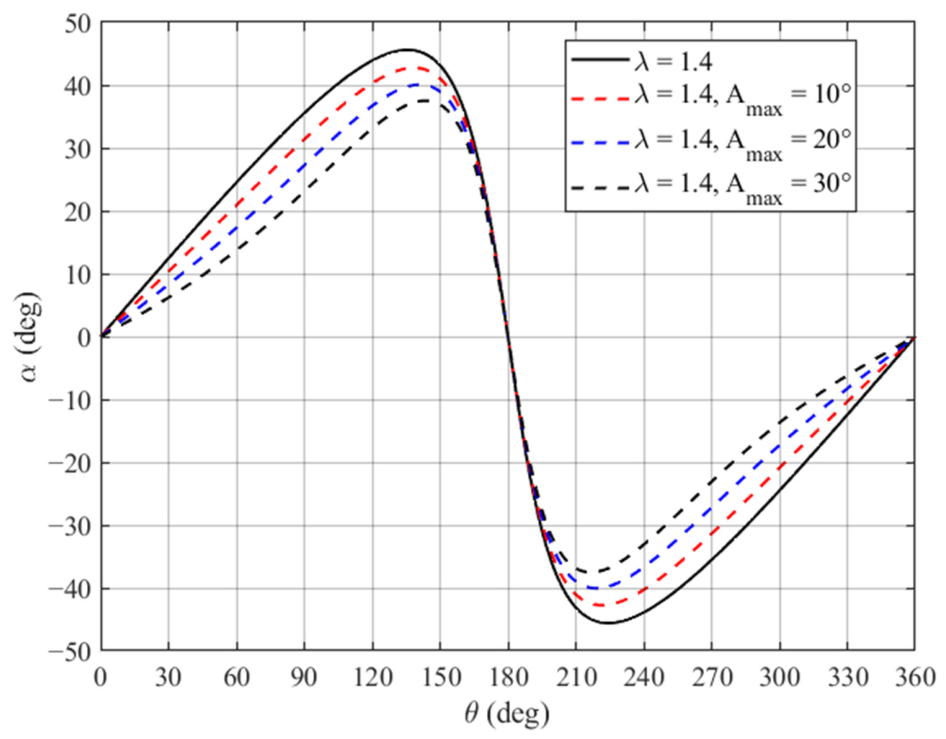
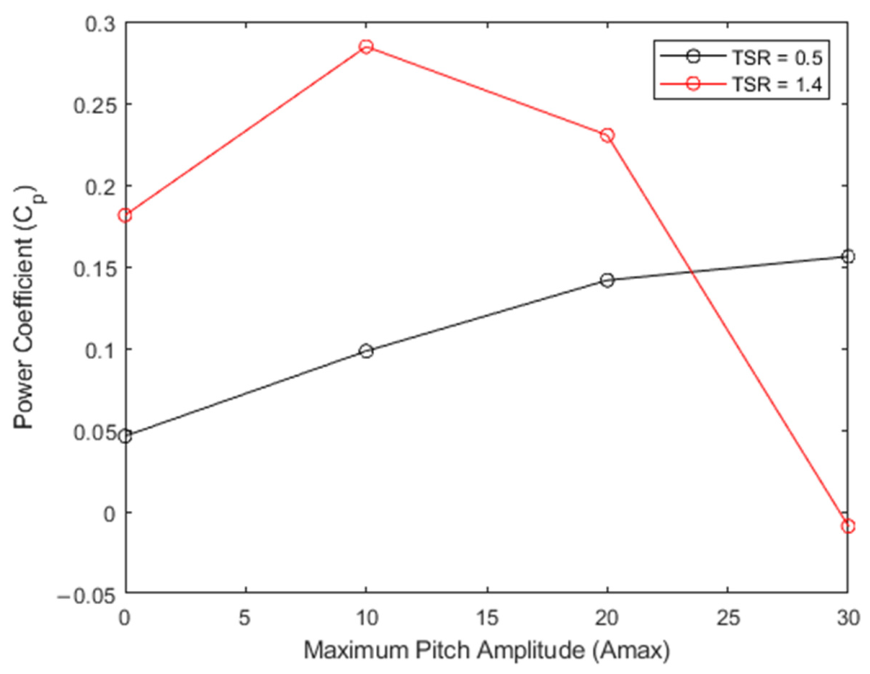
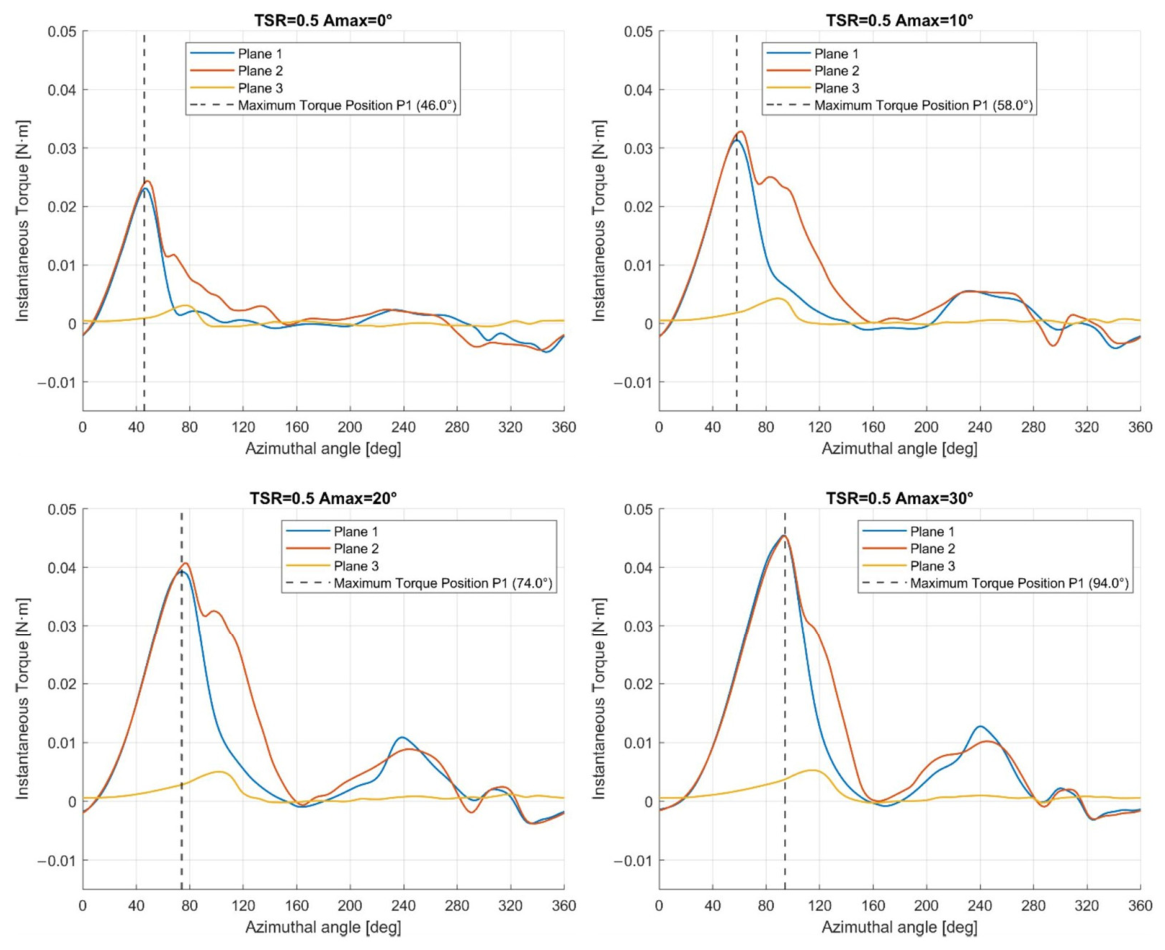
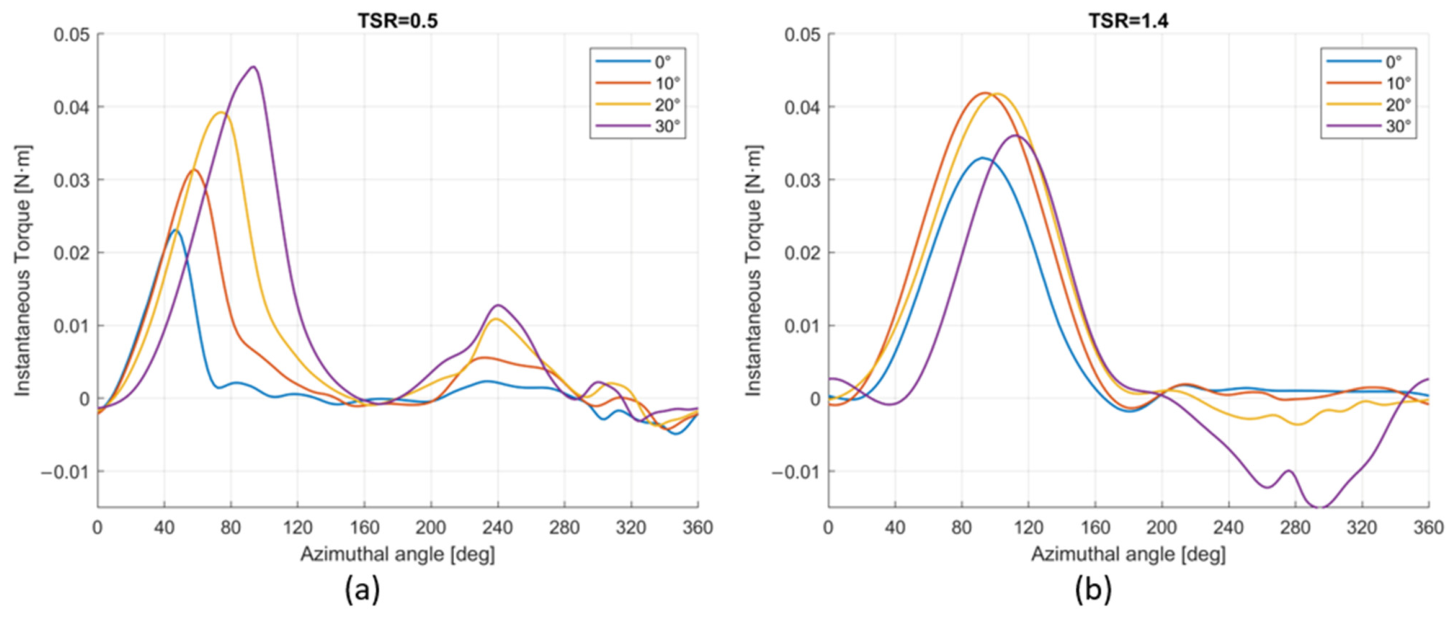
- TSR = 0.5. This regime is characterized by dynamic stall. Increasing the maximum pitch amplitude from 0° to 30° results in a monotonic increase in the power coefficient (Cp). This improvement is attributed to a reduction in the geometric angle of attack (Figure 8), which delays the onset of dynamic stall and prolongs the duration of attached flow, thereby enhancing torque generation.
- (b)
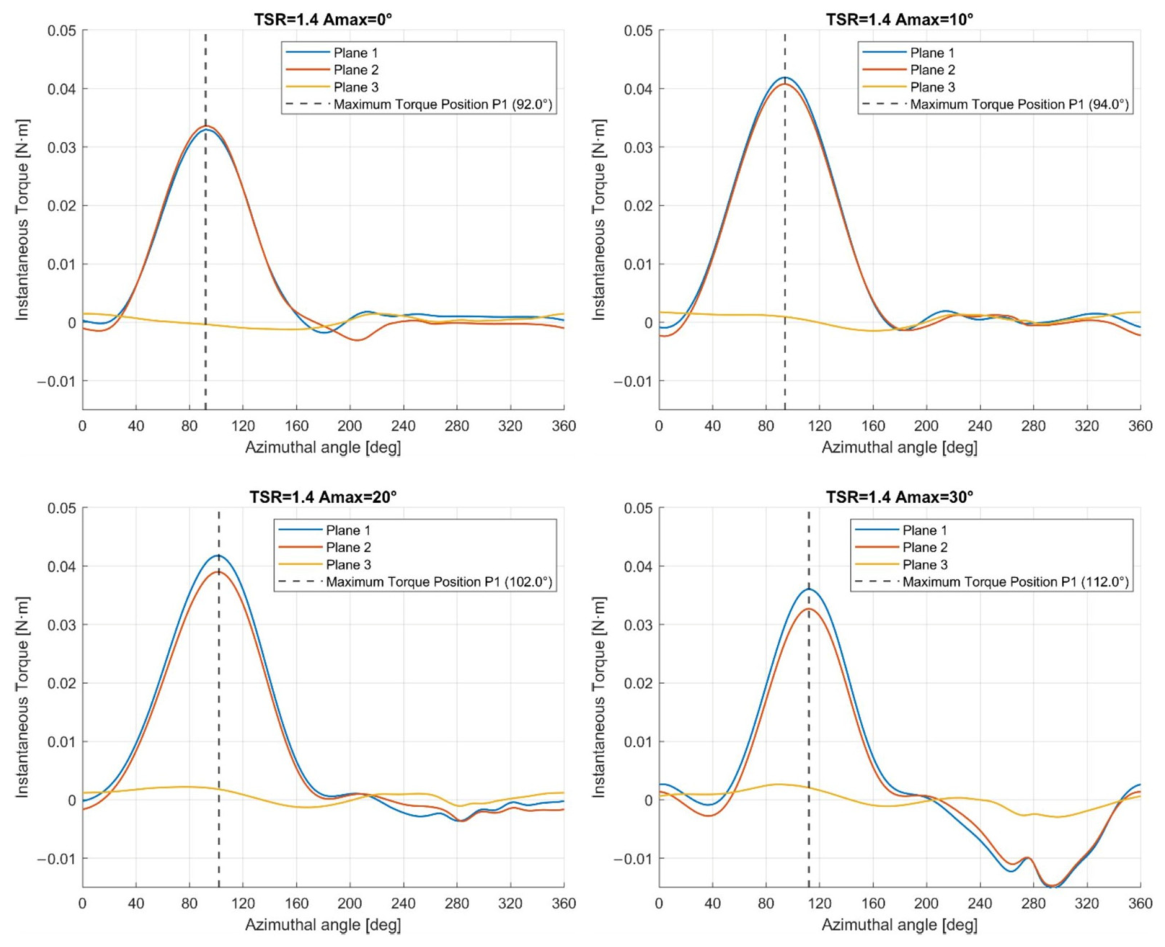
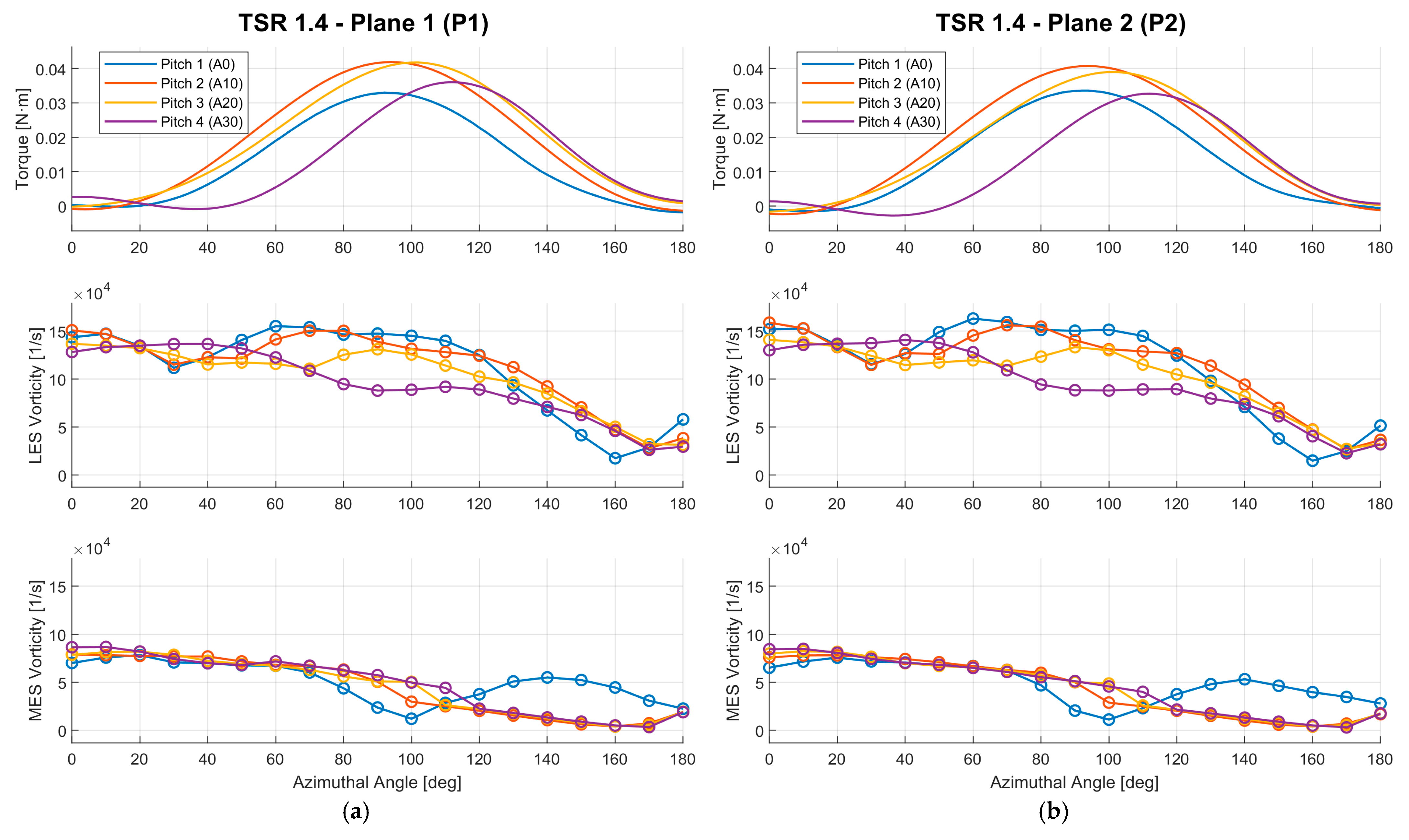
- TSR = 1.4. At this TSR, corresponding to near-optimal operation under fixed-pitch conditions, a small increase in pitch amplitude initially improves performance. However, beyond a threshold value, further increases shift the blade away from its optimal angle of attack, leading to a regime increasingly dominated by drag and viscous effects. Consequently, performance deteriorates, with the most extreme case observed at a 30° amplitude, where Cp is reduced to near zero relative to the fixed-pitch case, indicating a near-complete loss of power generation.
3.2. Effect of Pitch Amplitude on Instantaneous Torque Analysis
3.3. Quantitative Vorticity Analysis
3.4. Vorticity and Torque Relationship
4. Conclusions
- (a)
- It confirms via numerical simulation that in the variable-pitch VAWT, the power coefficient (Cp) augments by up to 237% and 58% at tip-speed ratios (TSRs) of 0.5 and 1.4, respectively.
- (b)
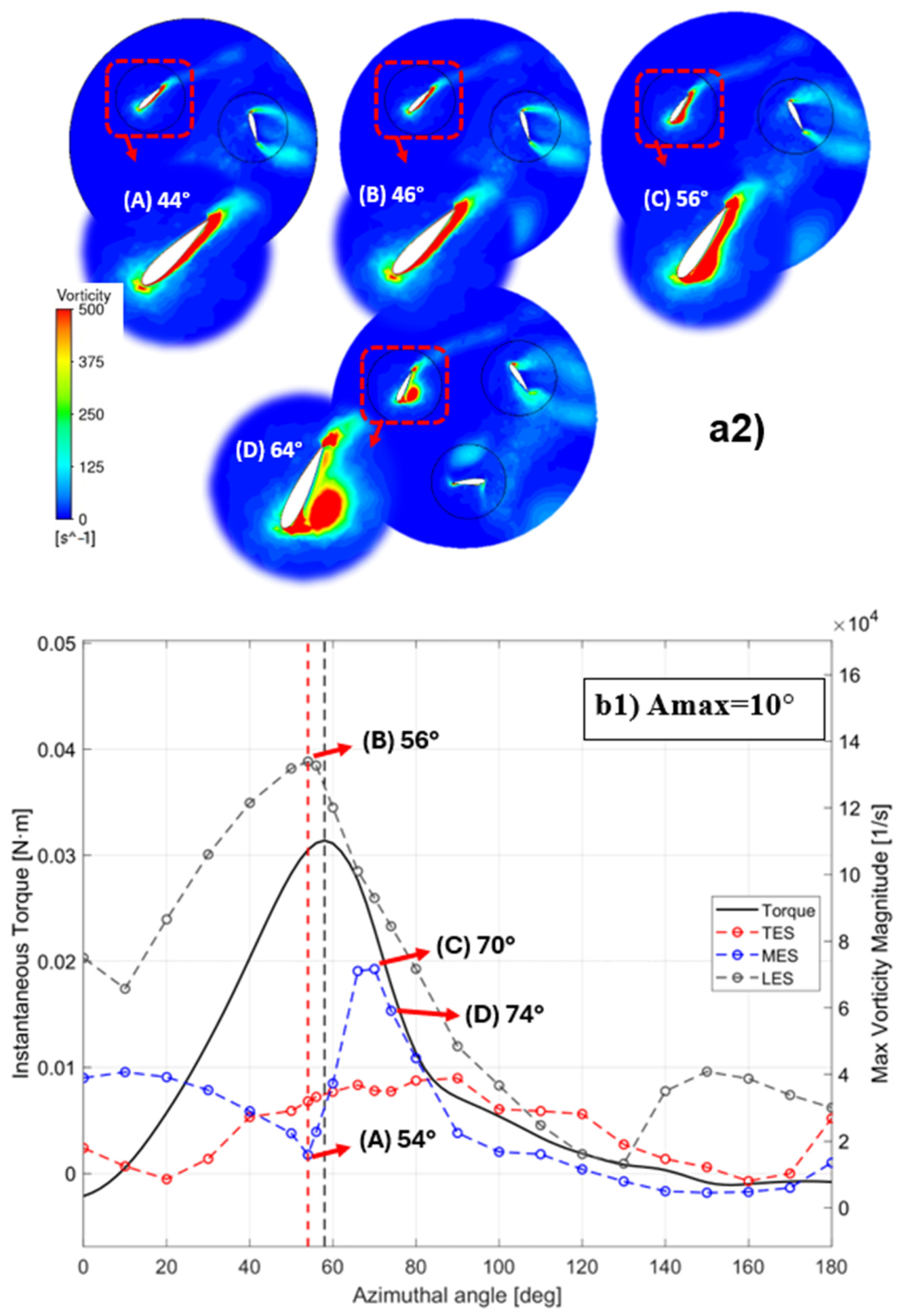
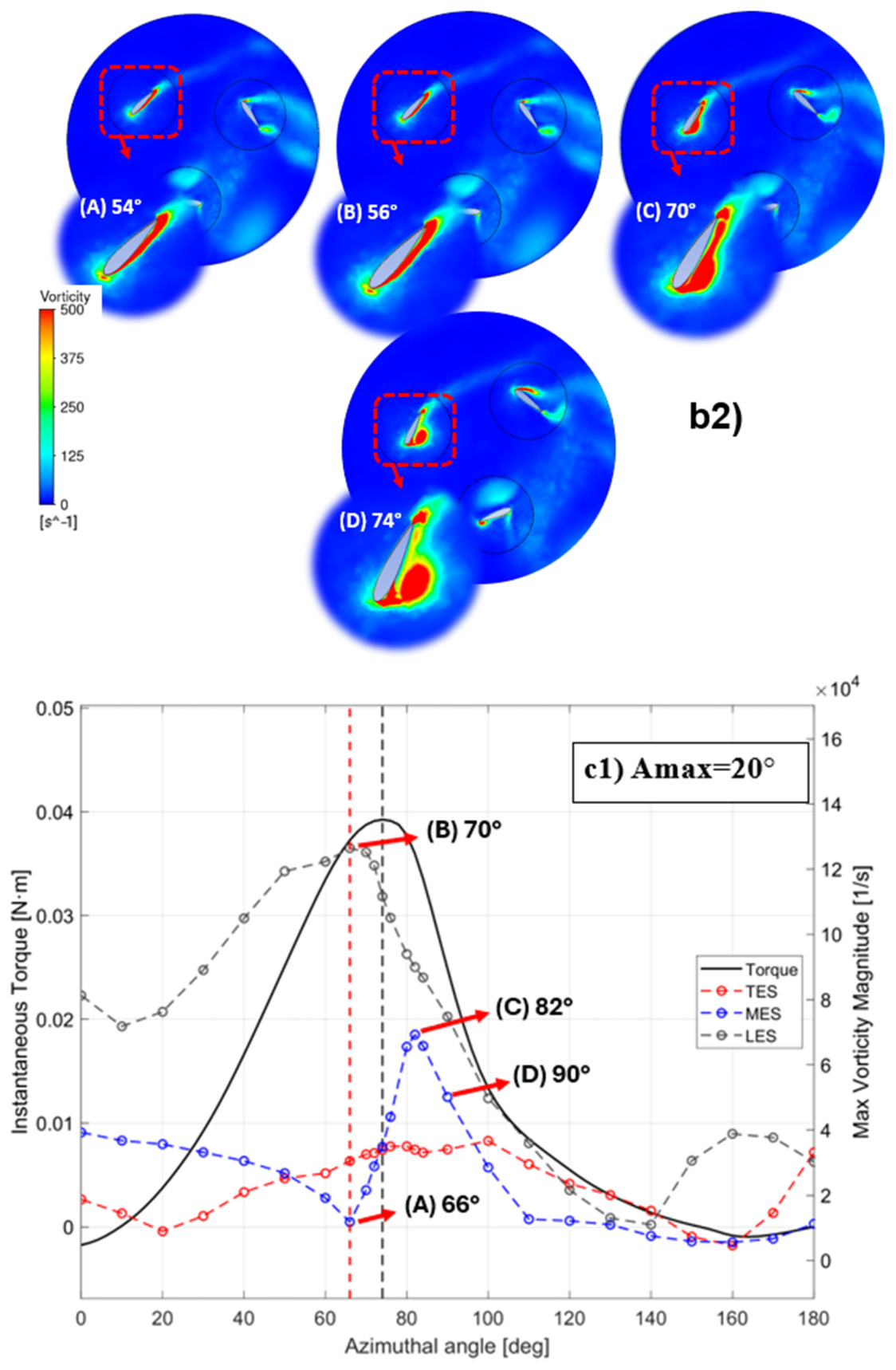
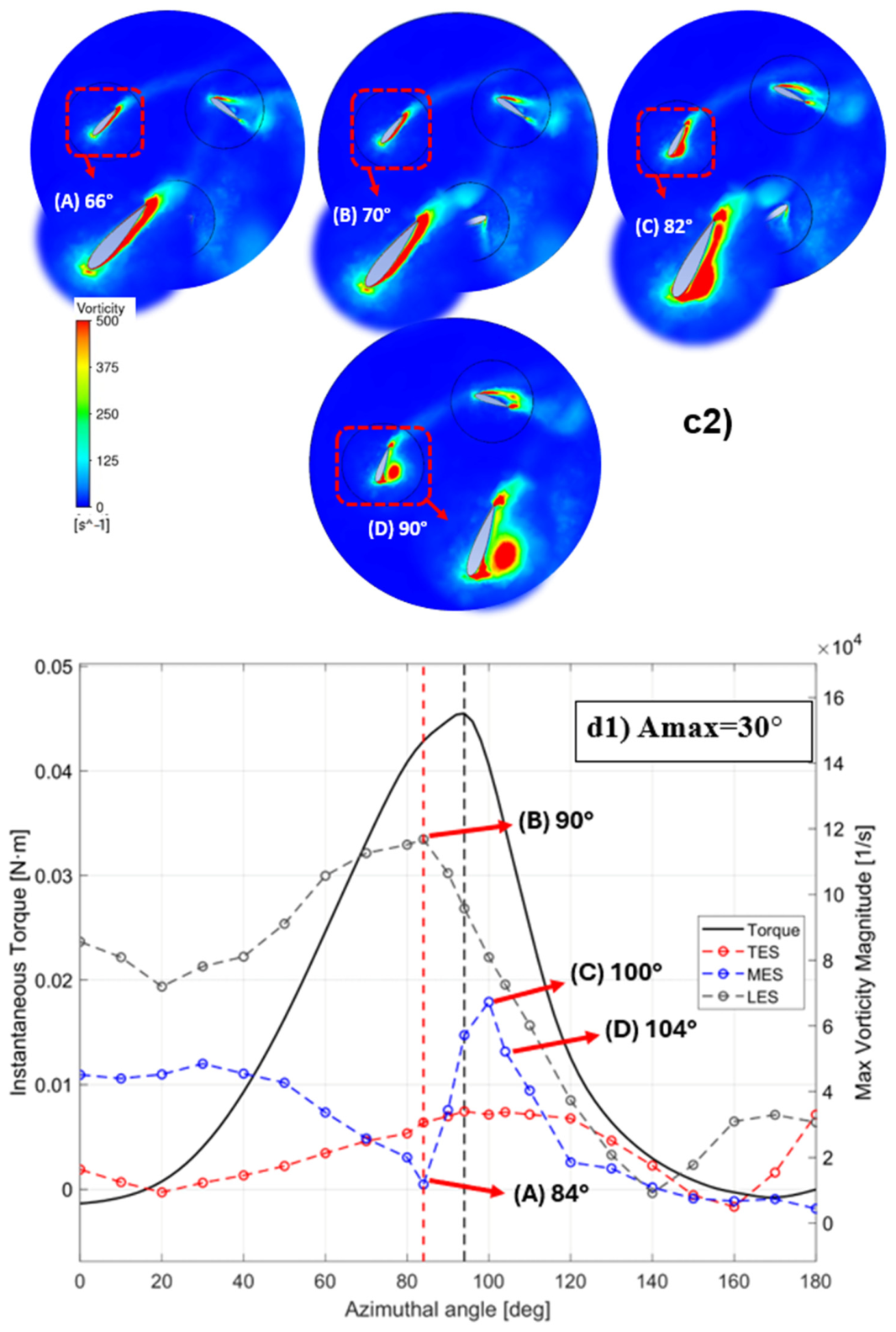
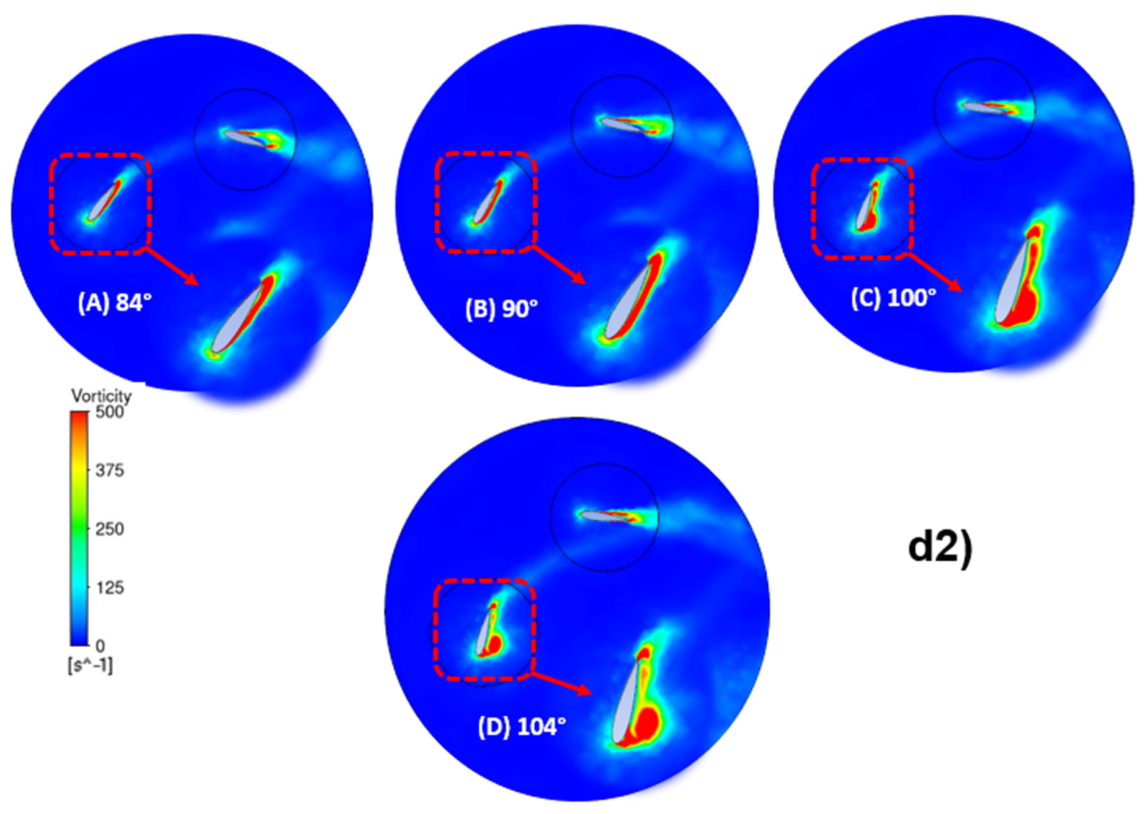
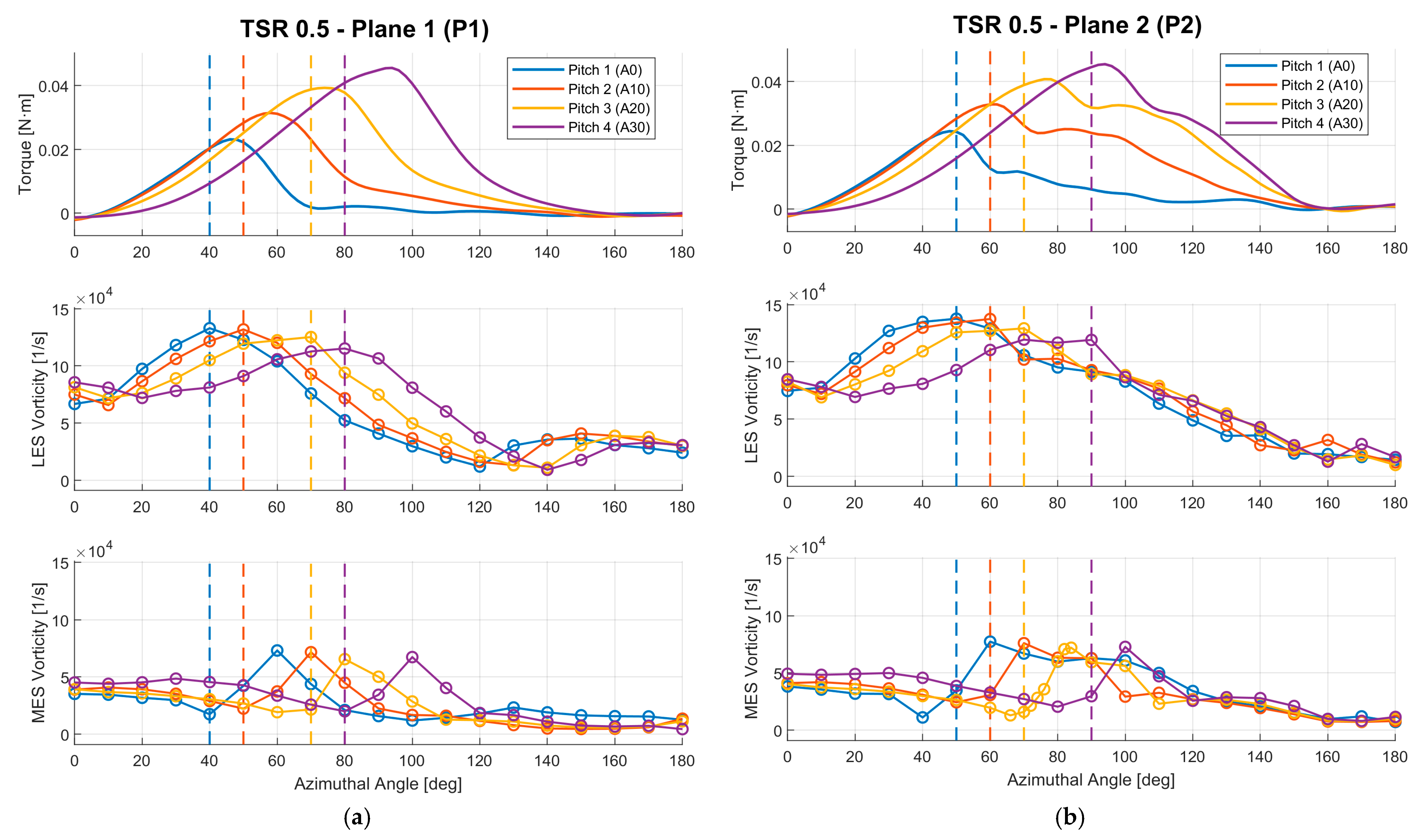
- It shows that increasing Amax at a TSR of 0.5 delays the onset of dynamic stall and reduces energy losses associated with uncontrolled vortex growth and detachment. This is evidenced by the shift in the Imminent Vortex Separation Condition (IVSC) to later azimuthal positions, as confirmed by quantitative vorticity analyses at the leading-edge (LES), mid-edge (MES), and trailing edge (TES) sections. These findings demonstrate that active pitch control improves flow attachment throughout the rotational cycle.
- (c)
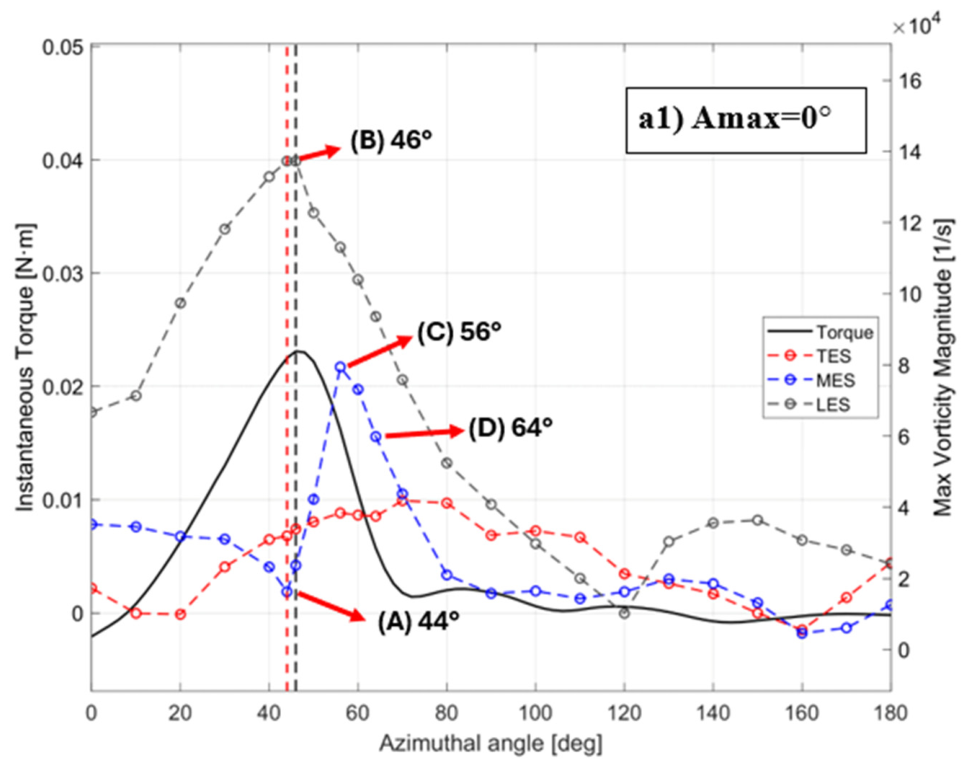
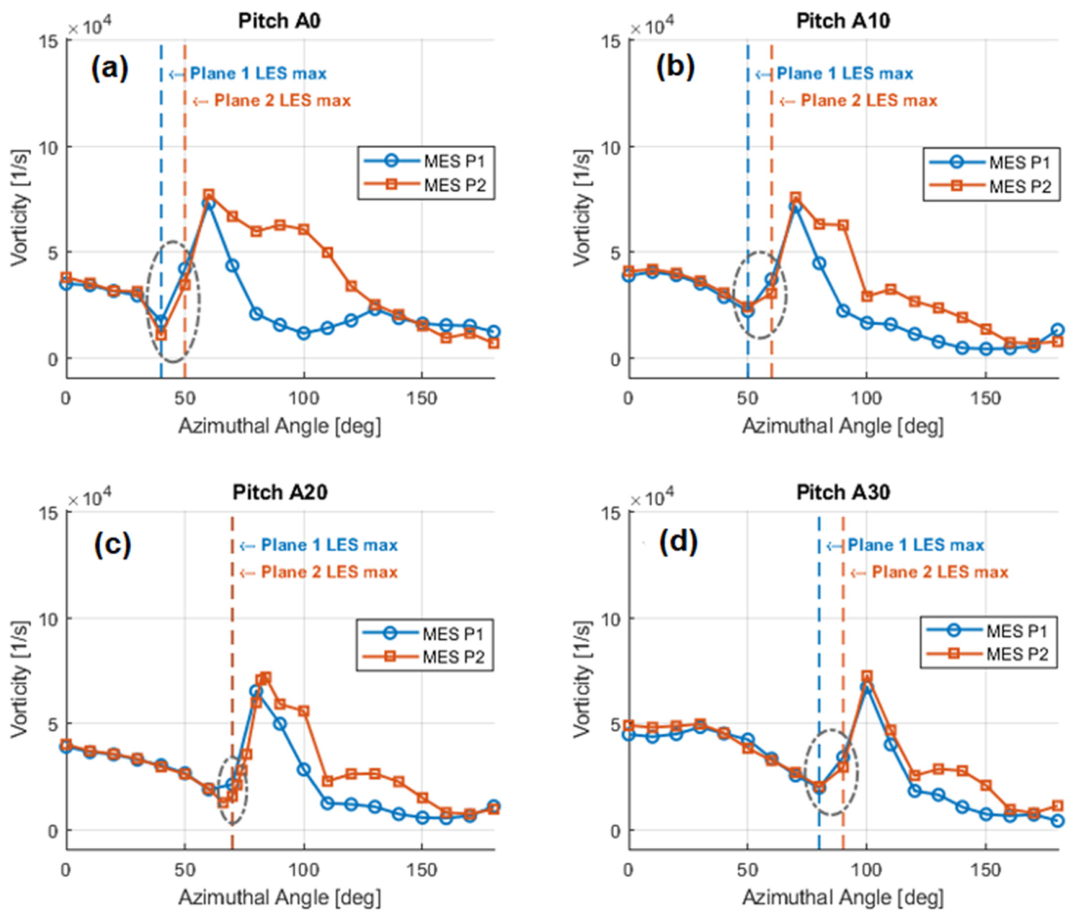
- It characterizes a vortex-dynamics mechanism predominant at low TSRs (i.e., ≤1.2), where vorticity initially accumulates at the Leading-Edge Section (LES), generating maximum torque, before moving toward the Mid-Edge Section (MES). Its subsequent accumulation at the MES triggers the Imminent Vortex Separation Condition (IVSC), leading to vortex detachment. This mechanism is less predominant at TSRs > 1.2 operating in the drag region.
- (d)
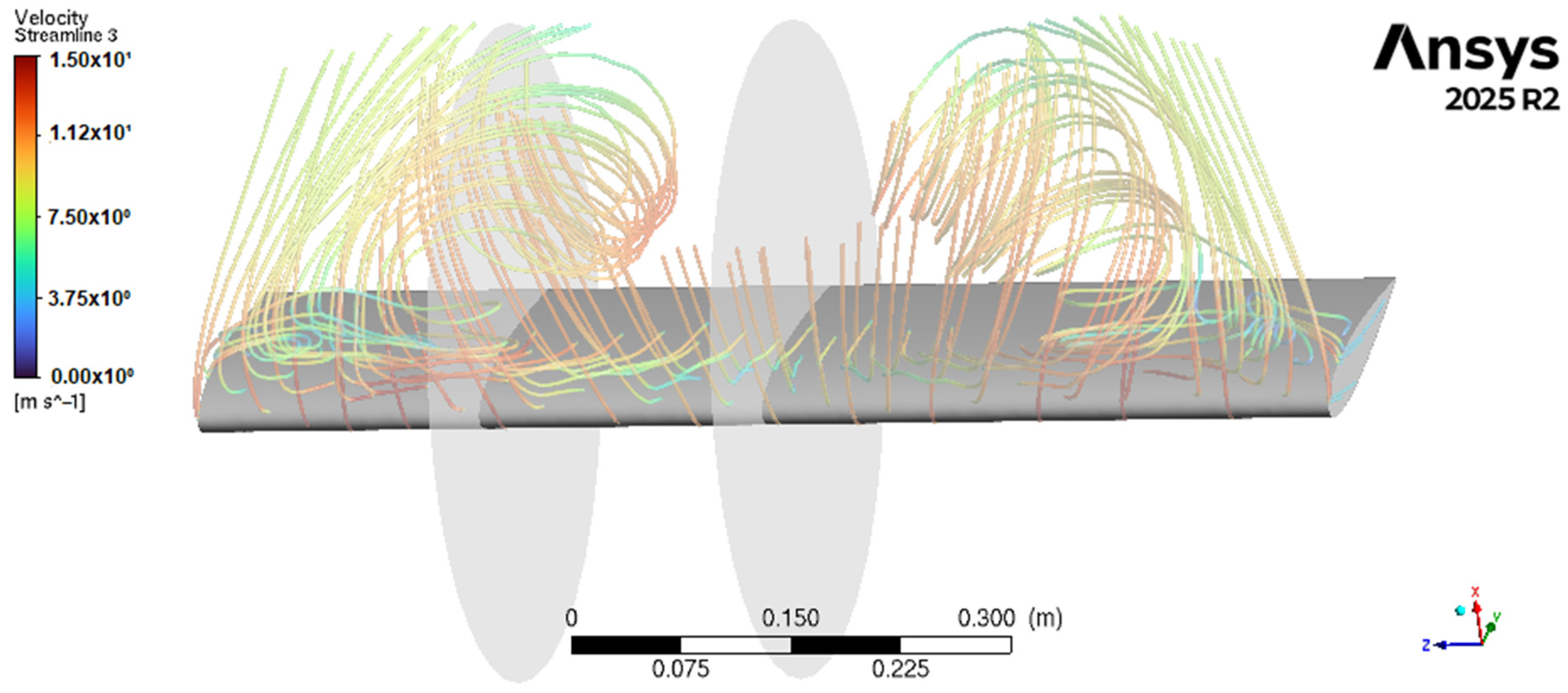
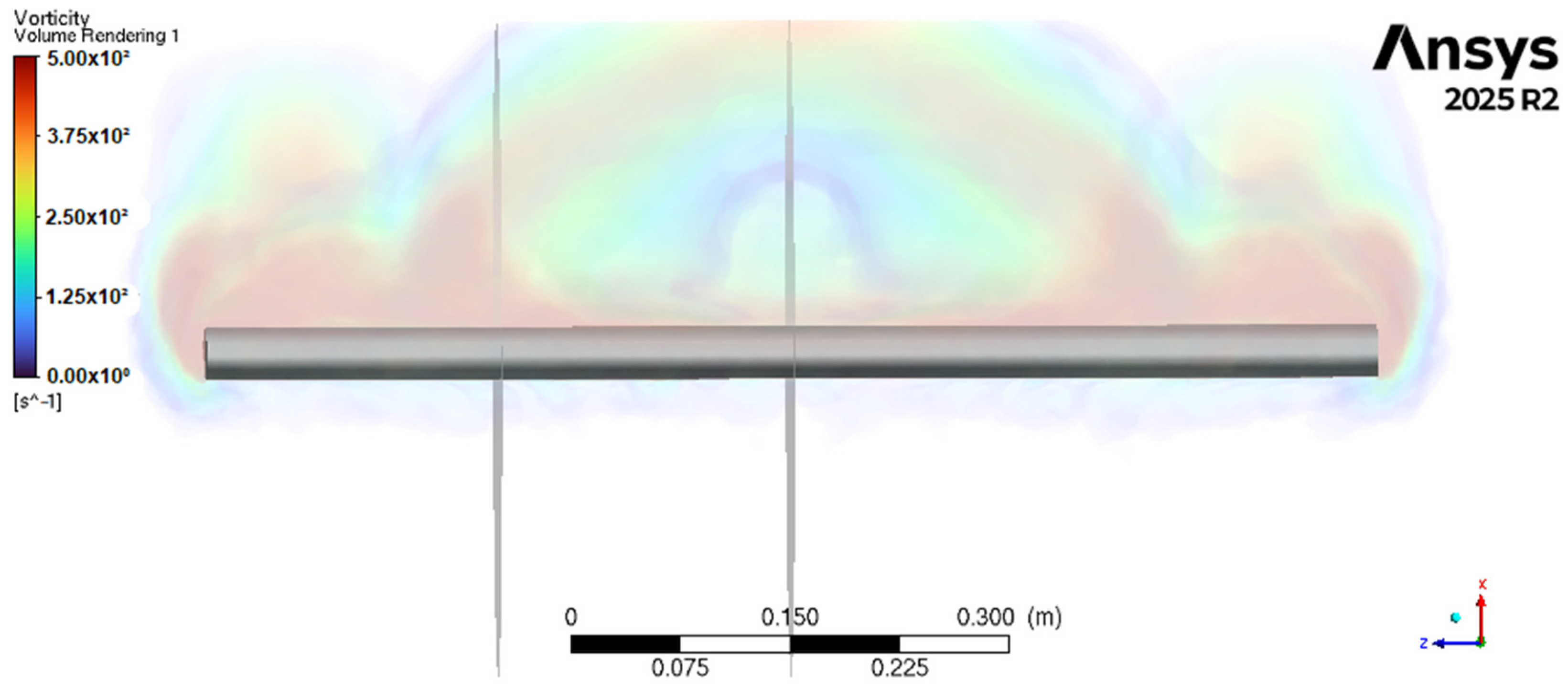
- It demonstrates that the proposed vorticity analysis can successfully identify both the chordwise (LES-MES) and axial transport of vorticity at low TSRs, capturing the premature rise in MES vorticity in downstream planes, proving the methodology’s effectiveness in tracking three-dimensional flow interactions across the blade span.
Author Contributions
Funding
Data Availability Statement
Acknowledgments
Conflicts of Interest
Notation
| Nomenclature | |
| Amax | Maximum local pitch amplitude [deg] |
| c | Chord length [m] |
| Cp | Power coefficient |
| D | Rotor diameter [m] |
| External body force | |
| Gravitational body force | |
| H | Blade span [m] |
| k | Kinetic energy |
| N | Number of blades |
| R | Rotor radius [m] |
| T | Torque [N m] |
| Flow velocity [m/s] | |
| Wind speed [] | |
| Non-dimensional first cell-wall distance | |
| Greek letters | |
| Angular marching step [] | |
| Angle of attack (no pitch variation) | |
| Modified angle of attack | |
| Pitch angle | |
| Azimuthal angle [deg] | |
| Tip-speed ratio = | |
| Fluid viscosity [Pa s] | |
| Fluid density [] | |
| Angular velocity | |
| Abbreviations | |
| CFD | Computational Fluid Dynamics |
| HAWT | Horizontal-Axis Wind Turbine |
| IVSC | Imminent Vortex-Separation Condition |
| LES | Leading-Edge Section |
| LEV | Leading Edge Vortex |
| MES | Middle-Edge Section |
| SST | Shear Stress Transport |
| TES | Trailing-Edge Section |
| TSR | Tip-Speed Ratio |
| URANS | Unsteady Reynolds-Averaged Navier–Stokes |
| VAWT | Vertical-Axis Wind Turbine |
| VI | Vorticity Index |
Appendix A


References
- Fossil Fuels Still Supply 84 Percent of World Energy—And Other Eye Openers from BP’s Annual Review. Available online: https://www.forbes.com/sites/rrapier/2020/06/20/bp-review-new-highs-in-global-energy-consumption-and-carbon-emissions-in-2019/?sh=692c741466a1 (accessed on 23 June 2026).
- Fossil Fuels | EESI. Available online: https://www.eesi.org/topics/fossil-fuels/description (accessed on 23 June 2026).
- Gerrie, C.; Islam, S.Z.; Gerrie, S.; Turner, N.; Asim, T. 3D CFD Modelling of Performance of a Vertical Axis Turbine. Energies 2023, 16, 1144. [Google Scholar] [CrossRef] [Scilit]
- Ahmed, B.; Al Mubarak, M.; Khouj, M. Renewable Technologies: Solar Power and Wind Power Energy Utilization—Advantages and Disadvantages. In Technological Sustainability and Business Competitive Advantage; Al Mubarak, M., Hamdan, A., Eds.; Internet of Things; Springer International Publishing: Cham, Switzerland, 2023; pp. 507–519. [Google Scholar]
- Vinoth Kanna, I.; Paturu, P. A Study of Hydrogen as an Alternative Fuel. Int. J. Ambient Energy 2020, 41, 1433–1436. [Google Scholar] [CrossRef] [Scilit]
- Benghanem, M.; Mellit, A.; Almohamadi, H.; Haddad, S.; Chettibi, N.; Alanazi, A.M.; Dasalla, D.; Alzahrani, A. Hydrogen Production Methods Based on Solar and Wind Energy: A Review. Energies 2023, 16, 757. [Google Scholar] [CrossRef] [Scilit]
- Mohtasham, J. Review Article-Renewable Energies. Energy Procedia 2015, 74, 1289–1297. [Google Scholar] [CrossRef] [Scilit]
- Schubel, P.J.; Crossley, R.J. Wind Turbine Blade Design Review. Wind Eng. 2012, 36, 365–388. [Google Scholar] [CrossRef] [Scilit]
- Li, S.; Dai, Y. Design and Simulation Analysis of a Small-Scale Compressed Air Energy Storage System Directly Driven by Vertical Axis Wind Turbine for Isolated Areas. J. Energy Eng. 2015, 141, 04014032. [Google Scholar] [CrossRef] [Scilit]
- Ferreira, C.J.S.; Bijl, H.; Bussel, G.V.; Kuik, G.V. Simulating Dynamic Stall in a 2D VAWT: Modeling Strategy, Verification and Validation with Particle Image Velocimetry Data. J. Phys. Conf. Ser. 2007, 75, 012023. [Google Scholar] [CrossRef] [Scilit]
- Le Fouest, S.; Mulleners, K. The Dynamic Stall Dilemma for Vertical-Axis Wind Turbines. Renew. Energy 2022, 198, 505–520. [Google Scholar] [CrossRef] [Scilit]
- Souaissa, K.; Ghiss, M.; Chrigui, M.; Bentaher, H.; Maalej, A. A Comprehensive Analysis of Aerodynamic Flow around H-Darrieus Rotor with Camber-Bladed Profile. Wind Eng. 2019, 43, 459–475. [Google Scholar] [CrossRef] [Scilit]
- Jiang, Y.; He, C.; Zhao, P.; Sun, T. Investigation of Blade Tip Shape for Improving VAWT Performance. J. Mar. Sci. Eng. 2020, 8, 225. [Google Scholar] [CrossRef] [Scilit]
- Visbal, M.R.; Garmann, D.J. Dynamic Stall of a Finite-Aspect-Ratio Wing. AIAA J. 2019, 57, 962–977. [Google Scholar] [CrossRef] [Scilit]
- Bianchini, A.; Balduzzi, F.; Bachant, P.; Ferrara, G.; Ferrari, L. Effectiveness of Two-Dimensional CFD Simulations for Darrieus VAWTs: A Combined Numerical and Experimental Assessment. Energy Convers. Manag. 2017, 136, 318–328. [Google Scholar] [CrossRef] [Scilit]
- Balduzzi, F.; Drofelnik, J.; Bianchini, A.; Ferrara, G.; Ferrari, L.; Campobasso, M.S. Darrieus Wind Turbine Blade Unsteady Aerodynamics: A Three-Dimensional Navier-Stokes CFD Assessment. Energy 2017, 128, 550–563. [Google Scholar] [CrossRef] [Scilit]
- Balduzzi, F.; Bianchini, A.; Maleci, R.; Ferrara, G.; Ferrari, L. Critical Issues in the CFD Simulation of Darrieus Wind Turbines. Renew. Energy 2016, 85, 419–435. [Google Scholar] [CrossRef] [Scilit]
- Fertahi, S.e.-D.; Samaouali, A.; Kadiri, I. CFD Comparison of 2D and 3D Aerodynamics in H-Darrieus Prototype Wake. E-Prime-Adv. Electr. Eng. Electron. Energy 2023, 4, 100178. [Google Scholar] [CrossRef] [Scilit]
- Nazari, S.; Zamani, M.; Moshizi, S.A. Comparison between Two-Dimensional and Three-Dimensional Computational Fluid Dynamics Techniques for Two Straight-Bladed Vertical-Axis Wind Turbines in Inline Arrangement. Wind Eng. 2018, 42, 647–664. [Google Scholar] [CrossRef] [Scilit]
- Franchina, N.; Persico, G.; Savini, M. 2D-3D Computations of a Vertical Axis Wind Turbine Flow Field: Modeling Issues and Physical Interpretations. Renew. Energy 2019, 136, 1170–1189. [Google Scholar] [CrossRef] [Scilit]
- Escudero Romero, A.; Blasetti, A.P.; Acosta-López, J.G.; Gómez-García, M.-Á.; De Lasa, H. Vorticity and Its Relationship to Vortex Separation, Dynamic Stall, and Performance, in an H-Darrieus Vertical-Axis Wind Turbine Using CFD Simulations. Processes 2024, 12, 1556. [Google Scholar] [CrossRef] [Scilit]
- Sagharichi, A.; Maghrebi, M.J.; ArabGolarcheh, A. Variable Pitch Blades: An Approach for Improving Performance of Darrieus Wind Turbine. J. Renew. Sustain. Energy 2016, 8, 053305. [Google Scholar] [CrossRef] [Scilit]
- Sagharichi, A.; Zamani, M.; Ghasemi, A. Effect of Solidity on the Performance of Variable-Pitch Vertical Axis Wind Turbine. Energy 2018, 161, 753–775. [Google Scholar] [CrossRef] [Scilit]
- Abdalrahman, G.; Daoud, M.A.; Melek, W.W.; Lien, F.-S.; Yee, E. Design and Implementation of an Intelligent Blade Pitch Control System and Stability Analysis for a Small Darrieus Vertical-Axis Wind Turbine. Energies 2021, 15, 235. [Google Scholar] [CrossRef] [Scilit]
- Rezaeiha, A.; Kalkman, I.; Blocken, B. Effect of Pitch Angle on Power Performance and Aerodynamics of a Vertical Axis Wind Turbine. Appl. Energy 2017, 197, 132–150. [Google Scholar] [CrossRef] [Scilit]
- Zhao, Z.; Wang, R.; Shen, W.; Wang, T.; Xu, B.; Zheng, Y.; Qian, S. Variable Pitch Approach for Performance Improving of Straight-Bladed VAWT at Rated Tip Speed Ratio. Appl. Sci. 2018, 8, 957. [Google Scholar] [CrossRef] [Scilit]
- Hammad, M.A.; Mahmoud, A.M.; Abdelrhman, A.M.; Sarip, S. Performance Enhancement of H-Type Darrieus VAWT Using a Hybrid Method of Blade Pitch Angle Regulation. Energies 2024, 17, 4044. [Google Scholar] [CrossRef] [Scilit]
- Chen, L.; Yang, Y.; Gao, Y.; Gao, Z.; Guo, Y.; Sun, L. A Novel Real-Time Feedback Pitch Angle Control System for Vertical-Axis Wind Turbines. J. Wind Eng. Ind. Aerodyn. 2019, 195, 104023. [Google Scholar] [CrossRef] [Scilit]
- Zhang, Q.; Bashir, M.; Miao, W.; Liu, Q.; Li, C.; Yue, M.; Wang, P. Aerodynamic Analysis of a Novel Pitch Control Strategy and Parameter Combination for Vertical Axis Wind Turbines. Renew. Energy 2023, 216, 119089. [Google Scholar] [CrossRef] [Scilit]
- Melani, P.F.; Balduzzi, F.; Brandetti, L.; Ferreira, C.S.; Bianchini, A. An Experimental and Numerical Analysis of the Dynamic Variation of the Angle of Attack in a Vertical-Axis Wind Turbine. J. Phys. Conf. Ser. 2020, 1618, 052064. [Google Scholar] [CrossRef] [Scilit]
- Asadbeigi, M.; Ghafoorian, F.; Mehrpooya, M.; Chegini, S.; Jarrahian, A. A 3D Study of the Darrieus Wind Turbine with Auxiliary Blades and Economic Analysis Based on an Optimal Design from a Parametric Investigation. Sustainability 2023, 15, 4684. [Google Scholar] [CrossRef] [Scilit]
- Ardaneh, F.; Abdolahifar, A.; Karimian, S.M.H. Numerical Analysis of the Pitch Angle Effect on the Performance Improvement and Flow Characteristics of the 3-PB Darrieus Vertical Axis Wind Turbine. Energy 2022, 239, 122339. [Google Scholar] [CrossRef] [Scilit]
- Sanaye, S.; Rezaeian, P.; Farvizi, A. A Novel Surrogated Approach for Optimizing a Vertical Axis Wind Turbine with Straight Blades. Wind Energy 2024, 27, 953–974. [Google Scholar] [CrossRef] [Scilit]
- Elkhoury, M.; Kiwata, T.; Aoun, E. Experimental and Numerical Investigation of a Three-Dimensional Vertical-Axis Wind Turbine with Variable-Pitch. J. Wind Eng. Ind. Aerodyn. 2015, 139, 111–123. [Google Scholar] [CrossRef] [Scilit]
- Yan, Y.; Avital, E.; Williams, J.; Cui, J. CFD Analysis for the Performance of Micro-Vortex Generator on Aerofoil and Vertical Axis Turbine. J. Renew. Sustain. Energy 2019, 11, 043302. [Google Scholar] [CrossRef] [Scilit]
- Syawitri, T.P.; Yao, Y.; Yao, J.; Chandra, B. A Review on the Use of Passive Flow Control Devices as Performance Enhancement of Lift-type Vertical Axis Wind Turbines. WIREs Energy Environ. 2022, 11, e435. [Google Scholar] [CrossRef] [Scilit]
- Ma, N.; Lei, H.; Han, Z.; Zhou, D.; Bao, Y.; Zhang, K.; Zhou, L.; Chen, C. Airfoil Optimization to Improve Power Performance of a High-Solidity Vertical Axis Wind Turbine at a Moderate Tip Speed Ratio. Energy 2018, 150, 236–252. [Google Scholar] [CrossRef] [Scilit]
- Kheradvar, A.; Pedrizzetti, G. Vortex Formation in the Cardiovascular System; Springer: London, UK, 2012. [Google Scholar]
- Wu, J.C. Elements of Vorticity Aerodynamics; Springer Tracts in Mechanical Engineering; Springer: Berlin/Heidelberg, Germany, 2018. [Google Scholar]
- Wu, J.-Z.; Ma, H.-Y.; Zhou, M.-D. Vorticity and Vortex Dynamics; Springer: Berlin/Heidelberg, Germany, 2006. [Google Scholar]
- Acosta-López, J.G.; Blasetti, A.P.; Lopez-Zamora, S.; De Lasa, H. CFD Modeling of an H-Type Darrieus VAWT under High Winds: The Vorticity Index and the Imminent Vortex Separation Condition. Processes 2023, 11, 644. [Google Scholar] [CrossRef] [Scilit]
- Navier–Stokes Equations Equations-Wikipedia. Available online: https://en.wikipedia.org/wiki/Navier%E2%80%93Stokes_equations (accessed on 23 June 2026).
- Menter, F.R. Two-Equation Eddy-Viscosity Turbulence Models for Engineering Applications. AIAA J. 1994, 32, 1598–1605. [Google Scholar] [CrossRef] [Scilit] [PubMed]
- Wong, K.H.; Chong, W.T.; Poh, S.C.; Shiah, Y.-C.; Sukiman, N.L.; Wang, C.-T. 3D CFD Simulation and Parametric Study of a Flat Plate Deflector for Vertical Axis Wind Turbine. Renew. Energy 2018, 129, 32–55. [Google Scholar] [CrossRef] [Scilit]
- Dyachuk, E. Aerodynamics of Vertical Axis Wind Turbines: Development of Simulation Tools and Experiments; Digital Comprehensive Summaries of Uppsala Dissertations from the Faculty of Science and Technology; Acta Universitatis Upsaliensis: Uppsala, Sweden, 2015. [Google Scholar]
- Dong, L.; Choi, K.-S.; Mao, X. Interplay of the Leading-Edge Vortex and the Tip Vortex of a Low-Aspect-Ratio Thin Wing. Exp. Fluids 2020, 61, 200. [Google Scholar] [CrossRef] [Scilit]



| Parameter | Symbol | Value |
|---|---|---|
| Rotor Diameter [m] | D | 0.8 |
| Blade Airfoil | - | NACA 0018 |
| Chord Length [m] | c | 0.2 |
| Rotor Height [m] | H | 0.8 |
| Blades Number | N | 3 |
| Solidity | σ | 0.75 |
| Parameter | Symbol | Value |
|---|---|---|
| Viscous model | SST k-ω | k-ω Shear Stress Transport |
| Air density | 1.225 kg/3 | |
| Air viscosity | μ | 1.79 × −5 Pa·s |
| Air velocity | ∞ | 8 m/s |
| Reynolds number | Re | 1.09 × 10⁵ |
| Turbulent intensity | 1% | |
| tip-speed ratio | TSR | 0.5–1.5 |
| Solver type | Pressure-Based | |
| Coupling method | Coupled | |
| Time discretization | 2° of rotation per timestep | |
| Residuals | 1 × −4 |
| Grid | Total Number of Elements | Cp | Error |
|---|---|---|---|
| Coarse | 873,000 | 0.172 | - |
| Medium | 1,461,000 | 0.189 | 9% |
| Fine | 2,336,000 | 0.181 | 4.4% |
| 0 | 0.05 | - | |
| 10 | 0.10 | 112.5 | |
| 20 | 0.14 | 206.2 | |
| 30 | 0.16 | 237.7 | |
| 0 | 0.18 | - | |
| 10 | 0.28 | 56.9 | |
| 20 | 0.23 | 27.0 | |
| 30 | −0.01 | −104.9 |
Disclaimer/Publisher’s Note: The statements, opinions and data contained in all publications are solely those of the individual author(s) and contributor(s) and not of MDPI and/or the editor(s). MDPI and/or the editor(s) disclaim responsibility for any injury to people or property resulting from any ideas, methods, instructions or products referred to in the content. |
© 2026 by the authors. Licensee MDPI, Basel, Switzerland. This article is an open access article distributed under the terms and conditions of the Creative Commons Attribution (CC BY) license.
Share and Cite
Escudero Romero, A.; Blasetti, A.P.; de Lasa, H. 3D CFD Simulation of a H-Darrieus Turbine with Variable Pitch: A Quantitative Vorticity Analysis. Processes 2026, 14, 2778. https://doi.org/10.3390/pr14172778
Escudero Romero A, Blasetti AP, de Lasa H. 3D CFD Simulation of a H-Darrieus Turbine with Variable Pitch: A Quantitative Vorticity Analysis. Processes. 2026; 14(17):2778. https://doi.org/10.3390/pr14172778
Chicago/Turabian StyleEscudero Romero, Angelo, Alberto Pedro Blasetti, and Hugo de Lasa. 2026. "3D CFD Simulation of a H-Darrieus Turbine with Variable Pitch: A Quantitative Vorticity Analysis" Processes 14, no. 17: 2778. https://doi.org/10.3390/pr14172778
APA StyleEscudero Romero, A., Blasetti, A. P., & de Lasa, H. (2026). 3D CFD Simulation of a H-Darrieus Turbine with Variable Pitch: A Quantitative Vorticity Analysis. Processes, 14(17), 2778. https://doi.org/10.3390/pr14172778