
Article

Recycling Valuable Metals from Spent Ternary Lithium-Ion Batteries for Low-Temperature NH3-SCR Catalysts: A Pathway for Solid Waste Valorization


1
Guodian Environmental Protection Research Institute Co., Ltd., Nanjing 210031, China
2
School of Energy and Mechanical Engineering, Nanjing Normal University, Nanjing 210023, China
3
Key Laboratory of Jiangxi Province for Persistent Pollutants Prevention Control and Resource Reuse, Nanchang Hangkong University, Nanchang 330063, China
*
Author to whom correspondence should be addressed.
Processes 2026, 14(17), 2731; https://doi.org/10.3390/pr14172731
Submission received: 31 July 2026 / Revised: 25 August 2026 / Accepted: 25 August 2026 / Published: 26 August 2026
(This article belongs to the Special Issue Advances in Solid Waste Treatment and Design (2nd Edition))

Abstract

Lithium-ion batteries (LIBs) with high energy density and long cycle life are extensively used in electric vehicles, energy storage systems, and other applications, which simultaneously leads to a large number of spent LIBs. Although a large number of spent LIBs pose a serious threat to the environment and human health, timely recovery and disposal of valuable metals in LIBs are crucial for mitigating the scarcity of Li, Ni, and Co resources and reducing environmental hazards in China. This study first disassembled the positive electrode materials of used lithium-ion batteries to obtain ternary powders; then, calcination was carried out under a CO2 atmosphere, and finally lithium was efficiently extracted via hot water leaching. Subsequently, the insoluble residue was leached with nitric acid, and NaOH was added to the resulting mixed metal ion solution to adjust the pH, yielding a Ni-Co-Mn precursor. Finally, a series of NCM/TiO2 catalysts using TiO2 as a support are synthesized via an impregnation method for low-temperature NH3-SCR reactions. The results indicate that the NCM/TiO2 catalysts exhibit optimal catalytic activity over the temperature range of 220–300 °C. Notably, the catalyst with 14 wt% Mn achieves over 85% NO conversion at 220 °C. On the whole, the NCM/TiO2 catalysts can effectively promote the adsorption and activation of NH3 and NO through rich oxygen vacancies and a high density of surface acid sites. This work provides a novel technical pathway and a theoretical foundation for the value-added utilization of spent LIBs.

1. Introduction

Nitrogen oxides (NOx), as major air pollutants, are primarily generated during thermal power generation, waste incineration, metallurgy, and chemical manufacturing [1]. Excessive NOx emissions directly contribute to urban photochemical smog, regional haze, nitric acid rain, and ozone layer depletion, posing a serious threat to both the ecological environment and human health [2,3]. Currently, the predominant NOx emission control technologies in industry include adsorption, selective non-catalytic reduction (SNCR), and selective catalytic reduction (SCR). Due to its high denitrification efficiency (exceeding 90%), economic viability, and technical maturity, SCR using ammonia as a reductant has become the mainstream process for flue gas purification in power-plant boilers and various industrial furnaces [4]. Vanadium-based catalysts such as V2O5-WO3/TiO2 are predominantly used in SCR and exhibit excellent catalytic activity, good stability, and high denitrification performance in the 300–400 °C temperature range.
The commercial V2O5-WO3/TiO2 catalyst is currently the most widely used NH3-SCR system in industrial applications. However, its activity temperature window is narrow, and it is prone to deactivation at high temperatures; the vanadium component is toxic, which cannot meet the application requirements for low-temperature denitrification. Most critically, they exhibited low catalytic activity at low temperatures (below 250 °C). These limitations make it impossible to realize the low-emission standards in non-electric industries [5,6]. In contrast, manganese-based catalysts showed significant potential for low-temperature NH3-SCR reactions due to their rich valence state variation, excellent redox capacity, and favorable surface acidity. However, single Mn catalysts indeed possessed low-temperature activity, but their thermal stability and resistance to H2O and SO2 still required improvement. Therefore, the strategy of introducing metal components (e.g., Ni, Co, Fe, Ce) to construct multi-component metal catalysts could effectively enhance their low-temperature activity and resistance to deactivation by modulating the electronic structure, surface acidity, and oxygen mobility [7,8,9].
Now, the rapid expansion of new energy vehicles, 3C electronics, and large-scale energy storage industries leads to growth in production and the consumption of lithium-ion batteries (LIBs), simultaneously resulting in a substantial quantity of spent LIBs [10,11]. The cathode materials from spent LIBs contain high-value metals (e.g., Ni, Co, Mn, Li) and harmful substances. Improper disposal can lead to significant resource depletion and severe pollution [11,12,13]. Although current recovery processes such as pyrometallurgy and hydrometallurgy are capable of effectively extracting valuable metals, they are fraught with numerous challenges, including complex process flows, high energy consumption, and potential secondary pollution [14,15]. Therefore, a novel approach directly transforming the cathode materials into high-value-added functional materials has garnered a lot of attention [16,17].
Given the aforementioned background, this work proposes an innovative strategy for resource recovery and pollution control. Specifically, a series of NCM/TiO2 catalysts using cathode materials as the metal source and nano-TiO2 (5–10 nm) as the support were synthesized via an impregnation and calcination process. This study aims to systematically investigate the structure–activity relationship between Mn loading and catalyst structure, surface properties, and low-temperature denitrification performance. The optimal Mn loading is determined through comprehensive activity evaluation, while the effective temperature window is established. The findings of this research can provide a novel technological pathway and a theoretical foundation for spent LIBs utilization and highly efficient low-temperature catalyst design.

2. Experimental Section

2.1. Pretreatment and Catalyst Preparation

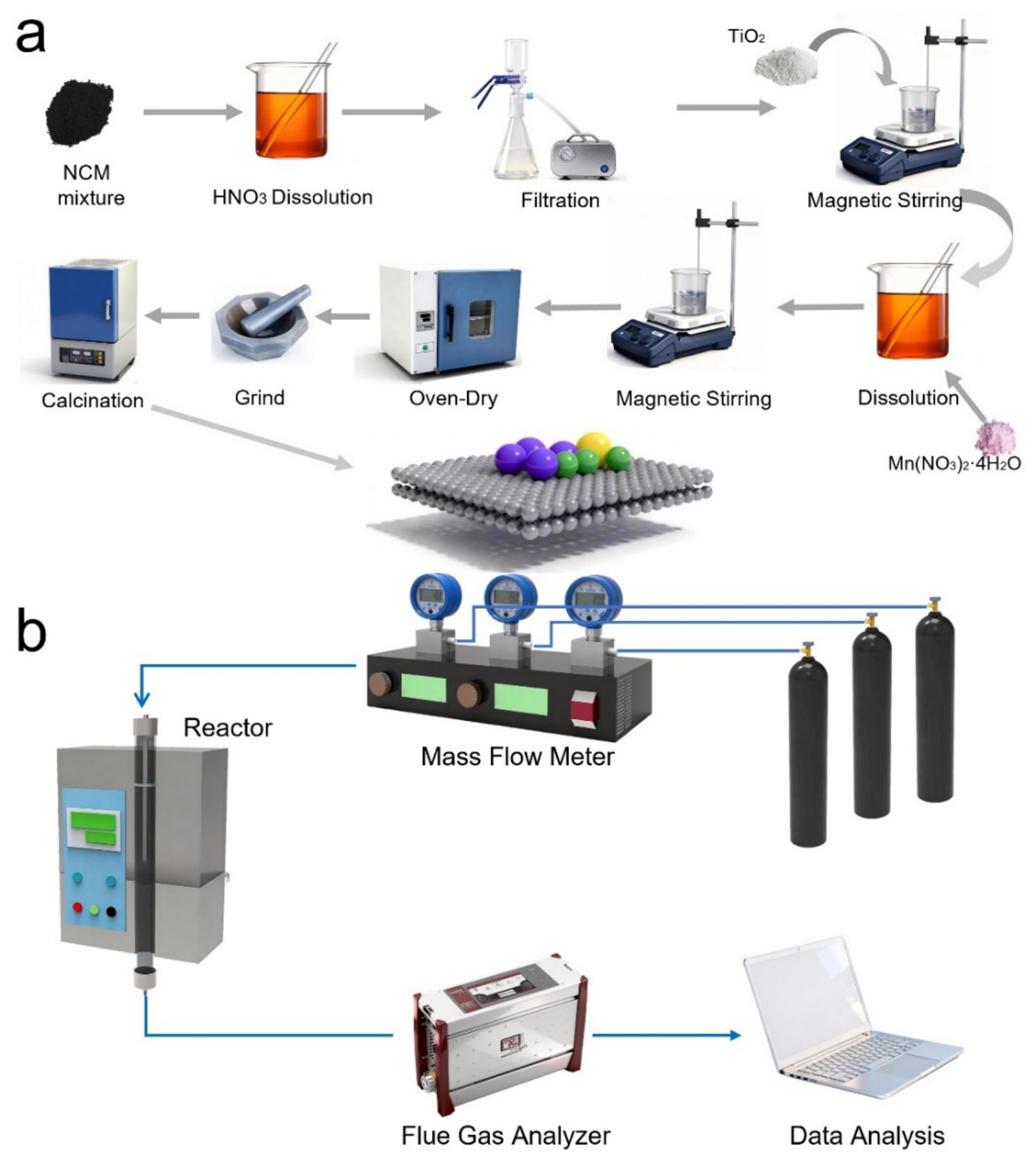
The overall experimental process is illustrated in Figure 1a. Firstly, spent LIBs (Contemporary Amperex Technology Co., Limited, Ningde, China) were dismantled and the cathode material was separated. The positive and negative plates, along with the diaphragm, were peeled off and mechanically crushed to promote binder separation. The obtained cathode material was then placed into a ball mill and ground into powder (80–100 mesh). The resulting powder was calcined in a CO2 (Nanjing Special Gas Plant Co., Ltd., Nanjing, China) atmosphere at 650 °C. Subsequently, the calcined powder was leached with hot water for 60 min to extract Li, with a solid-to-liquid ratio of 50 mL/g, leaving an insoluble residue composed of mixed Ni, Co, and Mn oxides. This residue was further leached with nitric acid (Sinopharm Chemical Reagent Co., Ltd., Shanghai, China) to obtain a mixed solution containing Ni2+, Co2+, and Mn2+; then, the solution was filtered to remove all insoluble impurities. NaOH (Shanghai Macklin Biochemical Co., Ltd., Shanghai, China) was added to the filtered solution to adjust the pH to promote the co-precipitation of Ni, Co, and Mn ions. The resulting precipitate was collected, filtered, washed, and dried to obtain the ternary precursor. Finally, the precursor was calcined at high temperature to yield the Ni-Co-Mn mixed oxide (hereafter denoted as NCM mixture) with a nominal composition of 30% Ni, 10% Co, and 10% Mn.
The multi-stage metal recovery performance of this CO2-roasting, hot-water, lithium-extraction, and nitric-acid leaching route using the identical batch of spent ternary cathode materials has been systematically characterized in our previously published work. Under the same experimental conditions, the leaching efficiency of Li via hot-water treatment reached 93.14%, and the acid-leaching efficiencies of Ni, Co, and Mn were all above 98%. Minor amounts of transition metals remain in the filtrate from the alkaline co-precipitation step. Such filtrate can be collected and recycled to the acid-leaching procedure, so the nitric-acid leaching efficiency can approximately reflect the practically achievable metal recovery of the whole process. Detailed ICP-OES measurements and stage recovery data are reported therein [18].
The NCM/TiO2 catalysts were prepared via impregnation. The specific preparation procedure was as follows: A 0.2 g portion of the NCM mixture was weighed and then subjected to acid leaching in 6 mol/L HNO3 at a solid-to-liquid ratio of 20 mL/g. The leaching process was conducted at 50 °C for 4 h. After complete dissolution, the solution was vacuum-filtered to remove residual Li and other insoluble impurities. Subsequently, 1 g of nano-TiO2 (5–10 nm, Shanghai Macklin Biochemical Co., Ltd., Shanghai, China) was weighed and added to the filtered solution as the catalyst support. The suspension was stirred using a magnetic stirrer (model SN-HWS-2DJ, Shanghai Shangyi Instrument Equipment Co., Ltd., Shanghai, China) at 200 rpm at 50 °C for 120 min. Following this, Mn(NO3)2·4H2O (0.137 g, 0.274 g, 0.411 g and 0.548 g, Shanghai Macklin Biochemical Co., Ltd., Shanghai, China) were respectively added to the above solution while continuing to stir at 200 rpm at 50 °C for 30 min. The beaker containing the mixture was then placed into a drying oven (model 101-3B, Hangzhou Hengyi Instrument Technology Co., Ltd., Hangzhou, China) and dried at 120 °C for 12 h. After drying, the sample was removed and ground in a crucible into powder (80–120 mesh). Finally, the powder was calcined in a muffle furnace (model GWL-1400X, Nanjing Hongxinlai Instrument Co., Ltd., Nanjing, China) at 500 °C for 4 h with a heating rate of 10 °C/min. This procedure produced a series of NCM/TiO2 catalysts with an Mn loading of 5 wt%, 8 wt%, 11 wt%, and 14 wt%.

2.2. Catalyst Characterization Method

The crystal structure of the NCM/TiO2 catalysts was characterized by powder X-ray diffraction (XRD) on a Bruker D8 diffractometer (model Bruker AXS, Bruker Corporation, Karlsruhe, Germany) operated with Cu Kα radiation in the range of 2θ = 20–90°. The specific surface area and pore structure were determined by nitrogen adsorption–desorption measurements using a Nova 2200e physicochemical adsorption analyzer (Quantachrome Instruments, Anton Paar QuantaTec Inc., Boynton Beach, FL, USA). The specific surface area was calculated via the Brunauer–Emmett–Teller (BET) method, while the pore size distribution was derived from the desorption branch using the Barrett–Joyner–Halenda (BJH) model. Surface morphology and elemental distribution were examined using a scanning electron microscope (SEM) equipped with an energy-dispersive X-ray spectrometer (EDS) (model Hitachi SU8010, Hitachi, Tokyo, Japan). The elemental composition and chemical states on the catalyst surface were analyzed by X-ray photoelectron spectroscopy (XPS) on a Thermo Scientific K-Alpha instrument (model Thermo Scientific K-Alpha, Thermo Fisher Scientific, East Grinstead, West Sussex, UK). Redox properties were evaluated by hydrogen temperature-programmed reduction (H2-TPR), and surface acidity was assessed by ammonia temperature-programmed desorption (NH3-TPD). Both the H2-TPR and NH3-TPD experiments were conducted on a Quantachrome Instrument adsorption analyzer.

2.3. Catalyst Performance Test

The catalytic performance test platform is illustrated in Figure 1b. The NH3-SCR reaction was conducted in a fixed-bed quartz reactor with an inner diameter of 6 mm. The composition of the simulated flue gas was regulated by mass flow controllers (model D07-19B, Beijing Sevenstar Flow Co., Ltd., Beijing, China) to maintain the following conditions: 500 ppm NO, 500 ppm NH3, 5 vol% O2, and N2 as the balance gas, with a total flow rate of 200 mL/min. The NOx concentration at the reactor outlet was measured with a flue gas analyzer (model 110-230V/5A, MRU GmbH, Neckarsulm, Germany), and the NOx conversion rate was subsequently calculated to assess catalytic efficiency.
The calculation formula for the NOx conversion efficiency is as follows:
N O x % = N O x in   N O x out   N O x in   × 100 %
In this equation, [NOx]in denotes the inlet NO concentration participating in the NH3-SCR reaction, while [NOx]out represents the outlet NO concentration measured after the reaction stabilizes.

3. Results and Discussion

3.1. Catalytic Performance

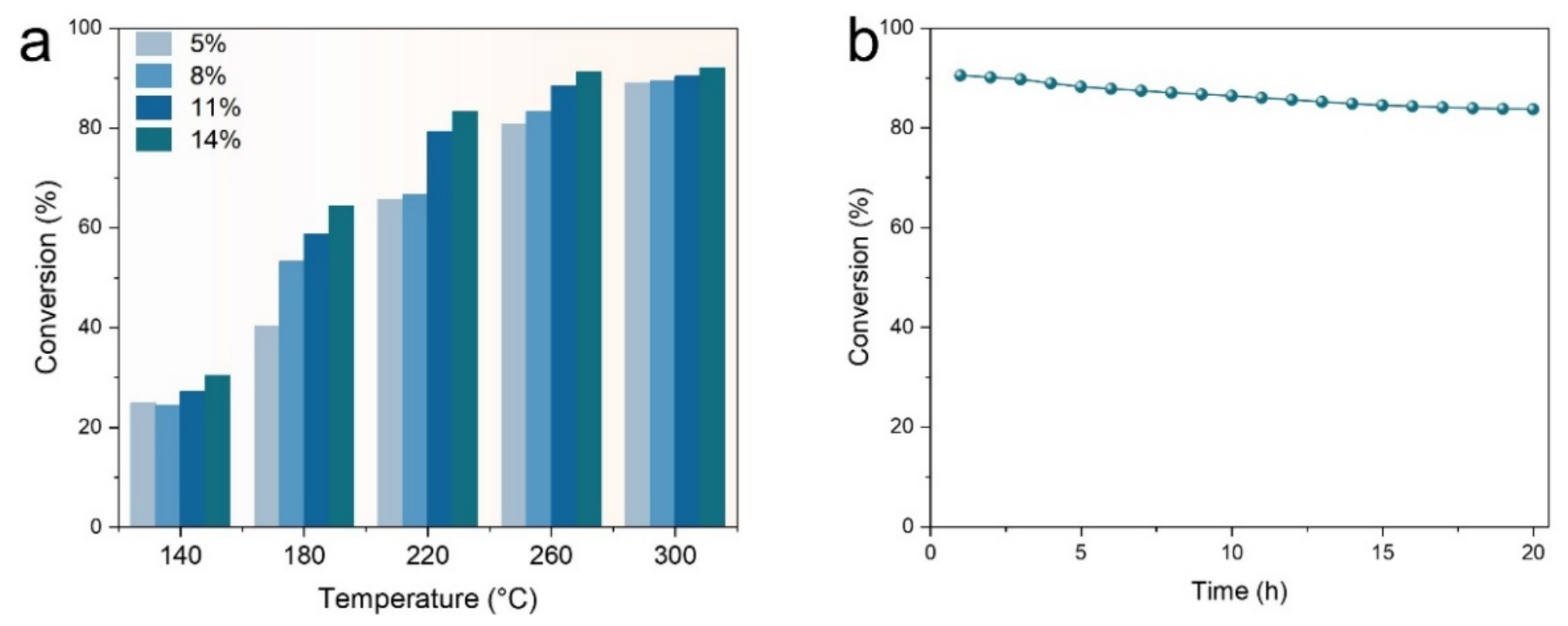
The catalytic performance of NCM/TiO2 catalysts with different Mn loadings is presented in Figure 2a. As the reaction temperature increased, the NO conversion of all samples showed a gradual rising trend, indicating excellent catalytic performance in the medium- to high-temperature region. In the low-temperature region (140–180 °C), the catalytic activities of samples differed significantly. The catalyst with 14 wt% Mn loading demonstrated the highest NO conversion, reaching 30.4% and 64.4% at 140 °C and 180 °C, respectively, which suggested that higher Mn loading was beneficial for enhancing low-temperature catalytic activity. As the temperature further increased to 220–260 °C, the activity of all catalysts improved notably. The samples with 11 wt% and 14 wt% Mn loadings exhibited excellent NO conversion, with the latter achieving 91.2% at 260 °C. At 300 °C, the NO conversion of all samples exceeded 89%, and, notably, the catalyst with 14 wt% Mn loading achieved 92.1% catalytic activity. Overall, the NCM/TiO2 catalyst with 14 wt% Mn loading exhibited excellent catalytic performance across the entire temperature range. The excellent performance was attributed to its higher surface acidic sites concentration, evidenced by NH3-TPD; greater abundance of surface-adsorbed oxygen species, revealed by XPS analysis; and superior redox properties, demonstrated by H2-TPR, which collectively promoted the adsorption and activation of NH3 and NO to facilitate the reaction efficiency.
To further evaluate the operational stability of the 14 wt% NCM/TiO2 catalyst, a 20 h stability test was conducted at 260 °C, with the results presented in Figure 2b. Throughout the testing period, the NO conversion rate gradually declined from 90.5% to 83.7%, overall decreasing by approximately 6.8%. Specifically, the catalytic activity had a slight decrease during the initial stage of the reaction, after which the NO conversion rate gradually stabilized. The conversion remained relatively constant at 84% between 10 h and 20 h, with no notable downtrend. These results demonstrated that the catalyst with 14 wt% Mn loading possessed excellent operational stability under reaction conditions. Two possible mechanisms may account for the slight deactivation. (1) Structural deactivation: Under prolonged reaction at 260 °C, the amorphous and highly dispersed Ni, Co, and Mn oxides supported on TiO2 undergo slow surface migration. The resulting aggregation of sub-nanometer active species reduces the number of exposed active sites. (2) Chemical deactivation: At lower temperatures, intermediates of NO oxidation (e.g., nitrate and nitrite) are not fully decomposed. Their gradual accumulation on the surface occupies Lewis acid sites and metal active centers, thereby inhibiting NH3 adsorption and NO oxidation.

3.2. XRD Analysis

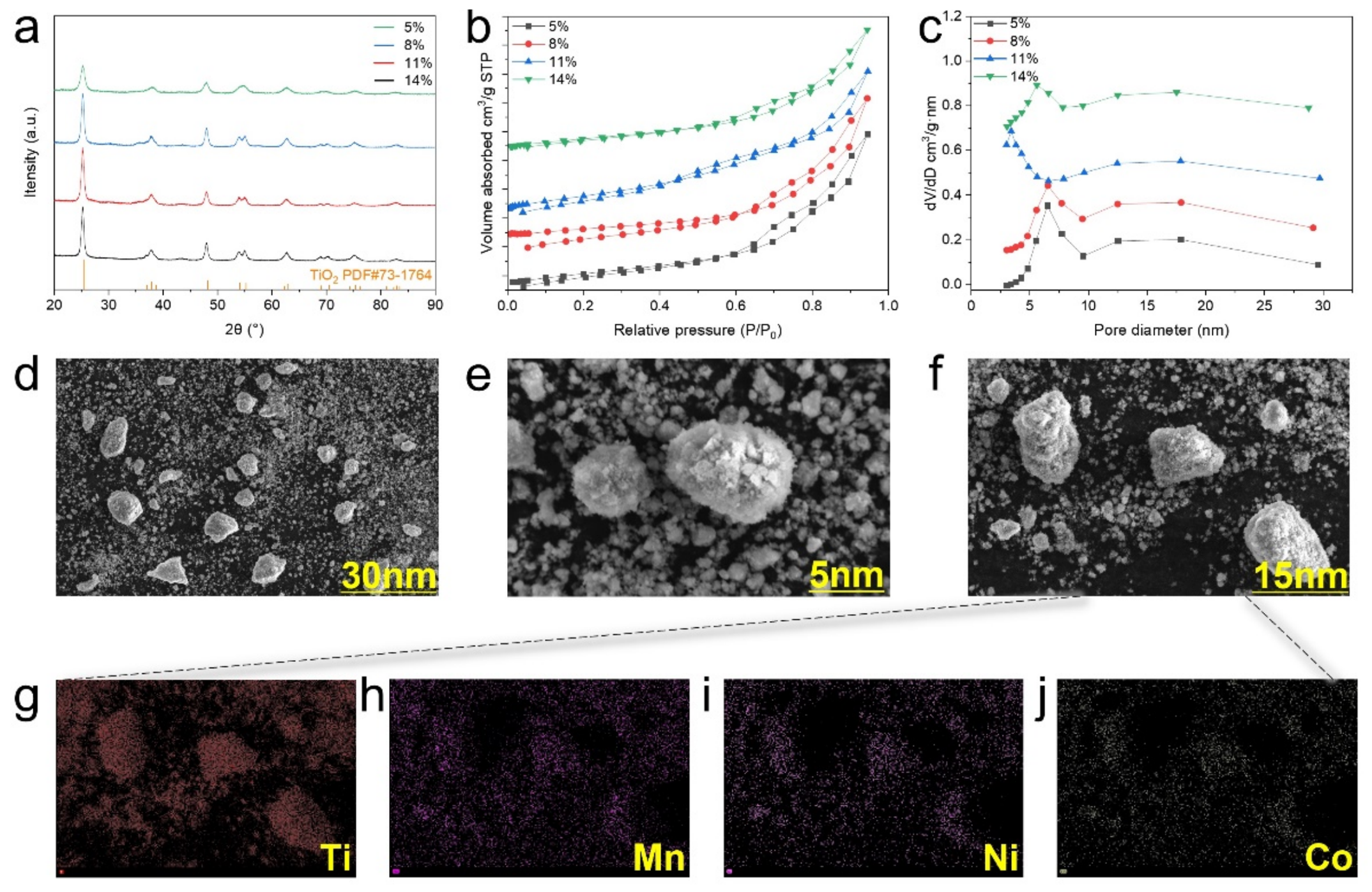
The X-ray diffraction patterns of the four NCM/TiO2 catalysts are presented in Figure 3a. All samples exhibited the characteristic diffraction peaks consistent with the standard card (PDF#73-1764) of anatase TiO2 within the 2θ range, indicating that the support maintains its well-crystallized structure. Notably, no discernible diffraction peaks corresponding to Ni, Co, Mn, or their oxides were observed in the patterns. This absence suggested that they were not present as independent, large-sized crystalline phases. Considering the total metal loading and the detection limit of XRD (typically >3–5 nm), this result further indicated that the Ni, Co, and Mn were highly dispersed on the TiO2 surface. They were likely present as amorphous oxides, sub-nanometer clusters, or even atomically dispersed species. Such a highly dispersed structure was advantageous for increasing the density of active sites, facilitating reactant adsorption and mass transfer at the interface, and simultaneously enhancing stability and catalytic performance through strong metal–support interactions [19].

3.3. BET-BJH Analysis

The N2 adsorption–desorption isotherms, pore size distributions, and corresponding textural parameters of all samples are presented in Figure 3b, Figure 3c, and Table 1, respectively. All catalysts exhibited typical Type IV adsorption isotherms with distinct H3-type hysteresis loops in the relative pressure (p/p0) range of 0.4–1.0 (Figure 3b), indicating the presence of slit-like mesoporous structures formed by the aggregation of plate-like particles. Such mesoporous architecture had considerable significance for heterogeneous catalytic reactions. On the one hand, the high specific surface area of this structure facilitated the dispersion and stabilization of active components. On the other hand, the confined environment inhibited the migration and agglomeration of active metal species at elevated temperatures, thereby sequentially mitigating activity decay due to Ostwald ripening or particle sintering. Consequently, this porous framework helped preserve the structural integrity and long-term catalytic activity [20,21]. The pore size distribution curves calculated by the BJH model (Figure 3c) further revealed that the pore diameters of all samples were predominantly concentrated within the range of 3.427–6.550 nm, which falls within the typical mesoporous region. This narrow distribution indicated that the catalysts possessed a uniform pore structure. Examination of the textural parameters summarized in Table 1 showed that the specific surface area of catalysts with the Mn loading increased from 5 wt% to 14 wt% and progressively rose from 45.638 m2·g−1 to 75.915 m2·g−1, while the pore volume simultaneously increased from 0.141 cm3·g−1 to 0.170 cm3·g−1. Among all the prepared catalysts, the 14 wt% NCM/TiO2 catalyst exhibited the best structural properties. Its high specific surface area and large pore volume promoted the high dispersion and stability of active metal species, simultaneously providing a more efficient pathway for the adsorption, diffusion, and desorption of reactant molecules (e.g., NH3 and NOx). Consequently, this porous architecture greatly enhanced the mass transfer efficiency and the overall catalytic activity.

3.4. SEM Analysis

The microstructure and elemental distribution of the representative catalyst were characterized by scanning electron microscopy equipped with energy-dispersive X-ray spectroscopy (SEM-EDS), and the results are presented in Figure 3d–j. Low-magnification SEM images (Figure 3d–f) revealed that the sample exhibited a hierarchical structure composed of aggregated irregular particles ranging from tens to hundreds of nanometers in size. This morphology was consistent with the mesoporous characteristics identified by N2 adsorption analysis. High-magnification observation further demonstrated that numerous fine particles with approximately 10–30 nm diameters were anchored onto the surface of larger TiO2 particles, forming a composite structure that effectively increased the available active interface area. EDS elemental mapping (Figure 3g–j) clearly illustrated the spatial distribution of the constituent elements. The Ti signal appeared uniform and continuous across the entire observed region, corresponding to the entire TiO2 support framework. More importantly, the distribution maps of active elements (e.g., Mn, Ni, Co) exhibited highly uniform and continuous signal coverage with no localized enrichment or segregation, which indicated that Ni, Co, and Mn were highly dispersed on the TiO2 support surface without forming discernible large-scale aggregates or independent crystalline phases. Such a uniform dispersion state greatly enlarged the exposure of active sites, simultaneously suggesting strong interactions between the metal components and the support, which provides a structural foundation for the catalyst to maintain high activity and stability.

3.5. XPS Analysis

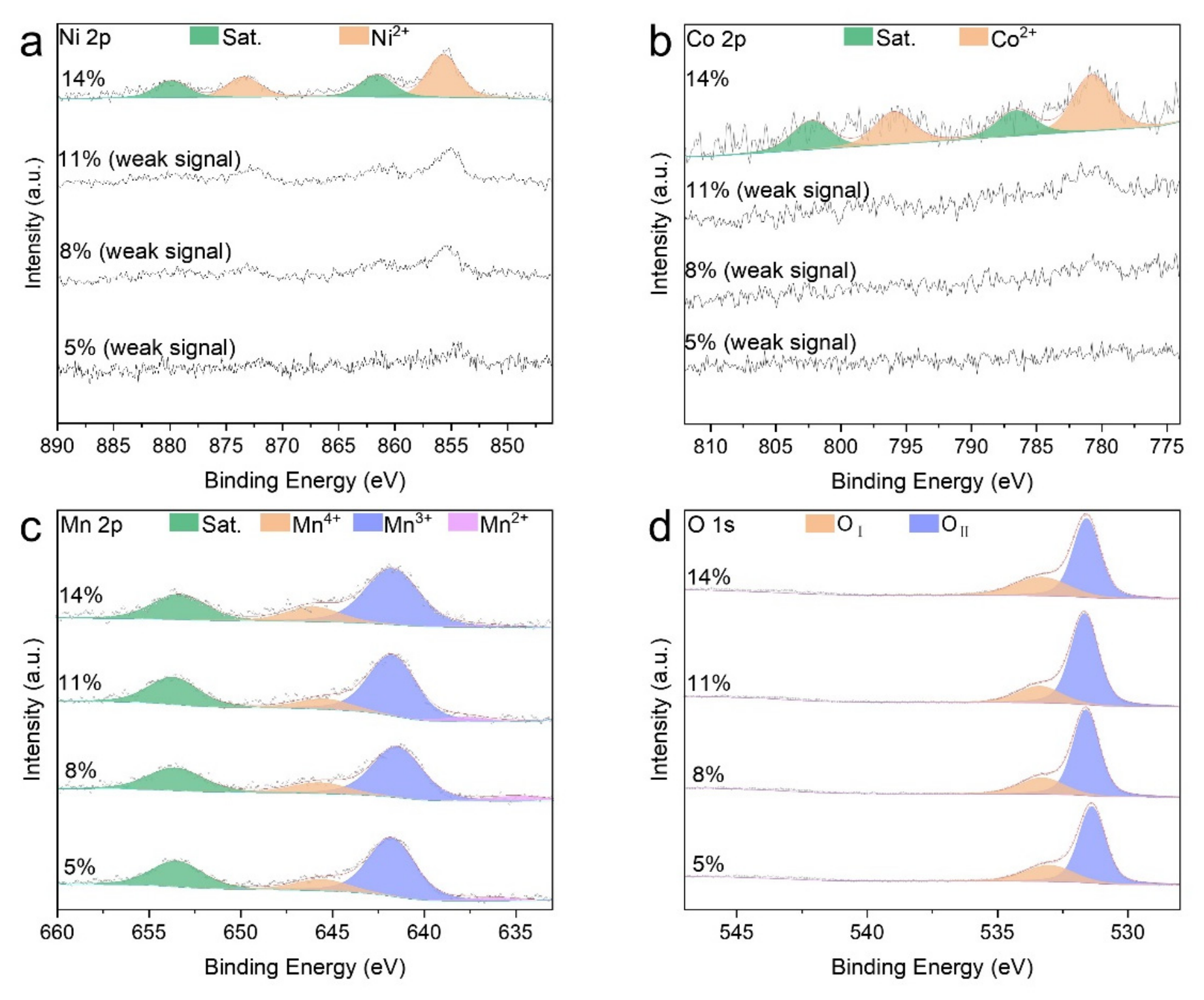
The surface elemental valence states of all catalysts were investigated by X-ray photoelectron spectroscopy (XPS); the results are presented in Figure 4. The Ni 2p photoelectron spectra are shown in Figure 4a. For the sample with 14 wt% Mn loading, distinct characteristic peaks corresponding to Ni 2p3/2 and Ni 2p1/2 were observed at binding energies of 855.7 eV and 873.4 eV. Additionally, prominent satellite peaks appeared at higher binding energies, which were a typical feature of Ni2+. This indicated that Ni predominantly existed in the +2 oxidation state on the catalyst surface [22]. In contrast, the Ni 2p signals for the samples with 5 wt%, 8 wt%, and 11 wt% Mn loadings were considerably weaker, showing only faint characteristic peaks. This suggested that the surface concentration of Ni was relatively low or the dispersion degree was exceptionally high under lower loading conditions, both of which could result in weak XPS signal intensity. As the Mn loading increased, the Ni 2p signal progressively strengthened, which indicated that the extent of surface enrichment of Ni correlated positively with the total loading amount. Similarly, the Co 2p spectra revealed that the sample with 14 wt% Mn loading exhibited distinct characteristic peaks at approximately 780.6 eV (Co 2p3/2) and 795.9 eV (Co 2p1/2), simultaneously showing notable satellite features. These spectral characteristics confirmed that Co predominantly existed in the +2 oxidation state on the catalyst surface [21]. Consistent with the trend observed for Ni, the Co 2p signal intensity for catalysts with lower Mn loadings was relatively weak and increased as the Mn loading increased. The Mn 2p3/2 spectra were presented in Figure 4c. Spectral deconvolution revealed characteristic peaks corresponding to Mn2+, Mn3+, and Mn4+ at binding energies of approximately 637.4 eV, 642.0 eV, and 646.0 eV, along with the satellite peak at around 653.6 eV. Previous studies have demonstrated that the presence of Mn4+ could greatly promote the oxidation of NO to NO2, consequently facilitating the “fast SCR” pathway and playing a positive role in the NH3-SCR process [23]. Examination of the Mn4+ content in samples with different Mn loadings (Table 2) revealed that the catalyst with 14 wt% loading exhibited the highest proportion of Mn4+, indicating that a higher loading facilitated the formation of high-valence Mn.
Figure 4d shows the O 1s electron binding energy spectra of NCM/TiO2 catalysts. The peak at about 529.7 eV could be attributed to OII, and the peak at about 531.5 eV corresponds to surface OI, which mainly includes defective oxygen, weakly bound oxygen species, or hydroxyl-like groups. OI has high mobility and strong oxidation activity, and its low binding energy and easy migration characteristics make it more active than lattice oxygen during the SCR reaction [24]. Examination of the OI content (Table 2) revealed that the sample with 14 wt% loading exhibited the highest proportion of surface-adsorbed oxygen, which was likely associated with the introduction of additional surface defects due to the higher metal loading. A certain degree of distortion in the TiO2 surface lattice occurred as the loading of Ni, Co, and Mn increased, and metal–support interaction was induced, thereby promoting the formation of oxygen vacancies [25]. These oxygen vacancies served as preferential sites for adsorption and activation, which significantly increased the amount of surface OI. Furthermore, the synergistic interaction among the polymetallic oxides helped maintain the stability of high-valence metal species, consequently further promoting the generation of reactive oxygen species [26].

3.6. H2-TPR and NH3-TPD

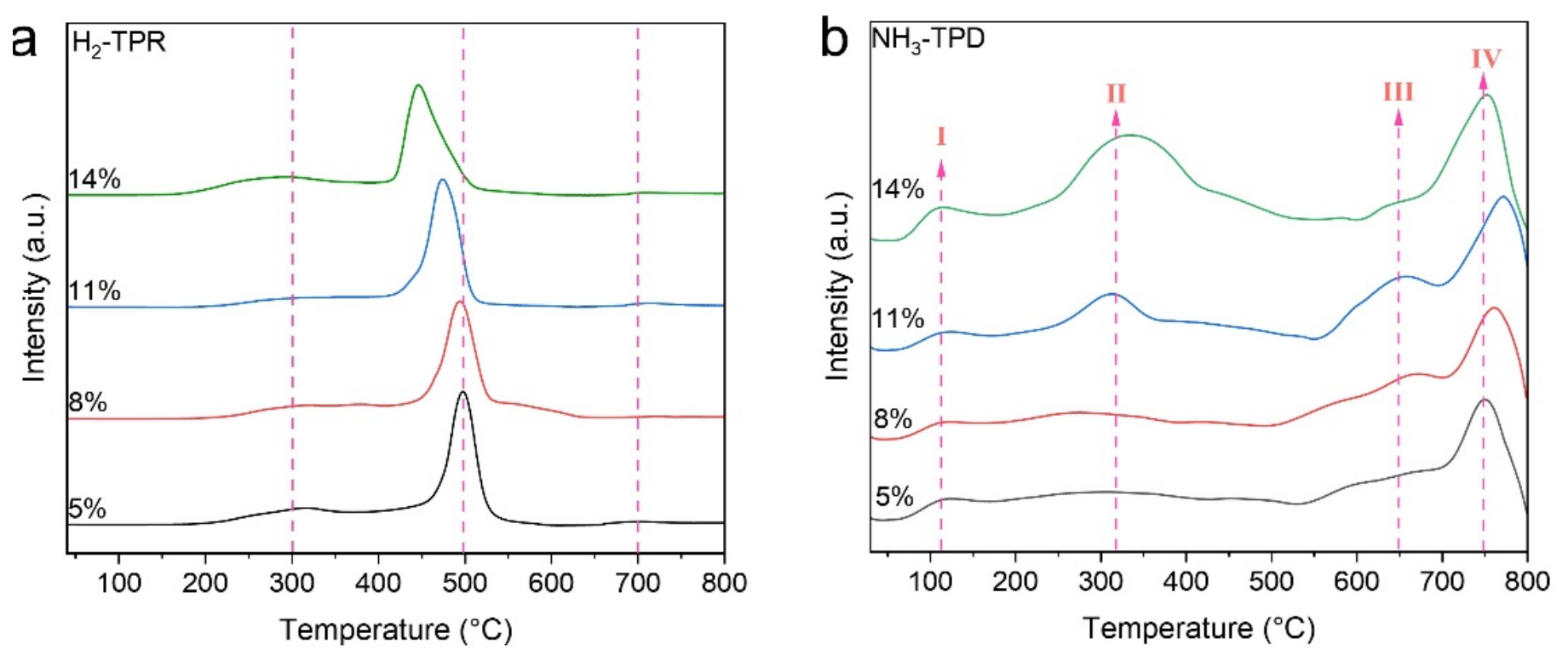
The reduction behavior of NCM/TiO2 catalysts with different Mn loadings was investigated by H2-TPR, and the results are presented in Figure 5a. All samples exhibited three characteristic reduction peaks at approximately 300 °C, 500 °C, and 700 °C, indicating the presence of multiple metal oxide species with varying reducibility on the catalyst surface. The low-temperature reduction peak around 300 °C was attributed to the reduction of highly dispersed CoOx (Co3+ → Co2+) and MnO2 (Mn4+ → Mn3+) on the surface [27,28]. The intermediate reduction peak around approximately 500 °C was attributed to the gradual reduction of Mn3+ to Mn2+, which might also encompass the reduction of Co2+. The weak reduction peak observed around 700 °C corresponded to the deep reduction of Ni2+ and Co2+ to their metallic states, which was attributed to the strong metal–support interactions. This process typically required elevated temperatures to overcome the energy barrier for metal-oxygen bond cleavage. On the whole, the intensity of each reduction peak gradually intensified as the Mn loading increased from 5 wt% to 14 wt%, indicating that the total amount of reducible species increased with higher loading. This trend was consistent with the variation in metal signal intensities observed in the XPS analysis.
The surface acidity of NCM/TiO2 catalysts with different Mn loadings was characterized by ammonia temperature-programmed desorption (NH3-TPD), and the results are presented in Figure 5b. All samples exhibited multiple NH3 desorption peaks within the temperature range of 100–800 °C, indicating that acid sites with a continuous distribution of strength existed on the catalyst surface. Based on the desorption temperature, these peaks could be classified into four characteristic regions: Region I (centered at approximately 100 °C) corresponded to weak acid sites, primarily associated with physisorbed or weakly chemisorbed NH3; Region II (centered at around 300 °C) represented medium-strength acid sites, typically related to Lewis acid sites or partial Brønsted acid sites; Regions III and IV (centered at approximately 650 °C and 750 °C, respectively) corresponded to strong acid sites, which may originate from strong Lewis acid sites on the TiO2 support surface or strong acid sites formed at the metal–support interface. The intensities of desorption peaks across all temperature regions increased as the Mn loading increased from 5 wt% to 14 wt%, indicating that the number of surface acid sites is rising. Notably, the NCM/TiO2 with 14 wt% loading displayed the most prominent desorption peaks in the medium-strength and strong acid regions (Regions II–IV), suggesting that its surface had a large number of strong acid sites. In contrast, the desorption peaks for the low-loading samples were relatively weak across all temperature regions, which reflected that the number of surface sites available for NH3 adsorption was limited. Studies have shown that medium-strength and strong acid sites play a crucial role in the adsorption and activation of NH3 during the NH3-SCR reaction [28,29].

3.7. Prediction of Reaction Mechanisms

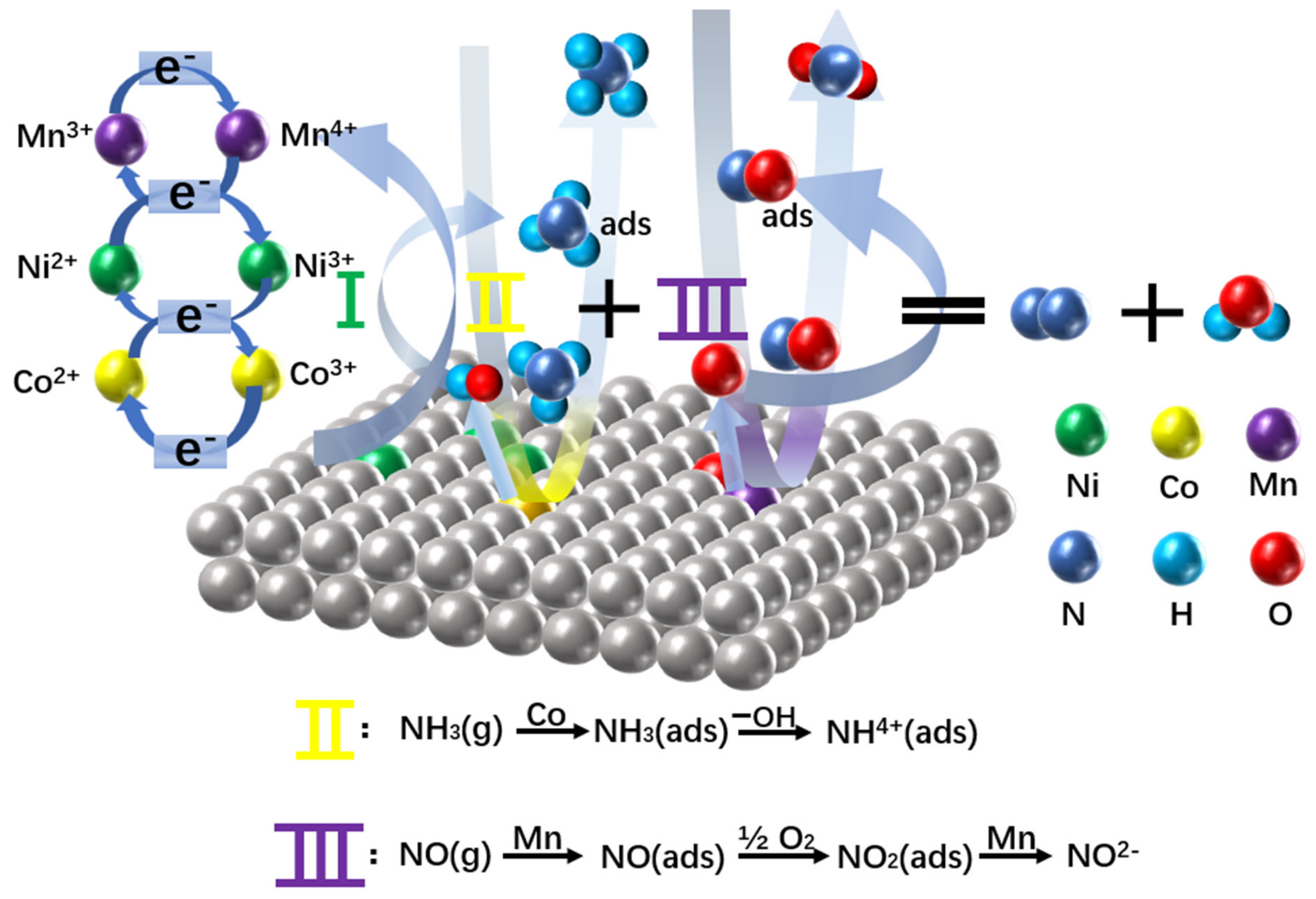
The catalytic performance strongly depends on Mn loading. At low loadings (5–8 wt%), the catalyst exhibits insufficient active sites, low surface acid site density, weak Ni-Co-Mn electronic interaction, and limited surface-adsorbed oxygen, resulting in poor low-temperature SCR activity. As Mn loading rises to 11 wt%, the relative proportion of Mn4+ reaches its peak, which facilitates NO oxidation and the “fast SCR” pathway. When Mn loading is further increased to 14 wt%, the density of active sites and surface acidity are significantly enhanced, electron transfer among Ni, Co, and Mn is strengthened, and the content of surface-adsorbed oxygen is greatly elevated. Although the relative atomic ratio of Mn4+ decreases slightly, the total amount of redox-active sites and the overall redox capacity are still effectively improved, thereby significantly boosting low-temperature SCR activity. Meanwhile, in the catalytic denitration reaction, Ni, Co, and Mn significantly improved the reaction efficiency by constructing a synergistic electronic cycle system in Figure 6. First of all, Ni, Co, and Mn formed a complete electron transfer cycle system (corresponding to process I in the mechanism diagram): the reversible redox pairs between Co2+/Co3+, Ni2+/Ni3+, and Mn3+/Mn4+ provided an efficient electron transfer channel for the reaction, ensuring charge balance in the catalytic process and that the reaction is stable. Secondly, Co, as the key active site for NH3 adsorption activation (corresponding to process II), could convert NH3(g) to surface-adsorbed NH3(ads) and further protonate with surface -OH to form active NH4+(ads) species, providing a reductant for the subsequent reduction process of NOx. At the same time, Mn, as the core active site of NO oxidation (corresponding to process III), first converted NO(g) to surface-adsorbed NO(ads) and then converted it to NO2(ads) by oxidation. NO2(ads) further reacted on the metal site and was finally converted to nitrite species, which promoted the activation and oxidation of NO. The three elements promoted the reaction of NH3 with NO through the synergy of the electronic cycle, reductant activation, and oxidant activation, and realized the efficient flue gas denitrification process.

4. Conclusions

In this study, a series of NCM/TiO2 catalysts with varying Mn loadings were successfully composed via impregnation and calcination process. Catalytic testing demonstrated that the NCM/TiO2 catalyst indeed exhibited excellent low-temperature activity and long-term stability. Notably, the 14 wt% NCM/TiO2 catalyst achieved over 90% NOx conversion at 260 °C and still retained more than 80% catalytic activity after a 20 h continuous reaction. In contrast, pure anatase TiO2 exhibits almost no activity in low-temperature SCR reactions below 300 °C, with an NO conversion rate lower than 15% [30]. The single-metal Mn/TiO2 (prepared by impregnation, with a manganese content of 10–14 wt%) only achieves approximately 52% NO conversion at 220 °C and about 78% at 260 °C [31]. This significantly enhanced activity directly confirms the synergistic promotion effect among Ni, Co, and Mn. This superior stability was attributed to the highly dispersed state of the polymetallic components on the TiO2 surface, along with strong metal–support interactions (e.g., Mn-O-Ti bonds), which effectively inhibited migration, agglomeration, and loss of active species.
Furthermore, the enhanced catalytic performance was closely associated with the catalysts’ textural properties and surface chemical states. Specifically, the specific surface area and pore volume gradually increased as the Mn loading increased, which facilitated efficient mass transfer during the reaction. Concurrently, the number and strength of surface acid sites were significantly optimized. The increased proportion of medium-strength and strong acid sites greatly enhanced the adsorption and activation of NH3. Additionally, XPS and H2-TPR analyses revealed abundant Mn4+/Mn3+ redox couples and a high proportion of surface-adsorbed oxygen on the catalyst, which collectively promoted the oxidation of NO and the activation of NH3. On the whole, the excellent low-temperature catalytic performance of NCM/TiO2 was due to the synergy of optimal texture, favorable acidity, and enhanced redox properties.
In summary, the NCM/TiO2 catalyst achieved high-efficiency low-temperature catalytic performance through the synergistic effects of multi-metal coordination, structural regulation and interface enhancement. This work demonstrates the dual significance of this strategy, enabling high-value spent LIBs recycling and guiding the development of low-temperature SCR catalysts.

Author Contributions

H.L.: Methodology, investigation, formal analysis, conceptualization, writing—original draft, data curation. Z.S.: Formal analysis and data curation. J.Y.: Software and validation. P.R.: Conceptualization and validation. J.Z.: Data curation and funding acquisition. Y.Z.: Writing—review and editing and data curation. X.Z.: Formal analysis and writing—review and editing. L.Z.: Validation and formal analysis. C.L.: Supervision, resources, conceptualization, and writing—review and editing. All authors have read and agreed to the published version of the manuscript.

Funding

The Science and Technology Project of the National Energy Group Science and Technology Research Institute Co., Ltd.: Development and Application Research of the Whole-Process Supervision and Management System for Denitration Catalysts in Thermal Power Enterprises (HB2025Y01); the National Key Research and Development Program of China (2023YFC3904800); and the Special Fund for Science and Technology Innovation of Carbon Peaking and Carbon Neutrality in Jiangsu Province (BT2024011).

Informed Consent Statement

All authors have studied the manuscript thoroughly and consented to the publication.

Data Availability Statement

The original contributions presented in this study are included in the article. Further inquiries can be directed to the corresponding author.

Conflicts of Interest

Authors Haiqiu Liu, Jie Yao, Peng Ren, and Jiaxin Zhang were employed by the Guodian Environmental Protection Research Institute Co., Ltd. The remaining authors declare that the research was conducted in the absence of any commercial or financial relationships that could be construed as a potential conflict of interest. The authors declare that this study received funding from National Energy Group Science and Technology Research Institute Co., Ltd. The funder contributed to the investigation, methodology, data collection, experimental verification, form analysis, and writing of the initial draft of this work.

References

  1. Dai, G.Y.; Liu, B.T.; Wang, R.J.; Wang, H.L.; Miao, Y.X.; Hou, S.J.; Lian, D.X.; Chen, M.H.Y.; Li, C.X.; Zhang, Z.J.; et al. Pretreatment techniques in CO-SCR and NH3-SCR: Status, challenges, and perspectives. J. Catal. 2025, 442, 115925. [Google Scholar] [CrossRef] [Scilit]
  2. Zou, Y.; Zhao, Y.Q.; Liu, X.L.; Zhu, T.Y. Catalytic oxidation of CO coupled with selective catalytic reduction (SCR) Denitrification: An alternative supplemental heating strategy and catalyst Design. J. Clean. Prod. 2025, 519, 145972. [Google Scholar] [CrossRef] [Scilit]
  3. Meng, L.Y.; Li, W.Q.; Wang, J.X.; Shi, Y.; Hu, C.Q. Research Progress on Flue Gas Desulfurization and Denitrification by Activated Carbon Method. Processes 2025, 13, 1396. [Google Scholar] [CrossRef] [Scilit]
  4. Liu, J.; Xie, Z.; Xu, Y.Z.; Han, Y.Z.; Zhang, Q.; Guo, B.Y.; Wang, Q.H.; Guo, X.W.; Du, H.L. Operating parameters optimization and efficient NO reduction of SNCR process in a municipal solid waste incinerator. Waste Manag. 2025, 205, 114996. [Google Scholar] [CrossRef] [Scilit] [PubMed]
  5. Dong, C.; Yao, J.X.; Shi, J.Q.; Han, L.N.; Qin, H.W.; Zhang, Z.H.; Zhang, Q.H.; Wang, J.C. Resource utilization strategy based on the deactivation mechanism of V2O5-WO3/TiO2 catalyst. Fuel 2025, 381, 133311. [Google Scholar] [CrossRef] [Scilit]
  6. Zhang, Y.Y.; Guan, B.; Zheng, C.Z.; Zhou, J.F.; Su, T.X.; Guo, J.F.; Chen, J.Y.; Chen, Y.J.; Zhang, J.H.; Dang, H.T.; et al. Research on the resistance of catalysts for selective catalytic reduction: Current progresses and future perspectives. J. Clean. Prod. 2024, 434, 139920. [Google Scholar] [CrossRef] [Scilit]
  7. Gao, M.; Lu, G.G.; Li, Z.C.; Wang, X.; Duan, R.C.; Fu, Y.; He, G.Z.; He, H. Unveiling the Reaction Mechanism of Selective Catalytic Reduction of NO with NH3 over Active Mn-W Dinuclear Sites. Environ. Sci. Technol. 2025, 59, 19060–19067. [Google Scholar] [CrossRef] [Scilit] [PubMed]
  8. Zhou, J.; Guo, R.T.; Zhang, X.F.; Liu, Y.Z.; Duan, C.P.; Wu, G.L.; Pan, W.G. Cerium Oxide-Based Catalysts for Low-Temperature Selective Catalytic Reduction of NOx with NH3: A Review. Energy Fuels 2021, 35, 2981–2998. [Google Scholar] [CrossRef] [Scilit]
  9. Xu, G.Y.; Guo, X.L.; Cheng, X.X.; Yu, J.; Fang, B.Z. A review of Mn-based catalysts for low-temperature NH3-SCR: NOx removal and H2O/SO2 resistance. Nanoscale 2021, 13, 7052–7080. [Google Scholar] [CrossRef] [Scilit] [PubMed]
  10. Liu, J.G.; Li, B.H.; Cao, J.H.; Xing, X.; Cui, G. Challenges in Li-ion battery high-voltage technology and recent advances in high-voltage electrolytes. J. Energy Chem. 2024, 91, 73–98. [Google Scholar] [CrossRef] [Scilit]
  11. Fan, E.S.; Li, L.; Wang, Z.P.; Lin, J.; Huang, Y.X.; Yao, Y.; Chen, R.J.; Wu, F. Sustainable Recycling Technology for Li-Ion Batteries and Beyond: Challenges and Future Prospects. Chem. Rev. 2020, 120, 7020–7063. [Google Scholar] [CrossRef] [Scilit] [PubMed]
  12. Lv, L.; Zhou, S.Q.; Liu, C.Q.; Sun, Y.; Zhang, J.B.; Bu, C.S.; Meng, J.G.; Huang, Y.J. Recycling and Reuse of Spent LIBs: Technological Advances and Future Directions. Molecules 2024, 29, 3161. [Google Scholar] [CrossRef] [Scilit] [PubMed]
  13. Rehman, S.; Al-Greer, M.; Burn, A.S.; Short, M.; Cui, X.J. High-Volume Battery Recycling: Technical Review of Challenges and Future Directions. Batteries 2025, 11, 94. [Google Scholar] [CrossRef] [Scilit]
  14. Huang, B.; Pan, Z.F.; Su, X.Y.; An, L. Recycling of lithium-ion batteries: Recent advances and perspectives. J. Power Sources 2018, 399, 274–286. [Google Scholar] [CrossRef] [Scilit]
  15. Jung, J.C.Y.; Sui, P.C.; Zhang, J.J. A review of recycling spent lithium-ion battery cathode materials using hydrometallurgical treatments. J. Energy Storage 2021, 35, 102217. [Google Scholar] [CrossRef] [Scilit]
  16. Xu, R.; Xu, W.; Wang, J.G.; Liu, F.M.; Sun, W.; Yang, Y. A Review on Regenerating Materials from Spent Lithium-Ion Batteries. Molecules 2022, 27, 2285. [Google Scholar] [CrossRef] [Scilit] [PubMed]
  17. Guo, M.M.; Wang, X.N.; Liu, L.Z.; Min, X.; Hu, X.F.; Guo, W.M.; Zhu, N.W.; Jia, J.P.; Sun, T.H.; Li, K. Recovery of cathode materials from spent lithium-ion batteries and their application in preparing multi-metal oxides for the removal of oxygenated VOCs: Effect of synthetic methods. Environ. Res. 2021, 193, 110563. [Google Scholar] [CrossRef] [Scilit] [PubMed]
  18. Lv, L.; Meng, J.G.; Liu, C.Q.; Zhang, J.B.; Wang, X.Y.; Bu, C.S.; Bu, Y.X.; Zhou, L.; Yang, L.M.; Luo, X.B. Upcycling valuable metals of spent LIB cathode into high-performance catalysts for CO2-CH4 dry reforming. Fuel 2026, 405, 136429. [Google Scholar] [CrossRef] [Scilit]
  19. Jiang, Y.; Liu, T.Y.; Lai, C.Z.; Yang, Z.D.; Lin, R.Y.; Wang, X.W.; Zhu, X.B. Deactivation of CeO2-TiO2 catalyst by K2SO4 for NH3-SCR: An experimental and DFT study. Appl. Surf. Sci. 2021, 547, 149196. [Google Scholar] [CrossRef] [Scilit]
  20. Li, G.; Hao, H.; Jin, P.; Wang, M.; Yu, Y.; Zhang, C. Dry reforming of methane over Ni/Al2O3 catalysts: Support morphological effect on the coke resistance. Fuel 2024, 362, 130855. [Google Scholar] [CrossRef] [Scilit]
  21. Sun, N.N.; Wen, X.; Wang, F.; Wei, W.; Sun, Y.H. Effect of pore structure on Ni catalyst for CO2 reforming of CH4. Energy Environ. Sci. 2010, 3, 366–369. [Google Scholar] [CrossRef] [Scilit]
  22. Long, H.L.; Xu, Y.; Zhang, X.Q.; Hu, S.J.; Shang, S.Y.; Yin, Y.X.; Dai, X.Y. Ni-Co/Mg-Al catalyst derived from hydrotalcite-like compound prepared by plasma for dry reforming of methane. J. Energy Chem. 2013, 22, 733–739. [Google Scholar] [CrossRef] [Scilit]
  23. Guo, R.T.; Wang, Q.S.; Pan, W.G.; Zhen, W.L.; Chen, Q.L.; Ding, H.L.; Yang, N.Z.; Lu, C.Z. The poisoning effect of Na and K on Mn/TiO2 catalyst for selective catalytic reduction of NO with NH3: A comparative study. Appl. Surf. Sci. 2014, 317, 111–116. [Google Scholar] [CrossRef] [Scilit]
  24. Zhang, X.L.; Lv, S.S.; Zhang, X.C.; Xiao, K.S.; Wu, X.P. Improvement of the activity and SO2 tolerance of Sb-modified Mn/PG catalysts for NH3-SCR at a low temperature. J. Environ. Sci. 2021, 101, 1–15. [Google Scholar] [CrossRef] [Scilit] [PubMed]
  25. Lee, H.J.; Back, S.; Lee, J.H.; Choi, S.H.; Jung, Y.; Choi, J.W. Mixed Transition Metal Oxide with Vacancy-Induced Lattice Distortion for Enhanced Catalytic Activity of Oxygen Evolution Reaction. ACS Catal. 2019, 9, 7099–7108. [Google Scholar] [CrossRef] [Scilit]
  26. Zhang, J.; Ma, Z.; Cao, A.; Yan, J.; Wang, Y.; Yu, M.; Lu, H.; Pan, S. Research progress of Mn-based low-temperature SCR denitrification catalysts. RSC Adv. 2024, 14, 32583–32601. [Google Scholar] [CrossRef] [Scilit] [PubMed]
  27. Gao, Y.F.; Li, H.; Zhang, R.Y.; Zeng, M.X.; Hu, J.Q.; Lu, J.F.; Ma, J. Accelerated tetracycline hydrochloride mineralisation by Fe@CeO2-x/MgO complex metal oxides via ozone-catalysed interfacial reactions: The role of oxygen vacancies and multivalent metal cycling. J. Colloid Interface Sci. 2025, 696, 137885. [Google Scholar] [CrossRef] [Scilit] [PubMed]
  28. Xu, J.Q.; Shen, H.; Zhou, X.L.; Zheng, T.; Guo, F.; Zhang, Q.; Duan, M.H. Enhancement low-temperature NH3-SCR activity of the Fe-Mn-Mo/TiO2 catalyst and its DFT calculations and kinetics. Mol. Catal. 2023, 551, 113657. [Google Scholar] [CrossRef] [Scilit]
  29. Tang, T.; Xue, J.Y.; Su, X.J.; Chen, J.F.; Qiao, W.Y.; Zhang, H.Y.; Li, S.H.; Li, X.B.; Du, X.S. Selective NH3 trapping as the enabler for efficient bifunctional catalysis of NH3-SCR and CO oxidation reactions. Appl. Catal. B Environ. Energy 2025, 375, 125430. [Google Scholar] [CrossRef] [Scilit]
  30. Bonelli, B.; Tammaro, O.; Martinovic, F.; Nasi, R.; Dell’Agli, G.; Rivolo, P.; Giorgis, F.; Ditaranto, N.; Deorsola, F.A.; Esposito, S. Reverse Micelle Strategy for the Synthesis of MnOx–TiO2 Active Catalysts for NH3-Selective Catalytic Reduction of NOx at Both Low Temperature and Low Mn Content. ACS Omega 2021, 6, 24562–24574. [Google Scholar] [CrossRef] [Scilit] [PubMed]
  31. Kim, Y.J.; Kwon, H.J.; Nam, I.S.; Choung, J.W.; Kil, J.K.; Kim, H.J.; Cha, M.-A.; Yeo, G.K. High deNOx performance of Mn/TiO2 catalyst by NH3. Catal. Today 2010, 151, 244–250. [Google Scholar] [CrossRef] [Scilit]
Figure 1. (a) Experimental process. (b) Catalytic performance test platform.
Processes 14 02731 g001
Figure 2. (a) Catalytic performance of NCM/TiO2. (b) Stability test of NCM/TiO2.
Processes 14 02731 g002
Figure 3. (a) XRD patterns. (b) BET curve. (c) BJH curve. (dj) SEM-EDS of 14% catalyst.
Processes 14 02731 g003
Figure 4. XPS spectra. (a) Ni 2p. (b) Co 2p. (c) Mn 2p. (d) O 1s.
Processes 14 02731 g004
Figure 5. (a) H2-TPR. (b) NH3-TPD.
Processes 14 02731 g005
Figure 6. Reaction mechanisms.
Processes 14 02731 g006
Table 1. Representative parameters of nitrogen adsorption.
CatalystsSSA (m2/g) aPore Diameter (nm) bPore Volume (cm3/g) b
5%45.6386.5240.141
8%55.1456.5500.160
11%64.7443.4270.165
14%75.9155.6160.170
a BET method. b BJH method.
Table 2. Key XPS atomic ratios of catalysts with different loading rates.
CatalystsOI (atm.%)OII (atm.%)Mn2+ (atm.%)Mn3+ (atm.%)Mn4+ (atm.%)
5%22.3677.64257.0712.99
8%24.0475.961.8756.0313.88
11%22.1777.830.2757.8215.66
14%31.6768.330.4859.5211.80
Disclaimer/Publisher’s Note: The statements, opinions and data contained in all publications are solely those of the individual author(s) and contributor(s) and not of MDPI and/or the editor(s). MDPI and/or the editor(s) disclaim responsibility for any injury to people or property resulting from any ideas, methods, instructions or products referred to in the content.