Review

Algae as Cost-Effective and Efficient Biosorbents for Heavy Metal Removal from Wastewater: Recent Progress, Limiting Factors, and Mechanistic Insights

1
Department of Chemistry, College of Science, Qassim University, Buraidah 51452, Saudi Arabia
2
National Institute of Oceanography & Fisheries (NIOF), Cairo 11516, Egypt
*
Author to whom correspondence should be addressed.
Processes 2026, 14(16), 2613; https://doi.org/10.3390/pr14162613
Submission received: 30 June 2026 / Revised: 8 August 2026 / Accepted: 14 August 2026 / Published: 17 August 2026
(This article belongs to the Special Issue Advances in Solid Waste Treatment and Design (2nd Edition))

Abstract

Heavy metal pollution in water bodies is a serious environmental and public health concern, as these contaminants are toxic, persistent and bioaccumulative in ecosystems and human tissues. Conventional remediation technologies are expensive, require constant monitoring and do not fully remove them. Recent studies have shown the potential, sustainability and cost-effectiveness of biosorption using algal biomass. This review gives a detailed assessment of the potential of algae and cyanobacteria as cheap biosorbents for the removal of heavy metals from wastewater. The sorption efficiency of algae and cyanobacteria is critically evaluated in terms of important operating parameters such as pH, temperature, initial metal concentrations, biomass loading and contact time. The diversity of metal-binding functional groups such as carboxylate, amine, imidazole, phosphate, sulfhydryl, sulfate and hydroxyl groups present on the surface of algal cells is discussed in detail, highlighting the complex algal biochemistry. Recent developments in functionalized algal materials are also discussed, with emphasis on their potential to improve adsorption capacity, selectivity, regeneration, and practical applicability. However, this review also identifies some limitations such as energy requirements for the drying of biomass, limitations of batch systems for microalgae applications, and challenges for large-scale implementation. Future research directions are suggested to highlight the urgent need for functionalized algal materials, optimization of large-scale applications, and integration of biosorption with other treatment technologies in the framework of a circular economy.

1. Introduction and Problem Statement

Clean water is essential for life, but its availability is increasingly threatened by population growth, industrialization, urbanization, and intensive agriculture. Access to safe drinking water remains a major challenge, particularly in developing regions [1].
Water systems are increasingly contaminated by household, agricultural, and industrial effluents, introducing persistent pollutants that can bioaccumulate and pose risks to human health and aquatic ecosystems [2,3].
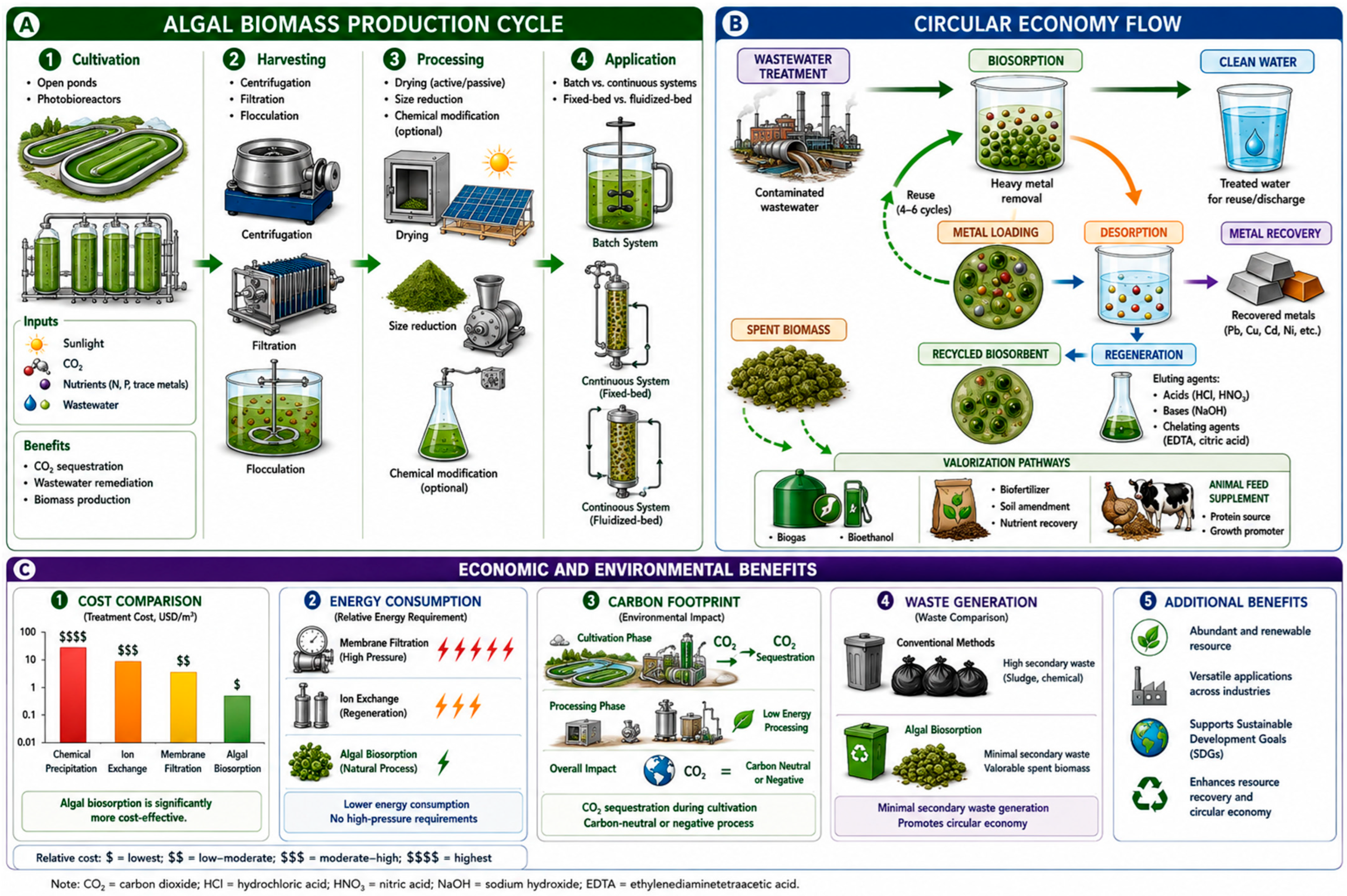
These challenges highlight the need for robust, cost-effective, and environmentally sustainable technologies for pollutant removal [4]. Among aquatic contaminants, heavy metals are of particular concern because of their persistence, toxicity, and potential for bioaccumulation. Although the biosorption of heavy metals by algae has been extensively studied, and many review articles have been published on this topic, the present review makes a number of unique contributions that distinguish it from previous reviews. First, unlike most of the current reviews, which are exclusively based on either microalgae or macroalgae, this review presents a comprehensive and balanced coverage of both groups with a systematic comparative analysis of biosorption capacities across brown, green and red algae. Second, we describe a quantitative structure–function analysis that correlates the density of functional groups with the capacity for metal binding, thereby giving a rationale for the design of better biosorbents by chemical modification or genetic engineering. Third, this review integrates multiple dimensions, such as chemistry, mechanisms, applications, efficiency, limitations and sustainability, within a unified framework supported by an original visual synthesis, including comprehensive schematics of cell wall architecture, adsorption pathways and circular economy integration. Fourth, we present one of the most comprehensive compiled datasets for >50 algal species and >15 heavy metals with mg/g and mmol/g units for direct comparison. Fifth, this review critically appraises the challenges of scaling up algal biosorption for real industrial applications and explicitly integrates the technology into a circular economy framework, demonstrating how metal-laden biomass can be valorized for bioenergy, biofertilizer and animal feed production.
Beyond summarizing the existing literature, this review aims to provide a critical synthesis that bridges fundamental adsorption science with practical wastewater treatment applications. Unlike previous reviews, the present work integrates comparative analyses of algal taxonomy, cell-wall chemistry, adsorption mechanisms, operational parameters, regeneration strategies, real wastewater applications, and circular-economy perspectives into a unified framework. In addition, this review highlights the research gaps, including the lack of standard adsorption protocols, the scarcity of pilot-scale studies, the lack of studies on real industrial wastewater applications, and the need for a quantitative structure–function analysis. These perspectives provide a roadmap for the further development of algal biosorbents toward sustainable industrial applications.

2. Literature Search Strategy

This review followed the standard guidelines for systematic literature reviews but was adjusted to account for the large body of work on algal biosorption. We conducted a systematic literature search in five major scientific databases, including Web of Science, Scopus, PubMed, Google Scholar and ScienceDirect. The search was conducted between January and March 2024 to include the latest publications.

2.1. Search Keywords and Terms

The following search terms and Boolean operators were used to maximize the retrieval of relevant articles:
Primary terms: (“algae” OR “macroalgae” OR “microalgae” OR “seaweed” OR “phytoremediation” OR “phycoremediation”) AND (“biosorption” OR “bioadsorption” OR “bioremediation” OR “heavy metal removal”).
Secondary terms: (“heavy metals” OR “toxic metals” OR “metal ions”) AND (“wastewater” OR “aqueous solution” OR “industrial effluent”).
Specific metal terms: (“Pb” OR “lead” OR “Cd” OR “cadmium” OR “Cu” OR “copper” OR “Cr” OR “chromium” OR “Ni” OR “nickel” OR “Zn” OR “zinc” OR “Hg” OR “mercury” OR “As” OR “arsenic”).
Algal type terms: (“brown algae” OR “Phaeophyceae” OR “green algae” OR “Chlorophyta” OR “red algae” OR “Rhodophyta” OR “Sargassum” OR “Chlorella” OR “Ulva”)
Mechanism terms: (“mechanism” OR “kinetics” OR “isotherm” OR “functional groups” OR “cell wall” OR “ion exchange” OR “complexation” OR “precipitation”).

2.2. Publication Years

The literature search included publications between 1990 and 2024. Special attention was given to research published after 2010 to reflect recent developments in biosorption technology, emerging functionalized materials, and novel mechanistic insights. However, similarly earlier works (1990–2009) were also included for historical context and foundational knowledge.

2.3. Publication Years, Inclusion and Exclusion Criteria

Articles were included if they met the following criteria:
  • Peer-reviewed original research articles or review articles;
  • Published in the English language;
  • Focused on heavy metal biosorption by algae (marine or freshwater);
  • Reported quantitative biosorption capacity data;
  • Provided mechanistic insights or operational parameter analysis,
  • Relevant to wastewater treatment applications.
Articles were excluded based on the following criteria:
  • Non-English publications;
  • Conference abstracts, proceedings, or opinion pieces;
  • Studies without quantitative adsorption data;
  • Studies focusing solely on algal cultivation or biofuel production without biosotion;
  • Duplicate publications or articles with overlapping data.

2.4. Article Screening and Selection

The initial literature search resulted in more than 500 articles. Titles and abstracts of the remaining articles (n = 85 after duplicates were removed) were screened for relevance. This first pass of screening yielded a total of approximately 250 articles for full-text review. After full-text assessment based on the inclusion/exclusion criteria, 180 articles were finally included in this comprehensive review. Additional references were identified by manual citation searching of the bibliographies of key review articles and were used to supplement these articles.

2.5. Data Extraction and Synthesis

For each article included, the following key information was extracted: algal species and type, heavy metal analyzed, biosorption capacity (mg/g and/or mmol/g), experimental conditions (pH, temperature, contact time, biomass dosage, initial metal concentration), isotherm and kinetic models applied, mechanistic insights, and advantages or limitations reported. This data was systematically organized and synthesized to present the comparative analyses, tables and figures of this review.
ChatGPT-5 (OpenAI) was used solely to assist in improving the visual quality and presentation of the figures. The authors have reviewed and edited the output and take full responsibility for the content of this publication.

3. Heavy Metal Sources and Health Effects

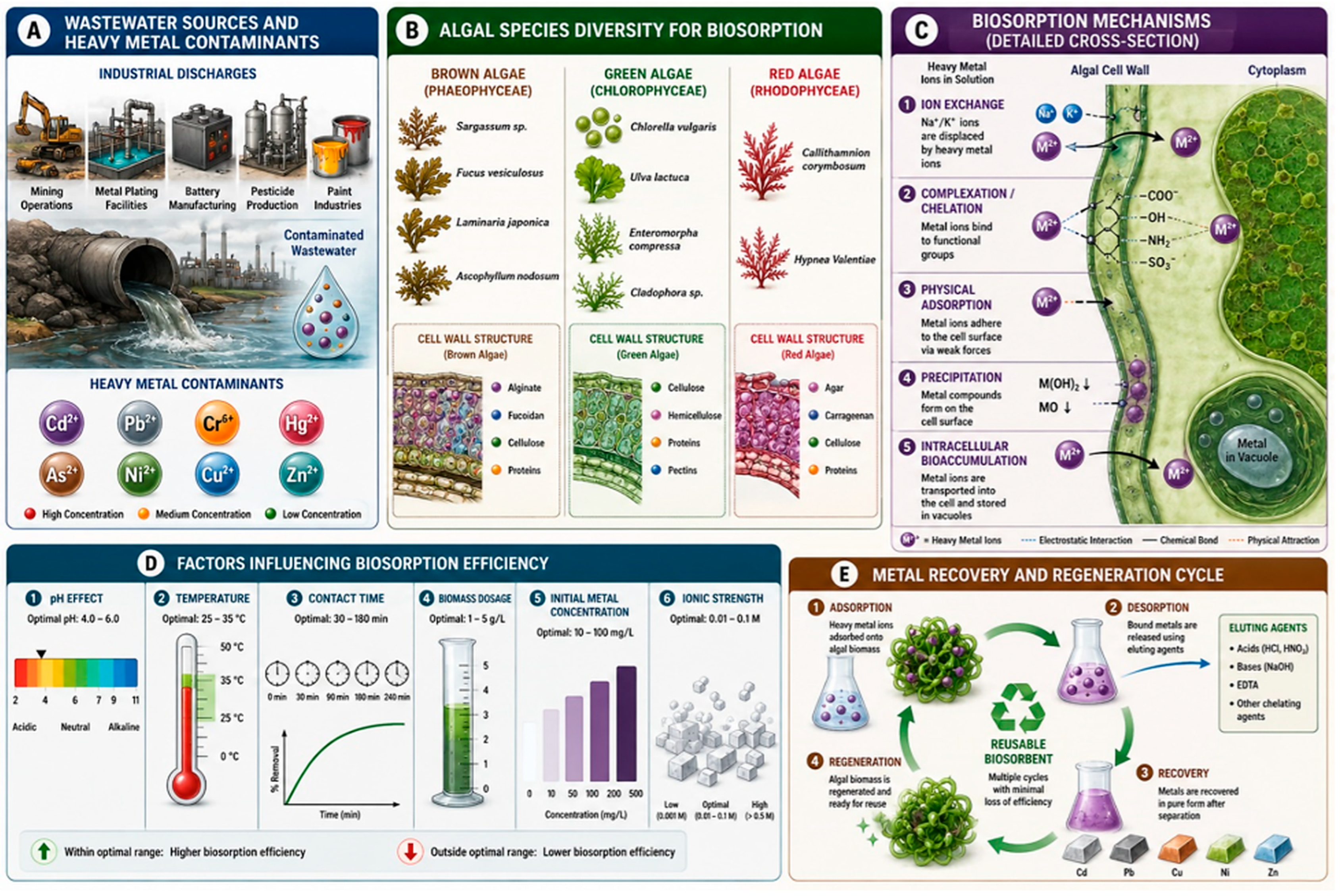
Heavy metals are naturally occurring and anthropogenic pollutants of major environmental concern because of their persistence, toxicity, and potential to accumulate in aquatic ecosystems. Elevated concentrations of heavy metals in aqueous environments can adversely affect aquatic organisms and human health [5]. Anthropogenic activities, particularly mineral processing, pesticide and paint manufacturing, paper production, battery manufacturing, metal smelting, plating, and other industrial processes, are important sources of heavy metal contamination [6,7]. Toxic metals such as cadmium, lead, chromium, mercury, nickel, copper, and zinc may therefore be discharged into aquatic environments through industrial effluents (Figure 1A). In addition to these anthropogenic inputs, heavy metals can enter natural ecosystems through soil erosion, volcanic activity, atmospheric deposition, and wastewater discharges [8,9,10,11,12]. The persistence of these contaminants and their occurrence in wastewater, sediments, soils, rivers, and other environmental matrices highlights the need for effective and sustainable approaches for their removal.
The maximum permissible addition (MPA) of the heavy metals Be, Se, Tl, Sb, Cd, V, Hg, Ni, Cu, Cr, As, Ba, Zn, Co, Sn, Pb and Mo in mg/kg in soil is 0.0061, 0.11, 0.25, 0.53, 0.76, 1.1, 1.9, 2.6, 3.5, 3.8, 4.5, 9.0, 16, 24, 34, 55 and 253, respectively. The World Health Organization (WHO) standards for heavy metals in groundwater for Fe, Cu, Zn, Pb, Ni, Cr, Cd, As, Ba, Hg, Sb, Sn, Se and Mn in mg/L are 1.0, 2.0, 1.0, 0.01, 0.07, 0.05, 0.003, 0.01, 0.05, 0.001, 0.005, 0.01 and 0.4, respectively [13,14,15].
Pharmaceuticals and personal care products are unique environmental pollutants that, at low concentrations, can have physiological effects on human health. However, conventional water treatment processes often fail to effectively remove these persistent chemicals from wastewater streams [16]. Ion exchange and precipitation are conventional methods for heavy metal removal from wastewater, which are inefficient, costly and can cause secondary contamination [17]. In this context, the potential use of low-cost adsorbents such as chitosan, clay minerals and natural zeolites for heavy metal mitigation has been investigated by researchers [18,19,20]. Activated carbon has been applied as an efficient adsorbent for the removal of dye and heavy metals from wastewater because of its high surface area and efficiency, easy regeneration and reusability, and fast kinetics. The high production cost of activated carbon presents a barrier to its industrial application. However, its production from low-cost materials decreases the production and treatment cost of activated carbon. The adsorption efficiency can be improved by the combination of magnetic compounds and activated carbon [21,22].
The study of the effects of heavy metals on microorganisms in fermentation processes, which led to the development of the biosorption concept [17,23] initiated the research on the biosorption of heavy metals from environmental samples, which has received much attention in recent years [7]. Heavy metals have been removed from wastewater using various living or non-living biomasses with different moisture contents [7].
Heavy metals constitute an important group of environmental contaminants because of their persistence, potential toxicity, and tendency to accumulate in biological systems. Although the term “heavy metals” is commonly associated with elements having relatively high density and atomic number, there is no universally accepted definition based solely on these physicochemical criteria [24,25]. Some metals, such as essential trace elements, are required by organisms at low concentrations for normal physiological functions but may become toxic when their concentrations exceed appropriate biological levels [26]. Therefore, the environmental risk associated with a metal depends not only on its concentration but also on its chemical form, bioavailability, and exposure conditions [27].
Heavy metals are divided into three groups according to the position of the element in the periodic table: (1) transition elements, all of which are metals, although some of them contain slightly amphoteric oxides (Ti, Zr, Hf, Rf, V, Nb, Ta, Cr, Mo, W, Mn, Tc, Re, Fe, Ru, Os and Zn); (2) rare earth elements, divided into the lanthanide series (including La), and the actinide series (including Ac); (3) some elements of the p-group, metal (Al, Ga, In, Tl, Sn, Pb, Sb, Bi and Po) or metalloids/borderline elements (Ge, As and Te), and not B and Si [28].
Sources and toxicity of heavy metals fall into two main categories: direct sources and indirect sources. The development of human activities and different industries, especially in developing countries, has resulted in the increased release of heavy metals into the environment via wastewater from different industries such as plating, industrial chemicals, agricultural industries, animal waste, mining operations, papermaking and battery production [29]. Humans are exposed to heavy metals in a variety of ways, including the inhalation of dust, eating and drinking. Long-term exposure to and accumulation of such heavy metals have detrimental health effects on human life, soil, air and aquatic biomass [30]. Exceeding the permissible limits of heavy metals such as lead, chromium, zinc, mercury, selenium, arsenic, nickel and cadmium, as permitted by the World Health Organization, can lead to acute and chronic toxicity, dysfunction and damage to the central nervous, cardiovascular and digestive systems, lungs, kidneys, liver and other internal glands.
Cadmium enters the human body primarily through inhalation, ingestion, and dermal contact, accumulating mainly in the kidneys and liver. Chronic exposure is associated with renal dysfunction, osteoporosis, osteomalacia, skeletal demineralization, and the development of Itai-itai disease [31,32].
Hexavalent chromium [Cr(VI)] is generally considered more toxic than trivalent chromium [Cr(III)] because of its greater mobility and ability to enter biological cells, where intracellular reduction processes can promote oxidative stress and cellular damage. Exposure to elevated concentrations of Cr(VI) has been associated with adverse biological effects, including oxidative stress and DNA damage, and chromium exposure may adversely affect several physiological systems. The toxicity and environmental behavior of chromium depend strongly on its oxidation state, concentration, exposure conditions, and the biological system [33]. Oxidative stress is also a well-documented mechanism of toxicity for other heavy metals, including cadmium, which can induce the accumulation of reactive oxygen species and oxidative damage in plants [34].
Arsenic is a highly toxic metalloid associated with skin, lung, and bladder cancers, liver dysfunction, respiratory diseases, and neurological disorders following prolonged exposure [35].
Mercury, particularly methylmercury, is one of the most hazardous heavy metals because of its ability to bioaccumulate and biomagnify through aquatic food webs. Chronic exposure causes severe neurological disorders, as demonstrated by the Minamata disease outbreak in Japan, which resulted from industrial methylmercury contamination [36].
Although the toxicological effects of heavy metals are well documented, most toxicity assessments are carried out under controlled laboratory conditions with exposure to single metals. However, polluted natural waters often contain a complex mixture of heavy metals and organic pollutants, pharmaceuticals, microplastics, and dissolved organic matter, which may have synergistic or antagonistic toxic effects that are poorly understood. Therefore, risk assessments based on single-metal exposure may underestimate the environmental complexity experienced in real aquatic ecosystems. Future studies should therefore consider multi-contaminant systems and long-term ecological impacts to improve environmental risk assessments.

4. Conventional Treatment Technologies with Limitations

Various techniques, such as ion exchange, advanced oxidation processes, filtration, electrodialysis, precipitation, microbial systems, electrochemical techniques and membrane bioreactors, are used to remove pollutants and heavy metal ions. These techniques can generally be divided into physical, chemical and biological methods [37,38].

4.1. Chemical Precipitation

One of the most important techniques of pH-controlled methods is chemical precipitation. The metal ions are transformed into solid particles by increasing the pH and through interaction with precipitating agents like lime and caustic soda. This interaction causes the formation of metal hydroxides, carbonates or sulfides [17]. The precipitate can be separated from the supernatant using solid–liquid separation techniques such as flotation, sedimentation, and filtration. These inexpensive techniques can process high flow rates of effluent with high concentrations of metals [39]. Chemical precipitation is widely applied for the removal of heavy metals because it is simple and cheap [40,41]. The initial pH before adding wastewater is an important factor. The heavy metal ions in the wastewater can react with the precipitating agent to form insoluble sediments, which can be separated by deposition or further treatment [42].

4.2. Coagulation/Flocculation

Coagulation techniques are used to remove colloidal particles and increase density. A coagulant is added to induce destabilization [43], which is followed by flocculation in which the destabilized particles aggregate and sediment [44]. This method has been proven effective for the removal of heavy metals from aqueous solutions. Its effectiveness is dependent on temperature, alkalinity, pH, mixing conditions and coagulant dosage. Ferric chloride and polyaluminum chloride (PAC) are efficient coagulants for the removal of heavy metals [45,46]. The advantages of this process are its ease of operation, low production of sludge and availability [47]. However, the flocculation technique only aggregates the heavy metals and cannot remove them from the wastewater. Therefore, other techniques like precipitation or spontaneous reduction along with flocculation and other coagulation processes are necessary for complete treatment [46].

4.3. Ion Exchange

Ion exchange is a reversible stoichiometric reaction in which ions with similar charges are exchanged for dissolved metals with the help of water-insoluble resins or ion exchangers that are compounds having charged functional groups on their surface that enable the exchange of ions when they are in contact with wastewater [48,49]. Ion exchangers are generally differentiated into cation or anion exchangers, e.g., strongly basic (SBA), weakly basic (WBA), strongly acidic cation (SAC) and weakly acidic cation (WAC) exchangers [50]. The ion exchange process is more efficient at removing metal ions and produces less sludge than the coagulation process. An ion-exchange resin is a material used for the recovery or removal of a certain group of metal ions depending on its chemical properties [51]. The disadvantages of the ion exchange method are the use of chemical reagents and the generation of secondary pollutants from the resin. The high operating cost limits the application of the ion exchange method in large-scale wastewater treatment.

4.4. Filtration by Membrane

Membrane filtration is one of the pressure-driven membrane processes and exhibits good removal of heavy metals and disinfectant properties [52]. The principle is based on the application of a pressure differential across a physical barrier which separates the feed into two streams based on selectivity [53]. The liquid feed cannot pass through without pressure insertion because the pores in the membrane are too small [53]. Membranes are generally classified into ceramic and polymeric membranes. Ceramic membranes are preferred in industrial wastewater treatment due to their robustness to chemicals despite cost and fragility problems [54]. The most commercially available polymers used to prepare polymeric membranes are polyvinylidene fluoride (PVDF), polypropylene (PP), and polyethylene (PE). The advantages are better removal efficiency, less space requirement and user friendliness, but the challenges are complicated operation, membrane fouling and high cost [55]. The pressure-driven membrane filtration separation method is classified into microfiltration, ultrafiltration, nanofiltration and reverse osmosis processes based on the size of the metals that are separated from wastewater.

4.5. Electrochemical Method

Electrochemical methods such as electrodeposition, electro-floatation and electrocoagulation involve the movement of charged particles between media using an electric current, allowing the direct removal of hazardous metals from effluent streams [56]. Heavy metals are recovered in elemental form by using the anodic and cathodic reactions in the electrochemical cell [57]. This process is limited to a few industrial applications due to the high investment cost [58]. Electrodialysis (ED) is an electro-membrane method where power is used to transport anions across the membrane. The aqueous solution is separated into two parts: concentrate and diluate [59,60]. The benefits of electrodialysis include low consumption of chemicals and high water recovery [61]. The main disadvantage of electrodialysis is the membranes’ scaling and fouling, thus limiting its application in the treatment of wastewater [60].

4.6. Biosorption: A Biological Remediation Technique

Biosorption is a physiochemical process exhibited by biological species that can remove pollutants, especially heavy metals (HMs) from wastewater by ionic or covalent interactions [62]. The efficiency of metal ion biosorption is enhanced by the presence of different binding groups such as COO-, SH-, OH-, RNH2-, RS- and RO- [25]. Biosorption has emerged as an effective technique for wastewater remediation in recent years. The advantages of this method include high adsorption capacity, economic efficiency in biosorbent recycling and environmental adaptation [63]. Some of these biosorbents can remove a wide spectrum of heavy metals while others only adsorb specific types of metals and materials. The intricate architecture of microorganisms enables them to adsorb metals in multiple ways [64,65].
These binding groups are usually located in the cytoplasm and on the cell surface, especially in large numbers in vacuoles. A net negative charge has been shown to be conferred by the carboxylate (–COO), phosphate (–PO43−), and other groups taking part in ion exchange in the algal cell wall. For instance, some species of algae like Ditylum brightwellii secrete copper ligands, whereas brown algae have the most acidic functional group, which is the carboxyl functional group (–COO). Algae reduce metal-induced damage by synthesizing metallothioneins (MTs), glutathione (GSH) and proline [66].
Different algal species have different cellular compositions, which leads to the formation of different functional groups in the cell wall [67]. Encapsulation of microalgae and their cellulose derivatives affects the selectivity of heavy metal absorption [68]. The suspension pH was adjusted by the reversible use of hydrochloric acid or citric acid, which facilitates the removal of absorbed heavy metals [69].
Biosorption is an important component of the bioremediation process in phycoremediation, an innovative cleanup process that combines the bioaccumulation and biosorption abilities of algae [70]. Algae are cost-effective biosorbents with low nutrient requirements, making them economical and efficient. Statistical analysis has shown that the biosorption efficiency of algae is about 15.3–84.6% higher than that of other microbial biosorbents [71].
Adsorbents such as algae, sawdust, fine sand, and paddy are used for the adsorption and reduction of water pollutants. The diversity, abundance and low cost of different biomasses like algae and tea pomace have always been the subject of extensive research on types of biomasses for the elimination of contaminants [72,73]. Algae are one of the earliest forms of plant life and there are about 40,000 various species of them, most of which are aquatic. Algae can produce 52 billion tons of organic carbon each year, which is around half of the total organic carbon production on the Earth [74].

4.7. Stabilized Biomass for Improved Biosorption and Preservation as Biosorbent

One of the unique advantages of biosorption with stabilized (non-living) biomass is the effective long-term maintenance of biosorbents. No adverse effects of heavy metals have been observed in stabilized biomasses. The chemical regeneration ability of the stabilized biomass enables its reuse in the adsorption–desorption cycles [75].
The majority of biosorbent research has focused on microbes and their derivatives, such as bacteria, cyanobacteria, fungi and macroalgae, but plants and other biomasses can also be characterized as having cell walls made up of biopolymers. But the composition of these biopolymer chains varies in different organisms. Bacterial cell walls are made up of peptidoglycan, while algal cell walls are rich in fucoidan and alginate. The chemical residues of biopolymers have functional groups that can interact with metals through physical and chemical complexation, resulting in biosorption [76].
High removal efficiencies have been reported for conventional technologies like chemical precipitation, ion exchange, membrane filtration and electrochemical treatment under optimized conditions. But they are often accompanied by severe operational limitations such as high energy consumption, membrane fouling, sludge generation, secondary pollution and high operating costs. Moreover, the reported removal efficiencies are generally measured in controlled laboratory experiments and may not be representative of industrial long-term performance. Therefore, comparisons with algal biosorption should consider not only removal efficiency but also operational complexity, economic feasibility, environmental sustainability and life-cycle impacts.

5. Algae as Biosorbents

The use of algal biomass for the removal of heavy metals from wastewater has attracted considerable attention as an alternative to conventional treatment approaches because of its renewable nature, broad availability, relatively low cost, and diverse surface chemistry [77]. Both living and non-living algal biomass can contribute to metal removal, although non-living biomass is often advantageous for biosorption because it does not require nutrient or oxygen supplementation and can be used in different treatment configurations [25,78]. In addition, algal biomass can potentially be regenerated and reused, which may improve the economic and environmental feasibility of the process [78].
Macroalgal biomass does not require immobilization, and both continuous and discontinuous phytoremediation strategies are possible [25]. Dead biomass can also be advantageous for both anaerobic and aerobic wastewater treatment units since it does not require nutrient or oxygen supplementation, and the year-round utility of algal biomass is an added advantage [79]. Phytoremediation is a cost-effective and economic method.
Marine macroalgae can be broadly classified into brown, green, and red groups, which differ in their cell-wall composition and consequently in the types and abundance of metal-binding sites they provide. However, taxonomic affiliation alone does not determine biosorption performance, which is also influenced by biomass characteristics, target metal chemistry, and operating conditions.
Algae are available in large quantities in seawater at low cost and are suitable for pollutant removal [80]. The algal cell wall contains polysaccharides, proteins, and lipids bearing functional groups such as amino, hydroxyl, carboxyl, and sulfate groups that can provide binding sites for heavy metal ions [81]. Brown algae are particularly rich in alginate, which provides abundant carboxyl-containing sites relevant to metal binding [82]. The specific contribution of these functional groups to metal uptake is discussed in Section 7.3. Therefore, the use of algae is highly considered due to its unique characteristics such as high adsorption capacity and availability [83].
Algal production for 1990 was estimated at approximately 4 million tons, of which about 1.25, 2.5 and 0.15 million tons were red, brown and green algae, respectively. The present consumption of green, brown and red algae by humans in Asia is 0.5, 66.5 and 33% respectively. About 94% of edible algae are produced by marine cultivation [84].
This review critically evaluates the role of algal biomass as a biosorbent for heavy metal removal from wastewater, with particular emphasis on the relationship between algal cell-wall chemistry, metal-binding functional groups, biosorption mechanisms, and adsorption performance. Rather than summarizing reported studies sequentially, the review compares the reported performance of different algal groups and species and examines how operational conditions, biomass characteristics, metal speciation, and surface chemistry influence biosorption efficiency. Particular attention is given to the mechanistic basis of metal binding, quantitative comparison of adsorption capacities, limitations affecting practical application, regeneration and reuse, and the challenges associated with scaling up algal biosorption within a sustainable and circular-economy framework.
Although taxonomic classification provides useful information about the general chemical composition of algal cell walls, it cannot by itself predict biosorption performance. Differences in functional-group density, accessibility and ionization, biomass characteristics, growth conditions, seasonal and geographical variability, pretreatment, and target metal speciation can result in substantial differences in adsorption capacity even among species belonging to the same algal group. Therefore, the selection of an algal biosorbent should be based primarily on experimentally demonstrated adsorption performance and mechanistic evidence rather than taxonomy alone. This perspective provides a basis for identifying the structural and operational factors that govern metal-binding behavior and for guiding the development of more effective, regenerable, and application-oriented algal biosorbents.

6. Mechanisms of Biosorption

Recently, algae have been the main focus of interest for scientists in the development of new biosorbent materials (Table 1). Algae are available in plenty and have phenomenal sorption capacities and are well known for them. The statistical analysis of biosorption research on a large scale has revealed the emergence of algae as the most popular biosorbent material with a lead of 15.3% over other biomasses. Algae outperform bacteria and fungi by a whopping 84.6 percent. Among the different types of algae, brown algae have been paid much attention due to their better adsorption capacity than green and red algae [85].
Biosorbents are able to bind specific metal ions and so decrease the concentration of heavy metal ions in a solution from ppm to ppb. The responses of biosorbents towards metal ions are closely related to the molecular make-up of the microbes that constitute them. Seaweeds are an inexpensive source of biomass.
Younis et al. [86] studied the potential of seaweeds for metal removal, especially brown algae. A lot of effort has been directed to improve the biosorption process, e.g., through immobilization and optimization for reuse. Different types of algae have been studied and used in biosorption studies to identify the most effective candidates for biosorption.
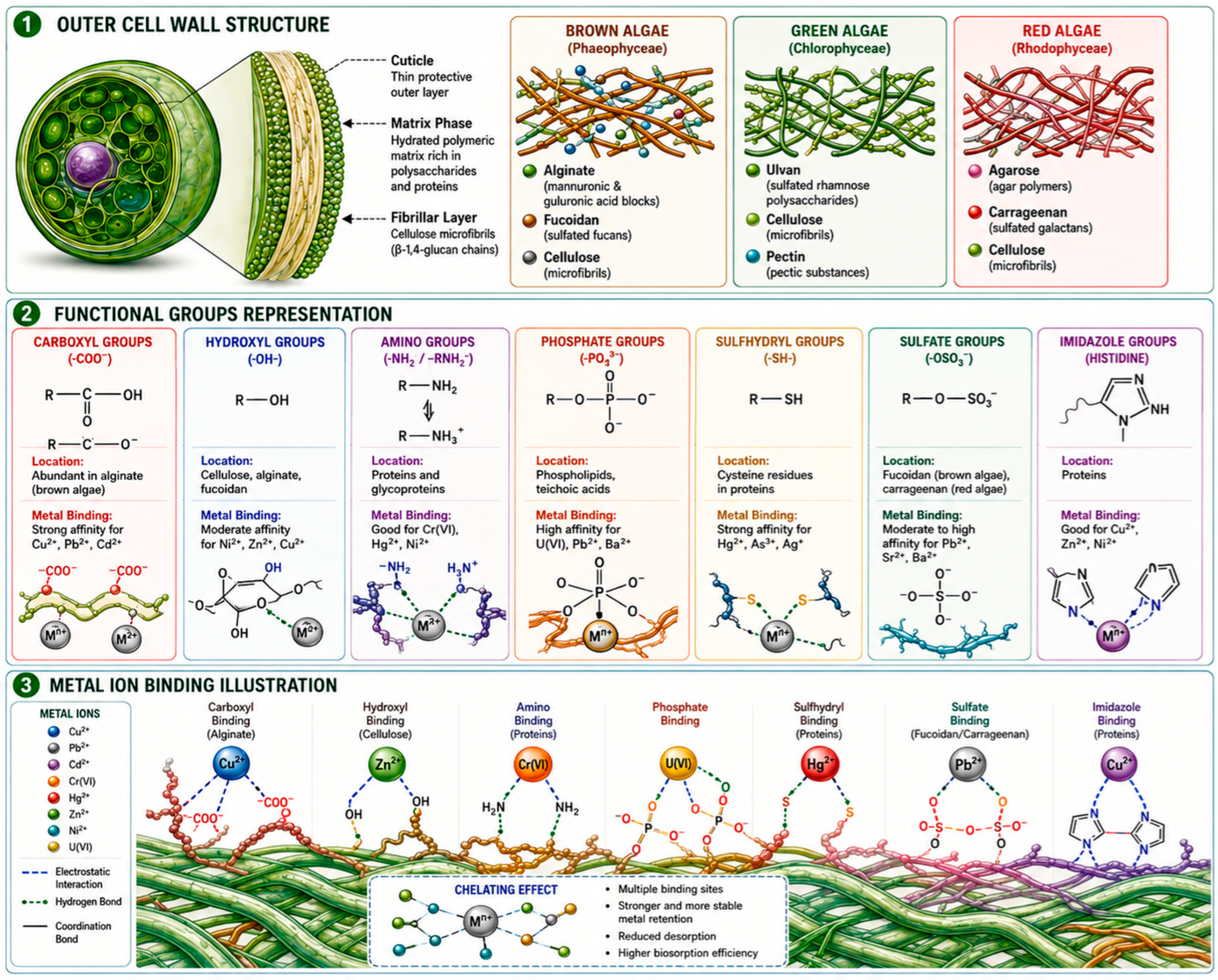
Algal cells are surrounded by a complex cell wall which plays a very important role in metal biosorption. The efficiency of metal binding to the biomass is dependent on the cell wall composition, especially on the surface properties and spatial arrangement. The cell wall comprises a thin cuticle, a hydrated matrix phase rich in polysaccharides and a fibrillar layer with cellulose microfibrils (Figure 2).

6.1. Types of Algae

There is no comprehensive and uniform classification for algae due to their rapid daily modifications in structures and genetics. Essentially, the most prominent feature in algae is their diverse colors. Based on this feature, algae are categorized into four classes: green algae (Chlorophyta), brown algae (Phaeophyta), red algae (Rhodophyta) and blue-green algae (Cyanobacteria) [87]. Furthermore, algae can be classified based on their TAL structures, cell walls and the number, type and location of flagella, besides pigment types in chloroplasts [88,89].
Chlorophyta (Green Algae): Chlorophytes are a class of green algae. They have the same forms of chlorophyll and their cell walls contain cellulose, thus they are evolutionarily related to plants [90]. The cells of these algae may be single or filamentous (branched or unbranched). They are normally green in color and are therefore referred to as ‘green algae’ [91]. Green algae are photosynthetic eukaryotes with two-layered membranes attached to the membrane containing chlorophyll a and b, pigments in embryophytes (beta-carotene and xanthophylls) and a unique stellar structure that connects nine microtubule pairs at the flagellar base [92]. These algae store starch as their principal polysaccharide. Green algae are one of the most morphologically diverse groups of eukaryotes. Morphological forms include pelagic ions, coccids, branched or unbranched filaments, multicore macrophages, and species with parenchymal tissues [93].
Phaeophyta (Brown Algae): Brown algae are often unicellular or form colonies of yellow or golden brown color; the cells move with the aid of two unequal flagella [91]. Some species of brown seaweed can be longer than 150 feet (45 m) [90]. Brown algae are mainly complex, macroscopic seaweeds that are brown due to the carotenoid pigments and fucoxanthin. Tannins of brown algae (Phaeophyceae) in different forms have been identified in less than 1% of freshwater habitats in about 2000 species (in 265 genera). The cell walls of brown algae contain cellulose, often in association with the mucopolysaccharide alginic acid. Certain species of seaweed are cultivated in commercial quantities. Alginates, however, are apparently less common in freshwater species [94]. Many brown algae convert long-chain fatty acids into C8 or C11 cyclic or cyclic hydrocarbons that act as pheromones in sexual reproduction [95].
Rhodophyta (Red Algae): Several unicellular algae, red algae, are capable of growth at relatively high temperatures. Red algae are unique among eukaryotic organisms in their capacity to inhabit thermal vents [90]. Rhodophytes are characterized by the floridean pigments which coat the green chlorophyll, reddening it. Most Rhodophyta are found along the tropical and sub-tropical coasts. They are found in the major oceans of the world and grow mainly in shaded areas with warm and calm water. Red algae also occur in the deepest waters [90]. Red algae can photosynthesize in dim light, thanks to their cyanobacteria and phycobilisomes. These antennas are constructed as complexes on top of the membrane and membrane processes near the photosystem reaction centers. These complexes are known as phycobilisomes and comprise proteins (phycobiliproteins) covalently linked with phycobilins [96]. Red algae produce granular floridean starch in the cytoplasm as storage products, which differs from green algae starch [97].
Cyanophyta or Cyanobacteria (Green-Blue Algae): They may be in the form of single, batch or filamentous cells. Organisms are mostly light blue or olive green or brown but rarely green. Organisms are capable of making lethal movements [91].
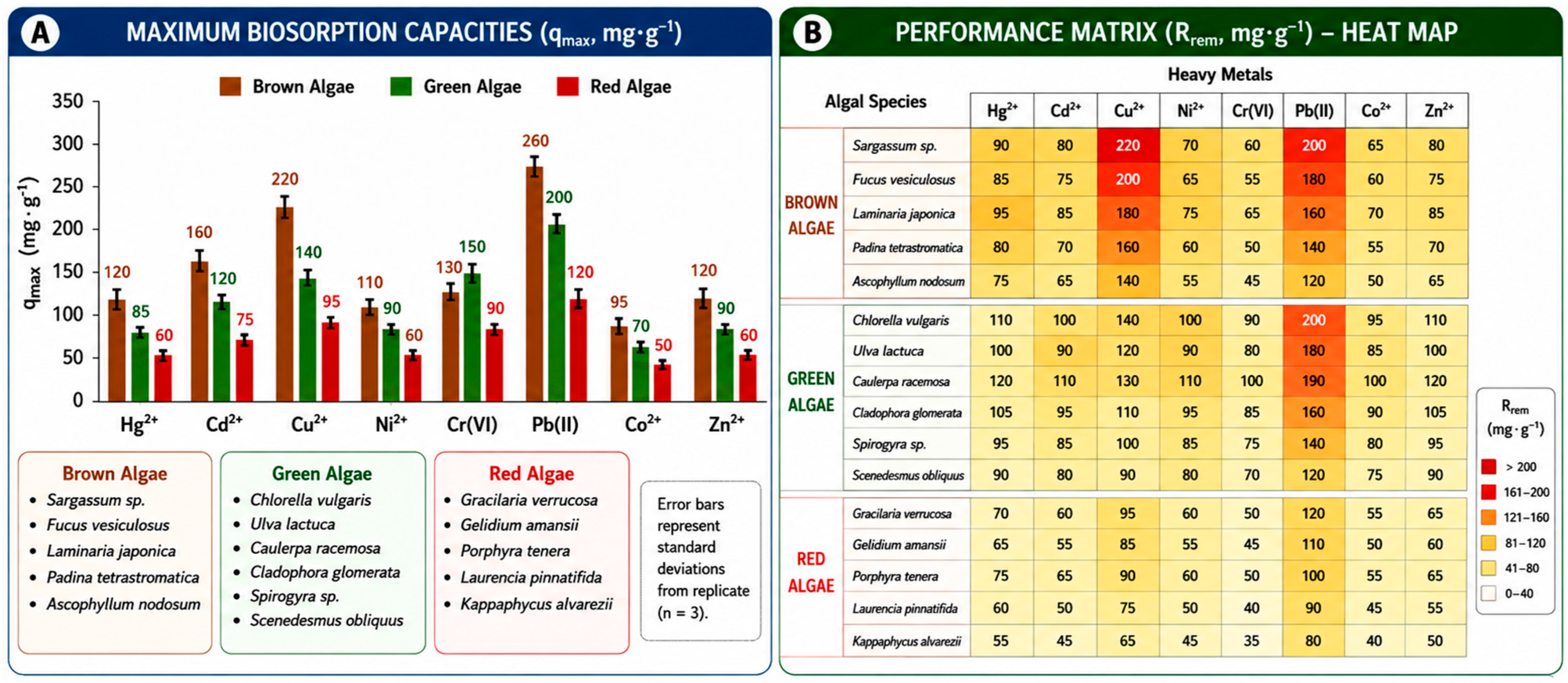
Reported adsorption capacities varied substantially among algal species and depended on the target metal and experimental conditions. Among the brown algae, Sargassum sp., Laminaria sp., and Padina sp. showed high reported capacities for several metal ions, although these values should not be interpreted as evidence that brown algae universally outperform other algal groups. The brown algae have better performance, where Sargassum sp. showed 92.59 mg/g for Cu2+ [98], Laminaria japonica 156 mg/g for Pb2+ [99] and Padina pavonica 176 mg/g for Cu2+ [100] (Table 1). Green algae are very versatile, e.g., Chlorella sorokiniana with 172 mg/g Ni2+ and 162 mg/g Cd2+ [101] and Chlamydomonas reinhardtii with very high biosorption capacity of U(VI) (218 mg/g; [102,103]. Red algae have moderate but uniform capacities for different metals (44–96 mg/g) [103,104]. Heat map analysis reveals varying selectivity patterns, with brown algae being effective at removing Cu2+ and Pb2+, green algae demonstrating improved performance in removing Ni2+, U(VI) and Cr(VI); and red algae exhibiting consistent moderate performance, particularly in removing Cr(VI) and U(VI).
A multi-criteria analysis of six important parameters, adsorption capacity—cost-effectiveness, regeneration potential, biomass availability, selectivity and ease of handling—was evaluated by a radar chart. Sargassum sp. has a high adsorption capacity (95/100) and selectivity (90/100) [105], while Chlorella species are excellent in terms of cost-effectiveness (95/100) and biomass availability (95/100) [101], making them attractive for large-scale applications. Differences in adsorption performance among algal biomasses are associated with variations in surface chemistry and the abundance of metal-binding functional groups [105]. The structure–function relationship underlying these differences is discussed in detail in Section 7.3.
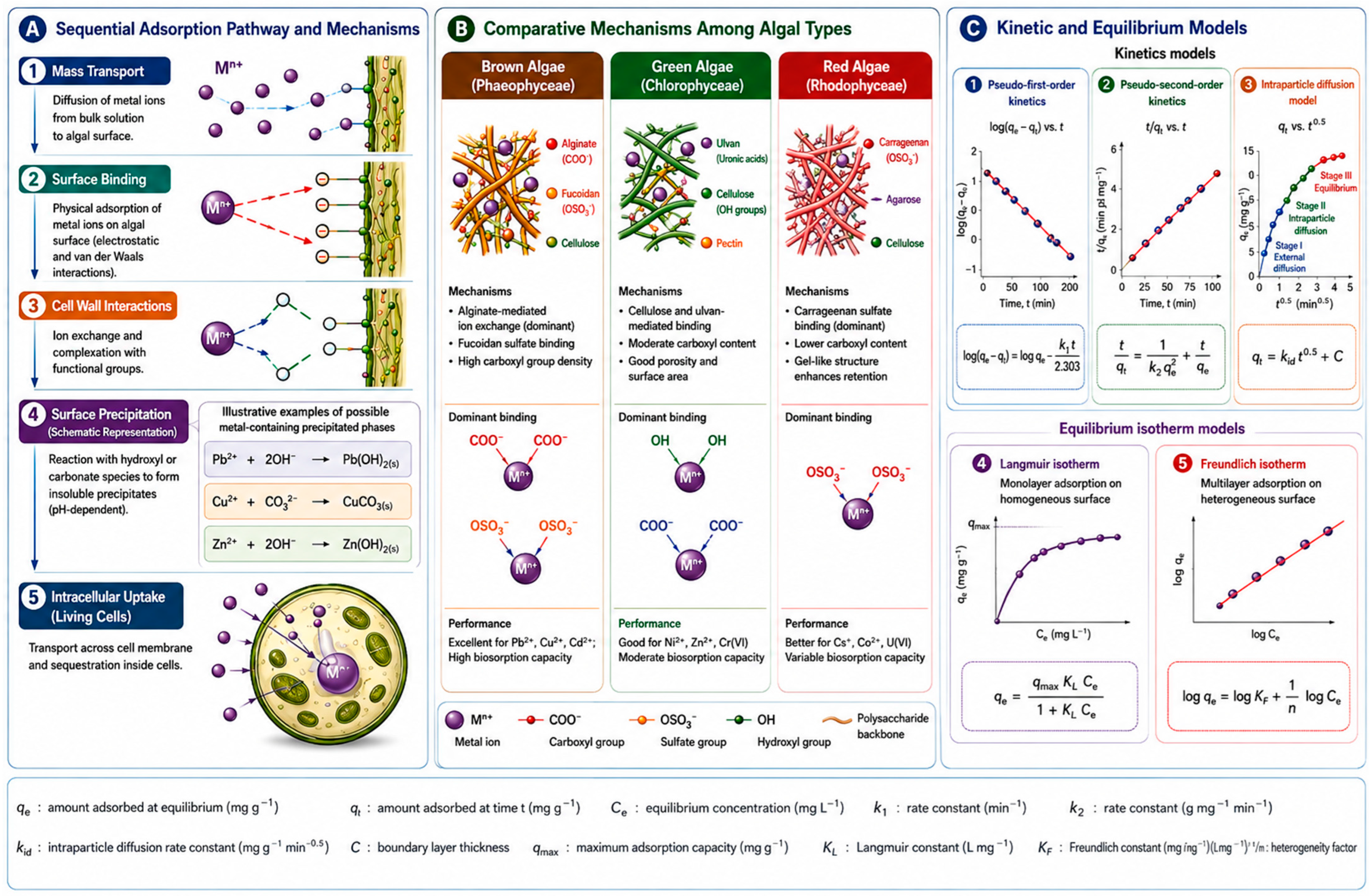
In green algae (Chlorophyceae) the binding mechanisms are mediated by cellulose and ulvan. They have moderate carboxyl contents compared to brown algae, but their good porosity and surface area make them good biosorbents for Ni2+, Zn2+ and Cr (VI) (Figure 3B). The principal binding mechanism in red algae (Rhodophyceae) is of the carrageenan type. They have a gel-like structure that enhances the retention of metals, despite the lower carboxyl contents, making them suitable for Cs+, Co2+ and U (VI) removal (Figure 3B).

6.2. Mechanisms Driving Biosorption by Algae

Algal biosorption involves complex interactions between metal ions and the surface or cell-wall components of algal biomass. Different types of algal biomass possess diverse surface characteristics and multifunctional binding sites that can contribute to metal retention through several simultaneous processes [106]. These interactions are primarily associated with surface and cell-wall chemistry and can involve metabolism-independent and metabolism-dependent pathways. The relative contribution of each pathway depends on the chemical characteristics of the algal biomass, the target metal, and the physicochemical conditions of the aqueous system.
Algal biosorption mechanisms can be classified into two categories: metabolism-dependent and metabolism-independent processes. The complex interaction between the sorbate and biosorbent is multifactorial and is primarily associated with surface and cell-wall interactions. Algal cell membranes and cell walls contain proteins, lipids, polysaccharides, and functional groups such as carbonyl, carboxyl, ester, hydroxyl, amino, and sulfhydryl moieties that can participate in metal binding [76]. Binding groups on the algal cell surface, including –COO, –OH, –NH2, –PO43−, –SH, –SR, and –OR, can promote ion adsorption and may contribute to the initial stages of bioaccumulation [107].
Heavy metal uptake by algae may involve several simultaneous processes, including chelation/complexation, physical adsorption, ion exchange, surface precipitation, and intracellular bioaccumulation [108]. The relative importance of these mechanisms depends on the interaction between the sorbate and the algal surface or cell wall. Electrostatic forces can play an important role in controlling sorbate–biosorbent interactions [109]. Adsorption may occur through both physisorption and chemisorption; physisorption is generally associated with relatively weak intermolecular forces, whereas chemisorption involves stronger chemical interactions and may include covalent bonding or electrostatic attraction [110].
The biosorption process begins with the mass transfer of metal ions from the bulk solution to the cell surface of the algae through the boundary layer (Figure 3A). After mass transport, binding of metal ions to the surface is achieved by physical adsorption (van der Waals forces and electrostatic interactions) and chemical adsorption (ion exchange and complexation) and is stereochemistry-dependent for selectivity and efficiency (Figure 3A). There are two main ways to achieve cell wall interactions. Ion exchange is the first mechanism in which metal ions replace Na+/K+ ions from carboxyl and sulfate groups (Algal-COONa+ + M2+ → Algal-COOM2+ + 2Na+; Algal-SO42−H+ + M2+ → Algal-SO42−M2+ + 2H+) and complexation/chelation is the second mechanism in which metal ions form coordination complexes with amino and carboxyl groups (Algal-2RNH2 + M2+ → [Algal-2RNH2]2M2+; Algal-2COO + M2+ → [Algal-COO]2M2+) (Figure 3A). Surface precipitation (Figure 3A) can create pH-dependent zones where metal ions react with hydroxyl or carbonate ions to form insoluble precipitates, including Pb(OH)2, CuCO3, and Zn(OH)2. Living cells can transport metal ions across the cell membrane and sequester them intracellularly in vacuoles (Figure 3A). Ref. [111] illustrates the mechanism of the adsorption process.
The efficiency of these mechanisms depends on the type of algae: brown algae (Phaeophyceae) bind Pb2+, Cu2+ and Cd2+ efficiently by alginate and fucoidan; green algae (Chlorophyceae) bind Ni2+, Zn2+ and Cr(VI) efficiently by cellulose and ulvan; red algae (Rhodophyceae) bind Cs+, Co2+ and U(VI) efficiently by carrageenan (Figure 3B).
The kinetics of biosorption was investigated by the pseudo-first order [log(qe − qt) vs. t], pseudo-second order [t/qt vs. t] and intraparticle diffusion models (qt vs. t0.5). The equilibrium data were fitted to the Langmuir and Freundlich isotherm models (Figure 3C). Adsorption isotherm models are generally studied to explain the adsorption process and its mechanism. The adsorption isotherm is a plot of the adsorption value (qe) against the metal equilibrium concentration (Ce) that displays the experimental results as functional equations with useful parameters. The R-squared (R2) is a significant parameter for the selection of better adsorption isotherms. If it was close to 1, then the experimental data obtained would be more compatible with the model being investigated [112,113]. The main isotherms studied for the equilibrium behavior of the biosorbent are the Langmuir and Freundlich isotherms. The adsorption isotherm study can be used to estimate the maximum metal ion biosorption.
Kinetic models are important in the adsorption process for the removal of toxic heavy metals [114]. The adsorption kinetics is used to investigate the rate-controlling mechanism (e.g., mass transfer, chemical reaction progress) of the adsorption process. Kinetic models are very important and necessary to study in the removal process of toxic heavy metal [115].

6.2.1. Ion Exchange

The biosorption process is thought to depend on ion exchange mechanisms provided by the various functional groups on biomass surfaces. The polysaccharides in the cell walls of microbes have different charges and they are important sites for the exchange of metal ions [116]. The interactions with the cell wall are achieved by two mechanisms: (i) ion exchange, where metal ions replace Na+/K+ ions from carboxyl and sulfate groups (Algal-COONa+ + M2+ → Algal-COOM2+ + 2Na+; Algal-SO42−H+ + M2+ → Algal-SO42−M2+ + 2H+), and (ii) complexation/chelation, where metal ions form coordination complexes with amino and carboxyl groups (Algal-2RNH2 + M2+ → [Algal-2RNH2]2M2+; Algal-2COO + M2+ → [Algal-COO]2M2+) (Figure 3A). the ion exchange process is a separation process where other ions are substituted for wastewater treatment. This is a type of chemical process in which unwanted dissolved ions are exchanged with ions of similar charge. The exchange process takes place between a solid, which is mainly a resin, and a liquid, which is water. For example, ions with the same charge as the resin surface are exchanged with negatively and positively charged ions, respectively [49].

6.2.2. Chelation and Complexation

Coordination or complexation can be described as the binding of cations to molecules or anions that have unpaired electrons. The ligand acts as a mediator in the coordination of heavy metal cations with atoms, molecules or anions at the core. Chelation is the complex formation of multidentate ligands [117].
The polymer generated by the bacteria can electrostatically interact with a metal ion-chelating agent, leading to complexation or coordination. Complexes may be formed on the cell surface. The cell wall contains hydroxy, carboxyl, amino and thiol groups which can bind metals and remove them from solutions [118,119].

6.2.3. Precipitation

It is an open question how cellular metabolism and precipitation interact. The removal of metals from solutions is often connected with the active defense mechanisms of microorganisms. At high pH, metals may sorb and precipitate on cell membranes or within cells. The binding of dangerous metals produces compounds that aid in the precipitation process [120]. Importantly, chemical reactions on the cell surface with metals could lead to precipitation in the absence of cellular metabolism [121].
The mechanisms of biosorption are usually ion exchange, complexation, electrostatic attraction, surface precipitation and intracellular bioaccumulation. However, mechanisms rarely function independently in heavy metal removal. Rather, their relative contributions are dependent on the wastewater chemistry and the operating conditions. Ion exchange and electrostatic attraction are the two major mechanisms at the initial stage of adsorption, as a result of the quick interaction between the dissolved metal ions and the negatively charged functional groups on the surface of the algae. In adsorption, surface complexation is more important as it is attained by coordination with carboxyl, hydroxyl, sulfate, phosphate and amino groups. Surface precipitation can be important under alkaline conditions due to the formation of insoluble metal hydroxides. Intracellular bioaccumulation is mainly relevant when live algal biomass is used in long-term exposure. Hence, the overall mechanism of biosorption is not governed by a single dominant process, but by the combined effects of the solution pH, metal speciation, ionic strength, competing ions, biomass pretreatment and contact time.

6.3. Factors Influencing Heavy Metal Biosorption by Algae

The efficiency of biosorption of heavy metals by algae is influenced by several important factors such as pH, amount of biosorbent, ionic strength, contact time, initial concentration of metal ions, and temperature of the reaction (Figure 1D). The main parameters that affect the adsorption process of heavy metals by algae are pH, contact time, reaction temperature, biosorbent dosage and initial metal ion concentration.

6.3.1. Effect of pH

The initial pH of heavy metal solutions significantly affects the surface charge of the biosorbent and the ionization degree of adsorbate during the adsorption process [122]. The initial pH of heavy metal-containing solutions greatly affects adsorption capacity [123]. Under very acidic conditions, the functional groups of the biosorbent are usually surrounded by hydronium ions (H+) which limit the availability of active sites due to electrostatic repulsion forces. Generally, under strongly acidic conditions, the functional groups of the biosorbent are surrounded by hydronium ions (H+). This results in a decrease in the occupation of active sites and the number of active sites of the biosorbent to accommodate the metal ions. Additionally, the electrostatic repulsion force between ions of the same charge (H+) and the metal ions would also inhibit the interaction between the active biosorbent sites and the heavy metal ions.
On the contrary, raising the pH level increases the concentration of hydroxide ions (OH), which dehydrate the surface functional groups and increase the adsorption efficiency [124]. Foroutan et al. [72] studied the adsorption capacity of Padina sanctaecrucis brown algae in the pH range of 2–11 for Cu(II) and Co(II) ions and achieved an optimum rate of adsorption of 86.4% at pH 6.

6.3.2. Optimization of Biosorption Efficiency: Effect of Biosorbent Dose

The sorbent concentration is a key factor influencing biosorption efficiency. With an increment of dose, cellular aggregates are formed, resulting in a low effective surface area for biosorption [125]. The amount of biosorbent is an important parameter in terms of the saturation of surface area with functional groups during adsorption [126]. As the amount of algae increases, the biosorbent has more unsaturated active sites, which results in a decrease in biosorption capacity per metal ion [127]. The maximum possible interaction between the heavy metals and the sites on the biosorbent should be reached for the optimal amount of biosorbent. In general, as the biosorbent dosage increases, the sites available for contaminants (heavy metals) also increase. Therefore, in this case, there are more collisions between the biosorbent and the contaminant, which increases the removal rate [128].
An increase in the surface area of the biosorbent increases the efficiency of adsorption. This means that more biosorbent is required because there are more functional sites available for metal adsorption. The specific adsorption of Cd(II) was found to increase with an increase in biosorbent concentration by Edris et al. [129]. However, this method has some disadvantages such as limited mixing, limited accessibility, site interference and electrostatic interactions.
Sargın et al. [130] successfully adsorbed heavy metals using only 0.2 g of chitosan–algae composite microbeads. Erkaya et al. [102], on the other hand, observed a decrease in the adsorption of the U(VI) ion from 218.3 to 93.1 mg/g with a tenfold increase in the carboxymethyl cellulose beads incorporated into algae, despite an increase in adsorption sites and surface area.

6.3.3. Effect of Ionic Strength on Algal Biosorption of Metal Ions

Ionic strength is essentially a measure of the competition for electrostatic interaction between heavy metals (HMs), Na+ and the negatively charged algae biomass. Most of the negative charges in algal biomass are balanced at higher ionic strength. The proton concentration inside the particle is higher than in the bulk solution at lower ionic strengths due to electrostatic attraction [131].
The charge density, binding sites and intrinsic proton binding constant (pKa) have been shown to be important in the characterization of the brown seaweed Colpomenia sinuosa, the green alga Ulva fascia and Sargassum hemiphyllum. The highest number of binding sites was found in Sargassum and Petalonia, followed by Colpomenia and Ulva [132]. The combined Donnan model and ion exchange biosorption isotherm indicated that proton binding decreased with increasing ionic strength and pH. This is due to electrostatic interactions that give rise to intraparticle regions with a higher proton concentration than the bulk solution [133].

6.3.4. Biosorption Efficiency Enhancement: Effect of Metal Concentration

A high initial ion concentration in aqueous solution is a crucial point for the efficiency of mass transfer to the biosorbent [134]. At very high initial ion concentrations relative to the biosorbent area, the steepest part of the graph can be observed, which shows the highest percentage of removal. However, concentration can negatively impact the removal efficiency because the ratio and availability of active sites decrease with an increase in concentration [135].
Molazadeh et al. [136] studied the biosorption capacity of Chaetoceros sp. and Chlorella sp. for lead ions from aqueous solutions with initial metal ion concentrations of 20–60 mg/L. They noted that the removal efficiency decreased as the concentration of lead ions increased, and the optimum concentration was 20 mg/L. The Langmuir isotherm model assumes monolayer adsorption on a homogeneous surface with a finite number of adsorption sites. The Langmuir isotherm model has been widely employed to determine the maximum adsorption capacity (Qmax) and the Langmuir constant (KL) associated with the affinity of binding in algal biosorption systems (Figure 3C). The Freundlich isotherm model describes multilayer adsorption on heterogeneous surfaces and is characterized by the heterogeneity factor (n) and adsorption capacity (KF). This empirical model can in many cases fit algal biosorption data well over a range of metal concentrations (Figure 3C).

6.3.5. The Effect of Contact Time on the Biosorption of Heavy Metals

The contact time of materials and heavy metal ions strongly influences the biosorption process. Various mechanisms for removing HM ions from water have been reported for various algae [137]. Gupta et al. [138] and Chang [139] demonstrated a two-step biosorption. The first step is the passive adsorption of metal ions to the cell membranes of the algal biomass, which usually occurs within the first minute. Here, live algae carry out active biosorption, absorbing the HM ions step by step into the algal cells. The contact time plays an important role in the economic evaluation of the adsorption process [140]. Normally, the rate of separation increases at the beginning of the process, and finally, it becomes constant after some time. The adsorption process generally occurs in two steps. In the first step, the adsorption velocity is very high because of physisorption or ion exchange at the surface of the biosorbent [141]. In the second stage, the rate of adsorption goes down.
Sooksawat et al. [139] and Vogel et al. [142] reported that more than 90% of lead (Pb) and uranium (VI) were adsorbed by the non-living biomass of Chara aculeolata and C. vulgaris within 5 min of contact. According to Younis et al. [25], the microalgae biomass reached the biosorption equilibrium for the ions Cd2+ and Pb2+ in 60 min. The kinetics of the biosorption are typically described by the pseudo-first-order model. This model links the rate of adsorption to the difference between the adsorption capacity at equilibrium and that at time (log (qe − qt) versus t). This model is generally valid for the first rapid adsorption step (Figure 3C). The pseudo-second-order kinetic model [t/qt versus t] shows a better correlation for most of the algal biosorption systems, indicating that chemisorption is the rate-limiting step. The model is well applied to find the rate constant (k2) and the equilibrium adsorption capacity (qe) (Figure 3C). However, the intraparticle diffusion model (qt vs. t0.5) indicates the presence of different diffusion stages, which are (I) external mass transfer (boundary layer diffusion), (II) intraparticle diffusion (pore diffusion) and (III) equilibrium. The non-linear trends indicate that the biosorption is governed by more than one mechanism (Figure 3C).

6.3.6. Effect of Temperature on Adsorption of Heavy Metal Ion by Algae

Temperature is one of the important factors for the adsorption of heavy metal ions by algae. Ahmad et al. [125] reported that Fe(II), Mn(II), and Zn(II) adsorption characteristics were temperature-dependent, as the cellular enzymes involved in the transfer of ions were most active at room temperature. Shen et al. [143] reported positive effects of microalgae at room temperature for the adsorption of iron oxide. In contrast, reaction temperature is an important factor in removing heavy metals. As a rule, the higher the temperature, the lower the removal efficiency. Increasing the temperature would have many effects, such as increasing the tendency of the ions to detach from the biosorbent surface, inactivating some active sites due to the breakdown of the functional group bonds, and weakening the gravity force between metal ions and active sites. One of the important characteristics of physical adsorption is that it has high removal efficiency at low temperature, which means that the adsorption process is exothermic [144].
Higher temperatures could enhance biosorption by increasing surface activity and kinetic energy, but they may also destroy the physical structure of biosorbent. Lieswito et al. [145] studied the removal of Cu(II) by immobilized algae at 25–45 °C. The maximum removal was achieved at 35 °C, with a removal of 94.8%. Wang et al. [146] indicated that the adsorption of Cr(VI) by microalgae immobilized by chitosan decreased with increasing temperature above 30 °C. The optimum temperature for algae adsorption generally is a moderate range. The optimum biosorption efficiency is obtained within certain ranges of operational parameters such as pH 4.0–6.0, temperature 25–35 °C, contact time 30–180 min, biomass dosage 1–5 g/L, initial metal concentration 10–100 mg/L.
Several recent studies have reported that many algal species possess substantial biosorption capacity (Table 1). The maximum biosorption capacity was obtained for the brown alga Sargassum sp. (213 mg g for Cu2+), with Laminaria japonica (156 mg g for Pb2+) [99] and Padina pavonica (176 mg g for Cu2+) [100] following. Red algae showed a moderate adsorption capacity for different metals, from 9.89 to 128 mg/g [103,104]. These results highlight the importance of the species selection depending on the target metal contaminants to obtain the best biosorption performance.
Table 1. Comprehensive comparison of heavy metal biosorption capacities of various algal and cyanobacterial species.
Algal SpeciesTypeMetal AnalyzedBiosorption CapacityReferences
mmol/gmg/g
Sargassum sp.BrownCd(II)-84.70[147]
Asparagopsis armataRedCu0.3321.3[148]
Asparagopsis armataRedPb0.3163.7[148]
Chondrus crispusRedCd0.6775.2[148]
Chondrus crispusRedNi0.6337.2[148]
Chondrus crispusRedZn0.7045.7[148]
Asparagopsis armataRedCu0.3321.3[148]
Callithamnion corymbosumRedCo(II)-9.89[104]
Chlamydomonas reinhardtiiGreenU(VI)-344.9[102]
Cladophora glomerataGreenCr(III)-107.5[149]
Chlorella sorokinianaGreenCu (II)-179.90[101]
Chlorella sorokinianaGreenNi (II) 86.49[101]
Chlorella sorokinianaGreenCd(II)-164.50[101]
Chlorella vulgarisGreenCr(VI)-74.63[150]
Chlorella vulgarisGreenCd(II)1.168-[151]
Chlorella vulgarisGreenCr(VI)-23.00[152]
Scenedesmus obliquusGreenCr(VI) 15.60[152]
Synechocystis sp.GreenNi(II) 15.80[152]
Chlorella vulgarisGreenCu(II) 40.00[152]
Chlorella vulgarisGreenCd(II)-31.05[153]
Chlorella vulgaris ZBS1GreenCr(VI)-74.63[150]
Chlorella colonialesGreenCd(II)-120.00[154]
Chlorella colonialesGreenCr(VI) 120.00[154]
Chlorella colonialesGreenAs 120.00[154]
Chlorella colonialesGreenCo 120.00[154]
Cystoseira indicaBrownPb(II)1.363-[155]
Cystoseira indicaBrownUO22+2.191-[155]
Padina australisBrownCs(I) 16.2[156]
Sargassum glaucescensBrownCs(I) 55.2[156]
Dictyota indicaBrownCs(I) 30.6[156]
Melanothamnus somalensisRedCs(I) 21.9[156]
Sarcodia carnosaRedCs(I) 54.9[156]
Gracilaria corticataRedCs(I) 14.5[156]
Hormophysa valentiaeBrownCs(I) 71.9[156]
Caulerpa indicaGreenCs(I) 63.29[156]
Durvillaea potatorumBrownCu(II)1.30-[157]
Ecklonia radiataBrownCu(II)1.11 [157]
Enteromorpha compressaGreenCr(III)-24.99[25]
Enteromorpha compressaGreenCo(II)-25.07[25]
Enteromorpha compressaGreenNi(II)-24.56[25]
Enteromorpha compressaGreenCu(II)-24.98[25]
Enteromorpha compressaGreenCd(II)-25.39[25]
Fucus spiralisBrownZn(II)0.8153.2[148]
Fucus vesiculosusBrownCd(II)0.23 [85]
Callithamnion corymbosum sp.RedCu(II)-24.25[104]
Callithamnion corymbosum sp.RedZn(II)-19.12[104]
Hypnea ValentiaeRedCo(II)-47.44[103]
Laminaria japonicaBrownPb(II)1.33-[158]
Ascophyllum nodosumBrownPb(II)1.27-[158]
Lessonia flavicansBrownPb(II)1.45-[158]
Lessonia nigresenseBrownPb(II)1.46-[158]
Laminaria hyperbolaBrownPb(II)1.35-[158]
Ecklonia maximaBrownPb(II)1.40-[158]
Ecklonia radiataBrownPb(II)1.26-[158]
Durvillaea potatorumBrownPb(II)1.55-[158]
Laminaria japonicaBrownCu(II)1.20 [158]
Ascophyllum nodosumBrownCu(II)1.19 [158]
Lessonia flavicansBrownCu(II)1.09 [158]
Lessonia nigresenseBrownCu(II)1.25 [158]
Laminaria hyperbolaBrownCu(II)1.22 [158]
Ecklonia maximaBrownCu(II)1.22 [158]
Ecklonia radiataBrownCu(II)1.11 [158]
Durvillaea potatorumBrownCu(II)1.31 [158]
Laminaria japonicaBrownPb(II)1.35-[99]
Laminaria japonicaBrownCd(II)1.10-[99]
Laminaria japonicaBrownFe(III)1.53-[99]
Laminaria japonicaBrownLa(III)0.87-[99]
Laminaria japonicaBrownCe(III)0.87-[99]
spirogyra spp.BrownCr(III)-30.21[159]
U. lactucaGreenCr(VI) -10.61[100]
Sargassum sp.BrownPb(II)1.16-[160]
Sargassum sp.BrownCu(II)0.99-[160]
Sargassum sp.BrownCd(II)0.76-[160]
Sargassum sp.BrownNi(II)0.913-[161]
Sargassum sp.BrownCu(II)1.483-[161]
Sargassum sp.BrownCu(II)1.08-[162]
Sargassum sp.BrownCr(III)1.30-[162]
Synechocystis sp.GreenNi(II)-189.8[152]
Synechocystis sp.GreenCr(VI)-153.6[152]
Spirulina platensisGreenNi(II)-49.32[163]
Spirulina platensisGreenAl(III)-47.80[163]
Ulva lactuca sp.GreenPb(II)0.3206-[164]
Ulva lactuca sp.GreenCd(II)0.308-[164]
Ulva lactuca sp.GreenCo(II)0.2832-[164]

7. Comparative Performance Evaluation

Table 1 provides a detailed review of the biosorption capacities described for a broad spectrum of heavy metal ions and radionuclides for various algal biosorbents. The literature compiled includes marine and freshwater algae studied for the removal of divalent and multivalent metal ions such as Pb(II), Cd(II), Cu(II), Ni(II), Cr(III), Cr(VI), Co(II), Zn(II), Fe(III), Al(III), La(III), Ce(III), Cs(I), U(VI) and UO22+. The recorded biosorption capacities are quite different for different algal species and target metals, reflecting the diversity of adsorption performance reported in the literature. Maximum adsorption capacities in mg g−1 varied from 9.89 mg g−1 for Co(II) adsorption by Callithamnion corymbosum [104] to 344.9 mg g−1 for U(VI) adsorption by Chlamydomonas reinhardtii [103]. Similarly, the reported adsorption capacities in mmol g−1 range from about 0.23 mmol g−1 up to 2.191 mmol g−1, representing almost one order of magnitude variation among the biosorbents studied.
In general, the studies collected show that brown algae are the most studied biosorbents. Brown macroalgae are involved in more than one-third of the studies reported, particularly species from the genera Sargassum, Laminaria, Lessonia, Durvillaea, Ascophyllum, Ecklonia, Cystoseira, Fucus, Padina, Dictyota and Hormophysa. Green algae represent the second-largest group, while relatively few studies have been done on red algae. This distribution implies that brown algae have been largely investigated for their consistently high biosorption capacities for various metal ions.
Table 2 provides a systematic comparison of representative studies on algal biosorption, highlighting adsorption capacity, operational conditions, and adsorption performance for different heavy metals. This comparison illustrates the variability among studies and emphasizes the influence of experimental conditions in addition to algal taxonomy.
A more comprehensive quantitative comparison of published studies, including adsorption capacity, optimum pH, equilibrium time, adsorption kinetics, isotherm models, regeneration efficiency, and wastewater type, is provided in Supplementary Table S1.

7.1. Comparative Performance of Brown Algae

Brown algae are the most widely applicable of all algal groups and were studied for Pb(II), Cu(II), Cd(II), Ni(II), Cr(III), Zn(II), Fe(III), La(III), Ce(III), Cs(I) and uranium species. The collected data show that brown algae have consistently high adsorption capacities, especially for Pb(II) and Cu(II), for which many independent studies are available.
Lead is the most extensively studied metal in the brown algal group. Yu et al. [158] studied Pb(II) adsorption capacities for eight kelp species and found them to be remarkably similar, ranging from 1.26 to 1.55 mmol g−1. Durvillaea potatorum (1.55 mmol g−1), followed by Lessonia nigresense (1.46 mmol g−1), Lessonia flavicans (1.45 mmol g−1), Ecklonia maxima (1.40 mmol g−1), Laminaria hyperbola (1.35 mmol g−1), Laminaria japonica (1.33 mmol g−1), Ascophyllum nodosum (1.27 mmol g−1) and, Ecklonia radiata (1.26 mmol g−1). The maximum and minimum values differ by less than 25%. This shows the high and consistent affinities of these kelp species for Pb(II). The consistency of this among taxonomically related species indicates brown algae as one of the most reliable biosorbent groups for Pb removal.
This observation is corroborated by independent studies. Cystoseira indica exhibited a Pb(II) adsorption capacity of 1.363 mmol g−1 [155] while Sargassum sp. was reported to adsorb Pb(II) with a capacity of 1.16 mmol g−1 [160]. Although this latter value is slightly lower than those reported for kelp species, it still indicates the strong Pb(II) adsorption ability of brown algae. Conversely, the single green alga investigated for Pb(II) in mmol g−1, Ulva lactuca, presented a much lower adsorption capacity of 0.3206 mmol g−1 [164]. The red alga Asparagopsis armata, however, adsorbed Pb(II) with a capacity of just 0.31 mmol g−1 [148]. Therefore, from the literature available in Table 1, it is evident that brown algae perform better than both green and red algae for Pb(II) biosorption.
Copper adsorption also follows a similar trend. Again, brown algae are prevailing in reported data, with adsorption capacities ranging from 0.99 to 1.483 mmol g−1. The highest Cu(II) adsorption capacity was reported for Sargassum sp. (1.483 mmol g−1) by [161], followed by Durvillaea potatorum (1.31 mmol g−1), Lessonia nigresense (1.25 mmol g−1), Laminaria hyperbola (1.22 mmol g−1), Ecklonia maxima (1.22 mmol g−1), Laminaria japonica (1.20 mmol g−1), Ascophyllum nodosum (1.19 mmol g−1), Ecklonia radiata (1.11 mmol g−1), Lessonia flavicans (1.09 mmol g−1) and Sargassum sp. (1.08 mmol g−1) reported by Silva et al. [162]. These values were taken from different studies but are always in a narrow range, which shows reproducible Cu(II) biosorption performance of brown algae.
This trend is supported by comparing this group to other algal groups. The maximum Cu(II) capacity of a red alga was 0.33 mmol g−1 for Asparagopsis armata [148], and Ulva lactuca exhibited no Cu(II) capacity in mmol g−1 and green algae were mostly tested in mg g−1 units. Thus, direct comparison is hampered by inconsistent reporting units; however, the available data in mmol g−1 clearly demonstrate that brown algae have superior adsorption capacities for Cu(II).
Cadmium has also attracted some attention. For Laminaria japonica, the adsorption capacity of Cd(II) was 1.10 mmol g−1 [99] and for Sargassum sp. was 0.76 mmol g−1 [160] and 84.70 mg g−1 [147]. The lowest Cd(II) adsorption (0.23 mmol g−1) was observed for the brown algae Fucus vesiculosus [85]. The reported values vary considerably but most are higher than those obtained for Ulva lactuca (0.308 mmol g−1) and are similar to or higher than those reported for Chondrus crispus (0.67 mmol g−1). Such comparisons confirm the constantly high Cd(II) adsorption performance of brown algae.
Brown algae also demonstrate versatility with respect to lesser-studied metals. Furthermore, the highest adsorption capacity (2.191 mmol g−1 for UO22+) among all the studies collected in Table 1 was achieved for Cystoseira indica [155]. This value is about 40% higher than the Pb(II) capacities reported for all other brown algae and exhibits the remarkable affinity of this biosorbent towards uranium species.
The brown algae group also showed significant adsorption capacities for Cs(I). Hormophysa valentiae showed the maximum capacity (71.9 mg g−1), followed by Sargassum glaucescens (55.2 mg g−1), Dictyota indica (30.6 mg g−1) and Padina australis (16.2 mg g−1) [156]. Similarly, Fucus spiralis adsorbed Zn(II) with a capacity of 53.2 mg g−1 [148], and Spirogyra spp. had a Cr(III) adsorption capacity of 30.21 mg g−1 [159]. Overall, these studies suggest that brown algae are effective for the removal of not only Pb(II), Cu(II) and Cd(II), but also for their significant adsorption capacities for radionuclides, rare-earth elements and transition metals.

7.2. Comparative Study of Groups of Algae

Performance analysis (Figure 4) shows different selectivity patterns between the groups of algae. Brown algae were the best biosorbent for Cu2+ and Pb2+ which is in agreement with the high affinity of carboxyl groups of alginates for these metals. Green algae exhibited better performance for Ni(II), U(VI) and Cr(VI) probably due to the presence of functional groups of cellulose, ulvan and protein which offer a variety of binding sites. The carrageenan content in the red algae, which includes sulfate groups, provides constant moderate performance in the removal of Cr(VI) and U(VI).
The radar chart analysis (Figure 5C) of the multi-criteria evaluation provides a comprehensive framework for biosorbent selection. Sargassum sp. has a very good adsorption capacity and selectivity, while Chlorella species are good in terms of cost-effectiveness and biomass availability, which makes them attractive for large-scale applications. This analysis emphasizes the importance of taking into account practical factors such as cost, availability, and ease of handling in addition to adsorption capacity in the selection of suitable algal species.
Brown algae have the highest adsorption capacities due to their alginate-rich cell walls and high densities of carboxyl functional groups that strongly bind Pb(II), Cu(II) and Cd(II) [85,105], but they should not be considered the best biosorbents. The selection of algal biomass should also be based on metal selectivity, availability of biomass, cost of cultivation, regeneration potential and operational requirements. Green algae are particularly attractive for large-scale wastewater treatment due to their wide distribution, rapid growth, high biomass production and generally lower cultivation costs. Moreover, some species of green algae show high adsorption performance for Ni(II), Cr(VI), Zn(II) and U(VI), making them suitable for wastewaters enriched with these metals [101,102,164]. However, sulfated polysaccharides such as carrageenan and agar in red algae provide efficient binding sites for Cr(VI), U(VI) and Co(II) and their gel-forming characteristic improves the mechanical stability, biomass handling and regeneration during the repetitive adsorption–desorption process [104,165] despite their lower adsorption capacity compared to brown algae. So, apart from the maximum adsorption capacity, the nature of the target wastewater, the specific heavy metal to be removed, local biomass availability, economic feasibility and ease of biomass processing should be taken into consideration for selecting an algal biosorbent. Thus, green and red algae may be more suitable and sustainable options under certain environmental and operational circumstances while brown algae still remain one of the most versatile biosorbents.
Many studies report higher adsorption capacities for brown algae, but these results need to be considered with caution. Compared to green and red algae, brown algae have been extensively studied, particularly in the research of Pb(II), Cu(II), and Cd(II) removal, leading to an unbalanced evidence base. Moreover, the adsorption capacities reported in the literature are highly dependent on experimental factors, such as biomass pretreatment, particle size, initial metal concentration, solution pH, contact time, adsorbent dosage, temperature and composition of the aqueous matrix. Thus, the differences in the reported adsorption performance cannot be attributed merely to algal taxonomy or cell-wall composition. The high concentration of alginate in brown algae generally offers abundant carboxyl functional groups that are favorable for metal binding, but green and red algae have also shown excellent adsorption performance under certain experimental conditions and for certain target metals. Therefore, direct comparisons between algal groups should be treated with caution unless they are based on standardized experimental conditions or supported by extensive meta-analyses that account for methodological heterogeneity. Therefore, brown algae should be considered the most studied and most reported biosorbents, not the best adsorbents.

7.3. Structure–Function Relationship

The higher the amount of carboxyl, hydroxyl, amino and phosphate groups on the surface of the algae, the better the biosorption performance [105]. This finding provides a rational basis for the design of better biosorbents by chemical modification or genetic engineering.
Figure 2 demonstrates the architecture of the algal cell wall to show the complexity of functional groups involved in metal binding. The seven important functional groups that have been recognized are the carboxyl (COO), hydroxyl (OH), amino (NH2−), phosphate (PO4), sulfhydryl (SH), sulfate (SO4−2) and imidazole groups. Each of these functional groups has specific metal binding properties. Brown algae alginate contains a large number of carboxyl groups which have strong affinity for Cu2+, Pb2+, and Cd2+ through electrostatic interactions [105]. Sulfhydryl groups in cysteine residues of proteins have a strong affinity for Hg2+, As3+, and Ag+ (Figure 2E). The presence of multiple binding sites leads to stronger and more stable binding of metal ions, lower desorption, and hence higher biosorption efficiency.
The adsorption capacity of algal biomass is closely related to the amount and chemical nature of the surface functional groups involved in metal complexation. Carboxyl, sulfate, hydroxyl, phosphate, and amino groups are the main binding sites in these groups for ion exchange and surface complexation mechanisms. Earlier studies demonstrated that the adsorption capacity usually increased with an increasing density of ionizable functional groups, in particular carboxyl groups, as they provide negatively charged sites for the coordination of divalent and trivalent metal ions [105,148]. Brown algae generally contain 20–40% alginate (dry weight) which results in a much higher density of carboxyl functional groups compared with the majority of green or red algae and is largely responsible for their superior adsorption capacities for Pb(II), Cu(II), Cd(II) and Zn(II) [85,105]. Likewise, sulfated polysaccharides in red algae and cellulose-rich cell walls in green algae offer alternative binding environments that show higher selectivity toward certain metals, including Cr(VI), U(VI), and Ni(II). However, the adsorption performance depends not only on the total number of functional groups but also on their accessibility, degree of ionization, steric arrangement and affinity for specific metal ions. The ionization state of these functional groups is highly dependent on the solution pH, which determines the availability of negatively charged binding sites and thus controls the adsorption efficiency. Therefore, the structure–function relationship of algal biomass is a combination of functional group density, surface chemistry, and physicochemical operating conditions, not solely a dependence on biomass composition.

7.4. Integrated Critical Analysis of Biosorption Data

The biosorption capacities reported in Table 1 range from 9.89 mg/g for Co(II) adsorption by Callithamnion corymbosum [104] to 344.9 mg/g for U(VI) adsorption by Chlamydomonas reinhardtii [102], representing almost two orders of magnitude. This variability is caused not only by species-specific differences but also by the complex interaction of experimental parameters, biomass pretreatment, and inherent biosorbent properties. The effect of experimental conditions on the biosorption capacity is apparent when analyzing data from different studies of the same species. For instance, Sargassum sp. presents Cu(II) biosorption capacities varying from 92 mg/g [98] to 340 mg/g [161]. This substantial variation can be attributed to differences in experimental conditions, including biosorbent dosage, initial metal concentration, and biomass pretreatment.
Barquilha et al. [161] used 0.1 g/75 mL (1.33 g/L), the lower biomass dose reported a higher capacity due to less competition for binding sites, while larger initial concentrations increase the driving force for mass transfer, whereas chemical pretreatment can make more functional groups available [103,155].
As seen in Table 2, biosorption was optimized in most studies in the pH range of 4.0–6.0, with some exceptions. Chlorella vulgaris ZBS1 for Cr(VI) had optimal adsorption at pH 1.0–2.0 [150], indicating the speciation of chromium: at low pH, Cr(VI) mainly exists as HCrO4 anions, which are electrostatically attracted by the protonated amino groups on the algal surface. By contrast, Chlorella coloniales showed the best biosorption at pH 7.0 for several metals [154], indicating that the optimum pH depends on the composition of the cell wall and the pKa values of the functional groups. The pH dependency highlights a key limitation in this area of research: the optimum conditions vary considerably for different metal–algae combinations, and the conditions optimized in laboratory conditions may not be suitable in real wastewater systems where the matrix is complex and the pH varies.
Table 2. Experimental conditions for heavy metal biosorption by algal and cyanobacterial species.
Algal SpeciesType of AlgaeTarget MetalExperimental pHTemperatureContact TimeBiosorbent DoseInitial ConcentrationReference
Sargassum glaucescensBrown algae (Phaeophyceae)Cd2+5.0 (range: 2–8)25 °C120 min (equilibrium at ~80 min)2.5 g/L250 mg/L[147]
Codium vermilaraGreen algae (Chlorophyta)Cd2+6.025 °C120 min0.5 g/L10–150 mg/L[148]
Codium vermilaraGreen algae (Chlorophyta)Ni2+6.025 °C120 min0.5 g/L10–150 mg/L[148]
Codium vermilaraGreen algae (Chlorophyta)Zn2+6.025 °C120 min0.5 g/L10–150 mg/L[148]
Codium vermilaraGreen algae (Chlorophyta)Cu2+5.025 °C120 min0.5 g/L10–150 mg/L[148]
Codium vermilaraGreen algae (Chlorophyta)Pb2+5.025 °C120 min0.5 g/L10–150 mg/L[148]
Spirogyra insignisGreen algae (Chlorophyta)Cd2+6.025 °C120 min0.5–2.0 g/L10–150 mg/L[148]
Spirogyra insignisGreen algae (Chlorophyta)Ni2+6.025 °C120 min0.5–2.0 g/L10–150 mg/L[148]
Spirogyra insignisGreen algae (Chlorophyta)Zn2+6.025 °C120 min0.5–2.0 g/L10–150 mg/L[148]
Spirogyra insignisGreen algae (Chlorophyta)Cu2+4.025 °C120 min0.5–2.0 g/L10–150 mg/L[148]
Spirogyra insignisGreen algae (Chlorophyta)Pb2+5.025 °C120 min0.5 g/L10–150 mg/L[148]
Asparagopsis armataRed algae (Rhodophyta)Cd2+6.025 °C120 min0.5 g/L10–150 mg/L[148]
Asparagopsis armataRed algae (Rhodophyta)Ni2+6.025 °C120 min0.5 g/L10–150 mg/L[148]
Asparagopsis armataRed algae (Rhodophyta)Zn2+6.025 °C120 min0.5 g/L10–150 mg/L[148]
Asparagopsis armataRed algae (Rhodophyta)Cu2+5.025 °C120 min0.5 g/L10–150 mg/L[148]
Asparagopsis armataRed algae (Rhodophyta)Pb2+4.025 °C120 min0.5 g/L10–150 mg/L[148]
Chondrus crispusRed algae (Rhodophyta)Cd2+6.025 °C120 min0.5 g/L10–150 mg/L[148]
Chondrus crispusRed algae (Rhodophyta)Ni2+6.025 °C120 min0.5 g/L10–150 mg/L[148]
Chondrus crispusRed algae (Rhodophyta)Zn2+6.025 °C120 min0.5 g/L10–150 mg/L[148]
Chondrus crispusRed algae (Rhodophyta)Cu2+4.025 °C120 min0.5 g/L10–150 mg/L[148]
Chondrus crispusRed algae (Rhodophyta)Pb2+4.025 °C120 min0.5 g/L10–150 mg/L[148]
Ascophyllum nodosumBrown algae (Chromophyta)Cd2+6.025 °C120 min0.5 g/L10–150 mg/L[148]
Ascophyllum nodosumBrown algae (Chromophyta)Ni2+6.025 °C120 min0.5 g/L10–150 mg/L[148]
Ascophyllum nodosumBrown algae (Chromophyta)Zn2+6.025 °C120 min0.5 g/L10–150 mg/L[148]
Ascophyllum nodosumBrown algae (Chromophyta)Cu2+4.025 °C120 min0.5 g/L10–150 mg/L[148]
Ascophyllum nodosumBrown algae (Chromophyta)Pb2+3.025 °C120 min0.5 g/L10–150 mg/L[148]
Fucus spiralisBrown algae (Chromophyta)Cd2+6.025 °C120 min0.5 g/L10–150 mg/L[148]
Fucus spiralisBrown algae (Chromophyta)Ni2+6.025 °C120 min0.5 g/L10–150 mg/L[148]
Fucus spiralisBrown algae (Chromophyta)Zn2+6.025 °C120 min0.5 g/L10–150 mg/L[148]
Fucus spiralisBrown algae (Chromophyta)Cu2+4.025 °C120 min0.5 g/L10–150 mg/L[148]
Fucus spiralisBrown algae (Chromophyta)Pb2+3.025 °C120 min0.5 g/L10–150 mg/L[148]
Callithamnion corymbosum (Alginate extract)Red algae (Rhodophyta)—Extracted alginateCu2+4.422 °C60 min (equilibrium)2.0 g/L12–180 mg/L[104]
Callithamnion corymbosum (Alginate extract)Red algae (Rhodophyta)—Extracted alginateCo2+4.422 °C60 min (equilibrium)2.0 g/L12–180 mg/L[104]
Callithamnion corymbosum (Alginate extract)Red algae (Rhodophyta)—Extracted alginateZn2+4.422 °C60 min (equilibrium)2.0 g/L12–180 mg/L[104]
Chlamydomonas reinhardtii (Free cells)Green algae (Chlorophyta)U6+4.525 °C60 min1.0–10.0 g/L1000 mg/L[102]
Chlamydomonas reinhardtii (Entrapped in CMC beads)Green algae (Chlorophyta)—ImmobilizedU6+4.525 °C60 min1.0–10.0 g/L1000 mg/L[102]
Bare CMC beadsCarboxymethyl cellulose (Control)U6+4.525 °C60 min1.0–10.0 g/L1000 mg/L[102]
Cladophora glomerataGreen algae (Chlorophyta)—FreshwaterCr3+5.0 (range: 3–5)25 °C90 min (equilibrium)0.1–1.0 g/L (optimal: 0.1 g/L)100–300 mg/L (optimal: 300 mg/L)[149]
Chlorella sorokiniana (Immobilized in Ca-alginate)Green algae (Chlorophyta)—ImmobilizedCu2+5.0 (range: 3–7)23 ± 1.2 °C180 min (equilibrium)~0.3 g (dry) (15 ± 1.5 g wet beads)5–320 mg/L[101]
Chlorella sorokiniana (Immobilized in Ca-alginate)Green algae (Chlorophyta)—ImmobilizedNi2+5.0 (range: 3–7)23 ± 1.2 °C180 min (equilibrium)~0.3 g (dry) (15 ± 1.5 g wet beads)8–200 mg/L[101]
Chlorella sorokiniana (Immobilized in Ca-alginate)Green algae (Chlorophyta)—ImmobilizedCd2+4.0 (range: 3–7)23 ± 1.2 °C180 min (equilibrium)~0.3 g (dry) (15 ± 1.5 g wet beads)10–280 mg/L[101]
Chlorella vulgaris ZBS1Green algae (Chlorophyta)Cr(VI)1.0–2.0 (range: 1–9)298 K (25 °C)120 min0.125 g/L10–104 mg/L (2.1–55.2 mg/L tested)[150]
Chlorella vulgaris (Dry biomass)Green algae (Chlorophyta)Cd2+6.0 (range: 3–8)25 °C30 min (equilibrium)0.08 g/50 mL (1.6 g/L)75 mg/L (20–100 mg/L tested)[151]
Chlorella vulgaris (Acetic acid pretreated)Green algae (Chlorophyta)Cd2+6.025 °C30 min0.08 g/50 mL (1.6 g/L)75 mg/L[151]
Chlorella vulgaris (Immobilized in Ca-alginate)Green algae (Chlorophyta)—ImmobilizedCd2+6.025 °C30 min0.025 g/10 mL alginate (50 beads)75 mg/L[151]
Chlorella vulgarisGreen algae (Chlorophyta)Cu2+5.0 (range: 2–6)25 °C24 h (equilibrium)1.0 g/L25–250 mg/L[152]
Chlorella vulgarisGreen algae (Chlorophyta)Ni2+4.5 (range: 2–6)25 °C24 h (equilibrium)1.0 g/L25–250 mg/L[152]
Chlorella vulgarisGreen algae (Chlorophyta)Cr(VI)2.0 (range: 1–4)25 °C24 h (equilibrium)1.0 g/L25–250 mg/L[152]
Scenedesmus obliquusGreen algae (Chlorophyta)Cu2+5.0 (range: 2–6)25 °C24 h (equilibrium)1.0 g/L25–250 mg/L[152]
Scenedesmus obliquusGreen algae (Chlorophyta)Ni2+4.5 (range: 2–6)25 °C24 h (equilibrium)1.0 g/L25–250 mg/L[152]
Scenedesmus obliquusGreen algae (Chlorophyta)Cr(VI)2.0 (range: 1–4)25 °C24 h (equilibrium)1.0 g/L25–250 mg/L[152]
Synechocystis sp.Cyanobacteria (Blue-green algae)Cu2+5.0 (range: 2–6)25 °C24 h (equilibrium)1.0 g/L25–250 mg/L[152]
Chlorella colonialesGreen algae (Chlorophyta)—FreshwaterCd724 ± 2 °C108–111 h (optimized: ~108 h)2.70–2.91 g/L (optimized)5.10–13.81 mg/L[154]
Chlorella colonialesGreen algae (Chlorophyta)—FreshwaterCr724 ± 2 °C95.6–120 h (optimized: ~108 h)2.70–2.91 g/L (optimized)5.10–6.58 mg/L[154]
Chlorella colonialesGreen algae (Chlorophyta)—FreshwaterCo724 ± 2 °C102 h2.46–2.71 g/L (optimized)5.10–15 mg/L[154]
Chlorella colonialesGreen algae (Chlorophyta)—FreshwaterFe724 ± 2 °C95.6 h2.71–2.91 g/L (optimized)5.10–6.58 mg/L[154]
Chlorella colonialesGreen algae (Chlorophyta)—FreshwaterAs724 ± 2 °C109 h2.70–2.91 g/L (optimized)5.10–5.24 mg/L[154]
Cystoseira indica (CaCl2 pretreated)Brown algae (Phaeophyceae)UO22+4.0 (range: 3.0–5.0)25 °C12 h (720 min)—equilibrium1.0 g/L50–1000 mg/L (0.21–4.20 mmol/L)[155]
Cystoseira indica (CaCl2 pretreated)Brown algae (Phaeophyceae)Pb2+5.5 (range: 3.0–5.5)25 °C12 h (720 min)—equilibrium1.0 g/L50–1000 mg/L (0.24–4.83 mmol/L)[155]
Padina australisBrown algae (Phaeophyceae)Cs+5.530 °C180 min (3 h)2.0 g/L20–500 mg/L[156]
Sargassum glaucescensBrown algae (Phaeophyceae)Cs+5.530 °C180 min (3 h)2.0 g/L20–500 mg/L[156]
Cystoseira indicaBrown algae (Phaeophyceae)Cs+5.530 °C180 min (3 h)2.0 g/L20–500 mg/L[156]
Dictyota indicaBrown algae (Phaeophyceae)Cs+5.530 °C180 min (3 h)2.0 g/L20–500 mg/L[156]
Nizimuddinia zanardiniBrown algae (Phaeophyceae)Cs+5.530 °C180 min (3 h)2.0 g/L20–500 mg/L[156]
Ulva fasciataGreen algae (Chlorophyta)Cs+5.530 °C180 min (3 h)2.0 g/L20–500 mg/L[156]
Gracilaria corticataRed algae (Rhodophyta)Cs+5.530 °C180 min (3 h)2.0 g/L20–500 mg/L[156]
Melanothamnus somalensisRed algae (Rhodophyta)Cs+5.530 °C180 min (3 h)2.0 g/L20–500 mg/L[156]
Hypnea valentiaeRed algae (Rhodophyta)Cs+5.530 °C180 min (3 h)2.0 g/L20–500 mg/L[156]
Enteromorpha compressa (Nanoparticles)Green algae (Chlorophyta)Cr3+5.0 (range: 3–10)25 °C120 min (equilibrium)50 mg/100 mL (0.5 g/L)100–500 mg/L[25]
Enteromorpha compressa (Nanoparticles)Green algae (Chlorophyta)Co2+5.0 (range: 3–10)25 °C120 min (equilibrium)50 mg/100 mL (0.5 g/L)100–500 mg/L[25]
Enteromorpha compressa (Nanoparticles)Green algae (Chlorophyta)Ni2+5.0 (range: 3–10)25 °C120 min (equilibrium)50 mg/100 mL (0.5 g/L)100–500 mg/L[25]
Enteromorpha compressa (Nanoparticles)Green algae (Chlorophyta)Cu2+5.0 (range: 3–10)25 °C120 min (equilibrium)50 mg/100 mL (0.5 g/L)100–500 mg/L[25]
Enteromorpha compressa (Nanoparticles)Green algae (Chlorophyta)Cd2+5.0 (range: 3–10)25 °C120 min (equilibrium)50 mg/100 mL (0.5 g/L)100–500 mg/L[25]
Ulva intestinalisGreen algae (Chlorophyta)Cd2+6.0 (range: 2–10)25 ± 2 °C40–80 min (equilibrium)50–250 mg/100 mL (0.5–2.5 g/L) (optimal: 100 mg)10–200 mg/L[166]
Ulva intestinalisGreen algae (Chlorophyta)Ni2+6.0 (range: 2–10)25 ± 2 °C40–80 min (equilibrium)50–250 mg/100 mL (0.5–2.5 g/L) (optimal: 100 mg)10–200 mg/L[166]
Hypnea ValentiaeRed algae (Rhodophyta)Co2+6.0 (range: 3–7)30 °C120 min (equilibrium)2.0 g/L0.7 mg/L[103]
Spirulina platensis (Acid-treated)Cyanobacteria (Blue-green algae)Al3+6.0 (range: 4–8)25 ± 0.5 °C80–100 min (equilibrium)2.5 ± 0.1 g/L (optimal: 4.6 g/L)50–75 mg/L[163]
Spirulina platensis (Acid-treated)Cyanobacteria (Blue-green algae)Ni2+5.0 (range: 4–8)25 ± 0.5 °C80–100 min (equilibrium)2.5 ± 0.1 g/L (optimal: 4.6 g/L)50–75 mg/L[163]
Sargassum sp. Brown algae (Phaeophyceae)Ni2+5.030 °C4–6 h (batch)0.1 g/75 mL (1.33 g/L)0–7 mmol/L (0–411 mg/L)[161]
Sargassum sp. Brown algae (Phaeophyceae)Cu2+5.030 °C4–6 h (batch)0.1 g/75 mL (1.33 g/L)0–7 mmol/L (0–445 mg/L)[161]

7.4.1. Group-Specific Performance Assessment with Experimental and Mechanistic Data

Brown Algae (Phaeophyta)
All the cases show that brown algae exhibit the highest biosorption capacities with maximum values of 2.191 mmol/g for UO22+ (Cystoseira indica; [155], 1.55 mmol/g for Pb2+ (Durvillaea potatorum; Yu et al. [158], and 1.483 mmol/g for Cu2+ (Sargassum sp.; [161]). Mechanistically, the better performance of brown algae has been explained by their high alginate content (20–40% dry weight), which gives rise to abundant carboxyl functional groups that act as the main binding sites for divalent and trivalent metal ions via ion exchange mechanisms [85,105].
Experimental Insights (Table 2): Brown algae generally exhibit optimal biosorption at pH 3.0–6.0, and 25–30 °C is the most commonly used temperature. Maximum sorption of Pb(II) on Fucus spiralis was observed at pH 3.0 [148]. Cystoseira indica exhibited a significant capacity for UO22+ (2.191 mmol/g) at pH 4.0 [155].
Mechanistic Insights (Supplementary Table S1): Biosorption data of brown algae are best fitted to the Langmuir isotherm model (R2 > 0.99 in most studies), which suggests monolayer coverage of binding sites on the heterogeneous surface. The pseudo-second-order kinetic model is dominant, indicating chemosorption as the rate-limiting step. The main mechanism is ion exchange with the release of Ca2+ when the metal is absorbed [148,155]. The high density of carboxyl groups of alginates is responsible for the impressive affinity for Pb(II), Cu(II) and Cd(II).
Critical Evaluation: While brown algae are the group most often reported to have the highest adsorption capacities for most metals, this conclusion should be qualified as brown algae are also the most commonly studied group. The reported capacities are highly dependent on the experimental conditions, notably pH and biomass dose. Comparisons with green and red algae are hampered by inconsistent experimental protocols and the predominance of single-metal batch studies. Additionally, the inter-study variability is influenced by the seasonal and geographic variation in alginate content, which can vary by 30–50% [105].
Chlorophyta (Green Algae)
Green algae show an impressive versatility, with capacities ranging from 10.61 mg/g for Cr(VI) by Ulva lactuca [100] to 344.9 mg/g for U(VI) by Chlamydomonas reinhardtii [102]. The very high U(VI) capacity of C. reinhardtii is remarkable but should be viewed in conjunction with the very high initial metal concentration (1000 mg/L) used in that study (Table 2).
Green algae show maximum biosorption over a broad pH range (2.0–7.0) with metal-specific optima (Table 2). For example, immobilized Chlorella sorokiniana in Ca-alginate had pH optima of 5.0 for Cu(II) and Ni(II) but 4.0 for Cd(II) [101]. Contact times vary from 30 min to 24 h. In general, a contact time of 60–180 min is sufficient to reach equilibrium for most species. The low doses of biomass (0.5–2.0 g/L) employed for microalgae are due to their large surface area-to-volume ratio.
The biosorption of green algae is mediated by cellulose and ulvan, providing functional groups such as hydroxyl, carboxyl, amino and phosphate groups (Supplementary Table S1). Most species were well fitted with the pseudo-second-order kinetic model with a high correlation coefficient (R2 > 0.99) indicating chemisorption as the dominant mechanism. In general, better fits are obtained with the Langmuir isotherm model, confirming monolayer adsorption. Immobilization of biosorbent in Ca-alginate beads improves biosorption at low biomass weights due to the formation of a porous surface for the binding of metals [151].
Living green algae [154] show a two-phase biosorption process (passive surface binding and active intracellular uptake) that provides additional metal removal capacity that is not possible with dead biomass. Green algae are especially well suited for large-scale applications because of their fast growth, low cultivation costs, and ability to reach almost complete removal (up to 100% for Cu2+).
Rhodophyta (Red Algae)
Red algae possess moderate but consistent biosorption capacities of about 9.89–96 mg/g [103,104]. The sulfated galactans of the carrageenan (carrageenan content) provide sulfate functional groups that act as specific binding sites for some metals, especially Cr(VI) and U(VI) [148].
Biosorption for red algae commonly occurs at pH 4.0–6.0 and 22–30 °C (Table 2). The optimum pH for biosorption of Cu(II), Co(II) and Zn(II) by Callithamnion corymbosum alginate extract was 4.4 [104]. Red algae have good regeneration potential with >97% desorption efficiency using 0.1 N HNO3 in 5 cycles.
The main mechanism is ion exchange in which metal ions exchange Ca2+. The fits of the Langmuir isotherm model were excellent (R2 > 0.98) indicating monolayer adsorption (Supplementary Table S1). The pseudo-second-order kinetic model is predominant, which confirms chemisorption as the rate-limiting step. The gel-forming property of carrageenan improves the mechanical stability and handling of the biomass during successive adsorption–desorption cycles [104,165]. Red algae have a particular selectivity for Cr(VI) which is suitable for wastewater contaminated with this highly toxic metal. Carrageenan has a competitive advantage over brown algae for this specific application because its sulfate groups provide specific binding sites for chromate ions.
Cyanobacteria
Cyanobacteria (Spirulina platensis, Synechocystis sp.) have moderate biosorption capacities (15.8–49.32 mg/g; [152,163]), but they have unique advantages such as fast growth, easy cultivation, and the presence of various functional groups including hydroxyl, amine, and phosphate groups (Table 2). Optimum biosorption of Ni(II) and Al(III) was observed for acid-treated Spirulina platensis at pH 5.0–6.0 and equilibrium was attained in 80–100 min [163]. The moderate concentration of biomass (2.5 g/L) and temperature (25 °C) is in line with other algal groups. Cyanobacteria show great regeneration potential with 76–93% efficiency after 5 cycles (Table 2). The Langmuir isotherm model exhibited excellent fits (R2 = 0.92–0.99), indicating monolayer adsorption. The pseudo-second-order model is widely used and suggests chemisorption is the rate-determining step. Acid treatment increases the electronegative surface groups, thus improving the biosorption capacity [163]. Functional groups like OH, N-H, S=O, O-P-O and C-H help in metal binding through electrostatic attraction, ion exchange and complexation mechanisms (Supplementary Table S1).

7.4.2. Influence of Experimental Parameters on Biosorption Capacity: A Critical Synthesis

pH-Sensitivity
The pH of the solution is probably the most important operational parameter, influencing both the speciation of metal ions and the protonation state of functional groups (Table 2). The optimal biosorption pH range is determined by the pKa values of the relevant functional groups: Carboxylic acids (pKa ~3–5): Deprotonated at pH > 4–5, giving negatively charged binding sites. Phosphate groups (pKa ~2–7): Offer binding sites over a broad pH range. Amino groups (pKa ≈ 9–11): Positively charged at pH < 9, so good for binding anions at low pH. Hydroxyl groups (pKa ≈ 9–12): Normally deprotonated only at high pH. The pH optimum for Cr(VI) biosorption by Chlorella vulgaris at pH 1.0–2.0 [150] with speciation of Cr(VI) as HCrO4 and protonation of amino groups allows electrostatic attraction. In contrast, the pH 6.0 optimum for Pb(II) biosorption by Ulva intestinalis [166] indicates deprotonation of the carboxyl groups and no significant metal hydroxide precipitation.
Effect of Biomass Dose
The inverse relation between biomass dose and specific biosorption capacity is clearly shown in Supplementary Table S1. For example, the U(VI) capacity of Chlamydomonas reinhardtii ranged from 344.9 mg/g at 1.0 g/L to 93.1 mg/g at 10.0 g/L [102]. This phenomenon can be explained by the following: (1) Binding site saturation: Not all available binding sites are fully occupied at higher biomass doses. (2) Aggregation: Cell aggregation due to increased biomass reduces the effective surface area. (3) Electrostatic interference: Higher biomass density increases electrostatic repulsion between adjacent binding sites. However, the optimum dose of biomass for industrial purposes will depend on the balance between capacity (lower doses) and removal percentage and practicality (higher doses for complete removal). Most studies recommend a biomass dose of 1–5 g/L for optimal performance.
Effect of Initial Metal Concentration and Isotherm Modeling
The initial metal concentration affects the driving force for mass transfer and the adsorption mechanism. As indicated in Supplementary Table S1, the majority of algal biosorption systems are optimally fitted to the Langmuir isotherm model (R2 > 0.95), suggesting monolayer adsorption on a homogeneous surface with a finite number of adsorption sites. The exceptions, notably the Freundlich model being better for some systems, suggest heterogeneous surfaces and multilayer adsorption in certain situations. The highest reported capacities (e.g., 344.9 mg/g for U(VI) by C. reinhardtii) were obtained at very high initial concentrations (1000 mg/L) and may not be representative of real wastewater conditions. This indicates the importance of the validation of biosorbent performance under realistic conditions and careful interpretation of reported capacities.
Dependence on Temperature
Most studies show maximum biosorption at 25–30 °C and a decrease in capacities with an increase in temperature (Table 2). The biosorption process is exothermic (negative ΔH values), so higher temperatures lead to desorption rather than adsorption. However, some studies indicate endothermic biosorption (positive ΔH) indicating the participation of chemisorption mechanisms with activation energy barriers [102,163].
Kinetic Modeling and Contact Time
For most algal biosorption systems, the pseudo-second-order kinetic model, with R2 > 0.998, was found to fit better than the pseudo-first-order model (Supplementary Table S1). This indicates that chemisorption (electron sharing or exchange) is the rate-determining step, consistent with the involvement of functional groups in metal binding. The pseudo-second-order model indicates that the rate of biosorption is proportional to the square of the number of free binding sites; that is, biosorption is controlled by chemical reactions rather than by diffusion. The intraparticle diffusion model (Table 2) indicates two steps. The first step is rapid external mass transfer, and the second step is the slower intraparticle diffusion of metal ions into the pores of the algal biomass. The intraparticle diffusion plots obtained were non-linear, indicating the involvement of more than one mechanism controlling the biosorption process.

7.4.3. Structure-Function Relationship: Molecular Basis of Performance

Functional Group Density and Metal Affinity
The dominant binding mechanisms are ion exchange and chemisorption, as indicated by Supplementary Table S1, which are mediated by functional groups such as carboxyl, hydroxyl, amino, phosphate, and sulfate groups. The higher the density of carboxyl groups (20–40% alginate in brown algae) the higher the metal binding capacity for divalent and trivalent cations [148]. The relationship between structure and function is clear when we compare:
Brown algae (high carboxyl density) → Effective removal of Pb2+, Cu2+, Cd2+
Red algae (high sulfate density) → Good Cr(VI) selectivity
Green algae (different functional groups) → Broad spectrum but low total capacity
Accessibility and Steric Effects
However, the adsorption performance is determined not only by the total amount of functional groups, but also by: (1) Accessibility: Functional groups present in micropores may be inaccessible. (2) Degree of ionization: pH-dependent protonation state. (3) Spatial orientation: Influences metal binding affinity. (4) Preference for specific metal ions: Hard versus soft acid-base interactions.
The ionization state of functional groups is highly dependent on pH and controls the availability of negatively charged binding sites, and hence the adsorption efficiency. This accounts for the metal-specific pH optima reported in studies.
These observations demonstrate that the mechanisms of algal biosorption are not universal to all environmental conditions. The relative importance of ion exchange, electrostatic attraction, surface complexation, precipitation and bioaccumulation, however, varies according to the physicochemical properties of both the wastewater and the algal biomass. Hence, a complete understanding of these interactions is required for the optimization of biosorbent selection and the design of efficient wastewater treatment systems.
The quantitative comparison presented in Table 2 and Table S1 demonstrates that adsorption performance cannot be evaluated solely on the basis of maximum adsorption capacity. Parameters such as optimum operating pH, equilibrium time, adsorption mechanism, regeneration potential, and performance under real wastewater conditions are equally important for assessing the practical applicability of algal biosorbents. The compiled data also reveal considerable methodological variability among studies, underscoring the need for standardized experimental protocols to facilitate meaningful cross-study comparisons and future meta-analyses.

8. Regeneration and Recovery

The strategy of reuse and regeneration is interesting because it allows the recovery of both the heavy metal and the biosorbent after the adsorption process, with the possibility of recovering the metal in its elemental form. This method needs a large amount of algal biomass and has advantages such as low cost, easy preparation and no pretreatment [167].
Recycling of the biosorbent can be achieved five or six times with naturally occurring algae material, especially for Ni(II). However, the sorption capacity decreases from 81.43% in the first cycle to 46.2% in the fifth cycle, and this requires the addition of fresh biosorbent after these cycles [167]. The best chemicals for desorption are acids, bases and chelating agents (like EDTA), which also help in maintaining the integrity of the biosorbent [168]. The process involves adsorption and desorption with eluting agents (acid, base, EDTA), metal recovery, and biosorbent regeneration for successive cycles (Figure 1E). Algae can be regenerated after the adsorption process to reduce the cost of the biosorption process. The heavy metals adsorbed on the binding sites of the cell wall of the algae should be desorbed. Various methods like chemical treatment, acid hydrolysis, microwave irradiation, mechanical disintegration, and the application of a magnetic field could be used [165,169,170]. Future studies should pay more attention to the reuse potential of biosorbents.
From Table 2, the most commonly used desorbing agent is 0.1–0.2 M HCl, with desorption efficiencies of 76–93%, while EDTA (0.02 M) also works for divalent metals; recovery over multiple cycles > 80% [101] (Petrovič and Simonič, 2016), whereas, HNO 3 (0.01 M) achieves > 97% desorption alginate extracts [104]. The maximum number of regeneration cycles reported is 5–6. Generally, the capacity decreases from 80 to 85% in the first cycle to 45–50% in the fifth cycle [167]. This decrease is because of the loss of functional groups; hydrolytic desorbing agents can hydrolyze carboxyl and sulfate groups. Since this aspect is critical for industrial utilization, future studies should systematically evaluate regeneration performance and economic viability. The trade-off between high initial adsorption capacity and long-term reusability should be judiciously evaluated for each biosorbent.
Although many algal biosorbents have been shown to maintain reasonable adsorption capacity after several adsorption–desorption cycles in laboratory experiments, regeneration efficiency alone is not enough to judge industrial feasibility. Long-term operational stability of the catalyst under continuous-flow conditions is still largely unexplored, and repeated regeneration could alter the biomass structure, reduce the availability of active functional groups, and decrease the adsorption efficiency. Furthermore, fouling by suspended solids, dissolved organic matter, microbial growth, and inorganic scaling may cause a reduction in the efficiency of algal biosorbents during long-term operation. Such challenges underline the need for long-term stability studies under realistic wastewater treatment conditions.

9. Advantages and Limitations

The use of algal biomass for the removal of heavy metals has several advantages (Table 3). The dead biomass can be used without the addition of nutrients or oxygen, thus reducing the operating costs. Algae are highly selective towards a broad spectrum of heavy metals and exhibit good adsorption rates. This approach reduces the generation of residual sludge, and the desorption and regeneration processes need a small amount of chemicals [169]. Micro- and macroalgae have benefits over other methods for the phytoremediation of wastewater and removal of metal ions from aqueous solutions. Algae are a more promising and novel option for the removal of heavy metals due to their low-cost raw material and cultivation, environmentally friendly nature, high adsorption capacity and metal ion uptake, high metal selectivity, absence of secondary pollution, and special mechanical properties for large-scale production. They exhibit a higher adsorption capacity, surpassing other conventional adsorbents.
However, there are some limitations. The drying of dead biomass also requires energy. Batch systems are not suitable for microalgae applications, and the immobilization of microalgae biomass is often a prerequisite. These limitations suggest that further research is needed to enhance the algal biosorption technique for large-scale applications [106]. Further studies on biosorption by algae may be useful in the optimization of adsorption capacity. Investigations and an understanding of different parameters affecting adsorption capacity, like pH, initial ion concentration, temperature and contact time, would help the implementation of the biosorption process for industrial applications. However, due to the limited industrial application of biosorption technology, it should be used as a hybrid system with other technologies such as bioprecipitation, membrane technology, reverse osmosis, electrochemical processes and bioremediation.
Algal biomass has been shown to have excellent heavy metal removal efficiencies in most of the published studies. However, most of these studies have been done in laboratory conditions under controlled conditions using synthetic single-metal solutions in batch adsorption systems. Such experimental designs are useful to understand the mechanisms of adsorption and to determine the equilibrium and kinetic parameters, but they do not fully represent the complexity of industrial wastewater. Real wastewaters usually contain many competing metal ions and abundant alkali and alkaline-earth cations (e.g., Na+, Ca2+, and Mg2+), various inorganic anions (Cl, SO42−, NO3, and PO43−), dissolved organic matter, suspended solids, oils, surfactants and microorganisms. These constituents compete for active adsorption sites, alter the surface charge, increase ionic strength, and may block functional groups, all of which reduce the adsorption capacity compared to that observed in synthetic laboratory systems. Moreover, variations in pH, temperature and contaminant composition make the adsorption performance more complex under practical operation conditions. Therefore, the adsorption capacities obtained from laboratory batch experiments should be considered as the intrinsic biosorption potential, instead of an indicator of full-scale treatment efficiency. Continuous-flow column studies and fixed-bed systems are used to provide a more realistic assessment of adsorbent performance as breakthrough behavior, hydraulic residence time, pressure drop, regeneration efficiency and long-term operational stability are evaluated. However, few pilot-scale or field studies have been reported, and comprehensive evaluations using real industrial effluents are limited. Therefore, future research should be directed towards continuous-flow and pilot-scale validation with real wastewater from industries such as mining, electroplating, battery manufacturing, tanning and textile processing.
Algal biosorbents hold promising environmental and economic potential, but there are still several barriers to commercialization. These include the seasonal availability of biomass, large-scale harvesting and drying requirements, storage stability under long-term operation, variation in biomass composition due to environmental conditions, and lack of standardized production protocols. In addition, in-depth techno-economic analyses and life-cycle assessments are still needed to better evaluate the economic competitiveness of algal biosorption relative to existing commercial technologies. These challenges will have to be overcome for successful industrial implementation.
Future circular economy strategies may also incorporate engineered algal materials, magnetic biosorbents, biochar composites, and hybrid treatment technologies to maximize resource recovery while minimizing environmental impacts throughout the wastewater treatment process.
Although algal biosorbents are generally regarded as renewable and environmentally attractive materials, their overall sustainability depends on biomass cultivation, harvesting, processing, regeneration efficiency, transportation, and end-of-life management. Therefore, a detailed life-cycle assessment and techno-economic analysis are needed before concluding that algal biosorption is environmentally or economically better than conventional wastewater treatment technologies.

10. Future Perspectives and Conclusion

The field of algae technology has phenomenal growth ahead of it. In the last decade, the global use of phycoremediation by algae has been increasing consistently. Novel supplementary treatment systems can improve the eco-friendly algal phycoremediation approach for better efficiency and profitability [171].
One exciting possibility is the large-scale farming of algae fed by sewage from cities or farm animals. Furthermore, genetic engineering interventions may be employed to enhance the growth and robustness of microalgae isolated from wastewater [172].
However, there are also some challenges with algae, such as physiological differences, contamination from competing microorganisms, difficulties in downstream processing, high total suspended solids (TSS) and turbidity, and issues with biomass harvesting. It is important to choose appropriate strains [106].
There is improved bioremediation potential of living and non-living algae, but there are still many areas that need further study and are not well understood. The understanding of the metabolic pathways of algae and the utilization of genetic modification techniques to improve their capacities for pollutant removal can be anticipated to drastically improve [173].
Future research should prioritize the selection and cultivation of algal strains with favorable biomass characteristics and high densities of relevant binding sites. Chemical functionalization and, where scientifically and economically justified, genetic or metabolic engineering may be investigated to modify surface chemistry and enhance metal-binding performance. Such approaches should, however, be evaluated against their additional processing, environmental, and economic requirements [172].
The sustainability of algal biosorption should be evaluated across the complete treatment chain, including biomass production or sourcing, harvesting, processing, adsorption, regeneration, metal recovery, and final biomass management. Regeneration can reduce the demand for fresh biomass and may enable the recovery of adsorbed metals, while spent biomass may potentially be valorized through pathways such as bioenergy or biofertilizer production. However, these options should be assessed in terms of energy demand, material requirements, recovery efficiency, and potential secondary environmental impacts. Therefore, the classification of algal biosorption as a sustainable technology should be supported by life-cycle assessment and techno-economic analysis rather than based solely on the renewable nature of algal biomass. Previous comparisons have indicated potential economic and environmental advantages of algal biosorption over some conventional treatment approaches, including lower energy requirements and reduced waste generation [79]. However, these advantages may vary with biomass production, harvesting, processing, regeneration, transportation, and waste-management requirements.
Recent advances in material engineering open new opportunities for improving the performance and applicability of algal biosorbents. Algae-derived biochar composites, magnetic algal biosorbents, and functionalized algal biomass showed better adsorption capacity, selectivity, ease of separation from the treated water, and regeneration performance compared to raw biomass. Hybrid technologies integrating biosorption with photocatalysis, membrane filtration, or advanced oxidation processes have also displayed considerable promise in the simultaneous removal of heavy metals and emerging organic contaminants. Such integrated treatment systems may overcome some of the limitations of conventional adsorption processes and improve overall treatment efficiency in complex wastewater conditions.
Digital technologies should also have a growing role to play in the development of next-generation biosorbents. Machine learning, artificial intelligence, and data-driven optimization can speed up the prediction of the adsorption performance, identify key material properties governing the biosorption efficiency, and optimize operational parameters while reducing experimental effort. The integration of these computational approaches with comprehensive techno-economic analysis and life-cycle assessment will allow a more realistic evaluation of the environmental sustainability, economic feasibility, and commercial potential of algal biosorption technologies.
Future research should focus on bridging the gap between laboratory-scale biosorption studies and practical wastewater treatment. Key priorities include: (i) selection and optimization of algal strains; (ii) development of functionalized and engineered biosorbents; (iii) validation in continuous-flow and fixed-bed systems; (iv) testing with real industrial wastewater; (v) assessment of regeneration and repeated-use performance; (vi) standardized techno-economic and life-cycle assessments; and (vii) integration of algal biosorption with complementary treatment technologies. Despite the huge number of biosorption studies published in the last two decades, only a small fraction has investigated algal biosorbents in continuous-flow systems, fixed-bed columns, or pilot-scale conditions using real industrial wastewater. Most reported adsorption capacities are from batch experiments using synthetic single-metal solutions, which do not reflect the complexity of real wastewater containing competing ions, dissolved organic matter, suspended solids and varying physicochemical conditions. Thus, the transition from laboratory-scale batch experiments to continuous-flow reactors, fixed-bed adsorption columns and pilot-scale wastewater treatment systems using real industrial effluents should be the focus of future research. Furthermore, more attention should be paid to process optimization, reactor design, adsorbent storage and shelf life, regeneration in repeated operating cycles, fouling mitigation strategies, and integrated techno-economic and environmental assessments. These advances are vital to prove the long-term reliability and commercial viability of algal biosorbents in full-scale wastewater treatment plants.
In conclusion, algal biomass represents one of the most promising sustainable biosorbents for heavy metal remediation owing to its abundance, diverse functional groups, environmental compatibility, and high adsorption potential for the removal of heavy metal contaminants from a wide variety of wastewaters. The high tolerance of microalgae and macroalgae to heavy metals makes them a cost-effective and efficient alternative to conventional organic wastewater treatment techniques.
This review not only describes previous studies but offers an integrated scientific scheme connecting algal taxonomy, functional group chemistry, adsorption mechanisms, operational parameters, regeneration techniques and circular-economy concepts. The review systematically compares more than 50 algal species and multiple heavy metals in order to identify the principal factors governing biosorption performance and points out the current knowledge gaps that limit its industrial implementation. These results offer useful information for future experimental designs and pave the way for the rational design of next-generation algal biosorbents.
Although brown algae have always shown good adsorption performance and are by far the most studied biosorbents, there is no current body of evidence to support the universal ranking of algal groups. The differences in the adsorption capacity reported are attributed to the effect of the composition of the biomass as well as the differences in experimental methodology, wastewater characteristics, target metal species, biomass pretreatment and operational conditions. Further studies, based on standardized experimental protocols and detailed meta-analyses, are needed to pave the way for robust comparisons between brown, green and red algae, and to define evidence-based criteria for selection for specific wastewater treatment applications.
Algal phycoremediation is an eco-friendly practice which has gained its momentum in the last decade. The integration of phycoremediation technologies into conventional frameworks in the best possible way could generate new secondary treatment systems that could improve environmental sustainability as well as economic returns.

Supplementary Materials

The following supporting information can be downloaded at: https://www.mdpi.com/article/10.3390/pr14162613/s1; Table S1: Comprehensive comparison of published studies on heavy metal biosorption by algal biomass, including algal species, target metals, adsorption models, regeneration performance, and reported biosorption mechanisms and functional groups.

Author Contributions

Conceptualization, A.M.Y. and E.M.E.; validation, A.M.Y. and E.M.E.; formal analysis, A.M.Y. and E.M.E.; investigation, A.M.Y. and E.M.E.; writing—review and editing, A.M.Y. and E.M.E. All authors have read and agreed to the published version of the manuscript.

Funding

This research was funded by the Deanship of Graduate Studies and Scientific Research at Qassim University, grant number QU-APC-2026.

Data Availability Statement

No new data were created or analyzed in this study.

Acknowledgments

This research was funded by the Deanship of Graduate Studies and Scientific Research at Qassim University.

Conflicts of Interest

The authors declare no conflicts of interest.

References

  1. Waheed, A.; Baig, N.; Ullah, N.; Falath, W. Removal of hazardous dyes, toxic metal ions and organic pollutants from wastewater by using porous hyper-cross-linked polymeric materials: A review of recent advances. J. Environ. Manag. 2021, 287, 112360. [Google Scholar] [CrossRef] [Scilit] [PubMed]
  2. Qiu, B.; Shao, Q.; Shi, J.; Yang, C.; Chu, H. Application of biochar for the adsorption of organic pollutants from wastewater: Modification strategies, mechanisms and challenges. Sep. Purif. Technol. 2022, 300, 121925. [Google Scholar] [CrossRef] [Scilit]
  3. Younis, A.M. Phycoremediation of Phenolic Compounds in Wastewater: Ecological Impacts, Mitigation Strategies, and Process Mechanisms. Egypt. J. Aquat. Biol. Fish. 2023, 27, 1133–1170. [Google Scholar] [CrossRef] [Scilit]
  4. Selvasembian, R.; Gwenzi, W.; Chaukura, N.; Mthembu, S. Recent advances in the polyurethane-based adsorbents for the decontamination of hazardous wastewater pollutants. J. Hazard. Mater. 2021, 417, 125960. [Google Scholar] [CrossRef] [Scilit] [PubMed]
  5. Ramavandi, B.; Rahbar, A.; Sahebi, S. Effective removal of Hg2+ from aqueous solutions and seawater by Malva sylvestris. Desalin. Water Treat. 2016, 57, 23814–23826. [Google Scholar] [CrossRef] [Scilit]
  6. Saeed, M.; Muneer, M.; Haq, A.U.; Akram, N. Photocatalysis: An effective tool for photodegradation of dyes—A review. Environ. Sci. Pollut. Res. 2022, 29, 293–311. [Google Scholar] [CrossRef] [Scilit] [PubMed]
  7. Younis, A.M.; Elkady, E.M.; El-Naggar, M. Biosorption of Arsenic (III) and Arsenic (V) from Aqueous Solutions: Equilibrium and Kinetic Studies using Mangrove Leaf Biomass (Avicennia marina). Egypt. J. Aquat. Biol. Fish. 2023, 27, 477. [Google Scholar] [CrossRef] [Scilit]
  8. Esmaeili, H.; Tamjidi, S.; Abed, M. Removal of Cu(II), Co(II) and Pb(II) from synthetic and real wastewater using calcified Solamen Vaillanti snail shell. Desalin. Water Treat. 2020, 174, 324–335. [Google Scholar] [CrossRef] [Scilit]
  9. Hashemian, S.; Saffari, H.; Ragabion, S. Adsorption of cobalt(II) from aqueous solutions by Fe3O4/bentonite nanocomposite. Water Air Soil Pollut. 2015, 226, 2212. [Google Scholar] [CrossRef] [Scilit]
  10. Tamjidi, S.; Esmaeili, H. Chemically modified CaO/Fe3O4 nanocomposite by sodium dodecyl sulfate for Cr(III) removal from water. Chem. Eng. Technol. 2019, 42, 607–616. [Google Scholar] [CrossRef] [Scilit]
  11. Teimouri, A.; Esmaeili, H.; Foroutan, R.; Ramavandi, B. Adsorptive performance of calcined Cardita bicolor for attenuating Hg(II) and As(III) from synthetic and real wastewaters. Korean J. Chem. Eng. 2018, 35, 479–488. [Google Scholar] [CrossRef] [Scilit]
  12. Elabbas, S.; Mandi, L.; Berrekhis, F.; Pons, M.N.; Leclerc, J.P.; Ouazzani, N. Removal of Cr(III) from chrome tanning wastewater by adsorption using two natural carbonaceous materials: Eggshell and powdered marble. J. Environ. Manag. 2016, 166, 589–595. [Google Scholar] [CrossRef] [Scilit] [PubMed]
  13. Musa, O.K.; Shaibu, M.M.; Kudamnya, E.A. Heavy metal concentration in groundwater around Obajana and its environs, Kogi State, North Central Nigeria. Am. Int. J. Contemp. Res. 2013, 3, 170–177. [Google Scholar]
  14. Foroutan, R.; Khoo, F.S.; Ramavandi, B.; Abbasi, S. Heavy metals removal from synthetic and shipyard wastewater using Phoenix dactylifera activated carbon. Desalin. Water Treat. 2017, 82, 146–156. [Google Scholar] [CrossRef] [Scilit]
  15. Gu, S.; Kang, X.; Wang, L.; Lichtfouse, E.; Wang, C. Clay mineral adsorbents for heavy metal removal from wastewater: A review. Environ. Chem. Lett. 2019, 17, 629–654. [Google Scholar] [CrossRef] [Scilit]
  16. Fenyvesi, É.; Barkács, K.; Gruiz, K.; Varga, E.; Kenyeres, I.; Záray, G.; Szente, L. Removal of hazardous micropollutants from treated wastewater using cyclodextrin bead polymer—A pilot demonstration case. J. Hazard. Mater. 2020, 383, 121181. [Google Scholar] [CrossRef] [Scilit] [PubMed]
  17. Wang, J.; Chen, C. Biosorbents for heavy metals removal and their future. Biotechnol. Adv. 2009, 27, 195–226. [Google Scholar] [CrossRef] [Scilit] [PubMed]
  18. Egashira, R.; Tanabe, S.; Habaki, H. Adsorption of heavy metals in mine wastewater by Mongolian natural zeolite. Procedia Eng. 2012, 42, 49–57. [Google Scholar] [CrossRef] [Scilit]
  19. Younis, A.M.; Aly-Eldeen, M.A.; Elkady, E.M. Effect of different molecular weights of chitosan on the removal efficiencies of heavy metals from contaminated water. Egypt. J. Aquat. Biol. Fish. 2019, 23, 149–158. [Google Scholar] [CrossRef] [Scilit]
  20. Li, H.; Zhang, J.; Zhang, Y.; Huang, H.; Ou, H.; Zhang, Y. In-situ adsorption-conversion recovery of heavy metal cadmium by natural clay mineral for multi-functional photocatalysis. Sep. Purif. Technol. 2023, 319, 124058. [Google Scholar] [CrossRef] [Scilit]
  21. Nadeem, M.; Shabbir, M.; Abdullah, M.A.; Shah, S.S.; McKay, G. Sorption of cadmium from aqueous solution by surfactant-modified carbon adsorbents. Chem. Eng. J. 2009, 148, 365–370. [Google Scholar] [CrossRef] [Scilit]
  22. Bonyadi, Z.; Kumar, P.S.; Foroutan, R.; Kafaei, R.; Arfaeinia, H.; Farjadfard, S.; Ramavandi, B. Ultrasonic-assisted synthesis of Populus alba activated carbon for water defluorination: Application for real wastewater. Korean J. Chem. Eng. 2019, 36, 1595–1603. [Google Scholar] [CrossRef] [Scilit]
  23. Younis, A.M.; Mostafa, A.M.; Elkady, E.M. Assessment of bioaccumulation and health risks of heavy metals in selected fish species from Red Sea coastal waters, Saudi Arabia. Egypt. J. Aquat. Res. 2024, 50, 348–356. [Google Scholar] [CrossRef] [Scilit]
  24. Ali, H.; Khan, E. What are heavy metals? Long-standing controversy over the scientific use of the term ’heavy metals’—Proposal of a comprehensive definition. Toxicol. Environ. Chem. 2018, 100, 6–19. [Google Scholar] [CrossRef] [Scilit]
  25. Younis, A.M.; Saleh, S.M.; Albadri, A.E.; Elkady, E.M. Enteromorpha compressa Macroalgal Biomass Nanoparticles as Eco-Friendly Biosorbents for the Efficient Removal of Harmful Metals from Aqueous Solutions. Analytica 2024, 5, 322–342. [Google Scholar] [CrossRef] [Scilit]
  26. Szyczewski, P.; Siepak, J.; Niedzielski, P.; Sobczyński, T. Research on heavy metals in Poland. Pol. J. Environ. Stud. 2009, 18, 755–768. [Google Scholar]
  27. Morais, S.; Costa, F.G.; Pereira, M.D.L. Heavy metals and human health. Environ. Health Issues Pract. 2012, 10, 227–246. [Google Scholar]
  28. Appenroth, K.-J. Definition of “heavy metals” and their role in biological systems. In Soil Heavy Metals; Sherameti, I., Varma, A., Eds.; Springer: Berlin/Heidelberg, Germany, 2010; pp. 19–29. [Google Scholar]
  29. Tamjidi, S.; Esmaeili, H.; Moghadas, B.K. Application of magnetic adsorbents for removal of heavy metals from wastewater: A review study. Mater. Res. Express 2019, 6, 102004. [Google Scholar] [CrossRef] [Scilit]
  30. Hart, B.T.; Lake, P.S. Studies of heavy metal pollution in Australia with particular emphasis on aquatic systems. In Lead, Mercury, Cadmium and Arsenic in the Environment; Meema, K.M., Hutchinson, T.C., Eds.; John Wiley & Son Limited: New York, NY, USA, 1987; pp. 187–216. [Google Scholar]
  31. Inaba, T.; Kobayashi, E.; Suwazono, Y.; Uetani, M.; Oishi, M.; Nakagawa, H.; Nogawa, K. Estimation of cumulative cadmium intake causing Itai-itai disease. Toxicol. Lett. 2005, 159, 192–201. [Google Scholar] [CrossRef] [Scilit] [PubMed]
  32. Genchi, G.; Sinicropi, M.S.; Lauria, G.; Carocci, A.; Catalano, A. The effects of cadmium toxicity. Int. J. Environ. Res. Public Health 2020, 17, 3782. [Google Scholar] [CrossRef] [Scilit] [PubMed]
  33. Ahluwalia, S.S.; Goyal, D. Microbial and plant derived biomass for removal of heavy metals from wastewater. Bioresour. Technol. 2007, 98, 2243–2257. [Google Scholar] [CrossRef] [Scilit] [PubMed]
  34. Farooq, M.A.; Ali, S.; Hameed, A.; Bharwana, S.A.; Rizwan, M.; Ishaque, W.; Farid, M.; Mahmood, K.; Iqbal, Z. Cadmium stress in cotton seedlings: Physiological, photosynthesis and oxidative damages alleviated by glycinebetaine. S. Afr. J. Bot. 2016, 104, 61–68. [Google Scholar] [CrossRef] [Scilit]
  35. Goering, P.L.; Aposhian, H.V.; Mass, M.J.; Cebrián, M.; Beck, B.D.; Waalkes, M.P. The enigma of arsenic carcinogenesis: Role of metabolism. Toxicol. Sci. 1999, 49, 5–14. [Google Scholar] [CrossRef] [Scilit] [PubMed]
  36. Korogi, Y.; Takahashi, M.; Okajima, T.; Eto, K. MR findings of Minamata disease—Organic mercury poisoning. J. Magn. Reson. Imaging 1998, 8, 308–316. [Google Scholar] [CrossRef] [Scilit] [PubMed]
  37. Boamah, P.O.; Huang, Y.; Hua, M.; Zhang, Q.; Wu, J.; Onumah, J.; Sam-Amoah, L.K.; Boamah, P.O. Sorption of heavy metal ions onto carboxylate chitosan derivatives—A mini-review. Ecotoxicol. Environ. Saf. 2015, 116, 113–120. [Google Scholar] [CrossRef] [Scilit] [PubMed]
  38. Ahmed, M.J.K.; Ahmaruzzaman, M. A review on potential usage of industrial waste materials for binding heavy metal ions from aqueous solutions. J. Water Process Eng. 2016, 10, 39–47. [Google Scholar] [CrossRef] [Scilit]
  39. Naja, G.M.; Volesky, B. Treatment of metal-bearing effluents: Removal and recovery. In Handbook of Advanced Industrial and Hazardous Wastes Management; CRC Press: Boca Raton, FL, USA, 2017; pp. 1067–1112. [Google Scholar]
  40. Matlock, M.M.; Howerton, B.S.; Atwood, D.A. Chemical precipitation of heavy metals from acid mine drainage. Water Res. 2002, 36, 4757–4764. [Google Scholar] [CrossRef] [Scilit] [PubMed]
  41. Xanthopoulos, P.; Agatzini-Leonardou, S.; Oustadakis, P.; Tsakiridis, P.E. Zinc recovery from purified electric arc furnace dust leach liquors by chemical precipitation. J. Environ. Chem. Eng. 2017, 5, 3550–3559. [Google Scholar] [CrossRef] [Scilit]
  42. Baltpurvins, K.A.; Burns, R.C.; Lawrance, G.A.; Stuart, A.D. Effect of electrolyte composition on zinc hydroxide precipitation by lime. Water Res. 1997, 31, 973–980. [Google Scholar] [CrossRef] [Scilit]
  43. Johnson, P.D.; Girinathannair, P.; Ohlinger, K.N.; Ritchie, S.; Teuber, L.; Kirby, J. Enhanced removal of heavy metals in primary treatment using coagulation and flocculation. Water Environ. Res. 2008, 80, 472–479. [Google Scholar] [CrossRef] [Scilit] [PubMed]
  44. López-Maldonado, E.A.; Oropeza-Guzman, M.T.; Jurado-Baizaval, J.L.; Ochoa-Terãn, A.J. Coagulation–flocculation mechanisms in wastewater treatment plants through zeta potential measurements. J. Hazard. Mater. 2014, 279, 1–10. [Google Scholar] [CrossRef] [Scilit] [PubMed]
  45. Huang, Y.; Wu, D.; Wang, X.; Huang, W.; Lawless, D.; Feng, X. Removal of heavy metals from water using polyvinylamine by polymer-enhanced ultrafiltration and flocculation. Sep. Purif. Technol. 2016, 158, 124–136. [Google Scholar] [CrossRef] [Scilit]
  46. Bojic, A.L.; Bojic, D.; Andjelkovic, T. Removal of Cu2+ and Zn2+ from model wastewaters by spontaneous reduction–coagulation process in flow conditions. J. Hazard. Mater. 2009, 168, 813–819. [Google Scholar] [CrossRef] [Scilit] [PubMed]
  47. El Samrani, A.G.; Lartiges, B.S.; Villiéras, F. Chemical coagulation of combined sewer overflow: Heavy metal removal and treatment optimization. Water Res. 2008, 42, 951–960. [Google Scholar] [CrossRef] [Scilit] [PubMed]
  48. Majumder, S.; Gupta, S.; Raghuvanshi, S. Removal of Dissolved Metals by Bioremediation; The Royal Society of Chemistry: London, UK, 2014. [Google Scholar]
  49. Dabrowski, A.; Hubicki, Z.; Podkościelny, P.; Robens, E. Selective removal of the heavy metal ions from waters and industrial wastewaters by ion-exchange method. Chemosphere 2004, 56, 91–106. [Google Scholar] [CrossRef] [Scilit] [PubMed]
  50. De Dardel, F.; Arden, T.V. Ion exchangers. In Ullmann’s Encyclopedia of Industrial Chemistry; Wiley Online Library: Hoboken, NJ, USA, 2000. [Google Scholar]
  51. Hubicki, Z.; Kołodyńska, D. Selective removal of heavy metal ions from waters and waste waters using ion exchange methods. In Ion Exchange Technologies; Kilislioglu, A., Ed.; InTech: Rijeka, Croatia, 2012; pp. 193–240. [Google Scholar]
  52. Lyu, S.; Chen, W.; Zhang, W.; Fan, Y.; Jiao, W. Wastewater reclamation and reuse in China: Opportunities and challenges. J. Environ. Sci. 2016, 39, 86–96. [Google Scholar] [CrossRef] [Scilit] [PubMed]
  53. Almasian, A.; Giahi, M.; Fard, G.C.; Dehdast, S.A.; Maleknia, L. Removal of heavy metal ions by modified PAN/PANI-nylon core-shell nanofibers membrane: Filtration performance, antifouling and regeneration behavior. Chem. Eng. J. 2018, 351, 1166–1178. [Google Scholar] [CrossRef] [Scilit]
  54. Mutamim, N.S.A.; Noor, Z.Z.; Hassan, M.A.A.; Olsson, G. Application of membrane bioreactor technology in treating high strength industrial wastewater: A performance review. Desalination 2012, 305, 1–11. [Google Scholar] [CrossRef] [Scilit]
  55. Vardhan, K.H.; Kumar, P.S.; Panda, R.C. A review on heavy metal pollution, toxicity and remedial measures: Current trends and future perspectives. J. Mol. Liq. 2019, 290, 111197. [Google Scholar] [CrossRef] [Scilit]
  56. Arora, R.; Singh, N.; Balasubramanian, K.; Alegaonkar, P. Electroless nickel coated nano-clay for electrolytic removal of Hg(II) ions. RSC Adv. 2014, 4, 50614–50623. [Google Scholar] [CrossRef] [Scilit]
  57. Feng, Y.; Yang, L.; Liu, J.; Logan, B.E. Electrochemical technologies for wastewater treatment and resource reclamation. Environ. Sci. Water Res. Technol. 2016, 2, 800–831. [Google Scholar] [CrossRef] [Scilit]
  58. Trellu, C.; Mousset, E.; Pechaud, Y.; Huguenot, D.; van Hullebusch, E.D.; Esposito, G.; Oturan, M.A. Removal of hydrophobic organic pollutants from soil washing/flushing solutions: A critical review. J. Hazard. Mater. 2016, 306, 149–174. [Google Scholar] [CrossRef] [Scilit] [PubMed]
  59. Gherasim, C.-V.; Křivčík, J.; Mikulášek, P. Investigation of batch electrodialysis process for removal of lead ions from aqueous solutions. Chem. Eng. J. 2014, 256, 324–334. [Google Scholar] [CrossRef] [Scilit]
  60. Liu, Y.; Yan, J.; Yuan, D.; Li, Q.; Wu, X. The study of lead removal from aqueous solution using an electrochemical method with a stainless steel net electrode coated with single wall carbon nanotubes. Chem. Eng. J. 2013, 218, 81–88. [Google Scholar] [CrossRef] [Scilit]
  61. Sadyrbaeva, T.Z. Removal of chromium(VI) from aqueous solutions using a novel hybrid liquid membrane—Electrodialysis process. Chem. Eng. Process. Process Intensif. 2016, 99, 183–191. [Google Scholar] [CrossRef] [Scilit]
  62. He, J.; Chen, J.P. A comprehensive review on biosorption of heavy metals by algal biomass: Materials, performances, chemistry, and modeling simulation tools. Bioresour. Technol. 2014, 160, 67–78. [Google Scholar] [CrossRef] [Scilit] [PubMed]
  63. Ebrahimi, A.; Hashemi, S.; Akbarzadeh, S.; Ramavandi, B. Modification of green algae harvested from the Persian Gulf by L-cysteine for enhancing copper adsorption from wastewater: Experimental data. Chem. Data Collect. 2016, 2, 36–42. [Google Scholar] [CrossRef] [Scilit]
  64. Shukla, S.R.; Pai, R.S. Adsorption of Cu(II), Ni(II) and Zn(II) on modified jute fibres. Bioresour. Technol. 2005, 96, 1430–1438. [Google Scholar] [CrossRef] [Scilit] [PubMed]
  65. Haghshenas, V.; Kafaei, R.; Tahmasebi, R.; Dobaradaran, S.; Hashemi, S.; Sahebi, S.; Sorial, G.A.; Ramavandi, B. Potential of green/brown algae for monitoring of metal(loid)s pollution in the coastal seawater and sediments of the Persian Gulf: Ecological and health risk assessment. Environ. Sci. Pollut. Res. 2020, 27, 7463–7475. [Google Scholar] [CrossRef] [Scilit] [PubMed]
  66. Aude-Garcia, C.; Villiers, F.; Collin-Faure, V.; Pernet-Gallay, K.; Jouneau, P.H.; Sorieul, S.; Mure, G.; Gerdil, A.; Herlin-Boime, N.; Carrière, M.; et al. Different in vitro exposure regimens of murine primary macrophages to silver nanoparticles induce different fates of nanoparticles and different toxicological and functional consequences. Nanotoxicology 2016, 10, 586–596. [Google Scholar] [CrossRef] [Scilit] [PubMed]
  67. Aziz, N.A.A.; Jayasuriya, N.; Fan, L. Adsorption study on Moringa oleifera seeds and Musa cavendish as natural water purification agents for removal of lead, nickel and cadmium from drinking water. IOP Conf. Ser. Mater. Sci. Eng. 2016, 136, 012044. [Google Scholar] [CrossRef] [Scilit]
  68. Wang, J.; Min, L.; Chao, D.; Jianpeng, S.; Yaowei, X. Preparation and characterization of cellulose-based adsorbent and its application in heavy metal ions removal. Carbohydr. Polym. 2019, 206, 837–843. [Google Scholar] [CrossRef] [Scilit] [PubMed]
  69. Khan, S.; Shamshad, I.; Waqas, M.; Nawab, J.; Ming, L. Remediating industrial wastewater containing potentially toxic elements with four freshwater algae. Ecol. Eng. 2017, 102, 536–541. [Google Scholar] [CrossRef] [Scilit]
  70. Furey, P.C.; Deininger, A.; Liess, A. Substratum-Associated Microbiota. Water Environ. Res. 2016, 88, 1637–1671. [Google Scholar] [CrossRef] [Scilit] [PubMed]
  71. Anastopoulos, I.; Kyzas, G.Z. Progress in batch biosorption of heavy metals onto algae. J. Mol. Liq. 2015, 209, 77–86. [Google Scholar] [CrossRef] [Scilit]
  72. Foroutan, R.; Esmaeili, H.; Sanati, A.M.; Ramavandi, B. Adsorptive removal of Pb(II), Ni(II), and Cd(II) from aqueous media and leather wastewater using Padina sanctae-crucis biomass. Desalin. Water Treat. 2018, 135, 236–246. [Google Scholar] [CrossRef] [Scilit]
  73. Jalali, R.; Ghafourian, H.; Asef, Y.; Davarpanah, S.J.; Sepehr, S. Removal and recovery of lead using nonliving biomass of marine algae. J. Hazard. Mater. 2002, 92, 253–262. [Google Scholar] [CrossRef] [Scilit] [PubMed]
  74. Kumar, K.V.; Ramamurthi, V.; Sivanesan, S. Modeling the mechanism involved during the sorption of methylene blue onto fly ash. J. Colloid Interface Sci. 2005, 284, 14–21. [Google Scholar] [CrossRef] [Scilit] [PubMed]
  75. Sathishkumar, M.; Mahadevan, A.; Vijayaraghavan, K.; Pavagadhi, S.; Balasubramanian, R. Green recovery of gold through biosorption, biocrystallization, and pyro-crystallization. Ind. Eng. Chem. Res. 2010, 49, 7129–7135. [Google Scholar] [CrossRef] [Scilit]
  76. Silva, A.; Stawiński, W.; Romacho, J.; Santos, L.H.; Figueiredo, S.A.; Freitas, O.M.; Delerue-Matos, C. Adsorption of fluoxetine and venlafaxine onto the marine seaweed Bifurcaria bifurcate. Environ. Eng. Sci. 2019, 36, 573–582. [Google Scholar] [CrossRef] [Scilit]
  77. Oyetibo, G.O.; Miyauchi, K.; Huang, Y.; Chien, M.F.; Ilori, M.O.; Amund, O.O.; Endo, G. Biotechnological remedies for the estuarine environment polluted with heavy metals and persistent organic pollutants. Int. Biodeterior. Biodegrad. 2017, 119, 614–625. [Google Scholar] [CrossRef] [Scilit]
  78. Elkady, E.M.; Younis, A.M. The potential accumulation of polycyclic aromatic hydrocarbons in macroalgae from the Egyptian coast of the Red Sea. Egypt. J. Aquat. Res. 2023, 49, 452–459. [Google Scholar] [CrossRef] [Scilit]
  79. Darda, S.; Papalas, T.; Zabaniotou, A. Biofuels journey in Europe: Currently the way to low carbon economy sustainability is still a challenge. J. Clean. Prod. 2019, 208, 575–588. [Google Scholar] [CrossRef] [Scilit]
  80. Foroutan, R.; Mohammadi, R.; Farjadfard, S.; Esmaeili, H.; Saberi, M.; Sahebi, S.; Dobaradaran, S.; Ramavandi, B. Characteristics and performance of Cd, Ni, and Pb bio-adsorption using Callinectes sapidus biomass: Real wastewater treatment. Environ. Sci. Pollut. Res. 2019, 26, 6336–6347. [Google Scholar] [CrossRef] [Scilit] [PubMed]
  81. Rajfur, M.; Kłos, A.; Wacławek, M. Algae utilization in assessment of the large Turawa Lake (Poland) pollution with heavy metals. J. Environ. Sci. Health Part A 2011, 46, 1401–1408. [Google Scholar] [CrossRef] [Scilit] [PubMed]
  82. Foroutan, R.; Mohammadi, R.; Ramavandi, B. Treatment of chromium-laden aqueous solution using CaCl2-modified Sargassum oligocystum biomass: Characteristics, equilibrium, kinetic, and thermodynamic studies. Korean J. Chem. Eng. 2018, 35, 234–245. [Google Scholar] [CrossRef] [Scilit]
  83. Klimmek, S.; Stan, H.J.; Wilke, A.; Bunke, G.; Buchholz, R. Comparative analysis of the biosorption of cadmium, lead, nickel, and zinc by algae. Environ. Sci. Technol. 2001, 35, 4283–4288. [Google Scholar] [CrossRef] [Scilit] [PubMed]
  84. Dawes, C.J. Marine Botany, 2nd ed.; John Wiley and Sons Inc.: New York, NY, USA, 1998. [Google Scholar]
  85. Brinza, L.; Nygård, C.A.; Dring, M.J.; Gavrilescu, M.; Benning, L.G. Cadmium tolerance and adsorption by the marine brown alga Fucus vesiculosus from the Irish Sea and the Bothnian Sea. Bioresour. Technol. 2009, 100, 1727–1733. [Google Scholar] [CrossRef] [Scilit] [PubMed]
  86. Younis, A.M.; Saleh, S.M.; Albadri, A.E.; Elkady, E.M. Biosorption of heavy metals by Enteromorpha compressa: Equilibrium and kinetic studies. J. Environ. Chem. Eng. 2024, 12, 112654. [Google Scholar]
  87. Raja, A.; Vipin, C.; Aiyappan, A. Biological importance of marine algae-an overview. Int. J. Curr. Microbiol. Appl. Sci. 2013, 2, 222–227. [Google Scholar]
  88. Demirbas, A. Use of algae as biofuel sources. Energy Convers. Manag. 2010, 51, 2738–2749. [Google Scholar] [CrossRef] [Scilit]
  89. Mirzabagheri, D.; Derijani, S.; Asadabadi, B.; Moradian, F. Effects of various environmental conditions on morphology, genetics and some physiological factors of 8 population of red algae pertaining to Southern Coastlines of Iran. J. Biodivers. Environ. Sci. 2014, 4, 93–105. [Google Scholar]
  90. Leliaert, F.; Smith, D.R.; Moreau, H.; Herron, M.D.; Verbruggen, H.; Delwiche, C.F.; De Clerck, O. Phylogeny and molecular evolution of the green algae. Crit. Rev. Plant Sci. 2012, 31, 1–46. [Google Scholar] [CrossRef] [Scilit]
  91. Van Vuuren, S.J. Easy Identification of the Most Common Freshwater Algae: A Guide for the Identification of Microscopic Algae in South African Freshwaters; Resource Quality Services (RQS): Stafford, TX, USA, 2006.
  92. Lewis, L.A.; McCourt, R.M. Green algae and the origin of land plants. Am. J. Bot. 2004, 91, 1535–1556. [Google Scholar] [CrossRef] [Scilit] [PubMed]
  93. Proschold, T.; Leliaert, F. Systematics of the green algae: Conflict of classic and modern approaches. In Unravelling the Algae: The Past, Present, and Future of Algal Systematics; Lewis, J., Brodie, J., Eds.; Chapman & Hall: London, UK, 2007; pp. 123–148. [Google Scholar]
  94. Wehr, J.D. Freshwater habitats of algae. In Freshwater Algae of North America: Ecology and Classification; Academic Press: Amsterdam, The Netherlands, 2003; pp. 11–57. [Google Scholar]
  95. La Barre, S.; Potin, P.; Leblanc, C.; Delage, L. The halogenated metabolism of brown algae (Phaeophyta), its biological importance and its environmental significance. Mar. Drugs 2010, 8, 988–1010. [Google Scholar] [CrossRef] [Scilit] [PubMed]
  96. Heldt, H.W. The use of energy from sunlight by photosynthesis is the basis of life on earth. In Plant Biochemistry; Elsevier Academic Press: Cambridge, MA, USA, 2005; pp. 52–56. [Google Scholar]
  97. Yoon, H.S.; Zuccarello, G.C.; Bhattacharya, D. Evolutionary history and taxonomy of red algae. In Red Algae in the Genomic Age; Chapman, D.J., Seckbach, J., Eds.; Springer: Dordrecht, The Netherlands, 2010; pp. 25–42. [Google Scholar]
  98. Niad, M.; Rasoolzadeh, L.; Zarei, F. Biosorption of copper (II) on Sargassum angostifolium C. Agardh phaeophyceae biomass. Chem. Speciat. Bioavailab. 2014, 26, 176–183. [Google Scholar] [CrossRef] [Scilit]
  99. Ghimire, K.N.; Inoue, K.; Ohto, K.; Hayashida, T. Adsorption study of metal ions onto crosslinked seaweed Laminaria japonica. Bioresour. Technol. 2008, 99, 32–37. [Google Scholar] [CrossRef] [Scilit] [PubMed]
  100. El-Sikaily, A.; El Nemr, A.; Khaled, A.; Abdelwehab, O. Removal of toxic chromium from wastewater using green alga Ulva lactuca and its activated carbon. J. Hazard. Mater. 2007, 148, 216–228. [Google Scholar] [CrossRef] [Scilit] [PubMed]
  101. Petrovič, A.; Simonič, M. Removal of heavy metal ions from drinking water by alginate-immobilised Chlorella sorokiniana. Int. J. Environ. Sci. Technol. 2016, 13, 1761–1780. [Google Scholar] [CrossRef] [Scilit]
  102. Erkaya, I.A.; Arica, M.Y.; Akbulut, A.; Bayramoglu, G. Biosorption of uranium(VI) by free and entrapped Chlamydomonas reinhardtii: Kinetic, equilibrium and thermodynamic studies. J. Radioanal. Nucl. Chem. 2014, 299, 1993–2003. [Google Scholar] [CrossRef] [Scilit]
  103. Vafajoo, L.; Cheraghi, R.; Dabbagh, R.; McKay, G. Removal of cobalt(II) ions from aqueous solutions utilizing the pre-treated 2-Hypnea Valentiae algae: Equilibrium, thermodynamic, and dynamic studies. Chem. Eng. J. 2018, 331, 39–47. [Google Scholar] [CrossRef] [Scilit]
  104. Lucaci, A.R.; Bulgariu, D.; Ahmad, I.; Bulgariu, L. Equilibrium and kinetics studies of metal ions biosorption on alginate extracted from marine red algae biomass (Callithamnion corymbosum sp.). Polymers 2020, 12, 1888. [Google Scholar] [CrossRef] [Scilit] [PubMed]
  105. Davis, T.A.; Volesky, B.; Mucci, A. A review of the biochemistry of heavy metal biosorption by brown algae. Water Res. 2003, 37, 4311–4330. [Google Scholar] [CrossRef] [Scilit] [PubMed]
  106. Priya, A.K.; Gnanasekaran, L.; Dutta, K.; Rajendran, S.; Balakrishnan, D.; Soto-Moscoso, M. Biosorption of heavy metals by microorganisms: Evaluation of different underlying mechanisms. Chemosphere 2022, 307, 135957. [Google Scholar] [CrossRef] [Scilit] [PubMed]
  107. Salama, E.-S.; Roh, H.-S.; Dev, S.; Khan, M.A.; Abou-Shanab, R.A.I.; Chang, S.W.; Jeon, B.H. Algae as a green technology for heavy metals removal from various wastewater. World J. Microbiol. Biotechnol. 2019, 35, 75. [Google Scholar] [CrossRef] [Scilit] [PubMed]
  108. Razzak, S.A.; Faruque, M.O.; Alsheikh, Z.; Alsheikhmohamad, L.; Alkuroud, D.; Alfayez, A.; Hossain, S.Z.; Hossain, M.M. A comprehensive review on conventional and biological-driven heavy metals removal from industrial wastewater. Environ. Adv. 2022, 7, 100168. [Google Scholar] [CrossRef] [Scilit]
  109. Yang, X.; Zhao, Z.; Yu, Y.; Shimizu, K.; Zhang, Z.; Lei, Z.; Lee, D.J. Enhanced biosorption of Cr(VI) from synthetic wastewater using algal-bacterial aerobic granular sludge: Batch experiments, kinetics and mechanisms. Sep. Purif. Technol. 2020, 251, 117323. [Google Scholar] [CrossRef] [Scilit]
  110. Ferrari, L.; Kaufmann, J.; Winnefeld, F.; Plank, J. Interaction of cement model systems with superplasticizers investigated by atomic force microscopy, zeta potential, and adsorption measurements. J. Colloid Interface Sci. 2010, 347, 15–24. [Google Scholar] [CrossRef] [Scilit] [PubMed]
  111. Christmann, K. Thermodynamics and Kinetics of Adsorption; Institut für Chemie und Biochemie, Freie Universität Berlin: Berlin, Germany, 2012. [Google Scholar]
  112. Shahrin, S.; Lau, W.-J.; Goh, P.-S.; Ismail, A.F.; Jaafar, J. Adsorptive removal of As(V) ions from water using Graphene oxide-manganese ferrite and Titania nanotube-manganese ferrite hybrid nanomaterials. Chem. Eng. Technol. 2018, 41, 2250–2258. [Google Scholar] [CrossRef] [Scilit]
  113. Sharafzad, A.; Tamjidi, S.; Esmaeili, H. Calcined lotus leaf as a low-cost and highly efficient biosorbent for removal of methyl violet dye from aqueous media. Int. J. Environ. Anal. Chem. 2020, 101, 2761–2784. [Google Scholar] [CrossRef] [Scilit]
  114. Baral, S.S.; Das, S.N.; Rath, P. Hexavalent chromium removal from aqueous solution by adsorption on treated sawdust. Biochem. Eng. J. 2006, 31, 216–222. [Google Scholar] [CrossRef] [Scilit]
  115. Xu, X.; Gao, B.; Yue, Q.; Li, Q.; Wang, Y. Nitrate adsorption by multiple biomaterial based resins: Application of pilot-scale and lab-scale products. Chem. Eng. J. 2013, 234, 397–405. [Google Scholar] [CrossRef] [Scilit]
  116. Vijayaraghavan, K.; Balasubramanian, R. Is biosorption suitable for decontamination of metal-bearing wastewaters? A critical review on the state-of-the-art of biosorption processes and future directions. J. Environ. Manag. 2015, 160, 283–296. [Google Scholar] [CrossRef] [Scilit] [PubMed]
  117. Abdi, O.; Kazemi, M. A review study of biosorption of heavy metals and comparison between different biosorbents. J. Mater. Environ. Sci. 2015, 6, 1386–1399. [Google Scholar]
  118. Sag, Y.; Kutsal, T. Recent trends in the biosorption of heavy metals: A review. Biotechnol. Bioprocess Eng. 2001, 6, 376–385. [Google Scholar] [CrossRef] [Scilit]
  119. Gahlout, M.; Prajapati, H.; Tandel, N.; Patel, Y. Biosorption: An eco-friendly technology for pollutant removal. Microb. Rejuven. Pollut. Environ. 2021, 2, 207–227. [Google Scholar] [CrossRef] [Scilit]
  120. Bhatt, P.; Bhandari, G.; Turco, R.F.; Aminikhoei, Z.; Bhatt, K.; Simsek, H. Algae in wastewater treatment, mechanism, and application of biomass for production of value-added product. Environ. Pollut. 2022, 309, 119688. [Google Scholar] [CrossRef] [Scilit] [PubMed]
  121. Wang, Z.; Wang, H.; Nie, Q.; Ding, Y.; Lei, Z.; Zhang, Z.; Shimizu, K.; Yuan, T. Pb(II) bioremediation using fresh algal-bacterial aerobic granular sludge and its underlying mechanisms highlighting the role of extracellular polymeric substances. J. Hazard. Mater. 2023, 444, 130452. [Google Scholar] [CrossRef] [Scilit] [PubMed]
  122. Yadav, S.K.; Singh, D.K.; Sinha, S. Chemical carbonization of papaya seed originated charcoals for sorption of Pb(II) from aqueous solution. J. Environ. Chem. Eng. 2014, 2, 9–19. [Google Scholar] [CrossRef] [Scilit]
  123. Gao, R.; Wang, J. Effects of pH and temperature on isotherm parameters of chlorophenols biosorption to anaerobic granular sludge. J. Hazard. Mater. 2007, 145, 398–403. [Google Scholar] [CrossRef] [Scilit] [PubMed]
  124. Bedemo, A.; Chandravanshi, B.S.; Zewge, F. Removal of trivalent chromium from aqueous solution using aluminum oxide hydroxide. SpringerPlus 2016, 5, 1288. [Google Scholar] [CrossRef] [Scilit] [PubMed]
  125. Ahmad, A.; Bhat, A.H.; Buang, A. Enhanced biosorption of transition metals by living Chlorella vulgaris immobilized in Ca-alginate beads. Environ. Technol. 2019, 40, 1793–1809. [Google Scholar] [CrossRef] [Scilit] [PubMed]
  126. Kumar, D.; Pandey, L.K.; Gaur, J.P. Metal sorption by algal biomass: From batch to continuous system. Algal Res. 2016, 18, 95–109. [Google Scholar] [CrossRef] [Scilit]
  127. Akbari, M.; Hallajisani, A.; Keshtkar, A.R.; Shahbeig, H.; Ghorbanian, S.A. Equilibrium and kinetic study and modeling of Cu(II) and Co(II) synergistic biosorption from Cu(II)-Co(II) single and binary mixtures on brown algae C. indica. J. Environ. Chem. Eng. 2015, 3, 140–149. [Google Scholar] [CrossRef] [Scilit]
  128. Qi, L.; Xu, Z. Lead sorption from aqueous solutions on chitosan nanoparticles. Colloids Surf. A Physicochem. Eng. Asp. 2004, 251, 183–190. [Google Scholar] [CrossRef] [Scilit]
  129. Edris, G.; Alhamed, Y.; Alzahrani, A. Biosorption of cadmium and lead from aqueous solutions by Chlorella vulgaris biomass: Equilibrium and kinetic study. Arab. J. Sci. Eng. 2014, 39, 87–93. [Google Scholar] [CrossRef] [Scilit]
  130. Sargın, İ.; Arslan, G.; Kaya, M. Efficiency of chitosan–algal biomass composite microbeads at heavy metal removal. React. Funct. Polym. 2016, 98, 38–47. [Google Scholar] [CrossRef] [Scilit]
  131. Andrade, A.D.; Rollemberg, M.C.E.; Nóbrega, J.A. Proton and metal binding capacity of the green freshwater alga Chaetophora elegans. Process Biochem. 2005, 40, 1931–1936. [Google Scholar] [CrossRef] [Scilit]
  132. Schiewer, S.; Wong, M.H. Ionic strength effects in biosorption of metals by marine algae. Chemosphere 2000, 41, 271–282. [Google Scholar] [CrossRef] [Scilit] [PubMed]
  133. Ungureanu, E.; Maria, E.F.; Denis, C.T.; Carmen, O.B.; Vlad, I.U.; Ciprian, C.; Razvan, R.; Bogdan, M.T.; Valentin, I.P.; Doina, C.J. Comparison adsorption of Cd(II) onto Lignin and Polysaccharide-based polymers. Polymers 2023, 15, 3794. [Google Scholar] [CrossRef] [Scilit] [PubMed]
  134. Peighambardoust, S.J.; Aghamohammadi-Bavil, O.; Foroutan, R.; Arsalani, N. Removal of malachite green using carboxymethyl cellulose-g-polyacrylamide/montmorillonite nanocomposite hydrogel. Int. J. Biol. Macromol. 2020, 159, 1122–1131. [Google Scholar] [CrossRef] [Scilit] [PubMed]
  135. Gogoi, P.; Thakur, A.J.; Devi, R.R.; Das, B.; Maji, T.K. A comparative study on sorption of arsenate ions from water by crosslinked chitosan and crosslinked chitosan/MMT nanocomposite. J. Environ. Chem. Eng. 2016, 4, 4248–4257. [Google Scholar] [CrossRef] [Scilit]
  136. Molazadeh, P.; Khanjani, N.; Rahimi, M.R.; Nasiri, A. Adsorption of lead by microalgae Chaetoceros sp. and Chlorella sp. from aqueous solution. J. Community Health Res. 2015, 4, 114–127. [Google Scholar]
  137. Sooksawat, N.; Meetam, M.; Kruatrachue, M.; Pokethitiyook, P.; Inthorn, D. Equilibrium and kinetic studies on biosorption potential of charophyte biomass to remove heavy metals from synthetic metal solution and municipal wastewater. Bioremediat. J. 2016, 20, 240–251. [Google Scholar] [CrossRef] [Scilit]
  138. Gupta, S.K.; Sriwastav, A.; Ansari, F.A.; Nasr, M.; Nema, A.K. Phycoremediation: An eco-friendly algal technology for bioremediation and bioenergy production. In Phytoremediation Potential of Bioenergy Plants; Springer: Singapore, 2017; pp. 431–456. [Google Scholar]
  139. Chang, Y.C. Microbial Biodegradation of Xenobiotic Compounds; CRC Press: Boca Raton, FL, USA, 2019. [Google Scholar]
  140. Boushehrian, M.M.; Esmaeili, H.; Foroutan, R. Ultrasonic assisted synthesis of Kaolin/CuFe2O4 nanocomposite for removing cationic dyes from aqueous media. J. Environ. Chem. Eng. 2020, 8, 103869. [Google Scholar] [CrossRef] [Scilit]
  141. Shankar, P.; Gomathi, T.; Vijayalakshmi, K.; Sudha, P.N. Comparative studies on the removal of heavy metals ions onto cross linked chitosan-g-acrylonitrile copolymer. Int. J. Biol. Macromol. 2014, 67, 180–188. [Google Scholar] [CrossRef] [Scilit] [PubMed]
  142. Vogel, M.; Günther, A.; Rossberg, A.; Li, B.; Bernhard, G.; Raff, J. Biosorption of U(VI) by the green algae Chlorella vulgaris in dependence of pH value and cell activity. Sci. Total Environ. 2010, 409, 384–395. [Google Scholar] [CrossRef] [Scilit] [PubMed]
  143. Shen, L.; Wang, J.; Li, Z.; Fan, L.; Chen, R.; Wu, X.; Li, J.; Zeng, W. A high-efficiency Fe2O3@Microalgae composite for heavy metal removal from aqueous solution. J. Water Process Eng. 2020, 33, 101026. [Google Scholar] [CrossRef] [Scilit]
  144. Bhatt, R.; Sreedhar, B.; Padmaja, P. Adsorption of chromium from aqueous solutions using crosslinked chitosan–diethylenetriaminepentaacetic acid. Int. J. Biol. Macromol. 2015, 74, 458–466. [Google Scholar] [CrossRef] [Scilit] [PubMed]
  145. Lieswito, N.A.; Rinanti, A.; Fachrul, M.F. Removal of heavy metal (Cu2+) by immobilized microalgae biosorbent with effect of temperature and contact time. J. Phys. Conf. Ser. 2019, 1402, 022106. [Google Scholar] [CrossRef] [Scilit]
  146. Wang, J.; Liang, Q.; Cui, L.; Wu, X.; Li, J.; Zeng, W.; Shen, L. Adsorption characteristics of Cr(VI) on microalgae immobilized by different carriers. Int. J. Phytoremediat. 2022, 24, 704–720. [Google Scholar] [CrossRef] [Scilit] [PubMed]
  147. Hajar, M. Biosorption of cadmium from aqueous solution using dead biomass of brown alga Sargassum sp. Chem. Eng. Trans. 2009, 17, 1173–1178. [Google Scholar]
  148. Romera, E.; González, F.; Ballester, A.; Blázquez, M.L.; Muñoz, J.A. Comparative study of biosorption of heavy metals using different types of algae. Bioresour. Technol. 2007, 98, 3344–3353. [Google Scholar] [CrossRef] [Scilit] [PubMed]
  149. Godlewska, K.; Marycz, K.; Michalak, I. Freshwater green macroalgae as a biosorbent of Cr(III) ions. Open Chem. 2018, 16, 689–701. [Google Scholar] [CrossRef] [Scilit]
  150. Tattibayeva, Z.; Tazhibayeva, S.; Kujawski, W.; Zayadan, B.; Musabekov, K. Peculiarities of adsorption of Cr(VI) ions on the surface of Chlorella vulgaris ZBS1 algae cells. Heliyon 2022, 8, e10468. [Google Scholar] [CrossRef] [Scilit] [PubMed]
  151. El-Sheekh, M.; El Sabagh, S.; Abou El-Souod, G.; Elbeltagy, A. Biosorption of cadmium from aqueous solution by free and immobilized dry biomass of Chlorella vulgaris. Int. J. Environ. Res. 2019, 13, 511–521. [Google Scholar] [CrossRef] [Scilit]
  152. Dönmez, G.Ç.; Aksu, Z.; Öztürk, A.; Kutsal, T. A comparative study on heavy metal biosorption characteristics of some algae. Process Biochem. 1999, 34, 885–892. [Google Scholar] [CrossRef] [Scilit]
  153. Cheng, J.; Yin, W.; Chang, Z.; Lundholm, N.; Jiang, Z. Biosorption capacity and kinetics of cadmium(II) on live and dead Chlorella vulgaris. J. Appl. Phycol. 2017, 29, 211–221. [Google Scholar] [CrossRef] [Scilit]
  154. Jaafari, J.; Yaghmaeian, K. Optimization of heavy metal biosorption onto freshwater algae (Chlorella coloniales) using response surface methodology (RSM). Chemosphere 2019, 217, 447–455. [Google Scholar] [CrossRef] [Scilit] [PubMed]
  155. Moghaddam, M.R.; Fatemi, S.; Keshtkar, A. Adsorption of lead (Pb2+) and uranium (UO22+) cations by brown algae; experimental and thermodynamic modeling. Chem. Eng. J. 2013, 231, 294–303. [Google Scholar] [CrossRef] [Scilit]
  156. Jalali-Rad, R.; Ghafourian, H.; Asef, Y.; Dalir, S.T.; Sahafipour, M.H.; Gharanjik, B.M. Biosorption of cesium by native and chemically modified biomass of marine algae: Introduce the new biosorbents for biotechnology applications. J. Hazard. Mater. 2004, 116, 125–134. [Google Scholar] [CrossRef] [Scilit] [PubMed]
  157. Yu, Q.; Kaewsarn, P. Fixed-bed study for copper(II) removal from aqueous solutions by marine alga Durvillaea potatorum. Environ. Technol. 1999, 20, 1005–1008. [Google Scholar] [CrossRef] [Scilit]
  158. Yu, Q.; Matheickal, J.T.; Yin, P.; Kaewsarn, P. Heavy metal uptake capacities of common marine macro algal biomass. Water Res. 1999, 33, 1534–1537. [Google Scholar] [CrossRef] [Scilit]
  159. Bishnoi, N.R.; Kumar, R.; Kumar, S.; Rani, S. Biosorption of Cr(III) from aqueous solution using algal biomass Spirogyra spp. J. Hazard. Mater. 2007, 145, 142–147. [Google Scholar] [CrossRef] [Scilit] [PubMed]
  160. Sheng, P.X.; Ting, Y.P.; Chen, J.P. Biosorption of heavy metal ions (Pb, Cu, and Cd) from aqueous solutions by the marine alga Sargassum sp. in single-and multiple-metal systems. Ind. Eng. Chem. Res. 2007, 46, 2438–2444. [Google Scholar] [CrossRef] [Scilit]
  161. Barquilha, C.E.R.; Cossich, E.S.; Tavares, C.R.G.; Silva, E.A. Biosorption of nickel(II) and copper(II) ions in batch and fixed-bed columns by free and immobilized marine algae Sargassum sp. J. Clean. Prod. 2017, 150, 58–64. [Google Scholar] [CrossRef] [Scilit]
  162. Silva, E.A.; Cossich, E.S.; Tavares, C.G.; Cardozo Filho, L.; Guirardello, R. Biosorption of binary mixtures of Cr (III) and Cu (II) ions by Sargassum sp. Braz. J. Chem. Eng. 2003, 20, 213–227. [Google Scholar] [CrossRef] [Scilit]
  163. Almomani, F.; Bhosale, R.R. Bio-sorption of toxic metals from industrial wastewater by algae strains Spirulina platensis and Chlorella vulgaris: Application of isotherm, kinetic models and process optimization. Sci. Total Environ. 2021, 755, 142654. [Google Scholar] [CrossRef] [Scilit] [PubMed]
  164. Bulgariu, D.; Bulgariu, L. Equilibrium and kinetics studies of heavy metal ions biosorption on green algae waste biomass. Bioresour. Technol. 2012, 103, 489–493. [Google Scholar] [CrossRef] [Scilit] [PubMed]
  165. El Achaby, M.; Kassab, Z.; Aboulkas, A.; Bouhfid, R. Reuse of red algae waste for the production of cellulose nanocrystals and its application in polymer nanocomposites. Int. J. Biol. Macromol. 2018, 106, 681–691. [Google Scholar] [CrossRef] [Scilit] [PubMed]
  166. Younis, A.M.; Almutairi, G.M. Application of Ulva intestinalis Linnaeus biomass-derived biosorbents for eco-friendly removal of metal contaminants from water. Processes 2025, 13, 1928. [Google Scholar] [CrossRef] [Scilit]
  167. Mohammed, A.A.; Najim, A.A.; Al-Musawi, T.J.; Alwared, A.I. Adsorptive performance of a mixture of three nonliving algae classes for nickel remediation in synthesized wastewater. J. Environ. Health Sci. Eng. 2019, 17, 529–538. [Google Scholar] [CrossRef] [Scilit] [PubMed]
  168. Gupta, V.K.; Nayak, A.; Agarwal, S. Bioadsorbents for remediation of heavy metals: Current status and their future prospects. Environ. Eng. Res. 2015, 20, 1–18. [Google Scholar] [CrossRef] [Scilit]
  169. Gupta, V.K.; Bhushan, R.; Nayak, A.; Singh, P.; Bhushan, B. Biosorption and reuse potential of a blue green alga for the removal of hazardous reactive dyes from aqueous solutions. Biorem. J. 2014, 18, 179–191. [Google Scholar] [CrossRef] [Scilit]
  170. Son, E.-B.; Poo, K.-M.; Mohamed, H.O.; Choi, Y.-J.; Cho, W.-C.; Chae, K.-J. A novel approach to developing a reusable marine macro-algae adsorbent with chitosan and ferric oxide for simultaneous efficient heavy metal removal and easy magnetic separation. Bioresour. Technol. 2018, 259, 381–387. [Google Scholar] [CrossRef] [Scilit] [PubMed]
  171. Abdelfattah, A.; Ali, S.S.; Ramadan, H.; El-Aswar, E.I.; Eltawab, R.; Ho, S.H.; Elsamahy, T.; Li, S.; El-Sheekh, M.M.; Schagerl, M.; et al. Microalgae-based wastewater treatment: Mechanisms, challenges, recent advances, and future prospects. Environ. Sci. Ecotechnol. 2023, 13, 100205. [Google Scholar] [CrossRef] [Scilit] [PubMed]
  172. Kandasamy, S.; Narayanan, M.; He, Z.; Liu, G.; Ramakrishnan, M.; Thangavel, P.; Pugazhendhi, A.; Raja, R.; Carvalho, I.S. Current strategies and prospects in algae for remediation and biofuels: An overview. Biocatal. Agric. Biotechnol. 2021, 35, 102045. [Google Scholar] [CrossRef] [Scilit]
  173. Tripathy, A.; More, R.D.; Gupta, S.; Samuel, J.; Singh, J.; Prasad, R. Present and future prospect of algae: A potential candidate for sustainable pollution mitigation. Open Biotechnol. J. 2021, 15, 142–156. [Google Scholar] [CrossRef] [Scilit]
Figure 1. Comprehensive schematic of algal biosorption process for heavy metal removal from wastewater. (A) Sources of heavy metal contamination in industrial wastewater; (B) Diversity of algal and cyanobacterial species used as biosorbents, showing brown, green, and red algae; (C) Detailed mechanisms of biosorption, including ion exchange, complexation, physical adsorption, precipitation, and intracellular bioaccumulation; (D) Key factors influencing biosorption efficiency, including pH, temperature, contact time, biomass dosage, metal concentration, and ionic strength; (E) Metal recovery and biosorbent regeneration cycle, showing adsorption–desorption-recovery-regeneration sequence.
Processes 14 02613 g001
Figure 2. Algal cell wall structure and functional groups involved in heavy metal biosorption. (1) Representative outer cell wall structures of brown, green, and red algae, showing the major structural layers and characteristic polysaccharides. (2) Major functional groups involved in metal binding, including carboxylate (–COO), hydroxyl (–OH), amino (–NH2), phosphate (–PO43−), sulfhydryl (–SH), sulfate (–OSO3), and imidazole groups. (3) Representative metal-ion binding interactions with algal functional groups. The numbered sections indicate the three major components of the figure. Colored circles identify representative metal ions, while blue dashed, green dotted, and black solid lines represent electrostatic interactions, hydrogen bonding, and coordination bonds, respectively. The colored bullets in Section 1 and Section 2 correspond to the respective algal cell-wall polymers and functional groups shown in the schematic.
Processes 14 02613 g002
Figure 3. Heavy metal adsorption pathways and mechanisms. (A) Sequential adsorption pathway showing mass transport, surface binding, cell-wall interactions, surface precipitation, and intracellular uptake in living algal cells. (B) Comparative biosorption mechanisms among brown, green, and red algae. (C) Kinetic and equilibrium models commonly used to describe heavy metal biosorption, including pseudo-first-order, pseudo-second-order, intraparticle diffusion, Langmuir, and Freundlich models. The numbered sections indicate the sequential adsorption steps and the corresponding kinetic and equilibrium models. Arrows indicate the direction of mass transport and adsorption processes. Purple spheres represent metal ions (Mn+), while the colored functional-group symbols represent carboxylate (–COO), sulfate (–OSO3), hydroxyl (–OH), and the corresponding algal polysaccharide backbones. Dashed lines indicate electrostatic interactions, dotted lines indicate hydrogen bonding, and solid lines indicate coordination bonds.
Processes 14 02613 g003
Figure 4. Biosorption performance comparison across representative algal species and heavy metals. (A) Maximum biosorption capacities (qmax) of representative brown, green, and red algal species for selected heavy metals. Error bars represent standard deviations from multiple studies (n = 3). (B) Performance matrix showing the reported biosorption capacities (R(rem)) of representative algal species for different heavy metals. The color scale represents the biosorption capacity ranges indicated in the legend.
Processes 14 02613 g004
Figure 5. Life-cycle assessment and sustainability aspects of algae-based biosorption. (A) Algal biomass production cycle, including cultivation, harvesting, processing, and application. (B) Circular economy flow showing wastewater treatment, biosorption, metal loading, desorption, metal recovery, biosorbent regeneration, reuse, and valorization of spent biomass. (C) Economic and environmental benefits of algal biosorption, including cost comparison, energy consumption, carbon footprint, waste generation, and additional sustainability benefits.
Processes 14 02613 g005
Table 3. Advantages and disadvantages of heavy metal removal from wastewater utilizing algal biomass.
AdvantagesDisadvantages
- Dead biomass can be utilized without need for oxygen or additional nutrients- Energy consumption is necessary for drying when employing dead biomass
- Biomass exhibits high regeneration potential, allowing reusability- Batch systems are less suited for microalgae applications
- Algae demonstrate remarkable selectivity towards a broad spectrum of heavy metals- Immobilization of microalgae biomass is a prerequisite
- They exhibit exceptional adsorption rates
- Immobilization is unnecessary for macroalgae biomass
- The process minimizes residual sludge generation
- Desorption and regeneration processes entail minimal chemical inputs
Disclaimer/Publisher’s Note: The statements, opinions and data contained in all publications are solely those of the individual author(s) and contributor(s) and not of MDPI and/or the editor(s). MDPI and/or the editor(s) disclaim responsibility for any injury to people or property resulting from any ideas, methods, instructions or products referred to in the content.