Article

A Data-Driven EWMA-KNN Run-to-Run Controller for Drift-Dominant Processes with Application to Chemical Mechanical Planarization

Department of Mechanical Engineering, Chung Yuan Christian University, Chung Li District, Taoyuan City 320, Taiwan
*
Author to whom correspondence should be addressed.
Processes 2026, 14(17), 2714; https://doi.org/10.3390/pr14172714
Submission received: 29 May 2026 / Revised: 19 August 2026 / Accepted: 21 August 2026 / Published: 25 August 2026
(This article belongs to the Section Process Control, Modeling and Optimization)

Abstract

This paper presents a data-driven run-to-run (R2R) controller for manufacturing processes subject to process drift. The proposed approach combines the exponentially weighted moving average (EWMA) method with the K-nearest neighbors (KNN) algorithm to determine process recipe adjustments. Control actions are derived entirely from historical process output data. In the hybrid controller, the EWMA estimator recursively updates the accumulated process drift using historical process errors and generates the corresponding recipe compensation. The KNN-based controller, in turn, identifies the K nearest neighbors in the historical feature database based on the current process error and determines the compensation action from the associated error–compensation relationships. The proposed controller was evaluated through simulations of a chemical mechanical planarization (CMP) process, with removal rate as the control objective. Under linear process drift with random white-noise disturbances, the proposed controller maintained the removal rate close to the target value, with a maximum overshoot of 4.40%, and satisfied the settling criterion from the beginning of the control process. Its performance was superior to that of the conventional EWMA controller and the standalone KNN controller. The EWMA controller exhibited several oscillations during the initial runs, with a maximum overshoot of 15.17%. Although the KNN controller satisfied the settling criterion from the beginning of the control process and produced a relatively small maximum overshoot of 3.10%, it did not consistently maintain the removal rate near the target value. Under nonlinear process drift with random disturbances, the proposed controller also maintained the process output near the target value with satisfactory stability, provided that the process drift remained within a bounded range. The controller also has a simple and intuitive implementation, which may facilitate practical industrial application.

1. Introduction

Many manufacturing processes are subject to process drift. In precision machining processes, for example, progressive tool wear and spindle thermal expansion can lead to dimensional deviations in machined products. In chemical processes, fouling and catalyst deactivation may alter product concentration and conversion efficiency over time. Process drift is also unavoidable in semiconductor manufacturing, despite the use of highly sophisticated and costly equipment.
Process drift refers to a gradual deviation of process outputs over time rather than variations caused solely by random white noise. Common sources include equipment aging, progressive tool wear, and changes in chemical concentration. Run-to-run (R2R) control is therefore widely used to compensate for process drift and maintain process stability. R2R control operates in discrete time, and the definition of a “run” depends on the time scale and configuration of the process. In semiconductor manufacturing, for example, a cassette commonly contains 25 wafers. If the entire cassette is treated as a single run, the process recipe is adjusted only after all wafers in the cassette have been processed. If each wafer is instead treated as an individual run, the recipe can be adjusted after every wafer. A run may also consist of several wafers, depending on the process configuration.
Semiconductor manufacturing involves highly complex physicochemical batch processes in which R2R control has become a widely used form of feedback control [1]. By combining process models with appropriate control strategies, R2R control seeks to maintain each production run under desired operating conditions. An R2R control framework therefore generally comprises two main stages: (i) process modeling and (ii) online model adaptation and process control.
Process modeling is typically based on linear regression models established through offline experiments. For process control, a range of controllers has been proposed and implemented across manufacturing applications, including exponentially weighted moving average (EWMA) [2,3,4,5,6,7], double exponentially weighted moving average (dEWMA) [8,9], model predictive control (MPC) [10], and artificial neural network (ANN) approaches [11,12]. As R2R control has expanded across application domains, hybrid strategies have also been developed to improve control performance. These strategies combine conventional R2R control with methods such as fault detection [13], Kalman filtering [14], state observers [15], virtual metrology [16], and online measurement [17]. In atomic layer etching processes, for example, R2R control has been integrated with a macroscopic computational fluid dynamics (CFD) model and a microscopic kinetic Monte Carlo (kMC) model [18,19,20,21]. In photolithography, multilayer L∞-norm-based control has been incorporated into the R2R framework to regulate overlay and stack-up overlay errors [22]. Such controllers update the process control model after each run using data collected from the preceding batch and adjust the process recipe, or controllable variables, to reduce process drift, offset, and variability while maintaining the process output at the desired quality target. These approaches are therefore fundamentally model-based.
EWMA controllers, including dEWMA variants, are among the most widely used R2R control strategies in semiconductor manufacturing because of their simplicity, robustness, and effectiveness in compensating for process drift and disturbances. These controllers estimate process deviation by recursively updating a weighted average of previous process errors, with greater weight assigned to more recent observations. The control action is then adjusted according to the estimated deviation to keep the process output close to the desired target value. Despite their relative simplicity compared with more advanced model-based methods, EWMA controllers are not entirely model-free because they still require a process model describing the relationship between the control input and process output. In some applications, however, such a model is difficult to establish accurately. Chemical mechanical planarization (CMP) provides one example: variations in equipment condition and small differences among polishing pads can make it difficult to develop a process model that performs consistently across different CMP tools. Practical constraints may further limit model development, as process engineers in semiconductor manufacturing often have little time for detailed process modeling. These limitations motivate the investigation of alternative approaches that can provide effective run-to-run control without requiring an explicit process model.
K-nearest neighbors (KNN) is a nonparametric, instance-based supervised learning algorithm widely used for classification [23,24,25,26,27,28,29] and regression [30]. Its underlying assumption is that samples located near one another in the feature space tend to have similar outputs or labels. For a given query sample, KNN calculates the distance between that sample and all training samples using a predefined metric, such as Euclidean or Manhattan distance. The algorithm then identifies the K nearest neighbors and determines the output by majority voting for classification or by averaging for regression. KNN is straightforward to implement and does not require an explicit parametric model. Recent studies have used KNN to identify the current operating mode of a system, thereby supporting the design of fault-tolerant control for stochastic switched systems [31]. However, despite these applications, KNN remains relatively uncommon in control-system research.
This study proposes a simple, model-free R2R controller that integrates an EWMA controller with the KNN algorithm for process recipe adjustment. The proposed approach is intended for manufacturing processes subject to linear process drift, including machining processes in which progressive tool wear affects process performance over time. A CMP process simulation is used as an illustrative case to demonstrate the operation of the controller. The remainder of this paper is organized as follows. Section 2 presents the proposed methodology, including the EWMA process offset estimator, the KNN-based controller, and the bounded-input bounded-output (BIBO) stability analysis. Section 3 describes the CMP process simulation and its implementation using the proposed R2R controller. Section 4 presents and analyzes the simulation results. Section 5 concludes the paper and identifies directions for future research.

2. R2R Controller

This paper proposes a data-driven R2R control strategy for controlling unknown manufacturing processes affected by process drift and random disturbances. The controller is designed under the assumption that the process model parameters, including the process intercept, process gain, drift characteristics, and white noise statistics, are completely unknown to the controller. Therefore, the control action is entirely determined by historical process output data. The controller is a model-free system composed of EWMA and KNN.

2.1. EWMA Process Offset Estimator

Unlike random white noise, process drift introduces gradual and systematic deviations in the process output over time. It cannot be effectively eliminated using only instantaneous feedback information. Hence, the process error is defined as the difference between the target output and the measured process output, and can be expressed as:
e i = T y i
where  e i denotes the process error at the i -th run, T is the desired target output, and y i is the measured process output.
To compensate for long-term process drift, the EWMA estimator recursively estimates the accumulated process drift by integrating historical process errors, thereby providing a smoothed estimation of the process drift, as defined below:
d ^ i = λ e i + ( 1 λ ) d ^ i 1
where d ^ i denotes the estimated process offset at the i -th run, e i is the current process error, and λ is the EWMA weighting factor satisfying 0 < λ 1 . Initially, d ^ 1 = e 1 . The estimated offset represents the accumulated deviation between the process output and the target value. The weighting factor determines the relative significance of recent process observations and previously estimated offsets. A larger value of λ assigns greater weight to the recent process errors, enabling the controller to respond more rapidly to sudden process changes. Conversely, a smaller λ provides the smoothing effect and improves noise attenuation. However, the response of the controller to process drift becomes slower.
Then, the EWMA-based recipe adjustment is generated according to:
u E W M A = η d ^ i
where η is the adaptation gain. Since the process gain is assumed to be unknown, the controller cannot directly calculate the exact recipe compensation required to eliminate the process error. Thus, the adaptation gain η is introduced to convert the estimated process offset into an incremental recipe adjustment. This concept is similar to that of an integral-type feedback controller in PI control, which can be expressed as:
u I ( t ) = K I 0 t e τ d τ
where K I is the integral gain. In other words, η has a similar function to K I , and can recursively accumulate historical process errors to compensate for process drift. A larger η can speed up drift compensation, but may increase sensitivity to random noise and cause oscillating behavior. A smaller η can improve robustness, but will reduce convergence speed.

2.2. KNN-Based Controller

In the proposed R2R control system, this KNN-based controller does not require explicit knowledge of the process model. Instead, it determines the control action by identifying similarities between the current process condition and training samples X stored in the feature database. The current process error e i is used as the feature input (query point) of the KNN algorithm. The controller subsequently calculates the Euclidean distance between e i and all training samples. Then, the algorithm identifies the K nearest neighbors, whose corresponding distances are denoted by ρ j , where j = 1 , ,   K . The corresponding weights are subsequently assigned according to the inverse of the distances, as defined below:
ω j = 1 ρ j + ϵ
where ϵ is a very small positive constant to avoid numerical instability when the distance is extremely small or equal to zero. Therefore, the control action of the KNN controller is calculated as follows:
u K N N = j = 1 K ω j Z j j = 1 K ω j
where Z represents the compensation actions associated with the training feature vector X .

2.3. Adaptive Recipe Tuning and BIBO Stability

After calculating the control actions of EWMA and KNN, the recipe update of this hybrid EWMA-KNN controller is given as:
u i = u E W M A + u K N N .
However, to prevent excessive control actions and improve closed-loop stability, a saturation constraint is further imposed on the recipe adjustment to limit the magnitude of the recipe compensation restricted within a predefined range bounded by α and α , as defined below:
u i = α u i > α u i α u i α α u i < α .
It is especially important for the KNN-based compensation term. If the distance between neighboring samples becomes very small, the inverse-distance weighting may occasionally generate excessively large compensation values. By limiting the maximum allowable value for recipe adjustment, overcompensation can be prevented.
Furthermore, an online learning mechanism is introduced to continuously update the KNN training database according to newly observed process outcomes. After each run, the current process error and the corresponding recipe adjustment are appended to the existing feature and compensation databases, respectively. Therefore, the KNN training database is continuously updated after each run by adding newly observed process-error and recipe-compensation pairs that can be utilized in subsequent KNN searches. The purpose of online learning is to improve the adaptability of the controller under process drift, rather than relying solely on a fixed set of historical samples. Assume that, at run i, the feature database is denoted by X i = x 1 , x 2 , , x n . Then, the new feature database X i + 1 is obtained by adding the current process error e i to X i and can be expressed as:
X i + 1 = x 1 , x 2 , , x n , e i .
Similarly, the corresponding recipe-compensation database Z i = z 1 , z 2 , , z n is updated by appending the corresponding recipe adjustment u i , resulting in Z i + 1 , which can be expressed as:
Z i = z 1 , z 2 , , z n , u i .
The proposed controller continuously accumulates new control experiences in the form of process-error and compensation pairs, thereby enabling the KNN module to adapt to time-varying process dynamics, nonlinear behavior, and process drift during online operation.
To analyze the bounded-input bounded-output (BIBO) stability of the proposed EWMA-KNN R2R control system, consider the process model:
y i = A u i + ω i + δ i
where A is the bounded constant process gain, ω i denotes bounded stochastic disturbances, and δ i is the process drift. Assuming that the initial recipe u 0 , process drift, and stochastic noise satisfy:
u 0 u m a x ,     ω i < ω m a x ,     δ i < δ m a x
and that the recipe adjustment is constrained by both the saturation mechanism described in Equation (8) and the imposed limit on the recipe value:
u i + 1 = s a t [ u m a x , u m a x ] u i + u i .
Then,
u i + 1 u m a x ,     i 0
the process output can be bounded as follows:
y i + 1 A u i + 1 + ω i + 1 + δ i + 1 A u m a x +   ω m a x +   δ m a x <
which implies that the process output remains bounded provided that the control input is maintained within the specified operating range and the disturbances remain bounded.

3. Simulation of CMP Process

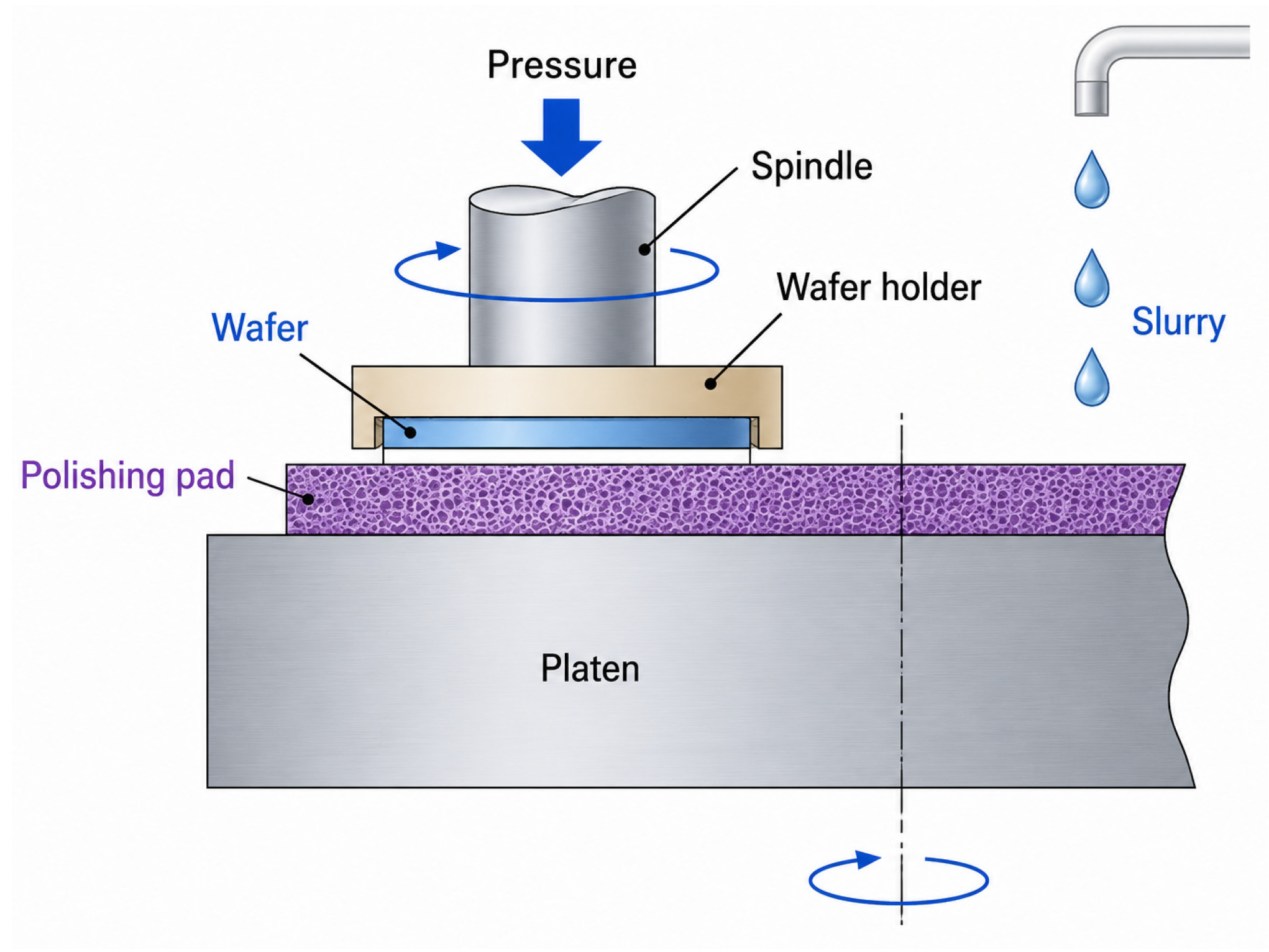
Next, this hybrid EWMA-KNN controller was applied to the simulation of CMP process. CMP is a global planarization technique widely used in semiconductor manufacturing to remove non-planar portions of thin films deposited on wafers through a combination of chemical reactions and mechanical polishing [32,33]. The basic configuration of a CMP system, as illustrated in Figure 1, consists of a polishing pad, a wafer carrier, and a slurry dispenser. During the process, the wafer is held face-down by the carrier and pressed against the polishing pad to facilitate the operation of the mechanical polishing mechanism. Both the wafer carrier and the polishing pad rotate simultaneously. Meanwhile, slurry, which contains a mixture of abrasive particles and chemical agents, is dispensed onto the pad to assist in removing specific materials from the wafer surface. The chemical components of the slurry soften or react with the wafer material, while the abrasive particles mechanically remove the reacted layers. As the number of interconnect layers in integrated circuits (ICs) continues to increase, layer planarization has become increasingly critical.
Because both the slurry and the polishing pad are consumable materials, process drift in the CMP process is inevitable. Therefore, the CMP process model considered in this study is described as follows [34].
y i = C + A u i + ω i + δ × i
where i denotes the run number, and u i is a 4 × 1 input vector for the i -th run, consisting of platen speed, back pressure, polishing head downforce, and profile, with the default values were designed as 45.5, 1, 4, and 14.5, respectively; y i is a 2 × 1 output vector representing the removal rate and non-uniformity, with target values of 1700 and 200, respectively. Moreover, the coefficients of Equation (16) are listed below.
A = 5.018 0.665 16.34 0.845 13.67 19.95 27.52 5.25   i s   t h e   p r o c e s s   g a i n .
C = 138.21 627.32 i s   t h e   c o n s t a n t   v e c t o r .
δ = 17 1.5 i s   t h e   p r o c e s s   d r i f t .
In addition, ω i is normally distributed white noise with zero mean and covariance matrix Λ , and
Λ = 66.564 0 0 5.29 .
It is a linear system with linear process drift. Moreover, the removal rate is considered as control target in this study.
Although Equation (16) describes the CMP process model, the actual process model varies from one CMP tool to another because of differences in machine conditions and operating characteristics. In reality, engineers cannot obtain real process models for every tool, nor can they build accurate process models in real time. Instead, engineers can only obtain the polishing results after the completion of each run. Accordingly, this study assumes that only the current and historical process output vectors { y i ,   y i 1 , ,   y 1 } are available for process adjustment. The proposed controller operates without knowledge of the process intercept, process gain, drift characteristics, or noise statistics. The control action is determined entirely from historical process output data.
In addition, since CMP is a multiple-input multiple-output (MIMO) process, not all recipe parameters exert a significant influence on the process outcomes. Consequently, engineers generally avoid adjusting all process parameters simultaneously to prevent over-adjustment from causing process instability and performance degradation. Instead, only the most influential parameter is selectively tuned to achieve reliable compensation for process drift.
Among the various controllable parameters in the CMP process, the polishing head downforce is generally considered the most critical variable for fine-tuning the process recipe because it directly influences the material removal rate and overall process controllability. According to Preston’s equation, the removal rate is approximately proportional to the applied polishing pressure, as expressed below:
R = K p × p × v
where R is the material removal rate, K p is the Preston coefficient, p represents the polishing pressure, and v is the relative velocity between the wafer and the polishing pad. In addition, the influence of polishing head downforce on polishing performance is generally more linear and predictable than that of other process parameters. Therefore, the polishing head downforce was selected as the manipulated variable for process optimization in this study.
For the KNN-based controller, K was set to 3, and the initial feature database was set to:
X = [ 200 150 100 50 0 50 100 150 200 ]
representing different levels of process deviation relative to the target value; and the compensation database of the KNN controller was set to
Z = [ 0.5 0.4 0.3 0.15 0 0.15 0.3 0.4 0.5 ] .
The construction of the error–compensation pairs is explained as follows:
For example, if the removal rate (process output) is 1900 while the target value is 1700, the resulting control error (target value − process output) is 200 . Because the removal rate exceeds the target, the polishing head downforce must be reduced to prevent over-polishing, which could result in wafer scrap. Therefore, the corresponding recipe adjustment is set to 0.5 . In addition, the weighting factor λ , the adaptation gain η , and the adjustment saturation bound u m a x were set to 0.3, 0.05, and ± 0.3 , respectively. These parameters are controller design parameters, that is, user-defined parameters for the KNN and EWMA algorithms (Algorithm 1).
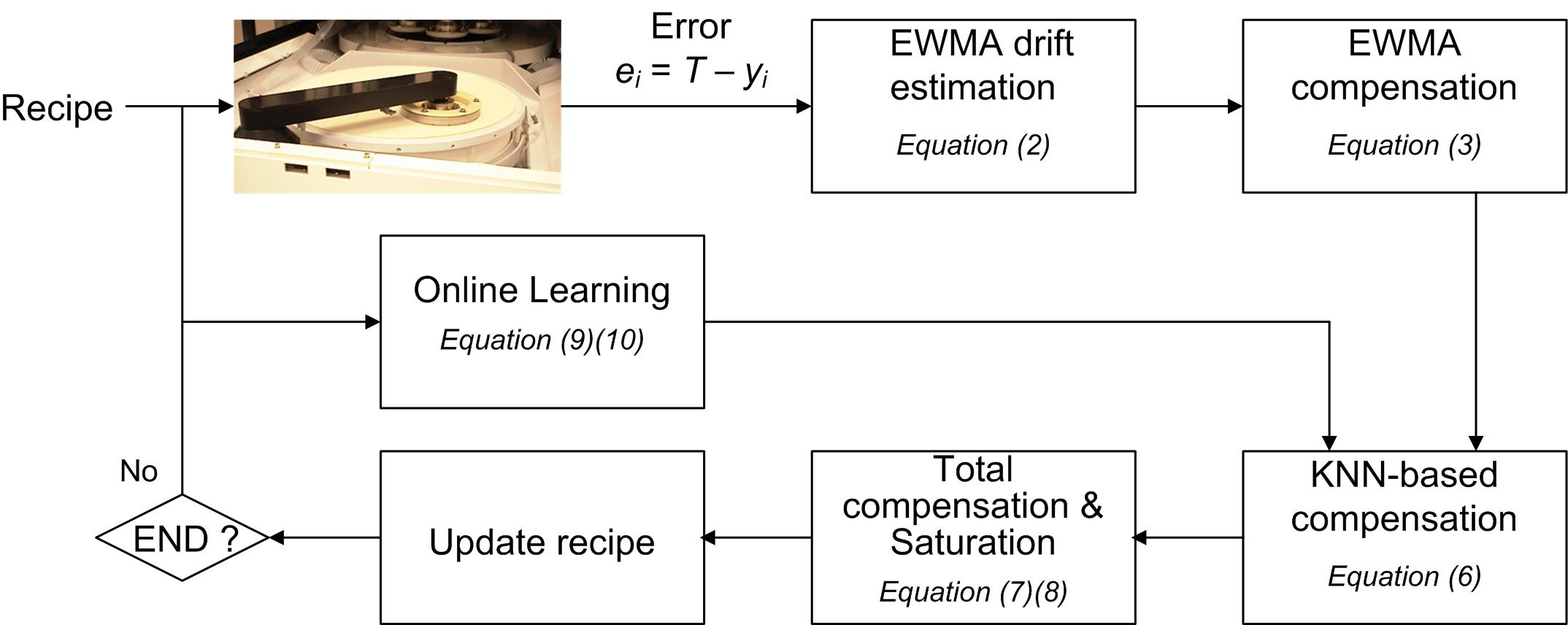
Figure 2 shows the flowchart of the proposed EWMA-KNN controller.
Algorithm 1 EWMA-KNN run-to-run control procedure
Initialize controller setting: K = 3, λ = 0.3 , η = 0.05 , u m a x = ± 10 , error–compensation pairs X, Z (Equations (22) and (23))
For  i = 1 , , N
   Obtain the process output y i and calculate e i = T y i
   Update the EWMA estimate: d ^ i = λ e i + ( 1 λ ) d ^ i 1 , d ^ 1 = e 1
   Calculate u E W M A = η d ^ i
   Calculate the distances between e i and the samples in X, and identify the K nearest neighbors
   Calculate u K N N = j = 1 K ω j Z j j = 1 K ω j
   Calculate u i = u E W M A + u K N N
   Saturation constraint u i + 1 = s a t [ u m a x , u m a x ] u i + u i
   Online learning: X i + 1 = x 1 , x 2 , , x n , e i and Z i = z 1 , z 2 , , z n , u i
End For

4. Simulation Results

In this study, both linear and nonlinear process drifts were investigated to evaluate the performance of the Hybrid EWMA-KNN controller, the conventional EWMA controller, and the KNN controller individually.

4.1. CMP Process with Linear Drift

4.1.1. Hybrid EWMA-KNN Controller

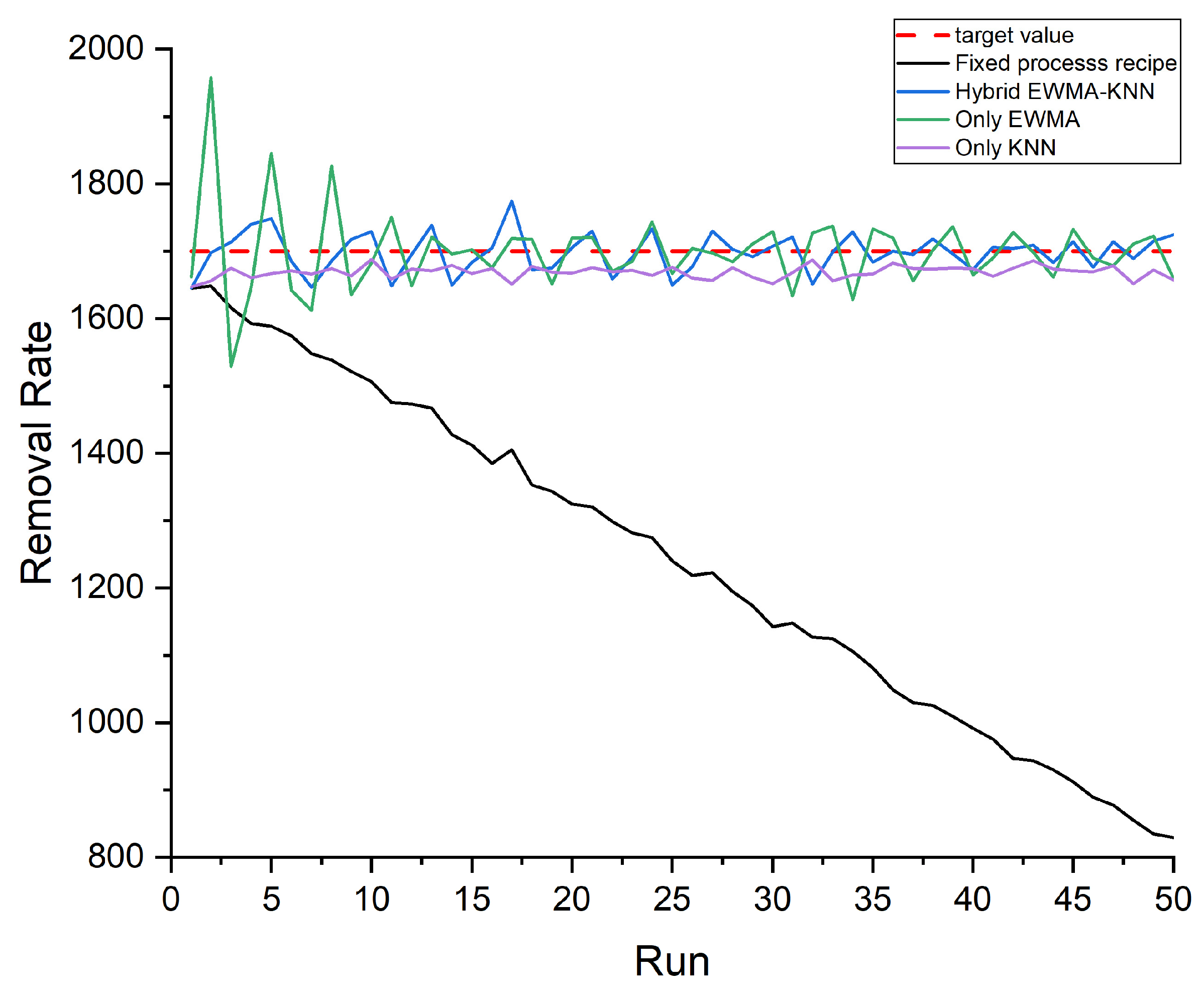
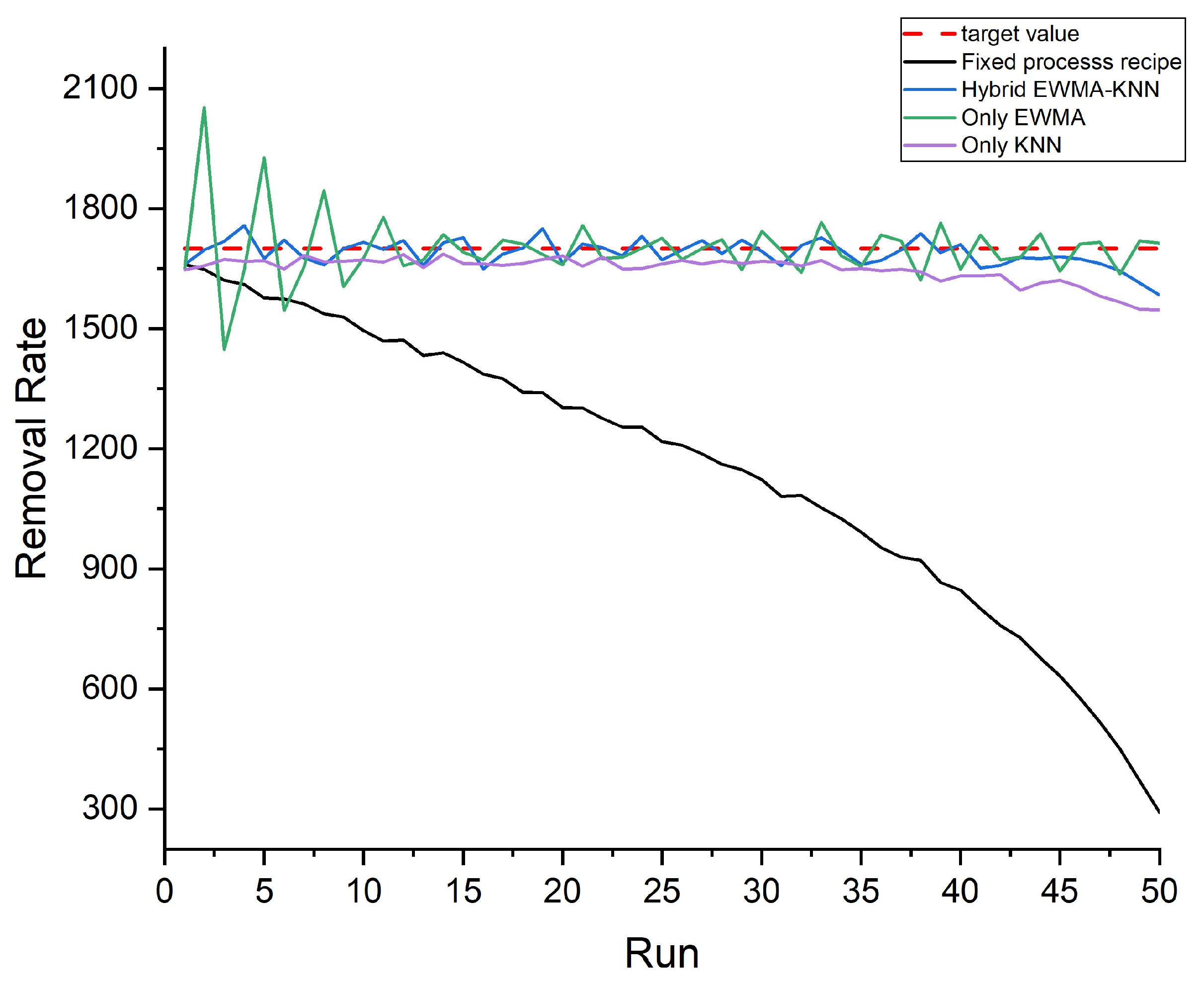
Equation (16) describes a linear CMP system subject to linear process drift and random white noise. When the process recipe remains unchanged throughout successive runs, the removal rate gradually decreases due to factors such as polishing pad wear, as shown in Figure 3. In contrast, when the proposed hybrid EWMA-KNN R2R controller is applied, the removal rate can be maintained close to the target value of 1700, with an average value of 1698.60 and a standard deviation of 28.79. The maximum absolute deviation from the target value is 74.84. Thus, the maximum overshoot M p % is 4.40%.
In addition, the settling run is defined as the run number required for the response to reach and remain within a ± 5 % tolerance band of the target value. We define a settling percentage as
R S % = s e t t l i n g   r u n   n u m b e r t o t a l   r u n   n u m b e r × 100 % .
The hybrid EWMA-KNN R2R controller achieves the settling behavior from the beginning of the control process and R S % = 0 % , indicating its capability to rapidly compensate for process variations.

4.1.2. Only EWMA Estimator (Without Adaptive Recipe Tuning)

When only the EWMA controller is employed, the removal rate can also be regulated around the target value of 1700, yielding an average value of 1699.21. However, the corresponding standard deviation increases to 62.72, indicating larger process fluctuations. The maximum absolute deviation from the target value reaches 257.86 and M p % is 15.17%. The EWMA controller exhibits several oscillations during the initial runs and reaches the settling criterion starting from the 9th run and R S % = 18 % , indicating a slower convergence behavior compared with the hybrid EWMA-KNN controller. The control performance of the EWMA controller is highly dependent on the accuracy of the estimated process model. Since the EWMA estimator recursively updates the accumulated process offset, the process offset cannot be accurately estimated during the initial runs of the process, which results in relatively large transient oscillations.
Nevertheless, the EWMA compensation term can effectively reduce initial process oscillation errors and enhance long-term process stability. Moreover, compared with many advanced model-based control approaches, the EWMA controller is much simpler and more effective.

4.1.3. Only KNN Controller (Without Adaptive Recipe Tuning)

When only the KNN controller is applied, the removal rate cannot be fully maintained around the target value of 1700. The average removal rate is reduced to 1668.69, although the standard deviation is only 9.38, indicating relatively small process fluctuations. The maximum absolute deviation from the target value is 52.74. The maximum overshoot M p % is 3.10% and, therefore, R S % = 0 % .
The KNN controller utilizes previously stored error–compensation pairs as its training database. During each run, the Euclidean distance between the current process error and historical error samples is calculated. The nearest neighboring samples are then selected according to the KNN algorithm to determine the corresponding recipe compensation. Consequently, if the error–compensation pairs established from prior control experience are insufficient or inadequately representative of actual process conditions, control inaccuracies may occur, leading to deviations from the target value. Nevertheless, owing to the compensation provided by the error–compensation pairs, the KNN controller achieves the settling criterion from the beginning of the control process.

4.2. CMP Process with Nonlinear Drift

4.2.1. Hybrid EWMA-KNN Controller

In practical manufacturing processes, nonlinear process drift may arise from multiple contributing factors. Therefore, in this study, an exponential term was incorporated into the linear drift component of Equation (16) to simulate nonlinear process drift, as shown below.
17 1.5 × i + e i / 8 e i / 10
where i denotes the run number.
As shown in Figure 4, when the process recipe is not adjusted for each run, the removal rate decreases rapidly over time. In contrast, when the proposed hybrid EWMA-KNN R2R controller is applied, the removal rate remains within ± 5 % tolerance band of the target value, with an average value of 1692.06, a standard deviation of 30.74, and a maximum absolute deviation of 73.50. The maximum overshoot M p % is 4.32% and the system achieves the settling behavior from the beginning of the control process. However, after the 49th run, the absolute deviation gradually increases, eventually causing the process to become out of control. Clearly, although the process is subject to nonlinear drift, the hybrid EWMA-KNN controller is able to maintain the removal rate close to the target value during the initial stage of operation. Nevertheless, due to the exponential nature of the process drift, the process variation gradually increases over time, resulting in driving the process out of control.

4.2.2. Only EWMA Estimator (Without Adaptive Recipe Tuning)

Relatively large process fluctuations are observed during the initial stage of control (before the 12th run), with the maximum absolute deviation from the target value reaching 238.56 and M p % = 14.03 % . Thereafter, the controller drives the removal rate to satisfy the settling criterion, with an average value of 1693.06 and a standard deviation of 59.87, where the statistical results include the first 12 runs. The percentage of settling runs among the in-control runs is 19.35%. As the process drift increases exponentially, the control performance gradually degrades, and the process goes out of control after the 63rd run.

4.2.3. Only KNN Controller (Without Adaptive Recipe Tuning)

When only the KNN controller is applied, the compensation action is determined based on the error–compensation pairs stored in the training database. Consequently, relatively small process fluctuations are observed, and the controller satisfies the settling criterion from the beginning of the control process. The maximum absolute deviation from the target value is 68.74 and M p % = 4.04 % . Before the process goes out of control at the 40th run, the removal rate has an average value of 1660.92 and a standard deviation of only 14.14. However, the deviation from the target value is the largest among these three controllers, which is consistent with the observation under linear process drift. This indicates that the training database is capable of generating appropriate recipe adjustments, thereby resulting in smaller process oscillations.

4.3. Controller Comparison

The primary function of the EWMA estimator is to recursively estimate the accumulated process drift by integrating historical process errors. In contrast, the KNN-based controller determines the control action by identifying similarities between the current process condition and the training samples stored in the feature database. This proposed model-free R2R controller is constructed by integrating these two approaches.
For linear process drift, all three controllers are capable of maintaining the removal rate around the target value. However, the performance of the KNN controller is relatively inferior. Nevertheless, it helps to suppress severe oscillations caused by the EWMA controller during the initial stage of control.
For nonlinear process drift, as shown in Figure 4, the exponential characteristic of the drift causes the KNN controller to become less effective after approximately run 40, since the error–compensation pairs can no longer provide sufficient compensation. As a result, the removal rate gradually decreases. Consequently, the hybrid EWMA-KNN controller also exhibits a slight downward trend after approximately run 48.
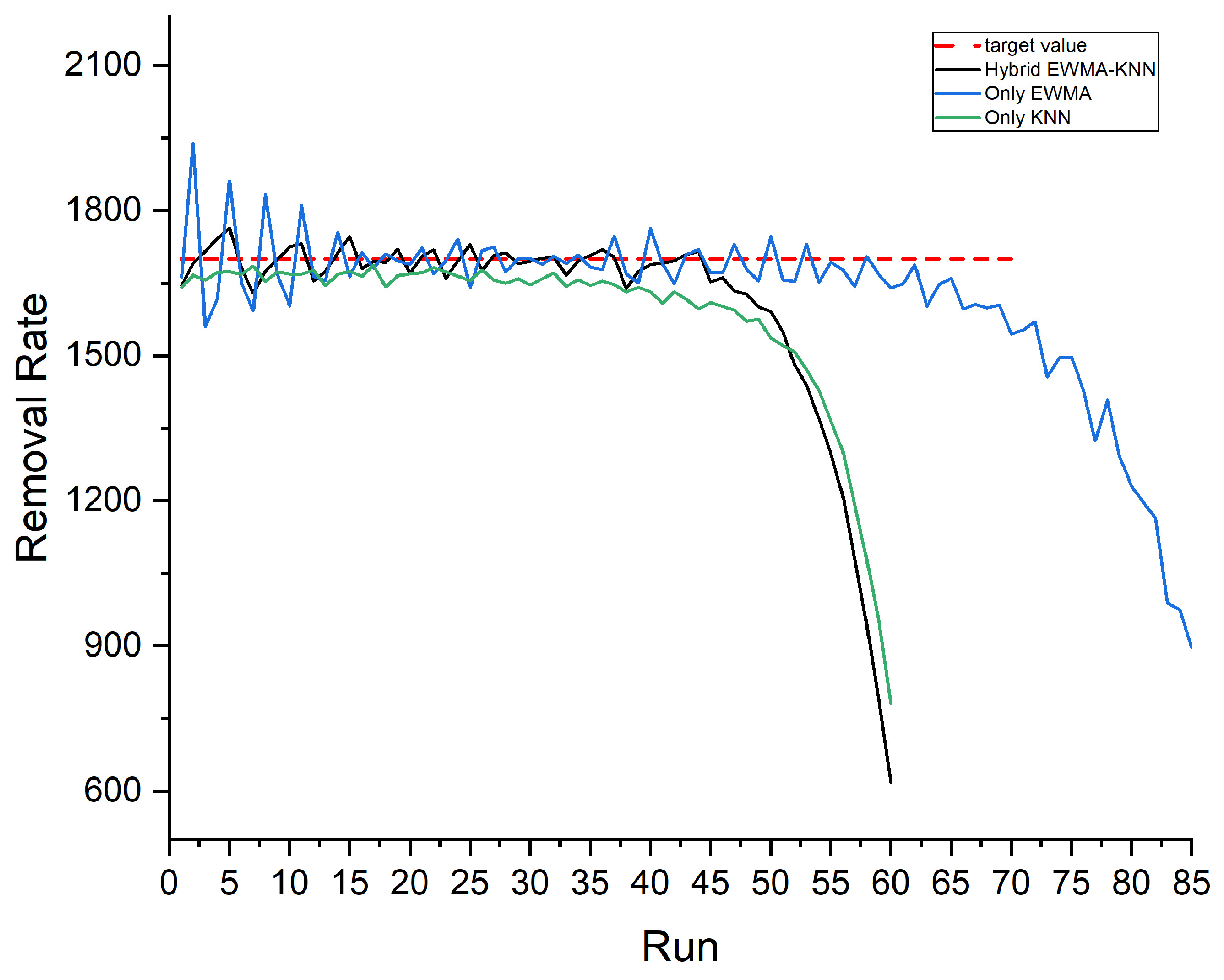
To further verify this phenomenon, the total run number was extended from 50 to 85. As shown in Figure 5, all three controllers exhibit a gradual reduction in removal rate under the exponential nonlinear process drift. This is because of the exponential process drift e i   w h e n   i 0 and, thereby, the process drift is not bounded. However, under both linear and nonlinear process drift conditions, the hybrid EWMA-KNN controller exhibits smaller oscillations from the initial runs and maintains the process output close to the target value, demonstrating better stability than both the EWMA controller and the KNN controller. The comparison of these three controllers is given in Table 1.
R2R control utilizes information from previously processed products to adjust the recipe for the current product, thereby decreasing the effects of process drift and variability. As a result, it can reduce equipment downtime, improve process yield, and minimize defect generation. Table 2 summarizes representative R2R control studies published in recent years. Although the control approaches differ depending on the specific application, most existing methods rely on establishing a process model and continuously updating or refining it to determine appropriate recipe adjustments. In contrast, the proposed method is entirely model-free and therefore eliminates the need for process model development and online model updating.

4.4. Reproducibility of Controller

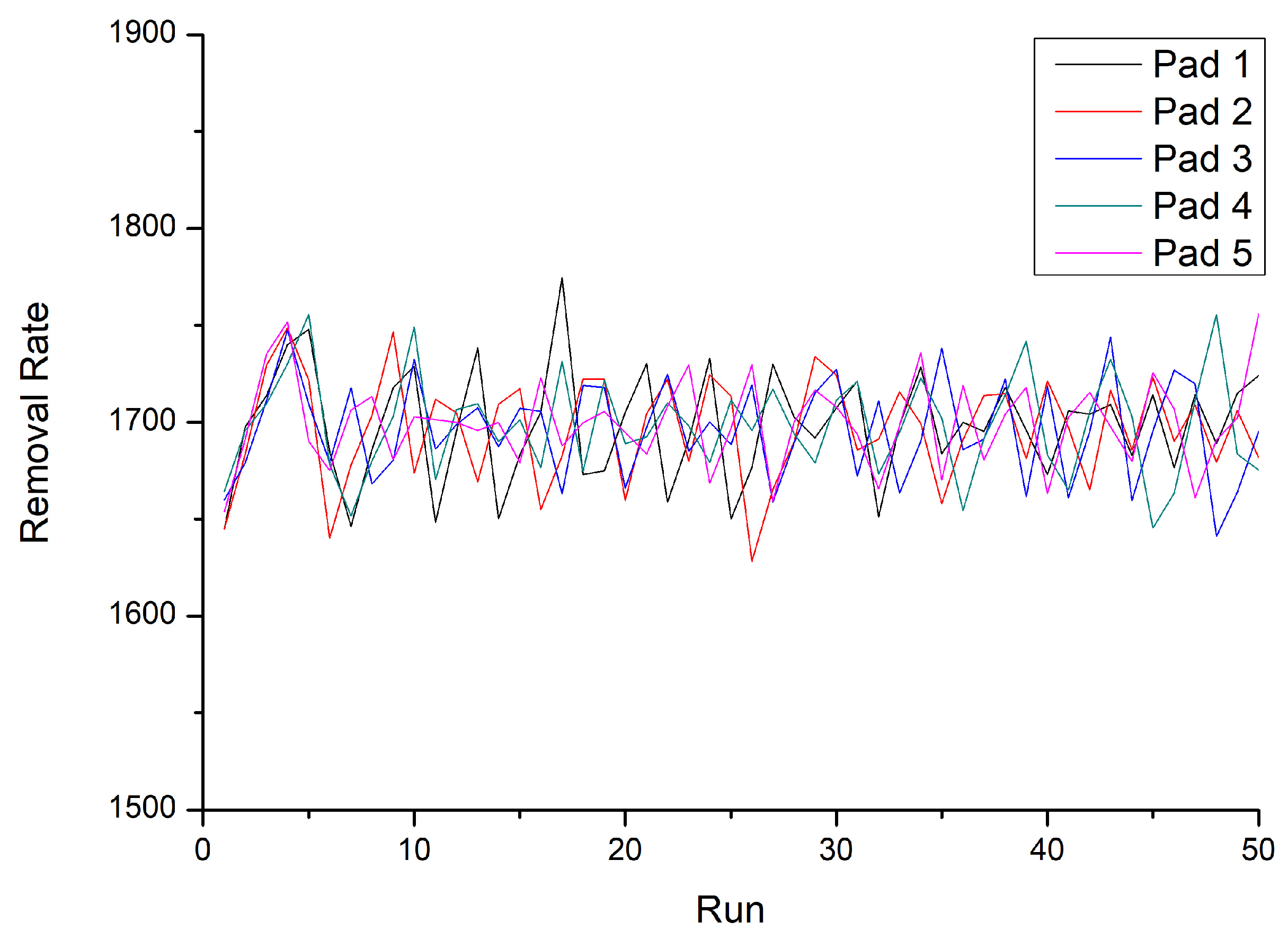
In machining processes, a cutting tool must be replaced once its wear exceeds the allowable limit. Similarly, in the CMP process, the polishing pad must be replaced after reaching its maximum allowable number of polishing runs to ensure stable process yield. Accordingly, this section examines the performance of the proposed controller following polishing pad replacement. A linear process drift is considered in the simulation. The polishing pad is assumed to be replaced after every 50 polishing runs. After each pad replacement, both the process recipe and the error–compensation database are reset to their initial settings. The simulation results are presented in Figure 6. The average removal rates of the five polishing pads are 1698.60, 1696.76, 1696.15, 1698.39, and 1699.53, respectively. The process output trajectories obtained with the five polishing pads exhibit similar trends, with standard deviations (process fluctuations) of 28.79, 27.35, 25.65, 26.07, and 22.91, respectively. Since the population variance is unknown, the 95% confidence interval for the average removal rate can be calculated using the following formula:
R ¯ t α / 2 , n 1 S n μ R ¯ + t α / 2 , n 1 S n
where R is the average removal rate of a polishing pad, S 2 denotes the sample variance, and t α / 2 , n 1 represents the critical value of the t-distribution with n 1 degrees of freedom. Based on the statistical analysis, the 95% confidence interval for the average removal rate is estimated to be 1696.16 μ 1699.61 . These results demonstrate that the controller maintains consistent control performance after each polishing pad replacement.

5. Conclusions

Process drift is common in manufacturing processes and may arise from equipment aging, tool wear, and changes in chemical concentration. The proposed hybrid EWMA-KNN R2R controller provides a model-free, data-driven approach that uses historical process outputs to determine drift compensation. Within the hybrid architecture, the KNN component supports the EWMA controller by suppressing excessive output oscillations during the initial stage of control. In the chemical mechanical planarization (CMP) simulation, the proposed controller maintained the removal rate close to the target value, with a maximum overshoot of 4.40%, and satisfied the settling criterion from the beginning of the control process. When process drift remained within a bounded range, the controller also maintained the process output close to the target value with a relatively small standard deviation. Its simple and intuitive implementation may further support practical application to drift-dominant manufacturing processes.

Author Contributions

Conceptualization, Y.-J.C.; methodology, Y.-J.C.; formal analysis, M.-C.H.; data curation, M.-C.H.; writing—original draft preparation, Y.-J.C.; visualization, M.-C.H. All authors have read and agreed to the published version of the manuscript.

Funding

This research received no external funding.

Data Availability Statement

The original contributions presented in this study are included in the article, and further inquiries may be directed to the corresponding author.

Conflicts of Interest

The authors declare no conflicts of interest.

References

  1. Liu, K.; Chen, Y.Q.; Zhang, T.; Tian, S.; Zhang, X. A survey of run-to-run control for batch processes. ISA Trans. 2018, 83, 107–125. [Google Scholar] [CrossRef] [Scilit] [PubMed]
  2. Prabhu, A.V.; Edgar, T.F.; Chong, R. Performance assessment of run-to-run EWMA controllers. In Proceedings of the International Symposium on Advanced Control of Chemical Processes, Gramado, Brazil, 2 April 2006. [Google Scholar]
  3. Prabhu, A.V.; Edgar, T.F.; Good, R. Missing data estimation for run-to-run EWMA-controlled processes. Comput. Chem. Eng. 2009, 33, 1861–1869. [Google Scholar] [CrossRef] [Scilit]
  4. Ai, B.; Zheng, Y.; Wang, Y.; Jang, S.-S.; Song, T. Cycle forecasting EWMA (CF-EWMA) approach for drift and fault in mixed-product run-to-run process. J. Process Control 2010, 20, 689–708. [Google Scholar] [CrossRef] [Scilit]
  5. Ai, B.; Wong, D.S.; Jang, S.-S.; Zheng, Y. Stability analysis of EWMA run-to-run controller subjects to stochastic metrology delay. In Proceedings of the 18th International Federation of Automatic Control, Milan, Italy, 28 August 2011. [Google Scholar]
  6. Kang, P.; Kim, D.; Lee, H.-J.; Doh, S.; Cho, S. Virtual metrology for run-to-run control in semiconductor manufacturing. Expert Syst. Appl. 2011, 38, 2508–2522. [Google Scholar] [CrossRef] [Scilit]
  7. Zaman, B.; Mahfooz, S.Z.; Khan, N.; Riaz, M.; Mehmood, R. Integration of hybrid score functions to design new adaptive EWMA control chart to monitor the process mean shift. Comput. Ind. Eng. 2023, 183, 109543. [Google Scholar] [CrossRef] [Scilit]
  8. Su, C.-T.; Hsu, C.-C. A time-varying weights tuning method of the double EWMA controller. Omega-Int. J. Manag. Sci. 2004, 32, 473–480. [Google Scholar] [CrossRef] [Scilit]
  9. Wu, W.; Maa, C.-Y. Double EWMA controller using neural network-based tuning algorithm for MIMO non-squared systems. J. Process Control 2011, 21, 564–572. [Google Scholar] [CrossRef] [Scilit]
  10. Kwon, J.S.; Nayhouse, M.; Ni, D.; Christofides, P.D. Handling parametric drift in batch crystallization using predictive control with R2R model parameter estimation. IFAC-PapersOnLine 2015, 48, 912–917. [Google Scholar] [CrossRef] [Scilit]
  11. Yang, W.-T.; Blue, J.; Roussy, A.; Pinaton, J.; Reis, M.S. A physics-informed Run-to-Run control framework for semiconductor manufacturing. Expert Syst. Appl. 2020, 155, 113424. [Google Scholar] [CrossRef] [Scilit]
  12. Tom, M.; Yun, S.; Wang, H.; Ou, F.; Orkoulas, G.; Christofides, P.D. Machine learning-based run-to-run control of a spatial thermal atomic layer etching reactor. Comput. Chem. Eng. 2022, 168, 108044. [Google Scholar] [CrossRef] [Scilit]
  13. Jen, C.-H.; Wang, J.-M. Integrating the fault detection method and run-to-run control for improving semiconductor process control. Procedia Comput. Sci. 2011, 4, 1316–1325. [Google Scholar] [CrossRef] [Scilit]
  14. Kim, H.; Park, J.H.; Lee, K.S. A Kalman filter-based R2R control system with parallel stochastic disturbance models for semiconductor manufacturing processes. J. Process Control 2014, 24, 119–124. [Google Scholar] [CrossRef] [Scilit]
  15. Wang, H.; Tan, F.; Sheng, B.; Bian, J.; Pan, T. Run-to-run control for semiconductor manufacturing processes using extended state observer. In Proceedings of the 28th Chinese Control and Decision Conference (CCDC), Yinchuan, China, 28–30 May 2016. [Google Scholar]
  16. Jebri, M.A.; El Adel, E.M.; Graton, G.; Ouladsine, M.; Pinaton, J. The impact of the virtual metrology on a run-to-run control for a chemical mechanical planarization process. IFAC-PapersOnLine 2017, 50, 6154–6159. [Google Scholar] [CrossRef] [Scilit]
  17. Huang, D.; Lv, J. Run-to-run control of batch production process in manufacturing systems based on online measurement. Comput. Ind. Eng. 2020, 141, 106298. [Google Scholar] [CrossRef] [Scilit]
  18. Yun, S.; Tom, M.; Ou, F.; Orkoulas, G.; Christofides, P.D. Multivariable run-to-run control of thermal atomic layer etching of aluminum oxide thin films. Chem. Eng. Res. Des. 2022, 182, 1–12. [Google Scholar] [CrossRef] [Scilit]
  19. Wang, H.; Tom, M.; Ou, F.; Orkoulas, G.; Christofides, P.D. Integrating run-to-run control with feedback control for a spatial atomic layer etching reactor. Chem. Eng. Res. Des. 2024, 203, 1–10. [Google Scholar] [CrossRef] [Scilit]
  20. Henrik Wang, H.; Ou, F.; Suherman, J.; Orkoulas, G.; Christofides, P.D. Integration of on-line machine learning-based endpoint control and run-to-run control for an atomic layer etching process. Digit. Chem. Eng. 2025, 14, 100206. [Google Scholar] [CrossRef] [Scilit]
  21. Lin, C.-P.; Ou, F.; Orkoulas, G.; Christofides, P.D. Run-to-run control of area-selective atomic layer deposition of SiO2 on Al2O3 and SiO2 surfaces with intermediate etching steps. Digit. Chem. Eng. 2026, 20, 100324. [Google Scholar] [CrossRef] [Scilit]
  22. Graff, N.; Dailey, R.; Djurdjanovic, D. Robust multilayer control of critical overlay error components across a pattern layer in photolithography processes. J. Process Control 2026, 161, 103685. [Google Scholar] [CrossRef] [Scilit]
  23. Madeti, S.R.; Singh, S.N. Modeling of PV system based on experimental data for fault detection using kNN method. Sol. Energy 2018, 173, 139–151. [Google Scholar] [CrossRef] [Scilit]
  24. Suyal, M.; Goyal, P. A review on analysis of K-nearest neighbor classification machine learning algorithms based on supervised learning. Int. J. Eng. Trends Technol. 2022, 70, 43–48. [Google Scholar] [CrossRef] [Scilit]
  25. Zhu, C.C.; Li, L.; Ding, S.X. Multiplicative fault detection and isolation in dynamic systems using data-driven K-gap metric based kNN algorithm. IFAC-PapersOnLine 2022, 55, 169–174. [Google Scholar] [CrossRef] [Scilit]
  26. ul Haq, I.; Khan, D.M.; Hamraz, M.; Iqbal, N.; Ali, A.; Khan, Z. Optimal-k nearest neighbours based ensemble for classification and feature selection in chemometrics data. Chemom. Intell. Lab. Syst. 2023, 240, 104882. [Google Scholar] [CrossRef] [Scilit]
  27. Halder, R.K.; Uddin, M.N.; Uddin, M.A.; Aryal, S.; Khraisat, A. Enhancing K-nearest neighbor algorithm: A comprehensive review and performance analysis of modifications. J. Big Data 2024, 11, 113. [Google Scholar] [CrossRef] [Scilit]
  28. Pansari, D.; Yadav, A. Adaptive fault diagnosis in renewable integrated microgrids using hybrid machine learning approach. Electr. Power Syst. Res. 2026, 251, 112297. [Google Scholar] [CrossRef] [Scilit]
  29. Pfeifer, B.; Kreuzthaler, M. Calibrated kNN classification via second-layer neighborhood analysis. Adv. Data Anal. Classif. 2026, 20, 145–165. [Google Scholar] [CrossRef] [Scilit]
  30. Ho, W.T.; Yu, F.W. Measurement and verification of energy performance for chiller system retrofit with k nearest neighbour regression. J. Build. Eng. 2022, 46, 103845. [Google Scholar] [CrossRef] [Scilit]
  31. Yahia, S.; Saida Bedoui, S.; Abderrahim, K. Lyapunov-based fault-tolerant control of stochastic switched systems via K-nearest neighbors switching detection and joint fault estimation. Results Control Optim. 2025, 21, 100625. [Google Scholar] [CrossRef] [Scilit]
  32. Quirk, M.; Serda, J. Semiconductor Manufacturing Technology; Prentice Hall: Upper Saddle River, NJ, USA, 2001; pp. 515–544. [Google Scholar]
  33. Xiao, H. Introduction to Semiconductor Manufacturing Technology; SPIE Press: Bellingham, WA, USA, 2012; pp. 505–544. [Google Scholar]
  34. Ning, Z.; Moyne, J.R.; Smith, T.; Boning, D.; Del Castillo, E.; Yeh, J.-Y.; Hurwitz, A. A comparative analysis of run-to-run control algorithms in the semiconductor manufacturing industry. In Proceedings of the 1996 IEEE/SEMI Advanced Semiconductor Manufacturing Conference, Cambridge, MA, USA, 12 November 1996. [Google Scholar]
Figure 1. Basic configuration of a CMP system.
Processes 14 02714 g001
Figure 2. Flowchart of the EWMA-KNN controller.
Processes 14 02714 g002
Figure 3. Process outputs of CMP system subject to linear drift and random disturbance.
Processes 14 02714 g003
Figure 4. Process outputs of CMP system affected by nonlinear drift (process drift including linear and exponential terms) and random disturbance.
Processes 14 02714 g004
Figure 5. Process outputs of CMP system affected by nonlinear drift (process drift including linear and exponential terms) and random disturbance with run number extended to 85.
Processes 14 02714 g005
Figure 6. Simulation results of polishing performance of the proposed controller following polishing pad replacement.
Processes 14 02714 g006
Table 1. Comparison of these three controllers. (Target removal rate: 1700.)
Drift TypeItemMeaningEWMAKNNHybrid
Linear driftAverageTarget tracking1699.211668.691698.60
Standard deviationProcess fluctuation62.729.3828.79
M p % Maximum overshoot15.17%3.10%4.40%
R S % Settling percentage 18 % 0%0%
Nonlinear driftRun number *In-control runs624048
AverageTarget tracking1693.061660.921692.06
Standard deviationProcess fluctuation59.8714.1430.74
M p % Maximum overshoot14.03%4.04%4.32%
* The number of runs in which the removal rate remains within ± 5 % tolerance band of the target value.
Table 2. Literature comparison.
ProcessApproachModelGoal/FeatureReference
Semiconductor manufacturing processExtended state observer & R2R controllerLinear model [15]
CMPDynamic Bayesian networks & Structured R2R controllerOffline modelingPhysics-informed framework integrating the real-time equipment condition[11]
Batch production processdEWMA controllerLinear regression modelOnline measurement[17]
Atomic layer etchingEWMA & PI controllerMacroscopic CFD model & microscopic kinetic Monte Carlo modelTo overcome the long purging times[19]
Photolithography processrobust multilayer L norm-based controllerZernike polynomial-based modelsTo control overlay and stack-up overlay errors[22]
CMPEWMA-KNNModel-freeData-drivenThis work
Disclaimer/Publisher’s Note: The statements, opinions and data contained in all publications are solely those of the individual author(s) and contributor(s) and not of MDPI and/or the editor(s). MDPI and/or the editor(s) disclaim responsibility for any injury to people or property resulting from any ideas, methods, instructions or products referred to in the content.