Article

Effects of a Sodium Alginate Coating Enriched with Isodon serra and Plinia cauliflora Leaf Extracts on Postharvest Quality and Anthracnose Control in Banana


Institute of Subtropical Agriculture, Fujian Academy of Agricultural Sciences, 1499 Jiulong Avenue, Zhangzhou 363005, China
*
Authors to whom correspondence should be addressed.
These authors contributed equally to this work.
Processes 2026, 14(17), 2698; https://doi.org/10.3390/pr14172698
Submission received: 14 July 2026 / Revised: 7 August 2026 / Accepted: 18 August 2026 / Published: 24 August 2026
(This article belongs to the Section Environmental and Green Processes)

Abstract

Banana is a typical climacteric fruit that rapidly undergoes ripening, peel browning, softening, moisture loss, and fungal decay during postharvest storage, leading to severe quality deterioration and a shortened shelf life. In this study, a sodium alginate (SA)-based edible coating enriched with Isodon serra extract (IE) and Plinia cauliflora (jaboticaba) leaf extract (JE) was developed and evaluated for its antioxidant, antifungal, and preservation effects on banana fruit. The two extracts exhibited distinct functional properties: IE showed strong inhibitory activity against Colletotrichum musae, whereas JE displayed superior radical scavenging capacity. When incorporated into the coating system, this functional complementarity translated into improved preservation performance. The composite coating (SA-IE-JE) effectively suppressed anthracnose development, reduced peel browning, and delayed ripening progression, as evidenced by an 11.8% reduction in fruit weight loss (11.48% vs. 13.01%), an 11.6% decrease in MDA accumulation (89.96 vs. 101.75), a 51.3% reduction in PPO activity (526 U/g vs. 1080 U/g), sustained TPC, and a slower increase in total soluble solids after 5 days of storage. All coating treatments improved postharvest quality compared with the uncoated control, while SA-IE and SA-IE-JE generally showed stronger preservation effects than SA alone. In particular, SA-IE-JE was more effective in reducing peel browning, delaying the increase in PPO activity, and suppressing anthracnose lesion expansion. These findings highlight that SA coating supplemented with IE and JE can serve as a promising, environmentally friendly strategy for maintaining banana quality and reducing postharvest disease. Our study provides a potential basis for the development of plant-extract-enriched edible coatings for banana preservation.

1. Introduction

Banana (Musa spp.) is among the most commonly consumed fruits worldwide owing to its appealing flavor, high nutritional value, and broad consumer acceptance [1]. However, as a typical climacteric fruit, banana is highly prone to rapid postharvest deterioration [2,3]. After harvest, accelerated respiration triggers a cascade of deteriorative events: rapid water loss, tissue softening, promotion of enzymatic browning and increased susceptibility to microbial infection, all of which markedly shorten storage life and reduce marketability.
In recent years, edible coatings have been widely explored as an effective and environmentally friendly approach for preserving fresh fruits and vegetables [4,5,6,7]. Among the various coating materials, sodium alginate (SA) [8,9], a naturally derived polysaccharide, has attracted considerable attention because of its excellent film-forming ability, biodegradability, biocompatibility, and ease of application. SA-based coatings can form a semi-permeable layer on the fruit surface, thereby reducing moisture loss and modulating gas exchange [9]. Unlike some polymer-based coatings requiring additional chemical modification, SA can form a stable gel network through Ca2+-mediated ionic crosslinking, providing a simple and food-compatible strategy for postharvest preservation. Nevertheless, the practical preservation effect of SA alone is often limited by its lack of intrinsic bioactive properties, particularly in controlling postharvest pathogens and oxidative deterioration [9].
SA-based edible coatings have been widely explored for postharvest banana preservation, with existing studies primarily following three modification strategies: incorporation of essential oils or their active compounds (e.g., cinnamaldehyde) [10], integration of inorganic nanoparticles (e.g., ZnO, AgNPs) [11,12], and addition of single plant-derived extracts or bioactive agents (e.g., Moringa oleifera extract, trans-resveratrol, glycine betaine) [13,14]. While essential oils often exhibit poor compatibility with hydrophilic SA matrices, and nanoparticles raise safety and regulatory concerns, single-additive formulations typically target either antimicrobial or antioxidant activity alone, lacking simultaneous protection against both fungal infection and oxidative deterioration.
To overcome this limitation, plant-derived bioactive extracts have increasingly been incorporated into edible coating systems to enhance their functional performance. Isodon serra, a traditional medicinal herb, is rich in diverse phytochemicals, including diterpenoids and phenolics [15], and has been reported to possess notable antimicrobial activity [16,17]. Our previous observations further demonstrated that I. serra extract effectively inhibits the growth of Colletotrichum musae, the causal agent of banana anthracnose. In addition, Plinia cauliflora (commonly known as jaboticaba) leaves contain abundant phenolics, flavonoids, and tannins and are recognized for their pronounced antioxidant activity as well as potential antimicrobial effects [18,19,20]. Accordingly, since Isodon serra extract (IE) and Plinia cauliflora leaf extract (JE) have disparate biological activities, with IE functioning as the main antifungal component and JE responsible for antioxidant activity, their combination within the SA coating system is expected to exert complementary preservation functions.
Anthracnose, caused by Colletotrichum musae, is one of the major postharvest diseases of banana and severely affects marketability during storage and shelf life [21,22]. Meanwhile, oxidative processes such as membrane lipid peroxidation and enzymatic browning further contribute to fruit deterioration [23,24]. Therefore, the development of a multifunctional edible coating capable of simultaneously suppressing fungal infection and alleviating oxidative deterioration would be of considerable practical significance for postharvest banana preservation [25].
In the present study, an SA-based composite coating incorporating I. serra extract (IE) and Plinia cauliflora leaf extract (JE) was developed, and its effects on postharvest banana quality and anthracnose control were systematically evaluated. The antifungal and antioxidant activities of the plant extracts and coating solutions were first characterized, followed by assessment of fruit quality attributes, physiological changes, and disease development during storage. This dual-extract design represents a shift from single-additive formulations to complementary, multi-component coatings for comprehensive postharvest protection. The findings of this study provide a potential basis for the application of plant-extract-enriched edible coatings as a natural strategy for extending the postharvest life of banana fruit.

2. Materials and Methods

2.1. Plant Materials, Chemicals, and Pathogen

Fresh bananas (Musa acuminata L., AAA group, cv. Brazilian) in the commercial ripening stage were harvested from the Institute of Subtropical Agriculture, Fujian Academy of Agricultural Sciences (FAAS, Zhangzhou, China; 117°44′14″ E, 24°33′8″ N). Jaboticaba (Plinia cauliflora, cv. Sabará) leaves were collected from the same germplasm repository. Isodon serra plants were collected from Xiaba Village, Wuping County, Longyan, Fujian, China (116°2′19″ E, 24°52′52″ N). The aerial parts of I. serra plants, approximately 6 months old and more than 70 cm in height, were used for extract preparation.
Sodium alginate (CAS: 9005-38-3, viscosity: 200 ± 20 mpa·s) was purchased from Macklin (Shanghai, China). Glycerol (CAS: 56-81-5, ≥99%, analytical grade), calcium chloride (CAS: 10043-52-4, ≥99%, analytical grade), absolute ethanol (CAS: 64-17-5, ≥99.7%, analytical grade) and other analytical-grade reagents were obtained from Xilong Scientific (Guangzhou, China).
Colletotrichum musae was isolated and subsequently employed for antifungal activity assays and fruit inoculation tests. The pathogen was incubated on potato dextrose agar (PDA) plates at 28 °C for 7 days, and 6 mm mycelial plugs were cut from the actively growing edge of fungal colonies and used as inocula.

2.2. Preparation of Plant Extracts and Edible Coating Solutions

Plant extracts were prepared following the method described by Yang et al. with some modifications [26]. Fresh I. serra and jaboticaba leaves were thoroughly washed to remove surface impurities, dried in a hot-air oven at 60 °C to constant weight, ground into powder, and passed through a 40-mesh sieve. The powdered samples were extracted with 70% (v/v) ethanol at a material-to-solvent ratio of 1:20 (g/mL). Extraction was first performed with ultrasonic assistance at 240 W for 30 min, followed by shaking incubation at 180 rpm for 60 min. The mixtures were then centrifuged at 8000 rpm for 15 min, and the extraction procedure was repeated three times. The collected supernatants were combined and concentrated under reduced pressure at 50 °C to remove ethanol. The resulting concentrates were freeze-dried to obtain crude extract powders, which were stored at 4 °C until further use.
The SA coating solution was prepared according to the literature [27]. SA (10 g) was dissolved in 1000 mL of distilled water, followed by the addition of 3 g of glycerol as a plasticizer and stirring at room temperature for 1 h. To prepare the SA-IE coating solution, IE powder was added to the SA solution to a final concentration of 4 mg/mL and stirred until completely dissolved. For preparation of the SA-IE-JE coating solution, IE and JE powders were incorporated into the SA solution at final concentrations of 4 mg/mL and 1 mg/mL, followed by stirring until complete dissolution. Concentrations were chosen according to their functional activities observed during preliminary antifungal and antioxidant evaluations. Notably, these levels were used to evaluate the coating performance herein and do not constitute an optimized commercial recipe.

2.3. LC-MS Chemical Profiling of Plant Extracts

Chemical profiling of IE and JE was performed using ultra-high-performance liquid chromatography coupled with tandem mass spectrometry (UHPLC-MS/MS). Detailed analytical conditions and the full metabolite datasets are provided in Supplementary Datasets S1 and S2. Briefly, IE was analyzed using a widely targeted metabolomics approach, and JE was subjected to targeted quantitative analysis of major phenolic and flavonoid compounds. Compound identification was based on accurate mass, MS/MS fragmentation patterns, and comparison with authentic standards and in-house databases.

2.4. Determination of Antifungal and Antioxidant Activities of Extracts and Coating Solutions

The antifungal and antioxidant activities of the plant extracts and coating solutions were evaluated by measuring their inhibitory effects on C. musae mycelial growth and their DPPH radical scavenging capacity, respectively.
The inhibitory effect on C. musae was assessed according to a previous study [28]. Freeze-dried extracts were dissolved in distilled water and incorporated into molten PDA cooled to approximately 50 °C. The medium was then poured into sterile 90 mm Petri dishes and allowed to solidify. A 6 mm mycelial plug of C. musae was placed at the center of each plate. Plates prepared with distilled water instead of the extract served as the control. All plates were incubated at 28 °C, and the colony diameter was measured using the cross method when C. musae had grown to approximately two-thirds of the Petri dish diameter (about 84 h of incubation). Each treatment was conducted in triplicate. The mycelial growth inhibition rate was calculated as follows:
I n h i b i t i o n   r a t e % = D c D t D c 6 × 100 %
where Dc represents the colony diameter of the control, and Dt represents that of the treatment.
Antioxidant activity was determined using the DPPH radical scavenging assay [29]. Briefly, 1 mL of extract solution was mixed with an equal volume of 0.2 mmol/L DPPH solution prepared with absolute ethanol. After incubation in the dark for 30 min, the absorbance was then measured at 517 nm (L5S, INESA Scientific Instrument Co., Ltd., Shanghai, China). For the blank control, the extract was replaced with distilled water, and the sample background was prepared by replacing the DPPH solution with absolute ethanol. Each treatment was conducted in triplicate. DPPH radical scavenging activity was calculated as follows:
P P H   s c a v e n i n g   a c t i v i t y % = 1 A 1 A 2 A 0 × 100 %
where A1 is the absorbance of the reaction mixture containing both the sample and DPPH solution, A2 is the absorbance of the sample background, and A0 is the absorbance of the blank control.
To evaluate the functional stability of coating solutions during storage, SA, SA-IE, and SA-IE-JE coating solutions were stored at 25 °C and 80% relative humidity, and their antifungal and antioxidant activities were measured at 4-day intervals. Antifungal activity was determined as described above, whereas coating solutions were diluted 50-fold prior to the DPPH assay. Each treatment was conducted in triplicate.

2.5. Fruit Treatment and Storage

Banana fruits of uniform size and peel color and without visible mechanical damage were selected at ripening stage 6 according to the banana color scale, at which point they were yellow overall with a little green on both ends [30]. The fruit preservation experiment was conducted according to previous research [31,32]. A total of 200 fruits were randomly divided into four groups. Fruits in the control group were immersed in distilled water for 1 min and then air-dried. Fruits in the other three groups were immersed for 1 min in the SA, SA-IE, or SA-IE-JE coating solution, with excess solution drained naturally for 30 s. After coating, the fruits were immediately dipped in 2% calcium chloride solution for 30 s to facilitate coating formation and then naturally air-dried. All treated fruits were hung separately and stored at 25 °C and 80% relative humidity for 5 days, and samples were collected at 0, 1, 2, 3, 4, and 5 days after coating (dac) for quality evaluation.
For the anthracnose inoculation assay, bananas at approximately 80% ripeness and free of visible defects were washed and air-dried. Uniform wounds (6 mm in diameter and 2 mm in depth) were made on the fruit surface using a sterile punch and blade, and a mycelial plug was placed into each wound. The inoculated fruits were incubated at 25 °C and 80% relative humidity for 24 h and then treated with distilled water or with the SA, SA-IE, or SA-IE-JE coating solution, as described above. After air-drying, the fruits were further stored at 25 °C and 80% relative humidity, and the lesion diameter was measured at regular intervals after coating. Each treatment included five fruits, and the experiment was performed in triplicate.

2.6. Quality Evaluation of Banana Fruit

The quality of banana fruit during storage was evaluated by determining the peel browning index, weight loss, fruit firmness, total soluble solids (TSS), total phenolic content (TPC), malondialdehyde (MDA) content, and the activity of polyphenol oxidase (PPO). Each treatment was conducted in triplicate.
Peel browning index. Peel browning was visually assessed using eight randomly selected fruits per replicate according to the following scale [33]: 1 = no browning; 2 = less than 20% of the peel surface browned; 3 = 20~40% browned; 4 = 40~60% browned; and 5 = more than 60% browned.
Weight loss. Fruit weight loss was calculated on an initial weight basis and expressed in percentage [33]. Eight fruits were randomly selected per replicate.
Fruit firmness. Fruit firmness was measured following the method described by Pannip et al. [34], with minor modifications. Firmness was assessed in the equatorial region of peeled bananas using a fruit hardness tester equipped with a 7.9 mm cylindrical probe (Tuopuyunnong Co., Ltd., model GY-4-J, Hangzhou, China). Six fruit fingers were randomly selected from each treatment for firmness measurement, and the results were expressed in newtons (N).
Total soluble solids. TSS content in banana pulp juice was measured using a digital refractometer (Pocket Refractometer PAL-BX, ATAGO, Tokyo, Japan) and expressed as a percentage (%). Three fruit fingers were randomly selected per replicate.
Total phenolic content (TPC). TPC was measured according to a previous study with some modifications [34]. Banana pulp (5 g) was homogenized with 50 mL of 80% methanol and extracted at room temperature for 15 min. The homogenate was filtered through a cloth and centrifuged at 10,000× g for 15 min. Then 1 mL of the supernatant was mixed with 2.5 mL of Folin–Ciocalteu reagent and 2.5 mL of 15% Na2CO3 solution, diluted to volume with distilled water, and thoroughly mixed. After incubation in a 40 °C water bath for 60 min and cooling for 20 min, the absorbance was measured at 760 nm. TPC was expressed as g gallic acid equivalents per kg fresh weight (g GAE/kg FW).
Malondialdehyde (MDA) content. MDA content was determined using a commercial assay kit (INSSH-0109W, Huangshi Aiensi Biotechnology Co., Ltd., Huangshi, China). Banana fruit tissue (~0.1 g) was homogenized in 1 mL of extraction buffer and centrifuged (12,000 rpm, 4 °C, 10 min). The supernatant (200 µL) was incubated with 300 µL of TBA working solution at 95 °C for 30 min, cooled on ice, and centrifuged. Absorbances of the supernatant were read at 532 nm and 600 nm (ΔA = A532 − A600). MDA content was calculated as ΔA × 32.3/W (nmol·g−1 fresh weight).
Polyphenol oxidase (PPO) activity. PPO activity was determined using a commercial assay kit (INSSH-0113W, Huangshi Aiensi Biotechnology Co., Ltd., Huangshi, China), strictly adhering to the manufacturer’s protocol. Briefly, ~0.1 g of fresh banana fruit tissue was homogenized in 1 mL of ice-cold extraction buffer and centrifuged (12,000 rpm, 4 °C, 15 min). The supernatant (50 µL) was mixed with 170 µL of reagent I and 50 µL of reagent II in a 96-well plate. Absorbance at 420 nm was recorded immediately (A1) and after 5 min (A2) at 25 °C. Activity was calculated as ΔA × 400/W (U/g fresh weight), where ΔA = A2 − A1, and W is tissue mass (g).
Absorbance values were recorded using a Microplate Reader (TraceFlex TFM, KELAB Technology Co., Ltd., Shanghai, China).

2.7. Statistical Analysis

All experiments were conducted with at least three independent replicates, and results were expressed as mean ± standard deviation (SD). Data for storage experiments were analyzed by one-way ANOVA, followed by the Tukey–Kramer HSD test at p < 0.05.

3. Results and Discussion

3.1. Chemical Characterization of IE and JE

Prior to evaluating their biological activities, chemical profiling of IE and JE was conducted via LC-MS. For IE, a total of 358 metabolites were identified through widely targeted metabolomic analysis, encompassing diverse bioactive classes including diterpenoids (e.g., miltirone, sugiol, kirenol), flavonoids (e.g., rutin, quercitrin, isoquercitrin), and phenolic acids (e.g., rosmarinic acid, ethyl gallate, salicylic acid). For JE, targeted quantitative analysis revealed high TPC (458.78–535.51 mg GAE/g DW) and total flavonoid content (99.46–233.42 mg RE/g DW), with 17 major phenolic and flavonoid compounds identified and quantified, including dihydromyricetin, chlorogenic acid isomers, ellagic acid, and rutin as the predominant constituents. Detailed metabolite profiles and quantitative data are provided in Supplementary Datasets S1 and S2.

3.2. Antifungal and Antioxidant Activities of IE and JE

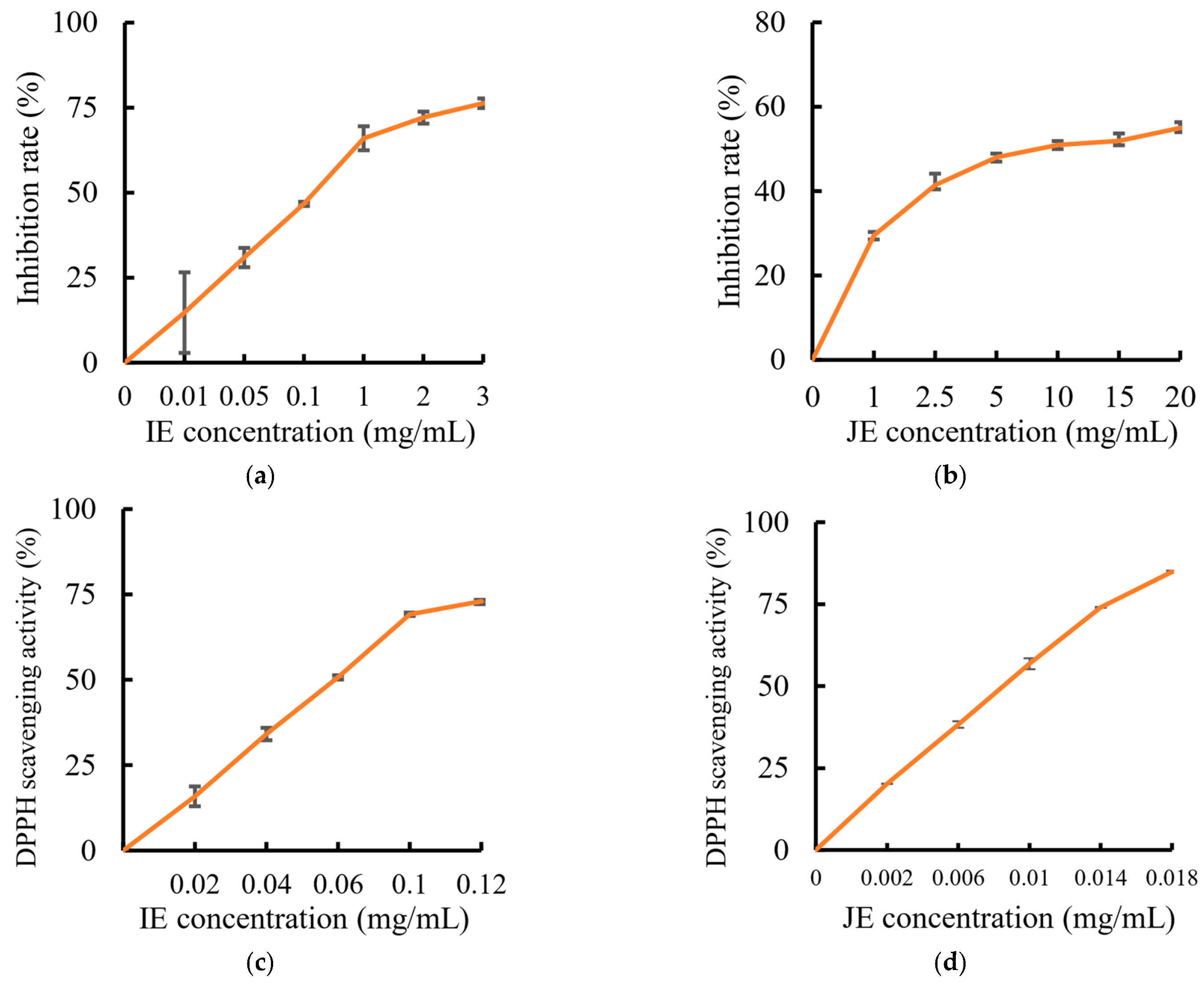
The antifungal and antioxidant activities of Isodon serra extract (IE) and Plinia cauliflora leaf extract (JE) were first examined to assess their suitability as functional components of the coating system. Due to the marked difference in antifungal potency of these two extracts, they were tested over different concentration ranges: 1~20 mg/mL for JE and 0.01~3 mg/mL for IE. As shown in Figure 1 panels a and b, both extracts inhibited mycelial growth; with the rise in extract concentration, the antibacterial efficacy improved progressively. Despite being evaluated at substantially lower concentrations, IE showed markedly stronger antifungal activity than JE, with the inhibition rate reaching 65.99% at 1.00 mg/mL, whereas JE showed only 29.55% inhibition at the same concentration. At the highest tested concentrations, the inhibition rates of IE and JE reached 76.29% and 54.97%, respectively. Diterpenoids, which are abundantly present in Isodon species, have been reported to exhibit significant antibacterial activity [35]. In particular, the antibacterial activity of enmein has been attributed to its cyclopentanone moiety conjugated with an exo-methylene group. For the antioxidant activity experiment, different effective concentration ranges of the two extracts were assessed. As shown in Figure 1c,d, JE showed notably stronger antioxidant activity than IE, with scavenging activity increasing from 20.20% to 84.87%. In comparison, IE increased from 15.87% to 73.00%. It is noteworthy that extracts were assayed over different concentration ranges: JE was tested in the range of 0.002~0.018 mg/mL, whereas IE was tested in the range of 0.02~0.12 mg/mL (10× higher than that of JE). Duarte et al. demonstrated that the TPC in jaboticaba leaves reached 79.69–145.04 mg/g on a dry weight basis [36]. Plant phenolics function as antioxidants primarily due to the hydrogen-donating capacity of their hydroxyl groups, as well as their ability to donate electrons to terminate free radical chain reactions.
Our results reveal a distinct functional divergence between the two extracts: IE primarily exhibits antifungal properties, while JE predominantly acts as an antioxidant agent. These properties provide a complementary foundation that can be understood in light of their chemical compositions. The strong antifungal activity of IE against C. musae is likely attributable to its rich content of diterpenoids (e.g., miltirone, sugiol, kirenol) and phenolic acids (e.g., rosmarinic acid, ethyl gallate), which have been reported to disrupt fungal cell membrane integrity and inhibit spore germination [37,38]. On the other hand, the potent antioxidant capacity of JE is consistent with its high total phenolic and flavonoid contents, particularly the abundance of dihydromyricetin, chlorogenic acid isomers, and ellagic acid—compounds well known for their free radical scavenging and metal-chelating properties [39,40]. These compositional differences provide a chemical basis for the complementary functional roles of IE and JE in the composite coating system.

3.3. Antifungal and Antioxidant Activities of Coating Solutions After Storage

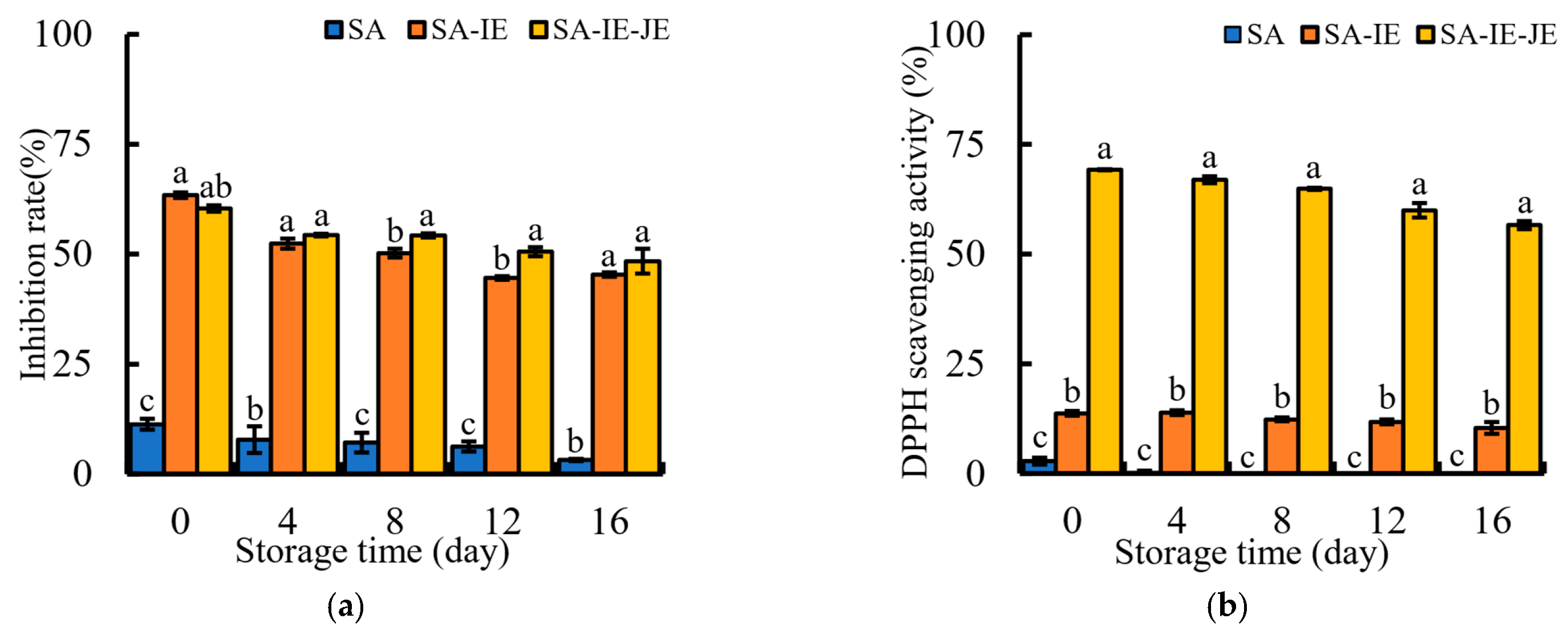
The functional stability of the coating solutions during storage was further evaluated in our study. As shown in Figure 2a, both SA-IE and SA-IE-JE exhibited higher inhibitory activity against C. musae than SA alone, indicating that the antifungal activity of IE was preserved after its incorporation into the coating solution. At the initial stage, no significant difference was observed between SA-IE and SA-IE-JE. However, antifungal activity declined gradually during storage in both formulations. By 16 days of storage, the inhibition rates of SA-IE and SA-IE-JE had decreased by 28.46% and 19.84%, respectively. A similar trend was observed for antioxidant activity (DPPH radical scavenging capacity, Figure 2b). SA-IE-JE showed higher DPPH radical scavenging activity than SA-IE, confirming that the major contribution to antioxidant performance came from JE in the coating solution. During storage, antioxidant activity gradually decreased in both formulations. The rate of decline was lower in SA-IE-JE than in SA-IE, with decreases of 18.21% and 24.18% by 16 days of storage, respectively. Overall, the combined usage of IE and JE not only improved the initial bioactivity of the SA coating but also improved the retention of functional properties during storage.

3.4. Effects of Coatings on External Appearance and Peel Browning of Banana Fruit

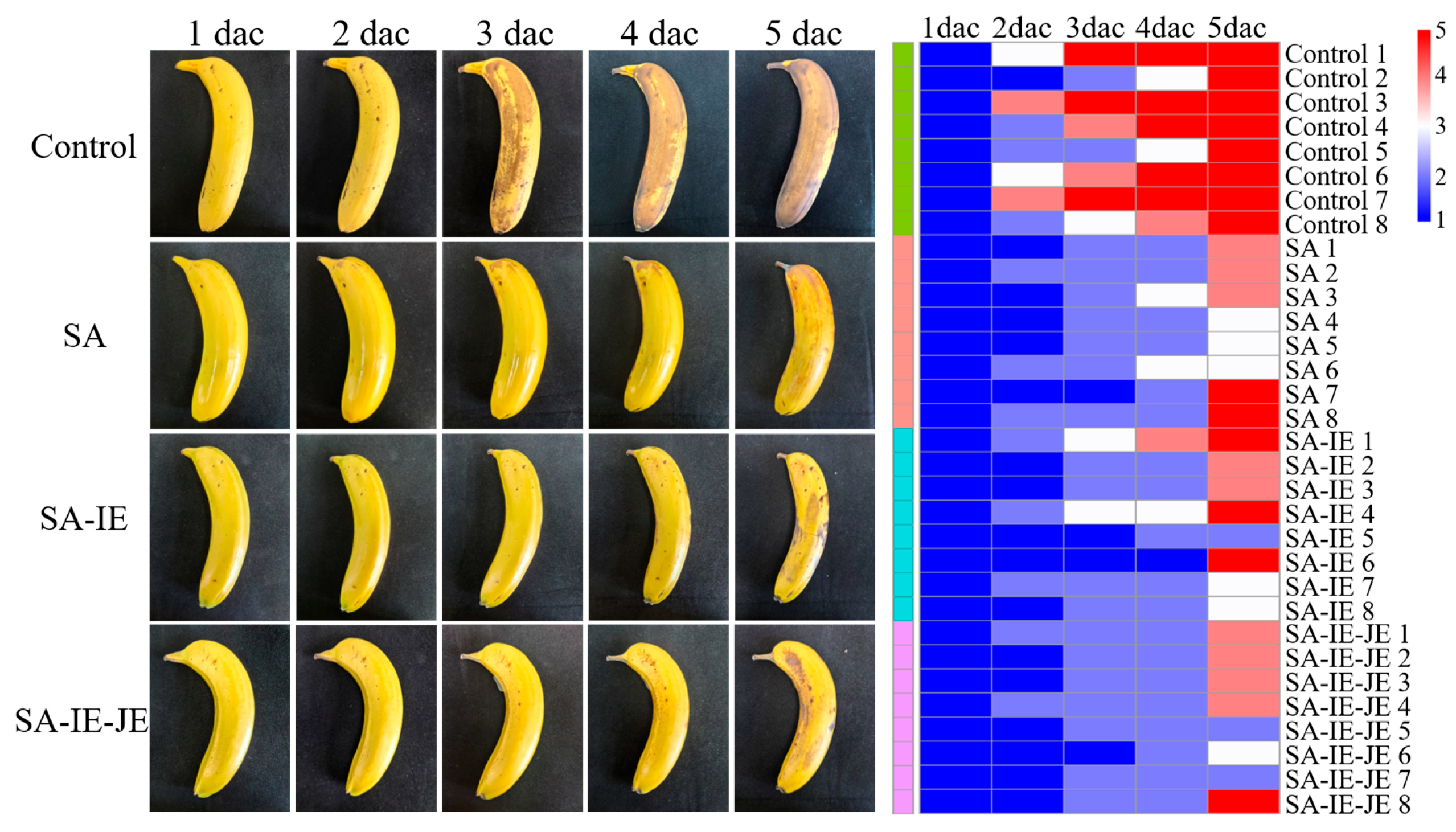
As storage progressed, clear differences in fruit appearance were observed among treatments after coating. All fruits were initially uniform (yellow and free from visible defects) at the beginning of storage (0 days after coating). In the control group, browning symptoms became visible by 2 dac, and peels were largely covered with dark spots by 5 dac, indicating natural ripening and deterioration. In contrast, all coated groups showed better external appearance throughout storage. As shown in Figure 3, the visual images and browning index heatmap showed that SA-IE-JE provided the best preservation of peel appearance. At 5 dac, the browning index of SA-IE-JE was 3.5, lower than those of the control, SA, and SA-IE groups, which were 5.0, 4.0, and 3.8, respectively.
The reduced browning in coated fruit may be associated with the barrier effect of the coating and the additional antioxidant and antifungal activities provided by the plant extracts [41]. Since peel browning in banana is closely related to senescence, oxidation, and microbial infection, the better appearance of coated fruit is coupled with a slower deterioration process. Our results indicate that the combination of IE and JE was more effective than SA alone and slightly more effective than SA-IE in preserving peel appearance.

3.5. Quality Evaluation of Banana Fruit After Coating

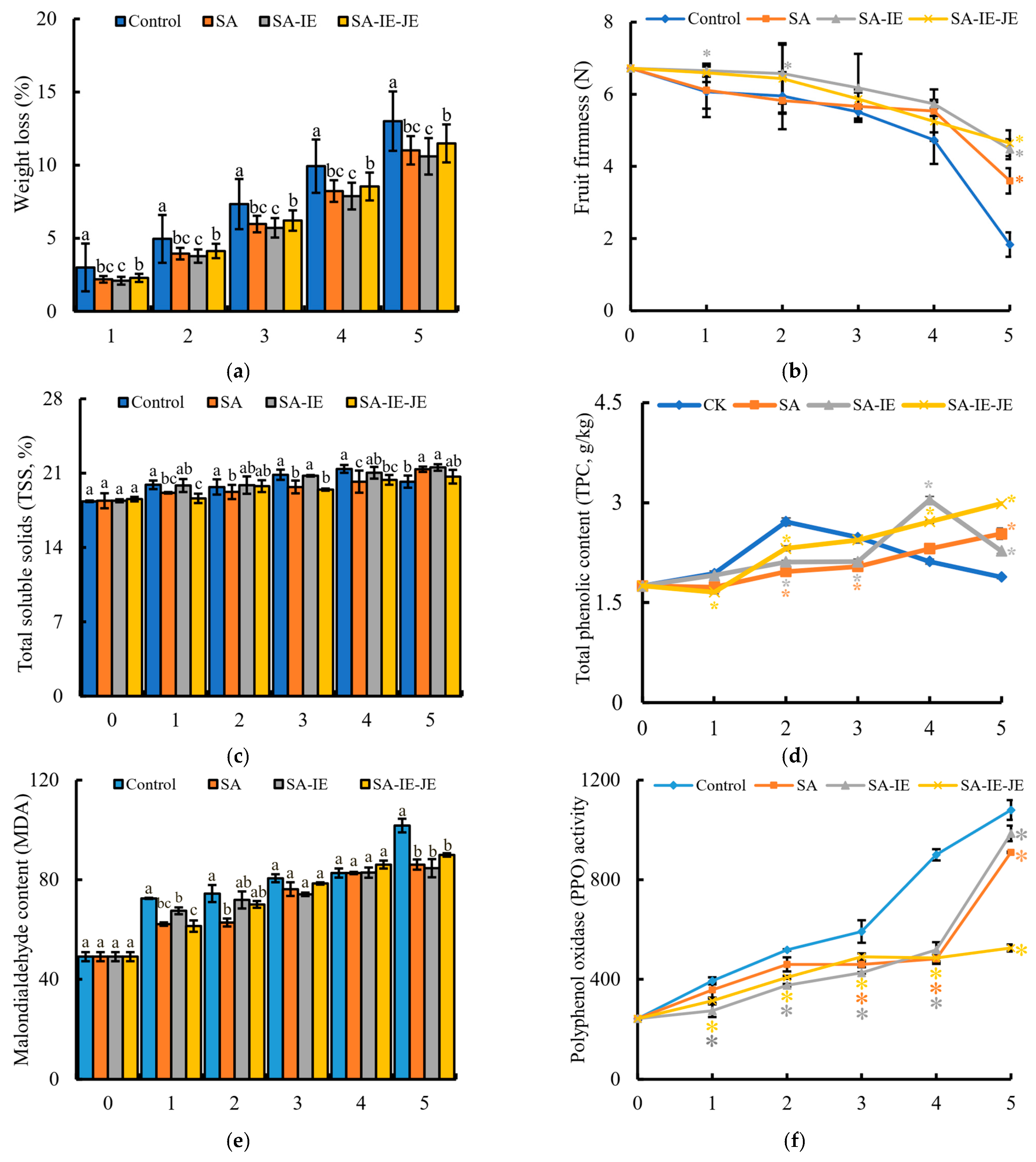
Fruit weight loss. Weight loss increased progressively in all treatments during storage, but the extent of the increase differed among groups, as shown in Figure 4a. At 5 dac, the weight loss of uncoated bananas reached 13.01%, which was higher than that of coated bananas (10.60~11.48%). Among the coating treatments, SA-IE showed the lowest weight loss, indicating the highest water retention effect. Yang et al. found that the water vapor permeability of agar films significantly decreased following the incorporation of red radish extract [42]. This effect was attributed to phenolic compounds in the extract, which form noncovalent hydrophobic interactions with agar, thereby reducing the hydrophilicity of the films. In contrast, SA-IE-JE did not further reduce weight loss and showed slightly higher values than SA. This result indicates that the treatment that provided the strongest overall biological protection was not necessarily the most effective in limiting water loss. In practical terms, the SA-IE formulation appeared to be the most favorable for reducing fruit mass loss, whereas SA-IE-JE provided broader preservation benefits in other quality attributes. These divergent effects can be explained by the distinct chemical compositions of the two extracts. LC-MS profiling revealed that JE is rich in highly hydrophilic phenolic and flavonoid compounds (dihydromyricetin, chlorogenic acid isomers, ellagic acid, rutin, catechin, etc.), whose multiple hydroxyl groups may increase coating hydrophilicity and potentially interfere with Ca2+-mediated “egg-box” crosslinking via hydrogen bonding, reducing film packing density. In contrast, IE contains a higher proportion of relatively lipophilic diterpenoids (miltirone, sugiol, kirenol) that are less likely to disrupt the alginate network. It should be noted that, in future work, direct measurement of water vapor permeability and film microstructure will be required to definitively validate these proposed mechanisms.
Fruit firmness. As shown in Figure 4b, fruit firmness declined in all treatments during storage, reflecting the normal softening process associated with banana ripening. However, coated fruit maintained significantly higher firmness than the control fruit throughout the storage period after coating [43]. Fruit firmness in the control group decreased from 6.72 N at 0 dac to 1.83 N at 5 dac, whereas the values remained at 3.60 N, 4.47 N, and 4.64 N in the SA, SA-IE, and SA-IE-JE groups, respectively. The presented results indicate that our coating solutions effectively delayed fruit softening. Similarly, Yang et al. reported that coated banana fruits showed higher firmness than uncoated fruits [43]. The preservation effect of SA likely arises from its barrier function, which reduces water loss. This physical modulation of the fruit’s surface coating is a plausible factor in the observed delay in ripening-associated tissue softening. The better firmness retention observed in SA-IE and SA-IE-JE further suggests that incorporation of plant extracts into the coating solution improved the overall protective effect and was effective in delaying softening.
Firmness is a critical commercial attribute for banana quality [44]. Therefore, the improved firmness retention in coated fruits further supports the practical value of these formulations for short-term shelf-life extension.
Total soluble solids (TSS). Soluble sugars accumulate when starch is hydrolyzed, so TSS content is commonly used to evaluate fruit ripening [45,46]. At the beginning of this experiment, all fruits were chosen at ripening stage 6; the initial TSS values ranged from 18.35% to 18.55% at 0 dac. As shown in Figure 4c, TSS increased steadily and reached a maximum value of 21.40% at 4 dac in the control group, followed by a decline to 20.20% at 5 dac, indicating that the fruits were overripe. This observation is consistent with the findings of Yang et al., who reported that the content of water-soluble polysaccharides increases during the early stages of storage but decreases rapidly in the later stages [47]. In contrast, TSS accumulation was slower in all coated groups, and none of them had a decline in TSS by 5 dac. SA-IE-JE exhibited the smallest increase in TSS, followed by SA and SA-IE, indicating a greater delay in the ripening process. This trend was consistent with the observed differences in external appearance and firmness, both of which indicated delayed senescence in coated fruit.
Total phenolic content (TPC). As shown in Figure 4d, in the control group, total phenolics increased from 1.75 g/kg FW at 0 dac to a maximum of 2.71 g/kg FW at 2 dac and then gradually declined to 1.89 g/kg FW at 5 dac. A similar increase-then-decrease trend was observed in SA-IE, but the peak was delayed to 4 dac and reached 3.04 g/kg FW. The study by Youryon et al. revealed that the TPC in bananas during the ripening stage was significantly higher than that in the unripe stage, while it slightly decreased in the overripe stage compared to the ripening stage [34]. The initial increase may be attributed to metabolic activation associated with ripening. As ripening progresses, the disintegration of cell wall tissues facilitates the release of cellular enzymes. These enzymes interact with phenolic compounds, resulting in the formation of o-quinones and consequently causing a reduction in TPC [48]. By contrast, the SA and SA-IE-JE groups showed a continuous increase throughout the 5 dac period, reaching 2.53 and 2.98 g/kg FW, respectively. These results suggest that the coating treatment delayed the shift from ripening to overripe and helped maintain or prolong the accumulation of phenolic compounds. Among the coated treatments, SA-IE-JE showed the highest TPC at the end of the post-coating period, suggesting a stronger ability to preserve antioxidant-related metabolites, which agrees well with previous observations of slower browning and better external appearance.
Malondialdehyde accumulation. MDA is a widely used indicator of membrane lipid peroxidation and oxidative damage during senescence [49]. As shown in Figure 4e, MDA content continuously increased in all treatments over the storage period, indicating progressive oxidative deterioration. In the present study, coated bananas accumulated less MDA than the control during most of the storage period. At 5 dac, MDA content reached 101.75 nmol/g FW in the control, whereas the values in SA, SA-IE, and SA-IE-JE were 86.08, 84.63, and 89.96 nmol/g FW, respectively. Yang et al. also reported that the MDA content of all banana fruits presented an increasing trend during storage; however, the rate of increase was significantly lower in coated fruits compared to uncoated fruits [43]. These results demonstrate that coating treatment alleviated oxidative damage during the post-coating period. The lower MDA accumulation in coated fruit is consistent with the overall delay in fruit senescence.
PPO activity. PPO activity is closely associated with enzymatic browning and oxidative changes during fruit ripening [50]. In this study, PPO activity increased significantly throughout storage in all groups, but the increase was substantially greater in the control group than in coated fruits, as shown in Figure 4f. This result aligns with the findings of Deng et al. [27], who reported that composite coatings of SA and whey protein isolate effectively slow the rate of PPO activity increase. By day 5, PPO activity had reached 1080 U/g in the control, compared with 910 U/g in SA, 986 U/g in SA-IE, and 526 U/g in SA-IE-JE. The much lower PPO activity in the SA-IE-JE group indicates that this treatment was particularly effective in suppressing browning-related oxidative processes. Our results indicate that the coating treatment slowed the rise in browning-related enzyme activity and that SA-IE-JE was especially effective in limiting PPO accumulation, which is consistent with its observed superior performance in maintaining peel appearance.
Collectively, the SA-IE-JE coating preserves banana fruit quality through complementary functionality. The SA matrix forms a semi-permeable film via Ca2+-mediated “egg-box” crosslinking that may reduce moisture transfer, effectively retarding ripening-associated softening and TSS accumulation. IE-derived diterpenoids (e.g., miltirone, sugiol, kirenol, tripdiolide) exert prolonged antifungal activity [35,37], which is further augmented by IE phenolic acids via metal chelation and oxidative stress induction [38]. Concurrently, JE phenolics (e.g., dihydromyricetin, ellagic acid, and chlorogenic acid) may contribute to browning suppression through ROS scavenging and by modulating PPO-catalyzed reactions [39,50]. By mitigating lipid peroxidation (reduced MDA), these compounds preserve membrane integrity, maintaining the compartmentalization of PPO and its substrates to delay quality loss and improve preservation performance. Notably, the lipophilic nature of IE diterpenoids minimally interferes with SA crosslinking, accounting for the lowest weight loss being observed in the SA-IE group.

3.6. Suppression of Anthracnose Development by Composite Coatings

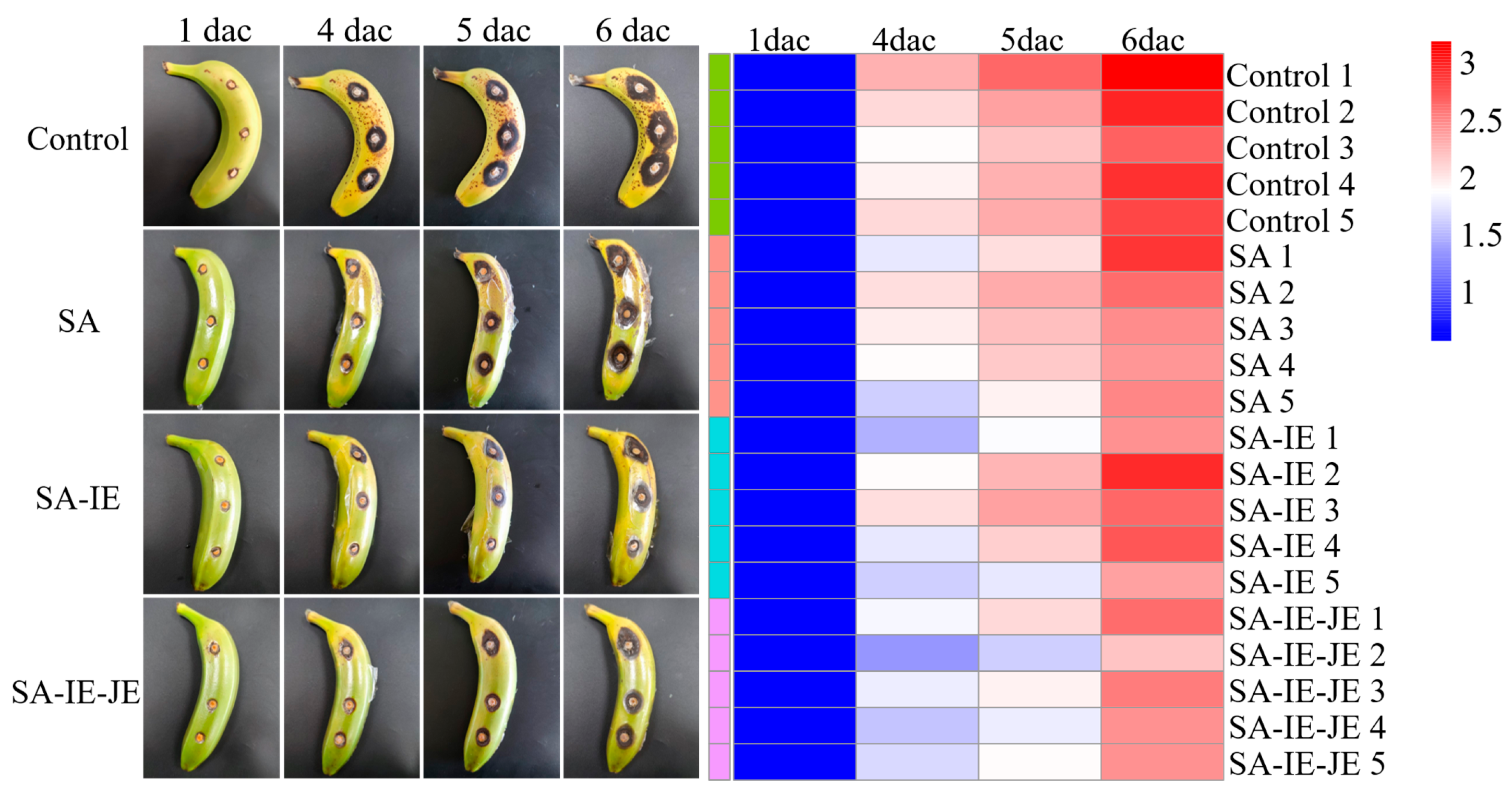
Anthracnose is one of the most important postharvest diseases of banana and greatly affects fruit marketability during storage. As shown in Figure 5, the protective effects of the coatings against anthracnose were examined in artificially inoculated banana fruits. Black, sunken lesions appeared on the fruit surface by 4 dac after inoculation with C. musae, and lesion size increased progressively thereafter. Disease severity was greater in the control than in all coated treatments. At 6 dac, lesion diameters in control, SA, SA-IE, and SA-IE-JE fruits were 2.99, 2.63, 2.58, and 2.49 cm, respectively. Our observations indicate that all coating treatments reduced anthracnose development, with SA-IE-JE showing the strongest suppression. The inhibitory effect of SA alone may be attributed to the formation of a protective barrier on the fruit surface. The improved suppression in SA-IE and SA-IE-JE compared to SA alone is consistent with antifungal activity, whereas the slightly better performance of SA-IE-JE suggests that JE further enhanced the overall protective efficacy of the coating system. Although strictly synergistic interactions were not directly tested, the combined formulation consistently showed the best performance in disease suppression and therefore appears to be the most promising treatment for anthracnose control in postharvest banana.

4. Conclusions

The present study demonstrates that the incorporation of plant-derived extracts into sodium alginate (SA) coatings can effectively improve the postharvest quality and disease resistance of banana fruit. The two extracts investigated in this work, Isodon serra extract (IE) and Plinia cauliflora leaf extract (JE), played distinct but complementary roles in banana preservation. IE exhibited substantially stronger antifungal activity against Colletotrichum musae, whereas JE showed superior antioxidant activity. When integrated into the coating system and applied to banana fruits, this functional complementarity translated into improved preservation performance.
In particular, the composite coating (SA-IE-JE) showed superior effectiveness in reducing peel browning, maintaining phenolic content, delaying TSS accumulation, and limiting PPO activity, while also reducing anthracnose development in vivo. Although the SA-IE formulation was more effective in minimizing weight loss, SA-IE-JE consistently provided broader protection across multiple quality attributes, indicating a more balanced preservation effect. However, the three coating formulations did not perform identically across all indices. SA-IE was the most effective in reducing weight loss and also showed the lowest final MDA content, whereas SA-IE-JE provided the best overall preservation performance, particularly in maintaining peel appearance, retaining total phenolics, suppressing PPO activity, and reducing anthracnose lesion expansion.

5. Limitations and Future Perspectives

Although the SA-IE-JE coating demonstrated promising preservation performance, several limitations should be acknowledged. First, the physicochemical properties of the coating, including thickness, water vapor permeability, mechanical strength, and surface morphology, were not systematically characterized. In addition, the interactions between coating structure and mass transfer, as well as the molecular responses of banana tissues to coating application, remain unclear. Future studies should investigate these aspects to better elucidate the mechanisms underlying coating performance.
Furthermore, although the SA-IE-JE coating exhibited advantages over previously reported plant-extract-enriched edible coatings, direct comparisons with commercial coating products under standardized storage conditions were beyond the scope of this study. Future work should include pilot-scale validation, cost–benefit analysis, and sensory evaluation to facilitate commercial application.

Supplementary Materials

The following supporting information can be downloaded at https://www.mdpi.com/article/10.3390/pr14172698/s1: Dataset S1: Identified metabolites from the widely targeted metabolomics profiling of IE; Dataset S2: Validated UHPLC-MS/MS quantification of major phenolic and flavonoid compounds in JE.

Author Contributions

Conceptualization, M.W. and H.H.; methodology, M.W. and H.H.; formal analysis, M.W., Q.L. and S.Z.; investigation, M.W., Q.L., J.H., H.L. and S.Z.; data curation, M.W.; resources, S.W.; writing—original draft preparation, M.W. and H.H.; writing—review and editing, H.H. and S.W.; supervision, S.W.; funding acquisition, M.W. All authors have read and agreed to the published version of the manuscript.

Funding

This research was funded by the Fujian Provincial Department of Science and Technology, grant number 2023R1028003; the Zhangzhou Department of Science and Technology, grant number ZZ2023J10; and the Fujian Academy of Agricultural Sciences, grant number DKBF2026013.

Data Availability Statement

The original contributions presented in this study are included in the article/Supplementary Materials. Further inquiries can be directed to the corresponding authors.

Conflicts of Interest

The authors declare no conflicts of interest.

References

  1. Khaskheli, S.G.; Soomro, A.H.; Mari, N.U.N.; Khaskheli, A.A.; Soomro, S.; Nawaz, S.; Khaskheli, S.G.; Tufail, T. Banana and Its By-products: A Comprehensive Overview of Nutritional Value and Beneficial Effects. In Importance of Plant Based Byproducts: Nutritional and Functional Properties; Bader Ul Ain, H., Tufail, T., Saeed, F., Ansar Rasul Suleria, H., Eds.; Springer Nature: Cham, Switzerland, 2026; pp. 25–43. [Google Scholar] [CrossRef] [Scilit]
  2. Xiao, L.; Jiang, X.; Deng, Y.; Xu, K.; Duan, X.; Wan, K.; Tang, X. Study on Characteristics and Lignification Mechanism of Postharvest Banana Fruit during Chilling Injury. Foods 2023, 12, 1097. [Google Scholar] [CrossRef] [Scilit] [PubMed]
  3. Murmu, S.B.; Mishra, H.N. Post-harvest shelf-life of banana and guava: Mechanisms of common degradation problems and emerging counteracting strategies. Innov. Food Sci. Emerg. Technol. 2018, 49, 20–30. [Google Scholar] [CrossRef] [Scilit]
  4. Salehi, F. Edible Coating of Fruits and Vegetables Using Natural Gums: A Review. Int. J. Fruit Sci. 2020, 20, S570–S589. [Google Scholar] [CrossRef] [Scilit]
  5. Perez-Vazquez, A.; Barciela, P.; Carpena, M.; Prieto, M.A. Edible Coatings as a Natural Packaging System to Improve Fruit and Vegetable Shelf Life and Quality. Foods 2023, 12, 3570. [Google Scholar] [CrossRef] [Scilit] [PubMed]
  6. Ammar, E.E.; Zou, X.; Ghosh, S.; Onyeaka, H.; Elmasry, S.A.; Alkeay, A.M.; Al-Farga, A.; Rady, H.A.; El-Shershaby, N.A.; Sallam, A.S. Fresh Futures: Cutting-Edge Eco-Friendly Coating Techniques for Fruits. J. Food Process. Preserv. 2025, 2025, 5201632. [Google Scholar] [CrossRef] [Scilit]
  7. Zhao, M.; Han, P.; Mu, H.; Sun, S.; Dong, J.; Sun, J.; Lu, S.; Wang, Q.; Ji, H. Food packaging films from natural polysaccharides and protein hydrogels: A comprehensive review. Food Chem. X 2025, 25, 102174. [Google Scholar] [CrossRef] [Scilit] [PubMed]
  8. Li, H.; Liu, C.; Sun, J.; Lv, S. Bioactive Edible Sodium Alginate Films Incorporated with Tannic Acid as Antimicrobial and Antioxidative Food Packaging. Foods 2022, 11, 3044. [Google Scholar] [CrossRef] [Scilit] [PubMed]
  9. Pai, M.; Kumar, A.; Singh, A.; Omar, B.J.; Kothari, A.; Kumar, P.; Tripathi, K.; Gairolla, J. Introduction to Alginate: Biocompatible, Biodegradable, Antimicrobial Nature and Various Applications. In Alginate—Applications and Future Perspectives; Aguiar Severo, I., Bellin Mariano, A., Vargas, J.V.C., Eds.; IntechOpen: London, UK, 2023. [Google Scholar] [CrossRef] [Scilit]
  10. Miao, J.; Lai, Y.; Zhang, Y.; Wei, J.; Fan, K.; Sun, N.; Qin, Z. Sodium Alginate-Based Antibacterial Coatings Reinforced with Quaternized Lignin–Cinnamaldehyde Composite Particles for Fruit Preservation. Foods 2025, 14, 4203. [Google Scholar] [CrossRef] [Scilit] [PubMed]
  11. Chavez-Esquivel, G.; Ángeles-Beltrán, D.; de la Torre, P.M.T.; Cortes-Cordova, D.E.; Huerta-Arcos, L.; de los Santos, P.E. Antimicrobial and antifungal edible coatings with ZnO nanoparticles dispersed in a chitosan-guar gum matrix for hass avocado preservation. Int. J. Biol. Macromol. 2025, 308, 142467. [Google Scholar] [CrossRef] [Scilit] [PubMed]
  12. Hmmam, I.; Abdallatif, A.; Mamdouh, B.M.; Ali, M.A. Innovative silver-salicylic acid nanoparticle coatings based on CMC and chitosan for mango (Mangifera indica L. cv. “Fajri Klan”) fruit preservation. Sci. Rep. 2026, 16, 15480. [Google Scholar] [CrossRef] [Scilit] [PubMed]
  13. Bajaj, K.; Adhikary, T.; Gill, P.P.S.; Kumar, A. Edible coatings enriched with plant-based extracts preserve postharvest quality of fruits: A review. Prog. Org. Coat. 2023, 182, 107669. [Google Scholar] [CrossRef] [Scilit]
  14. Gupta, D.; Lall, A.; Kumar, S.; Patil, T.D.; Gaikwad, K.K. Plant-based edible films and coatings for food-packaging applications: Recent advances, applications, and trends. Sustain. Food Technol. 2024, 2, 1428–1455. [Google Scholar] [CrossRef] [Scilit]
  15. Zhou, W.; Xie, H.; Xu, X.; Liang, Y.; Wei, X. Phenolic constituents from Isodon lophanthoides var. graciliflorus and their antioxidant and antibacterial activities. J. Funct. Foods 2014, 6, 492–498. [Google Scholar] [CrossRef] [Scilit]
  16. Li, B.; Hu, J.; Ji, C.; Wu, J. Diterpenoids from Isodon serra with promising anti-MRSA activities. Int. Microbiol. 2025, 28, 1005–1018. [Google Scholar] [CrossRef] [Scilit] [PubMed]
  17. Liu, X.; Bian, Z.; Tian, Y.; Li, H.; Hu, S.; Li, C.; Pandey, P.; Ferreira, D.; Chittiboyina, A.G.; Hamann, M.T.; et al. Six new diterpenoids with anti-inflammatory and cytotoxic activity from Isodon serra. Fitoterapia 2024, 176, 106019. [Google Scholar] [CrossRef] [Scilit] [PubMed]
  18. Zhang, Y.-L.; Fang, Z.-Z.; Ye, X.-F.; Pan, S.-L. Identification of candidate genes involved in anthocyanin accumulation in the peel of jaboticaba (Myrciaria cauliflora) fruits by transcriptomic analysis. Gene 2018, 676, 202–213. [Google Scholar] [CrossRef] [Scilit] [PubMed]
  19. da Silva-Maia, J.K.; Nagalingam, A.; Cazarin, C.B.B.; Marostica Junior, M.R.; Sharma, D. Jaboticaba (Myrciaria jaboticaba) peel extracts induce reticulum stress and apoptosis in breast cancer cells. Food Chem. Mol. Sci. 2023, 6, 100167. [Google Scholar] [CrossRef] [Scilit] [PubMed]
  20. Xu, S.; Pang, Y.; Cai, X.; Chen, Q.; Jin, G.; Zhang, M.; Huang, L. Comparative study of three cultivars of jaboticaba berry: Nutrient, antioxidant and volatile compounds. Front. Plant Sci. 2023, 14, 1105373. [Google Scholar] [CrossRef] [Scilit] [PubMed]
  21. Zakaria, L.; Sahak, S.; Zakaria, M.; Salleh, B. Characterisation of colletotrichum species associated with anthracnose of banana. Trop. Life Sci. Res. 2009, 20, 119–125. [Google Scholar] [PubMed] [PubMed Central]
  22. Balendres, M.A.; Mendoza, J.; Dela Cueva, F. Characteristics of Colletotrichum musae PHBN0002 and the susceptibility of popular banana cultivars to postharvest anthracnose. Indian Phytopathol. 2020, 73, 57–64. [Google Scholar] [CrossRef] [Scilit]
  23. Singh, B.; Suri, K.; Shevkani, K.; Kaur, A.; Kaur, A.; Singh, N. Enzymatic Browning of Fruit and Vegetables: A Review. In Enzymes in Food Technology: Improvements and Innovations; Kuddus, M., Ed.; Springer: Singapore, 2018; pp. 63–78. [Google Scholar] [CrossRef] [Scilit]
  24. Rasane, P.; Singh, J.; Kaur, S.; Bakshi, M.; Gunjal, M.; Kaur, J.; Sharma, K.; Sachan, S.; Singh, A.; Bhadariya, V.; et al. Strategic Advances in the Management of Browning in Fruits and Vegetables. Food Bioprocess Technol. 2024, 17, 325–350. [Google Scholar] [CrossRef] [Scilit]
  25. Bhutia, D.D.; Zhimo, Y.; Kole, R.; Saha, J. Antifungal activity of plant extracts against Colletotrichum musae, the post harvest anthracnose pathogen of banana cv. Martaman. Nutr. Food Sci. 2016, 46, 2–15. [Google Scholar] [CrossRef] [Scilit]
  26. Yang, C.; Lu, J.-H.; Xu, M.-T.; Shi, X.-C.; Song, Z.-W.; Chen, T.-M.; Herrera-Balandrano, D.D.; Zhang, Y.-J.; Laborda, P.; Shahriar, M.; et al. Evaluation of chitosan coatings enriched with turmeric and green tea extracts on postharvest preservation of strawberries. LWT 2022, 163, 113551. [Google Scholar] [CrossRef] [Scilit]
  27. Deng, P.; Zhang, Y.; Deng, Q.; Sun, Y.; Li, Y.; Wang, Z.; Jiang, F. Multifunctional sodium alginate-based self-healing edible cross-linked coating for banana preservation. Food Hydrocoll. 2024, 151, 109753. [Google Scholar] [CrossRef] [Scilit]
  28. Qiao, Y.; Xu, L.; Xu, G.; Cao, Y.; Gao, Y.; Wang, Y.; Feng, J. Efficacy and potential mechanism of hinokitiol against postharvest anthracnose of banana caused by Colletotrichum musae. LWT 2022, 161, 113334. [Google Scholar] [CrossRef] [Scilit]
  29. Tang, W.; Xing, Z.; Li, C.; Wang, J.; Wang, Y. Molecular mechanisms and in vitro antioxidant effects of Lactobacillus plantarum MA2. Food Chem. 2017, 221, 1642–1649. [Google Scholar] [CrossRef] [Scilit] [PubMed]
  30. Ringer, T.; Blanke, M. Non-invasive real time, in-situ determination of banana ripening stages. J. Food Meas. Charact. 2021, 13, 37–45. [Google Scholar] [CrossRef] [Scilit]
  31. Lan, W.; He, L.; Liu, Y. Preparation and Properties of Sodium Carboxymethyl Cellulose/Sodium Alginate/Chitosan Composite Film. Coatings 2018, 8, 291. [Google Scholar] [CrossRef] [Scilit]
  32. Mou, L.; Lu, Y.; Xi, Y.; Li, G.; Li, J. Sodium alginate-based coating incorporated with Anemone vitifolia Buch.-Ham. extract: Application in peach preservation. Ind. Crops Prod. 2022, 176, 114329. [Google Scholar] [CrossRef] [Scilit]
  33. Alali, A.A.; Awad, M.A.; Al-Qurashi, A.D.; Mohamed, S.A. Postharvest gum Arabic and salicylic acid dipping affect quality and biochemical changes of ‘Grand Nain’ bananas during shelf life. Sci. Hortic. 2018, 237, 51–58. [Google Scholar] [CrossRef] [Scilit]
  34. Youryon, P.; Supapvanich, S. Physicochemical quality and antioxidant changes in ‘Leb Mue Nang’ banana fruit during ripening. Agric. Nat. Resour. 2017, 51, 47–52. [Google Scholar] [CrossRef] [Scilit]
  35. Sun, H.-D.; Huang, S.-X.; Han, Q.-B. Diterpenoids from Isodon species and their biological activities. Nat. Prod. Rep. 2006, 23, 673–698. [Google Scholar] [CrossRef] [Scilit] [PubMed]
  36. Duarte, A.; Santos, S.; Seraphin, J.; Ferri, P. Environmental influence on phenols and essential oils of Myrciaria cauliflora leaves. J. Braz. Chem. Soc. 2010, 21, 1672–1680. [Google Scholar] [CrossRef] [Scilit]
  37. Ino, M.; Kihara, J.; Ishihara, A.; Ueno, M. Mechanism of the antifungal activity of the diterpenoid aldehyde traversianal against cucumber anthracnose fungus Colletotrichum orbiculare. J. Gen. Plant Pathol. 2025, 91, 351–358. [Google Scholar] [CrossRef] [Scilit]
  38. Zhang, J.; Han, R.-Y.; Ye, H.-C.; Zhou, Y.; Zhang, Z.-K.; Yuan, E.-L.; Li, Y.; Yan, C.; Liu, X.; Feng, G.; et al. Effect of pseudolaric acid B on biochemical and physiologic characteristics in Colletotrichum gloeosporioides. Pestic. Biochem. Physiol. 2018, 147, 75–82. [Google Scholar] [CrossRef] [Scilit] [PubMed]
  39. Scarano, A.; Laddomada, B.; Blando, F.; De Santis, S.; Verna, G.; Chieppa, M.; Santino, A. The Chelating Ability of Plant Polyphenols Can Affect Iron Homeostasis and Gut Microbiota. Antioxidants 2023, 12, 630. [Google Scholar] [CrossRef] [Scilit] [PubMed]
  40. Leopoldini, M.; Marino, T.; Russo, N.; Toscano, M. Antioxidant Properties of Phenolic Compounds:  H-Atom versus Electron Transfer Mechanism. J. Phys. Chem. A 2004, 108, 4916–4922. [Google Scholar] [CrossRef] [Scilit]
  41. Lekshmi, S.G.; Sethi, S.; Asrey, R.; Singh, D.; Nagaraja, A.; Kumar, R.; Singh, K.P.; Sindhu, P.M.; Singh, A.K.; Raghavendra, H.R. Active edible coatings with plant extracts rich in phenolic compounds to enhance guava storage quality by boosting defense against postharvest fungi. J. Food Meas. Charact. 2026, 20, 3393–3408. [Google Scholar] [CrossRef] [Scilit]
  42. Yang, Z.; Zhai, X.; Zhang, C.; Shi, J.; Huang, X.; Li, Z.; Zou, X.; Gong, Y.; Holmes, M.; Povey, M.; et al. Agar/TiO2/radish anthocyanin/neem essential oil bionanocomposite bilayer films with improved bioactive capability and electrochemical writing property for banana preservation. Food Hydrocoll. 2022, 123, 107187. [Google Scholar] [CrossRef] [Scilit]
  43. Yang, Z.; Li, M.; Zhai, X.; Zhao, L.; Tahir, H.E.; Shi, J.; Zou, X.; Huang, X.; Li, Z.; Xiao, J. Development and characterization of sodium alginate/tea tree essential oil nanoemulsion active film containing TiO2 nanoparticles for banana packaging. Int. J. Biol. Macromol. 2022, 213, 145–154. [Google Scholar] [CrossRef] [Scilit] [PubMed]
  44. Chu, X.; Miao, P.; Zhang, K.; Wei, H.; Fu, H.; Liu, H.; Jiang, H.; Ma, Z. Green Banana Maturity Classification and Quality Evaluation Using Hyperspectral Imaging. Agriculture 2022, 12, 530. [Google Scholar] [CrossRef] [Scilit]
  45. Olawoye, B.; Jolayemi, O.S.; Origbemisoye, B.A.; Oluwajuyitan, T.D.; Popoola-Akinola, O. Hydrolysis of Starch. In Starch: Advances in Modifications, Technologies and Applications; Sharanagat, V.S., Saxena, D.C., Kumar, K., Kumar, Y., Eds.; Springer International Publishing: Cham, Switzerland, 2023; pp. 83–101. [Google Scholar] [CrossRef] [Scilit]
  46. Yu, J.; Tseng, Y.; Pham, K.; Liu, M.; Beckles, D.M. Starch and sugars as determinants of postharvest shelf life and quality: Some new and surprising roles. Curr. Opin. Biotechnol. 2022, 78, 102844. [Google Scholar] [CrossRef] [Scilit] [PubMed]
  47. Yang, J.; Zeng, J.; Wen, L.; Zhu, H.; Jiang, Y.; John, A.; Yu, L.; Yang, B. Effect of morin on the degradation of water-soluble polysaccharides in banana during softening. Food Chem. 2019, 287, 346–353. [Google Scholar] [CrossRef] [Scilit] [PubMed]
  48. Huang, P.-H.; Cheng, Y.-T.; Lu, W.-C.; Chiang, P.-Y.; Yeh, J.-L.; Wang, C.-C.; Liang, Y.-S.; Li, P.-H. Changes in Nutrient Content and Physicochemical Properties of Cavendish Bananas var. Pei Chiao during Ripening. Horticulturae 2024, 10, 384. [Google Scholar] [CrossRef] [Scilit]
  49. Tsikas, D. Assessment of lipid peroxidation by measuring malondialdehyde (MDA) and relatives in biological samples: Analytical and biological challenges. Anal. Biochem. 2017, 524, 13–30. [Google Scholar] [CrossRef] [Scilit] [PubMed]
  50. Zhang, S. Recent Advances of Polyphenol Oxidases in Plants. Molecules 2023, 28, 2158. [Google Scholar] [CrossRef] [Scilit] [PubMed]
Figure 1. Antifungal and antioxidant activities of Isodon serra extract (IE) and Plinia cauliflora leaf extract (JE). (a,b) Inhibitory effects of IE and JE against Colletotrichum musae. (c,d) DPPH radical scavenging activities of IE and JE at different concentrations. Data are presented as mean ± SD (n = 3).
Processes 14 02698 g001
Figure 2. Antifungal and antioxidant activities of coating solutions during storage. (a) Antifungal activities of SA, SA-IE, and SA-IE-JE against Colletotrichum musae. The initial antifungal activities of SA-IE and SA-IE-JE were up to 60.38% and 63.41%. After 16 days of storage, the inhibition rates of SA-IE and SA-IE-JE had decreased to 45.36% and 48.41%, respectively. (b) DPPH radical scavenging activity of coating solutions during storage. The initial DPPH radical scavenging activities of SA-IE and SA-IE-JE were 13.70% and 69.22%, respectively. After 16 days of storage, these values decreased to 10.39% and 56.61%. Coating solutions were stored at 25 °C and 80% relative humidity. Data are presented as mean ± SD (n = 3). One-way analysis of variance (ANOVA) was conducted, followed by the Tukey–Kramer HSD multiple comparison test. Different lowercase letters within the same storage day indicate significant differences among treatments (p < 0.05).
Processes 14 02698 g002
Figure 3. External appearance and peel browning of banana fruit during storage. Representative images of banana fruits in the control, SA, SA-IE, and SA-IE-JE groups at different days after coating (dac), together with the corresponding browning index heatmap. Fruits were stored at 25 °C and 80% relative humidity. The browning index was divided into 5 grades, accordingly. Progressive peel browning and black spot development were observed during storage, with SA-IE-JE showing the best visual preservation effect.
Processes 14 02698 g003
Figure 4. Changes in postharvest quality parameters of banana fruit during storage. Banana fruits treated with distilled water (control), SA, SA-IE, or SA-IE-JE were stored at 25 °C and 80% relative humidity for 5 days. Changes in (a) weight loss, (b) fruit firmness, (c) total soluble solids (TSS), (d) total phenolic content, (e) MDA content, and (f) PPO activity were monitored throughout storage. Data are presented as mean ± SD (n ≥ 3). One-way analysis of variance (ANOVA) was conducted, followed by Tukey–Kramer HSD multiple comparison test. Different lowercase letters within the same storage day indicate significant differences among treatments (p < 0.05). Asterisks denote values significantly different from the Control group (p < 0.05).
Processes 14 02698 g004
Figure 5. Effects of coating treatments on anthracnose development in banana fruits during storage. Representative lesion symptoms, lesion diameter, and the corresponding heatmap of banana fruits inoculated with Colletotrichum musae and treated with control, SA, SA-IE, or SA-IE-JE. Fruits were stored at 25 °C and 80% relative humidity. Lesion diameter was measured periodically to evaluate disease progression. Data are presented as mean ± SD (n = 3).
Processes 14 02698 g005
Disclaimer/Publisher’s Note: The statements, opinions and data contained in all publications are solely those of the individual author(s) and contributor(s) and not of MDPI and/or the editor(s). MDPI and/or the editor(s) disclaim responsibility for any injury to people or property resulting from any ideas, methods, instructions or products referred to in the content.