Load Characteristics of Mechanical Cutters When Cutting Different Coal and Rock Formations and Entropy Features of the Samples

Abstract
1. Introduction
2. Establishment of the Finite Element Model for Drum Cutting of Coal and Rock
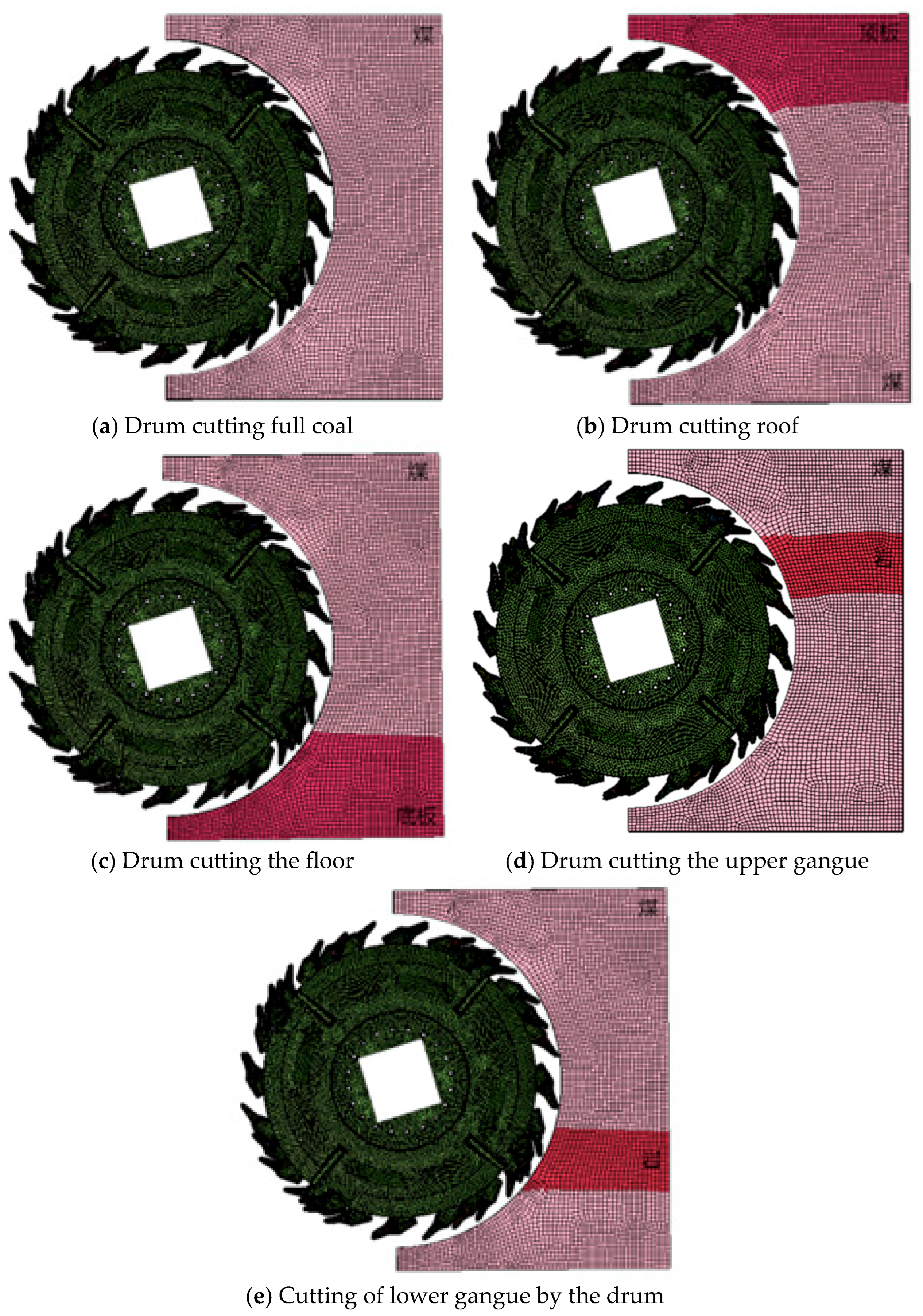
2.1. Finite Element Mesh Generation
2.2. Material Definition and Failure Criteria
2.3. Contact Algorithms and Boundary Conditions
2.4. Model Validation
3. Loads on the Shearer Drum Under Different Operating Conditions
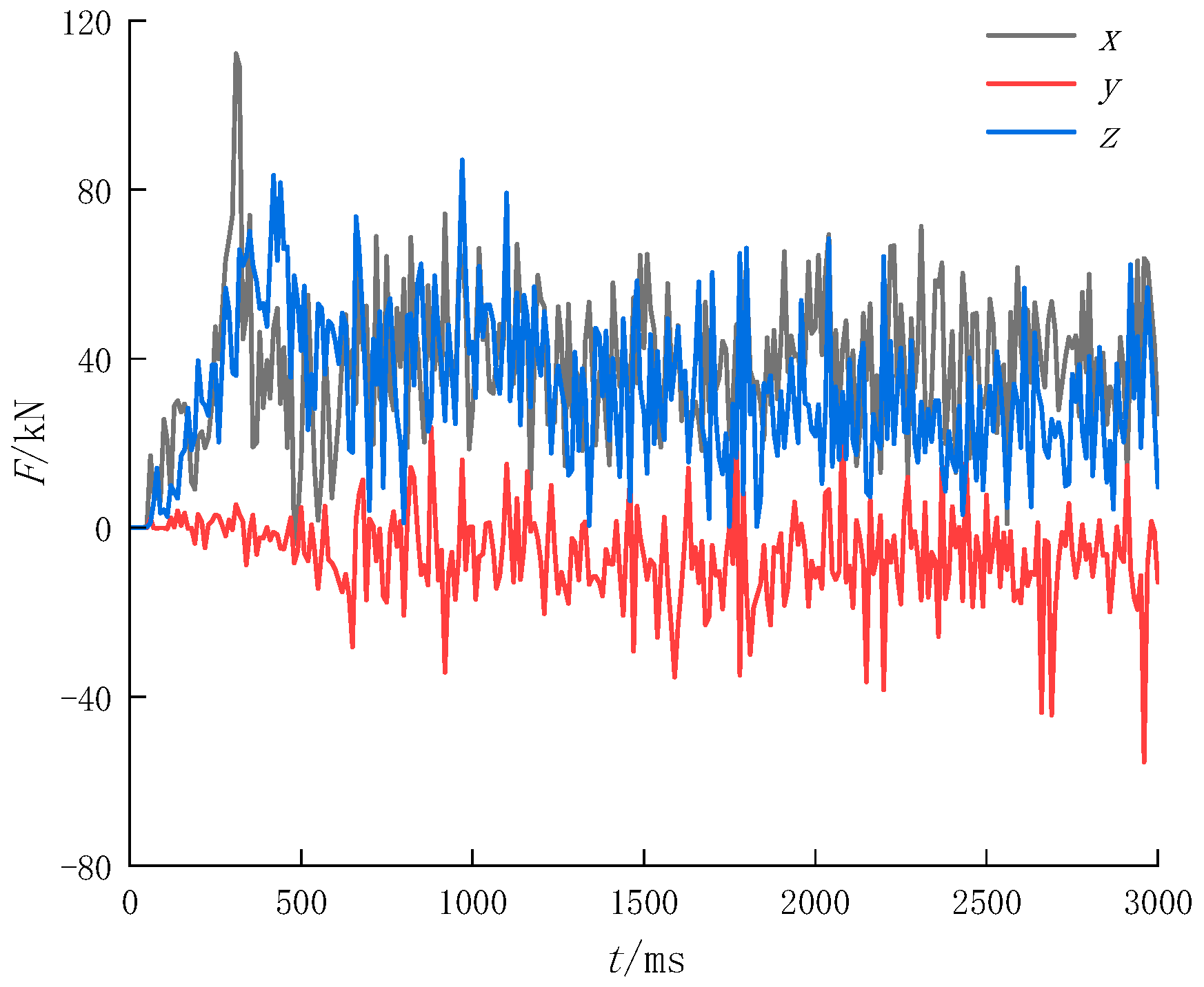
3.1. Drum Cutting of Pure Coal
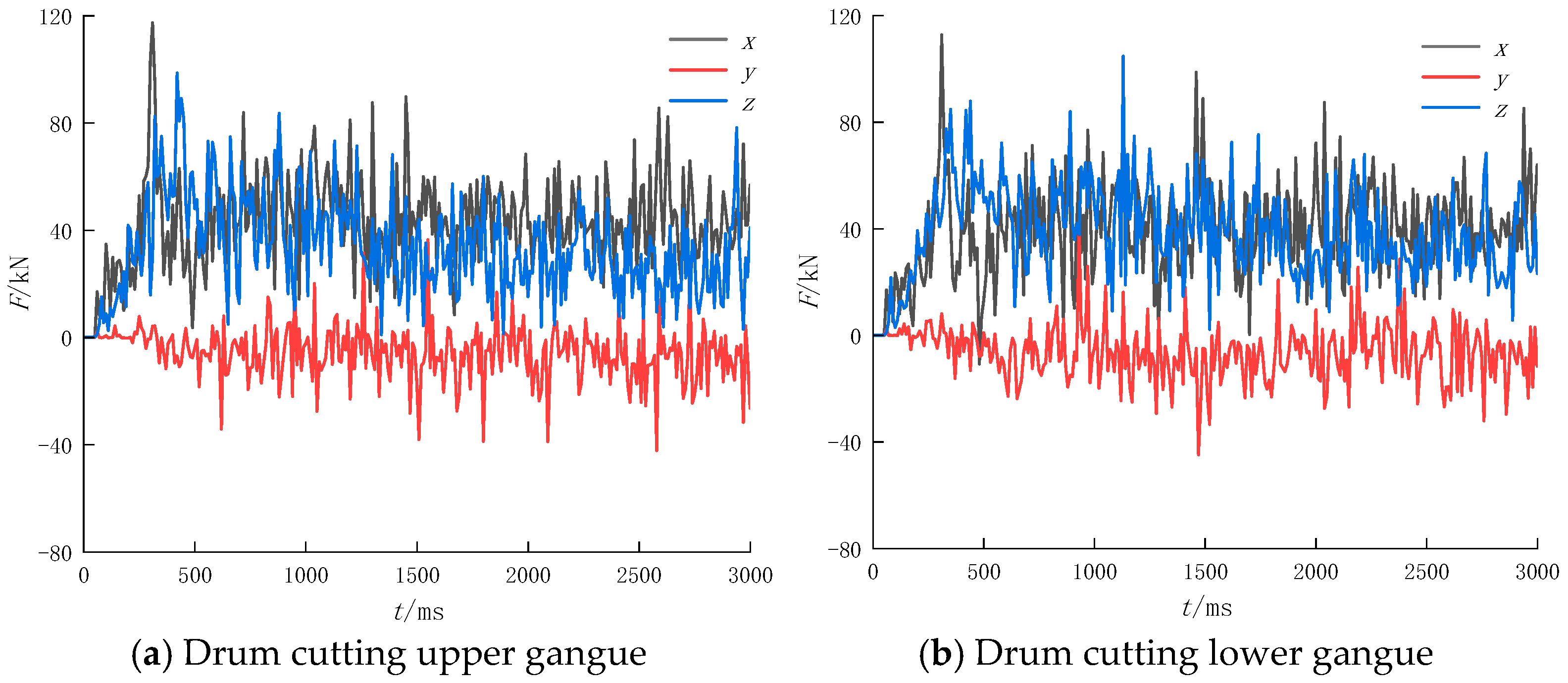
3.2. Drum Cutting of Gangue
3.3. Drum Cutting of Roof and Floor
4. Ensemble Empirical Mode Decomposition Method
4.1. Fundamental Principles of EEMD
4.2. Ensemble Empirical Mode Decomposition
4.2.1. Data Import and Preprocessing
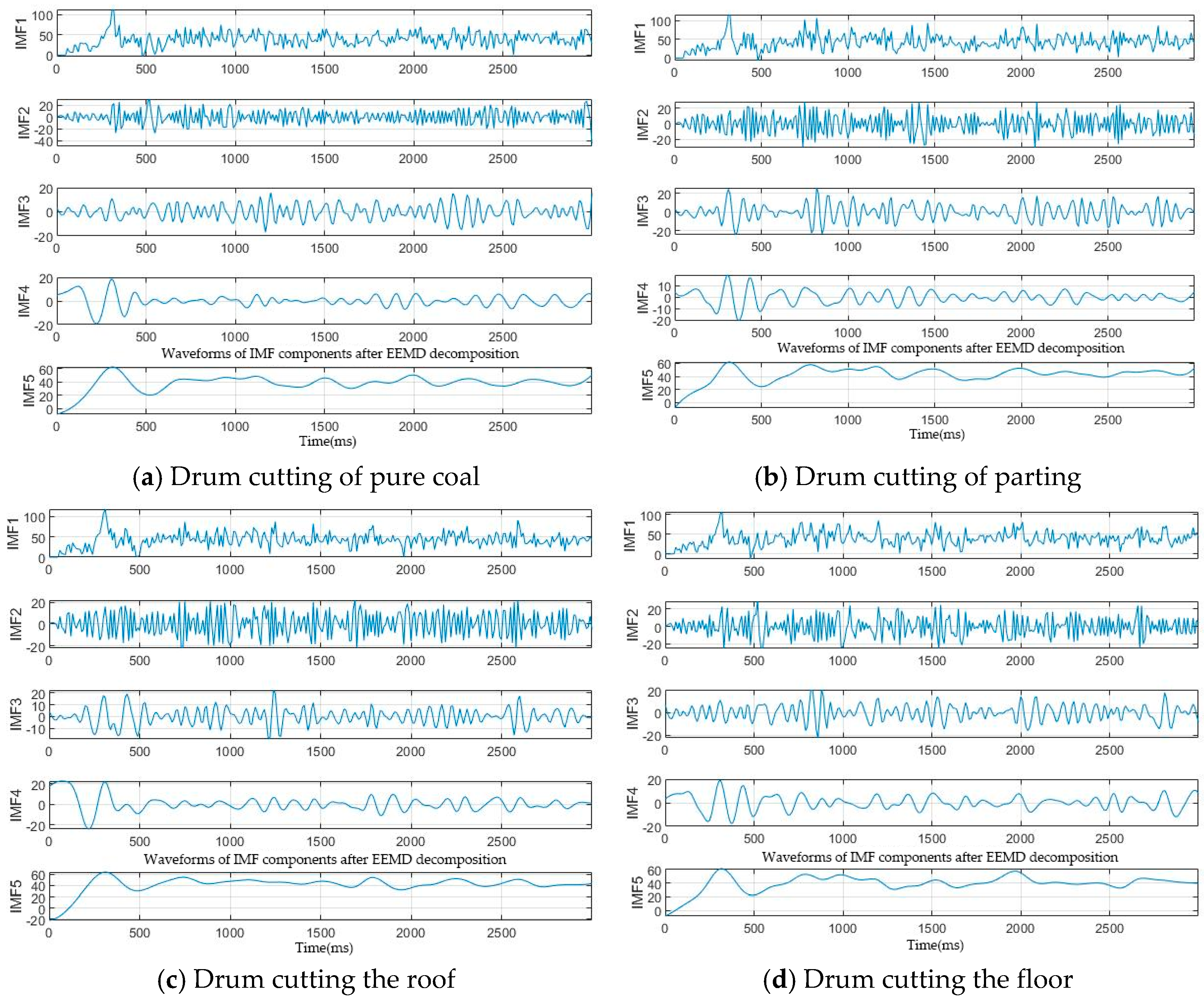
4.2.2. Waveforms of IMF Components and Sample Entropy Calculation
5. Conclusions
- (1)
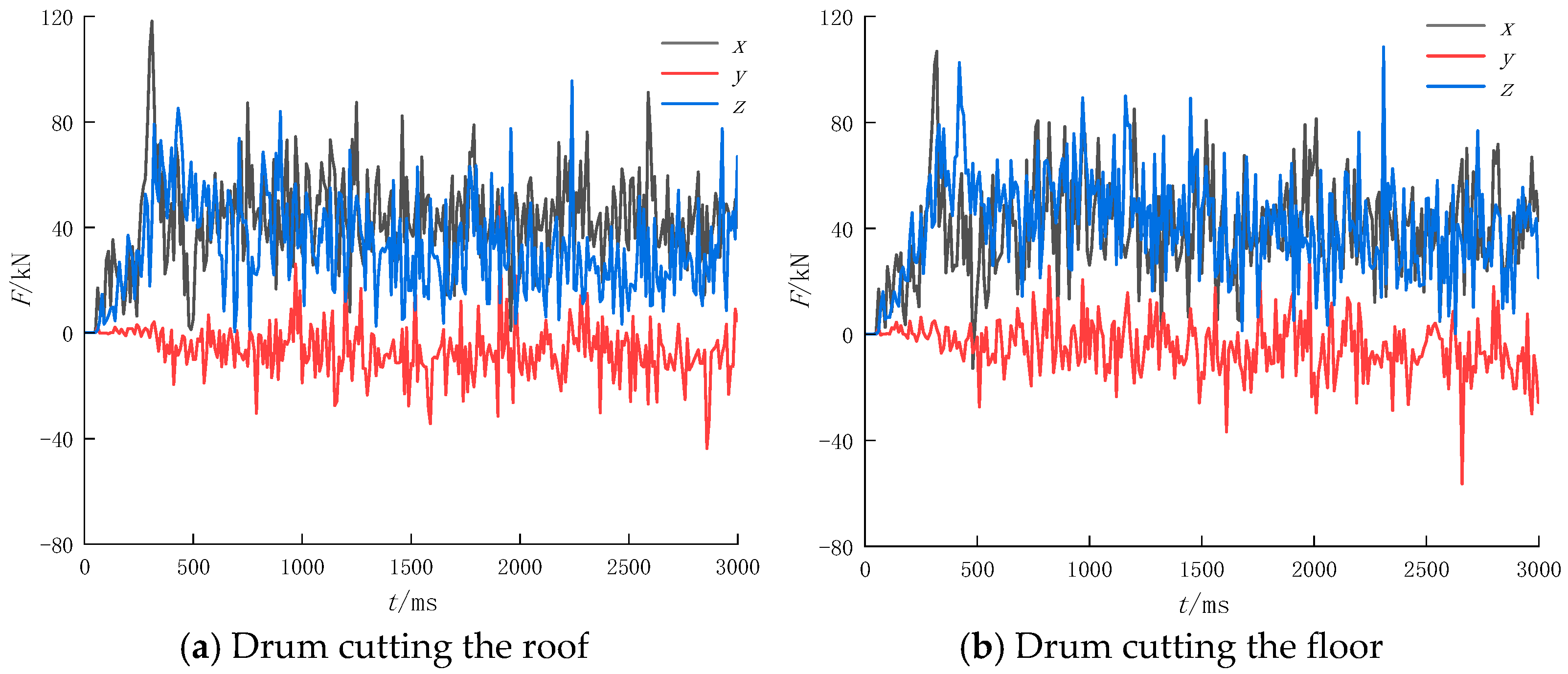
- During coal and rock cutting by the drum, both the cutting resistance and traction resistance initially increase, exhibiting a relatively large peak. Subsequently, as time progresses and the number of active picks increases, the drum enters a stable cutting state. When cutting coal containing gangue, the load on the drum varies with the position of the gangue; under otherwise identical conditions, the gangue position significantly affects the magnitude of the cutting resistance. Coal and rock strength has a pronounced effect on the load. The position of the gangue also exerts a significant influence: upper gangue results in the maximum traction resistance, whereas lower gangue leads to the maximum cutting resistance. Floor cutting induces high loads due to its high compressive strength. The theoretical and simulated cutting resistances for pure coal cutting are 91 kN and 87.0245 kN, respectively, with a relative error of approximately 4.37%, validating the effectiveness of the drum cutting simulation method.
- (2)
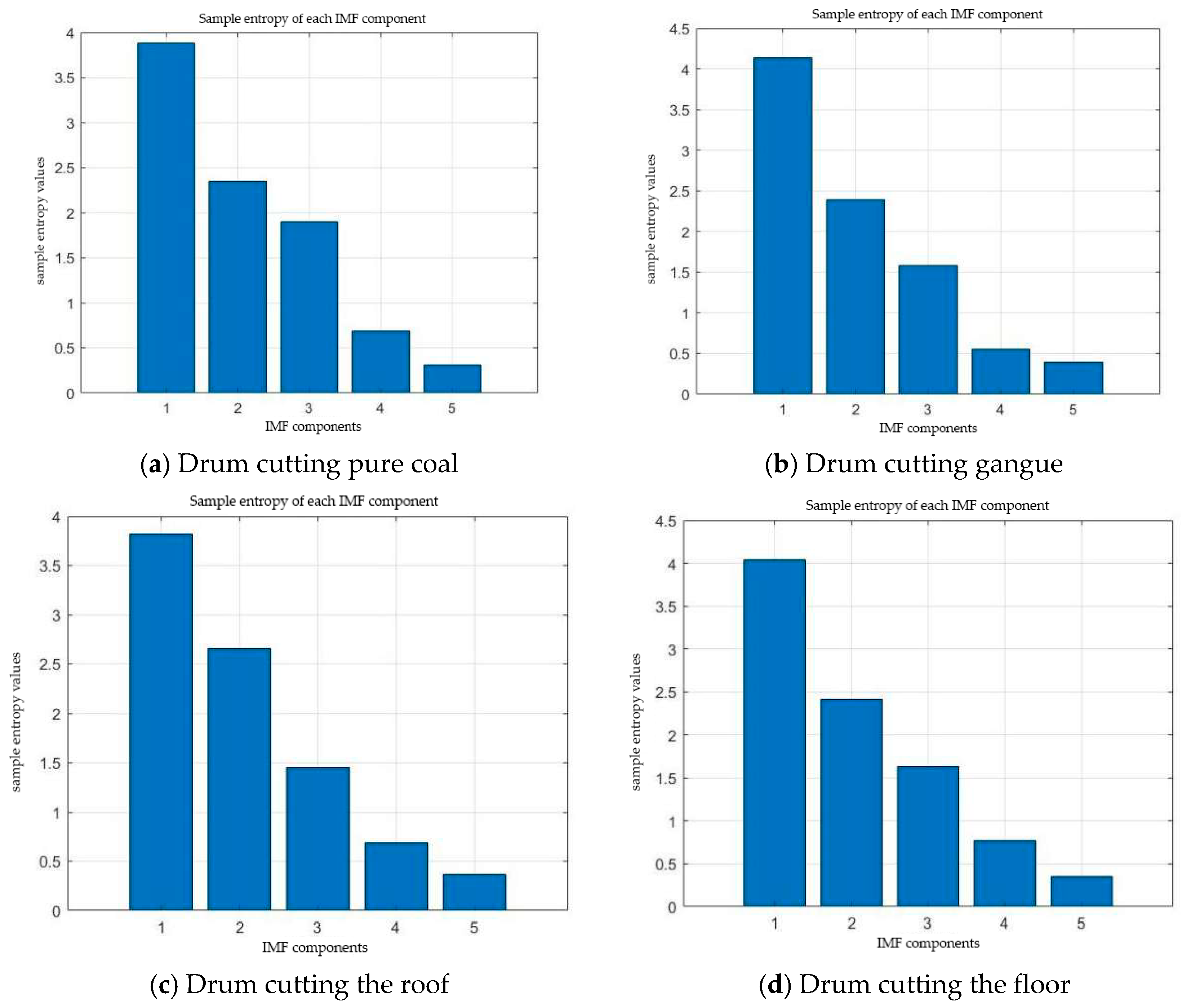
- EEMD analysis of the triaxial loads acting on the drum reveals that the complexity of the traction resistance signal varies across different cutting conditions, with the load during floor cutting exhibiting substantial high-frequency noise and significant fluctuations. The sample entropy of the IMF components obtained via EEMD indicates that the high-frequency components IMF1–2 possess the highest complexity, suggesting the presence of impact characteristics during the cutting process. Among all operating conditions, floor cutting yields the highest sample entropy values for IMF1–2, suggesting that floor cutting imposes the most severe impact loading among the five conditions examined in this study. Based on these findings, we recommend that drum design for seams with upper gangue should strengthen the haulage-direction structural components to withstand elevated traction resistance, while for lower gangue or floor cutting, enhancing the cutting picks and drum body against impact and fatigue is prioritized. For adaptive cutting control, the distinct sample entropy patterns across different cutting media suggest that real-time monitoring of load signal complexity could serve as a basis for automatic recognition of cutting conditions and adjustment of drum speed and haulage speed accordingly.
Author Contributions
Funding
Data Availability Statement
Conflicts of Interest
References
- Liu, J.; Zeng, F.; Zhang, C. Research on the influence of cutting surface characteristics on the cutting load of the conical pick. J. Phys. Conf. Ser. 2024, 2791, 397–412. [Google Scholar] [CrossRef] [Scilit]
- Zhang, M.; Zhao, L.; Li, M.; Tian, Z. Analysis and experimental study on the vibration characteristics of the spiral drum of a shearer based on two-way coupling method. Coal Sci. Technol. 2024, 52, 200–216. [Google Scholar]
- Tian, Z.; Jing, S.X.; Zhao, L.J.; Gao, S.; Zhang, C.G. Research on cutting performance of spiral drum of shearer in thin coal seam. J. Henan Polytech. Univ. (Nat. Sci.) 2020, 39, 80–84. [Google Scholar]
- Liu, X.N.; Zhao, L.J.; Zhou, W.C.; Liu, H.M. Strength analysis of shearer drum cutting coal-rock with gangue based on LS-DYNA. J. Mech. Strength 2019, 41, 1493–1498. [Google Scholar]
- Zhao, L.; Wang, Y.; Wang, B. Analysis and prediction of working performance of shearer spiral drums under coal seam with gangue. China Mech. Eng. 2021, 32, 976–986. [Google Scholar]
- Gao, K.D.; Zhang, X.D.; Sun, L.Q.; Zeng, Q.; Liu, Z. Loading performance of a novel shearer drum applied to thin coal seams. Energies 2021, 14, 358. [Google Scholar] [CrossRef] [Scilit]
- Chen, H.; Yang, X.; Mao, J.; Song, Q.S.; Yuan, Z. Vibration characteristics analysis of shearer under oblique cut on drum test load. J. Vib. Meas. Diagn. 2018, 38, 240–247. [Google Scholar]
- Jamshidi, E.; Kianoush, P.; Hosseini, N.; Adib, A. Scaling-up dynamic elastic logs to pseudo-static elastic moduli of rocks using a wellbore stability analysis approach in the Marun oilfield, SW Iran. Sci. Rep. 2024, 14, 19094. [Google Scholar] [CrossRef] [Scilit] [PubMed]
- Onate, E.; Rojek, J. Combination of discrete element and finite element methods for dynamic analysis of geomechanics problems. Comput. Methods Appl. Mech. Eng. 2004, 193, 3087–3128. [Google Scholar] [CrossRef] [Scilit]
- Cho, J.-W.; Jeon, S.; Yu, S.-H.; Chang, S.-H. Optimum spacing of TBM disc cutters: A numerical simulation using the three-dimensional dynamic fracturing method. Tunn. Undergr. Space Technol. Inc. Trenchless Technol. Res. 2009, 25, 654–664. [Google Scholar] [CrossRef] [Scilit]
- Jin, G.D. Analysis of rock-breaking mechanism by disc cutters on full-face rock tunnel boring machines (Part II). Power Stn. Constr. Mach. 1981, 58, 21–27. [Google Scholar]
- Dewangan, S.; Chattopadhyaya, S.; Hloch, S. Wear assessment of conical pick used in coal cutting operation. Rock Mech. Rock Eng. 2015, 48, 2129–2139. [Google Scholar] [CrossRef] [Scilit]
- Dewangan, S.; Chattopadhyaya, S. Characterization of wear mechanisms in distorted conical picks after coal cutting. Rock Mech. Rock Eng. 2016, 49, 225–242. [Google Scholar] [CrossRef] [Scilit]
- Pradeep, L.; Menezes, M.R.; Lovell, I.V.; Avdeev, C.; Higgs, F. Studies on the formation of discontinuous rock fragments during cutting operation. Int. J. Rock Mech. Min. Sci. 2014, 71, 131–142. [Google Scholar] [CrossRef] [Scilit]
- Menezes, P.L. Influence of friction and rake angle on the formation of built-up edge during the rock cutting process. Int. J. Rock Mech. Min. Sci. 2016, 88, 175–182. [Google Scholar] [CrossRef] [Scilit]
- Korinets, A.R.; Chen, L.; Alehossein, H.; Lim, W. DIANA modeling of a rolling disc cutter and rock indentation. Rock Mech. 1996, 36, 647–652. [Google Scholar]
- Kou, S.Q.; Lindqvist, P.A.; Tang, C.A.; Xu, X.H. Numerical simulation of the cutting of inhomogeneous rocks. Int. J. Rock Mech. Min. Sci. 1999, 36, 711–717. [Google Scholar] [CrossRef] [Scilit]
- Liu, H.Y.; Kou, S.Q.; Lindqvist, P.A.; Tang, C.A. Numerical simulation of the rock fragmentation process induced by indenters. Int. J. Rock Mech. Min. Sci. 2002, 39, 491–505. [Google Scholar] [CrossRef] [Scilit]
- Wang, L.; Liu, H.; Li, M.; Zhou, J.J.; Liu, H.D. Study on cutterhead load and vibration characteristics of shield tunneling modal system in composite strata. Tunn. Constr. 2017, 37, 103–112. [Google Scholar]
- Liu, C.; Shen, Z.; Li, D.; Liu, Y.; Wang, H. Characteristics of load spectra for picks on helical drum blades and end plates of shearers. J. Heilongjiang Univ. Sci. Technol. 2026, 36, 229–239. [Google Scholar]
- Jin, J.; Wang, B.; Yu, M.; Zhang, Y.; Zhang, Y. Adaptive EEMD based on fractal features and its application in wind power forecasting. Acta Energiae Solaris Sin. 2023, 44, 416–424. [Google Scholar]
- Geng, Z.Q.; Wang, Z.; Gu, X.B.; Lin, X.Y. Fault diagnosis method based on residue of ensemble empirical mode decomposition. J. Nanjing Univ. Sci. Technol. 2015, 39, 293–300. [Google Scholar]






| Component | E/GPa | ρ/(kg·m−3) | ν |
|---|---|---|---|
| pick tooth | 600 | 14,600 | 0.22 |
| drum | 600 | 14,600 | 0.22 |
| coal | 2.4 | 1500 | 0.24 |
| gangue | 2.99 | 2282 | 0.29 |
| roof slab | 2.99 | 2282 | 0.29 |
| base plate | 5.47 | 2355 | 0.25 |
| MID | EXCL | MXPRES | MNEPS | EFFEPS | VOLEPS | NUMFIP | NCS |
|---|---|---|---|---|---|---|---|
| 2 | 1234 | 1234 | 1234 | 1234 | 1234 | 1 | 1 |
| MNPRES | SIGP1 | SIGVM | MXEPS | EPSSH | SIGTH | IMPULSE | FAILTM |
| 1234 | 0.02 | 1234 | 1234 | 0.01 | 1234 | 1234 | 1234 |
| IDAM | — | — | — | — | — | — | LCREGD |
| 0 | — | — | — | — | — | — | 0 |
| LCFLD | NSFF | EPSTHIN | ENGCRT | RADCRT | LCEPS12 | LCEPS13 | LCEPSMX |
| 0 | 10 | 0 | 0 | 0 | 0 | 0 | 0 |
| SSID | MSID | SSTYP | MSTYP | SBOXID | MBOXID | SPR | MPR |
|---|---|---|---|---|---|---|---|
| 2 | 1 | 3 | 3 | 0 | 0 | 1 | 1 |
| FS | FD | DC | VC | VDC | PENCHK | BT | DT |
| 0.3 | 0.3 | 0 | 0 | 0 | 0 | 0 | 1E + 20 |
| SFS | SFM | SST | MST | SFST | SFMT | FSF | VSF |
| 1 | 1 | 0 | 0 | 1 | 1 | 1 | 1 |
| ISYM | EROSOP | IADJ | - | - | - | - | - |
| Statistical Value | Fx/kN | Fy/kN | Fz/kN |
|---|---|---|---|
| Maximum value | 74.2697 | 30.0948 | 87.0245 |
| Mean value | 40.3384 | −7.565 | 30.923 |
| Standard deviation | 14.0798 | 11.7532 | 15.9151 |
| Parting Seam Position | Statistical Value | Fx/kN | Fy/kN | Fz/kN |
|---|---|---|---|---|
| Up | Maximum | 117.408 | 36.4037 | 98.7089 |
| Mean | 43.0113 | −5.4699 | 33.445 | |
| standard deviation | 17.7727 | 10.3877 | 18.6941 | |
| down | Maximum | 112.852 | 41.1202 | 104.815 |
| mean | 39.0583 | −6.1359 | 38.4538 | |
| standard deviation | 18.1164 | 10.6855 | 18.0909 |
| Object | Statistical Value | Fx/kN | Fy/kN | Fz/kN |
|---|---|---|---|---|
| roof | maximum | 118.118 | 47.7117 | 95.5622 |
| mean | 42.1644 | −6.4215 | 32.1723 | |
| standard deviation | 18.3449 | 10.2751 | 18.8074 | |
| baseplate | maximum | 106.84 | 29.4456 | 108.387 |
| mean | 38.8619 | −4.6762 | 41.0849 | |
| standard deviation | 18.732 | 10.4029 | 20.0994 |
Disclaimer/Publisher’s Note: The statements, opinions and data contained in all publications are solely those of the individual author(s) and contributor(s) and not of MDPI and/or the editor(s). MDPI and/or the editor(s) disclaim responsibility for any injury to people or property resulting from any ideas, methods, instructions or products referred to in the content. |
© 2026 by the authors. Licensee MDPI, Basel, Switzerland. This article is an open access article distributed under the terms and conditions of the Creative Commons Attribution (CC BY) license.
Share and Cite
Fu, J.; Li, D.; Huang, X.; Hong, R.; Gao, Y. Load Characteristics of Mechanical Cutters When Cutting Different Coal and Rock Formations and Entropy Features of the Samples. Processes 2026, 14, 2651. https://doi.org/10.3390/pr14162651
Fu J, Li D, Huang X, Hong R, Gao Y. Load Characteristics of Mechanical Cutters When Cutting Different Coal and Rock Formations and Entropy Features of the Samples. Processes. 2026; 14(16):2651. https://doi.org/10.3390/pr14162651
Chicago/Turabian StyleFu, Jiaxing, Degen Li, Xin Huang, Ruixiang Hong, and Yang Gao. 2026. "Load Characteristics of Mechanical Cutters When Cutting Different Coal and Rock Formations and Entropy Features of the Samples" Processes 14, no. 16: 2651. https://doi.org/10.3390/pr14162651
APA StyleFu, J., Li, D., Huang, X., Hong, R., & Gao, Y. (2026). Load Characteristics of Mechanical Cutters When Cutting Different Coal and Rock Formations and Entropy Features of the Samples. Processes, 14(16), 2651. https://doi.org/10.3390/pr14162651