Article

Wind Energy in Spain: Technological Evolution, Market Dynamics and Policy Outlook to 2030

1
Department of Mechanical Engineering, University of Las Palmas de Gran Canaria, Campus de Tafira s/n, 35017 Las Palmas de Gran Canaria, Spain
2
Doctoral School, University of Las Palmas de Gran Canaria, Campus de Tafira s/n, 35017 Las Palmas de Gran Canaria, Spain
3
Department of Civil Engineering, University of Las Palmas de Gran Canaria, Campus de Tafira s/n, 35017 Las Palmas de Gran Canaria, Spain
4
Department of Electrical Engineering, University of Las Palmas de Gran Canaria, Campus de Tafira s/n, 35017 Las Palmas de Gran Canaria, Spain
*
Author to whom correspondence should be addressed.
Processes 2026, 14(15), 2437; https://doi.org/10.3390/pr14152437
Submission received: 6 July 2026 / Revised: 21 July 2026 / Accepted: 24 July 2026 / Published: 28 July 2026

Abstract

This paper provides an up-to-date, policy-oriented assessment of wind energy development in Spain, analysing recent technological, market and regulatory trends within a European and global context. It reviews the evolution of wind technology (including onshore scaling, digitalisation, hybridisation and emerging floating offshore solutions) and examines changes in the Spanish policy framework, with particular attention to auctions, corporate power purchase agreements (PPAs) and the updated National Energy and Climate Plan (NECP) targets. The study highlights Spain’s strong position in terms of resource availability, industrial capacity and a competitive levelized cost of energy (LCOE), while also identifying key structural challenges affecting future deployment. These include permitting bottlenecks, social acceptance issues, grid constraints and the need for increased system flexibility through storage and hybrid solutions. The analysis shows that, although wind energy is well positioned to remain a central pillar of Spain’s energy transition, achieving the 2030 targets will require improved regulatory stability, more effective auction design and accelerated investment in networks and flexibility resources. The paper concludes with a set of policy-relevant recommendations aimed at ensuring sustainable growth of the wind sector while maximising its economic, environmental and social benefits.

1. Introduction

Over the last two decades wind power has transformed from a niche technology into one of the central pillars of the global energy transition [1]. Globally, installed wind capacity surpassed 1.1 TW in 2024, up from only a few gigawatts in the late 1990s, with around 113 GW of new capacity added in 2024 alone [2,3]. Despite record annual additions, the pace of deployment remains below what is required to meet the goal of tripling renewable power by 2030 adopted at COP28, implying a persistent gap between climate ambitions and realised investments [3]. Wind, alongside solar photovoltaics (PV), now provides the bulk of new low-carbon electricity worldwide and plays a key role in reducing fuel price exposure and emissions in power systems.
Within Europe, wind energy has become a core component of the European Union’s (EU) decarbonisation strategy. In 2023 wind supplied about 19% of EU-27 electricity demand and total European installed capacity reached roughly 272 GW, of which 238 GW was onshore and 34 GW offshore [4]. Recent scenarios under the EU’s Fit-for-55 and REPowerEU packages foresee 425–450 GW of wind capacity by 2030 to deliver a renewable electricity share of at least 42.5% [5,6]. However, permitting bottlenecks, supply-chain stress and insufficient grid investment mean that current annual build rates remain significantly below the 30–33 GW per year needed to reach these targets [4,7].
Within this European context, Spain represents a particularly relevant case study because of its abundant onshore wind resources, established domestic manufacturing base and extensive experience in integrating large-scale wind generation into the electricity system [8]. By 2024, Spain had installed on the order of 31–32 GW of wind capacity, ranking second in Europe after Germany and supplying around 24–25% of national electricity demand [4,9,10,11] and by the end of 2025, Spain had approximately 33.3 GW of installed wind capacity, after adding around 1.2 GW during that year. Spain therefore remained one of Europe’s largest wind markets and wind continued to provide approximately one quarter of national electricity generation [4,9,10,11]. Wind is the single largest source of generation in the Spanish power system, ahead of nuclear and gas. In the first half of 2024, renewables as a whole generated almost 60% of Spain’s electricity, with wind contributing roughly one quarter and solar more than 16% [11,12].
The country’s trajectory has nonetheless been far from linear. Rapid expansion under generous feed-in tariffs (FiTs) in the 2000s was followed by a severe policy backlash after the financial crisis. Retroactive tariff revisions, the 2012 moratorium on support for new renewables and subsequent regulatory reforms created a period of deep uncertainty that sharply slowed new wind installations and put Spain at risk of missing its 2020 targets, despite a strong underlying wind resource and industrial capability [10,11,13].
Since around 2016 the policy environment has shifted again. Spain has reintroduced competitive auctions, phased out the so-called ‘sun tax’ on self-consumption, and aligned its long-term strategy with EU climate goals via successive National Energy and Climate Plans (NECPs). The updated 2023–2030 NECP raises the country’s ambition to around 62 GW of wind capacity by 2030, including 3 GW of offshore wind, and targets roughly 81% renewable electricity by the end of the decade [14]. At the same time, rapid growth in solar PV and rising electrification are putting new pressure on networks and markets, as illustrated by recent concerns about grid stability and curtailment during periods of very high renewable output [15,16].
The earlier literature provided comprehensive assessments of Spanish wind technology, market conditions and barriers to deployment, typically combining literature review with indicator-based assessments [10,17] and interviews with sector stakeholders and industry insights [13,18], within broader European policy frameworks [5]. These studies identified policy and economic variables (particularly regulatory predictability and remuneration levels) as the most critical factors affecting investment decisions [5,18] and proposed a broad set of policy actions ranging from improved planning and auction design to streamlined permitting and enhanced stakeholder engagement [10,13,17].
The sector has evolved rapidly since then. Turbine ratings have continued to grow, with new European onshore installations averaging around 4.5–4.6 MW in 2023–2024 and leading models in the 5–6 MW range with 155–170 m rotors [4,10,19]. Digitalisation, advanced analytics and condition-based maintenance are becoming standard features of modern wind farms [20]. The emergence of hybrid projects that combine wind, solar, storage and green hydrogen is changing project design and revenue structures, while repowering and decommissioning challenges are coming to the fore as early Spanish wind farms reach end-of-life [9,21].
Against this backdrop, the objective of the present paper is to provide an up-to-date assessment of wind energy in Spain. To this end, the paper provides an integrated and policy-relevant synthesis of recent technological, market and regulatory developments in the Spanish wind sector. Specifically, it makes four main contributions. First, it offers a synthesis of global and European wind trends with emphasis on the Spanish context. Second, it analyses the evolution of wind technology (onshore and offshore) highlighting size scaling, floating foundations, digitalisation and hybridisation. Third, it maps changes in Spain’s wind market and policy framework, including auctions, corporate power purchase agreements (PPAs) and the updated National Energy and Climate Plan (NECP) targets. Finally, it reviews the main drivers and barriers for future deployment and formulates policy recommendations aimed at ensuring that Spain can realistically achieve its 2030 wind objectives while maximising socio-economic and environmental benefits. In doing so, the paper contributes to the literature by offering a coherent and policy-relevant synthesis of recent developments and identifying key structural bottlenecks for achieving Spain’s 2030 wind targets.
Unlike previous post-2023 assessments of the Spanish wind sector, which have mainly addressed specific technological, regulatory or market aspects, this review provides an integrated analysis combining technological evolution, market dynamics, regulatory developments and system integration within a single analytical framework. Based on this comprehensive assessment, the paper proposes targeted policy recommendations to support the achievement of Spain’s 2030 wind energy targets.

2. Materials and Methods

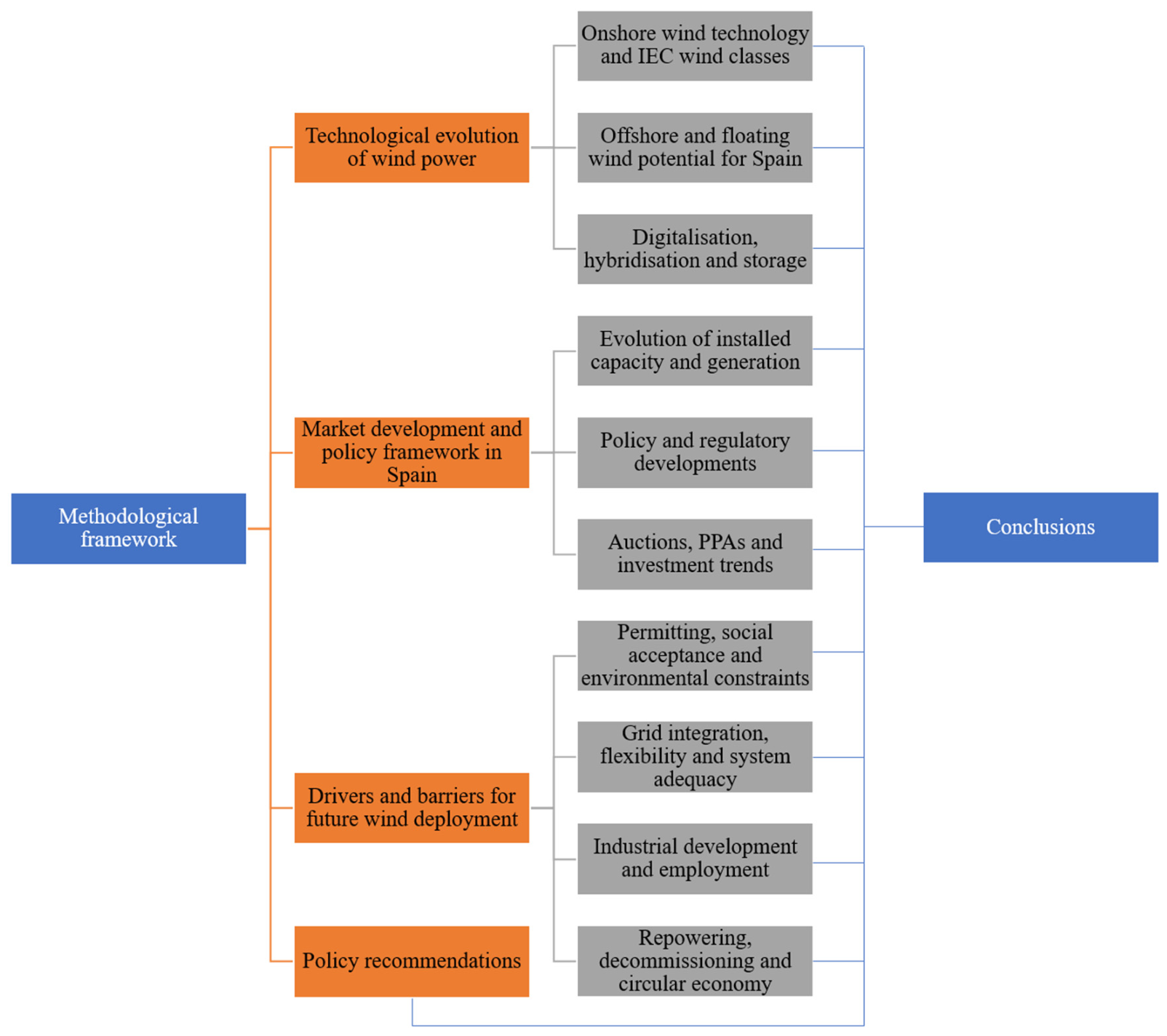
This study is conceived as a policy-oriented review rather than as an econometric or engineering optimisation analysis. It adopts an analytical framework that categorises the main determinants of wind energy deployment into four dimensions: (i) political and economic factors; (ii) market structure and regulation; (iii) grid and system integration; and (iv) administrative and social aspects. Similar typologies have been applied in previous studies, often in combination with stakeholder surveys, to assess the relative importance of these factors in Spain and other European contexts [2,4,5]. Figure 1 illustrates the overall structure of the article and shows how the methodological framework introduced in this section underpins the analysis developed in Section 3.
Building on this framework, the present study relies on a structured qualitative review of secondary data sources. Academic articles, industry reports, policy documents and selected press releases published between 2018 and late 2025 were systematically screened and analysed based on their relevance, recency and data reliability. Particular emphasis was placed on primary statistical sources, including system reports from Red Eléctrica de España (REE) [10,11], as well as datasets and analyses from the International Renewable Energy Agency (IRENA) [2,22], the Global Wind Energy Council (GWEC) [3], WindEurope [4,6], and national planning documents such as the updated National Energy and Climate Plan (NECP) [14]. These sources provide consistent quantitative information on installed capacity, electricity generation, capacity factors, and cost and investment trends.
Figure 1. Structure of the article.
Processes 14 02437 g001
Market and policy developments were examined through a review of official legislation, regulatory frameworks and supporting documentation related to support schemes, remuneration mechanisms, auction design and grid codes. This analysis was complemented by industry perspectives from associations such as Asociación Empresarial Eólica (AEE) and major developers, as well as recent studies on Spanish renewable auctions [7,21,23], macroeconomic impacts of renewables [18,24], and emerging trends such as digitalisation and repowering [13,20]. Together, these sources allow for a comprehensive assessment of evolving investment conditions and structural challenges.
Given the heterogeneity of the available evidence and the policy-review objective of the study, the four analytical dimensions were not assigned to new quantitative weights. Quantitative prioritisation through stakeholder surveys, analytic hierarchy processes or other multicriteria decision methods would require primary data collection, a defined stakeholder sample, explicit scoring criteria and sensitivity analysis. Such an exercise would constitute a separate empirical study and was beyond the scope of this review. Instead, the relative importance of the barriers was assessed through triangulation of official statistics, policy documents, the peer-reviewed literature and recurring findings reported by sector stakeholders.
This choice limits the ability to claim a statistically derived ranking of the barriers. Accordingly, the policy recommendations should be interpreted as evidence-informed priorities rather than as precise numerical rankings. To improve their practical usefulness, the revised manuscript distinguishes between near-term enabling actions (principally faster permitting, clearer auction schedules and grid-access reform) and medium-term structural actions involving network expansion, storage, offshore infrastructure and industrial policy. Future research could validate and quantify this prioritisation through stakeholder surveys or multicriteria decision analysis.

3. Results and Discussion

3.1. Technological Evolution of Wind Power

3.1.1. Onshore Wind Technology and IEC Wind Classes

Early Spanish wind farms in the late 1990s and early 2000s were dominated by turbines in the 0.5–2 MW range with rotor diameters of 40–80 m, typically certified for IEC Class I or II sites characterised by high or medium wind speeds [25]. As turbine technology matured, average unit size increased rapidly. For example, wind farms such as those located in La Rioja illustrate this transition towards larger turbine sizes and improved performance [26]. By around 2010, new onshore projects in Spain commonly deployed 2–3 MW machines with hub heights of 80–100 m and rotor diameters of 90–110 m, reflecting both aerodynamic advances and the search for better energy capture at moderate wind sites [27,28].
The International Electrotechnical Commission’s standard IEC 61400-1 [29] defines several wind turbine design classes according to reference wind speed, turbulence intensity and extreme gusts. Class I turbines are designed for sites with a reference mean wind speed of 10 m/s at hub height, Class II for 8.5 m/s, Class III for 7.5 m/s and Class IV for very low-wind sites around 6 m/s, each with sub-classes A and B indicating higher or lower turbulence, respectively [29]. Table 1 summarises the main parameters of these classes. Spain deploys turbines across all these categories, but the expansion into lower-wind inland regions has increased the relevance of Class II and III designs, often with larger rotors and relatively modest rated capacities to maximise capacity factors at given hub heights.
Recent turbine platforms illustrate the combination of larger rotors with moderate specific power. For example, Siemens Gamesa’s 5.X and 6.X onshore platforms offer ratings between about 5.8 and 6.6 MW with rotor diameters of 155–170 m, corresponding to swept areas of 18,600–22,700 m2 and specific powers of roughly 170–190 W/m2 [10,19]. Comparable 6 MW class turbines with rotor diameters around 160–170 m are offered by several manufacturers [7]. Such machines are particularly suitable for low-to-medium wind sites, enabling higher capacity factors as the industry pushes into sites with lower average wind speeds. Smaller turbines, such as the Enercon E-70 (2.3 MW), can provide greater operational flexibility and may be suitable for specific applications such as supplying electricity to desalination plants used to produce water for agricultural irrigation [25].
At the European level, the average rated capacity of new onshore turbines installed in 2023 reached approximately 4.5 MW, up from 4.1 MW in 2022, and increased further to about 4.6 MW in 2024 [4,6]. Spain’s new onshore turbines installed in 2023 had an average rating of around 3.8 MW, reflecting both the coexistence of repowering projects (where turbines are often constrained by existing site layouts) and new greenfield installations at more challenging sites [4]. Anticipated capacity factors for new European onshore wind farms span roughly 30–45%, with offshore projects around 50% [4]. These trends imply that even without large increases in installed capacity, repowering existing Spanish sites with modern machines can significantly increase annual output and reduce LCOE.

3.1.2. Offshore and Floating Wind Potential for Spain

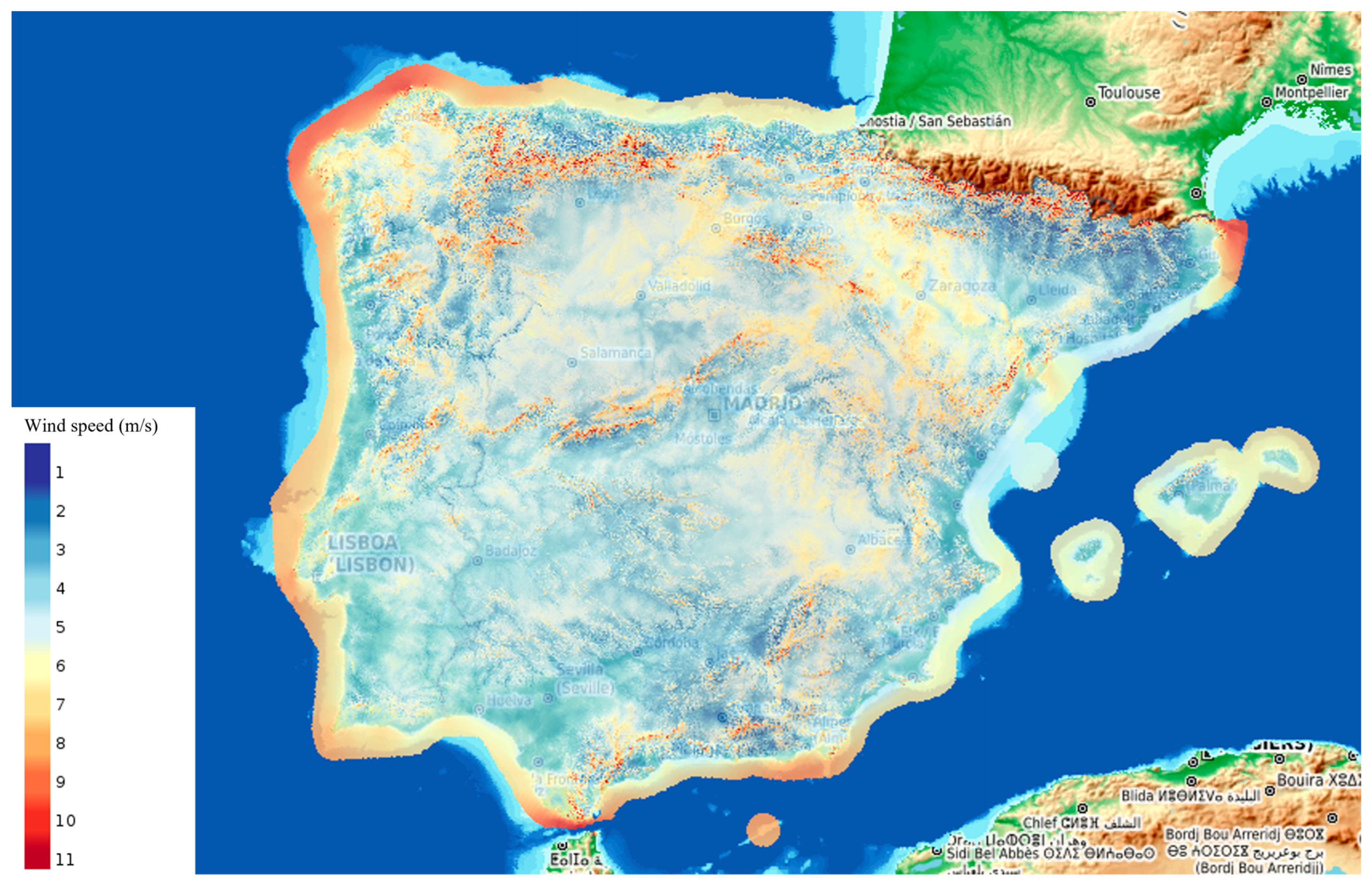
While Spain has long been a leader in onshore wind, offshore deployment has so far been limited to a small floating demonstration project. This is largely due to the country’s bathymetry: the continental shelf drops off quickly along most of the coast, making conventional fixed-bottom turbines technically and economically unattractive beyond a narrow near-shore strip [30,31]. As a result, floating foundations are expected to dominate future Spanish offshore wind projects [31]. In the Canary Islands, some offshore wind farms are projected in this way, especially in the southeastern coast of Gran Canaria, Fuerteventura and Lanzarote, where the wind speed is higher [32,33]. The main reason is that the Canary Islands are of volcanic origin and lack a continental shelf, resulting in significantly deeper nearshore waters than in continental Spain, making the islands an extreme case [33]. Spain nevertheless has a long coastline with excellent wind resources and an existing industrial base in shipyards, steel fabrication and maritime engineering [34], providing favourable conditions to develop a competitive floating-wind value chain [11,30]. As seen in Figure 2, wind resources are particularly strong along the Galician coast, the Strait of Gibraltar and in the northern part of Catalonia, with wind speeds exceeding 9 m/s [35].
The Spanish government’s ‘Roadmap for the Development of Offshore Wind and Marine Energy’ foresees 3 GW of floating offshore wind capacity by 2030 and 17–20 GW by 2050, subject to maritime spatial planning, environmental constraints and port upgrades [30]. The updated NECP 2023–2030 confirms 3 GW as a formal 2030 target [14]. To operationalise this ambition, Spain has prepared the first offshore wind auctions in designated marine demarcations, though tender rounds have experienced delays and industry concerns about remuneration levels and grid connection responsibilities [7,30].
The cost of floating offshore wind remains substantially higher and more uncertain than that of mature onshore wind. Spain does not yet have sufficient commercial project data to establish a nationally observed LCOE for floating offshore wind. Available international evidence indicates that first-of-a-kind floating projects may have LCOEs exceeding USD 200/MWh, reflecting the limited maturity of the technology and supply chain. Under progressive commercialisation and economies of scale, floating offshore wind costs are expected to decline substantially during the coming decades, although full cost parity with mature onshore wind by 2030 appears unlikely [36].
The principal cost-reduction pathways include technological learning, larger commercial project scale, standardisation and serial manufacture of floating platforms, improved port and assembly infrastructure, more efficient installation and towing strategies, lower mooring and dynamic-cable costs, improved operation and maintenance practices, and reduced financing costs through stable deployment pipelines and predictable long-term policy frameworks [36]. Spain may also obtain industrial and system benefits that are not fully captured by a direct LCOE comparison, including access to stronger offshore wind resources, reduced competition for land and opportunities for ports, shipyards and heavy industry [14].
Globally, offshore wind reached more than 75 GW of installed capacity by 2023, with 10.8 GW installed in that year alone, and is expected to expand rapidly over the coming decade [3,37]. Europe remains a key offshore market, although recent cost inflation and supply-chain bottlenecks have led to project delays and renegotiations in several countries [7]. For Spain, entering the offshore segment in the mid-2020s provides an opportunity to position itself in the growing floating-wind market, but also carries risks related to regulatory complexity, environmental permitting and port and grid infrastructure needs.

3.1.3. Digitalisation, Hybridisation and Storage

Digitalisation is transforming the operation and maintenance (O&M) of wind farms. According to WindEurope’s ‘Wind energy digitalisation towards 2030’ report [20], major applications include high-frequency condition monitoring of turbines, real-time farm-level optimisation, advanced forecasting, automated fault detection, and digital twins to support predictive maintenance. These applications rely on large volumes of supervisory control and data acquisition (SCADA) data, combined with new sensing technologies, edge computing and cloud-based analytics. In Spain, large utilities such as Iberdrola, Acciona Energía and EDPR have been at the forefront of integrating advanced analytics into their wind fleets [20].
Hybrid projects that combine wind with solar PV and battery energy storage systems (BESS) are also gaining traction [38]. Co-location allows developers to share grid connection infrastructure, smooth production profiles and participate more flexibly in energy and ancillary services markets [38]. Spain is seeing an increasing number of such hybridisation projects, including the conversion of former coal sites into renewable hubs featuring wind, solar, storage and sometimes green hydrogen production [23]. Large utilities are also deploying BESS at existing PV and wind sites to capture price arbitrage opportunities and provide grid support services [18,20].
The updated NECP raises Spain’s 2030 storage target to about 22.5 GW, including pumped hydro and batteries, up from only a few gigawatts currently installed [14]. This reflects recognition that high shares of variable renewables will require substantial flexibility from storage, demand response and interconnections. Hybrid projects and large-scale green hydrogen facilities, which use electrolysers to convert surplus renewable electricity into hydrogen for later use in industry or power generation, are attracting growing attention as long-duration flexibility options [9,14,39,40]. Several multi-hundred-megawatt green hydrogen projects have been announced in Spain, particularly in the south and along industrial corridors, explicitly leveraging abundant wind and solar resources [14].

3.2. Market Development and Policy Framework in Spain

3.2.1. Evolution of Installed Capacity and Generation

Spain’s wind deployment can be divided into four broad phases. The first, from the late 1990s to around 2004, saw very rapid growth under early support schemes, taking installed capacity from below 1 GW to around 8 GW. The second, from 2004 to 2012, was characterised by generous feed-in tariffs and premiums that sustained high annual additions, pushing capacity above 22 GW by 2012. The third phase, roughly 2012–2015, corresponded to the tariff deficit crisis, retroactive support cuts and the 2012 moratorium on new renewable support, during which wind capacity growth almost stalled [10]. The fourth phase, from about 2016 onwards, has been marked by the reintroduction of auctions, recovery of investor confidence and renewed growth.
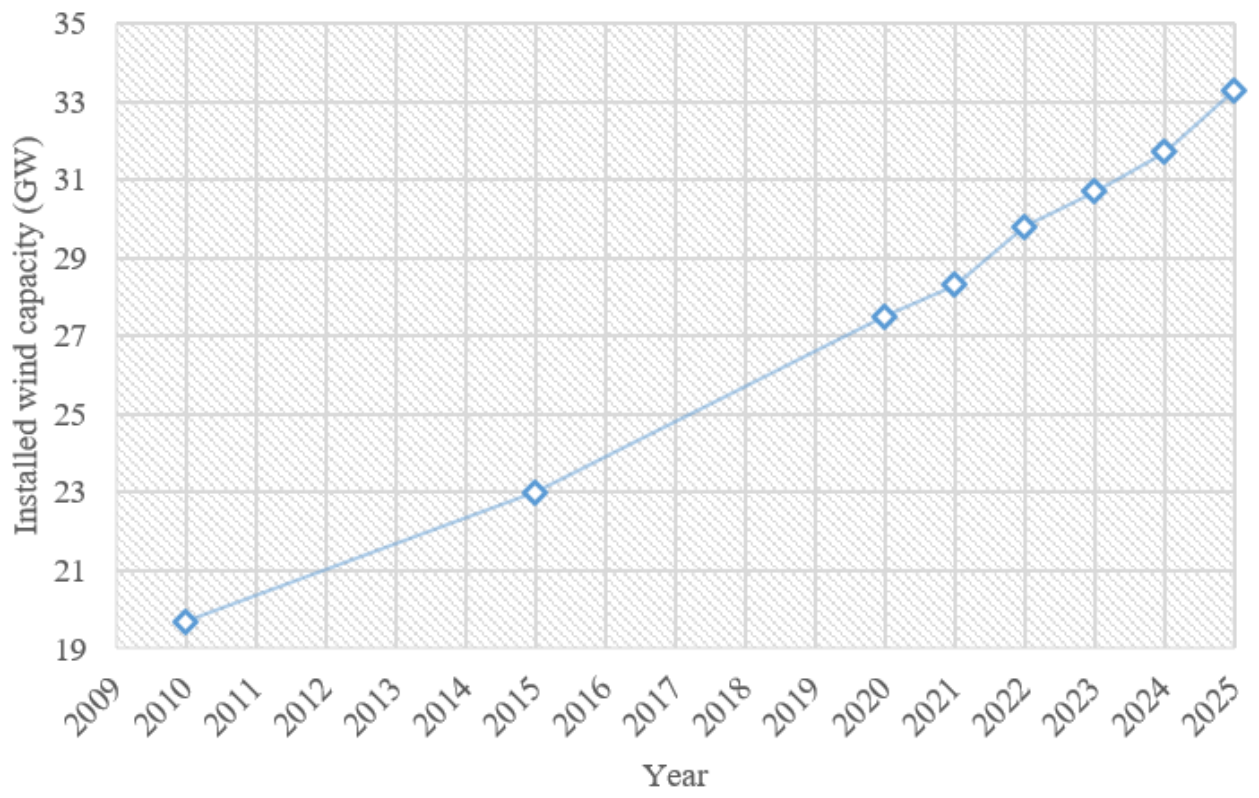
Table 2 shows that after several years of stagnation around 23 GW, wind capacity began to grow again from around 2019 onwards. REE data indicate that installed wind capacity reached about 27.5 GW in 2020 and 28.3 GW in 2021 [10]. The sector added roughly 1.7 GW in 2022, bringing capacity close to 29.8–29.9 GW [13,37], and continued to grow to around 30.7 GW by the end of 2023 [11]. Installed wind capacity continued to increase after 2023, reaching approximately 31.7 GW at the end of 2024 [9]. During 2025, around 1.2 GW of additional wind capacity was commissioned, bringing the national total to approximately 33.3 GW by 31 December 2025 [9]. Figure 3 shows the evolution of installed wind power capacity in these years.
Wind has consistently been the largest source of renewable generation in Spain. In 2020 wind power generated nearly 55 TWh, corresponding to about 21–22% of national electricity demand [41]. By the first half of 2024, wind produced around 24–25% of total electricity, with solar PV providing more than 16% and hydropower around 16%, taking the renewable share close to 60% over that period [11,12]. Several days in 2023 and 2024 saw hourly wholesale prices approach zero during hours of very high wind and solar output [12,18].
Figure 3. Evolution of installed wind power capacity in Spain for selected years between 2010 and 2025 (based on REE, IEA Wind and AEE statistics [9,10,11,13,37,41]).
Processes 14 02437 g003

3.2.2. Policy and Regulatory Developments

Spain’s policy framework for wind has undergone several profound transformations. The early support scheme under Royal Decree (RD) 2818/1998 and its successors RD 436/2004 and RD 661/2007 provided technology-specific FiTs and premiums that proved highly effective in stimulating investment. However, the combination of generous tariffs, falling technology costs and slower-than-expected demand growth contributed to a large ‘tariff deficit’ in the regulated component of electricity prices. In response, the government introduced a series of reforms culminating in RD-Law 9/2013 and subsequent implementing regulations, which replaced FiTs with a remuneration based on standard investment and operating parameters for a ‘reasonable return’ and imposed a moratorium on support for new renewables in 2012.
These retroactive changes, which reduced revenues for existing wind farms, undermined investor confidence and led to international arbitration cases. Stakeholder surveys and industry reports from that period consistently pointed to regulatory instability and income uncertainty as some of the most critical barriers to investment [13,18,41]. The resulting investment drought is evident in the almost flat installed-capacity curve between 2012 and 2018 (Table 2).
From 2016 onwards, Spain gradually reoriented its support framework towards competitive auctions. Early auctions in 2016 and 2017 allocated several gigawatts of wind and solar capacity under a remuneration scheme tied to the updated regulatory ‘reasonable return’ mechanism. After a pause, a new auction design based on pay-as-bid contracts for difference (CfDs) was introduced in 2021, aligned with the EU’s state aid guidelines. The first of these auctions in January 2021 awarded around 2.26 GW of wind and 0.87 GW of PV at average prices of approximately 25–30 €/MWh, significantly below prevailing wholesale prices [16]. A second auction later in 2021 allocated additional capacity at slightly higher prices due to the global energy price crisis [23].
However, subsequent auctions revealed design weaknesses. The 2022 onshore wind auction, which offered around 1.5 GW of capacity, ended up allocating only 46 MW because the undisclosed price cap was set below developers’ bids at a time of sharply rising equipment and financing costs [7,21]. Industry associations criticised the opaque ceiling price, insufficient indexation to inflation and the lack of flexibility in project delivery deadlines [21]. These issues, coupled with long permitting times, contributed to the slowdown in new wind additions observed in 2023 [9,18].
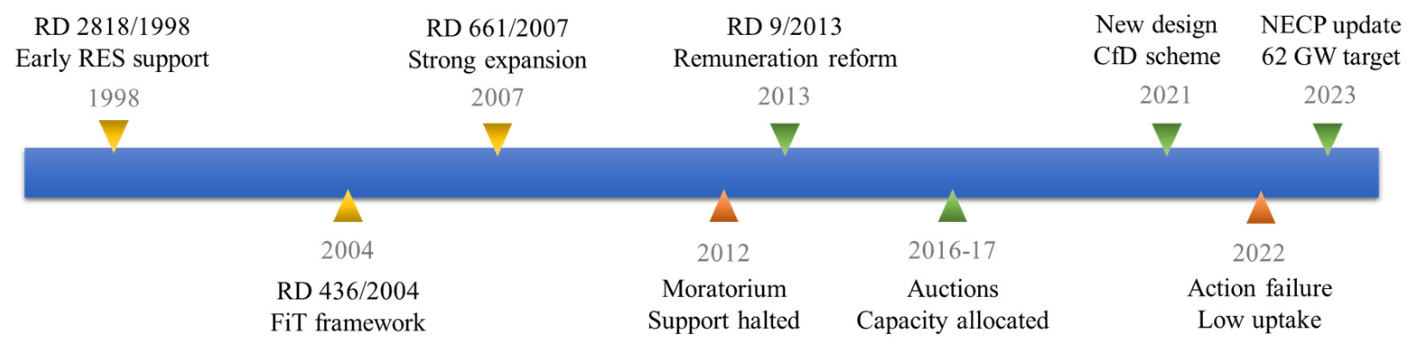
In parallel, Spain has strengthened its long-term planning and climate policy framework. The Climate Change and Energy Transition Law adopted in 2021 introduced legally binding climate targets and mandated the preparation of long-term strategies and NECP updates [5]. The updated NECP 2023–2030 raises the 2030 target for installed wind capacity to roughly 62 GW (including 3 GW offshore) and for renewables’ share in electricity generation to around 81% [14]. The plan also emphasises accelerated permitting for renewables, reinforcement of electricity grids, and expansion of storage and demand-side flexibility. Figure 4 presents a timeline of major policy and regulatory developments in Spain’s wind sector.
Recent policy developments have further reinforced this regulatory direction. At the EU and national levels, greater emphasis has been placed on streamlining permitting procedures, strengthening grid planning and enhancing system flexibility. In Spain, these priorities are reflected in the updated National Energy and Climate Plan, which supports the expansion of renewable generation together with transmission infrastructure, storage and industrial value chains required to achieve the 2030 targets [14].

3.2.3. Auctions, PPAs and Investment Trends

Auctions have become the main instrument for allocating support to new large-scale wind projects in Spain. When well designed, they can reveal falling technology costs and allocate capacity efficiently while limiting rents. The 2021 auctions confirmed that Spanish wind projects could be awarded at prices of approximately EUR 25–30/MWh under favourable financing conditions [23]. These results align with broader European and global trends: IRENA reports a global average LCOE for onshore wind of about 33 USD/MWh (≈30 €/MWh) in 2023, with many projects delivering even lower costs [22].
In Spain, corporate renewable PPAs commonly have contractual terms of approximately 8–15 years, although project-specific agreements may be shorter or extend beyond this range [42]. Prices are generally confidential and depend on the signing date, contract duration, technology, delivery profile, capture-price exposure, balancing responsibility, guarantees of origin, credit quality and point of connection. Public market assessments around 2024–2025 suggested indicative levels of approximately 60–70 EUR/MWh for standard ten-year Spanish wind PPAs, but these figures should not be interpreted as a uniform or official transaction price [43].
Small and medium-sized developers face several disadvantages in this market. These include limited access to creditworthy corporate off-takers, high legal and transaction costs, requirements for collateral and performance guarantees, imbalance and shape risk, uncertainty regarding project completion dates, and weaker negotiating capacity. Smaller electricity consumers may also lack the demand scale and credit rating required to sign long-term agreements. Aggregated PPAs, standardised contracts, public credit guarantees and intermediary platforms could reduce these barriers, although adequate risk assessment remains necessary [18,42].
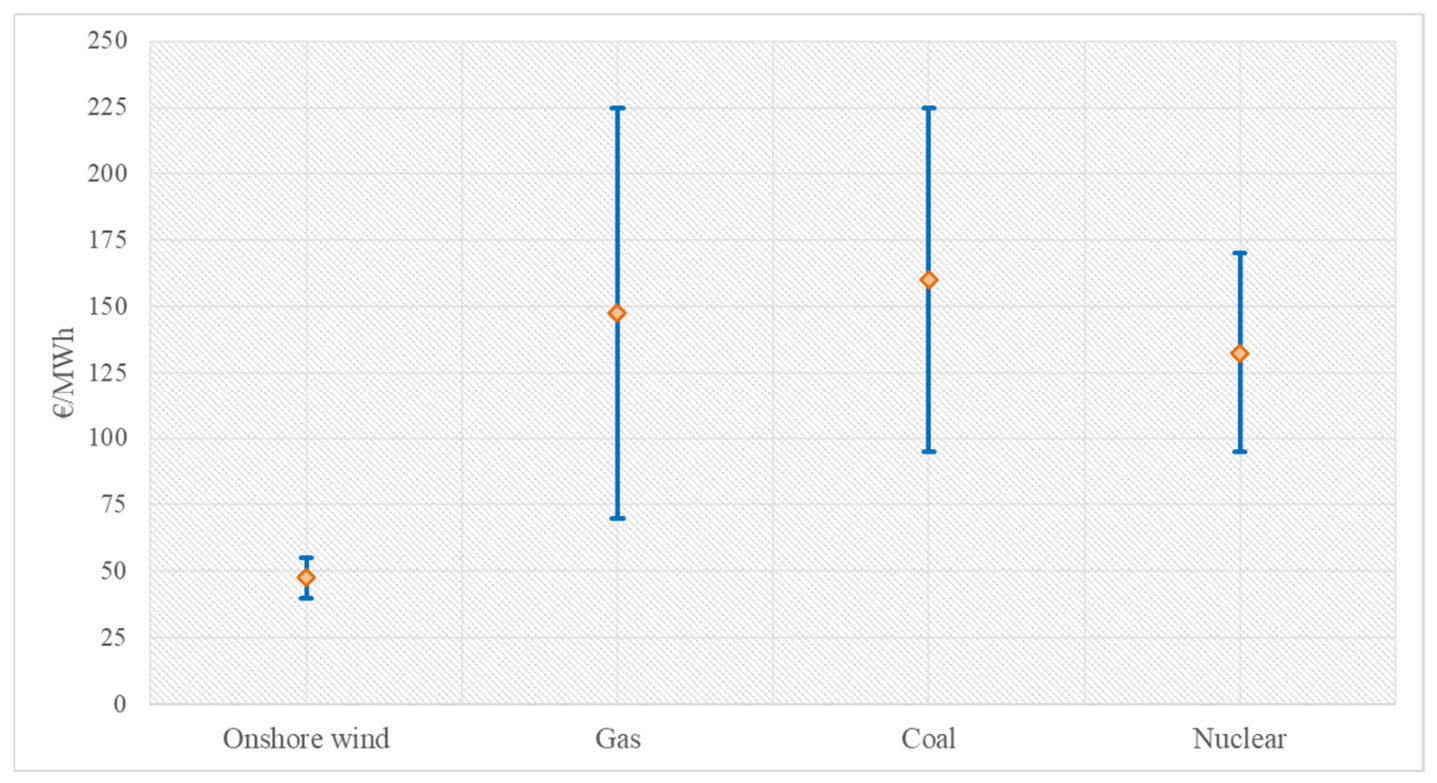
More recent estimates for Europe suggest that the LCOE of onshore wind typically falls in the 40–55 €/MWh range for projects reaching final investment decisions in the early 2020s, compared with projected gas-fired generation costs of 70–225 €/MWh, coal at 95–225 €/MWh and nuclear at 95–170 €/MWh, depending on fuel and capital cost assumptions [18,22]. Specific modelling for Spain indicates that 2023 LCOE for onshore wind may be somewhat higher than in countries such as Germany and France (≈43 €/MWh versus ≈32 €/MWh), partly reflecting project-specific financing and resource conditions [18]. Even so, wind remains highly competitive with fossil alternatives and is increasingly setting the marginal price during high-wind hours. Figure 5 highlights the strong cost competitiveness of onshore wind compared to conventional generation technologies.
The financial conditions underlying these costs are sensitive to macro-economic shocks. After a decade of declining interest rates that supported falling LCOEs, the post-pandemic inflation surge and tighter monetary policy led to higher financing costs and increased equipment prices. Recent IEA and IRENA analyses show that higher weighted average costs of capital (WACCs) in 2023–2024 have temporarily reversed part of the previous cost decline for onshore wind outside China [22,44]. Spain has been affected by these trends, as reflected in the under-subscription of the 2022 auction [7,21].
Corporate PPAs have emerged as a complementary route-to-market, particularly for large industrial and commercial consumers seeking price stability and green credentials. Spain has emerged as an important corporate PPA market in Europe, supported by favourable renewable resources, a competitive renewable energy sector and growing demand for long-term electricity price certainty [45]. These contracts provide long-term price certainty and reduce exposure to wholesale market volatility, thereby improving the bankability of renewable energy projects [45]. PPAs help hedge developers against market price volatility and can reduce perceived risk, lowering the cost of capital. At the same time, they require sophisticated risk management and creditworthy off-takers, which may be challenging for smaller developers.
From a macro-economic perspective, the rapid expansion of renewables has already had measurable impacts on wholesale prices. A recent analysis by BBVA Research estimates that the 20-percentage-point increase in the renewables share of generation between 2021 and 2024 reduced average wholesale electricity prices in Spain by about 20% compared with a counterfactual without that increase [24]. Realising these benefits while ensuring adequate investment incentives requires careful balancing of auction volumes, price caps, indexation rules and complementary instruments such as PPAs and capacity mechanisms. Overall, while wind energy remains cost-competitive, recent increases in financing and equipment costs highlight the sensitivity of investment conditions to macroeconomic factors.

3.3. Drivers and Barriers for Future Wind Deployment

3.3.1. Permitting, Social Acceptance and Environmental Constraints

Administrative procedures, land-use planning and social acceptance are widely recognised as key determinants of wind deployment in Spain. These factors remain highly relevant. Long and uncertain permitting procedures (often involving multiple administrative layers at municipal, regional and national levels) are frequently cited as a key bottleneck to achieving the NECP’s 2030 wind targets [5,14,18,46]. Complex environmental impact assessments, overlapping jurisdictional competences and limited administrative resources contribute to extended lead times.
Local opposition to new wind farms, particularly in areas with high landscape or biodiversity value, has grown in recent years. Concerns include visual impacts, noise, effects on tourism, and potential impacts on birds and bats. In some regions, opposition movements have coalesced around broader criticisms of centralised planning and perceived unfair distribution of project benefits and burdens. This has led to legal challenges and delays for several large projects and contributed to the relatively small pipeline of new onshore wind capacity currently under construction [46].
At the same time, there are positive examples of local engagement and benefit sharing, including cooperative ownership models, municipal participation schemes and targeted community funds. International experience suggests that early and transparent stakeholder engagement, coupled with mechanisms to share economic benefits and protect sensitive ecosystems, can substantially improve social acceptance. The NECP calls for the development of ‘renewables acceleration areas’ where permitting is streamlined while maintaining strong environmental safeguards [14]. Effective implementation of this concept will be crucial for Spain’s wind ambitions.

3.3.2. Grid Integration, Flexibility and System Adequacy

As wind and solar shares rise, grid integration challenges become more pronounced, particularly due to variability, overproduction and reduced utilisation of dispatchable generation [47]. Spain already operates with high instantaneous shares of variable renewables and has gained substantial experience in managing system stability under such conditions. Nevertheless, recent events and analyses underscore emerging risks. A 2023 report by Spain’s competition authority warned that rapid growth in solar and wind, combined with insufficient storage and limited interconnections, could strain the system [15]. In April 2025, a significant power disturbance was widely reported to be linked to voltage fluctuations during high renewable output, although investigations are ongoing [15].
Interconnection capacity with France remains limited relative to Spain’s renewable potential, constraining the ability to export surpluses during high-production hours. The NECP and EU planning documents call for reinforcing cross-border capacity and internal transmission networks, particularly to connect resource-rich regions in the north and centre to major load centres [5,14]. In distribution networks, the proliferation of distributed PV, electric vehicles and heat pumps will also require significant upgrades and smarter operation to avoid congestion and maintain power quality.
The temporal profile of wind generation does not perfectly coincide with the Spanish electricity load curve [47,48]. Wind output is strongly weather dependent and is often higher during winter and nighttime periods, while electricity demand generally exhibits morning and evening peaks and seasonal increases associated with heating and cooling [47]. Wind can therefore complement daytime solar generation, but periods of simultaneous high renewable output and low demand can create surpluses, whereas low-wind evening periods can increase residual-load requirements [47,48]. A rigorous quantification would require an hourly multi-year comparison of wind generation, solar generation, demand and interconnection flows. Such an analysis is outside the scope of this policy review and constitutes a relevant direction for future research [48].
Publicly available Spanish statistics do not provide a single, consistently defined annual curtailment rate attributable exclusively to wind generation. Renewable output may be reduced because of local network congestion, system-security redispatch, negative-price exposure or plant-level operational decisions, and these categories are not always reported in a directly comparable form. Consequently, the manuscript does not assign a precise national wind-curtailment percentage without a harmonised official dataset. This represents an important transparency gap, and publication of technology- and location-specific curtailment data by the system operator would improve investment and network-planning decisions [14].
Regarding infrastructure, Spain’s transmission planning for 2021–2026 involves several billion euros of network investment, including internal reinforcements and international interconnections [14]. Additional investment will be necessary beyond 2026 to connect resource-rich regions, accommodate the approximately 62 GW wind target and supply emerging electricity demand. The updated NECP also establishes a storage target of approximately 22.5 GW by 2030 [14]. Nevertheless, the required transmission capacity, storage duration and energy volume cannot be inferred from installed wind capacity alone. They must be established through nodal and chronological studies that jointly represent wind and solar profiles, demand growth, interconnection availability, hydrological variability and extreme system conditions [47,48].
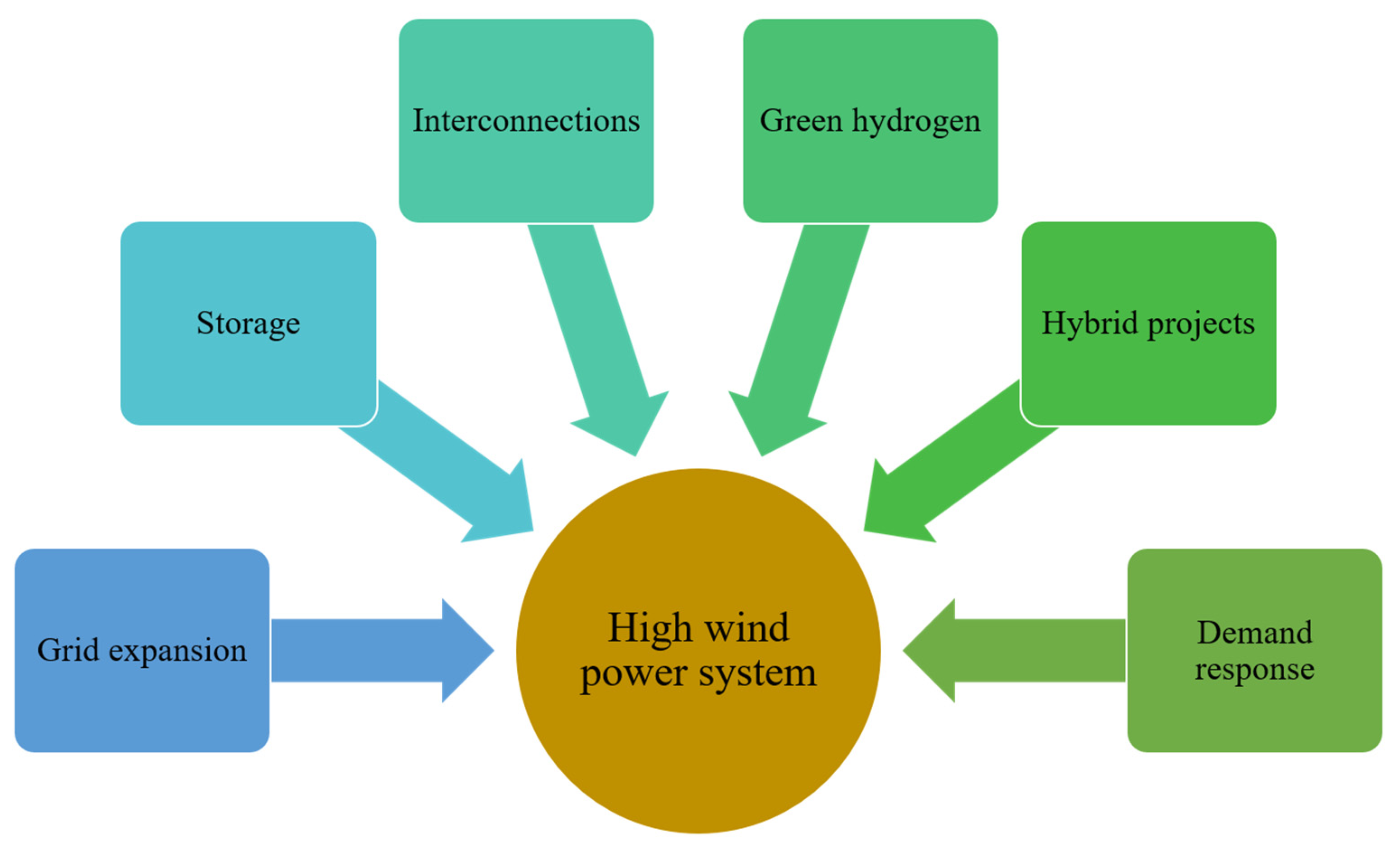
Flexibility from storage will be essential to manage variability and avoid curtailment [48]. Spain currently has only a few gigawatts of battery and pumped hydro storage, far below the 22.5 GW of storage capacity targeted for 2030 [14]. However, at wind and solar penetration levels approaching the NECP target of approximately 81% renewable electricity generation, system stability cannot be ensured solely by installing a predetermined quantity of battery capacity. A layered flexibility portfolio will be required [14,48]. Fast-response batteries can provide frequency containment, voltage support, reserve services and intraday balancing, generally over discharge durations of approximately one to four hours. Pumped hydro and medium-duration batteries can shift larger volumes of electricity across several hours, whereas demand response, stronger interconnections and flexible electricity consumption by electrolysers can absorb prolonged renewable surpluses [14,39,48]. Longer periods of low wind and solar production will require firm or long-duration flexibility resources, potentially including reservoir hydropower, renewable hydrogen and other low-carbon dispatchable capacity [39,40,48]. Storage and flexibility requirements should therefore be determined through chronological system modelling that accounts for hourly electricity demand, renewable generation profiles, transmission constraints and extreme-weather years, rather than through a single aggregate capacity target [47,48]. Hybrid wind–solar–storage plants and green hydrogen projects can also provide longer-duration flexibility, though their economics depend on technology costs, infrastructure development and market design [9,14].
The 22.5 GW national storage target provides a useful power-capacity benchmark, but it does not define the required stored-energy volume in GWh or the necessary level of operating reserves [14,47,48]. These parameters should be established through probabilistic adequacy and dynamic stability assessments [47,48]. Spain will require a combination of sub-second frequency response, frequency restoration reserves, replacement reserves and multi-hour energy-shifting capability, together with sufficient firm flexibility for extended periods of low renewable production [47,48]. The resulting requirement will depend on storage duration, hydropower availability, demand response, interconnection capacity and the spatial distribution of renewable generation [14,48]. Consequently, reserve and storage procurement should be regularly updated by the system operator on the basis of transparent system-needs assessments [14,48].
Figure 6 illustrates the main system integration and flexibility requirements in power systems with high wind penetration.

3.3.3. Industrial Development and Employment

Spain hosts a significant share of Europe’s wind manufacturing and engineering capabilities, including turbine manufacturing, tower and blade production, and balance-of-plant engineering. Companies such as Siemens Gamesa Renewable Energy, Nordex-Acciona, and numerous component suppliers form an industrial ecosystem that generates tens of thousands of jobs and significant export revenues [25]. Offshore wind and floating foundations offer new industrial opportunities, particularly for coastal shipyards and heavy engineering firms.
Recent analyses of the economic contribution of renewables to the Spanish economy suggest that the wind sector accounts for around 0.3% of GDP and has been a net job creator, even during periods of broader economic stagnation [13]. Offshore wind manufacturing activities in Spanish shipyards have already created thousands of jobs and could multiply their contribution if domestic offshore projects move ahead [11,30]. However, global competition and cost pressures require continuous innovation and stable policy signals to avoid de-industrialisation or relocation of production.
International investors have shown strong interest in Spanish renewables, including wind, attracted by resource quality, EU policy backing and the prospect of exporting green electricity, hydrogen and derived products. Recent large-scale acquisitions of Spanish renewable portfolios by foreign strategic and financial investors illustrate both the attractiveness of the sector and concerns about domestic control over critical assets [18]. Designing industrial and trade policies that leverage foreign capital while maintaining domestic value creation remains an important challenge.

3.3.4. Repowering, Decommissioning and Circular Economy

As the first generations of Spanish wind farms reach or surpass their original design lifetimes of 20–25 years, repowering and decommissioning issues are becoming increasingly important. Many turbines installed in the late 1990s and early 2000s are now technologically obsolete compared with modern 4–6 MW machines. Repowering (replacing old turbines with fewer, more powerful units) can significantly increase energy yield while reducing land footprint and enabling better environmental mitigation [13,49]. In addition, repowering can substantially increase electricity generation while using existing sites and infrastructure, making it a cost-effective strategy for enhancing the performance of ageing wind fleets [49].
At the same time, decommissioning raises challenges related to waste management, particularly for composite blades [50]. Estimates suggest that Spain may need to dismantle on the order of 7000 turbines and manage around 21,000 blades over the coming decade [51,52]. While steel towers and many metallic components are readily recyclable, current recycling options for fibre-reinforced composites remain limited and often energy-intensive, posing significant technical, economic and environmental challenges for large-scale deployment of repowering strategies [50]. European projects such as ReWind are exploring innovative solutions, including mechanical recycling, co-processing in cement kilns and reuse of blade segments in secondary applications [51,52].
Developing a circular-economy approach to wind technology (including design for recyclability, standardised decommissioning procedures, and dedicated recycling infrastructure) will be crucial for maintaining the social licence of wind power and aligning with EU waste and sustainability policies. Spain, with its large installed fleet and manufacturing base, is well positioned to become a hub for blade recycling and repowering expertise, provided that appropriate regulatory and economic incentives are put in place.
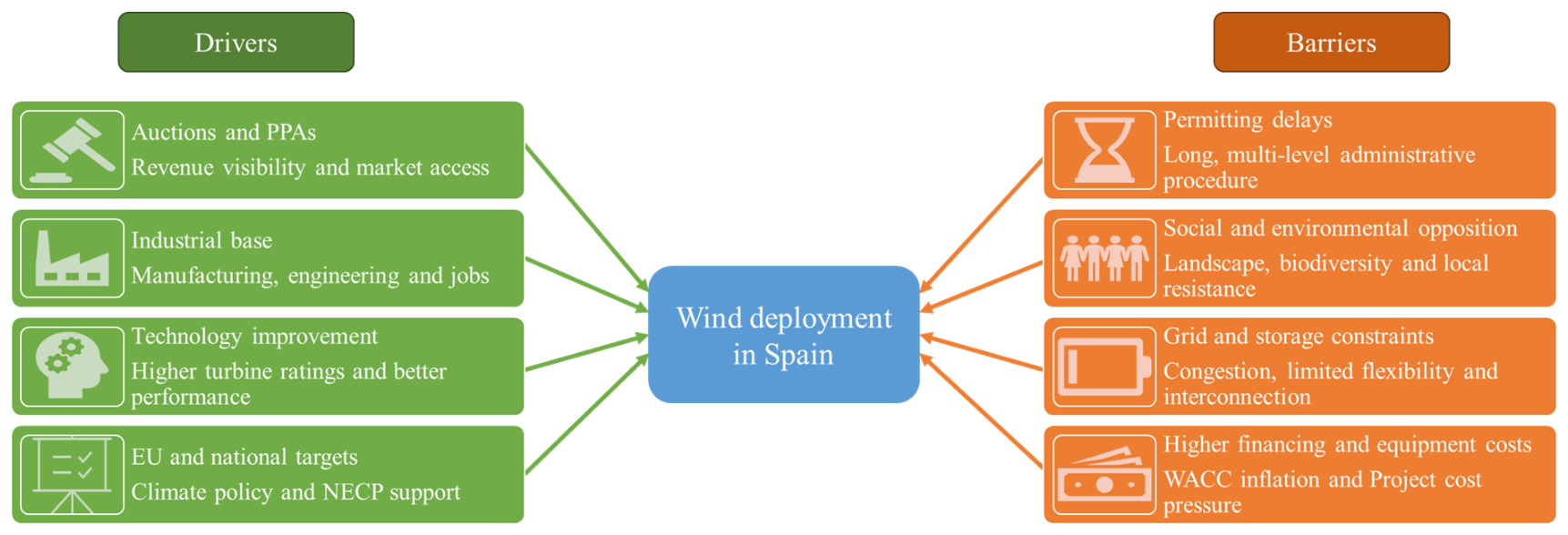
Taken together, the analysis of the previous subsections highlights that the deployment of wind energy in Spain is shaped by a complex interplay of regulatory, social, technical and economic factors, requiring coordinated policy action across multiple domains. Figure 7 summarises the main drivers and barriers for wind energy deployment in Spain identified in this section.

3.4. Policy Recommendations

Building on the updated evidence presented above and on earlier recommendations in the literature, this section outlines a set of priority actions to ensure that Spain can meet its 2030 wind targets while maximising economic, social and environmental benefits. Provide long-term regulatory stability and credible planning as a core pillar: a stable framework with predictable remuneration conditions is a precondition for low-cost finance, and the experience of the 2012–2013 reforms highlight the damage caused by retroactive changes. Future adjustments to support schemes should therefore be transparent, gradual and based on clear criteria linked to cost evolution and market conditions. In parallel, the NECP should be complemented by detailed, regularly updated auction schedules and grid development plans to give visibility to investors and the supply chain. Alongside this, improving auction design and diversifying support instruments is essential. Auctions should balance competition with bankability through realistic and transparent price caps, appropriate indexation to inflation, flexible delivery timelines, and penalties that deter speculative bidding without penalising bona fide developers facing external delays. Spain should continue to promote corporate PPAs and consider complementary instruments (such as two-way CfDs or capacity mechanisms) to ensure revenue stability while protecting consumers from excessive rents [7,18,21,22,23].
Among the policy measures discussed below, the intervention likely to deliver the greatest near-term acceleration in wind deployment is the establishment of a genuinely time-bound and adequately resourced permitting system. This should combine a digital one-stop shop, clear responsibility for coordinating municipal, regional and national authorities, statutory decision deadlines, early environmental screening and priority procedures for repowering and projects located in previously assessed renewable development areas. Such a measure could unlock technically mature projects more rapidly than interventions requiring the construction of major new infrastructure [14].
Experience from several European countries indicates that faster renewable deployment is associated with streamlined permitting procedures, coordinated spatial planning, clear institutional responsibilities and adequate administrative capacity. Spain should adapt these principles to its decentralised administrative structure while maintaining environmental safeguards and improving coordination among national, regional and local authorities [14].
At the same time, it is crucial to streamline permitting while strengthening environmental safeguards. Implementing ‘renewables acceleration areas’ with simplified and time-bound procedures, as foreseen in EU emergency regulations and the NECP, is essential [5,14]. Early strategic environmental assessments, transparent spatial planning and robust public participation can help identify suitable areas and reduce conflicts, while providing adequate resources and training for permitting authorities will be critical to avoid procedural bottlenecks. In parallel, Spain must invest in grids, storage and system flexibility. Achieving high wind shares without excessive curtailment will require accelerated investment in transmission and distribution networks, both domestically and at interconnections with France and Portugal [5,14,15]. Regulatory frameworks should reward flexibility services from storage, demand response and hybrid plants, and facilitate innovative solutions such as local flexibility markets and congestion management schemes. Clear remunerative signals for storage are also needed to unlock the 22.5 GW target for 2030 [14].
To mobilise private investment in storage, the government should complement energy-market revenues with transparent remuneration for capacity, availability and ancillary services [14,48]. Storage facilities should be allowed to participate on equal terms in balancing, congestion-management and local flexibility markets, while avoiding double network charges for electricity stored and subsequently returned to the grid [14,48]. Dedicated competitive tenders or contracts for difference could be considered for long-duration storage where energy-arbitrage revenues alone are insufficient [14,48]. Hybrid wind–solar–storage projects should benefit from simplified modification procedures and the efficient reuse of existing grid-connection rights [14,18]. For renewable hydrogen, support should focus on projects serving hard-to-electrify industrial demand, with competitive auctions, clear additionality requirements, access to shared infrastructure and long-term offtake mechanisms such as hydrogen purchase agreements [14,39].
Finally, supporting repowering and circular-economy solutions, leveraging industrial strengths, and fostering innovation will be key to consolidating long-term benefits. Repowering offers one of the most cost-effective ways to increase wind generation from existing sites, so Spain should establish dedicated permitting tracks and auction volumes for these projects, recognising their specific characteristics [13]. At the same time, developing national standards and incentives for blade recycling and circular design would position Spain as a leader in sustainable wind technology and help address public concerns about waste [52]. Policy should also explicitly link wind deployment to industrial and employment strategies, including support for domestic manufacturing of turbines, blades, towers and floating foundations in regions with existing capabilities, alongside targeted training and re-skilling programmes to enable just transitions for workers in carbon-intensive sectors [11,13,30]. Finally, fostering innovation in digitalisation and hybrid projects (such as digital O&M, advanced forecasting, hybrid wind–solar–storage systems, and green hydrogen integration) through dedicated R&D programmes, regulatory sandboxes and demonstration projects will improve system integration, reduce costs and open new value streams for wind power [9,18,20].
Investment priorities should be geographically and temporally coordinated. At the national level, Spain needs both additional wind generation and substantially more flexibility capacity [14,48]. At congested nodes with frequent renewable surpluses, storage, network reinforcement and flexible demand may provide greater marginal system value than additional generation alone [14,48]. Conversely, in areas with available grid capacity and complementary production profiles, new wind farms remain essential for meeting the 2030 capacity target [14]. The appropriate policy objective is therefore co-optimisation rather than choosing between wind deployment and storage [48].

4. Conclusions

The analysis presented in this paper confirms that wind energy has become a central pillar of Spain’s energy transition, supported by a combination of high-quality wind resources, a strong industrial base and continuous technological progress. Spain’s trajectory illustrates both the opportunities and risks associated with renewable energy development. Early expansion under feed-in tariff schemes enabled rapid capacity growth, while subsequent regulatory changes (particularly during the 2012–2015 period) created significant investment uncertainty and slowed deployment. The recent recovery phase, driven by competitive auctions, the expansion of corporate PPAs and alignment with European climate objectives through the updated NECP, reflects a more mature and market-oriented framework. At the same time, ongoing technological evolution (including larger turbine ratings, digitalisation, hybridisation with storage and solar PV, and the emergence of floating offshore wind) is enhancing efficiency, lowering costs and opening new development pathways for the sector.
Despite these positive developments, the paper also identifies several structural challenges that could constrain Spain’s ability to meet its 2030 wind energy targets. Administrative complexity and lengthy permitting processes, increasing social opposition in certain regions, and environmental constraints continue to delay project development. In parallel, the growing penetration of variable renewable energy sources is placing additional pressure on electricity networks, highlighting the urgent need for grid reinforcement, increased interconnection capacity and the deployment of flexibility solutions (such as storage, demand response and hybrid systems). Moreover, recent auction outcomes and rising financing and equipment costs underline the sensitivity of investment conditions to policy design and macroeconomic factors. Addressing these challenges will require coordinated and forward-looking policy action, including improved regulatory stability, better auction design, accelerated grid and storage investment, and targeted support for repowering and circular economy strategies. If effectively implemented, these measures will allow Spain not only to achieve its 2030 objectives but also to strengthen its position as a leading European hub for wind energy innovation, industrial development and sustainable energy system transformation.

Author Contributions

Conceptualization, C.M., R.F.-C. and E.R.; methodology, C.M., R.F.-C. and P.C.; validation, C.M., R.F.-C., N.F. and P.C.; formal analysis, C.M. and R.F.-C.; investigation, C.M., R.F.-C., N.F. and P.C.; data curation, C.M. and R.F.-C.; writing—original draft preparation, C.M. and R.F.-C.; writing—review and editing, C.M., R.F.-C., N.F., P.C. and E.R.; visualisation, C.M.; supervision, E.R. All authors have read and agreed to the published version of the manuscript.

Funding

This research received no external funding.

Data Availability Statement

The data presented in this study are available from the corresponding author upon reasonable request.

Conflicts of Interest

The authors declare no conflicts of interest.

Abbreviations

The following abbreviations are used in this manuscript:
BESSBattery Energy Storage System
CC BYCreative Commons Attribution License
CfDContract for Difference
COP2828th Conference of the Parties
EUEuropean Union
FiTFeed-in Tariff
IECInternational Electrotechnical Commission
LCOELevelized Cost of Energy
NECPNational Energy and Climate Plan
O&MOperation and Maintenance
PPAPower Purchase Agreement
PVPhotovoltaic
RDRoyal Decree
REPowerEUREPowerEU Plan
SCADASupervisory Control and Data Acquisition
WACCWeighted Average Cost of Capital

References

  1. Kaldellis, J.K.; Zafirakis, D. The Wind Energy (r)evolution: A Short Review of a Long History. Renew. Energy 2011, 36, 1887–1901. [Google Scholar] [CrossRef]
  2. International Renewable Energy Agency. Wind Energy. Available online: https://www.irena.org/Energy-Transition/Technology/Wind-energy/ (accessed on 10 April 2026).
  3. GWEC. Global Wind Report 2025. Available online: https://www.gwec.net/reports/globalwindreport/2025 (accessed on 10 April 2026).
  4. Wind Europe. Wind Energy in Europe: 2023 Statistics and the Outlook for 2024–2030. Available online: https://windeurope.org/data/products/wind-energy-in-europe-2023-statistics-and-the-outlook-for-2024-2030/ (accessed on 10 April 2026).
  5. European Commission. EU Wind Energy. Available online: https://energy.ec.europa.eu/topics/renewable-energy/eu-wind-energy_en (accessed on 10 April 2026).
  6. Wind Europe. Wind Energy in Europe: 2024 Statistics and the Outlook for 2025–2030. Available online: https://windeurope.org/data/products/wind-energy-in-europe-2024-statistics-and-the-outlook-for-2025-2030/ (accessed on 10 April 2026).
  7. Enerdata. Spain’s 4th Renewable Auction Was Largely Undersubscribed. Available online: https://www.enerdata.net/publications/daily-energy-news/spains-4th-renewable-auction-was-largely-undersubscribed.html (accessed on 10 April 2026).
  8. Bento, P.M.R.; Mariano, S.J.P.S.; Pombo, J.A.N.; Calado, M.R.A. Large-Scale Penetration of Renewables in the Iberian Power System: Evolution, Challenges and Flexibility Options. Renew. Sustain. Energy Rev. 2024, 204, 114794. [Google Scholar] [CrossRef]
  9. Asociación Empresarial Eólica. Available online: https://aeeolica.org/ (accessed on 10 April 2026).
  10. Red Eléctrica de España. Renewables in the Spanish Electricity System|System Reports. Available online: https://www.sistemaelectrico-ree.es/en/2021/renewable-energies-report (accessed on 10 April 2026).
  11. Red Eléctrica de España. Installed Capacity|System Reports. Available online: https://www.sistemaelectrico-ree.es/en/spanish-electricity-system/installed-capacity (accessed on 10 April 2026).
  12. Reuters. Renewables Produce Almost 60% of Spain’s Electricity. Available online: https://www.reuters.com/business/energy/renewables-produce-almost-60-spains-electricity-2024-07-02/ (accessed on 10 April 2026).
  13. EV Wind. Wind Energy Yearbook 2022: Analysis of Current Wind Power in Spain and in the World|REVE News of the Wind Sector in Spain and in the World. Available online: https://evwind.aeeolica.org/2022/08/31/wind-energy-yearbook-2022-analysis-of-current-wind-power-in-spain-and-in-the-world/87622 (accessed on 10 April 2026).
  14. Ministerio para la Transición Ecológica y el Reto Demográfico. Plan Nacional Integrado de Energía y Clima (PNIEC 2023–2030). Available online: https://www.miteco.gob.es/es/energia/estrategia-normativa/pniec-23-30.html (accessed on 10 April 2026).
  15. Le Monde. In Spain, Controversy Has Flared over the Rapid Acceleration of the Energy Transition. Available online: https://www.lemonde.fr/en/economy/article/2025/05/22/in-spain-controversy-has-flared-over-the-rapid-acceleration-of-the-energy-transition_6741515_19.html (accessed on 10 April 2026).
  16. Silva, W.N.; Vieira, G.G.T.T.; Rego, E.E.; Simone, L.F.C.; Lourenço, L.F.N.; Salles, M.B.C. Curtailment Pressures and Grid Flexibility in Brazil: Lessons from the Fast-Rising Distributed Generation. Util. Policy 2026, 99, 102148. [Google Scholar] [CrossRef]
  17. Petersen, C.; Reguant, M.; Segura, L. Measuring the Impact of Wind Power and Intermittency. Energy Econ. 2024, 129, 107200. [Google Scholar] [CrossRef]
  18. Tertre, M.G. Renewables: Spanish Industry’s Competitive Advantage. Available online: https://agendapublica.es/noticia/19145/renewables-spanish-industry-competitive-advantage (accessed on 10 April 2026).
  19. Wind-Turbine Models. Siemens Gamesa SG 6.6-170. Available online: https://en.wind-turbine-models.com/turbines/2346-siemens-gamesa-sg-6-6-170 (accessed on 10 April 2026).
  20. Wind Europe. Wind Energy Digitalisation towards 2030. Available online: https://windeurope.org/data/products/wind-energy-digitalisation-towards-2030/ (accessed on 10 April 2026).
  21. Wind Europe. Increasing Cost Pressures and Design Flaws Undermine Spanish Auction—WindEurope. Available online: https://windeurope.org/news/increasing-cost-pressures-and-design-flaws-undermine-spanish-auction/ (accessed on 10 April 2026).
  22. Bilbao, A.; Andrade, A.; Edge, G.; Brindley, G.; Zuboy, J.; Dersch, J.; Bianciotto, M.; Morgan, M.; Ellis, R. Renewable Power Generation Costs in 2023; IRENA: Abu Dhabi, United Arab Emirates, 2024; Available online: https://www.irena.org/Publications/2024/Sep/Renewable-Power-Generation-Costs-in-2023 (accessed on 10 April 2026).
  23. Aleasoft. Summary 2021 (Part II): The Return of Renewable Energy Auctions in the Spanish Electricity Market; AleaSoft Energy Forecasting: Barcelona, Spain, 2021; Available online: https://aleasoft.com/2021-return-renewable-energy-auctions-spanish-electricity-market/ (accessed on 10 April 2026).
  24. Cubero, J.J.; Más, P.; Ortiz, R. Environmental and Social Sustainability Reaping the Benefits of Renewable Energy in the Spanish Economy; Executive Summary; BBVA Research: Madrid, Spain, 2025. [Google Scholar]
  25. Carta, J.A.; Cabrera, P. Optimal Sizing of Stand-Alone Wind-Powered Seawater Reverse Osmosis Plants without Use of Massive Energy Storage. Appl. Energy 2021, 304, 117888. [Google Scholar] [CrossRef]
  26. Martínez, E.; Sanz, F.; Pellegrini, S.; Jiménez, E.; Blanco, J. Life Cycle Assessment of a Multi-Megawatt Wind Turbine. Renew. Energy 2009, 34, 667–673. [Google Scholar] [CrossRef]
  27. Schallenberg-Rodríguez, J.; Notario-del Pino, J. Evaluation of On-Shore Wind Techno-Economical Potential in Regions and Islands. Appl. Energy 2014, 124, 117–129. [Google Scholar] [CrossRef]
  28. Tiganj, J.; van der Loo, K.; Dogan, T. Wind-Power-Deployment. Available online: https://greenjobsproject.uniovi.es/wp-content/uploads/2023/08/D2.3-Wind-power-deployment.pdf (accessed on 10 April 2026).
  29. IEC 61400-1:2019; Wind Energy Generation Systems—Part 1: Design Requirements. IEC: Geneva, Switzerland, 2019. Available online: https://webstore.iec.ch/en/publication/26423 (accessed on 10 April 2026).
  30. Third Vice Presidency of Spanish Government; Ministry for the Ecological Transition and the Demographic Challenge. Roadmap Offshore Wind and Marine Energy in Spain. Available online: https://www.miteco.gob.es/content/dam/miteco/es/ministerio/planes-estrategias/desarrollo-eolica-marina-energias/enhreolicamarina-pdf_accesible_tcm30-538999.pdf (accessed on 10 April 2026).
  31. Wu, X.; Hu, Y.; Li, Y.; Yang, J.; Duan, L.; Wang, T.; Adcock, T.; Jiang, Z.; Gao, Z.; Lin, Z.; et al. Foundations of Offshore Wind Turbines: A Review. Renew. Sustain. Energy Rev. 2019, 104, 379–393. [Google Scholar] [CrossRef]
  32. Ministerio para la Transición Ecológica y el Reto Demográfico. Gobierno de España—Sede Electrónica Del Ministerio Para La Transición Ecológica. Available online: https://sede.miteco.gob.es/portal/site/seMITECO/navServicioContenido (accessed on 30 January 2025).
  33. Cabrera, P.; Carta, J.A.; Matos, C.; Rosales-Asensio, E.; Lund, H. Reduced Desalination Carbon Footprint on Islands with Weak Electricity Grids. The Case of Gran Canaria. Appl. Energy 2024, 358, 122564. [Google Scholar] [CrossRef]
  34. Myhr, A.; Bjerkseter, C.; Ågotnes, A.; Nygaard, T.A. Levelised Cost of Energy for Offshore Floating Wind Turbines in a Lifecycle Perspective. Renew. Energy 2014, 66, 714–728. [Google Scholar] [CrossRef]
  35. Centro Nacional de Energías Renovables (CENER). Mapa Eólico Ibérico. Available online: https://www.mapaeolicoiberico.com/map;latitude=42.81953;longitude=-1.63290;altura=50;dato=micro (accessed on 9 April 2026).
  36. International Renewable Energy Agency (IRENA). Floating Offshore Wind Outlook; International Renewable Energy Agency: Abu Dhabi, United Arab Emirates, 2024; Available online: https://www.irena.org/-/media/Files/IRENA/Agency/Publication/2024/Jul/IRENA_G7_Floating_offshore_wind_outlook_2024.pdf (accessed on 20 July 2026).
  37. Iea-Wind. Spain 2022. Available online: https://iea-wind.org/wp-content/uploads/2023/12/Spain_2022-1.pdf (accessed on 10 April 2026).
  38. Matos, C.; Cabrera, P.; Carta, J.A.; Melián-Martel, N. Wind-Powered Desalination on Islands: A Review of Energy–Water Pathways. J. Mar. Sci. Eng. 2024, 12, 464. [Google Scholar] [CrossRef]
  39. Jacobson, M.Z. Batteries or Hydrogen or Both for Grid Electricity Storage upon Full Electrification of 145 Countries with Wind-Water-Solar? iScience 2024, 27, 108988. [Google Scholar] [CrossRef] [PubMed]
  40. Fragoso, D.R.; dos Santos, A.; Fernandes, E.C. Increasing RES Penetration through H2 Technologies on Flores Island, Azores: A Techno-Economic Analysis. Int. J. Hydrogen Energy 2023, 48, 19846–19861. [Google Scholar] [CrossRef]
  41. Red Eléctrica de España. Renewable Energy in the Spanish Electricity System 2020. Available online: https://www.ree.es/sites/default/files/publication/2022/05/downloadable/inf_renov_ree_2020EN.pdf (accessed on 10 April 2026).
  42. S&P Global Commodity Insights. Rising Costs, Lower Revenues for European Wind and Solar Lift PPA Breakeven Points. S&P Global Commodity Insights. 18 January 2024. Available online: https://www.spglobal.com/energy/en/news-research/latest-news/electric-power/011824-rising-costs-lower-revenues-for-european-wind-and-solar-lift-ppa-breakeven-points (accessed on 20 July 2026).
  43. MIBEL Board of Regulators. Power Purchase Agreements (PPAs); MIBEL Board of Regulators: Madrid, Spain; Lisbon, Portugal, 2024; Available online: https://www.mibel.com/wp-content/uploads/2024/04/Estudio-PPAs_EN-1.pdf (accessed on 20 July 2026).
  44. Internacional Energy Agency. Wind Onshore LCOE Index Based on Average Annual Input Costs, 2018–2024—Charts-Data & Statistics—IEA. Available online: https://www.iea.org/data-and-statistics/charts/wind-onshore-lcoe-index-based-on-average-annual-input-costs-2018-2024 (accessed on 10 April 2026).
  45. Qorbanian, R.; Löhndorf, N.; Wozabal, D. Valuation of Power Purchase Agreements for Corporate Renewable Energy Procurement. Eur. J. Oper. Res. 2025, 326, 530–543. [Google Scholar] [CrossRef]
  46. Reuters. Spain Risks Missing 2030 Wind Energy Target, Think-Tank Says|Reuters. Available online: https://www.reuters.com/sustainability/climate-energy/spain-risks-missing-2030-wind-energy-target-think-tank-says-2024-06-12/ (accessed on 10 April 2026).
  47. Ueckerdt, F.; Brecha, R.; Luderer, G. Analyzing Major Challenges of Wind and Solar Variability in Power Systems. Renew. Energy 2015, 81, 1–10. [Google Scholar] [CrossRef]
  48. Lund, P.D.; Lindgren, J.; Mikkola, J.; Salpakari, J. Review of Energy System Flexibility Measures to Enable High Levels of Variable Renewable Electricity. Renew. Sustain. Energy Rev. 2015, 45, 785–807. [Google Scholar] [CrossRef]
  49. Villena-Ruiz, R.; Ramirez, F.J.; Honrubia-Escribano, A.; Gómez-Lázaro, E. A Techno-Economic Analysis of a Real Wind Farm Repowering Experience: The Malpica Case. Energy Convers. Manag. 2018, 172, 182–199. [Google Scholar] [CrossRef]
  50. Ahmed, F.; Foley, A.; Dowds, C.; Johnston, B.; Al Kez, D. Assessing the Engineering, Environmental and Economic Aspects of Repowering Onshore Wind Energy. Energy 2024, 301, 131759. [Google Scholar] [CrossRef]
  51. Energias Renovables Hoy. España Inicia El Desmantelamiento de Aerogeneradores Buscando La Repotenciación y El Reciclaje. Available online: https://www.energiasrenovableshoy.com/eolica/espana-inicia-el-desmantelamiento-de-aerogeneradores-buscando-la-repotenciacion-y-el-reciclaje/ (accessed on 10 April 2026).
  52. Zanon-Martinez, L.; Carrascosa-Lopez, C. The Key Constituents, Research Trends, and Future Directions of the Circular Economy Applied to Wind Turbines Using a Bibliometric Approach. Energies 2025, 18, 4024. [Google Scholar] [CrossRef]
Figure 2. Map of the wind resources in Spain. Source: Adapted from [35].
Processes 14 02437 g002
Figure 4. Timeline of major policy and regulatory developments for wind energy in Spain. In yellow, policy and regulatory developments before 2010, in green, policy and regulatory developments after 2010 and in red, drawbacks in the policy developments.
Processes 14 02437 g004
Figure 5. Indicative ranges of levelized cost of energy (LCOE) for onshore wind and conventional generation technologies based on recent European estimates. Midpoint values are used for visual representation of the indicative LCOE ranges.
Processes 14 02437 g005
Figure 6. Conceptual representation of system integration and flexibility requirements in power systems with high wind penetration.
Processes 14 02437 g006
Figure 7. Main drivers and barriers for wind energy deployment in Spain.
Processes 14 02437 g007
Table 1. Main IEC 61400-1 onshore wind turbine design classes [29].
ClassReference Mean Wind Speed at Hub Height (m/s)Turbulence Category50-Year Extreme 10 min Average Wind Speed (m/s)
I A/I B10.0High (A)/Medium (B)50
II A/II B8.5High (A)/Medium (B)42.5
III A/III B7.5High (A)/Medium (B)37.5
IV A/IV B6.0High (A)/Medium (B)30
Table 2. Evolution of installed wind power capacity in Spain (selected years).
YearInstalled Wind Capacity (GW)Main Source
201019.7REE/CNMC (compiled in [10])
201523.0REE preliminary reports [10]
202027.5REE 2020 renewables report [10]
202128.3REE 2021 renewables report [37]
202229.8IEA Wind TCP Spain 2022 [11]
202330.7REE system reports [12]
2024≈31.7AEE/REE provisional data [10,12]
2025≈33.3REE system reports [10,12]
Disclaimer/Publisher’s Note: The statements, opinions and data contained in all publications are solely those of the individual author(s) and contributor(s) and not of MDPI and/or the editor(s). MDPI and/or the editor(s) disclaim responsibility for any injury to people or property resulting from any ideas, methods, instructions or products referred to in the content.