


High-Permeability Anti-Clogging Porous Polyurethane for Coal-Fine Control in Gas Drainage Borehole Completions

 ,
,
Abstract
1. Introduction
2. Experimental Section
2.1. Experimental Materials
2.2. Preparation Process of Polyurethane Slurry and Its Consolidated Bodies
2.3. Performance Testing Methods for Porous Polyurethane Specimens
3. Results and Discussion
3.1. Performance of Polyurethane Slurry
3.1.1. Physical Properties of Polyurethane Slurry
3.1.2. Foaming Time
3.2. Properties of Cured Porous Polyurethane
3.2.1. Impact of Additive Type on the Performance of Porous Polyurethane
3.2.2. Impact of Additive Dosage on the Performance of Porous Polyurethane
3.3. Coal-Fine Control Performance of Porous Polyurethane
4. Conclusions
- (1)
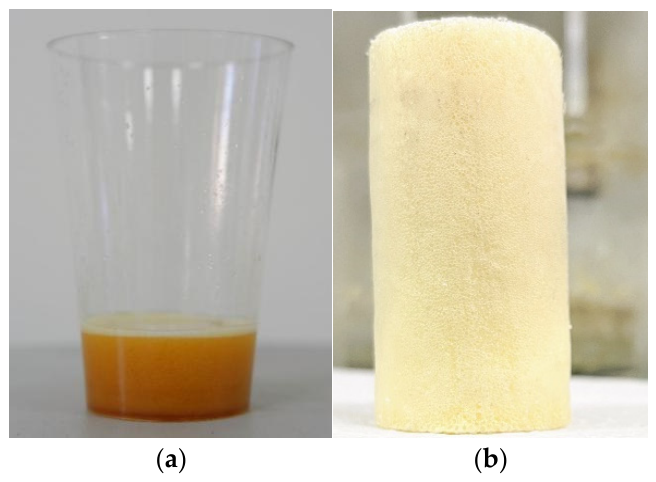
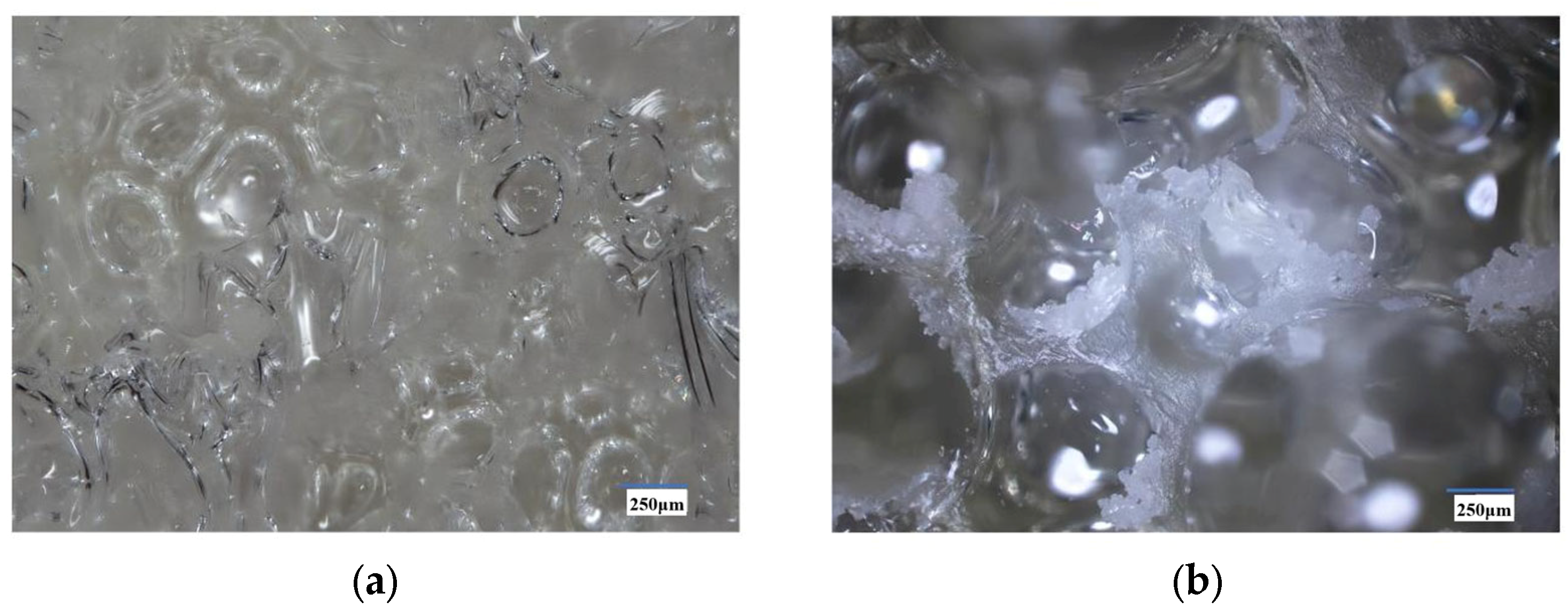
- The polyurethane slurry exhibited good fluidity/injectability, and by adjusting the catalyst type and dosage its gel time was controllable between 10 and 1500 s. Microscopy of the cured porous polyurethane revealed an interconnected open-cell structure with favorable transport and mechanical properties: porosity ~83%, permeability >4 D, and uniaxial compressive strength of 1.5 Mpa.
- (2)
- Optimizing additive chemistry and dosage governed the gelation–foaming balance and pore connectivity: the formulation using F1 foam stabilizer, K2 cell-opening agent, and CR2 cross-linker with ~55 wt% isocyanate and ~4 wt% water produced an open-cell polyurethane (porosity ~87.8%) with peak permeability ~4.72 D and adequate compressive strength (~1.6 MPa). Its permeability is comparable to that of precision metal screens used in oilfield applications, while its mechanical strength is similar to that of PVC screens. Insufficient/excessive blowing or less effective additives led to poorer connectivity, lower permeability, and/or reduced strength.
- (3)
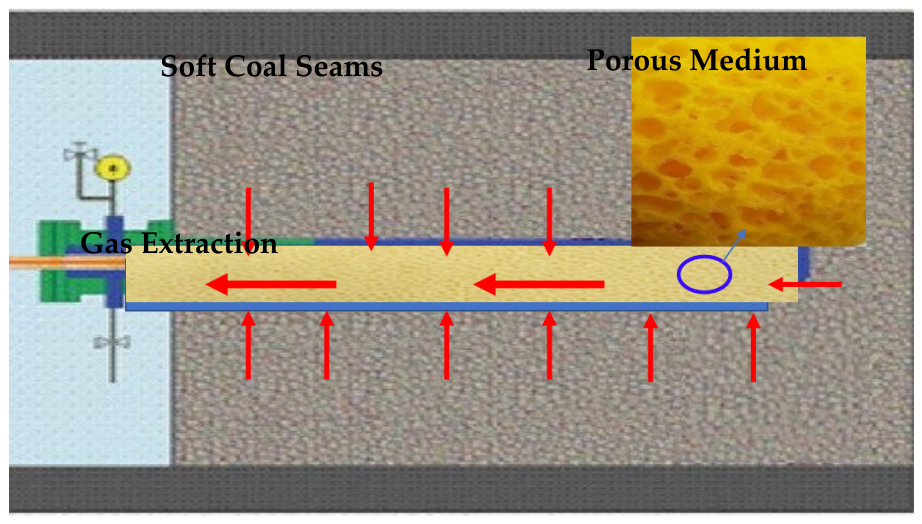
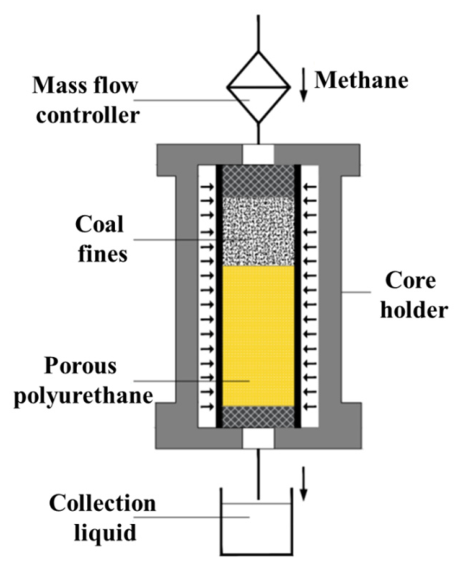
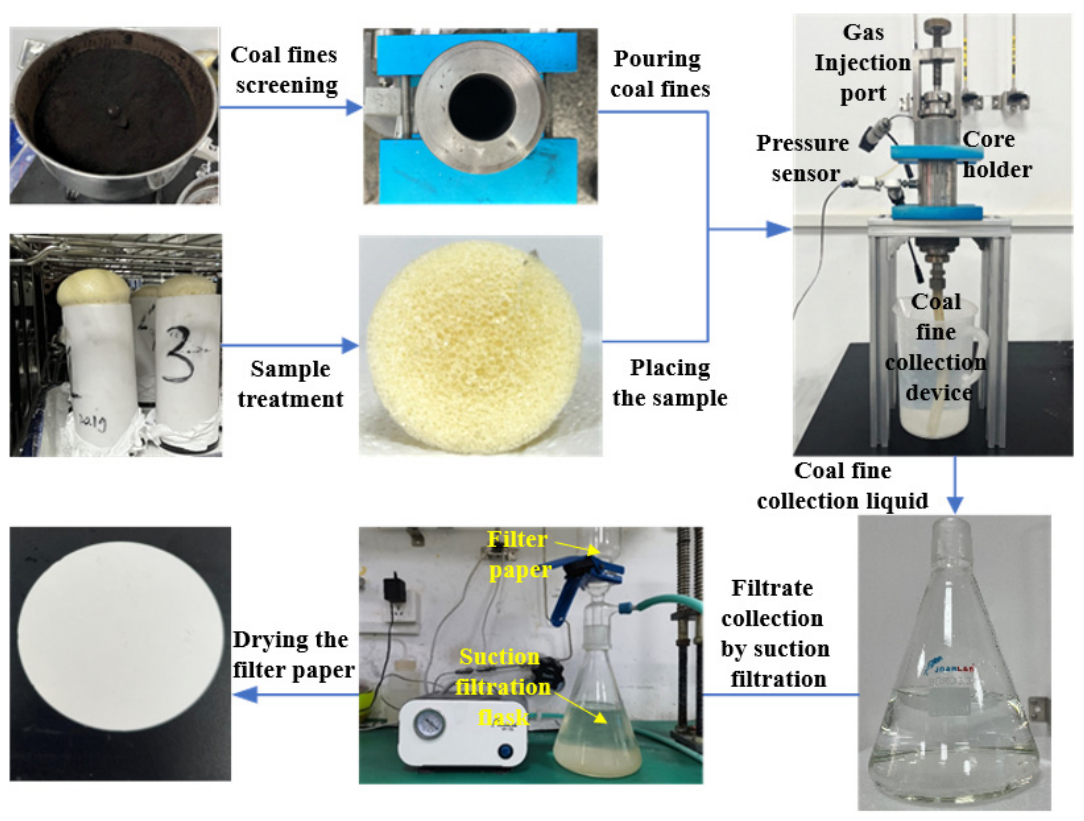
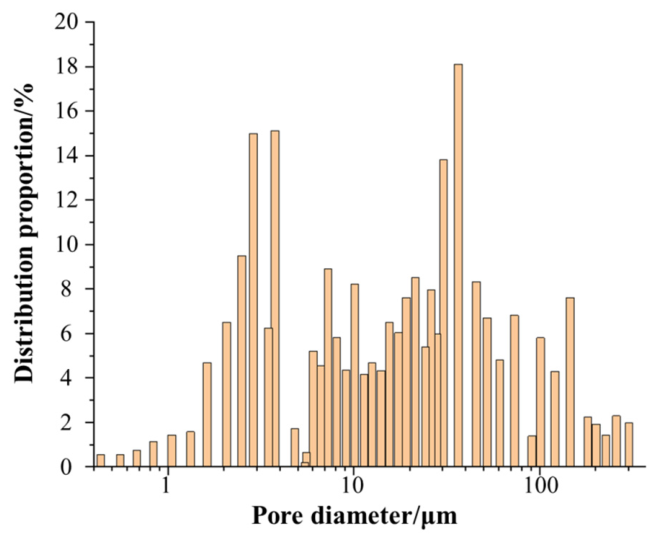
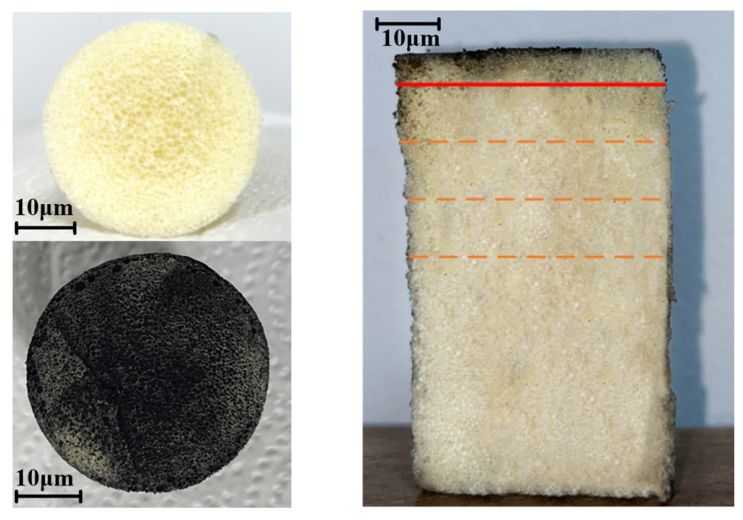
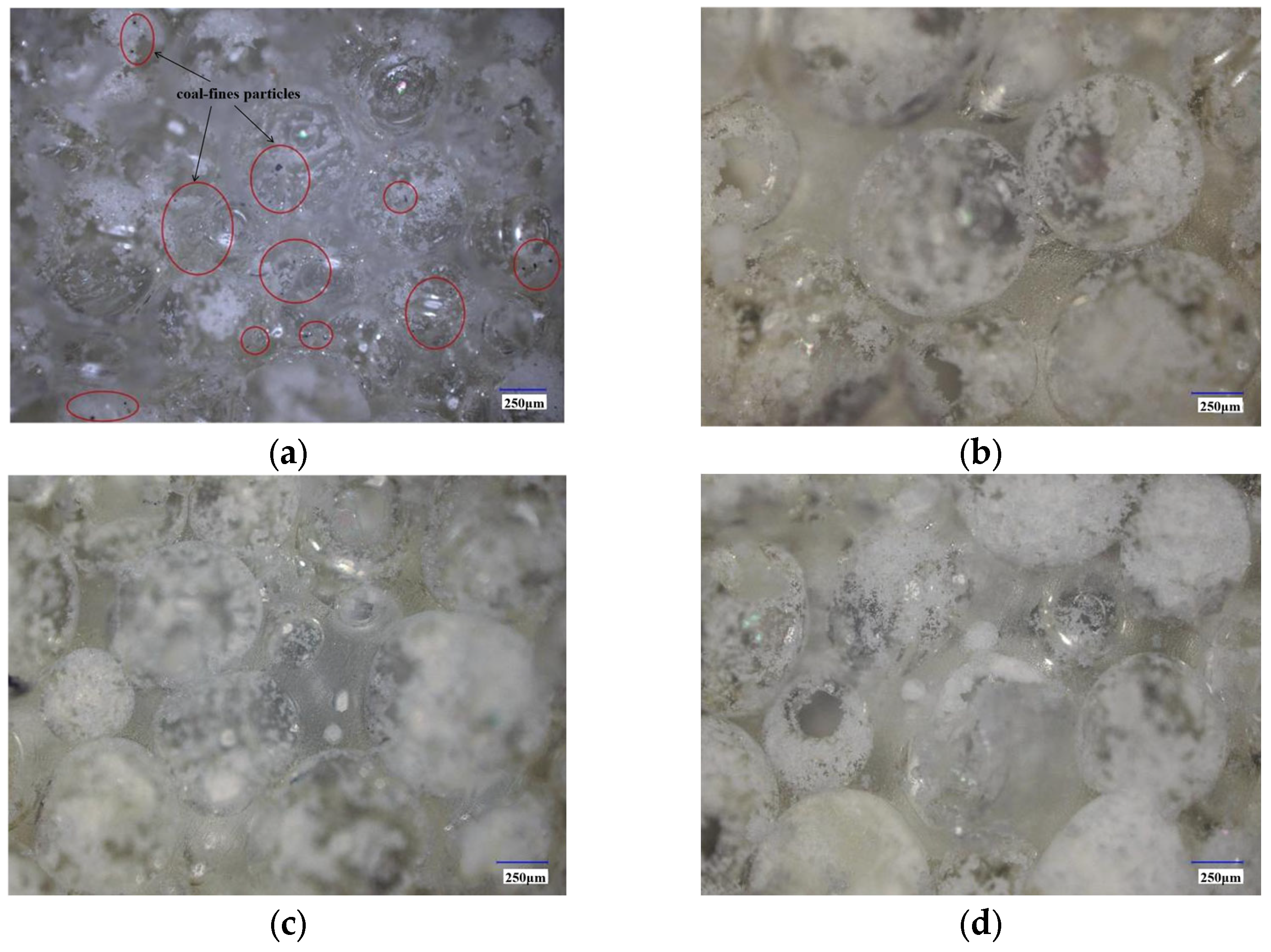
- The porous polyurethane possessed a highly interconnected, multiscale pore network (MIP porosity 78.9%, median pore size 125 μm, dominant range 1–301 μm) that enabled gas flow while filtering coal fines. Notably, conventional gas-drainage screens currently in use do not incorporate coal-fine prevention as a design criterion. Under simulated gas-extraction conditions, coal-fine production depended on flow rate: none occurred at ≤20 L/min, with onset near 30 L/min. Cross-sectional and SEM observations showed that fines were confined to the top ~5 mm, where smaller near-surface pores promoted bridging and straining, thereby preventing deep penetration.
- (4)
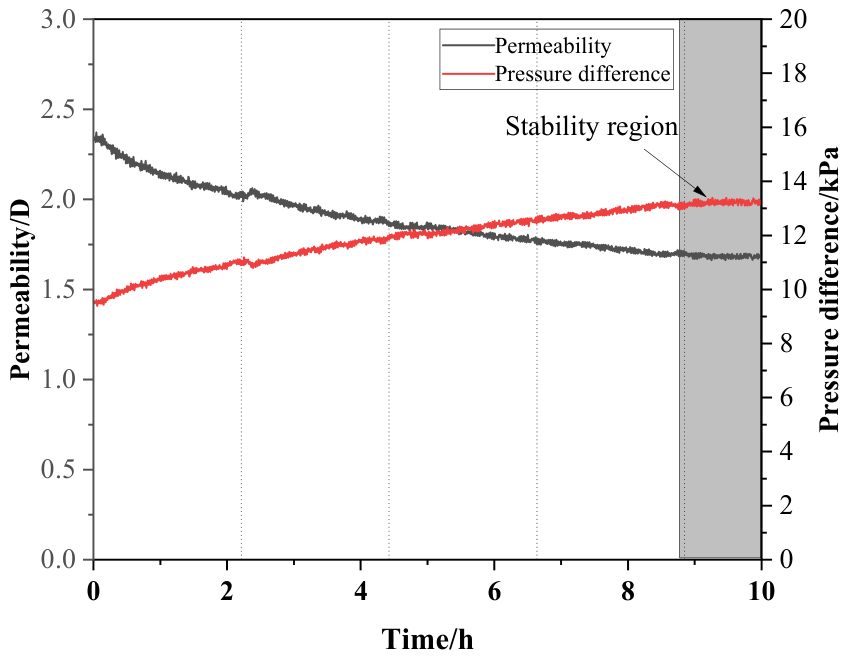
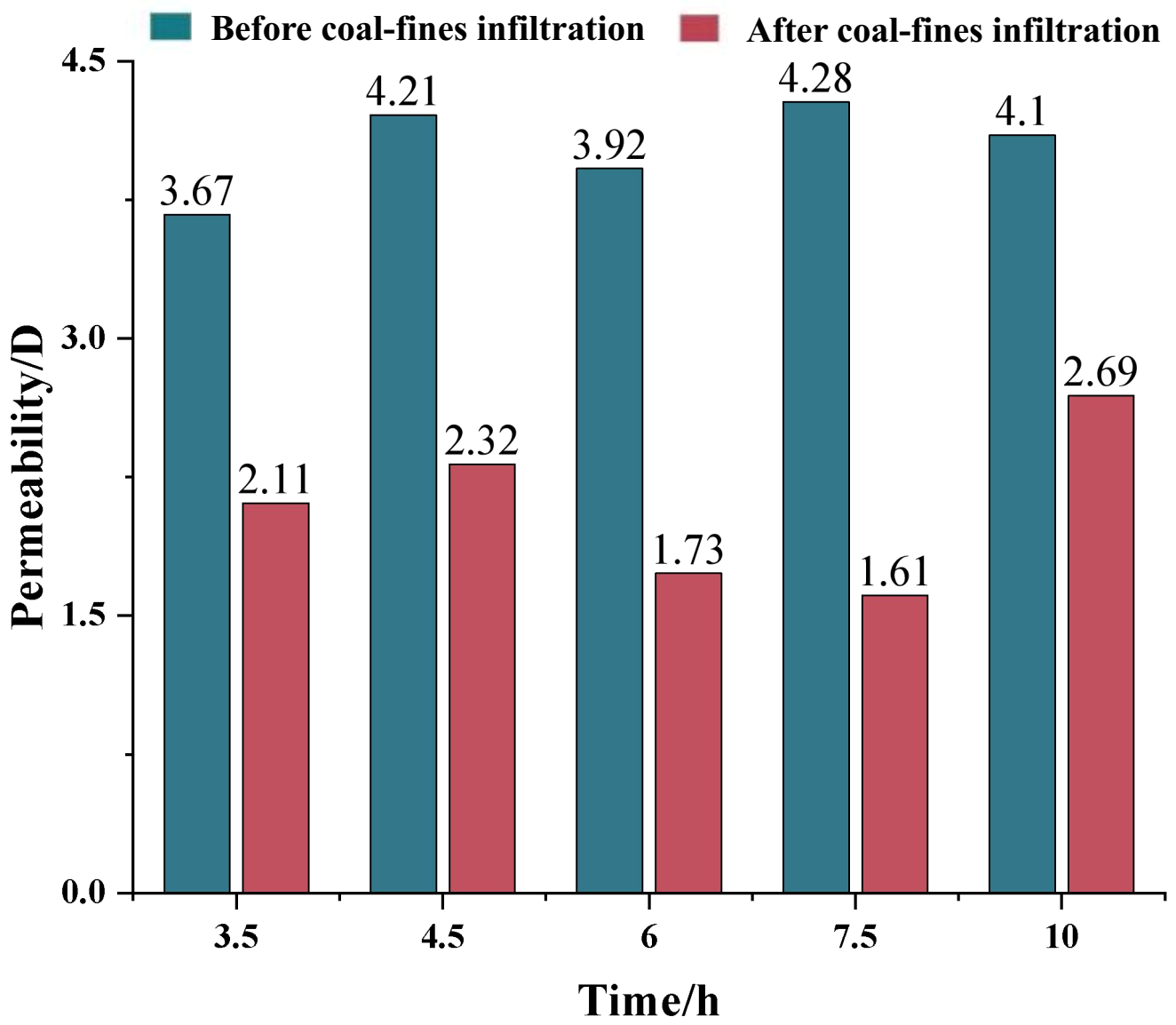
- Coal-fine ingress caused a moderate but acceptable loss of permeability. During dynamic testing, the coal fines–porous polyurethane medium declined from 2.35 D to ~1.68 D before stabilizing above ~1.5 D, while the intrinsic permeability of the porous polyurethane itself typically fell from ~4.0 D to ~2.0 D (a ~50% reduction). The reduction was governed primarily by near-surface deposition rather than deep clogging or the total fines mass, and the material retained sufficient permeability for methane drainage.
Author Contributions
Funding
Data Availability Statement
Conflicts of Interest
References
- Cheng, C.; Hu, Q.; Luo, Y.; Wang, B.; Tao, R.; Sun, Y. Experimental study of deformation evolution around the gas extraction borehole in a composite stratum. Fuel 2025, 381, 133296. [Google Scholar] [CrossRef]
- Xu, H.; Qin, Y.; Yang, D.; Wang, G.; Huang, Q.; Zhang, F. Experimental investigation of gas diffusion kinetics and pore-structure characteristics during coalbed methane desorption within a coal seam. Gas Sci. Eng. 2024, 121, 205173. [Google Scholar] [CrossRef]
- Zhang, Y.; Su, G.; Zheng, L.; Liu, D.; Guo, Z.; Wei, P. The environmental friendliness of fuzzy-ball drilling fluids during their entire life-cycles for fragile ecosystems in coalbed methane well plants. J. Hazard. Mater. 2019, 364, 396–405. [Google Scholar] [CrossRef] [PubMed]
- Xi, X.; Tao, Y.; Jiang, S.; Yin, C. Study on the formation mechanism and mechanical properties of composite foam slurry material for mine plugging. Energy 2023, 281, 128295. [Google Scholar] [CrossRef]
- Yi, M.; Wang, L.; Hao, C.; Liu, Q.; Wang, Z. Method for designing the optimal sealing depth in methane drainage boreholes to realize efficient drainage. Int. J. Coal Sci. Technol. 2021, 8, 1400–1410. [Google Scholar] [CrossRef]
- Lou, Z.; Wang, K.; Zhao, W.; Wei, G.; Yao, H.; Qin, H.; Wei, X.; Song, H. Experimental investigation on visualization and quantitative characterization of filling and plugging performances of fractures in coal. Phys. Fluids 2024, 36, 036609. [Google Scholar] [CrossRef]
- Deetjen, T.A.; Azevedo, I.L. Climate and Health Benefits of Rapid Coal-to-Gas Fuel Switching in the U.S. Power Sector Offset Methane Leakage and Production Cost Increases. Environ. Sci. Technol. 2020, 54, 11494–11505. [Google Scholar] [CrossRef] [PubMed]
- Xi, X.; Shi, Q.; Jiang, S.; Wang, K.; Wu, Z.; Shao, H. Effects of Graphene Oxide on the Mechanical and Microscopic Characteristics of Cement-Based Plugging Material for Preventing Spontaneous Combustion of Coal. Energy Fuels 2020, 34, 6346–6354. [Google Scholar] [CrossRef]
- Lou, Z.; Wang, K.; Kang, M.; Zhao, W.; Wei, G.; Yue, J.; Yao, H. Plugging methods for underground gas extraction boreholes in coal seams: A review of processes, challenges and strategies. Gas Sci. Eng. 2024, 122, 205225. [Google Scholar] [CrossRef]
- Zhou, F.; Xia, T.; Wang, X.; Zhang, Y.; Sun, Y.; Liu, J. Recent developments in coal mine methane extraction and utilization in China: A review. J. Nat. Gas Sci. Eng. 2016, 31, 437–458. [Google Scholar] [CrossRef]
- Yuan, L. Theory and practice of integrated coal production and gas extraction. Int. J. Coal Sci. Technol. 2015, 2, 3–11. [Google Scholar] [CrossRef]
- Karacan, C.Ö.; Ruiz, F.A.; Cotè, M.; Phipps, S. Coal mine methane: A review of capture and utilization practices with benefits to mining safety and to greenhouse gas reduction. Int. J. Coal Geol. 2011, 86, 121–156. [Google Scholar] [CrossRef]
- Noack, K. Control of gas emissions in underground coal mines. Int. J. Coal Geol. 1998, 35, 57–82. [Google Scholar] [CrossRef]
- Awan, F.U.R.; Arif, M.; Iglauer, S.; Keshavarz, A. Coal fines migration: A holistic review of influencing factors. Adv. Colloid Interface Sci. 2022, 301, 102595. [Google Scholar] [CrossRef] [PubMed]
- Han, W.; Wang, Y.; Li, Y.; Ni, X.; Wu, X.; Yang, J.; Zhao, S. Coal fines migration, deposition, and output simulation during drainage stage in coalbed methane production. Energy Fuels 2021, 35, 4901–4913. [Google Scholar] [CrossRef]
- Liu, Q.; Cheng, Y.; Yuan, L.; Fang, Y.; Shi, D.; Kong, S. A new effective method and new materials for high sealing performance of cross-measure CMM drainage boreholes. J. Nat. Gas Sci. Eng. 2014, 21, 805–813. [Google Scholar] [CrossRef]
- Yang, Y.; Cui, S.; Ni, Y.; Zhang, G.; Li, L.; Meng, Z. Key technology for treating slack coal blockage in CBM recovery: A case study from multi-lateral horizontal wells in the Qinshui Basin. Nat. Gas Ind. B 2016, 3, 66–70. [Google Scholar] [CrossRef]
- Huang, Z.; Li, G.; Yan, X.; Wang, K.; Shen, R.; Jin, L. Comparison experiment on steel and non-steel slotted screen pipes used in coalbed methane wells. Pet. Explor. Dev. 2012, 39, 522–527. [Google Scholar] [CrossRef]
- Zhao, Y.; Shi, Z.; Hao, S.; Liu, J.; Yang, Z.; Wang, S. Well Completion Technology Using Screen Pipe for Horizontally-intersected Well in Soft Coal Seam. Procedia Eng. 2014, 73, 311–317. [Google Scholar] [CrossRef]
- Zhang, H. Application of high efficient gas drainage technology with double casing pipe to mining seam. Coal Sci. Technol. 2013, 41, 64–67. [Google Scholar] [CrossRef]
- Wang, L.; Yao, N.; Yao, Y.; Wang, Y.; Zhang, J.; Fang, J.; Wei, H. Research progress of drilling and borehole completion technologies in broken soft coal seam in underground coal mine. Coal Geol. Explor. 2021, 49, 285–296. [Google Scholar]
- Niu, D. Gas pre-drainage technology with full length casing for borehole drilled along low permeability soft seam. Coal Sci. Technol. 2013, 41, 90–92+116. [Google Scholar] [CrossRef]
- Orhan, N. Effect of Different Screen Types on Head Loss in Deep Wells Used for Irrigation. Turk. J. Civ. Eng. 2023, 34, 61–82. [Google Scholar] [CrossRef]
- Yang, S.; Wen, G.; Yan, F.; Zhang, M.; Zhao, X. Evaluating the maximum rate of penetration for drilling borehole in soft coal seam. Energy Sci. Eng. 2020, 8, 3273–3284. [Google Scholar] [CrossRef]
- Zheng, C.; Chen, Z.; Kizil, M.; Aminossadati, S.; Zou, Q.; Gao, P. Characterisation of mechanics and flow fields around in-seam methane gas drainage borehole for preventing ventilation air leakage: A case study. Int. J. Coal Geol. 2016, 162, 123–138. [Google Scholar] [CrossRef]
- Zhang, B.; Yu, Y.; Gao, X.; Wu, Q.; Zhang, Q.; Liu, C. Experimental Study on the Optimization of Polymer-Modified Cement-Based Composite Sealing Materials and Mechanical Properties and Permeability of Cemented Coal Bodies. Front. Mater. 2022, 9, 774887. [Google Scholar] [CrossRef]
- Wang, Z.; Sun, Y.; Wang, Y.; Zhang, J.; Sun, Z. A coupled model of air leakage in gas drainage and an active support sealing method for improving drainage performance. Fuel 2019, 237, 1217–1227. [Google Scholar] [CrossRef]
- Xiang, X.; Zhai, C.; Xu, Y.; Yu, X.; Xu, J. A flexible gel sealing material and a novel active sealing method for coal-bed methane drainage boreholes. J. Nat. Gas Sci. Eng. 2015, 26, 1187–1199. [Google Scholar] [CrossRef]
- Fu, J.; Li, X.; Wang, Z. A novel sealing material and a bag-grouting sealing method for underground CBM drainage in China. Constr. Build. Mater. 2021, 299, 124016. [Google Scholar] [CrossRef]
- Zhang, X.; Wang, E. Study on Ratio Optimization and Diffusion-Gelation Process of Polymer Grouting Materials for Fracture Filling in Underground Mines. Materials 2024, 17, 3064. [Google Scholar] [CrossRef] [PubMed]
- Zhang, Q.; Hu, X.; Wu, M.; Zhao, Y.Y.; Yu, C. Effects of different catalysts on the structure and properties of polyurethane/water glass grouting materials. J. Appl. Polym. Sci. 2018, 135, 46460. [Google Scholar] [CrossRef]
- Zhang, H.; Yao, S.; Wang, J.; Hou, C.; Guan, X.; Zou, D. A novel CO2 foaming agent for the preparation of foamed sulfoaluminate cement material: Application to coal mine filling. J. Build. Eng. 2022, 62, 105353. [Google Scholar] [CrossRef]
- Henrique, B.Z.J.; Mohammad, H.; Chenxi, W.; Mahmood, S.; Alireza, N. A novel laboratory technique for open-hole gravel-pack design. J. Pet. Sci. Eng. 2022, 215, 110713. [Google Scholar] [CrossRef]
- Wang, C.; Pang, Y.; Mahmoudi, M.; Haftani, M.; Salimi, M.; Fattahpour, V.; Nouri, A. A set of graphical design criteria for slotted liners in steam assisted gravity drainage production wells. J. Pet. Sci. Eng. 2020, 185, 106608. [Google Scholar] [CrossRef]
- Wang, C.; Pallares, J.D.M.; Haftani, M.; Nouri, A. Developing a methodology to characterize formation damage (pore plugging) due to fines migration in sand control tests. J. Pet. Sci. Eng. 2020, 186, 106793. [Google Scholar] [CrossRef]
- Dawson, M.A.; Germaine, J.T.; Gibson, L.J. Permeability of open-cell foams under compressive strain. Int. J. Solids Struct. 2006, 44, 5133–5145. [Google Scholar] [CrossRef]
- Wang, L.; Xue, Y.; Wang, X.; Zhu, L.; Cao, X.; Ge, R. Effect of aggregate gradation on pore structure evolution and mechanical performance of coal gangue-fly ash cemented backfill: Insights from NMR. Powder Technol. 2026, 482, 122775. [Google Scholar] [CrossRef]
- Xue, Y.; Wang, L.; Cai, Y.; Liu, J.; Ranjith, P.G.; Gao, F.; Xie, H.; Liu, Y. Effects of heating–cooling on the mechanical properties and damage evolution of granite for underground cryogenic storage. Acta Geotech. 2026, 1–21. [Google Scholar] [CrossRef]
- Barksby, N.; Dormish, J.F.; Haider, K.W. Polyurethane Synthesis. In Encyclopedia of Polymeric Nanomaterials; Kobayashi, S., Müllen, K., Eds.; Springer: Berlin/Heidelberg, Germany, 2015; pp. 2091–2103. [Google Scholar]
- Gertig, C.; Erdkamp, E.; Ernst, A.; Hemprich, C.; Kröger, L.; Langanke, J.; Bardow, A.; Leonhard, K. Reaction Mechanisms and Rate Constants of Auto-Catalytic Urethane Formation and Cleavage Reactions. ChemistryOpen 2021, 10, 534. [Google Scholar] [CrossRef] [PubMed]
- GB/T 8813-2020; Rigid Cellular Plastics—Determination of Compression Properties. China Standards Press: Beijing, China, 2020.
- Xue, A.; Gao, W.; Mao, T. Type selection and optimization of filtration and separation equipment in coalbed methane gathering station. Gas Heat 2015, 35, 21–23. [Google Scholar] [CrossRef]
- McKenna, S.T.; Hull, T.R. The fire toxicity of polyurethane foams. Fire Sci. Rev. 2016, 5, 3. [Google Scholar] [CrossRef]
- Gama, N.V.; Ferreira, A.; Barros-Timmons, A. Polyurethane Foams: Past, Present, and Future. Materials 2018, 11, 1841. [Google Scholar] [CrossRef] [PubMed]
- Wang, Y.; Liang, S.; Tian, C.; Wang, J. Synthesis and properties of biodegradable polyurethane foams. New Chem. Mater. 2011, 39, 57–59+79. [Google Scholar]
- Sauter, T.; Lutzow, K.; Schossig, M.; Kosmella, H.; Weigel, T.; Kratz, K.; Lendlein, A. Pore morphology as structural parameter to tailor the shape-memory effect of polyuetherurethane foams. In Abstracts of Papers of the American Chemical Society; American Chemical Society: Washington, DC, USA, 2013; Volume 245. [Google Scholar]
- Wang, Z.; Wang, Z.; Wang, X.; Yang, B.; Li, S. Effect of formula compositions on compressive strength of polyurethane grouting materials. China Plast. 2023, 37, 7–14. [Google Scholar] [CrossRef]
- Zhang, X.; Cao, Y. Effect of cross linkage on properties of transparent polyurethane elastomer. Polym. Mater. Sci. Eng. 2002, 18, 122–125. [Google Scholar] [CrossRef]
- Tiancheng, X.; Yingchun, W.; Ziliang, L.; Biao, L.; Daiyong, C.; Anmin, W. Experimental Investigation on the Impact of Coal Fines Migration on Pores and Permeability of Cataclastic Coal. ACS Omega 2023, 8, 31246–31255. [Google Scholar] [CrossRef]

| Reagent Function | Reagent Name | Specification | Manufacture |
|---|---|---|---|
| Main components | PAPI | Industrial grade | Wanhua Energy Saving Technology Group Co., Ltd., Yantai, China |
| Polyether polyol | Industrial grade | Tianjin Third Petrochemical Plant, Tianjin, China | |
| Foaming agent | 99.99 | Ruixi Chemical Water Treatment Plant, Beijing, China | |
| Catalysts | T-9 | Industrial grade | Wuhan Litai Chemical Co., Ltd., Wuhan, China |
| Cross-linker | CR1 | Industrial grade | Shanghai McLean Biochemical Technology Co., Ltd., Shanghai, China |
| CR2 | Industrial grade | Xilong Science Co., Ltd., Shanghai, China | |
| Foam stabilizer | F1 | Industrial grade | Jiangsu MeiSide Chemical Co., Ltd., Nanjing, China |
| F2 | Industrial grade | BYK-Chemie GmbH, Shanghai, China | |
| F3 | Industrial grade | Guangzhou Xinguan Chemical Technology Co., Ltd., Guangzhou, China | |
| F4 | Industrial grade | Guangzhou Dejing Chemical Co., Ltd., Guangzhou, China | |
| Cell-opening agent | K1 | Industrial grade | Jiangsu MeiSide Chemical Co., Ltd., Nanjing, China |
| K2 | Industrial grade | Dongguan Guangsiyuan Polyurethane Materials Co., Ltd., Dongguan, China |
| Runs | Initial Permeability of Porous Polyurethane (D) | Gas Injection Rate (L·min−1) | Gas Injection Duration (h) | Coal Fines Produced (Yes/No) |
|---|---|---|---|---|
| 1 | 3.67 | 10 | 3.0 | No |
| 2 | 4.12 | 10 | 4.5 | No |
| 3 | 3.92 | 10 | 6.0 | No |
| 4 | 4.28 | 4 h @ 20 L/min; next 3.5 h @ 30 L/min. | 7.5 | Yes |
| 5 | 4.10 | 30 L/min | 10.0 | Yes |
| Types of Catalysts | Mass Fraction/% | Foaming Time/s |
|---|---|---|
| Tin compounds | 2 | 1500 |
| 4 | 600 | |
| 6 | 180 | |
| Amine | 2 | 40 |
| 4 | 15 | |
| 6 | 10 |
| Variable | Runs | Foam Stabilizer Type | Cell-Opening Agent | Cross-Linker Type | Permeability /D | Compressive Strength/MPa |
|---|---|---|---|---|---|---|
| Foaming agent | S1 | F1 | No cell-opening agent added | CR1 | 0.07 ± 0.01 | 1.72 ± 0.15 |
| S2 | F2 | — | — | |||
| S3 | F3 | — | — | |||
| S4 | F4 | 0.04 ± 0.01 | 1.70 ± 0.11 | |||
| Cell-opening agent | S4 | F1 | K1 | CR1 | 0.62 ± 0.02 | 1.62 ± 0.15 |
| S5 | K2 | 0.61 ± 0.03 | 1.66 ± 0.12 | |||
| Cross-linkers | S6 | F1 | K1 | CR1 | 0.57 ± 0.01 | 1.65 ± 0.20 |
| S7 | CR2 | 2.01 ± 0.02 | 1.78 ± 0.24 |
| Variable | Number | Isocyanate Mass Fraction/% | Foaming Agent Mass Fraction/% | Porosity/% | Permeability/D | Compressive Strength/MPa |
|---|---|---|---|---|---|---|
| Isocyanate dosage | S1 | 50 | 2 | 84.8 ± 0.3 | 2.12 ± 0.31 | 1.70 ± 0.14 |
| S2 | 55 | 2 | 85.0 ± 0.2 | 3.79 ± 0.20 | 1.86 ± 0.17 | |
| Blowing agent dosage | S3 | 55 | 3 | 86.2 ± 0.4 | 4.22 ± 0.08 | 1.70 ± 0.12 |
| S4 | 55 | 4 | 87.8 ± 0.3 | 4.72 ± 0.12 | 1.61 ± 0.16 | |
| S5 | 55 | 5 | 85.0 ± 0.3 | 2.58 ± 0.06 | 1.59 ± 0.13 |
Disclaimer/Publisher’s Note: The statements, opinions and data contained in all publications are solely those of the individual author(s) and contributor(s) and not of MDPI and/or the editor(s). MDPI and/or the editor(s) disclaim responsibility for any injury to people or property resulting from any ideas, methods, instructions or products referred to in the content. |
© 2026 by the authors. Licensee MDPI, Basel, Switzerland. This article is an open access article distributed under the terms and conditions of the Creative Commons Attribution (CC BY) license.
Share and Cite
Wang, C.; Wang, J.; Ma, S.; Liu, W.; Sun, Y.; Li, B.; Zhang, X.; Zhang, G. High-Permeability Anti-Clogging Porous Polyurethane for Coal-Fine Control in Gas Drainage Borehole Completions. Processes 2026, 14, 2419. https://doi.org/10.3390/pr14152419
Wang C, Wang J, Ma S, Liu W, Sun Y, Li B, Zhang X, Zhang G. High-Permeability Anti-Clogging Porous Polyurethane for Coal-Fine Control in Gas Drainage Borehole Completions. Processes. 2026; 14(15):2419. https://doi.org/10.3390/pr14152419
Chicago/Turabian StyleWang, Chuanliu, Jiale Wang, Shaoming Ma, Weiwei Liu, Ying Sun, Bing Li, Xiaofang Zhang, and Guobiao Zhang. 2026. "High-Permeability Anti-Clogging Porous Polyurethane for Coal-Fine Control in Gas Drainage Borehole Completions" Processes 14, no. 15: 2419. https://doi.org/10.3390/pr14152419
APA StyleWang, C., Wang, J., Ma, S., Liu, W., Sun, Y., Li, B., Zhang, X., & Zhang, G. (2026). High-Permeability Anti-Clogging Porous Polyurethane for Coal-Fine Control in Gas Drainage Borehole Completions. Processes, 14(15), 2419. https://doi.org/10.3390/pr14152419

