1. Introduction
The metalworking sector represents one of the fundamental pillars of the global economy: its processes—foundry, forming, machining, welding and heat treatments—transform metals into machinery, equipment and essential components for practically all productive sectors [
1,
2,
3]. However, this strategic position entails a high energy intensity that translates into a considerable carbon footprint (CF), expressed in carbon dioxide equivalent (CO
2eq) [
4]. This metric covers both direct Scope 1 emissions—derived from combustion in furnaces and industrial facilities—and indirect Scope 2 and 3 emissions, associated with electricity consumption and supply chain activities: raw material extraction, transport and waste management [
5,
6].
Increasing international regulatory pressure exacerbates this challenge. Regulatory frameworks such as the European Union’s Carbon Border Adjustment Mechanism (CBAM) and emissions trading schemes (ETS) require companies in the sector to provide verifiable and auditable evidence of the environmental impact of their products [
7,
8]. This requirement goes beyond the annual corporate emissions statement requiring the granular calculation of the Product Carbon Footprint (PCF), quantifying emissions per functional unit throughout its life cycle [
9]. However, the dynamic, fragmented and multi-actor nature of the metalworking supply chain makes this quantification a highly complex technical challenge [
10]. Traditional static accounting methods—based on generic emission factors and annual averages—are insufficient to solve this problem with the precision and dynamism required by the new regulatory frameworks [
11].
In response to these limitations, the convergence of Industry 4.0 technologies—the Internet of Things (IoT), digital twins (DT), big data analytics, machine learning, and blockchain technology—is shaping a new paradigm for life cycle data management [
12,
13,
14,
15,
16]. The integration of this digital ecosystem allows for the precise and real-time monitoring of energy flows and emissions at each stage of the production process, guaranteeing the integrity, transparency and immutability of the information [
17,
18,
19]. These attributes are essential both for the implementation of Digital Product Passports (DPPs)—which communicate verifiable data on materials and circularity—and to enable the operational transition to the circular economy [
1,
20].
However, the available evidence reveals a considerable gap between the theoretical potential of these technologies and their effective deployment in real industrial environments [
21]. This gap is especially pronounced in the metalworking subsector, where small and medium-sized enterprises (SMEs)—which make up the majority of the industrial fabric—often lack digital core systems such as enterprise resource planning (ERP) or manufacturing execution systems (MES), preventing automated capture of primary data for reliable PCF calculation [
22,
23].
The absence of primary data forces the use of generic secondary databases, introducing biases and uncertainties that compromise the fidelity of the environmental report [
24,
25]. This scenario is exacerbated in critical processes such as smelting and alloying, where the destruction of the physical traceability of the raw material makes it difficult to accurately assign emissions by-product variant [
26]. Added to this is the lack of methodological standardization for the interoperability of heterogeneous systems and the latent tension between the transparency required by regulations and the necessary protection of suppliers’ intellectual property [
21].
Faced with this scenario, the present study develops a systematic review of the literature following the PRISMA 2020 protocol [
27], with the aim of identifying, classifying and critically evaluating the collection tools and digital processing technologies used to calculate, manage and verify PCF in the metalworking industry. While recent reviews explore digital solutions for data-driven circularity, such as Mügge et al. [
28] evaluating DT under low technology readiness levels (TRL 2-3) and fragmented end-of-life data, and Madarkar et al. [
29] highlighting the conceptual integration of Dynamic Life Cycle Assessments (DLCA) with IoT and ERP/MES, these frameworks fail to address the high-energy processes and complex raw material traceability inherent to the metalworking sector. To bridge this gap, this review provides three specific contributions: (1) identifies and classifies the collection tools and digital processing technologies that enable the management and assurance of life cycle data required for the calculation of PCF in the metalworking supply chain; (2) characterizes the articulated life cycle data integration architecture using digital tools and technologies for automated calculation of the PCF of the metalworking supply chain; and (3) analyzes the role of verifiable digital credentials, and their linkage with Digital Product Passports, as a mechanism to improve the transparency and reliability of information on PCF in the metalworking supply chain.
The article is structured as follows:
Section 2 details the methodology for searching for and including studies;
Section 3 presents the bibliometric results and the synthesis of evidence;
Section 4 discusses the findings in terms of technical feasibility; and
Section 5 sets out the conclusions and future lines of research.
2. Methodology
The study employs a systematic literature review to identify, summarize, and critically evaluate existing research on collection tools and digital technologies used in the calculation, management, and verification of the carbon footprint of products in the metalworking industry. As an initial phase, a scoping review was carried out in the general manufacturing industry, which allowed us to build the theoretical and technical framework necessary to identify key technologies, their benefits and the main implementation challenges in the metalworking sector.
To ensure the scientific rigor and reproducibility of the process, the PRISMA guidelines were adopted, structuring the methodology in three sequential stages: firstly, Identification (
Section 2.1), which comprises an exhaustive search in scientific databases through the precise definition of keywords; secondly, the Selection (
Section 2.2), where preliminary filters are applied to exclude non-relevant documents; and, finally, Inclusion (
Section 2.3), in which studies are evaluated in detail through predefined research questions and eligibility criteria to ensure the robustness and reliability of the final results [
27,
30].
2.1. Identification
The literature search was executed on 31 March 2026, using Publish or Perish software [
31], which allows records from multiple academic sources—including Scopus and Web of Science—to be retrieved in a unified interface, facilitating the extraction of bibliometric metrics such as h-index and citation count to evaluate the relevance and impact of the identified publications.
The search strings were constructed with Boolean operators (AND, OR, NOT) to maximize the completeness of the recovery. To ensure full reproducibility according to PRISMA guidelines, the complete, exact, and unique query string applied across the platforms was structured as follows: For Scopus (using TITLE-ABS-KEY tag): TITLE-ABS-KEY((“Product Carbon Footprint” OR “PCF” OR “carbon footprint management”) AND (“manufacturing industry” OR “metalworking industry” OR “steel industry” OR “foundry”) AND (“carbon management software” OR “digital tool” OR “framework” OR “conceptual model”)); For Web of Science (using TS tag): TS = ((“Product Carbon Footprint” OR “PCF” OR “carbon footprint management”) AND (“manufacturing industry” OR “metalworking industry” OR “steel industry” OR “foundry”) AND (“carbon management software” OR “digital tool” OR “framework” OR “conceptual model”)).
No language restrictions were applied to the search execution. Through this strategy, an initial bulk of 64,092 raw records was identified. After refining the search by restricting the operational fields to titles, abstracts, and keywords within the Publish or Perish interface, a comprehensive set of 1657 records were successfully retrieved for subsequent screening (894 records from Scopus and 763 records from Web of Science).
2.2. Screening
After the initial search, a screening process was applied to ensure the relevance of the studies with respect to the research objective. First, a temporary inclusion criterion was established that limited the selection to articles published from 2016 onwards. This window allows us to capture the convergence of Industry 4.0 technologies with modern methods of environmental quantification. Duplicate records were then removed using Zotero software. To do this, a similarity algorithm with a conservative threshold of 90% in the titles was used to identify potentially identical records. However, to avoid the erroneous merging of different studies with similar names, the final exclusion decision was manually validated by comparing DOI identifiers, authorship, year and source, ensuring transparency in accordance with the PRISMA 2020 guidelines [
27].
Subsequently, the titles and abstracts of the remaining articles were evaluated manually to confirm their alignment with the scope of the study. Once the sample of eligible articles was consolidated, a complementary bibliometric analysis was carried out to explore research trends, temporal evolution, geographical distribution, representativeness in databases and concentration in scientific journals. This systematic assessment provided a structured perspective on the state of the art and facilitated the identification of key technological patterns in existing literature.
To ensure the quality and methodological rigor of the process, the expanded checklist, developed following the recommendations of [
32], is included as
Supplementary Material.
2.3. Inclusion Studies
After completing the selection process, the final selection of studies was determined based on their relevance to the research objective. The articles that passed these preliminary phases were fully analyzed, considering factors such as methodological quality, the relevance of the data and their applicability to the field of research. To ensure a systematic evaluation, specific research questions (RQs) were applied, followed by the implementation of the established inclusion and exclusion criteria.
The research questions that guided this selection and the analysis studies in this systematic review were as follows:
What collection tools and digital processing technologies enable the management and securing of the life cycle data required for PCF calculation in the metalworking supply chain? (RQ1)
How is product life cycle data integrated to calculate PCF in digital environments of the metalworking supply chain? (RQ2)
How do digital verifiable credentials contribute to improving the transparency and reliability of PCF information in the metalworking supply chain? (RQ3)
The formulation of research questions follows a progressive and hierarchical structure to ensure a solid exploration of the field. Thus, RQ1 is aimed at determining which collection tools and digital processing technologies allow data to be managed and secured in the metalworking supply chain, mapping the available technological ecosystem. RQ2 addresses how such data is integrated within digital environments to accurately calculate the product’s carbon footprint (PCF) throughout its life cycle. Finally, RQ3 assesses the contribution of digital verifiable credentials as mechanisms to improve the transparency and reliability of reported information, a crucial factor for the decarbonization of the sector. This hierarchical screening directly accounts for the final refinement layer: while general manufacturing papers () answered the baseline technological ecosystem (RQ1), only those meeting the strict “Sectoral specificity and technological depth” criterion () provided the granular architectural evidence required to address the integration and verification vectors (RQ2 and RQ3).
Although the PRISMA 2020 framework recommends assessing the risk of bias [
27], a standardized clinical quality appraisal tool was not used. Instead, a manual review was conducted independently and cross-checked by two authors, and therefore a formal quality assessment was not considered essential.
3. Results
The results derived from this study are presented in the following subsections, structured according to the successive phases defined in the methodological approach: identification, screening and inclusion of studies.
3.1. Identification
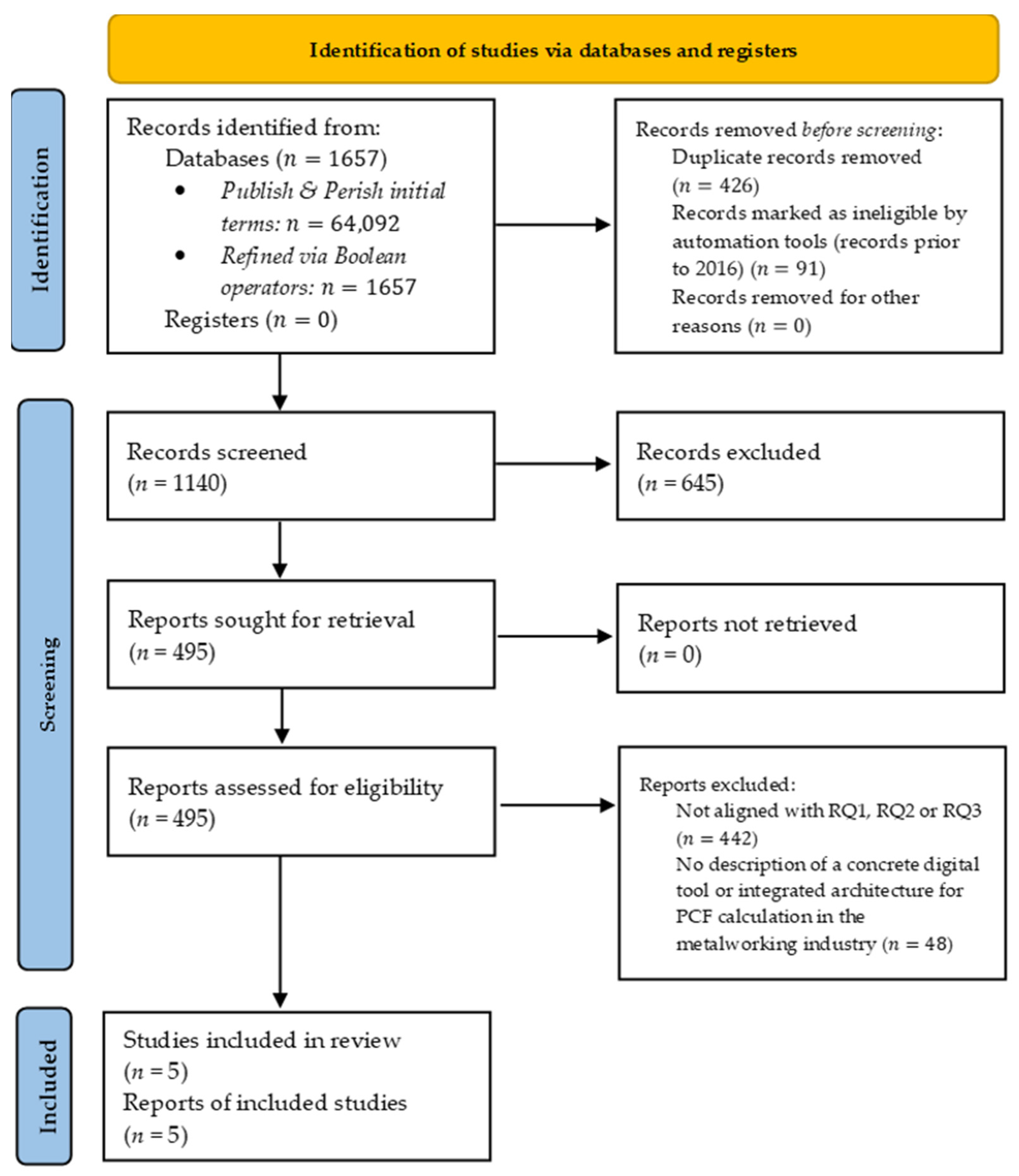
Following the methodology described above, the selection process was carried out in several phases to filter the initial results and identify the most relevant literature. The first phase consisted of an independent search by keywords, which yielded a total of 64,092 results. To improve accuracy, advanced Boolean operators were applied, reducing the number of documents recovered to 1657.
After applying the temporal filter (publications after 2016 until 31 March 2026), 1566 articles were retained (91 excluded). Removing duplicate records using a title similarity algorithm with a 90% threshold narrowed the selection to 1140 unique records (426 duplicates removed). Subsequently, the manual evaluation of titles and abstracts, aimed at verifying thematic alignment with the objectives of the research, resulted in 495 articles included (645 excluded due to lack of technical relevance).
The screening and mutual exclusion process was documented in detail in the flowchart based on the 2020 PRISMA guidelines (
Figure 1). Based on this screening, a total of 495 articles were used to conduct bibliometric analysis and general characterization of global trends in the literature. From this set, 53 studies with strict thematic relevance were selected to serve as the documentary basis for developing the answers to the research questions (RQ1, RQ2, and RQ3). Finally, after rigorously applying the cross-cutting inclusion criterion of “Sector-specificity and technological depth” (detailed in
Table 1), 90.5% (
n = 48) of the articles were excluded because they addressed the digitalization of sustainability in a generic manner within manufacturing or other industrial sectors. Only 5 studies simultaneously met the requirement of describing digital architecture or conceptual model explicitly applied to processes in the metalworking industry (such as casting, machining, or scrap management) with documented industrial validation or technical simulation. Therefore, these five specific cases (
Section 4) constitute the entirety of the eligible scientific evidence available in the current literature to inform the critical discussion and analysis of the limitations of the state of the art.
3.2. Screening
As a result of this phase, 495 studies were selected and subsequently subjected to a detailed analysis of research trends. This analysis covered the temporal evolution of the publications, their geographical distribution, the impact of studies based on citation analysis and the methodological classification of the reviewed works.
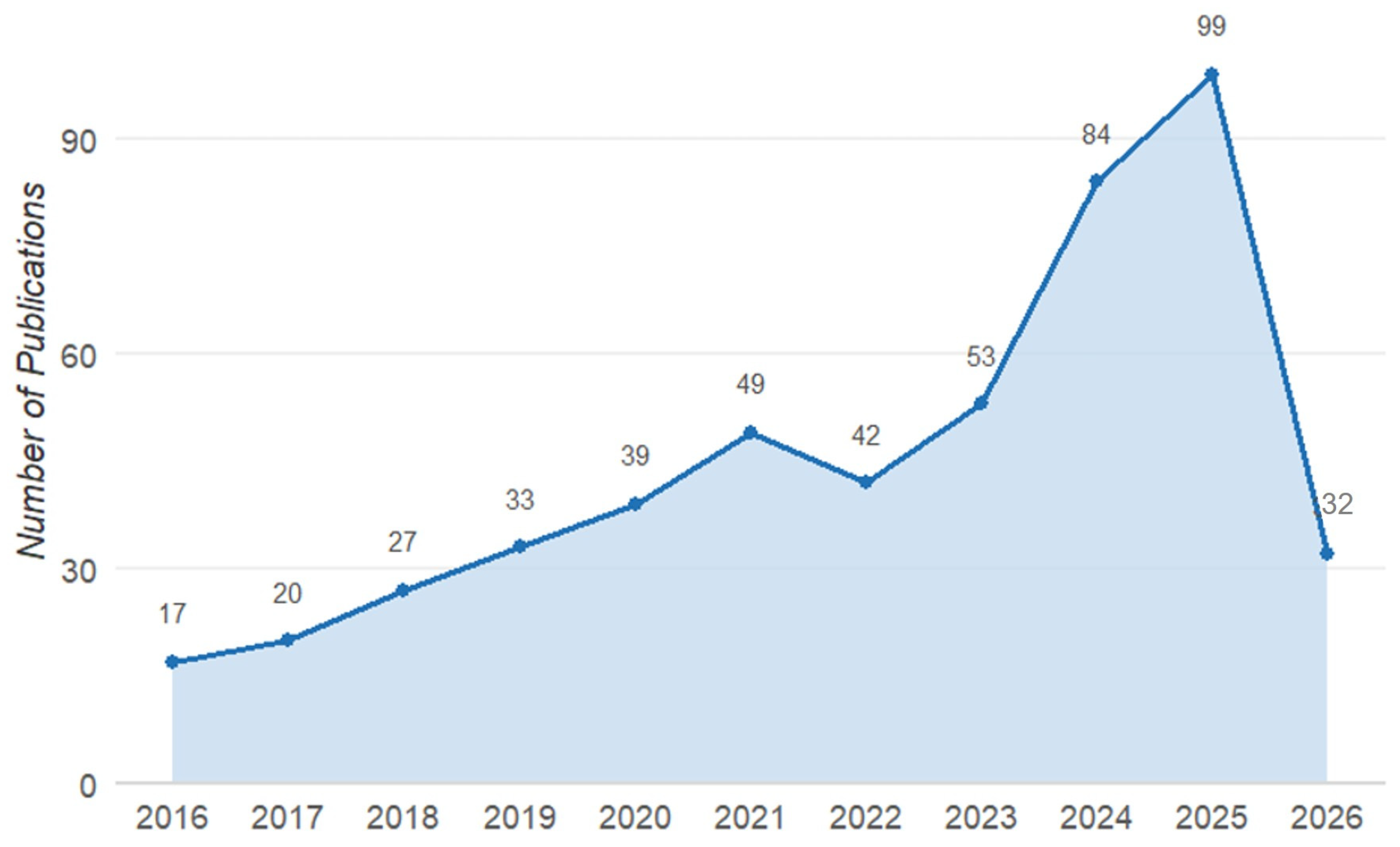
To assess the evolution of interest in this field, the distribution of publications over time was analyzed.
Figure 2 presents the number of articles published per year, allowing us to identify periods with greater scientific production and emerging research trends.
Figure 2 illustrates the temporal trajectory of the retrieved literature (
n = 495 cumulative publications), revealing an accelerating expansion of scientific interest. Following an initial consolidation phase between 2016 and 2020—where annual output rose steadily from 17 to 39 papers, the domain transitioned toward exponential growth after 2022. Notably, annual publications rose from 53 in 2023 to a peak of 99 in 2025, representing a 135% surge in annual production within just three years (2022–2025). The lower volume registered in 2026 (32 publications) is strictly attributable to the partial-year data collection window and does not indicate a decline in academic interest. This trajectory demonstrates that the field has entered a highly strategic phase of maturity, catalyzed by shifting regulatory landscapes, technological convergence, and the global urgency for industrial sustainability solutions.
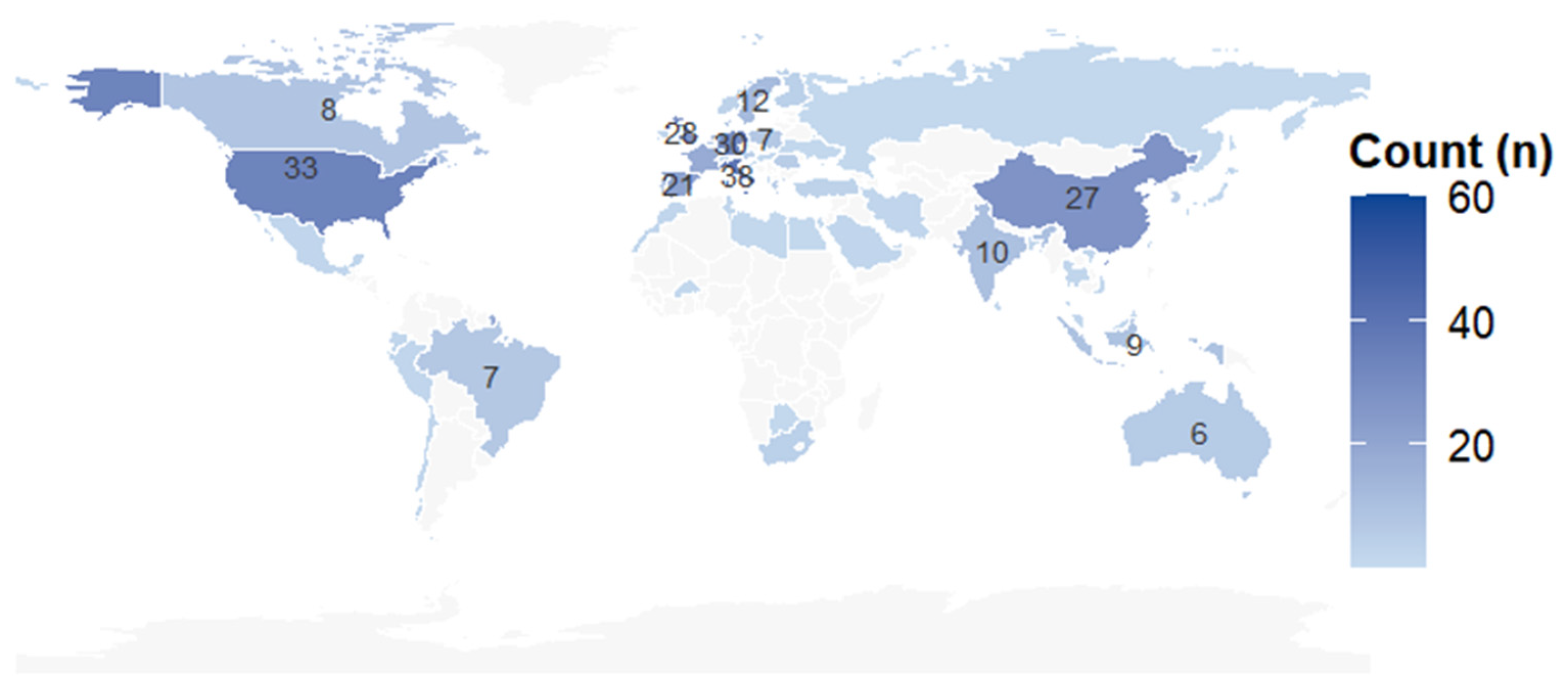
The analysis of the geographical distribution of the studies provides key insights into the country’s leading research on the collection tools and digital processing technologies used for carbon footprint calculation, management and verification.
Figure 3 and
Table 2 present the number of publications by country, allowing us to identify the regions with the highest scientific production in this field.
Figure 3 and
Table 2 illustrate the geographical distribution of the analyzed literature, revealing Italy (
) and the United States (
) as the predominant research hubs, followed closely by Germany (
), the United Kingdom (
), China (
), and Spain (
). Crucially, this spatial concentration is not merely incidental; it directly correlates with sovereign jurisdictions characterized by highly intensive metallurgical and manufacturing activities operating under stringent decarbonization mandates—such as the European Union’s Carbon Border Adjustment Mechanism (CBAM) and strict carbon reporting frameworks in North America and East Asia. Consequently, this distribution reflects a coordinated, regulatory-driven academic paradigm focused on deploying digital architectures to enable standardized Product Carbon Footprint (PCF) accounting and automated verification across transnational supply chains.
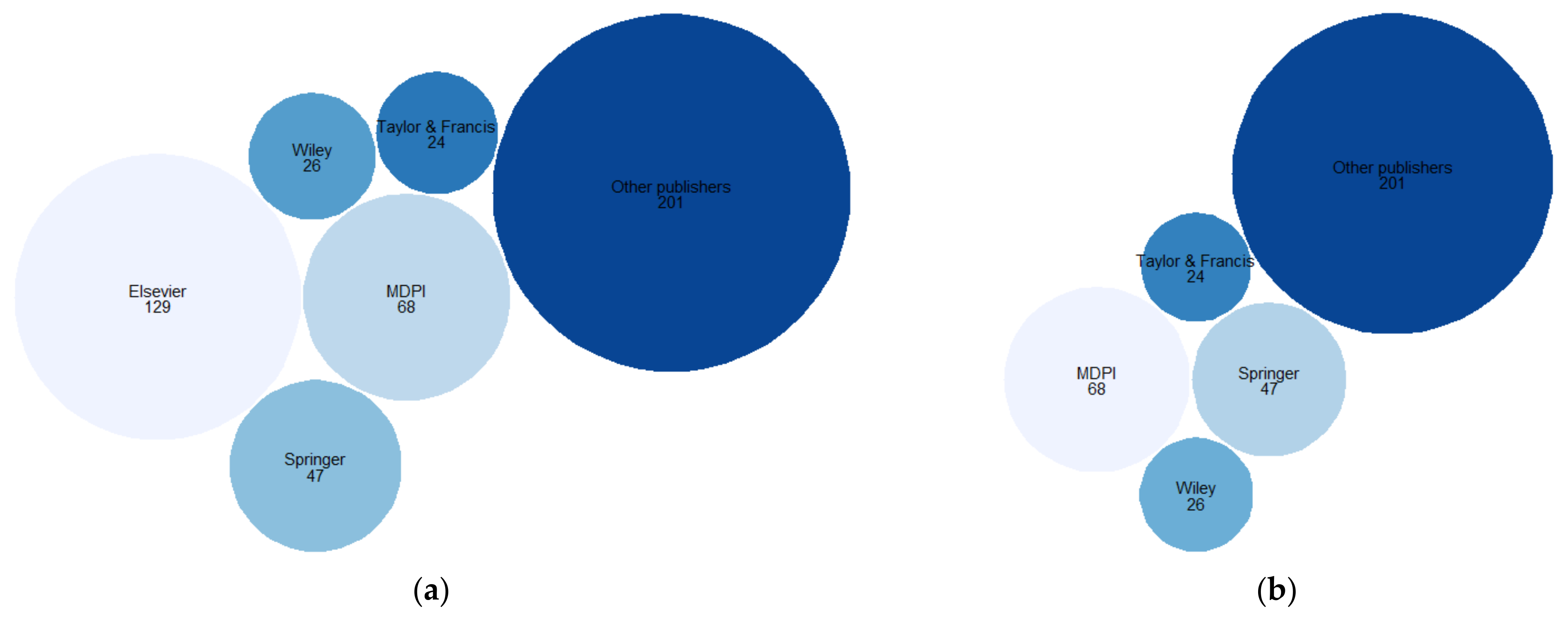
The studies selected for this research were extracted from various publishing houses, where
Figure 4a identifies Elsevier as the predominant source with 129 articles, consolidating itself as the pillar of scientific dissemination in the field of study. A closer look at the remaining contributions in
Figure 4b, which excludes the leading publisher to highlight other players, highlights the notable participation of MDPI (68 studies), followed by Springer (47 studies), Wiley (26 studies) and Taylor & Francis (24 studies), evidencing a dynamic and diversified publishing ecosystem. Finally, the presence of a significant volume of 201 articles grouped in “Other Publisher” reflects that, although there are strongly concentrated publishing nodes, interest in this topic is a cross-cutting phenomenon with a wide dispersion in academic forums and smaller-scale specialized journals.
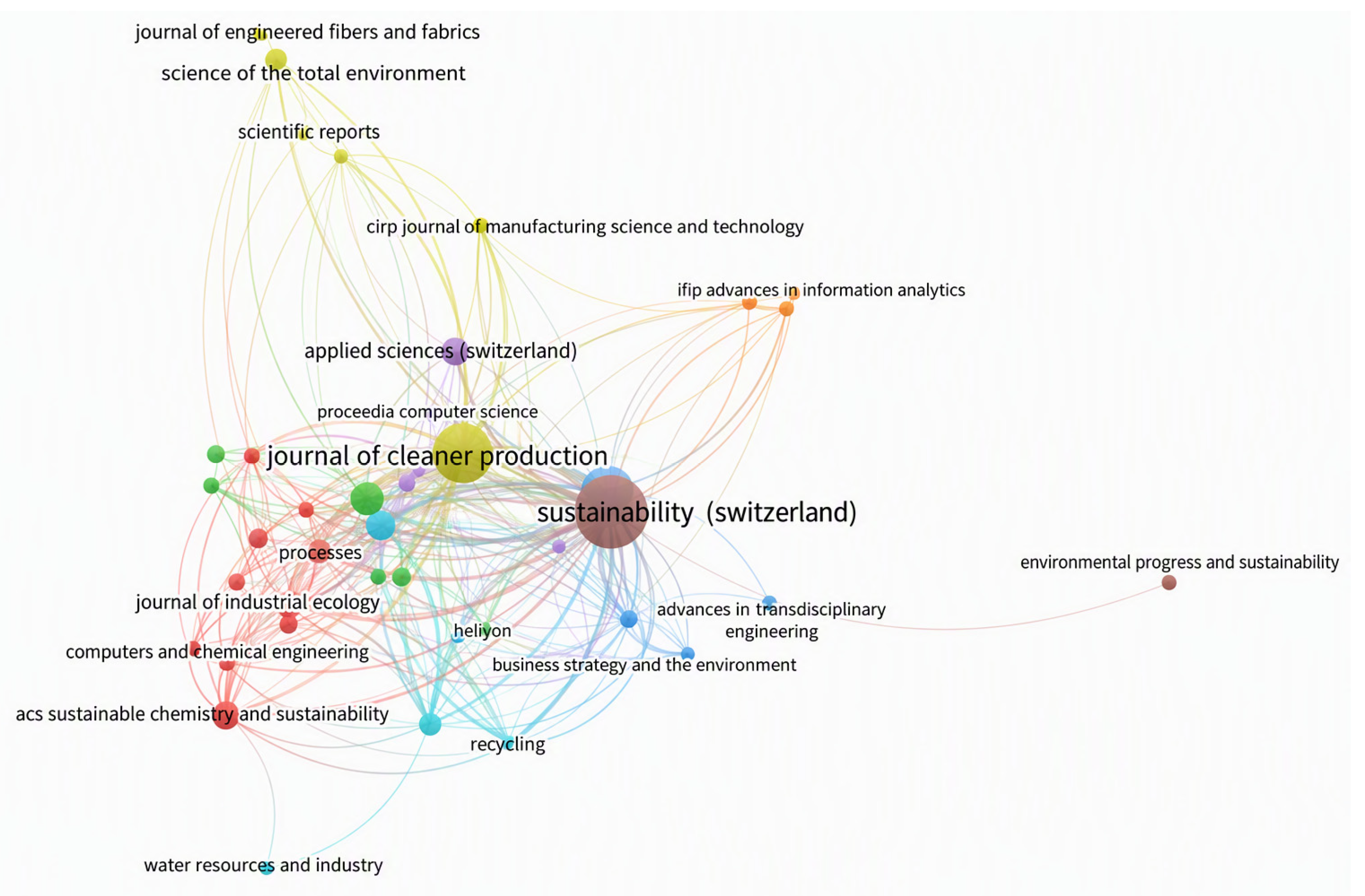
Figure 5 illustrates the journal citation network generated via VOSviewer 1.6.20 to map literature interconnections [
33]. Utilizing a minimum threshold of 10 citations to ensure statistical relevance and LinLog/modularity normalization, the network clusters journals by color to identify thematic subfields. The topology reveals a dominant core led by Sustainability (Switzerland) and the Journal of Cleaner Production, which serve as primary knowledge bridges linking digital systems with environmental management. These are integrated with key nodes—such as Processes, Journal of Industrial Ecology, and Applied Sciences (Switzerland)—to form a cohesive interdisciplinary structure spanning process engineering, applied computing, and sustainability sciences. This configuration demonstrates that carbon footprint analysis in the metalworking industry is anchored in a highly integrated and robust academic framework, transitioning from production-stage efficiency to the digital verification of environmental impacts.
3.3. Inclusion Studies
Multiple research projects have examined the implementation of data capture tools and digital processing technologies in the energy-intensive (RQ1) manufacturing supply chain, assessing their ability to manage and secure product life cycle data.
Table 3 summarizes and classifies the main tools and technologies identified in the literature.
Optimal data management for PCF calculation depends on the combination of these capture tools and analysis technologies, which ensure traceability, reliability, and availability of information [
51,
52,
53]. Obtaining data from heterogeneous sources (such as sensors and connected devices) allows operational variables to be recorded in real time, while integration mechanisms facilitate their contextualization for subsequent analysis [
54]. This is critical in the metalworking sector, where the supply chain represents a significant source of direct and indirect emissions [
55].
In this context, the literature highlights the synergy between IoT and blockchain [
37]. For example, the implementation of Hyperledger-based platforms allows information to be validated between manufacturers, logistics operators and consumers, reducing the opacity of traditional systems and strengthening control over product history [
34]. While continuous monitoring by IoT facilitates the verification of emissions, blockchain ensures the integrity of records through decentralized and immutable mechanisms [
36,
43], providing a reliable infrastructure for sharing information across multiple actors [
38] and improving accountability [
39,
45]. On the other hand, the use of Big Data and artificial intelligence expands the analytical capacity of the system, allowing patterns to be identified, improving operational visibility, optimizing environmental performance and facilitating decision-making based on scientific evidence [
12,
40].
The integration of life cycle data for PCF calculation in digital environments (RQ2) is underpinned by interoperable architectures that connect real-time information capture with storage, analysis, and traceability platforms [
56]. In this sense, IoT records critical operational variables (energy consumption, materials, waste and logistics activities), generating the primary data throughout the entire life cycle [
48,
57].
Once captured, this information is incorporated into digital infrastructures where blockchain plays a central role in providing immutable and transparent records for secure exchange between actors in the chain, maintaining traceability from the procurement of raw materials to the distribution of the final product [
38].
On this technological basis, digital twins transform the data collected into strategic information for decision-making. Through simulations, process optimization and scenario analysis, these tools allow the environmental performance of the product to be evaluated and its emissions to be estimated more accurately [
38]. The convergence between blockchain and digital twins simultaneously strengthens the reliability of information and the analytical capacity of the system [
58]. In industrial practice, this architecture is materialized in ecosystems that connect suppliers, manufacturers and customers through automatic identification technologies and management platforms that consolidate data into unified models, achieving the automated conversion of resource consumption into CO
2 equivalent emissions associated with each product [
56]. Therefore, the calculation of the PCF does not depend on an isolated technology, but on the coordinated articulation of capture mechanisms, traceability platforms and interoperable systems [
38].
To ensure that information is trusted, verifiable, and transparent without relying on a centralized authority, research points to digital verifiable credentials (RQ3) as a key data governance mechanism [
59,
60,
61,
62,
63]. These tools allow validating the authenticity, integrity and provenance of the information associated with the PCF, significantly reducing information asymmetries between manufacturers, suppliers, customers and regulatory bodies [
61]. Through decentralized ledgers and cryptographic validation methods, each participant in the supply chain can verify the veracity of the reported data without compromising sensitive information from industries. In this way, traceability goes from being a simple monitoring instrument to becoming an auditable asset that supports inter-organizational trust.
Its implementation is closely linked to Digital Product Passports (DPPs), which gather and communicate information on materials, environmental impacts and circularity strategies throughout the life cycle [
62]. In the context of DPPs, it is imperative that manufacturers share reliable data on the production stage, given its high contribution to the total environmental impact of the product [
64]. The integration of management systems, digital platforms [
54] and verifiable credentials optimizes the exchange of data in the value chain, facilitating compliance with regulatory requirements, reporting based on international standards, and informed decision-making in sustainability and circular economy [
59].
4. Discussion
The systematic review of the literature identified five key studies focused on digital tools and technologies for the calculation, management, and verification of PCF in the metalworking industry (
Table 4). Unlike the general manufacturing literature in other industrial sectors, the specific application in the metalworking sector presents dynamics due to the high energy intensity of its processes (such as casting and heat treatment) and the complexity of the management of by-products such as scrap. The findings are then critically contrasted to answer the research questions posed.
4.1. Collection Tools and Data Processing Technologies
The literature review demonstrates that data collection in the metalworking supply chain depends, predominantly, on the convergence between the Internet of Things (IoT) and real-time smart sensor networks. This technological infrastructure makes it possible to overcome the limitations of traditional static inventories by directly and dynamically capturing energy consumption, material flows and direct emissions for each operating unit.
In this sense, capture strategies vary substantially depending on the approach, complexity and physical nature of the manufacturing process analyzed. While Mastos et al. [
56] and Liu et al. [
35] implement IoT sensors to monitor critical environmental variables, such as metal waste and gaseous emissions in industrial furnaces, respectively, Winter et al. [
49] introduce the concept of Digital Shadows. This last approach is essential for the metalworking sector, as it establishes a one-way flow of data in real time from the physical to the digital environment, generating a virtual and historical reflection of the part as it moves through the production line. This allows for a strictly granular capture of life cycle information in highly dynamic processes such as machining and induction hardening, calculating the carbon footprint per specific product variant and overcoming the biases of traditional statistical averages.
For its part, Li et al. [
66] scale this connectivity in massive manufacturing environments by combining such sensors with distributed industrial control systems within energy-intensive metalworking plants. Integration at this level is critical, given that these authors operate in what is defined as a noisy industrial environment, characterized not only by noise pollution, but also by severe electromagnetic and thermal interference that distorts sensor signals. By coupling sensorization with distributed process control systems, they can filter out anomalies in the data and ensure consistency of the direct emissions inventory against the operational volatility of the plant.
Finally, Machine Learning is consolidated as the standard tool to process these massive flows of data and mitigate the uncertainty of noisy industrial environments. Within this area, the use of advanced hybrid models stands out—such as the principal component analysis based on the hidden fuzzy Gaussian nucleus proposed by Liu et al. [
35]—specifically designed to identify incomplete combustion early. This early detection is crucial in high-temperature environments, as it allows warning of anomalies in the burning of fossil fuels before they generate thermal inefficiencies or anomalous peaks of polluting gases. In this way, the integration of Cloud Computing and Big Data architectures aimed at large-scale predictive analysis not only optimizes the production process but also eliminates bias and uncertainty in the real-time measurement of the operational carbon footprint.
4.2. Integration of Life Cycle Data for PCF Calculation
The multi-factor integration of life cycle data is the indispensable bridge to migrate from traditional carbon accounting—characterized by retrospective, static and annual average-based records—to dynamic and interconnected sustainability governance in real time. This systemic approach makes it possible to unify heterogeneous variables, such as the logistics flows of raw materials, the consumption of sensors in the plant and the metrics of planning systems, transforming the environmental indicator into a tool for immediate operational decision-making. In this regard, the findings confirm that the ability to calculate the environmental impact by specific product variants determines competitive advantages and regulatory compliance in the metalworking sector. To solve the connectivity and automation of this massive flow of information, the current scientific literature points to two well-defined structural approaches.
On the one hand, the first focuses on interoperability and horizontal standardization in the production plant, proposed by Winter et al. [
49], this strategy uses centralized data architectures governed by standard industrial communication protocols to connect different machines and software systems to each other. The advantage of this approach is that it allows all components to share the same digital language, managing to track the exact energy consumption of a part throughout its different stages of manufacture. This allows accurate emissions to be allocated for each specific product variant, completely overcoming the biases of traditional methods that estimate the carbon footprint based on historical or annual averages of the entire factory.
On the other hand, the second focuses on vertical integration and corporate governance. Led by Li et al. [
66], this approach is not focused on connecting machines to each other, but on directly linking energy management platforms with centralized enterprise resource planning systems. This approach allows real-time operational emissions data to be automatically cross-referenced with financial, purchasing and logistics information from senior management. In this way, environmental accounting is no longer an isolated report and becomes a dynamic indicator for business decision-making and immediate regulatory compliance of the corporation.
In contrast to these two aspects of automation based on software architecture, a third perspective emerges that prioritizes methodological integration and scientific rigor of the inventory. In contrast to direct digital connectivity, Zhang and Asutosh [
65] integrate data by combining traditional Life Cycle Assessment (LCA) with the Emergy Synthesis Methodology. Although the latter is not a digital technology in the strict sense, its inclusion is justified because it provides the methodological framework of reference for the conversion of heterogeneous energy flows into comparable units, a problem not yet addressed in a standardized way by IoT systems and that any digital architecture for PCF calculation must eventually solve. The relevance of this approach lies in the fact that it unifies the conversion of different types of energy and material resources into a common unit—the equivalent solar joule (seJ)—eliminating the semantic dispersion of the data in plan. By basing the calculation on thermodynamic laws rather than on data flows alone, this model also makes it possible to identify with scientific precision that the material supply phase —corresponding to Scope 3—is the one that quantitatively predominates in the environmental impact of the metalworking sector [
5]. This demonstrates that accuracy in the calculation of PCF requires both the horizontal and vertical integration strategies described above and robust methodological metrics that avoid underestimating global supply chain impacts.
4.3. Role of Transparency and Digital Verification Mechanisms
Trust and integrity of shared environmental information represent the central challenge in supply chains. The research reviewed proposes different technological solutions to provide immutability, traceability and auditability to emissions declarations, which conceptually is equivalent to the issuance of verifiable credentials.
On the one hand, to strengthen the reliability required in the international arena, Li et al. [
66] directly address this need by proposing blockchain architectures combined with Continuous Emissions Monitoring Systems. This technological infrastructure aims to allow an automated and direct recording to be implemented from the emission sources in the plant, potentially mitigating attempt at alteration or malicious manipulation. In theoretical scenarios, this conceptual IT ecosystem seeks to enhance the immutability of environmental information, an essential requirement for the validation of assets within carbon emissions trading markets and to successfully pass external audit and international certification processes.
On an inter-organizational exchange level and on a more operational scale, Winter et al. [
49] enable the secure flow of information through the implementation of the Asset Administration Shell. This mechanism works as a standardized semantic container or “digital passport” that securely stores the product’s technical credentials and ecological inventory, allowing different links in the supply chain to share verifiable data under the same computer language.
Finally, Mastos et al. [
56] address the transparency challenge by deploying dynamic and interactive dashboards in real-time. The visibility offered by these tools could drastically reduce operational uncertainty among the actors in the chain. By clearly mapping waste material flows, “automated trading” is envisioned within circular economy models. This optimizes the logistics processes of collection and recovery of ferrous and aluminum by-products, efficiently coordinating scrap producers with recycling managers only when volumes and sustainability metrics justify it.
However, a critical gap in the reviewed literature is the systemic omission of the environmental paradox inherent to these digital architectures, particularly when evaluating the opportunities and challenges that Industry 4.0 poses to sustainability [
22]. While blockchain and distributed ledgers are heavily praised for ensuring data immutability and verifiable governance in high-emission supply chains [
16,
51], their operational energy consumption represents a significant trade-off. The computational overhead required for cryptographic validation, continuous network synchronization, and constant data replication across decentralized nodes generates an autonomous carbon footprint that is rarely quantified within the product’s life cycle. If the energy grid powering these validation infrastructures relies on non-renewable sources, the deployment of a blockchain-driven verification system can inadvertently counteract the marginal carbon reductions achieved through process optimization. Consequently, the assumption that distributed governance is inherently sustainable must be treated with skepticism until comprehensive net-benefit carbon accounting of the digital infrastructure itself is integrated into the models.
4.4. Socio-Technical Barriers and Feasibility of Real-World Implementation: The SME Digitalization Gap
The technological mapping of the scientific literature shows a profound disconnect between the ideal architectural models based on Industry 4.0 and the operational reality of small and medium-sized enterprises (SMEs), which constitute most of the metalworking industrial fabric [
22,
23]. Furthermore, this review reveals a significant feasibility gap, as empirical evidence indicates that Industry 4.0 pilot deployments exhibit high failure rates when transitioning from controlled laboratory simulations to real factory floors, primarily due to the rigid constraints of legacy equipment and acute semantic fragmentation between heterogeneous software platforms [
23]. While large corporations document the successful integration of IoT platforms coupled to ERP systems and blockchain architectures, critical analysis of the evidence reveals three structural barriers that prevent the adoption of these technologies in real-world scenarios [
23]:
For advanced technologies such as Digital Twins or machine learning engines to automate PCF calculation, a minimum production data capture infrastructure is required [
49]. In practice, metallurgical SMEs operate in a state of digital disconnection, usually lacking up-to-date Enterprise Resource Planning (ERP) or Manufacturing Execution Systems (MES) [
23]. Without this transactional basis, it is technically unfeasible to correlate real-time energy consumptions collected by peripheral sensors with specific manufacturing orders or product variants, degrading the PCF calculation to static estimates based on historical averages [
12,
49].
Casting, forging, and machining environments are dynamic and exhibit high levels of thermal and electromagnetic interference, described in the literature as “noisy industrial environments” [
35,
66]. Overcoming this noise requires the deployment of hybrid sensor networks and complex algorithmic data cleansing models [
35]. Metalworking SMEs face a severe shortage of qualified personnel in data engineering and system architecture, which generates a total dependence on external suppliers and raises operational maintenance costs to financially unviable levels for this segment [
23].
The lack of digital automation forces organizations to rely on manual data collection or the use of generic secondary databases to estimate supply chain emissions (Scope 3), which is quantitatively the most prevalent in the metalworking sector [
5,
12]. This introduces biases and high levels of uncertainty in environmental reporting [
24,
25]. By not being able to guarantee the physical or digital traceability of raw materials (such as recycled scrap or specific alloys) [
56], SMEs are marginalized from advanced digital governance mechanisms, such as verifiable credentials and Digital Product Passports (DPPs) [
1,
21], compromising their compliance with strict international regulations such as the Carbon Border Adjustment Mechanism (CBAM) [
7,
8].
Consequently, the transition to digital decarbonization in the metalworking sector does not depend exclusively on the development of cutting-edge technologies, but on overcoming the systemic vulnerability of the industrial fabric [
12,
23]. Expecting these smaller actors to absorb the prohibitive infrastructure and maintenance costs of advanced digital architecture without a prior homogenization of data standards is unrealistic [
12,
23]. Therefore, there is a clear need for the design of simplified, modular, and low-cost software architectures that allow SMEs to build a direct bridge between their traditional analog processes and interoperable carbon accounting.
4.5. Limitations
Despite the methodological and technological contributions identified in this systematic review, several limitations inherent in both the literature selection process and the current state of the art of the technologies analyzed must be recognized:
The scientific literature tends to document Industry 4.0 architectures (advanced IoT sensors, private blockchain networks, and AI platforms) implemented in controlled test environments or in large corporations. There is a paucity of empirical evidence on the financial and technical viability of these tools in small and medium-sized enterprises (SMEs), which make up the bulk of the metalworking industrial fabric in developing regions and face severe capital and skilled labor constraints.
At the technological level, there is a fragmentation in communication protocols and data ontologies between manufacturing execution systems (MES/ERP) and environmental accounting platforms. The lack of a universal semantic standard hinders the secure and automated exchange of carbon credentials between links in the supply chain, slowing down the mass adoption of digital product passports.
The specific literature of the metalworking sector still suffers from methodological fragmentation; while some authors propose complete conceptual architecture based on Blockchain or Artificial Intelligence, their validation is limited to simulated environments, leaving a gap in the demonstration of operational viability in real large-scale foundry plants.
Finally, the heterogeneity in the types of validation of the included studies—ranging from operational validations in real-world settings to theoretical proofs of concept—limits the direct comparability of their findings. In alignment with the protocol described in the methodology section, a formal quality assessment was not considered essential, relying instead on a manual review independently conducted and cross-checked by two authors. Although this approach secured data consistency, the absence of an externalized, standardized metric remains a methodological limitation. Future research must address this gap by developing specialized quality appraisal rubrics tailored to the nuances of digital integration and complex systems engineering.
5. Conclusions
This systematic review made it possible to answer the three research questions and to articulate contributions that go beyond a descriptive synthesis of the literature.
In response to RQ1, the evidence shows that no single technology is sufficient on its own; the most effective configuration articulates IoT and smart sensor networks as the primary capture layer, capable of recording energy consumption, material flows and direct emissions per operating unit in real time. On this basis, Machine Learning emerges as the predominant processing technology to filter the noise inherent in high thermal and electromagnetic-intensity environments, while Big Data enables plant-scale predictive analytics, and Digital Twins generate dynamic virtual representations of each part along the production line, allowing the carbon footprint to be quantified per specific product variant. The central implication is that the limitation of traditional methods is not merely one of accuracy but structural in nature: without real-time capture and intelligent processing, any emissions inventory will be systematically biased.
In response to RQ2, the findings reveal three complementary and hierarchically necessary integration architectures. Horizontal integration connects machines and software systems through standardized industrial protocols, enabling emissions to be assigned to each product variant rather than to factory-wide averages. Vertical integration links operational energy-management platforms directly with corporate ERP systems, transforming environmental accounting into a dynamic indicator for real-time business decision-making. Methodological integration, the combination of Life Cycle Assessment with Emergy Synthesis, shows that the material supply phase (Scope 3) is the quantitatively dominant contributor to the environmental impact of the sector. This finding is critical because digital architectures limited to monitoring direct plant emissions systematically underestimate the true impact of the product, undermining any decarbonization strategy focused solely on internal processes.
In response to RQ3, the review indicates that verifiable digital governance mechanisms are conceptually proposed to address the fundamental problem of information asymmetry in the supply chain, offering a framework for each actor to verify the veracity of reported data without accessing commercially sensitive supplier information. It should be noted that the sector-specific cases analyzed do not implement verifiable credentials in the strict (W3C) sense; rather, they deploy functionally equivalent mechanisms in simulated or controlled environments: Blockchain combined with Continuous Emission Monitoring Systems (CEMS) is projected to enhance the immutability of records in real time, theoretically enabling participation in regulated carbon markets (ETS) with externally auditable data; the Asset Administration Shell acts as a standardized “digital passport” designed to store a product’s technical credentials and ecological inventory under an interoperable language; and dynamic dashboards, in metal-scrap management, suggest that real-time visibility of by-product flows has the potential to improve traceability while enabling automated negotiation within circular-economy models, aiming to reduce logistics costs and unnecessary transport. Verifiable credentials are therefore best understood not as an additional reporting layer but as a promising governance abstraction intended to turn the PCF into an inter-organizational auditable asset—a mechanism without which compliance with CBAM and DPP requirements lacks a demonstrable technical basis at a large industrial scale.
Beyond the individual answers, this review uncovers a cross-cutting pattern that constitutes its most relevant contribution: the accuracy, integration and verifiability of PCF are interdependent and cannot be addressed in isolation. A system that captures real-time data (RQ1) but lacks interoperable integration architectures (RQ2) produces accurate yet untraceable inventories; a system that integrates data correctly (RQ2) but omits verifiable governance (RQ3) generates information that is internally reliable but unusable for external regulatory compliance. Consequently, this analytical interdependence suggests that a comprehensive digital decarbonization strategy in the metalworking sector could be structured around a proposed three-layer conceptual framework: real-time capture, multidimensional integration, and distributed verifiable governance. Rather than an empirically validated operational mandate, this integrated structure is presented as a theoretical synthesis of current research trends to guide future designs.
These conclusions and the proposed conceptual models, however, rest on a limited and heterogeneous sector-specific evidence base, consisting of only five primary studies directly addressing metalworking operations. The available studies are concentrated in large corporations or controlled laboratory environments, with little empirical validation of technical and economic feasibility in metalworking SMEs, which constitute the bulk of the sector’s industrial fabric. Unresolved challenges also persist regarding semantic fragmentation between heterogeneous platforms, the absence of emission factors specific to regional contexts, and the latent tension between the transparency required by regulation and the protection of suppliers’ intellectual property. These findings should therefore be read as a structured characterization of the state of the art rather than as conclusive sectoral evidence.
Considering these findings and limitations, the following lines of research are proposed:
Develop semi-automated tools tailored to different manufacturing environments, assessing the technical and operational feasibility of integrating BOM-based PCF calculation engines with the Verifiable Credentials (VC) ecosystem to automate the decentralized issuance and validation of Environmental Product Declarations (EPDs) and Digital Product Passports (DPPs), ensuring data veracity without compromising industrial privacy.
Design a standardized intelligent digital ecosystem for PCF automation in the metalworking industry, integrating IoT architectures, real-time data-acquisition systems and LCA methodologies to mitigate the asymmetries of manual data collection and establish a unified framework for the accuracy, traceability and dynamic updating of sectoral carbon inventories.
Implement plant-level pilot projects under real operating conditions to validate dynamic analytical models against sudden changes in material flows or energy consumption, generating long-term empirical data on digital maintenance costs and infrastructure stability.
Advance the definition of standardized protocols and common semantic frameworks for verifiable digital credentials, ensuring that PCF reporting achieves methodological reproducibility, regulatory consistency and direct comparability across global supply chains and regulated carbon markets.
Consequently, the digital decarbonization of the metalworking industry will depend not only on the incorporation of new technologies, but on the capacity to develop interoperable, scalable and economically accessible ecosystems that transform operational data into verifiable information for sustainable decision-making.
Author Contributions
Conceptualization, E.T.-N., F.O.-F. and M.A.V.B.; methodology, E.T.-N., F.O.-F. and M.A.V.B.; validation, J.V.B., F.O.-F. and M.A.V.B.; investigation, E.T.-N., F.O.-F. and M.A.V.B.; writing—original draft preparation, E.T.-N.; writing—review and editing, F.O.-F., J.V.B. and M.A.V.B. visualization E.T.-N., F.O.-F., J.V.B. and M.A.V.B.; supervision, M.A.V.B. All authors have read and agreed to the published version of the manuscript.
Funding
This research was funded by the Grants to Research Groups of Public R +D +i Organizations of the Principality of Asturias, Call 2024, under the project “Project Engineering and Sustainable Engineering” [Grant No. SEK-25-GRU-GIC-24-077]. The authors declare that the funding institution had no role in the study design, data collection, analysis, interpretation, manuscript writing, or the decision to publish.
Data Availability Statement
No new data were created or analyzed in this study. Data sharing is not applicable to this article.
Acknowledgments
During the preparation of this manuscript, the authors used ChatGPT 5.1 to assist with translation in English. The authors have reviewed and edited the output and take full responsibility for the content of this publication.
Conflicts of Interest
The authors declare no conflicts of interest.
Abbreviations
The following abbreviations are used in this manuscript:
| CF | Carbon Footprint |
| CBAM | Carbon Border Adjustment Mechanism |
| ETS | Emissions Trading System |
| PCF | Product Carbon Footprint |
| IoT | Internet of Things |
| DPP | Digital Product Passports |
| SME | Small and Medium-sized Enterprise |
| ERP | Enterprise Resource Planning |
| MES | Manufacturing Execution Systems |
| LCA | Life Cycle Assessment |
| AAS | Asset Administration Shell |
| VC | Verifiable Credentials |
| EPD | Environmental Product Declarations |
| CO2eq | Carbon dioxide equivalent |
| DT | Digital Twins |
| IEEE | Institute of Electrical and Electronics Engineers |
| GHG | Greenhouse gases |
| PRISMA | Preferred Reporting Items for Systematic Reviews and Meta-Analyses |
| RQ | Research Questions |
| WoS | Web of Science |
| AI | Artificial Intelligence |
| CEMS | Continuous Emission Monitoring Systems |
| DOI | Digital Object Identifier |
| BOM | Bill of Materials |
| DLCA | Dynamic Life Cycle Assessments |
| TRL | Technology readiness levels |
References
- Adisorn, T.; Tholen, L.; Götz, T. Towards a Digital Product Passport Fit for Contributing to a Circular Economy. Energies 2021, 14, 2289. [Google Scholar] [CrossRef]
- Ren, B.; Wang, Q.; Ge, H.; Xu, J.; Hao, X.; Wang, H. Sustainability Evaluation of the Steel Industry in Belt and Road Countries Using an ESG-MI and Obstacle Analysis Framework. Sci. Rep. 2025, 15, 36615. [Google Scholar] [CrossRef] [PubMed]
- Rakshit, S.; Islam, N.; Paul, T. Advancing Circular Supply Chain Management in the Steel Industry: An RFID-Enabled Blockchain Framework for Sustainability. Ann. Oper. Res. 2025, 355, 1877–1903. [Google Scholar] [CrossRef]
- Mühlegger, C.; Sasiain Conde, A.; Maier, O.; Kofler, I.; Spanlang, A.; Rummer, B. Using Process Simulation to Support Decarbonization in the Steel Industry. Berg. Huettenmaenn Monatsh 2025, 170, 409–414. [Google Scholar] [CrossRef]
- Wang, Y.; Hao, Y.; Hou, Y.; Quan, Q.; Li, Y. Optimizing Scope 3 Emissions in the Automotive Manufacturing Industry: A Multidisciplinary Approach. Carbon. Res. 2024, 3, 49. [Google Scholar] [CrossRef]
- Schüder, M.; Zülch, H. Corporate Carbon Performance and the Science-Based Targets Initiative: Disentangling the Effects across Scope 1, 2, and 3 Emissions. J. Ind. Ecol. 2026, 30, 799–813. [Google Scholar] [CrossRef]
- Malik, S.A.A.; Qureshi, S.; Ijaz, A.; Zulfiqar, M. Monitoring, Verification, and Trade Exposure: Evaluating Cross-Border Adjustment Mechanism (CBAM) Compliance in Pakistan’s Steel Sector. Eng. Proc. 2025, 111, 40. [Google Scholar] [CrossRef]
- Ramsook, D.A.; Boodlal, D.; Maharaj, R. Navigating Carbon Border Adjustments: A Case Study Analyzing the Impacts and Strategies for Trinidad and Tobago’s Ammonia Exports. Eur. J. Energy Res. 2025, 5, 1–11. [Google Scholar] [CrossRef]
- Berger, M. Harmonized Calculations Methods for Product Carbon Footprints and Life Cycle Assessments in the Mining and Metals Industry. Int. J. Life Cycle Assess. 2026, 31, 28. [Google Scholar] [CrossRef]
- Kaur, R.; Patsavellas, J.; Haddad, Y.; Salonitis, K. The Concept of Carbon Accounting in Manufacturing Systems and Supply Chains. Energies 2023, 17, 10. [Google Scholar] [CrossRef]
- Stechemesser, K.; Guenther, E. Carbon Accounting: A Systematic Literature Review. J. Clean. Prod. 2012, 36, 17–38. [Google Scholar] [CrossRef]
- Belhadi, A.; Venkatesh, M.; Kamble, S.; Abedin, M.Z. Data-Driven Digital Transformation for Supply Chain Carbon Neutrality: Insights from Cross-Sector Supply Chain. Int. J. Prod. Econ. 2024, 270, 109178. [Google Scholar] [CrossRef]
- Foschi, L.; Pennino, D.; Gislon, G.; Grossi, G.; Mantino, A.; Barbanera, M.; Marconi, M.; Cesarini, F.; Rossi, C.; Vitali, A.; et al. Development of a Machine Learning Tool for the Enhancement of Carbon Footprint Prediction for Cattle Milk Production. Int. J. Life Cycle Assess. 2025, 30, 3161–3174. [Google Scholar] [CrossRef]
- Li, Z.; Zheng, H.; Fan, X.; You, Z.; Hu, J.; Xie, Y.; Chu, J.; Li, T. Carbon Emission, Footprint and Pricing Prediction Using Machine Learning: A Survey. Appl. Intell. 2026, 56, 65. [Google Scholar] [CrossRef]
- Sakthivel, S.; Arivukarasi, M.; Charulatha, G.; Nithisha, J.; Abirami, B.; Jaithunbi, A.K.; Suresh Kumar, V. A Multi Strategy Optimization Framework Using AI Digital Twins for Smart Grid Carbon Emission Reduction. Sci. Rep. 2026, 16, 8570. [Google Scholar] [CrossRef] [PubMed]
- Tunca, S.; Kelten, Z.K.; Balcioglu, Y.S. Optimizing Carbon Footprint Reduction In Supply Chains through Blockchain Enabled Transparency and Business Analytics for High Emission Industries. Discov. Sustain. 2026, 7, 867. [Google Scholar] [CrossRef]
- Xing, K.; Qian, W.; Zaman, A.U. Development of a Cloud-Based Platform for Footprint Assessment in Green Supply Chain Management. J. Clean. Prod. 2016, 139, 191–203. [Google Scholar] [CrossRef]
- Ma, G.; Bai, H.; Zhao, W.; Yun, Q.; Zhang, Y. Blockchain-Enabled Traceability Evaluation Framework for Mineral Resource Development and Utilization: A Fuzzy Comprehensive Assessment Approach. Sci. Rep. 2026, 16, 11567. [Google Scholar] [CrossRef] [PubMed]
- Arias, A.; Feijoo, G.; Moreira, M.T. Dynamic Life Cycle Assessment in Environmental Assessment of Processes and Products: A Scoping Review of Sectoral Applications, Digitalization, Decision Support, and Policy Relevance. Environ. Impact Assess. Rev. 2026, 121, 108552. [Google Scholar] [CrossRef]
- Xing, L.; Friderikos, V.; Sastry, N.; Xuan, J.; Lam, H.-K.; Guo, M. Dynamic Digital Product Passports for Short-Shelf-Life Products. Nat. Rev. Clean. Technol. 2026, 2, 173–175. [Google Scholar] [CrossRef]
- Psarommatis, F.; May, G. A Comprehensive Review of Digital Product Passports in Sustainable Manufacturing: Current State, Challenges, and Future Directions. Circ. Econ. Sust. 2026, 6, 207. [Google Scholar] [CrossRef]
- Müller, J.M.; Kiel, D.; Voigt, K.-I. What Drives the Implementation of Industry 4.0? The Role of Opportunities and Challenges in the Context of Sustainability. Sustainability 2018, 10, 247. [Google Scholar] [CrossRef]
- Tanane, B.; Bentaha, M.-L.; Dafflon, B.; Moalla, N. Bridging the Gap between Industry 4.0 and Manufacturing SMEs: A Framework for an End-to-End Total Manufacturing Quality 4.0’s Implementation and Adoption. J. Ind. Inf. Integr. 2025, 45, 100833. [Google Scholar] [CrossRef]
- Balcioglu, G.; Fitzgerald, A.M.; Rodes, F.A.M.; Allen, S.R. Data Quality and Uncertainty Assessment of Life Cycle Inventory Data for Composites. Compos. Part B Eng. 2025, 292, 112021. [Google Scholar] [CrossRef]
- Lee, K.; Ko, J.; Jung, S. Quantifying Uncertainty in Carbon Emission Estimation: Metrics and Methodologies. J. Clean. Prod. 2024, 452, 142141. [Google Scholar] [CrossRef]
- Reuter, M.A.; van Schaik, A.; Gutzmer, J.; Bartie, N.; Abadías-Llamas, A. Challenges of the Circular Economy: A Material, Metallurgical, and Product Design Perspective. Annu. Rev. Mater. Res. 2019, 49, 253–274. [Google Scholar] [CrossRef]
- Page, M.J.; Moher, D.; Bossuyt, P.M.; Boutron, I.; Hoffmann, T.C.; Mulrow, C.D.; Shamseer, L.; Tetzlaff, J.M.; Akl, E.A.; Brennan, S.E.; et al. PRISMA 2020 Explanation and Elaboration: Updated Guidance and Exemplars for Reporting Systematic Reviews. BMJ 2021, 372, n160. [Google Scholar] [CrossRef] [PubMed]
- Mügge, J.; Seegrün, A.; Hoyer, T.-K.; Riedelsheimer, T.; Lindow, K. Digital Twins within the Circular Economy: Literature Review and Concept Presentation. Sustainability 2024, 16, 2748. [Google Scholar] [CrossRef]
- Madarkar, R.; Luo, X.; Walker, C.; Madathil, A.P.; Liu, Q. Prospects of Digital Twin for Dynamic Life Cycle Assessment of Smart Manufacturing Systems. MATEC Web Conf. 2024, 401, 13006. [Google Scholar] [CrossRef]
- Tranfield, D.; Denyer, D.; Smart, P. Towards a Methodology for Developing Evidence-Informed Management Knowledge by Means of Systematic Review. Br. J. Manag. 2003, 14, 207–222. [Google Scholar] [CrossRef]
- Harzing, A.-W.; Alakangas, S. Google Scholar, Scopus and the Web of Science: A Longitudinal and Cross-Disciplinary Comparison. Scientometrics 2016, 106, 787–804. [Google Scholar] [CrossRef]
- Page, M.J.; McKenzie, J.E.; Bossuyt, P.M.; Boutron, I.; Hoffmann, T.C.; Mulrow, C.D.; Shamseer, L.; Tetzlaff, J.M.; Akl, E.A.; Brennan, S.E.; et al. The PRISMA 2020 statement: An updated guideline for reporting systematic reviews. BMJ 2021, 372, n71. [Google Scholar] [CrossRef] [PubMed]
- van Eck, N.J.; Waltman, L. Software Survey: VOSviewer, a Computer Program for Bibliometric Mapping. Scientometrics 2010, 84, 523–538. [Google Scholar] [CrossRef] [PubMed]
- Cao, Y.; Jia, F.; Manogaran, G. Efficient Traceability Systems of Steel Products Using Blockchain-Based Industrial Internet of Things. IEEE Trans. Ind. Inform. 2020, 16, 6004–6012. [Google Scholar] [CrossRef]
- Liu, Z.; Yang, G.; Zhang, Y. Carbon Footprint Assessment in Manufacturing Industry 4.0 Using Machine Learning with Intelligent Internet of Things. Int. J. Adv. Manuf. Technol. 2023. [Google Scholar] [CrossRef]
- Boumaiza, A.; Maher, K. Harnessing Blockchain and IoT for Carbon Credit Exchange to Achieve Pollution Reduction Goals. Energies 2024, 17, 4811. [Google Scholar] [CrossRef]
- Mofatteh, M.Y.; Davallou, R.; Ishimwe, C.N.; Divekar, S.S.; Valilai, O.F. Developing a Blockchain Based Supply Chain CO2 Footprint Tracking Framework Enabled by IoT. Int. J. Adv. Comput. Sci. Appl. 2024, 15, 7. [Google Scholar] [CrossRef]
- Zhang, C.; Xu, Y.; Zheng, Y. Blockchain Traceability Adoption in Low-Carbon Supply Chains: An Evolutionary Game Analysis. Sustainability 2024, 16, 1817. [Google Scholar] [CrossRef]
- Chaudhari, R.S.; Rane, S.B.; Mahajan, S.K.; Phanden, R.K.; Mogal, Y.K. Integrated IoT-Blockchain Architecture for Sustainable Green Supply Chains in Agriculture Equipment Manufacturing Industries: A TOPSIS Approach. Int. J. Comput. Integr. Manuf. 2026, 39, 151–182. [Google Scholar] [CrossRef]
- Sarıışık, G.; Göncü, B.; Öğütlü, A.S. Harnessing Industry 4.0 Technologies to Reduce SMEs’ Carbon Footprint: A Machine Learning-Based Assessment. J. Environ. Manag. 2026, 398, 128459. [Google Scholar] [CrossRef] [PubMed]
- Liu, K.-H.; Chang, S.-F.; Huang, W.-H.; Lu, I.-C. The Framework of the Integration of Carbon Footprint and Blockchain: Using Blockchain as a Carbon Emission Management Tool. In Technologies and Eco-Innovation Towards Sustainability I: Eco Design of Products and Services; Hu, A.H., Matsumoto, M., Kuo, T.C., Smith, S., Eds.; Springer: Singapore, 2019; pp. 15–22. ISBN 978-981-13-1181-9. [Google Scholar] [CrossRef]
- Shakhbulatov, D.; Arora, A.; Dong, Z.; Rojas-Cessa, R. Blockchain Implementation for Analysis of Carbon Footprint across Food Supply Chain. In Proceedings of the 2019 IEEE International Conference on Blockchain (Blockchain), Atlanta, GA, USA, 14–17 July 2019; pp. 546–551. [Google Scholar] [CrossRef]
- Ju, C.; Shen, Z.; Bao, F.; Weng, P.; Xu, Y.; Xu, C. A Novel Credible Carbon Footprint Traceability System for Low Carbon Economy Using Blockchain Technology. Int. J. Environ. Res. Public Health 2022, 19, 10316. [Google Scholar] [CrossRef] [PubMed]
- Tota, R.; Facchini, F.; Iavagnilio, R.P.; Mossa, G.; Sassanelli, C. Digital Twin Supporting Environmental Performance Evaluation According to ISO Certification: An Application Case in the Tire Industry. Prod. Manuf. Res. 2024, 12, 2351839. [Google Scholar] [CrossRef]
- Yang, Z.; Li, X.; Zhu, Y.; Li, X. Blockchain-Driven Innovations of Carbon Emission Management in Cement Supply Chain: Evidence from China. J. Environ. Manag. 2025, 392, 126795. [Google Scholar] [CrossRef] [PubMed]
- Tuli, E.A.; Kim, D.-S. Individual CF Tracking and Management System Using Blockchain and Zero-Knowledge Proof. ICT Express 2026, 12, 646–652. [Google Scholar] [CrossRef]
- Singh, A.; Kumari, S.; Malekpoor, H.; Mishra, N. Big Data Cloud Computing Framework for Low Carbon Supplier Selection in the Beef Supply Chain. J. Clean. Prod. 2018, 202, 139–149. [Google Scholar] [CrossRef]
- Arshad, H.T.; Wang, Z.; Ji, T.; Peng, T. Digital Twin-Driven Carbon Emissions Management in Manufacturing. Manuf. Lett. 2025, 44, 1718–1730. [Google Scholar] [CrossRef]
- Winter, S.; Quernheim, N.; Arnemann, L.; Bausch, P.; Frick, N.; Metternich, J.; Schleich, B. Using the Integral Digital Twin for Product Carbon Footprint Calculation. Clean. Environ. Syst. 2025, 16, 100258. [Google Scholar] [CrossRef]
- Abdallah-Ou-Moussa, S.; Wynn, M.; Rouaine, Z. Leveraging Blockchain and Digital Twins for Low-Carbon, Circular Supply Chains: Evidence from the Moroccan Manufacturing Sector. Sustainability 2026, 18, 991. [Google Scholar] [CrossRef]
- Zhang, A.; Zhong, R.Y.; Farooque, M.; Kang, K.; Venkatesh, V.G. Blockchain-Based Life Cycle Assessment: An Implementation Framework and System Architecture. Resour. Conserv. Recycl. 2020, 152, 104512. [Google Scholar] [CrossRef]
- Metallidou, C.; Psannis, K.E.; Vergados, D.D.; Dossis, M. Digital Twin and Industrial Internet of Things Architecture to Reduce Carbon Emissions. In Proceedings of the 2022 4th International Conference on Computer Communication and the Internet (ICCCI), Chiba, Japan, 1 July 2022; IEEE: New York, NY, USA, 2022; pp. 185–189. [Google Scholar] [CrossRef]
- Attaran, S.; Attaran, M.; Celik, B.G. Digital Twins and Industrial Internet of Things: Uncovering Operational Intelligence in Industry 4.0. Decis. Anal. J. 2024, 10, 100398. [Google Scholar] [CrossRef]
- Boukhatmi, Ä.; Nyffenegger, R.; Grösser, S.N. Designing a Digital Platform to Foster Data-Enhanced Circular Practices in the European Solar Industry. J. Clean. Prod. 2023, 418, 137992. [Google Scholar] [CrossRef]
- Wang, T.; Shen, Y. Unlocking the Potential of Supply Chain Digitalization for Enhancing Enterprise Green Transformation Performance: Evidence from China. Humanit. Soc. Sci. Commun. 2025, 12, 1339. [Google Scholar] [CrossRef]
- Mastos, T.D.; Nizamis, A.; Vafeiadis, T.; Alexopoulos, N.; Ntinas, C.; Gkortzis, D.; Papadopoulos, A.; Ioannidis, D.; Tzovaras, D. Industry 4.0 Sustainable Supply Chains: An Application of an IoT Enabled Scrap Metal Management Solution. J. Clean. Prod. 2020, 269, 122377. [Google Scholar] [CrossRef]
- Ahmad Amouei, M.; Valmohammadi, C.; Fathi, K. Proposing a Conceptual Model of the Sustainable Digital Supply Chain in Manufacturing Companies: A Qualitative Approach. J. Enterp. Inf. Manag. 2023, 37, 544–579. [Google Scholar] [CrossRef]
- Fang, Z.; Yan, J.; Lu, Q.; Chen, L.; Yang, P.; Tang, J.; Jiang, F.; Broyd, T.; Hong, J. A Systematic Literature Review of Carbon Footprint Decision-Making Approaches for Infrastructure and Building Projects. Appl. Energy 2023, 335, 120768. [Google Scholar] [CrossRef]
- Nowacki, S.; Sisik, G.M.; Angelopoulos, C.M. Digital Product Passports: Use Cases Framework and Technical Architecture Using DLT and Smart Contracts. In Proceedings of the 2023 19th International Conference on Distributed Computing in Smart Systems and the Internet of Things (DCOSS-IoT), Pafos, Cyprus, 19–21 June 2023; pp. 373–380. [Google Scholar] [CrossRef]
- Canciani, A.; Felicioli, C.; Severino, F.; Tortola, D. Enhancing Supply Chain Transparency through Blockchain Product Passports. In Proceedings of the 2024 IEEE International Conference on Pervasive Computing and Communications Workshops and Other Affiliated Events (PerCom Workshops), Biarritz, France, 11–15 March 2024; pp. 751–756. [Google Scholar] [CrossRef]
- Heeß, P.; Rockstuhl, J.; Körner, M.-F.; Strüker, J. Enhancing Trust in Global Supply Chains: Conceptualizing Digital Product Passports for a Low-Carbon Hydrogen Market. Electron. Mark. 2024, 34, 10. [Google Scholar] [CrossRef]
- Becchi, B.; Cascavilla, A.; D’Adamo, I.; Grosso, C. Digital Product Passports for Cleaner Production: Economic Evidence from Producers and Consumers in the Fashion Industry. J. Clean. Prod. 2026, 545, 147792. [Google Scholar] [CrossRef]
- Simões, J.; Neves, C.; Oliveira, T.; Azadi, H.; Goli, I. Toward Circular Economy: Investigating Citizens’ Willingness to Use Digital Product Passports. Green. Technol. Sustain. 2026, 4, 100393. [Google Scholar] [CrossRef]
- Glišić, M.; Møller, C.; Veluri, B.; Ramanujan, D. Digital Process Passport: A Conceptual Model for Information Collection and Sharing In Sustainable Manufacturing. Procedia CIRP 2024, 130, 1077–1083. [Google Scholar] [CrossRef]
- Zhang, J.; Asutosh, A.T. LCA-Emergy and Carbon Footprint Analysis in a Steel Industry Reporting System: A Case Study of a Chinese Steel Company. Sci. Total Environ. 2025, 958, 177901. [Google Scholar] [CrossRef] [PubMed]
- Li, T.; Li, X.; Shangguan, F.; Zhang, W.; Zhou, J.; Ni, B.; Duan, Z.; Teng, G. Advancing digital carbon management in China’s steel industry. Gckxxb 2024, 46, 209–217. [Google Scholar] [CrossRef]
| Disclaimer/Publisher’s Note: The statements, opinions and data contained in all publications are solely those of the individual author(s) and contributor(s) and not of MDPI and/or the editor(s). MDPI and/or the editor(s) disclaim responsibility for any injury to people or property resulting from any ideas, methods, instructions or products referred to in the content. |




 ,
,