1. Introduction
Ultra-High Voltage (UHV) converter transformers are critical components of modern direct-current (DC) transmission systems, performing essential functions such as voltage conversion, power transfer, and system stability regulation [
1]. With the rapid expansion of UHV transmission projects and the construction of new power systems in China, the manufacturing quality and delivery performance of UHV converter transformers have become increasingly important for ensuring the timely implementation and reliable operation of national energy infrastructure projects [
2,
3].
The production of UHV converter transformers is characterized by long manufacturing cycles, customized production requirements, complex process interactions, and strict delivery deadlines. A typical production process involves multiple interdependent stages, including coil winding, core assembly, tank fabrication, vacuum drying, final assembly, and electrical testing. Meanwhile, key resources such as winding machines, drying tanks, and testing platforms are limited and often shared among concurrent orders, making production scheduling a challenging task [
4]. In practice, scheduling decisions are still largely based on manual experience and heuristic rules [
5]. Although such approaches can provide flexibility in small-scale production environments, they often suffer from low efficiency, poor repeatability, and limited adaptability when production complexity increases [
6]. More importantly, unexpected disturbances—including material delivery delays, equipment failures, process abnormalities, and rework requirements—can significantly disrupt production plans, resulting in resource conflicts, schedule deviations, and delivery delays [
7]. Therefore, developing a disturbance-aware and reliability-oriented scheduling framework has become a critical issue for UHV converter transformer manufacturing.
Production scheduling under uncertainty has been extensively studied in manufacturing systems [
8,
9]. Mathematical programming approaches, such as Mixed Integer Linear Programming (MILP), can provide optimal solutions for small-scale scheduling problems but often encounter computational difficulties in large-scale and highly constrained production environments [
10]. Metaheuristic algorithms, including Genetic Algorithms (GA), Particle Swarm Optimization (PSO), and Ant Colony Optimization (ACO), have demonstrated strong search capabilities for NP-hard scheduling problems [
11]. Hybrid optimization strategies that combine global planning and local improvement mechanisms have further improved scheduling performance in complex manufacturing systems [
12]. However, existing studies rarely consider the unique production characteristics of UHV converter transformers, particularly the strong process coupling, long production cycles, and frequent dynamic disturbances encountered in practice.
Reliability assessment has also attracted considerable attention in production planning and control. Petri nets are widely used for modeling discrete-event systems because of their ability to represent concurrency, synchronization, and resource competition [
13]. Timed Petri nets further incorporate temporal information, enabling more realistic representations of production processes [
14]. Nevertheless, most existing applications focus on general manufacturing systems, while reliability-oriented scheduling models tailored to UHV converter transformer production remain limited.
Another important challenge lies in disturbance quantification. Traditional approaches, such as the Analytic Hierarchy Process (AHP) [
15] and Failure Mode and Effects Analysis (FMEA), rely heavily on expert judgment and may underestimate low-probability but high-impact events [
16]. The Expected Risk Score (ERS) method provides a quantitative mechanism for evaluating risk by jointly considering occurrence frequency and consequence severity, while convex weighting can further emphasize the influence of high-consequence disturbances [
17]. Despite these advances, disturbance assessment, scheduling optimization, and reliability evaluation are often treated as separate research topics. An integrated framework that systematically links disturbance quantification, schedule reliability evaluation, and scheduling optimization has not yet been established for UHV converter transformer production.
To address these gaps, this study proposes a reliability-driven intelligent scheduling framework for UHV converter transformer manufacturing. The main contributions are summarized as follows:
- (1)
A disturbance quantification framework combining ERS and fuzzy rough number theory is developed to identify and rank key production disturbance factors using historical manufacturing data.
- (2)
A Monte Carlo simulation-based reliability evaluation model is established to quantify schedule feasibility and robustness under dynamic disturbance scenarios.
- (3)
A hybrid scheduling algorithm integrating global planning, local search, and dynamic rescheduling is proposed, in which disturbance risks and reliability constraints are incorporated into scheduling decisions.
- (4)
The proposed framework is validated using real production data from multiple UHV converter transformer manufacturers, demonstrating its effectiveness in improving scheduling reliability, resource utilization, and production efficiency.
The remainder of this paper is organized as follows:
Section 2 reviews related studies on production scheduling, disturbance assessment, and reliability-oriented manufacturing systems.
Section 3 presents the problem formulation and scheduling model.
Section 4 introduces the disturbance quantification method, reliability evaluation model, and hybrid scheduling algorithm, followed by experimental validation and comparative analyses. Finally,
Section 5 concludes the paper and discusses future research directions.
3. Framework of the Proposed Method
3.1. The Framework of the Proposed Method
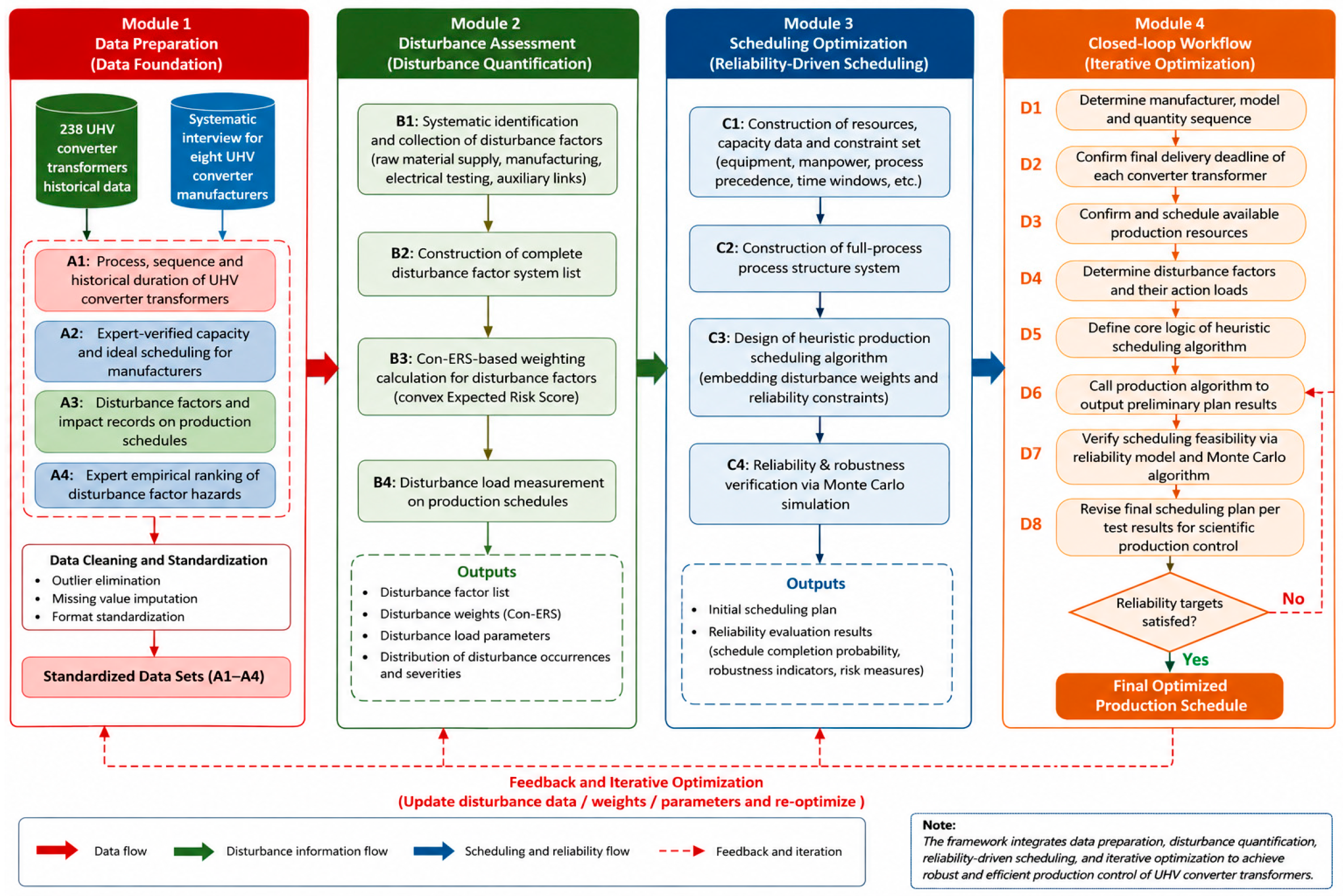
To address the challenges of long production cycles, complex process interactions, and frequent disturbances in UHV converter transformer manufacturing, a reliability-driven scheduling framework is developed. The framework integrates disturbance quantification, schedule optimization, and reliability evaluation into a unified decision-support process. As illustrated in
Figure 1, the proposed method consists of four interconnected modules: data preparation, disturbance assessment, scheduling optimization, and reliability verification.
The first module establishes the data foundation for subsequent analysis. Historical production records of 238 UHV converter transformers collected from major domestic manufacturers are combined with expert knowledge obtained through industrial investigations and interviews. The collected data include process routes, operation durations, resource capacities, disturbance occurrence records, and production planning information.
To ensure data quality and consistency, preprocessing procedures, including missing-value treatment, outlier detection, and data standardization, are performed. The processed dataset provides the basis for disturbance identification, scheduling model construction, and reliability evaluation.
Production disturbances are systematically identified across the entire manufacturing process, including material supply, production execution, testing, and supporting operations. A structured disturbance-factor system is established to characterize potential sources of schedule deviation.
To quantify the relative importance of disturbance factors, a convex Expected Risk Score (Con-ERS) model is employed. By jointly considering disturbance frequency and consequence severity, the model emphasizes high-impact risk factors that may substantially affect schedule execution. The resulting disturbance weights are subsequently incorporated into both reliability evaluation and scheduling optimization.
Based on the production process structure, resource constraints, and disturbance information, a scheduling model is established for UHV converter transformer manufacturing. The model considers key operational constraints, including process precedence relationships, equipment capacity limitations, resource exclusivity, and delivery requirements.
A hybrid scheduling algorithm is developed to balance production efficiency and schedule robustness. The algorithm combines global resource allocation with local schedule refinement and incorporates disturbance weights as reliability-related decision parameters. Unlike conventional deterministic scheduling methods, the proposed approach explicitly considers the potential impact of disturbances during schedule generation.
To evaluate schedule robustness under uncertainty, a Monte Carlo simulation-based reliability assessment model is constructed. Disturbance scenarios are generated according to the quantified disturbance distributions, and repeated simulation experiments are conducted to estimate schedule performance under stochastic operating conditions.
The reliability evaluation results are used to assess schedule feasibility, delivery reliability, and schedule deviation risk. If predefined reliability requirements are not satisfied, scheduling parameters are updated and the optimization procedure is repeated. Through this feedback mechanism, scheduling optimization and reliability evaluation are integrated into a closed-loop framework that continuously improves schedule quality.
The implementation procedure consists of the following steps:
Step 1: Collect and preprocess historical production and disturbance data.
Step 2: Identify disturbance factors and calculate their risk weights using the Con-ERS model.
Step 3: Construct the production scheduling model and define operational constraints.
Step 4: Generate an initial production schedule using the hybrid scheduling algorithm.
Step 5: Evaluate schedule reliability through Monte Carlo simulation.
Step 6: Compare reliability indicators against predefined acceptance criteria.
Step 7: Adjust scheduling parameters and regenerate schedules when reliability requirements are not met.
Step 8: Output the final production schedule with the highest reliability and operational feasibility.
The proposed framework establishes a systematic linkage between disturbance assessment, reliability evaluation, and scheduling optimization, thereby improving the robustness and practical applicability of production scheduling for UHV converter transformer manufacturing.
3.2. Module 1: Data Acquisition and Preprocessing
3.2.1. Data Sources
The proposed framework is developed using historical production data and expert knowledge collected from the UHV converter transformer industry. The historical dataset comprises 238 UHV converter transformers from five national UHV engineering projects, extracted from more than 16,000 weekly production reports. These reports contain detailed information on process execution, resource utilization, schedule deviations, and disturbance events throughout the manufacturing lifecycle.
To supplement historical records and improve the interpretability of disturbance factors, structured interviews were conducted with production managers, process engineers, and scheduling specialists from eight major UHV converter transformer manufacturers, including Shenyang Transformer (Shenyang, China), Shandong Transformer (Ji’nan, China), Xi’an Transformer (Xi’an, China), Hengyang Transformer (Hengyang, China), Baoding Tianwei (Baoding, China), Guangzhou Siemens (Guangzhou, China), Chongqing Hitachi (Chongqing, China), and Changzhou Xibian (Changzhou, China). The interviews focused on production processes, capacity constraints, disturbance mechanisms, scheduling practices, and risk assessment experiences.
The combination of historical production records and expert knowledge provides a comprehensive data foundation for disturbance identification, scheduling model construction, and reliability evaluation.
3.2.2. Data Cleansing and Standardization
To ensure data consistency and reliability, all collected data were subjected to a unified preprocessing procedure.
- (1)
Outlier detection and removal.
Invalid records, duplicated entries, and abnormal observations caused by reporting errors were identified and removed.
- (2)
Missing-value treatment.
Missing process durations were estimated using the average processing time of identical operations within the same manufacturer. Missing qualitative information was supplemented using interview records when available.
- (3)
Data standardization.
Production process names, disturbance descriptions, resource categories, and time units were standardized across manufacturers to eliminate inconsistencies in reporting formats.
- (4)
Structured data integration.
The cleaned data were organized into four standardized datasets (A1–A4), which provide the inputs for subsequent disturbance assessment, scheduling optimization, and reliability evaluation.
3.2.3. Production Process and Scheduling Data (A1)
Dataset A1 contains the process structure and scheduling information of UHV converter transformer manufacturing. Major production stages include core fabrication, coil winding, tank fabrication, body assembly, vacuum drying, final assembly, and electrical testing.
In addition to process durations, precedence relationships among operations were identified. For example, core fabrication and coil winding can be executed in parallel, whereas body assembly can only begin after both operations have been completed. Historical processing times extracted from the 238 production records provide the baseline parameters for schedule generation and simulation.
3.2.4. Disturbance Event Database (A2)
Dataset A2 contains disturbance-related information extracted from production reports and validated through expert interviews. Disturbance events were classified into four categories: raw material supply disturbances; manufacturing process disturbances; electrical testing disturbances; and auxiliary production disturbances.
For each disturbance factor, occurrence frequency, affected process, delay duration, and propagation effects were recorded. These data constitute the basis for disturbance quantification and schedule reliability assessment.
3.2.5. Expert Risk Assessment Dataset (A3)
Dataset A3 contains expert evaluations of disturbance severity. Experts were asked to assess the potential impact of identified disturbance factors on production schedules and delivery performance.
The resulting rankings provide supplementary information for risk assessment and are subsequently used to support the weighting procedure in the Con-ERS model. This dataset also serves as an external reference for validating the consistency of the calculated disturbance weights.
3.2.6. Production Capacity Dataset (A4)
Dataset A4 describes the production capabilities of participating manufacturers, including equipment availability, testing facilities, production capacity, and resource allocation characteristics.
In addition, benchmark scheduling information, such as expected process durations, preferred resource allocation patterns, and target delivery cycles, was collected through industrial investigations. These data are used to define scheduling constraints and establish performance benchmarks for evaluating scheduling results.
3.2.7. Outputs of Module 1
After preprocessing, four standardized datasets are obtained:
A1: Process structure and historical duration data;
A2: Disturbance event database;
A3: Expert risk assessment dataset;
A4: Production capacity and scheduling benchmark dataset.
Together, these datasets provide the data foundation for disturbance quantification (Module 2), scheduling optimization (Module 3), and reliability evaluation (Module 4).
3.3. Module 2: Identification and Quantification of Disturbance Loads
Based on the standardized datasets described in
Section 3.2, this section identifies and quantifies production disturbance loads for UHV converter transformer manufacturing. The purpose is to transform heterogeneous disturbance records into measurable risk weights that can be incorporated into subsequent scheduling optimization and reliability evaluation. The procedure includes three stages: disturbance-factor classification, Con-ERS-based risk scoring, and disturbance-load normalization and classification.
3.3.1. Disturbance-Factor System
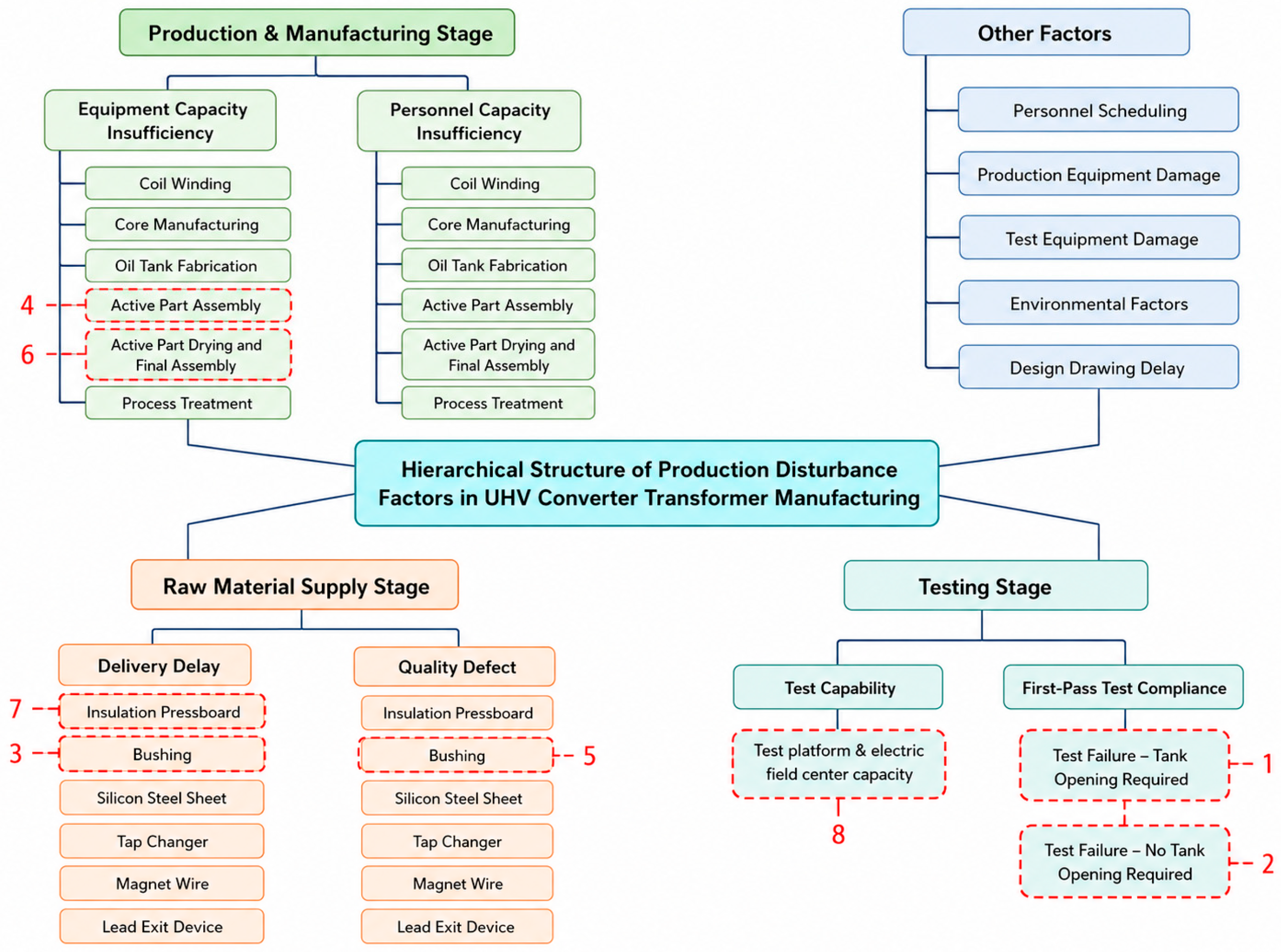
A hierarchical disturbance-factor system (
Figure 2) was constructed from production weekly reports and expert interviews. The identified disturbance factors cover four major categories: raw material supply, production and manufacturing, electrical testing, and auxiliary factors. Raw material disturbances include delivery delays and quality defects of key components such as bushings, silicon steel sheets, tap changers, magnet wires, and lead exit devices. Manufacturing disturbances mainly involve equipment capacity insufficiency and personnel capacity limitations in processes such as coil winding, core manufacturing, tank fabrication, active part assembly, drying and final assembly, and process treatment. Testing-stage disturbances include test platform capacity insufficiency and first-pass test failures. Auxiliary factors include personnel scheduling, production equipment damage, test equipment damage, environmental factors, and design drawing delays.
3.3.2. Definition of Disturbance Load
In this study, disturbance load refers to the quantified scheduling impact of a disturbance factor on production execution. It is jointly determined by two dimensions: occurrence frequency and consequence severity. Occurrence frequency reflects how often a disturbance appears in historical production records, while consequence severity is measured by the average schedule delay caused by that disturbance.
Let i denote a disturbance factor. The occurrence frequency of factor i is denoted as Pi, and the average delay duration caused by this factor is denoted as Ci. These values are extracted from the cleaned historical records of 238 UHV converter transformers and calibrated using expert-verified disturbance descriptions.
3.3.3. Con-ERS-Based Disturbance Load Calculation
To quantify disturbance impact, the Expected Risk Score (ERS) is first used as a reference indicator:
where
Pi is the occurrence frequency of disturbance factor
i and
is the average delay duration caused by the disturbance. However, the linear ERS formulation may underestimate low-frequency but high-consequence events, especially those occurring in late-stage processes such as electrical testing. To address this limitation, a convex Expected Risk Score, denoted as ConERS, is introduced:
where
s is the convex exponent determined according to the production stage in which the disturbance occurs. Specifically,
s = 1.2 is assigned to early-stage processes, such as coil winding, core manufacturing, and tank fabrication;
s = 1.4 is assigned to middle-stage processes, such as active part assembly, drying, and final assembly; and
s = 1.6 is assigned to late-stage testing processes. This setting reflects the fact that disturbances occurring in later stages usually have stronger impacts on delivery performance because the remaining adjustment window is shorter and rework costs are higher.
The calculation procedure is as follows: First, the occurrence frequency Pi of each disturbance factor is counted from historical weekly reports. Second, the average delay duration Ci is calculated based on the recorded schedule deviations. Third, the corresponding convex exponent s is selected according to the production stage, and the ConERS value is obtained using Equation (2).
3.3.4. Weight Normalization and Expert Consistency Verification
The ConERS values are normalized to obtain the relative disturbance weight:
where
n is the total number of identified disturbance factors and
wi represents the normalized importance weight of disturbance factor
i. These weights are used as disturbance-related parameters in the scheduling optimization model and Monte Carlo reliability evaluation.
To reduce the dependence on purely subjective judgment, expert empirical rankings were used only for consistency verification rather than direct weight assignment. The expert rankings were transformed into fuzzy rough numbers, and their consistency with the ConERS-based weights was examined. The consistency coefficient between the calculated weights and expert evaluations reached 0.87, indicating that the proposed quantification method is generally consistent with practical engineering judgment while maintaining data-driven objectivity.
3.3.5. Classification of Disturbance Loads
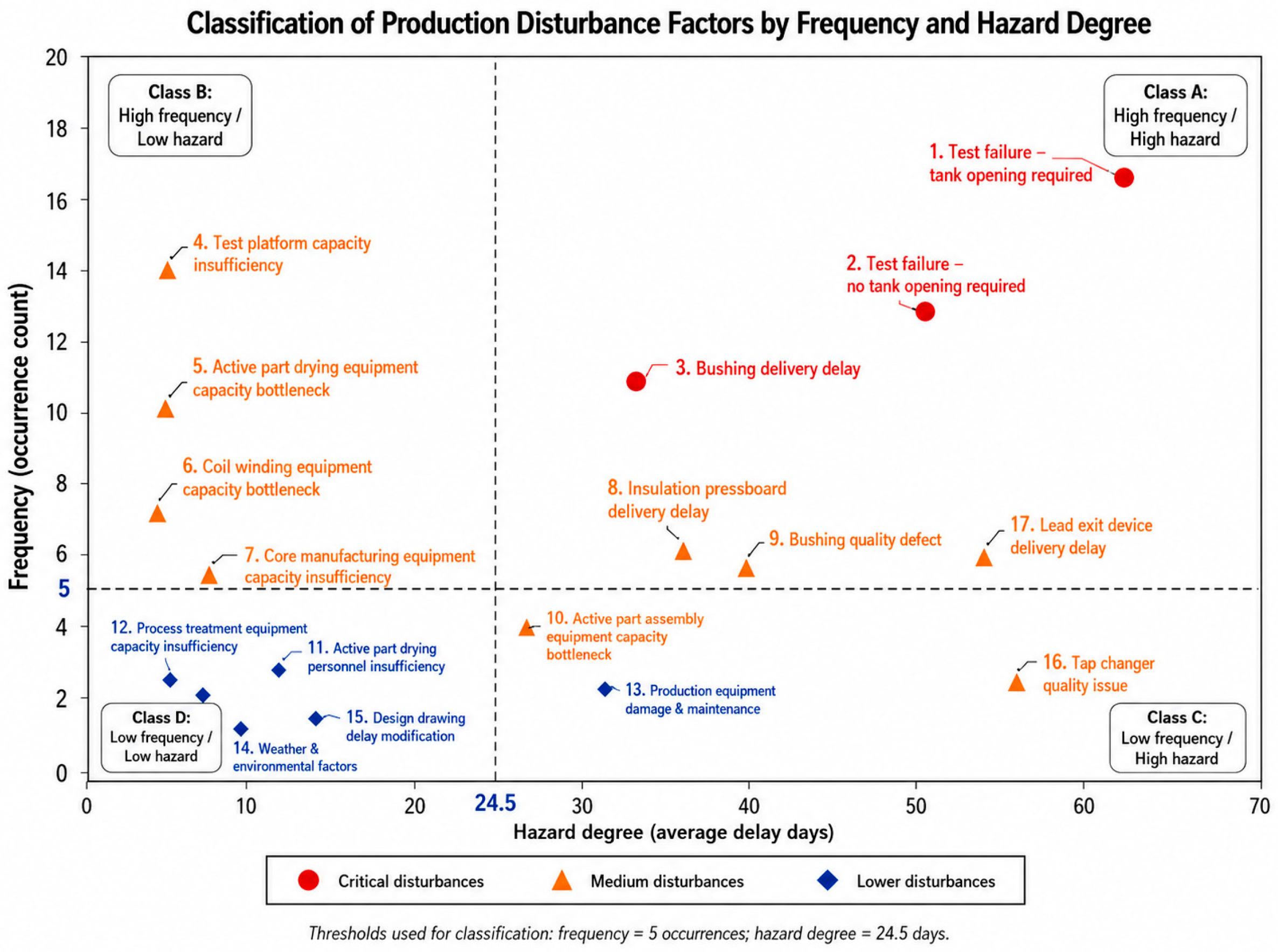
To further support differentiated scheduling strategies, disturbance factors were classified according to their occurrence frequency and consequence severity. As shown in
Figure 3, the horizontal axis represents the hazard degree measured by average delay duration, while the vertical axis represents occurrence frequency.
In
Figure 3, the frequency threshold was set at five occurrences to distinguish recurrent disturbances from occasional events. The hazard-degree threshold of 24.5 days was determined based on the historical delay distribution and expert-verified production buffer requirements. Disturbances above these thresholds are regarded as high-priority risk factors for scheduling optimization.
Based on engineering thresholds of frequency and hazard degree, the disturbance factors were divided into four classes:
Class A: high-frequency and high-hazard disturbances—these are critical disturbance sources that require priority control in production scheduling.
Class B: high-frequency but low-hazard disturbances—these factors should be managed through routine monitoring and process improvement.
Class C: low-frequency but high-hazard disturbances—these factors, such as severe electrical test failures, require preventive buffers and reliability-oriented scheduling adjustments.
Class D: low-frequency and low-hazard disturbances—these factors have limited scheduling impact and can be controlled through conventional management measures.
The results show that the most influential disturbance factors include test failure requiring cover-opening inspection, test failure without cover-opening inspection, and imported bushing delivery delay. These factors have high Con-ERS values because they either cause severe rework or occur in late-stage processes where schedule recovery is difficult.
The classification results provide direct inputs for the subsequent scheduling model. High-risk disturbance factors, especially those in Classes A and C, are assigned higher priority in reliability-driven scheduling and Monte Carlo disturbance scenario generation. In this way, disturbance quantification is explicitly linked to schedule optimization and reliability evaluation.
3.4. Reliability-Driven Heuristic Scheduling Model for UHV Converter Transformers
UHV converter transformer production is a discrete manufacturing process with long production cycles, strong process coupling, limited key resources, and strict delivery requirements. The production schedule is easily affected by disturbances such as material delivery delays, equipment capacity shortages, process abnormalities, and testing failures. Therefore, a deterministic schedule generated without considering disturbance risks may become infeasible during actual execution.
To address this problem, this section develops a reliability-driven heuristic scheduling model. The model integrates process precedence, resource availability, delivery constraints, and disturbance loads into a unified scheduling formulation. The disturbance weights obtained in
Section 3.3 are used to represent the risk intensity of different production processes. A hybrid heuristic scheduling algorithm is then designed to generate feasible schedules, and Monte Carlo simulation is used to evaluate schedule execution reliability under disturbance scenarios.
In this study, schedule execution reliability refers to the probability that a production schedule remains feasible and satisfies process precedence, resource exclusivity, capacity, and delivery constraints under simulated disturbances. This concept describes the robustness of the scheduling plan itself and does not refer to the physical reliability of transformer equipment.
3.4.1. Basic Sets, Parameters, and Reliability Definition
To improve model clarity and reproducibility, the main sets and parameters used in the scheduling model are defined as follows:
The production resource set is defined as:
where
denotes the set of equipment resources, including coil winding machines, vacuum drying tanks, assembly platforms, and testing platforms;
denotes the set of labor resources, including operators, process engineers, maintenance workers, and testing engineers; and
denotes the set of material resources, including cores, coils, insulation parts, bushings, and other key components.
- 2.
Process set and precedence relationship
The production process of a UHV converter transformer is represented as:
where
denotes the
k-th production process, and (q) is the total number of processes. If process
t(
ϕk) must be completed before process
ϕl. starts, the precedence relationship is expressed as
. The corresponding sequencing constraint is:
where
is the planned start time of process and
T(
ϕk) is the standard processing duration of process
ϕk.
- 3.
Process-level disturbance load
The disturbance weights calculated in
Section 3.3 are mapped to production processes to obtain process-level disturbance loads. Let
wi denote the normalized weight of disturbance factor
i, and let
denote the set of disturbance factors affecting process
ϕk. The disturbance load of process
ϕk is defined as:
where
represents the influence intensity of disturbance factor
i on process
. A larger
indicates that the corresponding process is more vulnerable to disturbance and should receive greater attention in scheduling optimization.
- 4.
Schedule execution reliability
For a candidate schedule, a Monte Carlo simulation is used to generate
N disturbance scenarios. If the schedule satisfies all process, resource, capacity, and delivery constraints under scenario
n, the indicator function
is set to 1; otherwise, it is set to 0. The schedule execution reliability is defined as:
where
represents the probability that the schedule remains feasible under disturbance scenarios. In this study,
is used as the minimum feasibility requirement for candidate schedules. A stricter reliability criterion can be applied during final schedule selection according to project delivery requirements.
3.4.2. Production Resource, Capacity, and Constraint Modeling
The production schedule must satisfy process precedence, equipment availability, capacity limitations, and delivery requirements. These constraints are formulated as follows:
The available capacity of equipment
at time t is defined as:
where
is the theoretical maximum capacity of equipment
, and
denotes its effective operating rate at time (t). This coefficient reflects unavailable periods caused by maintenance, material waiting, equipment failure, or other non-operational states.
- 2.
Process sequencing constraint
If process
must precede process
, the following constraint must be satisfied:
where
is the start time of process
, and
is its standard processing duration.
- 3.
Equipment exclusivity constraint
Each equipment resource can process only one operation at a given time. This constraint is expressed as:
where
if process
occupies equipment
at time t, and
otherwise.
denotes the set of processes requiring equipment
.
- 4.
Capacity upper-bound constraint
The total workload assigned to equipment
should not exceed its available capacity during the planning horizon:
where
denotes the planning horizon.
- 5.
Delivery constraint
The completion time of the final process must not exceed the contractual delivery deadline:
where
denotes the final production process, and
is the contractual delivery deadline.
3.4.3. Process Network Representation
To represent the serial–parallel relationships among production processes, the full production flow is modeled as a directed acyclic graph (DAG):
where
is the set of process nodes, and
is the set of directed edges representing precedence relationships.
A simplified production process chain can be expressed as:
where
denotes raw material preparation;
,
, and
denote core manufacturing, coil winding, and tank fabrication, respectively;
denotes active part assembly;
denotes drying and final assembly;
denotes electrical testing; and
denotes finished-product delivery.
This DAG representation allows process precedence, parallel operations, and disturbance locations to be incorporated into the scheduling model. For example, material supply disturbances are mapped to, equipment-capacity disturbances are mapped to the corresponding manufacturing processes, and testing failures are mapped to .
3.4.4. Multi-Objective Scheduling Model and Hybrid Heuristic Rules
The scheduling objective is to generate a feasible production plan that balances production efficiency, resource utilization, and schedule execution reliability. The multi-objective function is formulated as:
where
represents the total makespan,
represents resource–load imbalance, and
represents schedule unreliability.
,
, and
are non-negative objective weights satisfying
.
The makespan objective is defined as:
The resource–load imbalance objective is defined as:
where Load
is the total workload assigned to equipment
, and
is the average workload of all equipment resources.
The reliability-related objective is defined as:
where
is the schedule execution reliability defined in Equation (8).
To construct the schedule, three heuristic priority rules are integrated: Earliest Due Date (EDD), Shortest Processing Time (SPT), and Critical Disturbance (CD). EDD emphasizes delivery urgency, SPT improves processing efficiency, and CD gives priority to processes with higher disturbance loads.
The priority score of process
is calculated as:
where
. The three normalized priority components are defined as:
where
is the production start time, and
and
are the maximum and minimum standard processing durations among all candidate processes.
The weights , and are adjusted during the iterative optimization process according to the dominant source of infeasibility. If delivery violations dominate, is increased; if resource conflicts dominate, is increased; and if high-disturbance processes repeatedly fail in reliability verification, is increased. This rule-based adjustment improves reproducibility and avoids treating the adaptive mechanism as a black box.
A two-layer coding scheme is used to represent each scheduling solution:
where
represents the process priority sequence, and
represents the corresponding equipment allocation. The algorithm terminates when the change in the objective function between two consecutive iterations is smaller than
and the reliability requirement
is satisfied.
3.4.5. Monte Carlo-Based Schedule Reliability Verification
Monte Carlo simulation is used to evaluate whether a candidate schedule remains feasible under disturbance scenarios. In this study, a Monte Carlo simulation is not used to predict future production outcomes directly; rather, it estimates the probability that a given schedule can satisfy operational constraints when disturbances occur.
A stratified sampling strategy is adopted to represent both normal operating conditions and heavy-disturbance conditions. The disturbance variable
is generated as:
where
denotes the normal distribution,
denotes the truncated normal distribution, and
and
are the mean and standard deviation estimated from historical disturbance data. In the simulation experiment,
samples are generated, with 90% representing normal operating conditions and 10% representing heavy-disturbance conditions.
For each simulated scenario, the schedule is checked against process precedence, equipment exclusivity, capacity, and delivery constraints. The schedule execution reliability is calculated as:
where
if the schedule remains feasible under scenario (
n), and
otherwise.
The robustness of the makespan is measured by the coefficient of variation:
where
and
are the standard deviation and mean of the makespan obtained from Monte Carlo simulations. A smaller
indicates stronger robustness.
3.4.6. Closed-Loop Feedback and Schedule Revision
A closed-loop feedback mechanism is used to revise schedules that do not satisfy reliability or robustness requirements. The candidate schedule is accepted only when:
If these criteria are not satisfied, the algorithm identifies the main cause of infeasibility from failed simulation samples. Three types of corrective actions are then applied:
- (1)
If delivery violations dominate, the EDD weight is increased to improve due-date compliance.
- (2)
If equipment conflicts dominate, resource allocation is adjusted and local resequencing is performed.
- (3)
If high ConS processes repeatedly fail, additional time buffers are assigned to those processes and the CD weight is increased.
The revised schedule is then re-evaluated through Monte Carlo simulation. This iterative process continues until the reliability and robustness criteria are satisfied or the maximum number of iterations is reached.
3.4.7. Summary of Model Applicability
The proposed model links production resources, process precedence, disturbance loads, scheduling objectives, and Monte Carlo-based reliability verification within a unified framework. Compared with deterministic scheduling, it explicitly considers the influence of disturbance risks on schedule feasibility. The use of clearly defined constraints, priority rules, reliability indicators, and feedback criteria improves the reproducibility and engineering applicability of the proposed scheduling method for UHV converter transformer manufacturing.
3.5. Closed-Loop Workflow of the Proposed Optimization Algorithm
3.5.1. Core Connotation and Overall Architecture
The closed-loop workflow integrates the outputs of data preprocessing, disturbance quantification, scheduling optimization, and reliability evaluation into an iterative scheduling procedure. Its purpose is to generate a feasible production schedule and then verify whether the schedule remains robust under simulated disturbance scenarios.
The workflow follows the logic of “data input → initial schedule generation → reliability verification → schedule revision → final schedule output.” The disturbance loads , resource constraints, delivery deadlines, and Monte Carlo-based reliability indicators are used as feedback information. If the generated schedule does not satisfy the predefined reliability and robustness criteria, the scheduling parameters are adjusted and the schedule is regenerated.
Let
denote the scheduling scheme generated in iteration (r). The closed-loop procedure can be expressed as:
where
is the schedule execution reliability of scheme
,
is the makespan robustness coefficient, and ConS represents the process-level disturbance loads. The iteration stops when the reliability and robustness requirements are satisfied or when the maximum number of iterations is reached.
3.5.2. Eight-Step Implementation Procedure
The proposed closed-loop workflow is implemented through eight steps, corresponding to the production planning process of UHV converter transformer manufacturing.
The project name, manufacturer, product model, voltage-capacity specification, and production quantity are first determined. These parameters are used as the initial boundary conditions for matching process routes, resource configurations, and historical production data.
The contractual delivery deadline
of each converter transformer is extracted and used as a hard constraint. Based on the standard processing durations, the latest allowable start time of each process is calculated as:
where
denotes the set of subsequent processes after
, and
is the standard duration of process
.
The availability of key resources, including coil winding machines, vacuum drying tanks, assembly platforms, and electrical testing platforms, is obtained from the production capacity dataset. The resource availability matrix is defined as:
where
indicates that equipment
is available at time (t), and
otherwise.
The process-level disturbance loads obtained in
Section 3.3 are imported into the scheduling model:
Processes affected by Class A and Class C disturbances are marked as high-risk processes and receive priority attention during scheduling and reliability verification.
The objective weights, heuristic rule weights, reliability threshold, and robustness threshold are initialized. The hybrid priority rule integrates EDD, SPT, and CD components, as defined in
Section 3.4.4. The minimum reliability requirement is set as
, and the robustness criterion is set as
.
The hybrid heuristic scheduling algorithm is executed to generate an initial scheduling scheme . The output includes process start and completion times, equipment allocation results, resource loads, and total makespan.
The candidate schedule is evaluated using a Monte Carlo simulation. For each disturbance scenario, the schedule is checked against process precedence, equipment exclusivity, capacity, and delivery constraints. The schedule execution reliability and robustness coefficient are then calculated.
If and , the candidate schedule is accepted as the final production schedule. Otherwise, the failed simulation samples are analyzed to identify the dominant cause of infeasibility. If delivery violations dominate, the EDD weight is increased; if equipment conflicts dominate, resource allocation is adjusted; if high-disturbance processes repeatedly fail, additional buffers are assigned and the CD weight is increased. The revised parameters are then returned to D6 for another iteration.
Through this closed-loop process, the proposed algorithm links disturbance-aware scheduling with reliability verification and iterative improvement. This improves the feasibility, robustness, and practical applicability of production scheduling under dynamic disturbance conditions.
4. Scheduling Simulation and Result Analysis
To evaluate the feasibility, effectiveness, and robustness of the proposed reliability-driven scheduling method, a simulation study was conducted using real production records. The complete historical dataset contains 238 UHV converter transformers collected from multiple national engineering projects and manufacturers. It should be noted that these 238 units are not uniformly distributed across manufacturers or product models. The number of records differs substantially among manufacturers, with the smallest manufacturer subset containing only three units and the largest containing 42 units. Therefore, the simulation sample was not constructed under the assumption of uniform manufacturer distribution.
Instead, 40 UHV converter transformers were randomly selected from the subset of records that satisfied the completeness and validity requirements for scheduling simulation. The screening criteria included complete process-route information, valid start and delivery dates, available manufacturer and model information, complete resource records, and identifiable disturbance records. Records with missing key scheduling fields, duplicated entries, or inconsistent time information were excluded before sampling.
The selected 40 cases were used as the simulation test set to verify the proposed closed-loop scheduling workflow. The simulation follows the procedure described in
Section 3.5: project parameters, delivery deadlines, resource availability, and disturbance loads are first imported; the hybrid heuristic algorithm then generates a candidate production schedule; finally, a Monte Carlo simulation is used to evaluate schedule execution reliability and robustness under disturbance scenarios. If the reliability and robustness criteria are not satisfied, the scheduling parameters are adjusted and the schedule is regenerated.
All experiments were implemented on a Python-based simulation platform. The evaluation focuses on delivery compliance, resource utilization, schedule execution reliability, and makespan robustness. This design allows the proposed method to be tested not only in terms of scheduling efficiency but also in terms of its ability to maintain feasibility under production disturbances.
4.1. Project, Manufacturer, Model, and Quantity Parameters
This step defines the basic boundary conditions of the simulation cases. The 40 selected UHV converter transformers were randomly sampled from complete and valid production records in the historical dataset. The sample includes four typical voltage-capacity specifications and four representative manufacturers. The manufacturer and model composition of the simulation cases is shown in
Table 1.
It should be emphasized that the simulation sample is used to evaluate the applicability of the proposed scheduling method under real production conditions. It is not intended to reproduce the exact manufacturer distribution of the full 238-unit dataset. The full dataset has an uneven manufacturer distribution, while the simulation subset was selected from records with sufficient information to support process-level scheduling, disturbance mapping, and reliability verification.
The information in
Table 1 was extracted from the standardized dataset after data cleaning. The selected cases provide complete inputs for the scheduling model, including project type, manufacturer, product specification, production quantity, process route, resource configuration, and disturbance records. This ensures that the subsequent simulation can be reproduced using consistent boundary conditions and complete scheduling parameters.
4.2. Delivery Deadline Settings
The contractual delivery deadline of each converter transformer was used as a hard constraint in the scheduling model. For each selected case, the production start date and delivery deadline were extracted from valid historical production records. The available production cycles range from approximately 180 to 240 days, which is consistent with the long-cycle characteristics of UHV converter transformer manufacturing.
Table 2 lists the production time windows of the selected simulation batches.
Based on these deadlines and the standard process durations, the latest allowable start time of each process was calculated using the backward scheduling rule defined in
Section 3.5.2. This calculation ensures that delivery requirements are embedded into the scheduling model before schedule generation. Cases with shorter available production windows were assigned higher urgency in the EDD component of the hybrid heuristic rule.
A candidate schedule is considered feasible only when the final process is completed before the corresponding contractual delivery deadline while satisfying process precedence, equipment exclusivity, capacity, and disturbance-related reliability constraints. In this way, the delivery deadline settings provide the temporal boundary for both scheduling optimization and Monte Carlo-based reliability verification.
4.3. Production Resource and Process Precedence Settings
This step defines the production resources and process precedence relationships used in the scheduling simulation. For the selected 40 valid cases, the key resources include coil winding equipment, core manufacturing equipment, tank fabrication resources, active part assembly platforms, drying and final assembly facilities, and electrical testing platforms. The corresponding resource parameters were extracted from the cleaned production records and calibrated using manufacturer interview information.
Because the full 238-unit historical dataset is unevenly distributed across manufacturers and product models, the resource settings in this section are not intended to represent an average capacity profile of all manufacturers. Instead, they provide the actual boundary conditions for the 40 selected simulation cases with complete and valid scheduling records. For each process, the standard processing duration, reserved time allowance, and number of available parallel resource lines were standardized and imported into the scheduling model.
Table 3 summarizes the resource parameters used in the simulation. In each cell, the first value denotes the standard processing duration, the second value denotes the reserved time allowance, and NoL denotes the number of available parallel resource lines for the corresponding process.
Based on these parameters, a time-indexed resource availability matrix was established for each manufacturer. The matrix records whether a resource is available in each scheduling period and is used to check resource exclusivity and capacity constraints during schedule generation. Processes that require the same equipment cannot be assigned to overlapping time windows.
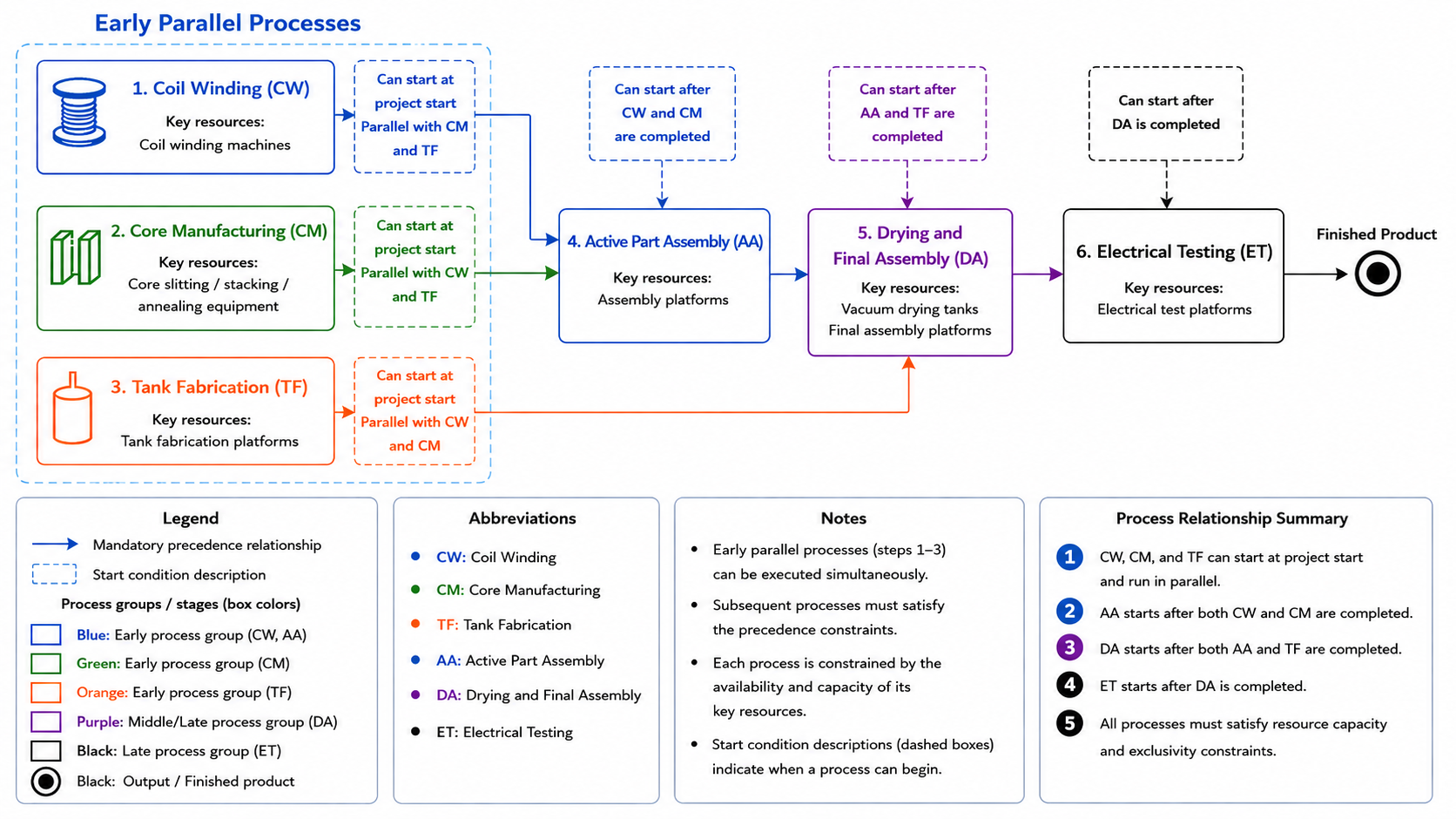
In addition to resource capacity, process precedence was also defined before scheduling. As shown in
Figure 4, coil winding, core manufacturing, and tank fabrication can be carried out in parallel. Active part assembly can begin only after coil winding and core manufacturing are completed. Drying and final assembly require the completion of active part assembly and tank fabrication. Electrical testing is performed after drying and final assembly.
This precedence relationship was verified through manufacturer interviews and was encoded into the scheduling model as a directed process network. Therefore, each candidate schedule generated by the algorithm must satisfy both resource constraints and process precedence constraints. These settings provide the operational boundary conditions for subsequent scheduling optimization and reliability verification.
4.4. Disturbance Factors and Process-Level Disturbance Loads
This step imports the disturbance identification and quantification results obtained in
Section 3.3 into the simulation model. The normalized disturbance weights and A/B/C/D classification results are used to determine the process-level disturbance load of each selected case. High-risk disturbance factors, especially Class A and Class C factors, are treated as key control objects in scheduling optimization and reliability verification.
For the 40 selected simulation cases, disturbance information was assigned only when complete and traceable historical records were available. Among the 40 cases, 10 cases contained valid disturbance records involving raw material supply, electrical testing, and manufacturing equipment capacity insufficiency. These recorded disturbances were mapped to their corresponding production processes and converted into process-duration adjustment coefficients for simulation. The remaining cases were not assigned deterministic disturbance events, but they were still included in the Monte Carlo reliability verification, where stochastic disturbance scenarios were generated according to the disturbance-load distribution described in
Section 3.3.
Table 4 summarizes the recorded disturbance events used in the simulation. The “duration multiplier” indicates the process-level impact applied to the affected operation. For example, a multiplier of 1.40 means that the affected process duration is adjusted to 1.40 times its standard processing duration in the corresponding disturbed case.
The disturbance settings in
Table 4 provide case-specific inputs for the deterministic scheduling simulation. In addition, the normalized disturbance weights are used to generate stochastic disturbance scenarios during Monte Carlo reliability evaluation. Therefore, the proposed simulation does not rely only on observed disturbance cases; rather, it combines recorded case-level disturbances with probabilistic reliability verification to evaluate schedule feasibility under uncertainty.
This design improves the traceability of disturbance assignment and avoids arbitrary disturbance imputation. It also strengthens the reproducibility of the simulation because each deterministic disturbance event can be traced to a specific manufacturer, transformer type, unit index, affected process, and process-duration multiplier.
4.5. Parameter Settings of the Heuristic Scheduling Algorithm
This step defines the main parameter settings of the hybrid heuristic scheduling algorithm used in the simulation. The algorithm integrates three priority rules: Earliest Due Date (EDD), Shortest Processing Time (SPT), and Critical Disturbance (CD). EDD reflects delivery urgency, SPT improves processing efficiency, and CD gives priority to processes with higher disturbance loads.
The initial weights of the three heuristic rules are set as follows:
This setting gives priority to delivery compliance while incorporating disturbance-aware scheduling. The three weights are used as initial values in the first iteration. During the closed-loop optimization process, they can be adjusted according to the feedback rules defined in
Section 3.5. Specifically, when delivery violations dominate,
is increased; when resource conflicts or processing inefficiency dominate,
is adjusted; and when high-disturbance processes repeatedly fail in reliability verification,
is increased.
The schedule execution reliability threshold is set as:
and the makespan robustness threshold is set as:
These two criteria are consistent with the reliability verification model defined in
Section 3.4. A candidate schedule is accepted only when both criteria are satisfied. Otherwise, the algorithm updates the heuristic rule weights, resource allocation strategy, or process buffer settings and then regenerates the scheduling scheme.
The main algorithmic parameters used in the simulation are summarized in
Table 5.
The scheduling algorithm adopts a process–resource two-layer coding structure. The first layer determines the process priority sequence, while the second layer determines equipment allocation. For each candidate solution, the algorithm checks process precedence, equipment exclusivity, capacity limitations, delivery deadlines, and disturbance-related reliability constraints.
After a candidate schedule is generated, a Monte Carlo simulation is used to evaluate its schedule execution reliability and makespan robustness. If the schedule does not satisfy the acceptance criteria, the closed-loop feedback mechanism updates the algorithm parameters and regenerates the schedule. This process continues until an acceptable schedule is obtained or the maximum number of iterations is reached.
By explicitly reporting the heuristic weights, reliability threshold, robustness threshold, sampling size, coding structure, and termination criteria, the parameter settings of the proposed algorithm become transparent and reproducible. This directly supports the subsequent comparison and reliability analysis of scheduling results.
4.6. Generation of Preliminary Scheduling Schemes
In this step, the hybrid heuristic scheduling algorithm is invoked to generate preliminary scheduling schemes for the 40 selected UHV converter transformer cases. The simulation cases include four representative manufacturers, namely Shandong, Changzhou, Baoding, and Shenyang, and four voltage-capacity specifications. As described in
Section 4.1,
Section 4.2,
Section 4.3 and
Section 4.4, these cases were randomly selected from complete and valid historical records and contain the required information on process routes, resource parameters, delivery deadlines, and disturbance records.
The algorithm integrates three priority rules: Earliest Due Date (EDD), Shortest Processing Time (SPT), and Critical Disturbance (CD). EDD is used to prioritize tasks with tighter delivery deadlines; SPT is used to improve processing compactness and reduce unnecessary idle time; and CD is used to give higher priority to processes with larger disturbance loads, such as drying and final assembly, active part assembly, and electrical testing.
During schedule generation, the algorithm checks the main hard constraints defined in
Section 3.4, including process precedence, equipment exclusivity, resource capacity, and delivery deadlines. The number of available parallel resource lines is determined according to the manufacturer-specific resource parameters listed in
Table 3, rather than assuming the same production capacity for all manufacturers.
The preliminary scheduling output includes the start and completion times of each major process, equipment allocation results, total makespan, and equipment load distribution. For the 40 simulation cases, the average computational time required to generate a preliminary schedule was 12.5 s on the Python-based simulation platform, indicating that the algorithm is computationally tractable for the selected scheduling scale.
Compared with the historical manual scheduling records, the preliminary algorithmic schedules showed improved performance before closed-loop reliability correction. The average total makespan was reduced by 11.3%, and equipment load fluctuation was reduced by 15.6%. These results indicate that the hybrid heuristic rules can improve scheduling efficiency and resource coordination under the given production constraints.
However, the preliminary schedules should not be regarded as final production plans. Because this step only generates initial schedules before closed-loop reliability correction, some schedules involving high-risk disturbance factors still fail to satisfy the reliability requirement. In particular, cases affected by bushing delivery delay, first-pass test failure, core manufacturing equipment capacity insufficiency, or drying equipment capacity insufficiency may still show insufficient schedule execution reliability. In the preliminary verification, the lowest observed value of was 0.82, which is lower than the acceptance threshold of .
Therefore, the preliminary scheduling schemes provide an initial solution set for subsequent reliability verification and iterative correction. The next step further evaluates these schedules through Monte Carlo simulation and applies closed-loop feedback when the reliability or robustness criteria are not satisfied.
4.7. Reliability Verification of Preliminary Scheduling Schemes
In this step, the preliminary scheduling schemes generated in
Section 4.6 were evaluated using Monte Carlo-based reliability verification. For each candidate schedule, 1000 stratified disturbance scenarios were generated, including 900 normal operating scenarios and 100 heavy-disturbance scenarios. The heavy-disturbance scenarios were mainly associated with high-risk disturbance factors identified in
Section 3.3, such as first-pass test failure, bushing delivery delay, and key equipment capacity insufficiency.
For each simulation scenario, the candidate schedule was checked against process precedence, equipment exclusivity, capacity limitations, and delivery deadline constraints. The schedule execution reliability was calculated as the proportion of feasible scenarios among all Monte Carlo samples. The makespan robustness coefficient was calculated to measure the fluctuation of makespan under stochastic disturbance conditions.
The verification results show that the preliminary algorithmic schedules performed better than the historical manual schedules (
Table 6). The average schedule execution reliability of the preliminary algorithmic schedules was
, while the historical manual schedules achieved only
. In addition, 7 of the 40 preliminary algorithmic schedules failed to satisfy the reliability threshold of
, whereas 31 of the 40 historical manual schedules failed to meet this threshold.
The robustness results show a similar trend. The average makespan robustness coefficient of the preliminary algorithmic schedules was , while that of the historical manual schedules was . This indicates that the proposed heuristic scheduling algorithm can reduce makespan fluctuation under disturbance scenarios, although the preliminary schedules still require further closed-loop correction before final acceptance.
The results indicate that the EDD-SPT-CD hybrid rule improves scheduling performance by considering delivery urgency, processing efficiency, and disturbance sensitivity simultaneously. In particular, the CD component enables the algorithm to assign higher priority to processes with larger disturbance loads, such as electrical testing, drying and final assembly, and active part assembly. However, because several high-risk cases still failed to reach the reliability threshold, the preliminary schedules cannot be directly accepted as final production plans. These verification results provide the quantitative feedback required for the closed-loop revision step in
Section 4.8.
4.8. Revision and Finalization of the Accepted Scheduling Plan
Based on the reliability verification results in
Section 4.7, the preliminary schedules that failed to satisfy the reliability or robustness criteria were revised through the closed-loop feedback mechanism defined in
Section 3.5. The revision focused on three types of infeasibility sources: delivery violations, equipment conflicts, and repeated failures of high-disturbance processes.
For schedules with delivery violations, the EDD weight was increased to improve due-date compliance. For schedules with equipment conflicts, local resource reallocation and process resequencing were performed. For schedules affected by high-disturbance processes, additional process buffers were introduced, and the CD weight was increased to strengthen disturbance-aware priority control.
After one to three closed-loop iterations, all 40 simulation cases satisfied the predefined acceptance criteria: .
The final accepted schedules include the start and completion time of each major process, equipment allocation results, makespan, resource–load statistics, and reliability verification results. These outputs can be formatted as Gantt charts, equipment allocation tables, and reliability reports for production decision support.
Compared with the preliminary schedules, the final accepted schedules further improved schedule execution reliability and makespan robustness. More importantly, all final schedules satisfied the delivery deadline, process precedence, equipment exclusivity, capacity, and reliability constraints. This confirms that the closed-loop workflow is necessary: the heuristic algorithm provides an efficient initial solution, while Monte Carlo verification and feedback correction ensure that the final schedule is robust under disturbance scenarios.
Therefore, the proposed scheduling framework does not rely solely on one-time heuristic optimization. Instead, it combines initial schedule generation, stochastic reliability verification, and iterative correction, which improves both scheduling efficiency and practical feasibility for UHV converter transformer production.
4.9. Comparative Analysis with Historical Manual Scheduling
This section compares the proposed reliability-driven heuristic scheduling algorithm with historical manual scheduling records. The comparison is based on the 40 selected simulation cases described in
Section 4.1. These cases were randomly selected from complete and valid historical records and cover four representative manufacturers: Shandong, Changzhou, Baoding, and Shenyang.
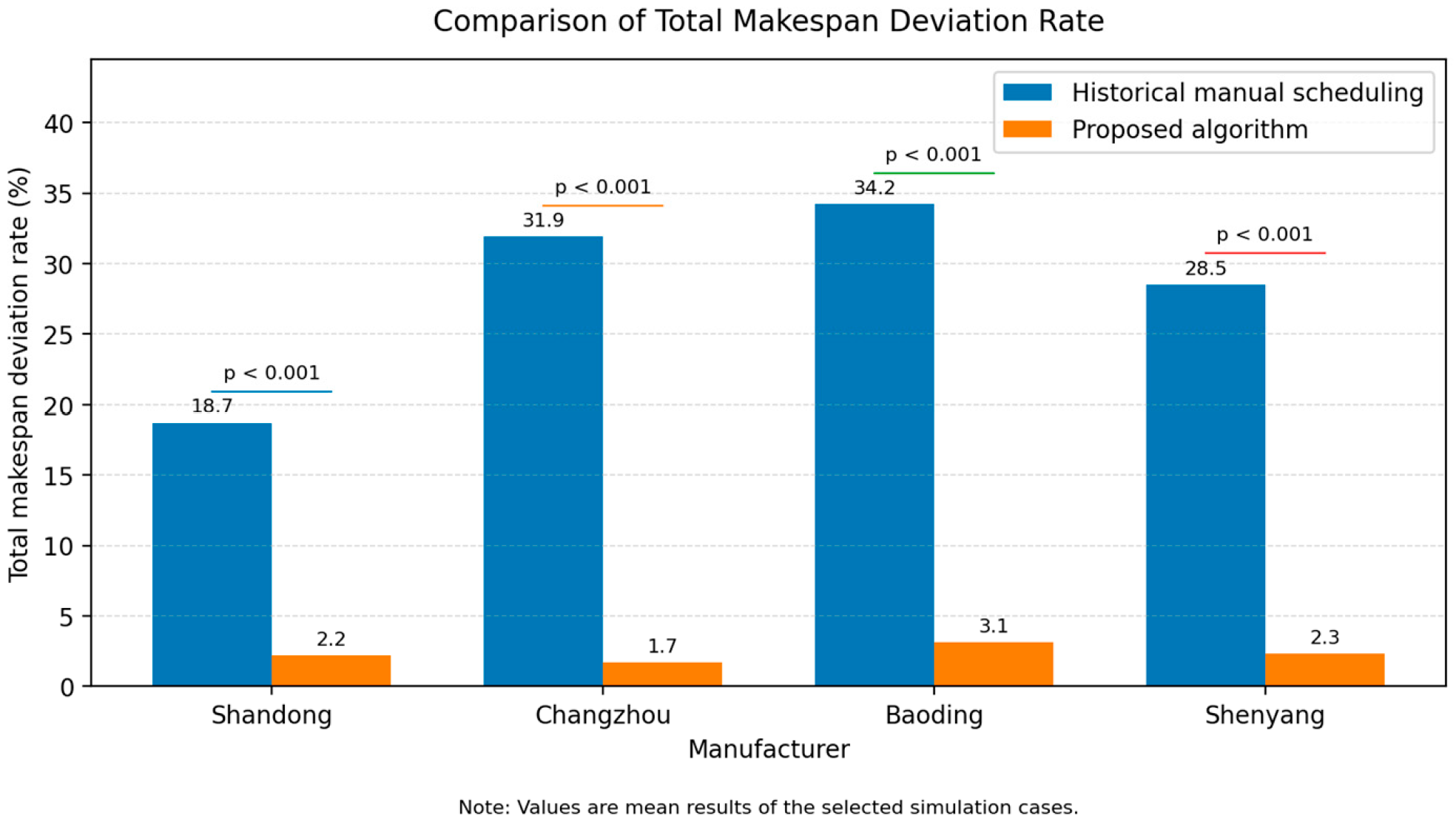
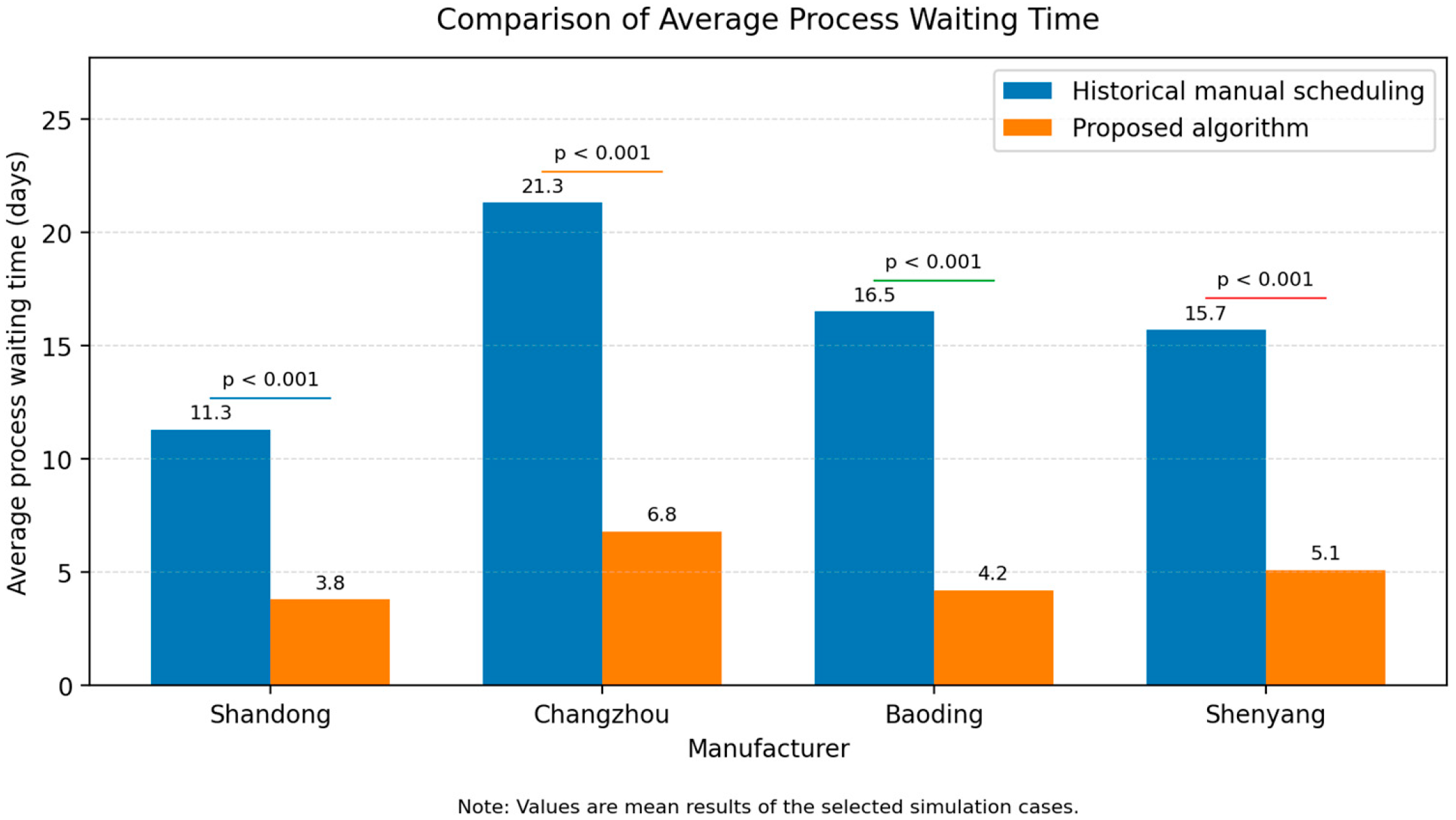
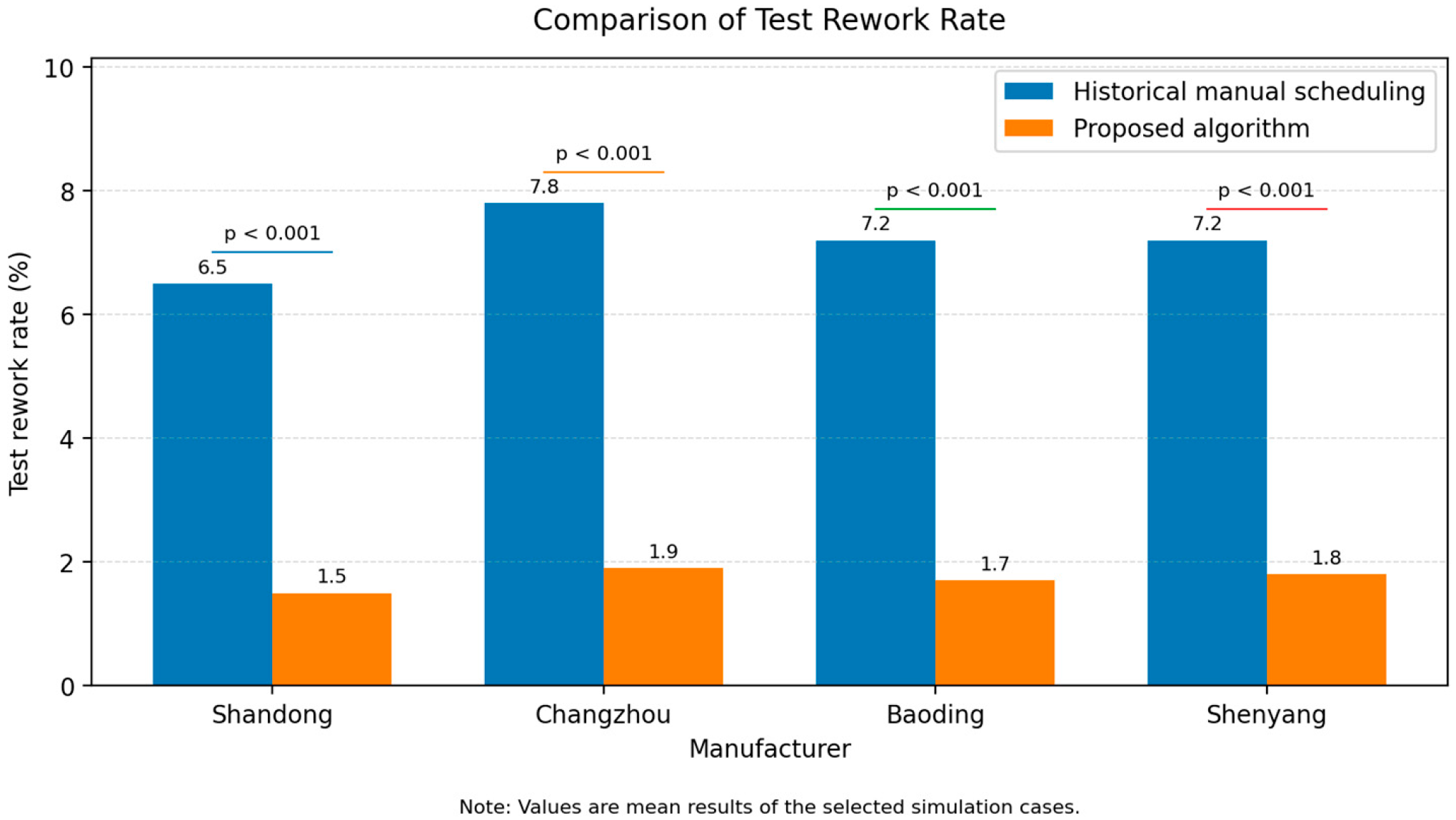
To evaluate scheduling performance from different perspectives, three indicators are used: total makespan deviation rate, average process waiting time, and test rework rate. The total makespan deviation rate reflects delivery compliance and is mainly related to the EDD component of the proposed algorithm. The average process waiting time reflects resource coordination and is mainly related to the SPT component. The test rework rate reflects disturbance-related schedule robustness and is associated with the CD component.
An independent-sample t-test was conducted using unit-level simulation results and historical manual scheduling records. The significance level was set at . A value of (p < 0.001) indicates a statistically significant difference between the two scheduling methods.
4.9.1. Performance Comparison
Table 7 summarizes the comparative results between historical manual scheduling and the proposed algorithm. The results show that the proposed algorithm outperforms manual scheduling across all three indicators and all four manufacturers.
The average total makespan deviation rate decreased from 28.3% under historical manual scheduling to 2.3% under the proposed algorithm. The average process waiting time decreased from 16.2 days to 4.9 days. The average test rework rate decreased from 7.2% to 1.7%. These results indicate that the proposed algorithm improves delivery compliance, resource coordination, and disturbance-related scheduling robustness.
4.9.2. Visual Comparison of Key Indicators
Figure 5,
Figure 6 and
Figure 7 provide visual comparisons of the three performance indicators across the four manufacturers.
Figure 5 compares the total makespan deviation rate,
Figure 6 compares the average process waiting time, and
Figure 7 compares the test rework rate.
The visual results are consistent with the numerical results in
Table 6. The proposed algorithm consistently reduces makespan deviation, process waiting time, and test rework rate for all four manufacturers. The improvement is particularly evident for Changzhou and Baoding in terms of total makespan deviation, where historical manual scheduling shows relatively large deviations from planned completion times.
4.9.3. Summary of Algorithmic Performance
The comparative results demonstrate the effectiveness of the proposed reliability-driven scheduling method.
First, the proposed algorithm improves delivery compliance. The average total makespan deviation rate is reduced from 28.3% to 2.3%, corresponding to a reduction of approximately 91.9%.
Second, the proposed algorithm improves production efficiency. The average process waiting time is reduced from 16.2 days to 4.9 days, corresponding to a reduction of approximately 69.8%.
Third, the proposed algorithm improves disturbance-related robustness. The average test rework rate is reduced from 7.2% to 1.7%, corresponding to a reduction of approximately 76.4%.
Overall, the proposed EDD-SPT-CD hybrid priority mechanism enables the scheduling model to consider delivery urgency, processing efficiency, and disturbance sensitivity simultaneously. Compared with historical manual scheduling, the proposed algorithm produces more stable and reliable scheduling results across different manufacturers and product specifications. These findings support the practical applicability of the proposed method for UHV converter transformer production scheduling.
5. Discussion and Conclusions
5.1. Main Contributions
This study addresses the scheduling problem of UHV converter transformer manufacturing under long production cycles, strong process coupling, limited key resources, and multiple disturbance risks. A reliability-driven heuristic scheduling framework is proposed by integrating disturbance quantification, hybrid priority scheduling, Monte Carlo-based reliability verification, and closed-loop schedule revision. The main contributions are summarized as follows:
First, this study develops a disturbance-aware scheduling framework tailored to UHV converter transformer manufacturing. Unlike traditional deterministic scheduling methods, the proposed framework explicitly incorporates production disturbances into the scheduling process. Disturbance factors are identified from historical production records and expert interviews, quantified using the Con-ERS method, and further mapped to process-level disturbance loads. This provides a structured way to link disturbance assessment with production scheduling decisions.
Second, this study proposes an EDD-SPT-CD hybrid heuristic scheduling mechanism. The EDD component reflects delivery urgency, the SPT component improves processing efficiency and reduces waiting time, and the CD component gives priority to processes with higher disturbance loads. Through this mechanism, the scheduling algorithm simultaneously considers delivery compliance, resource coordination, and disturbance sensitivity, thereby overcoming the limitation of using a single heuristic rule.
Third, this study constructs a Monte Carlo-based schedule execution reliability verification method. Schedule execution reliability is defined as the probability that a candidate schedule remains feasible under simulated disturbance scenarios while satisfying process precedence, equipment exclusivity, capacity, and delivery constraints. This definition distinguishes schedule reliability from the physical reliability of transformer equipment and provides a quantitative basis for evaluating schedule robustness under uncertainty.
Fourth, this study establishes a closed-loop scheduling workflow that integrates initial schedule generation, reliability verification, and iterative correction. When a candidate schedule fails to satisfy the reliability or robustness criteria, the algorithm adjusts heuristic weights, resource allocation, or process buffers and regenerates the schedule. This closed-loop logic improves the practical feasibility of the scheduling results and addresses the limitation of one-time open-loop scheduling.
Finally, the proposed method is validated using 40 selected simulation cases randomly sampled from complete and valid records within a historical dataset of 238 UHV converter transformers. The selected cases involve four representative manufacturers, namely Shandong, Changzhou, Baoding, and Shenyang. Compared with historical manual scheduling, the proposed algorithm reduces the average total makespan deviation rate from 28.3% to 2.3%, shortens the average process waiting time from 16.2 days to 4.9 days, and reduces the test rework rate from 7.2% to 1.7%. The average computational time for generating preliminary schedules is 12.5 s, indicating that the proposed method is computationally feasible for the selected scheduling scale.
Overall, the proposed framework provides a reproducible and disturbance-aware decision-support method for UHV converter transformer production scheduling. It contributes to both scheduling theory and engineering practice by integrating disturbance quantification, heuristic optimization, stochastic reliability verification, and closed-loop schedule correction within a unified framework.
5.2. Research Limitations
Although the proposed reliability-driven scheduling framework shows promising performance in the simulation study, several limitations should be acknowledged.
First, the empirical data used in this study are derived from domestic UHV converter transformer manufacturing projects. The historical dataset contains 238 units, but the distribution across manufacturers and product models is uneven. The simulation experiment further uses 40 selected cases randomly sampled from complete and valid records. Although these cases are sufficient for verifying the feasibility of the proposed workflow, they may not fully represent all possible production configurations, manufacturer capabilities, and project delivery conditions. Therefore, further validation using larger and more balanced datasets is still required.
Second, the current disturbance-factor system focuses mainly on disturbances that can be traced from historical production records, such as bushing delivery delay, first-pass test failure, equipment capacity insufficiency, and material quality defects. Extreme low-probability but high-impact events, such as large-scale equipment overhaul, severe supply-chain interruption, major public health emergencies, or sudden policy changes, were not explicitly modeled. As a result, the proposed method may require additional scenario-design mechanisms before being applied to extreme disruption environments.
Third, the Monte Carlo-based reliability evaluation relies on disturbance distributions estimated from available historical records and expert-calibrated parameters. Although this approach improves the quantitative evaluation of schedule execution reliability, the assumed disturbance distributions and threshold settings still involve engineering judgment. The classification thresholds for disturbance frequency and hazard degree, as well as the reliability acceptance criterion, should be further tested through sensitivity analysis and additional industrial cases.
Fourth, this study mainly compares the proposed algorithm with historical manual scheduling. Although this comparison reflects actual industrial practice, it does not fully cover all possible algorithmic baselines, such as mixed-integer programming, genetic algorithms, particle swarm optimization, ant colony optimization, or other metaheuristic approaches. Due to data confidentiality, computational workload, and the limited revision period, comprehensive benchmarking against multiple optimization algorithms was not fully implemented in this study. Future research should include broader comparative experiments to further evaluate the relative performance of the proposed method.
Fifth, the current framework is implemented as an offline simulation and decision-support method. It generates and evaluates schedules based on cleaned historical data, predefined resource parameters, and simulated disturbance scenarios. Real-time data interaction with manufacturing execution systems, online disturbance detection, and automatic dynamic rescheduling have not yet been fully realized. Therefore, the proposed method still needs further development before being deployed in fully digitalized and real-time production control environments.
Finally, the engineering validation is limited to UHV converter transformer manufacturing in China. Differences in production standards, equipment configurations, supply-chain structures, and management practices among international manufacturers were not considered. The generalizability of the proposed framework to other countries, other complex equipment industries, or transnational production networks should be examined in future studies.
Overall, these limitations do not undermine the main findings of this study, but they indicate that the proposed framework should be regarded as a disturbance-aware scheduling decision-support method rather than a fully autonomous real-time scheduling system. Future work will focus on expanding the dataset, incorporating more extreme disturbance scenarios, conducting multi-algorithm benchmarking, improving sensitivity analysis, and developing real-time closed-loop scheduling functions with industrial information systems.
5.3. Opportunities and Trends for Future Study
Based on the current study and its limitations, future research can be extended in several directions.
First, future work can develop a digital twin-driven dynamic scheduling system. The current framework is mainly based on offline simulation and historical production data. By integrating IoT sensors, manufacturing execution systems, and real-time equipment-monitoring data, future studies can build a physical–digital closed loop for UHV converter transformer production. Such a system would support real-time disturbance detection, online schedule evaluation, and dynamic rescheduling during production execution.
Second, the disturbance library can be further expanded. This study mainly considers disturbance factors that can be traced from historical production records. Future research should include extreme low-probability but high-impact events, such as large-scale equipment failures, severe supply-chain disruptions, public health emergencies, and sudden changes in project delivery requirements. Scenario-based simulation, stress testing, and robust optimization can be introduced to improve the adaptability of scheduling models under extreme uncertainty.
Third, future studies can extend the optimization objectives. In addition to delivery compliance, resource efficiency, and schedule execution reliability, production cost, energy consumption, carbon emissions, inventory level, and workforce stability can be incorporated into the objective function. This would support the development of low-carbon and sustainable scheduling methods for power equipment manufacturing.
Fourth, broader algorithmic benchmarking should be conducted. The present study compares the proposed method mainly with historical manual scheduling. Future research can compare the proposed EDD-SPT-CD hybrid heuristic method with mixed-integer programming, genetic algorithms, particle swarm optimization, ant colony optimization, reinforcement learning, and other metaheuristic or learning-based algorithms. Such comparisons would further clarify the relative advantages and applicable conditions of the proposed framework.
Fifth, cross-factory collaborative scheduling can be explored. UHV converter transformer projects often involve multiple manufacturers, shared suppliers, and coordinated delivery requirements. Future research can develop cloud–edge collaborative scheduling platforms to support resource sharing, task coordination, and disturbance response across factories. This would improve the flexibility and resilience of project-level production planning.
Finally, adaptive learning mechanisms can be incorporated into the scheduling framework. Machine learning or deep reinforcement learning methods may be used to update heuristic weights, estimate disturbance probabilities, and recommend rescheduling strategies based on historical and real-time production data. This would enhance the intelligence, generalization ability, and long-term applicability of the proposed scheduling framework.
Overall, future research should move from offline reliability-driven scheduling toward real-time, data-connected, multi-objective, and cross-factory intelligent scheduling. These directions will further support the digital and sustainable transformation of complex power equipment manufacturing.