1. Introduction
Distribution networks remain the interface between transmission systems and end users, but their operating role has changed substantially. They now accommodate distributed photovoltaics, wind power, energy storage, electric vehicles, controllable loads, and flexible prosumers. Bidirectional power flow, frequent topology changes, three-phase unbalance, voltage fluctuations, user-side flexibility, and tighter cyber-physical coupling have consequently become routine operating concerns. Simulation must therefore extend beyond offline power flow studies for planning and also support real-time state tracking, short-term operational analysis, risk warning, dispatch validation, and market-mechanism assessment.
Digital twins (DTs) are generally characterized by real-time mapping, continuous model updating, and bidirectional interaction between physical and virtual systems. A DT is thus more than a static model or visualization interface: it combines physical objects, virtual models, data connections, twin data, and service applications, with updates maintained across the system lifecycle to support decisions and feedback [
1,
2,
3,
4,
5,
6,
7,
8,
9,
10]. In power systems, DT research has addressed equipment, the power Internet of Things, grid operation, cyber-physical security, and distribution network operation and maintenance [
11,
12,
13,
14,
15,
16]. These studies establish a broader concept, but they leave open a more specific question: what does the DT approach add to distribution network simulation in practice?
This review paper addresses that question by focusing on DT applications in distribution network simulation. A distribution network DT is defined here as an updatable virtual representation of feeders, equipment, users, distributed resources, and their operating environment. Real-time or quasi-real-time data drive the representation, while topology processing, state estimation, power flow, optimal power flow, co-simulation, and data-driven models are used to reproduce current conditions and evaluate prediction, optimization, and control actions. The analysis considers how far these capabilities improve the timeliness, credibility, scalability, and feedback functions of distribution network simulation.
Two groups of sources are used. The abovementioned 86 studies retained through systematic screening constitute the core evidence base. The broader literature on general DT theory, power flow and optimal power flow algorithms, co-simulation, demand response, microgrids, and peer-to-peer energy systems is cited only where it clarifies definitions or explains enabling technologies.
This review paper makes four specific contributions. First, it distinguishes digital twin-based distribution network simulation from conventional offline simulation and static visualization through four requirements: data connectivity, model updating, physical–virtual consistency, and decision feedback. Second, it organizes 86 systematically screened studies in a classification framework tailored to distribution networks. Third, it examines data governance, topology identification, distribution system state estimation, power flow, optimal power flow, co-simulation, and machine learning-assisted modeling according to the functions they perform in maintaining a current and credible network representation. Fourth, it compares the literature in terms of architectural completeness, simulation credibility, validation strength, and closed-loop capability, thereby identifying the gap between today’s platform-oriented twins and operational twins.
Positioning Relative to Existing Reviews
Several recent reviews have discussed general DT concepts, power system requirements, distribution-side applications, and enabling technologies. The present review asks a narrower question: how, and based on what evidence, do DTs extend distribution network simulation? The comparison therefore emphasizes real-time or quasi-real-time state updating, HIL (hardware-in-the-loop), and real-time simulation validation, complementarity with distribution management systems (DMSs), benchmark-based fidelity assessment, and closed-loop decision support.
The intended contribution is not another generic DT architecture. It is a simulation-centered interpretation of DTs based on concrete engineering requirements: observable data streams, updatable feeder models, computational engines, validation evidence, and reliable feedback to network operation (see
Table 1).
2. Systematic Literature Search and Screening Method
2.1. Search Strategy and Data Sources
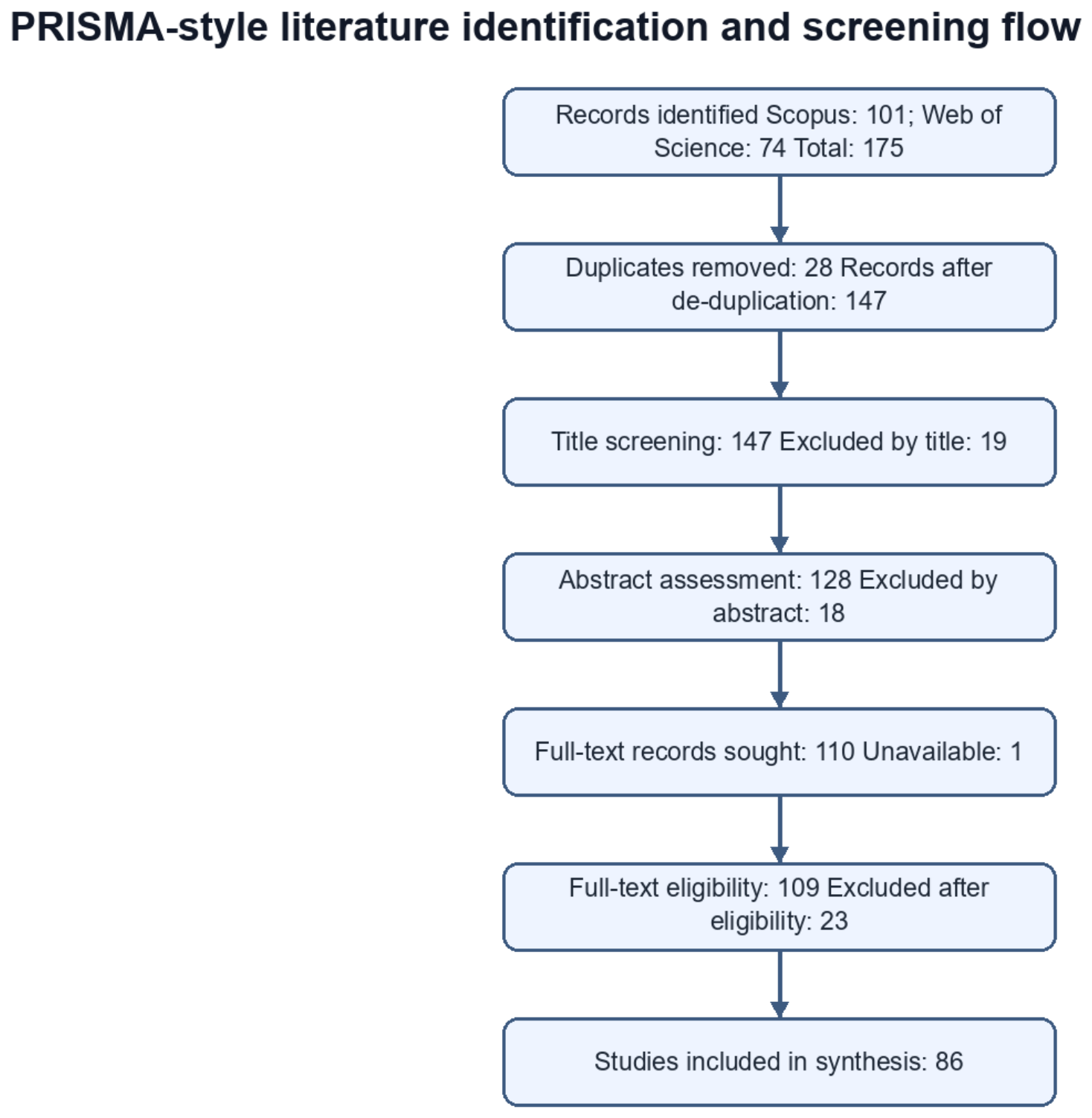
The literature search and screening followed the main PRISMA 2020 stages: identification, duplicate removal, title screening, abstract screening, and full-text eligibility assessment. The final search was completed on 9 June 2026. Scopus and the Web of Science Core Collection provided the records used in the quantitative screening process. IEEE Xplore was consulted to test the search vocabulary and identify supplementary studies, but its records were not included in the reported screening counts. The resulting core set contained 86 publications from 2019 to 2026 across three concept groups: digital twins, distribution networks, and simulation/modeling. The literature outside this set was used only where necessary to explain general DT concepts, algorithms, communication protocols, cybersecurity, real-time simulation platforms, or related engineering practice.
The search terms were “Digital Twin”, “Digital Twins”, “Distribution Network”, “Power Distribution Network”, “Distribution Grid”, “Simulation”, “Modeling”, “Power”, and “Electric*”. In Scopus, the TITLE-ABS-KEY query was (“Digital Twin” OR “Digital Twins”) AND (“Distribution Network” OR “Power Distribution Network” OR “Distribution Grid”) AND (Simulation OR Modeling) AND (Power OR Electric*). Results were limited to the Engineering, Energy, and Computer Science subject areas and to journal articles, reviews, and conference papers. The equivalent Web of Science topic query was TS = ((“Digital Twin” OR “Digital Twins”) AND (“Distribution Network” OR “Power Distribution Network” OR “Distribution Grid”) AND (Simulation OR Modeling) AND (Power OR Electric*)). IEEE Xplore remained a supplementary source and was excluded from the Scopus/Web of Science screening totals.
2.2. Screening Procedure
The searches yielded 101 records from Scopus and 74 from Web of Science, for a combined total of 175. All records were imported into Zotero (
https://www.zotero.org/) in RIS format. Duplicate identification used titles, authors, publication years, and DOI information; 28 duplicates were removed, leaving 147 records for title screening. Records clearly related to digital twins and distribution networks were retained. Studies centered on transmission lines, communication networks, logistics networks, water networks, or other unrelated domains were excluded, whereas uncertain records were carried forward. In total, 19 records were removed at this stage, and 128 proceeded to abstract screening (see
Figure 1 and
Table 2).
2.3. Inclusion and Exclusion Criteria
Abstracts were screened against three criteria: the digital twin had to be a substantive research object rather than a passing background term; the study had to concern a distribution network, distribution system, active distribution network, or directly coupled application; and it had to contain identifiable technical work in simulation, modeling, monitoring, state estimation, fault diagnosis, optimization, control, planning, or operational analysis. After two manual review rounds, 108 records were provisionally retained, 18 were excluded, and two boundary cases were advanced because their scope or technical content could not be resolved from the abstract. Full texts were therefore sought for 110 records. One conference paper could not be retrieved, leaving 109 records for eligibility assessment.
At the full-text stage, a study was retained only when the DT was central to the work, the distribution network was the main research object, a clear simulation, modeling, operation, or control application was presented, and technical information could be extracted on the architecture, method, application, validation system, or contribution. Twenty-three records were excluded because they fell outside the distribution network scope, used the DT concept only as background terminology, remained conceptual or visionary, or lacked sufficient technical detail. The final core evidence base contained 86 studies.
Boundary cases were handled conservatively. Studies confined to transmission grids or transmission lines were excluded. Work on isolated microgrids, virtual power plants, or integrated energy systems was retained only when distribution network access, distribution-side operation, or distribution network simulation was central to the study. Papers limited to charging station equipment were excluded, whereas EV studies were eligible when they explicitly examined distribution network operation, control, or simulation. Uncertain titles and abstracts were advanced rather than rejected. Screening was led by one researcher and followed by a second manual review of the abstract decisions; the method is therefore described as a systematic, PRISMA-framed process rather than a dual-independent review with formal conflict arbitration.
Reporting the databases, search strings, record counts, exclusion logic, and retained evidence improves transparency, although the procedure does not provide the inter-reviewer reliability of a dual-independent systematic review (see
Table 3).
2.4. Data Extraction and Classification Framework
For each included study, we recorded the title, authors, year, publication source, DOI, abstract, primary application category, DT modeling approach, distribution network focus, validation basis, simulation or tool keywords, extractable elements, and evidence supporting the main contribution. Each paper was assigned one primary application category, while additional labels could be used for modeling approach, network focus, and validation basis.
2.5. Descriptive Statistics and Comparative Synthesis Approach
Following screening, the 86 studies were coded descriptively and compared across application categories, modeling approaches, network objects, and validation bases. This analysis was intended to show where research activity is concentrated, which methods recur, and which technical questions remain underdeveloped, rather than merely to compile a large reference list.
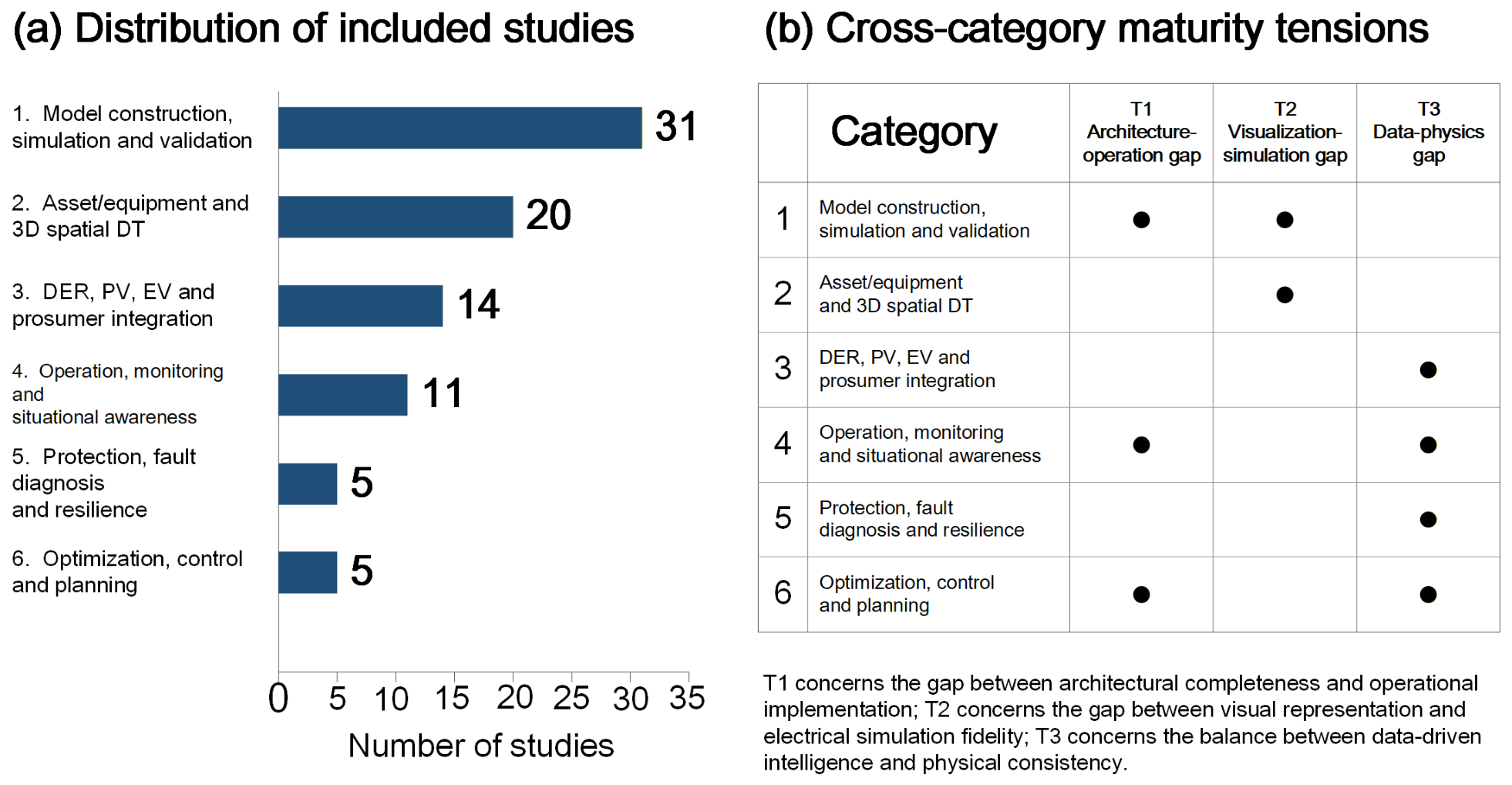
The distribution was uneven. Model construction, simulation, and validation platforms formed the largest group, with 31 studies. Assets, equipment, and 3D spatial digitalization accounted for 20 studies, and DER, PV, EV, and prosumer integration for 14. Operation, monitoring, and situational awareness included 11 studies, while protection, fault diagnosis, and resilience and optimization, control, and planning each contained five. The evidence base is therefore concentrated on twin construction, data spaces, and visualization or simulation environments; closed-loop control, resilience, and optimization remain less developed.
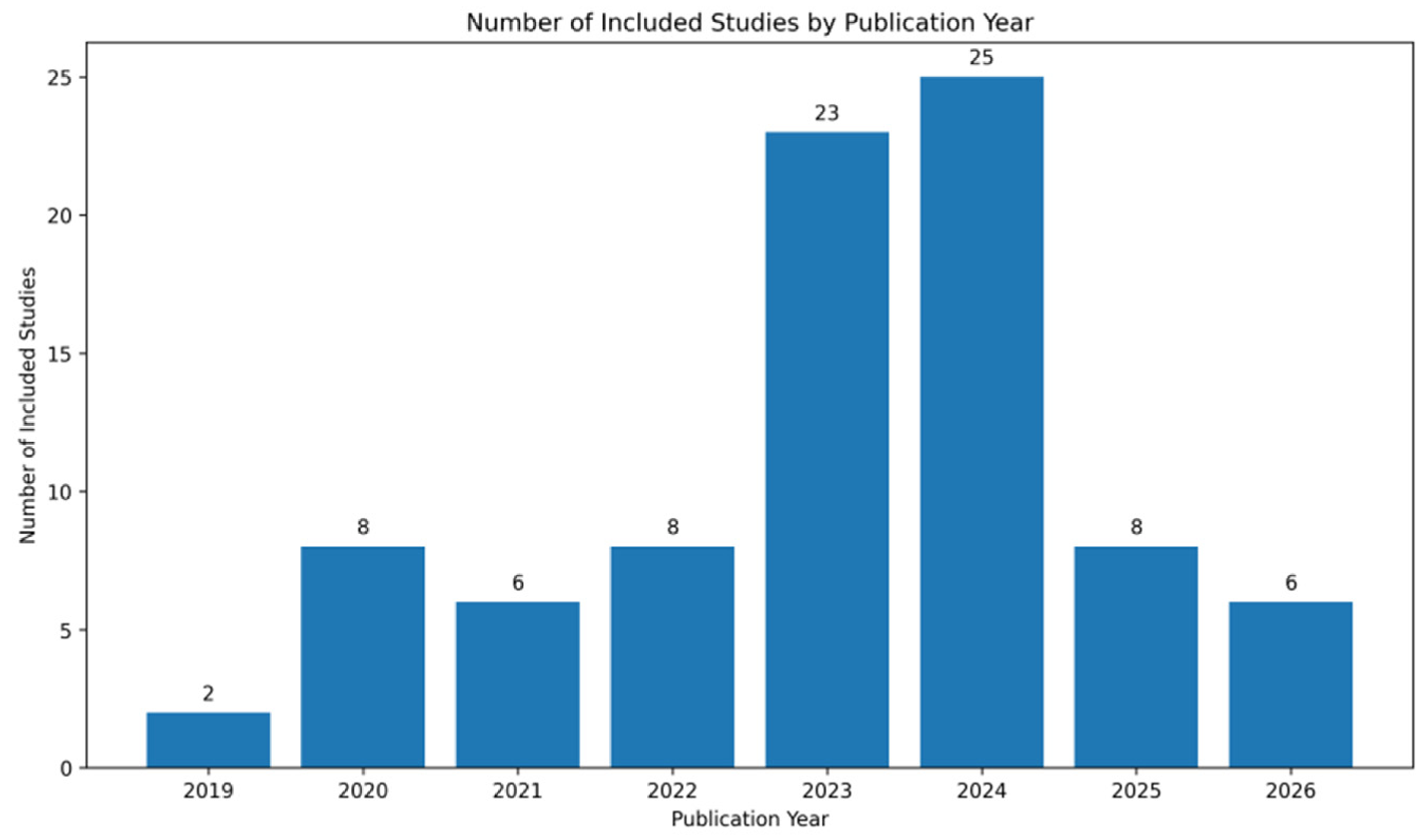
The publication profile also reflects the recent growth of the field. Only two included studies appeared in 2019, whereas most were published from 2023 onward. Papers from 2025 and 2026 were included because the databases were updated through 9 June 2026 and contained early-access or in-press records (see
Figure 2).
Implementation depth was assessed separately from application category. Platform-, system-, and architecture-level twins dominated the sample, and many papers reported cyber-physical or real-time interaction. Far fewer demonstrated physics-based model updating, ontology- or CIM (common information model)-based semantic interoperability, or field-validated closed-loop control. The studies were therefore not treated as equally mature. Framework papers were used mainly to identify architectural patterns, whereas HIL, testbed, benchmark feeder, and field case studies were given greater weight when validation and engineering readiness were discussed (see
Figure 3 and
Table 4).
3. Conceptual Boundary of Digital Twin-Based Distribution Network Simulation
3.1. Digital Twin Components and Distribution Network Implications
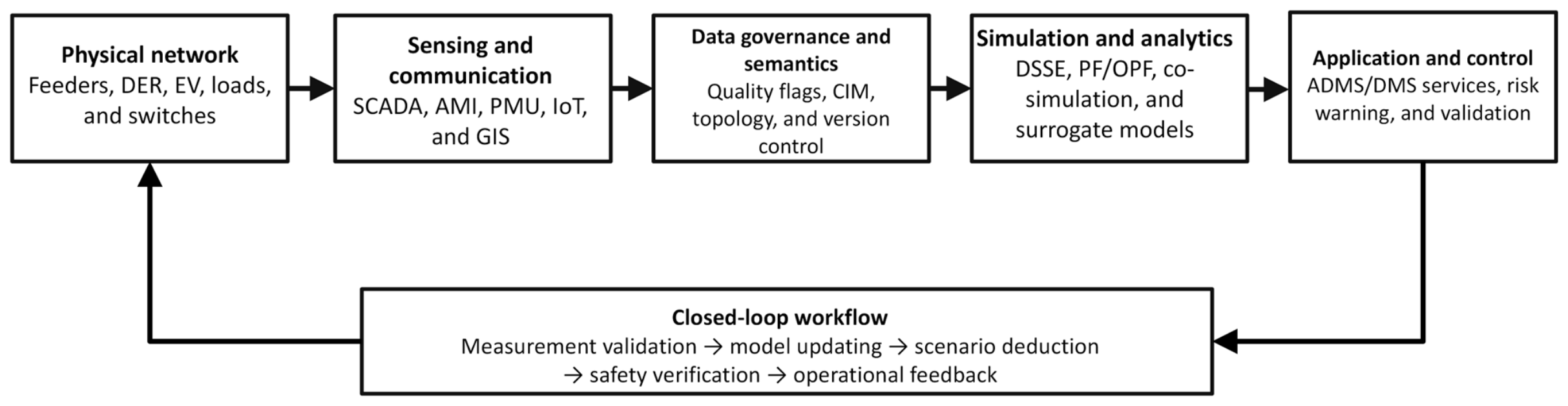
Five functional elements recur across the included literature: the physical network; data acquisition and communication; data governance; modeling and simulation; and application services. The physical element covers feeders, transformers, switches, protection devices, distributed generation, storage, EV charging facilities, and user loads. Data may come from SCADA (supervisory control and data acquisition), AMI (advanced metering infrastructure), PMUs (phasor measurement units), distribution automation terminals, IoT (Internet of Things) sensors, GIS, equipment ledgers, weather services, and market- or user-side systems. The simulation elements include topology and equipment models, state estimation, power flow, optimal power flow, co-simulation, and data-driven surrogates. Application services use these functions for monitoring, warning, dispatch, planning, operation and maintenance, DER coordination, and security assessment [
17,
18,
19,
20,
21,
22,
23].
The predominance of model construction, simulation, and validation studies—31 of the 86 papers—reflects the present stage of the field. Model resources, data interfaces, simulation engines, and validation environments must be established before a twin can support routine network operation. At the same time, this concentration indicates that many reported systems have not yet progressed from conceptual or platform-level designs to operational closed loops.
The five-part arrangement is used here to consolidate existing DT grid and power system models, not to propose a new number of layers. Earlier architectures already identify physical entities, virtual models, data connections, twin data, and service applications. The present synthesis maps these elements to distribution network tasks, including data validation, topology updating, state estimation, power flow and OPF (optimal power flow) analysis, co-simulation, verification and validation, and feedback to ADMS (advanced distribution management system)/DMS-assisted operation (see
Figure 4).
3.2. Difference from Conventional Simulation
Conventional distribution network studies commonly rely on fixed topology, representative load curves, and predefined scenarios. These models remain valuable for planning and offline analysis, but they are not necessarily synchronized with the network’s current state. In a DT setting, measurements are incorporated continuously, topology and parameters are revised, and the updated model is used for online scenario analysis and operational feedback. Power flow, OPF, co-simulation, and machine learning models are enabling components rather than DTs in isolation; they become part of a DT only when embedded in an updatable, data-connected physical–virtual loop [
1,
2,
3,
4,
5,
6,
7,
8,
9,
10].
This distinction is particularly important in distribution networks, where sparse low-voltage measurements, feeder reconfiguration, intermittent DER output, uncertain EV charging, and customer behavior can quickly reduce model accuracy. The relevant issue is not simply whether a virtual model exists, but whether it remains consistent with the physical network, supports scenario evaluation, and informs decisions.
4. Synthesis of the 86 Included Studies
The 86 studies were compared by application area and by the maturity of their DT implementation. Three questions guided the analysis: Does the study provide a computable and updatable twin model? Is the model connected to operational data or a real-time simulation environment? Does it inform an operational decision rather than serve only as a visualization? These questions distinguish conceptual and platform papers from work that demonstrates simulation, validation, or control capability.
4.1. Model Construction, Simulation and Validation Platforms
The largest category comprised 31 studies on model construction, simulation, and validation platforms [
20,
21,
22,
23,
24,
25,
26,
27,
28,
29,
30,
31,
32,
33,
34,
35,
36,
37,
38,
39,
40,
41,
42,
43,
44,
45,
46,
47,
48,
49,
50]. Their topics included five-dimensional structures for active distribution networks, rapid model reconstruction, cloud–edge collaboration, ontology and CIM-based topology models, real-time simulation, and power hardware-in-the-loop validation. Taken together, these studies show how fragmented network models and data resources can be assembled into virtual systems that can be updated and tested. Several papers addressed dynamic model identification and parameter tuning for inverter-dominated or load-center networks, where fidelity varies with operating conditions [
24,
25,
26,
27,
28,
45].
Validation-oriented studies are particularly informative because they connect virtual analysis with physical operation. Real-time simulation, HIL, and grid analyzer approaches have been used to test switching actions, high-frequency equipment behavior, network dynamics, and cyber-physical interactions before field deployment [
32,
35,
38,
39,
41,
49]. Studies with more extensive validation therefore treat the twin not only as a digital representation, but also as an experimental environment for model updates, operating strategies, and security assessment.
4.2. Assets, Equipment and 3D Spatial Digitalization
The second largest category comprised 20 studies on assets, equipment, and 3D spatial digitalization [
18,
51,
52,
53,
54,
55,
56,
57,
58,
59,
60,
61,
62,
63,
64,
65,
66,
67,
68,
69]. They covered distribution terminals, low-voltage cables, substations, distribution equipment, feeders, utility poles, vegetation risk, and panoramic spatial layouts. In contrast to feeder-level simulation studies, this work emphasizes digital representations of individual assets and their spatial or operating attributes. 3D, GIS (geographic information system), visual, and AR-based twins can improve model maintenance and interpretation when asset ledgers, topology records, and field inspection data are inconsistent [
18,
51,
52,
53,
54,
55,
56,
57,
58,
59,
60,
61,
62,
63,
64,
65,
66,
67,
68,
69].
Asset digitalization is nonetheless more than a visualization task. Network simulation depends on accurate equipment parameters, switch states, cable impedances, transformer connections, pole locations, and terminal health data. Asset-level twins can supply this parameter and spatial foundation, but they must be linked to electrical models and operational measurements before they can support simulation and decision-making.
4.3. DER, PV, EV and Prosumer Integration
Fourteen studies examined DER, PV, EV, and prosumer applications [
19,
70,
71,
72,
73,
74,
75,
76,
77,
78,
79,
80,
81,
82]. Reported uses included DER simulation, PV overload-risk warning, EV flexibility assessment, PV curtailment optimization, directional overcurrent protection validation, harmonic spectrum-based grid twins, automatic voltage regulation for PV inverters, and DER-based voltage regulation [
19,
70,
71,
72,
73,
74,
75,
76,
77,
78,
79,
80,
81,
82].
The main contribution of this group is the use of changing network conditions rather than a fixed scenario set. By updating load, PV output, EV charging behavior, and network state from real-time or quasi-real-time data, a DT can reassess voltage violations, overloads, reverse power flow, protection coordination, and available flexibility as conditions evolve. EV studies were retained only when the charging system was explicitly coupled to distribution network operation or simulation.
4.4. Operation, Monitoring and Situational Awareness
Eleven studies addressed operation, monitoring, and situational awareness [
17,
83,
84,
85,
86,
87,
88,
89,
90,
91,
92]. Their topics included dispatch operation, online flexibility assessment, automatic grid operation, situational awareness, state estimation with bad-data identification, operational optimization, online impedance-based stability analysis, and reinforcement learning-based extraction of network structures and load patterns. Among the six categories, this group is most closely associated with the transition from a static representation to an operational twin [
17,
83,
84,
85,
86,
87,
88,
89,
90,
91,
92].
Across these studies, data quality emerged as a prerequisite for trustworthy simulation. Bad measurements, sparse low-voltage telemetry, inconsistent equipment records, and communication delays can cause the virtual model to diverge from the network. Situational awareness therefore depends on topology verification, data fusion, anomaly detection, state estimation, and repeated validation rather than visualization alone. The bad-data identification and state estimation studies illustrate this dependence directly [
89].
4.5. Protection, Fault Diagnosis and Resilience
Only five studies were classified under protection, fault diagnosis, and resilience [
93,
94,
95,
96,
97]. Despite the small evidence base, this category is important because a DT can reproduce disturbance, fault, attack, and reconfiguration scenarios that would be unsafe or impractical to test on an operating network. Reported applications included disturbance localization, fault location, protection validation, cyberattack replication, and resilient reconfiguration.
These studies compared measurements with reference models, identified abnormal regions, and evaluated reconfiguration before field implementation [
93,
94,
95,
96,
97]. Their limited number suggests that resilience-oriented distribution network twins remain at an early stage. Protection coordination testing, dynamic recovery, cyber-physical attack models, and post-fault service restoration under high DER penetration require more systematic investigation.
4.6. Optimization, Control and Planning
Five studies covered optimization, control, and planning [
98,
99,
100,
101,
102]. They addressed resource allocation for distribution grid energy management, data-driven voltage performance tracking, hosting capacity improvement, voltage control, and coordinated reactive power/voltage optimization. In these applications, the twin serves as a controlled environment in which candidate decisions can be tested before they are applied to the physical network.
The limited size of this category suggests that closed-loop twins are less mature than monitoring- or modeling-oriented platforms. Many systems stop at visualization, data fusion, or simulation validation; relatively few complete the sequence from real-time data acquisition through optimization and safety checking to control feedback.
4.7. Cross-Category Comparison and Critical Assessment
The cross-category comparison points to three recurring tensions. The first lies between architectural completeness and operational depth. Multi-layer and five-dimensional architectures are common, but only a smaller set of studies shows how the architecture updates network states, performs online analysis, or returns results to dispatch and control. Architecture papers define useful system boundaries, but their value for simulation depends on explicit data flows, calibration procedures, and validation evidence.
The second tension concerns visual and simulation fidelity. Detailed 3D or GIS representations can improve asset management and field interaction, yet they do not by themselves improve electrical simulation. For operational use, spatial models must be linked to equipment parameters, switch states, feeder topology, DER operating points, and uncertainty descriptions; without those links, they remain primarily display or maintenance tools.
The third tension concerns data-driven intelligence and physical consistency. AI-assisted twins can accelerate forecasting, anomaly recognition, topology inference, and surrogate simulation, but unconstrained models may produce infeasible results during rare events, topology changes, or extreme weather. More credible designs combine data-driven methods with power flow equations, equipment limits, topology rules, and cyber-physical security constraints. This hybrid approach provides a stronger basis for operational use than either a conventional simulator with a visual interface or a black-box AI model (see
Table 5).
5. Enabling Technologies for Distribution Network Digital Twins
5.1. Data Governance, Topology Updating and State Estimation
Data governance and state awareness determine whether a DT can be trusted. Distribution network topology changes through switching, fault isolation, maintenance transfer, and temporary reconfiguration. If the topology is wrong, or abnormal measurements are not corrected, even an accurate power flow solver can produce misleading results. Research on topology learning, distribution system state estimation, robust estimation, and anomaly detection repeatedly points to the same sequence: validate measurements, verify topology, estimate the state, and update the model [
103,
104,
105,
106,
107,
108,
109,
110]. The included low-voltage, active distribution network, and bad-data-aware DT studies reach a similar conclusion [
17,
20,
21,
22,
23,
24,
25,
26,
27,
28,
29,
30,
31,
32,
33,
34,
35,
36,
37,
38,
39,
40,
41,
42,
43,
44,
45,
46,
47,
48,
49,
50,
83,
84,
85,
86,
87,
88,
89,
90,
91,
92,
111].
Low-voltage feeders present a related but more difficult problem: the model must remain updatable despite sparse metering and uneven data quality. Three approaches recur. Pseudo-measurement-based DSSE (distribution system state estimation) combines historical load profiles, AMI, and feeder measurements to estimate unobserved nodes. It is compatible with existing automation systems but depends strongly on load priors and time alignment [
103,
104,
108]. Physics-aware or learning-assisted estimators use network topology and power flow relationships to improve inference in telemetry-sparse feeders, although their outputs must be checked for physical violations and out-of-sample DER behavior [
71,
105]. Low-voltage-area DT studies based on multi-source data fusion, active-characteristic identification, and the “6C” goals integrate AMI, equipment records, station-area topology, customer data, and visual or IoT information [
18,
61,
63]. Pseudo-measurements improve coverage, AMI improves temporal detail, and learning methods improve speed, but none is sufficient alone. Low-voltage DT construction is therefore a combined problem of metering design, pseudo-state estimation, data quality assessment, and model assimilation.
5.2. Power Flow, Optimal Power Flow and Real-Time Deduction
Power flow and OPF remain the principal computational engines of distribution network simulation. Within a DT, they convert governed and synchronized data into scenario analysis, constraint checks, and candidate decisions; neither method constitutes the twin by itself. Multiphase power flow, convex relaxation, branch-flow formulations, distributed OPF, and real-time feedback optimization provide the mathematical basis for online analysis in active distribution networks [
112,
113,
114,
115,
116,
117,
118,
119,
120,
121,
122]. In the included studies, OPF and voltage control applications appear mainly in the DER, EV, and optimization control groups [
19,
70,
71,
72,
73,
74,
75,
76,
77,
78,
79,
80,
81,
82,
98,
99,
100,
101,
102], particularly in work on voltage regulation, hosting capacity, and resource allocation under current network conditions.
5.3. Co-Simulation, HIL and Machine Learning-Assisted Simulation
A distribution network DT often couples electrical models with communication systems, controllers, markets, user behavior, and weather. Co-simulation frameworks such as MOSAIK and HELICS (Hierarchical Engine for Large-scale Infrastructure Co-Simulation), together with integrated transmission–distribution simulation, provide practical mechanisms for coordinating heterogeneous models and time steps [
123,
124,
125,
126]. The included studies use real-time simulation, HIL, and grid analyzers to test model construction and dynamic behavior [
32,
35,
38,
39,
41,
49]. Machine learning and physics-informed learning can accelerate prediction, surrogate simulation, topology identification, and bad-data detection [
88,
127,
128], but their outputs still require checks against physical laws and security constraints.
5.4. Relationship with ADMS/DMS, SCADA, DERMS (Distributed Energy Resource Management System) and Utility Real-Time State Estimation
A distribution network DT must also be positioned alongside existing utility platforms. SCADA, DMS, ADMS, and DERMS already provide telemetry, alarms, switching analysis, FLISR (fault location, isolation, and service restoration), state estimation, Volt/VAR optimization, and DER coordination. NREL’s ADMS testbed, for example, integrates SCADA, outage management, GIS, DER management, and other utility applications, and evaluates volt/VAR optimization, FLISR, and distributed voltage regulation [
133,
134]. The contribution of a DT is not to recreate these functions, but to connect them to an updatable virtual feeder that tracks model-to-system consistency, supports what-if analysis before field execution, and links offline models, HIL validation, and operational feedback.
5.5. Readiness of Enabling Methods for Real-Time DT Simulation
Computational and validation metrics are reported unevenly across the literature, which prevents a fully numerical comparison of the available methods. Studies claiming real-time or quasi-real-time DT capability should report, at minimum, network scale, support for three-phase unbalance, computation time or latency, convergence or exactness conditions, accuracy, known failure modes, and validation basis.
Table 6 therefore provides a readiness-oriented comparison rather than a formal quantitative ranking. Its labels indicate the strength of the reported evidence: medium denotes data-connected or simulation-validated capability without demonstrated closed-loop operation, whereas high denotes explicit real-time, HIL, field validation, or operational feedback evidence (see
Table 6,
Table 7 and
Table 8).
6. Discussion: Research Gaps and Development Trends
6.1. From Platform Construction to Closed-Loop Control
The category counts reveal a marked imbalance. Platform/model construction and asset digitalization account for 51 of the 86 studies, whereas protection resilience and optimization control account for only 10. The evidence base is therefore still dominated by virtual model construction, spatial and equipment twins, and validation environments. A more operational research agenda would bring real-time data, model updating, scenario analysis, optimization checks, and safe feedback into the same workflow.
Definitions of digital twin also vary in rigor. Some papers use the term for a data-integrated model or visualization platform, whereas others require real-time synchronization, simulation, and feedback control. For distribution network simulation, the stricter definition is more useful: a high-value DT should support sensing, data governance, model updating, simulation, decision evaluation, and operational feedback as a continuous cycle. Static model construction studies remain relevant, but they represent enabling infrastructure rather than complete DT operation.
The feasibility of closed-loop control depends strongly on time scale. Millisecond to sub-second protection and converter control require deterministic communication, validated dynamic models, and fail-safe local controllers. At present, DTs are more credible at this scale as offline replicas, HIL test environments, or tools for protection-setting verification. Second- to minute-level voltage regulation, topology reconfiguration, DER coordination, transformer tap control, and BESS (battery energy storage system)/PV dispatch are more realistic near-term targets because moderate communication delays can be tolerated and commands can be checked on a virtual feeder before execution [
67,
71,
82,
121,
135]. Hour- to day-ahead scheduling, hosting capacity studies, and maintenance planning are less sensitive to latency, but depend on credible uncertainty and scenario models. Communication delay is therefore only one barrier; quantified model credibility, validated safety envelopes, operator authorization, and fallback mechanisms are also required before simulated decisions can be converted into commands.
6.2. From Visual Twins to Credible Simulation Twins
3D, GIS, AR, and panoramic twins are useful for asset management and field work, but visual detail is not equivalent to simulation fidelity. A simulation twin must connect spatial data with electrical parameters, topology, measurements, and operating constraints. Without those links, it remains primarily a visualization interface. Progress therefore depends on integrating spatial, electrical, and operational data in a single updatable model.
6.3. Validation and Benchmarking Deficiency
Validation evidence was not stated explicitly in 40 studies. Twenty-four used laboratory, HIL, or testbed validation; 24 used simulation cases; 20 used utility or field data; and only five clearly used benchmark or test feeders. These categories were not mutually exclusive, so one study could be coded under more than one validation basis. Even with this overlap, the pattern shows that proposed DTs are difficult to compare. Future papers should report the test feeder, data source, update frequency, model error, computation time, synchronization mechanism, and control feedback pathway so that results can be reproduced and assessed on a common basis.
The difference in validation strength has practical consequences. A conceptual architecture can define components and interfaces, but it cannot establish whether the model remains synchronized under measurement error, topology changes, DER variability, or communication latency. HIL, real-time simulation, benchmark feeders, and utility data provide stronger evidence of operational usefulness. Reviews and engineering deployments should therefore distinguish among proposed architectures, prototype platforms, and operationally validated systems.
An open benchmark library would improve the reproducibility of distribution network DT evaluation. It could begin with modified 33- and 69-bus benchmark distribution systems and the IEEE 123-node feeder and later incorporate anonymized utility feeders. Each case should include the electrical topology and parameters, time-stamped load, PV, EV, and storage profiles, AMI/SCADA/PMU measurement configurations, noise and missing-data patterns, switching and topology-change events, communication latency, and optional cyberattack or false-data injection scenarios. Useful metrics include state estimation error, topology identification accuracy, power flow deviation, model update latency, synchronization error, OPF feasibility, control security margin, and resilience to data anomalies. Such cases would test not only whether a platform can be constructed, but also whether it remains accurate, timely, and safe under standardized disturbances [
136,
137,
138,
139].
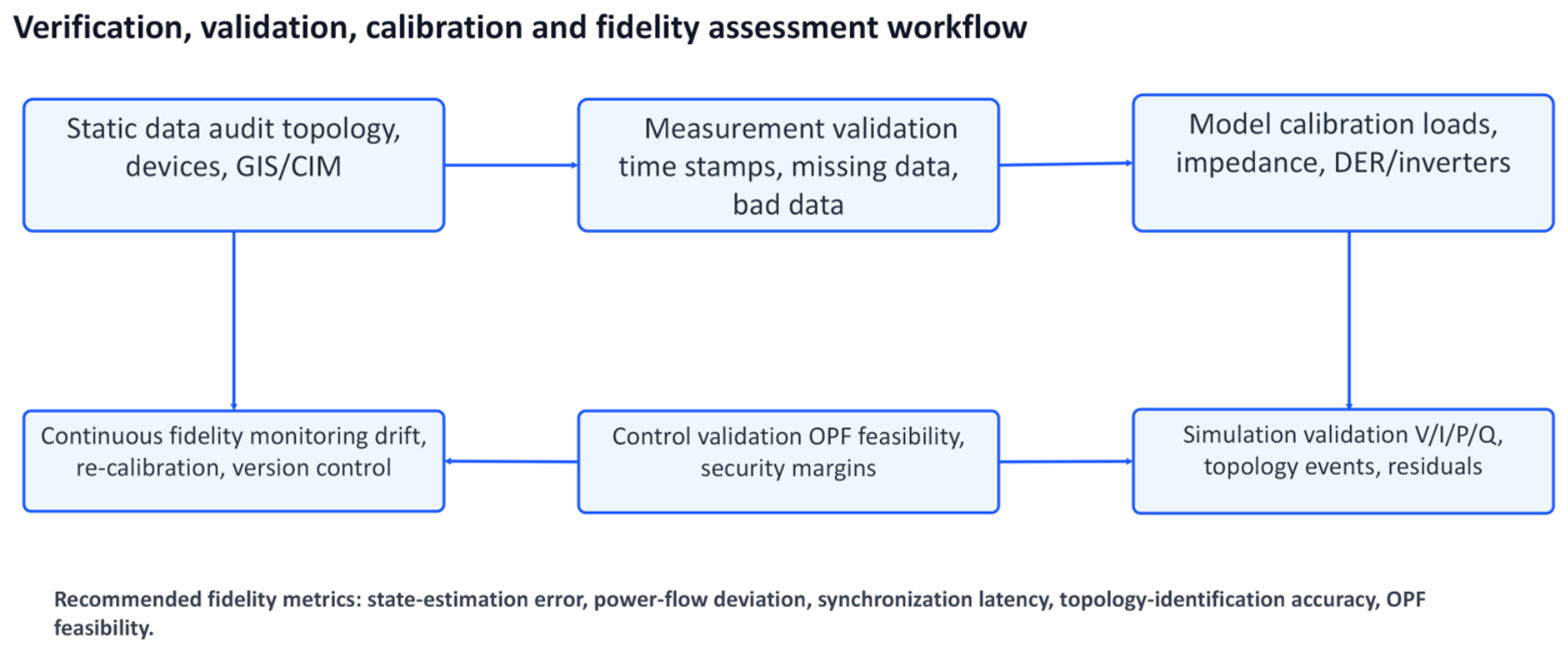
Verification, validation, calibration, and fidelity assessment serve different purposes. Verification checks whether algorithms, interfaces, and virtual models are implemented correctly. Validation determines whether the model reproduces the physical feeder within a defined tolerance. Calibration adjusts topology, impedance, load, DER, and controller parameters using measurements. Fidelity quantifies physical–virtual agreement under specified operating conditions. Treating these tasks separately makes claims of consistency more precise and testable (see
Figure 5 and
Table 9 and
Table 10).
6.4. Cyber-Physical Security and Privacy
Cybersecurity and privacy become more demanding once a DT is connected to dispatch, optimization, or control. False-data injection, communication delay, model tampering, and incorrect commands can propagate from the digital layer to the physical network. The included attack and resilience studies show how DTs can reproduce attacks and validate countermeasures [
93,
97]. Broader smart-grid security research adds requirements for anomaly detection, secure data exchange, model-version control, and isolated simulation environments [
110,
140].
Privacy is particularly important for low-voltage and customer-side twins because AMI, EV charging, and demand response records can reveal user behavior. Federated learning offers one approach to cloud–edge-end model updating: edge devices or station-area controllers train locally and send parameters or gradients instead of raw measurements, while differential privacy can reduce the risk of reconstructing individual records [
141,
142]. Neither technique is sufficient on its own. Aggregated models still require power flow and operating limit checks, abnormal updates must be filtered, and privacy controls must be coordinated with model-version management and secure simulation sandboxes.
6.5. Complementary Evidence from Grid-Level Frameworks and Real-World Microgrid Deployment
Two recent studies broaden the discussion beyond the strict distribution network sample. Sifat et al. reviewed the evolution, communication architecture, online analysis, cybersecurity, self-healing, and cloud service requirements of an electric digital twin grid [
140]. Their grid-level perspective supports treating a DT as a cyber-physical service architecture rather than an isolated simulation model, and places distribution network twins within the wider development of data-connected, secure, and self-healing grids.
Calderon et al. described a field-operated, DT-enhanced SCADA system for a renewable energy and green hydrogen microgrid that combined mathematical component models, PLC (programmable logic controller)-based acquisition, industrial communication networks, and LabVIEW monitoring [
143]. Performance was reported using RMSE, MAE, MAPE, and R-squared, together with details of the software, hardware, protocols, and update intervals. The study was excluded from the 86-paper core set because it concerns an isolated microgrid, but it provides useful supplementary evidence of how DT research can move from architecture proposals to continuously connected and quantitatively validated deployment. It also illustrates the level of implementation and synchronization detail that distribution network studies should report.
Together, these studies also clarify the communication layer. TCP/IP provides the basic transport infrastructure for distribution automation and SCADA, while Modbus TCP and DNP3 over TCP/IP are widely used for telemetry and supervisory control. OPC UA provides platform-independent, service-oriented communication with built-in security; IEC 61850/MMS and GOOSE support standardized substation information exchange and time-critical events; and MQTT (Message Queuing Telemetry Transport) is suitable for lightweight edge-to-cloud telemetry. The grid-level review discusses TCP/IP, OPC UA, and MQTT, whereas the microgrid implementation uses Modbus TCP, PROFINET, and OPC for PLC-SCADA communication [
140,
143]. Connectivity alone, however, does not ensure interoperability. DTs also require shared device semantics, synchronized timestamps, data quality flags, model-version management, and interfaces based on information models such as CIM/IEC 61968/61970 and IEC 61850 [
144,
145,
146].
Microgrid dynamics also show why an aggregated virtual model is not sufficient. Established work on microgrid control, demand response, and prosumer coordination provides the operating basis for component-level twins [
147,
148,
149,
150,
151,
152,
153,
154,
155,
156,
157,
158,
159]. A practical implementation should maintain separate models for PV (photovoltaic) generators, storage, converters, electrolyzers, fuel cells, controllable loads, and protection devices, and connect them through network topology and energy management logic. Calderon et al. modeled a PV generator, PEM (proton-exchange membrane) electrolyzer, and PEM fuel cell separately and compared each model with PLC- and SCADA-acquired measurements [
143]. The different errors observed under steady-state and fast-transient conditions demonstrate the need for component-specific models, differentiated update rates, and multi-time-scale validation.
7. Conclusions
This review examined digital twin applications in distribution network simulation through four related tasks: defining the boundary of a simulation-oriented DT, assembling and classifying the evidence, linking enabling technologies to operational functions, and assessing research maturity. A distribution network DT was treated not as a generic model or visualization platform, but as an updatable representation that remains connected to the physical system and supports credible simulation and decision feedback. The 86 screened studies were organized into six areas: model construction, asset digitalization, DER/EV integration, operation and monitoring, protection and resilience, and optimization and control.
The evidence remains concentrated in model construction, simulation platforms, validation environments, asset and equipment digitalization, and DER/EV integration. Work on operational monitoring, situational awareness, protection, resilience, and optimization control is increasing, but is less mature. The enabling chain spans data governance, topology updating, state estimation, power flow, OPF, co-simulation, HIL, and physics-informed learning. A DT differs from ordinary simulation not because it uses a particular algorithm, but because data acquisition, model updating, simulation, validation, and decision feedback are maintained as a continuing process.
Future work should give priority to low-voltage observability, open benchmark datasets, model credibility assessment, time-scale-aware closed-loop control, cyber-physical security, and privacy-preserving data collaboration. Distribution network DTs need to move beyond visualization and model integration toward systems that can combine sparse AMI and station-area data, revise feeder models after topology changes, test commands before field execution, and compare methods under shared scenarios containing DER variability, measurement noise, communication latency, and cyberattacks. Their practical value will depend on credible data governance, physics-constrained models, standardized validation, and control feedback mechanisms that fail safely.