Article

Evaluation of Switchable Polarity Tertiary Amines as Green Solvents for Microalgal Lipid Extraction


by
Costas Tsioptsias
1,
Sotirios D. Kalamaras
2 and
Petros Samaras
1,*
1
Department of Food Science and Technology, Alexandrian University Campus at Sindos, International Hellenic University, 57400 Thessaloniki, Greece
2
Laboratory of Animal Production and Environmental Protection, Faculty of Veterinary Medicine, School of Health Sciences, Aristotle University of Thessaloniki, 54124 Thessaloniki, Greece
*
Author to whom correspondence should be addressed.
Processes 2026, 14(13), 2182; https://doi.org/10.3390/pr14132182
Submission received: 24 May 2026 / Revised: 29 June 2026 / Accepted: 1 July 2026 / Published: 3 July 2026
(This article belongs to the Special Issue Advanced Biofuel Production Processes and Technologies)

Abstract

Microalgal lipid extraction, particularly the subsequent solvent recovery phase, constitutes the primary energy bottleneck in algal-based biodiesel biorefineries. Recently, switchable polarity solvents (SPS), such as the tertiary amine N,N-dimethylcyclohexylamine (DMCHA), have emerged as promising ‘green’ alternatives capable of extracting lipids directly from wet biomass, theoretically bypassing energy-intensive drying and solvent recovery distillation stages. This study presents a rigorous techno-energetic and thermodynamic evaluation combined with supporting experiments for qualitative conclusions to scrutinize the actual viability of DMCHA-mediated extraction against conventional hexane benchmarks, across three process configurations using different biomass types: algal liquor, wet paste, and dried biomass. Contrary to widespread assumptions in the literature, fundamental thermodynamic calculations reveal that the energy required for amine regeneration via protonation/deprotonation mechanisms equals or exceeds that of conventional distillation. Furthermore, mitigating biomass drying inadvertently escalates overall downstream energy and economic penalties due to the excessive solvent volumes demanded by dilute aqueous matrices. Direct extraction from algal liquor displays a cost and energy consumption countably higher than the other scenario; precisely, a cost of 232 €/kg of lipids and energy consumption of 454 kWh/kg of lipids. Extraction from wet paste exhibits, indeed, a slightly lower energy consumption compared to the hexane process (respectively 51 kWh/h versus 72 kWh/kg), but, due to the CO2 requirements, the cost is double (19 €/kg of lipids versus 8 €/kg of lipids). Ultimately, while switchable polarity chemistry offers a marginal reduction in process water footprints, it introduces substantial operational complexity, elevated carbon dioxide payloads, and severe solvent degradation risks, challenging its current readiness for industrial upscaling.

1. Introduction

The escalating environmental paradigms associated with fossil fuel depletion and anthropogenic greenhouse gas emissions have catalyzed an urgent mandate for scalable renewable energy alternatives. Among these, biodiesel stands out as an exceptionally viable surrogate for petroleum-based diesel, owing to its direct compatibility with compression-ignition engines and its capacity to substantially curtail particulate matter, unburned hydrocarbons, and carbon monoxide emissions [1]. Nonetheless, navigating the transition of biodiesel from a pilot-scale alternative to a commercially viable commodity remains hindered by formidable techno-economic barriers [1,2,3].
A prominent economic bottleneck resides in feedstock procurement and downstream processing. First-generation biofuels, derived from edible oilseeds, have elicited severe ethical scrutiny regarding the “food-versus-fuel” debate, coupled with prohibitive cultivation costs [1]. Second-generation frameworks utilize lignocellulosic residues, whereas third-generation bioenergy relies heavily on marine and freshwater micro- and macro-algal biomass [1]. Microalgae present unprecedented areal biomass productivities and photosynthetic efficiencies far surpassing conventional terrestrial crops [4]. Moreover, their capacity to proliferate in municipal or industrial wastewaters enables concurrent biomass synthesis and bioremediation [5], positioning them as a cornerstone of the circular bioeconomy.
The downstream transformation of microalgal biomass into biodiesel generally proceeds through three distinct technological stages: (a) cell disruption and lipid extraction, coupled with solvent–product separation, (b) crude lipid refining, and (c) transesterification. Among these, the lipid extraction and solvent recovery matrix stands out as the absolute thermodynamic “hot-spot” of the entire upstream pathway [6,7]. The intensive thermal energy required to vaporize and recycle solvents, alongside the prohibitive energy penalties dictated by upstream dewatering and thermal drying of wet algal biomass, severely undermines the net energy ratio of the process.
To circumvent these energy sinks, recent research has gravitated toward the deployment of switchable polarity solvents (SPS), specifically switchable tertiary amines, considered as an alternative “green” extraction platform [8,9,10,11,12,13,14]. Besides amines, various Deep Eutectic Solvents (DES) have been explored as SPS either by CO2 triggering [15] or by temperature alteration [16,17]. DES exhibit powerful solubility properties for various compounds; however, their non-volatility makes the recovery of the extracted compounds difficult. The polarity switching allows for achieving this separation, and a switchable polarity DES has been used for extracting lipids from microalgae [15]. In general, the fundamental advantage of SPS lies in their tunable hydrophobicity, which theoretically permits the direct extraction of lipids from dilute, wet microalgae suspensions without requiring prior biomass drying. Furthermore, the downstream separation of the extracted lipids from the solvent is accomplished not by energy-intensive distillation, but by triggering a reversible chemical phase switch via the bubbling of carbon dioxide CO2 at ambient conditions, followed by back-switching via nitrogen N2 sparging or mild thermal displacement. Precisely, the solvent initially is used in its hydrophobic form to extract the lipids. Then, instead of performing the energy-intensive process of distillation, the solvent is switched to its hydrophilic state and is dissolved in water and the lipids are recovered. Among SPS, N,N-dimethylcyclohexylamine (DMCHA) is perhaps the most studied solvent for extracting lipids from algae.
A sub-category of DES is natural DES (NADES) that are made from biobased materials. Such solvents are typically considered environmentally friendly and have been used for lipid extraction from algae [18]. A main characteristic of DES is their practical absence of volatility. This minimizes the risk of fire. Amines and alkanolamines used for switchable systems may be either harmless or toxic [19]. In the packaging of the DMCHA it is mentioned that it is toxic. Amines can be volatile. DMCHA exhibits a boiling point of 161 °C and a flash point of 42 °C, thus it can be considered as low-to-moderately flammable. In general, the SPS amines systems are considered as closed systems with an easy recycling of the solvent and thus are considered as environmentally friendly. Besides the “traditional” methods of lipid extraction such as Soxhlet, other methods for extracting lipids from algae are supercritical fluid technology [20], microwave assisted extraction [21], and ultrasound assisted extraction [22].
While a plethora of literature conceptualizes SPS as benign, highly efficient, and straightforward agents for wet-matrix extractions, these frameworks frequently overlook critical operational boundary conditions. Crucial engineering metrics—such as precise CO2 and N2 mass flow rates, optimal biomass-to-solvent ratios, and realistic solvent recovery rates—remain largely unquantified, masked by low recovery performance [12,14] and mass transfer limitations induced by the partial solubility of amines in water [11] and overall process complexity [13].
Moreover, the core premises of SPS technology warrant a rigorous thermodynamic re-evaluation. Algal cultures are inherently dilute matrices, typically exhibiting cell densities up to 4 g/L (0.4% w/v) [9,11]. Direct extraction of such suspensions routinely necessitates a solvent-to-liquor volume ratio of 1:1 [9,12], translating to a huge solvent volume of 250 L per kg of dry algae. Conversely, processing dewatered and dried biomass requires a mere 1–2 L of solvent per kg of dry algae. Consequently, extracting from wet suspensions demands solvent volumes that are one to two orders of magnitude higher than conventional protocols, implicitly escalating downstream handling, cost, and energy footprints.
Crucially, the existing literature systematically neglects the underlying enthalpy of the amine protonation reaction during the switching sequence. The transition of tertiary amines, such as DMCHA, from a hydrophobic state to a hydrophilic, is induced by the formation of a water-soluble form that is driven by the exothermic chemical absorption of CO2 [23]. Consequently, active cooling is required to remove the generated heat of reaction and shift the equilibrium toward high conversion efficiencies. Reciprocally, the back-switching mechanism relies on the reverse, endothermic deprotonation reaction, which demands substantial thermal inputs. This specific regeneration step represents the primary energy sink in industrial amine-based carbon capture processes [24,25,26], where various heat-integration strategies are continuously engineered to mitigate these thermodynamic penalties [24]. Given that the reported enthalpies of protonation for various amines span from −34 to −60 kJ/mol [27,28]—values mathematically equivalent to or exceeding the latent heat of vaporization of standard industrial alkanes (e.g., hexane approx. +30 kJ/mol)—the alleged energetic superiority of SPS over distillation remains highly questionable. No matter whether the enthalpies are expressed in kJ/kg or kJ/L, the conclusion is the same, that is, the heat of protonation and vaporization are similar. More precisely, the heat of vaporization of hexane is 335 kJ/kg or 221 kJ/L, while the heat of protonation of DMCHA is 306 kJ/kg or 260 kJ/L.
The objective of this work is to provide critical insights into these thermodynamic contradictions. Through fundamental thermodynamic and techno-economic calculations, this study evaluates and contrasts the energy consumption, water footprints, and utility costs of lipid extraction utilizing DMCHA versus conventional hexane across various biomass moisture states (liquor, wet paste, and dried algae). Rather than a site-specific techno-economic feasibility study, this work assesses the fundamental thermodynamic limits of the respective processes, establishing an unoptimized baseline (assuming ideal thermodynamic efficiencies) to challenge the scalability of switchable polarity chemistry. Drying, centrifugation, polarity switching (with addition of CO2 and heating), and distillation are the examined processes. As mentioned above, no full techno-economic feasibility study for specific configurations is examined. On the contrary, the processes are examined from a fundamental thermodynamic point of view in order to provide a better understanding of the physical limitations of each of the extraction approaches.

2. Methodology and Details of Calculations

2.1. Basis of Calculations and Assumptions

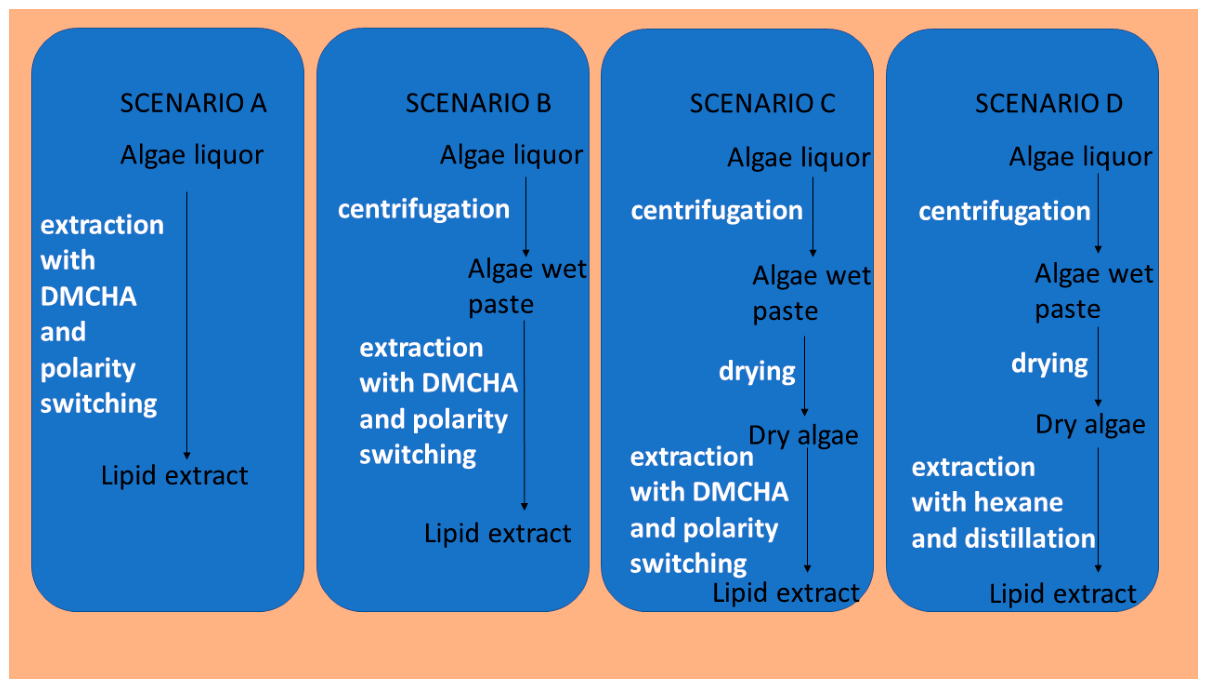
Before proceeding to the calculation details, a brief description of the 4 examined cases will be discussed. The algae liquor produced in the bioreactor can be directly extracted with DMCHA, or it can be centrifugated and the obtained wet paste can then be extracted with DMCHA. Alternatively, the wet paste can be dried and the obtained dried algae can be extracted either with DMCHA or hexane. These 4 scenarios are presented in Figure 1.
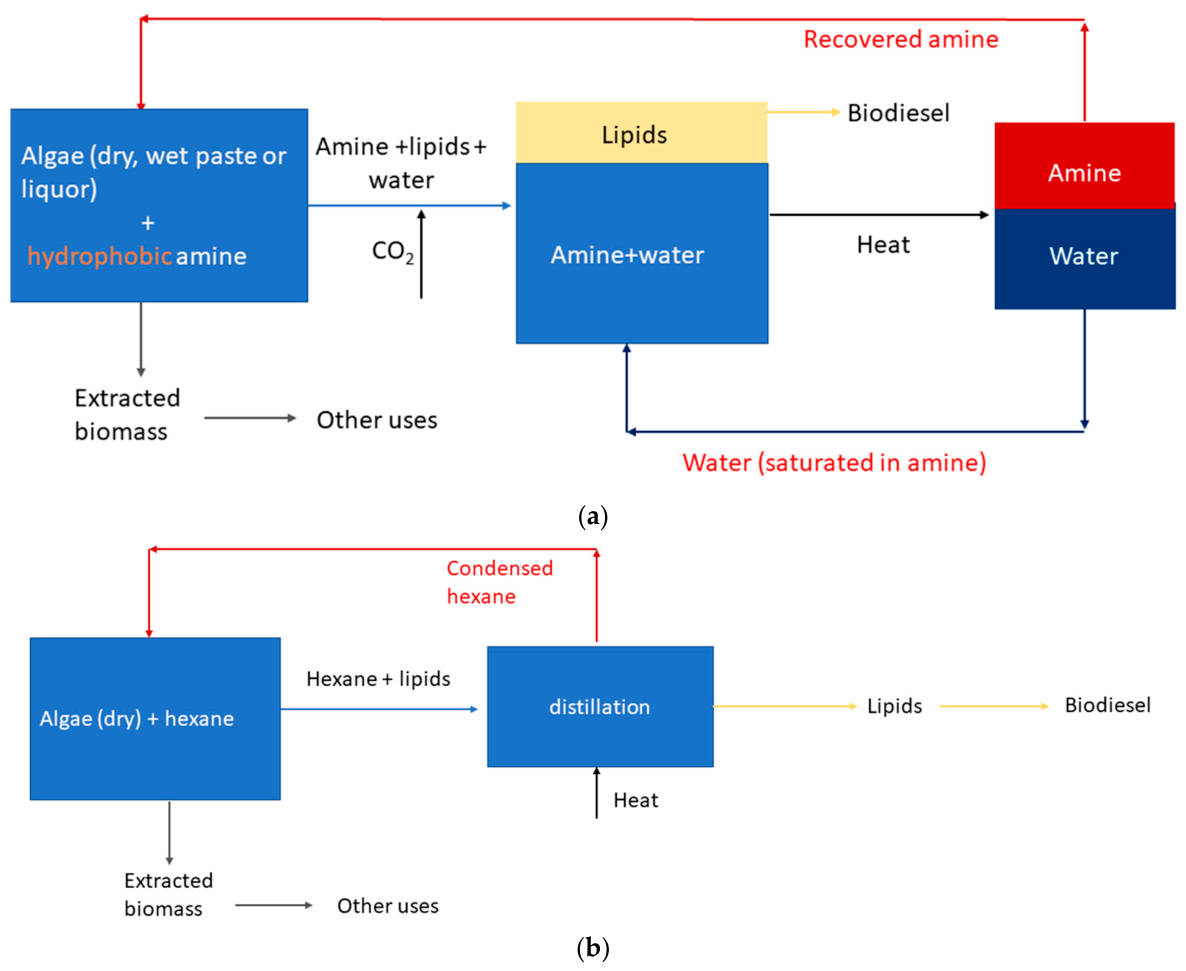
In the case of hexane, only the scenario of dry algae was examined, since the extraction yield from liquor and wet paste using hexane is very low, as derived from preliminary experiments. In scenarios 3 and 4 there is a key difference regarding the separation of the solvent from the extracted lipids. In the case of hexane, the extract is subjected to distillation; the lipids are recovered as a residue, and hexane is recovered as the distillate. In the case of DMCHA, the process is more complex. After extraction, lipids are dissolved in the hydrophobic (non-protonated) form of DMCHA. After separating the suspended algae, the extract is mixed with an equal volume of water. This results in the formation of two phases: the lower phase is water with some hydrophobic amine, and the upper phase is hydrophobic amine along with the lipids and some water. Then CO2 is bubbled which results in the formation of H2CO3 which, in turn, results in the formation of H+. Then, the amine is protonated and switches from its hydrophobic to its hydrophilic (protonated) form. This results in the formation of two new phases: the lower phase, which is a mixture of water and hydrophilic amine, and the upper phase, which is the lipids phase. The lipids are then removed, and the mixture of water and hydrophilic amine is subjected to heating, N2 bubbling, or vacuum (or a combination of these) in order to back-switch the amine from its hydrophilic to its hydrophobic state by the reverse deprotonation reaction. Ideally, at the end of this process the hydrophobic amine is separated from the water and can be reused in a subsequent extraction cycle. Simplified process diagrams for the stages of extraction and solvent recovery in the case of DMCHA and hexane are presented in Figure 2.
The baseline configuration for all thermodynamic and cost assessments is established at a volumetric flow of 1000 L of microalgal culture with a representative Dry Cell Weight (DCW) of 2.5 g/L. This cell density aligns with typical photobioreactor and open-pond discharges (1–5 g/L) and reflects matrices subjected to SPS extractions in the literature [9,11]. The downstream dewatering sequence assumes the generation of a wet algal paste possessing an 80% moisture content (w/w) [11]. The total lipid content of algae heavily depends on specie, culturing conditions, etc. Species with lipid content as high as 40% have been reported, but various species exhibit lipid content as low as 4% [29]. Based on these and on previous work [30] with Chlorella sorokiniana, which exhibited a total lipid content of 12.5%, here, a total lipid content equivalent to 15% of the DCW was assumed to be a representative value. Within this lipidic fraction, triacylglycerols (TAGs), the primary precursors for biodiesel transesterification, are assumed to constitute one-third (33%). This again depends on specie and culturing conditions. For example, two species exhibited a 25% TAG content while another specie exhibited 18% TAGs when cultured outdoor and 40% when cultured indoor. Thus, a value of 33% for the TAGs seems reasonable. To maintain a rigorous baseline comparison independent of specific solvent extraction kinetics, both DMCHA and hexane are assumed to exhibit identical extraction efficiencies toward the target TAG fraction ( 15 % × 0.33 = 4.95 % overall TAG yield), yielding a net mass of 0.12375 ≈ 0.12 kg of extracted lipids per batch. In the literature [11], three different algae species were extracted with DMCHA and the standard solvent mixture of methanol-chloroform (that is used in the Bligh–Dyer method [31] for the determination of total lipids). In all three cases, DMCHA exhibited a countably higher yield in total lipids; however, the fatty acids methyl esters (FAMEs) were practically the same. Since hexane exhibits selectivity for TAGs [30], it seems reasonable to assume that the same amount of TAGs will be extracted, despite the higher yield of DMCHA regarding total lipids. The critical baseline inventory parameters are summarized in Table 1.
The thermodynamic computations assume temperature-independent specific heat capacities (cp). The fundamental thermodynamic constants and estimated properties utilized in this study are compiled in Table 2. In the absence of extensive experimental databases for DMCHA, its cp and latent heat of vaporization ΔHvap were derived via predictive molecular models. The heat of vaporization as mentioned in the literature [32] has been estimated by the Joback method. The value of cp affects the results to a very small extent since the order of magnitude of the sensible heat is governed by the mass of the solvent to be heated. The heat of vaporization of DMCHA is also of rather low importance since the vast majority of DMCHA is recovered by polarity switching and not distillation. The enthalpy of deprotonation (ΔHdep) for DMCHA was securely benchmarked at +39 kJ/mol, representing the lower absolute limit typical for tertiary alkanolamines at elevated temperatures (approx. 90 °C), where endothermic desorption operates [27,28]. All thermal inputs are assumed to be supplied via an electrical utility grid, with utility pricing structures defined in Table 3.
Regarding the scope of the work, as mentioned in the last paragraph of the Introduction, it is not meant to perform a full techno-economic feasibility study. On the contrary, its aim is to study different processes from a fundamental point of view in order to recognize the inherent limitations of each approach independently of the various specific technologies that could be used; for example, for back-switching heat, vacuum or N2 bubbling could be applied. For this reason, no extreme accuracy for the prices is necessary, and for all scenarios the values will change proportionally if other prices are used. In other words, the conclusions are unaffected by the exact price of electricity, etc. In addition, currently there two ongoing wars (in Ukraine and the Middle East) and the prices of electricity, chemicals, oil, etc. are unstable and fluctuate week by week.
Calculations assume an ideal 100% solvent recovery efficiency achieved via single-stage fractional distillation for hexane, and via chemical polarity switching for DMCHA. The forward phase transition (switching) is modeled at 25 °C under active cooling and continuous CO2 sparging, while the reverse transition (back-switching) is driven by thermal utility streams. Four discrete process scenarios were evaluated, as presented in Figure 1:
Scenario A: Direct extraction from raw algal liquor utilizing DMCHA (bypassing centrifugation and thermal drying).
Scenario B: Extraction from centrifuged wet paste utilizing DMCHA (bypassing thermal drying).
Scenario C: Extraction from thermally dried algal biomass utilizing DMCHA.
Scenario D: Extraction from thermally dried algal biomass utilizing conventional hexane.
The specific solvent inventories demanded by each scenario, established from validated literature ranges [9,11,12] and preliminary experimental iterations, are detailed in Table 4. The solvent-to-biomass ratio influences the extraction yield [11]. Typically, higher amounts of solvent result in higher extraction yield, since the driving force for the mass transfer is higher. On the contrary, a low amount of solvent will result in an increased concentration of the lipids in the solvent, which decreases the driving force for further mass transfer from the algae to the solvent. However, the solvent recovery along with drying are the most expensive and energy-demanding processes among all the involved processes (centrifugation, extraction, etc.). Thus, a very low solvent-to-biomass ratio was selected in order to keep the amount of solvent and the related energy demand and cost for the recovery to a minimum. In order to ensure a sufficient extraction yield, two extraction cycles were assumed.

2.2. Mathematical Formulations for Solvent Recovery

2.2.1. Hexane Recovery via Distillation (Scenario D)

Post-extraction, the separation of the target TAGs from the hexane extract requires thermal distillation. Solvent mechanically entrapped within the spent solid biomass matrix was found approximately 1 L/kg of dry algae by experimental tests and must concurrently be recovered via vaporization and condensation. The total inventory of hexane to be managed is defined by the mass balance:
m solvent , total = m solvent , trapped + m solvent , extract
where
m solvent , total : the total mass of the solvent used for extraction;
m solvent , trapped : the mass of the solvent trapped in biomass;
m solvent , extract : the mass of the solvent in the extract.
Due to the presence of dissolved non-volatile lipids, a boiling point elevation is accounted for, establishing the operational boiling point of the hexane–lipid boiling mixture at 95 °C (relative to the 69 °C boiling point of pure hexane). The sensible heat required to elevate the extracted solid biomass slurry from ambient temperature (20 °C) to 95 °C is calculated via:
Q ex , biomass = ( m algae c p , algae + m solvent , trapped c p , solvent ) 95 20
where
m algae : the mass of dry algae;
c p , solvent : the specific heat capacity of hexane;
c p , algae : the specific heat capacity of dried algae.
Specific heat capacity of the extract equals to that of pure hexane, i.e.,
c p , extract = c p , solvent
Thus, the sensible heat of the liquid extract phase, Qextract, for heating to 95 °C is:
Q extract = m extract c p , solvent 95 20
where
mextract: total mass of the liquid extract phase incorporating the extracted lipids which is calculated as:
m extract = m solvent ,   extract + 0.0495 m algae
The total latent heat (Qvap) required for the complete vaporization of the solvent from both the biomass and extract is:
Q vap = Δ H vap m solvent ,   total
The cumulative thermal energy penalty for hexane recovery (Qhexane) is thus:
Q hexane = Q ex , biomass + Q extract + Q vap
This energy is divided by the mass of produced lipids in order to express energy consumption in kWh/kg of lipids. In addition, the cost of the energy for distillation and recovery of hexane per kg of lipids is calculated by multiplying the energy by the cost of kWh divided by the mass of produced lipids.
To compute the cooling water requirements (mcooling water), the heat of condensation (Qcon = |Qvap|) along with the sensible heat required to subcool the condensed hexane from 69 °C to 35 °C is balanced against a standard cooling water utility stream ΔT = 25 °C − 15 °C:
m cooling   water = Q con + m solvent ,   total c p , solvent 69 35 c p ,   water 25 15
The volume of water is multiplied by the cost of cooling water and divided by the mass of lipids to obtain the cost of cooling water per kg of lipids. The sum of the cost of the energy and the cost of water provides the total cost for solvent recovery by distillation.

2.2.2. DMCHA Recovery via Polarity Switching (Scenarios A, B, C)

In contrast to the single-variable distillation of hexane, the recovery of switchable tertiary amines introduces severe chemical and thermodynamic complexities. Beyond physical entrapment within the biomass, tertiary amines exhibit persistent mass-transfer losses due to their finite equilibrium solubility in water [11], aerosolization during continuous gas sparging, and progressive thermal degradation over repeated switching cycles [36,37]. While mechanical strategies such as high-salinity “salting-out” or closed-loop aqueous recycling can mitigate solubility losses, a theoretical 100% amine recovery baseline is assumed here to establish the absolute minimum thermodynamic boundary. For Scenarios A (Liquor) and B (Wet Paste), the presence of substantial water fractions alters the sensible heat dynamics. Since DMCHA exhibits low volatility (boiling point 160 °C), removal of residual amine from spent biomass requires thermal stripping up to 160 °C. The sensible heat equations for the dry biomass (Scenario C) and wet matrices (Scenario B) are defined, respectively, by:
Q ex , biomass = ( m algae c p , algae + m solvent , trapped c p , solvent ) 160 20
Q ex , biomass = ( m algae c p , algae + m solvent , trapped c p , solvent + m water ,   wet   paste c p , water ) 160 20
where
m water ,   wet   paste : is the mass of water contained in the wet paste.
The latent heat required to vaporize the mechanically entrapped amine fraction is:
Q vap , amine = m solvent , trapped Δ H vap ,   amine
Crucially, the chemical energy required to drive the endothermic deprotonation switch of the dissolved amine extract fraction (Qdep) is calculated using the molar mass of DMCHA (MWamine = 127.23 g/mol):
Q dep = m solvent , extract M W a m i n e Δ H dep
The mass of cooling water is calculated from Equation (8) using Qvap,amine equal to Qcon. For simplicity, and in absence of reliable data, water needed to condensate the amine losses during CO2 bubbling and back-switching is not taken into account. In addition to energy and water utilities, the polarity-switching process incurs a distinct operating cost for CO2 consumption. Although the integration of raw industrial flue gas is often proposed as a cost-saving measure, a balanced analysis reveals that any available waste heat from such a stream could equally be utilized to optimize conventional hexane distillation or thermal biomass drying. To avoid speculative process optimization and the confounding effects of auxiliary utility integration, this study evaluates a baseline assuming the deployment of pure CO2 gas, aligned to the established experimental protocols found throughout the existing literature.
The minimum required amount of CO2 can be calculated from the stoichiometry of the protonation reaction which for a tertiary amine ( R R R N ) involves the following reversible carbamate/bicarbonate equilibrium reactions:
CO 2 ( g ) CO 2 aq
H 2 O H + + OH
CO 2 aq + H 2 O H 2 CO 3
H 2 CO 3 H + + HCO 3
HCO 3 H + + CO 3 2
R R R N + H + R R R NH +
The overall protonation reaction is represented by the following equation:
R R R N + CO 2 + H 2 O R R R NH + +   HCO 3
Stoichiometrically, the transformation of 1 mol of hydrophobic amine requires exactly 1 mol of CO2, yielding a definitive mass ratio of 0.35 kg CO2 per kg of treated amine. The minimum chemical cost for the CO2 operating payload is computed via:
cost   of   CO 2 = 0.35 m solvent , extract price   of   CO 2 / mass   of   lipids
Thus, the total cost for the polarity switching is the sum of the cost of energy, cooling water and CO2.

2.3. Mathematical Formulations for Upstream Unit Operations

The electrical energy demand for dewatering via a continuous decanter centrifuge is calculated based on a fixed Specific Energy Consumption (SEC) of 1 kWh/m3 [38,39]:
cost   of   centrifugation = V liquor SEC price   of   kWh / mass   of   lipids
The thermal energy penalty for biomass drying (Qs,drying) encapsulates the sensible heat required to elevate the multi-component wet paste slurry to 100 °C plus the full latent heat of vaporization of the associated water fraction:
Q s ,   drying = m wet   paste ( 0.2 c p , algae + 0.8 c p , water ) 100 20
The heat of vaporizing (Qvap,drying) the water contained in the wet paste is given by:
Q vap ,   drying = 0.8 m wet   paste Δ H vap , water
The energy demand of drying Qdrying is then estimated as the sum of:
Qdrying = Qs,drying + Qvap,drying

3. Experimental

For the experiments, DMCHA (Roth, Germany, >99%) and distilled water were used. Experimental trials were conducted utilizing Chlorella sorokiniana cultivated in a tubular photobioreactor on a digestate wastewater substrate, according to established protocols [40]. In order to estimate the amount of solvent that is trapped in the dry algae and wet paste after extraction and justify the presented values in Table 4, the following experiments were performed. One g of dry algae fine powder was mixed with 7 mL of DMCHA. The mixture was mechanically homogenized and then transferred to a volumetric cylinder and left for 1–2 h at room temperature for separation to occur. One liquid phase (amine extract) and one solid rich phase (algae plus the trapped solvent). From the initial volume of the DMCHA and the volume of the liquid phase after separation, it can be estimated how much solvent is trapped in the biomass. The solvent trapped in the dry algae heavily depends on the porosity of the dry algae, which in turn depends on the size of dry algae, e.g., if it is pulverized to a great extent or if aggregates are present. Thus, besides the experiment with fine powder, another experiment was performed with dry algae that were not ground and mm- and cm-sized aggregates were present. One liter of DMCHA was mixed with 330 g of dry algae. After extraction, the volume of the extract was measured. A similar experiment was performed by mixing 1 mL of amine with 1 g of wet paste (79% moisture). After mixing and settling, the supernatant was transferred to a volumetric cylinder and its volume was measured.

4. Results and Discussion

The holistic techno-energetic and economic matrices computed across the four distinct extraction scenarios are compiled in Table 5. It should be clarified that the reported water footprint concerns the water consumption which is involved in the extraction and solvent separation processes. The water contained in the liquor can be taken into account in the footprint of algae culturing.
The quantitative outcomes decisively challenge the prevailing literature paradigms that advocate direct wet-matrix extractions as inherently energy-saving methodologies. Scenario A (direct liquor extraction) displays an unsustainable surge in both process economics (232 €/kg lipid) and net energy expenditure (454 kWh/kg lipid), exceeding countably conventional routes. This energetic penalty is fundamentally driven by the high dilution profile of the raw liquor, which demands vast solvent inventories. Consequently, any perceived energy savings gained by eliminating upstream centrifugation and thermal drying are completely surpassed by the massive downstream energy required to process and chemically switch the excessive solvent volumes.
When evaluating the remaining configurations, Scenario B (wet paste extraction via DMCHA) appears to optimize energy consumption (51 kWh/kg lipid) relative to the dry benchmarks. However, this configuration doubles the overall process cost (19 €/kg lipid) compared to conventional hexane-mediated extraction (8 €/kg lipid). This “contradiction” arises from the high amount of CO2 that is required, which increased the cost. Thus, Scenario B, although the best case from an energy intensiveness point of view, exhibits the second-highest cost. To elucidate the underlying operational cost drivers, individual unit operation breakdowns for cost and energy metrics are detailed in Table 6 and Table 7, respectively.
The information provided by Table 6 and Table 7 reveals that mechanical centrifugation dewatering demands negligible energy and cost allocations across all applicable configurations. For the dry-biomass configurations (Scenarios C and D), the upstream thermal drying phase represents the dominant energy sink, consuming 59.0 kWh/kg lipid. Conversely, for the wet configurations (Scenarios A and B), the economic and energetic burdens shift entirely to the downstream solvent recovery and phase-switching operations. In Scenario B, the thermal energy required to strip the amine from highly hydrated spent matrices, coupled with the chemical energy of the phase switch, requires 50.2 kWh/kg lipid—effectively neutralizing the energy advantages gained by avoiding the drying stage. It is recalled that no cost for solvent make-up is taken into account since a 100% recovery of solvents was assumed.
The structural composition of the utility costs is further analyzed in Table 8, isolating the financial impacts of electrical energy, cooling water, and chemical CO2 payloads.
The utility breakdown identifies the continuous stoichiometric CO2 payload as a severe financial liability for SPS architectures. In Scenario B, the CO2 requirement alone introduces a cost penalty of 13.1 €/kg lipid, rendering the process economically non-viable under standard pricing structures. While industrial arguments frequently propose the utilization of raw, un-priced flue gas streams to mitigate CO2 procurement costs, such integration strategies are equally applicable to conventional configurations. For instance, the high-temperature thermal waste from flue gases could be readily harvested to drive the thermal drying ovens in Scenario D or to power the steam jackets of standard hexane distillation columns, preserving the relative economic superiority of the alkane baseline. In addition, flue gas is of high temperature while the protonation reaction is exothermic and requires cooling. Thus, before bubbling the flue gas into the amine extract, cooling of the flue gas should be performed. Also, the low partial pressure of CO2 in flue gas will have as a result a further decrease in the solubility in water which will further deteriorate the switching process.
Furthermore, the theoretical assumption of a 100% ideal solvent recovery efficiency is highly unrealistic for amine-based systems. As supported by previous work [14], tertiary amines face extensive mass transfer limitations. In addition, the high viscosity and amorphous nature of the lipid mass recovered by post-switching [14] causes significant structural entrapment, making continuous product discharge difficult.
Moreover, as demonstrated in past work [30], DMCHA exhibits poor thermodynamic selectivity toward target TAGs relative to hexane, co-extracting high fractions of polar membrane lipids and pigments. This poor selectivity [30] directly accounts for the high viscosity of the resulting lipid mass, necessitating rigorous, energy-intensive downstream refining stages prior to transesterification. However, it should be mentioned that due to the more powerful solubility capacity of DMCHA the extraction is faster and less extraction time is required, as derived from some preliminary experiments. The extraction time also depends on the extraction temperature.
The structural integrity and purity of the recycled amine phase introduce further operational hurdles. As depicted in previous work [14] the recovered DMCHA phase splits into two distinct, contaminated fractions post-regeneration: a highly discolored green hydrophobic layer heavily enriched with co-extracted lipophilic chlorophyll pigments, and a secondary colorless distillate phase fractionally saturated with water. The progressive accumulation of intracellular impurities within the recycled solvent matrix over continuous operational loops risks altering the amine’s core dielectric properties, changing its equilibrium switching kinetics, and accelerating irreversible thermal and oxidative degradation pathways [36,37].
From an industrial safety and environmental standpoint, the trade-offs are equally complex. Hexane represents a critical operational hazard due to its high volatility (boiling point of 69 °C) and low flash point (−22 °C), requiring rigorous explosion-proof infrastructure. While DMCHA exhibits a more favorable flash point (approx. 40 °C) and much higher boiling point (162 °C), minimizing immediate flammability risks, it introduces heightened chemical toxicity profiles and aquatic ecotoxicity liabilities that complicate industrial handling and regulatory compliance. DMCHA has been reported to exhibit an LD50 orally in Rabbit, value of 272 mg/kg [41], and exhibits the Hazard Codes of C (corrosive), N (dangerous for the environment) and T (toxic) [41]. We were unable to find data for DMCHA biodegradation. Hexane exhibits an LD50 orally in rats, value of 32.0 g/kg [42], which is countably higher than the one of DMCHA. The hazardous codes of hexane are F (flammable), Xn (harmful), and N (dangerous for the environment) [42]. The solitary demonstrable advantage of the SPS architecture resides in its reduced process water footprint (Table 5); however, because cooling water utilities contribute minimally to global biorefinery operating expenditures, this environmental credit is insufficient to offset the overarching economic and complexity penalties.
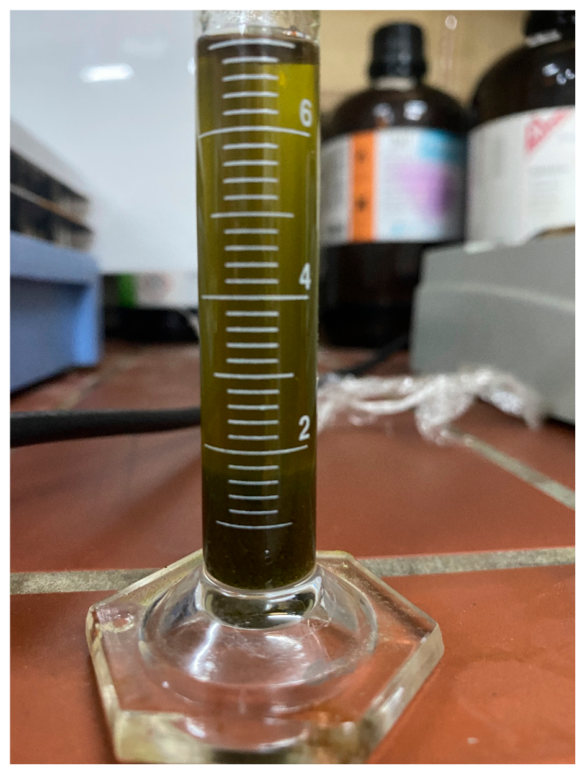
The solvent trapped in biomass is also more difficult to recover in the case of DMCHA. In the production of pomace oil from olive stone residues, hexane trapped in the biomass is recovered by passing steam in the extractor and condensing the hexane. Since DMCHA is much less volatile than hexane, a larger amount of steam would be needed to recover it from the biomass by this procedure. Alternatively, the biomass could be mixed with water and then perform a polarity switching. Then, the biomass could be separated by filtering or sedimentation and the supernatant could be back-switched with heat in order to recover the amine. But clearly, this again increases the complexity and cost, etc. The amount of solvent that is trapped in the biomass is countable and must be recovered. To the best of the authors’ knowledge, this is an issue that is not taken into account in the literature. As mentioned in Section 3 and Section 1 g of dry algae in the form of fine powder was mixed with 7 mL of DMCHA and then transferred to a volumetric cylinder (Figure 3). As can be seen in Figure 3, there are 5.4 mL of free solvent, that is, 1.6 mL out of 7 mL of solvent are trapped in 1 g of the dry biomass. Thus, the losses are 1.6 L/kg of dry biomass. In the experiment with 1 L of amine and 330 g of dry algae with mm- and cm-sized aggregates, 850 mL of DMCHA were recovered. It follows that the trapped amine in this case is 0.45 L/kg. Thus, for the calculations an average value of 1 kg/L was used (Table 4).
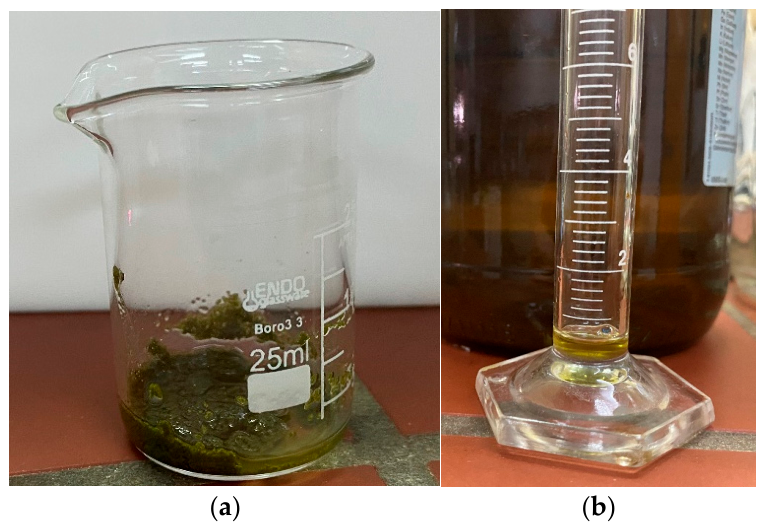
In Figure 4a the mixture of 1 g of wet paste with 1 mL of DMCHA is presented. In Figure 4b the supernatant that could be recovered is presented. As can be seen, the recovered amine is about 0.5–0.6 mL. Thus, for the calculations a loss of 0.4 kg/L of wet paste was used (Table 4).
Also, it is worth mentioning that the results presented in this study can be proportionally projected for any desired capacity, e.g., lipid production of 1000 kg/day. This arises from the fact that here the calculations were based on the fundamental thermodynamic aspects of the processes, which are unaffected by the capacity. On the contrary, this projection would not be possible if the calculations were performed for specific tanks and processes that would be impossible to use upon up-scaling.
Finally, it should be emphasized that by studying the fundamentals of the process under some idealized conditions and independently of any site-specific aspects, the conclusions have a general validity. For example, the heat of deprotonation will be required independently of whichever technology will be used to provide it; e.g., N2 bubbling, vacuum, or heating. If a process under idealized conditions (100% solvent recovery, stoichiometric amount of CO2) is not viable, then it is clear that it would not be viable under real conditions where the recovery of the solvent will be lower than 100% or an excess (and not just the stoichiometric) amount of CO2 will be required. These suggest that the literature claiming that amine-based technology is a simple, green, and viable technology for extracting lipids from microalgae is not valid.

5. Conclusions

This study established a comprehensive thermodynamic and economic matrix evaluating for four distinct microalgal lipid extraction scenarios, namely: (a) extraction of dry algae with hexane, (b) extraction of dry algae with DMCHA, (c) extraction of wet paste with DMCHA and (d) extraction of algae liquor (DCW = 2.5 g/L) with DMCHA. The quantitative outcomes challenge the consensus that direct wet-matrix extractions deliver energy savings via drying avoidance. Due to the high dilution profiles, wet extractions demand vast solvent-to-biomass ratios, shifting the energetic burden heavily onto the downstream recovery phase. Furthermore, stoichiometric assessments of the protonation pathway reveal that the continuous CO2 payload injects prohibitive utility costs. Since, under realistic conditions, an excess and not the stoichiometric amount of CO2 will be needed, the cost is expected to be even higher. Since the latent heat of hexane vaporization shares the same order of magnitude with the enthalpy of amine deprotonation, switchable polarity mechanisms do not seem to yield any fundamental thermodynamic superiority over classic distillation. The presented results, despite being based on idealized conditions (e.g., 100% solvent recovery, stoichiometric amount of CO2, etc.), provide useful insights regarding the potential viability of the processes and their inherent limitations, since the calculations were performed based on the fundamentals of the processes rather than site-specific technologies.

Author Contributions

Conceptualization, C.T. and P.S.; methodology, C.T.; validation, C.T., S.D.K. and P.S.; formal analysis, C.T.; investigation, C.T. and S.D.K.; writing—original draft preparation, C.T.; writing—review and editing, P.S. and S.D.K.; supervision, P.S.; project administration, P.S.; funding acquisition, P.S. All authors have read and agreed to the published version of the manuscript.

Funding

This research was funded by the EU European Climate Infrastructure and Environment Executive Agency (CINEA), project FUELPHORIA PN 101118286. The views and opinions expressed are, however, those of the authors only and do not necessarily reflect those of the European Union or CINEA. Neither the European Union nor CINEA can be held responsible for them.

Data Availability Statement

The original contributions presented in this study are included in the article. Further inquiries can be directed to the corresponding author.

Conflicts of Interest

The authors declare no conflicts of interest.

References

  1. Suhara, A.; Karyadi; Herawan, S.G.; Tirta, A.; Idris, M.; Roslan, M.F.; Putra, N.R.; Hananto, A.L.; Veza, I. Biodiesel Sustainability: Review of Progress and Challenges of Biodiesel as Sustainable Biofuel. Clean Technol. 2024, 6, 886–906. [Google Scholar] [CrossRef]
  2. Ali Ijaz Malik, M.; Zeeshan, S.; Khubaib, M.; Ikram, A.; Hussain, F.; Yassin, H.; Qazi, A. A review of major trends, opportunities, and technical challenges in biodiesel production from waste sources. Energy Convers. Manag. X 2024, 23, 100675. [Google Scholar] [CrossRef]
  3. Manaf, I.S.A.; Embong, N.H.; Khazaai, S.N.M.; Rahim, M.H.A.; Yusoff, M.M.; Lee, K.T.; Maniam, G.P. A review for key challenges of the development of biodiesel industry. Energy Convers. Manag. 2019, 185, 508–517. [Google Scholar] [CrossRef]
  4. Jha, S.; Singh, R.; Pandey, B.K.; Tiwari, A.K.; Shukla, S.; Dikshit, A.; Bhardwaj, A.K. Recent aspects of algal biomass for sustainable fuel production: A review. Discov. Sustain. 2024, 5, 300. [Google Scholar] [CrossRef]
  5. Bhatt, P.; Bhandari, G.; Turco, R.F.; Aminikhoei, Z.; Bhatt, K.; Simsek, H. Algae in wastewater treatment, mechanism, and application of biomass for production of value-added product. Environ. Pollut. 2022, 309, 119688. [Google Scholar] [CrossRef] [PubMed]
  6. Zapata-Boada, S.; Gonzalez-Miquel, M.; Jobson, M.; Cuéllar-Franca, R.M. A Methodology to Evaluate Solvent Extraction-Based Processes Considering Techno-Economic and Environmental Sustainability Criteria for Biorefinery Applications. Ind. Eng. Chem. Res. 2021, 60, 16394–16416. [Google Scholar] [CrossRef]
  7. Zapata-Boada, S.; Gonzalez-Miquel, M.; Jobson, M.; Cuéllar-Franca, R.M. Techno-economic and Environmental Analysis of Algae Biodiesel Production via Lipid Extraction Using Alternative Solvents. Ind. Eng. Chem. Res. 2022, 61, 18030–18044. [Google Scholar] [CrossRef]
  8. Al-Ameri, M.; Al-Zuhair, S. Using switchable solvents for enhanced, simultaneous microalgae oil extraction-reaction for biodiesel production. Biochem. Eng. J. 2019, 141, 217–224. [Google Scholar] [CrossRef]
  9. Choi, O.K.; Lee, J.W. CO2-triggered switchable solvent for lipid extraction from microalgal biomass. Sci. Total Environ. 2022, 819, 153084. [Google Scholar] [CrossRef] [PubMed]
  10. Du, Y.; Schuur, B.; Samorì, C.; Tagliavini, E.; Brilman, D.W.F. Secondary amines as switchable solvents for lipid extraction from non-broken microalgae. Bioresour. Technol. 2013, 149, 253–260. [Google Scholar] [CrossRef] [PubMed]
  11. Samorì, C.; López Barreiro, D.; Vet, R.; Pezzolesi, L.; Brilman, D.W.F.; Galletti, P.; Tagliavini, E. Effective lipid extraction from algae cultures using switchable solvents. Green Chem. 2013, 15, 353–356. [Google Scholar] [CrossRef]
  12. Anto, S.; Premalatha, M.; Mathimani, T. Tertiary amine as an efficient CO2 switchable solvent for extracting lipids from hypersaline microalgae. Chemosphere 2022, 288, 132442. [Google Scholar] [CrossRef] [PubMed]
  13. Russell, C.; Rodriguez, C. Lipid extraction from Chlorella vulgaris & Haematococcus pluvialis using the switchable solvent DMCHA for biofuel production. Energy 2023, 278, 127983. [Google Scholar] [CrossRef]
  14. Tsioptsias, C.; Maletskos, I.; Tachias, G.; Palikrousis, T.; Ntampou, X.; Kalogianni, E.P.; Samaras, P. A Proof-of-Concept Study for the Strong Electrolyte (SE) Switching and the Combined CO2-SE Switching of the Polarity of Tertiary Amine for Lipid Separation Application. Separations 2026, 13, 81. [Google Scholar]
  15. Cai, C.; Chen, X.; Li, F.; Tan, Z. Three-phase partitioning based on CO2-responsive deep eutectic solvents for the green and sustainable extraction of lipid from Nannochloropsis sp. Sep. Purif. Technol. 2021, 279, 119685. [Google Scholar] [CrossRef]
  16. Xiong, D.; Zhang, Q.; Ma, W.; Wang, Y.; Wan, W.; Shi, Y.; Wang, J. Temperature-switchable deep eutectic solvents for selective separation of aromatic amino acids in water. Sep. Purif. Technol. 2021, 265, 118479. [Google Scholar] [CrossRef]
  17. Longeras, O.; Gautier, A.; Ballerat-Busserolles, K.; Andanson, J.-M. Deep Eutectic Solvent with Thermo-Switchable Hydrophobicity. ACS Sustain. Chem. Eng. 2020, 8, 12516–12520. [Google Scholar] [CrossRef]
  18. Moreno Martínez, P.; Ortiz-Martínez, V.M.; Sánchez Segado, S.; Salar-García, M.J.; los Ríos, A.P.d.; Hernández Fernández, F.J.; Lozano-Blanco, L.J.; Godínez, C. Deep eutectic solvents for the extraction of fatty acids from microalgae biomass: Recovery of omega-3 eicosapentaenoic acid. Sep. Purif. Technol. 2022, 300, 121842. [Google Scholar] [CrossRef]
  19. Ismagilova, A.; Kisand, V.; Vares, L. Ecotoxicity risk assessment of amines used in ‘switchable water’ and CO2-capturing processes. Environ. Sci. Process. Impacts 2025, 27, 974–980. [Google Scholar] [CrossRef] [PubMed]
  20. Santana, A.; Jesus, S.; Larrayoz, M.A.; Filho, R.M. Supercritical Carbon Dioxide Extraction of Algal Lipids for the Biodiesel Production. Procedia Eng. 2012, 42, 1755–1761. [Google Scholar] [CrossRef]
  21. Pan, J.; Muppaneni, T.; Sun, Y.; Reddy, H.K.; Fu, J.; Lu, X.; Deng, S. Microwave-assisted extraction of lipids from microalgae using an ionic liquid solvent [BMIM][HSO4]. Fuel 2016, 178, 49–55. [Google Scholar] [CrossRef]
  22. Kim, Y.-H.; Park, S.; Kim, M.H.; Choi, Y.-K.; Yang, Y.-H.; Kim, H.J.; Kim, H.; Kim, H.-S.; Song, K.-G.; Lee, S.H. Ultrasound-assisted extraction of lipids from Chlorella vulgaris using [Bmim][MeSO4]. Biomass Bioenergy 2013, 56, 99–103. [Google Scholar] [CrossRef]
  23. Perdomo, F.A.; Khalit, S.H.; Graham, E.J.; Tzirakis, F.; Papadopoulos, A.I.; Tsivintzelis, I.; Seferlis, P.; Adjiman, C.S.; Jackson, G.; Galindo, A. A predictive group-contribution framework for the thermodynamic modelling of CO2 absorption in cyclic amines, alkyl polyamines, alkanolamines and phase-change amines: New data and SAFT-γ Mie parameters. Fluid Phase Equilibria 2023, 566, 113635. [Google Scholar] [CrossRef]
  24. Jiang, K.; Li, K. Harvesting CO2 reaction enthalpy from amine scrubbing. Energy 2023, 284, 129268. [Google Scholar] [CrossRef]
  25. Oh, H.-T.; Lee, J.-C.; Lee, C.-H. Performance and sensitivity analysis of packed-column absorption process using multi-amine solvents for post-combustion CO2 capture. Fuel 2022, 314, 122768. [Google Scholar] [CrossRef]
  26. Sreedhar, I.; Nahar, T.; Venugopal, A.; Srinivas, B. Carbon capture by absorption—Path covered and ahead. Renew. Sustain. Energy Rev. 2017, 76, 1080–1107. [Google Scholar] [CrossRef]
  27. Oscarson, J.L.; Wu, G.; Faux, P.W.; Izatt, R.M.; Christensen, J.J. Thermodynamics of protonation of alkanolamines in aqueous solution to 325° C. Thermochim. Acta 1989, 154, 119–127. [Google Scholar] [CrossRef]
  28. Perrin, C.L.; Shrinidhi, A. Enthalpic and entropic contributions to the basicity of cycloalkylamines. Chem. Sci. 2020, 11, 8489–8494. [Google Scholar] [CrossRef] [PubMed]
  29. Patle, D.S.; Pandey, A.; Srivastava, S.; Sawarkar, A.N.; Kumar, S. Ultrasound-intensified biodiesel production from algal biomass: A review. Environ. Chem. Lett. 2021, 19, 209–229. [Google Scholar] [CrossRef]
  30. Tsioptsias, C.; Mitis, S.; Rentzela, A.; Alvanou, K.; Kelesi, D.; Manolis, C.; Stergiou, A.; Kalamaras, S.D.; Samaras, P. A Simplified Methodology for Solvent Screening in Selective Extraction of Lipids from Microalgae Based on Hansen Solubility Parameters. Molecules 2025, 30, 4428. [Google Scholar] [CrossRef] [PubMed]
  31. Bligh, E.G.; Dyer, W.J. A rapid method of total lipid extraction and purification. Can. J. Biochem. Physiol. 1959, 37, 911–917. [Google Scholar] [CrossRef] [PubMed]
  32. Chemeo. N,N-dimethyl-cyclohexyl-amine. Available online: https://www.chemeo.com/cid/48-521-0/Cyclohexanamine-N-N-dimethyl#:~:text=%CE%94cH%C2%B0liquid%20:%20Standard%20liquid%20enthalpy%20of%20combustion,Cp%2Cgas%20:%20Ideal%20gas%20heat%20capacity%20(J/mol%C3%97K) (accessed on 10 February 2026).
  33. NIST. Water. Available online: https://webbook.nist.gov/cgi/cbook.cgi?ID=C7732185 (accessed on 10 February 2026).
  34. NIST. n-Hexane. Available online: https://webbook.nist.gov/cgi/cbook.cgi?ID=110-54-3 (accessed on 10 February 2026).
  35. Grierson, S.; Strezov, V.; Ellem, G.; McGregor, R.; Herbertson, J. Thermal characterisation of microalgae under slow pyrolysis conditions. J. Anal. Appl. Pyrolysis 2009, 85, 118–123. [Google Scholar] [CrossRef]
  36. Gouedard, C.; Picq, D.; Launay, F.; Carrette, P.L. Amine degradation in CO2 capture. I. A review. Int. J. Greenh. Gas Control 2012, 10, 244–270. [Google Scholar] [CrossRef]
  37. Lepaumier, H.; Picq, D.; Carrette, P.L. Degradation study of new solvents for CO2 capture in post-combustion. Energy Procedia 2009, 1, 893–900. [Google Scholar] [CrossRef]
  38. Mathimani, T.; Mallick, N. A comprehensive review on harvesting of microalgae for biodiesel—Key challenges and future directions. Renew. Sustain. Energy Rev. 2018, 91, 1103–1120. [Google Scholar] [CrossRef]
  39. Molina Grima, E.; Belarbi, E.H.; Acién Fernández, F.G.; Robles Medina, A.; Chisti, Y. Recovery of microalgal biomass and metabolites: Process options and economics. Biotechnol. Adv. 2003, 20, 491–515. [Google Scholar] [CrossRef] [PubMed]
  40. Palikrousis, T.L.; Manolis, C.; Kalamaras, S.D.; Samaras, P. Effect of Light Intensity on the Growth and Nutrient Uptake of the Microalga Chlorella sorokiniana Cultivated in Biogas Plant Digestate. Water 2024, 16, 2782. [Google Scholar] [CrossRef]
  41. Chemical Book. N,N-Dimethylcyclohexylamine. Available online: https://www.chemicalbook.com/ChemicalProductProperty_EN_CB1854754.htm (accessed on 14 June 2026).
  42. Chemical Book. n-Hexane. Available online: https://www.chemicalbook.com/ProductList_en.aspx?kwd=n-hexane (accessed on 14 June 2026).
Figure 1. Summary of the required processes for each of the four examined scenarios.
Processes 14 02182 g001
Figure 2. Simplified process diagrams for the stages of extraction and solvent recovery in the case of (a) DMCHA and (b) hexane.
Processes 14 02182 g002
Figure 3. Volumes of the liquid extract and the solid phase (dry algae + trapped solvent) after mixing 7 mL of DMCHA with 1 g dry algae in the form of fine powder.
Processes 14 02182 g003
Figure 4. (a) Mixture of 1 g of wet paste with 1 mL of DMCHA and (b) the solvent that was recovered as supernatant.
Processes 14 02182 g004
Table 1. Baseline inventory parameters for thermodynamic calculations.
Volume of algal culture (Vliquor), L1000
Algal cell density (DCW), g/L2.5
Moisture content of centrifuged wet paste, %80
Mass of water in centrifuged paste, kg10
Mass of dry algae biomass, kg2.5
Total mass of wet algal paste, kg12.5
Targeted lipid extraction yield, %4.95
Net mass of recovered target lipids, kg0.12
Table 2. Thermodynamic properties and constants.
Property/ParameterValueReference
Specific heat capacity of water, cp,water4.18 kJ/kg/K[33]
Specific heat capacity of hexane, cp,hexane2.3 kJ/kg/K[34]
Specific heat capacity of DMCHA, cp,DMCHA1.9 kJ/kg/K (estimated value)[32]
Specific heat capacity of dried algae, cp,algae1.6 kJ/kg/K (average value of different algae species)[35]
Latent heat of vaporization of water, ΔHvap,water+2260 kJ/kg[33]
Latent heat of vaporization of hexane, ΔHvap,hexane+335 kJ/kg[34]
Latent heat of vaporization of DMCHA, ΔHvap,DMCHA+283 kJ/kg (estimated value)[32]
Enthalpy of deprotonation of DMCHA, ΔHdep+39 kJ/mol[27]
Table 3. Utility cost frameworks.
ParameterCost
Electricity0.1 €/kWh
Cooling water1 €/m3
CO20.1 €/kg
Table 4. Required solvent and expected losses per kg of dry or wet algae and per L of liquor.
Biomass StateRequired Solvent in Each Extraction CycleNumber of Extraction CyclesTotal Volume of Solvent per kg of Dry AlgaeExpected Losses in Biomass
Dried algae3 L of solvent per 1 kg of dry algae26 L/kg of dry algae1 L/kg of dry algae
Wet paste with 80% water3 L of solvent per 1 kg of wet algae230 L/kg of dry algae0.4 L/kg of wet paste
Algal Liquor with DCW= 2.5 g/L1 L of solvent per 1 L of liquor1400 L/kg of dry algaeNo losses. The water can be reused
Table 5. Global techno-energetic and economic evaluation per kg of extracted target lipids.
ParameterScenario A
Amine (Liquor)
Scenario B
Amine
(Wet Paste)
Scenario C
Amine
(Dry Algae)
Scenario D
Hexane
(Dry Algae)
Total process cost, €/kg of lipids232.118.59.48.0
Net energy consumption, kWh/kg of lipids454.151.168.771.8
Process water footprint, L/kg of lipids0332.0166.0791.5
Table 6. Step-by-step process cost breakdown (€/kg of extracted target lipids).
Unit Operation/Process StepScenario A
Amine (Liquor)
Scenario B
Amine
(Wet Paste)
Scenario C
Amine
(Dry Algae)
Scenario D
Hexane
(Dry Algae)
Centrifugation, dewatering0.00.10.10.1
Thermal Biomass Drying0.00.05.95.9
Solvent Recovery/Phase Regeneration232.118.43.42.0
Table 7. Step-by-step process energy breakdown (kWh per kg of extracted target lipids).
Unit Operation/Process StepScenario A
Amine (Liquor)
Scenario B
Amine
(Wet Paste)
Scenario C
Amine
(Dry Algae)
Scenario D
Hexane
(Dry Algae)
Centrifugation, dewatering0.00.80.80.8
Thermal Biomass Drying0.00.059.059.0
Solvent Recovery/Phase Regeneration454.150.29.012.0
Table 8. Utility cost distribution (€/kg of extracted target lipids).
Utility ComponentScenario A
Amine (Liquor)
Scenario B
Amine
(Wet Paste)
Scenario C
Amine
(Dry Algae)
Scenario D
Hexane
(Dry Algae)
Electrical Power Grid45.45.16.97.2
Cooling Water Utility0.00.30.20.8
Stoichiometric CO2 Gas186.713.12.30.0
Disclaimer/Publisher’s Note: The statements, opinions and data contained in all publications are solely those of the individual author(s) and contributor(s) and not of MDPI and/or the editor(s). MDPI and/or the editor(s) disclaim responsibility for any injury to people or property resulting from any ideas, methods, instructions or products referred to in the content.