Article

Build-Up Mechanisms and Performance of Dynamic Push-the-Bit Rotary Steerable Drilling Tools

1
Oil Production Technology Research Institute of Xinjiang Oilfield Company, Karamay 834099, China
2
Exploration Utility Department of PetroChina Xinjiang Oilfield Company, Karamay 834099, China
3
CNPC Engineering Technology R&D Company Limited, Beijing 102206, China
4
State Key Laboratory of Deep Geothermal Resources, China University of Petroleum (Beijing), Beijing 102249, China
5
Beijing Key Laboratory of Optical Detection Technology for Oil and Gas, China University of Petroleum (Beijing), Beijing 102249, China
6
State Key Laboratory of Petroleum Resources and Engineering, China University of Petroleum (Beijing), Beijing 102249, China
*
Authors to whom correspondence should be addressed.
Processes 2026, 14(13), 2167; https://doi.org/10.3390/pr14132167
Submission received: 29 April 2026 / Revised: 12 June 2026 / Accepted: 29 June 2026 / Published: 2 July 2026

Abstract

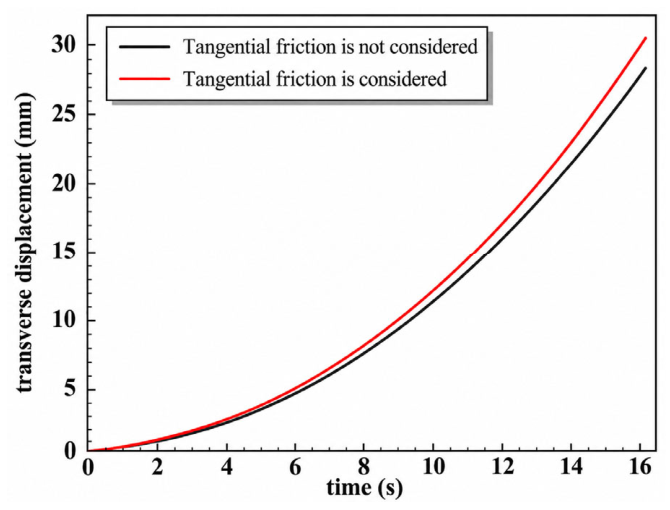
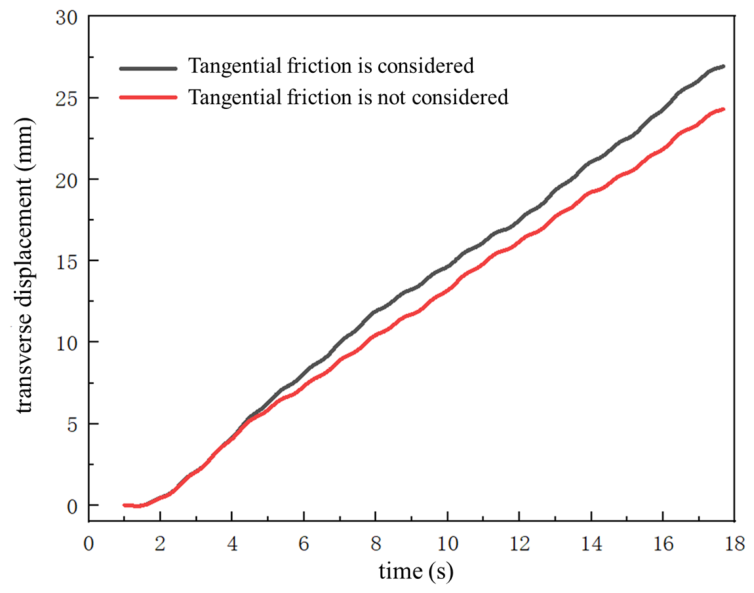
Rotary steerable drilling technology is fundamentally aimed at achieving precise wellbore trajectory control. As a representative directional tool, a dynamic push-the-bit RSS generates steering force during rotary drilling through the interaction between its extendable steering pads and the borehole wall, and it is distinguished from static push-the-bit RSS by the rotational friction that develops at the pad–wall interface. To further clarify the influence of friction on the resultant steering force and the build-up rate, this study develops a steering-force optimization model that explicitly incorporates tangential friction, validates the model, and then conducts numerical simulations to examine how PDC bit design parameters and formation properties affect the build-up rate. The results indicate that the friction-aware optimization model can achieve a higher build-up rate. Quantitatively, relative to the friction-free allocation model that is commonly used as the baseline in push-the-bit BUR prediction, the friction-aware formulation increases the final lateral displacement from approximately 28.4 to 30.6 mm in the analytical comparison (+7.7%) and from approximately 24.3 to 26.9 mm in the full-scale finite-element comparison (+10.7%) over the same steering-force action time. In soft formations with a low internal friction angle, a bit design combining a moderate gauge-protection dimension, an appropriate inner cone angle, and a large crown radius can effectively enhance lateral cutting and steering-force transmission, thereby improving build capability and trajectory stability. These findings provide a theoretical basis for improving build-rate efficiency in push-the-bit rotary steerable drilling systems.

1. Introduction

With steadily rising global energy demand—especially the sharp increase in China’s oil and natural gas consumption—the focus of petroleum exploration and development is progressively shifting from conventional to unconventional resources [1,2]. These resources are commonly hosted in tight reservoirs characterized by low porosity and low permeability, strong lithologic variability, and pronounced reservoir heterogeneity [3]; their effective development therefore depends on drilling long horizontal laterals within the reservoir to maximize reservoir contact and intersect more hydrocarbon-bearing intervals [4,5]. However, conventional drilling and directional methods often provide insufficient trajectory-control accuracy, leading to wellbore drift and making it difficult to achieve a high reservoir encounter rate. Rotary steerable systems (RSS), as an enabling technology, provide real-time steering while continuously rotating the drilling pipe, and thus can effectively address the complex geological conditions encountered during unconventional oil and gas exploration and production [6,7,8].
A dynamic-bias push-the-bit RSS can precisely control the wellbore trajectory [9]. Unlike static-bias push-the-bit steering tools, all internal modules in this system are free to rotate, enabling fully rotating drilling [10,11]. Taking SLB’s PowerDrive Orbit G2 as an example, its key assemblies include a stabilizer and a bias unit. During directional drilling, a dis valve meters and routes drilling-fluid flow to the hydraulic actuators, so that the steering pads are extended against the borehole wall to generate the lateral steering force required for inclination build [12,13]. In an 8-1/2 in directional well in the Mahakam Swamp, its field application was reported as record-setting [14]. For another example, the PowerDrive SRD incorporates a dedicated control system. While drilling, a downhole processor interprets steering commands downlinked from the surface, computes the required output force for each steering pad, and adjusts the pad actuation in real time to keep the resultant steering-force vector at the bit constant, thereby achieving controlled directional drilling [15].
The core objective of an RSS is to accurately command the target steering force so as to achieve efficient inclination build [16,17]. However, for current push-the-bit RSS deployments, a measurable mismatch often remains between the drilled wellbore trajectory and the planned directional profile [18,19]. For BUR prediction, Huang et al. [17] established limits and corrected BUR calculation methods for push-the-bit RSS by considering thruster-sidewall interaction, bit–formation interaction, tool structure, WOB, inclination, and bit/formation anisotropy; Chen et al. [20] further combined mechanical and trajectory methods to calculate the BUR of an internal push point-the-bit rotary steering tool. These studies provide important theoretical bases for trajectory prediction and tool-parameter analysis, but their contact descriptions mainly focus on resultant tool/bit forces and do not explicitly resolve the time-varying tangential friction generated by continuously rotating steering pads. For trajectory control, Wang et al. [21] developed a real-time control algorithm for push-the-bit RSS, thereby improving trajectory smoothness and control accuracy, yet the control objective is formulated at the wellpath-command level rather than at the instantaneous pad–wall friction-force redistribution level. Recent dynamic studies also show that push-the-bit RSS performance is closely related to BHA vibration, whirling, random bit–rock interaction, steering force, and friction coefficient [22,23,24], confirming that contact and dynamic effects cannot be neglected in RSS analysis. In addition, PDC bit steerability and friction-contact studies have demonstrated that side force, bit profile, gauge structure, cutter-rock friction, and borehole quality jointly govern lateral cutting and steering response [25,26]. Overall, the literature indicates that RSS build-up is controlled by coupled tool-force, bit–formation, and dynamic-contact mechanisms; however, a direct link between rotating steering-pad tangential friction, three-pad force allocation, and near-bit lateral cutting remains insufficiently developed. Existing RSS build-up and steering studies have provided important references for understanding trajectory-control mechanisms, but their modeling focuses and limitations are different. The BUR prediction models proposed by Huang et al. [17] and Chen et al. [20] consider side force, BHA geometry, tool structure, bit–formation interaction, WOB, inclination, and formation anisotropy, thereby providing useful theoretical baselines for build-up prediction. However, these models mainly use the resultant side force as the governing input and do not explicitly resolve the instantaneous redistribution of normal force and tangential friction among the continuously rotating steering pads. The real-time trajectory-control algorithm developed by Wang et al. [21] improves wellpath command tracking and trajectory smoothness, but the steering force is still treated primarily as a control command, and the local pad–wall friction mechanism that affects near-bit lateral cutting is not directly modeled. In addition, the full-scale PDC bit steerability tests reported by Menand et al. [25] demonstrate that side force, bit profile, and borehole quality strongly influence the deviation response, but their work focuses on bit steerability under side force and bit tilt rather than on three-pad steering-force allocation in a dynamic push-the-bit RSS. Therefore, although previous studies have clarified BUR prediction, trajectory control, and bit steerability from different perspectives, the direct relationship among rotating pad–wall tangential friction, three-pad force allocation, and near-bit lateral cutting has not been sufficiently established. The present study addresses this gap by treating tangential pad–wall friction not only as a dissipative effect but also as a directional force component that modifies the instantaneous resultant steering-force vector and affects the subsequent bit–rock lateral cutting response.
To further elucidate how friction influences steering-force allocation, this study models the interaction between the bottom-hole assembly (BHA) and the borehole wall during drilling and develops a steering-force optimization framework that explicitly accounts for tangential friction; the model is then validated. Based on a full-scale finite-element model of a PDC bit, the effects of key bit design variables and formation properties on build-up rate (BUR) are investigated. In the simulations, BUR is represented by the slope of the bit lateral-displacement–time curve as a practical surrogate metric. The results show that the friction-aware optimization model yields a higher BUR. In soft formations with a low internal friction angle, a bit configuration featuring a small inner cone angle, a moderate gauge-protection length, and a large bit crown radius can strengthen lateral cutting and improve steering-force transmission, thereby markedly enhancing build capability and trajectory stability.

2. Kinematic Model of Steering Pad–Wall Interaction

To keep the commanded resultant steering force constant while the steering pads rotate with the tool, a theoretical model is required that can compute—in real time—the time-varying redistribution of the three pad-force components as the pads rotate, thereby maintaining steering-force stability throughout continuous rotation and satisfying the requirements of directional drilling [27,28]. Accordingly, based on the architecture and operating principles of the RSS steering-control module, we perform a mechanical analysis of the interaction forces between the BHA steering section and the borehole wall, and then develop a steering-force optimization model that explicitly incorporates tangential friction at the pad–wall interface.

2.1. Model Assumptions and Simplifications

When establishing the mechanical model for the interaction between the steering pad and the borehole wall in a push-the-bit RSS, the following assumptions are adopted to simplify the problem while retaining practical applicability [29,30,31]:
(1)
Rigid-body, point-contact assumption: Both the borehole wall and the steering pad are treated as rigid bodies. Because the contact patch is small, the pad–wall interaction is idealized as point contact.
(2)
Ideal cylindrical borehole: The wellbore is assumed to be a perfect circular cylinder, and borehole irregularities—such as rugosity and washout—as well as local ledges are neglected.
(3)
Constant angular velocity; negligible inertia: The steering pad rotates at a constant angular velocity, and the pad’s inertial effects are ignored.
(4)
Homogeneous, isotropic medium: The drilled rock and the borehole-wall material are assumed homogeneous and isotropic.
The above assumptions were introduced to isolate the dominant near-bit steering mechanism and to make the analytical model solvable. The homogeneous and isotropic formation assumption represents an equivalent continuum description of the local borehole wall over the short steering interval considered here; it avoids introducing bedding, lamination, and mineral-scale heterogeneity before the basic friction-force redistribution mechanism has been clarified. The ideal cylindrical borehole assumption is also a first-order approximation because the proposed allocation method aims to control the resultant steering-force vector before severe washout or ledge development occurs. The rigid-tool assumption is reasonable for the PDC bit, short pipe section, and steering pads over the present simulation time because their elastic stiffness is much higher than that of the modeled rock. These assumptions do not imply that borehole irregularity, BHA flexibility, anisotropic formations, or progressive wear are unimportant; rather, they define the present model as a mechanism-oriented framework. Their influence is discussed further in the Discussion section and should be incorporated in subsequent field-scale models.

2.2. Development of the Steering-Force Optimization Model

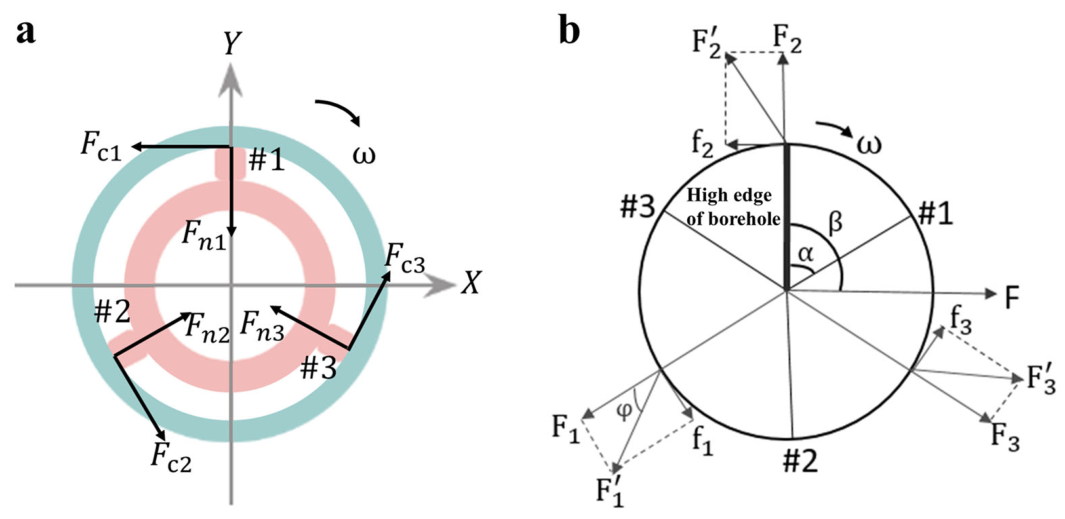
The mechanical analysis in this study is carried out primarily on the transverse cross-section containing the steering pads, as shown in Figure 1a. The pads rotate about the tool axis with an angular velocity ω . In this section, the BHA is subjected to the circumferential friction force F c i generated at each pad–borehole-wall contact, as well as the corresponding normal reaction force F n i exerted by the borehole wall on the pad. The effective steering force is defined as the vector resultant of these forces acting on the BHA in this cross-section [32].
During directional drilling, the contact interface between each steering pad and the borehole wall simultaneously develops a normal reaction force and a tangential friction force acting along the circumferential tangent of the wellbore. The total tangential friction force generated at the pad–wall interfaces can be expressed as:
F c i = μ c F n i
where μ c is the coefficient of sliding friction at the pad–borehole-wall interface; F n i denotes the pad force (the thrust applied by the i -th steering pad to the borehole wall); and i is the pad index. The steering pad follows a complex helical trajectory, resulting from the superposition of (1) the axial translation of the drilling pipe along the wellbore axis and (2) the pad’s circumferential motion induced by tool rotation. These two motions generate sliding-friction components in opposite directions, which combine to form the net tangential friction force f c i , as given in Equation (2):
f c i = μ c cos θ F n i
cos θ = v t v t 2 + v x 2
In Equation (3), v t denotes the tangential linear velocity of the rotating steering pad (m/s), and v x is the axial sliding velocity of the drilling pipe along the wellbore axis (m/s). By performing a vector superposition of, for each pad in Figure 1a, the normal reaction exerted by the borehole wall (opposite to the pad thrust) and the corresponding tangential friction force, the six force components can be reduced to three pad resultant forces. This leads to closed-form expressions for the magnitude of the resultant force acting on each steering pad and the included angle between the resultant and the pad thrust direction:
F n i = F n i ( 1 + μ c 2 cos θ 2 )
γ i : tan γ i = f c i F n i = μ c cos θ = μ c v t v t 2 + v x 2
Figure 1b shows the force schematic of the steering cross-section. Equation (1) presents the friction-inclusive steering-force optimization model. Building on this theoretical framework and invoking linear-momentum balance in the commanded steering-force direction together with the work-energy principle, we derive Equation (6), which gives the tool displacement as a function of the steering-force application time t .
f c i = μ c cos θ F n i cos θ = v t v t 2 + v x 2 F n i = F n i 1 + μ c 2 cos θ 2 tan γ i = f c i F n i = μ c cos θ = μ c v t v t 2 + v x 2 A max = 3 2 F max F min F = A max × A k F n 1 cos π t Δ w + F n 2 cos π 3 t Δ w + F n 3 cos π 3 t Δ w = F F n 1 sin π t Δ w + F n 2 sin π 3 t Δ w + F n 3 sin π 3 t Δ w = 0

2.3. Model Solution and Result Analysis

This theoretical model prescribes a set of measurable parameter values, specifically as follows: α is set to 0 rad, β to −0.1345 rad, v t (lateral velocity) to 0.812 m/s, v x (axial velocity) to 0.06 m/s, and μ c (friction coefficient) to 0.41. The maximum force F max is taken as 20 kN, the minimum force F min as 0.7 kN, and A k is set to 1, indicating that the operating efficiency reaches its maximum. These specific values are then substituted into the corresponding equations to obtain the required results.
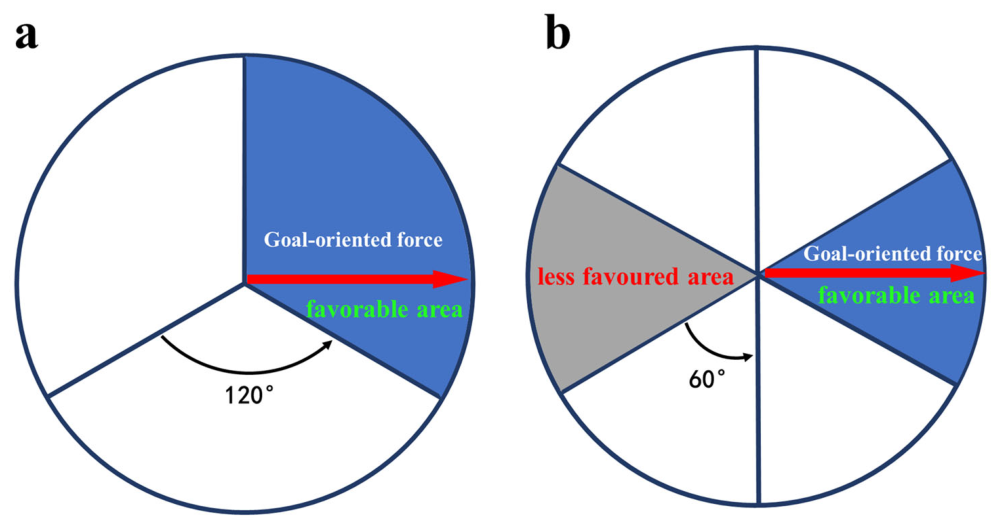
To determine the optimal solution, 120° and 60° sector-partition schemes were adopted to define the favorable and unfavorable sectors. By specifying one variable and combining it with Equation (6), the variation in the pad force with the rotation of the steering pads can be obtained. In the 120° partition scheme, the cross-section is divided into three 120° sectors, as shown in Figure 2a, and the sector containing the target steering force is defined as the favorable sector. During rotation of the steering pads, the direction of the target steering force remains unchanged; therefore, at any instant of pad rotation, one steering pad is always subjected to a reaction force located within the favorable sector. The pad force in the favorable sector is assigned the maximum value F max , and Equation (6) is then solved accordingly. In the corresponding 60° partition scheme, the cross-section is divided into six sectors, as shown in Figure 2b. Similarly, the sector containing the target steering force is taken as the favorable sector, whereas the sector opposite to the target steering force is defined as the unfavorable sector. The pad force in the favorable sector is assigned the maximum value, while that in the unfavorable sector is assigned the minimum value.
To further analyze the influence of tangential friction on steering-force allocation, the sum of the frictional torques acting on the three steering pads was investigated. Since the tangential friction acting on each steering pad is always perpendicular to the radial direction from the pad to the center of rotation, the frictional torque T i ( i = 1, 2, 3) acting on each steering pad can be derived according to the principle of moment calculation, yielding Equation (7), where R denotes the radius. Specifically, this equation is obtained by multiplying the instantaneous tangential friction acting on a steering pad by the radial distance from the steering pad to the center of rotation, thereby giving the frictional torque of an individual steering pad.
T i = R × f c i
T = i = 1 3 T i
Furthermore, by summing the frictional torques of the three steering pads, the resultant torque of the system can be obtained, as expressed in Equation (8). Based on Equations (7) and (8), the resultant tangential friction torque under the 120° and 60° sector-partition schemes was calculated, respectively.
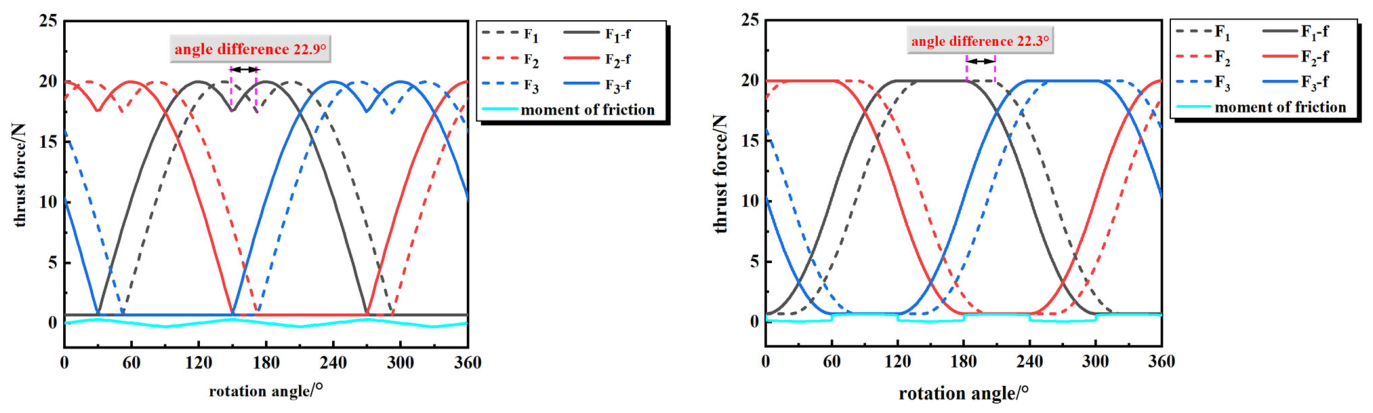
In the process of solving Equation (6), when the friction term is set to zero, the formulation reduces exactly to the steering-force allocation algorithm without considering tangential friction. To make a more rigorous comparison of the effect of tangential friction on steering-force allocation, two sector-partition schemes were used in this study. For both cases—with and without tangential friction—the variation curves of the three pad forces and of the resultant torque of these three forces with steering-pad rotation were obtained, as shown in Figure 3.
As shown in Figure 3, comparison of the results for the 120° and 60° sector-partition schemes indicates that both exhibit an overall periodic variation. In both cases, the results obtained when tangential friction is considered lag those obtained without tangential friction by a certain rotation angle. Measurements show that the phase lag is 22.9° for the 120° partition scheme, whereas it is 22.3° for the 60° partition scheme. This indicates that, relative to the 60° partition scheme, the discrepancy between the cases with and without friction is slightly greater for the 120° partition scheme. In addition, compared with the 120° partition scheme, the 60° partition scheme yields smaller fluctuations and smoother trends in the variation curves of the three pad forces.
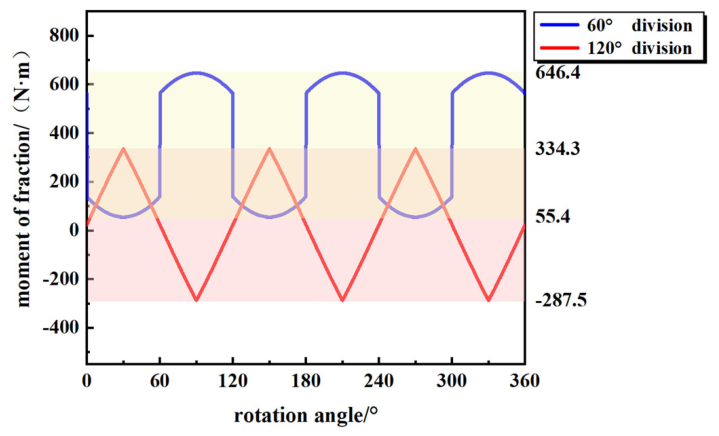
Moreover, the frictional torque of the steering pads obtained from both partition schemes varies periodically. However, the shapes of the resultant friction-torque curves generated by the steering-force allocation are completely different for the two partition schemes, and their fluctuation ranges also differ. For the 120° partition scheme, the resultant friction torque fluctuates around zero; by contrast, for the 60° partition scheme, the resultant torque remains positive throughout.
To further investigate the difference in the resultant friction torque generated by the steering pads under the two partition schemes, the resultant friction torques were compared in greater detail, as shown in Figure 4. It can be seen that the range of friction torque under the 120° partition scheme is larger, indicating that the tangential friction acting on the steering pads fluctuates more severely during rotation. In contrast, the friction torque under the 60° partition scheme varies more smoothly.
Since both the 60° and 120° sector-partition schemes are obtained by solving the system of equations in Equation (6), it is evident that, compared with the 120° partition scheme, the 60° partition scheme produces smaller pad-force fluctuations and smoother variations. This is beneficial for reducing tool damage and is therefore more suitable for target steering-force allocation. On this basis, the 60° sector-partition scheme was adopted in the subsequent work to establish the theoretical model for steering-force allocation.
To further evaluate the influence of tangential friction on the theoretical model of steering-force allocation, this study further derived the steering displacement generated under two allocation conditions, namely, with and without tangential friction, so as to directly assess the effect of tangential friction on steering-force allocation. Based on the above theoretical model, and by additionally imposing conservation of momentum and conservation of kinetic energy in the direction of the target steering force, the equation governing the displacement of the bottom-hole assembly as a function of the steering-force action time t can be obtained, as given in Equation (9).
x = F t 2 2 m
In Equation (10), the time represents the time required for a rotation angle of Δ ω at an angular velocity ω , and is expressed as:
t = Δ ω ω
The rotational angular velocity of the steering pads is set to ω = 7.329 rad/s, and the mass of the bottom-hole assembly is taken as m = 16 t. Based on the foregoing theoretical model, the displacement of the bottom-hole assembly in the direction of the steering force can therefore be obtained; here, this displacement is collectively referred to as the lateral displacement. By setting the action time of the target steering force to t = 16.7 s, the comparison shown in Figure 5 is obtained for the lateral displacement under the two cases, namely, with and without tangential friction.
As shown in Figure 5, when tangential friction is taken into account, the time-history curve of lateral displacement is similar to that of projectile motion. This is because, under the action of the target steering force, the motion of the bottom-hole assembly is always subjected only to a constant acceleration in the direction of the target steering force, while the initial velocity in that direction is zero. Therefore, the resulting curve is consistent with the actual theoretical derivation. In addition, Figure 5 shows that, for the same action time under target steering-force allocation, the lateral displacement obtained when tangential friction is considered is greater than that obtained when tangential friction is neglected. This demonstrates that the effect of tangential friction acting on the steering pads on steering-force allocation cannot be ignored. Accounting for tangential friction can increase the directional build-up rate of the drill bit.

3. Numerical Simulations

3.1. Geometric Model Construction

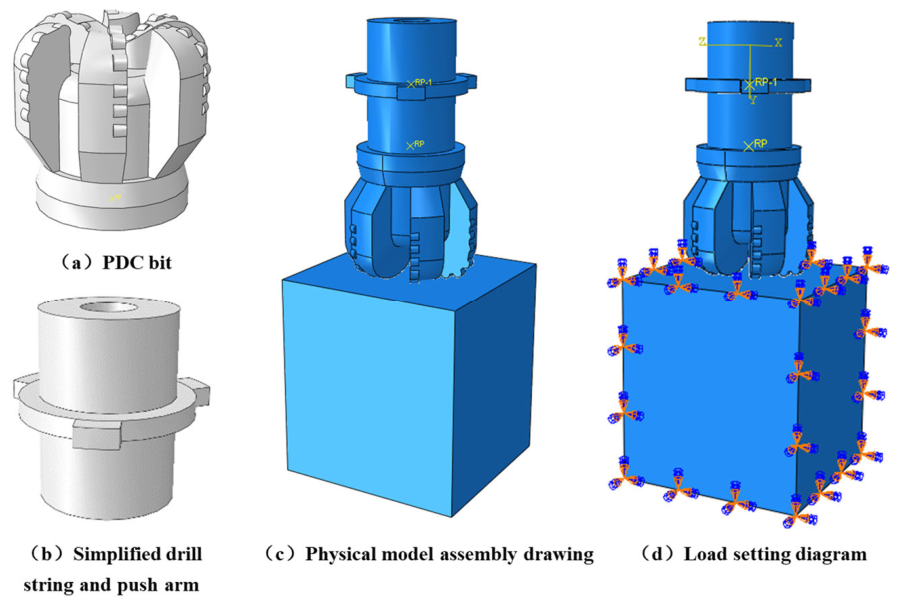
The numerical simulations in this study reproduce the near-bit directional build mechanism in a push-the-bit RSS, including the PDC bit, the steering pads, and the drilling pipe section that carries the pads and connects to the bit [33,34,35,36]. To obtain a more faithful representation of the modeled components, three-dimensional geometries were created in SolidWorks 2024 SP0.1: a 215.9 mm-diameter PDC bit, a rectangular rock block of 300 × 320 × 350 mm, a 200 mm-long drilling pipe section (outer radius 70 mm, inner radius 28.5 mm), and a simplified steering-pad model (inner diameter 70 mm, maximum outer diameter 107.95 mm). The geometric models of each component are shown in Figure 6a,b.
The simulations were conducted using Abaqus. The rock block was meshed with three-dimensional reduced-integration solid elements, while the drilling assembly was treated as rigid analytical bodies to reduce computational cost. General Contact was used for all interacting surfaces, and the tangential behavior was defined with the lithology-dependent sliding-friction coefficients listed in Table A2. The normal behavior adopted hard contact, allowing separation after contact. Fixed constraints were applied to the lateral and bottom boundaries of the rock block, while the drilling surface was left free. A mesh-independence check was performed by comparing coarse, medium, and refined rock meshes; the medium mesh was adopted because the difference in final lateral displacement between the medium and refined meshes was within the tolerance. A block-size check was also performed to ensure that lateral displacement was not controlled by the artificial boundary of the rock domain.
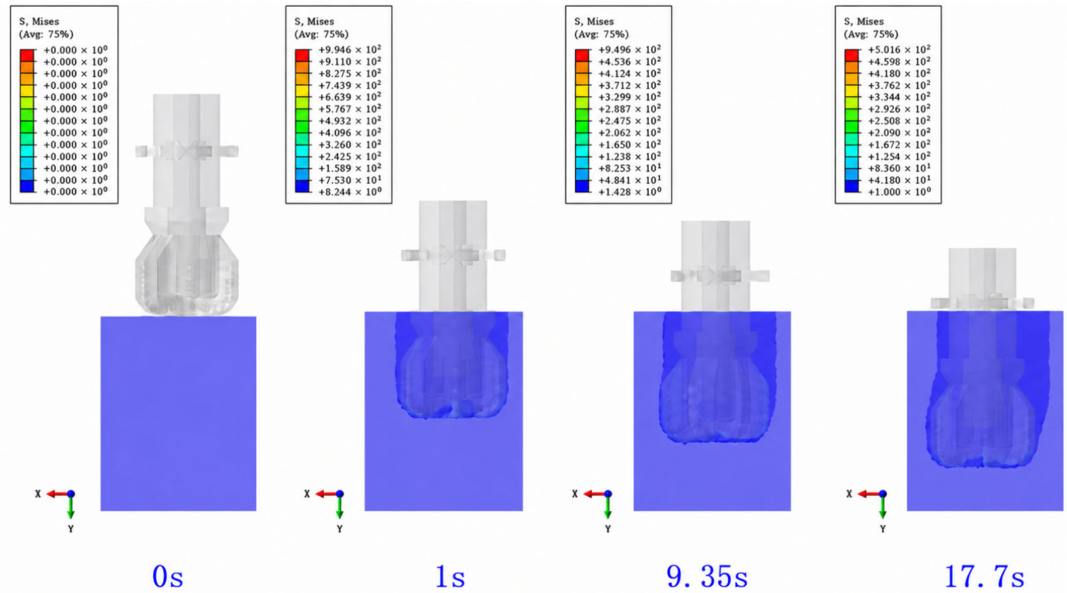
The stress cloud diagram of the rock at different times is shown in Figure 7. As can be seen from Figure 7, at the initial stage (0 s), the stress in the rock is uniformly distributed, and no deformation occurs. At 1 s, the drill bit penetrates vertically into the rock, forming a borehole wall. The tool is then subjected to a target steering force along the X-axis. As the bit penetrates further downward (8.5 s), it cuts in the positive X-direction while continuing to drill downward, causing stress within the rock to concentrate at the lower-left side of the borehole wall, and a lateral displacement has already developed. By 16 s, the bit cuts further in the direction of the target steering force, thereby achieving directional build-up.
To further improve the BUR of a push-the-bit RSS, we analyze two contributing aspects: formation lithology and PDC bit design parameters. A one-factor-at-a-time study was first designed to isolate the effect of each key bit-geometry parameter. The baseline case was set to a gauge-pad width of 60 mm, a gauge length of 70 mm, an inner cone angle of 120°, and a bit crown radius of 75 mm. The remaining cases were defined by varying the selected key parameters in stepwise levels consistent with field practice, as summarized in Table A1.
In the formation-parameter specification, shale, sandstone, limestone, and granite were selected because they are commonly encountered in drilling operations and exhibit pronounced contrasts in mechanical properties such as Young’s modulus and uniaxial compressive strength (UCS). Under the same target steering force, we investigated how the BUR varies among these four lithologies. Note that in the preceding simulations focused on bit-geometry parameters, the rock was assumed to be shale.
For the rock failure description, the Drucker–Prager criterion was adopted. The principal material parameters used in the model are summarized in Table A2. The drilling assembly—comprising the bit, drilling pipe section, and steering pads—was modeled as steel, and the density unit was converted from t/mm3 to kg/m3.
In the finite-element model, the PDC bit, the drilling pipe section, and the three steering pads of the BHA were defined as rigid bodies, and all interactions in the assembly were modeled using the Abaqus General Contact formulation. To eliminate rigid-body motion of the formation during loading, fixed boundary conditions were applied to all rock surfaces except the drilling surface. The simulation was carried out in two analysis steps. In Step 1, the drilling assembly was driven vertically downward at 200 mm/s for 1 s to create an initial borehole wall. In Step 2, the assembly continued to drill downward at 6 mm/s for 16.7 s, while the computed steering-force allocation was applied to the outer surfaces of the three pads in the form of time-varying pressure loads. This allowed the bit to drill ahead under axial feed while simultaneously experiencing the resultant steering load, thereby reproducing the directional drilling process of a push-the-bit RSS [28].

3.2. Analytical-Numerical Consistency Check

An analytical-numerical consistency check must be performed on the proposed steering force optimization model before numerical simulation. To compare the theoretical model, two steering-force allocation schemes were implemented in the numerical simulations, namely, one considering tangential friction and the other neglecting tangential friction. The thrust forces of each steering pad, varying with rotation angle, were applied to the finite element model in the form of time-varying loads, and both cases were simulated accordingly so as to validate the derivation of the theoretical model. The simulation results for the two steering-force allocation schemes are presented in Figure 8.
As shown in Figure 8, the finite-element response is consistent with the analytical prediction: for the same steering-force action time, the bit obtains a larger X-direction lateral displacement when tangential friction is included. From the analytical curves in Figure 5, the final lateral displacement increases from approximately 28.4 mm for the friction-free baseline to approximately 30.6 mm for the friction-aware model, corresponding to an increase of about 7.7% in the average BUR. The full-scale finite-element comparison in Figure 8 shows the same trend: the final lateral displacement increases from approximately 24.3 mm to approximately 26.9 mm after the tangential friction component is introduced, giving an increase of about 10.7%. Because both comparisons use the same geometry, pad-force envelope, formation parameters, and boundary conditions, the difference can be attributed mainly to the friction-induced redistribution of the effective steering-force vector. This result indicates that the proposed model is not only a force-allocation modification, but also a mechanism-level correction that improves the representation of near-bit lateral cutting in a dynamic push-the-bit RSS.

4. Results

4.1. Lateral Bit-Displacement Characteristics Under Different Formation Conditions

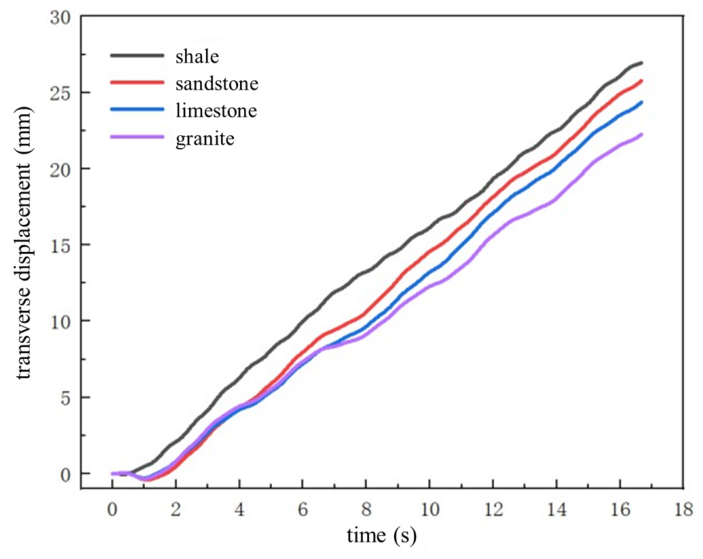
Based on the full-scale bit–rock-breaking model established above, the bit lateral displacement was computed under the steering-force allocation obtained from the tangential friction-inclusive scheme. Figure 9 presents the lateral-displacement responses for shale, sandstone, limestone, and granite when tangential friction is accounted for. In conjunction with the rock mechanical properties, the results indicate that—under the present setup—although the formations share the same internal friction angle, the coefficient of sliding friction and the rock’s hardness jointly control the initial steering response and the overall build capability. Shale exhibits the lowest Young’s modulus and a relatively high sliding-friction coefficient, which promotes stronger bit–rock interlocking at the bottomhole; consequently, it yields the largest overall lateral displacement, implying the most rapid steering response and the highest build-up rate. By contrast, limestone and granite, with higher Young’s moduli and lower sliding-friction coefficients, are more prone to early-stage lateral slip and may even exhibit transient reverse lateral displacement, leading to a delayed steering response and weaker overall build capability.

4.2. Lateral Bit-Displacement Characteristics Under Different Bit-Geometry Parameters

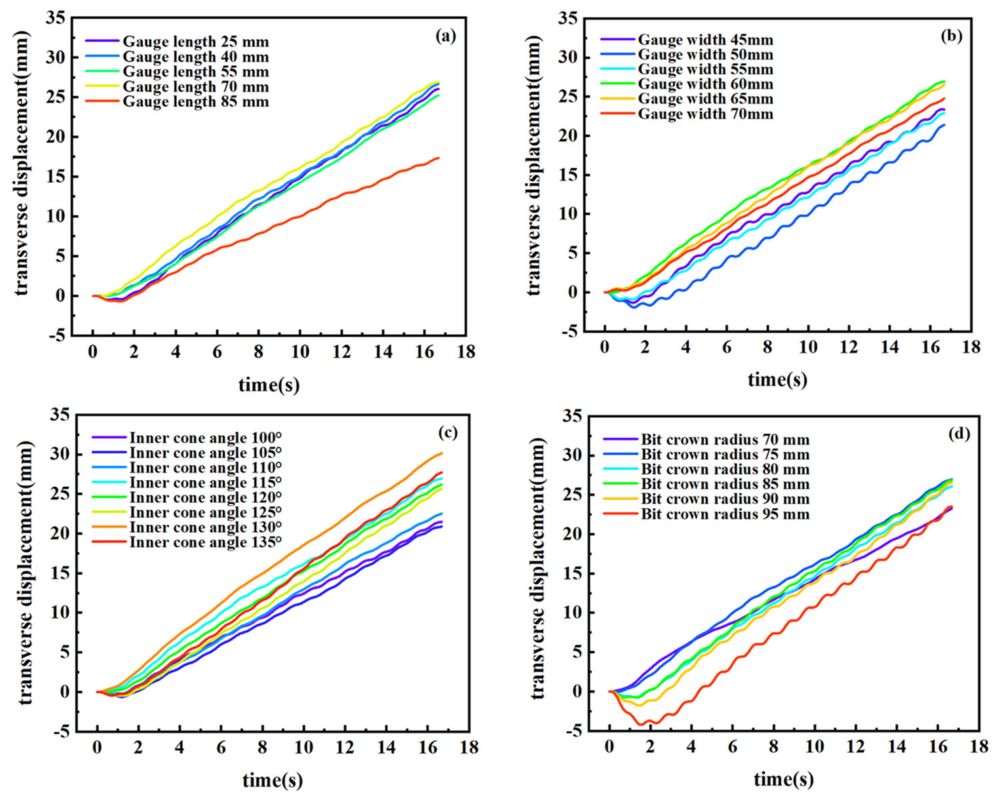
Figure 10 compares the simulated lateral displacement responses for different bit-geometry configurations. The results indicate that some cases exhibit a transient negative lateral displacement during the first 2 s. This behavior arises because, in the initial drilling stage, the bit has only just engaged the rock and the operation is dominated by axial penetration to establish the initial borehole wall rather than by sustained build; this initial contact condition can therefore produce a brief reverse lateral response. As drilling proceeds, the lateral displacement in all cases transitions to a monotonically increasing trend. In field operations, the build process typically persists over a much longer interval; accordingly, the overall trend of the lateral-displacement response over the full drilling interval provides a more representative measure of the bit’s build capability, whereas the early-time reverse displacement can be considered negligible.
As shown in Figure 10a, the lateral displacement curves for all gauge lengths exhibit an overall increasing trend with superimposed fluctuations. When the gauge length is 70 mm, the bit shows the largest lateral displacement within the first 2 s and the smallest oscillation amplitude, indicating that this gauge length provides adequate borehole-wall support and effectively suppresses excessive vibration and toolface instability, thereby maintaining a consistent direction of the applied pad force. At the same time, it avoids over-consuming the available lateral force due to excessive frictional resistance at the gauge, allowing the bit to sustain stable lateral cutting and yielding a smoother wellbore trajectory.
As indicated in Figure 10b, a gauge-pad width of 60 mm or 65 mm delivers the best steering performance: the bit exhibits higher lateral cutting efficiency per unit time and stronger build capability, and its displacement response is the smoothest with minimal oscillations. This suggests that under the applied pad side force, the bit enters a stable steering regime. At these widths, the bit–borehole interface provides an optimal contact area that offers stable lateral support, effectively suppressing lateral vibration during side cutting, while avoiding an excessive increase in sidewall drag that would otherwise consume the available lateral force. Consequently, the pad force can be converted efficiently into a sustained lateral feed advance. By contrast, when the gauge-pad width is smaller, the reduced pad–wall contact area provides insufficient support, making the bit more prone to lateral slip and vibration after loading; the displacement curve becomes highly oscillatory, and the overall build efficiency decreases.
As shown in Figure 10c, an inner cone angle of 105° provides the best steering performance. It yields the largest lateral displacement and the smoothest, most stable response, with almost no evident initial slip or oscillation. With this cone angle, when the bit’s lateral-cutting profile contacts the borehole wall, it can generate sufficient lateral support to resist the reactive torque and avoid sticking caused by excessive interlocking, while still maintaining strong lateral cutting and steering capability. As a result, the bit achieves stable and continuous side cutting, giving the highest steering efficiency.
If the inner cone angle is too small, the bit profile becomes overly sharp and tends to bite too deeply into the formation. The resulting excessive penetration resistance impedes smooth lateral motion and reduces overall build efficiency. Conversely, if the inner cone angle is too large, the bit profile becomes too flat; the contact area and mechanical interlock with the sidewall decrease, weakening the conversion of pad side force into effective lateral cutting. The bit then becomes more prone to sliding along the borehole wall rather than cutting, leading to a lower build capability.
As indicated in Figure 10d, increasing the bit crown radius markedly worsens steering stability. As the crown radius increases from 60 mm to 95 mm, the magnitude of the initial reverse lateral displacement becomes progressively larger, and the lateral-displacement trace becomes increasingly oscillatory throughout the drilling interval. When the radius reaches 95 mm, the contact footprint between the bit’s central region and the bottomhole rock is maximized; during rotary drilling, this geometry amplifies torque imbalance at the bit, reducing its ability to directionally bite into the formation under the applied pad side force and leaving the system in an unstable operating state, which manifests as pronounced fluctuations in the displacement curve.
By contrast, bits with a smaller crown radius exhibit better directional stability. A smaller crown radius produces a sharper nose profile, which promotes stress concentration and more effective sidewall engagement under pad loading, thereby providing a steadier side-cutting guidance mechanism; consequently, the displacement curve shows reduced oscillations and only limited reverse displacement, indicating a smoother lateral cutting process.
Accordingly, the design values obtained in this study should be regarded as a preliminary model-based design window rather than fixed universal parameters. For the simulated 215.9 mm PDC bit in shale, a gauge-pad width of 60–65 mm and an inner cone angle close to 105 deg produce a relatively stable build response. These values indicate a favorable matching relationship between sidewall support and lateral cutting aggressiveness under the present loading and formation conditions. For harder formations, different pad-force levels, or different bit and RSS assemblies, the same evaluation procedure should be repeated: the gauge-pad width and gauge length should first provide continuous sidewall support without excessive drag, and the inner cone angle and crown radius should then be selected to avoid both excessive biting and ineffective wall sliding. Thus, the recommended values are intended as an initial design reference that requires further refinement using formation-specific simulations or laboratory steerability tests.

4.3. Regression Analysis of Build-Up Rate

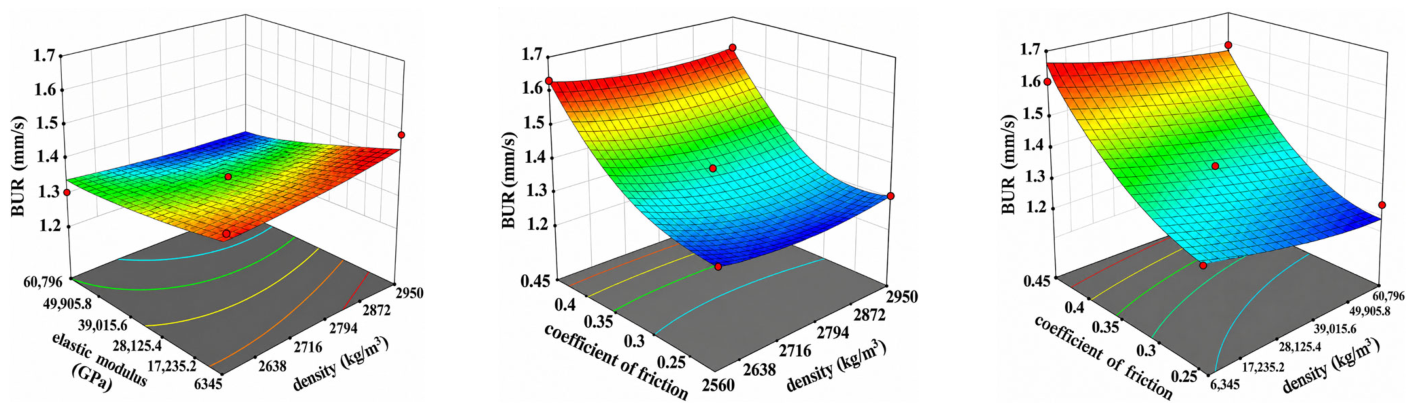
Considering the coupled effects of formation mechanical properties on the bit BUR, a multiple linear regression model was used to fit the data. Formation density ( x 1 ), Young’s modulus ( x 2 ), and the coefficient of sliding friction ( x 3 ) were taken as the independent variables, and BUR was taken as the dependent variable, yielding the following relationship between formation parameters and BUR:
B U R = 1.36 0.0438 x 2 + 0.1763 x 3 0.0225 x 1 x 2 0.0125 x 1 x 3 0.0005 x 2 x 3 + 0.0125 x 1 2 + 0.005 x 2 2 + 0.075 x 3 2
The regression fit in Figure 11 was used as a compact sensitivity indicator rather than as an independent predictive law. Within the present simulation matrix, the coefficient of sliding friction has the strongest positive contribution to the average BUR, whereas Young’s modulus and density show negative contributions. This trend is mechanically reasonable: larger sliding friction strengthens bit–sidewall engagement and supports the conversion of pad side force into lateral penetration, while higher stiffness and density increase resistance to lateral cutting. The response is consistent with the displacement curves in Figure 9, where shale gives the highest lateral displacement, and hard formations, such as limestone and granite, show delayed steering response. It also agrees qualitatively with the full-scale experimental trend reported by Menand et al. [25], namely that push-the-bit steerability is governed by the effective side force acting on the bit together with bit profile and borehole quality.
To provide a more explicit sensitivity measure, a normalized sensitivity index was calculated from the standardized regression coefficients. Before regression, each input variable and BUR were transformed into dimensionless variables by subtracting the mean and dividing by the standard deviation. The absolute value of each standardized coefficient was then divided by the sum of all absolute standardized coefficients to obtain a percentage contribution, allowing variables with different units to be compared on the same scale. For the formation-parameter model, the normalized sensitivity ranking is as follows: coefficient of sliding friction, 46.8%; Young’s modulus, 34.7%; and density, 18.5%. This ranking indicates that bit–rock friction is the dominant positive factor in the present simulation matrix, whereas formation stiffness and density mainly suppress lateral cut-ting. The goodness-of-fit metrics ( R 2 = 0.962, RMSE = 0.036 mm/s, and MAE = 0.029 mm/s) show that the regression surface reasonably reproduces the simulated trend, but the regression should be interpreted as a local sensitivity description rather than a universal BUR prediction equation.
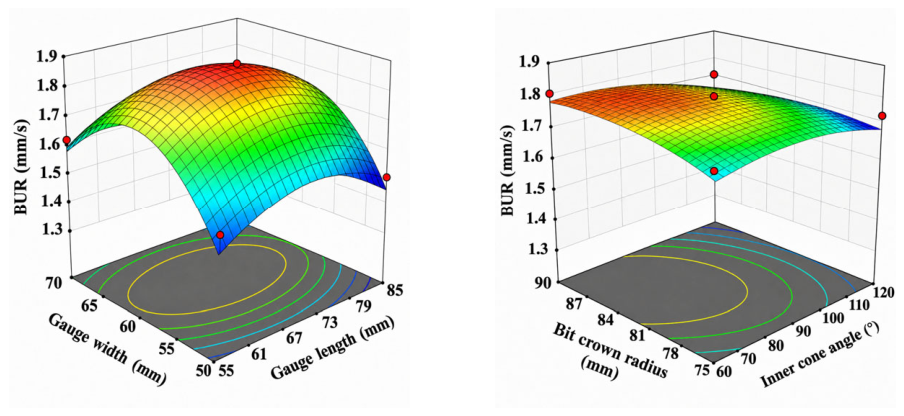
Furthermore, a multivariable linear regression model was used to relate bit structural parameters to BUR, with gauge length ( y 1 ), gauge-pad width ( y 2 ), inner cone angle ( y 3 ), and bit crown radius ( y 4 ) as the predictors, and BUR as the response, yielding:
B U R = 1.85 0.0294 y 1 + 0.0459 y 2 0.0399 y 3 + 0.0104 y 4 + 0.0034 y 1 y 2 0.0023 y 1 y 3 + 0.0066 y 1 y 4 + 0.0421 y 2 y 3 0.0066 y 2 y 4 0.0226 y 3 y 4 0.1045 y 1 2 0.2589 y 2 2 0.0401 y 3 2 0.0288 y 4 2
The regression results in Figure 12 should be interpreted together with the one-factor displacement curves in Figure 10. The fitted coefficient of crown radius is positive within the multivariable response surface, meaning that crown radius may contribute positively to the average BUR when it is combined with suitable values of gauge length, gauge-pad width, and inner cone angle. However, Figure 10d also shows that an excessive crown radius can increase early reverse displacement and displacement oscillation, thereby weakening steering stability. Therefore, the effect of crown radius is not a simple monotonic rule. It is beneficial only within a coordinated bit-geometry combination, while an excessively large value may reduce trajectory stability. For the bit-structure model, the same normalized-sensitivity procedure gives the following percentage ranking: inner cone angle, 31.6%; bit crown radius, 28.4%; gauge-pad width, 22.1%; and gauge length, 17.9%. Within the present design range, the inner cone angle and bit crown radius show relatively higher sensitivity because they directly affect bit–rock contact geometry, lateral cutting aggressiveness, and the conversion efficiency of pad side force into lateral penetration. The gauge-pad width and gauge length show slightly lower but still significant sensitivities, indicating that gauge support remains essential for maintaining stable sidewall contact, limiting lateral vibration, and reducing displacement oscillation. For the bit-structure regression, R 2 = 0.941, RMSE = 0.048 mm/s, and MAE = 0.037 mm/s. Therefore, the engineering implication is that BUR improvement should not be achieved by maximizing a single structural parameter, but by coordinating the inner cone angle, crown radius, gauge-pad width, and gauge length within a stable design window.
In summary, the sensitivity results show that the dominant controllable improvement in the proposed model comes first from incorporating tangential friction into the steering-force vector, and then from selecting bit parameters that maintain stable side cutting. The most direct quantitative comparison is between the friction-free and friction-aware cases: under identical loading and geometry, the average BUR increases by about 7.7% in the analytical model and about 10.7% in the full-scale finite-element model. The subsequent formation and bit-geometry analyses explain when this improvement can be effectively converted into stable build-up behavior.

5. Discussion

The present results place the proposed model in a clearer context relative to existing RSS models. Conventional push-the-bit BUR prediction methods usually calculate the build response from the resultant side force, BHA geometry, WOB, bit–formation interaction, and anisotropy [17,20], while recent control-oriented studies focus on how the commanded steering vector should be adjusted to improve trajectory smoothness and control accuracy [21]. These approaches are effective for trajectory-level prediction and control, but they generally do not explicitly describe how continuously rotating steering pads transform normal thrust and tangential friction into an instantaneous resultant steering-force vector. The main conceptual contribution of this study is therefore the force-allocation mechanism itself: tangential friction is not treated only as an energy-dissipation term, but as a directional component that changes the phase, magnitude, and smoothness of the pad-force allocation. This interpretation is consistent with full-scale PDC bit steerability experiments showing that side force and bit profile strongly affect deviation response [25], and with friction-contact studies emphasizing that cutter/rock friction influences lateral cutting and borehole quality [26]. Quantitatively, the proposed model improves the average BUR indicator by about 7.7% in the analytical comparison and 10.7% in the finite-element comparison relative to the friction-free baseline, demonstrating that the added friction term produces a measurable steering-performance improvement rather than only a formal modification of the equations.
A quantitative external benchmark can be made by comparing the order of the present improvement with published controlled RSS steerability tests. Sugiura [37] reported that, for an 8 1/2 in. RSS tested in a controlled RMOTC environment, the average build rate was approximately 10.0 deg/100 ft in point-the-bit mode at 98% deflection and 11.4 deg/100 ft in push-the-bit mode at 88% setting, corresponding to an increase of about 14%. Although that study used a different tool configuration and reported field-scale DLS rather than the local BUR surrogate used here, the present 7.7–10.7% increase in the average BUR indicator falls within the same engineering order of magnitude. Therefore, the proposed friction-aware correction is not directly calibrated to the published experiments, but its predicted improvement is quantitatively reasonable relative to available RSS steerability data.
The comparison should be interpreted within the limits of the present modeling framework. The analytical model assumes rigid pad–wall point contact, a homogeneous and isotropic formation, an ideal cylindrical borehole, and constant rotational kinematics. These assumptions are appropriate for isolating the pad-force redistribution mechanism, but they do not yet include borehole washout, ledges, bedding anisotropy, progressive cutter wear, bit whirl, or BHA flexibility. Therefore, the present results should be regarded as a mechanism-level and numerical-consistency demonstration rather than a complete field validation.
The regression equations have similar limitations. They are based on the finite-element simulation matrix used in this paper and are intended to summarize local sensitivity trends, not to replace mechanistic BUR models or published field-calibrated trajectory simulators. In particular, the small deterministic dataset makes it inappropriate to draw excessive conclusions from individual fitted coefficients, especially where strong parameter interactions exist. Future work should combine instrumented laboratory RSS steerability tests, downhole measurements, and non-ideal borehole models to validate the friction-aware allocation strategy and determine its applicable range under field drilling conditions.

6. Conclusions

This study developed a friction-aware steering-force allocation model for a dynamic push-the-bit RSS and coupled it with a full-scale bit–rock finite-element model. The work clarifies how tangential pad–wall friction, formation properties, and PDC bit geometry jointly affect near-bit lateral displacement and the build-up response. The main conclusions are as follows:
(1)
The proposed model explicitly decomposes pad–wall contact into normal pad force and tangential friction force, and then reconstructs the resultant three-pad steering-force vector. Compared with the friction-free baseline, this formulation better represents the force redistribution caused by continuous pad rotation.
(2)
Analytical and finite-element comparisons show that tangential friction produces a measurable improvement in steering response under the present modeling conditions. At 16.7 s, the analytical final lateral displacement increases from approximately 28.4 to 30.6 mm, and the finite-element final lateral displacement increases from approximately 24.3 to 26.9 mm, corresponding to average BUR increases of about 7.7% and 10.7%, respectively.
(3)
The normalized sensitivity analysis indicates that the coefficient of sliding friction is the dominant formation-related factor affecting BUR, followed by Young’s modulus and density. For bit geometry, inner cone angle and crown radius have the largest normalized sensitivities, while gauge-pad width and gauge length mainly affect steering stability and the smoothness of lateral displacement.
(4)
For the simulated 215.9 mm PDC bit and shale formation, a gauge-pad width of 60–65 mm and an inner cone angle close to 105° provide a stable build response. These values should be regarded as an initial design window rather than universal constants, because the optimal configuration depends on lithology, available pad force, borehole condition, and bit-RSS matching.
(5)
The present model remains a mechanism-level analytical-numerical framework. Its regression equations are suitable for local sensitivity interpretation within the simulated design matrix, but extrapolation to other RSS configurations or field conditions requires additional laboratory steerability tests and downhole validation.

Author Contributions

Conceptualization, C.X. (Chuanming Xi), W.H. and H.S.; methodology, C.X. (Chuanming Xi), H.H., Z.Q. and R.Z.; software, Z.Q. and H.K.; validation, C.X. (Chuanming Xi), H.H., W.H. and R.Z.; formal analysis, C.X. (Chuanming Xi), D.W., X.X. and H.K.; investigation, C.X. (Chuanming Xi), D.W., X.X., W.S. and R.Z.; resources, H.H., W.H., H.S. and C.X. (Chao Xiong); data curation, Z.Q., H.K. and C.X. (Chao Xiong); writing—original draft preparation, C.X. (Chuanming Xi) and Z.Q.; writing—review and editing, W.H., H.S., C.X. (Chao Xiong) and R.Z.; visualization, Z.Q., H.K. and C.X. (Chuanming Xi); supervision, W.H. and H.S.; project administration, H.S. and W.H.; funding acquisition, H.S. and W.H. All authors have read and agreed to the published version of the manuscript.

Funding

This work was made possible by funding from National Science and Technology Major Project for Novel Oil and Gas Exploration and Development: Mechanisms of Coal Rock Reservoir Instability and Optimized Fast Drilling Technology and Equipment (2025ZD1404205), and Institute-level Project of CNPC Engineering Technology R&D Company Limited: Collaborative Design of Tough PDC Cutter Materials and Low-Energy PDC Bits (CPET202501).

Data Availability Statement

Data is contained within the article.

Conflicts of Interest

Authors Chuanming Xi, Huaigang Hu, Desheng Wu, Xiaolong Xu, and Weiguo Sun were employed by the subsidiary companies of China National Petroleum Corporation. The remaining authors declare that the research was conducted in the absence of any commercial or financial relationships that could be construed as a potential conflict of interest. The funder was not involved in the study design, collection, analysis, interpretation of data, the writing of this article, or the decision to submit it for publication.

Appendix A

Table A1. Parameter table for the PDC drill bit comparison experiment.
Test No.Gauge Length (mm)Gauge-Pad Width (mm)Inner Cone Angle (°)Bit Crown Radius (mm)
1 (Baseline case)706012075
2256012075
3406012075
4556012075
5856012075
6704012075
7704512075
8705012075
9705512075
10706512075
11707012075
12706010075
13706010575
14706011075
15706011575
16706012575
17706013075
18706013575
1970606060
2070606065
2170606070
2270606080
2370606085
2470606090
2570606095
Table A2. The main material parameter settings of the model.
MaterialDensity
(kg/m3)
Young’s Modulus (GPa)Poisson’s RatioInternal Friction Angle (°)Coefficient of Sliding Friction
Shale256063450.216400.4
Limestone266040,9790.232400.29
Sandstone268042,8710.214400.399
Granite295060,7960.165400.25
Drilling assembly7850210,0000.3

References

  1. Zhang, K. From Tight Oil & Gas to Shale Oil & Gas—Approach for the Development of Unconventional Oil & Gas in China. Int. Pet. Econ. 2012, 20, 9–15. [Google Scholar]
  2. Men, X.Y.; Wang, L.X.; Wang, Y.; Lou, Y.; Guo, W. Strategic pattern of China’s oil and gas exploration and development in the new era and prospects for 2035. China Pet. Explor. 2021, 26, 1–8. [Google Scholar]
  3. Wang, H.G.; Chang, L.; Zhuo, L.B.; Xi, C.M.; Ouyang, Y. Current status and suggestions for drilling technology of CNPC continental shale oil reservoirs. Xinjiang Oil Gas 2024, 20, 1–14. [Google Scholar]
  4. Zhao, Y.L.; Fan, X.; Chu, H.Y.; Li, X.X.; Yuan, Y.L.; Zheng, T.H. Analysis of BHA Build-Up Performance for Jimsar Shale Oil Horizontal Wells. Xinjiang Oil Gas 2024, 20, 19–26. [Google Scholar]
  5. Du, B.H.; Lin, B.T.; Zhang, R.X.; Huang, Y. Technology to Stimulate Xinjiang Fengcheng Super-Heavy Oil Reservoir Containing Muddy Interlayers by Drilling Multilateral Wells. Xinjiang Oil Gas 2022, 18, 44–51. [Google Scholar]
  6. Kong, J.W. Research progress on rotary steering drilling system and its control methods. Petrochem. Ind. Technol. 2024, 31, 211–213. [Google Scholar]
  7. Su, Y.N.; Dou, X.R.; Gao, W.K.; Peng, L.X.; Zhang, L.; Liu, K.; Xi, X.W. Research Status and Development Trends of Rotary Steerable System. Drill. Prod. Technol. 2024, 47, 1–8. [Google Scholar]
  8. Wu, Z.B.; Jiang, W.; Hu, S.Y.; Liu, Y.Q.; Shen, F. Analysis and Simulation of Steering Force of Bias Mechanism in Static Push-the-bit Steerable System. Mech. Electr. Eng. Technol. 2024, 53, 180–184. [Google Scholar]
  9. Jiang, W.; Jinag, S.Q.; Fu, X.S.; Chen, P. Application of rotary steering drilling technology and its research progress. Nat. Gas Ind. 2013, 33, 75−79. [Google Scholar]
  10. Sun, W. Application Research and Progress of Rotary Steering Drilling Technology. China Pet. Chem. Stand. Qual. 2017, 37, 160–161. [Google Scholar]
  11. Song, H.X.; Zeng, Y.J.; Zhang, W.; Mi, J.T.; Huang, Z.W. Current situation and key technology analysis of rotary steering system. Sci. Technol. Eng. 2021, 21, 2123–2131. [Google Scholar]
  12. Zheng, P.; Zhang, G.S.; Wu, D.F. Analysis on the Field Application of AutoTrack Rotary Steering Tool. China Petrochem. 2016, 18, 31–32. [Google Scholar]
  13. Urayama, T. Development of Remote Controlled Dynamic Orientating System; Society of Petroleum Engineers: Richardson, TX, USA, 1999. [Google Scholar] [CrossRef]
  14. Handoko, A.I.; Saputra, R.; Maulana, M.D.; Wijayanto, T.; Taufik, E. RSS PowerDrive Orbit: Records in Challenging Mahakam Swamp Directional Well; Indonesian Petroleum Association: South Jakarta, Indonesia, 2019. [Google Scholar] [CrossRef]
  15. Gu, Z.Y.; Xiong, W.; Yang, S.H. Application of rotary steering drilling technology in HJ203H well. West-China Explor. Eng. 2010, 22, 125–128. [Google Scholar]
  16. Qin, Y.H.; Fan, Y.T.; Chen, W.H.; Liu, Y.; Li, X.J.; Wang, G. Static Push-the-Bit Rotary Steering Control Model and Build-up Rate Prediction Method. Pet. Drill. Tech. 2023, 51, 74–80. [Google Scholar]
  17. Huang, W.; Wang, G.; Gao, D. A method for predicting the build-up rate of ‘push-the-bit’ rotary steering system. Nat. Gas Ind. B 2021, 8, 622–627. [Google Scholar] [CrossRef]
  18. Li, W.; Mou, L.; Zhou, X.C.; Tan, X.H.; Fu, Q. Research progress of rotary steerable system and its control methods. Coal Geol. Explor. 2023, 51, 167–179. [Google Scholar]
  19. Xue, Q.L.; Ding, Q.S.; Huang, L.L. The Latest Progress and Development Trend of Rotary Steering Drilling Technology. China Pet. Mach. 2013, 41, 1–6. [Google Scholar]
  20. Chen, T.; Liu, G.; He, X.; Li, J.; Wang, W. Calculation method of the build-up rate of the internal push point-the-bit rotary steering tool. Geoenergy Sci. Eng. 2023, 230, 212177. [Google Scholar] [CrossRef]
  21. Wang, G.; Huang, W.; Gao, D. Real-Time Control Algorithm of Well Trajectory for Push-the-Bit Rotary Steering Drilling System. SPE J. 2023, 28, 2148–2164. [Google Scholar] [CrossRef]
  22. Li, Y.; Yu, Y.; Sun, Y.; Li, B. Dynamics and fatigue life investigation of push-the-bit rotary steerable bottom hole assembly with whirling finite element model. Eng. Fail. Anal. 2023, 150, 107300. [Google Scholar] [CrossRef]
  23. Li, Y.; Yu, Y.; Zhao, D.; Sun, Y.; Li, B.; Lim, C.W. Investigation on fatigue life of push-the-bit rotary steerable bottom hole assembly with random bit-rock interaction. Thin-Walled Struct. 2024, 198, 111752. [Google Scholar] [CrossRef]
  24. Jia, J.; Xue, Q.; Li, Y.; Li, X.; Li, B. Vibration analysis of push-the-bit rotary steerable bottom hole assembly. Geoenergy Sci. Eng. 2025, 245, 213429. [Google Scholar] [CrossRef]
  25. Menand, S.; Simon, C.; Gerbaud, L.; Ben Hamida, M.; Denoix, H.J.; Cuillier, B.; Gaombalet, J.; Amghar, Y.; Sinardet, H. PDC Bit Steerability Modeling and Testing for Push-the-Bit and Point-the-Bit RSS. In Proceedings of the IADC/SPE Drilling Conference and Exhibition, San Diego, CA, USA, 6–8 March 2012. [Google Scholar] [CrossRef]
  26. Rostamsowlat, I.; Evans, B.; Kwon, H.J. A review of the frictional contact in rock cutting with a PDC bit. J. Pet. Sci. Eng. 2022, 208, 109665. [Google Scholar] [CrossRef]
  27. Lei, J.; Yang, G.S.; Liang, T.; Hu, C. Steering Principles of Rotary Steerable Drilling Systems in China and Abroad. Drill. Eng. 2012, 39, 53–58. [Google Scholar]
  28. Li, S.Q.; Tong, Y.S.; Yan, T.; Zhou, Y.C.; Li, W.; Sun, X.F. Numerical simulation of rock breaking by resonance coring based on laboratory experiments. SPE J. 2025, 30, 1162–1176. [Google Scholar] [CrossRef]
  29. Du, J.S.; Liu, B.L.; Xia, B.R. The control scheme for three-pad static bias device of push-the-bit rotary steerable system. Oil Drill. Prod. Technol. 2008, 30, 5–10. [Google Scholar] [CrossRef]
  30. Cheng, Z.B.; Jiang, W.; Jiang, S.Q.; Gao, B.K. Control scheme for displacement vector of three-pad biasing rotary steerable system. Acta Pet. Sin. 2010, 31, 5. [Google Scholar]
  31. Yang, B.; Lv, W.; Liu, H.Y.; Yue, B.J.; Bai, J. The control scheme with smooth thrust for push-the-bit rotary steerable system. Cyber Secur. Data Gov. 2019, 38, 66–69. [Google Scholar] [CrossRef]
  32. Tang, X.P.; Su, Y.N.; Ge, Y.H.; Sheng, L.M.; Li, T.J. BHA mechanical analysis for rotary steering drilling system. Mech. Eng. 2013, 35, 55–59. [Google Scholar]
  33. Zhang, H.; Fu, H.; Qing, Y.H.; Shi, H.Z.; Li, X.J.; Fan, Y.T.; Wang, X.R.; Liu, K.R. Adaptability of PDC drill bit with push-the-bit rotary steerable tools for inclined drilling. J. China Univ. Pet. 2023, 47, 73–80. [Google Scholar]
  34. Liu, C.G. Influence Law of Key Parameters of PDC Bit on Buildup Ability of Push-Type Rotary Steering; China University of Petroleum Beijing: Beijing, China, 2021. [Google Scholar] [CrossRef]
  35. Zhang, J.F.; Fan, Y.T.; Sun, Y.; Zhu, R.M.; Wang, L.; Wang, H.H. Design of PDC bit for rotary steering system. China Pet. Chem. Stand. Qual. 2024, 44, 109–110+113. [Google Scholar]
  36. Wang, H.; Sun, M.G.; Zhang, J.S.; Guan, Z.C.; Shi, Y.C.; Sun, L.Z. Buildup Rate Prediction of a Static Push-the-Bit Rotary Steerable Tool. China Pet. Mach. 2021, 49, 15–21. [Google Scholar] [CrossRef]
  37. Sugiura, J. Systematic Testing with Push- and Point-the-Bit Rotary-Steerable Systems Leads to the Optimal BHA Design for Stability, Steerability and Borehole Quality. In Proceedings of the AADE Fluids Conference and Exhibition, Houston, TX, USA, 8–9 April 2008. [Google Scholar]
Figure 1. Force analysis diagram of the guide cross-section.: (a) Simplified cross-section force diagram; (b) Cross-section force diagram in rotating state.
Processes 14 02167 g001
Figure 2. 120° and 60° division diagrams ((a): 120° division; (b): 60° division). Steering Cross-Sectional Mechanics Diagram.
Processes 14 02167 g002
Figure 3. Diagram of thrust and resultant moment changes with stabilizer rib rotation (left: 120° division; right: 60° division).
Processes 14 02167 g003
Figure 4. Comparison diagram of tangential friction resultant moment for 120° and 60° division.
Processes 14 02167 g004
Figure 5. Comparison of the results of theoretical model derivation.
Processes 14 02167 g005
Figure 6. Schematic diagram of geometric model.
Processes 14 02167 g006
Figure 7. Stress distribution contour of rock at different times.
Processes 14 02167 g007
Figure 8. Comparison of the results of finite element simulation.
Processes 14 02167 g008
Figure 9. Comparison of results considering tangential friction for different rocks.
Processes 14 02167 g009
Figure 10. Simulation results of lateral displacement of the drill bit under different structural parameters: (a) Different gauge lengths; (b) Different gauge widths; (c) Different inner cone angles; (d) Different bit crown radiuses.
Processes 14 02167 g010
Figure 11. Fitting results of formation parameters versus bit build rate.
Processes 14 02167 g011
Figure 12. Fitting results of build rate versus bit structural parameters.
Processes 14 02167 g012
Disclaimer/Publisher’s Note: The statements, opinions and data contained in all publications are solely those of the individual author(s) and contributor(s) and not of MDPI and/or the editor(s). MDPI and/or the editor(s) disclaim responsibility for any injury to people or property resulting from any ideas, methods, instructions or products referred to in the content.