Build-Up Mechanisms and Performance of Dynamic Push-the-Bit Rotary Steerable Drilling Tools

 , ,
, ,
Abstract
1. Introduction
2. Kinematic Model of Steering Pad–Wall Interaction
2.1. Model Assumptions and Simplifications
- (1)
- Rigid-body, point-contact assumption: Both the borehole wall and the steering pad are treated as rigid bodies. Because the contact patch is small, the pad–wall interaction is idealized as point contact.
- (2)
- Ideal cylindrical borehole: The wellbore is assumed to be a perfect circular cylinder, and borehole irregularities—such as rugosity and washout—as well as local ledges are neglected.
- (3)
- Constant angular velocity; negligible inertia: The steering pad rotates at a constant angular velocity, and the pad’s inertial effects are ignored.
- (4)
- Homogeneous, isotropic medium: The drilled rock and the borehole-wall material are assumed homogeneous and isotropic.
2.2. Development of the Steering-Force Optimization Model
2.3. Model Solution and Result Analysis
3. Numerical Simulations
3.1. Geometric Model Construction
3.2. Analytical-Numerical Consistency Check
4. Results
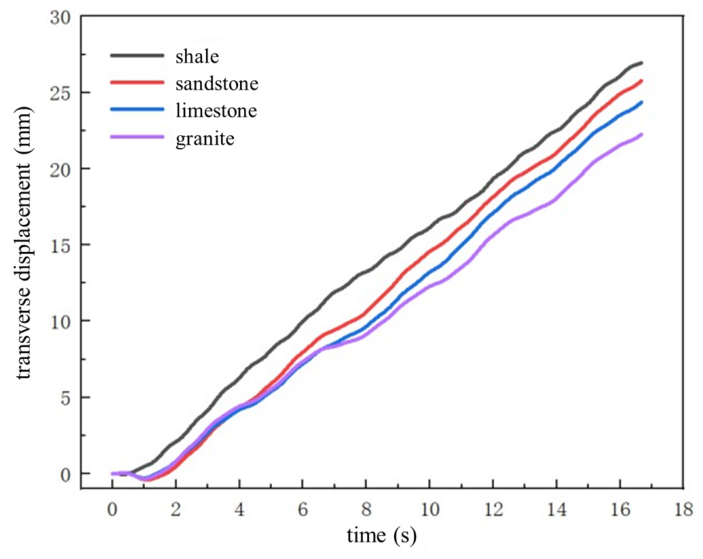
4.1. Lateral Bit-Displacement Characteristics Under Different Formation Conditions
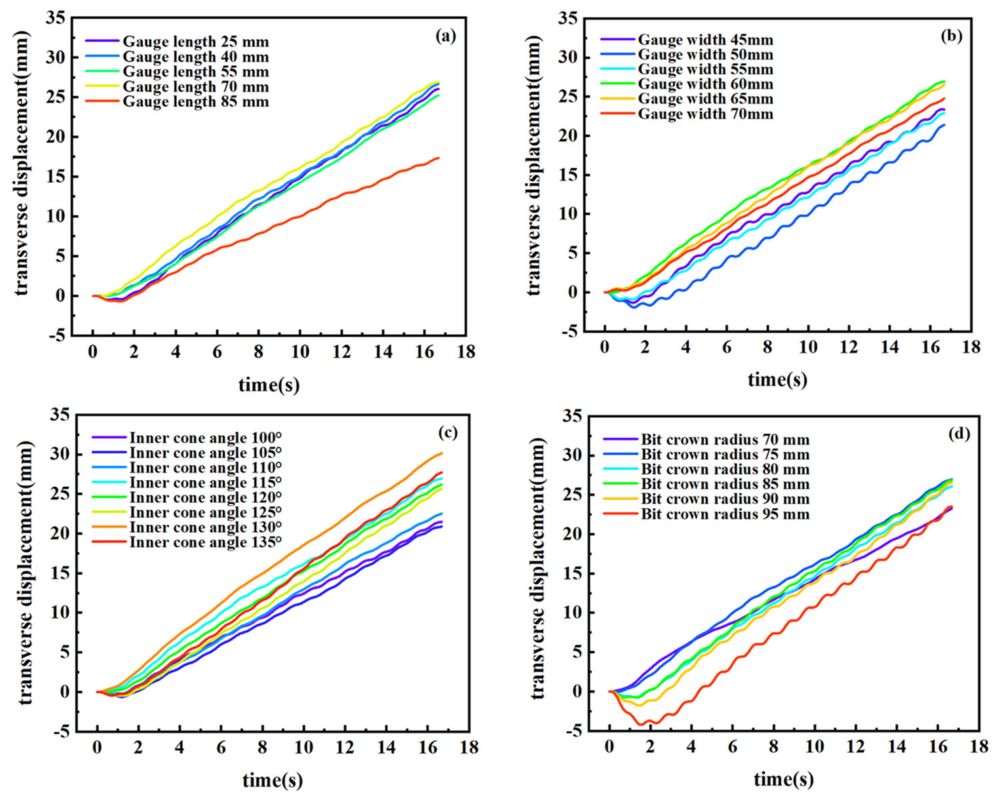
4.2. Lateral Bit-Displacement Characteristics Under Different Bit-Geometry Parameters
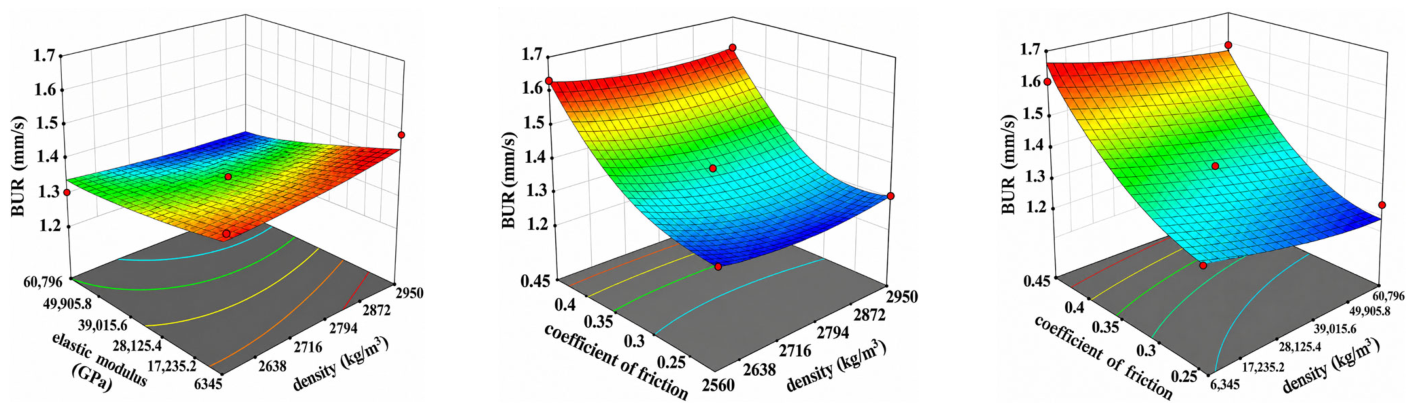
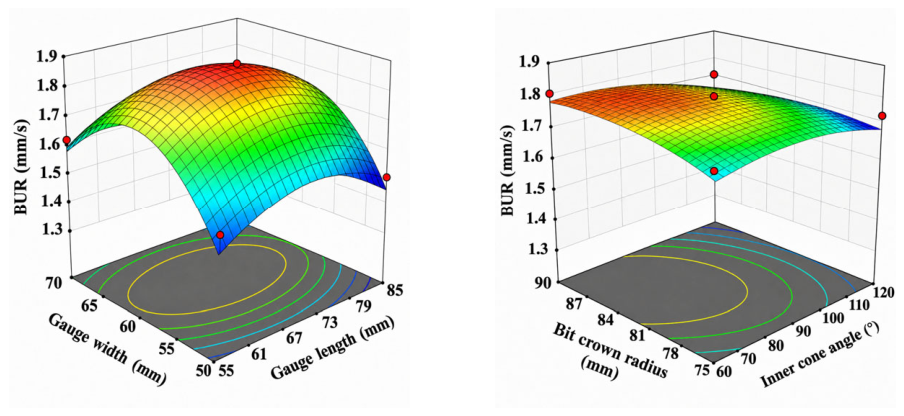
4.3. Regression Analysis of Build-Up Rate
5. Discussion
6. Conclusions
- (1)
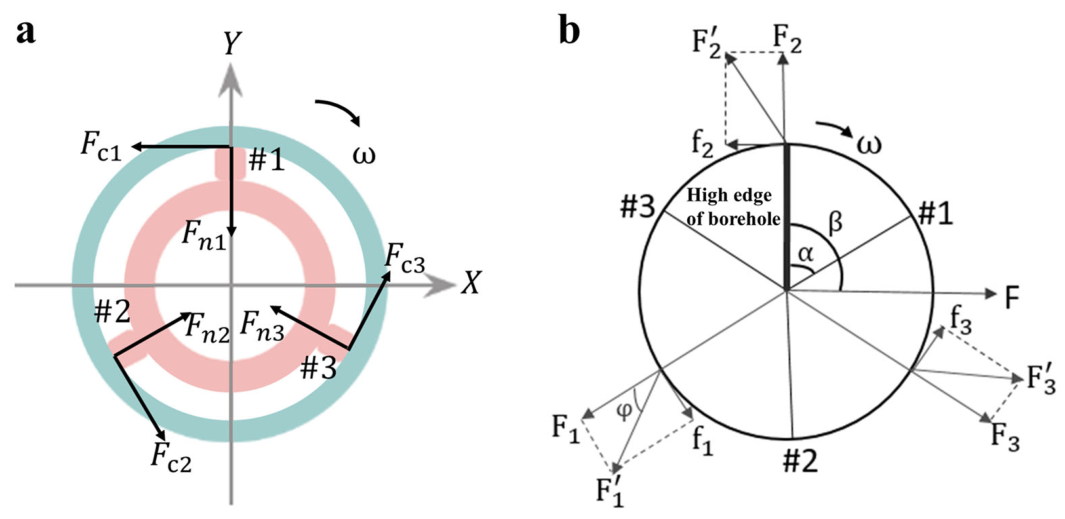
- The proposed model explicitly decomposes pad–wall contact into normal pad force and tangential friction force, and then reconstructs the resultant three-pad steering-force vector. Compared with the friction-free baseline, this formulation better represents the force redistribution caused by continuous pad rotation.
- (2)
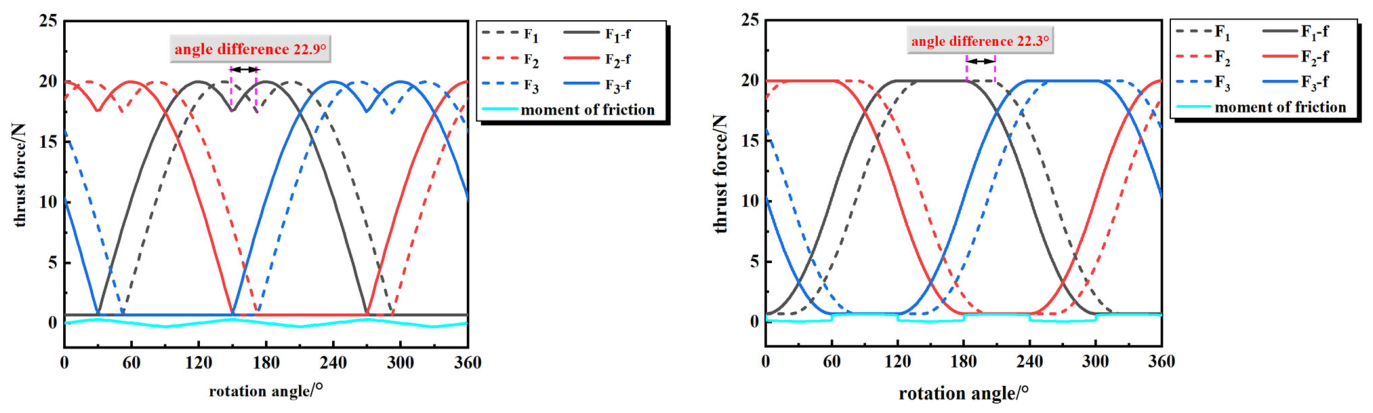
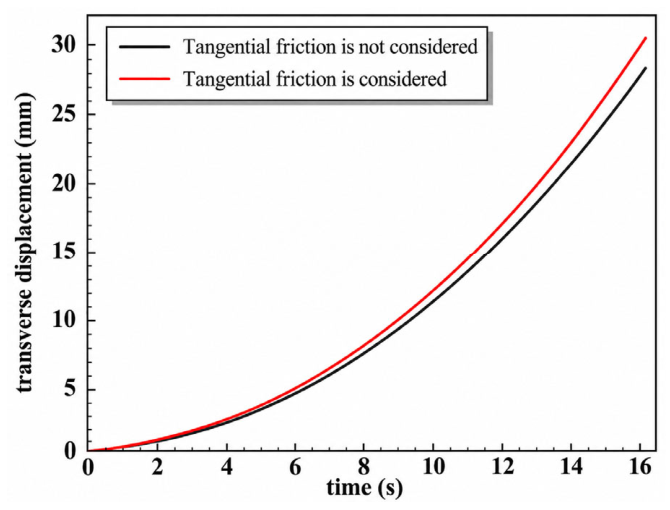
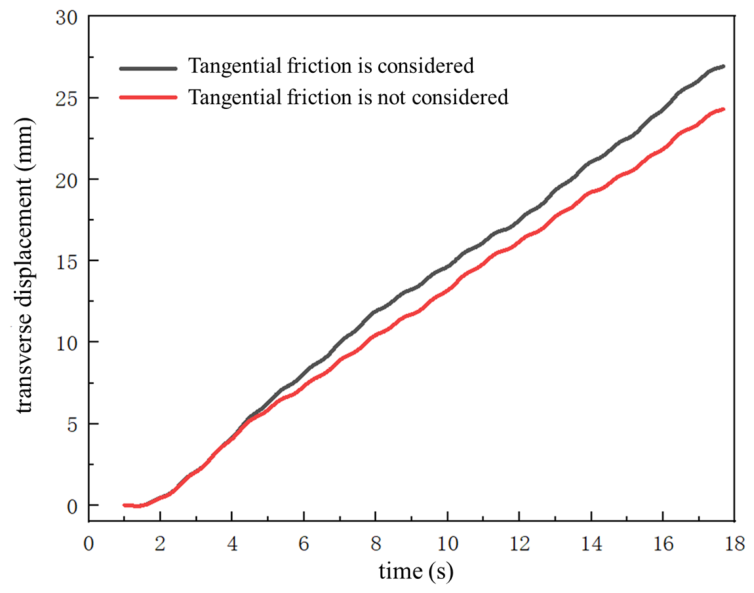
- Analytical and finite-element comparisons show that tangential friction produces a measurable improvement in steering response under the present modeling conditions. At 16.7 s, the analytical final lateral displacement increases from approximately 28.4 to 30.6 mm, and the finite-element final lateral displacement increases from approximately 24.3 to 26.9 mm, corresponding to average BUR increases of about 7.7% and 10.7%, respectively.
- (3)
- The normalized sensitivity analysis indicates that the coefficient of sliding friction is the dominant formation-related factor affecting BUR, followed by Young’s modulus and density. For bit geometry, inner cone angle and crown radius have the largest normalized sensitivities, while gauge-pad width and gauge length mainly affect steering stability and the smoothness of lateral displacement.
- (4)
- For the simulated 215.9 mm PDC bit and shale formation, a gauge-pad width of 60–65 mm and an inner cone angle close to 105° provide a stable build response. These values should be regarded as an initial design window rather than universal constants, because the optimal configuration depends on lithology, available pad force, borehole condition, and bit-RSS matching.
- (5)
- The present model remains a mechanism-level analytical-numerical framework. Its regression equations are suitable for local sensitivity interpretation within the simulated design matrix, but extrapolation to other RSS configurations or field conditions requires additional laboratory steerability tests and downhole validation.
Author Contributions
Funding
Data Availability Statement
Conflicts of Interest
Appendix A

| Test No. | Gauge Length (mm) | Gauge-Pad Width (mm) | Inner Cone Angle (°) | Bit Crown Radius (mm) |
|---|---|---|---|---|
| 1 (Baseline case) | 70 | 60 | 120 | 75 |
| 2 | 25 | 60 | 120 | 75 |
| 3 | 40 | 60 | 120 | 75 |
| 4 | 55 | 60 | 120 | 75 |
| 5 | 85 | 60 | 120 | 75 |
| 6 | 70 | 40 | 120 | 75 |
| 7 | 70 | 45 | 120 | 75 |
| 8 | 70 | 50 | 120 | 75 |
| 9 | 70 | 55 | 120 | 75 |
| 10 | 70 | 65 | 120 | 75 |
| 11 | 70 | 70 | 120 | 75 |
| 12 | 70 | 60 | 100 | 75 |
| 13 | 70 | 60 | 105 | 75 |
| 14 | 70 | 60 | 110 | 75 |
| 15 | 70 | 60 | 115 | 75 |
| 16 | 70 | 60 | 125 | 75 |
| 17 | 70 | 60 | 130 | 75 |
| 18 | 70 | 60 | 135 | 75 |
| 19 | 70 | 60 | 60 | 60 |
| 20 | 70 | 60 | 60 | 65 |
| 21 | 70 | 60 | 60 | 70 |
| 22 | 70 | 60 | 60 | 80 |
| 23 | 70 | 60 | 60 | 85 |
| 24 | 70 | 60 | 60 | 90 |
| 25 | 70 | 60 | 60 | 95 |
| Material | Density (kg/m3) | Young’s Modulus (GPa) | Poisson’s Ratio | Internal Friction Angle (°) | Coefficient of Sliding Friction |
|---|---|---|---|---|---|
| Shale | 2560 | 6345 | 0.216 | 40 | 0.4 |
| Limestone | 2660 | 40,979 | 0.232 | 40 | 0.29 |
| Sandstone | 2680 | 42,871 | 0.214 | 40 | 0.399 |
| Granite | 2950 | 60,796 | 0.165 | 40 | 0.25 |
| Drilling assembly | 7850 | 210,000 | 0.3 |
References
- Zhang, K. From Tight Oil & Gas to Shale Oil & Gas—Approach for the Development of Unconventional Oil & Gas in China. Int. Pet. Econ. 2012, 20, 9–15. [Google Scholar]
- Men, X.Y.; Wang, L.X.; Wang, Y.; Lou, Y.; Guo, W. Strategic pattern of China’s oil and gas exploration and development in the new era and prospects for 2035. China Pet. Explor. 2021, 26, 1–8. [Google Scholar]
- Wang, H.G.; Chang, L.; Zhuo, L.B.; Xi, C.M.; Ouyang, Y. Current status and suggestions for drilling technology of CNPC continental shale oil reservoirs. Xinjiang Oil Gas 2024, 20, 1–14. [Google Scholar]
- Zhao, Y.L.; Fan, X.; Chu, H.Y.; Li, X.X.; Yuan, Y.L.; Zheng, T.H. Analysis of BHA Build-Up Performance for Jimsar Shale Oil Horizontal Wells. Xinjiang Oil Gas 2024, 20, 19–26. [Google Scholar]
- Du, B.H.; Lin, B.T.; Zhang, R.X.; Huang, Y. Technology to Stimulate Xinjiang Fengcheng Super-Heavy Oil Reservoir Containing Muddy Interlayers by Drilling Multilateral Wells. Xinjiang Oil Gas 2022, 18, 44–51. [Google Scholar]
- Kong, J.W. Research progress on rotary steering drilling system and its control methods. Petrochem. Ind. Technol. 2024, 31, 211–213. [Google Scholar]
- Su, Y.N.; Dou, X.R.; Gao, W.K.; Peng, L.X.; Zhang, L.; Liu, K.; Xi, X.W. Research Status and Development Trends of Rotary Steerable System. Drill. Prod. Technol. 2024, 47, 1–8. [Google Scholar]
- Wu, Z.B.; Jiang, W.; Hu, S.Y.; Liu, Y.Q.; Shen, F. Analysis and Simulation of Steering Force of Bias Mechanism in Static Push-the-bit Steerable System. Mech. Electr. Eng. Technol. 2024, 53, 180–184. [Google Scholar]
- Jiang, W.; Jinag, S.Q.; Fu, X.S.; Chen, P. Application of rotary steering drilling technology and its research progress. Nat. Gas Ind. 2013, 33, 75−79. [Google Scholar]
- Sun, W. Application Research and Progress of Rotary Steering Drilling Technology. China Pet. Chem. Stand. Qual. 2017, 37, 160–161. [Google Scholar]
- Song, H.X.; Zeng, Y.J.; Zhang, W.; Mi, J.T.; Huang, Z.W. Current situation and key technology analysis of rotary steering system. Sci. Technol. Eng. 2021, 21, 2123–2131. [Google Scholar]
- Zheng, P.; Zhang, G.S.; Wu, D.F. Analysis on the Field Application of AutoTrack Rotary Steering Tool. China Petrochem. 2016, 18, 31–32. [Google Scholar]
- Urayama, T. Development of Remote Controlled Dynamic Orientating System; Society of Petroleum Engineers: Richardson, TX, USA, 1999. [Google Scholar] [CrossRef]
- Handoko, A.I.; Saputra, R.; Maulana, M.D.; Wijayanto, T.; Taufik, E. RSS PowerDrive Orbit: Records in Challenging Mahakam Swamp Directional Well; Indonesian Petroleum Association: South Jakarta, Indonesia, 2019. [Google Scholar] [CrossRef]
- Gu, Z.Y.; Xiong, W.; Yang, S.H. Application of rotary steering drilling technology in HJ203H well. West-China Explor. Eng. 2010, 22, 125–128. [Google Scholar]
- Qin, Y.H.; Fan, Y.T.; Chen, W.H.; Liu, Y.; Li, X.J.; Wang, G. Static Push-the-Bit Rotary Steering Control Model and Build-up Rate Prediction Method. Pet. Drill. Tech. 2023, 51, 74–80. [Google Scholar]
- Huang, W.; Wang, G.; Gao, D. A method for predicting the build-up rate of ‘push-the-bit’ rotary steering system. Nat. Gas Ind. B 2021, 8, 622–627. [Google Scholar] [CrossRef]
- Li, W.; Mou, L.; Zhou, X.C.; Tan, X.H.; Fu, Q. Research progress of rotary steerable system and its control methods. Coal Geol. Explor. 2023, 51, 167–179. [Google Scholar]
- Xue, Q.L.; Ding, Q.S.; Huang, L.L. The Latest Progress and Development Trend of Rotary Steering Drilling Technology. China Pet. Mach. 2013, 41, 1–6. [Google Scholar]
- Chen, T.; Liu, G.; He, X.; Li, J.; Wang, W. Calculation method of the build-up rate of the internal push point-the-bit rotary steering tool. Geoenergy Sci. Eng. 2023, 230, 212177. [Google Scholar] [CrossRef]
- Wang, G.; Huang, W.; Gao, D. Real-Time Control Algorithm of Well Trajectory for Push-the-Bit Rotary Steering Drilling System. SPE J. 2023, 28, 2148–2164. [Google Scholar] [CrossRef]
- Li, Y.; Yu, Y.; Sun, Y.; Li, B. Dynamics and fatigue life investigation of push-the-bit rotary steerable bottom hole assembly with whirling finite element model. Eng. Fail. Anal. 2023, 150, 107300. [Google Scholar] [CrossRef]
- Li, Y.; Yu, Y.; Zhao, D.; Sun, Y.; Li, B.; Lim, C.W. Investigation on fatigue life of push-the-bit rotary steerable bottom hole assembly with random bit-rock interaction. Thin-Walled Struct. 2024, 198, 111752. [Google Scholar] [CrossRef]
- Jia, J.; Xue, Q.; Li, Y.; Li, X.; Li, B. Vibration analysis of push-the-bit rotary steerable bottom hole assembly. Geoenergy Sci. Eng. 2025, 245, 213429. [Google Scholar] [CrossRef]
- Menand, S.; Simon, C.; Gerbaud, L.; Ben Hamida, M.; Denoix, H.J.; Cuillier, B.; Gaombalet, J.; Amghar, Y.; Sinardet, H. PDC Bit Steerability Modeling and Testing for Push-the-Bit and Point-the-Bit RSS. In Proceedings of the IADC/SPE Drilling Conference and Exhibition, San Diego, CA, USA, 6–8 March 2012. [Google Scholar] [CrossRef]
- Rostamsowlat, I.; Evans, B.; Kwon, H.J. A review of the frictional contact in rock cutting with a PDC bit. J. Pet. Sci. Eng. 2022, 208, 109665. [Google Scholar] [CrossRef]
- Lei, J.; Yang, G.S.; Liang, T.; Hu, C. Steering Principles of Rotary Steerable Drilling Systems in China and Abroad. Drill. Eng. 2012, 39, 53–58. [Google Scholar]
- Li, S.Q.; Tong, Y.S.; Yan, T.; Zhou, Y.C.; Li, W.; Sun, X.F. Numerical simulation of rock breaking by resonance coring based on laboratory experiments. SPE J. 2025, 30, 1162–1176. [Google Scholar] [CrossRef]
- Du, J.S.; Liu, B.L.; Xia, B.R. The control scheme for three-pad static bias device of push-the-bit rotary steerable system. Oil Drill. Prod. Technol. 2008, 30, 5–10. [Google Scholar] [CrossRef]
- Cheng, Z.B.; Jiang, W.; Jiang, S.Q.; Gao, B.K. Control scheme for displacement vector of three-pad biasing rotary steerable system. Acta Pet. Sin. 2010, 31, 5. [Google Scholar]
- Yang, B.; Lv, W.; Liu, H.Y.; Yue, B.J.; Bai, J. The control scheme with smooth thrust for push-the-bit rotary steerable system. Cyber Secur. Data Gov. 2019, 38, 66–69. [Google Scholar] [CrossRef]
- Tang, X.P.; Su, Y.N.; Ge, Y.H.; Sheng, L.M.; Li, T.J. BHA mechanical analysis for rotary steering drilling system. Mech. Eng. 2013, 35, 55–59. [Google Scholar]
- Zhang, H.; Fu, H.; Qing, Y.H.; Shi, H.Z.; Li, X.J.; Fan, Y.T.; Wang, X.R.; Liu, K.R. Adaptability of PDC drill bit with push-the-bit rotary steerable tools for inclined drilling. J. China Univ. Pet. 2023, 47, 73–80. [Google Scholar]
- Liu, C.G. Influence Law of Key Parameters of PDC Bit on Buildup Ability of Push-Type Rotary Steering; China University of Petroleum Beijing: Beijing, China, 2021. [Google Scholar] [CrossRef]
- Zhang, J.F.; Fan, Y.T.; Sun, Y.; Zhu, R.M.; Wang, L.; Wang, H.H. Design of PDC bit for rotary steering system. China Pet. Chem. Stand. Qual. 2024, 44, 109–110+113. [Google Scholar]
- Wang, H.; Sun, M.G.; Zhang, J.S.; Guan, Z.C.; Shi, Y.C.; Sun, L.Z. Buildup Rate Prediction of a Static Push-the-Bit Rotary Steerable Tool. China Pet. Mach. 2021, 49, 15–21. [Google Scholar] [CrossRef]
- Sugiura, J. Systematic Testing with Push- and Point-the-Bit Rotary-Steerable Systems Leads to the Optimal BHA Design for Stability, Steerability and Borehole Quality. In Proceedings of the AADE Fluids Conference and Exhibition, Houston, TX, USA, 8–9 April 2008. [Google Scholar]


Disclaimer/Publisher’s Note: The statements, opinions and data contained in all publications are solely those of the individual author(s) and contributor(s) and not of MDPI and/or the editor(s). MDPI and/or the editor(s) disclaim responsibility for any injury to people or property resulting from any ideas, methods, instructions or products referred to in the content. |
© 2026 by the authors. Licensee MDPI, Basel, Switzerland. This article is an open access article distributed under the terms and conditions of the Creative Commons Attribution (CC BY) license.
Share and Cite
Xi, C.; Hu, H.; Wu, D.; Xu, X.; Sun, W.; He, W.; Shi, H.; Qu, Z.; Xiong, C.; Zhang, R.; et al. Build-Up Mechanisms and Performance of Dynamic Push-the-Bit Rotary Steerable Drilling Tools. Processes 2026, 14, 2167. https://doi.org/10.3390/pr14132167
Xi C, Hu H, Wu D, Xu X, Sun W, He W, Shi H, Qu Z, Xiong C, Zhang R, et al. Build-Up Mechanisms and Performance of Dynamic Push-the-Bit Rotary Steerable Drilling Tools. Processes. 2026; 14(13):2167. https://doi.org/10.3390/pr14132167
Chicago/Turabian StyleXi, Chuanming, Huaigang Hu, Desheng Wu, Xiaolong Xu, Weiguo Sun, Wenhao He, Huaizhong Shi, Zixiao Qu, Chao Xiong, Runqing Zhang, and et al. 2026. "Build-Up Mechanisms and Performance of Dynamic Push-the-Bit Rotary Steerable Drilling Tools" Processes 14, no. 13: 2167. https://doi.org/10.3390/pr14132167
APA StyleXi, C., Hu, H., Wu, D., Xu, X., Sun, W., He, W., Shi, H., Qu, Z., Xiong, C., Zhang, R., & Kong, H. (2026). Build-Up Mechanisms and Performance of Dynamic Push-the-Bit Rotary Steerable Drilling Tools. Processes, 14(13), 2167. https://doi.org/10.3390/pr14132167