


Abstract
In this study, catalytic wet oxidation of highly concentrated antibiotic-containing pharmaceutical wastewater was investigated under mild operating conditions (200–280 °C, 2.0~6.0 MPa) using a CuCe/Al2O3catalyst, synthesized via the co-impregnation method. The physicochemical properties of the catalyst were characterized by SEM-EDS, TEM, XPS. The catalytic performance results demonstrated that the CuCe/Al2O3 catalyst exhibited optimal catalytic activity, achieving a chemical oxygen demand (COD) removal efficiency of 86.3% under the following conditions: reaction temperature 280 °C, reaction time 60 min, initial oxygen pressure 1.2 MPa, and catalyst dosage 5.0 g/L. The superior catalytic performance was attributed to the synergistic effect between Cu and Ce species as well as their excellent dispersion on the support. Kinetic analysis revealed that the oxidation process proceeded via two sequential reaction steps and followed an apparent first-order kinetic model. Overall, this catalytic wet oxidation process offers an efficient pretreatment strategy for highly concentrated pharmaceutical wastewater containing antibiotics.
1. Introduction
Nowadays, the global pharmaceutical sector has witnessed significant growth, fueled by the rising demand for antibiotics, synthetic drugs, and biopharmaceuticals [1]. Consequently, large volumes of pharmaceutical wastewater are generated during the extraction of raw materials, chemical synthesis, crystallization, and equipment cleaning [2,3]. This wastewater is characterized by extremely high chemical oxygen demand (COD), biological oxygen demand (BOD), and persistent toxic organic compounds, including antibiotics, heterocyclic aromatics, and phenols. It has a complex composition, high acute microbial toxicity, and low biodegradability [4]. Traditional treatment methods, such as biological technology, physicochemical method and conventional oxidation, face substantial limitations: biological systems are often inhibited by toxic organics; physicochemical approaches merely transfer pollutants rather than achieving mineralization; and conventional oxidation is typically inefficient, chemical-dependent, and costly. The development of pharmaceutical wastewater treatment urgently demands multifunctional catalytic systems integrating radical/non-radical oxidation pathways, to achieve the degradation of persistent pharmaceuticals, reduce chemical consumption, and enable resource recovery toward sustainable applications [5].
Advanced oxidation processes (AOPs) have attracted extensive attention for the treatment of high-concentration organic wastewater. For example, photocatalysis has attracted extensive attention, which was mainly studied in regard to the degradation of toxic compounds [6,7].In recent decades, wet oxidation has been shown as a representative advanced oxidation process that efficiently converts organic compounds into CO2, H2O, and small-molecule products using O2 or air under high temperatures (200–300 °C) and pressures (2–10 MPa) [8,9]. This technique is highly suitable for treating highly toxic and high-concentration wastewater, achieving substantial mineralization with no secondary pollution. Over the past three years, extensive research and engineering trials have optimized WO parameters—including temperature, pressure, and reaction time—for the pretreatment of pharmaceutical wastewater. For example, wet air oxidation (WAO) at 260 °C and 2 MPa O2 achieved a 74.1% COD reduction and raised the B/C ratio from 0.22 to 0.45. However, the harsh operating conditions of WAO lead to high capital and operational costs, limiting its widespread application. Accordingly, catalytic wet oxidation (CWO) has become a major research focus for treating refractory wastewater, as catalysts can alleviate reaction severity, reduce energy consumption, and improve oxidation efficiency [10]. Catalyst performance relies on the development of highly active, stable, and cost-effective materials. Despite remarkable progress over recent decades, the development of low-temperature, high-efficiency, and long-term stable catalysts remains a key challenge for promoting the practical application of CWO technology [11].
Among various catalytic systems explored, copper-based catalysts have garnered sustained research attention due to their favorable redox properties (Cu2+/Cu+ redox cycling), relatively low cost, and earth-abundant characteristics. These catalysts are generally categorized as homogeneous or heterogeneous according to their physical state. Homogeneous catalysts (e.g., Cu2+) remain dissolved in the aqueous phase after reaction and raise biotoxicity concerns, thus requiring post-treatment processes [12]. In contrast, heterogeneous catalysts can be readily separated and recycled from the liquid medium, rendering them more promising for practical applications [13]. Alumina-supported copper catalysts represent one of the most widely investigated systems for catalytic wet oxidation. Zhang reported two Cu/Al2O3 catalysts calcined under different atmospheres and systematically evaluated their performance in the catalytic wet peroxide oxidation of phenol. The catalyst showed outstanding catalytic activity, achieving a total organic carbon (TOC) removal efficiency of 96% [14]. Gosu synthesized copper-loaded activated alumina (Cu/AA) for the oxidation of catechol and reported that the 1 wt% Cu/AA catalyst attained 92% catechol removal and 87% mineralization under optimized conditions, with copper species uniformly dispersed at an average particle size of 5 nm on the alumina support [15]. In addition, Cu-based catalysts also have exhibited remarkable performance in treating refractory sludge. Cu/γ-Al2O3 achieved 76.5% COD removal and 93.6% VSS removal for the treatment of pharmaceutical sludge [16]. Cu-loaded catalysts have been shown to significantly promote the oxidation of acetaldehyde under wet oxidation conditions [17]. In the work of Chou, the oxidation of aromatic compounds was considerably enhanced using Cu-based catalysts [18]. Taran et al. demonstrated that Cu exerted a remarkable promoting effect during catalytic wet peroxide oxidation (CWPO) for the treatment of formic acid and phenol [19].
Notably, bimetallic systems comprising transition metals and rare-earth elements, especially Cu–Ce-based catalysts, have attracted considerable research attention owing to their outstanding catalytic performance [20]. Cerium (Ce) contributes to excellent oxygen storage/release capacity and superior redox stability, which favor the dispersion of active phases and improves the overall structural stability of the catalyst. CeO2 has been reported to exhibit remarkable catalytic activity during the ozonation of phenol-containing wastewater [21]. The dissolution–recrystallization rate during hydrothermal synthesis has been shown to regulate the catalyst morphology, thereby governing the density of surface oxygen vacancies and the efficiency of ozone decomposition into ·OH radicals. Furthermore, Cu–Ce bimetallic catalysts generally deliver superior catalytic performance relative to their monometallic counterparts. Recent studies have also confirmed that Cu–Ce systems effectively reduce the required reaction temperature and pressure, lower energy consumption, and promote the mineralization of organic pollutants. For instance, Cu–Ce/γ-Al2O3 achieved 81.2% COD removal and 93.8% VSS removal from antibiotic sludge wastewater, while maintaining low metal leaching and excellent reusability [22]. In a case study conducted at a pharmaceutical plant in Jiangsu Province treating nitroaniline wastewater (initial COD 80,000 mg/L), Cu–Ce-based catalytic wet oxidation operated at 260 °C and 6 MPa reduced the effluent COD to below 100 mg/L, with a catalyst recovery rate of 98%. Li reported a facile strategy for synthesizing bimetallic CuCeOX composite catalysts, which showed significantly enhanced degradation of refractory aromatic organic pollutants. The key novelty lay in the formation of strong interfacial interactions between CuO and CeO2, which simultaneously activated and stabilized the active Cu sites, inhibited the sluggish regeneration of Cu+, and mitigated the environmental risk associated with Cu leaching [23]. Liu extended the application of Cu–Ce synergistic effects to electro-Fenton systems. Their results demonstrated that Cu–Ce catalyst immobilized on a cathode surface, with abundant Lewis acid sites and oxygen vacancies, enabled highly efficient pollutant degradation via synergistic H2O2 activation and ·OH generation [24]. These observations suggest that the intrinsic Cu–Ce redox coupling can be extended and applied across diverse advanced oxidation platforms.
The objective of the present study was to explore the catalytic wet oxidation of highly concentrated antibiotic-containing pharmaceutical wastewater over Cu-based catalysts. The physicochemical properties of the synthesized catalyst were characterized using SEM-EDS, TEM, and XPS. Batch experiments were performed by varying reaction temperature, reaction time, and oxygen supply amount to evaluate the influences of key operational parameters and to analyze the catalytic reaction kinetics.
2. Material and Methods
2.1. Synthesis of Catalyst
The catalyst was prepared via the following procedure. Using Al2O3 as the support, it was washed repeatedly with distilled water 3–5 times until the rinse solution became clear, dried at 105 °C, and then calcined at 550 °C for 3 h. After cooling to room temperature, the support was immersed in a mixed aqueous solution of copper nitrate and cerium nitrate with a concentration 2.0 mol/L. The pH of the suspension was adjusted to approximately 10.0 with NaOH solution. The solid was then filtered, dried, and subsequently calcined in a muffle furnace at 600 °C for 4 h. Finally, the sample was cooled naturally to room temperature to obtain the finished CuCe/Al2O3 catalyst.
2.2. Materials
Raw pharmaceutical wastewater was collected from a pharmaceutical manufacturing plant. This wastewater is characterized by a complex matrix containing high concentrations of organic pollutants, residual antibiotics, pharmaceutical ingredients, and various chemical intermediates. The raw wastewater was characterized by a chemical oxygen demand (COD) of 35,000–36,000 mg/L and a pH range of 6.5–7.5, and was used directly without any pre-treatment. All analytical chemicals were purchased from Sinopharm Chemical Reagent Co., Ltd. (Shanghai, China), and gaseous oxygen used as the oxidant was obtained as commercial industrial-grade gas. All reagents were used as received without further purification.
2.3. Wet Oxidation Reaction System
All experiments were conducted in a 250mL SUS316 autoclave purchased from Shanghai Yanzheng Experimental Equipment Co., Ltd., Shanghai, China. In a typical reaction process, 100 mL of pharmaceutical wastewater was loaded into the reactor, which was then sealed and pressurized with oxygen to 0.6–1.2 MPa. The reactor was heated to the desired reaction temperature (220–280 °C), and the reaction timer was started once the target temperature was reached. The stirrer speed was kept constant at 300 rpm throughout the process. After a specified reaction time, the reactor was removed from the heating source and cooled naturally to ambient temperature. The internal pressure of the reactor was consistent with the saturated vapor pressure of water at the corresponding liquid temperature. All experiments were performed at least in duplicate to ensure reliability.
2.4. Analytical Methods
The morphologies of the catalyst were observed using scanning electron microscopy (SEM) (GeminiSEM 300, ZEISS, Oberkochen, Germany) and EDS (INCA X-Act, Oxford Instruments, Oxford, UK) and transmission electron microscopy (TEM) (JEM-F200, JEOL, Tokyo, Japan). The catalyst was characterized by X-ray photoelectron spectroscopy (XPS) (K-Alpha, Thermo Fisher Scientific, Waltham, MA, USA). pH levels were determined using a pH meter (pH-201, Hanna Corporation, Woonsocket, Italy). COD was determined using a HACH-DR1010 analyzer (Hach Company, Loveland, CO, USA) in accordance with the standard colorimetric method.
3. Results and Discussion
3.1. Characteristic of Catalyst
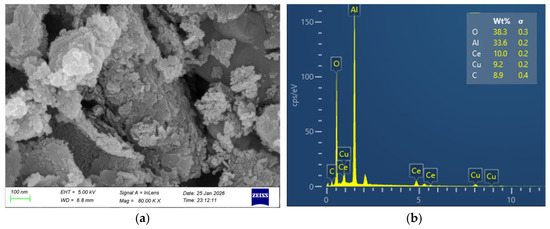
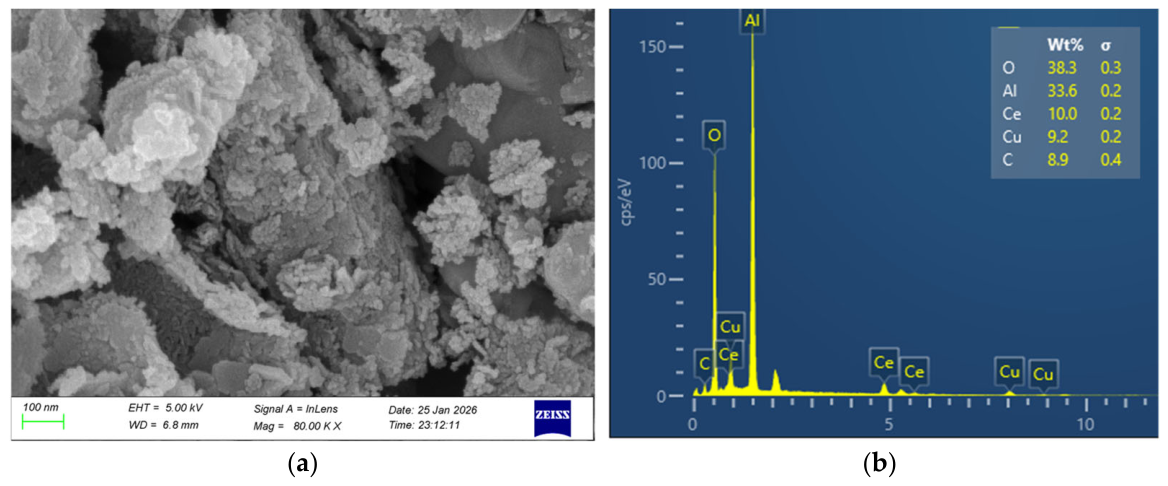
The scanning electron microscopy (SEM) image reveals the surface morphology and particle texture of the synthesized CuCe/Al2O3 catalyst, as shown in Figure 1a. The sample exhibits an irregular, aggregated morphology typical of supported metal oxide catalysts prepared by impregnation method. The Al2O3 support presents a granular structure with a rough surface, which provides a high surface area favorable for copper dispersion. Smaller crystalline features observed on the support surface are attributed to copper oxide species. The copper particles appear to be distributed heterogeneously to moderately uniformly across the alumina matrix. Some degree of agglomeration is visible, likely due to the high copper loading or thermal treatment during calcination. In Figure 1b, the energy-dispersive X-ray spectroscopy (EDS) spectrum confirms the elemental composition of the catalyst. Characteristic peaks corresponding to the elements of the active phase (Cu and Ce) and the support are clearly identified. The absence of extraneous peaks suggests high purity of the synthesized material. The semi-quantitative analysis shows an amount ratio [near 1:1] of Cu and Ce, consistent with the intended catalyst formulation.
Figure 1.
SEM image (a) and corresponding EDS spectrum (b) of the as-prepared catalyst.
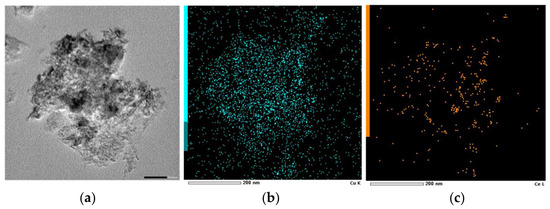
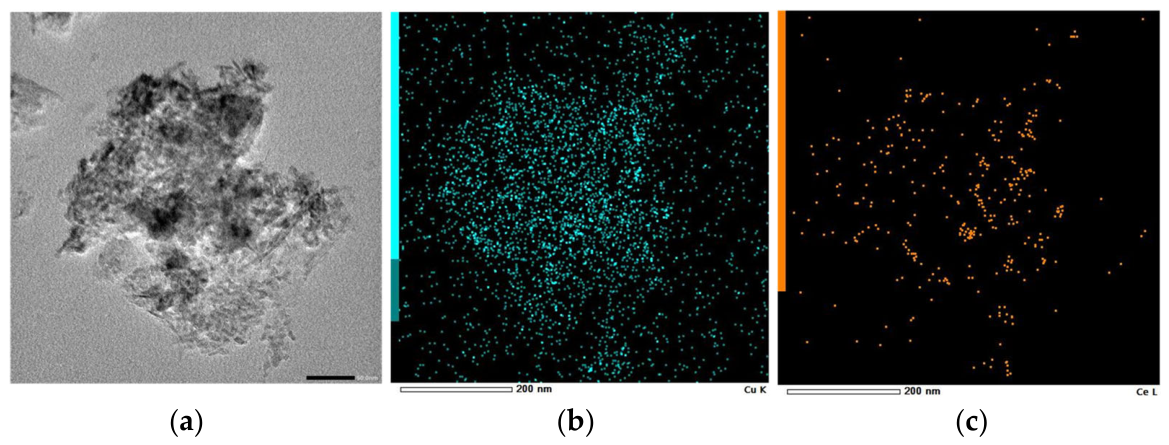
Figure 2 shows the TEM image and corresponding element mapping of the catalyst. As shown in Figure 2a, the TEM image reveals the detailed microstructure and particle morphology of the catalyst. The dark-contrast regions correspond to the loaded catalyst, which are uniformly dispersed on the surface of the lighter-contrast support material. The average particle size of the active species is approximately 100 nm, indicating a high dispersion favorable for catalytic activity. In Figure 2b,c, The EDS elemental maps provide spatial distribution of the key elements. The maps reveal that Cu (green) and Ce (Orange) are homogeneously distributed over the support material. The overlay image demonstrates a strong correlation between the active metal and the support surface, confirming the successful and uniform loading of the catalytic phase without significant agglomeration.
Figure 2.
TEM image (a), and the corresponding elemental mapping of Cu (b) and Ce (c) for the as-prepared catalyst.
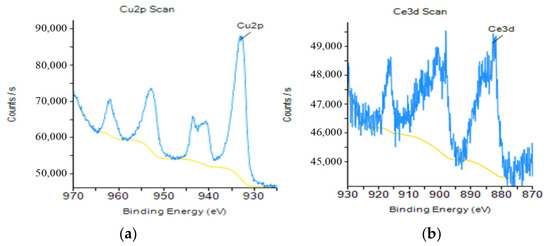
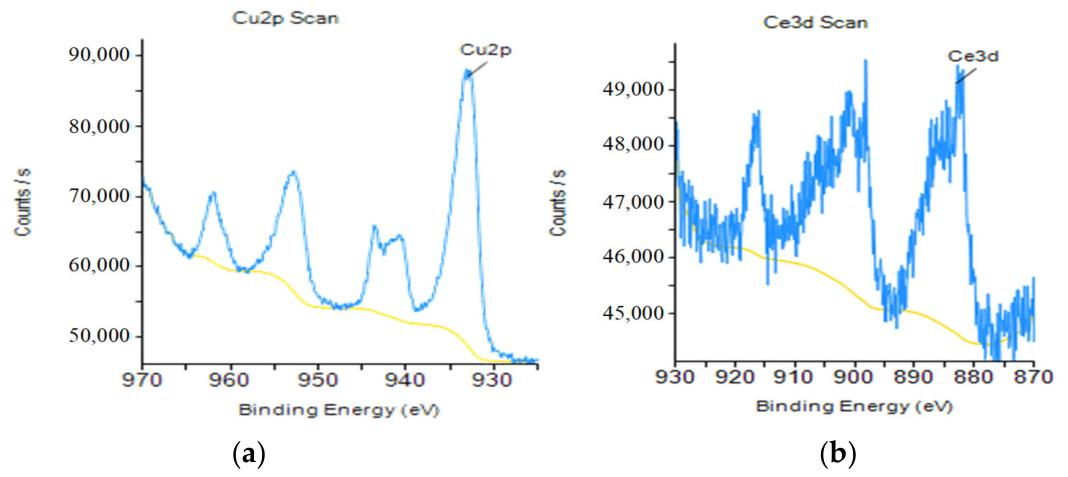
X-ray photoelectron spectroscopy (XPS) was employed to investigate the surface chemical states and electronic interactions of the CuCe/Al2O3 catalyst. The survey spectrum (Figure 3) confirms the presence of Cu and Ceon the catalyst surface, with no detectable impurities. High-resolution XPS spectra of Cu 2p (Figure 3a) exhibit two main peaks at approximately 932.6 eV and 952.5 eV, respectively. The presence of a weak satellite peak at around 942 eV suggests that copper exists predominantly as Cu+ or Cu0 species, with only a minor fraction of Cu2+. For Ce 3d (Figure 3b), the complex spectral featuresindicates the presence of oxygen vacancies, which are known to enhance redox properties and oxygen mobility. Notably, the introduction of Ce into the Cu/Al2O3 system leads to a slight shift in the Cu 2p binding energy (approximately 0.3 eV toward lower energy), suggesting an electronic interaction between Cu and Ce species.These active sites can enhance the oxidation capacity of the catalyst, facilitate the degradation of organic intermediates, and optimize the overall COD removal performance. In addition, the uniform dispersion of Ce active species confirmed by XPS analysis avoids the agglomeration of active sites, which guarantees the stable catalytic activity throughout the two-stage hydrothermal oxidation reaction. Collectively, the modulation of surface chemical states induced by Ce doping/loading plays a critical role in improving the catalytic performance. Overall, the XPS results confirm that copper and cerium are well-dispersed on the Al2O3 surface and that strong Cu–Ce electronic interactions exist, which are expected to enhance the catalytic performance through improved redox behavior and oxygen storage capacity.
Figure 3.
XPS full survey and high-resolution spectra of the as-prepared catalyst: Cu 2p (a) and Ce 3d (b).
3.2. Effects of Reaction Conditions on COD Removal
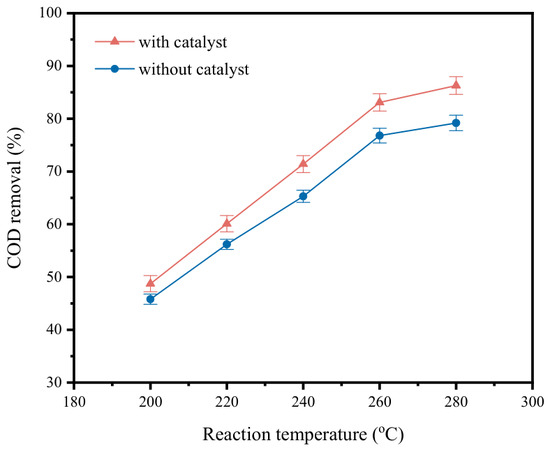
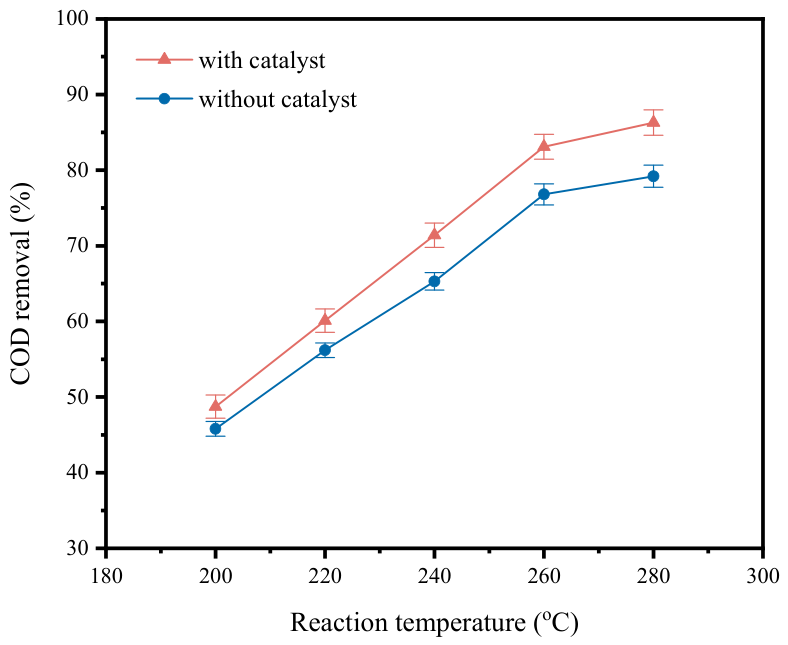
The effect of reaction temperature (ranging from 200 to 280 °C) on the wet oxidation of pharmaceutical wastewater was systematically investigated at a fixed reaction time of 60 min and a catalyst dosage of 5.0 g/L and initial oxygen pressure 1.2 MPa. As illustrated in Figure 4, elevating the temperature markedly accelerated the COD removal process—consistent with the Arrhenius law within the kinetic-controlled regime. When the temperature was below 200 °C, the COD removal efficiency remained relatively low, demonstrating that a high temperature is indispensable for driving the oxidation of refractory pollutants in pharmaceutical wastewater. Theoretically, complete COD removal could be achieved at elevated temperatures provided an adequate oxidant supply. Nevertheless, even at 260 °C for 60 min, the COD abatement was incomplete, with the efficiency merely reaching 70–80%. Previous studies have attributed this phenomenon to the low oxidizability of low-molecular-weight carboxylic acids (e.g., formic acid and acetic acid) under hydrothermal conditions [25]. Additionally, certain byproducts generated during the degradation of organic contaminants resist further oxidation and persist in the treated effluent. Given that wet oxidation serves as a pretreatment strategy for high-strength pharmaceutical wastewater, a temperature of 280 °C was deemed satisfactory for COD removal, balancing energy consumption and treatment efficiency. Consequently, 280 °C was selected as the optimal temperature for all subsequent experiments, while other operating parameters were varied and optimized accordingly.
Figure 4.
Effect of reaction temperature on COD removal efficiency.
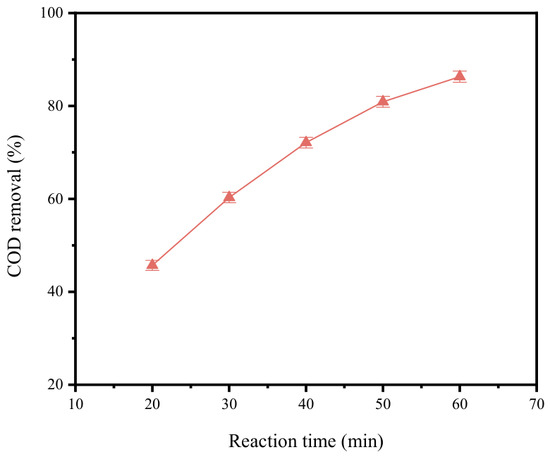
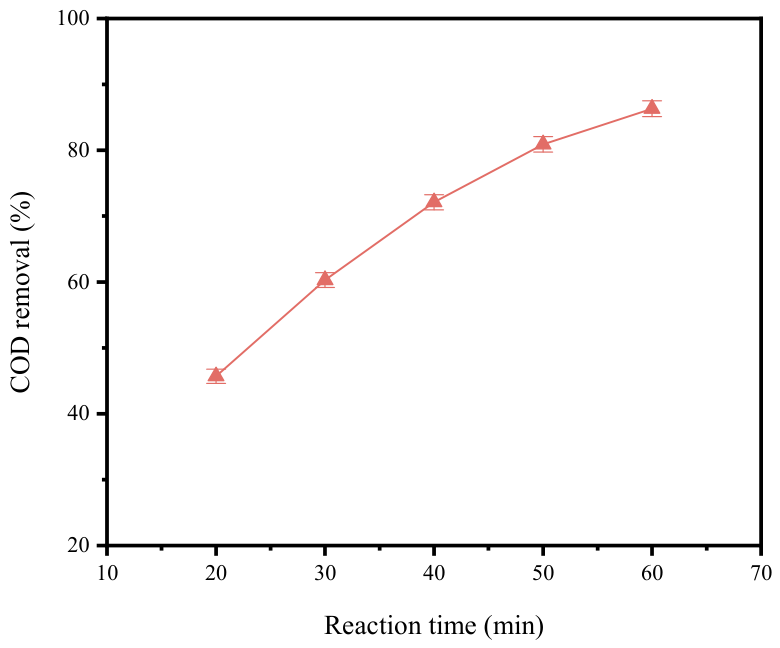
Figure 5 illustrates the effect of reaction time on COD removal at 280 °C, with an initial oxygen pressure of 1.2 MPa and a catalyst dosage of 5.0 g/L. The results demonstrate that the COD removal efficiency was already quite high (exceeding 60%) even at a reaction time of 30 min, indicating that the catalytic wet oxidation process exhibits high reactivity and rapid free radical generation under the tested conditions. This observation is consistent with previous reports, as the wet oxidation process is well known to proceed via a free radical mechanism, where shorter reaction times suffice for initial organic substrate degradation. Notably, for high-concentration organic wastewater, the role of reaction time extends beyond merely accelerating reaction rates: it governs the balance between complete mineralization and the accumulation of refractory intermediates. As the reaction time prolonged from 60 to 120 min, the COD removal efficiency increased gradually but at a diminishing rate. Shan reported that for high-strength wastewater, excessive reaction time not only increases energy consumption but also fails to achieve complete mineralization due to the formation of persistent intermediates [26]. The diminishing return observed in this study further underscores the trade-off between treatment efficiency and energy cost. Given the high concentration of pollutants in the pharmaceutical wastewater, a reaction time of 60 min was deemed sufficient to achieve a reasonable COD removal efficiency, while minimizing operational expenses, which is consistent with industrial practice guidelines for high-concentration organic wastewater pretreatment.
Figure 5.
Effect of reaction timeon COD removal efficiency.
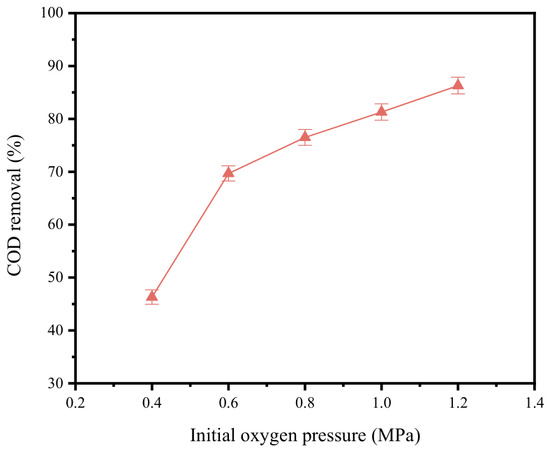
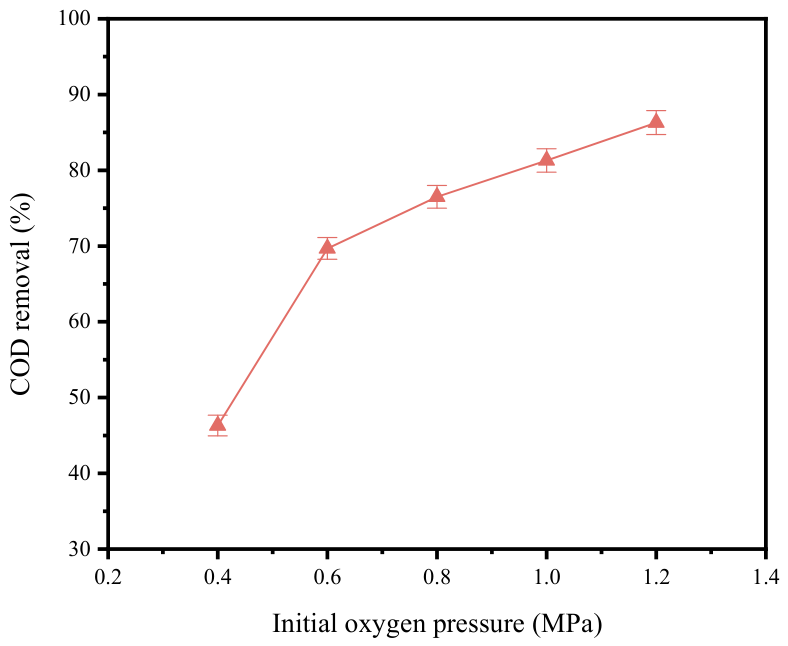
With different initial oxygen pressures (0.4~1.2 MPa), experiments were examined during reactions conducted at 280 °C for 60 min with a catalyst concentration of 5.0 g/L, to investigate the influence of oxygen supply on COD removal efficiency. The theoretical stoichiometric oxygen demand is defined as the oxygen quantity required to fully mineralize all organic pollutants in the wastewater, which is directly correlated with the COD value. As presented in Figure 6, COD removal efficiency increased consistently with increasing oxygen supply, which can be attributed to the fact that the concentration of dissolved oxygen in the aqueous phase is positively proportional to the applied oxygen pressure. Nevertheless, even when the oxygen supply exceeded the theoretical demand for complete mineralization of all contaminants, COD removal efficiency remained stable. This observation can be explained by the fact that COD removal represents the combined contribution of both oxidative reaction and thermolysis [27]. Furthermore, certain intermediate byproducts, particularly low-molecular-weight carboxylic acids such as acetic acid, are recalcitrant to further oxidation under hydrothermal conditions.
Figure 6.
Effect ofoxygen supply on COD removal efficiency.
3.3. Kinetic Analysis
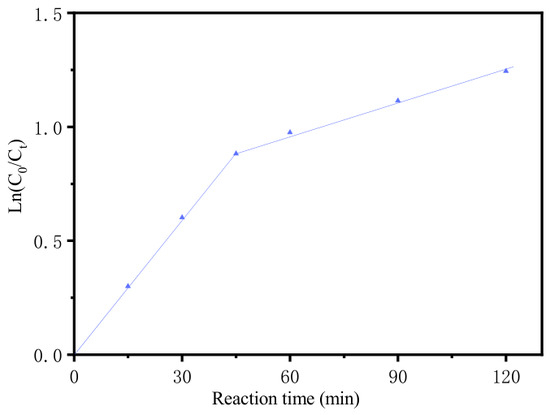
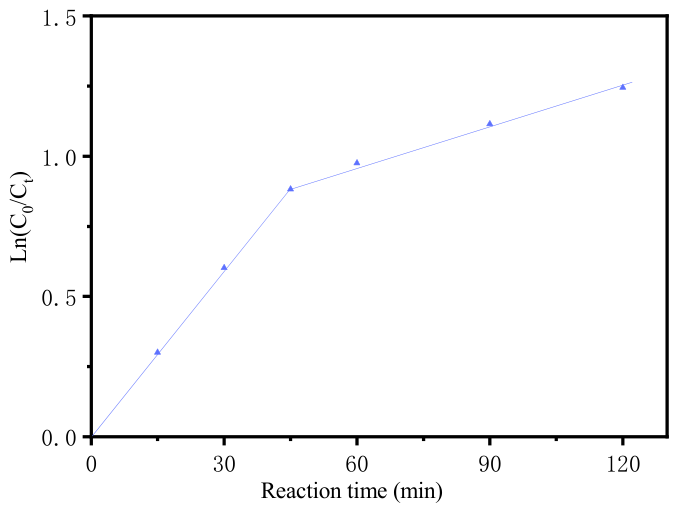
Two kinetic models have been proposed for describing wet oxidation treatment processes [27]. The first model characterizes the wet oxidation of numerous phenolic wastewaters via two consecutive first-order reactions, while the second model employs a generalized kinetic framework to represent the direct oxidation of organic compounds to final end-products. It has been well-documented that acetic acid is generated as an intermediate during wet oxidation, which is resistant to further oxidation into CO2 and H2O [28]. The first-order kinetic equation is expressed as: Ln(Ct/C0) = kt; where C0 and Ct denote the initial COD concentration and the COD concentration at reaction time t, respectively, and k represents the kinetic rate constant.
Kinetic analyses were performed using the experimental data obtained from the catalytic wet oxidation of pharmaceutical wastewater (Figure 7). Figure 7 presents the fitting results of COD removal data using the first-order kinetic model, and the two-step first-order reaction kinetic model was adopted to simulate the experimental process. The kinetic rate constants for each reaction step were derived accordingly. In the first reaction stage, the rate constant k was determined to be −0.0186 min−1 with a high correlation coefficient (R2) of 0.9814. In the second stage, the rate constant k was −0.0041 min−1, accompanied by an R2 value of 0.9736. These results demonstrate that both reaction steps follow apparent first-order reaction kinetics. Consistent with our findings, analogous kinetic behaviors have been reported in previous studies; for example, the oxidation of reactive orange dye and 2,4-dichlorophenol was also well-described by similar kinetic models [29]. Conversely, other investigations have revealed that the oxidation of certain azo dyes follows second-order kinetics, regardless of whether homogeneous or heterogeneous catalytic systems were applied [30]. In the present work, however, the experimental data could not be satisfactorily fitted to a second-order reaction model. Based on the kinetic profiles in Figure 7, it is unequivocally confirmed that both reaction steps in this CWO process obey apparent first-order rate laws. Therefore, as discussed above, low-molecular-weight carboxylic acids (e.g., acetic acid) are recalcitrant to oxidation under hydrothermal conditions. The kinetic analysis further confirms that the COD removal efficiency declines markedly in the later reaction stage, which can be attributed to the continuous accumulation of refractory acetic acid intermediates. Accordingly, the entire reaction process follows a two-stage kinetic evolution pathway. The synthesized catalyst generates abundant reactive oxygen species and oxygen vacancies, which significantly lowers the activation energy of organic oxidation. This catalytic enhancement eliminates the demand for extreme reaction parameters and shortens the hydraulic retention time. Correspondingly, the overall heat supply and aeration power consumption are greatly reduced. From the perspective of operational economy, lower reaction severity and shorter treatment duration directly cut down equipment operating loss and energy expenditure. Furthermore, the stable acetic acid intermediates can serve as an ideal carbon source for subsequent biological treatment processes.
Figure 7.
Kinetic fitting of COD removal efficiency via the first-order kinetic model.
3.4. Rolesof Cu-Ce Bimetallic Catalysis
Compared with conventional single-metal catalysts, the CuCe/Al2O3 catalyst fabricated in this study delivers superior redox capability and reaction pathway selectivity, which is derived from the strong bimetallic synergistic interaction between Cu and Ce species. Recent studies have further validated the synergistic advantages of Cu–Ce bimetallic composites in wastewater remediation. For example, Tang et al. demonstrated that Cu–Ce bimetallic composites could effectively activate peroxymonosulfate for high-efficiency dye degradation [31]. In such catalytic systems, Cu dominates the electron transfer process and triggers the generation of reactive oxygen species (ROS), while Ce induces abundant oxygen vacancies and optimizes metal dispersion to further improve catalytic activity. Zhou et al. adopted Cu/Ce-modified Na-X zeolites for the degradation of tetracycline hydrochloride under mild conditions [32]. In this composite catalyst, Cu serves as the primary active center to promote the formation of hydroxyl radicals, whereas Ce improves light absorption and thermal conversion efficiency, thereby enhancing the overall catalytic performance. Sun et al. investigated the catalytic ozonation performance of Cu–Ce@γ-Al2O3 toward organic wastewater [33]. In the ozonation system, Cu initiates ozone decomposition to generate reactive oxidative intermediates, and Ce optimizes the electronic structure and oxygen storage capacity of the catalyst, collectively improving ozone utilization and pollutant degradation efficiency. Similarly, Meng et al. employed Cu–Ce modified γ-Al2O3 for the catalytic ozonation of polar antibiotics [34]. The results indicated that Cu accelerates ozone dissociation to produce oxidative free radicals for antibiotic oxidation, while Ce stabilizes the active sites and optimizes interfacial electron transfer pathways. Generally, these studies confirm that the intrinsic synergistic effect between Cu and Ce prominently improves the degradation and mineralization performance of organic contaminants. Nevertheless, the in-depth reaction mechanism of Cu–Ce bimetallic catalytic systems still requires further exploration.
For the catalytic wet oxidation of pharmaceutical wastewater over the prepared CuCe composite catalyst in this study, the enhancement mechanism was assumed as two aspects. On the one hand, the synergistic coupling between Cu and Ce active sites continuously accelerates the generation and activation of ROS, which acts as the dominant oxidants to destroy the molecular skeleton of refractory antibiotic pollutants. On the other hand, the reversible valence cycling and interfacial electron transfer of multivalent Cu and Ce species construct a stable redox circulation system. This favorable redox behavior accelerates the regeneration of active sites, mitigates catalyst deactivation, and remarkably improves the mineralization efficiency of organic pollutants. Consequently, the dual synergistic effects endow the CuCe bimetallic catalyst with excellent catalytic capability, realizing the efficient elimination of antibiotic contaminants from pharmaceutical wastewater.
Moreover, it is noteworthy that acetate-dominated volatile fatty acids generated from the wet oxidation of pharmaceutical wastewater exhibit superior biodegradability. These volatile fatty acids can be efficiently utilized as alternative external carbon sources for biological denitrification, presenting higher carbon utilization efficiency relative to conventional carbon substrates [35]. Accordingly, the Cu-Mn/Al2O3 catalytic wet oxidation process serves not only as an efficient technique for the abatement of pharmaceutical wastewater contaminants but also as a feasible strategy for the selective recovery of acetate-rich VFAs as high-value biodegradable carbon resources. This innovative approach achieves the dual purposes of pollutant elimination and carbon resource recycling, thereby advancing the treatment of pharmaceutical wastewater from simple volume reduction to integrated pollutant removal and resource valorization.
4. Conclusions and Outlook
In this study, a CuCe/Al2O3 catalyst synthesized via co-impregnation was successfully employed for the catalytic wet oxidation of highly concentrated antibiotic pharmaceutical wastewater. Under moderate operating conditions (280 °C, 60 min, 1.2 MPa O2, and 5.0 g/L catalyst), a remarkable COD removal efficiency of 86.3% was attained, verifying the outstanding catalytic performance of the synthesized catalyst. The superior activity is mainly ascribed to the strong synergistic effect between Cu and Ce species, as well as their high dispersion on the support. Kinetic investigations further revealed that the oxidation process conforms to a first-order kinetic model involving two consecutive reaction stages. Overall, the developed process represents an effective and promising approach for the treatment of pharmaceutical wastewater.
While this work validates the excellent batch degradation performance of the prepared catalyst toward pharmaceutical wastewater treatment, several limitations impede its practical translation. Resolving the bottle necks in continuous-flow catalyst stability, intermediate toxicity evaluation, and scalable mass transfer optimization will bridge the gap between lab-scale findings and practical water remediation applications of this catalytic system. Furthermore, accumulating literature has demonstrated that catalytic wet air oxidation effluents are rich in acetate-dominated volatile fatty acids, which hold great potential as alternative carbon sources for subsequent biological wastewater treatment. Therefore, future work should conduct exhaustive compositional analysis of oxidized effluents and evaluate the technical feasibility of carbon source utilization. These prospective explorations favor the simultaneous achievement of efficient wastewater purification and recycled carbon resource utilization.
Author Contributions
X.Z.: conceived and designed the experiments; S.C.: performed the experiments and analyzed the data; X.Z.: contributed reagents/materials/analysis tools; X.Z. and H.L.: wrote the paper. All authors have read and agreed to the published version of the manuscript.
Funding
The authors gratefully acknowledge the financial support from the National Natural Science Foundation of China (51978499).
Data Availability Statement
The data presented in this study are available on request from the corresponding authors.
Conflicts of Interest
The authors declare no conflicts of interest.
References
- Zwiener, C.; Frimmel, F. Oxidative treatment of pharmaceuticals in water. Water Res. 2000, 34, 1881–1885. [Google Scholar] [CrossRef] [Scilit]
- Jelic, M.; Gros, A. Occurrence, partition and removal of pharmaceuticals in sewage water and sludge during wastewater treatment. Water Res. 2011, 45, 1165–1176. [Google Scholar] [CrossRef] [Scilit] [PubMed]
- Zeng, X.; Liu, J.; Zhao, J. Wet oxidation and catalytic wet oxidation of pharmaceutical sludge. Sci. Rep. 2023, 13, 2544. [Google Scholar] [CrossRef] [Scilit] [PubMed]
- Adeoye, J.B.; Tan, Y.H.; Lau, S.Y.; Tan, Y.Y.; Chiong, T.; Mubarak, N.M.; Mubarak, M. Advanced oxidation and biological integrated processes for pharmaceutical wastewater treatment: A review. J. Environ. Manag. 2024, 353, 120170. [Google Scholar] [CrossRef] [Scilit]
- Garcia, J.; Rodriguez, M.; Sanchez, A. Catalytic wet air oxidation of organics-laden wastewater: In situ catalyst regeneration and process scale-up. Environ. Sci. Water Res. Technol. 2024, 12, 1123–1132. [Google Scholar]
- Meng, S. Photocatalytic Materials and Photocatalytic Reactions. Molecules 2025, 30, 269. [Google Scholar] [CrossRef] [Scilit] [PubMed]
- Wen, B.; Zhang, M.; Lin, Y.; Yang, J.; Lv, J.; Han, N.; Xie, J.; Jia, H.; Su, B.; Roeffaers, M.; et al. Photo-assisted technologies for environmental remediation. Nat. Rev. Clean. Technol. 2025, 1, 201–215. [Google Scholar] [CrossRef] [Scilit]
- Liu, C.; Wang, L.; Zhang, Y. The catalytic wet air oxidation of pharmaceutical wastewater with alkali-activated Mn and Cu composites. J. Clean. Prod. 2024, 432, 139945. [Google Scholar]
- Xu, Z.; Liu, J.; Zhao, J. Catalytic wet oxidation of high concentration pharmaceutical wastewater with Fe3+ as catalyst. Water Sci. Technol. 2017, 3, 661–666. [Google Scholar]
- Wang, Y.; Li, J.; Zhang, H. Enhanced activity and stability of copper oxide/γ-alumina catalyst in catalytic wet-air oxidation: Critical roles of cerium incorporation. J. Environ. Chem. Eng. 2023, 11, 109876. [Google Scholar]
- Ma, P.F.; Zhang, N.W.; Sun, J.Z. Oxygen activation and transfer for catalytic wet-air oxidation of wastewater: A short review. RSC Adv. 2024, 14, 40141–40159. [Google Scholar] [CrossRef] [Scilit]
- Wang, G.W.; Wang, D.; Xu, X.C.; Liu, L.F.; Yang, F.L. Wet air oxidation of pretreatment of pharmaceutical wastewater by Cu2+ and [PxWmOy]q- catalyst system. J. Hazard. Mater. 2012, 217, 366–373. [Google Scholar] [PubMed]
- Cybulski, A. Catalytic wet air oxidation: Are monolithic catalysts and reactors feasible? Ind. Eng. Chem. Res. 2007, 46, 4007–4033. [Google Scholar] [CrossRef] [Scilit]
- Zhang, W.M.; Zhuang, H.M.; Guo, Y. Wet peroxide oxidation process catalyzed by Cu/Al2O3: Phenol degradation and Cu2+ dissolution behavior. Environ. Sci. Pollut. Res. Int. 2024, 31, 26916–26927. [Google Scholar] [PubMed]
- Gosu, V.; Dhakar, A.; Zhang, C. Using innovative copper-loaded activated alumina (Cu/AA) as the catalyst for catalytic wet peroxidation (CWPO) of catechol. Environ. Sci. Pollut. Res. 2023, 9, 40576–40587. [Google Scholar]
- Chu, S.; Zeng, X.; Lin, H.; Zhu, Y. High-Performance Catalytic wet oxidation of excess activated sludge derived from pharmaceutical wastewater treatment process over a Cu/-Al2O3 catalyst. Water 2023, 15, 3494. [Google Scholar]
- Li, Y.Z.; Fan, Z.Y.; Shi, J.W.; Liu, Z.Y.; Zhou, J.W.; Shangguan, W.F. Catalytic oxidation of low concentration formaldehyde with the assist of ozone over supported cobalt-manganese composite oxides. J. Mol. Catal. 2014, 1, 60–66. [Google Scholar]
- Chou, B.; Tsai, J.L.; Cheng, S. Cu-substituted molecular sieves as liquid phase oxidation catalysts. Microp. Mesop. Mater. 2001, 48, 309–317. [Google Scholar] [CrossRef] [Scilit]
- Taran, O.P.; Zagoruiko, A.N.; Ayusheev, A.B.; Yashnik, S.A.; Prihod’ko, R.V.; Ismagilov, Z.R. Cu and Fe-containing ZSM-5 zeolitesas catalysts for wet peroxide oxidation of organic contaminants: Reaction kinetics. Res. Chem. Intermed. 2015, 41, 9521–9537. [Google Scholar]
- Ma, W.; Zhang, S.; Deng, L. Cu-based perovskite as a novel CWPO catalyst for petroleum refining wastewater treatment: Performance, toxicity and mechanism. J. Hazard. Mater. 2023, 448, 130824. [Google Scholar] [CrossRef] [Scilit] [PubMed]
- Zhou, B.; Zhang, X.; Wang, P. Catalytic performance and insight into the mechanism of CeO2 nanorod catalysts in phenol ozone oxidation reaction. Ceram. Inter. 2024, 50, 394–402. [Google Scholar]
- Chu, S.; Lin, H.; Zeng, X. The Treatment of Antibiotic Excess Sludge via Catalytic Wet Oxidation with Cu-Ce/γ-Al2O3 and the Production of a Carbon Source. Water 2024, 16, 1249. [Google Scholar]
- Li, Y.; Shi, L.; Jiao, Z. Activation and stabilization of the Cu species via strong CuO-CeO2 interactions for enhanced decomposition of refractory aromatic organic pollutants in water. Sep. Purif. Technol. 2024, 334, 126105. [Google Scholar]
- Liu, Y.; Qi, H.; Zhang, J. Efficient electro-Fenton degradation of pollutants via the synergistic effect of Lewis acid sites and oxygen vacancies on Cu2O/CeO2 electro catalysts. Appl. Surf. Sci. 2025, 711, 164026. [Google Scholar]
- Jin, F.M.; Zeng, X.; Jing, Z.Z.; Enomoto, H. A potentiallly useful technology by mimicking nature by rapid conversion of biomass and CO2 into chemicals and fuels under hydrothermal conditions. Ind. Eng. Chem. Res. 2012, 51, 9921–9937. [Google Scholar]
- Shan, H.; Oh, R.; Fan, J. Developing Pt-M/C catalyst (M = Pb, Cu) for efficient catalytic wet air oxidation of phenol wastewater under mild conditions. J. Environ. Chem. Eng. 2023, 11, 109854–109863. [Google Scholar]
- Li, L.; Chen, P.; Gloyna, E.F. Generalized Kinetics Model for Wet Oxidation of Organic Compounds. AIChE J. 1991, 37, 1687–1697. [Google Scholar] [CrossRef] [Scilit]
- Mishra, V.S.; Mahajani, V.V.; Joshi, J.B. Wet Air Oxidation. Ind. Eng. Chem. Res. 1995, 34, 2–48. [Google Scholar] [CrossRef] [Scilit]
- Momani, F.; Sans, C.; Esplugas, S. A comparative study of the advanced oxidation of 2,4-dichlorophenol. J. Hazard. Mater. 2024, 107, 123–129. [Google Scholar]
- Zhang, G.; Wang, S.; Zhao, S.; Fu, L.; Chen, G.; Yang, F. Oxidative degradation of azo dye by hydrogen peroxide electrogenerated in situ on anthraquinonemonosulphonate/polypyrrole composite cathode with heterogeneous CuO/γ-Al2O3 catalyst. Appl. Catal. B Environ. 2011, 106, 370–378. [Google Scholar]
- Tang, X.; Huang, J.; Li, W.; Zhou, Z.; Yang, Y.; Liu, Z. Low-cost chrysotile-supported Cu-Ce bimetallic catalyst for efficient peroxymonosulfate activation: Singlet oxygen-driven dye degradation. Cryst. Eng. Comm. 2015, 17, 7069–7077. [Google Scholar]
- Zhou, M.; Zheng, D.; Yang, K.; Hu, L.F.; Zhang, Z.B. Insight into the photothermal Fenton-like degradation of tetracycline hydrochloride by Cu/Ce modified Na-X zeolites: Performance, mechanism, and degradation pathways. J. Water Process Eng. 2022, 47, 102678. [Google Scholar]
- Sun, W.Q.; Wang, Y.; Yang, X.W.; Wang, Z.R.; Zhu, H.Q.; Zhou, J.; Sun, Y.J. Catalytic ozone oxidation of chemical RO membrane concentrate wastewater by a Cu-Ce@γ-Al2O3 ozone catalyst. Water Environ. Res. 2020, 92, 1579–1588. [Google Scholar]
- Meng, Q.T.; Li, Z.W.; Wan, C.L.; Wu, C.Y.; Liu, X. Catalytic ozonation treatment of polar antibiotics with Cu-Ce modified γ-Al2O3 catalysts: pH effects and removal mechanism. Environ. Eng. Sci. 2021, 38, 411–421. [Google Scholar]
- Heponiemi, A.; Azalim, S.; Hu, T.; Vielma, T.; Lassi, U. Efficient removal of bisphenol A from wastewaters: Catalytic wet air oxidation with Pt catalysts supported on Ce and Ce-Ti mixed oxides. AIMS Mater. Sci. 2019, 6, 25–44. [Google Scholar]
Disclaimer/Publisher’s Note: The statements, opinions and data contained in all publications are solely those of the individual author(s) and contributor(s) and not of MDPI and/or the editor(s). MDPI and/or the editor(s) disclaim responsibility for any injury to people or property resulting from any ideas, methods, instructions or products referred to in the content. |
© 2026 by the authors. Licensee MDPI, Basel, Switzerland. This article is an open access article distributed under the terms and conditions of the Creative Commons Attribution (CC BY) license.