A Two-Stage Distribution Network Planning Study on Coordinating the Optimization of Economic Efficiency and Reliability

Abstract
1. Introduction
- (1)
- Develop a differentiated reliability evaluation system and power supply zoning method tailored to diverse load characteristics. To address the varying sensitivity to power outages among different load types, an evaluation matrix is constructed by integrating metrics such as average service availability index (ASAI), system average interruption frequency index (SAIFI), and fragmented customer average interruption duration index (FCAIDI). Based on this, a refined division of power supply areas is achieved by integrating load characteristics and geographic coordinates through an improved K-means clustering algorithm.
- (2)
- A two-stage distribution network planning model is established that balances investment cost-effectiveness with differentiated reliability requirements. Considering regional variations in reliability needs, a planning model is developed with the objective of jointly optimizing investment, operation, and maintenance costs alongside outage losses. The BPSO algorithm is employed to solve the two-stage model.
- (3)
- The effectiveness and superiority of the proposed model and algorithm were validated using actual engineering case studies. Simulation analyses were conducted using a real distribution network in a specific area of Tianjin. Through comparative analysis, the advantages of the proposed zoning strategy and planning model in enhancing the power supply reliability for critical users and optimizing overall return on investment were verified.
2. Materials and Methodology
2.1. Differentiated Reliability Evaluation Metrics
2.2. Power Supply Area Delineation Based on Load Clustering
- (1)
- Similarity Measures
- (2)
- Characterization of Load Attributes
- (3)
- Partitioning and Clustering Process Based on the K-Means Algorithm
2.3. Two-Stage Network Planning Model for Distribution Network
2.3.1. Mathematical Model for Network Optimization
2.3.2. Constraints
- (1)
- Differentiated Constraints:
- (2)
- Common Constraints:
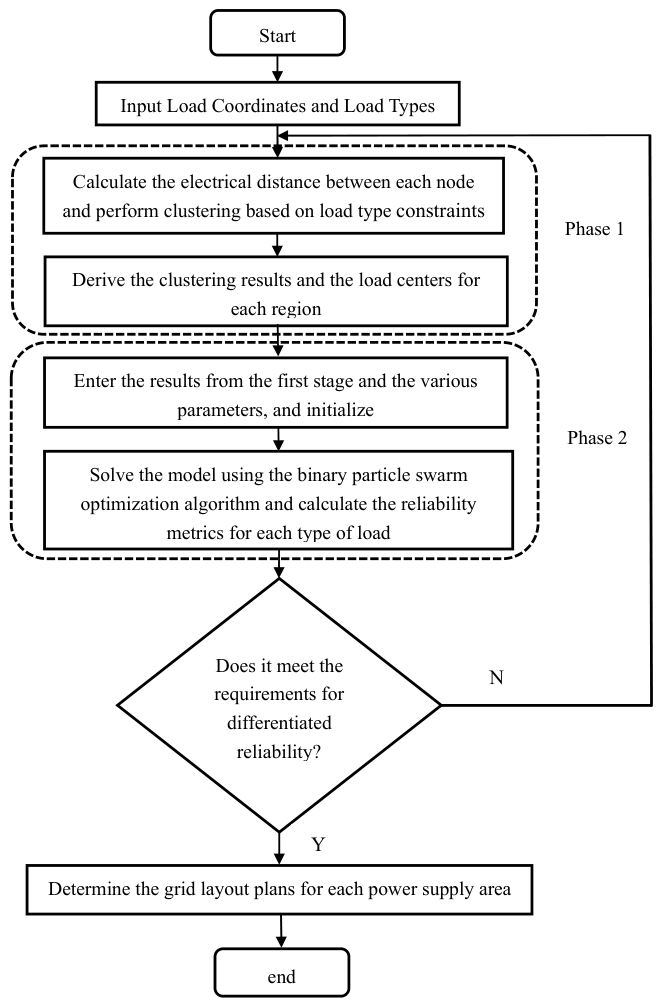
2.3.3. Model Solving Process
- First Phase: Load Partitioning Based on the Improved K-Means Algorithm
- Second Phase: BPSO-Based Network Optimization
3. Simulation Analysis
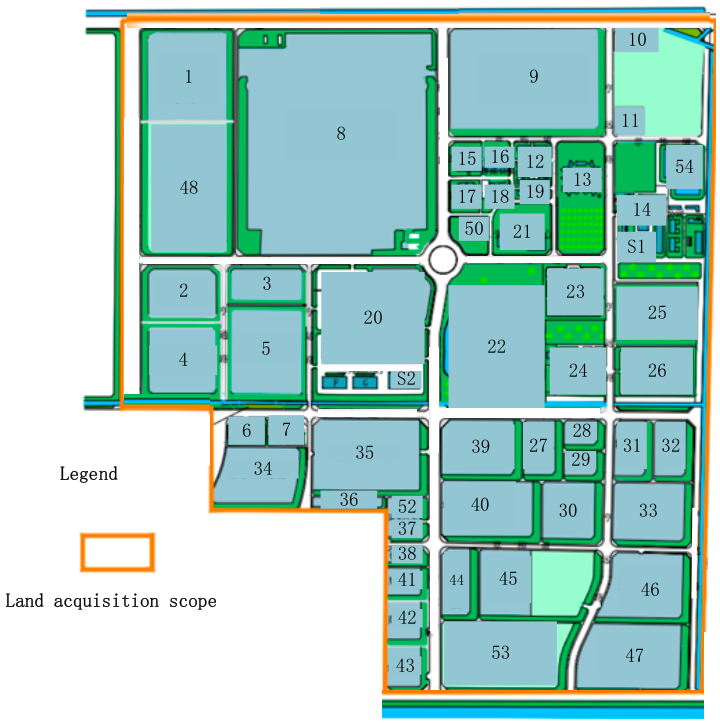
3.1. Case Study Setup
3.2. Results and Analysis of the Case Study
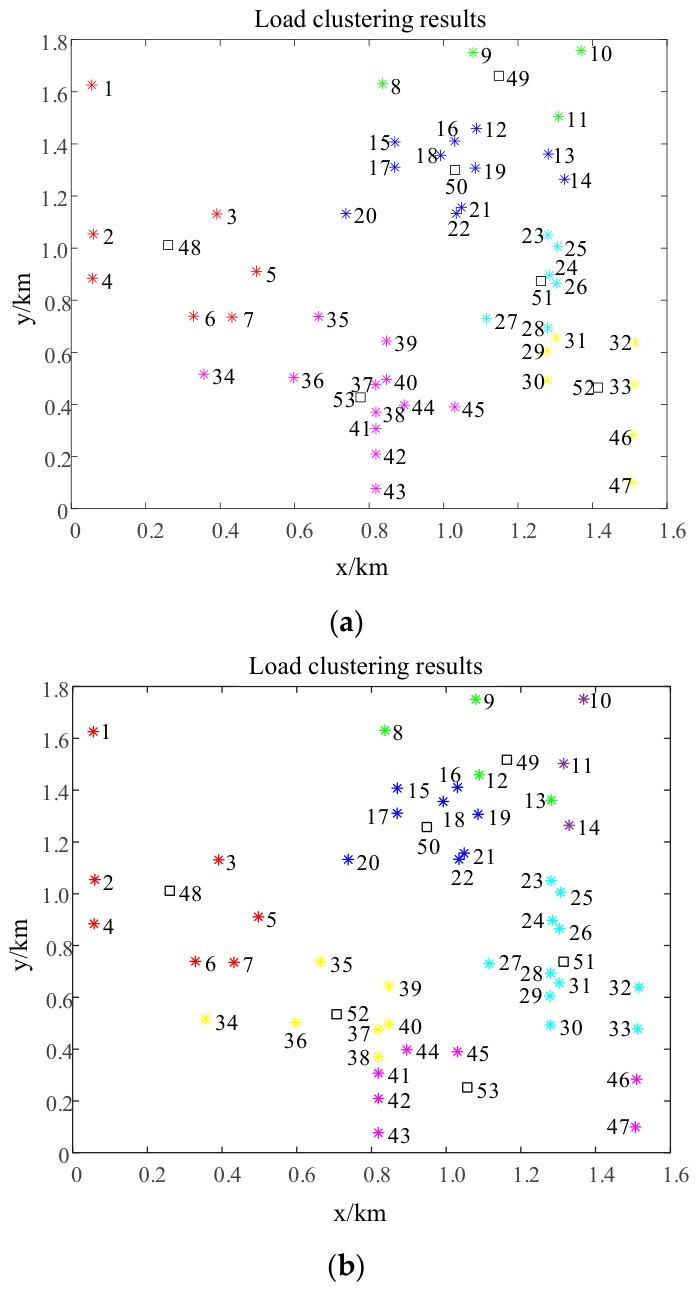
3.2.1. Clustering of Power Supply Areas
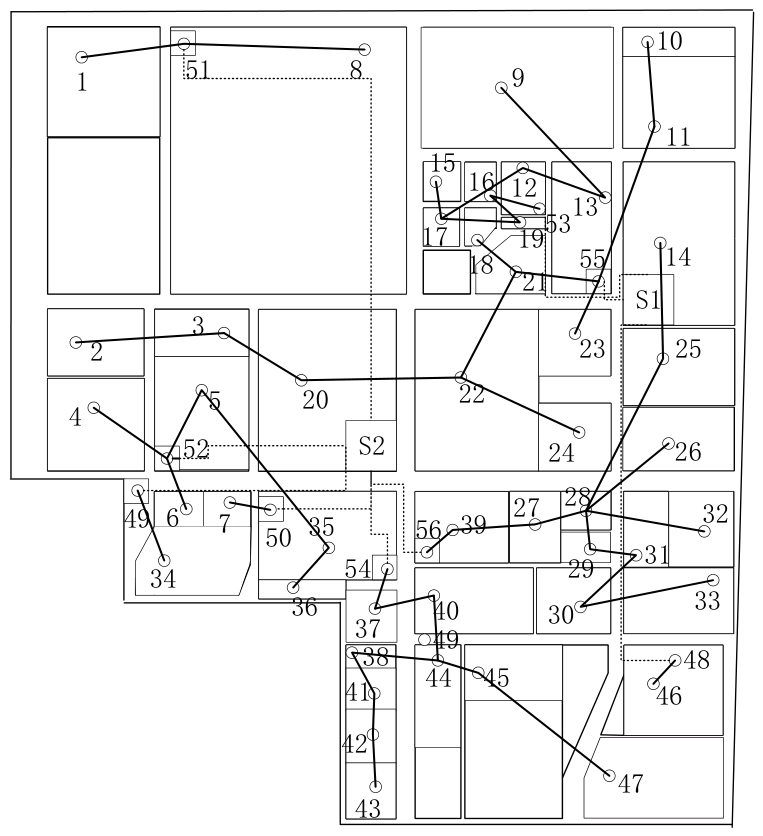
3.2.2. Analysis of the Network Planning Results
4. Conclusions
- (1)
- Precise alignment between user demand and network planning is achieved. By constructing a load zoning model based on improved K-means clustering that integrates geographic location information with load attribute characteristics, the method overcomes the limitations of traditional uniform zoning schemes. It enables the delineation of refined power supply zones with similar electricity consumption characteristics and concentrated spatial distribution, thereby providing a basis for subsequent distribution network planning.
- (2)
- A coordinated optimization mechanism that balances economic benefits and power supply reliability was established. Building on mature penalty optimization principles, the model minimizes investment, operation, and maintenance costs as well as line loss costs while incorporating outage loss costs that account for differentiated preferences. Comparative analysis demonstrates that the proposed method effectively optimizes key reliability indicators of the distribution network while ensuring the system’s total cost is minimized, thereby achieving a coordinated optimization of economic benefits and power supply reliability.
- (3)
- The effectiveness of differentiated constraints in improving system power supply quality has been verified. Simulation results indicate that applying differentiated reliability constraints across different zones can effectively guide the distribution network toward a scientifically sound and reasonable spatial layout. Although this approach may initially result in a slight increase in local line investment, it significantly reduces potential economic losses by precisely mitigating the risk of power outages for high-value users. Consequently, it enhances the overall power supply reliability and comprehensive operational efficiency of the regional distribution network, demonstrating strong practical applicability for engineering implementation.
Author Contributions
Funding
Data Availability Statement
Conflicts of Interest
References
- Li, W.; Sui, W.; Cheng, L.; Ji, Y.; Guo, Y.; Zhu, J. Quantifying seasonal demand-side flexibility in residential air conditioning under diverse control strategies. Energy Build. 2026, 352, 116764. [Google Scholar] [CrossRef]
- Liu, J.; Hou, Z.; Wang, B.; Yin, T. Optimizing Microgrid Energy Management via DE-HHO Hybrid Metaheuristics. Comput. Mater. Contin. 2025, 84, 4729–4754. [Google Scholar] [CrossRef]
- Liu, J.; Hou, Z.; Yin, T. Short-term power load forecast using OOA optimized bidirectional long short-term memory network with spectral attention for the frequency domain. Energy Rep. 2024, 12, 4891–4908. [Google Scholar]
- Luo, X.; Wang, J.; Dooner, M.; Clarke, J. Overview of current development in electrical energy storage technologies and the application potential in power system operation. Appl. Energy 2015, 137, 511–536. [Google Scholar] [CrossRef]
- Eajal, A.A.; Shaaban, M.F.; Ponnambalam, K.; El-Saadany, E.F. Stochastic Centralized Dispatch Scheme for AC/DC Hybrid Smart Distribution Systems. IEEE Trans. Sustain. Energy 2016, 7, 1046–1059. [Google Scholar] [CrossRef]
- Huang, J.; Jiang, C.; Xu, R. A review on distributed energy resources and MicroGrid. Renew. Sustain. Energy Rev. 2008, 12, 2472–2483. [Google Scholar] [CrossRef]
- Oree, V.; Hassen, S.Z.S.; Fleming, P.J. Generation expansion planning optimisation with renewable energy integration: A review. Renew. Sustain. Energy Rev. 2017, 69, 790–803. [Google Scholar] [CrossRef]
- Colmenar-Santos, A.; Reino-Rio, C.; Borge-Diez, D.; Collado-Fernández, E. Distributed generation: A review of factors that can contribute most to achieve a scenario of DG units embedded in the new distribution networks. Renew. Sustain. Energy Rev. 2016, 59, 1130–1148. [Google Scholar] [CrossRef]
- Zhang, L.; Xu, Z.; Liu, Y.; Li, K.; Ma, J.; Simayi, X. Distribution network planning framework based on digital twin simulation incorporating scaled electric heating loads. Energy Rep. 2026, 15, 109172. [Google Scholar] [CrossRef]
- Wang, L.; Sun, Q.; Wang, X.; Shi, T.; Yang, X.; Xu, H. Low carbon planning of flexible distribution network considering orderly charging and discharging of EV. Electr. Power Syst. Res. 2025, 244, 111546. [Google Scholar] [CrossRef]
- Li, J.; Li, F.; Sun, K.; Sun, B. Bi-level coordinated expansion planning of high-PV-penetration active distribution networks incorporating multiple flexible resources considering WGAN-GP-based uncertainty generation. Energy 2025, 330, 136685. [Google Scholar] [CrossRef]
- Li, J.; Li, J.; Wang, D.; Mao, C.; Guan, Z.; Liu, Z.; Du, M.; Qi, Y.; Wang, L.; Liu, W.; et al. Hierarchical and partitioned planning strategy for closed-loop devices in low-voltage distribution network based on improved KMeans partition method. Energy Rep. 2023, 9, 477–485. [Google Scholar] [CrossRef]
- Martínez, M.; Mateo, C.; Gómez, T.; Alonso, B.; Frías, P. A hybrid particle swarm optimization approach for explicit flexibility procurement in distribution network planning. Int. J. Electr. Power Energy Syst. 2024, 161, 110215. [Google Scholar] [CrossRef]
- Liu, W.; Gao, X.; Liu, C.; Shi, Q. Reliability-constrained Bi-level collaborative planning of distribution network and micro-energy grid. Int. J. Electr. Power Energy Syst. 2023, 152, 109199. [Google Scholar] [CrossRef]
- Esmaeilzadeh, Z.; Falaghi, H.; Ramezani, M. Reliability-oriented AC/DC hybrid distribution network planning: A risk-constrained approach. Renew. Energy Focus 2026, 56, 100790. [Google Scholar] [CrossRef]
- Hamidan, M.A.; Borousan, F. Optimal planning of distributed generation and battery energy storage systems simultaneously in distribution networks for loss reduction and reliability improvement. J. Energy Storage 2022, 46, 103844. [Google Scholar] [CrossRef]
- Adefarati, T.; Bansal, R.C. Reliability assessment of distribution system with the integration of renewable distributed generation. Appl. Energy 2017, 185, 158–171. [Google Scholar] [CrossRef]
- Tabares, A.; Muñoz-Delgado, G.; Franco, J.F.; Arroyo, J.M.; Contreras, J. Multistage reliability-based expansion planning of ac distribution networks using a mixed-integer linear programming model. Int. J. Electr. Power Energy Syst. 2022, 138, 107916. [Google Scholar] [CrossRef]



| Load | Position Coordinates | Power/MW | Load Type |
|---|---|---|---|
| 1 | (51.2,1512) | 1.7 + j * 1.0536 | (0,1,0) |
| 2 | (54.9286,980.3762) | 2.125 + j * 1.317 | (0,1,0) |
| 3 | (363.4,1051.9) | 0.85 + j * 0.5268 | (0,1,0) |
| 4 | (53.1551,822.3116) | 1.1433 + j * 0.7085 | (0,1,0) |
| 5 | (462.3830,847.0412) | 1.275 + j * 0.7902 | (0,1,0) |
| 6 | (305.4911,687.2142) | 0.2678 + j * 0.1659 | (0,1,0) |
| 7 | (401.5656,683.5891) | 0.51 + j * 0.3161 | (0,1,0) |
| 8 | (777.4,1516.5) | 1.6065 + j * 0.9956 | (1,1,0) |
| 9 | (1003.6,1628.1) | 0.765 + j * 0.474 | (1,1,0) |
| 10 | (1273.6,1634.8) | 0.1275 + j * 0.079 | (0,0,1) |
| 11 | (1217.7,1399.6) | 0.268 + j * 0.166 | (0,0,1) |
| 12 | (1012.1,1356.7) | 0.5355 + j * 0.332 | (1,1,0) |
| 13 | (1191.6,1265.9) | 0.7225 + j * 0.4478 | (1,1,0) |
| 14 | (1232.0,1175.9) | 1.751 + j * 1.085 | (0,0,1) |
| 15 | (808.3,1308.7) | 0.68 + j * 0.4214 | (1,0,0) |
| 16 | (957.9,1312.1) | 0.51 + j * 0.316 | (1,0,0) |
| 17 | (807.9,1218.9) | 0.51 + j * 0.316 | (1,0,0) |
| 18 | (922.6,1261.1) | 0.17 + j * 0.1054 | (1,0,0) |
| 19 | (1009.3,1215.5) | 0.255 + j * 0.158 | (1,0,0) |
| 20 | (686.0,1052.8) | 0.68 + j * 0.4214 | (1,0,0) |
| 21 | (974.4,1075.6) | 0.5355 + j * 0.3319 | (1,0,0) |
| 22 | (961.8,1053.7) | 0.5355 + j * 0.3319 | (1,0,0) |
| 23 | (1190.7,976.9) | 1.071 + j * 0.664 | (0,1,0) |
| 24 | (1194.2,834.7) | 0.2677 + j * 0.166 | (0,1,0) |
| 25 | (1214.8,935.6) | 1.186 + j * 0.735 | (0,1,0) |
| 26 | (1212.0,804.5) | 0.17 + j * 0.1054 | (0,1,0) |
| 27 | (1036.9,679) | 1.071 + j * 0.663 | (0,1,0) |
| 28 | (1190.1,644.9) | 0.34 + j * 0.211 | (0,1,0) |
| 29 | (1188.3,562.8) | 0.34 + j * 0.211 | (0,1,0) |
| 30 | (1189.2,458.7) | 1.105 + j * 0.685 | (0,1,0) |
| 31 | (1211.3,609.9) | 0.2125 + j * 0.1317 | (0,1,0) |
| 32 | (1409.3,594.3) | 0.2677 + j * 0.166 | (0,1,0) |
| 33 | (1406.5,445.3) | 1.025 + j * 0.624 | (0,1,0) |
| 34 | (330.8717,479.8409) | 0.17 + j * 0.1054 | (0,1,0) |
| 35 | (617.2922,685.4016) | 0.85 + j * 0.6 | (0,1,0) |
| 36 | (555.6536,468.0727) | 2.5925 + j * 1.6067 | (0,1,0) |
| 37 | (760.4926,442.7116) | 0.5455 + j * 0.3319 | (0,1,0) |
| 38 | (761.0032,344.2934) | 0.68 + j * 0.4214 | (0,1,0) |
| 39 | (787.4561,598.5424) | 0.34 + j * 0.2107 | (0,1,0) |
| 40 | (787.4561,461.6622) | 0.68 + j * 0.4214 | (0,1,0) |
| 41 | (761.0032,285.9192) | 0.136 + j * 0.084 | (0,1,0) |
| 42 | (760.8832,194.6127) | 0.268 + j * 0.166 | (0,1,0) |
| 43 | (760.8832,71.9560) | 0.268 + j * 0.166 | (0,1,0) |
| 44 | (831.8171,369.7643) | 1.598 + j * 0.99 | (0,1,0) |
| 45 | (957.7493,363.2338) | 2.04 + j * 1.264 | (0,1,0) |
| 46 | (1403.7,264) | 2.932 + j * 1.817 | (0,1,0) |
| 47 | (1400.9,92.5) | 0.425 + j * 0.263 | (0,1,0) |
| Region | Planning Results for Scheme 1 | Reliability Indices | |||
|---|---|---|---|---|---|
| Time-BasedCAIDI | Frequency-BasedSAIFI | Time/Frequency-Based ASAI | Energy-Based EENS | ||
| Feeder 1 | 46-48 | 23.4563 | 0.1018 | 0.99973 | 0.9285 |
| Feeder 2 | 34-49 | 20.2938 | 0.1267 | 0.99971 | 1.7918 |
| Feeder 3 | 7-50 | 16.6683 | 0.1583 | 0.99970 | 1.4400 |
| Feeder 4 | 51-8, 51-1 | 9.1690 | 0.4896 | 0.99949 | 14.6126 |
| Feeder 5 | 52-4, 52-6, 52-5-35-36 | 9.0381 | 0.4664 | 0.99952 | 14.2678 |
| Feeder 6 | 53-16-19-17-12-13-9, 15-17 | 7.4460 | 0.7729 | 0.99934 | 24.0435 |
| Feeder 7 | 54-37-40-44-38-41-42-43, 44-45-47 | 8.9767 | 0.4888 | 0.99950 | 27.1000 |
| Feeder 8 | 10-11-55-23, 55-21-22-24, 22-20-3-2, 18-21 | 7.3636 | 0.8143 | 0.99932 | 46.6214 |
| Feeder 9 | 56-39-27-28-29-31-30-33, 28-25-14, 32-28-26 | 7.4907 | 0.7592 | 0.99935 | 49.6131 |
| Region | Planning Results for Scheme 2 | Reliability Indices | |||
|---|---|---|---|---|---|
| Time-BasedCAIDI | Frequency-BasedSAIFI | Time/Frequency-Based ASAI | Energy-Based EENS | ||
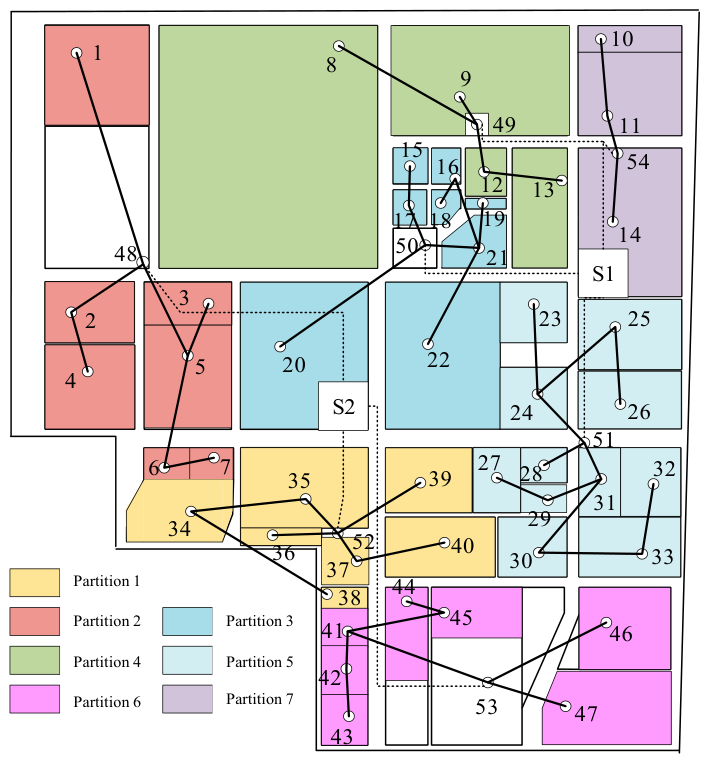
| Zone 1 | 38-34-35-52-37-40, 39-52-36 | 10.2780 | 0.3361 | 0.99961 | 20.2371 |
| Zone 2 | 7-6-5-48-2-4, 1-48, 3-5 | 8.3582 | 0.5610 | 0.99946 | 34.2038 |
| Zone 3 | 44-45-41-42-43, 41-53-46, 47-53 | 8.3056 | 0.5715 | 0.99946 | 37.8396 |
| Zone 4 | 8-49-9, 13-12-49 | 9.6686 | 0.4400 | 0.99950 | 13.8442 |
| Zone 5 | 19-21-22, 18-16-21-50-17-15, 50-20 | 11.8669 | 0.2889 | 0.99961 | 13.4458 |
| Zone 6 | 23-24-25-26, 24-51-28, 51-31-29-27, 31-30-33-32 | 10.1829 | 0.3831 | 0.99955 | 27.3480 |
| Zone 7 | 10-11-54-14 | 10.6119 | 0.3416 | 0.99959 | 8.3882 |
| Region | Planning Results for Scheme 2 | Reliability Indices | |||
|---|---|---|---|---|---|
| Time-BasedCAIDI | Frequency-BasedSAIFI | Time/Frequency-Based ASAI | Energy-Based EENS | ||
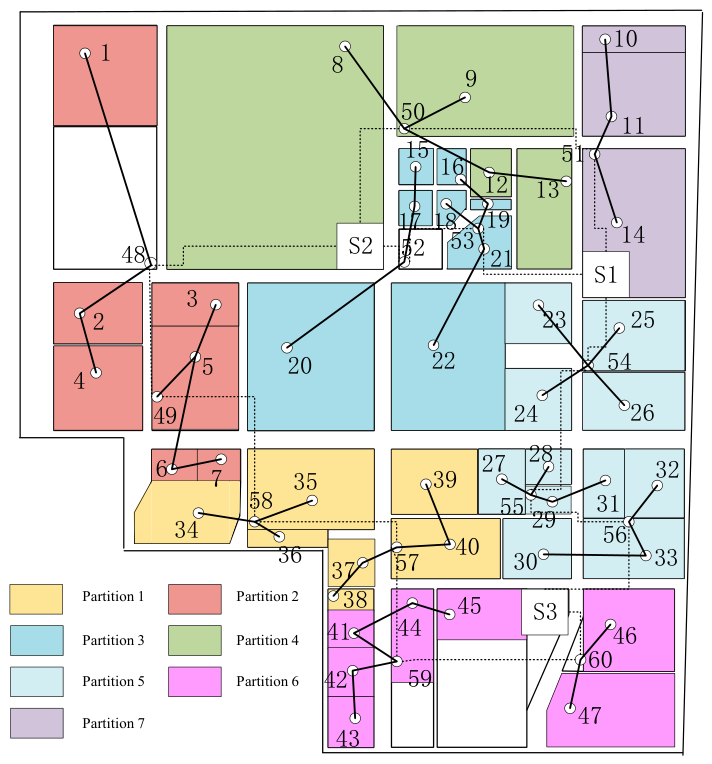
| Zone 1 | 34-58-36, 58-35, 39-40-57-37-38 | 14.8280 | 0.1979 | 0.99966 | 27.4528 |
| Zone 2 | 7-6-5-3, 5-49, 1-48-2-4 | 10.4382 | 0.3629 | 0.99956 | 17.6143 |
| Zone 3 | 45-44-41-59-42-43, 46-60-47 | 12.1863 | 0.2682 | 0.99963 | 24.4084 |
| Zone 4 | 8-50-9, 13-12-50 | 9.2757 | 0.4619 | 0.99951 | 13.7506 |
| Zone 5 | 15-17-52-20, 16-19-53-21-22, 53-18 | 13.3839 | 0.2393 | 0.99963 | 12.1767 |
| Zone 6 | 23-54-24, 25-54-26, 27-55-29-31, 55-28, 32-56-33-30 | 13.8159 | 0.2351 | 0.99963 | 21.8601 |
| Zone 7 | 10-11-51-14 | 10.3843 | 0.3406 | 0.99960 | 7.8038 |
| Scheme | Reliability Indices | Total Investment and Operation and Maintenance Cost/104 CNY | |||
|---|---|---|---|---|---|
| Time-Based CAIDI | Frequency-Based SAIFI | Time/Frequency-Based ASAI | Energy-Based EENS | ||
| Scheme 1 | 13.040 | 0.6198 | 0.99943 | 49.6131 | 2048.545 |
| Scheme 2 | 11.730 | 0.4605 | 0.99950 | 8.3882 | 1529.297 |
| Scheme 3 | 7.734 | 0.2683 | 0.99962 | 7.8038 | 2101.364 |
Disclaimer/Publisher’s Note: The statements, opinions and data contained in all publications are solely those of the individual author(s) and contributor(s) and not of MDPI and/or the editor(s). MDPI and/or the editor(s) disclaim responsibility for any injury to people or property resulting from any ideas, methods, instructions or products referred to in the content. |
© 2026 by the authors. Licensee MDPI, Basel, Switzerland. This article is an open access article distributed under the terms and conditions of the Creative Commons Attribution (CC BY) license.
Share and Cite
Liu, H.; Zhang, L.; Yang, F.; Jia, L.; Liang, L. A Two-Stage Distribution Network Planning Study on Coordinating the Optimization of Economic Efficiency and Reliability. Processes 2026, 14, 2087. https://doi.org/10.3390/pr14132087
Liu H, Zhang L, Yang F, Jia L, Liang L. A Two-Stage Distribution Network Planning Study on Coordinating the Optimization of Economic Efficiency and Reliability. Processes. 2026; 14(13):2087. https://doi.org/10.3390/pr14132087
Chicago/Turabian StyleLiu, Huazhi, Liang Zhang, Fan Yang, Lihu Jia, and Lemeng Liang. 2026. "A Two-Stage Distribution Network Planning Study on Coordinating the Optimization of Economic Efficiency and Reliability" Processes 14, no. 13: 2087. https://doi.org/10.3390/pr14132087
APA StyleLiu, H., Zhang, L., Yang, F., Jia, L., & Liang, L. (2026). A Two-Stage Distribution Network Planning Study on Coordinating the Optimization of Economic Efficiency and Reliability. Processes, 14(13), 2087. https://doi.org/10.3390/pr14132087