Article

A Two-Stage Distribution Network Planning Study on Coordinating the Optimization of Economic Efficiency and Reliability

Economic and Technological Research Institute, State Grid Tianjin Electric Power Company, Tianjin 300171, China
*
Author to whom correspondence should be addressed.
Processes 2026, 14(13), 2087; https://doi.org/10.3390/pr14132087
Submission received: 11 May 2026 / Revised: 23 June 2026 / Accepted: 25 June 2026 / Published: 26 June 2026
(This article belongs to the Special Issue Adaptive Control and Optimization in Power Grids)

Abstract

As the core platform supporting diverse user-side loads, the distribution network plays a critical role in the development of new power systems. To address the significant variations in terminal users’ power supply reliability requirements, this article proposes a two-stage distribution network planning method that optimally coordinates economic efficiency and reliability. First, a multi-type load-specific reliability evaluation index system is established. Using the K-means clustering algorithm, combined with geographic coordinates and load attribute feature matrices, a precision power supply zoning scheme is implemented. Second, considering the diverse demands of different zones, a two-stage distribution network planning model is developed. Finally, the model is solved using a binary particle swarm optimization algorithm (BPSO), and simulation verification is conducted using a case study of an actual distribution network in a certain area of Tianjin. The results indicate that, compared to traditional single-objective planning schemes, the proposed method achieves an effective balance between economic efficiency and reliability. While ensuring the power supply level for critical users, it enhances the flexibility and science of distribution network planning, thereby providing a decision-making reference for the grid-based planning and construction of a smart distribution network.

1. Introduction

With the global energy transition and the development of new electricity systems, distribution networks are rapidly evolving into intelligent, diversified power grids [1,2,3]. The large-scale integration of renewable energy and energy storage has demonstrated certain advantages in reducing transmission losses, optimizing voltage distribution, and deferring infrastructure investments [4,5]; however, the highly uncertain resource integration has also led to increasingly complex distribution network structures and operational characteristics [6]. This transformation poses severe challenges to grid operation and increases the difficulty of system control and fault response [7,8]. At the same time, terminal users’ electricity demands are shifting toward “customized and differentiated” reliability services. Therefore, within the framework of the new electricity system, how to construct a distribution network planning model that balances investment efficiency with users’ differentiated needs has become a core issue that urgently requires resolution in this field.
In the field of distribution network planning, existing research on the economic efficiency of such planning has primarily focused on reducing overall costs through optimized resource allocation and spatial partitioning. For example, Reference [9] utilized digital twin technology to construct an electric heating load model and optimized distribution network planning via an optimal economic model to improve investment efficiency; Ref. [10] established a two-level planning model aimed at minimizing total operating costs and coordinating the economic optimization of line and SOP investments; The K-means algorithm is a classic distance-based clustering algorithm that iteratively searches for the spatial partition with the highest cohesion [11]. Ref. [12] proposed an improved K-means algorithm based on geographic location and load conditions to achieve upper-level regional partitioning, thereby providing a spatial basis for hierarchical planning. Ref. [13] employs the Binary Particle Swarm Optimization (BPSO) algorithm to solve the main problem of grid restructuring and upgrading, and achieves a coordinated balance between flexible procurement in the distribution network and traditional grid expansion through the collaborative optimization of inner and outer layers. Overall, although partitioning algorithms and economic models are relatively mature, existing research primarily focuses on resource allocation and cost optimization at the global level, with insufficient consideration of the variability in terminal user load characteristics. This results in planning schemes that still exhibit limitations in resource allocation.
In terms of improving the reliability of distribution network planning, existing research has primarily focused on the impact of topological optimization and multi-energy complementary methods on ensuring the continuity of power supply in the distribution network. Ref. [14] explored leveraging the potential value of microgrids to defer grid investments and using price signals to guide supply/demand balance to meet reliability constraints; Ref. [15] proposed a risk-constrained method that utilizes the CVaR standard to quantify reliability risk costs under uncertainty; Ref. [16] employed the MOEA/D algorithm to minimize expected power outage volume, significantly improving the system’s load-side reliability level. Overall, most existing reliability studies treat reliability as a global hard constraint or a single optimization objective, with little attention paid to the differentiated preferences of different user types regarding reliability metrics. This makes it difficult to precisely align reliability levels with actual user demands and fails to establish a mechanism for the coordinated optimization of economic efficiency and reliability.
In summary, although existing research on distribution network planning has achieved certain results in terms of economic cost control, zoning strategies, and reliability modeling, the following limitations remain. First, there are shortcomings in accurately mapping the differentiated demands of end users to physical network planning, and second, the multi-objective optimization relationship between economic efficiency and reliability often remains at the level of global qualitative equilibrium, making it difficult to meet the refined and grid-based development needs of new distribution systems. In light of this, this paper addresses the limitations of existing research by proposing a two-stage distribution network planning study on coordinating the optimization of economic efficiency and reliability. The main research work and contributions of this paper are as follows:
(1)
Develop a differentiated reliability evaluation system and power supply zoning method tailored to diverse load characteristics. To address the varying sensitivity to power outages among different load types, an evaluation matrix is constructed by integrating metrics such as average service availability index (ASAI), system average interruption frequency index (SAIFI), and fragmented customer average interruption duration index (FCAIDI). Based on this, a refined division of power supply areas is achieved by integrating load characteristics and geographic coordinates through an improved K-means clustering algorithm.
(2)
A two-stage distribution network planning model is established that balances investment cost-effectiveness with differentiated reliability requirements. Considering regional variations in reliability needs, a planning model is developed with the objective of jointly optimizing investment, operation, and maintenance costs alongside outage losses. The BPSO algorithm is employed to solve the two-stage model.
(3)
The effectiveness and superiority of the proposed model and algorithm were validated using actual engineering case studies. Simulation analyses were conducted using a real distribution network in a specific area of Tianjin. Through comparative analysis, the advantages of the proposed zoning strategy and planning model in enhancing the power supply reliability for critical users and optimizing overall return on investment were verified.

2. Materials and Methodology

To meet the diverse reliability requirements of terminal users, this section proposes a distribution network planning model that accounts for differences in load characteristics, with the aim of mapping multi-dimensional load characteristics into core constraints for grid network structure optimization. By introducing an improved K-means clustering algorithm to cluster multi-dimensional load feature vectors, the model achieves fine-grained division of supply areas and precise allocation of functional attributes.

2.1. Differentiated Reliability Evaluation Metrics

To accurately characterize the reliability requirements of different types of loads, this paper constructs a multi-dimensional reliability evaluation index system to specifically assess the power supply quality in each planning zone.
(1) Time/frequency-sensitive loads: These are evaluated using the Average Service Availability Index (ASAI). This metric is defined as the ratio of the actual power supply time to the total demand time within a specified statistical period, reflecting the system’s ability to provide reliable power supply to users throughout all time periods. A higher indicator value indicates higher power supply reliability.
A S A I = 1 i = 1 n U i N i 8760 i = 1 n N i
(2) Frequency-sensitive loads: These are measured using the System Average Interruption Frequency Index (SAIFI). This indicator represents the average number of sustained interruptions experienced by a customer per unit time, reflecting the system’s ability to support frequency-sensitive users.
S A I F I = i = 1 n λ i N i i = 1 n N i
(3) Time-sensitive loads: These are measured by the Fragmented Customer Average Interruption Duration Index (FCAIDI), the annual average power outage time of users during non-electricity periods is the average power outage time experienced by users per unit time. This indicator is calculated using a simplified engineering approximation method based on the average load level [17], with a focus on the potential impact of power outages during non-electricity periods on users, quantifying the timeliness of fault repair per unit time.
F C A I D I = i = 1 n U i N i i = 1 n λ i N i
(4) Energy-sensitive loads: These are measured using Expected Energy Not Served (EENS). By calculating the average annual energy deficit caused by random component failures, this indicator evaluates the system’s energy support capability for load-intensive areas.
E E N S = L a i U i

2.2. Power Supply Area Delineation Based on Load Clustering

This paper first uses clustering techniques to accurately delineate power supply zones, thereby laying the foundation for differentiated planning.
(1)
Similarity Measures
Based on load type and location, the K-means clustering algorithm is employed to calculate clustering using Euclidean distance, with the objective function set to minimize the electrical distance, thereby achieving load clustering through K-means clustering.
d i j = d i 1 d j 1 2 + d i 2 d j 2 2
In the formula, d i j represents the distance between two points, d i 1 , d j 1 represents the x-coordinate of the i-th point and the j-th point, and d i 2 , d j 2 represents the y-coordinate of the i-th point and the j-th point.
(2)
Characterization of Load Attributes
A feature matrix a i , b i , c i , a i = 0 , 1 b i = 0 , 1 c i = 0 , 1 is introduced to describe load types. Here, a i = 1 indicates that the i-th load is a time-based load, b i = 1 indicates that the i-th load is a frequency-based load, and if both are 1, the load is a time and frequency-based load; indicates that the i-th load is an energy-intensive load.
Using Min Max Normalization to normalize all features, the formula is:
x = x x min x max x min
Among them, x is the original eigenvalue; x min and x max are the minimum and maximum values of all samples in this dimension, respectively; x is the normalized feature with a value range of [0,1]. After normalization, perform K-means clustering.
(3)
Partitioning and Clustering Process Based on the K-Means Algorithm
(a) Determining the Number of Power Supply Blocks
Based on users’ differentiated reliability requirements, the planning area is divided into three major load zones, and the K value in the K-means algorithm is set to 3. The number of power supply blocks n is calculated by combining the total load of each zone with feeder load constraints:
n = int j = 1 N P j 3 U N × I N × cos φ × β
where int [ ] denotes the ceiling function; P j represents the load magnitude of the th j load point within the planning area; N represents the number of load points within the planning area; U N represents the rated voltage of the feeder within the power supply block; I N represents the rated current of the feeder within the power supply block; cos φ represents the average power factor of the feeder; β represents the maximum allowable load factor of the feeder under normal operating conditions of the distribution network, the value of which is related to factors such as the wiring configuration of the distribution network and the characteristics of the feeder.
(b) Selection of Initial Cluster Centers
Calculate the Euclidean distances d i j between all load points in the planning area; count the number of other load points contained within the neighborhood of each load point; set a density threshold M ; include load points within a neighborhood where the number of load points exceeds M in the high-density region set D ; select the load point with the highest density from D as the first initial cluster center c 1 , and remove it from D ; calculate the distance between all load points in the set D and the first clustering center c 1 ; select the load point farthest from the first clustering center as the second initial clustering center c 2 , and remove it from the set D ; select the load point in the set D with the greatest sum of distances to the previously selected centers as the next initial center, and repeat this process until K initial clustering centers have been selected; if the number of initial centers is less than K, reduce the density threshold M and use the above method to reselect the clustering centers. The initial density threshold M is selected as 8, which is mainly determined based on the geographical area and total load of the park.
(c) Load Point Clustering and Power Supply Block Verification
Calculate the Euclidean distance between each load point and each initial cluster center. Taking into account the load balance and geographical factors among the power supply blocks formed by the clusters, introduce load weighting coefficients and distance coefficients to adjust the Euclidean distance. Cluster the load points according to the principle of minimum distance, as shown in the following equation, with each cluster forming a power supply block.
λ j = P j S k cos φ k P k
min d k j = δ k j λ j x k x j 2 + y k y j 2
In the equation, λ j represents the weighting coefficient of the j-th load point; S k represents the maximum allowable load capacity of the feeder lines within the k-th power supply block; cos ϕ k denotes the power factor of the feeder within the k-th power supply block; P k denotes the total load of the k-th power supply block from the previous clustering; d k j denotes the corrected distance between the k-th cluster center and the j-th load point, taking into account the load weighting coefficient; δ k j denotes the distance coefficient between the k-th cluster center and the j-th load point. x k , y k and x j , y j denote the coordinate positions of the cluster center and the j-th load point within the k-th power supply block, respectively. To balance both spatial proximity and electrical connection strength, δ k j is mathematically calculated using a weighted multi-attribute formulation as follows:
δ k j = α d k j g + ( 1 α ) d k j e
where d k j g = ( x k x j ) 2 + ( y k y j ) 2 represents the normalized Euclidean geographic distance based on spatial coordinates; d k j e = | Z k j | represents normalized electrical distance, capturing the topology of the power grid; α [ 0 , 1 ] is the weight coefficient that balances two dimensions (set to 0.5 in this study).
(d) Total Load Verification for Power Supply Blocks
After load points have been clustered into power supply blocks, verify whether the total load within the power supply block to which they belong exceeds the maximum allowable load capacity of the feeder. If the maximum load capacity is not exceeded, proceed to the next step; otherwise, cluster the load point into an adjacent power supply block with an active power capacity margin greater than the load value of that load point.
(e) Update Cluster Centers
After load points have been clustered, calculate the geometric center of the load points within each supply block and use it as the initial cluster center for the next clustering iteration. Repeat steps (c) through (e) until the change in the division of load points between two adjacent supply blocks or the change in the load center of a supply block is less than the required accuracy (this tolerance is set to 10−4).

2.3. Two-Stage Network Planning Model for Distribution Network

Building on the previous section’s implementation of power supply area segmentation using the improved K-means clustering algorithm, a distribution network optimization planning model was developed with the objective of minimizing the combined costs of investment and operation and maintenance, as well as the costs of power losses associated with differentiated reliability prices. The model was solved using the Binary Particle Swarm Optimization (BPSO) algorithm, and the reliability metrics of the planning solutions were quantitatively evaluated and validated using the Monte Carlo simulation method.

2.3.1. Mathematical Model for Network Optimization

Based on the power supply zones of the distribution network, this study considers the differentiated reliability requirements of loads in different areas and their corresponding reliability-based electricity prices. For a total of K power supply zones (where k = 1, 2, …, K), a two-stage planning scheme is developed that optimally balances reliability and economic efficiency, taking into account the differentiated reliability-based electricity prices associated with each zone.
min F 2 = k = 1 K C r , k + C l o s s , k + C b , k + C p e n a l t y
C l o s s , k = C i , k T max , k P l o s s , k i = 1 , 2 , 3 , 4 ; k = 1 , 2 , , K
C r , k = c t , k l k
In the formula, k is the index of the power supply zone, where k = 1, 2, …, K, and K is the total number of power supply zones; C r , k , C l o s s , k , and C b , k represent the line investment and operation and maintenance costs, line loss costs, and upper-level power purchase costs for the kth zone, respectively; represents the differentiated reliability tariff for the kth zone, corresponding to four load types: time-sensitive loads, frequency-sensitive loads, time/frequency-sensitive loads, and energy-sensitive loads; T max , k , P l o s s , k , c t , k , and l k represent the maximum the maximum load utilization hours for the kth zone, the total active power line loss, the investment and operation cost per unit length, and the line length. C p e n a l t y is the reliability penalty function defined as:
C p e n a l t y = k = 1 K λ 1 , k max 0 , A S A I k r e q A S A I k + λ 2 , k max 0 , S A I F I k S A I F I k r e q + λ 3 , k max 0 , F C A I D I k F C A I D I k r e q + λ 4 , k max 0 , E E N S k E E N S k r e q
where A S A I k , S A I F I k , F C A I D I k , and E E N S k are the actual reliability metrics of the k-th zone, while A S A I k r e q , S A I F I k r e q , F C A I D I k r e q , and E E N S k r e q denote the corresponding predefined reliability thresholds. The coefficients λ1,k~λ4,k are penalty factors assigned according to the importance of each load type in zone k. The max operator ensures that penalties are only imposed when reliability requirements are not satisfied.

2.3.2. Constraints

(1)
Differentiated Constraints:
For different zones, metrics such as ASAI, SAIFI, FCAIDI, and EENS are treated as hard constraints, while network reliability constraints are incorporated into the optimization objective as a penalty function using a penalty factor to ensure that each zone meets its corresponding reliability threshold.
(2)
Common Constraints:
(a) Connectivity Constraints
To ensure that every load in the network is supplied with power, each load must remain connected to a power source.
(b) Single-Connection Constraints
n = m + 1
Among these, n represents the number of nodes and m represents the number of branches. It should be noted here that Equation (15) represents the strict radial topological constraint traditionally used for radial networks, such as Scheme 2. Scheme 3 adopts a “closed-loop design, open-loop operation” strategy. In this operating mode, although the feeder loops in Scheme 3 are physically constructed as closed loops to establish multi-source transmission paths and improve reliability, the inter-feeder tie switches remain normally open under steady-state operating conditions. Therefore, during normal operation, the active network topology seamlessly maintains a radial tree structure, ensuring that the connectivity criteria in Equation (15) remain strictly valid throughout the optimization and power flow calculation processes.
(c) Power flow constraints
P i = U i j = 1 n U j G i j cos δ i j + B i j sin δ i j Q i = U i j = 1 n U j G i j sin δ i j B i j cos δ i j
In Equation (16), P i and Q i represent the active power and reactive power injected at node i , respectively; U i and U j represent the voltage magnitudes at nodes i and j , respectively; G i j and B i j represent the conductance and admittance of branch i j , respectively; and θ i j represents the phase angle difference between nodes i , j .

2.3.3. Model Solving Process

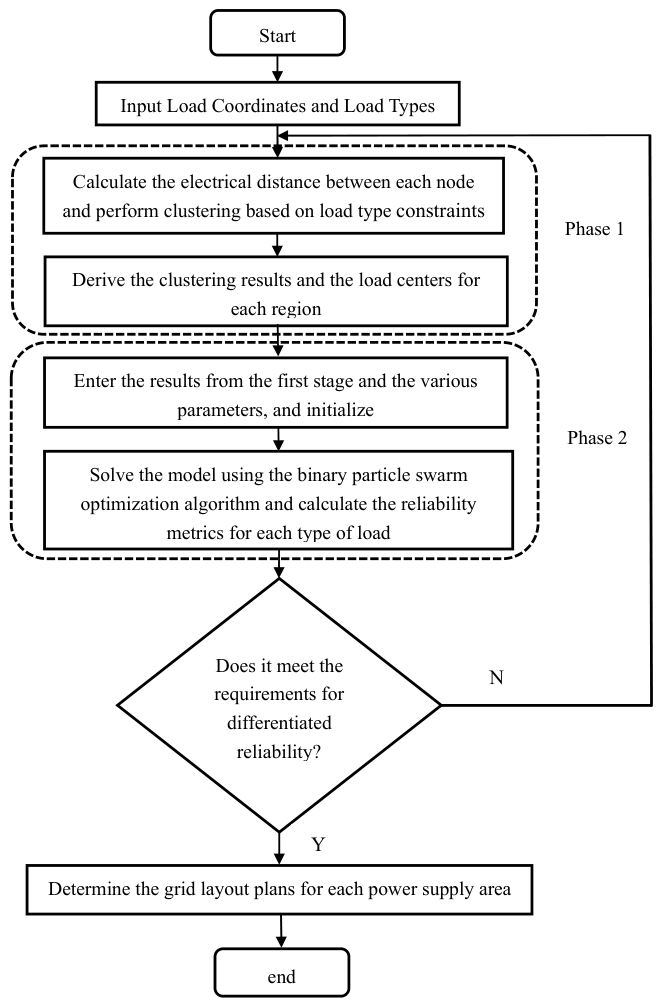
The solution process for the two-stage network planning model proposed in this paper is shown in Figure 1. It consists of two core stages: load zoning and network planning.
  • First Phase: Load Partitioning Based on the Improved K-Means Algorithm
Given the diverse load types and uneven spatial distribution within the planning area, the improved K-means clustering algorithm is employed to partition the power supply zones.
Step 1: Input the geographic coordinates of each load node within the planning area and the corresponding load attribute feature matrix.
Step 2: Apply the improved K-means clustering algorithm, using Euclidean distance as a measure of electrical affinity, to calculate the distance between each load point and the cluster centers, and determine which class each element should be assigned to based on the nearest cluster center.
Step 3: Iterate through all elements to cluster the loads. Determine whether the loads within each clustered area are of the same load type. If so, the clustering process ends, and the results are output; otherwise, proceed to Step 2.
  • Second Phase: BPSO-Based Network Optimization
Based on the load zoning results, we employed the Binary Particle Swarm Optimization (BPSO) algorithm to perform distribution network planning. The algorithm was deemed to have converged and the optimization process was terminated when the algorithm reached the preset maximum number of iterations or when the global optimal fitness value remained unchanged for 15 consecutive generations. We incorporated Monte Carlo reliability simulations into the particle fitness calculation process, ensuring that reliability constraints were fully integrated into the optimization process.
Step 1: Initialize the velocity and position of the particle swarm, set the population size to 30, the maximum number of iterations to 50, and use a linear decreasing strategy for inertia weights with a range of 0.9~0.4, including individual and group optimal values.
Step 2: Update particle positions and perform mutation. Particles update their positions according to the velocity formula and undergo random bit-flipping mutation with a certain probability. After updating and mutation, perform a topological feasibility check. Retain only feasible solutions that satisfy the topological constraints.
Step 3: For feasible particle solutions that pass the topological check, perform a Monte Carlo simulation to calculate the differentiated reliability metrics for each partition, verify whether they satisfy the differentiated hard constraints, and calculate the current fitness value of the particle by integrating economic costs.
Step 4: Update the individual optimal solutions and the global optimal solution of the particle swarm based on the fitness values, and increment the iteration count by 1.
Step 5: Determine whether the algorithm’s convergence criteria are met or the maximum number of iterations has been reached. If not met, return to Step 2 to continue the optimization iteration; if met, output the current global optimal truss scheme.

3. Simulation Analysis

In this section, we use a distribution network case from Tianjin, China to demonstrate the competitiveness of the proposed method. The content of this section is arranged as follows: Section 3.1 introduces the dataset and experimental setup; Section 3.2.1 presents the results of data preprocessing; Section 3.2.2 compares the proposed method with multiple distribution network planning models to verify its superiority.

3.1. Case Study Setup

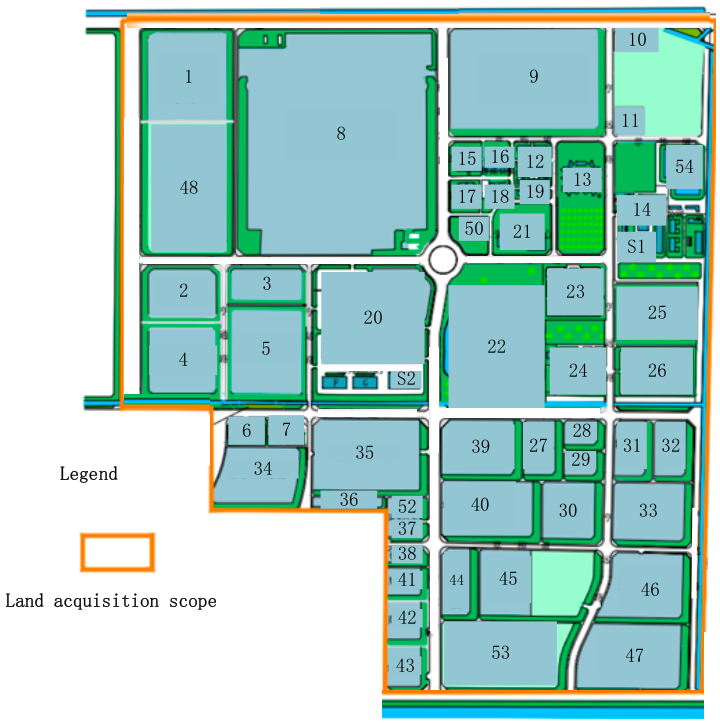
This paper uses an actual distribution network in a certain area of Tianjin as a simulation case study. The area served by this network covers approximately 2.5 square kilometers and includes several high-tech enterprises such as Samsung SDI, Taiyi Home Furnishings, Gurui Technology, and Zaifa Technology. The industrial sectors span multiple fields, including electronic information and high-end equipment manufacturing, resulting in a complex electricity load structure and significant variations in reliability requirements. The maximum load in this area is 21.2 MW, with the investment and operational costs per unit length amounting to 900,000 CNY/km. The failure rates for distribution lines, transformers, and circuit breakers are set at 0.012, 0.01, and 0.006, respectively, with corresponding restoration times of 5, 200, and 4 min. Loads are classified into four categories: time-sensitive loads, frequency-sensitive loads, time/frequency-sensitive loads, and energy-sensitive loads, with corresponding differentiated reliability tariffs of 0.04, 0.05, 0.08, and 0.1 CNY/kWh, respectively. The load location coordinates, power levels, and load types are detailed in Table 1 and Figure 2.
To verify the effectiveness and superiority of the two-stage planning method proposed in this paper, three schemes were compared to demonstrate the validity of this approach.
Scheme 1: Without considering the differentiated characteristics of load types, a unified single-layer network structure optimization is performed directly for the entire load.
Scheme 2: A two-stage planning strategy is adopted, in which load clustering and zoning are performed first, followed by network structure planning based on the demand of each zone, with a tree-like structure used at the feeder end [18].
Scheme 3 (Proposed Method): A two-stage distribution network planning method is adopted, involving load clustering and partitioning followed by distribution network planning, with a single-loop network structure at the feeder level. This scheme operates under a “closed-loop design, open-loop operation” infrastructure model. The single-loop topology is physically established across regions to form reliable backup paths; however, during normal operation, all interconnection switches remain open. This ensures the computational flexibility of radial network planning while maintaining the high reliability of a looped network.

3.2. Results and Analysis of the Case Study

This case study establishes three sets of schemes to investigate the effects of load zoning and feeder structure. Scheme 1 serves as the baseline, employing traditional planning and a tree-shaped feeder network without differentiated load zoning. Scheme 2 retains the tree-shaped feeder network but introduces the zoning strategy proposed in this paper to validate the effectiveness of the clustering method. Scheme 3 maintains the zoning unchanged while modifying the feeder structure to a single-loop configuration to compare the operational performance of different network topologies. This design separates the two major variables to avoid confounding of causality. The following sections will first present the clustering results, followed by a quantitative comparison of the reliability and economic indicators of the three scenarios to validate the effectiveness of the planning method proposed in this paper.

3.2.1. Clustering of Power Supply Areas

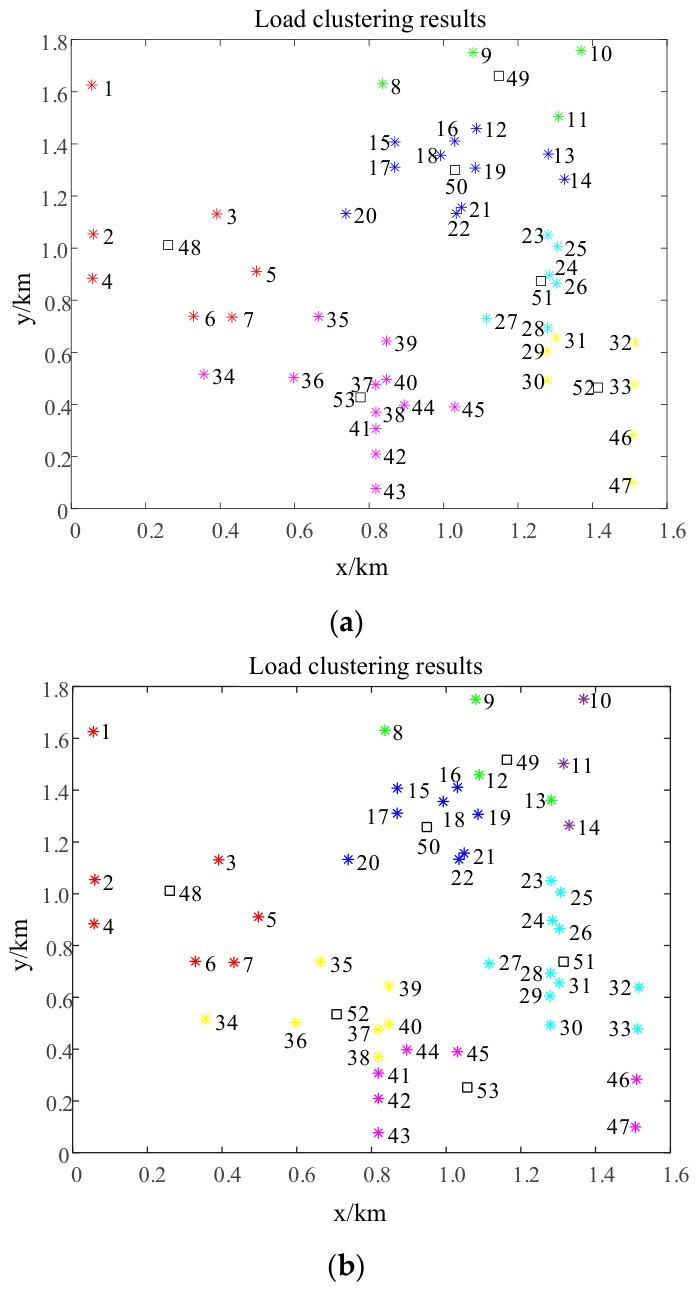
This article partitions based on the geographical coordinates of load points according to the logic of different planning schemes. The partitioning results of Scheme 1 are shown in Figure 3a, while the partitioning results of Scheme 2 and Scheme 3 are shown in Figure 3b. The points in Figure 3 represent loads, and different colors indicate that they are classified into different categories in different distribution network planning schemes.
As shown in Figure 3, when load types are not distinguished, the number of loads in the blue area of the left figure is 11, which is 3 more than in the right figure. This indicates that the yellow area in the left figure contains a larger number of loads due to their proximity. Furthermore, the right figure is better able to distinguish energy-sensitive loads, suggesting that, under the constraint of load types, the regional division in the right figure is more reasonable.

3.2.2. Analysis of the Network Planning Results

The actual route plan for Scheme 1 is shown in Figure 4, and the planning results are presented in Table 2.
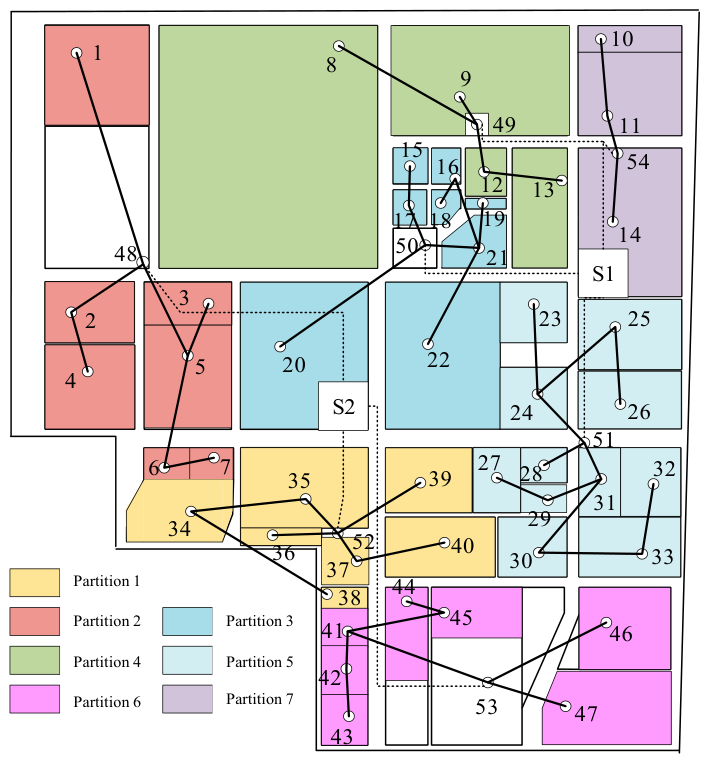
A two-stage planning method was adopted, involving load classification followed by distribution network planning. The actual line planning diagram showing a tree-like structure at the feeder end is shown in Figure 5. The planning results for Scheme 2 are shown in Table 3.
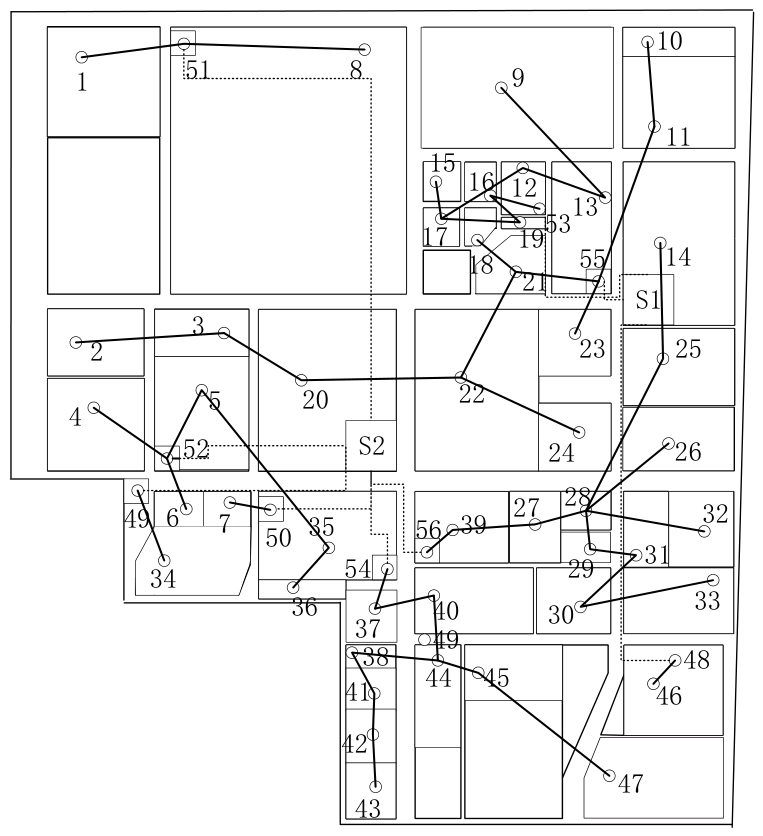
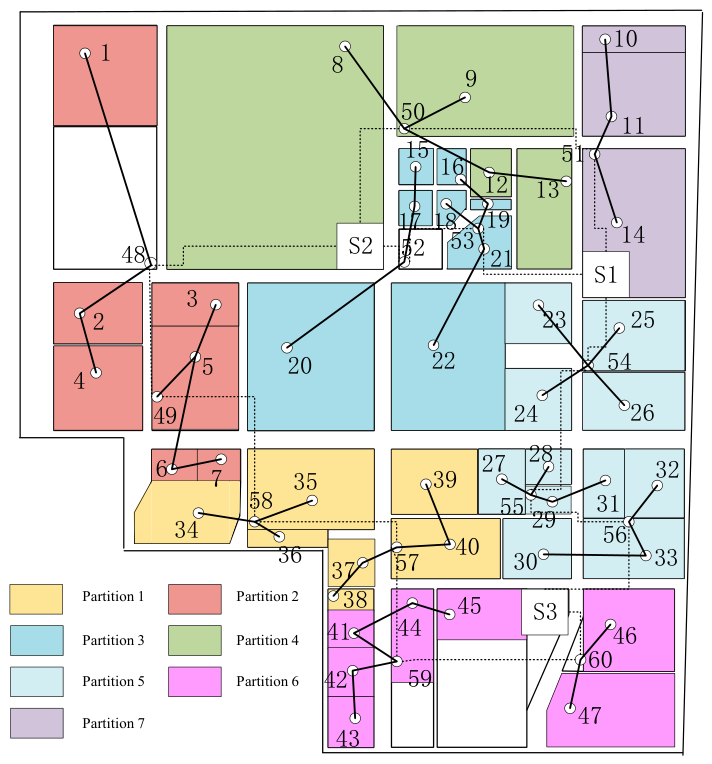
Based on the results of the zoning analysis, calculations were performed for the distribution network planning. The actual line layout for Scheme 3 is shown in Figure 6, and the planning results are presented in Table 4.
A comparison of the three planning schemes shows that Scheme 3 has 7, 7, 7, 7, 8, and 11 load points in each zone, respectively, indicating a relatively even distribution. Furthermore, the values of various metrics across zones are closer to one another than in Scheme 1, suggesting that Scheme 3 features a more rational cabling layout. The overall reliability and economic metrics for the planning area are shown in Table 5.
As shown in Table 5, compared with Scheme 1, which does not distinguish between load attributes and employs a traditional single-radial network topology, Scheme 3 proposed in this paper achieves significant improvements in differentiated reliability metrics for all types of users. Specifically, the frequency-sensitive index decreased by 56.71%, the energy-sensitive index dropped significantly by 84.27%, and the time-sensitive index was reduced by 40.69%. Based on the differentiated clustering results from the first stage, Scheme 3 adopts a single-loop network configuration at the grid level characterized by “closed-loop design and open-loop operation”. Although the system operates in open-loop mode during normal operation to simplify power flow control, the physically looped network provides the system with backup transfer paths. In the event of a sudden line failure, the lower-level model can dynamically transfer the affected load to other power supply units through the switching combinations of interconnection switches.
In terms of economic efficiency, the total investment and operating costs for Scheme 3 amount to 21.01364 million CNY. Although it has the highest capital expenditure among the three schemes, this planning model better accommodates customized, differentiated reliability requirements while also delivering favorable economic benefits. A comparison of the above indicators demonstrates that the proposed planning model not only meets the diverse reliability needs of the demand side but also safeguards the economic benefits of the supply side, thereby possessing high engineering application value.

4. Conclusions

To address issues such as unbalanced power supply demands resulting from differences in terminal users’ electricity consumption patterns and the poor adaptability of traditional distribution network planning due to its homogeneous approach, this paper proposes a two-stage distribution network planning study on coordinating the optimization of economic efficiency and reliability. The effectiveness of the proposed method was verified through simulation studies, and the main conclusions are as follows.
(1)
Precise alignment between user demand and network planning is achieved. By constructing a load zoning model based on improved K-means clustering that integrates geographic location information with load attribute characteristics, the method overcomes the limitations of traditional uniform zoning schemes. It enables the delineation of refined power supply zones with similar electricity consumption characteristics and concentrated spatial distribution, thereby providing a basis for subsequent distribution network planning.
(2)
A coordinated optimization mechanism that balances economic benefits and power supply reliability was established. Building on mature penalty optimization principles, the model minimizes investment, operation, and maintenance costs as well as line loss costs while incorporating outage loss costs that account for differentiated preferences. Comparative analysis demonstrates that the proposed method effectively optimizes key reliability indicators of the distribution network while ensuring the system’s total cost is minimized, thereby achieving a coordinated optimization of economic benefits and power supply reliability.
(3)
The effectiveness of differentiated constraints in improving system power supply quality has been verified. Simulation results indicate that applying differentiated reliability constraints across different zones can effectively guide the distribution network toward a scientifically sound and reasonable spatial layout. Although this approach may initially result in a slight increase in local line investment, it significantly reduces potential economic losses by precisely mitigating the risk of power outages for high-value users. Consequently, it enhances the overall power supply reliability and comprehensive operational efficiency of the regional distribution network, demonstrating strong practical applicability for engineering implementation.
In summary, this study focuses on the coordinated optimization of differentiated reliability and economic benefits in distribution network planning. The cost dimensions in the proposed model were specifically selected to align with the core research objectives. To further refine the distribution network planning framework, it is necessary to incorporate additional key cost factors. For example, factors such as flexibility costs, system conversion costs, renewable energy integration costs, and long-term lifecycle costs hold significant research value for establishing a comprehensive distribution network planning system. Furthermore, it should be noted that the introduction of advanced meta-heuristic algorithms to solve the planning model can yield more accurate results. Building on this research, future studies could integrate a multi-dimensional, full-lifecycle cost accounting system to further enhance the model’s generalizability and engineering applicability.

Author Contributions

Conceptualization, H.L. and L.Z.; methodology, H.L. and F.Y.; software, F.Y.; validation, H.L., L.Z. and F.Y.; formal analysis, L.J.; data curation, H.L. and L.L.; writing—original draft preparation, F.Y.; writing—review and editing, H.L. and L.L.; supervision, H.L. and L.Z.; project administration, L.J. and L.L. All authors have read and agreed to the published version of the manuscript.

Funding

This research was funded by the Science and Technology Project of State Grid Tianjin Electric Power Company under Grant No. Economic Research-S&T Project 2025-02.

Data Availability Statement

The data is derived from the measured engineering data.

Conflicts of Interest

Authors Huazhi Liu, Liang Zhang, Fan Yang, Lihu Jia and Lemeng Liang are employed by the Economic and Technological Research Institute, State Grid Tianjin Electric Power Company. The authors declare that the research was conducted in the absence of any commercial or financial relationships that could be construed as a potential conflict of interest.

References

  1. Li, W.; Sui, W.; Cheng, L.; Ji, Y.; Guo, Y.; Zhu, J. Quantifying seasonal demand-side flexibility in residential air conditioning under diverse control strategies. Energy Build. 2026, 352, 116764. [Google Scholar] [CrossRef]
  2. Liu, J.; Hou, Z.; Wang, B.; Yin, T. Optimizing Microgrid Energy Management via DE-HHO Hybrid Metaheuristics. Comput. Mater. Contin. 2025, 84, 4729–4754. [Google Scholar] [CrossRef]
  3. Liu, J.; Hou, Z.; Yin, T. Short-term power load forecast using OOA optimized bidirectional long short-term memory network with spectral attention for the frequency domain. Energy Rep. 2024, 12, 4891–4908. [Google Scholar]
  4. Luo, X.; Wang, J.; Dooner, M.; Clarke, J. Overview of current development in electrical energy storage technologies and the application potential in power system operation. Appl. Energy 2015, 137, 511–536. [Google Scholar] [CrossRef]
  5. Eajal, A.A.; Shaaban, M.F.; Ponnambalam, K.; El-Saadany, E.F. Stochastic Centralized Dispatch Scheme for AC/DC Hybrid Smart Distribution Systems. IEEE Trans. Sustain. Energy 2016, 7, 1046–1059. [Google Scholar] [CrossRef]
  6. Huang, J.; Jiang, C.; Xu, R. A review on distributed energy resources and MicroGrid. Renew. Sustain. Energy Rev. 2008, 12, 2472–2483. [Google Scholar] [CrossRef]
  7. Oree, V.; Hassen, S.Z.S.; Fleming, P.J. Generation expansion planning optimisation with renewable energy integration: A review. Renew. Sustain. Energy Rev. 2017, 69, 790–803. [Google Scholar] [CrossRef]
  8. Colmenar-Santos, A.; Reino-Rio, C.; Borge-Diez, D.; Collado-Fernández, E. Distributed generation: A review of factors that can contribute most to achieve a scenario of DG units embedded in the new distribution networks. Renew. Sustain. Energy Rev. 2016, 59, 1130–1148. [Google Scholar] [CrossRef]
  9. Zhang, L.; Xu, Z.; Liu, Y.; Li, K.; Ma, J.; Simayi, X. Distribution network planning framework based on digital twin simulation incorporating scaled electric heating loads. Energy Rep. 2026, 15, 109172. [Google Scholar] [CrossRef]
  10. Wang, L.; Sun, Q.; Wang, X.; Shi, T.; Yang, X.; Xu, H. Low carbon planning of flexible distribution network considering orderly charging and discharging of EV. Electr. Power Syst. Res. 2025, 244, 111546. [Google Scholar] [CrossRef]
  11. Li, J.; Li, F.; Sun, K.; Sun, B. Bi-level coordinated expansion planning of high-PV-penetration active distribution networks incorporating multiple flexible resources considering WGAN-GP-based uncertainty generation. Energy 2025, 330, 136685. [Google Scholar] [CrossRef]
  12. Li, J.; Li, J.; Wang, D.; Mao, C.; Guan, Z.; Liu, Z.; Du, M.; Qi, Y.; Wang, L.; Liu, W.; et al. Hierarchical and partitioned planning strategy for closed-loop devices in low-voltage distribution network based on improved KMeans partition method. Energy Rep. 2023, 9, 477–485. [Google Scholar] [CrossRef]
  13. Martínez, M.; Mateo, C.; Gómez, T.; Alonso, B.; Frías, P. A hybrid particle swarm optimization approach for explicit flexibility procurement in distribution network planning. Int. J. Electr. Power Energy Syst. 2024, 161, 110215. [Google Scholar] [CrossRef]
  14. Liu, W.; Gao, X.; Liu, C.; Shi, Q. Reliability-constrained Bi-level collaborative planning of distribution network and micro-energy grid. Int. J. Electr. Power Energy Syst. 2023, 152, 109199. [Google Scholar] [CrossRef]
  15. Esmaeilzadeh, Z.; Falaghi, H.; Ramezani, M. Reliability-oriented AC/DC hybrid distribution network planning: A risk-constrained approach. Renew. Energy Focus 2026, 56, 100790. [Google Scholar] [CrossRef]
  16. Hamidan, M.A.; Borousan, F. Optimal planning of distributed generation and battery energy storage systems simultaneously in distribution networks for loss reduction and reliability improvement. J. Energy Storage 2022, 46, 103844. [Google Scholar] [CrossRef]
  17. Adefarati, T.; Bansal, R.C. Reliability assessment of distribution system with the integration of renewable distributed generation. Appl. Energy 2017, 185, 158–171. [Google Scholar] [CrossRef]
  18. Tabares, A.; Muñoz-Delgado, G.; Franco, J.F.; Arroyo, J.M.; Contreras, J. Multistage reliability-based expansion planning of ac distribution networks using a mixed-integer linear programming model. Int. J. Electr. Power Energy Syst. 2022, 138, 107916. [Google Scholar] [CrossRef]
Figure 1. Flowchart of the Two-Step Planning Model Solution Process.
Processes 14 02087 g001
Figure 2. Map showing the actual geographic distribution of each load.
Processes 14 02087 g002
Figure 3. Comparison of partitioning results. (a) The partitioning results of Scheme 1. (b) The partitioning results of Scheme 2 and Scheme 3.
Processes 14 02087 g003
Figure 4. Route planning results for Scheme 1.
Processes 14 02087 g004
Figure 5. Route Planning Results for Scheme 2.
Processes 14 02087 g005
Figure 6. Route Planning Results for Scheme 3.
Processes 14 02087 g006
Table 1. Load Parameters.
LoadPosition CoordinatesPower/MWLoad Type
1(51.2,1512)1.7 + j * 1.0536(0,1,0)
2(54.9286,980.3762)2.125 + j * 1.317(0,1,0)
3(363.4,1051.9)0.85 + j * 0.5268(0,1,0)
4(53.1551,822.3116)1.1433 + j * 0.7085(0,1,0)
5(462.3830,847.0412)1.275 + j * 0.7902(0,1,0)
6(305.4911,687.2142)0.2678 + j * 0.1659(0,1,0)
7(401.5656,683.5891)0.51 + j * 0.3161(0,1,0)
8(777.4,1516.5)1.6065 + j * 0.9956(1,1,0)
9(1003.6,1628.1)0.765 + j * 0.474(1,1,0)
10(1273.6,1634.8)0.1275 + j * 0.079(0,0,1)
11(1217.7,1399.6)0.268 + j * 0.166(0,0,1)
12(1012.1,1356.7)0.5355 + j * 0.332(1,1,0)
13(1191.6,1265.9)0.7225 + j * 0.4478(1,1,0)
14(1232.0,1175.9)1.751 + j * 1.085(0,0,1)
15(808.3,1308.7)0.68 + j * 0.4214(1,0,0)
16(957.9,1312.1)0.51 + j * 0.316(1,0,0)
17(807.9,1218.9)0.51 + j * 0.316(1,0,0)
18(922.6,1261.1)0.17 + j * 0.1054(1,0,0)
19(1009.3,1215.5)0.255 + j * 0.158(1,0,0)
20(686.0,1052.8)0.68 + j * 0.4214(1,0,0)
21(974.4,1075.6)0.5355 + j * 0.3319(1,0,0)
22(961.8,1053.7)0.5355 + j * 0.3319(1,0,0)
23(1190.7,976.9)1.071 + j * 0.664(0,1,0)
24(1194.2,834.7)0.2677 + j * 0.166(0,1,0)
25(1214.8,935.6)1.186 + j * 0.735(0,1,0)
26(1212.0,804.5)0.17 + j * 0.1054(0,1,0)
27(1036.9,679)1.071 + j * 0.663(0,1,0)
28(1190.1,644.9)0.34 + j * 0.211(0,1,0)
29(1188.3,562.8)0.34 + j * 0.211(0,1,0)
30(1189.2,458.7)1.105 + j * 0.685(0,1,0)
31(1211.3,609.9)0.2125 + j * 0.1317(0,1,0)
32(1409.3,594.3)0.2677 + j * 0.166(0,1,0)
33(1406.5,445.3)1.025 + j * 0.624(0,1,0)
34(330.8717,479.8409)0.17 + j * 0.1054(0,1,0)
35(617.2922,685.4016)0.85 + j * 0.6(0,1,0)
36(555.6536,468.0727)2.5925 + j * 1.6067(0,1,0)
37(760.4926,442.7116)0.5455 + j * 0.3319(0,1,0)
38(761.0032,344.2934)0.68 + j * 0.4214(0,1,0)
39(787.4561,598.5424)0.34 + j * 0.2107(0,1,0)
40(787.4561,461.6622)0.68 + j * 0.4214(0,1,0)
41(761.0032,285.9192)0.136 + j * 0.084(0,1,0)
42(760.8832,194.6127)0.268 + j * 0.166(0,1,0)
43(760.8832,71.9560)0.268 + j * 0.166(0,1,0)
44(831.8171,369.7643)1.598 + j * 0.99(0,1,0)
45(957.7493,363.2338)2.04 + j * 1.264(0,1,0)
46(1403.7,264)2.932 + j * 1.817(0,1,0)
47(1400.9,92.5)0.425 + j * 0.263(0,1,0)
Note that the time-sensitive loads are (1,0,0), the frequency-sensitive loads are (0,1,0), the time/frequency-sensitive loads are (1,1,0), and the energy-sensitive loads are (0,0,1). The coordinate values listed above are expressed in relative coordinates; this coordinate system uses dimensionless grid units and does not represent actual geographic coordinates.
Table 2. Planning Results for Scheme 1.
RegionPlanning Results for Scheme 1Reliability Indices
Time-BasedCAIDIFrequency-BasedSAIFITime/Frequency-Based ASAIEnergy-Based EENS
Feeder 146-4823.45630.10180.999730.9285
Feeder 234-4920.29380.12670.999711.7918
Feeder 37-5016.66830.15830.999701.4400
Feeder 451-8, 51-19.16900.48960.9994914.6126
Feeder 552-4, 52-6, 52-5-35-369.03810.46640.9995214.2678
Feeder 653-16-19-17-12-13-9, 15-177.44600.77290.9993424.0435
Feeder 754-37-40-44-38-41-42-43, 44-45-478.97670.48880.9995027.1000
Feeder 810-11-55-23, 55-21-22-24, 22-20-3-2, 18-217.36360.81430.9993246.6214
Feeder 956-39-27-28-29-31-30-33, 28-25-14, 32-28-267.49070.75920.9993549.6131
Table 3. Planning Results for Scheme 2.
RegionPlanning Results for Scheme 2Reliability Indices
Time-BasedCAIDIFrequency-BasedSAIFITime/Frequency-Based ASAIEnergy-Based EENS
Zone 138-34-35-52-37-40, 39-52-3610.27800.33610.9996120.2371
Zone 27-6-5-48-2-4, 1-48, 3-58.35820.56100.9994634.2038
Zone 344-45-41-42-43, 41-53-46, 47-538.30560.57150.9994637.8396
Zone 48-49-9, 13-12-499.66860.44000.9995013.8442
Zone 519-21-22, 18-16-21-50-17-15, 50-2011.86690.28890.9996113.4458
Zone 623-24-25-26, 24-51-28, 51-31-29-27, 31-30-33-3210.18290.38310.9995527.3480
Zone 710-11-54-1410.61190.34160.999598.3882
Table 4. Planning Results for Scheme 3.
RegionPlanning Results for Scheme 2Reliability Indices
Time-BasedCAIDIFrequency-BasedSAIFITime/Frequency-Based ASAIEnergy-Based EENS
Zone 134-58-36, 58-35, 39-40-57-37-3814.82800.19790.9996627.4528
Zone 27-6-5-3, 5-49, 1-48-2-410.43820.36290.9995617.6143
Zone 345-44-41-59-42-43, 46-60-4712.18630.26820.9996324.4084
Zone 48-50-9, 13-12-509.27570.46190.9995113.7506
Zone 515-17-52-20, 16-19-53-21-22, 53-1813.38390.23930.9996312.1767
Zone 623-54-24, 25-54-26, 27-55-29-31, 55-28, 32-56-33-3013.81590.23510.9996321.8601
Zone 710-11-51-1410.38430.34060.999607.8038
Table 5. Comparison of Key Metrics Across Scenarios.
SchemeReliability IndicesTotal Investment and Operation and Maintenance Cost/104 CNY
Time-Based
CAIDI
Frequency-Based
SAIFI
Time/Frequency-Based ASAIEnergy-Based EENS
Scheme 113.0400.61980.9994349.61312048.545
Scheme 211.7300.46050.999508.38821529.297
Scheme 37.7340.26830.999627.80382101.364
Disclaimer/Publisher’s Note: The statements, opinions and data contained in all publications are solely those of the individual author(s) and contributor(s) and not of MDPI and/or the editor(s). MDPI and/or the editor(s) disclaim responsibility for any injury to people or property resulting from any ideas, methods, instructions or products referred to in the content.