Article

Preparation of a SiO2@PDA/CS Coated Stainless Steel Mesh with Superhydrophilicity and Underwater Superoleophobicity for Oil–Water Separation

1
Beijing Engineering Research Center of Radiographic Techniques and Equipment, Institute of High Energy Physics, Chinese Academy of Sciences, Beijing 100049, China
2
School of Environmental and Chemical Engineering, Shanghai University, 99 Shangda Road, Shanghai 200444, China
*
Author to whom correspondence should be addressed.
Processes 2026, 14(12), 1998; https://doi.org/10.3390/pr14121998 (registering DOI)
Submission received: 31 March 2026 / Revised: 20 May 2026 / Accepted: 17 June 2026 / Published: 19 June 2026
(This article belongs to the Section Separation Processes)

Abstract

To tackle the environmental challenges associated with industrial oily wastewater discharges and recurrent marine oil spill incidents, developing high-efficiency oil–water separation technologies represents a pressing environmental challenge. This research presents a novel design approach comprising the deposition of a stable SiO2 anchoring layer followed by the fabrication of a PDA/CS crosslinked coating, thereby achieving successful construction of a superhydrophilic/underwater superoleophobic (SH/UWSO) coating on stainless steel meshes (SSM). In the first step, SiO2 microspheres were deposited via vapor deposition to create a micro-rough surface architecture. Subsequently, a dopamine/chitosan (DA/CS) reaction solution was introduced to form a Polydopamine/chitosan (PDA/CS) coating, yielding a SiO2@PDA/CS-SSM separation membrane. The resulting membrane exhibited separation efficiencies surpassing 99% for various oil–water mixtures, achieving a flux of 1.24 × 10⁵ L·m−2·h−1 in petroleum ether systems. Notably, the membrane maintained high efficiency and structural stability even after 25 separation cycles, immersion in strong acid and base solutions for 72 h, and 100 abrasion tests. The rational design of the anchoring and crosslinking layers endows SiO2@PDA/CS-SSM with high efficiency and stability, making it an effective oil–water separation material.

1. Introduction

The rapid progression of industrialization and global economic development has led to frequent discharges of oily wastewater and crude oil spill accidents, posing significant threats to marine ecological security and sustainable resource utilization [1,2,3]. Interfacial separation materials with unique wettability—specifically, differential affinity toward oil and water phases—offer innovative solutions to this environmental challenge. However, traditional “oil-removing” porous materials, which are characterized by superhydrophobicity/superoleophilicity (SH/UWSO), face substantial limitations when dealing with high-viscosity oils. Their strong surface affinity for oils can cause pore blockage and surface fouling, resulting in diminished separation efficiency and challenging regeneration. This not only significantly shortens the service life of such materials but also tends to induce secondary ecological pollution [4,5,6].
With continued research efforts, “water-removal” materials, namely, SH/UWSO membranes, have emerged as a focal point in this field due to their inherent interfacial antifouling advantages [7,8]. This class of materials exhibits ultralow oil adhesion during the oil–water separation process, effectively suppressing the accumulation of oil droplets on the surface while offering favorable cyclic stability and environmental compatibility [9,10]. According to the classical Wenzel and Cassie–Baxter wetting models, the surface wettability of such materials arises from the synergistic interplay between chemical composition and micro/nanoscale roughness [11,12]. Upon contact with oily wastewater, the water phase rapidly wets and permeates the micro/nanoscale surface pores, forming a dense and stable hydration layer in situ. This hydration barrier facilitates the rapid penetration of water molecules while exerting a strong repulsive force against oil droplets, thereby preventing direct contact between the oil phase and the substrate and enabling highly efficient, antifouling oil–water separation [13,14,15,16].
Encouraged by this interception mechanism, researchers have developed various separation substrates, including polymer membranes, 3D sponges, textiles and metal meshes [17,18]. Among numerous substrate materials, stainless steel mesh (SSM) exhibits strong potential due to its excellent mechanical properties, low cost and easy of scalable application [19,20]. However, untreated commercial SSM is typically hydrophobic, necessitating surface modification to impart SH/UWSO wettability. A central challenge in current research is that conventional modified coatings are prone to delamination or detachment during repeated separation cycles. Therefore, the development of functionalized SSM featuring strong coating adhesion and long-term service stability is essential to advance its practical application.
To address this issue, researchers have explored the introduction of inorganic–organic hybrid strategies to enhance coating adhesion. hold considerable promise in interfacial engineering owing to their excellent chemical stability and the abundance of polar hydroxyl groups on the surface; the silanol groups can establish robust intermolecular interactions through a dense hydrogen bond network [21]. Through high-temperature vapor deposition in conjunction with polydimethylsiloxane (PDMS), SiO2 can be constructed in situ on substrate surfaces to create multiscale micro/nanostructures, thereby imparting the desired SH/UWSO properties [22]. Nevertheless, while this vapor-phase modification strategy is simple to implement, cost-effective and scalable, the interfacial adhesion between the purely inorganic SiO2 coating and the metal framework remains comparatively weak. This inadequate adhesion frequently results in coating delamination during repeated oil–water separation cycles, leading to a rapid decline in separation performance. To overcome the limitations of single-component inorganic coatings in terms of adhesion, organic–inorganic hybrid strategies have emerged as an effective solution [23,24,25]. In such a synergistic system, the organic polymer components serve as flexible interfacial “anchor points” that significantly enhance the adhesive toughness between the coating and the metal substrate, whereas the inorganic SiO2 particles act as rigid scaffolds that preserve microstructural integrity while sustaining the extreme wettability state. Leveraging this complementary mechanism, researchers have successfully developed robust oil–water separation materials that combine high mechanical durability with superior separation efficiency.
Dopamine (DA), the key functional moiety in mussel adhesive proteins, can self-polymerize and adhere tenaciously to nearly all solid surfaces via air oxidation under alkaline conditions, forming a stable and hydrophilic polydopamine (PDA) coating. Zhong et al. [26] utilized hydrophilic titanium dioxide nanoparticles in conjunction with dopamine for the hydrophilic modification of cotton fabrics, achieving a separation efficiency of 99.999% after 50 cycles. Li et al. [27] fabricated polydopamine–polyacrylamide (PDA-PAM) hydrogel-coated meshes using a simple dip-coating method coupled with self-polymerization processes, thereby enabling efficient oil–water separation (separation efficiency  >  97%, water flux up to 91,673 L·m–2·h–1). Chitosan (CS), a renewable natural polymer primarily sourced from crustaceans, exhibits favorable biocompatibility and degradability. Its abundant hydroxyl and amino groups furnish numerous active sites for functional modification. Zhang et al. [28] employed chitosan as the hydrophilic component and acrylamide (AAm) as the monomer to fabricate an under-oil superhydrophobic membrane (PAAm/CS@SSM) for oil–water separation by UV-initiated radical polymerization. Xu et al. [29] functionalized sepiolite/chitosan composites with PDMS; the resulting aerogel demonstrated not only excellent oil–water separation performance but also synergistic adsorption capacity for multiple pollutants, including Cu2+, Pb2+ and tetracycline hydrochloride (TC-HCl).
Although PDA and CS have been widely explored in surface functionalization, research concerning the synergistic construction of SiO2 micro/nanostructures combined with these two components on SSM through a straightforward method that ensures robust coating adhesion and separation stability remains limited. Building upon these findings, this study developed a novel coating fabrication strategy that integrates an interfacial synergistic mechanism to create a SiO2@polydopamine/chitosan (SiO2@PDA/CS) composite coating on stainless steel mesh surfaces. First, hydrophilic SiO2 micro/nanoscale rough structures were established on the SSM surface via PDMS high-temperature vapor deposition. Subsequently, the SiO2 coating was further modified with a DA/CS mixture enriched in polar groups. This secondary modification leverages the robust adhesive properties of PDA together with the inherent hydrophilic character of CS, thereby enhancing interfacial bonding strength and improving wetting stability. Guided by this design, we systematically investigated the surface morphology, wettability, oil–water separation performance, cyclic durability and resistance to acid/base corrosion of the SiO2@PDA/CS-SSM composite coating. To advance the understanding of durable oil–water separation material development for harsh operating conditions.

2. Materials and Methods

2.1. Materials

304 Stainless steel mesh (SSM, 500 mesh) was purchased from a local hardware supplier (Changzhou, China). Polydimethylsiloxane liquid (PDMS, Sylgard 184) was obtained from Dow Corning Corporation. (USA) Hydrochloride dopamine (DA, 98%) and sodium periodate (NaIO4, 99.5%) were purchased from Macklin Biochemical Technology Co., Ltd., (Shanghai, China). Glacial acetic acid (GR), chitosan (CS, degree of deacetylation ≥  95%, viscosity 100–200 mPa·s), carbon tetrachloride (molecular weight (MW) 153.82 g/mol, density 1.594 g/cm3, viscosity 0.908 mPa·s), methylene blue, dichloromethane (MW 84.93 g/mol, density 1.326 g/cm3, viscosity 0.413 mPa·s) were provided by InnoChem Science & Technology Co., Ltd., (Beijing, China). Sodium acetate (GR, 99.0%), n-hexane (MW 86.18 g/mol, density 0.659 g/cm3, viscosity 0.294 mPa·s), petroleum ether (MW 78.11 g/mol, density 0.64 g/cm3, viscosity 0.3 mPa·s) and Sudan III were purchased from Aladdin Reagent Co., Ltd. (Shanghai, China).

2.2. Preparation of SiO2-SSM

The SSM was cut into multiple sheets (effective membrane area: 0.0009 m2) and subsequently ultrasonically cleaned with anhydrous ethanol and deionized water to remove surface contaminants, then dried at 50 °C for 4 h. The silica coating was fabricated via chemical vapor deposition [30,31]. The deposition efficiency of polydimethylsiloxane (PDMS) depended on three variables: reaction temperature, duration and precursor mass. Guided by prior studies, the reaction temperature was fixed at 500 °C, with systematic evaluations performed to determine the influence of varying reaction durations (30–120 min) and PDMS quantities (0.3–1.1 g) on coating characteristics. Optimal processing conditions—500 °C, 0.8 g PDMS and 30 min reaction duration—were established through correlation analysis between surface wettability/separation efficacy of superhydrophobic coatings and corresponding SiO2 deposition levels. The effects of PDMS dosage and reaction time on the SiO2 loading capacity and separation flux are presented in Table S1. The detailed experimental protocol involved the following steps: 0.8 g of PDMS prepolymer was placed at the bottom of a cylindrical crucible, and the cleaned SSM was positioned above it prior to transfer into a muffle furnace. The temperature was ramped at a rate of 10 °C/min to 500 °C and held for 30 min. During this process, PDMS underwent pyrolytic oxidation, generating hydrophilic SiO2 microspheres that deposited on the SSM surface, yielding SiO2-modified SSM (denoted as SiO2-SSM). The deposited SiO2 mass accounted for 1.1–1.3% of the original SSM weight.

2.3. Preparation of SiO2@PDA/CS-SSM

Based on a literature review and control experiments [32], the optimal dosage ratio range of dopamine (DA) to chitosan (CS) was established. Initially, appropriate dosages of DA and CS were preliminarily screened through deposition effect assessments. Subsequently, comparative experiments were performed with a fixed DA dosage of 80 mg and varying CS masses (30, 60 and 90 mg). The optimal conditions were determined based on alterations in superhydrophobic surface (SSM) wettability characteristics. Specific operational procedures are as follows: First, 2 mL of 1.5% (w/v) CS solution and 80 mg of DA were introduced into 20 mL of acetic acid/sodium acetate buffer solution (pH = 5) and stirred for 5 min to ensure thorough mixing. Next, 40 mg of sodium periodate was added to the mixed solution. Subsequently, the SiO2-SSM was immersed in the aforementioned solution and allowed to react at 25 °C for 4 h under continuous shaking (80 rpm). Upon completion of the reaction, the membrane was rinsed repeatedly with deionized water to remove unbound species and then dried at 50 °C for 4 h to obtain SiO2@PDA/CS-modified SSM (designated as SiO2@PDA/CS-SSM). In the final composite, the mass of the deposited PDA/CS layer accounted for 0.15–0.17% of the SiO2-SSM mass. The reaction schematic diagram and figures illustrating the reaction phenomena of DA/CS are presented in Figures S1 and S2. The statistical data on the reaction quantities of the two compounds and the separation throughput are presented in Table S2.

2.4. Characterization

Surface Morphology Analysis: The surface microstructure of the samples was examined using a field-emission scanning electron microscope (FE-SEM, ZEISS Sigma 360, Oberkochen, Germany). The pore size of modified materials was evaluated from SEM images using ImageJ 1 Plus software (NIH, Bethesda, MD, USA).
Surface Wettability Analysis: Underwater oil contact angle (UWOCA) and water contact angle (WCA) were performed to characterize the membrane surfaces using a contact angle goniometer (Dingsheng JY-82C Chengde, China)All measurements were conducted in triplicate under identical experimental conditions.
Chemical Composition Analysis: X-ray photoelectron spectroscopy (XPS, Thermo Scientific K-Alpha, Waltham, MA, USA) was employed to analyze the elemental composition and chemical state of the sample surface. Wide scan spectra were obtained with a pass energy of 150 eV and a step size of 1 eV; narrow scan spectra were obtained with a pass energy of 50 eV and a step size of 0.1 eV.
Oil/Water Separation Performance Test: The as-prepared modified membrane (sample diameter: 5.0 cm) was clamped between two baffles in the separation device for separating a series of oil/water mixtures (Voil:Vwater  =  40:160), including petroleum ether, n-hexane, dichloromethane, and carbon tetrachloride. During the test, when the density of water exceeded that of the oil, the modified membrane was pre-wetted with water prior to separation; conversely, when the oil was denser, the membrane was pre-wetted with the corresponding heavy oil. For ease of visual observation, Sudan Red III (oil phase) and methylene blue (water phase) were used to selectively stain their respective phases prior to mixing. The oil/water separation test was conducted under gravity-driven atmospheric pressure. Separation performance was evaluated in terms of separation efficiency and flux. All tests were performed in triplicate under identical experimental conditions. The separation efficiency (η) was calculated according to Formula (1):
η = m 1 m 0 100 %
where m0 and m1 represent the mass of liquid passing through the membrane before and after separation, respectively. Unit (g).
The flux (F) is calculated according to Equation (2):
F = V A t
where V represents the volume of permeation, Unit (L·m−2·h−1), A denotes the effective permeation area, Unit (m2), and t signifies the permeation time, Unit (h).
Stability Testing: To evaluate the durability and reusability of the modified membrane samples, acid/base resistance and cyclic performance tests were conducted. The stability testing protocol consisted of three components: chemical resistance, reusability and abrasion resistance. Chemical Resistance Testing: The modified membrane was immersed in aqueous solutions with pH values of 2, 7 and 12 for 72 h. After immersion, the sample was thoroughly rinsed with distilled water and dried at 60 °C. Subsequently, the separation efficiency and permeation flux for a petroleum ether/water mixture were measured to assess its long-term chemical stability under acidic, alkaline and neutral environments. All tests were performed in duplicate under identical experimental conditions. Reusability Performance Testing: A single sample was subjected to 25 consecutive separation cycles using the same oil–water mixture (petroleum ether/water). After each cycle, the separation flux and efficiency were recorded. The reusability and performance degradation trends were evaluated by analyzing the variation in these parameters as a function of cycle number. All tests were performed in triplicate under identical experimental conditions. Abrasion Resistance Testing: The sample was placed on 2000-grit sandpaper under a 200 g load and then moved unidirectionally at 2 cm/s over a distance of 10 cm. After every 20 abrasion cycles, the underwater oil contact angle (UWOCA) as well as the separation efficiency and flux for a petroleum ether/water mixture were measured to comprehensively assess its mechanical durability. All tests were performed in triplicate under identical experimental conditions.

3. Results and Discussion

3.1. Surface Morphology Analysis

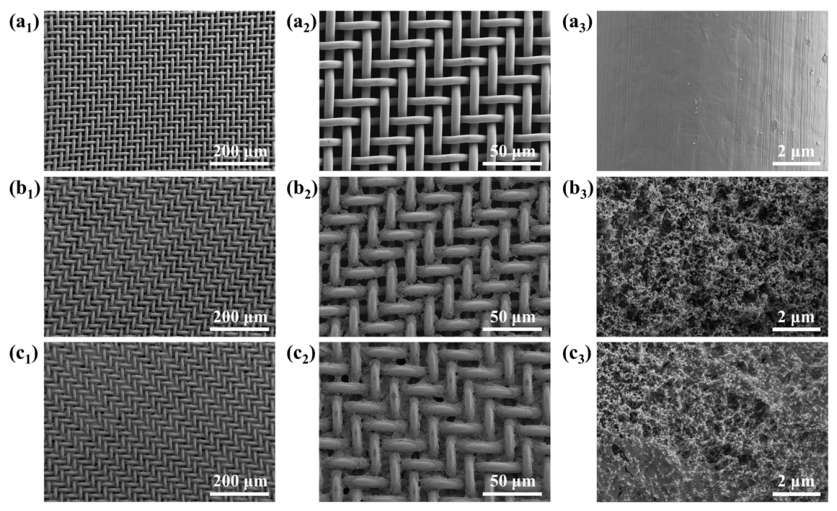
The microstructural changes of SSM before and after surface modification were observed by scanning electron microscopy (SEM) (Figure 1). The pristine SSM exhibited a relatively flat and smooth surface morphology (Figure 1(a1–a3)), consisting of a single layer of stainless steel wires with an average diameter of ~25 μm, regularly interwoven to form mesh openings of ~26.7 μm in size. Upon heating to 500 °C for 30 min, liquid PDMS vaporized and decomposed, generating fine hydrophilic SiO2 microspheres [30]. As shown in Figure 1(b1–b3), numerous SiO2 nanoparticles were subsequently deposited on the SSM surface. This deposition process not only successfully constructed hierarchical micro/nanoscale rough structures on the initially smooth SSM surface, thereby significantly enhancing its surface roughness, but also reduced the effective pore size of the stainless steel mesh to 21.3 μm. Figure 1(c1–c3) displays the morphology of SiO2@PDA/CS-SSM following further modified by PDA/CS. It can be clearly observed that the PDA/CS coating was uniformly distributed on the SiO2-decorated SSM surface, and the pore size was further reduced to 19.9 μm. In this synergistic system, high-density hydrophilic SiO2 microspheres formed an irregular, multilevel micro/nanoscale rough structure, while the PDA/CS component acted as a flexible crosslinked network that firmly anchored these inorganic particles. The combination of inorganic roughness and the polymer layer provided a robust structural foundation for attaining highly efficient and long-term stable underwater superoleophobicity on the stainless steel mesh.

3.2. Surface Wettability Analysis

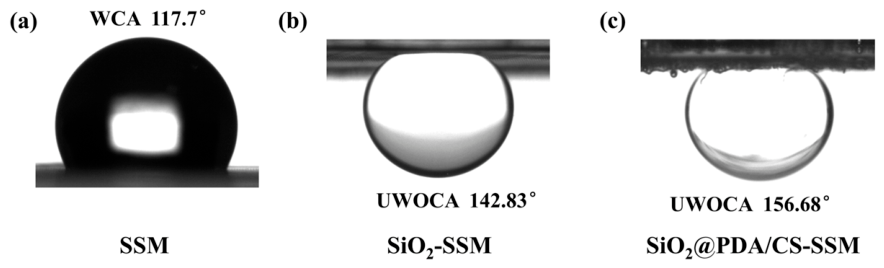
The static WCA is an important physical parameter for evaluating the macroscopic wetting behavior of material surfaces and their selectivity in oil–water separation. As shown in Figure 2, the pristine SSM exhibits hydrophobicity in air, on which water droplets maintain a nearly spherical shape, yielding a WCA of 117.7°. In striking contrast, when a water droplet contacts SiO2-SSM or the final SiO2@PDA/CS-SSM, it rapidly spreads and completely penetrates the mesh pores within an extremely short time (WCAs approaching 0° in both cases). This marked wettability transformation provides compelling evidence that the surface modification process successfully alters the initial hydrophobicity of the SSM, imparting excellent superhydrophilic properties.
Furthermore, to investigate the anti-oil fouling performance of the modified SSM in an underwater environment, this study employed petroleum ether as the oil phase to systematically measure its UWOCA. The results reveal that the UWOCA of the SiO2-SSM sample reaches 142.83°, indicative of favorable underwater oleophobicity. Following further crosslinking modification with PDA/CS, the UWOCA of SiO2@PDA/CS-SSM increases significantly to 156.68°, a value comparable to those reported in the literature [27,33]. This enhanced UWOCA is attributed to the densely distributed polar hydrophilic groups (–OH, –NH2) within the PDA/CS crosslinked network that coordinate with water molecules through strong intermolecular hydrogen bonding. When the modified mesh is immersed underwater, water molecules are instantly and firmly trapped within the micro/nanoscale rough structures constructed by SiO2, forming an extremely compact and stable hydration layer. According to the classical Cassie–Baxter wetting model, this water film effectively prevents direct physical contact between nonpolar oil droplets and the solid rough substrate, thereby enabling efficient separation of oil–water mixtures.
In this work, SiO2@PDA-CS-SSM exhibits excellent interfacial adhesion and outstanding underwater superoleophobicity, the underlying physicochemical mechanisms of which can be attributed to the synergistic effect of the organic–inorganic hybrid network at the molecular level. First, PDA serves as a binder; the catechol groups in its molecular structure not only form tight covalent crosslinks encapsulating the inorganic SiO2 nanoparticles but also confer strong adhesive properties to the PDA/CS coating through phenolic hydroxyl interactions, enabling it to adhere tenaciously to the SSM surface. Subsequently, long-chain CS is introduced as a flexible crosslinker, whose abundant –NH2 groups further couple with PDA via Schiff base reactions or Michael addition to construct a dense and robust organic crosslinked network in situ on the SSM framework. This network effectively secures the SiO2 particles and fundamentally imparts excellent mechanical durability to the coating [32,34].

3.3. Chemical Composition Analysis

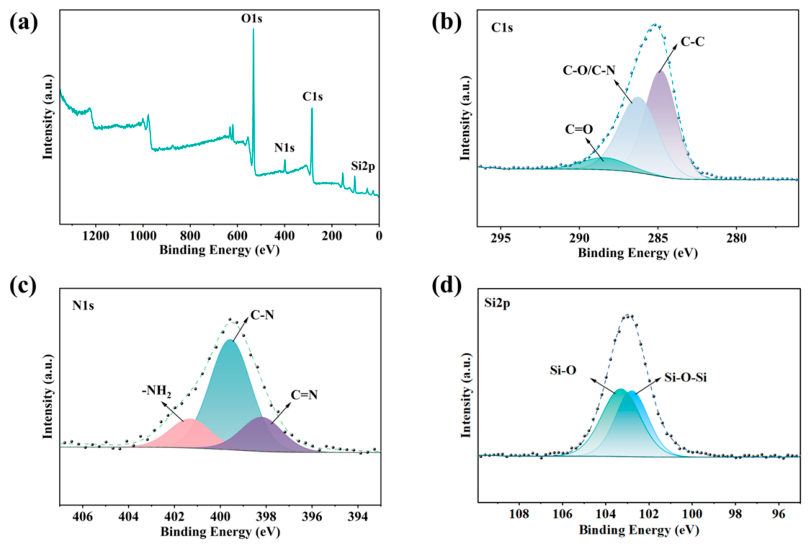
Owing to the inherent properties of the SSM substrate and the ultralow mass fraction (approximately 1–2%) of the SiO2@PDA/CS coating, Fourier transform infrared spectroscopy (FTIR) proved insufficiently sensitive to detect changes in chemical bonding before and after surface modification. Accordingly, X-ray photoelectron spectroscopy (XPS), which offers enhanced surface sensitivity, was employed to characterize the elemental composition and chemical states of the sample surface. The pristine SSM contains no detectable O or N. As shown in the survey XPS spectrum (Figure 3a), the modified SiO2@PDA/CS-SSM exhibits characteristic signals attributable to O 1s (531.8 eV), N 1s (399.0 eV), C 1s (284.5 eV) and Si 2p (102.9 eV).
The detection of carbon (C) and silicon (Si) elements on the sample surface preliminarily confirmed the successful immobilization of the SiO2@PDA/CS composite material onto the SSM substrate. To further validate the crosslinking reaction between polydopamine (PDA) and chitosan (CS), peak fitting analysis was conducted on the high-resolution X-ray photoelectron spectroscopy (XPS) fine spectra of C 1s and N 1s. Under pH 5 conditions with sodium periodate introduction, dopamine (DA) and CS could undergo crosslinking via Schiff base formation or Michael addition reactions, generating two distinct chemical bonds (C=O and C=N) [32]. As evidenced in Figure 3b,c, characteristic peaks corresponding to C=O and C=N groups were observed at binding energies of 289.14 eV in the C 1s spectrum and 398.8 eV in the N 1s spectrum, respectively, thereby substantiating the effective crosslinking interaction between PDA and CS. Concurrently, peak fitting characterization of the high-resolution Si 2p spectrum revealed distinct binding energy signals attributable to Si-O bonds (102.8 eV) and SiO2 (103.30 eV), demonstrating successful deposition of SiO2 onto the substrate surface at the molecular level through elemental chemical bonding.

3.4. Oil–Water Separation Performance

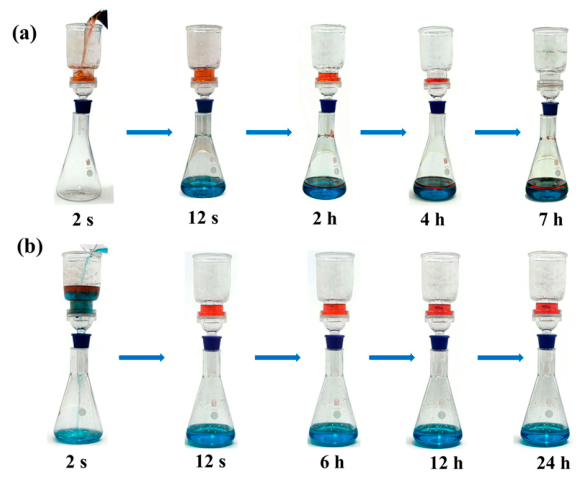
In this work, a petroleum ether/water mixture was selected as the standard test system to systematically evaluate the oil–water separation efficiency of stainless steel meshes at different modification stages. For SiO2-coated SSM (SiO2-SSM) loaded with only SiO2 particles, it could briefly intercept the oil phase in the initial stage of separation. However, after the water phase completely filtered out, the retained petroleum ether gradually penetrated under gravity and fully permeated through the separation membrane within 7 h (Figure 4a). This phenomenon indicates that a single SiO2 coating is not enough to achieve long-term stable oil–water separation. The reason may be attributed to the lack of strong adhesion between SiO2 microspheres and the substrate of SSM, where they easily fall off under the shear force of the liquid, resulting in local failure of the hydration barrier and deterioration of separation performance.
In contrast, the SiO2@PDA/CS-SSM exhibited rapid penetration of the water phase driven by gravity while completely retaining the oil phase (Figure 4b). Notably, no penetrating oil droplets were observed even after static placement for 24 h, confirming its excellent long-term separation stability. The long-term separation stability of this oil–water separation membrane can be attributed to the high density of polar groups present on the PDA/CS surface. These functional groups, positioned on the hydrophilic rough SiO2 surface, simultaneously stabilize the SiO2 particles on the SSM surface while establishing an exceptionally robust and durable liquid water barrier that effectively inhibits oil phase penetration.
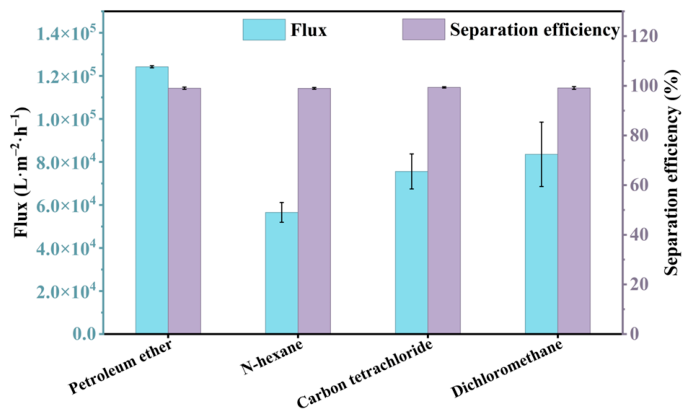
To further evaluate the material properties, separation tests were conducted using various light/heavy oil–water mixtures including n-hexane, carbon tetrachloride and dichloromethane (Figure 5). The results showed that the separation efficiency of the SiO2@PDA/CS-SSM for these oil–water mixtures remained above 99%. Remarkably, the separation flux of the petroleum ether/water mixtures was up to 1.24 × 10⁵ L⋅m−2⋅h−1, which represents a significant advantage over other oil–water separation materials reported in the literature (Table 1). The separation fluxes of n-hexane, carbon tetrachloride and dichloromethane were measured as high as 5.66 × 10⁴, 7.56 × 10⁴ and 8.35 × 10⁴ L⋅m−2⋅h−1, respectively. The difference in separation flux for different oil–water mixtures was mainly attributed to the density and viscosity of the oil phase. It is worth emphasizing that, compared with most reported oil–water separation membranes, the SiO2@PDA-CS modified stainless steel mesh prepared in this study not only achieves an extremely high separation purity of >99%, but also exhibits ultrahigh separation flux (up to 1.24 × 10⁵ L⋅m−2⋅h−1) among similar materials.
The two-step strategy proposed in this study demonstrates comprehensive superiority in the field of oil–water separation. First, this method is green, simple and cost-effective, requiring no expensive experimental equipment or toxic fluorine-containing low surface energy modifiers. Second, in contrast to the conventional physical dip-coating method, which is prone to delamination under fluid flushing, and benefiting from the crosslinking mechanism of PDA-CS, this coating exhibits exceptional interfacial adhesion strength and mechanical wear resistance that exceed conventional levels. Combining these characteristics—environmental friendliness, ultrahigh flux and reusability—the SiO2@PDA/CS stainless steel mesh has extremely broad commercialization prospects for practical engineering applications in large-scale industrial oily wastewater treatment and emergency recovery of marine oil spills.
Table 1. Comparison of Separation Performance between Similar Studies and This Study.
No.Base MaterialModified MaterialOil phaseSeparation Flux (L·m−2·h−1)Separation
Efficiency
Ref
1SSMPDMSChloroform1.5 × 105>99%[30]
2Copper MeshPDMS + CMC/Fe3+vegetable oil,
diesel fuel,
petroleum ether,
4.01 × 10⁴
3.0 ×10⁴
3.2 ×10⁴
>99%[31]
3SSMPDMS + PDA + PMAkerosene,
engine oil
9 × 10⁴
2 × 10⁴
>99%[35]
4SSM(NH4)2S2O8 + NaOH +
TA + H3PO4
n-hexane,
diesel fuel,
5 × 10⁴
4 × 10⁴
99.5%[36]
5SSMPDMS + PDA + CSpetroleum ether,
n-hexane.
1.24 × 10⁵
5.66 × 10⁴
>99%This study
All abbreviations in the table can be found in the abbreviation list in the text.

3.5. Chemical Stability and Reusability Performance Stability Test

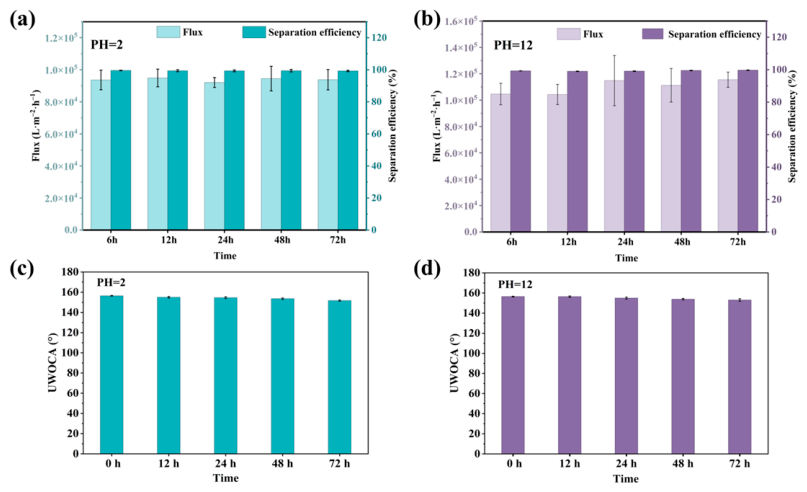
Industrial oily wastewater often involves harsh corrosive environments with strong acids or bases, which pose a great challenge to the long-term stability of separation materials. Therefore, in this work, the chemical durability of the SiO2@PDA/CS-SSM was systematically evaluated under extreme acidic and alkaline media. Specifically, SiO2@PDA/CS-SSM samples were continuously immersed in strongly acidic solution (pH  =  2) and strongly alkaline solution (pH  =  12) for up to 72 h, followed by monitoring the subsequent changes in their oil–water separation performance. The test results (Figure 6a) showed that after immersion in pH  =  2 acidic solution for 72 h, the membrane still maintained a water separation efficiency above 99% for the mixture; although its separation flux decreased partially (reduced to 9.38 ×  104 L·m–2·h–1), the overall performance remained relatively stable. After 72 h of immersion in a highly acidic environment (pH  =  2), the separation flux showed a certain degree of decline, which may be due to two reasons: On the one hand, there are abundant –NH2 groups on the macromolecular chains of PDA and CS. Under strong acid conditions, these -NH2 groups will undergo protonation [37], and the generated strong electrostatic repulsion will force the originally tight PDA-CS crosslinked network structure to expand. The expansion causes the coating to swell, microscopically reducing the pore size of the SSM, leading to a reduction in separation flux. On the other hand, there is the mechanism of acid-catalyzed hydrolysis degradation of the chitosan backbone. Prolonged exposure to strong acids can cause cleavage of glycosidic bonds in the molecular backbone of chitosan, causing the long-chain polymers to degrade into short-chain fragments [37]. The fracture of the backbone chain reduces the structural strength of the PDA-CS crosslinked network, thereby also contributing to the observed reduction in separation flux. Comparative analysis of mass changes between pristine SSM and SiO2@PDA/CS-SSM after 72 h of immersion revealed negligible differences (mass loss: 0.49‰ for the original SSM vs. 0.34‰ for the SiO2@PDA/CS-SSM). Similarly, after enduring 72 h of corrosion in pH  =  12 alkaline environment, the SiO2@PDA/CS-SSM exhibited excellent stability: its separation efficiency remained above 99%, while the permeation flux remained at an excellent level of 1.15 ×  105 L·m–2·h–1 without significant degradation (Figure 6b). As shown in Figure 6c,d, the UWOCA values of SiO2@PDA/CS-SSM after 72 h of immersion in both acidic and alkaline conditions still exceeded 150°, further confirming its outstanding acid and alkali resistance properties.
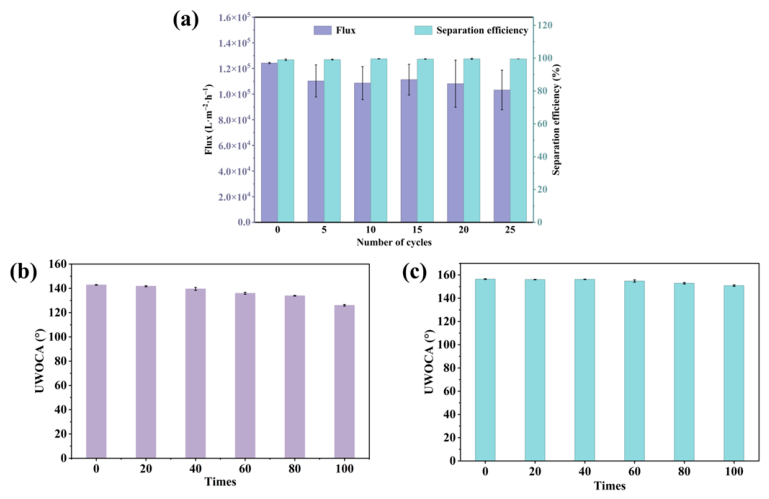
The reusability of materials is a key indicator for evaluating the practical application potential of oil–water separation materials. For this purpose, in this work, petroleum ether/water mixed solution was used as the test system, and the SiO2@PDA/CS-SSM was continuously subjected to 25 cycles of separation testing. As shown in Figure 7a, after 25 cycles of separation tests, the separation flux of SiO2@PDA/CS-SSM still remained at 1.07 × 10⁵ L·m–2·h–1, and the separation efficiency of each cycle was stable above 99%. No obvious signs of performance degradation were observed during the whole test process. This indicates that the membrane has excellent anti-fouling accumulation and regeneration ability.
In addition, physical friction in the practical application environment often affects the microstructure of coatings. To further evaluate the mechanical properties of the SiO2@PDA/CS-SSM, a standard sandpaper abrasion test was used to systematically study the effect of mechanical wear on the separation membrane. Figure 7b,c presents the underwater oil contact angle (UWOCA) evolution of SiO2-SSM and SiO2@PDA/CS-SSM after 100 abrasion cycles, respectively. The data demonstrate that the UWOCA of SiO2-SSM decreased substantially from 142.83° to 126.04°, while SiO2@PDA/CS-SSM exhibited minimal reduction from 156.68° to 150.83°, indicating superior resistance to surface degradation compared to the unmodified counterpart. Comparative analysis confirms that PDA/CS integration effectively preserves the underlying SiO2 micro/nanostructures, thereby enhancing both mechanical stability and wear resistance of the protective coating.

4. Conclusions

In conclusion, this study successfully fabricated a SiO2@PDA/CS composite coating on the surface of SSM via a facile two-step strategy. The coating takes full advantage of the micron/nanoscale rough structure of SiO2 microspheres and the synergistic effect of PDA/CS, which provides strong adhesion and hydrophilicity, conferring the modified SSM with SH/UWSO (UWOCA of 156.68°). Oil–water separation tests showed that the SiO2@PDA/CS-SSM exhibited excellent separation performance for various oil–water mixtures, achieving a maximum separation flux of 1.24  ×  105 L·m–2·h–1 for petroleum ether/water mixtures with stable separation efficiency above 99%. Notably, the material demonstrated exceptional cycling stability—manifested by negligible degradation in separation efficiency and flux over 25 operational cycles—which was attributed to the stabilizing influence of the PDA/CS crosslinked network on the SiO2 anchoring layer.
The findings of this study indicate that the construction of a covalently bonded anchoring layer via in situ chemical conversion of precursors constitutes a key strategy for imparting exceptional environmental resistance to subsequent functional coatings. This fundamental approach is anticipated to be applicable to diverse metallic substrates and various functional coating systems. This work provides a simple yet effective strategy to develop highly stable and scalable materials for oil–water separation. Future work will further investigate the crossflow separation performance of this material for different types of oil/water mixtures and its separation efficiency on surfactant stabilized emulsified oil/water systems while evaluating its long-term operational stability in real industrial wastewater treatment applications.

Supplementary Materials

The following supporting information can be downloaded at: https://www.mdpi.com/article/10.3390/pr14121998/s1, Figure S1: Schematic Diagram of the DA/CS Copolymerization Reaction; Figure S2: Schematic diagram of the DA/CS reaction process; Table S1: The effect of PDMS amount and reaction time on SiO2 loading and separation flux; Table S2: Related Literature Research. References [38,39,40] are cited in the supplementary materials.

Author Contributions

Z.Z.: experiments, writing—original draft, methodology, investigation, data curation. L.M.: writing—review & editing, supervision. Y.S.: investigation, data curation. D.X.: conceptualization, supervision. M.L.: writing—review & editing, writing—original draft, supervision, resources, project administration, methodology, investigation, project funding support. All authors have read and agreed to the published version of the manuscript.

Funding

This research was supported by the National Natural Science Foundation of China (NSFC, grant number 12075261).

Data Availability Statement

The original contributions presented in this study are included in the article/Supplementary Material. Further inquiries can be directed to the corresponding author.

Conflicts of Interest

The authors declare no conflicts of interest.

Abbreviations

The following abbreviations are used in this manuscript:
SSMstainless steel mesh
SH/UWSOsuperhydrophilic/underwater superoleophobic
DAdopamine
CSchitosan
PDApolydopamine
SiO2silica
PDMSpolydimethylsiloxane
MWmolecular weight
AAmacrylamide
PAAmpolyacrylamide
PAM/PMApolyacrylamide
TC-HCltetracycline hydrochloride
FE-SEMfield-emission scanning electron microscope
SEMscanning electron microscope
UWOCAoil underwater contact angle
WCAwater contact angle
XPSX-ray photoelectron spectroscopy
FT-IRFourier transform infrared spectroscopy
PMpolyacrylamide
TAtannic acid

References

  1. Kang, C.; Guo, J.; Kiyingi, W.; Fei, D.; Xiong, R. Sustainable Treatment and Recycling of Oily Sludge: Incorporation into Gel-System to Improve Oil Recovery. J. Clean. Prod. 2024, 436, 140640. [Google Scholar] [CrossRef]
  2. Xiang, B.; Sun, Q.; Zhong, Q.; Mu, P.; Li, J. Current Research Situation and Future Prospect of Superwetting Smart Oil/Water Separation Materials. J. Mater. Chem. A 2022, 10, 20190–20217. [Google Scholar] [CrossRef]
  3. Oh, S.; Bang, J.; Jin, H.-J.; Kwak, H.W. Green Fabrication of Underwater Superoleophobic Biopolymeric Nanofibrous Membranes for Effective Oil-Water Separation. Adv. Fiber Mater. 2023, 5, 603–616. [Google Scholar] [CrossRef]
  4. Liu, Z.; Si, Y.; Yu, C.; Jiang, L.; Dong, Z. Bioinspired Superwetting Oil-Water Separation Strategy: Toward the Era of Openness. Chem. Soc. Rev. 2024, 53, 10012–10043. [Google Scholar] [CrossRef] [PubMed]
  5. Elmi, F.; Valookolaee, F.H.; Taleshi, M.S. Superhydrophilic/Superoleophobic Mesh/Chitosan-MnO2 Membrane for Robust and Highly Efficient Separation of Oil-in-Water Emulsions. Water Air Soil Pollut. 2023, 234, 692. [Google Scholar] [CrossRef]
  6. Wang, Y.; Zhou, J.; Xu, J.; Ye, H.; Zhao, M.; Li, W.; Yang, B.; Li, X. Centrifugal Spinning of PVDF Micro/Nanofibrous Membrane for Oil-Water Separation. ACS Appl. Nano Mater. 2024, 7, 25665–25674. [Google Scholar] [CrossRef]
  7. Zhang, J.; Peng, K.; Xu, Z.-K.; Xiong, Y.; Liu, J.; Cai, C.; Huang, X. A Comprehensive Review on the Behavior and Evolution of Oil Droplets during Oil/Water Separation by Membranes. Adv. Colloid Interface Sci. 2023, 319, 102971. [Google Scholar] [CrossRef] [PubMed]
  8. Peng, Y.; Guo, J.; Gao, Y.; Li, X.; Ni, M.; Shen, X.; Chu, Z.; Yang, Z.; Hu, Y. FacilePreparation of Pickering Emulsion-Based Coatings for Hydrophobic, Oil-Resistant, Biodegradable Green Paper-Based Packaging. Food Hydrocoll. 2024, 149, 109624. [Google Scholar] [CrossRef]
  9. Wang, R.; Zhu, L.; Zhu, X.; Yan, Z.; Xia, F.; Zhang, J.; Liu, X.; Yu, J.; Xue, Q. A Super-Hydrophilic and Underwater Super-Oleophobic Membrane with Robust Anti-Fouling Performance of High Viscous Crude Oil for Efficient Oil/Water Separation. Colloids Surf. A 2023, 658, 130662. [Google Scholar] [CrossRef]
  10. Xiong, T.; Zou, C.; Wang, H.; Hu, Y.; Xiong, Y. Cucurbit[7]Uril-Modified Nano SiO2 for Efficient Separation of Crude Oil Emulsions: Properties and Demulsification Mechanism. Langmuir 2024, 40, 15178–15187. [Google Scholar] [CrossRef] [PubMed]
  11. Yuan, T.; Yin, J.; Liu, Y.; Tu, W.; Yang, Z. Micro/Nanoscale Structured Superhydrophilic and Underwater Superoleophobic Hybrid-Coated Mesh for High-Efficiency Oil/Water Separation. Polymers 2020, 12, 1378. [Google Scholar] [CrossRef] [PubMed]
  12. Fu, C.; Tian, G.; He, S.; Yao, L.; Guo, Z. Hydrogel Coated Mesh with Controlled Flux for Oil/Water Separation. ACS Appl. Mater. Interfaces 2024, 16, 37757–37769. [Google Scholar] [CrossRef] [PubMed]
  13. He, M.; Wu, S.; Xiong, S.; Zhang, L.; Lai, C.; Peng, X.; Zhong, S.; Lu, Z.-H.; Chen, S.; Zhang, W.-G.; et al. Hydrophobic Carbon Nitride Nanolayer Enables High-Flux Oil/Water Separation with Photocatalytic Antifouling Ability. Nano Lett. 2023, 23, 10563–10570. [Google Scholar] [CrossRef] [PubMed]
  14. Zhu, L.; Jiang, R.; Chen, C. Fabrication of a Janus Copper Mesh by SiO2 Spraying for Unidirectional Water Transportation and Oil/Water Separation. Langmuir 2024, 40, 8694–8702. [Google Scholar] [CrossRef] [PubMed]
  15. Xiong, W.; Zhu, L.; Jiang, R.; Chen, C. Laser Manufacturing of Superwetting Oil-Water Separation Materials: A Review. Separations 2024, 11, 126. [Google Scholar] [CrossRef]
  16. El-Sewify, I.M.; Ma, S. Recent Development of Metal-Organic Frameworks for Water Purification. Langmuir 2024, 40, 5060–5076. [Google Scholar] [CrossRef] [PubMed]
  17. Jiang, J.; Wan, S.; Wen, C.; Tang, L.; Xu, N. Frontiers in Innovative Materials and Technologies for Oil-Water Separation. Polymers 2025, 17, 1635. [Google Scholar] [CrossRef] [PubMed]
  18. Omar, R.A.; Talreja, N.; Ashfaq, M.; Chauhan, D. Two-Dimensional Nanomaterial (2D-NMs)-Based Polymeric Composite for Oil-Water Separation: Strategies to Improve Oil-Water Separation. Sustainability 2023, 15, 10988. [Google Scholar] [CrossRef]
  19. Qi, X.; Gao, Z.; Li, C.; Wang, S.; Zou, X.; He, L.; Liu, Z. Underwater Superoleophobic Copper Mesh Coated with Block Nano Protrusion Hierarchical Structure for Efficient Oil/Water Separation. J. Ind. Eng. Chem. 2023, 119, 450–460. [Google Scholar] [CrossRef]
  20. Xia, S.; Pang, Y.; Yu, Z.; Wang, J.; Chen, Z. Superhydrophobic DTES-SEP/SiO2@PDMS Coated Sponge and Stainless Steel Mesh for Efficient Oil and Water Separation. J. Environ. Chem. Eng. 2023, 11, 110605. [Google Scholar] [CrossRef]
  21. Shi, Z.; Zeng, H.; Yuan, Y.; Shi, N.; Wen, L.; Rong, H.; Zhu, D.; Hu, L.; Ji, L.; Zhao, L.; et al. Constructing Superhydrophobicity by Self-Assembly of SiO2@Polydopamine Core-Shell Nanospheres with Robust Oil-Water Separation Efficiency and Anti-Corrosion Performance. Adv. Funct. Mater. 2023, 33, 2213042. [Google Scholar] [CrossRef]
  22. Jiang, Q.; Lin, B.; Zhong, Z.; Fan, Y.; Xing, W. Ultra-Low Temperature Co-Sintering of Water Glass (WG)-Bonded Silicon Carbide Ceramic Membranes for Oil-Water Separation. J. Membr. Sci. 2024, 692, 122311. [Google Scholar] [CrossRef]
  23. Al Zoubi, W.; Yoon, D.K.; Kim, Y.G.; Ko, Y.G. Fabrication of Organic-Inorganic Hybrid Materials on Metal Surface for Optimizing Electrochemical Performance. J. Colloid Interface Sci. 2020, 573, 31–44. [Google Scholar] [CrossRef] [PubMed]
  24. Wang, Y.; Chen, Z.; Zhu, Y.; Wang, H.; Cui, Z.; Li, X.; Mo, J.; Li, J. An Ultrathin Al2O3 Ceramic Membrane Prepared by Organic-Inorganic Blending with Solvent Evaporation and High-Temperature Sintering for Highly Efficient Oil/Water Separation. J. Water Process Eng. 2025, 70, 107116. [Google Scholar] [CrossRef]
  25. Liu, Y.; Gui, Z.; Du, L.; Du, J.; Wu, M.; Li, D.; Cheng, L.; Huang, F. Innovative Organic-Inorganic Hybrid Membrane for Oil-Water Separation via Chemical Bond Reconstruction-Enhanced Interfacial Polarity Reversal. Small 2025, 21, e03268. [Google Scholar] [CrossRef] [PubMed]
  26. Zhong, X.; Guo, Z. Simple and Ultrahigh Efficient Superhydrophilic Polydopamine-Coated TiO2 Cotton for Oil-Water Separation. J. Bionic Eng. 2023, 20, 900–909. [Google Scholar] [CrossRef]
  27. Li, B.; Li, H.; Chen, K.; Liang, C.; Luo, Y.; Xiao, W.; Liu, X.; Liao, X. Stainless Steel Screen Modified with a Self-Healing Hydrogel for Efficient Gravity-Driven Oil-Water Separation. J. Polym. Environ. 2022, 30, 2165–2175. [Google Scholar] [CrossRef]
  28. Zhang, Y.; Cao, Z.; Luo, Z.; Li, W.; Fu, T.; Qiu, W.; Lai, Z.; Cheng, J.; Yang, H.; Ma, W.; et al. Facile Fabrication of Underwater Superoleophobic Membrane Based on Polyacrylamide/Chitosan Hydrogel Modified Metal Mesh for Oil-Water Separation. J. Polym. Sci. 2022, 60, 2329–2342. [Google Scholar] [CrossRef]
  29. Xu, X.; Liu, Y.; Cui, Y.; Wei, X.; Zhang, L. Nature-Driven Superhydrophobic Sepiolite/Chitosan Hybrid Aerogel: A Multifunctional Platform for High-Efficiency Oil-Water Separation and Versatile Pollutant Removal. ACS Appl. Polym. Mater. 2025, 7, 15372–15383. [Google Scholar] [CrossRef]
  30. Wen, N.; Miao, X.; Yang, X.; Long, M.; Deng, W.; Zhou, Q.; Deng, W. An Alternative Fabrication of Underoil Superhydrophobic or Underwater Superoleophobic Stainless Steel Meshes for Oil-Water Separation: Originating from One-Step Vapor Deposition of Polydimethylsiloxane. Sep. Purif. Technol. 2018, 204, 116–126. [Google Scholar] [CrossRef]
  31. Xiao, W.; Hu, Q.; Li, W.; Yu, H.; Yan, Z.; Xia, C.; Li, Y.; Wang, J.; Yang, X.; Li, B.; et al. Fabrication and Performance of a SiO2/CMC-Fe3+-Coated Copper Mesh for Efficient Oil-Water Separation. Langmuir 2025, 41, 18694–18706. [Google Scholar] [CrossRef] [PubMed]
  32. Zhang, L.; Luo, X.; Wen, X.; Liu, C.; Liu, P.; Jiang, M.; Li, J.; Ma, L. Constructing an Antifouling Sulfonated Dopamine/Chitosan Hydrogel Layer onto Two-Type Membrane for High-Efficiency Crude Oil Wastewater Treatment. Langmuir 2026, 42, 4186–4198. [Google Scholar] [CrossRef] [PubMed]
  33. Li, S.; Liu, Y.; Du, S.; Hu, C.; Liu, B. Photothermal-Driven Bio-Based Composite Sponge for Sustainable Oil-Water Separation: A Green Strategy Utilising Vanillin-Crosslinked Chitosan. Carbohydr. Polym. 2026, 380, 125088. [Google Scholar] [CrossRef] [PubMed]
  34. Manholi, S.; Athiyanathil, S. Eco-Friendly Poly (ε-Caprolactone) Based Microfiltration Polymeric Membranes-Influence of Dope Composition on Morphology and Performance Concerning Oil-Water Separation. J. Polym. Res. 2024, 31, 365. [Google Scholar] [CrossRef]
  35. Xiao, W.; Li, H.; Yang, H.; Shu, Y.; Tu, T.; Li, B.; Liao, X. Bioinspired Composite Hydrogel-Coated Stainless Steel Screen for Efficient and Stable Gravity-Driven Oil-Water Separation. Adv. Eng. Mater. 2023, 25, 2201258. [Google Scholar] [CrossRef]
  36. Sun, B.; Zhang, F.; Gao, M.; Zhao, S.; Wang, J.; Zhang, W.; Wang, Z.; Wang, J. Superhydrophilic Stainless Steel Mesh for Oil-Water Separation with Long-Term Durability, Impressive Corrosion Resistance, and Abrasion Resistance. Adv. Eng. Mater. 2020, 22, 2000262. [Google Scholar] [CrossRef]
  37. Kasaai, M.R.; Arul, J.; Charlet, G. Fragmentation of Chitosan by Acids. Sci. World J. 2013, 2013, 508540. [Google Scholar] [CrossRef] [PubMed]
  38. Wang, M.; Hu, D.-D.; Li, Y.-D.; Peng, H.-Q.; Zeng, J.-B. Biobased Mussel-Inspired Underwater Superoleophobic Chitosan Derived Complex Hydrogel Coated Cotton Fabric for Oil/Water Separation. Int. J. Biol. Macromol. 2022, 209, 279–289. [Google Scholar] [CrossRef] [PubMed]
  39. Wang, M.; Peng, M.; Zhu, J.; Li, Y.-D.; Zeng, J.-B. Mussel-Inspired Chitosan Modified Superhydrophilic and Underwater Superoleophobic Cotton Fabric for Efficient Oil/Water Separation. Carbohydr. Polym. 2020, 244, 116449. [Google Scholar] [CrossRef] [PubMed]
  40. Wu, R.; Han, J.; Chen, W.; Yu, X.; Gao, R.; Zhang, C. Beetle-Exoskeleton-Inspired Fluorine-Free PDA/Chitosan–SiO2/PDMS Coating for Cotton: Durable Self-Cleaning, Self-Healing, Antibacterial Activity, and Oil–Water Separation. ACS Sustain. Chem. Eng. 2025, 13, 19871–19887. [Google Scholar] [CrossRef]
Figure 1. Low- and high-magnification SEM images: (a1a3) the original SSM surface; (b1b3) SiO2-SSM; (c1c3) SiO2@PDA/CS-SSM.
Processes 14 01998 g001
Figure 2. (a) WCA of SSM; (b) UWOCA of SiO2-SSM; (c) UWOCA of SiO2@PDA/CS-SSM.
Processes 14 01998 g002
Figure 3. (a) XPS full spectrum of SiO2@PDA/CS-SSM; (bd) C 1s, N 1s and Si 2p spectroscopy of SiO2@PDA/CS-SSM.
Processes 14 01998 g003
Figure 4. Digital images of the oil–water separation of (a) SiO2-SSM, (b) SiO2@PDA/CS-SSM.
Processes 14 01998 g004
Figure 5. Separation flux and efficiency of various oil–water mixtures using SiO2@PDA/CS-SSM.
Processes 14 01998 g005
Figure 6. Separation flux and efficiency under acidic and alkaline conditions: (a) PH = 2; (b) pH = 12. UWOCA under acidic and alkaline conditions: (c) pH = 2; (d) pH = 12.
Processes 14 01998 g006
Figure 7. (a) Separation efficiency and separation flux after 25 separation cycles. (b) Variation plot of UWOCA for SiO2-SSM after 100 abrasion cycles. (c) Variation plot of UWOCA for SiO2@PDA/CS-SSM after 100 abrasion cycles.
Processes 14 01998 g007
Disclaimer/Publisher’s Note: The statements, opinions and data contained in all publications are solely those of the individual author(s) and contributor(s) and not of MDPI and/or the editor(s). MDPI and/or the editor(s) disclaim responsibility for any injury to people or property resulting from any ideas, methods, instructions or products referred to in the content.