


A Numerical Well Testing Method for Horizontal Wells in Hydraulically Fractured Shale Reservoirs Based on 3D Simulation and the Embedded Discrete Fracture Model

Abstract
1. Introduction
2. Methodology
2.1. Mathematical Model of Multi-Phase Flow in Hydraulically Fractured Shale Reservoirs
2.1.1. Fluid Flow in Shale Matrix
2.1.2. Fluid Flow in Fractures
2.1.3. Mass Transfer Between Matrix and Fracture
2.2. Embedded Discrete Fracture Model (EDFM)
2.3. Post-Processing Method for Well Testing
3. Simulation and Analysis
3.1. Model Validation
3.2. Results of the Basic Example
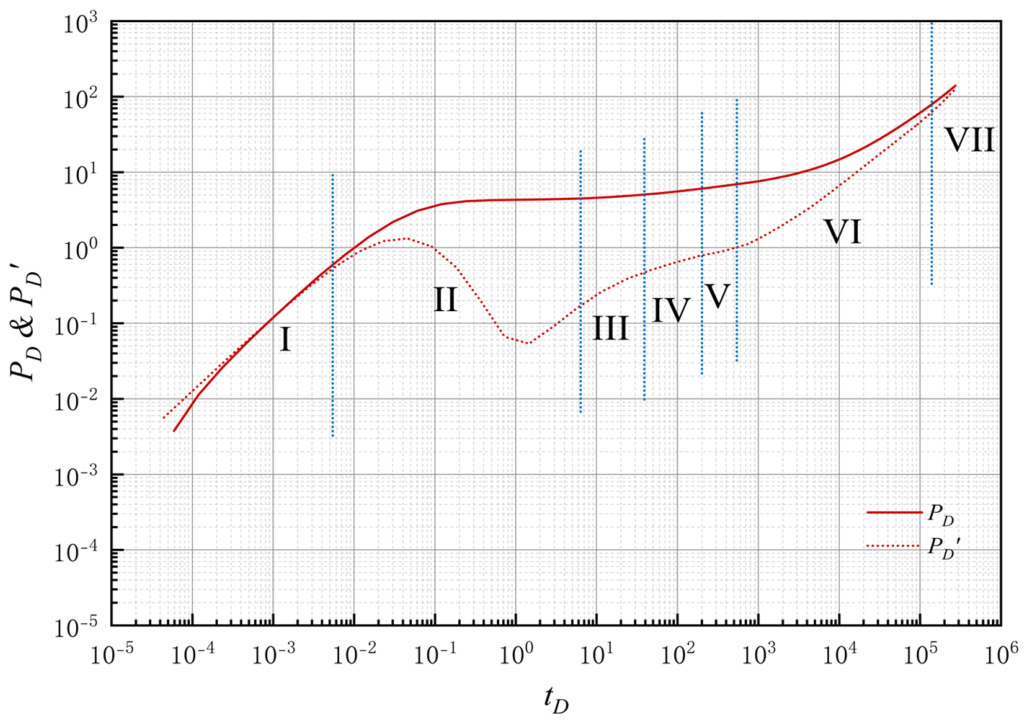
- (I)
- Stage of wellbore storage effect
- (II)
- Stage of transitional flow
- (III)
- Stage of linear flow inside fractures
- (IV)
- Stage of bi-linear flow
- (V)
- Stage of radial flow (occurs in some cases)
- (VI)
- Stage of the effect of the shale region outside of SRV
- (VII)
- Stage of the effect of closed boundary
3.3. Sensitivity Analysis
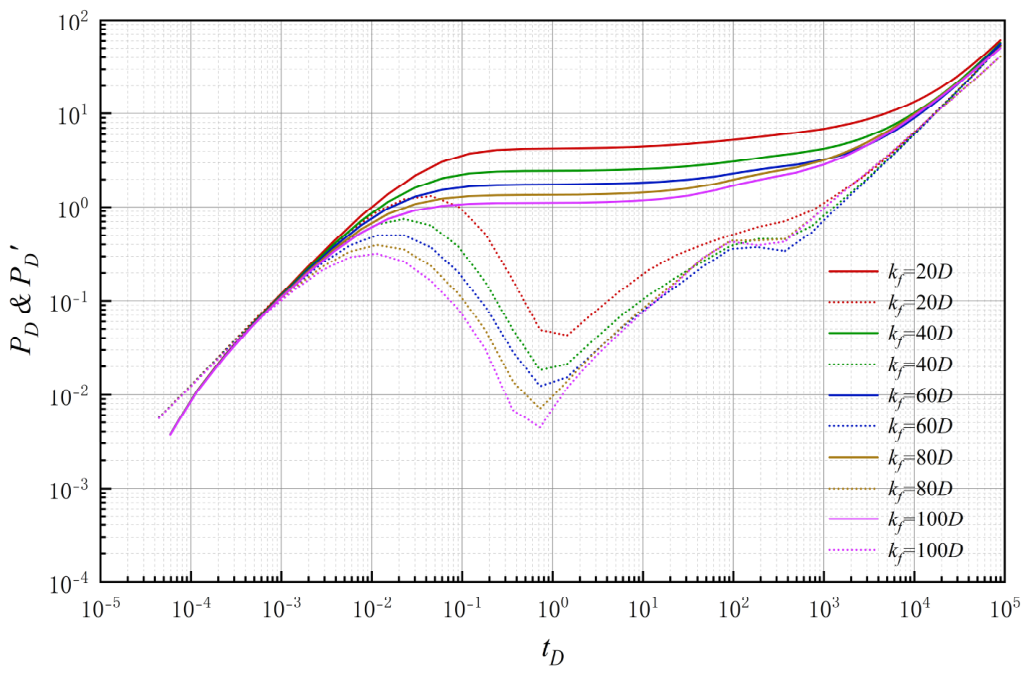
3.3.1. Permeability of Main Hydraulic Fractures
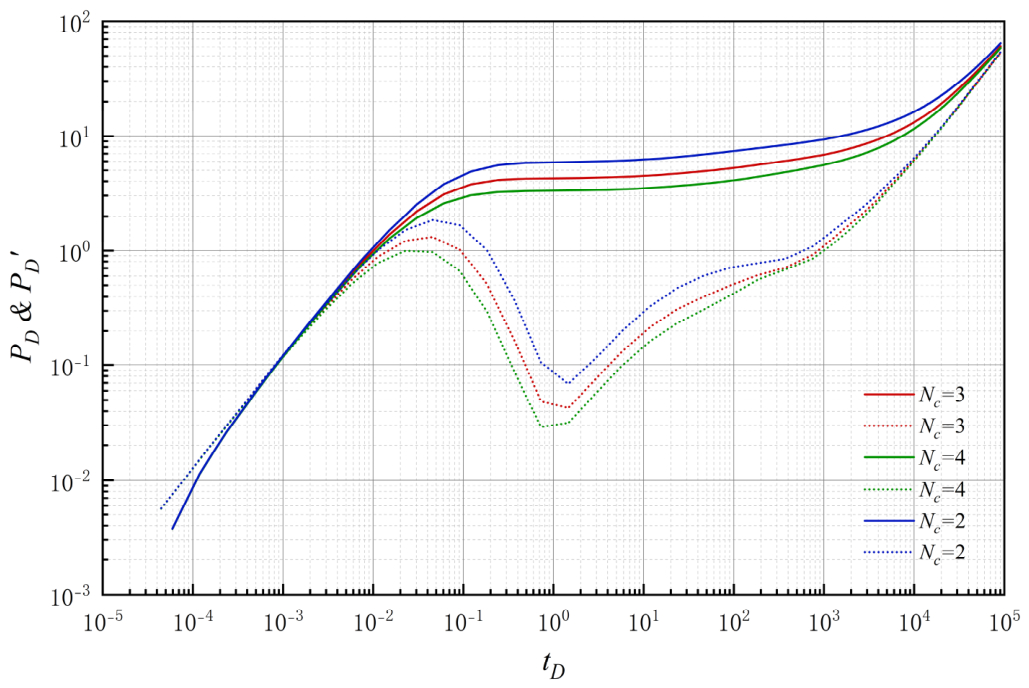
3.3.2. Number of Fracture Clusters
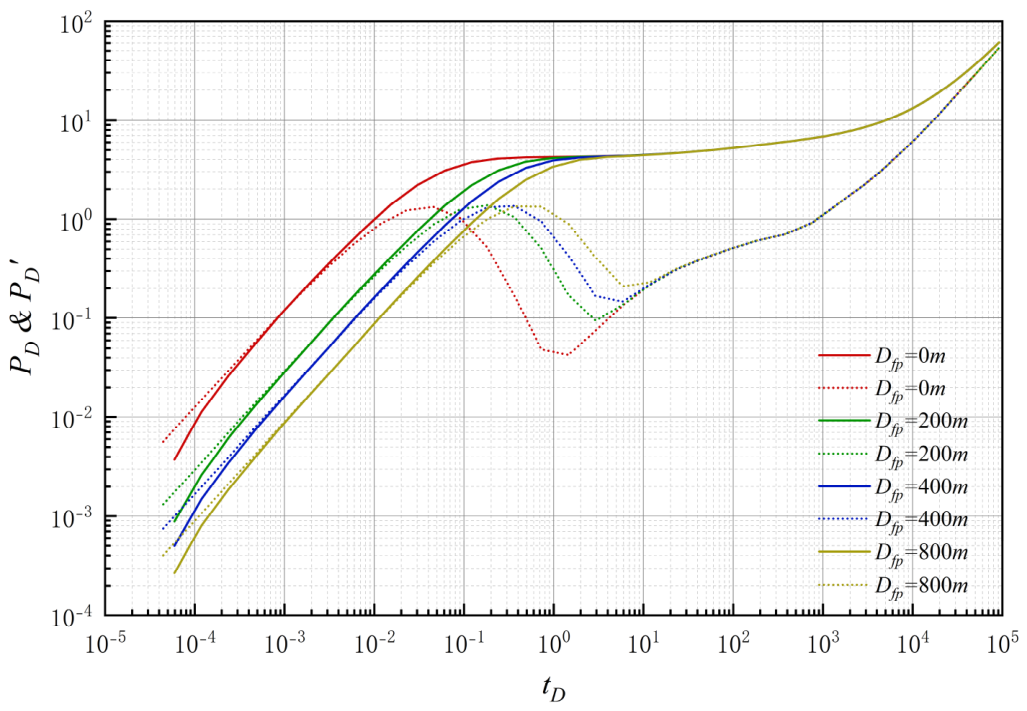
3.3.3. Distance from Fracturing Stage to Pressure Monitoring Point
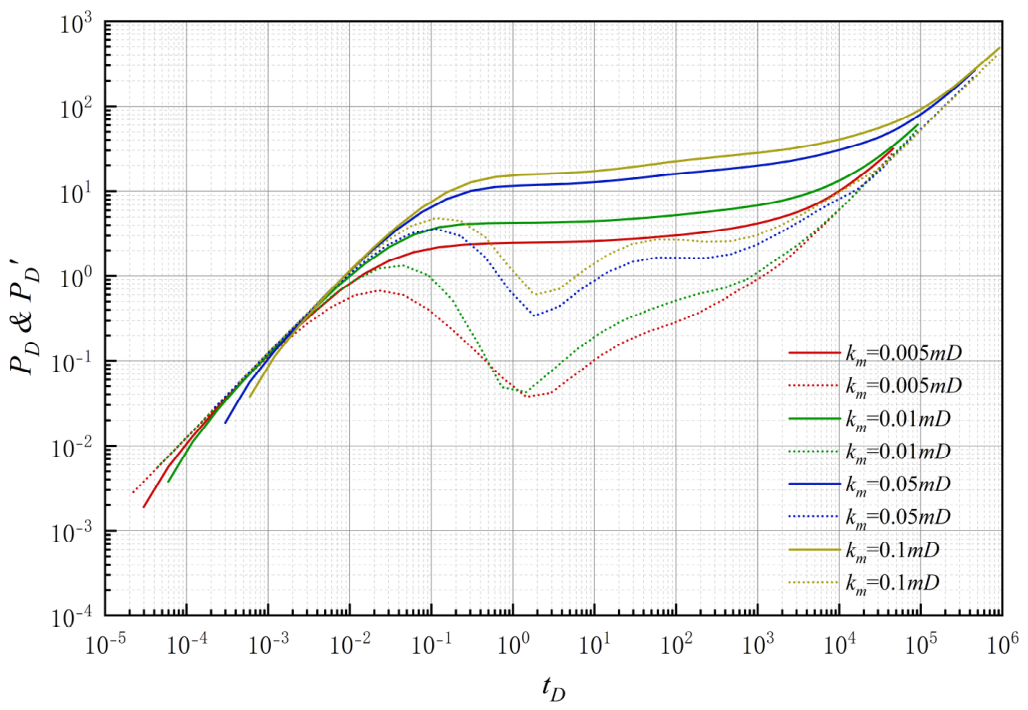
3.3.4. Initial Matrix Permeability
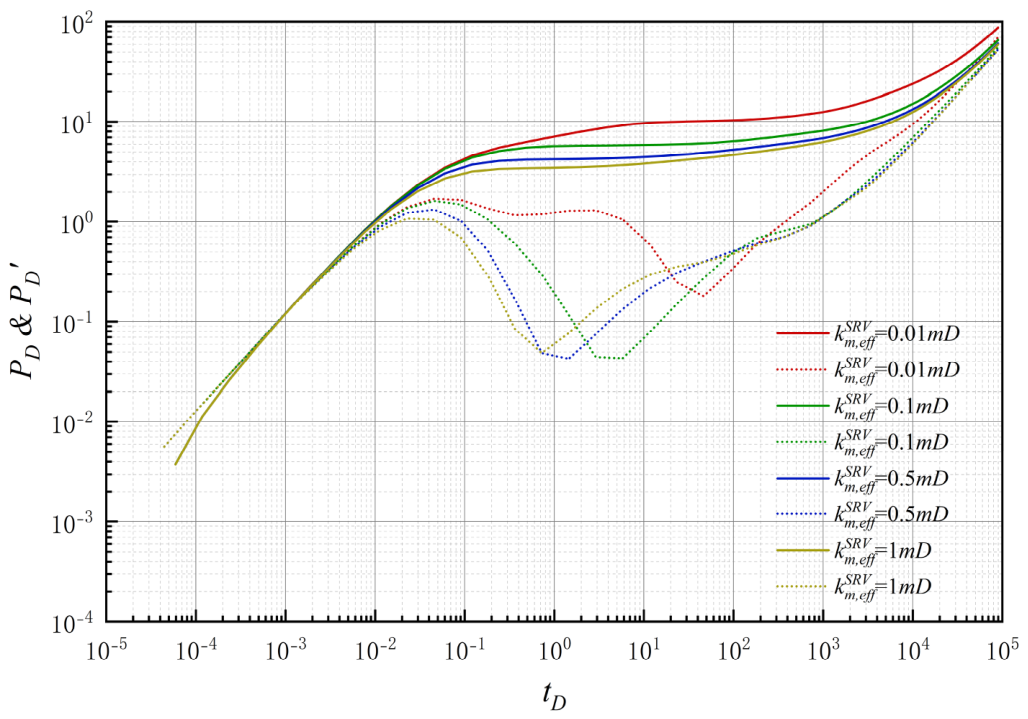
3.3.5. Effective Matrix Permeability in SRV
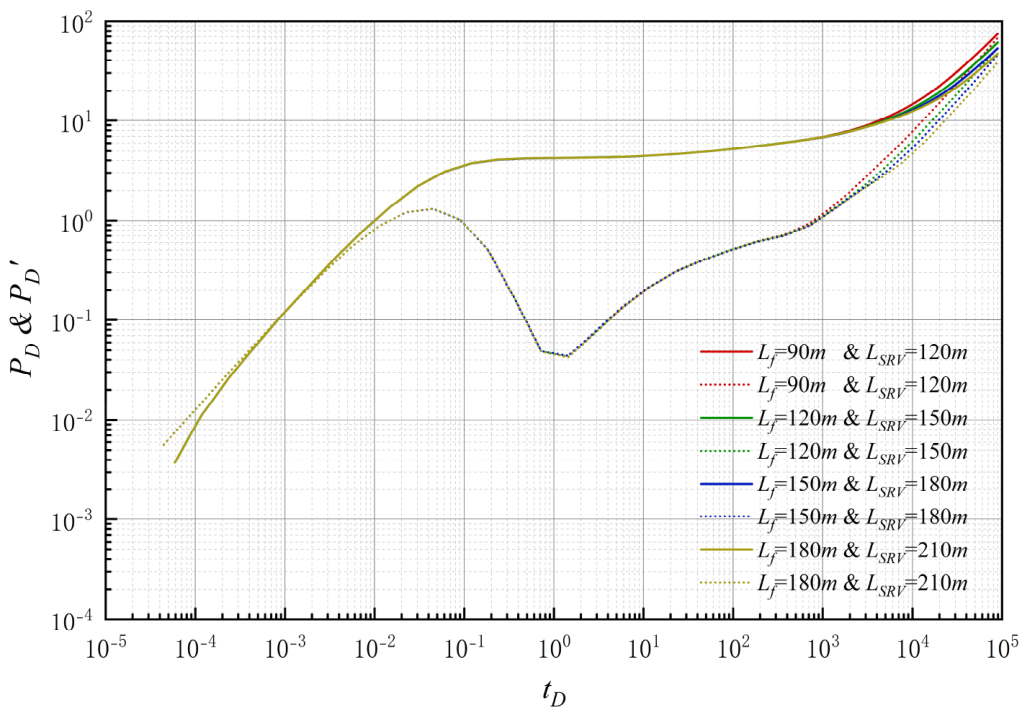
3.3.6. Half-Lengths of Main Fractures and SRV in the Y Direction
3.3.7. Water Saturation of Hydraulic Fractures
3.3.8. Boundary Conditions
4. Conclusions
- (1)
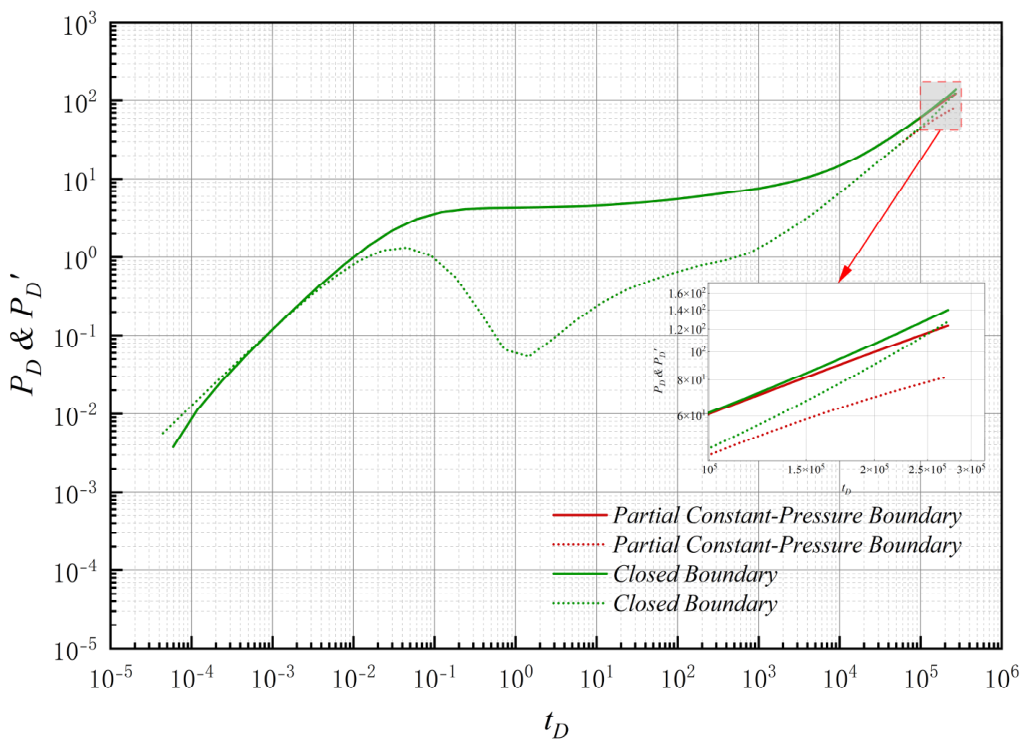
- Several factors have significant influences on most stages of the well testing curve, such as matrix permeability, main-fracture permeability, the number of fracture clusters in one fracturing stage, the equivalent matrix permeability in SRV, water saturation, etc. Others, however, only have an impact on a few specific stages, such as the distance from fracturing stage to pressure monitoring point, boundary conditions, and the size of the SRV, etc.
- (2)
- The main fracture permeability (conductivity) has a significant impact on the II to V stages of the well testing curve. Among them, when the permeability (conductivity) of the main fractures is relatively high, the characteristics of radial flow may occur in Stage V; while the permeability (conductivity) of the main fractures is relatively low, such characteristics will not occur or will be less obvious. The initial matrix permeability exerts a significant impact on the well testing curves across the entire range of dimensionless time. When the initial matrix permeability is 0.05 mD and 0.1 mD, its effects on the values of the dimensionless pressure and dimensionless pressure derivative are approximately ten times those observed at 0.005 mD and 0.01 mD.
- (3)
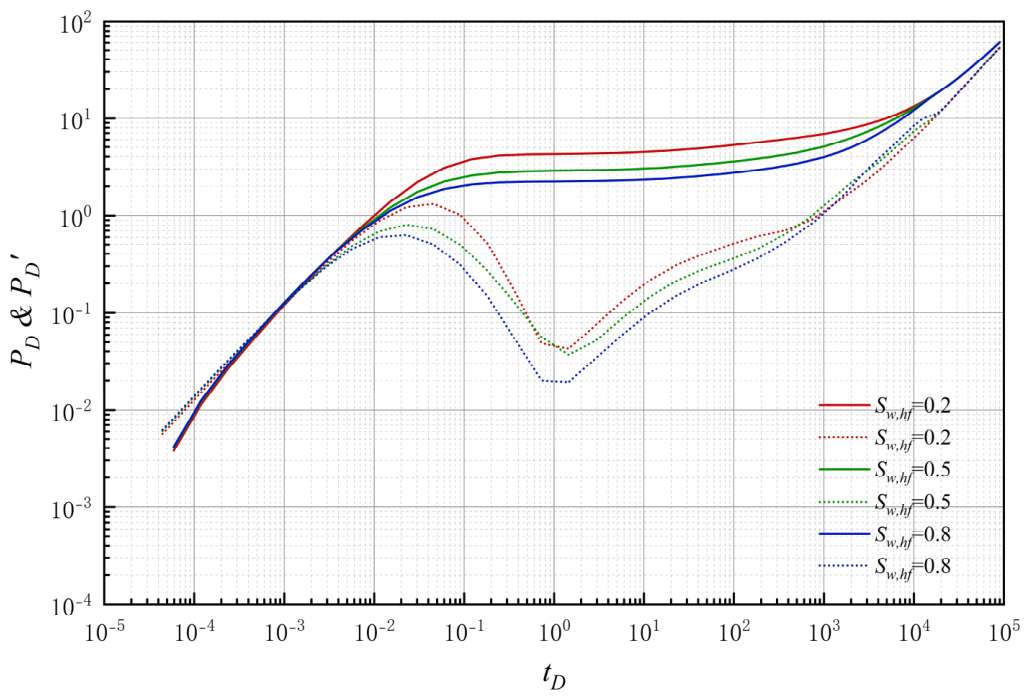
- Some factors which are often overlooked also have significant impacts on certain stages of the well testing curve, such as the distance from fracturing stage to pressure monitoring point and the initial water saturation inside the hydraulic fractures. The further the monitoring distance, the later the stages of the wellbore storage effect and the transitional flow occur, and at the same time, the V-shape dip of the dimensionless pressure derivative curve in the transitional flow stage (the II stage) becomes smaller. Among all cases, the distance between the fracturing stage and pressure monitoring point exerts the most prominent influence on Stage I and Stage II when it ranges from 0 m to 200 m. The water saturation inside the hydraulic fractures exhibits more complex effects. In the II to V stage if the water saturation is higher, the dimensionless pressure curve and the dimensionless pressure derivative curve are lower. However, in the VI stage, the situation reverses.
Author Contributions
Funding
Data Availability Statement
Conflicts of Interest
Abbreviations
| EDFM | Embedded discrete fracture model |
| SRV | Stimulated reservoir volume |
| DFM | Discrete fracture model |
| The porosity of the shale matrix, Dimensionless | |
| The permeability of the matrix, m2 | |
| The relative permeability of the water phase in the matrix, Dimensionless | |
| The relative permeability of the oil phase in the matrix, Dimensionless | |
| The mass flow rate of the water phase from the fractures to matrix, kg/(m2⋅s) | |
| The mass flow rate of the oil phase from the fractures to matrix, kg/(m2⋅s) | |
| The density of the water phase, kg/m3 | |
| The density of the oil phase, kg/m3 | |
| The saturation of the water phase, Dimensionless | |
| The saturation of the oil phase, Dimensionless | |
| The viscosity of the water phase, Pa⋅s | |
| The viscosity of the oil phase, Pa⋅s | |
| The water phase pressure inside the shale matrix, Pa | |
| The oil phase pressure inside the shale matrix, Pa | |
| The capillary pressure inside the shale matrix, Pa | |
| The porosity of the fractures, Dimensionless | |
| The permeability of the fractures, m2 | |
| The relative permeability of the water phase in the fractures, Dimensionless | |
| The relative permeability of the oil phase in the fractures, Dimensionless | |
| The mass flow rate of the water phase from the matrix to fractures, kg/(m2⋅s) | |
| The mass flow rate of the oil phase from the matrix to fractures, kg/(m2⋅s) | |
| The source or sink terms of the water phase, kg/(m3⋅s) | |
| The source or sink terms of the oil phase, kg/(m3⋅s) | |
| The pressure of the water phase in the fractures, Pa | |
| The pressure of the oil phase in the fractures, Pa | |
| The capillary pressure in the fractures, Pa | |
| The matrix-fracture connectivity coefficient, Dimensionless | |
| The fracture segment length produced by the division of the fractures by the matrix cell, m | |
| The average distance from the matrix cell center to the fracture segments, m | |
| The dimensionless time, Dimensionless | |
| The dimensionless pressure, Dimensionless | |
| The pressure derivative, Dimensionless | |
| The total compressibility factor of the shale reservoir, Pa−1 | |
| Radius of horizontal wells, m | |
| The reservoir thickness, m | |
| The volume factor of shale oil, Dimensionless | |
| The production rate, m3/s | |
| The production time, s | |
| The pressure drop, Pa | |
| A comprehensive parameter, Dimensionless | |
| The coefficient of wellbore storage effect, m3/Pa | |
| The number of fracture clusters, Dimensionless | |
| The distance from the fracturing stage to the pressure monitoring point, m | |
| The effective matrix permeability in SRV, m2 | |
| The half-length of main fractures, m | |
| The half-length of SRV in the y-direction, m | |
| The water saturation of hydraulic fractures, Dimensionless |
References
- Jin, Z.; Zhu, R.; Liang, X.; Shen, Y. Several issues worthy of attention in current lacustrine shale oil exploration and development. Pet. Explor. Dev. 2021, 48, 1276–1287. [Google Scholar] [CrossRef]
- Yang, L.; Jin, Z. Global shale oil development and prospects. China Pet. Explor. 2019, 24, 553–559. [Google Scholar]
- Chao, H. The Research of New Energy Source Development Strategy of China. Ph.D. thesis, Wuhan University, Wuhan, China, 2015. [Google Scholar]
- He, W.; Liu, B.; Zhang, J.; Bai, L.; Tian, S.; Chi, Y. Geological characteristics and key scientific and technological problems of Gulong shale oil in Songliao Basin. Earth Sci. 2023, 48, 49–62. [Google Scholar]
- Zhang, Y.; Zeng, H.; Tao, X.; Zhang, Y.; Zhou, D. Review of fracturing fluid leakage and prevention during volume fracturing in tight reservoirs. Sci. Technol. Eng. 2022, 22, 11277–11286. [Google Scholar]
- Jiang, T.; Wang, H. The current status and development suggestions for Sinopec′s staged fracturing technologies of horizontal shale oil wells. Pet. Drill. Tech. 2021, 49, 14–21. [Google Scholar]
- Meng, X. Numerical simulation of fracture propagation in the whole well stage of multi-cluster fracturing of horizontal wells in shale oil reservoirs: A case study of Shahejie Formation in Jiyang Depression. Fault-Block Oil Gas Field 2024, 31, 459–466. [Google Scholar]
- Zhao, J.; Chen, X.; Li, Y.; Fu, B.; Xu, W. Numerical simulation of multi-stage fracturing and optimization of perforation in a horizontal well. Pet. Explor. Dev. 2017, 44, 117–124. [Google Scholar] [CrossRef]
- Wang, L.; Sheng, Z.; Zhao, Z.; Song, D.; Wang, L.; Wang, G. Large-section and multi-cluster fracturing technology for horizontal wells in the Jimsar shale oil reservoir. Pet. Drill. Tech. 2021, 49, 106–111. [Google Scholar]
- Chen, H.; Liao, X.; Gao, J.; Chen, Z. A well test analysis method for multi-stage fractured horizontal wells in shale oil reservoirs. Xinjiang Pet. Geol. 2019, 40, 357–364. [Google Scholar]
- Liu, N. Practical Modern Well Test Interpretation Methods; Petroleum Industry Press: Beijing, China, 2008; pp. 21–25. [Google Scholar]
- Xing, C.; Yin, H.; Li, X.; Zhao, Z.; Fu, J. Research of the fractured vuggy type carbonate reservoirs well test analysis model. Hebei J. Ind. Sci. Technol. 2018, 35, 31–36. [Google Scholar]
- Yin, H.; Xing, C.; Ji, B.; Zhong, H.; Fakcharoenphol, P. Well Test Interpretation Model for Fracture-Cavity Reservoir with Well-Developed Large-Scale Caves. Spec. Oil Gas Reserv. 2018, 25, 84–88. [Google Scholar]
- Li, M.; Lin, J.; Li, Q.; Zhang, J. Well test analysis for a well with stress-sensitive natural fracture permeability and stress-dependent hydraulic fracture conductivities. Int. J. Oil Gas Coal Technol. 2019, 21, 298–312. [Google Scholar] [CrossRef]
- Peng, S.; Zhang, L.; Jiao, Y.; Yuan, H. A Temperature Well Test Analysis Method Considering Variable Thermal Storage Effect. In Springer Series in Geomechanics and Geoengineering; Springer: Cham, Switzerland, 2023; pp. 5168–5178. [Google Scholar]
- Shamsiev, M.; Gadil’shina, V. Numerical Well Test Analysis of Gas Reservoirs. Lobachevskii J. Math. 2023, 44, 1796–1800. [Google Scholar] [CrossRef]
- Zeng, Y.; Wang, B.; Nie, R. The porous flow model of multi-stage fractured horizontal well in linear composite oil reservoir. Acta Pet. Sin. 2017, 38, 687–695+720. [Google Scholar]
- Wang, J. Semi-Analytical Models for Multiple-Fractured Horizontal Wells in Compartmental Reservoirs. Ph.D. thesis, China University of Geosciences, Beijing, China, 2018. [Google Scholar]
- Chen, X. Semi-Analytical Model of Complex Fracture Networks and Performance Analysis of Fractured Horizontal Wells in Tight Oil Reservoirs. Thesis, China University of Geosciences, Beijing, China, 2023. [Google Scholar]
- Sun, L. Research on Numerical Well Testing Analysis Method in Sandstone Reservoir with Multiple Wells. Ph.D. thesis, China University of Petroleum, Beijing, China, 2022. [Google Scholar]
- Yang, S.; Fu, C.; Yang, L.; Zhao, J.; Li, Y.; Suo, Y. Numerical well testing analysis of pressure considering non-uniform distribution of skin factors in fractured wells. Mech. Eng. 2023, 45, 1128–1136. [Google Scholar]
- He, Y.; Chen, Z.; Tang, Y.; Zhao, G.; Wu, K. Numerical well testing analysis of multi-fractured horizontal wells with multi-well interference. J. Southwest Pet. Univ. (Sci. Technol. Ed.) 2025, 47, 96–112. [Google Scholar]
- Lin, Q. Numerical Well Testing Analysis of Multi-Stage Hydraulically Fractured Horizontal Wells in Tight Oil Reservoirs. Master’s thesis, Northeast Petroleum University, Daqing, China, 2025. [Google Scholar]
- Li, Y.; Jiang, Y.; Zhao, J.; Liu, C.; Zhang, L. Extended finite element method for analysis of multi-scale flow in fractured shale gas reservoirs. Environ. Earth Sci. 2015, 73, 6035–6045. [Google Scholar] [CrossRef]
- Li, Y.; Mo, W.; Jiang, Y.; Chang, T. Influence of fractures and heat transmission on wormhole propagation in fractured carbonate rocks. Geoenergy Sci. Eng. 2024, 239, 212916. [Google Scholar] [CrossRef]
- Xu, Y. Development and Application of Embedded Discrete Fracture Model for Conventional and Unconventional Reservoir Simulation. Ph.D. thesis, University of Texas at Austin, Austin, TX, USA, 2018. [Google Scholar]
- Yao, J.; Wang, Z. Theory and Method for Well Test Interpretation in Fractured-Vuggy Carbonate Reservoirs; China University of Petroleum Press: Beijing, China, 2008. [Google Scholar]
- Jiang, Y.; Zhao, J.; Li, Y.; Jia, H.; Zhang, L. Extended finite element method for predicting productivity of multifractured horizontal wells. Math. Probl. Eng. 2014, 2014, 810493. [Google Scholar] [CrossRef]
- Xu, R.; Guo, T.; Qu, Z.; Chen, M.; Qin, J.; Mou, S.; Chen, H.; Zhang, Y. Numerical simulation of fractured imbibition in a shale oil reservoir based on the discrete fracture model. Chin. J. Eng. 2022, 44, 451–463. [Google Scholar]
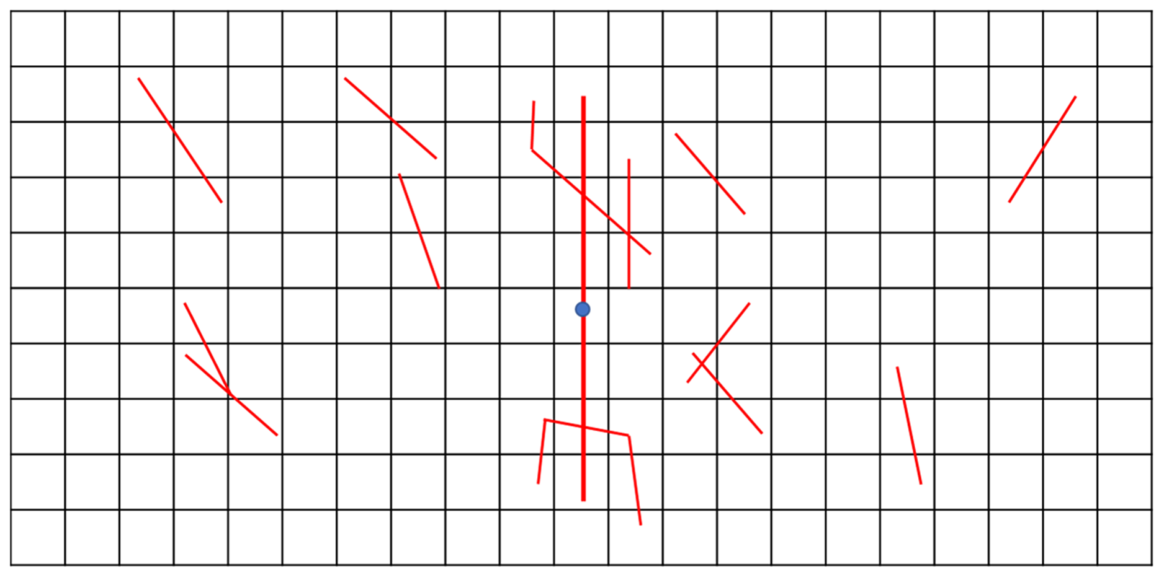
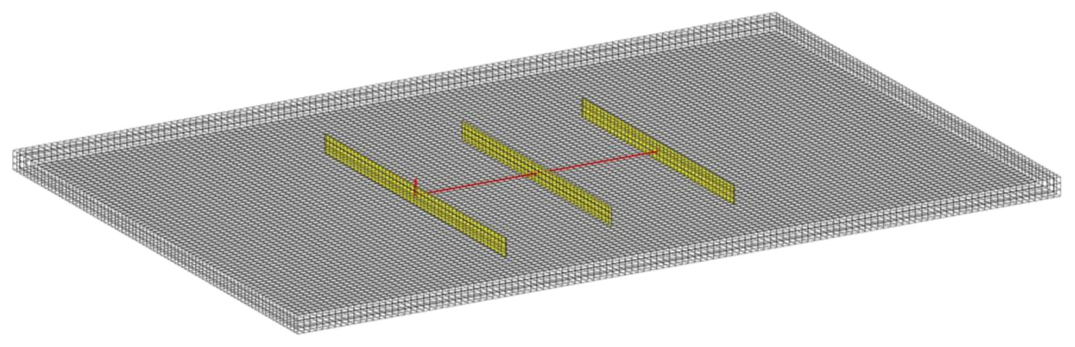
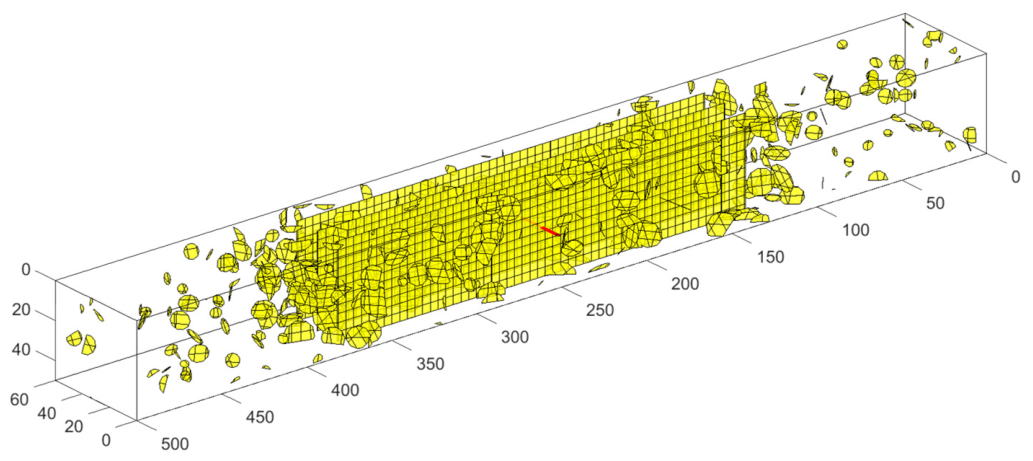
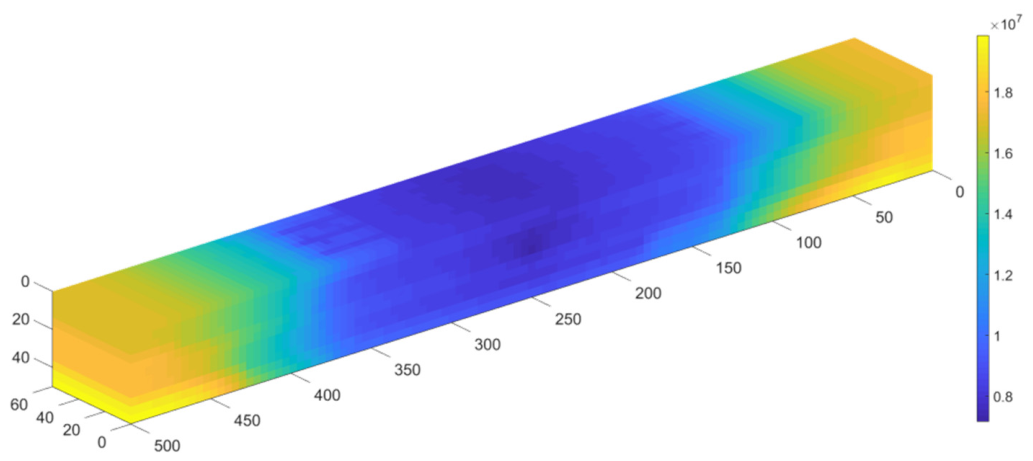

| Parameter Type | Value | Unit |
|---|---|---|
| Production rate (One stage) | 10 | m3/day |
| Reservoir size corresponding to single fracturing stage | 60 × 500 × 50 | m |
| Compressibility of rock | 2 × 10⁻⁹ | Pa−1 |
| Compressibility of water | 5 × 10⁻⁹ | Pa−1 |
| Compressibility of oil | 2 × 10⁻⁹ | Pa−1 |
| Matrix permeability | 0.01 | mD |
| Matrix porosity | 10 | % |
| Initial formation pressure | 30 | MPa |
| Viscosity of water and oil | 1, 5 | mPa·s |
| Number of main fractures per stage | 3 | clusters |
| Semi-length of main fractures | 120 | m |
| Permeability of main hydraulic fractures | 20 | Darcy |
| Width of main hydraulic fractures | 5 | mm |
| Permeability of secondary hydraulic fractures | 1 | Darcy |
| Width of secondary hydraulic fractures | 2 | mm |
| Permeability of natural fractures | 10 × 10−3 | Darcy |
| Width of natural fractures | 0.5 | mm |
| Porosity of main, secondary, and natural fractures | 0.25, 0.15, 0.0005 | / |
Disclaimer/Publisher’s Note: The statements, opinions and data contained in all publications are solely those of the individual author(s) and contributor(s) and not of MDPI and/or the editor(s). MDPI and/or the editor(s) disclaim responsibility for any injury to people or property resulting from any ideas, methods, instructions or products referred to in the content. |
© 2026 by the authors. Licensee MDPI, Basel, Switzerland. This article is an open access article distributed under the terms and conditions of the Creative Commons Attribution (CC BY) license.
Share and Cite
Ou, Z.; Liu, S.; Yue, W.; Ni, J.; Jiang, Y.; Peng, M.; Li, Z. A Numerical Well Testing Method for Horizontal Wells in Hydraulically Fractured Shale Reservoirs Based on 3D Simulation and the Embedded Discrete Fracture Model. Processes 2026, 14, 1941. https://doi.org/10.3390/pr14121941
Ou Z, Liu S, Yue W, Ni J, Jiang Y, Peng M, Li Z. A Numerical Well Testing Method for Horizontal Wells in Hydraulically Fractured Shale Reservoirs Based on 3D Simulation and the Embedded Discrete Fracture Model. Processes. 2026; 14(12):1941. https://doi.org/10.3390/pr14121941
Chicago/Turabian StyleOu, Zhipeng, Shengjun Liu, Wenhan Yue, Jia Ni, Youshi Jiang, Mengchong Peng, and Zhen Li. 2026. "A Numerical Well Testing Method for Horizontal Wells in Hydraulically Fractured Shale Reservoirs Based on 3D Simulation and the Embedded Discrete Fracture Model" Processes 14, no. 12: 1941. https://doi.org/10.3390/pr14121941
APA StyleOu, Z., Liu, S., Yue, W., Ni, J., Jiang, Y., Peng, M., & Li, Z. (2026). A Numerical Well Testing Method for Horizontal Wells in Hydraulically Fractured Shale Reservoirs Based on 3D Simulation and the Embedded Discrete Fracture Model. Processes, 14(12), 1941. https://doi.org/10.3390/pr14121941

