3.1. Simulation Case Setup
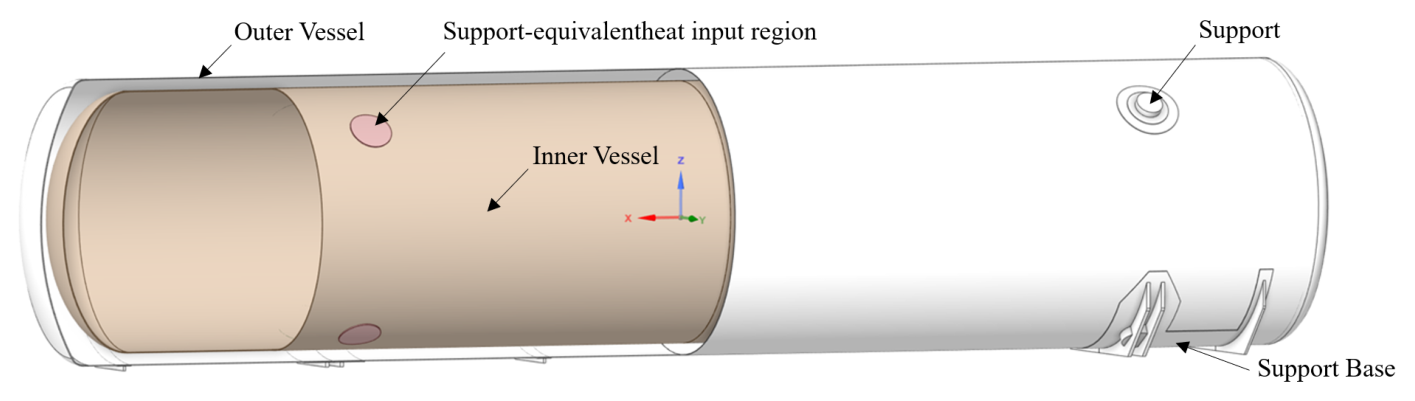
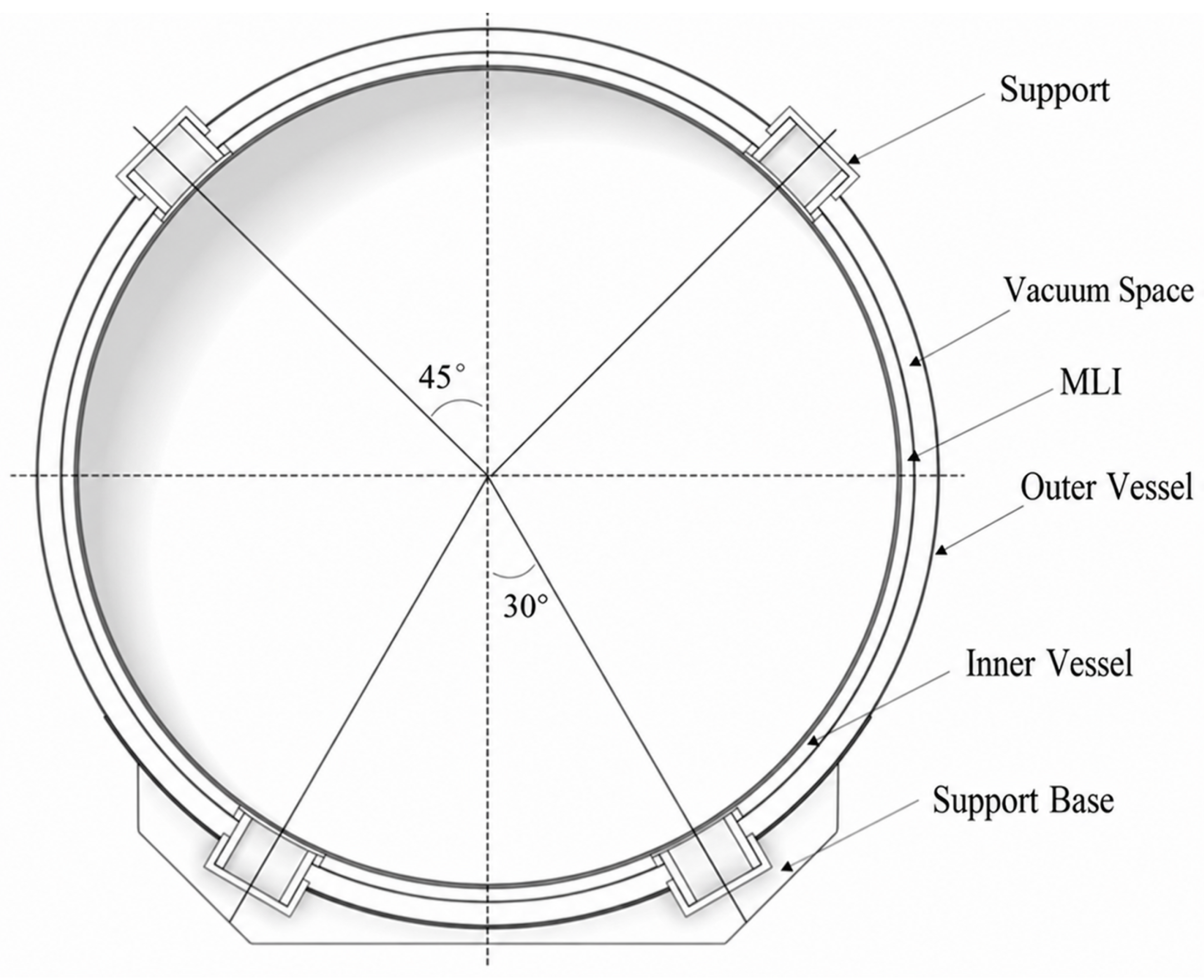
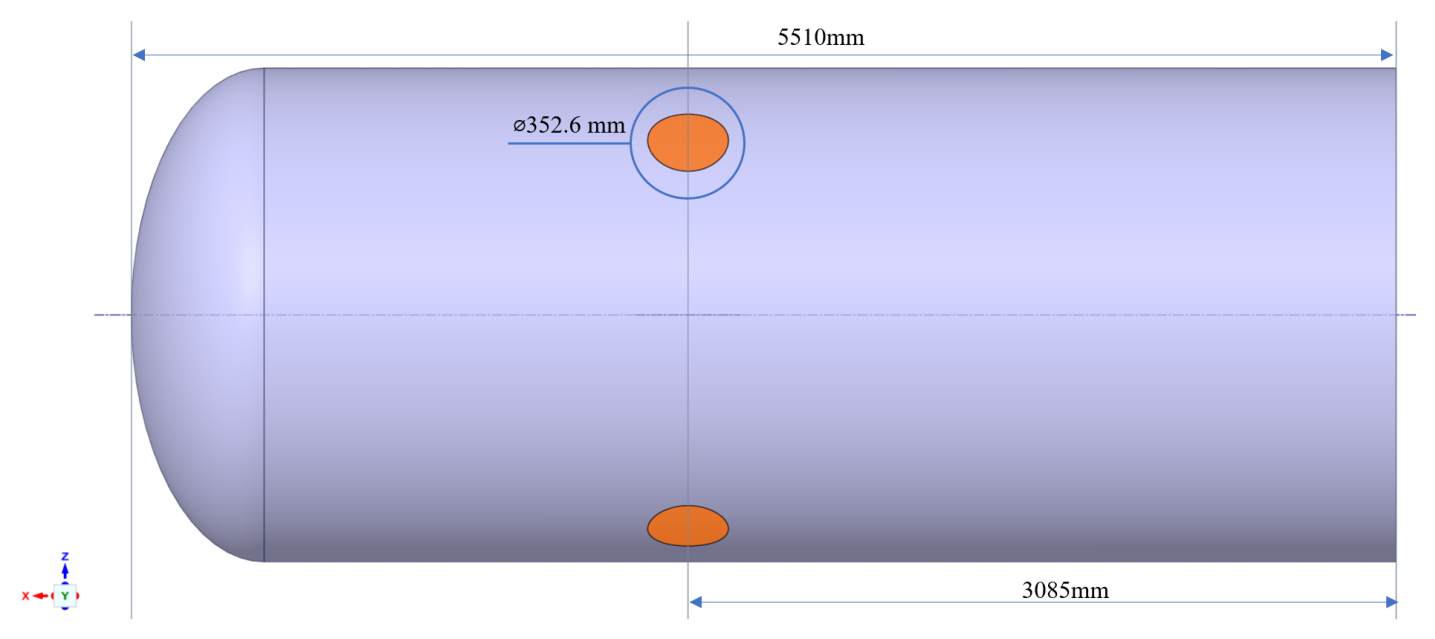
To investigate the effects of non-uniform heat input induced by support thermal bridges and its spatial distribution on the internal thermodynamic response of the liquid hydrogen tank, simulation cases were designed at a 50% filling ratio. Except for the spatial distribution of heat input, the circumferential support position, or the axial support position, all cases used the same initial conditions, boundary conditions, solver settings, and total heat input. In the baseline case, localized heat input boundaries were applied to the support regions, with the upper support angle set to
, the lower support angle set to
, and the axial support position set to
m. In the local heat input case, the heat flux applied to the support conduction regions was
, while that applied to the MLI-covered regions was
. In the uniform heat input case, the total heat input was kept unchanged, and a uniform heat flux of
was applied to the inner vessel wall. The detailed simulation cases are listed in
Table 1.
In the table, the uniform heat input case was used to compare the response differences between an ideal uniform heat flux boundary and the localized heat input boundary induced by support thermal bridges. The circumferential support position cases were divided into upper support variation and lower support variation cases. The upper support angle was set to , , and , while the lower support angle was also set to , , and . These cases were used to analyze the temperature field, flow field, and gas-phase pressure response when the relative position of the localized support heat input to the gas region, liquid region, and gas–liquid interface was changed. For the axial support position cases, the circumferential positions of the upper and lower supports were kept unchanged, and only the axial support position was varied as m, m, and m. These cases were used to compare the differences in the internal thermodynamic response caused by the movement of localized thermal disturbance along the tank length.
3.2. Comparison Between Local Heat Input and Uniform Heat Input
To analyze the effect of non-uniform heat input induced by support thermal bridges on the internal thermodynamic response of the liquid hydrogen tank, the local heat input case was compared with the uniform heat input case. The two cases maintained the same total heat input, and only the spatial distribution of heat input on the inner vessel wall was changed. The local heat input case was used to represent concentrated heat leakage caused by support thermal bridges, whereas the uniform heat input case was used to represent an ideal uniform heat flux boundary. By comparing the temperature field, flow field, and gas-phase pressure variation, it can be determined whether the localized heat input induced by support thermal bridges can be equivalent to a uniform heat input.
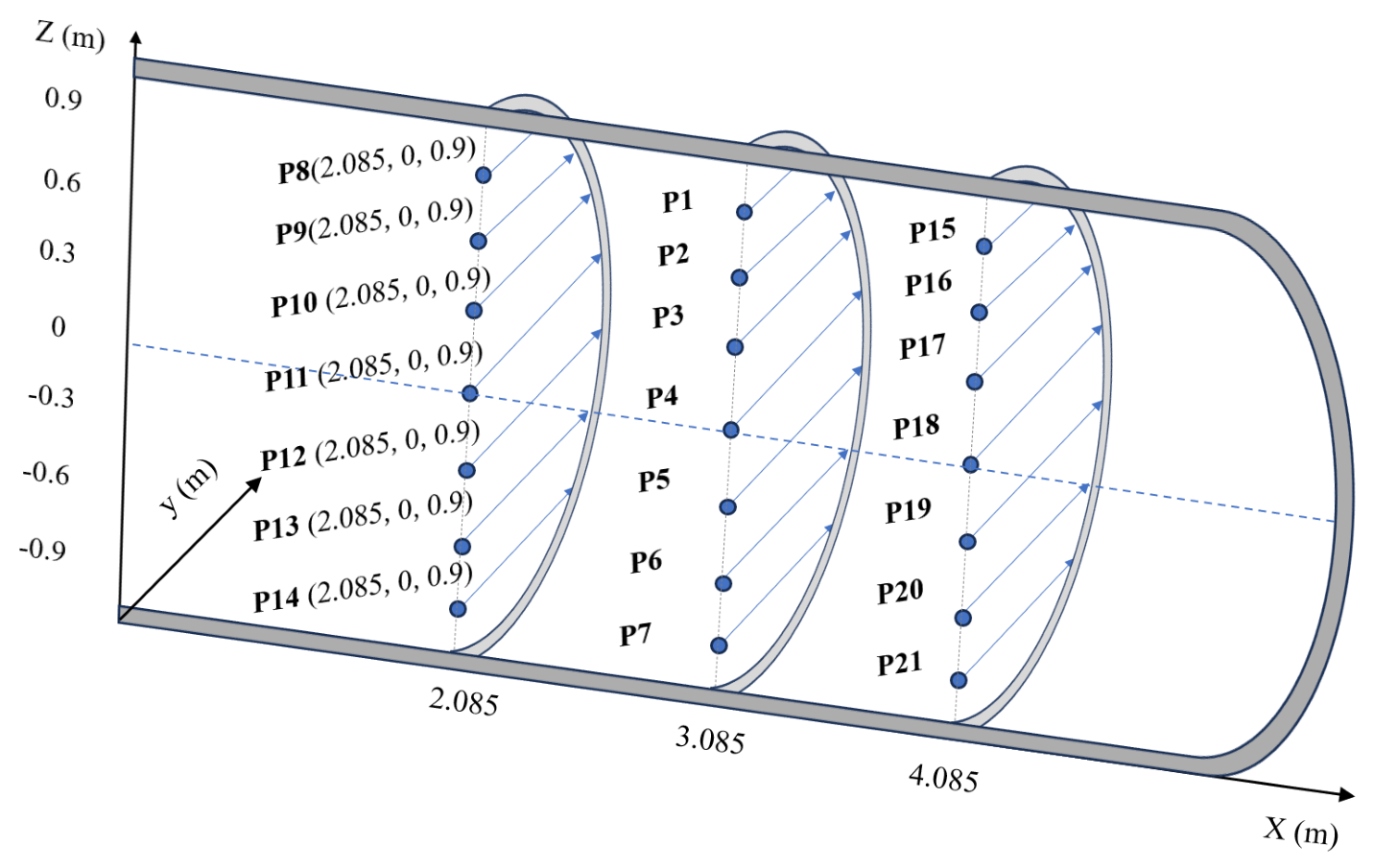
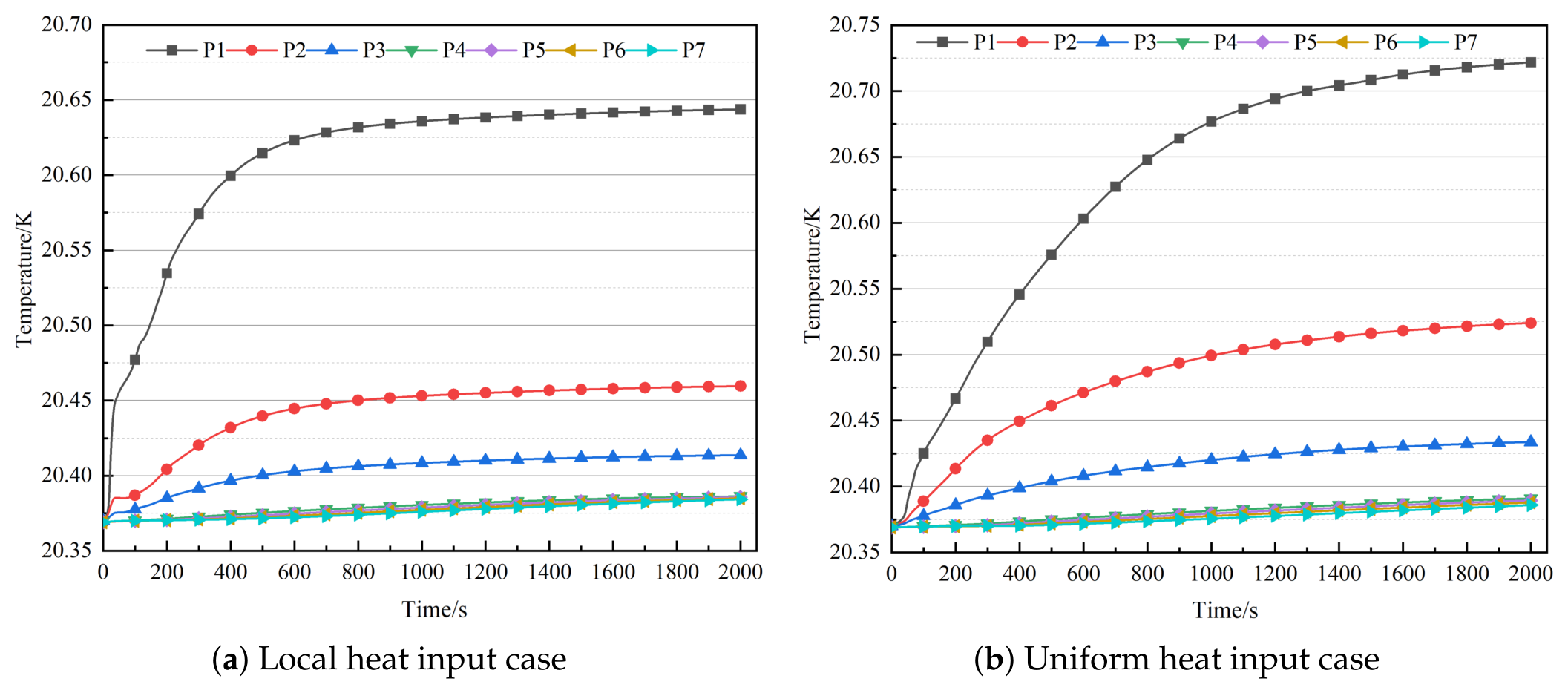
Figure 8 shows the temperature evolution at the monitoring points under the two heat input cases. In both cases, the temperatures of the monitoring points in the gas region increased with time, whereas those in the liquid region changed only slightly. This behavior is mainly related to the difference in thermal response between the gas and liquid phases. The gas region has a smaller heat capacity and is therefore more sensitive to wall heat input. In contrast, the liquid region has a larger heat capacity, and liquid-phase convection further weakens the local temperature rise. Comparison of the two heat input cases shows that the temperatures of the gas-region monitoring points were generally higher in the uniform heat input case than in the local heat input case. This difference is not caused by the total heat input, because the two cases have the same total heat input, but by the different spatial distribution of wall heating. In the uniform heat input case, heat continuously enters the gas region and the near-wall region along a larger portion of the inner vessel wall, resulting in a larger effective heated area in the gas phase. In the local heat input case, the support region produces a higher local heat flux and stronger local thermal disturbance, but the heated area is more concentrated. Therefore, its contribution to the overall gas-phase temperature rise is relatively limited, although it may have a stronger effect on the local temperature gradient and flow field development near the support region.
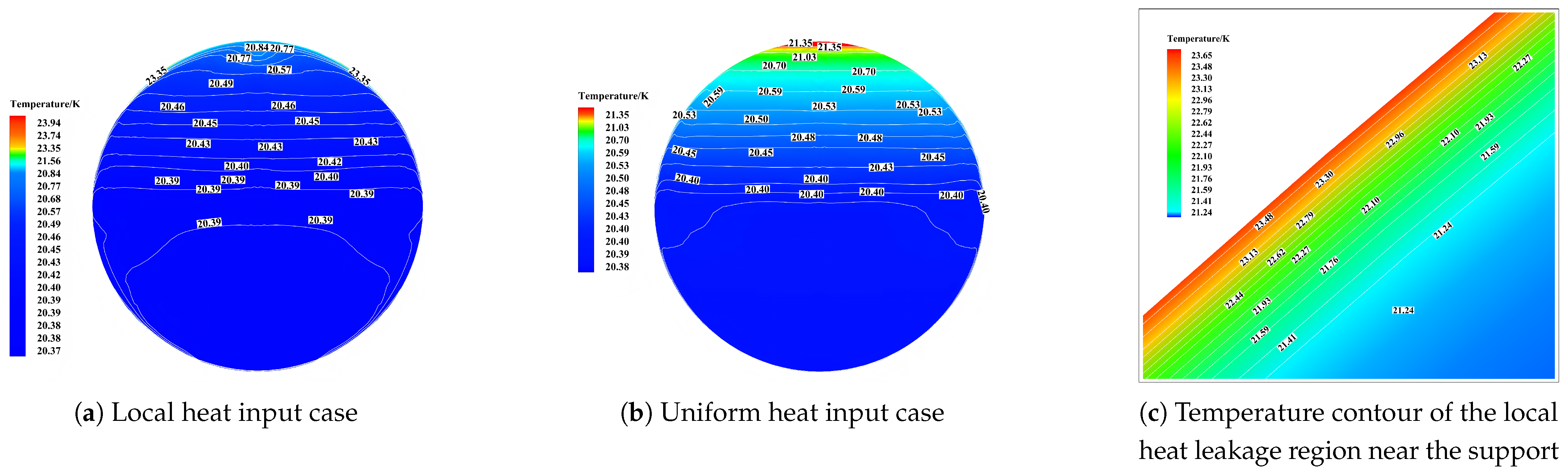
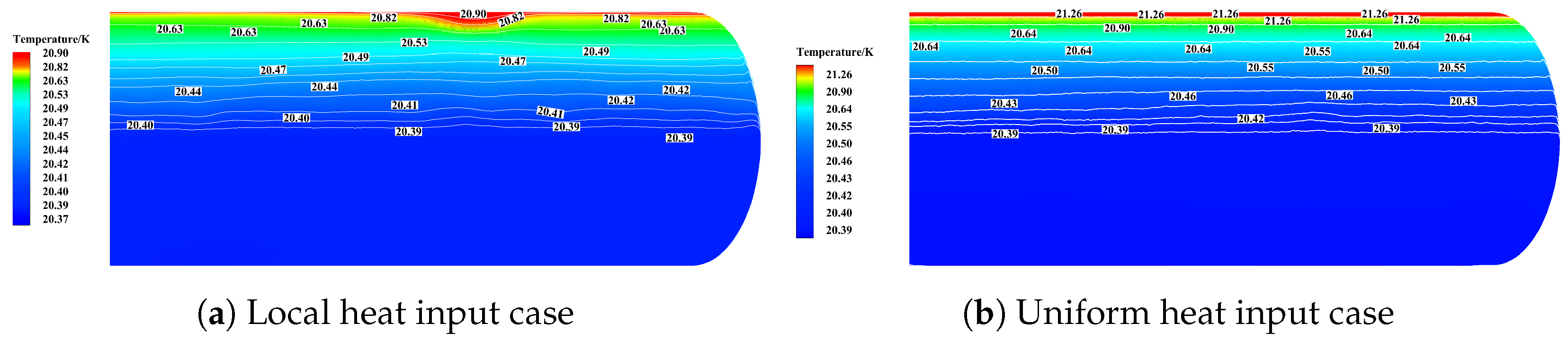
Figure 9 and
Figure 10 show the temperature distributions on the circumferential support section and the axial section under the two heat input cases, respectively. In both cases, gas–liquid thermal stratification was formed inside the liquid hydrogen tank, with the gas region showing a higher temperature than the liquid region. However, the spatial distribution and formation mechanism of the high-temperature region differed between the two cases. In the local heat input case, the high-temperature region was mainly concentrated near the wall corresponding to the support region, where the local temperature gradient was relatively large. This is because the support thermal bridge introduces heat into a limited wall area, thereby enhancing local heat accumulation and promoting upward thermal transport under buoyancy. In the uniform heat input case, the high-temperature region was more continuously distributed along the upper gas region, and the overall temperature level of the gas region was higher. This occurs because the same total heat input is distributed over a larger wall area, allowing the gas region to be heated more uniformly. These results indicate that local heat input mainly changes the near-wall temperature gradient and local heat accumulation near the support region, whereas uniform heat input mainly enhances the overall temperature rise in the gas region.
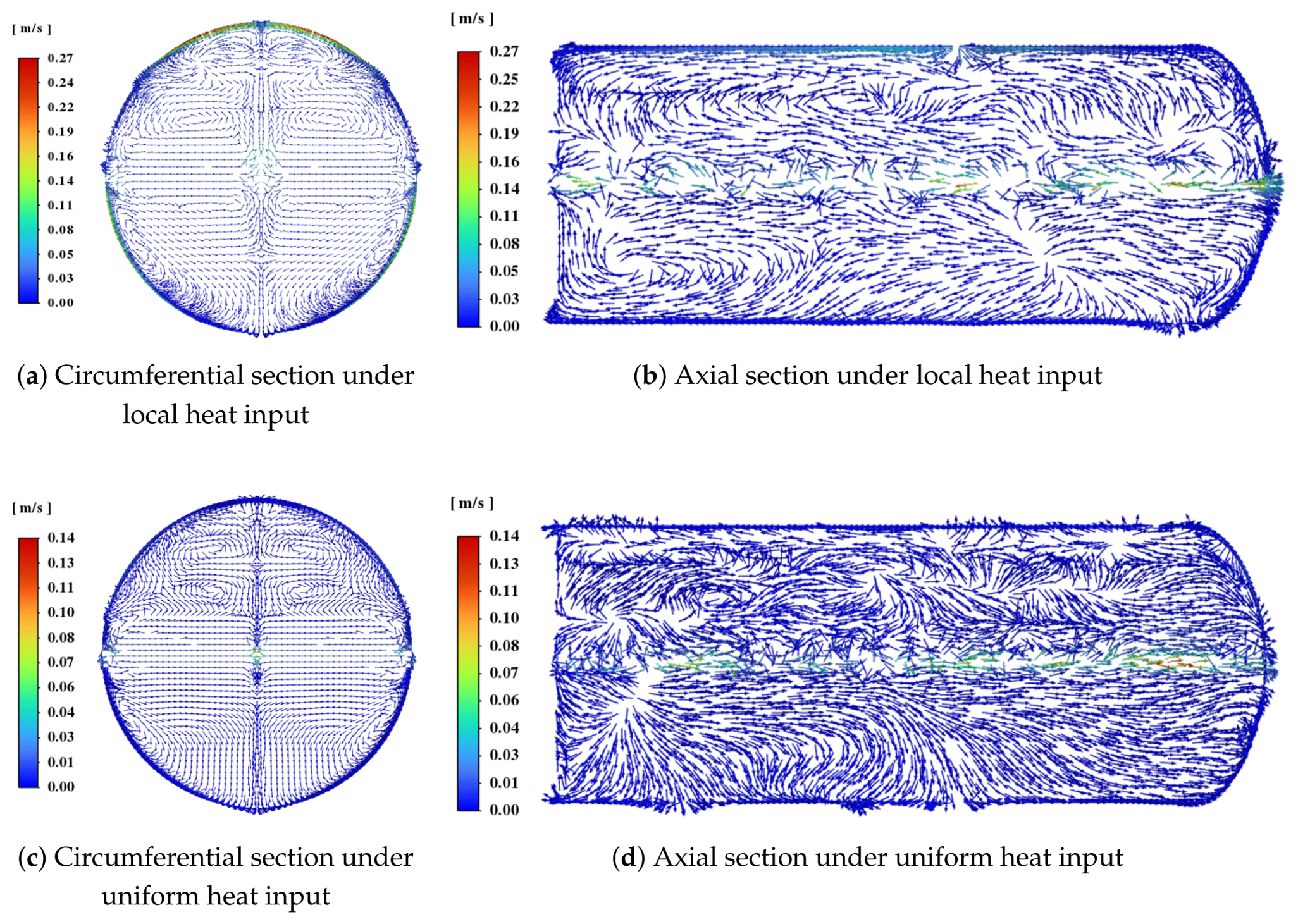
Figure 11 compares the velocity vector distributions under the two heat input cases. Natural convection induced by wall heating was observed in both cases, but the flow intensity and local flow structure differed. In the local heat input case, the large temperature gradient near the support region caused the heated fluid to rise along the wall and induced local recirculation near the gas–liquid interface. This is because the localized support heat input produces a stronger local density gradient, which strengthens the buoyancy-driven thermal plume and promotes interaction between the rising flow and the gas–liquid interface. The maximum velocity inside the tank was approximately 0.27 m/s. In the uniform heat input case, the wall heat input was more uniformly distributed, the local temperature gradient was smaller, and the natural convection structure was more gradual, with a maximum velocity of approximately 0.14 m/s. In this case, the thermal plume was less concentrated because the same total heat input was distributed over a larger wall area. This indicates that, under the same total heat input, localized heat input induced by support thermal bridges is more likely to generate strong local natural convection and local flow field reconstruction near the support region.
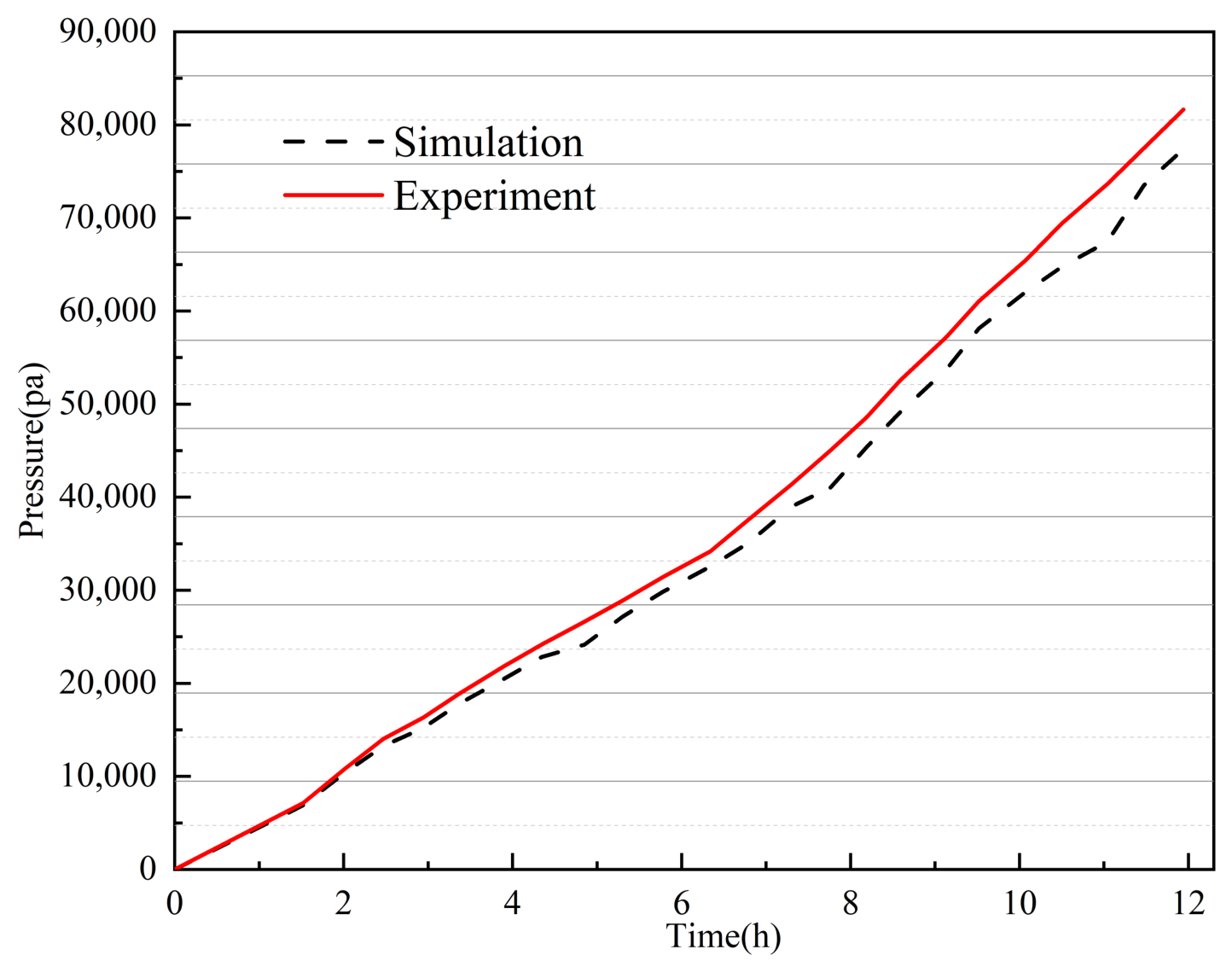
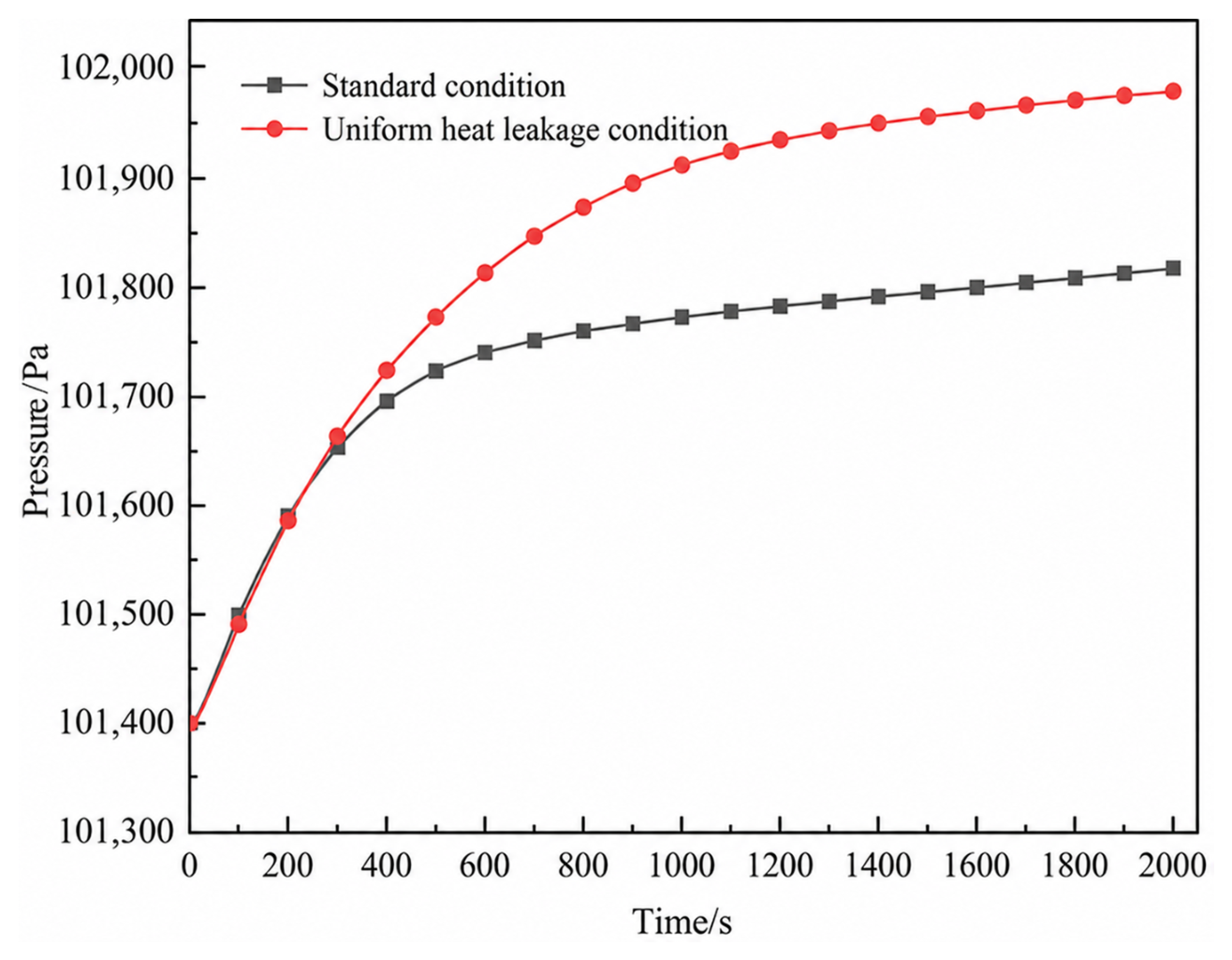
Figure 12 shows the gas-phase pressure evolution under the two heat input cases. In both cases, the gas-phase pressure increased with time, indicating that continuous heat input promoted liquid hydrogen evaporation and gas-phase pressure accumulation. Since the total heat input was kept the same in the two cases, the difference in pressure response mainly resulted from the spatial distribution of wall heat input rather than the heat input magnitude itself. The gas-phase pressure in the uniform heat input case was slightly higher than that in the local heat input case. This is because uniform heat input enlarged the heated area in the upper gas region and increased the overall gas-phase temperature. The difference between the two pressure curves was mainly reflected in the early-stage pressure level. After the internal heat transfer and natural convection structures gradually developed, the pressurization rates of the two cases became close to each other. Although local heat input enhanced natural convection near the support region, its heating area was more concentrated, and its contribution to the overall gas-phase temperature rise and pressure increase was relatively limited. Therefore, uniform heat input can approximately capture the overall pressurization trend, but it cannot accurately describe the local heat accumulation and flow field reconstruction induced by support thermal bridges. This is because gas-phase pressure is mainly governed by the total heat input, average gas-phase thermal state, and phase change mass transfer, whereas the local velocity field and near-wall temperature gradients are more sensitive to the spatial distribution of heat input. Thus, pressure evolution reflects the integral thermodynamic response of the tank, while the local temperature and velocity fields reflect the localized effect of support thermal bridges.
3.3. Effect of Circumferential Support Position Variation
To analyze the effect of circumferential support position variation on the internal thermodynamic response of the liquid hydrogen tank, upper support variation and lower support variation cases were designed. In the upper support variation cases, the lower support angle was kept at , while the upper support angle was set to , , and . In the lower support variation cases, the upper support angle was kept at , while the lower support angle was set to , , and . These cases were used to compare the differences in temperature field, flow field, and gas-phase pressure response caused by changes in the relative position between the localized support heat input and the gas region, liquid region, and gas–liquid interface.
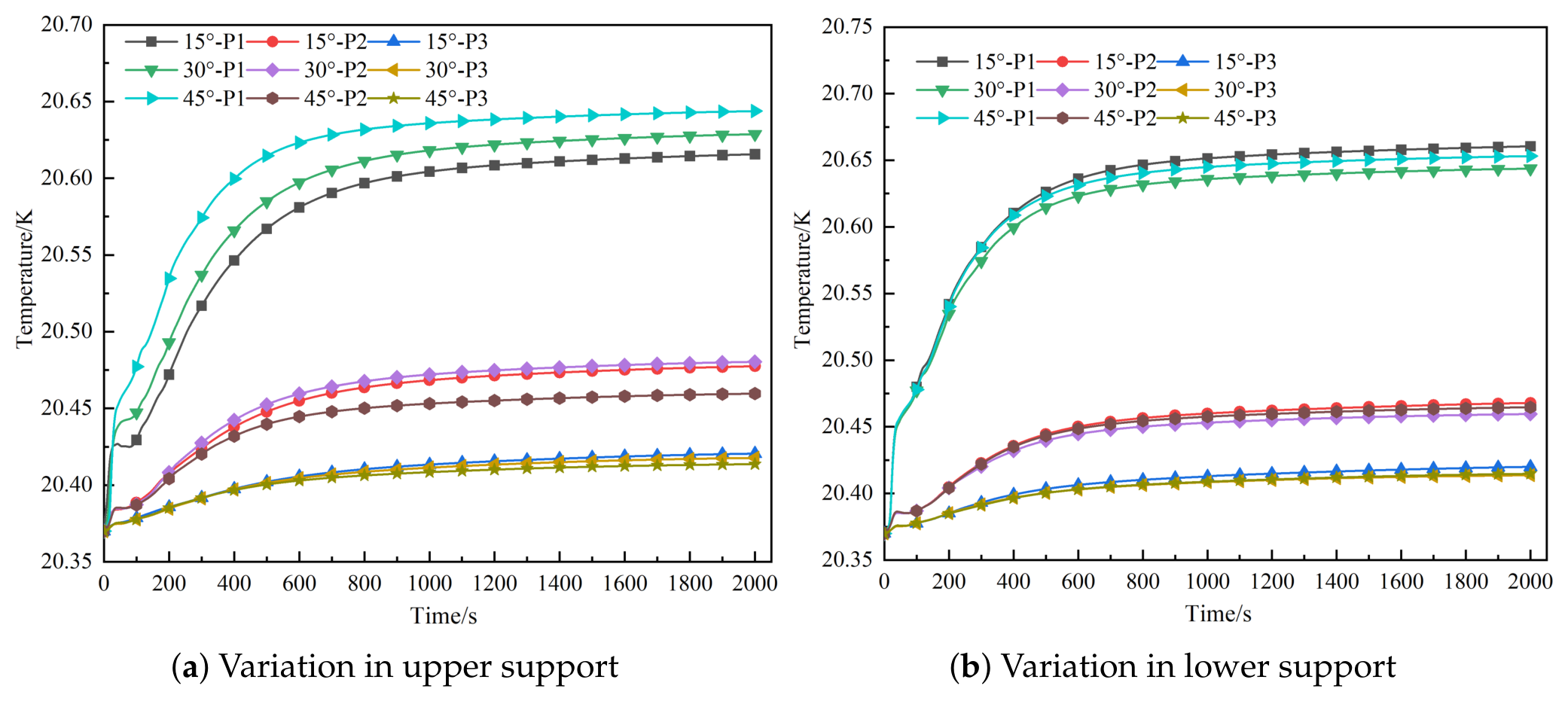
Figure 13 shows the temperature evolution at P1–P3 under different circumferential support positions. The temperature differences among the cases mainly appeared in the upper gas region, while the temperature variation near the gas–liquid interface was relatively small. When the lower support angle was kept at
, the maximum temperature differences at P1 and P2 caused by upper support position variation were about 0.03 K and 0.02 K, respectively, whereas the temperature difference at P3 was less than 0.01 K. This indicates that the thermal disturbance induced by upper support position variation was mainly concentrated in the upper gas region and gradually weakened toward the gas–liquid interface. When the upper support angle was kept at
, lower support position variation caused a smaller temperature difference, with the maximum differences at P1 and P2 being about 0.02 K and 0.01 K, respectively.
The different temperature responses can be explained by the relative position between the localized support heat input and the gas–liquid distribution. The upper support is closer to the gas region, where the heat capacity is smaller and local heat accumulation is more likely to occur. Therefore, changes in the upper support position can more directly affect the temperature response of the upper gas region. In contrast, the lower support is closer to the liquid region. The liquid phase has a larger heat capacity and stronger thermal buffering ability, so the local thermal disturbance introduced by the lower support is more readily diffused and weakened before it affects the upper gas region. Therefore, circumferential support position variation mainly affects the upper gas temperature, and upper support position variation has a more pronounced influence than lower support position variation.
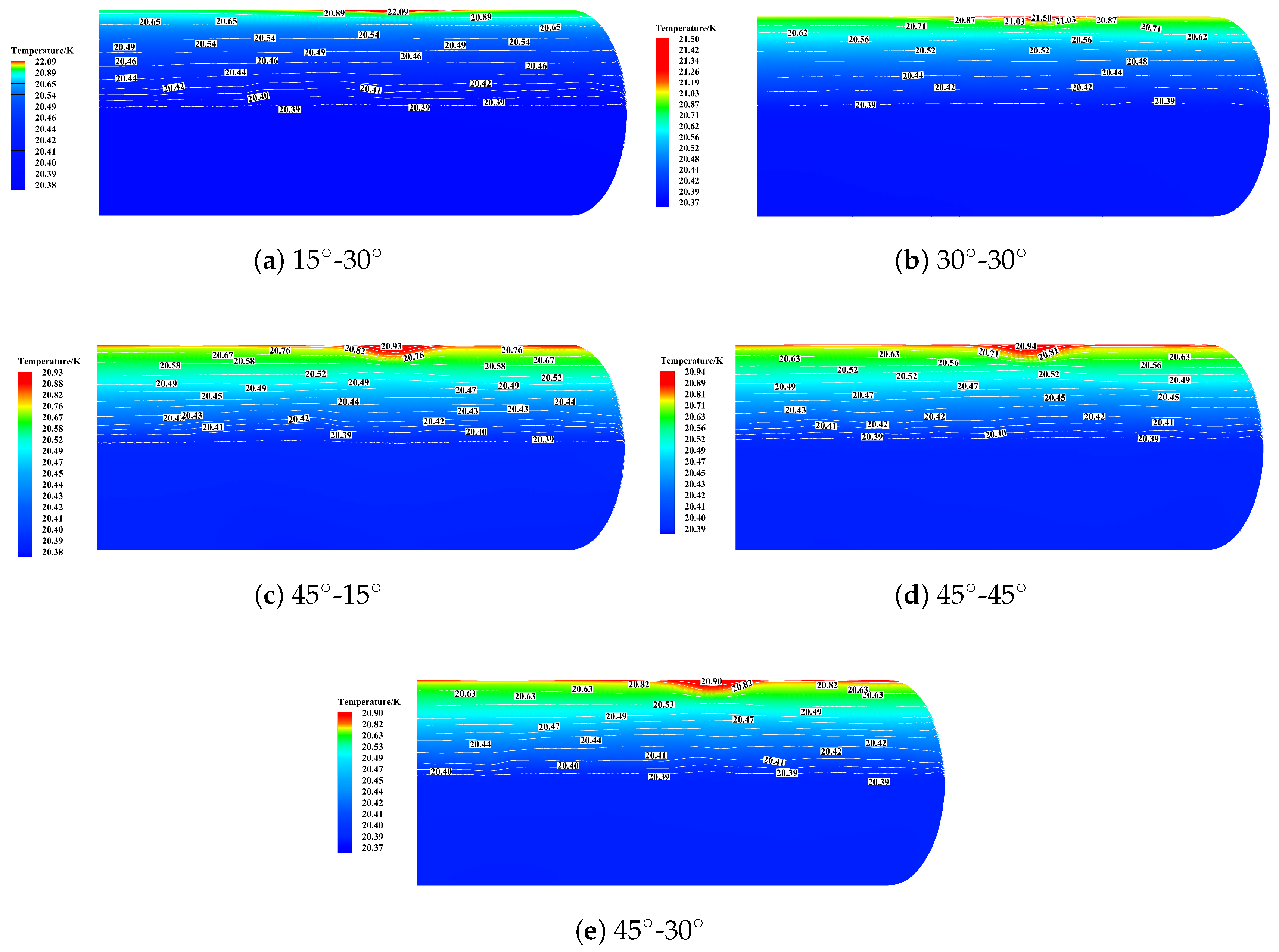
Figure 14 shows the axial temperature distributions under different circumferential support position combinations. In the angle notation used in
Figure 14 and the following discussion, the angle before the hyphen denotes the upper support angle, whereas the angle after the hyphen denotes the lower support angle. In all cases, the temperature variation in the bulk liquid region was small and remained within 20.39–20.42 K, indicating that the bulk liquid region had a strong thermal buffering effect under localized support heat input. The temperature differences were mainly concentrated near the top region corresponding to the support location. When the lower support angle was fixed at
, as the upper support angle increased from
to
and
, the local peak temperature near the upper support region decreased from 22.09 K to 21.50 K and 20.90 K, with a maximum decrease of about 1.19 K. This indicates that when the upper support heat input is closer to the top gas region, local heat accumulation is more likely to form. This is mainly because the upper gas region has a smaller heat capacity, and the localized heat input can be more easily accumulated near the top wall. As the upper support position moves downward along the side wall, the concentration of the local high-temperature region near the top is weakened. In this case, the localized heat source becomes closer to the gas–liquid interface, and part of the heat is transported by buoyancy-driven flow and interface-adjacent convection, which weakens the temperature accumulation in the upper gas region. In contrast, when the upper support angle was fixed at
, the local peak temperatures near the top region were approximately 20.93 K, 20.90 K, and 20.94 K for lower support angles of
,
, and
, the maximum temperature difference caused by lower support position variation was only about 0.04 K. Since the lower support heat input is closer to the liquid region, the larger heat capacity of the liquid phase and local convection weaken its influence on the temperature distribution in the upper gas region. Therefore, the circumferential position of the upper support has a more direct influence on local heat accumulation in the gas region, whereas the effect of lower support position variation is more easily buffered by the liquid phase.
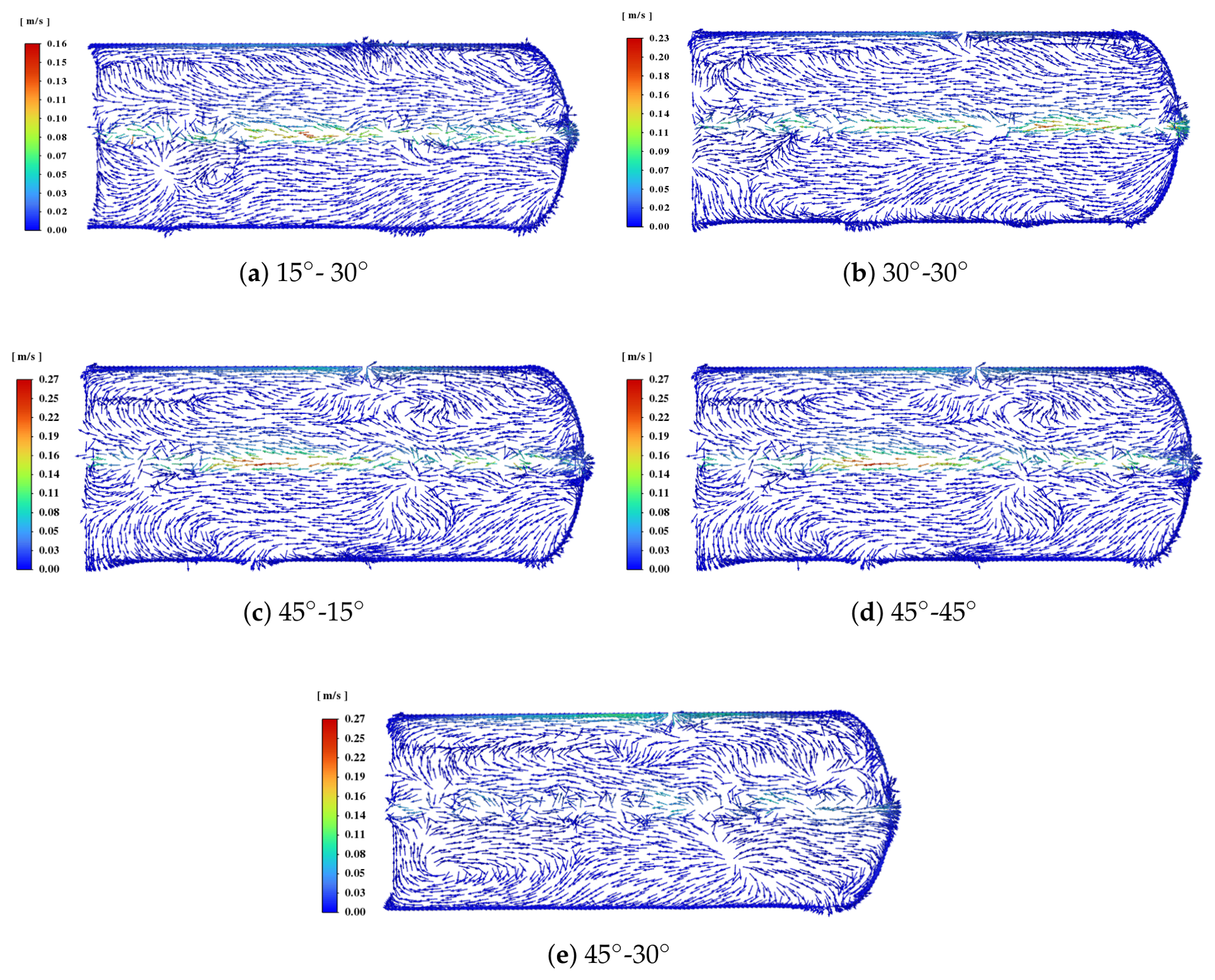
Figure 15 shows the velocity vector distributions under different circumferential support position combinations. Variation in the circumferential support position changes the location of the localized heat input relative to the gas region and the gas–liquid interface, thereby affecting the natural convection structure. This influence is essentially related to the coupling between the localized thermal plume and the interface-adjacent recirculation region. When the lower support angle was kept at
, the maximum velocity inside the tank increased from approximately 0.16 m/s to 0.23 m/s and 0.27 m/s as the upper support angle increased from
to
and
. This indicates that the local peak temperature and the overall natural convection intensity are not fully synchronized. As the upper support position moves downward along the side wall, the relative distance between the local heat source and the gas–liquid interface, as well as the buoyancy-driven flow path, changes. Although the local peak temperature near the upper region decreases, the localized heat source becomes more favorable for driving the heated fluid toward the gas–liquid interface. The rising thermal plume can interact more directly with the interface-adjacent recirculation structure, thereby enhancing local momentum exchange and increasing the velocity peak. Meanwhile, local heat accumulation in the upper gas region is weakened, resulting in a decrease in the peak temperature. In contrast, when the lower support angle was varied, the maximum velocity remained approximately 0.27 m/s. This is because the lower support heat input mainly acts on the liquid region, where the thermal disturbance is more readily diffused by liquid-phase convection; the larger heat capacity and stronger thermal buffering effect of the liquid phase weaken the upward propagation of the thermal disturbance. Therefore, variation in the lower support circumferential position has a weaker effect on the overall flow intensity.
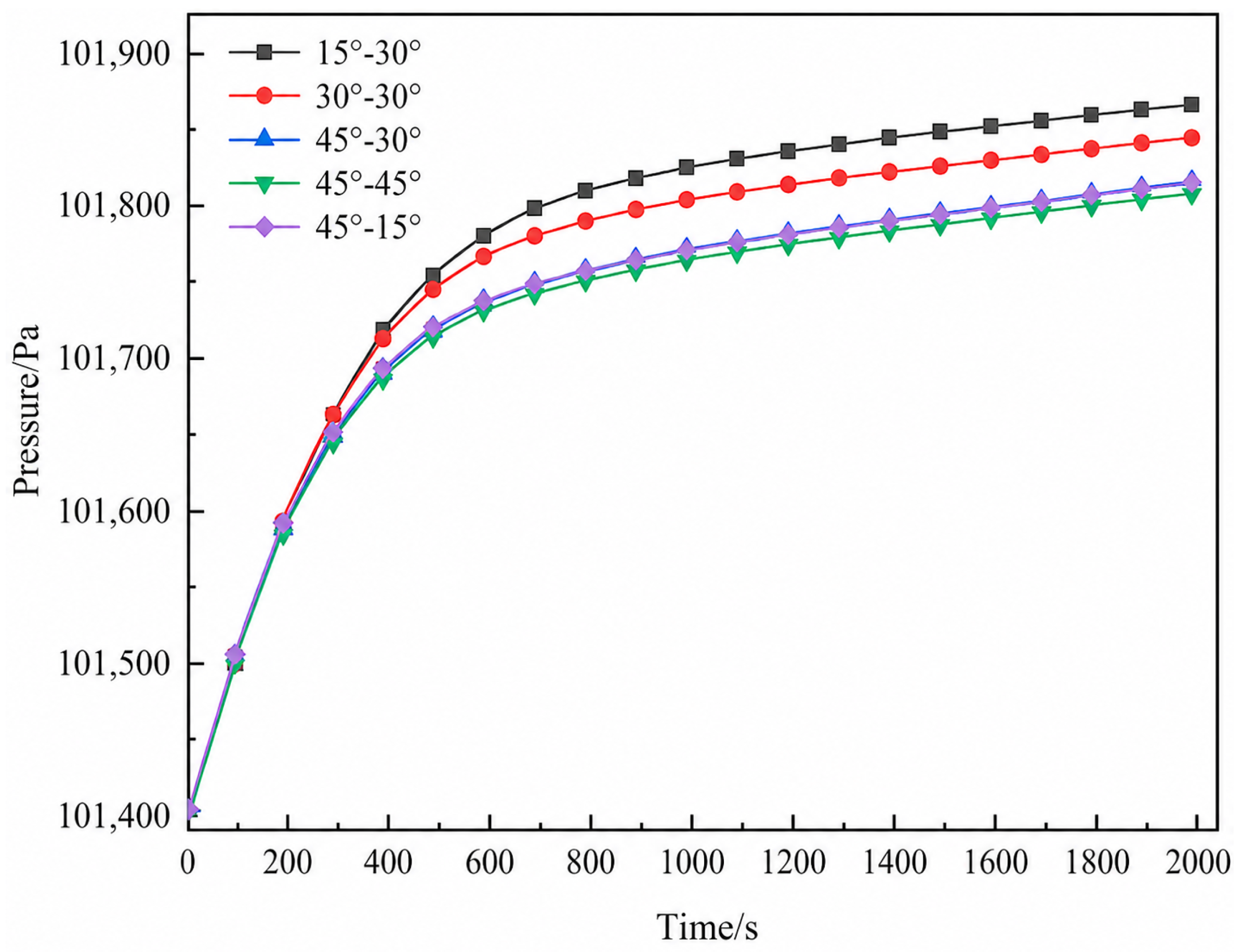
Figure 16 shows the gas-phase pressure evolution under different circumferential support position combinations. In all cases, the gas-phase pressure increased with time, and the overall increasing trend was similar. This similarity indicates that the pressure response was mainly governed by the total heat input, average gas-phase thermal state, and phase change mass transfer. The pressure differences caused by upper support position variation mainly developed during the early stage of the calculation. After approximately 600 s, the pressure curves became nearly parallel, and the average pressurization rate in the later stage was about 0.039 Pa/s. This indicates that the change in support angle mainly caused an early-stage pressure level shift, but did not significantly affect the late-stage pressurization rate. At the end of the calculation, the maximum gas-phase pressure difference among the different upper support angle cases was about 55 Pa. The pressure difference induced by lower support position variation was smaller, with a maximum pressure difference of about 10 Pa at the end of the calculation. These small pressure differences can be attributed to the identical total heat input used in all circumferential support position cases. Since gas-phase pressure is mainly controlled by the overall energy accumulation and the average gas-phase thermal state, changing the support angle only modifies the local heat input distribution without significantly changing the global pressurization behavior. Therefore, the small pressure differences indicate a limited influence of support position variation on the overall pressure response, rather than numerical error. Since the total heat input was kept constant in all cases, circumferential support position variation mainly affected the pressure level shift caused by early-stage local thermal disturbance, rather than significantly changing the overall pressurization trend.
3.4. Effect of Axial Support Position Variation
To analyze the effect of axial support position variation on the internal thermodynamic response of the liquid hydrogen tank, the axial support position was set to m, m, and m while keeping the circumferential positions of the upper and lower supports unchanged. Among these positions, m was taken as the baseline support position, whereas m and m correspond to cases in which the localized support heat input was shifted by 1 m in the negative and positive axial directions of the tank, respectively.
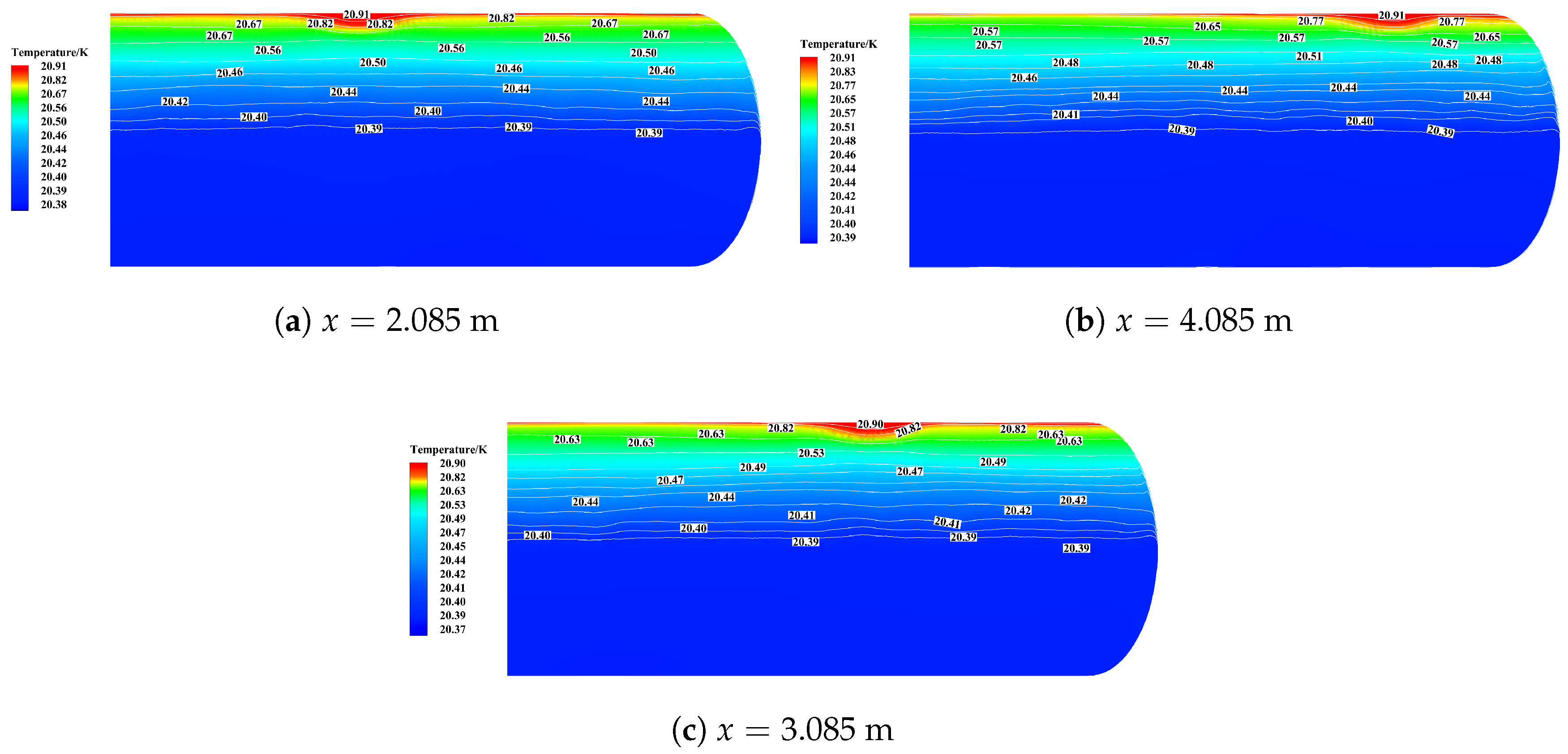
Figure 17 shows the axial temperature distributions under different axial support positions. In all three cases, gas–liquid thermal stratification was formed inside the liquid hydrogen tank, with the gas region showing a higher temperature than the liquid region, while the temperature variation in the bulk liquid region remained small. Variation in the axial support position did not significantly change the overall temperature distribution. Its effect was mainly reflected in the migration of the high-temperature region associated with the localized support heat input along the tank length. When the axial support position changed from
m to
m and
m, the maximum difference in local peak temperature near the top region was only about 0.01 K. This result indicates that axial support position variation mainly changes the axial location of the localized heat input, while having only a weak effect on the local peak temperature and the intensity of gas–liquid thermal stratification. For a horizontal liquid hydrogen tank, the dominant stratification and buoyancy-driven flow are controlled by the gravity direction. Since axial displacement does not change the height of the localized heat source relative to the gas–liquid interface, its effect is mainly reflected in the axial migration of the local high-temperature region rather than in a change in the overall thermal stratification pattern.
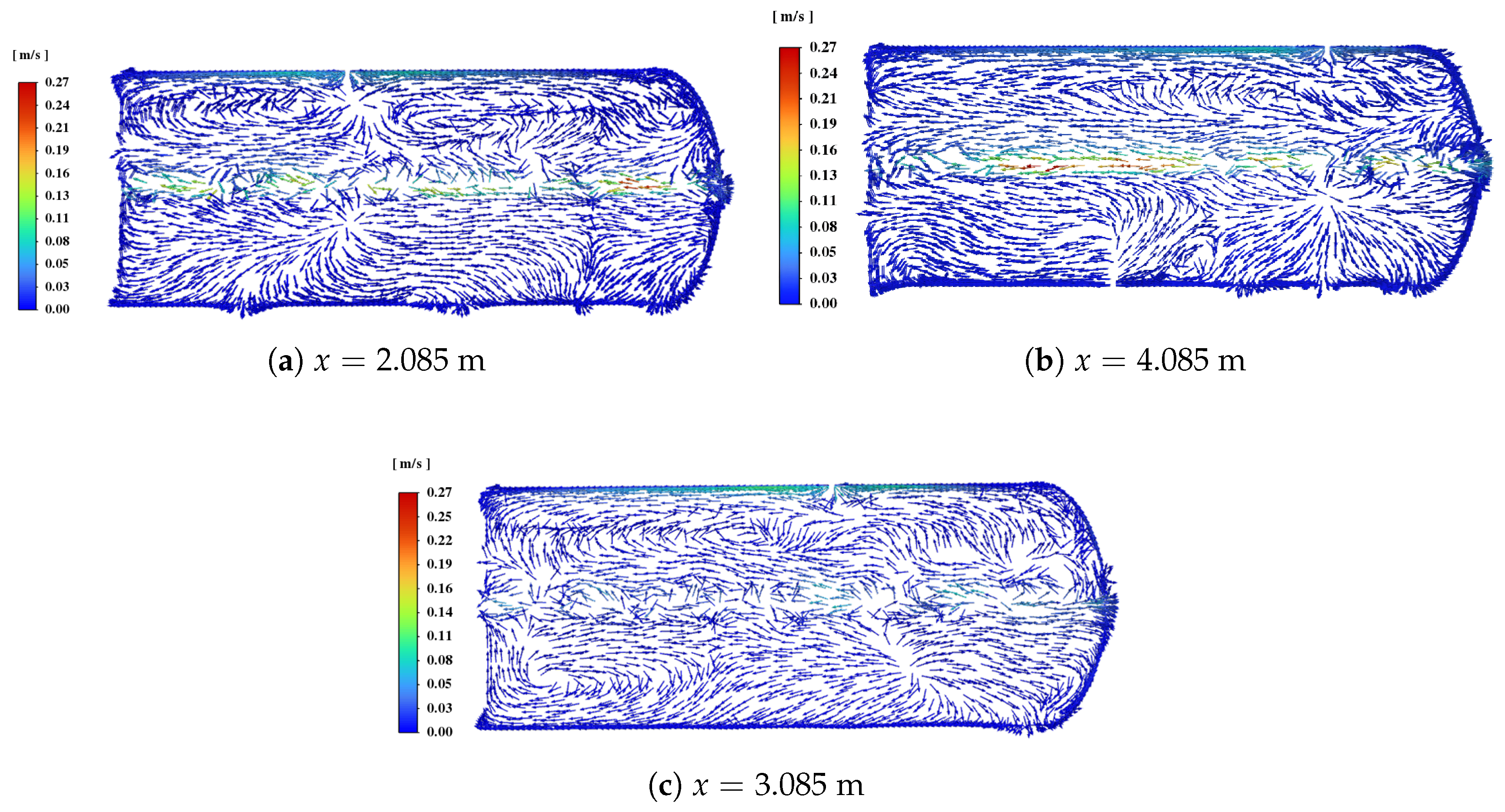
Figure 18 shows the velocity vector distributions under different axial support positions. In all three cases, natural convection induced by localized support heat input was formed. The fluid near the support region was heated and rose along the wall, inducing local recirculation near the gas–liquid interface. This indicates that the basic flow mechanism was still controlled by buoyancy-driven thermal plume development, rather than by the axial location of the support alone. The main differences among the cases were reflected in the axial locations of the local high-velocity region and recirculation structure, while the overall flow intensity changed only slightly. The maximum velocity in all three axial support position cases was approximately 0.27 m/s. This further indicates that axial support movement mainly changes the spatial position of the velocity disturbance, but has little influence on the strength of the natural convection. When the support was located at
m and
m, the velocity disturbance region shifted toward the front and rear of the tank, respectively. When the support was located at
m, the local high-velocity region was mainly concentrated near the support section. Therefore, the axial support position primarily determines where the local flow disturbance occurs along the tank length, while the dominant buoyancy-driven flow pattern remains almost unchanged.
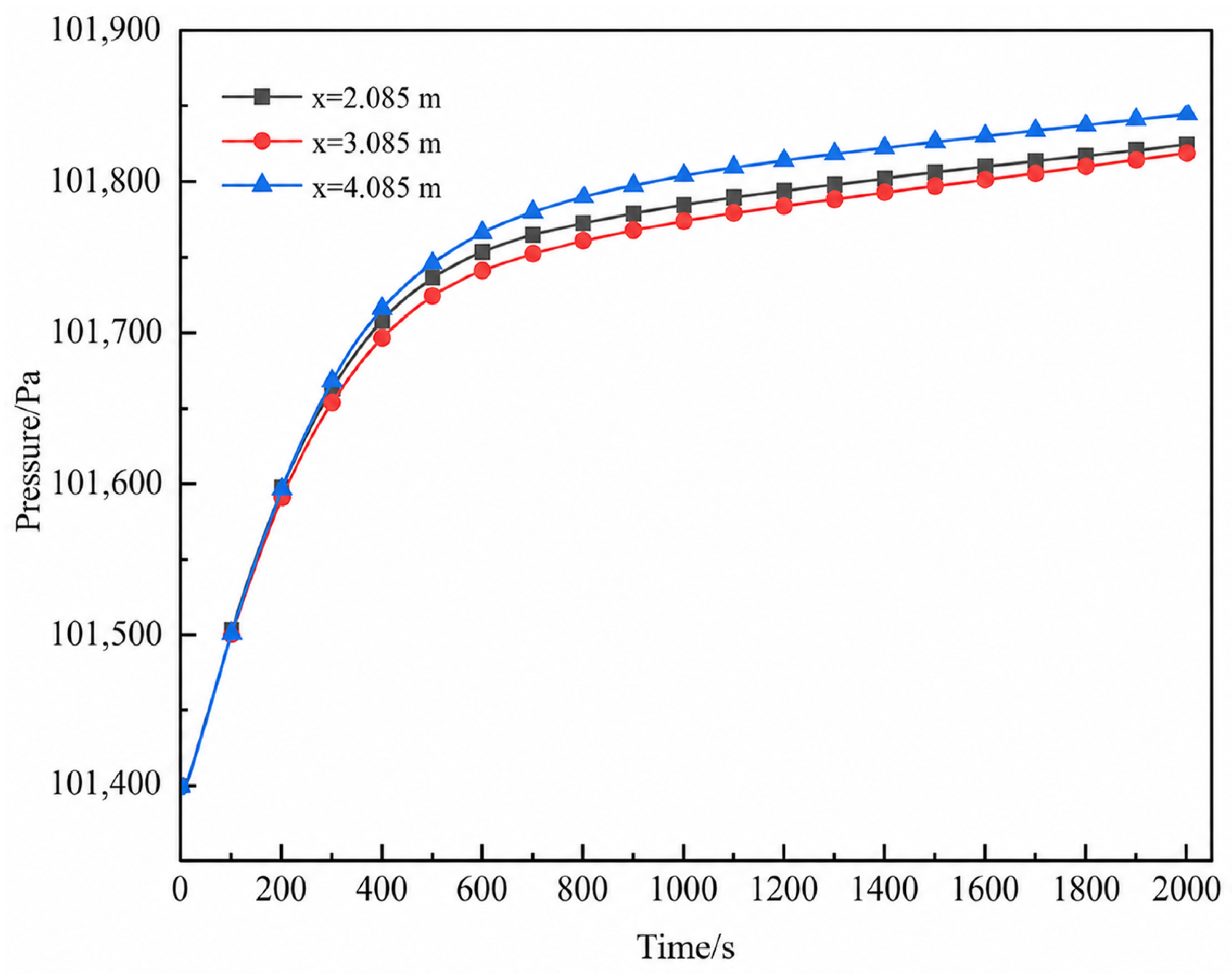
Figure 19 shows the gas-phase pressure evolution under different axial support positions. In all three cases, the gas-phase pressure increased with time, and the overall trend was nearly the same. At the end of the calculation, the maximum gas-phase pressure difference among the three axial-position cases was about 24 Pa. This difference was smaller than that caused by circumferential support position variation, indicating that axial support position variation has a relatively limited influence on the gas-phase pressure response. Unlike circumferential support variation, axial support variation does not change the height of the localized heat source relative to the gas–liquid distribution. It mainly shifts the local heat input region along the tank length. Therefore, its influence on the overall pressure evolution is weak, and the small pressure difference should be interpreted as a limited physical effect rather than numerical error.
3.5. Mechanism of Localized Support Heat Input
The non-uniform heat input induced by support thermal bridges mainly affects the internal thermodynamic response by changing the local temperature gradient and buoyancy-driven flow structure. Compared with equivalent uniform heat input, localized support heat input acts on a limited wall area and therefore produces stronger local heat accumulation near the support-corresponding region. The heated fluid rises along the wall under buoyancy and further induces local recirculation near the gas–liquid interface. As a result, localized heat input has a more pronounced effect on the near-wall temperature field and local velocity field, although its contribution to the average gas-phase temperature rise is relatively limited.
The influence of support position depends on the relative location between the localized heat source and the gas–liquid distribution. Circumferential support variation changes the height of the heat input region relative to the gas region, liquid region, and gas–liquid interface, so it has a more direct influence on local heat accumulation and natural convection development. The upper support mainly affects the gas region and interface-adjacent flow, whereas the effect of the lower support is weakened by the larger heat capacity and thermal buffering effect of the liquid phase. In contrast, axial support variation mainly changes the longitudinal location of the local thermal disturbance, without changing the vertical relationship between the heat source and the gas–liquid interface. Therefore, its influence is mainly reflected in the axial migration of the local high-temperature and high-velocity regions.
Under the same total heat input, the gas-phase pressure response is mainly governed by the overall energy accumulation, average gas-phase thermal state, and phase change mass transfer. Therefore, support position variation mainly causes a pressure level difference in the early stage, while the later-stage pressurization rates tend to be consistent. The small pressure differences among different support position cases indicate that support position has a limited influence on the overall pressure response, rather than numerical error. Overall, localized support heat input boundaries should be retained when local temperature distribution, flow field reconstruction, and support layout effects are of concern.