Article

Numerical Simulation Study on Rock-Breaking and Temperature Characteristics of Chisel PDC Cutter and Full-Bit Drilling


College of Mechanical Engineering, Xi’an Shiyou University, Xi’an 710065, China
*
Authors to whom correspondence should be addressed.
Processes 2026, 14(12), 1926; https://doi.org/10.3390/pr14121926 (registering DOI)
Submission received: 21 May 2026 / Revised: 7 June 2026 / Accepted: 9 June 2026 / Published: 12 June 2026
(This article belongs to the Section Materials Processes)

Abstract

Drilling in deep hard formations poses significant challenges for conventional polycrystalline diamond compact (PDC) cutters, which often suffer from low rock-breaking efficiency and premature failure due to severe cutter-face wear, high thermal loads, and stick-slip vibrations. To overcome these limitations, this study proposes a chisel-shaped PDC cutter and systematically investigates its rock-breaking and thermal characteristics. A coupled temperature–displacement finite element model (FEM) of cutter–granite interaction and a single-cutter indentation model were developed based on elastoplastic mechanics and the Drucker–Prager failure criterion. The rock constitutive parameters used in both models were validated through uniaxial compression tests. Using these models, the influences of cutter shape, back rake angle, and depth of cut (DOC) were analyzed. Compared with a conventional cylindrical cutter, the chisel cutter reduces the cutting force by 13.4% and the axial penetration reaction force by 22%. The cutting force of the chisel cutter remains consistently lower across all tested depths. The optimal back rake angle is 20–25°, and the optimal DOC is 1.5 mm. Full-bit simulations further demonstrate that the chisel-cutter bit creates a more concentrated bottomhole stress field, increases the rate of penetration (ROP) by 19.7%, reduces average torque by 11.34%, and produces smoother torque fluctuations, indicating higher drilling stability. Thermal analysis reveals that the chisel cutter exhibits lower and more stable cutter-face temperatures. Both simulation and experimental results confirm that the chisel design reduces the friction contact area between cuttings and the cutter face, thereby lowering temperature accumulation. Field drilling data corroborate the reliability of the conclusions. These findings provide guidance for the design of PDC bits intended for deep hard formations.

1. Introduction

Nowadays, as shallow oil and gas resources have been largely exhausted, China’s oil and gas exploration and development is accelerating its extension to deep and deep-sea formations, and the exploration and development of unconventional oil and gas resources will become a future priority [1,2]. Polycrystalline diamond compact (PDC) bits are the dominant rock-breaking tool in drilling engineering, offering better comprehensive performance and higher safety factors compared to roller cone bits and impregnated diamond bits. PDC bits have been selected as the preferred bit type for ultra-deep wells such as Well Chuanke-1 and Well Xin’an-1. However, when confronting complex formations such as homogeneous abrasive sandstone, highly abrasive conglomerate, and low-drillability shale, conventional PDC bits generally exhibit insufficient adaptability, short service life, and rapid decline in rate of penetration (ROP) [3].
In recent years, to overcome the limitations of conventional PDC cutters, various non-planar cutter structures have been proposed, and their rock-breaking performance has been investigated. Xu Weiqiang et al. [4] studied the characteristics of conical PDC cutters breaking conglomerate through single-cutter rock-breaking tests; the results show that when the conical PDC cutter breaks conglomerate at a rake angle of 20°, the variation coefficient of cutting force is significantly lower than that at 10° and 30°, indicating more stable force characteristics. Zeng et al. [5] designed a pyramid-triangular PDC cutter and compared it with conventional PDC cutters via numerical simulation, showing that this pyramid-shaped cutter can more easily penetrate hard rock, with better wear resistance and higher efficiency than conventional cylindrical PDC cutters. Liu Hexing et al. [6] established a mesoscale heterogeneous granite model and systematically analyzed the rock-breaking mechanisms of ten special-shaped PDC cutters under different confining pressures; saddle-shaped and hyperboloid cutters exhibited the highest rock-breaking efficiency, while conical cutters were most sensitive to confining pressure changes. Wu et al. [7] established a finite element model (FEM) for saw-shaped PDC cutters, finding a reduction in average cutting force by about 12.7% and mechanical specific energy by about 19%, with an optimal back rake angle of 10° and depth of cut of 1.5 mm. Zhang et al. [8] developed a three-dimensional FEM of wavy PDC cutters, showing that wavy cutters break rock through combined plowing and shearing, reducing cutting force by 6.64% compared with conventional cutters, with an optimal back rake angle of 10–15° and a depth of cut of 2 mm. Ke et al. [9] designed a biomimetic coupled PDC cutter; tests indicated an 18.4% increase in wear resistance ratio and a 167% improvement in wear rate, and a field ROP 2.5 times that of a conventional bit. Zhao Lingze et al. [10] simulated and analyzed briar-shaped PDC cutters for plastic oil shale; the briar-shaped cutter showed superior penetration efficiency with an optimal back rake angle of 20° and ridge height of 0.55 mm, achieving a field ROP 3.87 times that of an ax-shaped bit. Shao et al. [11] designed a multi-ridge PDC cutter that generates point loads to induce more cracks and volumetric fractures in highly abrasive formations. Chen et al. [12] proposed a center-groove PDC bit that enhances rock-breaking efficiency and reduces lateral vibration in deep wells. Existing studies focus mainly on mechanical metrics such as cutting force, MSE, and wear rate, while the coupled thermo-mechanical response during rock fragmentation, a critical factor for cutter life in deep hot formations, remains largely unexplored. The dynamic impact of rock cuttings on cutter faces and their contribution to thermal damage accumulation have also rarely been investigated.
Regarding the chisel cutter geometry specifically, Rahmani et al. [13] clarified the importance of non-planar cutter design and noted that the chisel-shaped geometry offers superior performance, generating a point-loading effect that improves cutting efficiency, concentrates stress in the shear direction, and promotes better cutting removal. Suleiman et al. [14] conducted field drilling tests across 151 trial sites in Oman, showing that the chisel-cutter bit performs excellently in hard rocks with no significant loss in durability or wear over long-term service. Roberts et al. [15] recommended further optimization of cuttings removal and cutter-face temperature control and broader application scenarios. Most studies focus on experimental and field performance, but a systematic parametric analysis of how back rake angle and penetration depth affect the thermo-mechanical rock-breaking behavior of chisel cutters is still lacking. The coupled evolution of rock fragmentation and localized temperature fields, along with debris impact-shear on different cutter faces, remains unexplored. This gap makes it unclear how to select these parameters to balance high cutting efficiency with low thermal damage when drilling hard formations with chisel cutters.
As noted earlier, during the drilling of deep hard formations, conventional cylindrical-cutter PDC bits often fail prematurely due to cutter-face wear, cuttings impact, high-temperature thermal damage, stick-slip vibration, and cutter chipping. To address this, the present study establishes a finite element analysis framework that integrates an elastic–plastic constitutive relationship with the Drucker–Prager yield criterion to evaluate the thermo-mechanical characteristics of chisel PDC cutters. By systematically varying the back-rake angle and depth of cut, the influence of these parameters on rock-breaking performance and cutter-face temperature is analyzed and compared with that of conventional cylindrical cutters. In addition, a damage-mechanics-based cohesive zone model (CZM) is introduced to investigate the impact and friction of rock cuttings on different structural surfaces of various cutter shapes. Finally, full-bit finite element models of both the chisel-cutter PDC bit and the cylindrical-cutter PDC bit are developed to simulate the rock-breaking process and analyze the corresponding rock-breaking and thermal characteristics. By identifying parameter combinations that maintain rock-breaking efficiency while lowering cutter-face temperature and mitigating thermal damage, this study provides guidance for the design of durable bits and the optimization of cutter arrangements for deep high-temperature formations.

2. Cutter Shape Design

SolidWorks 2021 software was utilized to construct the three-dimensional geometric profile of the chisel-shaped PDC cutter, with the resulting model illustrated in Figure 1.
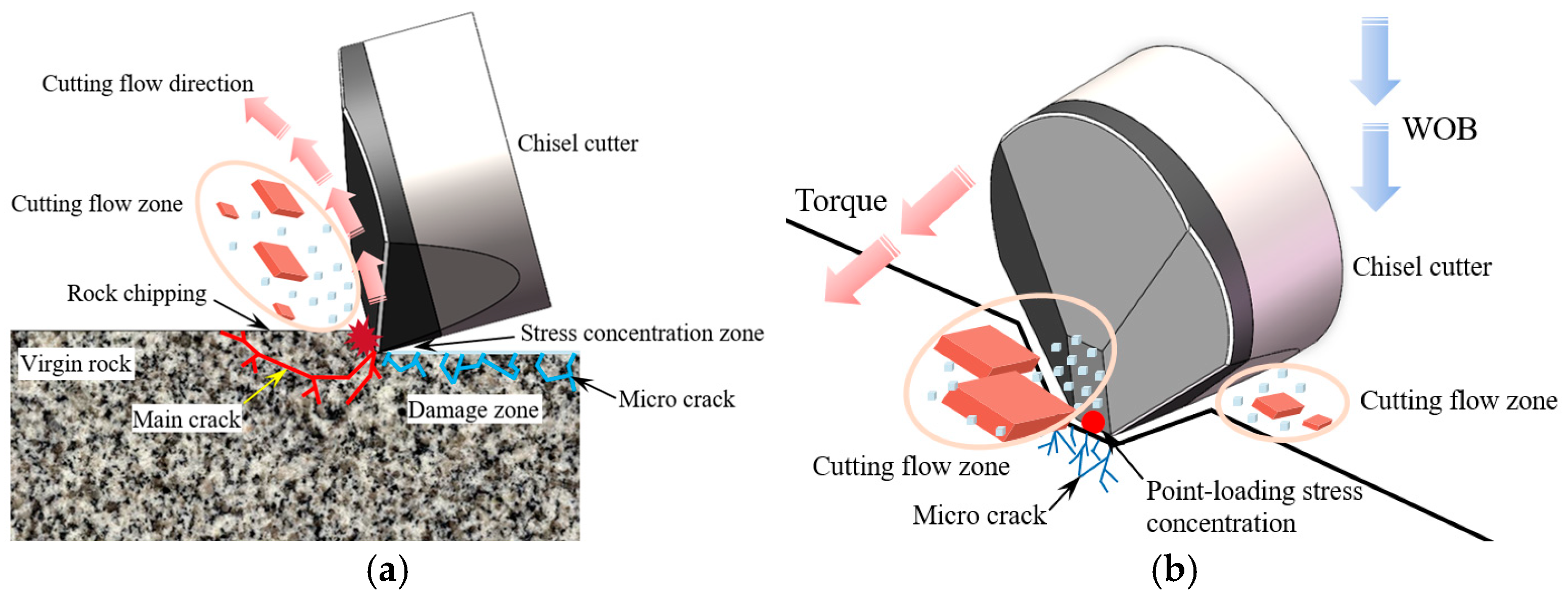
In a previous study, a non-planar cutter design featuring a V-shaped diamond face and low wings was reported to improve ROP and durability in field drilling tests [16]. Inspired by this winged cutter concept, a novel chisel PDC cutter with distinct structural modifications was designed, as shown in Figure 2. Unlike the V-shaped face and low-wing configuration described in the literature, the present cutter incorporates sector-shaped surfaces, side wings, and low wings reserved in the diamond layer. The sector-shaped surfaces guide cuttings away from the cutting face, facilitating their removal, preventing the cuttings from abrading and impacting the cutter face, and thereby reducing frictional heat generation. The side wings and low wings are designed to direct drilling fluid to flush the cutter face after rock breakage, which, in actual drilling operations, promotes cuttings evacuation and mitigates bit balling. However, to reduce the computational cost of the numerical simulations, the convective cooling effect of the drilling fluid is not explicitly modeled; only the cuttings flow-guiding function of these features is considered.
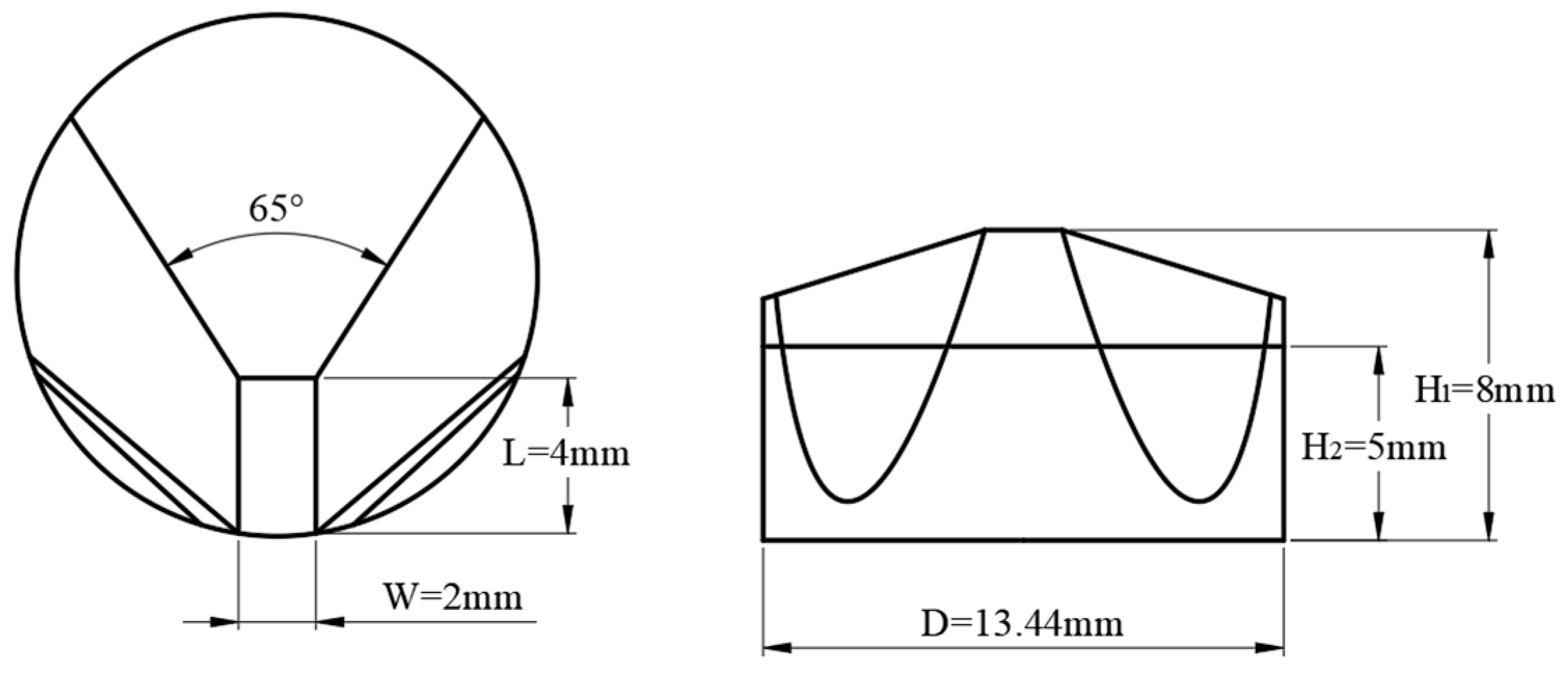
The cutter is intended for hard formations, and its dimensions were selected to balance penetration capability, structural integrity, and thermal management. A diameter D of 13.44 mm was adopted as a standard size for PDC cutters in demanding drilling environments. The total height H1 was set to 8 mm, with a cemented carbide layer height H2 of 5 mm, providing sufficient support for the diamond layer under high impact loads. The cutting edge is designed with a contact width W of 2 mm, extending 4 mm toward the cutter center along the cutting direction, which concentrates stress to promote rock fracture initiation while avoiding excessive point loading that could lead to premature chipping. The sector-shaped surfaces are inclined at an angle of 65°, chosen to optimize the balance between cuttings deflection and flow guidance, thereby reducing cuttings accumulation on the cutter face. Side wings and low wings were incorporated to channel drilling fluid across the cutter face, enhancing convective cooling and preventing bit balling. The structural parameters of the chisel cutter are labeled in Figure 3.

3. Materials and Methods

3.1. Evaluation Indices

In full-scale drilling operations, individual PDC cutting elements are strategically arrayed along the specialized spiral blades of the bit body. Subjected to the combined action of the global weight on bit (WOB) and rotational torque, each cutting insert traces a complex helical trajectory characterized by simultaneous axial penetration and angular rotation about the central drilling axis. To facilitate an isolated and computationally efficient examination of the discrete cutter-rock interaction during explicit numerical simulation, this curvilinear path is localized. Specifically, the rotary cutting motion is mathematically decoupled and treated as a quasi-static, instantaneous state captured over an infinitesimal time increment. This rational simplification effectively reduces the macro-level curvilinear translation to a stabilized linear displacement, maintaining a uniform, constant depth of cut [17].
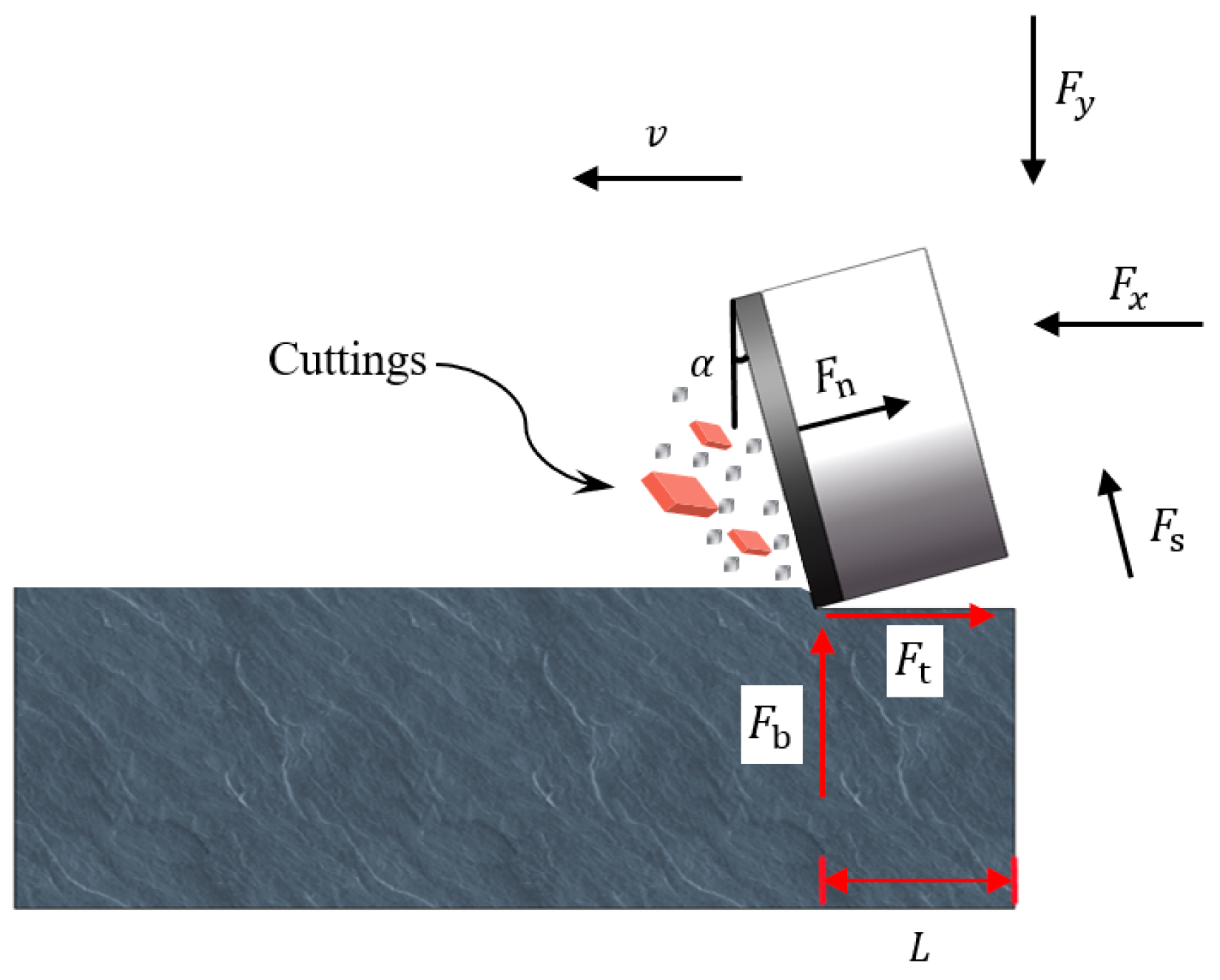
The structural configuration of this simplified orthogonal cutting mechanism is illustrated schematically in Figure 4. Let the localized tangential cutting resistance and the normal penetration resistance exerted on the compact insert be explicitly defined as F x and F y , respectively. Driven by the vertical contact pressure F y , the diamond cutting edge indents the geological substrate to achieve the target depth. Concurrently, under the continuous driving force F x , the cutter translates laterally to overcome the shearing strength of the rock formation, leading to progressive chip formation and volumetric fragmentation. Beyond these primary driving components, the complex contact boundaries generate secondary resistance forces. The active cutter face is explicitly subjected to a localized interfacial frictional drag F s opposing the chip flow, a normal contact reaction F t , a vertical cutting face reaction F n , and a base supporting reaction F b originating from the undeformed rock matrix beneath the cutter tip. Synthesizing these interfacial vectors, the steady-state mechanical equilibrium governing the cutting element is formulated as follows:
F x = F t + F n cos α + F s sin α
F y = F b + F n sin α + F s cos α
where F x and F y are the lateral force and axial force on the bit, respectively (N); F s , F t , and F n are the frictional force from the rock on the cutting face, the cutting reaction force, and the axial reaction force, respectively (N); F b is the supporting reaction force from the rock at the bottom of the cutter (N); α is the back rake angle (°);
The cutting force and mechanical specific energy (MSE) generated during rock-breaking are key indicators for evaluating the performance of a PDC cutter. The cutting force is the resistance experienced by the cutter in the cutting direction; a lower value indicates less resistance during rock fragmentation, easier rock breakage, and greater wear resistance of the cutter. MSE represents the energy consumed to break a unit volume of rock; a smaller MSE signifies higher rock-breaking efficiency of the PDC cutter [18]. In the calculation, the depth of cut is kept constant, and the axial force is assumed to do no work. The energy consumed in rock-breaking Q is equal to the work done by the cutting force F . Then:
Q = 0 L F d x = i = 1 n ( F i L n ) = L n i = 1 n F i = F ¯ L
where Q is the rock-breaking energy (J); L is the cutting distance (m); F is the cutting force (N); n is the number of instantaneous cutting force measurements; F i is the instantaneous cutting force (N); F ¯ is the average cutting force (N).
According to the definition of MSE:
M S E = Q V = F ¯ L ρ M
where V is the rock-breaking volume (m3); M is the cutting mass (kg); ρ is the rock density (kg/m3); M S E is the rock-breaking specific energy (MPa).
Accurate quantification of the rock breakage volume is a prerequisite for the quantitative analysis of the MSE of PDC cutters. In this study, a rock-breaking FEM was established using ABAQUS 2023, and an element damage failure criterion was adopted to simulate the generation of rock cuttings. During the explicit solution, once the stiffness degradation variable (SDEG) of an element reaches 1, an element deletion mechanism is triggered to mimic rock fragmentation and removal. To enhance data processing efficiency, a Python 3.9 script was written to automatically read the output database file (odb) after the simulation, filter out all failed elements, and sum their original volumes to obtain the total rock breakage volume. This automated extraction approach effectively eliminates errors inherent in manual counting and provides accurate data support for subsequent analyses of how rock-breaking parameters influence efficiency.

3.2. Mechanisms of PDC Cutter-Face Wear and the Cohesive-Element Computational Theory

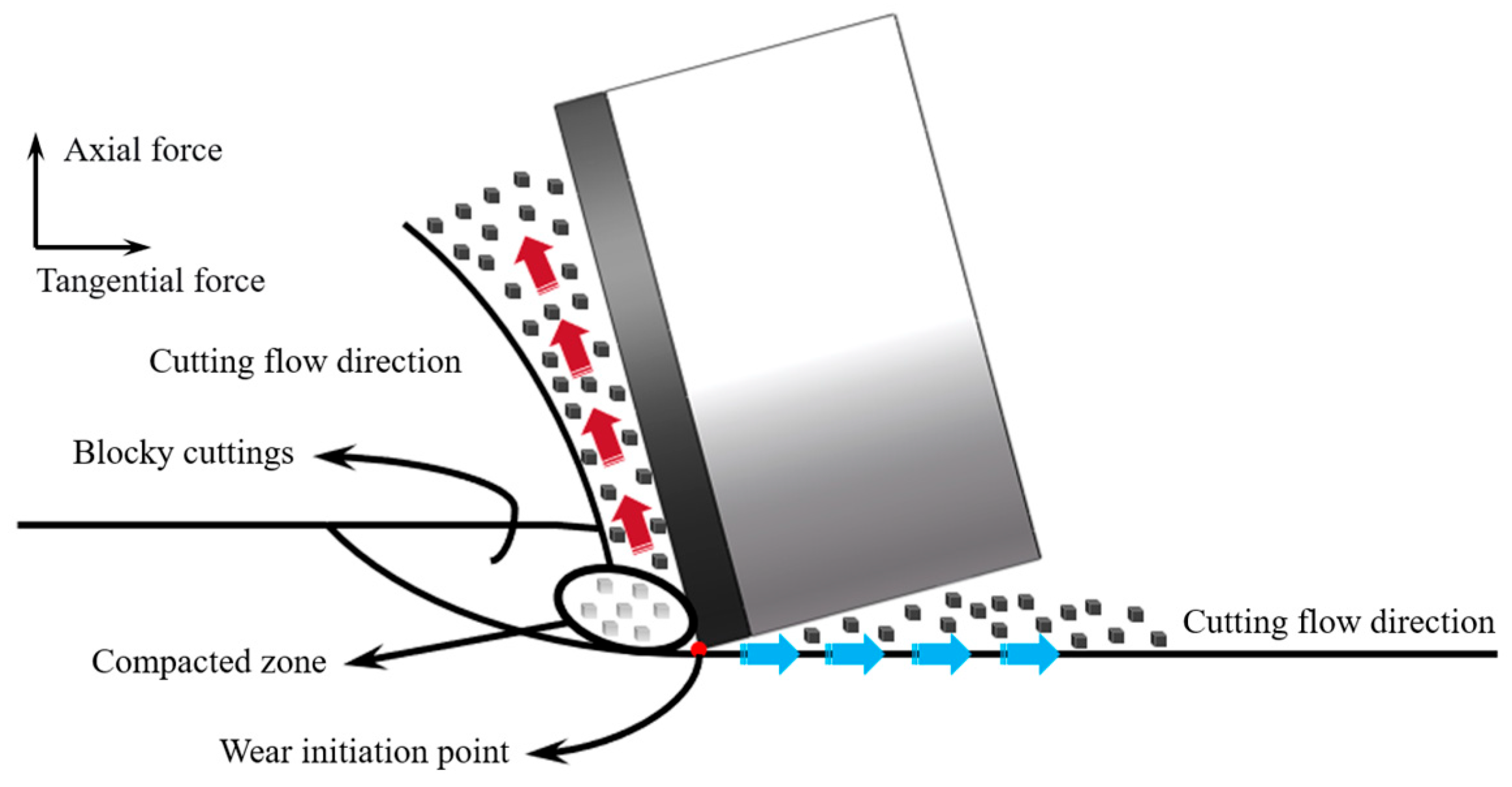
During drilling, the dominant wear mechanism is abrasive wear, which is an inevitable consequence of the interaction between the PDC cutter and the bottom-hole rock [19]. Figure 5 shows the wear that occurs between the cuttings and the cutter face during the rock-breaking process of a PDC cutter.
The cuttings generated during cutting flow out from the upper and lower boundaries of the compacted zone. The upward-flowing cuttings enter the plastic flow zone and move relative to the cutter face, generating friction at the contact interface; the resulting frictional heat accumulates depending on the cuttings removal efficiency, leading to an increase in cutter-face temperature. In addition, some cuttings impact the cutter face with an initial velocity acquired during rock fragmentation. The downward-flowing cuttings pass over the edge of the polycrystalline diamond layer. This edge also remains in contact with the original rock at the bottom of the cut groove and undergoes relative motion. Together with the downward-moving cuttings, these three bodies form a three-body abrasive wear system (i.e., cutter, rock, and cuttings). Owing to the high normal force during rock-breaking, wear initiates first at this location on the PDC cutter.
To simulate the rock fragmentation process ahead of the PDC cutter, cohesive elements were globally inserted into the established rock finite-element model. The cohesive element model, based on damage mechanics theory, is a tool widely used in numerical simulation studies of rock-breaking by drill bits, capable of simulating the initiation and propagation of cracks within the rock as well as the final detachment process of cuttings [20]. Although the cutting action of a PDC cutter is dominated by compressive and shear stresses, tensile stress also plays a critical role in the rock fragmentation process. During cutting, a complex stress distribution develops in the rock ahead of the cutter face: the compressive load induces deformation in the uncut rock, generating tensile stresses in the peripheral regions. Moreover, as shear cracks propagate, tensile microcracks initiate at the crack tip due to stress concentration, further promoting crack coalescence and ultimately leading to the detachment of rock cuttings.
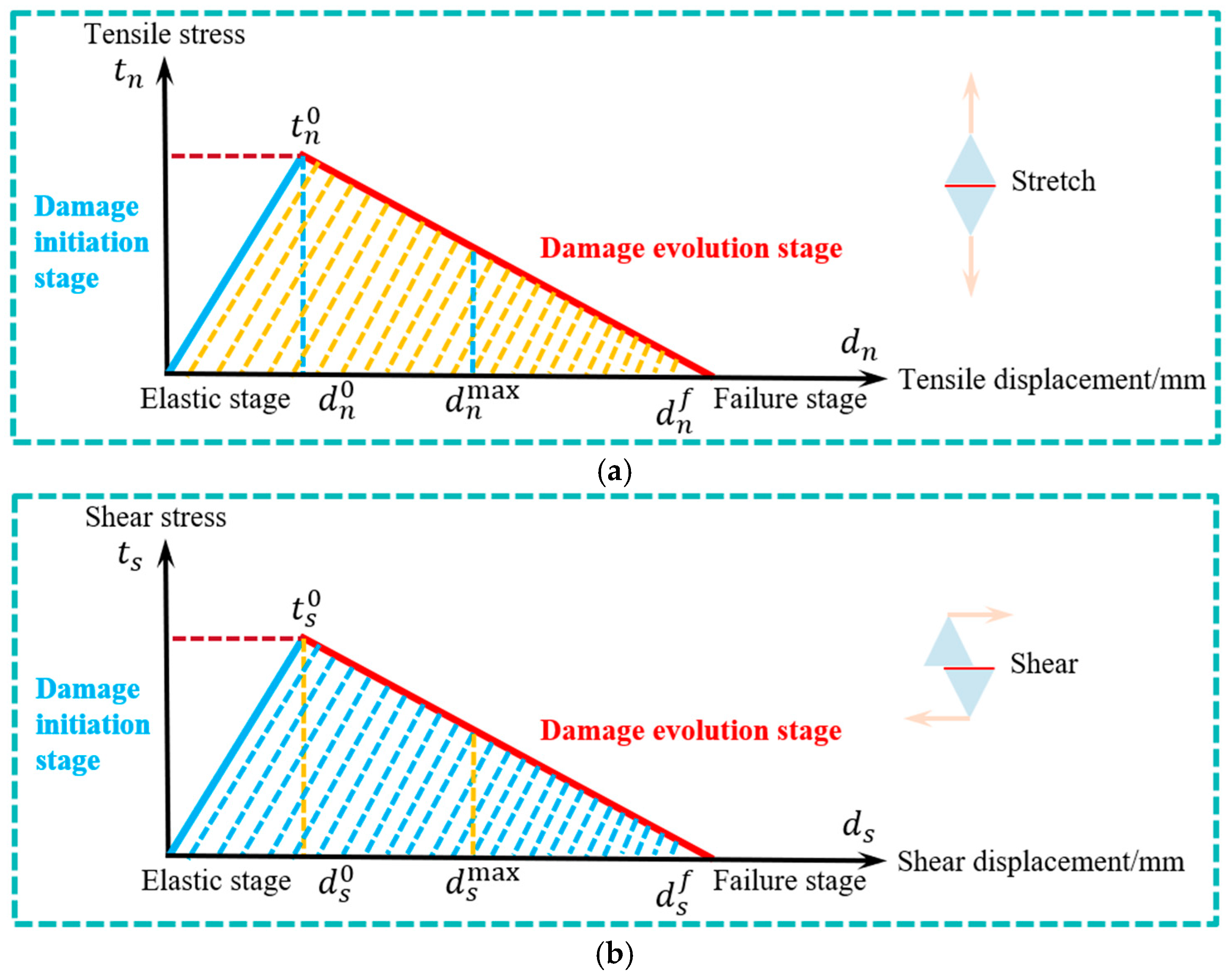
The cohesive element incorporates two damage modes, tensile failure and shear failure, as shown in Figure 6, both governed by a unified criterion. These modes follow the traction–separation law, which determines the interfacial bonding state between adjacent elements based on their relative displacement. This enables the cohesive element to simultaneously simulate shear-dominated fragmentation and tensile-stress-induced crack opening, allowing the finite element model to reproduce the spalling phenomena observed in experiments.
For brittle rocks, the pre-failure elastic response is extremely limited, and the cohesive element transitions rapidly into damage once the strength threshold is reached. The failure process can be conceptually divided into three phases. In the initial linear phase, the traction increases with separation, but the deformation is very small, and no damage accumulates. The second is the damage evolution stage, initiated once the displacement surpasses the damage onset displacement ( d 0 ); at this point, the cohesive element begins accumulating damage. The third and final stage is the failure stage ( d f ), where the displacement exceeds the critical value for complete failure, leading to the ultimate destruction of the cohesive element [21]. The corresponding stress variations under tension and shear are respectively given by Equations (5) and (6).
t n = { k n d n , d n d n 0 ( 1 D n ) k n d n , d n 0 d n d n f 0 , d n f d n
where t n is the tensile stress, k n is the material stiffness in the tensile direction, d n is the displacement in the tensile direction, and D n is the damage variable in the tensile direction. d n 0 is the initial damage value in the tensile direction, and d n f is the complete damage displacement in the tensile direction.
t s = { k s d s , d s d s 0 ( 1 D s ) k s d s , d s 0 d s d s f 0 , d s f d s
where t s is the shear stress, k s is the material stiffness in the shear direction, d s is the displacement in the shear direction, and D s is the damage variable in the shear direction. d s 0 is the initial damage value in the shear direction, and d s f is the complete damage displacement in the shear direction.
Δ = d f d f d 0 · ( 1 d 0 d m a x )
where d 0 is the displacement when the cohesive element starts to damage, d f is the displacement when the cohesive element is completely destroyed, d m a x is the maximum displacement of the cohesive element during the loading process, and Δ is the damage factor. When Δ = 0, it means that the cohesive element has no damage and is in the elastic stage. When 0 <   Δ < 1, it means that the cohesive element begins to suffer damage and is located in the damage evolution stage. When Δ = 1, it means that the cohesive element has been damaged and is in the failure stage.
As shown in Equations (5) and (6), the stress is a function of displacement. The peak stress t n 0 (or t s 0 ) is attained exactly when the displacement reaches the damage initiation displacement d n 0 (or d s 0 ). In this model, the failure behavior of the cohesive element is governed by the maximum nominal stress criterion. The element begins to damage as soon as the displacement in any direction reaches the value corresponding to the peak stress for that direction, i.e., when the following condition is satisfied:
m a x { t n t n 0 , t s t s 0 , t t t t 0 } = 1
where t n and t s are the stresses in the tensile and shear directions, respectively, and t n 0 and t s 0 are the nominal stresses in the tensile and shear directions, respectively, t t and t t 0 are the shear stress values in the direction of the other side. For rock materials, the tensile and shear stress levels depend upon the material property, and the direction of the shear plane may be abrupt as per the rock property. Therefore, the values of t s 0 and t t 0 should be defined according to the actual shear plane direction relative to the rock fabric.
Stress and strain are related through Equation (9):
[ t n t s t t ] = [ E n n T 0       E s s T 0       E t t T 0 ] [ d n d s d t ]
where E is the material stiffness in the tensile direction and the two shear directions, and T 0 is the initial thickness of the cohesive element, which is set to 1 to simplify the formulation and avoid numerical singularities in the stress calculation.

3.3. Theoretical Model of Rock and Temperature Field

To verify the numerical framework’s accuracy, Hooke’s law for linear elasticity governs the initial deformation phase of the rock domain. In geological and drilling mechanics, macroscopic shear failure is traditionally evaluated using classical yield models such as the Mohr-Coulomb criterion (M-C), the Drucker-Prager criterion (D-P), or the continuous surface cap model (CSCM). The M-C is generally applicable to the calculation of rock mechanical properties under conventional stress fields. When dealing with rock mechanics under high stress fields, the D-P is typically preferred. The D-P accounts for the effects of hydrostatic pressure and intermediate principal stress, features a smooth yield surface to ensure numerical convergence, and can be correlated with the parameters of the M-C, offering higher accuracy. Therefore, it is widely adopted in relevant mechanical models [22]. Accordingly, the D-P is selected as the rock constitutive model:
μ I 1 + J 2 = Φ
μ = 2 sin δ 3 ( 3 sin δ )
I 1 = σ 1 + σ 2 + σ 3
J 2 = 1 6 [ ( σ 1 σ 2 ) 2 + ( σ 2 σ 3 ) 2 + ( σ 3 σ 1 ) 2 ]
Φ = 6 c cos δ 3 ( 3 sin δ )
where μ and Φ signify constants calibrated through experimental testing. The stress state is mathematically represented by I 1 , which denotes the first invariant of the stress tensor (MPa), alongside J 2 ( MPa 2 ), which represents the second invariant of the deviatoric stress tensor. Regarding the intrinsic mechanical properties of the rock domain, δ specifies the internal friction angle (°), whereas c captures the cohesive strength (MPa). Additionally, the triaxial stress field is resolved into the three primary principal components denoted as σ 1 , σ 2 , and σ 3 (MPa), tracking the maximum, intermediate, and minimum loading directions, respectively.
In terms of failure kinematics, PDC cutters induce rock fragmentation primarily via macroscopic shear failure. To simulate this in the discrete domain, a constitutive damage initiation criterion is established: when the local equivalent plastic strain reaches its critical limit, material stiffness begins to degrade. By omitting the minor residual load-bearing capacity of these heavily fractured zones on the progressive failure front, the localized plastic strain criterion controlling element deletion is defined according to the following mathematical relation:
ε p ε f p l
where the equivalent plastic strain before rock failure and detachment is defined as ε p , and that after rock failure and detachment is defined as ε f p l .
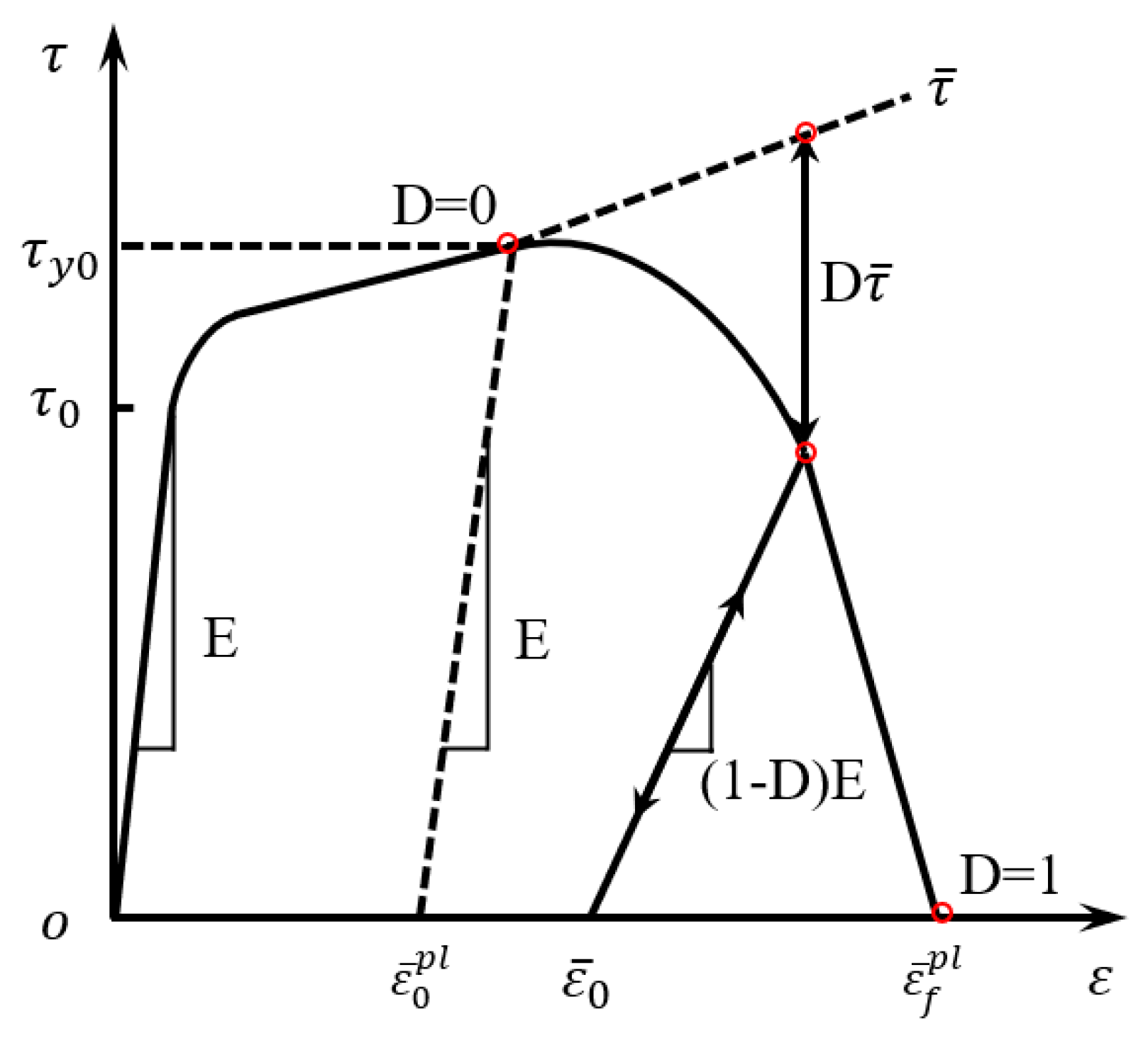
To more accurately characterize the failure mode of rock fragmentation and detachment, the concept of a damage factor D is introduced [23]. Its evolution is primarily related to the Young’s modulus of the material, and the functional expression is given as follows:
D = 1 E E = { 0 , ε ε ¯ f p l 1 τ τ ¯ , ε > ε ¯ f p l
At the precise location of fracture initiation, the threshold stress is captured by τ y 0 , representing the state immediately prior to degradation where D = 0. Once the induced plastic strain satisfies the ultimate failure criterion ε ¯ f p l , the degradation state shifts to D = 1, denoting that the continuum element has undergone complete structural breakdown and volumetric shedding. To visualize this evolution throughout the deformation history, the corresponding mechanical response curve is depicted in Figure 7.
During rock-breaking with a PDC bit, the intense friction between the cutters and the rock generates a substantial amount of heat, causing the majority of the mechanical energy consumed in the rock-breaking process to be released as thermal energy. This continuous heat accumulation leads to a progressive rise in the cutter temperature. Once the friction-induced temperature exceeds the thermal stability limit of the cutter material, irreversible performance degradation and failure occur. Moreover, this process is accelerated by the extremely poor heat dissipation conditions that prevail during downhole drilling. This represents the core bottleneck that results in the short service life and low efficiency of PDC bits when drilling through hard and highly abrasive formations.
The heat generation and heat dissipation capacities of the cutter during rock-breaking determine the temperature level of the cutter face at thermal equilibrium under the influence of drilling fluid [24]. The theoretical model of the cutter face temperature state is given as:
T = T 0 + γ h f τ s v f sin δ l sin φ cos ( φ + δ )
In this thermal formulation, T tracks the transient temperature fields developed on the cutter face (°C), evolving from an initial ambient baseline state denoted as T 0 (°C). The allocation of frictional heat energy into the cutting tool is governed by the dimensionless heat distribution coefficient γ . Geometrical configurations are explicitly captured by the cutter penetration depth h (m) and the primary shear angle φ (°). Regarding the mechanical chip formation process, v f represents the fractured chip volume (m3), l specifies the active contact length mapping the boundary between the cutting face and the sliding chip debris (m), and τ s quantifies the localized interfacial shear stress (Pa). Furthermore, the specific material parameter f characterizes the thermal response function intrinsic to the cutting element (°C/J).
In downhole operations, drilling fluids play a vital role in mitigating interfacial friction and removing generated heat from the PDC cutters. However, simulating transient convective heat transfer within a multiphase fluid-solid boundary introduces massive geometric nonlinearities and extreme computational overhead. To ensure the explicit dynamic integration is computationally tractable while focusing strictly on the primary thermomechanical wear mechanisms, fluid-induced convective cooling is omitted from the current transient temperature field models.
Accordingly, this investigation isolates the intrinsic thermal distribution profiles developed purely via cutter-rock contact friction and plastic rock deformation. To establish a rigorous yet isolated thermal boundary condition, the global geothermal gradient is neglected. Omitting the deep-well thermal baseline effectively insulates the simulation from peripheral environmental variables, thereby allowing a direct, uncoupled analysis of how operational variations (such as depth of cut and back rake configuration) dictate the absolute thermal flux [25]. While the resulting numerical temperatures may exhibit localized deviations from field-measured absolute values, the relative thermal gradients, evolution trends, and comparative parametric profiles remain scientifically robust. To maintain mathematical stability and optimize the mesh convergence rate within the explicit finite element solver, the following foundational assumptions are implemented across the computational domain:
(1)
The PDC cutters and the surrounding rock are both treated as homogeneous and continuous materials. Any effects arising from internal microstructural differences within these materials on the temperature field are neglected.
(2)
The density and thermophysical properties of the PDC cutters are assumed to remain unchanged with temperature. In other words, these parameters are taken as constants throughout the analysis.
These simplifications are intended to lower the complexity of the model, allowing the primary mechanisms behind the formation of the temperature field in PDC cutters and their distribution patterns to be more clearly identified.

3.4. Validation of the Rock Model

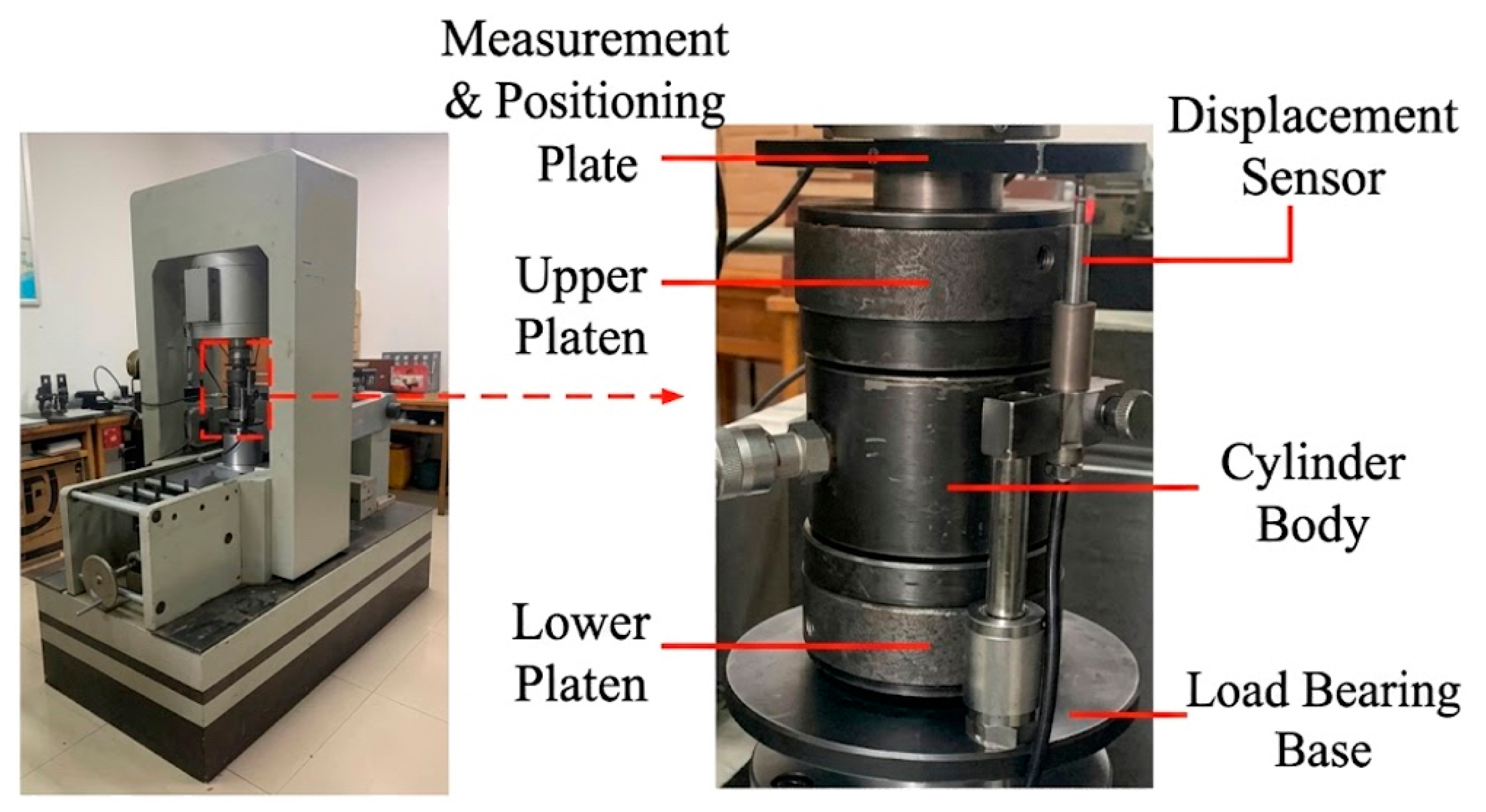
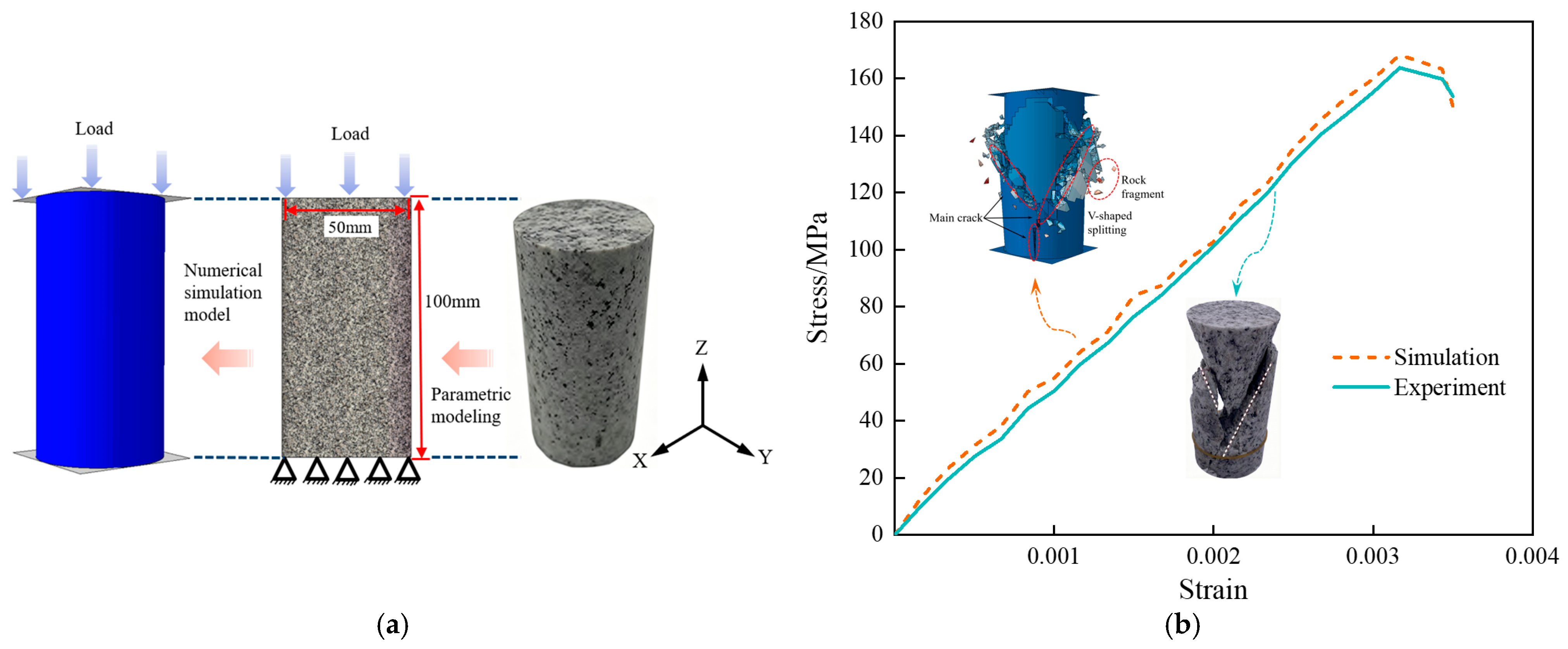
Based on the Triaxial compression test results reported in the literature [26], the stress–strain curve, compressive strength, and elastic modulus of granite were obtained. Subsequently, the internal friction angle and cohesion of the rock, corresponding to the Drucker-Prager criterion, were calculated and converted from triaxial compression test data. On this basis, taking the laboratory rock compression testing machine as the simulation prototype, as shown in Figure 8, a numerical simulation model of uniaxial compression was established, as shown in Figure 9a. The rock specimen had a diameter of 50 mm and a height of 100 mm. The loading indenter was set as a rigid square flat plate with a side length of 70 mm. During the calculation, the specimen was placed on a bottom rigid plate that was fixed. The loading rigid plate was slowly displaced along the Z-axis to apply loading. General contact was defined between the rigid plate and the rock, with a friction coefficient of 0.3.
Figure 9b presents the comparative profiles correlating the numerical predictions against the empirical data. The computed stress–strain response exhibits strong structural alignment with the experimental benchmarks, restricting the peak stress deviation to a maximum margin of 5%. The peak stress and the post-peak stress drop trend are both essentially consistent with the experimental results. This verifies that the established cohesive element model and the assigned parameters are highly accurate and reliable.
It should be noted that natural granite is anisotropic; the finite element models in this study adopt the D-P yield criterion with an isotropic assumption, a common approach in explicit dynamic rock-breaking simulations that balances efficiency and macroscopic accuracy. The validation simulation replicates a uniaxial compression test to verify the stress–strain response, yet the D-P strength parameters were derived from triaxial compression data. Through the stress invariants I1 and J2, the D-P criterion inherently accounts for hydrostatic pressure and the intermediate principal stress, enabling the model to capture the complex multi-axial stress states induced by cutter indentation despite the isotropic simplification.

3.5. FEM Establishment

This study adopts a two-stage approach: single-cutter analysis followed by full-bit simulation. The single-cutter model isolates the fundamental rock-breaking mechanisms, allowing systematic variation in cutter geometry, back-rake angle, and depth of cut under controlled conditions. It reveals the coupled thermo-mechanical response, cutting force evolution, and cutting impact characteristics at the individual cutter level, effects that are difficult to decouple in a full-bit assembly. Subsequently, cutters of different shapes are mounted on full-size bits for finite element rock-breaking simulation evaluation. The full-bit model captures multi-cutter interactions, cuttings evacuation, and overall rate of penetration in a more realistic downhole environment. The two stages are complementary: the single-cutter model guides cutter arrangement design, while the full-bit model validates the rock-breaking performance of the cutters.
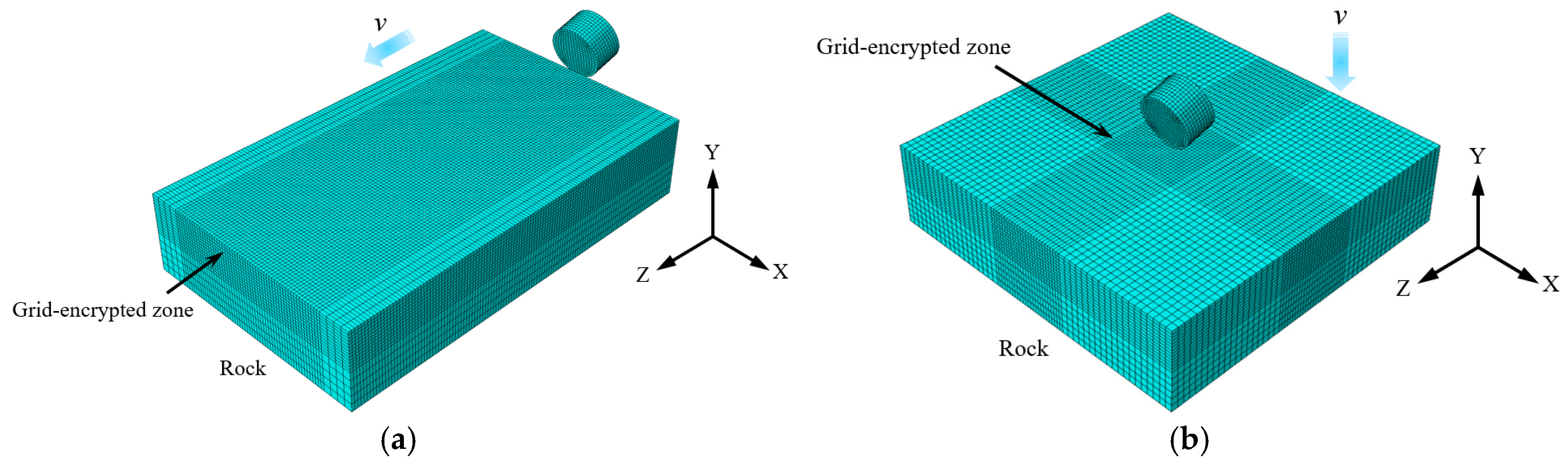
A coupled temperature-displacement FEM was established for the single-cutter rock-breaking simulation, and a separate purely mechanical FEM was established for the single-cutter indentation simulation, both using ABAQUS 2023 software, as illustrated in Figure 10. Identical boundary conditions were applied to both cutter geometries. In the coupled temperature-displacement finite element model for single-cutter rock breaking, the rock specimen is a rectangular block with dimensions of 100 mm × 50 mm × 25 mm. The mesh element types assigned to the rock and the cutter are C3D8T. The cutter is configured with a back rake angle of 15°, a depth of cut of 1 mm, and a cutting speed of 1000 mm/s. Frictional contact is defined between the cutter face and the rock nodes, with a friction coefficient of 0.3. The ambient temperature is set to 27 °C. The rock material used in the simulation was granite, and the material thermodynamic parameters of the rock and the cutter are listed in Table 1.
In the single-cutter indentation finite element model, the rock specimen is a rectangular block with dimensions of 80 mm × 80 mm × 20 mm. The meshing strategy follows the same approach as that used in the coupled temperature-displacement finite element model. The mesh element types assigned to the rock and the cutter are C3D8R. The indentation parameters are as follows: indentation speed of 10 mm/s, indentation depth of 1 mm, and back rake angle of 15°. The simulation duration for both models is set to 1 s. During the simulation, all faces of the rock are fixed except for the top surface.
It is necessary to clearly explain the logic underlying the parameter settings for the boundary conditions of the finite element model. A back-rake angle of 15° and a depth of cut of 1.0 mm were chosen as the baseline parameters. These intermediate values were used to build the initial finite element model, and a comparison of the fundamental rock-breaking mechanisms of the cylindrical cutter and the chisel cutter was conducted under the same baseline conditions. Starting from these baseline boundary conditions, a control-variable approach was further adopted to evaluate the effects of a wider range of back-rake angles and depths of cut on rock-breaking performance, so as to ultimately determine the optimal cutting parameters for the chisel PDC cutter.

3.6. Mesh Independence Verification

In finite element analyses involving element deletion, the mesh size directly affects the reliability of the computed results; an inappropriate mesh selection can lead to inaccurate results or excessively high computational cost. To eliminate such mesh dependency, mesh independence verification was carried out for both the thermo-mechanically coupled rock-breaking model and the single-cutter indentation model in this study.
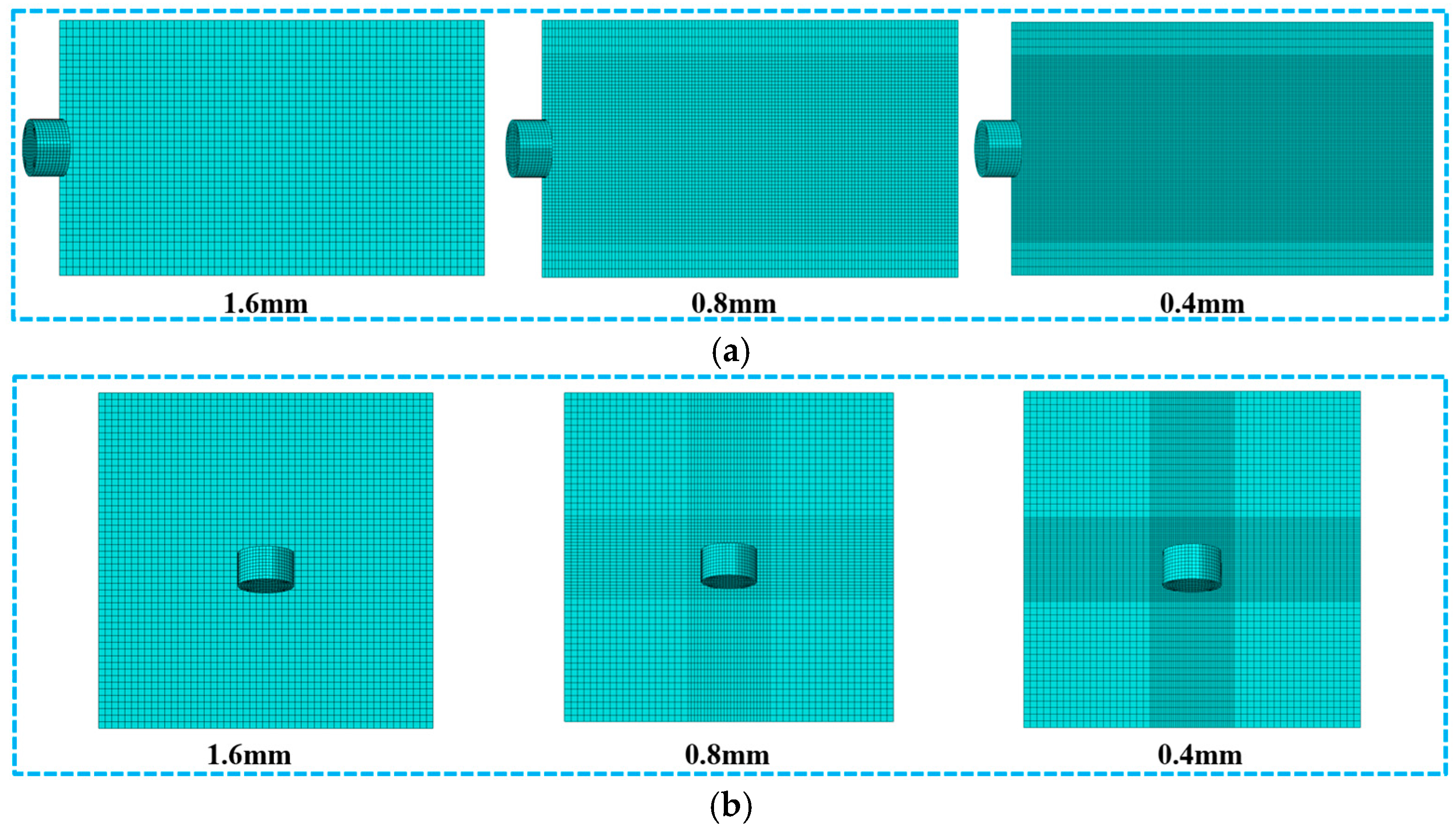
Three mesh sizes, 1.6 mm, 0.8 mm, and 0.4 mm, were tested in the cutter–rock contact zone, as shown in Figure 11, and the results obtained with different mesh sizes were compared, as listed in Table 2. When the mesh was refined from 0.8 mm to 0.4 mm, only minor differences were observed in the computed results. Although the results obtained with the 0.4 mm mesh might be slightly more accurate, this refinement leads to a substantial increase in the number of elements, causing a significant rise in computational cost with only a marginal improvement in accuracy. Balancing computational cost against the reliability of the numerical results, a mesh size of 0.8 mm was ultimately adopted in this study. This size yields stable and reliable results while meeting the accuracy requirements for both the mechanical and thermal fields. The mesh refinement zone in all subsequent formal simulations was discretized using this element size.

4. Results Analysis

4.1. Comparative Analysis of Rock-Breaking Characteristics

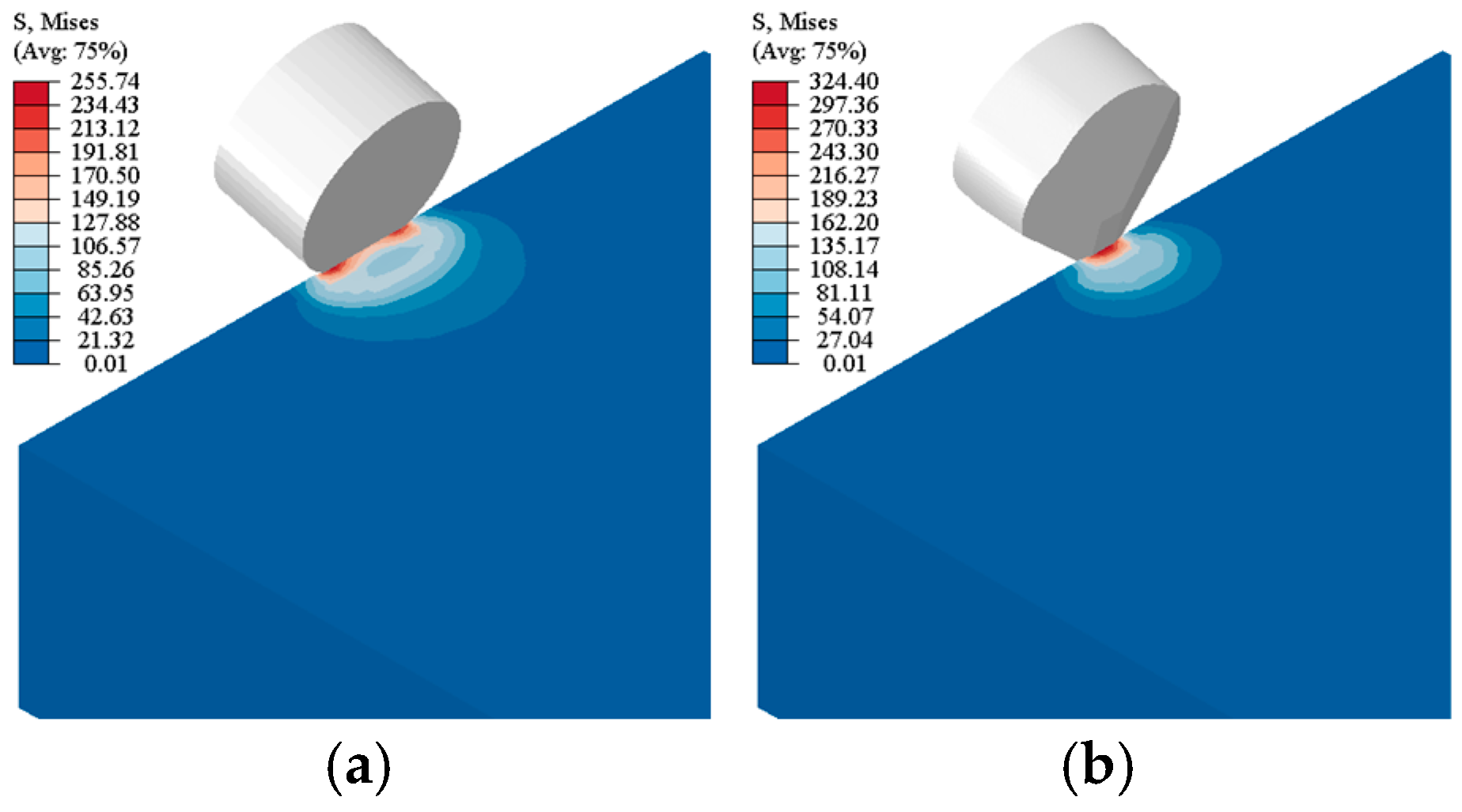
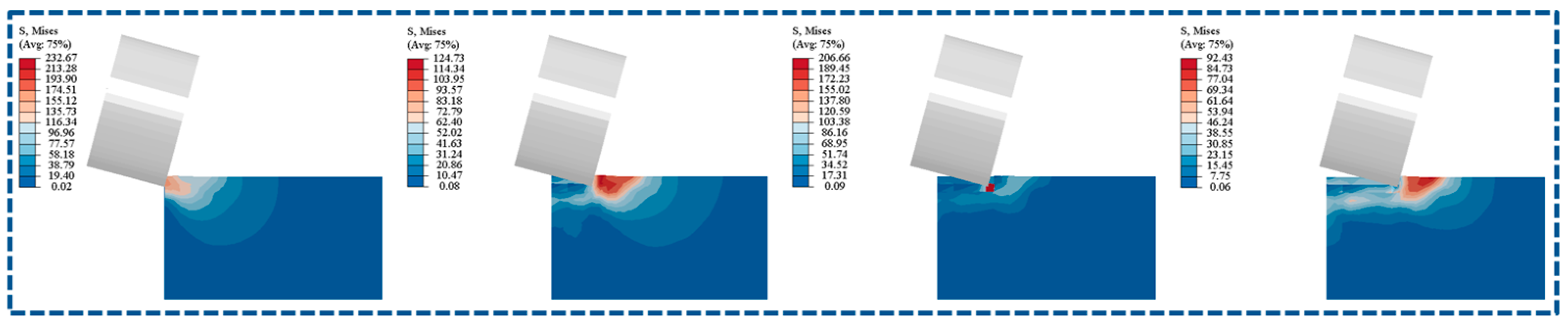
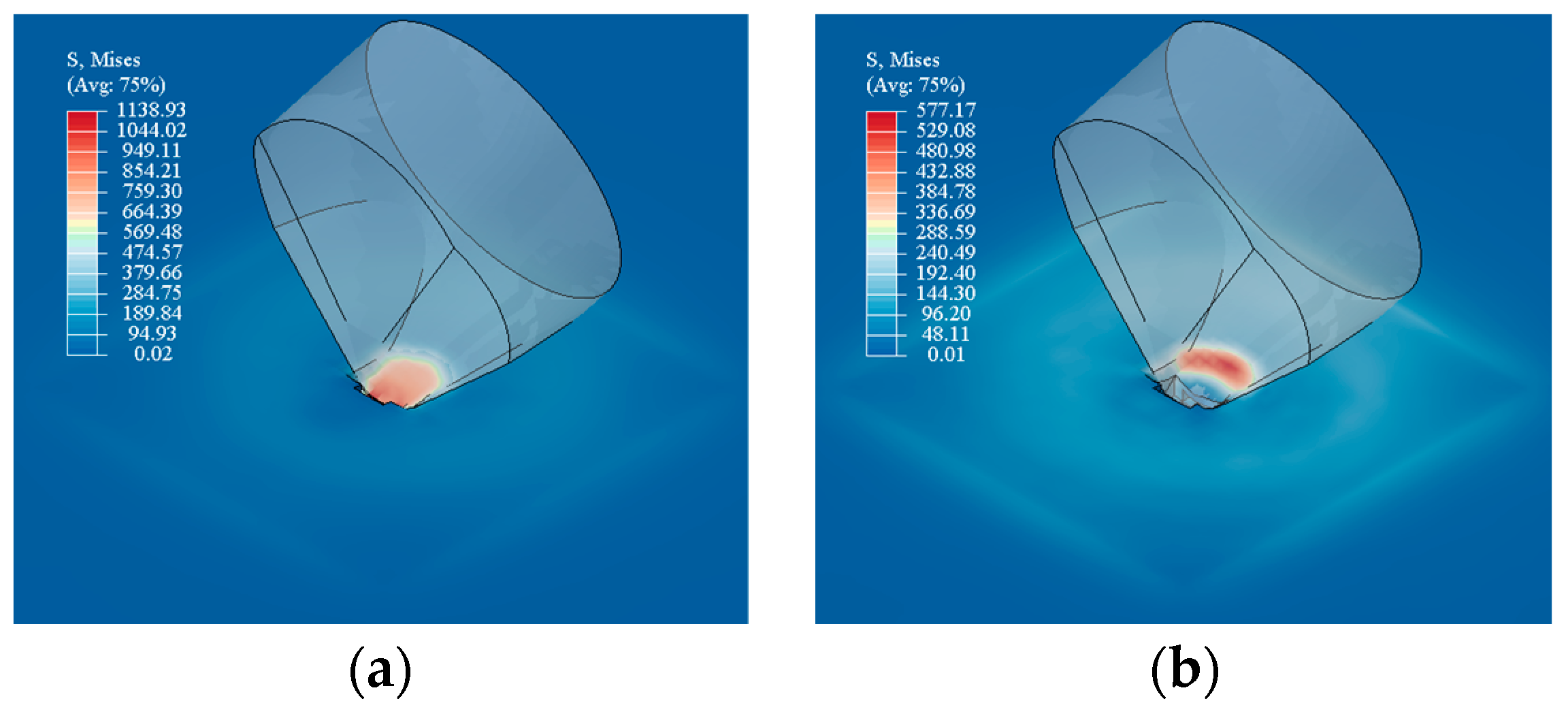
Figure 12 shows that the cylindrical cutter has a large contact area with the rock. Its stress field affects a relatively large region within the rock and exhibits a divergent distribution, with stress concentrated on both sides of the cutter face. A relatively high initial WOB is required for the cutter to initiate rock failure. In contrast, the chisel cutter penetrates the rock with its tip upon contact. At this moment, a high stress concentration is formed at the contact point between the chisel cutter tip and the rock, enabling the rock immediately beneath the tip to rapidly reach its yield limit and undergo failure.
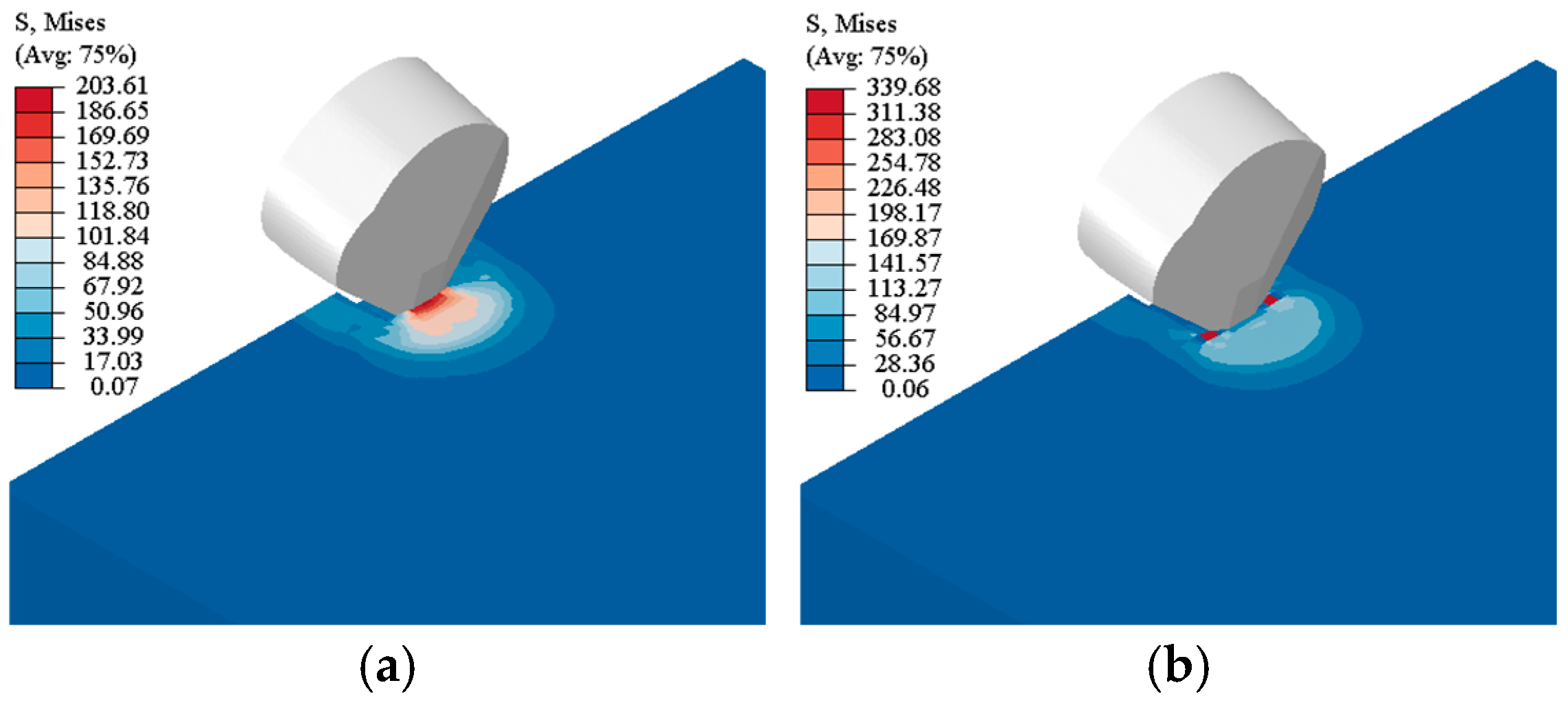
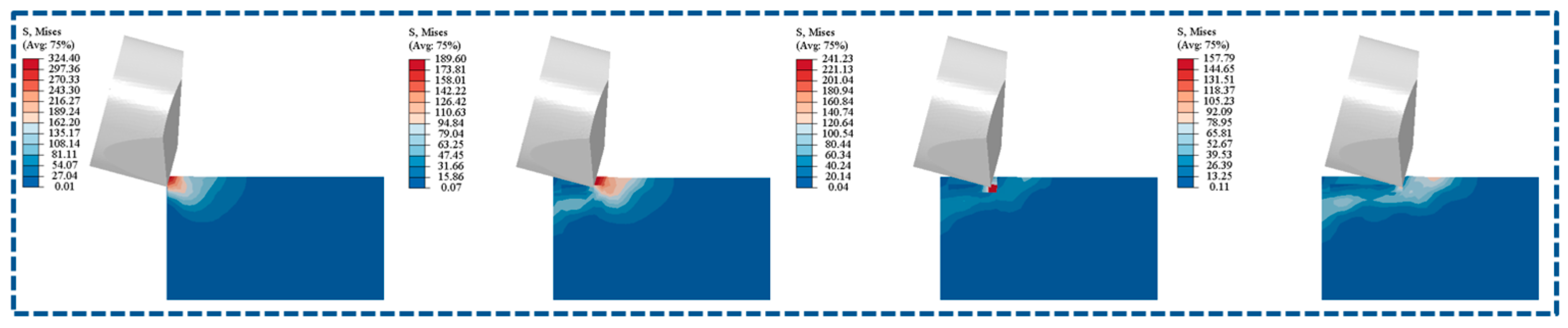
During the rock-breaking process of the chisel cutter, the high-stress region in the rock remains concentrated at the cutter tip and on both sides of the rake face, forming a forward-directed stress gradient within the rock mass in front of the cutter, as shown in Figure 13. Under the action of stress, the rock rapidly reaches its yield limit and undergoes combined shear and tensile failure. The convergent edge design of the cutter face enables the chisel cutter to fail the rock with a relatively small applied load during rock-breaking, which accounts for its lower MSE compared with cylindrical cutters.
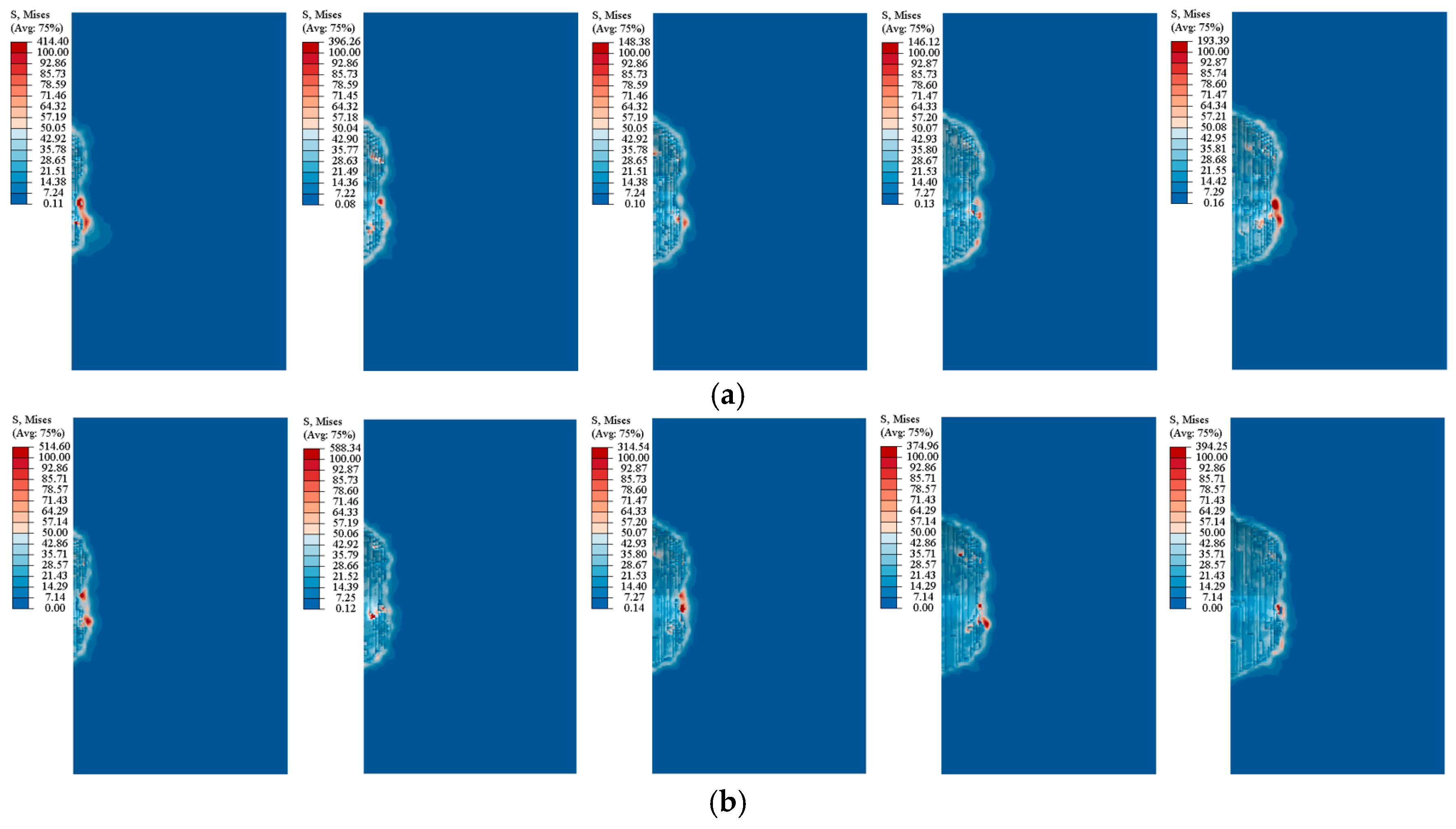
Figure 14 shows the von Mises stress field of the cylindrical cutter at different increments. A broad stress band appears in front of and beneath the cutter early in the cut. As the cutter advances, this high-stress zone spreads deep into the rock rather than causing immediate local failure. This gradual stress diffusion reflects a rock-breaking process dominated by large-volume compaction and plastic plowing. Consequently, a large portion of mechanical energy is consumed in compaction before macroscopic cuttings detach, delaying stress release and maintaining a persistently high contact stress.
Figure 15 shows the stress field evolution of the chisel cutter. High stress remains concentrated directly ahead of the cutter throughout the process. The von Mises stress does not spread into deeper rock but quickly peaks within a narrow zone, immediately triggering microcracks. As the cutter advances, this localized stress causes sudden brittle spalling of the cuttings. Once spalling occurs, the local stress is released instantly, and the cutter engages the next rock segment. This cycle of rapid stress concentration followed by abrupt release avoids compaction energy loss, validating the chisel cutter’s superior rock-breaking efficiency.
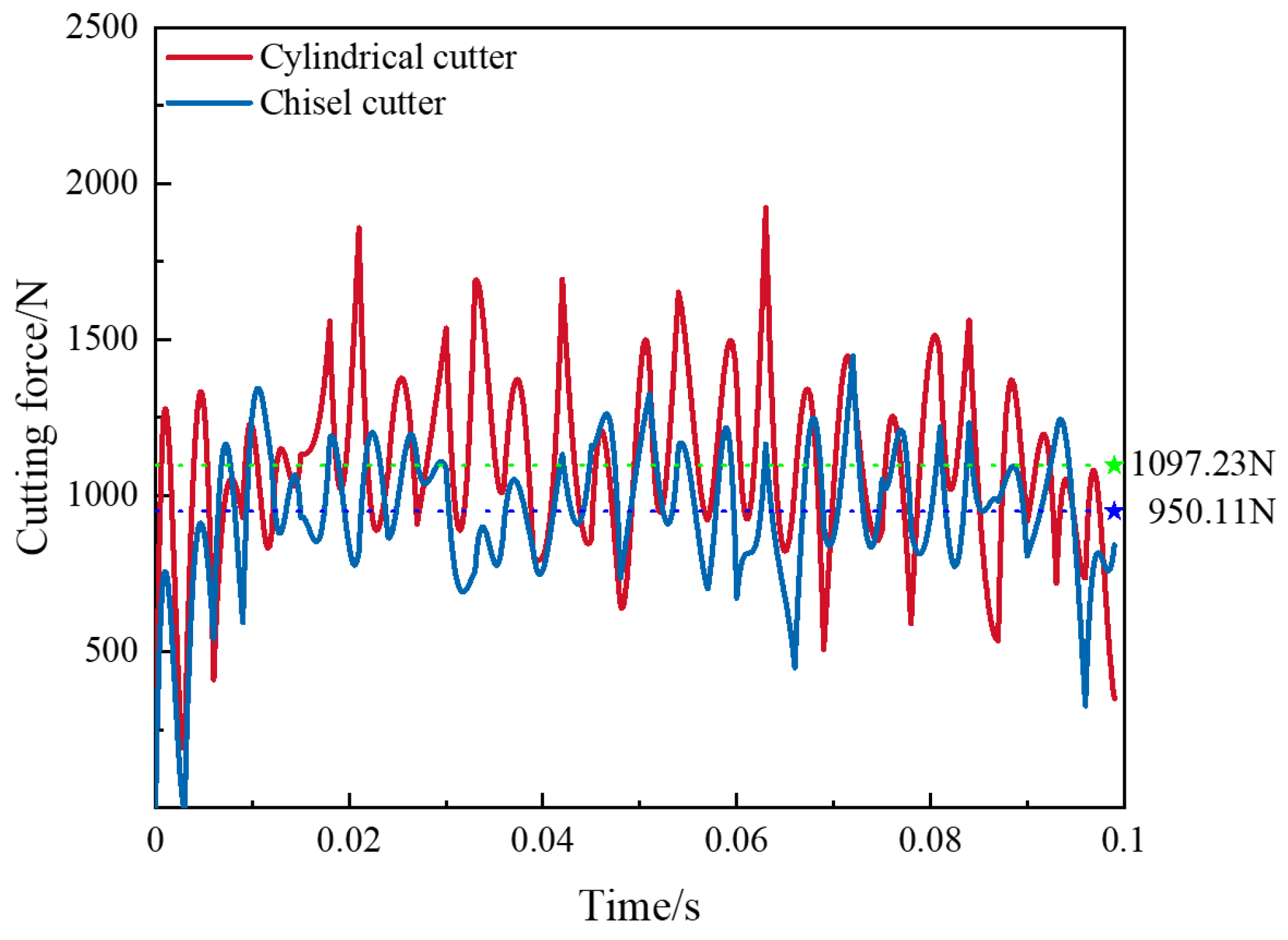
Figure 16 shows that both cutter shapes produce high-frequency, large-amplitude cutting force fluctuations. Even with homogeneous rock models, these fluctuations arise from sudden brittle fragmentation, as rock fails rapidly with microcrack propagation. Cutting is a cyclic compaction–spalling process: the cutter compacts the rock to failure, cuttings spall, and the force drops sharply before the next loading cycle begins. In explicit simulations, element deletion causes momentary contact loss and an abrupt impact on the next element, further amplifying peaks—sometimes to nearly twice the average force. The average cutting force of the cylindrical cutter is 1097.23 N, compared with 950.11 N for the chisel cutter, a reduction of 13.4%. This indicates that the chisel cutter engages with the rock more smoothly during drilling, which helps reduce torque fluctuations and stick-slip vibrations of the bit, in line with the self-adaptive optimization philosophy [27].

4.2. Analysis of Rock-Breaking Under Different Cutting Parameters

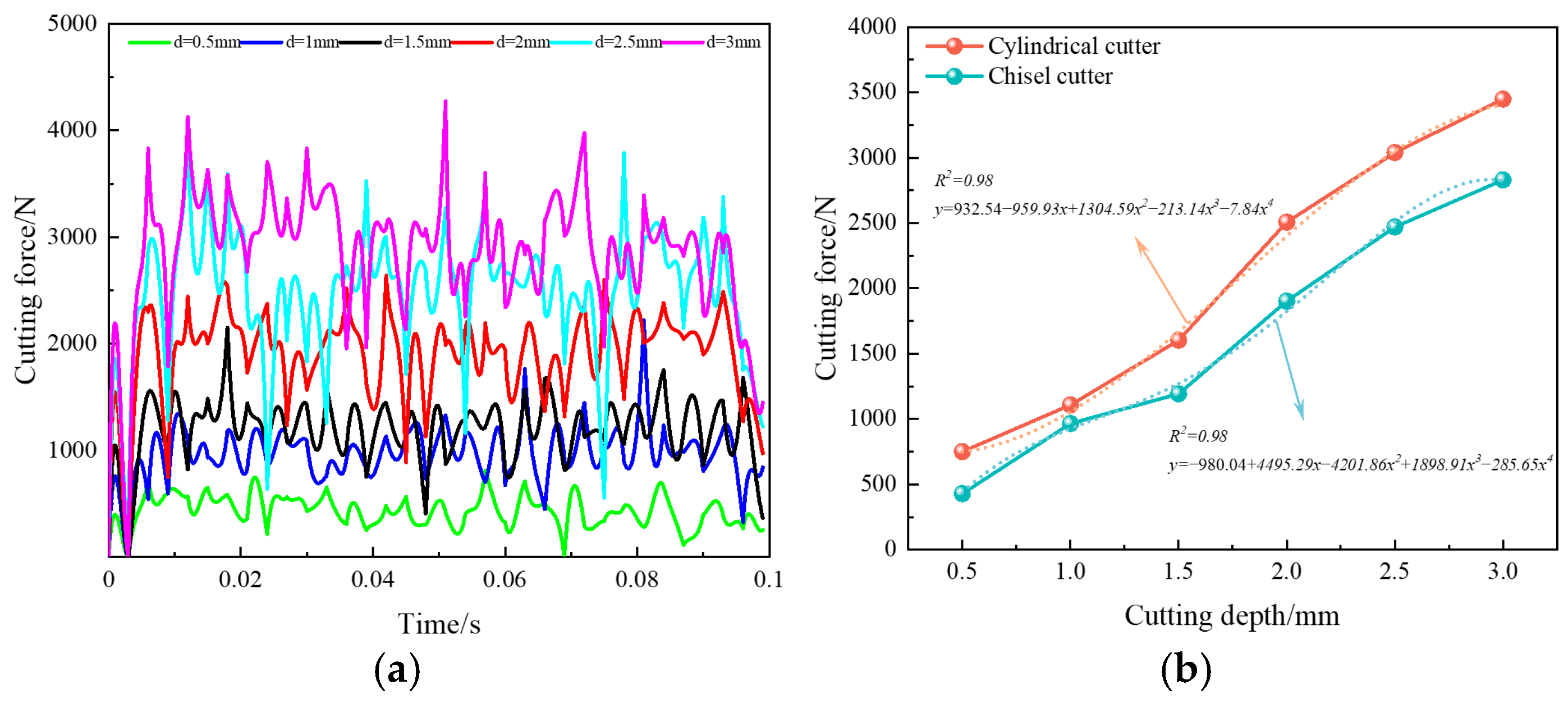
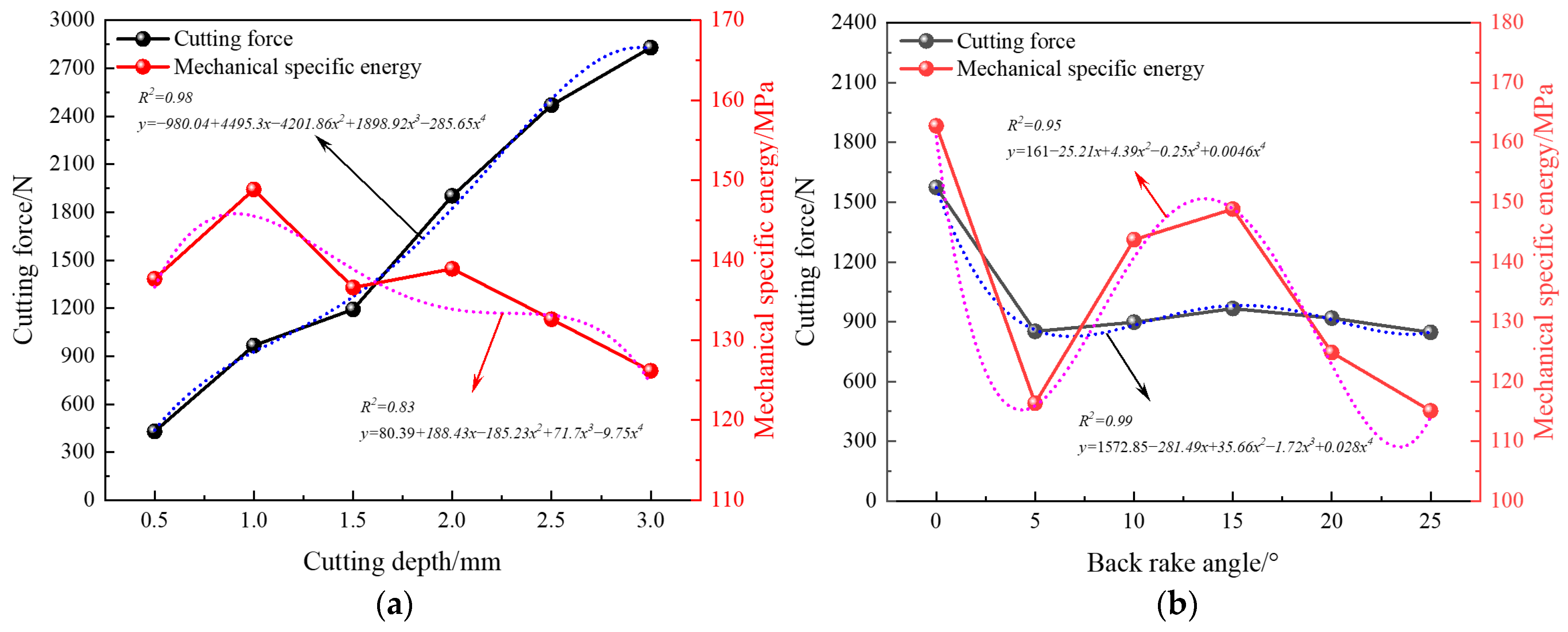
Analyzing the influence of the depth of cut on the rock-breaking performance of PDC cutters is beneficial for structural optimization. Meanwhile, to compare the cutting forces experienced by the chisel cutter and the cylindrical cutter at various depths of cut, numerical simulations were carried out on both cutter types under a back-rake angle of 15°, a cutting speed of 1000 mm/s, and depths of cut of 0.5, 1.0, 1.5, 2.0, 2.5, and 3.0 mm. As the depth of cut increases, the cutting force curve exhibits an overall upward trend, as shown in Figure 17a. This is because an increase in the depth of cut enlarges the contact area between the cutter and the rock. The load required for the chisel cutter to break the rock increases with the rock-breaking volume, leading to higher extracted cutting forces and more severe fluctuations in the cutting force curve.
When the depth of cut d 1.5 mm, the cutting force curve fluctuates relatively gently, with a small range between peaks and troughs. Under this condition, stress concentration occurs at the tip of the chisel cutter edge, and the rock-breaking mode is primarily characterized by continuous local micro-spalling and plastic plowing, resulting in high cutting stability. When the depth of cut d 2 mm, the cutting force curve exhibits high-frequency and intense fluctuations. This is because the large depth of cut induces large-volume brittle spalling of the rock, with the instantaneous release of elastic energy stored in the rock to brittle fracture, subjecting the cutter face to extremely severe alternating impact loads. Therefore, when drilling in hard rock with a chisel cutter, the depth of cut should be controlled within the range of 1.0–1.5 mm.
Figure 17b shows that when the depth of cut exceeds 1.5 mm, the slopes of both curves increase significantly. This corroborates the previous conclusion that the load required for rock fragmentation surges once the depth of cut exceeds 1.5 mm. Moreover, the difference in cutting force between the cylindrical cutter and the chisel cutter widens. The cylindrical cutter has a wider contact area with the rock, and as the depth of cut increases, the pressure on both sides of the cutter face rises, leading to an increase in cutting force. At a depth of cut d = 3.0 mm, the cutting force of the cylindrical cutter is approximately 3447.29 N. In contrast, due to the geometric design of its cutter face, the chisel cutter partially alleviates the pressure on both sides, and under the same operating conditions, its cutting force is approximately 2829.92 N, representing a reduction of 17.9%. The cutting forces of both cutter shapes increase monotonically with increasing depth of cut. The cutting force curve of the chisel cutter is consistently lower than that of the cylindrical cutter, demonstrating that the chisel cutter requires less torque when drilling in hard rock formations. This can effectively suppress stick-slip vibrations that are prone to occur under high WOB and large depth of cut, while also preventing impact-induced chipping failure of the cutter.
The MSE of PDC cutters at various depths of cut can be calculated by Equation (4), based on which the MSE of the cutters under different cutting parameters can be analyzed. As the depth of cut increases, the cutting force increases monotonically, whereas the MSE exhibits a nonlinear variation, as shown in Figure 18a.
When the depth of cut d 1.0   m m , due to the shallow cutting depth, energy is mainly consumed by intense friction between the cutter tip and the rock surface as well as by micro-fracturing of the surface layer, without the formation of large-volume rock fragmentation, leading to an increasing trend in the MSE. When the depth of cut reaches 1.5 mm, the MSE decreases. As the depth of cut further increases to 2 mm, the MSE increases slightly because the rock fragmentation mode transitions from surface spalling to larger-scale volumetric failure, requiring additional energy to initiate and propagate major cracks. However, with a continued increase in the depth of cut, the MSE begins to decrease, reaching its minimum at 3 mm. The cutter face geometry of the chisel cutter can generate stronger stress concentration, inducing deep cracks within the rock that propagate toward the free surface, thereby producing large-volume brittle spalling. Therefore, the deeper the depth of cut, the lower the energy required to break a unit volume of rock, and the lower the MSE.
Nevertheless, pursuing a large depth of cut by applying a high WOB entails certain risks. Although the MSE of the chisel cutter is the lowest at a depth of cut of 3 mm, the corresponding required cutting force is also the highest, and the associated high-frequency impact loads increase the risk of cutter chipping and exacerbate bit torsional vibration. Based on the analysis in Figure 17, in actual drilling engineering, the depth of cut for the chisel cutter should be controlled at approximately 1.5 mm by optimizing the cutter arrangement of the bit.
As plotted in Figure 18b, the chisel-shaped cutting element demonstrates a characteristic nonlinear sensitivity to variations in its back rake angle. These insights were captured via numerical simulations configured at a constant 1 mm depth of cut and a translation rate of 1000 mm/s across six discrete rake angles from 0° to 25°. When the cutting face stands perfectly vertical 0°, it exerts severe normal compression against the rock matrix. This inefficient failure mode yields substantial parasitic energy losses, causing the cutting force and mechanical specific energy to peak. Introducing a slight forward rake of 5° abruptly optimizes the shearing efficiency, yielding a dramatic drop in both parameters. Nevertheless, as the inclination progresses through the 10–15° range, the cutting tip induces severe pre-compression and compaction in the localized rock domain, which increases the fragmentation threshold and forces a subsequent rise in both force and energy expenditures. When the back rake angle continues to increase to 20–25°, the cutting force changes little, but the MSE decreases significantly. This is because, under such conditions, the chisel cutter exerts a greater compressive stress per unit area on the rock, and the weight-on-bit transfer efficiency is higher, inducing large-volume brittle spalling of the rock, thereby substantially reducing the MSE.

4.3. Temperature Characteristic Analysis

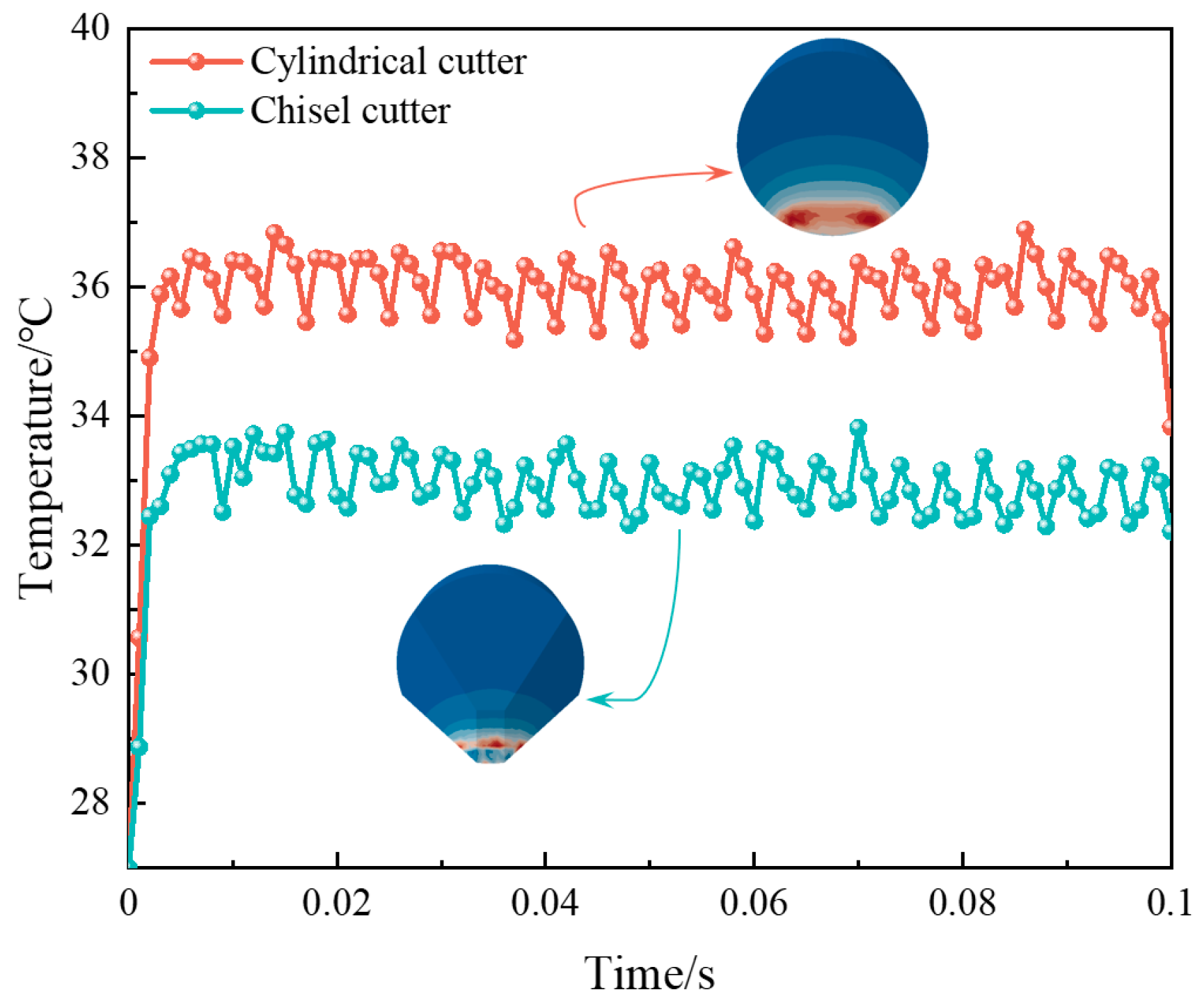
The temperature variation curves of the cutter face for the two cutter shapes at a depth of cut of 1 mm are shown in Figure 19.
In the initial stage, heat is generated by friction between the cutter face and rock. Owing to the short time of contact and insufficient heat dissipation, the temperatures of both cutter shapes exhibit an upward trend. As cutting enters the stable propagation stage, the temperature rise curves of the two diverge. The cutter face temperature of the cylindrical cutter continues to rise and exceeds that of the chisel cutter, indicating that the cylindrical cutter has greater difficulty in dissipating heat compared with the chisel cutter. After reaching its initial peak, the temperature variation curve of the chisel cutter remains at a relatively low level, with an overall reduction of approximately 8.3% compared with the cylindrical cutter, demonstrating that the chisel cutter possesses better heat dissipation capability.
The cylindrical cutter develops large, high-temperature zones on both sides of the cutter–rock contact that spread outward along the face. By contrast, the chisel cutter confines its smaller hot spot to the chisel face and the side-wing contact areas, leaving most of the cutter face cooler. This temperature distribution helps prevent thermal damage to the polycrystalline diamond layer, thereby extending bit life.
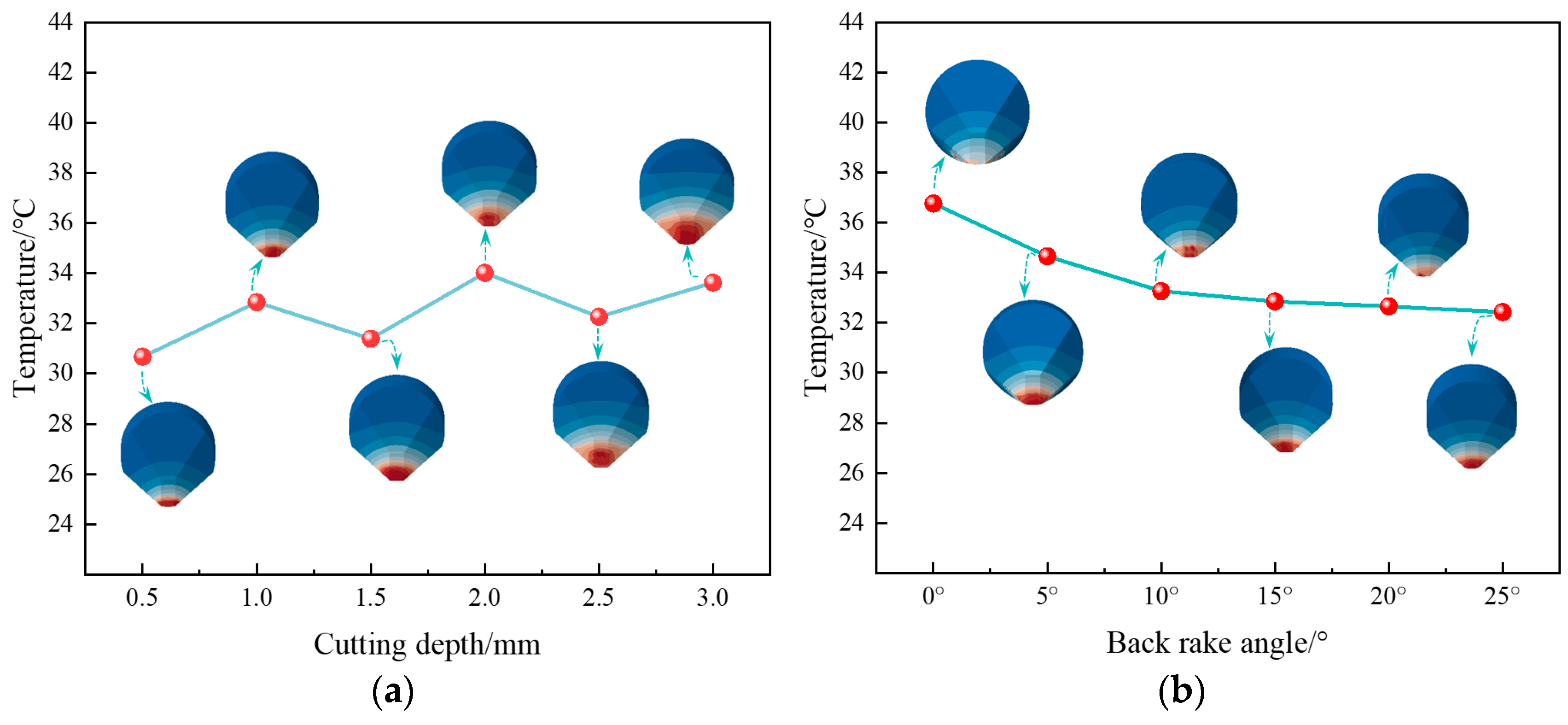
Figure 20a shows the chisel cutter-face temperature varying with depth of cut. Temperature rises noticeably from 0.5 mm to 1.0 mm, but at 1.5 mm, large-volume brittle spalling takes over. The ejected cuttings carry away frictional heat and interrupt continuous heating of the rake face, causing the temperature to drop. At depths beyond 2 mm, more intense fragmentation improves cuttings evacuation and heat removal, so the temperature decreases further at 2.5 mm and 3.0 mm, though an upward trend emerges as the larger contact area increases friction. This pattern indicates that the chisel cutter geometry exploits the rock’s fragmentation behavior to achieve a self-cooling effect, helping to extend bit life.
As shown in Figure 20b, under the same boundary conditions, the cutter face temperature of the chisel cutter decreases monotonically with increasing back rake angle. When the back rake angle is 0°, the cutter face remains in full contact with the rock, and frictional heat can be efficiently conducted to the cutter face. Almost all of the resistance on the cutter face is converted into compressive force, resulting in intense friction and thus the highest temperature. As the back rake angle increases, the rock-breaking angle optimizes the stress distribution. Combined with the analysis in Figure 18b, the cuttings carry away a substantial amount of frictional heat and interrupt the friction between the cutter face and the rock, causing the temperature to gradually decrease. When the back rake angle exceeds 15°, the temperature curves exhibit clear convergence and overlap, indicating that the boundary effect of reducing temperature solely by increasing the back rake angle gradually diminishes.
Moreover, cutting distance, depth of cut, cutting force, and MSE are thermo-mechanically coupled. They interact during drilling rather than act independently. Initially, a greater depth of cut and cutting distance raise contact stress and cutting resistance, increasing the mechanical work, most of which converts to frictional heat and elevates the cutter temperature. However, the rock failure mode introduces a nonlinear transition. At a critical depth of cut, the concentrated stress from the chisel cutter causes large-scale brittle spalling instead of plastic plowing, fundamentally improving rock-breaking efficiency. This also reduces cutter-face temperature: the rapid ejection of large cuttings removes accumulated frictional heat, interrupting continuous heat generation. Thus, a strong mutual coupling exists: selecting an appropriate depth of cut for the chisel cutter directly influences the rock’s stress state and failure mode, thereby optimizing MSE and providing effective cutter-face temperature control to prevent severe thermal damage.
Combined with the previous mechanical analysis on the relationship between back rake angle and MSE, the optimal back rake angle for the chisel cutter when drilling in hard rock formations should be controlled within the range of 20–25°. Within this range, the cutter can maintain a relatively low working temperature to avoid thermal damage while achieving high MSE. Similarly, it is recommended that the optimal depth of cut for the chisel cutter be controlled at approximately 1.5 mm.
The moderate temperature rise in the simulation is not expected to significantly impair cutter performance. The short engagement time limits thermal accumulation. This thermal analysis aims not to replicate real drilling conditions, but to compare the effects of cutter geometry, back rake angle, and penetration depth on cutter-face temperature distribution. Under identical conditions, the temperature differences between the chisel and cylindrical cutters and among parameter combinations guide the selection of configurations that reduce localized thermal concentration and mitigate thermal damage risk. Accurate downhole temperature data require future experimental or field tests.

4.4. Simulation Analysis of Rock-Breaking by Cutter Indentation

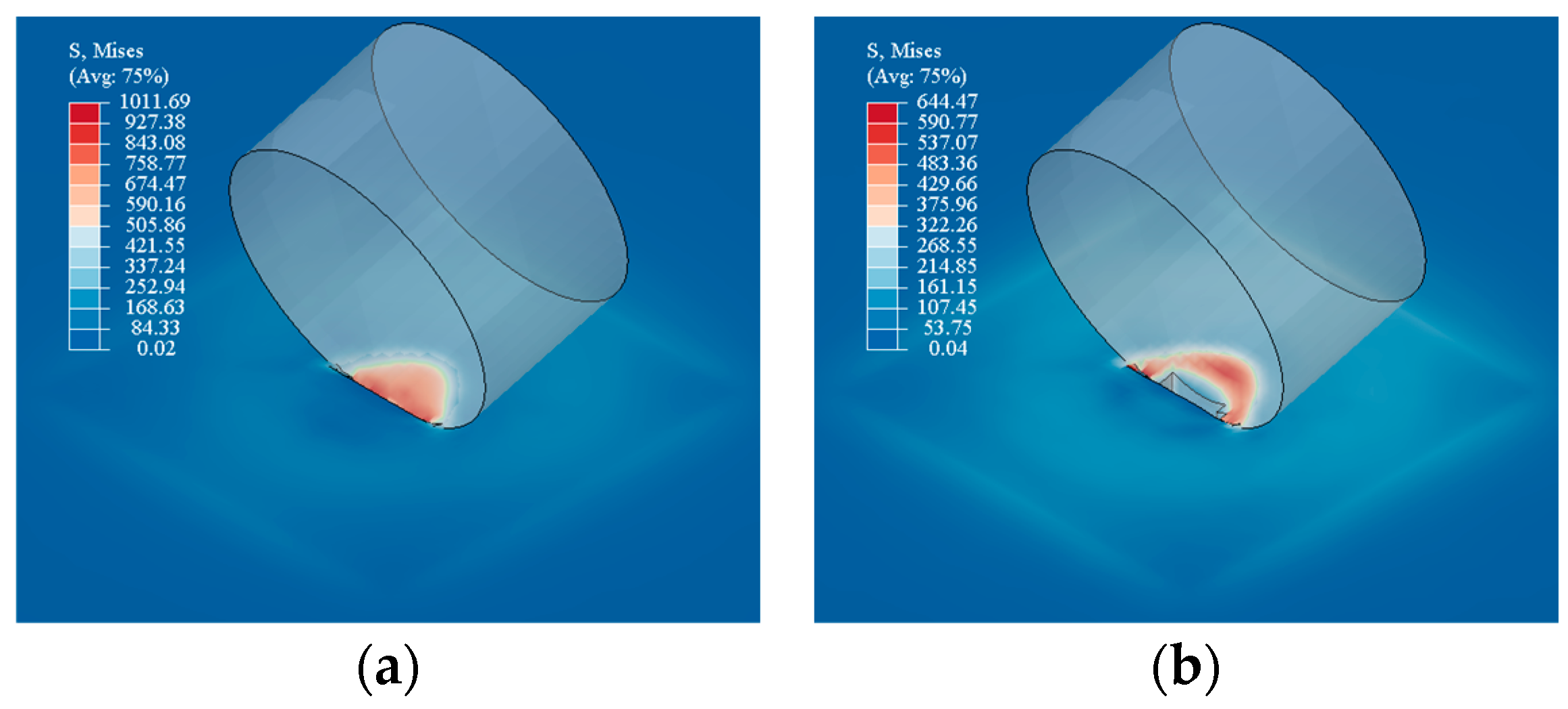
When drilling in hard formations with a PDC bit, the penetration capability of the cutter affects the transfer efficiency of the WOB. As shown in Figure 21, due to the large contact area at the bottom of the cylindrical cutter, the stress distribution beneath it exhibits an inverted fan shape with a low degree of stress concentration. This large-area surface compression requires a relatively high normal load to locally reach the yield strength of the rock.
In contrast, by virtue of its sharp tip structure, the chisel cutter can generate a concentrated high-stress zone at the contact point under a relatively small axial pressure, reaching the yield limit of the rock, as shown in Figure 22.
As the cutter is further indented, the difference in failure modes becomes further amplified. During indentation of the cylindrical cutter, the high-stress region spreads along the edges of the cutting face toward the surrounding rock surface. For the chisel cutter, the high-stress region remains concentrated at the contact point, continuing to indent into the rock within the geometric envelope of the cutter. This indicates that the chisel cutter can concentrate the WOB within the region directly beneath the cutter tip, subjecting the rock to a concentrated load, making it easier for the rock to reach its failure limit, and allowing the bit to penetrate the rock more readily during drilling.
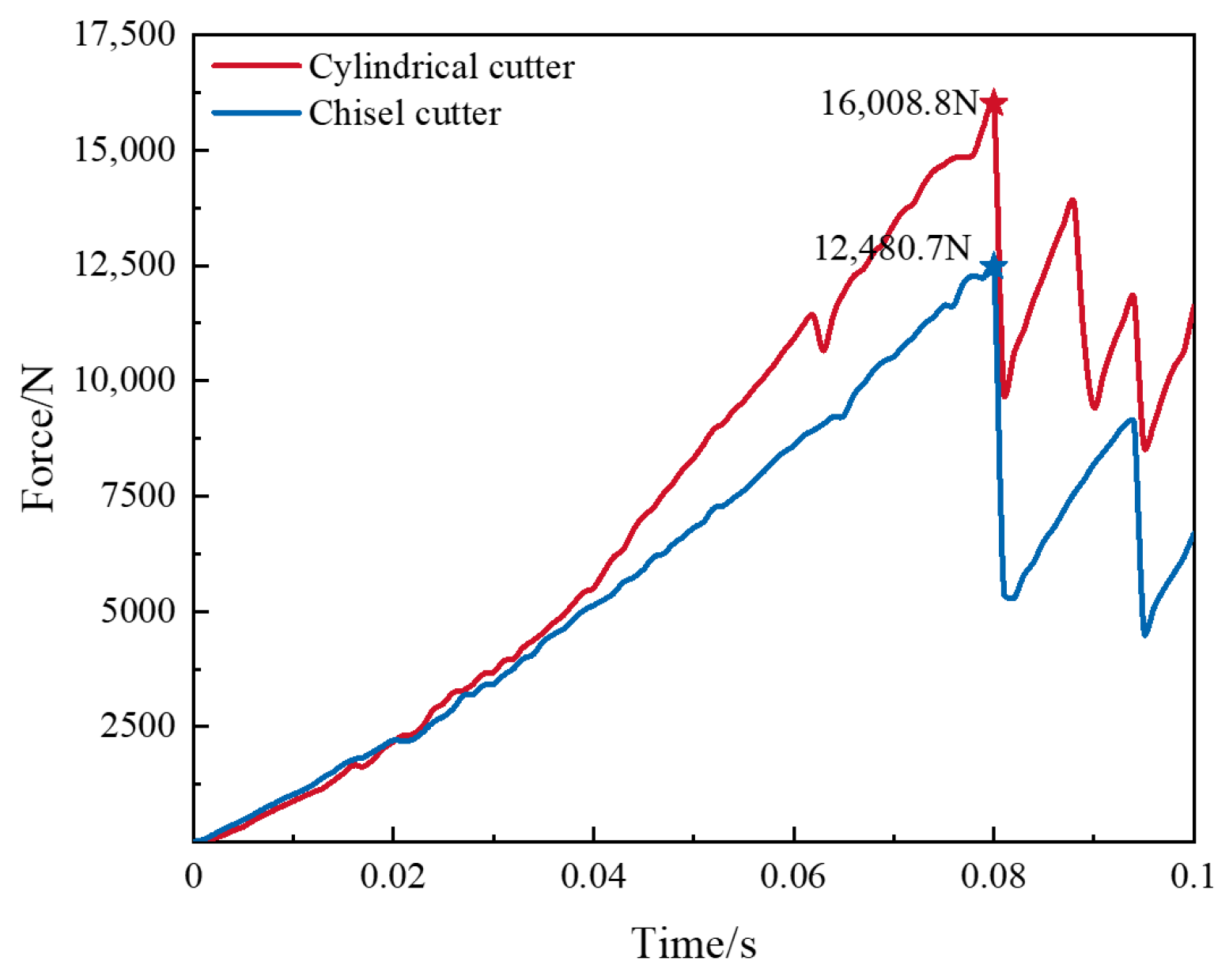
The axial force curves during the single-cutter indentation simulation were extracted in ABAQUS 2023, as shown in Figure 23. In the initial indentation stage, the indentation reaction forces of both cutter shapes increase rapidly with increasing indentation depth. However, as the indentation process proceeds, the reaction force curves of the two cutter shapes begin to diverge, with the curve of the cylindrical cutter growing faster. When the cylindrical cutter reaches the yield limit of the rock, the maximum reaction force of the cylindrical cutter is 16,008.8 N. Subsequently, the rock fractures and the axial force drops sharply. As indentation continues, the axial force then increases steadily. In contrast, the indentation reaction force curve of the chisel cutter is lower than that of the cylindrical cutter. When the rock reaches its yield limit, the indentation reaction force required for the chisel cutter is 12,480.7 N, which is 22% lower than that of the cylindrical cutter. From an engineering application perspective, this means that the chisel cutter can achieve an adequate depth of cut with a lower applied WOB when drilling in hard rock, thereby obtaining higher drilling efficiency.

5. Rock-Breaking Simulation Based on the Cohesive-Element Model and Experimental Validation

5.1. Model Establishment

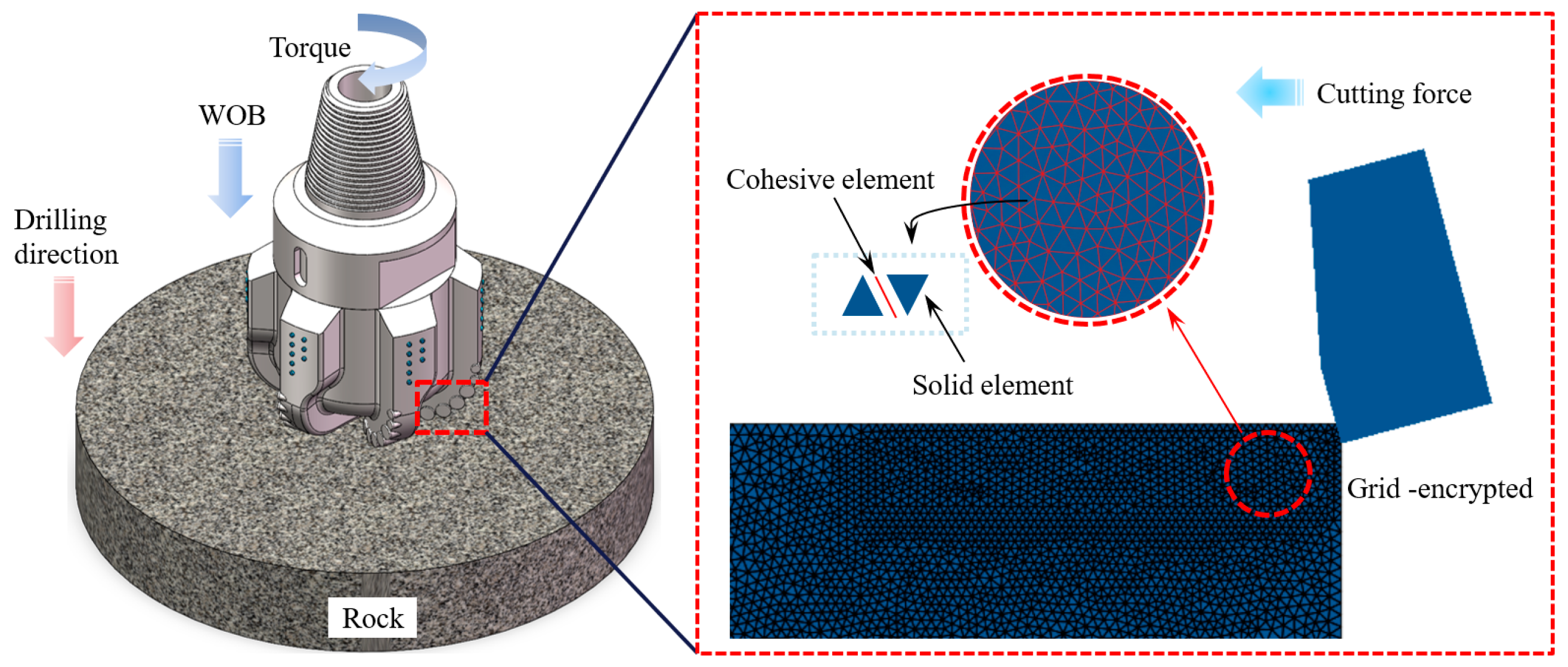
To accurately simulate the brittle fracture process of granite, this study adopts the cohesive element method to describe the initiation, propagation and fragmentation of microcracks within the rock. In the finite element simulation analysis, tetrahedral elements were used to mesh the cutter, with a mesh size of 0.8 mm. To facilitate the observation of irregular fragmentation, the rock model was meshed using triangular elements, which offer higher solution accuracy, and proper mapping was disabled. As shown in Figure 24, local mesh refinement is applied in the region where the rock contacts the cutter and failure occurs. The mesh size in the rock-cutter contact zone is set to 0.8 mm, while the mesh size elsewhere is 1.6 mm. The frictional relationship between cutter and rock was defined as hard friction, with a friction coefficient of 0.3.
The computation of this method is governed by six mechanical parameters: stiffness (normal), stiffness (first, second), nominal Stress (normal), nominal Stress (first, second), fracture energy (normal), and fracture energy (first, second). After calibration and comparative validation, the best agreement between the simulation and experimental results is achieved when the parameter values listed in Table 3 are adopted. The validation of the simulation and experimental results has been discussed in Section 3. The crack morphologies obtained from the numerical simulation closely resemble those observed in the physical experiments, confirming the reliability and accuracy of the established granite model.

5.2. Analysis of Simulation Results and Discussion of Experimental Validation

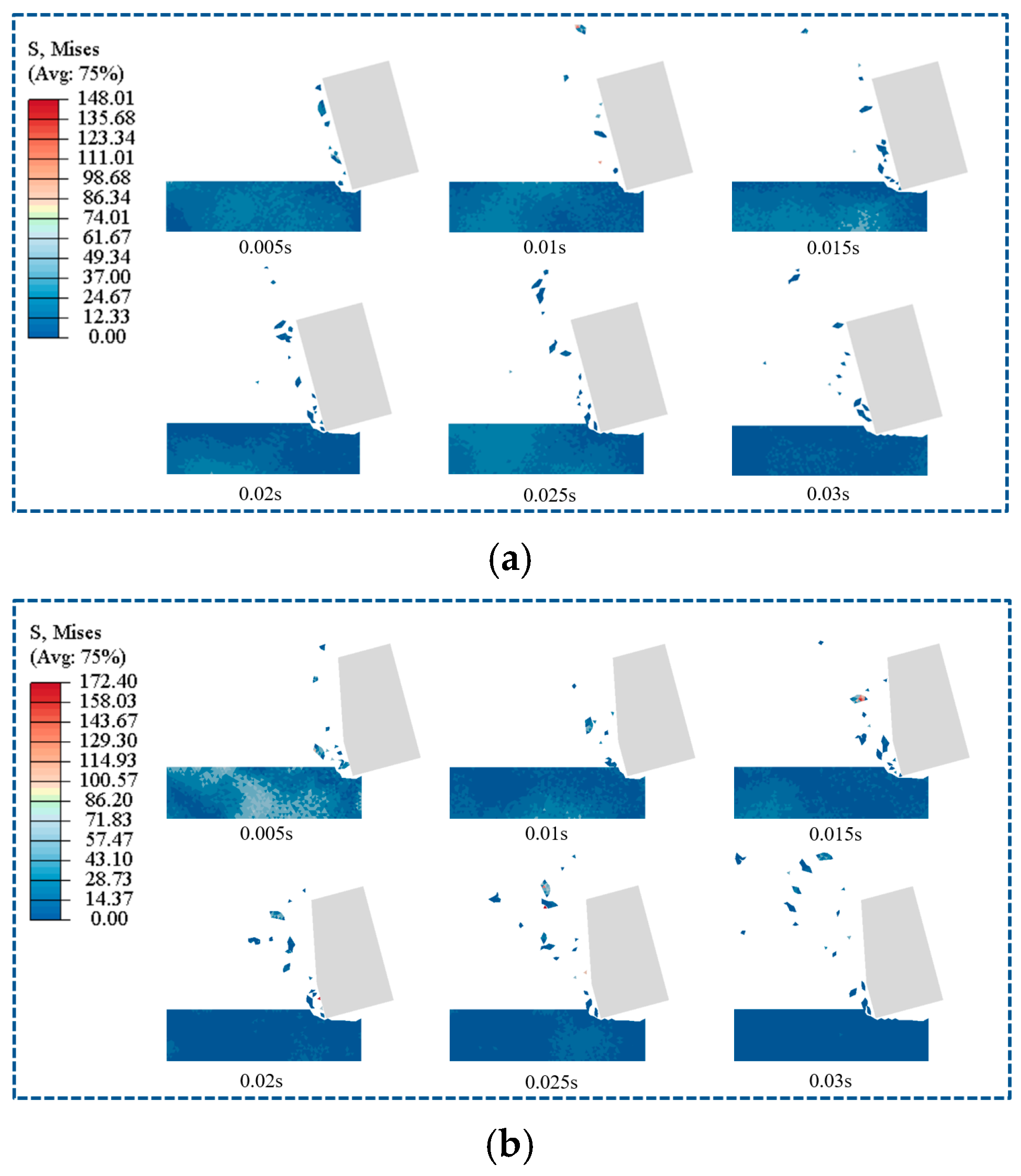
Figure 25 shows the rock-breaking process of the two cutter shapes from 0.005 s to 0.03 s. During the entire rock-breaking stage, the cuttings generated in front of the cylindrical cutter face cannot be rapidly discharged due to the wide rake face. As the cutter continuously advances during rock-breaking, the fragmented cuttings are forced to adhere to and rub against the cutter face by inertia. In contrast, the cuttings generated by the chisel cutter detach from the cutter face and fly away within a short period, without substantial accumulation on the rake face. The rapid detachment of cuttings reduces both the contact time and the frictional area between the rock and the cutter face.
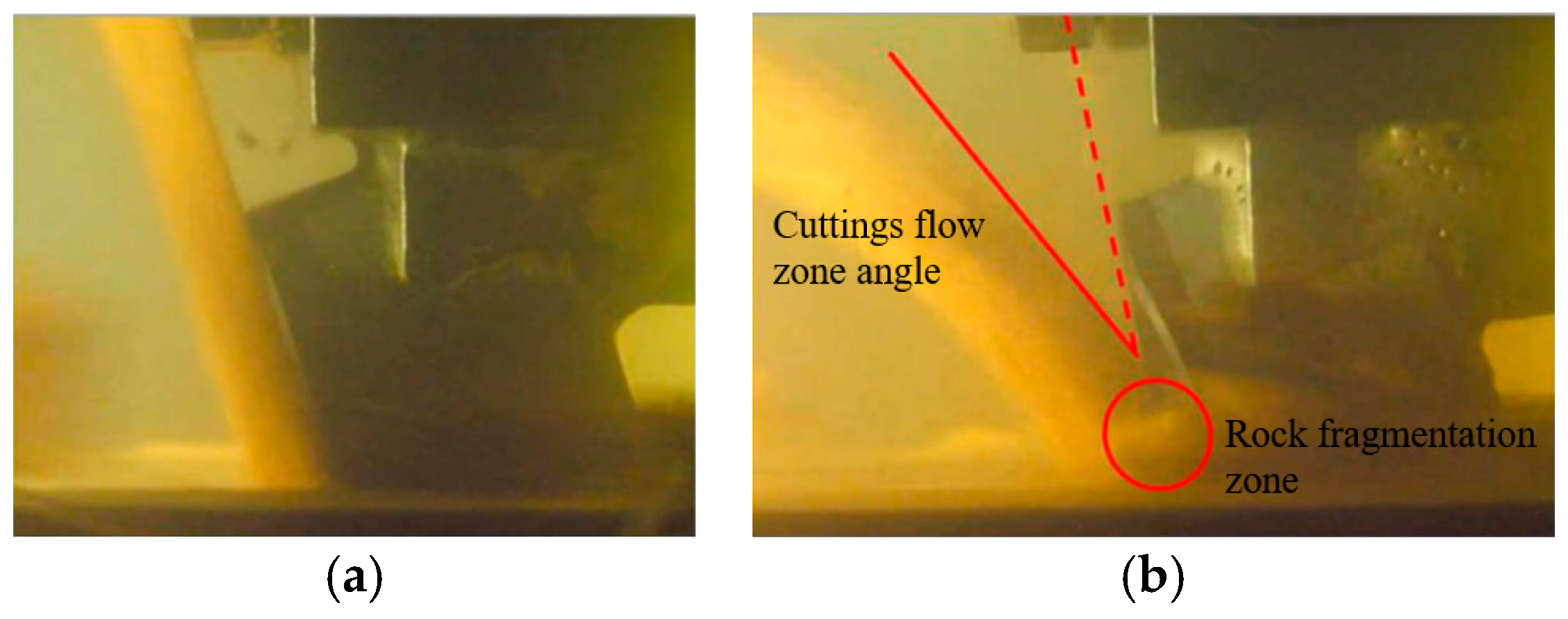
High-speed camera recordings captured the single-cutter rock-breaking test process for the two cutter shapes from the literature [28]. The cutter used in the test is structurally similar to the chisel PDC cutter designed in this study; therefore, its experimental results are cited to illustrate the working mode of the chisel cutter during the rock-breaking process, as shown in Figure 26. In the tests, the cuttings generated by the cylindrical cutter slid along the entire cutter face, causing wear and thermal damage to the cutter face due to friction and impact from the cuttings. In contrast, the chisel cutter has a smaller contact area with the cuttings, allowing it to push the cuttings away from the cutter face, effectively reducing wear between the cuttings and the cutter face, enhancing both the MSE and reliability of the bit.
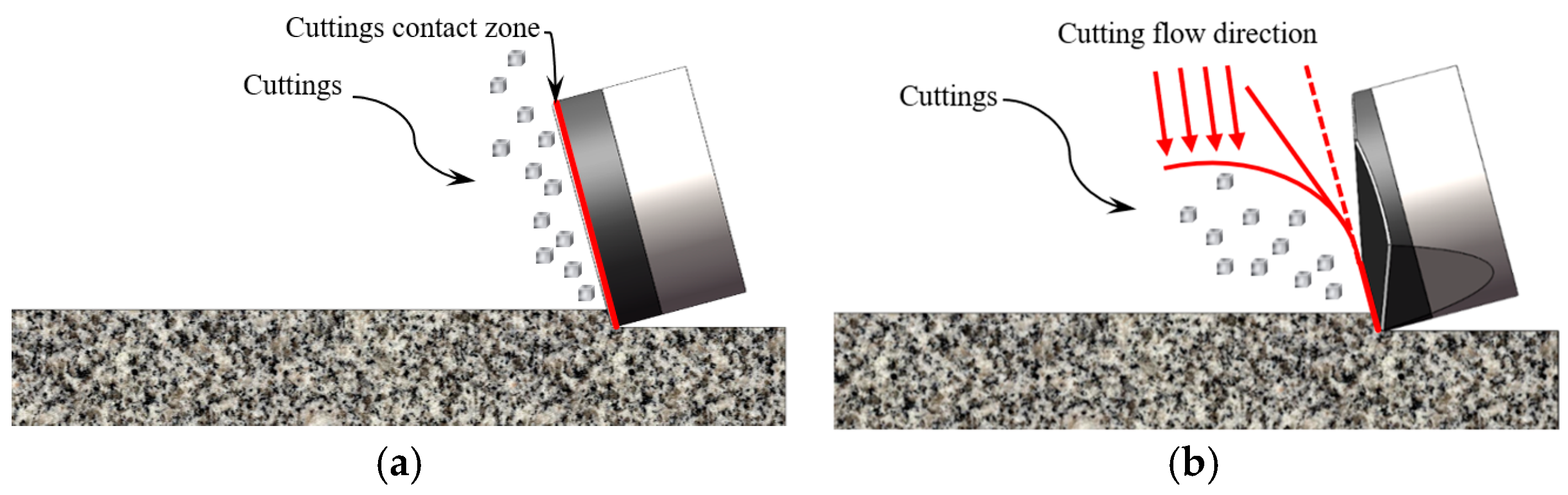
The experiments validated the reliability of the established cohesive model in terms of boundary conditions and parameter settings and confirmed the force-reducing and temperature-reducing mechanism of the chisel cutter. Specifically, by optimizing the three-dimensional geometrical configuration, the concentration of the cutting force on the rock is enhanced, while the cuttings can be rapidly removed, as shown in Figure 27. This mechanism, which actively alters the trajectory of cuttings, fundamentally interrupts the continuous frictional heat generation between the cuttings and the cutter face, providing a basis for the characteristics exhibited by the chisel cutter in the temperature field simulations presented above.
Consequently, the cuttings removal mechanism of the chisel cutter illustrated in Figure 27b is highly recommended for hard rock drilling. By dramatically reducing the contact dynamic area and friction residence time between the cuttings and the cutter face, this recommended mode fundamentally suppresses abrasive wear and structural thermal damage.

6. Simulation Analysis of Rock-Breaking Using a Full-Size Bit

6.1. Numerical Simulation Model Establishment

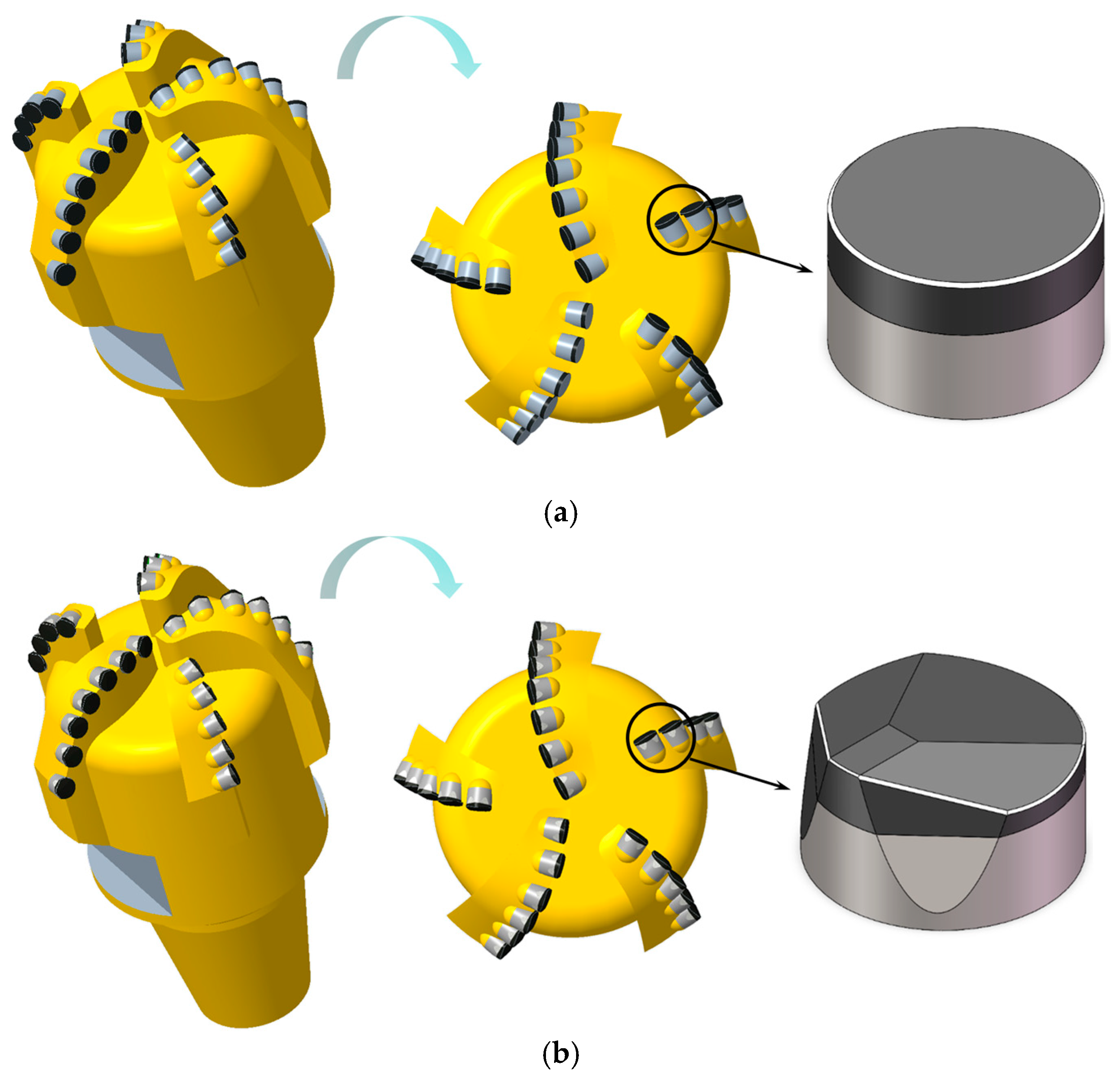
To compare the rock-breaking and drilling performance of PDC bits with two different cutter shapes, a five-blade PDC bit with a diameter of 215.9 mm was designed. The five blades were uniformly arranged, and the spiral blades were designed based on the Archimedean Spiral following the equal cutting principle. A conventional cylindrical PDC bit and a chisel PDC bit were respectively established in CREO 9.0 three-dimensional model software, as shown in Figure 28. Except for the difference in the polycrystalline diamond layer cutter face geometry, all other structural parameters of the two PDC bits were identical.
The fully assembled PDC drill bit geometry was subsequently imported into the ABAQUS 2023 explicit dynamics solver. To model the full-scale drilling sequence, a cylindrical rock domain was constructed featuring a standardized diameter of 500 mm paired with an axial height of 300 mm. This integrated assembly serves as the basis for the fully coupled thermal-displacement simulation.
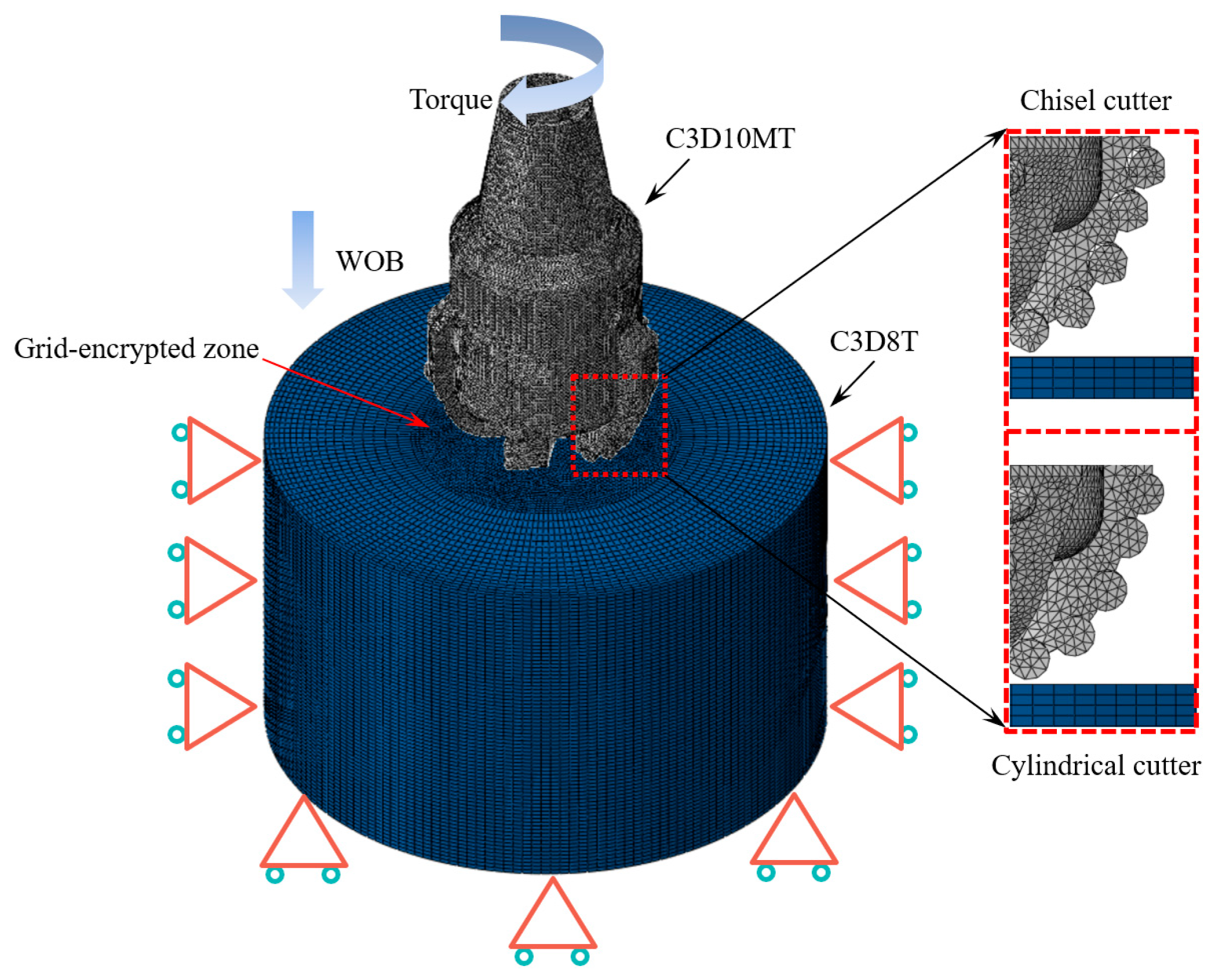
By applying consistent boundary conditions of WOB and rotational speed, the bit loading and the temperature variation on the cutter faces were calculated, and the differences between the two cutter-shaped PDC bits were compared to verify the reliability of the superior rock-breaking performance of the chisel cutter. The numerical simulation models for rock-breaking with the cylindrical-cutter and chisel PDC bits were established as shown in Figure 29. The mesh element types for the rock and the PDC bit were set to C3D8T and C3D10MT, respectively. Mesh refinement was performed at the contact region between the cutters and the rock. The mesh size of the bit cutting structure was 4 mm.
A gradient meshing method was adopted for the rock: a finer mesh of 4 mm was used in the bit-rock contact region, gradually transitioning to 12 mm toward the outer boundaries of the rock, thereby ensuring computational accuracy in the contact zone while improving the overall computational efficiency of the model. To prevent rigid-body translation of the geological domain during full-bit rotation, fixed boundary constraints are applied to all outer bounding surfaces of the rock substrate, with the exception of the upper cutting face. Interfacial boundary conditions between the advancing cutter faces and the rock nodes enforce a hard normal contact relationship to prevent geometric penetration. Concurrently, the corresponding tangential shearing resistance is captured via a penalty contact formulation assigning a friction coefficient of 0.3. The operational bit assembly is constrained as a rigid system linked to a primary reference point, which dictates the downhole kinematics under an applied WOB of 30,000 N and a rotational velocity of 60 r/min over a total simulation step time of 10 s. The material parameters involved in the rock-breaking simulation are listed in Table 1.

6.2. Analysis of Full-Size Bit Rock-Breaking and Drilling

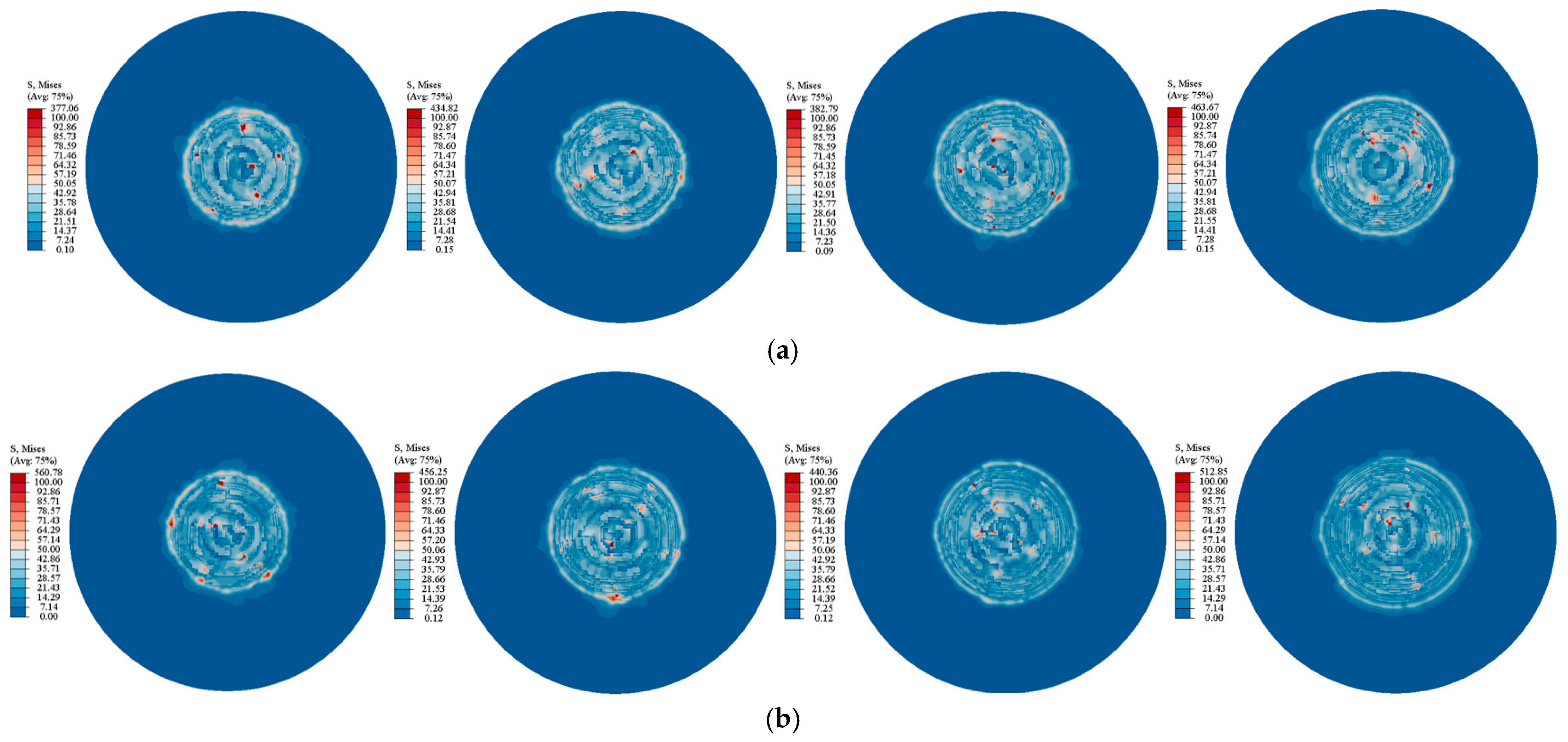
The stress contour maps of the bottomhole during rock-breaking within 10 s for the two types of PDC bits are shown in Figure 30. By comparing the bottomhole cutting trajectories formed after rock-breaking with the contours, it is found that they are completely consistent with the annular bottomhole condition generated by the PDC bit rock-breaking, which conforms to the actual situation.
From the dynamic stress contours within 10 s, it can be observed that during the rock-breaking process of both PDC bits, a clear circumferential stress zone is formed at the bottomhole, and the high-stress region is mainly concentrated on the instantaneous contact surface between the cutters and the rock. For the cylindrical-cutter PDC bit, the bottomhole stress distribution is relatively diffuse, with a larger area of stress concentration but a relatively lower peak intensity. This indicates that the cylindrical cutters break rock mainly through large-area shearing action. When breaking hard formations such as granite, the penetration pressure per unit area is relatively dispersed. Moreover, its cutting trajectory is relatively smooth, and the excitation of stress waves is mainly manifested as shallow shear. For hard granite, the rock-breaking mode is predominantly grinding, which tends to increase the cutter face temperature. For the chisel PDC bit, the high-stress region in the bottomhole stress contour is more concentrated and sharper. Due to the special geometric structure of the chisel cutters, they have a smaller contact area with the rock under the same WOB, resulting in a significant stress concentration effect. The discrete high-stress points in the contour indicate that the chisel cutters are accompanied by more intense impact vibrations and wedging action during rock-breaking. This characteristic suggests that the chisel cutters have a dual action of impact and shear during rock-breaking, enabling more effective fragmentation of hard rock.
The stress contour maps of the bottomhole during the drilling process within 10 s for the two types of PDC bits are shown in Figure 31.
The bottomhole stress profile contour of the cylindrical-cutter PDC bit shows a relatively regular stress distribution, mainly characterized by shallow shear failure features, with a weak ability to initiate cracks in the deep rock. In contrast, the bottomhole stress profile contour of the chisel PDC bit shows multiple stress peak centers in the vertical direction, with a more severe gradient variation in the high-stress region in the depth direction. This concentrated stress distribution facilitates the generation of intersecting complex stress fields within the rock, making it easier to form large fragmentation chips, thereby improving the MSE of the bit.
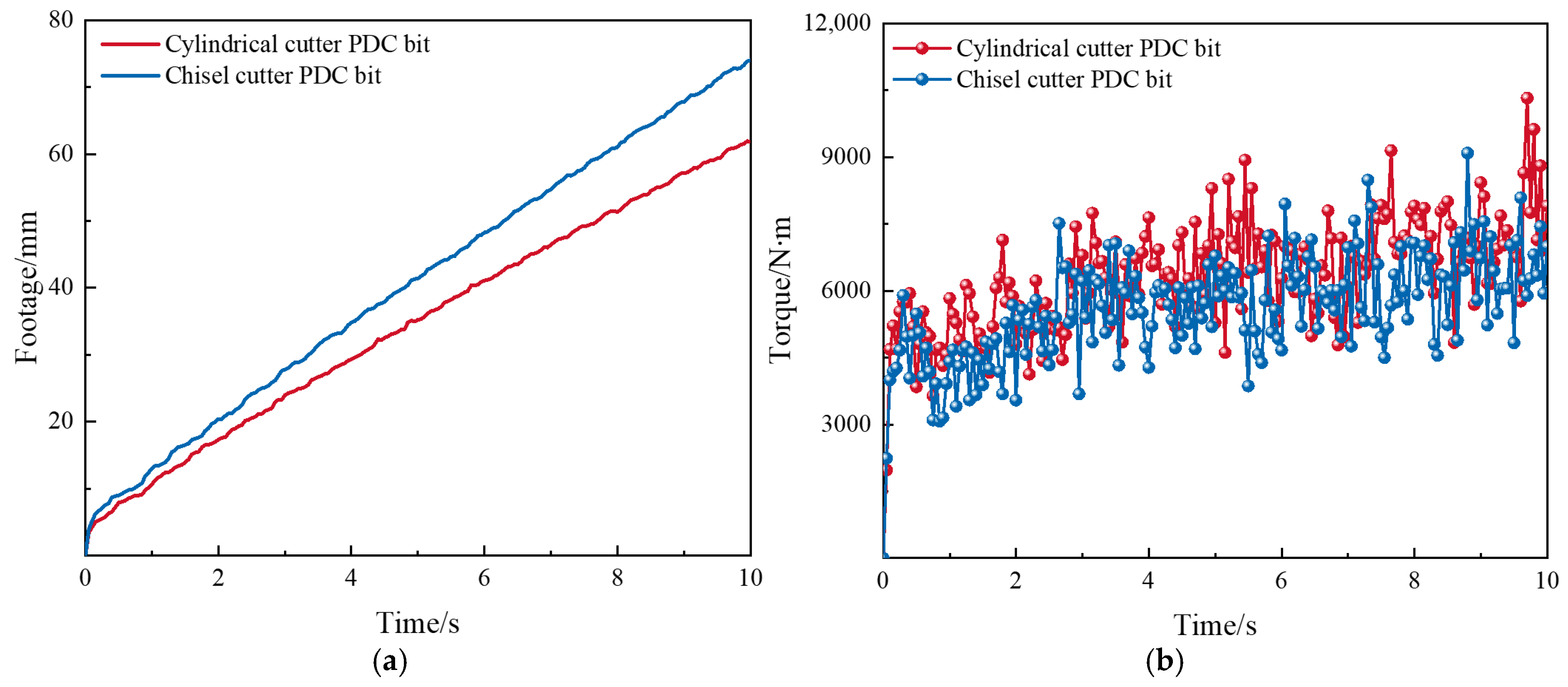
The displacement in the Z-axis direction was extracted in ABAQUS 2023 to simulate the footage of the PDC bit during actual drilling, as shown in Figure 32a. Within 10 s, the cylindrical-cutter bit achieved a footage of 61.87 mm, while the chisel cutter bit achieved a footage of 74.00 mm. Accordingly, the ROP of the cylindrical-cutter PDC bit was 6.18 mm/s, and that of the chisel PDC bit was 7.4 mm/s. Under identical external loading conditions, the ROP of the chisel bit was 19.7% higher than that of the cylindrical-cutter bit. The comparison of the footage curves shows that the displacement growth slope of the chisel bit is steeper, demonstrating that its strong wedging action effectively suppresses the bit skidding phenomenon on the hard rock surface and maintains a more stable depth of penetration.
The torque variation curves of PDC bits with different cutter shapes over time are shown in Figure 32b. The average torque of the cylindrical-cutter bit was 6321.52 N·m, while that of the chisel bit was 5604.58 N·m. The simulation results indicate that under identical formation and drilling parameters, the average torque of the chisel bit is 11.34% lower than that of the cylindrical-cutter bit. Moreover, the torque fluctuation curve of the chisel bit during rock-breaking is milder than that of the cylindrical-cutter bit, indicating higher stability during the rock-breaking and drilling process. Combined with the previously obtained result of a 19.7% increase in ROP, this demonstrates that the chisel cutter not only effectively improves drilling speed but also significantly reduces the torque load during drilling, effectively lowering the risk of stick-slip vibrations in the drill string.
In actual drilling, the drill string transmits energy generated by the surface rotary table to the bit for rock-breaking. When the bit has difficulty penetrating the rock, the drill string continuously accumulates energy, and the bit is in a stuck state. During this process, the drill string may fail due to excessive accumulated torque. When the drill string accumulates sufficient torque for the bit to break the rock, the rock suddenly fails, and the bit then experiences a large acceleration, generating severe longitudinal and lateral vibrations, which aggravate cutter wear and may even cause cutter chipping in severe cases. This indicates that the chisel PDC bit not only helps maintain the stability of downhole power tools but also avoids excessive impact loads caused by sudden torque changes that could lead to bit cutter chipping, thereby extending the overall service life of the bit.
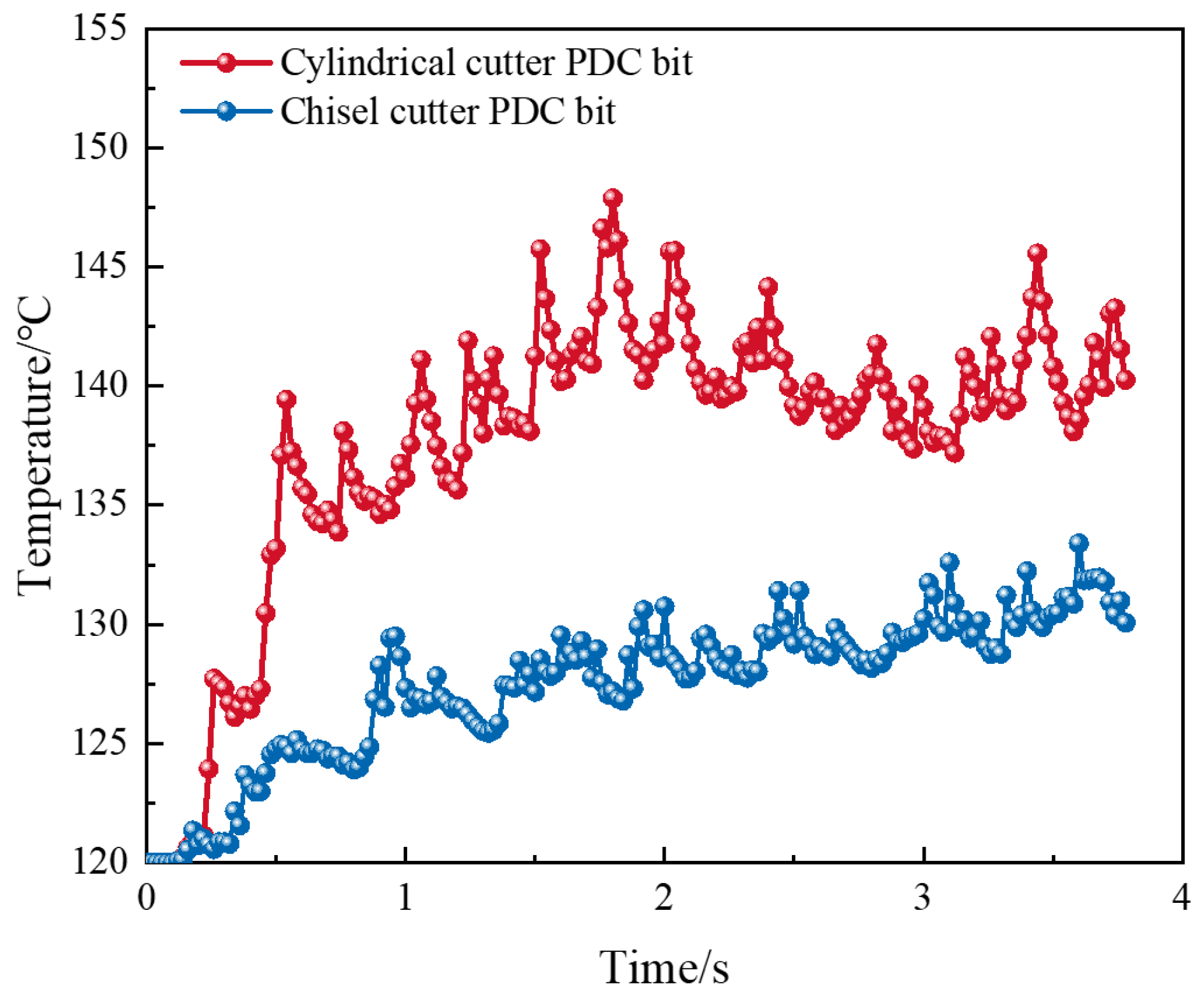
As shown in Figure 33, the simulation results indicate that, under identical boundary conditions, both the temperature rise rate and the working temperature at the same node are significantly lower for the bit equipped with chisel cutters than for the bit with cylindrical cutters. The instantaneous maximum node temperature of the cylindrical-cutter bit reaches nearly 148 °C, whereas that of the chisel-cutter bit fluctuates between 125 °C and 133.4 °C, yielding an average temperature reduction of 10–15 °C.
This difference arises because the cylindrical-cutter bit relies on continuous scraping and shearing to break the rock; the high-frequency friction between the cutters and the highly abrasive rock surface converts considerable mechanical energy into internal energy, causing a sustained temperature increase. In contrast, the chisel-cutter bit, by virtue of its specialized structural design, concentrates stress to induce brittle volumetric spalling of the rock, while its cutter-face geometry reduces both the friction of broken cuttings and their impact on the cutter face, thereby suppressing the accumulation of cutting heat at the source. The temperature variation curves reveal that the temperature rise curve of the cylindrical-cutter bit is highly erratic with a large instantaneous thermal shock amplitude, which tends to generate severe alternating thermal stress concentrations within the PDC layer. By comparison, the temperature rise trajectory of the chisel-cutter bit is considerably smoother, and its thermal shock amplitude is markedly attenuated. These results demonstrate that the chisel-cutter bit possesses superior temperature control capability during continuous rock-breaking, effectively mitigating thermal damage to the cutters caused by excessive cutter-face temperatures.

7. Field Data Reference

To verify the field performance of the chisel-cutter bit and its advantages over the conventional cylindrical-cutter bit, this paper cites actual drilling data from a previous study [29]. These field data were not generated by the authors and are used solely to demonstrate the practical effectiveness of the chisel-cutter bit. The chisel cutter was field-applied in a vertical well section with a diameter of 8.375 inches. The target formation consisted mainly of sandstone, claystone, and limestone, locally interbedded with hard and highly abrasive siltstone. Field drilling data indicate that in the medium-deep section, the bit equipped with chisel cutters achieved a footage of 1162 m and a ROP of 10.99 m/h. In comparison, the cylindrical-cutter bit in the adjacent well section had a footage of 1071 m and an ROP of 8.37 m/h. The PDC bit equipped with chisel cutters demonstrated clear advantages in both single-run footage and ROP.
The cutter geometry designed in this study is structurally similar to that of a cutter already validated through field drilling; therefore, these field data provide relevant supporting evidence for the findings of this study. As can be seen from Table 4, the chisel-cutter bit performed remarkably well in field drilling. In the target formation, its ROP was 31.3% higher, and its footage was 8.49% greater than those of the conventional cylindrical-cutter bit. To a certain extent, this confirms the reliability of the research work carried out in this study. According to the IADC wear evaluation, the inner and outer row cutters of the chisel bit exhibited less wear, and no cutter chipping phenomenon similar to that observed in the cylindrical-cutter bit occurred. This indicates that the conclusions regarding the impact and wear resistance of the chisel cutter drawn in this study are reliable.

8. Conclusions

(1)
The geometric design of the chisel cutter face exhibits a point-load effect during rock-breaking, concentrating the stress at the rock contact region. During single-cutter progressive rock-breaking, the chisel cutter records a noticeably steadier force profile than the standard cylindrical configuration, yielding an average load reduction of 13.4%. Moreover, comparative parametric evaluations demonstrate that the force curve of the chisel geometry remains systematically below that of the cylindrical element regardless of the prescribed depth of cut. The indentation reaction force is reduced by 22% compared with that of the cylindrical cutter.
(2)
Cutting parameters have a significant influence on the cutting force and temperature field response of the chisel cutter. Based on the comprehensive evaluation indices, it is recommended that the optimal back rake angle for the chisel cutter when drilling in hard rock formations be controlled within the range of 20–25°. Within this range, the cutter can maintain a relatively low working temperature to avoid thermal damage while achieving high MSE. Similarly, by reasonably controlling the WOB and optimizing the cutter arrangement of the bit, the depth of cut should be stabilized at approximately 1.5 mm.
(3)
Full-bit rock-breaking simulations show that the bit equipped with chisel cutters produces a more pronounced bottom-hole stress concentration. Compared with the cylindrical-cutter bit, its ROP is increased by 19.7%, the average torque is reduced by 11.34%, and the torque fluctuations are much milder, indicating higher rock-breaking stability. The maximum cutter-face temperature of the chisel-cutter bit is about 133.4 °C, which is lower than that of the cylindrical-cutter bit, and its temperature fluctuations are also more moderate.
(4)
Based on the findings, it is inferred that chisel cutters could be advantageously used as front-row cutters for breaking hard rock formations or be placed in the outer cone and shoulder regions where the bit is subjected to the most severe loading and the highest linear velocity, in combination with cylindrical cutters. This arrangement can fully exploit the drag-reducing and temperature-reducing advantages of the chisel cutters, thereby improving the overall service life and drilling efficiency of the PDC bit. Future work should focus on laboratory full-scale bench tests and field drilling trials in hard formations to validate this configuration.
The novelty of this study lies in the design of a new chisel PDC cutter. Through a systematic thermo-mechanical coupled numerical simulation, its rock-breaking mechanism and temperature field characteristics were analyzed, and it was quantitatively demonstrated to outperform the cylindrical cutter in reducing cutting force, increasing ROP, mitigating cutter-face wear, and lowering cutter-face temperature. Currently, only the accuracy of the single-cutter rock-breaking FEM has been validated, and comparative analyses have been conducted based on full-bit numerical simulations and field data reported by others. The proposed chisel cutter, however, is still in the design optimization stage, and its independent field application verification in actual complex formations remains limited. Nevertheless, the results of this study can provide theoretical guidance for the structural design and operational parameter optimization of PDC cutters intended for hard formations. Future work should systematically investigate the rock-breaking performance under different lithologies and cutting parameters, and carry out laboratory experiments and field trials to accelerate the engineering application of chisel cutters and promote the development of high-performance PDC bits [30].

Author Contributions

Conceptualization, Z.W. and T.W.; methodology, Z.W.; software, T.W.; validation, L.S. and Y.Y.; formal analysis, T.W.; investigation, Z.W.; resources, Z.W.; data curation, T.W.; writing—original draft preparation, Z.W.; writing—review and editing, T.W.; visualization, H.W.; supervision, Z.W.; project administration, T.W.; funding acquisition, Z.W. All authors have read and agreed to the published version of the manuscript.

Funding

This research was funded by the Hundred-Talent Program (Grant No. Z16178/290088247) and the “Research on Intelligent Drilling Technology of Winch” project of Sinopec No. 4 Machinery Petroleum Machinery (Project Number: 15570046-25-FW2399-0005).

Data Availability Statement

The original contributions presented in this study are included in the article. Further inquiries can be directed to the corresponding authors.

Conflicts of Interest

The authors declare no conflicts of interest. The funders had no involvement in the study design, collection, analysis, interpretation of data, the writing of this article or the decision to submit it for publication.

References

  1. Gao, D.L.; Huang, W.J. Basic research progress and prospect in deep and ultra-deep directional drilling. Nat. Gas Ind. 2024, 44, 1–12+201. [Google Scholar] [CrossRef]
  2. Gao, D.L. Some research advances in well engineering technology for unconventional hydrocarbon. Nat. Gas Ind. 2021, 41, 153–162. [Google Scholar] [CrossRef]
  3. Luo, L.C.; Zhang, H.Z.; Zhang, J.M.; Li, T.W.; Qiu, M.X. Situation and development trend of Chinese and foreign oil and gas exploration and development. Pet. Sci. Technol. Forum 2024, 43, 18–24. [Google Scholar] [CrossRef]
  4. Xu, W.Q.; Shi, H.Z.; Cao, Q.; Shi, X.X.; Hu, X.H. Experimental study on conglomerate breaking characteristics of conical PDC cutter. China Pet. Mach. 2021, 49, 9–16. [Google Scholar] [CrossRef]
  5. Zeng, Y.J.; He, W.H.; Zhang, Z.; Shi, H.Z.; Zhou, J.; Ding, S.D.; Ma, G.J. Rock-breaking performances of innovative triangular-shaped polycrystalline diamond compact cutter. Rev. Sci. Instrum. 2021, 92, 035115. [Google Scholar] [CrossRef]
  6. Liu, H.X.; Luo, Y.X.; Liu, W.J.; Ma, C.H.; Wu, Y.H. Rock-breaking mechanism of special-shaped PDC cutter in heterogeneous granite. China Pet. Mach. 2022, 50, 22–31. [Google Scholar] [CrossRef]
  7. Wu, Z.B.; Yuan, R.F.; Zhang, W.X.; He, X.L.; Liu, J.L. Numerical simulation on rock-breaking and temperature characteristics of sawtooth PDC cutter. China Pet. Mach. 2024, 52, 29–37. [Google Scholar] [CrossRef]
  8. Zhang, Z.Z.; Zhao, D.J.; Zhao, Y.; Gao, K.; Zhang, C.S.; Lv, X.S. 3D numerical simulation study of rock breaking of the wavy PDC cutter and field verification. J. Pet. Sci. Eng. 2021, 203, 108578. [Google Scholar] [CrossRef]
  9. Gao, K.; Li, M.; Dong, B.; Sun, Y.H.; Sun, Y.; Liu, J. Bionic coupling polycrystalline diamond composite bit. Pet. Explor. Dev. 2014, 41, 533–537. [Google Scholar] [CrossRef]
  10. Zhao, L.Z.; Tong, X.; Li, Z.H.; Lin, S.Y.; Li, Y.B.; Cao, F. Research on rock-breaking mechanism of thorn-shaped cutters in plastic formations based on finite element analysis. Drill. Prod. Technol. 2025, 48, 148–155. [Google Scholar] [CrossRef]
  11. Shao, F.Y.; Liu, W.; Gao, D.L.; Zhao, X. Development and verification of triple-ridge-shaped cutter for PDC bits. SPE J. 2022, 27, 3849–3863. [Google Scholar] [CrossRef]
  12. Chen, X.Y.; Yang, Q.Q.; Yang, J.; Gao, D.L.; Zou, Y.Q.; Zhu, M.C. The stress field simulation of a novel M-type convex stepped bottomhole and the rate of penetration enhancement mechanism of a new type of central-grooved PDC bit for offshore deep & ultradeep well drilling. Ocean Eng. 2024, 293, 116706. [Google Scholar] [CrossRef]
  13. Rahmani, R. Rock Customized Shaped Cutters Improve Rock Cutting Efficiency. In Proceedings of the SPE/IADC International Drilling Conference and Exhibition, The Hague, The Netherlands, 5–7 March 2019. [Google Scholar] [CrossRef]
  14. Suleiman, A.; Roberts, S.; Bailey, M.J.; Doudou, S.; Hallal, A.; Perez, J. Enhancing Drilling Efficiency with Flanked Non-Planar Shaped PDC Cutters. In Proceedings of the International Petroleum Technology Conference, Dhahran, Saudi Arabia, 12 February 2024. [Google Scholar] [CrossRef]
  15. Roberts, S.L.; Bailey, M.J.; Babaie Aghdam, A.; Suleiman, A.; Fathy, A. Novel Drill Bit Analysis to Delay and Mitigate Fixed Cutter Thermal Damage. In Proceedings of the SPE/IATMI Asia Pacific Oil & Gas Conference and Exhibition, Virtual, 12–14 October 2021. [Google Scholar] [CrossRef]
  16. Luo, M.; Zhu, H.Y.; Liu, Q.Y.; Wang, Z.W.; Li, Y.J.; Han, C.; Zhang, C. A V-cutter PDC bit suitable for ultra-HTHP plastic mudstones. Nat. Gas Ind. B 2021, 41, 97–106. [Google Scholar] [CrossRef]
  17. Ma, Y.C.; Huang, Z.Q.; Li, Q.; Zhou, Y.; Peng, S.J. Cutter layout optimization for reduction of lateral force on PDC bit using Kriging and particle swarm optimization methods. J. Pet. Sci. Eng. 2018, 163, 359–370. [Google Scholar] [CrossRef]
  18. Zhang, W.B.; Shi, H.Z.; Xi, C.M.; Zhang, N.; Xiong, C.; Chen, Z.L. Experimental study on rock cutting with the combination of conical diamond elements and conventional PDC cutters. China Pet. Mach. 2023, 51, 33–39. [Google Scholar] [CrossRef]
  19. Wei, J.; Liu, W.; Gao, D.L. Mechanism analysis and mathematical modeling of brittle failure in rock cutting with a single sharp cylinder-shaped PDC cutter. SPE J. 2024, 29, 651–669. [Google Scholar] [CrossRef]
  20. Saadat, M.; Taheri, A. A cohesive grain based model to simulate shear behavior of rock joints with asperity damage in poly-crystalline rock. Comput. Geotech. 2020, 117, 103254. [Google Scholar] [CrossRef]
  21. Wang, X.R.; Zhang, H.; Dong, Z.X.; Li, J.; Qin, C.; Yang, Y.B.; Zhou, Y.T. Characterizing rock-breaking performance of PDC cutters via stability metrics and energy consumption in FDEM simulations. Sci. Rep. 2024, 14, 24159. [Google Scholar] [CrossRef] [PubMed]
  22. Wu, Z.B.; Yuan, R.F.; Zhang, W.X.; Hu, S.Y.; Jiang, W. Numerical Simulation and Field Test of a PDC Bit with Mixed Cutter Arrangement to Break Non-Homogeneous Granite. Appl. Sci. 2023, 13, 9133. [Google Scholar] [CrossRef]
  23. Kong, L.L.; Wang, Z.W.; Wang, H.G.; Cui, M.Y.; Liang, C.; Kong, X.W.; Wang, P. Selection and optimization design of PDC bits based on FEM analysis for drilling long horizontal sections of shale formations. Processes 2023, 11, 2807. [Google Scholar] [CrossRef]
  24. Li, C.; Wu, Z.H.; Yuan, Y.B.; Cao, J.F.; Huang, Z.; Sun, J.X. Thermo-mechanical coupling behavior research and optimization strategy of PDC cutter. China Pet. Mach. 2025, 53, 43–49. [Google Scholar] [CrossRef]
  25. Wu, Z.B.; Zhang, Z.H.; Lin, Y.F.; Yan, Z.; Liu, K.N. Analysis of Impact Rock-Breaking Characteristics and Temperature Field of PDC Cutter. Processes 2026, 14, 807. [Google Scholar] [CrossRef]
  26. Li, Y.; Yang, Y.B.; Liang, W.B.; Zhai, Y.; Wei, S.Y. Influence of confining pressure on strength characteristics and brittleness of granite and its characterization. Chin. J. Undergr. Space Eng. 2024, 20, 1528–1540. [Google Scholar] [CrossRef]
  27. Wang, G.; Fang, Q.; Wang, J.; Ru, Z.H.; Wei, J.Y.; Huang, J.K. An efficient self-adaptive planning algorithm for shield machine attitude and segment assembly considering machine–segment interaction. J. Rock Mech. Geotech. Eng. 2025, in press. [Google Scholar] [CrossRef]
  28. Bahsir, J.; Al Shammari, Y.; Al Najar, J.; Suleiman, A.; Hassanein, M.; El Zein, M.; Al Otaibi, A.; Khalil, A.; Roberts, S. Revolutionizing Lateral Section Drilling: Improved Performance with Shaped Cutters in Pdc Bits. In Proceedings of the SPE Conference at Oman Petroleum & Energy Show, Muscat, Oman, 12–14 May 2025. [Google Scholar] [CrossRef]
  29. Bailey, M.J.; Suleiman, A.; Roberts, S.; Doudou, S.; Perez, J.; Hinai, M.A.; Rashdi, A.A. Shaping the Future of PDC Bit Performance–A Superior Approach to Hard Rock Drilling. In Proceedings of the SPE Annual Technical Conference and Exhibition, New Orleans, LA, USA, 23–25 September 2024. [Google Scholar] [CrossRef]
  30. Wang, G.; Fang, Q.; Wang, J.; Li, Q.; Chen, J.; Liu, Y. Estimation of Load for Tunnel Lining in Elastic Soil Using Physics-Informed Neural Network. Comput.-Aided Civ. Infrastruct. Eng. 2024, 39, 2701–2718. [Google Scholar] [CrossRef]
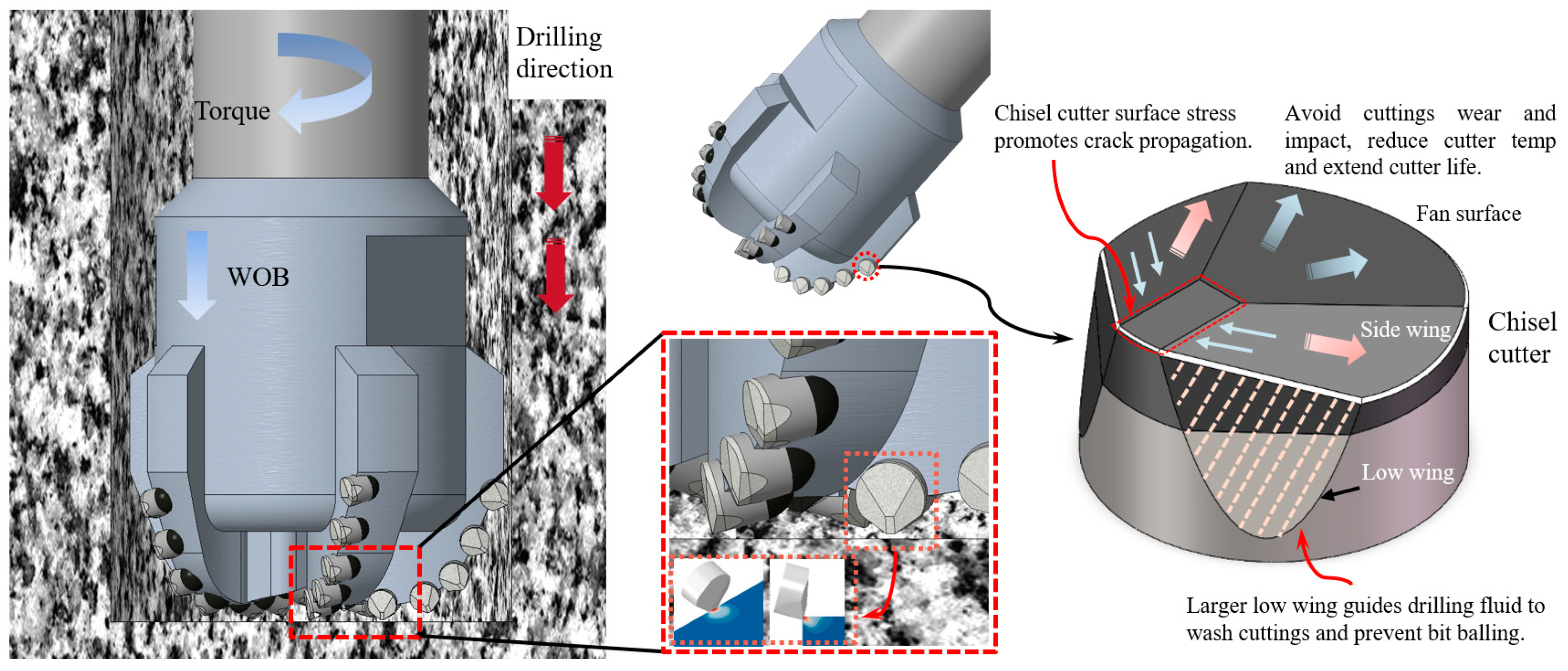
Figure 1. Chisel PDC cutter model.
Processes 14 01926 g001
Figure 2. Conceptual model illustrating the rock fragmentation mechanisms induced by a chisel-shaped PDC cutting element: (a) Cross-sectional profile detailing crack propagation and localized damage zones; (b) Isometric spatial view mapping the chip clearance trajectories and applied loading directions.
Processes 14 01926 g002
Figure 3. Parameters of a chisel PDC cutter.
Processes 14 01926 g003
Figure 4. PDC cutter interacting with rock.
Processes 14 01926 g004
Figure 5. Schematic of cutter-face wear during the rock-breaking process.
Processes 14 01926 g005
Figure 6. Damage evolution constitutive model: (a) Tensile failure mode; (b) Shear failure mode.
Processes 14 01926 g006
Figure 7. Rock stress–strain curve.
Processes 14 01926 g007
Figure 8. Simulation prototype.
Processes 14 01926 g008
Figure 9. Validation of the finite-element model: (a) Schematic of uniaxial compression loading; (b) Comparison between simulation and experiment.
Processes 14 01926 g009
Figure 10. FEM: (a) Coupled temperature-displacement model for single-cutter rock-breaking; (b) Single-cutter indentation model.
Processes 14 01926 g010
Figure 11. Mesh models with different grid sizes: (a) Coupled temperature-displacement model for single-cutter rock-breaking; (b) Single-cutter indentation model.
Processes 14 01926 g011
Figure 12. Initial stress contour plot: (a) Cylindrical cutter; (b) Chisel cutter.
Processes 14 01926 g012
Figure 13. Stress contour plot of the rock-breaking process: (a) Rock-breaking stage 1; (b) Rock-breaking stage 2.
Processes 14 01926 g013
Figure 14. Cross-sectional stress contour plot of the rock-breaking process by a cylindrical cutter.
Processes 14 01926 g014
Figure 15. Cross-sectional stress contour plot of the rock-breaking process by a chisel cutter.
Processes 14 01926 g015
Figure 16. Cutting force variation curve.
Processes 14 01926 g016
Figure 17. Variation in cutting force with time under different depths of cut: (a) Cutting force variation in the chisel cutter at different depths of cut; (b) Cutting force variation in chisel and cylindrical cutters at different depths of cut.
Processes 14 01926 g017
Figure 18. Variation in cutting force and MSE with cutting parameters for the chisel cutter: (a) Cutting force and MSE with cutting depth; (b) Cutting force and MSE with back rake angles.
Processes 14 01926 g018
Figure 19. Cutter surface temperature variation.
Processes 14 01926 g019
Figure 20. Variation in cutter-face temperature with cutting parameters for the chisel cutter: (a) Variation in temperature with cutting depth; (b) Variation in temperature with back rake angle.
Processes 14 01926 g020
Figure 21. Axial penetration stress field of the cylindrical cutter: (a) Stress state of the rock beneath the cutter before breakage; (b) Stress state of the rock beneath the cutter after breakage.
Processes 14 01926 g021
Figure 22. Axial penetration stress field of the chisel cutter: (a) Stress state of the rock beneath the cutter before breakage; (b) Stress state of the rock beneath the cutter after breakage.
Processes 14 01926 g022
Figure 23. Variation in axial indentation force.
Processes 14 01926 g023
Figure 24. Cutter rock-breaking simulation model.
Processes 14 01926 g024
Figure 25. Simulation results of cuttings during rock-breaking: (a) Simulation result of cuttings spalling during rock-breaking by the cylindrical cutter; (b) Simulation result of cuttings spalling during rock-breaking by the chisel cutter.
Processes 14 01926 g025
Figure 26. Single-cutter rock-breaking test: (a) cylindrical cutter; (b) chisel cutter.
Processes 14 01926 g026
Figure 27. Correlation analysis of cutter shape and cuttings: (a) cylindrical cutter; (b) chisel cutter.
Processes 14 01926 g027
Figure 28. Three-dimensional model of PDC bit: (a) PDC bit with cylindrical cutters; (b) PDC bit with chisel cutters.
Processes 14 01926 g028
Figure 29. Numerical simulation model of PDC bit rock-breaking.
Processes 14 01926 g029
Figure 30. Variation in bottomhole stress contours during the rock-breaking process of the PDC bit: (a) Stress contour of bottomhole during rock-breaking for the cylindrical-cutter PDC bit; (b) Stress contour of bottomhole during rock-breaking for the chisel PDC bit.
Processes 14 01926 g030
Figure 31. Variation in bottomhole stress contours during the drilling process of the PDC bit: (a) Stress contour of bottomhole during drilling for the cylindrical-cutter PDC bit; (b) Stress contour of bottomhole during drilling for the chisel-cutter PDC bit.
Processes 14 01926 g031
Figure 32. Footage and torque comparison: (a) Footage; (b) Torque.
Processes 14 01926 g032
Figure 33. Temperature variation curve with time.
Processes 14 01926 g033
Table 1. Material thermodynamic parameters.
NameYoung’s Modulus/GPaDensity/(kg∙m−3)Poisson’s RatioCoefficient of Thermal Expansion/°C−1Thermal Conductivity
/(W∙m−1∙°C−1)
Specific Heat/(J∙kg−1∙°C−1)
PDC89035000.072.5 × 10−6543790
Cemented carbide layer57915,0000.225.2 × 10−6100230
Granite39.4126300.2852 × 10−63.5800
Table 2. Mesh independence verification results.
Mesh Size/mmPeak Temperature/°CTemperature Variation RatePeak Cutting Force/NCutting Force Variation RatePeak Penetration Reaction Force/NPenetration Reaction Force Variation Rate
1.635.611854.516,557.5
0.836.79+3.3%1923.3+3.7%16,008.8−3.3%
0.438.47+4.5%2029.7+5.5%15,193.3−5.1%
Table 3. Cohesive element parameters of FEM.
Cohesive Element Material ParametersUnitValue
Stiffness (Normal)N/mm250,000
Stiffness (First, Second)N/mm75,000
Nominal Stress (Normal)MPa3.5
Nominal Stress (First, Second)MPa11.8
Fracture Energy (Normal)N/mm20.07
Fracture Energy (First, Second)N/mm20.095
Table 4. Comparison of field drilling performance of different bits.
TypeInterval/mMeterage Drilled/mROP/m·h−1IADC Dull Grading
Chisel cutter2992~4154116210.991-1-WT-A-X-I-PN-BHA
Cylindrical cutter3171~424210718.371-1-WT-A-X-I-CT/BT-PR
Disclaimer/Publisher’s Note: The statements, opinions and data contained in all publications are solely those of the individual author(s) and contributor(s) and not of MDPI and/or the editor(s). MDPI and/or the editor(s) disclaim responsibility for any injury to people or property resulting from any ideas, methods, instructions or products referred to in the content.