Article

Analysis of Virtual Inertia in DC Microgrid Based on Matching Control Bandwidth

1
State Grid Shandong Electric Power Research Institute, Jinan 250002, China
2
School of Electrical and Electronic Engineering, Shandong University of Technology, Zibo 255000, China
*
Author to whom correspondence should be addressed.
Processes 2026, 14(12), 1925; https://doi.org/10.3390/pr14121925 (registering DOI)
Submission received: 20 April 2026 / Revised: 24 May 2026 / Accepted: 5 June 2026 / Published: 12 June 2026

Abstract

The mismatch between the DC voltage control bandwidth and the low-pass filter control bandwidth results in a non-virtual inertia phenomenon in the DC voltage of the DC microgrid. For this purpose, a transfer function model of the DC microgrid is established in this paper, and the causes of the non-virtual inertia phenomenon are explained from the perspective of control bandwidth. Secondly, a virtual inertia response criterion based on control bandwidth matching is presented in this paper. Then, the concept and solution method of the control bandwidth matching domain are also provided in this paper. This control bandwidth matching domain can not only effectively ensure the virtual inertia characteristics of the DC microgrid but also be used to evaluate the system’s virtual inertia strength under different low-pass filter control bandwidths. Experimental results show that when the ratio of the voltage control bandwidth to the low-pass filter control bandwidth is greater than 10, the DC microgrid presents virtual inertia characteristics; otherwise, it exhibits non-virtual inertia (damped oscillation) characteristics.

1. Introduction

Renewable energy sources and distributed energy storage systems are typically integrated into DC microgrids through power electronic converters [1,2,3,4,5,6]. However, power electronic converters do not possess the inertia physical characteristics of traditional synchronous machines [7,8,9]. Consequently, the lack of inertia physical characteristics in power electronic converters leads to a more prominent issue of low inertia in DC microgrids [10,11,12,13]. For this reason, how to enhance the virtual inertia of DC microgrids has become a research hotspot.
Current researchers typically enhance the virtual inertia of DC microgrids by optimizing the control structure. Due to the negative influence of DC output current on the virtual inertia response of DC bus voltage, a virtual inertia control method based on current feedforward control is presented in reference [14]. This control method is applied in the AC/DC converter of a DC microgrid. Furthermore, this feedforward control introduces the DC output current into the AC current control loop via a proportional controller. Additionally, a virtual inertia control method based on feedforward disturbance compensation of DC output current is presented in reference [15], which is applicable to DC microgrids composed of DC/DC converters. Compared to reference [14], reference [15] introduces the output current into the virtual inertia controller through a proportional controller. Actually, the compensation loop is parallel to either the current controller or the virtual inertia controller in the literature [14] and [15]. In contrast, a novel virtual inertia control structure is presented in references [16,17,18]. In this control architecture, the virtual inertia controller is connected in series between the voltage controller and the current controller. In reference [16], the novel virtual inertia control takes into account the state of charge (SOC) of each energy storage device. Therefore, the differences in SOC among various energy storage devices can be effectively reduced. A virtual inertia control strategy based on virtual capacitance is provided in reference [17], which can effectively mitigate the rate of change in the DC bus voltage. Based on reference [17], the electric power in virtual inertia control is replaced by virtual synchronous machine power in reference [18]. Additionally, virtual inertia control methods based on differential feedforward compensation of DC bus voltage are presented in references [19,20]. In reference [19], the output power of the AC/DC converter is dynamically compensated, which is obtained through a proportional-derivative control component of the DC bus voltage. Unlike in document [19], there are three differential compensation points in document [20]. One of these differential compensation points is located at the inductor current reference of the DC/DC converter. However, when significant fluctuations occur in the DC bus voltage, the differential compensation based on it may cause stability issues in the DC microgrid. For this purpose, a virtual inertia compensation control method based on capacitor current is presented in reference [21]. To enhance the virtual inertia of AC/DC microgrids, a virtual inertia control method based on output power is provided in reference [22]. To enhance the small-signal stability of AC-DC microgrids, a control method based on adaptive adjustment of the virtual inertia coefficient is presented in reference [23]. Similarly, research has also been conducted to apply model predictive control in DC microgrids to enhance their virtual inertia [24,25,26,27]. To increase the virtual inertia response time of the DC microgrid, an optimization design method for virtual capacitor based on model predictive control is provided by reference [24]. To enhance the regulation capability of the DC microgrid on the DC bus voltage, an adaptive adjustment method for current reference based on output current prediction is proposed in reference [26]. Based on references [25,26], a model predictive control suitable for AC/DC grid-connected converters is presented in reference [27]. In order to enhance the inertia support capability of the DC microgrid for the DC bus voltage, a virtual inertia control method based on nonlinear disturbance observation is proposed in reference [28]. Considering the constraint limitations of DC bus voltage variations during load power disturbances, a design method for virtual inertia parameters is provided in reference [29]. It is indicated in the literature [30] that the interaction between control loops of different time scales affects the virtual inertia of DC microgrids. In summary, research is urgently needed on how to match the voltage control bandwidth and the virtual control bandwidth to enable the DC microgrid to exhibit virtual inertia characteristics.
Reasonable virtual inertia control parameters are an important prerequisite for ensuring the strength of the virtual inertia in DC microgrids. Based on the unit step response of the DC microgrid’s transfer function model, it is found in the literature [18] that a larger virtual natural frequency or droop coefficient will cause the DC voltage to exhibit virtual inertia characteristics. Likewise, the impact of the inertia constant and damping constant on the dynamic response of DC bus voltage or AC frequency is studied in reference [22] through a simplified transfer function model. However, the Nyquist criterion and eigenvalue analysis method are applicable for studying the variations in the stability of DC microgrids under different virtual inertia control parameters [31,32]. For example, as indicated by the research in the literature [18], a larger virtual natural frequency or droop coefficient will lead to a greater stability margin in DC microgrids. Based on the zero-pole movement of the impedance model, the influence of system parameters such as the current proportional-integral coefficient and virtual resistance on the response characteristics of the DC microgrid is presented in reference [21]. Similarly, the impact of the virtual inertia coefficient and PI control parameters on the small-signal stability of AC/DC microgrids is also examined using the root locus method in reference [23]. The theoretical study in reference [23] indicates that a larger virtual inertia coefficient can cause instability issues in AC/DC microgrids. Similarly, it is found in reference [24] that the stable poles in the DC microgrid will transform into unstable poles as the virtual capacitance increases. To avoid the emergence of unstable poles in the DC microgrid, a feedback compensation control method based on an extended state observer is presented in the literature [25]. Moreover, through the frequency-domain response results of the DC microgrid’s transfer function model, it is found by reference [25] that the stability of the DC microgrid is influenced by the control bandwidth. To satisfy the specific dynamic response characteristics of the DC microgrid, the virtual inertia constant and the virtual damping constant are designed by utilizing a parameter feasible region solution method in reference [31]. However, the dynamic response characteristics of the DC bus voltage exhibit a damped oscillatory response under the designed virtual inertia parameters. In summary, in order to enhance the virtual inertia of DC microgrids, current research still lacks an intuitive and effective method for designing virtual inertia parameters.
For the issue of virtual inertia in DC microgrids mentioned above, the transfer function model of the DC microgrid is established in this paper. Based on this model, a theoretical explanation is provided for the non-virtual inertia phenomenon from the perspective of the mismatch between the DC voltage control bandwidth and the low-pass filter control bandwidth. To address the issue of virtual inertia caused by mismatched control bandwidth, a virtual inertia response criterion is provided. Furthermore, the concept and solution method for the control bandwidth matching domain based on this virtual inertia response criterion are also presented. Finally, the effectiveness of the control bandwidth matching domain is verified using the RT-Box experimental platform.

2. Non-Virtual Inertia Phenomenon of DC Microgrid

2.1. Topology of DC Microgrid

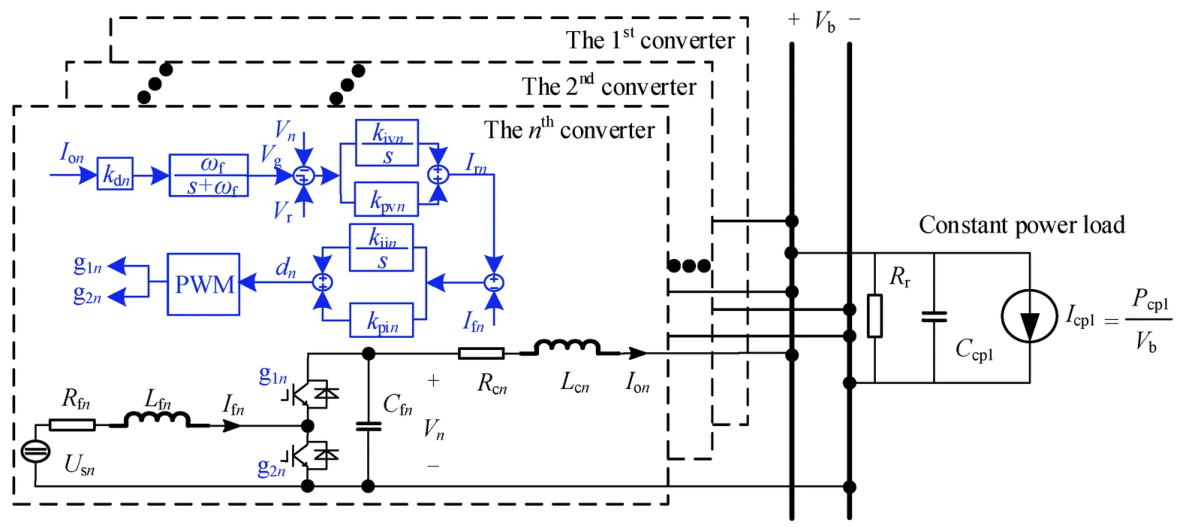
The topological structure of a DC microgrid with n parallel-connected converters is shown in Figure 1.
Here Rfn is the filter resistance of the n-th converter, Lfn is the filter inductance of the n-th converter, Ifn is the filter inductance current of the n-th converter, Vn is the output voltage of the n-th converter, Cfn is the filter capacitance of the n-th converter, Rcn is the line resistance of the n-th converter, Lcn is the line inductance of the n-th converter, Ion is the output current of the n-th converter, Ccpl is the filter capacitance of constant power load (CPL), Pcpl is the power of CPL, Vb is the DC bus voltage, Icpl is the current of CPL, kdn is the droop coefficient of the n-th converter, ωf is the control bandwidth of low-pass filter, Vg is the voltage reference, Vr is the rated voltage, kpin is the current proportional gain, kiin is the current integral gain of the n-th converter, s is the Laplace operator, kpvn is the voltage proportional gain of the n-th converter, kivn is the voltage integral gain of the n-th converter, Irn is the current reference of the n-th converter, dn is the duty factor of the n-th converter, Usn is the input voltage of the n-th converter, g1n, g2n are the modulation signals for the two IGBTs of the n-th converter, respectively. The specific numerical values of main system parameters are listed in Table 1.
Table 1. Parameters of PVESS.
DeviceParametersValue
Battery storage converterOutput voltage400 V
Input voltage200 V
Filter inductor/filter resistor0.373 mH/0.005 Ω
Switching frequency10 kHz
Filter capacitor0.08 F
Droop coefficient0.5
Low-pass filter bandwidth5 rad/s
Sampling time0.1 ms
RT-Box Solver time step25 μs
Constant power loadInput filter capacitor0.08 F

2.2. Two Classic Virtual Inertia Control Methods

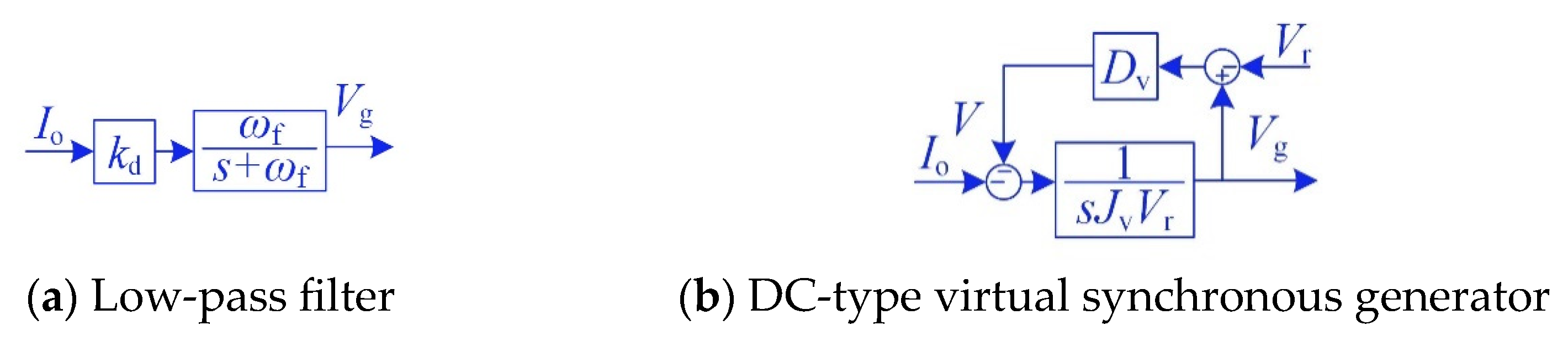
The two classic virtual inertia control methods shown in Figure 2 are usually adopted in current research to enhance the virtual inertia of DC microgrids [33].
Here Jv is the virtual inertia coefficient, Dv is the virtual damping coefficient, Vr is the rated DC bus voltage, and kd is the droop coefficient. It can be derived that the low-pass filter-based virtual inertia control and the DC-type virtual synchronous generator (DC-VSG) control are mathematically equivalent, and their parameter relationships can be established through frequency-domain analysis.
For the low-pass filter-based virtual inertia control, the transfer function describing the dynamic response of the current reference is
G lpf ( s ) = I ref I in = ω f s + ω f
where Iin is the current signal corresponding to input power, and ωf is the low-pass filter control bandwidth.
For the DC-VSG-based virtual inertia control, the electromechanical dynamic equation considering droop characteristics is
J v d V d t + D v ( V V r ) = k d V r ( P ref P )
In DC microgrids, voltage is linearly mapped to frequency (Vω), thus converting (3) into current dynamics, where P and Pref are the actual and reference power, respectively. In DC microgrids, the power–voltage–current relationship satisfies PVrI under small-signal conditions. Substituting this relationship and performing the Laplace transformation, the equivalent current-oriented transfer function of the DC-VSG control is obtained as
G VSG ( s ) = I ( s ) I in ( s ) = 1 / J v s + D v / ( J v V r )
By comparing the denominators of Glpf(s) and GVSG(s), the pole positions are required to be identical to ensure equivalent dynamic responses. Combined with the droop coefficient definition, the complete parameter mapping relationship between the two control methods is established as
ω f = D v J v V r k d = 1 D v
Under this mapping, the two control methods exhibit identical frequency-domain characteristics and can thus be treated as equivalent and interchangeable in controller design and parameter tuning. While Jv and Dv in the DC-VSG control possess clear physical interpretations from the perspective of synchronous generator emulation, the low-pass filter control bandwidth ωf provides a more intuitive and engineering-friendly parameter for voltage and current loop design in DC microgrids.

2.3. Non-Virtual Inertia Experiment Results

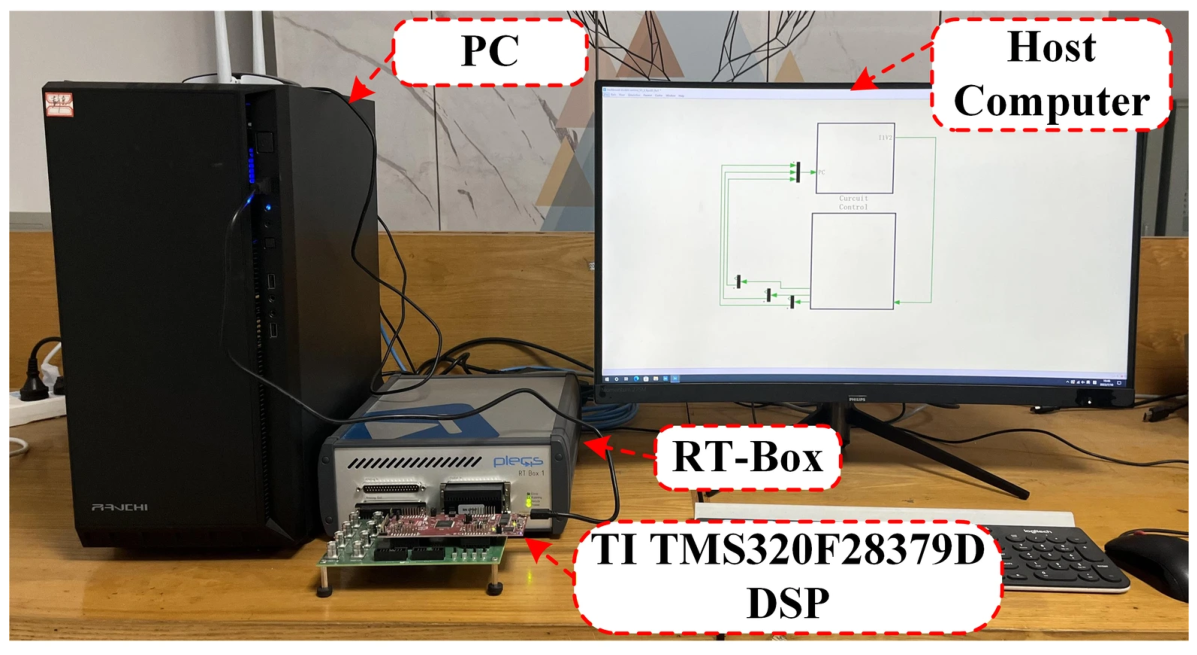
The DC microgrid in Figure 1 is established by the RT-box HIL platform shown in Figure 3. The voltage and current controllers are discretized using the bilinear transform.
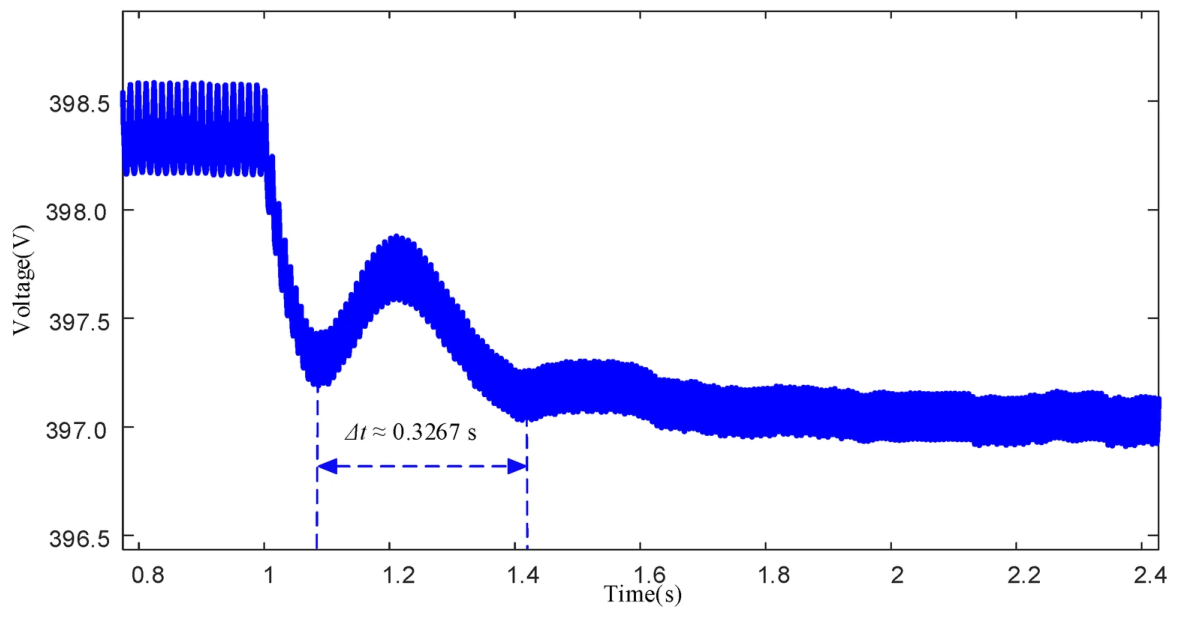
The CPL steps up from 1 kW to 2 kW at 1 s. The DC voltage experiment results are shown in Figure 4. It can be observed from the figure that the experimental waveform exhibits damped oscillation characteristics within the time range of roughly [1.0 s, 2.0 s], with an oscillation frequency of about 19.22 rad/s. In general, a waveform with exponential decay represents the virtual inertia characteristic, while that with damped oscillation corresponds to the non-virtual inertia characteristic [13]. Therefore, from what theoretical perspective can this non-virtual inertia phenomenon be explained? And how can the DC voltage be endowed with virtual inertia response characteristics? Both of these issues are worthy of in-depth investigation.

3. Theoretical Explanation of Non-Virtual Inertia Phenomenon Based on the Virtual Inertia Response Criterion

To explain the non-virtual inertia phenomenon shown in Figure 4, a transfer function model is developed in this subsection. Based on the frequency-domain response of this model, a criterion for virtual inertia response is provided. Furthermore, this criterion explains the non-virtual inertia phenomenon in Figure 4 from the perspective of the mismatch between the DC voltage control bandwidth and the low-pass filter control bandwidth.

3.1. The Transfer Function Model of DC Microgrid

When the virtual inertia control loop, voltage control loop, and current control loop in Figure 1 are not taken into account, the open-loop transfer function Gvd(s) from the duty factor d to DC voltage V can be expressed in the following form [34,35,36]:
G vd s = 1 d R f + L f s R c + R load 1 d V C f s + G in s R f + L f s + 1 d 2
where Rload is the equivalent resistor, the expression for the function Gin(s) is presented in Equation (5). Additionally, Gvdm(s) and Gvdd(s) are designated as the numerator and denominator expressions of the transfer function Gvd(s), respectively.
G in s = C cpl s 1 R load L c C cpl s 2 + R c C cpl L c R load s + 1 R c R load
Similarly, the transfer function Gid(s) from duty factor d to filter inductor current If can be obtained as follows:
G id s = V G vdd s 1 d G vdm s R f + L f s G vdd s
As can be seen from Figure 1, the expression for the current controller Gic(s) can be written in the following form:
G ic s = k pi + k ii s
Furthermore, the expressions for the loop gain Tii(s) and the closed-loop transfer function Gii(s) can be derived separately, with the details presented in Equations (9) and (10), respectively.
T ii s = G id s G ic s
G ii s = G id s G ic s 1 + G id s G ic s
For convenience, Giim(s) and Giid(s) are denoted as the numerator and denominator expressions of the transfer function Gii(s), respectively. Furthermore, the open-loop transfer function of the voltage control loop Giv(s) can be obtained as
G iv s = G iim s 1 d G iid s V R c + R r + R cpl 1 d Z s
where the mathematical expressions for transfer functions Z (s) are shown in Equation (12).
Z s = R load + R c + L c s C cpl R load s 1 C cpl R load s 1 + R load + R c + L c s C cpl R load s 1 C f s
As can be seen from Figure 1, the mathematical expression for the voltage controller Gvc(s) can be written in the following form:
G vc s = k pv + k iv s
Furthermore, the mathematical expressions for the loop gain Tviv(s) and the closed-loop transfer function Gviv(s) can be derived separately. The details are presented in Equations (14) and (15), respectively.
T viv s = G iv s G vc s
G viv s = G iv s G vc s 1 + G iv s G vc s
In the virtual inertia control shown in Figure 1, the mathematical expression for the low-pass filter controller Glpf(s) is presented in Equation (16).
G lpf s = ω f s + ω f
Similarly, the mathematical expression for the closed-loop voltage transfer function Gvivf(s) considering virtual inertia control can be derived, as shown in the following equation.
G vivf s = G vc s G ic s G c s G load s + 1 G f s G vdm s G vc s G ic s G load s k d G lpf s + G c s G load s + 1 G f s G vdm s + G f s + G ic s V G vdd s G ic s 1 d G vdm s G c s G load s + 1
where the mathematical expressions for transfer functions Gc(s), Gf(s), and Gload(s) are shown below, respectively:
G c s = R c + L c s G f s = R f + L f s G load s = C cpl s 1 / R load

3.2. Theoretical Analysis of the Non-Virtual Inertia Phenomenon

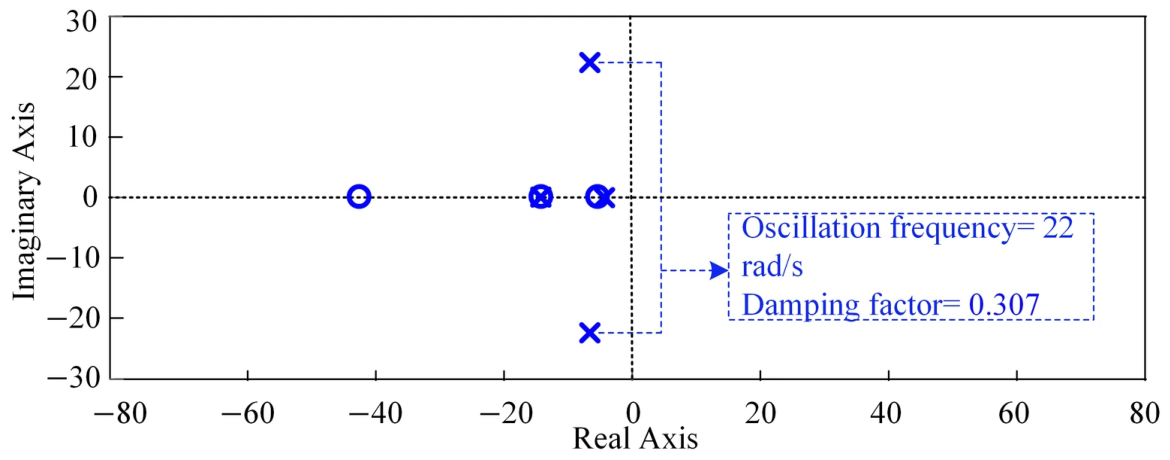
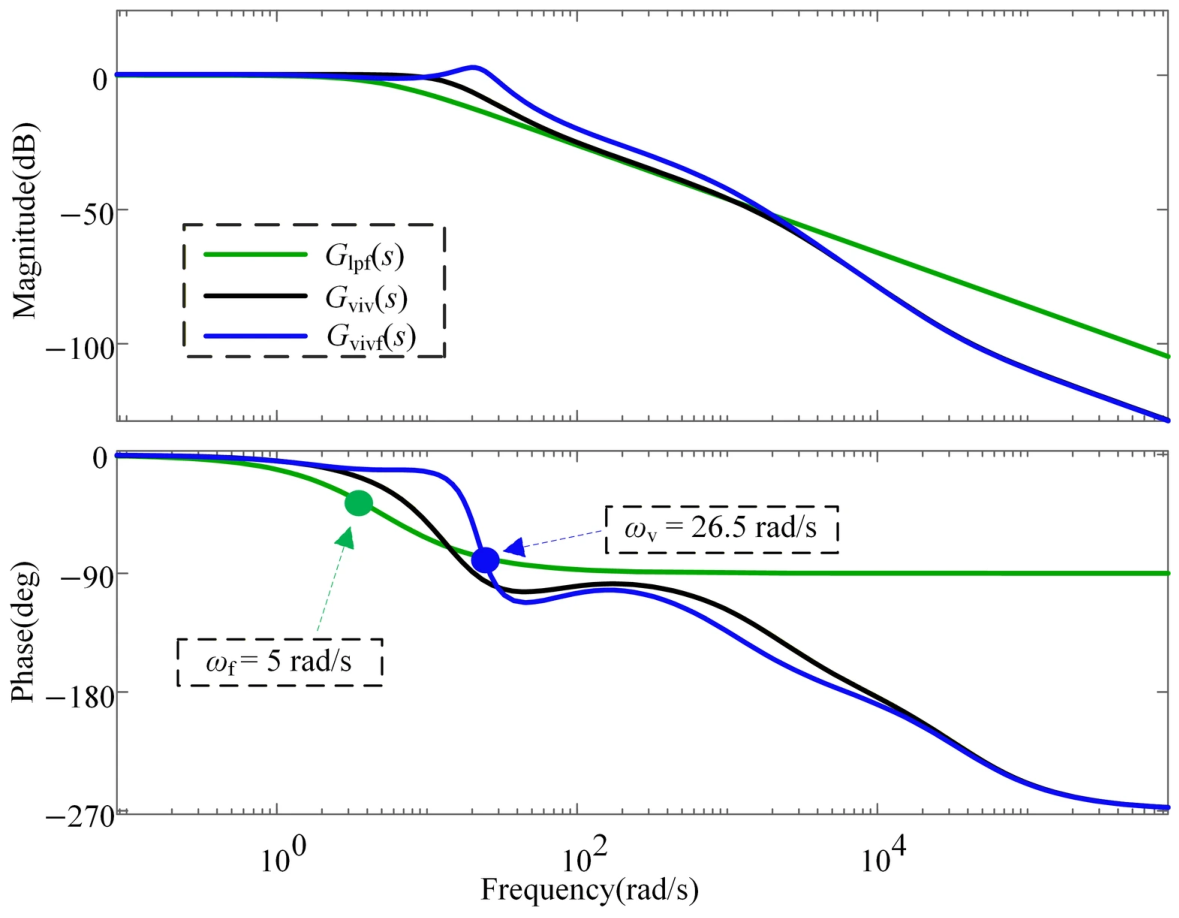
The zero-pole diagram and Bode plot of the transfer function Gvivf(s) are shown in Figure 5 and Figure 6, respectively. The oscillation frequency of the dominant conjugate poles in Figure 5 is roughly 22 rad/s (with a damping factor of roughly 0.307), which remains largely consistent with the experimental result of 19.22 rad/s presented in Figure 4.
Based on the above analysis, it can be seen that the zero-pole diagram is suitable for evaluating the damped oscillation characteristics. The impact of control bandwidth on the virtual inertia is difficult to explain by the zero-pole diagram. According to Figure 6, it can be seen that the DC voltage control bandwidth ωv of transfer functions Gvivf(s) is approximately 26.5 rad/s. The low-pass filter control bandwidth ωf of the transfer function Glpf(s) is 5 rad/s.

3.3. Criterion for Virtual Inertia Response

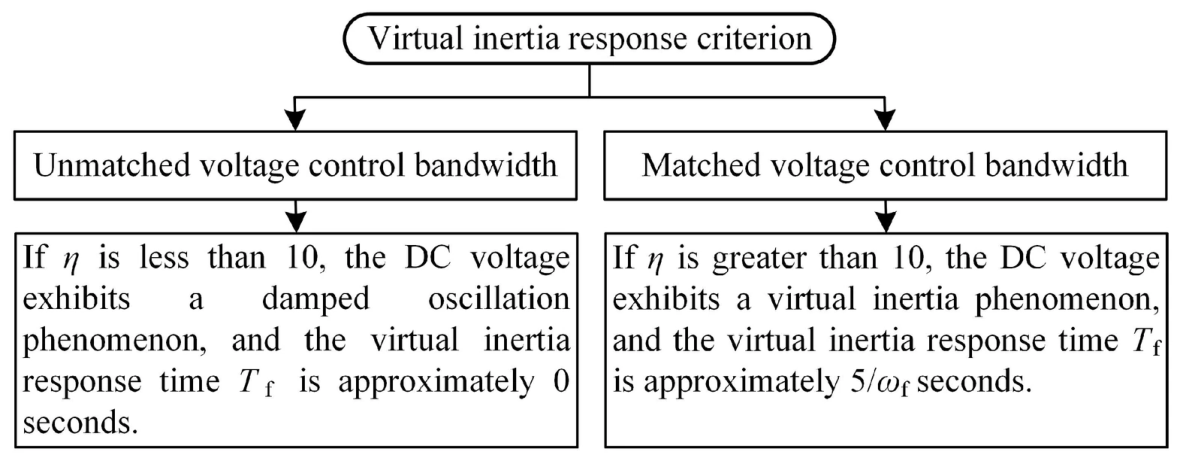
To evaluate the matching relationship between the DC voltage control bandwidth ωv and the low-pass filter control bandwidth ωf, a virtual inertia response criterion is proposed in this article, as detailed in Figure 7.
η is the bandwidth coefficient, and its mathematical calculation equation is shown below
η = ω v ω f
where ωv is the DC voltage control bandwidth, and ωf is the low-pass filter control bandwidth.
The threshold η > 10 is established based on an engineering rule of thumb for cascade control systems: the inner loop (voltage controller) should have a bandwidth at least 5 to 10 times higher than the outer loop (low-pass filter) to ensure negligible interaction. In this paper, the conservative value of 10 is adopted. To verify this choice, consider the closed-loop transfer function Gvivf(s).
(1)
Matched voltage control bandwidth:
When the bandwidth coefficient η is greater than 10, the response speed of the voltage controller Gvc(s) is much faster than that of the low-pass filter Glpf(s). That is, the voltage controller Gvc(s) enables the DC voltage V to quickly track the voltage reference value Vg generated by the low-pass filter Glpf(s). At this point, the impact of the voltage controller Gvc(s) on the dynamic response of DC voltage can be largely ignored. That is, the dynamic response of the system is predominantly determined by the low-pass filter Glpf(s). Consequently, the DC voltage will primarily exhibit virtual inertia characteristics, and the virtual inertia response time Tf of the DC voltage is approximately 5/ωf seconds.
(2)
Unmatched voltage control bandwidth:
When the bandwidth coefficient η is less than 10, the dynamic response of the system is jointly determined by the voltage controller Gvc(s) and the low-pass filter Glpf(s). In that case, the DC voltage may exhibit non-virtual inertia phenomena, and the virtual inertia response time Tf of the DC voltage is approximately 0 s.
It can be deduced that when the bandwidth coefficient η is greater than 10, the DC microgrid will exhibit virtual inertia characteristics. That is, the ratio of DC voltage control bandwidth ωv to low-pass filter control bandwidth ωf should be greater than 10. According to Figure 6, it can be inferred that the ratio between the DC voltage control bandwidth ωv and the low-pass filter control bandwidth ωf is approximately 5.3. Since 5.3 is less than 10, the dynamic response characteristics of the DC voltage are jointly determined by the low-pass filter and the voltage controller. The frequency-domain responses of transfer functions Glpf(s) and Gvivf(s) exhibit virtual inertia characteristics and damped oscillation characteristics, respectively. Therefore, the experimental results in Figure 4 exhibit damped oscillation characteristics (i.e., non-virtual inertia characteristics). In summary, the mismatch between the DC voltage control bandwidth ωv and the low-pass filter control bandwidth ωf is the fundamental reason for the non-virtual inertia phenomenon in DC microgrids.

4. Virtual Inertia Characteristics Based on Matched Control Bandwidth

4.1. PI Control Parameter Design Based on Transfer Function

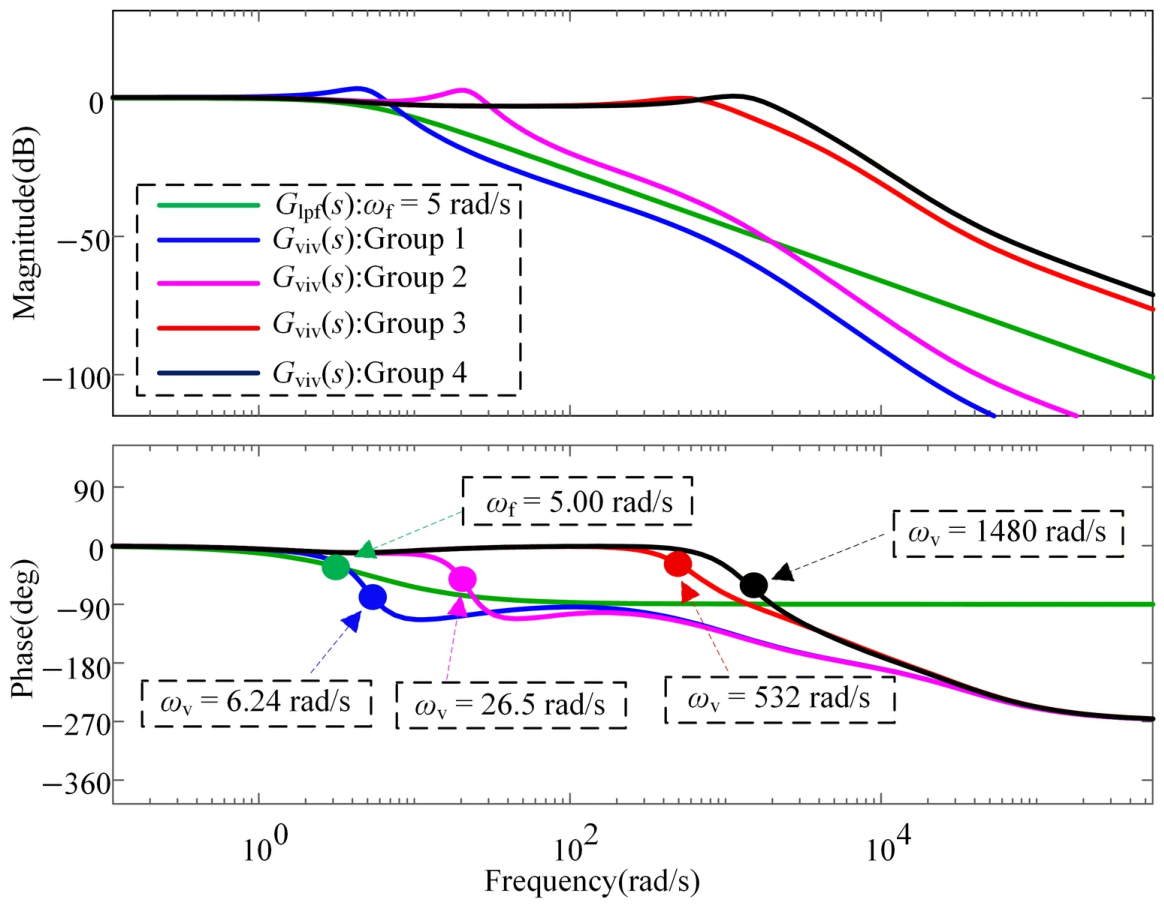
Based on the established transfer function model, four sets of PI control parameters have been designed in this paper. Furthermore, the PI control parameters listed in reference [34] are denoted as the second set of PI control parameters. The details of the parameters and the Bode plot are shown in Table 2 and Figure 8, respectively.
As can be seen from Figure 8, the DC voltage control bandwidth ωv of PI control parameters for Groups 1 to 4 are 6.24 rad/s, 26.5 rad/s, 532 rad/s, and 1480 rad/s, respectively.
In this article, the minimum ωf_min and maximum ωf_max values of the low-pass filter control bandwidth are set to 1 rad/s and 10 rad/s, respectively. Consequently, the bandwidth coefficients for the PI control parameters of Group 1, Group 2, Group 3, and Group 4 are designed to be 0.62, 2.65, 53.20, and 148.00, respectively, as detailed in Table 3. Since the bandwidth coefficients η of PI control parameters for both Group 1 and Group 2 are less than 10, the DC voltage will exhibit a non-virtual inertia phenomenon. On the other hand, the bandwidth coefficients η of PI control parameters for both Group 3 and Group 4 are greater than 10. Therefore, it can be inferred that the DC voltage will demonstrate virtual inertia characteristics.
In previous studies, the relationship between the virtual inertia characteristics and control parameters of DC microgrids has not been well established. Based on the virtual inertia response criterion proposed in this paper, this relationship is defined by the bandwidth coefficient.

4.2. Control Bandwidth Matching Domain of DC Microgrid

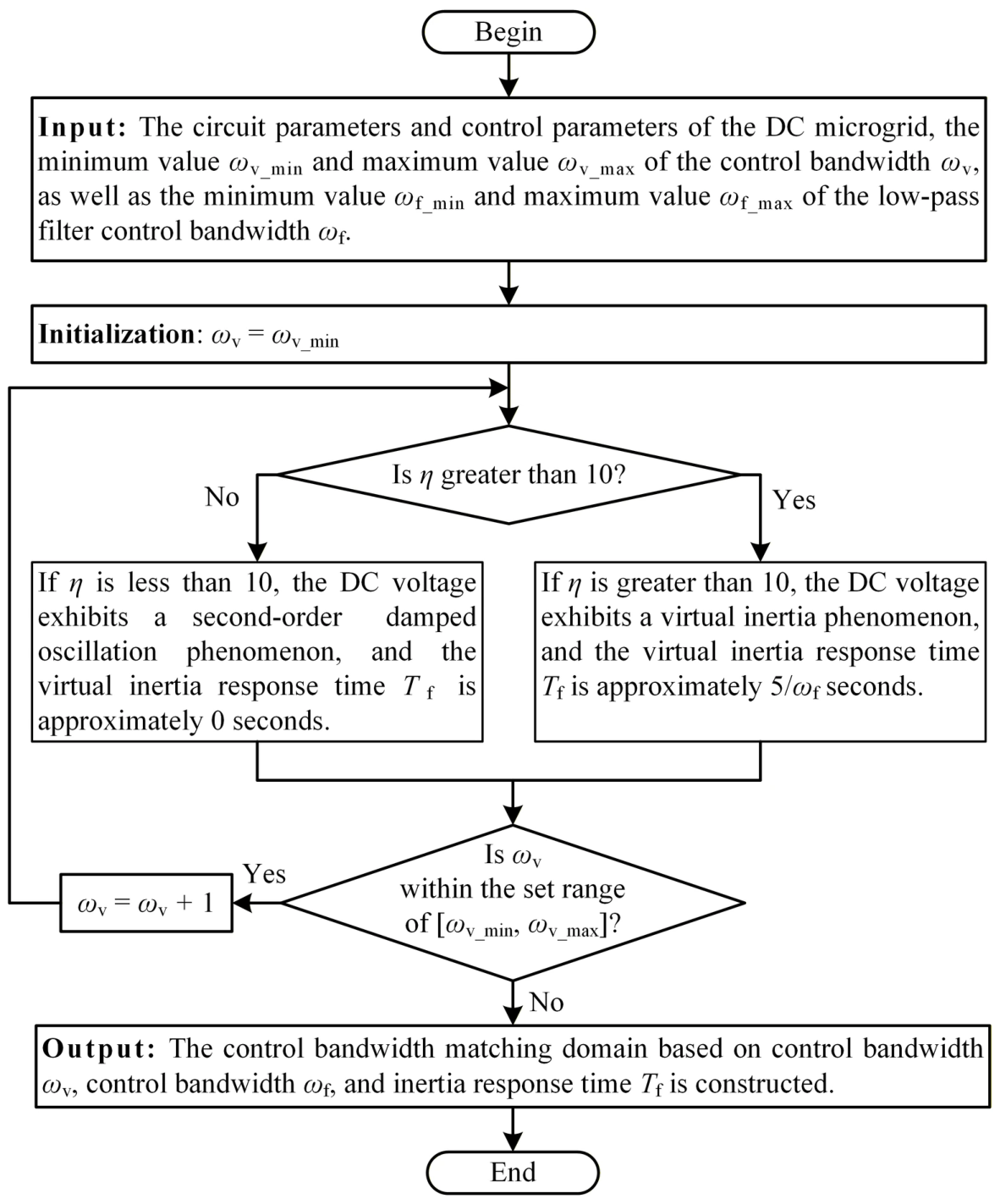
To address the non-virtual inertia issues caused by the mismatch between the DC voltage control bandwidth ωv and the low-pass filter control bandwidth ωf, the concept of a control bandwidth matching domain is proposed in this paper. In addition, a method for solving the control bandwidth matching domain is proposed. The specific solution process is shown in Figure 9.
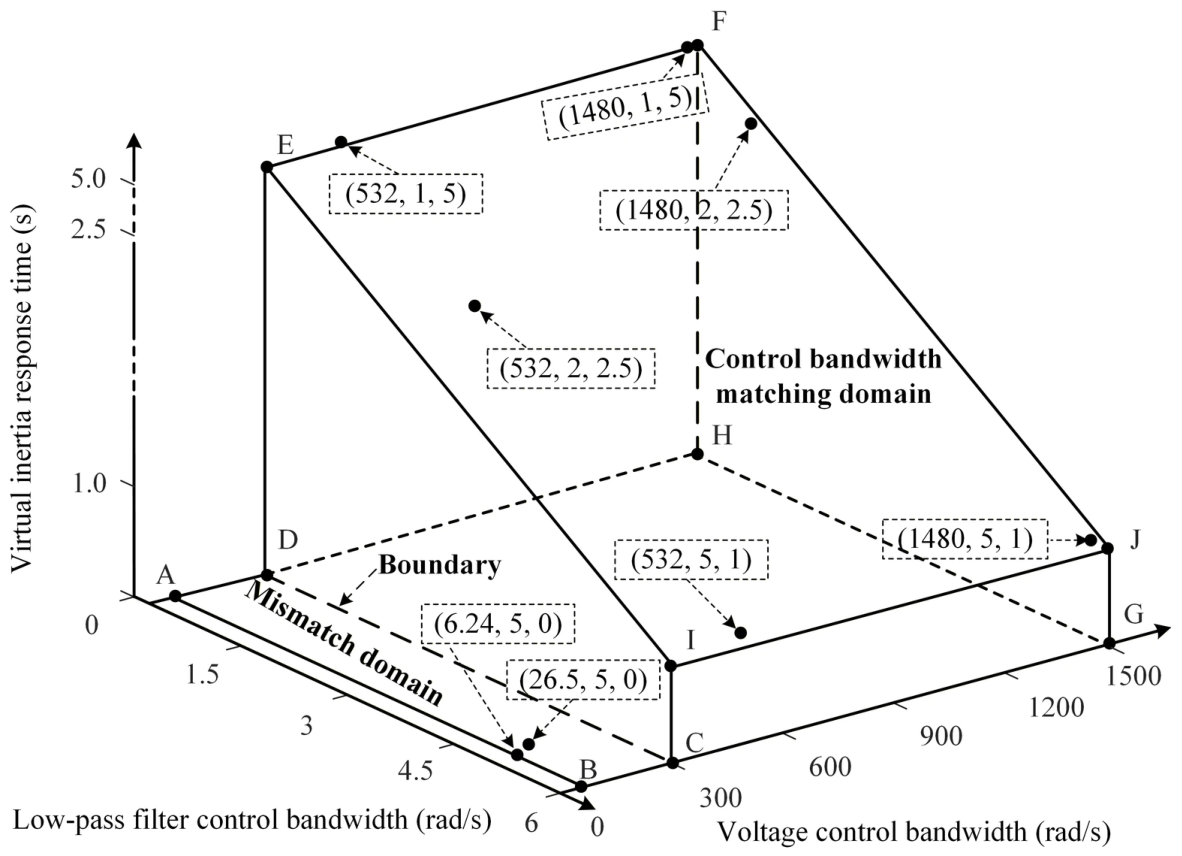
According to the construction process outlined in Figure 9, the control bandwidth matching domain is characterized by this article, as illustrated in Figure 10. In Figure 10, the closed-loop domain formed by connecting Point A, Point B, Point C, Point D, and back to Point A is represented as the control bandwidth mismatch domain. The closed-loop domain created by connecting Point E, Point I, Point J, Point F, and back to Point E is labeled as the control bandwidth matching domain. The dashed line between Point D and Point C is designated as the boundary between the control bandwidth mismatch domain and the control bandwidth matching domain.
(1)
Control bandwidth matching domain: The bandwidth coefficient η within the control bandwidth matching domain is greater than 10. In the control bandwidth matching domain, the dynamic response characteristics of the DC microgrid are almost entirely determined by the low-pass filter Glpf(s). Under such circumstances, the DC microgrid exhibits a virtual inertia phenomenon, and the virtual inertia response time Tf is approximately 5/ωf seconds. Simultaneously, the length of the virtual inertia response time signifies the strength of the system’s virtual inertia. Specifically, a longer virtual inertia response time indicates a stronger virtual inertia strength of the system. Additionally, under the condition of a fixed DC voltage control bandwidth ωv, as the low-pass filter control bandwidth ωf decreases, the virtual inertia response time increases accordingly. Consequently, the virtual inertia strength of the DC microgrid is enhanced.
For instance, in Figure 10, the DC voltage control bandwidth ωv is set to 532 rad/s. When the low-pass filter control bandwidth ωf is set to 5 rad/s, 2 rad/s, and 1 rad/s, the virtual inertia response times are approximately observed to be 1 s, 2.5 s, and 5 s, respectively. As the virtual inertia response time increases, the virtual inertia strength of the DC microgrid is gradually being enhanced. Within the reasonable regulation range, increasing the DC voltage control bandwidth can raise the bandwidth coefficient, effectively strengthen the system virtual inertia characteristic and further improve the system stability margin.
(2)
Control bandwidth mismatch domain: In the control bandwidth mismatch domain, the dynamic response characteristics of the DC microgrid are jointly determined by the voltage controller Gvc(s) and the low-pass filter Glpf(s). That is, the DC microgrid will exhibit damped oscillation characteristics (or non-virtual inertia phenomenon), and the virtual inertia response time of DC voltage is approximately 0 s.

5. Experimental Verification

To verify the validity of the virtual inertia response criterion and the effectiveness of the control bandwidth matching domain, multiple sets of experimental results for DC microgrids are presented in this section.

5.1. Parameters for Group 1 and Group 2

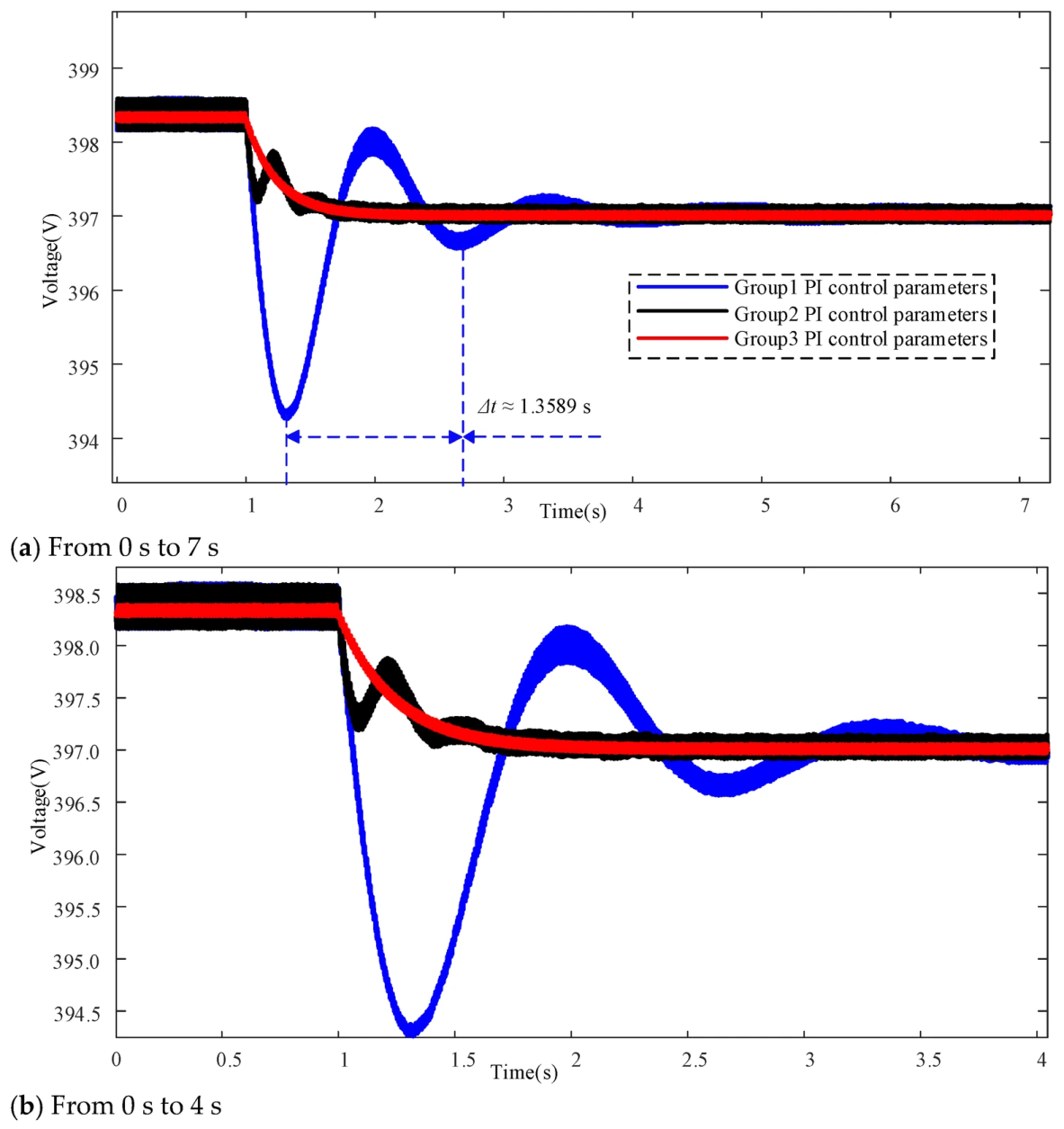
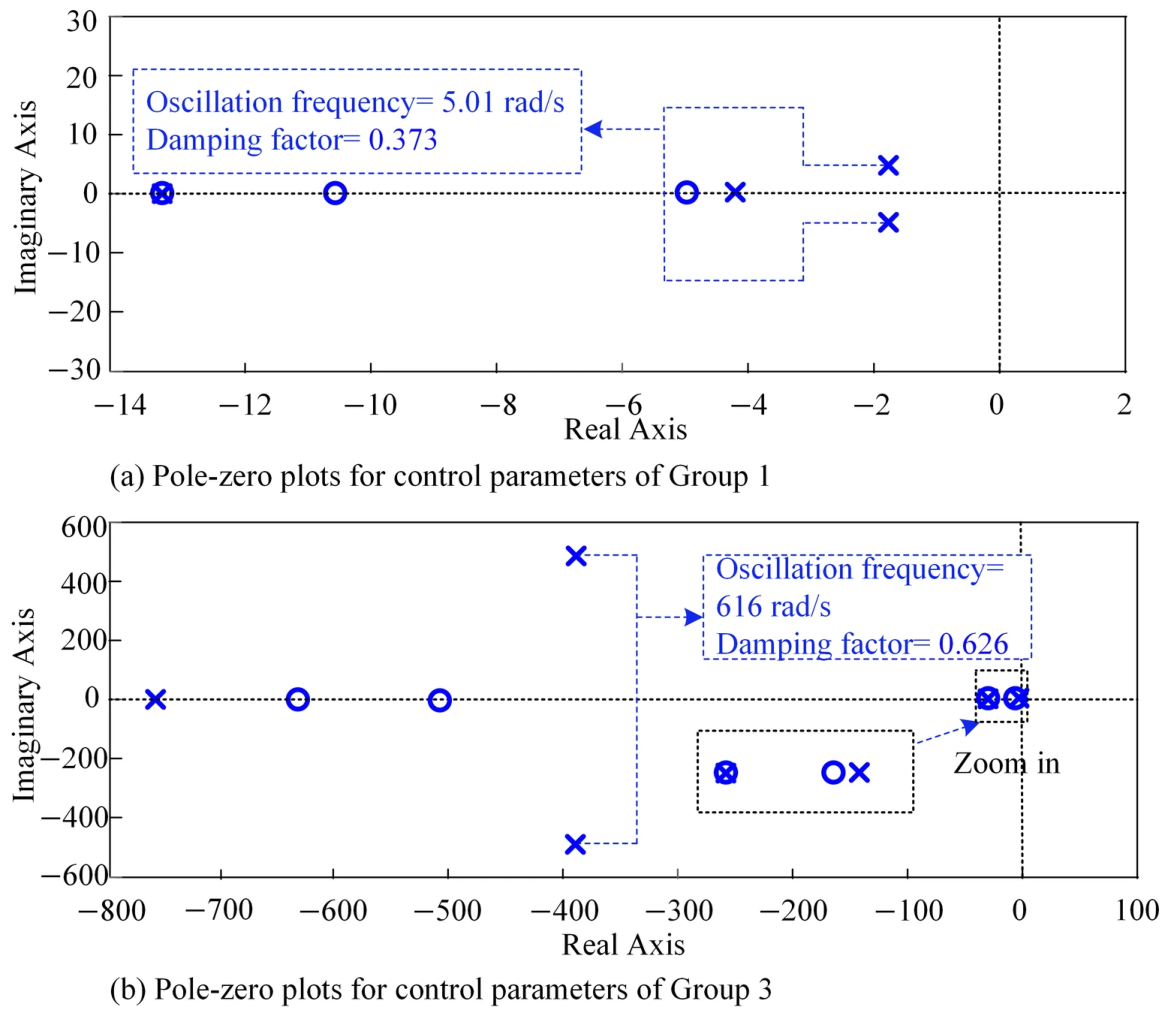
At 1 s, the load power is varied from 1 kW to 2 kW. The detailed zero and pole values of PI control parameters for Group 1, Group 2 and Group 3 are listed in Table 4. The low-pass filter control bandwidth ωf is fixed at 5 rad/s. Furthermore, the experimental waveforms for the parameters of Group 1, Group 2, and Group 3 are shown as the blue, black, and red curves in Figure 11, respectively. In Figure 11, the experimental waveform of the PI control parameters in Group 1 exhibits second-order damped oscillation characteristics within the time range of approximately [1.0 s, 4.5 s]. Furthermore, the experimental oscillation frequency within the time range of [1.0 s, 4.5 s] is approximately 4.62 rad/s, which is largely consistent with the theoretical oscillation frequency of 5.01 rad/s presented in Figure 12. It is concluded that the zero-pole diagram is indeed suitable for evaluating second-order damped oscillation characteristics. In addition, the validity of the control bandwidth mismatch domain is verified by the blue and black experimental waveforms. Specifically, both points (6.24 rad/s, 5 rad/s) and (26.5 rad/s, 5 rad/s) are located within the control bandwidth mismatch domain shown in Figure 10.
Compared to the PI control parameters of Group 1 and Group 2, the experimental waveform of the PI control parameters in Group 3 exhibits virtual inertia characteristics within the time range of approximately [1.0 s, 2.0 s]. The correctness of the virtual inertia response criterion is verified based on the experimental waveforms in Figure 11. The validity of the control bandwidth matching domain is verified by the red experimental waveform. Specifically, the point (532 rad/s, 5 rad/s) is located within the control bandwidth matching domain depicted in Figure 10.
Table 4. Zeros and poles of the PI control parameters from Group 1 to Group 3.
Control ParametersPolesZeros
Group 1 PI Parameters−155.00; −13.40; −4.20; −1.87 ± 4.64i;−126.00; −13.40; −10.50; −5.00
Group 2 PI Parameters−156.00; −13.40; −6.76 ± 20.90i; −3.48−126.00; −41.90; −13.40; −5.00
Group 3 PI Parameters−764.00; −386.00 ± 480.00i; −13.40; −3.44−628.00; −503.00; −13.40; −5.00

5.2. The Third Set of Control Parameters

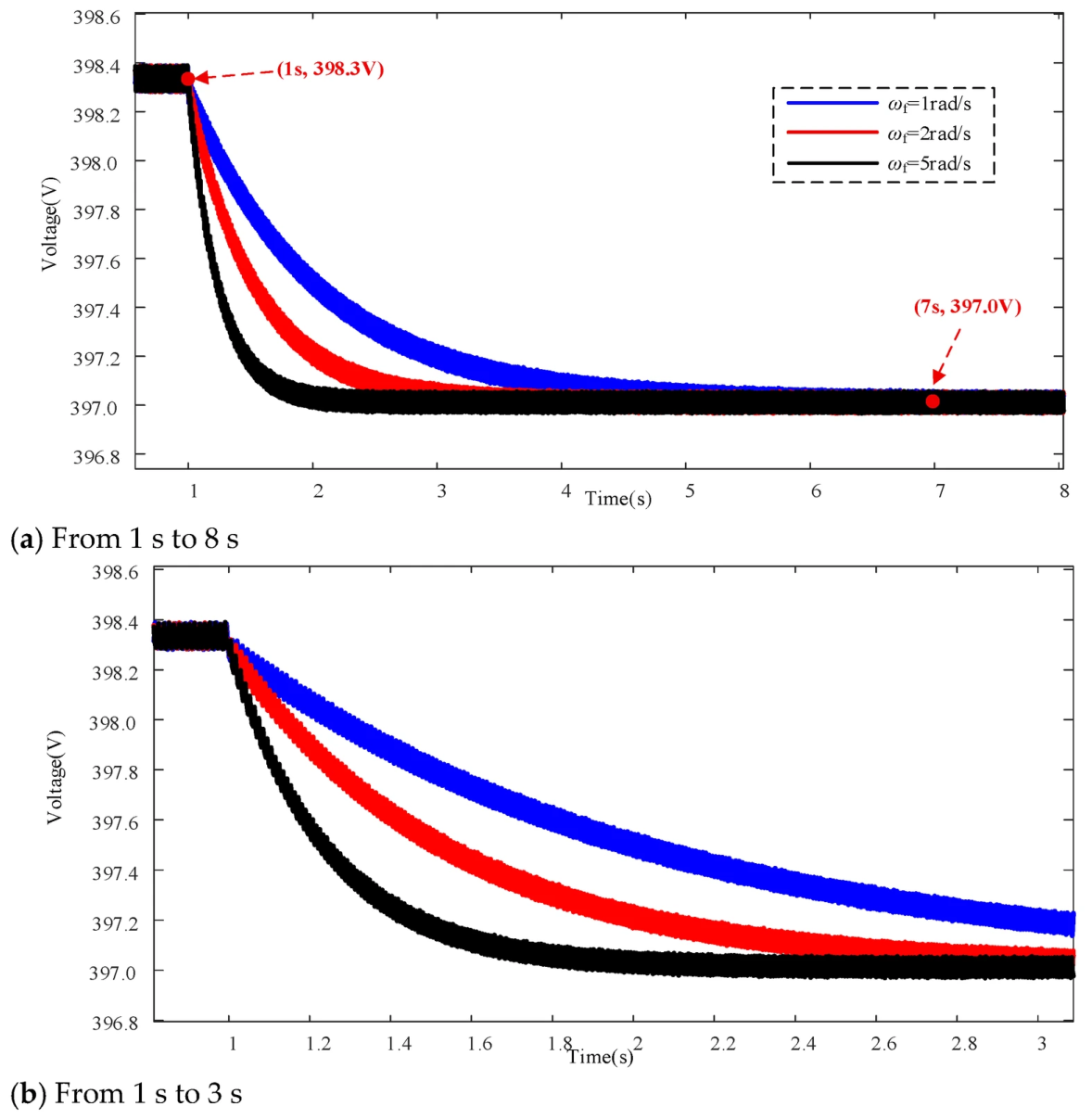
At 1 s, the load power is varied from 1 kW to 2 kW, and the experimental waveform of the DC microgrid is shown in Figure 13. From Figure 13, it can be observed that the experimental results of the PI control parameters in Group 3 all exhibit virtual inertia characteristics. Based on the experimental waveforms in Figure 13, the correctness of the virtual inertia response criterion is verified.
Based on the experimental results provided in Table 5 and Figure 13 can be obtained. To provide more details, when the low-pass filter control bandwidth ωf is set to 5 rad/s, 2 rad/s, and 1 rad/s, the experimental results approximately exhibit virtual inertia characteristics within the time ranges of [1.0 s, 2.0 s], [1.0 s, 3.5 s], and [1.0 s, 6.0 s] respectively. Then, the virtual inertia response times for various low-pass filter control bandwidths can all be calculated. Specifically, for low-pass filter control bandwidths of 5 rad/s, 2 rad/s, and 1 rad/s, the corresponding virtual inertia response times are 1.0 s, 2.5 s, and 5.0 s, respectively. In other words, the virtual inertia response time increases from 1.0 s to 5.0 s as the low-pass filter control bandwidth ωf decreases from 5 rad/s to 1 rad/s. Then, the virtual inertia strength of the system will be gradually enhanced. The effectiveness of the control bandwidth matching domain is also verified through the experimental results shown in Figure 13.

5.3. The Fourth Set of Control Parameters

At 1 s, the load power is varied from 1 kW to 2 kW. The experimental waveform is detailed in Figure 14. The experimental waveforms in Figure 14 all exhibit virtual inertia characteristics. Based on this, the correctness of the virtual inertia response criterion is further verified.
Similarly, Table 6 provides the corresponding data of Group 3, and Table 7 lists the virtual inertia response time data of Group 4 PI parameters. According to Table 5, Table 6 and Table 7, when the low-pass filter control bandwidth ωf is 5 rad/s, the virtual inertia response times for both the third and fourth groups of PI control parameters are 1.0 s. As the low-pass filter control bandwidth ωf decreases from 5 rad/s to 2 rad/s, the virtual inertia response times for both the third and fourth groups of PI control parameters increase from 1.0 s to 2.5 s. Similarly, when the low-pass filter control bandwidth is set to 1 rad/s, the virtual inertia response times for both the third and fourth groups of PI control parameters are 5.0 s. In summary, when the DC voltage control bandwidth ωv is increased from 532 rad/s to 1480 rad/s, the virtual inertia response time remains almost unchanged. Therefore, the correctness of the control bandwidth matching domain is also verified.
Table 7. Virtual inertia response time for PI control parameters of Group 4.
Low-Pass Filter Control Bandwidth ωf5 Rad/s2 Rad/s1 Rad/s
The time range of virtual inertia characteristics[1.0 s, 2.0 s][1.0 s, 3.5 s][1.0 s, 6.0 s]
Virtual inertia response time1.0 s2.5 s5.0 s

5.4. PI Parameter Design of Group 5 and Group 6

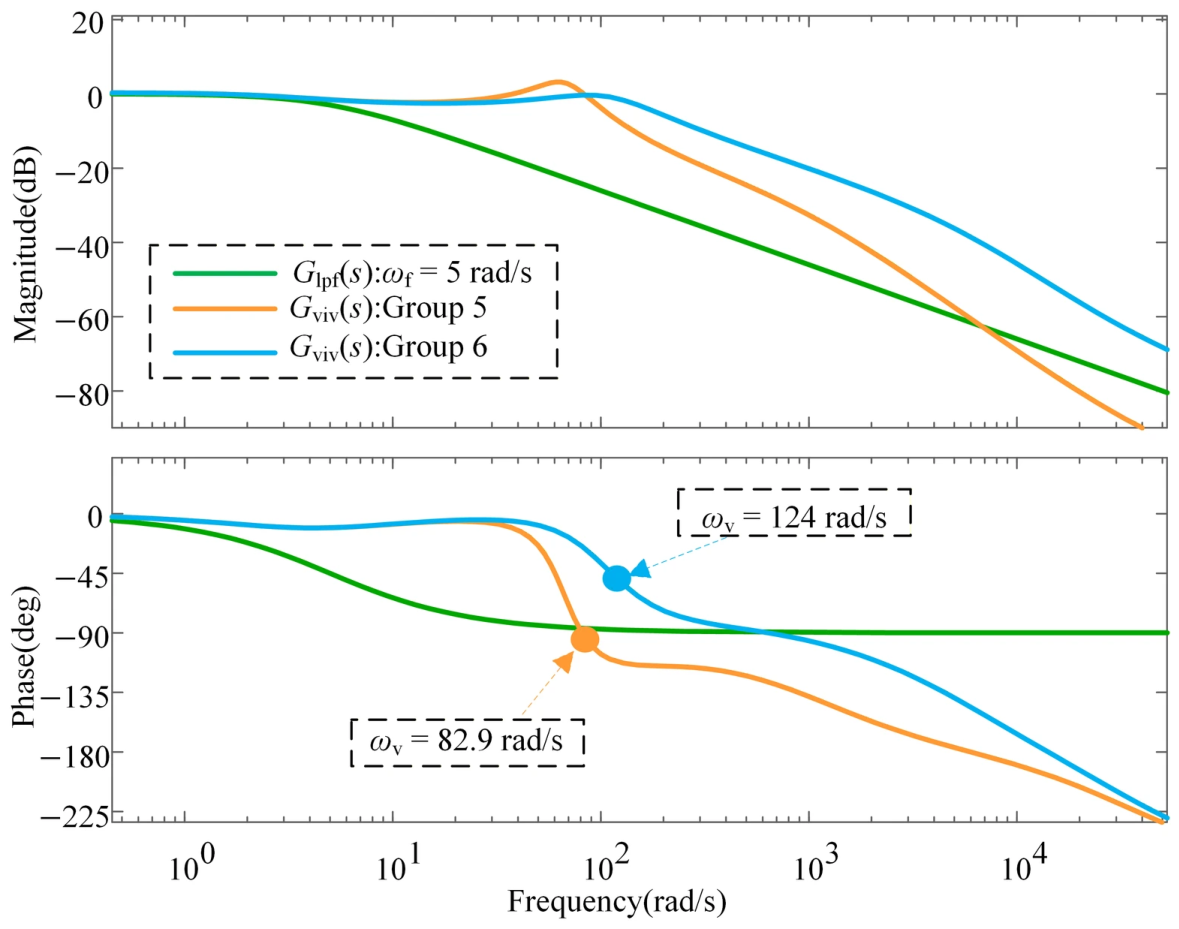
To further verify the validity of the DC voltage virtual inertia response criterion around the bandwidth coefficient η=10, this paper designs the sixth and seventh groups of PI control parameters. The PI parameters are given in Table 8, and relevant indices are listed in Table 9. The design process and corresponding Bode diagrams are shown in Figure 15. It can be seen that the DC voltage control bandwidth ωvb of the transfer function Gviv (s) corresponding to Group 5 and Group 6 are 82.9 rad/s and 124 rad/s, and the calculated bandwidth coefficients η are 8.29 and 12.40 respectively.
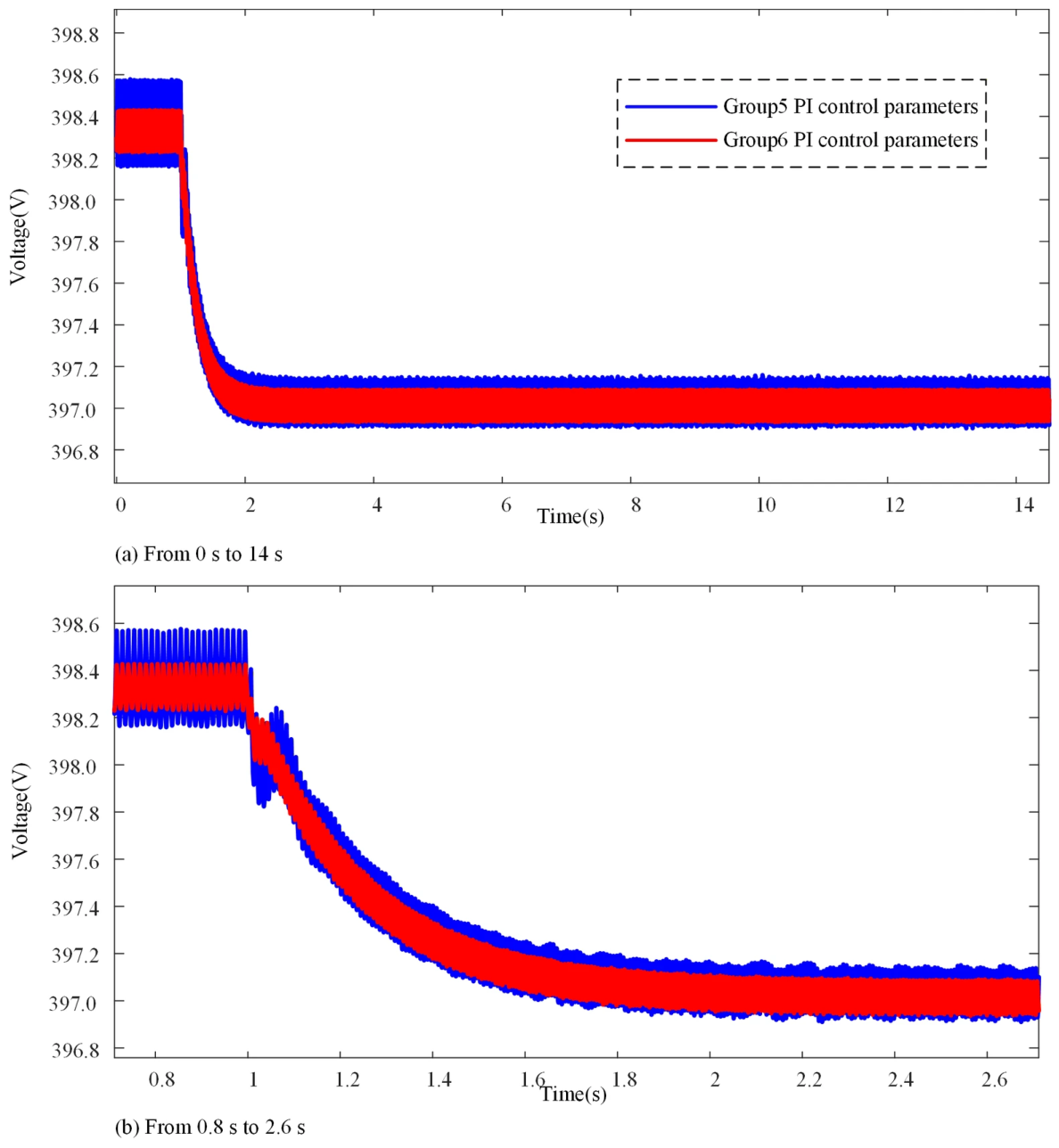
The experimental waveforms with load power stepping from 1 kW to 2 kW at 1 s and the low-pass filter control bandwidth ωf fixed at 5 rad/s are depicted in Figure 16. In the experimental results, the blue curve shows damped oscillation characteristics, whereas the red curve basically manifests typical virtual inertia characteristics [35].
Table 8. Current and voltage PI coefficients for Groups 5 and 6.
Transfer FunctionsGroup 5Group 6
Current proportional coefficient0.00060.0029
Current integral coefficient0.07301.8401
Voltage proportional coefficient5.425217.9832
Voltage integral coefficient681.74471,614.1690
Figure 16. Experimental waveforms for PI control parameters of Groups 5 to 6.
Processes 14 01925 g016
Table 9. The PI control parameters for Groups 5 to 6.
Transfer FunctionsDC Voltage Control Bandwidth ωvBandwidth Coefficient ηThe Response Characteristics of DC Voltage
Group 582.9 rad/s8.29Damped oscillation
Group 6124.0 rad/s12.40Virtual inertia

5.5. Load Disturbance Performance Under Various Droop Coefficients

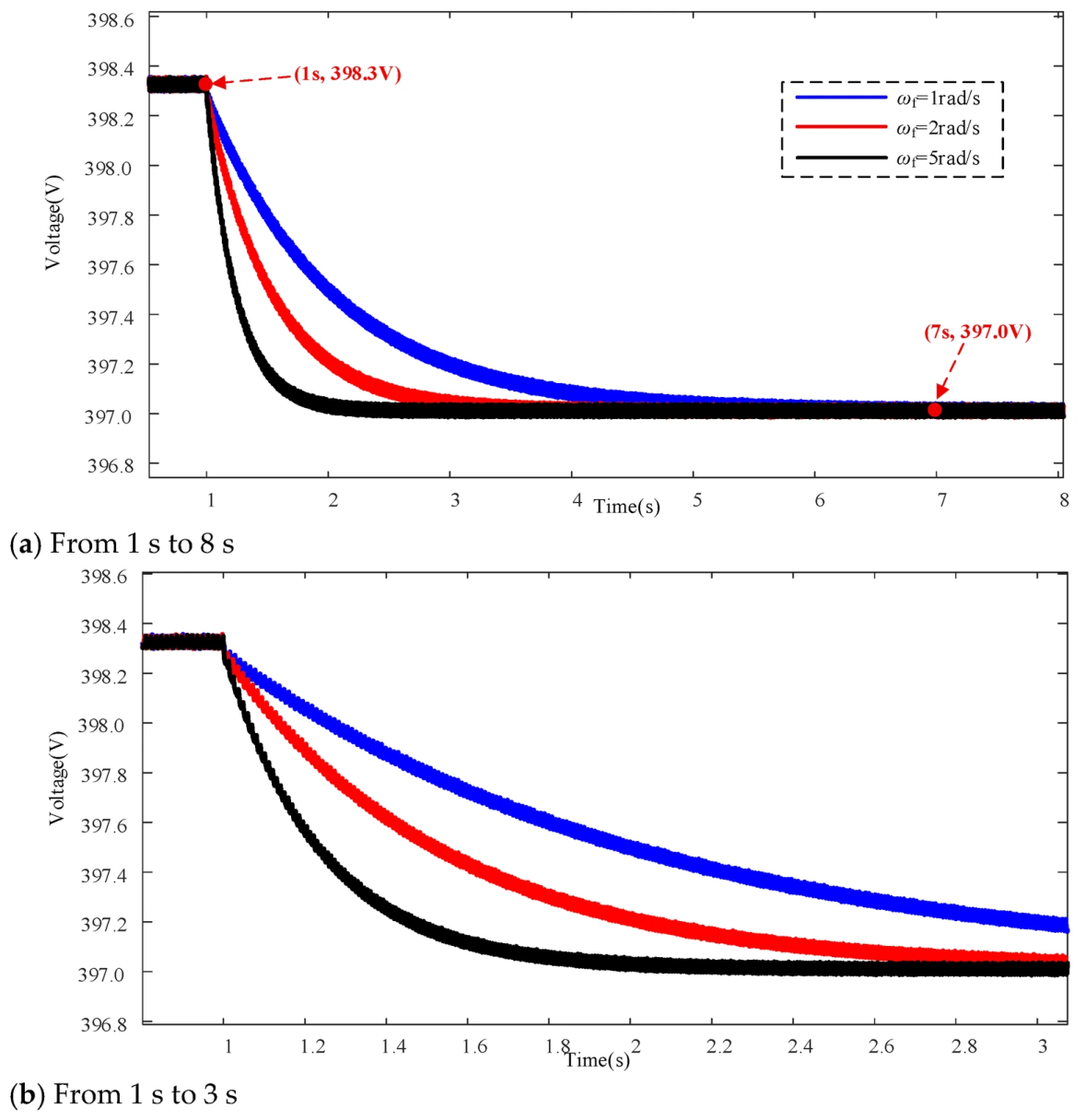
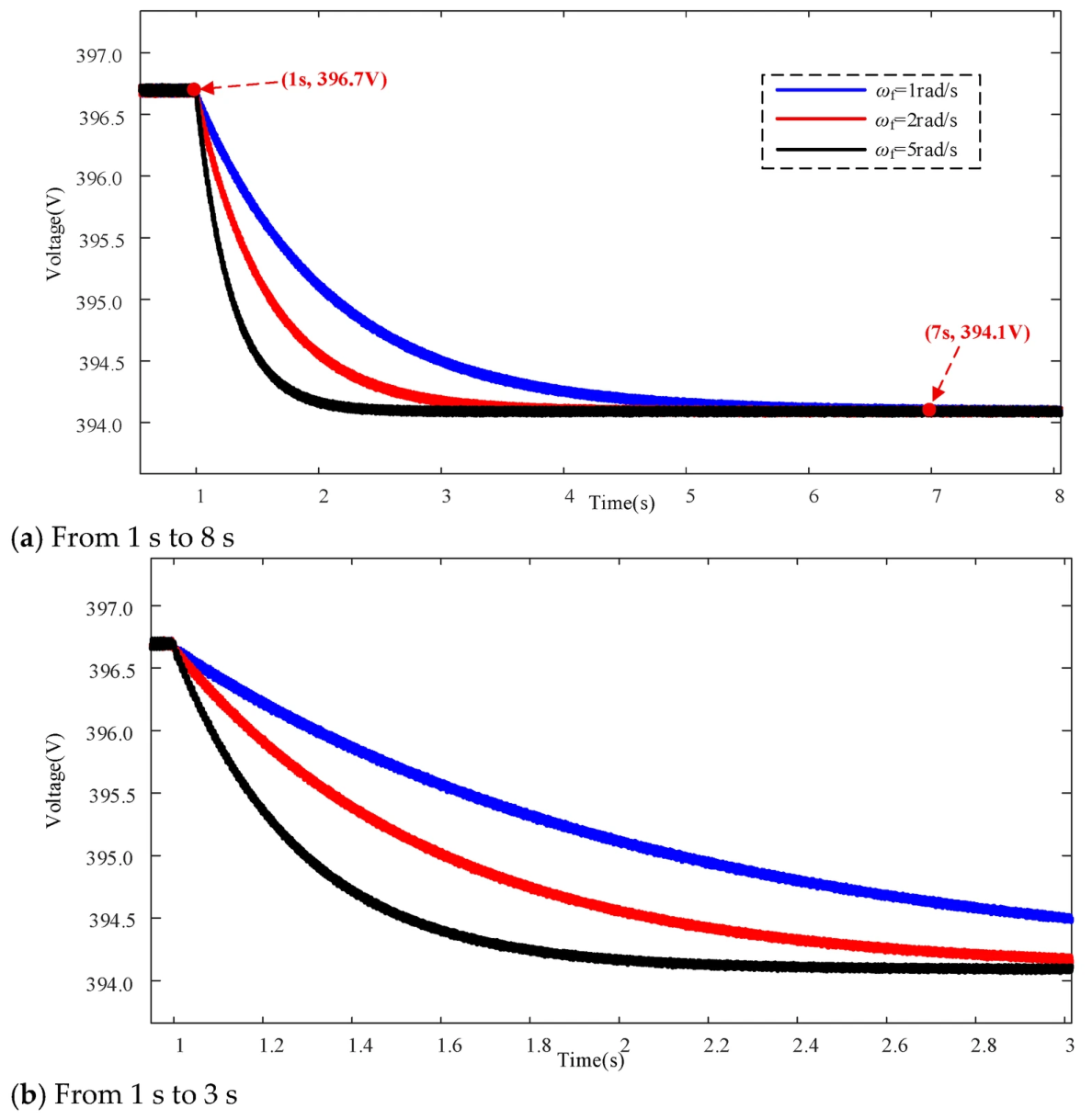
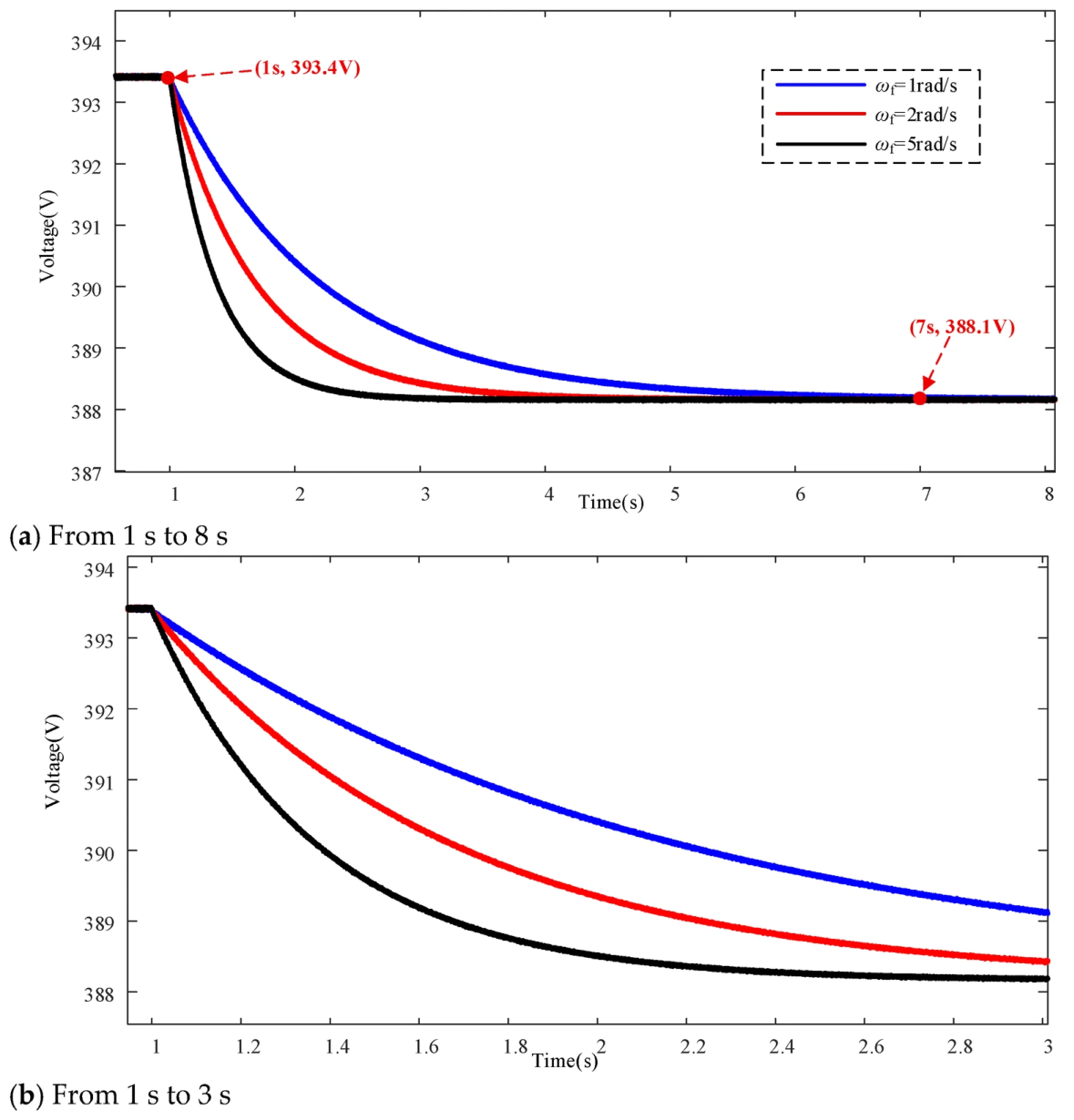
At 1 s, the load power is varied from 1 kW to 2 kW, and the experimental waveform of the DC microgrid under different droop coefficients is shown in Figure 17 and Figure 18, respectively. Compared with the case in Figure 13, all waveforms exhibit typical virtual inertia response characteristics, while significant differences exist in the steady-state voltage before and after load disturbance when the droop coefficient is varied. When the droop coefficient is doubled, the steady-state voltage before disturbance is 396.7 V and drops to approximately 394.1 V after the disturbance. When the droop coefficient is quadrupled, the steady-state voltage decreases from 393.4 V (pre-disturbance) to approximately 388.1 V (post-disturbance). It can be seen that both the pre- and post-disturbance steady-state voltages decrease as the droop coefficient increases.

5.6. Load Disturbance Characteristics of Multi-Parallel Converters

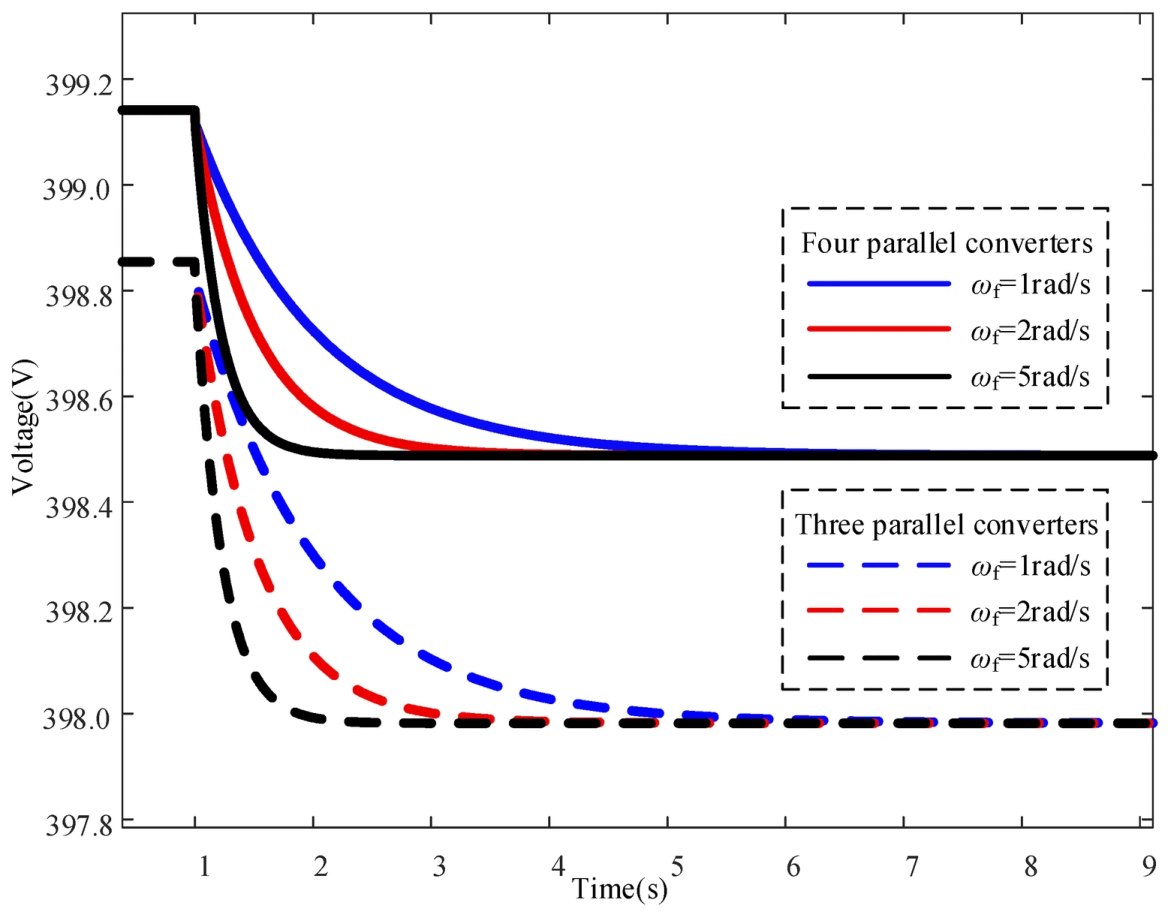
At 1 s, the load power is varied from 1 kW to 2 kW, and the experimental waveforms of the DC microgrid with three and four parallel converters are shown in Figure 19, respectively. Compared with the results in Figure 13, all measured waveforms exhibit virtual inertia characteristics, while obvious differences exist in the steady-state DC voltage before and after load variation. Specifically, the steady-state voltages before disturbance are approximately 398.30 V, 398.85 V and 399.14 V for two, three and four parallel units, and the corresponding post-disturbance steady-state voltages are about 397.00 V, 397.98 V and 398.49 V respectively.

6. Conclusions

For the non-virtual inertia phenomenon in DC microgrids, this paper proposes a method for enhancing virtual inertia and a method for constructing the feasible region of virtual inertia in DC microgrids based on control bandwidth matching. The main conclusions are as follows:
(1)
A virtual inertia response criterion based on matching control bandwidth is proposed in this paper. When the bandwidth coefficient η is greater than 10, the response speed of the voltage controller Gvc(s) is much faster than that of the low-pass filter Glpf(s). That is, the dynamic response of DC voltage is predominantly determined by the low-pass filter Glpf(s). Then, the DC voltage will primarily exhibit virtual inertia characteristics, and the virtual inertia response time Tf of the DC voltage is approximately 5/ωf seconds. When the bandwidth coefficient η is less than 10, the dynamic response of DC voltage is jointly determined by the voltage controller Gvc(s) and the low-pass filter Glpf(s). In that case, the DC voltage may exhibit non-virtual inertia phenomena, and the virtual inertia response time Tf of the DC voltage is approximately 0 s.
(2)
The concept and solution method of the control bandwidth matching domain are also provided in this paper. Within the control bandwidth matching domain, the bandwidth coefficient η is greater than 10. In this domain, the dynamic response characteristics of the DC microgrid are almost entirely determined by the low-pass filter Glpf(s). Under such circumstances, the DC microgrid exhibits a virtual inertia phenomenon, and the virtual inertia response time Tf is approximately 5/ωf seconds. For instance, in Figure 10, the DC voltage control bandwidth ωv is set to 532 rad/s. When the low-pass filter control bandwidth ωf is set to 5 rad/s, 2 rad/s, and 1 rad/s, the virtual inertia response times are observed to be 1 s, 2.5 s, and 5 s, respectively. As the virtual inertia response time increases, the virtual inertia strength of the DC microgrid is gradually being enhanced.
Future work will concentrate on exploring how measurement noise and sampling characteristics affect bandwidth estimation accuracy in DC microgrids. In addition, the negative effects of controller saturation and actuator constraints will be analyzed and mitigated. Relevant optimization methods will be presented to suppress disturbances, strengthen the robustness of bandwidth-matching control, and improve the dynamic performance and engineering practicability of DC microgrid control systems.

Author Contributions

Conceptualization, S.S. and Y.C.; methodology, S.S. and P.Y.; software, S.W. (Shuangchen Wu), J.X. and X.Z.; validation, S.S., P.Y. and S.W. (Shibo Wang); investigation, S.S. and Y.C.; writing—original draft preparation, X.Z.; writing—review and editing, S.S., Y.Q., Y.C., S.W. (Shibo Wang) and P.Y.; visualization, S.W. (Shibo Wang) and J.X.; supervision, S.S. and Y.C.; project administration, X.Z. All authors have read and agreed to the published version of the manuscript.

Funding

This work is supported by the Science and Technology Project of State Grid Shandong Electric Power Company (Research on System Analysis, Optimal Control, and Planning Layout Technologies for Power Grid-Forming Device Integration Supporting Large Power Grid Security and Stable Operation, No. 52062625000Z).

Data Availability Statement

The original contributions presented in this study are included in the article. Further inquiries can be directed to the corresponding author.

Conflicts of Interest

Authors Shumin Sun, Yan Cheng, Peng Yu, Shibo Wang, and Jiawei Xing are employed by the State Grid Shandong Electric Power Research Institute. Authors Xueshen Zhao, Shuangchen Wu, and Yuqing Qu are employed by the School of Electrical and Electronic Engineering at Shandong University of Technology. The remaining authors declare that the research was conducted in the absence of any commercial or financial relationships that could be construed as a potential conflict of interest. The authors declare that this study received funding from the Science and Technology Project of State Grid Shandong Electric Power Company. The funder was not involved in the study design, collection, analysis, interpretation of data, the writing of this article or the decision to submit it for publication.

References

  1. Hatziargyriou, N.; Milanovic, J.; Rahmann, C.; Ajjarapu, V.; Canizares, C.; Erlich, I.; Hill, D.; Hiskens, I.; Kamwa, I.; Pal, B.; et al. Definition and Classification of Power System Stability—Revisited & Extended. IEEE Trans. Power Syst. 2021, 36, 3271–3281. [Google Scholar]
  2. Wang, K.; Wang, C.; Yao, W.; Zhang, Z.; Liu, C.; Dong, X.; Yang, M.; Wang, Y. Embedding P2P transaction into demand response exchange: A cooperative demand response management framework for IES. Appl. Energy 2024, 367, 123319. [Google Scholar] [CrossRef]
  3. Zhang, Z.; Wang, C.; Wu, Q.; Dong, X. Optimal dispatch for cross-regional integrated energy system with renewable energy uncertainties: A unified spatial-temporal cooperative framework. Energy 2024, 292, 130433. [Google Scholar] [CrossRef]
  4. Igbineweka, E.; Chowdhury, S. Application of Dual-Tree Complex Wavelet Transform in Islanding Detection for a Hybrid AC/DC Microgrid with Multiple Distributed Generators. Energies 2024, 17, 5133. [Google Scholar] [CrossRef]
  5. Zhu, S.; Zhang, H. Control Strategy of Bidirectional Full-bridge DC/DC Converter for DC Microgrid. Shandong Electr. Power Technol. 2020, 47, 1–6. [Google Scholar]
  6. Hu, R.; Qi, S.; Zhang, Y. Nonlinear Hierarchical Control Strategy for Hybrid DC Microgrid. Shandong Electr. Power Technol. 2022, 49, 17–24. [Google Scholar]
  7. Zheng, F.; Su, M.; Liu, B.; Liu, W. Adaptive Virtual Inertia Control Strategy for a Grid-Connected Converter of DC Microgrid Based on an Improved Model Prediction. Symmetry 2023, 15, 2072. [Google Scholar] [CrossRef]
  8. Wang, S.; Wang, Z.; Liu, X.; Ye, X. An SOC-Based Bidirectional Virtual DC Machine Control for Energy Storage Systems in Offshore Isolated Island DC Microgrids. J. Mar. Sci. Eng. 2023, 11, 1502. [Google Scholar] [CrossRef]
  9. Afifi, M.A.; Marei, M.I.; Mohamad, A.M.I. Modelling, Analysis and Performance of a Low Inertia AC-DC Microgrid. Appl. Sci. 2023, 13, 3197. [Google Scholar] [CrossRef]
  10. Zhao, H.; Chen, X.; Wang, C.; Liu, X.; Qiu, J. SOC Balanced Power Distribution Control Strategy of a DC–DC Converter with Virtual Synchronous Generator. Electronics 2022, 11, 3978. [Google Scholar] [CrossRef]
  11. Lu, S.; Yu, T.; Liu, H.; Zhang, W.; Sui, Y.; Yang, J.; Zhang, L.; Zhou, J.; Wang, H. Research on Flexible Virtual Inertia Control Method Based on the Small Signal Model of DC Microgrid. Energies 2022, 15, 8360. [Google Scholar] [CrossRef]
  12. Mao, J.; Zhang, X.; Dai, T.; Wu, A.; Yin, C. An Adaptive Backstepping Sliding Mode Cascade-Control Method for a DC Microgrid Based on Nonlinear Virtual Inertia. Electronics 2021, 10, 3100. [Google Scholar] [CrossRef]
  13. Wang, T.; Li, H.; Wang, T.; Liu, M.; Zhu, T.; Liu, H. Virtual Inertia Adaptive Control Strategy of ESU in DC Microgrid. Energies 2022, 15, 6112. [Google Scholar] [CrossRef]
  14. Wu, W.; Chen, Y.; Luo, A.; Zhou, L.; Zhou, X.; Yang, L. A Virtual Inertia Control Strategy for DC Microgrids Analogized with Virtual Synchronous Machines. IEEE Trans. Ind. Electron. 2017, 64, 6005–6016. [Google Scholar] [CrossRef]
  15. Zhu, X.; Meng, F.; Xie, Z.; Yue, Y. An Inertia and Damping Control Method of DC–DC Converter in DC Microgrids. IEEE Trans. Energy Convers. 2020, 35, 799–807. [Google Scholar] [CrossRef]
  16. Zhi, N.; Ding, K.; Du, L.; Zhang, H. A An SOC-Based Virtual DC Machine Control for Distributed Storage Systems in DC Microgrids. IEEE Trans. Energy Convers. 2020, 35, 1411–1420. [Google Scholar] [CrossRef]
  17. Yang, Y.; Li, C.; Xu, J.; Blaabjerg, F.; Dragičević, T. A Virtual Inertia Control Strategy for Improving Damping Performance of DC Microgrid With Negative Feedback Effect. IEEE J. Emerg. Sel. Top. Power Electron. 2021, 9, 1241–1257. [Google Scholar] [CrossRef]
  18. Li, C.; Yang, Y.; Dragicevic, T.; Blaabjerg, F. A New Perspective for Relating Virtual Inertia with Wideband Oscillation of Voltage in Low-Inertia DC Microgrid. IEEE Trans. Ind. Electron. 2022, 69, 7029–7039. [Google Scholar] [CrossRef]
  19. Kim, J.; Lee, S.H.; Park, J.-W. Inertia-Free Stand-Alone Microgrid—Part II: Inertia Control for Stabilizing DC-Link Capacitor Voltage of PMSG Wind Turbine System. IEEE Trans. Ind. Appl. 2018, 54, 4060–4068. [Google Scholar] [CrossRef]
  20. Zhi, N.; Ming, X.H.; Ding, Y.; Du, L.; Zhang, H. Power-Loop-Free Virtual DC Machine Control with Differential Compensation. IEEE Trans. Ind. Appl. 2022, 58, 413–422. [Google Scholar] [CrossRef]
  21. Swaminathan, G.V.; Periasamy, S.; Lu, D.D.-C. Capacitor Current Control Based Virtual Inertia Control of Autonomous DC Microgrid. IEEE Trans. Ind. Electron. 2023, 70, 6908–6918. [Google Scholar] [CrossRef]
  22. Li, X.; Li, Z.; Guo, L.; Zhu, J.; Wang, Y.; Wang, C. Enhanced Dynamic Stability Control for Low-Inertia Hybrid AC/DC Microgrid With Distributed Energy Storage Systems. IEEE Access 2019, 7, 91234–91242. [Google Scholar] [CrossRef]
  23. Zhang, Y.; Sun, Q.; Zhou, J.; Li, L.; Wang, P.; Guerrero, J.M. Coordinated Control of Networked AC/DC Microgrids With Adaptive Virtual Inertia and Governor-Gain for Stability Enhancement. IEEE Trans. Energy Convers. 2021, 36, 95–110. [Google Scholar] [CrossRef]
  24. Yang, H.; Li, T.; Long, Y.; Chen, C.L.P.; Xiao, Y. Distributed Virtual Inertia Implementation of Multiple Electric Springs Based on Model Predictive Control in DC Microgrids. IEEE Trans. Ind. Electron. 2022, 69, 13439–13450. [Google Scholar] [CrossRef]
  25. Long, B.; Zeng, W.; Rodríguez, J.; Garcia, C.; Guerrero, J.M.; Chong, K.T. Stability Enhancement of Battery-Testing DC Microgrid: An ADRC-Based Virtual Inertia Control Approach. IEEE Trans. Smart Grid 2022, 13, 4256–4268. [Google Scholar] [CrossRef]
  26. Long, B.; Zeng, W.; Rodríguez, J.; Guerrero, J.M.; Chong, K.T. Voltage Regulation Enhancement of DC-MG Based on Power Accumulator Battery Test System: MPC-Controlled Virtual Inertia Approach. IEEE Trans. Smart Grid 2022, 13, 71–81. [Google Scholar] [CrossRef]
  27. Long, B.; Zeng, W.; Rodríguez, J.; Guerrero, J.M.; Hu, J.; Chong, K.T. Enhancement of Voltage Regulation Capability for DC-Microgrid Composed by Battery Test System: A Fractional-Order Virtual Inertia Method. IEEE Trans. Power Electron. 2022, 37, 12538–12551. [Google Scholar] [CrossRef]
  28. Carrizosa, M.J.; Iovine, A.; Damm, G.; Alou, P. Droop-Inspired Nonlinear Control of a DC Microgrid for Integration of Electrical Mobility Providing Ancillary Services to the AC Main Grid. IEEE Trans. Smart Grid 2022, 13, 4113–4122. [Google Scholar] [CrossRef]
  29. Tao, L.; Zha, X.; Tian, Z.; Sun, J. Optimal Virtual Inertia Design for VSG-Based Motor Starting Systems to Improve Motor Loading Capacity. IEEE Trans. Energy Convers. 2022, 37, 1726–1738. [Google Scholar] [CrossRef]
  30. Lin, G.; Liu, J.; Wang, P.; Rehtanz, C.; Li, Y.; Wang, S. Low-Frequency Oscillation Analysis of Virtual-Inertia-Controlled DC Microgrids Based on Multi-Timescale Impedance Model. IEEE Trans. Sustain. Energy 2022, 13, 1536–1552. [Google Scholar] [CrossRef]
  31. Lin, G.; Ma, J.; Li, Y.; Rehtanz, C.; Liu, J.; Wang, Z.; Wang, P.; She, F. A Virtual Inertia and Damping Control to Suppress Voltage Oscillation in Islanded DC Microgrid. IEEE Trans. Energy Convers. 2021, 36, 1711–1721. [Google Scholar] [CrossRef]
  32. Neto, P.J.d.S.; Barros, T.A.d.S.; Silveira, J.P.C.; Filho, E.R.; Vasquez, J.C.; Guerrero, J.M. Power Management Strategy Based on Virtual Inertia for DC Microgrids. IEEE Trans. Power Electron. 2020, 35, 12472–12485. [Google Scholar] [CrossRef]
  33. Tu, H.; Yu, H.; Lukic, S. Impact of Virtual Inertia on DC Grid Stability with Constant Power Loads. IEEE Trans. Power Electron. 2023, 38, 5693–5699. [Google Scholar] [CrossRef]
  34. Hou, R.; An, J.; Qin, L.; Zhao, Z.; Cao, Y.; Zhao, X. Small-Signal Stability Analysis and Voltage Control Parameter Design for DC Microgrids. Processes 2024, 12, 2247. [Google Scholar] [CrossRef]
  35. Xu, Q.; Hu, X.; Wang, P.; Xiao, J.; Tu, P.; Wen, C. A Decentralized Dynamic Power Sharing Strategy for Hybrid Energy Storage System in Autonomous DC Microgrid. IEEE Trans. Ind. Electron. 2017, 64, 5930–5941. [Google Scholar] [CrossRef]
  36. Liang, C.; Zhang, Y.; Ji, X.; Meng, X.; An, Y.; Yao, Q. DC Bus Voltage Sliding-mode Control for a DC Microgrid Based on Linearized Feedback. Chin. Autom. Congr. 2019, 21, 5380–5384. [Google Scholar]
Figure 1. Circuit topology and control block diagram.
Processes 14 01925 g001
Figure 2. Two classic virtual inertia control methods.
Processes 14 01925 g002
Figure 3. RT-Box hardware-in-the-loop experimental platform.
Processes 14 01925 g003
Figure 4. Experimental results of the system.
Processes 14 01925 g004
Figure 5. Zero-pole diagram of DC microgrid.
Processes 14 01925 g005
Figure 6. Bode plot of DC microgrid.
Processes 14 01925 g006
Figure 7. Schematic diagram of virtual inertia response criterion.
Processes 14 01925 g007
Figure 8. Bode plots of PI control parameters for Groups 1 to 4.
Processes 14 01925 g008
Figure 9. Schematic diagram for the construction of the control bandwidth matching domain.
Processes 14 01925 g009
Figure 10. Schematic diagram of control bandwidth matching domain.
Processes 14 01925 g010
Figure 11. Experimental waveforms for PI control parameters of Groups 1 to 3.
Processes 14 01925 g011
Figure 12. Pole-zero plots for control parameters of Groups 1 and 3.
Processes 14 01925 g012
Figure 13. Experimental waveforms for PI control parameters of Group 3.
Processes 14 01925 g013
Figure 14. Experimental waveforms for PI control parameters of Group 4.
Processes 14 01925 g014
Figure 15. Bode plots of PI control parameters for Groups 5 to 6.
Processes 14 01925 g015
Figure 17. Experimental waveforms with doubled droop coefficient (Kd).
Processes 14 01925 g017
Figure 18. Experimental waveforms with a quadrupled droop coefficient.
Processes 14 01925 g018
Figure 19. Experimental waveforms under multi-parallel converters.
Processes 14 01925 g019
Table 2. Performance indices of four groups with different PI parameters.
Transfer FunctionsGroup 1Group 2Group 3Group 4
Current proportional coefficient0.00060.00060.00290.0029
Current integral coefficient0.07300.07301.84011.8401
Voltage proportional coefficient0.45491.818396.9715176.9877
Voltage integral coefficient4.763476.164748,743.2162166,807.0128
Table 3. The PI control parameters for Groups 1 to 4.
Transfer FunctionsControl Bandwidth ωvBandwidth Coefficient ηThe Response Characteristics of DC Voltage
Group 16.24 rad/s0.62Damped oscillation
Group 226.5 rad/s2.65Damped oscillation
Group 3532 rad/s53.20Virtual inertia
Group 41,480 rad/s148.00Virtual inertia
Table 5. Virtual inertia response time under mismatch-domain filter bandwidths for Group 3 PI parameters.
Low-Pass Filter Control Bandwidth ωf6.24 Rad/s26.5 Rad/s532 Rad/s
The time range of virtual inertia characteristicsalmost 0 salmost 0 s[25.0 s, 26.0 s]
Virtual inertia response timealmost 0 salmost 0 s1.0 s
Table 6. Virtual inertia response time for PI control parameters of Group 3.
Low-Pass Filter Control Bandwidth ωf5 Rad/s2 Rad/s1 Rad/s
The time range of virtual inertia characteristics[1.0 s, 2.0 s][1.0 s, 3.5 s][1.0 s, 6.0 s]
Virtual inertia response time1.0 s2.5 s5.0 s
Disclaimer/Publisher’s Note: The statements, opinions and data contained in all publications are solely those of the individual author(s) and contributor(s) and not of MDPI and/or the editor(s). MDPI and/or the editor(s) disclaim responsibility for any injury to people or property resulting from any ideas, methods, instructions or products referred to in the content.