Article

Study on a Method for Identifying Particles Causing High-Speed Fluid Wear Based on Multi-Source Information Fusion


1
School of Mechatronics Engineering, Shandong University of Science and Technology, Qingdao 266590, China
2
Laser Research Institute, Qilu University of Technology, Jinan 250300, China
*
Author to whom correspondence should be addressed.
Processes 2026, 14(12), 1918; https://doi.org/10.3390/pr14121918 (registering DOI)
Submission received: 26 April 2026 / Revised: 4 June 2026 / Accepted: 9 June 2026 / Published: 12 June 2026
(This article belongs to the Section Process Control, Modeling and Optimization)

Abstract

Mechanical Wear particle recognition is an important approach for equipment health monitoring and fault early warning. However, flow-field disturbances and high-speed particle motion in high-speed fluid environments can lead to image degradation, non-stationary electrostatic signals, and insufficient reliability of single-source recognition methods. Therefore, this study proposes a wear particle recognition method based on multi-source information fusion for high-speed fluid environments. The method establishes a multi-scale electrostatic sensing model to characterize the coupling relationship among particle material properties, motion states, and electrostatic response characteristics. Empirical mode decomposition and independent component analysis are combined for adaptive electrostatic signal denoising, and a Transformer network is used to extract multi-domain features. Meanwhile, an ECA-CNN model with an efficient channel attention mechanism is introduced to enhance the feature representation of degraded particle images. On this basis, a meta-learning-based sample-adaptive decision fusion framework is developed to achieve dynamic and complementary fusion of electrostatic and visual information. The experimental results demonstrate that the proposed method exhibits excellent recognition accuracy and robustness in the tested high-speed fluid environment of 10 m/s, achieving a fusion recognition accuracy of 96.0%, which is significantly superior to single-source recognition methods. Ablation experiments further show that removing the global scaling factor, guidance loss, interpolation loss, and category-specific weight generator decreases the average recognition accuracy by 0.7%, 1.2%, 0.4%, and 1.8%, respectively, confirming the contribution of each key module to fusion recognition performance. These findings provide a new technical approach for the online intelligent recognition of wear particles under high-speed fluid conditions and offer theoretical support and methodological guidance for condition monitoring, health assessment, and intelligent operation and maintenance of large-scale equipment.

1. Introduction

The monitoring of mechanical equipment operating conditions and fault diagnosis form a vital foundation for ensuring the safety, stability and long service life of major equipment [1]. In high-end equipment such as wind turbine gearboxes, aeroengines and gas turbines, friction pairs operate continuously under high speeds, heavy loads and complex lubrication conditions; wear is inevitable and is one of the primary causes of performance degradation and functional failure [2,3]. Wear particles generated during the wear process carry key information regarding material transfer at the friction interface, damage accumulation and failure progression; their characteristics—including concentration, size, morphology and composition—are closely related to typical wear mechanisms such as adhesive wear, abrasive wear and fatigue wear [4,5]. Consequently, the identification and analysis of wear particles represent a crucial technical approach for achieving early fault detection, wear condition assessment and predictive maintenance of equipment.
In terms of visual perception, Li Bo et al. [6] proposed an online image segmentation method for particle imaging using reflected light from a visual ferrospectrometer; by combining image pre-processing with multi-feature fusion techniques, they improved the completeness of particle extraction and monitoring accuracy. Cao Zhuoran et al. [7] proposed an online method for detecting particles in lubricating oil based on telecentric imaging and random forests; by optimising the optical system and classification algorithms, they achieved efficient identification of various types of particles. Hou Yuanyuan et al. [8] proposed a method for detecting particulates in aviation engine lubricating oil based on continuous-flow microfluidics and image processing. By constructing a feature dataset and employing a support vector machine (SVM) classifier, they achieved effective identification of various particulate types. Wang Han et al. [9] designed an online particle image monitoring system suitable for high-flow conditions, proposing a method for particle and bubble recognition based on HOG features and an SVM classifier, which effectively overcomes the issue of bubble interference in the oil. Ramos et al. [10] proposed an automatic analysis method for wear particles based on computer vision and self-organising mapping networks; through morphological feature extraction and unsupervised clustering, they achieved reliable automatic classification of wear particles. Visual methods can directly characterise particle morphology, size and boundary information, offering intuitive advantages in abrasive particle recognition. However, their performance is highly dependent on image quality. In high-velocity fluid environments, the high-speed movement of particles, random changes in their orientation and fluid flow disturbances can easily cause image blurring, edge degradation and object occlusion, posing severe challenges to stable recognition.
In the field of electrostatic sensing, Yin et al. [11] proposed a detection method based on a coaxial array electrostatic sensor and the VMD-SR-DTW model, achieving accurate identification of wear particles in complex oil environments. Li Shaocheng et al. [12] designed an electrostatic sensor for the online monitoring of wear particles in oil; through finite element analysis and experimental validation, they proposed a method for designing electrode structures based on sensitivity optimisation. Xue Haiwei et al. [13] constructed a three-dimensional finite element model using ANSYS for electrostatic sensors in wear zones, systematically investigating the influence of probe diameter and the spatial position of point charges on the sensor’s spatial sensitivity. Electrostatic sensing demonstrates excellent engineering adaptability in complex confined flow channels, turbid media and high-velocity flow scenarios, and is particularly suitable for online monitoring applications. However, electrostatic signals are inherently non-stationary, of low amplitude and susceptible to noise interference. Variations in particle material properties, size, velocity and flow field disturbances further exacerbate the randomness and weak separability of the signals, presenting significant challenges for feature extraction and precise identification.
In terms of particle recognition methods, research has gradually evolved from traditional manual feature design to deep learning-driven automatic feature extraction. Wang et al. [14] proposed a method for identifying metal wear particles based on empirical mode decomposition and support vector machines; by extracting feature parameters such as energy entropy and singular values, they achieved high-precision identification of particle material and size. Jia et al. [15] explored an end-to-end recognition method based on deep convolutional neural networks (DCNNs). By systematically evaluating the performance of various DCNN models in wear particle classification, they validated the effectiveness of deep learning in this field. Peng et al. [16] proposed a novel wear particle detection and recognition network, WP-DRnet, which utilises YOLOv3 to achieve segmentation-free detection and localisation of particles in ferrographic images, offering new insights for the automation and intelligentisation of ferrographic analysis. Cai et al. [17] proposed a deep learning method based on CEEMDAN-CNN-BiLSTM, constructing an end-to-end wear condition recognition model through signal decomposition and spatio-temporal feature extraction. Deep learning methods have significantly enhanced feature learning capabilities under complex sample conditions; however, existing research remains largely focused on modelling single-modal information. In scenarios where image degradation and weak electrostatic signals coexist under high-speed fluid operating conditions, a single information source often struggles to balance recognition accuracy, robustness and generalisation ability.
To overcome the limitations of relying on a single information source, some studies have introduced the concept of multi-source information fusion. Chaleshtori et al. [18] systematically explored the applications and challenges of multi-source information fusion in industrial fault diagnosis, introducing three fusion strategies at the data, feature and decision levels, and pointing out that current deep learning-based methods suffer from poor model generalisation and high computational costs. Peng et al. [19] investigated the synergistic effects of vibration analysis and wear particle analysis in machine condition monitoring, experimentally confirming that the two approaches are complementary in revealing wear mechanisms and capturing fault frequencies. Cao Jianming et al. [20] proposed a fault diagnosis system based on multi-source information fusion for doubly fed wind turbines, integrating vibration, current and temperature signals and employing D-S evidence theory to achieve rapid fault localisation. Shang Yuanyi et al. [21] addressed the issue of belt conveyor fault diagnosis by proposing a method based on multi-source information fusion and D-S evidence theory; by integrating multi-sensor signals such as velocity and current, they effectively reduced diagnostic uncertainty. However, research on the online identification of wear particles remains relatively limited. Particularly in high-speed fluid environments, where visual and electrostatic information exhibit significant heterogeneity, asynchrony and fluctuations in sample quality, traditional methods such as feature concatenation, fixed-weighting or static evidence fusion struggle to achieve cross-modal complementarity and dynamic, reliable decision-making.
At present, wear-particle identification under high-speed fluid flow conditions still faces several limitations. First, the electrostatic evolution patterns and response mechanisms of particles with different properties have not been systematically clarified, resulting in insufficient physical support for electrostatic signal characterisation and identification. Second, particle images acquired in high-speed flows are prone to motion blur, texture degradation, and subtle inter-class differences, which limits the performance of existing vision-based recognition methods. Third, although multi-source information fusion provides an effective way to compensate for the limitations of single-modal recognition, most existing fusion strategies still rely on fixed weights, feature concatenation, or static fusion rules, and therefore lack adaptability to sample-level quality variations and changes in modal reliability. Recent adaptive decision-level fusion approaches, including confidence-based dynamic weighting, uncertainty-aware reliability weighting, attention-based multimodal fusion, and dynamic ensemble selection, can partially address this problem. However, these methods usually adjust fusion weights according to overall classifier confidence, global modality reliability, or sample-level attention, while category-dependent modality discriminability and physical-prior constraints are rarely considered simultaneously. This issue is particularly important for high-speed fluid wear-particle recognition, because electrostatic signals and visual images exhibit different discriminative capabilities across particle categories. Some particles are more distinguishable by image texture features, whereas others rely more strongly on electrostatic signal characteristics. Therefore, existing studies are constrained not only by the restricted capability of single-modal recognition, but also by the lack of an integrated framework that combines mechanism analysis, single-source enhancement, and category-aware sample-adaptive fusion.
To address these issues, this paper proposes a multi-source wear-particle identification framework that integrates electrostatic sensing and machine vision for high-speed fluid environments. Rather than simply stacking existing techniques, the proposed framework is organised around three coherent components: mechanism modelling, enhanced single-source recognition, and sample-adaptive decision fusion. Specifically, a fluid–solid–electrostatic multiphysics coupling model is first established to reveal the electrostatic response characteristics of particles with different properties and to provide a mechanistic basis for electrostatic identification. Then, an EMD-ICA and Transformer-based method is developed to suppress non-stationary noise, enhance weak electrostatic features, and capture long-range temporal dependencies in electrostatic signals. In parallel, a CNN incorporating the ECA attention mechanism is introduced to improve visual feature extraction under motion blur, background interference, and local texture degradation. Finally, a sample-adaptive decision-level fusion model is constructed to dynamically adjust the contributions of electrostatic and visual modalities according to their discriminative reliability. The main contributions of this work are therefore threefold: (1) establishing a multiphysics-based theoretical foundation for electrostatic characterisation; (2) developing scenario-oriented enhanced recognition methods for electrostatic and visual information; and (3) proposing an adaptive decision fusion mechanism to improve the accuracy and robustness of multi-source identification under complex operating conditions. This study provides methodological support for online wear-particle monitoring and intelligent operation and maintenance of large-scale equipment under high-speed fluid conditions.

2. Theoretical Foundations and Overall Research Framework

2.1. Mechanisms of Electrostatic Evolution in Particles with Different Properties

The electrostatic evolution of abrasive particles is a physical process governed by the coupled effects of multiple factors, with the charging mechanism varying according to material properties. During high-speed friction, metal particles—due to their abundance of free electrons, excellent electrical conductivity and high charge transfer efficiency—accumulate charge primarily depending on the contact area, collision energy and surface condition; particles that are larger or have higher surface roughness are more prone to accumulating net charge [22,23]. In contrast, non-metallic particles have poor electrical conductivity; once a charge is transferred, it does not readily migrate or dissipate and tends to accumulate on the surface. Their charging process typically requires higher friction energy or longer contact times to reach a significant level, and they are more sensitive to external environmental conditions (such as humidity and temperature) [24,25]. In practical wear scenarios, wear particles often contain both metallic and non-metallic components, making their electrostatic evolution mechanisms more complex. These involve the combined effects of multiple mechanisms, including contact charging, triboelectric charging and induced charging; the final charge state depends on the combined influence of factors such as composition ratio, spatial distribution, particle shape, size and interparticle forces [26]. Therefore, elucidating the electrostatic evolution patterns of particles with different properties is a theoretical prerequisite for establishing a mapping relationship between electrostatic response characteristics and particle properties.

2.2. Key Issues in the Identification of Abrasive Particles in High-Speed Fluids

Under high-velocity fluid flow conditions, the identification of abrasive particles faces three key challenges. Firstly, electrostatic signals exhibit significant non-stationarity and a low signal-to-noise ratio. The induced charge signals generated by collisions between particles and walls or electrodes are of weak amplitude and are severely affected by flow field disturbances, environmental noise and multi-source interference; consequently, traditional time-frequency analysis methods struggle to effectively separate useful features from background noise [27,28]. Secondly, the quality of visual images is severely degraded. High-speed motion leads to motion blur, edge degradation and object occlusion in particle imaging. Furthermore, the difficulty in distinguishing particles from interferences such as bubbles and impurities in the flow field poses significant challenges for feature extraction and accurate classification [29,30]. Finally, multi-source information fusion lacks adaptability. Electrostatic signals and visual images exhibit significant differences in physical properties, sampling frequency, temporal synchronisation and sample quality. Traditional fusion methods (such as feature concatenation, fixed-weighting or static evidence-based reasoning) struggle to dynamically adjust decision weights based on the discriminative confidence of each information source regarding the current sample. Consequently, recognition performance under complex and variable operating conditions fails to meet engineering application requirements [31]. These issues are intertwined, creating an urgent need to develop a recognition method capable of synergistically utilising the advantages of dual-source information and possessing dynamic adaptive capabilities.

2.3. General Framework for the Multi-Source Identification of Particles in High-Speed Fluid Wear

To address the key issues outlined above, this paper proposes a multi-source information recognition framework that integrates electrostatic sensing with machine vision; its overall structure is shown in Figure 1. Drawing on the fundamental principles of multi-source information fusion and meta-learning [32], the framework comprises three core components. The section on electrostatic response mechanism analysis and signal recognition constructs a fluid–solid–electric multi-physics field coupled simulation model to reveal the electrostatic response patterns of particles with different properties, thereby providing a physically interpretable basis for electrostatic signal feature extraction; building upon this, the EMD-ICA joint denoising method is employed to suppress non-stationary noise, and combined with a Transformer network to extract time-domain, frequency-domain and time–frequency-domain features of the signal [28,33], thereby achieving accurate classification of wear particles. In the visual image processing and recognition section, a pre-processing workflow integrating template matching, geometric filtering, adaptive region scoring and image enhancement was designed to overcome motion blur and background interference; a Convolutional Neural Network incorporating an Efficient Channel Attention mechanism (ECA-CNN) was constructed to enhance the joint representation capability of local texture and global semantic features of particles in blurred scenes. In the sample-adaptive decision fusion section, a learnable fusion network was constructed based on meta-learning principles. This dynamically generates fusion weights according to the dual-source probability vectors of the input samples, thereby achieving intelligent fusion tailored to specific conditions. These three sections are organically integrated to form a complete technical chain, aimed at comprehensively enhancing the accuracy and robustness of wear particle recognition in high-speed fluid environments.

3. Mechanisms and Simulation Analysis of Electrostatic Responses in Abrasive Particles

3.1. Development of a Multi-Physics Coupled Simulation Model for Fluid–Structure–Electricity Interactions

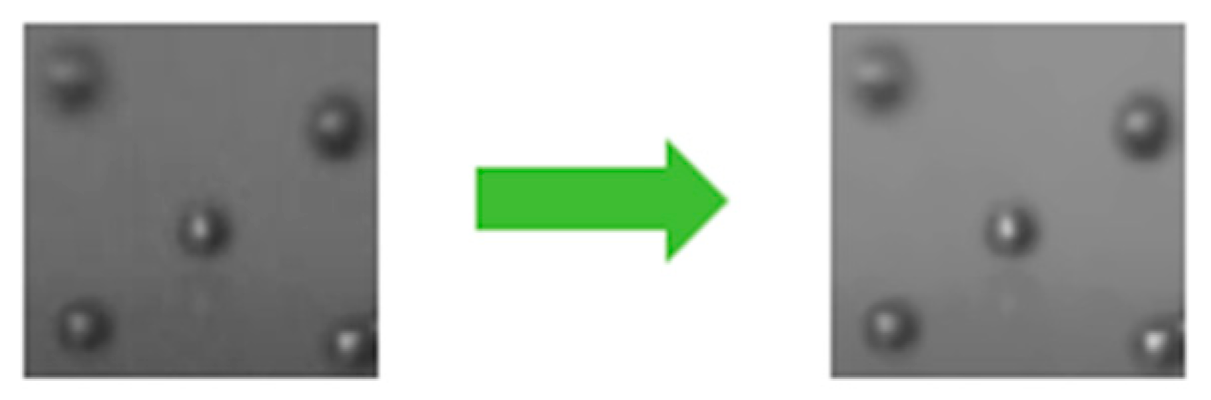
To elucidate the physical mechanisms underlying the generation of electrostatic signals from abrasive particles in high-speed fluids, a three-dimensional multiphysics simulation model coupling fluid, solid and electrical fields was developed using the COMSOL6.4 Multiphysics platform. Figure 2 illustrates the process of charge transfer following the collision of a particle with a copper ball electrode, reflecting the physical mechanism by which charge exchange occurs when the particle comes into contact with the sensing electrode during its motion; this constitutes the direct source of the electrostatic signal.
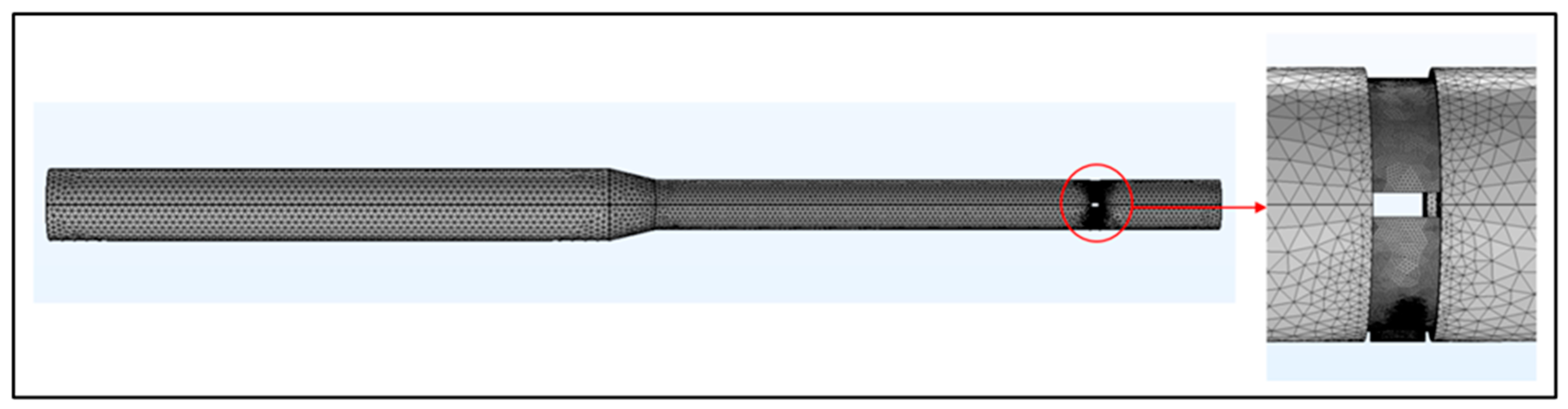
Figure 3 shows a schematic diagram of the computational domain mesh. Given the complex geometric boundaries of the pipe inner wall and the spherical electrode surface, the entire computational domain is discretised using an unstructured tetrahedral mesh to ensure high adaptability to irregular boundaries. As the collision between abrasive particles and the copper ball induction electrode triggers a sudden and severe change in the electric field gradient, and since the accurate solution of the electrostatic induction signal is highly dependent on the precise calculation of the charge density on the electrode surface, a local mesh refinement was applied to the surface of the copper ball induction electrode and the adjacent spatial region.
Table 1 presents a comparison of the peak induced charges for the coarse, medium and fine meshing schemes. Taking the results from the fine-mesh scheme as a reference, when the number of mesh elements reaches 260,000, the relative error of the calculated charge peak is only 0.11%, indicating that this meshing scheme has achieved good convergence whilst ensuring computational accuracy. The impact of further mesh refinement on the results is negligible; therefore, all subsequent simulations are based on this medium-mesh scheme.
In fluid flow modelling, an incompressible fluid model is used to describe the flow of gas within a pipe; the governing equations are the continuity equation and the Navier–Stokes equations:
· u = 0
ρ u t + u · u = p + μ 2 u
In the equation: u represents the fluid velocity vector, p represents pressure, ρ and μ represent the density and dynamic viscosity of air, respectively. Solving this equation yields the velocity distribution within the pipe, which is used to calculate the drag force exerted on the particle by the fluid.
In particle kinetics modelling, the Lagrangian method is employed to describe the motion of individual wear particles. Particles in a flow field are subject to both fluid drag and collision forces, and their translational motion is governed by Newton’s second law:
m p d v p d t = F d + F c
In the equation: m p and v p represent the mass and velocity of the particle respectively; F d represents the fluid drag; F c represents the contact force generated when the particle collides with the tube wall, other particles or the sensing electrode. Particles undergo frequent collisions whilst moving at high speed, and this process is the primary physical source of electrostatic charge generation and transfer.
In electrostatic field modelling, the effects of magnetic fields are neglected, and the Spatial Potential module is used to describe the spatial potential distribution, which satisfies Poisson’s equation:
2 φ = ρ e ε 0 ε r
where φ is the electric potential, ε 0 is the permittivity of free space, ε r is the relative permittivity, ρ e is the volume charge density. Electric field intensities E = φ and D = ε 0 ε r E . When charged abrasive particles move, an electric field is formed in the surrounding space, inducing a charge on the surface of the induced electrode. According to Gauss’s law, the total charge Q on the surface of the induced electrode can be obtained by integrating the displacement vector over the surface area of the electrode:
Q = S D · n d s
where S represents the surface of the copper ball electrode, n is the unit normal vector.
Table 2 summarizes the key simulation parameters of the six representative wear-particle types used in this study, including steel fatigue balls, alumina ceramic granules, corundum abrasive particles, exfoliated chromite particles, flake-like graphite particles, and brass swarf. The parameters include material type, relative permittivity, characteristic size, electrical conductivity, work function, and initial surface charge density. For particles marked as “Not prescribed” in the initial surface charge density column, no fixed initial surface charge density was manually assigned in the simulation. Instead, the electrostatic response was determined by the material properties, work function difference, and particle–electrode interaction conditions.

3.2. Analysis of the Electrostatic Response Characteristics of Abrasive Particles with Different Properties

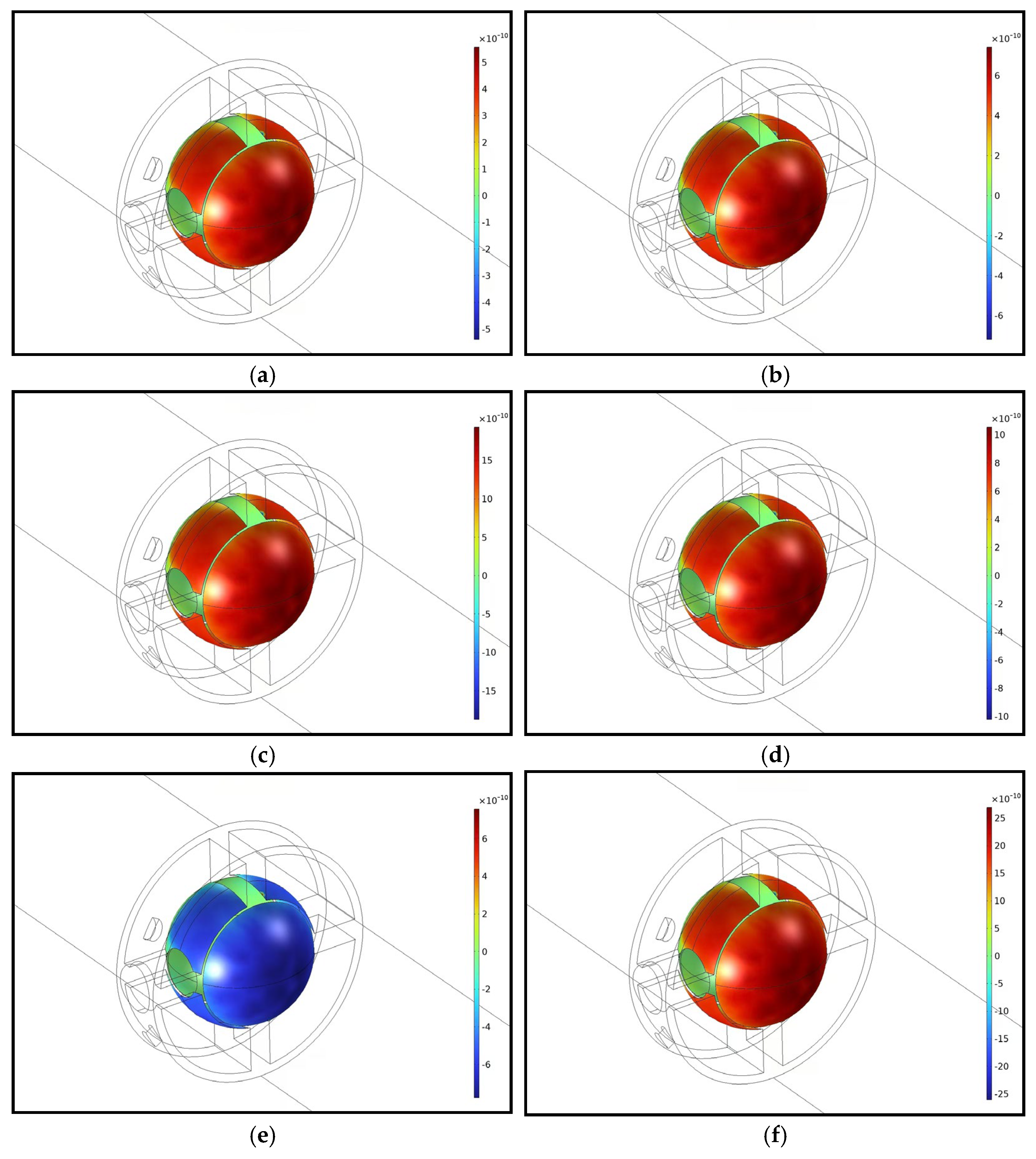
Based on the aforementioned simulation model, numerical experiments were conducted on six typical types of wear particles to systematically analyse their electrostatic response characteristics. Figure 4 shows the contour plots of the induced charge distributions formed on the electrode surface by the six types of particles. It can be seen from the figure that: the charge distribution of the stainless steel fatigue balls (a) is relatively concentrated, exhibiting localised high-value regions; the charge distribution of the Alumina ceramic granules (b) is more diffuse, covering a wider area; the Abrasive corundum (c), due to its irregular shape, exhibits an uneven charge distribution; the Exfoliated chromite particles (d) also have a relatively dispersed charge distribution; the Flake-like graphite particles (e) display a partitioning of positive and negative charges, demonstrating a distinct polarity difference; and the brass swarf (f) exhibits a highly concentrated charge distribution near the point of impact, with the highest peak.
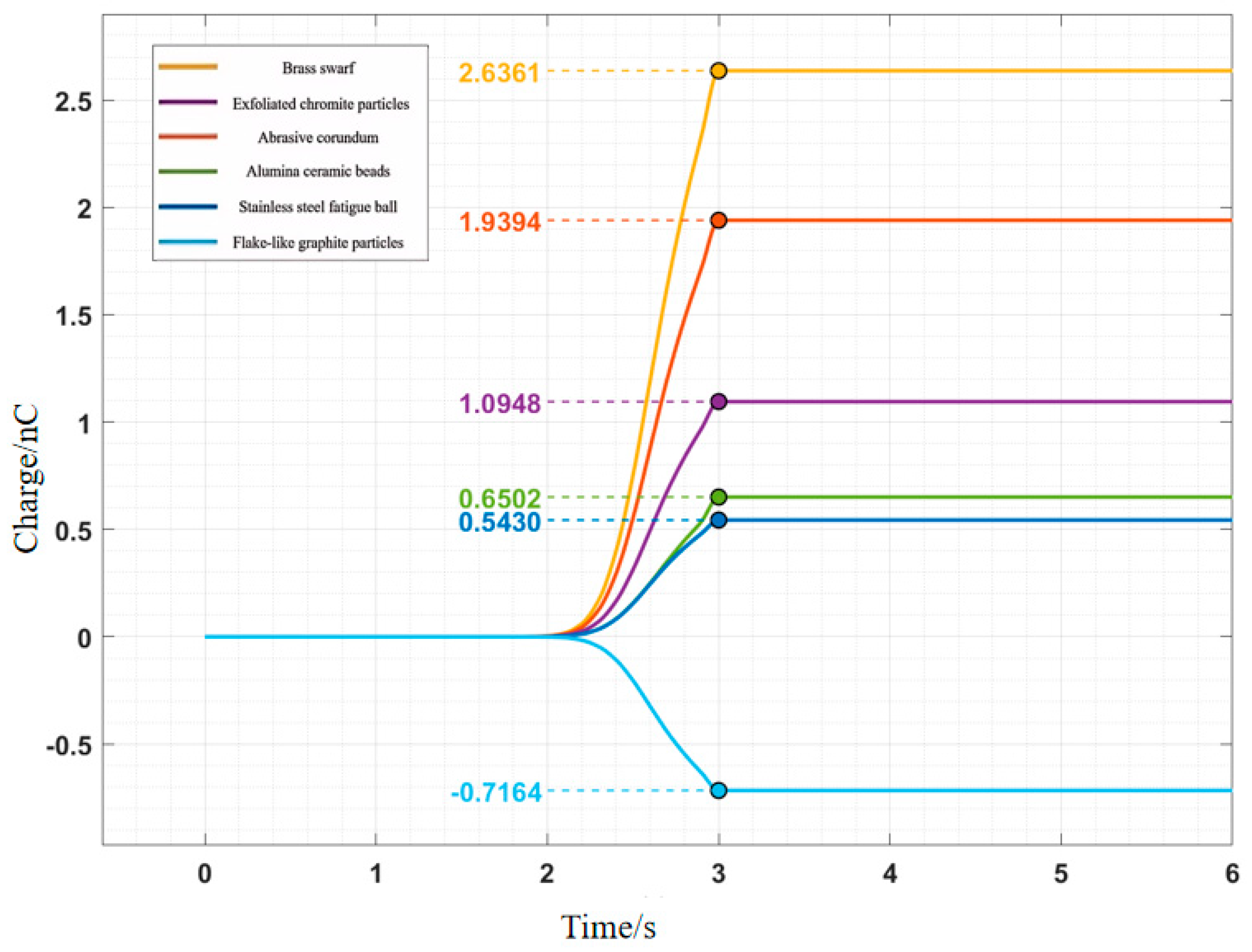
Table 3 shows the peak induced charges for six types of particles at four flow velocities: 2 m/s, 5 m/s, 8 m/s and 10 m/s. Figure 5 presents a line graph illustrating the variation in these peak induced charges. Based on the combined data from the tables and figures, the following pattern can be observed: the peak induced charge for all particle types increases monotonically with rising flow velocity; however, the rate of increase varies between particles of different materials and morphologies, with metallic and irregularly shaped particles being more sensitive to changes in flow velocity.

3.3. Analysis of the Feasibility of Characterising and Identifying Electrostatic Response Features

The simulation results reveal several electrostatic response characteristics with clear physical significance. From the perspective of material properties, metallic particles exhibit highly localized induced charge distributions with pronounced peak values, whereas non-metallic particles show relatively diffuse charge distributions. Notably, graphite particles present a distinct spatial partitioning of positive and negative charges, which can be attributed to their intrinsic layered structure and results in polarity characteristics that differ markedly from those of the other particles. With respect to particle morphology, the charge distribution patterns of irregular particles are clearly distinguishable from those of spherical particles, while curled particles are characterized by multiple localized charge-concentration regions. In addition, the peak induced charge increases with increasing flow velocity for all particle types; however, the rate of increase varies depending on both material properties and morphological characteristics. These material-, morphology-, and velocity-dependent electrostatic features exhibit appreciable separability among the six particle categories. Therefore, the simulation results indicate that preliminary classification of the six types of particles can be achieved based solely on electrostatic signals, providing both a physically interpretable basis and a clear feature-extraction strategy for subsequent electrostatic signal recognition.

4. Methods for Processing and Identifying Electrostatic Signals from High-Speed Fluid-Worn Particles

4.1. An Adaptive Noise Reduction Method for Electrostatic Signals Based on EMD-ICA

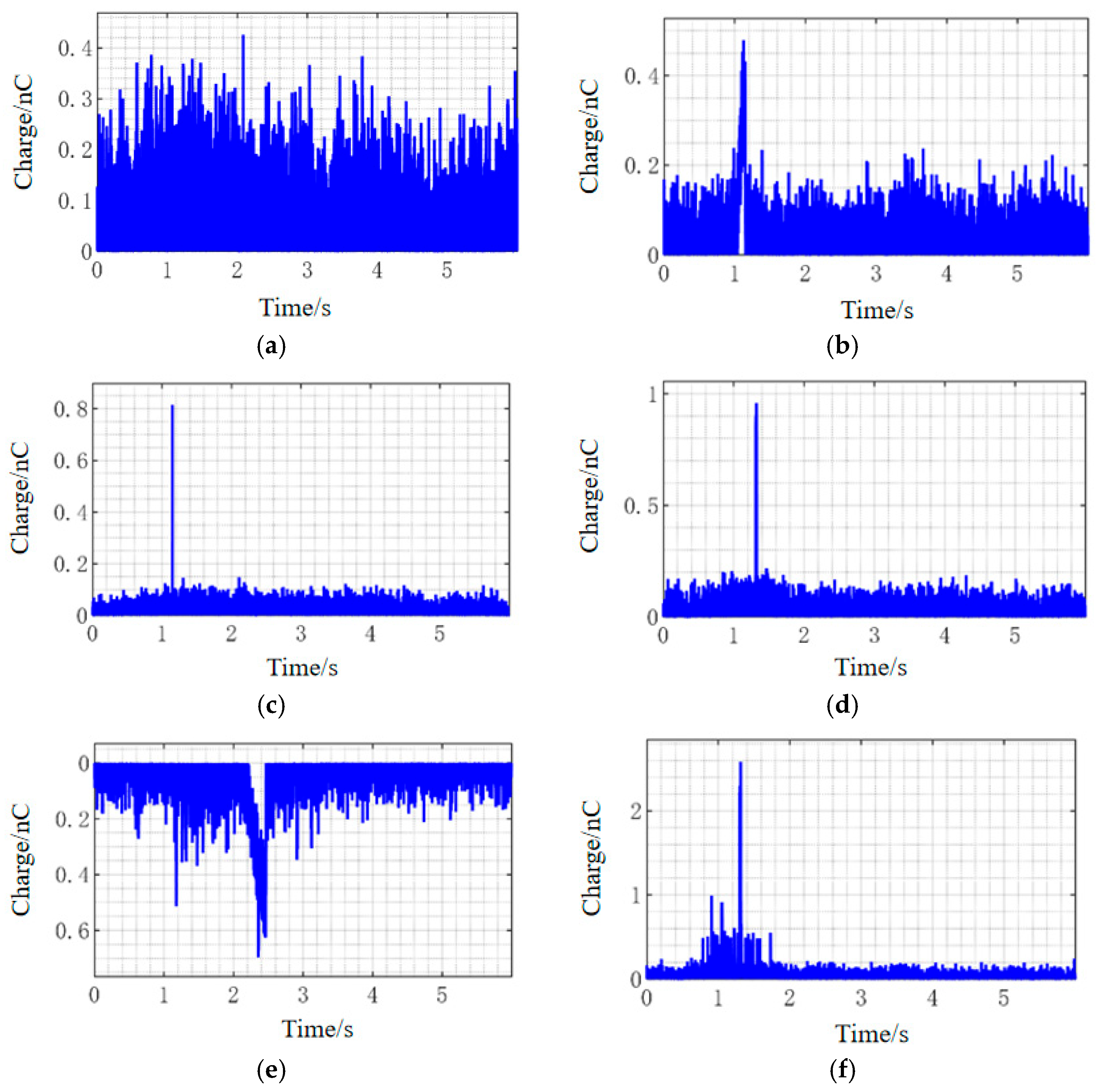
In high-speed fluid environments, the electrostatic signals generated by the interaction between wear particles and electrodes are extremely weak and are often masked by strong background noise, such as flow field vibrations and electromagnetic interference. Figure 6 shows the raw electrostatic signals of six typical wear particles collected using a high-precision charge meter at a wind speed of 10 m/s. As shown in the figure, the raw signals generally suffer from low amplitude, strong non-stationarity, and indistinct pulse characteristics; for some non-metallic particles, it is even difficult to directly identify valid pulses, which poses a significant obstacle to subsequent feature extraction and recognition.
To address the issue of significant background noise in raw electrostatic signals, we propose a joint denoising method based on Empirical Mode Decomposition (EMD) and Independent Component Analysis (ICA). EMD decomposes the raw signal into a series of intrinsic mode functions (IMFs) and a residual term:
x ( t ) = i = 1 n c i ( t ) + r n ( t )
where c i ( t ) is the i IMF component, and r n ( t ) is the residual term.
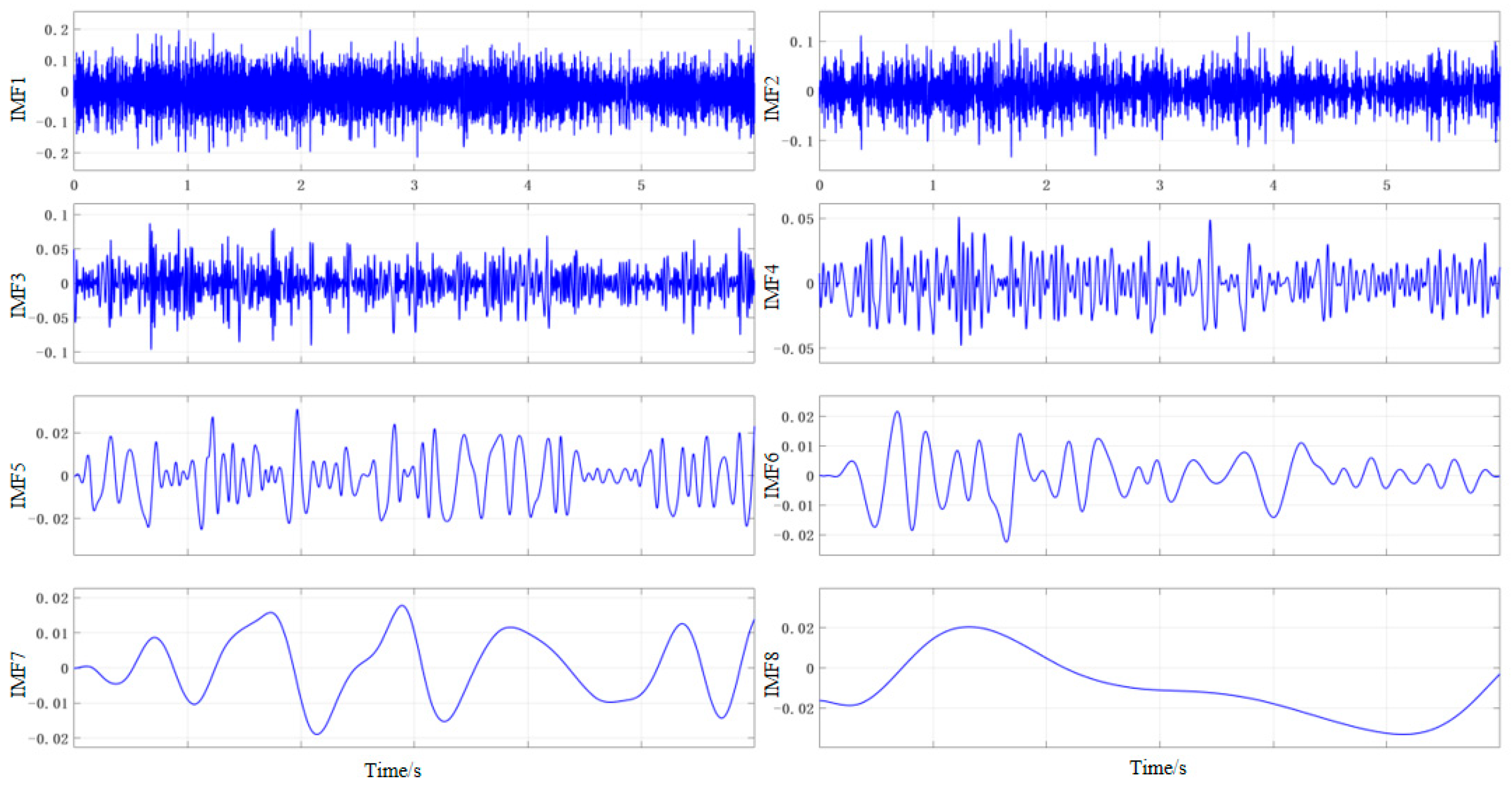
As shown in Figure 7, the high-frequency IMF components typically correspond to noise, while the mid-frequency components contain the impulse characteristics of the particles, and the low-frequency components tend to be flat. The filtered MF components are used to construct the observation signal matrix X, which is then fed into ICA for blind source separation:
X = AS + N
where X is the matrix of observed data, A is the unknown mixing matrix, S is the matrix of statistically independent source signals, and N is the additive noise matrix.
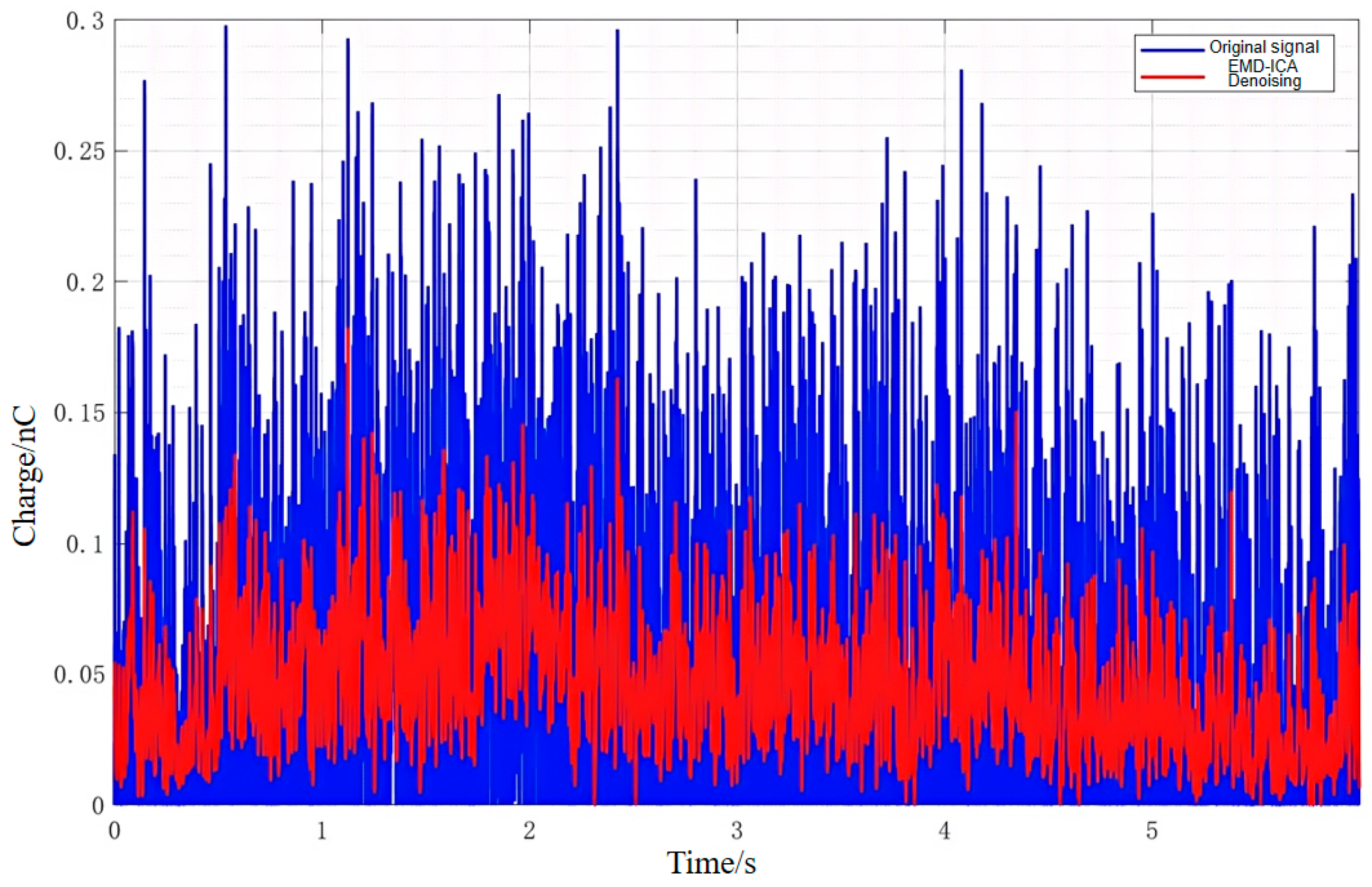
By using negative entropy as a measure of non-Gaussianity, we selected components with high negative entropy scores to reconstruct the signal. Figure 8 shows a comparison of the waveforms before and after noise reduction. The results indicate that after joint EMD-ICA noise reduction, the signal waveform is smoother, the pulse profiles are clearer, and the weak pulses that were originally buried in the noise have become easily distinguishable, effectively restoring the physical characteristics of the signal.

4.2. Analysis of Electrostatic Signal Characteristics

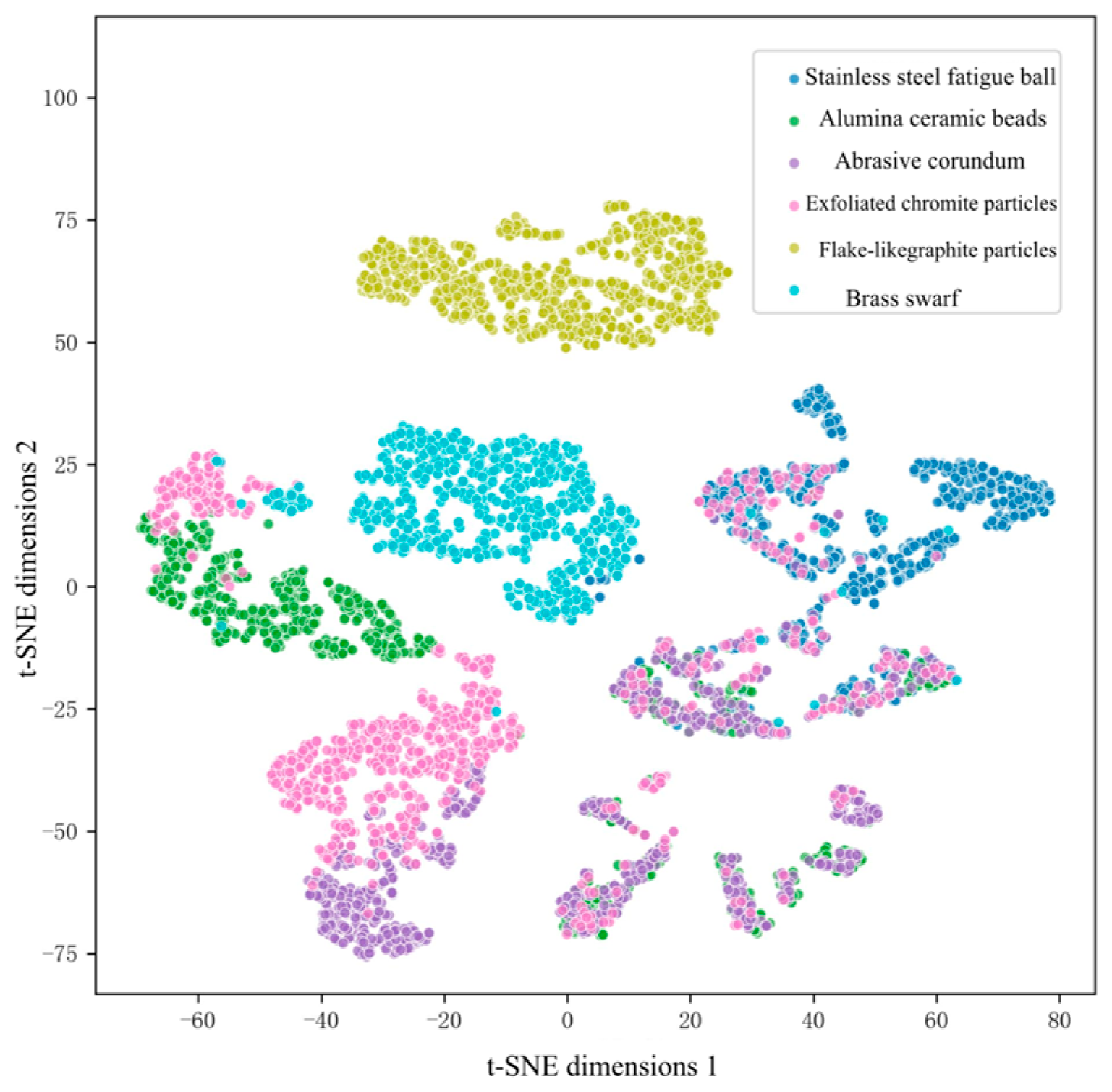
To quantify the differences in the electrostatic responses of particles across different categories, this paper extracted a total of 20 feature parameters from the noise-reduced reconstructed signals, based on three dimensions: time-domain statistics, distribution characteristics, and correlation and complexity. These include variance, energy, root mean square, standard deviation, absolute mean, kurtosis, skewness, information entropy, Hjorth complexity, peak factor, pulse factor, and autocorrelation decay coefficient. To validate the proposed feature set’s ability to distinguish among the six particle categories, the t-SNE algorithm was employed to perform dimensionality reduction and visualization of the high-dimensional feature vectors.
The t-SNE visualization in Figure 9 shows that the six types of particles form clusters with relatively distinct boundaries in the two-dimensional feature space. In particular, brass chips (a type of metal), stainless steel fatigue balls, aluminum oxide ceramic particles (a type of non-metal), and graphite flake particles with unique negative polarity are clearly separated from one another. This demonstrates that the constructed feature set can effectively characterize the differences in electrostatic responses among particles of different materials and morphologies, laying a solid data foundation for subsequent Transformer-based classification and recognition.

4.3. Transformer-Based Method for Static Signal Recognition

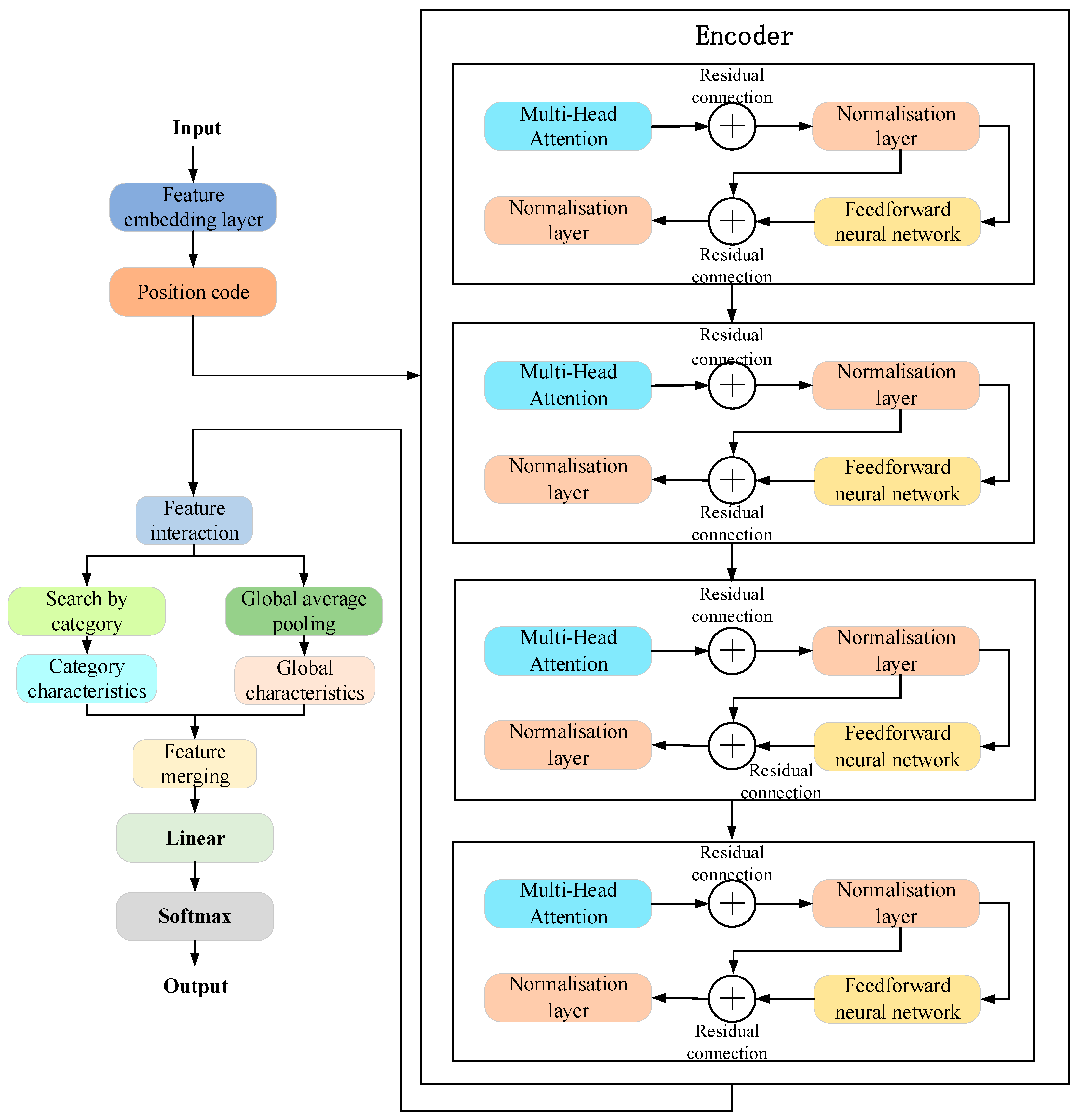
The workflow of the Transformer-based electrostatic signal recognition model described in this paper is shown in Figure 10. The model takes a denoised signal sequence as input. After feature embedding and positional encoding, the signal is fed into a core network consisting of four stacked Transformer encoders (each layer contains an 8-head self-attention mechanism with a hidden dimension of 256). The self-attention calculation process is as follows:
Attention ( Q , K , V ) = s o f t max ( Q K T d k ) V
In the formula: Q , K , V represent the query, key, and value matrices, respectively, d k is the dimension of the key vector.
Figure 10. Workflow of the Electrostatic Identification Method.
Processes 14 01918 g010
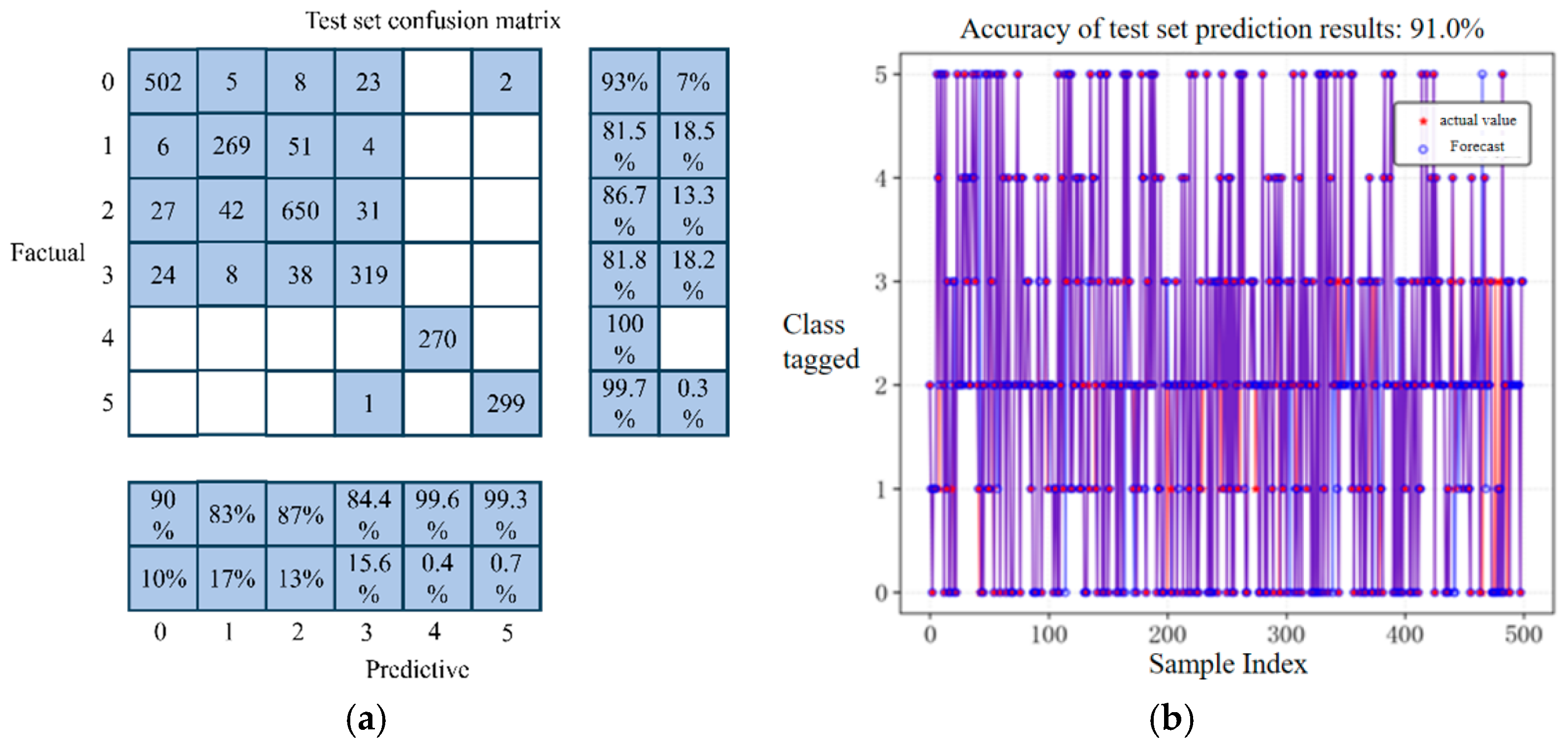
The model also incorporates a dedicated module for the collaborative extraction of category-specific and global features. The test results in Figure 11 show that the model achieved an average recognition accuracy of 91.0%, with specific accuracies of 93.0% for stainless steel fatigue balls, 99.7% for brass chips, 100% for graphite flakes, 81.5% for alumina ceramic particles, and 81.8% for flaking chromite particles. The comparative experiments in Table 4 demonstrate that the proposed Transformer model significantly outperforms baseline models such as SVM, RF, LSTM, and BiLSTM across all evaluation metrics.

5. Image Processing and Recognition Methods for High-Speed Fluid-Worn Particles

5.1. Image Preprocessing Methods for Particles

To address motion blur and background interference in particle images captured in high-speed fluid environments, this paper proposes an integrated image preprocessing workflow. This workflow consists of the following steps: template matching to remove the lower boundary of the pipe, as shown in Figure 12; geometric feature filtering to isolate particle contours, as shown in Figure 13; adaptive region scoring to select the optimal region, as shown in Figure 14; and cropping the selected region to 224 × 224 pixels followed by image enhancement, as shown in Figure 15. The adaptive region scoring function is defined as:
S ( R ) = ω 1 S c o u n t + ω 2 S d e n s i t y + ω 3 S c e n t e r + ω 4 S c o n t r a s t
In the formula: S ( R ) represents the composite score for region R , S c o u n t represents the score for particle count, S d e n s i t y represents the score for spatial density, S c e n t e r represents the score for centrality, S c o n t r a s t represents the score for contrast, ω 1 ~ ω 4 represents the weighting coefficient.
Figure 12. Effect of removing the lower boundary of the pipe.
Processes 14 01918 g012
Figure 13. Particle contour extraction results.
Processes 14 01918 g013
Figure 14. Schematic diagram of adaptive region selection.
Processes 14 01918 g014
Figure 15. Comparison of image enhancement results.
Processes 14 01918 g015

5.2. ECA-CNN-Based Particle Image Recognition Model

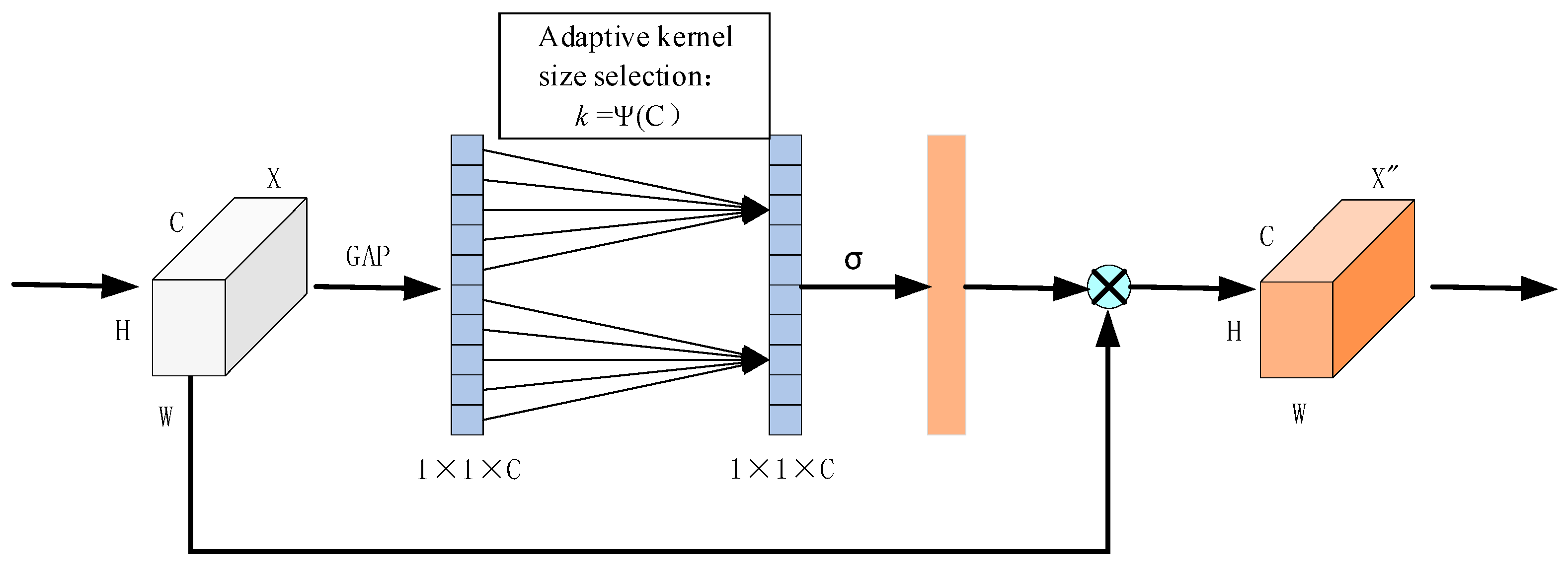
To enhance the model’s focus on key features of particles in blurry images, this paper proposes a convolutional neural network that incorporates an efficient channel attention mechanism. In Figure 16, the ECA module generates channel weights through global average pooling and one-dimensional convolution, with the size of the convolution kernel determined adaptively:
k = ψ ( C ) = log 2 ( C ) γ + b γ o d d
where k is the size of the one-dimensional convolution kernel, C is the number of channels in the input feature map, γ and b are adaptive parameters (typically set to γ = 2 , b = 1 ), o d d denotes the nearest odd number.
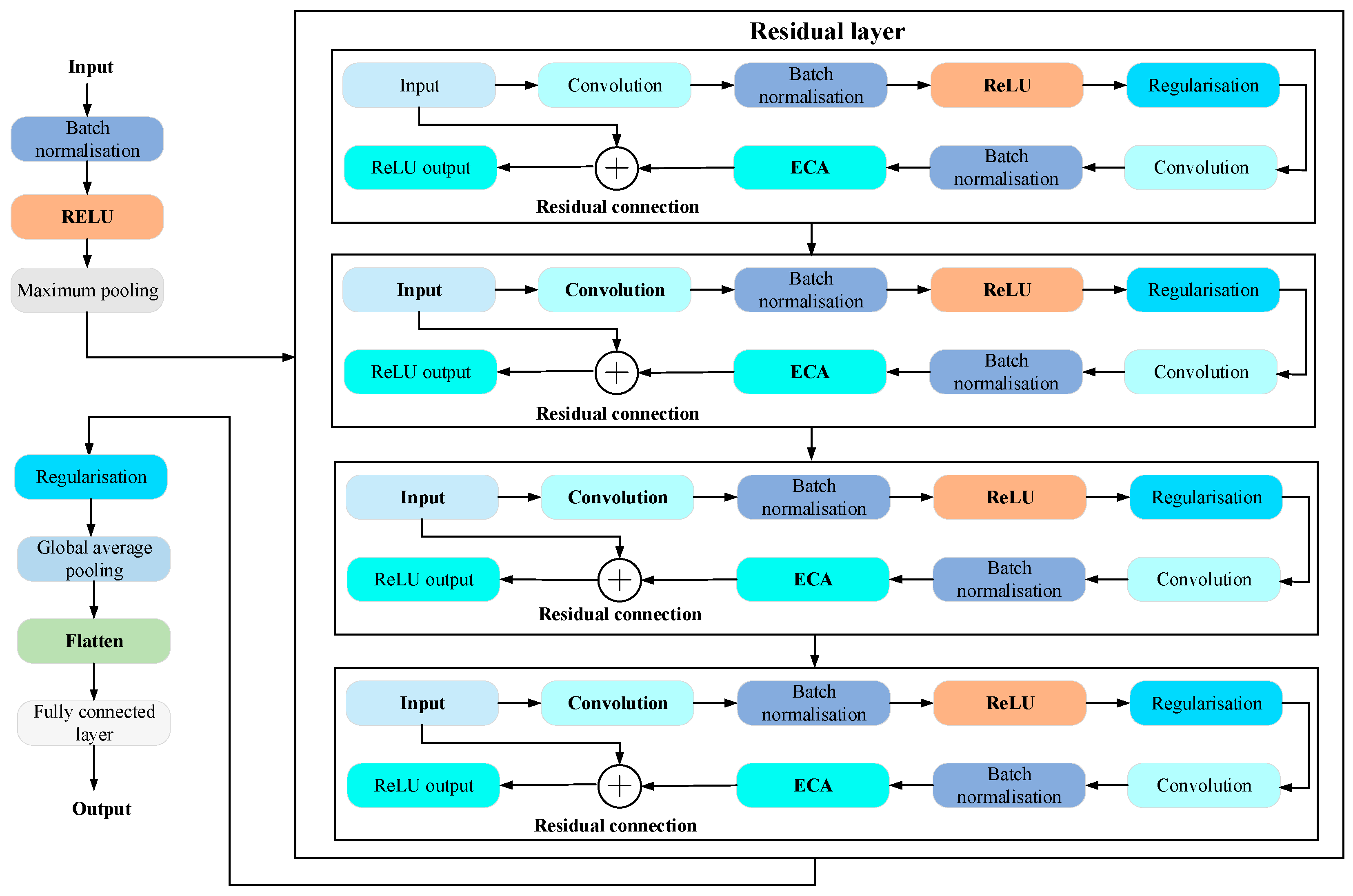
As shown in Figure 17, the model uses ResNet34 as its backbone network, embeds ECA modules in each residual block, and finally outputs the probability distributions for the six classes via a fully connected layer.

5.3. Training Image Recognition Models and Configuring Parameters

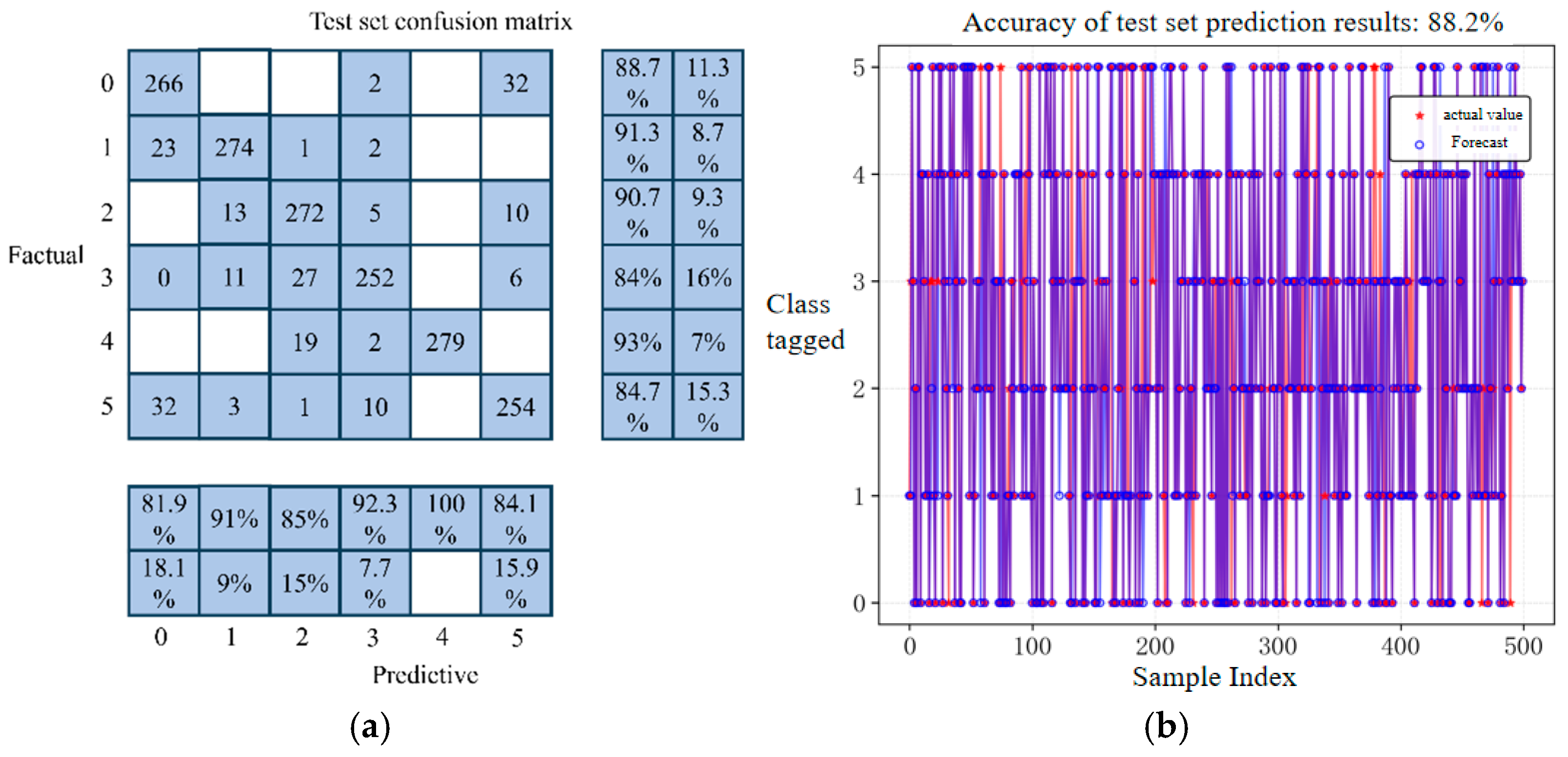
The model was trained using a preprocessed image dataset. The test results in Figure 18 show that the final model achieved an average recognition accuracy of 88.7%, with specific accuracies of 93.0% for graphite flake particles, 91.3% for alumina ceramic spheres, 90.7% for intrusive corundum abrasives, 88.7% for stainless steel fatigue balls, 84.0% for exfoliated chromite particles, and 84.7% for brass chips. The comparative experiments in Table 5 confirm that the CNN model incorporating the ECA attention mechanism outperforms mainstream models such as VGG16, MobileNetV2, ResNet50, and EfficientNet-B0 in terms of recognition accuracy.

6. Sample-Adaptive Decision-Level Fusion Method

6.1. Methods for Characterizing Multi-Source Recognition Results

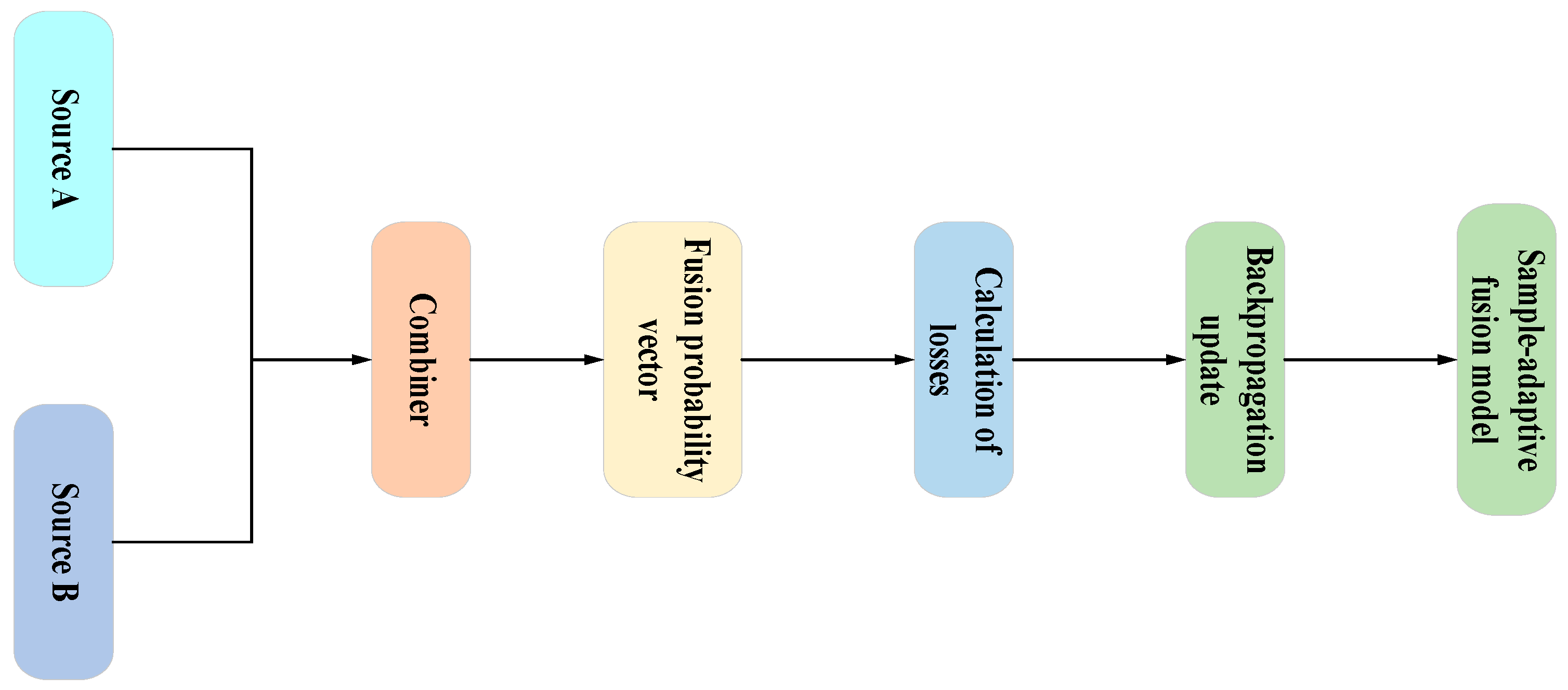
To achieve decision-level fusion, the six-dimensional probability vectors P e l e c and P v i s —output by the electrostatic Transformer model and the visual CNN-ECA model, respectively—are first concatenated into a 12-dimensional joint vector z = [ P e l e c ; P v i s ] . Through precise timestamp matching, a total of 1200 pairs of samples were obtained, which were divided into training and testing sets in a 4:1 ratio. Figure 19 illustrates the overall framework for multi-source information fusion and recognition.

6.2. Construction of a Sample-Adaptive Decision Fusion Model

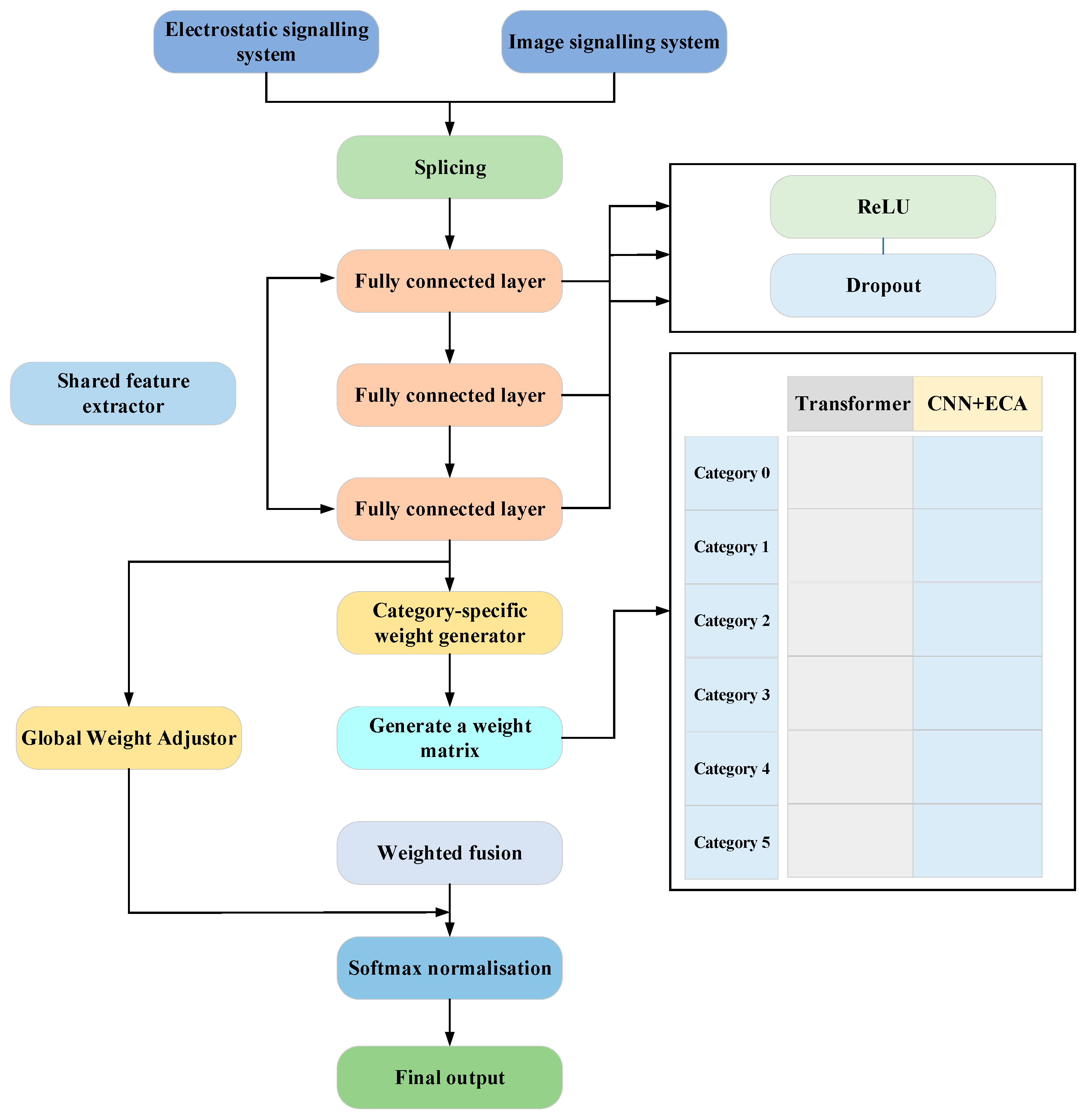
The structure of the sample-adaptive fusion model proposed in this paper is shown in Figure 20. The model primarily consists of three components: a shared feature extraction layer, a category-specific weight generator, and a global adjustment factor. For a given category, the formula for calculating the fusion probability is:
p p r e ( c ) = ω ^ e l e c ( c ) p e l e c ( c ) + ω ^ v i s ( c ) p v i s ( c )
where p p r e ( c ) is the initial fusion probability for class c ; ω ^ e l e c ( c ) and ω ^ v i s ( c ) are the contribution weights of electrostatic and visual information, respectively, for class c (satisfying ω ^ e l e c ( c ) + ω v i s ( c ) = 1 ); p e l e c ( c ) and p v i s ( c ) are the probabilities of class c output by the electrostatic model and the visual model, respectively.
The combined loss function:
ι = ι C E + λ 1 ι g u i d e + λ 2 ι d i f f
In the equation: ι C E represents the cross-entropy loss, ι g u i d e represents the guidance loss (which encourages weight distributions that align with physical priors), ι d i f f represents the difference-constrained loss (which penalizes excessive differences between the weights of the two modalities), λ 1 and λ 2 are balancing hyperparameters.

6.3. Integrated Decision-Making Process

For a test sample, the static probability vector P e l e c and the visual probability vector P v i s are first concatenated to form z = [ P e l e c ; P v i s ] , and joint features h = f s h a r e ( z ) are obtained through a shared feature extraction layer; then, a class-specific weight generator produces a pair of weights [ ω ^ e l e c ( c ) , ω ^ v i s ( c ) ] = S o f t max ( W c ( w ) h + b c ( w ) ) for each class c , and a preliminary fusion probability is calculated; simultaneously, a global adjustment factor network yields α = σ ( w α T h + b α ) which is used to fine-tune the preliminary probability to obtain p ˜ ( c ) = ( 1 α ) p p r e ( c ) + α 1 6 ; finally, the final fusion probability is obtained through Softmax normalization, and the class corresponding to the maximum probability is selected as the prediction result:
y ^ = arg max c ( S o f t max ( ( 1 α ) p p r e + α 1 6 ) )
In the equation: y ^ represents the category predicted by the model, p p r e = [ p p r e ( 0 ) , p p r e ( 1 ) , , p p r e ( 5 ) ] T represents the initial fusion probability vector, α represents the global adjustment factor, 1 6 represents the uniform probability vector, and Softmax represents the normalization function.

7. Experiments and Analysis of Results

7.1. Experimental Setup and Dataset

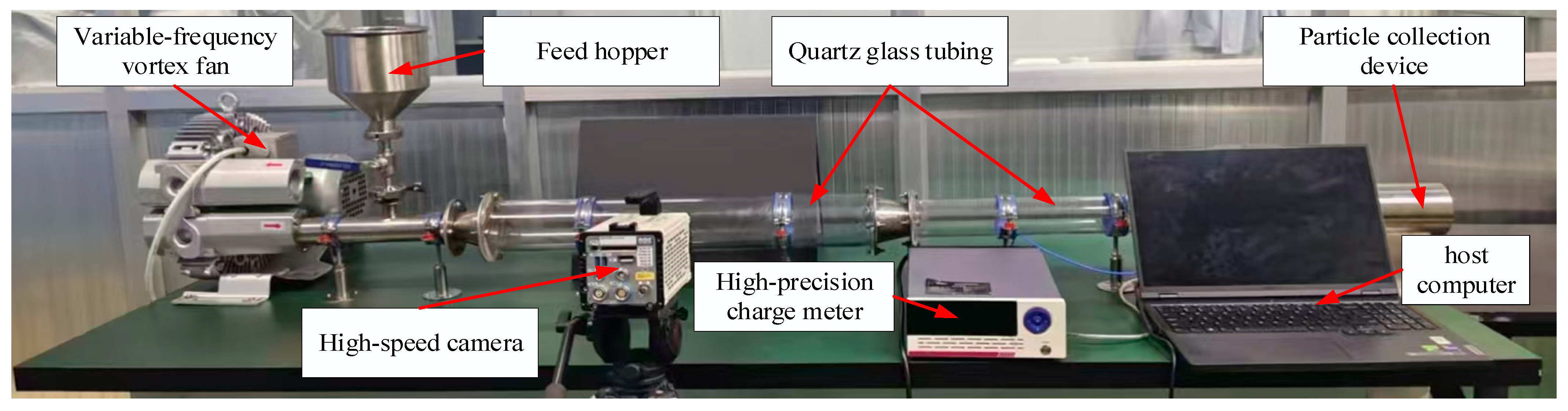
To verify the effectiveness of the proposed method, a high-speed fluid-induced wear particle test bench was constructed, as shown in Figure 21. The system consists of a CWG10-0.75T4-1B variable-frequency vortex blower for generating airflow with an adjustable velocity range of 0–10 m/s, a MEMRECAM HX-7S high-speed camera (Manufacturer: NAC Image Technology, Howell, MI, USA) operating at 5000 fps for particle image acquisition, and a HEST111A high-precision charge meter with a charge acquisition rate of 1000 Hz for electrostatic signal measurement. At a wind speed of 10 m/s, 1000 valid samples were collected for each of the six particle types. Through time-stamp pairing, a dataset comprising 6000 pairs of samples was ultimately generated. All 6000 pairs of samples were divided into training, validation and test sets using stratified random sampling, with a split ratio of 80%:20%. As each particle class contains 1000 valid sample pairs, each class was divided into 800 training samples and 200 test samples; the six classes together comprise a total of 4800 training samples and 1200 test samples. See Table 6 for details. Specifically, the electrostatic recognition model and the visual recognition model were trained using the electrostatic samples and image samples from their respective training subsets, and validation and testing were conducted under the same partitioning scheme; the decision-layer fusion model was trained and evaluated based on the output results of the two single-modal models under the same training/testing partitioning scheme.
The fused samples are not additionally collected independent samples. Instead, each fused sample is constructed from the electrostatic signal and the synchronously captured image corresponding to the same particle event. Therefore, the number of fused samples is identical to the number of corresponding electrostatic signal samples and image samples.
The collected data include different categories of wear particles and cover variations in particle size, morphology, motion state, electrostatic response intensity, and image acquisition quality. Under high-speed fluid conditions, the motion state of wear particles is inherently variable. The electrostatic signals may be affected by particle charging state, motion trajectory, and local flow-field disturbance, while the particle images may suffer from motion blur, local texture degradation, unclear boundaries, and subtle inter-class morphological differences. Therefore, the dataset used in this study is not collected under fully idealized or static conditions; instead, it contains typical multi-source information fluctuations encountered in high-speed fluid wear particle identification. To further clarify the representativeness of the dataset, the samples used in this study were not generated by repeatedly augmenting a single particle image or a single signal segment. Instead, they were constructed from multiple independent particle events formed when different types of wear particles passed through the detection region on the high-speed fluid experimental platform. Each independent particle event corresponds to the electrostatic response and synchronised visual image acquired when a particle passes through the sensing region, ensuring event-level correspondence between the electrical signal and image information. The dataset covers wear particles with different material types and damage morphologies, including metallic particles, ceramic particles, and flaking particles, and contains intra-class variations caused by differences in particle size, posture, spatial position, image blurring, and signal amplitude fluctuation. Nevertheless, the current dataset was mainly collected from the same experimental platform under controlled flow conditions, and its diversity cannot fully represent the data distribution generated during long-term operation in real industrial sites. Therefore, the interpretation of model performance in this study is limited to the current experimental dataset, and future work will further collect and validate larger-scale independent particle events across different equipment and operating conditions.
To enhance the reproducibility of the experiments, this paper summarises the main training settings and key hyperparameters of the proposed models in Table 7. All models were implemented using PyTorch2.8 and trained on a platform equipped with an Intel i9 processor. The Adam optimiser is uniformly adopted throughout this paper, with an initial learning rate set to 1 × 10⁻³, a batch size of 32, and a maximum training epoch of 100. Learning rate scheduling employs the ReduceLROnPlateau strategy with a decay factor of 0.5, and the model achieving the highest validation set accuracy is selected for the final test.
For the electrostatic recognition branch, the electrostatic time-series signals processed via EMD-ICA are fed into a Transformer model, with the following key parameters: 4 encoder layers, 4 attention heads, 128-dimensional embedding representations, and a 256-dimensional feedforward network hidden layer. For the visual recognition branch, all particle images were uniformly resized to 224 × 224 pixels and fed into the constructed ECA-CNN model. For the fusion branch, the decision layer fuses the class probability vectors output by the electrostatic and visual models, with the fusion network configured as a lightweight multi-layer perceptron. Furthermore, key modules such as the class-specific weight generator, global scaling factor, guidance loss and interpolation loss are enabled in the complete fusion model.

7.2. Analysis of Recognition Performance and Weights for the Fusion Model

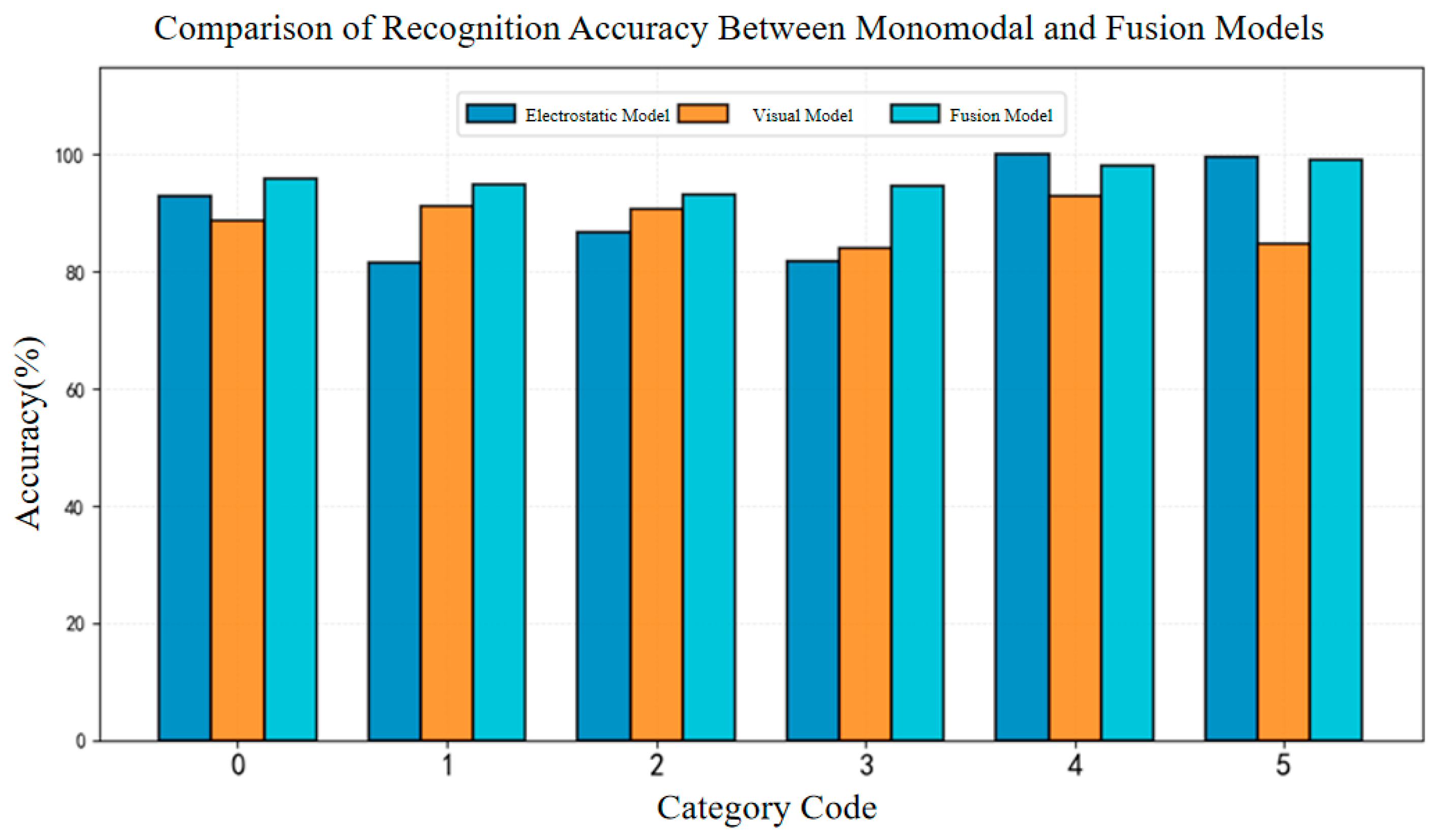
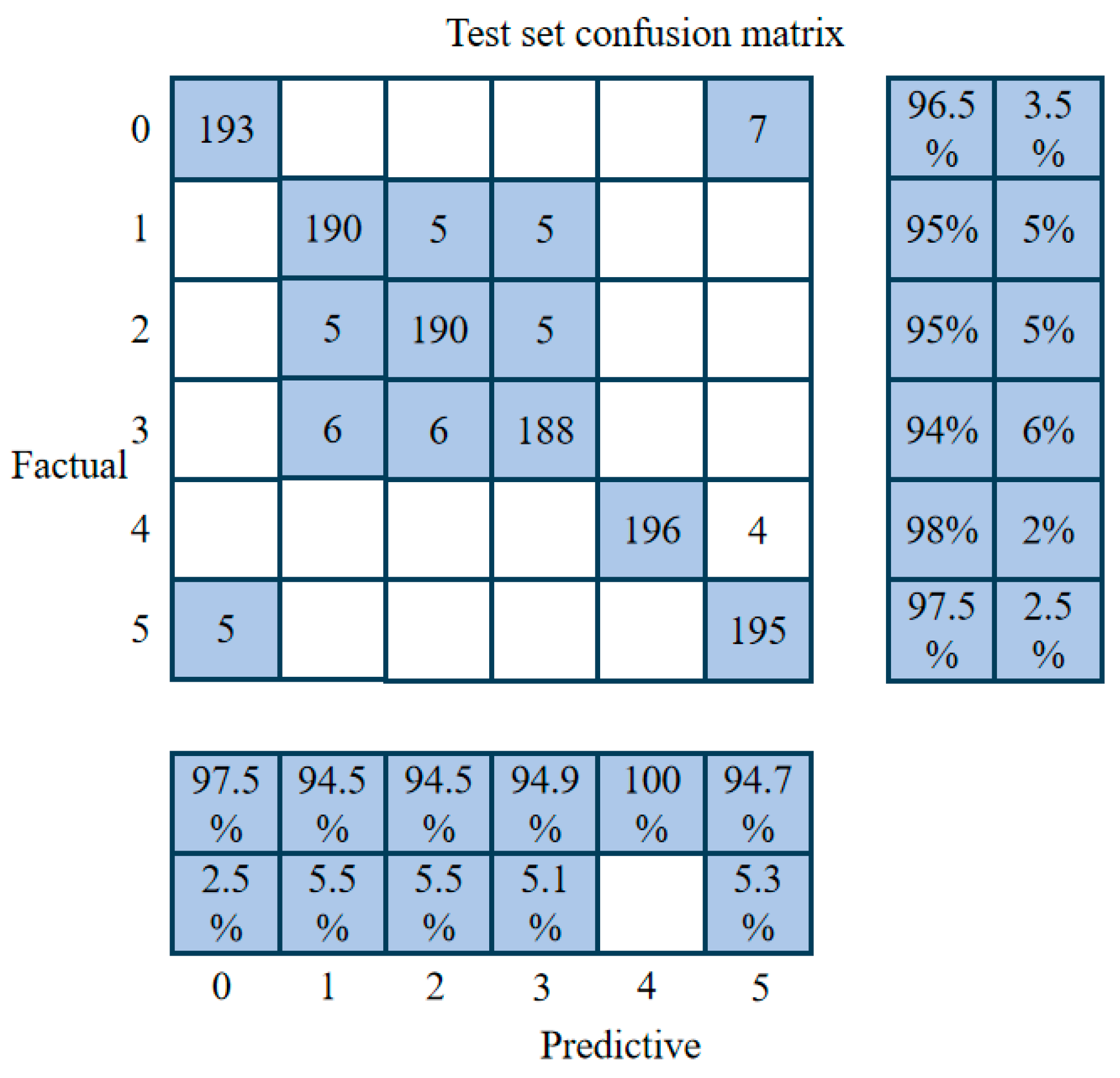
The experimental results show that the fusion model proposed in this paper achieves an average recognition accuracy of 96.0%, representing a 5.0% improvement over the electrostatic model (91.0%) and a 7.3% improvement over the visual model (88.7%). Figure 22 shows the recognition accuracy rates for each category. The ablation experiments in Table 8 further validate the effectiveness of the model’s key components, such as the category-specific weight generator, global adjustment factor, and related loss functions. To further provide a comprehensive evaluation of the classification performance of the proposed fusion model, the average recognition accuracy alone was not considered sufficient. Therefore, the confusion matrix of the final fusion model on the test set is presented in Figure 23. In addition, the class-wise precision, recall, and F1-scores were calculated based on the confusion matrix, as listed in Table 9.
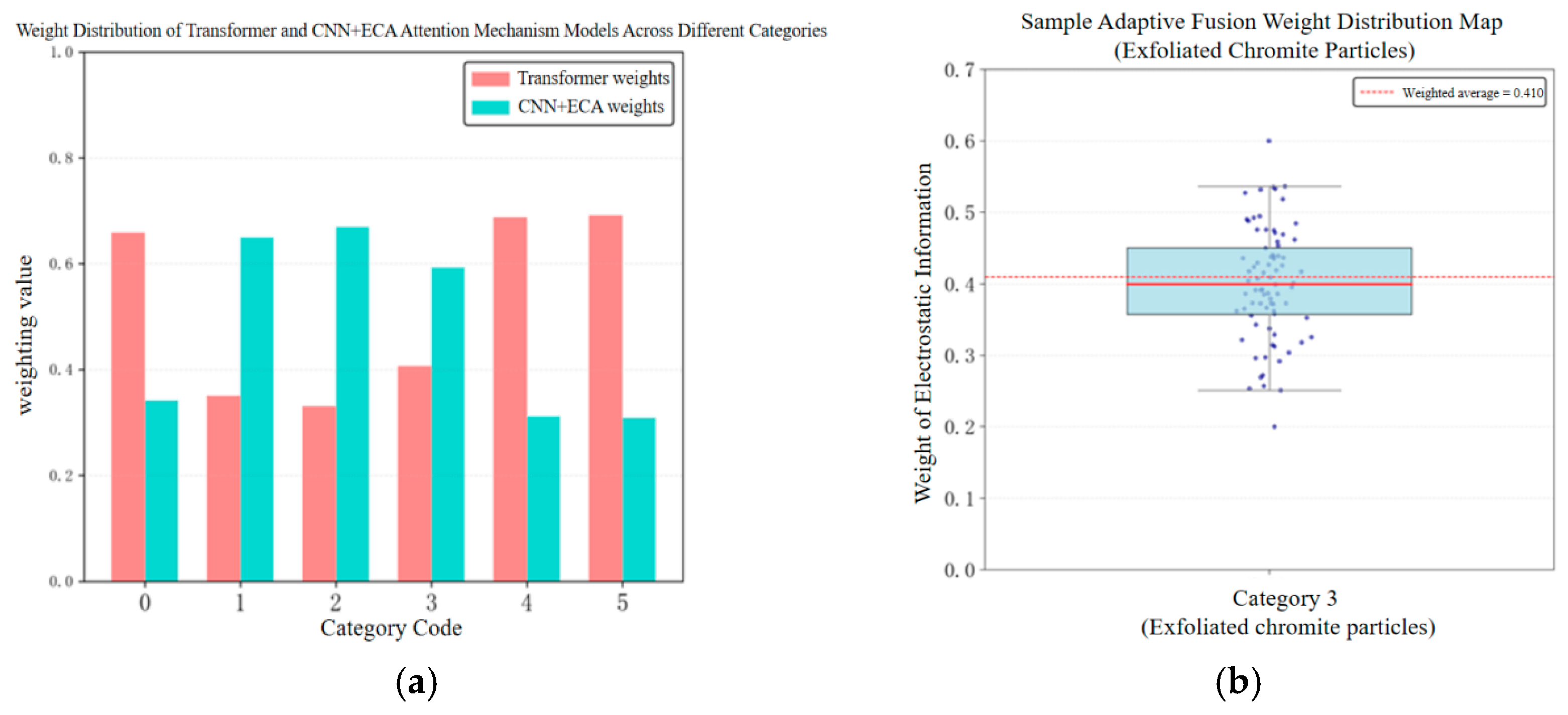
The analysis of average weight distribution in Figure 24a shows that the fusion model can adaptively adjust its decision-making preferences based on particle properties: for metallic particles (such as brass and stainless steel), the model places greater emphasis on electrostatic information (with a weight of approximately 0.68); for non-metallic particles, it places greater emphasis on visual information (with a weight of approximately 0.64); and for graphite particles, which have unique polar characteristics, the weight of electrostatic information reaches as high as 0.69. Figure 24b, using exfoliated chromite particles as an example, demonstrates fluctuations in weight distribution among similar samples, fully demonstrating that the model has achieved a sample-adaptive decision-making mechanism tailored to specific conditions.

7.3. Comparison of Different Fusion Methods

To comprehensively evaluate the performance advantages of the proposed sample-adaptive decision fusion method, this paper selects four representative fusion strategies for comparative experiments, including D-S evidence theory, support vector machines, random forests, and the weighted average fusion method.
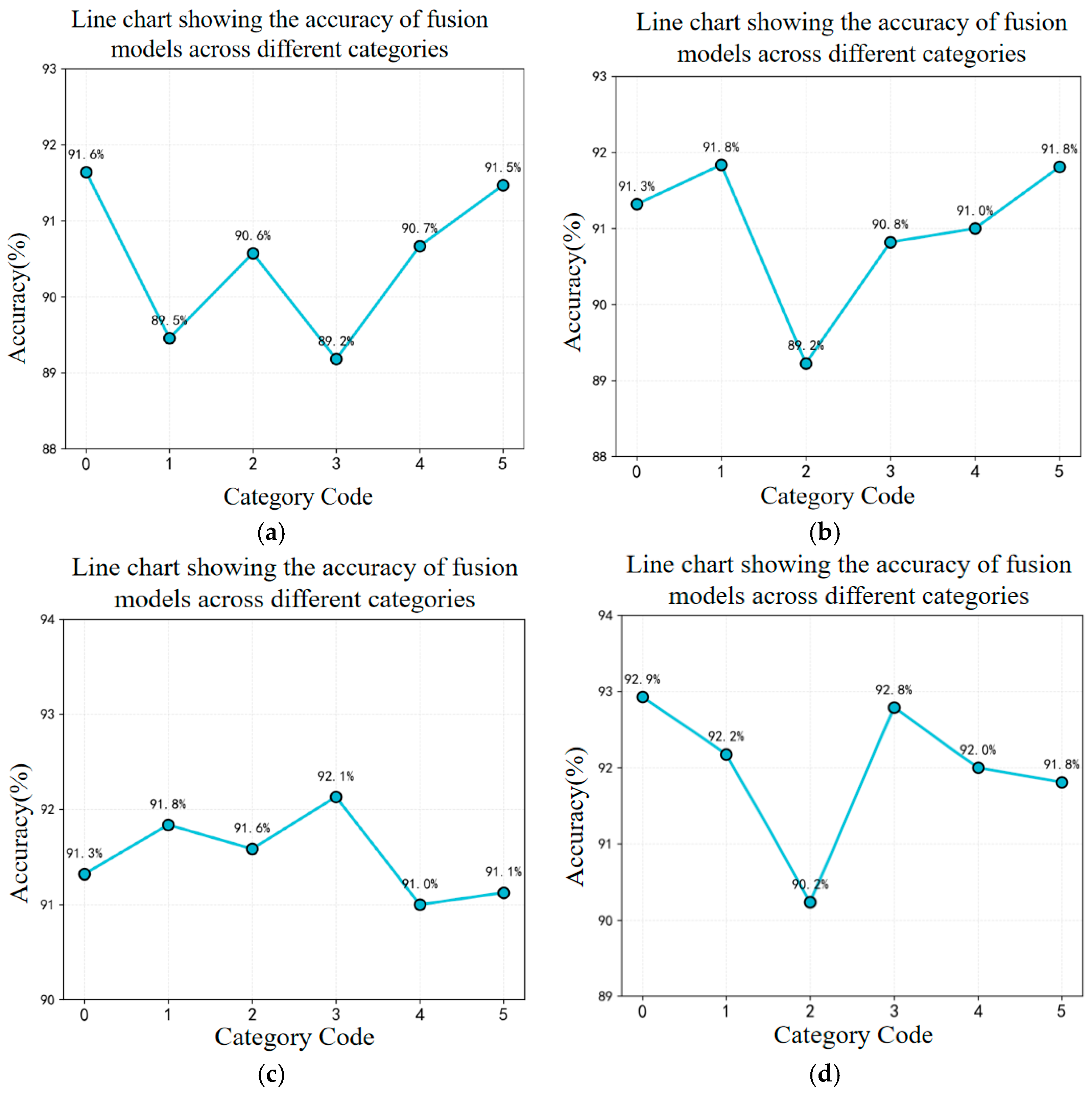
Figure 25 shows a comparison of recognition accuracy across different fusion methods on the test set. As shown in the figure, the proposed sample-adaptive fusion method achieved the highest recognition accuracy of 96.0%, representing a significant improvement over weighted average fusion (92.0%), random forest (91.5%), support vector machines (91.0%), and D-S evidence theory (90.5%). Further analysis of recognition performance across categories reveals that traditional fusion methods generally exhibit low recognition accuracy for certain challenging categories (such as alumina ceramic particles and flaking chromite particles), often leading to misclassification between categories. In contrast, the method proposed in this paper employs a sample-adaptive weight allocation mechanism that dynamically adjusts the fusion strategy based on the dual-source discrimination capability of individual samples. This effectively mitigates category confusion and results in more balanced recognition accuracy across all categories.
To further verify the stability of the adaptive weighting mechanism, the dual-source weight distributions for each particle category were analyzed across different random seeds and cross-validation folds. The results show that although the weights of individual samples fluctuate adaptively according to feature quality, the average weight preference of each category remains consistent across repeated experiments: metallic particles still rely more on electrostatic information, non-metallic particles rely more on visual information, and graphite particles exhibit a stronger preference for electrostatic information. The relatively small standard deviations of the weights indicate that the weighting behavior is not random but can stably reflect the discriminative contribution of different information sources for different sample categories. As shown in Table 10.
It should be noted that although the proposed fusion method achieved a high recognition accuracy on the test set, this result should be interpreted cautiously in relation to the dataset size and sample source. On the one hand, the high accuracy can be mainly attributed to the complementarity between electrostatic signals and visual images, as well as the ability of the sample-adaptive fusion mechanism to dynamically adjust the contribution weights of the two information sources according to their discriminative reliability for each sample. On the other hand, because the current dataset is relatively limited in scale and the samples were mainly collected from the same experimental platform, the high recognition accuracy does not imply that the model has fully achieved cross-equipment, cross-condition, and cross-scenario generalisation. To reduce the influence of random data partitioning, repeated trials were conducted to report the mean accuracy, standard deviation, and confidence interval, and the model stability was preliminarily evaluated through ablation experiments and noise-robustness tests. Nevertheless, future studies should include more independent particle events, more diverse wear particle types, a wider range of flow velocities and oil conditions, and data from different experimental platforms or industrial equipment to further verify the stability and generalisation capability of the model.
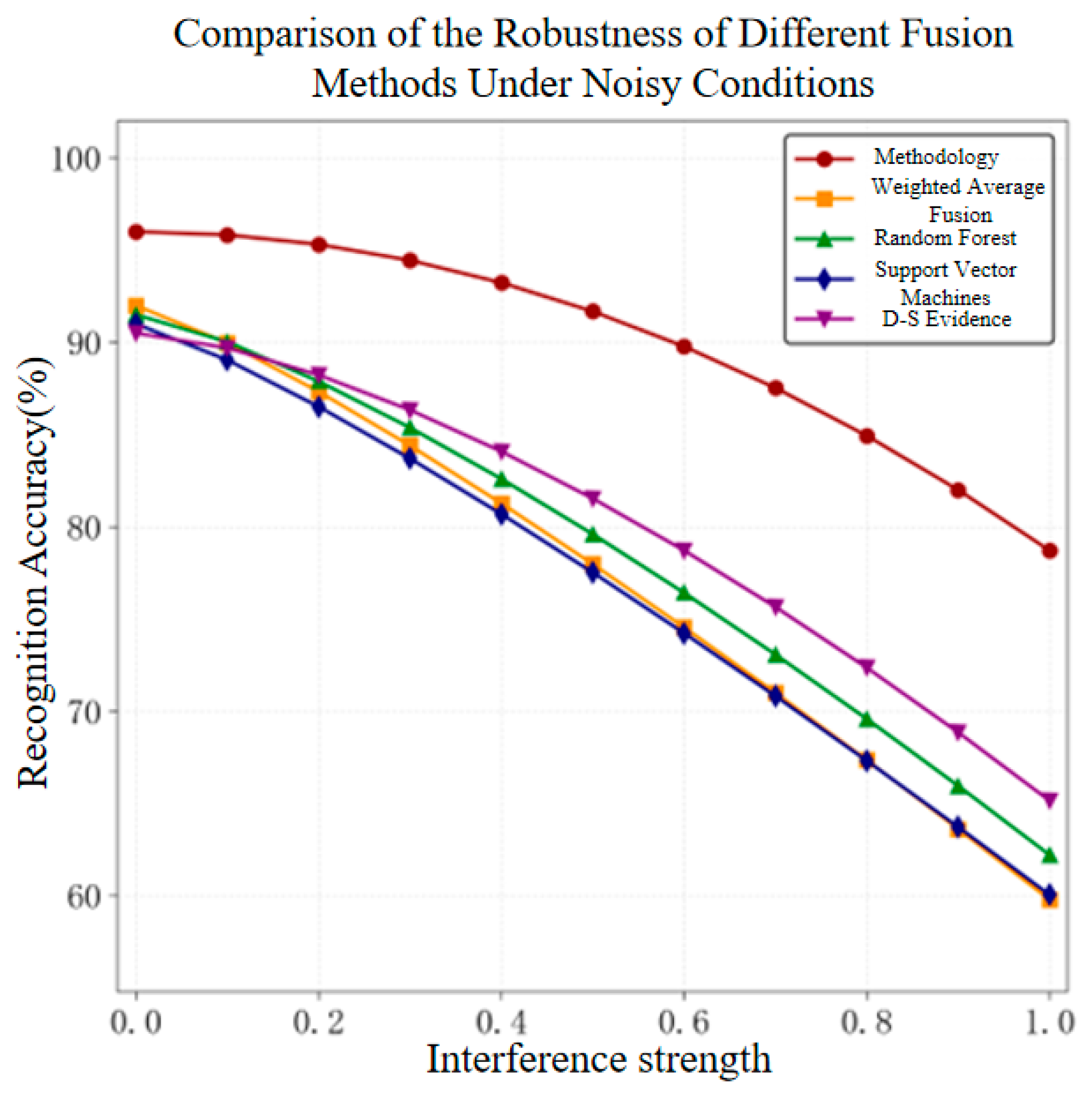
To further evaluate the robustness of different fusion methods under complex operating conditions, a comparative anti-interference experiment was conducted. Gaussian white noise with varying signal-to-noise ratios was added to the raw electrostatic signals, while Gaussian blur with different variances was applied to the visual images, thereby simulating signal and image degradation encountered in practical scenarios. As shown in Figure 26, the recognition accuracy of all fusion methods decreases with increasing interference intensity. Nevertheless, the proposed method consistently achieves the highest accuracy under all interference conditions and exhibits the slowest performance degradation. To avoid overestimating recognition performance, the experimental dataset was constructed to include multi-source information fluctuations, image degradation, and signal uncertainty, and the model was further assessed through repeated trials, ablation studies, and noise robustness tests. However, since the current dataset was mainly collected from an experimental platform, long-term field data from real industrial equipment are still needed to further verify the model’s generalisability under complex operating conditions.

7.4. Practical Implementation and Economic Impact Analysis

To further address the feasibility of real-time deployment, this study provides an approximate runtime analysis of the proposed framework based on the experimental hardware configuration, input data size, and model-processing workflow. The models were trained and tested on a laboratory platform equipped with an Intel i9 CPU and an NVIDIA GeForce RTX 5070 GPU. The input image size of the visual branch was 224 × 224 × 3, with a batch size of 32 and a maximum training epoch of 50. It should be noted that the following runtime values are approximate estimates based on the model composition and hardware conditions, rather than strict field benchmark results obtained on a unified industrial hardware platform.
The online inference process of the proposed framework mainly consists of three parts: electrostatic signal-branch inference, visual image-branch inference, and sample-adaptive decision fusion. The electrostatic signal branch has relatively low-dimensional input and a shorter processing chain; therefore, its single-sample inference time can generally be controlled within 1 min. The visual image branch performs feature extraction and classification on 224 × 224 × 3 images and constitutes the main source of computational cost. With RTX 5070 GPU acceleration, the single-sample inference time of the visual branch is estimated to be approximately 2–6 min. The sample-adaptive fusion module only performs decision-level weighting on the category probabilities or confidence scores generated by the two upstream models, and its computational cost is very small, typically less than 0.1 min per sample.
Considering signal processing, image inference, fusion computation, and basic data-transfer overhead, the estimated end-to-end model inference time for one paired sample is approximately 5–15 min under GPU acceleration, excluding sensor acquisition, data storage, and industrial communication latency. For the dataset containing 6000 paired samples, the complete inference process is expected to be completed within a few minutes when batch inference is adopted. By contrast, if only CPU inference is used, the end-to-end latency for one sample may increase to approximately 10–20 min, depending on the model architecture, image preprocessing strategy, and inference-framework optimisation.
From a deployment perspective, the proposed method has the basis for further online validation on industrial PCs, edge-GPU platforms, or systems with comparable parallel computing capability. Since the fusion module operates at the decision level, its additional computational overhead is relatively limited. Therefore, the practical deployment bottleneck mainly lies in visual-branch inference, image preprocessing, data transmission, and field-system integration. It should also be emphasised that the present study mainly focuses on method development and laboratory-scale validation, and strict end-to-end latency, throughput, memory/GPU-memory usage, and power-consumption tests have not yet been completed on a unified industrial hardware platform. Therefore, the current runtime analysis should be interpreted as an estimate based on the experimental hardware and model workflow rather than as a final industrial deployment performance metric. Future work will further verify the real-time capability and deployability of the proposed method in practical industrial online monitoring through real-time inference testing under unified hardware conditions, model lightweighting, input compression, and edge-inference optimisation.

8. Conclusions

This paper investigates identification methods based on multi-source information fusion to address the technical challenges of high-precision identification of wear particles in high-speed fluid environments. Through theoretical modeling, simulation analysis, algorithm design, and experimental validation, the following main conclusions were reached:
(1)
The electrostatic response mechanism of abrasive particles in high-speed fluids was elucidated. A multiphysics coupling simulation model integrating fluid, solid, and electrical fields was established using COMSOL Multiphysics. This model clarified the differences between metal and non-metal particles in terms of charge distribution, amplitude characteristics, and flow velocity response, providing a physical basis for electrostatic signal recognition.
(2)
A dual-source information recognition method for electrostatic signals and visual images was proposed. To address the issues of non-stationary signals and low signal-to-noise ratio in electrostatic signals, a combined EMD-ICA denoising approach with a Transformer model achieved a recognition accuracy of 91.0%. To address image degradation caused by high-speed motion, a CNN model incorporating an ECA attention mechanism was constructed, achieving a recognition accuracy of 88.7%.
(3)
A sample-adaptive decision-level fusion model was established. By dynamically generating dual-source weights through a learnable fusion network, we achieved intelligent fusion decisions tailored to specific scenarios. The fusion accuracy reached 96.0%, representing a significant improvement over single-source information, and outperformed traditional fusion methods in robustness tests.
In summary, this study mainly accomplished the development and experimental validation of a multi-source information fusion method for wear particle identification. The results demonstrate that the proposed method achieves favourable recognition performance and a certain degree of disturbance tolerance under controlled experimental conditions, providing methodological support for online wear particle monitoring in high-speed fluid environments and intelligent operation and maintenance of large-scale equipment. Although real-time deployment is beyond the main scope of this work, the proposed framework has potential for industrial online monitoring, as electrostatic signals and visual images can be obtained through non-destructive or minimally intrusive sensing. However, the current experimental validation is still mainly based on a single laboratory platform and does not fully cover the complex disturbances encountered in real industrial environments. In long-term industrial deployment, sensor ageing, contamination, and sensitivity drift may reduce the stability of electrostatic measurements and affect the consistency of visual image acquisition. Meanwhile, changes in lubricant properties caused by oxidation, contamination, temperature fluctuation, viscosity variation, or additive degradation may influence particle charging behaviour, transport characteristics, and imaging quality, thereby causing distribution shifts between laboratory data and field data. These factors may weaken the long-term robustness and generalisation ability of the identification model. Therefore, before large-scale engineering deployment, long-term field data from different equipment, operating stages, lubricant conditions, and working conditions are still required to conduct cross-equipment and cross-condition robustness verification and generalisation assessment. Future work will focus on sensor health monitoring, periodic calibration, signal compensation, lubricant condition assessment, model lightweighting, real-time inference optimisation, anti-interference preprocessing, and adaptive model updating to further improve the applicability and reliability of the proposed method in real industrial scenarios.

Author Contributions

Supervision, resource allocation, research and fundraising, L.F.; Drafting, software development, resource acquisition, methodological design, research and data organisation, Z.X.; Validation, resource allocation, project management and research, J.L.; Software development, resource acquisition and data organisation, F.Z.; Supervision, resource allocation, fundraising and data organisation, Z.Z.; Software development and resource allocation, H.X. All authors have read and agreed to the published version of the manuscript.

Funding

This research was funded by National Natural Science Foundation of China, grant number 52304174 and 52404172.

Data Availability Statement

Data will be made available on request.

Conflicts of Interest

The authors declare no conflicts of interest.

Abbreviations

The following abbreviations are used in this manuscript:
EMDEmpirical Mode Decomposition
ICAIndependent Component Analysis
ECAEfficient Channel Attention
ECA-CNNEfficient Channel Attention mechanism

References

  1. Luo, P.; Hu, N.; Shen, G.; Zhang, L. TE-PF and Its Application in Bearing Life Prediction. Vib. Test. Diagn. 2024, 44, 668–674+823. [Google Scholar] [CrossRef]
  2. Xue, Q.; Wu, Z.; Yi, H. A Method for Extracting Abrasive Particle Signals from Lubricating Oil Using a Fluxgate Sensor and CEEMDAN-DWT. J. Aeronaut. Dyn. 2025, 33, 36–42. [Google Scholar] [CrossRef]
  3. Chen, H.; Huang, W.; Shang, Y.; Wang, L. Testing and Inspection Technologies for Bearings in High-Power Wind Turbine Gearboxes. Bearing 2023, 6, 121–126. [Google Scholar] [CrossRef]
  4. Hao, W.; Bing, L.; Huaping, L.; Hao, Z. A new modeling method for fault prediction of wind turbine gearbox based on partial least squares regression analysis. In Proceedings of the 2021 3rd Asia Energy and Electrical Engineering Symposium (AEEES), Chengdu, China, 26–29 March 2021; pp. 805–809. [Google Scholar] [CrossRef]
  5. Wang, C.; Wang, S.; Zhang, H.; Chao, Y.; Yang, Z.; Wu, D.; Luo, L.; Li, W.; Sun, H.; Zhang, S.; et al. Research on the characteristics of micro planar capacitance sensor for multi wear particle detection. Measurement 2023, 213, 112755. [Google Scholar] [CrossRef]
  6. Li, B.; Yi, Z.; Wu, W. A Study on Image Segmentation and Feature Extraction Methods for Abrasive Particles in Online Reflected Light Ferrography Imaging. Lubr. Seal. 2026, 51, 119. [Google Scholar] [CrossRef]
  7. Cao, Z.; Duan, F.; Fu, X.; Niu, G. Online Detection Technology for Lubricating Oil Abrasive Particles Based on Telecentric Imaging and Random Forests. Adv. Lasers Optoelectron. 2025, 62, 90–96. [Google Scholar] [CrossRef]
  8. Hou, Y.; Li, J.; Zhang, C. A Study on Abrasive Particle Detection Technology for Aircraft Engine Lubricants. Electron. Des. Eng. 2023, 31, 180–184. [Google Scholar] [CrossRef]
  9. Wang, H.; Zuo, H.; Liu, Z.; Fei, H.; Liu, Y. Online Monitoring Technology for Abrasive Particle Images Based on HOG and SVM Algorithms. J. Nanjing Univ. Aeronaut. Astronaut. 2022, 54, 1152–1158. [Google Scholar] [CrossRef]
  10. Yin, Y.; Feng, L.; Zhang, Q.; Wang, Y.; Song, L.; Chi, H.; Wen, Z. A wear particle detection method based on coaxial array electrostatic sensor and VMD-SR-DTW model. IEEE Trans. Instrum. Meas. 2024, 73, 9514611. [Google Scholar] [CrossRef]
  11. Li, S.; Zuo, H. Design of an Electrostatic Sensor for Online Particle Monitoring. Piezoelectr. Acousto-Opt. 2010, 32, 325–328. [Google Scholar] [CrossRef]
  12. Xue, H.; Liu, R.; Zhang, L.; Sun, J.; Yan, X. Modeling, Simulation, and Testing of the Monitoring Characteristics of Electrostatic Sensors in Wear-Prone Areas. Mech. Des. Res. 2024, 40, 51–55+62. [Google Scholar] [CrossRef]
  13. Ramos, M.A.C.; Leme, B.C.C.; de Almeida, L.F.; Bizarria, F.C.P.; Bizarria, J.W.P. Clustering wear particle using computer vision and self-organizing maps. In Proceedings of the 2017 17th International Conference on Control, Automation and Systems (ICCAS), Jeju, Republic of Korea, 18–21 October 2017; pp. 4–8. [Google Scholar] [CrossRef]
  14. Wang, C.; Wu, D.; Li, R.; An, Y.; Zhang, H.; Zhang, P.; Tang, X.; Li, G.; Yang, G. The size and material identification of metal wear particles in lubricating oil based on EMD and SVM. Measurement 2025, 258, 119065. [Google Scholar] [CrossRef]
  15. Jia, F.; Yu, F.; Song, L.; Zhang, S.; Sun, H. Intelligent classification of wear particles based on deep convolutional neural network. J. Phys. Conf. Ser. 2020, 1519, 012012. [Google Scholar] [CrossRef]
  16. Peng, Y.; Cai, J.; Wu, T.; Cao, G.; Kwok, N.; Peng, Z. WP-DRnet: A novel wear particle detection and recognition network for automatic ferrograph image analysis. Tribol. Int. 2020, 151, 106379. [Google Scholar] [CrossRef]
  17. Cai, J.; Wang, Z.; Cheng, C.; Zhang, H.; Li, X.; Zhang, Y. A CEEMDAN-CNN-BiLSTM-Based Method for Monitoring Wear Particles with Electrostatic Sensors. IEEE Trans. Instrum. Meas. 2025, 74, 9536013. [Google Scholar] [CrossRef]
  18. Chaleshtori, A.E. Data fusion techniques for fault diagnosis of industrial machines: A survey. arXiv 2022, arXiv:2211.09551. [Google Scholar] [CrossRef]
  19. Peng, Z.; Kessissoglou, N.J.; Cox, M. A study of the effect of contaminant particles in lubricants using wear debris and vibration condition monitoring techniques. Wear 2005, 258, 1651–1662. [Google Scholar] [CrossRef]
  20. Cao, J. A Study on Wind Turbine Fault Diagnosis Based on Multi-Source Information Fusion. Autom. Appl. 2021, 3, 84–85+88. [Google Scholar] [CrossRef]
  21. Shang, Y. A Study on Conveyor Belt Fault Diagnosis Based on Multi-Source Information Fusion Technology. Comput. Knowl. Technol. 2018, 14, 219–221. [Google Scholar] [CrossRef]
  22. Yan, X.; Liu, R.; Zhang, L.; Sun, J.; Zhou, Z. A Study on a Method for Extracting Fault Features of Rolling Bearings Based on Electrostatic Monitoring and Sparse Representation. Manuf. Technol. Mach. Tools 2023, 9, 9–16. [Google Scholar] [CrossRef]
  23. Chen, J. Research on Electrostatic Monitoring in Lubrication Systems. Ph.D. Thesis, Nanchang University of Aeronautics, Nanchang, China, 2018. [Google Scholar]
  24. Wang, S. Experimental Study on the Generation of Static Electricity in Abrasive Particles in Gas-Solid Two-Phase Flow. Ph.D. Thesis, China University of Petroleum, Beijing, China, 2021. [Google Scholar] [CrossRef]
  25. Li, S. A Study on Oil Particle Monitoring Technology Based on Electrostatic Induction and Microscopic Imaging. Ph.D. Thesis, Nanjing University of Aeronautics and Astronautics, Nanjing, China, 2009. [Google Scholar] [CrossRef]
  26. Liu, S.; Liu, R.; Sun, J.; Zhang, J. A Study on an Online Electrostatic Monitoring Method for Assessing Wear in Wind Turbine Gearboxes. J. Eng. Des. 2021, 28, 163–169. [Google Scholar] [CrossRef]
  27. Chennana, A.; Ahmia, A.; Megherbi, A.C.; Bessous, N.; Sbaa, S.; Teta, A. A bearing faults diagnosis enhancement using EMD and MEDA. In Proceedings of the 2024 2nd International Conference on Electrical Engineering and Automatic Control (ICEEAC), Setif, Algeria, 12–14 May 2024; pp. 1–6. [Google Scholar] [CrossRef]
  28. Stefatos, G.; Hamza, A.B. Dynamic independent component analysis approach for fault detection and diagnosis. Expert Syst. Appl. 2010, 37, 8606–8617. [Google Scholar] [CrossRef]
  29. Wang, Q.; Wu, B.; Zhu, P.; Li, P.; Zuo, W.; Hu, Q. ECA-Net: Efficient channel attention for deep convolutional neural networks. In Proceedings of the IEEE/CVF Conference on Computer Vision and Pattern Recognition, Seattle, WA, USA, 14–19 June 2020; pp. 11534–11542. [Google Scholar] [CrossRef]
  30. Wang, K.; Gao, B.; Shan, S.; Wang, R.; Wang, X. Research on rolling bearing fault diagnosis method based on ECA-MRANet. Appl. Sci. 2024, 14, 551. [Google Scholar] [CrossRef]
  31. Liu, W.; Zhang, Z.; Zhang, J.; Huang, H.; Zhang, G.; Peng, M. A novel fault diagnosis method of rolling bearings combining convolutional neural network and transformer. Electronics 2023, 12, 1838. [Google Scholar] [CrossRef]
  32. Vanschoren, J. Meta-learning: A survey. arXiv 2018, arXiv:1810.03548. [Google Scholar] [CrossRef]
  33. Weng, C.; Lu, B.; Gu, Q.; Zhao, X. A novel multisensor fusion transformer and its application into rotating machinery fault diagnosis. IEEE Trans. Instrum. Meas. 2023, 72, 3507512. [Google Scholar] [CrossRef]
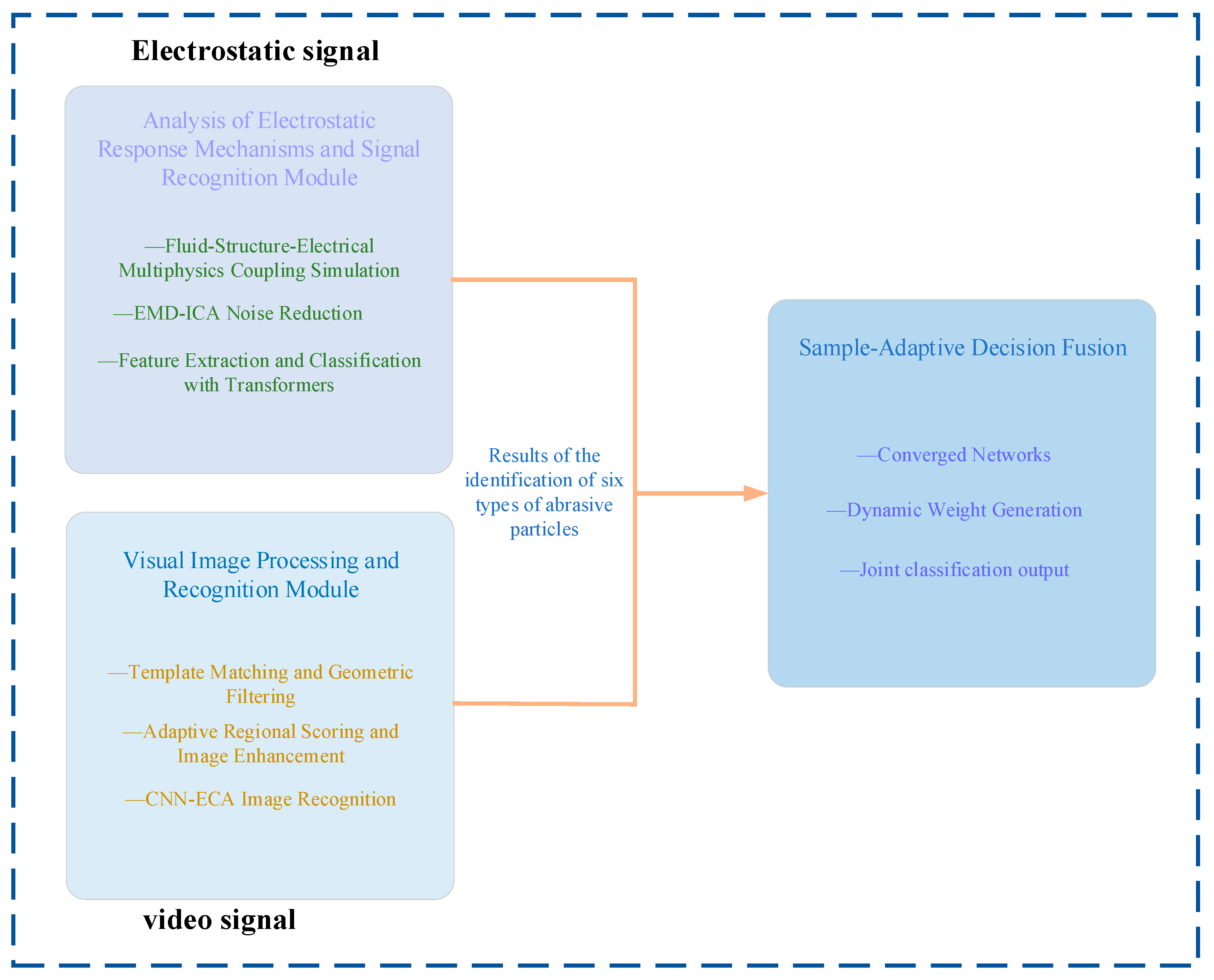
Figure 1. Overall framework for multi-source information fusion and recognition.
Processes 14 01918 g001
Figure 2. The process of charge transfer during particle collisions.
Processes 14 01918 g002
Figure 3. Schematic diagram of the computational domain mesh.
Processes 14 01918 g003
Figure 4. Contour plot of simulation results: (a) Stainless steel fatigue ball; (b) Alumina ceramic beads; (c) Abrasive corundum; (d) Exfoliated chromite particles; (e) Flake-like graphite particles; (f) Brass swarf.
Processes 14 01918 g004
Figure 5. Peak induced charges of different particle types at different flow velocities.
Processes 14 01918 g005
Figure 6. Raw electrostatic signals from different wear particles: (a) Electrostatic signals from stainless steel fatigue balls; (b) Electrostatic signals from alumina ceramic beads; (c) Electrostatic signals from abrasive corundum; (d) Electrostatic signals from flaking chromite particles; (e) Electrostatic signals from graphite flake particles; (f) Electrostatic signals from brass chips.
Processes 14 01918 g006
Figure 7. Results of EMD of electrostatic signals.
Processes 14 01918 g007
Figure 8. Comparison of electrostatic signal noise before and after noise reduction.
Processes 14 01918 g008
Figure 9. t-SNE visualization of selected electrostatic features.
Processes 14 01918 g009
Figure 11. Model Recognition Results: (a) Test set confusion matrix; (b) Comparison of Forecast Values and Actual Values.
Processes 14 01918 g011
Figure 16. ECA Attention Mechanism.
Processes 14 01918 g016
Figure 17. CNN-ECA Model Workflow.
Processes 14 01918 g017
Figure 18. Image of the image model recognition results: (a) Test set confusion matrix; (b) Comparison of Forecast Values and Actual Values.
Processes 14 01918 g018
Figure 19. Framework for Multi-Source Information Fusion and Recognition.
Processes 14 01918 g019
Figure 20. Schematic diagram of the sample-adaptive fusion model network architecture.
Processes 14 01918 g020
Figure 21. Experimental system for high-speed fluid-induced particle wear.
Processes 14 01918 g021
Figure 22. Comparison of Recognition Accuracy Between Single-Modal and Fusion Models.
Processes 14 01918 g022
Figure 23. Test set confusion matrix.
Processes 14 01918 g023
Figure 24. Analysis of Weight Distribution in the Fusion Model: (a) Average weight distribution across different particle categories; (b) Adaptive weight distribution of samples from exfoliated chromite particles.
Processes 14 01918 g024
Figure 25. Recognition Accuracy of Different Fusion Methods: (a) The D-S criterion; (b) Support Vector Machines; (c) Random Forest; (d) Weighted average fusion.
Processes 14 01918 g025
Figure 26. Comparison of the robustness of different fusion methods under noisy conditions.
Processes 14 01918 g026
Table 1. Results of the grid-independence verification.
Grid SchemeTotal Number of UnitsCalculate the Peak Charge (nC)Relative Error
Coarse mesh125,0002.5802.24%
Medium mesh260,0002.63610.11%
Fine mesh480,0002.6390%
Table 2. Correspondence Table of Particle Types and Key Simulation Parameters.
Particle TypeMaterialRelative PermittivityCharacteristic Size (mm)Electrical Conductivity (S/m)Work Function
(eV)
Initial Surface Charge Density (μC/m2)
Stainless steel fatigue ballStructural steel1.031.04.03 × 1054.42Not predefined
Alumina ceramic
granules
Alumina9.621.01.00 × 10−123.50+1.2
Abrasive corundumAlumina10.251.191.00 × 10−123.60+1.5
Exfoliated chromite particlesChromite4.051.41.00 × 10−94.70+0.8
Flake-like graphite particlesGraphite2.521.57.00 × 1044.80−1.5
Brass swarfBrass1.021.01.55 × 1074.35Not predefined
Table 3. Peak induced charges for six types of particles at different flow rates.
Particle Type2 m/s (nC)5 m/s (nC)8 m/s (nC)10 m/s (nC)
Stainless steel fatigue ball0.090.240.330.395
Alumina ceramic
granules
0.190.320.440.512
Abrasive corundum0.320.520.700.825
Exfoliated chromite particles0.380.610.820.965
Flake-like graphite particles−0.16−0.39−0.59−0.698
Brass swarf0.801.582.192.605
Table 4. Comparison of the Performance of Different Electrostatic Signal Recognition Models.
ModelCategory Average Accuracy (%)Accuracy (%)F1 Score (%)
SVM82.582.182.3
RF84.283.884.0
LSTM86.385.986.1
BiLSTM87.186.786.9
Transformer91.090.190.6
Table 5. Comparison of Performance Among Different Image Recognition Models.
ModelCategory Average Accuracy (%)Accuracy (%)F1 Score (%)
VGG1680.580.180.3
MobileNetV282.381.982.1
ResNet5084.183.783.9
EfficientNet-B085.485.085.2
CNN-ECA88.788.288.7
Table 6. Composition of the dataset and the training/testing split.
Particle TypeTotal Paired SamplesElectrostatic Samples for TrainingImage Samples for TrainingFused Samples for TrainingElectrostatic Samples for TestingImage Samples for TestingFused Samples for Testing
Stainless steel fatigue ball1000800800800200200200
Alumina ceramic
granules
1000800800800200200200
Abrasive corundum1000800800800200200200
Exfoliated chromite particles1000800800800200200200
Flake-like graphite particles1000800800800200200200
Brass swarf1000800800800200200200
Total6000480048004800120012001200
Table 7. Model Architecture and Hyperparameters.
Electrostatic branch: TransformerInput typeEMD-ICA processed electrostatic sequence
Sequence length256
Number of ICA components8
Transformer encoder layers4
Attention heads4
Embedding dimension128
Feed-forward dimension256
Dropout0.1
ActivationGELU
Classification headFC(128 → 6)
Visual branch: ECA-CNNBackboneECA-CNN
Input image size224 × 224
Input channels3
Data augmentationRandom horizontal flip, random rotation (±10°), normalization
Initial convolution channels32
ECA kernel size3
Dropout0.3
ActivationReLU
Classifier headFC(256 → 6)
Adaptive Decision Fusion ModelFusion levelDecision-level fusion
Fusion inputProbability vectors from electrostatic and visual branches
Input 12 (6 + 6)
Hidden layers2
Hidden dimension32
ActivationReLU
Dropout0.2
Output layerFC(32 → 6)
Category-specific weight generatorEnabled
Global scaling factorEnabled
Guidance loss weight λ10.5
Interpolation loss weight λ20.2
Fusion training epochs50
Table 8. Ablation Experiments.
ModelAverage Accuracy Rate (%)Decline in Relatively Complete Models (%)
Complete model96.00
Remove the global scaling factor95.30.7
Remove the guidance loss94.81.2
Remove the interpolation loss95.60.4
Remove category-specific weight generators94.21.8
Table 9. Evaluation metrics for fusion models.
Particle TypePrecision/%Recall/%F1-Score/%
Stainless steel fatigue ball97.4796.5096.98
Alumina ceramic
granules
94.5395.0094.76
Abrasive corundum94.5395.0094.76
Exfoliated chromite particles94.9594.0094.47
Flake-like graphite particles100.0098.0098.99
Brass swarf94.6697.5096.06
average96.0296.0096.00
Table 10. Performance comparison over repeated trials.
MethodMean Acc (%)Std (%)95% CI
Proposed96.00.4[95.7, 96.3]
Weighted Average92.00.8[91.4, 92.6]
Random Forest91.50.9[90.8, 92.2]
SVM91.01.0[90.2, 91.8]
D-S90.51.1[89.6, 91.4]
Disclaimer/Publisher’s Note: The statements, opinions and data contained in all publications are solely those of the individual author(s) and contributor(s) and not of MDPI and/or the editor(s). MDPI and/or the editor(s) disclaim responsibility for any injury to people or property resulting from any ideas, methods, instructions or products referred to in the content.