Article

Fault Diagnosis for Key Nuclear Power Plant Systems and Equipment Based on Knowledge Graphs and Bayesian Networks

1
College of Nuclear Science and Technology, Harbin Engineering University, Harbin 150001, China
2
Suzhou Nuclear Power Research Institute Co., Ltd., Suzhou 215004, China
3
China General Nuclear Power Operation Co., Ltd., Shenzhen 518031, China
*
Author to whom correspondence should be addressed.
Processes 2026, 14(12), 1903; https://doi.org/10.3390/pr14121903
Submission received: 31 January 2026 / Revised: 30 April 2026 / Accepted: 8 May 2026 / Published: 11 June 2026

Abstract

Failures in critical systems and equipment within nuclear power plants (NPPs) significantly threaten operational safety and reliability. Therefore, rapid and accurate root cause localization during the incipient stages of failure is critical to preventing escalation. Traditional modeling methods often fail to address the inherent structural complexity of NPPs, the diversity of failure modes, and the stochastic mapping relationships between symptoms and causes. To address these challenges, this paper proposes an intelligent fault diagnosis framework integrating knowledge graphs (KGs) and Bayesian networks (BNs). First, by analyzing failure modes and anomaly characteristics, we define discrimination criteria for typical faults. Second, a structured knowledge modeling approach is developed to transform unstructured fault information into a KG, which is subsequently mapped to a BN topology. Finally, to mitigate the subjectivity of expert priors, data-driven structure and parameter learning algorithms are employed to optimize the model, enhancing inference accuracy. Robustness was validated through experiments targeting three fault severity levels, using signed directed graphs (SDGs), support vector machines (SVMs), domain generalization softmax (DG-softmax) and long short-term memory (LSTM) as benchmarks. Experimental results demonstrate that the proposed method maintains high diagnostic precision across varying severities, outperforming traditional data-driven methods in accuracy and stability. This study enhances the interpretability and engineering applicability of intelligent diagnosis in nuclear power systems.

1. Introduction

The safe operation of nuclear power plant systems remains a focal point in the field of nuclear safety. Rapidly and accurately localizing the root causes of faults in their early stages is a critical means of effectively preventing deterioration and enhancing the safety and reliability of plant operations. A recent review systematically classifies AI-based NPP fault diagnosis methods into knowledge-driven and data-driven categories, and confirms the technical trend of fusing the two approaches [1]. Due to the complex structure of system equipment, the diversity of failure modes, causes, and types, as well as the uncertainty in the correspondence between fault symptoms and causes, traditional diagnostic methods struggle to adequately express the correlations between symptoms and etiologies. Meanwhile, the plant operation process generates vast amounts of historical data, O&M experience, and maintenance reports. These resources contain rich value; however, the lack of effective technical means prevents the utilization of this data and knowledge to guide NPP O&M processes. As data and symptom information accumulate and expert experience solidifies, the fusion of knowledge and data has emerged as a prevailing technological trend.
Currently, international fault diagnosis methods are broadly categorized into three types: analytical model-based, expert knowledge-based, and data-driven methods. Each possesses distinct advantages and limitations. Analytical model-based methods can precisely express system physical mechanisms through mathematical modeling, offering clear physical significance and precise results. Piyush has advanced analytical model-based methods by developing a sliding mode observer scheme for NPP actuator and sensor fault tolerant control [2]. However, due to the complex internal structure of nuclear systems and severe coupling between equipment, achieving physical modeling for the entire nuclear system is arduous.
In the fault diagnosis community, data-driven methodologies have generally evolved through three stages: expert-based decision systems, traditional machine learning, and deep intelligent models. Benefiting from strong nonlinear modeling capabilities, recent deep transfer learning studies have made significant progress in domain adaptation and cross-domain diagnosis [3,4]. And Wang clarifies that explainable AI frameworks and validation under nuclear safety constraints are the core priorities for future research [5].
However, despite these advancements, pure deep learning models still suffer from the “black box” nature of their internal representations, resulting in a critical lack of interpretability. Furthermore, their diagnostic efficacy is heavily contingent on the quantity and quality of training data. Given the nuclear industry’s extremely high safety requirements and the scarcity of fault data, data-driven methods face barriers to practical application in this high-security domain. Expert knowledge-based methods avoid the construction of complex, precise mathematical models and feature simple modeling processes. However, they face challenges such as difficulty in knowledge acquisition, high knowledge subjectivity, and the combinatorial explosion of rules in complex systems. Nevertheless, due to the strong interpretability of their results, they are widely accepted by industry experts and have been the subject of in-depth research.
Expert systems represent a traditional and representative technology within knowledge-based fault diagnosis. In 1982, Nelson et al. [6] developed REACTOR, a rule-based expert system for diagnosing four types of typical accidents in nuclear power plants. In 1991, Fang [7] from Tsinghua University developed NPPDS, an online fault diagnosis expert system for NPPs expressed in first-order predicate logic. Today, expert systems remain a primary research direction in the nuclear field. Wei et al. [8] of China Nuclear Power Operation Technology Corporation developed ADEES, an online diagnosis and assessment expert system for nuclear accidents based on MAAP5, capable of diagnosing accident stages and root causes to support emergency decision-making.
With technological advancement, methods such as fault trees [9], Markov models [10], Petri nets [11], and signed directed graphs (SDGs) [12,13] have been applied to the nuclear safety domain with positive results. The knowledge graph (KG), proposed by Google on 17 May 2012, uses graph models to describe knowledge and model the connections between entities in the world. Recently, it has been applied to fault diagnosis in nuclear systems. Xiong et al. [14] of the University of Chinese Academy of Sciences proposed a knowledge modeling and analysis method for nuclear equipment health management based on KGs, addressing the issue of data silos in equipment maintenance knowledge integration. Zhang et al. [15] of the Nuclear Power Institute of China designed a complete KG construction process for control rod drive mechanisms (CRDM), achieving a tight integration of nuclear data mining and R&D design. Jun et al. [16] proposed a KG-based fault diagnosis system for the CRDM of a liquid-fueled thorium molten salt reactor, realizing fault diagnosis functions fused with graph data visualization. Evidently, due to their superior diagnostic performance and powerful visualization capabilities, KGs have become a hotspot in expert knowledge-based fault diagnosis research.
Due to the complex characteristics of nuclear systems and equipment, reliance on a single diagnostic method often fails to yield ideal results. Consequently, scholars domestically and internationally have begun attempting to combine multiple diagnostic methods to enhance fault inference models. Currently, hybrid diagnostic methods based on models, knowledge, and data are generally divided into two categories: (1) Strategic Level: Using multiple methods simultaneously to realize different functions of fault diagnosis, leveraging the respective advantages of each model to improve effects. (2) Algorithmic Level: Nesting two or more methods at the model algorithm level to overcome inherent defects in the algorithms themselves.
Wen [17] from Harbin Engineering University developed a comprehensive hybrid intelligent fault diagnosis method for nuclear power plants based on principal component analysis (PCA), SDG models, and Elman neural networks, realizing anomaly detection, fault type identification, and severity assessment. Wang et al. [18] of China Nuclear Power Engineering Co., Ltd. Proposed an intelligent fault early warning and diagnosis scheme for NPPs, utilizing convolutional neural networks (CNNs) and stacked autoencoders (SAEs) for early warning, and fault tree analysis (FTA) for root cause searching. Chen et al. [19] of the Naval University of Engineering utilized modularization, simulation analysis, inference engines, and neural networks to design an online nuclear safety support system for marine reactors. Jiang [20] of Harbin Engineering University used the k-nearest neighbor (k-NN) algorithm for state classification, followed by SDG and fuzzy Petri nets for system fault diagnosis. While such multi-technology fusion strategies leverage individual model advantages, they often fail to resolve the intrinsic problems of the models themselves.
Yang and Zhong [21] of the Naval University of Engineering proposed a fault diagnosis method for the primary circuit system combining knowledge and data. By adding qualitative trend analysis of data to the SDG, they overcame the issue of missed alarms common in traditional methods. Jia [22] of Wuhan University of Technology proposed a diagnostic method combining neural networks and expert systems, using rule-based reasoning to verify low-confidence diagnostic results from the neural network, successfully improving the interpretability of data-driven methods. Yu [23] of Harbin Engineering University acquired fault data by establishing primary and secondary circuit simulation models, then trained long short-term memory (LSTM) networks for diagnosis, solving the problem of insufficient fault data types and quantity in the nuclear field, though the issue of poor interpretability remained unresolved.
In summary, given the sudden, complex, and urgent nature of faults in nuclear systems, ensuring the timeliness, accuracy, and interpretability of diagnostic results is paramount. The diversity of failure modes and the uncertainty in symptom-cause mappings make it difficult for traditional methods to express these associations. As data accumulates and expert knowledge solidifies, diagnosis methods based on the fusion of expert knowledge and fault data are becoming the mainstream research direction. Therefore, this paper investigates a fault diagnosis method fusing expert knowledge and data-driven approaches. By utilizing data-driven methods to enhance the robustness and accuracy of expert knowledge models, we achieve complementary advantages. To effectively utilize the massive historical data and maintenance reports, we design knowledge extraction strategies to analyze and summarize the associations between failure modes, effects, phenomena, and causes. This knowledge is structured to achieve the transformation from knowledge mapping to KG topology. Simultaneously, to avoid the subjectivity of expert knowledge and the pitfalls of single data-driven methods, we employ Bayesian structure learning and parameter learning algorithms as auxiliary modeling tools for the KG, ultimately forming a fault inference model for NPP systems and equipment.
The primary contributions of this paper are:
1. Fault KG construction strategy: organizing fragmented NPP fault data into a structured graph.
2. Hybrid inference model: combining KG topology with Bayesian inference to quantify uncertainty.
3. Data-driven optimization: using fault data to refine KG structure and parameters, reducing reliance on subjective expert rules.
4. Robustness validation: utilizing a test set with varying severity levels to demonstrate superior performance over SDG, SVM, DG-softmax and LSTM benchmarks, particularly in incipient fault detection.
The remainder of this paper is organized as follows: Section 2 details the proposed diagnostic strategy, theoretical methodologies, and the modeling process. Section 3 presents the experimental data and a comparative analysis of the test results. Section 4 discusses the interpretability of the model and analyzes the implications of feature drift in fault evolution. Finally, Section 5 summarizes the study and presents the conclusions.

2. Materials and Methods

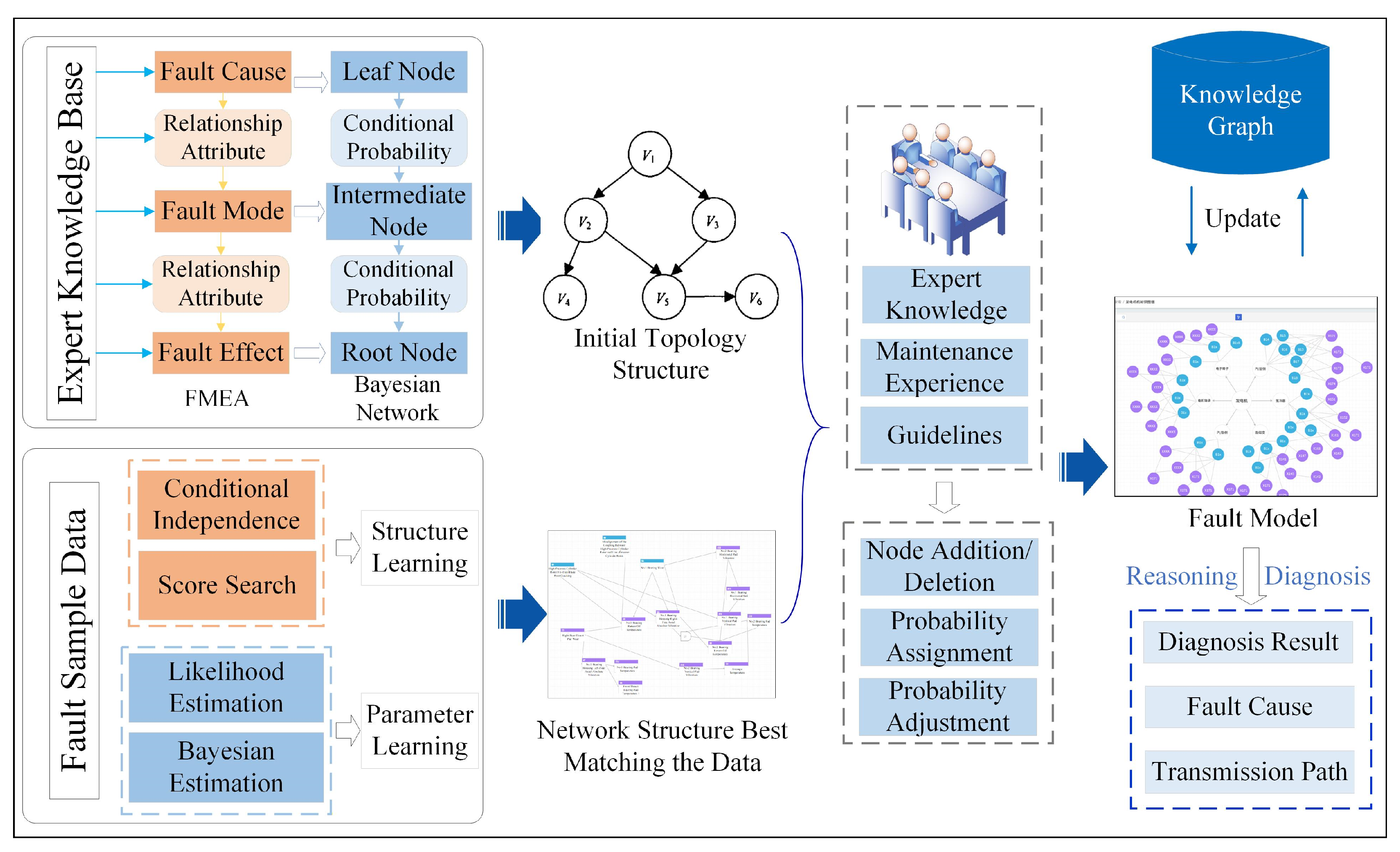
This paper proposes a fault diagnosis framework for NPPs that fuses KGs with data-driven Bayesian inference. The original contribution of this methodology lies in an architectural constraint mechanism: utilizing the deterministic, physical-mechanism-based semantic topology of a KG to strictly constrain the hypothesis search space of a probabilistic Bayesian Network (BN). It leverages the high interpretability and low data dependency of expert knowledge while exploiting the modeling efficiency and accuracy of data-driven methods. The overall technical framework is illustrated in Figure 1.
First, we construct a structured fault knowledge model. Domain expert knowledge implied in fault event analysis reports and operator experience is extracted, classified, and stored in a structured knowledge base. A network structure employing nodes and directed edges visualizes this knowledge, facilitating query, maintenance, and expansion.
Second, we develop the fault diagnosis inference engine. This involves constructing an inference model by mapping the “Entity-Relation-Entity” triples of the structured expert knowledge into the initial “Node-Edge-Node” topology of a BN.
Finally, structure and parameter learning utilizing sample data are employed to refine the model. The network structure is optimized (via edge addition/deletion) based on expert review, and quantitative assignments for node thresholds, prior probabilities, and conditional probabilities are finalized.

2.1. Fault Knowledge Modeling

2.1.1. Knowledge Graph Fundamentals

KG represents knowledge through entity–relation–entity triples [24]. It offers advantages in storage capacity, query speed, and relationship visualization. In this study, KG technology standardizes the expression of fault data and domain expert knowledge, providing the foundational elements for intelligent application.

2.1.2. Knowledge Extraction Strategy

Knowledge Extraction (KE) identifies and retrieves key elements from heterogeneous NPP data sources, including the basic database, failure mode and effects analysis (FMEA) tables, and electronic logs. This process involves data standardization to regulate data types and content descriptions.
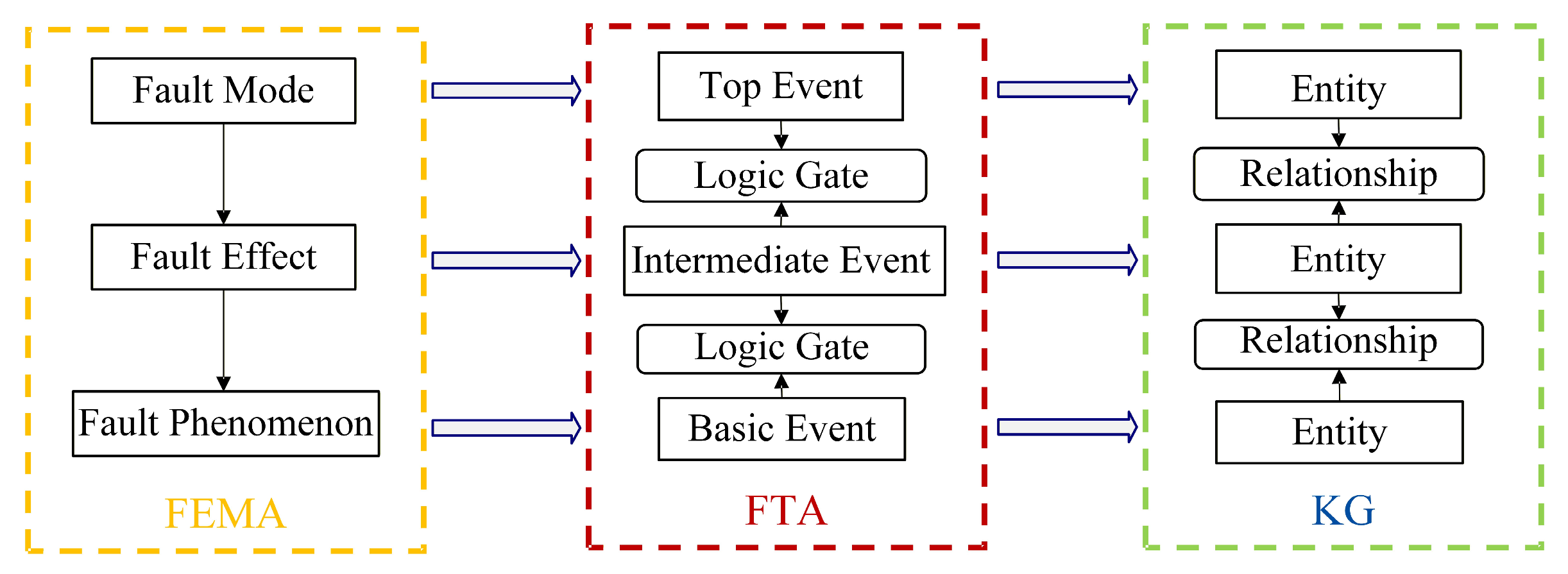
Given the complexity of knowledge sources, a standardized extraction process is designed. Knowledge is categorized into text type (e.g., electronic log cases), semi-structured type (e.g., FMEA tables), and structured type (e.g., FTA Fault Trees). The extraction flow is as follows: First, text information is organized into FMEA tables containing failure modes, effects, and phenomena. The extraction module treats these three parts as nodes in an FTA and displays the implied logical relationships as logic gates, forming a tree-structured FTA. On this basis, fault tree events serve as KG entity nodes, and relations within logic gates serve as KG edges. Multiple FTA groups are integrated to form the KG infrastructure. Quantitative information is stored as node and edge attributes, ultimately forming a graph-structured knowledge model rich in information. The flow is shown in Figure 2. To formalize the transition from FMEA/FTA to the KG and eliminate subjective ambiguity, we established three standardized structured mapping rules:
(1) Entity Extraction: Failure modes, effects, and phenomena documented in the FMEA are directly mapped as independent entity nodes.
(2) Relationship Direction: The logical gates in the FTA strictly dictate the directed edges, always pointing from cause entities to effect entities.
(3) Quantitative Transformation: The occurrence frequencies and probabilities recorded in historical data are automatically populated as the conditional probability distributions for these directed edges.

2.1.3. KG to Network Structure Conversion

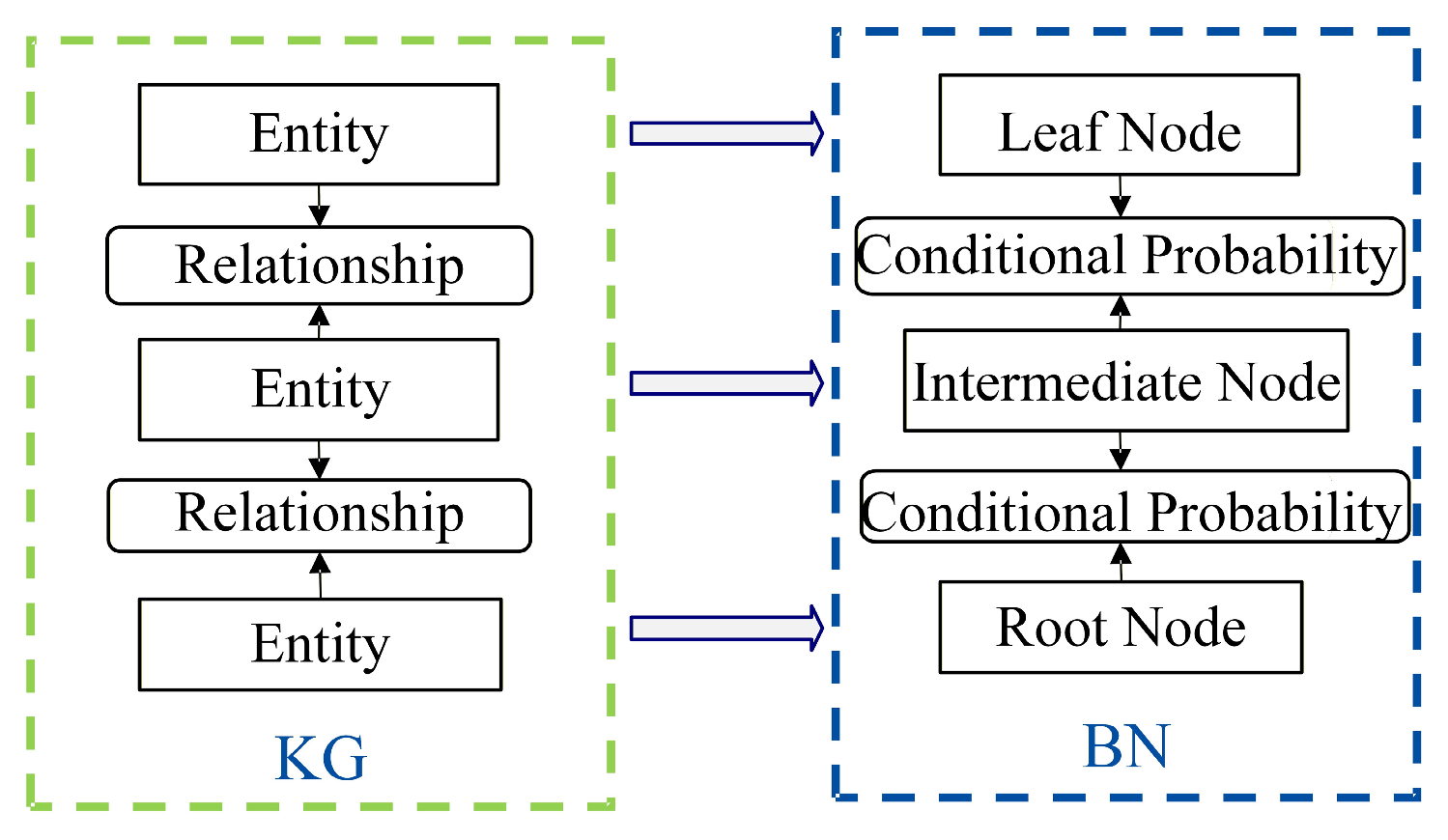
The primary objective of this conversion is to transform the KG into a BN to utilize BN algorithms for fault inference. Since a BN is a Directed Acyclic Graph (DAG) composed of nodes representing variables and directed edges representing causal dependencies (parent to child), a direct structural correspondence with KGs is possible. Entities in the KG map to leaf nodes, intermediate nodes, and root nodes in the BN, while relationships between entities are presented as conditional probability tables (CPTs). The correspondence is shown in Figure 3.

2.2. Fault Inference Model

2.2.1. Bayesian Networks

A BN is an inference model fusing graph theory and probability theory. It uses CPTs to describe the degree of causal association between adjacent nodes, effectively embodying uncertain connections between entities. It is highly applicable to fault diagnosis in complex systems [25]. The basic idea of BN inference stems from Bayes’ Theorem:
For arbitrary events A and B
P A | B = P B | A P A P B
where P(A) is the prior (or marginal) probability of A; P(A|B) is the posterior probability of A; P(B|A) is the likelihood; and P(B) is the normalizing constant.

2.2.2. Bayesian Network Learning

BN construction can be manual or data-driven (BN Learning), comprising structure learning and parameter learning [26,27]. Structure construction is the first step, typically achieved by analyzing faults and summarizing causal relationships to map nodes and edges. Structure learning calculates qualitative knowledge (causal relations) from historical data to build the association structure, utilizing scoring search algorithms, constraint-based algorithms, or hybrid algorithms.
Parameter learning calculates the quantitative values of causal strengths based on the existing structure to obtain CPTs. Expert assignment can be labor-intensive with many variables; parameter learning based on sample data (similar to statistical parameter estimation) reduces this workload. Common methods include Maximum Likelihood Estimation (MLE), Bayesian Parameter Estimation, and the Expectation-Maximization (EM) algorithm.

2.2.3. Construction of Bayesian Network Inference Engine

Knowledge representation determines modeling difficulty. Decomposing complex systems into subsystems and equipment facilitates hierarchical representation, modularization, and structuring, which effectively bounds the combinatorial explosion of CPTs and ensures the computational scalability of the inference engine even in large-scale central subsystems. Therefore, based on instance information in the knowledge base, “Entity-Relation-Entity” triples for each fault type are extracted to preliminarily form BN topologies. When domain knowledge is missing, historical operating data and machine learning methods are used for structure learning. Subsequently, expert knowledge is used to manually add, remove, or adjust variables and edges to finalize the BN structure. These manual interventions are strictly governed by thermodynamic principles and established operational guidelines to eliminate spurious mathematical correlations generated by purely data-driven algorithms. Furthermore, while minor structural variations may theoretically alter specific inference paths, the subsequent data-driven parameter learning process robustly compensates for these structural uncertainties by optimizing the conditional probability distributions, thereby stabilizing the overall diagnostic accuracy.
After determining the topology, quantitative characteristics of node dependencies must be defined. Feature attributes of variable instances are converted into quantitative features. For nodes with missing information, the EM algorithm is used to obtain conditional probabilities from data. Finally, expert knowledge adjusts the CPTs. Node thresholds, priors, and conditional probabilities can be manually edited to finalize causal association strengths.
By combining mechanistic analysis with mathematical models, a BN inference engine construction method driven jointly by knowledge and data is formed. This mitigates expert subjectivity while avoiding noise from pure data use. Through the mutual conversion of KG and BN topologies, the inference model updates rapidly when the KG expands. Conversely, reasonable structural adjustments to the inference engine verify and adjust the KG structure.
When the monitoring system triggers an anomaly warning, the model identifies time-series data based on stored parameter thresholds, retrieves the relevant inference model from the KG, and executes diagnostic inference to lock onto the root cause. Although KG updates and BN structure/parameter learning are inherently resource-intensive offline tasks, the online inference strictly involves probability propagation within the pre-compiled directed acyclic graph (DAG). This decoupling bounds the online diagnostic latency to the millisecond scale, satisfying the real-time operational constraints of NPPs. The process is shown in Figure 4.

3. Results

3.1. Key Systems and Equipment

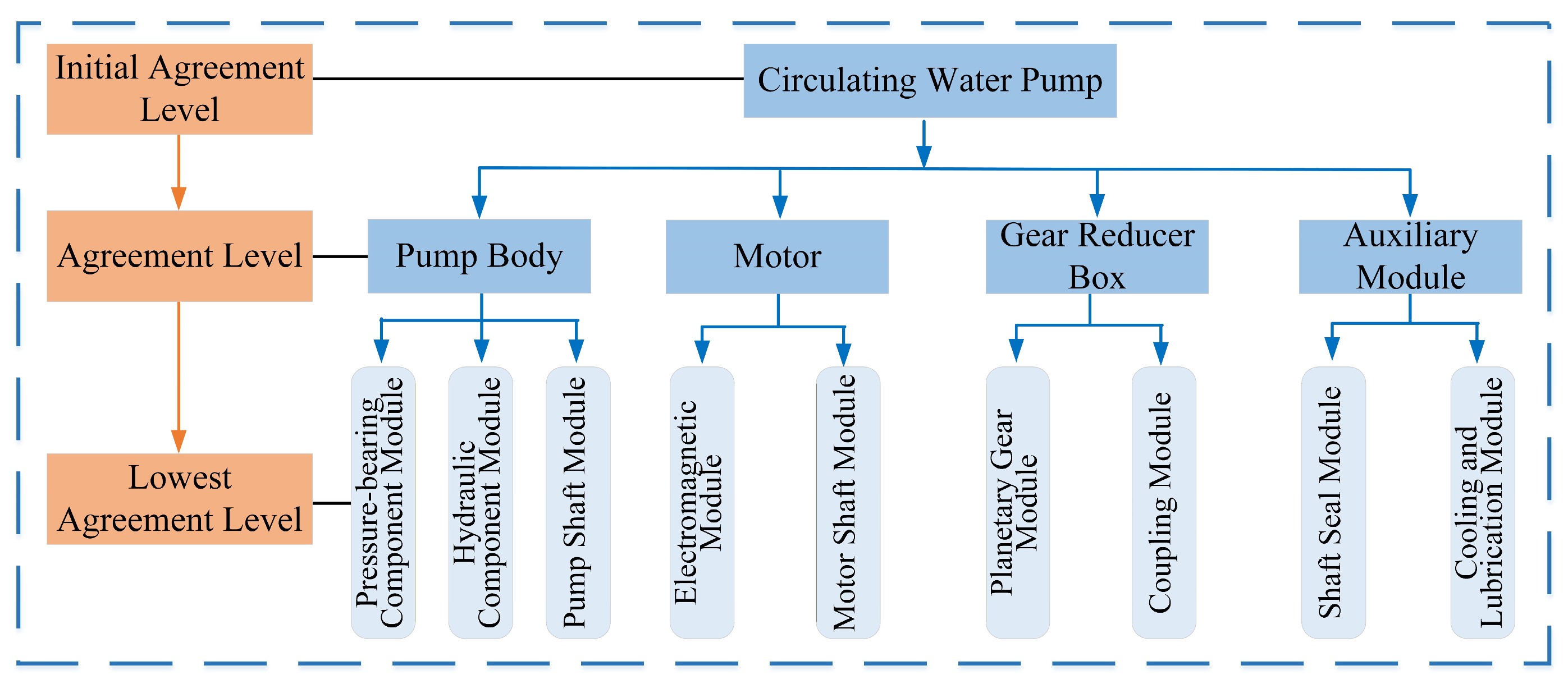
We developed an NPP fault diagnosis platform utilizing the technical and data architecture of a pilot NPP. The Reactor Coolant System (RCS) and the CRF Circulating Water Pump were selected as experimental objects for validation. The RCS comprises the reactor vessel, steam generators, coolant pumps, pressurizer, and connecting piping. The CRF pump assembly includes pump body, motor, reduction gear, and auxiliary modules, as structured in the FMEA hierarchy (Figure 5).

3.2. Fault Mechanism Analysis

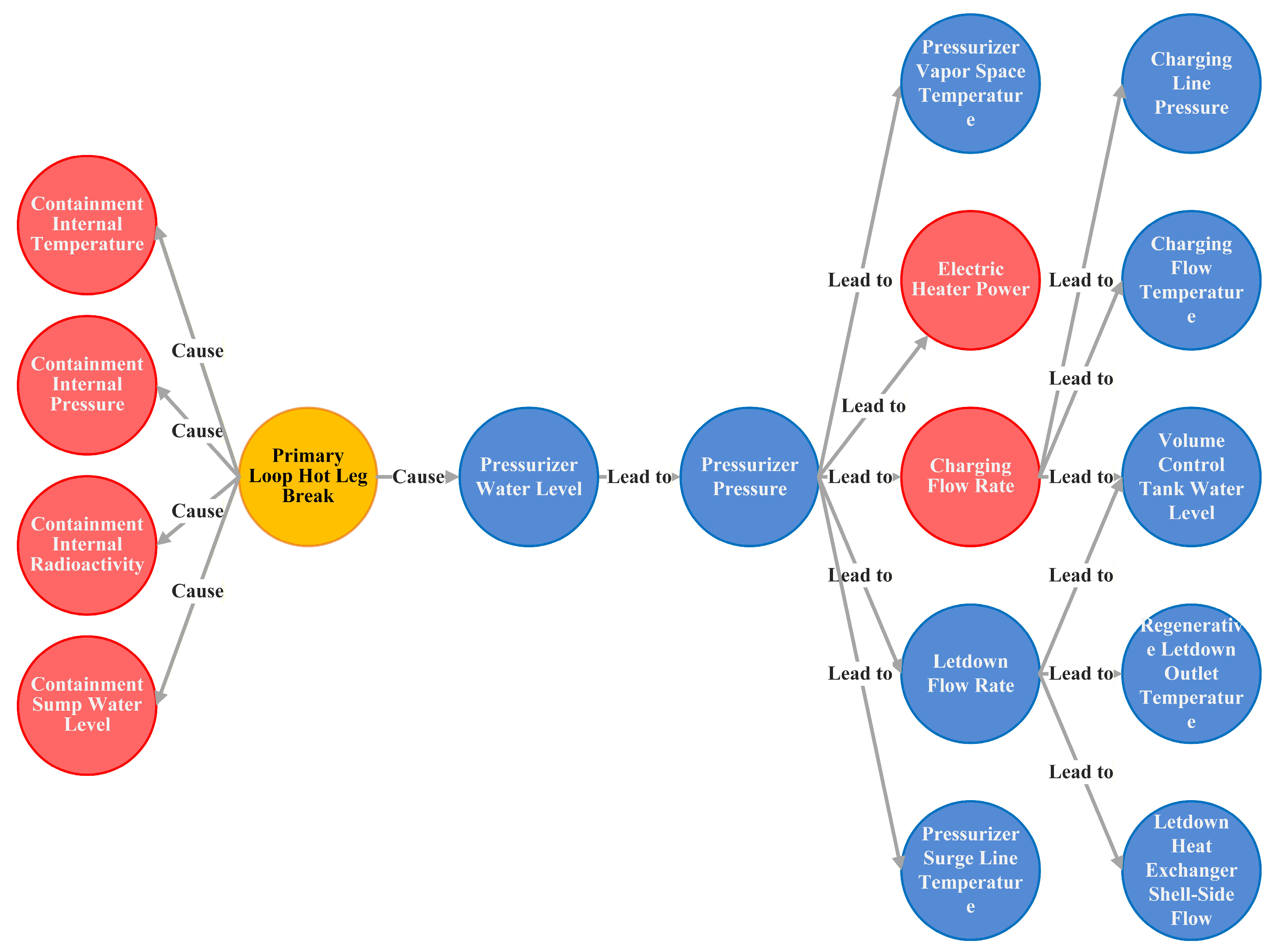
The study selected fault modes with low signal-to-noise ratios, specifically the small-break loss of coolant accident (SBLOCA) at the hot leg and volume control tank (VCT) leakage. The causal chains derived from failure analysis—such as the propagation from a hot leg break to containment parameter anomalies and RCS pressure drops—were structured into triples (Table 1). These relations were visualized in the KG (Figure 6), where node attributes indicate directional trends (decreasing blue/increasing red).

3.3. Validation and Analysis

3.3.1. NPP System Faults

Fault simulation data were categorized into three severity levels, minor, medium, and severe, as detailed in Table 2. The prior probabilities are given in Table 3. Based on the learned structure, Bayesian parameter estimation was employed to generate CPTs. As shown in Table 4, when the parent node “pressurizer level” is in the state “−1” (low), the conditional probability of the child node “pressurizer pressure” being “−1” is observed to be 0.5223, which is the highest probability state for this condition.
The inference paths for typical faults are illustrated in Figure 6:
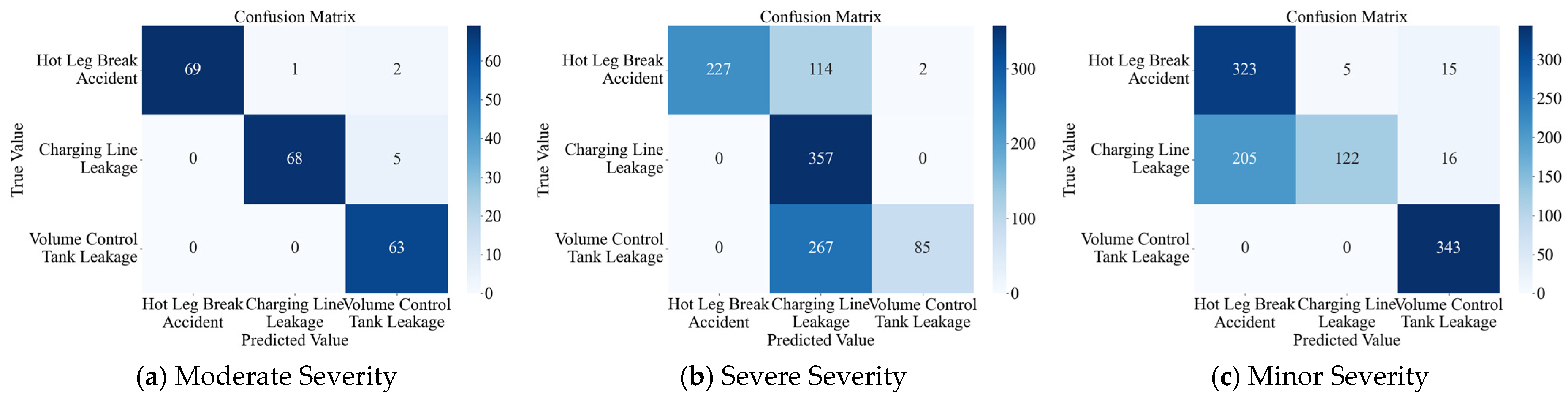
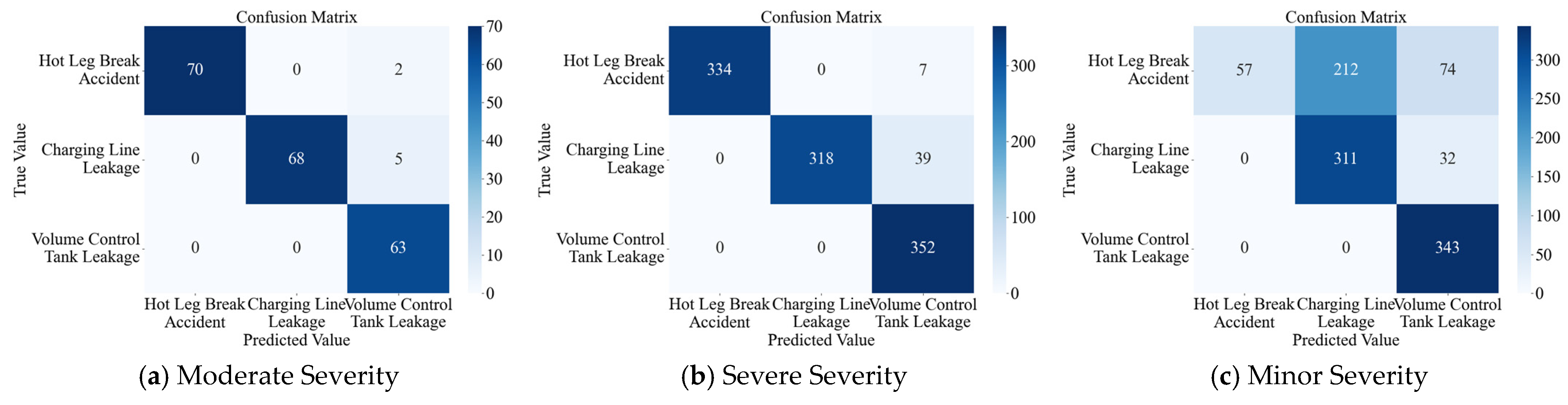
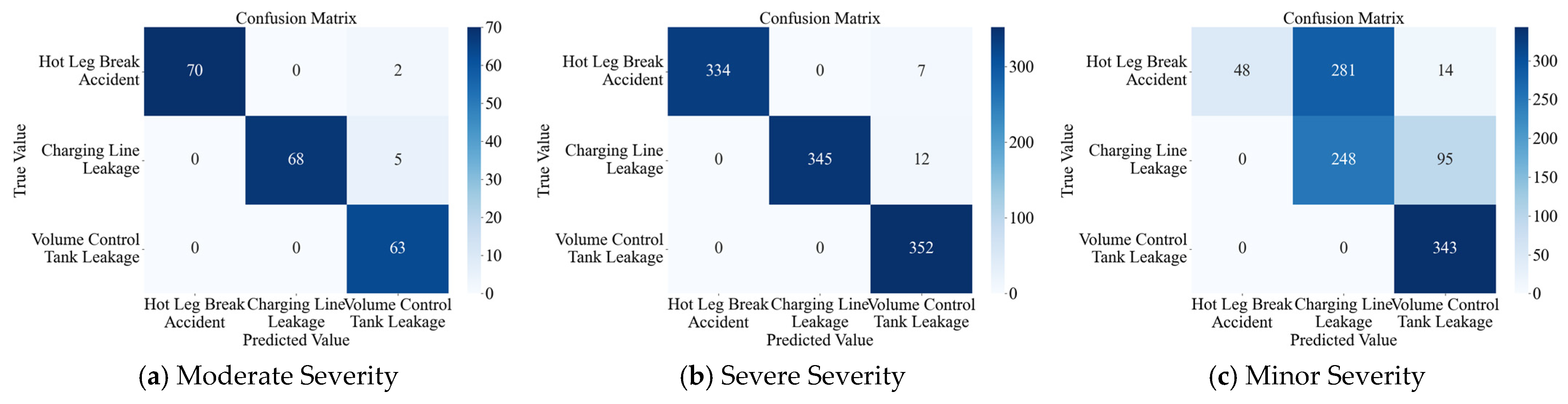
The confusion matrices for the proposed KGBN model are presented in Figure 7. The model achieved near 100% accuracy for VCT leakage. For the “hot leg break” and “charging line leakage” scenarios, the classification results varied with severity. In the “minor” condition, the recall rate for Hot Leg Break was recorded at approximately 49% due to misclassification as charging line leakage. From a node-level contribution perspective, the minute break flow during early stages fails to trigger the critical distinguishing evidence nodes (i.e., containment internal pressure and radioactivity). Consequently, the inference engine is forced to rely predominantly on the shared pressurizer water level anomaly, resulting in heavily overlapping posterior probabilities between the two competing hypotheses.

3.3.2. Ablation Study and Comparative Analysis

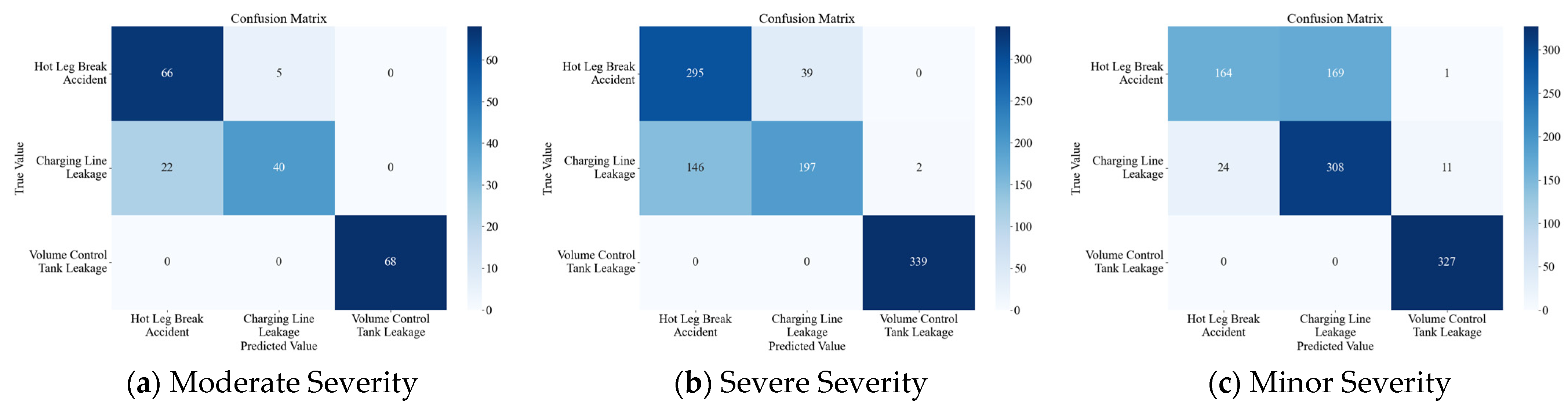
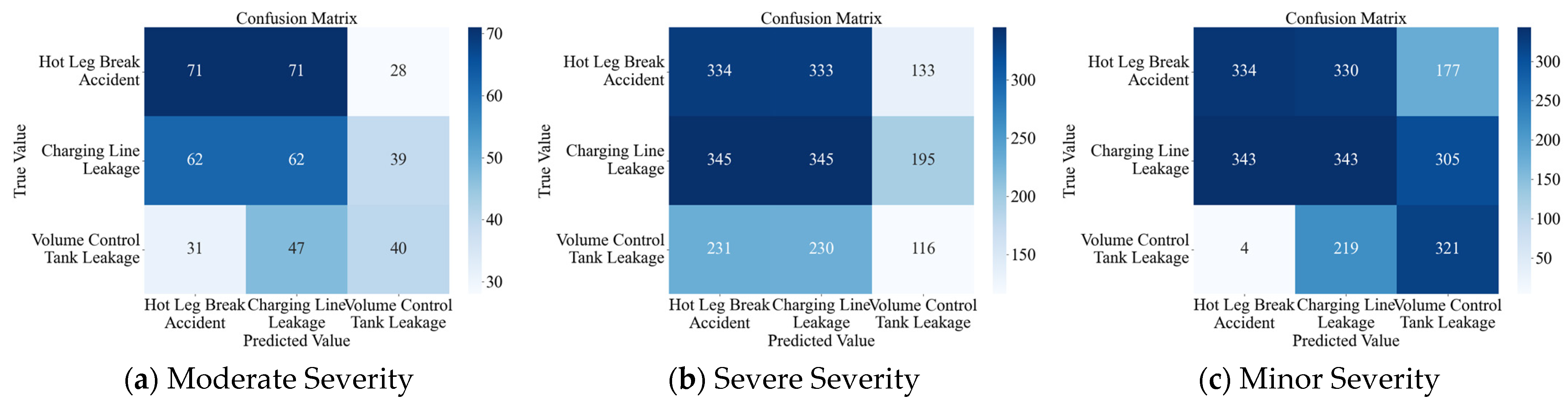
The proposed KGBN method was compared against SDG, SVM, DG-softmax and LSTM benchmarks [28]. To ensure transparency and experimental reproducibility, the detailed configurations for the benchmark models are summarized in Table 5, and the confusion matrices for the three models are shown in Figure 8, Figure 9, Figure 10 and Figure 11.
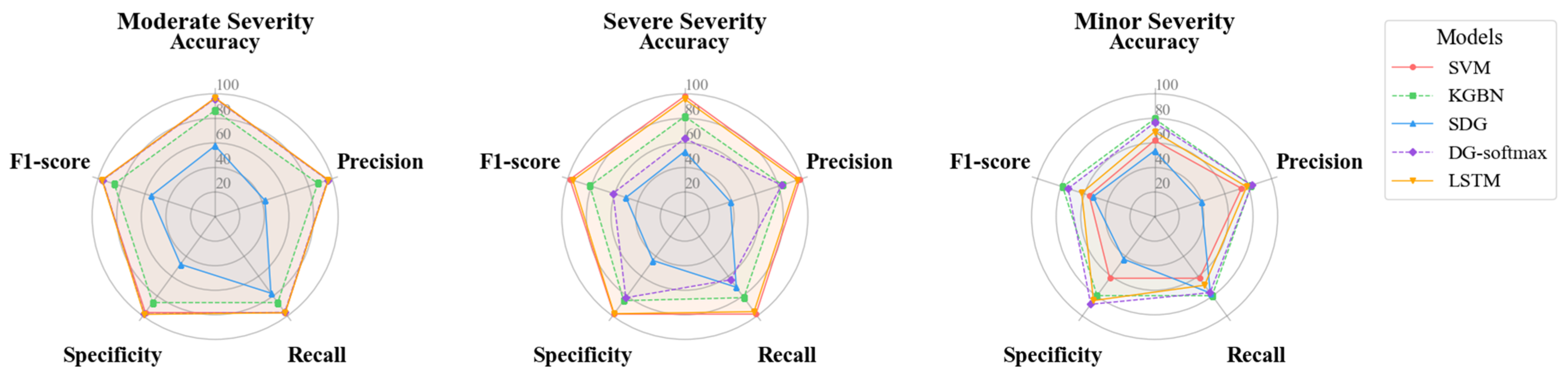
Radar charts (Figure 12) visualize the multi-dimensional performance metrics. The KGBN method demonstrates a balanced performance envelope across all three scenarios, with F1-score and Recall metrics exceeding those of SVM in the “minor Fault” test set.

3.3.3. NPP Equipment Faults

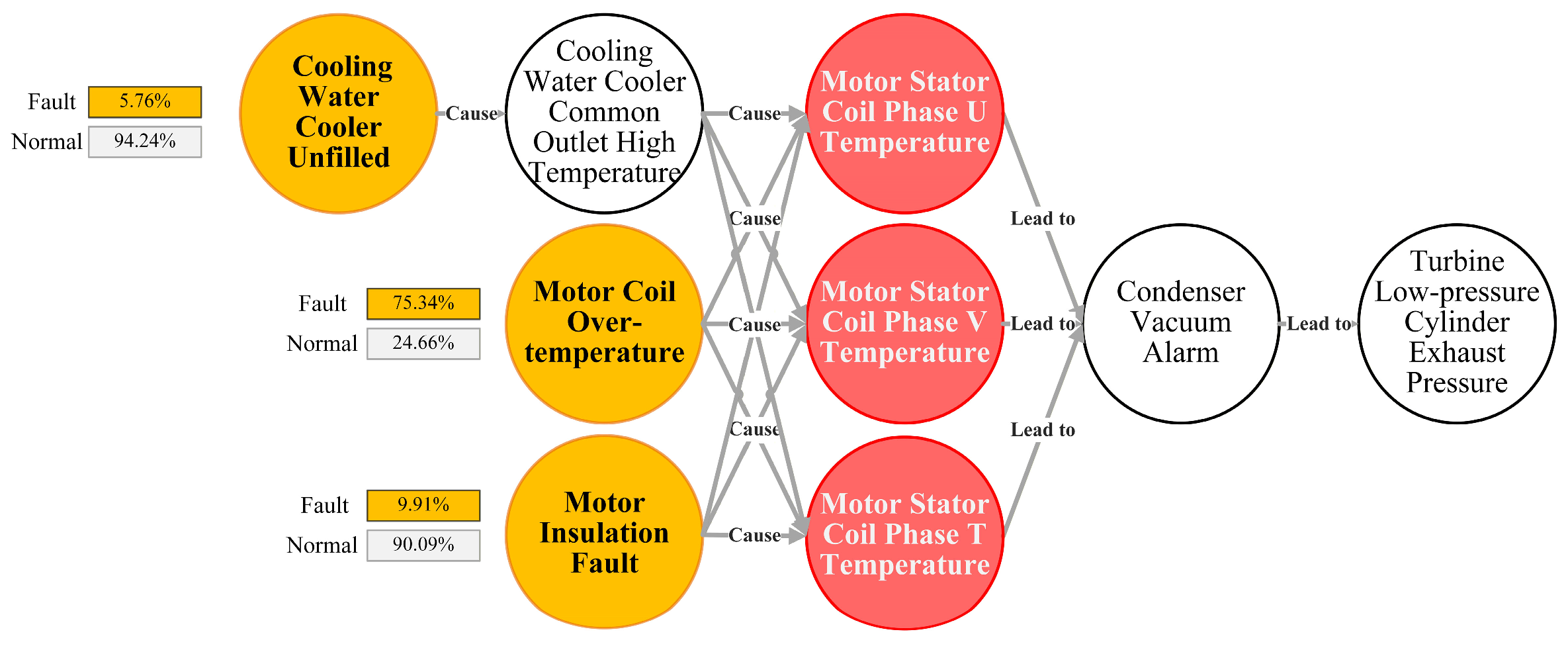
For the equipment-level diagnosis of the CRF circulating water pump, the “motor stator coil temperature anomaly” scenario was tested. As illustrated in the inference path (Figure 13), the posterior probability for “motor insulation fault” rose to 75.34%, while the probability for “closed loop cooling water failure” remained at 5.76%. This verifies the model’s ability to filter low-probability events and handle competitive hypotheses. The method demonstrates vertical adaptability, covering macro-system faults and micro-component failures.

4. Discussion

4.1. Ablation Study

This section validates the superiority of the proposed Knowledge Graph-Bayesian Network (KGBN) via targeted ablation study and benchmark comparative analysis. For the ablation study, we only set two test groups: the industry-standard Signed Directed Graph (SDG) as the control group, and the full KGBN as the experimental group. The topology of the fault influence diagram for the two models is completely identical under the ablation test. Ablation results show that SDG has inherent limitations: it achieves Recall of 0.7699 but Precision of only 0.3993 under minor severity, leading to severe undistinguishable multi-alarm issues. In contrast, KGBN realizes complementary advantages: under minor severity, Recall reaches 0.7958, Precision jumps to 0.8250, and F1-score improves by 49.4% from 0.5259 to 0.7855, effectively decoupling physically similar faults.

4.2. Comparative Analysis

We further compare KGBN with mainstream data-driven models (SVM, DG-softmax, LSTM). All data-driven models achieve near-perfect performance under original and severe severity, e.g., LSTM reaches Accuracy of 0.9663 and F1-score of 0.9659 under original severity. However, their performance drops sharply under minor severity. The optimal data-driven model (LSTM) only achieves Recall of 0.6910 and F1-score of 0.6232 under minor severity, 13.2% and 26.0% lower than KGBN respectively, limited by scarce nuclear fault data and “black box” uninterpretability. The combined results confirm KGBN fully meets IAEA SSR-2/1’s dual requirements of early fault identification and traceable diagnostic results, with significant engineering value.

4.3. Interpretability and Causal Reasoning

Unlike “black box” models such as neural networks, the proposed method provides transparent inference paths that align with physical mechanisms. As illustrated in the CRF pump case, the model not only identified the “motor insulation fault” but also correctly suppressed the “cooling water failure” hypothesis by utilizing “negative evidence” (the absence of differential pressure anomalies). This capability to process negative evidence and quantify the probability of competing hypotheses verifies that the model performs logical reasoning rather than simple pattern matching. This transparency is crucial for nuclear safety, as it provides operators with the “why” behind a diagnosis, facilitating confident decision-making.

4.4. The Phenomenon of Feature Drift in Fault Evolution

A critical finding from the confusion matrices is the non-linear “feature drift” phenomenon observed across severity levels. Our results indicate that the symptom overlap between SBLOCA and charging line leakage is not static; it shifts as the physical severity evolves. In minor stages, the thermal-hydraulic signatures are spatially aliased, causing high misclassification rates in data-driven models. This suggests that fault diagnosis in nuclear systems cannot rely on static thresholds or linear classifiers. Future diagnostic models must account for the dynamic trajectory of fault evolution, necessitating the decoupling of “fault severity” from “fault category” in the feature space, which remains a key direction for our future research.

5. Conclusions

To address the persistent challenges of diagnosing complex, incipient faults in Nuclear Power Plants (NPPs), this paper proposes and validates an intelligent diagnostic framework that fuses expert KGs with BN inference. By integrating mechanistic knowledge with data-driven learning, the proposed method overcomes the interpretability limitations of “black-box” models and the resolution constraints of qualitative methods.
The key conclusions and contributions of this study are as follows:
1. Semantic Integration of expert knowledge and data: We established a robust framework for extracting structured fault knowledge from heterogeneous NPP data sources. By mapping this knowledge to a BN topology, we successfully constrained the search space of data-driven models with physical priors, ensuring that diagnostic inference paths remain consistent with system mechanisms.
2. Superior robustness in incipient fault diagnosis: Comparative experiments on the Reactor Coolant System confirm that the proposed KGBN method significantly outperforms SDG, SVM, DG-softmax and LSTM benchmarks in low-signal-to-noise ratio scenarios. Specifically, in the “minor” fault test sets, KGBN achieved superior Recall and F1-scores, effectively mitigating the performance degradation of pure data-driven models when handling early-stage weak signals.
3. Identification of feature drift: This study revealed the phenomenon of “Feature Drift,” where the symptom overlap between physically similar faults (e.g., SBLOCA vs. charging line leakage) evolves non-linearly with fault severity. This finding highlights the inadequacy of static decision boundaries in traditional diagnostic models.
Furthermore, since the empirical validations rely on simulator data from a single commercial facility, the specific KG topology and CPT parameters remain inherently context-dependent. Extending this framework to different reactor designs or operating conditions requires a domain adaptation process, overcoming critical technical challenges associated with cross-domain feature distribution adaptation.
Driven directly by these empirical findings—particularly the classification bottlenecks observed between minor SBLOCA and charging line leakage scenarios (as shown in Figure 10)—future research will focus on two directions: (1) investigating the non-linear perturbation of physical intensity on feature spaces to decouple “fault severity” from “fault category,” thereby improving boundary precision; and (2) developing dynamic KG update mechanisms to enable self-adaptive model iteration throughout the NPP lifecycle.

Author Contributions

Conceptualization, H.W., Y.S. and Y.C.; methodology, Y.S. and Y.C.; software, Y.S.; validation, Y.S., Y.C. and H.R.; formal analysis, Y.S. and R.L.; investigation, Y.S. and S.C.; resources, H.W., M.P. and S.C.; data curation, Y.S. and S.C.; writing—original draft preparation, Y.S.; writing—review and editing, H.W. and Y.C.; visualization, Y.S. and R.L.; supervision, H.W. and M.P.; project administration, H.W.; funding acquisition, H.W. All authors have read and agreed to the published version of the manuscript.

Funding

This research was funded by the Youth Innovation Science and Technology Support Plan of Shandong Colleges and Universities, and the China National Nuclear Corporation (CNNC) Leading Innovation Project entitled “Intelligent Identification and Auxiliary Emergency Intervention System for Abnormal Conditions in Nuclear Power Plants” (CNNC-LCKY-2025-062).

Data Availability Statement

The data presented in this study are derived from the full-scope simulator of a commercial nuclear power plant. Due to the strict privacy and security protocols regarding critical nuclear infrastructure operational parameters, the data are not publicly available.

Conflicts of Interest

Author Yan Cui was employed by the company Suzhou Nuclear Power Research Institute Co., Ltd. Author Shijun Chen was employed by the company China General Nuclear Power Operation Co., Ltd. The authors declare no conflicts of interest. The funders had no role in the design of the study; in the collection, analyses, or interpretation of data; in the writing of the manuscript; or in the decision to publish the results.

References

  1. Qi, B.; Liang, J.G.; Tong, J.J. Fault Diagnosis Techniques for Nuclear Power Plants: A Review from the Artificial Intelligence Perspective. Energies 2023, 16, 1850. [Google Scholar] [CrossRef]
  2. Surjagade, P.V.; Deng, J.; Shimjith, S.R.; Arul, A.J. Descriptor sliding mode observer based fault tolerant control for nuclear power plant with actuator and sensor faults. Prog. Nucl. Energy 2023, 162, 104774. [Google Scholar] [CrossRef]
  3. Qian, Q.; Zhang, J.; Luo, J.; Qin, Y. Integrated-Dispersion Manifold Distance: A New Distribution Discrepancy Metric for Machine Fault Transfer Diagnosis Under Time-Varying Conditions. IEEE Trans. Cybern. 2026, 56, 1687–1699. [Google Scholar] [CrossRef] [PubMed]
  4. Qian, Q.; Pu, H.; Tu, T.; Qin, Y. Variance discrepancy representation: A vibration characteristic-guided distribution alignment metric for fault transfer diagnosis. Mech. Syst. Signal Process. 2024, 217, 111544. [Google Scholar] [CrossRef]
  5. Wang, Z.; Wei, H.; Tian, R.; Tan, S. A review of data-driven fault diagnosis method for nuclear power plant. Prog. Nucl. Energy 2025, 181, 105785. [Google Scholar] [CrossRef]
  6. Nelson, W.R. REACTOR: An Expert System for Diagnosis and Treatment of Nuclear Reactor Accidents. In Proceedings of the AAAI Conference on Artificial Intelligence 1982, Pittsburgh, PA, USA, 18–20 August 1982; pp. 296–301. Available online: https://api.semanticscholar.org/CorpusID:9921863 (accessed on 25 March 2026).
  7. Fang, X. Expert system for fault diagnosis of nuclear power plants. Nucl. Power Eng. 1991, 90–91. Available online: https://qikan.cqvip.com/Qikan/Article/Detail?id=511324 (accessed on 25 March 2026).
  8. Wei, W.; Li, Q.; Xie, Z.; Huang, X.; Ma, G.; Xie, M. Development of ADEES, an online expert system for diagnosis and assessment of severe accidents in nuclear power plants. Nucl. Sci. Eng. 2023, 43, 1113–1121. [Google Scholar] [CrossRef]
  9. Yang, R. Nuclear power plant protection system circuit reliability prediction based on fault tree. Nucl. Electron. Detect. Technol. 2023, 43, 1096–1100. [Google Scholar] [CrossRef]
  10. Wang, L.; Wu, Q.; He, Z.; Liu, Y.; Sun, Y.; Li, Y.; Chen, P.; Zhang, J. Research on unloading command design technology of Hualong One diesel generator set. Nucl. Power Eng. 2023, 44, 92–97. [Google Scholar] [CrossRef]
  11. Xu, X.; Huang, X. High-temperature gas-cooled reactor nuclear power plant computerized operation procedure plan and abnormal event handling procedure entrance identification. At. Energy Sci. Technol. 2019, 53, 703–710. [Google Scholar] [CrossRef]
  12. Wu, G.; Liu, Y.; Xie, C.; Pen, M.; Duan, Z. Research on nuclear power plant fault diagnosis technology based on SDG-QTA. At. Energy Sci. Technol. 2016, 50, 1467–1473. [Google Scholar] [CrossRef]
  13. Wen, Z.; Liu, Y.; Duan, Z.; Pen, M. Application of PCA-SDG in typical fault diagnosis of reactor coolant system. Appl. Sci. Technol. 2016, 43, 82–87. [Google Scholar] [CrossRef]
  14. Xiong, A.; Gao, C.; Zhao, M.; Zhang, L. Modeling and analysis of nuclear power equipment health management knowledge based on knowledge graph. Sci. Technol. Dev. 2021, 17, 640–649. Available online: https://d.wanfangdata.com.cn/periodical/kjcjfz202104009 (accessed on 25 March 2026).
  15. Zhang, J.; Li, C.; Xu, H.; Yan, X.; Gou, X. Construction and application of knowledge graph based on nuclear power equipment data resources. Sci. Technol. Vis. 2024, 14, 73–76. [Google Scholar] [CrossRef]
  16. Jun, X.J.; Wen, Z.; Jie, H. Construction of fault diagnosis system for control rod drive mechanism based on knowledge graph and Bayesian inference. Nucl. Sci. Tech. 2023, 34, 21. [Google Scholar] [CrossRef]
  17. Wen, Z. Research on Hybrid Intelligent Fault Diagnosis Method of Nuclear Power Plant. Ph.D. Thesis, Harbin Engineering University, Harbin, China, 2017; pp. 9–37. Available online: https://d.wanfangdata.com.cn/thesis/D01338555 (accessed on 25 March 2026).
  18. Wang, M.; Li, M.; Wan, X. Research on intelligent fault early warning and diagnosis scheme for nuclear power plants. Autom. Instrum. 2023, 44, 65–68. [Google Scholar] [CrossRef]
  19. Chen, Y.; Wang, X.; Cai, Q. Development and research of marine reactor nuclear safety online support system. Nucl. Sci. Eng. 2022, 42, 731–736. [Google Scholar] [CrossRef]
  20. Jiang, L. Research on Fault Diagnosis of Primary Circuit System of Nuclear POWER Plant Based on Petri-SDG Method. Ph.D. Thesis, Harbin Engineering University, Harbin, China, 2020. [Google Scholar] [CrossRef]
  21. Yang, G.; Zhong, X. Research on primary loop coolant system fault diagnosis method based on SDG-QTA. Ship Electron. Eng. 2018, 38, 123–127. [Google Scholar] [CrossRef]
  22. Jia, J. Research on Nuclear Power Plant Fault Diagnosis Based on Neural Network and Expert System. Ph.D. Thesis, Wuhan University of Technology, Wuhan, China, 2021; pp. 28–36. [Google Scholar] [CrossRef]
  23. Yu, M. Research on Fault Diagnosis of Nuclear Power Plants. Ph.D. Thesis, Harbin Institute of Technology, Harbin, China, 2020. [Google Scholar] [CrossRef]
  24. Liu, X. Research on Knowledge Graph Construction Technology for Fault Analysis. Ph.D. Thesis, Beijing University of Posts and Telecommunications, Beijing, China, 2019. Available online: https://cdmd.cnki.com.cn/Article/CDMD-10013-1019042475.htm (accessed on 25 March 2026).
  25. Wang, D. Research on the Vitality Assessment Method of Ship Power System Based on Bayesian Network. Ph.D. Thesis, Dalian Maritime University, Dalian, China, 2023. [Google Scholar] [CrossRef]
  26. Wang, Y. Research on Gas Pipeline Safety Situation Awareness Model Based on Bayesian Network. Ph.D. Thesis, Shandong University, Jinan, China, 2023. Available online: https://link.cnki.net/doi/10.27272/d.cnki.gshdu.2023.001357 (accessed on 25 March 2026).
  27. Cha, Y.; Wang, T.; Shang, G. Fault diagnosis of train control on-board equipment based on Bayesian network. J. Beijing Jiaotong Univ. 2021, 45, 37–45. [Google Scholar] [CrossRef]
  28. Qian, Q.; Wen, Q.; Tang, R.; Qin, Y. DG-Softmax: A new domain generalization intelligent fault diagnosis method for planetary gearboxes. Reliab. Eng. Syst. Saf. 2025, 260, 111057. [Google Scholar] [CrossRef]
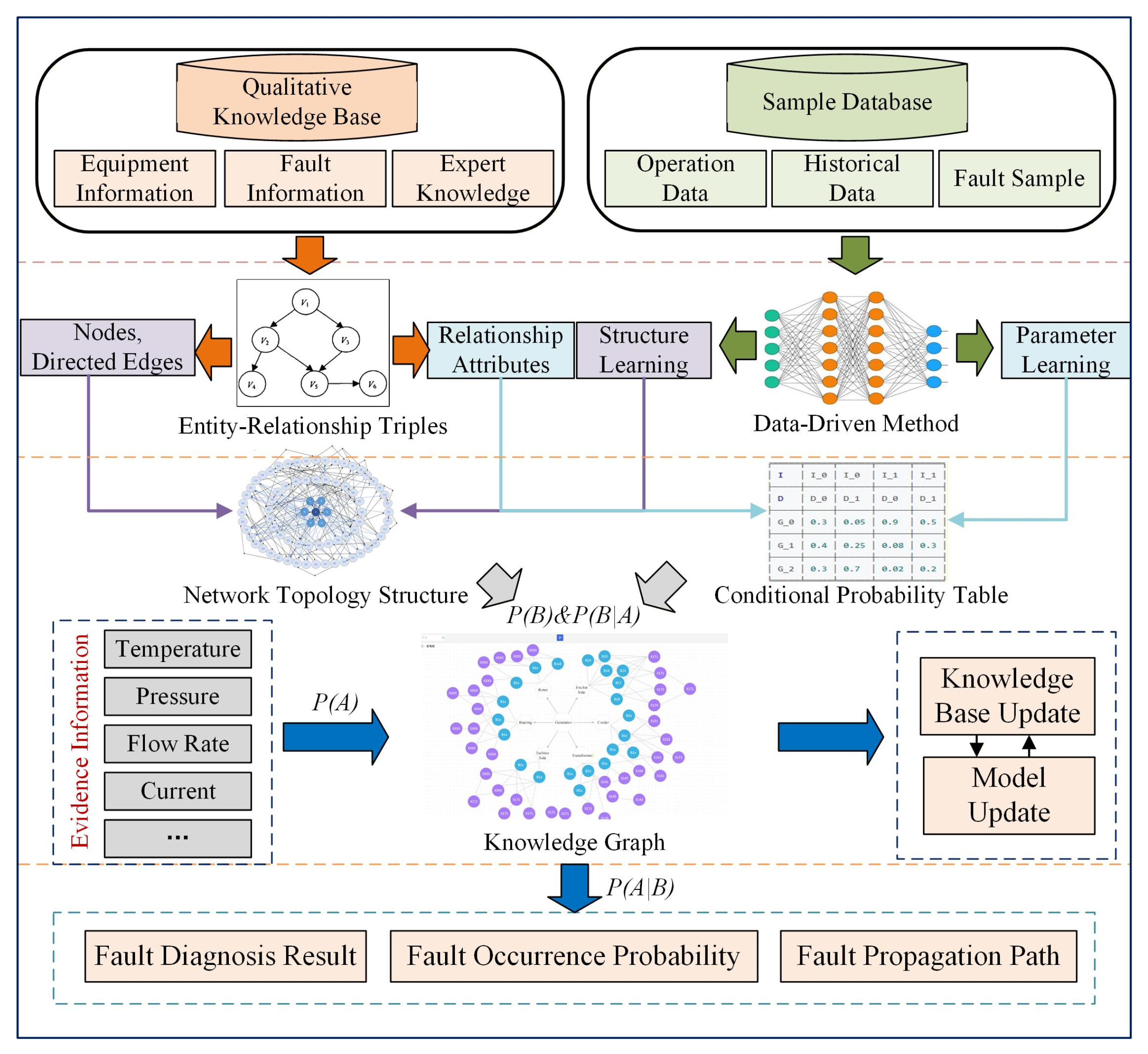
Figure 1. Overall Technical Scheme for KG and Data Fusion Fault Diagnosis.
Processes 14 01903 g001
Figure 2. Knowledge Extraction Flowchart.
Processes 14 01903 g002
Figure 3. Knowledge Correspondence Diagram.
Processes 14 01903 g003
Figure 4. Technical Flowchart for Bayesian Network Inference Model Construction.
Processes 14 01903 g004
Figure 5. Overall Hierarchy Diagram.
Processes 14 01903 g005
Figure 6. Inference Paths for Hot Leg Break.
Processes 14 01903 g006
Figure 7. KGBN Confusion Matrices.
Processes 14 01903 g007
Figure 8. SDG Confusion Matrix.
Processes 14 01903 g008
Figure 9. SVM Confusion Matrix.
Processes 14 01903 g009
Figure 10. DG-softmax Confusion Matrix.
Processes 14 01903 g010
Figure 11. LSTM Confusion Matrix.
Processes 14 01903 g011
Figure 12. Radar Charts of Model Performance.
Processes 14 01903 g012
Figure 13. CRF Motor Coil Temperature Anomaly Inference Path.
Processes 14 01903 g013
Table 1. Fault Knowledge Triples.
EntityRelationshipEntity
Primary loop hot leg breakcauseSteam generator outlet flow rate
Primary loop hot leg breakcauseContainment pressure
Primary loop hot leg breakcauseContainment sump water level
Primary loop hot leg breakcausePressurizer water level
Primary loop hot leg breakcauseContainment internal temperature
Primary loop hot leg breakcauseContainment internal radioactivity
Pressurizer water levellead toPressurizer pressure
Pressurizer pressurelead toCharging flow rate
Pressurizer pressurelead toLetdown flow rate
Pressurizer pressurelead toThermal power of electric heaters
Pressurizer pressurelead toPressurizer vapor space temperature
Pressurizer pressurelead toPressurizer surge line temperature
Thermal power of electric heaterslead toPressurizer vapor space temperature
Table 2. Fault Data Severity Settings.
Fault NameModerateSevereMinor
Primary loop hot leg break0.150.20.1
Charging line leakage0.10.150.05
Volume control tank leakage0.10.20.05
Table 3. Prior Probabilities of Fault Nodes.
Hot Leg BreakCharging Line LeakageVolume Control Tank Leakage
Prior probability0.32940.33670.3339
Table 4. Conditional Probability Table (Partial).
Fault NamePressurizer Level−10
Pressurizer pressure−10.52230.2488
00.15620.5024
10.32150.2488
Pressurizerpressure−10
Electric heater power00.42870.6734
10.57130.3266
Table 5. Detailed Configurations for Benchmark Models.
ModelConfigurations
SDGedge_sign_logic = (ratio_same/diff > 0.33),
propagate_mode = ‘BFS_with_conflict_resolution’,
decision_threshold = 0.5, parallel_diagnoser = True
SVMkernel = [‘rbf’, ‘linear’], C = [0.1, 1, 10, 100],
gamma = [1, 0.1, 0.01, 0.001, ‘scale’], probability = True
DG-softmaxbackbone = 1D-CNN (Conv-BN-MaxPool x2, Conv-BN-GAP x1),
epochs = 40 (pre-train) + 20 (DG-train), batch_size = 20,
optimizer = Adam(lr = 0.001),
loss = CategoricalCrossentropy(from_logits = True),
margin_logic = Adaptive PCA-distribution distance
LSTMself.lstm = nn.LSTM(input_size = 1, hidden_size = 128, batch_first = True)
self.dropout = nn.Dropout(p = 0.2)
self.fc1 = nn.Linear(128, 48); self.relu = nn.ReLU()
self.fc2 = nn.Linear(48, num_classes); Optimizer = Adam(lr = 0.01)
Loss = CategoricalCrossentropy; Epochs = 200
Disclaimer/Publisher’s Note: The statements, opinions and data contained in all publications are solely those of the individual author(s) and contributor(s) and not of MDPI and/or the editor(s). MDPI and/or the editor(s) disclaim responsibility for any injury to people or property resulting from any ideas, methods, instructions or products referred to in the content.