Article

Deep Learning-Based Segmentation and Spatial Distribution Characteristics of Coal Matrix Pores in FIB-SEM Images

School of Safety Science and Engineering, Xi’an University of Science and Technology, Xi’an 710054, China
*
Author to whom correspondence should be addressed.
Processes 2026, 14(12), 1888; https://doi.org/10.3390/pr14121888
Submission received: 23 March 2026 / Revised: 1 June 2026 / Accepted: 8 June 2026 / Published: 10 June 2026
(This article belongs to the Section Energy Systems)

Abstract

Coal matrix pores are critical sites for gas storage and migration, ensuring effective gas drainage, safe coal mining and reliable evaluation of pore structures. To investigate coal matrix pore characteristics, this study examines coal samples from the Xiaobaodang and Sangshuping collieries (Samples 1 and 2, respectively) using focused ion beam scanning electron microscopy. Datasets were developed through systematic data acquisition, preprocessing and labelling, and the MDFA-DeepLabv3+ model was trained for pore segmentation. Spatial pore size distribution characteristics were derived by integrating 3D reconstruction theory. The final evaluation metrics yielded IoU, Dice, PA, Precision, and Recall values of 81.63%, 89.89%, 98.51%, 89.43%, and 90.34%, respectively. Sample 1 and Sample 2 have broadly similar coordination numbers, Euler numbers and tortuosity values, yet they show distinct differences in the proportion of pores by volume and total pore quantity. These findings provide a theoretical basis for the accurate evaluation of coal matrix pore characteristics and the optimisation of gas drainage design.

1. Introduction

The coal matrix exhibits a pore structure spanning characteristic dimensions from micrometres to nanometres, providing the primary domain for coalbed methane migration and storage. Notably, nanopores (<100 nm) account for more than 60% of the total porosity. Their morphology and connectivity directly control methane seepage efficiency; however, conventional characterisation techniques struggle to resolve these microscopic features because of inherent resolution constraints. Coal pore structures fundamentally govern gas adsorption, desorption and seepage behaviour and, therefore, form the basis of coalbed methane diffusion and permeability studies [1,2]. Presently, coal pore structure characterisation methods are primarily divided into photoelectric radiation and fluid injection techniques. With advances in photoelectric technologies, imaging approaches have progressed from simple 2D, macroscopic observations to complex, 3D and microscopic analyses, opening new avenues for comprehensive investigation of coal pore structures [3].
Substantial progress has been achieved recently in the characterisation and reconstruction of coal pore systems. Multimodal computed tomography (CT) fusion approaches have demonstrated distinct advantages driven by technological developments. The integration of microCT with Avizo software 2020.2 has provided new insights into coal pore morphology, revealing the dominance of pores in the 500–1400 nm range and a pronounced increase in throat number with increasing radius and length [4]. A tri-modal framework combining X-ray tomography, nuclear magnetic resonance (NMR) spectroscopy, and magnetic resonance imaging has been established to compare pore systems in bituminous coal and anthracite, showing a negative correlation between pore number and their contribution to total pore volume [5]. Related studies, employing CT coupling techniques [6], X-ray diffraction NMR fusion methods [7] and μCT scanning with digital image processing [8], have enabled multiscale characterisation of pore-fracture structures and heterogeneity, including quantitative discrimination between connected and isolated pores, 3D visual reconstruction, and gas flow simulation for permeability prediction.
During 3D reconstruction, threshold-based segmentation is commonly applied to isolate pore spaces. However, the geometric complexity of coal pores can substantially reduce segmentation accuracy, constraining the reconstruction of nanopores and compromising the precision and completeness of pore structure characterisation [5].
Although multimodal CT techniques are effective for macroscopic pore analysis, the intricate pore architecture of coal imposes stricter requirements on image quality and segmentation accuracy. As a result, focused ion beam (FIB) scanning electron microscopy (SEM) has increasingly been adopted for high-resolution microstructural investigation. FIB-SEM observations have shown that anthracite contains clustered nanopores in the 10–200 nm range, accounting for 96.31% of the total pore volume [9], while contraction pores of 10–50 nm have been identified as key pathways for gas migration [10]. By coupling FIB-SEM with Avizo software, nanopores in anthracite from the Qinshui Basin have been reconstructed, enabling a detailed comparison of organic pores, inorganic pores, and microfractures [11]. Furthermore, cryo-FIB-SEM has been applied to visualise 3D pore distributions in lignite under water-bearing conditions [12].
Despite these advances, traditional approaches remain limited by data-processing efficiency. Machine learning-based methods offer a rapid alternative for pore identification and segmentation through the training, validation, and testing of coal pore slice images, reducing manual effort while improving efficiency. Conventional CT scanning typically achieves only micrometre-scale resolution, restricting its ability to reconstruct nanopores in 3D coal pore models. In contrast, FIB-SEM provides nanometre-scale resolution and effectively discriminates pores from organic matter. For example, a U-Net convolutional network has been developed to optimise FIB-SEM image segmentation, reducing characterisation errors for nanopores and micropores to 3% while improving efficiency by 40% [13]. A deep learning-based U-Net model has been applied to FIB-SEM image segmentation to mitigate the mis-segmentation caused by pore–background artefacts inherent in threshold-based methods [14]. Additionally, U-Net architectures have been successfully used to segment concrete SEM images, demonstrating robust performance in porosity and microstructural analysis [15].
While machine vision excels in medical imaging, coal pore segmentation remains understudied. High-voxel 3D segmentation is computationally infeasible, so 2D methods persist but suffer from topological discontinuity in 3D reconstruction and poor multiscale feature capture. This work uses high-resolution FIB-SEM slices and an enhanced DeepLabv3+ with channel attention, a tri-level progressive decoder, and a parallel edge detection branch to address these limitations, enabling accurate 3D pore reconstruction and analysis.
The remainder of the paper is organised as follows. Section 2 describes coal sample preparation and the construction of the MDFA-DeepLabv3+ model. Section 3 presents dataset development, experimental environment, evaluation metrics, and a detailed analysis of semantic segmentation results. Section 4 discusses the 3D reconstruction of pores, pore structure characteristics, and pore connectivity analysis. The main conclusions are summarised in Section 5.

2. Testing Methods and Model Construction

2.1. Sample Preparation and Testing

Coal samples from the Xiaobaodang Coal Mine (Sample 1) in the Shaanbei Jurassic Coalfield and the Sangshuping Coal Mine (Sample 2) in the Weibei Coalfield were selected for this study. The samples were classified according to volatile matter content, with Samples 1 and 2 identified as long-flame coal and lean coal, respectively. For FIB-SEM analysis, coal specimens with a volume of 1 cm3 were prepared through crushing, grinding, and drying. The findings are listed in Table 1.
Initially, the samples were dried, mechanically polished, argon-ion polished, and carbon-coated to minimise scanning artefacts arising from inadequate surface flatness and electrical conductivity. The prepared samples were then mounted on the stage, the chamber was evacuated, and the electron beam system was activated. The distance between the column and the stage was adjusted to ensure that the sample surface was clearly visible within the field of view. Subsequently, the stage was tilted by 52° relative to the horizontal plane, and the sample surface was imaged and scanned. Based on the acquired imaging data, post-processing was applied to restore the original sample geometry and perform offset correction. The region with the largest exposed area was selected for analysis to maximise the representativeness of pore distribution characteristics. The experimental principle is illustrated in Figure 1.

2.2. MDFA-Deeplabv3+ Model Construction

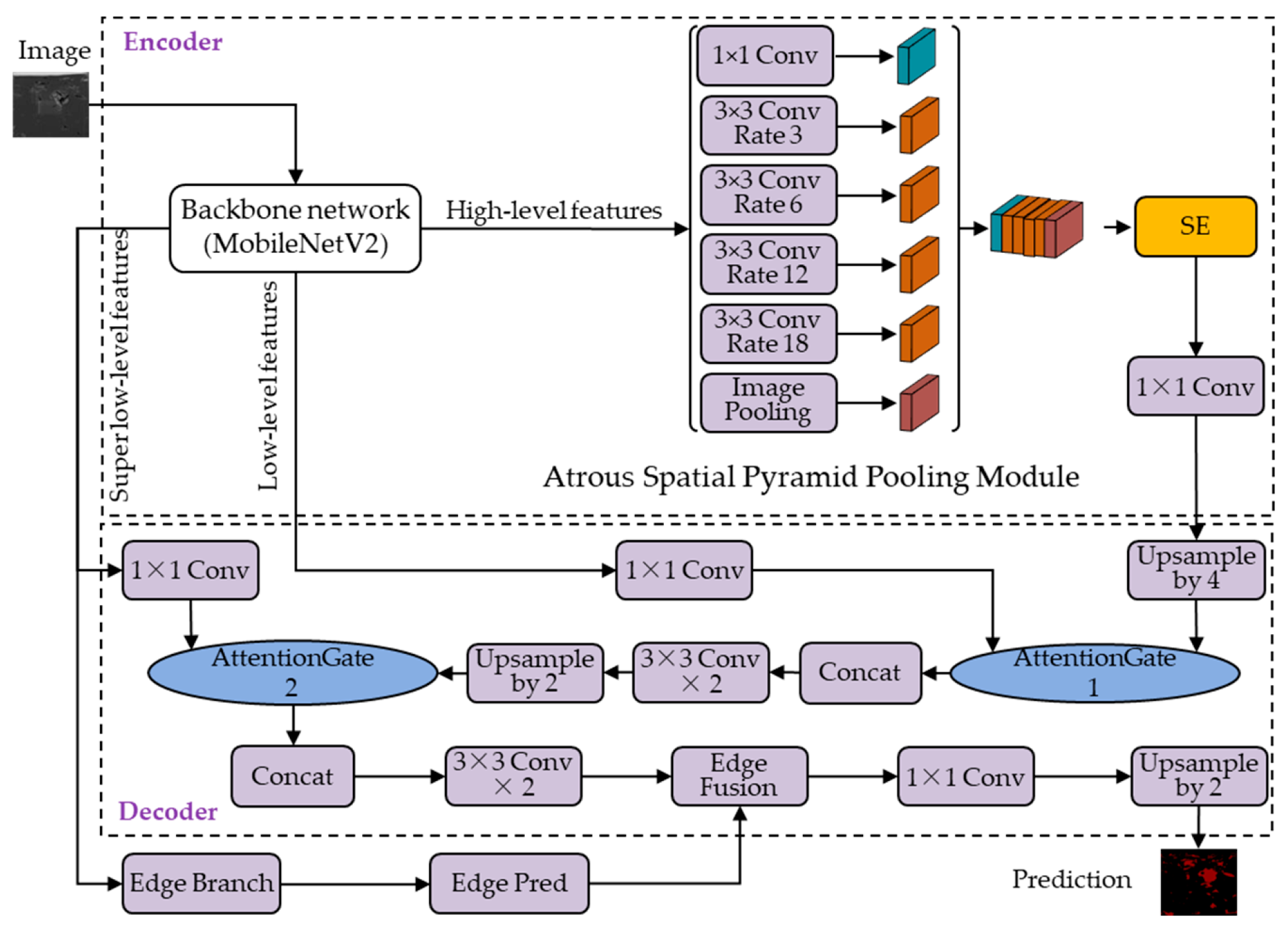
To address the inherent challenges arising from segmentation regions with fine-grained complex topologies and blurry boundaries, this paper proposes a semantic segmentation network based on the improved DeepLabV3+ architecture [16,17]. As demonstrated by the network structure, the original DeepLabV3+ model is enhanced in three key aspects: a multiscale feature extractor embedded with channel attention mechanisms, a tri-level progressive decoder driven by attention gates, and an independent parallel edge detection branch. The overall network architecture is shown in Figure 2. The overall pipeline utilises an enhanced MobileNetV2 [18] as the backbone to capture multi-level feature representations. Unlike the standard baseline that solely bridges one low-level feature map, our network establishes a tri-level hierarchical fusion strategy, integrating deep semantic contexts with both low-level and super-low-level spatial details to preserve minuscule structures from severe downsampling attenuation.
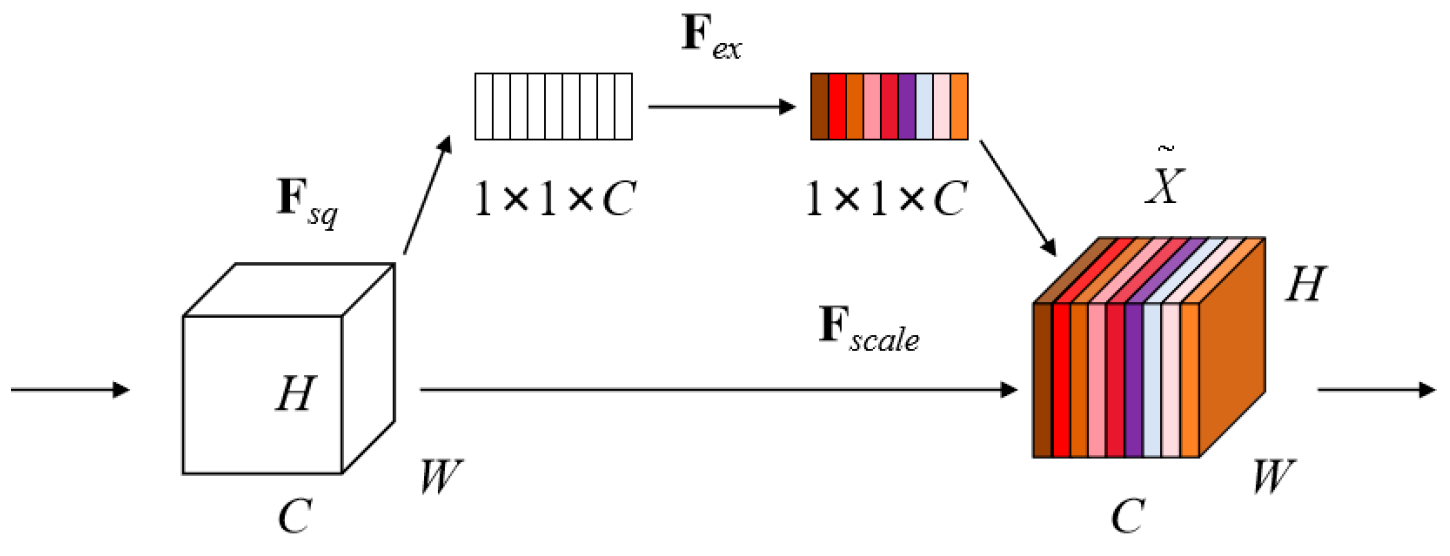
The classic Atrous Spatial Pyramid Pooling (ASPP) [19,20] module extracts multiscale contextual information via parallel atrous convolutions with varied dilation rates. Based on the original five-branch ASPP, a new small-scale atrous convolution branch with a dilation rate of 3 is added. We add the Squeeze and Excitation (SE) block [21] immediately after the ASPP feature concatenation process. By modelling interdependencies among channels explicitly, the SE mechanism adaptively adjusts feature responses across all channels (Figure 3).
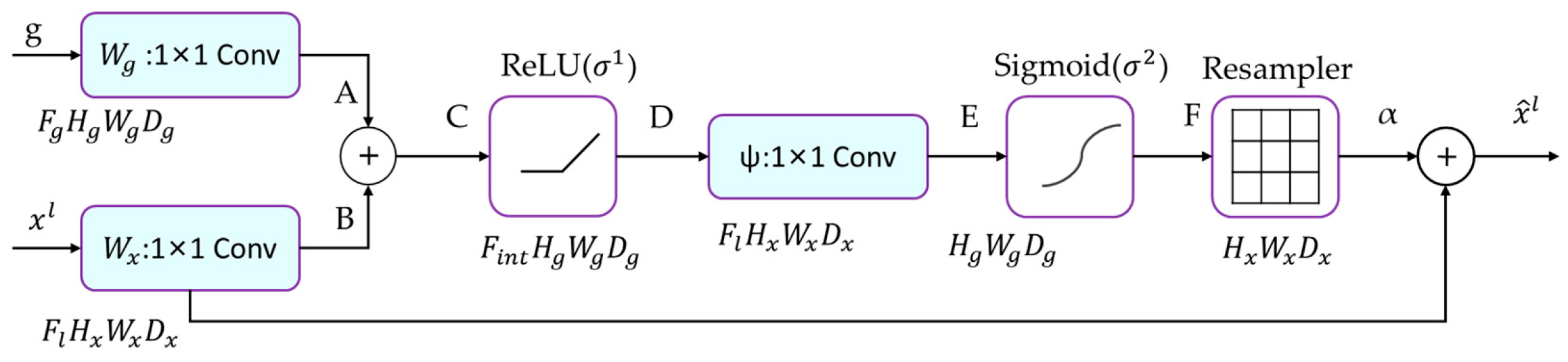
A two-layer feature fusion structure is adopted instead of the single fusion in the original model. The first fusion concatenates the multiscale semantic features output by ASPP with the low-level features filtered by an attention gate. The second fusion concatenates the upsampled intermediate features with the super-low-level features filtered by another attention gate. The attention gates can dynamically select useful features at different levels and suppress background noise interference (Figure 4) [22].
The total loss function of the proposed model is a weighted combination of three components: the main segmentation loss, auxiliary deep supervision loss, and edge loss. It integrates multi-level feature supervision signals to mitigate gradient vanishing and improve edge segmentation accuracy.
To address the extreme class imbalance and edge segmentation errors in semantic segmentation tasks, the main segmentation loss adopts Dice–Focal Loss, formulated as follows:
L m a i n Y , Y ^ = L F o c a l ( Y m a i n , Y ^ ) + L D i c e ( Y m a i n , Y ^ )
where Y m a i n denotes the predicted output of the main branch of the model; Y ^ denotes the ground truth label; L F o c a l [23] is the cross-entropy loss (the hyperparameters are set as α = 0.5, γ = 2); and L D i c e [24] is the Dice loss.
The total loss function L t o t a l , incorporating deep supervision and edge optimisation, is defined as:
L t o t a l = L m a i n Y m a i n , Y ^ + λ 1 L a u x ( Y a u x , Y ^ ) + λ 2 L e d g e ( P e d g e , E g t )
where Y a u x is the deep supervision auxiliary output derived from the intermediate feature layer of the ASPP module; P e d g e signifies the edge probability map generated by applying a Sigmoid activation function to the output of the shallow edge branch; and E g t is the high-frequency edge map extracted from the ground truth label using the Laplacian operator. In the experimental configuration of this study, the weight of the deep supervision loss λ 1 is set to 0.4, and the weight of the Laplacian edge loss λ 2 is set to 0.3. L e d g e adopts the Laplacian Edge Loss to impose explicit boundary constraints, thereby thoroughly correcting segmentation errors at the interface between coal matrix and pores. In addition, the base weight of each class is initialised as an all-ones array, and the optimisation for sample imbalance is entirely driven adaptively by the internal mechanisms of Focal Loss and Dice Loss.

3. MDFA-Deeplabv3+ Coal Pore Segmentation

3.1. Dataset Construction

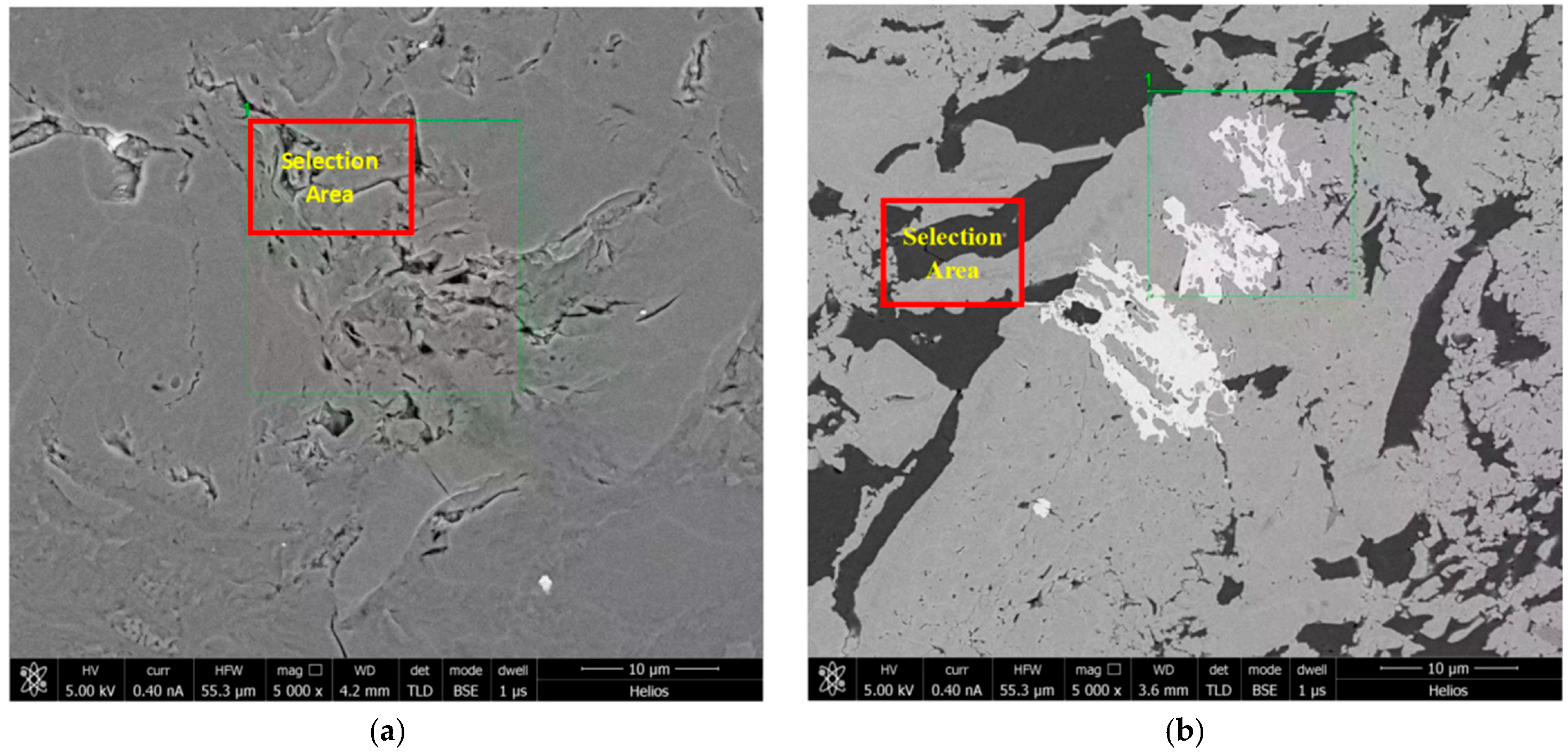
Two sets of coal samples were analysed in this study. FIB-SEM was employed to characterise the samples, revealing well-developed internal pore structures through preliminary surface morphology observations (Figure 5). The region highlighted by the red box was selected for high-resolution SEM imaging and subsequent FIB-SEM slicing and scanning. The resulting pore image slices served as the primary dataset for machine learning analysis. In total, 988 images from Sample 1 and 932 images from Sample 2 were acquired and retained in their original .TIFF format.
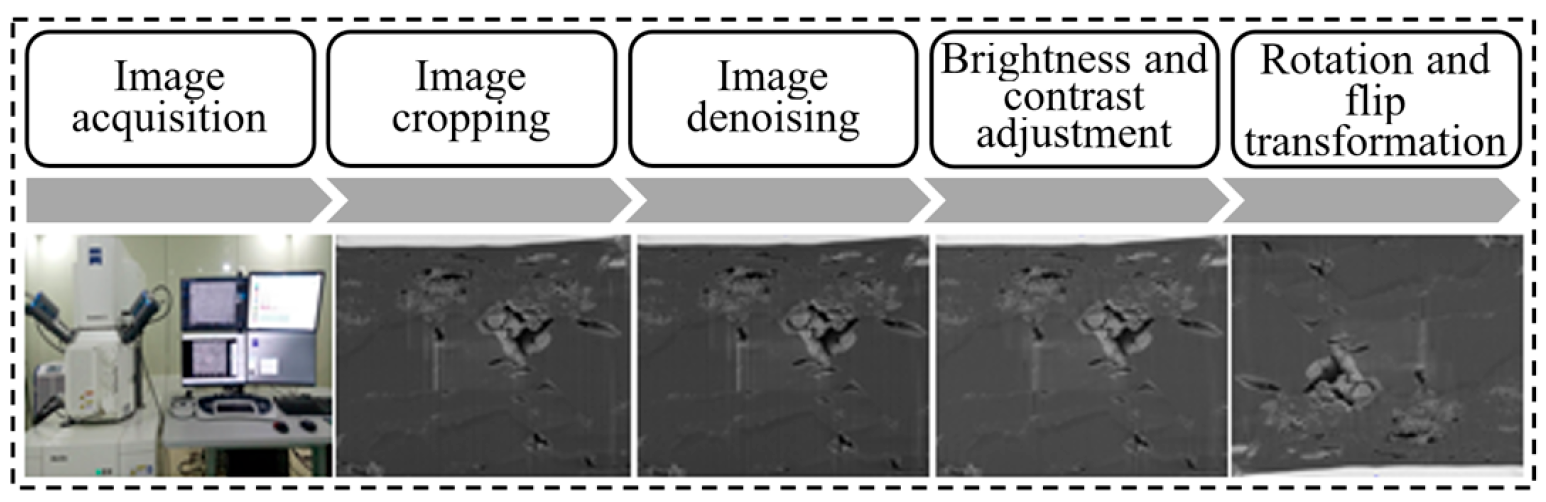
During image acquisition, transmission, and storage, coal pore images inevitably contain noise, which can adversely affect segmentation accuracy if directly input into the model. Because machine learning-based pore identification relies on pixel-level classification, noise interferes with global feature extraction [25,26], while limited datasets can further constrain model generalisation. Accordingly, image enhancement procedures were applied to suppress noise and improve feature clarity. Specifically, a Fourier transform filter was used to mitigate FIB-SEM-induced artefacts, followed by data augmentation operations including horizontal flipping, translation, scaling, rotation, grid distortion, random brightness, and contrast adjustment. These steps yielded 200 high-quality images for subsequent labelling, as illustrated in Figure 6.
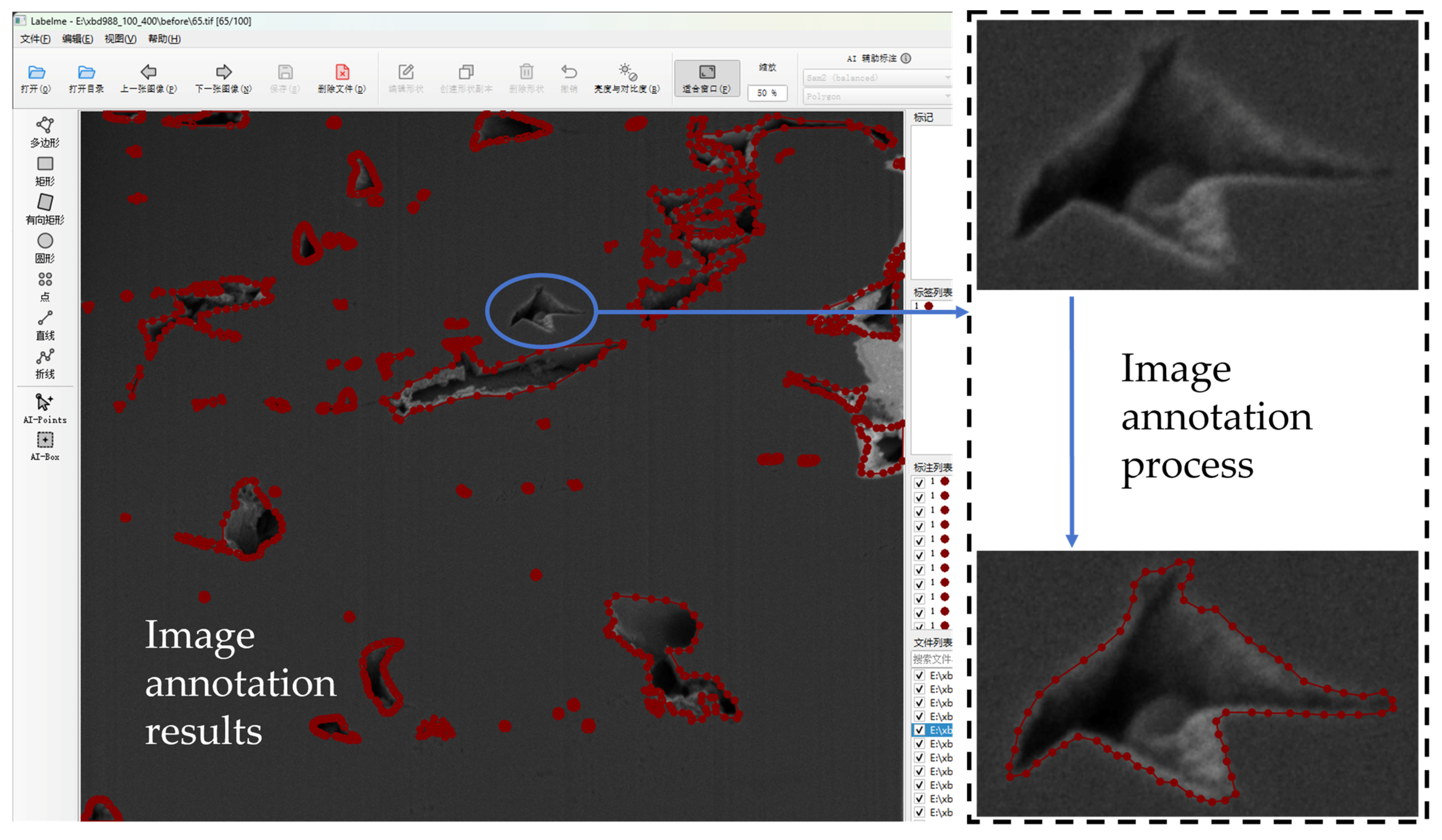
Labelme 6.3.1 was adopted as the data-labelling tool. Coal pore images were imported into the software, and the polygon tool was used to manually delineate pore boundaries. The labelling procedure is illustrated in Figure 7. Each image was opened via the toolbar, after which the ‘Create Polygon’ function was used to sequentially trace the contours of all visible pores. Regions outside the labelled polygons were defined as the coal matrix. Coal pores were assigned to Category 1 and displayed in red (RGB: 255, 0, 0). Upon completion, a corresponding JSON file was generated for each image, containing the coordinates of the labelled pores together with the path and dimensions of the associated image.
To mitigate the inherent uncertainty and subjectivity in delineating microscale coal pore boundaries, we established a standardised collaborative annotation workflow using Labelme. Two experienced researchers conducted precise pixel-level polygon labelling following a pilot consensus training session on representative slices, which unified boundary recognition criteria under complex greyscale variations. All generated JSON annotation files were subjected to strict cross-verification and hierarchical review by two senior geological engineering experts, with approximately 20% of slices randomly extracted for rigorous blind quality audit. Boundary ambiguities and structural misclassifications were reassessed and corrected via consensus voting using polygon modification tools in Labelme, guaranteeing the dataset’s high reliability and geometric fidelity for deep learning training.
After all the required images had been labelled, coal pore datasets were constructed following the visual object class (VOC) dataset format [27], comprising three components: ImageSets, JPEGImages, and SegmentationClass. ImageSets stores metadata for the training and validation subsets, while JPEGImages and SegmentationClass contain the FIB-SEM images and their corresponding labelled masks, respectively.
Two labelled coal sample data sets are used in this experiment, named xbd and ssp, respectively. Each data set contains 100 labelled images, so there are 200 labelled images in total. All data sets are split in sequence into three subsets that do not overlap: training set, validation set and test set.
For both xbd and ssp data sets, the first 70 images are assigned to the training set, the next 10 images from the 71st to the 81st are placed in the validation set, and the remaining 20 images form the test set. After the combination of the two data sets, the training set contained 140 images, the validation set contained 20 images, and the test set contained 40 images.
Data augmentation was applied to the 140 images in the training set before model training started. The final training log recorded 1260 images for training, 20 images for validation and 40 images for testing. All input images were resized to 512 by 512 pixels. In the labels, the pixel value of the background is set to 0, and the pixel value of the target region is set to 1.

3.2. Experimental Environment

To ensure experimental validity and reproducibility, all coal pore segmentation experiments were performed on a single machine with a consistent hardware configuration. The model was developed and optimised using PyTorch 2.1.0 and implemented in Python 3.9.18 within the PyCharm 2023.2 environment. Detailed hardware specifications are provided in Table 2.

3.3. Evaluation Metrics

To quantitatively evaluate the segmentation performance of the model on pore network structures, this paper selects Intersection over Union (IoU) [28], Dice Similarity Coefficient (DSC) [29], Pixel Accuracy (PA) [30], Recall, and Precision as evaluation metrics. These metrics are all constructed based on the basic statistics of the confusion matrix and are suitable for class-imbalanced datasets such as pore networks, where the number of foreground (pore) voxels is significantly lower than that of background (matrix) voxels. The basic statistics of the confusion matrix are defined as follows: TP (True Positive) is the number of voxels correctly predicted as pores; TN (True Negative) is the number of voxels correctly predicted as matrix; FP (False Positive) is the number of matrix voxels incorrectly predicted as pores; and FN (False Negative) is the number of pore voxels incorrectly predicted as matrix.
The mathematical expression of IoU is:
IoU   =   TP TP   +   FP   +   FN
The mathematical expression of Dice is:
Dice   =   2   ×   TP 2   ×   TP   +   FP   +   FN
The mathematical expression of PA is:
PA   =   TP   +   TN TP   +   TN   +   FP   +   FN
The mathematical expression of Recall is:
Recall   =   TP FN   +   TP
The mathematical expression of Precision is:
Precision   =   TP FP   +   TP
For segmentation tasks that present class imbalance, a single metric cannot fully represent the overall segmentation performance of a model. This study, therefore, applies the multiple metrics referred to above to conduct a comprehensive evaluation and deliver an objective assessment of the performance of the model.

3.4. Training Parameter Settings

MobileNetV2 serves as the backbone network for the improved DeepLabV3+ model, achieving an output downsampling factor of 16. Optimiser Adam is used with beta one set to 0.9, beta two set to 0.999, and the weight decay is 0. To accommodate the batch size of 4 used in both the freezing and unfreezing stages under hardware constraints, the base maximum learning rate is adaptively bounded at 3 × 10 4 . Concurrently, the minimum learning rate is restricted to 3 × 10 6 . Cosine Annealing is adopted as the learning rate decay strategy together with linear warmup.
The total number of training epochs is 90. Due to GPU memory limitations, the batch size is set to 4 for both training stages. Model weights are saved every five epochs throughout the training process, and the optimal model is retained according to the loss values obtained from the validation set.
For the loss configuration, the primary and auxiliary Focal Loss functions are implemented with hyperparameters set to α = 0.5 and γ = 2. The multi-task weighting coefficients for the comprehensive objective function ( L t o t a l ) are explicitly assigned as 1.0 for the main segmentation loss, 0.4 for the auxiliary deep supervision loss, and 0.3 for the Laplacian edge optimisation loss. Additionally, background and target categories share a balanced base class weight of 1.0.
Segmentation performance was evaluated using both quantitative metric values, where higher values indicate better performance, and loss curves describing training convergence [31]. Lower loss values indicate smaller discrepancies between predicted outputs and ground truth.

3.5. Analysis of Experimental Results

During the training of the MDFA-DeepLabv3+ model, the dataset was sequentially split into training set, validation set and test set at a ratio of 7:1:2 to prevent data leakage. An excessively large training set may lead to overfitting, whereas an insufficient training set can result in incomplete feature learning and underfitting [32].
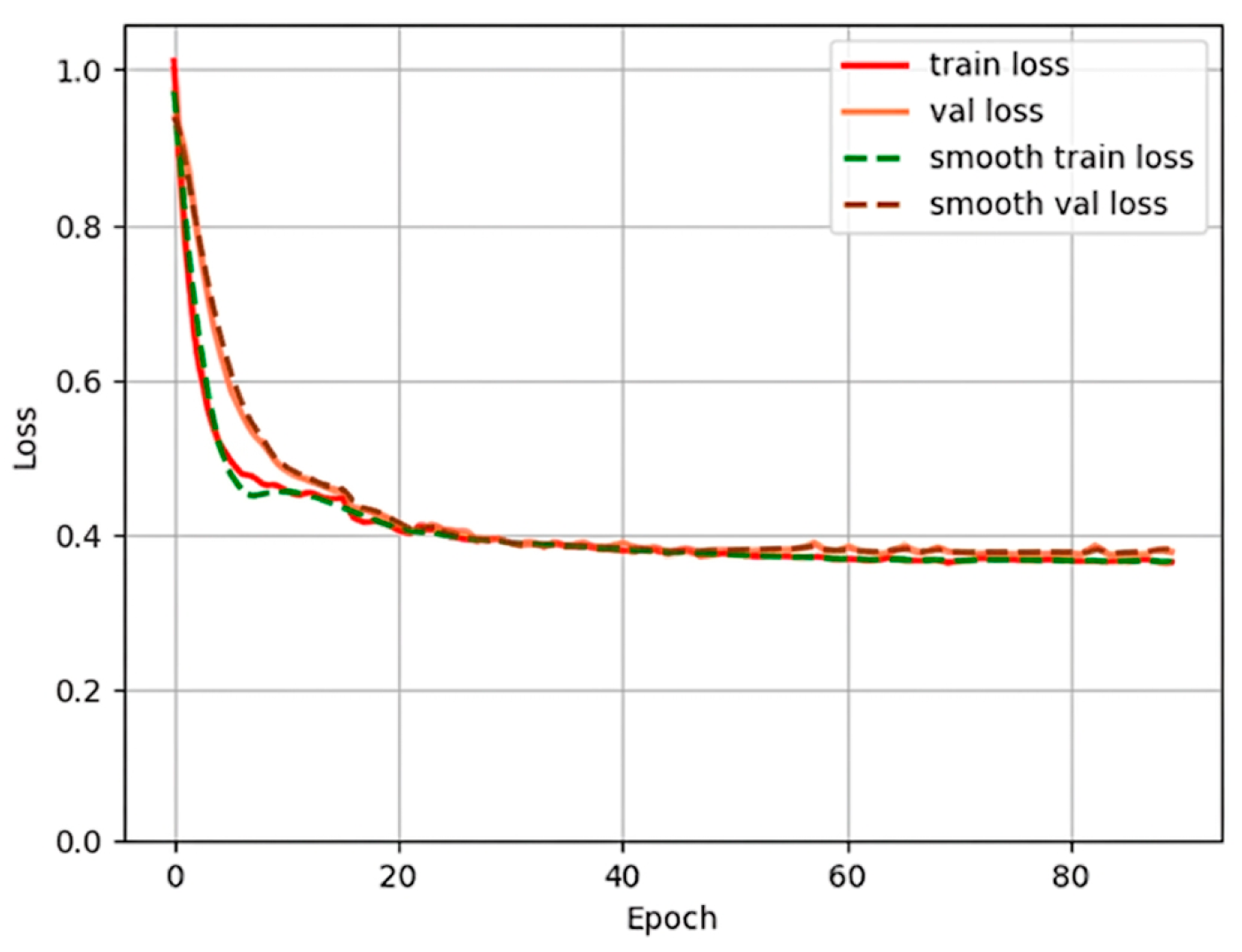
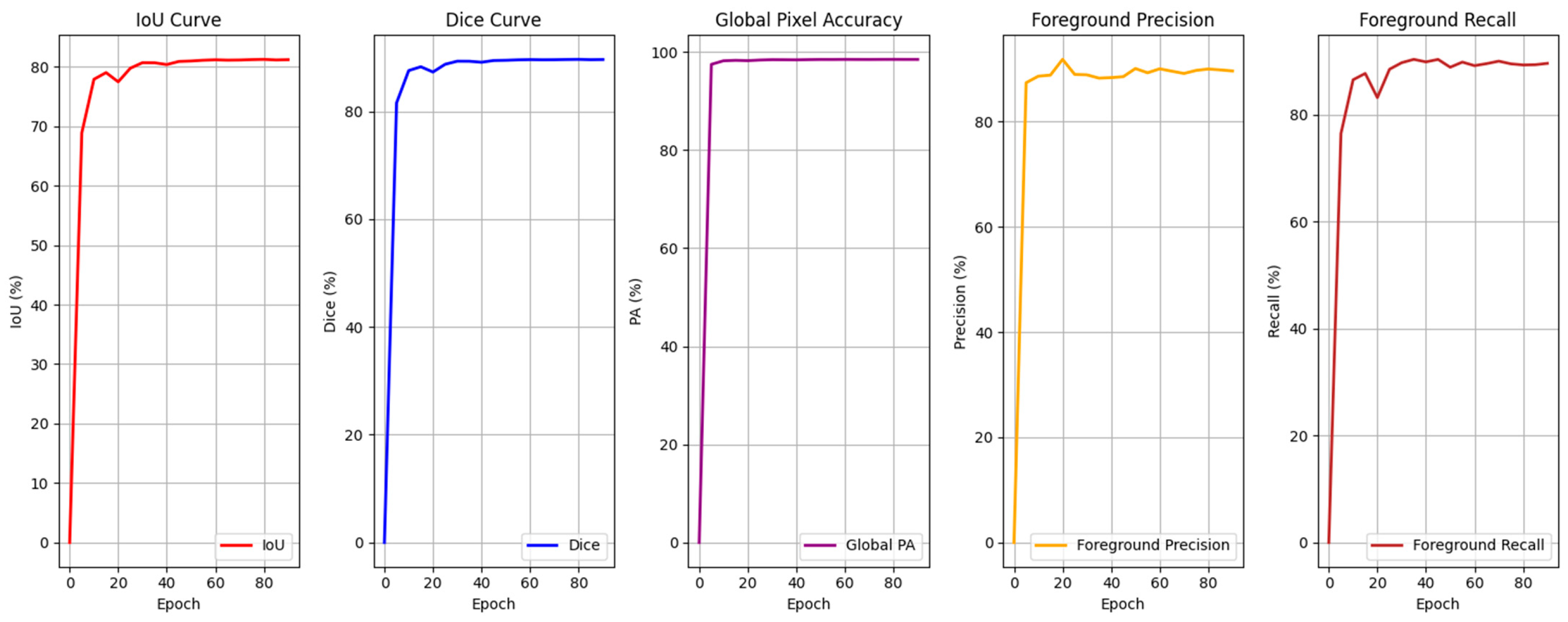
The training process and evaluation metrics for the MDFA-DeepLabv3+ model are presented in Figure 8 and Figure 9, respectively. At the early stage of training, the loss decreased sharply, followed by gradual stabilisation and convergence as the number of iterations increased, indicating a relatively fast convergence rate.
In Figure 8, it is worth noting that the total loss function in this study incorporates multiple auxiliary constraints, including the Laplacian edge loss, auxiliary supervision, and shallow boundary loss, alongside the primary segmentation loss. The stringent penalties imposed by these geometric constraints near the intricate pore boundaries sustain the converged loss value at a higher absolute baseline (around 0.4).
As shown in Figure 9, the precision curve exhibited a similar pattern, characterised by a rapid initial increase and subsequent stabilisation. The final evaluation metrics yielded IoU, Dice, PA, Precision, and Recall values of 81.63%, 89.89%, 98.51%, 89.43%, and 90.34%, respectively. These results indicate high accuracy and robustness in coal pore identification, with consistently strong segmentation performance.
To further eliminate result deviations caused by the random initialisation of model parameters and to verify the performance stability of the model under a fixed data distribution, we adopted a fixed split of the training set and the test set and conducted repeated experiments with three different random seeds [33]. All evaluation indicators are presented in Table 3.

3.6. Analysis of Ablation Experiment

To quantitatively assess the contribution of individual model components and to verify the effect of attention mechanisms on segmentation accuracy, an ablation study was conducted, with the results summarised in Table 4. Here, DeepLabv3+ denotes the baseline architecture, and SE+DeepLabv3+ incorporates only the SE attention mechanism and MDFA-DeepLabv3+ modules.
In all test schemes, MDFA-DeepLabv3+ achieves the largest performance improvement and better segmentation accuracy compared with baseline models. To eliminate the influence caused by different data splits across various models, the remaining data after excluding the test set is divided sequentially into five independent subsets. The ratio of training parts to validation parts within each fold is 4:1, and 5-fold cross-validation is adopted. The experimental results in Table 4 are presented as mean value plus or minus sample standard deviation.
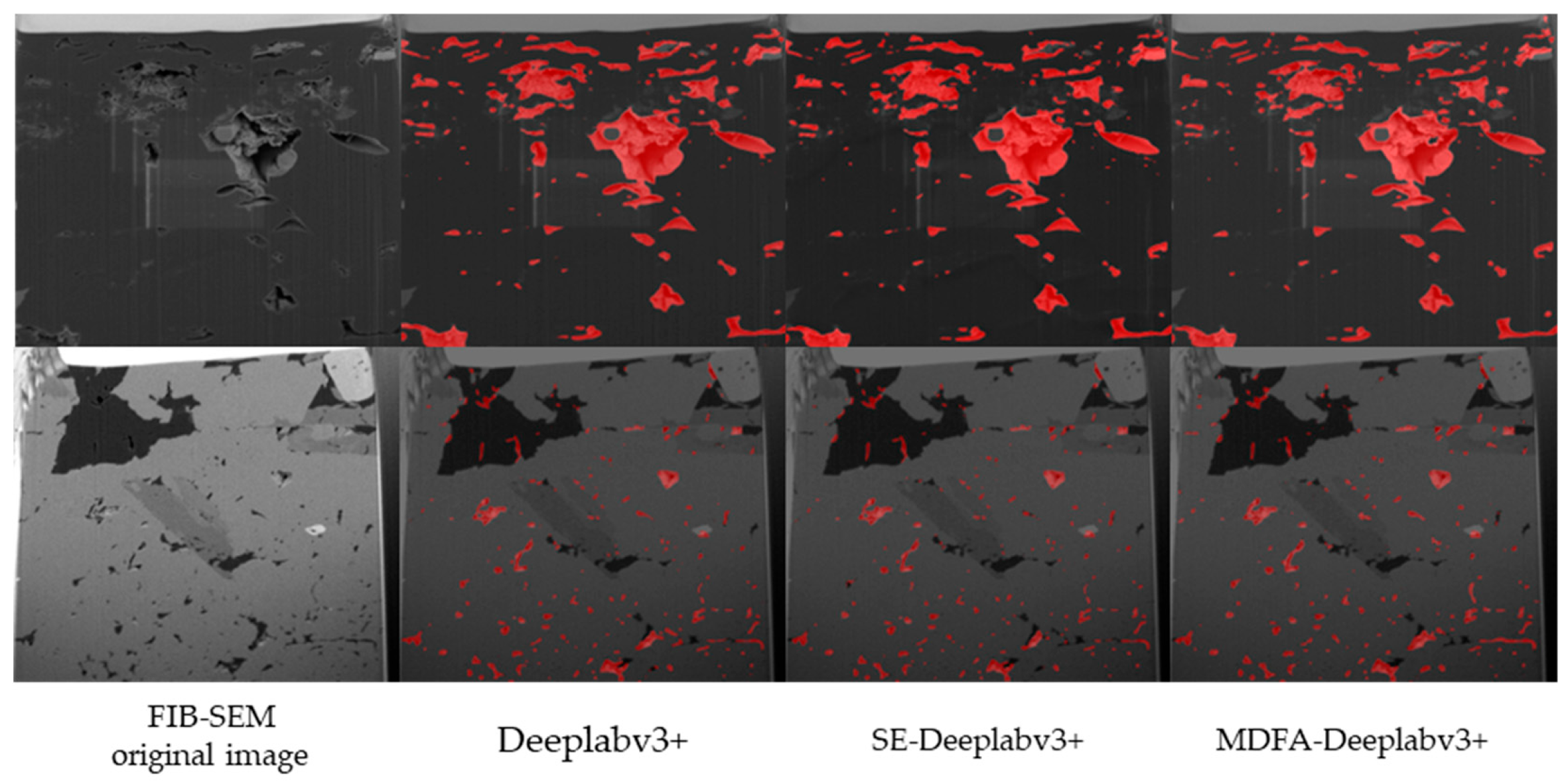
To provide a more intuitive comparison of module effectiveness, four representative coal pore slices were selected for visual inspection (Figure 10). Following the integration of SE modules, the enhanced model outperformed the baseline approaches in semantic feature extraction. In particular, it exhibited improved sensitivity to small pores, reduced omission of fine structures, and fewer misclassifications overall.
As shown in Table 5, MDFA-DeepLabv3+ achieves better performance than U-Net, U-Net++ and PSPNet across all evaluation metrics. The ratio of training parts to validation parts within each fold is 4:1, and 5-fold cross-validation is adopted. These results further verify the effectiveness and superiority of the proposed architecture.
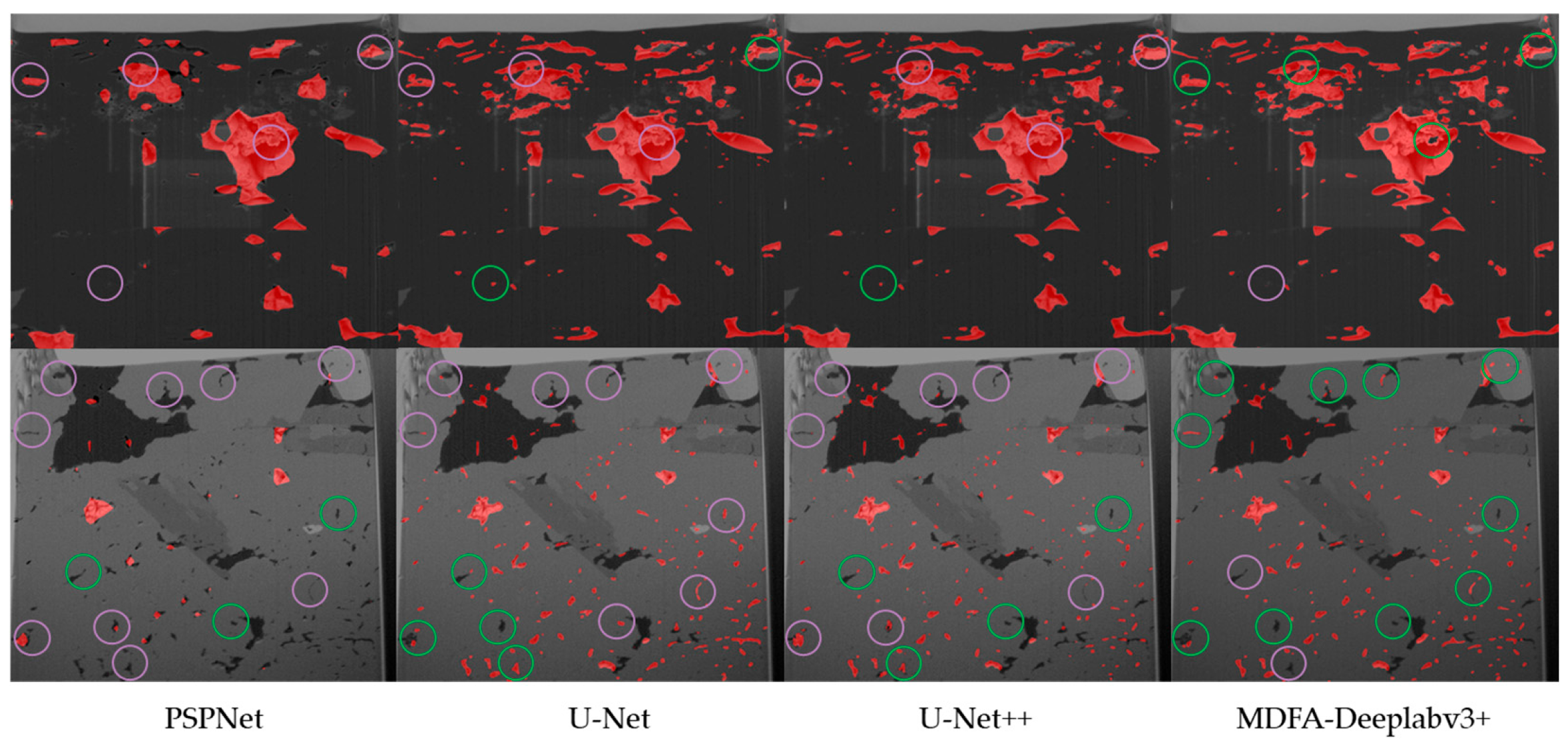
Figure 11 provides a visual comparison of the segmentation results from different models. Green circles denote true positives and true negatives. Purple circles denote false positives and false negatives. The images are generated by PSPNet, U-Net, U-Net++ and MDFA-DeepLabv3+ in sequence. PSPNet delivers the poorest performance, with incomplete segmentation of pore contours, frequent missed detections of tiny pores and low overall accuracy. U-Net++ achieves the second-best results after the modified DeepLabv3+. It performs well in identifying tiny pores yet suffers from segmentation errors and spurious edges, which may adversely affect subsequent pore reconstruction, connectivity analysis and topological characterisation. In contrast, the modified DeepLabv3+ model captures subtle pore features more accurately and exhibits stronger generalisation ability.

4. 3D Reconstruction and Characterisation of Coal Pores

4.1. 3D Reconstruction Results

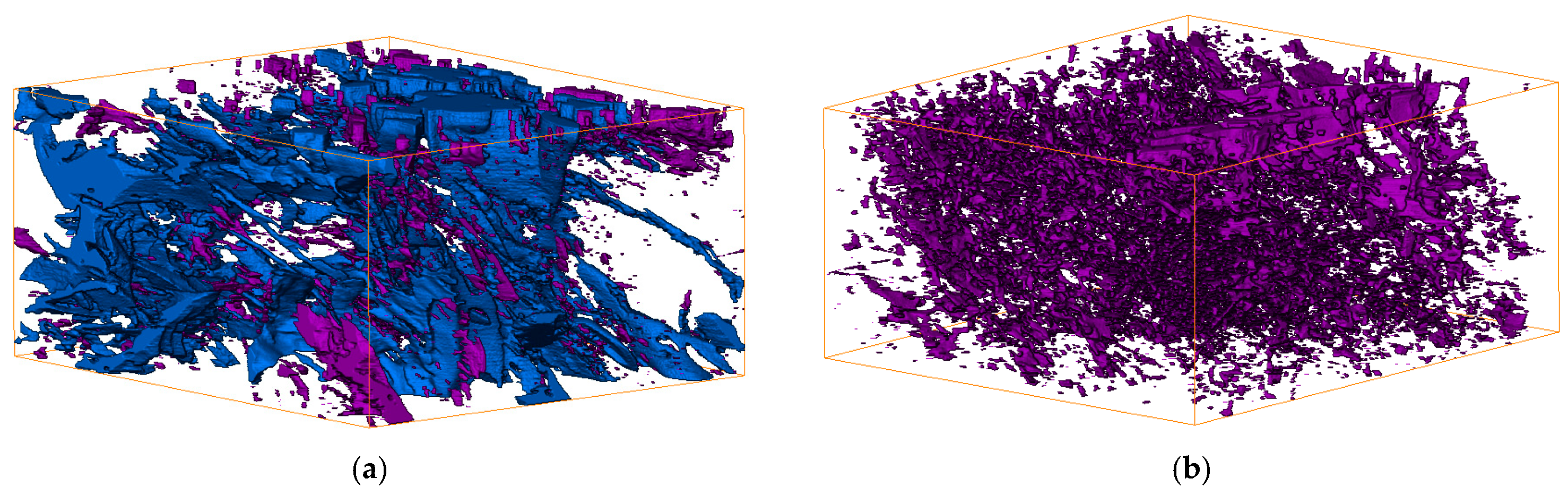
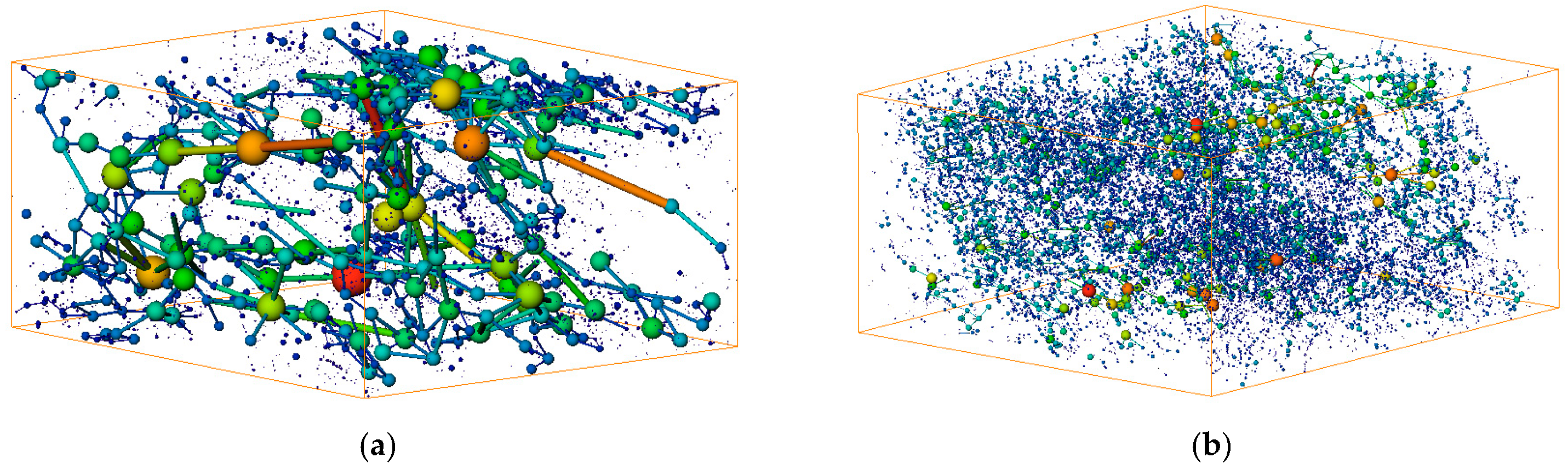
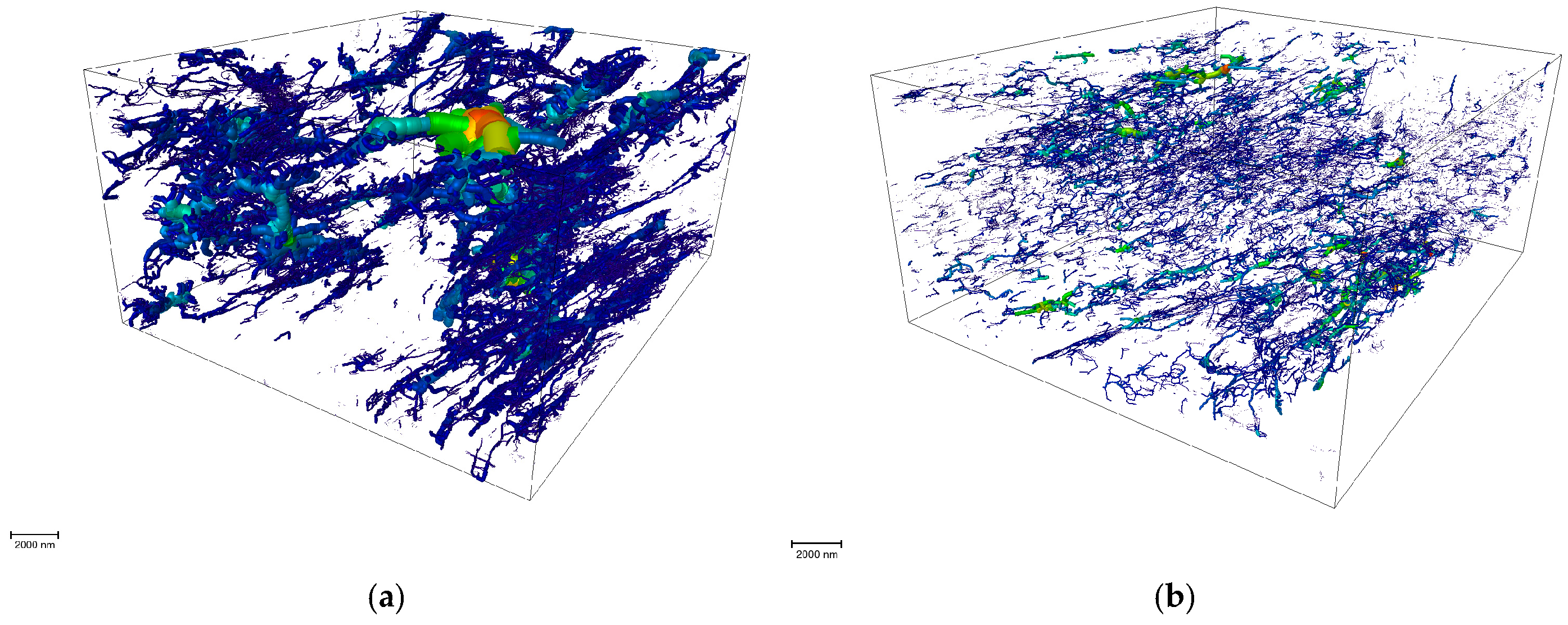
The MDFA-DeepLabv3+ model was applied to segment coal pores. The 2D pore slices identified by the model were sequentially stacked and subjected to interpolation to generate volumetric data. 3D visualisation and modelling were then performed using the volume-rendering module of Avizo (2020.2) software to achieve 3D reconstruction of the coal pore structure [34]. The resulting 3D pore reconstructions and corresponding ball–stick representations derived from maximum ball-based characterisation are shown in Figure 12 and Figure 13, respectively.
The 3D reconstruction results indicate that coal fractures and pores exhibit pronounced spatial heterogeneity and randomness, primarily reflecting the variable pressures and temperatures experienced during coal formation. Such complex spatial architectures provide substantial storage capacity for gas [35]. In Sample 1, the total number of pores was relatively low, but individual pores occupied larger volumes. The pore network model shows that Sample 1 contained more developed throat structures, indicating stronger connectivity and larger equivalent pore radii. In contrast, Sample 2 was dominated by smaller pores with poorly developed throats and a higher proportion of isolated pores, resulting in weaker overall connectivity.

4.2. Pore Structure Characteristics

Quantitative characterisation of pore structures was conducted based on 3D reconstruction of both coal samples. As shown in Table 6, sample 1 contained 6584 discrete pores, with a cumulative pore volume of 350.18 μm3 and a total surface area of 4179.70 μm2. Pore radii ranged from the minimum detected value to above 1000 nm, indicating strong structural heterogeneity. Numerically, pores in the 5–100 nm range dominated the distribution (5665 pores, 86.04%), whereas only 8 pores (0.12%) fell within the 900–1000 nm interval. In contrast, the largest contributions to pore volume (87.75 μm3) originated from pores in the >1000 nm range, while the 700–800 nm range contributed the most to the surface area (751.85 μm2); pores smaller than 100 nm contributed minimally (2.87 μm3 in volume and 220.19 μm2 in surface area).
As shown in Table 7, sample 2 exhibited a substantially higher pore count (22,181 pores) but markedly smaller overall dimensions, with total pore volume and surface area of 99.9055 μm3 and 4729.04 μm2, respectively. Pore radii ranged from approximately 6.20 to 1296.14 nm, with 19,781 pores (89.18%) concentrated in the 5–100 nm range. Distinct differences were observed in the dominant size classes, where the 100–200 nm range showed both the maximum pore volume (22.16 μm3) and the greatest surface area contribution (1288.23 μm2). Pores larger than 800 nm were scarce, while the 800–900 nm interval did not exhibit negligible volumetric and surface contributions, which were 4.78 μm3 and 114.93 μm2, respectively.
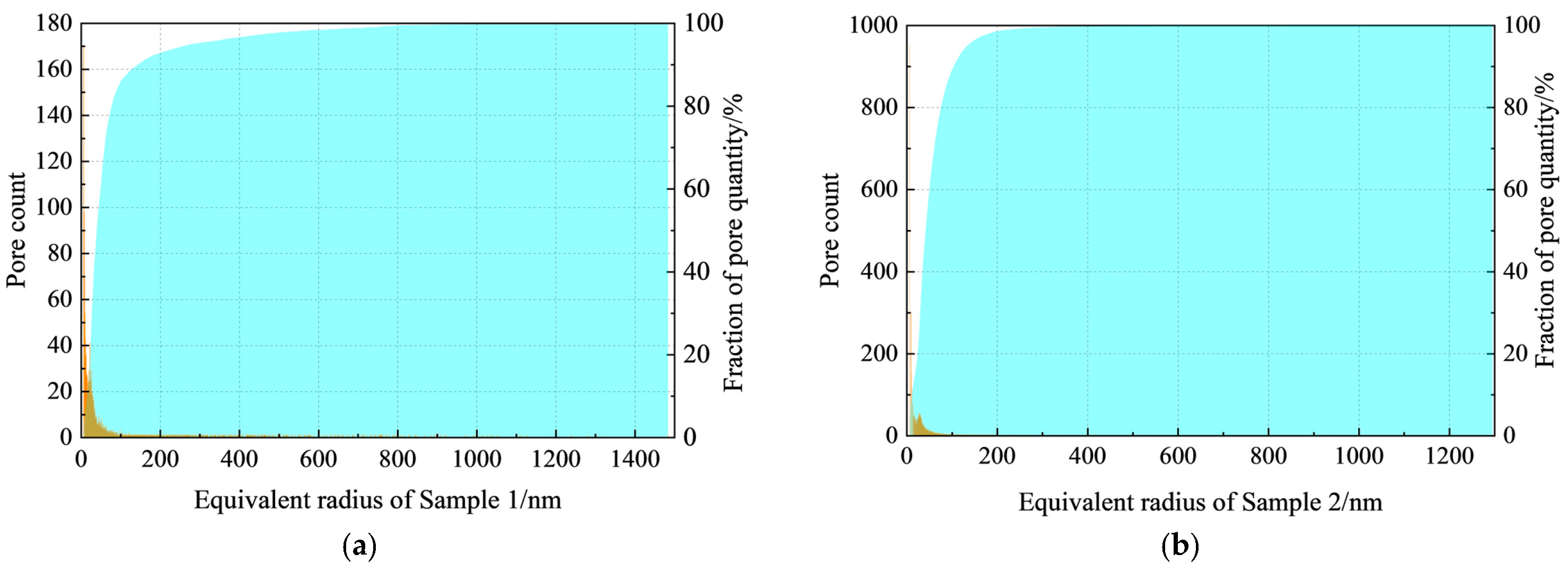
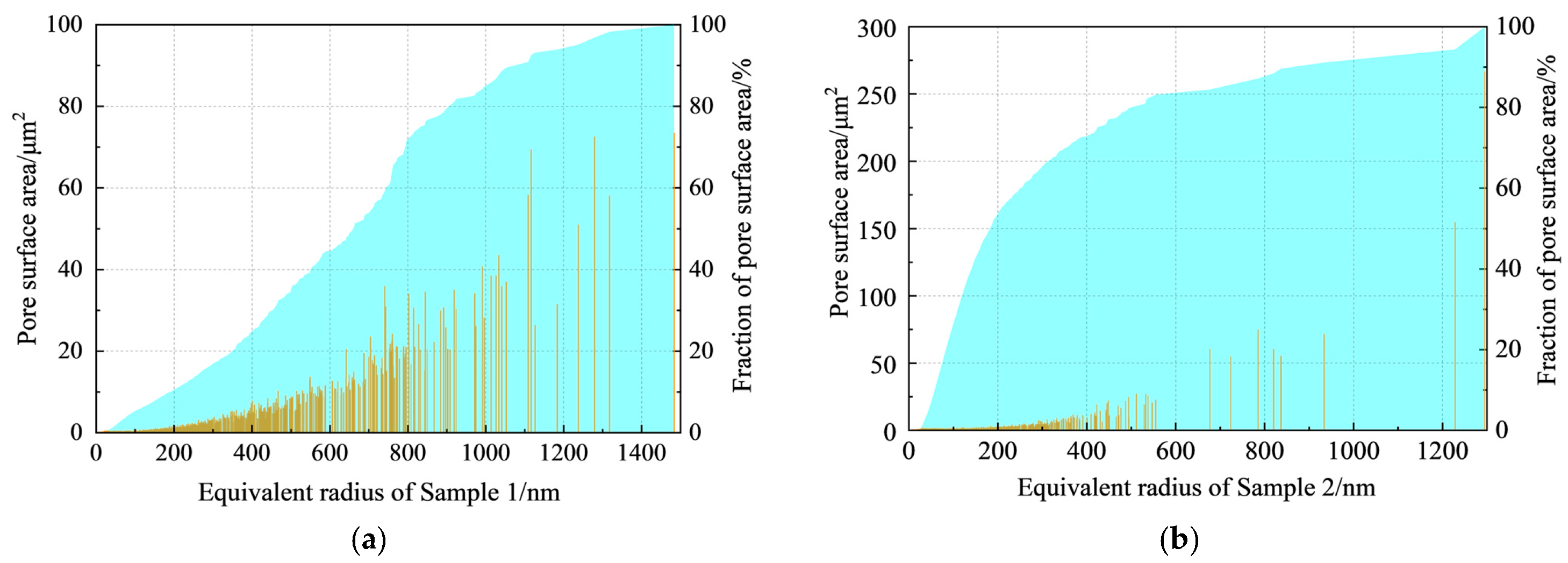
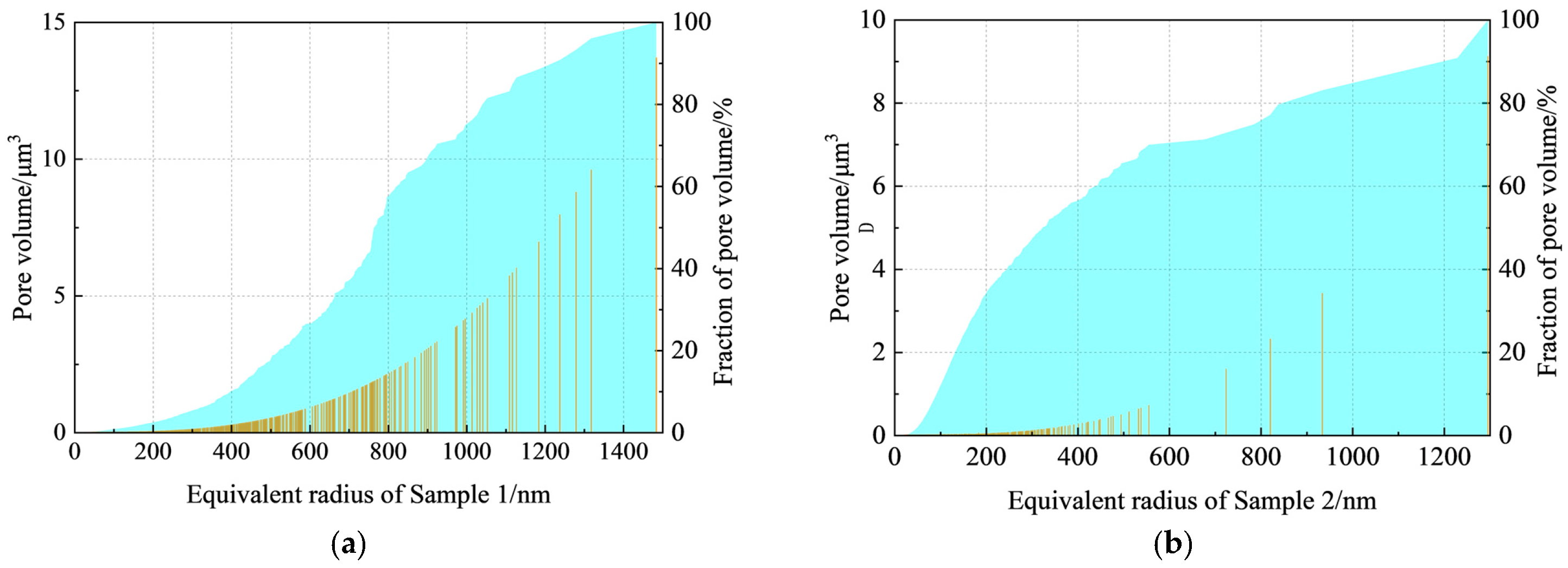
Analysis of cumulative pore characteristics (Figure 14, Figure 15 and Figure 16) reveals three consistent trends across both coal samples: cumulative pore number, surface area and volume increase monotonically with pore size; the <100 nm pore fraction dominates numerically, as indicated by the steepest rise in cumulative pore count curves; and pores larger than 100 nm exert a disproportionate influence on storage capacity and reactive surface availability, reflected by the steepest slopes in cumulative volume and surface area curves at larger pore sizes.

4.3. Pore Connectivity and Topological Characteristics

In this study, pore network connectivity was evaluated using three key parameters: coordination number to assess node linkage, Euler number to characterise topological integrity, and tortuosity to quantify flow-path complexity. As a primary indicator of coal pore connectivity, the coordination number enables systematic topological analysis through its distribution patterns [36,37]. The pore architecture forms a complex network of discrete pore elements that may occur as isolated units or clustered assemblies, depending on their morphology. This multiscale organisation gives rise to scale-dependent connectivity characteristics, with distinct interpretations at the pore, component, and network scales. Isolated pores are identified by zero connectivity values, whereas interconnected pore systems are characterised by positive connectivity.
As a topological descriptor, the Euler number quantitatively evaluates image connectivity by capturing the structural characteristics of the pore network and revealing interconnectivity patterns and transport pathways within the pore space [38]. When the Euler number is ≤ 0, pores are disconnected, or voids overlap; when the Euler number is greater than 0, the pores are interconnected. Smaller Euler numbers indicate stronger pore connectivity.
The Euler number is calculated as:
E   =   β 0 β 1   +   β 2
where E denotes the Euler number; β 0 represents the number of isolated objects; β 1 denotes redundant links; and β 2 is the number of closed cavities. For a fully connected pore system, β 0 = 1 and β 2 = 0.
Tortuosity describes the curvature of pore throats and is defined as the ratio of the actual flow path length through interconnected pores to the shortest straight-line distance. It is calculated as follows [39]:
τ   =   L t / L 0
where L t is the actual length traversed by fluid through the porous and fractured medium, and L 0 is the corresponding straight-line length.
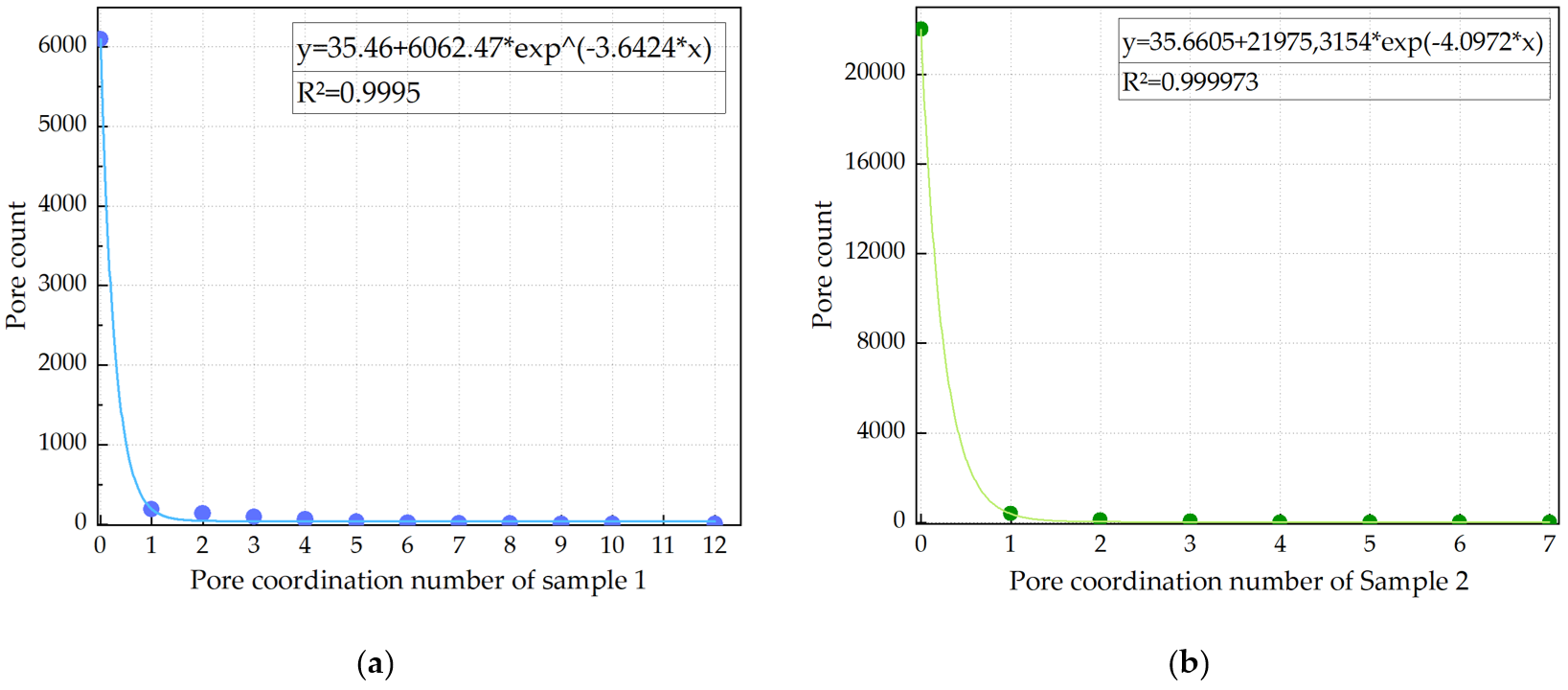
The distribution of pore numbers across different coordination numbers is shown in Figure 17. For both samples, pore numbers decreased sharply with increasing coordination number, followed by a more gradual decline and eventual stabilisation, indicating an exponential relationship between pore frequency and connectivity. Although relatively few, highly connected pores are typically located at the centres of pore components. Removal of these key pores can cause a connected network to fragment into multiple disconnected components.
For Sample 1, pore numbers peaked at 6098 at a coordination number of 0 and decreased gradually, with 2 pores at a coordination number of 12. In Sample 2, the maximum pore count was 22,011 at a coordination number of 0, declining to 1 at a coordination number of 7. Both samples contained substantially more isolated pores than connected pores. Higher coordination numbers correspond to stronger pore network connectivity, promoting inter-pore linkage and fluid transport, thereby enhancing gas flow [40]. Sample 1 exhibited a maximum coordination number of 12, with 8.21% of pores showing coordination numbers greater than zero. By contrast, Sample 2 had a maximum coordination number of 7, with only 2.74% of pores exhibiting nonzero connectivity. The higher peak coordination number and larger proportion of connected pores in Sample 1 indicate superior pore connectivity.
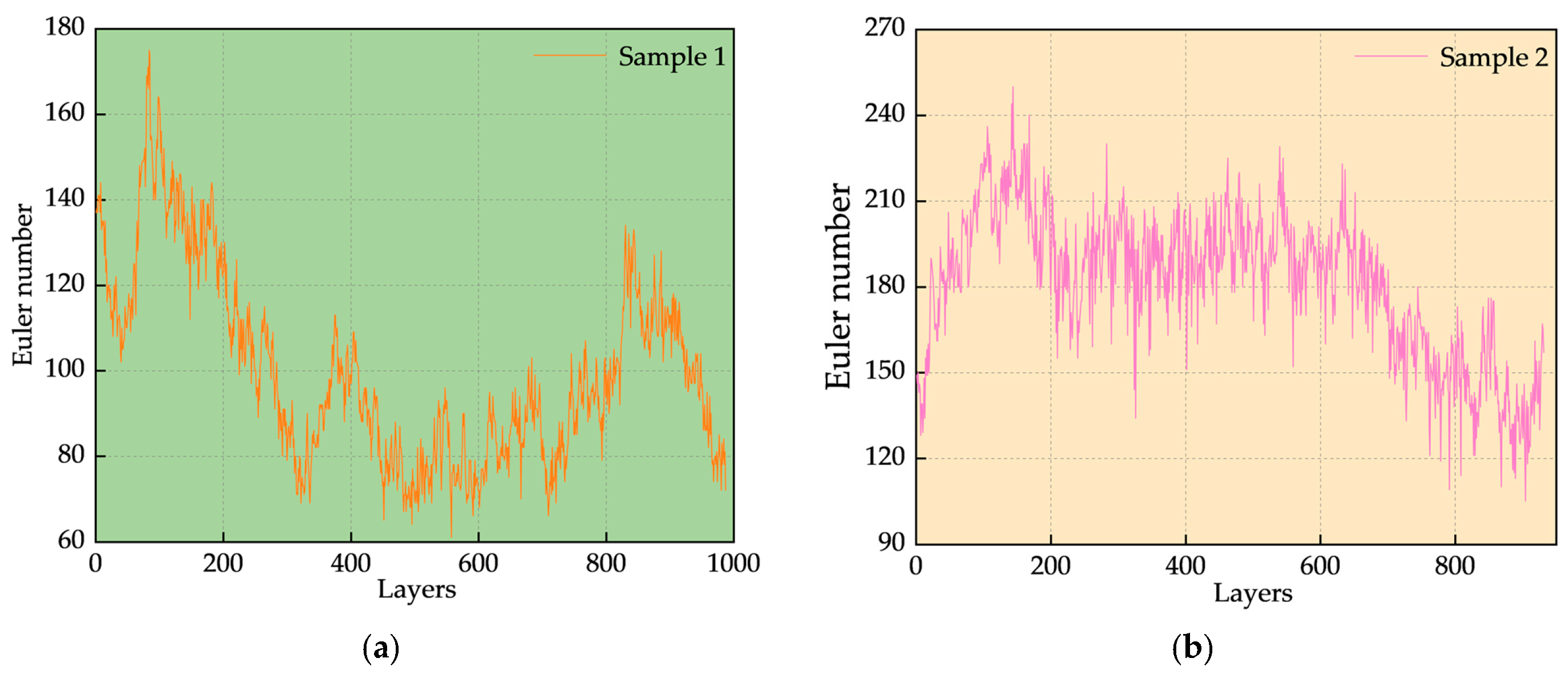
Euler numbers across successive slices of both coal samples are shown in Figure 18. For Sample 1, the Euler number exhibited an initial decrease, followed by an increase and a subsequent decrease with increasing slice index, with lower values concentrated in the central region of the coal body and higher values at the upper and lower boundaries. In Sample 2, the Euler number followed a simpler trend, increasing initially and then decreasing, with relatively higher values in the upper slices and lower values in the lower slices. Euler numbers for Sample 1 ranged from 61 to 171, with a mean of 100.06, whereas Sample 2 exhibited a broader range from 105 to 250, with an average of 180.94.
The coal matrix framework network is illustrated in Figure 19. In this representation, spheres correspond to individual pores, connecting lines denote the actual lengths of pore throats, and straight lines indicate the shortest inter-pore distances.
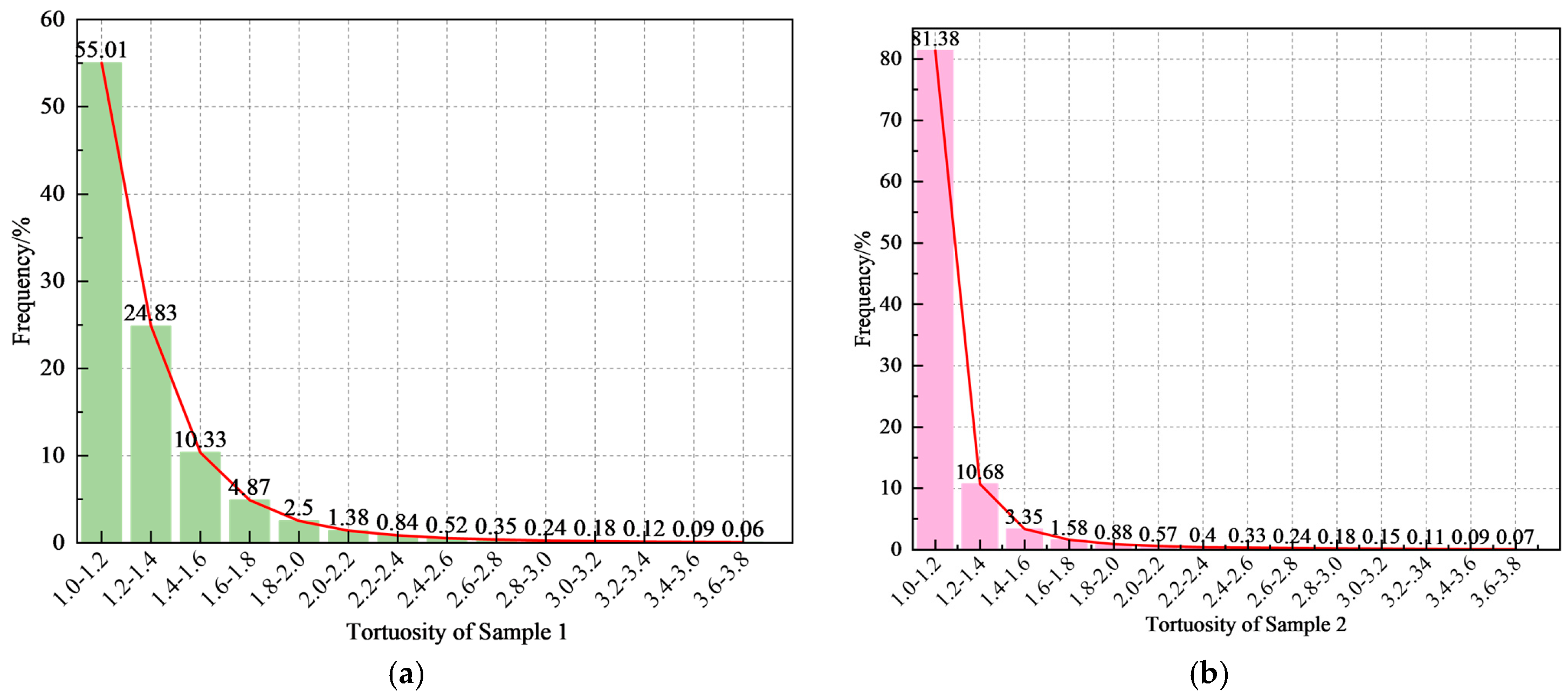
The tortuosity distribution of the two coal samples is shown in Figure 20. The average tortuosity of Sample 1 is 1.14, while that of Sample 2 is 1.19, indicating a minor difference between the two values. For Sample 2, over 80% of pore tortuosity values fall within the range of 1.0 to 1.2.
For Sample 1 and Sample 2, the proportion of pores with radii between 5 and 100 nanometres is nearly identical, as are their mean Euler number and tortuosity. Nevertheless, Sample 2 contains a considerably larger total number of pores, and its pores with equivalent radii of 5 to 100 nm contribute far more to total surface area and volume.
In addition, Sample 2 shows a similarly high proportion of individual pores with tortuosity ranging from 1 to 1.2 and pores with a coordination number of zero. In Sample 1, by contrast, the proportion of pores with tortuosity between 1 and 1.2 is markedly higher than that of pores with a coordination number of zero.
These findings demonstrate that the two coal samples share consistent pore geometry and connectivity characteristics at an observation resolution of 10 nm. Their primary differences lie in pore size distribution and total pore quantity: Sample 1 contains a fraction of mesopores and thus has a much lower total pore count, while Sample 2 is dominated by a large number of small pores.

4.4. Effect of Segmentation Detection Rate on Pore Topology

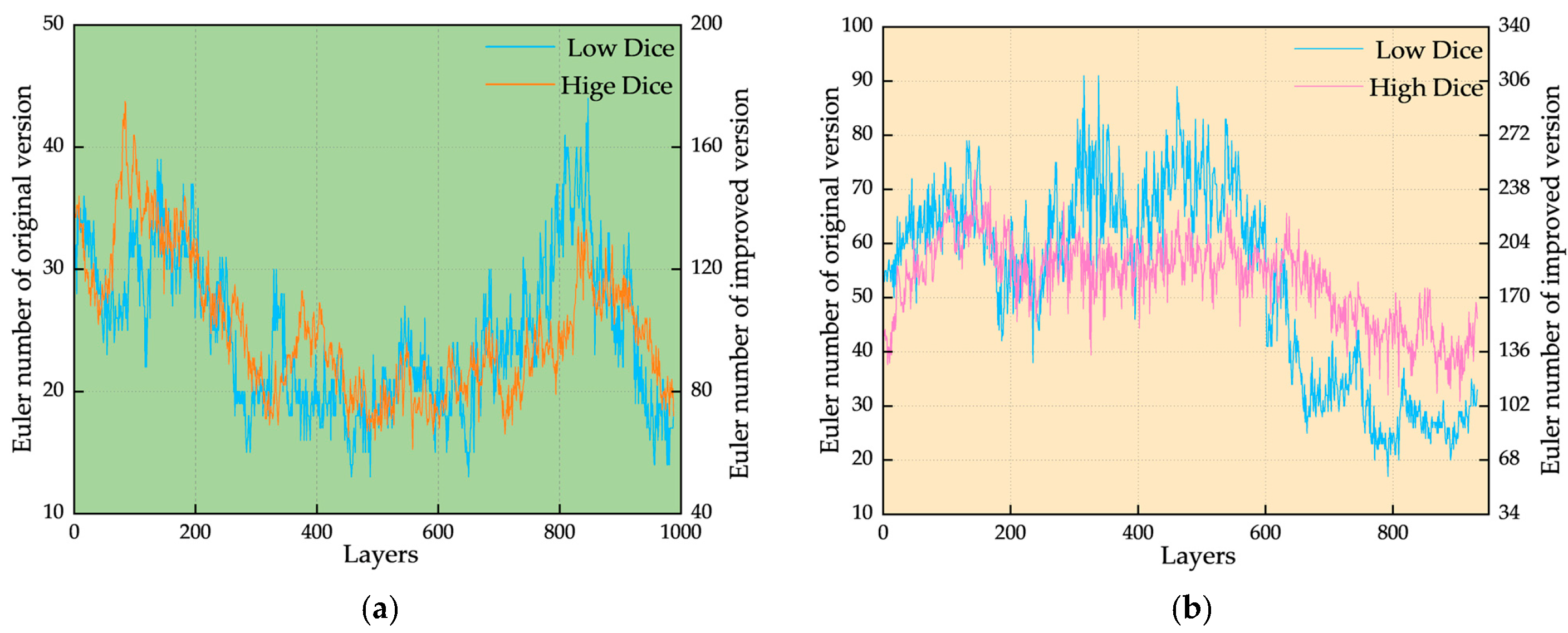
We calculated the Euler number corresponding to each pore slice of the two samples under different Dice values (Figure 21). Based on the range between maximum and minimum values, the Euler number results obtained at different Dice values for the pore slices of both samples are displayed at an equal scale. To compare the degree of fluctuation more accurately, we introduce the coefficient of variation to eliminate the influence caused by the mean value base.
To compare the degree of fluctuation more accurately, we adopt the coefficient of variation (CV) to remove the impact of the mean magnitude. The formula is shown below:
CV   =   σ / μ
where σ denotes the population standard deviation, and μ represents the mean value.
The results are presented in Table 8.
The coefficients of variation for Sample 1 at low and high Dice values are very close (22.1% versus 24.8%). This indicates that the pore distribution of coal Sample 1 across different spatial slices is relatively stable. Although the model with a low Dice value fails to capture numerous small pores, it introduces uniform deviations to all slices. Sample 2 shows a distinct behaviour. Its CV is only 14.1% at a high Dice value, suggesting a low level of intrinsic spatial heterogeneity. However, the CV rises sharply to 33.7% at a low Dice value. This demonstrates that the complex pore structure of coal Sample 2 is highly sensitive to the segmentation accuracy of the deep learning model.
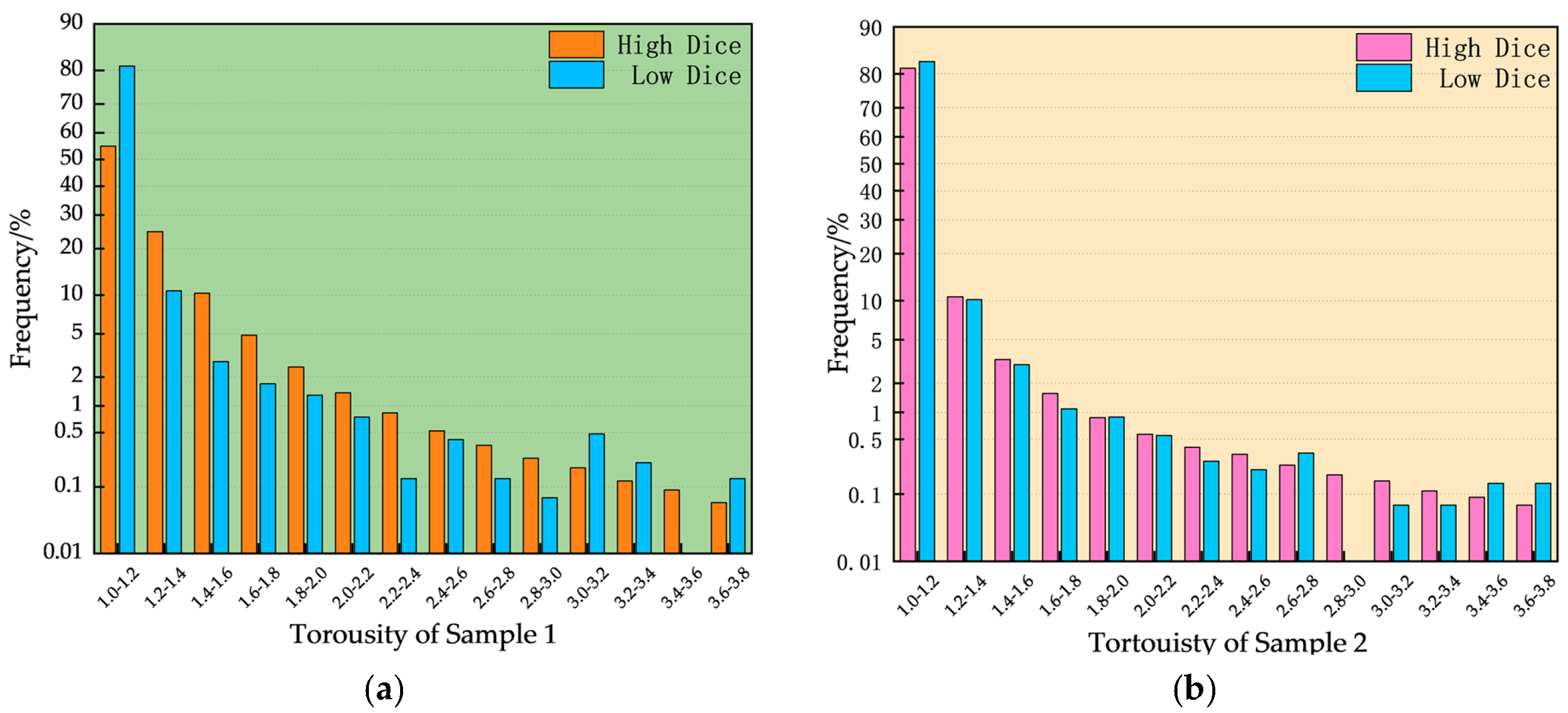
This study quantitatively characterises pore tortuosity at varying segmentation accuracies using 3D geometric paths. As shown in Figure 22, the results reveal that segmentation accuracy, measured by the Dice coefficient, exerts a prominent central axis reconstruction effect on pore systems with long-range connectivity.
For Sample 1, high-accuracy segmentation fully preserves the microscopic roughness of pore walls and the connectivity of fine pore throats. The extracted central axis skeletons capture abundant high-frequency spatial undulations, which cause a marked right shift in the apparent tortuosity distribution. Specifically, the proportion of values ranging from 1.0 to 1.2 decreases from 81.08% to 55.01%. This demonstrates that low-accuracy segmentation substantially underestimates the actual tortuosity of fracture-like and elongated pores.
In contrast, Sample 2 shows strong insensitivity to changes in segmentation accuracy. Combined with its high Euler number, this indicates that the pore structure of Sample 2 is dominated by isolated, isotropic microvesicular pores. During morphological thinning, the topological skeletons of such pores tend to collapse into short line segments around their geometric centres. Since the geometric path length is barely affected by boundary resolution, the geometric tortuosity remains consistently low across all segmentation accuracies.

5. Conclusions

In this study, FIB-SEM combined with the MDFA-DeepLabv3+ network was used for coal pore identification and segmentation. This network consists of a multiscale feature extractor embedded with channel attention mechanisms, a tri-level progressive decoder driven by attention gates, and an independent parallel edge detection branch.
The final evaluation metrics yielded IoU, Dice, PA, Precision, and Recall values of 81.63%, 89.89%, 98.51%, 89.43%, and 90.34%, respectively. The effectiveness of MDFA-DeepLabv3+ for coal pore segmentation was further confirmed through comparisons with other existing models and visual comparisons of segmentation results.
At a resolution of 10 nm, Sample 1 and Sample 2 exhibit consistent pore geometry and connectivity, with the main differences lying in pore size distribution and total pore count. Both samples have similar proportions of pores in the 5 to 100 nm radius range, as well as comparable mean Euler number and mean tortuosity. However, Sample 2 contains far more pores in total, and pores within this size range contribute significantly more to its total surface area and volume.
Reduced segmentation accuracy severely underestimates the true tortuosity of Sample 1. In contrast, the tortuosity values of Sample 2 are barely affected by segmentation accuracy, as its isolated microvesicular pores collapse into short skeleton segments during the thinning process. These findings demonstrate that the extent to which Dice values influence pore analysis results is strongly dependent on pore type.

6. Uncertainty Analysis

The dataset used in this study is relatively limited in scale, which may restrict the generalisation ability of the model across different coal types and geological conditions. Therefore, future research will expand the dataset size to explore the recognition performance of the model.

Author Contributions

C.W.: Methodology, Funding acquisition, Conceptualisation. Z.C.: Writing—original draft, Formal analysis, Data curation. L.Z.: Writing—review and editing, Visualisation. D.X.: Writing—review and editing, Visualisation. J.Q.: Writing—review and editing, Visualisation. J.L.: Writing—review and editing, Project administration. Y.S.: Writing—review and editing, Project administration. All authors have read and agreed to the published version of the manuscript.

Funding

This work is supported by multiple sources. Cuixia Wang acknowledges National Natural Science Foundation of China (Grant No. 52204235). Yu Shi acknowledges Natural Science Basic Research Program of Shaanxi Province under Grant No. 2025JC-YBMS-491.

Data Availability Statement

The original contributions presented in this study are included in the article. Further inquiries can be directed to the corresponding author.

Conflicts of Interest

The authors declare no conflicts of interest.

References

  1. Chen, D.; Qu, B.; Zhang, J.; Long, Q.; Sun, R. Methods and techniques for determining the gas content of coal seams in China: A mini-review. Fuel Process. Technol. 2025, 275, 108257. [Google Scholar] [CrossRef]
  2. Wang, K.; Guo, L.; Xu, C.; Wang, W.; Yang, T.; Lin, S.; Cai, Y. Multiscale characteristics of pore-fracture structures in coal reservoirs and their influence on coalbed methane (CBM) transport: A review. Geoenergy Sci. Eng. 2024, 242, 213181. [Google Scholar] [CrossRef]
  3. Wang, G.; Shen, J.; Liu, S.; Jiang, C.; Qin, X. Three-dimensional modeling and analysis of macro-pore structure of coal using combined X-ray CT imaging and fractal theory. Int. J. Rock Mech. Min. Sci. 2019, 123, 104082. [Google Scholar] [CrossRef]
  4. Fan, N.; Wang, J.; Deng, C.; Fan, Y.; Wang, T.; Guo, X. Quantitative characterization of coal microstructure and visualization seepage of macropores using CT-based 3D reconstruction. J. Nat. Gas Sci. Eng. 2020, 81, 103384. [Google Scholar] [CrossRef]
  5. Liu, W.; Wang, G.; Han, D.; Xu, H.; Chu, X. Accurate characterization of coal pore and fissure structure based on CT 3D reconstruction and NMR. J. Nat. Gas Sci. Eng. 2021, 96, 104242. [Google Scholar] [CrossRef]
  6. Du, F.; Wang, K.; Zhang, G.; Zhang, Y.; Zhang, G.; Wang, G. Damage characteristics of coal under different loading modes based on CT three-dimensional reconstruction. Fuel 2022, 310, 122304. [Google Scholar] [CrossRef]
  7. Zhang, C.; Jia, S.; Huang, X.; Shi, X.; Zhang, T.; Zhang, L.; Wang, F. Accurate characterization method of pores and various minerals in coal based on CT scanning. Fuel 2024, 358, 130128. [Google Scholar] [CrossRef]
  8. Liu, P.; Nie, B.; Zhao, Z.; Li, J.; Yang, H.; Qin, C. Permeability of micro-scale structure in coal: Insights from μ-CT image and pore network modelling. Gas Sci. Eng. 2023, 111, 204931. [Google Scholar] [CrossRef]
  9. Li, Z.; Liu, D.; Cai, Y.; Ranjith, P.G.; Yao, Y. Multi-scale quantitative characterization of 3-D pore-fracture networks in bituminous and anthracite coals using FIB-SEM tomography and X-ray μ-CT. Fuel 2017, 209, 43–53. [Google Scholar] [CrossRef]
  10. Zhou, S.; Liu, D.; Cai, Y.; Yao, Y.; Li, Z. 3D characterization and quantitative evaluation of pore-fracture networks of two Chinese coals using FIB-SEM tomography. Int. J. Coal Geol. 2017, 174, 41–54. [Google Scholar] [CrossRef]
  11. Fang, H.; Sang, S.; Liu, S.; Du, Y. Methodology of three-dimensional visualization and quantitative characterization of nanopores in coal by using FIB-SEM and its application with anthracite in Qinshui basin. J. Pet. Sci. Eng. 2019, 182, 106285. [Google Scholar] [CrossRef]
  12. Zakrzewski, M.; Schertel, A.; Brus, G.; Wagner, M.; Sciazko, A.; Komatsu, Y.; Szmyd, J.S. A three-dimensional reconstruction of coal microstructure using the Cryo-FIB-SEM technique. Fuel 2020, 275, 117919. [Google Scholar] [CrossRef]
  13. Liu, B.; Yasin, Q.; Sun, M.; Ismail, A.; Wood, D.A.; Tian, X.; Fu, L. An improved convolutional architecture for quantitative characterization of pore networks in fine-grained rocks using FIB-SEM. Int. J. Coal Geol. 2024, 295, 104625. [Google Scholar] [CrossRef]
  14. Zang, J.; Liu, J.; He, J.; Zhang, X. Characterization of the pore structure in Chinese anthracite coal using FIB-SEM tomography and deep learning-based segmentation. Energy 2023, 282, 128686. [Google Scholar] [CrossRef]
  15. Bangaru, S.S.; Wang, C.; Zhou, X.; Hassan, M. Scanning electron microscopy (SEM) image segmentation for microstructure analysis of concrete using U-net convolutional neural network. Autom. Constr. 2022, 144, 104602. [Google Scholar] [CrossRef]
  16. Chen, L.C.; Zhu, Y.; Papandreou, G.; Schroff, F.; Adam, H. Encoder-decoder with atrous separable convolution for semantic image segmentation. In Proceedings of the European Conference on Computer Vision (ECCV), Munich, Germany, 8–14 September 2018; pp. 801–818. [Google Scholar]
  17. Chen, L.C.; Papandreou, G.; Kokkinos, I.; Murphy, K.; Yuille, A.L. Deeplab: Semantic image segmentation with deep convolutional nets, atrous convolution, and fully connected crfs. IEEE Trans. Pattern Anal. Mach. Intell. 2017, 40, 834–848. [Google Scholar] [CrossRef]
  18. Sandler, M.; Howard, A.; Zhu, M.; Zhmoginov, A.; Chen, L.C. Mobilenetv2: Inverted residuals and linear bottlenecks. In Proceedings of the IEEE/CVF Conference on Computer Vision and Pattern Recognition (CVPR), Salt Lake City, UT, USA, 18–23 June 2018; pp. 4510–4520. [Google Scholar]
  19. Lian, X.; Pang, Y.; Han, J.; Pan, J. Cascaded hierarchical atrous spatial pyramid pooling module for semantic segmentation. Pattern Recognit. 2021, 110, 107622. [Google Scholar] [CrossRef]
  20. Sunandini, G.; Sivanpillai, R.; Sowmya, V.; Gopalakrishnan, E.A.; Soman, K.P. Significance of atrous spatial pyramid pooling (aspp) in deeplabv3+ for water body segmentation. In Proceedings of the 2023 10th International Conference on Signal Processing and Integrated Networks (SPIN), Noida, India, 23–24 March 2023; pp. 744–749. [Google Scholar]
  21. Hu, J.; Shen, L.; Sun, G. Squeeze-and-excitation networks. In Proceedings of the IEEE/CVF Conference on Computer Vision and Pattern Recognition (CVPR), Salt Lake City, UT, USA, 18–22 June 2018; pp. 7132–7141. [Google Scholar]
  22. Oktay, O.; Schlemper, J.; Folgoc, L.L.; Lee, M.; Heinrich, M.; Misawa, K.; Rueckert, D. Attention u-net: Learning where to look for the pancreas. arXiv 2018, arXiv:1804.03999. [Google Scholar] [CrossRef]
  23. Lin, T.Y.; Goyal, P.; Girshick, R.; He, K.; Dollár, P. Focal loss for dense object detection. IEEE Trans. Pattern Anal. Mach. Intell. 2017, 42, 318–327. [Google Scholar] [CrossRef]
  24. Milletari, F.; Navab, N.; Ahmadi, S.A. V-net: Fully convolutional neural networks for volumetric medical image segmentation. In Proceedings of the 2016 Fourth International Conference on 3D Vision (3DV), Stanford, CA, USA, 25–28 October 2016; pp. 565–571. [Google Scholar]
  25. Frénay, B.; Verleysen, M. Classification in the presence of label noise: A survey. IEEE Trans. Neural Netw. Learn. Syst. 2013, 25, 845–869. [Google Scholar] [CrossRef]
  26. González-Santoyo, C.; Renza, D.; Moya-Albor, E. Identifying and mitigating label noise in deep learning for image classification. Technologies 2025, 13, 132. [Google Scholar] [CrossRef]
  27. Tong, K.; Wu, Y. Rethinking PASCAL-VOC and MS-COCO dataset for small object detection. J. Vis. Commun. Image Represent. 2023, 93, 103830. [Google Scholar] [CrossRef]
  28. Everingham, M.; Van Gool, L.; Williams, C.K.; Winn, J.; Zisserman, A. The pascal visual object classes (voc) challenge. Int. J. Comput. Vis. 2010, 88, 303–338. [Google Scholar] [CrossRef]
  29. Zijdenbos, A.P.; Dawant, B.M.; Margolin, R.A.; Palmer, A.C.; Evangelou, J.A. Morphometric analysis of white matter lesions in MR images: Method and validation. IEEE Trans. Med. Imaging 2014, 13, 716–724. [Google Scholar] [CrossRef]
  30. Long, J.; Shelhamer, E.; Darrell, T. Fully convolutional networks for semantic segmentation. In Proceedings of the IEEE Conference on Computer Vision and Pattern Recognition (CVPR), Boston, MA, USA, 7–12 June 2015; pp. 3431–3440. [Google Scholar]
  31. Popovic, A.; De la Fuente, M.; Engelhardt, M.; Radermacher, K. Statistical validation metric for accuracy assessment in medical image segmentation. Int. J. Comput. Assist. Radiol. Surg. 2007, 2, 169–181. [Google Scholar] [CrossRef]
  32. Montesinos-López, O.A.; Montesinos-López, A.; Crossa, J. Overfitting, model tuning, and evaluation of prediction performance. In Multivariate Statistical Machine Learning Methods for Genomic Prediction; Springer: Cham, Switzerland, 2022; pp. 109–139. [Google Scholar]
  33. Picard, D. Torch.manual_seed(3407) is all you need: On the influence of random seeds in deep learning architectures for computer vision. arXiv 2021, arXiv:2109.08203. [Google Scholar]
  34. Zhang, K.; Wang, S.; Wang, L.; Cheng, Y.; Li, W.; Han, X.; Su, H. 3D visualization of tectonic coal microstructure and quantitative characterization on topological connectivity of pore-fracture networks by Micro-CT. J. Pet. Sci. Eng. 2022, 208, 109675. [Google Scholar] [CrossRef]
  35. Zhou, C.; Ye, Z.; Yao, C.; Fan, X.; Xiong, F. Estimation of the anisotropy of hydraulic conductivity through 3D fracture networks using the directional geological entropy. Int. J. Min. Sci. Technol. 2024, 34, 137–148. [Google Scholar] [CrossRef]
  36. Fang, H.; Wang, Z.; Sang, S.; Liu, S.; Gu, C.; Yang, J.; Huang, Y. Correlation Evaluation and Schematic Analysis of Influencing Factors Affecting Pore and Fracture Connectivity on the Microscale and Their Application Discussion in Coal Reservoir Based on X-ray CT Data. ACS Omega 2023, 8, 11852–11867. [Google Scholar] [CrossRef] [PubMed]
  37. Du, S.H.; Shi, Y.M. Concise extraction and characterization of the pore-throat network in unconventional hydrocarbon reservoirs: A new perspective. Pet. Sci. 2024, 21, 1474–1487. [Google Scholar] [CrossRef]
  38. Borinsky, M.; Vogtmann, K. The Euler characteristic of the moduli space of graphs. Adv. Math. 2023, 432, 109290. [Google Scholar] [CrossRef]
  39. Wang, Z.; Fang, H.; Sang, S.; Guo, J.; Yu, S.; Liu, H.; Xu, H. Comprehensive analysis of connectivity and permeability of a pore-fracture structure in low permeability seam of Huainan–Huaibei coalfield. ACS Omega 2024, 9, 15357–15371. [Google Scholar] [CrossRef] [PubMed]
  40. Zhang, K.; Zou, A.; Wang, L.; Cheng, Y.; Li, W.; Liu, C. Multiscale morphological and topological characterization of coal microstructure: Insights into the intrinsic structural difference between original and tectonic coals. Fuel 2022, 321, 124076. [Google Scholar] [CrossRef]
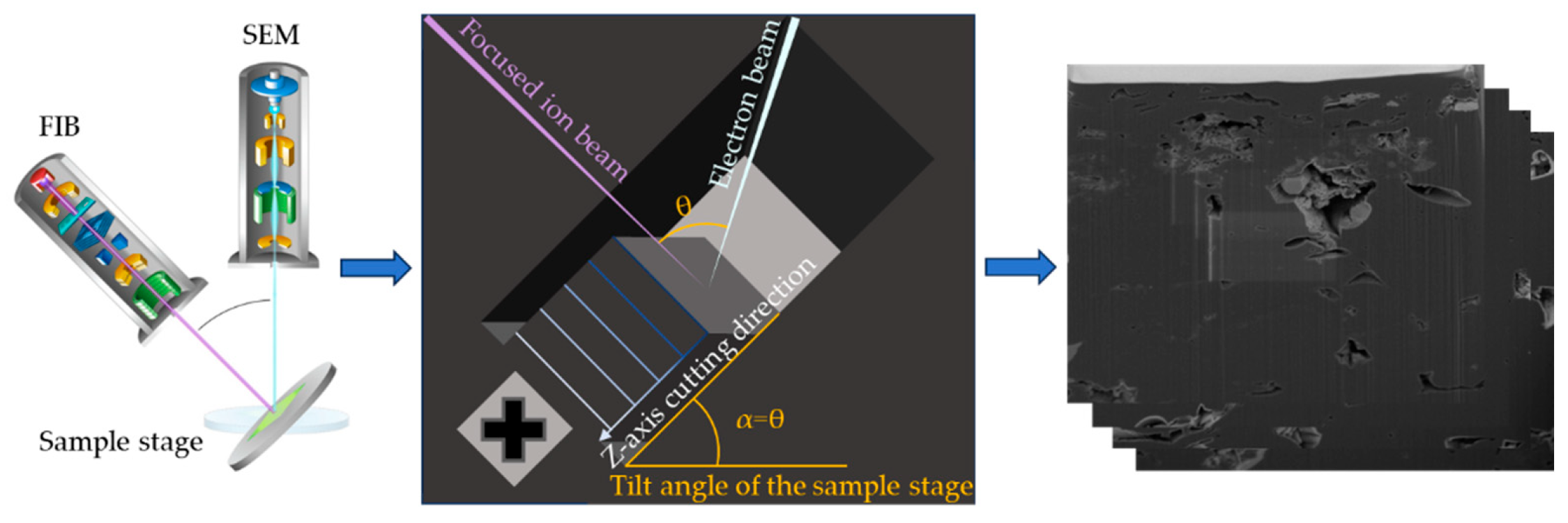
Figure 1. FIB-SEM experimental principle.
Processes 14 01888 g001
Figure 2. MDFA-DeepLabv3+ Network architecture.
Processes 14 01888 g002
Figure 3. SE attention mechanism.
Processes 14 01888 g003
Figure 4. Attention gate (AG) mechanism.
Processes 14 01888 g004
Figure 5. Sample selection maps: (a) Sample 1, (b) Sample 2.
Processes 14 01888 g005
Figure 6. Image processing flow.
Processes 14 01888 g006
Figure 7. Coal pore image annotation process.
Processes 14 01888 g007
Figure 8. Model loss curve of MDFA-DeepLabv3+ Model.
Processes 14 01888 g008
Figure 9. Evaluation metrics of MDFA-DeepLabv3+ model.
Processes 14 01888 g009
Figure 10. Comparison of model recognition and segmentation effects.
Processes 14 01888 g010
Figure 11. Comparison of model recognition and segmentation effects.
Processes 14 01888 g011
Figure 12. 3D reconstruction results of coal pores: (a) Sample 1, (b) Sample 2.
Processes 14 01888 g012
Figure 13. Network model diagram of coal pores: (a) Sample 1, (b) Sample 2.
Processes 14 01888 g013
Figure 14. Cumulative pore quantity distribution curve: (a) Sample 1, (b) Sample 2.
Processes 14 01888 g014
Figure 15. Cumulative pore surface area distribution: (a) Sample 1, (b) Sample 2.
Processes 14 01888 g015
Figure 16. Cumulative pore volume distribution: (a) Sample 1, (b) Sample 2.
Processes 14 01888 g016
Figure 17. Relationship between pore quantity and pore connectivity: (a) Sample 1, (b) Sample 2.
Processes 14 01888 g017
Figure 18. Euler number distribution of coal samples: (a) Sample 1, (b) Sample 2.
Processes 14 01888 g018
Figure 19. Skeleton network of coal samples: (a) Sample 1, (b) Sample 2.
Processes 14 01888 g019
Figure 20. Tortuosity distribution of coal samples: (a) Sample 1, (b) Sample 2.
Processes 14 01888 g020
Figure 21. Comparison of Euler number distribution between high and low Dice groups: (a) Sample 1, (b) Sample 2.
Processes 14 01888 g021
Figure 22. Comparison of tortuosity distribution between high and low Dice groups: (a) Sample 1, (b) Sample 2.
Processes 14 01888 g022
Table 1. Results of industrial analysis of coal samples.
SampleMoisture Mad/%Ash Content Ad/%Volatile Matter Vdaf/%Fixed Carbon FCad/%
13.7710.9032.1458.18
21.1516.1724.1662.85
Table 2. Hardware environment.
NameConfiguration
CPUIntel(R) Core(TM) i7-12700H
GPUNVIDIA A100
RAM32 G
Operating SystemWindows 10 64-bit
CUDA11.8
Table 3. Comparison of evaluation metrics in stability evaluation experiments.
Random SeedMIoU/%Dice/%PA/%Precision/%Recall/%
202481.4789.7998.5089.3690.22
202581.2789.6798.4889.4589.89
202681.2789.6798.4889.5089.84
Mean ± Std81.34 ± 0.1289.71 ± 0.0798.49 ± 0.0189.44 ± 0.0789.98 ± 0.21
Table 4. Comparison of evaluation metrics.
ModelIoU/%Dice/%PA/%Precision/%Recall/%
DeepLabv3+73.44 ± 0.7684.69 ± 0.5498.14 ± 0.1188.36 ± 0.6281.31 ± 0.92
SE+DeepLabv3+77.18 ± 0.8187.12 ± 0.5898.41 ± 0.1089.35 ± 0.5585.00 ± 1.05
MDFA+DeepLabv3+79.74 ± 0.9788.72 ± 0.6098.59 ± 0.1189.72 ± 0.4887.75 ± 1.27
Table 5. Comparison of different deep learning architectures.
ModelIoU/%Dice/%PA/%Precision/%Recall/%
U-Net75.21 ± 0.8585.85 ± 0.6498.26 ± 0.1288.57 ± 0.7883.29 ± 0.95
PSPNet54.01 ± 1.4570.14 ± 1.1597.59 ± 0.2879.52 ± 1.3062.74 ± 1.65
Unet++76.04 ± 0.7286.39 ± 0.5198.07 ± 0.0989.03 ± 0.6583.90 ± 0.82
MDFA+DeepLabv3+79.74 ± 0.9788.72 ± 0.6098.59 ± 0.1189.72 ± 0.4887.75 ± 1.27
Table 6. Pore distribution of Sample 1.
Pore Equivalent Radius Intervals/nmPore Quantity Proportion/%Pore Surface Area Proportion/%Pore Volume
Proportion/%
5–10086.04255.26820.8183
100–2006.82095.22491.6312
200–3002.43016.37832.9185
300–4001.35187.82614.6958
400–5001.078410.03347.6678
500–6000.68359.62858.6909
600–7000.47089.080910.2492
700–8000.607517.988220.6146
800–9000.19757.82289.4329
900–10000.12155.61058.2203
>10000.197515.139225.0594
Table 7. Pore distribution of Sample 2.
Pore Equivalent Radius Intervals/nmPore Quantity Proportion/%Pore Surface Area Proportion/%Pore Volume
Proportion/%
5–10089.179926.332212.0061
100–2009.404427.240822.1831
200–3000.991811.893913.1860
300–4000.10827.35049.0703
400–5000.10826.98898.9889
500–6000.03163.35294.5122
600–7000.00451.27171.3040
700–8000.00902.73333.6246
800–9000.00902.43044.7839
900–10000.00451.50553.4196
>10000.00908.900116.9212
Table 8. Comparison of Euler number statistics between high and low Dice groups.
SampleDiceMean ValuePopulation Standard DeviationCoefficient of Variation/%
1high100.0622.1422.1
low24.706.1324.8
2high180.9425.5714.1
low53.0417.8933.7
Disclaimer/Publisher’s Note: The statements, opinions and data contained in all publications are solely those of the individual author(s) and contributor(s) and not of MDPI and/or the editor(s). MDPI and/or the editor(s) disclaim responsibility for any injury to people or property resulting from any ideas, methods, instructions or products referred to in the content.