Article

FeCl3-Activated Agro-Waste Biochars for Enhanced Dye Adsorption: Unveiling the Role of Iron Oxide Active Sites


by
Alejandra Noemi Pérez-Jasso
1,
Kayim Pineda-Urbina
1,
Cintia Karina Rojas-Mayorga
2,
Didilia Ileana Mendoza-Castillo
3,4,
Gabriela Durán-Jiménez
5,
Adrián Bonilla-Petriciolet
3 and
Ismael Alejandro Aguayo-Villarreal
1,*
1
Facultad de Ciencias Químicas, Universidad de Colima, Colima-Coquimatlán km 9, Coquimatlán 28400, Colima, Mexico
2
Centro Universitario de Gestión Ambiental, Universidad de Colima, Ex-Hacienda de Nogueras S/N, Comala 28400, Colima, Mexico
3
Tecnológico Nacional de México, Instituto Tecnológico de Aguascalientes, Av. Adolfo López Mateos Ote. 1801, Aguascalientes 20256, Aguascalientes, Mexico
4
Investigadoras e Investigadores por México, Secretaría de Ciencia, Humanidades, Tecnología e Innovación, Av. Insurgentes S 1582, Benito Juárez 03940, Ciudad de Mexico, Mexico
5
Faculty of Engineering, University of Nottingham, University Park, Nottingham NG7 2RD, UK
*
Author to whom correspondence should be addressed.
Processes 2026, 14(12), 1886; https://doi.org/10.3390/pr14121886
Submission received: 28 April 2026 / Revised: 24 May 2026 / Accepted: 30 May 2026 / Published: 10 June 2026

Abstract

In this study, activated biochars derived from spent coffee grounds (CAC-600) and lemon pomace (LAC-600) were prepared through pyrolysis with FeCl3 activation and evaluated for the selective adsorption of Acid Blue 74 (AB74), a dye widely used in the denim textile industry. FeCl3 activation significantly increased the surface area and pore development relative to the pristine biochars, while also promoting the formation of Fe2O3 phases on the activated biochars surfaces. The activated biochars exhibited comparable adsorption capacities of 39.44 and 37.16 mg·g−1 for CAC-600 and LAC-600, respectively, indicating that adsorption performance was governed mainly by the activation process rather than by the precursor biomass. Isotherm and kinetic models revealed heterogeneous adsorption behavior involving surface interactions combined with internal diffusion. The materials showed stable adsorption performance within a pH range of 4–10. Competitive adsorption experiments demonstrated preferential adsorption of AB74 over Acid Red 1 (AR1), confirming the selectivity of LAC-600 and CAC-600. Density Functional Theory (DFT) calculations revealed a cooperative adsorption mechanism combining π-surface interactions with localized Fe-oxide anchoring sites on the graphene-based model, increasing the adsorption energy by approximately 24 kcal·mol−1 relative to carbon-only systems. These findings demonstrate the potential of Fe-activated agro-industrial biochars as adsorbents for dye removal from aqueous media.

1. Introduction

In the 21st century, one of the main challenges for agriculture has been to maintain food production in line with population growth [1]. Efforts to increase food production in this sector have led to the implementation of a series of practices that, directly or indirectly, generate environmental impact. Among the most significant are the intensive use of water resources for irrigation, the growing demand for fertilizers and pesticides, and the generation of agro-industrial wastes.
Agro-industrial wastes are mainly composed of organic matter such as peels, pulps, leaves and roots, and due to their high moisture content, improper management can lead to biological degradation, resulting in an adverse effect on ecosystems. However, their composition makes them attractive for transformation into valuable materials for diverse applications including the production of biofuels, biopolymers, biofertilizers and functional materials used in areas such as catalysis, energy storage and water treatment [2]. Although some raw biomass materials (e.g., sugarcane bagasse) have been used for the adsorption of water pollutants, their high moisture content is a limitation since it can favor microbial growth during the purification process [3]. An alternative to overcome this limitation is the transformation of biomass into biochar through thermochemical conversion, such as pyrolysis, which reduces moisture content and improves the mechanical strength of the material [4]. But pyrolysis at temperatures ≥ 250 °C can induce the degradation of surface organic functional groups, thereby decreasing the adsorption performance [5]. Therefore, pristine biochars generally exhibit low adsorption capacity despite their economic and environmental benefits.
Different modification strategies have been developed to improve the physicochemical properties of biochars [1]. Chemical activation includes the use of acidic agents such as H2SO4, CH3COOH, and H3PO4, and basic agents such as KOH, NaOH, and K2CO3. An alternative approach is the activation with ZnCl2, FeCl3, KCl, CaCl2, and NH3. In contrast, physical activation involves the use of oxidizing gases such as CO2 and water vapor. The main disadvantage of physical activation methods is that they are energy-intensive processes that require higher temperatures (800–1200 °C) than chemical activation (450–800 °C). Moreover, the selection of the activating chemical agent enables the development of well-controlled porosity and high specific area [6].
The low-cost activated biochars emerged as promising candidates for the effective removal of aqueous contaminants including dye molecules. Dye pollution remains a critical environmental issue in several regions worldwide, as textile effluents contain significant concentrations of persistent dye residues due to their low fixation efficiency on fibers and the lack of effective recovery processes. Once released into water bodies, these compounds pose serious risks to aquatic ecosystems and human health through direct exposure or ingestion. Anionic dyes such as Acid Blue 74 (indigo carmine, AB74) are widely used in the denim textile industry. The chemical structure of AB74 limits its biodegradation, contributing to its persistence in aquatic environments. Moreover, this dye has been associated with toxic and carcinogenic effects, as well as respiratory and cardiovascular disorders in humans [7]. Although several treatment technologies for AB74 removal, including heterogeneous Fenton-like degradation, electrocoagulation, adsorption, and biological processes, have been reported, the development of methodologies with a favorable cost–benefit relationship remains necessary [8]. In this context, adsorption using materials derived from agro-industrial residues represents a promising and economically viable alternative for dye removal.
In this study, lemon pomace and spent coffee grounds were valorized as precursors for the synthesis of FeCl3-activated biochars, which were subsequently evaluated as adsorbents for dye removal. These biomasses were selected due to their high global demand and large-scale production. For instance, worldwide coffee production exceeded 177 million 60 kg bags in 2024, of which approximately 45% is converted into waste after processing and consumption [9]. Similarly, global citrus production surpasses 23 million metric tonnes annually, with nearly 45–55% of the fruit corresponding to agro-industrial residues, including peels, seeds, and pomace [10]. Consequently, both spent coffee grounds and citrus residues represent highly abundant agro-industrial waste streams with significant potential for valorization. This approach not only provides a sustainable pathway for the management of agro-industrial residues but also enables the development of materials with enhanced physicochemical properties. The use of FeCl3 as an activating agent promoted the formation of a well-developed porous structure with an increased surface area, while simultaneously introducing iron species onto the carbon surface. This dual functionality is particularly relevant, as it generates a higher density of active sites and may enhance adsorption performance through synergistic interactions between surface functional groups and iron species [11].
Consequently, this study goes beyond conventional experimental approaches by incorporating Density Functional Theory (DFT) analysis to elucidate dye-adsorbent interactions at the molecular level. This integrated strategy elucidates adsorption mechanisms and contributes to the rational design of more effective and sustainable decontamination technologies.

2. Materials and Methods

2.1. Materials

All chemicals used in this study were of analytical grade and were used as received. The reagents were ferric chloride hexahydrate (FeCl3⋅6H2O, 98%), sodium hydroxide (NaOH, 98.5%), hydrochloric acid (HCl, 36.46%), sodium carbonate (Na2CO3, 99.5%), and sodium bicarbonate (NaHCO3, 99%). The adsorbates were acid blue 74 (AB74, 85%), basic blue 3 (BB3, 25%) and acid red 1 (AR1, 60%). All chemicals were purchased from Sigma-Aldrich (Burlington, MA, USA).

2.2. Preparation of Biochars by Pyrolysis

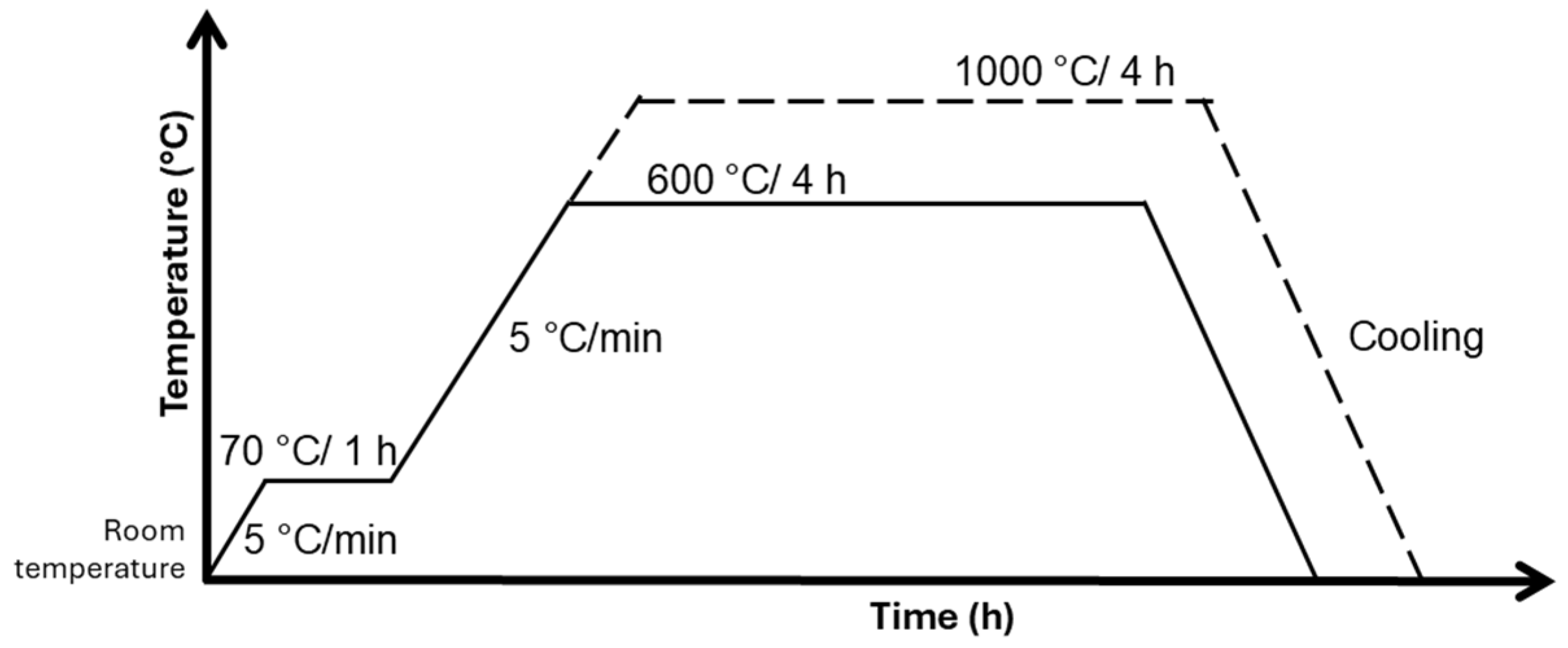
Lemon pomace (Citrus aurantifolia) and spent coffee grounds (Coffea arabica) were initially dried, milled, and washed with hot deionized water in successive cycles (until the washing water became clear), dried and sieved to collect particles within 18–40 mesh size range. The precursor particles were pyrolyzed in a tubular furnace under an inert atmosphere (150 cm3·min−1 N2) following the experimental conditions described in Figure 1. The biochar samples were labeled as CC-600, CC-1000, LC-600 and LC-1000, where CC and LC denote spent coffee grounds and lemon pomace, and 600 and 1000 refer to the pyrolysis temperature.

2.3. Preparation of FeCl3-Activated Biochars by Pyrolysis

For the synthesis of chemically activated biochars, 20 g of biomass precursor (clean lemon pomace or spent coffee ground particles) was impregnated with 150 mL of 0.5 M FeCl3 solution and stirred at 90 rpm for 24 h. The 1:1 mass ratio (salt:biomass) was selected according to literature reports, where this proportion has been demonstrated to be the optimal ratio [12]. The impregnated biomass was dried at 80 °C for 24 h and sieved to homogenize the particle size to 18–40 mesh. The particles were then placed in a tubular furnace (Carbolite CTF 12/65/550, Carbolite Gero, Derbyshire, UK) and pyrolyzed in a nitrogen atmosphere following the synthesis conditions corresponding to 600 °C heating ramp (Figure 1). The activated biochar samples were identified as CAC-600 and LAC-600.

2.4. Physicochemical Characterization of Adsorbents

All materials were characterized using various instrumental and analytical techniques. X-ray powder diffraction (XRD) patterns were obtained at 45 kV and 40 mA using CuKα radiation with a PANalytical X’pert PRO diffractometer (PANalytical B.V., Almelo, The Netherlands) over a 2θ range of 5–70°. Surface functional groups were identified using Fourier transform infrared spectroscopy (FTIR) in the spectral range of 4000–400 cm−1. Particle morphology was analyzed using scanning electron microscopy (SEM) with a TM 3000 Hitachi Tabletop Microscope (Hitachi High-Technologies Corporation, Tokyo, Japan) operated at 15 kV, while the elemental profile was determined by energy-dispersive X-ray spectroscopy (EDS) using an XFlash MIN SVE Bruker adapter (Bruker Nano GmbH, Karlsruhe, Germany). The textural properties, including the specific surface area and pore size distribution, were determined by N2 physisorption at 77 K using a Micromeritics ASAP 2020 porosimeter (Micromeritics Instrument Corporation, Norcross, GA, USA).
The pH at point of zero charge (pHPZC) was determined through the pH drift method [13] using a potentiometer Orion 3 Start pH Benchtop Thermo Scientific (Thermo Fisher Scientific, Waltham, MA, USA). The surface acidic and basic functional groups were estimated by Boehm titration method [14]. For these analyses, 20 mg of biochar were mixed with 20 mL of 0.01 M NaOH, HCl, and NaHCO3 solutions, and 10 mL of 0.01 M Na2CO3 solution, respectively, and stirred at 185 rpm for 24 h at 30 °C. The adsorbent was separated from the corresponding solution, and NaOH, Na2CO3 and NaHCO3 solutions were titrated with a 0.01 M HCl solution, while HCl solution was titrated with a 0.01 M NaOH solution. The concentration of the surface functional groups was calculated using the following equation:
n x = C S r V S r C S t V S t V S r V a
where nx corresponds to the number of moles of the functional group (x represents the solution used to neutralize the acidic and basic groups, i.e., NaOH, Na2CO3, NaHCO3, and HCl), CSr and VSr are the concentration (M) and volume (L) of the solution in contact with the biochar, respectively. Va (L) is the volume of the aliquot extracted from VSr for titration, and CSt and VSt are the concentration (M) and volume (L) of the titrant solution (HCl or NaOH) added to the aliquot, respectively. The acidic and basic groups were calculated using the following equations:
n N a O H n N a 2 C O 3 = p h e n o l i c   g r o u p s
n N a 2 C O 3 n N a H C O 3 = l a c t o n i c   g r o u p s
n N a H C O 3 = c a r b o x y l i c   g r o u p s
n H C l = b a s i c   g r o u p s

2.5. Dye Adsorption Studies

Kinetic and equilibrium adsorption studies were carried out in batch systems at 30 °C, mixing 20 mg of adsorbent with 10 mL of dye solution under constant stirring at 185 rpm. For the kinetic experiments, an initial dye concentration of 500 mg·L−1 was used, and different contact times were evaluated. For the adsorption isotherms, dye solutions with initial concentrations ranging from 25 to 1150 mg·L−1 were used and placed in contact with the biochar for 24 h. The initial and final concentrations (mg·L−1) of the dyes were determined by UV-Visible spectroscopy by measuring the absorbance at their maximum wavelength (λmax): 609 nm for AB74, 655 nm for BB3 and 530 nm for AR1, in a Cary 60 UV–Vis spectrophotometer (Agilent Technologies, Santa Clara, CA, USA). The adsorption capacity (qe and qt, expressed in mg·g−1) was calculated using the following equation:
q e = C 0 C e V W
q t = C 0 C t V W
where Ce, Ct and C0 represent the dye concentration at the equilibrium time, at time t and at initial time (mg·L−1), respectively; W is the mass of adsorbent (g); V is the volume of the aqueous phase (L) [15].
The effect of pH on the adsorption capacity of activated biochar was evaluated at pH 4, 6, 8 and 10, using dye solutions with an initial concentration of 500 mg·L−1. Finally, UV-Vis spectra (400–800 nm) were obtained before and after the adsorption process using 20 and 40 mg of activated biochar with a dye binary solution containing AB74 and AR1 (0.0001 M) under the experimental conditions described above.

2.6. Kinetic and Isotherm Modeling

The experimental data were analyzed using various models. For the isotherm fitting, the following expressions were applied:
Langmuir q e = q m K L C e 1 + K L C e
Freundlich q e = K F C e n F
Sips q e = q m K S C e n S 1 + K S C e n S
where qm (mg·g−1) is the maximum adsorption capacity predicted by the model; KL (L·mg−1), KF (mg1−n·Ln·g−1) and KS (L·mg−1) are the model constants; the nF and nS parameters (dimensionless) can be related to the heterogeneity of the adsorbent surface [16].
Additionally, the adsorption kinetics were analyzed using different kinetic models, as described by the following equations:
Pseudo first-order (PFO) q t = q e , c a l ( 1 e k 1 t )
Pseudo second-order (PSO) q t = q e , c a l 2 k 2 t 1 + q e , c a l k 2 t
Intraparticle diffusion (W&M) q t = k i d t 0.5 + C
where k1 (min−1), k2 (g·mg−1·min −1), and kid (mg·g−1·min−0.5) are the rate constants; and C is a constant related to the thickness of the boundary layer (dimensionless) [17].

2.7. DFT Simulations

All quantum-chemical calculations were carried out with the ORCA program package, version 6.0.1 (FACCTs GmbH, Mülheim an der Ruhr, Germany) [18], using a cluster DFT approach to model the local adsorption environment of the activated biochars. Three hydrogen-terminated graphenic cluster models were considered. The pristine graphene model (G) was represented by a finite nanoflake of formula C150H30, in which all peripheral dangling bonds were saturated with hydrogen atoms. The carboxylated model (G-COOH) was generated by replacing one peripheral hydrogen atom of G with a carboxylic acid group, yielding a model of formula C151H30O2. The Fe-containing model (G-COOH-Fe4O6) was built by placing a neutral Fe4O6 oxide cluster near the carbonyl side of the carboxylic group, giving a total formula of C151H30O8Fe4 for the resulting assembly. After optimization, the Fe4O6 fragment remained anchored to the oxygenated edge region, with a shortest Fe···O(carboxyl) contact of 2.08 Å. The Supplementary Information contains a schematic figure of the isolated cluster models, a summary of their formulas, charges, and multiplicities, and the Cartesian coordinates used to define the calculations.
Geometry optimizations were performed with the PBE density functional in combination with Grimme’s dispersion correction and the def2-SVP basis set and def2/J auxiliary basis set [19,20,21]. AB74 dye molecule was treated with a −2 charge and closed shell. For the Fe-containing systems, an unrestricted formalism was employed with a spin multiplicity of 5. The RI approximation with def2/J basis sets was used to accelerate the calculations [22]. All calculations modeled an aqueous medium through the SMD solvation model [23]. Because the aim of this section was a comparative mechanistic analysis of large cluster models, the discussion is based on electronic adsorption energies rather than full thermochemical corrections.
Adsorption energies were corrected for basis-set superposition error (BSSE) using the Boys-Bernardi counterpoise procedure [24]. The adsorption energy was evaluated as E a d s = E d y e + E s u r f a c e E c o m p l e x + E B S S E . With this convention, larger positive values indicate stronger adsorption, facilitating comparison among the different cluster models.
CM5 charges were obtained from the final electronic densities and summed over the dye and adsorbent fragments to evaluate charge redistribution upon adsorption [25]. Intermolecular interactions were further analyzed with the independent gradient model based on Hirshfeld partition (IGMH) as implemented in Multiwfn 3.8 (Beijing Kein Research Center for Natural Sciences, Beijing, China) [26,27]. δ g i n t e r isosurfaces were colored by s i g n λ 2 ρ , and the resulting cube files were rendered in VMD 1.9.3 (University of Illinois at Urbana-Champaign, Urbana, IL, USA) [28].

3. Results and Discussion

3.1. Physicochemical Characterization

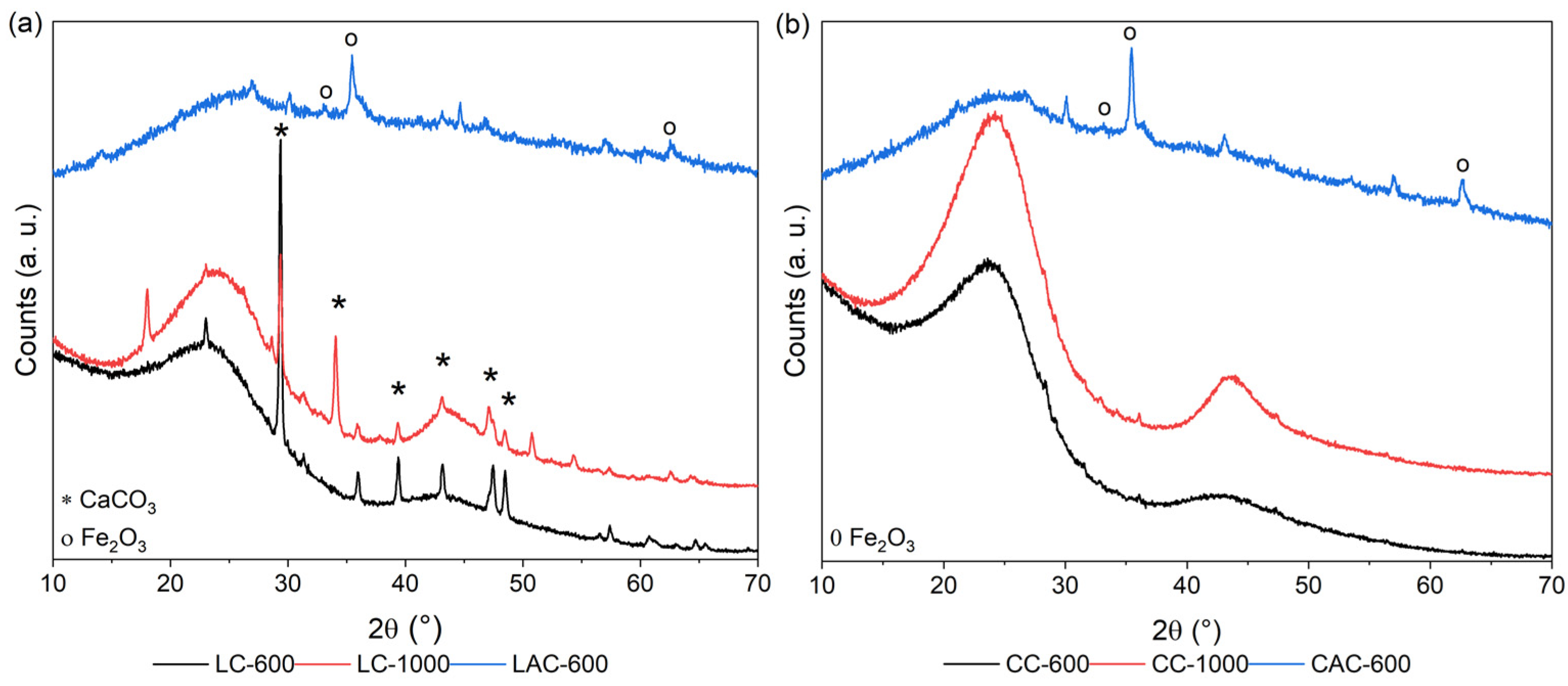
The X-ray diffraction patterns (Figure 2) of the carbon-based materials show the characteristic pattern of graphitic carbons, with two broad diffraction peaks centered at ~25° and ~45° 2θ, which correspond to the (002) and (100) crystal planes, respectively. The low intensity and pronounced broadening of these reflections indicate a high degree of structural disorder and low crystallinity, which are typical characteristics of predominantly amorphous materials [29].
Well-defined reflections in the X-ray diffractograms of LC-600 and LC-1000 samples correspond to crystalline CaCO3 phases (ICDD: 00-005-0586), which can be associated with the intrinsic calcium compounds present in lemon peel [30]. During pyrolysis, calcium-containing compounds undergo thermal transformations that promote the formation of calcium carbonate, a phenomenon previously reported for carbons derived from citrus residues [31]. These reflections disappeared after chemical activation with FeCl3 (Figure 2a). According to the literature, the thermal decomposition of FeCl3 leads to the formation of iron oxides (i.e., Fe2O3 and Fe3O4) and the release of HCl, which reacts with CaCO3 to form CaCl2. This CaCl2 is removed during the washing step of LAC-600 [12].
In addition, the diffraction patterns of the activated biochars, LAC-600 and CAC-600, exhibit reflections associated with Fe2O3 (ICDD: 00-033-0664) at 2θ values of 33° (220), 35° (311), and 62° (440), confirming the incorporation of iron species onto the carbon surface. This information is consistent with previous reports describing similar activation processes [32].
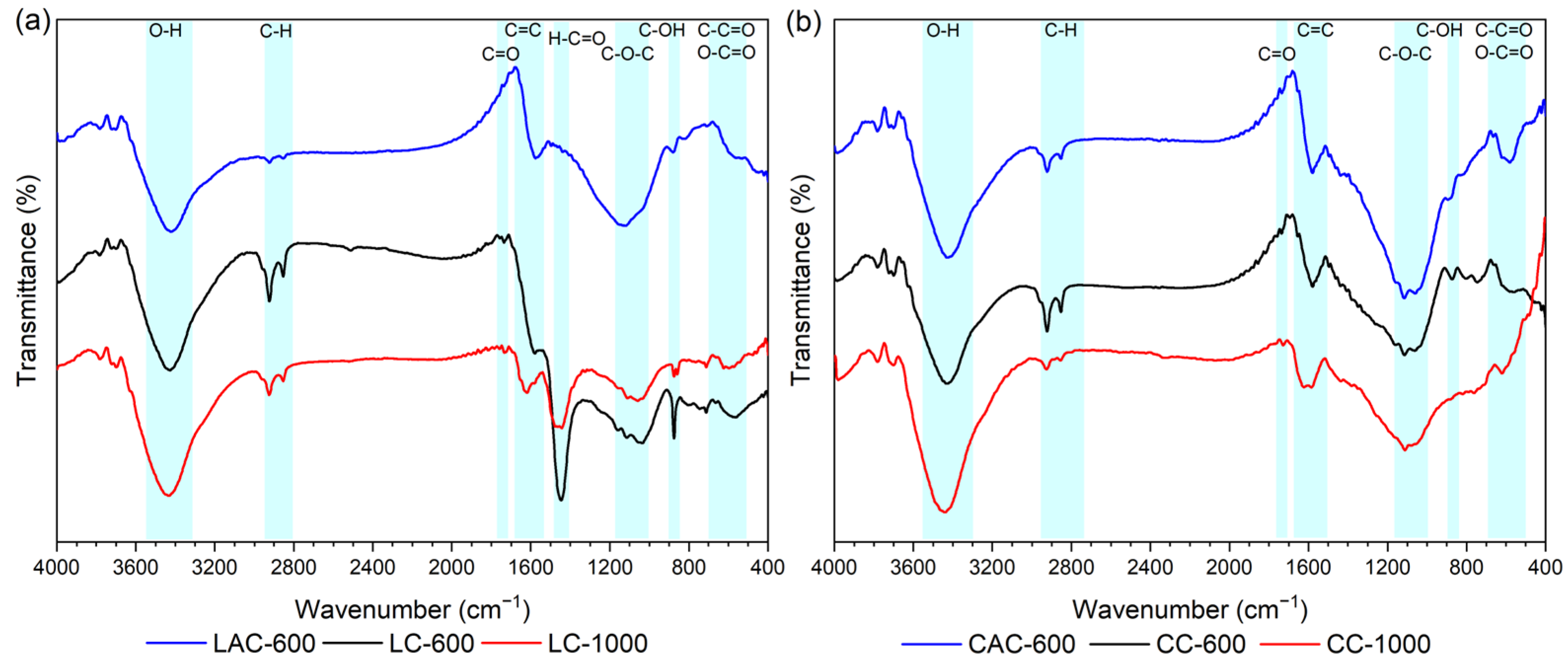
The FTIR spectra (Figure 3) show absorption bands characteristic of carbon-based materials, with no significant differences in the surface functional groups between the lemon pomace and SCG-derived samples, regardless of the pyrolysis temperature (600 or 1000 °C) or after activation with FeCl3. The broad absorption band in the ~3550–3300 cm−1 region is attributed to O-H stretching vibrations of hydroxyl groups, while the absorption bands at 2980 and 2750 cm−1 correspond to C-H stretching vibrations of aliphatic groups. The absorption bands between ~1780–1680 cm−1 are associated with the C=O stretching vibrations of lactonic and carbonyl groups, and those in the ~1650–1550 cm−1 range are attributed to the C=C stretching vibrations of conjugated aromatic rings. The absorption bands in the 1200–1000 cm−1 region are attributed to C-O-C vibrations of the ether groups, while the absorption bands between ~960–500 cm−1 are related to the characteristic vibrations of the carboxylic groups. Overall, these absorption bands are consistent with those reported for other biochars derived from similar biomass precursors [33].
The Boehm titration results confirmed the presence of carboxylic, phenolic, and lactonic groups in the activated biochars. These results showed a higher abundance of acidic functional groups (phenolic, lactonic, and carboxylic) than basic groups (Table 1). Consequently, pHPZC values of the materials corresponded to low pH values. This behavior implies that at pH > pHPZC, the biochar surface carries a net negative charge, which would electrostatically favor the adsorption of cationic species. However, as discussed in Section 3.2, the preferential adsorption of the anionic dye AB74 observed in this study suggests that non-electrostatic interactions, particularly those involving Fe-containing active sites, govern the adsorption mechanism.
The pHPZC values for the synthesized LC-600, LC-1000, CC-600, and CC-1000 biochars were 6.1, 6.3, 5.6, and 5.5, respectively, suggesting that the pyrolysis temperature had no effect on the acidic/basic character of the biochar surface. However, a small difference was detected with respect to the biomass precursors. Adsorbents derived from lemon pomace had higher pHPZC values than those derived from spent coffee grounds. This behavior could be associated with the presence of CaCO3 species [34], which, due to their alkaline nature, can participate in acid–base equilibrium that consume protons and increase the surface basicity. After FeCl3 activation, the pHPZC values decreased considerably. This decrease can be attributed to FeCl3 hydrolysis, which generates protons and promotes the development of acidic oxygenated functionalities, ferric species, and the removal of basic mineral phases such as CaCO3.
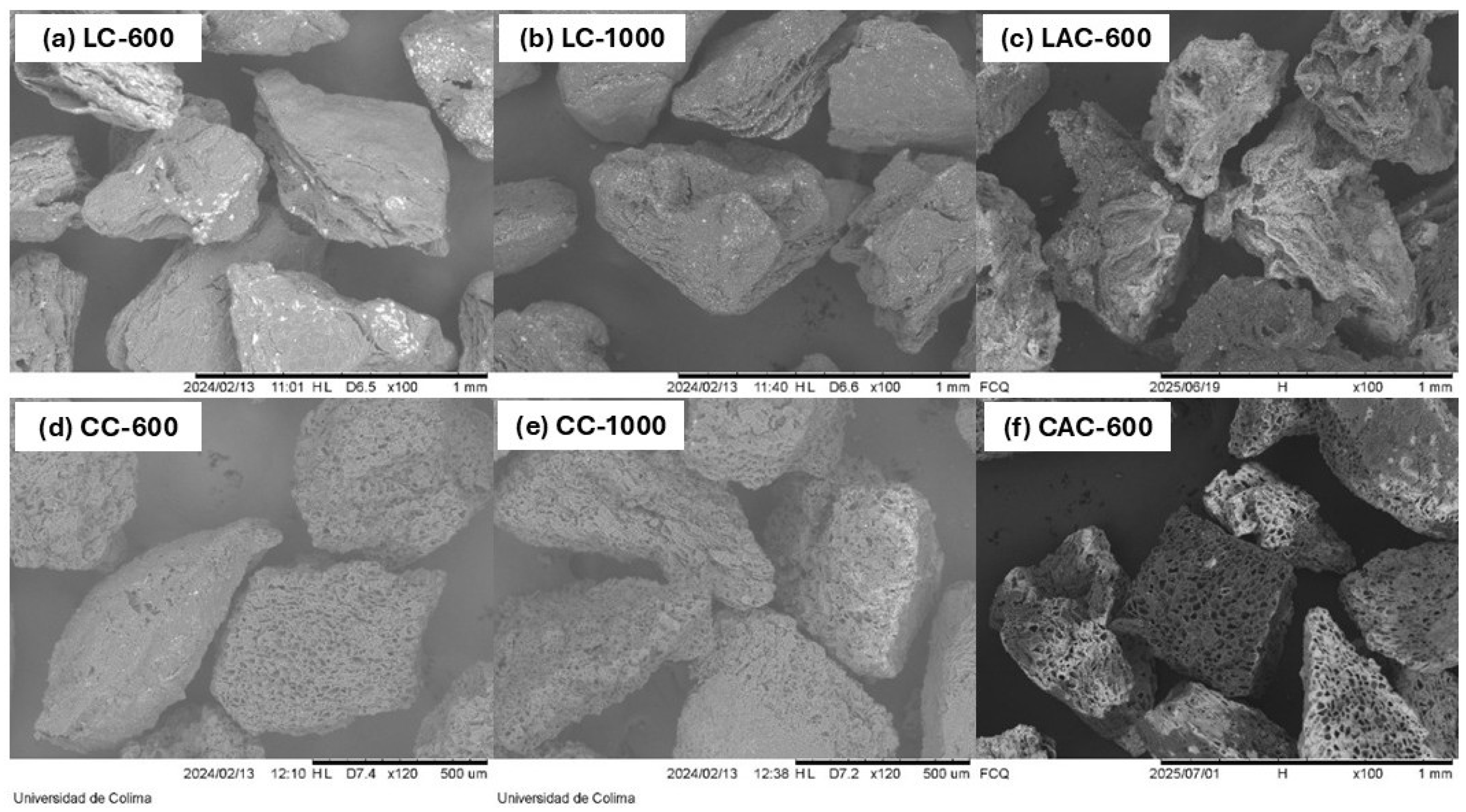
SEM micrographs (Figure 4) reveal morphological differences between biochars derived from spent coffee grounds and lemon pomace. In the adsorbents derived from spent coffee grounds, the cavities are mainly distributed on the external surface of the particles, while biochars derived from lemon pomace have lamellar morphology with transverse cavities. These differences can be attributed to the inherent anatomical structure of the precursor biomass. After the chemical activation process with FeCl3, both series of biochars showed a notable increase in surface roughness, suggesting a textural modification induced by the activating agent. Similar results have been obtained for FeCl3-modified reed straw biochar [35].
EDS analysis confirmed that carbon was the predominant element in all samples (Table 2). A decrease in oxygen content was observed with increasing pyrolysis temperature in non-activated biochars, consistent with the thermal removal of oxygen-containing functional groups at high temperatures, as reported for carbon-based materials [36]. Additionally, calcium was identified in the LC-600 and LC-1000 samples but was not detected after chemical activation with FeCl3, which is consistent with the XRD results. Finally, iron was detected exclusively in the activated biochars LAC-600 and CAC-600, confirming the successful incorporation of iron species during the activation process. The higher oxygen content observed in these materials could be attributed to the formation of surface iron oxide phases.
The N2 physisorption results revealed that the biochars LC-600 and CC-600 did not have a measurable specific surface area, indicating that these adsorbents had a negligible degree of porosity. Although the increase in the pyrolysis temperature from 600 to 1000 °C promotes the development of some surface area, the value of this parameter was only 1.24 and 1.19 m2·g−1 for CC-1000 and LC-1000, respectively. In contrast, after chemical activation with FeCl3, a significant improvement in the textural properties was achieved, with specific surface areas of 360.3 m2·g−1 and 546.3 m2·g−1 for CAC-600 and LAC-600, respectively. The development of porosity was attributed to the role of FeCl3 as a dehydrating and oxidizing agent. These values are consistent with those reported for other activated carbon-based materials [37,38].
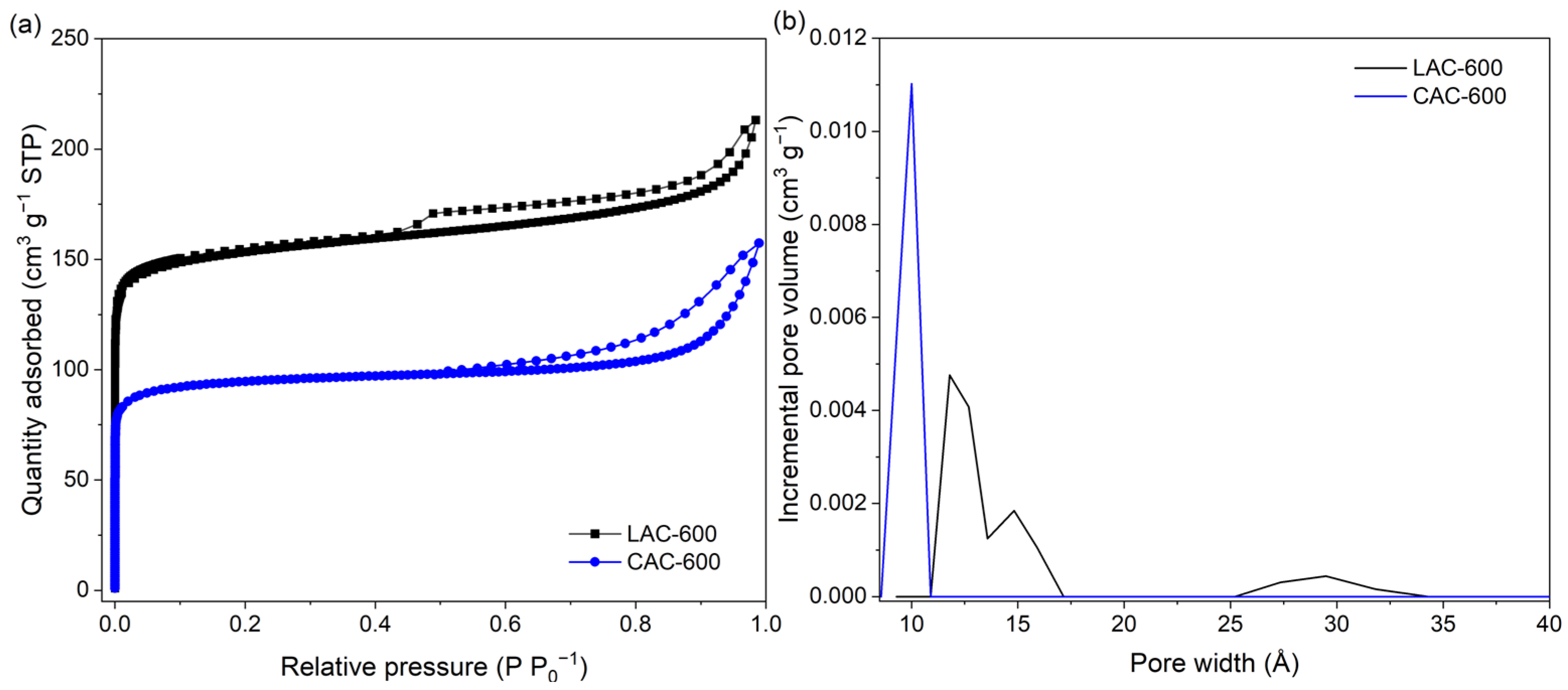
N2 adsorption–desorption isotherms and pore size distribution analysis showed the presence of micropores in the activated biochars (Figure 5). In particular, the isotherm corresponding to LAC-600 presents a type H4 hysteresis loop, which is associated with the coexistence of micropores and narrow mesopores, in accordance with the pore size distribution. This behavior is characteristic of materials with slit-shaped cavities. Additionally, in CAC-600, smaller pores with sizes below 11 Å were identified in the microporous region. The total pore volumes were 0.2149 and 0.2756 cm3·g−1 for CAC-600 and LAC-600, respectively. The higher pore volume observed for LAC-600 may be associated with the presence of larger micropores and mesopores.

3.2. Dye Adsorption

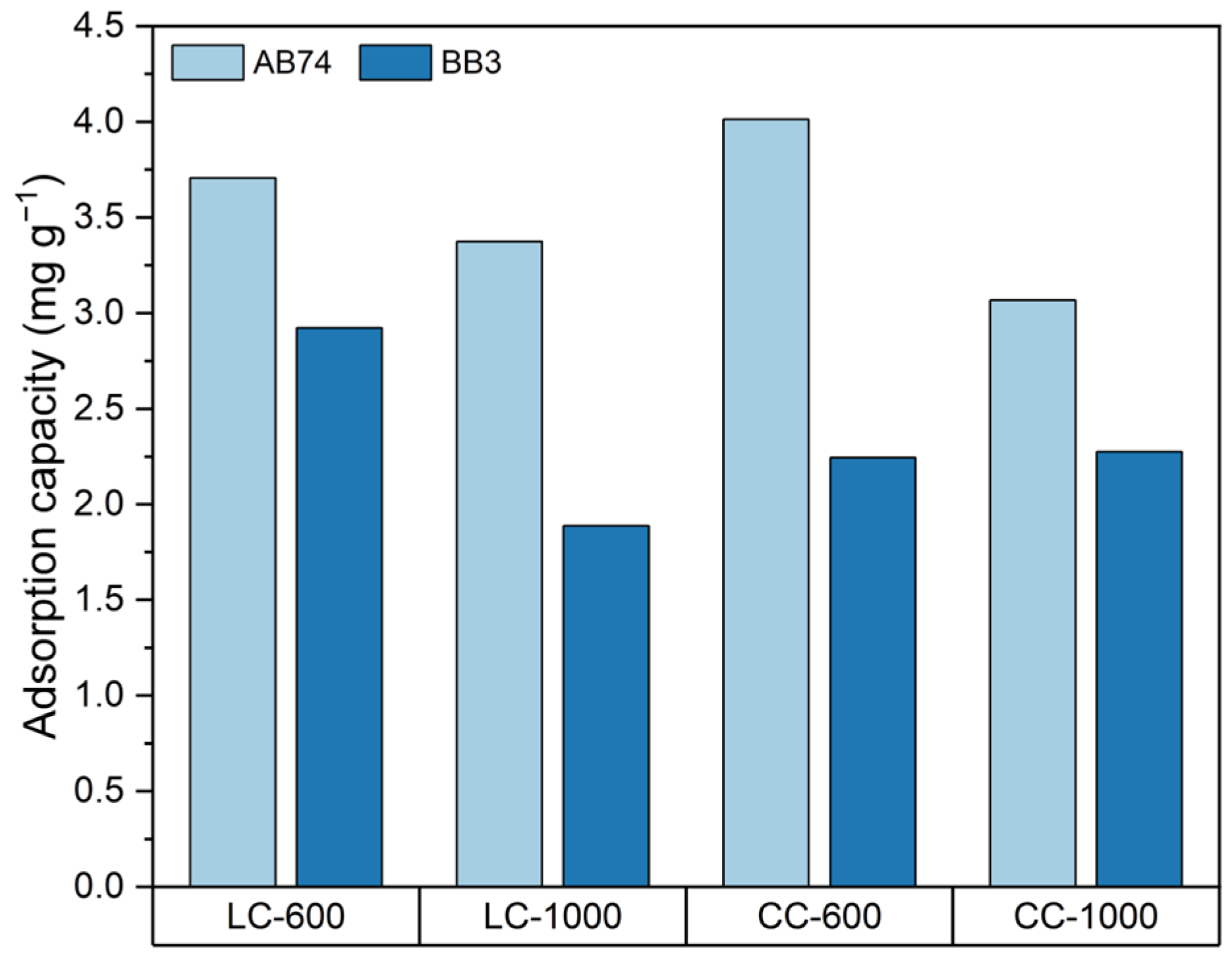
The adsorption capacities of LC-600, LC-1000, CC-600 and CC-1000 biochars were evaluated using acid blue 74 (AB74) and basic blue 3 (BB3) dyes. All adsorbents exhibited adsorption capacities lower than 5 mg·g−1 for both pollutants (Figure 6), consistent with values reported for non-activated biochars synthesized from switchgrass (Panicum virgatum L.) [39]. However, biochars synthesized at a lower pyrolysis temperature (600 °C) had higher adsorption capacities than those obtained at 1000 °C, regardless of the precursor biomass. This phenomenon can be attributed to the higher concentration of oxygen-containing functional groups on the surface of the carbon prepared at 600 °C, as suggested by the EDS analysis, which resulted in a higher adsorption capacity. The presence of –OH and other oxygen-containing functional groups can form hydrogen bonds or electrostatic interactions with specific functional groups of the dye molecules. Based on these findings, 600 °C was selected as the most effective temperature for synthesizing the activated biochars LAC-600 and CAC-600.
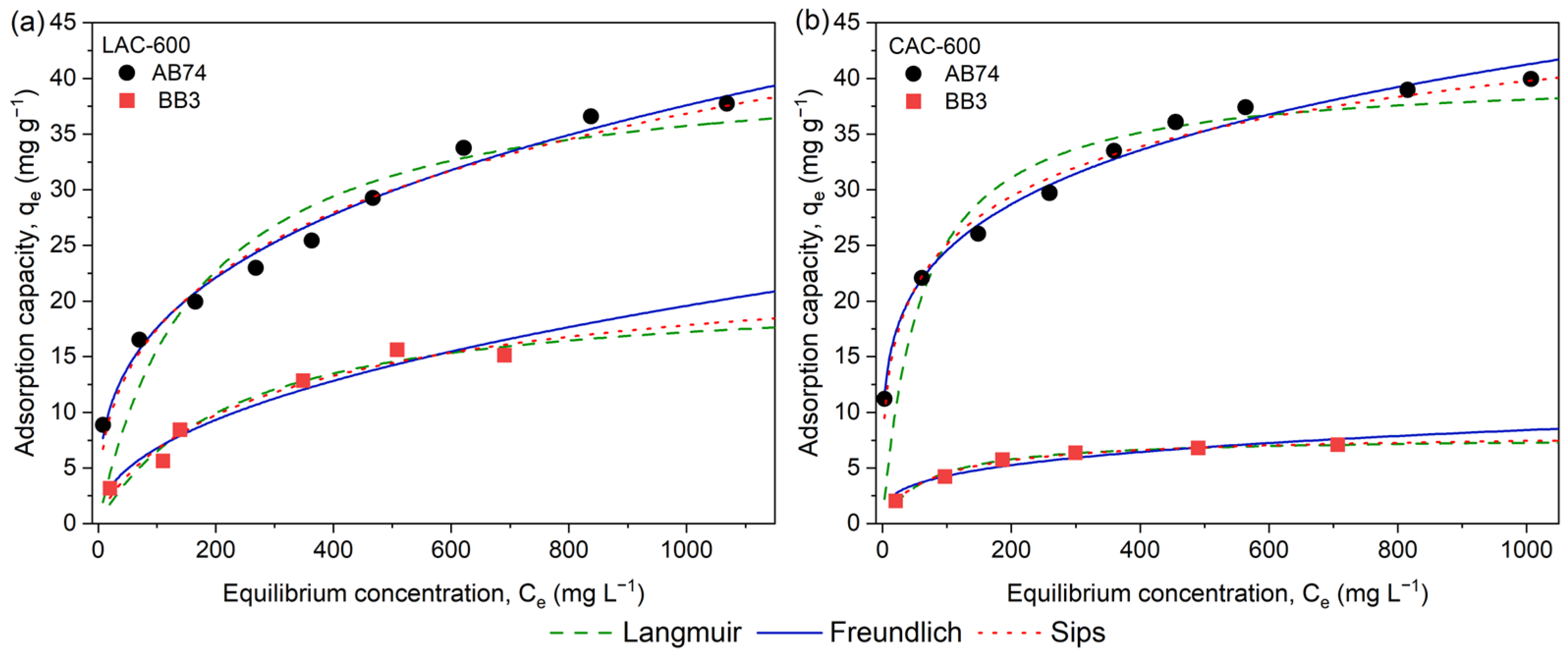
Figure 7a shows the isotherms of AB74 and BB3 dyes obtained using lemon-pomace-derived activated biochar (LAC-600), where the maximum adsorption capacities at equilibrium (qe) were 37.2 and 15.4 mg·g−1 for AB74 and BB3, respectively. Conversely, Figure 7b shows the isotherms corresponding to the dye adsorption with spent-coffee-ground-derived activated biochar (CAC-600). In this case, the adsorption capacities were 39.4 and 6.9 mg·g−1 for AB74 and BB3, respectively. Note that the qe values for AB74 dye were similar for both activated carbons, regardless of the precursor used. This could be associated with the strong influence of FeCl3 on the surface chemistry of the activated biochars, which allows electrostatic interactions with acid dyes.
The Langmuir, Freundlich and Sips models were used for the analysis of the adsorption isotherms. The results shown in Table 3 highlight that the Sips model resulted in a higher value of R2 for dye AB74 and CAC-600 adsorbent; however, the value of ꭓ2 suggests a better fit to the Freundlich model. For the isotherm obtained with LAC-600 and AB74 dye, both parameters R2 and ꭓ2 indicate a better fit to the Freundlich model. Therefore, the adsorption of AB74 is heterogeneous and may involve the formation of multilayers due to physical and chemical dye-adsorbent and dye-dye interactions [40]. For the BB3 dye, the R2 values indicated a better fit to the Sips and Langmuir models. This is further supported by nS values close to 1, suggesting homogeneous adsorption. According to Langmuir theory, adsorption occurs as a monolayer without interactions between adsorbed molecules. This behavior is related to the low reactivity of the functional groups present in the BB3 molecule, which limited dye–dye interactions on the adsorbent surface [41].
The qm values calculated using the Langmuir and Sips models do not fully represent the experimental adsorption behavior. This limitation is likely associated with model overparameterization arising from the shape of the isotherms, which, despite the broad concentration range investigated, did not reach a clearly defined asymptotic saturation region.
Overall, the FeCl3-activated biochars LAC-600 and CAC-600 showed greater adsorption capacity for the acid dye AB74 than for the basic dye BB3. Based on these results, the selective dye removal using a mixture of acid dyes was studied. These experiments were conducted using a mixture of acid red 1 (AR1) and acid blue 74 (AB74) at a 1:1 molar ratio. Simultaneously, the effect of adsorbent dosage (i.e., 20 and 40 mg) was evaluated. The results (Table 4) show that the adsorption capacity of both dyes in mixture decreased as the adsorbent mass increased. This is because under the evaluated conditions, some active sites remain unsaturated while the number of sites available for adsorption increase [42]. Both materials exhibited preferential adsorption for AB74 dye. Nevertheless, at an adsorbent dosage of 20 mg, CAC-600 exhibited an adsorption molar ratio of 4.5:1 (AB74:AR1), whereas LAC-600 presented a lower ratio of 2.5:1, indicating a slight decrease in selectivity toward AB74 and, consequently, a relatively greater affinity for AR1 than CAC-600. The increase in the AR1 adsorption capacity on LAC-600 can be attributed to its larger specific surface area and pore size compared to those of CAC-600.
Although the results demonstrated selective adsorption toward AB74, it is important to note that the adsorption capacity strongly depends on the preparation and treatment conditions of the carbon materials. Table 5 summarizes the adsorption capacities reported for carbon-based adsorbents derived from different biomasses and treated using various activation strategies. In particular, the performance achieved through FeCl3 activation is shown to be comparable to that obtained with other treatment methods reported in the literature.
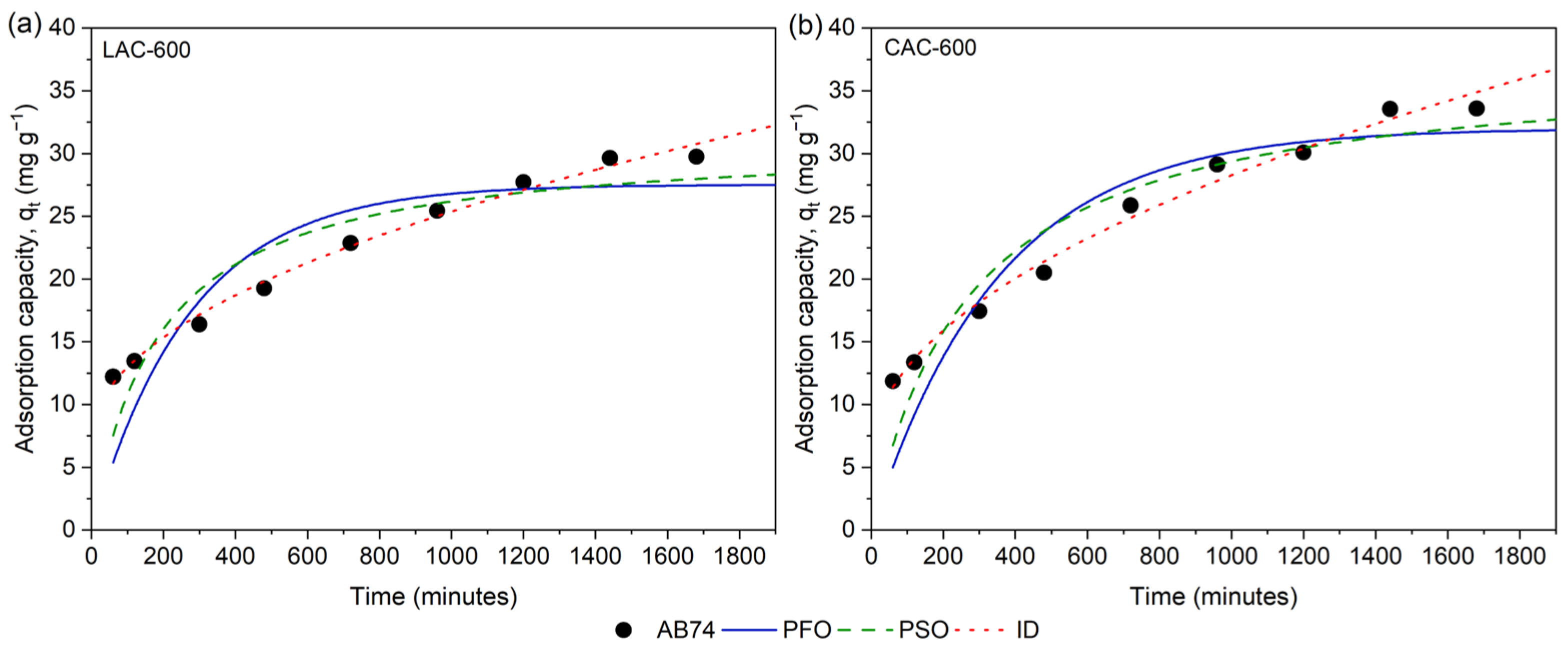
The AB74 adsorption kinetics on FeCl3-activated biochars LAC-600 and CAC-600 were evaluated (Figure 8). The results confirmed that adsorption equilibrium was reached after 24 h. The slow adsorption kinetics can be attributed to the difficulty of diffusion in micropores due to the size of the dye molecule and rigid carbonaceous matrix. Additionally, adsorption kinetics were analyzed based on pseudo first-order, pseudo second-order and intraparticle diffusion models.
The kinetic modeling results (Table 6) showed that the intraparticle diffusion model provided the best overall statistical fit, consistent with the long contact time required to reach equilibrium. Among the reaction-order models, the pseudo-second-order model fitted the data better than the pseudo-first-order model, suggesting that specific surface interactions also contributed to AB74 uptake [17]. Both adsorption systems presented a better fit to the pseudo-second-order model with similar qe,cal and qe,exp values, indicating possible strong interactions between the sulfonate groups of the dye and the iron atoms derived from the FeCl3-activated biochars. The experimental and fitted results indicate that the adsorption of AB74 onto the activated biochars involves specific surface interactions and intraparticle diffusion during the later stages of adsorption.
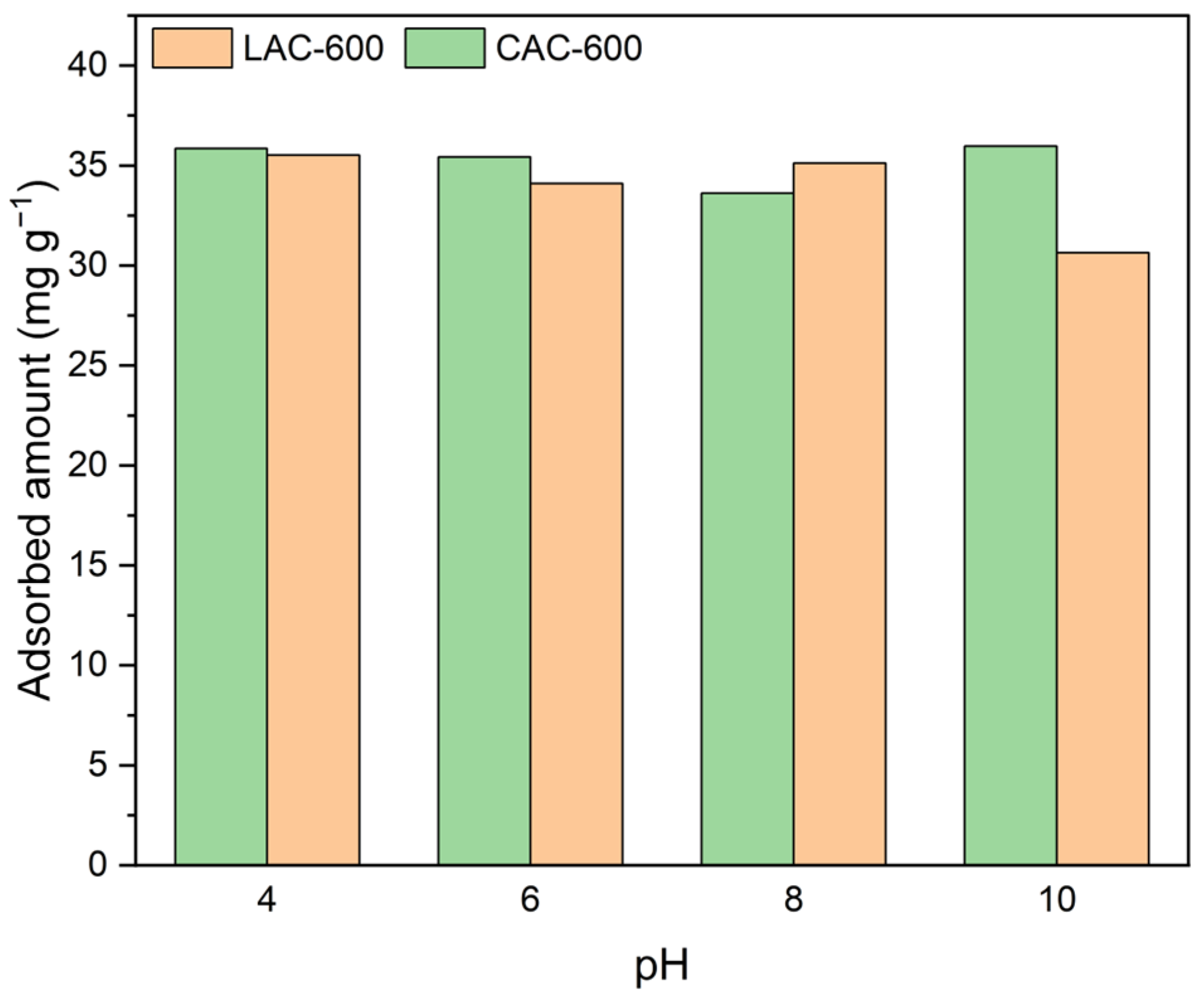
The effect of solution pH on AB74 adsorption was analyzed in the pH range of 4–10, within which AB74 remains ionized, with its sulfonate groups present as -SO3. In addition, the materials have a negative surface charge because pHPZC < pHsolution, limiting the adsorbate-adsorbent electrostatic interactions. The results of Figure 9 show that the adsorption capacity of CAC-600 does not change significantly with the pH of AB74 solution, reaching a maximum adsorption capacity at pH 10. Similarly, no significant changes are observed at pH between 4 and 8 when the adsorbent is LAC-600; however, the adsorption capacity decreases at pH = 10. These results demonstrate that the activated biochar maintained their removal performance over a wide pH range, suggesting that the adsorption mechanism is not primarily governed by electrostatic interactions. Instead, stronger interactions (metal sites-sulfonate groups) may be involved, similar to interactions reported for textile wastewater systems [46].

3.3. DFT Modelling of Dye–Surface Interactions on FeCl3-Activated Biochar Surface

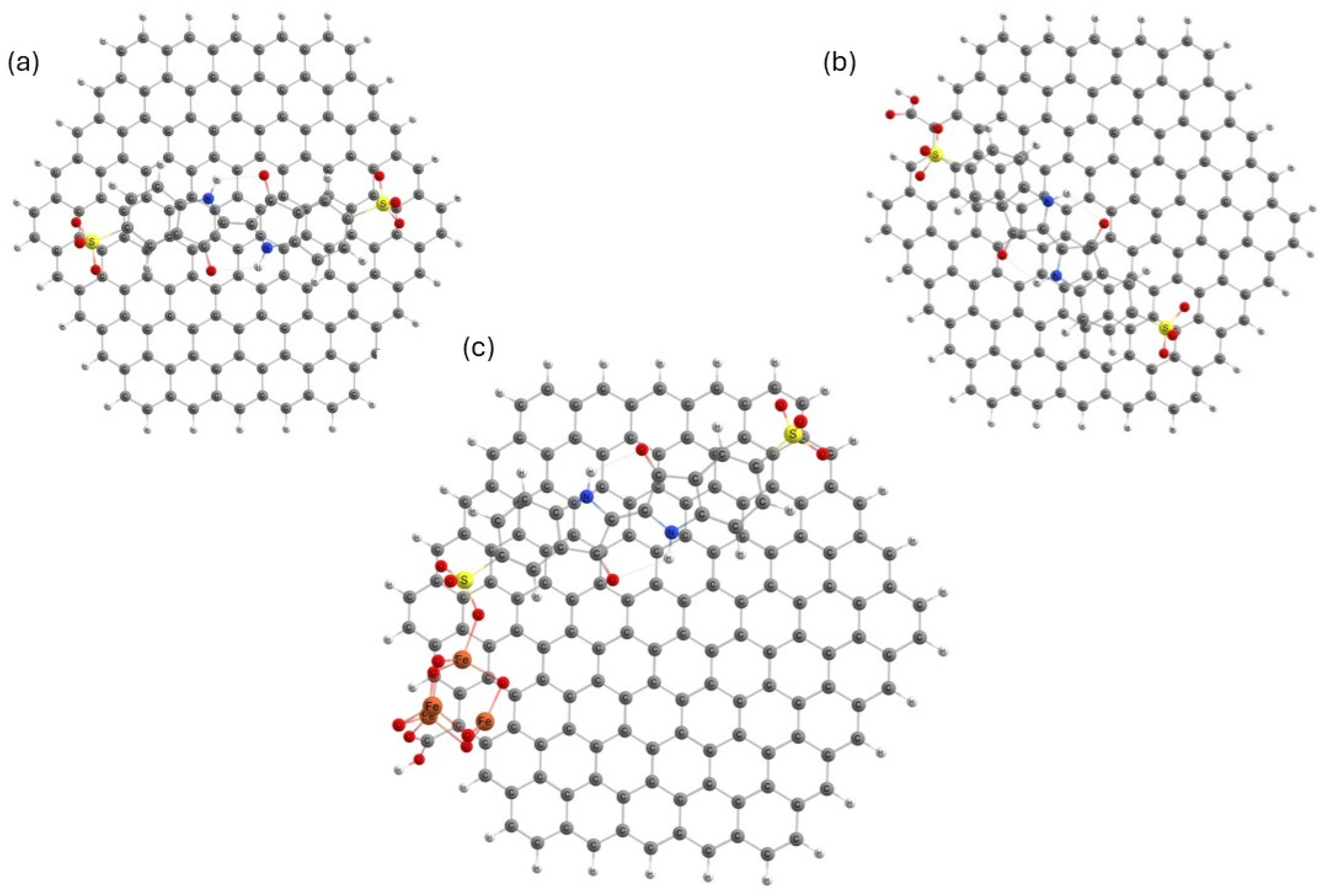
To gain mechanistic insight into the enhanced adsorption of AB74 on FeCl3-activated biochars, cluster DFT models were used to separate the contributions of the graphene surface, oxygenated functionalities, and Fe-containing moieties. The results allow the local adsorption mechanism to be rationalized in terms of dispersive surface contact, the limited effect of isolated oxygenated groups, and the strong anchoring role of Fe-containing sites. Figure 10 compares the optimized adsorption geometries of AB74 on the three cluster models and provides the first structural evidence of how Fe-containing sites modify the adsorption mechanism.
In the G and G-COOH models, AB74 adopts a nearly parallel orientation over the graphene surface, indicating that adsorption is dominated by extended π-surface and dispersive interactions [47,48]. The similarity between both structures suggests that a single carboxylic group does not substantially alter the preferred adsorption mode. In contrast, the optimized structure of G-COOH-Fe4O6 shows a clear reorganization of the adsorption geometry: while the aromatic scaffold of AB74 remains positioned over the graphene plane, one end of the molecule is oriented toward the Fe-containing cluster. This indicates a cooperative mechanism in which graphene acts as a dispersive platform and the Fe-oxide moiety provides a localized anchoring site. Structurally, this is the clearest sign that Fe incorporation changes not only the strength but also the nature of the dye-surface interactions. The shortest contact distance in the G-COOH-Fe4O6-AB74 complex is 1.98 Å, which is significantly shorter than that expected for a purely dispersive long-range contact. This short separation is consistent with a highly localized interaction between AB74 and the Fe-containing region of the adsorbent. This short contact distance is consistent with previous studies showing that sulfonated dyes can interact with Fe oxides through metal–sulfonate coordination motifs [49]. The adsorption energies in Table 7 quantify the individual contributions of the graphene surface, the carboxylic functionality, and the Fe-containing moiety to the stabilization of AB74.
The energy values exhibit a clear trend. AB74 molecule adsorbs on pristine graphene with an energy of 28.86 kcal·mol−1, and the value changes only marginally to 28.27 kcal·mol−1 on G-COOH. This difference of only 0.59 kcal·mol−1 indicates that the isolated carboxylic group does not significantly strengthen the adsorption. Therefore, the main role of G-COOH is unlikely to be direct enhancement of AB74 binding. The negligible energetic difference between G and G-COOH for AB74 contrasts with graphene-oxide studies on cationic dyes such as methylene blue, where carboxylation or a higher degree of oxygen functionalization improved adsorption performance, highlighting that the contribution of carboxylic groups is strongly dependent on dye charge and functionality [50,51]. In contrast, the adsorption energy increases sharply to 52.88 kcal·mol−1 for the G-COOH-Fe4O6 model, which corresponds to an increase of approximately 24 kcal·mol−1 relative to the carbon-only systems. This substantial stabilization demonstrates that the Fe-containing site is the principal source of enhanced local adsorption. In addition, the interaction energy of Fe4O6 with G-COOH is 23.90 kcal·mol−1, confirming that the oxide cluster is itself stably anchored to the oxygenated graphene model. Together, these values support a two-level interpretation: the graphene framework provides the adsorption platform, whereas the Fe-containing site is responsible for the major energetic gain associated with activation. The CM5 fragment charges (Table 8) provide an electronic perspective on the adsorption process and help to identify whether the Fe-containing moiety promotes a stronger redistribution of electron density.
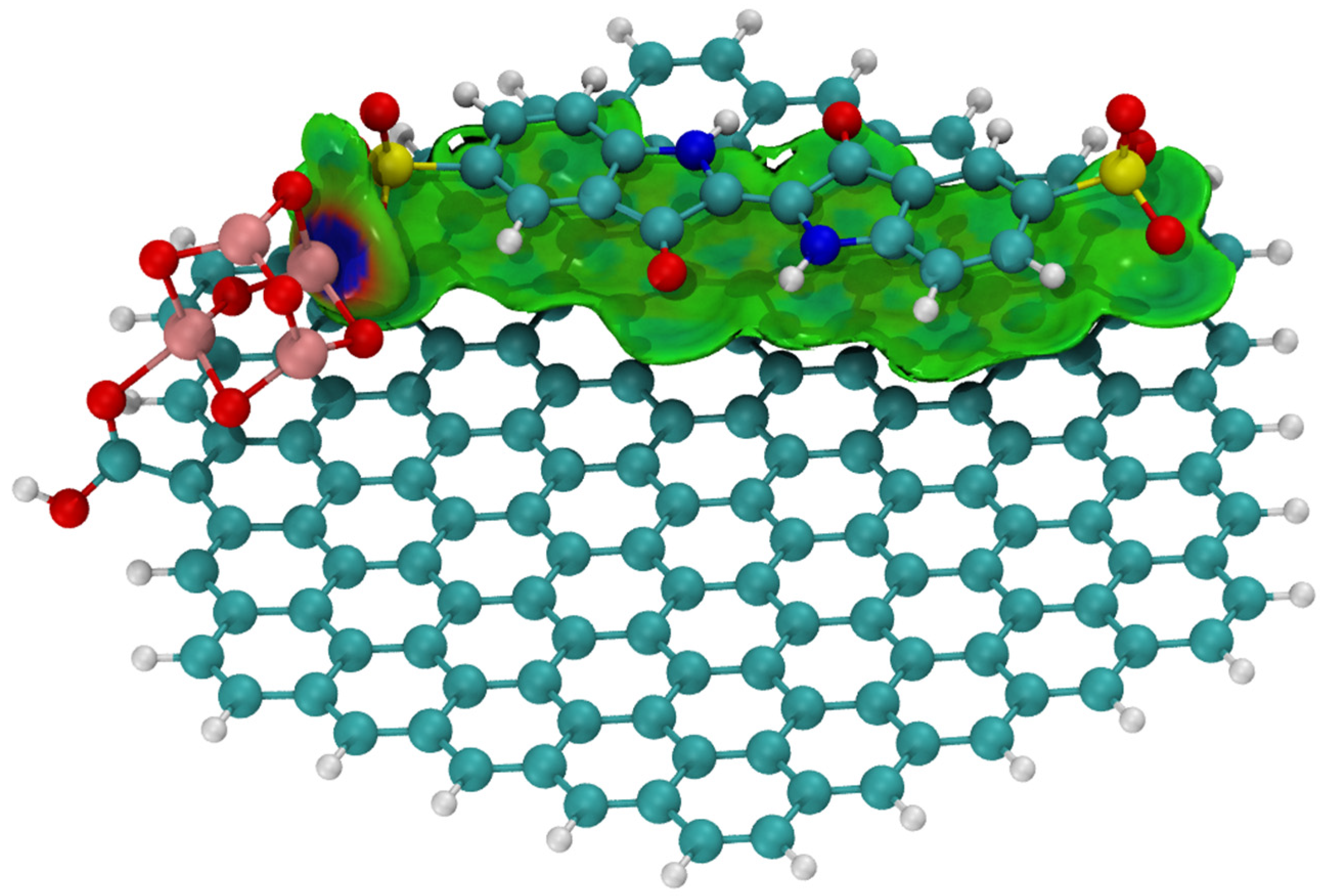
For the AB74@G and AB74@G-COOH complexes, the charge distribution remains very similar: the dye carries charges of −1.93 and −1.91 e, respectively, while the adsorbent fragments bear only small residual charges of −0.07 and −0.09 e. This minimal change is consistent with the energy analysis, which showed that the isolated carboxylic group has little effect on adsorption strength. In contrast, the G-COOH-Fe4O6-AB74 complex displays a noticeably different charge distribution, with the dye becoming less negative (−1.55 e) and the adsorbent becoming more negative (−0.45 e). This result indicates a substantially larger redistribution of electron density upon adsorption in the presence of the Fe-containing moiety. Therefore, the stronger interaction observed for G-COOH-Fe4O6 is not only geometric but also electronic in nature. The CM5 analysis thus reinforces the interpretation that Fe incorporation creates an active site capable of establishing a more specific and electronically stronger interaction with AB74 than graphene or carboxylated graphene alone. The IGMH analysis in Figure 11 provides a visual decomposition of the interaction pattern in the Fe-containing complex and helps distinguish between the contributions of the graphene surface and the Fe4O6 moiety.
The isosurface exhibits an extended green region distributed beneath much of the aromatic body of AB74, indicating widespread weak-to-moderate interactions between the dye and the graphene substrate. This pattern is characteristic of dispersive surface contact and is consistent with the role of graphene as the structural platform for adsorption. More importantly, a localized blue region appears near the Fe-containing end of the system, showing the presence of a much stronger attractive interaction centered at the Fe4O6 moiety. The coexistence of these two regions points to a cooperative adsorption mechanism: AB74 is stabilized globally by broad π-surface interactions with graphene, but the decisive energetic reinforcement arises from a localized interaction with the Fe-containing site. The red/orange contour surrounding the intense blue region is also meaningful because it reflects the expected steric or repulsive boundary around a very close contact. The IGMH map visually confirms the conclusion reached from the energies and CM5 charges: Fe incorporation changes the adsorption mechanism from mainly surface-supported physisorption to combined surface adsorption plus specific anchoring. The present hybrid G-COOH-Fe4O6 model differs from bare iron-oxide nanoparticle systems, where dye adsorption has often been described as largely electrostatic and highly sensitive to pH and ionic strength [52]; here, the graphene platform adds a broad dispersive contribution, while the Fe-containing moiety provides localized strong anchoring.
More broadly, this interpretation agrees with recent reviews on Fe-modified biochar, which emphasize that Fe incorporation modifies both the surface chemistry and the adsorption behavior of lignocellulosic carbons, rather than acting only through textural changes [53].
It should be noted that the present DFT models are simplified local cluster representations of the activated biochar surface and should not be interpreted as complete atomistic descriptions of the real heterogeneous materials. The C150H30 nanoflake was selected to provide an extended graphenic domain large enough to describe π-surface interactions with AB74, while hydrogen termination was used to remove artificial dangling-bond effects at the cluster edges. Nevertheless, finite clusters may still be affected by edge effects, and no explicit cluster-size convergence test or periodic-slab benchmark was performed. Similarly, the Fe4O6 fragment represents a simplified oxide-like Fe-containing active site generated after FeCl3 activation, rather than the full distribution of iron oxide phases, particle sizes, and surface hydration states expected in the experimental biochars. Therefore, the calculated adsorption energies should be interpreted primarily as comparative local interaction energies among G, G-COOH, and G-COOH-Fe4O6, rather than as absolute macroscopic adsorption free energies. Despite these limitations, finite graphitic and modified-biochar cluster models have been widely used to isolate local adsorption mechanisms, including π–π interactions, oxygenated functional-group effects, heteroatom contributions, and metal-containing active sites in carbonaceous adsorbents [54,55].

4. Conclusions

In this study, lemon pomace and spent coffee grounds were successfully valorized as precursors for the preparation of FeCl3-activated biochars with improved adsorption properties. The activation process produced carbon-based materials with markedly higher specific surface areas, developed microporosity, abundant acidic oxygenated groups, low pHPZC values, and the incorporation of Fe2O3 phases, all of which clearly differentiated them from the non-activated biochars. In addition, the non-activated pyrolytic biochars obtained without activation exhibited very low adsorption capacities for acid and basic dyes (<5 mg·g−1), confirming that FeCl3 activation is essential to generate effective adsorbents from these agro-industrial residues.
The adsorption results demonstrated that both activated biochars exhibited greater affinity for the acid dye AB74 than for the basic dye BB3. AB74 adsorption capacities were 37.16 and 39.44 mg·g−1 for LAC-600 and CAC-600, respectively, whereas BB3 adsorption was considerably lower. Isotherm analysis indicated that AB74 adsorption is better described by heterogeneous models with possible multilayer formation, whereas BB3 exhibited behavior closer to monolayer adsorption. In dye-mixture experiments, both activated biochars preferentially removed AB74 over AR1. CAC-600 exhibited an adsorption molar ratio of 4.5:1 (AB74:AR1). The lower molar ratio (2.5:1) obtained with LAC-600 indicated a relatively enhanced uptake of AR1, which may be related to its larger surface area and pore structure. In addition, AB74 adsorption remained effective over a wide pH range (4–10), and kinetic analysis indicated that the adsorption process was controlled by both intraparticle diffusion and specific surface interactions.
The DFT study provided mechanistic support for the experimental findings by showing that pristine graphene and carboxylated graphene interact with AB74 with similar strengths, whereas the incorporation of an Fe-containing moiety produced a pronounced increase in the adsorption energy, approximately 24 kcal·mol−1. CM5 charge analysis and IGMH visualization further showed that adsorption on the Fe-decorated model was governed by a cooperative mechanism in which the graphene-like surface acted as a dispersive platform and the Fe-containing site behaved as a localized anchoring center. Therefore, the enhanced performance of FeCl3-activated biochars cannot be explained only by textural development, but also by the creation of chemically active Fe-based adsorption sites. Overall, these results demonstrate that FeCl3-activated biochars derived from lemon pomace and spent coffee grounds are promising low-cost adsorbents for the removal of anionic dyes from aqueous media and represent a valuable strategy for sustainable utilization of agro-industrial waste.
Future studies should evaluate the performance of these FeCl3-activated biochars in continuous-flow systems and real textile effluents, where competing ions and other constituents may affect adsorption behavior. In addition, in situ reusability cycles should be investigated to verify the long-term stability of the materials and the preservation of Fe-based active sites during continuous operation. Such studies are necessary to bridge the gap between laboratory-scale evaluations and practical industrial implementation.

Supplementary Materials

The following supporting information can be downloaded at: https://www.mdpi.com/article/10.3390/pr14121886/s1, Figure S1: Isolated cluster models used in the DFT calculations; Table S1: Summary of the cluster models used in the DFT calculations; Table S2: Selected distances (Å) in the optimized G-COOH-Fe4O6 model.

Author Contributions

A.N.P.-J.: Investigation, Methodology, Visualization; K.P.-U.: Simulations, Methodology, Writing—Original Draft; C.K.R.-M.: Investigation, Conceptualization, Validation; D.I.M.-C.: Investigation, Methodology; G.D.-J.: Investigation, Methodology; A.B.-P.: Conceptualization, Visualization; I.A.A.-V.: Conceptualization, Writing—Original Draft, Validation. All authors have read and agreed to the published version of the manuscript.

Funding

The authors acknowledge the support provided by SECIHTI (Grant No. CBF-2025-G-1241).

Data Availability Statement

The original contributions presented in this study are included in the article/Supplementary Materials. Further inquiries can be directed to the corresponding author.

Conflicts of Interest

The authors declare no conflict of interest.

References

  1. OECD; FAO. OCDE-FAO Perspectivas Agrícolas 2025–2034; OECD Publishing: Paris, France, 2025; ISBN 9789264987715. [Google Scholar]
  2. Culqui-Arce, C.; Mori-Mestanza, D.; Fernández-Jeri, A.B.; Cruzalegui, R.J.; Mori Zabarburú, R.C.; Vergara, A.J.; Cayo-Colca, I.S.; da Silva, J.G.; Araujo, N.M.P.; Castro-Alayo, E.M.; et al. Polymers Derived from Agro-Industrial Waste in the Development of Bioactive Films in Food. Polymers 2025, 17, 408. [Google Scholar] [CrossRef] [PubMed]
  3. Mubarak, A.A.; Ilyas, R.A.; Nordin, A.H.; Ngadi, N.; Alkbir, M.F.M. Recent Developments in Sugarcane Bagasse Fibre-Based Adsorbent and Their Potential Industrial Applications: A Review. Int. J. Biol. Macromol. 2024, 277, 134165. [Google Scholar] [CrossRef] [PubMed]
  4. Qiu, B.; Shao, Q.; Shi, J.; Yang, C.; Chu, H. Application of Biochar for the Adsorption of Organic Pollutants from Wastewater: Modification Strategies, Mechanisms and Challenges. Sep. Purif. Technol. 2022, 300, 121925. [Google Scholar] [CrossRef]
  5. Luo, Q.; Deng, Y.; Li, Y.; He, Q.; Wu, H.; Fang, X. Effects of Pyrolysis Temperatures on the Structural Properties of Straw Biochar and Its Adsorption of Tris-(1-Chloro-2-Propyl) Phosphate. Sci. Rep. 2024, 14, 25711. [Google Scholar] [CrossRef]
  6. Gao, Y.; Yue, Q.; Gao, B.; Li, A. Insight into Activated Carbon from Different Kinds of Chemical Activating Agents: A Review. Sci. Total Environ. 2020, 746, 141094. [Google Scholar] [CrossRef]
  7. Gallego-Ramírez, C.; Chica, E.; Rubio-Clemente, A. Elimination of Indigo Carmine in Water by Pinus Patula Biochar: Adsorption Process Optimization, Kinetics and Isotherms. J. Environ. Chem. Eng. 2024, 12, 112425. [Google Scholar] [CrossRef]
  8. Ristea, M.-E.; Zarnescu, O. Indigo Carmine: Between Necessity and Concern. J. Xenobiot. 2023, 13, 509–528. [Google Scholar] [CrossRef]
  9. International Coffee Organization. I-CIP Falls on Easing of Supply Concerns; International Coffee Organization: London, UK, 2025. [Google Scholar]
  10. Núñez-Pérez, J.; Burbano-García, J.; Espín-Valladares, R.; Lara-Fiallos, M.; DelaVega-Quintero, J.; Cevallos-Vallejos, M.; Pais-Chanfrau, J.-M. Cascade Valorisation of Lemon-Processing Residues (Part I): Current Trends in Green Extraction Technologies and High-Value Bioactive Recovery. Foods 2026, 15, 491. [Google Scholar] [CrossRef]
  11. Bedia, J.; Peñas-Garzón, M.; Gómez-Avilés, A.; Rodriguez, J.J.; Belver, C. Review on Activated Carbons by Chemical Activation with FeCl3. C 2020, 6, 21. [Google Scholar] [CrossRef]
  12. Xu, Z.; Zhou, Y.; Sun, Z.; Zhang, D.; Huang, Y.; Gu, S.; Chen, W. Understanding Reactions and Pore-Forming Mechanisms between Waste Cotton Woven and FeCl3 during the Synthesis of Magnetic Activated Carbon. Chemosphere 2020, 241, 125120. [Google Scholar] [CrossRef]
  13. Kosmulski, M. The PH Dependent Surface Charging and Points of Zero Charge. X. Update. Adv. Colloid Interface Sci. 2023, 319, 102973. [Google Scholar] [CrossRef]
  14. Boehm, H.P. Surface Oxides on Carbon and Their Analysis: A Critical Assessment. Carbon N. Y. 2002, 40, 145–149. [Google Scholar] [CrossRef]
  15. Qi, X.; Tong, X.; Pan, W.; Zeng, Q.; You, S.; Shen, J. Recent Advances in Polysaccharide-Based Adsorbents for Wastewater Treatment. J. Clean. Prod. 2021, 315, 128221. [Google Scholar] [CrossRef]
  16. Murphy, O.P.; Vashishtha, M.; Palanisamy, P.; Kumar, K.V. A Review on the Adsorption Isotherms and Design Calculations for the Optimization of Adsorbent Mass and Contact Time. ACS Omega 2023, 8, 17407–17430. [Google Scholar] [CrossRef]
  17. Wang, J.; Guo, X. Adsorption Kinetic Models: Physical Meanings, Applications, and Solving Methods. J. Hazard. Mater. 2020, 390, 122156. [Google Scholar] [CrossRef]
  18. Neese, F. Software Update: The ORCA Program System—Version 6.0. WIREs Comput. Mol. Sci. 2025, 15, e70019. [Google Scholar] [CrossRef]
  19. Weigend, F.; Ahlrichs, R. Balanced Basis Sets of Split Valence, Triple Zeta Valence and Quadruple Zeta Valence Quality for H to Rn: Design and Assessment of Accuracy. Phys. Chem. Chem. Phys. 2005, 7, 3297. [Google Scholar] [CrossRef] [PubMed]
  20. Grimme, S.; Ehrlich, S.; Goerigk, L. Effect of the Damping Function in Dispersion Corrected Density Functional Theory. J. Comput. Chem. 2011, 32, 1456–1465. [Google Scholar] [CrossRef]
  21. Perdew, J.P.; Burke, K.; Ernzerhof, M. Generalized Gradient Approximation Made Simple. Phys. Rev. Lett. 1996, 77, 3865, Erratum in Phys. Rev. Lett. 1997, 78, 1396. https://doi.org/10.1103/PhysRevLett.78.1396. [Google Scholar] [CrossRef]
  22. Weigend, F. Accurate Coulomb-Fitting Basis Sets for H to Rn. Phys. Chem. Chem. Phys. 2006, 8, 1057. [Google Scholar] [CrossRef]
  23. Marenich, A.V.; Cramer, C.J.; Truhlar, D.G. Universal Solvation Model Based on Solute Electron Density and on a Continuum Model of the Solvent Defined by the Bulk Dielectric Constant and Atomic Surface Tensions. J. Phys. Chem. B 2009, 113, 6378–6396. [Google Scholar] [CrossRef]
  24. Boys, S.F.; Bernardi, F. The Calculation of Small Molecular Interactions by the Differences of Separate Total Energies. Some Procedures with Reduced Errors. Mol. Phys. 1970, 19, 553–566. [Google Scholar] [CrossRef]
  25. Marenich, A.V.; Jerome, S.V.; Cramer, C.J.; Truhlar, D.G. Charge Model 5: An Extension of Hirshfeld Population Analysis for the Accurate Description of Molecular Interactions in Gaseous and Condensed Phases. J. Chem. Theory Comput. 2012, 8, 527–541. [Google Scholar] [CrossRef]
  26. Lu, T.; Chen, Q. Independent Gradient Model Based on Hirshfeld Partition: A New Method for Visual Study of Interactions in Chemical Systems. J. Comput. Chem. 2022, 43, 539–555. [Google Scholar] [CrossRef]
  27. Lu, T.; Chen, F. Multiwfn: A Multifunctional Wavefunction Analyzer. J. Comput. Chem. 2012, 33, 580–592. [Google Scholar] [CrossRef]
  28. Humphrey, W.; Dalke, A.; Schulten, K. VMD: Visual Molecular Dynamics. J. Mol. Graph. 1996, 14, 33–38. [Google Scholar] [CrossRef]
  29. Kiełbasa, K.; Siemak, J.; Sreńscek-Nazzal, J.; Benaouda, B.; Roy, B.; Michalkiewicz, B. Carbon Dioxide Adsorption over Activated Biocarbons Derived from Lemon Peel. Molecules 2024, 29, 4183. [Google Scholar] [CrossRef] [PubMed]
  30. Jiang, H.; Zhang, W.; Xu, Y.; Chen, L.; Cao, J.; Jiang, W. An Advance on Nutritional Profile, Phytochemical Profile, Nutraceutical Properties, and Potential Industrial Applications of Lemon Peels: A Comprehensive Review. Trends Food Sci. Technol. 2022, 124, 219–236. [Google Scholar] [CrossRef]
  31. Wilson, F.; Tremain, P.; Moghtaderi, B. Characterization of Biochars Derived from Pyrolysis of Biomass and Calcium Oxide Mixtures. Energy Fuels 2018, 32, 4167–4177. [Google Scholar] [CrossRef]
  32. Shi, C.; Wang, Y.; Zhang, K.; Lichtfouse, E.; Li, C.; Zhang, Y. Fe-Biochar as a Safe and Efficient Catalyst to Activate Peracetic Acid for the Removal of the Acid Orange Dye from Water. Chemosphere 2022, 307, 135686. [Google Scholar] [CrossRef]
  33. Campbell, R.; Xiao, B.; Mangwandi, C. Production of Activated Carbon from Spent Coffee Grounds (SCG) for Removal of Hexavalent Chromium from Synthetic Wastewater Solutions. J. Environ. Manag. 2024, 366, 121682. [Google Scholar] [CrossRef]
  34. Caicedo-Salcedo, O.D.; Vargas-Delgadillo, D.P.; Giraldo, L.; Moreno-Piraján, J.C. Data of Preparation and Characterization of Activated Carbon Using Two Activant Agents and Mango Seed as Precursor Material. Data Brief. 2019, 27, 104769. [Google Scholar] [CrossRef]
  35. Kuang, P.; Cui, Y.; Zhang, Z.; Ma, K.; Zhang, W.; Zhao, K.; Zhang, X. Increasing Surface Functionalities of FeCl3-Modified Reed Waste Biochar for Enhanced Nitrate Adsorption Property. Processes 2023, 11, 1740. [Google Scholar] [CrossRef]
  36. Rahimi, V.; Pimentel, C.H.; Gómez-Díaz, D.; Freire, M.S.; Lazzari, M.; González-Álvarez, J. Development and Characterization of Biomass-Derived Carbons for the Removal of Cu2+ and Pb2+ from Aqueous Solutions. C 2024, 11, 2. [Google Scholar] [CrossRef]
  37. Chen, W.; Wu, G.; Su, Y.; Sun, E.; Zhang, H. Controllable Preparation of Biomass-Derived Activated Carbon for Targeted Adsorption of Phenolic Substances in Crude Wood Vinegar. J. Anal. Appl. Pyrolysis 2026, 194, 107584. [Google Scholar] [CrossRef]
  38. Qu, D.; Zhu, J.; Yu, Y.; Lei, C.; Wang, B.; Dong, W.; Xu, J. Study on the Adsorption of Rose Anthocyanins by Rose Residue Activated Carbon. iScience 2025, 114334. [Google Scholar] [CrossRef]
  39. Park, J.-H.; Wang, J.J.; Meng, Y.; Wei, Z.; DeLaune, R.D.; Seo, D.-C. Adsorption/Desorption Behavior of Cationic and Anionic Dyes by Biochars Prepared at Normal and High Pyrolysis Temperatures. Colloids Surf. A Physicochem. Eng. Asp. 2019, 572, 274–282. [Google Scholar] [CrossRef]
  40. Wang, J.; Guo, X. Adsorption Isotherm Models: Classification, Physical Meaning, Application and Solving Method. Chemosphere 2020, 258, 127279. [Google Scholar] [CrossRef]
  41. Pérez-Millán, T.M.; Mendoza-Castillo, D.I.; Aguayo-Villarreal, I.A.; Rojas-Mayorga, C.K.; Villanueva-Mejía, F.; Bonilla-Petriciolet, A. Application of DFT and Response Surface Models to Analyze the Adsorption Process of Basic Blue 3 and Reactive Blue 19 Dyes on Sugarcane Bagasse and Coconut Endocarp Biomass. J. Mol. Struct. 2023, 1287, 135658. [Google Scholar] [CrossRef]
  42. Rápó, E.; Tonk, S. Factors Affecting Synthetic Dye Adsorption; Desorption Studies: A Review of Results from the Last Five Years (2017–2021). Molecules 2021, 26, 5419. [Google Scholar] [CrossRef]
  43. Sikdar, D.; Goswami, S.; Das, P. Activated Carbonaceous Materials from Tea Waste and Its Removal Capacity of Indigo Carmine Present in Solution: Synthesis, Batch and Optimization Study. Sustain. Environ. Res. 2020, 30, 30. [Google Scholar] [CrossRef]
  44. Nnadozie, E.C.; Ajibade, P.A. Isotherm, Kinetics, Thermodynamics Studies and Effects of Carbonization Temperature on Adsorption of Indigo Carmine (IC) Dye Using C. Odorata Biochar. Chem. Data Collect. 2021, 33, 100673. [Google Scholar] [CrossRef]
  45. Bhowmik, S.; Chakraborty, V.; Das, P. Batch Adsorption of Indigo Carmine on Activated Carbon Prepared from Sawdust: A Comparative Study and Optimization of Operating Conditions Using Response Surface Methodology. Results Surf. Interfaces 2021, 3, 100011. [Google Scholar] [CrossRef]
  46. Wang, X.; Jiang, J.; Gao, W. Reviewing Textile Wastewater Produced by Industries: Characteristics, Environmental Impacts, and Treatment Strategies. Water Sci. Technol. 2022, 85, 2076–2096. [Google Scholar] [CrossRef]
  47. Mounra, E.; Malloum, A.; Fifen, J.J.; Conradie, J. Adsorption of Some Cationic Dyes onto Two Models of Graphene Oxide. J. Mol. Model. 2023, 29, 380. [Google Scholar] [CrossRef]
  48. Aguayo-Villarreal, I.A.; Cortes-Arriagada, D.; Rojas-Mayorga, C.K.; Pineda-Urbina, K.; Muñiz-Valencia, R.; González, J. Importance of the Interaction Adsorbent –Adsorbate in the Dyes Adsorption Process and DFT Modeling. J. Mol. Struct. 2020, 1203, 127398. [Google Scholar] [CrossRef]
  49. Bandara, J.; Mielczarski, J.A.; Kiwi, J. 1. Molecular Mechanism of Surface Recognition. Azo Dyes Degradation on Fe, Ti, and Al Oxides through Metal Sulfonate Complexes. Langmuir 1999, 15, 7670–7679. [Google Scholar] [CrossRef]
  50. Justino, D.D.; Alves, M.O.; Galvão, B.R.L.; Santamaría, R.; De Sousa, F.B.; Ortega, P.F.R. The Effects of Functionalization on Graphene Oxide for Organic Dye Adsorption: An Experimental-Theoretical Study Using Electronic Structure Calculations and Statistical Mechanical Modeling. J. Mol. Liq. 2023, 387, 122612. [Google Scholar] [CrossRef]
  51. Srikaew, M.; Wongnongwa, Y.; Jungsuitiwong, S.; Kaiyasuan, C.; Promarak, V.; Saengsuwan, S. Improvement of Adsorption Performance and Selectivity of GO-COOH towards MB Dye through Effective Carboxylation Approach: Combined Experimental and DFT Studies. Colloids Surf. A Physicochem. Eng. Asp. 2023, 673, 131920. [Google Scholar] [CrossRef]
  52. Talbot, D.; Queiros Campos, J.; Checa-Fernandez, B.L.; Marins, J.A.; Lomenech, C.; Hurel, C.; Godeau, G.D.; Raboisson-Michel, M.; Verger-Dubois, G.; Obeid, L.; et al. Adsorption of Organic Dyes on Magnetic Iron Oxide Nanoparticles. Part I: Mechanisms and Adsorption-Induced Nanoparticle Agglomeration. ACS Omega 2021, 6, 19086–19098. [Google Scholar] [CrossRef] [PubMed]
  53. Chon, K.; Mo Kim, Y.; Bae, S. Advances in Fe-Modified Lignocellulosic Biochar: Impact of Iron Species and Characteristics on Wastewater Treatment. Bioresour. Technol. 2024, 395, 130332. [Google Scholar] [CrossRef]
  54. Yin, Q.; Liu, M.; Li, Y.; Li, H.; Wen, Z. Computational Study of Phosphate Adsorption on Mg/Ca Modified Biochar Structure in Aqueous Solution. Chemosphere 2021, 269, 129374. [Google Scholar] [CrossRef]
  55. Cheng, L.; Ji, Y.; Liu, X.; Mu, L.; Zhu, J. Sorption Mechanism of Organic Dyes on a Novel Self-Nitrogen-Doped Porous Graphite Biochar: Coupling DFT Calculations with Experiments. Chem. Eng. Sci. 2021, 242, 116739. [Google Scholar] [CrossRef]
Figure 1. Pyrolysis conditions used to produce biochars from spent coffee grounds and lemon pomace.
Processes 14 01886 g001
Figure 2. X-ray diffraction patterns of carbon-based materials obtained from lemon pomace (a) and spent coffee grounds (b).
Processes 14 01886 g002
Figure 3. FTIR spectra of carbon-based materials derived from lemon pomace (a) and spent coffee grounds (b).
Processes 14 01886 g003
Figure 4. SEM micrographs of carbonaceous materials of lemon pomace (a,b,c) and spent coffee grounds (d,e,f).
Processes 14 01886 g004
Figure 5. Adsorption–desorption isotherms of N2 (a) and DFT pore size distribution (b) of carbon-based materials.
Processes 14 01886 g005
Figure 6. Adsorption of acid and basic dyes (C0 = 500 mg·L−1) on biochars at 30 °C and unadjusted pH.
Processes 14 01886 g006
Figure 7. Experimental and simulated dye adsorption isotherms using lemon (a) and coffee (b) activated biochar. Adsorption conditions: 20 mg of activated biochars, 30 °C and equilibrium time of 24 h.
Processes 14 01886 g007
Figure 8. Experimental and simulated dye adsorption kinetics obtained with lemon (a) and coffee (b) activated biochar. Adsorption conditions: C0 = 500 mg·L−1, 30 °C.
Processes 14 01886 g008
Figure 9. Influence of pH on the adsorption capacity of AB74 using activated biochars.
Processes 14 01886 g009
Figure 10. Optimized adsorption geometries of AB74 on (a) pristine graphene (G), (b) carboxylated graphene (G-COOH), and (c) Fe-oxide-decorated carboxylated graphene (G-COOH-Fe4O6). The geometries illustrate the transition from predominantly surface-supported adsorption on G and G-COOH to cooperative adsorption on G-COOH-Fe4O6, where AB74 interacts simultaneously with the graphitic surface and Fe-containing moiety.
Processes 14 01886 g010
Figure 11. IGMH isosurface for the AB74@G-COOH-Fe4O6 complex, colored by sign(λ2)ρ, showing extended weak-to-moderate interactions between the aromatic framework of AB74 and graphene, and a localized strong attractive region near the Fe-containing moiety.
Processes 14 01886 g011
Table 1. Surface functional groups and pHPZC of carbonaceous materials.
Acidic Groups (mmol·g−1)Basic Groups
(mmol·g−1)
pHPZC
PhenolicLactonicCarboxylic
LAC-6000.3040.2200.2920.4262.87
CAC-6000.5090.1670.2570.0812.02
Table 2. Elements detected by EDS in carbon-based materials.
At. % CAt. % OAt. % KAt. % CaAt. % FeAt. % Cl
CC-60094.315.600.050.04------
CC-100097.042.86---0.1------
LC-60088.4210.810.140.63------
LC-100091.797.770.120.31------
CAC-60075.5122.78------1.370.34
LAC-60091.387.81------0.620.19
Table 3. Langmuir, Freundlich and Sips parameters for dye adsorption on activated biochars.
MaterialLAC-600CAC-600
DyeAB74BB3AB74BB3
Sipsqm81.60 ± 31.6426.27 ± 17.4568.17 ± 19.608.30 ± 0.55
KS0.04 ± 0.010.008 ± 0.0090.1 ± 0.020.02 ± 0.008
nS0.42 ± 0.090.79 ± 0.380.38 ± 0.070.85 ± 0.11
R20.980.960.980.99
χ21.991.691.830.03
LangmuirKL0.006 ± 0.0020.0040.016 ± 0.0060.015 ± 0.001
qm41.73 ± 4.2521.06 ± 2.5140.38 ± 2.87.77 ± 0.22
R20.870.960.840.99
χ213.151.3715.420.04
FreundlichKF 3.85 ± 0.480.81 ± 0.348.69 ± 0.621.12 ± 0.31
nF0.33 ± 0.020.46 ± 0.070.23 ± 0.010.29 ± 0.05
R20.990.950.990.93
χ21.601.641.090.30
qm (mg·g−1); KS and KL (L·mg−1); KF (mg1−n·Ln·g−1).
Table 4. Adsorbent dosage evaluation in solutions containing a mixture of acid dyes (AB74 + AR1).
MaterialDosage (mg) Adsorption Capacity of AB74 (mg·g−1)Adsorption Capacity of AR1 (mg·g−1)
CAC-6002012.643.06
409.502.78
LAC-6002010.024.43
407.954.01
Table 5. Comparison of carbon-based materials in AB74 adsorption.
Material Adsorption Capacity
of AB74 (mg·g−1)
Reference
AC-Hummers’ method (tea waste)20[43]
C. odorata biochar112.63[44]
H3PO4-treated AC (sawdust)34.97[45]
NaOH treated AC (sawdust)55.87
FeCl3-LAC (lemon pomace)37.16This study
FeCl3-CAC (spent coffee ground)39.44
Table 6. Kinetic parameters for AB74 adsorption onto FeCl3-activated biochar.
Material Pseudo First-OrderPseudo Second-OrderIntraparticle Diffusion
qe,expqe,calk1R2qe,calk2R2kidCR2
LAC-60037.227.50.0030.74531.11.705 × 10−40.860.5747.2190.99
CAC-60039.432.00.0030.84337.49.792 × 10−50.900.7075.9020.99
Table 7. Adsorption energies for AB74 on graphene-based cluster models and interaction energy for Fe4O6 anchoring on G-COOH.
SystemAdsorption Energy (kcal·mol−1)
AB74@G28.86
AB74@G-COOH28.27
Fe4O6@G-COOH23.90
AB74@G-COOH-Fe4O652.88
Table 8. CM5 fragment charges for AB74 adsorbed on graphene-based models, showing charge redistribution upon interaction with the adsorbent.
SystemDye Charge (e)Adsorbent Charge (e)
AB74@G−1.93−0.07
AB74@G-COOH−1.91−0.09
AB74@G-COOH-Fe4O6−1.55−0.45
Disclaimer/Publisher’s Note: The statements, opinions and data contained in all publications are solely those of the individual author(s) and contributor(s) and not of MDPI and/or the editor(s). MDPI and/or the editor(s) disclaim responsibility for any injury to people or property resulting from any ideas, methods, instructions or products referred to in the content.