1. Introduction
Complex mechanical systems are typically composed of multiple structural components connected through joints. Establishing an accurate structural dynamics model of the assembly is the fundamental prerequisite for conducting structural dynamic characteristic analysis, performance prediction, and optimization design [
1,
2]. Dynamic modeling of assembled structures primarily involves two critical tasks [
3]: substructure modeling and joint modeling. While substructure modeling techniques, particularly those employing the finite element (FE) method combined with experimental modal analysis for model updating, have reached a relatively mature stage, joint modeling and parameter identification remain the most challenging aspects of assembly system dynamics [
4]. Joints exhibit intricate dynamic behaviors, and the accuracy of their stiffness and damping parameters directly determines the predictive precision of the system’s dynamic model [
5]. The dynamic behavior of joint interfaces is inherently a highly nonlinear process dominated by the microscopic contact mechanism [
6]. The equivalent stiffness and damping of joints not only strongly depend on microscopic contact topography (e.g., roughness and asperity distribution [
7]) and macroscopic contact conditions (e.g., preload or assembly accuracy [
8]), but may also exhibit time-varying characteristics (e.g., interface evolution caused by wear, fretting [
9], and loosening [
10]). These complex physical mechanisms make it challenging to establish universal and high-precision theoretical models. Meanwhile, experiments typically only observe system-level macroscopic responses (e.g., overall frequency response functions and modal parameters), making it challenging to directly isolate and quantify the internal microscopic mechanical properties of the interface [
11]. Therefore, the precise identification of joint parameters is widely recognized as an extremely challenging academic problem, and related research has continued to attract widespread attention and make progress over the past three decades [
12].
Joint identification is essentially an inverse problem-solving process that combines theoretical modeling with experimental testing. By using experimental data, the unknown joint parameters in the theoretical model are solved either directly or through iterative methods. Currently, the mainstream joint identification methods can be classified into three categories: methods based on fractal contact mechanics [
13], methods based on substructure decoupling [
14], and optimization methods based on minimizing the error between experimental and simulated frequency responses [
15].
The fractal contact mechanics-based approach for interface characterization has been widely employed in the analysis of mechanical fixed joints, including bolted connections and interference fits. Rooted in asperity contact theory and statistical mechanics principles, this methodology establishes a quantitative model correlating joint parameters (including contact stiffness and damping) with both macroscopic contact pressure and microscopic surface fractal characteristics (fractal dimension and fractal roughness) [
16]. The implementation protocol consists of three key steps [
17]: (1) acquisition of three-dimensional surface topography data using advanced metrological techniques, (2) extraction of fractal parameters through power spectral density analysis, and (3) computational determination of contact characteristics by incorporating these parameters into the theoretical model. While this approach offers rigorous physical foundations and mathematical tractability, its practical implementation faces limitations concerning surface metrology accuracy and the fidelity of fractal representation challenges, which become particularly pronounced when addressing non-ideal interfaces or time-varying preload conditions, necessitating further methodological refinements for enhanced applicability.
The substructure decoupling-based method for joint identification treats the coupled system with joints as an assembly of multiple substructures. This approach involves measuring the frequency response functions (FRFs) of substructures under free or constrained boundary conditions and employs a coupling/decoupling theoretical framework to inversely identify joint parameters [
18]. The primary challenges lie in three aspects: (1) The number of measured FRFs must satisfy the observability requirement of interface degrees of freedom (DOFs) [
19]. (2) Direct acquisition of FRF components associated with interface DOFs is often experimentally infeasible [
20]. (3) The inversion of FRF matrices is highly sensitive to measurement noise, leading to ill-posed inverse problems and unstable solutions [
21].
The optimization methodology fundamentally establishes an error function (e.g., FRF norm difference or modal frequency deviation) between FE simulations and experimental measurements, then iteratively adjusts joint parameters through optimization algorithms to minimize the discrepancy [
22]. This approach requires only a single experimentally measured frequency response, offering advantages in experimental simplicity. However, three primary challenges emerge in practical implementation: (1) The frequency-dependent sensitivity of joint parameters necessitates careful selection of both frequency ranges and weighting strategies in the objective function. (2) The error function’s inherent nonlinearity and multimodal characteristics cause conventional gradient-based optimization algorithms to frequently converge to local minima [
23], while global optimization methods (e.g., genetic algorithms [
24]) suffer from high computational costs and slow convergence rates. (3) Implementation through commercial FE software introduces substantial computational overhead due to repeated software interfacing and data exchange operations.
The advancement of artificial intelligence has led to growing applications of machine learning methods in engineering sciences. While substantial research has been conducted on structural dynamic response prediction [
25], defect detection [
26], and structural optimization design [
27] using machine learning, the application in structural joint identification remains at an exploratory stage. Recently, Korbar et al. [
28] introduced an artificial neural network -based joint identification framework using FRFs as input features. This study demonstrated the feasibility of applying machine learning to joint parameter identification and provided a promising alternative to conventional optimization-based approaches. However, the proposed framework relied on the linear dimensionality reduction technique—principal component analysis (PCA)—for FRF feature extraction. Since FRFs are inherently high-dimensional and exhibit complex nonlinear variations with respect to joint parameters, the capability of nonlinear dimensionality reduction techniques to improve feature representation and identification robustness remains insufficiently investigated. In addition, the applicability of machine-learning-based identification methods to practical engineering structures under varying preload conditions has not yet been fully explored.
Accurate and efficient joint identification requires progress in two aspects: the formulation of an identification method that minimizes experimental FRF requirements while maintaining computational efficiency, and the development of a dynamic model capable of fully characterizing the physical properties of the joint. Existing joint identification methods still face several limitations. Traditional substructure decoupling methods require multiple measured FRFs, including angular FRFs, and involve matrix inversion operations that may be sensitive to measurement errors. Optimization-based identification methods generally suffer from high computational cost because repeated dynamic analyses are required during iterative parameter searches. The recently reported machine-learning-based FRF identification framework employs PCA for feature extraction. However, the effectiveness of nonlinear dimensionality reduction techniques for representing FRF characteristics and improving identification robustness has not yet been systematically investigated.
To address these limitations, this study proposes a novel joint identification framework for assembled structures. The main contributions of this work are summarized as follows: A simulation-driven training database is established using the frequency-domain substructure synthesis (FDSS) method. By efficiently generating large numbers of single-point driving-FRFs corresponding to different joint parameter combinations, the proposed approach avoids the computational burden associated with repeatedly performing full finite element analyses. A nonlinear dimensionality reduction strategy based on Uniform Manifold Approximation and Projection (UMAP) is introduced for FRF feature extraction. Compared with conventional linear dimensionality reduction methods, UMAP is capable of preserving the nonlinear relationships embedded in FRF data while improving robustness to measurement noise and data variability. A multilayer perceptron (MLP) neural network is developed to establish the mapping between FRF features and joint parameters. The proposed framework enables direct identification of joint parameters from only a single experimentally measured FRF, thereby significantly reducing experimental requirements compared with conventional identification methods.
2. Methodology Description
This section presents the proposed joint identification methodology. The overall framework is first introduced, followed by a detailed description of the implementation of each sub-module.
2.1. Framework of Joint Identification
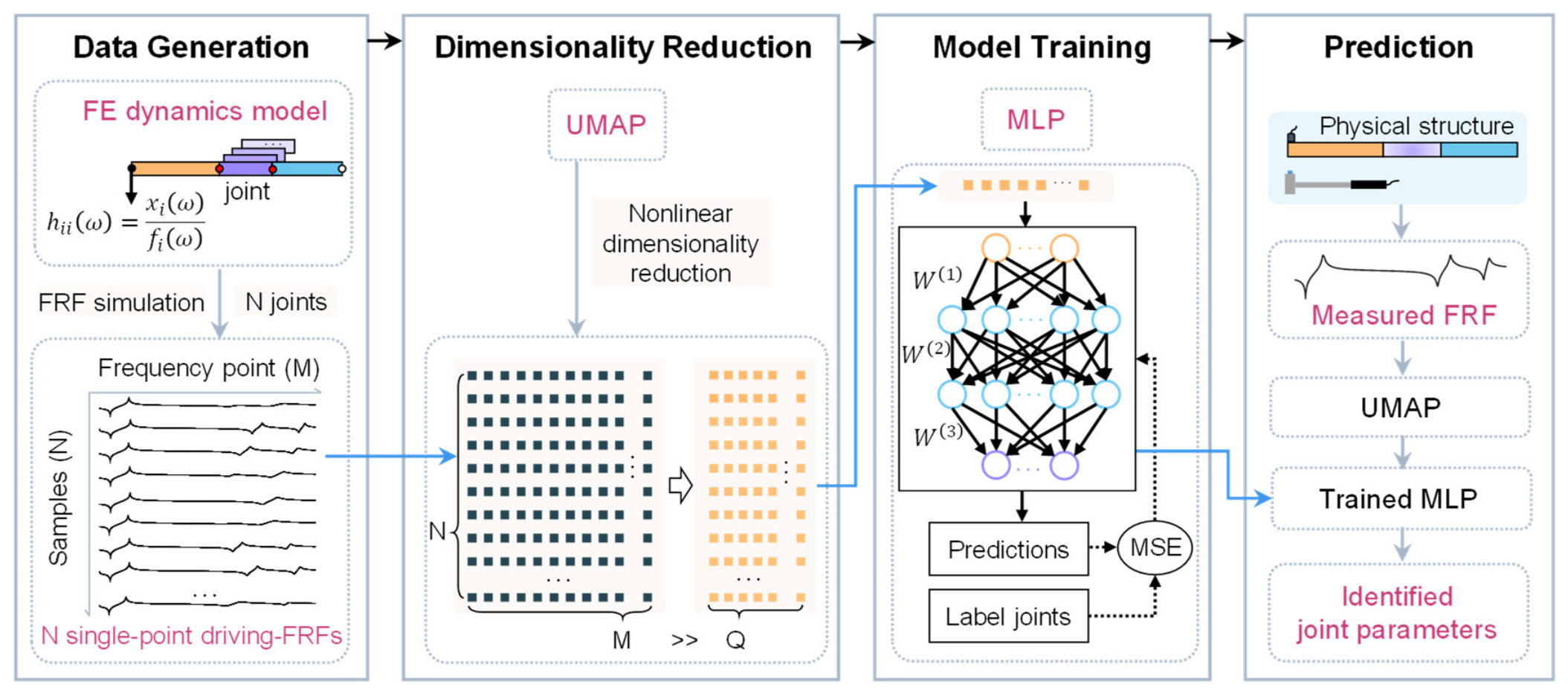
In assembled structures, variations in joint parameters induce modifications in the modal characteristics of FRFs. Although a physical correlation exists between joint parameters and assembly FRFs, their mapping relationship often defies precise description through explicit mathematical models. This nonlinear mapping complexity has rendered joint parameter identification a persistent challenge in structural dynamics. Neural networks, leveraging their superior nonlinear fitting capability, could establish high-dimensional mappings from FRFs to joint parameters via data-driven approaches. Based on this premise, this study proposes a neural network-based joint identification framework (see
Figure 1), comprising four key phases: data generation, dimensionality reduction, model training, and prediction.
(1) Data generation: Parametric scanning of the joint parameter space in the assembly dynamics model is conducted through single-point driving-FRF simulations. This yields an N×M-dimensional dataset, where N represents the number of samples and M denotes the discrete frequency points in each amplitude spectrum.
(2) Dimensionality reduction: To address the high-dimensional nature of raw FRF data, the UMAP manifold learning algorithm is employed to extract essential features, reducing the input dimension from M to a more tractable Q-dimensional space. This step substantially enhances the training efficiency and generalization capability of the subsequent neural network model.
(3) Model training: A fully connected feed-forward neural network (i.e., MLP) is trained using the dimensionality-reduced features as inputs, with the corresponding joint parameters serving as supervised learning labels. The mean squared error (MSE) between predicted and actual parameters is employed as the loss function. Through an iterative backpropagation algorithm, the network weights and bias terms are continuously updated to minimize the prediction error.
(4) Prediction: For practical implementation, only a single measured FRF data from the target structure is required. After undergoing identical UMAP feature extraction, the processed data is fed into the trained MLP to achieve end-to-end joint parameter identification.
In the proposed framework, the simulated FRF dataset was first divided into training and testing subsets. The UMAP model was fitted exclusively using the training dataset, and the trained UMAP transformation was subsequently applied to the testing dataset and experimental FRFs. Therefore, no information from the testing or experimental samples was used during the UMAP training process, avoiding potential information leakage.
2.2. Generation of Single-Point Driving-FRF Dataset Based on FE Simulation and FDSS
The construction of a high-quality dataset is recognized as a fundamental prerequisite for the development of neural network models. The fundamental principle of the proposed joint identification method is to predict joint parameters using the single-point driving-FRF of the assembled structure. Consequently, the dataset for neural network training encompasses a substantial number of samples, containing the corresponding assembly FRFs and the underlying joint parameters, generated while varying the joint characteristics.
Dataset preparation can typically be accomplished via experimental or simulation-based approaches. For the joint identification problem, employing an experimental approach presents considerable difficulties. Primarily, fabricating numerous physical assembly samples with varying joint properties and conducting FRF measurements is a highly time-consuming endeavor. Secondly, obtaining the requisite label data—the true joint parameter values—necessitates a priori identification for a large number of physical structures, which is evidently non-trivial and adds significant complexity. In contrast, generating the dataset via simulation is a more practical and feasible alternative.
In this study, a hybrid methodology combining FE simulation with FDSS is proposed to efficiently generate the required single-point driving-FRF dataset. FDSS is a substructuring methodology based on FRFs that enables the calculation of assembly FRFs using substructure FRFs and joint FRFs, thereby eliminating the requirement for full-system dynamic modeling and solution. FDSS offers significant advantages for dataset generation. When computing a large number of FRF samples of the assembled structure, only the joint FRFs need to be modified while the substructure FRFs remain unchanged. Although the assembly FRFs could alternatively be obtained using full assembly dynamic modeling, this approach substantially increases both modeling complexity and computational costs.
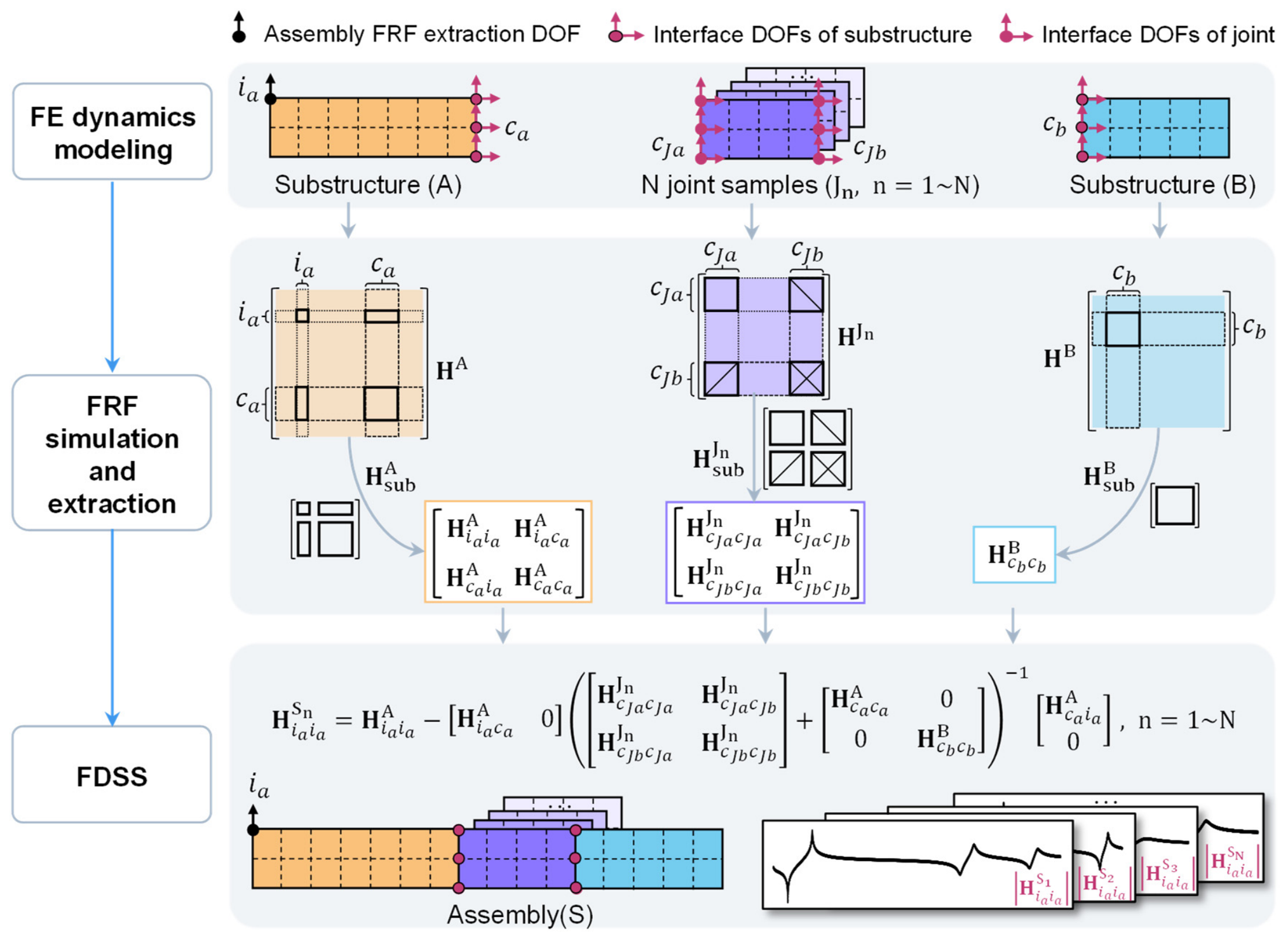
Figure 2 illustrates the workflow of the proposed dataset generation method, which consists of three steps: FE dynamics modeling, FRF simulation and extraction, and FDSS.
(1) FE dynamics modeling of substructures and joints: The assembly (S) is partitioned into substructures (A, B) and a joint (J). To facilitate substructuring analysis, the degrees of freedom (DOFs) are defined as follows:
: The response DOF for assembly FRF computation (assumed to be located in the non-joint region of substructure A).
and : Interface DOFs of substructure A and B, respectively.
and : DOFs where joint J connects to substructures A and B, respectively.
The substructures and joints are modeled using the FE method, with mass, stiffness, and damping matrices extracted for subsequent FRF calculations. Notably, for the joint, its dynamic matrix equation incorporates unknown joint parameters. Latin Hypercube Sampling (LHS) is employed to generate N uniformly distributed joint parameter samples in the design space, corresponding to N joint instances (, , …, ). For each sample, the joint’s dynamic parameter matrices are computed.
(2) FRF Simulation and extraction: The full-DOF FRF of substructures A, B, and joint J
n are derived based on linear system theory (Equations (1)–(3)). For substructure A, a reduced-order FRF matrix
is obtained by extracting the rows and columns corresponding to DOFs
and
from its FRF matrix
(Equation (4)). Similarly,
is derived from
by selecting the
DOFs (Equation (5)). For each joint instance
, the reduced-order FRF matrix
is formed by extracting
and
DOFs from
(Equation (6)).
where
H,
M,
K,
C, and
D represent the FRF matrix, mass matrix, stiffness matrix, viscous damping matrix, and structural damping matrix, respectively, with superscripts denoting their respective substructure or joint affiliation.
represents the angular frequency and
denotes the imaginary unit.
(3) FDSS: The driving-FRF of the assembly at DOF
is computed via Equation (7) [
21]. By keeping the substructure reduced FRF matrices unchanged and successively substituting the joint FRF matrix (
), N assembly FRF samples are generated.
To ensure the validity of the dataset, the following considerations should be emphasized:
Experimental validation of FE Models: The substructure FE models should be experimentally validated and refined to guarantee the accuracy of their computed FRFs.
Physical consistency of joint dynamic models: For simple joints (e.g., sliding guideway interfaces or bolted connection joint surfaces), the joint parameters could typically be modeled as equivalent contact stiffness and damping. In contrast, for complex joints (e.g., rolling bearings or spring collets), inertial effects should be incorporated to ensure the fidelity of the dynamic model.
Reasonable driving-FRF DOF selection: The selected DOF for the assembly FRF should avoid modal nodes, particularly those associated with modes significantly influenced by joint parameters. Failure to comply with this criterion will result in substantially reduced dynamic variability in the assembly FRF dataset, thereby compromising the reliability of subsequent analyses.
2.3. Dimensionality Reduction in FRF Amplitude Sequences Based on UMAP
The acquired dataset (i.e., assembly FRFs and joint parameters) is utilized as training samples for the neural network model. Before model training, the network architecture requires optimization, and the data needs to be preprocessed. The input features comprise FRF amplitude sequences. Two mainstream approaches are typically considered for processing such high-dimensional features: (1) The deep learning approach is where deep network architectures with increased layer depth and width are implemented to adequately extract data features. While straightforward, this method is associated with excessive parameterization, heightened overfitting risks, and suboptimal training efficiency. (2) The dimensionality reduction approach is where the input dimension is substantially reduced through feature extraction, followed by training with a shallow network. This approach effectively reduces model parameters, leading to improved training efficiency while simultaneously mitigating overfitting risks and enhancing generalization capability.
Within the proposed identification framework, model training utilizes simulation data, while predictions employ experimental FRFs. Simulation data is typically “clean”, devoid of noise, and strictly adheres to idealized model assumptions. In contrast, experimentally measured data inevitably contain noise and exhibit nonlinearities. Thus, the dimensionality reduction (or feature extraction) algorithm employed must possess robust nonlinear mapping capabilities.
In this study, the nonlinear dimensionality reduction in FRF amplitude sequences is performed using the UMAP algorithm. UMAP operates under the fundamental assumption that data are uniformly distributed on locally connected Riemannian manifolds [
29].
The applicability of UMAP is analyzed concerning the characteristics of assembly FRFs. When plotted on logarithmic coordinates, these FRF curves exhibit distinct peak-valley characteristics, with peaks corresponding to natural frequencies and valleys representing transitional regions between modes. It should be emphasized that the dataset is generated through variation in joint parameters in the assembly, which fundamentally reflects modifications in underlying physical parameters (i.e., stiffness, mass, and damping). These parametric variations induce nonlinear evolutionary patterns in FRF, manifested through resonance frequency shifts, amplitude modulations, and mode coupling phenomena. Notably, substantial parameter variations may lead to peak merging or splitting events. The parametric variation-induced FRF evolution forms a nonlinear manifold structure in the original high-dimensional space. UMAP demonstrates advantages in this context owing to its capability in nonlinear manifold learning, enabling the effective identification of subtle morphological patterns in FRF curves induced by joint parameter variations and embeds these patterns into a low-dimensional space with high fidelity. The algorithm’s topology-preserving characteristics ensure simultaneous conservation of local neighborhood structures and global topological continuity during dimensionality reduction, while the diffeomorphic mapping guarantees structural correspondence between high-dimensional manifolds and their low-dimensional embeddings. Given these attributes, UMAP is demonstrably well-suited for dimensionality reduction in the input FRF amplitude spectra in this study.
The performance of the UMAP algorithm is predominantly governed by four key parameters:
(1) Target dimensionality (n_components): This parameter determines the dimensionality of the reduced space. A value between 5 and 20 times the output dimensionality is typically recommended. Insufficient dimensionality (e.g., 2–10) may lead to significant information loss, whereas excessively high dimensionality (e.g., >200) diminishes the practical utility of dimensionality reduction.
(2) Local neighborhood size (n_neighbors): This parameter balances the preservation of local versus global structures. A smaller value (e.g., 5) enhances sensitivity to subtle features such as peak shifts in FRF curves but increases susceptibility to noise. Conversely, a larger value (e.g., 100) improves the recognition of large-scale modal reconfigurations but may obscure weakly expressed modes.
(3) Minimum inter-point separation (min_dist): Ranging from 0 to 1, this parameter regulates the density of point distributions in the low-dimensional space, directly influencing cluster compactness.
(4) Distance metric (metric): For logarithmic amplitude data of FRFs, the correlation distance (correlation) or cosine distance (cosine) is recommended to effectively capture waveform similarities.
In practical applications, the hyperparameter optimization of the UMAP model can be performed based on the performance evaluation of the neural network model. In the present study, the final UMAP hyperparameters were optimized together with the MLP hyperparameters through a parametric study described in
Section 4.2.
After determining the UMAP hyperparameters, unsupervised nonlinear dimensionality reduction is performed on the assembly FRF dataset to obtain a low-dimensional feature array. These extracted features subsequently serve as input to the neural network model.
2.4. Neural Network Model Architecture and Model Training
Since the amplitude sequence of the FRF has undergone dimensionality reduction, only a shallow neural network architecture is required. Among the common neural network models for sequential data analysis, MLP and one-dimensional convolutional neural networks are widely adopted. In this study, the MLP is employed due to its simpler network architecture.
This study adopts a streamlined dual-hidden-layer network architecture. Specifically, the number of neurons in the input layer is set to match the reduced feature dimension (input: ), whereas the output layer consists of neurons corresponding to the number of joint parameters (output: ). For the hidden layers, the number of neurons is determined via cross-validation based on the training sample size.
Predicting joint parameters using the assembly FRF is a typical regression problem. For the regression task, the Rectified Linear Unit activation function is employed in both the input and hidden layers to enhance nonlinear modeling capability, while a linear activation function is applied to the output layer to ensure continuous-valued predictions.
The training of the MLP is conducted by minimizing the MSE loss function. The gradients of the loss function with respect to the network parameters are computed via backpropagation. Adaptive Moment Estimation optimizer is employed to update network parameters until the loss function converges to a stable minimum, thereby obtaining the optimal weights and biases. To optimize model performance, L2 weight regularization and dropout strategies are incorporated during training to mitigate overfitting and improve generalization.
2.5. Apply the Trained Model to Conduct Actual Joint Identification
The obtained UMAP-MLP model is employed to identify mechanical joint parameters in practical assemblies. Firstly, a modal test is conducted on the target assembly structure via either impact testing (employing an impact hammer with accelerometer measurement) or shaker-based modal testing (utilizing an electrodynamic exciter with force transducer and response accelerometers) to acquire the single-point driving-FRF.
Notably, the test DOF must strictly match those configured in the numerical simulations during the prior dataset generation phase. Subsequently, the amplitude spectrum of the measured FRF is extracted and reshaped into a row vector with dimensions of 1 × M.
The trained UMAP model is then utilized to perform nonlinear dimensionality reduction on the FRF amplitude vector. The processed feature vector (with shape 1 × Q) is subsequently fed into the trained MLP model for joint parameters prediction, and the output is subjected to inverse normalization to obtain the final identified parameters.
To validate the effectiveness of the parameter identification, the assembly FRF is reconstructed based on the identified parameters. The agreement between the reconstructed FRF and the experimentally measured FRF is evaluated to verify the efficacy of the identified joint parameters.
3. Comparison of Dimensionality Reduction Methods for FRF Magnitude Sequences
To improve the robustness of the neural network model when applied to measured data, the nonlinear dimensionality reduction algorithm UMAP was incorporated into the proposed joint identification framework. Rezazadeh et al. [
30] conducted a comparative study of multiple dimensionality reduction techniques applied to vibration signals and found that UMAP achieved the best overall performance compared with PCA, locally linear embedding (LLE), and t-distributed stochastic neighbor embedding (t-SNE), despite its slightly higher computational cost. In the field of FRF dimensionality reduction, Korbar et al. [
28] employed the classic PCA linear dimensionality reduction technique.
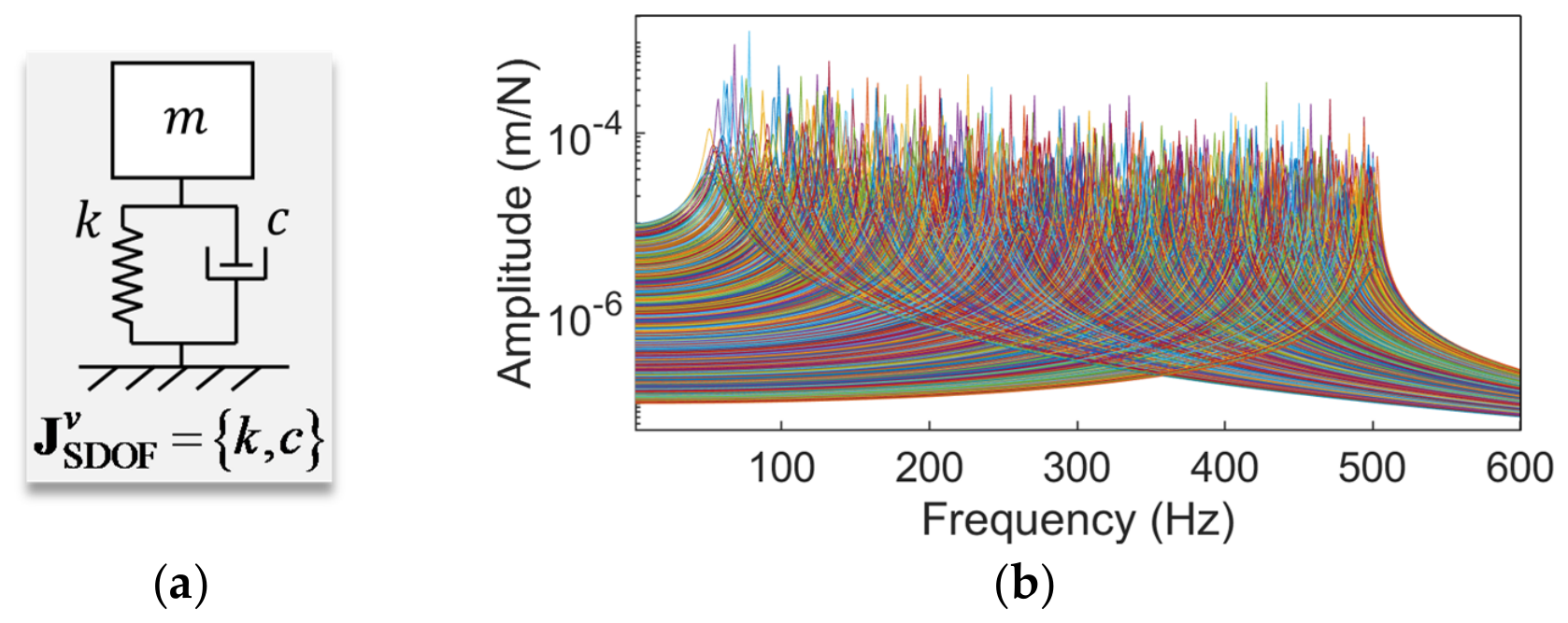
In this section, the suitability of UMAP and PCA within the proposed joint identification framework is investigated using a single-degree-of-freedom (SDOF) spring–mass–damper system, as illustrated in
Figure 3a.
In the SDOF model, the lumped mass was fixed at 1 kg, while the spring stiffness and damping coefficient were treated as the joint parameters (
). The sampling ranges of stiffness and damping were defined as [1, 100] × 10
5 N/m and [1, 100] N·s/m, respectively. A total of 5000 joint parameter samples were generated using LHS. The corresponding FRFs were calculated over a frequency range of 1–600 Hz with 600 frequency points, as shown in
Figure 3b. The resulting FRF dataset indicates that the natural frequency of the system varies approximately between 50 Hz and 500 Hz.
The generated dataset was randomly divided into training and testing subsets using an 8:2 ratio. The training set, consisting of 4000 samples, was used to train both the UMAP-MLP and PCA-MLP models.
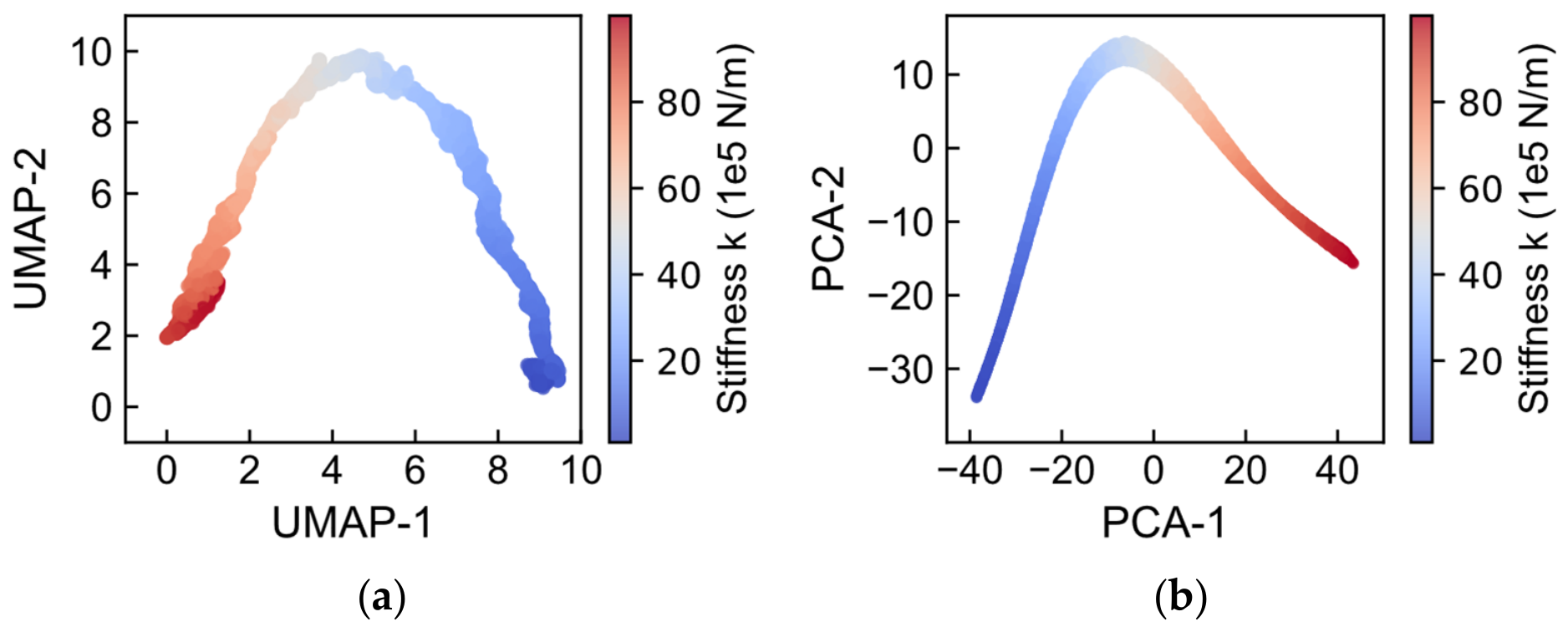
Figure 4 presents the distributions of the first two reduced-dimensional features obtained by UMAP and PCA, respectively. The color of each data point represents the corresponding stiffness value. As shown in
Figure 4a, the UMAP embedding reveals a clear nonlinear structure in the FRF dataset, with stiffness exhibiting a smooth and continuous gradient across the reduced-dimensional space. In addition, numerous local patterns are preserved, indicating that UMAP effectively maintains neighborhood relationships among samples. In contrast, the PCA results shown in
Figure 4b represent a linear projection of the FRF data, where the first principal component mainly reflects the global variation trend associated with stiffness. These observations suggest that UMAP is more effective in capturing local structures and nonlinear variations, whereas PCA primarily characterizes global linear trends.
The predictive performance of the trained models was evaluated using the testing set containing 1000 samples. To compare the noise robustness of UMAP-MLP and PCA-MLP, Gaussian noise was added to the testing FRFs according to
where
denotes the original data,
denotes the noise-contaminated data,
is the noise-level coefficient,
is the standard deviation of the original data, and
is Gaussian noise with zero mean and standard deviation
.
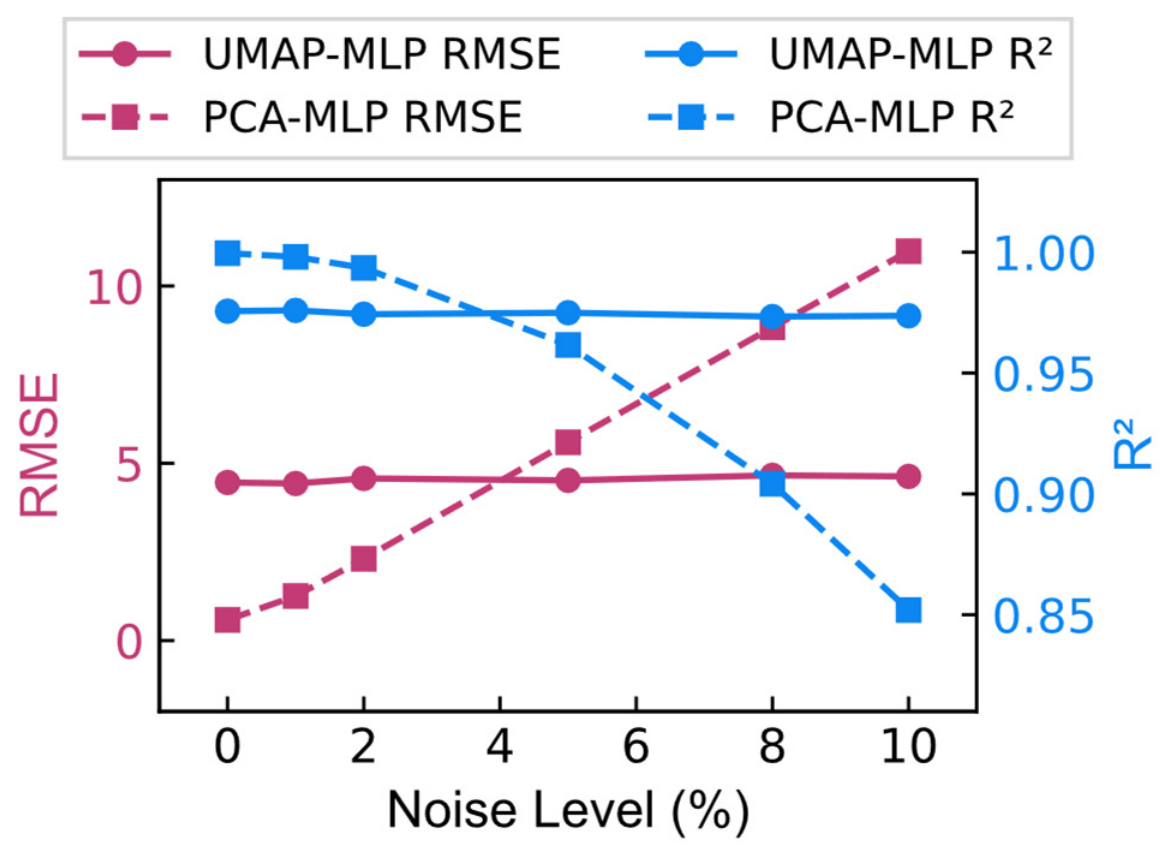
Figure 5 presents the coefficient of determination (R
2) and the root mean square error (RMSE) as functions of noise level. For the PCA-MLP model, R
2 decreases approximately following a quadratic trend, while RMSE increases nearly linearly as the noise level increases. In contrast, the R
2 and RMSE values of the UMAP-MLP model remain nearly unchanged over the investigated noise range. These results demonstrate that, within the proposed joint identification framework, UMAP exhibits substantially better noise robustness than the conventional linear dimensionality reduction method, PCA, thereby providing more reliable joint parameter predictions under noisy measurement conditions.
4. Methodology Validation in Practical Joint
The proposed joint identification method was applied to a tool–collet–holder system to validate its effectiveness. Initially, the tool–collet–holder assembly was divided into two substructures and a joint subsystem. The FE models of the tool, holder, and joint were established, and 12 joint parameters to be identified were determined. A dataset comprising 50,000 assembly FRFs was generated through numerical simulation (with 40,000 samples allocated for training), while parametric studies were conducted to optimize the configuration of the UMAP-MLP model. Subsequently, FRF measurements were performed on a physical assembly with identical specifications. The trained UMAP-MLP model was utilized to identify the joint parameters under varying preload states, and comparisons were made with different methods. Finally, the identified joint parameters were employed to predict the tool-tip FRFs for novel tool/holder configurations.
4.1. The Studied Tool–Collet–Holder System and Its Joints
This section focuses on establishing the substructure and joint dynamics model of the tool–collet–holder system and determining the critical parameters of the joint to be identified, which serve as the essential data foundation for the establishment of the UMAP-MLP model.
The assembly structure of the tool–collet–holder system is illustrated in
Figure 6a. A distinctive feature of this system is that the tool is not in direct contact with the holder but is instead connected through the collet. Specifically, the inner cylindrical surface of the collet’s left end interfaces with the tool’s outer cylindrical surface, while the outer conical surface of the collet’s right end engages with the inner conical surface of the holder.
Notably, the collet is designed with circumferentially discontinuous slots at specific angular intervals, enabling radial elastic deformation. When a tightening torque is applied, the axial displacement of the nut drives the collet rightward, inducing radial contraction due to the constraint imposed by the holder’s inner conical surface. This mechanism ensures secure clamping of the tool while simultaneously establishing a stable axial preload between the collet and the holder. The tightening torque directly influences the radial contraction of the collet, the axial position of the locking nut, and ultimately the tool clamping stiffness, thereby altering the dynamic characteristics of the joint between the tool and the holder. These critical factors are systematically incorporated into the joint dynamic modeling in this study.
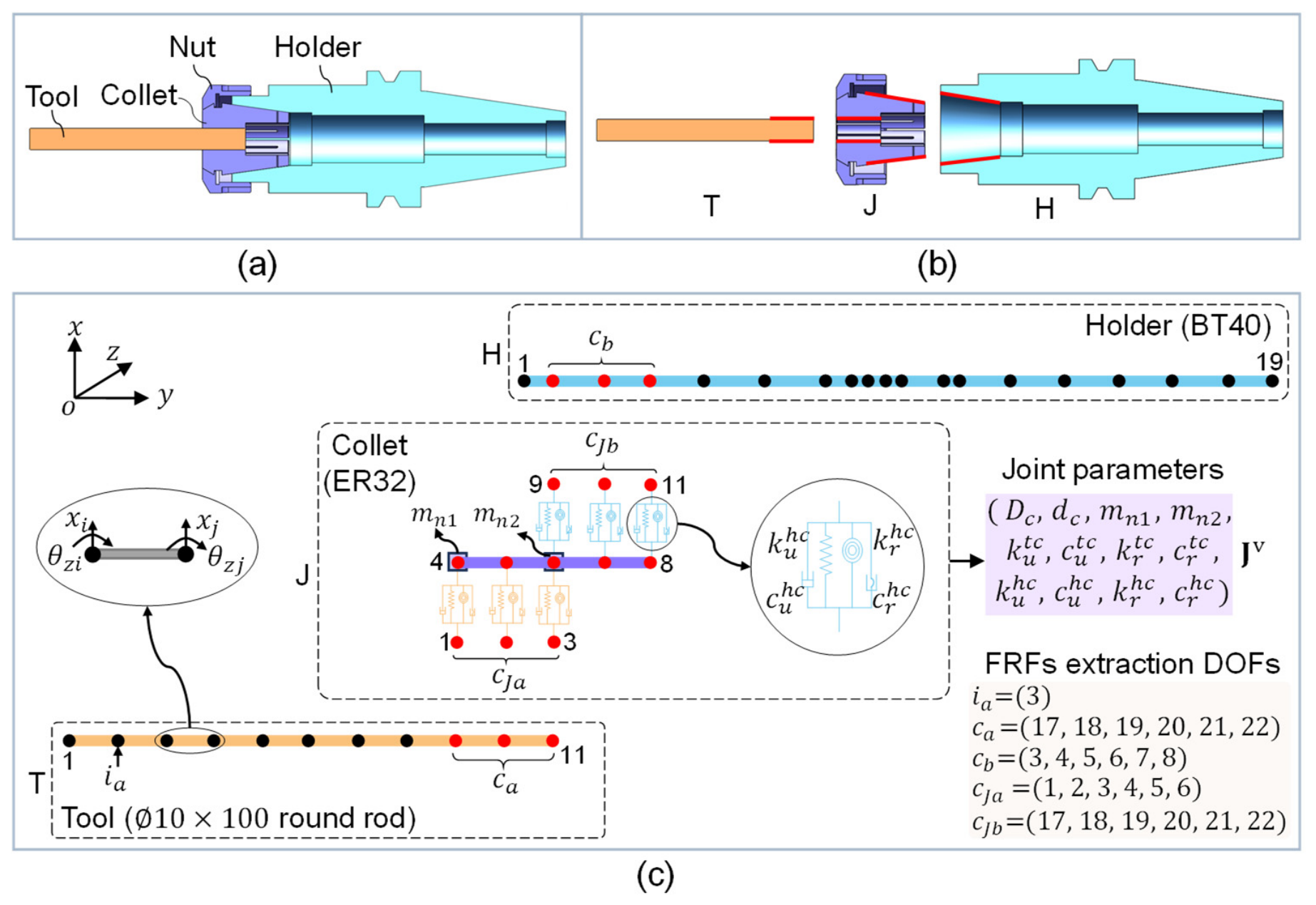
To apply the FDSS method, the tool–collet–holder assembly is partitioned into two substructures and a joint. As illustrated in
Figure 6b, the tool and the holder are defined as independent substructures (T and H, respectively), while the tool–collet interface, the holder–collet interface, and the collet assembly (including the nut) are collectively treated as a joint subsystem (J).
During the identification stage, a tool without a fluted section is used (i.e., a round rod with a diameter of 10 mm and a length of 100 mm). The clamping length of the tool is 20 mm (with an 80 mm overhang). The code of the holder is BT40-ER32-100L, which is characterized by an ER32 collet system, 100 mm projection length from the taper base, major taper diameter of 44.45 mm, and standard 7:24 taper ratio.
Given the near-axisymmetric nature of the tool–collet–holder system and the dominance of lateral tool vibration during milling operations, the dynamic models are simplified to a 2D planar representation (
x-y plane), retaining only the translational DOF along the
x-axis and the rotational DOF about the
z-axis.
Figure 6c presents the FE models corresponding to the substructures and the joint shown in
Figure 6b.
For the tool and the holder, the four-DOF planar Timoshenko beam element is employed to establish the FE model. The tool substructure is discretized into 10 beam elements with 22 DOFs, whereas the holder comprises 18 beam elements (38 DOFs). The dimensions of these elements are summarized in
Table 1.
The material parameters of the tool and the holder FE models were calibrated via experimental modal testing. The validated tool material properties were determined as follows: elastic modulus = 583.6 GPa, density = 14,451.3 kg/m3, Poisson’s ratio = 0.3, and structural damping ratio = 0.005. For the holder, the corresponding parameters were found to be 199.4 GPa, 7711.5 kg/m3, 0.3, and 0.003, respectively.
In the joint subsystem, the collet is discretized using Timoshenko beam elements, and the locking nut is simplified as lumped masses. The tool–collet interface and holder–collet interface are modeled using the zero-thickness elastic damping layer theory. Due to the complex geometric configuration of the collet and its deformation during the preloading process, the beam element parameters are difficult to determine accurately in FE modeling. Additionally, varying locking torques alter the axial position of the locking nut, making it challenging to precisely characterize the equivalent nodal mass of the locking nut. To address these uncertainties and ensure the validity of the dynamic model, the following modeling assumptions are proposed.
(1) The elastic modulus, Poisson’s ratio, density, and structural damping ratio of the collet are assumed to be identical to those of the holder. This assumption is justified by the fact that both the collet and the holder are typically manufactured from alloy steel, exhibiting minimal discrepancies in material properties.
(2) The element discretization of the collet strictly aligns with that of the contact segments on the tool and the holder, facilitating the subsequent addition of spring–damper elements between corresponding nodes. While the cross-sectional properties of the beam elements are parameterized using equivalent outer diameter (Dc) and inner diameter (dc) as substitutes for actual geometric dimensions, and serving as parameters to be identified.
(3) Considering the mass distribution characteristics of the nut, it is equivalently represented by two lumped masses (
mn1 and
mn2) applied to two nodes, as depicted in
Figure 6c. The equivalent masses of the nut are also treated as parameters to be identified, accounting for variations in mass distribution under different preload conditions.
Under the aforementioned assumptions, the collet is discretized into four Timoshenko beam elements of equal length (10 mm), as illustrated in
Figure 6c. Both the tool–collet and holder–collet interfaces are equivalently modeled using three spring–damper elements with 2-DOF each. This configuration yields a 22-DOF joint subsystem. This system contains twelve unknown joint parameters, which are mathematically represented by the vector
as given in Equation (9). Among these twelve joint parameters, the first four are used to indirectly determine the stiffness, mass, and structural damping matrices of the collet, while the remaining eight parameters directly define the equivalent stiffness and damping matrices of the dual interface connections.
where
and
represent the translational stiffness and rotational stiffness of the tool–collet interface, respectively, and
and
denote the corresponding translational and rotational damping coefficients. Similarly,
and
indicate the translational stiffness and rotational stiffness of the holder–collet interface, and
and
represent the corresponding damping coefficients for the translational stiffness and rotational stiffness.
Through the systematic modeling of the tool–collet–holder system, the FE models of the tool, the holder, and the joint (containing 12 unknown parameters) were obtained, which were used for the subsequent generation of the assembly FRF dataset.
4.2. Dataset Generation/Preprocessing and Model Parametric Study
Based on the findings reported in Ref. [
23] and preliminary simulation trials, the ranges of each joint parameter were determined and summarized in
Table 2. The selected ranges were designed to adequately cover the physically realistic variations in the joint properties while ensuring consistency with experimentally observed values. The LHS approach was employed to generate 50,000 joint parameter samples.
The assembly FRFs were extracted at a point located 10 mm from the tool tip, as illustrated in
Figure 6c. The frequency range was selected from 100 Hz to 9000 Hz to cover the dominant vibration modes. A frequency resolution of 2 Hz was adopted to accurately capture resonance characteristics while maintaining computational efficiency, resulting in 4451 frequency points per FRF (i.e.,
M = 4451).
For each sampled parameter set, the corresponding joint dynamic stiffness matrices were constructed and incorporated into the frequency-domain substructure synthesis (FDSS) model described in
Section 2.2. The assembly FRFs were then calculated without re-running the finite element model, thereby enabling efficient generation of the training dataset. Specifically, Equation (7) was applied to each set of joint FRFs, resulting in a total of 50,000 assembly FRF samples.
The assembly FRF samples and joint parameter samples were transformed into matrix form and partitioned into training set and test set in a ratio of 8:2. Thus, a training set with a sample size of
N = 40,000 was obtained, denoted as
and
, as shown in the following two equations:
where
represents the initial feature data, and
represents the target data.
and
(
n = 1~
N) represent the FRF amplitude vector and the joint parameter vector corresponding to the
n-th sample, respectively.
(
i = 1~
M) represents the frequency point.
The original FRF data matrix
was processed using the UMAP algorithm for dimensionality reduction. Prior to dimension reduction, a logarithmic transformation was applied to the input data according to the following:
where the addition of unity (+1) ensures all transformed values
remain strictly positive. This preprocessing step was implemented to address the significant magnitude variations in FRFs across different frequency points.
The processed data
was then subjected to UMAP dimensionality reduction. The parameters of the UMAP model were determined through a parametric study, with the finalized configuration summarized in
Table 3. The dimensionally reduced dataset, designated as
, retains
Q = 100 features.
The dimensionality-reduced data was standardized using the Z-score method. Initially, the column-wise mean () and standard deviation () of were computed. Subsequently, each element of was standardized according to Equation (13), yielding the final data fed into the MLP model, denoted as .
For the target data
, the min-max normalization was adopted. The column-wise maximum (
) and minimum (
) values of
were first determined. Each element of
was then normalized according to Equation (14), resulting in the processed data (
).
The final obtained data (with shape N × Q = 40,000 × 100) and (with shape N × Q = 40,000 × 12) were employed for training the MLP model.
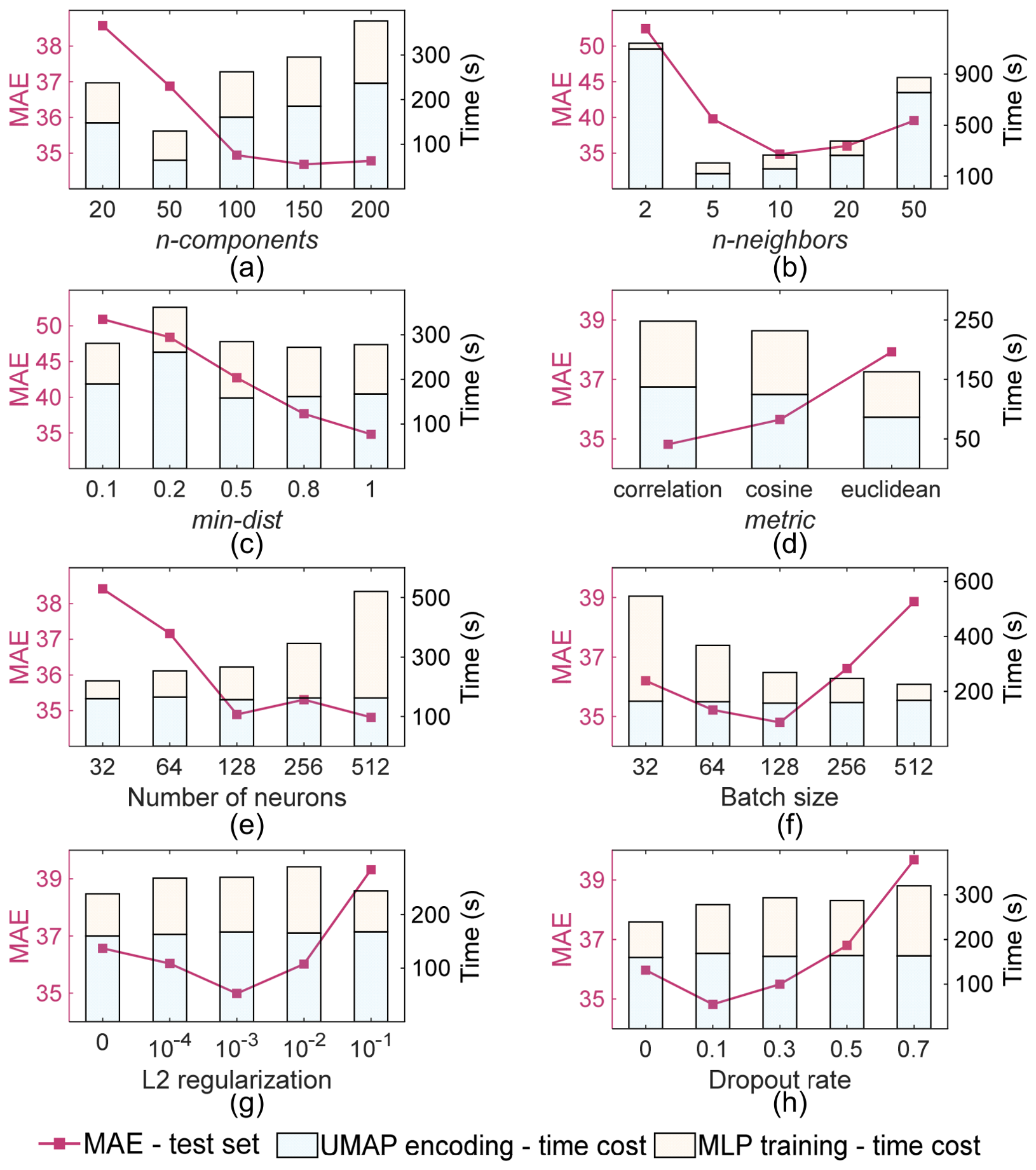
A comprehensive parametric study was conducted to determine the optimal configuration of both the UMAP dimensionality reduction model and the MLP regression model. Rather than selecting hyperparameters empirically, all key model parameters were systematically evaluated using predefined design spaces. The mean absolute error (MAE) of the prediction results on the test set, as well as the time consumed for UMAP encoding and MLP training, were employed as evaluation metrics. The hyperparameter selection criterion prioritized prediction accuracy while maintaining reasonable computational efficiency.
Four hyperparameters each for UMAP (
n_components,
n_neighbors,
min_dist, and
metric) and MLP (number of neurons in each hidden layer, batch size, L2 weight regularization, and dropout rate) were considered in the parameterization study.
Figure 7 presents the sensitivity analysis results for each hyperparameter (univariate analysis, with other parameters held constant at their final selected values).
Table 3 summarizes the parameter design space and final selections for UMAP and MLP architectures.
4.3. Experimental Setup
Before employing the trained UMAP-MLP model to identify the joint parameters in an actual tool–collet–holder assembly, impact testing was conducted to obtain the single-point driving-FRF.
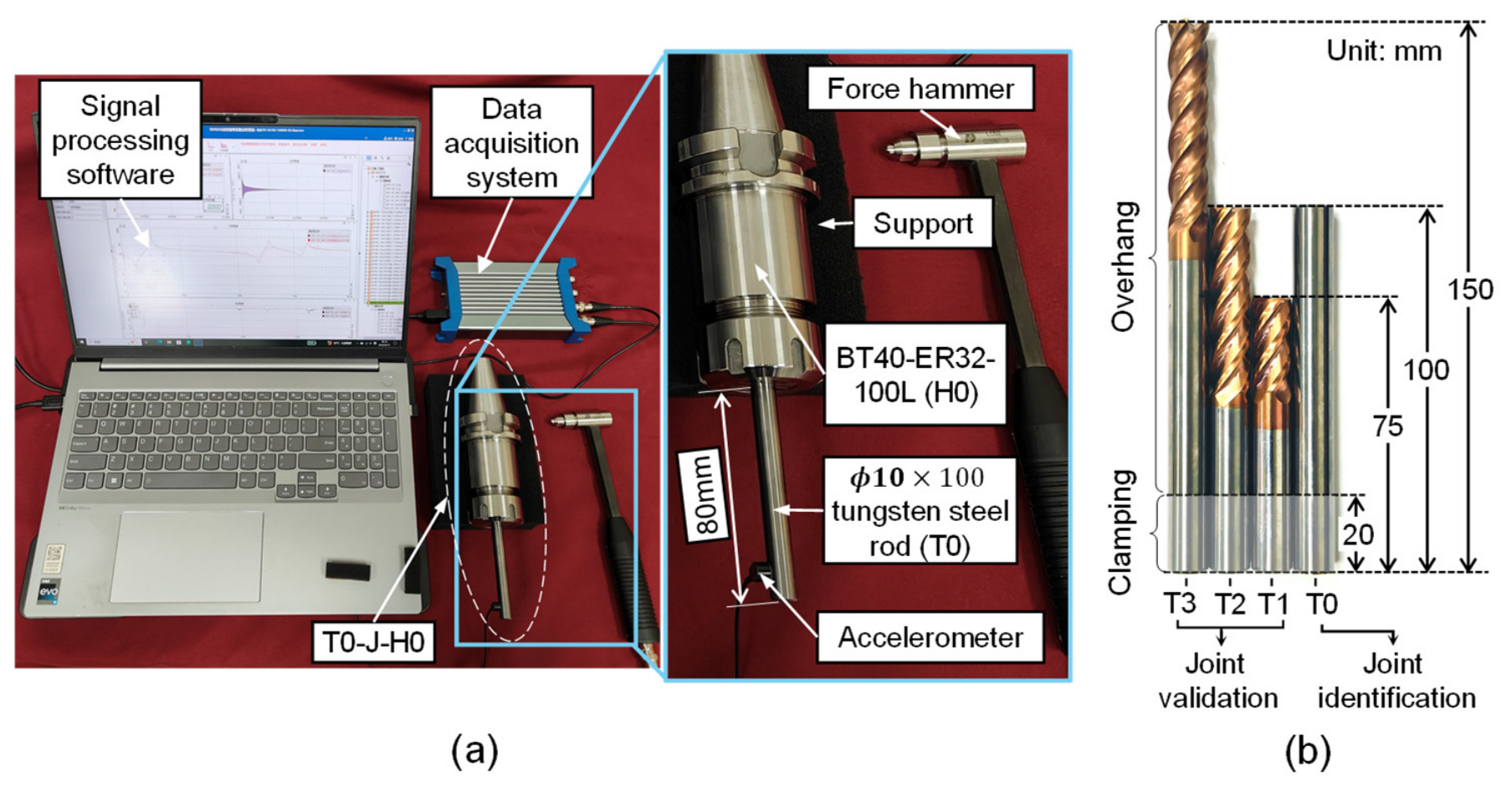
Figure 8a illustrates the FRF testing system and the tool–collet–holder assembly used to acquire source data for joint identification (with specifications consistent with those used for FE modeling in
Section 4.1). The actual tool–collet–holder is designated as the reference assembly H0-J-T0, where T0 corresponds to the ϕ10 × 100 (mm) round rod and H0 corresponds to the BT40-ER32-100L holder.
During the test, the excitation was provided using an impact hammer (Model LC02 with sensitivity 1.068 mV/N and range 5000 N), while the vibration response was measured using a piezoelectric accelerometer (Model 1A803 with sensitivity 1 mV/m·s
−2, range 5000 m·s
−2, frequency range 5–10,000 Hz (±10%), and mass 1.2 g). Both force and acceleration signals were recorded by a data acquisition system DH5930 (Jiangsu Donghua Test Technology Co., Ltd., Taizhou, China) and transmitted to a signal processing software (DHDAS, version number: V6.24.5.13ZI) for FRF calculation. The assembly was supported on soft foam to simulate free boundary conditions. The measurement locations matched the computational points shown in
Figure 6c, with the accelerometer mounted 10 mm from the rod end and the impact point located opposite. To enhance measurement reliability, each FRF was obtained through 10 repeated hammer impacts followed by ensemble averaging. The sampling frequency was set to 25,600 Hz with 16,384 sample points, yielding a frequency resolution of 1.5625 Hz. To maintain consistency with the input requirements of the UMAP-MLP model, the measured FRFs were truncated and interpolated to cover the 100–9000 Hz range with 2 Hz resolution.
Furthermore, since accelerometers possess a non-negligible mass, their attachment to structures introduces additional mass, leading to deviations between the measured FRFs and the actual structural FRFs. To eliminate the influence of accelerometer-added mass, the Receptance Coupling Substructures Analysis (RCSA) method was employed to modify the measured FRFs [
31].
Tool clamping in a spring–collet–tool–holder is achieved through threaded preload, where variations in tightening torque significantly influence both the joint stiffness and dynamic characteristics of the tool–collet–holder assembly. To assess the identification capability of the proposed neural network model for joints across varying preload scenarios, five tightening torque levels (20 N·m, 40 N·m, 60 N·m, 80 N·m, and 100 N·m) were designed for H0-J-T0. A digital torque wrench (RE32UM-135) was utilized to control the tightening torque of the nut.
To further confirm the physical validity and engineering applicability of the joint parameters identified from H0-J-T0, three tungsten steel milling cutters (with lengths of 75 mm for T1, 100 mm for T2, and 150 mm for T3) were designed for joint validation, as illustrated in
Figure 8b.
4.4. FE Model Validation of the Holder and Tools
The FE models of the reference tool (T0) and the reference holder (H0) established in
Section 4.1 were experimentally validated, as illustrated in
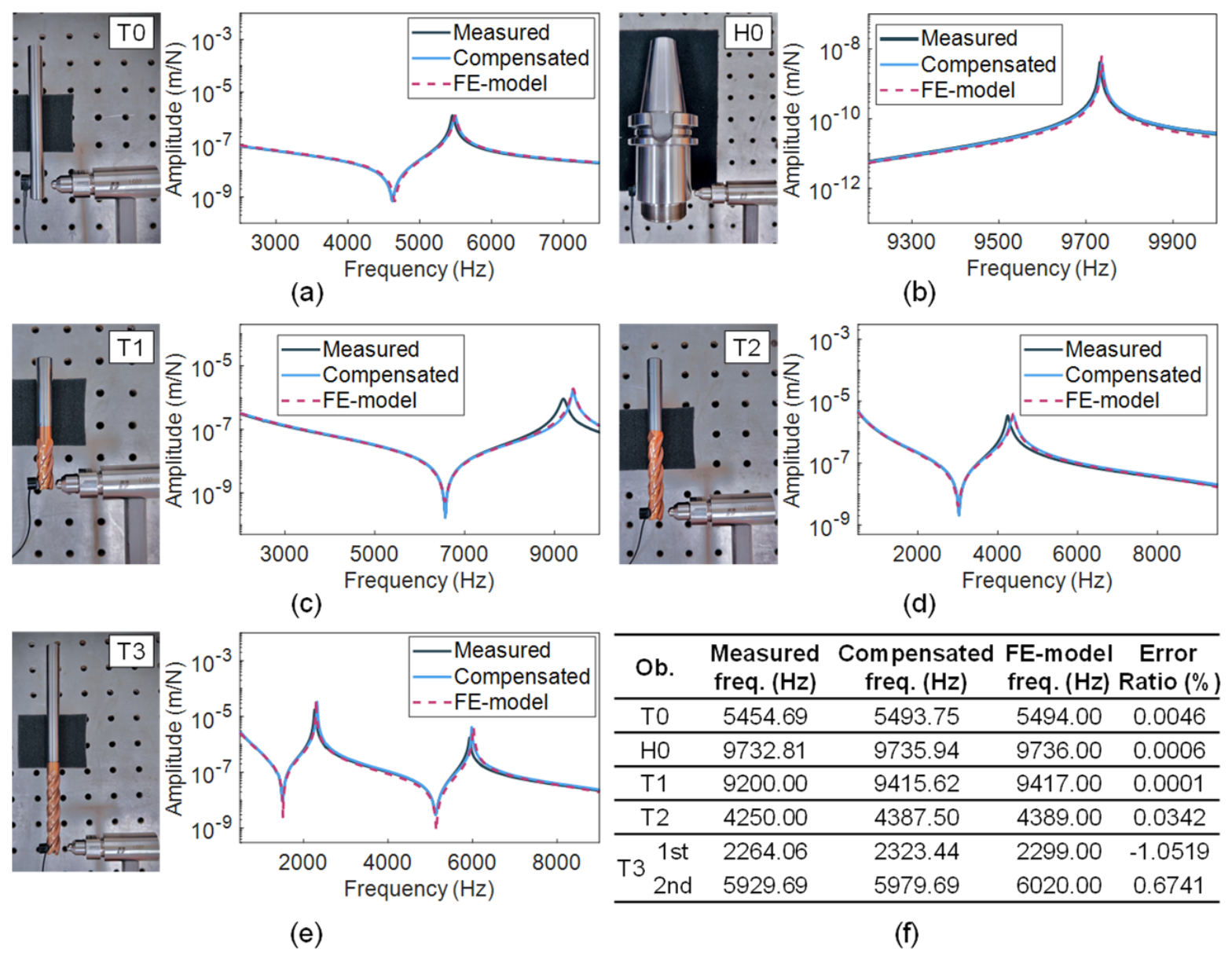
Figure 9a,b. Furthermore, FE modeling and experimental validation were conducted for three novel tools (T1, T2, and T3) used for joint validation, with results sequentially presented in
Figure 9c–e. The compensated FRFs were derived by modifying the measured FRFs to account for the mass effect of the accelerometer. A close agreement is observed between the simulated FRFs from the FE models and the compensated experimental FRFs.
Figure 9f summarizes the natural frequencies of all four tools and the holder. For H0, T0, T1, and T2, the simulated natural frequencies exhibit negligible differences from the compensated values (relative errors < 0.04%). For T3, two modal frequencies were identified, showing relative errors of −1.0519% for the first mode and 0.6741% for the second mode. Although these errors are marginally higher than those of the other cases, they remain within acceptable limits for engineering applications.
4.5. FRFs of Reference Assembly H0-J-T0 Under Five Designed Tightening Torques
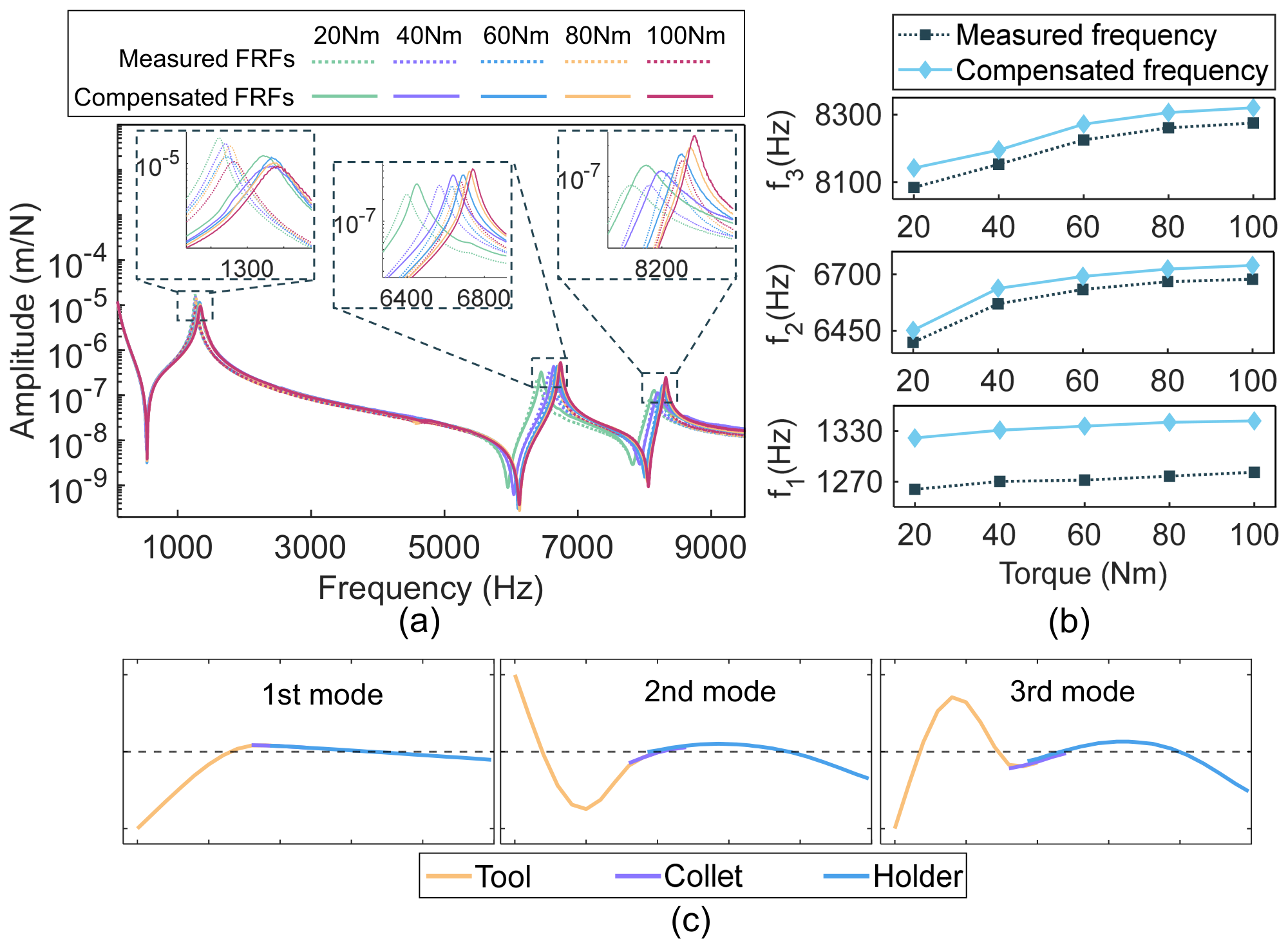
The measured and compensated FRFs of H0-J-T0 under five designed tightening torques are presented in
Figure 10a, exhibiting three resonance peaks corresponding to the first three elastic modes of the system.
Figure 10b illustrates the variation in the measured and compensated natural frequencies with tightening torque. The first natural frequency exhibits a gradual linear increase, while the second and third natural frequencies demonstrate pronounced nonlinear growth—rising rapidly within the 20–60 N·m range and growing slowly beyond 60 N·m. As the tightening torque increases 20 to 100 N·m, the natural frequencies increase by 20.31 Hz (1.54%), 287.5 Hz (4.46%), and 178.12 Hz (2.19%) for modes 1–3, respectively. This indicates that tightening torque variation exerts the strongest influence on the second mode, followed by the third mode, with minimal impact on the first mode. Given that tightening torque directly governs joint dynamics, these results demonstrate that joint characteristic variations predominantly affect the second and third modal properties (particularly the second mode) of the studied tool–collet–holder system, while having minor effects on the first-order modal characteristics.
The distinct influence of tightening torques on each mode can be interpreted through modal shapes.
Figure 10c depicts the first three modal shapes of H0-J-T0. The first-order mode is distinctly localized at the tool, manifesting as bending of the tool segment. In contrast, the second and third modes involve collective deformation of the tool, the joint, and the holder. Consequently, the tightening torque (reflecting joint characteristics) exerts a relatively weak influence on the first-order mode.
4.6. Joint Identification for Reference Assembly H0-J-T0 and Comparative Analysis
The trained UMAP-MLP model was employed to identify the joint parameters of H0-J-T0 at five specified tightening torque levels based on the amplitude spectrum data shown in
Figure 10a.
For comparative analysis, two distinct approaches were implemented. Firstly, the classical linear dimensionality reduction algorithm—principal component analysis (PCA) [
28]—was applied to the assembly FRF dataset (with the target dimension set to 100, consistent with the UMPA method). An MLP model with identical architecture was subsequently trained, denoted as PCA-MLP, and deployed for joint identification of H0-J-T0. Secondly, the optimization method proposed by Yang et al. [
32] was employed to identify the joint parameters of H0-J-T0. The optimization objective was formulated to minimize the error between the reconstructed and measured FRFs. The gradient-based global optimization solver MultiStart in MATLAB (MathWorks, Natick, Massachusetts, USA; version number: R2024b) was utilized for parameter determination.
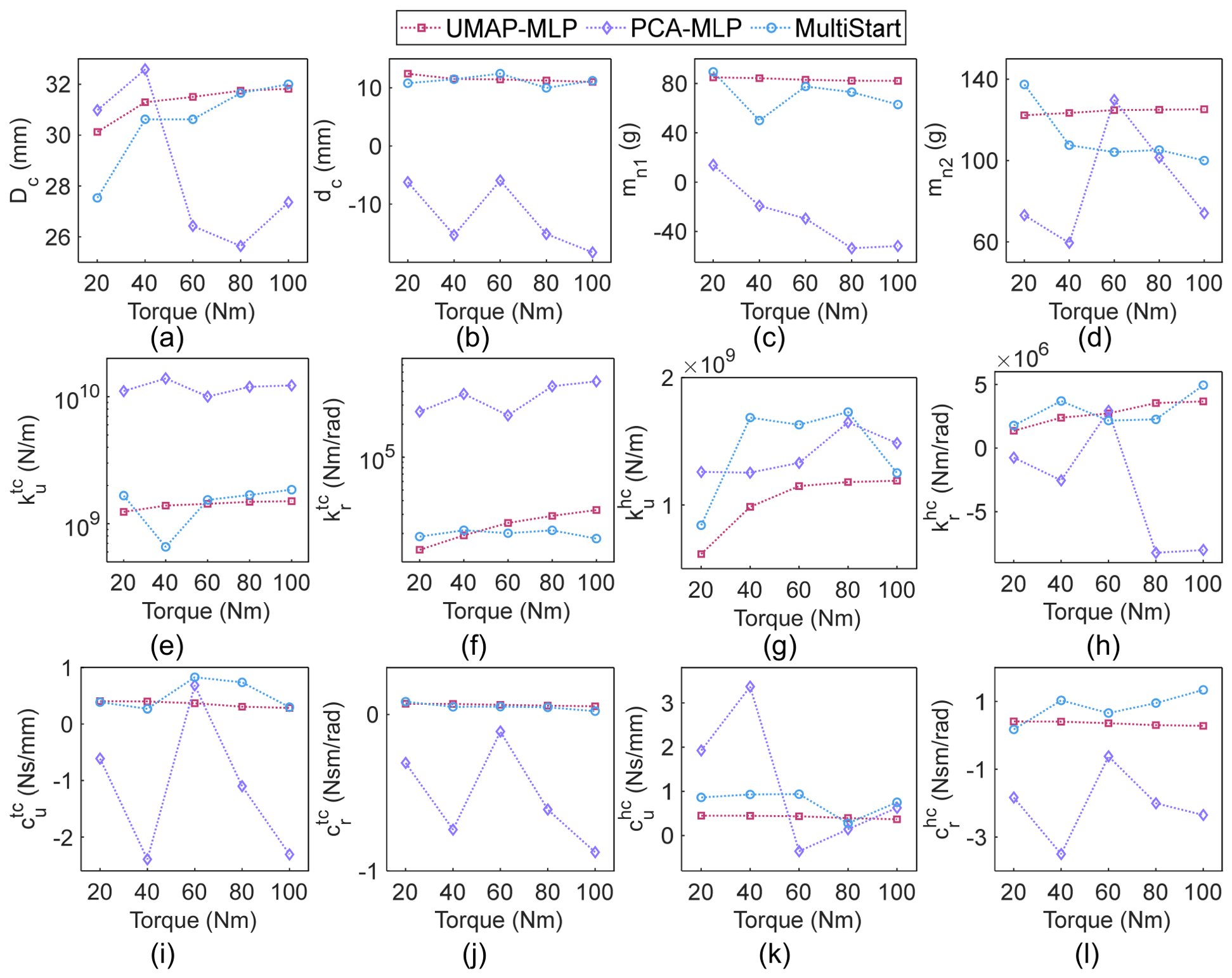
Figure 11 presents the 12 identified joint parameters for the H0-J-T0 assembly at five specified tightening torque levels, obtained through UMAP-MLP, PCA-MLP, and MultiStart. As global optimization methods have been established as viable and effective for tool-holder joint identification, the parameters acquired via MultiStart serve as the benchmark reference. It is observed that most parameters identified by UMAP-MLP and MultiStart demonstrate close agreement, with stiffness parameters residing within the same order of magnitude. While certain discrepancies exist between specific parameters, their impact on the reconstructed FRFs is relatively minor, as subsequently confirmed by FRF comparative analysis. Notably, PCA-MLP yielded physically unrealistic negative parameter values, with most parameters exhibiting significant discrepancies compared to UMAP-MLP and MultiStart, indicating the inapplicability of PCA dimensionality reduction within the proposed joint identification framework.
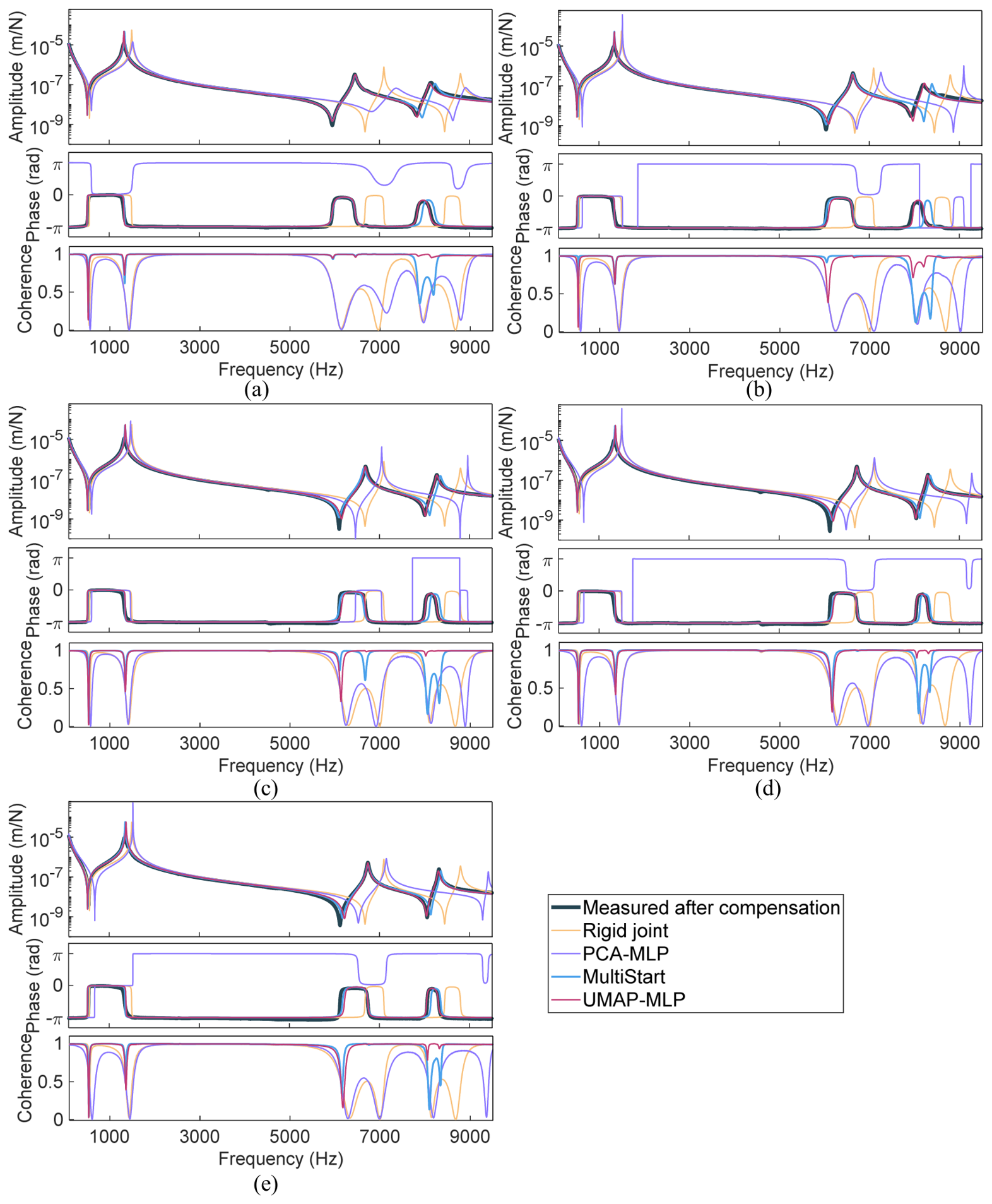
To visually demonstrate and validate the effectiveness of the identified joint parameters, the assembly FRFs were reconstructed using the identified joint parameters. Additionally, the FRFs under the rigid joint assumption were computed to investigate the influence of interface elasticity on the dynamic characteristics of the assembly.
Figure 12 presents the compensated and reconstructed FRFs of the H0-J-T0 assembly under five designed tightening torques. For each subgraph, the first two rows display the magnitude and phase spectra, respectively, while the third row shows the coherence spectrum calculated via Equation (15).
where
h1 and
h2 represent two complex sequences of FRFs with the same length, and
f denotes the frequency point. The superscript * denotes conjugation. The coherence spectrum, ranging from 0 to 1, provides a quantitative measure of the agreement between the reconstructed and reference FRFs at each frequency point.
The results demonstrate that the FRFs reconstructed using joint parameters identified by both UMAP-MLP and MultiStart methods exhibit close agreement with the compensated experimental FRFs, thereby validating the effectiveness of the proposed joint identification approach. In contrast, significant discrepancies are observed between experimental data and FRFs obtained through the PCA-MLP method or the rigid joint assumption. Notably, the amplitudes of the FRFs reconstructed by the PCA-MLP method deviate even more significantly from experimental data than in the rigid joint case, and the phases of the FRFs also fail to match the experimental data. This abnormal result is intrinsically linked to the physically unrealistic parameters identified by PCA-MLP. These findings underscore the paramount importance of accurate joint parameter determination for reliable structural dynamic modeling and prediction.
For quantitative evaluation, the average coherences between the experimental FRFs and those reconstructed by different methods were calculated within the analysis frequency band, and the results are summarized in
Table 4. Overall, both the UMAP+MLP and MultiStart identification methods significantly outperform the rigid joint and PCA+MLP approaches.
Table 5 summarizes the modal frequencies obtained from the compensated and reconstructed FRFs presented in
Figure 12. Both UMAP-MLP and MultiStart methods demonstrate relatively low errors, while the frequency deviations produced by PCA-MLP and rigid joints are unacceptable. Furthermore, modal-order-dependent frequency error ratios are observed: the first mode consistently demonstrates the largest relative errors, followed by the third mode, with the second mode showing minimal error ratios (except at 20 N·m, where PCA-MLP and rigid joint exhibit reversed second/third-mode error magnitudes). This error distribution inversely correlates with each mode’s sensitivity to joint characteristics, as demonstrated in
Figure 10 with the observed sensitivity hierarchy: second-mode > third-mode > first-mode.
Further comparison of modal frequency errors in the FRFs reconstructed by UMAP-MLP and MultiStart reveals that: at tightening torques of 60 N·m, 80 N·m, and 100 N·m, UMAP-MLP demonstrates superior performance for the second and third modes; whereas MultiStart exhibits lower error for the first mode. At a tightening torque of 20 N·m, UMAP-MLP achieves higher matching accuracy for the first and third resonance peaks. At 40 N·m, UMAP-MLP exhibits lower modal frequency error for the third mode.
4.7. Discussion on Joint Parameters Identified by Different Methods
In the dynamic modeling of the tool–collet–holder system, twelve joint parameters were defined. The variation in tightening torque affected the joint dynamics through two mechanisms: (1) The deformation of the collet and axial position of the locking nut were altered, leading to changes in the dynamic characteristics (reflected in the first four joint parameters). (2) The contact stress distribution and actual contact area at both the tool–collet and the holder–collet interfaces were modified, resulting in different interface stiffness and damping properties (corresponding to the latter eight joint parameters).
The joint parameters identified by UMAP-MLP revealed that, as tightening torque increased, the equivalent outer diameter (
Dc, see
Figure 11a) of the collet increased while its equivalent inner diameter (
dc, see
Figure 11b) slightly decreased, corresponding to a larger moment of inertia and enhanced bending stiffness—a physically reasonable consequence of greater elastic deformation and energy storage. The equivalent node mass
mn1 of the nut decreased slightly, whereas
mn2 increased (
Figure 11c,d), because the nut moves toward the
mn2 region during tightening. The interface contact parameters (
Figure 11e–l) generally exhibited increasing stiffness and decreasing damping with higher preload; notably, the holder–collet interface showed higher rotational stiffness (
) and damping (
) than the tool–collet interface, attributable to its larger diameter and consequently greater contact area.
In contrast, the MultiStart-based global optimization results showed less consistent trends with torque variation, with only Dc and following the expected patterns. This discrepancy can be attributed to the fundamental differences between the two identification approaches.
The MultiStart optimization, which adjusts 12 highly nonlinear design variables to minimize the objective function, yielded parameter trends that varied inconsistently across preload conditions. This behavior reflects the non-uniqueness of local optima in a complex solution space, preventing clear trends from emerging. In contrast, the UMAP-MLP model established a regression mapping from FRFs to joint parameters and successfully captured the systematic resonance shifts induced by increasing torque, producing physically meaningful trends. This consistency can be interpreted as the network converging to the same type of local solution, since the FRF differences across preloads were insufficient to shift the prediction qualitatively.
The PCA-MLP approach, however, resulted in unphysical negative values and order-of-magnitude deviations from the other methods, leading to poor FRF reconstruction. This failure originates from the fundamental limitations of PCA as a linear dimensionality reduction technique: it relies on the linear structure of simulated data and cannot adapt to the nonlinearity and noise in experimental measurements, resulting in feature degradation. By contrast, UMAP, being a nonlinear manifold learning method, better preserves the essential structure of experimental data, thereby enabling more accurate joint parameter identification.
4.8. Prediction of Free–Free FRFs for Novel Tool Assemblies Using the Identified Joint Parameters
To further validate the identified joint parameters, a prediction study on free–free tool-tip FRFs was conducted for the reference tool–collet–holder assembly configured with novel tools. The validation procedure involves:
(1) Replacing the standard cylindrical rod in the reference assembly H0-J-T0 with tools T1, T2, and T3 (see
Figure 8b), then applying specified tightening torques of 20 N·m, 40 N·m, and 60 N·m, respectively, to create three validation cases (denoted as H0-J
20Nm-T1, H0-J
40Nm-T2, and H0-J
60Nm-T3).
(2) Incorporating the joint parameters identified from the reference assembly H0-J-T0 by UMAP-MLP at corresponding torque levels into FE models to numerically predict tool-tip FRFs.
(3) Experimentally measuring actual FRFs for each assembly and applying accelerometer mass compensation to serve as validation benchmarks for quantitative evaluation of the predictions.
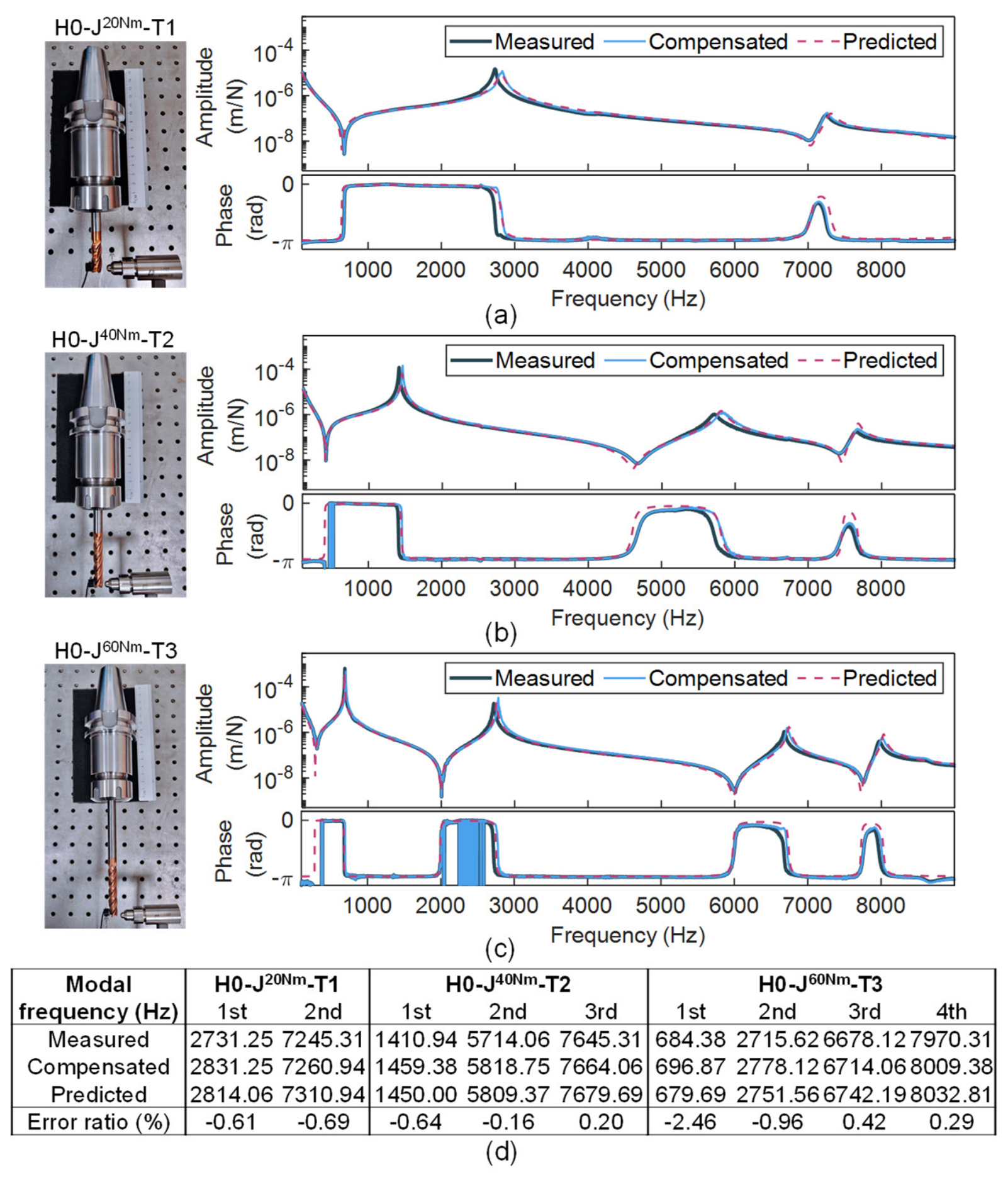
Figure 13a–c displays the experimental setups and comparisons of measured, compensated, and predicted FRFs for the three validation cases. Frequency-domain analysis reveals distinct resonant characteristics: the H0-J
20N·m-T1 system exhibits two dominant resonance peaks, H0-J
40Nm-T2 shows three, while H0-J
60Nm-T3 demonstrates four prominent peaks. Notably, the predicted FRFs show close agreement with compensated experimental FRFs across all cases, confirming the validity of the identified joint parameters for new tool configurations.
Figure 13d summarizes the measured, compensated, and predicted modal frequencies for the three validation cases, along with the relative errors between prediction and compensation results. The results demonstrate that the error ratios for all modes of H0-J
20Nm-T1 and H0-J
40Nm-T2 remain within 1%. For H0-J
60Nm-T3, modes 2–4 exhibit error ratios within 1%, while mode 1 shows relatively higher deviation (−2.46%). Since the first-order mode of H0-J
60Nm-T3 is dominated by tool-bending effects, and the modeling accuracy of the T3 FE model is relatively lower compared to T1 and T2 (as evidenced in
Figure 7), the error in the first-order modal frequency is slightly larger.
4.9. Prediction of Tool-Tip FRFs for Novel Tool Assemblies Mounted on a Spindle Using the Identified Joint Parameters
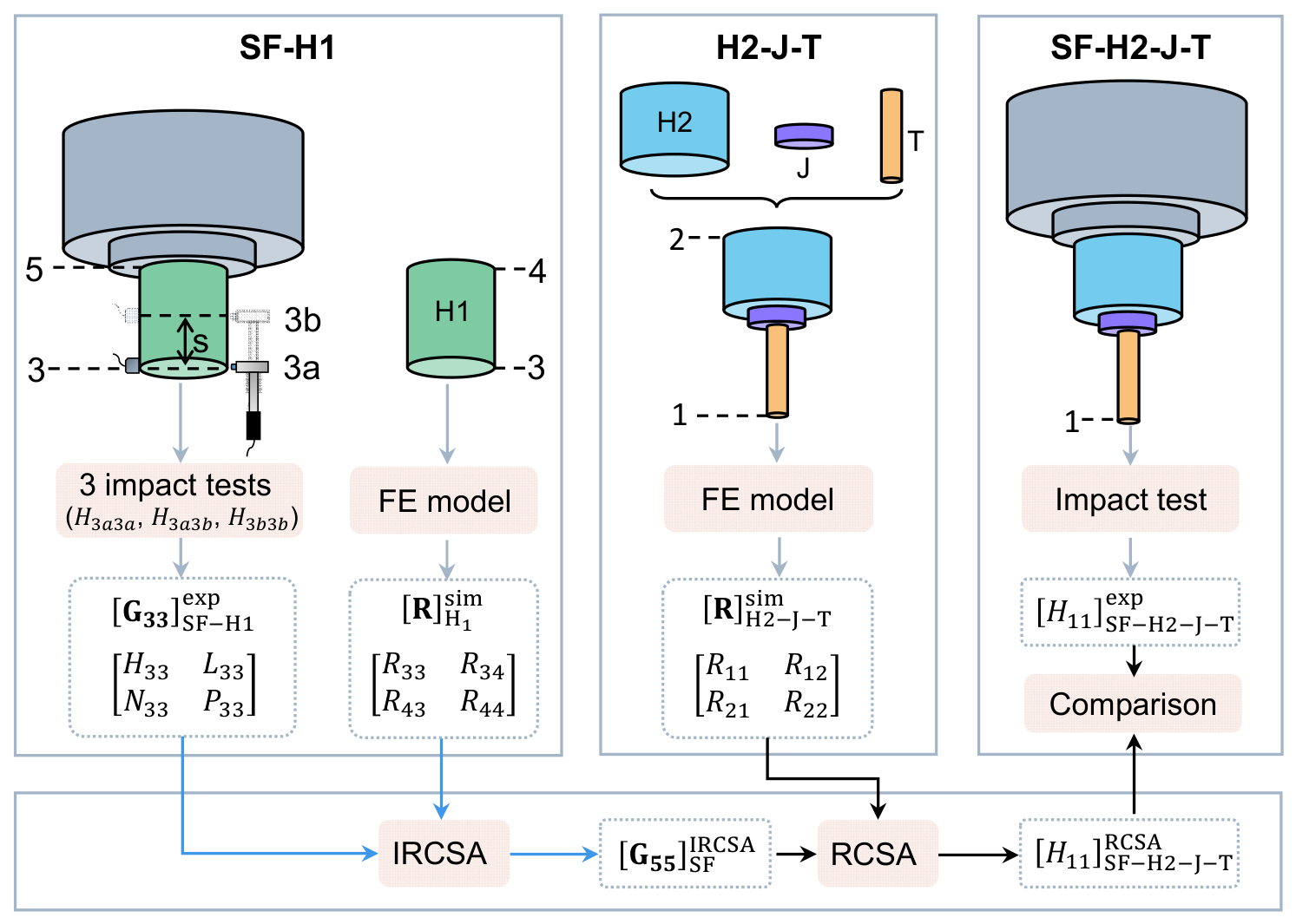
To further validate the generalizability of the identified joint parameters, predictive validation of tool-tip FRFs on novel tool assemblies mounted on a spindle was conducted. The prediction workflow, as illustrated in
Figure 14, comprises five steps.
(1) Obtain the receptance matrix (
, see Equation (16)) at the tip (position 3) of the calibrated holder (H1) mounted on the spindle via three impact tests (to obtain
,
, and
) and the first-order finite difference method proposed in [
33].
where
is the displacement-to-force receptance (or FRF),
is the displacement-to-moment receptance,
is the rotation-to-force receptance, and
is the rotation-to-moment receptance, with
s denoting the spacing between the test points 3a and 3b.
(2) Apply FE simulation to determine the free–free receptance matrix (
, see Equation (17)) of H1 (considering only the outer part of the flange).
(3) Obtain the receptance matrix (
, see Equation (18)) of the spindle-flange (SF) end (position 5) via inverse-RCSA (IRCSA).
(4) Apply FE simulation to determine the free–free receptance matrix (
, see Equation (19)) for a novel tool–collet–holder assembly (H2-J-T), where the joint parameters in the FE model directly employ the identification results (obtained via UMPA-MLP) from
Section 4.6.
(5) Predict the tool-tip FRF (
, see Equation (20)) of the spindle system coupled with H2-J-T (SF-H2-J-T) via RCSA and compared with the experimental FRF
.
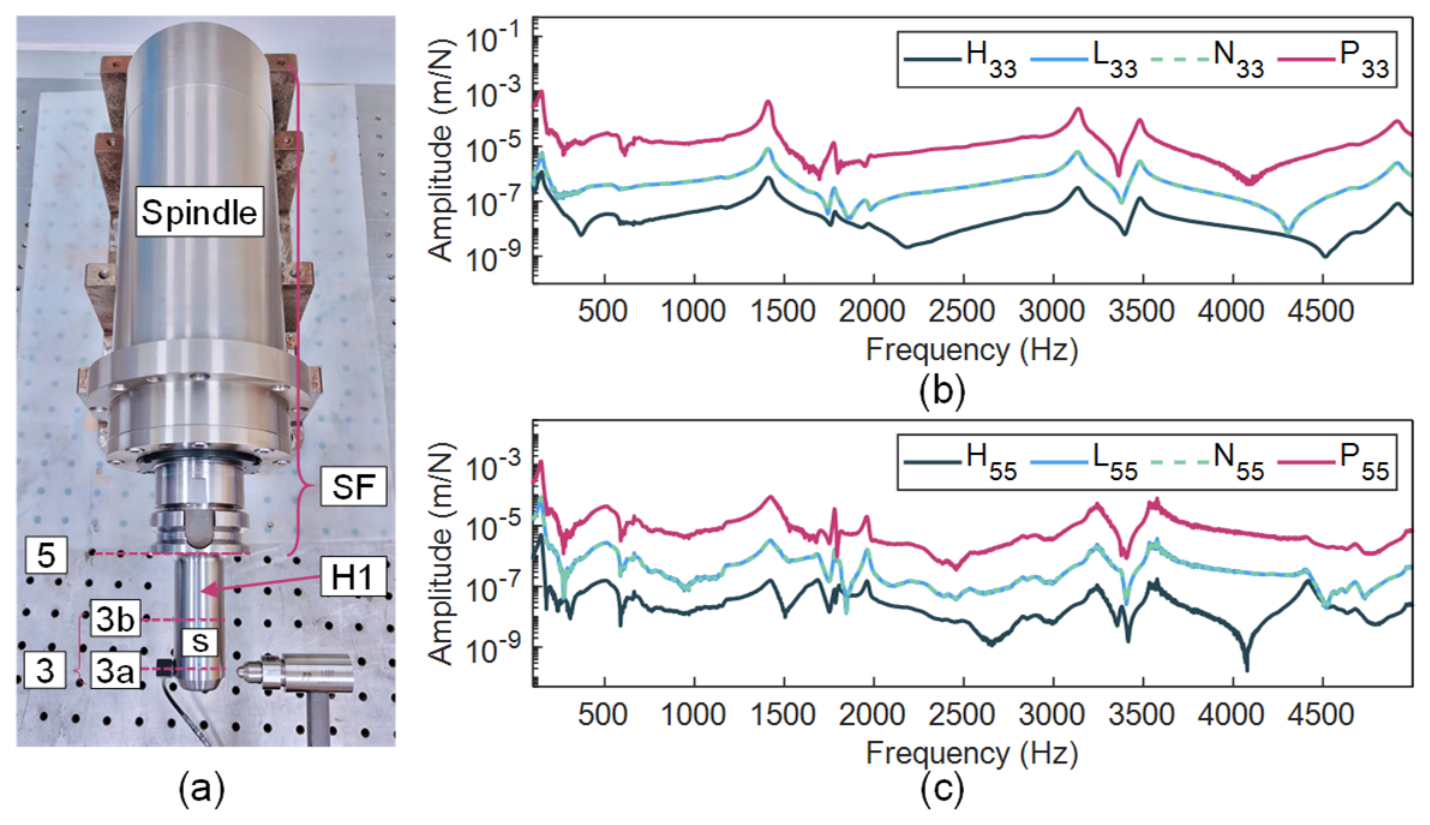
Figure 15a illustrates the experimental setup for acquiring the spindle-flange receptance matrix. The spindle was mounted on an optical platform via a V-shaped base. The calibration holder H1 featured an extending section beyond the flange with a diameter of 30 mm and a length of 72 mm. Following the guidelines proposed by Chaux [
33], a spacing (
s) of 20 mm was selected between measurement points 3a and 3b. The obtained receptance matrices
and
are presented in
Figure 15b and
Figure 15c, respectively.
This validation study employed a novel BT40-ER32-150L holder (H2) with 50 mm increased length compared to the reference holder H0, while the collet remained ER32. The new holder was mounted on the identical spindle setup shown in
Figure 15a (replacing holder H1), followed by tool installation for subsequent validation. Similar to
Section 4.8 three validation cases were designed: (1) tool T1 was clamped onto the holder H2 with a tightening torque of 100 N·m (denoted as SF-H2-J
100Nm-T1), (2) tool T2 was clamped onto the holder H2 with a tightening torque of 80 N·m (denoted as SF-H2-J
80Nm-T2), and (3) tool T3 was clamped onto the holder H2 with a tightening torque of 20 N·m (denoted as SF-H2-J
20Nm-T3).
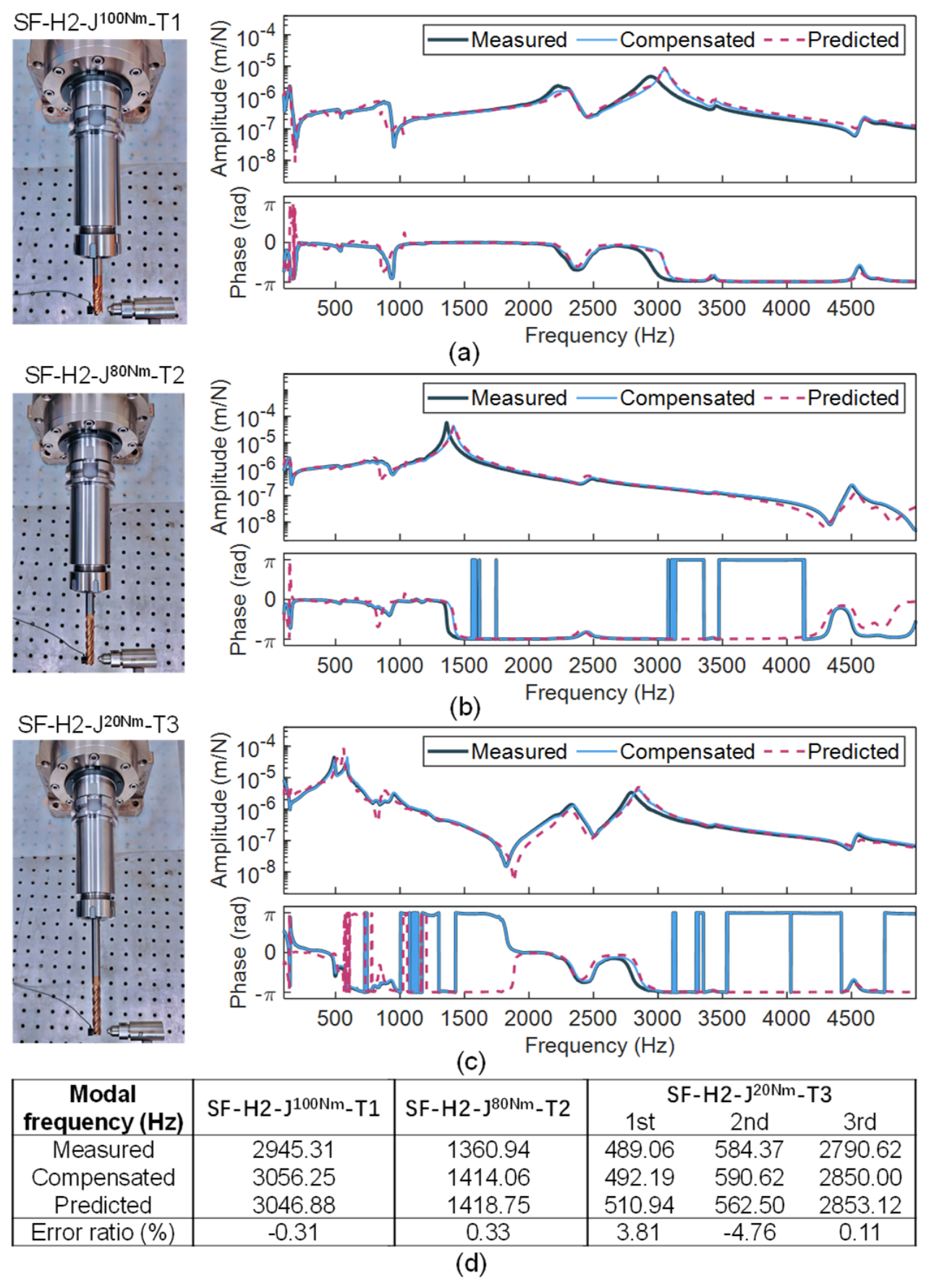
Figure 16a–c presents the test configurations (left) and corresponding tool-tip FRF comparisons (right) for three validation cases. Predicted results demonstrate close agreement with compensated experimental data, particularly for tool-dominant modes with higher frequency response amplitudes.
Figure 16d summarizes the measured, compensated, and predicted frequencies of tool-dominant modes across three cases. For case SF-H2-J
100Nm-T1, the predicted frequency (3046.88 Hz) shows merely −0.31% error versus the compensated result. The 110.94 Hz compensation shift (measured: 2945.31 Hz, compensated: 3056.25 Hz) confirms tool dominance, which is consistent with Özşahin ‘s finding that accelerometer mass loading selectively reduces tool-mode frequencies during impact testing [
34]. This effect remains negligible for spindle/holder-dominated modes due to their substantially higher effective mass and smaller relative displacement at the tool tip.
For SF-H2-J80Nm-T2, the measured, compensated, and predicted tool-mode frequencies were 1360.94 Hz, 1414.06 Hz, and 1418.75 Hz, respectively, with the prediction error remaining at a low level (0.33%).
In the case of SF-H2-J20Nm-T3, the tool-dominated first-order modal frequency is significantly reduced due to the longer tool overhang, and two closely spaced modes appear (with prediction errors of 3.81% and −4.76% respectively). Additionally, a distinct tool-mode was observed in the relatively high frequency range (with a prediction error of 0.11%).
These results validate the effectiveness of the joint parameters identified by UMAP-MLP, demonstrating robust predictive capability under complex conditions involving tool/holder changes, variations in preload state, and coupling with the spindle system, verifying its engineering application viability.
4.10. Error Analysis and Limitations
Several factors contribute to the discrepancies between the predicted and experimental FRFs.
First, FE modeling errors are unavoidable. Although the FE models of the tools and holders were experimentally calibrated, deviations still exist between the simulated and measured dynamic responses. In addition, the joint interfaces were represented using a linear equivalent spring–damper model. Such a simplification cannot fully capture the inherently nonlinear contact behavior of real joints, including preload-dependent stiffness, microslip, and nonlinear energy dissipation, which may affect the accuracy of the identified parameters and the predicted FRFs.
Second, experimental uncertainties also introduce errors. Although repeated impact tests and signal averaging were employed to reduce random noise, measurement uncertainty arising from sensor noise, impact location deviation, signal processing, and environmental disturbances cannot be completely eliminated. These uncertainties may propagate into the identified joint parameters and the subsequent FRF predictions.
Third, the proposed UMAP-MLP model is a data-driven regression model and therefore possesses inherent prediction errors associated with the neural network training and generalization process.
Finally, the prediction accuracy is closely related to the modal characteristics of the investigated system. The first-order mode is mainly dominated by tool bending and exhibits relatively low sensitivity to joint parameters, whereas the higher-order modes are more strongly influenced by joint dynamics. Consequently, the proposed model achieves better prediction accuracy for the second- and third-order modes than for the first-order mode.
Overall, the prediction errors originate from the combined effects of FE modeling approximations, experimental uncertainty, neural network regression errors, and modal sensitivity characteristics of the investigated structure. Although the proposed framework demonstrated satisfactory performance when applied to experimentally measured FRFs, future research will focus on evaluating the robustness of the proposed framework under measurement uncertainties and model mismatches, as well as incorporating these uncertainties into the training process to further improve the reliability and generalization capability of the method.
5. Conclusions
In this study, a novel joint identification framework based on neural networks is developed. The single-point driving-FRF dataset is generated via FE simulation and FDSS. The MLP model is trained exclusively on simulated data. Only one experimental FRF is required as source data for joint parameter identification. To avoid deep network architectures while preserving the nonlinear relationship between FRF and joint parameters, the UMAP algorithm is employed for nonlinear dimensionality reduction in FRF amplitude sequences. Notably, this marks the first reported application of UMAP to assembly FRF datasets, with appropriate algorithm parameters determined through parametric studies, providing a valuable academic reference.
The proposed joint identification methodology is systematically validated on the tool–collet–holder assembly. The conventional dual-interface model is enhanced to accurately characterize the tool–holder joint dynamics. Variations in clamping states affecting the spring collet and locking nut are incorporated, yielding a model with 12 joint parameters.
Experimental validation is performed on an actual tool–collet–holder assembly. The effectiveness of the proposed method is first demonstrated through comparisons with existing global optimization-based identification approaches. The need for nonlinear dimensionality reduction in the proposed joint identification framework—which trains models using simulation data and performs predictions with experimental data—is confirmed through comparison with the PCA method. The FRFs of the reference assembly under different tightening torques are reconstructed using the identified parameters and compared with the compensated experimental results. The results indicate that the UMAP-MLP method exhibits comparable or even superior accuracy to the MultiStart method. The PCA-MLP method identified parameter failures with prediction errors exceeding those under the rigid joint assumption. The reconstruction errors for modal frequencies exhibited the following order: first-order > third-order > second-order. These are negatively correlated with the sensitivity of each mode to tightening torque (i.e., joint characteristics). The first-order mode, dominated by tool bending, demonstrated insensitivity to joint characteristics. Notably, the joint parameters identified by UMAP-MLP exhibited physically consistent trends across varying tightening torques, while the optimization results showed random distributions, confirming that the UMAP-MLP effectively learned the complex mapping between the assembly FRF and the joint parameters.
The generalizability of the identified joint parameters is further validated through predictive studies of the free–free tool-tip FRFs of the reference assembly equipped with new tools, as well as the tool-tip FRFs of the novel tool assemblies mounted on the spindle. Results demonstrate that the parameters identified by UMAP-MLP exhibit excellent cross-condition applicability, delivering reliable predictive performance under various conditions, including tool/holder replacement, variations in preload state, and coupling with complex spindle systems. Notably, the geometry of the contact area between the tools and the holders remained unchanged throughout these validation cases. Therefore, the proposed method is confirmed to be effective when contact geometry remains consistent, while geometric changes would necessitate dataset adaptation—a worthwhile direction for future research.
The proposed neural network-based joint identification method offers significant value by providing a highly versatile, data-driven framework for identifying contact interface characteristics that are difficult to model precisely in mechanical systems. While the validation cases focus on the representative tool-holder connection structure (demonstrating its effectiveness in handling typical industrial interfaces and dual-contact problems), the method is inherently not limited to specific structures or levels of complexity. It could be applied to simpler single-interface connection systems (e.g., interference fits between shafts and hubs or single-bolt connections). It also holds potential for extension to more complex systems (such as machine tool spindle systems involving multiple interfaces, including tool–holder, spindle–holder, and bearings). Future work could also explore the integration of this approach with real-time monitoring systems for in situ joint condition assessment.