Sample Selection Generative Adversarial Networks for Intelligent Frequency Regulation of Microgrids

Abstract
1. Introduction
- (1)
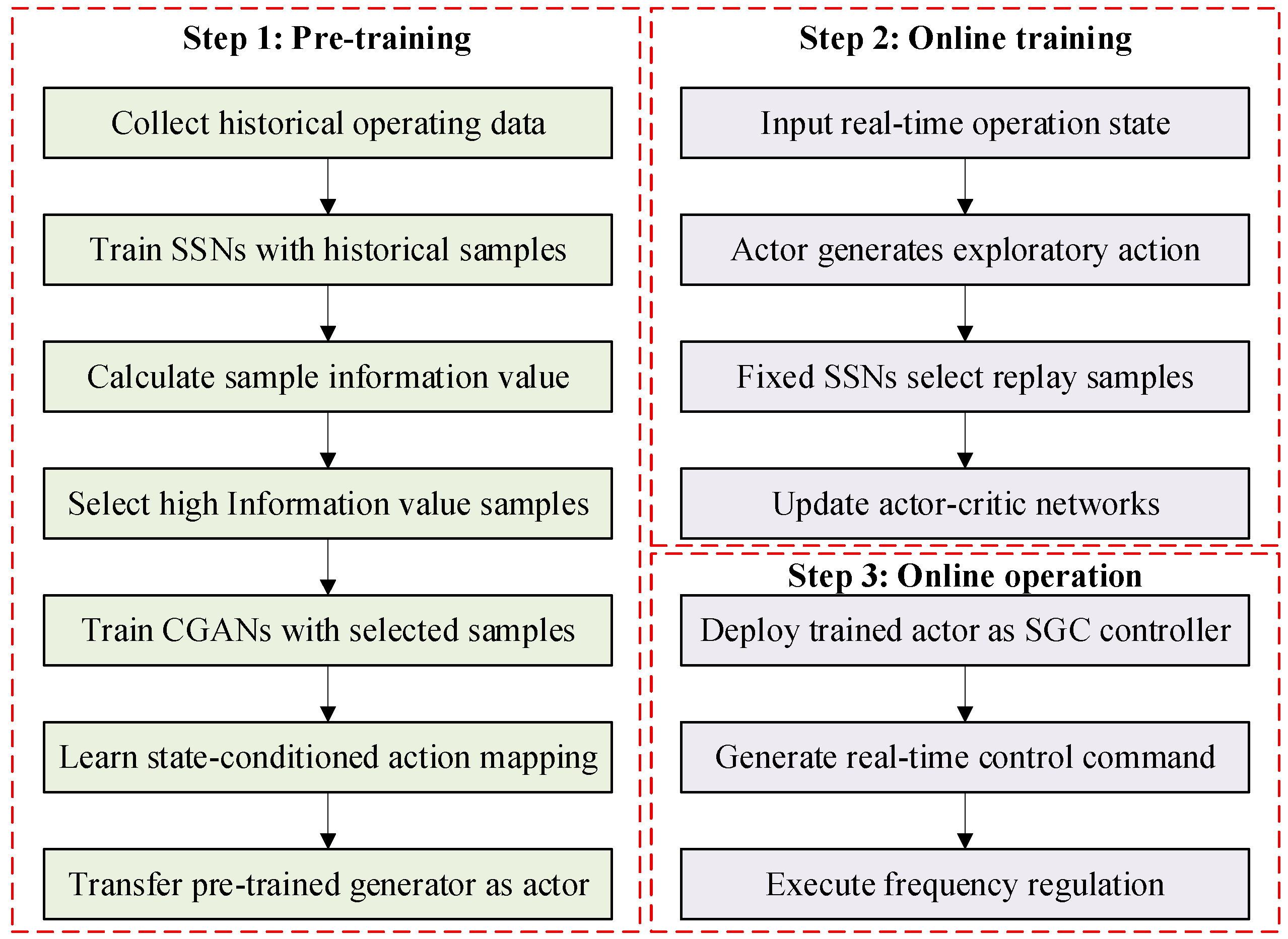
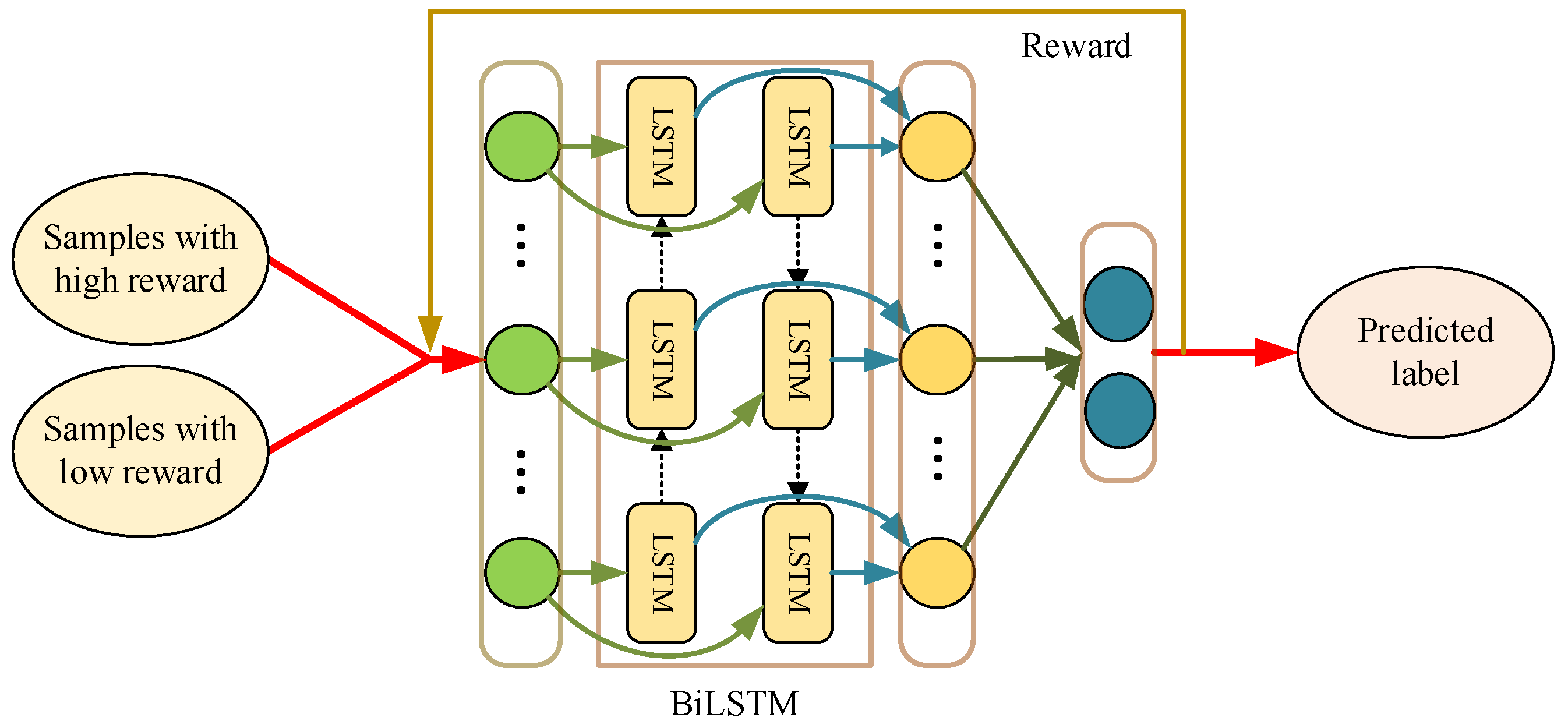
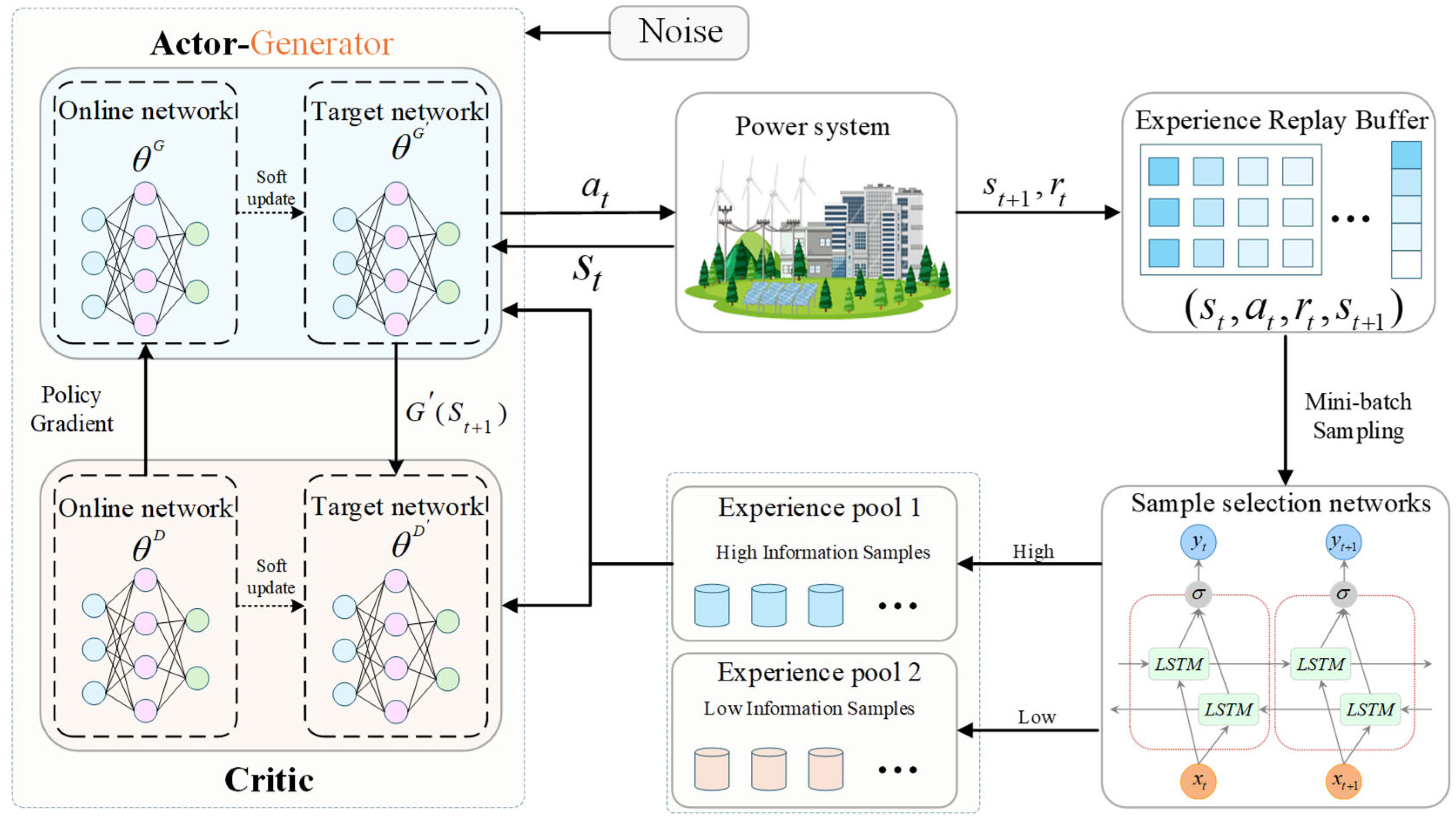
- The SSGANs introduce SSNs to evaluate sample information values and prioritize informative samples, thereby improving training efficiency.
- (2)
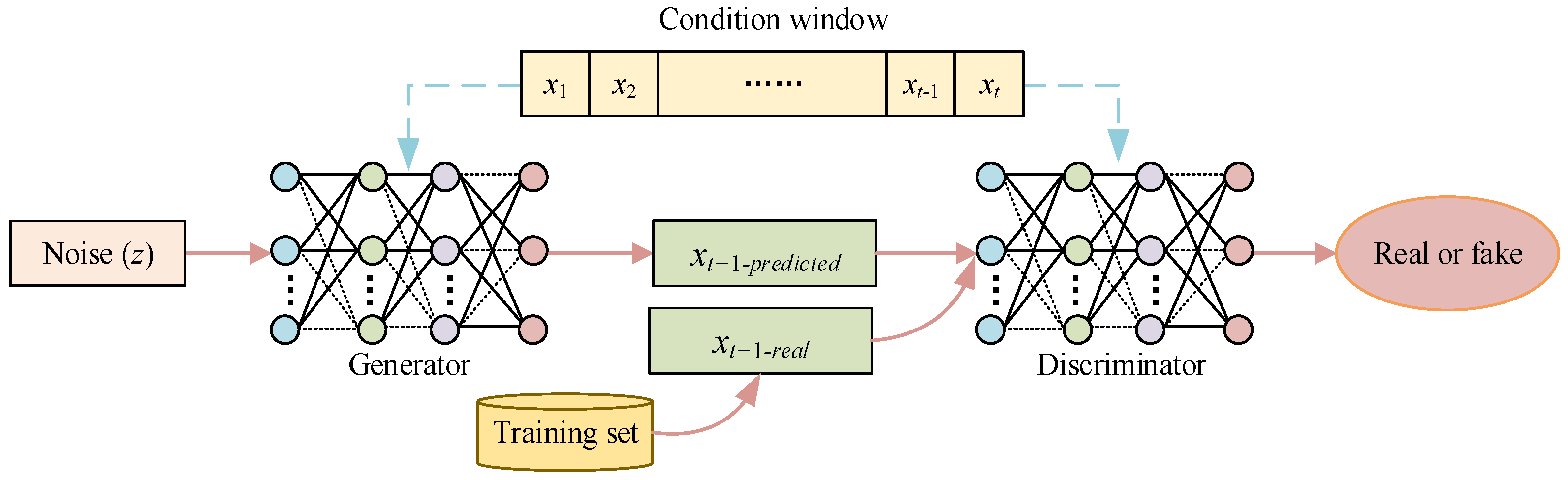
- The SSGANs use CGANs to learn the state-conditioned mapping between microgrid operating states and control actions, thereby improving action generation quality.
- (3)
- The SSGANs integrate the pretrained generator into the actor–critic framework as the actor, enabling online policy optimization for intelligent frequency regulation of microgrids.
2. Principle of Sample Selection Generative Adversarial Networks
2.1. Sample Selection Networks
2.2. Conditional Generative Adversarial Networks
2.3. Sample Selection Generative Adversarial Networks
2.4. Sample Selection Generative Adversarial Networks for SGC
| Algorithm 1. Pseudo-code of SSGANs for SGC |
| 1: Initialize parameters 2: for each training sample do 3: Estimate the validation reward using Equation (1) 4: Update the SSN state 5: Calculate the sample information value using Equation (3)) 6: If the predicted reward exceeds the mean, save the sample to experience pool 1; otherwise to experience pool 2 7: end for 8: Pre-train the CGANs on experience pool 1 by Equation (6). 9: Transfer the pre-trained generator to initialize the online actor network 10: for t = 1…T do 11: Generate action 12: Store samples 13: Calculate the target value by Equation (7) 14: Update the critic and actor using Equation (8) and Equation (9) 15: Soft-update the target networks using Equation (10) 16: end for 17: Deploy the trained actor network 18: Input the current microgrid state into the trained actor 19: Generate the control command for real-time frequency regulation |
3. Simulation Setup
3.1. Evaluation and Reward Function
3.2. Parameter Setting
4. Case Studies
4.1. Case I
4.1.1. Pretraining of SSNs and CGANs
4.1.2. Online Training of SSGANs
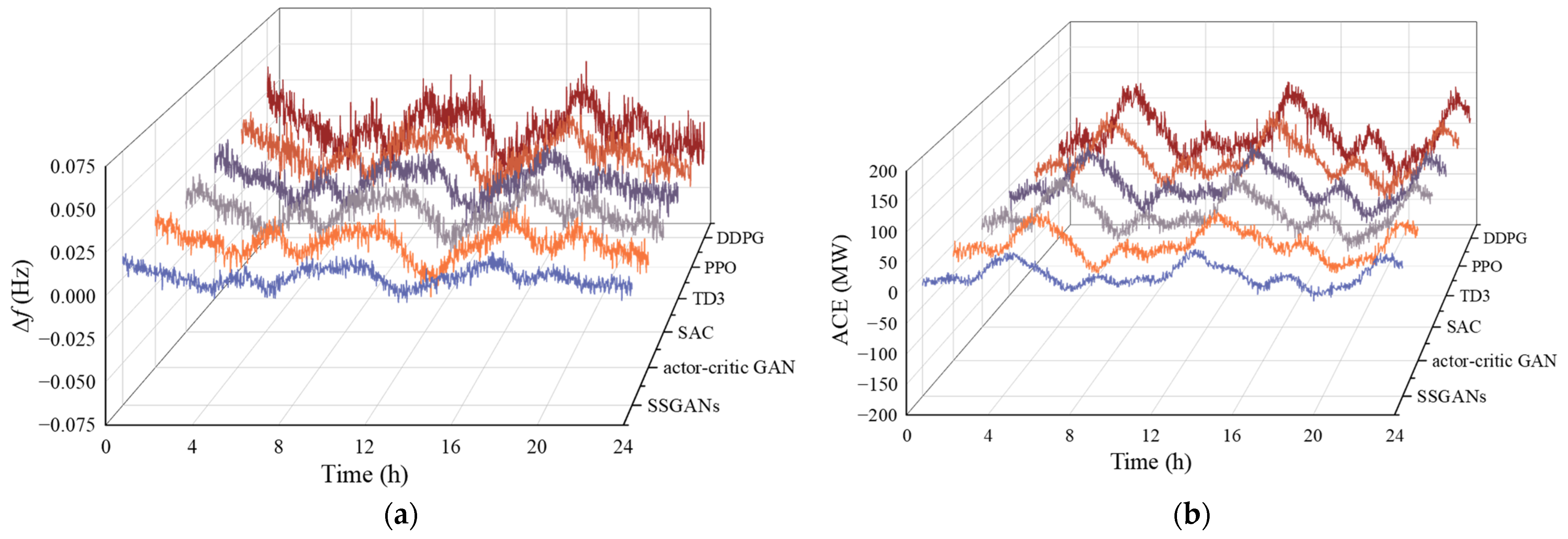
4.1.3. Online Operation
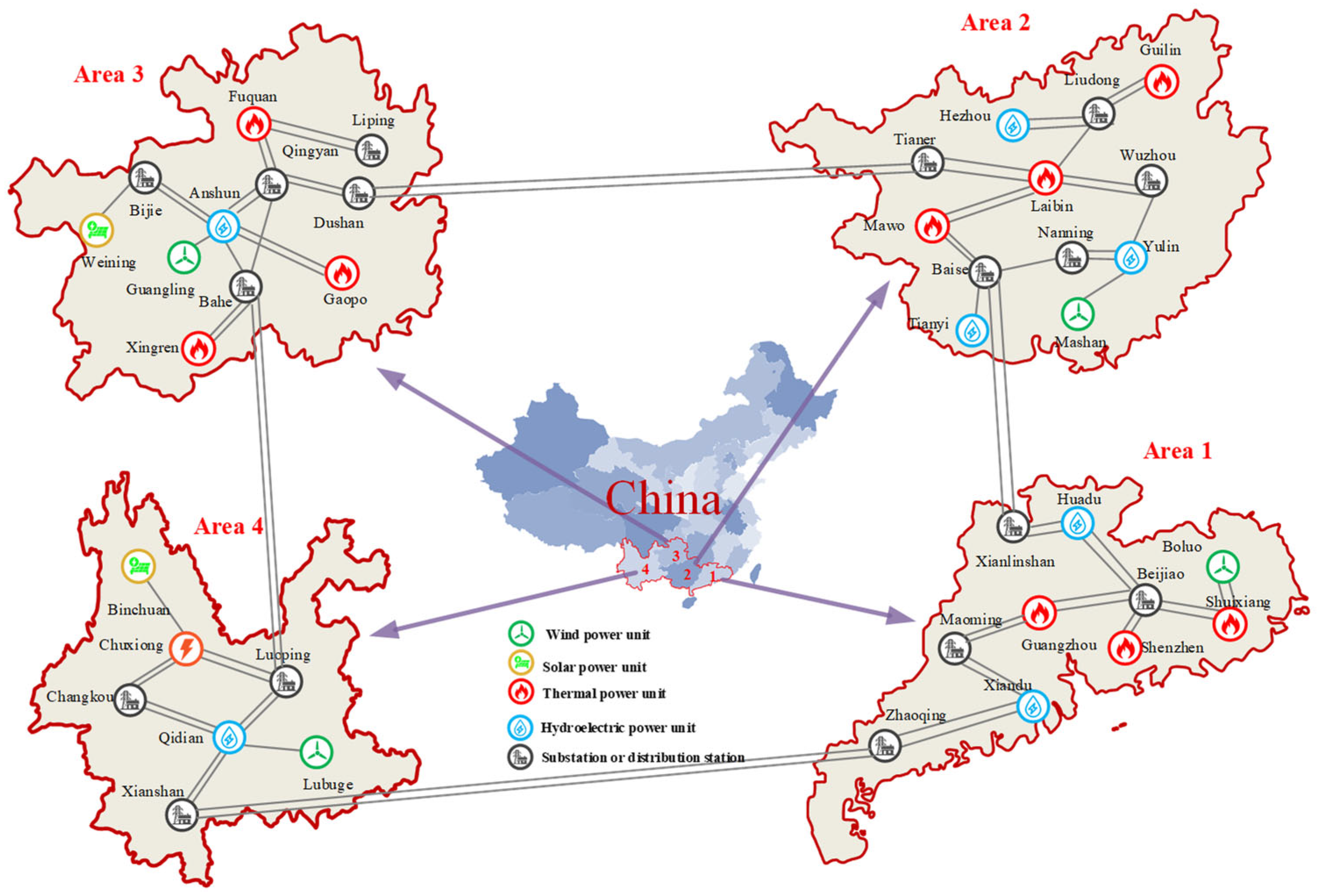
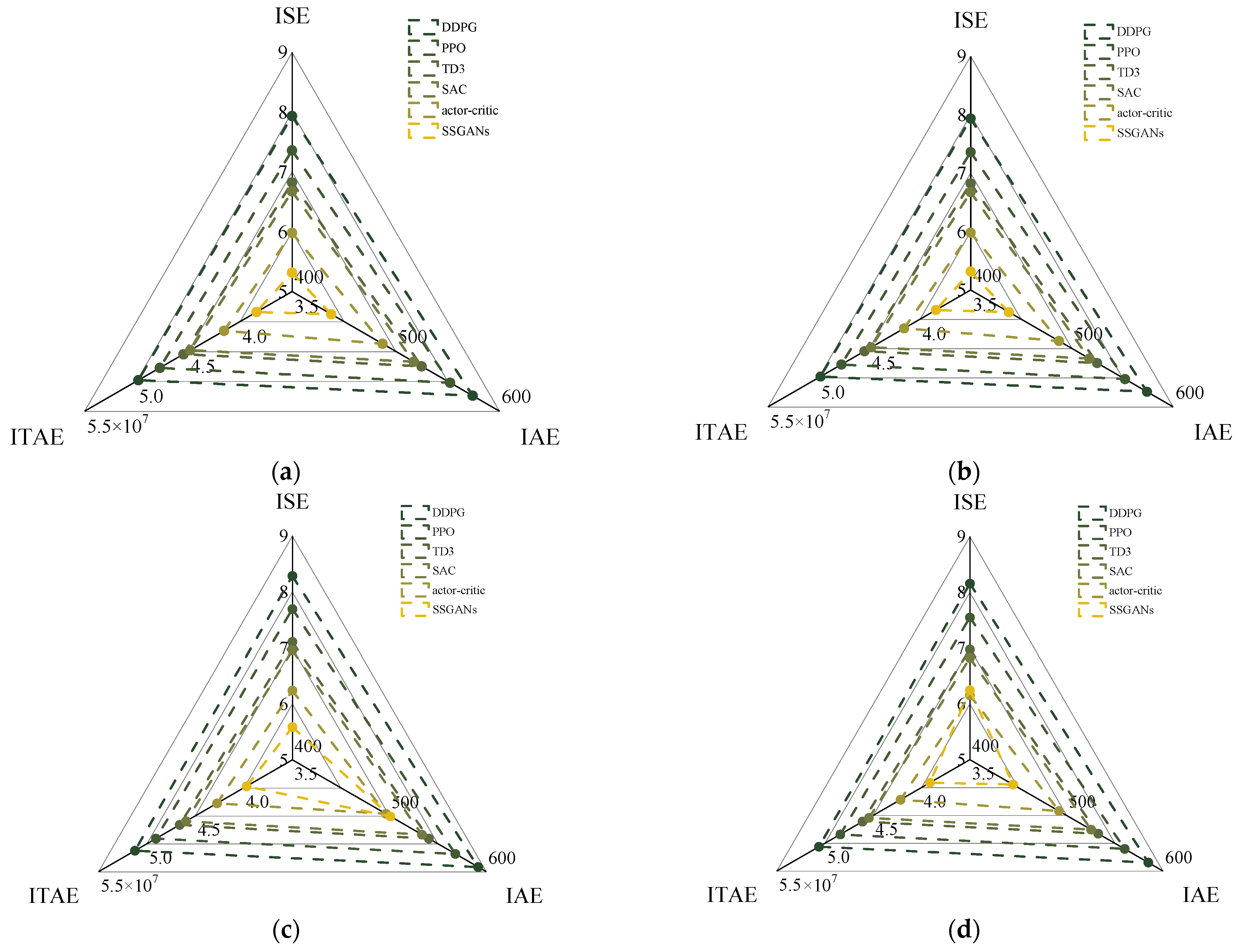
4.2. Case II
4.3. Discussion
4.3.1. Ablation Studies
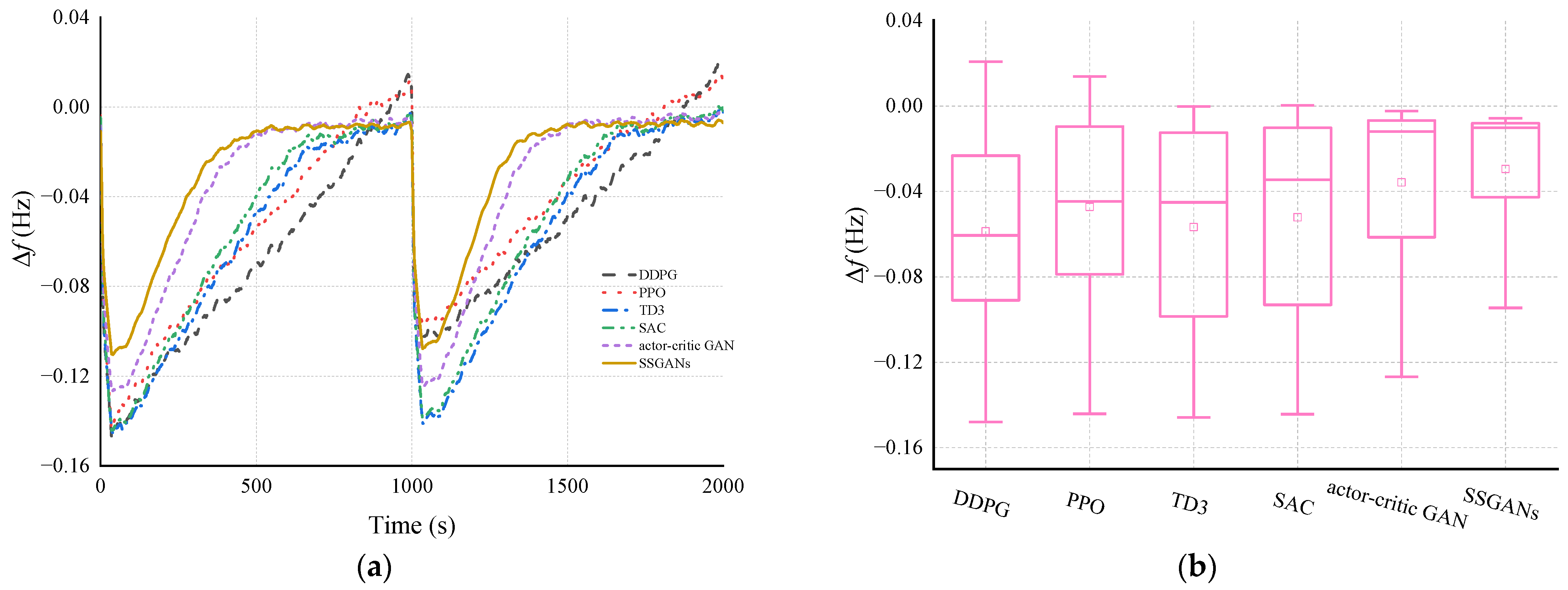
4.3.2. Dynamic Response Performance
4.3.3. Communication Delay Analysis
4.3.4. Statistical Significance Analysis
4.3.5. Discussion of Limitations
- (1)
- The training time of SSGANs is longer than that of standard deep RL methods due to the additional SSN training and CGAN pretraining stages. In applications where rapid deployment is required, this additional training overhead may become a constraint.
- (2)
- The current validation is based on simulation models, and experimental verification on physical microgrid platforms is required to further confirm the practical applicability.
- (3)
- The pretraining data is generated by a conventional PID controller, which may limit the diversity and quality of the initial training samples. Exploring more diverse data sources for pretraining could further improve the performance of SSGANs.
- (4)
- The current work mainly focuses on simulation-based control performance, while the theoretical stability analysis of the system is not considered.
5. Conclusions
- (1)
- SSNs can evaluate sample information values and select informative samples, thereby improving sample utilization and training efficiency.
- (2)
- CGANs can learn the state-conditioned mapping between operating states and control actions, which improves action generation quality and reduces inefficient exploration.
- (3)
- By transferring the pretrained CGAN generator into the actor–critic framework, SSGANs achieve online policy optimization. Case studies show that SSGANs obtain smaller frequency deviation, lower ACE, and better dynamic response performance than the compared algorithms.
Author Contributions
Funding
Data Availability Statement
Conflicts of Interest
Abbreviations
| ACE | Area control error |
| AGC | Automatic generation control |
| BiLSTM | Bidirectional long short-term memory |
| BN | Batch normalization |
| CGANs | Conditional generative adversarial networks |
| DDPG | Deep deterministic policy gradient |
| DNNs | Deep neural networks |
| GANs | Generative adversarial networks |
| IAE | Integral absolute error |
| ISE | Integral squared error |
| ITAE | Integral time multiple absolute error |
| PPO | Proximal policy optimization |
| RMSE | Root mean square error |
| SAC | Soft actor–critic |
| SGC | Smart generation control |
| SSGANs | Sample selection generative adversarial networks |
| SSNs | Sample selection networks |
| TD3 | Twin delayed deep deterministic policy gradient |
References
- Zhang, Y.; Lu, T.; Zhang, L.; Mei, Y.; Guo, Y.; Wu, S.; Wu, Q.; Xu, Y. Low-carbon optimal dispatching of rural multi-energy microgrid system based on multi-energy conversion and agricultural load demands. Energy 2026, 344, 140024. [Google Scholar] [CrossRef]
- Zheng, J.; Zhai, L.; Tao, M.; Tang, W.; Li, Z. Low-Carbon Economic Dispatch in Integrated Energy Systems: A Set-Based Interval Optimization with Decision Support Under Uncertainties. Prot. Control Mod. Power Syst. 2025, 11, 68–87. [Google Scholar] [CrossRef]
- Li, Z.; Cheng, Z.; Wang, Y.; Sui, Q. Distributed event-triggered fixed-time SMC-based AGC for power systems with heterogeneous frequency regulation units. IEEE Trans. Ind. Inform. 2024, 20, 8031–8043. [Google Scholar] [CrossRef]
- Muduli, R.; Jena, D.; Moger, T. Application of reinforcement learning-based adaptive PID controller for automatic generation control of multi-area power system. IEEE Trans. Autom. Sci. Eng. 2025, 22, 1057–1068. [Google Scholar] [CrossRef]
- Çetin, G.; Özkaraca, O.; Keçebaş, A. Development of PID based control strategy in maximum exergy efficiency of a geothermal power plant. Renew. Sustain. Energy Rev. 2021, 137, 110623. [Google Scholar] [CrossRef]
- Wang, N.; Hao, F. Event-triggered sliding mode control with adaptive neural networks for uncertain nonlinear systems. Neurocomputing 2021, 436, 184–197. [Google Scholar] [CrossRef]
- Xi, L.; Chen, J.F.; Huang, Y.H.; Xu, Y.C.; Liu, L.; Zhou, Y.M.; Li, Y. Smart generation control based on multi-agent reinforcement learning with the idea of the time tunnel. Energy 2018, 153, 977–987. [Google Scholar] [CrossRef]
- Yin, L.; He, X. Artificial emotional deep Q learning for real-time smart voltage control of cyber-physical social power systems. Energy 2023, 273, 127232. [Google Scholar] [CrossRef]
- Perera, A.T.D.; Kamalaruban, P. Applications of reinforcement learning in energy systems. Renew. Sustain. Energy Rev. 2021, 137, 110618. [Google Scholar] [CrossRef]
- Irfan, M.; Deilami, S.; Huang, S.J.; Tahir, T.; Veettil, B.P. Optimizing load frequency control in microgrid with vehicle-to-grid integration in Australia: Based on an enhanced control approach. Appl. Energy 2024, 366, 123317. [Google Scholar] [CrossRef]
- Tao, X.; Hafid, A.S. DeepSensing: A novel mobile crowdsensing framework with double deep Q-network and prioritized experience replay. IEEE Internet Things J. 2020, 7, 11547–11558. [Google Scholar] [CrossRef]
- Yin, L.F.; Luo, S.K.; Ma, C.X. Expandable depth and width adaptive dynamic programming for economic smart generation control of smart grids. Energy 2021, 232, 120964. [Google Scholar] [CrossRef]
- Lillicrap, T.P.; Hunt, J.J.; Pritzel, A.; Heess, N.; Erez, T.; Tassa, Y.; Silver, D.; Wierstra, D. Continuous control with deep reinforcement learning. arXiv 2015, arXiv:1509.02971. [Google Scholar] [CrossRef]
- Fujimoto, S.; van Hoof, H.; Meger, D. Addressing Function Approximation Error in Actor-Critic Methods. In Proceedings of the 35th International Conference on Machine Learning, Stockholmsmässan, Stockholm, Sweden, 10–15 July 2018; Volume 80, pp. 1587–1596. [Google Scholar]
- Haarnoja, T.; Zhou, A.; Abbeel, P.; Levine, S. Soft actor-critic: Off-policy maximum entropy deep reinforcement learning with a stochastic actor. 35th International Conference on Machine Learning, Stockholmsmässan, Stockholm, Sweden, 10–15 July 2018; Volume 80, pp. 1861–1870. [Google Scholar]
- Schulman, J.; Wolski, F.; Dhariwal, P.; Radford, A.; Klimov, O. Proximal policy optimization algorithms. arXiv 2017, arXiv:1707.06347. [Google Scholar] [CrossRef]
- Fu, X.; Zhang, C.; Zhang, X.; Sun, H. A novel GAN architecture reconstructed using Bi-LSTM and style transfer for PV temporal dynamics simulation. IEEE Trans. Sustain. Energy 2024, 15, 2826–2829. [Google Scholar] [CrossRef]
- Han, K.; Yang, K.; Yin, L. Lightweight actor-critic generative adversarial networks for real-time smart generation control of microgrids. Appl. Energy 2022, 317, 119163. [Google Scholar] [CrossRef]
- Han, C.; Gim, G. Time-series-based anomaly detection in industrial control systems using generative adversarial networks. Processes 2025, 13, 2885. [Google Scholar] [CrossRef]
- Li, H.; Misra, S. Reinforcement learning based automated history matching for improved hydrocarbon production forecast. Appl. Energy 2020, 284, 116311. [Google Scholar] [CrossRef]
- Pfau, D.; Vinyals, O. Connecting generative adversarial networks and actor-critic methods. arXiv 2016, arXiv:1610.01945. [Google Scholar] [CrossRef]
- Peng, B.; Li, X.; Gao, J.; Liu, J.; Wong, K.F. Adversarial advantage actor-critic model for task-completion dialogue policy learning. arXiv 2017, arXiv:1710.11277. [Google Scholar] [CrossRef]
- Ye, Y.; Qiu, D.; Sun, M.; Papadaskalopoulos, D.; Strbac, G. Deep reinforcement learning for strategic bidding in electricity markets. IEEE Trans. Smart Grid 2020, 11, 1343–1355. [Google Scholar] [CrossRef]
- Kumar, R.; De, M. Advancement in power system resilience through deep reinforcement learning: A comprehensive review. Renew. Sustain. Energy Rev. 2025, 222, 115951. [Google Scholar] [CrossRef]
- Sadoughi, N.; Busso, C. Speech-driven expressive talking lips with conditional sequential generative adversarial networks. IEEE Trans. Affect. Comput. 2021, 12, 1031–1044. [Google Scholar] [CrossRef]
- Dhawas, P.V.; Bedekar, P.; Nandankar, P.V.; Vaidya, M.G. Localization of HIFS in primary distribution networks using voltage and current sequence components. Expert Syst. Appl. 2024, 242, 122428. [Google Scholar] [CrossRef]
- Vinci, C. Predicting auction price of vehicle license plate with deep recurrent neural network. Expert Syst. Appl. 2020, 142, 113008. [Google Scholar] [CrossRef]
- Michael, N.E.; Bansal, R.C.; Ismail, A.A.A.; Elnady, A.; Hasan, S. A cohesive structure of bi-directional long-short-term memory (BiLSTM)-GRU for predicting hourly solar radiation. Renew. Energy 2024, 222, 119943. [Google Scholar] [CrossRef]
- Ding, Y.F.; Chen, Z.J.; Zhang, H.W.; Wang, X.; Guo, Y. A short-term wind power prediction model based on CEEMD and WOA-KELM. Renew. Energy 2022, 189, 188–198. [Google Scholar] [CrossRef]
- Schaul, T.; Quan, J.; Antonoglou, I.; Silver, D. Prioritized experience replay. arXiv 2016. [Google Scholar] [CrossRef]
- Thibaut, T.; Damien, E. An application of deep reinforcement learning to algorithmic trading. Expert Syst. Appl. 2021, 173, 114632. [Google Scholar] [CrossRef]
- Xi, L.; Yu, L.; Xu, Y.; Wang, S.X.; Chen, X. A novel multi-agent DDQN-AD method-based distributed strategy for automatic generation control of integrated energy systems. IEEE Trans. Sustain. Energy 2020, 11, 2417–2426. [Google Scholar] [CrossRef]
- Li, S.; Gu, C.; Zhao, P.; Cheng, S. A novel hybrid propulsion system configuration and power distribution strategy for light electric aircraft. Energy Convers. Manag. 2021, 238, 114171. [Google Scholar] [CrossRef]
- Khokhar, B.; Dahiya, S.; Parmar, S. Load frequency control of a microgrid employing a 2D Sine Logistic map based chaotic sine cosine algorithm. Appl. Soft Comput. 2021, 109, 107564. [Google Scholar] [CrossRef]
- Jalali, N.; Razmi, H.; Doagou-Mojarrad, H. Optimized fuzzy self-tuning PID controller design based on Tribe-DE optimization algorithm and rule weight adjustment method for load frequency control of interconnected multi-area power systems. Appl. Soft Comput. 2020, 93, 106424. [Google Scholar] [CrossRef]
- Chen, Y.; Xie, Z.; Zhong, J.; Chen, P.; Xiao, J. SQKformer: Spiking sparse QKformer with adaptive batch normalization for membrane potential. Neurocomputing 2026, 671, 132666. [Google Scholar] [CrossRef]
- Yin, L.; Wang, T.; Wang, S.; Zheng, B. Interchange objective value method for distributed multi-objective optimization: Theory, application, implementation. Appl. Energy 2019, 239, 1066–1076. [Google Scholar] [CrossRef]
- Zhang, J.; Cheng, C.; Yu, S.; Wu, H.; Gao, M. Sharing hydropower flexibility in interconnected power systems: A case study for the China Southern power grid. Appl. Energy 2021, 288, 116645. [Google Scholar] [CrossRef]







| Mode | Layer | Hidden Unit | Active Function | Batch Normalization Size |
|---|---|---|---|---|
| Generator–Actor | 1 | 4 | ReLU | 64 |
| Generator–Actor | 2 | 90 | ReLU | 64 |
| Generator–Actor | 3 | 90 | ReLU | 128 |
| Generator–Actor | 4 | 4 | Tanh | - |
| Discriminator | 1 | 4 | ReLU | 32 |
| Discriminator | 2 | 90 | ReLU | 32 |
| Discriminator | 3 | 90 | ReLU | 64 |
| Discriminator | 4 | 2 | Sigmoid | - |
| Critic | 1 | 4 | ReLU | 32 |
| Critic | 2 | 90 | ReLU | 32 |
| Critic | 3 | 90 | ReLU | 64 |
| Critic | 4 | 1 | Sigmoid | - |
| BiLSTM | 1 | 4 | ReLU | 64 |
| BiLSTM | 2 | 90 | ReLU | 64 |
| BiLSTM | 3 | 90 | ReLU | 128 |
| BiLSTM | 4 | 2 | Sigmoid | - |
| Parameter | DDPG | TD3 | SAC | PPO | Actor–Critic GAN |
|---|---|---|---|---|---|
| Network type | MLP | MLP | MLP | MLP | CGANs-Actor + Critic |
| Hidden layers | 2 | 2 | 2 | 2 | 2 |
| Hidden units | [128, 128] | [128, 128] | [128, 128] | [128, 128] | [128, 128] |
| Activation function | ReLU | ReLU | ReLU | ReLU | ReLU |
| Optimizer | Adam | Adam | Adam | Adam | Adam |
| Learning rate | 1×10⁻⁴/1×10−3 | 1×10⁻⁴/1×10−3 | 3×10⁻⁴/3×10−4 | 3×10⁻⁴/1×10−3 | 1×10⁻⁴/1×10−3 |
| Discount factor | 0.99 | 0.99 | 0.99 | 0.99 | 0.99 |
| Batch size | 128 | 128 | 128 | 128 | 128 |
| Training steps | 10,000 | 10,000 | 10,000 | 10,000 | 10,000 |
| Algorithms | Specific Settings |
|---|---|
| DDPG | Replay buffer size = 1×10⁶; soft update coefficient = 0.005; Gaussian exploration noise linearly decayed from 0.20 to 0.05 |
| TD3 | Replay buffer size = 1×10⁶; soft update coefficient = 0.005; policy delay = 2; target policy smoothing noise = 0.20 |
| SAC | Replay buffer size = 1×10⁶; soft update coefficient = 0.005; entropy coefficient automatically tuned |
| PPO | Rollout length = 2048; clip ratio = 0.20; GAE parameter = 0.95; update epochs per batch = 10 |
| actor–critic GAN | Adversarial pretraining; discriminator hidden units = [128, 128]; replay buffer size = 1×10⁶ |
| Symbol | Parameter | Value |
|---|---|---|
| TgA, TgB | Governor time constant | 0.08 s |
| TtA, TtB | Turbine time constant | 0.3 s |
| TpA, TpB | Frequency response time constant | 20 s |
| BA, BB | Primary frequency bias coefficient | 4166 Hz/p.u. |
| KA, KB | Frequency response coefficient | 0.00012 Hz/p.u. |
| RA, RB | Secondary frequency deviation coefficient | 0.0047 |
| TAB | Time constant of the tie-line | 3.42 s |
| Area | Algorithm | (Hz) | (MW) | ISE | IAE | ITAE (×107) |
|---|---|---|---|---|---|---|
| DDPG | 0.0106 | 84.7183 | 14.3926 | 884.6251 | 7.4368 | |
| PPO | 0.0094 | 76.2854 | 12.8567 | 803.4927 | 6.7815 | |
| Area 1 | TD3 | 0.0078 | 63.9142 | 10.3275 | 674.3186 | 5.6247 |
| SAC | 0.0076 | 62.4879 | 10.0843 | 661.7352 | 5.4819 | |
| actor–critic GAN | 0.0056 | 51.2685 | 6.7429 | 503.6148 | 4.2176 | |
| SSGANs | 0.0031 | 43.8267 | 4.0185 | 356.2943 | 3.0268 | |
| DDPG | 0.0103 | 82.9641 | 13.8754 | 852.7365 | 7.1642 | |
| PPO | 0.0091 | 74.6385 | 12.3948 | 781.4693 | 6.5147 | |
| Area 2 | TD3 | 0.0075 | 61.8257 | 9.8756 | 642.5871 | 5.3195 |
| SAC | 0.0074 | 60.7462 | 9.6423 | 631.4268 | 5.2064 | |
| actor–critic GAN | 0.0053 | 48.9254 | 6.2851 | 472.8639 | 3.9257 | |
| SSGANs | 0.0029 | 41.5376 | 3.7824 | 341.7592 | 2.8463 |
| Area | Tg (s) | Tt (s) | Tp (s) | B (Hz/p.u.) | K (Hz/p.u.) | R |
|---|---|---|---|---|---|---|
| Area 1 | 0.08 | 0.3 | 20 | 4166 | 0.00012 | 0.0047 |
| Area 2 | 0.08 | 0.3 | 20 | 3850 | 0.00012 | 0.0050 |
| Area 3 | 0.08 | 0.3 | 20 | 3500 | 0.00012 | 0.0052 |
| Area 4 | 0.08 | 0.3 | 20 | 3700 | 0.00012 | 0.0048 |
| Area | Algorithm | (Hz) | (MW) | ISE | IAE | ITAE (×107) |
|---|---|---|---|---|---|---|
| Area 1 | DDPG | 0.0069 | 141.3285 | 7.9352 | 574.2168 | 4.9826 |
| PPO | 0.0066 | 136.5942 | 7.3627 | 552.4873 | 4.7765 | |
| TD3 | 0.0062 | 129.4736 | 6.8241 | 524.9586 | 4.5487 | |
| SAC | 0.0061 | 127.8365 | 6.6758 | 517.3924 | 4.4823 | |
| actor–critic GAN | 0.0055 | 120.6847 | 5.9826 | 487.2645 | 4.1568 | |
| SSGANs | 0.0041 | 109.5738 | 5.3154 | 437.8256 | 3.8427 | |
| Area 2 | DDPG | 0.0071 | 145.8264 | 8.2865 | 591.7438 | 5.1254 |
| PPO | 0.0068 | 140.9573 | 7.6942 | 568.3157 | 4.9086 | |
| TD3 | 0.0064 | 133.6285 | 7.1056 | 540.8624 | 4.6635 | |
| SAC | 0.0063 | 132.0746 | 6.9584 | 533.7426 | 4.5982 | |
| actor–critic GAN | 0.0057 | 124.8639 | 6.2418 | 496.5284 | 4.2786 | |
| Area 3 | SSGANs | 0.0042 | 113.4927 | 5.5863 | 501.2468 | 3.9724 |
| DDPG | 0.0072 | 148.3657 | 8.5243 | 604.3852 | 5.2847 | |
| PPO | 0.0069 | 143.2185 | 7.9286 | 581.7463 | 5.0625 | |
| TD3 | 0.0065 | 136.4728 | 7.3462 | 554.3286 | 4.8264 | |
| SAC | 0.0064 | 134.8651 | 7.1845 | 547.1369 | 4.7583 | |
| actor–critic GAN | 0.0058 | 127.5264 | 6.4867 | 513.7942 | 4.4128 | |
| Area 4 | SSGANs | 0.0043 | 116.3846 | 5.7825 | 462.8165 | 4.4657 |
| DDPG | 0.0070 | 143.7926 | 8.1568 | 584.9275 | 5.0642 | |
| PPO | 0.0067 | 138.5264 | 7.5483 | 560.3841 | 4.8427 | |
| TD3 | 0.0063 | 131.8472 | 6.9765 | 532.9476 | 4.6128 | |
| SAC | 0.0062 | 130.2857 | 6.8247 | 525.6183 | 4.5461 | |
| actor–critic GAN | 0.0056 | 122.9465 | 6.1564 | 492.3857 | 4.2184 | |
| SSGANs | 0.0041 | 111.8365 | 6.2489 | 444.7268 | 3.9146 |
| Algorithm | (Hz) | (MW) | ISE | IAE | ITAE (×107) | Training Time (h) | Computing Time (s) |
|---|---|---|---|---|---|---|---|
| SSGANs | 0.0041 | 109.5738 | 5.3154 | 437.8256 | 3.8427 | 2.86 | 0.52 |
| SSGANs without SSNs | 0.0051 | 120.4486 | 5.7134 | 467.1862 | 4.2806 | 2.53 | 0.51 |
| SSGANs without CGANs | 0.0054 | 130.4773 | 6.1776 | 492.4875 | 4.5163 | 1.74 | 0.53 |
| Actor–Critic | 0.0059 | 141.3985 | 6.6608 | 526.7964 | 4.7757 | 1.35 | 0.5 |
| Algorithm | Settling Time (s) | Frequency Overshoot (Hz) |
|---|---|---|
| DDPG | 965 | 0.146 |
| PPO | 842 | 0.132 |
| TD3 | 735 | 0.119 |
| SAC | 708 | 0.113 |
| actor–critic GAN | 624 | 0.101 |
| SSGANs | 486 | 0.084 |
| Delay | Algorithm | (Hz) | (MW) | ISE | IAE | ITAE (×107) | Regulation Mileage (MW) |
|---|---|---|---|---|---|---|---|
| 10 ms | DDPG | 0.0081 | 163.8724 | 9.1046 | 655.4382 | 5.7341 | 2117.86 |
| PPO | 0.0077 | 156.4826 | 8.3983 | 628.9164 | 5.4718 | 1964.27 | |
| TD3 | 0.0072 | 146.3958 | 7.7395 | 592.8731 | 5.1784 | 1786.39 | |
| SAC | 0.0071 | 144.6287 | 7.5624 | 584.9365 | 5.0867 | 1735.42 | |
| actor–critic GAN | 0.0064 | 135.9276 | 6.8137 | 551.4628 | 4.7825 | 1548.73 | |
| SSGANs | 0.0049 | 123.6845 | 5.9276 | 476.3184 | 4.2865 | 1328.54 | |
| 20 ms | DDPG | 0.0094 | 188.5367 | 10.5864 | 756.8291 | 6.6237 | 2468.15 |
| PPO | 0.0089 | 179.4825 | 9.7246 | 718.5372 | 6.2984 | 2296.43 | |
| TD3 | 0.0082 | 165.7934 | 8.9185 | 666.4829 | 5.8925 | 2075.86 | |
| SAC | 0.0081 | 163.2846 | 8.7348 | 657.2396 | 5.7862 | 2014.38 | |
| actor–critic GAN | 0.0073 | 153.8462 | 7.8463 | 613.9584 | 5.4176 | 1796.27 | |
| 30 ms | SSGANs | 0.0058 | 141.9273 | 6.7824 | 538.6427 | 4.9738 | 1517.69 |
| DDPG | 0.0112 | 221.6845 | 12.6482 | 897.4163 | 7.8654 | 2942.68 | |
| PPO | 0.0105 | 209.7538 | 11.5237 | 846.5284 | 7.4326 | 2734.15 | |
| TD3 | 0.0097 | 191.4827 | 10.4526 | 778.3495 | 6.9148 | 2468.72 | |
| SAC | 0.0095 | 188.9364 | 10.2185 | 765.2841 | 6.7845 | 2394.56 | |
| actor–critic GAN | 0.0086 | 176.5482 | 9.1487 | 701.6283 | 6.2857 | 2142.83 | |
| SSGANs | 0.0069 | 166.4386 | 7.9465 | 627.8153 | 5.8462 | 1748.35 |
| Algorithm | Metric | Mean Difference | Paired t-Test p-Value | Wilcoxon p-Value | 95% Bootstrap CI |
|---|---|---|---|---|---|
| DDPG | (Hz) | 0.0013 | <0.001 | <0.001 | [0.0010, 0.0016] |
| DDPG | (MW) | 22.7099 | <0.001 | <0.001 | [18.72, 26.91] |
| TD3 | (Hz) | 0.0009 | 0.001 | 0.001 | [0.0006, 0.0011] |
| TD3 | (MW) | 15.0188 | 0.001 | 0.001 | [11.03, 18.76] |
| SAC | (Hz) | 0.0007 | 0.002 | 0.002 | [0.0004, 0.0009] |
| SAC | (MW) | 9.7874 | 0.002 | 0.002 | [6.21, 12.94] |
| PPO | (Hz) | 0.0011 | <0.001 | <0.001 | [0.0008, 0.0014] |
| PPO | (MW) | 18.1640 | <0.001 | 0.001 | [13.47, 21.82] |
| actor–critic GAN | (Hz) | 0.0004 | 0.018 | 0.015 | [0.0001, 0.0006] |
| actor–critic GAN | (MW) | 4.5995 | 0.014 | 0.012 | [1.72, 7.33] |
Disclaimer/Publisher’s Note: The statements, opinions and data contained in all publications are solely those of the individual author(s) and contributor(s) and not of MDPI and/or the editor(s). MDPI and/or the editor(s) disclaim responsibility for any injury to people or property resulting from any ideas, methods, instructions or products referred to in the content. |
© 2026 by the authors. Licensee MDPI, Basel, Switzerland. This article is an open access article distributed under the terms and conditions of the Creative Commons Attribution (CC BY) license.
Share and Cite
Ye, X.; Ouyang, X.; Chen, B.; Wang, X.; Zhu, T.; Yang, K.; Chen, R. Sample Selection Generative Adversarial Networks for Intelligent Frequency Regulation of Microgrids. Processes 2026, 14, 1872. https://doi.org/10.3390/pr14121872
Ye X, Ouyang X, Chen B, Wang X, Zhu T, Yang K, Chen R. Sample Selection Generative Adversarial Networks for Intelligent Frequency Regulation of Microgrids. Processes. 2026; 14(12):1872. https://doi.org/10.3390/pr14121872
Chicago/Turabian StyleYe, Xi, Xuetong Ouyang, Baorui Chen, Xi Wang, Tong Zhu, Kai Yang, and Runzhi Chen. 2026. "Sample Selection Generative Adversarial Networks for Intelligent Frequency Regulation of Microgrids" Processes 14, no. 12: 1872. https://doi.org/10.3390/pr14121872
APA StyleYe, X., Ouyang, X., Chen, B., Wang, X., Zhu, T., Yang, K., & Chen, R. (2026). Sample Selection Generative Adversarial Networks for Intelligent Frequency Regulation of Microgrids. Processes, 14(12), 1872. https://doi.org/10.3390/pr14121872