Evolution of Overlying Strata and Fracture Networks in Close-Distance Coal Seam Groups Based on DIC and Fractal Theory


Abstract
1. Introduction
2. Materials and Methods
2.1. Geological Background
2.2. Physical Model Setup
- (1)
- Similar parameters were determined. Based on the occurrence conditions of the overlying strata in the area and the size parameters of the laboratory model frame, a plane stress model was used for physical simulation experiments. The geometric similarity ratio of the model was 1:150. Geometric similarity ratio , Time similarity ratio , Gravity similarity ratio , Uniaxial compressive strength, elastic modulus, and cohesion similarity ratio , Similarity ratio of internal friction angle , Gravity acceleration similarity ratio , and Similarity ratio of applied forces . Among them, lm, γm, tm, rm, gm, and fm are the geometric dimensions, bulk density, time, internal friction angle, gravitational acceleration, and applied forces in similar simulations; lp, γp, tp, rp, gp, and fp are relevant data measured on the model.
- (2)
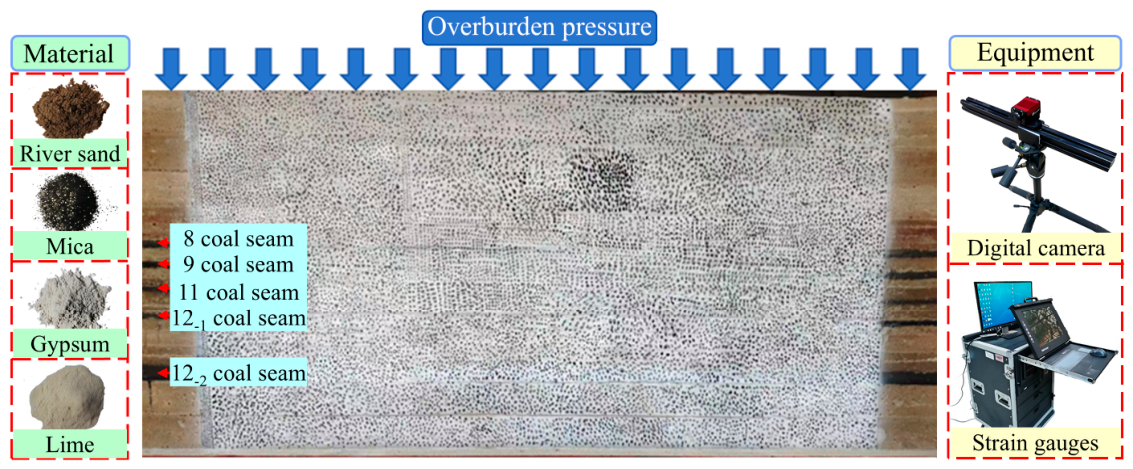
- The selection and proportioning of similar materials were determined. Similar materials mainly included river sand, lime, gypsum, and mica flakes. River sand was used as aggregate, gypsum and lime were used as bonding materials, and mica flakes were used as separation materials between rock layers. Black ink was added to simulate coal seams. Based on the physical and mechanical parameters and similar conditions of each rock layer, the ratio of coal seam physical similarity testing materials with different rock characteristics was determined. The proportioning scheme of the physical similarity model is shown in Table 1.
- (1)
- The quality of the speckle field directly determined the calculation accuracy of DIC. After the surface of the model was uniformly coated with white matte primer, black scattered spots of different sizes were randomly drawn manually. The speckle diameter was strictly controlled within 2 to 5 pixels to ensure optimal gradient identification by the software subset. To accurately capture the development of cracks and deformation of tunnels, speckle refinement was carried out in the expected fracture and strong disturbance areas to ensure high contrast and randomness of the grayscale distribution.
- (2)
- To eliminate testing errors caused by changes in natural lighting angles, the experiment was conducted in a dark room environment. Two sets of high-brightness photography lights were used for symmetrical supplementary lighting to ensure a uniform and shadow-free light field on the surface of the model. The high-definition digital camera continuously tracked and captured the experimental process at a fixed frequency of once every 5 s.
- (3)
- Due to the limitations of the camera field of view and the influence of boundary effects, the model’s surroundings were excluded, resulting in an effective full field monitoring area of 2000 mm × 1000 mm.
2.3. Excavation Procedure
3. Results and Analysis
3.1. Characteristics of Overlying Strata Fractures and Displacements
3.1.1. 8 Coal Seam Mining
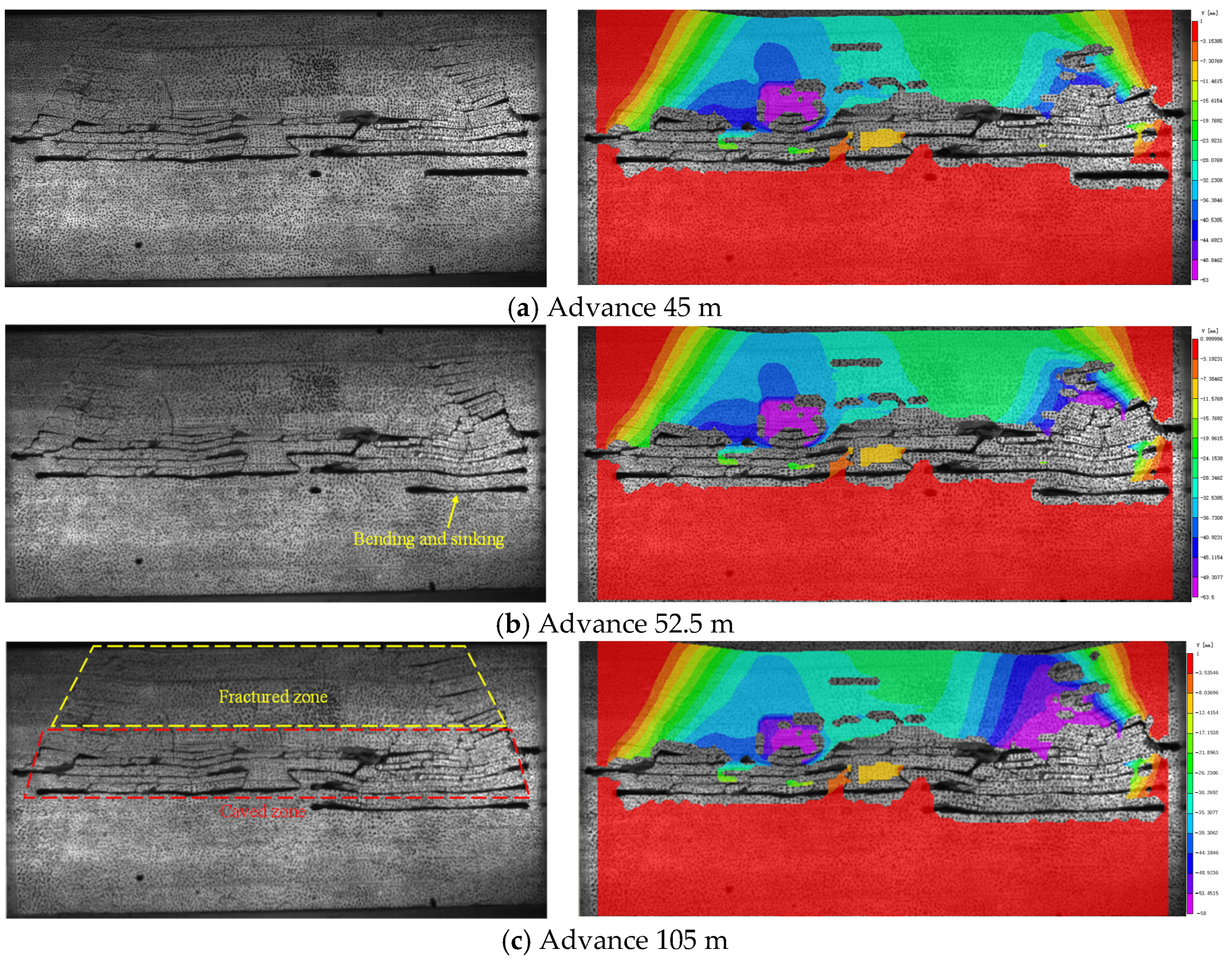
3.1.2. 9 Coal Seam Mining
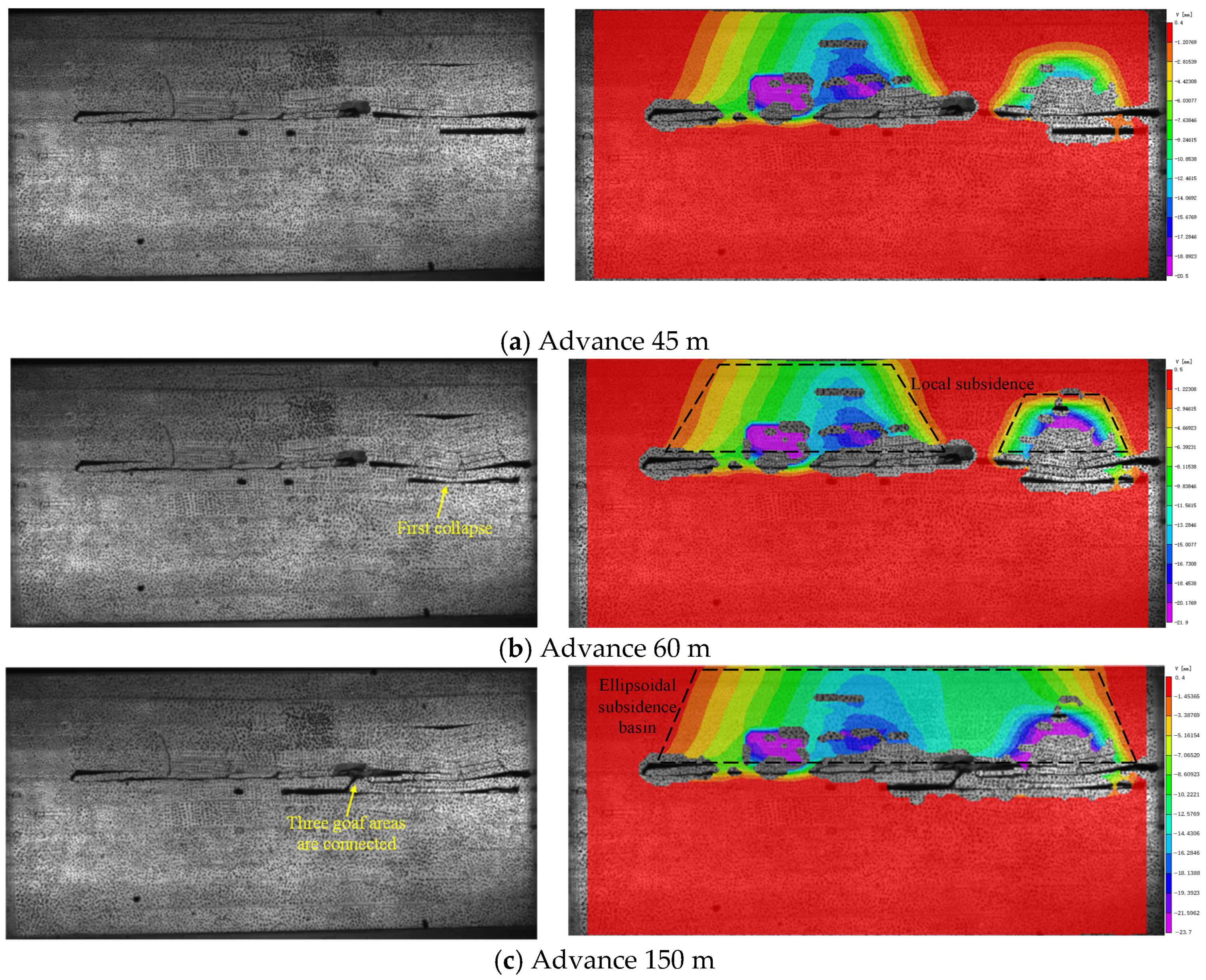
3.1.3. 11 Coal Seam and 12−1 Coal Seam Mining
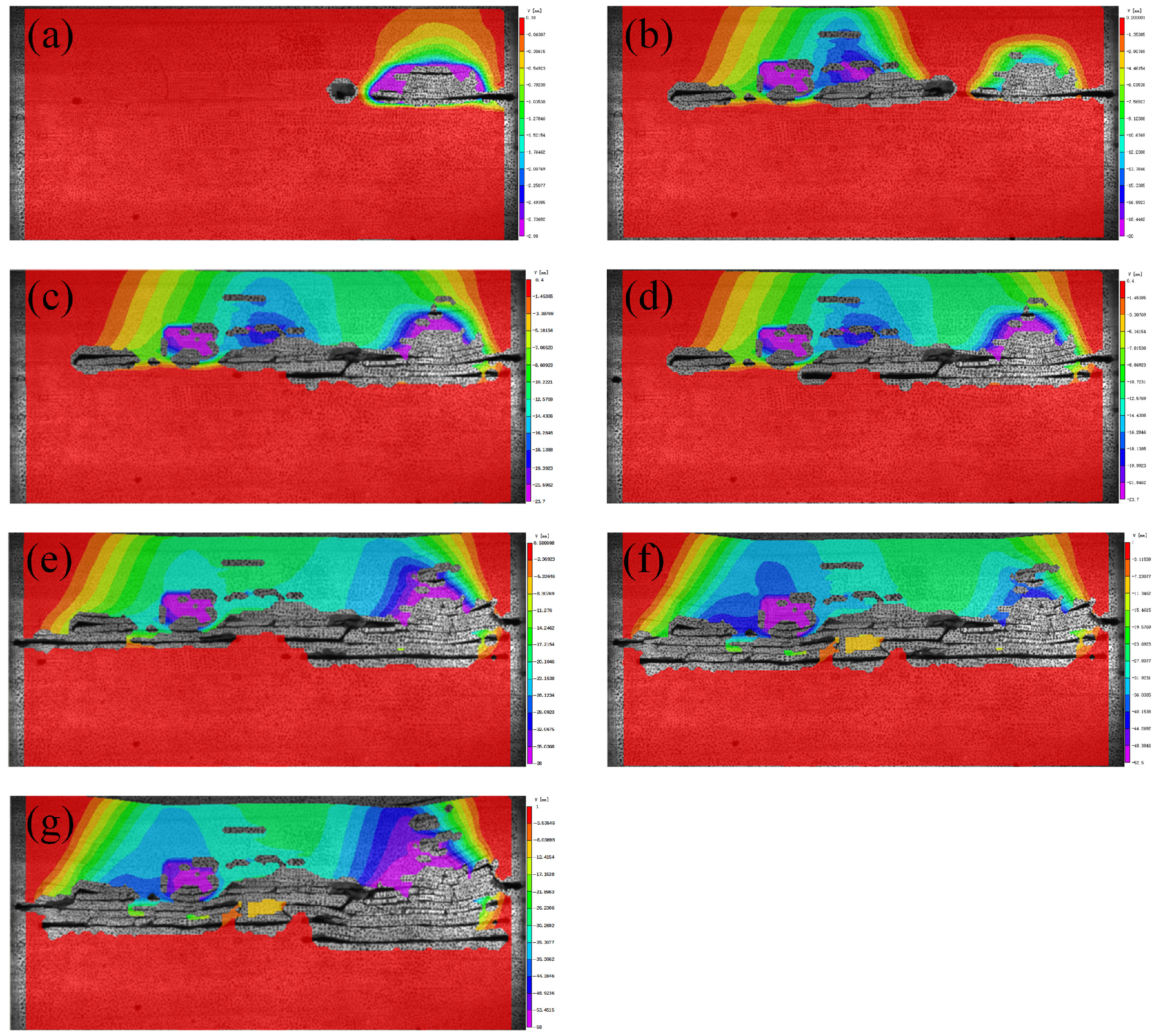
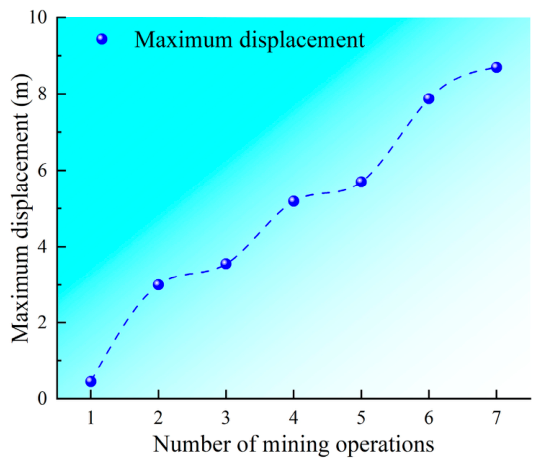
3.2. The Displacement Evolution Characteristics of Overlying Strata
3.3. Evolution Characteristics of the Fractal Dimension of the Fracture Network
4. Discussion
4.1. Instability Mechanisms of Overlying Strata in Close-Distance Coal Seam Groups Mining
4.2. Differentiated Disaster Prevention and Control Strategies
5. Conclusions
- (1)
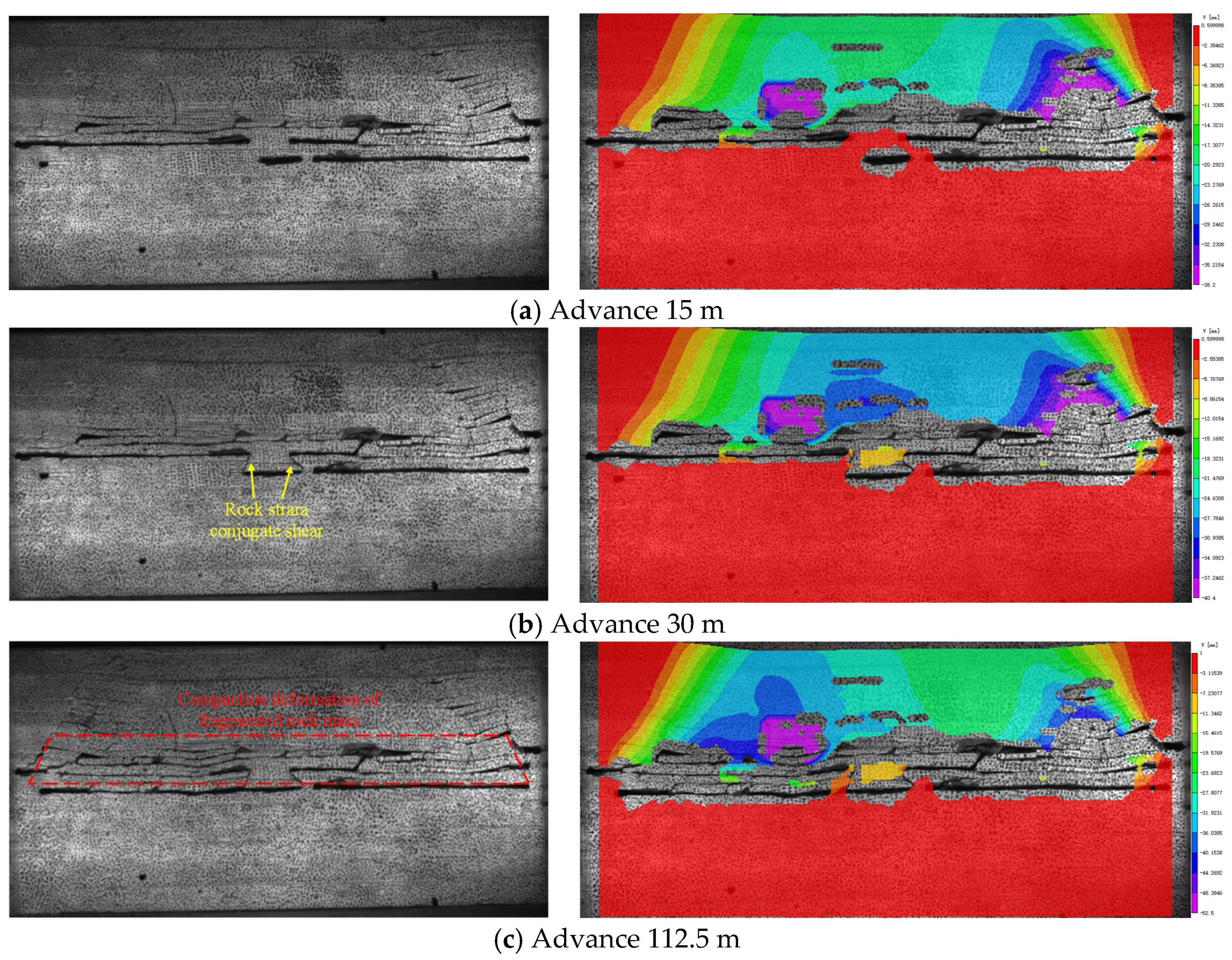
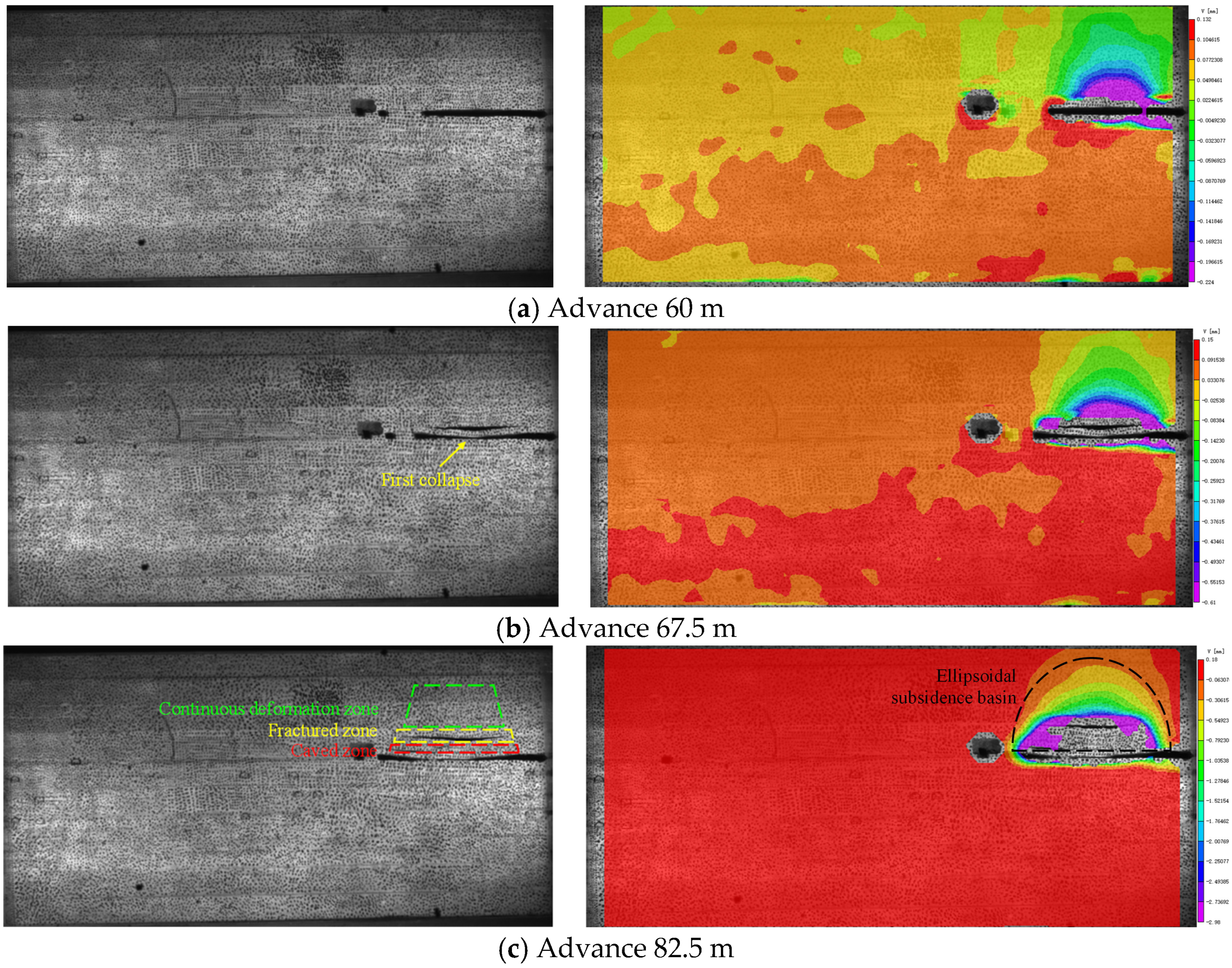
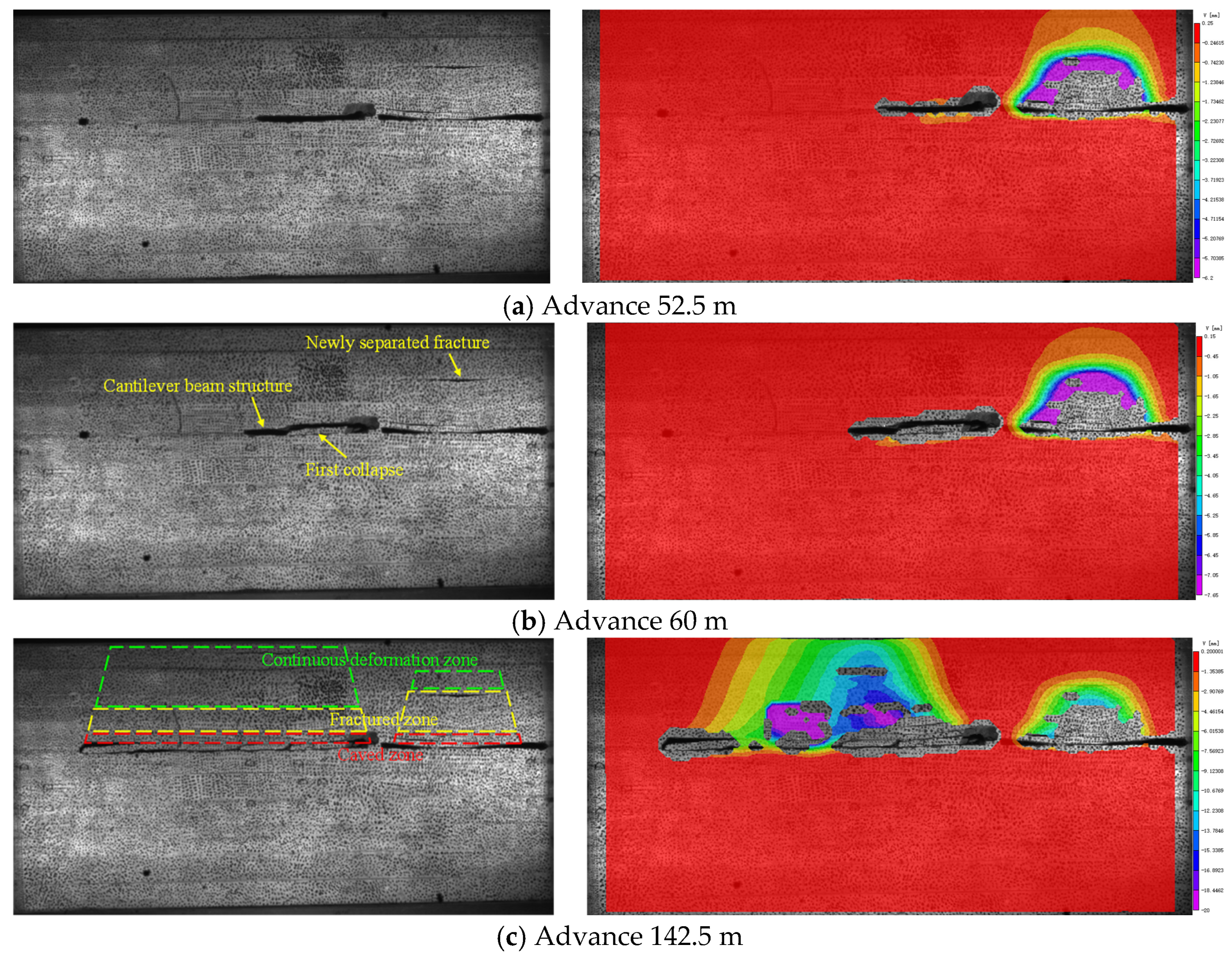
- The evolutionary mechanism of the overlying strata structure in close-distance coal seam groups was revealed. The mining of the upper coal seam causes damage to the lower rock mass, weakening the structural stability of the lower coal seam, which resulted in an 11.1% reduction in the initial collapse step distance of the 9 coal seam compared to the 8 coal seam. Furthermore, the downward mining triggers the secondary activation of the upper goafs. After multiple mining disturbances, the interlayer rock structure is significantly crushed, transforming the classic vertical three-zone structure into a composite trapezoidal failure zone, while the interlayer rock evolves from a rigid load-bearing beam to a loose buffer layer.
- (2)
- The subsidence displacement of the overlying strata exhibits a step-like nonlinear growth characteristic. Driven by structural instability rather than simple linear superposition, the maximum subsidence displacement increased dramatically from an initial 0.44 m to a final state of 8.70 m. The change in maximum subsidence displacement is closely related to changes in rock structure. There are three significant increases in subsidence displacement, and the reasons for the increases are different.
- (3)
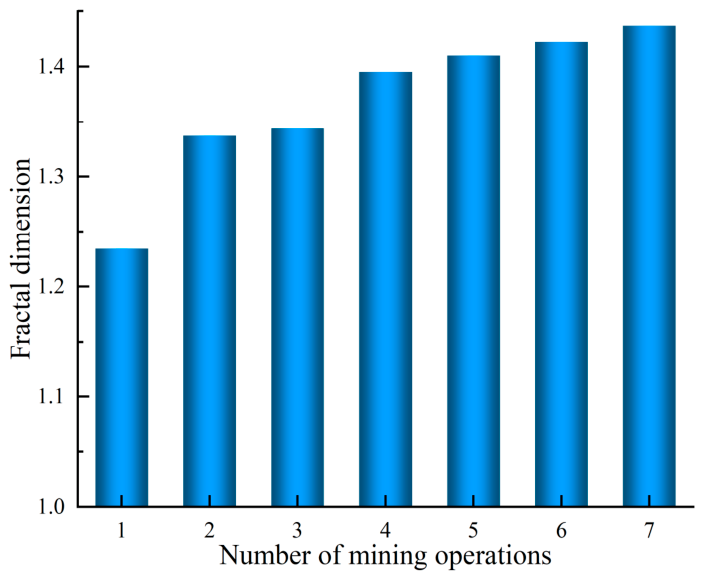
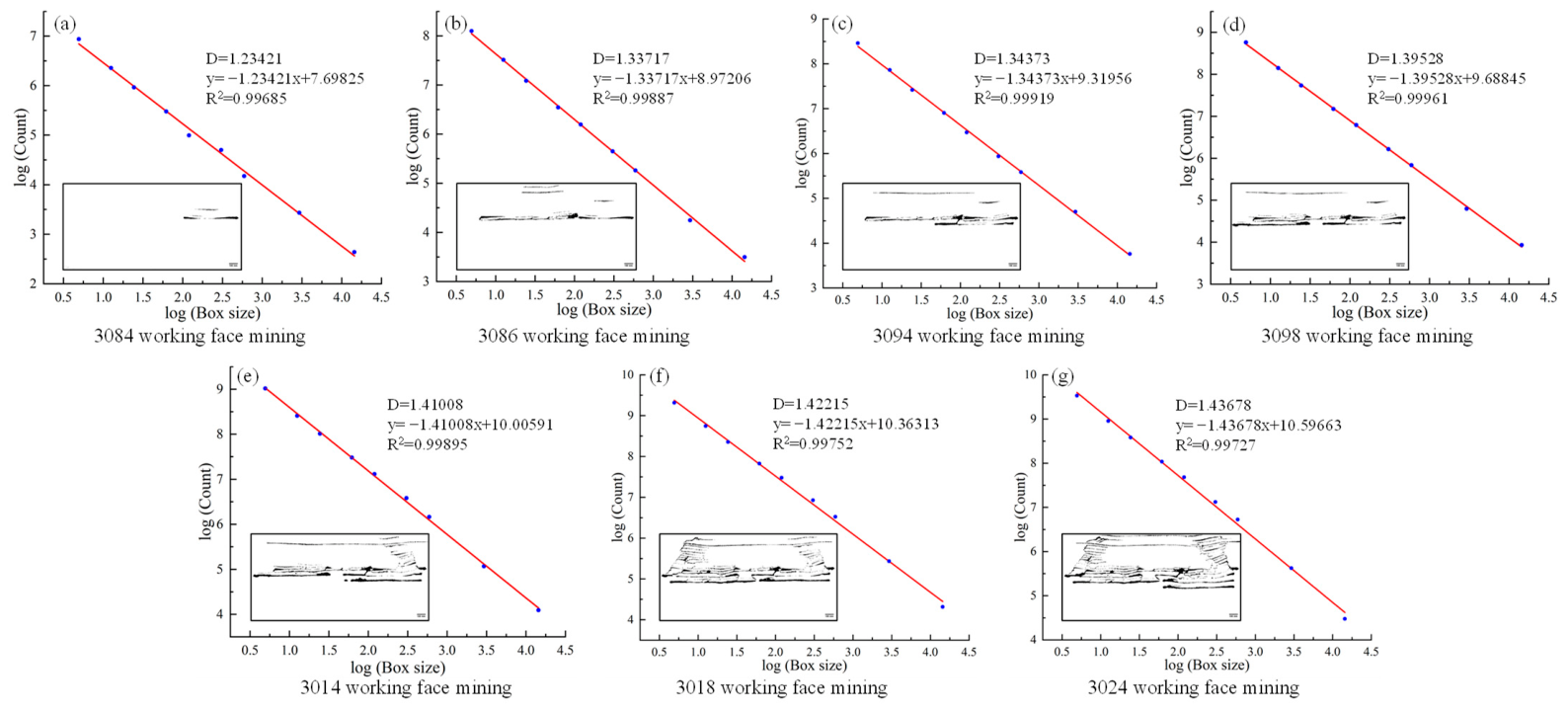
- The topological evolution of the fracture network was quantitatively captured. The fractal dimension of the fracture network showed an overall nonlinear increasing trend, rising from 1.234 to a stabilized 1.437. This evolution was characterized by two significant surges with growth rates of 8.34% and 3.79%, which were triggered by the connectivity of the goaf in the same coal seam and the connectivity of the upper and lower goafs, respectively. The fractal dimension eventually stabilized because the overlying strata became highly fragmented, transitioning the movement into sliding between fragments and the compaction of loose particles.
- (4)
- A differentiated interlayer support strategy for close-distance coal seam groups was proposed. Based on the damage evolution, the support design must be differentiated. For the upper coal seams, a high pre-tension and high-strength constant-resistance large-deformation support system should be applied to resist dynamic impacts and shear forces. Conversely, for the lower coal seams, a pressure-relief and flexible yielding support strategy must be adopted to accommodate the massive static pressure settlement. These differentiated strategies provide significant industrial usefulness and practical guidance for safe and cost-effective disaster prevention in close-distance coal seam groups mining operations globally.
Author Contributions
Funding
Data Availability Statement
Conflicts of Interest
References
- Xie, H.P.; Ren, S.H.; Xie, Y.C.; Jiao, X.M. Development opportunities of the coal industry towards the goal of carbon neutrality. J. China Coal Soc. 2021, 46, 2197–2211. [Google Scholar]
- Sun, Y.Z.; Wen, G.H.; Dai, H.F.; Feng, Y.; Azaele, S.; Lin, W.; Zhou, F.B. Quantifying the resilience of coal energy supply in china toward carbon neutrality. Research 2024, 7, 398. [Google Scholar] [CrossRef] [PubMed]
- Kang, H.P.; Xu, G.; Wang, B.; Wu, Y.Z.; Jiang, P.F.; Pan, J.F.; Ren, H.W.; Zhang, Y.J.; Pang, Y.H. Forty years development and prospects of underground coal mining and strata control technologies in China. Int. J. Min. Sci. Technol. 2019, 29, 7–28. [Google Scholar]
- Yuan, L. Strategic thinking of simultaneous exploitation of coal and gas in deep mining. J. China Coal Soc. 2016, 41, 1–6. [Google Scholar]
- Li, Y.L.; Zhang, S.; Yang, R.S.; Shi, S.Y. Investigation into the stress corrosion behavior of cable bolts under different tensile stresses. Tunn. Undergr. Space Technol. 2026, 171, 107452. [Google Scholar] [CrossRef]
- Feng, J.W.; Wang, W.M.; Wang, Z.; Lou, F.; Wang, H.Z.; Wu, R.; Jia, Y.Y.; Yong, M.C. Study on the mechanism and control of strong rock pressure in thick coal seam mining under the goaf of very close multiple coal seams. Processes 2023, 11, 1320. [Google Scholar] [CrossRef]
- Wang, Y.C.; Wu, G.Y.; Kong, D.Z.; Zhang, Q. Study on the destabilization and deformation breakage characteristics of the mine roof under repetitive mining of close coal seam group. Comput. Part. Mech. 2024, 11, 1503–1516. [Google Scholar] [CrossRef]
- Wu, X.Y.; Wu, X.W.; Zhang, N. Analysis of the location of a lower coal seam roadway under multiple stress disturbances in a close coal seam. Sci. Rep. 2025, 15, 22504. [Google Scholar] [CrossRef]
- Singh, A.K.; Singh, R.; Maiti, J.; Kumar, R.; Mandal, P.K. Assessment of mining induced stress development over coal pillars during the extraction of a thick coal seam. Int. J. Rock Mech. Min. Sci. 2011, 48, 805–818. [Google Scholar] [CrossRef]
- Qian, M.G.; Miao, X.X.; He, F.L. Analysis of key block in the structure of voussoir beam in longwall mining. J. China Coal Soc. 1994, 19, 557–563. [Google Scholar]
- Peng, S.S. Coal Mine Ground Control, 3rd ed.; Syd S. Peng: Morgantown, WV, USA, 2008; pp. 88–125. [Google Scholar]
- Xu, J.L.; Zhu, W.B.; Wang, X.Z. New method to predict the height of fractured water-conducting zone by location of key strata. J. China Coal Soc. 2012, 37, 762–769. [Google Scholar]
- Mark, C.; Chase, F.E.; Pappas, D.M. Analysis of multiple seam stability. In Proceedings of the 26th International Conference on Ground Control in Mining, Morgantown, WV, USA, 31 July–2 August 2007; West Virginia University: Morgantown, WV, USA, 2007; pp. 5–18. [Google Scholar]
- Suchowerska, A.M.; Carter, J.P.; Merifield, R.S. Vertical stress changes in multi-seam mining under supercritical longwall panels. Int. J. Rock Mech. Min. Sci. 2013, 61, 306–320. [Google Scholar]
- Zhang, P.; Tulu, I.B.; Sears, M.; Trackemas, J. Geotechnical considerations for concurrent pillar recovery in close-distance multiple seams. Int. J. Min. Sci. Technol. 2018, 28, 21–27. [Google Scholar] [CrossRef]
- Das, A.J.; Mandal, P.K.; Prakash, A.; Roy, L.B.; Tewari, S. Underground extraction methodology of contiguous coal seams ensuring the safety of the parting and the surface structures. Saf. Sci. 2020, 121, 215–230. [Google Scholar] [CrossRef]
- Suchowerska Iwanec, A.M.; Carter, J.P.; Hambleton, J.P. Geomechanics of subsidence above single and multi-seam coal mining. J. Rock Mech. Geotech. Eng. 2016, 8, 304–313. [Google Scholar] [CrossRef]
- Pongpanya, P.; Sasaoka, T.; Shimada, H. Prediction of multi-seam mining-induced surface subsidence in underground coal mine in Indonesia. ASEAN Eng. J. 2022, 12, 169–183. [Google Scholar] [CrossRef]
- Ning, J.G.; Wang, J.; Tan, Y.L.; Xu, Q. Mechanical mechanism of overlying strata breaking and development of fractured zone during close-distance coal seam group mining. Int. J. Min. Sci. Technol. 2020, 30, 207–215. [Google Scholar] [CrossRef]
- Tan, Y.L.; Li, X.B.; Liu, X.S.; Fan, D.Y.; Song, S.L.; Zhang, Y.; Song, H. Disaster mechanism induced by overburden structure and control techniques for close-distance coal seam group. J. China Coal Soc. 2026, 51, 314–317. [Google Scholar]
- Song, S.L.; Liu, X.S.; Tan, Y.L.; Li, X.B.; Yang, S.L.; Zhang, Y. Failure characteristics and evolution law of overburden structure under repeated mining of close-distance coal seam group in Ningdong mining area. Energy Sci. Eng. 2025, 13, 5627–5644. [Google Scholar]
- Huang, Q.X.; Wei, Y.H.; He, Y.P.; Luo, L.B. Roof structure and strata control theory in shallow coal seam (group) mining. J. China Coal Soc. 2026, 51, 1–12. [Google Scholar]
- Chai, J.; Gao, J.B.; Zhang, D.D.; Ma, Z.; Zhao, W.H.; Yang, X.N.; Zhang, J.Y.; Jiang, L. Research on the mining law of extremely close coal seam groups in a valley terrain. J. Min. Saf. Eng. 2025, 42, 487–496. [Google Scholar]
- Xie, P.S.; Qu, L.L.; Wu, Y.P.; Zhang, Y.Y.; Yan, Z.Z.; Feng, K.; Yang, G.B.; Ji, F. Roof breaking mechanism of longwall stope with steeply dipping contugous coal seam group. Coal Sci. Technol. 2022, 50, 65–74. [Google Scholar]
- Jia, H.S.; Zhang, Z.M.; Liu, S.W.; Peng, B.; Yu, H.; Shao, S.Q.; Wang, Y.B. Research on dissimilation characteristics and control method of failure of surrounding rock in the roadway with repeated mining of steep and ultra-close multiple coal seam. Coal Sci. Technol. 2025, 53, 68–80. [Google Scholar]
- Miao, K.J.; Tu, S.H.; Tu, H.S.; Tang, L.; Zhao, H.B.; Guo, B.H.; Lv, K.; Ma, Y.H. Study on reasonable position of mining roadway under repeated mining overburden structure in shallow buried close distance coal seam: A case study. Sci. Rep. 2026, 16, 6440. [Google Scholar] [CrossRef] [PubMed]
- Yu, S.; Suo, Y.L.; Cai, C.H.; Feng, J.; Huo, X.Q.; Hu, J.; Ren, J.X. Failure mechanism of surrounding rock and synergistic control of strong support-strong pressure relief for lower-seam roadways in close-distance coal seam groups. Sci. Rep. 2026, 16, 7895. [Google Scholar] [CrossRef] [PubMed]
- Miao, Y.P. Study on the failure law of overlying rock under coal seam in close distance coal seam and feasibility discrimination of upward mining. Sci. Rep. 2025, 15, 40924. [Google Scholar] [CrossRef]
- Wu, Q.Y.; Guo, Z.W.; Zhai, H.L.; Wang, J.W.; Zhang, M.J.; Chi, B.S.; Wang, E.Y.; Guo, S.Q. Physical simulation on spatial distribution of void fraction in overburden due to repeated mining in North Shaanxi Mining Area. Coal Sci. Technol. 2022, 50, 105–111. [Google Scholar]
- Ju, J.F.; Xu, J.L. Structural characteristics of key strata and strata behaviour of a fully mechanized face with 7.0 m height chocks. Int. J. Rock Mech. Min. Sci. 2013, 58, 46–54. [Google Scholar] [CrossRef]
- Shabanimashcool, M.; Li, C.C. Analytical approaches for studying the stability of laminated roof strata. Int. J. Rock Mech. Min. Sci. 2015, 79, 99–108. [Google Scholar] [CrossRef]
- Li, S.C.; Wang, Q.; Wang, H.T.; Jiang, B.; Wang, D.C.; Zhang, B.; Li, Y.; Ruan, G.Q. Model test study on surrounding rock deformation and failure mechanisms of deep roadways with thick top coal. Tunn. Undergr. Space Technol. 2015, 47, 52–63. [Google Scholar] [CrossRef]
- Sutton, M.A.; Orteu, J.J.; Schreier, H. Image Correlation for Shape, Motion and Deformation Measurements: Basic Concepts, Theory and Applications, 1st ed.; Springer: New York, NY, USA, 2009; pp. 1–32. [Google Scholar]
- Xie, H.P. Fractals in Rock Mechanics, 1st ed.; A.A. Balkema: Rotterdam, The Netherlands, 1993; pp. 88–105. [Google Scholar]
- Zhang, X.; Zou, J. Research on collaborative control technology of coal spontaneous combustion and gas coupling disaster in goaf based on dynamic isolation. Fuel 2022, 321, 124123. [Google Scholar] [CrossRef]
- Xiong, Y.; Kong, D.; Cheng, Z.; Wen, Z.; Ma, Z.; Wu, G.; Liu, Y. Instability control of roadway surrounding rock in close-distance coal seam groups under repeated mining. Energies 2021, 14, 5193. [Google Scholar] [CrossRef]
- Shang, Y.; Kong, D.; Pu, S.; Xiong, Y.; Li, Q.; Cheng, Z. Study on failure characteristics and control technology of roadway surrounding rock under repeated mining in close-distance coal seam. Mathematics 2022, 10, 2166. [Google Scholar] [CrossRef]
- Cantieni, L.; Anagnostou, G. The effect of the stress path on squeezing behavior in tunneling. Rock Mech. Rock Eng. 2009, 42, 289–318. [Google Scholar] [CrossRef]
- Zhou, J.; Lou, J.; Wei, J.; Dai, F.; Chen, J.; Zhang, M. A 3D microseismic data-driven damage model for jointed rock mass under hydro-mechanical coupling conditions and its application. J. Rock Mech. Geotech. Eng. 2023, 15, 911–925. [Google Scholar] [CrossRef]
- Lu, J.; Jiang, C.; Jin, Z.; Wang, W.; Zhuang, W.; Yu, H. Three-dimensional physical model experiment of mining-induced deformation and failure characteristics of roof and floor in deep underground coal seams. Process Saf. Environ. Prot. 2021, 150, 400–415. [Google Scholar] [CrossRef]
- Coutinho, C.P.; Baptista, A.J.; Dias Rodrigues, J. Reduced scale models based on similitude theory: A review up to 2015. Eng. Struct. 2016, 119, 81–94. [Google Scholar] [CrossRef]
- Zhang, H.; Guo, G.; Li, H.; Wang, T.; Ni, J.; Meng, H. A new numerical method for calculating residual deformation in mined-out areas considering water–rock interaction and its application. Sci. Rep. 2025, 15, 11207. [Google Scholar] [CrossRef]
- Zhao, Y.; Yang, T.; Hou, J.; Jeon, S.; Zhang, P.; Wang, S.; Jia, P.; Zhao, Q. A new rock fracture reconstruction method under the constraints of microseismic location and focal mechanism. Int. J. Rock Mech. Min. Sci. 2023, 170, 105493. [Google Scholar] [CrossRef]
- Ma, K.; Tang, C.A.; Wang, L.X.; Tang, D.H.; Zhuang, D.Y.; Zhang, Q.B.; Zhao, J. Stability analysis of underground oil storage caverns by an integrated numerical and microseismic monitoring approach. Tunn. Undergr. Space Technol. 2016, 54, 81–91. [Google Scholar] [CrossRef]
- Ju, Y.; Wang, Y.; Su, C.; Zhang, D.; Ren, Z. Numerical analysis of the dynamic evolution of mining-induced stresses and fractures in multilayered rock strata using continuum-based discrete element methods. Int. J. Rock Mech. Min. Sci. 2019, 113, 191–210. [Google Scholar] [CrossRef]
- Scholtès, L.; Donzé, F. Modelling progressive failure in fractured rock masses using a 3D discrete element method. Int. J. Rock Mech. Min. Sci. 2012, 52, 18–30. [Google Scholar] [CrossRef]






| Serial Number | Rock Character | Buried Depth/m | Thickness/m | Model Thickness/cm | Material Quality/kg | ||
|---|---|---|---|---|---|---|---|
| River Sand | Lime | Gypsum | |||||
| 25 | Siltstone | 480.80 | 16.50 | 11.00 | 213 | 13.3 | 13.3 |
| 24 | Fine sandstone | 497.30 | 19.50 | 13.00 | 254.7 | 14.2 | 14.2 |
| 23 | Siltstone | 516.80 | 18.00 | 12.00 | 235 | 13 | 13 |
| 22 | Fine sandstone | 534.80 | 12.00 | 8.00 | 156.6 | 8.7 | 8.7 |
| 21 | Siltstone | 546.80 | 4.50 | 3.00 | 58.5 | 3.25 | 3.25 |
| 20 | Fine sandstone | 551.30 | 5.85 | 3.90 | 76.5 | 4.8 | 4.8 |
| 19 | Siltstone | 557.15 | 7.70 | 5.10 | 99 | 5.5 | 5.5 |
| 18 | Claystone | 564.85 | 7.80 | 5.20 | 56 | 24.9 | 31.1 |
| 17 | Fine sandstone | 572.65 | 6.45 | 4.30 | 82.7 | 5.2 | 5.2 |
| 16 | 8 coal seam | 579.10 | 3.60 | 2.40 | 46.8 | 3.1 | 2.1 |
| 15 | Siltstone | 582.70 | 6.00 | 4.00 | 76.5 | 4.8 | 4.8 |
| 14 | 9 coal seam | 588.70 | 2.60 | 1.70 | 33.3 | 2.2 | 1.5 |
| 13 | Fine sandstone | 591.30 | 4.00 | 2.60 | 49.8 | 3.1 | 3.1 |
| 12 | Siltstone | 595.30 | 4.70 | 3.10 | 60.3 | 3.35 | 3.35 |
| 11 | 11 coal seam | 600.00 | 1.80 | 1.20 | 23.4 | 1.6 | 1 |
| 10 | Fine sandstone | 601.80 | 3.30 | 2.20 | 44.5 | 2.8 | 2.8 |
| 9 | Siltstone | 605.10 | 6.00 | 4.00 | 77.4 | 4.3 | 4.3 |
| 8 | 12−1 coal seam | 611.10 | 2.40 | 1.60 | 30.4 | 2 | 1.4 |
| 7 | Siltstone | 613.50 | 3.60 | 2.40 | 46.8 | 2.6 | 2.6 |
| 6 | Fine sandstone | 617.10 | 16.80 | 11.20 | 213 | 13.3 | 13.3 |
| 5 | 12−2 coal seam | 633.90 | 4.64 | 3.10 | 90 | 6 | 4 |
| 4 | Siltstone | 638.54 | 10.50 | 7.00 | 137 | 7.6 | 7.6 |
| 3 | Fine sandstone | 649.04 | 19.50 | 13.00 | 254.7 | 14.2 | 14.2 |
| 2 | Siltstone | 668.54 | 15.00 | 10.00 | 196.2 | 10.9 | 10.9 |
| 1 | Fine sandstone | 683.54 | 22.50 | 15.00 | 294 | 16.4 | 16.4 |
Disclaimer/Publisher’s Note: The statements, opinions and data contained in all publications are solely those of the individual author(s) and contributor(s) and not of MDPI and/or the editor(s). MDPI and/or the editor(s) disclaim responsibility for any injury to people or property resulting from any ideas, methods, instructions or products referred to in the content. |
© 2026 by the authors. Licensee MDPI, Basel, Switzerland. This article is an open access article distributed under the terms and conditions of the Creative Commons Attribution (CC BY) license.
Share and Cite
Yang, B.; He, F.; Zhang, S.; Li, Y. Evolution of Overlying Strata and Fracture Networks in Close-Distance Coal Seam Groups Based on DIC and Fractal Theory. Processes 2026, 14, 1852. https://doi.org/10.3390/pr14121852
Yang B, He F, Zhang S, Li Y. Evolution of Overlying Strata and Fracture Networks in Close-Distance Coal Seam Groups Based on DIC and Fractal Theory. Processes. 2026; 14(12):1852. https://doi.org/10.3390/pr14121852
Chicago/Turabian StyleYang, Baogui, Fei He, Sheng Zhang, and Yongliang Li. 2026. "Evolution of Overlying Strata and Fracture Networks in Close-Distance Coal Seam Groups Based on DIC and Fractal Theory" Processes 14, no. 12: 1852. https://doi.org/10.3390/pr14121852
APA StyleYang, B., He, F., Zhang, S., & Li, Y. (2026). Evolution of Overlying Strata and Fracture Networks in Close-Distance Coal Seam Groups Based on DIC and Fractal Theory. Processes, 14(12), 1852. https://doi.org/10.3390/pr14121852