Article

Magnetic Resonance-Based Online Detection Method and Device Concept for Polyacrylamide Concentration in Fracturing Fluids

1
Research Institute of Petroleum Exploration and Development, China National Petroleum Corporation (CNPC), Beijing 100083, China
2
PetroChina Jidong Oilfield Company, Tangshan 063023, China
*
Author to whom correspondence should be addressed.
Processes 2026, 14(11), 1810; https://doi.org/10.3390/pr14111810
Submission received: 7 May 2026 / Revised: 20 May 2026 / Accepted: 27 May 2026 / Published: 2 June 2026

Abstract

Online monitoring of polyacrylamide (PAM) concentration is needed for quality control in continuous fracturing-fluid blending and for closed-loop smart fracturing operations. This study evaluates the feasibility and current limits of an MR-based PAM assay route. Static CPMG-T2 tests on an existing 4.6 MHz magnetic resonance multiphase flowmeter (MRMF) platform showed that T2-based viscosity discrimination is useful when the PAM concentration is above approximately 3‰, but it becomes insufficient in the 1–3‰ low-concentration interval. A 20 MHz laboratory T2-D validation test indicated that the apparent diffusion coefficient responds more clearly to PAM-induced molecular-mobility variation than T2 alone. On this basis, a 23.5 MHz diffusion-capable online detector concept was developed, featuring a permanent-magnet module, a gradient-capable RF probe, compact spectrometer electronics, and a quasi-static bypass sampling process for oilfield installation. The revised interpretation framework combines T1, T2, diffusion coefficient, temperature, signal-quality indicators, repeatability checks, and calibration-domain gating. The present work defines a proof-of-concept route, and the validation requirements for online PAM concentration monitoring; final accuracy, repeatability, RMSE, confidence intervals, and field-calibrated acceptance thresholds must still be determined through controlled loop and field tests.

1. Introduction

Fracturing fluid is a key working medium for fracture propagation, proppant transport, and conductivity maintenance in unconventional oil and gas stimulation. Polyacrylamide (PAM) and its derivatives are widely used as drag reducers, thickeners, or functional polymers in fracturing-fluid systems. Their concentration directly affects viscoelasticity, proppant-carrying capacity, friction reduction, and flowback behavior. In continuous blending and high-rate pumping operations, a concentration deviation from the design value may cause insufficient carrying capacity, unstable treatment quality, or unnecessary chemical consumption. Online measurement of PAM concentration is therefore not only a laboratory analysis issue but also a prerequisite for liquid quality control and closed-loop smart fracturing [1,2,3,4].
At present, PAM concentration in the field is usually obtained by manual sampling followed by laboratory analysis. Typical methods include iodine-starch colorimetry, turbidity measurement, ultraviolet/visible spectroscopy, and indirect viscosity-based estimation. Although these methods are useful in controlled laboratory conditions, their field application is limited by long response time, weak sample representativeness, temperature and salinity effects, bubbles, particles, and shear-history dependence [5,6,7]. These limitations are inconsistent with the need for traceable, near-real-time, and continuous data in transparent wellsite operations.
Compared with iodine-starch colorimetry, turbidity, ultraviolet/visible spectroscopy, and indirect viscosity methods, MR is not expected to be the lowest-cost or simplest laboratory assay. Its value lies in its potential to provide a reagent-free, mobility-based descriptor for opaque, particle-containing, or optically unstable fracturing fluids. Optical methods are convenient for offline reference analysis but are sensitive to sample color, turbidity, bubbles, and optical-path fouling; ultrasound is mechanically simpler but gives an indirect response that is strongly coupled to bubbles, solids, and flow regime. Therefore, the practical question addressed here is not whether MR replaces all reference assays, but whether it can provide a robust online quality-control signal under conditions where conventional online optical or acoustic approaches are difficult to maintain.
MR provides molecular-scale information on hydrogen relaxation and diffusion. It is non-radioactive, non-contact, and sensitive to fluid mobility rather than optical transparency or electrical conductivity [8,9,10]. We previously developed an online MR multiphase-flow detection method and device that combined static phase-holdup measurement with flowing-state velocity measurement. The system integrated a Halbach magnet, dual antenna, spectrometer, electrically controlled valves, and intelligent software, and was successfully tested in oilfield applications [11,12].
The present study is not a direct reuse of the earlier MRMF for PAM concentration measurement. PAM concentration assay is closer to a quasi-static physical measurement than to continuous velocity metering. A representative sample must be temporarily retained in the measurement section, relaxation and diffusion features must be extracted, and these features must then be converted into viscosity and concentration. Low-concentration PAM solutions also differ from oil-water phase identification: the water signal dominates, and the polymer-induced variation in T2 may be small. The central problem is therefore to identify the boundary of the existing low-frequency platform, verify whether diffusion features improve sensitivity, and design a higher-frequency online MR device that can be integrated into a fracturing-fluid flowline.
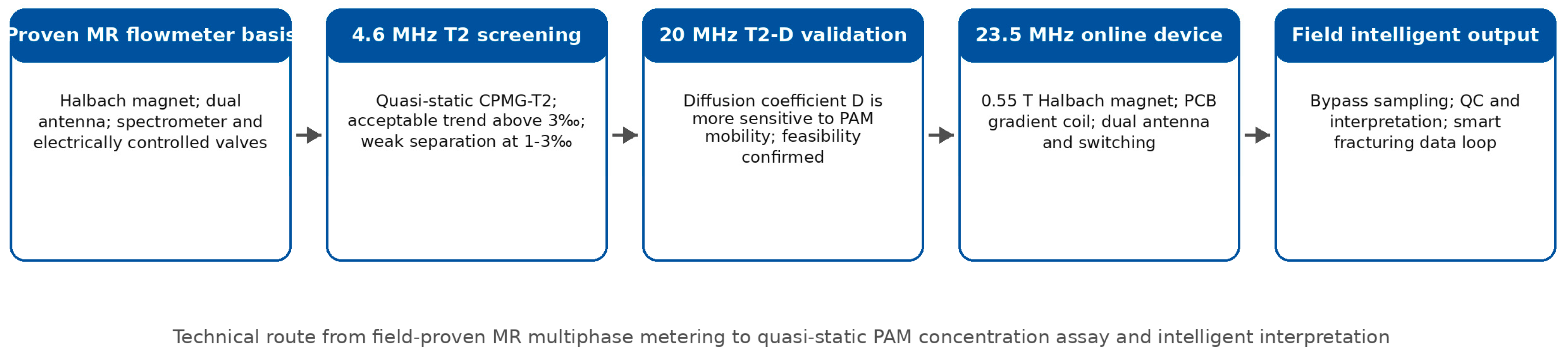
The main contributions are as follows (As shown in Figure 1): (i) the practical measurement boundary of the existing 4.6 MHz MRMF platform is identified for PAM solutions, with explicit recognition that the 1–3‰ interval requires stronger sensitivity and replicate validation; (ii) the added value of diffusion-sensitive 20 MHz T2-D measurements is demonstrated for low-concentration PAM interpretation; and (iii) a 23.5 MHz diffusion-capable detector concept, quasi-static bypass sampling route, and physics-constrained interpretation workflow are presented as a field-oriented development route rather than as a completed field-calibrated instrument.

2. Theory and Interpretation Framework

2.1. MR Signal Formation Relevant to PAM Detection

In a static magnetic field B0, the magnetic moment of a hydrogen nucleus precesses around the field direction. The angular frequency and corresponding resonance frequency are described by the Larmor relationship:
ω0 = γB0
where ω0 is the Larmor angular frequency (rad s−1), γ is the gyromagnetic ratio of hydrogen (rad s−1 T−1), and B0 is the static magnetic flux density (T). The resonance frequency f0 is:
f0 = ω0/(2π) = (γ/2π) B0
where f0 is the resonance frequency (Hz). For hydrogen, γ/2π is approximately 42.577 MHz T−1. A higher resonance frequency generally corresponds to a stronger magnetic field and a larger MR signal amplitude, which benefits low-concentration detection. However, it also imposes stricter requirements on field homogeneity, temperature stability, radio-frequency matching, and explosion-proof integration [8,13,14].

2.2. CPMG Echo Decay and T2 Spectrum Inversion

The Carr–Purcell–Meiboom–Gill (CPMG) sequence is widely used for transverse relaxation measurements in low-field MR. For a single component, the echo amplitude at the nth echo can be expressed as:
M(2nτ) = M0 exp(−2nτ/T2)
where M(2nτ) is the echo amplitude at time 2nτ, M0 is the initial signal amplitude, n is the echo index, τ is the half-echo spacing, and T2 is the transverse relaxation time. For a mixture or a continuous relaxation distribution, the echo signal can be expressed as an integral equation:
M(t) = ∫0^∞ A(T2) exp(−t/T2) dT2 + ε(t)
where M(t) is the echo signal at time t, A(T2) is the relaxation-time distribution, and ε(t) is measurement noise. After discretization, Equation (4) becomes:
M(tk) = Σi=1N Ai exp(−tk/T2,i) + εk
where tk is the kth sampling time, Ai is the signal amplitude of the ith relaxation component, T2,i is the corresponding transverse relaxation time, N is the number of discrete components, and εk is the noise term. The T2 spectrum can be estimated using non-negative regularized inversion, such as CONTIN-type algorithms [15].

2.3. Diffusion, Temperature, and Concentration Estimation

Only the relations directly used in the PAM interpretation route are retained here. In the low-concentration region, the polymer-induced change in T1 and T2 can be comparable to temperature drift, baseline noise, and sample-history effects. Temperature is therefore treated as a measured correction variable, and diffusion is retained as the primary additional descriptor of molecular mobility.
For a pulsed-field-gradient or diffusion-edited measurement, diffusion introduces an additional attenuation:
S(b) = S0 exp(−bD)
where S(b) is the diffusion-weighted signal, S0 is the signal without diffusion weighting, b is the diffusion-weighting factor (s m−2), and D is the self-diffusion or apparent diffusion coefficient (m2 s−1). For a pulsed-gradient spin-echo measurement, b can be written as:
b = gamma2 g2 delta2 (Delta − delta/3)
where g is the gradient strength (T m−1), delta is the gradient-pulse duration (s), and Delta is the diffusion time (s). The diffusion coefficient is related to solution viscosity through the Stokes–Einstein relationship [16]:
D = kB T/(6 pi eta rh)
where kB is the Boltzmann constant, T is the thermodynamic temperature (K), eta is the dynamic viscosity (Pa s), and rh is the effective hydrodynamic radius (m). For dilute polymer solutions, viscosity and concentration may be related by the Huggins equation [17]:
eta_sp/C = [eta] + kH [eta]2 C
where eta_sp is the specific viscosity, C is the polymer concentration, [eta] is the intrinsic viscosity, and kH is the Huggins coefficient. In field fracturing fluids, salinity, polymer molecular weight, hydrolysis degree, temperature, and shear history alter this relationship; the final concentration model must therefore combine physical constraints with calibration data rather than rely on a single theoretical equation.

2.4. Physics-Constrained Multi-Parameter Interpretation Framework

For low-concentration PAM detection, the main difficulty is maintaining sensitivity and reliability when the water signal dominates, the target concentration range is narrow, and field disturbances are unavoidable. The physics-constrained multi-parameter interpretation framework is therefore implemented as a gated workflow rather than as an unconstrained black-box regression.
SNRN = SNR1 Ns1/2 eta_pc eta_f
where SNRN is the SNR after Ns repeated scans, SNR1 is the single-scan SNR, ηpc is the gain factor introduced by phase cycling or compensation-style accumulation, and ηf is the gain factor of filtering or matched reconstruction. Increasing Ns improves SNR but also increases measurement time. The first step of the interpretation procedure is therefore signal acquisition with explicit quality control, rather than unconditional averaging.
tcycle = tsample + tT1 + tT2 + tD + tproc + tpurge
The cycle time of one online assay is explicitly controlled by Equation (11), where tcycle is the total single-assay time, tsample is the sampling and valve-stabilization time, tT1, tT2, and tD are the acquisition times for T1, T2, and diffusion measurements, tproc is the processing time, and tpurge is the flushing or sample-release time.
The concentration estimate can then be written as a physics-constrained mapping only after signal quality and acquisition mode have been determined:
C_hat = Ftheta(T, T1, T2, D, A0, SNR, sigma_rep, Q)
where C_hat is the estimated PAM concentration, Ftheta is a calibrated interpretation model with parameters theta, T is temperature, A0 is the initial MR signal amplitude, SNR is the signal-to-noise ratio, sigma_rep is the repeated-measurement variance, and Q is a data-quality flag vector. In calibration, the sensitivity coefficients such as partial D/partial C and partial T2/partial C should be estimated from replicate samples, and samples whose feature response is smaller than the combined uncertainty should be classified as below the reliable discrimination boundary [18].
C_hat = mu_C +/− z_alpha sigma_C
where mu_C is the mean concentration estimate, sigma_C is the estimated standard deviation, and z_alpha is the coverage coefficient for the desired confidence level. This uncertainty term is used to decide whether the result should be released directly, repeated, or rejected.
Accept = I(qSNR and qrep and qT and qC)
where I is an indicator function; qSNR denotes SNR ≥ SNRmin, qrep denotes sigma_rep ≤ sigma_max, qT denotes Tmin ≤ T ≤ Tmax, and qC denotes Cmin ≤ C_hat ≤ Cmax. These thresholds are calibration-domain quantities, not assumed constants. They should be selected from replicate calibration data by requiring acceptable accuracy, repeatability, RMSE, and confidence interval coverage before field deployment.
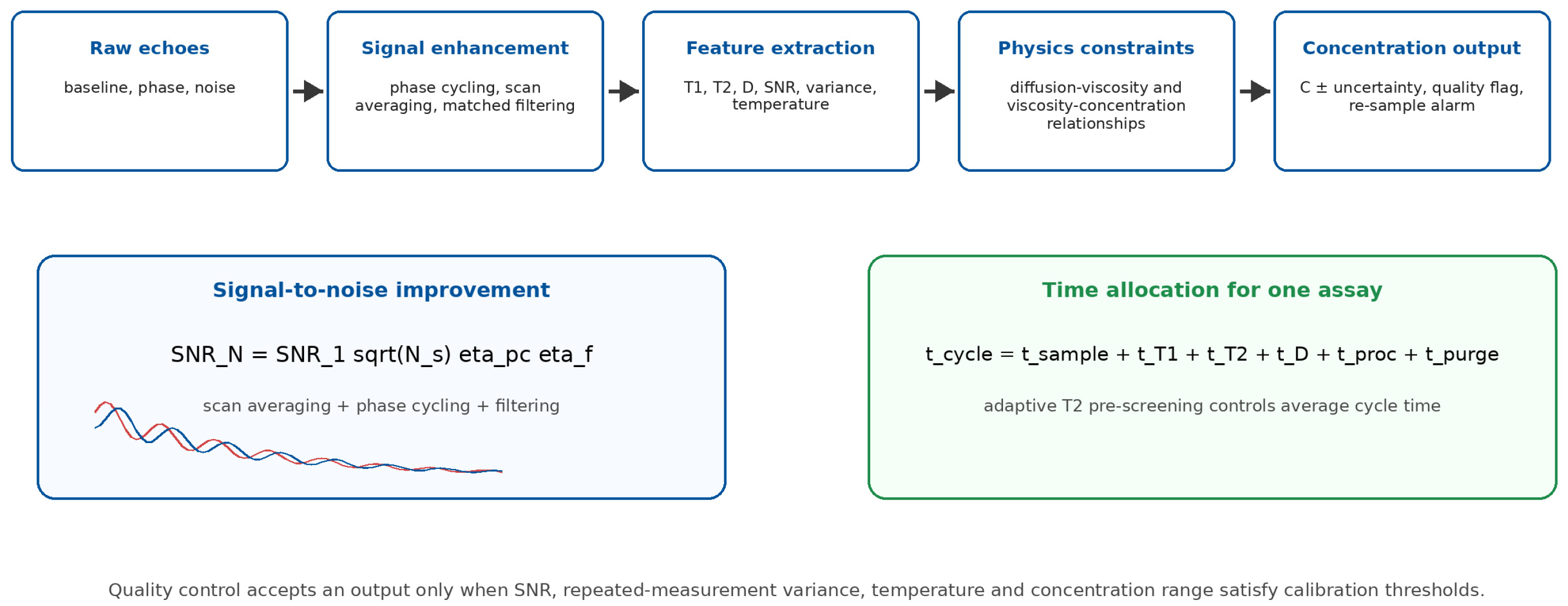
Operationally, the workflow (Figure 2) uses a short T2 scan as a pre-screening step, triggers diffusion acquisition when the sample falls near the low-concentration boundary or when the quality flag is poor, applies temperature- and calibration-domain corrections, and then reports the concentration with an uncertainty or rejection flag. This implementation makes the framework testable and prevents unsupported output under invalid field conditions.

3. Materials and Methods

3.1. PAM Samples and Existing MR Flowmeter Platform

A total of 31 PAM solution samples were used in the preliminary study, with nominal mass-fraction concentrations covering approximately 0.05% to 1.5% (0.5–15‰). The low-concentration interval emphasized in this paper is 1–3‰, which is closer to typical slickwater or low-viscosity fracturing-fluid service than to high-viscosity gel systems. The samples were collected and prepared for device-feasibility screening rather than for a final metrological calibration; therefore, the present dataset is used to identify MR feature trends and sensitivity boundaries, not to claim field-grade accuracy.
To improve reproducibility, the calibration protocol was clarified. Each future calibration sample should record PAM grade, molecular-weight range, hydrolysis degree, stock-solution preparation route, dissolution and hydration time, stirring condition, dilution sequence, salinity, temperature, shear history, and the reference viscosity or reference chemical-assay method. Replicate preparation and replicate MR acquisition are required before accuracy, repeatability, sensitivity coefficient, RMSE, and confidence interval can be reported.
The existing magnetic resonance multiphase flowmeter (MRMF) platform was originally designed for oil–gas–water multiphase-flow metering. The instrument was developed by the Research Institute of Petroleum Exploration and Development (RIPED), PetroChina, Beijing, China. The system consists of a 4.6 MHz Halbach permanent magnet assembly, RF probe, compact spectrometer, electrically controlled valves, and dedicated acquisition software (MRMF Control Software, internal development, RIPED, Beijing, China). It integrates a permanent magnet, an MR probe, a compact spectrometer, control software, and electrically controlled valves. In the present study, its static measurement capability was used to perform CPMG-T2 tests on PAM solutions. The main reported parameters were a waiting time of 6000 ms, echo spacing of 200 us, 120,000 echoes, 8 scans, and a working frequency of approximately 4.60 MHz. Reference viscosity was used as an external comparison indicator; future calibration should pair each MR record with replicate viscosity or chemical-assay results measured under the same temperature and shear conditions.

3.2. 20 MHz Laboratory T2-D Validation

A 20 MHz laboratory magnetic resonance system developed by Beijing Limecho Technology Co., Ltd. (Beijing, China) was used to acquire two-dimensional T2-D spectra. The purpose was not to replace the field device, but to verify whether increasing the resonance frequency and introducing diffusion information could improve the discrimination of low-concentration PAM solutions. A diffusion-edited pulse sequence and two-dimensional inversion were used to obtain the apparent diffusion coefficient and its distribution. The diffusion dimension was interpreted alongside T2 to avoid reliance on a single peak position, which is easily affected by temperature drift and baseline noise in water-dominated, low-concentration solutions. Because these tests were sensitivity-validation experiments rather than full calibration tests, the manuscript now avoids reporting unsupported final accuracy indices from this limited dataset. Data processing, diffusion-coefficient extraction, statistical analysis, and figure generation were performed using Python (Version 3.11, Python Software Foundation, Wilmington, DE, USA). The representative MR parameters for the first six PAM samples are listed in Table 1.

3.3. Design Rationale and Physical Implementation of the 23.5 MHz Online Detector

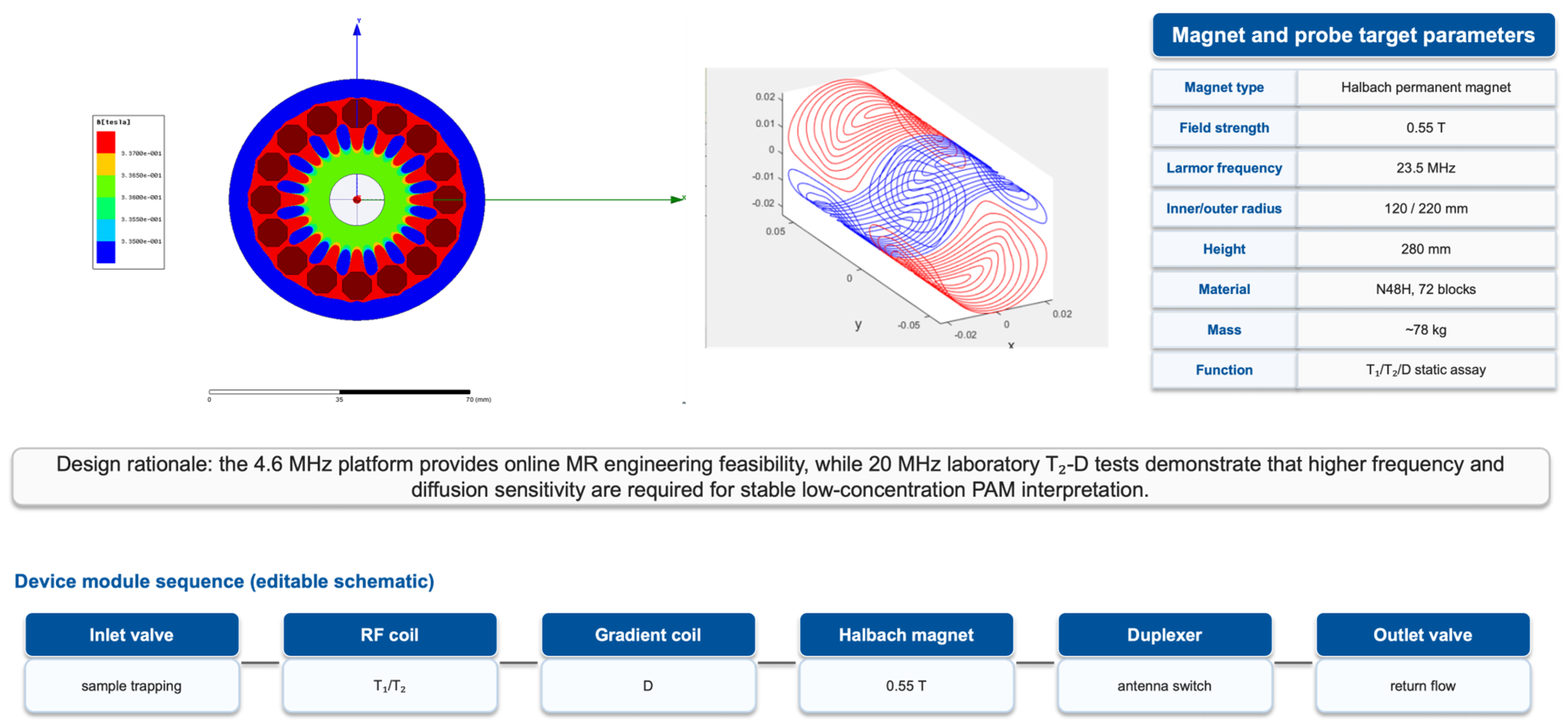
The 4.6 MHz test and 20 MHz validation jointly indicate that field detection of low-concentration PAM requires a stronger magnetic field, improved SNR, and diffusion-capable probing. The 23.5 MHz online detector is therefore described as a design and prototype-development route, not as a fully field-validated industrial instrument. Its key engineering requirements include magnetic-field homogeneity, gradient calibration, RF probe matching, SNR stability, temperature-control precision, and long-term drift verification. The prototype configuration developed from the project progress, including the optimized Halbach magnet, gradient-capable RF coil structure, key design parameters, and functional module sequence, is illustrated in Figure 3.
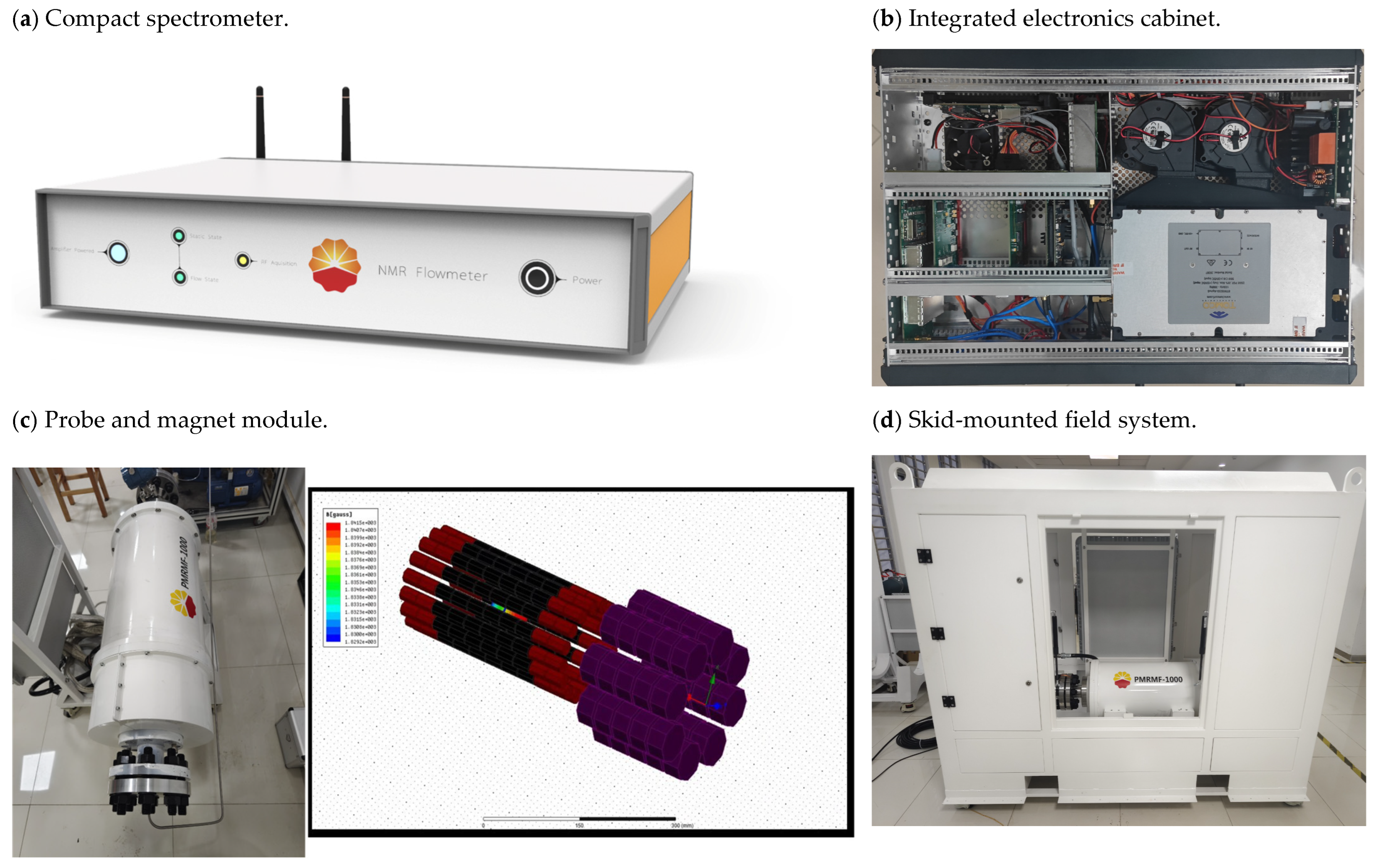
Tailoring to online oilfield requirements is reflected in three concrete choices. First, the measurement route uses a bypass branch and electrically controlled valves so that the main fracturing line remains continuous while a representative sample is temporarily retained in the probe. Second, the flow tube and surrounding structure are intended to be nonmagnetic, corrosion-resistant, and compatible with industrial pipeline installation. Third, the hardware is organized in a skid-mounted form with spectrometer control, power management, and temperature stabilization, which is more consistent with long-duration oilfield service than a laboratory bench-top arrangement. In this sense, the device innovation is not only the target frequency, but also the coupled realization of magnet, probe, electronics, thermal stabilization, and sampling logic within one field-oriented system, as illustrated in Figure 4.

4. Results and Discussion

4.1. Identification Boundary of the 4.6 MHz T2 Measurement

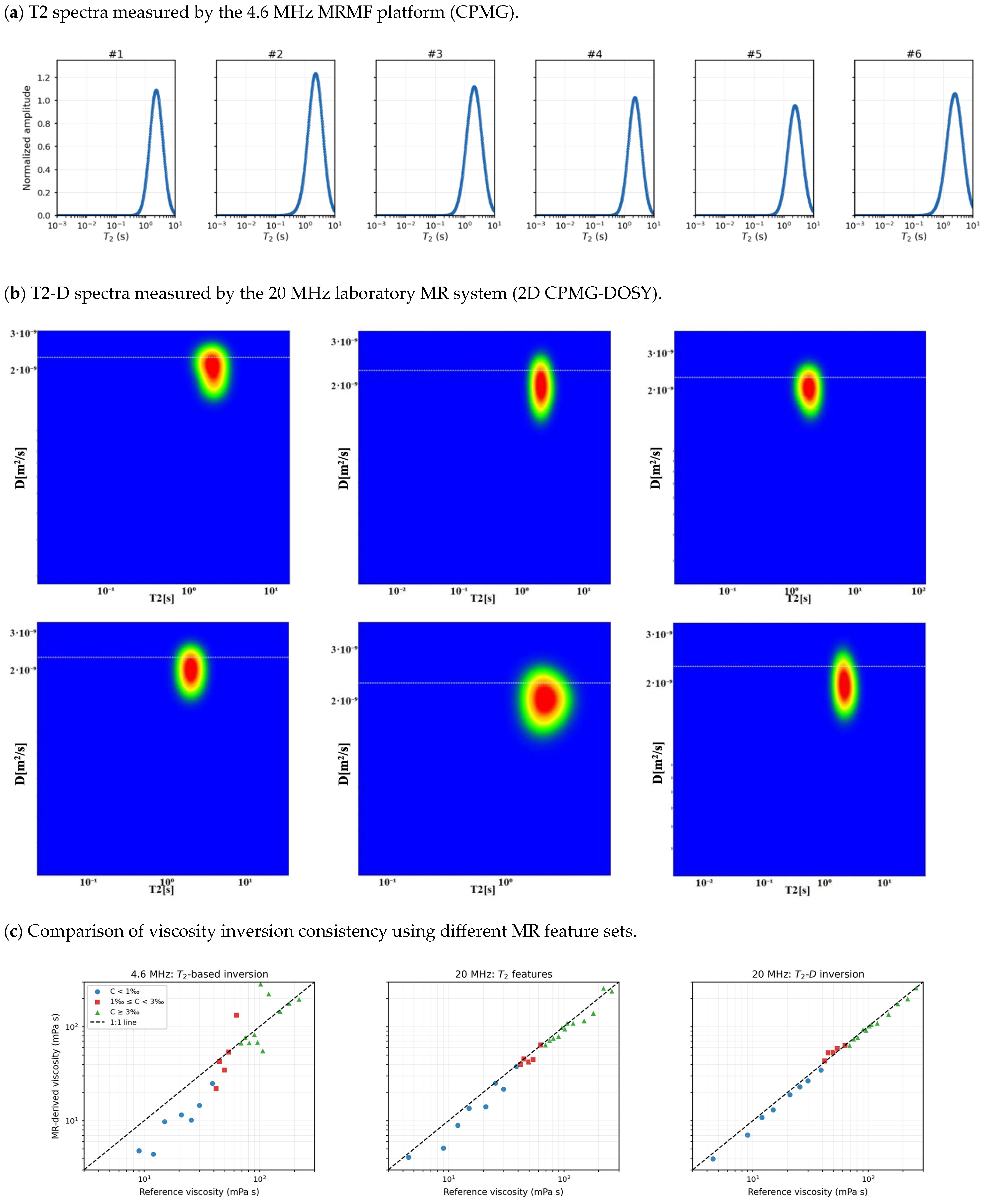
The 4.6 MHz MRMF experiments show that the existing MR flowmeter architecture can be transferred to quasi-static PAM solution measurement. For samples with relatively high concentration or large viscosity difference, T2 spectra and echo-decay features followed the general viscosity–concentration trend. This result is important for engineering implementation because the method inherits a validated online MR hardware chain, valve-control logic, and data-acquisition route from the MRMF platform [11,12].
However, T2 alone exhibits a clear boundary in the low-concentration interval. In the available preliminary dataset, the T2-derived viscosity trend remains useful above approximately 3‰, whereas the 1–3‰ interval shows weaker and less stable separation. In the revised interpretation, this boundary should be determined quantitatively from replicate samples: if the feature sensitivity coefficient is smaller than the combined uncertainty from baseline noise, temperature drift, and repeatability error, the concentration should be reported as outside the reliable T2-only discrimination range.
This boundary is technically important because it prevents overextension of the existing flowmeter platform. The 4.6 MHz result demonstrates basic feasibility for quasi-static PAM screening, but the manuscript now treats the 1–3‰ interval as a calibration and validation target rather than as a solved quantitative measurement range.

4.2. Diffusion-Enhanced Sensitivity Verified by 20 MHz T2-D Measurements

The 20 MHz T2-D results show that the diffusion coefficient is more sensitive to the molecular-mobility variation induced by PAM. For the first six samples, T1 and T2 spectra are similar, whereas the T2-D spectra show a discernible shift in the diffusion dimension. For example, when the reference viscosity changes from 12 to 54 mPa s, the apparent diffusion coefficient changes from approximately 2.48 × 10⁻⁹ to 2.06 × 10⁻⁹ m2 s−1. This trend is consistent with Equation (8): higher viscosity restricts molecular diffusion and lowers D. The present result supports diffusion-assisted interpretation, although it does not yet constitute a complete concentration-calibration curve.
The comparison in Figure 5c should therefore be read as more than a visual improvement. The 4.6 MHz T2-based inversion follows the general viscosity trend, but the scatter becomes more visible when the concentration decreases, and the response remains water-dominated. The 20 MHz T2 feature set provides only limited improvement, whereas the 20 MHz T2-D feature set yields a tighter trend because the diffusion dimension adds information that is not carried by the T2 peak shift alone. This is the experimental rationale for designing the online detector as a diffusion-capable system rather than a T2-only monitor.

4.3. Industrial Quasi-Static Online Measurement Route

PAM concentration detection does not require full T2-D acquisition under high-speed flow. A more practical field route is to maintain continuous flow in the main fracturing line while short-time bypass sampling is conducted in a measurement branch. During an assay, the bypass line introduces a representative sample into the MR probe; electrically controlled valves close both sides of the measurement section; T1, T2, and diffusion measurements are performed under quasi-static conditions; and the sample is then returned to the main process to the or downstream blending line.
From a process point of view, this bypass route is part of the practical innovation of the method. It provides a workable compromise between laboratory-style multidimensional MR measurement and field-line continuity. By decoupling the measurement section from the high-rate main stream for a short period, the device retains the signal quality needed for T1, T2, and diffusion acquisition while still serving an online blending process. The functional roles, key features, industrial status, and current limitations of the three MR platforms considered in this study are summarized in Table 2.

4.4. Error Control and Operational Workflow

The interpretation logic is intentionally conservative. The system first determines whether the acquired signal is usable, then determines whether diffusion information is required, and only then releases the concentration together with an uncertainty range. Temperature affects the assay through at least two pathways: increasing temperature generally decreases liquid viscosity and increases diffusion, while relaxation times can also shift due to changes in the molecular-motion correlation time. Therefore, temperature must be measured with each assay and included as a correction variable rather than treated only as a background condition.
A practical workflow is recommended. First, a short T2 scan is used to confirm that the sample is within the normal water-dominated response range and to estimate whether a full diffusion measurement is necessary. Second, if the estimated concentration is close to the low-concentration boundary or the quality flag is poor, an adaptive T2-D scan is triggered. Third, the interpretation model outputs concentration only when SNR, repeated-measurement variance, and temperature fall within the calibration domain. Salinity, sand particles, bubbles, additives, pressure fluctuation, shear history, and long-term magnetic or electronic drift should be treated as disturbance variables and screened through quality flags or additional calibration subsets.

4.5. Scope, Disturbance Factors, and Validation Requirements

The present study should be interpreted as a proof-of-concept and engineering-route study. It identifies the limitation of a 4.6 MHz T2-only workflow, demonstrates the added sensitivity of diffusion information, and defines a 23.5 MHz field-oriented detector concept. It does not yet provide a final industrial calibration curve or field-certified online analyzer.
The main field disturbance factors are salinity/mineralization, temperature, shear history, sand particles, bubbles, additives, pressure fluctuation, and long-term system drift. Salinity and additives may alter relaxation and RF loading; temperature changes viscosity, D, T1, and T2; shear history may change polymer conformation and apparent viscosity; and bubbles or particles may reduce filling repeatability and signal stability. The quasi-static bypass process reduces flow instability but does not eliminate these effects; they must be included in calibration and quality-control thresholds.
Future validation should report, at minimum, replicate accuracy, repeatability, sensitivity coefficient, RMSE, confidence interval, temperature-correction residual, salinity/additive robustness, bubble/particle rejection behavior, magnetic-field homogeneity, gradient strength and linearity, RF-probe matching, SNR range, temperature-control precision, and long-term drift. These metrics are necessary before the 23.5 MHz design can be claimed as a field-calibrated industrial instrument. The required validation items and their current status are summarized in Table 3.

5. Conclusions

This paper presents a proof-of-concept MR route for online PAM concentration monitoring in fracturing fluids. The main finding is that the existing 4.6 MHz MRMF platform can support quasi-static T2 screening, but a T2-only workflow is not reliable enough for the 1–3‰ low-concentration interval.
Diffusion-sensitive 20 MHz T2-D measurements provide a stronger mobility descriptor than T2 alone, which justifies retaining diffusion capability in the field-oriented detector design. The proposed 23.5 MHz route combines a stronger permanent-magnet module [19], gradient-capable RF probe [20], compact electronics, and quasi-static bypass sampling.
The main innovation is therefore the coupled route from platform-boundary identification to diffusion-assisted interpretation and oilfield-compatible sampling, rather than a simple frequency upgrade. The physics-constrained framework further prevents concentration output when SNR, repeatability, temperature, or calibration-domain conditions are not satisfied.
The study does not yet claim final industrial calibration. Controlled loop and field tests are required to determine accuracy, repeatability, RMSE, confidence intervals, temperature and salinity corrections, and hardware stability before the detector can be used as a field-calibrated online PAM analyzer.


Author Contributions

Conceptualization, F.D. and J.S.; methodology, F.D., Y.F. and S.C.; device design, G.C., H.L. and R.Z.; investigation, S.C., Y.L. and T.L.; writing-original draft preparation, F.D.; writing—review and editing, J.S. and Y.F.; supervision, J.S. All authors have read and agreed to the published version of the manuscript.

Funding

This research was funded by the China National Petroleum Corporation (CNPC) International Cooperation Research Project, “Research on Online Magnetic Resonance Detection Technology for Multiphase Fluids under Flowing Conditions”, Grant No. 2023DQ0420.

Data Availability Statement

The data presented in this study are available from the corresponding author upon reasonable request, subject to project and company data-management requirements.

Conflicts of Interest

Authors Junfeng Shi, Feng Deng, Shiwen Chen, Guanhong Cheng, Yongqiang Fu, Ruidong Zhao, and Huaxue Liu were employed by The Research Institute of Petroleum Exploration and Development, CNPC. Authors Yunzi Li, and Tianbo Liu were employed by PetroChina Jidong Oilfield Company. The remaining authors declare that the research was conducted in the absence of any commercial or financial relationships that could be construed as a potential conflict of interest.

References

  1. Deng, F.; Xiong, C.; Chen, S.; Chen, G.; Wang, M.; Liu, H.; Zhang, J.; Lei, Q.; Cao, G.; Xu, D.; et al. A method and device for online magnetic resonance multiphase flow detection. Pet. Explor. Dev. 2020, 47, 798–808. [Google Scholar] [CrossRef]
  2. Shi, J.-F.; Deng, F.; Xiao, L.-Z.; Liu, H.-B.; Ma, F.-Q.; Wang, M.-Y.; Zhao, R.-D.; Chen, S.-W.; Zhang, J.-J.; Xiong, C.-M. A proposed NMR solution for multi-phase flow fluid detection. Pet. Sci. 2019, 16, 1148–1158. [Google Scholar] [CrossRef]
  3. Coates, G.R.; Xiao, L.; Prammer, M.G. NMR Logging: Principles and Applications; Gulf Professional Publishing: Houston, TX, USA, 2000. [Google Scholar]
  4. Blümich, B.; Casanova, F.; Appelt, S. NMR at low magnetic fields. Chem. Phys. Lett. 2009, 477, 231–240. [Google Scholar] [CrossRef]
  5. Casanova, F.; Perlo, J.; Blümich, B. Single-Sided NMR; Springer: Berlin/Heidelberg, Germany, 2011. [Google Scholar]
  6. Li, Y.; Yonemoto, Y.; Yamahata, Y.; Kawahara, A. Rheological Property Changes in Polyacrylamide Aqueous Solution Flowed Through Microchannel Under Low Reynolds Number and High Shear Rate Conditions. Micromachines 2025, 16, 545. [Google Scholar] [CrossRef] [PubMed]
  7. Sun, X.; Guo, Q.; Wang, Y.; Xu, C.; Ma, W.; Liu, T.; Cao, Y.; Song, M. Experimental and Simulation Studies of HPAM Microcomposite Structure and Molecular Mechanisms of Action. Polymers 2025, 17, 3005. [Google Scholar] [CrossRef] [PubMed]
  8. Dutra, C.P.; Peres, A.C.C.; Petzhold, C.L.; Silveira, N.P. Synthesis and solution properties of hydrophobically modified polyacrylamide with styrene. J. Mol. Liq. 2025, 426, 127470. [Google Scholar] [CrossRef]
  9. Ghannam, M.T.; Selim, M.Y.E.; Thaher, A.; Ahmad, N.; Almarzooqi, R.; Khalil, A. Viscosity Characteristics of Cationic Polyacrylamide Aqueous Solutions. Polymers 2026, 18, 331. [Google Scholar] [CrossRef] [PubMed]
  10. Bloch, F. Nuclear induction. Phys. Rev. 1946, 70, 460–474. [Google Scholar] [CrossRef]
  11. Bloembergen, N.; Purcell, E.M.; Pound, R.V. Relaxation effects in nuclear magnetic resonance absorption. Phys. Rev. 1948, 73, 679–712. [Google Scholar] [CrossRef]
  12. Carr, H.Y.; Purcell, E.M. Effects of diffusion on free precession in nuclear magnetic resonance experiments. Phys. Rev. 1954, 94, 630–638. [Google Scholar] [CrossRef]
  13. Meiboom, S.; Gill, D. Modified spin-echo method for measuring nuclear relaxation times. Rev. Sci. Instrum. 1958, 29, 688–691. [Google Scholar] [CrossRef]
  14. Stejskal, E.O.; Tanner, J.E. Spin diffusion measurements: Spin echoes in the presence of a time-dependent field gradient. J. Chem. Phys. 1965, 42, 288–292. [Google Scholar] [CrossRef]
  15. Venkataramanan, L.; Song, Y.Q.; Hürlimann, M.D. Solving Fredholm integrals of the first kind with tensor product structure in two and 2.5 dimensions. IEEE Trans. Signal Process. 2002, 50, 1017–1026. [Google Scholar] [CrossRef]
  16. Einstein, A. On the movement of small particles suspended in stationary liquids required by the molecular-kinetic theory of heat. Ann. Phys. 1905, 17, 549–560. [Google Scholar] [CrossRef]
  17. Huggins, M.L. The viscosity of dilute solutions of long-chain molecules. IV. Depend. concentration. J. Am. Chem. Soc. 1942, 64, 2716–2718. [Google Scholar] [CrossRef]
  18. Hoult, D.I.; Richards, R.E. The signal-to-noise ratio of the nuclear magnetic resonance experiment. J. Magn. Reson. 1976, 24, 71–85. [Google Scholar] [CrossRef]
  19. Halbach, K. Design of permanent multipole magnets with oriented rare earth cobalt material. Nucl. Instrum. Methods 1980, 169, 1–10. [Google Scholar] [CrossRef]
  20. Blümler, P. Proposal for a permanent magnet system with a constant gradient mechanically adjustable in direction and strength. Concepts Magn. Reson. Part B 2016, 46, 41–48. [Google Scholar] [CrossRef]
Figure 1. Technical route of the MR-based online detection method for PAM concentration. The route links the field-proven MRMF foundation, 4.6 MHz T2 boundary screening, 20 MHz T2-D diffusion validation, 23.5 MHz diffusion-capable detector design, calibration-domain control, and future loop/field validation.
Processes 14 01810 g001
Figure 2. Key steps of the physics-constrained multi-parameter interpretation framework. Signal enhancement, T2 pre-screening, diffusion-assisted viscosity inference, temperature correction, calibration-domain restriction, and quality-control thresholds are combined to improve robustness at low concentrations while controlling the single-assay cycle time.
Processes 14 01810 g002
Figure 3. Prototype design of the 23.5 MHz online detector derived from the project progress. The figure summarizes the optimized Halbach magnet and flexible PCB gradient-coil/antenna development for diffusion-capable PAM concentration detection.
Processes 14 01810 g003
Figure 4. Physical implementation route of the compact field-oriented MR hardware. Representative views of the compact spectrometer, integrated electronics cabinet, probe/magnet assembly, and skid-mounted field system are shown to illustrate the proposed 23.5 MHz oilfield-oriented low-field MR platform; full engineering qualification requires bench, loop, and field validation.
Processes 14 01810 g004
Figure 5. Key experimental evidence. Panel (a) shows T2 relaxation spectra measured by the 4.6 MHz MRMF platform using CPMG; panel (b) shows T2-D diffusion-sensitive spectra measured by the 20 MHz laboratory MR system; and panel (c) compares reference viscosity with MR-derived feature trends. The relevant physical quantities are T2 relaxation time (s), apparent diffusion coefficient D (10−9 m2 s−1), reference viscosity (mPa s), and sample number.
Processes 14 01810 g005
Table 1. Representative MR parameters for the first six PAM samples. The values are used to illustrate feature sensitivity and are not a complete concentration-calibration dataset.
Sample123456
Reference viscosity (mPa·s)125433271221
D (10−9 m2 s−1)2.482.062.202.162.202.05
T2 main peak (s)2.32.32.12.32.42.5
Table 2. Functional comparison of the three MR platforms considered in this study.
Item4.6 MHz MRMF Platform20 MHz Laboratory System23.5 MHz Online Detector
RoleBoundary identificationFeasibility validationField-oriented device
Main featureT2T2-DT1, T2, D, T, signal quality
Low-concentration behaviorWeak in 1–3‰ intervalImproved by diffusionExpected stable after calibration
Industrial statusExisting flowmeter platformLaboratory validationMagnet and antenna design completed
Main limitationLow SNR and T2-only featureNot a field instrumentRequires integration and loop validation
Table 3. Required validation items before field-calibrated deployment of the 23.5 MHz PAM detector.
Validation ItemPurposeCurrent Manuscript Status
Accuracy, repeatability, RMSE, confidence intervalQuantify metrological performance over concentration, salinity, temperature, and shear historyListed as required future calibration output
Temperature correction and salinity/additive robustnessSeparate PAM concentration effects from fluid-property and chemistry effectsIncluded in revised interpretation framework
Bubble, sand, pressure, and flow-disturbance rejectionEvaluate field sampling reliability and quality flagsAddressed through quasi-static bypass and future loop tests
Magnetic-field homogeneity, gradient strength, RF matching, SNR, and driftQualify detector hardware for stable diffusion-capable measurementDefined as pending bench and loop-validation metrics
Disclaimer/Publisher’s Note: The statements, opinions and data contained in all publications are solely those of the individual author(s) and contributor(s) and not of MDPI and/or the editor(s). MDPI and/or the editor(s) disclaim responsibility for any injury to people or property resulting from any ideas, methods, instructions or products referred to in the content.