Article

Experimental and FDEM-Based Numerical Investigation of the Breathing Effect and Lost Circulation Pressure in Fractured Formations

by
Shuijie Yu
1,*,
Hongwei Yang
2,
Lei An
1,
Yang Xu
1,
Jun Li
2,
Qiang Li
2 and
Licheng Guan
2
1
Sinopec International Petroleum Exploration and Production Corporation, Beijing 100029, China
2
College of Petroleum Engineering, China University of Petroleum (Beijing), Beijing 102249, China
*
Author to whom correspondence should be addressed.
Processes 2026, 14(11), 1811; https://doi.org/10.3390/pr14111811
Submission received: 7 April 2026 / Revised: 28 May 2026 / Accepted: 29 May 2026 / Published: 2 June 2026
(This article belongs to the Section Petroleum and Low-Carbon Energy Process Engineering)

Abstract

To address the industry challenge that the formation breathing effect in fractured formations narrows the safe mud weight window and significantly increases well control difficulty, this study employs two approaches—a self-designed experimental apparatus for the formation breathing effect and a combined finite-discrete element method (FDEM) numerical model—to systematically reveal the characteristic behavior and underlying mechanism of this effect, and to establish a prediction method for near-wellbore lost-circulation pressure that accounts for the breathing effect. The numerical simulation achieves high quantitative accuracy, with errors of less than 2.1% during the loss stage and less than 4.1% during the flowback stage. The results show that the typical signature of the breathing effect in fractured formations is a sustained loss of drilling fluid followed by rapid flowback, resulting in a pronounced reversible volume change in the wellbore. The intrinsic mechanism lies in the switching between fracture opening and closure triggered by the shift in the pressure differential between the wellbore and the formation. Parametric sensitivity analysis indicates that increasing wellbore pressure intensifies the breathing effect; formations with low fracture opening pressure, high porosity, and high permeability are more prone to severe breathing effects. Increasing the plastic viscosity and yield point of the drilling fluid can suppress the breathing effect, but careful management of the resulting increase in circulating friction and equivalent circulating density (ECD), which raises bottomhole pressure, is required. Field case calculations for a well in the Cameroon block show that, after improving the lost-circulation pressure calculation method to incorporate the breathing effect, the safe mud weight window can narrow by up to 0.03 g/cm3. This study advances the understanding of breathing effects in fractured formations and provides theoretical support for safe drilling within the narrow mud weight windows commonly encountered in such formations.

1. Introduction

Fractured formations are characterized by complex geological conditions, narrow safe mud weight windows, and considerable drilling challenges [1,2]. During routine operations such as pump start-up and shut-down and pipe connections, frequent wellbore pressure fluctuations can readily induce the formation breathing effect in fractured formations, further complicating wellbore pressure management [3]. The “formation breathing effect” refers to the cyclic inflow and outflow of drilling fluid driven by pressure variations between the wellbore and the formation [4]. This phenomenon is difficult to identify in real time and is easily misinterpreted as wellbore influx or a kick [5,6,7]. If mistakenly addressed by well-killing measures such as increasing the drilling fluid density, it will not only trigger more severe fluid losses but may, in extreme cases, lead to formation breakdown and catastrophic drilling incidents. Therefore, there is an urgent need for dedicated research on the formation breathing effect in fractured formations.
Since the term “formation breathing effect” was first introduced by Gill in 1989 [8], extensive research has been conducted on this phenomenon. The breathing effect is generally attributed to three mechanisms: radial expansion of the tubular string [8,9,10], thermal expansion of the drilling fluid caused by formation temperature [11,12], and the opening/closure of formation fractures under varying wellbore pressure [4,13]. For instance, Gill [8] proposed wellbore expansion as the governing mechanism of the breathing effect. Eirik [11] and Babu [12] noted, from analyses of drilling fluid volume behavior in high-temperature, high-pressure (HTHP) wells, that the breathing effect is closely correlated with thermal expansion of the drilling fluid. However, numerical simulations of wellbore and tubular string deformation performed by Bjørkevoll et al. [9] indicated that the flowback volume attributable to elastic deformation accounts for only 14–15% of the total flowback volume actually observed during breathing events. Similarly, Sadd et al. [10], in deriving the radial displacement expression for elastic deformation of large wellbores in soft formations, pointed out that the flowback volume induced by elastic wellbore expansion (1.094 bbl) is far lower than that recorded in actual breathing events (32.82–109.4 bbl). Tubular string expansion is therefore not the dominant cause of the formation breathing effect. Likewise, the time required for the flowback induced by thermal expansion of the drilling fluid to develop is approximately 10–12 h, which is incompatible with the much shorter duration—typically one to two hours—observed during field breathing events [14,15]. Hence, fluid flowback caused by wellbore expansion is not the primary driver of the breathing effect either.
There is now a broad consensus that the complex natural fracture networks developed in the near-wellbore region constitute the principal cause of the breathing effect in fractured formations. Tare [4] compared breathing phenomena observed under different operational conditions and noted a close relationship between the extent of fracture system development, drilling fluid properties, and the breathing effect. Baldino and Meng [16] presented a systematic review of theoretical models related to the breathing effect and identified the coupled relationships among fracture poroelasticity, fracture aperture variation, and wellbore pressure fluctuation as key sources of misinterpreting flowback as a kick. Xie [13] further described the field breathing process as follows: when the wellbore pressure exceeds the fracture opening pressure, fractures open and drilling fluid enters the fractures; when the pumps are shut down and the wellbore pressure drops, the fractures close and the invaded drilling fluid is driven back into the wellbore by the formation pressure, eventually overflowing at the wellhead. To clarify the behavioral patterns of the breathing effect in fractured formations, further investigations have been carried out through both experimental and numerical approaches [17,18,19,20,21,22,23,24,25,26]. On the experimental side, Ozdemirtas [17] and Gao et al. [6] developed experimental setups to investigate the breathing effect under the influence of fractures and analyzed its dependence on pressure conditions and rock type. From the numerical simulation perspective, Helstrup et al. [21] employed a numerical single-fracture model to study the breathing effect. Lavrov et al. [22] extended this approach by constructing a more complex circular fracture model and examined the influence of drilling fluid viscosity and fracture properties. Yang et al. [23] built a three-dimensional breathing effect model for fractured formations and analyzed the influence of parameters such as elastic modulus and Poisson’s ratio. Huang et al. [24] carried out sensitivity studies targeting deepwater shallow formations, further demonstrating the impact of pressure fluctuations on the identification and control of the breathing effect under narrow safe mud weight window conditions. It is worth noting that, in recent years, research on the breathing effect in fractured formations has progressively evolved from single-fracture representations toward multi-fracture networks, wellbore–formation coupling, and intelligent identification approaches. For example, the most recent studies by Zhang et al. [25] and Wang et al. [26] have expanded the engineering application boundaries of this problem from the perspectives of the dynamic response characteristics of deepwater HTHP fractured formations and wellbore–formation coupling and intelligent identification, respectively.
Notwithstanding the multi-faceted investigations summarized above, several limitations persist. On the experimental side, existing studies have largely focused on observing loss–flowback behavior in single-fracture configurations or under specific rock-type conditions, with insufficient consideration given to the coupled effects of wellbore pressure, fracture opening pressure, confining pressure, and lithological combinations. As a result, the full-process response characteristics of the breathing effect governed by fracture opening and closure have yet to be systematically characterized. Moreover, the limited capability of certain experimental setups to independently regulate fracture closure pressure and wellbore pressure fluctuations makes it difficult to extend the experimental results to the analysis of how variations in engineering parameters influence breathing effect intensity. On the numerical simulation side, most existing models have been built upon single-fracture, regular-fracture, or pre-defined fracture-path representations. Such representations are inadequate for capturing the initiation, propagation, closure, contact, and connectivity evolution of fractures within complex fracture networks. Furthermore, some models fail to simultaneously resolve the coupled processes of continuum deformation of the formation, discontinuous failure of fractures, and fracture–matrix fluid–solid interaction. As a consequence, a systematic understanding of the mechanism of the breathing effect in fractured formations and its key controlling factors remains lacking.
To address these gaps, this study combines a self-designed experimental apparatus for formation breathing in fractured formations with the combined finite-discrete element method (FDEM) to conduct a systematic investigation. The experimental apparatus, comprising an autoclave, a fluid injection system, a back-pressure control system, and a pneumatically actuated loading mechanism, enables independent control of the simulated wellbore pressure, confining pressure, and fracture opening pressure. It can therefore realistically reproduce the dynamic process of fracture opening and drilling fluid loss induced by wellbore pressure fluctuations, as well as the subsequent fracture closure and fluid flowback upon pressure reduction. Compared with the finite-element-based approaches predominantly adopted in previous studies, the FDEM retains the capability of the finite element method to resolve continuum deformation fields, while also incorporating the capability of the discrete element method to describe fracture initiation, propagation, coalescence, and block contact. This makes it better suited for capturing the merging, bifurcation, and closure-rebound behaviors of microfracture networks in fractured formations. The overarching objectives of this study are to elucidate the typical characteristics and mechanism of the breathing effect in fractured formations, to clarify the influences of geological and engineering parameters on breathing effect intensity, and to develop a prediction method for near-wellbore lost-circulation pressure that accounts for the breathing effect. The findings are intended to provide a theoretical foundation for the identification, mitigation, and accurate safe mud weight window prediction in fractured formations.

2. Materials and Methods

In this study, we systematically investigated the formation breathing effect using two complementary approaches: a self-designed experimental apparatus and FDEM (combined finite-discrete element method) numerical simulations. The experimental and numerical components are relatively independent, yet they jointly serve the investigation of the breathing effect in fractured formations. Specifically, the experimental component was used to explore the fundamental physical mechanisms and typical response patterns of the breathing effect, while the numerical model was employed to extend the analysis to field-scale pressure conditions and fracture network configurations.

2.1. Experimental Study on the Breathing Effect in Fractured Formations

2.1.1. Experimental Apparatus

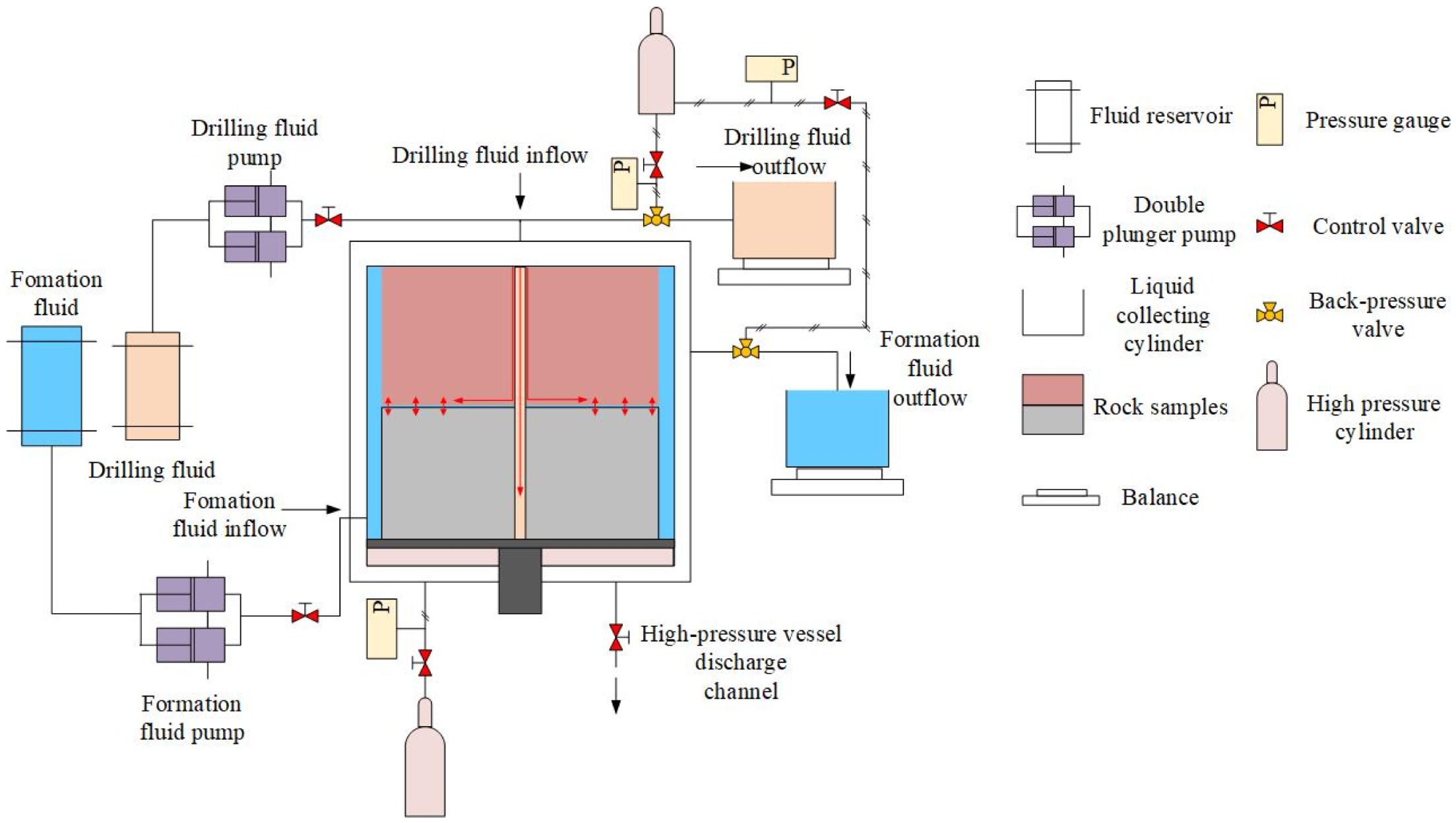
To simulate the formation breathing effect in fractured formations under realistic conditions, we independently designed and constructed an experimental apparatus based on the fracture opening–closure mechanism. The apparatus comprises four core components: an autoclave, a fluid injection system, a back-pressure control system, and a data acquisition system, as schematically illustrated in Figure 1. Rock specimens are placed inside the autoclave, beneath which a pneumatically actuated loading plate is installed. Stable gas pressure applied in the sealed chamber below the loading plate generates axial compressive stress on the specimen, thereby simulating the in situ fracture opening pressure. To maintain sealing integrity, the loading plate and the upper platen of the autoclave—both in direct contact with the specimen—are fitted with sealing gaskets. The fluid injection system continuously delivers the working fluid into the autoclave via a dual-piston pump, while the back-pressure control system governs the overall pressure throughout the apparatus. These two systems work in concert to apply the simulated wellbore and formation pressures. During the experiments, parameters such as injection flow rate and pressure are acquired in real time using a 7017C module (accuracy = ±1% FS) and a 7520 acquisition module (accuracy = ±1.6% FS) and are stored on a companion computer.

2.1.2. Experimental Parameters and Methods

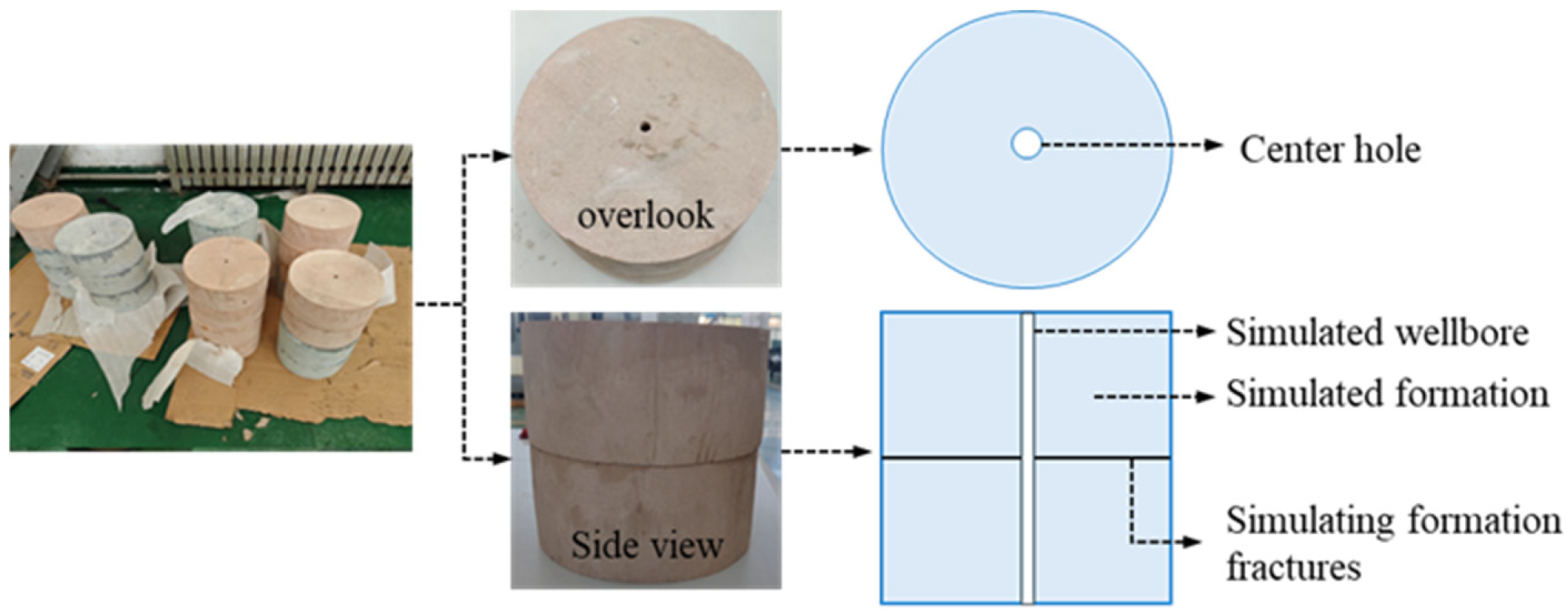
As shown in Figure 2, the experimental rock samples are cylindrical with dimensions of 240 mm × 100 mm. The lithology includes both sandstone and shale. Each specimen features a central borehole 10 mm in diameter to replicate the wellbore in the formation. During the experiments, two such specimens were stacked together with their central holes aligned, and the contact surfaces were tightly pressed against each other to simulate a formation fracture. Given the limited availability of in situ core samples from the target block, sandstone and shale specimens were sourced from the Sichuan Basin, China, which exhibits lithological characteristics, including mineral composition, matrix tightness, and natural fracture development, comparable to those encountered in the Cameroon block. This selection was intended to enhance the relevance of the experimental results to the target formation conditions. Because the dual-piston pump used in the experimental setup had limited injection capacity and real drilling fluids tended to cause blockage in the flow lines, water was adopted as the working fluid. In the subsequent numerical simulations, however, field drilling fluid properties were assigned to replicate actual downhole conditions.
It should be noted that the primary objective of this experimental study was to investigate the response patterns of the formation breathing effect. Accordingly, a detailed examination of the effects of fracture surface roughness, thermally induced fluid expansion, and other related factors was beyond the scope of the present experimental work, given the inherent constraints of the apparatus.
To eliminate the influence of water absorption by the rock matrix on the measured fluid loss and flowback volumes during breathing effect experiments, the specimens were pre-conditioned in an autoclave under confining pressure for more than three hours prior to testing, allowing them to become fully water-saturated. At the start of each experiment, the high-pressure gas cylinder was first opened to actuate the lower platen of the autoclave, applying a stable axial compressive load to the specimen. Simultaneously, a separate high-pressure gas cylinder was used to supply constant back-pressure to the back-pressure valve. Subsequently, water was injected into the annular space between the specimen and the autoclave wall via the dual-piston pump to apply confining pressure. Finally, water was injected into the simulated wellbore to replicate the fluid circulation process during drilling. To investigate the influences of wellbore pressure and fracture opening pressure on the breathing effect, multiple sets of pressure conditions were configured for comparison. The detailed experimental pressure parameters are listed in Table 1. To ensure the reliability of the results, three replicate experiments were conducted under each pressure condition, and the reported results are the arithmetic means of the three replicates. All the experiments were conducted at room temperature, with no intentional temperature variation introduced during the test program.

2.2. Numerical Model for the Breathing Effect in Fractured Formations Based on the Finite-Discrete Element Method

The experimental component presented in Section 3.1 was designed to investigate the typical characteristics and behavioral patterns of the formation breathing effect. However, it was subject to certain experimental limitations, such as restrictions on pump pressure and the tendency of flow lines to become clogged. To further explore the breathing effect in fractured formations, we therefore employed a numerical simulation approach based on the combined finite-discrete element method (FDEM), using actual field parameters to reproduce downhole conditions and extend the investigation, thereby enhancing the engineering applicability of our findings. It should be noted that the numerical model was not calibrated against the experimental results. Instead, it was built directly from field data, and its accuracy was subsequently validated through comparison with field observations in later sections.

2.2.1. Governing Equation

Unlike the conventional finite element method, which relies on a single discretization pattern of continuous meshes with shared nodes, the finite-discrete element method (FDEM) innovatively adopts a dual discretization strategy. It discretizes the continuous medium domain using triangular elements with independent, unshared nodes and embeds zero-thickness interface elements (joint elements) along the boundaries of adjacent elements, thereby achieving precise simulation of discontinuous geological structures. The numerical model for the breathing effect in fractured formations established in this study, based on the finite-discrete element method, is used to accurately characterize the drilling fluid loss and flowback processes during the breathing effect in complex fractured formations. The model involves formation geotechnical deformation, fracture opening-closure in complex fracture networks, and fracture-pore dual-medium flow. The key governing equations of the model are shown as follows:
  • Constitutive Equation of the Formation Matrix
The stress–strain response characteristics of the formation matrix under wellbore pressure, formation pressure, and in situ stress are described by the following constitutive equation:
T = 1 det F E 1 + ν E d + E 1 ν E s + 2 μ D ,
where D is the strain rate tensor; Ed is the Green strain tensor; E is the elastic modulus, Pa; F is the deformation gradient; T is the stress tensor; v is Poisson’s ratio; and Es is the St. Venant strain tensor. The deformation gradient, Green strain tensor, St. Venant strain tensor, and strain rate tensor can all be calculated based on the position and velocity changes of the triangular element nodes.
2.
Contact Stress Equation of Elements
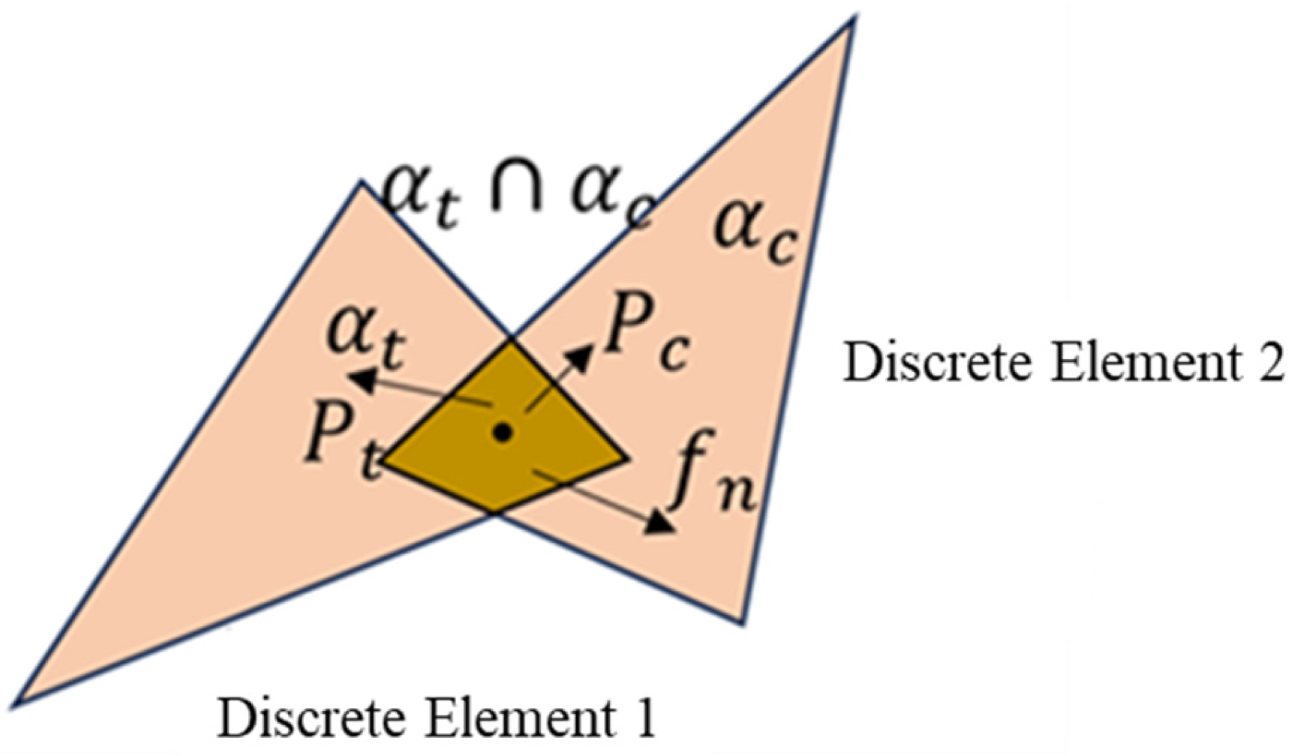
The contact algorithm of the finite-discrete element method (FDEM) features linear time complexity, where the computational cost is proportional to the total number of triangular elements generated by discretization, demonstrating high computational efficiency. As shown in Figure 3, the contact interaction force between the nodes of mesh elements consists of two orthogonal components: tangential contact force and normal contact force.
The tangential contact force is calculated by the Coulomb friction criterion:
f t n + 1 = f t n p t Δ u t
The normal contact force is calculated using the penalty function method:
f n = p n Γ β t β c grad ϕ c ( P c ) grad ϕ t ( P t ) d A ,
where ut is the relative displacement of the contact point at different times, m; pt is the tangential penalty parameter of the triangular element, Pa/m; ft is the tangential contact force of the triangular element, Pa; fn is the normal contact force of the triangular element, Pa; βc and βf are the target bodies of the two triangular elements; pn is the normal penalty parameter of the triangular element, Pa/m (in this study, all the penalty parameters were set to 100 times the Young’s modulus); Pc and Pt are the points in the contact area of the two triangular elements, dimensionless; A is the area of the triangular element contact region, m2; and φc(Pc) and φt(Pt) are the potentials of the two points in the contact area, dimensionless.
3.
Fracture Element Damage Evolution Equation
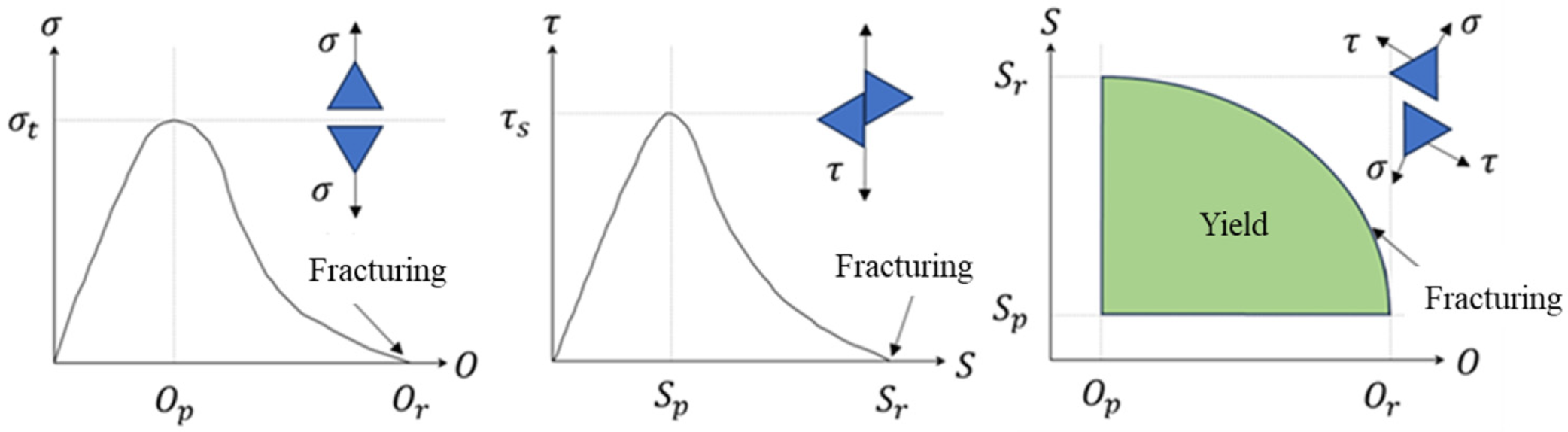
The opening and propagation processes of fractures are characterized by the damage evolution of joint elements. The numerical model defines three fracture damage modes: tensile failure, shear failure, and mixed failure (Figure 4). In the actual calculation process of the model, a damage factor D (0 < D < 1) is used to define the degree of element failure, i.e., when D = 0, the joint element is undamaged; when D = 1, the joint element is completely damaged, generating a fracture. The damage factors for the three failure types can be determined by Equation (4).
o o p o r o p = D I s s p s r s p = D II o o p o r o p 2 + s s p s r s p 2 = D III
In the equation, D (dimensionless) represents the damage factor; o and op (unit: m) denote the normal opening and its critical value, respectively; S and Sp (unit: m) represent the tangential slip and its critical value, respectively; Sr (unit: m) is the maximum shear slip; and Or (unit: m) is the maximum normal opening. Fluid flow within the unfractured rock matrix is characterized by Darcy’s law. Fluid flow within a fracture can generally be described using the parallel-plate model. When the fracture aperture is small, the flow regime satisfies laminar flow conditions, and the fracture walls can be approximated as smooth parallel surfaces, the fracture transmissivity can be characterized by the cubic law. This law states that the volumetric flow rate through a fracture is proportional to the cube of the fracture aperture, expressed as follows:
Q = W b 3 12 μ Δ p L ,
where Q is the volumetric flow rate within the fracture, m3/s; W is the fracture width (or out-of-plane thickness of the model), m; b is the hydraulic aperture, m; μ is the dynamic viscosity of the fluid, Pa·s; Δp is the pressure difference between the two ends of the fracture, Pa; L is the length along the flow direction of the fracture, m; and Δp/L is the pressure gradient, Pa/m.
When expressed in terms of the volumetric flow rate per unit fracture width, Equation (5) can be rewritten as follows:
q = Q W = b 3 12 μ Δ p L ,
where q is the volumetric flow rate per unit fracture width, m2/s. It is evident from the expression above that fracture aperture exerts a dominant influence on fracture conductivity. When the aperture changes, the flow rate through fractures varies proportionally to the cube of the aperture. Consequently, during the breathing effect in fractured formations, an increase in wellbore pressure that opens or widens fractures leads to rapid enhancement of the fracture flow capacity, thereby inducing drilling fluid losses. Conversely, when the wellbore pressure decreases and fractures close or their apertures shrink, the flow capacity diminishes significantly, which may result in backflow. In the numerical model, the drilling fluid is represented as a Bingham fluid in accordance with actual field drilling fluid properties, and fluid compressibility is neglected.

2.2.2. Model Geometry and Parameters

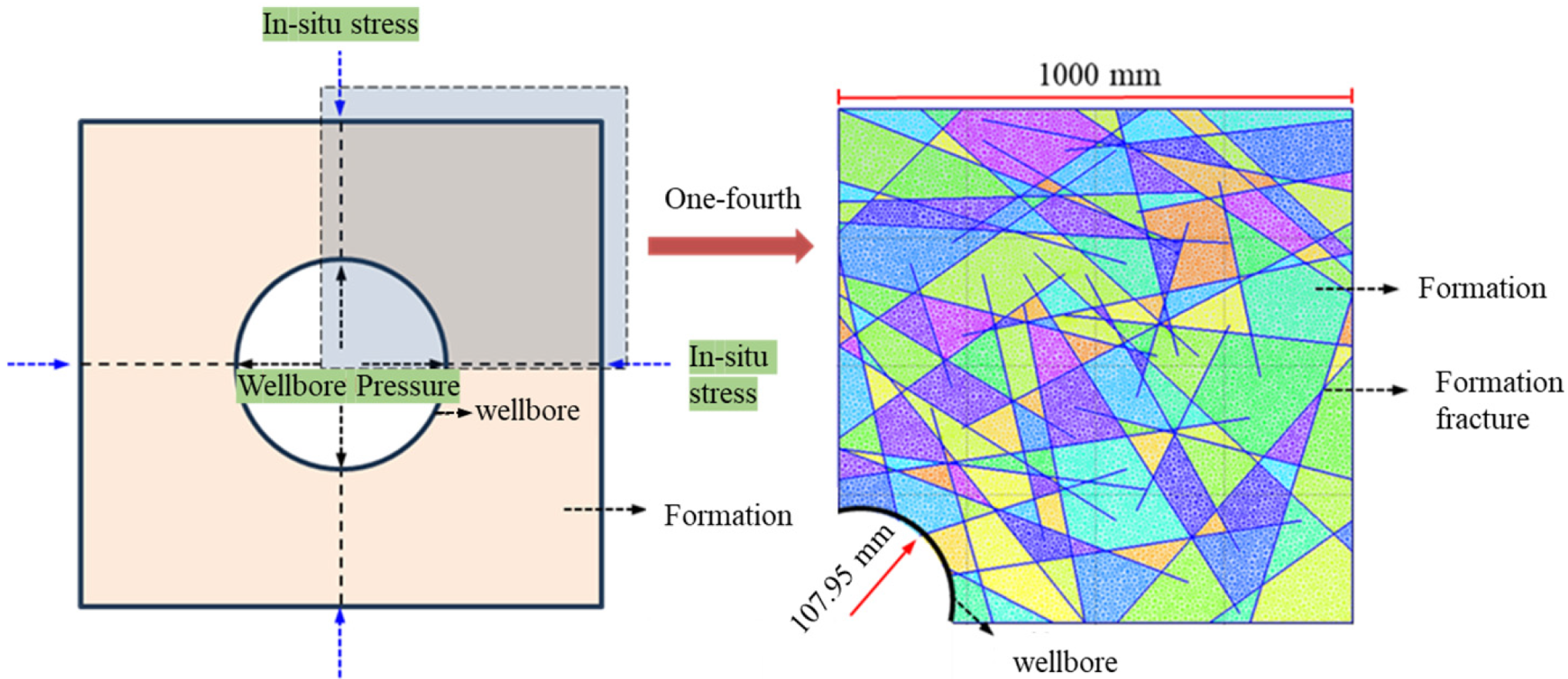
During drilling, the bit continuously advances toward the target formation, creating a near-cylindrical wellbore in the subsurface (Figure 5 left). Taking advantage of the symmetry of the wellbore-formation system, a quarter-model of the actual configuration was adopted, as illustrated on the right side of Figure 5. In this model, the formation is represented by a square domain with a side length of 1000 mm, and a quarter-circle with a radius of 107.95 mm located at the lower-left corner simulates the wellbore.
To replicate the complex fracture network distribution characteristic of fractured formations as realistically as possible, a discrete fracture network (DFN) model was employed to stochastically generate the fracture length and orientation. The initial fracture aperture was prescribed to be sufficiently small to represent an initially closed or near-closed state. During the simulation, however, the fracture aperture is not held constant; rather, it evolves dynamically in response to variations in wellbore pressure, in situ stress, and the damage/contact state of the fracture elements. The flow capacity of each fracture is therefore jointly governed by its initial aperture, fracture opening pressure, wall-contact condition, and pressure-driven aperture change. It should be noted that, owing to the lack of high-resolution fracture surface scans and statistical data on in situ fracture apertures, the current aperture distribution represents an equivalent treatment. The detailed parameters, including wellbore and formation pressures, rock mechanical properties, and drilling fluid properties, are summarized in Table 2, all of which were sourced from field data acquired in the Cameroon block.
Regarding the boundary conditions, the right and bottom boundaries of the model correspond to the symmetry planes of the quarter-model and are assigned normal displacement constraints. The far-field outer boundaries are subjected to the in situ horizontal stresses and the initial formation pore pressure. The boundary is treated as a free outflow boundary, with no reflection considered at the boundary. The wellbore boundary is prescribed with the corresponding wellbore pressure according to the drilling or flowback stage.
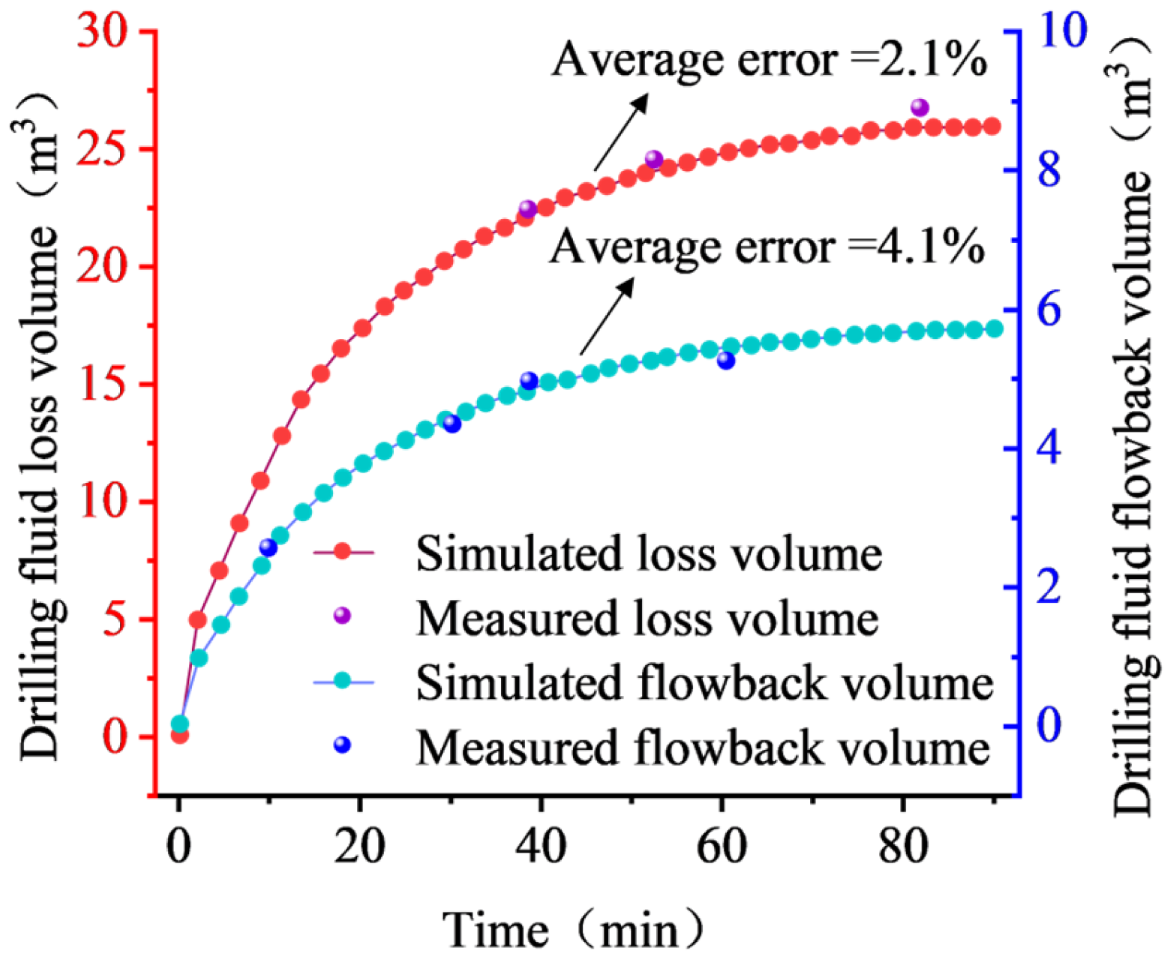
The near-wellbore region experiences the most pronounced wellbore pressure perturbations, pore pressure gradients, and fracture aperture evolution. If the mesh in this region is too coarse or the local element size is excessively large, the wellbore stress concentration, pore pressure diffusion, and crack-tip opening displacement cannot be accurately captured, leading to errors in the computed fracture opening behavior, drilling fluid loss volume, and flowback volume. This is particularly critical in FDEM models, where fracture initiation, propagation, and closure depend on damage evolution and contact detection at element boundaries. An overly coarse mesh degrades the resolution of fracture path delineation and may result in discontinuous fracture propagation or inadequate identification of local flow channels. To ensure that the processes of fracture opening, closure, and propagation are accurately captured, the mesh was locally refined in the near-wellbore region and in zones where fractures are expected to develop. In the present model, GPU-based parallel computing was adopted, which substantially reduces the impact of mesh size on computational efficiency. To improve simulation accuracy, a relatively large number of elements was employed. The adequacy of the selected mesh density was subsequently confirmed through model validation (Figure 6). In total, 128,352 Delaunay triangular elements were used for the spatial discretization.

2.2.3. Model Validation

Severe drilling fluid loss and flowback phenomenon, known as the formation breathing effect, occurred in a well located in Cameroon while drilling through the S1G formation. Based on the formation and drilling parameters of this region, a validation model for the breathing effect in fractured formations was established. The detailed parameters of the validation model are listed in Table 2. To validate the accuracy of the numerical model, the calculated drilling fluid loss and flowback volumes were compared with field measured data, as shown in Figure 6. The comparison results indicate that the field-measured data for both the loss and flowback stages fluctuate and are in close agreement with the numerical simulation results. Specifically, the simulation error for drilling fluid loss volume is less than 2.1%, and the error for flowback volume is less than 4.1%. Consequently, the model demonstrates high accuracy and satisfies engineering precision requirements. It should be noted that the above-stated errors are derived from a comparison of the drilling fluid loss and flowback volumes over a single well section, and they primarily reflect the fitting accuracy under the pressure conditions and formation parameter ranges specific to the target interval in this case-study well. Field instantaneous flowrate signals are subject to the influence of mud pump strokes, wellbore temperature variations, and measurement noise; therefore, the error levels of 2.1% and 4.1% should not be extrapolated as absolute errors applicable to all actual drilling scenarios.

3. Results and Discussion

This section first clarifies the typical characteristics of the breathing effect in fractured formations based on experiments. Subsequently, numerical simulation techniques are employed to further supplement and reveal the mechanism of the breathing effect in fractured formations, and a sensitivity analysis is conducted on the geological and engineering parameters. Finally, a calculation method for formation loss pressure considering the breathing effect is established to achieve accurate prediction of the loss pressure and drilling fluid safety density window in fractured formations.

3.1. Analysis of Experimental Results

3.1.1. Analysis of Typical Characteristics of Breathing Effect in Fractured Formations

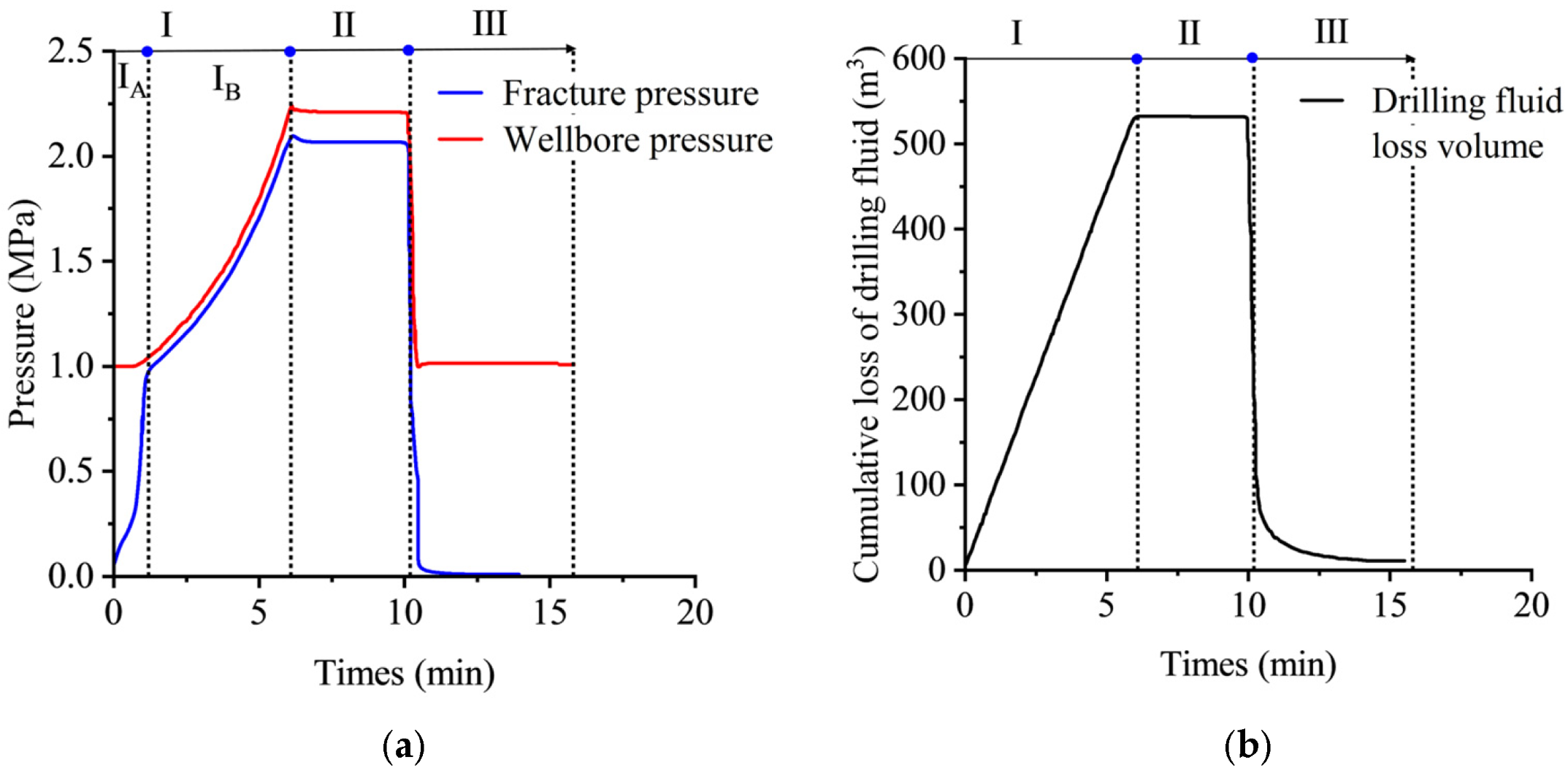
The ambiguity regarding the typical characteristics of the breathing effect in fractured formations is a primary reason why field engineers struggle to distinguish it from a kick. Therefore, we conducted breathing effect experiments under varying lithological combinations and pressure conditions. The typical characteristics of fluid loss during the breathing effect are presented in Figure 7b, while Figure 7a illustrates the variation curves of the system pressure environment during the experiment. As shown in Figure 7a, during the simulated pumping and drilling phase (Phase I), the wellbore pressure increases rapidly as fluid is continuously pumped into the simulated wellbore, gradually reaching the fracture opening pressure (Phase IA); subsequently, the simulated fracture opens, communicating the wellbore with the fracture, causing the wellbore pressure and fracture pressure to rise synchronously (Phase IB). During the simulated pump-off phase (Phase II), fluid injection into the simulated wellbore ceases, and the wellbore pressure remains constant. During the simulated tripping-out phase (Phase III), the wellbore pressure drops rapidly, and the pressure in the communicating fracture gradually decreases until closure. Throughout the experiments, we observed that the drilling fluid exhibited a consistent pattern during the breathing effect across different rock types and pressure conditions, as shown in Figure 7b. It can be observed from Figure 7b that the typical characteristics of the breathing effect in fractured formations are continuous drilling fluid loss during the drilling phase, followed by severe flowback during the subsequent tripping-out phase. Furthermore, during the pump-off period between drilling and tripping, the fluid loss maintains a pseudo-steady state; at this stage, due to the relative equilibrium between the wellbore and formation pressure, the volume of drilling fluid loss remains relatively stable.
In practice, at the well site, the rapid flowback of drilling fluid over a short period during the late stage of the breathing effect is highly susceptible to being misdiagnosed as a kick. If incorrect mitigation measures, such as increasing the drilling fluid density (weighting up), are implemented, serious drilling accidents, such as induced lost circulation, may ensue. Elucidating the typical characteristics of the breathing effect in fractured formations facilitates its field identification and ensures drilling safety.

3.1.2. Sensitivity Analysis of Parameters

This section outlines a sensitivity study that was conducted on the key factors affecting the breathing effect—wellbore pressure and fracture opening pressure—using an experimental setup for the breathing effect in fractured formations. It should be noted that due to experimental limitations, the sensitivity analysis of parameters such as porosity, permeability, drilling fluid viscosity, and yield stress, which are difficult to control during the experiment, will be addressed in Section 3.2.2 through numerical simulation techniques.
  • Wellbore Pressure
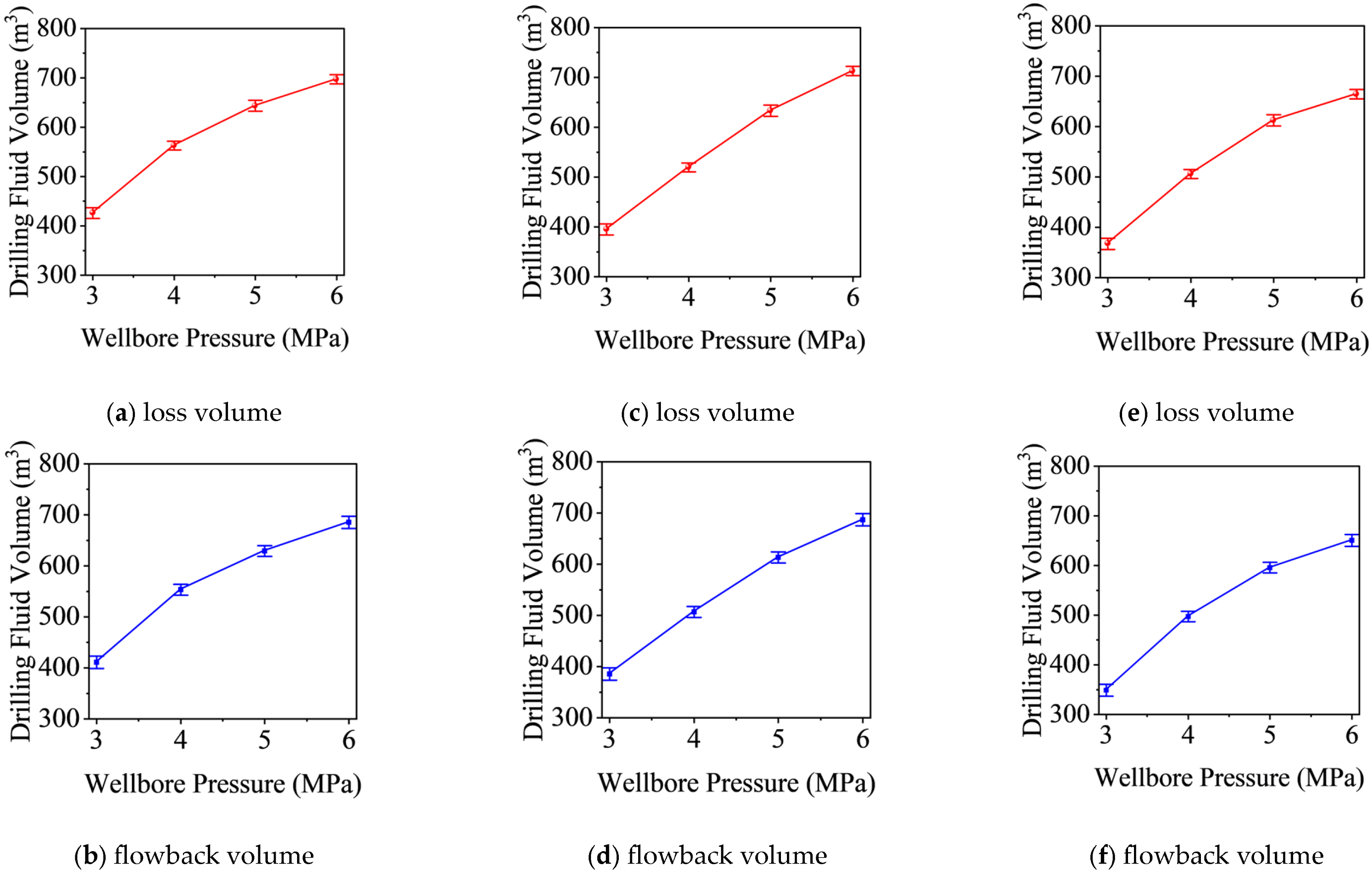
Wellbore pressure is one of the key factors influencing the breathing effect in fractured formations. As illustrated in Figure 8, the curves depicting the relationship between lost circulation volume, fluid flowback volume, and wellbore pressure during the breathing effect were plotted under various experimental lithological conditions. It can be clearly observed that both drilling fluid loss and flowback volumes increase with the increase in wellbore pressure. Since the drilling fluid loss and flowback volumes during the breathing effect directly reflect the intensity of the phenomenon, it can be concluded that the intensity of the breathing effect increases with wellbore pressure.
With constant formation pressure, the increase in wellbore pressure leads to a gradual enlargement of the wellbore-formation pressure differential. Consequently, the driving force for drilling fluid loss increases, which is the primary cause of the intensified breathing effect. A comparison of the loss and flowback curves across sandstone, shale, and sandstone–shale combination formations reveals no significant differences in the relationship between wellbore pressure and breathing effect intensity attributable to lithology.
In practical operations, wellbore pressure should be controlled to avoid excessive levels, thereby preventing the induction of severe breathing effects. Furthermore, this explains why misdiagnosing the formation breathing effect as a kick and adopting well-killing measures, such as increasing drilling fluid density, leads to serious consequences: increasing the density elevates the wellbore pressure, thereby exacerbating the breathing effect, causing it to spiral out of control, and potentially leading to complex accidents such as induced lost circulation.
2.
Fracture opening pressure
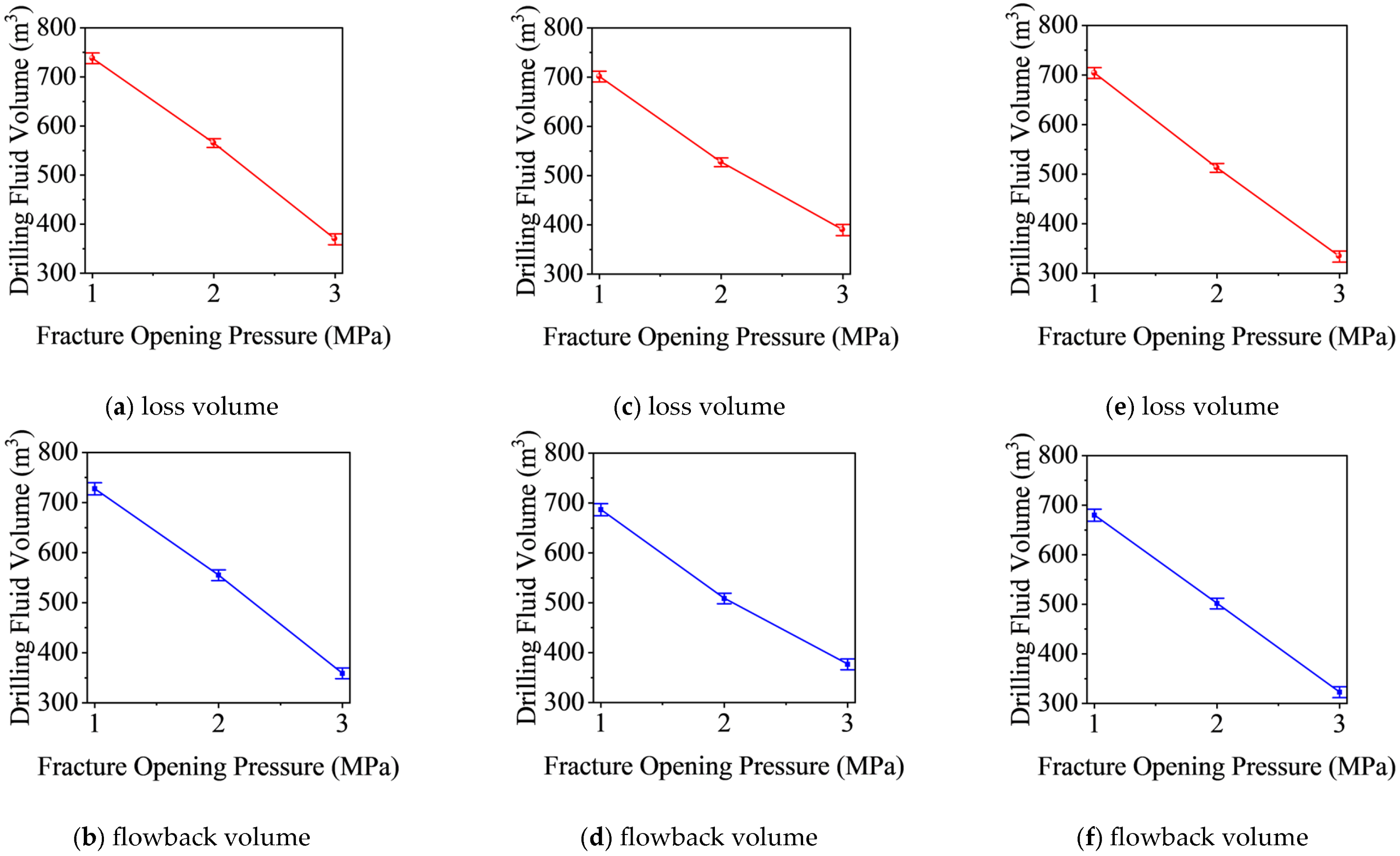
Figure 9 presents the relationship curves of fluid loss volume and flowback volume versus fracture opening pressure during the breathing effect under different experimental lithological conditions. In the experiments, the fracture opening pressure was applied as an axial compressive load on the rock specimen, and its magnitude directly reflects the ease with which formation fractures can be opened. It can be observed from the figure that, overall, the smaller the fracture opening pressure, the larger the breathing-induced fluid loss and flowback volumes—that is, the stronger the breathing effect intensity. From the perspective of the fracture opening mechanism, under the same wellbore pressure, lower fracture opening pressure means that fractures are more readily opened by wellbore pressure perturbations, leading to a higher degree of wellbore–fracture connectivity and a lower barrier for drilling fluid to enter the fracture network, thereby making the formation more susceptible to a severe breathing effect. Therefore, formations with low fracture opening pressure are breathing-effect-sensitive formations that require prioritized prevention and mitigation in engineering practice.

3.2. Analysis of Numerical Simulation Results

This section further reveals the mechanism of the breathing effect in fractured formations through a numerical model based on the finite-discrete element method (FDEM) and utilizes the model to further investigate the influence of key parameters, such as formation parameters and drilling fluid parameters, on the intensity of the breathing effect.

3.2.1. Mechanism of Breathing Effect in Fractured Formations

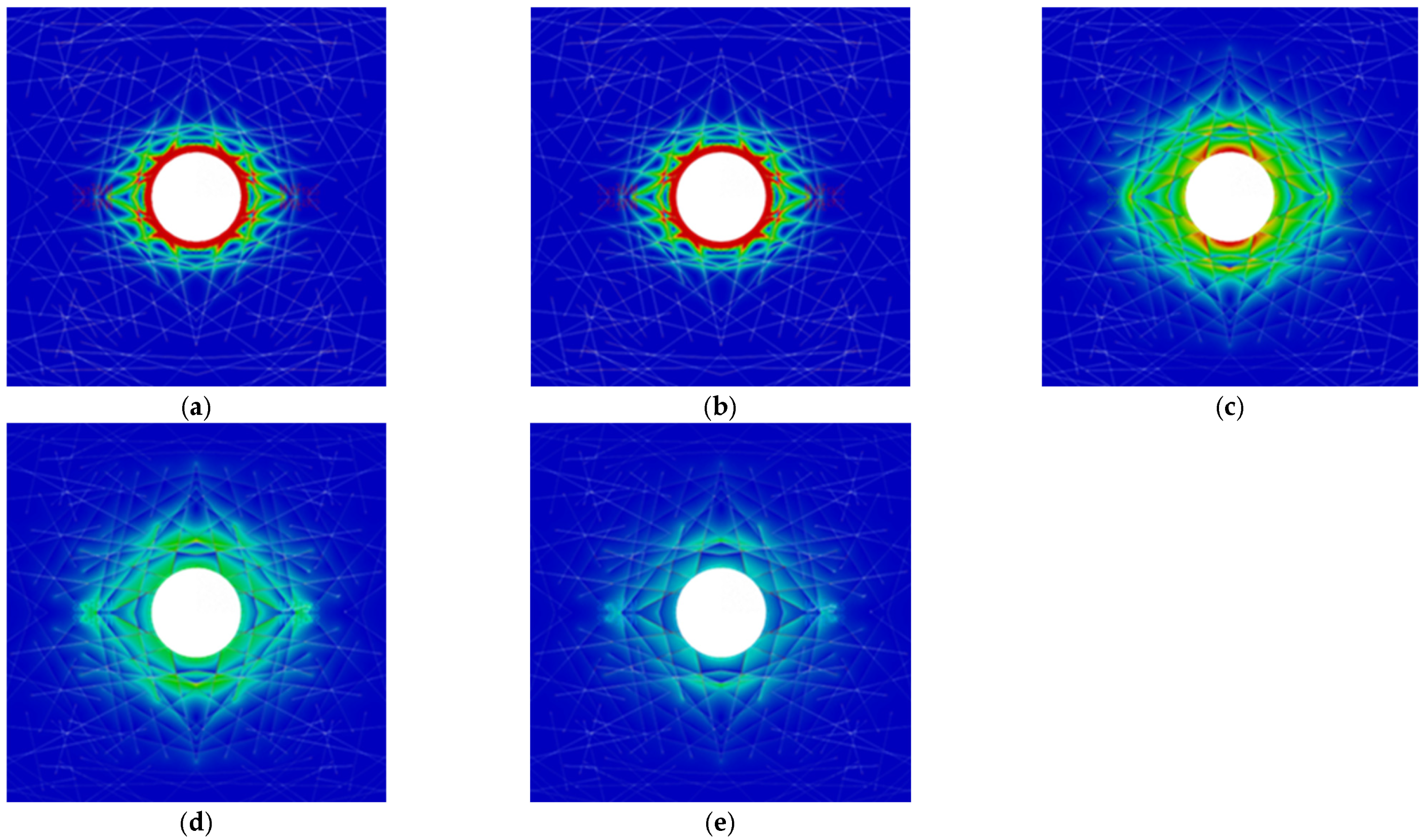
Due to the limited visualization capabilities of the experiments, numerical simulation is employed here to further investigate the microscopic response mechanism of the breathing effect in fractured formations. As shown in Figure 10, the formation pore pressure nephograms during the breathing process in fractured formations are presented, where 0–80 min corresponds to the fluid loss stage, and 80–160 min corresponds to the flowback stage. The opening and closing states of formation fractures during the breathing effect can be clearly observed in the figure. Specifically, during drilling, high wellbore pressure drives the opening of fractures around the wellbore. Under a high pressure differential (wellbore pressure exceeding formation pressure), drilling fluid seeps toward the far field through the fractures and the formation matrix. The high wellbore pressure gradually diffuses into the deep formation. As observed in the figure, from 10 min to 80 min, the formation fractures gradually open, and the influence range of wellbore pressure expands. This stage corresponds to the fluid loss stage of the typical breathing effect in fractured formations. During tripping out, the wellbore pressure drops suddenly, causing the wellbore to lose the high-pressure environment and forming a reverse pressure differential with the formation (formation pressure exceeding wellbore pressure). At this point, the drilling fluid in the fractures and formation pores returns to the wellbore under the action of the reverse pressure differential, resulting in an increase in wellbore fluid volume. As fluid flows out of the formation, the formation fractures gradually close, and the pore pressure decreases. A contraction of the high-pressure zone in the fractured formation can be observed in the figure. This stage corresponds to the flowback stage of the typical formation breathing effect. The research above indicates that wellbore pressure variation is closely related to the breathing effect in fractured formations. The opening and closing of fractures caused by the change in relative pressure differential between the wellbore and the formation is the intrinsic cause of the reversible process of drilling fluid loss followed by flowback.

3.2.2. Sensitivity Parameter Analysis

Due to experimental limitations, this section utilizes a numerical model of the breathing effect based on the finite-discrete element method (FDEM) to further investigate the influence of formation parameters and drilling fluid parameters on the breathing effect in fractured formations.
  • Porosity
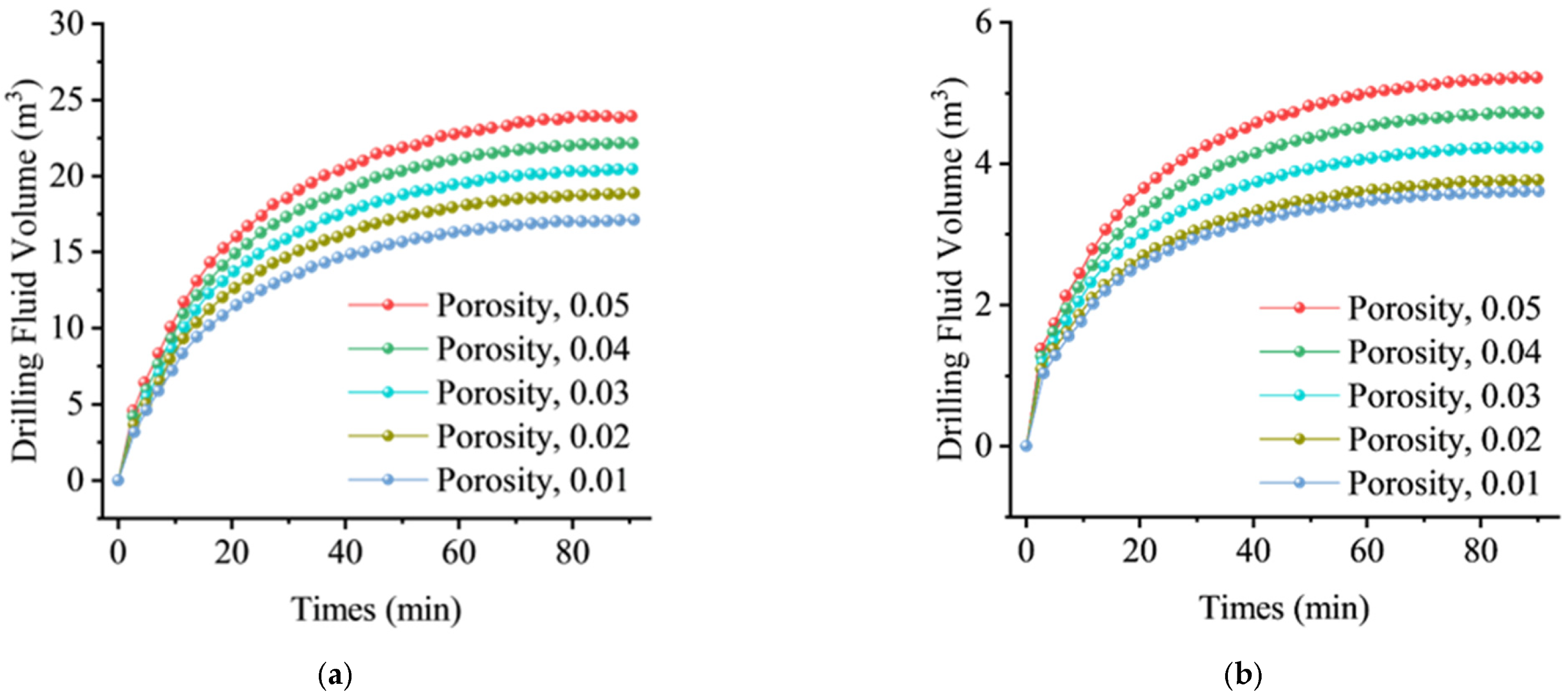
Figure 11 presents the curves of drilling fluid loss volume and flowback volume during the breathing effect under different porosity conditions. It can be observed that as formation porosity increases, both the fluid loss and flowback volumes increase progressively, that is, the intensity of the formation breathing effect intensifies with increasing porosity. Porosity serves as a measure of the pore volume within a formation—the larger its value, the greater the pore space available for accommodating drilling fluid, and consequently, the stronger the capacity to store lost drilling fluid. Moreover, high porosity typically implies a higher pore compressibility storativity and a stronger pressure diffusivity. Wellbore pressure perturbations can therefore propagate deeper into the matrix and fracture network, prolonging the high-pressure holding time within the fractures and enhancing the elastic rebound flowback after pump shut-down. Hence, high porosity not only provides a “larger accommodation space,” but also amplifies the entire loss–flowback process through increased pressure diffusion and enhanced pore-elastic energy storage, ultimately leading to a more severe breathing effect.
2.
Permeability
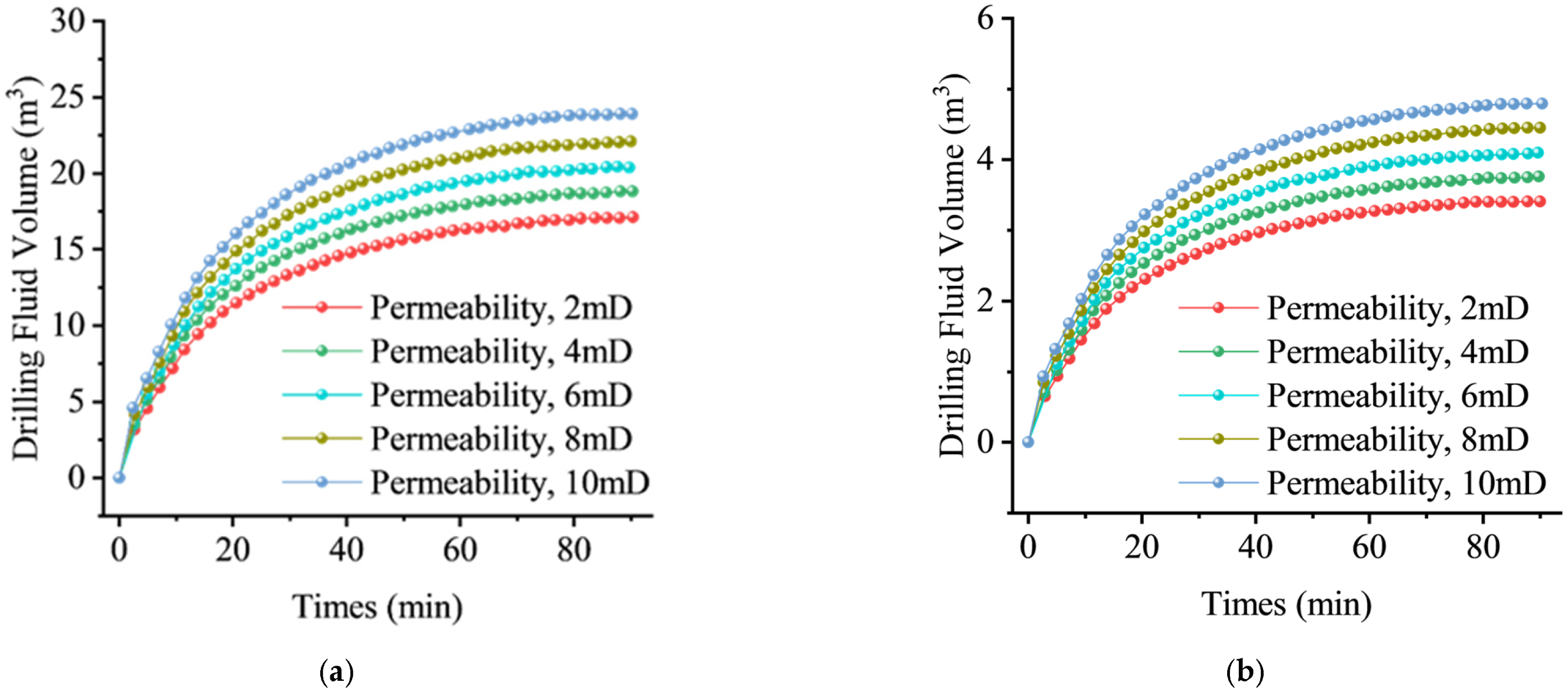
Figure 12 plots the relationship curves of drilling fluid loss volume and flowback volume versus permeability during the breathing effect. It can be observed that both the loss and flowback volumes increase with permeability, indicating that the breathing effect intensifies as permeability increases. Permeability reflects the ability of the rock to transmit fluids. Under the same differential pressure, drilling fluid flows more readily through high-permeability formations, resulting in greater loss and flowback volumes. Moreover, an increase in permeability enhances the pressure diffusivity coefficient and fluid mobility, enabling the wellbore pressure to act more rapidly on fracture tips and fracture–matrix interfaces, thereby promoting fracture aperture growth and expanded connectivity. When pumps are shut down or during tripping out, the fluid within the formation can also return to the wellbore more quickly under the combined action of the reversed pressure differential and the elastic rebound of fractures. Consequently, high-permeability formations are more prone to sustained fluid losses and pronounced flowback, leading to a more severe breathing effect.
3.
Plastic viscosity
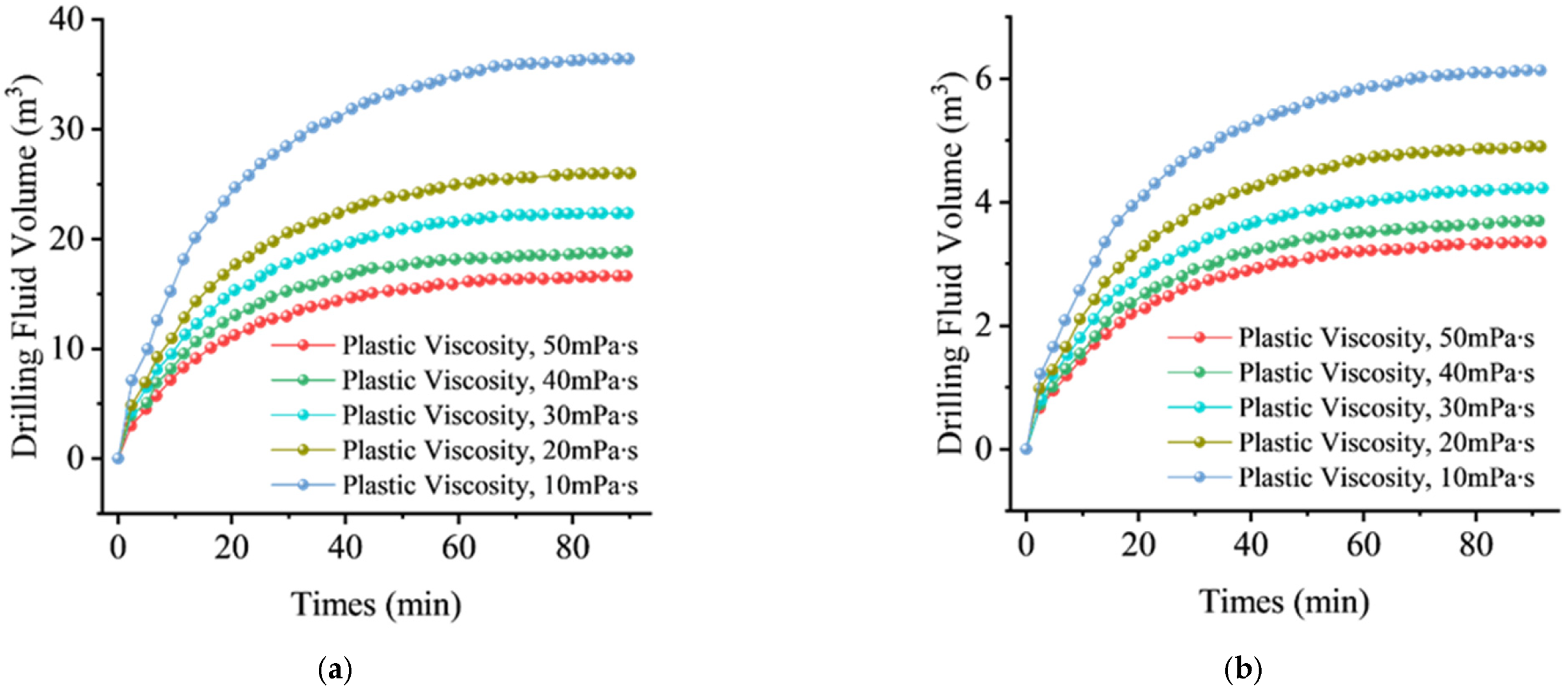
Viscosity is a field-adjustable drilling fluid parameter that governs the flow resistance of the fluid within the formation: the higher the viscosity, the greater the flow resistance. Figure 13 presents the variations in drilling fluid loss volume and flowback volume under different plastic viscosities, where (a) shows the loss volume and (b) the flowback volume. As can be seen, both the loss and flowback volumes increase with decreasing plastic viscosity, and the rate of increase progressively enlarges as the viscosity drops. This indicates that a higher drilling fluid viscosity helps suppress the intensity of the formation breathing effect. Hence, with other engineering parameters kept constant, moderately increasing the viscosity can reduce the impact of the breathing effect on wellbore flow behavior. In actual field operations, however, excessively high viscosity elevates the circulating friction, which may in turn reopen fractures and trigger an even more severe breathing effect. Therefore, the design of drilling fluid viscosity should not merely aim for a higher value; instead, in field practice, breathing effect mitigation should be formulated as a constrained optimization problem. The plastic viscosity should be optimally selected with the objectives of minimizing the cumulative loss and flowback volumes, while satisfying the constraints imposed by cuttings transport, wellbore stability, and pump pressure limitations. It should be noted that the numerical model in this study does not yet incorporate the constraints imposed by cuttings transport, wellbore stability, and pump pressure on drilling fluid viscosity. The discussion presented here is limited to a theoretical exploration of the optimal selection of plastic viscosity; dedicated investigations will be conducted in future work.
4.
Yield point
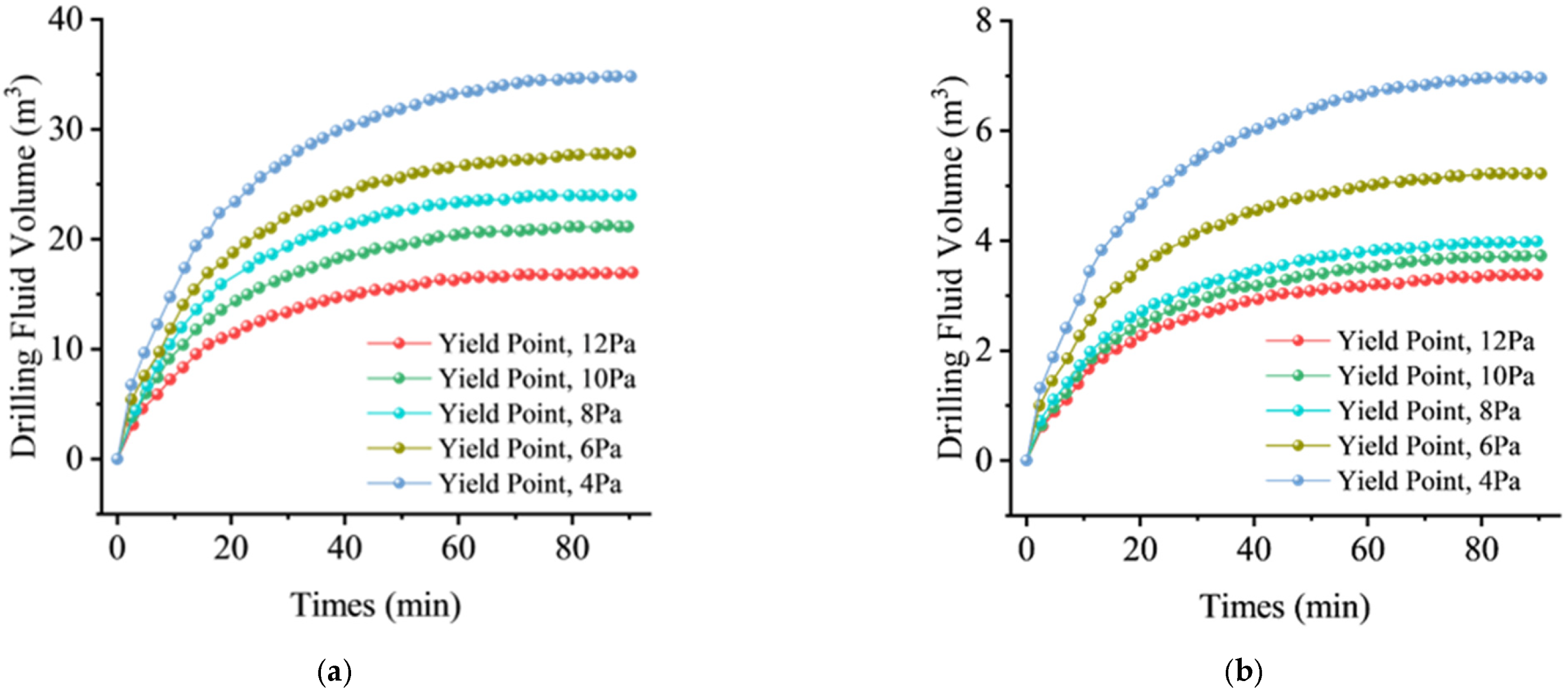
The yield point of the drilling fluid is another important performance parameter. Figure 14 illustrates the influence of yield point on the fluid loss and flowback volumes, with (a) showing the loss volume and (b) the flowback volume under different yield point conditions. As can be observed, both the loss and flowback volumes increase as the yield point decreases, and the rate of increase progressively enlarges. Reducing the yield point intensifies the formation breathing effect. This indicates that, with other engineering parameters held constant, moderately increasing the yield point can mitigate the impact of the breathing effect on wellbore flow behavior—for instance, by adding inorganic electrolytes or bentonite to the drilling fluid.

3.3. Prediction Method for Formation Leakage Pressure Around the Wellbore Considering the Breathing Effect

During drilling operations in the target block of Cameroon, significant reversible lost circulation occurs due to the breathing effect, even when the bottom-hole pressure is lower than the formation fracturing pressure. Consequently, conventional methods for predicting formation lost circulation pressure are inadequate. It is essential to account for the impact of the breathing effect to properly design the drilling fluid density window (mud weight window). Based on the fracture formation breathing effect model established in Section 2.2, this study modifies the calculation model for lost circulation pressure. This approach incorporates the influence of the breathing effect on fluid loss, thereby achieving accurate prediction of the lost circulation pressure.

3.3.1. Modification of Formation Lost Circulation Pressure Calculation Model

Drilling fluid loss occurs when the pressure differential between the bottomhole pressure and the formation pressure exceeds the critical threshold of flow resistance for fluid invasion into the formation. In fractured formations, near-wellbore natural or induced fractures can open at pressures below the conventional fracture breakdown pressure; therefore, a breathing effect correction term must be introduced into the traditional lost-circulation pressure model. The basic model accounting for the correlation between loss rate and loss pressure differential can be written as follows:
p l = p p + Δ p d = p p + A Q B ,
where Q is the drilling fluid loss rate, m3/h; A is the fitting coefficient, dimensionless; B is the fitting exponent, dimensionless; pp is the formation pressure, MPa; ΔPd is the loss pressure differential, MPa; and Pl is the formation leakage pressure, MPa.
During the breathing effect, the total lost circulation volume (Vl) entering the fracture and pore system is composed of the formation retained volume (Va) and the flowback volume (Vb), which can be expressed as follows:
V l = V a + V b ,
where Vl is the total drilling fluid loss volume, m3; Va is the drilling fluid retention volume in the formation, m3; and Vb is the drilling fluid flowback volume, m3.
The presence of the breathing effect in the near-wellbore formation prevents engineers from accurately calculating the lost volume of drilling fluid, which in turn leads to errors in the determination of the loss rate. Therefore, a correction to the loss rate is required. Incorporating the loss volume relationship during the breathing effect (Equation (8)), the correction formula for the loss rate is expressed as follows:
Q x = V l t l = V a + V b t l = 1 1 γ V a t = 1 1 γ Q ,
where γ is the intensity coefficient used to quantify the influence of the formation breathing effect on the calculation of lost-circulation pressure, defined in this paper as the ratio of the flowback volume to the total loss volume, and is expressed as follows:
γ = V b V l
Then, the modified leakage pressure can be expressed as follows:
p l = p p + A Q x B = p p + A 1 1 γ B Q B ,
where Qx is the modified drilling fluid loss rate, m3/h; t is the loss time, h; and γ is the breathing effect intensity coefficient defined in this study, dimensionless. In field practice, the value of γ can be determined from the field-calibrated numerical model of the breathing effect in fractured formations.
The analysis above reveals the existence of a critical loss rate. When the loss rate reaches or exceeds this critical value, drilling fluid loss occurs, and the corresponding bottomhole pressure is taken as the lost-circulation pressure. The critical loss rate is governed by multiple factors, including the physical and rheological properties of the drilling fluid, the geometric and mechanical parameters of the fractures, and the relevant formation properties. In practice, the critical loss rate is generally determined based on actual field conditions; for fractured formations, the critical loss rate is typically set in the range of 3–5 m3/h. If the lost-circulation pressure calculated from the critical loss rate exceeds the formation fracture pressure, the actual lost-circulation pressure should be taken as the formation fracture pressure.
Based on the analysis above, and taking the formation fracture pressure into comprehensive consideration, the calculation of leakage pressure should be divided into the following two cases:
① When the formation fracture pressure is relatively low and formation fracturing occurs, resulting in a loss rate lower than the critical loss rate, the leakage pressure is given by the following:
p l = p f
② When the formation fracture pressure is relatively high, and the loss rate exceeds the critical loss rate before formation fracturing occurs, the leakage pressure is given by the following:
p l = p p + A Q x B = p p + A 1 1 γ B Q B

3.3.2. Case Calculation of Formation Pressure Considering the Formation Breathing Effect

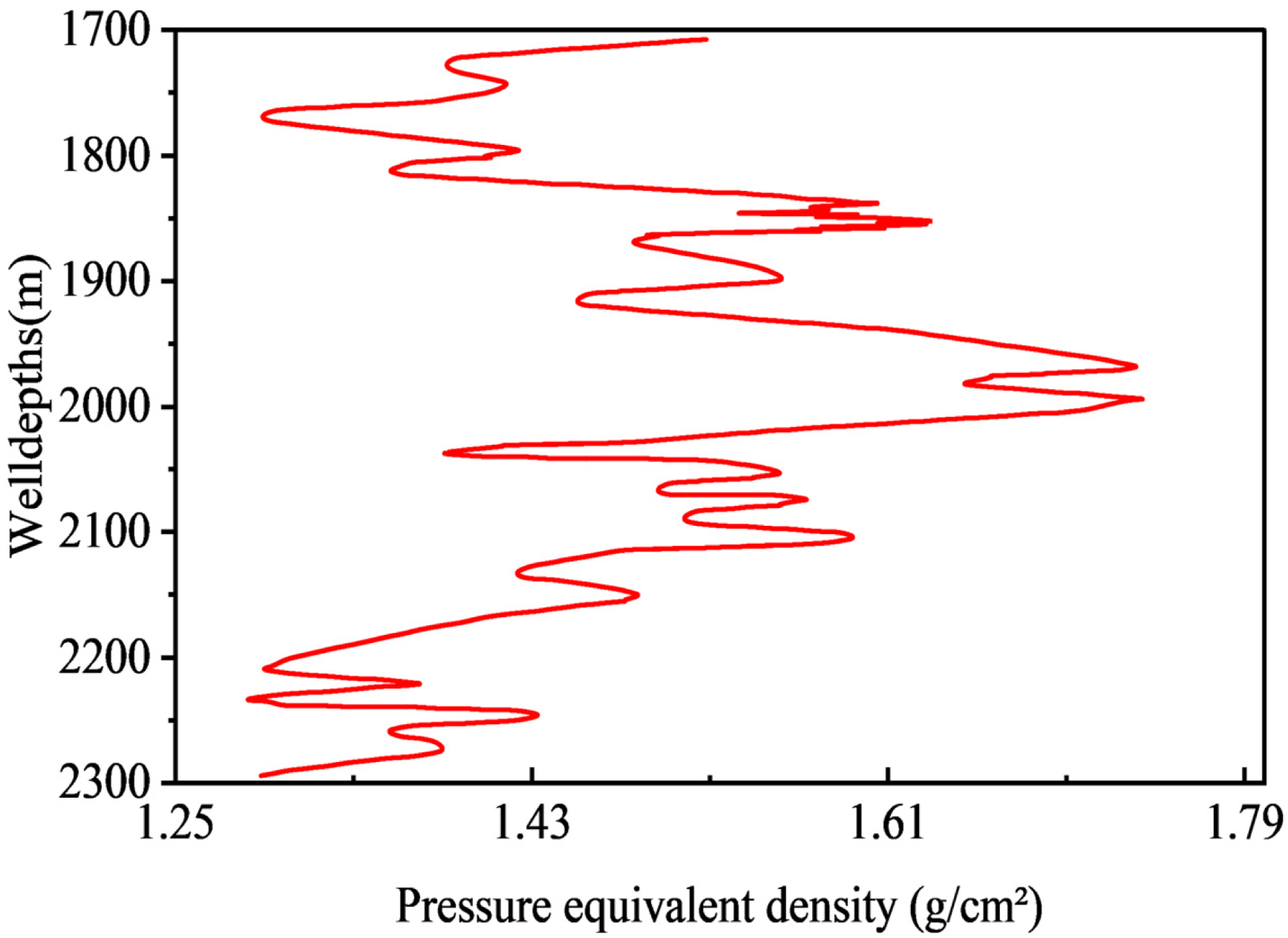
Well X in the Cameroon region is an appraisal exploration well located in water depths of approximately 42 m. A kick occurred at a depth of 3603 m during drilling, followed by lost circulation during the well-killing operation. Drilling continued despite the simultaneous occurrence of overflow and loss; however, another overflow happened during tripping out after reaching the total depth. After pumping a heavy mud cap, the drill string was pulled out of the hole, and a simplified bottom hole assembly (BHA) was run to place/squeeze a cement plug at the casing shoe to abandon the well, thereby sealing the oil and loss zones. However, even after sidetracking, the well continued to encounter kicks and lost circulation, indicating a distinct narrow density window. Figure 15 illustrates the equivalent bottomhole pressure density for a section of this case well. As shown in the figure, the wellbore pressure gradually increased in the 1760–2000 m interval and decreased in the 2000–2300 m interval. Based on the wellbore pressure fluctuations and the observed loss–flowback phenomenon in this well, it was determined on site that a relatively severe formation breathing effect had occurred. It is therefore necessary to consider the influence of the breathing effect on the near-wellbore lost-circulation pressure. According to the findings presented in Section 3.3.1, the breathing effect intensity coefficient γ directly affects the corrected lost-circulation pressure calculation. Taking the derivative of Equation (13) with respect to γ yields the following:
d p l d γ = A B Q B ( 1 γ ) B + 1
Since Q > 0, B > 0, and γ > 0, the partial derivative remains consistently positive, indicating that the lost-circulation pressure is positively correlated with γ. The breathing effect intensity coefficient γ should generally be determined based on actual field conditions. According to field data from the Cameroon block, the values of γ defined in this study fall primarily within the range of 0.35–0.55; in the present case, a value of γ = 0.45 is adopted.
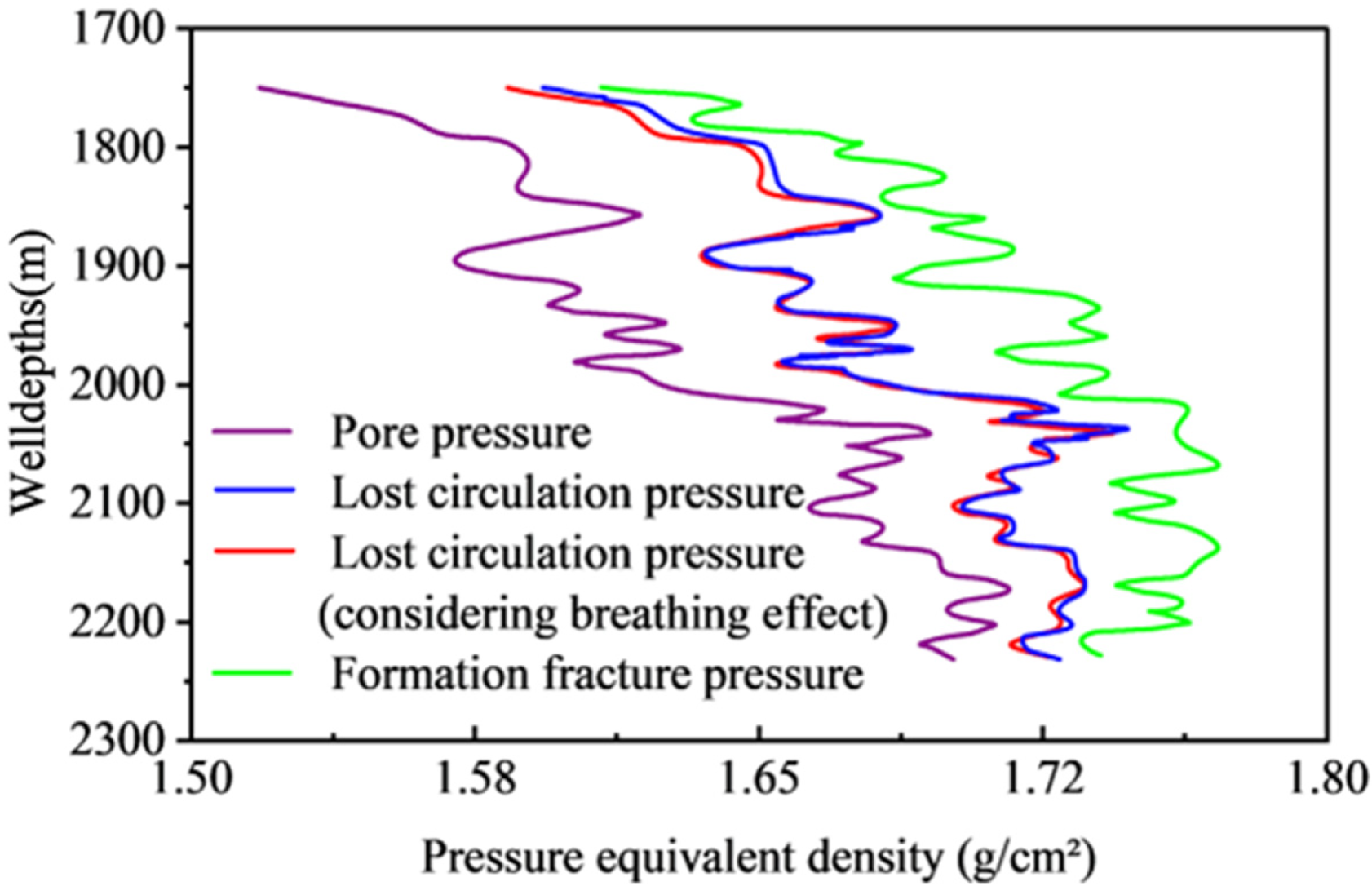
To investigate the influence of the breathing effect on the calculated lost-circulation pressure, we computed the lost-circulation pressure under two conditions: with and without consideration of the breathing effect. Figure 16 presents the lost-circulation pressure curves obtained from the two models, and Table 3 lists in detail the lost-circulation pressure values at selected well depths for both cases. The results indicate that the breathing effect can cause a significant narrowing of the safe mud weight window, with the maximum reduction reaching 0.03 g/cm3 at a depth of 1845 m. Neglecting the influence of the breathing effect on lost-circulation pressure may lead to severe drilling fluid losses or even formation breakdown, resulting in complex downhole incidents.

4. Conclusions

  • The typical characteristics of the breathing effect in fractured formations are continuous drilling fluid loss followed by rapid flowback, resulting in significant reversible changes in wellbore fluid volume. Based on these characteristics, the formation breathing effect can be accurately identified on-site. The primary cause of this effect is the switching of fracture open/closed states triggered by changes in the relative pressure differential between the wellbore and the formation.
  • An increase in wellbore pressure leads to an intensified breathing effect. Formations with low fracture opening pressure, high porosity, and high permeability are more prone to severe breathing effects. Although increasing drilling fluid viscosity and yield point can effectively control the breathing effect, care must be taken to prevent high wellbore pressure caused by increased circulating friction.
  • Based on the traditional theory of lost-circulation pressure, an improved calculation method is developed by incorporating the influence of the formation breathing effect. A case study is conducted using data from a well drilled in the Cameroon block. The results indicate that the lost-circulation pressure predicted for fractured formations with the breathing effect taken into account is lower than that obtained from conventional prediction methods. Due to the breathing effect, the safe mud weight window in the case-study well can narrow by up to 0.03 g/cm3.
  • In the present study, the experimental apparatus has limited pressure and temperature resistance and is therefore unable to fully reproduce the deep high-temperature, high-pressure environment; the numerical model also incorporates simplifications in the description of fluid rheology, fracture surface roughness, and thermal–hydraulic coupling. These limitations will be progressively addressed in future investigations.

Author Contributions

Conceptualization, S.Y. and H.Y.; methodology, S.Y.; software, S.Y.; validation, L.A., Y.X. and J.L.; formal analysis, Q.L.; investigation, L.G.; resources, S.Y.; data curation, S.Y.; writing—original draft preparation, S.Y.; writing—review and editing, S.Y.; visualization, S.Y.; supervision, S.Y.; project administration, S.Y., Y.X. and J.L.; funding acquisition, Y.X. and J.L. All authors have read and agreed to the published version of the manuscript.

Funding

This research was funded by the National Natural Science Foundation of China Major Research Instrument Development Project “Development of Real-time Downhole Intelligent Identification System for Complex Drilling Conditions”, grant number No. 5222780 and the National Natural Science Foundation of China General Program “Intelligent Identification of Overflow in Ultra-deep Complex Formations and Integrated Control Method for Shut-in and Killing”, grant number No. 5247401.

Data Availability Statement

Data are available on request due to restrictions. The reason for the restriction is that the data involve privacy-related and other proprietary information pertaining to oil and gas fields, which cannot be made publicly available. However, the data can be made available upon request to the corresponding author, subject to appropriate permissions.

Acknowledgments

We sincerely appreciate the editors and reviewers for their careful review and valuable comments on our manuscript. Your constructive suggestions have not only helped us identify the deficiencies in the paper but also provided important guidance for improving the quality of the article.

Conflicts of Interest

Authors Shuijie Yu, Lei An and Yang Xu were employed by the company Sinopec International Petroleum Exploration and Production Corporation. The remaining authors declare that the research was conducted in the absence of any commercial or financial relationships that could be construed as potential conflicts of interest.

References

  1. Labenski, F.; Reid, P.; Santos, H. Drilling fluids approaches for control of wellbore instability in fractured formations. In Proceedings of the SPE/IADC Middle East Drilling Technology Conference and Exhibition; SPE-85304-MS; SPE: Richardson, TX, USA, 2003. [Google Scholar]
  2. Jia, L.; Chen, M.; Hou, B.; Sun, Z.; Jin, Y. Drilling fluid leakage model and leakage law in fractured formations. Pet. Explor. Dev. 2014, 41, 95–101. [Google Scholar] [CrossRef]
  3. Wu, Y.H.; Huang, H.L.; Luo, M.; Li, W.T.; Ma, C.H.; Dai, R.; Li, J. Dynamic response characteristics of deepwater high-temperature and high-pressure fractured breathing effect. Drill. Fluid Complet. Fluid 2025, 42, 167–179. [Google Scholar]
  4. Tare, U.A.; Whitfill, D.L.; Mody, F.K. Drilling fluid losses and gains: Case histories and practical solutions. In Proceedings of the SPE Annual Technical Conference and Exhibition; SPE-71368-MS; SPE: Richardson, TX, USA, 2001. [Google Scholar]
  5. Lin, Y. Identification and treatment of formation respiration effect in deep well control. Ocean. Oil 2014, 34, 72–76. [Google Scholar]
  6. Gao, R.; Li, J.; Liu, G.; Yang, H.; Luo, K.; Zhai, W.; Zhang, X.; Zhang, R. Experimental study on typical characteristics of borehole breathing under different pressure and rock type conditions. J. Nat. Gas Sci. Eng. 2020, 77, 103241. [Google Scholar] [CrossRef]
  7. Liu, Z. MY-2 breathing effect and identification. West. Prospect. Proj. 2022, 34, 52–54. [Google Scholar]
  8. Gill, J.A. Charged shales: Self-induced pore pressures. In Proceedings of the IADC/SPE Drilling Conference, Dallas, TX, USA, 9–12 February 1986. [Google Scholar]
  9. Bjørkevoll, K.S.; Vefring, E.H.; Rommetveit, R.; Aadnøy, B. Changes in Active Volume due to Variations in Pressure and Temperature in HPHT wells. In Proceedings of the 7th Northern European Drilling Conference, Kristiansand, 4–6 October 1994. [Google Scholar]
  10. Sadd, M.H. Elasticity: Theory, Applications, and Numerics; Academic Press: New York, NY, USA, 2009. [Google Scholar]
  11. Eirik, K.; Bernt, S.A. Analysis of temperature measurements during drilling. In Proceedings of the SPE Annual Technical Conference and Exhibition; Society of Petroleum Engineers: San Antonio, TX, USA, 1997. [Google Scholar]
  12. Babu, D.R. Effect of P-ρ-T behavior of muds on loss/gain during high-temperature deep-well drilling. J. Pet. Sci. Eng. 1998, 20, 49–62. [Google Scholar] [CrossRef]
  13. Xie, J. Treatment of formation respiration effect in a well in the eastern South China Sea. Chem. Eng. Equip. 2023, 8, 111–113. [Google Scholar] [CrossRef]
  14. Ward, C.; Clark, R. Anatomy of a Ballooning Borehole using PWD. In Proceedings of the Workshop Proceedings in Petroleum Exploration, Pau, France, 7–8 April 1998; Available online: https://www.osti.gov/etdeweb/biblio/20036659 (accessed on 26 January 2026).
  15. Kårstad, E. Analysis of ballooning effects during drilling of high pressure high temperature wells. In Proceedings of the SPE Europec Featured at EAGE Conference and Exhibition; SPE-52066-STU; SPE: Richardson, TX, USA, 1998. [Google Scholar]
  16. Baldino, S.; Meng, M. Critical review of wellbore ballooning and breathing literature. Géoméch. Energy Environ. 2021, 28, 100252. [Google Scholar] [CrossRef]
  17. Ozdemirtas, M.; Babadagli, T.; Kuru, E. Numerical modelling of borehole ballooning/breathing-effect of fracture roughness. In Proceedings of the PETSOC Canadian International Petroleum Conference, Calgary, Alberta, 12 June 2007; p. PETSOC-2007-038. [Google Scholar] [CrossRef]
  18. Pordel Shahri, M.; Zeyghami, M.; Majidi, R. Investigation of fracture ballooning and breathing in naturally fractured reservoirs: Effect of fracture deformation law. In Proceedings of the SPE Nigeria Annual International Conference and Exhibition; SPE-150817-MS; SPE: Richardson, TX, USA, 2011. [Google Scholar]
  19. Baldino, S.; Miska, S.Z.; Ozbayoglu, E.M. A novel approach to borehole-breathing investigation in naturally fractured formations. SPE Drill. Complet. 2019, 34, 27–45. [Google Scholar] [CrossRef]
  20. Ozdemirtas, M.; Kuru, E.; Babadagli, T. Experimental investigation of borehole ballooning due to flow of non-Newtonian fluids into fractured rocks. Int. J. Rock Mech. Min. Sci. 2010, 47, 1200–1206. [Google Scholar] [CrossRef]
  21. Helstrup, O.A.; Rahman, K.; Chen, Z.; Rahman, S.S. Poroelastic effects on borehole ballooning in naturally fractured formations. In Proceedings of the SPE/IADC Drilling Conference and Exhibition; SPE-79849-MS; SPE: Richardson, TX, USA, 2003. [Google Scholar]
  22. Lavrov, A.; Tronvoll, J. Modeling mud loss in fractured formations. In Proceedings of the Abu Dhabi International Petroleum Exhibition and Conference; SPE-88700-MS; SPE: Richardson, TX, USA, 2004. [Google Scholar]
  23. Yang, H.; Gao, R.; Li, J.; Lian, W.; Guo, B.; Wang, W.; Huang, H. Dynamic response mechanism of borehole breathing in fractured formations. Energy Rep. 2022, 8, 3360–3374. [Google Scholar] [CrossRef]
  24. Huang, H. Research on the Formation Mechanism and Precise Prediction Method of Marine Formation Pressure System Considering Diapiric Structures. Ph.D. Thesis, China University of Petroleum, Beijing, China, 2023. [Google Scholar] [CrossRef]
  25. Zhang, G.; Li, J.; Huang, H.; Yang, H.; Liu, G.; Wang, B.; Luo, M.; Li, W. Research on response characteristics of breathing effect in deep-water high temperature and high pressure fractured formation. Geoenergy Sci. Eng. 2025, 246, 213646. [Google Scholar] [CrossRef]
  26. Wang, X.; Li, J.; Li, H.; Sun, B.; Wang, Z.; Gao, Y. The mechanism of breathing effect and intelligent recognition method considering wellbore-formation coupling during drilling in deepwater. Ocean. Eng. 2025, 339, 122038. [Google Scholar] [CrossRef]
Figure 1. Schematic diagram of the experimental principle for the breathing effect in fractured formations.
Processes 14 01811 g001
Figure 2. Relative position diagram of rock samples during the experiment.
Processes 14 01811 g002
Figure 3. Schematic diagram of contact between discrete units.
Processes 14 01811 g003
Figure 4. Typical failure mode classification of two-dimensional FDEM joint elements.
Processes 14 01811 g004
Figure 5. Numerical model of formation breathing effect based on finite-discrete element method.
Processes 14 01811 g005
Figure 6. Model validation.
Processes 14 01811 g006
Figure 7. Typical characteristics of breathing effect in fractured formations. (a) Experimental pressure—time; (b) leakage volume—time.
Processes 14 01811 g007
Figure 8. The relationship curves among fluid loss volume, flowback volume, and wellbore pressure during the breathing process under different formation lithology conditions: (a) and (b), sandstone formation; (c) and (d), shale formation; (e) and (f), sandstone–shale composite formation.
Processes 14 01811 g008
Figure 9. The relationship curves among fluid loss volume, flowback volume, and fracture opening pressure during the breathing process under different formation lithology conditions. (a) and (b), sandstone formation; (c) and (d), shale formation; (e) and (f), sandstone–shale composite formation.
Processes 14 01811 g009
Figure 10. Cloud map of pore pressure at different times during the breathing effect phase: (a) 10 min; (b) 20 min; (c) 80 min; (d) 100 min; (e) 160 min.
Processes 14 01811 g010
Figure 11. Drilling fluid loss volume and flowback volume during the breathing process under different porosity conditions: (a) drilling fluid loss volume; (b) drilling fluid flowback volume.
Processes 14 01811 g011
Figure 12. Drilling fluid loss volume and flowback volume during the breathing process under different permeability conditions: (a) drilling fluid loss volume; (b) drilling fluid flowback volume.
Processes 14 01811 g012
Figure 13. Drilling fluid loss volume and flowback volume during the breathing process under different plastic viscosity conditions: (a) drilling fluid loss volume; (b) drilling fluid flowback volume.
Processes 14 01811 g013
Figure 14. Drilling fluid loss volume and flowback volume during the breathing process under different yield point conditions: (a) drilling fluid loss volume; (b) drilling fluid flowback volume.
Processes 14 01811 g014
Figure 15. Equivalent bottomhole pressure density of Well X.
Processes 14 01811 g015
Figure 16. Calculation results of leakage pressure and safe density window.
Processes 14 01811 g016
Table 1. Experimental pressure parameters.
Serial NumberFracture Opening Pressure (MPa)Wellbore Pressure (MPa)Serial NumberFracture Opening Pressure (MPa)Wellbore Pressure (MPa)
I12IV24
II23VI26
III34V25
Table 2. Numerical simulation parameters.
ParameterNumerical ValueParameterNumerical Value
Well depth, m2157Drilling Fluid Density, g/cm31.55
Permeability, mD20Elastic Modulus, GPa25
Tensile strength, MPa10Porosity, Dimensionless0.02
Poisson’s ratio, dimensionless0.2Maximum Horizontal Principal Stress, MPa25
Yield value, Pa6Minimum Horizontal Principal Stress, MPa25
Plastic viscosity, mPa·s46Formation Fracture Pressure, MPa32
Drilling/Backflow Wellbore pressure, MPa31/30Original Formation Pressure, MPa30
Well depth, m2157Drilling Fluid Density, g/cm31.55
Table 3. Comparison of lost-circulation pressure with and without consideration of the formation breathing effect.
Depth (m)CategoryEquivalent Drilling Fluid Density (g/cm3)Difference (g/cm3)
800Without breathing effect1.6510.007
With breathing effect1.644
1900Without breathing effect1.6430.002
With breathing effect1.641
2000Without breathing effect1.6820.003
With breathing effect1.679
2100Without breathing effect1.7210.014
With breathing effect1.707
2200Without breathing effect1.7350.009
With breathing effect1.726
Disclaimer/Publisher’s Note: The statements, opinions and data contained in all publications are solely those of the individual author(s) and contributor(s) and not of MDPI and/or the editor(s). MDPI and/or the editor(s) disclaim responsibility for any injury to people or property resulting from any ideas, methods, instructions or products referred to in the content.