Article

Carbothermic Reduction of Antimony from Sodium Antimonate onto a Lead Collector

by
Valeriy Volodin
,
Bagdaulet Kenzhaliyev
,
Sergey Trebukhov
,
Alina Nitsenko
,
Xeniya Linnik
*,
Farkhad Tuleutay
and
Galiya Ruzakhunova
Institute of Metallurgy and Ore Beneficiation, Satbayev University, Almaty 050010, Kazakhstan
*
Author to whom correspondence should be addressed.
Processes 2026, 14(11), 1808; https://doi.org/10.3390/pr14111808
Submission received: 30 April 2026 / Revised: 26 May 2026 / Accepted: 29 May 2026 / Published: 2 June 2026
(This article belongs to the Section Chemical Processes and Systems)

Abstract

This paper presents the results of studies on the direct production of lead–antimony alloys from sodium antimonate and on the use of antimony obtained through carbothermic reduction for technical purposes. It was shown that during the carbothermic reduction of antimony from sodium antimonate onto a lead collector at 900 °C, antimony recovery into the lead–antimony alloy increased by 10.88–12.93% compared with the process performed without the addition of lead. The process proceeds without the addition of slag-forming components. A decrease in the Sb content in the lead–antimony alloy as a result of changes to the amount of metallic lead in the melt has practically no effect on the process performance. Examples of the production of lead–antimony alloy containing 25.58% and 11.52% antimony during the carbothermic smelting of sodium antimonate are given. It is shown that the alloy containing 25.58% Sb can be used in the technological process of lead refinement at the final bismuth removal stage. The alloy containing 11.52% antimony complies with the standard for the SSuYu grade of lead–antimony alloy (9.0–12.0% Sb), including the regulated impurities, except for iron. The iron content exceeds the specified limit by 0.045%, which will require minor additional purification or the use of this alloy for special purposes. Dilution of the antimony alloy by adding lead to reduce the antimony content to 4.0% Sb at 340–360 °C was also considered. The purpose of the latter is to reduce energy consumption in cases where a significant volume of metallic lead would otherwise need to be heated to the temperature of reduction smelting at 900 ± 20 °C. The proposed technical solutions can be integrated quite easily into the existing technological flowsheet of lead production.

1. Introduction

Most antimony deposits are concentrated in China, Russia, Bolivia, and Kyrgyzstan [1], with China accounting for 25% of the total reserves. There are no deposits in which antimony predominates in the Republic of Kazakhstan. Antimony is an important strategic metal. Metallic antimony and its compounds are used in the production of semiconductors, far-infrared materials, and lead–antimony alloys; lead refinement; catalyst production; and the military industry, aerospace, and other fields [2,3,4,5,6].
In this regard, the attention of researchers and process engineers has been focused on the possibility of recovering antimony from wastes and intermediate products of metallurgical production [7,8,9,10,11,12,13,14]. One of the sources of antimony production is sodium antimonate, an intermediate product of the technological flowsheet for crude lead refining [15].
The refining of 100,000 t of crude lead per year at the Shymkent Lead Plant, the Republic of Kazakhstan, with an antimony content of 0.2–0.4%, results in 200–400 t of antimony [16]. Approximately 180–380 t of Sb will be extracted into the alkaline melts, while the residual antimony content in the refined lead will be 0.02%. Approximately 128–289 t of Sb can be produced with the hydrometallurgical recovery of antimony into sodium antimonate of about 95% and a recovery rate of 75–80% during reverberatory smelting into crude antimony. No more than 30 t will be required for the final bismuth removal process with an antimony consumption of 0.2–0.3 kg/t Pb for the total volume of lead produced, which is significantly lower than the production demand. The surplus may be sold as a commercial product.
Studies on the processing of sodium antimonate, which is produced in significant quantities during the lead-refining process, are performed using both hydrometallurgical [17,18] and pyrometallurgical methods [19,20,21,22,23], with preference being given to high-temperature reduction processes.
Reduction smelting is based on the easy reducibility of antimony oxides at 800–1000 °C [15,24] by solid carbon and carbon monoxide. Soda ash is used as a flux, which makes it possible to obtain a low-melting slag containing 45% Na2O and less than 20% SiO2. Crude antimony containing 96–99% of the base metal is produced, with a recovery rate of 90%, as a result of smelting.
The authors of [23] studied the reduction smelting of sodium antimonate obtained during the crude lead-refining process to produce commercial-grade antimony. The aim of their study was to determine the optimal process parameters for processing antimony concentrate, namely sodium antimonate, to produce grade antimony in a manner applicable to the technological infrastructure of pyrometallurgical lead production. The following charge composition was found to be optimal: 100% sodium antimonate; 9% coke breeze. Experiments were performed in a rotary resistance furnace with a graphite crucible. This ensured the maximum yield of the metallic phase of 40–45% and the minimum yield of the slag phase of 29–45%. The use of fluxes is not recommended in the smelting of antimony concentrate, since the process is sustained by the presence of sodium salts in the antimonate and soda formed in the slag. As a result, according to the authors of [22], crude antimony was obtained with the following composition, wt. %: Sb 92–95; Pb 3–7; As 0.5–0.7; Sn 0.3–0.6. Cu, Fe, Na, S constituted the balance, along with slag containing about 60% Na2CO3, about 25% NaSbO3, about 8% CaO, and about 4% PbO. Due to the high content of impurities, the crude antimony was refined by introducing various fluxes into the melt: elemental sulfur or crudum (Sb2S3), caustic soda and soda ash, SiO2 with air blowing, and a 20–40% mixture of NH2PO4 + H3PO4. It was possible to produce metal of Su1 grade when the latter mixture was used.
The authors of [25] proposed a process for the carbothermic reduction of antimony from sodium antimonate with the addition of 14% special coke made from coal from the Shubarkol deposit, Kazakhstan, and 12% sodium hydroxide to the charge. The aim of their testing was to reduce the carbon footprint of the off-gases. The achieved degree of CO2 binding in the pilot tests was 87%, while the carbon dioxide content in the off-gases was 0.001%. In our opinion, the latter figure requires verification. It should be noted that there are technical difficulties associated with the analysis of the gas phase and the achievement of such low carbon dioxide emissions in technological processes.
The research was focused on extracting and obtaining commercial antimony during carbothermic reduction; however, the issues of direct production of antimony alloys and the associated extraction of impurity metals in such alloys, for example, lead, were not considered.
In the present work, similar raw materials were processed, and we attempted to directly produce and use antimony obtained through carbothermic reduction for technical purposes.

2. Materials and Methods

2.1. Materials

Sodium antimonate, an antimony concentrate (ST RK 2296-2013) [26], was supplied by KazZinc JSC (Ust-Kamenogorsk, Kazakhstan). The elemental composition of the initial sodium antimonate at a moisture content of 2% is given in Table 1.
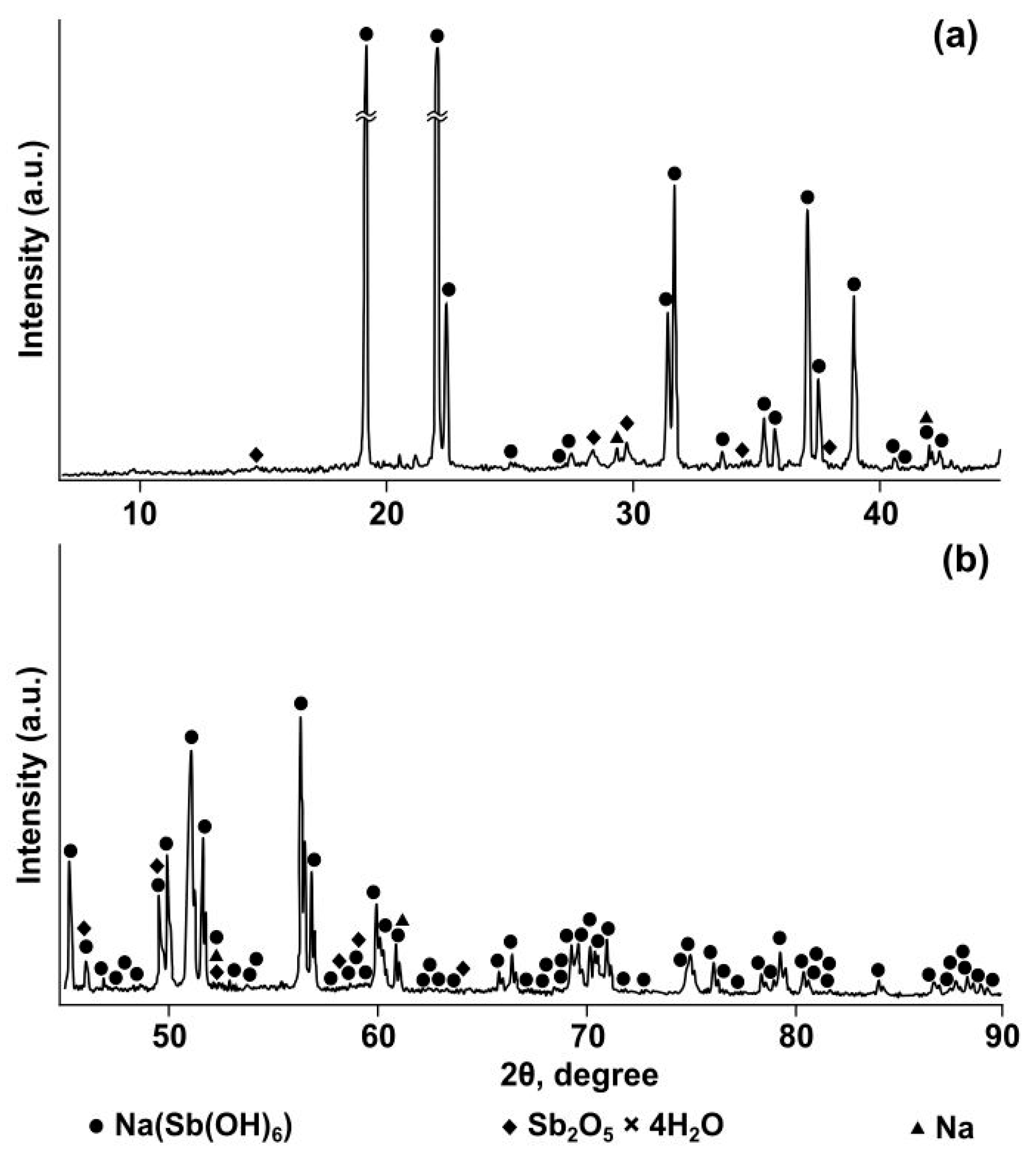
X-ray diffraction analysis showed that the concentrate contained 90.6% mopungite, Na(Sb(OH)6), 5.7% antimony pentoxide tetrahydrate, Sb2O5 × 4H2O, and 3.6% sodium (Figure 1).
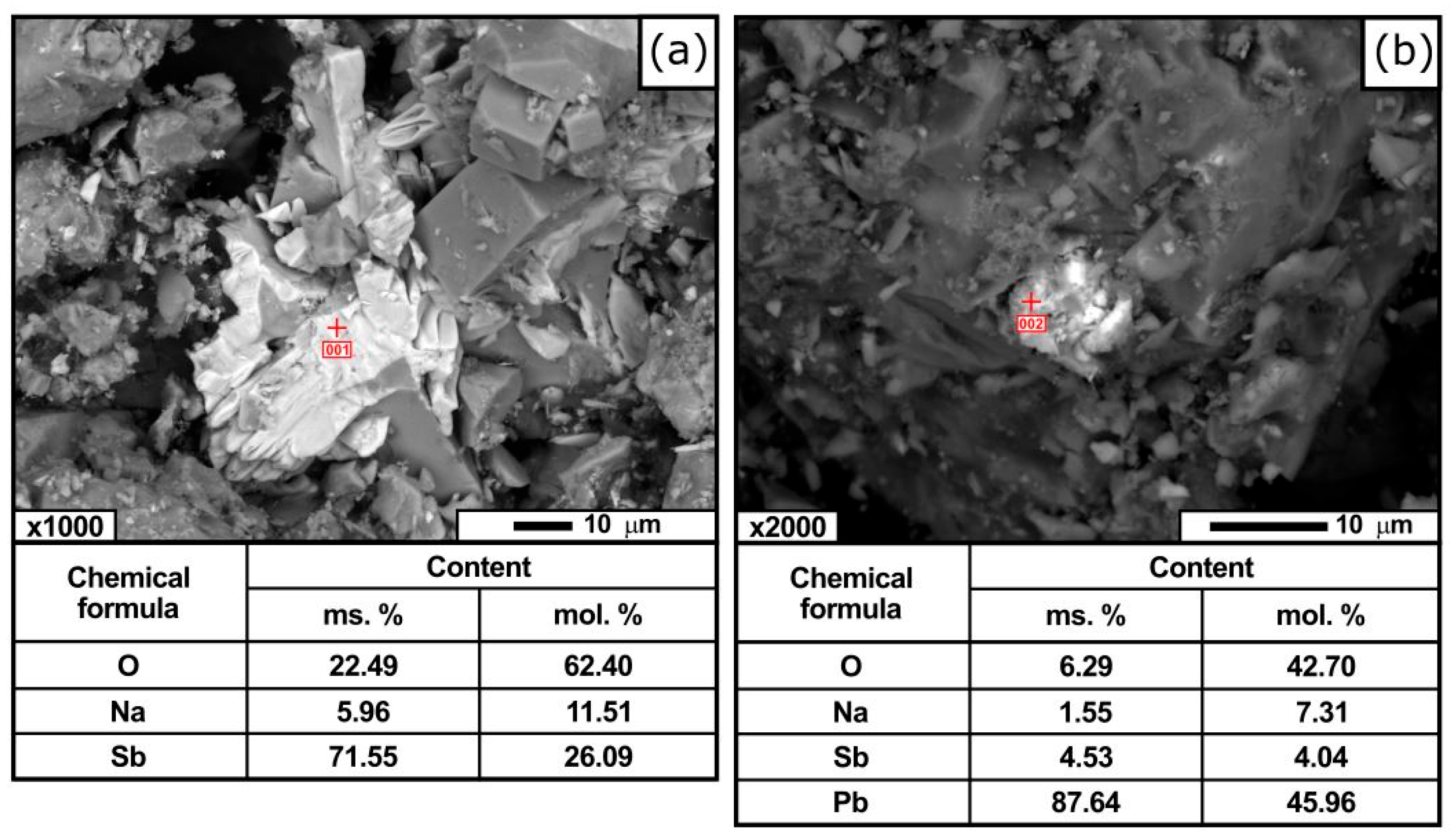
Scanning electron microscopy of sodium antimonate showed that the impurity elements sodium, lead, iron, and antimony oxides are distributed locally in the antimony concentrate as inclusions of different compositions, forming compounds with antimony. Antimony oxides are present in the form of hydrates, in particular, as antimony pentoxide tetrahydrate, Sb2O5 × 4H2O. Images are provided in Figure 2.
Mopungite and antimony pentoxide tetrahydrate lost water after roasting at 1100 °C. In this case, the concentrate was represented by NaSbO3 (94%) and antimony pentoxide, Sb2O5 (6.0%). The contents of Na, As, Te, and Pb decreased only slightly and amounted to 6.57, 0.51, 0.41, and 0.51%, respectively, which indicates that they are present as antimony compounds with low partial vapor pressure.

2.2. Methodology

Reduction smelting onto a lead collector was proposed to enable the direct production of antimony alloys for engineering applications. The charge was prepared using coke breeze with an ash content of no more than 15% and grade C3 lead, which is commonly used for manufacturing rolled products for industrial applications. The batch was prepared by mixing sodium antimonate with coke breeze of less than 2 mm in particle size. Lead was added in lump form after the batch had melted.
The carbothermic reduction experiments were performed in an electrically heated shaft-type crucible furnace with an isolated gas space.
The smelting procedure was as follows. The batch was charged into an open corundum crucible, which was then placed inside a steel retort that isolated the space above the crucible from the electric heating elements. The retort containing the crucible was lowered either into a cold shaft furnace or into a furnace preheated to the target experimental temperature, depending on the test conditions, and a thermocouple protection tube was installed with its tip positioned inside the crucible. A removable hood was fitted to the top of the retort to remove the vapor–dust–gas phase. The hood rested freely on the upper rim of the vertical retort and was connected to the exhaust system. Lead was charged after the batch had melted.
The moment that the batch reached the target experimental temperature was taken as the start of smelting. The hood was removed, and the thermocouple was withdrawn from the crucible after holding for the required period. The retort with the crucible was then taken out of the furnace. The smelting products were removed from the crucible, weighed, and analyzed after cooling.

2.3. Characteristics

The elemental composition was determined through X-ray fluorescence analysis using an Axios 1 kW wavelength-dispersive spectrometer (PANalytical, Almelo, The Netherlands).
Chemical analysis was performed using standard analytical procedures.
Weighing was performed on JW-1 analytical balances (Acom, Pocheon, Gyeonggi Province, Republic of Korea) with an accuracy of ±0.1 g.

3. Results and Discussion

3.1. Carbothermic Reduction of Antimony from Antimony Concentrate

Carbothermic smelting of sodium antimonate was performed under identical conditions without the addition of lead to provide a basis for comparison with the subsequent reduction smelting experiments performed on a lead collector. The smelting experiments were performed at 900 ± 20 °C using charge samples consisting of about 500 g of sodium antimonate and 10% coke breeze, based on the stated weight of sodium antimonate. The crucible containing the charge was heated together with the shaft furnace, with a heating rate of 8–10 °C/min. The smelting time after reaching the specified temperature was 1 h. The results of the balance smelting test are presented in Table 2.
Analysis of the smelting results shows that 72.41% of the antimony was recovered into crude metal. This value, as well as the antimony content in the slag (1.40%), is broadly consistent with the performance achieved in industrial production. A significant amount of antimony, 26.29%, passed into the vapor–dust–gas phase in the form of antimony trioxide.
Lead and iron accumulated mainly in the crude metal, at 79.01% and 74.44%, respectively, while 10.57% of the iron was recovered into the slag. Sodium in sodium antimonate acted as a slag-forming metal and passed into the slag at a rate exceeding 98%. Arsenic and tellurium were distributed among the processing products in comparable amounts.
Antimony of this composition can be used for final bismuth removal in the crude lead-refining process during the production of S1 and S0 grades. The chemical composition of these grades is given in Table 3.
The final bismuth removal operation will require 260 × 0.3 = 78 kg of antimony in lead-refining kettles with a capacity of 260 t and a maximum antimony consumption of 0.3 kg/t [16]. Using the antimony composition given in Table 2, the following amounts would be introduced into 260 t of lead (wt.%): Na—1.59 × 10⁻⁴; As—1.50 × 10⁻⁴; Fe—2.64 × 10⁻⁴. The lead would then be returned to the main process stream.
At the final stage, namely during the final alkaline refining of lead, possibly with the addition of sodium nitrate (NaNO3), the small amount of Na will be oxidized and, together with a similar amount of introduced arsenic, will be removed from the lead into the alkaline melt. Iron dissolves in liquid lead only in extremely small amounts. Therefore, at 600 °C, the solubility of iron in lead is 8.5 × 10⁻⁴ at.% or 2.29 × 10⁻⁴ wt.% [16]. The iron content in the refined lead will be even lower and will comply with the relevant standard at 420–450 °C, the temperature range at which alkaline refining is usually performed.

3.2. Carbothermic Reduction of Antimony from Antimony Concentrate Using a Lead Collector

Smelting of sodium antimonate onto a lead collector is justified by the possibility of directly producing a lead–antimony alloy with simultaneous recovery of the lead contained in the antimonate into that alloy. In addition, during the formation of the lead–antimony alloy, that is, during dissolution of the reduced antimony in lead, the thermodynamic activity of antimony decreases, which is expected to reduce its interaction with the gas-phase components and, consequently, to suppress the formation of volatile antimony trioxide.
For carbothermic reduction of antimony using a lead collector, optimal conditions for reducing antimony and sodium antimonate were used, as defined in [21,22,23] and in our data obtained previously [28]: a temperature of 900–1000 °C and a reducing agent consumption of 10% relative to the antimonate.
Initially, experiments were performed to determine the effect of lead additions on the degree of antimony recovery into the lead–antimony alloy, the antimony content in the alloy, and the lead content in the slag phase. In this case, the sodium antimonate charge was 100 g, and the coke breeze addition was 10 g. The results are presented in Table 4. Table 4 shows the mass fraction of lead in the charge.
The results of the study show that the use of lead as a collecting additive increased antimony recovery into the lead–antimony alloy by 10.88–12.93% compared with smelting without lead addition (Table 2). This effect is due to a decrease in the amount of volatile Sb2O3 formed. It can be seen that the amount of lead in the charge had virtually no effect on antimony recovery into the lead–antimony alloy. The differences in recovery values at different lead additions may be explained by the sampling location and analytical error. A slight expected increase in the lead concentration in the slag was observed as the amount of lead added increased. The results of these experiments make it possible to conclude that lead–antimony alloys with different metal ratios can be produced across the entire concentration range of the phase diagram without affecting the process performance of reduction smelting.
Smelting experiments were performed at 900 °C using charge samples consisting of about 500 g of sodium antimonate and 10% coke breeze, based on the stated weight of sodium antimonate. The crucible containing the charge was heated together with the shaft furnace, with a heating rate of 8–10 °C/min. Metallic lead was introduced into the molten charge either all at once or in portions after reaching 900 ± 20 °C, depending on the intended composition of the lead–antimony alloy. For addition to the melt, low-grade C3 lead in the form of 5 mm thick rolled sheet intended for technical applications was used. The rolled lead was cut into strips 7–10 cm long and 1.0–1.5 cm wide. Before feeding the lead into the crucible, the electric heating power was increased. The holding time was 1 h.
The results of smelting sodium antimonate onto a lead collector with a one-time addition of the latter are presented in Table 5.
The smelting results indicate the following. In addition to the increase in antimony recovery into the lead–antimony alloy to 84.74%, a significant decrease in antimony transfer to the gas phase, together with the balance discrepancy, was observed, decreasing from 26.29% to 10.39%. As expected, the lead content in the slag phase increased from 0.05% to 0.21%, owing to oxidation of the added lead. No sodium was detected in the lead–antimony alloy. All the sodium contained in the charge was converted into a Na2CO3-based slag. As a result of smelting, arsenic passed in significant amounts into the slag phase (58.87%) and the gas phase (39.85%). Tellurium was distributed among the smelting products in comparable proportions. Iron was distributed between the alloy and the slag.
The melting point of the resulting lead–antimony alloy corresponds to 380–400 °C [29]. Such a lead–antimony alloy can be used as a master alloy in the final bismuth removal stage of lead refining. At the antimony consumption stated above, namely 78 kg per operation for a 260 t kettle, about 305 kg of alloy would be required. The alloy volume per operation would amount to 31.2 dm3, assuming an additive alloy density of 11.34 × 0.7109 + 6.68 × 0.2509 = 9.77 kg/dm3 [30]. With the above antimony consumption per 78 kg operation, about 305 kg of alloy will be needed per 260 ton boiler. With an additive alloy density of kg/dm3 [30], the alloy volume per operation will be 30.8 dm3. Here, the concentration of lead and antimony in the alloy is in % (other impurities were not taken into account), and the densities of lead and antimony are in kg/dm3. This value is insignificant compared with the volume of lead in the kettle; however, the much lower melting point relative to metallic antimony (630.7 °C) would make it possible to reduce antimony losses due to oxidation during mixing into the lead bath, with subsequent transfer of antimony oxide into the alkaline melt.
Therefore, lead–antimony alloys can be produced directly during smelting as a result of the carbothermic reduction of antimony. The interstate standard [31] specifies 17 grades of lead-based alloys containing 0.15 to 12.0% antimony.
The material balance for the carbothermic reduction of antimony with the production of a lead–antimony alloy is given in Table 6.
At present, work is underway to improve shot-production technology and to optimize the composition by involving antimony-containing secondary raw materials in the process [32,33]. The authors found the following conditions to be optimal: the use of a lead–antimony alloy containing 3.5–4.5% antimony with the incorporation of secondary raw materials into the processing, followed by heat treatment and quenching of the finished product.
For the production of shot from a lead–antimony alloy with the above antimony content, we propose using an alloy obtained by carbothermic reduction of antimony from sodium antimonate onto a lead collector. Producing such an alloy directly during reduction smelting onto a lead collector is impractical because of the high energy consumption required to heat a large amount of lead to 900 °C. In our view, the most suitable approach is reduction smelting of sodium antimonate onto a lead collector, accompanied by increased direct recovery of antimony, followed by adjustment of the lead content to 95.5–96.5% at the relatively low temperature of 340–400 °C.
The results of a trial melting of a lead–antimony alloy containing 25.58% antimony and 84.74% lead (Table 5), followed by adjustment of the composition to 4% Sb at 340–360 °C, are presented in Table 7.
The composition of the alloy containing 4% antimony was determined by calculation. The total Sb + Pb content of 101.53% in this alloy is due to analytical errors in the chemical analysis of the processing products reported in Table 5.
It is evident that dilution of the lead–antimony alloy with lead by a factor of 5.4 makes it possible to obtain the required alloy quite readily in kettle-type process equipment under the conditions of a lead refinery shop for the production of wire blanks intended for manufacturing shotgun pellets.
It should be noted that all of the above processes can be implemented using conventional lead-production equipment, for example, in reverberatory furnaces.


4. Conclusions

As a result of the reduction smelting of sodium antimonate using solid carbon, namely coke breeze, onto a lead collector, lead–antimony alloys suitable for technical applications were obtained. The direct recovery of antimony into the alloy increased by 10.88–12.93% compared with reduction smelting without the use of a lead collector. The assumption that antimony losses with the off-gases decrease as a result of the lower thermodynamic activity of antimony in the Pb-Sb alloy was confirmed. In this case, losses, including the balance discrepancy, decreased from 30.0% without lead addition to 10.39% and 5.18% in smelting tests with different amounts of metallic lead added to the charge.
Possibilities for the technological use of crude antimony and lead–antimony alloy immediately after production in the final bismuth removal stage of the lead-refining process were considered.
The possibility of producing commercial-grade lead–antimony alloys, in particular SSuYu grade (9.0–12.0% Sb), by reduction smelting onto a lead collector was demonstrated, with the exception of the iron content, which requires slight additional purification.
The production of shotgun pellets, in which the antimony content typically ranges from 3.5 to 4.5%, was also considered as a potential field of application. For this purpose, it was proposed that, at the first stage, a lead–antimony alloy should be produced to increase direct antimony recovery into the alloy and reduce the energy required to heat a sufficiently large amount of lead, followed by adjustment of the antimony content in the alloy by adding metallic lead at 340–360 °C.
The proposed technical solutions fit well into the technology and infrastructure of lead production.

Author Contributions

Conceptualization, V.V. and B.K.; methodology, V.V., S.T. and A.N.; investigation, V.V., S.T., A.N., X.L. and F.T.; data curation, V.V., F.T., A.N., X.L. and G.R.; writing—original draft preparation, V.V., B.K., S.T. and A.N.; writing—review and editing, V.V., A.N. and G.R.; visualization, A.N., X.L., F.T. and G.R.; project administration, B.K. All authors have read and agreed to the published version of the manuscript.

Funding

This research was funded by the Science Committee of the Ministry of Science and Higher Education of the Republic of Kazakhstan, grant number BR24992757.

Data Availability Statement

The original contributions presented in this study are included in the article. Further inquiries can be directed to the corresponding author.

Acknowledgments

The authors acknowledge the funding support from the Science Committee of the Ministry of Science and Higher Education of the Republic of Kazakhstan.

Conflicts of Interest

The authors declare no conflicts of interest.

References

  1. Li, Z.; Feng, Y.; Wen, Y.; Wang, R.; Peng, X. Preparation technology research progress of high-purity antimony. Trans. Nonferr. Met. Soc. China 2025, 35, 579–601. [Google Scholar] [CrossRef]
  2. Dembele, S.; Akcil, A.; Panda, S. Technological trends, emerging applications and metallurgical strategies in antimony recovery from stibnite. Miner. Eng. 2022, 175, 107304. [Google Scholar] [CrossRef]
  3. Ling, H.; Blanpain, B.; Guo, M.; Malfliet, A. Characterization of antimony-coating metallurgical residues for antimony recovery. J. Clean. Prod. 2021, 327, 129491. [Google Scholar] [CrossRef]
  4. Murugesan, S.; Volokh, M.; Mokari, T. Antimony-based materials for supercapacitor applications: A focused review. J. Power Sources 2026, 669, 239338. [Google Scholar] [CrossRef]
  5. Levet, A.; Kaur, P.; Kahruman, C.; Thakur, S.; Büyükyıldız, M. Brass alloys improved with antimony additives for gamma-ray shielding applications. Appl. Radiat. Isot. 2026, 228, 112313. [Google Scholar] [CrossRef]
  6. Pola, A.; Gelfi, M.; Modigell, M.; Roberti, R. Semisolid lead-antimony alloys for cars batteries. Trans. Nonferr. Met. Soc. China 2010, 20, 1774–1779. [Google Scholar] [CrossRef]
  7. Wang, K.; Wang, Q.; Chen, Y.; Li, Z.; Guo, X. Antimony and arsenic substance flow analysis in antimony pyrometallurgical process. Trans. Nonferr. Met. Soc. China 2023, 33, 2216–2230. [Google Scholar] [CrossRef]
  8. Khorshidi, N.; Parsons, M.B.; Lentz, D.R.; Karbalaeiramezanali, A. Antimony in Canada: Challenges and opportunities in resources, markets, and sustainability. Facets 2025, 10, 1–18. [Google Scholar] [CrossRef]
  9. Volodin, V.; Trebukhov, S.; Nitsenko, A.; Burabayeva, N.; Linnik, X. Distribution of antimonium chalcogenides under conditions of vacuum thermal processing of mattes. Kompleks. Ispol. Mineral. Syra 2023, 326, 88–95. [Google Scholar] [CrossRef]
  10. Dosmukhamedov, N.; Zholdasbay, E. The solubility of Cu, Pb, As, Sb of copper-lead matte in the slag. Kompleks. Ispol. Mineral. Syra 2020, 312, 31–40. [Google Scholar] [CrossRef]
  11. Gu, Z.; Li, L.; Dong, Z.; Cao, C.; Zeng, T.; Wang, Z.; Lei, Y. Efficient recovery of antimony from waste alkali leached lead anode slimes using an activity regulation method with PbS. Waste Manag. 2026, 209, 115183. [Google Scholar] [CrossRef]
  12. Akilbekova, S.; Moldabayeva, G.; Myrzalieva, S.; Seidakhmetova, N. To the question of pyrometallurgical technology for processing antimony-gold-bearing ores and concentrates. Kompleks. Ispol. Mineral. Syra 2025, 340, 77–86. [Google Scholar] [CrossRef]
  13. Wikedzi, A.; Sandström, A.; Awe, S.A. Recovery of antimony compounds from alkaline sulphide leachates. Int. J. Miner. Process. 2016, 152, 26–35. [Google Scholar] [CrossRef]
  14. Zhang, F.; Cui, Y.; He, X.; Lv, C.; Li, L.; Zhang, J.; Nan, J. Selective alkaline leaching of antimony from low-grade refractory gold ores and process optimization. Miner. Eng. 2023, 201, 108198. [Google Scholar] [CrossRef]
  15. Melnikov, S.M.; Rozlovsky, A.A.; Shuklin, A.M.; Bayborodov, P.P.; Kolbin, N.A.; Kulbatsky, I.S.; Ponomarv, F.I.; Berdichevsky, B.I.; Shupikov, V.A.; Dronov, N.V.; et al. Antimony; Melnikov, S.M., Ed.; Metallurgy: Moscow, Russia, 1977; 536p. [Google Scholar]
  16. Smirnov, M.P. Lead Refining and Processing of Intermediate Products; Metallurgy: Moscow, Russia, 1977; 280p. [Google Scholar]
  17. Bugenov, E.S.; Bugenov, B.E.; Bugenov, A.E. Method of Sodium Antimonate Processing. Innovation Patent of the Republic of Kazakhstan No. 28700, 15 July 2014. [Google Scholar]
  18. Bugenov, E.S.; Bugenov, B.E.; Bugenov, A.E. Method of Processing Sodium Antimonate in Acidic Solutions. Innovation Patent of the Republic of Kazakhstan No. 29399, 25 December 2014. [Google Scholar]
  19. Zharmenov, A.A.; Terlikbaeva, A.Z.; Sydykov, A.O.; Mazulevsky, E.A.; Berdikulova, F.A.; Kovzalenko, T.V. Sodium Antimonate Processing Method. Patent of the Republic of Kazakhstan No. 27811, 18 December 2013. [Google Scholar]
  20. Sydykov, A.; Mazulevsky, E.; Berdikulova, F.; Kovzalenko, T.; Chukyanova, M.; Seitkhanov, B. Production of metallic antimony from antimonate raw materials of lead-zinc production. Ind. Kazakhstan 2013, 2, 50–54. [Google Scholar]
  21. Terlikbaeva, A.; Sydykov, A.; Mazulevsky, E.; Berdikulova, F. Reducing smelting of antimonate concentrate of lead production. Ind. Kazakhstan 2016, 4, 45–48. [Google Scholar]
  22. Terlikbaeva, A.; Sydykov, A.; Berdikulova, F.; Mazulevsky, E. Production of metallic antimony with low arsenic content from antimonate concentrate. Izv. VUZov. Non-Ferr. Metall. 2018, 2, 28–33. [Google Scholar] [CrossRef]
  23. Timofeev, K.P.; Korolev, A.A.; Maltsev, G.I.; Voinkov, R.S. Processing of sodium antimonate with the production of commodity antimony. Non-Ferr. Met. 2025, 1, 21–25. [Google Scholar] [CrossRef]
  24. Wan, Y.; Liu, C.; Li, Y.; Ye, Y.; Xu, F.; Li, Y. Metallic antimony preparation by carbothermic reduction of stibnite concentrates: Strategies, mechanisms, and comparison of microwave and conventional roasting. Miner. Eng. 2024, 208, 108584. [Google Scholar] [CrossRef]
  25. Berdikulova, F.; Seidakhmetova, N.; Mazulevsky, E.; Kovzalenko, T.; Ondiris, B. Features of Antimonate Concentrate Reduction in Alkaline Melts Under Carbon-Neutral Smelting Conditions. Metals 2026, 16, 265. [Google Scholar] [CrossRef]
  26. ST RK 2296-2013; Antimony Concentrate. Technical Specifications. KazStandart: Astana, Kazakhstan, 2013.
  27. Interstate Standard GOST 3778-98; Lead. Technical Specifications. Interstandar: Moscow, Russia, 2001.
  28. Volodin, V.; Kenzhaliev, B.; Trebukhov, S.; Nitsenko, A.; Tuleutay, F.; Linik, X.; Sukurov, B. Distribution of Metals During Carbothermic Reduction of Antimony from Sodium Antimonate. Materials 2026, 19, 1848. [Google Scholar] [CrossRef]
  29. Lyakishev, N.P. Phase Diagrams of Binary Metallic Systems; Book 1; Mashinostroenie: Moscow, Russia, 2001; 872p. [Google Scholar]
  30. Grigoriyev, I.S.; Meilikhov, E.Z. Physical Quantities: Handbook; Energoatomizdat: Moscow, Russia, 1991; 1232p. [Google Scholar]
  31. Interstate Standard GOST 1292-81; Lead-Antimony Alloys. Technical Specifications. Interstandard: Moscow, Russia, 1982.
  32. Tokar, V.S.; Svinin, V.I.; Vasilevskii, P.A.; Kotelnikov, V.P.; Mikhalenko, Y.A.; Klimov, V.S.; Moskalev, S.A.; Kuzmina, N.V.; Rezayev, M.D.; Panov, V.V.; et al. Method for Producing Shotgun Pellets. Patent of the Russian Federation No. 2106222, 10 March 1998. [Google Scholar]
  33. Vasilevskii, P.A.; Moskalev, S.A.; Zheleznyak, L.M.; Motyreva, T.A. Improvement of the quality, economic, and environmental performance of lead-antimony shot production. Tsvetnye Met. 2013, 3, 74–78. [Google Scholar]
Figure 1. Fragments of the diffractogram: 2θ = 0–45 degrees (a) and и 2θ = 45–90 degrees (b) of sodium antimony concentrate.
Processes 14 01808 g001
Figure 2. Local images of antimony concentrate at points 1 and 2: sodium antimonate and its composition (a); lead admixture in sodium antimonate and its composition (b).
Processes 14 01808 g002
Table 1. Elemental composition of the antimony concentrate according to the data from IMOB JSC.
ElementsSbAsPbNaTeFeAlSCaZnMoInO
Content, wt. %60.390.600.567.660.790.520.010.040.180.020.130.1728.93
Table 2. Material balance of carbothermic reduction of sodium antimonate.
Balance Items%SbPbNaAsFeTe
Content, %Recovery, %Content, %Recovery, %Content, %Recovery, %Content, %Recovery, %Content, %Recovery, %Content, %Recovery, %
Charged
Sodium antimonate90.9162.031000.601007.801000.641000.591000.64100
Coke breeze9.09
Total100100100100100100100
Produced
Crude antimony45.3690.0272.410.9579.010.533.390.5038.980.8874.440.3527.29
Slag24.641.400.610.052.2628.2498.130.8234.730.2310.570.9339.39
Total70.0073.0281.27101.5273.7185.0166.68
Losses + balance discrepancy−30.00−26.98−18.73+1.52−26.29−14.99−33.32
Table 3. Chemical composition of S0 and S1 lead grades [27].
GradesPb, MinMass Fraction of Impurities, % (Max)
AgCuZnBiAsSnSbFeMg + Ca + SbTotal
C099.9923 × 10−45 × 10−41 × 10−34 × 10−35 × 10−45 × 10−45 × 10−41 × 10−32 × 10−38 × 10−3
C199.9851 × 10−31 × 10−31 × 10−36 × 10−35 × 10−45 × 10−41 × 10−31 × 10−32 × 10−315 × 10−3
Table 4. Effects of lead additions on antimony recovery and antimony content in the alloy and on lead content in the slag.
ParameterLead Added to the Charge, wt.%
20.6257.6973.1786.42
Antimony recovery to alloy, %84.8382.2983.4385.34
Antimony content in alloy, %68.6025.4819.4112.08
Lead content in slag, %0.110.140.210.24
Table 5. Material balance of carbothermic reduction of sodium antimonate onto a lead collector.
Balance Items%SbPbNaAsFeTe
Content, %Recovery, %Content, %Recovery, %Content, %Recovery, %Content, %Recovery, %Content, %Recovery, %Content, %Recovery, %
Charged
Sodium antimonate38.4662.0399.990.600.407.801000.6499.300.5998.740.64100
Coke breeze3.84
Grade C3 lead57.705 × 10−30.0199.9099.603 × 10−30.705 × 10−31.26
Total100-100100100100100100
Produced
Pb-Sb alloy79.0425.5884.7471.0997.10-4 × 10−31.280.1551.590.1651.38
Slag10.570.540.240.210.0429.92105.461.3858.870.9042.330.5624.06
Total89.6184.9897.14105.4660.1593.9275.44
Losses + balance discrepancy−10.39−15.02−2.86+5.46−39.85−6.08−24.56
Table 6. Material balance for the carbothermic reduction of sodium antimonate with the production of a lead–antimony alloy.
Balance Items%SbPbNaAsFeTe
Content, %Recovery, %Content, %Recovery, %Content, %Recovery, %Content, %Recovery, %Content, %Recovery, %Content, %Recovery, %
Charged
Sodium antimonate19.6662.0399.970.600.157.801000.6498.870.5996.730.64100
Coke breeze1.97
Grade C3 lead78.375 × 10−30.0399.9099.853 × 10−31.835 × 10−33.27
Total100100100100-100100100
Produced
Pb-Sb alloy88.6411.5283.7283.3794.23-5 × 10−33.460.0536.970.0535.23
Slag6.180.183.130.270.0225.90104.441.5775.741.0654.61.0149.64
Total94.8286.8594.25104.4479.2091.6384.87
Losses + balance discrepancy−5.18−13.15−5.75−4.44−20.80−8.37−15.13
Table 7. Adjustment of the composition of the lead–antimony melt by adding lead.
Balance Items%SbPbAs
Content, %Recovery, %Content, %Recovery, %Content, %Recovery, %
Charged
Pb-Sb alloy (25.58% Sb)15.6425.5899.8984.7413.574 × 10−319.80
Grade C3 lead84.365 × 10−30.1199.9086.433 × 10−380.20
Total100100100100
Produced
Pb-Sb alloy (4.0% Sb)1004.0010097.531003 × 10−3100
Total100100100100
Disclaimer/Publisher’s Note: The statements, opinions and data contained in all publications are solely those of the individual author(s) and contributor(s) and not of MDPI and/or the editor(s). MDPI and/or the editor(s) disclaim responsibility for any injury to people or property resulting from any ideas, methods, instructions or products referred to in the content.