Article

Relationship Between Structure and Properties in Al–Si Alloys: Thermal, Mechanical, and Electrochemical Corrosion Aspects

by
Alejandra Silvina Román
,
Edgar Rolando Ibañez
,
Claudia Marcela Méndez
,
Natalia Silvina Zadorozne
and
Alicia Esther Ares
*
Programa de Materiales y Fisicoquímica (ProMyF), Instituto de Materiales de Misiones (IMAM), Facultad de Ciencias Exactas, Químicas y Naturales (FCEQyN), Universidad Nacional de Misiones (UNaM), 1552 Félix de Azara Street, Posadas 3300, Argentina
*
Author to whom correspondence should be addressed.
These authors contributed equally to this work.
Processes 2026, 14(11), 1782; https://doi.org/10.3390/pr14111782
Submission received: 11 May 2026 / Revised: 23 May 2026 / Accepted: 25 May 2026 / Published: 29 May 2026
(This article belongs to the Special Issue Corrosion Processes of Metals: Mechanisms and Protection Methods)

Abstract

In the present study, the influence of microstructural morphology and dendritic refinement on the electrochemical corrosion behavior of directionally solidified aluminum-based structures (columnar and equiaxed) with Si contents between 6 and 12.6 wt. % was investigated in a 0.5% NaCl solution at room temperature. Corrosion resistance was evaluated using potentiodynamic polarization and electrochemical impedance spectroscopy (EIS) techniques. The directional solidification process was repeated for each of the alloy compositions at different cooling rates, yielding different secondary dendritic spacing values. The columnar-to-equiaxed transition (CET) was observed to occur when the temperature gradient in the melt decreased to values between −1.85 and 0.75 °C/cm. In addition, a small increase in the microhardness values was observed as a function of the Si content. The same applies to tensile strength values. The values of the polarization resistance are used as a basic criterion for the evaluation of the corrosion resistance of alloys. The columnar grain zone presents higher corrosion resistance than the equiaxed grain zone, despite presenting coarser dendritic spacing. This behavior contrasts with the commonly expected improvement in corrosion resistance associated with microstructural refinement and indicates that passive-layer stability and cathodic phase distribution play a dominant role in the electrochemical behavior. When the polarization resistance decreases with the increase in the distance from the base, the grain size and secondary dendritic arm spacings increase. In addition, when the polarization resistance increases, the critical temperature gradient decreases. This work allows us to conclude that the modification of thermal parameters in the solidification process can be used for the development of an optimized microstructure morphology and to optimize corrosion resistance in Al–Si alloys through control of dendritic spacing and passive film formation mechanisms.

1. Introduction

Aluminum–silicon alloys remain one of the most important groups of light casting alloys due to their excellent castability, low density, good corrosion resistance, and adequate thermal conductivity. Cast Al–Si (aluminum–silicon) alloys have a long history of practical applications due to their excellent combination of low density, good castability, corrosion resistance, thermal conductivity, and mechanical properties. Their industrial applications mainly include the automotive industry (engine blocks, pistons, cylinder heads, crankcases, wheels, and transmission components), the aerospace industry (lightweight structural components, housings and supports, and parts subjected to high strength-to-weight ratios), the marine and transportation industries (boat parts, railway components, and lightweight transport structures), the electronics and thermal management industries (heat sinks, electronic housings, and heat exchanger components), as well as engineering and manufacturing applications (molds and dies, pumps and compressors, tools, and mechanical components). More recently, Al–Si alloys have attracted significant interest in additive manufacturing, reinforced composite materials, components for electric vehicles, and high energy-efficiency applications, owing to the possibility of optimizing their microstructure through heat treatments, grain refinement, and eutectic modification [1,2,3].
The columnar-to-equiaxed transition (CET) is a key microstructural phenomenon during metallic solidification, as it governs grain morphology, crystallographic texture, segregation patterns, and mechanical anisotropy in structural components. CET results from the competition between directional dendritic growth from the solidification front and nucleation of grains within the undercooled liquid ahead of the interface. While this classical framework remains valid, recent research has expanded its interpretation through multiscale modeling, advanced characterization techniques, and process-specific analyses, particularly in additive manufacturing and rapid solidification technologies [4,5,6].
The transition is primarily controlled by the relationship between thermal gradient (G), solidification rate (R), and nucleation density. High G/R ratios promote columnar growth due to directional heat flow, whereas lower values favor equiaxed grain formation in the bulk melt. Experimental and numerical studies across a wide range of alloys and processing conditions confirm that this criterion remains fundamental for predicting grain morphology evolution [1,2,3,4].
The relationship between microstructural morphology and corrosion behavior in Al–Si alloys constitutes a critical aspect in the design of lightweight materials intended for structural and marine applications. The modification of microstructural parameters, mainly the distribution and size of the Si phases present in Al–Si alloys, is a widely used and studied strategy aimed at improving their mechanical properties [1,4,5,6,7].
Hypoeutectic Al–Si alloys have been extensively investigated because of their excellent combination of castability, low density, wear resistance, corrosion resistance, and mechanical performance. In particular, Al–6 wt. %Si, Al–8 wt. %Si, Al–10 wt. %Si, and Al–12 wt. %Si alloys are technologically important since they cover a compositional range close to the eutectic composition (~12.6 wt. %Si), where significant changes in solidification behavior and microstructure occur [8].
Al–6 wt. %Si alloys have mainly been studied due to their higher α-Al fraction and lower eutectic content, which provide improved ductility and toughness. Previous studies have also analyzed dendritic refinement and eutectic modification to optimize mechanical and corrosion properties [9].
Al–8 wt. %Si alloys present a balance between ductility and strength and are therefore widely used in automotive cast components. Research has focused on the influence of solidification parameters, secondary dendrite arm spacing, and eutectic Si morphology on mechanical and tribological behavior [10].
Al–10 wt. %Si alloys are among the most investigated compositions because of their proximity to the eutectic composition and their excellent fluidity and wear resistance. Numerous studies have examined grain refinement, intermetallic formation, cooling rate effects, and electrochemical corrosion behavior [11].
Al–12 wt. %Si alloys, which are close to the eutectic composition, have received considerable attention because of their excellent castability, low shrinkage, and superior wear resistance. They are extensively used in pistons, cylinder liners, and engine blocks. Recent studies have focused on eutectic modification, heat treatments, additive manufacturing, and corrosion behavior [12].
Current research trends on Al–Si alloys are mainly directed toward microstructural refinement, eutectic modification, additive manufacturing, nanoparticle reinforcement, and simultaneous optimization of thermal, mechanical, tribological, and electrochemical properties [8,9,10,11,12].
However, the electrochemical performance of Al–Si alloys depends decisively on the distribution and morphology of the Si phases and secondary precipitates, which control localized dissolution processes, passive film formation, and microscale galvanic coupling [7,13,14,15]. Therefore, any microstructural modification intended to improve the mechanical properties of Al–Si alloys directly influences their corrosion behavior [7,16,17].
The microstructure of hypoeutectic Al–Si alloys typically consists of primary α-phase dendrites, rich in aluminum, surrounded by an Al–Si eutectic mixture. In hypoeutectic and eutectic Al–Si alloys, corrosion resistance is determined by the biphasic nature of the α-Al/Si system. Si-rich phases act as cathodes relative to the Al matrix, promoting localized anodic dissolution at phase boundaries and leading to pitting and intergranular corrosion mechanisms [18,19,20]. However, recent literature shows discrepancies regarding the influence of these microstructural features on corrosion resistance. Osorio et al. [7], by applying laser surface remelting to an Al–8% Si alloy, obtained significant microstructural refinement that resulted in higher corrosion susceptibility of the evaluated sample. In contrast, more recent studies suggest that the formation of fine and spheroidal dendrites improves the corrosion resistance of hypoeutectic Al–Si alloys due to eutectic Si refinement [3].
It is widely accepted that the corrosion resistance of aluminum-based alloys depends primarily on the properties, thickness, and density of the passive film that they are able to form [16]. Khan et al. [13] demonstrated that, under natural seawater conditions, eutectic Al–Si alloys develop a more stable protective layer attributed to the presence of mixed oxides such as MgO and SiO2, compared with solutions containing only NaCl. More recent literature has extended this analysis to the context of additive manufacturing, where extreme thermal conditions during solidification lead to fine and anisotropic microstructures. In additively manufactured alloys, a nanoscale distribution of Si and a continuous eutectic network have been observed to modify the formation and stability of the passive film [15,21,22]. Ujjwal et al. [14] reported that the microstructure obtained by arc-based directed energy deposition in the ER4043 alloy promotes the formation of a more stable passive film, although the presence of pores and residual stresses may induce susceptibility to stress corrosion. Similarly, Shi et al. [20] demonstrated that in Al–Si alloys produced by laser powder bed fusion, increasing the Si content (from 7 to 12 wt. %) refines the eutectic network morphology and improves corrosion resistance by reducing corrosion current density and shifting the open-circuit potential toward more noble values.
Despite these advances, gaps remain in the understanding of how specific morphological parameters quantitatively influence corrosion resistance in chloride-containing environments. Available studies agree that small variations in Si morphology can significantly alter the kinetics of passive film formation and breakdown, as well as the distribution of local potentials at the metal–electrolyte interface.
These structural and microstructural parameters are the result of the thermal behavior of the metal/mold system during the solidification process. Consequently, different macrostructural morphologies and grain sizes may arise due to the wide range of operational conditions and thermal parameters present during casting.
Secondary dendrite arm spacing, λ2, is considered the characteristic length parameter of cast Al–Si alloys, as it reflects grain size and the density of boundaries between the α-Al matrix and eutectic regions [22]. Therefore, in the present work, different cooling rates were applied in order to obtain distinct values of secondary dendrite arm spacing in the evaluated alloys, produced by directional solidification. Secondary dendrite arm spacing is a direct indicator of the degree of segregation in the microstructure. A smaller λ2 (“fine” structure) results from higher cooling rates, leading to shorter diffusion times and therefore lower solute segregation (mainly Si and impurity or alloying elements) at grain boundaries and in interdendritic regions. Conversely, a larger λ2 (“coarse” structure) implies lower cooling rates, resulting in greater segregation and the formation of larger and more widely spaced intermetallic phases in interdendritic regions.
The central hypothesis of this study is therefore that microstructural morphology acts as a critical parameter controlling the thermal and mechanical properties and corrosion behavior of Al–Si (Al-6 wt. %Si, Al-8 wt. %Si, Al-10 wt. %Si, and Al-12 wt. %Si) alloys. Accordingly, the present work evaluates the corrosion resistance of Al–Si alloys considering the influence of composition, grain structure, secondary dendrite arm spacing, and the thermal and mechanical properties.

2. Materials and Methods

2.1. Materials Preparation

Alloys of the Al–Si system (Al–6 wt. %Si, Al–8 wt. %Si, Al–10 wt. %Si, and Al–12.6 wt. %Si) were prepared from commercial grade aluminum ingot and an Al-50 wt. %Si alloy in a FAC® muffle furnace. The pre-melting composition is shown in Table 1. Three repetitions per alloy composition were carried out using different cooling rates. Sufficient amounts of Al and Al–Si were weighed using a CAS® electronic balance, CAS Corporation manufacturer, Seoul, South Korea (Model CUX620H®, Max. 620 g, d = 10 mg). The metals were melted in a ceramic crucible at approximately 100 °C above the Liquidus temperature obtained from the phase diagram, and casting was performed once the alloy was fully molten.

2.2. Directional Solidification Process

The alloy samples were solidified by upward directional solidification in a Bridgman-type furnace. A schematic representation of the directional solidification system is presented in Figure 1 (This figure was created using generative AI tools). The system consisted of a ceramic mold (2.3 cm i.d. and 2.5 cm e.d. with a flat bottom) with a bronze chill at its base, which separated the mold containing the molten metal from a water-cooled system. In this way, heat extraction occurred only through the bottom of the furnace. Solidification tests were carried out by pouring the molten metal into the ceramic mold positioned inside the solidification furnace. The water-cooling system was activated once thermocouple equilibrium was detected through the data acquisition system.
The directional solidification process began by pouring the molten metal at a temperature of 800–820 °C [23]. The temperature versus time was monitored throughout the entire solidification process using six K-type thermocouples encased in ceramic tubes to isolate them from the molten metal. The thermocouples were positioned at distances of 5, 25, 45, 65, 85, and 105 mm (P) from the base. All thermocouples were connected via coaxial cables to a data acquisition system interfaced with a computer.
The cooling rates were calculated from the slope of the cooling curves in the liquid region (above the melting point), considering the temperature difference between an upper and a lower point over a time interval. Thermal gradients were calculated from the temperature difference (ΔT) measured between two adjacent thermocouples divided by the known distance between them (ΔX).
As a result of the solidification tests, cylindrical samples of Al–Si alloys were obtained and sectioned along their vertical axis. The samples were ground using SiC papers up to #1500 grit and polished with 6 µm diamond paste. Macrostructural features were revealed by etching in Keller’s reagent (2.5 mL HNO3, 1.5 mL HCl, 1 mL HF, and 95 mL distilled H2O) [24,25] for 10–30 s depending on Si content. For microstructural analysis, etching times were adjusted to highlight the primary α–Al dendritic matrix and eutectic (α–Al + β-Si) regions. All specimens exhibited a columnar-to-equiaxed transition (CET) associated with the directional solidification process.

2.3. Materials Characterization

Macrographs were obtained using Nikon® digital camera and micrographs using an optical metallographic microscope provided by Nikon Instruments manufacturer, Melville, New York, NY, USA. From the images obtained from the development of the macrostructure, the width of the average columnar grains was measured, as explained in previous work [26,27,28,29,30].
The size of the equiaxed grains of the equiaxed zone close to the CET and zones close above it was determined. Each sample was divided into equal surfaces, and the size of the equiaxed grains was determined at each interval of approximately 10 mm, according to the ASTM 112-96 standard [31]. With these values, the average equiaxed grain diameter, DGe, was calculated.
Secondary dendrite arm spacings (λ2) were measured by averaging the distance between adjacent secondary arms in the longitudinal section of a primary dendrite. It is worth noting that dendritic microstructures were observed throughout all castings for every alloy examined. Image analysis was performed using the TSView® software, version 6.2.4.5.
By repeating the directional solidification tests with at least two different cooling rates for each composition, different λ2 values were obtained. Samples with lower λ2 values were designated as “fine,” whereas regions with higher λ2 values were classified as “coarse.” Consequently, samples containing different grain morphologies—columnar and equiaxed—and different degrees of microstructural refinement (“fine” and “coarse”) were selected for each composition studied.
The characterization of the surface of Al–Si alloys was carried out using an FEI Quanta 200® Scanning Electron Microscope (SEM), FEI Company (Field Electron and Ion Company, Hillsboro, OR, USA), with an energy dispersive spectroscopy (EDS) detector of the Electron Microscopy and Microanalysis Service (SemFi-LIMF, Faculty of Engineering, UNLP, La Plata, Buenos Aires, Argentina).

2.4. Mechanical Tests

Microhardness measurements were carried out using a Future Tech FM800® microvickers durometer, Future Tech Corporation, Tokyo, Japan, with a load of 50 gf and a residence time of 10 s [32]. Ten measurements were carried out in each of the phases of each alloy.
Tensile tests were performed on a PeetLab testing machine, model WDE-10E, TIME-Shijin Group manufacturer, Jinan, Shandong, China (distributed in Latin America by Instrumentalia, Buenos Aires, Argentina). It belongs to the Materials Laboratory of the Faculty of Forestry Sciences at the National University of Misiones (UNaM). The tests were performed according to the ASTM E8 standard for flat metallic samples. The samples were taken from the columnar and equiaxed zones in order to compare this property in the zones of different types of grains. The size of the specimens was 45 mm of total specimen length; the thickness of the specimens was 5 mm. A total of 24 tensile specimens were tested in this work, with 2–3 specimens from each grain zone and concentration. The tests were performed at a strain rate of 0.5 mm/min.

2.5. Corrosion Tests

To evaluate corrosion behavior, electrochemical techniques were applied in a 0.5 M NaCl solution at room temperature. A three-electrode electrochemical cell was used, employing a saturated calomel electrode as the reference electrode and a platinum wire as the counter electrode, according to ASTM G-5 Standard [33]. The solution was deaerated by nitrogen bubbling for 10 min prior to each experiment. A Gamry Reference 600® potentiostat (Gamry Instruments manufacturer, Warminster, PA, USA) was used.
Cyclic potentiodynamic polarization curves were performed starting 30 mV below the open-circuit potential (Eoc) at a scan rate of 0.16 mV s−1. Once a current density of 1 mA cm−2 was reached, the scan direction was reversed. Corrosion current densities (Icorr) were determined according to the criteria proposed by Lekatou et al. [34] for aluminum-based alloys.
Electrochemical impedance spectroscopy (EIS) measurements were conducted at the open-circuit potential using a perturbation amplitude of 10 mV rms over the frequency range from 105 to 10−2 Hz. Prior to each test, the system was allowed to stabilize for 10 min. The resulting spectra were analyzed by equivalent circuit fitting using the Gamry Echem Analyst® software, version 6.25.

3. Results and Discussion

3.1. Description of the Macrostructure and the Phenomenon of the Columnar to Equiaxed Transition (CET) Grain Structure

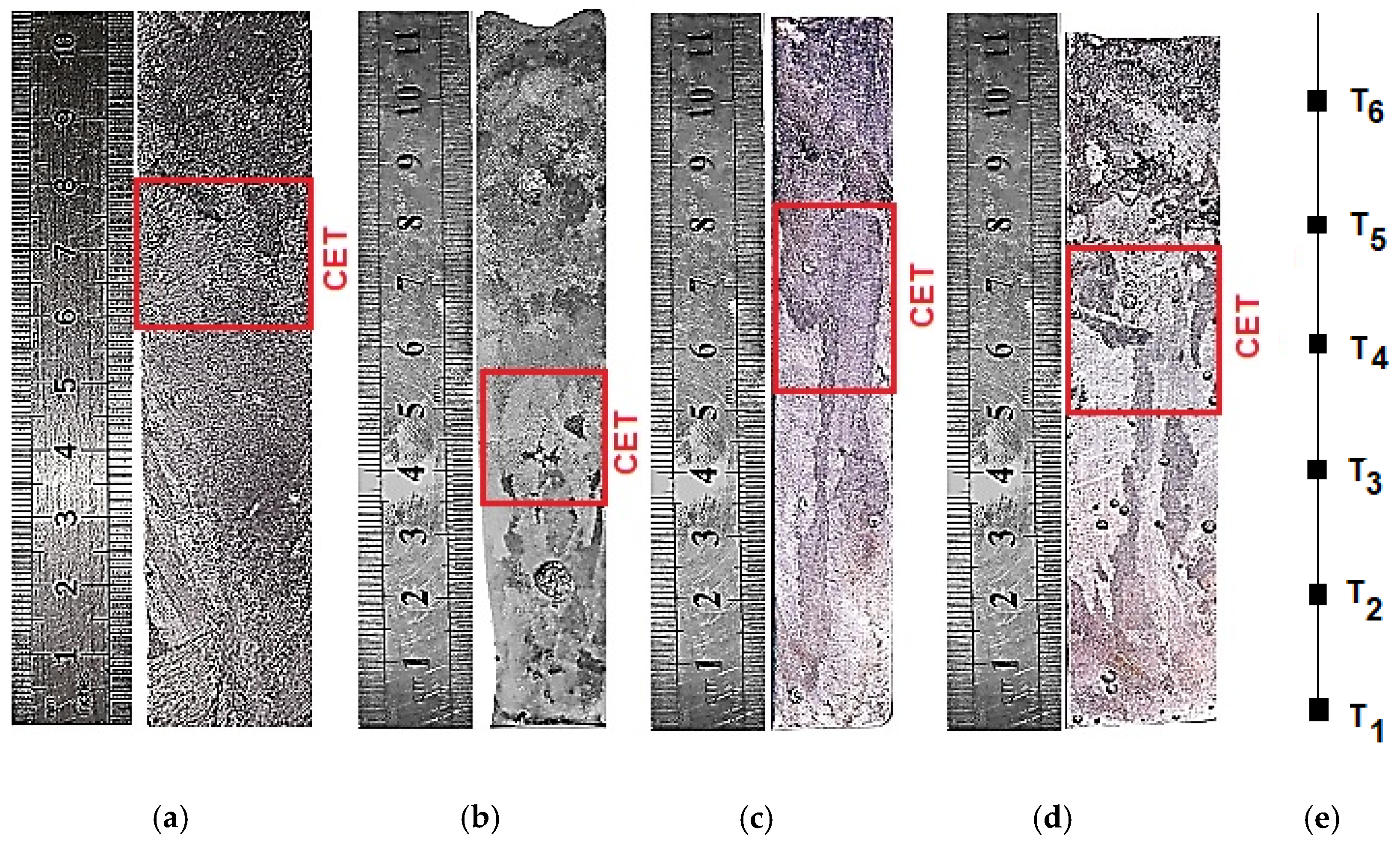
The macrostructures achieved in this study consisted of columnar structures, which occur when crystals align primarily in the direction of heat flow, forming long columns, like “rods” extending along the growth direction during solidification. It can be observed that the grain shape differs for each specimen; this is due to variations in the thermal parameters involved in the solidification process. This type of structure is possible because it commonly occurs in the solid phase of materials that are cooled in a controlled manner, especially in slow solidification processes, where molecules or atoms have time to organize themselves in a single-directional orientation. Finally, at the top of the specimen, grains with an equiaxed structure are observed, exhibiting an isotropic shape, meaning that the grain dimensions are equal in all directions, and therefore there is no preferred growth direction.
The grains do not show elongation in any particular direction. Grain formation is possible in the upper regions of the specimen because these areas form where the melt cools in almost all directions, without a preferred direction of heat flow. In these equiaxed grain areas, the effect of the base cooler is minimal or nonexistent due to the protective thermal layer created by the partially solidified mass at the base of the specimen. Figure 2 shows the macrographs obtained for the four alloy concentrations ((a) Al-6 wt. %Si. (b) Al-8 wt. %Si. (c) Al-10 wt. %Si. (d) Al-12.6 wt. %Si).
Regarding the results obtained from the CET, it was observed that this process occurs gradually, not abruptly or along a horizontal line. These results were also observed by Ares et al. [28,35], Román et al. [36], and Siquiera et al. [37], unlike Gadin et al. [38] and Rocha et al. [39], who found that the CET occurred more abruptly; that is, the transformation of columnar to equiaxed grains occurred rapidly along a plane parallel to the cold wall. The differences in results compared with those obtained by [38,39] are due to the fact that the TCE is highly dependent on the alloy system, the thermal variables, and the device used to perform the tests. By standardizing the thermal parameters and test devices, similar results could be obtained for the different concentrations.
For planning solidification processes, it is necessary to understand the influence of solidification parameters, such as the cooling rate (Ť), the rate of advance of the characteristic liquidus isotherm (VL), and the forward temperature gradient of the isotherm (G), on the formation of the solidification structure. These parameters determine the properties of the metal and, therefore, the quality of the final product. All of these vary with time and position during solidification and also depend on the composition (Co). It was also observed that the solidification structure occurs over a range, not along a straight line. Table 2 shows the values of the thermal parameters of all the compositions used in this work and observations: minimum CET position, CETMin, maximum CET position, CETMax, average CET position, CETAverage, average cooling rate, Ť, temperature gradient at the instant the CET occurs (critical value), Gc, and liquid interface velocity at the instant the CET occurs, VCL.
The criteria for identifying and evaluating the columnar, columnar-to-equiaxed grain transition (CET), and equiaxed zones in a solidification macrostructure are mainly based on grain morphology, growth direction, thermal gradient, and nucleation conditions during solidification [26,27,28,29,30,31,32,33,34,35,36,37,38,39,40].
The columnar zone is characterized by elongated and oriented grains, preferential growth in the direction opposite to the heat flow, high structural anisotropy, and the presence of long and parallel dendrites. It is identified by a high grain length-to-width ratio, a preferential crystallographic orientation, continuous growth from the mold wall toward the center, and the dominance of the thermal gradient (a high G/R ratio favors a stable interface and directional growth).
The columnar-to-equiaxed transition (CET) zone corresponds to the region where columnar growth loses stability and equiaxed grains nucleated in the liquid begin to dominate. It is characterized by the coexistence of columnar and equiaxed grains, dendritic fragmentation, a decrease in the thermal gradient, and an increase in constitutional undercooling. It is identified by the interruption of directional growth, the appearance of approximately globular grains, the reduction in preferential orientation, and an abrupt change in grain size and morphology. A classical criterion proposed by Hunt states that the transition occurs when equiaxed nucleation surpasses columnar growth.
Finally, the equiaxed zone presents approximately equidimensional grains, random orientation, lower anisotropy, and a high density of nuclei. It is identified by a grain length-to-width ratio close to 1, the absence of preferential growth direction, finer and more homogeneous grains, and formation generally in the central regions of the ingot or casting. Equiaxed solidification is favored by a low thermal gradient, high nucleation rate, liquid agitation, grain refiners, and high local cooling rates.

3.2. Thermal Profiles and Solidification Variables

It is known that structural parameters depend on solidification parameters, which vary with time and position during solidification. To examine the correlation between these parameters and structures during solidification, the results of experimental thermal profiles will be used to determine the thermal parameters described below.

3.2.1. Cooling Curves and Determination of Liquidus and Solidus Temperatures

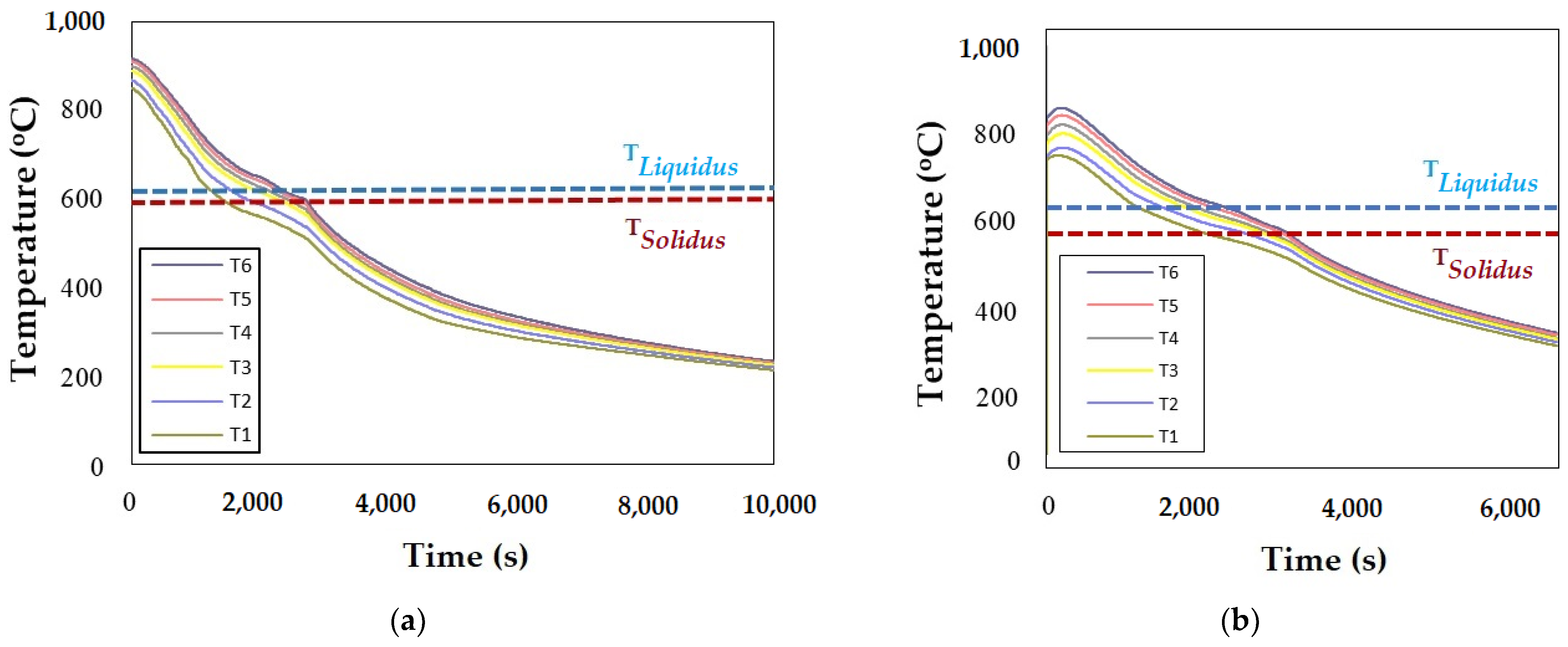
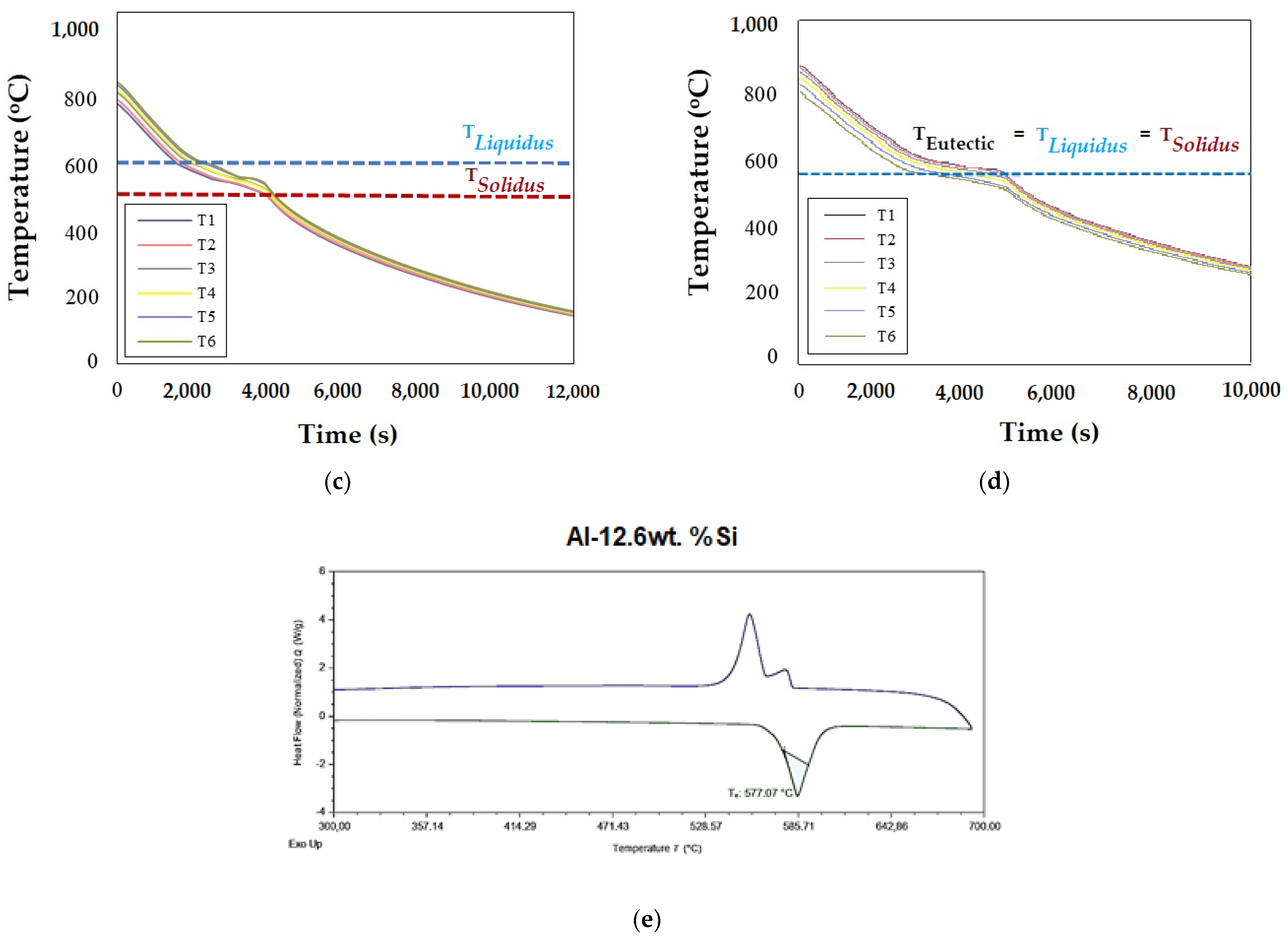
In Figure 3, for the four different alloys, the temperature variation over time recorded by six thermocouples inserted into the liquid metal during solidification is shown. T1 is the thermocouple located at the base of the specimen, and T6 is the one located at the top.
The experimental Liquidus (TL) and Solidus (TS) temperatures were determined by observing the change in slope of the cooling curve, which indicates the beginning and end of solidification for Figure 3a–d.
The degree of superheating for each alloy was: 178 °C for Al-6 wt. %Si, 183 °C for Al-8 wt. %Si, 199 °C for Al-10 wt. %Si, and 218 °C for Al-12.6 wt. %Si. Also, the withdrawal speed was 22.17 J/s for Al-6 wt. %Si, 19.20 J/s for Al-8 wt. %Si, 14.60 J/s for Al-10 wt. %Si and 14.46 J/s for Al-12.6 wt. %Si.
Furthermore, in Figure 3d, for Al-12.6 wt. %Si, the graph shows that the plateau from its beginning to its end was almost a horizontal straight line, where the invariant eutectic transformation occurs. This technique was also used in previous studies [28,35,40,41]. This criterion was taken because alloys solidify within a temperature range, in which solidification can be explained by means of a phase diagram, and the cooling curve of a given composition [42].
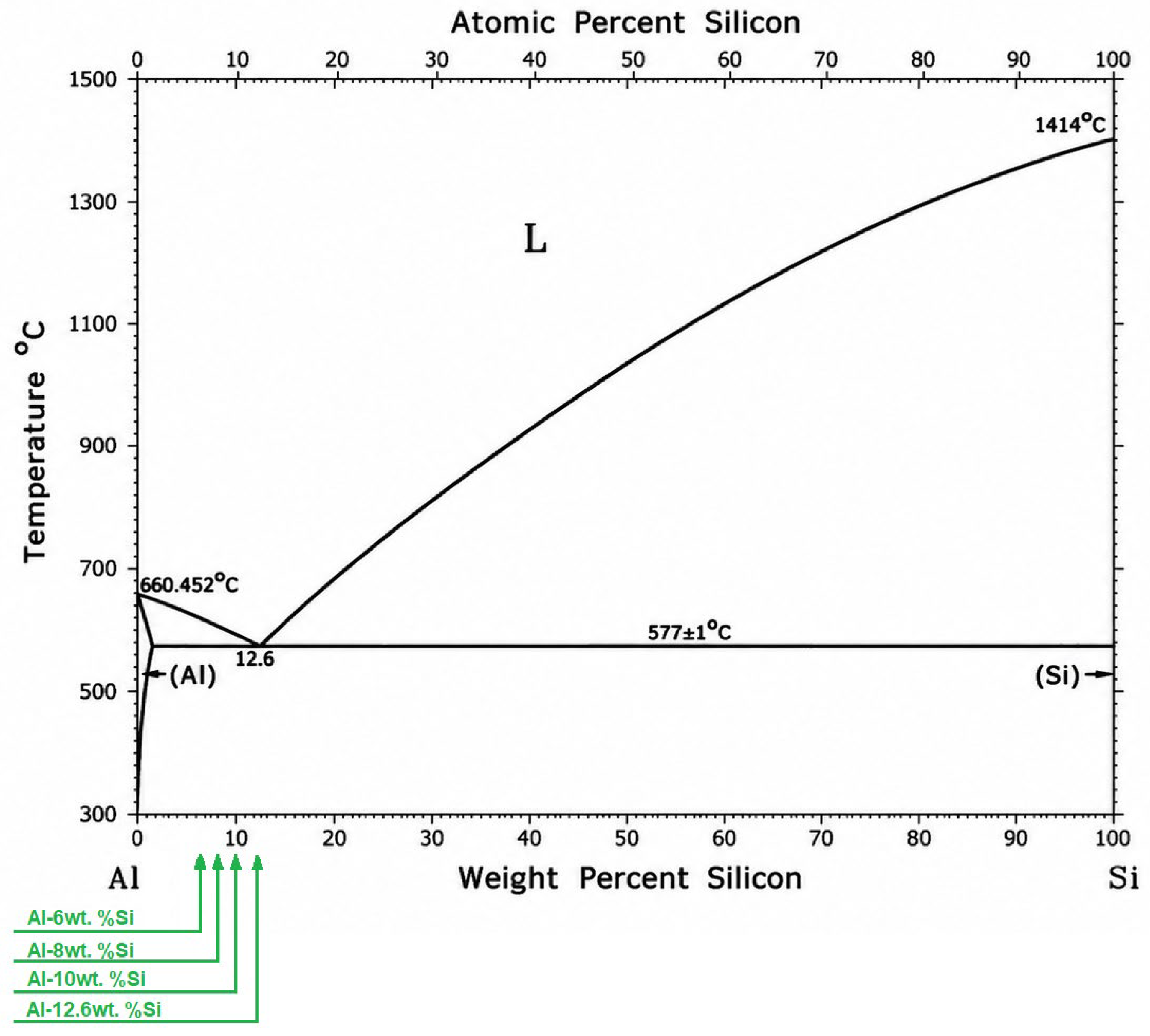
The solidification process of Al–Si alloys begins in the liquid phase. Solidification starts when the Liquidus line is reached (a first change in slope is observed due to the release of latent heat). Figure 4 shows the Al–Si equilibrium diagram, in which the alloys studied in this work are indicated with green arrows. This temperature is highly variable and depends on the percentage of silicon present in the alloy and the rate of cooling. The second change in slope of the cooling curve (the aluminum–silicon eutectic temperature) can be observed between 577 °C and 581 °C (see Table 3). Further analyses were performed using differential scanning calorimetry (DSC) to confirm the temperatures at which the transformations described by the slope change technique occur. Figure 3e shows the experimental DSC curves of the Al-12.6 wt. %Si alloy, obtained at a cooling rate of 0.166 °C/s. The endothermic curves indicate that the onset of the transformations is strongly influenced by the cooling rate, which can cause variations in the temperatures associated with these transformations. However, the results reproduce the temperatures of both reactions according to the equilibrium diagram of the Al–Si binary system. The TL and TS temperatures determined by both methods were similar. These results allow us to conclude that, for this type of test, and provided the thermocouples are correctly calibrated, the slope change technique is a reliable method for determining TL and TS values, as well as for obtaining an approximate estimate of the alloy concentration (see Table 2).

3.2.2. Cooling Rate (Ť)

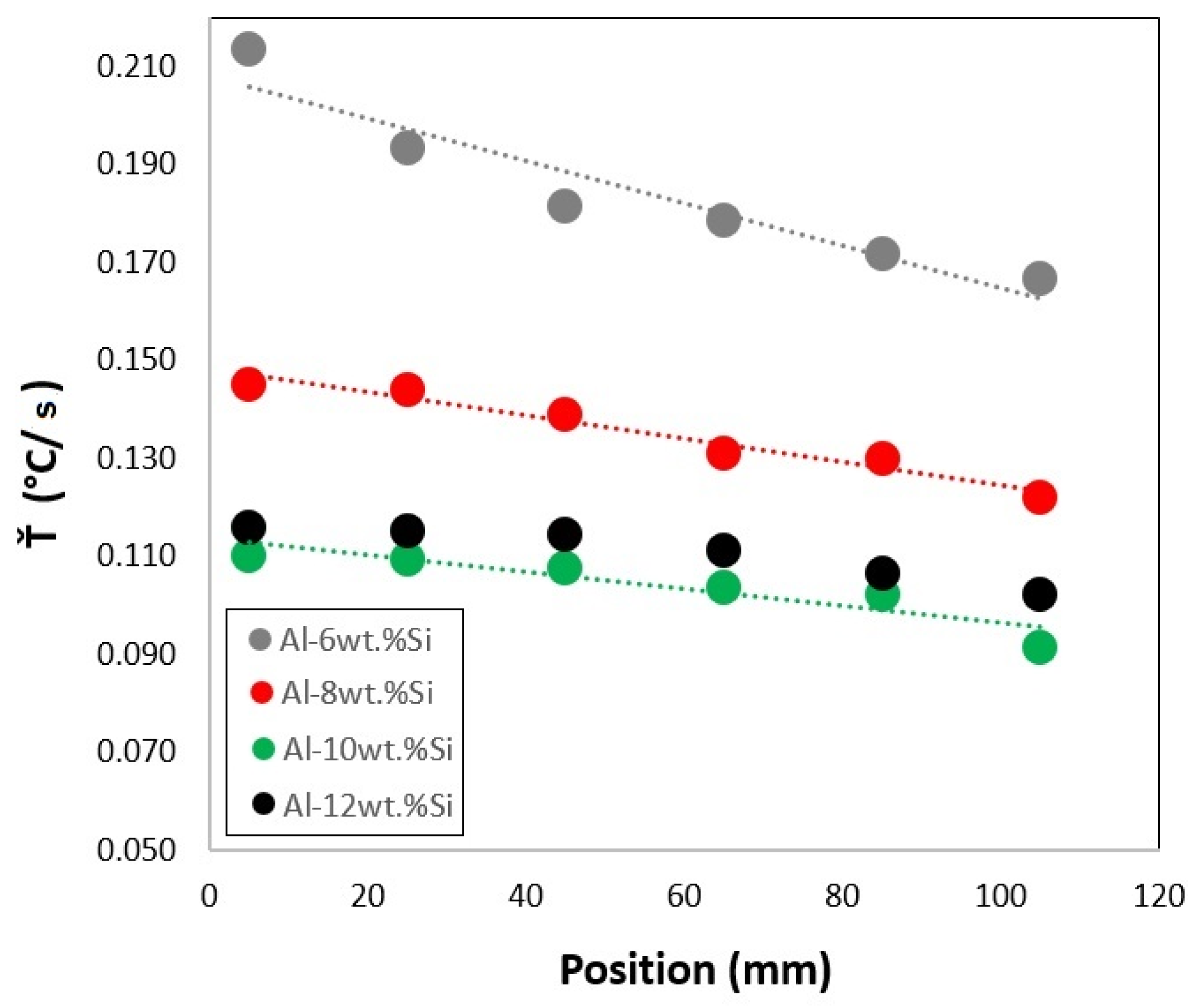
The cooling rate (Ť) was calculated from the temperature-time data recorded in Figure 3 for four alloys. For this purpose, the average slopes of these graphs were used. Subsequently, the Ť values corresponding to the position of each thermocouple were determined, as shown in Figure 5. This procedure was performed to analyze, in later stages, the influence of the cooling rate on the resulting metallographic structures.
The arrangement of the thermocouples in the directional solidification tests allows for the recording of a wide range of cooling rate Ť values in a single experiment. This is possible thanks to the data acquisition system, which collects temperature readings at 0.5 s intervals. This high sampling frequency facilitates the accurate determination of the slope of the experimental cooling curves, providing reliable data for the thermal analysis of the process. Figure 5 shows the variation in the cooling rate (Ť) as a function of the position from the cooler, corresponding to four tests performed with different concentrations. The results show that this pattern is consistently repeated in all the tests carried out in this study. The decrease in the cooling rate can be explained by the fact that, when heat is extracted from the base of the alloy sample, the initial solidification rate increases significantly. However, this rate gradually decreases as a solid layer forms, which introduces additional thermal resistance. This behavior directly influences the metallographic properties, allowing for differentiated characteristics to be obtained in different sections of the analyzed samples.
It is interesting to observe how the grain structures being formed are visible in the cooling curves obtained from each thermocouple. During the solidification process (Figure 3a–d), it is observed that in thermocouples T1, T2, and T3, the cooling is more abrupt, with the change in slope not clearly defined. Furthermore, the curves are more widely spaced, resulting in higher thermal gradients for the columnar regions. On the other hand, in thermocouples T4, T5, and T6, the change in slope is very pronounced upon reaching the Liquidus interface. Likewise, the curves of these thermocouples are closer together, so the gradients for the equiaxed regions are lower than those for the columnar regions. This behavior of the cooling curves in both columnar and equiaxed regions was observed by Flood et al. [44].

3.2.3. Influence of Interface Velocity (VL) on the CET

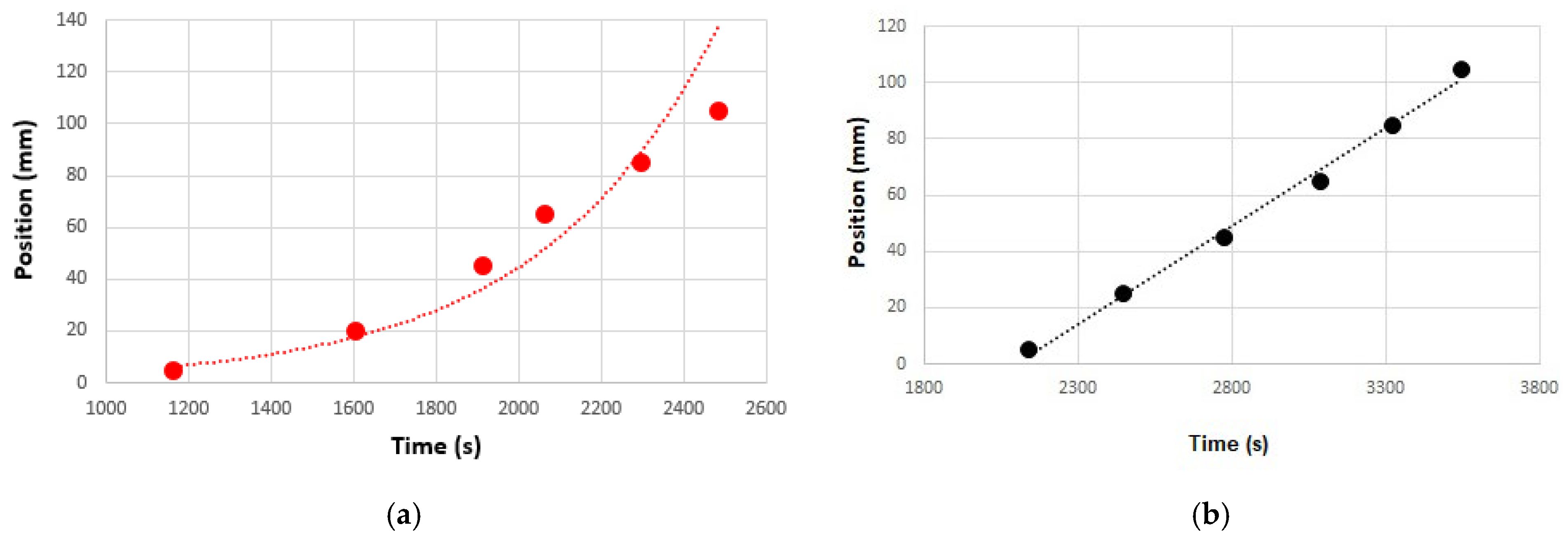
Thermal solidification parameters related to the passage of liquid isotherms through each thermocouple were generated from the experimental cooling curves in Figure 6a,b. Thermal readings were used to provide position (P) versus time plots corresponding to the passage of the solidification front through each thermocouple from the metal/mold interface.
It is observed that the advance of the Liquidus isotherms is exponential, unlike the eutectic; at higher positions (higher P values), the Liquidus interface advances faster. This generally occurs at thermocouple positions 4, 5, and 6, where equiaxed grains are present. Through this analysis, it is possible to obtain the velocity in the CET zone, which is called the critical liquid interface velocity (VCL). This velocity value in this zone is higher than in other zones because the thermal gradient (G) is minimal, and V is closely related to G, as explained in the following paragraph. The critical values for all tests are shown in Table 2.
Regarding the morphology of the resulting macrostructure, some studies in the literature report that the CET can occur according to critical values of either the interface velocity (VL) or the temperature gradient (G) in the liquid ahead of the solidification front [35,42,44,45,46]. However, various investigations on binary aluminum alloys, such as Al-Cu, Al–Si, Al-Ni, and Al-Sn, which solidify under unstable conditions, reveal that the transition is driven by the combined interaction of G and VL. This means that there is a critical value for the cooling rate during solidification (Ť = G.VL) that varies depending on the alloy system and the test conditions. For this reason, this work will not focus on the interface velocity, but rather on the values of Ť, which are considered more relevant to this research.

3.2.4. Behavior of the Thermal Gradient (G) in the CET Zone

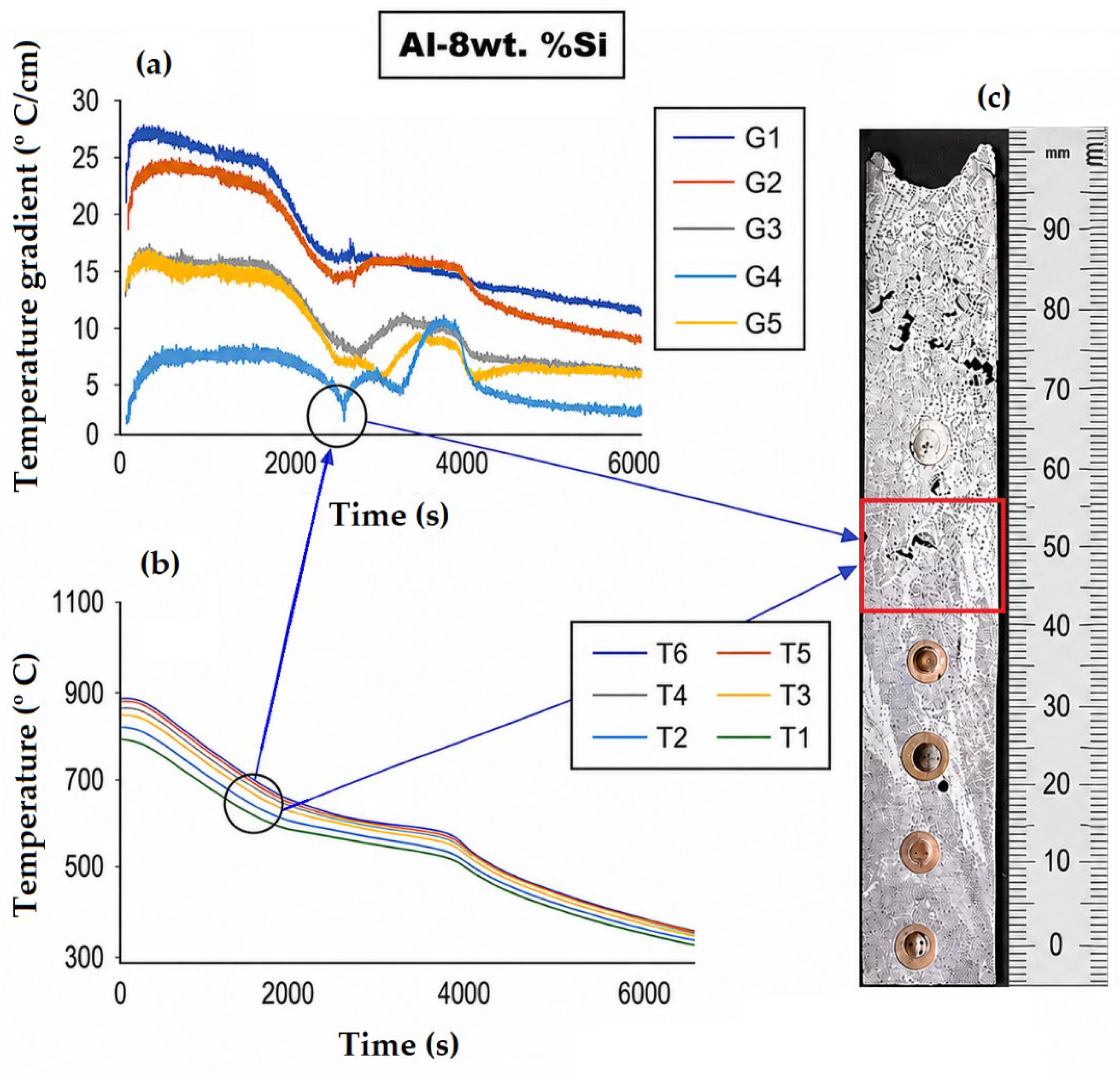
A representation of the experimental results of the temperature gradient corresponding to Al-8 wt. %Si alloy is shown in Figure 7a–c for two different alloys. The G value of interest is shown in Table 2; these values were calculated from the readings of six thermocouples, as shown in the graph where they are labeled G1–G5. It can also be seen that initially the G values are higher, but over time and during solidification, they decrease, reaching a minimum and even becoming slightly negative in some tests. This is called the critical temperature gradient, Gc (see Table 2).
In Figure 7a, the Gc value for when equiaxed grains nucleate, thus initiating the CET, reaches 0.35 °C/cm at G5 (a value between T5 and T6), the gradient measured between thermocouples 5 and 6. A cooling curve and a macrostructure image from the same test are also included to demonstrate that a Gc value is obtained in the CET zone (see Figure 7b,c).
The reason for this Gc value is attributed to the latent heat released by the equiaxed grains upon nucleation. Because of this, for an instant, both thermocouples are equal in temperature or very close to each other, causing G to decrease. The dispersion in the gradient values is associated with the fact that the transition generally occurs between two thermocouples and, therefore, the calculated value is an average over a region that includes the pasty zone and the melting zone.
This behavior is attributed to the common assumption that solutes have equilibrium distribution coefficients less than one, so the solute is rejected at the solid/liquid interface upon solidification. The accumulation of solute at the interface reduces the liquid and lowers the solidification temperature at the interface [29]. This behavior is what allows the thermocouple to measure that brief instant when the solidification temperature drops.

3.2.5. Metallographic Parameters and Their Relationship with Solidification Parameters

Influence of Solidification Parameters (Ť and Co) on the Position of the CET
Various directional solidification tests have shown that alloy composition and superheating affect columnar zone length and grain size. For a particular experimental setup in an alloy system with constant superheating, increasing the solute content (Co) results in a decrease in columnar zone length and a smaller equiaxed grain size, which promotes the formation of the CET [4,5]. Gandin et al. [38] demonstrated that columnar zone length increases slightly when solute content is decreased. This result agrees well with the tests of Mahapatra and Weinberg on tin-lead alloys [47]. Tarsis [48] discovered a parameter P that depends on the alloy composition (C0), the slope of the liquid curve (m), and a constant K (equilibrium distribution coefficient). It was found that when P is low, the structures are columnar, and they change to equiaxed when P is high. This parameter is expressed in Equation (1):
P = m C 0 ( 1 k )
The analysis in the previous paragraph regarding Equation (1) and the corresponding distances to the CET position, compared with the other cited authors, with respect to the CET position values in this research, is based on the fact that the CET position is strongly influenced by Ť, although there is a shared behavior with the increase or decrease in solute content.
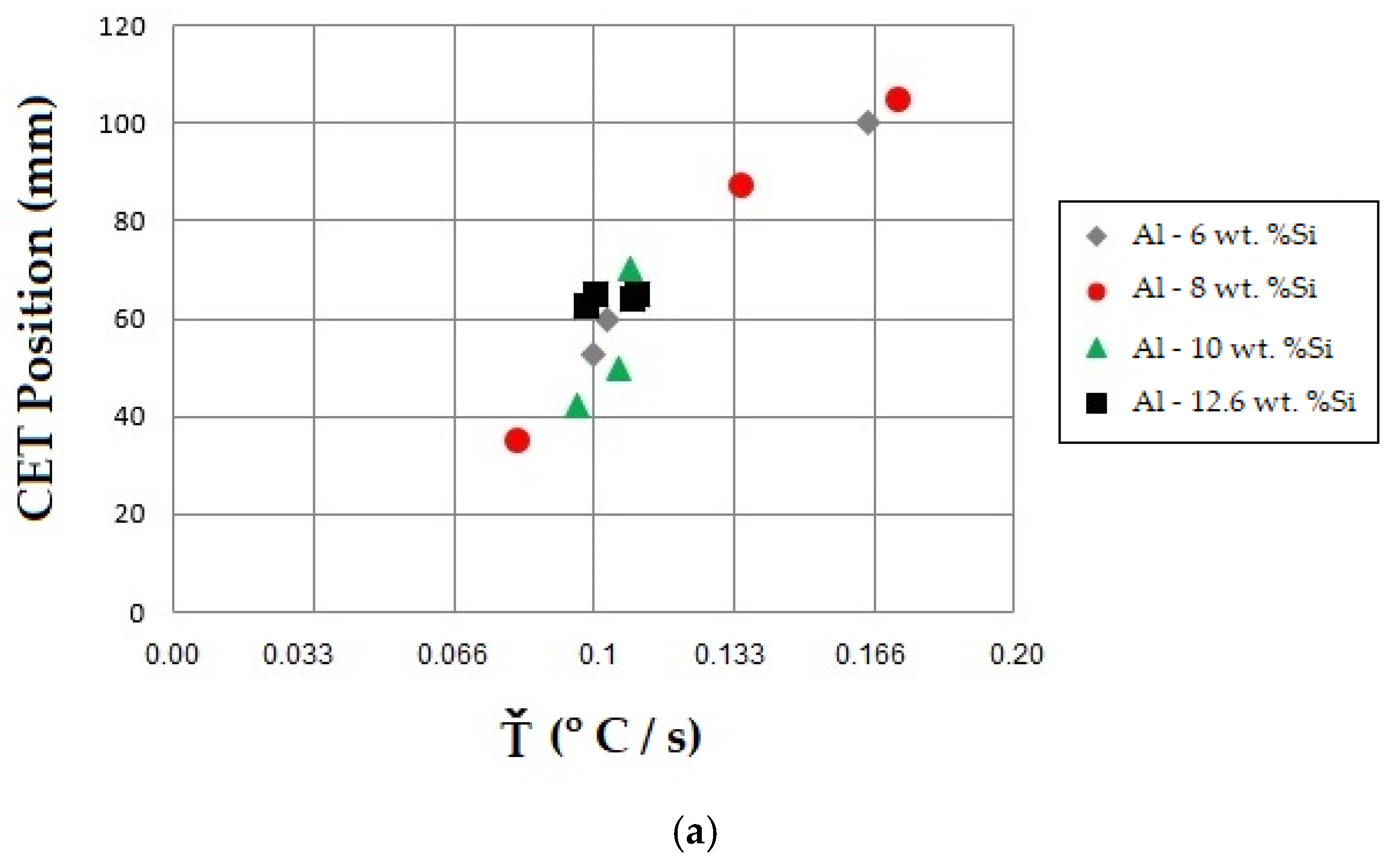
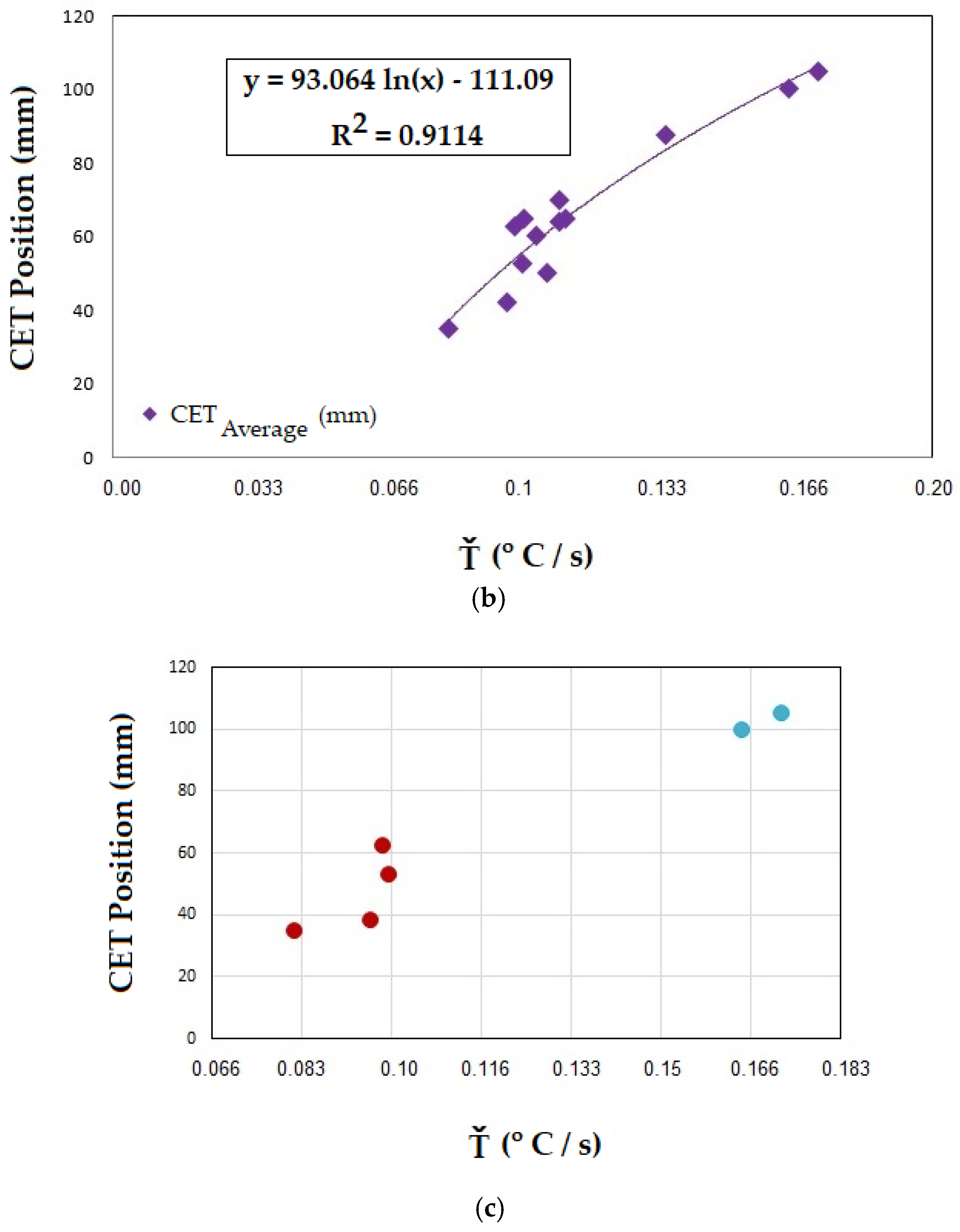
According to the results of this work, it appears that Ť is the most significant solidification parameter defining the CET position, as it shows a clear logarithmic trend at all the concentrations studied (higher values of Ť resulted in higher CET position values regardless of C0), as can be seen in Figure 8a,b. The relationship between CET and G values was also analyzed, and it was not found that this influences the CET position; rather, its influence lies in reaching a critical value that promotes the occurrence of the CET phenomenon.
Furthermore, it was observed that the amount of solute (C0) has a lesser effect on the CET position at higher velocities, as shown in Figure 8c. To explain this behavior, lower velocity ranges, with values from 0.080 to 0.098 °C/s, and higher velocity ranges, with values from 0.165 to 0.172 °C/s, were used. At high velocities, the CET had values between 98 and 105 mm, while at lower velocities it ranged from 38 to 60 mm. The difference in CET position values for these measurements was 7 mm at high velocities and 32 mm at low velocities. In a study by Gandin [38] et al. and another by Pérez [42], unlike this work, the authors demonstrated that the solute content in Al–Si alloys does not affect the experimental position of the CET.
Influence of Cooling Rate and Si Content on Columnar Grain Width and Equiaxed Grain Size
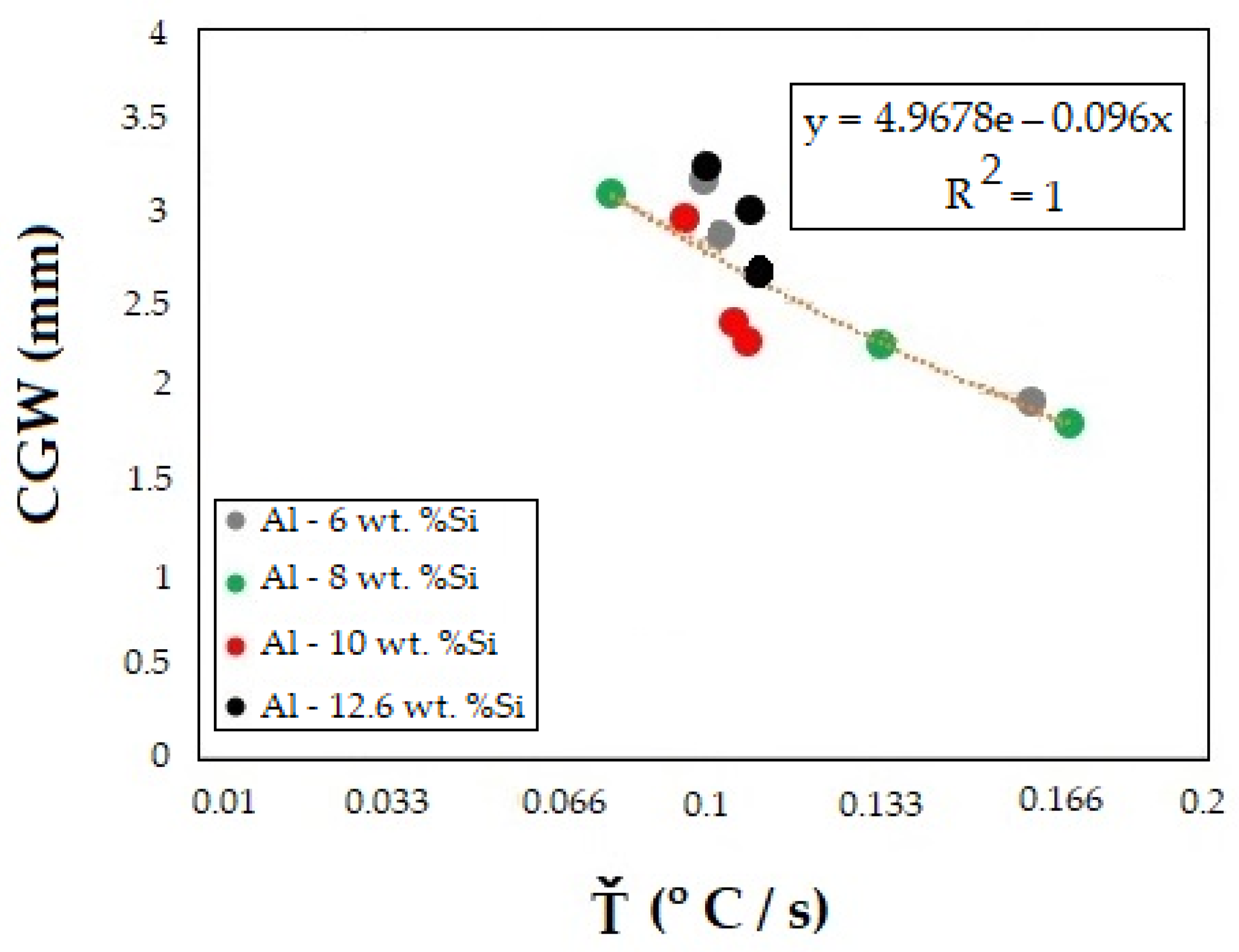
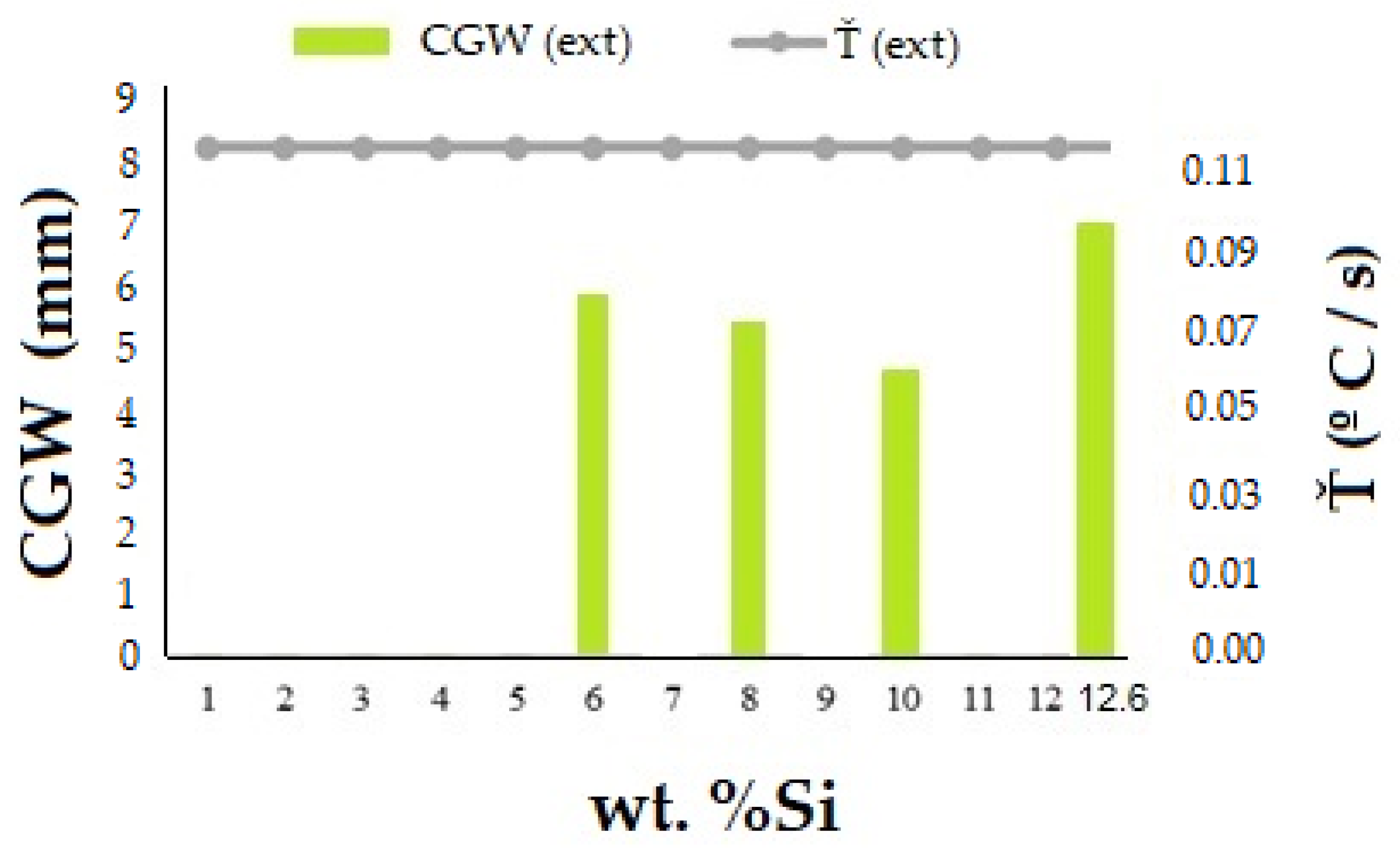
To analyze the influence of cooling rate and silicon content on columnar grain width (CGW) values, CGW measurements were taken at the same distance from the base of the specimen (P = 25 mm). A preliminary analysis found that, at the same concentration and with higher Ť values, the columnar grains become finer. This behavior can be observed in Table 4 with Ť vs. CGW values and in Figure 9.
In addition, the base indicates a relationship between standard CGW and concentration. The behavior took the form CGW = a*Ť−b, where the equation parameters were obtained through regression analysis and are shown in Table 5. This behavior was reported by other authors [28,35,41]. The values obtained from the formulas are shown in Table 5. Yong-zhe Wang et al. [49] also found similar behaviors of columnar grain size as a function of cooling rate, and reported in their work that the columnar grain size decreased on average from 5.8 to 2.3 mm when the extraction rate increased from 0.003 to 0.016 mm/s.
Finally, to further reveal the effect of silicon content, the columnar grain width (CGW) was compared with similar Ť values for different concentrations, as shown in Figure 10. This figure shows the experimental values obtained in this work, where it can be seen that, at similar velocities, the grain width decreases with increasing silicon content up to 10 wt%, then increases towards the eutectic concentration. However, since there is still a variation in velocities, this continues to have a significant impact on the behavior, and the conclusions may be confusing.
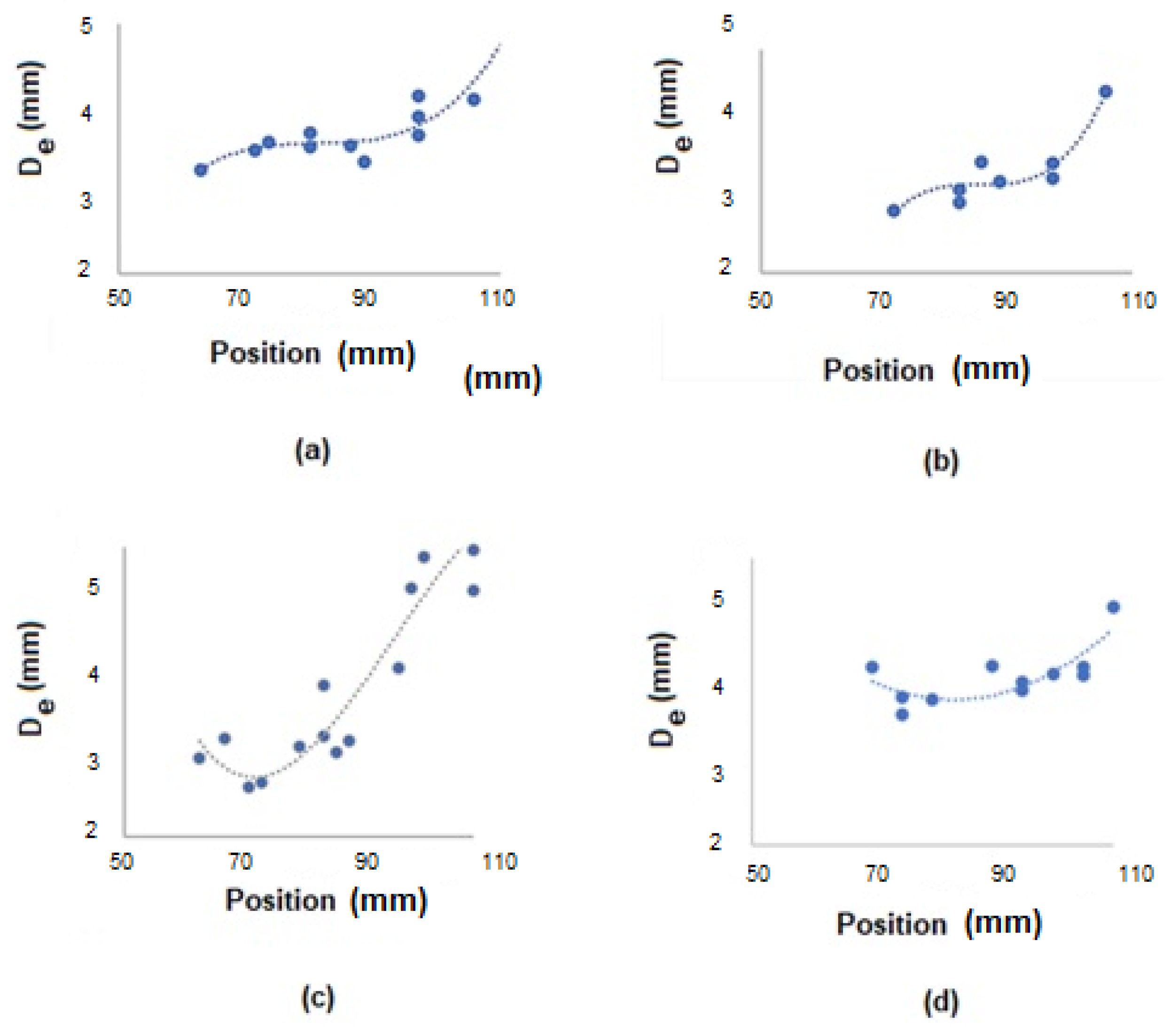
Regarding equiaxed grain size (De), measurements of the average diameter of equiaxed grains were taken at positions near and above the thermocouple (CET). Each sample was segmented into uniform intervals, determined by the distance between thermocouples (20 mm), to facilitate analysis. Since the behavior of equiaxed grains showed similarities to that of columnar grains in relation to the Ť and silicon content (decrease in De with increase in Ť and C0), a less rigorous analysis of the results will be performed.
The measurement results are illustrated in Figure 11a–d, where the four alloys are analyzed. It can be seen that, as we move away from the CET, the value of De increases. This occurs because the values of Ť tend to be lower in areas further from the base of the specimen, which in turn generates a longer solidification time and leads to an increase in the average grain size.

3.2.6. Microstructure Description

Characterization by Optical Microscopy, Electron Microscopy, and X-Ray Diffraction
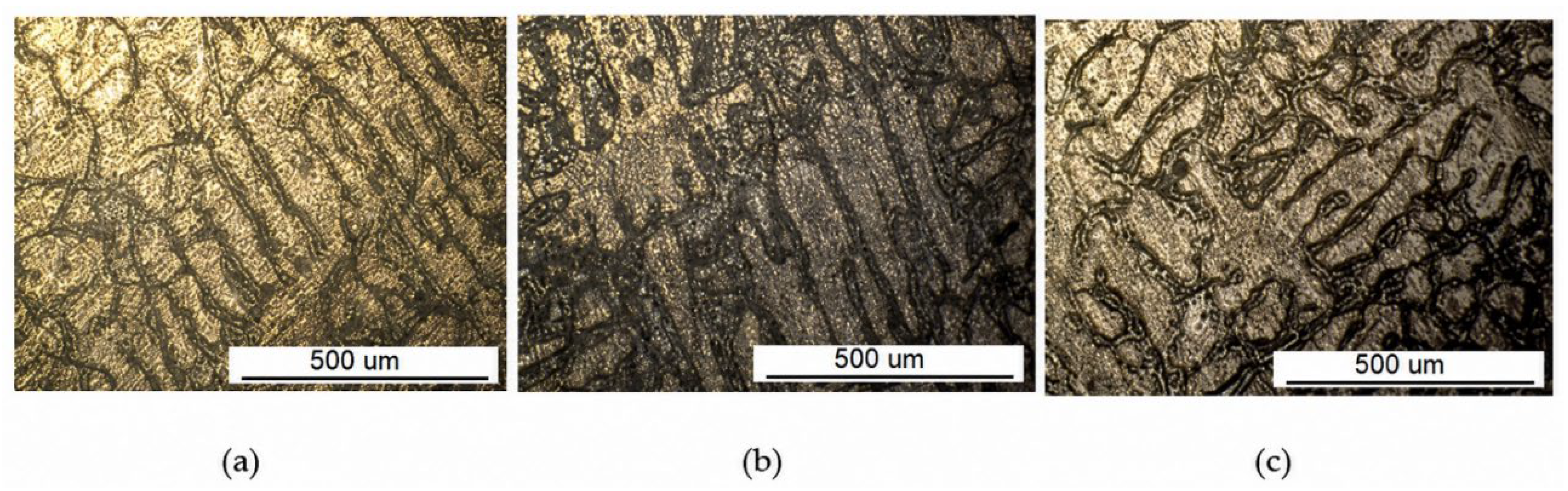
The Al–Si alloys obtained in this work are best understood with the help of a binary equilibrium phase diagram of Al–Si [43], see Figure 4. The eutectic reaction (Liquid (L) → α-Al + β-Si) occurs at a temperature of 577 °C with 12.6 wt. %Si. Primary α-Al (with ~1.65 wt. %Si dissolved at eutectic temperature) solidifies in the form of non-faceted dendrites with an Al–Si eutectic structure present between the interdendritic arms, as seen in Figure 12a–c for an Al-6 wt. %Si alloy in the columnar, CET, and equiaxed zones of the samples.
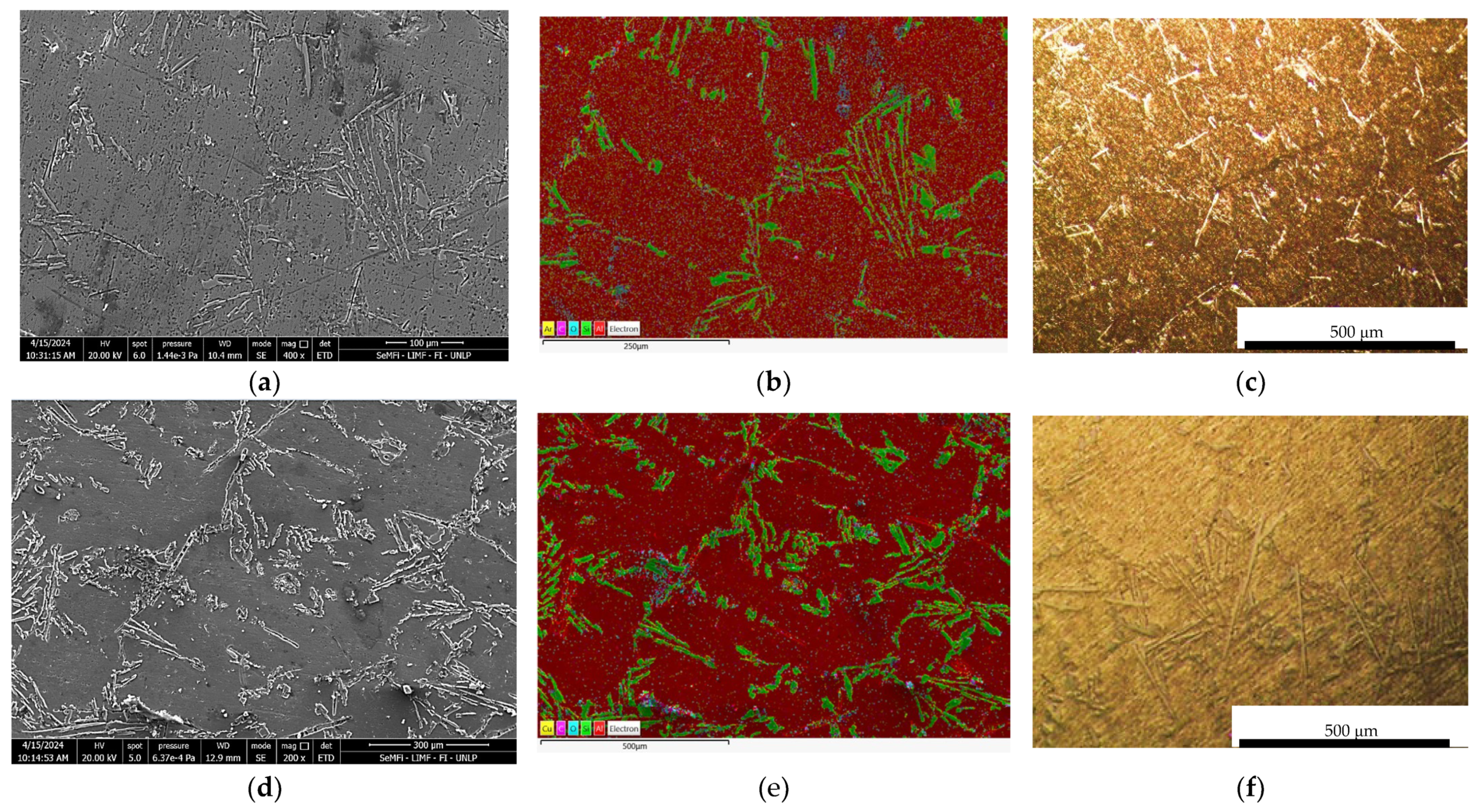
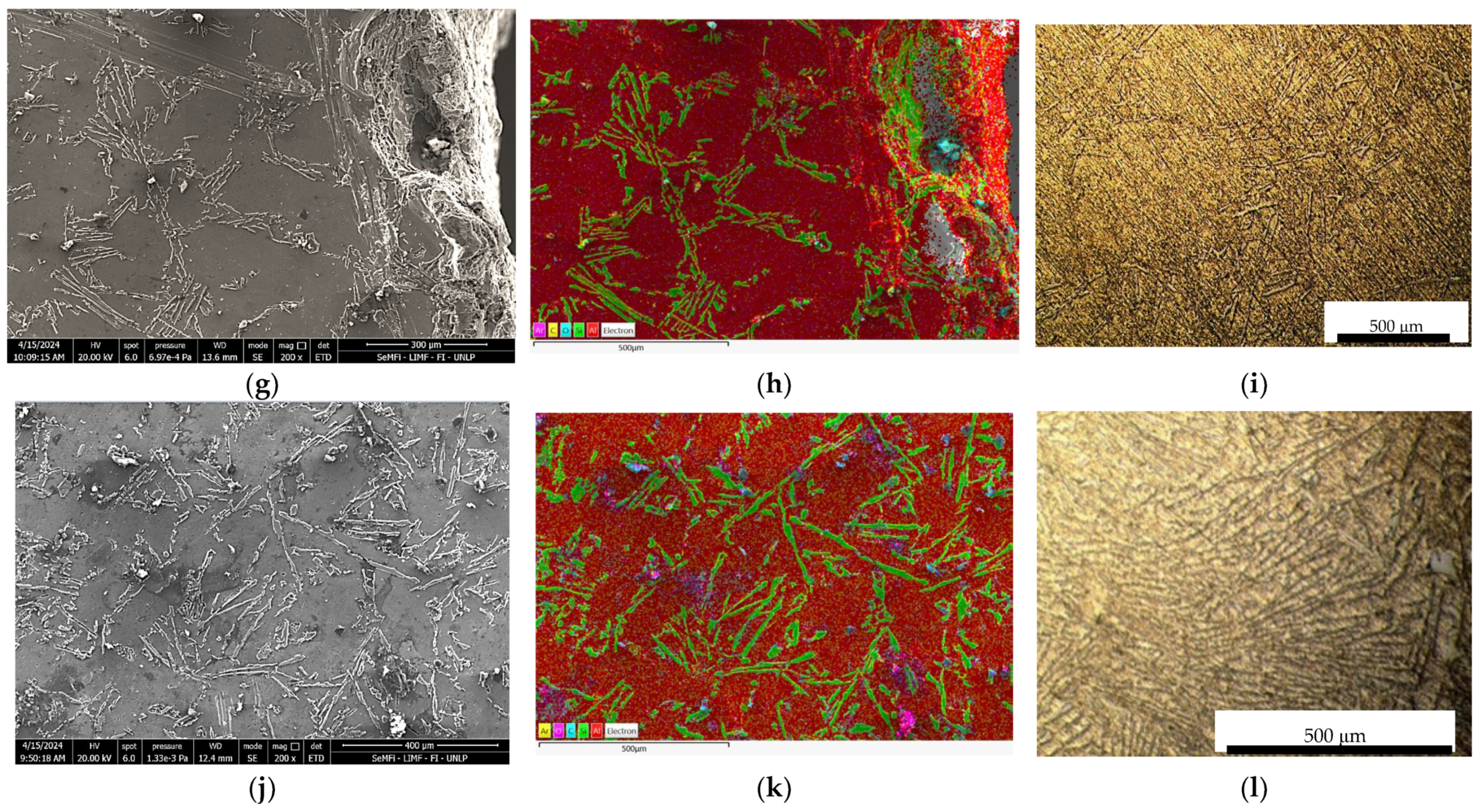
Typical microstructures of hypoeutectic (<12.6 wt. %) and eutectic (12.6 wt. %) alloys can be seen in Figure 13: (a–c) Al-6 wt. %Si. (d–f) Al-8 wt. %Si. (g–i) Al-10 wt. %Si. (j–l) Al-12.6 wt. %Si.
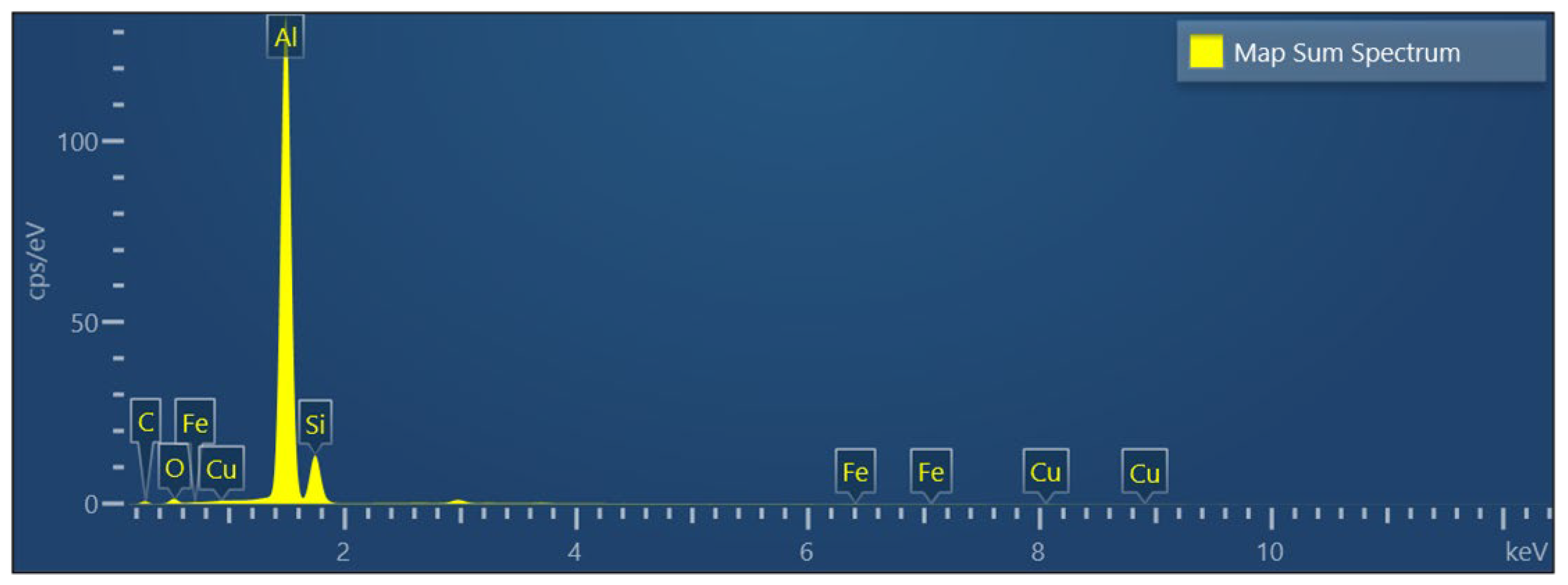
Figure 14 shows the results obtained using the EDS technique in Figure 13g,h for an Al-10 wt. %Si alloy. The energy of the characteristic X-rays generated by the electrons is intrinsically related to the nature of the atoms that make up the sample, as shown in Figure 14. In the EDS analysis, peaks of Si are observed along with the Al peak as a matrix element and other elements in small proportions (Cu and Fe).
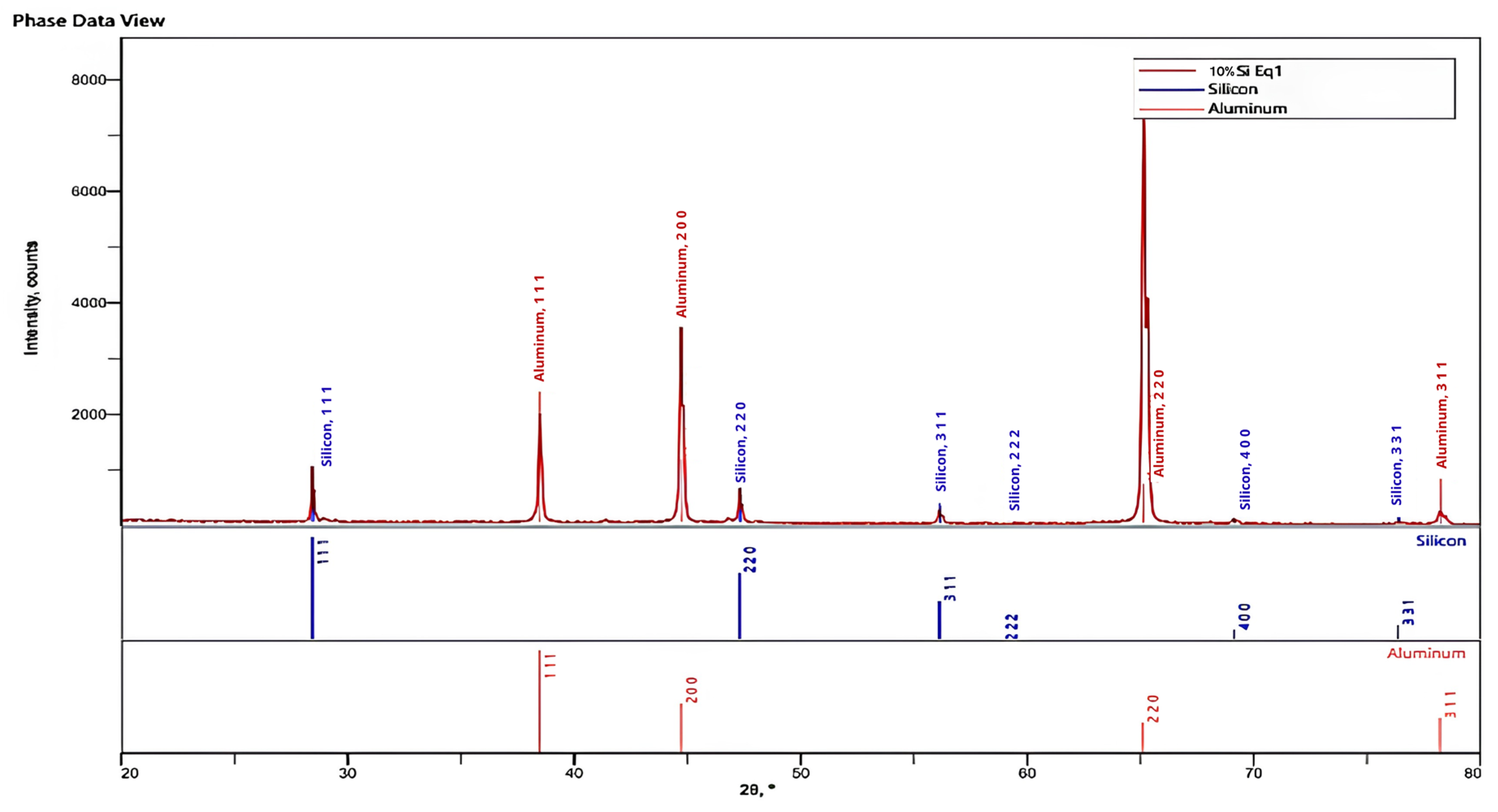
The XRD analysis results are presented in Figure 15. The diffraction patterns showed only aluminum and silicon peaks in the three zones with different macrostructures; iron peaks appeared in some diffraction patterns. Furthermore, this technique yielded information on the α and β phases, which consist of an Al (α) phase with an fcc structure and a lattice parameter a = (4.045 ± 0.0002) Å and a Si (β) phase with a bcc structure and lattice parameters a = (5.43 ± 0.0001) Å. It can be observed that variations in the peak height and width profile are present in the different zones.
This phenomenon can be attributed to the accumulation of dislocations, which is likely in columnar areas due to their higher solidification rate. It is also reasonable to assume that the material exhibits an induced texture reflected in the preferential orientation of the grains and the particular distribution of the solute throughout the specimen. However, this research will not delve into the quantitative analysis of the texture and dislocations, as that falls outside the scope of this work.
Since aluminum has an FCC crystal structure and silicon has a cubic crystal structure, it is not compatible with many intermetallic compounds. The eutectic structure varies in morphology, size, and distribution, depending on the chemical composition and cooling rate during alloy solidification (this will be discussed in the next section). Commercial and engineering Al–Si alloys are not limited to silicon as the sole alloying element. To impart adequate strength and fracture toughness, several other elements are added at optimized concentrations during alloy development.

3.2.7. Influence of Cooling Rate and Si Content on Secondary Dendritic Spacing λ2

Dendritic growth is perhaps the most frequently observed phenomenon during solidification. It is a well-known fact that there is an intrinsic connection between thermal variables and the solidification process. This relationship directly influences the morphological characteristics of the resulting structure, such as the spacing between dendritic arms. Since fluid flow in the interdendritic channels depends on these dendritic arm spacings, it is important to understand the variation in these parameters during the solidification process to analyze certain characteristics such as tensile strength, ductility, and toughness. These morphological parameters are determined by the heat transfer conditions established by the interaction between the metal and the mold, as well as by the concentration of the solute present. Thus, by regulating thermal variables, such as the thermal gradient (G) and the cooling rate (Ť), a range of possibilities opens up for generating diverse microstructures [45,46,47,48,49,50,51,52]. The general consensus of previous research indicates that, by increasing the cooling rate, a refinement in grain size is achieved, the structure of the silicon particles is transformed, and the value of λ2 is reduced.
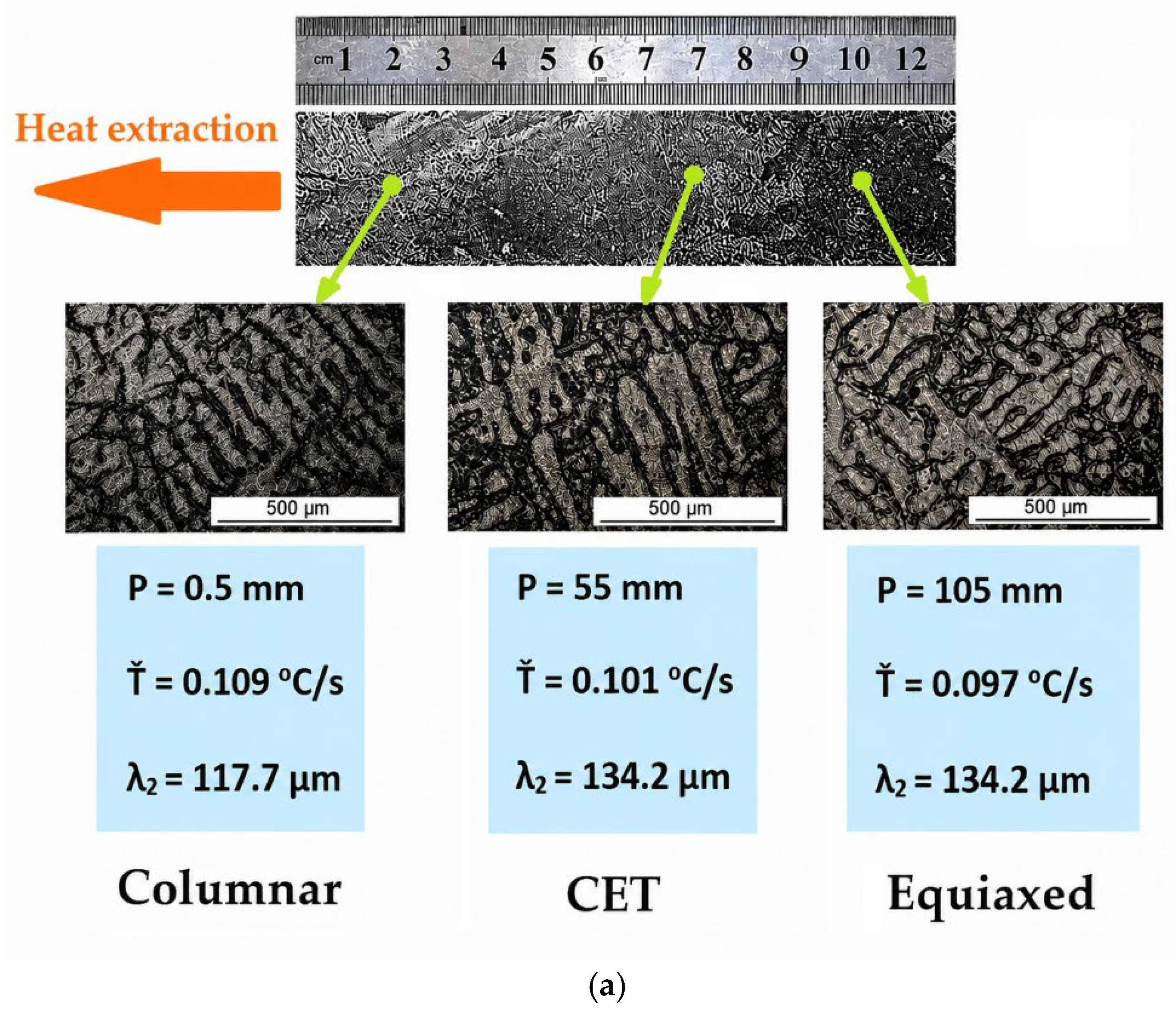
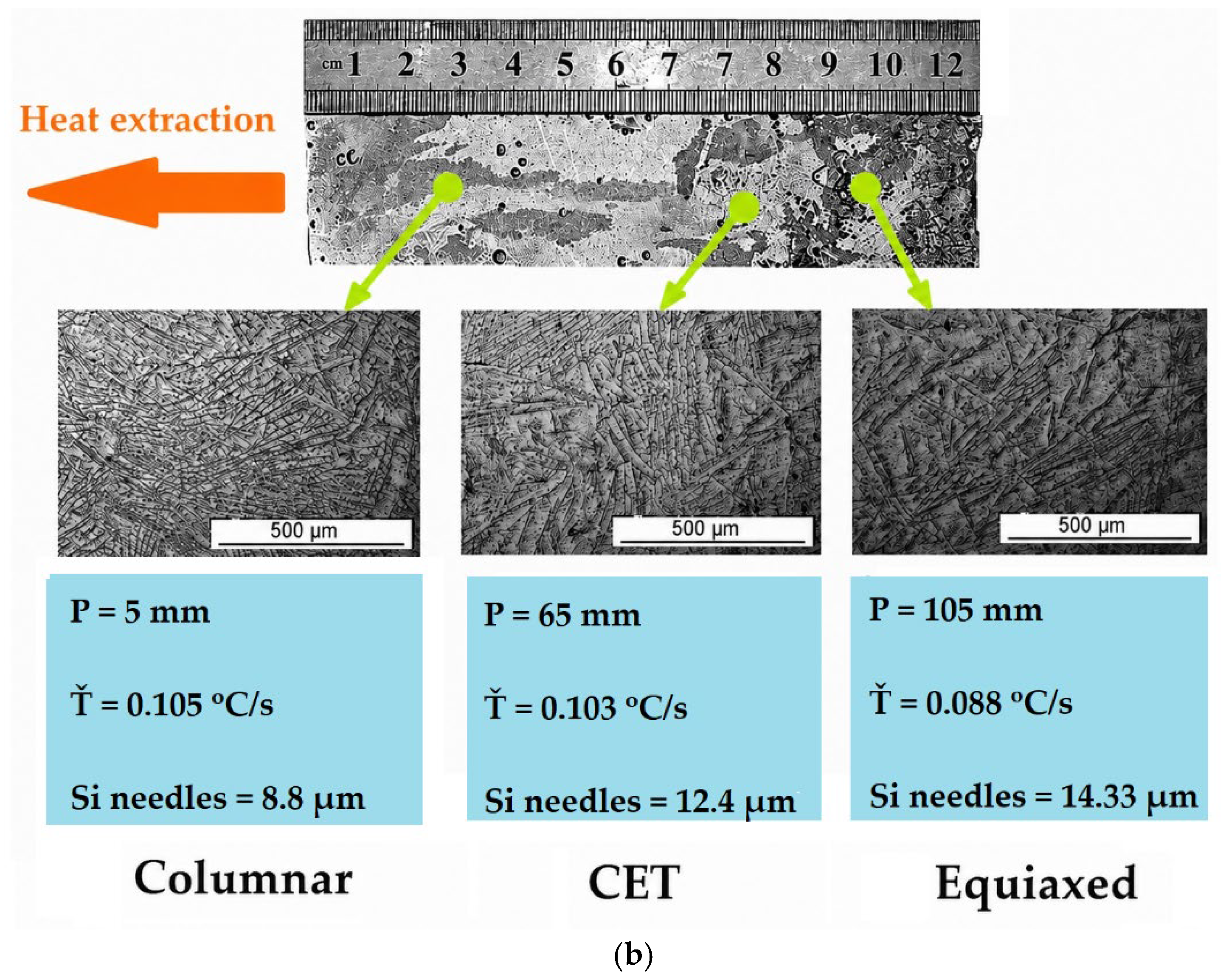
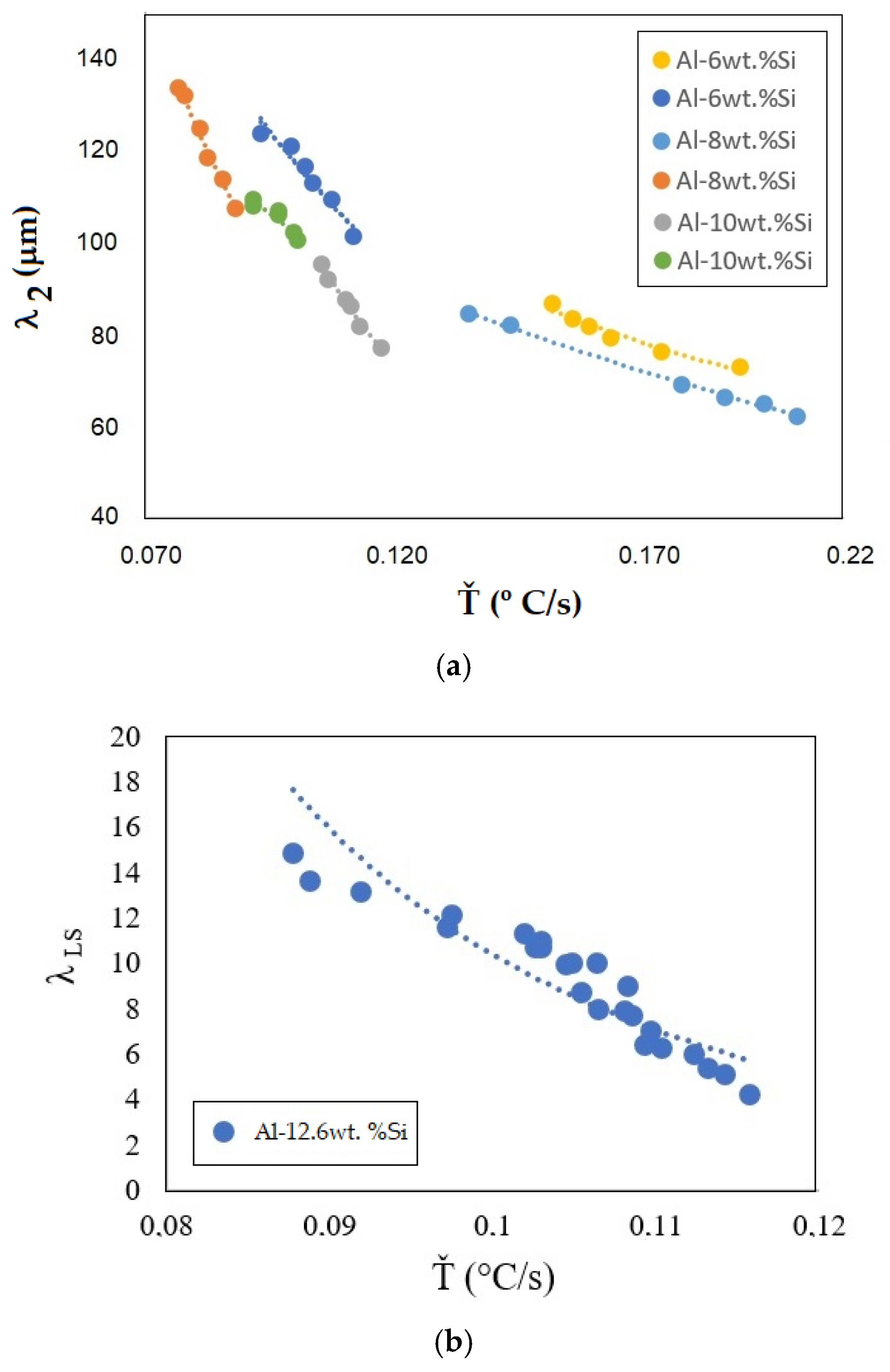
To study what was described in the previous paragraph, data were taken from different positions, and this, in turn, is linked to different cooling rates (Ť), which is expected to have an effect on the microstructural properties, in this case, the secondary dendritic spacing (λ2). For this purpose, images were obtained at locations near the thermocouples along the solidified pieces; these are shown in Figure 16a,b.
Both figures show the variation in the λ2 distribution as a function of the position in the specimen, that is, the areas with different macrostructures for an Al-2% Si and Al-5% Si alloy. The evolution of the λ2 values in relation to the position can be observed in these figures. In the boxes of each micrograph, information can be found about the position from which the sample was taken in the alloy, the λ2 spacing values, and the Ť values. Identifying this behavior is crucial because the λ2 values in the dendritic network are significant for more extensive dispersion of the eutectic phase, and the ε values are also important because they change along the length of the castings and affect the λ2 values. It is observed that the use of a water-cooled mold imposes higher cooling rates near the casting surface and a decreasing profile along the casting due to the increasing thermal resistance of the solidified shell with distance from the cooled surface. This influence results in lower experimental λ2 values in areas near the cooling surface, which gradually increase with distance from it.
Because Ť plays an important role in controlling the formation of different structures, and consequently, the mechanical properties, increasing Ť refines the grain size, modifies the silicon particles, and decreases λ2. This is because more solidification nuclei form when the melt cools more rapidly.
To demonstrate the above with numerical values, Table 6 presents the results obtained from measurements of λ2, Ť, and HV 0.05/10 (which will be analyzed later) at different positions for five alloys with varying silicon content. The data from Table 6 were used to plot and express λ2 as a function of Ť.
Figure 16a,b uses Ť values obtained in this work (between 0.08 °C/s and 0.17 °C/s). In both cases, an inverse relationship between Ť and λ2 is observed (i.e., the higher the cooling rate, the lower λ2). The choice of these five alloys provides a good indication of how the alloying element content and Ť affect the magnitude of λ2.
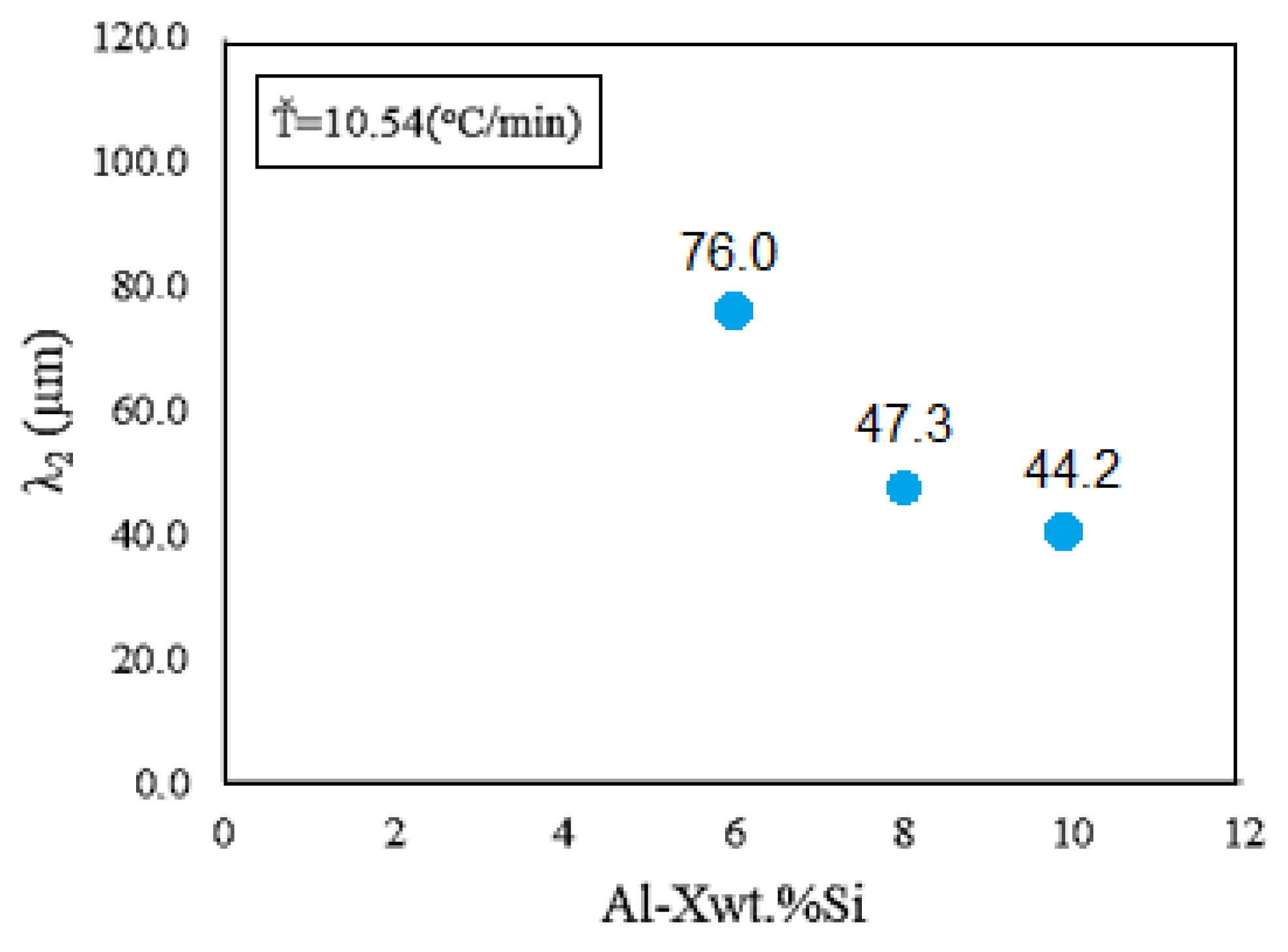
As explained previously, it is known that different cooling rates during solidification can lead to variations in the quantity and shape of various morphological features of the solidified structures, which in turn can lead to different mechanical properties. As observed in Figure 16a,b, different silicon contents have some effect on the size of λ2, although the effect is usually small compared with that obtained by varying Ť. In order to analyze the effect of silicon content on λ2 values, Figure 17 presents λ2 values as a function of different silicon contents, with similar average cooling rates. It can be observed that increasing the percentage of silicon in the alloy caused a notable decrease in the size of λ2. When the silicon content increased above 8% by weight, the effect was less noticeable.
The microstructure analysis presented in Figure 17 and Figure 18 shows that the addition of silicon decreases the size of λ2. A further increase in silicon content has almost no effect on the size of this micro constituent. These results are expected because other authors have found [41,49,50] that dendrite size, in addition to the cooling rate, is dependent on the level of alloying elements present in the melt.
Therefore, when designing a solidified part, the effect of Ť on λ2 must be considered beforehand. At the same time, the effect of chemical composition should not be overlooked. Figure 18 clearly shows how the value of λ2 changes as a function of silicon concentration. Consequently, the impact of composition on the size of λ2 must be understood and appropriately applied to achieve the required quality of the solidified product. As a result, the effect of the chemical composition must be employed for precise adjustment in order to achieve the desired size of λ2.

3.3. Mechanical Properties

3.3.1. Influence of λ2 and Silicon Content on Vickers Microhardness Values

The microhardness (HV 0.05/10) value provides an indication of resistance to deformation, densification, and cracking. It is often used to evaluate the mechanical properties of metallic materials. Because HV 0.05/10 is a highly relevant property of materials, it indicates a material’s strength against localized plastic deformation; that is, a material’s ability to withstand permanent indentation or deformation when in contact with an indenter under load. Through HV 0.05/10 tests, changes in this property were determined for the studied alloys under the effect of silicon additions and different cooling rates.
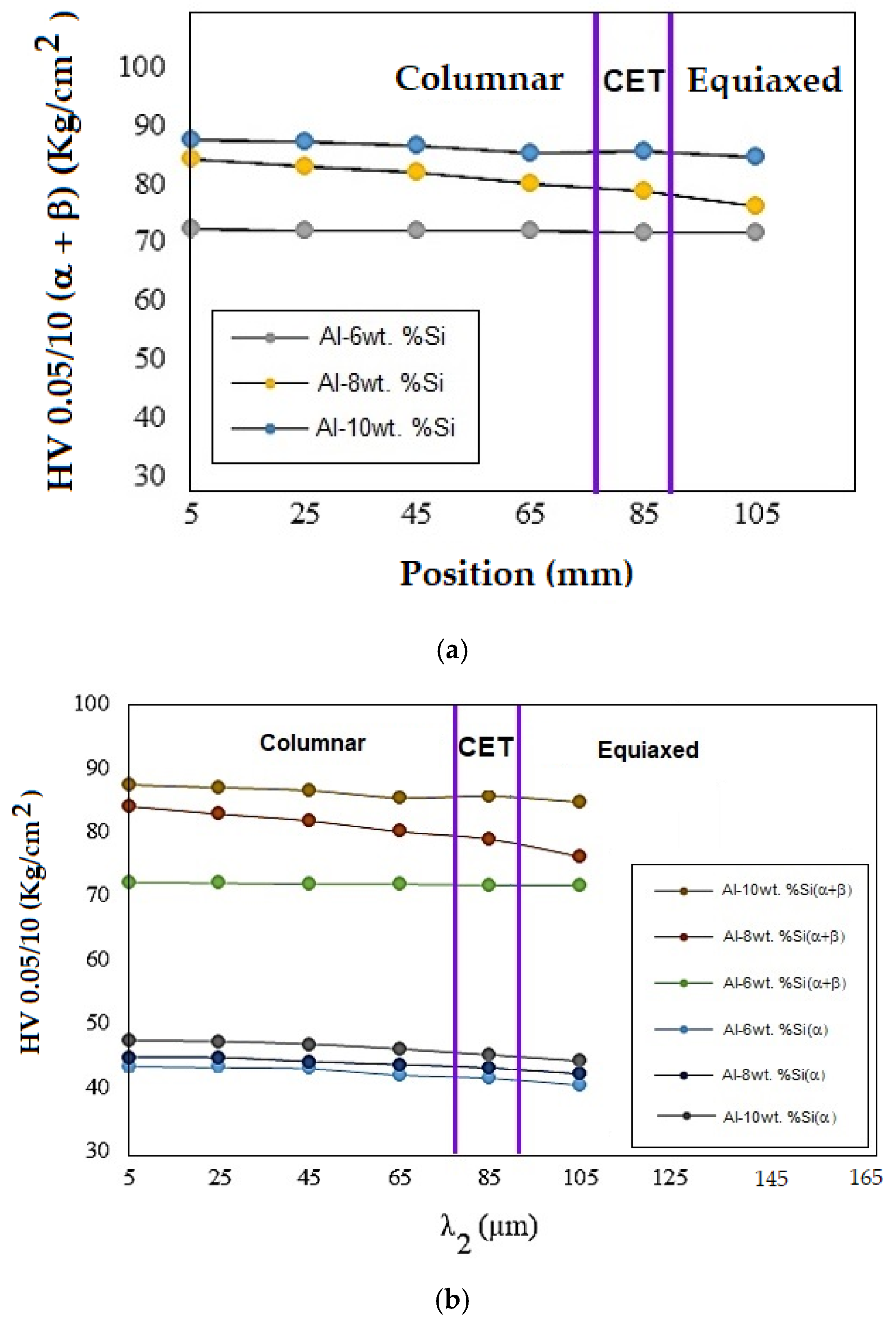
The HV 0.05/10 values shown here were obtained from three different concentrations. Figure 19a shows the variation in HV 0.05/10 values as a function of distance from the cooling surface (P). As expected, HV 0.05/10 decreases with increasing position from the cooling surface (P). This behavior is due to the fact that greater distances from the base of the specimen (with higher P) produce higher λ2 values (see Table 6). This increase in λ2 and the decrease in HV 0.05/10 values occur because, at locations farther from the cooler, solidification happens at a slower cooling rate, leading to thickening of the microstructure. This behavior has been reported by several authors [45,53,54].
To validate the above, specifically that microstructural refinement leads to improved mechanical properties, Figure 19b shows the variation in HV 0.05/10 as a function of secondary dendritic spacing (λ2). It is clear that HV 0.05/10 values increase as λ2 decreases, demonstrating an inverse relationship between these two parameters.
This behavior is explained by the fact that a more refined microstructure results in greater alloy hardening. In particular, a finer distribution of the (α-Al + β-Si) eutectic restricts dislocation movement, thus increasing resistance to localized plastic deformation. Likewise, a lower λ2 implies a more homogeneous distribution of silicon particles in the interdendritic region, which further contributes to increased mechanical strength.
The microhardness values obtained in this study are comparable to those reported in the literature. For example, Rodríguez et al. [41] reported HV 0.05/10 values in the range of 55, 50, and 42 kg/cm2 from the columnar to the equiaxed zone in Al–11% Si alloys, while Kakitani et al. [55] reported an average value of 48 kg/cm2 in the matrix. On the other hand, Immanuel et al. [56] obtained higher values (82–100 HV 0.05/10 in the matrix and 95–105 HV 0.05/10 in the eutectic zone) in Al–6% Si alloys, attributable to more intensive microstructural refinement processes, such as cryolamination and solution treatments, which reduced the silicon particle size to scales on the order of 1–4 μm, in contrast to the ~10 μm observed in this work. The higher HV 0.05/10 values achieved at shorter distances from the base are due to the fact that the refinement of dendritic spacings complicates dislocation movement during the indentation deformation process. This restriction on dislocation displacement explains why higher microhardness values are obtained in regions near the cooling interface [57,58].
These results were also found by Neuser et al. [57], who reported that the strength properties of Al-9 wt. %Si are correlated with solidification rates and λ2; that is, the lower the λ2 and the solidification rate, the higher the strength of the cast alloy. A characteristic feature of cast components is the so-called ladder curve, which describes the decrease in mechanical properties with increasing thickness of the cast component. This curve is directly related to λ2 because higher solidification rates lead to a significantly lower λ2.
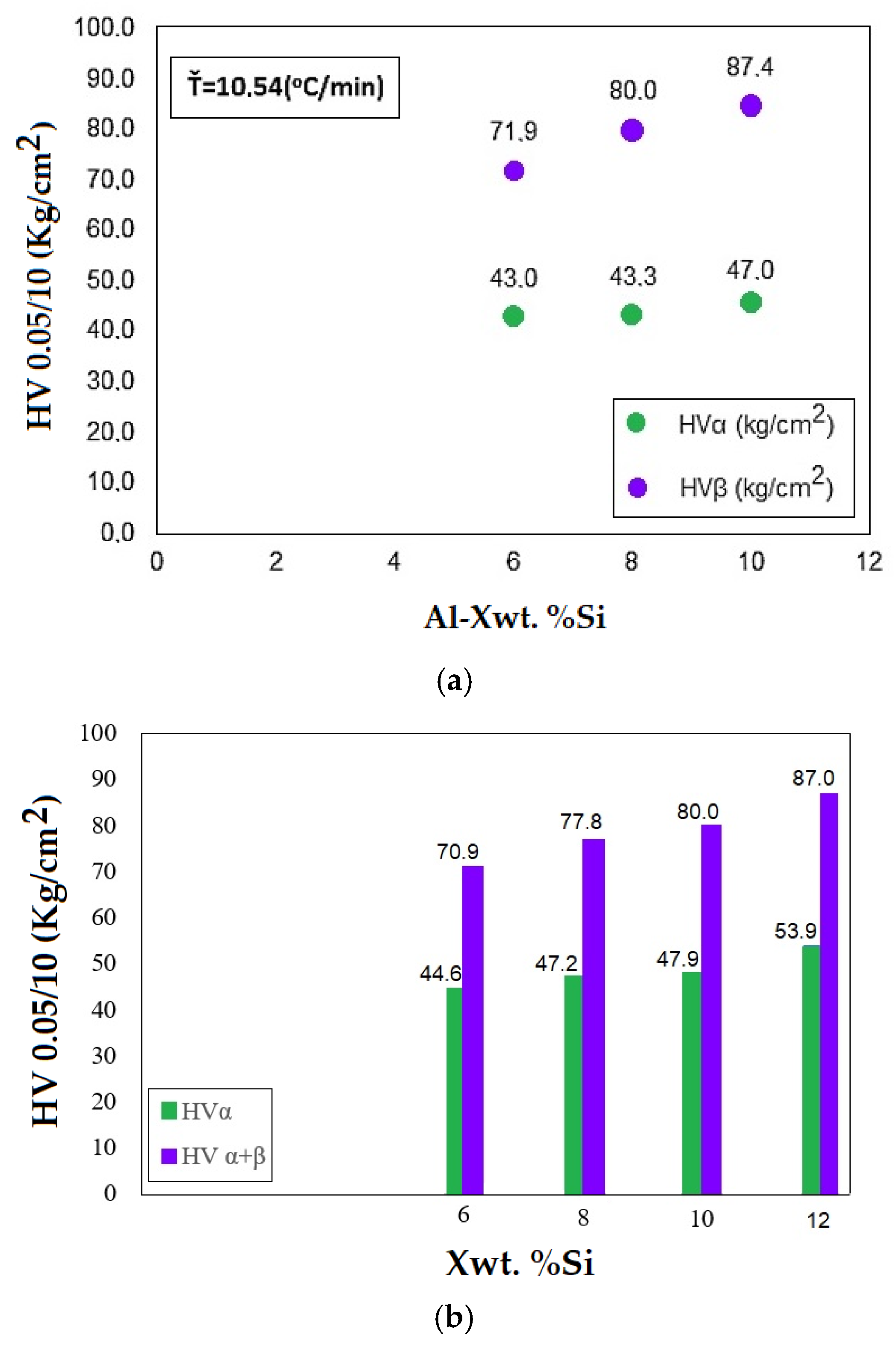
To analyze the effect of silicon content on HV 0.05/10 values, Figure 20a shows the variation in HV 0.05/10 values as a function of concentration. For this analysis, the values of Ť were kept constant. It is clearly observed that, as the silicon concentration increases, the HV 0.05/10 values also experience a significant increase.
Figure 20b shows that the average HV 0.05/10 values vary with concentration, demonstrating a clear increase in hardness as the silicon content increases. This is because the eutectic phase, enriched in silicon, has a considerably high hardness. Thus, the alloy’s hardness is enhanced by the addition of more silicon, as the volume fraction of the eutectic increases with the concentration of this element. It was noted that the α-Al phase maintained a relatively constant value. This is because it is a soft phase, composed mainly of aluminum, with only a few isolated silicon particles dispersed. This increase in hardness is also attributed to the fact that the covalent bonds of Si are stronger than the metallic bonds of Al. More Si in the alloy leads to a greater number of Si-Si covalent bonds, resulting in a higher HV 0.05/10.
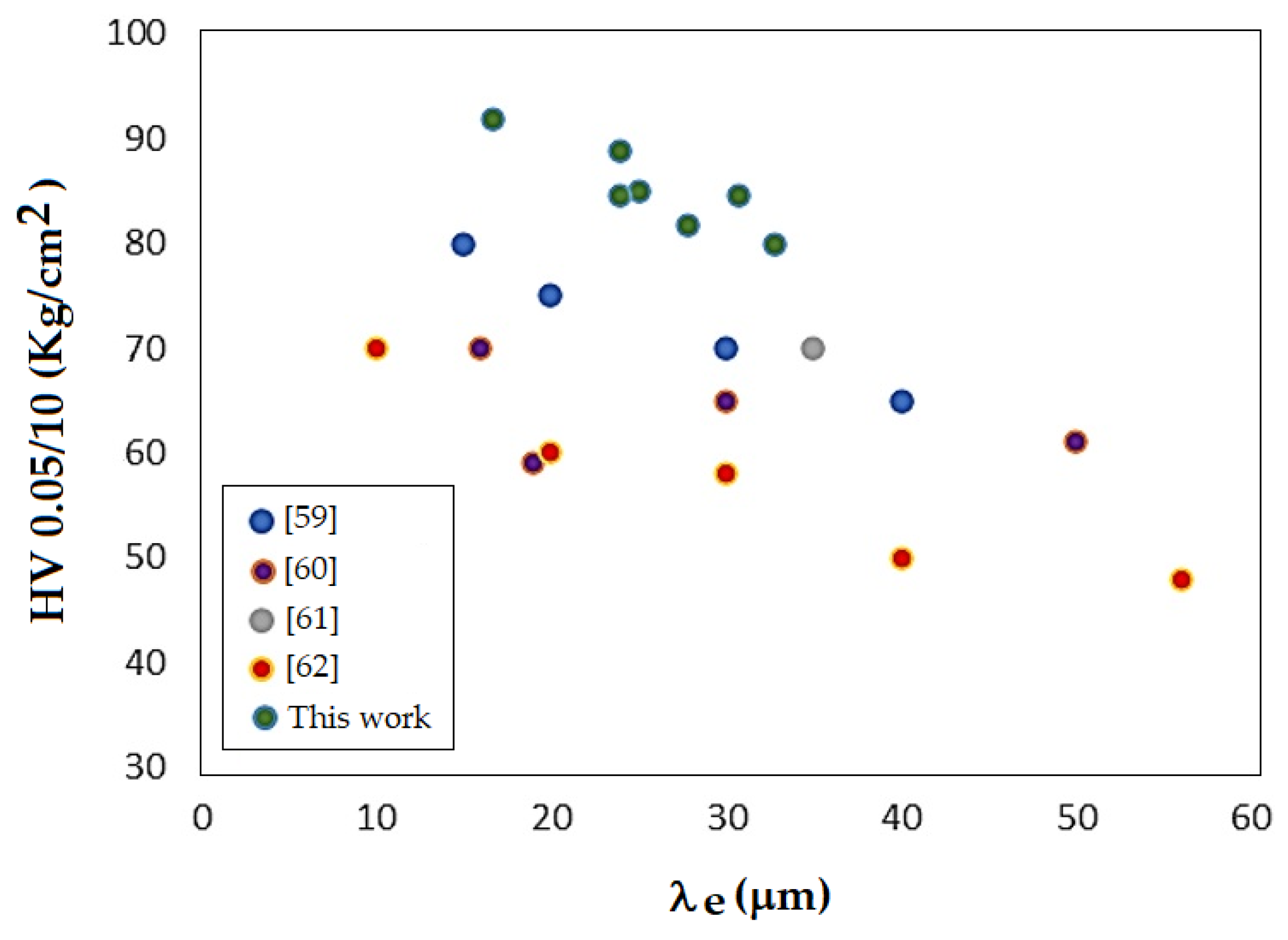
Figure 21 compares experimental HV 0.05/10 values for Al–Si eutectic alloys [59,60,61,62], which are in good agreement with values from the available literature under similar solidification conditions.

3.3.2. Influence of λ2 and Silicon Content on Tensile Strength Values

Table 7 and Table 8 show the results of the final maximum tensile strength (σMax) and the stress before yielding (σ0.2), obtained from the stress–strain tests applied to the specimens extracted from the columnar and equiaxed zones of the samples.
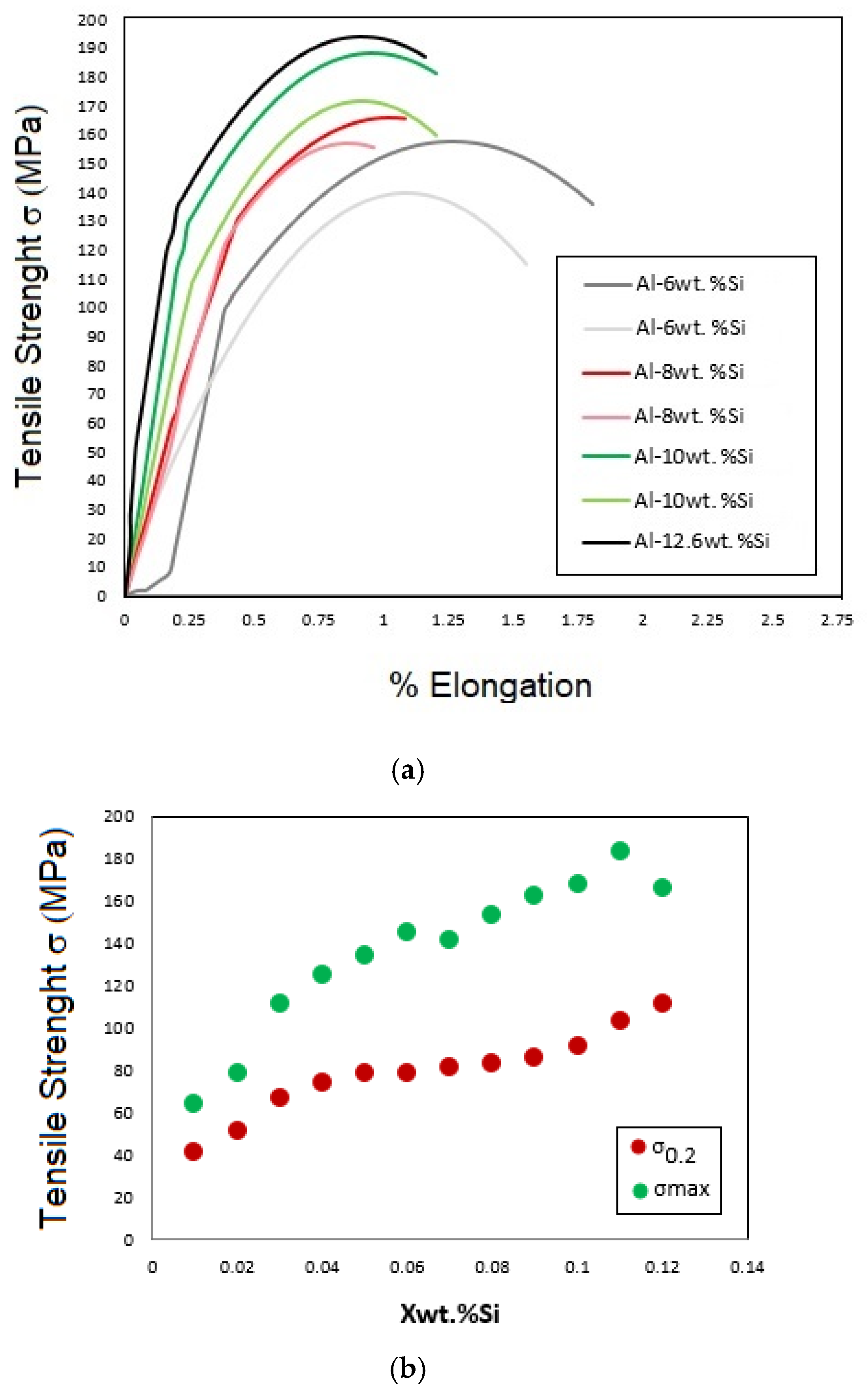
Figure 22a highlights the results obtained in the tensile tests related to the different concentrations analyzed. The tensile test graphs showed a clear improvement in tensile strength as the Si content increased, as shown in Figure 22b. This is due to the increased eutectic fraction in the matrix. Additionally, the microstructural refinement (λ2, λe, λLS) also contributed to this increase, as can be seen in Figure 22b and Table 7 and Table 8. In both graphs, it is evident that the refinement of λ2, along with the increased silicon content, resulted in a significant improvement in mechanical properties.
Furthermore, it can be observed that in both Figure 22a and Table 7, the columnar zone exhibited better tensile strength performance compared with the equiaxed zone. This is because the form of silicon that solidifies in the eutectic (residual) affects the ductility of the castings. Thicker Al–Si needles or platelets are shown in the micrographs described above; they greatly reduce tensile strength and ductility [63,64,65,66,67]. Although increasing silicon content improves tensile strength, it also causes a decrease in the alloy’s ductility. Figure 22a illustrates this, a consequence of the increased number of eutectic silicon particles. The tensile strength and elongation figures show that alloys with higher Si content, in this case an Al-10 wt. %Si alloy, are stronger but less ductile than alloys with 6 wt. %Silicon, respectively.
Neuser et al. [57] attribute this behavior to the fact that a high silicon content in the molten aluminum alloy presents a challenge during deformation, since silicon reduces elongation at fracture due to its brittle and acicular nature. These researchers performed sand solidification tests on an Al-9 wt. %Si alloy with strontium addition to refine the eutectic silicon, achieving λ2 values ranging from 12 to 25 μm at Ť intervals from 84 °C/min to 228 °C/min. σ0.2 values ranged from 75 to 84 MPa, σMax from 178 to 197 MPa, and elongation percentages from 10 to 13%. Other authors [58] obtained σ0.2 values from 200 to 332 MPa and elongations from 5.1 to 10.4%.
It is clear that the mechanical behavior achieved by these researchers exceeds that measured in this work (80.84 and 81.2 MPa for σ0.2 and 149.8 and 167.6 MPa for σMax in the columnar and equiaxed zones, respectively, and 3 to 3.5% elongation for the same concentration). This is due to the high cooling rate used for solidification and the addition of strontium, resulting in highly refined microconstituents.
Another work carried out by Fatahalla et al. [68], in which Si particles were modified with strontium and sodium, reported tensile test results for a commercial Al-5.5 wt. %Si alloy, where σ0.2 gave values around 57 to 70 MPa, 115 to 142 MPa for σMax, unlike the alloys obtained in this work for Al-5 wt. %Si where the values of σ0.2 and σMax were around 75.42 and 144.25 MPa, respectively, no very significant differences were found in the stress values, if it is observed in the percentages of elongation, which for [59] was from 7.3 to 10.5% elongation, and in this work, the values were from 2.9 to 3.5% elongation.
As the iron content of these alloys increased, an increase in the density of eutectic fibers was observed, resulting in a significant improvement in tensile strength. However, this iron enrichment also led to a decrease in ductility.
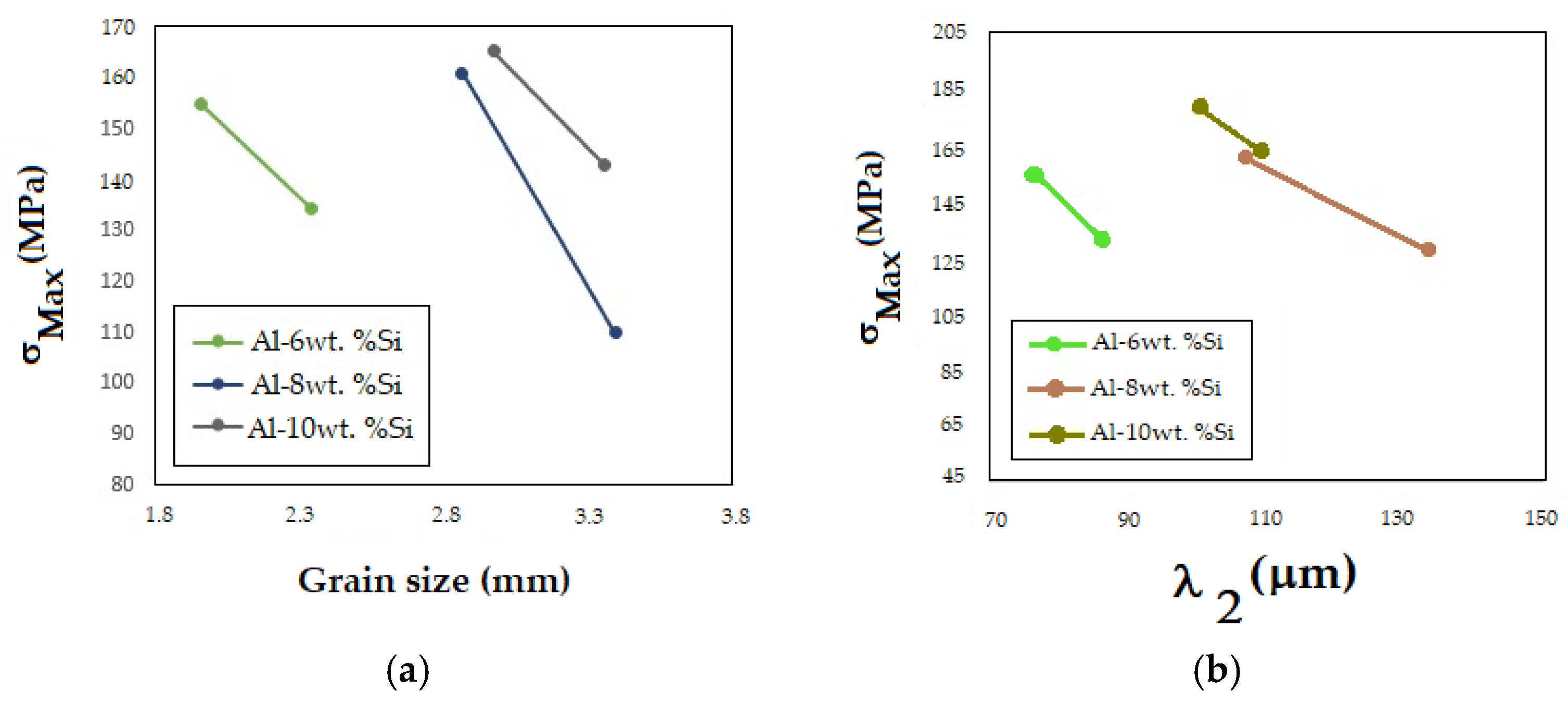
Figure 23a,b presents a comparison between grain size and λ2, and how they affect the value of σmax. The Hall-Petch law states that the mechanical behavior of polycrystalline materials is strongly influenced by grain size. Grain boundaries act as barriers to dislocation movement, hindering plastic deformation. Therefore, metals with smaller grains, which have a higher density of grain boundaries, are generally stronger than those with larger grains [69,70]. In this study, columnar grains, with higher λ2 values, showed better mechanical performance in tensile tests compared with equiaxed grains. This can be seen in Figure 23a. Evaluating only grain size to determine the mechanical properties of a solidified metal would be too limited an approach. The complexity of its study lies in the presence of various secondary phases, dendritic structures, and eutectic phases, which require a more in-depth and detailed analysis.

3.4. Electrochemical Properties

3.4.1. Cyclic Potentiodynamic Polarization

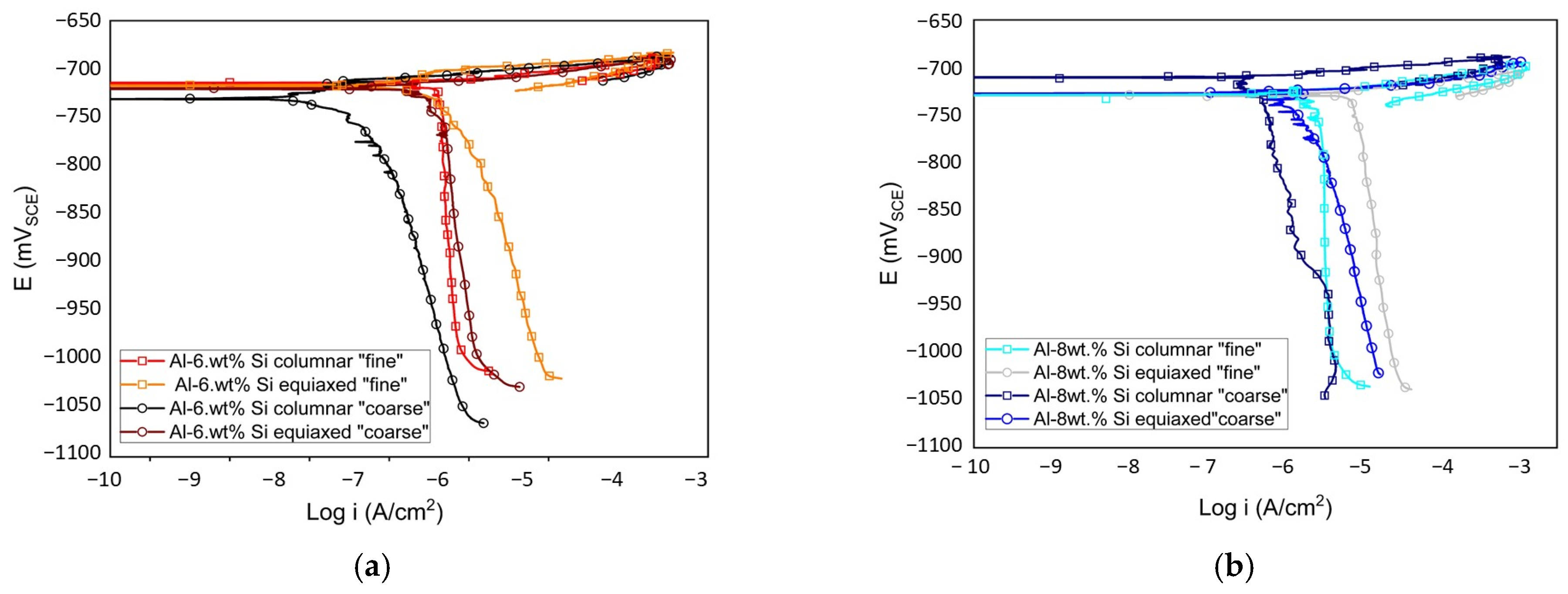
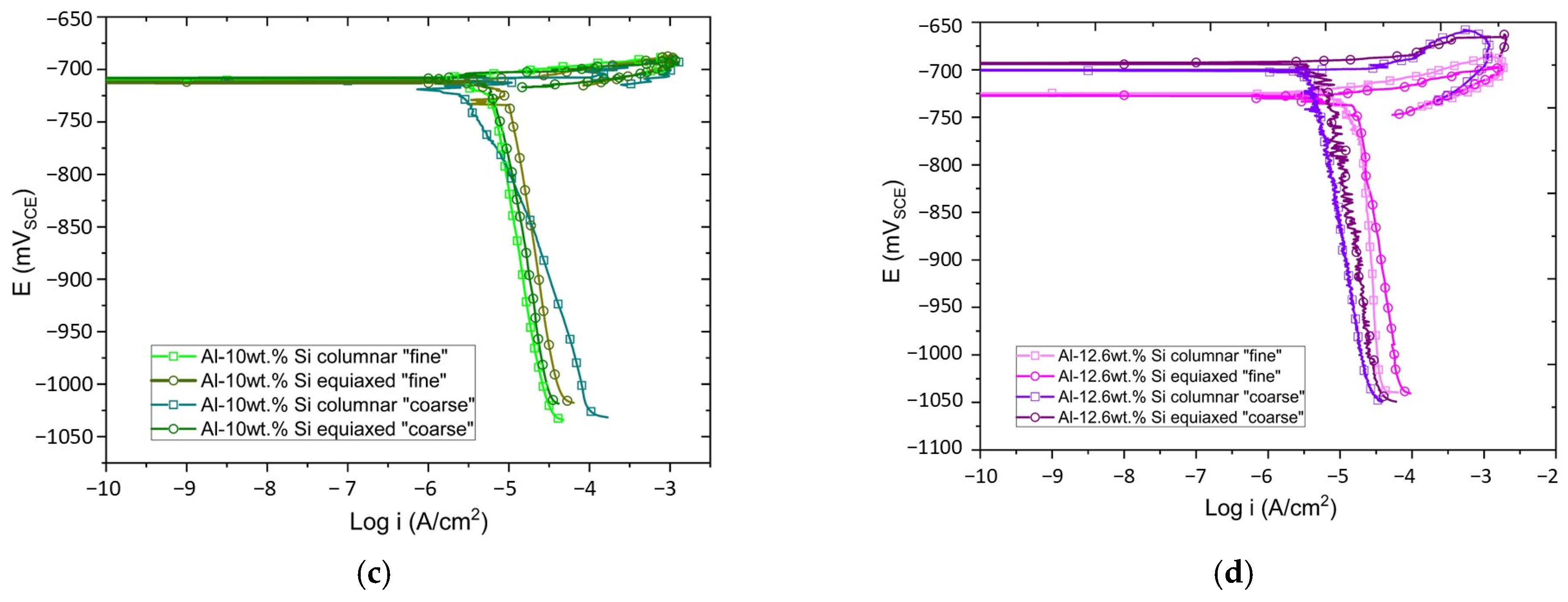
Figure 24 shows the potentiodynamic curves obtained for Al–Si alloys with different grain structures and microstructural refinement. The behavior of the Al–Si alloys is consistent with what is expected for Al-based alloy systems in solutions containing NaCl. After reaching the Ecorr, a continuous increase in current is observed in the anodic polarization curve, associated with the direct dissolution of the material. This behavior has already been reported for Al–Si alloys [1,5,19,20,22,71] as well as for other Al-based alloy systems [16,72,73]. Hoshi et al. [1] linked similar behavior to the formation of an oxide film and the appearance of pitting corrosion. According to the results recently published by Araujo et al. [73], this characteristic aspect of the curves for aluminum and its alloys is associated with the presence of oxygen in the solution. Although the methodology of the present work indicates that we have worked with N2 bubbling, starting 10 h prior to the experiment, Araujo et al. [68] demonstrated that a high flow of N2 for 24 h prior to the test achieves semi-deaerated conditions.
In the obtained curves, it is clearly observed that the cathodic region has a steeper slope than the anodic region. This indicates that the corrosion process is under cathodic control [6]. According to Araujo et al. [73], the shape of the cathodic slope is characteristic of the oxygen reduction reaction.
Table 9 presents the corrosion potentials, Ecorr, measured for the studied Al–Si alloys with respect to a saturated calomel electrode (SCE). No evident influence of Si content on Ecorr was observed. For all compositions and grain types evaluated, Ecorr values ranged approximately between −729 mV and −700 mV. Some authors have reported that the Ecorr of Al-based alloys depends on the composition and not on the phase distribution [14,15]. No clear trend was found in the influence of grain type on Ecorr. However, it is observed that as the Si content in the alloys increases, the Ecorr values for the different grain zones converge, with very similar values found for both grain structures. That is, Ecorr is practically the same at both the base and the top of the specimens.
Considering that the appearance of the potentiodynamic curves indicates that the alloys are undergoing localized corrosion upon reaching Ecorr, it is logical to interpret the values in Table 9 as the pitting potentials, Epit, of the evaluated alloys [1,5,13,14].
Table 10 presents the corrosion rates, Icorr, measured for the studied Al–Si alloys. These values were determined using Tafel extrapolation of the cathodic region of the polarization curves. This methodology has been previously used to determine Icorr for other Al-based alloy systems [14,15].
The Icorr values obtained are on the order of those measured for Al–Si alloys in similar study media [2,16,17,18]. The authors also found similar values for other aluminum-based alloy systems [13,19].
In general, corrosion rates increase with increasing Si content [2,20]. This trend is more pronounced in fine-grained structures. The eutectic Al-12.6% Si alloy with a fine morphology exhibits corrosion rates an order of magnitude higher than the alloy with the lower Si content. In agreement with these values, Khan et al. [13] found that the Icorr for an Al–Si alloy with a composition close to the eutectic in a 3% NaCl solution was 0.0198 mA/cm2. Milošev et al. [74] determined a current density of 0.00297 mA/cm2 for an Al-9%Si-3%Cu alloy in artificial seawater. When comparing the columnar and equiaxed grain structures for each composition and microstructural refinement, it was found that the equiaxed grain structure exhibits higher corrosion rates. This could be because the morphology of equiaxed grains promotes the formation of a larger fraction of peripheral matrix, generating more contact interfaces between the aluminum-rich α phase and the Si present in the eutectic mixture. The Si particles in the Al matrix are identified as cathodic sites that contribute to the reduction reaction, favoring anodic dissolution [16,66]. In studying the electrochemical behavior of two hypoeutectic Al–Si alloys, Osorio et al. [75] found that the corrosion rate decreased with increasing distance from the metal/mold interface. A better behavior of the columnar grain structure compared with equiaxed grains has already been found for other aluminum-based alloy systems [7,19].
Likewise, for all compositions and grain types evaluated, coarse grains exhibited the lowest corrosion rates. As previously mentioned, the “coarse” structure results from a slower cooling rate and, consequently, greater segregation. A higher λ2 value is associated with larger and more widely spaced intermetallic Si precipitates. These large cathodic phases are separated by a more extensive aluminum matrix, which decreases the density of pit nucleation sites per unit area, limiting the formation and propagation of galvanic microcells. Hernández et al. [16] developed a diagram showing the Al/Si galvanic couple responsible for pitting corrosion in Al–Si alloys in Cl containing solutions. Mingo et al. [76] indicated that the cathodic reaction occurring on the cathodic particles produces local alkalization that destabilizes the passive layer of the Al matrix adjacent to the intermetallics, thus favoring aluminum oxidation.
In agreement with the aforementioned results, Ujjwal et al. [14], when evaluating the production of Al–Si alloys by energy-directed arc deposition, found that structures obtained at lower cooling rates (consequently, with coarser grain structures) exhibited better corrosion resistance associated with the presence of fewer grain boundaries. Similarly, Fernandes Gomes et al. [2], when evaluating Al–Si and Al–Si-Ag alloy systems, found that microstructural refinement increased corrosion rates. They attributed this behavior to the fact that a lower λ2 allows for a more extensive distribution of Si embedded in the interdendritic regions.
Analysis of the influence of microstructures on corrosion rates indicates that microstructural morphologies that reduce the contact regions between the interdendritic region and the aluminum-rich alpha phase favor the electrochemical behavior of Al–Si alloys. This is because these areas act as an active site for corrosion attack [72,77].

3.4.2. Electrochemical Impedance Spectroscopy

Impedance tests were performed to characterize the electrochemical behavior of the electrode-electrolyte interface. This technique involves applying periodic signals to perturb the electrode surface and measuring the electrochemical response, which can be analyzed to obtain information on the mechanisms and kinetics of corrosion.
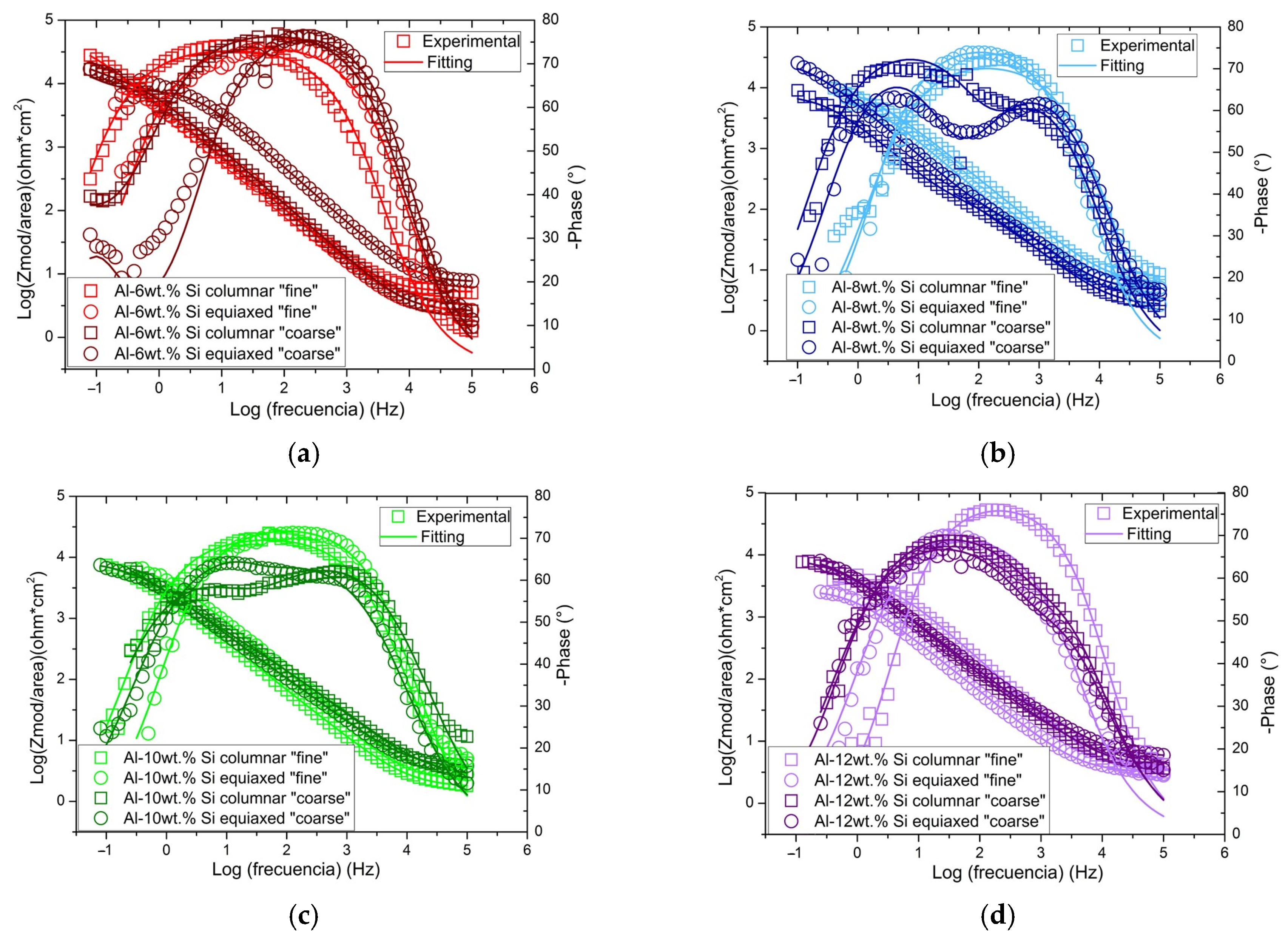
Figure 25 shows the impedance magnitude (Log |Z|/area) on the left axis and the phase angle on the right axis, versus frequency, for all the alloys studied. The symbols represent experimental data, and the solid lines represent the fit with an equivalent circuit. The data were fitted up to frequency values of 0.1 Hz, since below these values, the data do not exhibit linearity [6]. The Bode plots corresponding to the Al–Si alloys with different Si content showed a clear dependence of the electrochemical response on the microstructural morphology.
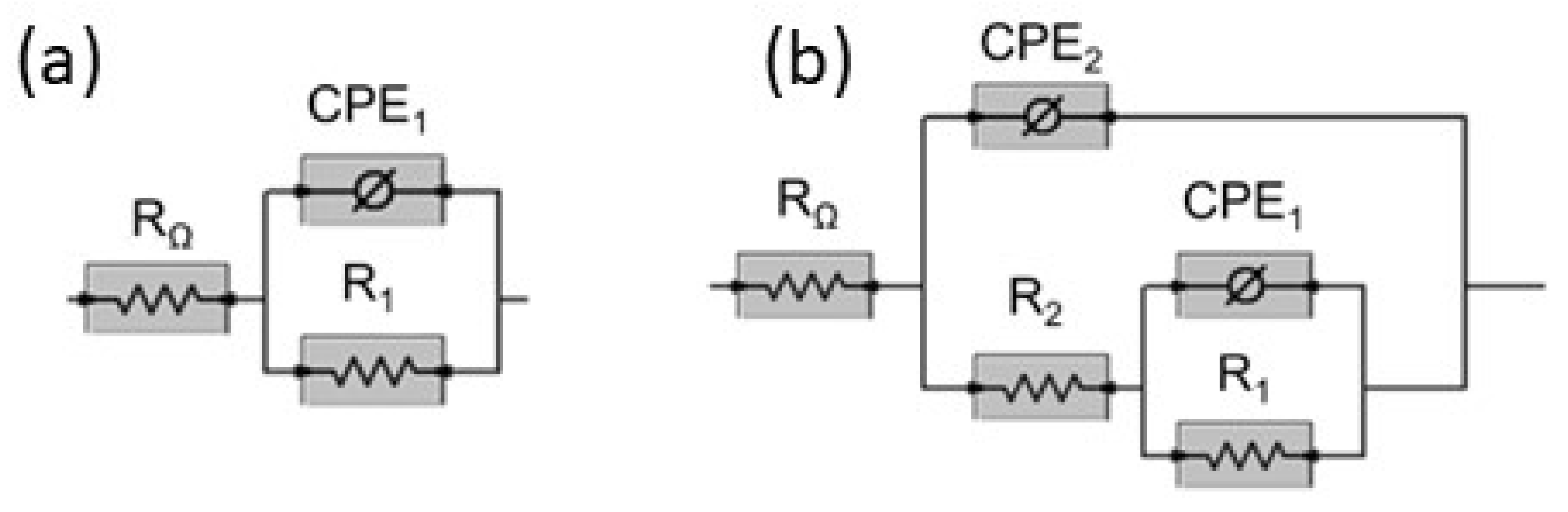
The spectra corresponding to Al-6 wt. %Si alloy exhibit a well-defined phase maximum in the intermediate frequency region. As the Si content in the alloys increases, this behavior appears to be maintained for “fine-grained” alloys. However, for “coarse-grained” alloys, a broadening of the phase peak is observed, indicating a dual capacitive contribution. This could be explained by the existence of two overlapping electrochemical processes: diffusion through an oxide film in addition to charge transfer at the interface. By assimilating the behavior of the metal-solution interface to the presence of an electrical circuit combining resistors and capacitors, the experimental data were fitted to equivalent circuits, which are presented in Figure 26. The quality of the fit was assessed using chi-square (χ2) values of approximately 10−3. This fit allowed for the identification of two distinct behaviors. The spectra obtained from the samples with the smallest dendritic spacing, i.e., those with “fine grains,” were fitted with a simpler circuit (Figure 26a) [2,16,17,22,72,73]. RΩ represents the solution resistance. R1 and CPE1 represent the resistance and capacitance of the barrier layer, respectively. This circuit would indicate the presence of a single layer in the impedance response. This behavior suggests that the surface behaves as a homogeneous system, where the resistance corresponds primarily to the charge transfer resistance associated with the oxide film.
However, the spectra corresponding to the samples with “coarse grains” were fitted with the circuit in Figure 26b, with two resistors in series (R1 and R2), each associated with a different phase constant. This model indicates the existence of two layers or coupled electrochemical processes [22,72,78,79]. The parameters R2 and CPE2 correspond to the pore resistance and the capacitance of the outer porous layer, respectively.
Table 11 presents the parameter values obtained from fitting the experimental data. To perform a comparative analysis between the two circuits, the polarization resistance, Rp, was calculated as the sum of R1 and R2. These calculated values are also included in Table 11. Rp provides information about the overall corrosion resistance of the system [7,72].
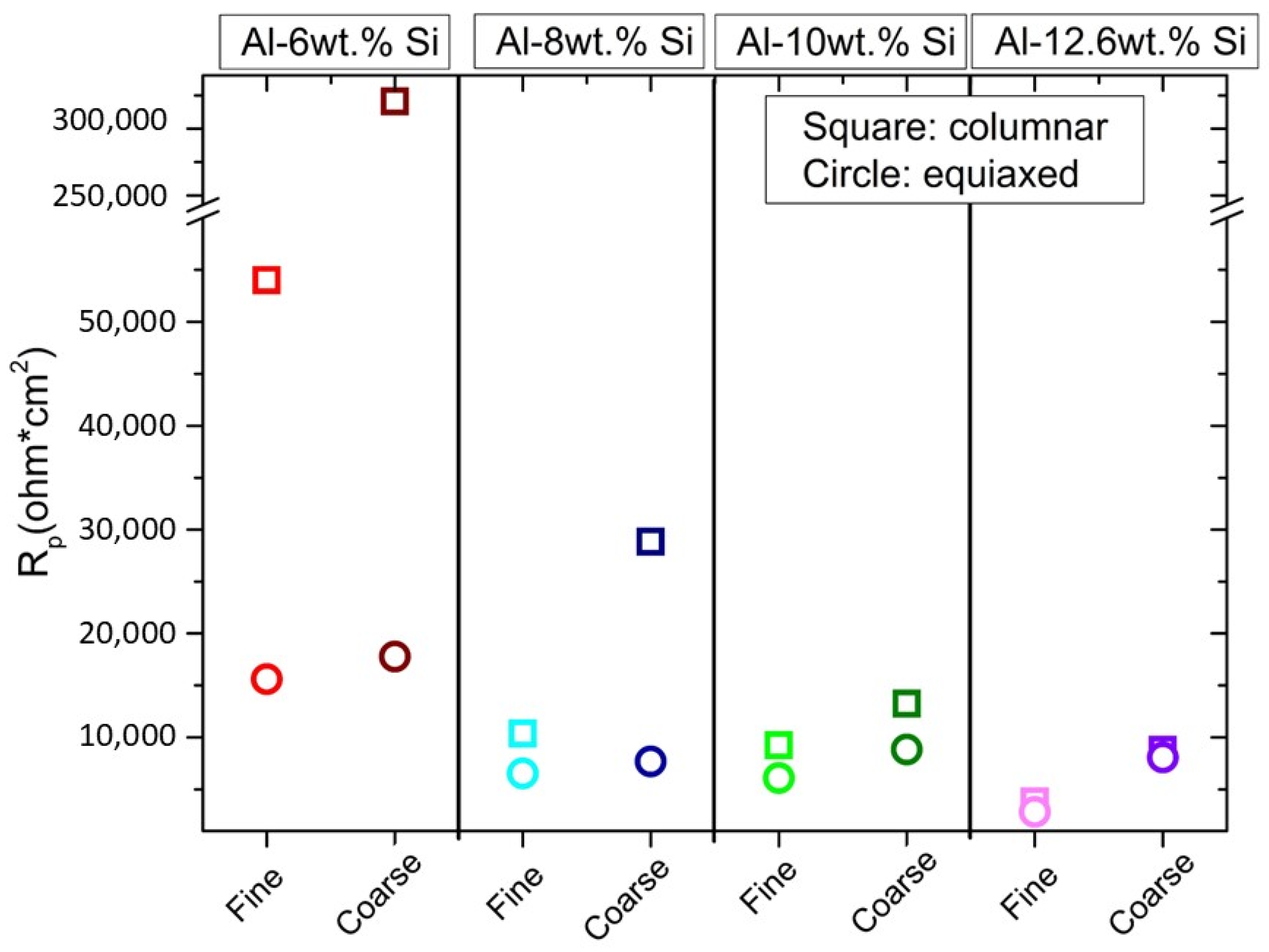
Figure 27 shows the calculated Rp values as a function of Si concentration, grain type, and alloy refinement.
It was observed that as the Si content increased, the polarization resistance decreased markedly for the columnar samples. As mentioned by Osório et al. [75], increased Si has a detrimental effect on the corrosion resistance of Al–Si alloys. In the case of the equiaxed samples, the resistance decreased from Al-6 wt. %Si to Al-8 wt. %Si, and then appeared to remain relatively constant, even up to the eutectic concentration.
Comparing the different grains, the columnar grain zone exhibited greater polarization resistance than the equiaxed grain zone for all compositions and refinements evaluated. This coincides with the trend found when evaluating corrosion rates (Table 10).
Regarding the influence of microstructure refinement, despite having a more heterogeneous structure, the coarse samples exhibited higher polarization resistance values than the fine-structure samples. This implies a higher overall impedance and, therefore, greater corrosion resistance.
This behavior can be explained by the formation of a double layer in coarse alloys: a dense, adherent inner layer (R1) and a more porous or hydrated outer layer (R2). The presence of both layers improves the system’s barrier behavior, reducing the transport of aggressive species and limiting electrochemical reactions at the interface. Conversely, samples with fine grains, exhibiting a more uniform distribution and a higher density of Si/Al interfaces, tend to generate a thinner and less differentiated film, dominated by a single resistive process. While this reflects a more electrochemically homogeneous surface, the absence of the second protective layer leads to a lower overall resistance.
In agreement with these results, Fernandes Gomes et al. [2] found that samples with higher secondary dendritic spacing values exhibited higher polarization resistance values. They associated this with improvements in the protective properties of the formed oxide film. Zhu et al. [80] investigated the formation and growth mechanism of the oxide layer in Al–Si alloys, evaluating the influence of Si content, Si particle morphology, and cooling rate on the anodizing response. They found that oxide layer growth depends on the microstructure of the base material and the distribution of the resulting eutectic phase. By decreasing the Si concentration or the cooling rate, they limited the possibility of the oxide layer growing in the eutectic phase, thus obtaining a thicker oxide layer. Similarly, Linder et al. [81], studying aluminum-based alloys, found that coarse microstructures with larger precipitates favored passive layer formation. Likewise, Del Olmo et al. [82] evaluated the application of surface treatments to Al–Si alloys obtained by traditional solidification and by additive manufacturing. They found that samples with a finer and more homogeneous Si distribution developed a thinner and more compact coating.
Therefore, we could conclude that the appearance of an equivalent circuit with two resistances in coarse-grained alloys reveals a greater structural complexity of the passive film, composed of two sublayers with distinct electrochemical properties. This configuration results in a “superior overall resistance,” demonstrating that the coarse microstructure favors the formation of more stable and effective protective layers against corrosion.

3.5. Mechanical Versus Electrochemical Parameters

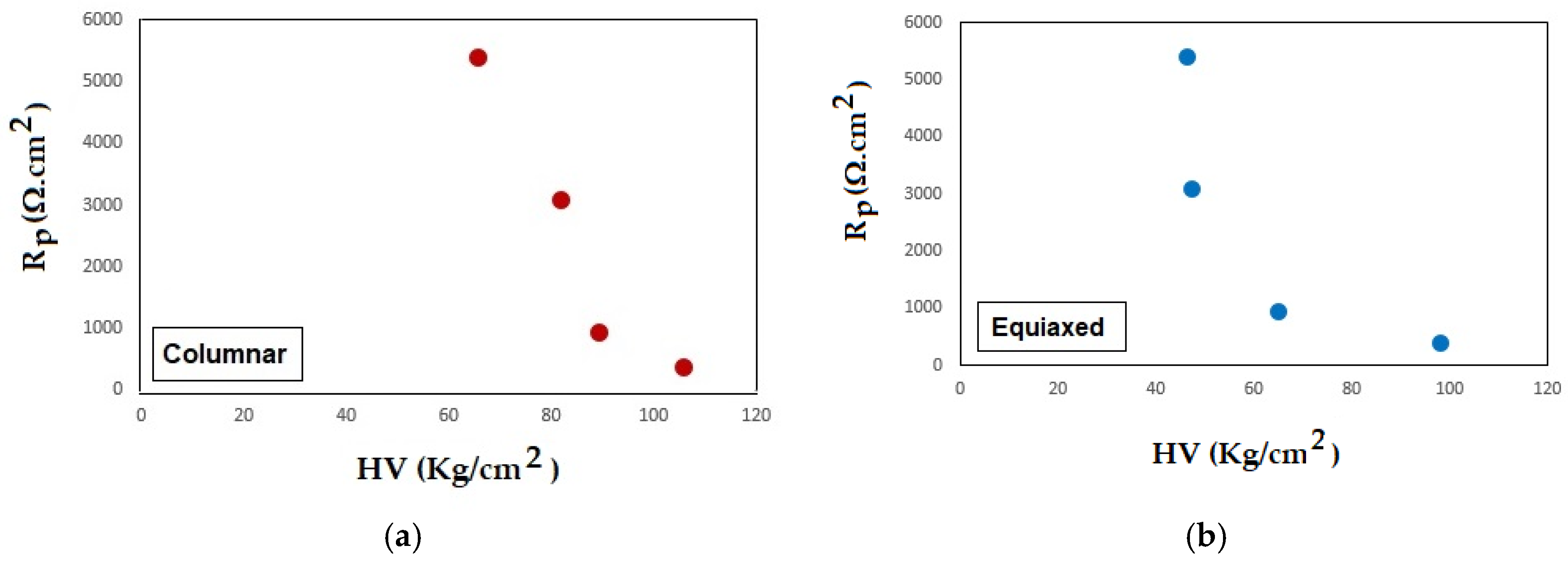
Figure 28 correlates the values of polarization resistance, Rp, with microhardness, HV 0.05/10, for both types of grain structures ((a) columnar and (b) equiaxed). It is observed that the higher the HV 0.05/10, the lower the value of Rp for hypoeutectic (Al-6 wt. %Si, Al-8 wt. %Si, and Al-10 wt. %Si) and eutectic (Al-12.6 wt. %Si) alloys.
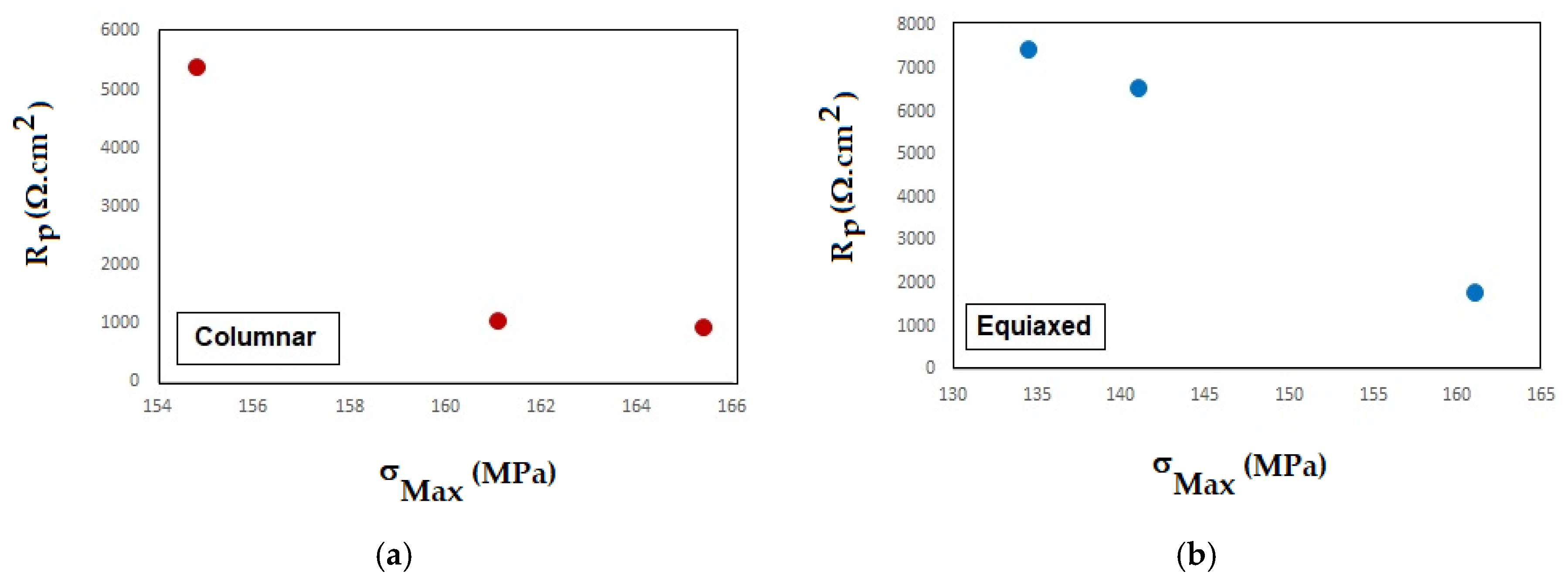
Figure 29 shows the polarization resistance, Rp, versus maximum tensile strength, σmax, for both types of grain structures (columnar and equiaxed) of hypoeutectic (Al-6 wt. %Si, Al-8 wt. %Si, and Al-10 wt. %Si) alloys. It can be seen that the behavior of Rp with σmax is similar to that of Rp with HV 0.05/10. This is in accordance with what was proposed by Román et al. in a previous study [77].

4. Summary and Conclusions

In this study, unidirectional upward solidifications of Al-6 wt. %Si to Al-12.6 wt. %Si (eutectic) alloys were carried out under different conditions. The influence of solidification processing parameters on microhardness, tensile strength, and corrosion resistance was investigated. A summary of the main results is presented below:
  • The columnar-to-equiaxed transition (CET) position is governed by the thermal gradient and cooling rate during directional solidification, shifting toward regions closer to the chill surface as the cooling rate increases. The values of the cooling rates decreased gradually with the distance to the cooler-mold interface. The thermal gradients reach a minimum or negative value for the CET to occur.
  • The secondary dendrite arm spacing (λ2) increases with increasing distance from the chill surface due to the reduction in cooling rate, demonstrating the strong dependence of dendritic refinement on solidification thermal parameters.
  • Columnar grain regions exhibit higher tensile strength compared with equiaxed regions, indicating that grain morphology plays a relevant role in determining the mechanical response of directionally solidified Al–Si alloys. The increase in silicon content improved the tensile properties.
  • The results obtained in the corrosion tests confirmed that the electrochemical corrosion behavior of solidified Al–Si alloys results from a complex balance between microstructural refinement, grain morphology, the cathodic phase fraction present, and the effectiveness of the passive layer that may form.
  • Microstructural morphologies that reduce the contact interfaces between the aluminum-rich α phase and the silicon present in the eutectic mixture promote matrix stability, conferring superior corrosion resistance. This behavior is associated with greater passive film stability and reduced galvanic interaction between the microstructural constituents.
  • Increasing the HV 0.05/10 values, the Rp becomes lower for hypoeutectic (Al-6 wt. %Si, Al-8 wt. %Si, and Al-10 wt. %Si) and eutectic (Al-12.6 wt. %Si) alloys. The behavior of Rp with σmax is similar to that of Rp with HV 0.05/10.
  • Optimizing the solidification process, aiming for a more columnar microstructure with controlled secondary dendritic spacing, is crucial for improving the service performance of Al–Si alloys in aggressive environments.

Author Contributions

Conceptualization, A.E.A.; methodology, A.E.A.; formal analysis, A.E.A.; investigation, A.S.R., E.R.I., N.S.Z. and C.M.M.; resources, A.E.A.; data curation, A.E.A. and C.M.M.; writing—original draft preparation, A.E.A., A.S.R. and E.R.I.; writing—review and editing, A.E.A.; visualization, A.E.A.; supervision, A.E.A.; project administration, A.E.A. and C.M.M.; funding acquisition, A.E.A. All authors have read and agreed to the published version of the manuscript.

Funding

This research was funded by Universidad Nacional de Misiones (UNaM), grant number 16/Q2364-PI.

Data Availability Statement

The data presented in this study are available on request from the corresponding author (due to privacy reasons).

Acknowledgments

All authors gratefully thank the National Scientific CONICET of Argentina (Consejo Nacional de Investigaciones Científicas y Técnicas (CONICET), Argentina). We also appreciate the support provided by the Universidad Nacional de Misiones (UNaM).

Conflicts of Interest

The authors declare no conflicts of interest. The funders had no role in the design of the study; in the collection, analyses, or interpretation of data; in the writing of the manuscript, or in the decision to publish the results.

References

  1. Hoshi, Y.; Miyazawa, R.; Otani, Y.; Kim, D.; Takata, N.; Kobashi, M. Four-dimensional electrochemical impedance spectroscopy: Role of microstructure on corrosion behaviour of Al-Si alloys additive-manufactured by laser powder bed fusion. Corros. Sci. 2024, 232, 112018. [Google Scholar] [CrossRef]
  2. Fernandes Gomes, L.; Kugelmeier, C.L.; Garcia, A.; Della Rovere, C.A.; Spinelli, J.E. Influences of alloying elements and dendritic spacing on the corrosion behavior of Al–Si–Ag alloys. J. Mater. Res. Technol. 2021, 15, 5880–5893. [Google Scholar] [CrossRef]
  3. Qi, M.; Kang, Y.; Qiu, Q.; Tang, W.; Li, J. Microstructures, mechanical properties, and corrosion behavior of novel high-thermal-conductivity hypoeutectic Al-Si alloys prepared by rheological high pressure die-casting and high pressure die-casting. J. Alloys Compd. 2018, 749, 487–502. [Google Scholar] [CrossRef]
  4. Ibañez, E.R.; Alonso, P.R.; Ares, A.E. Effects of cooling rate and silicon content on microstructure and mechanical properties of directional solidification of eutectic Al-Si alloys. J. Mater. Eng. Perform. 2025, 35, 7370–7401. [Google Scholar] [CrossRef]
  5. Ding, W.; Gou, L.; Hu, L.; Zhang, H.; Zhao, W.; Ma, J. Modification of eutectic Si in hypoeutectic Al-Si alloy with novel Al-3Ti-4.35La master alloy. J. Alloys Compd. 2022, 929, 167350. [Google Scholar] [CrossRef]
  6. Saravanan, T.T.; Kamaraj, M.; Sharma, S.C.; Anoop, S.; Manwatkar, S.K. Influence of characteristic eutectic free microstructure on mechanical and corrosion response of spark plasma sintered hypereutectic Al-Si alloy. Mater. Lett. 2022, 308, 131104. [Google Scholar] [CrossRef]
  7. Osório, W.R.; Cheung, N.; Peixoto, L.C.; Garcia, A. Corrosion resistance and mechanical properties of an Al 9wt % Si alloy treated by laser surface remelting. Int. J. Electrochem. Sci. 2009, 4, 820–831. [Google Scholar] [CrossRef]
  8. Dahle, A.K.; Nogita, K.; McDonald, S.D.; Dinnis, C.; Lu, L. Eutectic modification and microstructure development in Al–Si alloys. Mater. Sci. Eng. A 2005, 413, 243–248. [Google Scholar] [CrossRef]
  9. Gursoy, O.; Timelli, G. A focused review of eutectic modification in hypoeutectic Al–Si casting alloys. J. Mater. Res. Technol. 2020, 9, 12636–12647. [Google Scholar] [CrossRef]
  10. Berlanga-Labari, C.; Biezma-Moraleda, M.V.; Rivero, P.J. Corrosion of Cast Aluminum Alloys: A Review. Metals 2020, 10, 1384. [Google Scholar] [CrossRef]
  11. Niu, G.; Wang, Y.; Zhu, L.; Ye, J. Fluidity of casting Al–Si series alloys for automotive lightweight applications: A review. Mater. Manuf. Process. 2022, 38, 902–911. [Google Scholar] [CrossRef]
  12. Ahammed, D.S.; Razin, A.A.; Khan, A.A.; Kaiser, M.S. Mechanical properties of hypoeutectic, eutectic, and hypereutectic Al–Si automotive alloys under ageing treatment. Eng. Rev. 2024, 44, 1–13. [Google Scholar] [CrossRef]
  13. Khan, A.A.; Razin, A.A.; Ahammed, D.S.S.; Kaiser, M.S. Comparison of electrochemical corrosion performance of eutectic Al-Si automotive alloy in deep seawater and 3.5% NaCl solution. Mater. Today Proc. 2023, 82, 241–247. [Google Scholar] [CrossRef]
  14. Ujjwal, K.; Al-Saadi, S.; Kumar Das, A.; Raman, R.K.S. Corrosion and stress corrosion cracking characteristics of 4043 aluminium alloy fabricated through directed energy deposition process. J. Alloys Compd. 2024, 976, 173154. [Google Scholar] [CrossRef]
  15. Hanza, S.; Liveric, L. Corrosion investigations of Al-Si casting alloys in 0.6 M NaCl solution. Eng. Rev. 2021, 41, 115–123. [Google Scholar] [CrossRef]
  16. Hernández, H.H.; Mandujano Ruiz, A.; González Morán, C.O.; Miranda Hernández, J.G.; Flores Cuautle, J.A.; Hernández Casco, I.; Hernández, J.M. Microstructural and Electrochemical Study: Pitting Corrosion Better Mechanism on A390 Al–Si Alloy and Ce–Mo Treatment as a Better Corrosion Protection. Materials 2024, 17, 3044. [Google Scholar] [CrossRef]
  17. Kaiser, M.S.; Khan, A.A.; Sharma, S.D.; Al Nur, M. Investigation on electrochemical corrosion behavior of eutectic Al-Si automotive alloy in 0.2 M HCl, 0.2 M NaOH, and 0.2 M NaCl environments. J. Chem. Technol. Metall. 2023, 58, 969–980. [Google Scholar] [CrossRef]
  18. Dos Santos, S.L.; Tolockzo, F.R.; Neto, A.C.M.; Cezario, F.E.M.; da Silva, D.M.; Antunes, R.A. Microstructural evolution and corrosion behavior of non-isothermally heat treated hypoeutectic Al-Si-Cu alloy. Next Mater. 2024, 5, 100262. [Google Scholar] [CrossRef]
  19. Wang, R.; Zhong, J.; Wang, D.; Nagaumi, H.; Zhang, X.; Liu, Z. Modeling passive film breakdown in corroded Cu-containing Al–Si alloy. J. Mater. Res. Technol. 2025, 39, 818–830. [Google Scholar] [CrossRef]
  20. Shi, Y.; Tan, H.; Xie, L.; Wang, M.; Zhou, B. Effect of silicon content on the mechanical and corrosion behavior of additively manufactured aluminum–silicon alloys via selective laser melting. Anti-Corros. Methods Mater. 2026, 73, 286–296. [Google Scholar] [CrossRef]
  21. Lekatou, A.; Sfikas, A.K.; Karantzalis, A.E.; Sioulas, D. Microstructure and corrosion performance of Al-32%Co alloys. Corros. Sci. 2012, 63, 193–209. [Google Scholar] [CrossRef]
  22. Du, S.; Zhang, C.; Zhu, J.; Feng, Y.; Pan, X.; Jia, J. A Comparative investigation on corrosion behaviors of high pressure die-cast Al-Si Alloys in 3.5% NaCl solution. Int. J. Electrochem. Sci. 2022, 17, 22125. [Google Scholar] [CrossRef]
  23. Okamoto, H.; Schlesinger, M.E.; Mueller, E.M. Alloy Phase Diagrams; ASM Handbook; ASM International: Novelty, OH, USA, 2016; Volume 8, pp. 108–146. [Google Scholar]
  24. Petzow, G. Metallographic Etching, 2nd ed.; ASM International: Novelty, OH, USA, 2008. [Google Scholar]
  25. Vander Voort, G. Metallography and Microstructures; ASM Handbook; ASM International: Novelty, OH, USA, 2004; Volume 9. [Google Scholar]
  26. Gueijman, S.F.; Schvezov, C.E.; Ares, A.E. Vertical and horizontal directional solidification of Zn-Al and Zn-Ag diluted alloys. Mater. Trans. 2010, 51, 1861–1870. [Google Scholar] [CrossRef]
  27. Ares, A.E.; Gueijman, S.F.; Schvezov, C.E. Semi-empirical modeling for columnar and equiaxed growth of alloys. J. Cryst. Growth 2002, 241, 235–240. [Google Scholar] [CrossRef]
  28. Ares, A.E.; Schvezov, C.E. Influence of solidification thermal parameters on the columnar-to-equiaxed transition of aluminum-zinc and zinc-aluminum alloys. Metall. Mater. Trans. A 2007, 38, 1485–1499. [Google Scholar] [CrossRef]
  29. Ares, A.E.; Schvezov, C.E. Solidification parameters during the columnar-to-equiaxed transition in lead-tin alloys. Metall. Mater. Trans. A 2000, 31, 1611–1625. [Google Scholar] [CrossRef]
  30. Kociubzyk, A.I.; Rozicki, R.S.; Ares, A.E. Movement of the interphases during the horizontal solidification of tin-zinc alloys. Rev. Mater. 2018, 23, e11993. [Google Scholar] [CrossRef]
  31. ASTME112—96e3; Standard Test Methods for Determining Average Grain Size. ASTM: West Conshohocken, PA, USA, 2004.
  32. Kaya, H.; Böyük, U.; Çadırlı, E.; Maras, N. Measurements of the microhardness, electrical and thermal properties of the Al–Ni eutectic alloy. Mater. Des. 2012, 34, 707–712. [Google Scholar] [CrossRef]
  33. ASTMG5-14; Standard Reference Test Method for Making Potentiodynamic Anodic Polarization Measurements. ASTM: West Conshohocken, PA, USA, 2021.
  34. Lekatou, A.; Sfikas, A.K.; Petsa, C.; Karantzalis, A.E. Al-Co alloys prepared by vacuum arc melting: Correlating microstructure evolution and aqueous corrosion behavior with Co content. Metatls 2016, 6, 46. [Google Scholar] [CrossRef]
  35. Rosenberger, M.R.; Ares, A.E.; Gatti, I.P.; Schvezov, C.E. Wear resistance of dilute Zn-Al alloys. Wear 2010, 268, 1533–1536. [Google Scholar] [CrossRef]
  36. Roman, A.S.; Ibañez, E.R.; Méndez, C.M.; Pedrozo, M.; Kramer, G.R.; Zadorozne, N.S.; Alonso, P.R.; Ares, A.E. Electrochemical Properties of Diluted Al-Mg Alloys with Columnar-To-Equiaxed Transition. Front. Mater. 2022, 9, 857671. [Google Scholar] [CrossRef]
  37. Siqueira, C.A.; Cheung, N.; Garcia, A. Solidification thermal parameters affecting the columnar-to-equiaxed transition. Metall. Mater. Trans. A 2002, 33, 2107–2118. [Google Scholar] [CrossRef]
  38. Gandin, C.A. From constrained to unconstrained growth during directional solidification. Acta Mater. 2000, 48, 2483–2501. [Google Scholar] [CrossRef]
  39. Rocha, O.L.; Gomes, L.G.; Moutinho, D.J.C.; Ferreira, I.L.; Garcia, A. The columnar to equiaxed transition in the directional solidification of aluminum based multicomponent alloys. Rem Rev. Esc. Minas 2015, 68, 85–90. [Google Scholar] [CrossRef][Green Version]
  40. Ares, A.E.; Caram, R.; Schvezov, C.E. Estudio de las condiciones en que se produce la transición de estructura columnar a equiaxial en diferentes sistemas de aleaciones. An. AFA 2004, 15, 2042–2248. [Google Scholar]
  41. Rodrigues, J.A.F.; Santos Júnior, G.E.M.; Barros, A.D.S.; Rocha, O.F.L.D.; Moreira, A.L.S. Liga hipoeutética Al-11% Si: Coeficiente de transferência de calor interfacial, variáveis térmicas, parâmetros microestruturais e microdureza. Matéria 2022, 26, e13064. [Google Scholar] [CrossRef]
  42. Peres, M.D.; Siqueira, C.A.; Garcia, A. Macrostructural and microstructural development in Al–Si alloys directionally solidified under unsteady-state conditions. J. Alloys Compd. 2004, 381, 168–181. [Google Scholar] [CrossRef]
  43. ASM International. ASM Handbook, Volume 3: Alloy Phase Diagrams; ASM International: Novelty, OH, USA, 1992. [Google Scholar]
  44. Flood, S.C.; Hunt, J.D. Columnar and equiaxed growth: II. Equiaxed growth ahead of a columnar front. J. Cryst. Growth 1987, 82, 552–560. [Google Scholar] [CrossRef]
  45. Djurdjevič, M.; Grzinčič, M. The effect of major alloying elements on the size of secondary dendrite arm spacing in the As-Cast Al-Si-Cu alloys. Arch. Foundry Eng. 2012, 12, 19–24. [Google Scholar] [CrossRef]
  46. Spittle, J.A. Columnar to equiaxed grain transition in as solidified alloys. Int. Mater. Rev. 2006, 51, 247–269. [Google Scholar] [CrossRef]
  47. Mahapatra, R.B.; Weinberg, F. The columnar to equiaxed transition in tin-lead alloys. Metall. Trans. B 1987, 18, 425–432. [Google Scholar] [CrossRef]
  48. Tarshis, L.A.; Walker, J.L.; Rutter, J.W. Experiments on the solidification structure of alloy castings. Metall. Trans. 1971, 2, 2589–2597. [Google Scholar] [CrossRef]
  49. Wang, Y.Z.; Ding, H.S.; Chen, R.R.; Guo, J.J.; Fu, H.Z. Dependency of microstructure and microhardness on withdrawal rate of Ti-43Al-2Cr-2Nb alloy prepared by electromagnetic cold crucible directional solidification. China Foundry 2016, 13, 289–293. [Google Scholar] [CrossRef][Green Version]
  50. Santos, G.A.; de Moura Neto, C.; Osório, W.R.; Garcia, A. Design of mechanical properties of a Zn27Al alloy based on microstructure dendritic array spacing. Mater. Des. 2007, 28, 2425–2430. [Google Scholar] [CrossRef]
  51. Sui, Y.; Wang, Q.; Wang, G.; Liu, T. Effects of Sr content on the microstructure and mechanical properties of cast Al–12Si–4Cu–2Ni–0.8 Mg alloys. J. Alloys Compd. 2015, 622, 572–579. [Google Scholar] [CrossRef]
  52. Baradarani, B.; Raiszadeh, R. Precipitation hardening of cast Zr-containing A356 aluminium alloy. Mater. Des. 2011, 32, 935–940. [Google Scholar] [CrossRef]
  53. Bhatta, L.; Pesin, A.; Zhilyaev, A.P.; Tandon, P.; Kong, C.; Yu, H. Recent development of superplasticity in aluminum alloys: A review. Metals 2020, 10, 77. [Google Scholar] [CrossRef]
  54. Carvalho, D.B.; Guimarães, E.C.; Moreira, A.L.; Moutinho, D.J.; Dias Filho, J.M.; Rocha, O.L.D. Characterization of the Al-3wt.% Si alloy in unsteady-state horizontal directional solidification. Mater. Res. 2013, 16, 874–883. [Google Scholar] [CrossRef]
  55. Kakitani, R.; Garcia, A.; Cheung, N. Morphology of intermetallics tailoring tensile properties and quality index of a eutectic Al–Si–Ni alloy. Adv. Eng. Mater. 2020, 22, 2000503. [Google Scholar] [CrossRef]
  56. Immanuel, R.J.; Panigrahi, S.K. Influence of cryorolling on microstructure and mechanical properties of a cast hypoeutectic Al–Si alloy. Mater. Sci. Eng. A 2015, 640, 424–435. [Google Scholar] [CrossRef]
  57. Neuser, M.; Grydin, O.; Andreiev, A.; Schaper, M. Effect of solidification rates at sand casting on the mechanical joinability of a cast aluminium alloy. Metals 2021, 11, 1304. [Google Scholar] [CrossRef]
  58. Rappaz, M.; Boettinger, W.J. On dendritic solidification of multicomponent alloys with unequal liquid diffusion coefficients. Acta Mater. 1999, 47, 3205–3219. [Google Scholar] [CrossRef]
  59. Kaya, H.; Çadırh, E.; Gündüz, M.; Ülgen, A. Effect of the temperature gradient, growth rate, and the interflake spacing on the microhardness in the directionally solidified Al-Si eutectic alloy. J. Mater. Eng. Perform. 2003, 12, 544–551. [Google Scholar] [CrossRef]
  60. Yilmaz, F.; Elliott, R. The microstructure and mechanical properties of unidirectionally solidified Al− Si alloys. J. Mater. Sci. 1989, 24, 2065–2070. [Google Scholar] [CrossRef]
  61. Telli, A.I.; Kisakürek, S.E. Effect of antimony additions on hardness and tensile properties of directionally solidified Al–Si eutectic alloy. Mater. Sci. Technol. 1988, 4, 153–156. [Google Scholar] [CrossRef]
  62. Yilmaz, F. Structure and properties of directionally solidified Al-Si hypereutectic alloys. Mater. Sci. Eng. A 1990, 124, L1–L5. [Google Scholar] [CrossRef]
  63. Thirugnanam, A.; Sukumaran, K.; Pillai, U.T.S.; Raghukandan, K.; Pai, B.C. Effect of Mg on the fracture characteristics of cast Al–7Si–Mg alloys. Mater. Sci. Eng. 2007, 445, 405–414. [Google Scholar] [CrossRef]
  64. Ma, K.; Wen, H.; Hu, T.; Topping, T.D.; Isheim, D.; Seidman, D.N.; Schoenung, J.M. Mechanical behavior and strengthening mechanisms in ultrafine grain precipitation-strengthened aluminum alloy. Acta Mater. 2014, 62, 141–155. [Google Scholar] [CrossRef]
  65. Chen, Z.W.; Li, J.S.; Jie, W.Q.; Liu, L.; Fu, H.Z. Solidification behaviour of Al7SiMg casting alloys. Trans. Nonferr. Met. Soc. China 2005, 15, 40–44. [Google Scholar] [CrossRef]
  66. Alparslan, C.; Bayraktar, Ş. Experimental research and optimization based on response surface methodology on machining characteristics of cast Al-7Si-0.6 Mg alloy: Effects of cutting parameters and heat treatment. Measurement 2024, 236, 115111. [Google Scholar] [CrossRef]
  67. Guru, P.R.; Khan, F.; Panigrahi, S.K.; Ram, G.J. Enhancing strength, ductility and machinability of an Al–Si cast alloy by friction stir processing. J. Manuf. Process. 2015, 18, 67–74. [Google Scholar] [CrossRef]
  68. Fatahalla, N.; Hafiz, M.; Abdulkhalek, M. Effect of microstructure on the mechanical properties and fracture of commercial hypoeutectic Al-Si alloy modified with Na, Sb and Sr. J. Mater. Sci. 1999, 34, 3555–3564. [Google Scholar] [CrossRef]
  69. Callister, W.D., Jr.; Rethwisch, D.G. Materials Science and Engineering: An Introduction; John Wiley & Sons: Hoboken, NJ, USA, 2020. [Google Scholar]
  70. Barbosa, C.R.; Monteiro de Lima, J.O.; Hirayama Machado, G.M.; Magalhaes de Azevedo, H.A.; Rocha, F.S.; Barros, A.S.; Lima da Rocha, O.F. Relationship between aluminum-rich/intermetallic phases and microhardness of a horizontally solidified AlSiMgFe alloy. Mater. Res. 2019, 22, e20180365. [Google Scholar] [CrossRef]
  71. Ren, P.; Huang, W.; Zuo, Z.; Li, D.; Zhao, C.; Yan, K. High cycle fatigue analysis and modelling of cast Al e Si alloys extracted from cylinder heads considering microstructure characteristics. J. Mater. Res. Technol. 2022, 19, 3004–3017. [Google Scholar] [CrossRef]
  72. Roman, A.S.; Mendez, C.M.; Gervasi, C.A.; Rebak, R.B.; Ares, A.E. Corrosion Resistance of Aluminum-Copper Alloys with Different Grain Structures. J. Mater. Eng. Perform. 2021, 30, 131–144. [Google Scholar] [CrossRef]
  73. Araujo, J.V.; Gabbardoa, A.D.; Fernandes, S.M.; Costa, I. Corrosão Localizada do Alumínio em meios aerados e em meios com baixo teor oxigênio: Estudo e comparação por meio de curvas de polarização. Quim. Nova 2025, 48, e-20250067. [Google Scholar] [CrossRef]
  74. Milošev, I.; Kapun, B.; Rodic, P.; Carrière, C.; Mercier, D.; Zanna, S.; Marcus, P. Mechanism of Corrosion of Cast Aluminum-Silicon Alloys in Seawater. Part 1: Characterization and Field Testing of Bare Alloys in the Adriatic Sea. Corrosion 2023, 79, 193–212. [Google Scholar] [CrossRef]
  75. Osório, W.R.; Goulart, P.R.; Garcia, A. Effect of silicon content on microstructure and electrochemical behavior of hypoeutectic Al-Si alloys. Mater. Lett. 2008, 62, 365–369. [Google Scholar] [CrossRef]
  76. Mingo, B.; Arrabal, R.; Pardo, A.; Matykina, E.; Skeldon, P. 3D study of intermetallics and their effect on the corrosion morphology of rheocast aluminium alloy. Mater. Charact. 2016, 112, 122–128. [Google Scholar] [CrossRef]
  77. Román, A.S.; Ibañez, E.R.; Zadorozne, N.S.; Méndez, C.M.; Ares, A.E. Corrosion Susceptibility and Microhardness of Al-Ni Alloys with Different Grain Structures. Appl. Sci. 2024, 14, 8862. [Google Scholar] [CrossRef]
  78. Frankel, G.S. Electrochemical Techniques in Corrosion: Status, Limitations, and Needs. J. ASTM Int. 2008, 5, 1–27. [Google Scholar] [CrossRef]
  79. Ralston, K.D.; Birbilis, N.; Davies, C.H.J. Revealing the relationship between grain size and corrosion rate of metals. Scr. Mater. 2010, 63, 1201–1204. [Google Scholar] [CrossRef]
  80. Zhu, B.; Seifeddine, S.; Per, O.A.P.; Jarfors, A.; Leisner, P.; Zanella, C. A study of formation and growth of the anodised surface layer on cast Al-Si alloys based on different analytical techniques. Mater. Des. 2016, 101, 254–262. [Google Scholar] [CrossRef]
  81. Linder, C.; Nyborg, L.; Lindén, J.B.; Zanella, C. Corrosion resistance of additively manufactured aluminium alloys for marine applications. Mater. Degrad. 2024, 8, 46. [Google Scholar] [CrossRef]
  82. Del Olmo, R.; Revilla, R.I.; Andreatta, F.; De Graeve, I. Layered double hydroxides on additively manufactured Al–Si alloy: Growth mechanism, microstructure and corrosion performance. Appl. Surf. Sci. 2025, 710, 163891. [Google Scholar] [CrossRef]
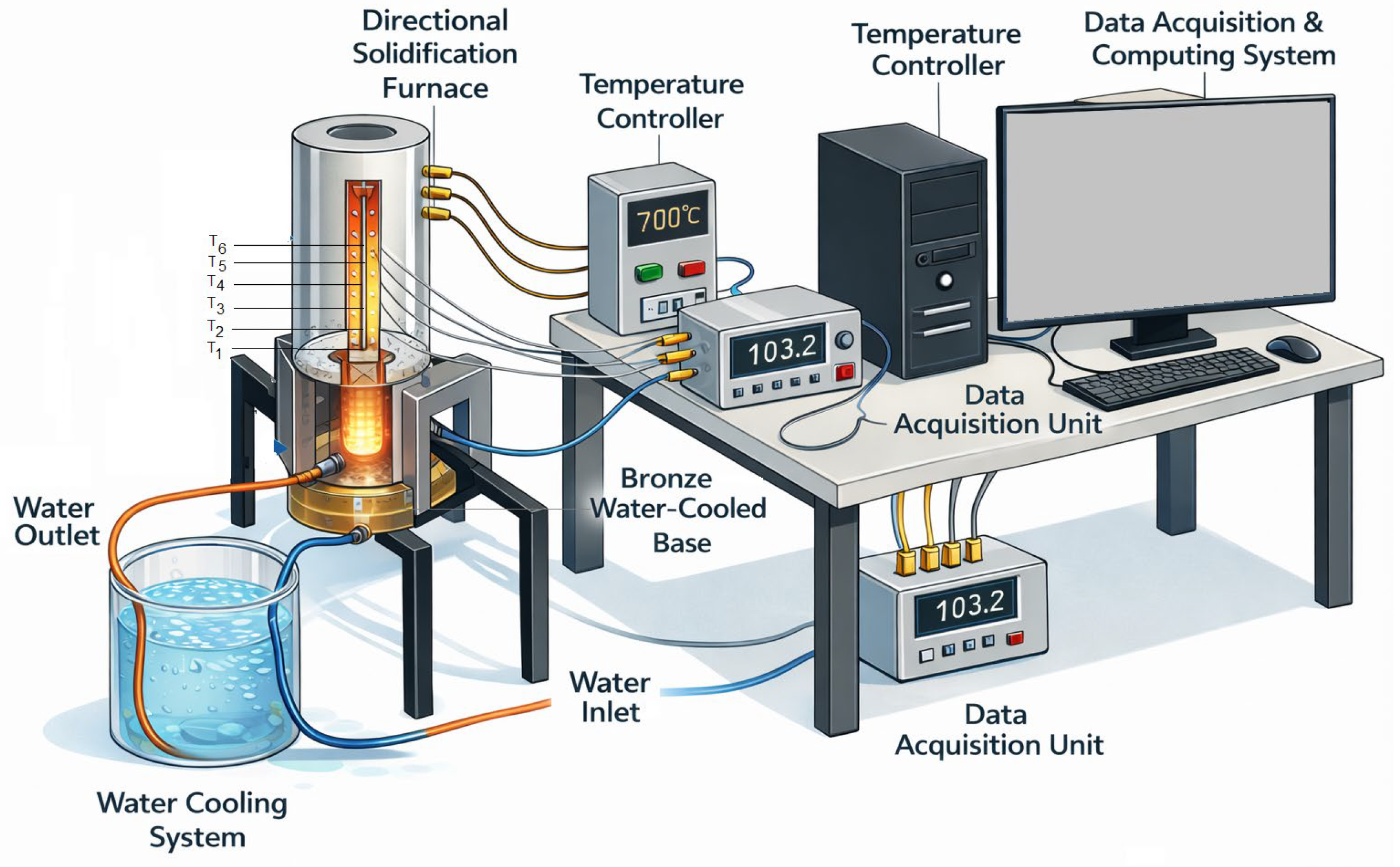
Figure 1. Schematic representation of the directional solidification system. This figure was created using generative AI tools.
Processes 14 01782 g001
Figure 2. Columnar-to-equiaxed transition (CET) in Al–Si alloys: (a) Al-6 wt. %Si. (b) Al-8 wt. %Si. (c) Al-10 wt. %Si. (d) Al-12.6 wt. %Si. The red boxes indicate the CET zones in each macrostructure. (e) Diagram indicating the position of the thermocouples along the length of the test tubes (T1 is the one in the lowest position and T6 is in the highest position).
Processes 14 01782 g002
Figure 3. Temperature versus time curves: (a) Al-6 wt. %Si. (b) Al-8 wt. %Si. (c) Al-10 wt. %Si. (d) Al-12.6 wt. %Si. (e) Graphs obtained by the Differential Scanning Calorimetric equipment of the TA Instrument Trios V 5.1.1.46572 Program. The blue dotted line in all figures corresponds to TLiquidus and the maroon dotted line corresponds to the TSolidus.
Processes 14 01782 g003aProcesses 14 01782 g003b
Figure 4. Al–Si equilibrium diagram. Adapted from [43].
Processes 14 01782 g004
Figure 5. Values of Ť with respect to the position of each thermocouple for different concentrations (Al-6 wt. %Si, Al-8 wt. %Si, Al-10 wt. %Si, and Al-12.6 wt. %Si).
Processes 14 01782 g005
Figure 6. Position vs. time of the Liquidus isotherm (a) Al-8 wt. %Si. (b) Al-12.6 wt. %Si alloy (eutectic isotherm).
Processes 14 01782 g006
Figure 7. (a) Temperature vs. time gradient curves. (b) Cooling curves. (c) Macrostructure, showing the position of the CET. It can be seen that in the CET zone, the gradient values reach a minimum, Gc, and T5 and T6 are equal for a moment. Furthermore, at that moment, we can see that the CET occurs in the T5 and T6 zones of the macrostructures. Al-8 wt. %Si alloy.
Processes 14 01782 g007
Figure 8. (a,b) Position of the CET vs. Ť for all concentrations. (c) Position of the CET vs. Ť for high (blue dots) and low (red dots) velocities obtained in this work.
Processes 14 01782 g008aProcesses 14 01782 g008b
Figure 9. Columnar grain width (CGW) vs. Ť for four different alloy concentrations.
Processes 14 01782 g009
Figure 10. Columnar grain width vs. cooling rate. Data obtained experimentally.
Processes 14 01782 g010
Figure 11. Relation of De vs. Position along the alloy samples for: (a) Al-6 wt. %Si. (b) Al-8 wt. %Si. (c) Al-10 wt. %Si. (d) Al-12.6 wt. %Si.
Processes 14 01782 g011
Figure 12. Cross-sectional micrographs of a unidirectionally solidified Al-6 wt. %Si alloy showing the dendritic solidification pattern in the three zones of the sample. (a) Columnar. (b) CET. (c) Equiaxed.
Processes 14 01782 g012
Figure 13. Microstructures of Al–Si alloys. (ac) Al-6 wt. %Si. (df) Al-8 wt. %Si. (gi) Al-10 wt. %Si. (jl) Al-12.6 wt. %Si. The EBDS images show the elements present in each image. These include the aluminum matrix (red), the Si dendrites (green), and other elements present in minor amounts: Argon (yellow), Carbon (fuchsia), and Oxygen (light blue).
Processes 14 01782 g013aProcesses 14 01782 g013b
Figure 14. Image of the characteristic X-ray emission of Figure 13g,h. Al-10 wt. %Si alloy.
Processes 14 01782 g014
Figure 15. Diffraction pattern of Al-10 wt. %Si alloy, equiaxed zone.
Processes 14 01782 g015
Figure 16. (a) Macrostructure of Al-6 wt. %Si alloy. (b) Macrostructure of Al-12.6 wt. %Si alloy. The green circles show where the micrographs were taken, showing the dendritic growth in columnar, CET, and equiaxed zones, respectively.
Processes 14 01782 g016aProcesses 14 01782 g016b
Figure 17. (a) Comparison of λ2 with respect to Ť. (a) Al-6 wt. %Si, Al-8 wt. %Si and Al-10 wt. %Si. (b) Al-12.6 wt. %Si.
Processes 14 01782 g017
Figure 18. The effect of silicon content on the size of λ2. There is a refining effect since the silicon content varied between 6 and 10 percent by weight of silicon.
Processes 14 01782 g018
Figure 19. (a) Variation in HV 0.05/10 as a function of P, for different silicon content. (b) Variation in HV 0.05/10 as a function of λ2 values. The purple lines delimit the CET zone.
Processes 14 01782 g019
Figure 20. (a) Variation in HV 0.05/10 as a function of Silicon content and similar Ť. (b) Average HV 0.05/10 values for the concentrations studied in this work.
Processes 14 01782 g020
Figure 21. Comparison of the HV 0.05/10 values obtained with experimental data available in the literature for Al–Si eutectic alloys.
Processes 14 01782 g021
Figure 22. (a) Stress–strain curves for concentrations studied in this work. (b) Variation in tensile strength with increasing silicon content.
Processes 14 01782 g022
Figure 23. (a) Values of σmax with respect to columnar and equiaxed grain size. (b) Values of σmax with respect to λ2.
Processes 14 01782 g023
Figure 24. Cyclic potentiodynamic curves of Al–Si alloys in 0.5 M NaCl solution: (a) Al-6 wt. %Si, (b) Al-8 wt. %Si, (c) Al-10 wt. %Si, (d) Al-12.6 wt. %Si.
Processes 14 01782 g024aProcesses 14 01782 g024b
Figure 25. Bodes diagrams of Al–Si alloys in 0.5 M NaCl solution: (a) Al-6 wt. %Si, (b) Al-8 wt. %Si, (c) Al-10 wt. %Si, (d) Al-12.6 wt. %Si.
Processes 14 01782 g025
Figure 26. (a) Equivalent circuit used for adjusting samples with “fine grains”. (b) Equivalent circuit used for adjusting samples with “coarse grains”.
Processes 14 01782 g026
Figure 27. Polarization resistance, Rp, of Al–Si alloys in 0.5 M NaCl solution as a function of different grain structures and different refinements. The different colors used in each alloy are to identify the fine and coarse structure: Al-6wt. %Si (red (fine) and brown (coarse). Al-8wt. %Si (light blue (fine) and blue (coarse). Al-10wt. %Si (light green (fine) and dark green (coarse). Al-12.6wt. %Si (pink (fine) and violet (coarse).
Processes 14 01782 g027
Figure 28. (a,b) Polarization resistance, Rp, versus microhardness, HV 0.05/10, for both types of grain structures (columnar and equiaxed) of Al–Si alloys.
Processes 14 01782 g028
Figure 29. (a,b) Polarization resistance, Rp, versus maximum tensile strength, σmax, for both types of grain structures (columnar and equiaxed) of Al–Si alloys.
Processes 14 01782 g029
Table 1. Pre-melting composition of grade commercial Al and Al-50 wt. %Si alloy.
AlSiFeCuMnMgNiTiNaZnCrBPb
Al99.2020.6000.1100.0010.0110.0020.0010.040.020.010.0010.0010.001
Al-50 wt. %Si51.4947.610.360.160.180.170.03
Table 2. Values of the thermal parameters of all the compositions used in this work and observations: minimum CET position, CETMin, maximum CET position, CETMax, average CET position, CETAverage, temperature gradient at the instant the CET occurs, Gc, average cooling rate, Ť, and liquid interface velocity at the instant the CET occurs, VCL.
Alloy CETMin (mm)CETMax (mm)CETAverage (mm)Gc (°C/cm)Ť (°C/s)VCL (mm/s)
Al-6 wt. %Si1456053−0.150.10.092
2951051002.00.160.18
35060550.41.030.127
Al-8 wt. %Si1100110105−0.30.170.23
28590882.00.130.161
3304035−0.160.080.091
Al-10 wt. %Si14555500.450.100.09
23542390.400.090.108
3657570−1.850.100.27
Al-12.6 wt. %Si1586863−1.60.100.18
25570630.750.090.09
3607065−0.50.110.09
46068640.700.100.08
Table 3. Values of experimental TL and TS.
AlloyTL
(°C)
TS
(°C)
Al-6 wt. %Si622581
Al-8 wt. %Si617577
Al-10 wt. %Si601577
Al-12.6 wt. %Si577577
Table 4. Grain width values obtained at a P of 25 mm, for all alloy concentrations.
AlloyŤ (°C/s)CGW (mm)
Al-6 wt. %Si0.1003.17
0.1651.96
0.1032.89
Al-8 wt. %Si0.1711.84
0.1352.28
0.1352.04
0.1052.29
Al-10 wt. %Si0.1062.32
0.0962.97
0.1082.23
Al-12.6 wt. %Si0.1004.25
0.0984.78
0.1103.64
0.1094.21
Table 5. Values obtained from the behavior of the CGW through a regression analysis.
AlloyEquationParameters
Al-6 wt. %SiY = 15.2X − 0.9
R2 = 0.909
a = 15.2
b = 0.90
Al-8 wt. %Si
Al-10 wt. %Si
Y = 70.9X − 0.5
R2 = 0.7794
a = 70.9
b = 0.5
Al-12.6 wt. %SiY = −10,863X + 11.05
R2 = 0.69
a = 10,863
b = 11.05
Table 6. Values of λ2 obtained for similar velocities.
AlloyZoneP
(mm)
Ť
(°C/s)
λ2
(µm)
HVα
0.05/10
(kg/cm2)
HVβ
0.05/10
(kg/cm2)
Al-6 wt. %SiC50.1872.746.766.9
C250.1776.046.565.7
C450.1679.146.363.5
C650.1581.546.362.3
CET850.1583.145.461.1
E1050.1586.544.159.9
Al-8 wt. %SiC50.2050.549.584.0
C250.1947.947.481.8
C450.1847.346.880.0
C650.1746.846.377.9
CET850.1445.344.872.1
E1050.1344.443.972.0
Al-10 wt. %SiC50.1758.0557.091.4
C250.1662.656.989.9
C450.1664.955.589.4
C650.1566.554.889.4
CET850.1569.753.986.5
E1050.1473.449.084.5
Table 7. Tensile strength values corresponding to all concentrations analyzed in this work from the columnar and equiaxed zones are presented together with the λ2 measurements recorded in the fracture zone.
AlloyZone CGW
(mm)
De
(mm)
σ0.2
(MPa)
σMax
(MPa)
λ2
(µm)
Al-6 wt. %SiColumnar21.96 78.4154.8272
Equiaxed2 2.1479.2134.586
Al-8 wt. %SiColumnar22.71 82.33161.182.97
Columnar32.96 79.33160107.14
Equiaxed3 3.0975.83110133.43
Columnar42.56 80.2141.1101
Al-10 wt. %SiColumnar22.97 95.2165.4100.2
Equiaxed2 3.3593.33143109.2
Columnar13.05 85.71161.7178.07
Columnar32.86 92.9168.476.77
Table 8. Tensile strength values at eutectic concentration, from the columnar and equiaxed zones, are presented together with the λe and λLS measurements recorded in the fracture zone.
AlloyZone CGW
(mm)
De
(mm)
σ0.2
(MPa)
σmax
(MPa)
λe
(µm)
λLS
(µm)
Al-12.6 wt. %SiColumnar14.29 135.1160.525.010.0
Columnar24.78 113.3156.029.011.1
Columnar33.62 149.5195.017.55.1
Columnar44.16 146.7184.518.45.5
Equiaxed1 2.9893.1168.030.714.3
Equiaxed2 2.8492.7166.031.512.0
Equiaxed3 2.5398.0189.023.010.2
Equiaxed4 2.3993.6178.023.010.2
Table 9. Corrosion potentials, Ecorr, of Al–Si alloys in 0.5 M NaCl solution.
Ecorr (mV)
GrainAl-6 wt. %SiAl-8 wt. %SiAl-10 wt. %SiAl-12.6 wt. %Si
StructureFineCoarseFineCoarseFineCoarseFineCoarse
Columnar−713−729−729−710−709−709−725−700
Equiaxed−717−719−727−726−713−709−726−693
Table 10. Corrosion current densities, Icorr, of Al–Si alloys in 0.5 M NaCl solution.
Icorr (mA/cm2)
GrainAl-6 wt. %SiAl-8 wt. %SiAl-10 wt. %SiAl-12 wt. %Si
StructureFineCoarseFineCoarseFineCoarseFineCoarse
Columnar0.001170.000130.002820.000410.005710.003550.018030.00385
Equiaxed0.001610.001520.007040.001000.009240.005860.017510.00580
Table 11. Impedance fit parameters for Al–Si alloys in 0.5 M NaCl solution.
ZoneRefinementRΩR2CPE2n2R1CPE1n1Rp
Ω × cm2Ω × cm2Ω−1s−ncm−2 Ω × cm2Ω−1s−ncm−2 Ω × cm2
Al-6wt. %SiColumnarFine5.16 5.40 × 1044.75 × 1050.825.40 × 104
Equiaxed2.54 1.56 × 1044.43 × 1050.831.56 × 104
ColumnarCoarse2.571.20 × 1042.98 × 1050.863.08 × 1051.41 × 1040.633.20 × 105
Equiaxed7.398.37 × 1037.31 × 1060.889.42 × 1032.46 × 1041.001.78 × 104
Al-8wt. %SiColumnarFine5.90 1.04 × 1041.73 × 1050.811.04 × 104
Equiaxed5.20 6.54 × 1032.09 × 1050.866.55 × 103
ColumnarCoarse4.612.58 × 1022.80 × 1050.822.86 × 1041.10 × 1050.902.88 × 104
Equiaxed2.562.60 × 1024.42 × 1050.807.43 × 1033.80 × 1050.887.69 × 103
Al-10wt. %SiColumnarFine1.70 9.24 × 1049.25 × 1050.799.24 × 103
Equiaxed2.58 7.43 × 1033.72 × 1050.827.43 × 103
ColumnarCoarse5.112.63 × 1035.08 × 1050.751.06 × 1042.06 × 1061.001.32 × 104
Equiaxed3.411.75 × 1037.63 × 1050.757.07 × 1033.09 × 1061.008.83 × 103
Al-12.6wt. %SiColumnarFine3.09 3.83 × 1031.72 × 1050.883.83 × 103
Equiaxed3.00 2.82 × 1039.00 × 1050.802.82 × 103
ColumnarCoarse3.969.78 × 1014.03 × 1050.798.70 × 1038.75 × 1050.848.80 × 103
Equiaxed4.457.34 × 1014.74 × 1050.778.00 × 1031.53 × 1050.828.08 × 103
Disclaimer/Publisher’s Note: The statements, opinions and data contained in all publications are solely those of the individual author(s) and contributor(s) and not of MDPI and/or the editor(s). MDPI and/or the editor(s) disclaim responsibility for any injury to people or property resulting from any ideas, methods, instructions or products referred to in the content.