1. Introduction
In oil and gas exploration and development, reservoir porosity has long been recognized as a fundamental parameter, essential for describing rock properties and subsurface fluid flow behavior, making it a central focus of both research and practice [
1,
2,
3]. Porosity provides a direct measure of the size and connectivity of pore spaces within rocks [
4,
5,
6]. It governs not only the capacity of oil, gas, and water to be stored, but also strongly impacts permeability, recoverable reserves, and the overall production potential of the reservoir [
7]. Consequently, reliable prediction and characterization of porosity are of great theoretical significance and practical value, supporting reservoir evaluation, hydrocarbon development, CO
2 geological storage, and geothermal resource exploitation [
8,
9,
10,
11,
12].
In practical exploration and field development, porosity estimation is primarily derived from core analysis and well log interpretation. Core analysis yields highly accurate microscopic petrophysical parameters and is regarded as one of the most reliable approaches [
13,
14,
15]. However, it is expensive, spatially limited, and provides only localized information around the wellbore. Well log interpretation provides continuous porosity estimation along the borehole, but its accuracy is restricted by logging tool performance, interpretation models, and formation heterogeneity, thereby limiting its application to well-controlled zones [
16,
17]. Because exploration areas often contain sparse well networks or even well-free regions, both methods face clear limitations in spatial extrapolation and regional-scale prediction.
To break through the constraints of borehole-scale measurements, seismic inversion techniques are extensively employed for porosity prediction. Seismic data provide broad spatial coverage and continuous information, capturing the integrated response of the subsurface medium [
18,
19]. Over decades of development, these approaches have been structured into two main categories. The first is seismic–well log joint inversion, in which elastic parameters—such as P- and S-wave impedances, Poisson’s ratio, and elastic moduli—are obtained from post-stack or pre-stack inversion and subsequently transformed into porosity through rock physics models, including the Gassmann equation or empirical correlations [
9,
20,
21,
22,
23,
24]. These methods are physically grounded, yet they typically depend on simplified assumptions. Another category of approaches employs a Bayesian framework to establish a joint probabilistic model linking elastic parameters with porosity, thereby enabling simultaneous inversion of seismic attributes and reservoir properties [
25,
26]. This approach inherently incorporates uncertainty analysis and enhances the robustness of inversion results [
27,
28,
29]. However, it is highly sensitive to prior information and model assumptions, incurs high computational costs, and, in the absence of proper constraints, is prone to convergence issues or biased solutions. Considerable advances have been achieved in porosity prediction through seismic inversion; however, challenges remain when applied to reservoirs characterized by strong heterogeneity and complex structural settings.
In recent years, the rapid progress of artificial intelligence has propelled deep learning to the forefront of geophysical research [
30,
31]. By leveraging multi-layer neural networks, deep learning can learn complex nonlinear mappings from large datasets, demonstrating strong robustness and generalization in tasks such as structural interpretation, fault and fracture detection, noise attenuation, seismic facies analysis, and reservoir inversion [
32,
33,
34]. Its core strength lies in automatically extracting high-level features and optimizing models through large datasets, thereby eliminating the need for manually defined analytical relationships. In porosity prediction, deep learning provides a breakthrough beyond the constraints of conventional inversion methods. The general workflow involves: constructing training datasets from well logs and seismic data; applying LSTM (Long Short-Term Memory Recurrent Neural Network), or Unet (U-shaped convolutional encoder–decoder network) architectures to extract features; predicting porosity via nonlinear mapping; and continuously updating weights through iterative optimization [
35,
36,
37]. By leveraging the high resolution of well log data, the predicted results typically surpass those of conventional methods in both accuracy and resolution. Nevertheless, the exclusive use of deep learning for porosity prediction encounters several challenges. On the one hand, its strong reliance on the size and representativeness of training data often leads to reduced prediction accuracy in regions with limited well control. On the other hand, the absence of geological and physical constraints means that even numerically consistent results may lack geological plausibility, thereby undermining interpretability and restricting their practical utility.
In recent years, researchers have increasingly recognized that neither purely data-driven nor purely physics-driven approaches alone are sufficient for accurate porosity prediction in geologically complex reservoirs [
38,
39,
40]. Integrating deep learning’s nonlinear modeling capacity with the mechanistic constraints of rock physics has emerged as a prominent research direction. Consequently, hybrid porosity prediction methods have been developed, where rock physics constraints are embedded into deep learning networks [
41]. This allows the model to automatically capture the mapping between seismic responses and porosity while ensuring the physical plausibility and interpretability of the results. For instance, one may incorporate rock physics error terms into the loss function or embed prior relationships between elastic parameters and porosity within the network architecture, effectively merging the strengths of data-driven learning and physics-based constraints [
42,
43].
This paper proposes a reservoir porosity prediction method jointly driven by data and rock physics models. By integrating the strengths of deep learning and rock physics, the method aims to deliver high-accuracy porosity predictions with geological plausibility, even in areas with limited well control data. The approach leverages deep neural networks to integrate seismic attributes and embeds rock physics constraints within the architecture, thereby exploiting the complementarity of seismic and well log data while improving model interpretability and stability. This work provides a novel technical pathway for porosity prediction and offers both theoretical insights and practical guidance for advancing reservoir parameter inversion methodologies.
The remainder of this paper is organized as follows.
Section 2 introduces the rock physics modeling theory, the construction of the LSTM-UNet architecture, and the proposed joint data–model-driven porosity prediction workflow.
Section 3 presents synthetic tests based on the SEAM model to evaluate the feasibility and robustness of the proposed method.
Section 4 applies the proposed method to field seismic data and analyzes its practical performance.
Section 5 discusses the advantages, limitations, and computational aspects of the method. Finally,
Section 6 summarizes the main conclusions of this study.
2. Materials and Methods
2.1. Theory of Rock Physics Modeling
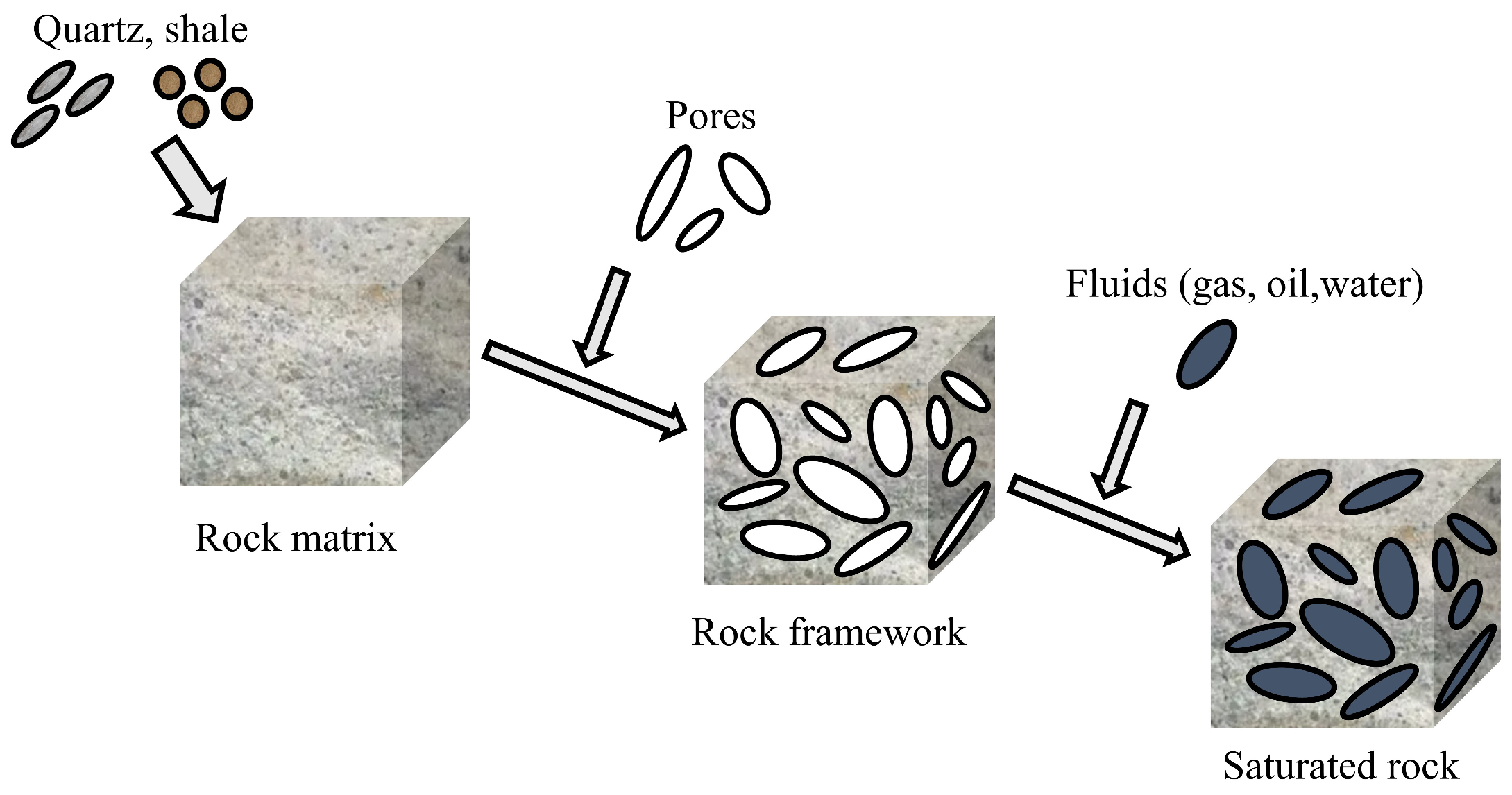
In this paper, the Gassmann equation and the critical porosity model are applied to perform rock physics modeling of sandstone composed mainly of quartz and clay. During the modeling process, the inversion results of physical parameters are directly influenced by the selected rock physics model.
Figure 1 presents a detailed schematic of the modeling workflow.
To calculate the elastic modulus of the rock matrix, it is assumed that the matrix consists of
N minerals, each with a volume fraction
Vi. The bulk modulus of the composite can then be determined using the classical Voigt-Reuss-Hill (V-R-H) model, which averages the Voigt upper bound and Reuss lower bound, as expressed in Equation (1):
In Equation (1),
Xm denotes the elastic modulus of the rock matrix, while
Xi refers to that of the
i-th mineral. Here,
Xm can be either the bulk modulus or the shear modulus. If the sandstone is assumed to be composed solely of quartz and clay, then the elastic modulus of the rock can be determined using Equation (2).
Here, K denotes the bulk modulus, G the shear modulus, and C the clay fraction. Once the elastic moduli of the rock matrix are determined, the Kuster–Toksöz (K-T) model is applied to introduce pore space into the matrix, as described by Equations (3) and (4).
In the above equations,
Kd,
Km, and
Kf represent the bulk moduli of the rock frame, the matrix, and the pore-filling material, respectively.
Gd,
Gm, and
f correspond to the shear moduli of the rock framework, the solid matrix, and the pore-filling phase, respectively.
represents the volumetric fraction of the
l-th pore-filling phase.
refers to the aspect ratio of the pores, and the calculation relationship is expressed in Equation (5):
The Kuster–Toksöz (K-T) model is valid under the condition that the ratio of porosity to pore aspect ratio is much smaller than one. Under this assumption, the solid matrix can be considered a continuous medium, while the pores act as sparse perturbations that correct the overall elastic moduli. It should be emphasized that at the initial stage of pore introduction, the bulk and shear moduli of the pore-filling phase are set to zero, corresponding to the assumption of a dry rock framework with no fluid saturation.
Based on Gassmann’s theory, the elastic properties of rocks are altered once the pore space is filled with fluid. The Gassmann equation allows the elastic moduli and seismic velocities of fluid-saturated rocks to be formulated as functions of the dry rock frame modulus, the mineral matrix modulus, and the bulk modulus of the pore fluid, as expressed in Equation (6):
In this equation,
Ks denotes the bulk modulus of the saturated rock,
Gs represents the shear modulus of the saturated rock, and
Kf refers to the bulk modulus of the pore fluid. The bulk modulus and density of the saturated fluid can be calculated using Equation (7):
In this equation, Sw denotes the water saturation; Kg represents the bulk modulus of gas; Kw represents the bulk modulus of water; is the water density; is the gas density; and corresponds to the density of the saturated fluid.
Ultimately, the saturated rock’s P-wave velocity (Vp), S-wave velocity (Vs), and density (ρ) can be determined as Equation (8):
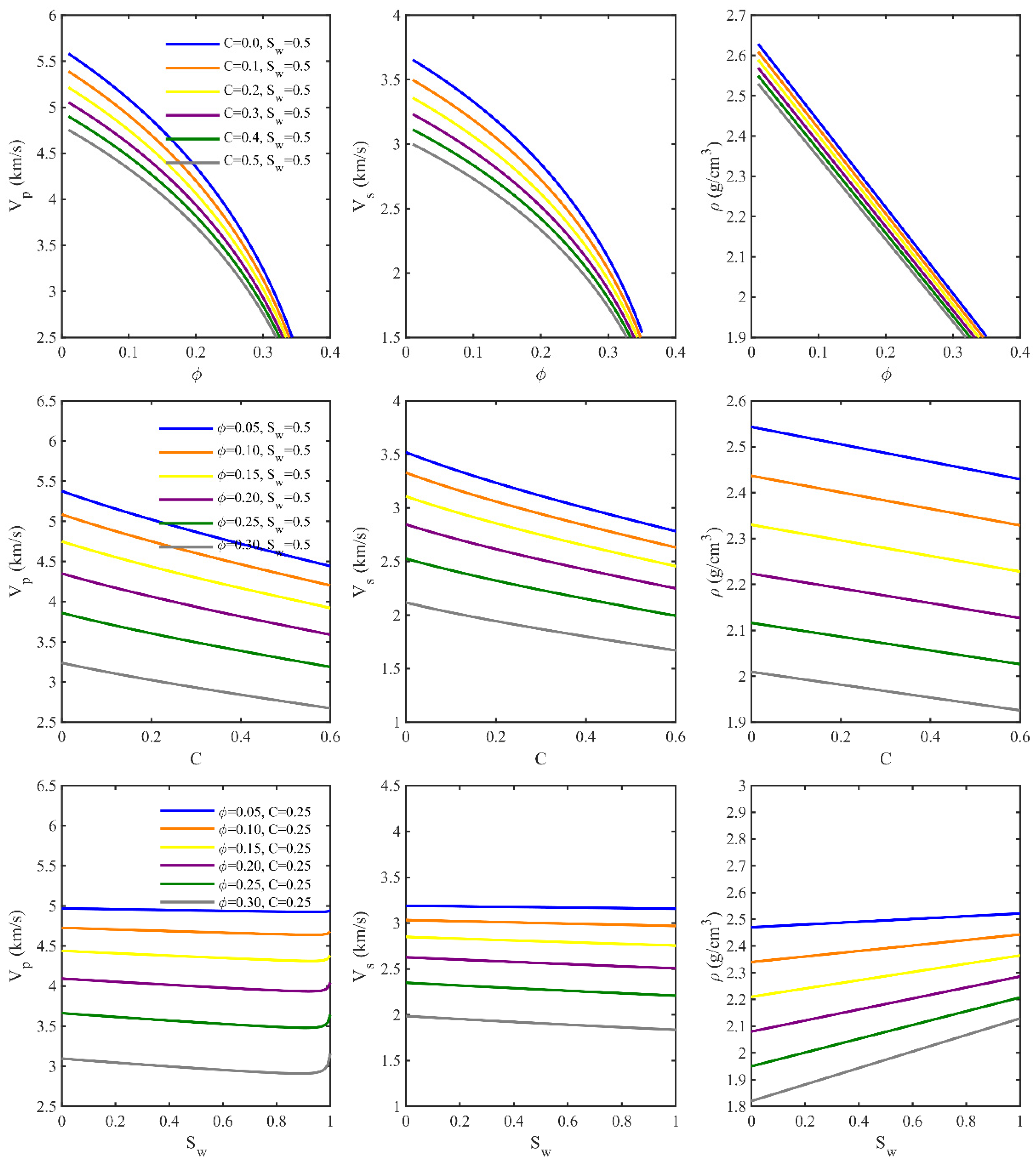
The above process establishes a nonlinear relationship between petrophysical parameters and elastic parameters. To analyze the sensitivity of different petrophysical parameters, the relationships between porosity and elastic parameters under varying pore fluids and mineral compositions (as listed in
Table 1) are examined.
Figure 2 shows the relationships between porosity and elastic parameters for varying clay contents and pore fluid conditions. The figure clearly indicates that porosity exerts a strong influence on elastic parameters. With increasing porosity, the fraction of solid grains in the rock framework decreases, leading to a marked nonlinear reduction in P-wave and S-wave velocities. Moreover, increasing clay content also significantly affects the elastic parameters. As clay content rises, both P- and S-wave velocities tend to decrease, although the magnitude and nonlinearity of the reduction are less pronounced than those associated with porosity. This is primarily attributed to the presence of clay minerals, which reduce the stiffness of the rock matrix and may promote the development of microfractures, resulting in a reduction in wave velocity. Nevertheless, because clay minerals are typically dispersed within the rock framework, their influence on velocity is less pronounced than that of porosity. Hence, theoretical rock physics modeling demonstrates that rock-physics-driven inversion provides a feasible approach for estimating porosity parameters.
2.2. Construction of the LSTM-Unet
The Unet network, due to its outstanding capability in image feature extraction and resolution recovery, has been widely applied in seismic data processing and interpretation. The central idea of Unet lies in its symmetric encoder–decoder structure, which enables effective extraction and fusion of multi-scale information. More specifically, the encoder progressively downsamples the input data to capture deep-level features while compressing spatial resolution to obtain abstract semantic representations; the decoder then progressively upsamples to recover spatial resolution and produce segmentation outputs matching the scale of the input image. In this workflow, the U-shaped symmetric architecture of Unet guarantees the simultaneous capture of global and local information: the down-sampling path extracts low-resolution global context, whereas the up-sampling path restores fine local spatial details. To prevent the loss of crucial information during repeated down-sampling and up-sampling, Unet incorporates skip connections linking the encoder and decoder. Through skip connections, feature maps from encoder layers are directly passed to their corresponding decoder layers, allowing the decoder to leverage multi-scale features and significantly improve boundary sharpness and detail retention in the segmentation results. Such a design enhances the flexibility of information flow within the network while effectively preserving spatial details and semantic features of the input data, thus minimizing the loss of essential information.
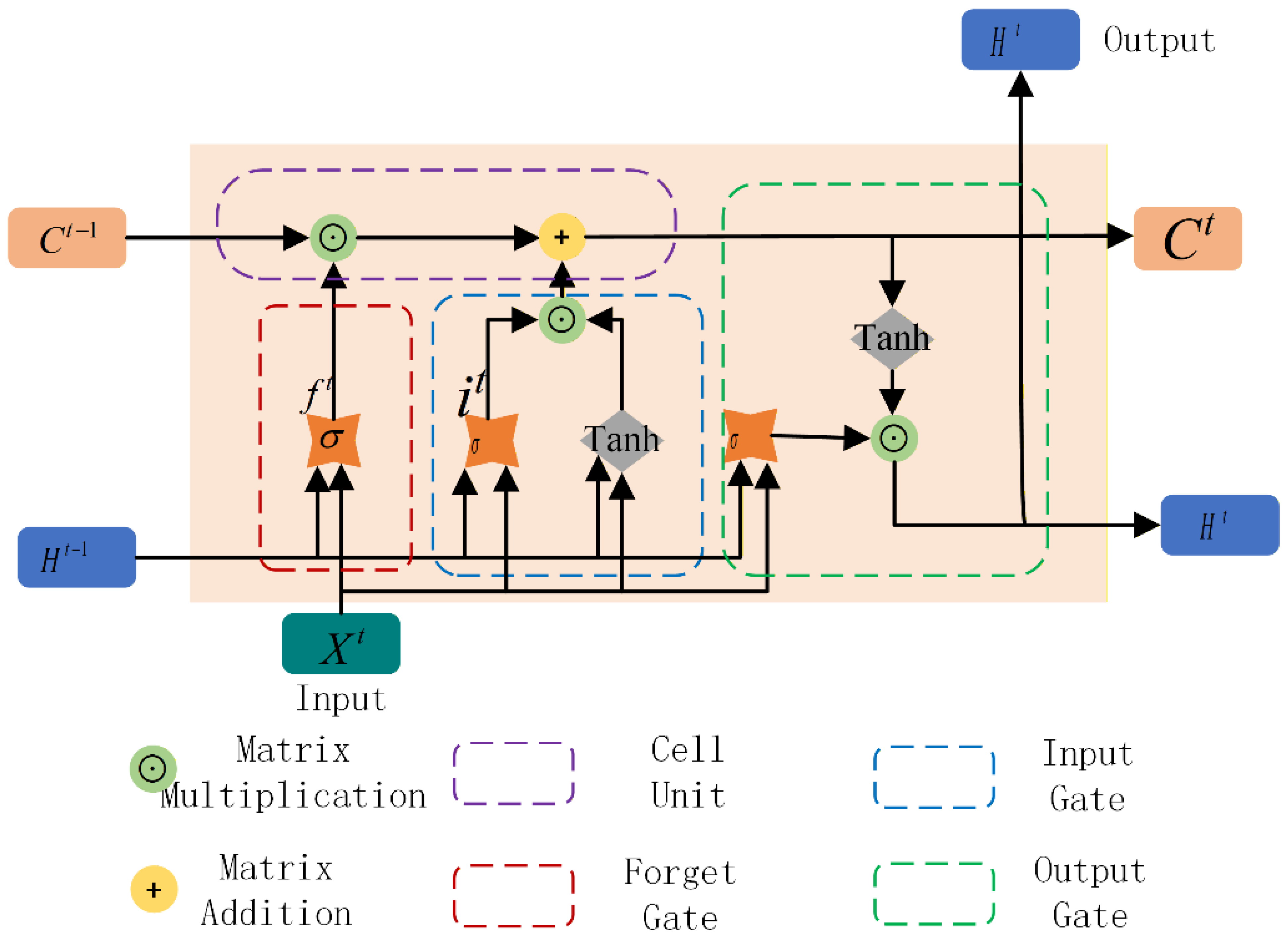
Nevertheless, conventional Unet architectures are limited in handling tasks like seismic data processing, where temporal correlations are significant. More specifically, Unet is effective in extracting spatial features but lacks the capacity to properly model temporal dynamics. By comparison, the Long Short-Term Memory (LSTM) network is well suited for sequence modeling, as it effectively captures long-range dependencies in time series and maintains critical information over extended temporal intervals. Through its gating mechanisms—input, forget, and output gates—LSTM demonstrates robust performance in filtering redundant information and highlighting essential dynamic patterns.
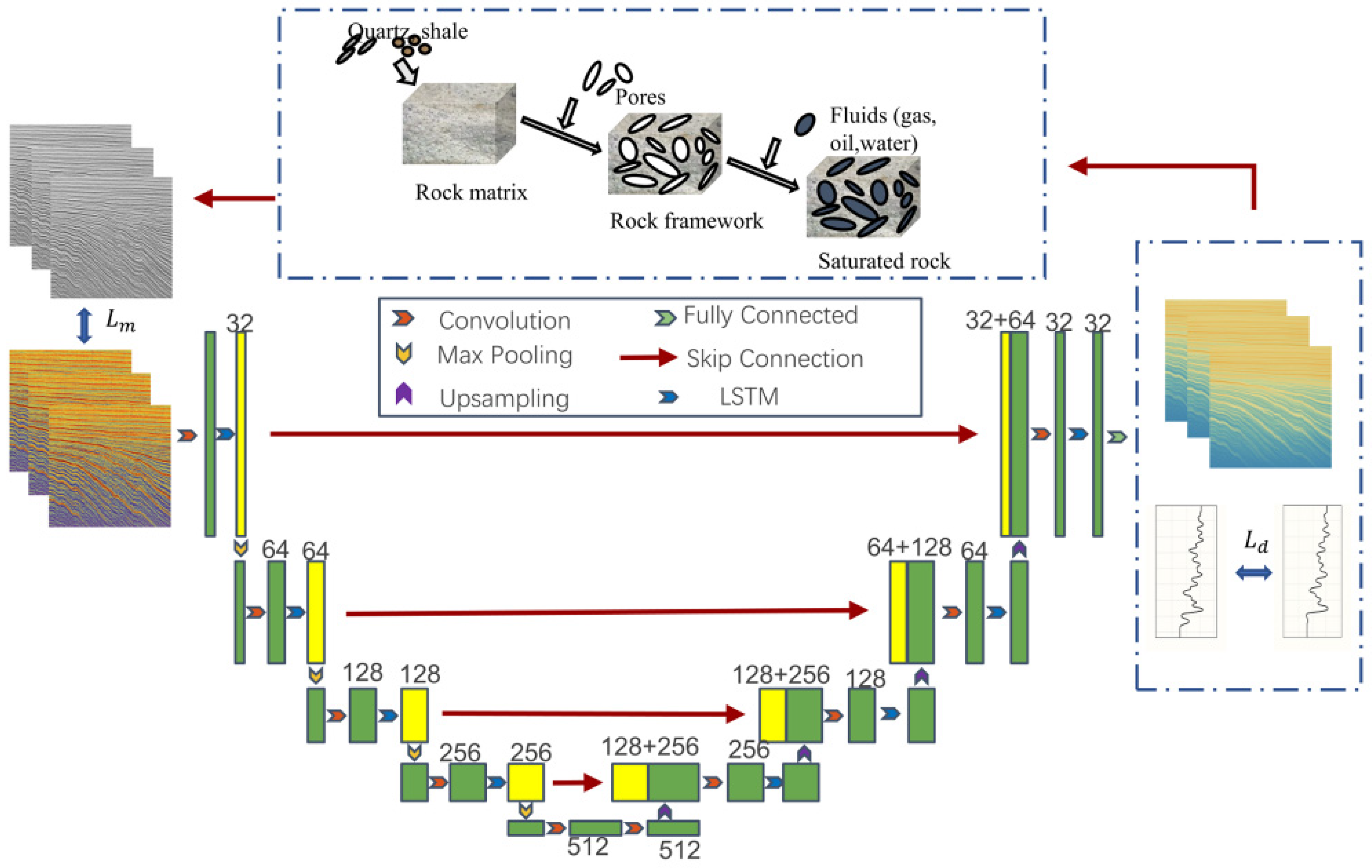
Figure 3 illustrates the standard architecture of an LSTM unit. On this basis, integrating LSTM with Unet yields the LSTM-Unet architecture, capable of jointly capturing spatial and temporal features. The network simultaneously extracts multi-resolution spatial representations and models the temporal evolution of seismic signals. By integrating both aspects, the model provides a more detailed representation of complex seismic signals: maintaining multi-scale detail and global structures in the spatial domain while capturing dynamic wavefield evolution in the temporal domain, thus delivering improved accuracy and stability in applications such as seismic data segmentation, attribute extraction, and reservoir prediction.
Once the normalized post-stack seismic data and well-log impedance labels are fed into the network, the Unet encoding layers process them. Each encoding layer employs weight-shared convolutional kernels, producing spatial feature vectors at every stage
. The spatial feature vectors are subsequently input into the LSTM block, which also acts as skip connections across each encoding stage. The LSTM employs gating mechanisms to capture temporal attributes. Within the LSTM-Unet framework, spatial feature vectors are not multiplied with high-dimensional weight matrices; instead, convolution operations are applied to compute the hidden and cell states. Accordingly, each gating mechanism can be formulated as Equation (9).
The cell state can be represented by Equation (10):
The hidden state is computed according to Equation (11):
In this equation,
refers to the general forget gate,
indicates the activation function,
denotes the convolution kernel,
corresponds to the forget gate,
to the input gate, and
to the output gate. At the last encoding stage, the hidden state
is upsampled in the corresponding decoding layer and linked with the stored information
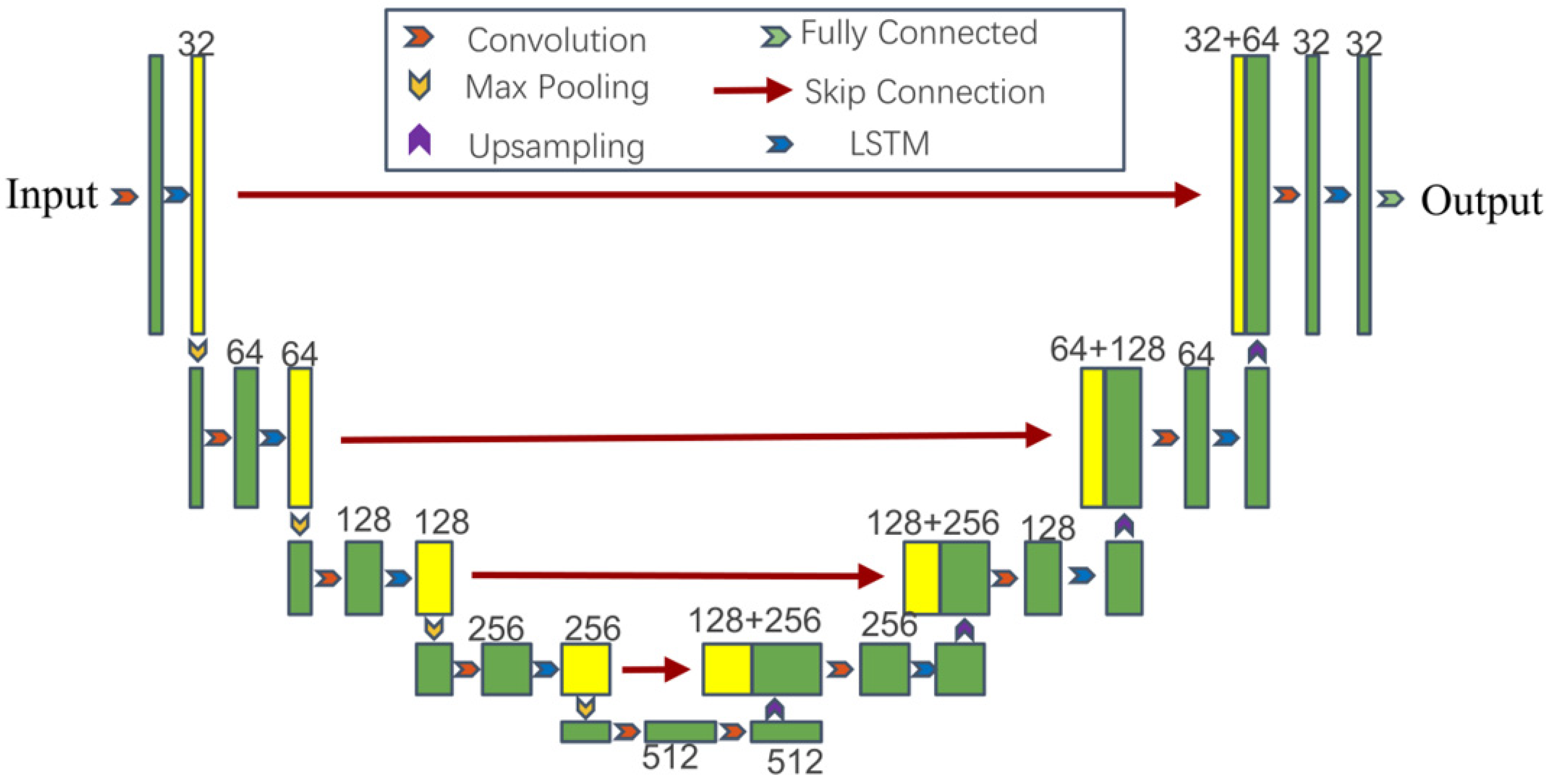
. This upsampling process proceeds in the same way through successive decoding layers until the final layer, where the feature vectors are restored to their original dimensionality. The architecture of the LSTM-Unet network described above is illustrated in
Figure 4. The integers 32, 64, 128, 256, and 512 in
Figure 4 denote the number of feature channels produced by the convolutional filters at different encoder and decoder stages.
2.3. Post-Stack Seismic Porosity Prediction Based on Joint Data–Model-Driven Approach
In traditional post-stack seismic data, repeated stacking inevitably weakens or even eliminates the amplitude variation with offset (AVO) features. Consequently, depending only on post-stack impedance inversion followed by indirect porosity estimation via rock physics relationships often introduces multiple sources of uncertainty, leading to cumulative prediction errors and thereby reducing the reliability and precision of porosity inversion. In contrast, combining seismic inversion with rock physics constraints, and further integrating high-resolution well log information, enables the inversion process to balance the seismic data’s large-scale continuity with the fine-scale detail of well data. This joint data–model-driven strategy effectively mitigates the shortcomings of post-stack data information loss and substantially improves both the accuracy and stability of porosity prediction, thereby offering a more robust basis for reservoir parameter characterization.
In this process, post-stack seismic records are generated through a convolutional model as Equation (12):
In this equation, W stands for the seismic wavelet, while R represents the reflection coefficient series; in post-stack seismic data, this relationship can be expressed by Equation (13):
where
ρ refers to the medium density, while
Vp indicates the seismic P-wave velocity. Data-driven porosity inversion methods have emerged in recent years as a new class of techniques fueled by the rapid progress of deep learning. The central concept is to exploit the strong nonlinear approximation capacity of deep neural networks to model the complex mapping between seismic data and porosity. In the training phase, seismic attributes or inversion parameters are used as inputs, while high-resolution porosity measurements from well logs serve as labels. The model parameters are iteratively optimized to minimize the difference between predicted and actual porosity. During training, porosity data from well logs are treated as labels, and the objective is to minimize the loss function between predicted and reference porosity. The loss function is expressed as Equation (14):
where
stands for the well-log label data,
f corresponds to the nonlinear mapping learned by the neural network, and
m refers to the seismic impedance parameter.
Building on data-driven inversion, the trained porosity curve is not the final result but serves as a crucial input for constructing rock physics models. More specifically, the predicted porosity curve is integrated with well-log parameters such as clay content and water saturation to establish a quantitative relationship between rock physics properties and elastic parameters (including P-wave velocity, S-wave velocity, and density). This procedure yields full elastic parameter curves. The derived elastic parameter curves are employed in forward modeling to synthesize seismic records, which are subsequently compared with field seismic observations. During the inversion process, minimizing only the misfit between observed and synthetic seismic records may improve data fitting but often results in overfitting or oscillatory artifacts, which compromise the geological reasonableness of the inversion. To address this, regularization terms are incorporated into the objective function to enforce smoothness constraints on model parameters, thereby emphasizing stratigraphic continuity and depositional stability. Taking both the data misfit and smoothing constraint terms into account, the objective function is formulated as Equation (15):
where
represents the gradient of the model parameters, serving as a measure of spatial variation, while
γ is the balancing factor used to regulate the trade-off between the data misfit and smoothing constraint terms. The overall loss function of the inversion network for this process is defined as Equation (16):
Thus, the general workflow for data–model jointly-driven post-stack seismic porosity prediction using the LSTM-Unet architecture is shown in
Figure 5. The network was implemented in Python using PyTorch version 2.1.1. The LSTM units and convolutional layers were constructed using the standard neural network modules provided by PyTorch. However, the overall LSTM-U-Net architecture, including the encoder–decoder structure, the integration of the LSTM module, the data flow, and the training workflow, was designed and developed by the authors specifically for seismic porosity prediction. No existing commercial LSTM-UNet software package was directly used in this study.
3. Theoretical Model Test
In this section, the SEAM porosity model is employed to generate synthetic seismic data in order to evaluate the feasibility and effectiveness of the proposed approach. The SEAM model, developed and released by the Society of Exploration Geophysicists (SEG), has become one of the most widely adopted benchmark models in geophysical research. The SEAM model incorporates complex geological structures typical of real subsurface settings and reproduces significant lateral heterogeneity along with abrupt changes in stratigraphic parameters, rendering it highly appropriate for validating and benchmarking deep learning seismic inversion methods. The geological section represented by the SEAM model demonstrates pronounced depositional continuity, where strata within the same area typically display spatial stability and a degree of parameter uniformity on a macroscopic scale. These features capture the large-scale depositional trends of subsurface reservoirs, thereby enhancing the controllability of the synthetic data and improving the reliability of subsequent interpretation. In addition, the dataset incorporates challenging salt-dome structures. Salt-dome formation generally produces strong geophysical responses, with boundaries characterized by sharp parameter contrasts between surrounding rocks and the salt body. These abrupt contrasts not only complicate wavefield propagation and inversion, but also serve as rigorous benchmarks for testing the robustness and resolution of inversion algorithms.
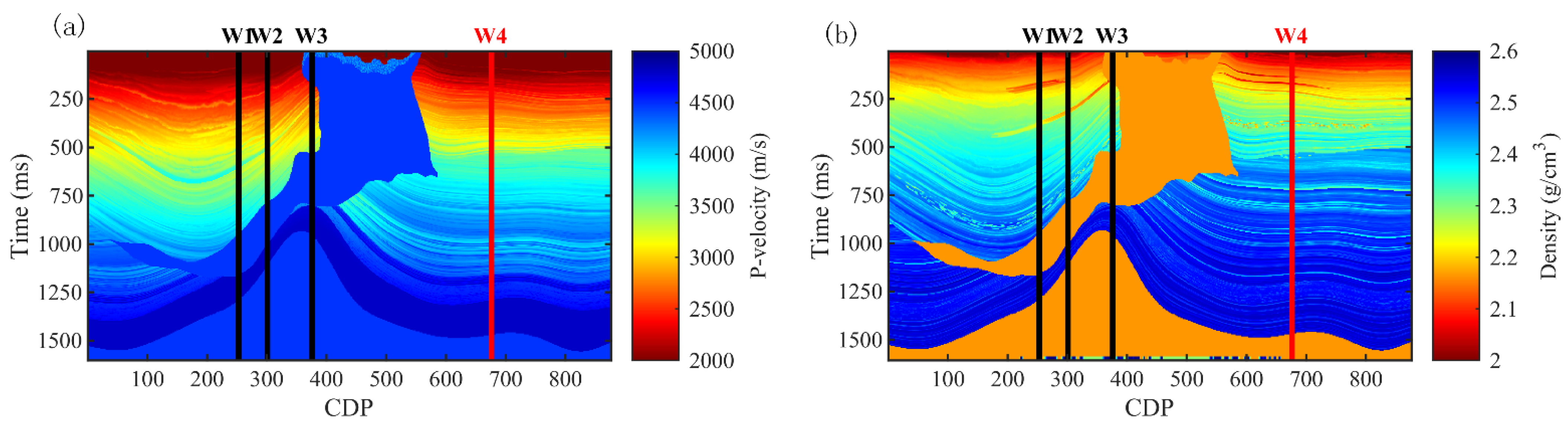
Figure 6 illustrates the characteristic structure of the salt dome within the SEAM model, where pronounced contrasts in physical parameters are evident along the salt boundaries.
Figure 6a displays the Vp profile, while
Figure 6b presents the density profile. The model includes four wells, with their positions marked by solid lines in the figure, W1 at trace 253, W2 at trace 301, W3 at trace 376, and W4 at trace 676. The dataset contains 876 traces and 320 samples in depth/time, with a sampling interval of 4 ms. To assess the generalization and robustness of the proposed neural network for porosity prediction, wells W3 and W4 are used for training and testing, W2 for validation, and W1 for prediction, thereby evaluating the predictive performance.
For synthetic data generation, the exact Zoeppritz equations are applied to produce pre-stack seismic records at incident angles of 5°, 15°, and 25° [
44]. These are stacked to yield post-stack seismic data, using a 30 Hz Ricker wavelet as the source.
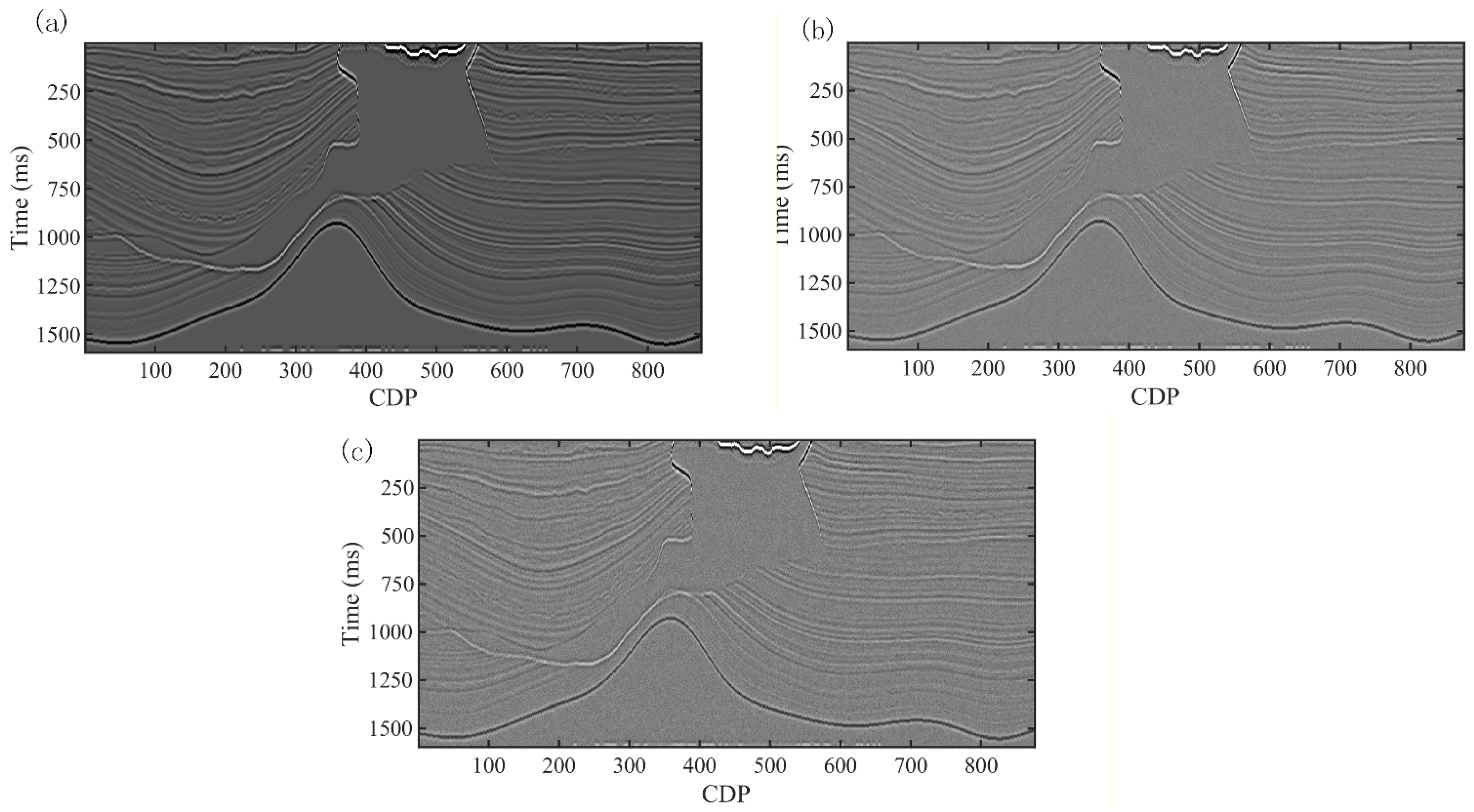
Figure 7a presents the synthetic post-stack seismic section without noise. To evaluate the noise robustness of the method, random noise with an SNR of 5 and 2 are added to the synthetic record, as shown in
Figure 7b,c.
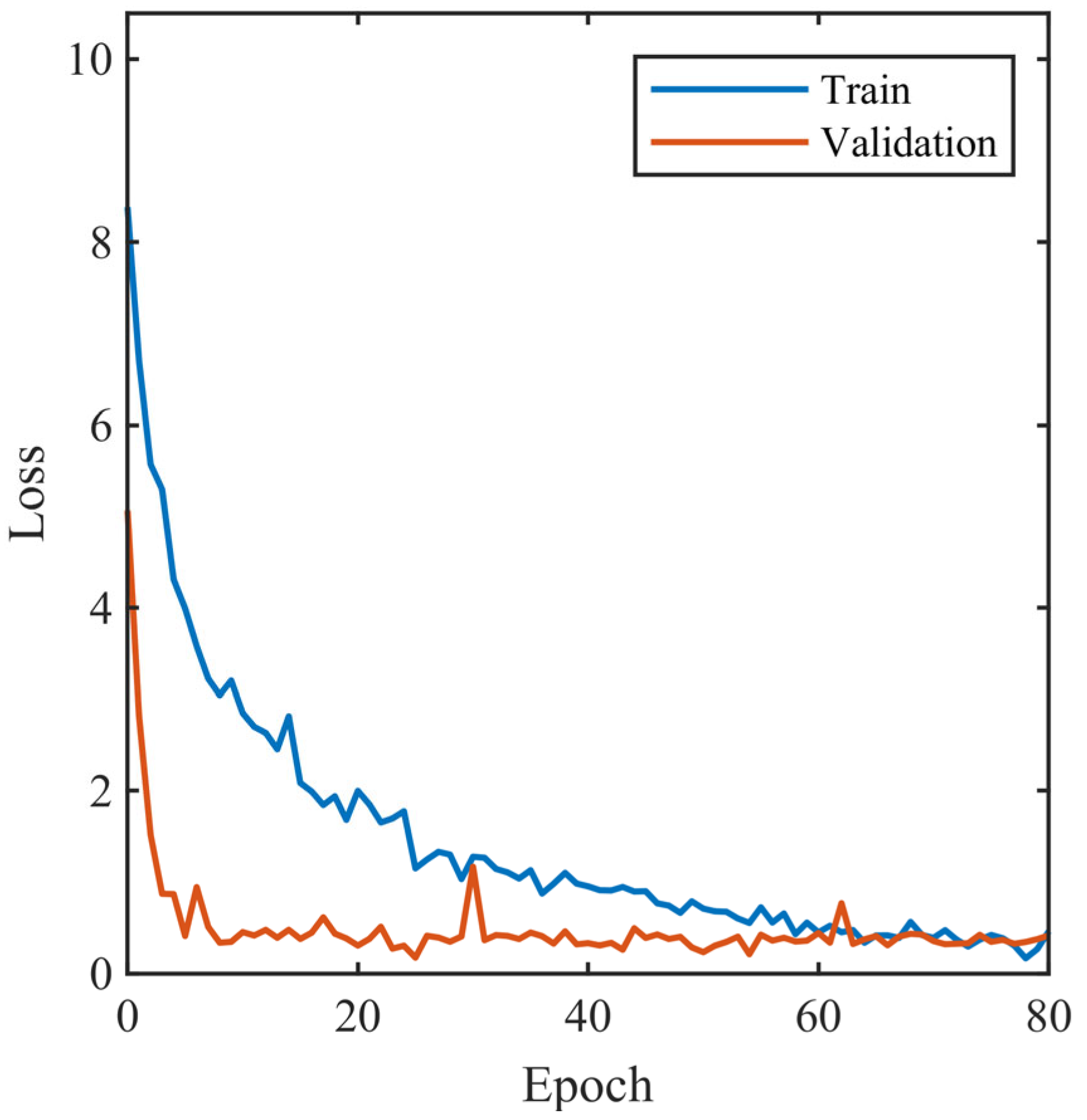
Figure 8 shows the evolution of the loss function for both the training and validation datasets throughout the training process. The results demonstrate that the model converges rapidly during the early training phase, with the training error markedly reduced and stabilized by approximately the 10th epoch, while the validation error remains low and shows no significant rebound. These findings indicate that the model maintains both strong fitting ability and generalization across datasets, validating the effectiveness of the network architecture. In addition, the narrow gap between training and validation errors indicates that neither overfitting nor underfitting occurred. The model is capable of effectively capturing nonlinear features of complex seismic data and reliably constructing the mapping between seismic attributes and porosity.
Additionally, the seismic data from the prediction set were fed into the LSTM-Unet model, yielding the porosity prediction profile displayed in
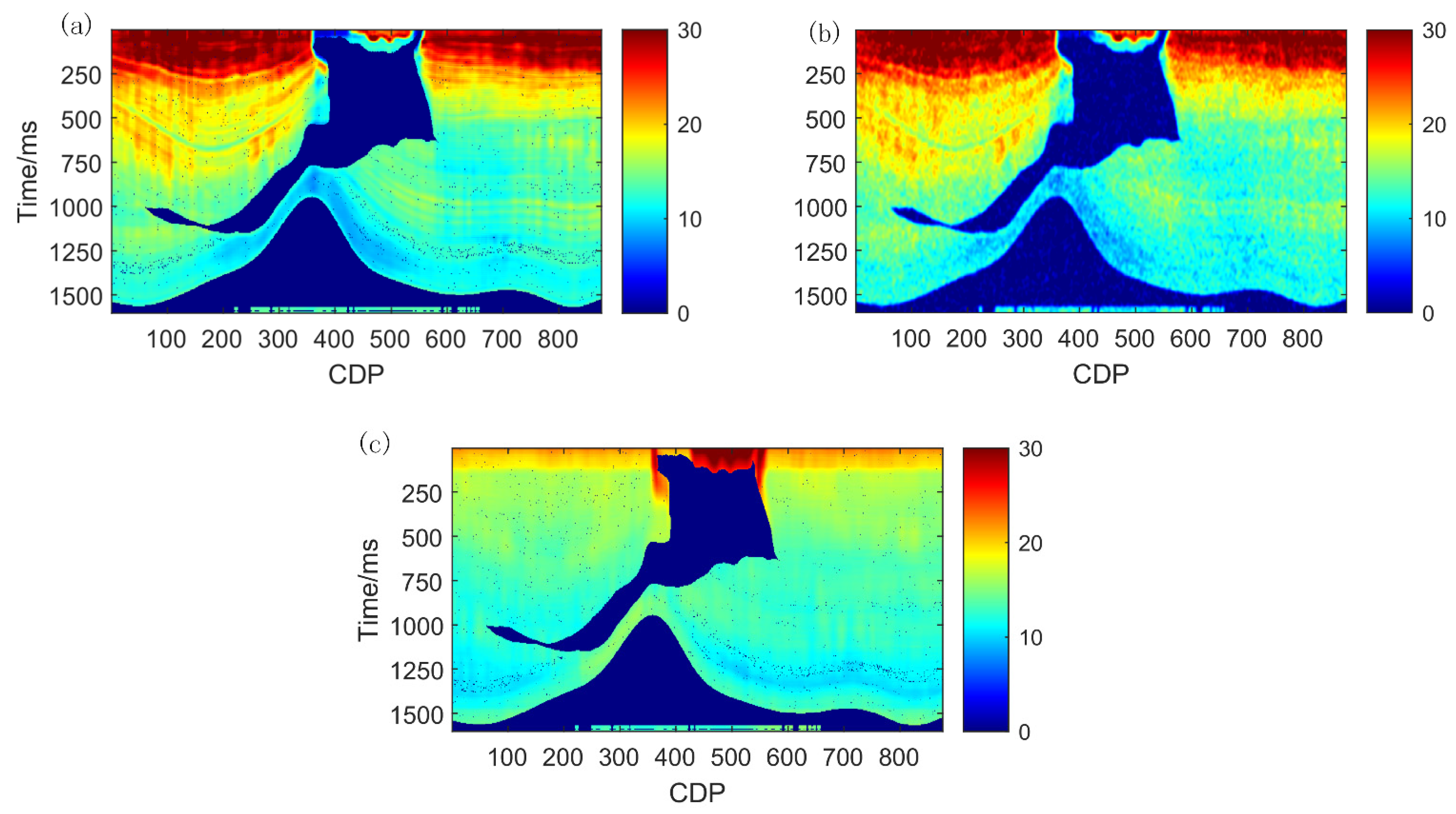
Figure 9. In detail,
Figure 9a illustrates the prediction outcome under noise-free conditions, and
Figure 9b shows the result when random noise with an SNR of 5 is added, and
Figure 9c shows the result when random noise with an SNR of 2 is added. Overall, the prediction profile depicts porosity variations and interlayer heterogeneity well, showing distinct responses at structural boundaries and reservoir zones. The results maintain high credibility even in the presence of strong noise.
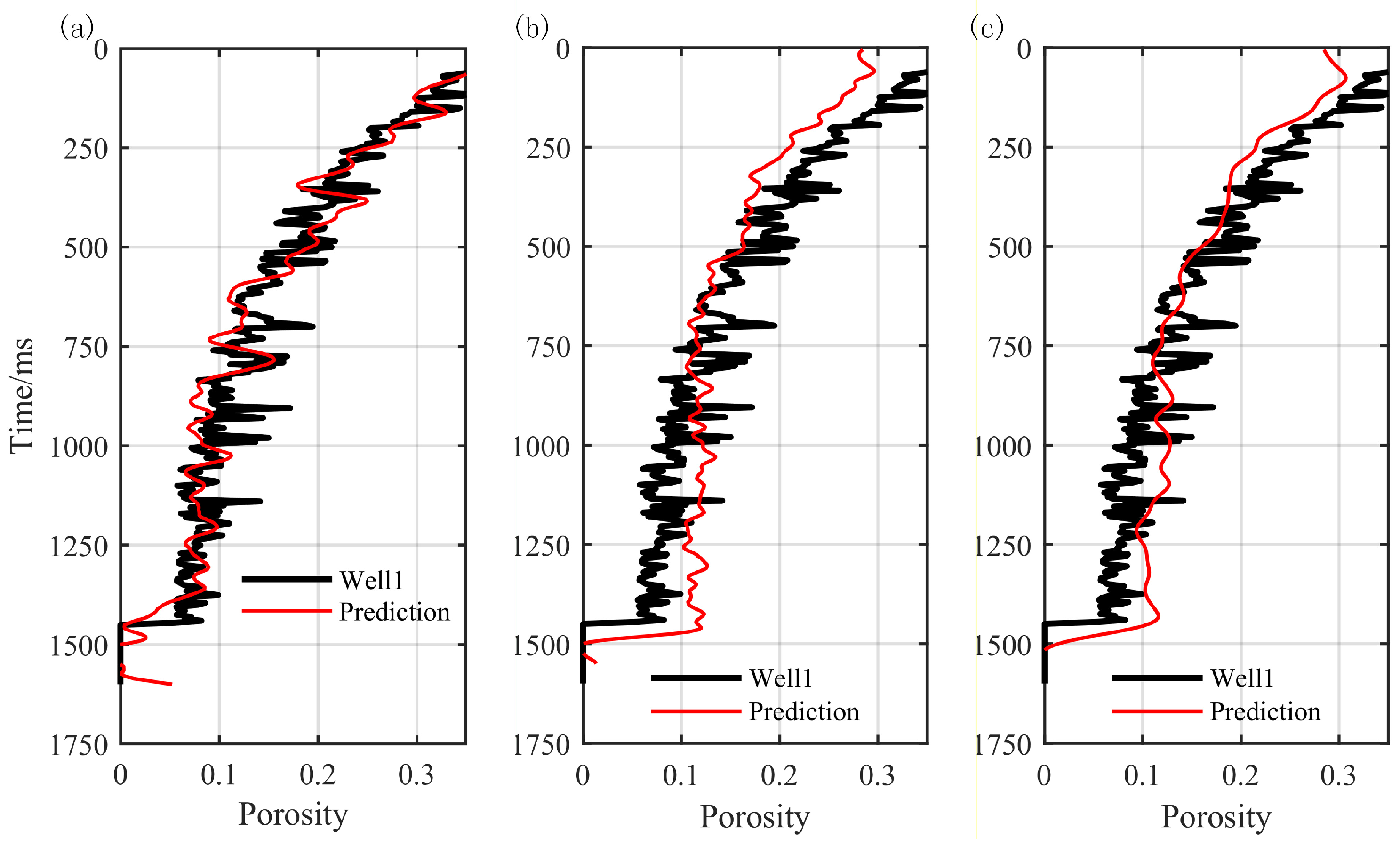
Figure 10 presents a comparison of predicted and actual porosity at well W1, where the overall trends are highly consistent, with discrepancies occurring only at certain localized depths.
To further quantitatively evaluate the prediction performance of the proposed method under different noise conditions, RMSE, MAE, and correlation coefficient (Cor) were calculated between the predicted porosity and the true porosity at the validation well, as listed in
Table 2. The results show that the proposed method achieves high prediction accuracy under noise-free conditions, with an RMSE of 3.8205, an MAE of 3.0653, and a correlation coefficient of 0.9403. When random noise is added, the prediction accuracy decreases slightly, but the overall performance remains stable. For the SNR = 5 case, the RMSE and MAE increase to 4.3507 and 3.6009, respectively, while the correlation coefficient remains high at 0.9319. Even under the stronger noise condition of SNR = 2, the correlation coefficient is still 0.8752, indicating that the predicted porosity maintains a good consistency with the true model. These quantitative results demonstrate that the proposed physics-constrained LSTM-UNet method has good robustness and noise resistance in seismic porosity prediction.
In conclusion, the LSTM-Unet–based porosity inversion method proposed in this study not only performs well in noise-free scenarios but also shows strong noise resistance in high-noise environments, highlighting its robustness. Such performance benefits from the LSTM module’s strength in modeling high-dimensional temporal features and the Unet architecture’s capability in multi-scale feature integration and structural identification. Additionally, the method features a joint data–model-driven framework, allowing efficient integration of seismic waveforms with structural information even in complex geological and noisy conditions. It enables reliable porosity prediction and offers a novel technical route and theoretical foundation for the characterization of real oil and gas reservoirs.
4. Field Data Test
In order to validate the practical applicability of the porosity prediction method based on joint rock physics modeling and data-driven approaches, this study uses post-stack seismic data from a representative study area located at the southeastern margin of a sedimentary basin. The study area lies within a NE-trending tectonic belt and has experienced uplift–depression evolution from the Caledonian to Indosinian periods. It was further modified by strong compressional tectonics during the Yanshan–Himalayan orogeny, resulting in the present-day NE-trending fault–fold structural framework. Fault development in the area is relatively limited, with only locally developed small-scale reverse faults. The fold structures are generally well preserved, and the strata strike NE–SW with NW dips ranging from 5° to 15°, which is consistent with the regional tectonic background.
The study region hosts extensive marine sedimentary formations, within which sandstone reservoirs constitute important targets for hydrocarbon exploration and development. Neighboring areas have already achieved commercial production, indicating favorable reservoir conditions and significant industrial potential. Within the study area, the target sandstone formation is well preserved, and certain intervals exhibit clear hydrocarbon shows, suggesting good conditions for reservoir modification and hydrocarbon accumulation. The field data test focuses on the target sandstone interval. The inversion integrates available well logging, drilling, and seismic data, together with the proposed joint data–model-driven approach, to evaluate the model’s adaptability and prediction accuracy under complex geological conditions.
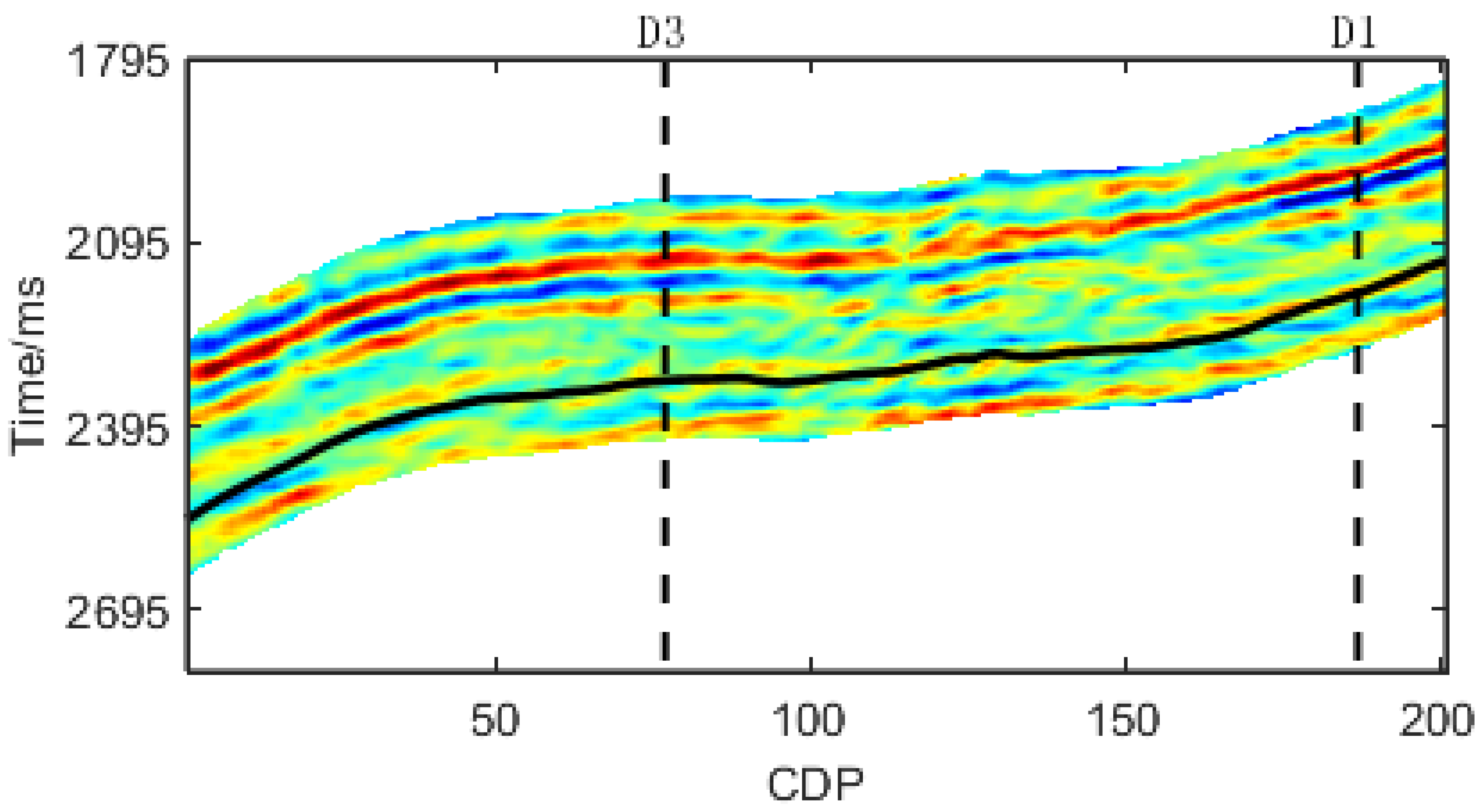
Figure 11 shows the post-stack seismic profile of the selected test region, with dashed lines indicating the well locations.
Figure 12 presents the acoustic impedance profile obtained from inversion.
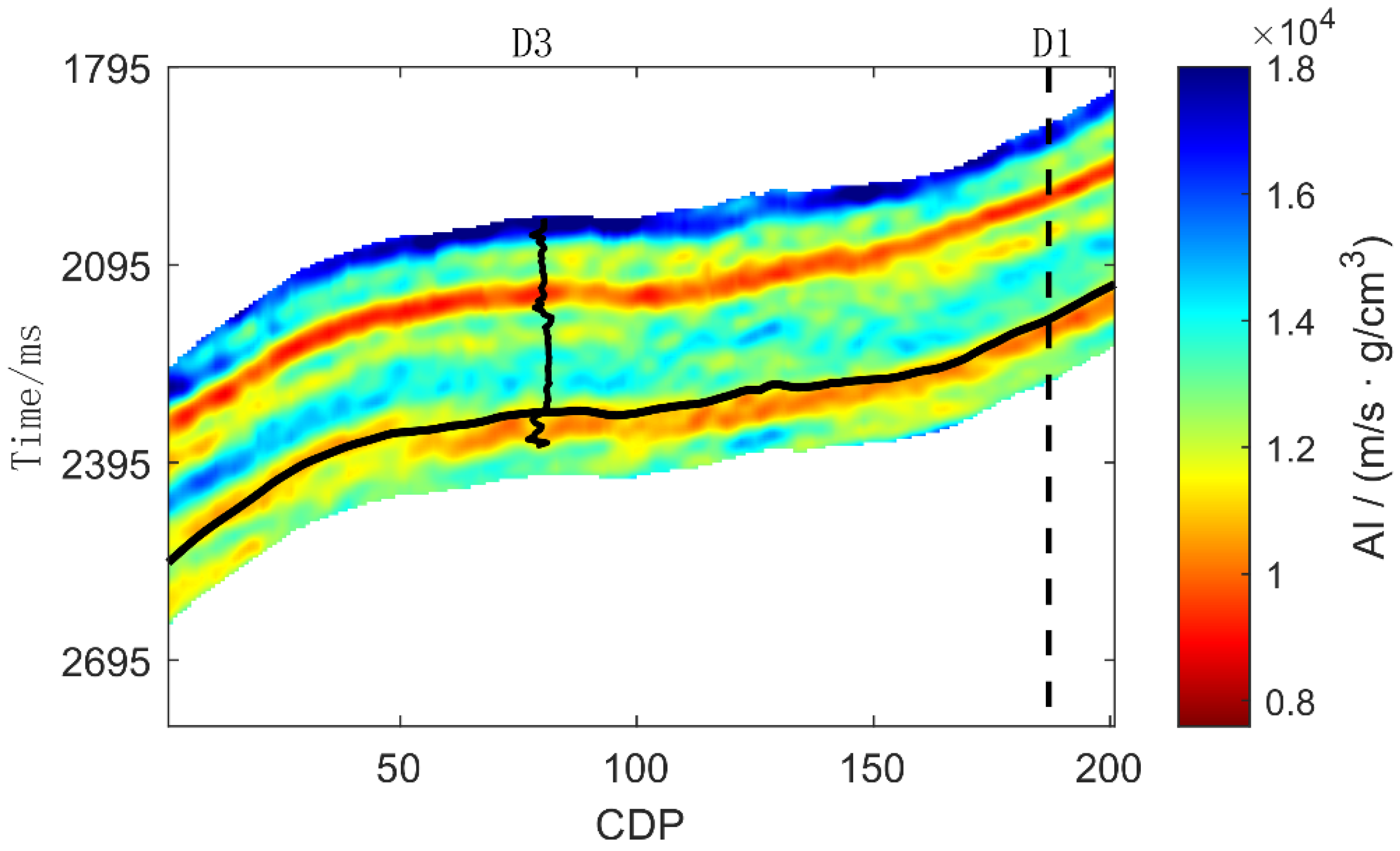
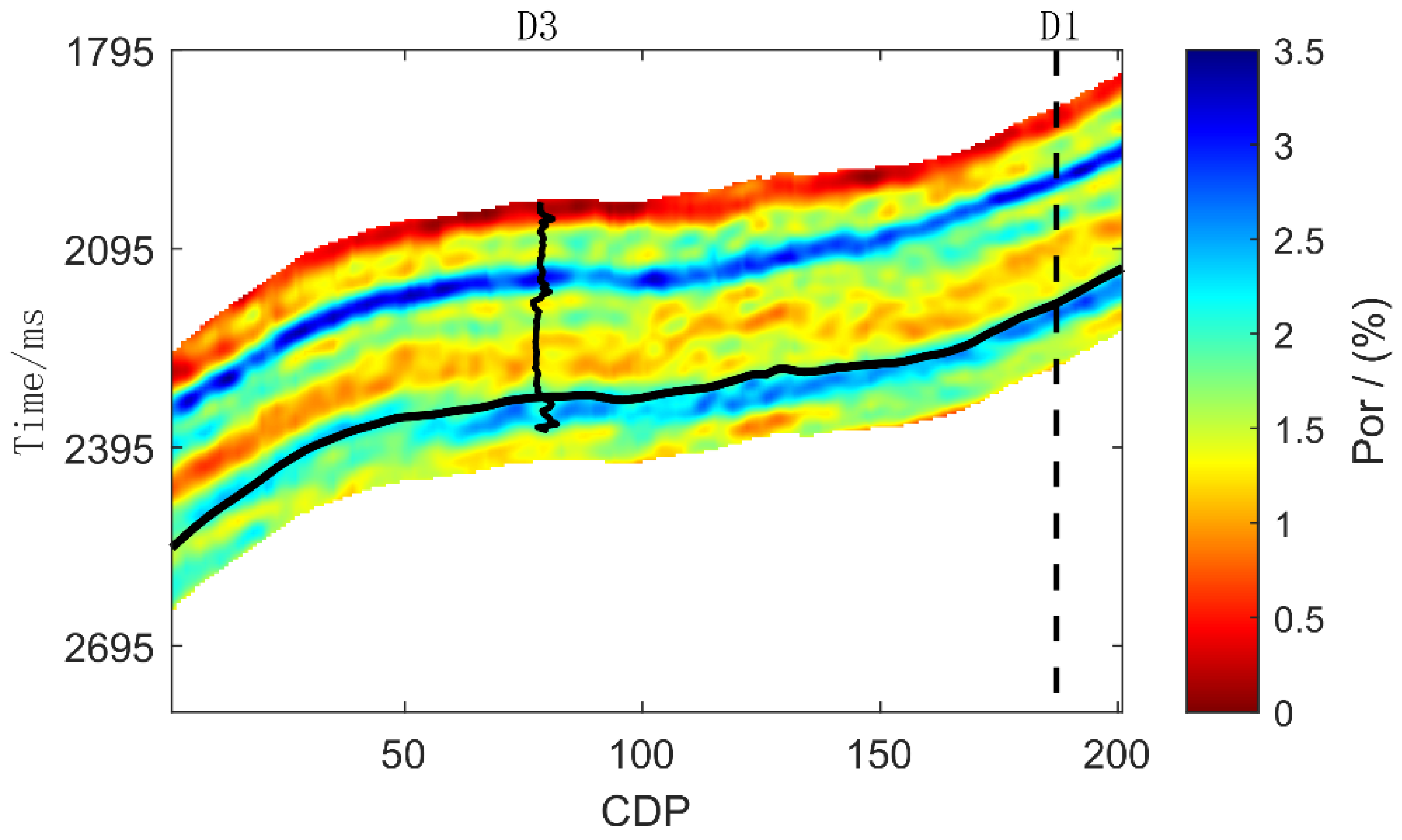
Figure 13 illustrates the predicted porosity profile. The black curve represents the well log from a representative well, and the inversion results clearly delineate the main porosity distribution within the study area.
As shown in
Figure 13, the porosity inversion profile indicates that the sandstone reservoir in the study area exhibits a clearly stratified distribution, with significant variations among different structural units. Higher-porosity zones are mainly distributed in structural highs and favorable depositional facies belts. The predicted results are consistent with the general reservoir development patterns in the region. At well D3, the inverted porosity trend shows good agreement with the measured porosity log, demonstrating the capability of the proposed method to capture vertical heterogeneity within the reservoir. In addition, the predicted porosity between wells exhibits strong lateral continuity, effectively compensating for the spatial limitations of sparse well control. More specifically, the inversion results suggest that the reservoir porosity is generally at a medium to low level, while certain intervals present localized zones of relatively higher porosity, particularly in structurally favorable positions and zones influenced by sedimentary facies variations. This distribution pattern reflects the combined control of structural framework and depositional processes on reservoir properties.
Furthermore, the results indicate that incorporating rock physics constraints into the deep learning framework effectively reduces the risk of overfitting and enhances the robustness of prediction in noisy environments, thereby improving the geological consistency and reliability of the inversion results. In summary, the field data application demonstrates that the proposed joint data–rock physics-driven porosity prediction method achieves reliable and high-resolution porosity estimation under complex geological conditions and limited well constraints. The predicted results not only match well with well-log observations but also exhibit strong lateral continuity and stability, providing a solid basis for reservoir characterization in the study area.
5. Discussion
The proposed joint-driven porosity prediction method demonstrates strong adaptability and effectiveness in both theoretical modeling and practical applications. Numerical tests using the SEAM model show that the method can reliably recover porosity distribution features under different noise levels, indicating that the combination of LSTM and Unet in the network structure effectively extracts multi-scale spatial features and temporal dynamics from seismic data, while maintaining prediction accuracy in complex signal environments. In the field data test from the Dingshan structure in the southeastern Sichuan Basin, the predicted porosity section shows a high consistency with the well-log porosity curve, further confirming that embedding rock physics constraints in the deep learning process not only improves geological rationality and interpretability, but also provides better spatial continuity compared with traditional methods. Relative to conventional methods, the approach presented here achieves clear advancements. Rock-physics-driven porosity prediction generally relies on simplified assumptions, such as homogeneity and isotropy, which cannot capture the nonlinearities inherent in complex reservoirs, leading to limited accuracy. Purely data-driven approaches, though capable of modeling complex input–output relationships, lack physical constraints and often produce predictions that are numerically reasonable but geologically inconsistent. Traditional post-stack inversion methods, which depend solely on impedance inversion after the loss of AVO features, similarly suffer from reduced precision and reliability. By contrast, the proposed joint-driven method embeds rock physics constraints into the optimization of deep neural networks, effectively merging the interpretability of physics-driven models with the adaptability of data-driven methods, thus enhancing both prediction accuracy and geological validity.
Despite the favorable outcomes in both synthetic and real-data tests, some limitations exist. The rock physics modeling framework adopted here is still based on the classical Gassmann equation and K-T model, without accounting for more complex features such as dual-porosity systems, fracture networks, or anisotropic fluid distributions. This may restrict performance in highly heterogeneous reservoirs. Furthermore, the deep learning network requires abundant and representative training data; in areas with sparse well control, model generalization may be weakened. Additionally, the LSTM-Unet architecture involves a large number of parameters, leading to high computational costs that may hinder large-scale deployment. In terms of computational complexity, the main computational burden of the proposed method comes from the convolution operations in the Unet encoder–decoder structure, the recurrent calculations in the LSTM modules, and the additional rock-physics-based forward modeling used for physical constraint calculation. For a seismic input with spatial size H × W, convolution kernel size k, input channels, and output channels, the complexity of a typical convolution layer is approximately. The LSTM module further introduces sequential computation along the temporal dimension, with a complexity approximately proportional to O(Td2), where T denotes the sequence length and d is the feature dimension. In addition, the rock physics modeling and seismic forward modeling steps increase the computational cost during training because the predicted porosity needs to be converted into elastic parameters and then used to generate synthetic seismic records for loss calculation. However, these physics-guided calculations mainly affect the training stage. Once the network is trained, the prediction stage only requires forward propagation through the LSTM-Unet network, which is much more efficient than conventional iterative inversion. Therefore, although the proposed method has higher training complexity than a standard Unet or purely data-driven network, it provides improved physical consistency, robustness, and geological reliability.
Although the proposed physics-constrained LSTM-UNet method achieves satisfactory results in both synthetic and field data tests, several limitations should still be noted. First, the prediction performance depends on the quality and representativeness of the training wells. When well control is very limited or the training wells cannot adequately represent the geological characteristics of the prediction area, the generalization ability of the model may decrease. Second, the proposed framework relies on rock physics assumptions, such as the Gassmann equation and critical porosity model. If the reservoir contains complex pore structures, strong fractures, significant anisotropy, or complicated fluid distributions, these assumptions may not be fully valid and may introduce uncertainty into the prediction. In addition, under extreme noise conditions or poor seismic data quality, the seismic features extracted by the network may become unreliable, leading to increased prediction errors. Therefore, future work should further incorporate more diverse well data, improve adaptive rock physics constraints, and introduce uncertainty analysis to enhance the applicability of the method under complex geological conditions.
Future work can evolve along multiple directions. First, incorporating additional wavefield information, such as joint inversion of PP and PS data or anisotropy parameters, may improve both accuracy and robustness. Second, more advanced rock physics models that account for complex pore systems and fluid distributions could enhance the geological realism of constraints. Moreover, approaches like transfer learning, semi-supervised learning, and physics-informed neural networks (PINNs) hold potential for addressing the challenge of limited training data. Finally, introducing uncertainty quantification and confidence interval estimation into the predictions would further strengthen the method’s practical utility in reservoir characterization and production planning.
6. Conclusions
This study proposes a porosity prediction method for sandstone reservoirs that is jointly driven by data and rock physics models. Its effectiveness and reliability are validated through both theoretical modeling and field data applications. The designed LSTM–Unet architecture effectively integrates spatial and sequential feature extraction, enabling the model to capture multi-scale structural characteristics and complex seismic response patterns. Synthetic experiments based on the SEAM porosity model demonstrate that the proposed method maintains stable and accurate predictions under both noise-free and noisy conditions, highlighting its robustness and generalization capability. Application to field seismic data further confirms that the method can reliably delineate reservoir porosity distributions in complex geological settings. The predicted porosity shows good agreement with well-log data, and exhibits strong lateral continuity, demonstrating its practical applicability under conditions of limited well control.
Overall, the proposed joint data–rock physics-driven framework is both theoretically grounded and practically effective. It provides a robust and interpretable approach for porosity prediction in sandstone reservoirs, offering valuable support for reservoir characterization, hydrocarbon exploration, and related engineering applications.