Article

Influence of Catalyst Preparation and MAO Purity on the Kinetics and Active-Site Behavior of CpTiCl3/MAO in Polybutadiene Synthesis

by
Teresa Córdova
1,
Alexandre Canarin-Madeira
1,
Jorge Herrera-Ordoñez
2,
Ilse Magaña
1,
Hened Saade
1,
Héctor Ricardo López-González
1,
Luis Valencia
3,* and
Ramón Díaz de León
1,*
1
Research Center for Applied Chemistry, Blvd. Enrique Reyna 140, Saltillo 25294, Mexico
2
Center for Applied Physics and Advanced Technology, Blvd. Juriquilla 3001, Queretaro 76230, Mexico
3
Greewave AB, Skrikarhyttan 116, 71392 Gyttorp, Sweden
*
Authors to whom correspondence should be addressed.
Processes 2026, 14(11), 1698; https://doi.org/10.3390/pr14111698
Submission received: 27 February 2026 / Revised: 8 May 2026 / Accepted: 21 May 2026 / Published: 24 May 2026
(This article belongs to the Section Catalysis Enhanced Processes)

Abstract

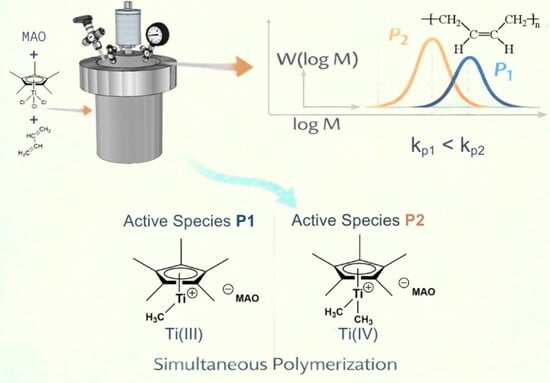
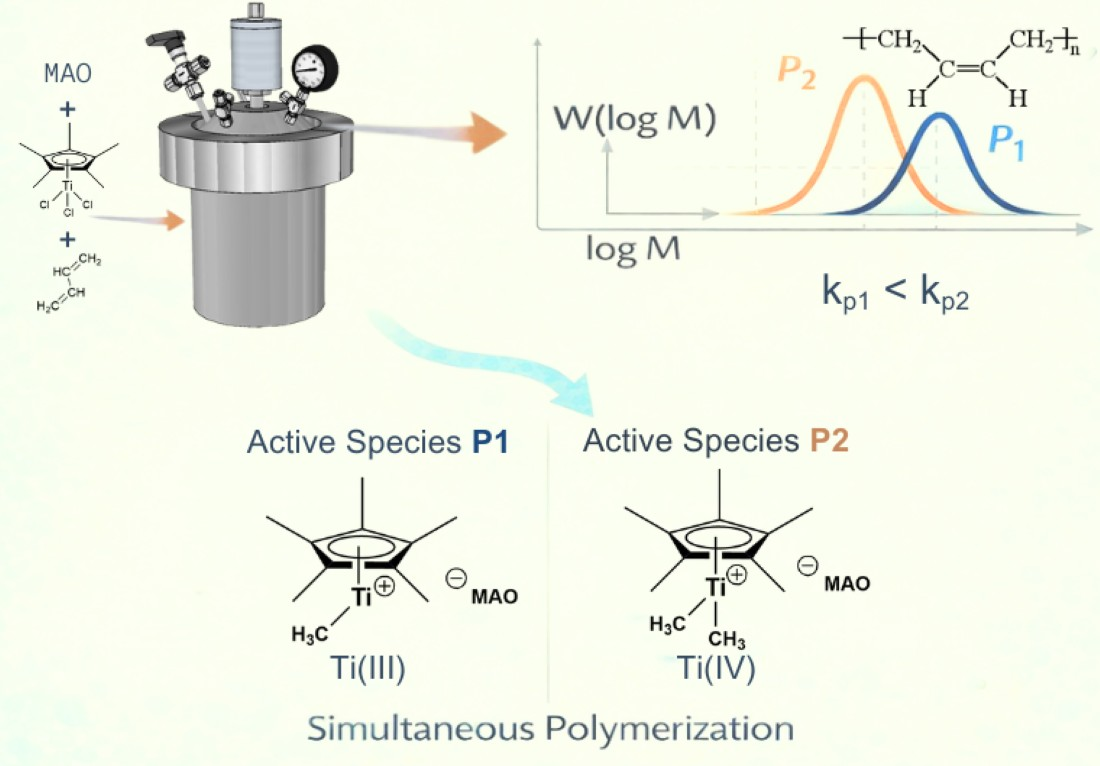
The coordination polymerization of 1,3-butadiene with half-metallocenes/MAO catalysts is a versatile route to polybutadiene, yet the kinetic impact of catalyst preparation remains poorly understood. This work compares CpTiCl3/MAO systems prepared either in situ or by aging as a function of [MAO]/[Ti], temperature, and the presence of residual trimethylaluminum (TMA) in MAO. Aged catalysts display markedly higher activity than in-situ systems, achieving up to 99% conversion at [MAO]/[Ti] = 250 (vs. 34% in situ) while maintaining similar molecular weights and cis-1,4 microstructure (76–77%). Because the in-situ and aged systems were evaluated at different titanium concentrations, this activity difference should be interpreted as arising from both catalyst pre-conditioning and differences in effective Ti concentration. Time-resolved GPC coupled with chromatogram deconvolution reveals two coexisting macromolecular populations, associated with kinetically distinct chain-growth contributions. For aged systems, the corresponding apparent propagation rate constants remain of the same order of magnitude throughout the reaction, consistent with persistent catalytic heterogeneity rather than progressive site deactivation. The role of residual trimethylaluminum (TMA) in commercial MAO is clarified: TMA accelerates initial activation and enhances chain transfer processes, lowering molecular weight and broadening dispersity, but does not measurably affect cis-1,4 selectivity, which is governed by the ligand environment of CpTiCl3. Overall, thermal aging and MAO conditioning emerge as effective tools to tune the kinetic behavior of CpTiCl3/MAO catalysts without compromising microstructural control in polybutadiene synthesis.

Graphical Abstract

1. Introduction

The coordination polymerization of 1,3-butadiene is a chemical process of significant industrial and academic relevance due to the wide application of poly(butadiene) in high-performance elastomeric materials, including tires and synthetic elastomers [1]. This type of polymerization has been extensively studied, employing various catalytic systems to control the microstructure of the resulting polymer, such as cis-1,4, trans-1,4, or 1,2-vinyl units, which directly influence the mechanical properties of the final material [2].
A wide range of catalytic systems has been explored for the coordination polymerization of 1,3-butadiene, among which group IV organometallic complexes activated with methylaluminoxane (MAO) stand out for their high activity and versatility. Monocyclopentadienyl titanium complexes such as CpTiCl3 represent a distinct category of catalyst, often referred to as half-metallocenes, whose coordination environment differs significantly from that of traditional bis(cyclopentadienyl) systems [3].
When CpTiCl3 is combined with MAO, catalyst activation involves concurrent alkylation of the titanium center and abstraction of chloride ligands, generating electrophilic species capable of coordinating and inserting conjugated dienes. In addition, interaction with aluminum alkyls may lead to a distribution of titanium species with different electronic environments, potentially including reduced forms such as Ti(III), although the exact oxidation state is not directly established in the present work [2,4]. As a consequence, the system is better described as evolving toward a distribution of catalytically distinct species rather than a single, well-defined active center.
An additional factor that can influence the nature of the catalytic species is the method used for catalyst preparation. While in situ activation, where CpTiCl3 and MAO are mixed directly in the reaction medium, is commonly employed [5,6], pre-activation or aging procedures have also been reported [7,8]. In these approaches, the components are allowed to interact prior to polymerization, which can promote structural rearrangements within the aluminoxane and alter the equilibrium between different titanium species. Such pre-conditioning may have a significant impact on both catalytic activity and the distribution of active sites [8,9,10].
In titanium-based catalysts, activation with MAO involves simultaneous processes of alkylation, chloride abstraction, and the generation of coordinatively unsaturated species capable of initiating insertion. These transformations were first described in classical studies on titanocene complexes, where it was reported that the Ti-MAO interaction does not lead to a single active center, but rather to a distribution of catalytic species exhibiting different propagation and chain transfer rates [11]. This multiplicity of catalytic centers complicates the overall kinetics of the system and is reflected in non-monomodal molecular weight distributions, even under apparently simple reaction conditions.
Recent studies have demonstrated that GPC profile deconvolution can elucidate the coexistence of multiple active species, where the appearance of distinct macromolecular populations correlates with catalytic centers operating with different activities and mechanisms [4]. These observations highlight that molecular weight profiles constitute a critical tool for investigating not only the final polymer but also the internal dynamics of the catalytic system during the reaction [12].
Despite extensive prior study of titanium-MAO systems, the relationship between preparation methodology (in situ versus pre-aging) and the resulting kinetic behavior of multiple active-site species has not been systematically characterized in CpTiCl3-based catalysts through quantitative kinetic analysis [13,14]. This represents a significant gap, particularly given the industrial importance of butadiene polymerization and the need to optimize catalyst efficiency and control polymer properties.
Within this conceptual framework, the present work shows that the preparation mode of the CpTiCl3/MAO catalytic system, whether generated in situ or through aging, has a measurable impact on catalytic activity and reaction kinetics, even when similar polymer microstructures are obtained. However, because the in situ and aged systems were evaluated at different titanium concentrations in part of the study, the observed differences in conversion should not be attributed exclusively to the aging method. Instead, the results indicate that catalyst pre-conditioning acts in combination with concentration-dependent effects to influence the kinetic response of the system. Time-resolved GPC analysis combined with chromatogram deconvolution was therefore used as a semi-quantitative tool to examine how catalyst preparation and MAO composition influence the distribution of macromolecular populations and their apparent propagation behavior.

2. Materials and Methods

2.1. Materials

All manipulations were conducted either in an MBraun 10 glovebox (Labmaster 130, MBraun, Gaithersburg, MD, USA) or under an inert atmosphere using dual vacuum–nitrogen manifold and standard Schlenk techniques. 1,3-butadiene (Sigma-Aldrich, St. Louis, MO, USA; 98% purity) was further purified prior to use by passing it through a packed column containing a 50/50 (w/w) mixture of activated aluminum oxide and molecular sieves. Toluene (Quimica Delta, Mexico City, Mexico; 95.5% purity) was purified by distillation over metallic sodium under a nitrogen atmosphere. Methylaluminoxane (Sigma-Aldrich, Sheboygan, WI, USA; 10% Toluene, 4–8 wt% Al concentration). Cyclopentadienyltitanium (IV) trichloride (Sigma-Aldrich, She-boygan, WI, USA; 97% purity) was dissolved in purified toluene to obtain a final concentration of 0.153 mmol/L.

2.2. Catalytic System

Two approaches were employed for the preparation of the [CpTiCl3]/[MAO] catalytic system: the in situ method and the aging method. For each preparation route, two experimental sets were designed to probe stoichiometric dependencies. In the first set, the titanium concentration was held constant within each preparation mode while the MAO concentration was systematically varied. In the second set, the MAO concentration was maintained fixed, and the CpTiCl3 concentration was varied. All polymerization reactions were conducted at 25 °C unless otherwise specified. In the aging method, the catalytic system was pre-contacted separately inside the glovebox by stirring MAO and CpTiCl3 for 30 min at 30 °C prior to transfer to the reactor. Therefore, the aging temperature and the polymerization temperature correspond to different steps of the experimental procedure. Table 1 summarizes the specific concentrations used under each condition.

2.3. Polymerization

All manipulations were carried out under a dry nitrogen atmosphere using toluene as the solvent in a 1 L stainless-steel reactor equipped with mechanical stirring and temperature control via an internal cooling/heating system.
Toluene and 1,3-butadiene (Bd) were introduced into the reactor through a feeding system composed of glass columns under nitrogen. The reactor was then pressurized and heated with an electric heating jacket until reaching the desired reaction temperature, while maintaining an agitation rate of 150 rpm. Once the temperature stabilized, the catalytic system prepared either in situ or by the aging method, according to the experimental design, was added to initiate the polymerization.
During the reaction, aliquots were periodically withdrawn, quenched with methanol to stop the reaction, and the conversion was subsequently determined by gravimetry. At the end of the specified polymerization time, the reaction was completely terminated by adding 1 mL of acidified methanol (10% vol HCl) containing pentaerythritol tetrakis(3(3,5-ditertbutyl-4-hydroxyphenyl)propionate) (Irganox 1010, 0.5 wt%) (BASF, Ludwigshafen, Germany) as a stabilizer. The resulting polymer was precipitated in excess methanol (polymer:methanol = 1:4 v/v), repeatedly washed with methanol, and finally dried in a vacuum oven at 50 °C to constant weight.

2.4. Polymer Characterization

The analysis of molecular weights and molecular weight distributions was determined by gel permeation chromatography (GPC) using polystyrene standards for calibration. Therefore, the reported molecular weights correspond to relative values, since the hydrodynamic volume of the polybutadiene differs from that of polystyrene. Nevertheless, because all samples were analyzed under the same calibration and operating conditions, the data remains suitable for comparative analysis of molecular weight trends within this study.
The microstructure of the obtained polybutadiene samples was analyzed by 1H and 13C NMR spectroscopy using a 400 MHz spectrometer, with CDCl3 as solvent at 25 °C. In the 1H NMR spectra, the olefinic protons of 1,4-units appeared in the region of 5.3–5.6 ppm, while vinyl units appeared at 4.9–5.2 ppm. Complementarily, 13C NMR spectra were used to distinguish between cis-1,4, trans-1,4, and 1,2-vinyl configurations, in which characteristic signal were observed. The signals were assigned according to reported data, with cis-1,4 units typically appearing around 22–26 ppm, trans-1,4 units near 28–32 ppm, and vinyl carbons in the ranges of 116–120 ppm.
The relative content of 1,2-vinyl (Equation (1)) and 1,4 units (Equation (2)) was determined from the integration of the corresponding signal in the 1H NMR spectra using the following relationships:
%   1 , 2 = I v i n y l I v i n y l + I 1 , 4 × 100
%   1 , 4 = I 1 , 4 I v i n y l + I 1 , 4 × 100
The relative proportion of cis-1,4 (Equation (3)) and trans-1,4 (Equation (4)) configurations was estimated from the integration of their respective signals, according to:
%   c i s - 1 , 4 = I c i s I c i s + I t r a n s × %   1 , 4
%   t r a n s - 1 , 4 = I t r a n s I c i s + I t r a n s × %   1 , 4

3. Results

3.1. [MAO]/[CpTiCl3] Ratio and Catalyst Preparation

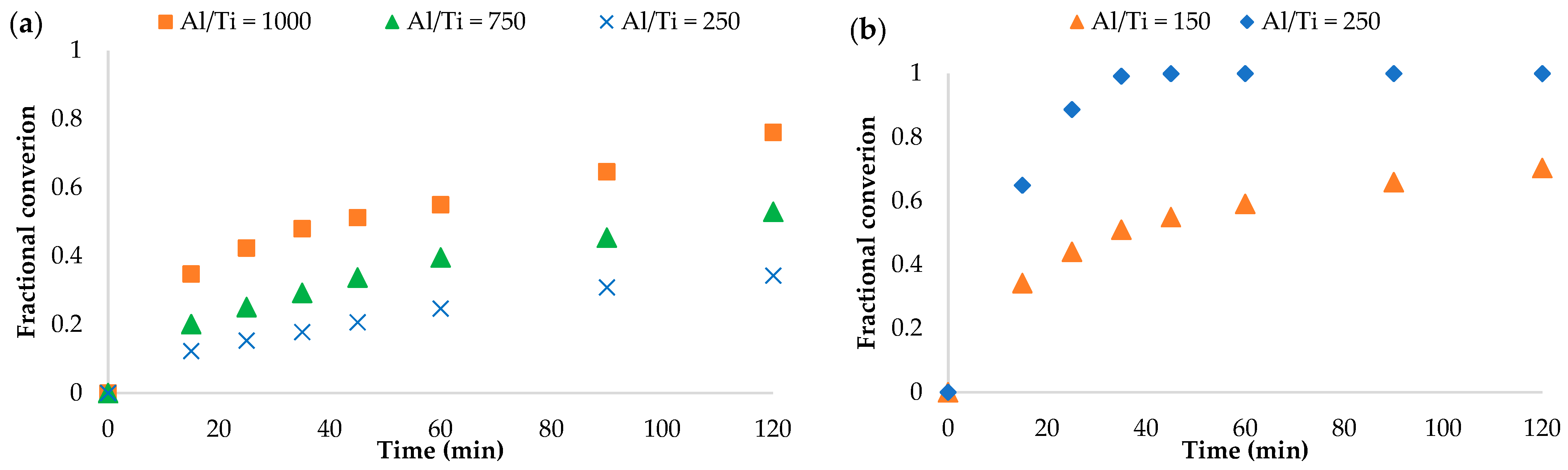
The catalytic performance of group IV half-metallocene/MAO systems in olefin polymerization is sensitive to both cocatalyst composition and activation methodology, yet mechanistic understanding of these dependencies remains incomplete for butadiene synthesis. In the present case, the effect of the [MAO]/[CpTiCl3] ratio, evaluated at fixed CpTiCl3 concentration within each preparation mode, shows that conversion increases as the amount of MAO is raised. In the in situ system, conversion rises gradually from 34% at [MAO]/[CpTiCl3] = 250:1 to 76% at 1000:1 over 120 min, consistent with the progressive generation of catalytically competent species in the reactor. In the aged system, conversion approaches 100% under comparable nominal ratios; however, this higher activity must be interpreted with caution because the aged and in situ systems were evaluated at different titanium concentrations. Accordingly, the enhanced conversion observed for the aged system is attributed to a combination of catalyst pre-conditioning during aging and differences in effective Ti concentration, rather than to the aging treatment alone.
The effect of the [MAO]/[CpTiCl3] ratio, when the concentration of CpTiCl3 is kept constant, and the amount of MAO is increased (Table 2), is consistent with the behavior commonly observed for half-metallocene/MAO systems, in which catalytic activity depends on the availability of aluminoxane species capable of promoting alkylation and chloride abstraction.
This dual activation mechanism, comprising Ti-Cl alkylation (forming Ti-Me species) and chloride abstraction (generating cationic Ti+ centers), has been widely described in the literature for MAO-activated half-metallocenes catalysts in olefin polymerization [3], yet its specific manifestation in butadiene chemistry reveals distinct kinetic signatures. In the case of the in situ preparation method, the conversion increases gradually as the [MAO]/[CpTiCl3] ratio grows (Figure 1a), rising from 34% at ratio 250:1 to 76% at ratio 1000:1 over 120 min reflecting that the catalytic species are generated directly in the reactor through alkylation processes, where rapid kinetic limitations emerge from the initial equilibrium between Ti-Cl and Ti-Me species, with [MAO] availability governing the forward rate of cationic species formation [14].
In contrast, when the catalytic system is prepared through an aging procedure (Table 1), a much more pronounced increase in conversion is observed, reaching values close to 100% (Figure 1b). Specifically, aged catalysis at [MAO]/[CpTiCl3] = 250:1 achieves ~100% conversion within 120 min, a ~3-fold kinetic acceleration versus in situ equivalents, which can be attributed to a combination of catalyst pre-conditioning during aging and differences in titanium concentration between systems. This behavior is consistent with previous studies suggesting that aging in MAO-based systems may induce structural reorganization of aluminoxane species, affecting their Lewis acidity and, consequently, the formation and stabilization of catalytically active centers. In addition, interactions between MAO and the titanium precursor may lead to the formation of Al-O-Ti linkages, which could influence the nature of the active species [15].
The molecular weight data exhibit the opposite trend, with Mw decreasing as the proportion of MAO increases. Specifically, aged systems at MAO/Ti = 250 yield Mw = 1300 kDa (Đ = 2.0), whereas in situ equivalents reach 2400 kDa (Đ = 1.7), corresponding to a 45% reduction in average chain length despite the higher conversion. This behavior indicates that, although catalytic activity increases, chain-transfer pathways also become more competitive at higher aluminum concentrations. In this context, the effect is more appropriately described in terms of aluminum-mediated chain-transfer reactions and early chain termination, rather than as a direct or exclusive consequence of β-hydride elimination induced by Al–CH3 groups. The broader dispersities observed for the aged systems, with Đ values ranging from 1.5 to 2.0 compared with 1.5 to 1.7 for in situ systems, are consistent with the coexistence of multiple kinetically distinct chain-growth contributions [4,16]. However, these distributions should be interpreted cautiously and not as direct evidence of discrete active sites.
It should be noted that the comparison between in situ and aged systems involves different titanium concentrations (0.153 mmol/L for in situ and 0.89 mmol/L for aged systems). Therefore, the higher conversion observed for the aged system cannot be attributed exclusively to the aging process. Instead, enhanced activity likely arises from a combination of catalyst pre-conditioning and the higher effective concentration of active species.
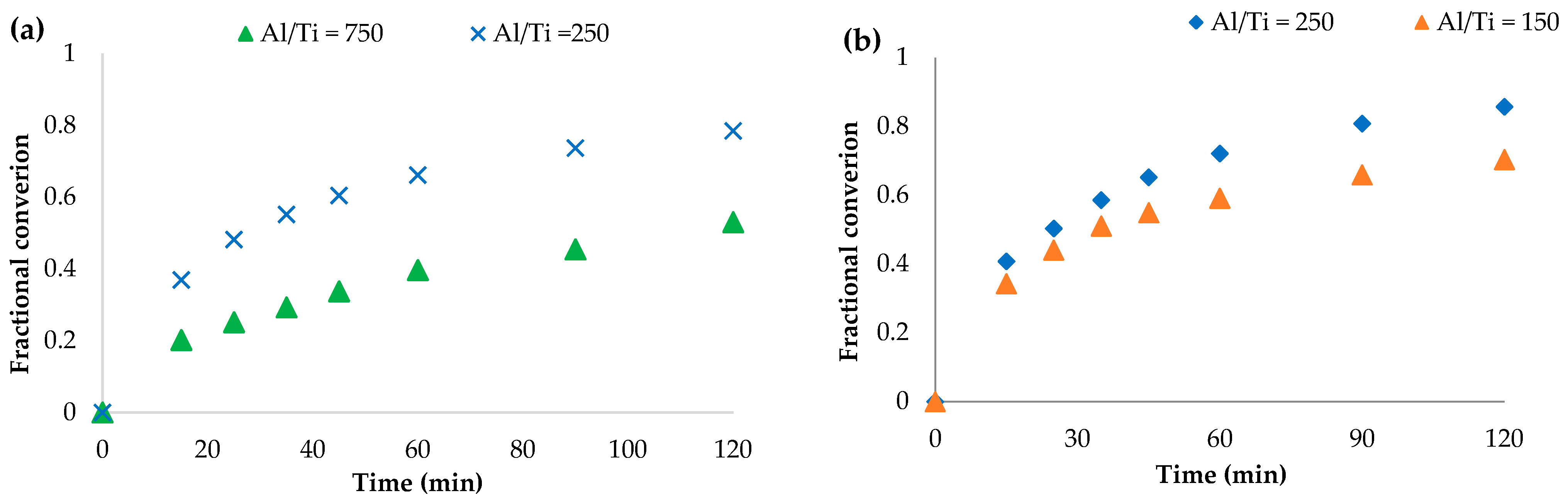
The results from the second experimental set (Table 3 and Figure 2) show the behavior of the system when the MAO concentration is kept constant, and the amount of CpTiCl3 is varied. In the in situ method, conversion increases as the CpTiCl3 ratio are raised, from 53% (ratio 750:1, 120 min) to 79% (ratio 250:1, 120 min), indicating that a higher precursor concentration promotes the formation of catalytically active species upon activation with MAO. However, the improvement is not strictly proportional, suggesting that excess precursor may lead to incomplete activation and the formation of less productive species [14].
In contrast, the aged method exhibits higher conversion at shorter reaction times (35 min), indicating that the catalytic species present in the preformed aged system possess greater intrinsic efficiency [15]. Remarkably, even at elevated Ti loading ([CpTiCl3]/[MAO] = 250), aged catalysis achieves 99% conversion in 35 min versus 79% in situ at 120 min, suggesting that pre-equilibration enhances reactivity under these conditions.
Based on the prior comparison of the catalytic systems, the kinetic analysis focused on evaluating the influence of temperature on polymerization using the aged CpTiCl3/MAO system. To minimize the influence of other variables, the analysis was carried out at a [CpTiCl3]/[MAO] ratio of 250, an MAO concentration of 23 mmol/L, and a monomer concentration of 1.07 mol/L. These conditions were selected because the aged system provides high conversion and reproducible kinetic behavior, allowing the effect of temperature on the apparent propagation behavior to be assessed more reliably.

3.2. Temperature Effect

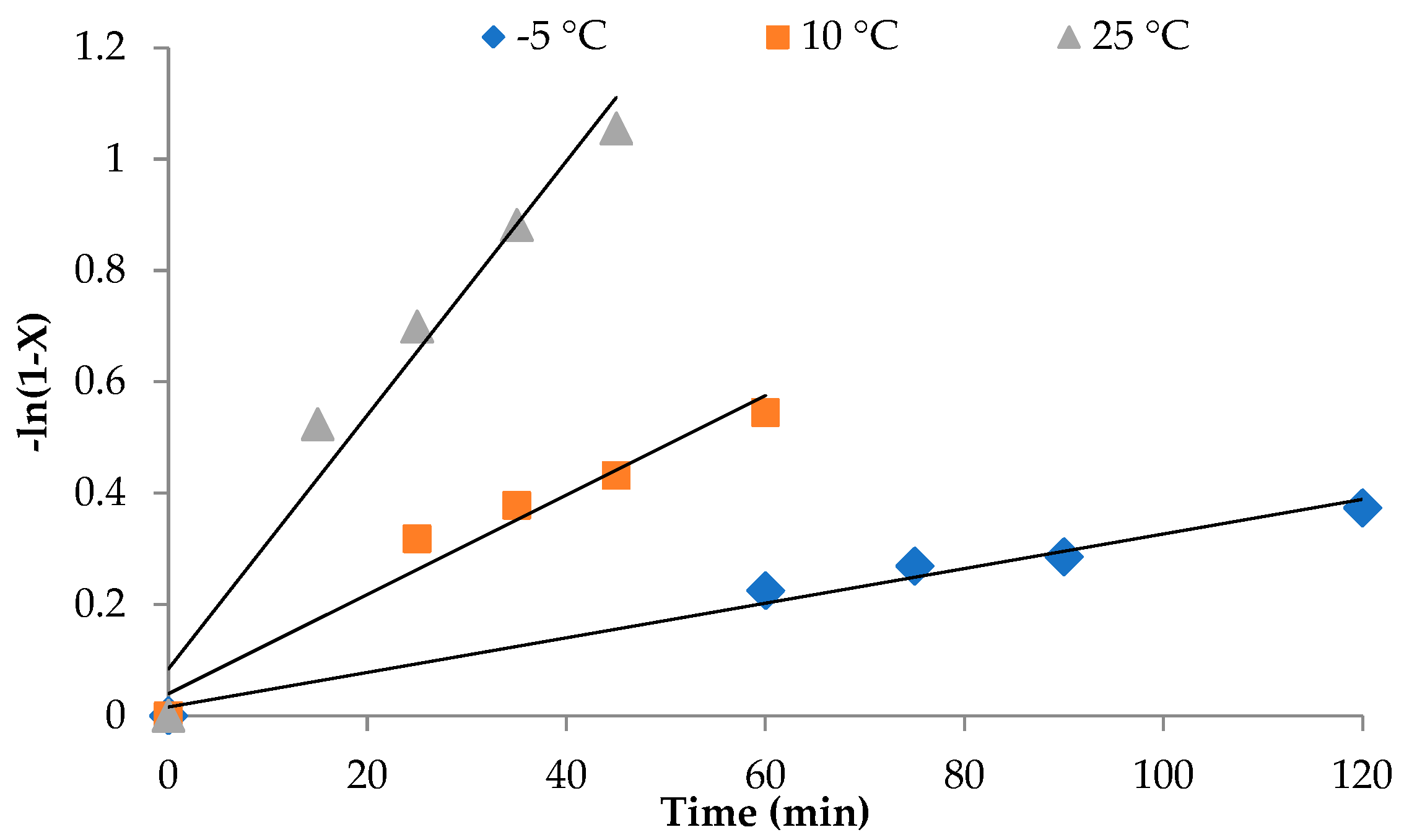
The study of the temperature effect on the aged CpTiCl3/MAO catalytic system reveals clear changes in the polymerization kinetics. Although temperature generally accelerates polymerization reactions, the apparent propagation rate constants ( k p ) obtained in this work do not follow a simple Arrhenius-type behavior. This can be attributed to the coexistence of multiple active-site populations, whose relative contributions change with temperature. As a result, the calculated k p values should be interpreted as effective parameters rather than intrinsic single-site propagation constants (Table 4).
Although increasing the temperature accelerates the reaction, as evidenced by the steeper slopes of the −In(1−X) versus time curves (Figure 3), higher temperatures may also increase the contribution of chain termination and chain transfer processes. These processes, including β-hydride elimination, chain transfer to aluminum, and MAO-mediated deactivation pathways, can alter the apparent kinetic behavior of the system [17]. Consequently, the relative contribution of kinetically less favorable pathways may increase with temperature, broadening the differences between the active site populations. This behavior is consistent with reports for metallocene catalysts activated with aluminoxanes, where elevated temperatures intensify the coexistence of catalytic sites with significantly different propagation rate constants ( k p ) [18].
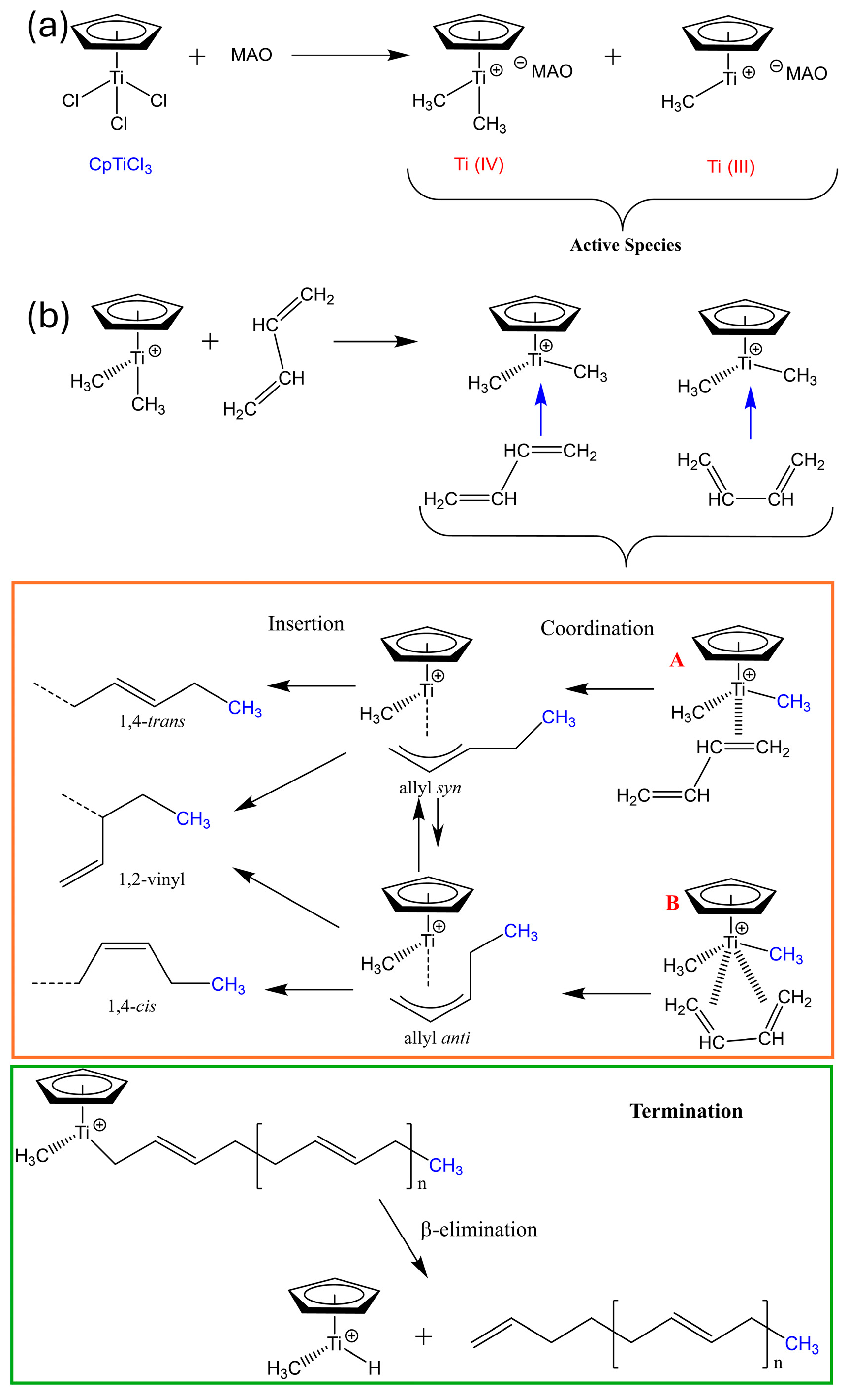
The polymerization of 1,3-butadiene mediated by the CpTiCl3/MAO system can be rationalized within the framework of the Cossee–Arlman mechanism, which describes chain growth as a sequence of coordination and insertion steps at a metal–carbon bond. In the present system, however, this classical mechanism operates within a more complex catalytic environment, where multiple titanium species may coexist and contribute differently to the overall kinetics [3,18].
The activation of CpTiCl3 by MAO involves alkylation and chloride abstraction processes that generate catalytically competent species. Aluminum alkyls can promote the formation of Ti-alkyl bonds, while aluminoxane species act as ionizing agents, producing cationic titanium centers associated with weakly coordinating counteranions. These cationic species, characterized by an open coordination site, are responsible for initiating the coordination insertion sequence described by the Cossee–Arlman model [18]. In parallel, interactions with residual aluminum alkyls may lead to a distribution of titanium species with different electronic properties, potentially including reduced forms such as Ti(III), although the exact speciation is not directly established in the present work [11,14].
This distribution of titanium species provides a mechanistic basis for the coexistence of distinct active site populations, as evidenced by the GPC deconvolution results. The identification of two well-defined macromolecular populations (P1 and P2) indicates that at least two families of catalytically active centers operate simultaneously during polymerization. The population characterized by higher propagation rate constants (P2) may be associated with more electrophilic cationic Ti(IV) species, which exhibit enhanced monomer coordination and insertion efficiency. In contrast, the population with lower propagation rate (P1) could be related to less reactive centers, plausibly involving reduced Ti(III) species or less efficiently activated titanium sites.
These assignments should be considered as a tentative interpretation based on the observed kinetic behavior, rather than as direct evidence of specific oxidation states.
Within this framework, the polymerization proceeds through the classical Cossee–Arlman sequence: Upon generation of the cationic titanium active species, which contain a vacant coordination site, 1,3-butadiene coordinates to the metal center through its conjugated π system (Figure 4a). Subsequently, monomer insertion into the metal–carbon bond occurs via a concerted four-center mechanism. The coordinated diene forms a pre-insertion complex (Figure 4b), followed by a four-center transition state in which the electrons of the Ti-C bond migrate to form a new carbon–carbon bond with the monomer, while the π electron pair reorganizes to establish a new Ti-C bond. This process regenerates the vacant coordination site and enables the sequential repetition of coordination and insertion steps, leading to polymer chain growth.
In the case of 1,3-butadiene, insertion can proceed through allyl syn and allyl anti intermediates, resulting in different microstructures, mainly cis-1,4, 1,4-trans, and 1,2-vinyl units, as illustrated in Figure 4. Microstructural selectivity is governed by the orientation of the diene during coordination and by the electronic and steric environment of the active metal center.
Chain termination and molecular weight control arise from processes competing with propagation. β-hydride elimination, occurring at the titanium center, generates a Ti-H species and a polymer chain with a terminal double bond, whereas chain transfer to aluminum involves the interaction of aluminum alkyl species with the growing chain. The role of aluminum alkyls in promoting chain transfer reactions has been widely reported in MAO-activated systems [15].
The results of GPC deconvolution and kinetic analysis indicate the coexistence of two catalytically active populations, designated as P1 and P2. Based on the experimental evidence and the observed kinetic behavior ( k p , 2 > k p , 1 ), these populations can be tentatively assigned to two cationic titanium species. P2, characterized by higher apparent propagation rate constants, is associated with the more reactive population, whereas P1, with lower propagation rate constants, corresponds to the less reactive population.
Building upon the comparative analysis of catalytic systems prepared in situ and by aging, the aged conditions conducted at 25 °C were selected as the most suitable conditions for evaluating the effect of trimethylaluminum (TMA) present in MAO. Under these conditions, the catalytic system achieves high conversion, exhibits reproducible kinetic behavior, and provides a molecular weight distribution sufficiently sensitive to detect variations in the catalyst response. Accordingly, the selected conditions provide a sound basis for the subsequent kinetic analysis of TMA effects in the aged CpTiCl3/MAO system.

3.3. Effect of Trimethylaluminum in MAO

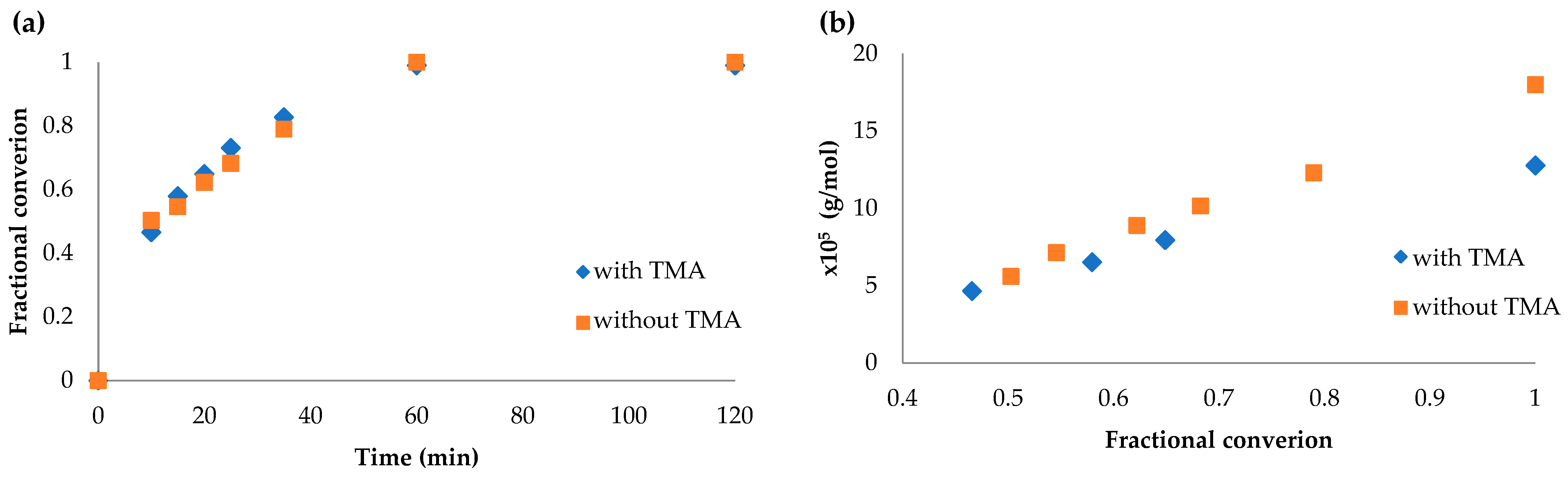
The comparative evaluation of the aged catalytic systems using MAO with and without TMA (Table 5) shows that both systems reach high conversion (99%), indicating that the removal of TMA does not hinder the formation of active titanium species. However, differences are observed in the characteristics of the polymer produced.
In the system containing TMA, faster initial activation is observed (Figure 5a), consistent with the presence of residual TMA promoting the early formation of active titanium species. This enhanced activation is reflected in the higher reaction rate during the early stage. However, the polymer produced in the presence of TMA exhibits a lower molecular weight and broader Ð. This behavior suggests an increase in chain-transfer pathways, including possible TMA-mediated termination processes, which are favored by the excess of Al-Me species [14].
In contrast, the system employing purified MAO (TMA-free) exhibits slightly slower kinetics but produces polymers with higher molecular weights and narrower dispersity (Figure 5b). This behavior suggests that, in the absence of TMA, the highly reactive Al-Me species no longer interfere in the reaction, leading to a higher propagation to transfer ratio and broadened molecular weight distribution.
To further investigate the origin of the kinetic and macromolecular differences observed between the systems with and without TMA, the molecular weight distributions were analyzed through GPC chromatogram deconvolution. This methodology makes it possible to resolve distinct macromolecular populations and provides indirect evidence for kinetically differentiated catalytic behavior. The following section presents this analysis in detail, showing that, regardless of the TMA content, two kinetically distinct populations are observed.

3.4. GPC Deconvolution Reveals Two Coexisting Macromolecular Populations

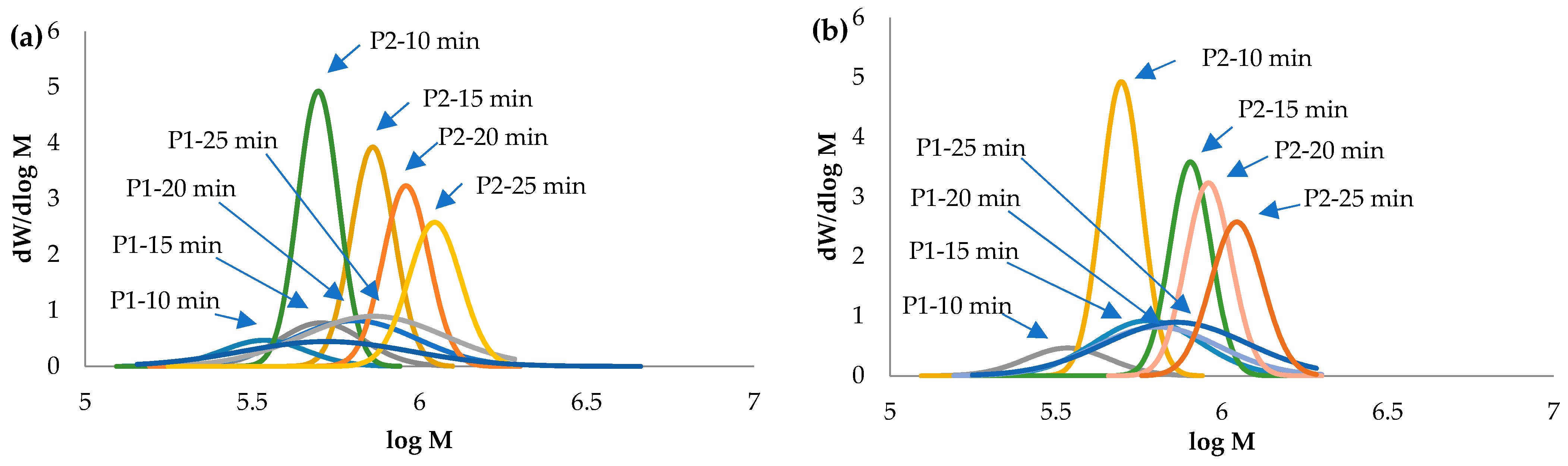
The detailed analysis of the molecular weight distributions through deconvolution of the GPC chromatograms provides evidence consistent with the coexistence of two well-defined macromolecular populations, reflecting the presence of kinetically distinct chain-growth processes during the polymerization of 1,3-butadiene catalyzed by the aged CpTiCl3/MAO system (Figure 4a). In both systems, namely MAO containing TMA and purified (TMA-free) MAO, the chromatograms cannot be adequately described by a single monomodal distribution. Instead, the deconvolution reveals two overlapping populations, denoted as P1 and P2, which exhibit distinct molecular weight evolution and propagation behavior throughout the reaction.
Each experimental chromatogram was fitted using the sum of two log-normal distribution functions, according to the following expression:
W l o g M = f 1 W 1 l o g M + f 2 W 2 l o g M
where W 1 and W 2 correspond to the macromolecular populations P1 and P2, respectively, and f 1 and f 2 represent their weight fractions.
The deconvolution of the GPC chromatograms was performed using PeakFit 4.12 software by fitting log-normal functions to the experimental distributions. The fitting procedure was applied consistently across all samples using standard nonlinear regression, ensuring convergence and reproducibility.
The quality of the fits was evaluated based on residual minimization and consistency across different reaction times. From the deconvoluted profiles, the evolution of the average number of polymerizations (Xn) for each population was determined as a function of time. The corresponding chain-growth rates (ΔXn/Δt) were then calculated and used to estimate the apparent propagation rate constants ( k p ).
It should be noted that this approach provides a semi-quantitative description of the molecular weight distributions. Therefore, the identified populations (P1 and P2) are interpreted as representative of distinct kinetic contributions rather than as direct evidence of discrete active sites.
It is important to note that the molecular weights used to calculate the degree of polymerization (Xn) were obtained from GPC measurements calibrated with polystyrene standards and therefore correspond to relative values. Consequently, the derived Xn and propagation rate constants ( k p ) should be interpreted as apparent or relative parameters.
From the deconvolution, Mn,i, Mw,I, and Ði were obtained for each population. The degree of polymerization for each population was calculated as:
X n , i = M n , i M 0
and the propagation rate constant was obtained from:
k p , i = 1 [ M ] d X n , i d t
The results show that populations P1 and P2 exhibit clearly distinct k p values, with k p , 2 > k p , 1 under all evaluated conditions (Table 6 and Table 7). This difference confirms that the two populations are associated with catalytically active sites possessing different propagation efficiencies.
Figure 6 illustrates the evolution of populations P1 and P2 obtained from the deconvolution of the GPC chromatograms for both catalytic systems, namely MAO containing TMA and purified (TMA-free) MAO. In both cases, the chromatographic profiles clearly display two well-defined and temporally evolving distributions. Population P1 is centered at lower molecular weight regions (log M ≈ 5.4–5.7), whereas P2 is shifted toward higher molecular weight regions (log M ≈ 5.8–6.2). The persistent separations between these maxima indicate that the bimodal behavior does not arise from simple distribution broadening, but is instead consistent with two kinetically distinct chain-growth processes operating simultaneously.
At early reaction times, population P2 shows a more pronounced shift toward higher log M values and greater intensity, indicating a higher propagation efficiency. In contrast, P1 displays slower molecular weight growth and broader distribution profiles. As polymerization progresses, changes in the relative contributions of both populations can be observed, reflecting differences in their growth behavior [20].
These differences are derived from the deconvolution of the molecular weight distributions and are therefore better understood as trends in chain-growth behavior, rather than as direct evidence of differences in site stability or deactivation processes.
The kinetic parameters derived from deconvolution further support this interpretation. Population P2 consistently exhibits higher propagation rate constants ( k p , 2 ) than P1 ( k p , 1 ) , confirming the presence of catalytically differentiated titanium species. Mechanistically, this dual-site behavior can be attributed to the formation of structurally distinct cationic titanium complexes during MAO activation. Variations in alkylation degree, chloride abstraction, and interaction with different MAO oligomeric fragments can generate titanium centers, ultimately leading to different monomer insertion efficiencies [20].
Importantly, in the purified MAO system (Table 7), the duality of populations persists, suggesting that catalytic heterogeneity is an inherent feature of the CpTiCl3/MAO system and not solely induced by TMA. However, the relative difference between P 2 and P 1 decreases, and the overall dispersity narrows slightly, suggesting that TMA amplifies kinetic differentiation between active sites. This observation is consistent with the known role of TMA in promoting alkyl exchange and chain transfer processes.


4. Conclusions

Thermal aging of CpTiCl3/MAO prior to polymerization significantly enhances catalytic efficiency in 1,3-butadiene polymerization, enabling near-quantitative conversion at lower [MAO]/[Ti] ratios than in-situ preparation, while yielding polymers with similar molecular weights and cis-1,4 microstructure. GPC deconvolution shows that aged catalysts operate through two coexisting macromolecular populations with distinct propagation rate constants, k p , 1 and k p , 2 , which remain persistent over time, suggesting active-site heterogeneity rather than progressive deactivation.
Temperature and MAO-purity studies reveal that residual TMA accelerates activation and increases chain transfer, lowering molecular weight and broadening dispersity, but does not measurably alter cis-1,4 selectivity, which is dictated by the CpTiCl3 ligand environment. Altogether, these results establish thermal pre-equilibration and MAO conditioning as practical levers to tune the kinetic landscape of CpTiCl3/MAO catalysts via controlled active-site pre-distribution, without compromising microstructural control in polybutadiene synthesis.
Building on these findings, we will expand this approach through laboratory-scale studies under controlled conditions, including variations in monomer concentration, reaction time, and experimental setup. Specifically, we will evaluate the consistency of the observed kinetic characteristics and the persistence of active site heterogeneity across different experimental regimes. In parallel, incorporating methodologies that allow for the determination of absolute molecular weights will enable a more rigorous quantitative description of the kinetic parameters and contribute to a deeper understanding of the system.

Author Contributions

Conceptualization, R.D.d.L. and J.H.-O.; methodology, A.C.-M. and I.M.; validation, J.H.-O. and H.R.L.-G.; formal analysis, T.C. and I.M.; investigation, A.C.-M.; resources, R.D.d.L. and J.H.-O.; data curation, H.R.L.-G. and H.S.; writing—original draft preparation, T.C.; writing—review and editing, L.V.; visualization, L.V. and R.D.d.L.; supervision, L.V. and T.C.; project administration, R.D.d.L. All authors have read and agreed to the published version of the manuscript.

Funding

This research did not receive any specific grant from funding agencies in the public, commercial, or not-for-profit sectors.

Data Availability Statement

The original data presented in the study are openly available in the repository CIQA at https://ciqa.repositorioinstitucional.mx/jspui/handle/1025/3/simple-search?filterquery=ALEXANDRE+CANARIN+MADEIRA&filtername=author&filtertype=equals (accessed on 17 February 2026).

Acknowledgments

To Secretaría de Ciencia, Humanidades, Tecnología e Innovación (SECIHTI) for the financial support provided for the completion of Córdova’s postdoctoral fellowship. We appreciate the technical support of Myrna Salinas Hernández, Fabiola Castellanos, Ricardo Mendoza, José Alejandro Díaz Elizondo, and Martha Roa Luna for their technical support in reagent purification and thermal characterization.

Conflicts of Interest

Author Luis Valencia was employed by Greenave AB. The remaining authors declare that the research was conducted in the absence of any commercial or financial relationships that could be construed as a potential conflict of interest.

References

  1. Yang, J.; Wang, P.; Neumann, H.; Jackstell, R.; Beller, M. Industrially Applied and Relevant Transformations of 1,3-Butadiene Using Homogeneous Catalysts. Ind. Chem. Mater. 2023, 1, 155–174. [Google Scholar] [CrossRef]
  2. Ricci, G.; Sommazzi, A.; Masi, F.; Forni, A. Polymerization of 1,3-Butadiene with Catalysts Based on Cobalt Dichloride Complexes with Aminophosphines: Switching the Regioselectivity by Varying the MAO/Co Molar Ratio. Chin. J. Polym. Sci. 2024, 42, 501–510. [Google Scholar] [CrossRef]
  3. Anselment, T.M.J.; Vagin, S.I.; Rieger, B. Activation of Late Transition Metal Catalysts for Olefin Polymerizations and Olefin/CO Copolymerizations. Dalton Trans. 2008, 34, 4537–4548. [Google Scholar] [CrossRef] [PubMed]
  4. Yamakawa, S.; Takeuchi, D.; Osakada, K.; Takano, S.; Kaita, S. Polymerization of 1,3-Butadiene Catalyzed by Co(Ii) and Ni(Ii) Complexes of 6,6′-Dihydroxy-2,2′-Bipyridine Ligands: 1,4-Cis-Polymerization versus Isospecific 1,2-Polymerization. RSC Adv. 2025, 15, 12557–12562. [Google Scholar] [CrossRef] [PubMed]
  5. Zhang, M.; Liu, L.; Cong, R.; Dong, J.; Wu, G.; Wang, F.; Liu, H.; Zhang, X. In-Situ Block Copolymerization of 1,3-Butadiene with Cyclohexene Oxide and Trimethylene Carbonate via Combination of Coordinative Chain Transfer Polymerization and Ring Opening Polymerization by Neodymium-Based Catalyst System. Eur. Polym. J. 2021, 148, 110355. [Google Scholar] [CrossRef]
  6. Quirk, R.P.; Kells, A.M. Polymerization of Butadiene Using Neodymium Versatate-Based Catalyst Systems: Preformed Catalysts with SiCl4 as Halide Source. Polym. Int. 2000, 49, 751–756. [Google Scholar] [CrossRef]
  7. de León Gómez, R.E.; Enríquez-Medrano, F.J.; Maldonado Textle, H.; Mendoza Carrizales, R.; Reyes Acosta, K.; López González, H.R.; Olivares Romero, J.L.; Lugo Uribe, L.E. Synthesis and Characterization of High Cis-Polymyrcene Using Neodymium-Based Catalysts. Can. J. Chem. Eng. 2016, 94, 823–832. [Google Scholar] [CrossRef]
  8. Oehme, A.; Gebauer, U.; Gehrke, K.; Lechner, M.D. The Influence of Ageing and Polymerization Conditions on the Polymerization of Butadiene Using a Neodymium Catalyst System. Die Angew. Makromol. Chem. 1996, 235, 121–130. [Google Scholar] [CrossRef]
  9. Mello, I.L.; Coutinho, F.M.B. Neodymium Ziegler–Natta Catalysts: Evaluation of Catalyst Ageing Effect on 1,3-Butadiene Polymerization. Eur. Polym. J. 2008, 44, 2893–2898. [Google Scholar] [CrossRef]
  10. Endo, K.; Yamanaka, Y. Polymerization of Butadiene with V(Acac)3-Methylaluminoxane Catalyst. Macromol. Chem. Phys. 2001, 202, 201–206. [Google Scholar] [CrossRef]
  11. Peluso, A.; Improta, R.; Zambelli, A. Mechanism of Isoprene and Butadiene Polymerization in the Presence of CpTiCl3−MAO Initiator: A Theoretical Study. Macromolecules 1997, 30, 2219–2227. [Google Scholar] [CrossRef]
  12. Lin, J.; Wang, F.; Zhang, C.; Liu, H.; Li, D.; Zhang, X. Copolymerization of 1,3-Butadiene with Phenyl/Phenethyl Substituted 1,3-Butadienes: A Direct Strategy to Access Pendant Phenyl Functionalized Polydienes. RSC Adv. 2021, 11, 23184–23191. [Google Scholar] [CrossRef] [PubMed]
  13. Ali, A.; Nadeem, M.; Lu, J.; Moradian, J.M.; Rasheed, T.; Aziz, T.; Maouche, C.; Guo, Y.; Awais, M.; Zhiqiang, F.; et al. Rapid Kinetic Evaluation of Homogeneous Single-Site Metallocene Catalysts and Cyclic Diene: How Do the Catalytic Activity, Molecular Weight, and Diene Incorporation Rate of Olefins Affect Each Other? RSC Adv. 2021, 11, 31817–31826. [Google Scholar] [CrossRef] [PubMed]
  14. Velthoen, M.E.Z.; Muñoz-Murillo, A.; Bouhmadi, A.; Cecius, M.; Diefenbach, S.; Weckhuysen, B.M. The Multifaceted Role of Methylaluminoxane in Metallocene-Based Olefin Polymerization Catalysis. Macromolecules 2018, 51, 343–355. [Google Scholar] [CrossRef] [PubMed]
  15. Velthoen, M.E.Z.; Boereboom, J.M.; Bulo, R.E.; Weckhuysen, B.M. Insights into the Activation of Silica-Supported Metallocene Olefin Polymerization Catalysts by Methylaluminoxane. Catal. Today 2019, 334, 223–230. [Google Scholar] [CrossRef]
  16. Wang, Q.; Weng, J.; Xu, L.; Fan, Z.; Feng, L. Multiple Active Sites Model of Ethylene Polymerization with the Cp2ZrCl2–Aluminoxanes Catalytic System. Polymer 1999, 40, 1863–1870. [Google Scholar] [CrossRef]
  17. Talarico, G.; Budzelaar, P.H.M. Variability of Chain Transfer to Monomer Step in Olefin Polymerization. Organometallics 2008, 27, 4098–4107. [Google Scholar] [CrossRef]
  18. Kaminsky, W.; Arndt, M. Metallocenes for Polymer Catalysis. In Polymer Synthesis/Polymer Catalysis; Springer: Berlin/Heidelberg, Germany, 1997; pp. 143–187. ISBN 978-3-540-68444-2. [Google Scholar]
  19. Canarin, A. Madeira Estudio Cinético y Modelamiento Matemático de la Polimerización del 1,3-Butadieno Utilizando el Sistema Catalítico Basado en Cpticl3/Mao; Centro De Investigacion En Quimica Aplicada: Saltillo, Mexico, 2014. [Google Scholar]
  20. Novokshonova, L.A.; Ushakova, T.M.; Krasheninnikov, V.G.; Kovaleva, N.Y.; Ladygina, T.A.; Lysova, M.V.; Leipunskii, I.O.; Zhigach, A.N.; Kuskov, M.L. Heterogenized Methylaluminoxane and Isobutylaluminoxane as Activators for Metallocene Catalysts. Kinet. Catal. 2006, 47, 251–256. [Google Scholar] [CrossRef]
Figure 1. (a) In situ reactions performed at a fixed CpTiCl3 concentration (0.153 mmol/L). (b) Aged reactions carried out at a fixed CpTiCl3 amount (0.89 mmol/L) while varying the concentration of the MAO.
Processes 14 01698 g001
Figure 2. (a) In situ reactions performed at a fixed MAO concentration (23 mmol/L). (b) Aged reactions carried out at a fixed MAO amount (23 mmol/L) while varying the concentration of the CpTiCl3.
Processes 14 01698 g002
Figure 3. Effect of temperature with aged catalytic systems.
Processes 14 01698 g003
Figure 4. Proposed mechanism for the coordination and insertion of 1,3-butadiene in the CpTiCl3/MAO catalytic system: (a) coordination of 1,3-butadiene to the cationic titanium active center through its conjugated π system; (b) formation of the pre-insertion complex prior to monomer insertion into the metal–carbon bond through a concerted four-center mechanism. The red letters (A and B) indicate the proposed coordination/insertion pathways. The red and blue text highlights different atoms or interactions involved in the mechanism, while the blue arrows indicate the direction of the coordination and insertion process.
Processes 14 01698 g004
Figure 5. Comparison of the polymerization behavior using MAO with and without TMA in the aged CpTiCl3/MAO catalytic system: (a) fractional conversion as a function of reaction time; (b) evolution of molecular weight as a function of fractional conversion.
Processes 14 01698 g005
Figure 6. Deconvoluted GPC molecular weight distributions showing two populations (P1 and P2) (a) MAO containing TMA (b) TMA-FreeMAO. Reproduced from [19].
Processes 14 01698 g006
Table 1. Experimental design and stoichiometric conditions.
[MAO]/[CpTiCl3]
MethodCpTiCl31502507501000
In situ0.153 mmol/L-xxx
Aging0.89 mmol/Lxx--
[CpTiCl3]/[MAO]
MethodMAO1502507501000
In situ23 mmol-xx-
Aging23 mmolxx--
Note: ‘x’ indicates that the experiment was performed, while ‘-’ indicates that the experiment was not performed.
Table 2. Effect of [MAO]/[CpTiCl3] Ratio on the Molecular and Microstructural Properties of Polybutadiene Using Aged and Non-Aged Catalytic Systems.
[MAO]/[CpTiCl3]X b (%)Time (min)Mw c (kDa)Ð c
In situ10007612024001.7
7505312032001.5
2503412024001.6
Aged *2509912013002.0
1507012012001.5
Experimental condition: temperature = 25 °C, [CpTiCl3] = 0.153 mmol/L, * different titanium concentration used for aged systems = 0.89 mmol/L, [M] = 1.07 mol/L, b gravimetrically determined, c determined by size exclusion chromatography using polystyrene standards.
Table 3. Effect of [CpTiCl3]/[MAO] Ratio on the Molecular and Microstructural Properties of Polybutadiene Using Aged and Non-Aged Catalytic Systems.
[CpTiCl3]/[MAO]X b (%)Time (min)Mw c (kDa)Ð c
In situ7505312032001.5
2507912012001.6
Aged250993516001.7
1507012013002.0
Experimental condition: Temperature = 25 °C, [MAO] = 23 mmol/L, [M] = 1.07 mol/L, b Gravimetrically determined, c Determined by size exclusion chromatography using polystyrene standards.
Table 4. Results of aged reactions performed at different temperatures.
Temp (°C)b X (%)Time (min) k p (min−1) k p * (min−1)
Aged25861200.00310.0033
10581200.0090.0086
−5402400.0230.029
Experimental condition: k p : linear fit, k p *: Curve fitting, [MAO]/[CpTiCl3] = 250, [CpTiCl3] = 23 mmol/L, [M] = 1.07 mol/L, b Gravimetrically determined.
Table 5. Results of polymerization using MAO with and without TMA.
X b (%)Time (min)Mw c (kDa)cis-1,4trans-1,4Vinyl
TMA991201270777.515.5
TMA-free991201800768.115.9
Experimental condition: aged reactions, temperature = 25 °C, [CpTiCl3]/[MAO] = 250, [MAO] = 23 mmol/L, [M] = 1.07 mol/L, b gravimetrically determined, c determined by size exclusion chromatography using polystyrene standards.
Table 6. Calculation of the Polymerization Rate Constant for the Reaction Without MAO Purification. Data from [19].
t
(s)
Xn1ΔXn1/ΔtXn2ΔXn2/ΔtX[M] (mol/L) k p , 1
(L/mol·s)
k p , 2
(L/mol·s)
00-0-01.07--
600635010.58921715.360.470.5718.526.9
900939710.1613,40613.960.580.4522.631.0
120011,8368.1316,87011.540.650.3821.630.7
150013,4905.5120,53612.220.730.2919.142.4
Experimental condition: Aged reactions, Temperature = 25 °C, [CpTiCl3]/[MAO] = 250, [MAO] = 23 mmol/L, determined by size exclusion chromatography using polystyrene standards.
Table 7. Calculation of the Polymerization Rate Constant for the Reaction Using Purified MAO. Data from [19].
t
(s)
Xn1ΔXn1/ΔtXn2ΔXn2/ΔtX[M]
(mol/L)
k p , 1
(L/mol·s)
k p , 2
(L/mol·s)
00-0-01.07--
600737212.2910,67117.790.500.5423.033.2
90011,05612.2814,88714.050.550.4825.529.2
120012,4864.7619,04613.860.620.4111.734.1
150014,3956.3622,22310.590.680.3418.630.9
Experimental condition: Aged reactions, temperature = 25 °C, [CpTiCl3]/[MAO] = 250, [MAO] = 23 mmol/L, determined by size exclusion chromatography using polystyrene standards.
Disclaimer/Publisher’s Note: The statements, opinions and data contained in all publications are solely those of the individual author(s) and contributor(s) and not of MDPI and/or the editor(s). MDPI and/or the editor(s) disclaim responsibility for any injury to people or property resulting from any ideas, methods, instructions or products referred to in the content.