


Abstract
Hydraulic oscillator tools (HOTs) are effective solutions for mitigating excessive drag encountered during sliding drilling in horizontal wells. However, their field performance remains unpredictable due to theoretical limitations in modeling nonlinear friction behavior under axial vibration. To address this gap, a series of friction tests was conducted on sandstone–steel pairs under water-based mud lubrication. Experimental results demonstrate that steady-state sliding friction follows the velocity-dependent Dieterich–Ruina model, while vibration–sliding coupled friction is accurately described by the Dahl model. Integrating these findings, a comprehensive drillstring dynamic model was developed. The model was solved using an explicit central difference method and validated against field hook load data from Well XX-1, with prediction errors below 9%. Parametric studies further quantified HOT performance, revealing that excitation force amplitude and HOT placement significantly impact drag reduction, whereas vibration frequency exerts a relatively modest influence. Meanwhile, the effective propagation distance induced by the hydraulic oscillator is relatively limited, resulting in a drag reduction rate of no more than 30% even under optimal parameter conditions. This work establishes a validated theoretical framework for optimizing hydraulic oscillator parameters in horizontal drilling.
1. Introduction
Global energy markets have become increasingly sensitive to geopolitical instability and oil-price volatility. Recent conflicts in the Middle East have further highlighted the vulnerability of global oil supply chains and the strategic importance of maintaining stable and efficient oil and gas production [1]. In this context, improving the cost-effectiveness and operational reliability of drilling technologies is essential for supporting energy security. Meanwhile, high-grade conventional oil and gas resources are currently facing depletion in the world, making unconventional oil and gas resources the strategic alternative in the energy landscape [2,3]. Low-cost horizontal well technology, represented by sliding drilling using bent-housing mud motors coupled with measurement while drilling (MWD), plays a critical part in economically efficient development of unconventional oil and gas resources [4,5]. However, excessive drag and torque between the drillstring and wellbore wall impair the rate of penetration (ROP) and limit horizontal section extension. Moreover, progressively increasing friction may induce sinusoidal or helical buckling, potentially culminating in drillstring lock-up that triggers downhole failures [6,7]. Consequently, drag and torque reduction constitute the essential prerequisite for safe, efficient horizontal well drilling.
Mechanical drag-reducing techniques effectively mitigate axial drillstring friction during sliding drilling operations. By installing specialized tools in the bottom hole assembly (BHA), static friction at the drillstring–wellbore interface converts to dynamic friction, enhancing steerable drilling efficiency with downhole motors [8]. Conventional mechanical reduction tools include non-rotating drill pipe protectors [9], drill pipe bearing subs [10], drillstring torque reduction subs [11], and cuttings bed cleaners [12]. These tools reduce the friction coefficient at the drillstring–wellbore interface, though their effectiveness depends heavily on wellbore conditions and deployment density. Advanced mechanical friction-reduction tools, such as hydraulic oscillators and Slider systems, demonstrate significantly improved performance over conventional tools. Moreover, hydraulic oscillator tools (HOTs) prove more effective in friction reduction than lateral and torsional vibration tools [13]. Liu et al. [14] established that HOT vibration amplitude and frequency significantly influence drillstring drag reduction and axial force transmission. Wang et al. [15] determined that HOTs installed near the drill bit achieve superior drag reduction compared to those in curved sections. Liu et al. [16] observed increasing weight-on-bit (WOB) fluctuations when HOTs are positioned closer to the bit, potentially damaging the bit and measurement tools. Shi et al. [17] emphasized that drillstring integrity and hydraulic constraints must inform HOT parameter optimization. These analyses indicate that proper HOT parameters are essential for achieving safe, efficient friction reduction. HOT development remains a persistent focus for petroleum companies and researchers [18,19], yet field applications face challenges, particularly unpredictable friction-reduction performance. The core issue involves theoretical limitations: HOT placement currently lacks theoretical foundation [14,20], relying instead on empirical methods, while standardized parameter optimization frameworks remain undeveloped.
The mechanism of axial vibration on friction force and load transfer characteristics constitutes the theoretical foundation for HOT field applications [21]. Extensive studies have shown that vibration-induced drag reduction arises from cyclical and instantaneous reversals in the direction of the friction force vector [22,23]. However, accurate evaluation of HOT drag-reduction performance remains challenging and continues to be a key research focus in drilling engineering. Traditional drillstring dynamic analyses commonly employ the Coulomb friction model to describe drillstring–wellbore interactions [24]. While computationally efficient, this model cannot capture the nonlinear friction behavior of sliding motion under imposed axial vibration.
To overcome this limitation, dynamic friction models have been increasingly introduced. The Dahl model [25], one of the earliest dynamic friction models, was originally developed to simulate symmetrical hysteresis loops observed in bearings undergoing small-amplitude sinusoidal excitations [26]. More advanced models, such as the LuGre, Leuven, and GMS models, have further extended the Dahl framework and can describe more complex friction phenomena, including bristle deformation, pre-sliding displacement, Stribeck behavior, and dynamic hysteresis [27]. In particular, LuGre-type models have recently been introduced into HOT-related drillstring friction analysis, confirming their capability in describing local dynamic friction under axial oscillation conditions [28]. However, these models usually require additional parameters, such as bristle stiffness, damping coefficient, viscous coefficient, Stribeck velocity, and multi-state weighting parameters, which are difficult to identify reliably for full-scale drillstring–wellbore contact systems. Therefore, although these models are theoretically more comprehensive, their direct implementation may introduce additional uncertainty when the available experimental dataset is insufficient for robust parameter calibration.
Recently, the Dahl model has been introduced to describe the vibrating–sliding coupled friction behavior in drilling systems [23,29]. Nevertheless, it does not account for the velocity-dependent characteristics of steady sliding friction. As a result, existing approaches are unable to simultaneously capture both the velocity-dependent sliding behavior in steady regions and the hysteretic friction response in vibration-affected regions. This limitation leads to an incomplete description of the spatially heterogeneous friction mechanisms under HOT operation and may result in inaccurate predictions of drag-reduction performance. Therefore, a comprehensive description of drillstring friction under HOT operation requires accounting for both velocity-dependent and vibration-induced nonlinear behaviors.
This study conducted a series of friction tests, including sliding friction and axial vibration–sliding coupled friction, on sandstone–steel pairs under water-based mud (WBM) lubrication. Experimental results demonstrate that the Dieterich–Ruina (D-R) model describes the velocity-dependent sliding friction behavior and the Dahl model characterizes the vibrating–sliding coupled friction behavior. Subsequently, a drillstring dynamic model incorporating this hybrid friction approach was developed and solved. Finally, using this integrated model, the effects of HOT parameters on axial vibration-induced friction reduction were systematically quantified.
2. Laboratory Friction Experiments
As we all know, the influence scope of the hydraulic oscillator is relatively limited under actual drilling circumstances. Hence, the friction behavior between drillstring and wellbore wall under the influence of hydraulic oscillator mainly includes two forms, namely, the sliding friction on a fairly large portion of drillstring and the vibration–sliding coupling friction on the hydraulic oscillator-affected section. Obviously, these two kinds of friction behaviors have different features and need different friction models to describe them. Therefore, the purpose of this section is to characterize the friction behavior of the sandstone–steel contact pair and provide an experimental basis for the friction-model formulation in Section 3.
2.1. Sliding Friction Experiment
2.1.1. Experimental Method for Sliding Friction Test
In the present study, the sandstone samples were collected from a representative outcrop with similar lithological properties to the Chang-7 formation rocks encountered in horizontal drilling operations. Mineralogical composition was determined by X-ray diffraction (XRD), indicating that the sandstone is predominantly composed of quartz and feldspar, with minor clay minerals. The porosity of the sandstone was measured using helium porosimetry, yielding a value of approximately 7~11%. Prior to testing, both sandstone and steel specimens were carefully prepared to ensure consistent contact conditions. The sandstone surface was polished, while the steel specimen was machined and finished using standard metallographic procedures. Surface roughness was measured using a contact profilometer. The average roughness (Ra) and the average of the highest peaks and lowest valleys (Rz) of the sandstone surface were 1.28 μm and 15.32 μm, respectively, while those of the steel surface were 0.61 μm and 5.35 μm, respectively.
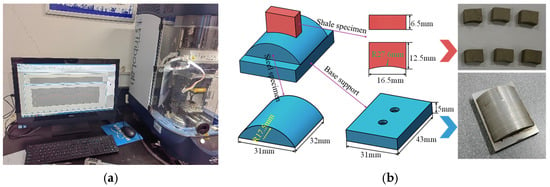
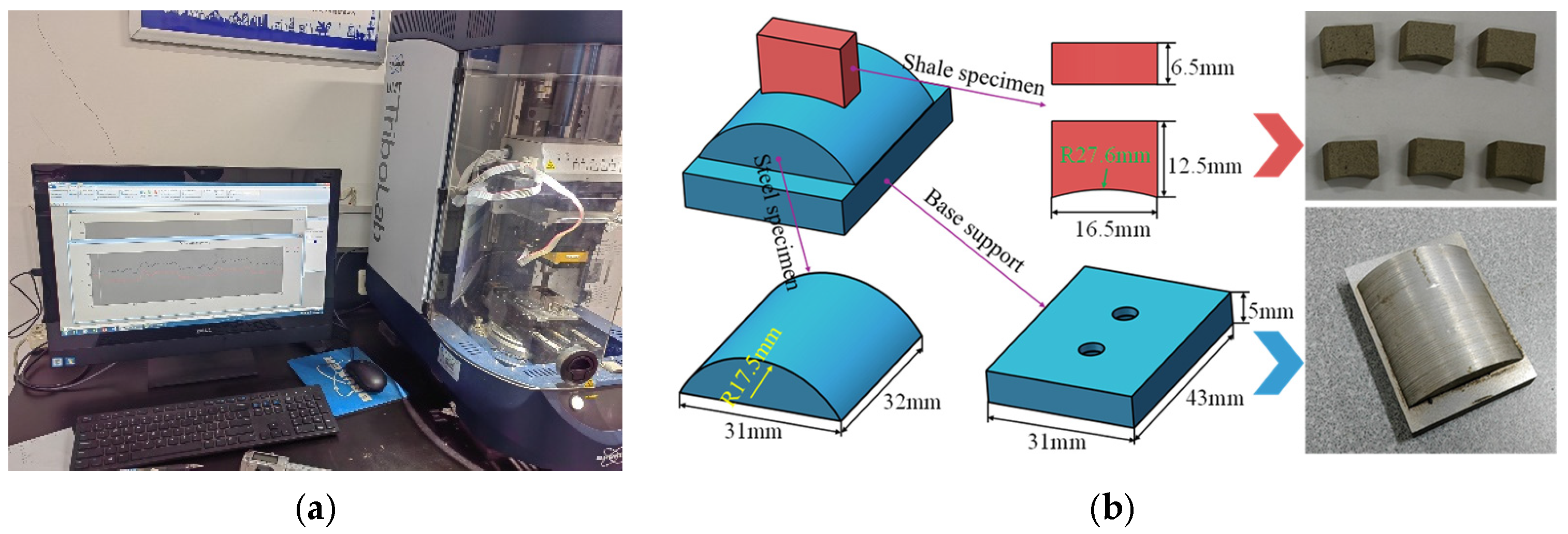
Sliding friction experiments were conducted on a UMT-Tribolab friction and wear tester (Bruker Corporation, Billerica, MA, USA), as shown in Figure 1a. The upper sandstone sample was processed into a cuboid core (16.5 mm × 12.5 mm × 6.5 mm) with one face polished to a 27.6 mm radius arc. The lower steel sample was machined into a 32 mm long curved specimen with a 17.5 mm radius (Figure 1b). This configuration creates an inner-cylinder-on-cylinder contact geometry between sandstone and steel samples, replicating actual drillstring–wellbore wall contact conditions.
Figure 1.
Schematic diagram of sandstone–steel sliding friction test. (a) UMT-Tribolab; (b) sample preparation.
The normal load (20–50 N) was not selected to match the absolute downhole force, but to ensure similarity in contact mechanics. By matching the curvature of the contact pair and adjusting the load accordingly, the resulting contact width is approximately equivalent to that under field conditions. This ensures similarity in local contact stress and contact area, which are the key factors controlling friction behavior, rather than matching the absolute force magnitude. The sliding velocities (va) were set to 0.3–2.1 mm/s, which corresponds to the ROP values of 1.08–7.56 m/h. Field-deployed WBM served as the lubricant, with measured properties including a density of 1.2 g/cm3, plastic viscosity of 50 mPa·s, and yield stress of 6 Pa. Experimental design parameters and test outcomes are summarized in Table 1.
Table 1.
Experimental design and testing results of sliding friction.
2.1.2. Characterization of Sliding Friction Behavior
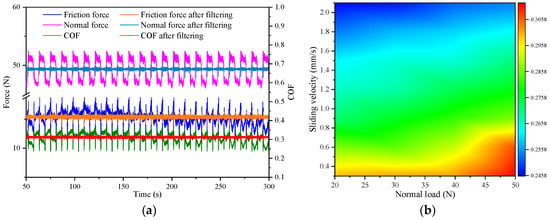
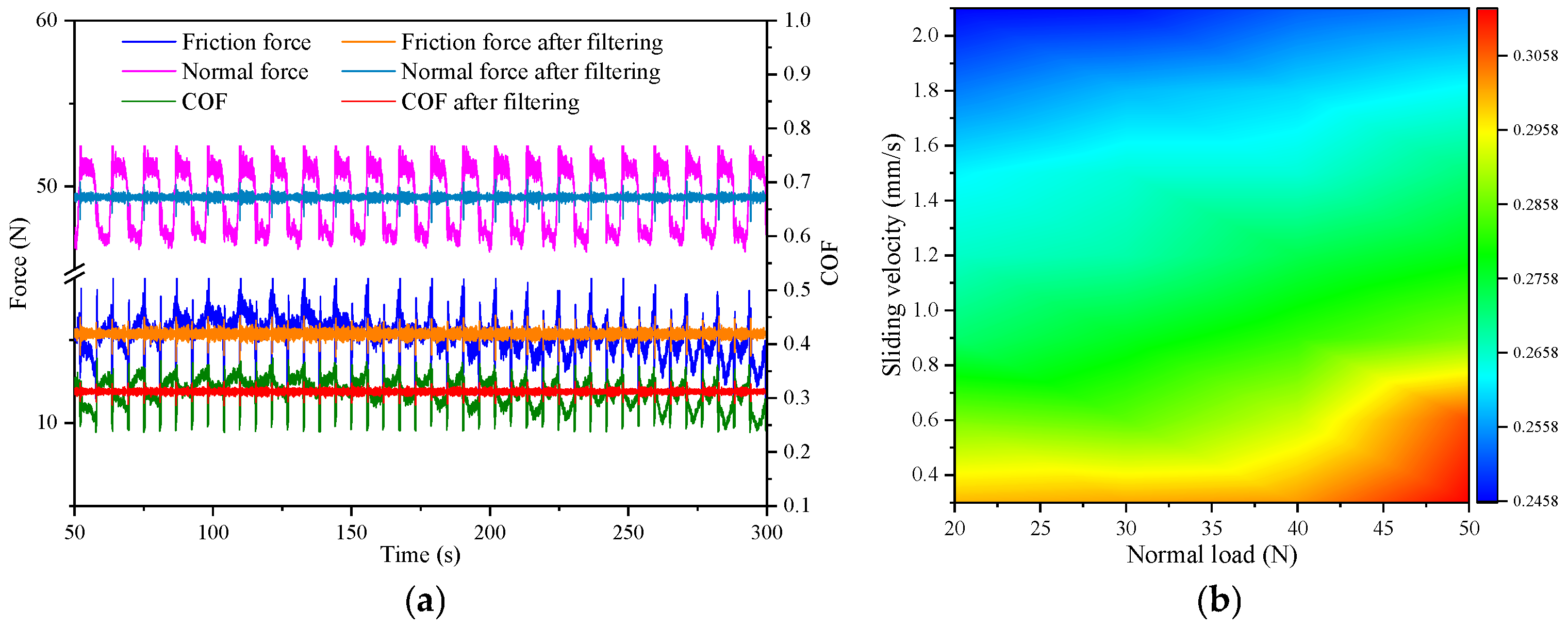
A typical friction response curve for va = 0.3 mm/s and P = 50 N is shown in Figure 2a. It can be seen that due to surface asperity interactions and system vibrations, the raw signals contain high-frequency noise and local fluctuations. Therefore, the measured data were processed using the built-in filtering function of the UMT-Tribolab system to remove signal drift and noise, while preserving the steady-state friction characteristics. In this study, a high-pass filter is used with a cutoff frequency of 1.0 Hz. It can be seen that the filtered data becomes more stable, and the signal mutations caused by the reciprocating motion of the upper sample disappear. The average COF values reported in Table 1 are calculated from the stable portion of the filtered signals. Figure 2b shows the variation in COSF with sliding velocity and normal force. These results indicate that the steady sliding friction coefficient is primarily dependent on sliding velocity within the tested range. Therefore, the obtained sliding friction data are used in Section 3.3.1 to identify the velocity-dependent D–R friction model for the non-vibrating drillstring sections.
Figure 2.
COF of sandstone–steel sliding friction pairs. (a) Typical friction response curve for va = 0.3 mm/s and P = 50 N; (b) variations in COF under different normal loads and sliding velocities.
2.2. Axial Vibration and Sliding Coupled Friction Experiment
2.2.1. Experimental Method for Axial Vibration-Sliding Coupled Friction Test
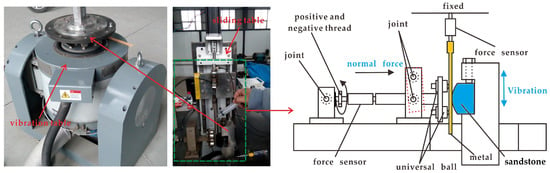
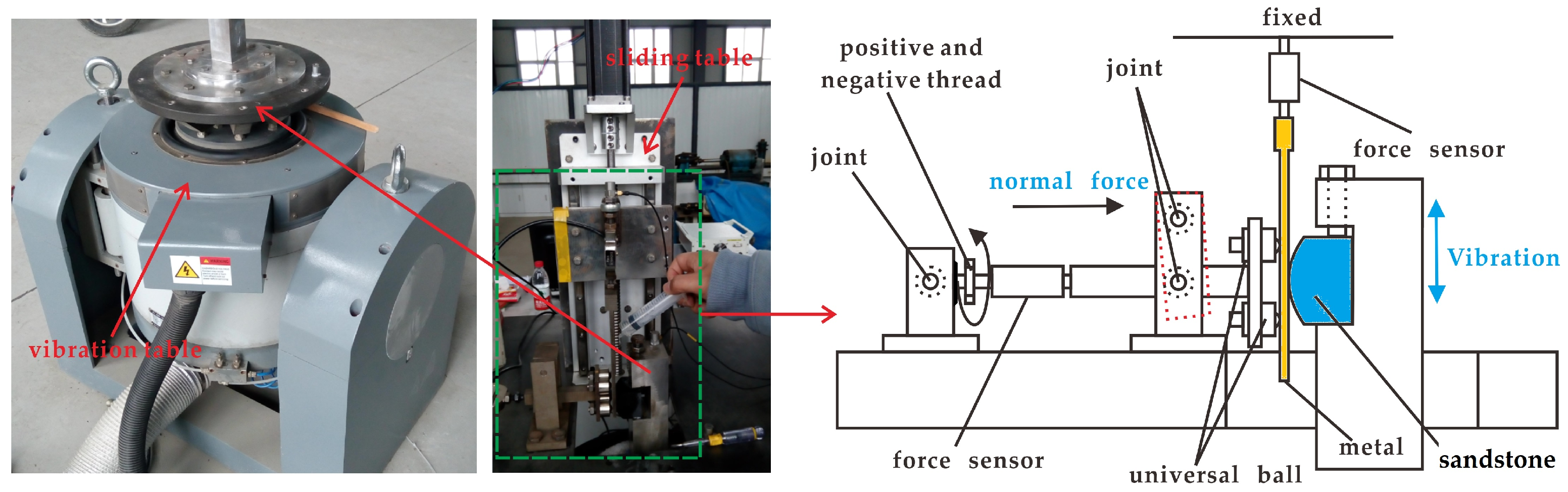
Figure 3 illustrates the experimental setup for investigating vibration–sliding friction behavior between sandstone and steel specimens under WBM lubrication. The sandstone specimen was bolted to a pillar mounted on an electro-dynamic vibration shaker. A steel specimen was translated vertically at constant velocity along a linear guide rail, with sliding velocity regulated by an electronic controller. The sandstone specimen maintained continuous contact with the steel surface. Normal force was applied to the steel specimen through four universal balls. Force sensors measured driving and normal forces, while parameters including vibration acceleration and sliding displacement were recorded in real time.
Figure 3.
Experimental device for axial vibration–sliding coupled friction test.
The experimental parameters were set to a normal force (FN) range of 40–60 N. In this case, the contact width between rock and steel samples was approximately equal to that in real-world drilling conditions. The sliding velocities (va) were set to 0.2–1.2 mm/s. The same field-deployed WBM served as the lubricant. The experimental scheme was designed by using a random combination approach, as shown in Table 2.
Table 2.
Experimental design and testing results of axial vibration-sliding coupled friction.
2.2.2. Experimental Result
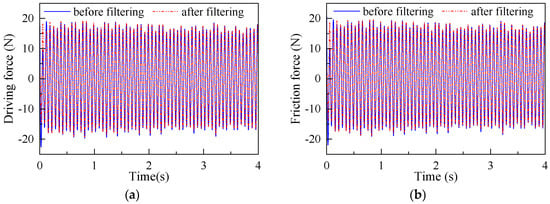
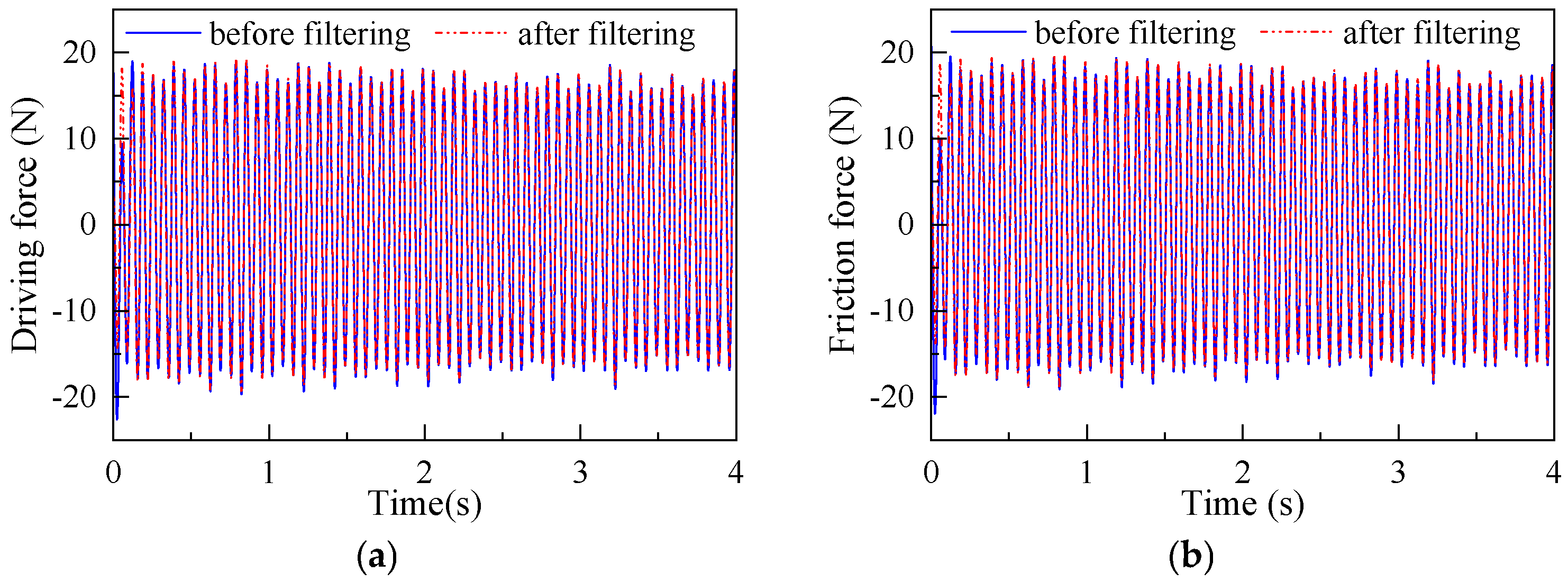
The friction response curve during axial vibration and sliding motion coupling is shown in Figure 4. Figure 4a,b represent the measured driving force and the inversed friction force during the testing period. The difference between the two forces is the inertia force of the sliding specimen, which can be determined by the monitored acceleration. In addition, fast Fourier transform (FFT) analysis indicated that the measured data contained low-frequency and high-frequency interference signals. Therefore, to extract the physically meaningful vibration-induced response, the measured signals were processed using a band-pass filter with a frequency range of 10–30 Hz, corresponding to the excitation frequency of the system. This procedure removes unrelated low-frequency trends and high-frequency noise while retaining the dominant friction response. It can be seen that the driving force and friction force show a sine-wave-like shape. According to the principle of force directionality, it can be assumed that the average friction force during the testing period must be decreasing. The statistical result of each group is listed in Table 2, among which Fsf denotes the friction force during sliding motion, Fdf denotes the average friction force in a vibration cycle, and μdf denotes the ratio of Fdf to FN, namely the average vibrating friction coefficient. Obviously, the friction coefficient of axial vibration–sliding coupled friction was much lower than the pure sliding friction. These observations demonstrate that the friction response under axial vibration–sliding coupling exhibits obvious cyclic variation and dynamic hysteresis. Therefore, the experimental results are used in Section 3.3.2 to support the introduction of the Dahl/empirical dynamic friction model for the HOT-affected region.
Figure 4.
Typical friction response curve for u = 4 mm, f = 15 Hz, va = 120 mm/s and P = 50 N. (a) Time domain signal of driving force; (b) time domain signal of friction force.
3. Mechanical Models
To clarify the overall modeling logic, the models used in this study have different functions and are coupled sequentially. The laboratory friction experiments provide the basis for selecting and identifying the friction laws. The D-R model is used to describe velocity-dependent sliding friction in the non-vibrating drillstring sections, while the Dahl/empirical model is used to describe vibration–sliding coupled friction in the HOT-affected region. The stiff-string model [30,31] is used to calculate the initial axial force and distributed normal contact force, which provide the normal-load input for the friction models. The finite-element drillstring dynamic model then updates the displacement, velocity, and friction force during the time-stepping solution.
3.1. Model Description
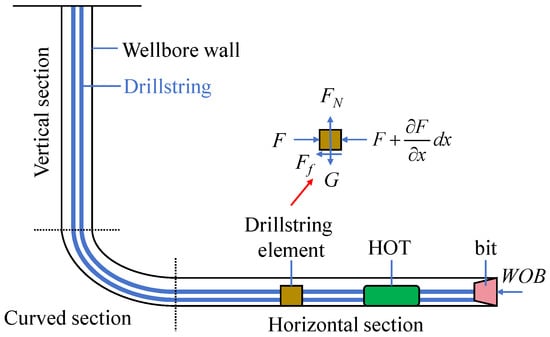
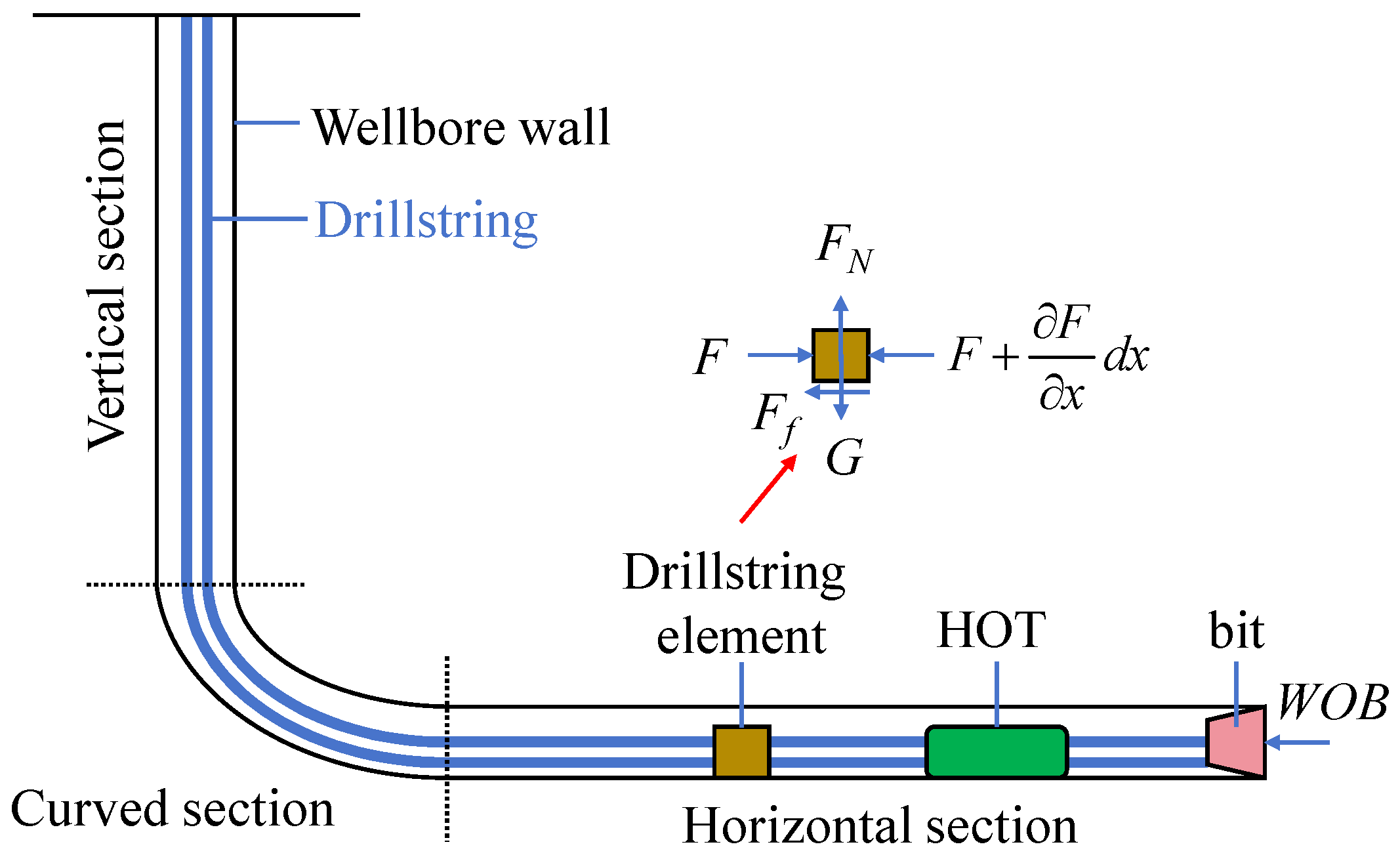
Sliding drilling using a bent-housing mud motor combined with MWD remains the mainstream approach for horizontal wells. However, the absence of drillstring rotation during sliding drilling generates excessive friction forces. A feasible solution involves applying HOT to the BHA to modify friction distribution along the drillstring, as illustrated in Figure 5. The HOT system functions as an excitation source with force output Fe = Fasin(2πft) [14]. Nevertheless, this excitation complicates drillstring mechanical behavior in sliding operation, presenting challenges for optimizing HOT parameters.
Figure 5.
Physical model and force analysis of drillstring in the horizontal well.
To simplify derivation and calculation, the following assumptions are adopted [14,24,32]: (1) the wellbore is rigid, the drillstring material is isotropic, and only elastic deformation is considered; (2) the drillstring is modeled as a slender rod of uniform cross-section and discretized into a series of spatial beam elements along its axial direction (Figure 6); (3) the D-R model is adopted for the non-vibrating sliding sections of the drillstring, whereas the Dahl/empirical model is adopted for the HOT-affected section where axial vibration–sliding coupling occurs; (4) only axial dynamics of the drillstring are accounted for, but the buckling effect is ignored; (5) inertia and viscous effects of drilling fluids are neglected; and (6) temperature effects and drill cuttings bed thickness are disregarded. It should be noted that drillstring buckling (including sinusoidal and helical buckling) is not explicitly considered in the present model. This simplification is adopted to maintain computational efficiency and to focus on the influence of axial vibration-induced friction mechanisms. As a result, the additional contact force amplification caused by buckling is not directly captured, which may lead to a certain underestimation of friction under high compressive loading conditions.
Figure 6.
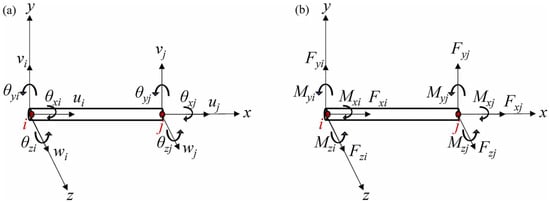
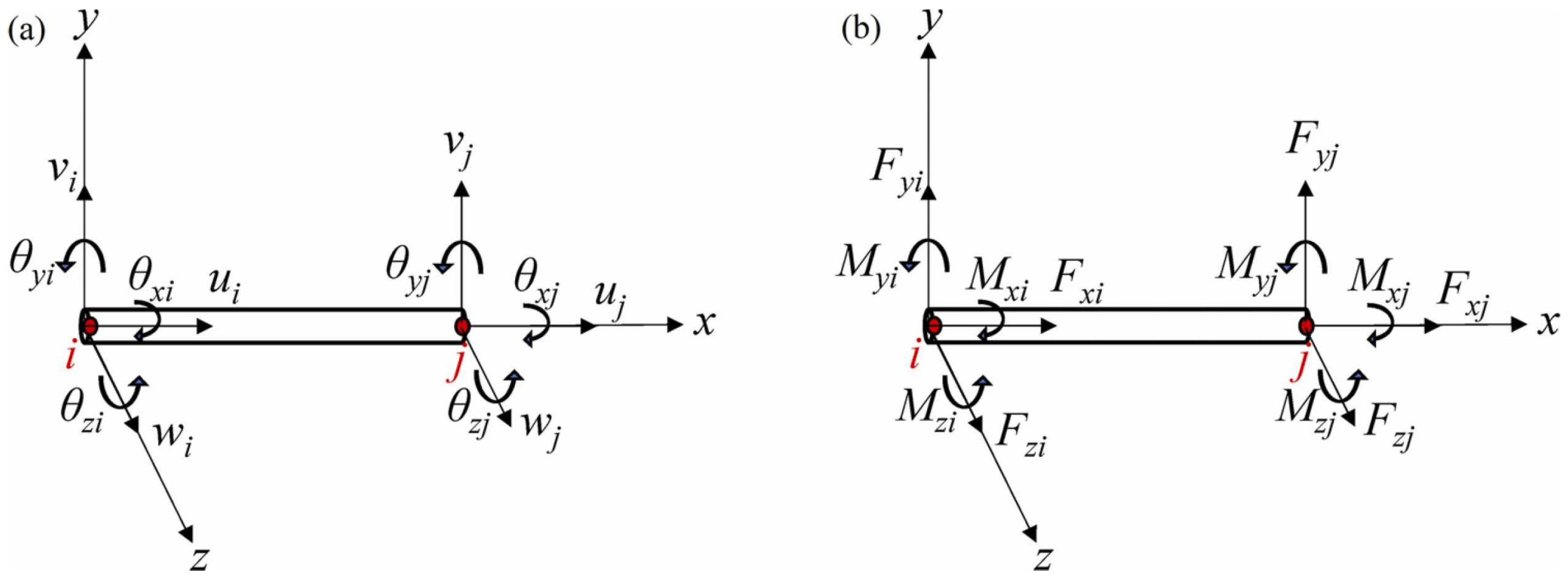
Schematic diagram of displacements and forces of drillstring element [32]: (a) Nodal displacement analysis; (b) nodal forces analysis.
3.2. Drillstring Axial Vibration Model
Based on the preceding assumptions and force analysis, each element comprises two nodes, with each node possessing six degrees of freedom [32,33]. The generalized coordinate vector for nodal displacements is expressed as:
The corresponding generalized nodal force is:
where ui and uj are displacements of element nodes along the x-axis; vi and vj are displacements along the y-axis; wi and wj are displacements along the z-axis; θxi and θxj are torsional angles about the x-axis; θyi and θyj are torsional angles about the y-axis; and θzi and θzj are torsional angles about the z-axis. Fxi and Fxj are axial forces of node i and node j at beam element; Fyi and Fyj are transversal shear forces of node i and node j at beam element along the y-axis; Fzi and Fzj are shear forces of node i and node j at beam element along the z-axis; Mzi and Mzj are torques of node i and node j at beam element; Myi and Myj are bending moments of node i and node j at straight beam element in the xz plane; and Mxi and Mxj are bending moments of node i and node j at straight beam element in the yz plane.
Based on the finite element method principle, displacements within the beam element can be obtained by interpolation of nodal displacements using displacement functions, expressed as [27,32,33]:
The velocity and acceleration matrices of the beam element can be expressed in terms of the shape function matrix as follows:
where [N] is the form function matrix; is the nodal velocity matrix; and is the nodal acceleration matrix.
The three-dimensional deformation of the drillstring constitutes a geometrically nonlinear problem characterized by large deflections and small strains. The equivalent nodal load vector for the beam element is given by [34,35]:
where {PV} is the body force matrix, and {PS} is the surface force matrix.
The friction between the drillstring and wellbore wall is incorporated into the body force matrix. The excitation force acts on nodes and is included in the nodal load matrix. Considering the total energy and dissipation functions of the beam elements, the element motion equations in the body-fixed coordinate system are derived as follows:
where {U}e is nodal displacement matrix, {F}e is element load matrix, [M]e is element mass matrix, [C]e is element damping matrix, and [K]e is element stiffness matrix.
Following coordinate transformation, the kinematic equations of all elements are assembled into the global kinematic equation for the entire drillstring in the horizontal well:
where {U} is the global generalized displacement matrix; is the global generalized velocity matrix; is the global generalized acceleration matrix; [M] is the global mass matrix; [C] is the global damping matrix; [K] is the global stiffness matrix; and {F} is the global generalized external force matrix.
3.3. Friction Force Between Drillstring and Wellbore Wall
Due to the limited propagation distance of axial vibration induced by the hydraulic oscillator, the drillstring exhibits spatially distinct friction regimes. Therefore, a zonal modeling strategy is adopted, in which different friction laws are assigned according to the dominant physical mechanisms in each region, rather than applying a single uniform model.
3.3.1. Sliding Friction Force on Drillstring Without HOT
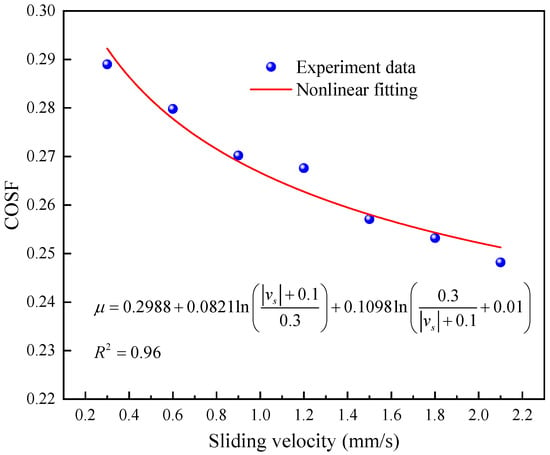
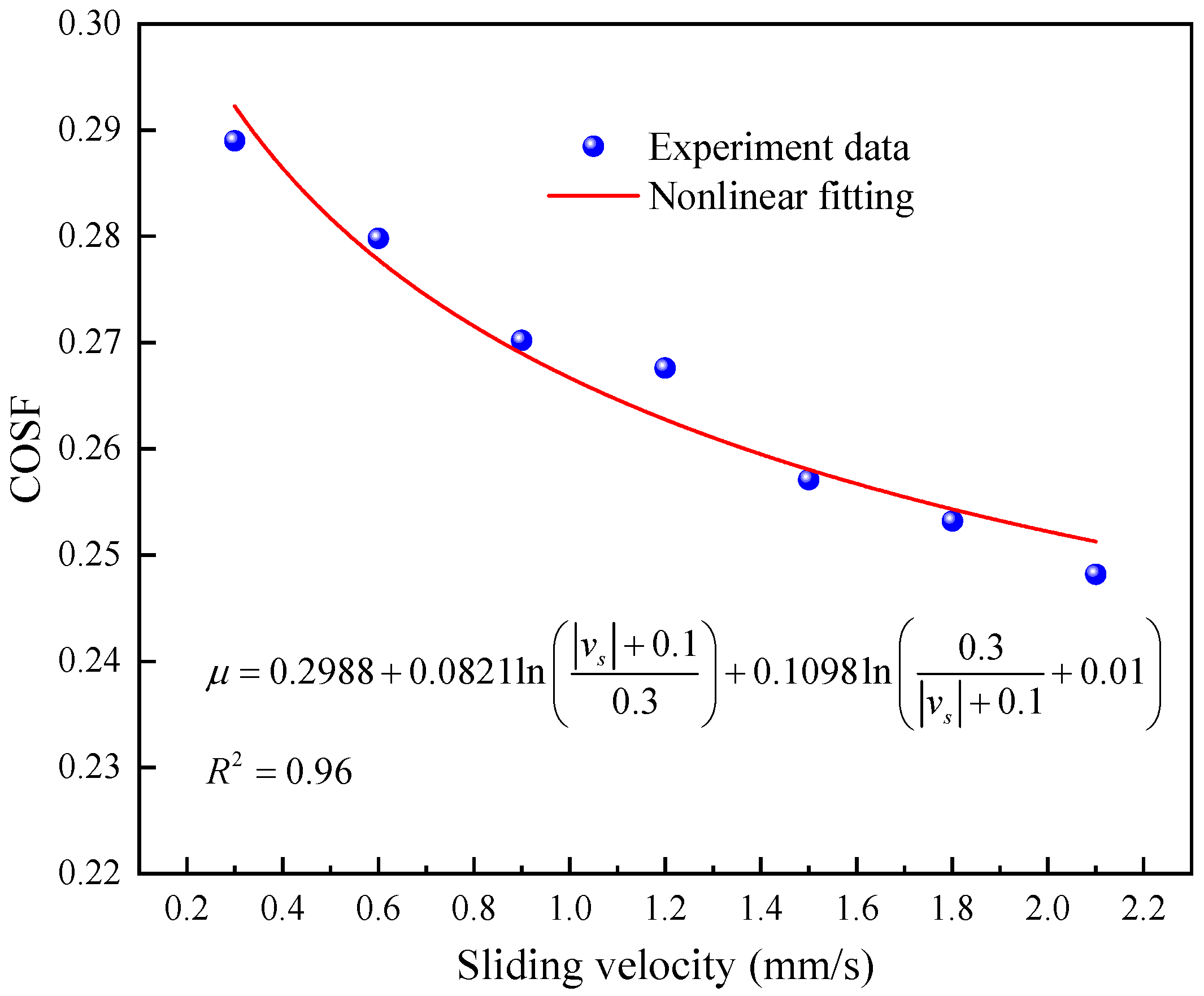
The use of a velocity-dependent friction law is also supported by the concepts of velocity weakening and velocity strengthening in rate-and-state friction theory. In general, velocity weakening indicates a decrease in the friction coefficient with increasing sliding velocity, whereas velocity strengthening indicates the opposite trend. The transition between these regimes is governed by contact aging, asperity renewal, surface roughness, material properties, etc. For the sandstone–steel contact pair tested in this study, the measured coefficient of sliding friction decreases with increasing sliding velocity, indicating a velocity-weakening tendency within the tested velocity range. Therefore, for the sliding friction zone or the sliding plus reactive torque zone, a steady-state Dieterich–Ruina (D-R) model is selected to describe the changes in friction force with surface relative velocity [36,37,38]:
where vs is the sliding velocity of the rock specimen; μ* is the steady-state reference value of μ for a chosen sliding velocity V*, V* is specified as 0.3 mm/s; a, b and c are dimensionless model parameters; and ε is a cut-off velocity for eliminating singularity.
Based on the results of the sliding friction experiment, the parameters a, b and c of the D-R model can be achieved through a user-defined fitting function in Origin 2021 software. The fitting curve and equation are shown in Figure 7. We can find that the COSF shows a gradually decreasing trend with the increasing of sliding velocity.
Figure 7.
Fitting result of the steady-state D-R model.
Thus, the sliding friction force on the whole drillstring without HOT can be obtained:
3.3.2. Sliding Friction Force on Drillstring with HOT
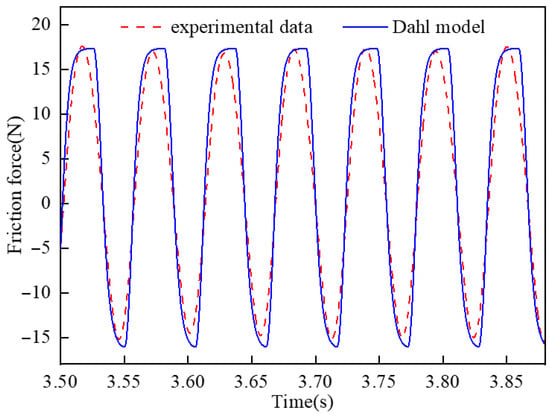
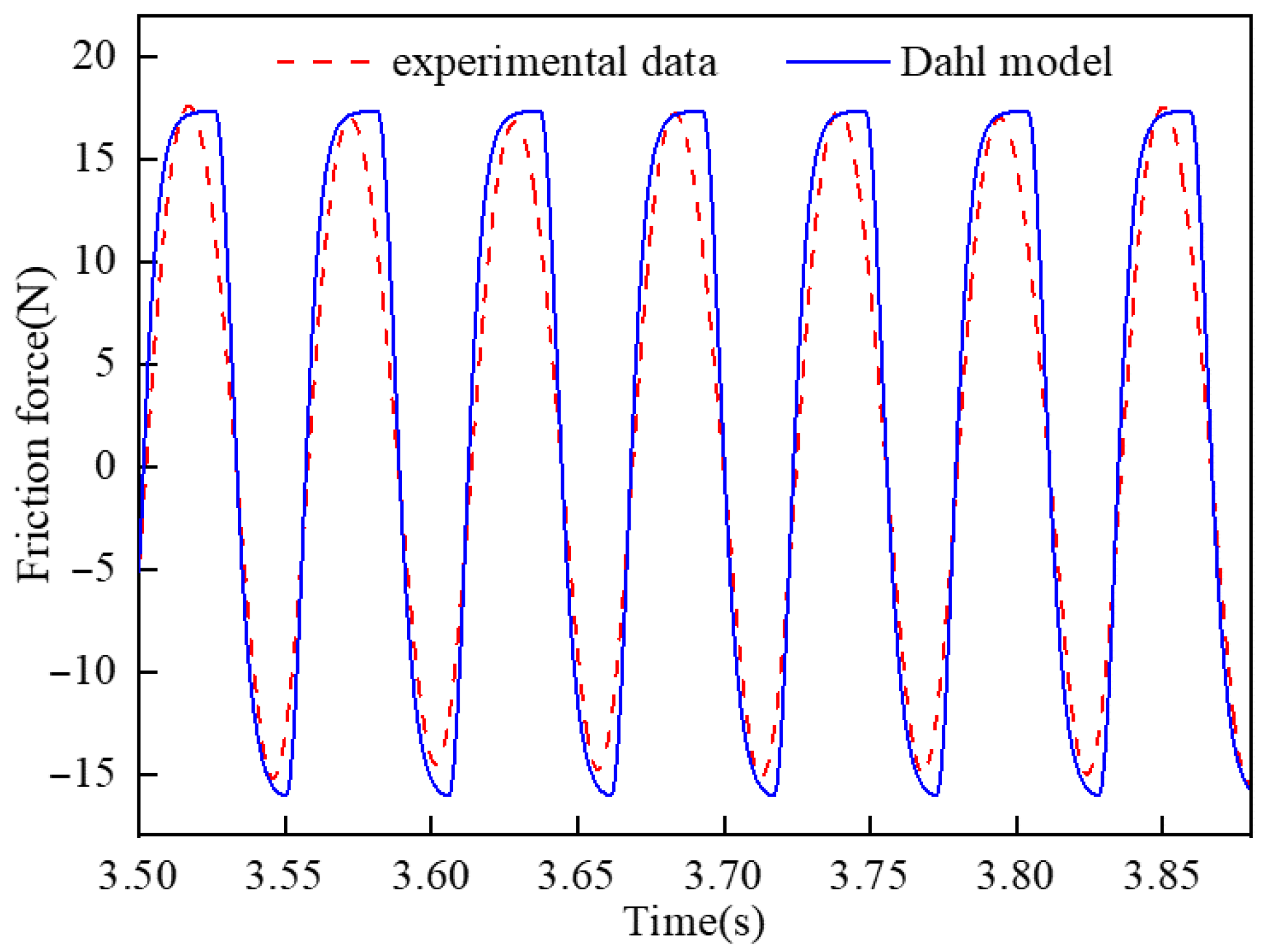
For the HOT action zone, previous studies have demonstrated that the Dahl model can accurately describe this type of coupling friction behavior. The present experiment result also confirms the correctness and effectiveness of the Dahl model, as shown in Figure 8. According to the Dahl model, the dynamic friction force induced by HOT can be written as [25]:
where
where Fdf is the dynamic friction force, Kt is the tangential contact stiffness, which can be determined by the axial vibrating–sliding coupling experiment, δ is the tangential deformation of the asperities, Vr is the relative velocity of friction pairs, μ0 is the static friction coefficient, FN is the normal load, vs is the sliding velocity, va is the vibration velocity amplitude, t is the instantaneous time, Ua is the vibration amplitude, and f is the vibration frequency.
Figure 8.
Comparison of theoretical and experimental friction force for u = 5 mm, f = 16 Hz, va = 20 mm/s and FN = 60 N.
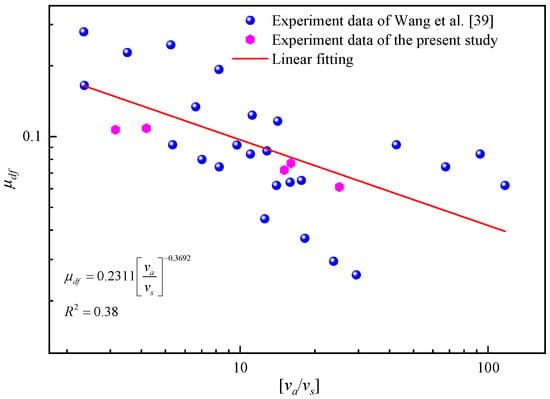
It should be noted that the direct solution of the Dahl model is quite troublesome. In this study, it was solved using the Runge–Kutta method in Matlab/Simulink R2020b software [23], but the process is clumsy and time-consuming. To tackle the problem, an empirical formula for describing this type of coupling friction behavior is proposed based on dimensional analysis [39]. The empirical model is written as:
where k and c are arbitrary constants, which can be determined through the experiment.
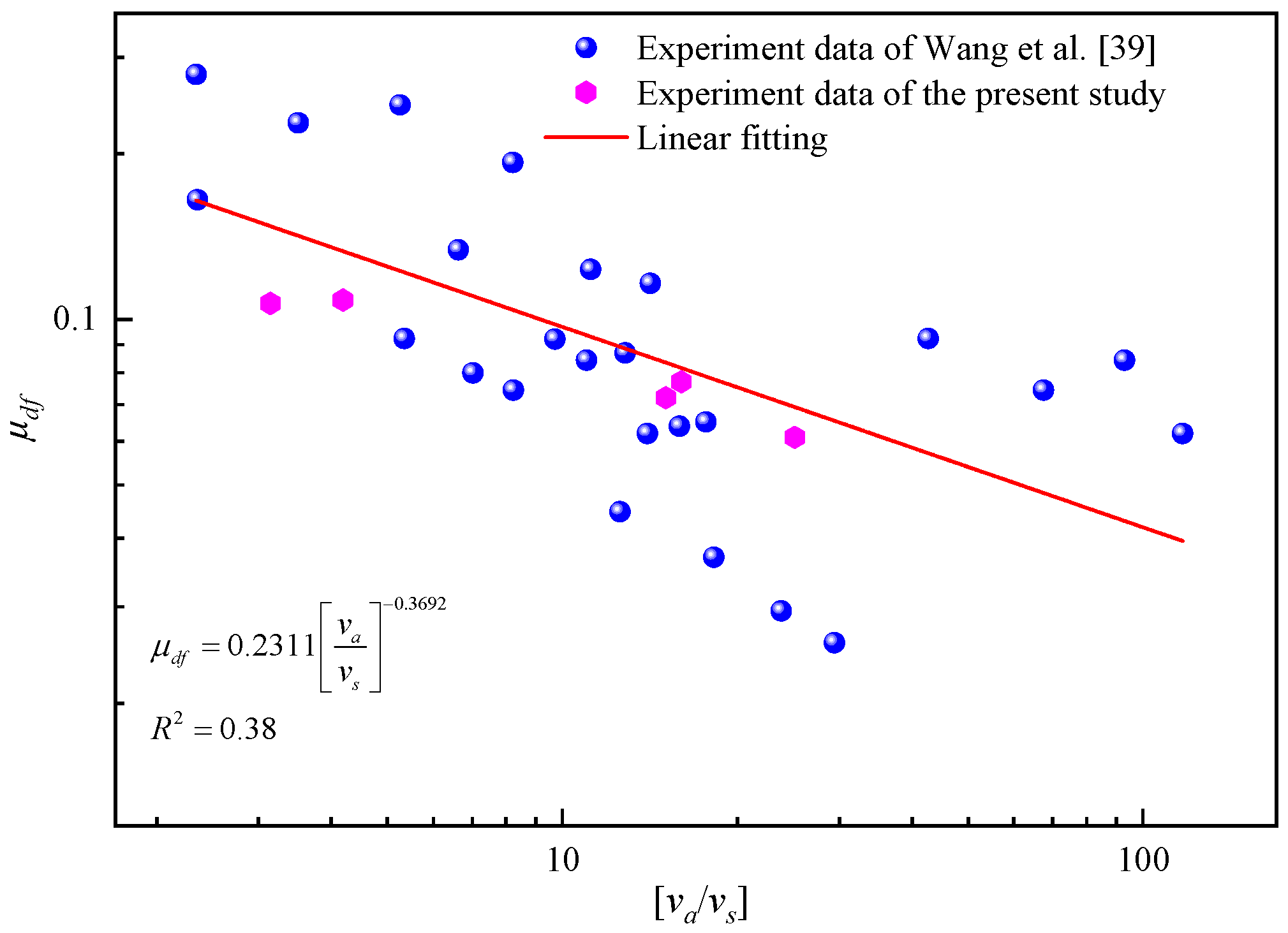
The experimental data from Wang et al. [39] and the present study are utilized to determine the unknown parameters in Equation (14). The results are presented in Figure 9. It can be seen that the statistically derived dynamic friction coefficient does not exhibit a clear linear correlation with the ratio of va to vs in the log-log plot. This is primarily because stick-slip motion occurs under certain experimental conditions, which leads to a more pronounced friction coefficient within that region. As a result, the friction force of the drillstring during axial vibration–sliding motion may be underestimated or overestimated.
Figure 9.
Fitting result of the empirical model.
It should be noted that the proposed hybrid formulation is not intended to be the only possible modeling approach. Instead, it represents a mechanism-based and experimentally supported framework that enables simultaneous consideration of velocity dependence and dynamic hysteresis, while maintaining computational efficiency for field-scale applications.
3.4. Initial and Boundary Conditions
The drillstring is in the equilibrium state, and the initial displacement and velocity of the drillstring can be expressed as:
The displacement at the top of the drillstring is achieved by controlling the position of the hook. Then, the top boundary condition is expressed as:
where uhook is the displacement of the hook on the ground.
According to the working principle of the hydraulic oscillator, the hydraulic oscillator can be simplified as the combination of the large stiffness spring and the excitation force. The continuity conditions at the oscillator can be expressed as [40]:
where Fu and Fd are the axial forces of the drillstring on both sides of the oscillator; Fe(t) is the excitation force generated by the oscillator; κ is the equivalent spring coefficient of the oscillator; and Uu and Ud are the axial displacements of the drillstring on both sides of the oscillator.
The bottom of the drillstring is tied to the drill bit. Then, the bottom boundary condition is expressed as:
4. Model Solution and Model Verification
4.1. Model Solution
The present drillstring dynamic model is a second-order nonlinear ordinary differential equation, which is commonly solved with the Newmark method and the finite difference method [33]. In this study, the explicit central difference method is adopted because it avoids iterative solution and matrix inversion, thereby improving computational efficiency. In this scheme, the displacement, velocity, and acceleration at each time step are updated explicitly based on the preceding time-step conditions. To ensure numerical stability, the time increment is selected to satisfy the Courant condition.
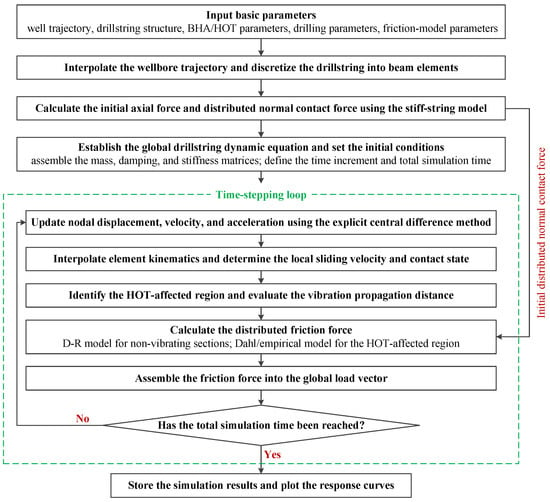
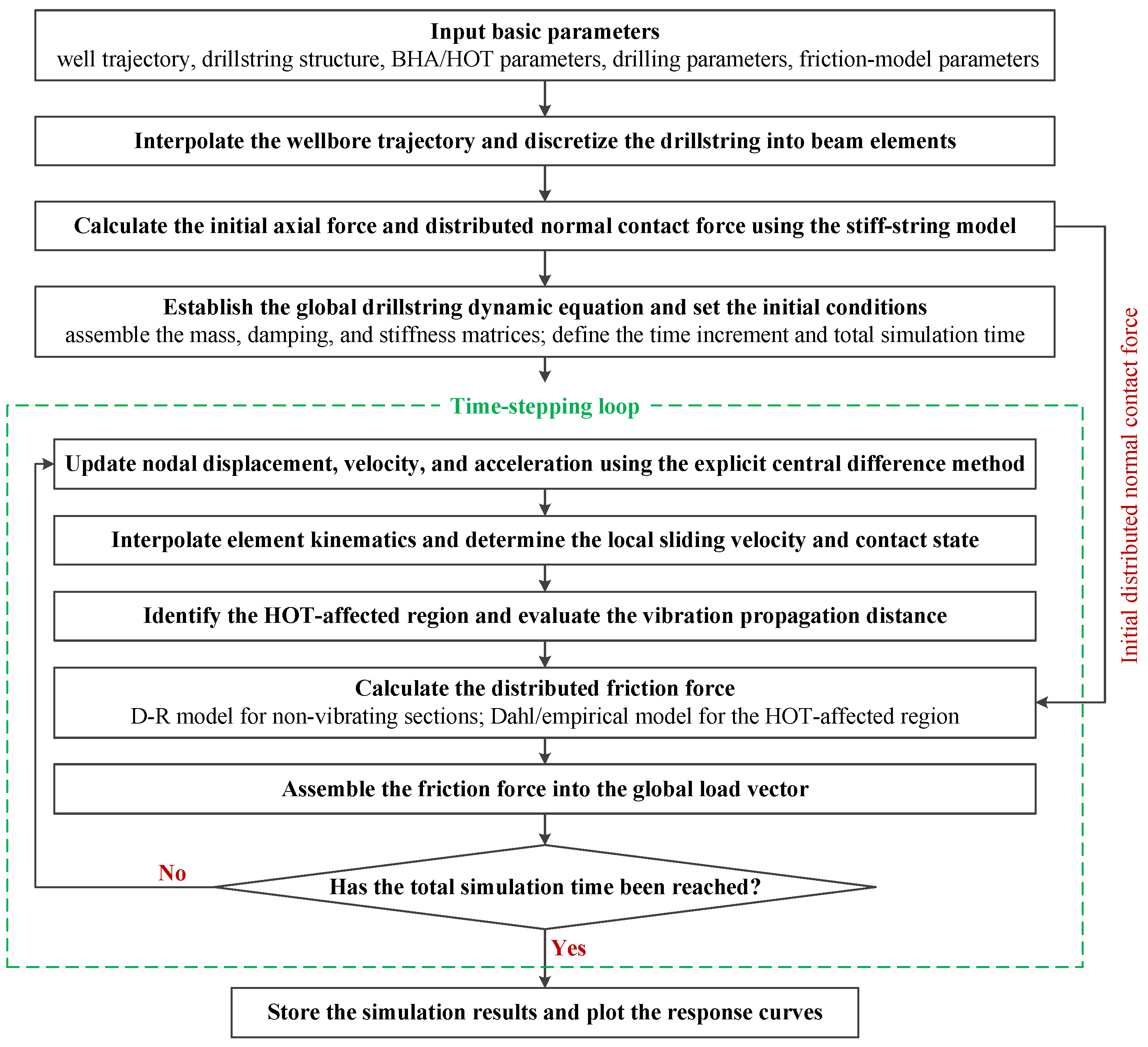
Figure 10 shows the computational workflow of the coupled drillstring dynamics–friction model. First, the well trajectory is interpolated, and the drillstring is discretized into beam elements. The stiff-string model is used to calculate the initial axial force and the distributed normal contact force. During each time step, the updated kinematic variables are interpolated to obtain the local sliding velocity and contact state, which are then transferred to the friction model. The D-R model is used for non-vibrating sections, while the Dahl/empirical model is used for the HOT-affected region. The resulting distributed friction force is assembled into the global load vector and fed back into the dynamic equation for the next time-step solution.
Figure 10.
Solution flowchart of the drillstring axial vibration model.
4.2. Model Verification
Well XX-1 was selected as the validation case because it is a representative horizontal well drilled with a hydraulic oscillator tool during sliding drilling. In addition, relatively complete field data are available for this well, including the well trajectory, BHA configuration, drilling parameters, HOT parameters, and time-series hook-load data. Therefore, this case provides suitable field conditions for evaluating the capability of the proposed model to predict load transfer and HOT drag-reduction performance.
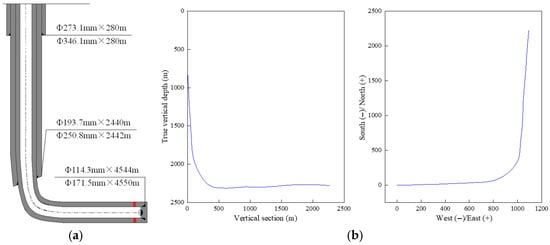
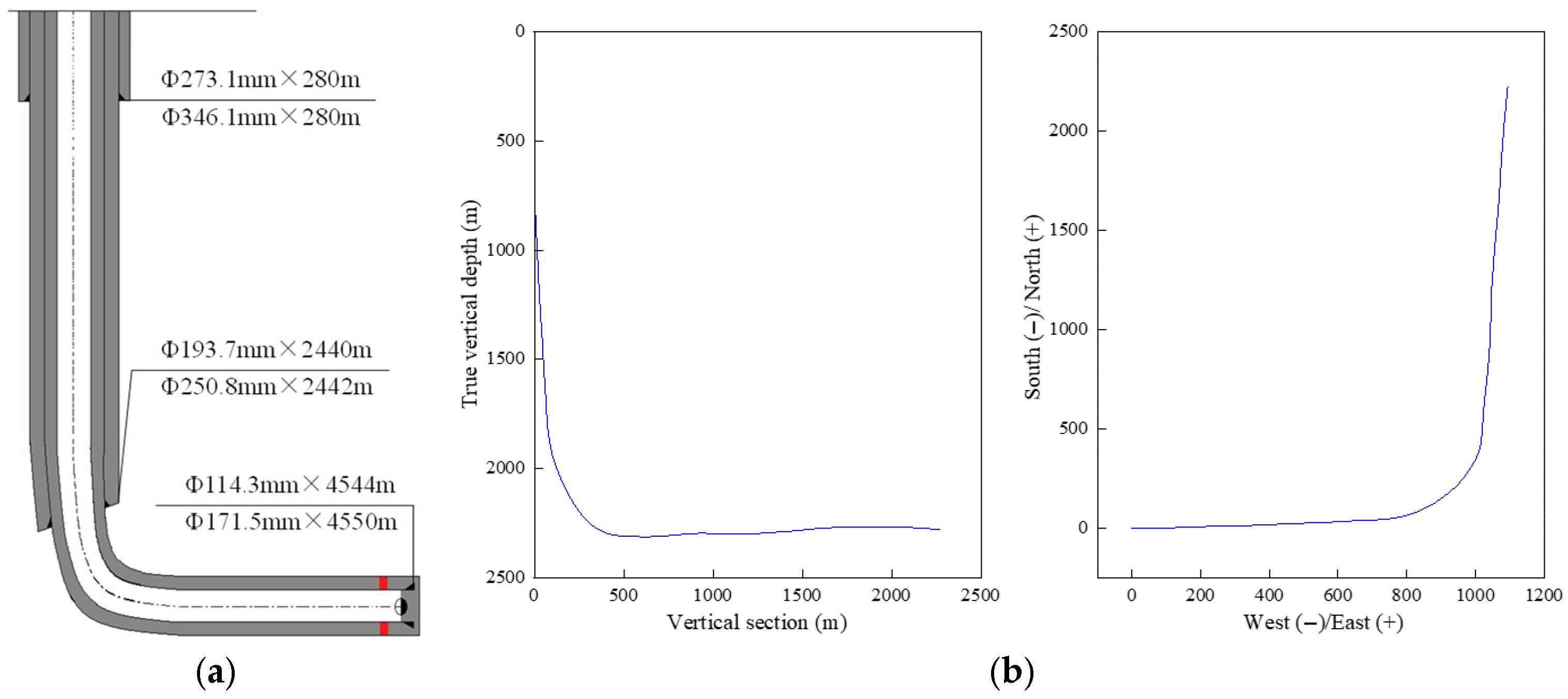
Well XX-1 is a horizontal well with a measured depth of 4550.00 m and a horizontal section length of 1670.00 m. The kick-off point depth is 322.00 m, the maximum inclination angle is 95.10°, and the maximum dogleg severity is 0.24°/m. The well structure and actual drilling trajectory are shown in Figure 11. The bottom hole assembly (BHA) used during horizontal section drilling is simplified as follows: Φ171.5 mm bit + Φ140 mm bent housing motor (1.0°) + Φ101.6 mm non-magnetic heavy weight drill pipe (NMHWDP) + Φ101.6 mm heavy weight drill pipe (HWDP) × 54 m + Φ101.6 mm drill pipe (DP) × 135 m + HOT + Φ101.6 mm DP × 1620 m + Φ101.6 mm HWDP × 108 m + Φ114.3 mm DP to surface. The drilling parameters used for sliding drilling were: weight on bit (WOB) of 80 kN, flow rate of 26 L/s, and rate of penetration (ROP) of 12 m/h. The excitation force of the HOT follows a sinusoidal function with an amplitude of 20 kN and a frequency of 16 Hz. For the numerical simulation, the time interval was set to 0.0001 s, the segment length to 5 m, and the simulation time to 120 s.
Figure 11.
Well structure and well trajectory of Well XX-1. (a) Well structure; (b) actual drilling trajectory.
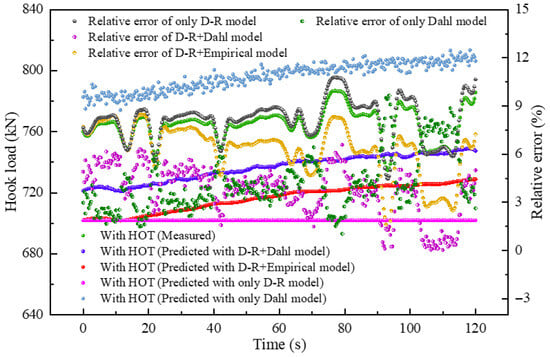
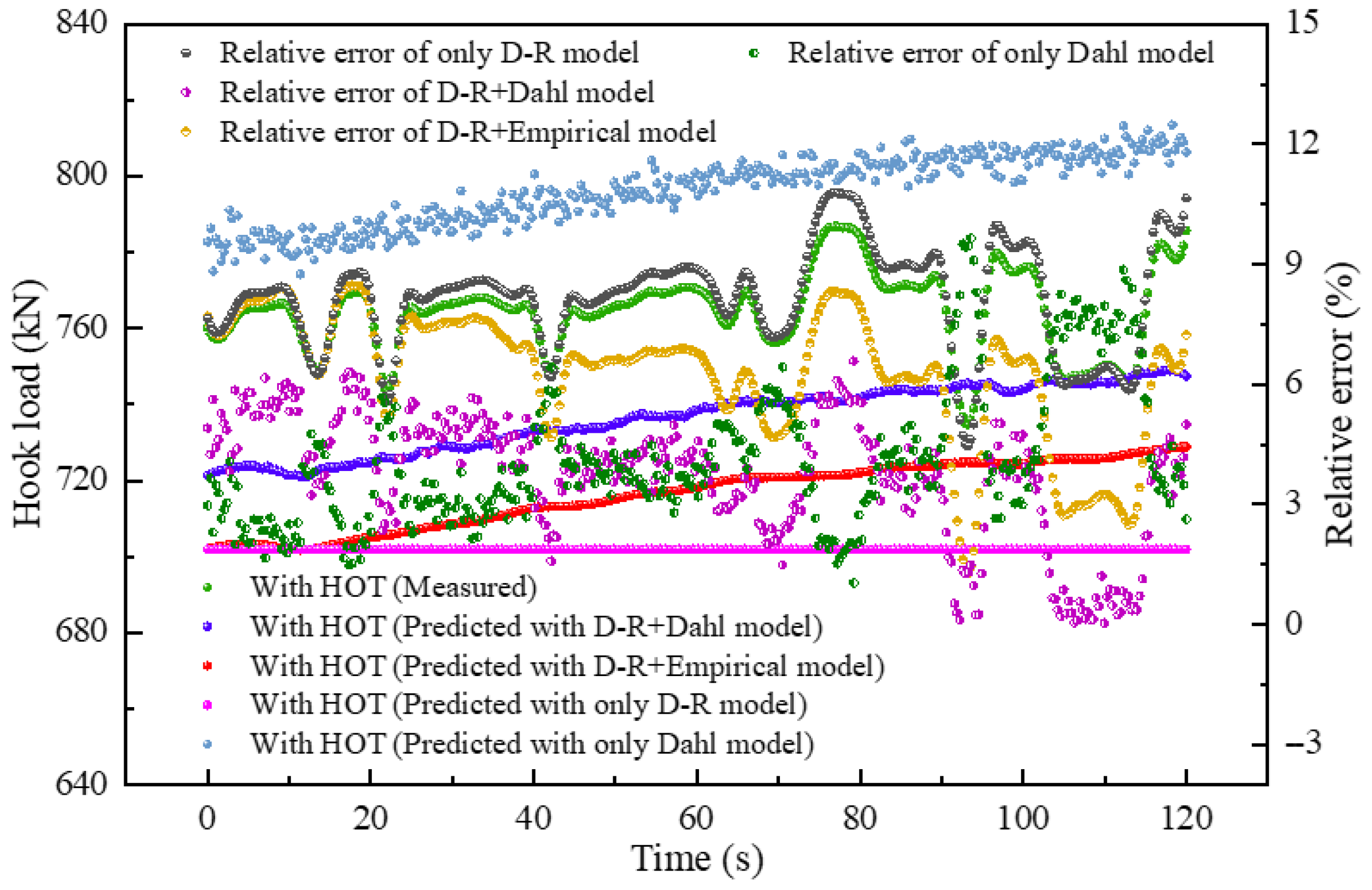
Using time-series logging data at the measured depth of 3778.1 m for model verification, Figure 12 compares the predicted and measured hook loads during sliding drilling with HOT. It can be observed that the relative errors remain below 9% for all friction models considered. The remaining discrepancy between the predicted and measured hook loads may be partly attributed to the omission of buckling effects in the current model. In horizontal wells, compressive loads can induce sinusoidal or helical buckling, which increases the normal contact force between the drillstring and the wellbore wall and consequently elevates friction. Since this effect is not explicitly included, the model may underestimate friction in certain sections. Nevertheless, the comparison results indicate that the model still achieves acceptable accuracy for engineering applications under the studied conditions. Specifically, the mean relative errors (MREs) of the four modeling schemes, including the D-R Only model, Dahl Only model, hybrid D-R + Dahl model, and hybrid D-R + empirical model, are 0.0817, 0.0416, 0.0373, and 0.0621, respectively. Correspondingly, the root mean square errors (RMSEs) of the four models are 63.48, 34.25, 30.94, and 49.88 kN, respectively. It can be observed that the Dahl Only model and the hybrid D-R + Dahl model show better agreement with the measured data; however, their computational efficiency is relatively low, which limits their practicality for practical applications. It should be noted that the prediction results of the Dahl Only model may be somewhat distorted because this model assumes that the entire drillstring is under vibration. In comparison, the hybrid D-R + empirical model achieves a better balance between computational efficiency and prediction accuracy, provided that the coefficients k and c are determined in advance.
Figure 12.
Comparison of the predicted and measured hook load for sliding drilling with HOT.
5. Results and Discussion
5.1. Drillstring Dynamic Response for Sliding Drilling with HOT
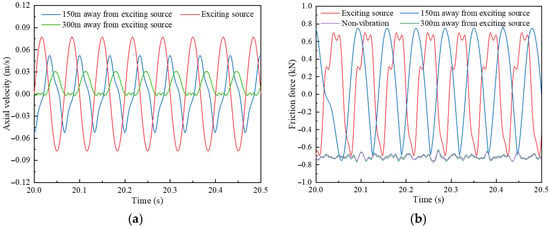
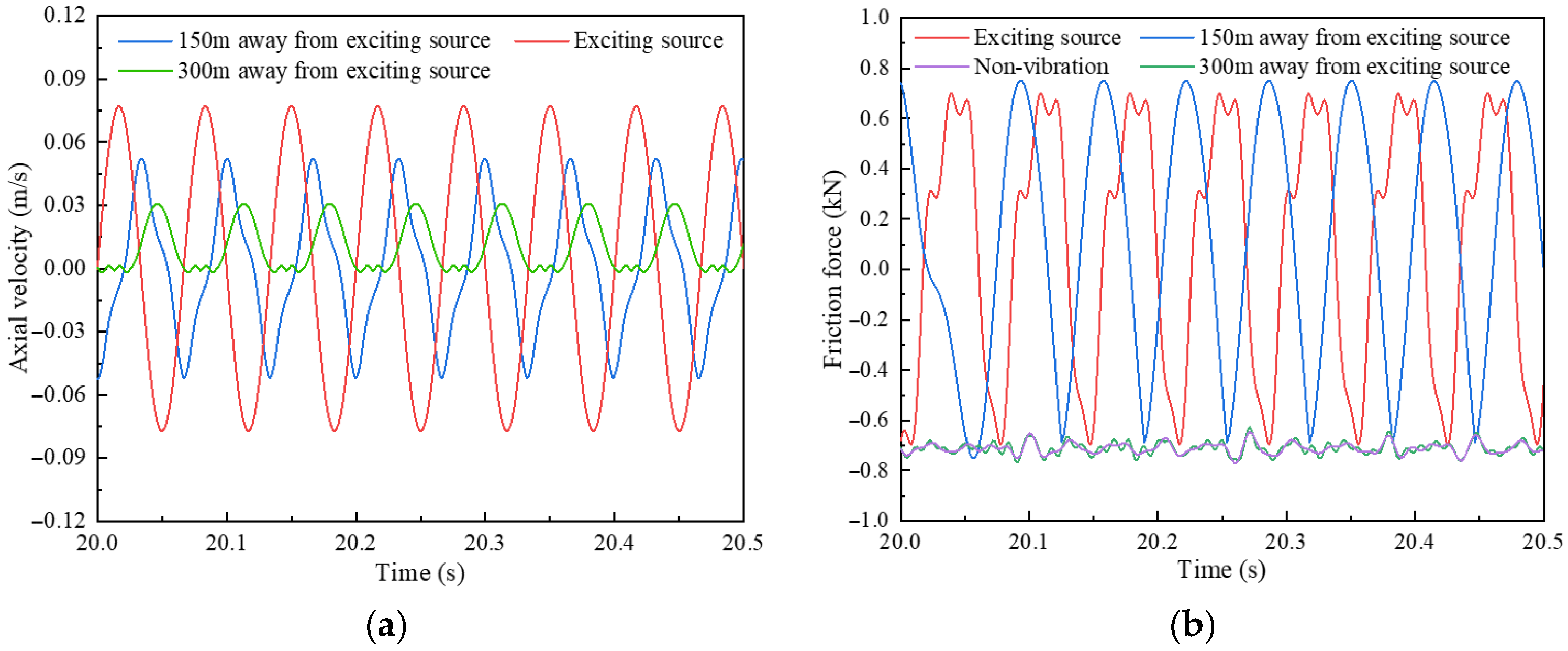
Figure 13 shows the time-dependent axial velocity and distributed friction force at different nodes of the drillstring during HOT operation. Figure 13a reveals that the magnitude and direction of the axial velocity undergo obvious periodic changes during operation, while the velocity fluctuations gradually decrease with increasing distance from the excitation source. At 300 m from the HOT position, the axial velocity changes only slightly over time. Meanwhile, Figure 13b illustrates that the distributed friction force along the drillstring exhibits similar characteristics. At 300 m from the HOT position, there is almost no significant difference between the distributed friction forces before and during HOT operation. This implies that the effective propagation distance of the HOT-induced effects does not reach this location, and consequently, no friction reduction effect occurs here.
Figure 13.
Dynamic responses of drillstring during HOT operation. (a) Variation in axial velocity at various drillstring nodes; (b) variation in distributed friction force at various drillstring nodes.
Overall, the effective propagation distance of HOT-induced effects on the drillstring is relatively limited [40,41]. Beyond this distance, the drag-reduction effect is poor. According to the drag-reducing principle of the HOT, the criterion for determining the effective propagation distance is that the vibration velocity is less than the sliding velocity. During HOT application, the excitation force propagates both upward and downward along the drillstring.
5.2. Effect of Exciting Force Amplitude on Drag-Reduction
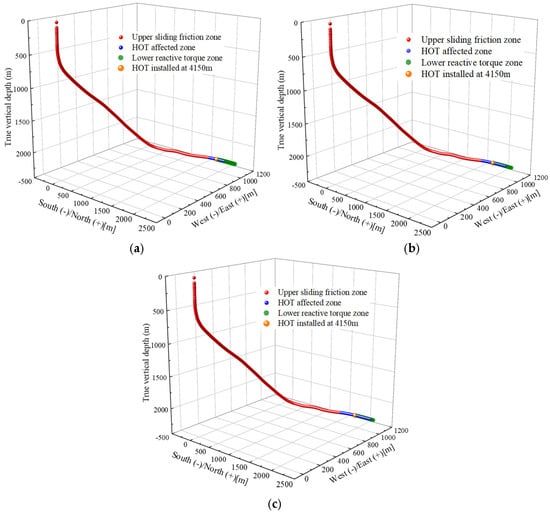
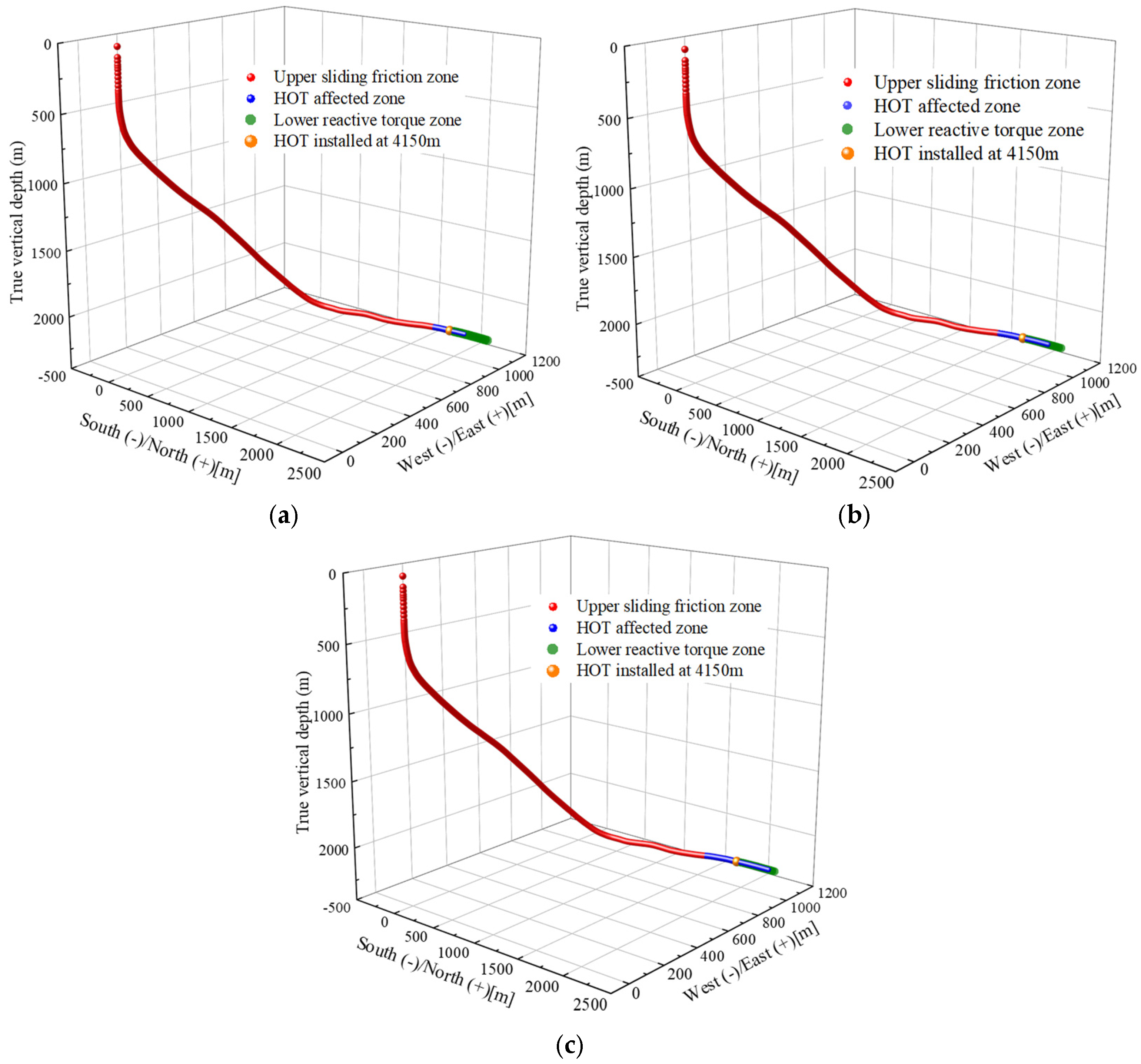
To study the effects of excitation force amplitude on effective propagation distance and drag-reduction performance, the vibration frequency and installation position of the HOT were specified as 15 Hz and 400 m, respectively. The excitation force amplitude was adjusted to 10 kN, 20 kN, and 30 kN. Figure 14 shows the variation in vibration propagation distance under these different excitation force amplitudes. It can be clearly observed that the effective propagation distance of axial vibration along the drillstring increases with higher excitation force amplitudes, which are respectively 340 m, 520 m and 680 m. This occurs because a larger excitation force delivers greater energy input to the drillstring system. This enhanced energy input further improves the ratio of vibration velocity to sliding velocity, thereby reducing the total frictional force along the drillstring. However, due to energy dissipation from friction, the effect of axial vibration on the motion of the far-end drillstring weakens and ultimately vanishes as the vibration propagates beyond a certain distance. Correspondingly, the drag-reduction rates achieved for the three excitation force amplitudes (10 kN, 20 kN, and 30 kN) were 12.3%, 20.5%, and 27.7%, respectively. These results demonstrate that a larger excitation force significantly improves the drag-reduction effect.
Figure 14.
Effect of exciting force amplitude on drag reduction. (a) Exciting force amplitude 10 kN; (b) exciting force amplitude 20 kN; (c) exciting force amplitude 30 kN.
On the other hand, it must be recognized that excitation force amplitude is constrained by multiple factors, including drilling fluid flow rate, valve assembly design, and spring stiffness. Higher excitation force intensifies WOB fluctuation, which can damage the drill bit and MWD tools. Therefore, excitation force amplitude must be optimized within safe operational limits of the drillstring. According to Shi et al. [42], an exciting force amplitude of 30–40 kN is recommended for optimal HOT performance. This range effectively balances drillstring fatigue, hydraulic loss, and equipment safety.
5.3. Effect of Vibration Frequency on Drag-Reduction
To study the effects of vibration frequency on effective propagation distance and drag-reduction performance, the excitation force amplitude and installation position of the HOT were specified as 20 kN and 400 m, respectively. The vibration frequency of the HOT was set to 15 Hz, 20 Hz, and 25 Hz. The simulation results for the HOT at these three frequencies are compared in Figure 14b and Figure 15. It can be observed that higher HOT frequencies result in longer vibration propagation distances—specifically, 520 m at 15 Hz, 560 m at 20 Hz, and 580 m at 25 Hz. Correspondingly, the drag-reduction rates for these frequencies were 20.5%, 21.4%, and 21.8%, respectively. These results indicate that vibration frequency has limited influence on both effective propagation distance and drag-reduction rate. This occurs because once the ratio of vibration velocity to sliding velocity exceeds a critical threshold, the drag-reduction effect of axial vibration stabilizes. More importantly, the operational frequency of the HOT must be tuned outside the axial natural frequency range of the drillstring to avoid resonance. Failure to do so may induce severe lateral vibrations and potentially damage downhole tools. Therefore, frequency selection requires careful consideration.
Figure 15.
Effect of frequency on the effective propagation distance of axial vibration. (a) f = 20 Hz; (b) f = 25 Hz.
5.4. Effect of HOT Placement on Drag-Reduction
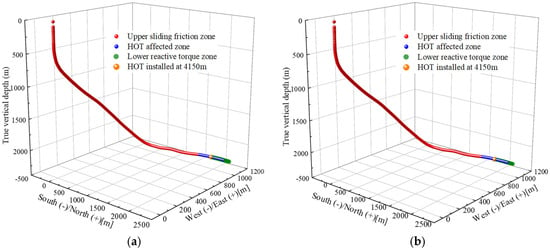
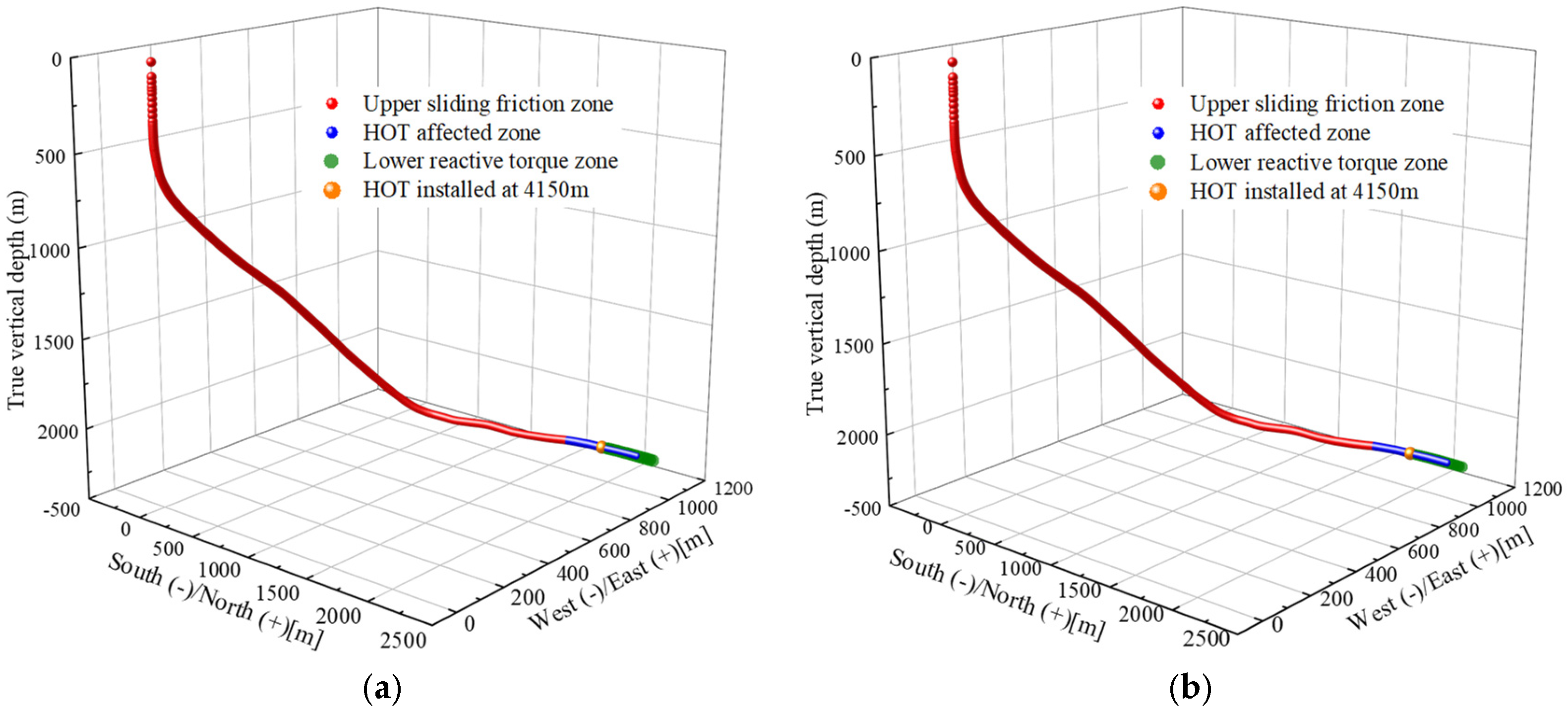
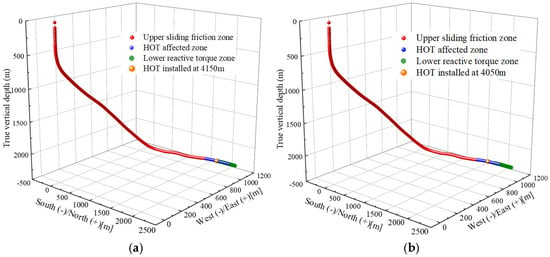
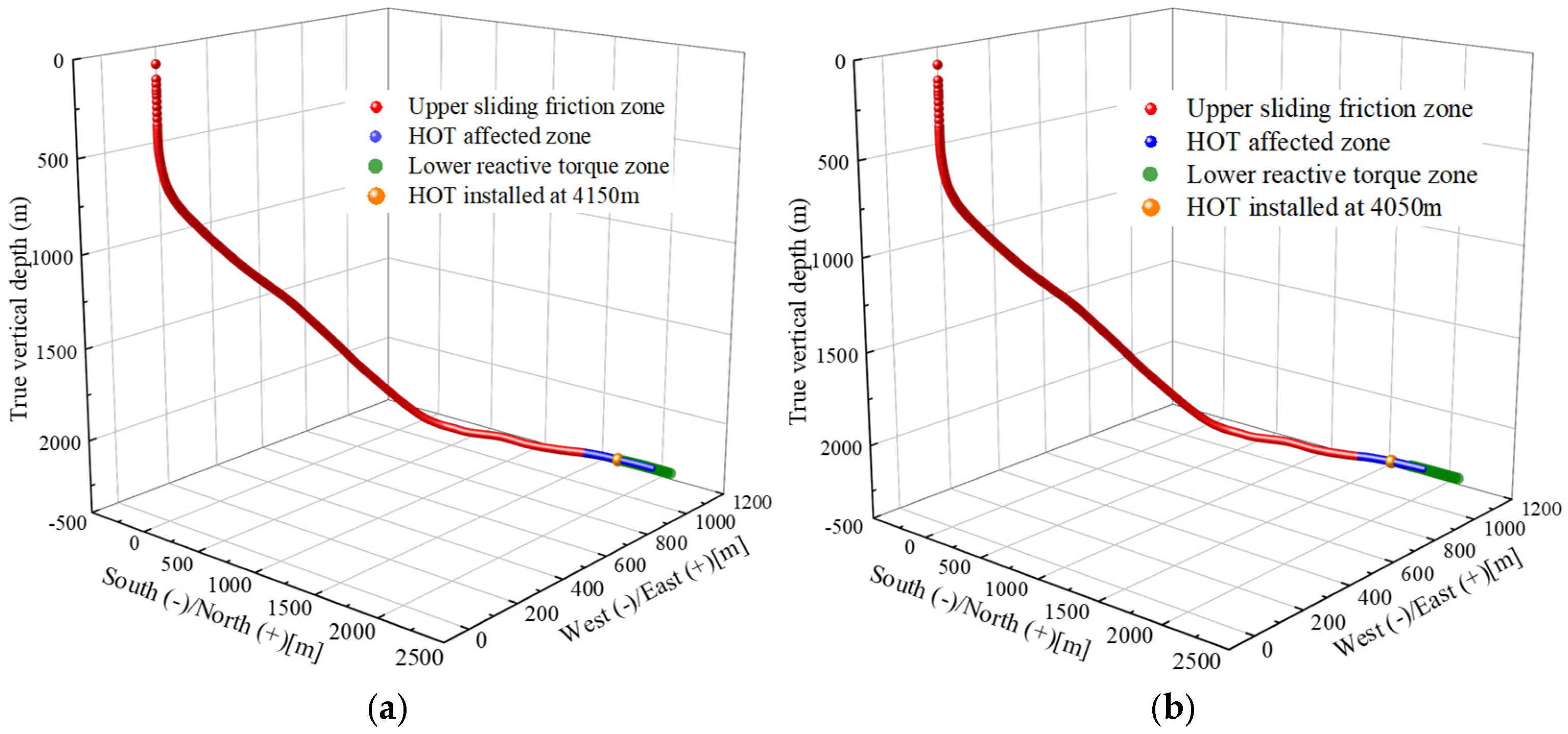
To study the effects of HOT placement on effective propagation distance and drag-reduction performance, the vibration frequency and excitation force amplitude of the HOT were specified as 15 Hz and 20 kN, respectively. The distance from the HOT installation position to the bit was set at 300 m, 400 m, and 500 m. Simulation results for these three positions are compared in Figure 14b and Figure 16. The observed propagation distances are 450 m (300 m position), 520 m (400 m position), and 540 m (500 m position), indicating a positive correlation between installation distance and propagation distance. However, the corresponding drillstring friction reduction rates are 16.8%, 20.5%, and 16.1%. This demonstrates that positioning the HOT at a moderate distance from the bit (400 m in this case) optimizes drag reduction. Although greater distances activate longer drillstring segments dynamically, the peak drag reduction occurs at an intermediate position. The underlying mechanism relates to the non-uniform distribution of friction forces along the well trajectory. Contact forces between the drillstring and wellbore vary spatially due to changes in depth-dependent buoyed weight, dogleg severity and inclination angle. These spatially variable friction forces exhibit differential suppression effects on vibration wave propagation along the drillstring.
Figure 16.
Effect of HOT placement on drag reduction: (a) HOT placement away from bit 300 m; (b) HOT placement away from bit 500 m.
5.5. Limitations of the Present Study
Although the proposed hybrid nonlinear friction model provides a useful framework for evaluating the drag-reduction performance of HOTs in horizontal wells, several limitations should be acknowledged.
First, the laboratory friction tests were conducted using sandstone–steel contact pairs under water-based mud lubrication. Although the sandstone samples were selected to represent the Chang-7 tight sandstone formation and the surface roughness and porosity were characterized, the present experiments cannot fully cover the wide range of lithologies encountered in field drilling, such as shale, carbonate, highly abrasive formations, or strongly heterogeneous rocks. In addition, the experimental sliding velocity was selected based on the scale limitation of the test setup and the relatively low ROP of the studied field block. Therefore, further friction tests under broader velocity ranges, different lithologies, and different drilling-fluid systems are required to improve the generality of the model.
Second, the present friction experiments were not repeated under identical conditions. Therefore, repeatability-based standard deviations and conventional error bars could not be rigorously provided. Although signal filtering and statistical averaging were applied to extract representative friction characteristics, future work should include repeated tests under the same operating conditions to quantify experimental uncertainty and improve the statistical reliability of friction-model parameter identification.
Third, several simplifications were adopted in the drillstring dynamic model. The model mainly focuses on axial dynamics and does not explicitly consider buckling-induced contact force amplification, lateral vibration, torsional vibration, drilling-fluid inertia, cuttings-bed effects, temperature-dependent friction behavior, or long-term wear of the contact interface. In horizontal wells, sinusoidal or helical buckling may increase the normal contact force and therefore increase friction. Neglecting this effect may partly explain the remaining discrepancy between the predicted and measured hook loads.
Fourth, the proposed hybrid framework uses the D-R model to describe velocity-dependent steady sliding friction and the Dahl/empirical model to describe vibration–sliding coupled friction in the HOT-affected region. Although this zonal modeling strategy is physically supported by the experimental observations, the current model does not include a full transient rate-and-state evolution law or advanced dynamic friction models such as LuGre or GMS. Moreover, the effects of key friction parameters, such as the characteristic length in the D-R model and the contact stiffness in the Dahl model, were discussed based on existing studies but were not independently analyzed through a full parametric sensitivity study. This should be further investigated in future work.
Finally, the model was validated using field hook-load data from a single horizontal well. Although the comparison shows acceptable engineering accuracy, additional validation using more wells, different formations, and downhole vibration or force measurements is still needed. Furthermore, the present model can be used for rapid engineering evaluation and HOT parameter screening, but it is not yet a fully real-time closed-loop control model. Future work should focus on reduced-order modeling, parallel computation, and real-time parameter updating to improve its applicability to field advisory or control systems.
6. Conclusions
This study presents a comprehensive framework for evaluating the drag-reduction performance of HOT in horizontal wells during slide drilling, combining experimental analysis with dynamic modeling. The main conclusions are summarized as follows:
- (1)
- Laboratory tests under WBM lubrication demonstrated that steady-state sliding friction follows the velocity-dependent Dieterich–Ruina (D-R) model, while vibration–sliding coupled friction is accurately characterized by the Dahl dynamic model. This mechanistic distinction validates the necessity of a hybrid nonlinear friction approach for modeling drillstring–wellbore interactions.
- (2)
- A drillstring dynamics model integrating the D-R and Dahl formulations was developed. This model was solved using an explicit central difference method. Validation against field hook-load data from Well XX-1 demonstrated acceptable engineering accuracy, with the maximum relative error below 9%.
- (3)
- Parametric studies using the validated drillstring dynamics model indicate that even under optimized parameters, the maximum drag-reduction rate achieved by the HOT does not exceed 30%. Specifically, excitation force amplitude and HOT placement significantly improve drag-reduction rate and extend propagation distance; however, the effective influence range remains constrained by energy dissipation along the drillstring.
- (4)
- Future work should further consider buckling-induced contact force amplification, broader lithology-dependent friction calibration, and repeated friction tests to improve the model generality and uncertainty quantification.
Author Contributions
Conceptualization, C.Y. and J.S.; methodology, C.Y. and J.S.; software, C.Y.; validation, C.Y., Y.Y. and J.S.; formal analysis, C.Y. and Y.Y.; investigation, C.Y., Y.Y. and J.S.; data curation, C.Y. and Y.Y.; writing—original draft preparation, C.Y. and Y.Y.; writing—review and editing, J.S.; visualization, C.Y. and Y.Y.; supervision, J.S. All authors have read and agreed to the published version of the manuscript.
Funding
This research received no external funding.
Data Availability Statement
The original contributions presented in this study are included in the article. Further inquiries can be directed to the corresponding author.
Acknowledgments
The authors have reviewed and edited the output and take full responsibility for the content of this publication.
Conflicts of Interest
Author Chao Yang was employed by the China Petroleum Technical Service Corporation (CPTEC). Author Yun Yang was employed by the Drilling & Production Technology Research Institute, CNPC Chuanqing Drilling Engineering Company Limited. The authors declare that the research was conducted in the absence of any commercial or financial relationships that could be construed as a potential conflict of interest.
Abbreviations
The following abbreviations are used in this manuscript:
| HOT | Hydraulic oscillator tools |
| MWD | Measurement while drilling |
| COSF | Coefficient of static friction |
| WBM | Water-based mud |
References
- Charles, D. The Impact of Oil Prices on Guyana’s Real Exchange Rate: An AlphaFold-Decomposition Analysis. FinTech Sustain. Innov. 2026, 2, A3. [Google Scholar] [CrossRef] [Scilit]
- Ma, X.H.; Xie, J. The progress and prospects of shale gas exploration and exploitation in southern Sichuan Basin, NW China. Pet. Explor. Dev. 2018, 45, 161–169. [Google Scholar] [CrossRef] [Scilit]
- Holechek, J.L.; Geli, H.M.E.; Sawalhah, M.N.; Valdez, R. A global assessment: Can renewable energy replace fossil fuels by 2050? Sustainability 2022, 14, 4792. [Google Scholar] [CrossRef] [Scilit]
- Gillan, C.; Boone, S.; LeBlanc, M.; Picard, R.; Fox, T. Applying computer based precision drill pipe rotation and oscillation to automate slide drilling steering control. In Proceedings of the SPE Canada Unconventional Resources Conference, Calgary, AB, Canada, 15–17 November 2011; p. SPE-148192-MS. [Google Scholar] [CrossRef] [Scilit]
- Liu, Y.; Song, X.; He, J.; Xiang, X.; Ma, T.; Zhang, J.; Chen, P. Influence of pipe rocking on the effectiveness of the load transfer along the drillstring during slide drilling: A comprehensive experimental study. Geoenergy Sci. Eng. 2024, 241, 213203. [Google Scholar] [CrossRef] [Scilit]
- Sarker, M.; Rideout, D.G.; Butt, S.D. Dynamic model for longitudinal and torsional motions of a horizontal oilwell drillstring with wellbore stick-slip friction. J. Pet. Sci. Eng. 2017, 150, 272–287. [Google Scholar] [CrossRef] [Scilit]
- Liu, Y.; Ma, T.; Chen, P.; Yang, C. Method and apparatus for monitoring of downhole dynamic drag and torque of drill-string in horizontal wells. J. Pet. Sci. Eng. 2018, 164, 320–332. [Google Scholar] [CrossRef] [Scilit]
- Wang, X.; Chen, P.; Huang, W.; Zou, J. Development of torque clutch drilling tool and evaluation of drag reduction performance. Adv. Mech. Eng. 2018, 10, 1687814018806655. [Google Scholar] [CrossRef] [Scilit]
- Moore, N.B.; Mock, P.W.; Krueger, R.E. Reduction of drill string torque and casing wear in extended reach wells using non-rotating drill pipe protectors. In Proceedings of the SPE Western Regional Meeting, Anchorage, AK, USA, 22–24 May 1996; p. SPE-35666-MS. [Google Scholar] [CrossRef]
- Rodman, D.W.; Swietlik, G. Extended reach drilling limitations: A shared solution. In Proceedings of the the SPE Offshore Europe, Aberdeen, UK, 9–12 September 1997; p. SPE-38466-MS. [Google Scholar] [CrossRef]
- Yim, M.; Healey, S.; Leedham, R.; Giuliano, M.; Weber, M.; Pitre, D. Drill String Torque Reducing Technology Improves Drilling Efficiency in Horizontal Well. In Proceedings of the SPE/IATMI Asia Pacific Oil & Gas Conference and Exhibition, Nusa Dua, Bali, Indonesia, 20–22 October 2015; p. SPE-176134-MS. [Google Scholar] [CrossRef] [Scilit]
- Ji, G.; Wang, H.; Huang, H.; Meng, Z.; Cui, L.; Guo, W. Design and test of a cuttings bed remover for horizontal wells. Nat. Gas Ind. B 2021, 8, 412–419. [Google Scholar] [CrossRef] [Scilit]
- Omojuwa, E.; Ahmed, R.; Acquaye, J. Practical approach to functional testing and analytical modeling of axial oscillation-supported drillstrings. J. Energy Resour. Technol. 2019, 141, 092906. [Google Scholar] [CrossRef] [Scilit]
- Liu, Y.; Chen, P.; Ma, T.; Wang, X. An evaluation method for friction-reducing performance of hydraulic oscillator. J. Pet. Sci. Eng. 2017, 157, 107–116. [Google Scholar] [CrossRef] [Scilit]
- Wang, P.; Ni, H.; Wang, X.; Wang, R. Modelling the load transfer and tool surface for friction reduction drilling by vibrating drill-string. J. Pet. Sci. Eng. 2018, 164, 333–343. [Google Scholar] [CrossRef] [Scilit]
- Liu, J.; Zheng, H.; Kuang, Y.; Yu, B.; Zhou, Y.; Deng, M. A feasible model for friction-reduction investigation of drillstrings in long-horizontal wells with axial oscillation tools and analysis of key influencing factors. J. Pet. Sci. Eng. 2020, 185, 106643. [Google Scholar] [CrossRef] [Scilit]
- Shi, X.; Huang, W.; Gao, D.; Zhu, N. Optimal design of drag reduction oscillators by considering drillstring fatigue and hydraulic loss in sliding drilling. J. Pet. Sci. Eng. 2022, 208, 109572. [Google Scholar] [CrossRef] [Scilit]
- Tang, L.; Zhang, S.; Zhang, X.; Ma, L.; Pu, B. A review of axial vibration tool development and application for friction-reduction in extended reach wells. J. Pet. Sci. Eng. 2021, 199, 108348. [Google Scholar] [CrossRef] [Scilit]
- Tian, J.; Wei, L.; Dai, L.; Emtiaz, S.R.; Islam, A.; Uddin, R.; Zhang, T. Study on the mechanism of drilling speed increase considering the axial vibration of drill string. J. Braz. Soc. Mech. Sci. Eng. 2021, 43, 8. [Google Scholar] [CrossRef] [Scilit]
- d’Almeida, E.F.V.; Aguiar, R.R.; Ritto, T.G. Parametric analysis of a dynamical model of the axial vibration of a vibration-assisted drilling tool, a vibro-impact system with multiple impacts. Arch. Appl. Mech. 2021, 91, 15–22. [Google Scholar] [CrossRef] [Scilit]
- Zhang, W.; Shi, H.; Li, G.; Song, X.; Zhao, H. Mechanism analysis of friction reduction in coiled tubing drilling with axial vibratory tool. J. Pet. Sci. Eng. 2019, 175, 324–337. [Google Scholar] [CrossRef] [Scilit]
- Gutowski, P.; Leus, M. The effect of longitudinal tangential vibrations on friction and driving forces in sliding motion. Tribol. Int. 2012, 55, 108–118. [Google Scholar] [CrossRef] [Scilit]
- Liu, Y.; Chen, P.; Wang, X.; Ma, T. Modeling friction-reducing performance of an axial oscillation tool using dynamic friction model. J. Nat. Gas Sci. Eng. 2016, 33, 397–404. [Google Scholar] [CrossRef] [Scilit]
- Mitchell, R.F.; Bjørset, A.; Grindhaug, G. Drillstring analysis with a discrete torque/drag model. SPE Drill. Complet. 2015, 30, 5–16. [Google Scholar] [CrossRef] [Scilit]
- Dahl, P.R. Solid friction damping of mechanical vibrations. AIAA J. 1976, 14, 1675–1682. [Google Scholar] [CrossRef] [Scilit]
- Piatkowski, T. Dahl and LuGre dynamic friction models—The analysis of selected properties. Mech. Mach. Theory 2014, 73, 91–100. [Google Scholar] [CrossRef] [Scilit]
- Wang, X.; Chen, P.; Ma, T.; Liu, Y. Modeling and experimental investigations on the drag reduction performance of an axial oscillation tool. J. Nat. Gas Sci. Eng. 2017, 39, 118–132. [Google Scholar] [CrossRef] [Scilit]
- Ni, W.; Yang, G.; Ma, C.; Liu, G.; Ma, F.; Zhao, K. Research on the influence factors of hydraulic oscillator on drag reduction efficiency in horizontal well drilling. Meas. Control 2024, 57, 871–878. [Google Scholar] [CrossRef] [Scilit]
- Wu, H.; Chen, P.; Liu, Y.; Ma, T. Effect of axial vibration on sliding frictional force between shale and 45 steel. Shock Vib. 2018, 2018, 4179312. [Google Scholar] [CrossRef] [Scilit]
- Mitchell, R.F.; Samuel, R. How good is the torque/drag model? SPE Drill. Complet. 2009, 24, 62–71. [Google Scholar] [CrossRef] [Scilit]
- Li, Z.; Zhang, C.; Song, G. Research advances and debates on tubular mechanics in oil and gas wells. J. Pet. Sci. Eng. 2017, 151, 194–212. [Google Scholar] [CrossRef] [Scilit]
- Liu, W.; Ni, H.; Wang, Y.; Guo, Y.; Gao, Y.; He, P. Dynamic modeling and load transfer prediction of drill-string axial vibration in horizontal well drilling. Tribol. Int. 2023, 177, 107986. [Google Scholar] [CrossRef] [Scilit]
- Fu, J.; Ren, Z.; Bai, J.; Qin, F.; Li, B. The friction-reducing principle and application of the drill string with a hydro-oscillator. J. Pet. Sci. Eng. 2018, 165, 453–461. [Google Scholar] [CrossRef] [Scilit]
- Hu, Y.; Di, Q.; Zhu, W.; Chen, Z.; Wang, W. Dynamic characteristics analysis of drillstring in the ultra-deep well with spatial curved beam finite element. J. Pet. Sci. Eng. 2012, 82, 166–173. [Google Scholar] [CrossRef] [Scilit]
- Wang, J.; Xue, Q.; Li, L.; Liu, B.; Huang, L.; Chen, Y. Dynamic analysis of simple pendulum model under variable damping. Alex. Eng. J. 2022, 61, 10563–10575. [Google Scholar] [CrossRef] [Scilit]
- Dieterich, J.H. Modeling of rock friction: 1. Experimental results and constitutive equations. J. Geophys. Res. Solid Earth 1979, 84, 2161–2168. [Google Scholar] [CrossRef] [Scilit]
- Cabboi, A.; Marino, L.; Cicirello, A. A comparative study between Amontons–Coulomb and Dieterich–Ruina friction laws for the cyclic response of a single degree of freedom system. Eur. J. Mech.-A/Solids 2022, 96, 104737. [Google Scholar] [CrossRef] [Scilit]
- Liu, Y.; Chen, S.; Wei, S.; Tao, H.; Xiang, X.; Ma, T. The influence of surface rocking motion on the dynamic responses of drillstring during horizontal well drilling. Results Eng. 2025, 27, 106757. [Google Scholar] [CrossRef] [Scilit]
- Wang, P.; Ni, H.; Wang, R.; Li, Z.; Wang, Y. Experimental investigation of the effect of in-plane vibrations on friction for different materials. Tribol. Int. 2016, 99, 237–247. [Google Scholar] [CrossRef] [Scilit]
- Shi, X.; Huang, W.; Gao, D.; Zhu, N.; Li, W. Extension limit analysis of drillstring with drag reduction oscillators in horizontal drilling. Geoenergy Sci. Eng. 2023, 228, 211996. [Google Scholar] [CrossRef] [Scilit]
- Zhang, H.; Ashok, P.; van Oort, E.; Shor, R. Investigation of pipe rocking and agitator effectiveness on friction reduction during slide drilling. J. Pet. Sci. Eng. 2021, 204, 108720. [Google Scholar] [CrossRef] [Scilit]
- Shi, X.; Huang, W.; Gao, D. Optimal design of drag reduction parameters with the rotary reciprocating control system and hydraulic oscillators in sliding drilling. Geoenergy Sci. Eng. 2024, 243, 212856. [Google Scholar] [CrossRef] [Scilit]

Disclaimer/Publisher’s Note: The statements, opinions and data contained in all publications are solely those of the individual author(s) and contributor(s) and not of MDPI and/or the editor(s). MDPI and/or the editor(s) disclaim responsibility for any injury to people or property resulting from any ideas, methods, instructions or products referred to in the content. |
© 2026 by the authors. Licensee MDPI, Basel, Switzerland. This article is an open access article distributed under the terms and conditions of the Creative Commons Attribution (CC BY) license.